

Submitted:
07 September 2026
Posted:
10 September 2026
You are already at the latest version
Abstract
Background: Neurological disorders substantially affect physical, cognitive, and psychosocial functioning. Smart wearable technologies may support objective assessment, monitoring and intervention in clinical and real-world settings, but applicability across neurological conditions and outcome domains remains unclear. Methods: This scoping review followed PRISMA-ScR. Five databases—MEDLINE, EBSCOhost, Cochrane Library, IEEE Xplore, and Web of Science—were searched for studies evaluating smart wearables for assessment, monitoring, or intervention in adults with neurological disorders. Methodological quality was assessed using NIH Study Quality Assessment Tools. Sustained adherence and structured patient-reported usability were evaluated. Results: Seventy-nine studies were included, with evidence concentrated in stroke and Parkinson’s disease. Most studies evaluated physical and motor outcomes, particularly gait, mobility, and activity; this emphasis remained after Poor-rated studies were excluded. Methodological quality was uneven: seven studies were Good, fifty-four Fair, and eighteen Poor, with observational cohort or cross-sectional designs predominating. Sustained adherence, structured patient-reported usability, and long-term real-world use were infrequently assessed. Conclusions: Smart wearables show the clearest applicability in physical and motor applications, predominantly assessment and monitoring, but evidence remains uneven, concentrated in stroke and Parkinson’s disease, and limited for other neurological conditions. Rigorous longitudinal real-world studies are needed, particularly in underrepresented conditions and physiological and psychosocial outcomes.
Keywords:
smart wearables
; neurological disorders
; neurorehabilitation
; remote monitoring
; scoping review
Introduction
Advancements in technology have revolutionised health management and monitoring, with smart wearables emerging as a promising tool in this landscape. These devices not only provide real-time feedback to nudge or prompt behavioural changes in patients, but may also enhance their understanding of their own conditions [1]. They also offer several benefits to clinicians, such as remote monitoring of patients and complementing patients’ subjective experiences with objective data [2]. Such devices range from commercial smartwatches and smart glasses to medical-grade devices specifically engineered to monitor health parameters in specific populations [3]. Despite their growing presence, the use of smart wearables in research remains relatively novel [4,5].
This technological development is particularly relevant given that the global burden of neurological disorders continues to rise. This increase, when coupled with workforce constraints, places significant pressure on healthcare professionals and health systems worldwide [6,7]. These conditions pose an escalating global health challenge, contributing to impairments in cognitive and motor functions that can substantially affect individuals’ quality of life [8]. Recognising this burden, the World Health Organisation’s Intersectoral Global Action Plan (2022-2031) provides a strategic framework for countries to improve prevention, early identification, treatment, and rehabilitation of neurological disorders on a global scale [9].
Within neurological care, neurorehabilitation serves as a central element in restoring function and improving individuals’ quality of life [10,11,12,13,14,15]. Neurorehabilitation commonly promotes physical activity and functional recovery through approaches including repetitive task practice, gait training and patient education [16]. In this context, smart wearables may complement conventional assessment and monitoring by capturing information on an individual’s physical activity, physiological status, and psychosocial functioning beyond the clinical environment.
Smart wearables incorporate sensors that measure various physical activity parameters (e.g., step count, gait speed), physiological parameters (e.g., heart rate, calorie expenditure, temperature), and psychosocial parameters (e.g., sleep duration, global positioning system [GPS] tracking for life space mobility and isolation). These metrics may provide quantifiable objective data to support health monitoring within the community, which can in turn be used by clinicians to understand disease progression and evaluate the impact of their interventions beyond the clinic [17].
Minen and Stieglitz [18] highlighted both the limited evidence regarding wearable use specifically in neurological populations and an abundance of commercially available smart wearables whose applicability in neurological disorders has not been sufficiently established. Smart wearables have also been utilised to support rehabilitation for neurological disorders. Chae et al. [19] demonstrated the potential of wearable technology to support home-based upper limb rehabilitation and the achievement of physiotherapy goals. However, despite their potential, wearables face several limitations, including a lack of standardisation in device placement and data collection methods [20]. Additionally, there are uncertainties regarding their long-term reliability, the generalisability of findings across different neurological conditions, and their integration into routine clinical practice [21].
Recent reviews have explored how wearables are used to monitor physical function in neurological populations, focusing on parameters such as step count, gait and physical activity levels [5,22,23]. Other reviews have focused on specific neurological populations, such as Parkinson’s disease (PD) [21,24,25] and Huntington’s disease [26]. Together, these reviews provide important evidence regarding particular conditions or domains of wearable use, but a broader understanding of how wearable technologies are being applied across neurological disorders remains limited. The heterogeneity of neurological disorders, together with the wide variety of smart wearables, also introduces challenges in synthesising findings across studies. Therefore, a scoping review is well suited to mapping the breadth of literature in this area and identifying key trends, characteristics and gaps in the use of smart wearables [27].
A broader mapping of this evidence may therefore help clarify where wearable technologies have demonstrated applicability and which aspects require further investigation before wider clinical implementation. Accordingly, this scoping review aims to map the available evidence pertaining to the applicability of smart wearables for assessment, monitoring, and intervention across physical, physiological, and psychosocial domains in individuals with neurological disorders.
Methods
Design
This scoping review was developed according to the Preferred Reporting Items for Systematic Reviews and Meta-Analyses extension for Scoping Reviews (PRISMA-ScR) guidelines [28]. The Population-Concept-Context (PCC) framework [29] was employed to define key elements for conceptualising the scoping review: adults with neurological disorders (Population), smart wearables (Concept), and wearable technologies used for assessment, monitoring, or intervention across physical, physiological, and psychosocial domains (Context). The study was registered on the Open Science Framework (OSF; OSF.IO/ZHCPE).
Device Eligibility and Classification Framework
For this review, smart wearables were defined as body-worn electronic devices incorporating sensors capable of collecting data relevant to physical activity (e.g., step count, gait speed), physiological function (e.g., heart rate, calorie expenditure, temperature), and psychosocial function (e.g., sleep duration, global positioning system [GPS] tracking for life space mobility and isolation), excluding study-specific developmental prototypes, as defined below.
The primary purpose of wearable use within each study was categorised as Assessment, Monitoring, or Intervention. Where applicable, studies were additionally coded according to the specific aspect or function being investigated, including accuracy, feasibility, validity, data collection, reliability, and symptom detection (Table 1).
Because this review focused on the applicability of smart wearables for assessment, monitoring, and intervention in neurological populations, eligible devices were required to have stable configurations and reproducible deployment procedures that permitted use beyond a single developmental study. Research-grade devices were therefore included and defined as devices with stable hardware and software configurations, documented technical specifications, and reproducible operating procedures that could reasonably be obtained or deployed by researchers outside the originating development team, irrespective of commercial availability or regulatory authorisation. Study-specific developmental prototypes were excluded and defined as devices developed, assembled, or substantially modified for an individual study whose hardware or software configurations remained under development, lacked stable technical specifications or operating procedures, or could not reasonably be obtained or reproduced by an independent research group. Such devices were excluded because they primarily represented early-stage technology development or proof-of-concept evaluation, rather than systems with sufficient deployment stability to assess their current applicability in neurological populations.
To capture implementation-related applicability, studies were additionally evaluated for sustained adherence and patient-reported usability. For the purposes of this review, sustained adherence was operationally defined as quantified wearable use, wear time, or protocol completion over at least four weeks. Structured patient-reported usability was defined as the assessment of ease of use, comfort, acceptability, satisfaction, or device-related burden using a questionnaire, scale, or interview.
Search Strategy
Between 29 July 2024 and 2 August 2024, the searches were conducted in five databases: MEDLINE, EBSCOhost, Cochrane Library, IEEE Xplore and Web of Science. The selection of search terms included “wearables”, “neurological disorders” and “applicability” and their variations. The search queries were developed collaboratively with an experienced librarian and are provided in Supplementary Files.
Eligibility Criteria
The inclusion criteria were as follows:
- Human participants aged 18 years or older.
- Neurological disorders of any type.
- Publications from January 2004 to August 2024 – This timeframe was selected to incorporate recent findings, noting that commercial wearables have been available since 2003.
- Smart wearables meeting the definition above and used for assessment, monitoring or intervention.
- Full-text literature written in the English language.
The exclusion criteria encompassed the following:
- Studies not involving neurological disorders.
- Non-human studies.
- Studies with abstracts only.
- Review studies.
- Implanted sensors.
- Study-specific developmental prototypes, as defined above.
Selection Process
After removing duplicates, two independent reviewers (K and M) screened titles and abstracts for study eligibility using the selection criteria. Subsequently, three reviewers (K, M and A) reviewed the full texts of pre-selected studies and collectively determined the final set of included studies. In cases of disagreement regarding study inclusion, an additional reviewer was consulted to facilitate consensus.
Data Charting and Quality Assessment
Data were charted from the selected studies using a data charting table. The charted variables included author, study purpose, study design and duration, geographic and research settings, participant characteristics, wearable characteristics, control or comparator where applicable, measured parameters, and study findings. Two reviewers were involved in charting the included studies. The methodological quality of the selected studies was evaluated using the study-design-specific National Institutes of Health (NIH) Study Quality Assessment Tools by two reviewers (M & A) [30]. Based on the relevant assessment tool, studies were classified as Good, Fair, or Poor.
Results
Search Results
The study selection process is summarised in Figure 1. The initial search yielded 3,214 records from the online databases. After removing 1,435 duplicates, 1,779 records were screened. After screening the titles and abstracts, 1,546 studies were excluded. The full texts of 233 studies were obtained for further review. Of these, 79 were included in this scoping review.
The results section was structured based on the type of neurological condition: stroke, PD, multiple sclerosis (MS) and dementia. Less-studied neurological conditions such as traumatic brain injury (TBI), amyotrophic lateral sclerosis (ALS), epilepsy, Huntington’s disease (HD), spinal cord injury (SCI), and progressive supranuclear palsy (PSP) were grouped together as the search yielded only a few results per condition. Figure 2 and Figure 3 represent the distribution of studies across neurological conditions and research settings respectively. Studies involving multiple neurological conditions were counted in each applicable category.
Several studies spanned more than one setting and were therefore counted in multiple categories. Therefore, the number of studies represented in Figure 3 is greater than the total number of studies included in this review.
For the less frequently studied neurological conditions, both TBI studies were laboratory-based, whereas both ALS studies were conducted in community settings. The only studies involving epilepsy and PSP were conducted in inpatient and laboratory settings respectively. Among the four SCI studies, two were conducted in clinics, two in laboratories, and one in community settings, with Schneider et al. [31] spanning both clinical and community environments. The study involving Huntington’s disease incorporated both clinic-based and remote research.
Stroke
Nature of Disease
Twenty-seven studies were included in the stroke population. Fifteen studies recruited participants with chronic stroke (defined as more than six months post-stroke) [19,32,33,34,35,36,37,38,39,40,41,42,43,44,45], three included subacute stroke [46,47,48] (defined as between two weeks and six months post-stroke) and one included acute stroke [49] (defined as two weeks or less post-stroke). Three studies recruited participants across the stroke rehabilitation continuum [50,51,52], while five studies did not specify their participants’ stroke staging characteristics [53,54,55,56,57]. Stroke severity was assessed using a variety of outcome measures, including the National Institutes of Health Stroke Scale (NIHSS), Fugl-Meyer Assessment (FMA) and Motor Assessment Scale (Table 2).
Purpose of Device and Research Setting
A total of twenty-six studies utilized wearables for assessment (n=2) or monitoring (n=24) and two subcategories were identified: data collection and technical evaluation studies. Data collection studies formed the majority with wearables used as a tool for patient monitoring over a period of time. Technical evaluation studies aimed to compare the wearable in question to an established comparator to assess specific measurement qualities such as validity, accuracy or reliability. The remaining study used the iStrideTM gait device as an intervention in participants with chronic stroke [37].
In the study investigating wearables in people with acute stroke [49], upper limb movements were assessed alongside accelerometry features to determine whether participants with hemiparesis could be distinguished from healthy controls.
Four main research settings were identified, with several studies taking place in more than one: inpatient, clinic, laboratory and community. Laboratory studies were the most frequently reported with sixteen studies [32,33,35,38,39,40,41,42,43,44,45,47,51,54,56,57]. Six studies each were conducted in inpatient [34,46,48,49,52,53] and community settings [19,33,36,37,42,55] followed by one clinic-based study [44].
Parameters
Most studies utilised wearables for the measurement of physical activity parameters (n=25) [19,32,33,34,35,36,37,38,39,40,41,42,43,45,46,47,49,50,51,52,53,54,55,56,57]. Gait parameters such as gait speed, step count and stride length were commonly assessed. Movement profiles were also commonly used, where participants performed specific movements and were subsequently recorded. However, there is no standardisation, and these movement profiles can vary considerably between studies.
Physiological parameters were assessed in six studies [38,44,47,48,50,52], including caloric expenditure, heart rate and skin temperature.
Type of Device Used
Twenty-eight unique device models were identified representing a wide variety of wearable technology. Device types included inertial measurement units (IMUs), accelerometers, smartwatches, kinematic motion sensors, armbands, pedometers and insoles. Most studies used these devices on the upper limbs [19,33,38,39,41,42,44,46,47,48,49,50,52,54]. Four studies examined wearables on the lower limbs [34,35,36,37] and four on the trunk [43,47,51,55]. Nine studies employed wearables across multiple regions of the body [32,38,40,45,47,50,53,56,57].
Parkinson’s Disease
Nature of Disease
PD severity was assessed using Hoehn and Yahr staging, Movement Disorder Society-Unified Parkinson’s Disease Rating Scale (MDS-UPDRS), and Timed Up and Go (TUG) Test. Of the thirty-four studies included, nine studies included people in the early stages of PD, categorised by Hoehn & Yahr Stage I-II, de novo or untreated participants with minimal symptoms [58,59,60,61,62,63,64,65,66]. Fifteen studies included participants with mild-stage PD, classified by low clinical symptoms and the absence of significant gait impairments or tremors that interfere greatly with daily functioning [55,60,61,63,64,65,66,67,68,69,70,71,72,73,74]. The majority of studies (n=22) involved people with moderate-stage PD, defined as Hoehn & Yahr Stage II-III, with clinically significant tremors, gait impairments, and greater motor fluctuations (ON/OFF phases) and dyskinesia [61,67,68,69,70,71,72,75,76,77,78,79,80,81,82,83,84,85,86,87,88,89]. Finally, advanced-stage PD was represented in four studies, categorised by Hoehn & Yahr Stage IV-V, significant ON/OFF fluctuations, significant gait disturbances such as freezing of gait, individuals undergoing deep brain stimulation, or being homebound due to the severity of the condition [76,79,86,88].
It should be noted that some studies included people across multiple disease stages, resulting in overlapping counts. For example, the studies by Liikkanen et al. [69] and Lee et al. [62] included people with PD of both mid-to-late stages, while Schlachetzki et al. [65] included people with early-to-mild stages of PD.
Purpose of Device and Research Setting
The majority of the thirty-four studies used wearables for assessment and monitoring (n=32). Within these studies, three main areas of investigation were identified:
Firstly, symptom quantification, which comprised twenty-two studies. There were six studies on symptom detection [66,69,75,76,79,85], five studies examining motor or symptom fluctuations [61,67,80,82,83], three studies classifying the severity of the condition [58,64,86], and four studies assessing gait impairments [63,65,72,73], with two examining fall risk [81,88]. Secondly, one study examined the monitoring of physical activity in people with PD [55]. Lastly, thirteen studies investigated accuracy, feasibility and validity [59,60,61,68,70,71,74,77,78,84,87,88,89]. Two studies were categorised under intervention [62,73].
Of the thirty-four studies, the research settings were categorised as laboratory, inpatient, outpatient, and community. Twelve studies (35%) were conducted in laboratories [61,66,68,70,71,72,74,75,77,78,79,90]. Three studies (9%) took place in the inpatient setting [63,67,86], five studies in the outpatient setting [60,61,65,73,84], while seventeen studies (50%) were conducted in the community [55,58,59,69,72,75,76,78,79,80,81,82,83,85,86,89,90]. Three studies did not specify their research setting [64,87,88]. Research settings were not mutually exclusive. Three studies were conducted in both laboratory and home settings [72,78,79]; one in both inpatient and community settings [86]; and two in both laboratory and community settings [75,90].
Parameters
Thirty-two out of thirty-four studies measured physical parameters, such as motor symptoms, gait, tremor, bradykinesia and functional mobility. Only two studies explored physiological parameters, such as energy expenditure, heart rate, respiratory rate, or electrocardiogram [59,67]. In contrast, four studies addressed psychosocial parameters (sleep, motility behaviour, and daily living patterns) [59,67,78,89]. Some studies such as Boroojerdi et al. [78] and Godkin et al. [59] were included across multiple categories as they measured more than one parameter.
Type of Device Used
The location of wearables was relatively evenly distributed across the trunk, upper and lower extremities, and mixed regions (involving combinations such as upper limbs and trunk), with one study by Lee et al. [62] involving the use of head-mounted Google Glasses. Ten studies examined wearables on the upper extremities, involving wrist-worn devices [55,66,67,69,75,80,82,83,85,86], while seven studies focused on lower limb foot-worn or shoe-mounted devices [61,63,65,71,81,84,88]. Six studies applied the wearables to the trunk [60,68,74,76,79,89], while ten studies involved mixed sensor locations across multiple regions of the body [58,59,64,70,72,73,77,78,87,90].
Multiple Sclerosis (MS)
Nature of Disease
A total of eight studies [53,91,92,93,94,95,96,97] investigating the use of smart wearables in MS were included in this review (Table 4). The studies covered various MS types, including relapsing-remitting or secondary progressive (n=3) [91,93,94] and primary progressive (n=1) [91] MS. In six of the studies, the Expanded Disability Status Scale (EDSS) was the predominant measure of disease severity, with participants falling within the EDSS range of 2.0-7.0, indicating a broad range of disability, from minimal disability to severe ambulatory limitation among individuals who were otherwise medically stable. The studies had differing criteria to determine “mild”, “moderate”, or “high” disability using the EDSS. For instance, Flachenecker et al. [92] classified their participants into two groups – lower (EDSS≤3.5) and higher (EDSS 4.0-7.0) disability, to determine whether walking distance would have significant implications for the gait parameters measured.
Purpose of Device and Research Setting
Five of the studies [91,92,95,96,97] focused on monitoring the condition through wearables, two studies examined their use for data collection [91,95], two assessed device reliability [92,96], one study assessed accuracy [97], one assessed feasibility [95] and one assessed validity [92]. Aside from monitoring, three of the studies [53,93,94] explored their use for assessment, such as in walking capacity and endurance measurements like the 6MWT or 6MWD. Research was conducted in various settings; three in the community [91,93,94], two in clinics [92,96], two in laboratories [95,97] and two in inpatient hospitals [53,93].
Parameters
All studies measured physical parameters, including step count, gait speed and stride length. One study measured sit-to-stand transition time as a marker of fall risk [95]. Two studies measured physiological parameters, particularly heart rate [94,96]. One study also assessed deep sleep measures [96], which were classified within the psychosocial domain in this review.
Type of Device Used
Wearable locations and device systems varied across the studies. Four studies employed wrist or trunk-worn devices [91,93,94,96], while the other four studies used a range of device systems [53,92,95,97].

Table 3.
Parkinson’s Disease Data Extraction (34 studies).
| Author | Purpose (A/I/M) | Study Design/Time Period | Geographic Setting | Research Setting | Participants’ Profile (Sample Size, Age, Sex) | Wearable characteristics (Brand, Model, Type, Location) | Control/Comparator | Parameters | Results/Findings/Comments |
| Bayés et al. (2018) | A | Observational Cohort & Cross-sectional 3 days |
Spain, Italy, Israel & Ireland | Community |
Mean age: 71.3 (7.3) Sample size: 44 28M/16F |
REMPARK system Used with smartphone for medication management and visualisation of symptoms Worn near the iliac crest, inside a bio-compatible belt |
NA | Physical: Motor state (On or Off state) | The system recognized ON-OFF motor states with 97% sensitivity and 88% specificity. |
| Bonora et al. (2015) | A | Validation study 1 session |
Italy | Lab | Age: 62-83 Sample size: 11 7M/4F |
TMA, Tecnobody Worn on L2-L4 & proximally on the lateral aspect of the shank of the first stepping leg |
20 healthy subjects Age: 23-77, 10M/10F Validity assessed using force plate data |
Physical: Gait initiation & step climbing | The method reliably evaluates temporal and medio-lateral features of anticipatory postural adjustments (APAs) before gait initiation and step climbing, showing strong correlation with force plate data and applicability across ages and people with PD. |
| Boroojerdi et al. (2019) | M (F) | Prospective feasibility study Part 1: 1 day-clinic Part 2: 2-day-clinic, 1-day home-based |
USA | Clinic and Community |
No mean age specified HY stage 2-3 Sample size: 25 |
NIMBLE patch Used with smartphone app Worn on forearms, shins, chest and back of tremor-dominant hand |
NA |
Physical: tremor and postural instability Psychosocial: sleep quality (sleep actigraphy data) |
Patch accelerometers were most effective for large-range-of-motion tasks, while EMG was better for small movements, and chest-mounted patches were feasible for tracking sleep disturbances, some motor symptoms, and overall “on”/”off” fluctuations |
| Caballol et al. (2023) | M (F) | Observational Cohort & Cross-sectional Two 1-week periods, 3 months apart |
Spain | Community and Laboratory | Age: 69 ± 8 Sample size: 39 56%M/44%F |
STAT-ON Used with smartphone app, 12 hours per day Worn on left hip |
Intervention group vs no intervention (medical intervention - Ldopa) | Physical: Gait fluidity, minutes walked, the number of steps per day, the cadence and the number of falls, % of Off-Time, On-Time, dyskinesia, and FoG | Wearable sensors successfully captured improvements in movement and walking after treatment adjustments, demonstrating the value of monitoring both medication-related motor states and walking characteristics in Parkinson’s disease |
| Cai et al. (2017) | M (DC) | Case-Control Studies 5 days |
China | Community | Mean age: 60s Sample size: 21 16M/5F H&Y stage 1-4 |
Bong smart bracelet Worn on wrist |
20 healthy volunteers (15M/5F) |
Physical: average step count Psychosocial: sleep time Physiological: energy expenditure (calories) |
Activity levels, speed, and sleep were reduced compared to controls, activity improved one hour after levodopa, but daily movement was unrelated to disease stage, clinical scores, medication dose, or demographics. |
| Delrobaei et al. (2018) | M (DC) | Observational evaluation study 1 session |
Canada | Laboratory | Mean age: 65.28 [45,46,47,48,49,50,51,52,53,54,55,56,57,58,59,60,61,62,63,64,65,66,67,68,69,70,71,72,73,74,75,76,77,78,79,80,81,82,83,84,85] Sample size: 40 |
GS-18 Synertial system Worn as a body suit |
Mean age: 64.90 Sample size: 22 healthy controls |
Physical: Tremor severity and classification of PD subtype | A full-body tremor severity score (TSS) derived from multi-sensor wearables effectively aids in assessing PD tremor. |
| Dominey et al. (2020) | M (DC) | Observational Cohort and Cross-Sectional Study 3 years |
UK | Clinic and Commuty | Age: 39-87 Sample size: 166 (88 follow-up participants, 78 newly diagnosed) 95M/71F |
Personal KinetiGraph (PKG) Worn on most affected wrist |
NA | Physical: tremor, bradykinesia, dyskinesia | The use of PKG in routine care identified unmet treatment needs and informed therapeutic recommendations, including changes to dopamine replacement therapy. Most participants found the device acceptable, with 97% willing to continue using it as part of their management. |
| Godkin et al. (2022) | M (V) | Mixed-methods feasibility study 7 days |
Canada | Clinic and Commuty | Mean age: 68 Sample size: 39 (10 CVD, 8 AD/MCI, 5 FTD, 11 PD, 5 ALS) |
GENEActiv Originals (ActivInsights) Worn on wrist and ankles Bittium Faros Worn on chest |
NA |
Physical: Gait parameters, posture, transitions between postures, ambulatory bouts, activity levels Psychosocial: Sleep Quality: sleep duration, sleep efficiency, time spent in bed vs. asleep, sleep interruptions and sleep onset latency Physiological: heart rate, heart rate variability (HRV), respiratory rate, electrocardiogram (ECG) data |
High median adherence rate, median 98.2% (from mixed neurological cohort) to wearing multiple sensors, minimal daily non-wear time (17–22 min), and generally positive feedback with little discomfort or inconvenience. |
| Greene et al. (2022) | M (Acc, V) | Observational cohort 3 sessions |
Ireland | Laboratory | Sample size 42 (2 PD groups) 1. PD group 1 n=15 10M/5F Age 67.3 ± 7.1 2. PD group 2 (“Healthy PD”) n=27 17M/9F Age 64.9 ± 7.3 |
QTUG inertial sensor system Worn on bilateral shins |
Age 72.2 ± 10.9 Sample size: 1015 344 M/671 F |
Physical: TUG test time, turn mid-point time, mean stride length, mean stride velocity, number of steps. Activity: QTUG (TUG, instrumented with inertial sensors), UPDRS part III |
Wearables shows potential for predicting fall counts, though the validity of physical activity estimates depends on sensor type and placement, activity characteristics in people with PD. |
| Hadley et al. (2021) | M | Observational Cohort and Cross-Sectional Study 5 weeks |
USA | Community and Clinic | Age: 59-87 Sample size: 16 7M/9F 15 H&Y 2, 1 stage 3 |
Mobvoi TicWatch E With companion smartphone Samsung Galaxy J3 or A10E Worn on more affected wrist |
NA | Physical: Tremor and dyskinesia scored using previously validated algorithms | A smartwatch app tracked tremor, bradykinesia, and dyskinesia fluctuations, detected therapy-related improvements in over half of people with PD, and influenced treatment adjustments in about 38% of cases. |
| Hill et al. (2021) | A | Observational Cohort & Cross-sectional 1 session |
USA | Clinic |
Mean age: 65 Sample size: 176 65%M/35%F |
DynaPort MT Worn on lower back in midline |
NA | Physical: 12 quantitative mobility measures for associations with (i) motor MDS-UPDRS, (ii) motor subtype (tremor dominant vs. postural instability/gait difficulty), (iii) Montreal Cognitive Assessment (MoCA), and (iv) physical functioning disability (PROMIS-29). | Wearable-derived quantitative mobility measures capture PD motor impairments complementary to MDS-UPDRS and may be more sensitive in detecting gait and axial deficits, including in people with early-stage PD. |
| Joshi et al. (2019) | M (DC) | Observational Cohort and Cross-Sectional Study 6-10 days |
USA | Community and Clinic | Age: 46-83 Sample size: 63 37M/26F |
Personal KinetiGraph Worn on most affected wrist |
NA | Physical: tremor, bradykinesia, dyskinesia | The PKG report detected unreported symptoms in 35% of visits and missed participant-reported ones in 18%, while most clinicians found it improved dialogue and treatment assessment, and most participants reported high usability and satisfaction, with 39% seeing strong added value in their care |
| Kleiner et al. (2018) | M (Acc, V) | Observational Cohort & Cross-sectional 1 session |
Italy | Laboratory | Age: 50-85 Sample size: 30 15M/15F |
BTS G-Sensor Worn on L5 Optoelectronic system (BTS SMART) Worn on LL and trunk |
Optoelectronic system & stopwatch | Physical: TUG Time | The IMU-based iTUG demonstrated excellent reproducibility, precision, and accuracy in measuring TUG time, matching optoelectronic system performance and enabling reliable automatic clinical evaluation in people with PD. |
| Lee et al. (2018b) | M (V, R) | Validation and cross-sectional One session |
Korea | Laboratory |
Age: 64.6 ± 7.4 Sample size: 17 8M/9F |
DynaStab™ Worn on feet |
Motion capture system (9 infrared cameras [MX-T1], 1 acquisition system [MX-Gigane]) | Physical: Linear accelerations, cadence, left step length, right step length, left step time, and right step time on a treadmill for 1 minute, at self-preferred speed | The shoe-type IMU system showed excellent agreement with motion capture for linear acceleration, cadence, step length, and step time, providing reliable and valid gait analysis in people with PD. |
| Lee et al. (2021b) | A | Prospective cross-sectional study 2 sessions |
Taiwan | Laboratory | Age: 65.55 ± 8.16 Sample size: 20 9M/11F |
Physilog 5 Worn on each foot |
NA |
Physical: Gait velocity, step length, cadence, strike angle, lift-off angle, minimal toe clearance, and double support time. Activity: 3 x 5-meter walkway at comfortable speed. |
Wearable sensors show moderate to good reliability for measuring gait in people with PD, especially in early stages, but reliability may decline as the disease progresses, requiring cautious interpretation in advanced stages. |
| Lee et al. (2023) | I | Before-After 1 session |
USA | Clinic | Age: 54-82 Sample size: 9 4M/5F |
Google Glass Worn on face |
NA | Physical: Gait speed | Google Glass visual and auditory cueing modestly improved FOG in some tasks, demonstrating feasibility for home use, though some users experienced discomfort or fatigue. |
| Liikkanen et al. (2023) | M (V, DC, SD, F) | Observational Cohort and Cross-Sectional Study 5 weeks |
Finland | Community |
Age: 43-75 Sample size: 36 (15M/21F) + 6 DBS PD (1M/5F) |
Garmin Vivosmart 4 Worn on wrist |
23 controls, UPDRS done for screening | Physical: tremor, bradykinesia and/or rigidity | Most people with PD and controls rated the wearable as easy to use, and the majority of people with PD found symptom reporting via the app straightforward. |
| López-Blanco et al. (2019) | M (DC, R) | Observational Cohort and Cross-Sectional Study Re-evaluated in 3-6months, but followed up to 1 year after recruitment |
Spain | Clinic | Mean age: 72 Sample size: 22 13M/9F |
Sony Smartwatch 3 10 participants wore one smartwatch on one wrist, 12 participants wore one smartwatch on each wrist Worn on wrist |
Video-filmed for neurologist examination | Physical: resting tremors | Smartwatch gyroscope data showed strong correlation and high reliability with clinical tremor ratings, though wrist placement may miss finger tremors, highlighting the potential need for finger-based devices. |
| Maremmani et al. (2022) | M (V) | Observational cross-sectional study 2 sessions, 1 week apart |
Italy | Laboratory | Mild-moderate PD Age: 66.6 (8.8) Sample size: 64 40M/24F |
SensHands-SensFeet (SH-SF) Worn on both hand, wrists and foot dorsums |
50 healthy controls Age: 65.5 39M/11F |
Physical: UL and LL motility, gait, tremors | The SH-SF system records multiple motor tasks in ~30 min, yielding 75 objective motor measures, of which 58 significantly differed between people with PD and healthy controls and 32 showed high discriminatory ability, with excellent reliability, enabling monitoring of PD progression, motor fluctuations, and early identification of at-risk or preclinical PD participants |
| Mariani et al. (2013) | M (Acc) | Case-Control time period Not mentioned |
Not mentioned | Laboratory |
Age: 64 ± 7 Sample size: 10 |
Physilog Worn on upper feet |
1. Mocap system (gold standard) 2. Age-matched control subjects (n=10). Age 66±7 years |
Physical: Stride velocity and stride length, turning angle, path length, and swing width. Activity: 3-m TUG (single and dual tasks) |
The on-shoe sensor system accurately and precisely measured stride velocity and length across control, ON, and OFF states, captured subtle PD-related motor impairments, and effectively analysed challenging turning movements. |
| Muthukrishnan et al. (2020) | M (Acc, R, DC) | Validation and cross-sectional One session |
USA | Laboratory | Age: 72.3 ± 6.6 Sample size: 6 3M/3F |
APDM Opal V2 Worn on the dorsum of each foot |
1. Sample size 14 young adults 7 M/ 7 F 2. GAITRite (electronic pressure-sensitive mat) |
Physical: Step length, step time. Activity: Walked on the GAITRite mat while wearing an IMU on each foot, at preferred walking speed, along a 11 m walkway, 3 repetitions |
The SDI-Step algorithm from wearable IMU sensors provides accurate and reliable gait measurements, supporting continuous PD monitoring and personalised rehabilitation. |
| Oyama et al. (2023) | M (DC, V) | Observational Cohort and Cross-Sectional Study 1 month |
Japan | Inpatient, Community | Mean age: 62.3 Sample size: 96 44M/52F Mostly H&Y 2 (41/96) or 3 (38/96) |
Verily Study Watch Worn on preferred wrist |
Neurologist examination, MDS-UPDRS Part III | Physical: tremors, UL and LL bradykinesia, gait parameters, postural sway | Multi-sensor smartwatch scores correlated well with clinical motor exams, reliably distinguished levodopa states in both supervised and unsupervised settings, and demonstrated the value of wearables for objective continuous monitoring of Parkinson’s motor symptoms. |
| Ricci et al. (2020) | A | Cross-sectional observational study 1 session |
Italy | Not mentioned | Mean age: 63 [46,47,48,49,50,51,52,53,54,55,56,57,58,59,60,61,62,63,64,65,66,67,68,69,70,71,72,73,74,75,76,77,78,79,80,81] Sample size: 30 (drug-free, de novo) 23M/7F |
Movit G1 Worn on arm, legs and trunk (14 sensors) |
Mean age 69 Sample size: 30 healthy controls 10M 20F |
Physical: UPDRS, Heel-Toe Tapping (HTT), and Timed Up and Go test (TUG) |
Wearable sensors distinguished de novo PD from controls with 95% accuracy, detected subtle early-stage motor impairments, partially correlated with clinical scores, and demonstrated feasibility for early, objective PD diagnosis and management. |
| Safarpour et al. (2022) | A | Observational study 5-9 days (mean 6.8 days) |
USA | Lab and Community | Age: 68.9 ± 5.9 Sample size: 31 19M/12F |
Opal Worn on lower lumbar area and on each foot |
NA | Physical: gait speed, turn quality (turn duration, turn velocity, turn angle), postural sway | MDS-UPDRS Part III and rigidity scores were best predicted by gait bout count, while postural instability/gait difficulty (PIGD) scores were best estimated using gait bouts, gait speed, and sway area on a firm surface. |
| San-Segundo et al. (2020) | M (SD) | Observational Cohort and Cross-Sectional Study Up to 4 weeks |
Switzerland | Lab and Community | Age: 62-85 Sample size: 12 |
Axivity AX3 Worn on both wrists |
Video recording | Physical: tremor detection during ADLs | A CNN+MLP model on accelerometer data detected tremor with low error rates (4% lab, 9% real-world), outperformed traditional methods, correlated with self-reports, and showed promise for automated, long-term, remote monitoring of Parkinson’s symptoms. |
| Schlachetzki et al. (2017) | M (DC) | Cross-sectional One session |
Germany | Clinic | Age: 63.7±0.8 [36,37,38,39,40,41,42,43,44,45,46,47,48,49,50,51,52,53,54,55,56,57,58,59,60,61,62,63,64,65,66,67,68,69,70,71,72,73,74,75,76,77,78,79,80,81,82,83,84,85] Sample size: 190 125M/65F |
SHIMMER Worn on lateral side of each shoe |
Age 61.2 sample size 101 45 M/ 56 F |
Physical: Gait parameters Activity: 4x 10-meter walk test |
The wearable sensor gait analysis reliably reflected Parkinson’s progression, aligned with physician ratings, identified reduced foot clearance as a distinguishing marker, and offered an objective tool for diagnosis, characterisation, and individualized monitoring of gait in people with PD. |
| Shawen et al. (2020) | M (DC, Acc) | Observational Cohort and Cross-Sectional Study 2 sessions |
USA | Clinic | Mean age: 62.1 Sample size: 13 (9M/4F) Average 6 years since diagnosis |
Apple Watch series 2 and BioStamp RC sensor patch Worn on affected arm, or on dominant side if bilaterally affected |
Performance was compared between the flexible sensor and smart watch | Physical: 13 motor tasks | Tremor detection was similar with smartwatch and skin sensors, bradykinesia detection improved with gyroscope data, tremor accuracy worsened at higher sampling frequencies (unlike bradykinesia), and reduced feature sets preserved performance, supporting efficient model use. |
| Silva-Batista et al. (2023) | I | pilot feasibility trial 1 session |
USA | Laboratory | Mean age 69.3 [60,61,62,63,64,65,66,67,68,69,70,71,72,73,74,75] mild (90%) to moderate (10%) PD Sample size: 10 7M/3F |
Opal sensors Worn on feet, wrists, lumbar, and sternum |
NA | Physical: Gait parameters | The Mobility Rehab system uses wearable sensors and tablet-based visual feedback to provide objective gait measures, enabling individualised treadmill training that immediately improved foot-strike angle, trunk coronal ROM, and arm swing during walking. |
| Tsakanikas et al. (2023) | M (DC) | Observational cross-sectional study Not mentioned |
Greece | Not mentioned | Sample size: 19 1. sample size: 17 ON/OFF state - mean age (range):62 [29,30,31,32,33,34,35,36,37,38,39,40,41,42,43,44,45,46,47,48,49,50,51,52,53,54,55,56,57,58,59,60,61,62,63,64,65,66,67,68,69,70,71,72,73,74,75,76] - 14M/3F - OFF state - MDS-UPDRS Part III: 42±21 - ON state MDS-UPDRS Part III: 30±20 2. sample size: 2 Dopamine Continuous Infusion Pumps [DCIP]) - mean age (range): 68 [63,64,65,66,67,68,69,70,71,72] - 0M/2F - MDS-UPDRS Part III: 33±28 |
Pressure insoles (at feet; Moticon ReGo AG) and wearable IMUs (at bilateral wrists, ankles, waist; PDMonitor) | NA | Physical: Bilateral heel strike, toe off, toe strike, heel off | Pressure insoles and IMUs generated highly correlated gait features in people with PD, enabling machine learning (ML) models to classify impaired versus normal gait with over 90% accuracy. |
| Vergara-Diaz et al. (2021) | M (DC, V) | Observational, longitudinal study 4 days |
USA | Community and lab | Sample size: 17 No mean age and age range specified. |
SHIMMER 3 Worn on each forearm and shank, and lower back |
NA | Physical: Gait parameters, tremor amplitude, bradykinesia, dyskinesia detection, symptom severity, limb-specific symptom tracking [e.g., left vs. right limb movements], ON vs OFF medication states | Wearable sensors on the trunk, wrists, and ankles effectively captured high-quality, real-world movement data in people with PD, were well tolerated, and provided detailed limb- and trunk-specific information to support digital biomarkers for tremor, bradykinesia, and dyskinesia. |
| Waddell et al. (2023) | M (DC) | Observational Cohort and Cross-Sectional Study 30 days |
USA | Community | Mean age: 74.9 ± 7.5 Sample size: 20 20M |
Fitbit Inspire HR Worn on the hip or less affected wrist if they did not use an assistive walking device |
NA | Physical: Daily step count | Wearables are a feasible method to monitor daily step count in people with PD or stroke remotely. Participants averaged ~2,618 steps/day with daily steps declining with age, while device adherence and interaction with the remote monitoring platform remained high. |
| Wang et al. (2020) | M (DC) | Case-Control Not mentioned |
China | Laboratory | Age: 63.6 ± 5.9 PD with ALCT intervention (n=18) 6M/12F Age 63.4 ± 6.9 PD with DBS intervention (n=25): 9M/16F |
InvenSense Worn on each ankle |
Without PD n=17 Age 62.4 ± 7.1 |
Physical: Mean step angle, initial step angle, and last step angle. Activity: 10-meter walking test (single and dual task) |
Gait step angles sensitively reflect PD severity and treatment effects, outperforming traditional metrics, suggesting their potential as novel markers for assessment and rehabilitation |
| Zago et al. (2018) | M | Observational Cohort & Cross-sectional one session |
Italy | Laboratory |
Age: 60-80 Sample size: 22 12M/10F |
BTS G-studio Worn on L5, with an elastic belt |
Marker-based optoelectronic system (8 cameras placed on subject’s skin) |
Physical: Gait parameters Activity: 5 x 10m walkway at self-selected walking speed |
The IMU reliably measured most spatiotemporal gait parameters in people with PD, but overestimated gait velocity compared to the reference system. |
| Zhu et al. (2022) | M (R) | Observational Cohort & Cross-sectional 14 days |
Canada | Community | Criterion Age: 69.2 8M/6F All participants’ age: 67.1 39M/17F Sample size: 70 |
WIMU-GPS Used during waking hours Worn around torso or hip, using a flexible clip-enclosure strap |
NA |
Psychosocial: GPS-derived community mobility outcomes |
In people with PD, GPS recordings of at least 500–600 minutes per day over eight days, including weekdays and weekends, reliably captured community mobility metrics. |
A: Assessment; Acc: Accuracy; DC: Data collection; F: Feasibility; I: Intervention; M: Monitoring; R: Reliability; SD: Symptom detection; V: Validity.
Table 4.
Multiple Sclerosis Data Extraction (8 studies).
| Author | Purpose (A/I/M) | Study Design/Time Period | Geographic Setting | Research Setting | Participants’ Profile (Sample Size, Age, Sex) | Wearable characteristics (Brand, Model, Type, Location) | Control/Comparator | Parameters | Results/Findings/Comments |
| Bernhard et al. (2018) | A | Observational Cohort and Cross-Sectional Studies 1 session |
Germany | Inpatient hospital | Mean Age: 62 Sample size: 23 60%Male/40%Female |
Rehawatch Worn on both ankles and L4-L5 (3 sensors) |
Age-matched controls with no gait and balance deficits (151) | Physical: Gait speed | Using inertial sensors over a 4-month period for the investigation of neurological inpatients is feasible. |
| DasMahapatra et al. (2018) | M (DC) | Observational Cohort and Cross-Sectional Studies 23 day study with a mean of 20.1 days of wearable data |
United States of America | Community | Mean Age: 52 Sample size: 114 in final sample 25%Male/75%Female Relapse-remitting, secondary progressive, primary progressive |
Fitbit One Worn on belt, pocket or bra |
NA | Physical: Step count | Fitbit One reliably assessed mobility with minimally one week of data, reduced patient burden, differentiated patient types by ambulatory function, and showed strong correlations between subjective disability reports and objective activity measures. |
| Feldhege et al. (2015) | M (Acc) | Observational Cohort and Cross-Sectional Studies Not mentioned |
Germany | Laboratory | Age 49.5 ± 7.4 years Sample size: 11 7Male/4Female EDSS score between 3 and 6, EDSS 4.6 ± 1.1 |
InvenSense Custom-made femoral and tibial sensor integrated into one orthosis Worn on lateral thigh and shank |
For step count monitoring, commercially available activPAL activity monitor was applied to the same limb For knee range of motion, electro-mechanical goniometer Healthy subjects (n=10) 9 Male/1 Female Age 30.4 ± 7.7 years |
Physical: Step counts, knee flexion/extension angle (during lying, sitting, standing, walking activities) | The custom system exhibited higher accuracy in step detection and could distinguish between the sedentary postures of lying and sitting, compared to commercially available ActivPAL sensor. |
| Flachenecker et al. (2020) | M (R, V) | Observational Cohort and Cross-Sectional Studies 7 months |
Germany | Clinic | Sample size: 102 Age 43.0 ± 11.6 33Male/69Female Lower (EDSS≤3.5) and higher (EDSS 4.0–7.0) |
SHIMMER 3 Bilateral sensor-based gait analysis system IMU (tri-axial accelerometer and gyroscope, SHIMMER 3 sensors) Worn on feet |
n=22 12 Male/10 Female Age 34.2 ± 15.5 |
Physical: Gait parameters during 25-foot walking test (25FWT), two times in a self-selected speed, followed by two times in a speed as fast as possible | Gait parameters showed differences between controls and people with MS The wearable system is reliable and able to detect gait impairment in the early stages of MS, especially when walking with fast speed. |
| Kontaxis et al. (2023) | A | Observational Cohort and Cross-Sectional Studies Every three months, for 7 days |
Italy, Denmark, Spain | Hospital & community | Mean Age: 47.3 ± 9.3 Sample size: 154 63Male/91Female EDSS 3.2 ± 1.0 Relapse-remitting and secondary progressive |
Bittium Faros Worn on chest |
NA | Physical: (1) Walking capacity using 2min walk test (2MWT), Timed 25-Foot Walk (T25FW), 6min walk test (6MWT) & (2) Walking endurance using 2MWD or 6MWD | Robust estimation of the 2MWD in clinical settings can be feasible in the majority of persons with MS with the usage of wearables. |
| Sun et al. (2022) | A | Observational Cohort and Cross-Sectional Studies 6-24 months |
Spain, Denmark, Italy | Community | Mean Age: 46.3 ± 9.7 Sample size: 337 EDSS: 3.4 ± 1.3 Relapse-remitting and secondary progressive |
Fitbit Charge 2/3 Smartwatch Worn on wrist |
Maximum 6min walk test (6MWT) score in each participant |
Physical: Step count, activity levels (sedentary, lightly/fairly/very active duration) Physiological: Heart rate |
The favourable length of the time window for calculating the step count features is generally less than or equal to 8 minutes. |
| Tulipani et al. (2020) | M (DC, F) | Observational Cohort and Cross-Sectional Studies 1 session |
United States of America | Laboratory | Mean Age: 50.6 ± 12.1 Sample size: 38 EDSS: 2.9 ± 1.3 |
Biostamp Worn on anterior R thigh and chest |
NA | Physical: STS transition time |
BioStamp-derived accelerometer metrics obtained during the 30-second Chair Stand Test may enhance functional assessment and support the identification of fall risk in people with MS. |
| Woelfle et al. (2023) | M (R) | Observational Cohort and Cross-Sectional Studies 6 weeks |
Switzerland | Clinic | Age range: 18-70 Sample size: 62 (31 with multiple sclerosis) EDSS ≤ 6.5 |
Fitbit Versa 2 smartwatch Worn on wrist |
31 age- and sex-matched healthy volunteers |
Physical: Step count, floors count, proportion sedentary, proportion lightly active, proportion fairly active, proportion very active, proportion moderate-to-vigorous physical activity Physiological: heart rate, calories Psychosocial: deep sleep measures |
Smartwatch-derived activity, heart rate, and deep sleep measures discriminated well between healthy volunteers and people with MS with moderate disability (EDSS ≥ 3.5). |
A: Assessment; Acc: Accuracy; DC: Data collection; EDSS: Expanded Disability Status Scale; R: Reliability; F: Feasibility; I: Intervention; M: Monitoring; V: Validity.
Dementia
Nature of Disease
Seven studies involving dementia populations were included in this review (Table 5) [53,59,98,99,100,101,102]. The participant populations primarily included individuals with mild-to-moderate cognitive impairment. Of these, three studies examined individuals with Alzheimer’s dementia [59,98,99], two examined dementia with Lewy bodies [99,101], one examined frontotemporal dementia [59] and one examined vascular dementia [101].
Purpose of Device and Research Setting
Six of the seven studies [59,98,99,100,101,102] reported the use of the devices for monitoring the condition, including feasibility, data collection, validity and the ability of the device to detect symptoms, whereas only one study reported the use of the device for assessment [53]. The studies took place in various research settings; two in laboratories [99,101], two in hospitals [53,102], two in community settings [59,100], one in a clinic [100] and one in a nursing home [98].
Parameters
Six of the seven studies [53,59,99,100,101,102] measured physical parameters, which included step count, activity types, gait characteristics and turn quality. Two studies measured psychosocial parameters, such as location and stress levels [98,100]. Only one study [59] measured physiological parameters, including cardiovascular and respiratory metrics. The same study also monitored the psychosocial parameter of sleep [59].
Type of Device Used
Four studies [59,98,100,102] examined the use of wrist-worn smartwatches from brands such as Sony, MotionWatch, Philips and GENEActiv Originals, while the other three studies [53,99,101] examined trunk-worn devices such as AX3, Opal and Rehawatch.
Other Neurological Conditions
Traumatic Brain Injury (TBI)
Two studies involving TBI were included in this review. Both studies used devices for monitoring and were conducted in laboratory settings. Lee et al. [40] used arm and trunk-worn SHIMMER2 sensors to monitor physical parameters such as fine motor tasks (reaching and manipulation), while Uomoto et al. [103] used the Zeriscope shoulder strap to monitor physiological parameters, particularly heart rate.
Amyotrophic Lateral Sclerosis (ALS)
Two studies relating to ALS were included [59,104]. The study by Johnson et al. [104] involved people with early to mid-stage ALS, characterised by ambulatory status, consistent use of wearables, and ALSFRS-RSE scores. In contrast, Godkin et al. [59] included participants from a wider disease spectrum, ranging from early to advanced stages.
In both studies, the devices served monitoring purposes in the community. In Johnson et al. [104], the device was used to quantify and monitor disease progression, while in Godkin et al. [59], the devices were employed to evaluate the feasibility, adherence and user acceptance of the wearable.
Johnson et al. [104] measured daily physical activity metrics, including step counts and activity intensity. Godkin et al. [59] evaluated multiple domains: physical parameters such as mobility, including step count, gait characteristics across wrists, ankles and chest; psychosocial parameters including sleep patterns and behavioural analyses through device usage patterns; physiological parameters including heart rate, respiratory rate, and electrocardiogram data; adherence metrics, which comprised non-wear intervals and device refusal times; and user experience, assessed through semi-structured qualitative interviews on device usability.
Johnson et al. [104] utilised an ankle-worn Modus StepWatch device, while Godkin et al. [59] attached five synchronised GENEActiv devices to both ankles and wrists, along with Bittium Faros attached to the chest.
Epilepsy
Only one study by Bernhard et al. [53] investigated the use of wearables in epilepsy in a hospital setting, using the ankle and trunk-worn Rehawatch, which showed feasibility in monitoring gait and balance.
Progressive Supranuclear Palsy (PSP)
One study addressing PSP was included, by Sotirakis et al. [105]. The participants were at various disease stages, ranging from early to moderate severity. The purpose of the smart wearables was to monitor and assess motor symptoms and disease progression. Physical parameters were measured, including gait speed, balance metrics, postural sway, and amplitude abnormalities during movement. The six Opal APDM devices were body-worn IMUs placed on the wrists, ankles and lower back of participants.
Spinal Cord Injury (SCI)
Four studies were identified in individuals with SCI [31,38,106,107]. In two of these studies, by Murphy et al. [107] and Lemay et al. [106], the reliability and validity of devices were assessed. In the former study, the reliability and validity of the Actiwatch Score and PRO-Diary activity tracking device were assessed against healthy age-matched controls for the assessment of physical parameters such as physical activity levels. In the latter, IMUs from GaitUp were used in rehabilitation centres for the monitoring of gait parameters. Five IMUs were attached to both feet, shanks and the sacrum.
Jayaraman et al. [38] assessed the validity of manufacturer-provided standard proprietary algorithms for energy expenditure, step count and metabolic equivalent against gold-standard measures. Wearables assessed were worn over multiple regions of the body and revealed several different factors that can influence the accuracy of physical activity metrics.
Schneider et al. [31] used ReSense nodules on the wrists of people with SCI to determine the reliability of single-day physical activity measures, and at the same time investigate the duration required to obtain reliable results.
Huntington’s Disease
One study by Gordon et al. was identified [108]. In this study, eligible participants included male and female patients with Huntington’s disease (HD) who were 21 years old or older, with a body weight of at least 50 kg. The device was used to evaluate chorea symptoms over six months. Participants were continuously monitored by the smartwatch at home but were also required to attend in-clinic visits every two months.
Only physical parameters were investigated, using triaxial accelerometer data from the smartwatch and accelerometer and gyroscopic data from the smartphone. The device used was a smartwatch paired with a companion smartphone (no specific brand or model indicated).
Table 6.
Other Neurological Conditions Data Extraction.
|
Author |
Neurological Condition | Purpose (A/I/M) | Study Design/Time Period | Geographic Setting | Research Setting | Participants’ Profile (Sample Size, Age, Sex) | Wearable characteristics (Brand, Model, Type, Location) | Control/Comparator | Parameters | Results/Findings/Comments |
| Lee et al. (2021a) | TBI | M (DC) | Observational Cohort and Cross-Sectional Studies 2 sessions |
USA | 2 Laboratory visits | Mean age: 53.7 ± 17.2 years old Sample size: 44 (22 stroke, 22 TBI survivors) |
Shimmer2 Worn on sternum, arm, wrist & fingers, secured using bi-adhesive tape and/or Velcro straps |
NA | Physical: 8 fine motor tasks (reaching and manipulation) |
Wearable sensors have significant advantage in monitoring. The algorithm based on wearable sensor data predicted rehabilitation outcomes more accurately and better captured individual variability than the algorithm based on clinical data alone, while combining both algorithms further improved prediction accuracy. |
| Uomoto et al. (2022) | TBI | M (Acc, R) | Observational Cohort and Cross-Sectional Studies 1 session |
USA | Lab | Age: 23-48 Sample size: 25 23Male/2Female |
Zeriscope Worn as shoulder strap |
3-channel Holter monitor (SEER Light) to obtain electrocardiogram (ECG) | Physiological: Heart rate | Zeriscope did not reach an acceptable level of accuracy compared with a standard ECG Holter monitor in service members with TBI. Precise and reliable Zeriscope electrode placement is required to ensure accurate ECG monitoring |
| Godkin et al. (2022) | ALS | M (F, DC) | Mixed-methods observational feasibility study 7 days |
Canada | Free-living | Mean age: 68 Sample size: 39 (10 CVD, 8 AD/MCI, 5 FTD, 11 PD, 5 ALS) |
GENEActiv Originals (ActivInsights) worn on wrist and ankle Bittium Faros Worn on Chest |
NA |
Physical: Gait parameters, posture, transitions between postures, ambulatory bouts, activity levels Psychosocial: Sleep Quality: sleep duration, sleep efficiency, time spent in bed vs. asleep, sleep interruptions and sleep onset latency Physiological: heart rate, heart rate variability (HRV), respiratory rate, electrocardiogram (ECG) data |
People with ALS, amongst other neurological conditions demonstrated high adherence (median 98.2%) to wearing multiple sensors, with low non-wear time of 17–22 minutes per day, slightly higher during daytime than nighttime. |
| Johnson et al. (2023) | ALS | M (DC) | Observational cohort study 6 months |
Not reported | Remote | Age 61.8 ± 12.0Sample size: 40 25Male/15 Female |
Actigraph (wrist-worn) and Modus StepWatch 4 (ankle-worn) | NA | Physical: Step count, activity levels (light/moderate/vigorous), sedentary/non-sedentary duration (free roaming) | Wearable device and smartphone data captured longitudinal changes in measures associated with ALS progression, suggesting their potential in monitoring disease progression. |
| Bernhard et al. (2018) | Epilepsy | A | Observational Cohort and Cross-Sectional Studies 1 session |
Germany | Inpatient hospital | Mean age: 62 Sample size: 30 60%Male/40%Female |
Hasomed Rehawatch Worn at both ankles and L4-L5 |
Age-matched controls with no gait and balance deficits (151) | Physical: Gait speed | Using inertial sensors over a 4-month period for the investigation of neurological inpatients is feasible. |
| Sotirakis et al. (2022) | PSP | M (DC) | Longitudinal study. 12 months |
John Radcliffe Hospital, Oxford | Lab | Mean age: 63 Sample size: 17 9Male/8Female |
Opal™ sensors by APDM Worn on Bilateral wrists, feet, sternum, and the lumbar region (6 sensors) |
NA | Physical: postural sway | Wearable IMU data combined with mathematical modeling can track PSP progression, detecting changes up to three months earlier than standard clinical scales, though findings are limited by a small sample size. |
| Jayaraman et al. (2018) | SCI | M (V) | Cross-Sectional Studies One session |
USA | Lab | Mean age: 49 Sample size: 8 7Male/1Female |
ActiGraph wG3TX-BT and Metria-IH1 Worn on upper arm, waist and ankle (ActiGraph) or back of the upper left arm (Metria) |
Cosmed K4B2 |
Physical: Step count Physiological: Energy expenditure and metabolic equivalent |
Estimates by these standard proprietary algorithms for energy expenditure and metabolic equivalent significantly diverged from the gold standard estimates at all levels of activity. |
| Lemay et al. (2021) | SCI | M (R, V) | Cross-Sectional Studies 2 sessions 2 weeks apart |
Canada | Rehabilitation centres | Mean age: 55.9 ± 20.6 Sample size: 33 (18 participants, 15 controls) 14Male/4Female |
GaitUp Worn on both feet, both shanks and sacrum (5 sensors) |
15 age-matched healthy individuals |
Physical: Gait parameters |
Results reported support the reliability and validity of IMU to assess the gait of individuals with SCI. |
| Murphy et al. (2019) | SCI | M (V) | Cross-Sectional Studies One session |
USA | Lab | Mean age: 49 Sample size: 38 (19 participants, 19 control) 35 pts wore Actiwatch, 12 wore PRO-diary |
Actiwatch Score accelerometer Worn on wrist PRO-Diary activity tracking device |
Age-matched healthy controls |
Physical: Activity counts per minute Sedentary activities, simulated housework activities, ambulation activities, UL exercise activities |
The Actiwatch Score and PRO-Diary were highly consistent with each other and demonstrated good construct validity. |
| Schneider et al. (2018) | SCI | M (R, DC) | Observational Cohort and Cross-sectional Studies 7 days |
Switzerland | Clinic and community | Mean age: 49.3 ± 16.6 Sample size: 63 ASIA impairment scale A-D Neurological Level of Injury C1-L2 Wheelchair-dependent (< 3 in mobility domains of the Spinal Cord Independence Measure III) |
ReSense Worn on both wrists, and attached to right wheel of wheelchair |
NA |
Physical: Activity counts; Time spent in sedentary, low, or moderate-to-vigorous activity; Total distance wheeled; Distance wheeled; Movement quality (laterality, mean wheeling velocity) |
Reliabilities of metrics of movement quantity are higher in patients with a higher impairment like in tetraplegia and in the early stages of rehabilitation. Metrics of movement quality should optimally be measured for 4 days to achieve a mean reliability of 0.8 |
| Gordon et al. (2019) | Huntington’s Disease | M (DC) | Observational Cohort Study 6 months |
USA | Clinic & home | Age: 51 ± 12 9M/8F 15 (17 screened, 15 enrolled, 10 with sufficient wearable data for analysis) |
Smartwatch containing a triaxial accelerometer, used with a smartphone app To wear continuously during daytime hours throughout the 6-month period Worn on wrist of chorea-dominant UL |
NA |
Physical: Chorea monitoring; Accelerometer data (specific parameters not specified) Activity: Timed-Up and Go Test, sit at rest with arms relaxed for 2min, sit at rest with arms extended for 1 min, stand at rest for 30s, walk in a straight line for 10m, drink from a cup repetitively 5x |
Chorea can be characterized using accelerometer data during static assessments. |
A: Assessment; Acc: Accuracy; ALS: Amyotrophic lateral sclerosis; ASIA: American Spinal Injury Association; DC: Data collection; F: Feasibility; I: Intervention; IMU: Inertial measurement unit; M: Monitoring; PSP: Progressive supranuclear palsy; R: Reliability; SCI: Spinal cord injury; SD: Symptom detection; TBI: Traumatic brain injury; UL: Upper limb; V: Validity.
Sustained Adherence to Wearable Use and Patient-Reported Usability
As shown in Figure 4A, sustained adherence over at least four weeks was reported in 2 of 27 stroke studies (7.4%) [19,55], 3 of 34 PD studies (8.8%) [55,82,86], 1 of 8 multiple sclerosis studies (12.5%) [96], 2 of 7 dementia studies (28.6%) [98,100], and 2 of 11 studies involving other neurological conditions (18.2%) [104,108]. Structured patient-reported usability was evaluated in 3 stroke studies (11.1%) [32,33,43], 10 PD studies (29.4%) [59,62,69,73,78,79,80,82,83,86], no MS studies, 2 dementia studies (28.6%) [59,100], and 2 studies involving other neurological conditions (18.2%) [59,103] (Figure 4B).
In stroke, one study reported informal patient feedback on device-related difficulties without using a structured usability assessment [19], while three studies reported wearable use or protocol completion over monitoring periods shorter than four weeks [33,37,43].
In PD, one study described informal feedback on wearing discomfort [90], while two studies collected data over approximately four weeks or longer but did not provide an explicit measure of wear-time or protocol adherence and were therefore not classified as reporting sustained adherence [69,75].
In MS, one study quantified adherence over 23 days [91], whereas another analysed longitudinal wearable data collected over 6–24 months without explicitly reporting adherence [94]; pooled informal acceptability findings from a mixed neurological inpatient sample were not specific to participants with MS [53].
In dementia, short-term wearable use or protocol completion was reported over four to seven days [59,101], while initial willingness to wear a device and pooled acceptability findings were not classified as structured post-use usability assessments [53,102].
Among other neurological conditions, Godkin et al. [59] reported short-term adherence over seven days and evaluated structured patient-reported usability in participants with amyotrophic lateral sclerosis; however, the study did not meet the four-week threshold for sustained adherence. Schneider et al. [31] conducted seven-day monitoring in spinal cord injury but did not explicitly quantify adherence or evaluate structured patient-reported usability. Sotirakis et al. [105] used repeated sensor assessments over 12 months rather than continuous long-term wear and was therefore not classified as reporting sustained adherence.
Critical Appraisal
Among the seventy-nine studies, 66 were observational cohort or cross-sectional studies, three were case-control studies, two were controlled intervention studies, and eight were before-after studies with no control group (Table 7, Table 8, Table 9 and Table 10). Overall, 7 of the 79 included studies (8.9%) were rated Good, 54 (68.4%) were rated Fair, and 18 (22.8%) were rated Poor. All seven Good-rated studies were observational cohort or cross-sectional studies, whereas the case-control, controlled intervention, and before-after studies were rated exclusively as Fair or Poor.
Questions to 1-14 are presented according to their corresponding numbering.
- Was the research question or objective in this paper clearly stated?
- Was the study population clearly specified and defined?
- Was the participation rate of eligible persons at least 50%?
- Were all the subjects selected or recruited from the same or similar populations (including the same time period)? Were inclusion and exclusion criteria for being in the study prespecified and applied uniformly to all participants?
- Was a sample size justification, power description, or variance and effect estimates provided?
- For the analyses in this paper, were the exposure(s) of interest measured prior to the outcome(s) being measured?
- Was the timeframe sufficient so that one could reasonably expect to see an association between exposure and outcome if it existed?
- For exposures that can vary in amount or level, did the study examine different levels of the exposure as related to the outcome (e.g., categories of exposure, or exposure measured as continuous variable)?
- Were the exposure measures (independent variables) clearly defined, valid, reliable, and implemented consistently across all study participants?
- Was the exposure(s) assessed more than once over time?
- Were the outcome measures (dependent variables) clearly defined, valid, reliable, and implemented consistently across all study participants?
- Were the outcome assessors blinded to the exposure status of participants?
- Was loss to follow-up after baseline 20% or less?
- Were key potential confounding variables measured and adjusted statistically for their impact on the relationship between exposure(s) and outcome(s)?
Questions to 1-12 are presented according to their corresponding numbering.
- Was the research question or objective in this paper clearly stated and appropriate?
- Was the study population clearly specified and defined?
- Did the authors include a sample size justification?
- Were controls selected or recruited from the same or similar population that gave rise to the cases (including the same timeframe)?
- Were the definitions, inclusion and exclusion criteria, algorithms or processes used to identify or select cases and controls valid, reliable, and implemented consistently across all study participants?
- Were the cases clearly defined and differentiated from controls?
- If less than 100 percent of eligible cases and/or controls were selected for the study, were the cases and/or controls randomly selected from those eligible?
- Was there use of concurrent controls?
- Were the investigators able to confirm that the exposure/risk occurred prior to the development of the condition or event that defined a participant as a case?
- Were the measures of exposure/risk clearly defined, valid, reliable, and implemented consistently (including the same time period) across all study participants?
- Were the assessors of exposure/risk blinded to the case or control status of participants?
- Were key potential confounding variables measured and adjusted statistically in the analyses? If matching was used, did the investigators account for matching during study analysis?
Questions to 1-14 are presented according to their corresponding numbering.
- Was the study described as randomized, a randomized trial, a randomized clinical trial, or an RCT?
- Was the method of randomization adequate (i.e., use of randomly generated assignment)?
- Was the treatment allocation concealed (so that assignments could not be predicted)?
- Were study participants and providers blinded to treatment group assignment?
- Were the people assessing the outcomes blinded to the participants’ group assignments?
- Were the groups similar at baseline on important characteristics that could affect outcomes (e.g., demographics, risk factors, co-morbid conditions)?
- Was the overall drop-out rate from the study at endpoint 20% or lower of the number allocated to treatment?
- Was the differential drop-out rate (between treatment groups) at endpoint 15 percentage points or lower?
- Was there high adherence to the intervention protocols for each treatment group?
- Were other interventions avoided or similar in the groups (e.g., similar background treatments)?
- Were outcomes assessed using valid and reliable measures, implemented consistently across all study participants?
- Did the authors report that the sample size was sufficiently large to be able to detect a difference in the main outcome between groups with at least 80% power?
- Were outcomes reported or subgroups analyzed prespecified (i.e., identified before analyses were conducted)?
- Were all randomized participants analyzed in the group to which they were originally assigned, i.e., did they use an intention-to-treat analysis?
Questions to 1-12 are presented according to their corresponding numbering.
- Was the study question or objective clearly stated?
- Were eligibility/selection criteria for the study population prespecified and clearly described?
- Were the participants in the study representative of those who would be eligible for the test/service/intervention in the general or clinical population of interest?
- Were all eligible participants that met the prespecified entry criteria enrolled?
- Was the sample size sufficiently large to provide confidence in the findings?
- Was the test/service/intervention clearly described and delivered consistently across the study population?
- Were the outcome measures prespecified, clearly defined, valid, reliable, and assessed consistently across all study participants?
- Were the people assessing the outcomes blinded to the participants’ exposures/interventions?
- Was the loss to follow-up after baseline 20% or less? Were those lost to follow-up accounted for in the analysis?
- Did the statistical methods examine changes in outcome measures from before to after the intervention? Were statistical tests done that provided p values for the pre-to-post changes?
- Were outcome measures of interest taken multiple times before the intervention and multiple times after the intervention (i.e., did they use an interrupted time-series design)?
- If the intervention was conducted at a group level (e.g., a whole hospital, a community, etc.) did the statistical analysis take into account the use of individual-level data to determine effects at the group level?
Quality-Stratified Sensitivity Analysis
After excluding the 18 Poor-rated studies, the descriptive synthesis of the remaining 61 Good- or Fair-rated studies showed that 59 (96.7%) assessed at least one physical or motor-related parameter, indicating that the emphasis on physical outcomes was not driven by Poor-rated studies (Table 11). Controlled laboratory or supervised clinical settings remained the largest category, accounting for 33 of 61 studies (54.1%), although 28 studies (45.9%) included a real-world component. Among the seven Good-rated studies, all assessed physical or motor-related parameters, whereas study settings were evenly distributed between controlled or supervised clinical and real-world environments, with three studies in each category and one hybrid study.
Discussion
This scoping review mapped the available evidence on the applicability of smart wearables for assessment, monitoring, and intervention across physical, physiological, and psychosocial domains in individuals with neurological disorders. Overall, the evidence was concentrated in a limited number of neurological conditions and was predominantly focused on physical and motor outcomes, while the methodological quality of the available literature remained uneven.
Overall Study Quality
The methodological quality of the included evidence was uneven. Of the 79 included studies, only 7 (8.9%) were rated Good, whereas 54 (68.4%) were rated Fair and 18 (22.8%) were rated Poor. Moreover, all Good-rated studies used observational cohort or cross-sectional designs, indicating a limited high-quality evidence base for drawing conclusions about the broader clinical applicability and implementation of wearable technologies.
The quality-stratified sensitivity analysis nevertheless showed that the strong emphasis on physical or motor-related outcomes persisted after Poor-rated studies were excluded. In contrast, the apparent predominance of controlled laboratory or supervised clinical research was less robust, as controlled and real-world settings were equally represented among the Good-rated studies. More broadly, the findings should be interpreted primarily as a map of current research activity and methodological priorities rather than as evidence that wearable technologies are ready for routine clinical adoption.
Research Focus Across the Conditions
Most of the studies focused on stroke and PD, whereas other neurological conditions such as TBI, Huntington’s disease, and SCI were under-represented. Beyond this research disparity, these conditions vary considerably in terms of pathophysiology, recovery profiles, and symptom presentation. It therefore remains unclear whether research findings from commonly studied conditions like stroke and PD can be generalised to other neurological populations, even where the functional impairments may appear similar.
Across the conditions reviewed, the most common application of smart wearables was the measurement and monitoring of physical parameters, particularly gait characteristics, step count, activity levels, and other mobility-related metrics. This concentration on physical monitoring was accompanied by comparatively limited investigation into physiological and psychosocial outcomes, despite their substantial contribution to overall disease burden [109]. While some studies explored parameters such as heart rate variability, sleep quality, and fatigue, these remained far less common than physical measures. Psychosocial parameters, including behavioural symptoms and life space mobility were similarly underrepresented. This gap is particularly salient in conditions such as dementia and MS. For persons with dementia, there is a critical need for monitoring tools that can capture patterns and triggers for behavioural and psychological symptoms [110], which contribute significantly to patient morbidity and caregiver burden. Notably, behavioural and social changes may also precede cognitive decline [111], suggesting that multimodal wearable measures could support earlier detection and more individualised care planning. In MS, the focus on physical monitoring has similarly overshadowed cognitive, affective, and psychosocial dimensions that are equally relevant to disease burden and quality of life [112]. Expanding wearable applications beyond physical monitoring may therefore provide a more holistic understanding of neurological conditions and their impact on daily functioning.
At the same time, broader wearable monitoring may introduce important ethical and privacy considerations. Location tracking, for example, may provide information about mobility and social participation, while also raising concerns about patient re-identification [113] and potential distress associated with feelings of being “followed” or “watched” [114]. Goldenholz et al. [115] proposed several approaches to reduce re-identification risk when using location data in biomedical research, although no single strategy can completely eliminate this risk without removing potentially valuable information. Such considerations should therefore be incorporated into the development and implementation of location-based wearable monitoring.
Disease-Specific Applicability and Severity
Stroke
The relationship between stroke severity and device accuracy was explored primarily in chronic stroke, as seen in Bishop et al. [32] and Bertomeu-Motos et al. [54]. Therefore, the observed reduction in accuracy with increasing stroke severity may be more applicable to chronic stroke and cannot currently be generalised across different stages of stroke.
Challenges in identifying clear patterns are also influenced by restrictions in participant selection. For example, Kramer et al. [52] explicitly stratified participants by NIHSS scores and enrolled no participants with severe stroke. Several studies examining ambulatory outcomes also require independent ambulation as an inclusion criterion [41,47,56].
Parkinson’s Disease
The applicability of smart wearables in PD varies according to the severity and manifestation of the disease, the methodology used in each study, as well as the purpose of each smart wearable. Across the studies, smart wearables were used mainly for three purposes: monitoring of symptoms and activities, assessment of motor impairments and technology-supported interventions. In people with early-stage PD (Hoehn and Yahr I-II), wearables such as lower-limb IMUs and foot-mounted sensors have been used to objectively measure subtle gait and mobility parameters such as step count, stride parameters, gait time and step angle [61,63,64,65,77,84,88]. However, the available evidence does not demonstrate that these devices are uniquely more applicable or superior in early PD, as the studies included participants across the range of disease severity.
In mild-to-moderate stage PD (Hoehn and Yahr II-III), the purpose of wearables focused more on symptom monitoring. Smartwatches, wrist-worn devices, sensor patches and systems (such as Parkinson’s KinetiGraph) were used to assess tremor, dyskinesia, bradykinesia, ON-OFF states and treatment-related changes [69,75,76,78,79,80,82,83,85]. Wearables were also involved in intervention studies examining gait training, including cueing as feedback for bradykinesia and freezing of gait [62,73]. These studies demonstrate that smart wearables can be applied not only for monitoring and assessment, but also to support treatment strategies. However, these findings should be interpreted according to the specific outcome measures evaluated by each study, avoiding generalisation of the findings.
Lastly, in people with severe PD (Hoehn and Yahr III-V), wearables were applied to assess gait dysfunction, postural instability, community activity, and fall prediction [60,68,72,81,87,89]. The relevance of specific parameters may vary as mobility declines. For example, gait parameters may be relevant in ambulatory individuals, while outcomes related to balance and falls may be more appropriate as functional decline is more apparent.
However, disease severity was not consistently reported across the included studies, and there is a lack of evidence to conclude that specific devices are more accurate, reliable, or applicable at particular PD stages. Hence, device selection may be guided by the main impairment and the intended purpose of the wearable, rather than solely considering disease stage [60,66].
Dementia
In dementia, wrist-worn devices from GENEActiv Originals [59] and MotionWatch [102] were used for monitoring activity, mobility and sleep, while the Opal system was used to objectively quantify wandering behaviour through turning frequency, duration, speed and angle [101]. In contrast, Rehawatch was primarily used for monitoring gait speed rather than behavioural symptoms [53].
Wearables were predominantly investigated in individuals with mild dementia, particularly those able to manage devices independently, or who had caregivers supporting device use, while evidence in later-stage dementia remains limited. Only 2 of 7 studies reported sustained use beyond four weeks, including Thorpe et al. [100], which monitored participants using a Sony SmartWatch 3 for 8 weeks. Godkin et al. [59] was conducted over an 11-month study period, although individual wearable use was shorter, with the Bittium Faros worn for only four days due to battery limitations. Daytime non-wear and the burden of wearing multiple sensors also remained challenges [59]. Thus, the findings support the use of different wearable approaches according to the specific parameters of interest, however, evidence remains insufficient to determine which device or configuration is most appropriate for sustained monitoring across different stages of dementia.
Multiple Sclerosis
In MS, the devices studied were predominantly the Fitbit brand. Fitbit One, Fitbit Charge 2/3 and Fitbit Versa 2 demonstrated applicability for free-living monitoring of step count and activity levels [91,94,96]. Other brands included SHIMMER 3 IMUs and Bittium Faros, which were used for more targeted assessment of gait and walking capacity [92,93].
Wearable performance was demonstrated across mild-to-moderate disability, with SHIMMER 3 accurately detecting gait impairment even in earlier-stage MS [92]. However, evidence in individuals with more advanced disability remains limited, restricting conclusions regarding wearable applicability across more severe stages of MS. Sustained adherence was poorly established, with only 1 of 8 studies reporting wearable use beyond four weeks [96], and no studies evaluating structured patient-reported usability. Therefore, while several devices demonstrated technical applicability for specific MS-related outcomes, evidence remains insufficient to determine which devices are most suitable for long-term monitoring across different stages of MS.
Limitations
At the review level, several methodological limitations should be acknowledged. The search was predominantly based on free-text terminology, which may have limited the retrieval of relevant studies that used alternative terminology or indexing terms. In addition, the search was restricted to English-language full-text studies; therefore, relevant studies published in other languages may not have been captured. One limitation of this review is the exclusion of study-specific developmental prototypes, which narrowed the evidence base to commercially available and established research-grade devices with relatively stable configurations. This criterion was consistent with the review’s focus on current applicability in neurological care, although commercial availability does not necessarily imply superior measurement validity or clinical performance. Some prototype systems, particularly those developed for underrepresented neurological conditions, may provide rigorous disease-specific validation; however, their technical stability, independent reproducibility, and feasibility for sustained real-world use often remain insufficiently established. Accordingly, the findings primarily reflect devices with greater deployment maturity and may not fully capture emerging early-stage innovations.
At the evidence-base level, several characteristics of the included studies limit the strength and generalisability of the available evidence. First, small sample sizes reduce statistical precision and increase susceptibility to sampling variation, limiting confidence in estimates of device performance across disease stages and patient subgroups. Second, the frequent absence of control or comparator groups restricts assessment of whether wearable-derived measures can distinguish clinically meaningful states or provide incremental value beyond established clinical assessments. Third, cross-sectional studies based on brief, supervised tasks may not reflect device performance under free-living conditions and cannot adequately evaluate longitudinal responsiveness, sustained adherence, data completeness, or resilience to practical challenges. Fourth, substantial heterogeneity in wearable devices, sensor placement, measured parameters, assessment protocols, and analytical approaches further restricts direct comparison across studies and the extent to which findings can be generalised across devices and neurological populations. The implications of this heterogeneity are illustrated by the SenseWear Armband, where four studies in stroke populations [44,47,50,52] largely found it unsuitable for measuring step count and energy expenditure, with the exception of Mandigout et al. [47], who found it acceptable for estimating energy expenditure specifically in subacute stroke survivors when worn on the non-paretic side. Finally, sustained adherence and structured patient-reported usability were assessed in only a minority of studies (Figure 4), limiting conclusions regarding long-term wearability, device-related burden, data completeness, and the feasibility of sustained real-world use.
Recommendations for Future Research
Future research should build on the current evidence by addressing the methodological and clinical gaps identified in this review. Future studies should prioritise adequately powered prospective and multicentre designs incorporating appropriate control or comparator groups where relevant, standardised measurement protocols, repeated real-world measurements, and prespecified implementation outcomes. Transparent reporting of attrition and missing data and appropriate adjustment for confounding will also be important for evaluating wearable applicability across disease stages and care settings and supporting translation from technical validation to clinically meaningful implementation.
Beyond physical parameters, more robust research on physiological and psychosocial monitoring will be essential to better understand the broader applicability of smart wearable devices across neurological disorders. Most studies remain cross-sectional or based on short-term laboratory assessments, limiting understanding of long-term usability and reliability. Longitudinal studies in real-world environments should therefore be prioritised to better evaluate device adherence and usability.
Future reviews could complement these findings by examining the development, validation, and translational progression of prototype wearable systems. Addressing these gaps will be important as healthcare moves toward broader clinical adoption of wearables.
Conclusions
Across the 79 included studies, evidence on the applicability of smart wearables in neurological disorders was concentrated in stroke and PD and focused predominantly on physical and motor outcomes, particularly gait, step count, mobility, and activity measures. This pattern persisted after Poor-rated studies were excluded, while physiological and psychosocial applications remained comparatively underrepresented. The methodological quality of the evidence was uneven, with only seven studies rated Good; most were rated Fair, and observational cohort or cross-sectional designs predominated. Evidence on sustained adherence, structured patient-reported usability, and long-term real-world use was also limited. Taken together, the current evidence supports the applicability of smart wearables mainly for selected physical and motor assessment and monitoring purposes but remains insufficient to support broad generalisation across neurological disorders or routine clinical implementation. Future research should prioritise adequately powered prospective studies with longitudinal real-world evaluation and standardised methods, while extending research to underrepresented neurological conditions and physiological and psychosocial domains.
Funding
APF funding support was provided by the Rehabilitation Research Institute of Singapore (Grant ID: 021099-00001), a tripartite collaboration between the Nanyang Technological University (NTU), the Agency for Science, Technology and Research (A∗STAR), and NHG Health.
Acknowledgments
We would like to express our sincere gratitude to Prof. Choo Pei Ling for her guidance, support and valuable insights throughout the course of this project. Her expertise in this field was essential in shaping the direction of this work. We also acknowledge the assistance of the institutional librarian, Yasmin Lynda Munro, whose support in refining the search strategy and accessing relevant literature greatly contributed to the comprehensiveness of this review. We also acknowledge Carol Er for her help during the screening process. Additionally, we recognise the use of the artificial intelligence tool ChatGPT by OpenAI for writing assistance during the preparation of the manuscript, including drafting, refinement, organisation, and editing. The text was further revised by the authors, and all content was verified for accuracy. The authors take full responsibility for the content of this manuscript.
Conflicts of Interest
The authors declare no conflicts of interest.
Data Availability: All data supporting the findings of this scoping review are available within the article and its accompanying supplementary materials.
Authors’ Contributions: Keanan Yong, Michelle Kwok Soong Ting, Alia Binothman Binte Amir: Data curation, Software, Formal analysis, Investigation, Methodology, Visualization, Writing – original draft. Huanyu Li: Formal analysis, Investigation, Methodology, Visualization, Writing – original draft. Eloise Lie: Project administration, Resources, Supervision, Validation, Methodology. Sharon Fong Mei Toh, Tiev Miller and Kenneth Fong: Validation, Writing – review & editing. Karen Chua Sui Geok and Ananda Sidarta: Funding acquisition, Validation, Writing – review & editing. Pablo Cruz Gonzalez: Conceptualization, Resources, Supervision, Validation, Methodology, Writing – review & editing.
Abbreviations
6MWT: 6-minute walk test; ALS: amyotrophic lateral sclerosis; ECG: electrocardiogram; EDSS: Expanded Disability Status Scale; FMA: Fugl-Meyer Assessment; GPS: Global Positioning System; HD: Huntington disease; HRV: heart rate variability; IMU: inertial measurement unit; iTUG: Instrumented Timed Up and Go; MDS-UPDRS: Movement Disorder Society–Unified Parkinson’s Disease Rating Scale; MS: multiple sclerosis; NIH: National Institutes of Health; OSF: Open Science Framework; PD: Parkinson disease; PKG: Personal KinetiGraph; PRISMA-ScR: Preferred Reporting Items for Systematic Reviews and Meta-Analyses extension for Scoping Reviews; PSP: progressive supranuclear palsy; SCI: spinal cord injury; TBI: traumatic brain injury; TUG: Timed Up and Go; UPDRS: Unified Parkinson’s Disease Rating Scale.
References
- Belsi, A.; Papi, E.; McGregor, A.H. Impact of Wearable Technology on Psychosocial Factors of Osteoarthritis Management: A Qualitative Study. BMJ Open 2016, 6, e010064. [Google Scholar] [CrossRef] [PubMed]
- Kurtz, S.M.; Higgs, G.B.; Chen, Z.; Koshut, W.J.; Tarazi, J.M.; Sherman, A.E.; McLean, S.G.; Mont, M.A. Patient Perceptions of Wearable and Smartphone Technologies for Remote Outcome Monitoring in Patients Who Have Hip Osteoarthritis or Arthroplasties. J. Arthroplast. 2022, 37, S488–S492.e2. [Google Scholar] [CrossRef] [PubMed]
- Deng, Z.; Guo, L.; Chen, X.; Wu, W. Smart Wearable Systems for Health Monitoring. Sensors 2023, 23, 2479. [Google Scholar] [CrossRef] [PubMed]
- Boukhennoufa, I.; Zhai, X.; Utti, V.; Jackson, J.; McDonald-Maier, K.D. Wearable Sensors and Machine Learning in Post-Stroke Rehabilitation Assessment: A Systematic Review. BioMed Signal Process Control 2022, 71, 103197. [Google Scholar] [CrossRef]
- Keogh, A.; Argent, R.; Anderson, A.; Caulfield, B.; Johnston, W. Assessing the Usability of Wearable Devices to Measure Gait and Physical Activity in Chronic Conditions: A Systematic Review. J. Neuroeng. Rehabil. 2021, 18. [Google Scholar] [CrossRef] [PubMed]
- Bassetti, C.L.A.; Accorroni, A.; Arnesen, A.; Basri, H.B.; Berger, T.; Berlit, P.; Boon, P.; Charway-Felli, A.; Kruja, J.; Lewis, S.; et al. General Neurology: Current Challenges and Future Implications. Eur. J. Neurol. 2024, 31. [Google Scholar] [CrossRef] [PubMed]
- Feigin, V.L.; Nichols, E.; Alam, T.; Bannick, M.S.; Beghi, E.; Blake, N.; Culpepper, W.J.; Dorsey, E.R.; Elbaz, A.; Ellenbogen, R.G.; et al. Global, Regional, and National Burden of Neurological Disorders, 1990–2016: A Systematic Analysis for the Global Burden of Disease Study 2016. Lancet Neurol. 2019, 18, 459–480. [Google Scholar] [CrossRef] [PubMed]
- Ding, C.; Wu, Y.; Chen, X.; Chen, Y.; Wu, Z.; Lin, Z.; Kang, D.; Fang, W.; Chen, F. Global, Regional, and National Burden and Attributable Risk Factors of Neurological Disorders: The Global Burden of Disease Study 1990–2019. Front. Public Health 2022, 10, 952161. [Google Scholar] [CrossRef] [PubMed]
- Leonardi, M.; Martelletti, P.; Burstein, R.; Fornari, A.; Grazzi, L.; Guekht, A.; Lipton, R.B.; Mitsikostas, D.D.; Olesen, J.; Owolabi, M.O.; et al. The World Health Organization Intersectoral Global Action Plan on Epilepsy and Other Neurological Disorders and the Headache Revolution: From Headache Burden to a Global Action Plan for Headache Disorders. J. Headache Pain 2024, 25, 4. [Google Scholar] [CrossRef] [PubMed]
- Campbell, J.; Langdon, D.; Cercignani, M.; Rashid, W. A Randomised Controlled Trial of Efficacy of Cognitive Rehabilitation in Multiple Sclerosis: A Cognitive, Behavioural, and MRI Study. Neural Plast. 2016, 2016, 4292585. [Google Scholar] [CrossRef] [PubMed]
- Fritz, N.E.; Rao, A.K.; Kegelmeyer, D.; Kloos, A.; Busse, M.; Hartel, L.; Carrier, J.; Quinn, L. Physical Therapy and Exercise Interventions in Huntington’s Disease: A Mixed Methods Systematic Review. J. Huntingt. Dis. 2017, 6, 217–235. [Google Scholar] [CrossRef] [PubMed]
- Lippert, J.; Guggisberg, A.G. Diagnostic and Therapeutic Approaches in Neurorehabilitation after Traumatic Brain Injury and Disorders of Consciousness. Clin. Transl. Neurosci. 2023, 7. [Google Scholar] [CrossRef]
- Okada, Y.; Ohtsuka, H.; Kamata, N.; Yamamoto, S.; Sawada, M.; Nakamura, J.; Okamoto, M.; Narita, M.; Nikaido, Y.; Urakami, H.; et al. Effectiveness of Long-Term Physiotherapy in Parkinson’s Disease: A Systematic Review and Meta-Analysis. J. Park. Dis. 2021, 11, 1619–1630. [Google Scholar] [CrossRef] [PubMed]
- Schatton, C.; Synofzik, M.; Fleszar, Z.; Giese, M.A.; Schöls, L.; Ilg, W. Individualized Exergame Training Improves Postural Control in Advanced Degenerative Spinocerebellar Ataxia: A Rater-Blinded, Intra-Individually Controlled Trial. Park. Relat. Disord. 2017, 39, 80–84. [Google Scholar] [CrossRef] [PubMed]
- Van Peppen, R.P.S.; Kwakkel, G.; Wood-Dauphinee, S.; Hendriks, H.J.; Van Der Wees, P.J.; Dekker, J. The Impact of Physical Therapy on Functional Outcomes after Stroke: What’s the Evidence? Clin. Rehabil. 2004, 18, 833–862. [Google Scholar] [CrossRef] [PubMed]
- Viruega, H.; Gaviria, M. After 55 Years of Neurorehabilitation, What Is the Plan? Brain Sci. 2022, 12, 982. [Google Scholar] [CrossRef] [PubMed]
- Shin, G.; Jarrahi, M.H.; Fei, Y.; Karami, A.; Gafinowitz, N.; Byun, A.; Lu, X. Wearable Activity Trackers, Accuracy, Adoption, Acceptance and Health Impact: A Systematic Literature Review. J. BioMed Inf. 2019, 93, 103153. [Google Scholar] [CrossRef] [PubMed]
- Minen, M.T.; Stieglitz, E.J. Wearables for Neurologic Conditions. Neurol. Clin. Pract. 2021, 11, e537–e543. [Google Scholar] [CrossRef] [PubMed]
- Chae, S.H.; Kim, Y.; Lee, K.-S.; Park, H.-S. Development and Clinical Evaluation of a Web-Based Upper Limb Home Rehabilitation System Using a Smartwatch and Machine Learning Model for Chronic Stroke Survivors: Prospective Comparative Study. JMIR Mhealth Uhealth 2020, 8. [Google Scholar] [CrossRef] [PubMed]
- Canali, S.; Schiaffonati, V.; Aliverti, A. Challenges and Recommendations for Wearable Devices in Digital Health: Data Quality, Interoperability, Health Equity, Fairness. PLoS Digit Health 2022, 1, e0000104. [Google Scholar] [CrossRef] [PubMed]
- Silva de Lima, A.L.; Evers, L.J.W.; Hahn, T.; Bataille, L.; Hamilton, J.L.; Little, M.A.; Okuma, Y.; Bloem, B.R.; Faber, M.J. Freezing of Gait and Fall Detection in Parkinson’s Disease Using Wearable Sensors: A Systematic Review. J. Neurol. 2017, 264, 1642–1654. [Google Scholar] [CrossRef] [PubMed]
- Cabot, M.; Daviet, J.C.; Duclos, N.; Bernikier, D.; Salle, J.Y.; Compagnat, M. First Systematic Review and Meta-Analysis of the Validity and Test-Retest Reliability of Physical Activity Monitors for Estimating Energy Expenditure During Walking in Individuals With Stroke. Arch. Phys. Med. Rehabil. 2022, 103, 2245–2255. [Google Scholar] [CrossRef] [PubMed]
- Guo, C.C.; Chiesa, P.A.; De Moor, C.; Fazeli, M.S.; Schofield, T.; Hofer, K.; Belachew, S.; Scotland, A. Digital Devices for Assessing Motor Functions in Mobility-Impaired and Healthy Populations: Systematic Literature Review. J. Med. Internet Res. 2022, 24, e37683. [Google Scholar] [CrossRef] [PubMed]
- Mughal, H.; Javed, A.R.; Rizwan, M.; Almadhor, A.S.; Kryvinska, N. Parkinson’s Disease Management via Wearable Sensors: A Systematic Review. IEEE Access 2022, 10, 35219–35237. [Google Scholar] [CrossRef]
- Rovini, E.; Maremmani, C.; Cavallo, F. How Wearable Sensors Can Support Parkinson’s Disease Diagnosis and Treatment: A Systematic Review. Front Neurosci. 2017, 11. [Google Scholar] [CrossRef] [PubMed]
- Tortelli, R.; Rodrigues, F.B.; Wild, E.J. The Use of Wearable/Portable Digital Sensors in Huntington’s Disease: A Systematic Review. Park. Relat. Disord. 2021, 83, 93–104. [Google Scholar] [CrossRef] [PubMed]
- Munn, Z.; Peters, M.D.J.; Stern, C.; Tufanaru, C.; McArthur, A.; Aromataris, E. Systematic Review or Scoping Review? Guidance for Authors When Choosing between a Systematic or Scoping Review Approach. BMC Med. Res. Methodol. 2018, 18, 143. [Google Scholar] [CrossRef] [PubMed]
- Tricco, A.C.; Lillie, E.; Zarin, W.; O’Brien, K.K.; Colquhoun, H.; Levac, D.; Moher, D.; Peters, M.D.J.; Horsley, T.; Weeks, L.; et al. PRISMA Extension for Scoping Reviews (PRISMA-ScR): Checklist and Explanation. Ann. Intern Med. 2018, 169, 467–473. [Google Scholar] [CrossRef] [PubMed]
- Peters, M.D.J.; Godfrey, C.M.; Khalil, H.; McInerney, P.; Parker, D.; Soares, C.B. Guidance for Conducting Systematic Scoping Reviews. Int. J. Evid. Based Healthc. 2015, 13, 141–146. [Google Scholar] [CrossRef] [PubMed]
- Study Quality Assessment Tools. Available online: https://www.nhlbi.nih.gov/health-topics/study-quality-assessment-tools (accessed on 28 February 2025).
- Schneider, S.; Popp, W.L.; Brogioli, M.; Albisser, U.; Demko, L.; Debecker, I.; Velstra, I.-M.; Gassert, R.; Curt, A. Reliability of Wearable-Sensor-Derived Measures of Physical Activity in Wheelchair-Dependent Spinal Cord Injured Patients. Front Neurol. 2018, 9. [Google Scholar] [CrossRef] [PubMed]
- Bishop, L.; Demers, M.; Rowe, J.; Zondervan, D.; Winstein, C.J. A Novel, Wearable Inertial Measurement Unit for Stroke Survivors: Validity, Acceptability, and Usability. Arch. Phys. Med. Rehabil. 2024, 105, 1142–1150. [Google Scholar] [CrossRef] [PubMed]
- Demers, M.; Bishop, L.; Cain, A.; Saba, J.; Rowe, J.; Zondervan, D.K.; Winstein, C.J. Wearable Technology to Capture Arm Use of People With Stroke in Home and Community Settings: Feasibility and Early Insights on Motor Performance. Phys. Ther. 2024, 104. [Google Scholar] [CrossRef] [PubMed]
- David, V.; Forjan, M.; Martinek, J.; Kotzian, S.; Jagos, H.; Rafolt, D. Evaluating Wearable Multimodal Sensor Insoles for Motion-Pattern Measurements in Stroke Rehabilitation — A Pilot Study. 2017 International Conference on Rehabilitation Robotics (ICORR), 2017; pp. 1543–1548. [Google Scholar] [CrossRef] [PubMed]
- Ensink, C.J.; Hofstad, C.; Theunissen, T.; Keijsers, N.L.W. Assessment of Foot Strike Angle and Forward Propulsion with Wearable Sensors in People with Stroke. Sensors 2024, 24. [Google Scholar] [CrossRef] [PubMed]
- Hui, J.; Heyden, R.; Bao, T.; Accettone, N.; McBay, C.; Richardson, J.; Tang, A. Validity of the Fitbit One for Measuring Activity in Community-Dwelling Stroke Survivors. Physiother. Can. 2018, 70, 81–89. [Google Scholar] [CrossRef] [PubMed]
- Huizenga, D.; Rashford, L.; Darcy, B.; Lundin, E.; Medas, R.; Shultz, S.T.; DuBose, E.; Reed, K.B. Wearable Gait Device for Stroke Gait Rehabilitation at Home. Top. Stroke Rehabil. 2021, 28, 443–455. [Google Scholar] [CrossRef] [PubMed]
- Jayaraman, C.; Mummidisetty, C.K.; Mannix-Slobig, A.; Koch, L.M.; Jayaraman, A. Variables Influencing Wearable Sensor Outcome Estimates in Individuals with Stroke and Incomplete Spinal Cord Injury: A Pilot Investigation Validating Two Research Grade Sensors. J. Neuroeng. Rehabil. 2018, 15. [Google Scholar] [CrossRef] [PubMed]
- Lee, S.I.; Adans-Dester, C.P.; Grimaldi, M.; Dowling, A.V.; Horak, P.C.; Black-Schaffer, R.M.; Bonato, P.; Gwin, J.T. Enabling Stroke Rehabilitation in Home and Community Settings: A Wearable Sensor-Based Approach for Upper-Limb Motor Training. IEEE J. Transl. Eng. Health Med. 2018, 6. [Google Scholar] [CrossRef] [PubMed]
- Lee, S.I.; Adans-Dester, C.P.; O’Brien, A.T.; Vergara-Diaz, G.P.; Black-Schaffer, R.; Zafonte, R.; Dy, J.G.; Bonato, P. Predicting and Monitoring Upper-Limb Rehabilitation Outcomes Using Clinical and Wearable Sensor Data in Brain Injury Survivors. IEEE Trans. BioMed Eng. 2021, 68, 1871–1881. [Google Scholar] [CrossRef] [PubMed]
- Schaffer, S.D.; Holzapfel, S.D.; Fulk, G.; Bosch, P.R. Step Count Accuracy and Reliability of Two Activity Tracking Devices in People after Stroke. Physiother. Theory Pract. 2017, 33, 788–796. [Google Scholar] [CrossRef] [PubMed]
- Seo, N.J.; Coupland, K.; Finetto, C.; Scronce, G. Wearable Sensor to Monitor Quality of Upper Limb Task Practice for Stroke Survivors at Home. Sensors 2024, 24. [Google Scholar] [CrossRef] [PubMed]
- Taylor-Piliae, R.E.; Mohler, M.J.; Najafi, B.; Coull, B.M. Objective Fall Risk Detection in Stroke Survivors Using Wearable Sensor Technology: A Feasibility Study. Top. Stroke Rehabil. 2016, 23, 393–399. [Google Scholar] [CrossRef] [PubMed]
- Compagnat, M.; Daviet, J.C.; Batcho, C.S.; David, R.; Salle, J.Y.; Mandigout, S. Quantification of Energy Expenditure during Daily Living Activities after Stroke by Multi-Sensor. Brain Inj. 2019, 33, 1341–1346. [Google Scholar] [CrossRef] [PubMed]
- Cleland, B.T.; Alex, T.; Madhavan, S. Concurrent Validity of Walking Speed Measured by a Wearable Sensor and a Stopwatch during the 10-Meter Walk Test in Individuals with Stroke. Gait Posture 2024, 107, 61–66. [Google Scholar] [CrossRef] [PubMed]
- Lyckegård Finn, E.; Carlsson, H.; Ericson, P.; Åström, K.; Brogårdh, C.; Wasselius, J. The Use of Accelerometer Bracelets to Evaluate Arm Motor Function over a Stroke Rehabilitation Period – an Explorative Observational Study. J. Neuroeng. Rehabil. 2024, 21, 82. [Google Scholar] [CrossRef] [PubMed]
- Mandigout, S.; Lacroix, J.; Ferry, B.; Vuillerme, N.; Compagnat, M.; Daviet, J.-C. Can Energy Expenditure Be Accurately Assessed Using Accelerometry-Based Wearable Motion Detectors for Physical Activity Monitoring in Post-Stroke Patients in the Subacute Phase? Eur. J. Prev. Cardiol. 2017, 24, 2009–2016. [Google Scholar] [CrossRef] [PubMed]
- Kobayashi, M.; Shinohara, T.; Usuda, S. Accuracy of Wrist-Worn Heart Rate Monitors during Physical Therapy Sessions among Hemiparetic Inpatients with Stroke. J. Phys. Ther. Sci. 2021, 33, 45–51. [Google Scholar] [CrossRef] [PubMed]
- Datta, S.; Karmakar, C.K.; Rao, A.S.; Yan, B.; Palaniswami, M. Automated Scoring of Hemiparesis in Acute Stroke From Measures of Upper Limb Co-Ordination Using Wearable Accelerometry. IEEE Trans. Neural Syst. Rehabil. Eng. 2020, 28, 805–816. [Google Scholar] [CrossRef] [PubMed]
- Compagnat, M.; Batcho, C.S.; David, R.; Vuillerme, N.; Salle, J.Y.; Daviet, J.C.; Mandigout, S. Validity of the Walked Distance Estimated by Wearable Devices in Stroke Individuals. Sensors 2019, 19. [Google Scholar] [CrossRef] [PubMed]
- Moore, S.A.; Hickey, A.; Lord, S.; Del Din, S.; Godfrey, A.; Rochester, L. Comprehensive Measurement of Stroke Gait Characteristics with a Single Accelerometer in the Laboratory and Community: A Feasibility, Validity and Reliability Study. J. Neuroeng. Rehabil. 2017, 14, 1–10. [Google Scholar] [CrossRef] [PubMed]
- Kramer, S.F.; Johnson, L.; Bernhardt, J.; Cumming, T. Validity of Multisensor Array for Measuring Energy Expenditure of an Activity Bout in Early Stroke Survivors. Stroke Res. Treat. 2018, 2018, 1–8. [Google Scholar] [CrossRef] [PubMed]
- Bernhard, F.P.; Sartor, J.; Bettecken, K.; Hobert, M.A.; Arnold, C.; Weber, Y.G.; Poli, S.; Margraf, N.G.; Schlenstedt, C.; Hansen, C.; et al. Wearables for Gait and Balance Assessment in the Neurological Ward - Study Design and First Results of a Prospective Cross-Sectional Feasibility Study with 384 Inpatients. BMC Neurol. 2018, 18. [Google Scholar] [CrossRef] [PubMed]
- Bertomeu-Motos, A.; Ezquerro, S.; Barios, J.A.; Catalán, J.M.; Blanco-Ivorra, A.; Martinez-Pascual, D.; Garcia-Aracil, N. Feasibility of an Intelligent Home-Based Neurorehabilitation System for Upper Extremity Mobility Assessment. IEEE Sens. J. 2023, 23, 31117–31124. [Google Scholar] [CrossRef]
- Waddell, K.J.; Patel, M.S.; Wilkinson, J.R.; Burke, R.E.; Bravata, D.M.; Koganti, S.; Wood, S.; Morley, J.F. Deploying Digital Health Technologies for Remote Physical Activity Monitoring of Rural Populations With Chronic Neurologic Disease. Arch. Rehabil. Res. Clin. Transl. 2023, 5. [Google Scholar] [CrossRef] [PubMed]
- Pan, Z.; Gao, H.; Chen, Y.; Xie, Z.; Xie, L. Evaluation of Hemiplegic Gait Based on Plantar Pressure and Inertial Sensors. IEEE Sens. J. 2023, 23, 12008–12017. [Google Scholar] [CrossRef]
- Wüest, S.; Massé, F.; Aminian, K.; Gonzenbach, R.; de Bruin, E.D. Reliability and Validity of the Inertial Sensor-Based Timed “Up and Go” Test in Individuals Affected by Stroke. J. Rehabil. Res. Dev. 2016, 53, 599–610. [Google Scholar] [CrossRef] [PubMed]
- Delrobaei, M.; Memar, S.; Pieterman, M.; Stratton, T.W.; McIsaac, K.; Jog, M. Towards Remote Monitoring of Parkinson’s Disease Tremor Using Wearable Motion Capture Systems. J. Neurol. Sci. 2018, 384, 38–45. [Google Scholar] [CrossRef] [PubMed]
- Godkin, F.E.; Turner, E.; Demnati, Y.; Vert, A.; Roberts, A.; Swartz, R.H.; McLaughlin, P.M.; Weber, K.S.; Thai, V.; Beyer, K.B.; et al. Feasibility of a Continuous, Multi-Sensor Remote Health Monitoring Approach in Persons Living with Neurodegenerative Disease. J. Neurol. 2022, 269, 2673–2686. [Google Scholar] [CrossRef] [PubMed]
- Hill, E.J.; Mangleburg, C.G.; Alfradique-Dunham, I.; Ripperger, B.; Stillwell, A.; Saade, H.; Rao, S.; Fagbongbe, O.; von Coelln, R.; Tarakad, A.; et al. Quantitative Mobility Measures Complement the MDS-UPDRS for Characterization of Parkinson’s Disease Heterogeneity. Park. Relat. Disord. 2021, 84, 105–111. [Google Scholar] [CrossRef] [PubMed]
- Lee, Y.-Y.; Li, M.-H.; Luh, J.-J.; Tai, C.-H. Reliability of Using Foot-Worn Devices to Measure Gait Parameters in People with Parkinson’s Disease. NeuroRehabilitation 2021, 49, 57–64. [Google Scholar] [CrossRef] [PubMed]
- Lee, A.; Hellmers, N.; Vo, M.; Wang, F.; Popa, P.; Barkan, S.; Patel, D.; Campbell, C.; Henchcliffe, C.; Sarva, H. Can Google GlassTM Technology Improve Freezing of Gait in Parkinsonism? A Pilot Study. Disabil. Rehabil. Assist Technol. 2023, 18, 327–332. [Google Scholar] [CrossRef] [PubMed]
- Mariani, B.; Jiménez, M.C.; Vingerhoets, F.J.G.; Aminian, K. On-Shoe Wearable Sensors for Gait and Turning Assessment of Patients With Parkinson’s Disease. IEEE Trans. Biomed. Eng. 2013, 60, 155–158. [Google Scholar] [CrossRef] [PubMed]
- Ricci, M.; Di Lazzaro, G.; Pisani, A.; Mercuri, N.B.; Giannini, F.; Saggio, G. Assessment of Motor Impairments in Early Untreated Parkinsons Disease Patients: The Wearable Electronics Impact. IEEE J. BioMed Health Inf. 2020, 24, 120–130. [Google Scholar] [CrossRef] [PubMed]
- Schlachetzki, J.C.M.; Barth, J.; Marxreiter, F.; Gossler, J.; Kohl, Z.; Reinfelder, S.; Gassner, H.; Aminian, K.; Eskofier, B.M.; Winkler, J.; et al. Wearable Sensors Objectively Measure Gait Parameters in Parkinson’s Disease. PLoS ONE 2017, 12. [Google Scholar] [CrossRef] [PubMed]
- Shawen, N.; O’Brien, M.K.; Venkatesan, S.; Lonini, L.; Simuni, T.; Hamilton, J.L.; Ghaffari, R.; Rogers, J.A.; Jayaraman, A. Role of Data Measurement Characteristics in the Accurate Detection of Parkinson’s Disease Symptoms Using Wearable Sensors. J. Neuroeng. Rehabil. 2020, 17, 52. [Google Scholar] [CrossRef] [PubMed]
- Cai, G.; Huang, Y.; Luo, S.; Lin, Z.; Dai, H.; Ye, Q. Continuous Quantitative Monitoring of Physical Activity in Parkinson’s Disease Patients by Using Wearable Devices: A Case-Control Study. Neurol. Sci. 2017, 38, 1657–1663. [Google Scholar] [CrossRef] [PubMed]
- Kleiner, A.F.R.; Pacifici, I.; Vagnini, A.; Camerota, F.; Celletti, C.; Stocchi, F.; De Pandis, M.F.; Galli, M. Timed Up and Go Evaluation with Wearable Devices: Validation in Parkinson’s Disease. J. Bodyw. Mov. Ther. 2018, 22, 390–395. [Google Scholar] [CrossRef] [PubMed]
- Liikkanen, S.; Sinkkonen, J.; Suorsa, J.; Kaasinen, V.; Pekkonen, E.; Kärppä, M.; Scheperjans, F.; Huttunen, T.; Sarapohja, T.; Pesonen, U.; et al. Feasibility and Patient Acceptability of a Commercially Available Wearable and a Smart Phone Application in Identification of Motor States in Parkinson’s Disease. PLoS Digit Health 2023, 2, e0000225. [Google Scholar] [CrossRef] [PubMed]
- Maremmani, C.; Rovini, E.; Salvadori, S.; Pecori, A.; Pasquini, J.; Ciammola, A.; Rossi, S.; Berchina, G.; Monastero, R.; Cavallo, F. Hands–Feet Wireless Devices: Test–Retest Reliability and Discriminant Validity of Motor Measures in Parkinson’s Disease Telemonitoring. Acta Neurol. Scand. 2022, 146, 304–317. [Google Scholar] [CrossRef] [PubMed]
- Muthukrishnan, N.; Abbas, J.J.; Krishnamurthi, N. A Wearable Sensor System to Measure Step-Based Gait Parameters for Parkinson’s Disease Rehabilitation. Sensors 2020, 20. [Google Scholar] [CrossRef] [PubMed]
- Safarpour, D.; Dale, M.L.; Shah, V.V.; Talman, L.; Carlson-Kuhta, P.; Horak, F.B.; Mancini, M. Surrogates for Rigidity and PIGD MDS-UPDRS Subscores Using Wearable Sensors. Gait Posture 2022, 91, 186–191. [Google Scholar] [CrossRef] [PubMed]
- Silva-Batista, C.; Harker, G.; Vitorio, R.; Horak, F.B.; Carlson-Kuhta, P.; Pearson, S.; VanDerwalker, J.; El-Gohary, M.; Mancini, M. Feasibility of a Novel Therapist-Assisted Feedback System for Gait Training in Parkinson’s Disease. Sensors 2023, 23. [Google Scholar] [CrossRef] [PubMed]
- Zago, M.; Sforza, C.; Pacifici, I.; Cimolin, V.; Camerota, F.; Celletti, C.; Condoluci, C.; De Pandis, M.F.; Galli, M. Gait Evaluation Using Inertial Measurement Units in Subjects with Parkinson’s Disease. J. Electromyogr. Kinesiol 2018, 42, 44–48. [Google Scholar] [CrossRef] [PubMed]
- San-Segundo, R.; Zhang, A.; Cebulla, A.; Panev, S.; Tabor, G.; Stebbins, K.; Massa, R.E.; Whitford, A.; De La Torre, F.; Hodgins, J. Parkinson’s Disease Tremor Detection in the Wild Using Wearable Accelerometers. Sensors 2020, 20, 5817. [Google Scholar] [CrossRef] [PubMed]
- Bayés, À.; Samá, A.; Prats, A.; Pérez-López, C.; Crespo-Maraver, M.; Manuel Moreno, J.; Alcaine, S.; Rodriguez-Molinero, A.; Mestre, B.; Quispe, P.; et al. A “HOLTER” for Parkinson’s Disease: Validation of the Ability to Detect on-off States Using the REMPARK System. Gait Posture 2018, 59, 1–6. [Google Scholar] [CrossRef] [PubMed]
- Bonora, G.; Carpinella, I.; Cattaneo, D.; Chiari, L.; Ferrarin, M. A New Instrumented Method for the Evaluation of Gait Initiation and Step Climbing Based on Inertial Sensors: A Pilot Application in Parkinson’s Disease. J. Neuroeng. Rehabil. 2015, 12, 45. [Google Scholar] [CrossRef] [PubMed]
- Boroojerdi, B.; Ghaffari, R.; Mahadevan, N.; Markowitz, M.; Melton, K.; Morey, B.; Otoul, C.; Patel, S.; Phillips, J.; Sen-Gupta, E.; et al. Clinical Feasibility of a Wearable, Conformable Sensor Patch to Monitor Motor Symptoms in Parkinson’s Disease. Park. Relat. Disord. 2019, 61, 70–76. [Google Scholar] [CrossRef] [PubMed]
- Caballol, N.; Bayés, À.; Prats, A.; Martín-Baranera, M.; Quispe, P. Feasibility of a Wearable Inertial Sensor to Assess Motor Complications and Treatment in Parkinson’s Disease. PLoS ONE 2023, 18, e0279910. [Google Scholar] [CrossRef] [PubMed]
- Dominey, T.; Kehagia, A.A.; Gorst, T.; Pearson, E.; Murphy, F.; King, E.; Carroll, C. Introducing the Parkinson’s KinetiGraph into Routine Parkinson’s Disease Care: A 3-Year Single Centre Experience. J. Park. Dis. 2020, 10, 1827–1832. [Google Scholar] [CrossRef] [PubMed]
- Greene, B.R.; Premoli, I.; McManus, K.; McGrath, D.; Caulfield, B. Predicting Fall Counts Using Wearable Sensors: A Novel Digital Biomarker for Parkinson’s Disease. Sensors 2022, 22, 54. [Google Scholar] [CrossRef] [PubMed]
- Hadley, A.J.; Riley, D.E.; Heldman, D.A. Real-World Evidence for a Smartwatch-Based Parkinson’s Motor Assessment App for Patients Undergoing Therapy Changes. Digit Biomark. 2021, 5, 206–215. [Google Scholar] [CrossRef] [PubMed]
- Joshi, R.; Bronstein, J.M.; Keener, A.; Alcazar, J.; Yang, D.D.; Joshi, M.; Hermanowicz, N. PKG Movement Recording System Use Shows Promise in Routine Clinical Care of Patients With Parkinson’s Disease. Front. Neurol. 2019, 10, 1027. [Google Scholar] [CrossRef] [PubMed]
- Lee, M.; Youm, C.; Jeon, J.; Cheon, S.-M.; Park, H. Validity of Shoe-Type Inertial Measurement Units for Parkinson’s Disease Patients during Treadmill Walking. J. Neuroeng. Rehabil. 2018, 15, 38. [Google Scholar] [CrossRef] [PubMed]
- López-Blanco, R.; Velasco, M.A.; Méndez-Guerrero, A.; Pablo Romero, J.; del Castillo, M.D.; Ignacio Serrano, J.; Rocon, E.; Benito-León, J. Smartwatch for the Analysis of Rest Tremor in Patients with Parkinson’s Disease. J. Neurol. Sci. 2019, 401, 37–42. [Google Scholar] [CrossRef] [PubMed]
- Oyama, G.; Burq, M.; Hatano, T.; Marks, W.J.; Kapur, R.; Fernandez, J.; Fujikawa, K.; Furusawa, Y.; Nakatome, K.; Rainaldi, E.; et al. Analytical and Clinical Validity of Wearable, Multi-Sensor Technology for Assessment of Motor Function in Patients with Parkinson’s Disease in Japan. Sci. Rep. 2023, 13, 3600. [Google Scholar] [CrossRef] [PubMed]
- Tsakanikas, V.; Ntanis, A.; Rigas, G.; Androutsos, C.; Boucharas, D.; Tachos, N.; Skaramagkas, V.; Chatzaki, C.; Kefalopoulou, Z.; Tsiknakis, M.; et al. Evaluating Gait Impairment in Parkinson’s Disease from Instrumented Insole and IMU Sensor Data. Sensors 2023, 23, 3902. [Google Scholar] [CrossRef] [PubMed]
- Wang, J.; Gong, D.; Luo, H.; Zhang, W.; Zhang, L.; Zhang, H.; Zhou, J.; Wang, S. Measurement of Step Angle for Quantifying the Gait Impairment of Parkinson’s Disease by Wearable Sensors: Controlled Study. JMIR Mhealth Uhealth 2020, 8, e16650. [Google Scholar] [CrossRef] [PubMed]
- Zhu, L.; Boissy, P.; Duval, C.; Zou, G.; Jog, M.; Montero-Odasso, M.; Speechley, M. How Long Should GPS Recording Lengths Be to Capture the Community Mobility of An Older Clinical Population? A Parkinson’s Example. Sensors 2022, 22, 563. [Google Scholar] [CrossRef] [PubMed]
- Vergara-Diaz, G.; Daneault, J.-F.; Parisi, F.; Admati, C.; Alfonso, C.; Bertoli, M.; Bonizzoni, E.; Carvalho, G.F.; Costante, G.; Fabara, E.E.; et al. Limb and Trunk Accelerometer Data Collected with Wearable Sensors from Subjects with Parkinson’s Disease. Sci. Data 2021, 8, 47. [Google Scholar] [CrossRef] [PubMed]
- DasMahapatra, P.; Chiauzzi, E.; Bhalerao, R.; Rhodes, J. Free-Living Physical Activity Monitoring in Adult US Patients with Multiple Sclerosis Using a Consumer Wearable Device. Digit Biomark. 2018, 2, 47–63. [Google Scholar] [CrossRef] [PubMed]
- Flachenecker, F.; Gaßner, H.; Hannik, J.; Lee, D.-H.; Flachenecker, P.; Winkler, J.; Eskofier, B.; Linker, R.A.; Klucken, J. Objective Sensor-Based Gait Measures Reflect Motor Impairment in Multiple Sclerosis Patients: Reliability and Clinical Validation of a Wearable Sensor Device. Mult. Scler. Relat. Disord. 2020, 39, 101903. [Google Scholar] [CrossRef] [PubMed]
- Kontaxis, S.; Laporta, E.; Garcia, E.; Martinis, M.; Leocani, L.; Roselli, L.; Buron, M.D.; Guerrero, A.I.; Zabala, A.; Cummins, N.; et al. Automatic Assessment of the 2-Minute Walk Distance for Remote Monitoring of People with Multiple Sclerosis. Sensors 2023, 23. [Google Scholar] [CrossRef] [PubMed]
- Sun, S.; Folarin, A.A.; Zhang, Y.; Cummins, N.; Liu, S.; Stewart, C.; Ranjan, Y.; Rashid, Z.; Conde, P.; Laiou, P.; et al. The Utility of Wearable Devices in Assessing Ambulatory Impairments of People with Multiple Sclerosis in Free-Living Conditions. Comput Methods Programs BioMed 2022, 227. [Google Scholar] [CrossRef] [PubMed]
- Tulipani, L.J.; Meyer, B.; Larie, D.; Solomon, A.J.; McGinnis, R.S. Metrics Extracted from a Single Wearable Sensor during Sit-Stand Transitions Relate to Mobility Impairment and Fall Risk in People with Multiple Sclerosis. Gait Posture 2020, 80, 361–366. [Google Scholar] [CrossRef] [PubMed]
- Woelfle, T.; Pless, S.; Reyes, Ó.; Wiencierz, A.; Kappos, L.; Granziera, C.; Lorscheider, J. Smartwatch-Derived Sleep and Heart Rate Measures Complement Step Counts in Explaining Established Metrics of MS Severity. Mult. Scler. Relat. Disord. 2023, 80. [Google Scholar] [CrossRef] [PubMed]
- Feldhege, F.; Mau-Moeller, A.; Lindner, T.; Hein, A.; Markschies, A.; Zettl, U.K.; Bader, R. Accuracy of a Custom Physical Activity and Knee Angle Measurement Sensor System for Patients with Neuromuscular Disorders and Gait Abnormalities. Sensors 2015, 15, 10734–10752. [Google Scholar] [CrossRef] [PubMed]
- Kikhia, B.; Stavropoulos, T.G.; Andreadis, S.; Karvonen, N.; Kompatsiaris, I.; Sävenstedt, S.; Pijl, M.; Melander, C. Utilizing a Wristband Sensor to Measure the Stress Level for People with Dementia. Sensors 2016, 16. [Google Scholar] [CrossRef] [PubMed]
- Mc Ardle, R.; Del Din, S.; Galna, B.; Thomas, A.; Rochester, L. Differentiating Dementia Disease Subtypes with Gait Analysis: Feasibility of Wearable Sensors? Gait Posture 2020, 76, 372–376. [Google Scholar] [CrossRef] [PubMed]
- Thorpe, J.; Forchhammer, B.H.; Maier, A.M. Adapting Mobile and Wearable Technology to Provide Support and Monitoring in Rehabilitation for Dementia: Feasibility Case Series. JMIR Form. Res. 2019, 3. [Google Scholar] [CrossRef] [PubMed]
- Kamil, R.J.; Bakar, D.; Ehrenburg, M.; Wei, E.X.; Pletnikova, A.; Xiao, G.; Oh, E.S.; Mancini, M.; Agrawal, Y. Detection of Wandering Behaviors Using a Body-Worn Inertial Sensor in Patients With Cognitive Impairment: A Feasibility Study. Front Neurol. 2021, 12. [Google Scholar] [CrossRef] [PubMed]
- Kuzmik, A.; Resnick, B.; Cacchione, P.; Arendacs, R.; Boltz, M. Physical Activity in Hospitalized Persons with Dementia: Feasibility and Validity of the MotionWatch 8. J. Aging Phys. Act. 2021, 29, 852–857. [Google Scholar] [CrossRef] [PubMed]
- Uomoto, J.M.; Skopp, N.; Jenkins-Guarnieri, M.; Reini, J.; Thomas, D.; Adams, R.J.; Tsui, M.; Miller, S.R.; Scott, B.R.; Pasquina, P.F. Assessing the Clinical Utility of a Wearable Device for Physiological Monitoring of Heart Rate Variability in Military Service Members with Traumatic Brain Injury. Telemed. J. E Health 2022, 28, 1496–1504. [Google Scholar] [CrossRef] [PubMed]
- Johnson, S.A.; Karas, M.; Burke, K.M.; Straczkiewicz, M.; Scheier, Z.A.; Clark, A.P.; Iwasaki, S.; Lahav, A.; Iyer, A.S.; Onnela, J.-P.; et al. Wearable Device and Smartphone Data Quantify ALS Progression and May Provide Novel Outcome Measures. npj Digit. Med. 2023, 6, 34. [Google Scholar] [CrossRef] [PubMed]
- Sotirakis, C.; Conway, N.; Su, Z.; Villarroel, M.; Tarassenko, L.; FitzGerald, J.J.; Antoniades, C.A. Longitudinal Monitoring of Progressive Supranuclear Palsy Using Body-Worn Movement Sensors. Mov. Disord. 2022, 37, 2263–2271. [Google Scholar] [CrossRef] [PubMed]
- Lemay, J.-F.; Noamani, A.; Unger, J.; Houston, D.J.; Rouhani, H.; Musselmann, K.E. Using Wearable Sensors to Characterize Gait after Spinal Cord Injury: Evaluation of Test–Retest Reliability and Construct Validity. Spinal Cord. 2021, 59, 675–683. [Google Scholar] [CrossRef] [PubMed]
- Murphy, S.L.; Kratz, A.L.; Zynda, A.J. Measuring Physical Activity in Spinal Cord Injury Using Wrist-Worn Accelerometers. Am. J. Occup. Ther. 2019, 73, 7301205090p1–7301205090p10. [Google Scholar] [CrossRef] [PubMed]
- Gordon, M.F.; Grachev, I.D.; Mazeh, I.; Dolan, Y.; Reilmann, R.; Loupe, P.S.; Fine, S.; Navon-Perry, L.; Gross, N.; Papapetropoulos, S.; et al. Quantification of Motor Function in Huntington Disease Patients Using Wearable Sensor Devices. Digit Biomark. 2019, 3, 103–115. [Google Scholar] [CrossRef] [PubMed]
- Yang, Y.; Wang, C.; Xiang, Y.; Lu, J.; Penzel, T. Editorial: Mental Disorders Associated With Neurological Diseases. Front Psychiatry 2020, 11, 196. [Google Scholar] [CrossRef] [PubMed]
- Kang, H.G.; Mahoney, D.F.; Hoenig, H.; Hirth, V.A.; Bonato, P.; Hajjar, I.; Lipsitz, L.A. In Situ Monitoring of Health in Older Adults: Technologies and Issues. J. Am. Geriatr. Soc. 2010, 58, 1579–1586. [Google Scholar] [CrossRef] [PubMed]
- Cloak, N.; Schoo, C.; Al Khalili, Y. Behavioral and Psychological Symptoms in Dementia. In StatPearls; StatPearls Publishing: Treasure Island (FL), 2024. [Google Scholar]
- Bass, A.D.; Van Wijmeersch, B.; Mayer, L.; Mäurer, M.; Boster, A.; Mandel, M.; Mitchell, C.; Sharrock, K.; Singer, B. Effect of Multiple Sclerosis on Daily Activities, Emotional Well-Being, and Relationships. Int. J. MS Care 2020, 22, 158–164. [Google Scholar] [CrossRef] [PubMed]
- Michael, K.; McNamee, A.; Michael, M. The Emerging Ethics of Humancentric GPS Tracking and Monitoring. In Proceedings of the 2006 International Conference on Mobile Business; IEEE, June 2006; pp. 34–34. [Google Scholar] [CrossRef]
- Dobson, J.E.; Fisher, P.F. Geoslavery. IEEE Technol. Soc. Mag. 2003, 22, 47–52. [Google Scholar] [CrossRef]
- Goldenholz, D.M.; Goldenholz, S.R.; Krishnamurthy, K.B.; Halamka, J.; Karp, B.; Tyburski, M.; Wendler, D.; Moss, R.; Preston, K.L.; Theodore, W. Using Mobile Location Data in Biomedical Research While Preserving Privacy. J. Am. Med. Inf. Assoc. 2018, 25, 1402–1406. [Google Scholar] [CrossRef] [PubMed]
Figure 1.
PRISMA-ScR diagram.
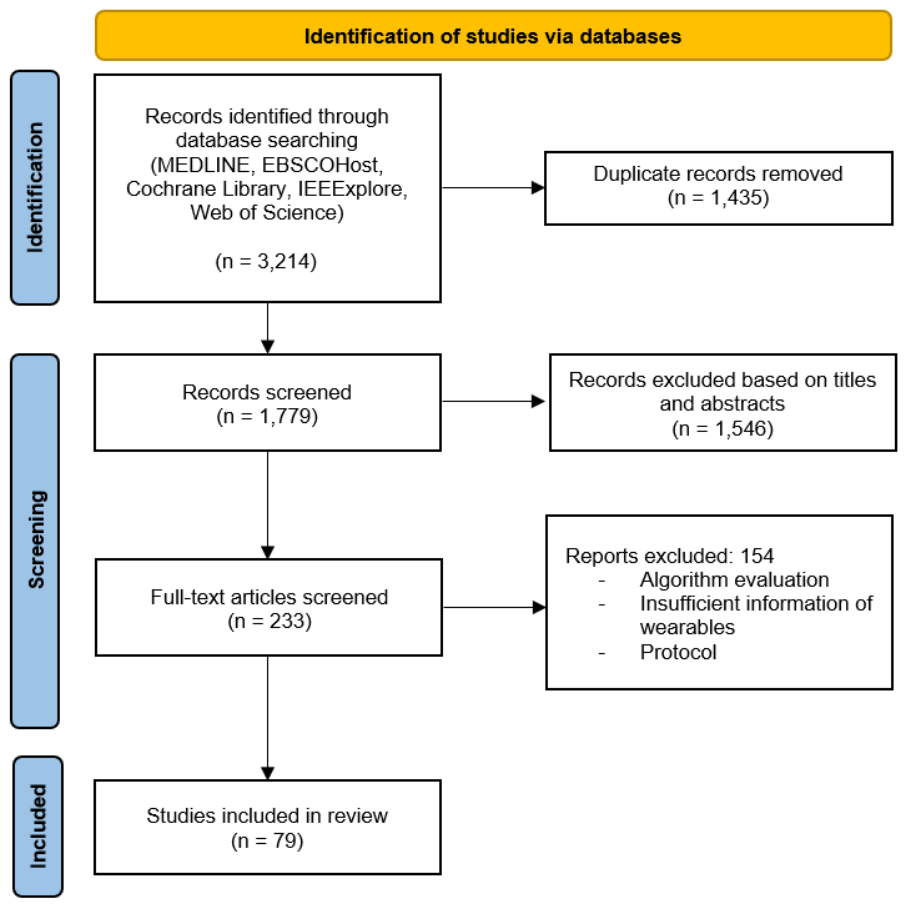
Figure 2.
Distribution of included studies across neurological disorders. MS: Multiple sclerosis, PSP: Progressive supranuclear palsy, SCI: Spinal cord injury, TBI: Traumatic brain injury, HD: Huntington’s disease, ALS: Amyotrophic lateral sclerosis, PD: Parkinson’s disease.
Figure 2.
Distribution of included studies across neurological disorders. MS: Multiple sclerosis, PSP: Progressive supranuclear palsy, SCI: Spinal cord injury, TBI: Traumatic brain injury, HD: Huntington’s disease, ALS: Amyotrophic lateral sclerosis, PD: Parkinson’s disease.
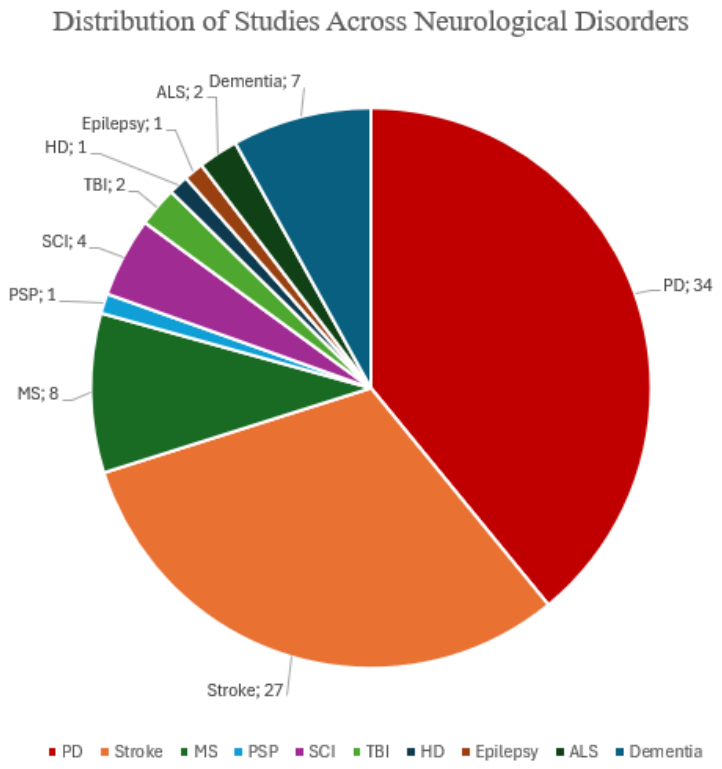
Figure 3.
Distribution of research settings across neurological conditions. Stacked bars show the percentage of studies conducted in different settings, or where the research setting was not mentioned. Numbers within each segment indicate the number of studies.
Figure 3.
Distribution of research settings across neurological conditions. Stacked bars show the percentage of studies conducted in different settings, or where the research setting was not mentioned. Numbers within each segment indicate the number of studies.
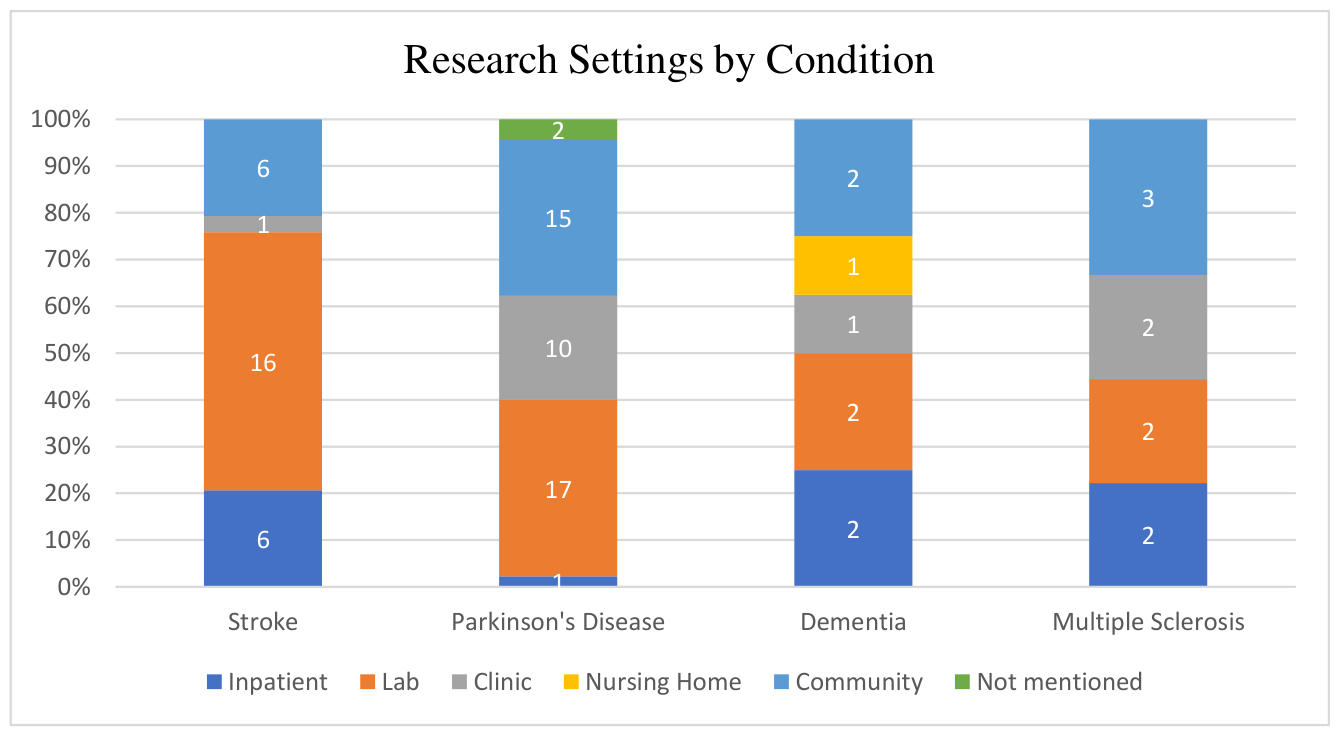
Figure 4.
Reporting of sustained adherence and patient-reported usability in wearable studies across neurological conditions. (A) Proportion of studies reporting quantified sustained adherence to wearable use over a period of at least four weeks. (B) Proportion of studies evaluating structured patient-reported usability, including ease of use, comfort, acceptability, satisfaction, or device-related burden. Bars represent the proportion of studies reporting the respective outcome within each neurological condition category, and labels indicate the number of reporting studies relative to the total number of studies in that category, with the corresponding percentage, n/N (%). Other neurological conditions included traumatic brain injury (TBI), amyotrophic lateral sclerosis (ALS), epilepsy, progressive supranuclear palsy (PSP), spinal cord injury (SCI), and Huntington’s disease (HD).
Figure 4.
Reporting of sustained adherence and patient-reported usability in wearable studies across neurological conditions. (A) Proportion of studies reporting quantified sustained adherence to wearable use over a period of at least four weeks. (B) Proportion of studies evaluating structured patient-reported usability, including ease of use, comfort, acceptability, satisfaction, or device-related burden. Bars represent the proportion of studies reporting the respective outcome within each neurological condition category, and labels indicate the number of reporting studies relative to the total number of studies in that category, with the corresponding percentage, n/N (%). Other neurological conditions included traumatic brain injury (TBI), amyotrophic lateral sclerosis (ALS), epilepsy, progressive supranuclear palsy (PSP), spinal cord injury (SCI), and Huntington’s disease (HD).
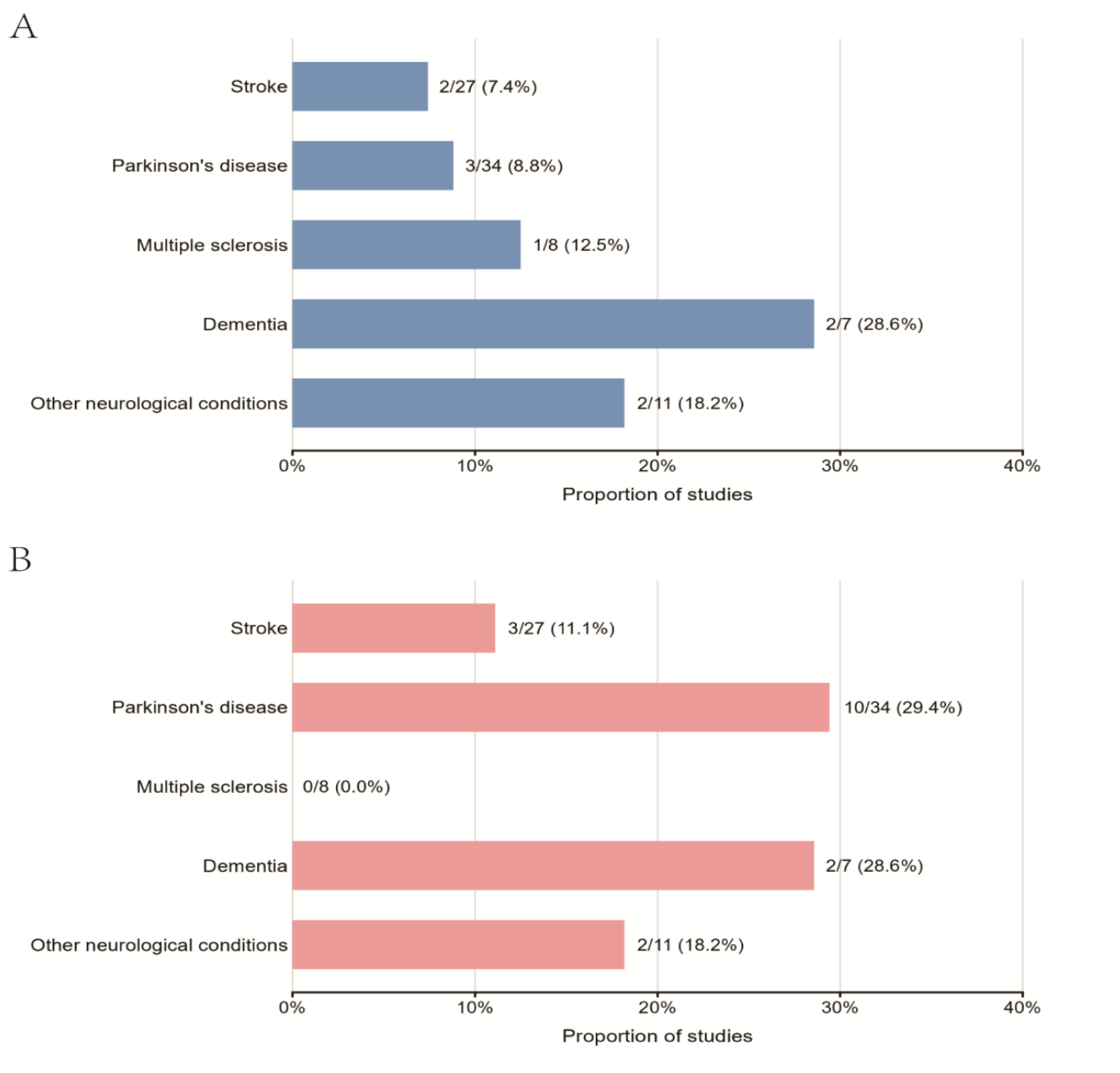
Table 1.
Classification framework for the purpose and characteristics of wearable use in the included studies.
Table 1.
Classification framework for the purpose and characteristics of wearable use in the included studies.
| Legend | Interpretation | Definition |
| M | Monitoring | Use of the wearable to track or quantify physical, physiological and psychosocial parameters, or disease-related symptoms and changes over time. |
| (Acc) | Accuracy | The ability to produce a result true to the correct clinical value. |
| (F) | Feasibility | The practicality of using the device within the intended research, clinical, or daily-life context. |
| (V) | Validity | The extent to which the device measures the intended construct or parameter. |
| (DC) | Data Collection | Use of the wearable to quantify disease characteristics, progression, or changes over time. |
| (R) | Reliability | The ability of the device to produce consistent results. |
| (SD) | Symptom Detection | Use of the wearable to identify or detect symptoms of a neurological condition. |
| A | Assessment | Use of the wearable as, or to support, an assessment or outcome measure, including the development or validation of assessment tools. |
| I | Intervention | Use of the wearable as part of a treatment or rehabilitation intervention. |
Table 2.
Stroke Data Extraction (27 studies).
| Author | Purpose (A/I/M) | Study Design/Time Period | Geographic Setting | Research Setting | Participants’ Profile (Sample Size, Age, Sex) | Wearable characteristics (Brand, Model, Type, Location) | Control/Comparator | Parameters | Results/Findings/Comments |
| Bernhard et al. (2018) | M (F) | Cross-Sectional Studies One session |
Germany | Inpatient | Mean age: 62 Sample size: 50 |
Hasomed Rehawatch Worn on bilateral ankles and L4-L5 |
Age-matched controls with no gait and balance deficits (151) |
Physical: Gait speed |
Using inertial sensors over a 4-month period for the investigation of neurological inpatients is feasible. |
| Bertomeu-Motos et al. (2023) | M (DC) | Before-After Studies with No Control Group One session |
Spain | Lab | Sample size: 5 (2 therapists, 1 healthy subject, 2 participants) | SHIMMER and Thalmics Labs Worn on paretic side’s upper arm, forearm and hand |
1 healthy subject, therapists wore sEMG armband on same arm |
Physical: Quality of 8 upper extremity movements |
The system shows potential as a home rehabilitation tool for therapist data collection. Accuracy fell with impairment severity in testing, though this reflects only a 2-patient case comparison and not a powered statistical analysis. |
| Bishop et al. (2024) | M (Acc) | Cross-Sectional Studies One session |
United States of America | Clinical research laboratory | Mean age: 57 Sample size: 30 19M/10F/1NB |
MiGo Worn on bilateral wrists, paretic hip and bilateral ankles |
Video, APDM system |
Physical: Upper limb: Active movement time, Movement counts, Mobility: Step count, stance time symmetry (paretic vs. nonparetic leg) |
Step count validity excellent across all FAC levels. However, stance-time symmetry agreement was explicitly stratified by FAC and degraded with lower function: significant at FAC 5 and FAC 4, but not significant at FAC 3. Good upper limb movement-count agreement (paretic r=0.85); high acceptability but includes donning difficulty. |
| Chae et al. (2020) | M (F) | Controlled Intervention Studies 12 weeks |
Korea | Community | Mean age: 58.3 (9.3) Control mean: 64.5 (9.6) Sample size: 23 (6 controls + 17 stroke participants) |
LG W270 Worn on wrist (side not specified) |
6 controls |
Physical: (1) bilateral shoulder flexion with both hands interlocked; (2) wall push exercise; (3) active scapular exercise; and (4) towel slide exercise |
A home system comprising a smartwatch and machine learning model can improve function and shoulder range of motion in people with chronic stroke. |
| Cleland et al. (2024) | M (R) | Cross-Sectional Studies One session |
USA | Lab | Mean age: 61 Sample size: 62 39M/23F |
Opal V2R Worn on lumbar spine and bilateral feet |
Speed derived from stopwatch timing |
Physical: Gait speed |
Walking speed from stopwatch, APDM sensors, and Mobility Lab software should not be used interchangeably. |
| Compagnat et al. (2019a) | M (V) | Cross-Sectional Studies One session |
France | Clinic | Mean age: 65.7 ± 13.5 Sample size: 38 20M/18F |
SenseWear Armband Worn on non-paretic arm |
Metamax 3B CORTEX (portable indirect calorimeter) |
Physiological: Energy expenditure (kcals) |
The SenseWear Armband is not valid for the measurement of energy expenditure during daily living tasks in people with stroke. |
| Compagnat et al. (2019b) | M (V) | Cross-Sectional Studies One session |
France | Lab | Mean age: 65 Sample size: 35 |
Actigraph GT3x Worn on bilateral arms and non-paretic hip Sensewear Armband Worn on bilateral arms Pedometer (ONStep400, Geonaute) Worn on non-paretic hip and around the neck |
Examiner assessment |
Physical: Step count (Actigraph, Sensewear & pedometer) Physiological: Heat flux, skin temperature, galvanic skin response (Sensewear) |
The SenseWear Armband does not seem to reliably estimate the number of steps in people with stroke. The estimation of the Actigraph worn at the ankle was the closest to the measured walked distance. |
| Datta et al. (2020) | M (V) | Observational Cohort Studies One session |
Australia, India | Inpatient | Age: 30s-70s Sample size: 47 (32 participants + 15 healthy controls) |
Eoxys Used with smartphone app Worn on bilateral wrists |
15 healthy controls |
Physical: Finger tapping, opening/closing of hand, wrist torsion, elbow flexion/extension, finger swiping |
Healthy control subjects could be easily separated from people with acute stroke suffering from hemiparesis. |
| David et al. (2017) | M (V) | Observational Cohort Studies 4 weeks |
Austria | Inpatient | Age: 65±13 yrs Sample size: 35 (30 ischemic stroke, 5 haemorrhagic stroke) 22M/13F |
eSHOE Worn on feet as orthopaedic insoles |
Clinical motion analysis system VICON |
Physical: Gait parameters, foot pressure distribution, and gait cycle |
The eSHOE system is able to detect and record gait data for implementation in stroke rehabilitation. |
| Demers et al. (2024) | M (F) | Observational Cohort Studies 12 hours a day for a week |
USA | Lab and home | Sample size: 30 18M/11F/1TM |
MiGo activity watch Worn on bilateral wrists |
Visit 1: FMA-UE, CAHAI, Rating of Everyday Arm Use in the Community and Home Visit 2: System Usability Scale, Motor Activity Log, novoConfidence in Arm and Hand Movement |
Physical: Active upper limb movement duration, and arm use ratio (minutes of paretic arm activity/minutes of less affected arm activity) |
The MiGo wrist sensor is feasible in capturing arm and hand activity in people with chronic stroke. |
| Ensink et al. (2024) | M (V) | Cross-Sectional Studies One session |
Netherlands | Lab | Mean age: 61 Sample size: 12 7M/5F |
MTw Awinda Worn on dorsal side of bilateral feet |
Optical motion capture system |
Physical: Shank linear acceleration, gait parameters |
An inertial measurement unit used on the foot can measure foot-strike angle accurately during straight walking. |
| Lyckegård Finn et al. (2024) | M (DC) | Before-After Studies with No Control Group Approx. 1 month |
Sweden | Inpatient | Mean age: 58.5 (27–72) Sample size: 18 13M/5F |
E4, Empatica Inc Worn on bilateral wrists |
Motor Assessment Scale and Motor Activity Log |
Physical: Wrist acceleration |
Wrist acceleration measured by a wrist sensor on the affected arm correlated with measurements of arm motor function. |
| Hui et al. (2018) | M (Acc) | Cross-Sectional Studies 3 days |
Not mentioned | Community, free-living | Mean age: 62 Sample size: 12 7M/5F |
Fitbit One Worn on non-paretic ankle |
Actical accelerometer on non-paretic ankle |
Physical: Step count, sedentary time spent, time doing light/moderate/vigorous activity (mins). |
The Fitbit One is reasonably accurate in measuring step counts and light-intensity activities in people with stroke during daily activities. |
| Huizenga et al. (2021) | I | Before-After Studies with No Control Group 4 weeks |
USA | Participant’s home | Mean age: 56 Sample size: 21 10M/11F |
iStride Worn on feet |
NA |
Physical: Gait speed, gait characteristics |
The iStride gait device was able to improve gait parameters in people with chronic stroke. |
| Jayaraman et al. (2018) | M (V) | Cross-Sectional Studies One session |
USA | Lab | Mean age: 56 Sample size: 10 6M/4F |
ActiGraph wG3TX-BT and Metria-IH1 Worn on upper arm, waist and ankle (ActiGraph) or back of the upper left arm (Metria) |
Cosmed K4B2 |
Physical: Step count Physiological: Energy expenditure and metabolic equivalent |
Estimates by these standard proprietary algorithms for energy expenditure and metabolic equivalent significantly diverged from the gold standard estimates at all levels of activity. |
| Kobayashi et al. (2021) | M (R) | Observational Cohort Studies 1 week |
Japan | Inpatient | Mean age: 69.7 ± 11.3 Sample size: 30 17M/13F |
Polar A370 WHR and H10 CHR monitors, connected to Actigraph-wGT3X-BT Worn on bilateral wrists and chest |
Polar chest heart rate monitor |
Physiological: Wrist heart rate |
The relative reliability of wrist heart rate monitors was substantial compared to chest heart rate monitors. Heart rate estimation at the wrist was not accurate due to wide limits of agreement. |
| Kramer et al. (2018) | M (R) | Cross-Sectional Studies One session |
Australia | Inpatient | Mean age: 78 (70 to 83) Sample size: 22 13M/9F |
SenseWear Armband Worn on bilateral arms |
Metabolic cart (Oxycon Mobile Device), manual counter for step count |
Physical: Step count, walking Physiological: Energy expenditure (METs) |
The SenseWear Armband overestimated energy expenditure compared to the metabolic cart during walking and underestimated energy expenditure during sit-to-stands. |
| Lee et al. (2018a) | M (DC) | Before-After Studies with No Control Group One session |
USA | Lab | Mean age: 54.4 ± 10.1 Control mean age: 53.8 ± 11.4 Sample size: 30 (20 stroke survivors and 10 controls) |
Shimmer Worn on bilateral wrists |
10 age-matched controls |
Physical: Upper limb motor tasks that resembled different types of ADLs Upper limb rehab exercises typical of home-based interventions |
Results indicated that movements can be successfully classified into either goal-directed or non-goal-directed movements which allows appropriate feedback. |
| Lee et al. (2021a) | M (DC) | Observational Cohort Studies 2 sessions |
USA | 2 Laboratory visits | Mean age: 58 Sample size: 22 |
Shimmer2 units Worn on sternum as well as the arm, wrist, thumb, and index finger of the hemiparetic upper limb |
NA |
Physical: 8 different reaching and manipulation tasks |
The algorithm based on wearable sensor data predicted rehabilitation outcomes more accurately and better captured individual variability than the algorithm based on clinical data alone, while combining both algorithms further improved prediction accuracy |
| Mandigout et al. (2017) | M (Acc) | Observational Cohort Studies One session |
France | Lab | Mean age: 68.2 ±13.9 Sample size: 24 15M/9F |
Sensewear Armband Worn on bilateral arms Actigraph GT3x-BT Worn on bilateral ankles, hips and wrists Actical Worn on bilateral ankles, hips and wrists ONStep400 Worn on neck and hip |
Metamax indirect calorimetry |
Physical: Time spent at each activity level, step count Physiological: Energy expenditure and active energy expenditure (kcal) |
No sensor was able to accurately estimate energy expenditure for a whole scenario of common tasks in post-stroke participants in the subacute phase except the Sensewear Armband being worn on the non-plegic side. |
| Moore et al. (2017) | M (F, R, V) | Observational Cohort Studies 2 sessions and 2 consecutive 7-day periods |
UK | Lab | Mean age: 63 Sample size: 23 19M/4F |
AX3 Worn on L5 |
GaitRite instrumented walkway, wearable data capture system, video |
Physical: Gait characteristics, total daily step count, mean walking bout length, total number of daily walking bouts |
The wearable system used in people with stroke with mild to moderate gait impairments demonstrated excellent feasibility. |
| Pan et al. (2023) | A (V) | Observational cross-sectional study 1 session |
China | Lab | Mean age: 55.9 Sample size: 12 11M/1F |
7 IMUs (on bilateral thigh, shanks, feet), 2 plantar pressure insole sensors (brand not mentioned) | Healthy population, VICON system |
Physical: Joint angles and plantar pressure insole |
Compared to the VICON system and healthy population, there is good accuracy for gait assessment, and the collected data has good repeatability |
| Schaffer et al. (2017) | M (Acc) | Observational Cohort One session |
USA | Lab | Mean age: 54 ± 13.4 Sample size: 24 14M/10F |
Garmin Vivofit Worn on bilateral wrists Fitbit Zip Worn on non-paretic hip |
Step count from 6MWT |
Physical: Step count |
The Fitbit Zip appears to be the most accurate Activity Tracking Device for chronic stroke survivors. The use of the Garmin Vivofit could not be recommended as a way to monitor physical activity, except when worn on the paretic arm by limited and full-community ambulating individuals poststroke. |
| Seo et al. (2024) | M (F) | Before-After Studies with No Control Group 1 lab session and 1 home session |
USA | Lab and home | Mean age: 61 ± 12 Sample size: 19 12M/7F |
ActiGraph GT9X link Worn on hemiparetic wrist |
Video recording of participants performing functional task practices at home (ground truth), evaluated by OT |
Physical: Cup to shelf, cup to mouth, tongs use, finger food |
The study supports the feasibility of monitoring movement quality of different tasks by people with stroke at home using a wrist worn IMU. |
| Taylor-Piliae et al. (2016) | M (F) | Observational Cohort Studies Consecutive 48 hours |
USA | Lab | Mean age: 70 Sample size: 10 3M/7F |
PAMSys Worn on mid-sternal pocket located in a comfortable t-shirt |
Age-matched healthy controls |
Physical: Trunk tilt Type of postural transitions (e.g., sit-to-stand) Duration of postural transitions Duration of locomotion Characterization of locomotion Type of postures Gait parameters: number of steps, walking speed, and amount of walking. |
The device was comfortable, did not intrude everyday activities, and people with stroke were willing to wear it for 48 hours. |
| Waddell et al. (2023) | M (F) | Observational Cohort Studies 1 month |
USA | Community | Mean age: 71.0 (7.4) Sample size: 20 |
Fitbit Inspire HR Worn on less affected wrist or less affected hip if using assistive device |
NA |
Physical: Daily step count |
It was feasible to establish a remote physical activity monitoring program for people with stroke living in rural areas. |
| Wüest et al. (2016) | A (V) | Observational Cohort One session |
Switzerland | Gait lab | Mean age: 65 Sample size: 39 (14 stroke + 25 controls) 12M/2F Control mean age: 76 8M/17F |
Physilog Worn on each wrist, shank, and one on the trunk and complemented with one device on each foot and one on the back (L3) |
25 nondisabled by self- report control participants aged over 65 yrs who had no history of neurological, cardiovascular, or musculoskeletal pathologies |
Physical: iTUG total duration Sit-to-Walk Metrics Gait metrics Turning metrics Turn-to-Sit metrics |
The internal sensor-based iTUG was able to distinguish people with stroke from healthy controls using iTUG measures. |
A: Assessment; Acc: Accuracy; DC: Data collection; F: Feasibility; I: Intervention; M: Monitoring; R: Reliability; SD: Symptom detection; V: Validity. sEMG: surface EMG; FAC: Functional Ambulation Category; FMA-UE: Fugl-Meyer Assessment Upper Extremity; CAHAI: Chedoke Arm and Hand Activity Inventory; WHR: Wrist heart rate; CHR: Chest heart rate; ADL: Activity of daily living; IMU: Inertial measurement unit; 6MWT: 6-minute walk test; iTUG: Instrumented timed up and go.
Table 5.
Dementia Data Extraction (7 studies).
| Author | Purpose (A/I/M) | Study Design/Time Period | Geographic Setting | Research Setting | Participants’ Profile (Sample Size, Age, Sex) | Wearable characteristics (Brand, Model, Type, Location) | Control/Comparator | Parameters | Results/Findings/Comments |
| Bernhard et al. (2018) | A | Observational Cohort and Cross-Sectional Studies 1 session |
Germany | Inpatient hospital | Age: 62 Sample size: 16 60%Male/40%Female |
Hasomed Rehawatch Worn at both ankles and L4-L5 (3 sensors) |
Age-matched controls with no gait and balance deficits (151) | Physical: Gait speed | High acceptance of sensor-unit-based assessments for Rehawatch. |
| Godkin et al. (2022) | M (F) | Observational Cohort and Cross-Sectional Studies 7-day wear period; study conducted May 2019–March 2020 |
Canada | Community | Mean age: 68 Sample size: 39 Alzheimer’s, Frontotemporal dementia |
1. GENEActiv Originals Captured movement patterns, activity levels, & sleep-related metrics using accelerometry Worn on wrist and ankles 2. Bittium Faros Captured electrocardiography, respiratory data & posture. Only worn from day 1-4 due to battery life. Worn on chest |
NA |
Physical: Gait parameters, posture, transitions between postures, ambulatory bouts, activity levels Physiological: heart rate, heart rate variability (HRV), respiratory rate, electrocardiogram (ECG) data. Psychosocial: Sleep Quality (sleep duration, sleep efficiency, time spent in bed vs. asleep, sleep interruptions and sleep onset latency) |
High median adherence rate (from mixed neurological cohort) to wearing at least three devices concurrently throughout the study period. Non-wear rates were higher during daytime compared to nighttime. |
| Kamil et al. (2021) | M (F) | Before-After Studies With No Control Group 4 days |
USA | Laboratory | Age: 57-85 Sample size: 12 5Male/7Female Alzheimer’s dementia, Vascular dementia, Lewy Body dementia, Dementia due to multiple factors |
Opal To wear the device for a minimum of 4 consecutive days for at least 8 hours daily during waking hours Worn on lower back, with elastic belt against skin or snuggly around clothing |
Free of neurological disease or dementia, same methodology applied | Physical: Number of turns per 30min interval, Mean turn duration, Mean peak speed, Mean turn angle | Opal is feasible for continuous monitoring people with cognitive impairment and shows potential to characterise wandering behaviour. |
| Kikhia et al. (2016) | M (DC) | Observational Cohort and Cross-Sectional Studies 2 months |
Sweden | Nursing homes | Sample size: 36 (30 staff members, 6 patients with Alzheimer’s) | Philips DTI-2 wristband sensor Part of online platform Worn on wrist |
Clinical observation notes from staff serving as ground truth | Psychosocial: Stress levels | DTI-2 analyzed galvanic skin response (GSR), which captured longer-term emotional changes but was limited by noise, artifacts, and high variability across individuals. |
| Kuzmik et al. (2021) | M (F, V) | Controlled Intervention Studies Minimum 24h |
USA | Inpatient hospital | Age: 65-103 Sample size: 259 103Male/156Female Mild-moderate dementia |
MotionWatch8 Worn on wrist |
Barthel Index | Physical: Activity types (sedentary, low, moderate, vigorous) | MotionWatch8 is feasible and valid for monitoring physical activity in hospitalised older adults with dementia, with high wearability and construct validity. |
| Mc Ardle et al. (2020) | M (F, SD) | Observational Cohort and Cross-Sectional Studies 1 session |
UK | Laboratory | Alzheimer’s: Age: 77±6 Sample size: 32 (15Male/17Female) Lewy body: Age: 76±6 Sample size: 28 (22Male/6Female) Parkinson’s Disease: Age: 78±6 Sample size: 14 (13Male/1Female) |
AX3 Worn on skin above L5, with double-sided tape and Hypafix tape |
NA | Physical: 14 gait characteristics including pace, variability, rhythm, asymmetry and postural control | AX3 differentiated dementia subtypes with modest accuracy across seven gait characteristics. |
| Thorpe et al. (2019) | M (F) | Observational Cohort and Cross-Sectional Studies 8 weeks |
Denmark | Clinic/Community | Age: 65-78 Sample size: 6 4Male/2Female Early dementia |
Sony SmartWatch 3 Smartwatch paired with a smartphone (Nexus 5) Worn on wrist |
Patient’s subjective perceptions of behaviour |
Physical: Step count, active bouts (on foot and bicycle), still time, active time (on foot and bicycle) Psychosocial: Location |
Sensor-based measures reflected people with dementia’s perceived fluctuations in behavior. |
A: Assessment; Acc: Accuracy; DC: Data collection; F: Feasibility; I: Intervention; M: Monitoring; R: Reliability; SD: Symptom detection; V: Validity.
Table 7.
Observational Cohort and Cross-Sectional Studies.
| Author | 1 | 2 | 3 | 4 | 5 | 6 | 7 | 8 | 9 | 10 | 11 | 12 | 13 | 14 | Quality rating |
| Bayés et al. (2018) | ✓ | ✓ | NR | ✓ | ✗ | NA | ✓ | ✗ | ✓ | ✓ | ✓ | NR | NA | ✗ | Fair |
| Bernhard et al. (2018) | ✓ | ✓ | ✓ | ✓ | ✗ | ✓ | ✓ | ✓ | ✓ | ✗ | ✓ | ✗ | ✓ | ✗ | Good |
| Bishop et al. (2024) | ✓ | ✓ | NR | ✓ | ✗ | NA | NA | NA | ✓ | ✓ | NA | ✗ | ✓ | NR | Fair |
| Bonora et al. (2015) | ✓ | ✓ | CD | ✓ | ✗ | ✓ | ✓ | ✗ | ✓ | ✗ | ✓ | ✗ | ✓ | ✗ | Fair |
| Boroojerdi et al. (2019) | ✓ | ✓ | CD | ✓ | ✗ | CD | CD | ✗ | ✓ | ✗ | ✓ | CD | NA | ✗ | Fair |
| Caballol et al. (2023) | ✓ | ✓ | NR | ✓ | ✗ | NA | ✓ | ✓ | ✓ | ✓ | ✓ | NA | NR | ✗ | Fair |
| Cleland et al. (2024) | ✓ | ✓ | CD | ✓ | ✗ | ✓ | ✓ | ✗ | ✓ | ✗ | ✓ | ✗ | ✓ | ✗ | Fair |
| Compagnat et al. (2019a) | ✓ | ✓ | CD | ✓ | ✓ | ✓ | ✓ | ✓ | ✓ | ✗ | ✓ | ✗ | ✓ | ✗ | Fair |
| Compagnat et al. (2019b) | ✓ | ✓ | NR | ✓ | ✓ | ✗ | ✗ | ✓ | ✓ | ✗ | ✓ | NR | NA | ✗ | Poor |
| DasMahapatra et al. (2018) | ✓ | ✓ | NR | ✓ | ✗ | NA | CD | ✓ | ✓ | ✓ | ✓ | NA | ✓ | ✓ | Good |
| Datta et al. (2020) | ✓ | ✓ | NR | ✓ | ✗ | NA | NA | ✓ | ✓ | ✗ | ✓ | NR | NA | ✗ | Fair |
| David et al. (2017) | ✓ | ✓ | NR | ✓ | ✗ | ✓ | ✓ | ✓ | ✓ | ✓ | ✓ | NR | NR | ✗ | Fair |
| Delrobaei et al. (2018) | ✓ | ✓ | CD | ✓ | ✗ | NA | NA | ✗ | ✓ | ✗ | ✓ | CD | NA | ✗ | Fair |
| Demers et al. (2024) | ✓ | ✓ | NR | ✓ | ✗ | NA | NA | NA | ✓ | ✓ | ✓ | NR | ✓ | ✗ | Fair |
| Dominey et al. (2020) | ✓ | ✓ | NR | ✓ | ✗ | ✓ | ✓ | ✓ | ✓ | ✓ | ✓ | NR | ✓ | ✓ | Fair |
| Ensink et al. (2024) | ✓ | ✓ | CD | ✓ | ✗ | ✓ | ✓ | ✓ | ✓ | ✗ | ✓ | ✗ | ✓ | ✗ | Fair |
| Feldhege et al. (2015) | ✓ | ✓ | NR | NR | ✗ | ✗ | ✗ | NA | ✓ | NA | ✓ | ✗ | NA | ✗ | Poor |
| Flachenecker et al. (2020) | ✓ | ✓ | NR | NR | ✗ | ✗ | ✗ | NA | ✓ | ✓ | ✓ | ✗ | NA | ✗ | Fair |
| Godkin et al. (2022) | ✓ | ✓ | ✗ | ✓ | ✗ | NA | NA | NA | ✓ | ✓ | NA | NA | ✓ | NA | Fair |
| Gordon et al. (2019) | ✓ | ✓ | NR | ✓ | ✗ | NA | ✓ | ✓ | ✓ | ✓ | ✓ | NR | ✗ | ✗ | Fair |
| Greene et al. (2022) | ✓ | ✓ | NR | ✓ | ✗ | ✓ | ✓ | ✓ | ✓ | ✓ | ✓ | NR | NR | ✗ | Fair |
| Hadley et al. (2021) | ✓ | ✓ | ✓ | ✓ | ✗ | ✓ | ✓ | ✓ | ✓ | ✓ | ✓ | NR | ✓ | ✗ | Good |
| Hill et al. (2021) | ✓ | ✓ | NR | ✓ | ✗ | NA | ✓ | ✓ | ✓ | ✗ | ✓ | NR | NA | ✗ | Fair |
| Hui et al. (2018) | ✓ | ✓ | NR | NR | ✗ | ✗ | ✗ | NA | ✓ | NA | ✓ | ✗ | NA | ✗ | Poor |
| Jayaraman et al. (2018) | ✓ | ✓ | NR | ✓ | ✗ | ✗ | ✗ | ✓ | ✓ | ✗ | ✓ | NR | NA | ✗ | Poor |
| Johnson et al. (2023) | ✓ | ✓ | NR | ✓ | ✗ | ✗ | ✓ | ✓ | ✓ | ✓ | ✓ | NA | NA | ✗ | Fair |
| Joshi et al. (2019) | ✓ | ✓ | NR | ✓ | ✗ | ✓ | ✓ | ✗ | ✓ | ✓ | ✓ | ✗ | NR | ✗ | Fair |
| Kikhia et al. (2016) | ✓ | ✓ | NR | ✓ | ✗ | ✗ | NR | ✓ | ✓ | ✓ | ✓ | NR | NR | ✗ | Fair |
| Kleiner et al. (2018) | ✓ | ✓ | NR | ✓ | ✗ | NA | ✓ | ✗ | ✓ | ✗ | ✓ | ✗ | NA | ✗ | Fair |
| Kobayashi et al. (2021) | ✓ | ✓ | NR | ✓ | ✗ | ✗ | ✓ | ✓ | ✓ | ✓ | ✓ | NR | NR | ✗ | Fair |
| Kontaxis et al. (2023) | ✓ | ✓ | NR | ✓ | ✗ | NA | ✓ | ✓ | ✓ | ✓ | ✓ | NR | NR | ✗ | Fair |
| Kramer et al. (2018) | ✓ | ✓ | NR | ✓ | ✗ | ✗ | ✗ | ✓ | ✓ | ✓ | ✓ | NR | NA | ✗ | Poor |
| Lee et al. (2018b) | ✓ | ✓ | NR | NR | ✗ | ✗ | ✗ | NA | ✓ | NA | ✓ | ✗ | NA | ✗ | Poor |
| Lee et al. (2021a) | ✓ | ✓ | CD | ✓ | ✗ | ✓ | ✓ | ✓ | ✓ | ✗ | ✓ | NR | ✓ | ✗ | Fair |
| Lee et al. (2021b) | ✓ | ✓ | NR | NR | ✗ | ✗ | ✗ | NA | ✓ | ✓ | ✓ | ✗ | NA | ✗ | Fair |
| Lemay et al. (2021) | ✓ | ✓ | CD | ✓ | ✗ | ✓ | ✓ | ✓ | ✓ | ✓ | ✓ | ✗ | ✓ | ✗ | Good |
| López-Blanco et al. (2019) | ✓ | ✓ | NR | ✓ | ✗ | ✗ | ✗ | ✓ | ✓ | ✗ | ✓ | NR | NA | ✗ | Poor |
| Mandigout et al. (2017) | ✓ | ✓ | NR | ✓ | ✗ | NA | NA | ✓ | ✓ | ✗ | ✓ | NR | NA | ✗ | Fair |
| Maremmani et al. (2022) | ✓ | ✓ | CD | ✓ | ✗ | ✓ | ✓ | ✓ | ✓ | ✓ | ✓ | ✗ | ✓ | ✗ | Good |
| Mc Ardle et al. (2020) | ✓ | ✓ | NR | ✓ | ✓ | ✓ | ✓ | ✓ | ✓ | ✗ | ✓ | ✗ | NA | ✗ | Fair |
| Moore et al. (2017) | ✓ | ✓ | NR | ✓ | ✗ | NA | ✓ | ✓ | ✓ | ✓ | ✓ | NR | NA | ✗ | Fair |
| Murphy et al. (2019) | ✓ | ✓ | NR | ✓ | ✗ | NA | NA | ✓ | ✓ | ✗ | ✓ | NR | NA | ✗ | Fair |
| Muthukrishnan et al. (2020) | ✓ | ✓ | NR | NR | ✗ | ✗ | ✗ | NA | ✓ | NA | ✓ | ✗ | NA | ✗ | Poor |
| Oyama et al. (2023) | ✓ | ✓ | NR | ✓ | ✗ | ✓ | ✓ | ✓ | ✓ | ✓ | ✓ | NR | NR | ✗ | Good |
| Pan et al. (2023) | ✓ | ✓ | ✓ | ✓ | ✗ | NA | NA | NA | ✓ | ✓ | ✗ | ✗ | ✓ | NR | Fair |
| Ricci et al. (2020) | ✓ | ✓ | NR | CD | ✗ | NA | NA | NA | ✓ | ✓ | NR | ✗ | NA | NR | Poor |
| Safarpour et al. (2022) | ✓ | ✓ | CD | ✓ | ✗ | ✓ | ✓ | ✓ | ✓ | ✗ | ✓ | ✗ | ✓ | ✗ | Fair |
| San-Segundo et al. (2020) | ✓ | ✓ | NR | ✓ | ✗ | ✓ | NR | ✗ | ✓ | ✗ | ✓ | ✗ | NR | ✗ | Fair |
| Schaffer et al. (2017) | ✓ | ✓ | NR | ✓ | ✗ | NA | NA | NA | ✓ | ✓ | ✓ | NR | ✓ | ✗ | Fair |
| Schlachetzki et al. (2017) | ✓ | ✓ | NR | ✓ | ✗ | ✗ | ✗ | ✓ | ✓ | NA | ✓ | NR | NA | ✗ | Poor |
| Schneider et al. (2018) | ✓ | ✓ | NR | ✓ | NA | NA | NA | ✓ | ✓ | ✓ | ✓ | NA | CD | NA | Good |
| Shawen et al. (2020) | ✓ | ✓ | ✓ | ✓ | ✗ | ✗ | ✗ | ✓ | ✓ | ✗ | ✓ | NR | NA | ✗ | Poor |
| Sotirakis et al. (2022) | ✓ | ✓ | NR | CD | ✗ | ✓ | ✓ | NA | ✓ | CD | NR | ✗ | ✗ | NR | Fair |
| Sun et al. (2022) | ✓ | ✓ | NR | ✓ | ✗ | ✓ | ✓ | ✓ | ✓ | ✓ | ✓ | NR | NR | ✗ | Fair |
| Taylor-Piliae et al. (2016) | ✓ | ✓ | NR | ✓ | ✗ | NA | CD | ✓ | ✓ | ✓ | ✓ | NR | NR | ✗ | Fair |
| Thorpe et al. (2019) | ✓ | ✓ | NR | ✓ | ✗ | ✗ | ✓ | NA | ✓ | ✓ | ✓ | NA | NR | ✗ | Fair |
| Tsakanikas et al. (2023) | ✓ | ✓ | CD | ✓ | ✗ | NA | NA | NA | ✓ | ✗ | ✓ | CD | NA | ✗ | Fair |
| Tulipani et al. (2020) | ✓ | ✓ | CD | ✓ | ✗ | ✓ | ✓ | ✓ | ✓ | ✗ | ✓ | ✗ | ✓ | ✗ | Fair |
| Uomoto et al. (2022) | ✓ | ✓ | NR | ✓ | ✗ | NA | CD | ✓ | ✗ | ✓ | ✗ | NR | ✗ | ✗ | Poor |
| Vergara-Diaz et al. (2021) | ✓ | ✓ | NR | ✓ | ✗ | NA | NA | NA | ✓ | ✓ | NA | ✗ | ✓ | NR | Fair |
| Waddell et al. (2023) | ✓ | ✓ | ✗ | ✓ | CD | ✓ | CD | ✓ | ✓ | ✓ | ✓ | NA | ✓ | ✓ | Fair |
| Woelfle et al. (2023) | ✓ | ✓ | NR | ✓ | ✗ | ✓ | ✓ | ✓ | ✓ | ✓ | ✓ | NR | NR | ✗ | Fair |
| Wüest et al. (2016) | ✓ | ✓ | NR | ✓ | ✗ | NA | NA | NA | ✓ | ✓ | NR | ✗ | ✓ | NR | Fair |
| Zago et al. (2018) | ✓ | ✓ | NR | ✓ | ✗ | NA | ✓ | ✗ | ✓ | ✗ | ✓ | NR | NA | ✗ | Fair |
| Zhu et al. (2022) | ✓ | ✓ | NR | ✓ | ✗ | NA | ✓ | ✓ | ✓ | ✓ | ✓ | NA | NR | ✗ | Fair |
| Liikkanen et al. (2023) | ✓ | ✓ | NR | ✓ | ✗ | ✓ | ✓ | ✗ | ✓ | ✓ | ✓ | ✗ | NR | ✗ | Fair |
Table 8.
Case Control Studies.
| Author | 1 | 2 | 3 | 4 | 5 | 6 | 7 | 8 | 9 | 10 | 11 | 12 | Quality rating |
| Cai et al. (2017) | ✓ | ✓ | ✗ | ✓ | ✓ | ✓ | NR | ✓ | NA | ✓ | NA | NR | Fair |
| Mariani et al. (2013) | ✓ | ✗ | ✗ | ✓ | ✓ | ✓ | NR | ✓ | NA | ✓ | NA | NR | Poor |
| Wang et al. (2020) | ✓ | ✓ | ✗ | ✓ | ✓ | ✓ | NR | ✓ | NA | ✓ | NA | NR | Fair |
Table 9.
Controlled Intervention Studies.
| Author | 1 | 2 | 3 | 4 | 5 | 6 | 7 | 8 | 9 | 10 | 11 | 12 | 13 | 14 | Quality rating |
| Chae et al. (2020) | ✗ | NA | NA | ✗ | ✗ | ✓ | ✓ | ✓ | NR | ✓ | ✓ | ✓ | ✓ | ✗ | Poor |
| Kuzmik et al. (2021) | ✓ | ✓ | ✓ | ✓ | ✗ | ✗ | ✓ | ✓ | ✓ | ✓ | ✓ | NR | NR | ✓ | Fair |
Table 10.
Before After Pre-Post Studies with No Control Group.
| Author | 1 | 2 | 3 | 4 | 5 | 6 | 7 | 8 | 9 | 10 | 11 | 12 | Quality rating |
| Bertomeu-Motos et al. (2023) | ✓ | ✓ | ✓ | NR | ✗ | ✓ | ✓ | NR | NR | ✓ | ✗ | NA | Poor |
| Lyckegård Finn et al. (2024) | ✓ | ✓ | ✓ | NR | ✗ | ✓ | ✓ | NR | ✓ | ✓ | ✗ | NA | Fair |
| Huizenga et al. (2021) | ✓ | ✓ | ✓ | NR | ✗ | ✓ | ✓ | NR | NR | ✗ | ✗ | NA | Poor |
| Kamil et al. (2021) | ✓ | ✓ | ✓ | NR | ✗ | ✓ | ✓ | NA | ✓ | NA | NA | NA | Fair |
| Lee et al. (2018a) | ✓ | ✓ | ✓ | NR | ✗ | ✓ | ✓ | NR | NR | ✓ | ✗ | NA | Poor |
| Lee et al. (2023) | ✓ | ✓ | ✓ | CD | ✗ | ✓ | ✓ | ✓ | ✗ | ✗ | ✓ | ✓ | Fair |
| Seo et al. (2024) | ✓ | ✓ | ✓ | NR | ✗ | ✓ | ✓ | NR | ✓ | ✓ | ✗ | NA | Fair |
| Silva-Batista et al. (2023) | ✓ | CD | ✗ | CD | ✗ | ✓ | ✓ | NA | CD | ✓ | CD | CD | Poor |
Table 11.
Quality-stratified sensitivity analysis of parameter domains and study settings.
| Characteristic | Good- or Fair-rated studies (n = 61) n (%) | Good-rated studies (n = 7) n (%) |
| Parameter domains | ||
| Physical or motor-related | 59 (96.7) | 7 (100.0) |
| Physiological | 5 (8.2) | 0 (0.0) |
| Psychosocial or behavioural | 2 (3.3) | 0 (0.0) |
| Primary study setting | ||
| Controlled laboratory or supervised clinical | 33 (54.1) | 3 (42.9) |
| Real-world or free-living | 23 (37.7) | 3 (42.9) |
| Hybrid | 5 (8.2) | 1 (14.3) |
Note: The primary study setting was determined by the environment in which the wearable data used for the main analysis was collected. Hybrid studies incorporated substantial data collection in both controlled or supervised clinical and real-world or free-living settings. Parameter domains were not mutually exclusive, as individual studies could assess more than one domain.
Disclaimer/Publisher’s Note: The statements, opinions and data contained in all publications are solely those of the individual author(s) and contributor(s) and not of MDPI and/or the editor(s). MDPI and/or the editor(s) disclaim responsibility for any injury to people or property resulting from any ideas, methods, instructions or products referred to in the content. |
© 2026 by the authors. Licensee MDPI, Basel, Switzerland. This article is an open access article distributed under the terms and conditions of the Creative Commons Attribution (CC BY) license (http://creativecommons.org/licenses/by/4.0/).
Copyright: This open access article is published under a Creative Commons CC BY 4.0 license, which permit the free download, distribution, and reuse, provided that the author and preprint are cited in any reuse.