

Submitted:
08 September 2026
Posted:
10 September 2026
You are already at the latest version
Abstract
Canada Post faces a structural financial crisis driven by declining letter-mail volumes, rising operating costs, intensifying parcel competition, and the rapid transformation of logistics through artificial intelligence (AI) and automation. This paper develops and applies a Scenario-Based Net Present Value (SNPV) model to evaluate whether restructuring can restore the long-term financial sustainability of a public enterprise while preserving service obligations. Drawing on comparative public administration, postal economics, international postal reforms, and the experience of Japan Post Holdings, the study examines a hybrid restructuring strategy combining AI-driven automation, postal banking, lending, insurance services, and expanded community-based services. The results show that the low scenario remains financially unfavourable, whereas the base scenario generates an SNPV of CAD $15.98 billion and a Benefit–Cost Ratio (BCR) of 1.08. The high scenario produces an SNPV of CAD $383.26 billion and a BCR of 2.66, although it is explicitly treated as an upper-bound sensitivity case rather than an expected outcome. An automation-only sensitivity case remains financially unfavourable, indicating that technological modernization alone is insufficient under the model assumptions. The findings suggest that long-term financial sustainability depends primarily on combining technological modernization with institutional diversification while preserving the broader public value of universal postal infrastructure. The study contributes a quantitative framework for evaluating Crown corporation restructuring and broader public-enterprise adaptation in the AI economy.
Keywords:
postal service
; rural
; cost-benefit
; evaluation
; Japan postal
; restructuring
; essential services
; entrepreneurship
; AI economy
; robotic automation
1. Introduction
Canada Post is facing among the most significant institutional and financial distress in its recent decades. The corporation’s traditional business model, historically built around high-volume letter-mail delivery and universal door-to-door service, has become increasingly unsustainable amid digital communication, e-commerce transformation, intensifying parcel competition, and changing consumer behaviour. Between 2018 and 2025, Canada Post accumulated more than $5 billion in losses, while the federal government was forced to provide repeated financial support to maintain operations (Public Services & Procurement Canada, 2025). By 2025, government officials described the organization as facing an “existential crisis,” with operational losses estimated at approximately $10 million per day (Public Services & Procurement Canada, 2025).
Canada Post's financial deterioration reflects broader structural changes in the global postal and logistics sector. Twenty years ago, Canada Post delivered approximately 5.5 billion letters annually; by 2025, that number had declined to approximately 2 billion despite continued population growth and an increasing number of delivery addresses (Public Services & Procurement Canada, 2025). At the same time, the corporation’s anticipated growth sector—parcel delivery—has become increasingly dominated by private logistics and technology corporations. Canada Post’s parcel market share reportedly declined from 62% in 2019 to below 24% by 2025 as competitors such as Amazon, FedEx, UPS, and other private delivery platforms expanded their vertically integrated logistics systems and increasingly automated supply chain operations (Public Services & Procurement Canada, 2025).
The rapid expansion of the artificial intelligence (AI)-driven digital economy has accelerated these pressures. AI, robotics, predictive logistics, automated warehousing, and algorithmically optimized delivery systems are transforming the global transportation and logistics sectors at an unprecedented pace (Glass & Gori, 2026; Strobel et al., 2026). Recent public administration research suggests that the first AI revolution may require substantial restructuring of public institutions, as technological transformation increasingly reshapes labour markets, service delivery systems, communications, security, logistics, and administrative governance (Jozaghi, 2025, 2026a, 2026b). Consequently, many public organizations may face growing pressure to modernize institutional structures and operational models designed for earlier technological eras. Major corporations such as Amazon have increasingly adopted robotic package-sorting systems, automated fulfillment centres, machine-learning-driven route optimization, and experimental autonomous-delivery technologies to reduce labour costs and increase delivery efficiency (Delfanti, 2021; Glass & Gori, 2026; Schmid, 2026). In this environment, traditional labour-intensive postal systems face growing difficulty competing with technologically integrated logistics corporations that can continuously optimize operational efficiency through automation and data-driven management systems.
At the same time, the rise of digital communication technologies has fundamentally weakened the economic foundation of legacy postal systems. Electronic billing, email communication, digital document transfer, online banking, large data centres, and cloud-based administrative services have substantially reduced dependence on traditional letter mail (Finger et al., 2005; Eckert, 2009). Younger generations may, in fact, grow up without ever sending a letter, as they increasingly interact through digital ecosystems that bypass many services historically monopolized by public postal systems (Finger et al., 2005). Consequently, postal operators across advanced economies have been forced to reconsider their institutional mandates, delivery standards, labour structures, and revenue-generation strategies (Khazabi, 2017; Eckert, 2009).
Canada Post’s existing institutional structure has proven particularly vulnerable because it still operates under a regulatory and operational framework designed for a twentieth-century communications economy rather than an AI-integrated logistics economy. The Canadian Postal Service Charter continues to impose extensive universal delivery obligations, including five-day delivery standards and broad geographic service commitments in rural and northern regions, despite declining mail volumes and rising infrastructure costs (Taylor, 2025). Canada Post itself has argued that the existing mandate has become a structural barrier preventing modernization and long-term financial sustainability (Taylor, 2025).
The federal government has already begun introducing partial restructuring measures, including transitioning millions of households to community mailboxes, reducing delivery standards, and reconsidering protections for rural post offices (Public Services & Procurement Canada, 2025). These reforms are intended to reduce operational costs and “right-size” the corporation in response to declining mail demand and mounting financial losses (Public Services and Procurement Canada, 2025). However, these measures largely reflect cost-containment strategies rather than a comprehensive reinvention of the institution itself in the AI economy.
This paper argues that incremental reforms alone are unlikely to restore Canada Post's long-term sustainability. Beyond postal delivery, the corporation reflects a broader public-administration challenge about the future role of Crown corporations, state capacity, and public-service delivery in an increasingly digital and AI-driven economy. Drawing on the literature on public-sector reform, public value, and institutional modernization, as well as comparative international experiences in postal restructuring, this paper proposes a hybrid model for institutional renewal. Specifically, it argues that Canada Post should be reconceptualized as a technologically integrated public infrastructure and service platform rather than solely a mail-delivery organization. Drawing in part on the experience of Japan Post Holdings, the paper proposes a restructuring model based on automation, service diversification, and institutional modernization.
While previous research has examined postal liberalization, privatization, universal service obligations, and comparative restructuring strategies, comparatively little attention has been devoted to quantitatively evaluating whether institutional diversification and technological modernization can restore the long-term financial sustainability of public postal enterprises. Existing cost-benefit analyses have largely focused on estimating the social consequences of reducing universal postal service obligations or valuing existing postal services (Lindhjem & Pedersen, 2012; Pindus et al., 2010). In contrast, building on established cost–benefit analysis principles while extending them to institutional restructuring, this study develops a Scenario-Based Net Present Value (SNPV) model. By integrating projected revenues, operating costs, automation-related efficiencies, and discounted future cash flows across multiple scenarios, the SNPV model provides a quantitative framework for evaluating whether institutional transformation can restore a Crown corporation's financial sustainability while preserving its public-service mandate.
The next section reviews the public administration and economics literature on Crown corporations, public enterprises, institutional modernization, postal economics, and public-sector reform. Subsequent sections examine international models of postal restructuring, evaluate the public value of Canada's national postal service, and assess how elements of the Japanese postal model could be adapted to the Canadian context through service diversification and AI-driven modernization. The paper then presents a SNPV for public-enterprise restructuring that estimates the long-term financial implications of automation, postal banking, lending, insurance services, and community-based service diversification across multiple sensitivity scenarios. The final sections discuss the implications for Canadian public administration, Crown corporations, and the future role of public enterprises in the AI economy.
2. Public Enterprise, Public Administration, and Economic Perspectives on Institutional Reform
2.1. Public Administration, Crown Corporations, and Institutional Adaptation
The challenges facing Canada Post must be understood within broader debates concerning public administration, state capacity, Crown corporations, and public-sector reform. Since the 1980s, governments worldwide have undertaken extensive efforts to modernize public institutions in response to fiscal pressures, technological change, globalization, and evolving citizen expectations. These reforms have frequently sought to improve efficiency, accountability, responsiveness, and financial sustainability while preserving core public-service objectives (Pollitt & Bouckaert, 2017). One of the most influential reform paradigms has been New Public Management (NPM), which encouraged governments to adopt private-sector management practices, performance measurement systems, market-based mechanisms, and organizational restructuring to improve public-sector performance (Hood, 1991; Mazzucato, 2013). Under NPM principles, many public enterprises were corporatized, commercialized, privatized, or required to meet business-oriented performance standards. Postal systems became a central focus of these reforms because they combined public-service mandates with commercial activities and operated in sectors increasingly exposed to technological disruption and market competition.
Within Canada, Crown corporations have historically served as important instruments of public policy and economic development (Prichard, 1983; Christensen & Lægreid, 2011). They were established to provide services that private markets could not or would not adequately supply, particularly in sectors involving national infrastructure, transportation, communications, finance, and regional development (Prichard, 1983). Unlike conventional government departments, Crown corporations were designed to balance public accountability with operational flexibility, allowing them to pursue public-policy objectives while maintaining managerial autonomy (Mazzucato, 2013). Canada Post occupies a unique position within this institutional landscape. As a federal Crown corporation, it operates at the intersection of commercial activity and public service. The organization is expected to maintain financial sustainability while simultaneously fulfilling universal-service obligations that often conflict with purely commercial objectives. This tension reflects a broader challenge facing many public enterprises: balancing efficiency, equity, accessibility, and fiscal responsibility (Mazzucato, 2013).
Restructuring Canada Post would not represent an unprecedented departure from Canadian public-administration practice. Federal and provincial governments have repeatedly restructured, commercialized, corporatized, privatized, or divested Crown corporations in response to changing economic conditions, technological disruption, fiscal pressures, and evolving policy priorities. At the federal level, Petro-Canada was gradually privatized between 1991 and 2004 as governments sought to reduce direct state ownership while maintaining a competitive national energy sector. Similarly, Air Canada was privatized in 1988, Canadair was sold to Bombardier in 1986, and Canadian National Railway (CN) was privatized in 1995, creating one of North America’s largest rail transportation companies (Boardman et al., 2009; Canada Transportation Act Review Panel, 2016; Air Canada, 2024; Padova, 2005). In contrast, some public enterprises were transformed through alternative governance arrangements rather than outright privatization.
For example, Nav Canada was established in 1996 as a private, non-share capital corporation responsible for Canada’s air navigation system, representing an innovative hybrid model that combined operational independence with public service responsibilities. At the provincial level, the transfer of BC Rail’s operations to CN in 2004 reflected efforts to address infrastructure investment requirements and long-term financial sustainability (Tenove, 2003). These examples illustrate that Canadian governments have historically adapted public enterprises to changing economic and technological environments rather than maintaining static institutional structures. Consequently, the central public-administration challenge has rarely been whether reform should occur, but rather how restructuring can balance efficiency, fiscal sustainability, public accountability, service accessibility, and broader public-policy objectives (Christensen & Lægreid, 2011; Pollitt & Bouckaert, 2017; Prichard, 1983). These experiences provide important context for contemporary debates about Canada Post and suggest that institutional adaptation has long defined Canadian Crown-corporation governance (Mazzucato, 2013).
Canadian public-sector reform has also included the creation of Special Operating Agencies (SOAs), which sought to improve managerial flexibility and service delivery while maintaining public accountability, reflecting broader efforts to balance bureaucratic control with operational efficiency (Aucoin, 1995). Public administration scholars have increasingly emphasized SOAs and public value as an alternative framework to purely market-oriented reform approaches. Moore (1995) argued that public organizations should be evaluated not solely on financial performance but also on their contribution to societal outcomes, democratic legitimacy, and collective well-being. From a public-value perspective, institutions such as Canada Post generate benefits extending beyond direct revenues and expenditures. These benefits include territorial cohesion, social inclusion, emergency resilience, economic accessibility, and maintaining government presence in underserved communities. This perspective is particularly relevant for geographically expansive countries such as Canada. Public institutions in transportation, communications, and service delivery often perform nation-building functions that traditional financial accounting measures cannot fully capture. Consequently, evaluating Canada Post solely by profitability metrics risks underestimating its broader contributions to public administration and social policy.
Contemporary economic administration literature has also placed growing emphasis on state capacity and governments' ability to adapt institutions to changing economic and technological environments (Mazzucato, 2013). State capacity encompasses not only regulatory authority but also governments' ability to mobilize resources, coordinate actors, deliver services, and respond effectively to emerging challenges (Painter & Pierre, 2005). In the digital era, maintaining state capacity increasingly requires institutional modernization, technological adaptation, and organizational innovation. Canada Post's current challenges can therefore be interpreted as a state-capacity issue rather than merely a postal-sector issue. The decline of traditional mail services, the emergence of platform-based logistics corporations, and the rapid diffusion of AI have fundamentally altered the environment within which the corporation operates. The central policy question is not whether change should occur but how public institutions can adapt while preserving their public-service mandate.
Recent public administration scholarship increasingly suggests that the AI revolution will require governments to undertake institutional restructuring comparable in significance to previous technological revolutions. Rather than simply introducing new tools or technologies, AI is expected to transform public-service delivery, labour markets, communications, logistics, security, procurement, and administrative decision-making processes (Jozaghi, 2025; Jozaghi, 2026a, 2026b). As governments confront rapidly evolving technological, economic, and social environments, traditional organizational structures designed for industrial-era conditions may become increasingly inadequate. Scholars have therefore argued that maintaining state capacity and public-sector effectiveness during the AI era will require organizational modernization, workforce adaptation, technological integration, and the redesign of legacy institutions to meet emerging challenges and opportunities (Jozaghi, 2025; Jozaghi, 2026a, 2026b). From this perspective, the difficulties confronting Canada Post are not isolated to the postal sector but instead reflect broader pressures facing public institutions throughout advanced economies as they adapt to the transformative effects of the first AI revolution.
2.2. Economic Perspectives on Public Enterprise and Postal Restructuring
An economic perspective on Canada Post’s financial challenges can also be developed through the soft budget constraint (SBC) concept introduced by Kornai (1986). A budget constraint becomes “soft” when an organization expects that persistent expenditures exceeding internally generated revenues may ultimately be covered through external support, particularly by the state (Kornai, 1986, 1998). Although originally developed in relation to socialist state-owned enterprises, Kornai emphasized that the phenomenon can also arise in mixed and market economies, particularly where public ownership creates a vertical relationship between the state and an enterprise and where sustained losses do not necessarily result in organizational exit (Kornai, 1998). Later economic treatments conceptualized SBCs more broadly as a dynamic commitment problem: expectations of refinancing or government support can weaken incentives to restructure when decision-makers believe financial distress will not ultimately lead to liquidation or withdrawal of support (Berglof & Roland, 1998; Maskin & Xu, 2001). This perspective is relevant to Canada Post but should not be interpreted as evidence that the corporation necessarily exhibits the full SBC syndrome. Rather, it highlights an economic tension facing Crown corporations with substantial public-service obligations: continued state support may be justified by social objectives, territorial accessibility, and service continuity, while expectations of such support can potentially weaken incentives for cost reduction, innovation, and structural adaptation. Kornai himself cautioned against treating hard budget constraints as unambiguously desirable, emphasizing a trade-off between efficiency and broader concerns of security and social welfare (Kornai, 1986). For postal systems, this tension is further complicated by network economics, universal-service obligations, and the high fixed costs of maintaining nationwide delivery infrastructure, making the economics of postal restructuring inseparable from questions of market structure and service accessibility.
Postal economics further complicates applying conventional market-efficiency criteria to public postal enterprises because postal services combine competitive activities with network characteristics, substantial fixed costs, and universal-service obligations (USOs). De Donder (2016) distinguishes between upstream activities such as collection, transportation, and sorting, where economies of scale and sunk costs are relatively limited, and last-mile delivery, where significant economies of scale arise because much of the delivery network and labour costs must be maintained regardless of mail volume. These cost characteristics matter more in geographically dispersed markets because delivery economies vary substantially across densely populated cities and sparsely populated rural regions, while USOs require affordable, geographically extensive service even where commercial returns are weak. Liberalization can therefore create a cream-skimming problem in which competitors concentrate on profitable high-density markets while the incumbent remains responsible for costly nationwide service, potentially undermining the financial sustainability of the universal-service provider (De Donder, 2016; Eckert, 2009).
From a welfare perspective, however, the resulting costs cannot be evaluated independently of the social benefits generated by universal access. Lindhjem and Pedersen (2012) conceptualize postal USOs as producing network, redistributive, regional-policy, and public-good benefits and show that service reductions can generate substantial cost savings while imposing welfare losses on households and businesses. This trade-off also appears in comparative evidence: Khazabi (2017) finds that different combinations of public ownership and market liberalization yield different outcomes in efficiency, profitability, and service provision, with non-liberalized public postal systems performing relatively poorly financially while maintaining comparatively high service levels. Canada Post's economic problem is therefore not simply how to minimize costs or maximize commercial revenue, but how to improve financial sustainability while preserving the network and universal-service functions that generate benefits not fully captured by conventional accounting measures.
A second strand of literature examines postal financial services as both an instrument of financial inclusion and a mechanism for sustaining universal postal networks. Postal operators have an institutional advantage that commercial banks often lack: universal-service obligations have historically produced geographically dispersed branch networks that extend into rural and less densely populated communities where conventional banking may be commercially unattractive. Cross-country evidence from 60 countries indicates that postal outlets may outperform conventional financial institutions in reaching groups vulnerable to financial exclusion, including lower-income and less-educated populations and individuals outside the labour force; larger postal networks are also associated with greater postal-account penetration (Ansón et al., 2013). This advantage is particularly relevant to Canada, where maintaining access in remote and rural areas constitutes both a cost of the universal-service mandate and a potentially valuable public infrastructure asset. Rather than treating underutilized rural postal facilities solely as a financial liability, diversification can leverage existing postal infrastructure, staff, and geographic coverage to provide complementary financial services and expand access in underserved communities (Singh et al., 2014).
D’Alcantara and Gautier (2013) formalize this argument through economies of scope, showing that postal–bank partnerships can use spare capacity in rural post offices to provide financial services at lower incremental cost than establishing new bank branches, potentially generating additional revenue while improving financial inclusion. Importantly, postal financial diversification need not require Canada Post to become a fully licensed bank immediately. International practice ranges from cash and payment services and partnerships with regulated financial institutions to postal savings institutions and fully licensed postal banks, allowing the degree of financial involvement to evolve with institutional capacity and regulatory requirements (Clotteau & Measho, 2016). Such diversification also complements technological modernization: digitized front- and back-office systems, automated processes, mobile platforms, and integrated payment infrastructure can reduce transaction costs while allowing physical postal outlets to function as access points within a broader digital financial network. Consequently, this study conceptualizes postal banking not simply as a new commercial activity, but as a mechanism to transform existing universal-service infrastructure into a multi-service platform that supports financial inclusion, rural accessibility, public value, and Canada Post's long-term financial sustainability.
Recent public-administration scholarship has increasingly recognized that public-sector innovation often occurs through hybrid organizational models that combine commercial activities with public objectives (Christensen & Lægreid, 2011). Rather than viewing public and private sectors as competing alternatives, these models seek to integrate market efficiency with public accountability. International examples such as Japan Post, Swiss Post, and Poste Italiane illustrate how public enterprises can evolve into diversified service organizations while maintaining important public responsibilities. From this perspective, Canada Post's restructuring should be viewed as part of a broader process of institutional adaptation across many sectors of government. Similar debates have emerged regarding public transportation agencies, public utilities, infrastructure banks, development finance institutions, and digital service organizations. The common challenge involves redesigning public institutions to remain effective amid technological disruption, fiscal constraints, and shifting citizen expectations. Consequently, Canada Post's future raises broader questions about the role of Crown corporations in Canada's evolving public administration landscape. Rather than representing a declining legacy institution, Canada Post may represent an opportunity to reimagine how public enterprises contribute to state capacity, regional development, digital inclusion, and public delivery services and outlets during the AI revolution. The challenge for policymakers is not simply to reduce costs but to identify institutional arrangements that can sustain both economic viability and public value in an increasingly digital and AI-driven economy.
3. Postal Services in Other Countries
Postal systems worldwide have undergone significant institutional, economic, and technological transformation over the past three decades. Historically, postal systems functioned as state-controlled monopolies responsible for universal communication infrastructure, national integration, and public service delivery. However, globalization, digital communication technologies, e-commerce expansion, privatization movements, and fiscal pressures have forced governments to reconsider the structure, ownership, and operational mandates of postal corporations (Eckert, 2009). Contemporary postal reform has increasingly focused on balancing universal service obligations with market competitiveness, financial sustainability, and technological modernization.
Comparative international research demonstrates that modern postal systems generally fall into several broad governance models, including publicly owned, liberalized systems; publicly owned, non-liberalized systems; and privatized, liberalized systems (Khazabi, 2017). These models differ substantially in terms of ownership structure, competition policy, financial sustainability, labour relations, and service diversification strategies. Countries such as Canada, the United States, China, and India have historically maintained publicly owned, non-liberalized postal systems characterized by strong universal service mandates and limited competition. In contrast, the Netherlands, Germany, and the United Kingdom pursued substantial privatization and market-liberalization reforms to increase competition and operational efficiency (Khazabi, 2017).
One of the most important global trends in postal restructuring has been diversification beyond traditional letter-mail delivery. Declining mail volumes, driven by electronic communication, digital billing, email, and online administration, have weakened the historical economic foundation of postal corporations across advanced economies. In response, many postal operators expanded into banking, insurance, logistics, e-commerce support, and financial services (Khazabi, 2017). Japan Post Holdings' experience has been particularly influential in demonstrating how postal systems can evolve into broader public and financial service infrastructures. Japan Post integrated postal banking, insurance, logistics, and retail services into its operations, allowing banking and insurance revenues to subsidize universal postal obligations and rural service delivery (Khazabi, 2017).
Similarly, Italy’s Poste Italiane expanded aggressively into financial services, insurance, mobile communications, and digital infrastructure. By 2013, approximately 60% of Poste Italiane’s revenue originated from financial and insurance services rather than traditional mail delivery (Khazabi, 2017). Swiss Post likewise diversified into financial and logistics services, reducing dependence on declining mail revenues and allowing the corporation to maintain profitability despite substantial declines in letter-mail volume (Khazabi, 2017). These examples suggest that long-term sustainability increasingly depends on diversification into adjacent service sectors rather than continued reliance on traditional mail operations alone.
The experiences of New Zealand Post and Poste Italiane provide additional evidence that postal financial diversification can develop incrementally rather than immediately reaching the scale observed in Japan. New Zealand Post established Kiwibank in 2002 and integrated banking services into its existing postal network. By September 2007, Kiwibank had attracted more than 550,000 customers and was experiencing substantial annual growth in deposits and lending, while also contributing positively to New Zealand Post's financial performance (Buser et al., 2007). This experience shows that postal banking can develop in a comparatively small national market, but that market penetration occurs progressively after institutional establishment rather than instantaneously.
Poste Italiane provides a complementary example of gradual financial diversification. Its restructuring strategy expanded financial services alongside organizational modernization rather than relying on an immediate transformation into a full-scale bank. Financial-service expansion was part of the 1998–2002 restructuring plan, and BancoPosta subsequently saw rapid but steady customer adoption; private current accounts increased from approximately 215,000 to 1.2 million in slightly more than a year after the new BancoPosta service was introduced. Over the longer term, financial and insurance activities became increasingly important components of the group's business model (Bicaroni, 2016).
At the same time, several countries pursued extensive privatization and liberalization reforms intended to increase efficiency through competition. Germany’s postal transformation is frequently cited as one of the most influential examples of postal-sector liberalization. From the late 1980s through the 2000s, Germany gradually privatized and liberalized Deutsche Post while introducing market competition and regulatory restructuring (Geloso & Giguère, 2025). The privatization process was accompanied by labour restructuring, operational modernization, and substantial workforce reductions. Over time, Deutsche Post evolved into a globally integrated logistics corporation with significant investments in parcel delivery, freight transportation, and international supply-chain management.
The German experience demonstrates both the opportunities and political tensions associated with postal reform. Advocates of privatization argue that competition and shareholder accountability improved operational efficiency, reduced inflation-adjusted postal prices, and stimulated innovation (Geloso & Giguère, 2025). Critics, however, have noted that postal liberalization often results in labour reductions, workforce casualization, and concerns about equitable provision of universal service in rural regions (Eckert, 2009). These tensions between efficiency, market competition, and public-service obligations remain central to contemporary debates surrounding postal restructuring globally.
Research further suggests that geography, population density, and political institutions significantly shape postal reform outcomes (Eckert, 2009). Densely populated countries such as Singapore and the Netherlands can generally better support competitive, liberalized postal markets because lower delivery costs and greater urban concentration improve operational efficiency. In contrast, geographically dispersed nations such as Canada, parts of the United States, and Australia face much higher costs in maintaining universal rural and remote delivery obligations (Khazabi, 2017). Consequently, public ownership and state support often remain politically significant in countries with large rural populations and extensive territorial service requirements.
Another important trend has been the increasing integration of technology, automation, and digital logistics systems within postal operations. Postal corporations increasingly rely on automated sorting facilities, AI-assisted route optimization, parcel-tracking systems, robotic warehousing, and digital customer-service platforms (Strobel et al., 2026; Glass & Gori, 2026). These technologies aim to reduce labour costs, improve efficiency, and compete with rapidly expanding logistics corporations such as Amazon and DHL (Glass & Gori, 2026). Technological modernization has therefore become inseparable from broader debates over postal restructuring, including workforce transformation, automation, labour adaptation, and long-term institutional sustainability (Eckert, 2009; Strobel et al., 2026).
International experience suggests that postal systems that maintain long-term viability generally share several characteristics: operational flexibility, diversified revenue streams, modernized logistics infrastructure, and adaptation to digital economic conditions. Countries that remained heavily dependent on traditional letter-mail monopolies, without substantial diversification or technological adaptation, generally experienced more severe financial deterioration. These international comparisons provide an important framework for examining Canada Post's future and evaluating potential restructuring pathways in the Canadian context.
4. Benefits of the National Postal Service
A publicly funded postal service has value in Canada because the postal network functions not only as a delivery system but also as essential public infrastructure that supports territorial cohesion, rural accessibility, emergency communication, small-business activity, and national and social inclusion. In geographically expansive countries with dispersed populations, purely market-driven postal systems may fail to provide adequate and equitable service to rural, northern, and remote communities, where high delivery costs and limited commercial profitability reduce incentives for private-sector investment and long-term service provision (De Donder, 2016; Eckert, 2009). The economics of postal delivery help explain why public support remains important. Delivery operations involve high fixed costs, which increase substantially in geographically dispersed regions with low population density. De Donder (2016) notes that delivery costs account for approximately half of total postal costs and that economies of scale are significantly weaker in rural areas than in dense urban areas. This creates structural challenges for universal service obligations in countries such as Canada, where large distances and relatively sparse settlement patterns increase the cost of maintaining nationwide delivery networks.
As a result, Canada Post's value cannot be evaluated solely through profitability metrics. A report prepared for the Canadian Parliament emphasized that post offices often represent the Canadian government’s only permanent institutional representation in many rural areas and noted the longstanding political sensitivity surrounding rural post-office closures (Le Goff, 2005). In this context, postal infrastructure serves both symbolic and practical state functions, reinforcing national connectivity and administrative presence in underserved rural Indigenous and northern regions. Postal systems also generate broader social benefits beyond mail delivery itself. The Urban Institute’s roadmap for evaluating the economic estimates of mail deliveries identified key consumer and community benefits of universal postal access, particularly for rural, elderly, disabled, and low-income populations (Pindus et al., 2010). These benefits include access to medications, government services, bills, financial transactions, information exchange, and delivery of goods in areas with limited transportation or broadband infrastructure (Pindus et al., 2010). In northern and remote regions of Canada, where banking closures, transportation barriers, food and digital inequality persist, postal infrastructure hubs can help reduce social and economic exclusion.
Another important consideration is the risk of “cream-skimming” in liberalized postal markets (Eckert, 2009). Delivery firms generally focus on profitable urban routes while avoiding high-cost rural deliveries (Eckert, 2009). Eckert (2009) argues that this dynamic remains a central tension in postal liberalization, as public postal operators often bear the costs of universal service requirements while competitors target profitable market segments. In the Canadian context, extensive privatization could therefore weaken the financial cross-subsidization necessary to maintain service in northern, Indigenous, Inuit, and rural regions. Public postal systems also provide important emergency response and public health functions. The Urban Institute report highlights the role of postal infrastructure and workers in postal services disaster response, emergency communication, medication delivery, and maintaining social connectivity during crises (Pindus et al., 2010). These functions are especially important in geographically isolated communities where alternative communication and transportation systems may be fragile or limited.
Finally, publicly supported postal infrastructure may serve as a platform for broader delivery in public services. Le Goff (2005) proposes that Canada Post’s retail network could support additional government and financial services, particularly in rural, Inuit, Indigenous, and suburban regions where access to public institutions has declined. International examples, particularly in Europe and Japan, demonstrate that postal systems can evolve into broader community-service networks through postal banking, insurance services, digital identity verification, and government service access points. Such diversification may help offset declining traditional mail revenues, preserve rural accessibility, and strengthen the public sector's presence. Overall, Canada's publicly funded postal service should be understood as national infrastructure that supports economic inclusion, territorial integration, emergency resilience, and equal access to services. In a country characterized by vast geography and uneven population distribution, maintaining a universal postal system continues to hold substantial public-interest, administrative, and social-policy value.
5. Reimagining Canada Post Through the Japanese Model and AI-Driven Efficiencies
Canada Post's long-term sustainability increasingly depends on whether it can successfully transition from a traditional mail-delivery institution into a diversified logistics, financial, and public-service infrastructure organization. Comparative international evidence suggests that postal systems that have adapted to digital transformation, declining letter-mail volumes, and growing parcel competition have generally relied on two interconnected strategies: service diversification and technological modernization through automation and AI (Glass & Gori, 2026; Strobel et al., 2026). One of the most influential international examples remains Japan Post Holdings. Unlike many Western postal operators that remained heavily dependent on traditional letter-mail revenue, Japan Post diversified into banking, insurance, retail, logistics, and digital services. This diversification enabled the organization to use profits from financial, lending, and insurance services to partially offset the high costs of maintaining universal postal services across rural and aging communities (Khazabi, 2017). In many rural Japanese communities, post offices serve not only as delivery centers but also as financial-service hubs, government access points, and community infrastructure institutions.
This model is particularly relevant to Canada because many rural and northern communities increasingly face withdrawal of banking services, retail closures, declining transportation options, and reduced federal institutional presence. Expanding Canada Post into postal banking, insurance services, and digital government-access points could therefore strengthen both financial sustainability and territorial equity. Recent Canadian policy developments further demonstrate that governments continue to establish and expand public financial institutions when strategic national objectives exceed the capacity or incentives of purely private markets. New lending frameworks, such as the Canada Infrastructure Bank, the expanded role of the Business Development Bank of Canada, and the federal government’s support for the proposed Defence, Security and Resilience Bank, reflect growing recognition that public-sector financial infrastructure remains important for national development, regional equity, strategic investment, and economic resilience (Government of Canada, 2026a; Government of Canada, 2026b; McIntyre, 2026). In this context, proposals to expand Canada Post Bank into lending, financial services, insurance, and community-based services would not represent a historical anomaly, but rather an extension of broader contemporary trends in Canadian state-led economic and institutional restructuring.
Nevertheless, developing a large-scale Canadian postal bank would face substantial institutional, regulatory, and competitive barriers. Unlike Japan Post Bank, which developed from a longstanding postal-savings system and established customer relationships, an expanded Canada Post banking operation would enter a mature financial market dominated by established chartered banks, credit unions, and increasingly digital financial-service providers. Expansion beyond basic financial services into deposit-taking, mortgage lending, commercial lending, or insurance would also require appropriate regulatory authorization, prudential oversight, capital adequacy, risk-management capacity, deposit protection arrangements, cybersecurity infrastructure, and specialized financial-sector expertise. Customer acquisition and public trust would develop gradually rather than automatically following from Canada Post's existing postal network. Consequently, the financial-service scenarios developed in this study should be interpreted as sensitivity cases concerning potential institutional scale rather than forecasts that Canada Post could reproduce Japan Post Bank's historical market position.
As several scholars have noted, postal networks are among the few remaining universal public infrastructures that can support broader state functions in underserved regions (Le Goff, 2005). At the same time, technological transformation is reshaping global logistics and delivery systems at an unprecedented speed. Recent research on postal-sector modernization emphasizes that future postal competitiveness increasingly depends on integrating AI, predictive logistics systems, automated warehousing, robotic parcel sorting, and digital route optimization (Glass & Gori, 2026; Strobel et al., 2026). Postal operators no longer compete solely with other national postal services; they increasingly compete with technologically integrated logistics corporations that can leverage innovation, automation, and data-driven management systems.
Amazon's expansion illustrates the scale of this transformation. By 2023, Amazon had become the largest parcel-delivery business in the United States, surpassing traditional carriers through aggressive logistics integration, warehouse automation, route optimization, and AI-driven supply-chain management (Glass & Gori, 2026). Amazon’s restructuring included major investments in robotics, data systems, predictive delivery algorithms, and a redesigned distribution network, intended to cut labour costs and speed up delivery. Similar automation trends have occurred at UPS, FedEx, DHL, and other global logistics corporations, which increasingly rely on automated fulfillment centers, real-time tracking systems, and machine-learning-assisted delivery planning (Glass & Gori, 2026; Strobel et al., 2026). These developments matter because labour-intensive delivery systems face mounting structural disadvantages in highly competitive parcel markets. Research on postal-sector transformation suggests that declining letter-mail volumes reduce economies of scale in traditional delivery models while increasing per-item delivery costs (Cerpickis et al., 2026). Consequently, postal operators increasingly attempt to optimize delivery systems through alternate-day delivery models, AI-assisted route planning, automated sorting centers, and dynamic logistics systems that reduce operational inefficiencies (Strobel et al., 2026).
Several European postal operators have already begun implementing such reforms. Countries including Denmark, Norway, Sweden, and Finland reduced delivery frequencies, introduced optimized delivery models, and integrated more technologically flexible logistics systems in response to declining mail demand and increasing operational costs (Strobel et al., 2026). These reforms often included expanded parcel infrastructure, automated delivery planning, and more centralized logistics management (Strobel et al., 2026). For Canada Post, automation and AI integration could substantially improve operational efficiency in parcel handling, warehouse management, and transportation logistics. Robotic parcel-sorting systems could reduce processing times and labour intensity in major distribution facilities. AI-assisted route optimization could improve fuel efficiency and reduce delivery redundancy, especially in suburban and urban environments. Predictive logistics systems could also improve inventory management, delivery forecasting, and dynamic transportation scheduling. Such technologies are increasingly becoming standard within modern logistics industries rather than optional innovations.
However, unlike fully privatized logistics corporations, Canada Post operates within a public administration framework shaped by universal service obligations, union labour protections, and regional equity mandates. Consequently, technological modernization cannot be understood solely as a cost-cutting exercise. Instead, automation should be integrated within a broader restructuring strategy that preserves universal accessibility while improving long-term institutional sustainability and labour obligations. Importantly, Canada Post's future role may ultimately extend beyond traditional mail delivery altogether. Contemporary postal literature increasingly emphasizes that postal systems are evolving into broader communication, logistics, and digital-service infrastructures rather than merely physical letter-delivery organizations (Brennan, 2026). In this context, postal modernization may include hybrid physical-digital communication systems, secure government document delivery, digital identity verification, community logistics hubs, telehealth facilitation, and public digital access infrastructure. The Canadian context makes such diversification particularly important. Vast geography, uneven population density, and growing rural-service gaps limit the viability of purely market-driven delivery systems. A restructured Canada Post, modelled partly on Japan Post and partly on contemporary AI-driven logistics systems, may therefore provide a hybrid public-infrastructure solution that balances economic sustainability with national territorial cohesion.
6. SNPV Model for Public Enterprise Restructuring
6.1. Theoretical Framework
This framework is a Scenario-Based Net Present Value (SNPV) model because it evaluates multi-period discounted cash flows under alternative low, base, and high restructuring scenarios with time-varying revenues, costs, adoption trajectories, and investment assumptions. The model does not employ the risk-replicating portfolio, contingent-claims, or real-options methodologies associated with some uses of the term “Dynamic Net Present Value” in the finance literature. The SNPV terminology is therefore adopted to distinguish this scenario-based discounted cash-flow framework from more specialized dynamic valuation methods.
To ensure consistency and facilitate interpretation of the mathematical model, Table 1 defines the notation used throughout the SNPV framework. The notation distinguishes baseline values, time-dependent revenues and costs, scenario-specific parameters, and mature revenue targets. Subscript denotes the value of a variable in year while superscript * denotes a mature or target value reached following the applicable revenue ramp-up period.
Traditional cost–benefit analyses of postal systems have primarily evaluated whether changes in universal service obligations generate positive net social welfare by comparing changes in consumer benefits with reductions in operating costs (Lindhjem & Pedersen, 2012). Such approaches are appropriate when governments seek to reduce delivery frequency, delivery speed, or other existing service standards. However, they are less appropriate for evaluating comprehensive institutional restructuring that fundamentally alters a public enterprise's business model.
Unlike previous postal cost–benefit studies (Lindhjem & Pedersen, 2012), this analysis evaluates Canada Post's long-term financial sustainability following institutional transformation. The SNPV framework integrates changes in traditional postal revenues, diversification revenues, automation-related operating savings, and restructuring investment costs. These components are specified mathematically below.
6.2. Model Variables and Assumptions
The SNPV model combines financial information reported by Canada Post with parameter estimates derived from the public administration, postal economics, banking, insurance, and logistics literature. Where direct Canadian estimates were unavailable, we derived values from international experience, particularly Japan Post Holdings, or evaluated them through sensitivity analysis. All financial values are reported in Canadian currency. Table 2 summarizes the variables incorporated into the SNPV model.
Population-based scaling from Japan Post Bank is used only to establish an upper-bound comparative benchmark, not to assume that a Canadian postal bank would replicate Japan Post Bank's market position. The Canadian and Japanese banking environments differ substantially, and a Canadian postal bank would enter an established financial-services market in which commercial banks and other financial institutions already maintain extensive customer networks. To account for this structural difference, the model introduces a Canadian postal-bank market-penetration factor (λB), representing the proportion of the population-adjusted Japanese benchmark ultimately achieved in Canada. The low, base, and high scenarios assume market penetration equivalent to 5%, 25%, and 100% of the population-adjusted Japan Post Bank benchmark, respectively. The high scenario is therefore interpreted as an upper-bound sensitivity case rather than an expected market outcome.
Other international postal experiences further support the plausibility of gradual rather than immediate financial-service expansion. Kiwibank developed progressively after New Zealand Post established it in 2002, while Poste Italiane expanded BancoPosta and related financial services over several years as part of a broader institutional restructuring process (Buser et al., 2007; Bicaroni, 2016). These cases do not generate additional population-scaled revenue estimates because their regulatory environments, product structures, and market conditions differ from Canada's. Instead, they cross-validate the model's conservative treatment of market penetration and its scenario-specific 15-, 10-, and 5-year diversification ramp-up periods.
The restructuring strategy requires substantial transition and implementation expenditures associated with automation infrastructure, robotic parcel-processing systems, information-technology infrastructure, banking and insurance platforms, cybersecurity, branch modernization, workforce retraining, regulatory compliance, brand development, and customer acquisition. These expenditures are incorporated into the SNPV framework through an initial restructuring investment () and recurring annual restructuring investment (). The distinction allows the model to account separately for upfront expenditures required to establish the new institutional infrastructure and continuing expenditures associated with implementation, technological modernization, workforce transition, regulatory compliance, and service expansion. Because the precise magnitude and timing of these expenditures remain uncertain, we treat the CAD $2.0 billion initial investment and CAD $2.0 billion annual implementation expenditure as modelling assumptions rather than deterministic forecasts. The financial baseline represents Canada Post's reported 2024 financial position. We derived total operating costs by summing reported revenues and the annual pre-tax loss, resulting in an estimated annual operating expenditure of $7.90 billion. Labour and employee benefits account for approximately 65% of total operating expenditures and therefore represent the largest potential source of operational savings through automation and organizational restructuring.
Automation benefits were estimated based on evidence from UPS, which reported an approximately 28% reduction in parcel-processing costs following large-scale investments in automated logistics systems and AI. Because Canada Post does not publicly report parcel-specific operating costs, the analysis evaluates three parcel-cost scenarios (30%, 40%, and 50% of total operating costs) to reflect uncertainty regarding the proportion of operating expenditures directly affected by automation. We estimated financial-service revenues using Canadian banking literature and international postal experience. We estimated postal banking revenues at 5%–7% of annual revenues, consistent with estimates of payments-related revenues among Canadian chartered banks. We derived lending revenues by scaling Japan Post Bank's asset base by the relative populations of Japan and Canada and applying reported Canadian net interest margins. Similarly, we estimated insurance revenues by scaling Japan Post Insurance's revenues to Canada's population and applying typical net insurance profit margins reported in the Canadian insurance industry.
We estimated government service revenues from passport and driver's licence processing in rural communities, reflecting Canada Post's proposed expansion into community service delivery hubs. We obtained rural population estimates, document renewal rates, and government service fees from publicly available Canadian sources. Together, these variables provide the analytical foundation for the SNPV model. Because future adoption rates of financial services, automation efficiencies, and operational restructuring remain uncertain, the subsequent analysis evaluates low-, base-, and high-scenario assumptions to examine the robustness of the proposed restructuring strategy under alternative long-term conditions.
6.3. SNPV Model Specification
After specifying the model variables, the SNPV model integrates projected operating revenues, declining traditional mail revenues, automation-related operating savings, and institutional diversification into a unified discounted cash flow framework.
6.3.1. Revenue Components
Unlike previous postal cost–benefit analyses, which primarily evaluated changes in universal service obligations (Lindhjem & Pedersen, 2012), this framework assesses whether comprehensive organizational restructuring can restore a public enterprise's long-term financial sustainability.
Equation (1): Total annual revenue
Annual operating revenue is stated as
In the revised specification, diversification revenues are not represented by a separate term. Instead, they are incorporated directly within total annual revenue, , through postal banking revenue (), lending revenue (), insurance contribution (), and government-service revenue ().
Letter-mail revenue is projected according to the observed annual decline reported for Canada Post:
Equation (2): Letter-mail revenue
where
The reported 17.2% decline is treated as a short-term observed deterioration in Canada Post's parcel performance rather than as a permanent annual decay rate. Applying this rate recursively over the full analytical horizon would mechanically drive parcel revenue toward zero and would not adequately distinguish Canada Post's recent market-share erosion from the longer-term evolution of the parcel market. Accordingly, the 17.2% figure is used only as an empirical reference point, while long-run parcel revenues are projected using scenario-specific growth or decline assumptions rather than extrapolating the observed short-term decline over the full analytical horizon. This approach recognizes that Canada Post may continue to lose market share while operating within a parcel market supported by ongoing e-commerce demand.
Equation (3): Parcel revenue
where
the scenario-specific parcel revenue growth (or decline) rate following restructuring.
6.3.2. Automation and revenue adoption
Automation reduces annual operating expenditures, according to
Equation (4): Automation-related savings
where
represents the proportion of Canada Post operating costs attributable to parcel-processing activities. Because parcel-specific operating costs are not publicly reported by Canada Post, three scenario assumptions are evaluated, representing the low-, base-, and high-scenario conditions:
Because the proposed financial and government-service activities would require time to develop customer adoption, regulatory capacity, infrastructure, and institutional scale, the model does not assume that these revenue streams reach their mature values immediately. Instead, new diversification revenues are subject to a scenario-specific ramp-up factor, , defined as:
Equation (5): Diversification revenue ramp-up
where represents the proportion of mature revenue achieved at the start of year t, and H represents the number of years required for the new service to reach its scenario-specific target level. The low, base, and high scenarios assume ramp-up periods of 15, 10, and 5 years, respectively. These values are treated as scenario assumptions rather than deterministic forecasts. Once the ramp-up factor reaches 1, the relevant diversification activity operates at its assumed mature revenue level.
6.3.3. Financial-Service Diversification
Postal banking revenue is estimated as
Equation (6): Postal banking revenue
Where
Based on the proportion of Canadian banking revenues generated through day-to-day banking services (Radecki, 1999). For lending, the asset portfolio itself:
Equation (7): Mature lending assets
The lending portfolio is then subject to the diversification ramp-up trajectory:
Equation(8): Lending-asset ramp-up
Annual lending revenue is therefore:
Equation (9): Annual lending revenue
where represents Canadian postal-bank lending assets in year , and represents the applicable net interest margin (Wowa, 2026). Insurance revenue is similarly subject to the diversification ramp-up trajectory and is estimated as:
Equation (10): Insurance contribution
6.3.4. Government-Service Revenues
Government-service revenue is modelled separately and is also subject to the diversification ramp-up factor. Government-service revenue is estimated from passport and driver's licence processing. Passport revenue is estimated as
Equation (11): Mature passport-service revenue
Annual realized passport revenue after ramp-up:
Equation (12): Realized passport-service revenue
Similarly,
Equation (13): Mature driver's-licence-service revenue
Government-service revenue is therefore
Equation (14): Total government-service revenue
Annual operating costs following restructuring become
Equation (15): Operating costs after restructuring
Because automation-related savings () reduce baseline operating costs, substituting into the net cash-flow expression yields . Automation savings therefore enter the SNPV equation as a positive term because they represent avoided operating expenditures, rather than an additional revenue stream. This formulation counts the savings once through reduced operating costs.
Finally, the SNPV of the restructuring strategy is calculated as
Equation (16): Scenario-Based Net Present Value
A positive SNPV indicates that the combined effects of automation, operational modernization, and institutional diversification generate sufficient long-term financial benefits to offset restructuring costs while maintaining universal service obligations. Conversely, a negative SNPV suggests that, under the assumed conditions, restructuring would be insufficient to restore long-term financial sustainability. This scenario-based approach reflects uncertainty regarding technological adoption, market conditions, financial-service expansion, and operational performance while providing policymakers with a transparent framework for evaluating alternative restructuring pathways.
The SNPV measures the cumulative discounted financial return generated by the restructuring strategy over the analytical period. The Benefit–Cost Ratio measures the relationship between the discounted value of restructuring benefits and the discounted value of associated costs:
Equation (17): Benefit–Cost Ratio
For the BCR calculation, represents gross operating costs before automation-related savings. Automation savings () are included only in the numerator as a restructuring benefit and are not simultaneously deducted from the cost denominator. This specification prevents the double counting of automation-related efficiencies. For each scenario, we calculated two principal financial indicators: SNPV and the Benefit–Cost Ratio (BCR). SNPV measures the discounted net financial effect of restructuring over the relevant analytical horizon, while the BCR compares the discounted value of restructuring benefits with the corresponding discounted operating and investment values. Values above 1 indicate that discounted benefits outweigh costs, while values below 1 indicate that costs outweigh benefits.
6.4. Public-Value Assessment
The SNPV and BCR evaluate the financial sustainability of restructuring but do not attempt to monetize the broader public value Canada Post generates. This distinction is important because postal infrastructure produces benefits—including territorial connectivity, rural and northern accessibility, social inclusion, emergency resilience, and access to government services—that are difficult to express reliably in monetary terms (Moore, 1995; Eckert, 2009; De Donder, 2016; Pindus et al., 2010). Accordingly, the quantitative financial analysis is complemented by a non-monetized public-value assessment. Restructuring scenarios are therefore evaluated not only by their financial performance but also by whether they preserve or strengthen the principal public-value functions identified in the literature. The SNPV should consequently be interpreted as a financial-sustainability measure rather than a comprehensive measure of social welfare. Table 3 summarizes the public-value dimensions used to complement the financial analysis and identifies their relevance to Canada Post and their principal theoretical or empirical foundations.
A restructuring scenario is considered policy-favourable when it demonstrates acceptable long-term financial performance while preserving or strengthening the public-value functions associated with universal postal infrastructure.
6.5. Scenario Definitions
The SNPV model was evaluated under three scenarios to reflect uncertainty about future financial services adoption, technological modernization, and operational restructuring. Scenario analysis is widely employed in long-term public-sector investment appraisal because it allows policymakers to assess the stability of projected outcomes considering alternative economic and organizational conditions. Rather than relying on a single deterministic forecast, the present analysis estimates low-, base-, and high-case restructuring scenarios that differ based on assumptions about automation efficiency, financial-service expansion, and institutional diversification.
The low scenario assumes a relatively conservative organizational transformation. Automation is expected to affect approximately 30% of Canada Post's parcel-processing operating costs. Postal banking generates revenue equivalent to 5% of current operating revenue, while the Canadian postal bank gradually develops a mature lending portfolio of approximately CAD $21.14 billion, equivalent to 5% of the population-adjusted Japan Post Bank benchmark. Insurance operations remain relatively modest, reflecting limited initial market penetration. Passport and driver's licence processing are assumed to be implemented only within rural communities. The base scenario assumes successful implementation of the proposed restructuring strategy. Approximately 40% of parcel-related operating costs are assumed to benefit from AI-driven automation and robotics. Postal banking revenues increase to 6% of annual operating revenues, while lending activities expand to an estimated CAD $105.7 billion portfolio, equivalent to 25% of the population-adjusted Japan Post Bank benchmark. Government service delivery expands across rural and selected suburban communities.
The high scenario assumes long-term convergence toward the diversified business model currently observed within Japan Post Holdings. Automation accounts for about 50% of parcel-processing expenditures, while postal banking, lending, and insurance operations mature into major components of Canada Post's business model. Lending assets are assumed to reach the population-adjusted equivalent of Japan Post Bank, approximately CAD $422.8 billion (Yamaguchi & Asim, 2025). Insurance revenues likewise approach the population-adjusted scale of Japan Post Insurance (Investing Pro, 2026). Community-based government services become fully integrated throughout the national postal network. Table 4 summarizes the principal assumptions incorporated within each scenario.
The 3% real social discount rate serves as the reference-case rate, not an assumption that the appropriate discount rate is known with certainty. Given uncertainty surrounding long-term restructuring and financial-service expansion, the resilience of the SNPV finding is additionally examined through a univariate discount-rate sensitivity analysis using real rates of 1%, 3%, 5%, 7%, and 10%.
the restructuring strategy's sensitivity to different levels of organizational success. The low scenario represents a cautious implementation pathway with limited diversification, whereas the high scenario reflects mature institutional transformation broadly comparable to the diversified business model developed by Japan Post Holdings. The base scenario represents the most plausible long-term trajectory and serves as the primary reference case throughout the subsequent SNPV analysis.
7. Results
7.1. Main SNPV and BCR Estimates
The SNPV model was applied to the three restructuring scenarios described in the previous section to estimate the long-term financial implications of transforming Canada Post into a diversified public enterprise. Each scenario incorporates projected changes in operating revenues, operating costs, AI-driven automation savings, postal banking, lending, insurance services, and community-based government services over 20-, 30-, and 40-year planning horizons.
Unlike conventional cost–benefit analyses that evaluate individual policy changes in isolation, the present model estimates the cumulative financial effects of multiple complementary reforms implemented simultaneously. Annual revenues were projected by combining existing postal revenues with estimated revenues generated through financial-service diversification. Operating expenditures were adjusted for projected automation-related savings, and future cash flows were discounted at a 3% social discount rate (Boardman et al., 2010).
A Benefit–Cost Ratio greater than one indicates that the proposed restructuring generates discounted financial benefits that exceed discounted costs. Although projected returns vary across scenarios, the analysis allows policymakers to assess how sensitive Canada Post's financial sustainability is to assumptions about technological modernization, financial-service adoption, and institutional diversification. The low scenario represents relatively conservative organizational change, whereas the high scenario approximates the long-term institutional diversification achieved by Japan Post Holdings. The results should not be interpreted as precise forecasts of Canada Post's future financial performance. Rather, they represent scenario-based estimates intended to illustrate the long-term financial implications of alternative restructuring pathways under transparent and reproducible assumptions. This approach aligns with long-term public-sector investment appraisal, where uncertainty around technological innovation, demographic change, and organizational adaptation makes deterministic forecasting inappropriate. Table 5 presents the principal SNPV and BCR estimates for the low, base, and high restructuring scenarios, together with the automation-only sensitivity case.
Figure 1 illustrates the annual net cash-flow trajectories underlying the SNPV estimates, showing how the financial effects of restructuring evolve as automation and diversification activities mature over the analytical horizon.
Under the low scenario, the restructuring strategy yields a negative SNPV of about CAD $52.1 billion and a BCR of 0.65, indicating that conservative automation and diversification are insufficient to offset projected costs and declining traditional revenues. Under the base scenario, SNPV increases to approximately CAD $16.0 billion, and the BCR reaches 1.08, indicating modest positive long-term financial performance under the reference assumptions. Under the high scenario, SNPV increases substantially to approximately CAD $383.3 billion, with a BCR of 2.66. Although this scenario represents an upper-bound sensitivity case rather than an expected outcome, it illustrates the potential financial effects of extensive institutional diversification. Overall, the SNPV analysis indicates that Canada Post's financial viability depends less on incremental reductions in service obligations than on successfully implementing technological modernization and institutional diversification. While modest reforms focused primarily on cost containment generate limited long-term benefits, combining AI-driven automation, expanded financial services, and new community-service functions substantially improves projected long-term financial performance. These findings support the broader public-administration argument advanced throughout this paper that institutional transformation, rather than organizational contraction, offers the most promising pathway to sustain Canada's national postal infrastructure in the emerging AI economy.
7.2. SNPV Component Decomposition
To improve the transparency and face validity of the SNPV estimates, this paper reports the discounted financial contribution of each major revenue, cost-saving, and expenditure component separately for the low, base, and high scenarios as seen in Table 6.
This decomposition identifies the components driving the projected results and allows assessment of how much the SNPV estimates depend on individual diversification revenues or automation-related savings.
7.3. Automation-Only Sensitivity Analysis
In addition to the low, base, and high restructuring scenarios, this analysis evaluates an automation-only sensitivity case to isolate the financial contribution of technological modernization from that of institutional diversification. Under this case, postal banking, lending, insurance, and government-service revenues are set to zero, while existing letter-mail and parcel revenues, automation-related operating savings, and applicable restructuring investment costs are retained. The automation-only case therefore provides a counterfactual benchmark for assessing whether technological modernization alone can improve long-term financial sustainability or whether it depends substantially on introducing new revenue streams.
Under this restriction, total operating revenue becomes:
The corresponding automation-only SNPV is therefore:
The difference between the automation-only SNPV and the corresponding diversified restructuring scenarios indicates the incremental financial contribution of institutional diversification.
7.4. Discount-Rate Sensitivity Analysis
To assess sensitivity to the social discount rate, we repeated the reference-case SNPV calculation using real discount rates of 1%, 3%, 5%, 7%, and 10%, holding all other base-case assumptions constant, as shown in Table 7.
This univariate sensitivity analysis isolates the discount rate's effect on the estimated present value of restructuring and provides a more conservative test of long-term financial viability.
7.5. One-Way Parameter Sensitivity Analysis
To identify the assumptions that most strongly influence the financial results, we conducted an additional one-way sensitivity analysis using the base scenario as the reference case, as seen in Table 8.
The analysis evaluates the effects of the social discount rate, automation efficiency, postal-banking revenue share, mature lending assets, and insurance penetration on both SNPV and the Benefit–Cost Ratio. This approach separates the influence of individual assumptions from the combined effects represented by the low, base, and high scenarios. The one-way sensitivity analysis identifies which assumptions most influence projected financial performance. Comparison with the composite scenarios also clarifies whether automation efficiencies, banking revenues, lending scale, insurance expansion, or discounting assumptions primarily drive the results.
8. Discussion
The evidence presented throughout this paper, together with the SNPV analysis, suggests that the financial crisis confronting Canada Post reflects not merely temporary operational inefficiencies or short-term market fluctuations but a deeper structural mismatch between a twentieth-century institutional model and a rapidly evolving AI-driven economy. The traditional postal model—built on high-volume letter mail delivery, predictable demand, and labour-intensive logistics—has been fundamentally disrupted by digital communication technologies, e-commerce, and the emergence of technology-integrated logistics corporations. While the qualitative literature reviewed throughout this paper demonstrates the institutional need for restructuring, the SNPV analysis further suggests that long-term financial sustainability is unlikely to be achieved through incremental cost-containment measures alone. Rather, the model indicates that organizational transformation combining automation with diversified revenue generation offers substantially greater long-term economic potential than continued reliance on traditional postal operations.
The SNPV analysis adds a quantitative dimension to broader public administration debates concerning the future of Crown corporations in the digital economy. Since the emergence of new reforms in public management during the 1980s and 1990s, public organizations have increasingly been expected to balance commercial efficiency with public service obligations (Hood, 1991; Pollitt & Bouckaert, 2017). Canada Post illustrates the tensions inherent in this governance model. While financial sustainability remains an important objective, the corporation also generates considerable public value through territorial integration, accessibility, emergency resilience, and regional equity (Moore, 1995). Consequently, evaluating Canada Post solely by conventional financial performance risks underestimating its broader contribution to state capacity and public administration. The SNPV analysis evaluates the financial sustainability of institutional restructuring, while the accompanying public-value assessment recognizes that financial performance alone does not capture Canada Post's broader contributions to territorial integration, accessibility, resilience, and regional equity. Taken together, these two dimensions provide a more appropriate basis for evaluating restructuring of a public enterprise than profitability measures alone. The SNPV estimates incorporate restructuring investment costs for AI implementation, digital infrastructure, financial services platforms, workforce retraining, and institutional modernization. Although these investments reduce the initial net present value of restructuring, the long-term financial returns from diversification remain positive under both the base and high scenarios.
The comparative international evidence reviewed in this paper demonstrates that postal decline is not inevitable. Japan Post Holdings, Swiss Post, Poste Italiane, and Deutsche Post have all adapted to technological disruption through varying combinations of institutional restructuring, service diversification, automation, and logistics modernization. These international experiences demonstrate that long-term postal sustainability increasingly depends upon diversification into financial services, logistics integration, digital infrastructure, and technologically enhanced operational systems. The SNPV analysis supports these qualitative observations by demonstrating that scenarios with greater diversification consistently yield stronger long-term financial performance than those that rely primarily on operational efficiencies. Although projected returns vary across scenarios, the model consistently indicates that financial diversification contributes substantially more to long-term sustainability than cost reductions from automation alone.
For Canada, however, institutional restructuring presents unique challenges for public administration due to the country's geography and ongoing universal service obligations. Unlike in densely populated countries where liberalized private delivery markets may operate efficiently, Canada's vast territory and dispersed population result in persistently high delivery costs across rural, northern, and Indigenous communities. Consequently, purely market-driven restructuring models may fail to maintain equitable access to essential services. The SNPV framework therefore supports the broader argument advanced throughout this paper that Canada Post should not be evaluated solely by private-sector profitability metrics. Rather, it should be understood as strategic national infrastructure that supports territorial integration, public service accessibility, economic inclusion, and state presence across geographically dispersed regions.
This broader institutional role becomes increasingly important as many rural communities continue to lose banking, transportation, retail, and government services. In this context, the Japanese model of integrating postal banking, lending, insurance, and selected government services (licensing and passport services) within the postal network appears particularly relevant for Canada. Expanding Canada Post into financial and community services may not only partially offset declining traditional mail revenues but also strengthen public service accessibility and regional resilience. The SNPV analysis demonstrates that these additional revenue streams substantially improve long-term financial sustainability, particularly under the base and high scenarios, thereby supporting the strategic rationale for institutional diversification rather than organizational contraction.
The analysis likewise reinforces the growing importance of automation and AI-driven logistics within contemporary delivery systems. Corporations such as Amazon, UPS, FedEx, and DHL have fundamentally transformed parcel logistics through robotic warehousing, automated sorting facilities, machine-learning-assisted route optimization, predictive analytics, and integrated supply-chain management. These technologies have substantially reduced operating costs while improving delivery efficiency and responsiveness. The present modelling suggests that similar technologies could generate meaningful operating savings for Canada Post. Nevertheless, automation alone does not fully resolve the corporation's structural financial challenges. Instead, the SNPV analysis suggests viewing automation as one component of a broader institutional restructuring strategy that combines technological modernization with diversified revenue generation.
Applying these reforms to Canada Post nevertheless raises important questions concerning public administration, labour policy, and democratic governance. Unlike private logistics corporations, Canada Post operates within a broader political framework characterized by universal accessibility obligations, unionized labour, regional equity commitments, and parliamentary accountability. Consequently, automation cannot simply be interpreted as a mechanism for reducing labour costs. Successful implementation will require careful workforce planning, employee retraining, labour-force transition strategies, and ongoing consultation with organized labour. Maintaining public legitimacy during technological transformation may ultimately prove as important as achieving operational efficiency.
The proposed restructuring also suggests that the future role of postal systems increasingly extends beyond traditional mail delivery. Contemporary postal organizations are evolving into integrated communication, logistics, financial, and digital-service platforms that combine physical infrastructure with digital identity verification, secure document transmission, financial intermediation, telehealth facilitation, e-government access, and community-service provision. Canada's extensive postal network therefore represents a valuable strategic public asset that can support broader government objectives in the AI economy, rather than a declining legacy institution requiring continual financial support.
At the same time, the proposed restructuring inevitably raises political questions regarding institutional reform. International experience shows that postal modernization often sparks debate over privatization, workforce reductions, labour casualization, and changes to universal service obligations. In Canada, proposals involving automation, service redesign, or expanded commercial activities will likely encounter similar political and institutional resistance. The SNPV analysis should therefore not be interpreted as advocating privatization or erosion of public-service obligations. Instead, it demonstrates that maintaining universal service may itself require substantial organizational innovation and diversification. Financial sustainability and public value should therefore be viewed as complementary rather than competing objectives.
Overall, this study suggests that Canada Post's challenges should be understood not simply as a postal-sector issue but as part of a broader transformation affecting public infrastructure, technological change, automation, and state capacity during the first AI revolution. By integrating comparative public administration with an SNPV framework, this paper demonstrates that long-term institutional sustainability depends less on reducing public services than on redesigning public enterprises to operate successfully in rapidly changing technological environments. More broadly, the SNPV framework developed here may provide a useful analytical approach for evaluating restructuring strategies across other Crown corporations and public enterprises confronting similar technological disruption in the emerging AI economy.
9. Strengths and Limitations
A major contribution of this study is the development of an SNPV framework for evaluating long-term public-enterprise restructuring. By integrating projected operating revenues, automation-related efficiencies, financial-service diversification, and discounted future cash flows within a single analytical model, the framework extends existing postal-sector cost–benefit approaches beyond evaluating service reductions toward assessing comprehensive organizational transformation. The scenario analysis demonstrates that technological modernization alone provides only part of the solution, whereas combining automation with diversified financial and community services substantially improves long-term financial sustainability.
The proposed framework also contributes to contemporary public administration scholarship by demonstrating how quantitative economic modelling can inform decisions about institutional modernization. Although developed using Canada Post as a case study, the SNPV approach may apply to other Crown corporations and public enterprises facing similar pressures from AI, automation, digitalization, demographic change, and evolving citizen expectations. In this sense, the framework provides not only a postal-sector model but also a broader methodology for evaluating public-sector restructuring amid technological transformation.
Several limitations should be acknowledged. The SNPV estimates are scenario-based projections that depend upon assumptions regarding automation efficiencies, financial-service adoption, market growth, and long-term organizational performance. Future technological change, regulatory decisions, consumer behaviour, and competitive responses may differ from those assumed in the present analysis. Consequently, the numerical estimates should be interpreted as decision-support scenarios rather than precise forecasts. Future research could refine the model using more detailed operational data, alternative discount rates, behavioural adoption models, and empirical evidence from postal banking and automation initiatives implemented in other jurisdictions.
10. Conclusion
Canada Post stands at a critical point in its institutional evolution. The continuing decline of traditional letter mail services, combined with intensifying competition from technologically advanced logistics firms, demonstrates that the corporation can no longer rely on the business model that sustained it throughout much of the twentieth century. The challenge facing policymakers is therefore not simply how to reduce expenditures, but how to redesign a national public enterprise to remain financially sustainable while continuing to deliver essential public services across the world's largest and most geographically dispersed countries.
This paper argues that international experience offers a practical direction for such transformation. Postal organizations that have successfully adapted to technological disruption have generally diversified beyond conventional mail delivery by expanding into financial services, insurance, logistics, and digital public infrastructure. Rather than representing isolated reforms, these developments illustrate a broader institutional transition in which postal systems increasingly function as integrated public-service platforms that generate multiple revenue streams while maintaining universal accessibility.
Ultimately, Canada Post's future depends on whether policymakers choose to manage decline or pursue institutional renewal. The analysis presented here suggests that modernization need not require abandoning universal service or diminishing the corporation's public role. Instead, strategic investment in AI, automation, financial services, and community-based service delivery may enable Canada Post to evolve into a financially resilient public enterprise while continuing to support accessibility, regional development, and state capacity. More broadly, this case illustrates how legacy public institutions can reposition themselves to remain economically viable and publicly relevant in the emerging AI economy.
Data Availability Statement
The data for this evaluation were collected from publicly available online materials; all data are available in the tables.
Abbreviations
The following abbreviations are used in this manuscript:
| AI | Artificial Intelligence |
| BCR | Benefit–Cost Ratio |
| CN | Canadian National Railway |
| CUPW | Canadian Union of Postal Workers |
| DNPV | Dynamic Net Present Value |
| NIM | Net Interest Margin |
| NPM | New Public Management |
| SBC | Soft Budget Constraint |
| SNPV | Scenario-Based Net Present Value |
| SOA | Special Operating Agency |
| USO | Universal Service Obligation |
| UPS | United Parcel Service |
References
- Acera. What kind of profits do insurance companies make? 2026. Available online: https://acera.ca/what-kind-of-profits-do-insurance-companies-make/ (accessed on 6 June 2026).
- Air Canada. Air Canada Corporate Archives. 2024. Available online: https://www.aircanada.com/media/csr-archive/ (accessed on 6 June 2026).
- Ansón, J.; Berthaud, A.; Klapper, L.; Singer, D. Financial inclusion and the role of the post office; World Bank Policy Research Working Paper No. 6630; World Bank, 2013. [Google Scholar]
- Aucoin, P.; Peter, A. The new public management: Canada in comparative perspective; Institute for Research on Public Policy: Montreal, 1995. [Google Scholar]
- Berglof, E.; Roland, G. Soft budget constraints and banking in transition economies. J. Comp. Econ. 1998, 26(1), 18–40. [Google Scholar] [CrossRef]
- Buser, M.; Jaag, C.; Trinkner, U. Economics of post office networks: Strategic issues and the impact on mail demand. In Swiss Economics Working Paper 0008; 2007. [Google Scholar]
- Bicaroni, G. Privatization of state owned companies: Poste Italiane's case. Master's thesis, University of Padova, 2016. [Google Scholar]
- Boardman, A. E.; Laurin, C.; Moore, M. A.; Vining, A. R. A cost-benefit analysis of the privatization of Canadian national railway. Can. Public Policy 2009, 35(1), 59–83. [Google Scholar] [CrossRef]
- Boardman, A. E.; Moore, M. A.; Vining, A. R. The social discount rate for Canada based on future growth in consumption. Can. Public Policy 2010, 36(3), 325–343. [Google Scholar] [CrossRef]
- Brennan, T. J. Could and should electronic communication help meet universal service obligations? In Postal strategies in a digital and green transition: Universal service, challenges, and innovations; Pisarkiewicz, A. R., Brennan, T. J., Mazzoni, L., Glass, V., Eds.; Springer, 2026; pp. 47–58. [Google Scholar]
- Canada Post. 2024 annual report: Executive summary. 2024. Available online: https://www.canadapost-postescanada.ca/cpc/en/our-company/financial-and-sustainability-reports/2024-annual-report/executive-summary.page (accessed on 6 June 2026).
- Canada Post. Canada Post records $205 million loss before tax in first quarter. 29 May 2026. Available online: https://www.canadapost-postescanada.ca/cpc/en/our-company/news-and-media/corporate-news/news-release/2026-05-29-canada-post-records-205-million-loss-before-tax-in-first-quarter (accessed on 6 June 2026).
- Canada Transportation Act Review Panel. Pathways: Connecting Canada's transportation system to the world. Government of Canada. 2016. Available online: https://tc.canada.ca/sites/default/files/migrated/ctar_vol1_en.pdf (accessed on 6 June 2026).
- Cerpickis, M.; Østermann, J.; Tizik, S. Fit for purpose? A four-step methodology for evaluating universal service obligations in the postal sector. In Postal strategies in a digital and green transition: Universal service, challenges, and innovations; Pisarkiewicz, A. R., Brennan, T. J., Mazzoni, L., Glass, V., Eds.; Springer, 2026; pp. 19–33. [Google Scholar]
- Christensen, T.; Lægreid, P. (Eds.) The Ashgate research companion to new public management; Ashgate, 2011. [Google Scholar]
- CUPW. Canada Post releases annual report for 2025. 2026. Available online: https://www.cupw.ca/en/canada-post-releases-annual-report-2025 (accessed on 6 June 2026).
- d’Alcantara, G.; Gautier, A. The postal sector as a vector of financial inclusion. Ann. Public Coop. Econ. 2013, 84(2), 119–137. [Google Scholar] [CrossRef]
- Eckert, S. Postal reform around the globe: Comparing the Asian and European experience. Policy Soc. 2009, 27(3), 261–272. [Google Scholar] [CrossRef]
- Clotteau, N.; Measho, B. Global panorama on postal financial inclusion 2016; Universal Postal Union, 2016. [Google Scholar]
- Delfanti, A. The warehouse: Workers and robots at Amazon. In Pluto Books.; 2021. [Google Scholar]
- De Donder, P. Give Canada Post a break: Allowing more pricing flexibility and competition could help the corporation succeed; University of Calgary School of Public Policy, 2016. [Google Scholar]
- Finger, M.; Alyanak, I.; Mollet, P. Postal sector overview and dynamics; École Polytechnique Fédérale de Lausanne, 2005. [Google Scholar]
- Geloso, V.; Giguère, G. Privatizing Canada Post: Lessons from Germany; Montreal Economic Institute, 2025. [Google Scholar]
- Glass, V.; Gori, S. Is it time to revisit the USPS’ strategy for financial sustainability? In Postal strategies in a digital and green transition: Universal service, challenges, and innovations; Pisarkiewicz, A. R., Brennan, T. J., Mazzoni, L., Glass, V., Eds.; Springer, 2026; pp. 75–85. [Google Scholar]
- Government of British Columbia. Senior drivers. 2026. Available online: https://www2.gov.bc.ca/gov/content/transportation/driving-and-cycling/roadsafetybc/medical-fitness/seniors (accessed on 6 June 2026).
- Government of Canada. Pay your passport fee in Canada. 2026. Available online: https://www.canada.ca/en/immigration-refugees-citizenship/services/canadian-passports/fees/passport-canada.html (accessed on 6 June 2026).
- Hood, C. A public management for all seasons? Public Adm. 1991, 69(1), 3–19. [Google Scholar] [CrossRef]
- Insurance Corporation of British Columbia. Driver licensing fees. 2026. Available online: https://icbc.com/driver-licensing/visit-dl-office/Fees (accessed on 6 June 2026).
- Pro, Investing. Japan Post Insurance Co., Ltd.: Total revenue. 2026. Available online: https://ng.investing.com/pro/DB:4JP/explorer/total_rev (accessed on 6 June 2026).
- Jozaghi, E. National security during the first AI revolution: The case for transforming Canada's security apparatus. Can. Public Adm. 2025, 68(2), 285–308. [Google Scholar] [CrossRef]
- Jozaghi, E. AI revolution and warfare: A new paradigm shifts in defence procurement, restructuring, training, and recruitment. In Canadian Public Administration; Advance online publication; 2026a. [Google Scholar] [CrossRef]
- Jozaghi, E. A new innovative method to evaluate public news broadcasting: Preserving democracy, culture, and identity during the first AI revolution. Journalism 2026b, 27(5), 1364–1385. [Google Scholar] [CrossRef]
- Khazabi, M. Postal service markets: An international comparison analysis. J. Public Aff. 2017, 17(3), e1599. [Google Scholar] [CrossRef]
- Kornai, J. The soft budget constraint. Kyklos 1986, 39(1), 3–30. [Google Scholar] [CrossRef]
- Kornai, J. The place of the soft budget constraint syndrome in economic theory. J. Comp. Econ. 1998, 26(1), 11–17. [Google Scholar] [CrossRef]
- Le Goff, P. Canada Post Corporation as a provider of financial and government services: The way of the future? Library of Parliament, 2005. [Google Scholar]
- Lindhjem, H.; Pedersen, S. Should publicly funded postal services be reduced? A cost-benefit analysis of the universal service obligation in Norway. Rev. Netw. Econ. 2012, 11(2), 3. [Google Scholar] [CrossRef]
- Maskin, E.; Xu, C. Soft budget constraint theories: From centralization to the market. Econ. Transit. 2001, 9(1), 1–27. [Google Scholar] [CrossRef]
- Mazzucato, M. The entrepreneurial state debunking public vs. private sector myths; Penguin Books: London, 2013. [Google Scholar]
- McIntyre, C. BDC launches $500M loan program to help small businesses adopt AI. The Logic. 2026. Available online: https://thelogic.co/news/bdc-ai-loans-small-business-canada/.
- Moore, M. H. Creating public value: Strategic management in government; Harvard University Press, 1995. [Google Scholar]
- Padova, A. Federal commercialization in Canada. 2005. Available online: https://publications.gc.ca/collections/Collection-R/LoPBdP/PRB-e/PRB0545-e.pdf (accessed on 6 June 2026).
- Painter, M.; Pierre, J. (Eds.) Challenges to state policy capacity: Global trends and comparative perspectives; Palgrave Macmillan, 2005. [Google Scholar]
- Pindus, N.; Brash, R.; Franks, K.; Morley, E. A framework for considering the social value of postal services. In Urban Institute; 2010. [Google Scholar]
- Pollitt, C.; Bouckaert, G. Public management reform: A comparative analysis—Into the age of austerity, 4th ed.; Oxford University Press, 2017. [Google Scholar]
- Public Services and Procurement Canada. Government of Canada instructs Canada Post to begin transformation. Government of Canada. 25 September 2025. Available online: https://www.canada.ca/en/public-services-procurement/news/2025/09/government-of-canada-instructs-canada-post-to-begin-transformation.html (accessed on 6 June 2026).
- Prichard, R. S. J. Crown corporations in Canada: the calculus of instrument choice; Ontario Economic Council: Butterworths, 1983. [Google Scholar]
- Radecki, L. J. 1999. Banks' payments-driven revenues (Federal Reserve Bank of New York Staff Report No. 62). Economic Policy Review. accessed. (accessed on 6 June 2026). [Google Scholar] [CrossRef]
- Remitbee. Canada's passport renewal and application backlog. 2022. Available online: https://www.remitbee.com/blog/lifestyle/passport-renewal/canadas-passport-renewal-and-application-backlog (accessed on 6 June 2026).
- Schmid, K. Amazon in the Arctic: E-Commerce, Infrastructure, and Alimentary Assemblages in Nunavut, Canada. J. Contemp. Ethnogr. 2026, 55(1), 110–131. [Google Scholar] [CrossRef]
- Singh, C.; Mittal, A.; Goenka, A.; Goud, C. R. P.; Ram, K.; Suresh, R. V.; Chandrakar, R.; Garg, R.; Kumar, U. Financial inclusion in India: Select issues IIMB Working Paper No. 474; Indian Institute of Management Bangalore, 2014. [Google Scholar]
- Statistics Canada. Population growth in Canada's rural areas, 2016 to 2021. 2022. Available online: https://www12.statcan.gc.ca/census-recensement/2021/as-sa/98-200-x/2021002/98-200-x2021002-eng.cfm.
- Statistics Canada. Consumer price indexes. 2026. Available online: https://www.statcan.gc.ca/en/subjects-start/prices_and_price_indexes/consumer_price_indexes (accessed on 6 June 2026).
- Strobel, C.; Houpis, G.; Forsyth, H. Impact of changes to the USO. In Postal strategies in a digital and green transition: Universal service, challenges, and innovations; Pisarkiewicz, A. R., Brennan, T. J., Mazzoni, L., Glass, V., Eds.; Springer, 2026; pp. 35–46. [Google Scholar]
- Tahirali, J. A look at how much mail Canada Post delivers amid a strike notice. CTV News. 2024. Available online: https://www.ctvnews.ca/canada/article/a-look-at-how-much-mail-canada-post-delivers-amid-a-strike-notice/ (accessed on 6 June 2026).
- Taylor, S. Federal government ‘exploring all options’ to modernize Canada Post, as it launches overdue mandate review; National Post, 10 July 2025. [Google Scholar]
- Tenove, C. Why Are We Selling Our Railway? Tyee. 2003. Available online: https://thetyee.ca/News/2003/11/14/Why_Are_We_Selling_Our_Railway/?mobile-app=true&theme=falseCampfire (accessed on 6 June 2026).
- The Globe and Mail. UPS Q4 deep dive: Automation, network reconfiguration, and Amazon glide down shape outlook. 2026. Available online: https://www.theglobeandmail.com/investing/markets/stocks/UPS/pressreleases/37267684/ups-q4-deep-dive-automation-network-reconfiguration-and-amazon-glide-down-shape-outlook/ (accessed on 6 June 2026).
- Wowa. Net interest margin (NIM). 2026. Available online: https://wowa.ca/net-interest-margin-nim (accessed on 6 June 2026).
- Yamaguchi, Y.; Asim, A. Japan Post Bank eyes lending amid stiff competition, shrinking deposits. S&P Global. 2025. Available online: https://www.spglobal.com/market-intelligence/en/news-insights/articles/2025/3/japan-post-bank-eyes-lending-amid-stiff-competition-shrinking-deposits-87979972 (accessed on 6 June 2026).
Figure 1.
Projected Annual Net Cash Flows under the Low, Base, and High Restructuring Scenarios.
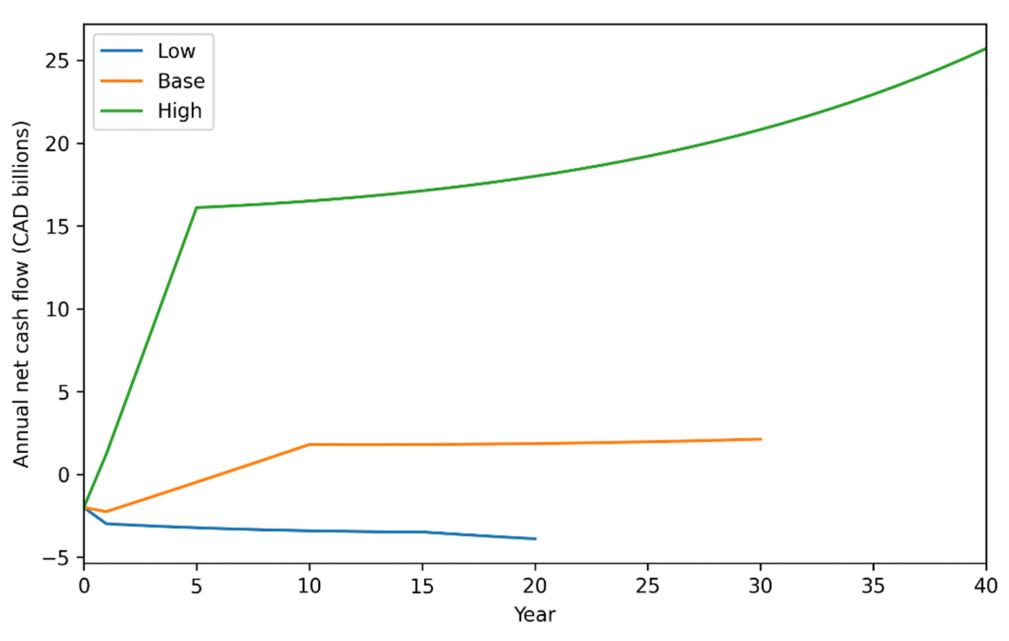

Table 1.
Mathematical Notation Used in the SNPV Model.
| Symbol | Variable | Short explanation |
| SNPV | Scenario-Based Net Present Value | Present value of the net financial effects of restructuring over the analytical horizon. |
| t | Year | Individual year within the analytical period. |
| T | Time horizon | Total number of years included in the analysis. |
| r | Social discount rate | Rate applied to convert future cash flows into present-value terms. |
| Rₜ | Total annual operating revenue | Sum of postal and diversification revenues generated in year t. |
| Rₘₐᵢₗ,ₜ | Letter-mail revenue | Traditional letter-mail revenue in year t. |
| Rₘₐᵢₗ,₀ | Baseline letter-mail revenue | Letter-mail revenue at the beginning of the analysis. |
| gₘ | Letter-mail decline rate | Annual rate of decline in traditional letter-mail revenue. |
| Rₚₐᵣ,ₜ | Parcel revenue | Parcel-delivery revenue in year t. |
| Rₚₐᵣ,₀ | Baseline parcel revenue | Parcel revenue at the beginning of the analysis. |
| gₚ | Observed short-term parcel-revenue decline | Observed recent parcel-revenue decline used as an empirical reference only; not extrapolated over the full analytical horizon. |
| δ | Post-restructuring parcel growth rate | Scenario-specific annual parcel-revenue growth or decline rate used in long-term projections. |
| Rᴮ,ₜ | Postal banking revenue | Revenue generated from postal banking in year t. |
| b | Banking revenue share | Mature postal-banking revenue expressed as a proportion of baseline operating revenue. |
| Rₗₒₐₙ,ₜ | Lending revenue | Revenue generated from the postal-bank lending portfolio in year t. |
| Aᴸ,ₜ | Lending assets | Postal-bank lending asset portfolio in year t. |
| Aᴸ* | Mature lending assets | Scenario-specific target lending portfolio after full ramp-up. |
| λᴮ | Canadian postal-bank market-penetration factor | Proportion of the population-adjusted Japan Post Bank benchmark assumed to be achieved in Canada. |
| Aᴶᴾ,ᶜᴬᴺ | Population-adjusted Japan Post Bank benchmark | Upper-bound Canadian-equivalent lending-asset benchmark derived from Japan Post Bank. |
| NIM | Net interest margin | Net annual return generated from lending assets. |
| Rᴵ,ₜ | Insurance contribution | Insurance-related financial contribution generated in year t. |
| Iᴿ* | Mature insurance revenue base | Scenario-specific insurance revenue base after full ramp-up. |
| mᴵ | Insurance profit margin | Net profit generated as a proportion of insurance revenue. |
| Rᴳ,ₜ | Government-service revenue | Revenue generated from government and community services in year t. |
| Rₚₐₛₛ* | Mature passport-service revenue | Annual passport-service revenue at full implementation. |
| Rᴰ* | Mature driver's-licence revenue | Annual driver's-licence-service revenue at full implementation. |
| Pᵣ | Rural population | Population used to estimate eligible government-service demand. |
| ρₚₐₛₛ | Passport renewal rate | Proportion of the relevant population renewing passports. |
| ρᴰ | Driver's-licence renewal rate | Annual proportion of the relevant population renewing driver's licences. |
| Fᴾ | Passport fee | Fee associated with passport processing. |
| Fᴰ | Driver's-licence fee | Fee associated with driver's-licence processing. |
| ϕₜ | Diversification revenue ramp-up factor | Proportion of mature diversification revenue achieved in year t, ranging from 0 to 1. |
| H | Ramp-up period | Number of years required for diversification revenues to reach their mature values. |
| Sₜ | Automation-related savings | Annual operating-cost savings attributable to automation in year t. |
| α | Automation cost reduction | Estimated proportional reduction in affected parcel-processing costs. |
| β | Parcel-cost share affected by automation | Proportion of baseline operating costs assumed to be subject to automation efficiencies. |
| C₀ | Baseline operating cost | Annual operating expenditure before restructuring. |
| Cₜ | Operating cost after restructuring | Annual operating cost in year t after automation-related savings. |
| I₀ | Initial restructuring investment | Upfront capital expenditure required to initiate restructuring. |
| Iₜ | Annual restructuring investment | Ongoing capital and implementation expenditure in year t. |
Note. Subscript t denotes the value of a variable in year t; subscript 0 denotes a baseline value; and superscript * denotes a mature or target value reached after the applicable ramp-up period. The 17.2% parcel decline (gₚ) is an empirical reference only; long-term parcel projections use δ.
Table 2.
Model variables and assumptions used in the SNPV analysis.
| Category | Variable | Symbol | Value | Source |
| Time Horizon | Low scenario | T1 | 20 years | Assumption |
| Base scenario | T2 | 30 years | Assumption | |
| High scenario | T3 | 40 years | Assumption | |
| Investment | Initial restructuring investment | IO | CAD $2.0 billion | Scenario assumption |
| Annual capital expenditure | It | CAD $2.0 billion annually | Scenario assumption | |
| Discounting | Social discount rate | r | 3% | Boardman et al. (2010); |
| Canada Post | Annual revenue | R0 | $6.33 billion | Canada Post (2024) CUPW (2026) |
| Baseline letter-mail revenue | $2.6 billion | CUPW (2026) | ||
| Baseline parcel revenue | $1.9 billion | CUPW (2026) | ||
| Annual operating cost | C0 | $7.90 billion | Derived from Canada Post (2024) | |
| Annual pre-tax loss | L0 | $1.57 billion | Canada Post (2024) | |
| Annual mail decline | gm | 2.50% | Tahirali (2024) | |
| Observed short-term parcel-revenue decline | gp | -17.20% | Canada Post (2026) | |
| Long-term scenario parameter actually used in the projections | δ | Scenario analysis | Author assumption | |
| Labour share of operating costs | LC | 65% | Canada Post (2024) | |
| Automation | Parcel processing cost reduction | α | 28% | The Globe and Mail (2026) |
| Parcel-cost share (Low) | β1 | 30% | Scenario assumption | |
| Parcel-cost share (Base) | β2 | 40% | Scenario assumption | |
| Parcel-cost share (High) | β3 | 50% | Scenario assumption | |
| Postal Banking | Banking revenue share | b | 5–7% of revenue | Radecki (1999) |
| Lending | Mature Canadian postal-bank lending assets | AL | Low: $21.14B (5%); Base: $105.7B (25%); High: $422.8B (100%); | Population-adjusted from Japan Post Bank [Yamaguchi & Asim, 2025] |
| Annual lending revenue | Rloan,t | Model-derived | Model derived | |
| Net interest margin | NIM | Low: 3%; Base: 3.5%; High: 4% | Wowa (2026) | |
| Scenario-specific mature insurance revenue base | $2.0 billion (low), $4.5 billion (base), and $7.2 billion (high) | Investing Pro (2026) | ||
| Net insurance profit margin | mI | 4–10% | Acera (2026) | |
| Government Services | Rural population | Pr | 17.8–18% | Statistics Canada (2022) |
| Passport fee | FP | $122.50 | Government of Canada (2026) | |
| Driver's licence fee | FD | $75.00 | ICBC (2026) | |
| Passport renewal rate | ρPass | 15–20% | Remitbee (2022) | |
| Driver's licence renewal rate | ρD | 20% annually | Government of British Columbia (2026) | |
| Revenue Adoption | Diversification revenue ramp-up factor | ϕt | 0–1 | Scenario assumption |
| Revenue Adoption | Ramp-up period | H | Low: 15 years; Base: 10 years; High: 5 years | Scenario assumption |
Note. Estimated Canadian postal banking assets and insurance revenues were derived by scaling the reported assets of Japan Post Bank and the reported revenues of Japan Post Insurance according to the relative populations of Japan (123 million) and Canada (40 million). This population-adjustment approach assumes proportional market penetration for illustrative modelling purposes and is evaluated through subsequent sensitivity analyses.
Table 3.
Public-Value Dimensions Used Alongside the SNPV Analysis.
| Public-value dimension | Meaning in the Canada Post context | Principal theoretical/empirical basis |
| Universal accessibility | Maintaining access to postal and public services regardless of geographic profitability | Moore (1995); De Donder (2016) |
| Territorial and regional cohesion | Maintaining national infrastructure and institutional presence across rural, northern, Indigenous, and remote communities | Moore (1995); Le Goff (2005) |
| Equity and social inclusion | Preserving access for rural, elderly, disabled, low-income, and digitally underserved populations | Pindus et al. (2010) |
| Emergency and community resilience | Maintaining infrastructure for medication delivery, emergency communication, and service continuity during crises | Pindus et al. (2010) |
| Government-service accessibility | Using the postal network as an access point for government documents and services | Le Goff (2005) |
| Protection against geographic cream-skimming | Preventing profitable urban markets from being served while high-cost rural areas are abandoned | Eckert (2009) |
Note. The public-value dimensions are assessed qualitatively and are not monetized within the SNPV calculation.
Table 4.
SNPV Scenario Assumptions.
| Variable | Low | Base | High | Source |
| Time horizon (years) | 20 | 30 | 40 | Assumption |
| Discount rate | (3%) | (3%) | (3%) | Boardman et al. (2010) |
| Mail decline | 2.50% | 2.50% | 2.50% | Tahirali (2024) |
| Parcel revenue growth after restructuring | -5% | 2% | 5% | Canada Post (2026) |
| Parcel share affected by automation | 30% | 40% | 50% | Scenario assumption |
| Automation cost reduction | 28% | 28% | 28% | The Globe and Mail (2026) |
| Postal banking revenue | 5% | 6% | 7% | Radecki (1999) |
| Lending assets | $21.14B | $105.7B | $422.8B | Yamaguchi & Asim (2025); author's population adjustment |
| net lending margin | 3.00% | 3.50% | 4.00% | Wowa (2026) |
| Insurance revenue | $2.0B | $4.5B | $7.2B | Investing Pro (2026); author's population adjustment |
| Insurance profit margin | 4% | 7% | 10% | Acera (2026) |
| Passport renewal rate | 15% | 17.50% | 20% | Remitbee (2022) |
| Driver's licence renewal rate | 20% | 20% | 20% | Government of British Columbia (2026) |
| Diversification revenue ramp-up period | 15 years | 10 years | 5 years | Scenario assumption |
Note. An additional automation-only sensitivity case is evaluated separately from the three principal restructuring scenarios. In this case, postal banking, lending, insurance, and government-service revenues are set to zero to isolate the financial effects of automation and operational modernization. Values identified as scenario assumptions are modelling inputs selected to represent plausible low, base, and high conditions under uncertainty; they should not be interpreted as empirically estimated parameters. Their influence on the results is subsequently evaluated through sensitivity analysis.
Table 5.
Illustrative SNPV Estimates for Canada Post Restructuring.
| Scenario | Time Horizon (Years) | SNPV (CAD billions) | Benefit–Cost Ratio |
| Low | 20 | -52.12 | 0.65 |
| Base | 30 | 15.98 | 1.08 |
| High | 40 | 383.26 | 2.66 |
| Automation-only (base-case) | 30 | -56.45 | 0.71 |
Note. SNPV values are expressed in constant Canadian dollars. The automation-only case uses the base-case horizon and assumptions while setting diversification revenues to zero.
Table 6.
Decomposition of Discounted SNPV Components by Scenario.
| Component |
Low PV (CAD B) |
Low share (%) |
Base PV (CAD B) |
Base share (%) |
High PV (CAD B) |
High share (%) |
| Discounted benefits | ||||||
| Parcel revenue | 18.08 | 18.6% | 49.18 | 23.2% | 115.53 | 18.8% |
| Letter-mail revenue | 30.71 | 31.6% | 37.21 | 17.5% | 40.96 | 6.7% |
| Other baseline operating revenue | 27.23 | 28.0% | 35.87 | 16.9% | 42.30 | 6.9% |
| Postal banking revenue | 2.81 | 2.9% | 5.91 | 2.8% | 9.41 | 1.5% |
| Lending revenue | 5.62 | 5.8% | 57.54 | 27.1% | 359.02 | 58.5% |
| Insurance contribution | 0.71 | 0.7% | 4.90 | 2.3% | 15.28 | 2.5% |
| Government-service revenue | 2.13 | 2.2% | 4.08 | 1.9% | 6.04 | 1.0% |
| Automation-related savings | 9.87 | 10.2% | 17.34 | 8.2% | 25.56 | 4.2% |
| Total discounted benefits | 97.17 | 100% | 212.02 | 100% | 614.10 | 100% |
| Discounted costs | ||||||
| Baseline operating costs | 117.53 | 78.7% | 154.84 | 79.0% | 182.61 | 79.1% |
| Initial restructuring investment (I₀) | 2.00 | 1.3% | 2.00 | 1.0% | 2.00 | 0.9% |
| Annual restructuring investment (Iₜ) | 29.75 | 19.9% | 39.20 | 20.0% | 46.23 | 20.0% |
| Total discounted costs | 149.29 | 100% | 196.04 | 100% | 230.84 | 100% |
| Net SNPV | -52.12 | — | 15.98 | — | 383.26 | — |
Note. Present values are discounted over each scenario's analytical horizon. Revenue and automation components are reported as shares of total discounted benefits; operating and restructuring expenditures are reported as shares of total discounted costs. Because SNPV is a net measure, percentage shares are not expressed as percentages of net SNPV.
Table 7.
Discount-Rate Sensitivity Analysis of the Base-Case SNPV.
| Real discount rate (r) | Base-case SNPV (CAD billions) | Change from 3% reference (CAD billions) |
| 1% | 26.47 | +10.49 |
| 3% (reference) | 15.98 | — |
| 5% | 9.17 | -6.80 |
| 7% | 4.67 | -11.30 |
| 10% | 0.52 | -15.46 |
Note. The 3% real social discount rate is the reference case. Only the discount rate is varied; all other base-case assumptions are held constant.
Table 8.
One-Way Parameter Sensitivity Analysis.
| Parameter varied | Low value | Base/reference | High value |
SNPV at low (CAD B) |
SNPV at base (CAD B) |
SNPV at high (CAD B) |
BCR at low | BCR at base | BCR at high |
| Discount rate (r) | 1% | 3% | 10% | 26.47 | 15.98 | 0.52 | 1.10 | 1.08 | 1.01 |
| Automation cost share (β) | 30% | 40% | 50% | 11.64 | 15.98 | 20.31 | 1.06 | 1.08 | 1.10 |
| Banking revenue share (b) | 5% | 6% | 7% | 14.99 | 15.98 | 16.96 | 1.08 | 1.08 | 1.09 |
| Mature lending assets (Aᴸ*) | $21.14B | $105.7B | $422.8B | -30.06 | 15.98 | 188.61 | 0.85 | 1.08 | 1.96 |
| Mature insurance revenue base (Iᴿ*) | $2.0B | $4.5B | $7.2B | 13.26 | 15.98 | 18.92 | 1.07 | 1.08 | 1.10 |
Note. Each parameter is varied individually while all other base-case assumptions are held constant. For the discount-rate row, the reported low and high values are 1% and 10%, respectively, with 3% as the reference case.
Disclaimer/Publisher’s Note: The statements, opinions and data contained in all publications are solely those of the individual author(s) and contributor(s) and not of MDPI and/or the editor(s). MDPI and/or the editor(s) disclaim responsibility for any injury to people or property resulting from any ideas, methods, instructions or products referred to in the content. |
© 2026 by the author. Licensee MDPI, Basel, Switzerland. This article is an open access article distributed under the terms and conditions of the Creative Commons Attribution (CC BY) license.
Copyright: This open access article is published under a Creative Commons CC BY 4.0 license, which permit the free download, distribution, and reuse, provided that the author and preprint are cited in any reuse.