
Submitted:
08 September 2026
Posted:
10 September 2026
You are already at the latest version
Abstract
Introduction: Existing evidence on why children miss vaccines after infancy has focused on the demand side, focusing on the attitudes and circumstances of caregivers. The supply side, meaning the system’s capacity to make vaccines available, accessible, and deliverable, has received less attention, even though it determines whether a willing caregiver can be served. This study examined the supply-side determinants of second-year and newer vaccine uptake in Malawi through a coverage-cascade and bottleneck analysis.
Methods: A mixed-methods study drew on a caregiver survey, a survey of frontline health workers, a facility checklist and data quality assessment, and key-informant interviews at facility, district, and national level. Findings were organised through the Tanahashi coverage framework, which follows the steps from the availability of commodities and staff, through geographic access, to service contact and effective coverage. Supply-side constraints in uptake were profiled at each step and set against the coverage achieved for each antigen.
Results: Effective coverage fell across the antigen sequence, from 95.9 percent for the second dose of measles-rubella vaccine and 93.1 percent for the second dose of polio vaccine, to 74.6 percent for typhoid, to 63 percent for HPV. Commodity availability was high, with cold chain and vaccines present in every checklist facility, and stock records in 47 of 50, yet a quarter of caregivers had been turned away due to stockouts. Human-resource readiness was weaker, with over half of frontline workers never receiving refresher training. Geographic access constrained a fifth of caregivers, and outreach, though present everywhere, was limited by fuel and, in staff accounts, reduced by the 2025 withdrawal of external funding. The bottleneck was not commodity availability but the contact step and the maintenance of frontline capacity. National respondents placed these constraints within a financing system that is partly donor-dependent and fragmented across separate partner plans.
Conclusions: The supply system delivered the established second-year antigens well and faltered for the newer ones and at the point of contact. Sustaining uptake will require protecting stock at the point of need, resourcing outreach, maintaining frontline capacity, and adapting supply for the newer vaccines.
Keywords:
immunisation
; second year of life
; supply side
; coverage cascade
; bottleneck analysis
; Tanahashi
; vaccine stockout
; outreach
; health workforce
; Malawi
1. Introduction
Vaccination coverage depends on both demand and supply side determinants however the two side have not been equally studied, [1]. A coverage figure records how many eligible children and adolescents were reached, without showing which side fell short [2]. The demand side has been mapped in depth. For examples, in sub-Saharan Africa, successive reviews have synthesised the behavioural and social drivers of childhood immunisation, from caregiver knowledge and trust to maternal autonomy and access to information [3,4,5]. The reasons children and adolescents go unvaccinated have themselves been reviewed [6]. The supply side has drawn less attention. It is examined less often as a focus. Reviews of coverage and equity note that supply-side determinants are frequently left out of the analysis altogether [7]. Where the supply side has been studied, the work has usually been confined to one country or tied to a single intervention rather than tracing the delivery pathway as a whole [8,9]. This demonstrates the limited attention paid to one side of factors that affect coverage.
This imbalance matters most for vaccines given after infancy and for the newer antigens now entering national schedules. Over the past decade Malawi has added several such vaccines to its routine schedule. These include the typhoid conjugate vaccine, the human papillomavirus vaccine, a second dose of inactivated polio vaccine and the second dose of measles-rubella vaccine. These vaccines do not ride on the established infant visit. They reach children through outreach, through schools and through repeat contact beyond the first year of life. The evidence on their delivery is thinner than for the infant series. It is scattered across vaccines and countries. It is dominated by accounts of introduction rather than any supply-side map of where uptake is lost after launch [10,11,12,13]. During the same time, Malawi’s health system has faced pressures related to intermittent stockouts, limited transport and fuel for outreach, dependence on external financing, and disruptions linked to the withdrawal of development assistance [14,15,16]. These pressures make the supply side central to understanding whether newer and later-scheduled vaccines can achieve and sustain high uptake.
The evidence in Malawi has not kept pace with these additions. Work on immunisation in the country has centred on coverage levels and on the demand side. Existing work has documented barriers to the second measles dose, including missed opportunities and delayed or cancelled vaccination sessions [17]. This evidence predates the introduction or expansion of newer vaccines such as TCV and HPV, and it does not examine multiple antigens through linked facility, provider and caregiver data [18]. How the supply system performs for the newer and second-year antigens has not been examined. Few studies have traced these vaccines through a supply-side cascade using caregiver, provider, facility and national data together. We therefore set out to examine the supply-side determinants of uptake for newly introduced and second-year vaccines in Malawi. We aimed to locate the steps at which the delivery system narrows, from the availability of commodities and staff, through geographic access and service contact, to effective coverage.
To structure this, we applied the Tanahashi framework [19,20]. The framework represents coverage as a sequence of stages. These run from availability of services, through geographic accessibility and initial contact, to continued use and effective coverage. Each stage is a point at which eligible populations can be lost. The framework has been used to locate coverage losses in immunisation and in broader health services in comparable settings. That work shows a single national or district figure can obscure very different underlying constraints [21,22,23]. We applied it descriptively to the supply side. We used caregiver, provider, facility and key-informant data to distinguish facility-level readiness from point-of-contact availability, geographic access, outreach continuity, workforce capacity and delivery-platform constraints.
2. Methods
2.1. Study Design and Reporting
This study used a mixed-methods design. The quantitative core was cross-sectional and observational. It drew on four datasets, supported by qualitative interviews. The quantitative components are reported in accordance with the Strengthening the Reporting of Observational Studies in Epidemiology guidance [24]. The qualitative component is reported in accordance with the Consolidated Criteria for Reporting Qualitative Research [25,26].
2.2. Data Sources
Four datasets contributed to the cascade:
Caregiver survey: a survey of caregivers of age-eligible children (n=1,177) provided the effective-coverage outcomes and the caregiver-reported experiences of access and contact. Frontline health worker survey: a survey of health surveillance assistants and community immunisation volunteers (n=453) provided the provider account of workforce readiness and outreach. Facility checklist and data quality assessment. Facility-level assessments recorded commodity availability, cold chain, and stock records.
Key-informant interviews: interviews at facility, district, and national level explained the quantitative findings and situated them within the financing system. Two further instruments collected during the same fieldwork, a data-reporting survey of records staff and a health-worker survey on service integration, did not inform this analysis. Effective-coverage estimates are consistent with the companion coverage paper [47], from which the definitive estimates are drawn.
2.3. Setting and Period
The study was conducted from September to October 2025 in three districts of Malawi: Chikwawa in the Southern Region, Kasungu in the Central Region, and Mangochi in the Eastern Zone of the Southern Region. The districts were selected to represent variation in geography, facility density, and history of partner support. Immunisation in these districts is delivered through health facilities and outreach, supported by health surveillance assistants. All analyses were restricted to these three districts. Where facility assessments had also been conducted in other districts, those records were excluded so that every step of the cascade drew on the same three-district frame.
2.4. Populations and Sampling
The caregiver survey enrolled 1394 caregivers across three districts drawn from two of the parent study’s community survey populations which included caregivers of children aged 13-59 months, and caregivers of adolescent girls aged 9-14 years. Coverage outcomes for the present analysis were assessed among the 986 children who were old enough to be due for second-year and are presented in a companion paper [47]. Caregivers were recruited from within the catchment areas of the selected facilities. Of the parent study’s three community-survey populations, two were eligible for the present analysis: caregivers of children aged 13–59 months, and caregivers of adolescent girls aged 9–14 years for the HPV-related items. Caregivers of children and adolescents with non-communicable diseases, the parent study’s third community-survey population, were not included in this analysis.
Eligible caregivers were those aged 18 years or older, who had been residents in the study area for at least six months, and who were the primary caregiver of an age-eligible child. Caregivers with severe cognitive or communication difficulties that precluded them from an interview were excluded.
The target sample size for the parent study’s community survey was calculated using the Cochran formula, assuming 85% as the proportion of children who had received the third dose of the pentavalent vaccine (the proxy indicator for coverage used in the calculation), a 95% confidence level, a 5% margin of error, a design effect of 2, and a 5% allowance for non-response, giving a parent-study target of 1,235 caregivers across all study populations and districts. [sampling method]. The health-worker survey enrolled 453 frontline staff across three districts. These comprised 249 health surveillance assistants and 195 community volunteers. Interviews were conducted at health-facility level for most respondents. The post and the time in that post were recorded for each respondent.
The facility checklist covered 16 facilities. The data quality assessment covered 50 facilities, Facilities were sampled using probability proportional to size, following WHO recommendations to assess between 10 and 50 percent of facilities in the area of interest depending on feasibility [27]. Key-informant interviews were conducted at three levels, with 70 interviews in total. At facility and district level they included health surveillance assistants, facility managers, clinicians, and district officers. At national level they included respondents from the Ministry of Health, the World Health Organization, and a development partner. These national respondents spoke to financing, procurement, and the supply chain. National respondents are attributed by role and institution rather than by name.
2.5. Framework and Measures
In this study, newly introduced vaccines are those added to Malawi’s national routine immunisation schedule within the past decade, as distinct from the long-established infant antigens. These are the human papillomavirus vaccine, launched nationally in January 2019 and taken into the routine schedule in 2021; the typhoid conjugate vaccine, introduced in May 2023 and given routinely at nine months; and the second dose of inactivated polio vaccine, introduced in December 2024. Vaccines after the first year of life are doses scheduled beyond infancy, principally the second dose of measles-rubella vaccine, introduced in 2015 and given at 15 months.
The Tanahashi framework organised the analysis [19,20]. It represents coverage as a sequence of steps, from the availability of commodities and staff, through geographic accessibility, to service contact and effective coverage. The framework was applied descriptively. Each step was operationalised using measures already present in the datasets rather than the framework’s own validated instruments.
Availability had two components. Commodity availability was measured from the facility checklist and data quality assessment as the presence of vaccines, functional cold chain, and maintained stock records. Workforce availability was measured from the health worker survey as training on the newer vaccines, refresher training, supervision, job aids, and access to registers and defaulter lists. Accessibility was measured from the caregiver survey as the distance travelled to the vaccination site, and from the health worker survey as the reach and constraints of outreach. Contact was measured from the caregiver survey as being turned away when a vaccine was unavailable and the convenience of service days, and from the health worker survey as the follow-up of children who missed doses. Effective coverage was measured from the caregiver survey as caregiver-reported receipt of each antigen among the children age-eligible for it, as reported in the companion coverage paper. The second measles-rubella dose and the second inactivated polio dose were assessed among children aged 18 months or older. The typhoid conjugate vaccine was assessed among children aged 9 months or older. HPV was assessed among girls aged 9 to 14 years. Because HPV is delivered mainly through schools rather than the immunisation contacts from which caregivers were sampled, the HPV figure is reported at second hand and should be read as indicative. The companion coverage paper [47]reports the definitive estimates. The analysis foregrounded supply-side determinants while recognising that demand and quality determinants act at the same steps.
2.6. Analysis
Supply-side constraints were summarised as counts and percentages at each step of the cascade, using the dataset appropriate to that step. Effective coverage was taken from the companion coverage paper, in which caregiver-reported receipt of each antigen was calculated among the children age-eligible for that antigen, without sampling weights, with standard errors adjusted for the clustering of children within caregivers. Facility and workforce indicators were summarised overall and by district. Because the datasets were collected in different samples and were not linked at the level of the individual child or facility, the cascade integrates evidence across sources rather than tracing one population through every step. It is therefore a descriptive bottleneck analysis rather than a formally linked estimate of effective coverage. In the integrated bottleneck tables, each step was classified as a relative strength or a constraint by comparing its indicators against the preceding step, with the qualitative evidence used to interpret each classification. Analyses were conducted in R version 4.5.2.
2.7. Qualitative Data Collection and Analysis
The qualitative component was designed to explain the survey findings, with particular attention to the completion gap and the concerns about the newer vaccines. Focus group discussions and key-informant interviews were conducted across the three districts. Focus group discussions were held with caregivers. Key-informant interviews were held with health surveillance assistants, community immunisation volunteers, facility in-charges, nurses, teachers, community leaders, and religious leaders. Trained interviewers used semi-structured guides in the local language. Discussions were audio-recorded, transcribed, and translated into English where necessary.
Transcripts were analysed thematically. A deductive framework was first applied, organised around the quantitative. Codes were grouped into themes, and illustrative quotations were selected to represent each theme. Integration of the two components was achieved through a joint display, in which each quantitative finding was placed alongside the qualitative evidence that helped to explain it.
2.8. Ethical Considerations
Ethical approval was obtained from the College of Medicine Research and Ethics Committee of Malawi, reference P.06/25-1638. All participants provided informed consent. Identifiers were removed before analysis.
3. Results
Figure 1 presents the supply-side bottleneck cascade used to interpret uptake of second-year and newly introduced vaccines. The cascade begins with national financing and procurement, moves through facility-level readiness, geographic access and outreach-point-of contact delivery, and ends with effective antigen coverage. The figure highlights that facility-level readiness was strong, but reliability narrowed downstream at the point of contact, where caregivers experienced stockouts, inconvenient sessions, and fragile outreach. The resulting coverage gradient was highest for established second-year vaccines, lowest for TCV, and lowest for HPV, consistent with weaker supply arrangements for newer or less-established delivery platforms.
3.1. Upstream Financing and Supply Governance
The supply of vaccines begins way beyond the facility, in national budgeting and procurement, and the national accounts described how that upstream tier works and where it is strained. A Ministry of Health respondent described immunization financing as an annual negotiation, in which the programme takes stock of its priorities and then agrees on an amount with the Ministry of Finance. The respondent also described challenges that external funding introduces, since the donor-driven plans cause fragmentation and have to be integrated into a single planning and budgeting framework by the government.
“We have donors and implementing partners that do their separate [and] problematic plan… we are implementing [a] framework, call it one plan one budget.”
(National-level respondent, Ministry of Health, key-informant interview)
Another national partner respondent described the support that keeps the immunization supply chain functioning, which included both the supply chain itself and the staff who manage the data behind it.
“They focus on immunization supply chain so that it is very responsive… [and provide] data clerk consultants to strengthen the data collection.”
(National-level respondent, development partner, key-informant interview)
The respondents located the constraints in the system that funds and supervises them. A national monitoring respondent described supervision, on which the collection of field data depends, as reliant on funded programmes.
“The data we rely on from supervision are a bit tricky because mostly are funded programs. Without them we cannot be able to do so.”
(National-level respondent, Ministry of Health, key-informant interview)
This national tier frames the cascade that follows. The commodities and the supply chain are supported, in part through external funding. The constraints documented downstream sit within a financing system that is partly donor-dependent and only now being drawn into a single plan.
3.2. Facility-Level Commodity Readiness
Facility-level availability of vaccines and equipment was high. Of the facilities that were assessed confirmed the availability of : a functional cold chain, available vaccines, and immunization outreach were recorded. Stock records were maintained in 47 of the 50 facilities in the data quality assessment.
3.3. Point-of-Contact Stock Reliability
Some caregivers (19-36%) reported being turned away from services because the vaccine was not available when they attended. The gap between facility-level availability and caregivers’ experience indicates that stockouts were intermittent rather than chronic, so a facility holding vaccines on the day of assessment did not always mean vaccines were available when a caregiver came to access the service.
“You find vaccines are out of stock when you have already made the journey to come and collect the vaccines. So you go back without it.”
(Health surveillance assistant, key-informant interview, Mangochi)
Stockouts were intermittent rather than absolute, which is why a single-visit assessment did not see them.
“When they run out of stock, they inform us so we should wait. But it usually doesn’t take time for transport to make deliveries of the vaccine.”
(Health Surveilance Assistant, Key Informant Interview, Mangochi)
For the newer antigens the platform itself was the constraint. HPV was delivered through schools by arrangement with teachers, on set dates, with vaccinators given allowances for the day.
“During the HPV campaign, they give them allowances for the day, because they also do it together with the teachers. So they book the teachers, we are coming to vaccinate the girls on this date, and on the said date they go and get vaccinated.”
(EPI coordinator, Key Informant Interview, Mangochi)
“When we come to schools on a set date to conduct immunisation, guardians are already informed, such that some even come to escort the child, because in some cases children may run away from school.”
(Health Surveilance Assistant, Key Informant Interview, Mangochi)
Campaign-to-routine transition. This is the strongest of the emerging points.
“Among the new vaccines, HPV data often shows gaps, especially after transitioning from campaign to routine immunisation, because adolescents are not present at routine outreach clinics.”
(District EPI analysis, Kasungu
Health-passport discontinuity. Your tracing story is not only funds and fuel; it is also a record that does not follow the child.
“Parents frequently present with a different health passport each month, making it difficult to trace a child’s vaccination history.”
(District EPI analysis, Kasungu
3.4. Workforce Readiness and Maintenance
The frontline workforce was in place, but its readiness and capacity to deliver were uneven, as shown in Table 1. Training on the newer vaccines, access to registers and defaulter lists, and regular supervision were reported by most workers, and follow-up of points where the delivery system failed to serve eligible children was frequent. The clearest gap was in the maintenance of capacity, because more than half of workers in every district had never received refresher training on immunization and defaulter tracing. Thus, the system depended on frontline workers to generate contact through defaulter follow-up; more than half of them had not received the refresher training needed to keep this work aligned with current tracing practices.
In contrast qualitative evidence demonstrated that facility readiness was high, but the workforce behind it was fragile. Training tended to be a single event rather than a maintained competence, and establishments were thin.
“Constant and refresher training for EPI staff is needed.”
(Nurse, key-informant interview, Chikwawa)
“I am the only person working as a data clerk, so sometimes I do hire people who are not trained to help me, which is not right.”
(Data clerk, key-informant interview, Kasungu)
Staff shortages at under-five clinics were reported to stop health passports being screened for missed doses, so missed opportunities went unnoticed.
“Shortage of staff at under-five clinics prevents them from scrutinising health passports for missed doses.”
(Nurse, key-informant interview, Kasungu)
3.5. Outreach and Geographic Accessibility
Geographic access limited a substantial minority and did so unevenly across districts, with 9% to 38% of the participants living more than five kilometres from the facility across the districts. Seventy-two percent of the health service providers named transport as the single largest barrier to community mobilisation, ahead of materials, and community engagement, as shown in Table 2. Outreach is the supply-side response to distance. It was widely provided, since immunization outreach was recorded in all 16 checklist facilities. Its continuity was the weak point, because the interviews described outreach as constrained by fuel, and district staff linked a recent reduction in outreach to the withdrawal of external funding.
“The availability of a motorcycle has helped us but the challenge is fuel.”
(Health surveillance assistant, key-informant interview, Chikwawa)
“In the rainy season some areas became impassable across rivers, and outreach transport was not always provided, so workers relied on personal means or borrowed equipment.
“Some locations become unpassable due to rivers during the rainy season, leading to failure to reach everyone; transport is not always provided.”
(Health Surveillance assistant, Key informant interview, Kasungu)
3.6. Delivery Platform Constraints for Newer Antigens
The contact step was where the supply cascade narrowed most, as stockouts limited access to services. Between, 8 and 20% of the caregivers reported service hours as being inconvenient for them across districts for health facilities that did not offer immunization services throughout the week. Reminder and follow-up systems relied mainly on direct and labor-intensive methods. Home visits were the most common approach, used by 43-61% of providers across districts, followed by child health passports or appointment cards, reported by 37-56%. Community announcements were used by about one-third of providers in each district. These methods show that contact generation was not automated but depended on staff, time, mobility, community networks, and paper-based tracking. For newer and later-schedule vaccines, such as TCV and HPV, this reliance on manual follow-up makes uptake vulnerable to the same workforce, transport, and outreach constraints identified elsewhere in the cascade.
HPV depends on parental consent, so a girl is missed when a parent refuses or is absent, a bottleneck unique to the school platform (EPI coordinator, Mangochi).
Integrated bottleneck analysis
Table 3 sets the supply-side constraints on uptake against the steps of the cascade, and it locates the bottleneck. Commodity availability at the facility was not the constraint, because it was high. The constraints sat at the point of contact, where stockouts and inconvenient or refused sessions turned willing caregivers away, at the maintenance of the workforce, where refresher training was largely absent, and at the continuity of outreach, where distance was met by a service that fuel and funding made fragile. These constraints fell hardest on the newer antigens, which depend on supply arrangements that are not yet as established as those for the routine second-year doses.
4. Discussion
4.1. Principal Findings
The main finding of this study is that the supply side constraint for second-year and newer vaccines uptake in these districts was not the presence of vaccines in facilities, but the system’s ability to sustain reliable contact with eligible children and adolescents. Based on the Tanahashi framework, the cascade did not fail primarily at nominal availability; it narrowed downstream after availability where services had to be geographically accessible, predictably open, stocked at the point of delivery, and supported by a workforce able to trace and follow up missed doses [19,28]. This treats availability as a condition to be sustained rather than merely documented, consistent with effective-coverage cascades in which input readiness sets an upper limit on, but does not determine, coverage actually achieved [29]. This is an important distinction because facility-level readiness indicators can overstate effective supply when they do not capture intermittent stockouts, cancelled or inconvenient sessions [29,30].
The pattern observed here aligns with immunization bottleneck studies in Ghana and Uganda, where losses in effective coverage were linked to constraints beyond basic service availability, including access, utilization, and service continuity [21,22,23]. It also aligns with broader evidence that vaccine stock-outs are associated with lower immunization coverage in low- and middle-income countries [14]. The coverage gradient from established second-year antigens to TCV and HPV suggests that newer vaccines are particularly vulnerable when their delivery requirements have not yet been fully routinised through staff training, logistics, school or community platforms, recording tools, and outreach financing [10,11,12,30]. The principal finding is therefore that vaccine introduction and facility-level availability are necessary but insufficient: uptake depends on maintaining the delivery system that converts supply into actual vaccination at the point of need.
4.2. From Facility Availability to Point-of-Contact Reliability
The study findings demonstrate a mismatch between facility-level availability and point-of-contact reliability. Facilities appeared well supplied when assessed, yet caregivers still reported being turned away because the vaccine was unavailable on the day they attended the session. Such failures are easy to miss in facility readiness assessments, which capture whether vaccines are present on the day of observation but not whether they are consistently available across sessions, outreach days, or different points of care. For caregivers, however, intermittent stockouts are experienced as service failure. A wasted journey imposes time and transport costs, weakens confidence in the service, and may reduce the likelihood of returning, especially where distance and opportunity costs are already high. In these districts, 19 to 36 percent of caregivers reported being turned away even though facilities were recorded as holding vaccines. The two findings are not in conflict. A single-visit assessment cannot capture the intermittent stockouts that caregivers meet across sessions and outreach days.
This interpretation is consistent with coverage-cascade and bottleneck analyses in other settings, which show that losses in immunization coverage often occur after nominal service availability, at the stages of access, contact, continued utilization, and effective coverage [19,21,22,23]. It also aligns with supply-chain evidence from low- and middle-income countries showing that vaccine stockouts are associated with lower immunization coverage [14], and with broader assessments of immunization supply systems that identify stock reliability, outreach costs, transport, and recurrent operating inputs as persistent constraints. The contribution of this study is to show how these general supply-side vulnerabilities appear for second-year and newer vaccines in Malawi: the system was able to make vaccines available at facilities, but less able to guarantee that eligible children and adolescents would encounter a stocked, dependable service when they came for vaccination.
4.3. Workforce Maintenance and Contact Generation
This study shows that contact for second-year and newly introduced vaccines is not generated automatically once vaccines and staff are present at a facility. It depends on a maintained frontline workforce able to identify missed doses, communicate schedule changes, mobilize caregivers, and follow up children and adolescents who do not attend the scheduled sessions. In these districts, workers were generally available, and many had received orientation training at introduction, but refresher training was limited. In every district more than half, 53 to 55 percent, had never received it. This matters because later-scheduled and newly introduced antigens impose demands beyond those of the first year of immunization including revised eligibility criteria, updated registers and defaulter forms, counselling of caregivers of older children, and coordination with outreach and school-based platforms [31,32,33]. Where these functions lapse, the result is missed opportunities for vaccination, which remain common in African programmes and track health-worker knowledge and service organization rather than vaccine unavailability alone [30].
Evidence from low- and middle-income settings indicates that supportive supervision, refresher training, and reliable recording tools sustain service quality and make defaulter tracing feasible [29,34,35,36,37]. The same pattern is evident for later doses regionally, where default on the 24-month RTS,S dose in Ghana was attributed to provider communication and follow-up gaps [38]. Similar in Malawi, weak HPV recording tools and target enumeration produced unreliable coverage estimates and stockouts [39].The bottleneck is therefore not a shortage of frontline workers but insufficient maintenance of the functions that generate contact, which for these antigens means treating refresher training, supervision, and defaulter tracing as core supply-side inputs.
Defaulter tracing was further undermined by the record itself. Frontline staff reported that caregivers often presented a different health passport each month, so a child’s vaccination history could not be reconstructed and missed doses could not be identified (district EPI analysis, Kasungu). Tracing is usually framed as a problem of workforce time and outreach cost, but this finding adds a further constraint, namely that the document meant to follow the child does not. Where the record is discontinuous, even a well-supervised worker cannot see who has defaulted, so contact generation fails before a home visit is attempted [30,39].
4.4. Outreach, Access, and Financing Fragility
Outreach was the main supply-side mechanism for overcoming distance, and its presence across the assessed facilities indicated that the program had the right access strategy. Its weakness was continuity. Interviews described outreach as dependent on fuel or other modes of transport that were not always available, consistent with costing evidence that recurrent operating inputs, rather than vaccine costs, largely determine whether outreach sessions function as planned [40,41]. Staff also linked reduced outreach and supervision to the 2025 withdrawal of external funding. Since this evidence is qualitative and we lack before-and-after measures of outreach volume, it cannot show that coverage fell because funding was withdrawn; it shows that outreach response to distance rests on inputs that are exposed when external support contracts. Access therefore remained conditional even where services formally existed; outreach reduces travel time only if sessions are predictable, staffed supplied and resourced, and when fuel shortages interrupt them the access barrier reappears, particularly for later-scheduled doses requiring caregivers to return after the first year, and for school-based HPV delivery [10,38] Geographical access is thus not solved by the mere scheduling of outreach sessions, but only where the session is financed and regular enough to create dependable contact. Across the districts, 9 to 38 percent of caregivers lived more than five kilometers from a facility. Transport was the single largest provider barrier, at 72 percent. The outreach that answers distance is therefore the most exposed link in the chain.
The financing accounts explain why this access mechanism was fragile. Immunization financing was described as negotiated annually with the Ministry of Finance, fragmented across donor and implementing-partner plans, and only partly consolidated through a single planning and budgeting framework, with supply-chain functions and parts of the data workforce externally supported. This mirrors wider concerns about donor dependence and transition risk in immunization systems [41,42,43] sharpened by the 2025 contraction in development assistance [44]. The field-level fragility of outreach and supervision was therefore not only a local operational problem but a structural feature of a financing model in which core delivery functions depend on external, sometimes fragmented, support. Whether Malawi’s move toward one plan and domestic financing reduces or entrenches this fragility will determine whether outreach remains a reliable access strategy.
4.5. Implications of Newer-Vaccines
The findings suggest that Malawi’s immunisation system can introduce vaccines, but sustaining uptake depends on whether supply-side functions remain reliable at the point where eligible children and adolescents encounter the service. Established second-year antigens benefit from mature delivery routines, whereas TCV, a first-year antigen introduced in 2023 through an integrated campaign with follow-on routine delivery, relies on school-based platforms [26,39,45] (https://pubmed.ncbi.nlm.nih.gov/39633851)n with follow-on routine delivery and the HPV, relies on school-based platforms [26,39,45].Each newer antigen adds supply requirements including cold-chain volume and storage [46],recording tools and revised registers, and training session planning, and for HPV coordination with the education sector beyond routine child immunization [32,47]
The coverage gradient therefore cautions that vaccine introduction is not equivalent to delivery; post-introduction evaluations in Malawi and comparable settings show that uptake of newly introduced antigens depends on how far these arrangements were established and maintained [47] Newer antigens require deliberate strengthening of their specific supply arrangements rather than an assumption that the existing system will absorb it.
A distinct weakness emerged where a vaccine moved from campaign to routine delivery. District respondents reported that HPV data showed gaps once the vaccine shifted from its launch campaign into routine immunisation, because adolescent girls are not present at the routine outreach clinics that serve infants. The model that reached girls during a time-bound, school-based campaign was not rebuilt for continuous delivery, a difficulty documented in HPV programmes elsewhere and in Malawi’s own experience of unreliable HPV recording and enumeration [39,45]. For antigens introduced by campaign, coverage is therefore likely to decline as the campaign infrastructure is withdrawn, unless the routine platform is deliberately adapted to the eligible age group.
HPV delivery also carried a requirement absent from infant immunisation. It depends on parental consent,
4.6. Program and Policy Implications
The coverage framework helps direct investment toward the points In the delivery pathway where the system is narrowing. For sustained vaccine uptake, stock reliability must be protected at the point of delivery, not only documented at facility level. This means strengthening buffer stocks, session-level stock planning, real-time stock monitoring, and rapid redistribution between facilities so that vaccines are available when caregivers attend sessions. Dependable vaccination sessions are equally important: willing caregivers should not be turned away because vaccines, staff, or sessions are unavailable on the day they seek care. For the workforce, the priority is to institutionalise refresher training and supportive supervision, especially for staff responsible for defaulter tracing, caregiver communication, and follow-up under evolving vaccine schedules. For geographic access, outreach should be treated as a core delivery function rather than an optional activity; this requires secured funding for fuel, transport, supervision, and community mobilisation, so that services reaching distant communities are not disrupted by external financing shocks. For newer antigens, program planning should recognize that each vaccine may require distinct supply arrangements, including specific recording tools, delivery platforms, training needs, and coordination mechanisms. The implication is that vaccine introduction should not end at procurement or launch. It should include sustained investment in the operational systems that convert vaccine availability into reliable vaccination at the point of need.
4.7. Strengths and Limitations
The key strength of this study is the mixed-methods study design which enabled supply-side constraints to be examined from several complementary perspectives. By combining data from caregivers, frontline providers, facility assessments, district-level respondents, and national level informants, the study was able to compare how constraints appeared across different levels of the immunization system, form national financing and procurement, to point-of-contact service delivery. The use of the Tanahashi framework provided a structured approach to identifying bottlenecks along the pathway, allowing analysis to move beyond overall coverage estimates and to identify where eligible children and adolescents were most likely to be lost before receiving vaccines. Another strength is the inclusion of a diverse set of antigens including established second-year vaccines, newer vaccines, as well as vaccines delivered through different vial presentations and delivery platforms. This allowed the study to assess whether supply-side constrains differed by vaccine type, and to generate findings that may be relevant to other vaccines with similar delivery requirements.
Several limitations should be acknowledged. First, the four data sources were collected in different samples and in some cases, different districts. The cascade therefore integrates evidence across complementary sources rather than following the same individuals, facilities, or districts through each step. As a result, it should be interpreted as descriptive bottleneck analysis rather than a formally linked estimate of effective coverage. Second, vaccination status and caregiver experiences of suwere self-reported and may be affected by recall or reporting bias. he HPV estimate should be interpreted with caution, because HPV vaccination is delivered through school-based platforms rather than routine immunization contacts, making it less directly comparable with other antigens. Third, facility availability of supplies was assessed at a single point in time and may therefore underestimates intermittent stock-outs or session-level stock gaps that occur between assessment visits. Fourth, the cross-sectional design limits causal inference; the supply-side constraints identified here are associated with where the cascade narrows, but the study cannot demonstrate that they caused specific missed vaccinations. Fifth, the funding-withdrawal theme was based on qualitative accounts from a small number of informants and should be interpreted as evidence of perceived program vulnerability rather than a measured effect of funding changes. Finally, supply-side, demand-side, and quality-related constraints often operate at the same cascade steps. This analysis purposely foregrounded the supply-side determinants and therefore does not estimate their relative contribution compared with demand-side factors examined elsewhere.
Immunisation records were also inconsistent across sites, with separate registers for local and visiting children, which were reported to produce mismatches between recorded and administered doses (district EPI analysis, Kasungu). This may affect the denominators underlying coverage and reinforces the reading of the cascade as descriptive rather than exact [27,39].
5. Conclusions
In these districts of Malawi, the supply side of second-year and newer vaccine uptake appeared strong at the level where it is commonly measured, but weaker at the point where it most directly determines where eligible children and adolescents are vaccinated. Vaccines, cold chain capacity, stock records, and outreach services were largely available at facilities, yet caregivers still reported being turned away when they sought vaccination. This indicates that the main bottleneck was not facility-level availability, but reliability of service delivery at the point of contact. Outreach services which are essential for reaching distant communities were vulnerable to fuel, transport and funding constraints, while frontline capacity was weakened by limited refresher training. Coverage declined from established second-year antigens to newer vaccines, sustained investment in delivery systems after launch. Improving uptake after the first year of life will therefore require protecting stock at the point of delivery, ensuring dependable vaccination sessions, consistently financing outreach, maintaining frontline workforce capacity, and strengthening the specific supply arrangements each newer vaccine requires. The message is therefore encouraging but conditional. Vaccine introduction is not the same as delivery. Uptake beyond infancy will hold only where the point of contact, and the workforce that sustains it, are financed and maintained.
Author Contributions
Conceptualization, B.S.L., A.S, E.M, S.B, L.D, B.M, B.H.L, A.M, H.C, A.P, J.R.Q, T.M, P.O.N, A.L.P.N, C.P, C.N, J.B, M.C, B.M, H.C, C.P, V. S, JP. Methodology, B.S.L. and J.P.; formal analysis, B.S.L., S.B., LD,V.S,H.K Investigation, B.S.L., A.S, E.M, S.B, L.D, B.M, B.H.L, A.M, H.C, A.P, J.R.Q, T.M, P.O.N, A.L.P.N, C.P, C.N, J.B, M.C, B.M, H.C, C.P, V. S, JP. Data curation BS.L., L.D., S.B., E.M.,A.M., A.P., H.CHA; Original draft preparation, B.S. L, E.M., B.H.L Writing, B.S.L., A.S, E.M, S.B, L.D, B.M, B.H.L, A.M, H.C, A.P, J.R.Q, T.M, P.O.N, A.L.P.N, C.P, C.N, J.B, M.C, B.M, H.C, C.P, V. S, JP. Reviewing and editing B.S.L., A.S, E.M, S.B, L.D, B.M, B.H.L, A.M, H.C, A.P, J.R.Q, T.M, P.O.N, A.L.P.N, C.P, C.N, J.B, M.C, B.M, H.C, C.P, V. S, JP. all authors; supervision, J.P. Funding J.C., A.L.P.L-N. All authors have read and agreed to the published version of the manuscript.
Funding
This research was funded by Gavi, the Vaccine Alliance, through the United Nations Children’s Fund (UNICEF) and implemented with support from the UNICEF Malawi Country Office.
Institutional Review Board Statement
The study was conducted in accordance with the Declaration of Helsinki and approved by the College of Medicine Research Ethics Committee of Malawi, approval number P.06/25-1638 on 16th July 2025.
Informed Consent Statement
Written informed consent was obtained from all study participants.
Data Availability Statement
Data is available upon request.
Acknowledgments
The authors thank the caregivers, health workers, and district staff who gave their time.
Conflicts of Interest
The authors declare no conflicts of interest.
Ethics approval and consent to participate
The study was approved by the College of Medicine Research and Ethics Committee (COMREC) of Malawi (approval reference P.06/25-1638). All participants provided informed consent.
References
- Phillips DE, Dieleman JL, Lim SS, et al. Determinants of effective vaccine coverage in low and middle-income countries: a systematic review and interpretive synthesis. BMC Health Serv Res; 17. Epub ahead of print 26 September 2017. [CrossRef]
- Patel C, Rendell N, Sargent GM, et al. Measuring National Immunization System Performance: A Systematic Assessment of Available Resources, www.ghspjournal.org (2023).
- Christian E, Tinessia A, Zhu J, et al. Behavioural and social drivers of childhood immunisation uptake in sub-Saharan Africa: A rapid qualitative review. Vaccine; 88. Epub ahead of print 13 August 2026. [CrossRef]
- Dzinamarira T, Mano O, Musuka G, et al. Prevalence and determinants of full immunization among children under five in sub-Saharan Africa: A systematic review and meta-analysis (2013–2025). Vaccine; 75. Epub ahead of print 7 March 2026. [CrossRef]
- Van Heemskerken PG, Decouttere CJ, Broekhuizen H, et al. Understanding the complexity of demand-side determinants on vaccine uptake in sub-Saharan Africa. Health Policy Plan 2022; 37: 281–291.
- Périères L, Séror V, Boyer S, et al. Reasons given for non-vaccination and under-vaccination of children and adolescents in sub-Saharan Africa: A systematic review. Hum Vaccin Immunother; 18. Epub ahead of print 2022. [CrossRef]
- Allorant A, Bergen N, Danovaro-Holliday MC, et al. Assessing Geographic Inequalities in Childhood Immunisation Coverage: A Critical Scoping Review of Spatial Analysis Methods. Vaccines 2026; 14: 572.
- Excler JL, Privor-Dumm L, Kim JH. Supply and delivery of vaccines for global health. Curr Opin Immunol 2021; 71: 13.
- Eboreime E, Abimbola S, Bozzani F. Access to Routine Immunization: A Comparative Analysis of Supply-Side Disparities between Northern and Southern Nigeria. PLoS One; 10. Epub ahead of print 1 December 2015. [CrossRef]
- Nyaku M, Wardle M, Eng J Vanden, et al. Immunization delivery in the second year of life in Ghana: the need for a multi-faceted approach. Pan Afr Med J 2017; 27: 4.
- Gallagher KE, Howard N, Kabakama S, et al. Lessons learnt from human papillomavirus (HPV) vaccination in 45 low- and middle-income countries. PLoS One; 12. Epub ahead of print 1 June 2017. [CrossRef]
- Tsu VD, LaMontagne DS, Atuhebwe P, et al. National implementation of HPV vaccination programs in low-resource countries: Lessons, challenges, and future prospects. Prev Med (Baltim); 144. Epub ahead of print 1 March 2021. [CrossRef]
- Fousseni S, Ngangue P, Barro A, et al. Navigating the Road to Immunization Equity: Systematic Review of Challenges in Introducing New Vaccines into Sub-Saharan Africa’s Health Systems. Vaccines; 13. Epub ahead of print 1 March 2025. [CrossRef]
- Lee D, Lavayen MC, Kim TT, et al. Association of vaccine stockout with immunisation coverage in low-income and middle-income countries: a retrospective cohort study. BMJ Open; 13. Epub ahead of print 31 July 2023. [CrossRef]
- UNICEF. Immunization Supply Chain Interventions. New York, 2020.
- Sriram S. Financing the transition: a roadmap for sustaining disease control in low- and middle-income countries after the 2025 contraction in development assistance for health. Front Heal Serv; 6. Epub ahead of print 19 August 2026. [CrossRef]
- Chirwa G, Wilkins KA, Mercer DJ. Descriptive study of measles vaccination second dose reporting and barriers to improving coverage in six districts in Malawi. Pan Afr Med J; 35. Epub ahead of print 2020. [CrossRef]
- World Health Organization, UNICEF. WHO and UNICEF Estimates of National Immunization Coverage: Malawi, 2025 Revision.
- Tanahashi T. Health service coverage and its evaluation. Bull World Health Organ 1978; 56: 295.
- O’Connell S. Thomas, Sharkey Alyssa. Reaching Universal Health Coverage through District Health System Strengthening: Using a modified Tanahashi model sub-nationally to attain equitable and effective coverage. December 2013. Epub ahead of print December 2013. [CrossRef]
- Yawson AE, Bonsu G, Senaya LK, et al. Regional disparities in immunization services in Ghana through a bottleneck analysis approach: implications for sustaining national gains in immunization. Arch Public Health; 75. Epub ahead of print 13 March 2017. [CrossRef]
- Sheff MC, Bawah AA, Asuming PO, et al. Evaluating health service coverage in Ghana’s Volta Region using a modified Tanahashi model. Glob Health Action; 13. Epub ahead of print 31 December 2020. [CrossRef]
- Henriksson DK, Fredriksson M, Waiswa P, et al. Bottleneck analysis at district level to illustrate gaps within the district health system in Uganda. Glob Health Action 2017; 10: 1327256.
- von Elm E, Altman DG, Egger M, et al. The Strengthening the Reporting of Observational Studies in Epidemiology (STROBE) statement: guidelines for reporting observational studies. J Clin Epidemiol 2008; 61: 344–349.
- Tong A, Sainsbury P, Craig J. Consolidated criteria for reporting qualitative research (COREQ): a 32-item checklist for interviews and focus groups. Int J Qual Heal care J Int Soc Qual Heal Care 2007; 19: 349–357.
- Debellut F, Bello G, Chisema M, et al. Cost of the typhoid conjugate vaccine introduction through an integrated campaign and follow-on routine immunization in Malawi. Vaccine X; 21. Epub ahead of print 1 December 2024. [CrossRef]
- World Health Organization. Data Quality Assurance (DQA). https://www.who.int/data/data-collection-tools/health-service-data/data-quality-assurance-dqa (2021).
- Mmanga K, Mwenyenkulu TE, Nkoka O, et al. Tracking immunization coverage, dropout and equity gaps among children ages 12-23 months in Malawi—bottleneck analysis of the Malawi Demographic and Health Survey. Int Health 2022; 14: 250–259.
- Bello IM, Lebo E, Shibeshi ME, et al. Implementation of integrated supportive supervision in the context of coronavirus 19 pandemic: its effects on routine immunization and vaccine preventable surveillance diseases indicators in the East and Southern African countries. Pan Afr Med J; 38. Epub ahead of print 2021. [CrossRef]
- Jaca A, Mathebula L, Iweze A, et al. A systematic review of strategies for reducing missed opportunities for vaccination. Vaccine 2018; 36: 2921–2927.
- Wang SA, Hyde TB, Mounier-Jack S, et al. New vaccine introductions: Assessing the impact and the opportunities for immunization and health systems strengthening. Vaccine; 31. Epub ahead of print 18 April 2013. [CrossRef]
- Guignard A, Praet N, Jusot V, et al. Introducing new vaccines in low- and middle-income countries: challenges and approaches. Expert Rev Vaccines 2019; 18: 119–131.
- Masresha BG, Dochez C, Bwaka A, et al. Immunisation program training needs in 9 countries in the African Region. Pan Afr Med J; 39. Epub ahead of print 2021. [CrossRef]
- Magoola J, Aksnes BN, Ampeire I, et al. Community-Led Defaulter Tracking for Catch-Up Vaccination: Implementation Experience in Uganda, 2022 and 2024. Vaccines; 14. Epub ahead of print 1 June 2026. [CrossRef]
- Jalloh MF, Namageyo-Funa A, Gleason B, et al. Assessment of VaxTrac electronic immunization registry in an urban district in Sierra Leone: Implications for data quality, defaulter tracking, and policy. Vaccine 2020; 38: 6103–6111.
- Shibeshi ME, Masresha BG, Daniel F. Immunisation program reviews in East and Southern Africa (2012-2018): key lessons. Pan Afr Med J; 38. Epub ahead of print 22 February 2021. [CrossRef]
- Oyo-Ita A, Oduwole O, Arikpo D, et al. Interventions for improving coverage of childhood immunisation in low- and middle-income countries. Cochrane database Syst Rev; 12. Epub ahead of print 6 December 2023. [CrossRef]
- Okyere J, Bediako VB, Ackah JA, et al. RTS,S/AS01E vaccine defaults in Ghana: a qualitative exploration of the perspectives of defaulters and frontline health service providers. Malar J; 22. Epub ahead of print 1 December 2023. [CrossRef]
- Hausi H, Nicks P, Mzengeza T, et al. The challenge of identifying eligible girls for HPV vaccination: HPV mapping data verification in Malawi. Vaccine 2022; 40: A49–A57.
- Menzies NA, Suharlim C, Geng F, et al. The cost determinants of routine infant immunization services: a meta-regression analysis of six country studies. BMC Med; 15. Epub ahead of print 6 October 2017. [CrossRef]
- Vaughan K, Clarke-Deelder E, Tani K, et al. Immunization costs, from evidence to policy: Findings from a nationally representative costing study and policy translation effort in Tanzania. Vaccine 2020; 38: 7659–7667.
- Saxenian H, Alkenbrack S, Freitas Attaran M, et al. Sustainable financing for Immunization Agenda 2030. Vaccine 2024; 42: S73–S81.
- Chompolola A, Chama-Chiliba CM, Simuyemba MC, et al. Fiscal space for the immunisation program in Zambia- an efficiency analysis approach. BMC Res Notes; 17. Epub ahead of print 1 December 2024. [CrossRef]
- Stover J, Sonneveldt E, Tam Y, et al. Effects of reductions in US foreign assistance on HIV, tuberculosis, family planning, and maternal and child health: a modelling study. Lancet Glob Heal 2025; 13: e1669–e1680.
- Rosen JG, Guillaume D, Mlunde LB, et al. Feasibility and sustainability of a school-based platform for integrated delivery of HPV vaccination with adolescent health services in Tanzania: qualitative insights from stakeholders. Health Policy Plan 2023; 38: 486–495.
- Wedlock PT, Cox SN, Bartsch SM, et al. Should countries switch to using five- or ten-dose rotavirus vaccines now that they are available? Vaccine 2021; 39: 4335–4342.
- Gallagher KE, Erio T, Baisley K, et al. The impact of a human papillomavirus (HPV) vaccination campaign on routine primary health service provision and health workers in Tanzania: a controlled before and after study. BMC Health Serv Res; 18. Epub ahead of print 12 March 2018. [CrossRef]
- Laher BS, Chinkonde JR, Malata E, Barnaba S, Banda J, Lungu H, et al. High Second Year Immunisation Coverage Alongside Persistent Newer Vaccine Hesitancy: A Mixed-Methods Study in Three Districts of Malawi. Submitted to Vaccines. 2026.
Figure 1.
Supply-side bottleneck cascade for second-year and newly introduced vaccines in Malawi.
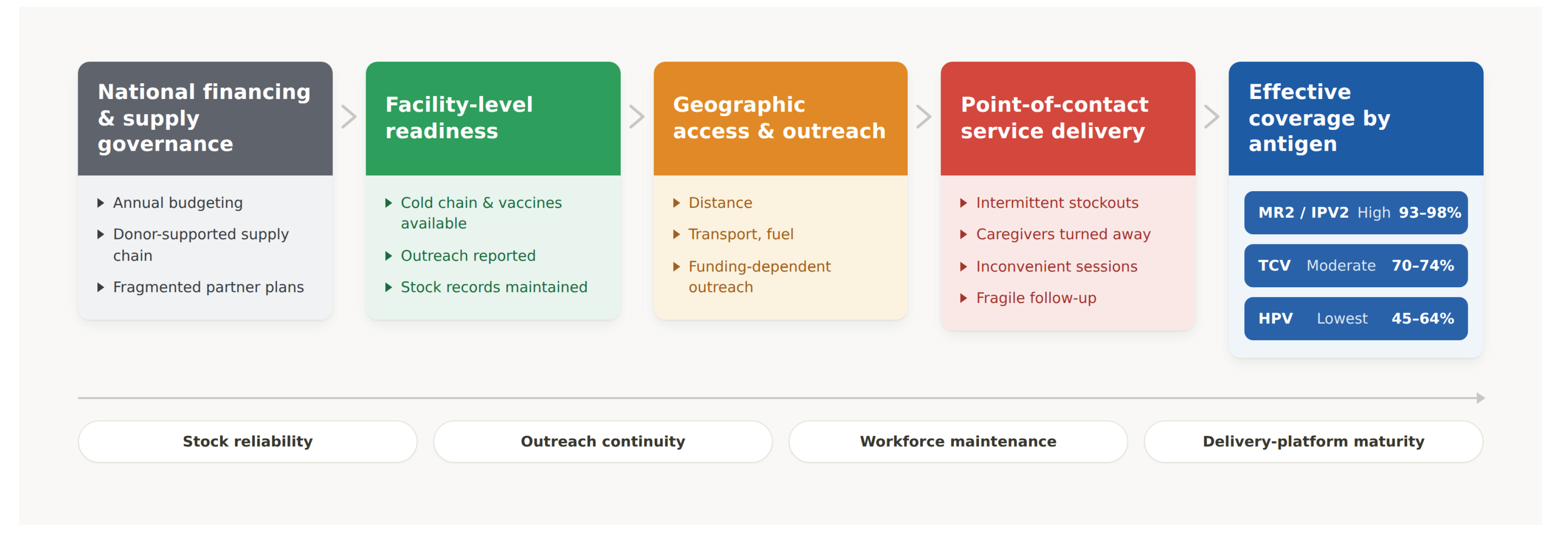

Table 1.
Provider-reported supply capacity, by district.
| Element | Chikwawa | Kasungu | Mangochi |
| Trained on the newer vaccines | 71.1% | 83.4% | 87.9% |
| Information materials or job aids | 62.3% | 59.1% | 78.8% |
| Access to registers or defaulter lists | 69.1% | 65.8% | 81.8% |
| Regular supervision and supplies | 78.4% | 72.5% | 87.9% |
| Never received refresher training | 53.1% | 52.8% | 54.5% |
| Monthly follow-up of missed doses | 62.7% | 74.6% | 69.7% |
Table 2.
Provider-reported constraints to community mobilization (n = 453).
| Constraints | Percentage of providers |
| Transport | 72% |
| Lack of materials | 30% |
| Low community engagement | 25% |
| Financial capability to conduct mobilization | 23% |
| Lack of training | 16% |
| Too busy with other work | 9% |
Table 3.
Integrated supply-side bottleneck analysis across the immunisation delivery cascade.
| Cascade step | Quantitative evidence | Qualitative evidence | Bottleneck | Relevance for newer vaccines |
| National financing and supply | Annual budget negotiation; donor and partner plans being drawn into one plan; supply-chain and data staff partner-supported | Supervision and data functions depend on funded programmes (national KII, Ministry of Health) | Supported, but partly donor-dependent and fragmented | Sustained delivery of newer vaccines depends on external financing and coordination |
| Availability, commodities | Functional cold chain, available vaccines and outreach recorded in all 16 checklist facilities; stock records maintained in 47 of 50 | Stock runs out and staff wait for resupply (HSA, Mangochi) | High at facility on the assessment day, intermittent at the point of need | Newer antigens need reliable stock at the point of contact, not only on audit day |
| Availability, workforce | Trained on newer vaccines 71–88%; regular supervision 73–88%; never received refresher training 53–55% | Training is a one-off, refresher rare, establishments thin (nurse, Chikwawa; data clerk, Kasungu) | Present but not maintained | Newer schedules require updated knowledge, which refresher gaps erode |
| Accessibility and outreach | 9–38% live over 5 km; transport the largest provider barrier at 72%; outreach in all 16 checklist facilities but fuel-constrained and reduced by funding withdrawal | Rivers impassable in the rains, outreach transport not always provided (HSA, Kasungu) | Distance met by fragile outreach | Affects later doses and school and community platforms |
| Contact | Turned away 19–36%; inconvenient service hours 8–20%; reminders labour-intensive (home visits 43–61%, passports or cards 37–56%) | Caregivers turned away after making the journey (HSA, Mangochi); HPV depends on parental consent (EPI coordinator, Mangochi) | The narrowest step; unreliable point-of-contact availability | Undermines uptake despite attendance; TCV and HPV sit on weaker, manual channels |
| Effective coverage (endpoint) | MR2 95.9%, IPV2 93.1%, TCV 74.6%, HPV 63% (companion coverage paper) | HPV shows data gaps after the campaign-to-routine shift, as adolescents are absent from routine outreach (district EPI analysis, Kasungu) | Coverage declines across the antigen sequence | The newer the antigen, the lower the coverage |
Disclaimer/Publisher’s Note: The statements, opinions and data contained in all publications are solely those of the individual author(s) and contributor(s) and not of MDPI and/or the editor(s). MDPI and/or the editor(s) disclaim responsibility for any injury to people or property resulting from any ideas, methods, instructions or products referred to in the content. |
© 2026 by the authors. Licensee MDPI, Basel, Switzerland. This article is an open access article distributed under the terms and conditions of the Creative Commons Attribution (CC BY) license (http://creativecommons.org/licenses/by/4.0/).
Copyright: This open access article is published under a Creative Commons CC BY 4.0 license, which permit the free download, distribution, and reuse, provided that the author and preprint are cited in any reuse.