

Submitted:
09 September 2026
Posted:
09 September 2026
You are already at the latest version
Abstract
Contemporary systemic-risk governance is organized around a family of concepts, risk, Knightian uncertainty, deep uncertainty, complexity, systemic risk, and polycrisis, each built to isolate one dimension of a disorderly world. We argue that the family has a gap at its center: none of its members names the standing condition in which multiple uncertainties interact and evolve continuously, including in the quiet periods before any recognizable crisis. We call that condition Polyuncertainty and define it through five necessary attributes, multiplicity, interdependence, dynamic evolution, cascading effects, and limited governability, and five generative mechanisms. The contribution is deliberately conceptual. We propose no new estimator and claim no priority over the mature apparatus for systemic risk in finance or compound risk in climate science; the claim is that a bounded organizing concept, positioned against its neighbors and equipped with boundary conditions and testable propositions, can improve problem definition and set a cumulative research agenda across governance capability, measurement, and domain application. Five recent episodes in which losses spread through structure rather than the initiating hazard motivate the concept, and a transparent agent-based simulation, offered as a proof of concept, shows that the five mechanisms generate a disproportionate-cascade signature single-hazard assessment misses, and that slack, coordination, and the timing of coordination move it as the framework predicts.
Keywords:
polyuncertainty
; systemic risk
; governance
; deep uncertainty
; polycrisis
; complexity
; adaptive governance
1. Introduction
On 21 November 2025 the city of Hat Yai in southern Thailand recorded 335 millimeters of rain in a single day, part of an accumulation of roughly 630 millimeters over seventy-two hours, and within days floodwaters stood at one to two and a half meters across much of the urban area and above three meters in places (Nation Thailand 2025a; LH Bank Business Research 2025). The Department of Disaster Prevention and Mitigation counted more than 2.7 million people across some 980,000 households affected as of 26 November, and the confirmed toll reached 145 across eight southern provinces by 28 November, of which 110 were in Songkhla, before passing 276 nationally in early December (LH Bank Business Research 2025; Al Jazeera 2025a, 2025b). The rainfall is the least interesting part of that record. What matters for an economist is that the losses traveled through channels with no relation to water depth. Between 90 and 95 percent of the city's three hundred hotels sustained damage, depending on which of the two hotel associations was reporting; Malaysian arrivals through the southern land crossings fell by more than 55 percent in December, worth about 300 million dollars (9.66 billion baht) of foregone tourism revenue; and firms well outside the flooded districts lost trade because the destination itself had been repriced in the minds of travelers (Khaosod English 2025; Nation Thailand 2025b; Bangkok Post 2026). Published loss estimates ranged from about 770 million dollars (25 billion baht) to figures in the billions of dollars, according to scope and to which body was doing the estimating (Thai PBS World 2025; Nation Thailand 2026). That dispersion is not noise to be averaged away. It is the most policy-relevant feature of the episode, because it shows that the parties could not agree on the model, the distribution, or the valuation of what had happened.
Seven months earlier, at 12:33 on 28 April 2025, electricity failed across peninsular Spain, mainland Portugal, Andorra, and parts of southwest France, cutting power to tens of millions of people for about ten hours and leaving eight dead. The final report of the panel convened by the European transmission operators, prepared by forty-nine experts, did not identify a single cause. It concluded instead that the blackout emerged from many interacting factors, among them gaps in voltage and reactive-power control, differing regulation practices, and cascading generator disconnections, so that a disturbance at the local level acquired system-wide consequences (ENTSO-E 2026). Nine months before that, on 19 July 2024, a faulty update to one vendor's endpoint-security software crashed approximately 8.5 million Windows devices worldwide, grounding flights and interrupting hospitals, banks, and broadcasters, even though the affected machines were, as the platform owner noted, under one percent of the installed base. Direct losses to United States Fortune 500 firms were put at 5.4 billion dollars, of which cyber insurance was thought to cover only ten to twenty percent, and healthcare and banking together absorbed 57 percent of that total while accounting for a fifth of Fortune 500 revenue (Parametrix 2024). Through 2023 and into 2024 the Panama Canal, which carries roughly 3 percent of world maritime trade by volume, cut daily transits from the usual thirty-six or thirty-eight toward twenty-four as Gatun Lake fell to the lowest level in a record kept since 1965, and an attribution study found the drought unlikely without El Nino while detecting no long-run drying trend (UNCTAD 2024; Carbon Brief 2024). In March 2023 Silicon Valley Bank disclosed a 1.8 billion dollar securities loss on a Wednesday and lost 42 billion dollars of deposits the following day, close to a quarter of its base, with a further 100 billion dollars of withdrawals queued behind them, a run that took about eight hours and moved through venture-capital networks and social media rather than through branch queues (Federal Reserve OIG 2023; California DFPI 2023).
These five episodes are not variations on one theme, and part of their difficulty is that they resist a common label. One is a hydrometeorological hazard, one a failure of a physical network, one a software monoculture, one a hydrological constraint on trade, and one a maturity mismatch turned into a run. Yet they share a family resemblance conventional risk analysis tends to miss. In three of the five, a disturbance affecting a small share of a system produced disproportionate aggregate losses, the network property that separates systemic from merely large risk. In four of the five, the binding constraint identified after the fact was institutional rather than physical, which places these events inside the domain of economics rather than at its edge. And in every case losses spread through the structure of interconnection, so that the counterfactual under a single isolated shock would have understated both the size and the reach of the damage. The point is not that each event was unforeseeable; it is that the tools an analyst reaches for, one hazard at a time, with a bounded consequence and an assignable owner, describe a world these events did not inhabit.
That mismatch has a history of useful but partial concepts. Over the past century scholarship has produced a sequence of framings for a disorderly world, from risk with known probabilities, through Knightian uncertainty where probabilities are unavailable, to complexity, deep uncertainty, systemic risk, and most recently polycrisis, alongside the practitioner heuristics of VUCA and BANI. Each isolates one dimension of the problem, whether probability, ignorance, nonlinear interaction, contagion, or the interaction of realized crises, and each carries its own burden of proof and its own measurement apparatus, or lack of one. Used precisely each does real analytical work; used loosely and interchangeably, as they increasingly are in policy and strategy documents, they inflate claims and invite the skepticism referees now direct at undefined crisis language (Drezner 2023; Lawrence et al. 2024). The gap this paper addresses lies not in any one concept but in the space between them, in the standing governance condition where multiple uncertainties interact and evolve continuously, before, during, and after crises, while institutions attempt to govern them. That condition is felt with particular force in cities, the ultimate setting of the wider program to which this paper belongs, because cities concentrate interacting uncertainties and because urban scholarship has come to treat the urban not as a bounded object but as constituted through cross-scalar, cross-domain processes that climate change is now reshaping (Scott and Storper 2015; Brenner and Schmid 2015; Angelo and Wachsmuth 2015; Goh 2026).
This paper makes three contributions, and it is worth stating their limits at the outset. First, it offers a bounded definition of Polyuncertainty as a governance condition rather than an event or hazard, distinguished from its six nearest neighbors by the kind of object each concept names and the measurement status each carries. Second, it specifies the concept through five necessary attributes and five mechanisms, so that its implications can be tested rather than merely invoked and so that boundary conditions separate cases that qualify from cases that do not. Third, it sets out a cumulative research agenda in which governance capability, readiness measurement, and a first environmental application follow from, and can test, the concept. What the paper does not do matters equally. It introduces no new estimator, claims no priority over the quantitative literatures on financial systemic risk or climatic compound risk, and does not argue that a new word by itself resolves anything. The value of a concept of this kind, if it has value, lies in better problem definition, and the paper is written in that spirit rather than as a manifesto.
The argument proceeds as follows. Section 2 traces the evolution of uncertainty theory and sorts the seven contemporary framings by the object each names and the measurement it supports. Section 3 identifies the conceptual, theoretical, and measurement gaps that remain once those framings are laid side by side. Section 4 defines Polyuncertainty formally and states its attributes, dimensions, and boundary conditions. Section 5 develops the conceptual framework, the mechanisms and cascades through which the condition is generated and the governance implications that follow. Section 6 develops a recursive agent-based model as the conceptual workhorse, establishing within a single period that the mechanisms generate the expected signature and respond to the governance levers, and then letting the system run over many periods to test the framework's dynamic propositions. Section 7 offers three illustrative applications of the concept, in urban planning, environmental governance, and economic planning and development. Section 8 sets out the research agenda and a set of initial propositions. Section 9 discusses the theoretical and policy implications and concludes. Throughout, the framing is chosen to fit a journal concerned with systemic risk, which means the argument is anchored in the limitations of contemporary systemic-risk governance rather than in any single applied domain.
2. The Evolution of Uncertainty Theory
The concepts a field uses to describe disorder are not interchangeable, and the most common error in the applied literature is to treat them as synonyms. Each of the seven framings that now circulate, namely risk, Knightian uncertainty and its formalization as deep uncertainty, complexity, systemic risk, polycrisis, and the practitioner heuristics VUCA and BANI, emerged from a different discipline, names a different kind of object, and carries a different burden of proof. Sorting them by what they name and whether they can be measured is the necessary first step before any new concept can earn its place, and Table 1 summarizes the result, while Figure 1 arranges the same concepts by date and by the kind of object each names. The organizing distinction, which does most of the work, is between concepts that name a property of the world, concepts that name a property of a hazard or a system, and concepts that name a condition of the analyst.
The figure is read along two dimensions at once. The horizontal position of each concept is its approximate date of formulation, approximate because a concept of this kind crystallizes over years rather than appearing at a point, and the color records the kind of object it names, a property of the world or of a hazard, a property of a system, a condition of the analyst, or the felt character of a decision environment. The grouping, rather than any single date, is what the figure is meant to convey, and a useful exercise for the reader is to place any new crisis vocabulary encountered elsewhere by asking which of these groups it would join. The diagram is a conceptual ordering of the literature reviewed in Section 2, not a measurement of it.
The oldest distinction is between risk and uncertainty, and it remains the sharpest. Knight (1921) separated the measurable from the unmeasurable, reserving risk for situations in which outcomes and their probabilities can be specified and uncertainty for those in which they cannot. Economics developed the second category through the study of ambiguity, from the demonstration that decision makers systematically violate the standard axioms when probabilities are unknown (Ellsberg 1961) through responses that admit multiple priors or treat the model itself as uncertain (Gilboa and Schmeidler 1989; Hansen and Sargent 2008). The distinction governs what an analyst may legitimately compute: where probabilities exist, expected-value optimization is defensible; where they do not, the object of computation must change, and a governance framework that assumes the first world while operating in the second will be systematically overconfident.
Deep uncertainty is the modern name for the harder case, and it is the only one of the seven framings that describes the condition of the analyst rather than a property of the world. It exists when decision makers do not know, or cannot agree on, the appropriate models, the probability distributions over key parameters, or how to value alternative outcomes (Lempert et al. 2003; Walker et al. 2003). The disagreement clause matters, since it converts a purely epistemic condition into a partly political one, and development-policy guidance retains it deliberately (Kalra et al. 2014). What makes the concept substantive rather than a counsel of despair is that it changes the decision criterion, since the methods gathered under decision making under deep uncertainty replace the search for an optimal plan against a resolved distribution with the search for a plan that performs acceptably across many futures, through robust decision making, dynamic adaptive policy pathways, and info-gap analysis (Ben-Haim 2006; Haasnoot et al. 2013; Marchau et al. 2019; Lempert 2019). The shift is not a matter of taste, because an expected-value calculation requires a probability measure that by assumption is unavailable, so satisficing across futures is a logical consequence, and the approach has been taken up in climate and infrastructure appraisal because a design robust across hydrological futures is more defensible than one optimized against a central projection (Lempert et al. 2024).
Complexity names a property of a system, and it too is used in two incompatible senses that must be kept apart. In ordinary usage it means complicatedness, a system with many parts that is hard to understand; in scientific usage it names a specific class of systems, those composed of heterogeneous agents whose interactions generate aggregate patterns that in turn alter the agents' behavior (Holland 1992; Arthur 2021). Only the second sense carries analytical content. A modern aircraft is complicated but not complex, because its behavior is fixed by its design and it does not adapt, whereas a financial market is complex, because its participants respond to the aggregate outcome they collectively produce, and that response changes the outcome. The economic program built on this insight, on increasing returns, lock-in, and emergent patterns, implies that aggregation cannot be assumed, that the composition of a population matters as much as its mean, and that policy multipliers are state dependent (Arthur 1999; Kirman 2010; Beinhocker 2006; Schelling 1971). The operational lesson for governance is a certain humility, since in a genuinely complex system the effect of an intervention can be non-monotonic and history dependent, so that the observed configuration of an industry or a city should not be read as evidence of its efficiency.
Systemic risk names a propagation property, the capacity of an impairment to spread through interconnections and degrade the function of a system, and it is the one framing in this set with a mature quantitative apparatus, at least in finance. Following the crisis of 2007 to 2009, regulators defined it as the risk of disruption to financial services caused by an impairment of all or part of the system, with the potential for serious consequences for the real economy, a definition that is functional rather than institutional, because what is at stake is the provision of services rather than the survival of any one firm (IMF, BIS, and FSB 2009; Caruana 2010). What distinguishes it from every other term here is the existence of competing, well-specified estimators, including conditional tail measures, capital-shortfall measures, and network models that trace default cascades through a graph of exposures (IMF 2009; Adrian and Brunnermeier 2016; Acharya et al. 2017; Brownlees and Engle 2017; Billio et al. 2012; Haldane and May 2011). A survey cataloged thirty-one distinct measures, which is itself informative about the absence of consensus, and they disagree in ranking institutions because some capture an institution's contribution to system distress while others capture its exposure to it (Bisias et al. 2012). Outside finance the term migrated into disaster-risk and environmental governance to name interconnected, non-linear, boundary-crossing risks, where its distinguishing feature is the crossing of system boundaries that sectoral management fails to capture, but where it is qualitative rather than measured (OECD 2003; Renn et al. 2022; Sillmann et al. 2022; UNDRR 2022). The most common error in work spanning finance and climate is to conflate the two traditions, and an honest analysis of systemic risk should specify the system, the function whose impairment constitutes the risk, and the transmission mechanism through which impairment spreads.
Polycrisis names a realized state of the world, an entanglement of crises across multiple systems that has already occurred, and it is the newest and the most contested of the seven. The most rigorous available formulation defines a global polycrisis as the causal entanglement of crises in multiple global systems in ways that significantly degrade humanity's prospects, and it insists that the crises be causally entangled rather than merely simultaneous (Homer-Dixon et al. 2015; Lawrence et al. 2022, 2024). The accompanying framework is more useful than the definition alone, since it distinguishes slow-moving stresses from fast-moving triggers and identifies three pathways by which crises become linked, common stresses that degrade several systems at once, domino effects in which failure in one system propagates into another, and inter-systemic feedbacks in which crises mutually reinforce, each with a different empirical signature and intervention point. The criticism should be engaged rather than waved away. The concept was mainstreamed as a policy slogan before it acquired a research program, it has no accepted operationalization, and its own leading proponents concede that it has functioned as a buzzword that cannot sustain disciplined knowledge accumulation without precisely defined core concepts (Lawrence et al. 2024). The sharper worry for a political economist is that presenting crises as emergent properties of interacting systems can obscure the specific decisions, distributional conflicts, and institutional arrangements that generated them.
Compound risk, though not always counted among the headline framings, deserves a place because it is the most precisely specified of the group and the one with a ready-made estimation strategy. Originating in climate science, it names a property of a hazard combination defined by its drivers and their dependence structure, and its core claim is quantitative: assessing hazards one at a time systematically underestimates risk when the drivers are dependent (Zscheischler et al. 2018, 2020; Seneviratne et al. 2012). If two drivers exhibit positive tail dependence, the probability of their joint exceedance is materially higher than the product of the marginals, so an independence assumption produces a downward-biased loss estimate, and the tools for handling this, copulas, multivariate extremes, and large-ensemble simulation, are explicit and portable (Leonard et al. 2014; Brett et al. 2025). For risk transfer the implication is direct, since correlated losses erode the diversification benefit on which pooling depends precisely when protection is most needed.
VUCA and BANI name the felt character of a decision environment and belong to the practitioner and foresight literatures rather than to research. VUCA, for volatility, uncertainty, complexity, and ambiguity, entered management vocabulary from a United States Army War College curriculum of the late 1980s, and its most defensible use disaggregates the four elements into distinct situations requiring distinct responses (Bennis and Nanus 1985; Bennett and Lemoine 2014). BANI, for brittle, anxious, nonlinear, and incomprehensible, was devised by a futurist in 2018 and popularized during the pandemic (Cascio 2020). Neither has an index, a threshold, or a test, and both mix ontological categories, since brittleness is a system property while anxiety is a psychological state and incomprehensibility an epistemic condition. They communicate a real intuition to non-specialist readers efficiently but have no place as analytical constructs in research, with the single exception of brittleness, which points at a genuine and under-researched externality, the systematic underprovision of slack, and can be operationalized through measurable quantities such as supplier concentration, inventory coverage, and fiscal space (Taleb 2012; Haldane and May 2011).
Read together, the seven framings are complements rather than substitutes, and the useful one in any analysis is whichever carries the analytical load. Applied to the five episodes of Section 1, compound risk explains the driver structure of the Hat Yai floods and the Panama drought, systemic risk explains why losses spread to unflooded firms and why a software fault touching under one percent of machines produced the largest information-technology outage on record, complexity explains a blackout for which no single cause could be found, and deep uncertainty explains both the drainage decision in Hat Yai and the extraordinary dispersion in its published loss estimates. Polycrisis, applied honestly, fit none of the five, a demonstration that the term can be used with discipline. What the exercise also reveals, and what the next section takes up, is that none of the seven is designed to name the standing condition all five episodes share, the continuous interaction of multiple evolving uncertainties that institutions must govern whether or not a crisis is currently visible (Figure 2).
Each concept is placed by what it names, running from properties of hazards and systems toward conditions of governance, and by the maturity of the measurement apparatus behind it, running from none toward well-developed estimators. Positions are ordinal and judgmental rather than cardinal, since measurement maturity has no natural unit, and small differences in placement carry no meaning. What the figure is designed to make visible is the empty region rather than any single point: no concept sits where a governance-condition object meets mature measurement, and Polyuncertainty is drawn at the edge of that region with its measurement agenda still open, which is the honest representation of its current status.
3. The Conceptual Gap
The purpose of laying the seven framings side by side is not to declare a winner but to locate the space they leave empty, which becomes visible once the framings are sorted by the object each names. This section argues that three related gaps remain, a conceptual gap in what is named, a theoretical gap in how governance responds, and a measurement gap in what can be assessed, and that together they define the opening a concept of Polyuncertainty is meant to fill. It states plainly what each existing concept does well, because a gap is only worth filling if the existing tools genuinely fail to reach it, and overclaiming here would undermine the argument rather than advance it.
The conceptual gap is the most basic. Risk management works best when threats can be identified, probabilities estimated, consequences bounded, and responsibilities assigned, and it becomes unreliable exactly when those conditions fail. Deep uncertainty acknowledges severe limits to prediction but centers on decision methods under alternative futures rather than on the general governance condition that produces those futures. Complexity explains nonlinear interaction and emergence but does not by itself specify the capabilities an institution needs, the readiness it should build, or the pathway from one to the other. Resilience, which recurs across these literatures, connects disruption with the capacity to absorb, recover, and adapt, but it can privilege persistence without examining the interacting sources of uncertainty that generate disruption in the first place (Walker et al. 2004; Folke et al. 2005). Systemic risk explains propagation across a definable architecture but generally assumes that the architecture is given. Polycrisis foregrounds the interaction of crises that have already occurred but says little about the evolving uncertainty environment before a crisis becomes recognizable. Each concept, in other words, illuminates a facet, and the facet each illuminates is real. What none of them names is the continuous, standing condition in which uncertainties from several systems interact and change one another, including in the calm intervals that precede any crisis, and it is that condition, not any single crisis, that a governing institution actually inhabits.
The theoretical gap follows from the conceptual one. There is at present no sufficiently integrated account of how multiple interacting uncertainties affect governance institutions, of how those institutions develop the capabilities to cope, of why some learn and transform while others remain rigid under the same pressures, and of how trust and legitimacy mediate these processes. The relevant literatures are rich, spanning adaptive governance, polycentric arrangements, robust and reliable organization, and the governance of turbulent problems (Folke et al. 2005; Ostrom 2010; Weick et al. 1999; Ansell et al. 2021; Head 2022), and they draw on a longer lineage, from the argument that a modern society produces the very hazards it must then govern (Beck 1992), through the case for resilience and trial-and-error safety over the anticipation of specified threats (Wildavsky 1988), to the study of risk governance under complexity and of community resilience as an integrated capacity (Renn 2008; Berkes and Ross 2013). But they are not organized around a common diagnosis of the condition being governed, and so their insights accumulate in parallel rather than cumulatively. The consequence is concrete: if interacting uncertainties are treated as separate risks, an institution responds through fragmented mandates, siloed information, and isolated contingency plans, each locally rational and collectively inadequate, whereas if the interaction is recognized as a systemic condition, the institution can develop integrated capabilities, assess its readiness, and design reforms against a coherent target. The gap is thus not academic; it is the difference between a governance response that addresses the condition and one that addresses its symptoms one at a time.
The measurement gap is the most consequential for empirical work, and it is where honesty is most required. No widely used instrument directly assesses an institution's readiness to govern interacting, evolving uncertainties as an integrated construct. Existing governance, resilience, and adaptive-capacity indicators offer useful components, and the mature systemic-risk estimators in finance measure propagation with real precision, but none of them measures multiplicity, interdependence, dynamic evolution, cascading potential, and limited governability together (Bisias et al. 2012; Renn et al. 2022). It should be said clearly that this gap is not evidence that the condition is unmeasurable. The history of the concepts reviewed here suggests the opposite lesson, since compound events were considered analytically intractable before dependence modeling was applied to them, and financial contagion was thought unmeasurable before network and conditional-tail methods were developed. Describing a phenomenon as beyond measurement risks naturalizing an absence of research effort, and the appropriate response to the measurement gap is therefore to treat it as an agenda rather than as a verdict.
Two boundary conditions keep the argument from overreaching, and stating them is part of an honest case. The first is that a concept meant to fill this gap must be bounded tightly enough to generate testable implications, since a frame broad enough to describe everything explains nothing and would deserve the same skepticism that undefined polycrisis attracts. The second is that the concept must add value beyond relabeling, which means it must generate propositions and boundary cases that the existing concepts do not, rather than restating systemic risk or polycrisis in new vocabulary. These two conditions are demanding, and the risk that a new concept fails them is real. The remainder of the paper is written to meet them, and the reader is entitled to judge the concept against them rather than against a more forgiving standard.
4. Defining Polyuncertainty
A concept intended to fill the gap identified above must be defined by its necessary attributes and its boundary conditions, not merely by examples, since a definition by example is exactly what invites the buzzword criticism. This section states the definition, specifies the five attributes that are jointly necessary for a case to qualify, situates the concept among its neighbors, and marks the cases the concept excludes. The aim is a definition tight enough to exclude, because a definition is judged not by whether it is true but by whether it discriminates among cases, generates implications that can be refuted, and earns its keep against its neighbors.
We define Polyuncertainty as a governance condition in which multiple interacting uncertainties evolve simultaneously across interconnected socio-economic, political, technological, environmental, and institutional systems, generating dynamic, nonlinear, and often unpredictable effects that exceed the explanatory and operational scope of conventional risk frameworks. Three features distinguish it from its neighbors. First, it is a condition, not an event and not a hazard, which separates it from polycrisis, a realized state, and from compound risk, a hazard combination; it is the environment an institution governs in, present whether or not a crisis is visible. Second, its object is uncertainty rather than crisis, which places its analytical center before and beyond the moment of failure. Third, it is defined relative to the operational scope of conventional risk frameworks, tying it directly to the systemic-risk governance concern of this journal, since the condition is precisely the one in which the standard tools of identification, estimation, and assignment of responsibility begin to fail.
Five attributes are jointly necessary for a case to count as Polyuncertainty, and Table 2 states them with their governance implications. The first is multiplicity, several uncertainties present at once, so that an institution must monitor a portfolio rather than a single threat, and a case driven by one dominant uncertainty, however severe, does not qualify. The second is interdependence, uncertainties connected across sectors and levels, so that coordination and systems analysis become essential and a case of genuinely independent uncertainties falls outside the concept, since independent risks can be assessed separately and aggregated. The third is dynamic evolution, uncertainties that change in nature and intensity over time, so that policies require revision, learning, and adaptive triggers, and a static configuration is a weaker instance. The fourth is cascading effects, disruption that propagates through interconnected systems, so that preparedness must account for secondary and tertiary consequences. The fifth is limited governability, prediction and centralized control that are incomplete, so that institutions need robust, distributed, and transformative capabilities. The insistence that all five be present is what gives the concept discriminant content, because it excludes the large class of consequential risks that are severe but singular, interdependent but static, or damaging but fully governable.
Placing Polyuncertainty among its neighbors clarifies both what it borrows and what it adds, and Table 3 sets out the comparison. It borrows from complexity the premise that interacting components generate emergent behavior, from systemic risk the premise that impairment propagates through structure, from deep uncertainty the premise that the analyst's knowledge is limited and contested, and from polycrisis the attention to interaction across systems. What it adds is the integration of these premises into a single named condition centered on uncertainty rather than on any one of them, together with a specification, through the five attributes, of when the condition obtains. The concept is deliberately nested rather than imperial. It does not claim to replace systemic risk, which retains its precise financial meaning and its estimators, nor compound risk, which retains its dependence modeling, nor deep uncertainty, which retains its decision methods. It claims only to name the broader condition within which those more specialized tools are deployed, and to make that condition a legitimate object of governance in its own right.
The domains across which Polyuncertainty operates are worth enumerating, because the list marks the scope of the concept and guards against the impression that it is a climate or a finance concept in disguise. They are the environmental, covering climate, biodiversity, water, land, and natural hazards; the economic, covering inflation, employment, fiscal pressure, financial instability, and supply chains; the technological, covering artificial intelligence, cybersecurity, automation, and data governance; the institutional, covering administrative capacity, coordination, and implementation; the political, covering leadership change, polarization, legitimacy, and policy reversal; the social, covering trust, inequality, migration, and demographic change; the geopolitical, covering war, trade conflict, and cross-border disruption; and the public-health, covering pandemics, health-system capacity, and behavioral response. The five episodes of Section 1 each ignited across several of these at once, which is why no single-domain lens captured any of them fully, and the enumeration demonstrates that the condition is genuinely cross-domain by construction (Figure 3), a co-production of environmental, economic, and political processes that urban political ecology has long insisted cannot be cleanly separated (Swyngedouw and Heynen 2003).
The eight domains are drawn as nodes of a single system, and the light connections indicate that interaction among them is continuous rather than episodic, present in quiet periods as well as in crises. The highlighted path traces one illustrative cascade, in which an environmental uncertainty becomes economic, then institutional, then political, and it should be read as one path among many rather than as a privileged sequence, since a cascade can begin in any domain and cross in any order. The diagram is conceptual, so the geometry carries no quantitative information; what matters is that every domain is reachable from every other in a small number of steps.
The attribute test can be run on a concrete case, and doing so shows that the definition operates as a checklist rather than as a label. Consider the governance condition of the Hat Yai basin in the years preceding the flood of November 2025, as distinct from the flood itself. Multiplicity was present, because the responsible authorities faced hydrological, fiscal, and cross-border economic uncertainties at once rather than a single dominant threat. Interdependence was present, because the value of the tourism economy depended on Malaysian arrivals, which depended on perceptions formed by hazard outcomes, which depended in turn on drainage investments constrained by the fiscal position, so that no one of these uncertainties could be assessed without the others. Dynamic evolution was present, because urban expansion and shifting visitor markets were changing both the hazard and the exposure between events. Cascading potential was present, as the November 2025 event went on to demonstrate, with losses propagating from inundated districts into unflooded firms through the repricing of the destination. And governability was limited, because no single agency controlled the basin, the border, and the budget, and the relevant probabilities were contested rather than known, as the dispersion of the eventual loss estimates confirms. The episode was a realization; the condition that qualified was standing, and it was present before any rain fell. An isolated earthquake on a known fault, by contrast, fails the test at the first two attributes however large its toll, which is exactly the discriminating work the definition is meant to do.
It remains to state what Polyuncertainty is not, since boundary cases discipline a concept more than central ones. A single severe but well-characterized hazard, such as an isolated earthquake with a known fault and bounded consequence, is risk, not Polyuncertainty, however large its toll. A set of severe but genuinely independent risks is a portfolio to be managed by diversification, since the interdependence attribute is absent. A realized entanglement of crises that has already crystallized, with the uncertainty largely resolved into damage, is closer to polycrisis, whose center of gravity is not the unresolved and evolving condition. And a complex system that is nonetheless fully observed and controllable would lack the limited-governability attribute. These exclusions are the substance of the claim, because a concept that admitted all of them would be the broad and empty frame the paper argues against, and the willingness to exclude is what separates a bounded concept from a slogan.
5. Conceptual Framework: Mechanisms, Cascades, and Governance
Defining a condition is not the same as explaining how it is generated, and a concept earns its keep only if it specifies mechanisms that can be examined and, in principle, disrupted. This section sets out the five mechanisms through which Polyuncertainty is produced, traces how those mechanisms generate the cascades observed in the opening episodes, and draws the governance implications that follow, which the model of Section 6 and the applications of Section 7 then examine. The mechanisms are stated as propositions about process rather than as metaphors, so that later empirical work can look for their signatures.
Polyuncertainty is generated, we propose, through five mechanisms that operate in sequence and in combination, and Figure 4 renders them as a linked process, and Table 4 links each mechanism to one of the opening episodes. Interaction is the first, when uncertainties influence one another, as when climate exposure alters the fiscal position that shapes a government's capacity to respond. Amplification is the second, when the combined effect exceeds the sum of the separate effects, turning a manageable disturbance into a disproportionate loss, which corresponds to the positive tail dependence that compound-risk analysis measures. Transmission is the third, the movement of effects across sectors or scales, as when a local software fault propagates into aviation, health, and finance at once because those sectors share a single infrastructure. Transformation is the fourth and most distinctive, when one uncertainty changes the nature of another rather than merely adding to it, as when a hydrological drought becomes a trade-policy problem and then a fiscal one, so that the character of the uncertainty at the end of the chain is not the one it began as. Institutional feedback is the fifth, and it most clearly makes Polyuncertainty a governance condition rather than a natural one, because policy responses reshape the uncertainty environment, reducing uncertainty in one place while redistributing or creating it elsewhere. A climate-adaptation measure that alters land values, livelihoods, and migration, or a digital-government reform that improves access while deepening dependence on a vendor, is not a neutral intervention in a fixed landscape but a move that changes the landscape itself.
The forward chain runs left to right, from interaction through amplification and transmission to transformation, and the return arrow carries institutional feedback from the governance response back into the uncertainty environment, closing the loop. The closed loop is the substantive content of the drawing, because it places the governing institution inside the system it governs rather than outside it, so that no response is a neutral intervention in a fixed landscape. In reading the figure it is the arrows rather than the boxes that deserve attention, since each arrow corresponds to one claim about process, and the simulation of Section 6 operationalizes each of them as a rule. The layout is schematic and carries no quantities.
These mechanisms explain the cascades in the opening episodes more completely than any single-hazard account, and one case is worth walking through. In Hat Yai, extreme rainfall interacted with a saturated basin and limited drainage, so that the hazard was amplified beyond what daily rainfall alone would predict, a compound structure in the technical sense. It then transmitted through the region's economic structure, not through manufacturing, as in the central Thai floods of 2011, but through services and cross-border tourism, because Hat Yai is the commercial hub of the south and depends on a single visitor market entering through a few land crossings (World Bank 2012; Haraguchi and Lall 2015; Nation Thailand 2025b). The uncertainty then transformed, from a hydrological question into one about the destination's reputation, a network variable that propagates faster than water and that harmed firms that never flooded. And institutional feedback closed the loop, as the slow, contested recovery, the dispersion of loss estimates, and the emerging demand for basin-scale water management reshaped the uncertainty the region will carry into the next monsoon. The same grammar reads the blackout, the software outage, the drought, and the bank run, and its value is that it directs attention to the joints where a cascade can be interrupted rather than only to the initiating hazard.
The bank run shows the same grammar in a case with no natural hazard, tested against the mature financial apparatus. At Silicon Valley Bank an interest-rate uncertainty interacted with a concentrated, uninsured deposit base, so that a securities loss survivable at a more diversified institution was amplified into a solvency signal. That signal transmitted in hours through venture-capital networks and social media, a velocity the standard estimators, built on data at frequencies that assume runs take days, do not capture (Federal Reserve OIG 2023). The uncertainty then transformed, from one bank's duration risk into a question about mid-sized banks as a category, and institutional feedback closed the loop when the authorities invoked a systemic-risk exception for an institution that regulation had earlier defined out of the systemically important category (Federal Reserve 2023). A category that can be legislated away and then invoked at the point of failure is doing weak analytical work, which is why a condition-level concept attentive to interaction and feedback complements the institution-level estimators rather than duplicating them.
The framework also clarifies why a disturbance affecting a small share of a system can produce disproportionate losses, the recurring feature of the opening episodes that a proportional model of risk cannot accommodate. When systems are densely and efficiently coupled, amplification and transmission dominate, so that the size of the initiating shock is a poor predictor of the outcome and the relevant quantity becomes the structure of interconnection rather than the magnitude of the trigger. This is the insight the financial-network literature reached through contagion, that complexity carries a price in errors compounding along chains of connection (Haldane and May 2011; Battiston et al. 2016), that systems thinking and the disaster-risk community press in arguing a system cannot be understood by quantifying its parts separately (Meadows 2008; Schweizer 2019; UNDRR 2019), and that the brittleness element of BANI gestures at without measuring, the underprovision of slack in systems each of whose parts is locally efficient. Polyuncertainty gives this scattered insight a single home and ties it to a governance response.
The governance implications are the point of the exercise, and they can be stated as capabilities the mechanisms imply an institution must possess, developed here in prose and left for the next paper to formalize. Because uncertainties are multiple, an institution needs to monitor a portfolio rather than a threat, a foresight and analytical capability. Because they are interdependent, it needs to act across organizational and sectoral boundaries, a coordination capability. Because they evolve, it needs to revise policy as conditions change, a learning and experimentation capability. Because they cascade, it needs to plan for secondary and tertiary consequences, a crisis and continuity capability. And because they are only partly governable, it needs to sustain cooperation under contested knowledge, a matter of trust and legitimacy, and ultimately to redesign the underlying system when adjustment within it is insufficient, a transformative capability. These capabilities are not a wish list; they map directly onto the five mechanisms, each a response to a specific way in which the condition is generated, and that mapping is what the next stage of the program is built to develop and then measure.
A final implication concerns the maturity of a governance system rather than its capabilities. Capabilities describe what an institution can do; maturity describes the degree to which those capabilities are embedded, coordinated, and sustained over time. An institution may hold a foresight unit and an experimentation mandate on paper while remaining, in practice, reactive, and the progression from reactive through responsive, adaptive, and anticipatory to transformative governance is a claim about embedding rather than about the presence of any single capability. Holding the two apart matters for measurement, because a readiness instrument that conflated them would reward the announcement of a capability as much as its exercise, and the agenda that follows keeps them distinct.
6. A Recursive Agent-Based Model
The mechanisms of the previous section are stated as claims about process, and a claim about process can be examined in a transparent model even when it cannot yet be estimated from data. This section builds that model and uses it as the conceptual workhorse of the framework, the device on which the mechanisms are given rules, exercised, and stress-tested before the applications that follow put them on a map. The model has two layers. Within a single period it is the threshold cascade that the systemic-risk literature already understands, in the lineage of Watts (2002) and the financial-contagion models of Gai and Kapadia (2010), and that layer answers the first question, whether the five mechanisms written as rules generate the disproportionate cascade that runs through the opening episodes. Across periods it becomes recursive, and that layer answers the harder question the static model cannot reach, whether the two attributes the framework insists on but a one-shot model can only assert, the dynamic evolution of uncertainty and the institutional feedback by which a response reshapes the environment it acts on, change the governance problem once they are allowed to operate over time. The model is a heuristic proof of concept throughout. It can show that the mechanisms are sufficient to produce a pattern, but not that they are the empirical cause of any particular event, because the identification and calibration problems that attend agent-based models mean that a version fitted to data would not by itself constitute evidence (Farmer and Foley 2009; Tesfatsion and Judd 2006). Its value is that it makes the framework examinable in a controlled setting, so that if the mechanisms failed to generate the signature, or if the recursive dynamics behaved against the propositions, the framework itself would be in difficulty.
The within-period layer maps each mechanism onto a rule. A population of units, read as institutions, firms, or infrastructures, sits on a network whose coupling, the mean number of connections per unit, is the channel through which interaction and transmission operate; an individual unit i has kᵢ neighbors of its own. Each unit functions until the fraction of its neighbors that have failed crosses a fragility threshold φᵢ, and this threshold rule is where amplification enters, since a unit absorbs some failed neighbors and then topples once the combined pressure passes its limit, so that the aggregate effect is disproportionate to any single input. A transformation term δ lets an impaired neighbor raise the pressure a unit feels rather than merely adding to a count. Writing sᵢ(t) for the state of unit i, with 0 functioning and 1 impaired, and mᵢ(t) for its number of impaired neighbors, a functioning unit topples in the next step when
si(t+1) = 1 if mi(t) / ki + δ · 1[mi(t) > 0] ≥ φi, and si(t) otherwise.
With one percent of units impaired at the outset the monotone dynamics reach a fixed point whose impaired share is the within-period cascade size. The full specification of both layers, with parameters in Table 5, is given in Appendix A, and the model is reproducible from fixed seeds.
The first within-period experiment isolates the cost of treating interacting uncertainties as independent risks, proposition P1. With coupling in the range where cascades are possible, a one percent seed produces on average a 67 percent impairment, and in about 69 percent of runs more than half the system fails, while in roughly 9 percent the shock fizzles near its starting point (Figure 5). The distribution is bimodal, and that is the substantive result rather than an artifact, since the same one percent shock either dies out or engulfs the system, with little in between. An assessment treating the units as independent risks would predict impairment equal to the seed, one percent, understating the average realized cascade by a factor of roughly sixty-seven. This is the same downward bias the compound-risk literature identifies when dependence among drivers is ignored, shown here for governance cascades rather than physical hazards, and it makes concrete the claim of Section 3 that independence-based assessment fails precisely when interaction is present.
The horizontal axis is the final impaired share of the system at the end of a run and the vertical axis counts runs, of which there are five hundred, each drawing a fresh network, a fresh threshold vector, and a fresh randomly placed seed. The solid red line marks the prediction of an assessment that treats the units as independent risks, which is simply the one percent seed itself, and the dashed green line marks the realized mean. In reading the histogram the feature to attend to is the near-empty middle, since outcomes concentrate at the two ends, the mean is not a typical outcome, and summary statistics computed from it understate how sharply the system separates containment from engulfment. The distribution reproduces exactly from the fixed seed reported in Appendix A.
The second experiment examines the structural conditions under which cascades occur, and it disciplines a common intuition. Figure 6 sweeps coupling against slack, a modest upward shift in every unit's failure threshold that represents buffers, redundancy, and spare capacity. Two features stand out. First, cascade risk is not monotonic in coupling: it is negligible when the network is too sparse for failures to propagate, rises to a peak at intermediate coupling, and falls again as dense connectivity makes each unit harder to topple, because a single failed neighbor is then a smaller share of its connections. This is the robust yet fragile property the financial-network literature describes, in which the same connectivity that diversifies small shocks also carries large ones (Haldane and May 2011), so that neither the claim that more connection is always safer nor that it is always more dangerous is correct, and the level of coupling is itself a variable to be managed. Second, slack collapses the dangerous region: at the peak coupling, raising the threshold from zero by about 0.06 cuts the mean cascade from roughly 67 percent to about 3 percent. Because each unit's slack is privately costly while its benefit accrues to the system, its underprovision is a classic externality, and the model makes that externality's magnitude visible rather than rhetorical, the measurable content behind the brittleness intuition of Section 2.
Each cell of the map reports the mean final cascade over seventy independent runs at one combination of coupling, on the horizontal axis, and slack, on the vertical axis, with a common color scale across all cells so that shades are directly comparable. The map is best read in two directions. Reading horizontally along the bottom edge traces the non-monotonic ridge, where cascade risk is negligible in sparse networks, peaks at intermediate coupling, and declines again as density rises. Reading vertically at any coupling shows how quickly modest slack drains the ridge. The boundary of the dark region is the practically relevant object, since it locates the combinations of connectivity and buffer at which a system crosses from fragile to robust.
The third experiment turns to the governance response itself, and it speaks to propositions P2 and P5. Figure 7 fixes coupling in the dangerous window and varies the strength of coordinated institutional feedback, a coordinated raising of the still-functioning units' thresholds once system-wide impairment passes a trigger. Raising it from zero lowers the mean cascade sharply, from about 67 percent to about 10 percent at the lower of the two couplings and from about 25 percent to about 7 percent at the higher, whose baseline is smaller because it sits past the cascade peak of Figure 6, and it compresses the spread of outcomes across runs, so that results become both smaller and more predictable. This is P2 in the model, since coordination moderates the relationship between the interaction of uncertainties and system failure, and it is P5, since institutions with that capacity show smaller and less dispersed losses under an identical shock. Two sensitivity checks discipline the reading of these results. At the baseline coupling with no slack and no feedback, setting δ to zero cuts the mean cascade from about 67 to about 12 percent, while raising it to 0.04 pushes the mean above 90 percent, so the headline disproportion depends importantly on the transformation channel, though even with the channel switched off the realized cascade is twelve times the independent-risks prediction and the qualitative bias stands on contagion alone. Varying the trigger at which coordinated feedback activates, holding its strength fixed, shows that the final cascade tracks the trigger almost linearly, from about 3 percent of the system when coordination fires at 2 percent impairment to about 27 percent when it fires at 30, so that coordination approximately caps the cascade near the point at which it activates. The full sensitivity design is given in Appendix A.
The horizontal axis is the strength of coordinated feedback, swept from zero to 0.30, and the vertical axis is the mean final cascade over two hundred and fifty runs per point, shown separately for the two coupling levels of the experiment. The shaded bands are plus or minus one standard deviation across runs, a dispersion measure rather than a confidence interval, so their narrowing as coordination strengthens is itself a result, since the outcome becomes not only smaller but more predictable, which matters for any institution planning around it. The trigger at which coordination activates is held fixed at ten percent impairment throughout this figure; the consequences of moving the trigger are reported separately in the sensitivity analysis.
The within-period layer thus establishes that the mechanisms are sufficient to generate the disproportion, and that slack, coordination, and the timing of coordination move it in the predicted direction. What it cannot show is the difference that time makes, because a single cascade run to a fixed point is a photograph of a condition the framework insists is a moving picture. The recursive layer supplies the motion, and it does so by making the state of the system persistent rather than by rerunning the photograph. Impairment now carries over from period to period, an impaired unit recovering with a fixed probability each period, so the object that evolves is the impaired set itself. Within each period the sequence is always the same: units recover, a fresh exogenous shock strikes, governance sets the period's slack in response to the impairment it observed the period before, and the within-period cascade then runs to its fixed point. Two channels complete the recursion. The first is dynamic evolution, since the intensity of the exogenous shock drifts upward and compounds on the previous period's impairment, so that a bad period leaves the next one more dangerous and the condition intensifies of its own accord unless something checks it. The second is institutional feedback as a genuine control loop, with three regimes compared: no response; a reactive rule that deploys the full response only after a large cascade has occurred and lets it lapse a few periods later; and an anticipatory rule that maintains a modest standing buffer and escalates to the same full response on an early signal. The recursion can also be understood analytically, and Appendix A derives the one-period map that carries this period's impaired share into the next period's under each level of slack, using the mean-field self-consistency condition for threshold cascades on random networks (Gleeson and Cahalane 2007). The map, drawn in Figure 8a, has two branches. With no response, and with the standing buffer alone, it lies above the diagonal, so the only stable resting point is near-total impairment and the condition runs away; with the full response in force it crosses the diagonal at a contained fixed point, but only within a basin, so that the full response holds the system if it arrives while impairment is still moderate and cannot retrieve it in a single step once impairment has run beyond the basin. Everything the two recursive experiments show follows from the structure of that map, which is what makes the workhorse analyzable rather than merely simulable.
The first recursive experiment compares the three regimes over forty periods, and its result is the sharpest in the paper (Figure 8b). Under no feedback the intensifying shock drives the system to near-total impairment, a mean of about 94 percent with a large cascade in almost every period, the runaway fixed point of the map realized in simulation. The reactive regime does better but oscillates: it allows impairment to build until a large cascade crosses its trigger, deploys the full response, drains the system while the response stays in force, and then lets it lapse, whereupon the buildup begins again, a sawtooth that averages about 44 percent impairment with a large cascade still striking in about four periods in ten. The anticipatory regime holds mean impairment near 8 percent and experiences no large cascade in any period of any run, because the early trigger deploys the full response while the state is still inside the basin of the contained fixed point. The comparison of cost is the economically interesting part, and Figure 8c reports it: the reactive and anticipatory regimes hold almost exactly the same average slack in force, 0.22 against 0.23, yet differ by a factor of nearly six in mean impairment. Anticipation, in this model, is not a policy of spending more; it is a policy of spending at the right time, and the entire difference between living near the contained fixed point and oscillating against the runaway one is the timing of the same expenditure. That is the case for foresight as a capability stated quantitatively, and the within-period model, having no time dimension, could not state it.
The second recursive experiment turns to institutional feedback's least comfortable property, that a response can redistribute uncertainty as well as reduce it, and it makes that property quantitative (Figure 8d). Two coupled domains, read as two sectors or two jurisdictions, share a slack budget equal to exactly two full responses, and they face the same law of motion as before, with the shock striking both. Splitting the budget evenly gives each domain precisely the response that contains it, and the system settles near 6 percent impairment. Concentrating the budget on one domain doubles protection where it is no longer needed and removes it where it is: the unprotected domain runs away to about 89 percent, the protected domain is dragged to about 11 percent by spillover across the coupling despite holding twice the necessary buffer, and the system averages about 50 percent, roughly eight times the balanced outcome. The result is a caution and a prescription at once. It cautions that a governance response which shores up one visible part of a system, the politically legible part, can redistribute the exposure to another part rather than removing it, which is the institutional-feedback mechanism of Section 5 operating as a cost rather than a benefit, and it prescribes coordination across the coupling as the allocation that dominates, which is proposition P2 recovered from the dynamics rather than assumed. The honest qualification is that the model still treats slack as effective once funded, so that it shows the redistribution a response can cause but not the full political economy of who funds it, a limit the measurement and application papers are meant to address where the cost side can be disciplined by data.
The four panels play different roles and should be read differently. Panel (a) is analytical rather than simulated: the curves are the mean-field one-period map derived in Appendix A, the dotted diagonal marks the points where next period's impairment equals this period's, and the dots mark stable fixed points, so the panel conveys the geometry that the remaining panels realize. Panels (b) through (d) are simulation output over sixty replications: in (b) the shaded bands are the tenth to ninetieth percentiles across runs, in (c) the slack bars are scaled by one hundred so that cost and outcome can share one axis, and in (d) each group of bars is one allocation of the shared budget, with the two domains and the system reported separately. The mean-field panel is an approximation whose limits are stated in Appendix A, and every number quoted in the text comes from the simulation.
Taken together the two layers establish what a conceptual workhorse should. The mechanisms, written as simple rules, are enough to produce the disproportionate cascade that a single-hazard assessment built on independence would miss. The static levers the framework names, slack and coordination, move that cascade in the predicted direction and by amounts large enough to matter. And once time is admitted, the dynamic propositions the framework rests on hold in the model rather than merely in the prose, since acting early dominates acting late at the same average expenditure, and coordinating across a coupling dominates concentrating protection on one side of it. What the model does not establish, and does not try to, is that any real episode was produced by these particular rules and numbers, because it is fitted to no data and its parameters cannot be recovered from observed outcomes. Read as a proof of concept it strengthens the case that Polyuncertainty is a workable object of analysis whose mechanisms leave visible and governable traces; read as evidence about the world it would claim too much. It is to bring those traces down to recognizable ground, without pretending to more, that the paper now turns from the workhorse to three illustrative applications.
7. Illustrative Applications
The model of the previous section shows in the abstract that the mechanisms are sufficient and that the levers move the cascade, and a reader entitled to ask what the concept changes in practice deserves to see it operate on a recognizable problem, which is what this section provides. This section offers three illustrative applications, one in urban planning, one in environmental governance, and one in economic planning and development, chosen because they are the settings in which the wider program is meant to work and because each corresponds to one of the opening episodes. The applications are deliberately schematic. They are hypothetical places rather than named cities or basins, they introduce no data and no estimator, and the maps that accompany them show the mechanisms of Section 5 rather than the output of any simulation, a limit stated plainly in each figure so that nothing illustrative is mistaken for a result. What they add is spatial concreteness, since a cascade that travels through the structure of a place is easier to govern once one can see where the structure carries it, and each application closes on the two levers the framework identifies, the slack that damps a cascade and the coordination whose timing bounds it.
The first application is urban, and it takes the form the opening flood already suggested, that in a densely serviced city the losses travel where the water does not. Consider a hypothetical coastal city whose commercial core, tourism district, and single land gateway to a neighboring market sit well away from the low-lying ground along the river (Figure 9). An extreme rainfall interacts with a saturated basin, the first mechanism, and the combination amplifies into a flood whose physical footprint is small, a few low-lying districts, yet whose economic reach is not, because the disruption transmits along the road and service network into the commercial core and then transforms, from a hydrological event into a reputational one, when the destination is repriced in the minds of travelers and arrivals through the gateway fall. In the episode that motivates the case, between ninety and ninety-five percent of one city's hotels were damaged while arrivals through the southern crossings fell by more than fifty-five percent, a spread between physical damage and economic loss that a depth-of-flooding map cannot explain. Institutional feedback then closes the loop, as a slow and contested recovery and the belated demand for basin-scale water management reshape the uncertainty the city carries into the next monsoon. Read this way the planning levers are specific rather than exhortatory, since drainage and retention in the low-lying districts are the slack that keeps the flood small, a diversified visitor base is the redundancy that keeps a single repriced gateway from carrying the whole loss, and a basin authority that can coordinate across the municipal boundary is the mechanism that shortens the feedback the city would otherwise relearn each year.
The map is a hypothetical coastal city, not a real place, and its buildings, roads, and river are illustrative context rather than data. The mechanism overlay uses the same visual grammar as the other two application maps, so learning it once suffices: translucent discs are interacting pressure fields, the starburst marks the point of amplification, solid dark arrows carry transmission through the structure, the two-color arrow marks transformation, the point at which the uncertainty changes its nature en route, and the dashed green loop is the institutional feedback that returns from the response to the source. The spatial arrangement, with the flood footprint small and the arrows long, is the figure's argument in miniature, and it is shown schematically to convey the mechanisms rather than as the output of any simulation.
The second application is environmental, and it shows the same grammar in a setting where the initiating uncertainty is a slow hydrological one rather than a sudden storm. Consider a hypothetical river basin in which an upland catchment feeds a reservoir that in turn supplies a transit chokepoint, downstream irrigated farmland, and a coastal port (Figure 10). A drought interacts with falling storage, and the combination amplifies at the chokepoint, where reduced water depth forces a cut in throughput out of proportion to the rainfall deficit, much as the Panama Canal, which carries roughly three percent of world maritime trade by volume, cut daily transits from the mid-thirties toward the low twenties as its feeder lake fell to a record low. The effect transmits along the shipping lane to the port and inland to the farms, and then transforms, from a question about water into a question about trade and then about the public budget, as tolls, rerouting costs, and relief obligations turn a catchment problem into a fiscal one. Institutional feedback enters through the allocation rule itself, since a basin authority that reserves water for navigation reshapes the uncertainty faced by irrigators, and one that favors agriculture reshapes the uncertainty faced by shippers, so that the response redistributes the condition rather than simply reducing it. The levers follow directly, since buffer storage and demand management are the slack that keeps the chokepoint open, and a basin authority empowered to set allocation across uses before a drought rather than during one is the coordination whose early trigger, as the model of the next section shows, does most of the work.
The basin is hypothetical, and its terrain, water bodies, and field patterns are illustrative context rather than data. The visual grammar repeats from the previous map: pressure fields as translucent discs, amplification as a starburst at the chokepoint, transmission as solid arrows along the channel and the shipping lane, transformation as the two-color arrow that turns a water question into a budget question, and institutional feedback as the dashed green loop from the allocation rule back to the reservoir. The reader may note where the amplification sits, at the piece of infrastructure that converts a gradual hydrological deficit into a discrete cut in throughput; locating that point on a real basin's map is exactly the diagnostic exercise the framework is meant to support, and it requires no simulation to attempt.
The third application is economic, and it is the one in which the disproportion between the size of a shock and the reach of its consequences is starkest. Consider a hypothetical economic corridor, an industrial zone of clustered firms linked to a financial hub and a logistics gateway, all of them depending on one shared node, which may be read as a single software vendor, a single power substation, or a single clearing bank (Figure 11). A fault at that node, touching well under one percent of the system, interacts with the tight coupling of the corridor and amplifies, because everything that depends on the node fails at once rather than in sequence, and the effect transmits along the corridor to the firms, the gateway, and the hub. It then transforms, from an operational fault into a solvency or a category question, as when a software update grounded flights and interrupted banks and hospitals at a direct cost to large United States firms of about five and a half billion dollars, of which insurance covered only a small fraction, or when one bank's duration losses became a question about mid-sized banks as a class and the authorities invoked a systemic-risk exception for an institution that regulation had earlier defined out of the systemically important category. Institutional feedback is that backstop, which stabilizes the corridor while deepening the expectation of rescue that shapes the next cycle of risk-taking. The levers are again concrete, since diversification away from a single vendor or supplier is the slack that keeps the shared node from being a single point of failure, redundancy in the shared infrastructure is the buffer that keeps its fault local, and the coupling of the corridor is itself a variable that planning can hold below the level at which every firm rises and falls together.
The corridor is hypothetical, and the urban fabric is illustrative context rather than data. The grammar repeats a final time: the translucent disc is the pressure field around the shared node, the starburst is amplification at the point where everything that depends on the node fails together, solid arrows are transmission along the corridor, the two-color arrow is the transformation of an operational fault into a solvency or category question at the financial hub, and the dashed green loop is the policy backstop feeding back to the node. The dotted gray lines deserve particular attention, since they draw each firm's dependence on the single shared node, the structure that is invisible in ordinary times and decisive when the node fails; mapping those dependency lines for a real corridor is the practical counterpart of this figure.
Taken together the three applications make a single point that the abstract framework can only assert, that the five mechanisms are not tied to any one domain and that the two levers translate into recognizable instruments in each, drainage and diversified demand in the city, buffer storage and pre-committed allocation in the basin, and supplier diversification and infrastructural redundancy in the corridor. They also expose the limit the applications share with the concept, that showing a mechanism on a map demonstrates plausibility rather than magnitude, and it is because the model of Section 6 has already established that the mechanisms are sufficient to generate the disproportion they depict, and that the levers move it in the predicted direction, that these three settings can be read as illustrations of a tested grammar rather than as claims in their own right.
8. A Research Agenda
A foundational concept is only as valuable as the cumulative work it enables, and this section sets out the research agenda that follows from the definition and mechanisms above, together with a set of initial propositions that make the agenda testable. The agenda is presented as a sequence in which each stage depends on the one before, so that the concept is not left as a definition but is carried through to capability, measurement, and application. The propositions are offered as hypotheses to be examined rather than as findings, and they are stated in a form that could in principle be refuted, which is the discipline the paper has argued a concept of this kind requires.
The first stage develops the governance response implied by the mechanisms, an account of the institutional capabilities required to govern under Polyuncertainty and of the maturity pathway along which they become embedded, a theory-building task drawing on the adaptive-governance, policy-capacity, and reliability literatures and the natural subject of the paper that follows this one (Folke et al. 2005; Ostrom 2010; Weick et al. 1999). The second stage operationalizes that account, translating the capabilities into a measurable instrument, a readiness index whose construction through indicator generation, expert validation, and psychometric testing is a measurement task with its own standards of reliability and validity. The third stage applies the framework to a first domain, the environmental one, where ecological uncertainties interact with social, economic, technological, and institutional ones to produce cascades and transformation pressures, and where it can be tested against concrete systems such as climate, land, and insurance. The sequence is cumulative by design, so that measurement cannot proceed until the capability account is stable and application cannot proceed until the instrument exists, which protects the program against the temptation to apply a concept before it is specified (Figure 12). When the framework is later carried into cities, initially in Asia, comparative urban scholarship counsels against transplanting a single template across contexts, and much urban governance operates through informal arrangements that a readiness instrument must recognize rather than assume away (Robinson 2016; Roy 2005).
The figure is read left to right, with each stage feeding the next: the foundational concept of the present paper, the governance-capability account, the readiness measurement, and the first domain application. The arrows encode a dependency claim rather than a decoration, since each stage presupposes a stable predecessor, and the sequence exists to prevent the temptation the text warns against, applying a concept before it has been specified and measured. The stages also map onto the papers of the wider research program, so the figure serves as a reader's guide to where the present argument sits, what it deliberately defers, and where the deferred work will appear; nothing in the drawing is quantitative.
Several propositions organize the empirical work this agenda invites, stated as hypotheses that later papers, and other researchers, can test, and numbered here because the simulation of Section 6 refers to them. The first (P1) is that governance failure under Polyuncertainty is more likely when institutions treat interacting uncertainties as independent risks, because fragmented mandates and siloed information prevent the recognition of interaction until it has already produced a cascade. The second (P2) is that cross-sector coordination and institutional learning moderate the relationship between the interaction of uncertainties and governance failure, so that two institutions facing the same condition may diverge sharply depending on these capabilities. The third (P3) is that strategic foresight improves performance only when joined to flexibility and implementation capacity, since anticipation without the ability to act on it is inert. The fourth (P4) is that trust and legitimacy raise the effectiveness of adaptive policies by sustaining cooperation under contested knowledge, so that the same policy may succeed in a high-trust setting and fail in a low-trust one. The fifth (P5) is that institutions with higher readiness will show faster learning, lower coordination failure, and greater policy continuity during interacting shocks, the proposition that most directly connects the concept to observable performance. These are not the only propositions the framework generates, but they are enough to show that it generates propositions at all, the test a concept must pass to be more than a label.
The agenda carries risks that should be named rather than hidden, because a research program that concealed its own vulnerabilities would be practicing exactly the overclaiming this paper has criticized. The most serious is that the concept could be judged, after all, to overlap too heavily with polycrisis or systemic risk to justify a separate term, and the defense against this risk is the boundary analysis of Section 4 rather than any assertion of novelty. A second risk is that the framework becomes so broad that it loses testable content, and the defense is the insistence that all five attributes be present, which excludes the large class of merely consequential risks. A third risk is specific to measurement, that a readiness instrument built on this concept could produce a false precision, reducing a rich condition to a single score, and the defense is to report readiness as a profile across capabilities with explicit uncertainty rather than as a league-table ranking. Naming these risks does not neutralize them, but it does convert them from objections that could sink the program into questions the program is designed to answer.
9. Discussion and Conclusion
This paper has argued that the concepts through which contemporary institutions understand a disorderly world, though individually valuable, leave a gap at their center, and that the gap corresponds to a real and governable condition that no existing concept names. The argument began with five recent episodes in which losses spread through structure rather than through the initiating hazard and in which institutional design rather than physical limits was the binding constraint. It sorted the seven framings by the object each names and the measurement each supports, showing that each illuminates a facet of disorder while none names the standing condition in which multiple uncertainties interact and evolve continuously. It defined Polyuncertainty as that condition, specified it through five attributes and five mechanisms, marked the cases it excludes, and set out a cumulative research agenda from capability through measurement to application, with testable propositions. The contribution, restated plainly, is a bounded organizing concept and a research program, not a new measurement and not a claim of priority over the fields whose tools the concept coordinates.
The theoretical implications are best stated with the same restraint. Polyuncertainty offers a common diagnosis under which the parallel insights of adaptive governance, complexity economics, systemic-risk analysis, and the deep-uncertainty program can be organized around the condition they each partially describe, a contribution to problem definition rather than to any single technique, together with a taxonomy that locates the concept among its neighbors and a mechanism-level account connecting the diagnosis to a governance response. Whether these contributions prove durable will depend not on the elegance of the concept but on whether the propositions it generates survive contact with evidence, and the paper is written to make that contact possible rather than to preempt its result. A concept of this kind can fail in an informative way, since a finding that the five attributes do not travel, or that the mechanisms leave no measurable signature, would itself advance understanding, and the program treats such an outcome as a result rather than a setback.
The policy implications follow from the mechanisms rather than from the label, and they are concrete. If amplification and transmission dominate in densely coupled systems, then the underprovision of slack, in supply chains, fiscal buffers, critical-infrastructure redundancy, and single-supplier procurement, is a governable externality that measurable quantities can track, and the case for slack is an economic argument about correlated catastrophe rather than an appeal to prudence. If institutional feedback is real, policy appraisal should account for the way an intervention reshapes the uncertainty environment rather than treating it as fixed, a specific and testable amendment to standard practice. And if the binding constraint is institutional rather than physical, as it was in four of the five, the returns to investing in coordination, foresight, adaptive budgeting, and the trust that sustains cooperation are likely higher than a hazard-by-hazard accounting would suggest. The model adds a sharper point about timing, because coordination caps a cascade near the point at which it activates, so the value of early-warning and anticipatory monitoring lies not in prediction for its own sake but in buying the trigger down, and that value persists even when the response itself is cheap. None of this requires accepting a new term; it requires only recognizing the condition the term names, which is the more important claim.
For the risk-transfer community in particular, the concept sharpens a point compound-risk analysis has already made in a narrower setting. When losses are correlated across perils or geographic units, the diversification that makes pooling viable disappears exactly when it is most needed, so that independence assumptions inflate the apparent benefit of pooling and understate the capital a book requires (Zscheischler et al. 2018; Seneviratne et al. 2021). The same feature produced the large protection gap in the software outage of 2024, where cyber insurance covered only a small fraction of the losses because policy limits were low relative to a correlated event that struck many insureds at once (Parametrix 2024). Read through Polyuncertainty these are not separate curiosities of climate and cyber lines but instances of a single condition, in which interdependence and cascading turn a diversifiable risk into an accumulation with measurable pricing and reserving implications. That is how a concept centered on governance can still speak to a journal centered on risk.
The limitations are those of any foundational conceptual contribution, and acknowledging them is part of the argument. The concept is defined but not yet measured, the mechanisms are specified but not yet estimated, and the propositions are stated but not yet tested, so the paper's claims are by construction about how a problem should be posed rather than how it is resolved. The framing for a systemic-risk audience is deliberately partial, since the concept is broader than finance, and anchoring it in the limitations of systemic-risk governance reflects the concerns of this journal rather than the full reach of the idea. These limitations are why the paper is the first in a sequence rather than a standalone statement, and the sequence is the honest form for a claim of this kind, because it commits the concept to the tests that will determine whether it deserves to persist.
Contemporary governance, the paper has argued, should no longer be understood principally as the management of isolated risks. It should be understood as the governance of multiple uncertainties that interact, evolve, and reshape one another across interconnected systems, a condition that is present in the quiet intervals as well as in the crises, and that institutions inhabit whether or not they have a name for it. Naming it is a modest first step, and its worth will be settled by what can be built on it, but the five episodes with which the paper began are a reminder that the condition is not a speculation about the future. It is the environment in which governance already takes place.
Supplementary Materials
The following supporting information can be downloaded at the website of this paper posted on Preprints.org.
Author Contributions
Conceptualization, methodology, formal analysis, software, and writing (original draft, review, and editing) were carried out by the sole author, K.L. The author has read and agreed to the published version of the manuscript.
Funding
This research received no external funding.
Institutional Review Board Statement
Not applicable.
Informed Consent Statement
Not applicable.
Data Availability Statement
No new empirical data were created in this study. The recursive agent-based model, the complete code used to generate the simulation results and Figure 5, Figure 6, Figure 7 and Figure 8, including the single-period sensitivity analyses and the recursive experiments of Section 6, and the workbook containing the numeric series behind the data-driven figures accompany the submission; every reported quantity reproduces from the fixed random seeds stated in the code (20260728 for the single-period experiments, 20260802 for the recursive experiments). The figures in Section 7 are schematic illustrations of the mechanisms rather than data. The files will be deposited in a public repository with a persistent identifier upon acceptance.
Conflicts of Interest
The author declares no conflicts of interest.
Appendix A. Formal Specification of the Cascade Model
This appendix states the model in full. It is a discrete-time threshold-cascade process on a random network, in the tradition of Watts (2002) and the financial-contagion models of Gai and Kapadia (2010), and it is meant to be read as a transparent operationalization of the five mechanisms rather than as a calibrated structural model.
Let G = (V, E) be an undirected graph on N = |V| units, with symmetric adjacency aᵢⱼ ∈ {0,1} and degree kᵢ = Σⱼ aᵢⱼ. Graphs are drawn Erdős-Rényi with edge probability p = z / (N − 1), so that the expected degree, which is the coupling in the model, is
E[ki] = z .
In the implementation the graph is generated by drawing a binomial number of edges and assigning endpoints uniformly at random, with self-loops removed and duplicate edges collapsed, an approximation to the independent-draw construction under which the realized mean degree sits marginally below z; none of the reported results is sensitive to the difference. Each unit carries a fragility threshold drawn independently from a uniform distribution on the interval with lower bound 0.18 and upper bound 0.42, and a slack parameter σ ≥ 0 shifts every threshold upward to represent buffers, redundancy, and spare capacity, giving the effective threshold
φieff = min( φi + σ , φmax ) , φmax = 1.5 .
The implementation also clips the effective threshold below at 0.01; the lower clip never binds at the parameter values used. Each unit has a state sᵢ(t) ∈ {0,1}, with 0 functioning and 1 impaired. A run begins by selecting a seed set S₀ ⊆ V of size |S₀| = ⌈ρ₀ N⌉ uniformly at random and setting sᵢ(0) = 1 for i ∈ S₀ and 0 otherwise, where ρ₀ is the initial shock. With mᵢ(t) = Σⱼ aᵢⱼ sⱼ(t) the number of impaired neighbors, a functioning unit with kᵢ > 0 becomes impaired when its perceived pressure, the impaired-neighbor fraction plus a transformation term δ that applies whenever at least one neighbor has failed, reaches its effective threshold:
si(t+1) = 1 if si(t) = 1 or mi(t)/ki + δ · 1[mi(t) > 0] ≥ φieff(t) , and 0 otherwise.
The rule is monotone, so an impaired unit never recovers. Institutional feedback enters through a coordination parameter κ ≥ 0 and a trigger θ. Writing ρ(t) = (1/N) Σᵢ sᵢ(t) for the impaired fraction and τ = min{ t : ρ(t) ≥ θ } for the first time it reaches the trigger, the thresholds of the units still functioning at τ are raised once and for all,
which represents a coordinated response that shores up the parts of the system not yet lost. Because the dynamics are monotone and the state space is finite, a run reaches a fixed point in at most N steps, and the cascade size is the final impaired share S = ρ(∞).
φieff(t) = φieff + κ · 1[t > τ] for all i with si(τ) = 0 ,
For a parameter vector ϑ = (N, z, σ, δ, κ, θ, ρ₀) the reported quantities are Monte Carlo averages over R independent realizations, each drawing a fresh graph, threshold vector, and seed set. The mean cascade size and the probability of a system-wide cascade are estimated by the sample analogues
mean cascade = (1/R) Σr S(r) , P(S ≥ ½) ≈ (1/R) Σr 1[S(r) ≥ ½] .
The non-monotonic dependence of cascade risk on coupling, visible in Figure 6, follows from the structure of the rule rather than from any tuning. A unit is vulnerable, in the sense that a single impaired neighbor suffices to topple it, when 1/kᵢ + δ ≥ φᵢ^eff. As the mean degree z rises, each unit needs a larger absolute number of impaired neighbors to cross its fractional threshold, so the vulnerable fraction falls; a global cascade requires the subgraph of vulnerable units to percolate, which is possible only within an intermediate window of z, the cascade window identified by Watts (2002). Slack σ shifts thresholds up and shrinks the vulnerable set directly, while coordination κ does the same dynamically once the trigger is crossed, which is why both collapse the cascade in Figure 6 and Figure 7.
The three single-period experiments of Section 6 hold the baseline values N = 800, threshold bounds 0.18 and 0.42, δ = 0.02, and ρ₀ = 0.01, and vary the rest. Experiment 1 fixes z = 3 and σ = κ = 0 and records the distribution of S over 500 runs. Experiment 2 sweeps z from 1 to 8 and σ from 0 to 0.06 with κ = 0, averaging 70 runs per cell. Experiment 3 fixes σ = 0 and θ = 0.10, takes z ∈ {3, 4}, and sweeps κ from 0 to 0.30 over 250 runs per point. The two sensitivity analyses reported in Section 6 use the same model under a separate fixed seed, so that the results of Experiments 1 to 3 are unaffected. The first holds z = 3 and σ = κ = 0 and varies δ over the values 0, 0.01, 0.02, 0.04, and 0.06 with 250 runs per value; the second holds z = 3, δ = 0.02, and κ = 0.15 and varies the trigger θ over the values 0.02, 0.05, 0.10, 0.15, 0.20, and 0.30, again with 250 runs per value. All parameter values are collected in Table 5, and the complete simulation code accompanies the paper.
The recursive layer makes the state of the system persistent, and this paragraph states its law of motion. Let ρ(t) denote the impaired share at the end of period t. Each period unfolds in four steps. First, each impaired unit recovers independently with probability γ, so that impairment is a stock with an exit rate rather than an absorbing condition. Second, an exogenous shock impairs a fraction ρ₀(t) of the still-functioning units, drawn uniformly at random, with
ρ0(t) = min( ρcap , ρbase + d · t + c · ρ(t-1) ) ,
which represents an uncertainty environment that intensifies of its own accord and does so faster after a bad period. Third, governance sets the slack in force for the period, σ(t), as a function of the impairment it observed the period before, an information lag of one period. Fourth, the within-period cascade above runs to its fixed point at effective thresholds φᵢ + σ(t), starting from the union of the carried and newly shocked units, and the resulting impaired share is recorded as ρ(t). In expectation the impaired share entering the cascade is
ι(t) = (1 − γ) · ρ(t-1) + ρ0(t) · [ 1 − (1 − γ) · ρ(t-1) ] .
The three governance regimes differ only in the rule mapping ρ(t-1) into σ(t), and they share the same maximal instrument, differing in when it is deployed. The no-response regime holds σ(t) = 0. The reactive regime deploys the full response for a window of W periods after a large cascade and lapses otherwise,
σreac(t) = σmax · 1[ t ≤ τR + W ] , τR = max{ s < t : ρ(s) ≥ θhi } ,
and the anticipatory regime holds a standing buffer at all times and escalates to the same full response on an early signal,
σant(t) = σbase + ( σmax − σbase ) · 1[ ρ(t-1) ≥ θlo ] .
The one-period behavior can be derived in mean field, which is what makes the recursion analyzable. On an Erdős-Rényi graph the degree of a randomly chosen unit is approximately Poisson with mean z. Suppose an impaired share ρ is placed uniformly at random, and consider a functioning unit of degree k and threshold φ. Its number of impaired neighbors is binomial, B ~ Bin(k, ρ), and its threshold is exceeded when B/k + δ · 1[B > 0] ≥ φ + σ. Averaging over the uniform threshold distribution gives the per-unit failure probability
F(ρ; σ) = Σk pk Σb=1k C(k,b) ρb (1 − ρ)k−b · Λ( b/k + δ − σ ) , Λ(x) = min( 1, max( 0, (x − φlo) / (φhi − φlo) ) ) ,
with p_k the Poisson weights, and the within-period cascade settles, in this approximation, at the smallest solution of the self-consistency condition
ρ = ι + (1 − ι) · F(ρ; σ) ,
obtained by iterating from ρ = ι, the standard treatment of threshold cascades on random networks (Gleeson and Cahalane 2007). Composing the four steps of a period then yields the one-period map ρ(t) = Φ_σ(ρ(t-1)) drawn in Figure 8a.
The map explains the regimes. With σ = 0 it lies above the diagonal at every interior point, so the unique stable fixed point is near-total impairment, at 0.966 in mean field against 0.948 in the final decade of the simulation. The standing buffer alone does not change this geometry, since at σ = σ_base the map remains above the diagonal and the fixed point is essentially unchanged, which is why anticipation cannot work through the buffer level by itself. The full response does change it: at σ = σ_max the map crosses the diagonal at a contained fixed point of 0.040, but the map is bistable, with a basin boundary at moderate impairment, so the full response holds the system at the contained point only while the state is inside the basin, and the mean-field containment threshold under the baseline shock lies at about σ = 0.2. Two approximations should be borne in mind when reading Figure 8a. The mean field places the carried impairment uniformly at random, whereas in simulation it is clustered by the previous cascade, and it treats the surviving units as representative, whereas the survivors of a large cascade are selected toward higher thresholds and degrees, which is why the simulated reactive regime recovers from levels the mean field would classify as beyond retrieval. The map is therefore a qualitative guide to the geometry of the recursion, and every number reported in the text comes from the simulation.
Experiment A holds N = 800, z = 3, T = 40, and R = 60 replications, with γ = 0.6, ρ_base = 0.01, d = 0.0006, c = 0.05, ρ_cap = 0.06, σ_base = 0.06, σ_max = 0.25, θ_lo = 0.05, θ_hi = 0.25, and W = 3, and reports for each regime the mean impaired share, the share of periods with a large cascade, and the average slack in force, the last being the cost measure of Figure 8c. Experiment B replaces the single population with two equal domains of 400 units on a block network with within-domain mean degree 2.7 and cross-domain mean degree 0.3, so that the domains are coupled but distinguishable, facing the same law of motion. A shared budget equal to two full responses, 2σ_max, is allocated entirely to one domain, entirely to the other, or split evenly, and the experiment reports the mean impaired share of each domain and of the system over the same horizon and replication count. All recursive quantities use the fixed seed 20260802, separate from the single-period seed, so that the results of the within-period experiments are unaffected. All parameter values are collected in Table 5.
References
- Acharya, Viral V.; Pedersen, Lasse Heje; Philippon, Thomas; Richardson, Matthew P. Measuring Systemic Risk. Rev. Financ. Stud. 2017, 30(1), 2–47. [Google Scholar] [CrossRef]
- Adrian, Tobias; Brunnermeier, Markus K. CoVaR. Am. Econ. Rev. 2016, 106(7), 1705–1741. [Google Scholar] [CrossRef]
- Al Jazeera. Death Toll from Flooding in Southern Thailand Reaches at Least 145. Al Jazeera. 28 November 2025a. Available online: https://www.aljazeera.com/news/2025/11/28/death-toll-from-flooding-in-southern-thailand-reaches-at-least-145 (accessed on 29 July 2026).
- Al Jazeera. Satellite Images Show the Scale of Destruction from Asia Floods. Al Jazeera. 9 December 2025b. Available online: https://www.aljazeera.com/news/longform/2025/12/9/satellite-images-show-the-scale-of-destruction-from-asia-floods (accessed on 29 July 2026).
- Angelo, Hillary; Wachsmuth, David. Urbanizing Urban Political Ecology: A Critique of Methodological Cityism. Int. J. Urban Reg. Res. 2015, 39(1), 16–27. [Google Scholar] [CrossRef]
- Ansell, Christopher; Sørensen, Eva; Torfing, Jacob. The COVID-19 Pandemic as a Game Changer for Public Administration and Leadership? The Need for Robust Governance Responses to Turbulent Problems. Public Manag. Rev. 2021, 23(7), 949–960. [Google Scholar] [CrossRef]
- Arthur, W. Brian. Complexity and the Economy. Science 1999, 284(5411), 107–109. [Google Scholar] [CrossRef] [PubMed]
- Arthur, W. Brian. Foundations of Complexity Economics. Nat. Rev. Phys. 2021, 3(2), 136–145. [Google Scholar] [CrossRef] [PubMed]
- Bangkok Post. Panel Issues Hat Yai Flood Warning. Bangkok Post. 2026. Available online: https://www.bangkokpost.com/thailand/general/3279865/panel-issues-hat-yai-flood-warning (accessed on 29 July 2026).
- Battiston, Stefano; Farmer, J. Doyne; Flache, Andreas; Garlaschelli, Diego; Haldane, Andrew G.; Heesterbeek, Hans; Hommes, Cars; Jaeger, Carlo; May, Robert; Scheffer, Marten. Complexity Theory and Financial Regulation. Science 2016, 351(6275), 818–819. [Google Scholar] [CrossRef] [PubMed]
- Beck, Ulrich. Risk Society: Towards a New Modernity; Sage: London, 1992. [Google Scholar]
- Beinhocker, Eric D. The Origin of Wealth: Evolution, Complexity, and the Radical Remaking of Economics; Harvard Business School Press: Boston, 2006. [Google Scholar]
- Ben-Haim, Yakov. Info-Gap Decision Theory: Decisions under Severe Uncertainty, 2nd ed.; Academic Press: Oxford, 2006. [Google Scholar]
- Bennett, Nathan; Lemoine, G. James. What a Difference a Word Makes: Understanding Threats to Performance in a VUCA World. Bus. Horiz. 2014, 57(3), 311–317. [Google Scholar] [CrossRef]
- Bennis, Warren G.; Nanus, Burt. Leaders: The Strategies for Taking Charge; Harper & Row: New York, 1985. [Google Scholar]
- Berkes, Fikret; Ross, Helen. Community Resilience: Toward an Integrated Approach. Soc. Nat. Resour. 2013, 26(1), 5–20. [Google Scholar] [CrossRef]
- Billio, Monica; Getmansky, Mila; Lo, Andrew W.; Pelizzon, Loriana. Econometric Measures of Connectedness and Systemic Risk in the Finance and Insurance Sectors. J. Financ. Econ. 2012, 104(3), 535–559. [Google Scholar] [CrossRef]
- Bisias, Dimitrios; Flood, Mark D.; Lo, Andrew W.; Valavanis, Stavros. A Survey of Systemic Risk Analytics. Annu. Rev. Financ. Econ. 2012, 4(1), 255–296. [Google Scholar] [CrossRef]
- Brenner, Neil; Schmid, Christian. Towards a New Epistemology of the Urban? City 2015, 19(2–3), 151–182. [Google Scholar] [CrossRef]
- Brett, Lou; White, Christopher J.; Domeisen, Daniela I. V.; van den Hurk, Bart; Ward, Philip; Zscheischler, Jakob. Review Article: The Growth in Compound Weather and Climate Event Research in the Decade since SREX. Nat. Hazards Earth Syst. Sci. 2025, 25(8), 2591–2611. [Google Scholar] [CrossRef]
- Brownlees, Christian T.; Engle, Robert F. SRISK: A Conditional Capital Shortfall Measure of Systemic Risk. Rev. Financ. Stud. 2017, 30(1), 48–79. [Google Scholar] [CrossRef]
- California DFPI (Department of Financial Protection and Innovation). Review of DFPI’s Oversight and Regulation of Silicon Valley Bank; California Department of Financial Protection and Innovation: Sacramento, CA, 8 May 2023; Available online: https://dfpi.ca.gov/wp-content/uploads/sites/337/2023/05/Review-of-DFPIs-Oversight-and-Regulation-of-Silicon-Valley-Bank.pdf (accessed on 29 July 2026).
- Carbon Brief. Drought behind Panama Canal’s 2023 Shipping Disruption “Unlikely” without El Niño. Carbon Brief. 3 May 2024. Available online: https://www.carbonbrief.org/drought-behind-panama-canals-2023-shipping-disruption-unlikely-without-el-nino/ (accessed on 29 July 2026).
- Caruana, Jaime. Systemic Risk: How to Deal with It? Bank for International Settlements: Basel, 2010. [Google Scholar]
- Cascio, Jamais. Facing the Age of Chaos. In Medium; 2020. [Google Scholar]
- Drezner, Daniel W. Are We Headed toward a “Polycrisis”? The Buzzword of the Moment, Explained. In Vox; 2023. [Google Scholar]
- Ellsberg, Daniel. Risk, Ambiguity, and the Savage Axioms. Q. J. Econ. 1961, 75(4), 643–669. [Google Scholar] [CrossRef]
- ENTSO-E (European Network of Transmission System Operators for Electricity). Expert Panel Final Report on the 28 April 2025 Blackout in Continental Spain and Portugal; ENTSO-E: Brussels, 20 March 2026; Available online: https://www.entsoe.eu/news/2026/03/20/entso-e-publishes-expert-panel-final-report-on-28-april-2025-blackout-in-spain-and-portugal/ (accessed on 29 July 2026).
- Farmer, J. Doyne; Foley, Duncan. The Economy Needs Agent-Based Modelling. Nature 2009, 460(7256), 685–686. [Google Scholar] [CrossRef] [PubMed]
- Federal Reserve. Review of the Federal Reserve’s Supervision and Regulation of Silicon Valley Bank; Board of Governors of the Federal Reserve System: Washington, DC, 2023. [Google Scholar]
- Federal Reserve OIG (Office of Inspector General; Board of Governors of the Federal Reserve System. Material Loss Review of Silicon Valley Bank; Federal Reserve OIG: Washington, DC, 2023; Available online: https://oig.federalreserve.gov/reports/board-material-loss-review-silicon-valley-bank-sep2023.pdf (accessed on 29 July 2026).
- Folke, Carl; Hahn, Thomas; Olsson, Per; Norberg, Jon. Adaptive Governance of Social-Ecological Systems. Annu. Rev. Environ. Resour. 2005, 30, 441–473. [Google Scholar] [CrossRef]
- Gai, Prasanna; Kapadia, Sujit. Contagion in Financial Networks. Proc. R. Soc. A 2010, 466(2120), 2401–2423. [Google Scholar] [CrossRef]
- Gilboa, Itzhak; Schmeidler, David. Maxmin Expected Utility with Non-Unique Prior. J. Math. Econ. 1989, 18(2), 141–153. [Google Scholar] [CrossRef]
- Gleeson, James P.; Cahalane, Diarmuid J. Seed Size Strongly Affects Cascades on Random Networks. Phys. Rev. E 2007, 75(5), 056103. [Google Scholar] [CrossRef] [PubMed]
- Goh, Kian. Planet at the End of the City: How Climate Changes the Nature of Urban Theory. Int. J. Urban Reg. Res. 2026, 50(2), 240–255. [Google Scholar] [CrossRef]
- Haasnoot, Marjolijn; Kwakkel, Jan H.; Walker, Warren E.; ter Maat, Judith. Dynamic Adaptive Policy Pathways: A Method for Crafting Robust Decisions for a Deeply Uncertain World. Glob. Environ. Change 2013, 23(2), 485–498. [Google Scholar] [CrossRef]
- Haldane, Andrew G.; May, Robert M. Systemic Risk in Banking Ecosystems. Nature 2011, 469(7330), 351–355. [Google Scholar] [CrossRef] [PubMed]
- Hansen, Lars Peter; Sargent, Thomas J. Robustness; Princeton University Press: Princeton, 2008. [Google Scholar]
- Haraguchi, Masahiko; Lall, Upmanu. Flood Risks and Impacts: A Case Study of Thailand’s Floods in 2011 and Research Questions for Supply Chain Decision Making. Int. J. Disaster Risk Reduct. 2015, 14, 256–272. [Google Scholar] [CrossRef]
- Head, Brian W. Wicked Problems in Public Policy: Understanding and Responding to Complex Challenges; Palgrave Macmillan: Cham, 2022. [Google Scholar]
- Holland, John H. Complex Adaptive Systems. Daedalus 1992, 121(1), 17–30. [Google Scholar]
- Homer-Dixon, Thomas; Walker, Brian; Biggs, Reinette; Crépin, Anne-Sophie; Folke, Carl; Lambin, Eric F.; Peterson, Garry D.; Rockström, Johan; Scheffer, Marten; Steffen, Will; Troell, Max. Synchronous Failure: The Emerging Causal Architecture of Global Crisis. Ecol. Soc. 2015, 20(3), 6. [Google Scholar] [CrossRef]
- IMF (International Monetary Fund). Detecting Systemic Risk. In Global Financial Stability Report; International Monetary Fund: Washington, DC, 2009; chap. 3. [Google Scholar]
- IMF; BIS; FSB (International Monetary Fund, Bank for International Settlements, and Financial Stability Board). Guidance to Assess the Systemic Importance of Financial Institutions, Markets and Instruments: Initial Considerations; Bank for International Settlements: Basel, 2009. [Google Scholar]
- Kalra, Nidhi; Hallegatte, Stéphane; Lempert, Robert; Brown, Casey; Fozzard, Adrian; Gill, Stuart; Shah, Ankur. Agreeing on Robust Decisions: New Processes for Decision Making under Deep Uncertainty; Policy Research Working Paper 6906; World Bank: Washington, DC, 2014. [Google Scholar]
- English, Khaosod. Flood Damage Wipes Out Hat Yai’s Year-End Tourism Revenue. Khaosod English. 4 December 2025. Available online: https://www.khaosodenglish.com/tourism/2025/12/04/flood-damage-wipes-out-hat-yais-year-end-tourism-revenue/ (accessed on 29 July 2026).
- Kirman, Alan. Complex Economics: Individual and Collective Rationality; Routledge: London, 2010. [Google Scholar]
- Knight, Frank H. Risk, Uncertainty and Profit; Houghton Mifflin: Boston, 1921. [Google Scholar]
- Lawrence, Michael; Janzwood, Scott; Homer-Dixon, Thomas. What Is a Global Polycrisis? Discussion Paper 2022-4, Version 2.0; Cascade Institute: Victoria, BC, 2022. [Google Scholar]
- Lawrence, Michael; Homer-Dixon, Thomas; Janzwood, Scott; Rockström, Johan; Renn, Ortwin; Donges, Jonathan F. Global Polycrisis: The Causal Mechanisms of Crisis Entanglement. Glob. Sustain. 2024, 7, e6. [Google Scholar] [CrossRef]
- Lempert, Robert J. Robust Decision Making (RDM). In Decision Making under Deep Uncertainty: From Theory to Practice; Marchau, Vincent A. W. J., Walker, Warren E., Bloemen, Pieter J. T. M., Popper, Steven W., Eds.; Springer: Cham, 2019; pp. 23–51. [Google Scholar]
- Lempert, Robert J.; Lawrence, Judy; Kopp, Robert E.; Haasnoot, Marjolijn; Reisinger, Andy; Grubb, Michael; Pasqualino, Roberto. The Use of Decision Making under Deep Uncertainty in the IPCC. Front. Clim. 2024, 6, 1380054. [Google Scholar] [CrossRef]
- Lempert, Robert J.; Popper, Steven W.; Bankes, Steven C. Shaping the Next One Hundred Years: New Methods for Quantitative, Long-Term Policy Analysis; RAND Corporation: Santa Monica, CA, 2003. [Google Scholar]
- Leonard, Michael; Westra, Seth; Phatak, Aloke; Lambert, Martin; van den Hurk, Bart; McInnes, Kathleen; Risbey, James; Schuster, Sandra; Jakob, Dörte; Stafford-Smith, Mark. A Compound Event Framework for Understanding Extreme Impacts. WIREs Clim. Change 2014, 5(1), 113–128. [Google Scholar] [CrossRef]
- LH Bank Business Research. Impact Analysis of Great Flooding in Hat Yai and Southern Thailand; Land and Houses Bank: Bangkok, 2025; Available online: https://www.lhbank.co.th/getattachment/786620e8-8d34-4d58-951e-14b9b93404eb/economic-analysis-Economic-and-Industry-Analysis-2025-Flooding-in-Southern_Nov25 (accessed on 29 July 2026).
- Marchau, Vincent A. W. J.; Walker, Warren E.; Bloemen, Pieter J. T. M.; Popper, Steven W. (Eds.) Decision Making under Deep Uncertainty: From Theory to Practice; Springer: Cham, 2019. [Google Scholar]
- Meadows, Donella H. Thinking in Systems: A Primer; Chelsea Green: White River Junction, VT, 2008. [Google Scholar]
- Nation Thailand. Flashback: Hat Yai Floods, a Major Disaster and a New Challenge Ahead. The Nation Thailand. 26 November 2025a. Available online: https://www.nationthailand.com/news/general/40058814 (accessed on 29 July 2026).
- Nation Thailand. Thailand’s Southern Floods Cut Malaysian Tourists by 55%, Impacting 2025 Arrivals. The Nation Thailand. 17 December 2025b. Available online: https://www.nationthailand.com/blogs/news/tourism/40059914 (accessed on 29 July 2026).
- Nation Thailand. Hat Yai Still Struggling a Month after Floods, SMEs Hit Hard. The Nation Thailand. 10 January 2026. Available online: https://www.nationthailand.com/news/general/40061033 (accessed on 29 July 2026).
- OECD (Organisation for Economic Co-operation and Development). Emerging Systemic Risks in the 21st Century: An Agenda for Action; OECD Publishing: Paris, 2003. [Google Scholar]
- Ostrom, Elinor. Polycentric Systems for Coping with Collective Action and Global Environmental Change. Glob. Environ. Change 2010, 20(4), 550–557. [Google Scholar] [CrossRef]
- Parametrix. CrowdStrike to Cost the Fortune 500 5.4 Billion Dollars, with an Insured Loss Range of 0.54 to 1.08 Billion Dollars. Parametrix. 24 July 2024. Available online: https://www.parametrixinsurance.com/in-the-news/crowdstrike-to-cost-fortune-500-5-4-billion-insured-loss-range-of-540-million-to-1-08-billion (accessed on 29 July 2026).
- Renn, Ortwin. Risk Governance: Coping with Uncertainty in a Complex World; Earthscan: London, 2008. [Google Scholar]
- Renn, Ortwin; Laubichler, Manfred; Lucas, Klaus; Kröger, Wolfgang; Schanze, Jochen; Scholz, Roland W.; Schweizer, Pia-Johanna. Systemic Risks from Different Perspectives. Risk Anal. 2022, 42(9), 1902–1920. [Google Scholar] [CrossRef] [PubMed]
- Robinson, Jennifer. Comparative Urbanism: New Geographies and Cultures of Theorizing the Urban. Int. J. Urban Reg. Res. 2016, 40(1), 187–199. [Google Scholar] [CrossRef]
- Roy, Ananya. Urban Informality: Toward an Epistemology of Planning. J. Am. Plan. Assoc. 2005, 71(2), 147–158. [Google Scholar] [CrossRef]
- Schelling, Thomas C. Dynamic Models of Segregation. J. Math. Sociol. 1971, 1(2), 143–186. [Google Scholar] [CrossRef]
- Schweizer, Pia-Johanna. Governance of Systemic Risks for Disaster Prevention and Mitigation; Contributing Paper to GAR 2019; United Nations Office for Disaster Risk Reduction: Geneva, 2019. [Google Scholar]
- Scott, Allen J.; Storper, Michael. The Nature of Cities: The Scope and Limits of Urban Theory. Int. J. Urban Reg. Res. 2015, 39(1), 1–15. [Google Scholar] [CrossRef]
- Seneviratne, Sonia I.; Nicholls, Neville; Easterling, David; Goodess, Clare M.; Kanae, Shinjiro; Kossin, James; Luo, Yali; Marengo, José; McInnes, Kathleen; Rahimi, Mohammad; Reichstein, Markus; Sorteberg, Asgeir; Vera, Carolina; Zhang, Xuebin. Changes in Climate Extremes and Their Impacts on the Natural Physical Environment. In Managing the Risks of Extreme Events and Disasters to Advance Climate Change Adaptation; Cambridge University Press: Cambridge, 2012; pp. 109–230. [Google Scholar]
- Seneviratne, Sonia I.; Zhang, Xuebin; Adnan, Muhammad; Badi, Wafae; Dereczynski, Claudine; Di Luca, Alejandro; Ghosh, Subimal; Iskandar, Iskhaq; Kossin, James; Lewis, Sophie; Otto, Friederike; Pinto, Izidine; Satoh, Masaki; Vicente-Serrano, Sergio M.; Wehner, Michael; Zhou, Botao. Weather and Climate Extreme Events in a Changing Climate. In Climate Change 2021: The Physical Science Basis; Cambridge University Press: Cambridge, 2021; pp. 1513–1766. [Google Scholar]
- Sillmann, Jana; Christensen, Ingrid; Hochrainer-Stigler, Stefan; Huang-Lachmann, Jo-Ting; Juhola, Sirkku; Kornhuber, Kai; Mahecha, Miguel D.; Mechler, Reinhard; Reichstein, Markus; Ruane, Alex C.; Schweizer, Pia-Johanna; Williams, Scott. ISC-UNDRR-RISK KAN Briefing Note on Systemic Risk; International Science Council: Paris, 2022. [Google Scholar]
- Swyngedouw, Erik; Heynen, Nikolas C. Urban Political Ecology, Justice and the Politics of Scale. Antipode 2003, 35(5), 898–918. [Google Scholar] [CrossRef]
- Taleb, Nassim Nicholas. Antifragile: Things That Gain from Disorder; Random House: New York, 2012. [Google Scholar]
- Tesfatsion, Leigh; Judd, Kenneth L. (Eds.) Handbook of Computational Economics, Volume 2: Agent-Based Computational Economics; North-Holland: Amsterdam, 2006. [Google Scholar]
- Thai PBS World. Hat Yai Floods Inflict Bt25 Billion Economic Blow: Kasikorn Research Centre. Thai PBS World. 27 November 2025. Available online: https://world.thaipbs.or.th/detail/hat-yai-floods-inflict-bt25-billion-economic-blow-kasikorn-research-centre/59679 (accessed on 29 July 2026).
- UNCTAD (United Nations Conference on Trade and Development). Review of Maritime Transport 2024: Navigating Maritime Chokepoints, chap. 2; UNCTAD: Geneva, 2024; Available online: https://unctad.org/system/files/official-document/rmt2024ch2_en.pdf (accessed on 29 July 2026).
- UNDRR (United Nations Office for Disaster Risk Reduction). Global Assessment Report on Disaster Risk Reduction 2019; UNDRR: Geneva, 2019. [Google Scholar]
- UNDRR (United Nations Office for Disaster Risk Reduction). Global Assessment Report on Disaster Risk Reduction 2022: Our World at Risk. In Transforming Governance for a Resilient Future; UNDRR: Geneva, 2022. [Google Scholar]
- Walker, Brian; Holling, Crawford S.; Carpenter, Stephen R.; Kinzig, Ann P. Resilience, Adaptability and Transformability in Social-Ecological Systems. Ecol. Soc. 2004, 9(2), 5. [Google Scholar] [CrossRef]
- Walker, Warren E.; Harremoës, Poul; Rotmans, Jan; van der Sluijs, Jeroen P.; van Asselt, Marjolein B. A.; Janssen, Peter; von Krauss, Martin P. Krayer. Defining Uncertainty: A Conceptual Basis for Uncertainty Management in Model-Based Decision Support. Integr. Assess. 2003, 4(1), 5–17. [Google Scholar] [CrossRef]
- Watts, Duncan J. A Simple Model of Global Cascades on Random Networks. Proc. Natl. Acad. Sci. 2002, 99(9), 5766–5771. [Google Scholar] [CrossRef] [PubMed]
- Weick, Karl E.; Sutcliffe, Kathleen M.; Obstfeld, David. Organizing for High Reliability: Processes of Collective Mindfulness. Res. Organ. Behav. 1999, 21, 81–123. [Google Scholar]
- Wildavsky, Aaron. Searching for Safety; Transaction Books: New Brunswick, NJ, 1988. [Google Scholar]
- World Bank. Thai Flood 2011: Rapid Assessment for Resilient Recovery and Reconstruction Planning; World Bank: Bangkok, 2012. [Google Scholar]
- Zscheischler, Jakob; Martius, Olivia; Westra, Seth; Bevacqua, Emanuele; Raymond, Colin; Horton, Radley M.; van den Hurk, Bart; AghaKouchak, Amir; Jézéquel, Aglaé; Mahecha, Miguel D.; Maraun, Douglas; Ramos, Alexandre M.; Ridder, Nina N.; Thiery, Wim; Vignotto, Edoardo. A Typology of Compound Weather and Climate Events. Nat. Rev. Earth Environ. 2020, 1(7), 333–347. [Google Scholar] [CrossRef]
- Zscheischler, Jakob; Westra, Seth; van den Hurk, Bart J. J. M.; Seneviratne, Sonia I.; Ward, Philip J.; Pitman, Andy; AghaKouchak, Amir; Bresch, David N.; Leonard, Michael; Wahl, Thomas; Zhang, Xuebin. Future Climate Risk from Compound Events. Nat. Clim. Change 2018, 8(6), 469–477. [Google Scholar] [CrossRef]
Figure 1.
A genealogy of framings for a disorderly world.
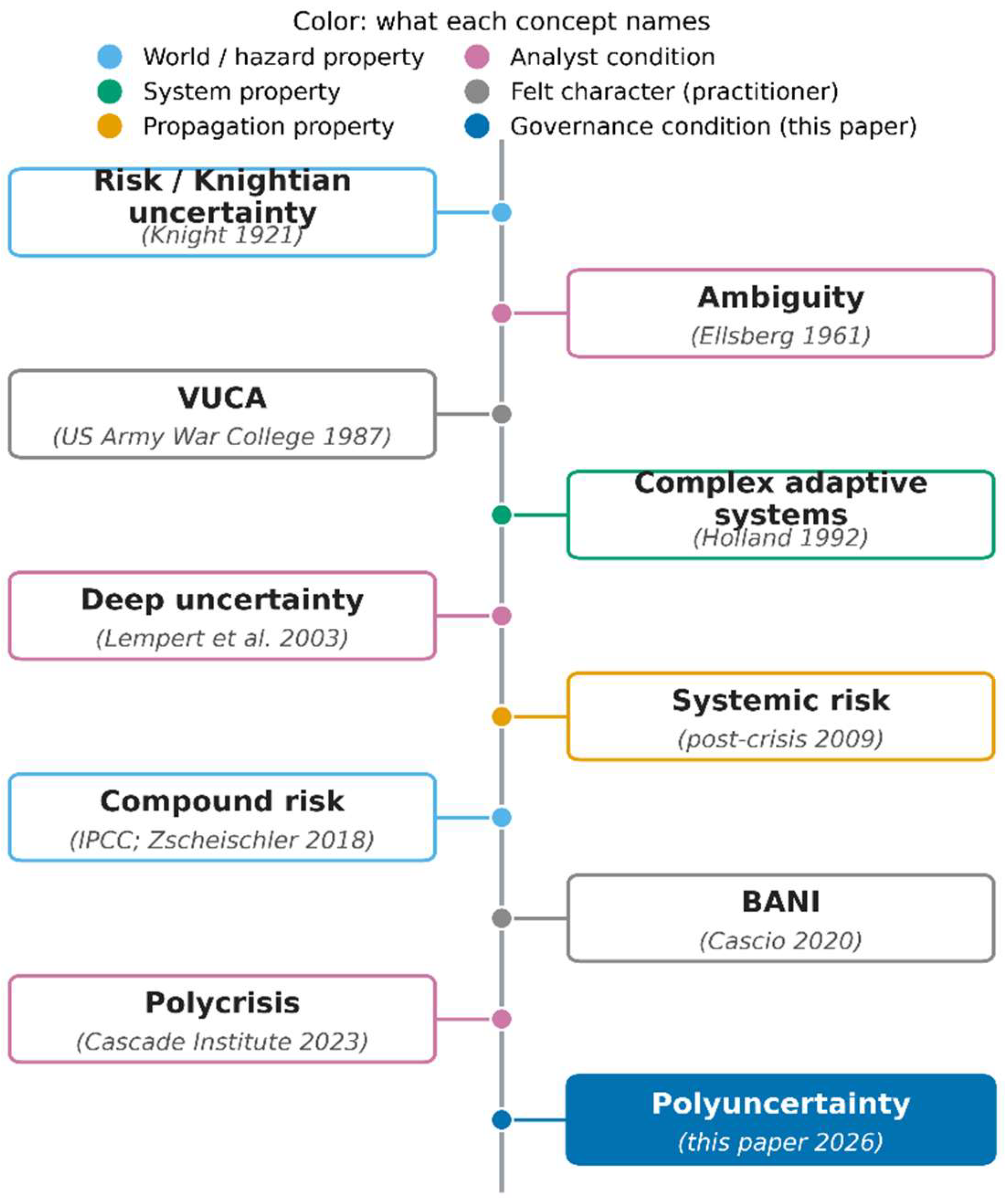
Figure 2.
What each framing names versus how well it can be measured.
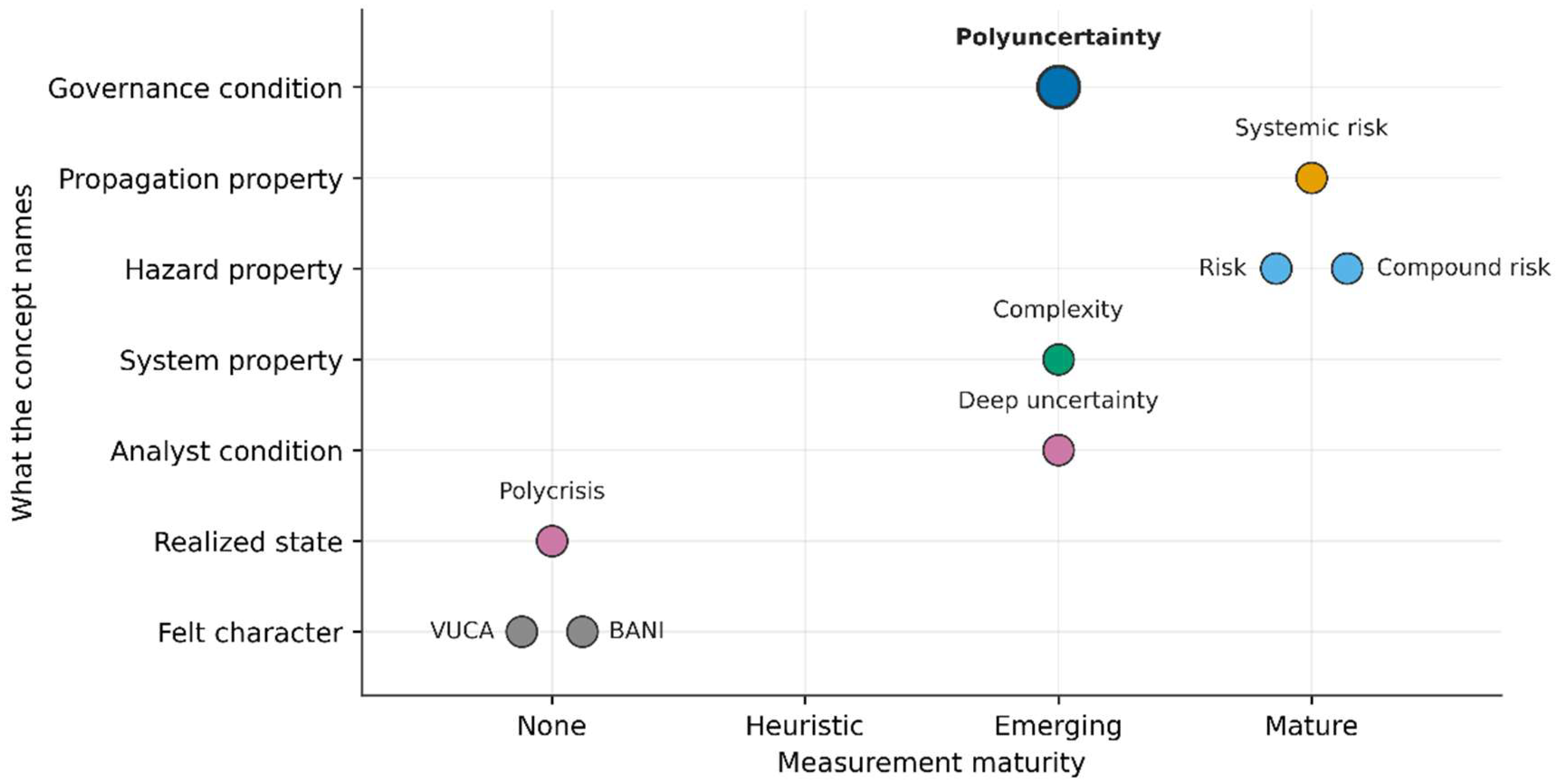
Figure 3.
Polyuncertainty as cross-domain interaction and cascade.
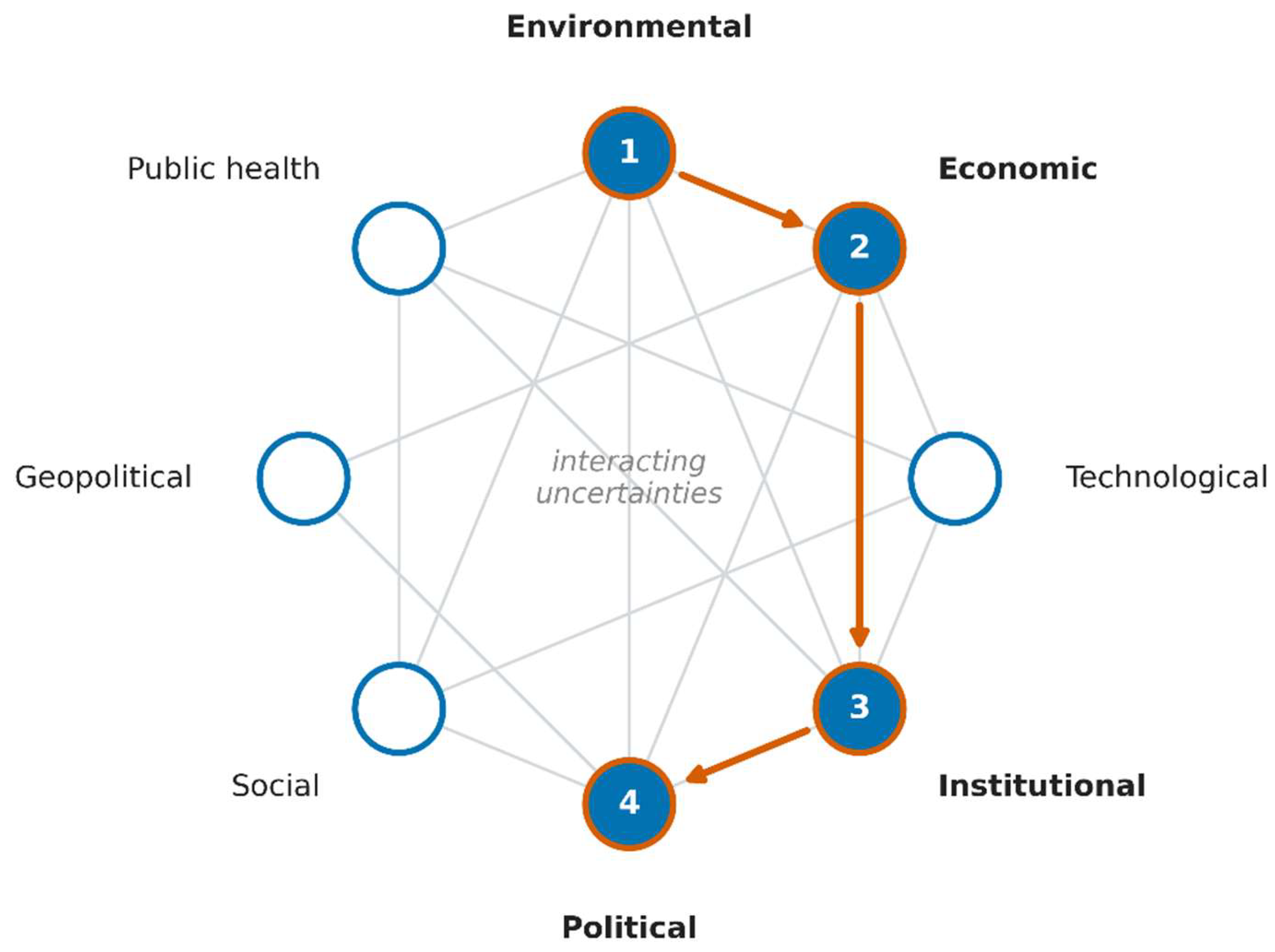
Figure 4.
The five mechanisms that generate Polyuncertainty.
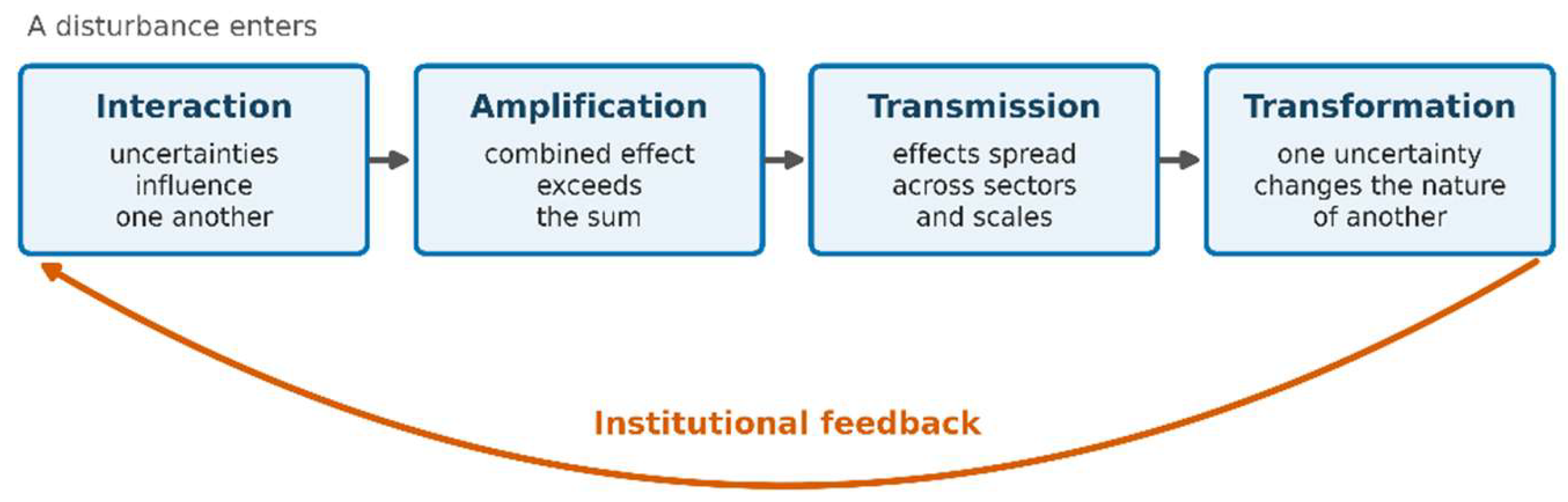
Figure 5.
The independence bias in the within-period cascade.
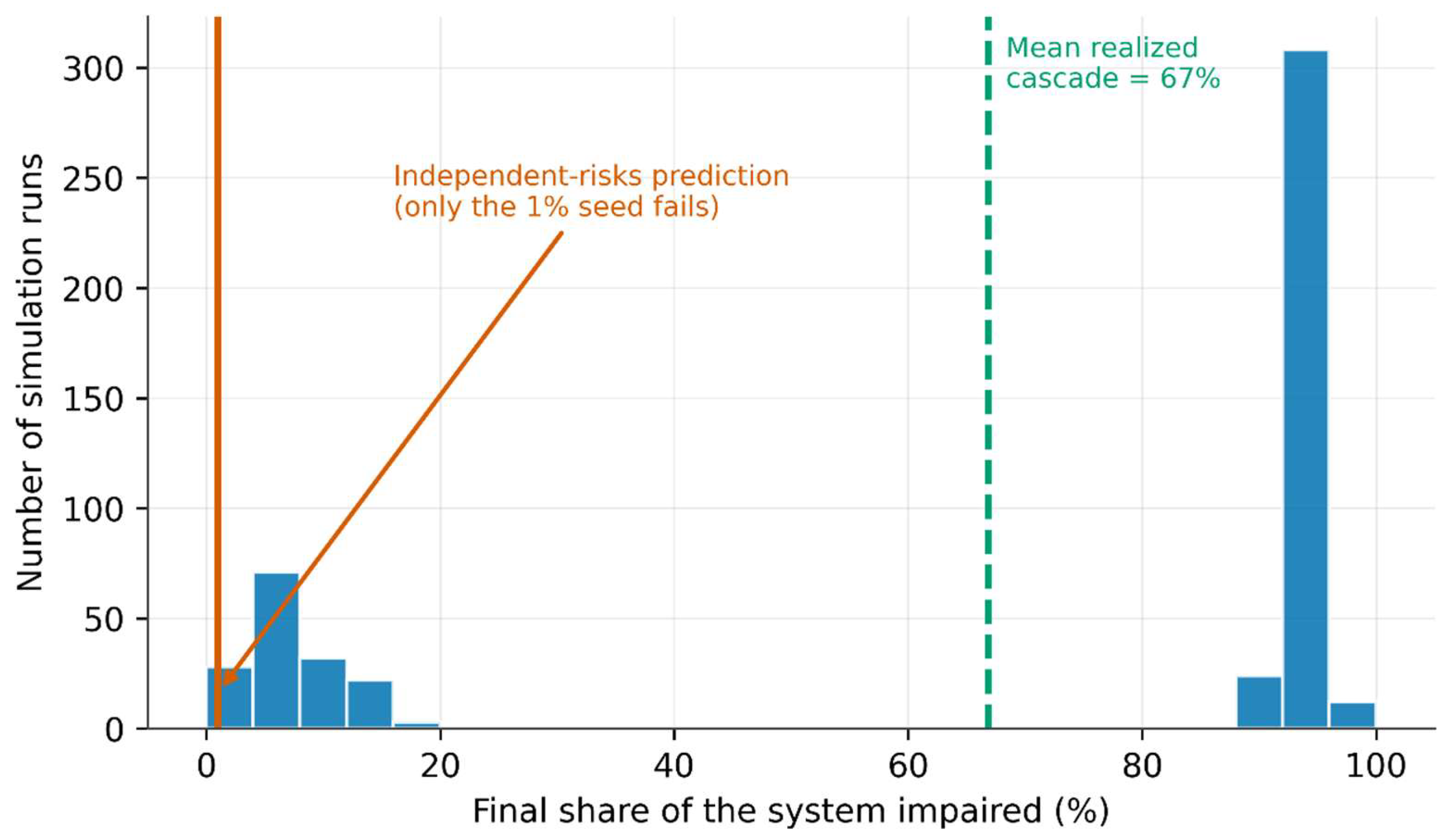
Figure 6.
Mean within-period cascade size as a function of coupling and slack.
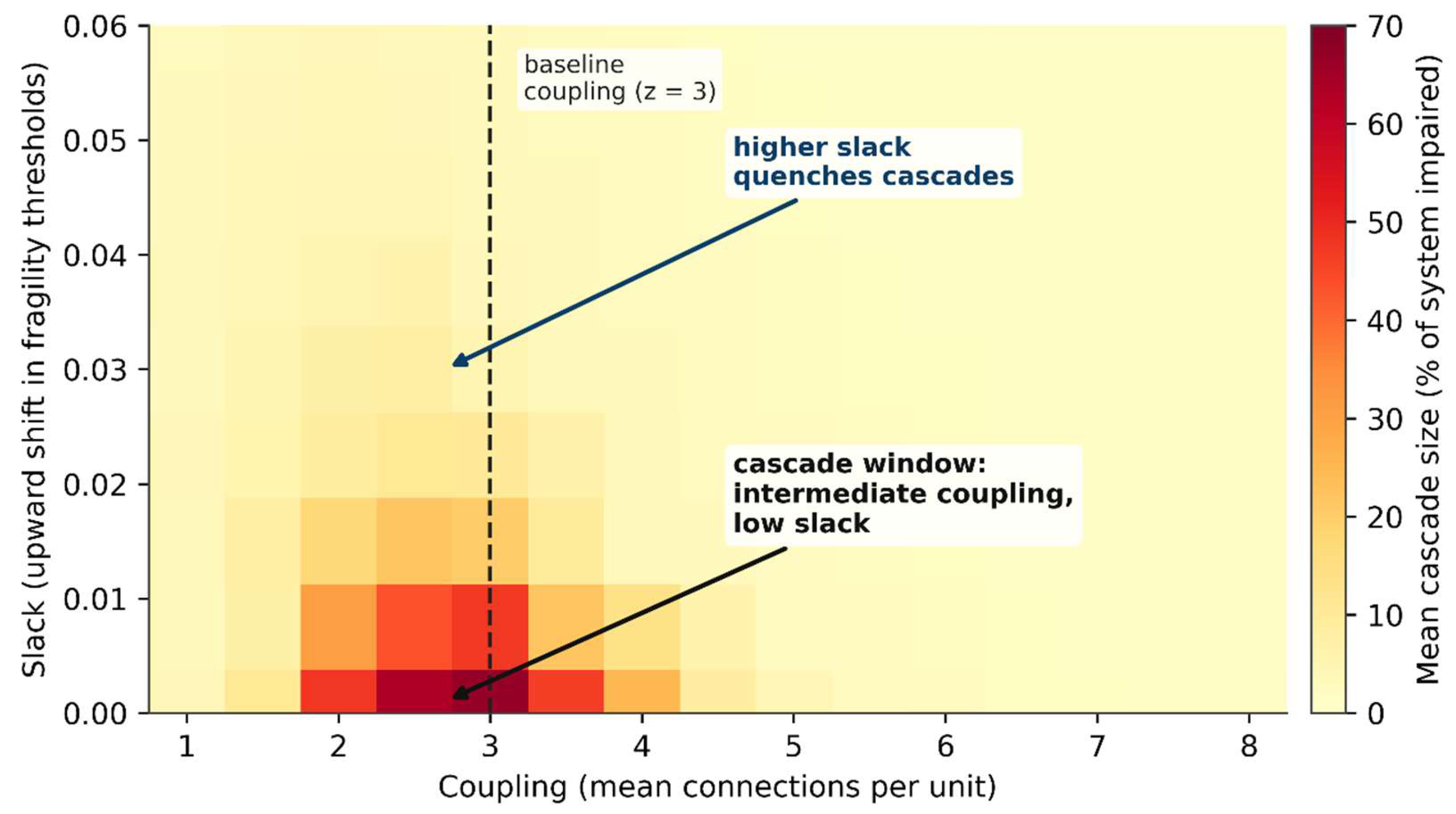
Figure 7.
The effect of coordinated institutional feedback within a period.
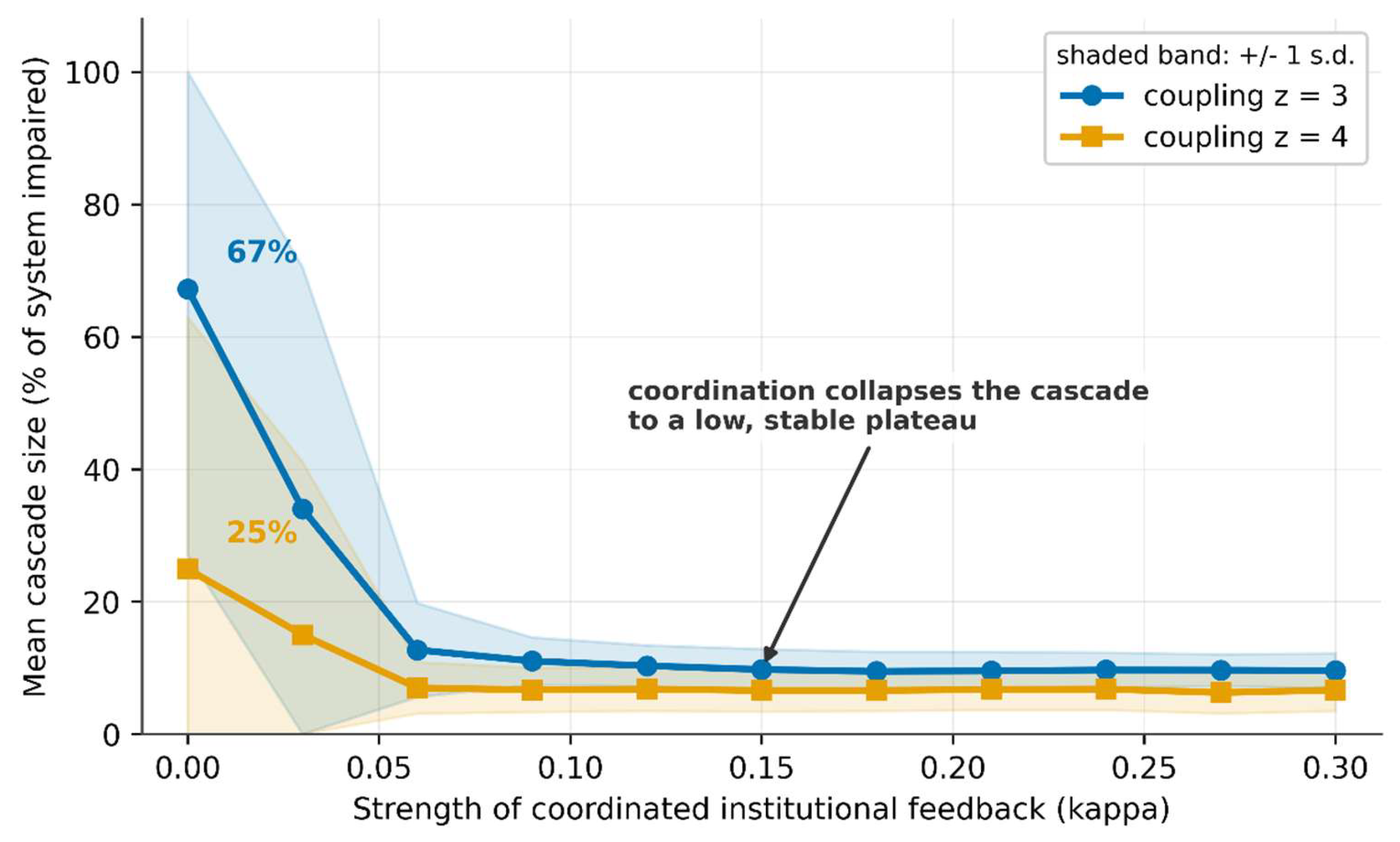
Figure 8.
The recursive workhorse.
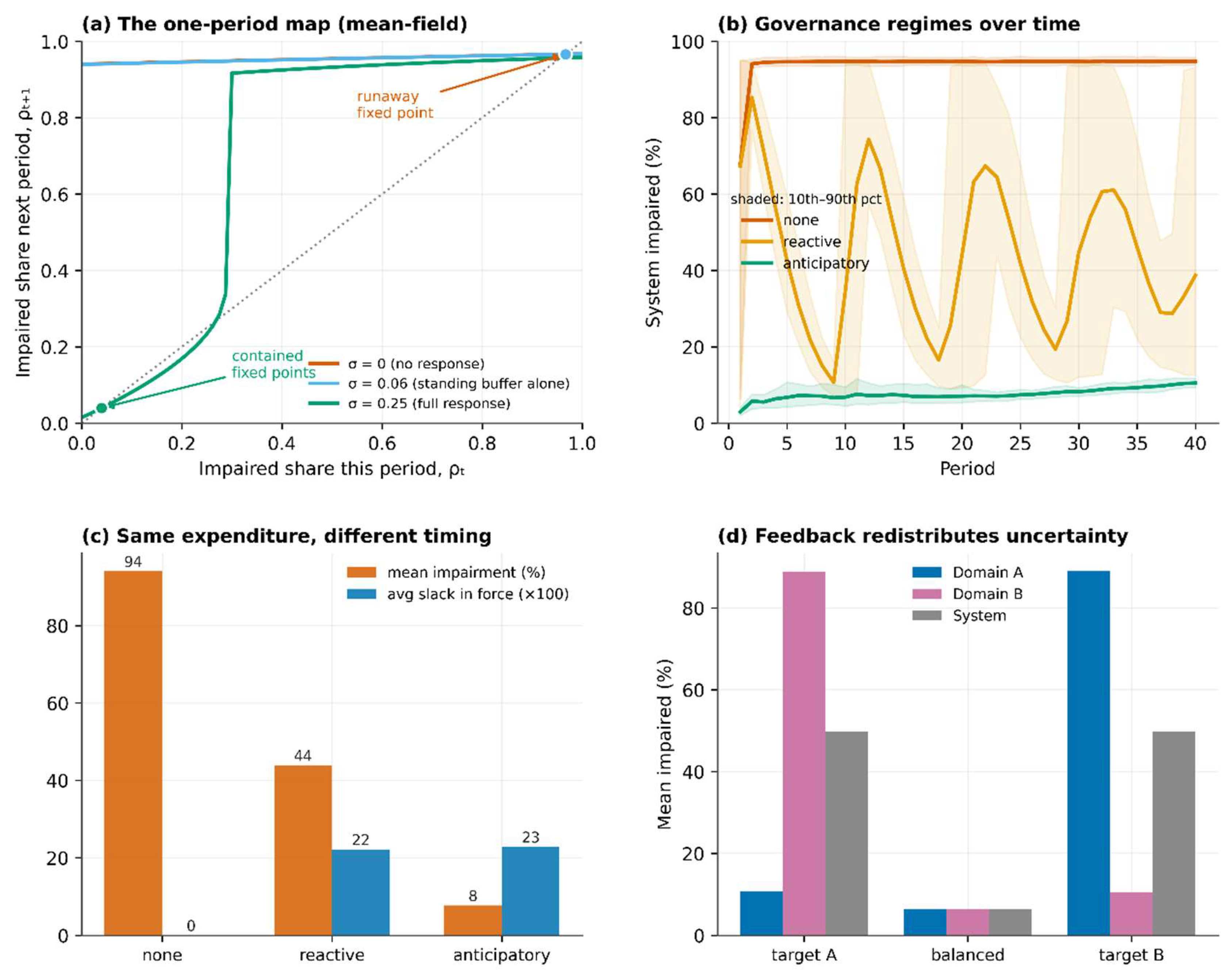
Figure 9.
Illustrative application to urban planning.
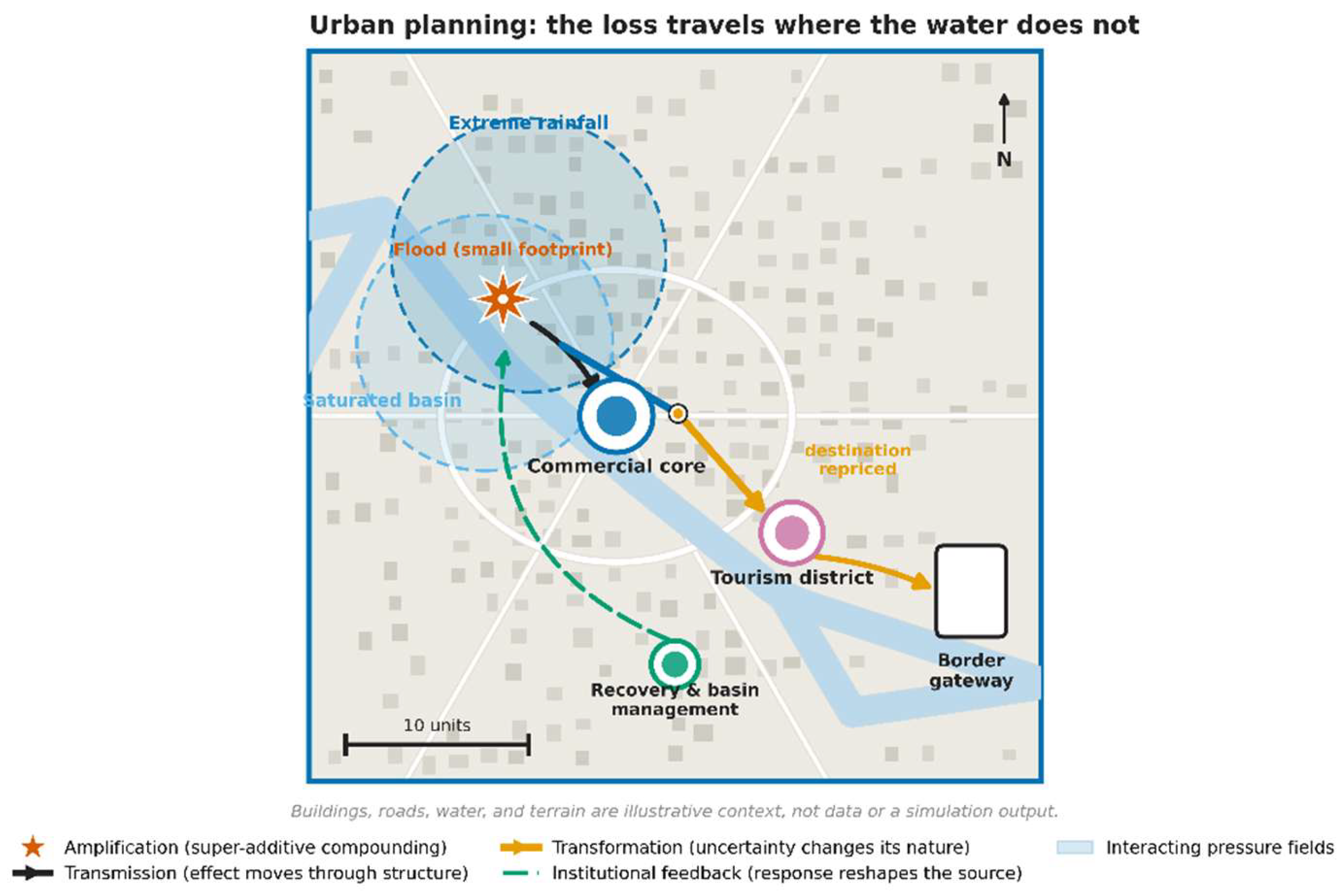
Figure 10.
Illustrative application to environmental governance.
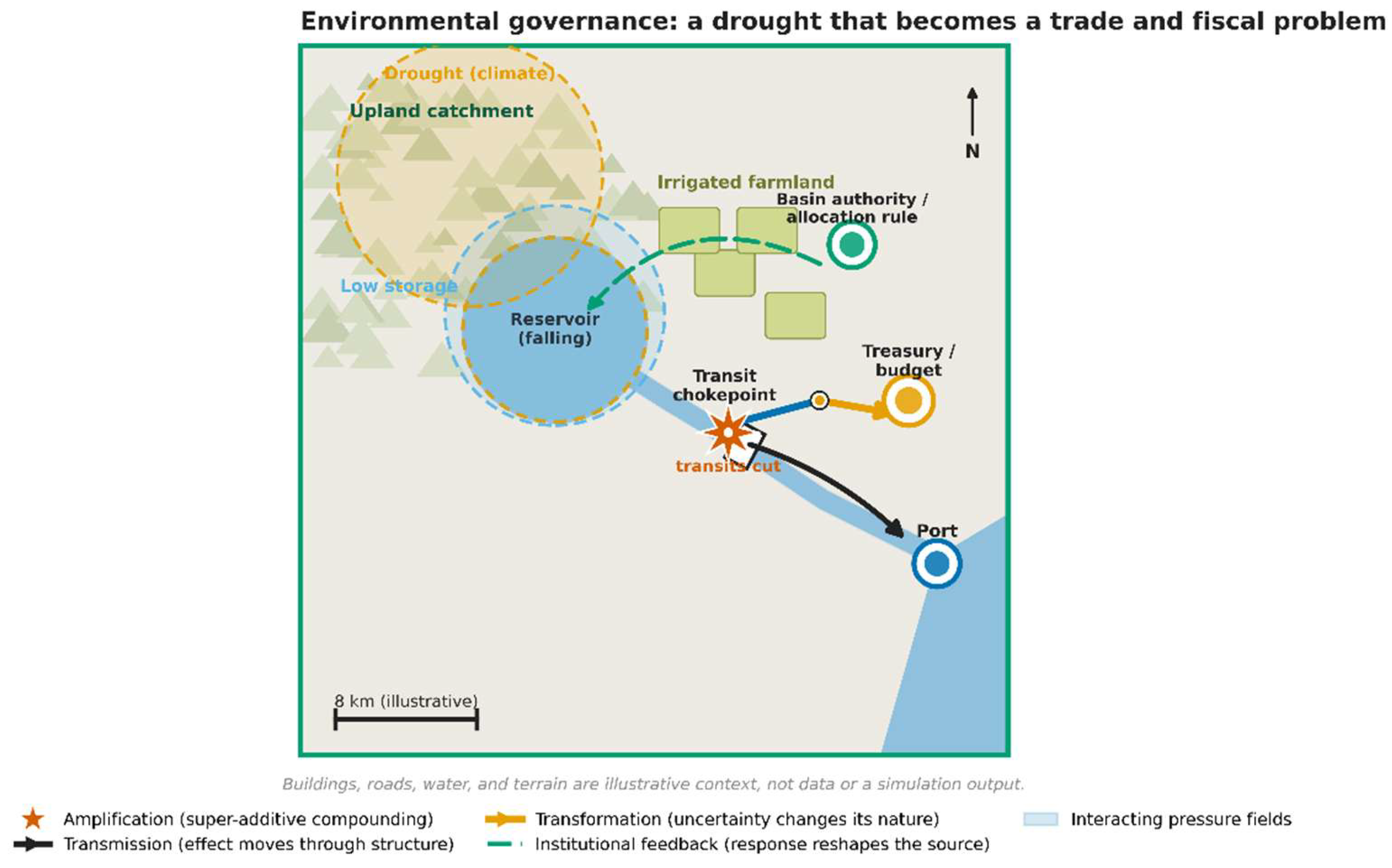
Figure 11.
Illustrative application to economic planning and development.
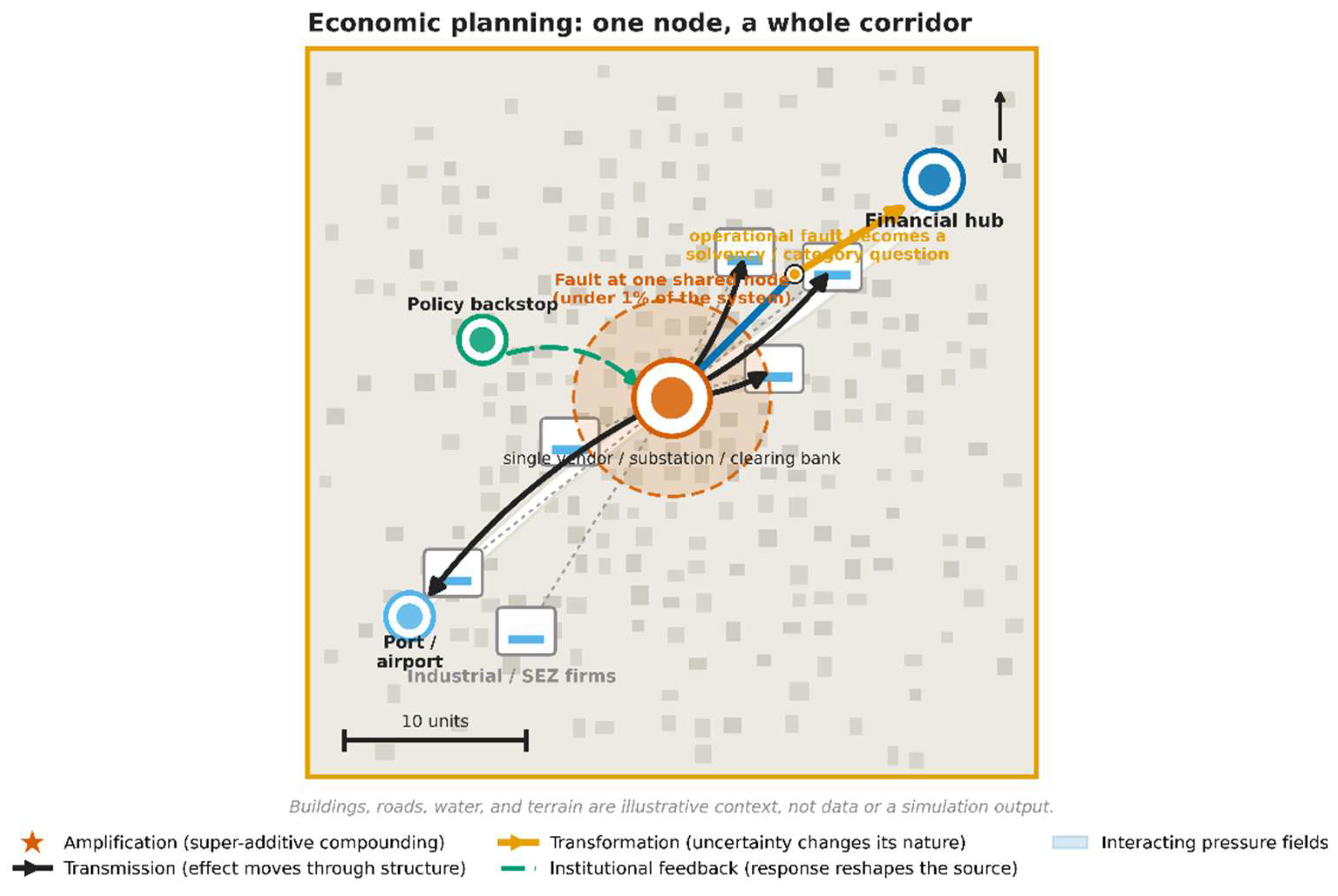
Figure 12.
The cumulative research agenda.
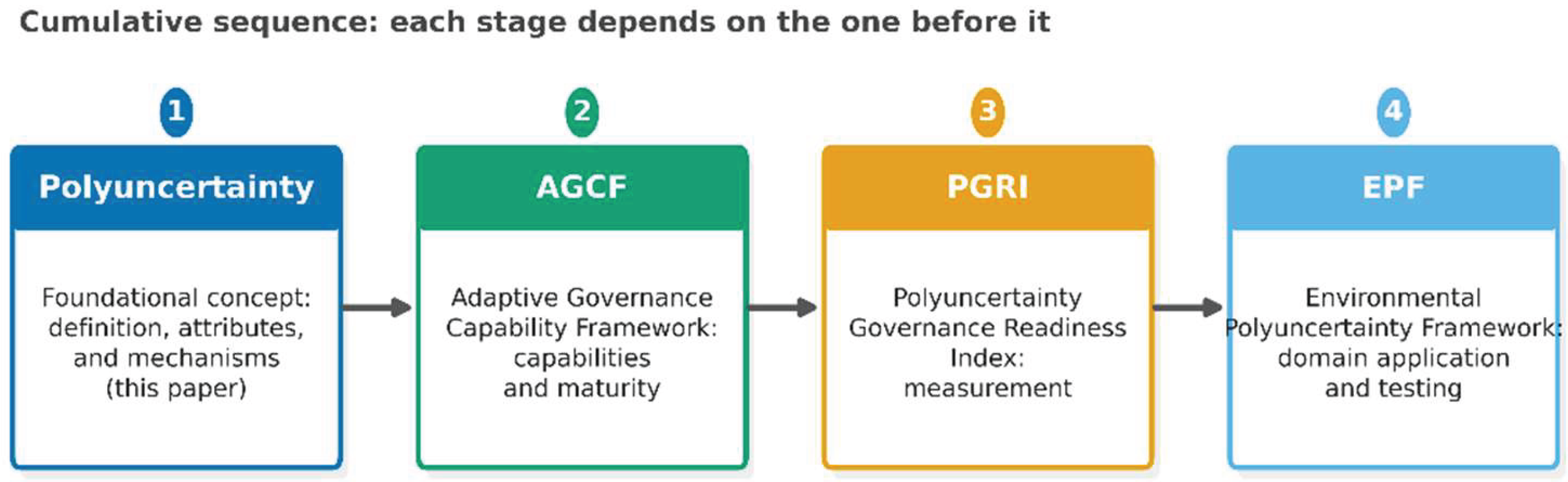

Table 1.
The seven contemporary framings compared, by the object each names and its measurement status.
Table 1.
The seven contemporary framings compared, by the object each names and its measurement status.
| Concept | Object named | Origin / anchor | Measurement status | Recommended use in research |
|---|---|---|---|---|
| Risk and Knightian uncertainty | World / hazard property | Knight (1921); Ellsberg (1961) | Mature where probabilities exist; absent under ignorance | Where probabilities can be specified; state clearly when they cannot |
| Deep uncertainty | Condition of the analyst | Lempert et al. (2003); Walker et al. (2003) | The condition is not measured; the methods are mature | To justify robustness criteria in place of expected-value optimization |
| Complexity | Property of a system | Holland (1992); Arthur (2021) | Large toolkit; unresolved validation standards | Where the mechanism is emergence, not merely many moving parts |
| Systemic risk | Propagation property | IMF, BIS, and FSB (2009); Renn et al. (2022) | Mature in finance; qualitative elsewhere | Where a network or balance-sheet structure exists; state contribution vs exposure |
| Compound risk | Property of a hazard combination | Zscheischler et al. (2018, 2020) | Mature: copulas, multivariate extremes, ensembles | Where joint distributions and dependence can be modeled |
| Polycrisis | Realized state of the world | Homer-Dixon et al. (2015); Lawrence et al. (2024) | No accepted operationalization | Framing and discussion, with the definition stated and criticism acknowledged |
| VUCA and BANI | Felt character of an environment | Bennett and Lemoine (2014); Cascio (2020) | None: no index, threshold, or test | Practitioner and communication contexts; translate into specified constructs for research |
Table 2.
The five attributes that are jointly necessary for a case to count as Polyuncertainty.
| Attribute | Meaning | Governance implication |
|---|---|---|
| Multiplicity | Several uncertainties are present at once | Institutions must monitor a portfolio of uncertainties rather than a single threat |
| Interdependence | The uncertainties are connected across sectors and levels | Coordination and systems analysis become essential |
| Dynamic evolution | The uncertainties change in nature and intensity over time | Policies require revision, learning, and adaptive triggers |
| Cascading effects | Disruption propagates through interconnected systems | Preparedness must account for secondary and tertiary consequences |
| Limited governability | Prediction and centralized control are incomplete | Institutions need robust, distributed, and transformative capabilities |
Table 3.
The conceptual location of Polyuncertainty relative to adjacent concepts.
| Concept | Primary concern | Main strength | Remaining gap |
|---|---|---|---|
| Risk | Known or estimable probabilities | Formal assessment and management | Weak when probabilities and system boundaries are unstable |
| Uncertainty (Knightian) | Unknown outcomes or probabilities | Recognizes the limits of prediction | Does not by itself explain interacting domains |
| Deep uncertainty | Disagreement about models, distributions, values | Supports robust and adaptive decisions | Centers decision methods rather than the governance condition |
| Complexity | Nonlinearity, feedback, emergence | Explains system behavior | Does not specify capabilities, readiness, or pathways |
| Resilience | Absorption, recovery, adaptation | Connects disruption with capacity | Can privilege persistence over interacting uncertainty sources |
| Systemic risk | Contagion and system-wide consequences | Explains propagation across networks | Often assumes a definable risk architecture |
| Polycrisis | Interaction among realized crises | Highlights compounding crises | Centers crises more than the evolving uncertainty environment |
| Polyuncertainty | Multiple interacting, evolving uncertainties as a standing governance condition | Integrates the above into a bounded condition with specified mechanisms | Conceptual; not yet operationalized (the agenda of Section 7) |
Table 4.
The five mechanisms that generate Polyuncertainty, with illustrations from the opening episodes.
Table 4.
The five mechanisms that generate Polyuncertainty, with illustrations from the opening episodes.
| Mechanism | Process | Illustration |
|---|---|---|
| Interaction | Uncertainties influence one another | Climate exposure alters the fiscal position that in turn shapes response capacity |
| Amplification | The combined effect exceeds the sum of the parts | Extreme rainfall on a saturated basin; a securities loss at a concentrated deposit base |
| Transmission | Effects move across sectors and scales | A single software fault reaches aviation, health, and finance simultaneously |
| Transformation | One uncertainty changes the nature of another | A hydrological drought becomes a trade-policy and then a fiscal problem |
| Institutional feedback | Policy responses reshape the uncertainty environment | A systemic-risk exception invoked for a bank earlier defined out of the category |
Table 5.
Parameters of the illustrative agent-based cascade model (see Appendix A).
Table 5.
Parameters of the illustrative agent-based cascade model (see Appendix A).
| Parameter | Meaning | Baseline / range |
|---|---|---|
| Units (N) | Number of interacting units | 800 |
| Network | Random graph (Erdős-Rényi) | mean degree z |
| Coupling (z) | Mean connections per unit | swept 1-8; z = 3 in Experiments 1 and 3 |
| Failure threshold | Fraction of failed neighbors that topples a unit | Uniform(0.18, 0.42) |
| Slack (s) | Upward shift in thresholds (buffers, redundancy) | swept 0-0.06; 0 at baseline |
| Transformation (delta) | Extra pressure added when any neighbor has failed | 0.02 |
| Institutional feedback (kappa) | Threshold increase for survivors once triggered | swept 0-0.30 |
| Feedback trigger | Impairment level that activates coordination | 0.10 |
| Initial shock | Fraction of units impaired at the outset | 0.01 (one percent) |
| Monte Carlo runs | Independent runs per parameter setting | 70-500 |
| Sensitivity analyses | delta over 0-0.06; feedback trigger over 0.02-0.30 (separate fixed seed) | 250 runs per value |
| Periods (recursive), T | Length of the recursive horizon | 40 (R = 60 replications) |
| Recovery (gamma) | Per-period recovery probability of an impaired unit | 0.6 |
| Shock evolution | Drift d and compounding c on the per-period shock | d = 0.0006, c = 0.05, cap 0.06 |
| Governance regimes | None; reactive (full response after a large cascade, window W = 3); anticipatory (standing buffer plus early escalation) | buffer 0.06, full response 0.25; triggers 0.05 / 0.25 |
| Two-domain block (Exp. B) | Within- and cross-domain mean degree; shared slack budget | 2.7 / 0.3; budget 0.50 (two full responses) |
| Recursive seed | Fixed seed for the recursive experiments | 20260802 |
Disclaimer/Publisher’s Note: The statements, opinions and data contained in all publications are solely those of the individual author(s) and contributor(s) and not of MDPI and/or the editor(s). MDPI and/or the editor(s) disclaim responsibility for any injury to people or property resulting from any ideas, methods, instructions or products referred to in the content. |
© 2026 by the authors. Licensee MDPI, Basel, Switzerland. This article is an open access article distributed under the terms and conditions of the Creative Commons Attribution (CC BY) license (http://creativecommons.org/licenses/by/4.0/).
Copyright: This open access article is published under a Creative Commons CC BY 4.0 license, which permit the free download, distribution, and reuse, provided that the author and preprint are cited in any reuse.