

Submitted:
08 September 2026
Posted:
09 September 2026
You are already at the latest version
Abstract
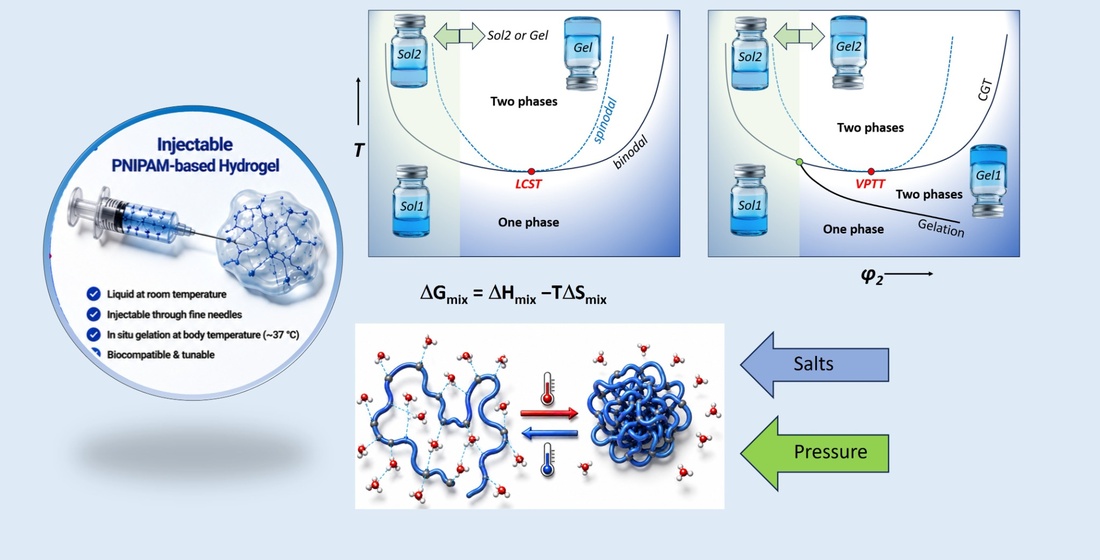
Poly(N-isopropylacrylamide) (PNIPAM)-based hydrogels are “smart” materials of great interest and demand, primarily in a variety of biomedical applications, due to their LCST close to physiological temperature. The basic biomedical applications of PNIPAM-based injectable hydrogels include controlled drug delivery, tissue engineering, wound healing, and cancer therapy. This review summarizes the thermal phase behavior of PNIPAM-based systems in different conditions, including different scenarios of physical gelation in polymer solutions and volume phase transitions in chemically crosslinked hydrogels. The thermodynamics of coil-to-globule phase transition, its relation to the gel formation, and mechanisms underlying the phase transitions in PNIPAM-based hydrogels are discussed, as well as external parameters which may affect these processes. Different types of phase diagrams observed for PNIPAM-based systems are considered, with particular attention paid to the cases in which gelation occurs separately from the coil-to-globule transition. The rational design of injectable platforms should be based upon a thorough understanding of the PNIPAM-based system’s phase behavior to achieve controllable and reproducible properties.
Keywords:
poly(N-isopropylacrylamide)
; smart materials
; thermoresponsive polymers
; injectable hydrogels
; coil-to-globule transition
; gelation
1. Introduction
1.1. Thermoresponsive Hydrogels
Stimuli-responsive, or “smart” hydrogels attract great interest due to their unique phase behavior, primarily for a variety of biomedical applications, but also for emerging applications in other fields. Stimuli-responsive hydrogels exhibit a dramatic change in their swelling, mechanical properties and shape upon a shift in the environmental conditions, such as temperature, pH, ionic strength, light wavelength, electric and magnetic fields. Thermoresponsive polymers are among the most extensively studied smart materials, since their phase behavior may be governed by the body temperature, that determines their great potential in medical uses. The phase diagrams of such systems are characterized by a binodal which divides the regions of one-phase and two-phase states, with an upper critical solution temperature (UCST), a lower critical solution temperature (LCST), or both. The majority of prospective thermoresponsive hydrogels are based on the LCST-type polymers, due to the higher feasibility of such approaches. The recent advances in these approaches are collected in a large number of reviews which have appeared in the last years (see, e.g., [1,2,3,4,5,6,7,8,9,10]).
There are many classes of thermoresponsive polymers forming hydrogels, including poloxamers, poly(N-vinylcaprolactam), poly(N-ethyloxazoline), poly(methyl vinyl ether) and acrylamide-based copolymers [1,7,11]. However, various derivatives of poly-N-isopropylacrylamide (PNIPAM) have conquered most attention due to their transition temperature close to the body temperature. PNIPAM has an LCST of about 32 C, and addition of different hydrophilic and hydrophobic units may shift it higher or lower, in accordance with the target application. When heated to the LCST, aqueous solutions of PNIPAM-based polymers demix and form two phases, while, starting from a certain concentration, they may form physical gels. At the same time, when crosslinked, swollen hydrogels release the bound water and undergo a collapse at the transition temperature (volume phase transition temperature, VPTT). Polymer solutions forming a physical gel upon heating are termed “thermoreversible gels” or “thermogelling materials”, their mechanisms of gelation depending on the design of their macromolecules [10].
The key feature of a hydrogel’s structure, whether it is a physical or a chemical gel, is a 3D network of polymer chains which absorb and retain a high amount of water, while sustaining its integrity and mechanical characteristics [6,12]. The water-filled regions of the network may be varied in their sizes to provide transport of various molecules or support whole cells. Such a specific structure and properties are due to the presence of hydrophilic functional groups, such as -OH, -SO3H, -COOH, -NH2 and -CONH2, in the macromolecules comprising a hydrogel, which further promote the hydrogel interactions with live tissues [12].
Physical hydrogels are held together by non-covalent bonds such as hydrogen bonds, hydrophobic interactions, ionic interactions, and chain entanglement [6,12]. Physical hydrogels undergo reversible gelation and may be returned to the liquid state upon lowering the temperature. They can also be used as self-healing hydrogels [6]. Chemical crosslinking includes formation of chemical bridges using various crosslinkers (bis-acrylamide, glutaraldehyde, elastin-like polypeptides, alginate, photosensitive agents, enzymatic crosslinkers), and provides reproducible and stable 3D network [5,6,12]. Chemically crosslinked thermoresponsive hydrogels range in their sizes from bulk materials at the macroscale to microgels (~100 nm to microns) and nanogels at the nanoscale [5].
The sol-gel transition is monitored using various techniques, primarily, by rheological methods, with the frequently used simplified approach to defining the gelation temperature as the point at which the elastic modulus, G’, starts to exceed the viscous modulus G” [11].
1.2. Applications of Thermoresponsive Hydrogels
The basic applications of thermoresponsive hydrogels are associated with biomedical engineering, primarily, with novel controlled release drug-delivery systems [1,2].
The review by Throat&Bhattacharya [5] extensively discusses how PNIPAM-based systems are used in the studies on the cancer treatment. In particular, microgels and nanogels, as well as conjugates have appeared efficient in the sustained anti-cancer target drug delivery. A new thermoresponsive hydrogel system for generation and isolation of cancer cell spheroids is also described. Of the latest experimental studies on the anticancer drug delivery using PNIPAM-based hydrogels, one can address [13,14]. Narayana et al. mentions application of such systems in the photothermal/photodynamic therapy of cancer [6]. PNIPAM-based nanospheres in conjunction with optical coherence tomography showed promise in cancer-related imaging [5]. Other drug-delivery systems with PNIPAM-based hydrogels included those for ocular diseases, oral ulcers, skin diseases, Parkinson’s disease, and antibacterial agents [5,6,15].
As mentioned above, hydrogels may be designed to sustain whole cells, that determines their importance in biological tissue engineering, including scaffolds for cartilage regeneration, dentoalveolar tissue engineering, intervertebral disc regeneration, and bone regeneration [5,6,16].
The intrinsic porosity and capacity to retain large volumes of water determine application of PNIPAM-based hydrogels in wound dressings, since they are able not only to deliver the required drug payload to the wound, but also to support healing and tissue regeneration, as well as to carry agents for wound monitoring [3,6].
The emerging medical and sport-related application of PNIPAM hydrogels is associated with various sensors, including wearable temperature sensors, strain sensors, sensors measuring pressure and pH, chemosensors, humidity sensors, and biosensors for glucose, hydrogen peroxide, proteins, DNA, drugs etc. ([2,7,17]). Along with sensors, smart textiles are also developed with the use of such systems [2].
The non-medical applications of PNIPAM-based hydrogels attract the growing attention in the last years and include energy-saving smart windows and curtains ([2,18,19,20], solar-driven interfacial evaporation [2], actuators and soft robotics [2], preservation of fruit and vegetables [21], anti-counterfeiting labels and information encryption devices [22,23], and smart rechargeable zinc-ion batteries [24].
1.3. Injectable PNIPAM-Based Hydrogels
Drug and cell delivery using injectable thermoresponsive hydrogels appears an advantageous way offering minimally invasive surgical intervention, enhanced bioavailability, and lower costs as compared to conventional surgical interventions [12,24,25,26,27,28]. Depending on the clinical applications, several administration options are described for injectable hydrogels, among them subcutaneous, intramuscular, intratumoral, intra-articular and intraocular injections [27].
The basic principle behind the injectable gel delivery consists in the hydrogel administration in the form of a solution via an injection, followed by the solution being heated naturally inside the body to the body temperature, which exceeds the temperature of gelation (phase transition). In drug delivery, the formed gel then releases the loaded cargo in a controlled manner thus minimizing the systemic toxicity and related side effects. In tissue engineering applications, the cell-laden scaffold is injected into the damaged tissue as a viscous fluid without the need of surgery, providing the precise filling and sustained shape and robust mechanical properties afterwards, while maintaining the transport of needed biologically active molecules to the treated site [12,27]. Injectable hydrogels appear promising materials in cell therapy, as well [28]. The high potential of injectable thermoresponsive compositions is associated with the possibility of immediately connecting the synthetic material with the treated tissues, since the used polymeric systems are designed to mimic the natural extracellular matrix [27]. The basic applications of PNIPAM-based injectable hydrogels are displayed in Figure 1.
In the cancer therapy, thermoresponsive hydrogel-based systems show promise in intratumoral delivery of chemotherapeutic drugs which otherwise may cause significant toxicity to healthy tissues [25]. An in situ formed gel functions as a prolonged release composition applied directly at the tumor site, thus allowing one to use relatively high drug doses. The recent review by Zhang et al. discusses the use of injectable hydrogels in the therapy of osteoarthritis [24].
Wound treatment also finds advantages in the use of injectable self-healing hydrogels [3]. Liquid polymers may take on any geometric shape of a wound, forming a sufficiently mechanically strong dressing after gelation, eliminating the need in suturing the wound. Moreover, they may provide controlled drug release during the wound healing process.
Interestingly, injectable PNIPAM-based hydrogels appeared instrumental in modeling certain medical conditions by inducing local stress on tissues upon their gelation [29].
In the design of injectable thermoresponsive hydrogels, beside the apparent importance of the gelation temperature, the viscous properties of the liquid phase should also be considered as the basic condition for the injectability. The polymer concentration should be high enough to exceed the threshold concentration for gelation, at the same time, the higher the concentration the higher the viscosity, hence, the poorer the injectability. In general, shear-thinning behavior is highly preferable, since, in this case, viscosity drops under shear force, that provides better extrusion of the solution [3]. The combination of the shear-thinning behavior with a high rate of network reassembly is needed to create a stable pool of the hydrogel at the target site [3].
There are four basic mechanisms described for drug release from hydrogels [25,30] – diffusion-controlled, erosion-controlled, chemically-controlled, and swelling-controlled ones. The type of a mechanism for a certain hydrogel is defined by the hydrogel mesh size and the cargo molecule size. Small molecules are transferred from the matrix via diffusion, which may be rather fast, while large molecules like proteins may diffuse much slower proving the prolonged release. When the drug size exceeds the mesh size of the hydrogel, erosion- or swelling-controlled mechanisms are responsible for the drug release.
Biocompatibility and biodegradability are desirable properties for carrier hydrogels, thus weak bonds are frequently used in the hydrogel design [25]. The degradation of PNIPAM in tissues results in the production of the monomer, cyclic imides, diisopropylamine via chain scission, peptide fragments and products from crosslinkers may also be found; however, in general, PNIPAM shows low toxicity [6]. Among other limitations of PNIPAM, insufficient mechanical strength of hydrogels and restricted ability to retain drugs leading to burst release are usually mentioned [4,6]. A plethora of various approaches aimed at overcoming PNIPAM drawbacks and creating highly functional hydrogels are currently developed [4].
The above-mentioned limitations, along with the problems with the scalability and regulatory standards, as well as difficulties choosing an adequate animal model, represent challenges which slower the translation of the research results into the clinical practice [27].
According to [27], 81 systems based on injectable hydrogels have been mentioned as products on the market and objects of clinical studies to date, however, no PNIPAM-based products have been included in this list. Nevertheless, a whole number of patents on PNIPAM-based smart hydrogel applications in biomedical fields can be found, mostly on cancer, wound healing, and ocular hydrogels [6].
2. Thermodynamics of the Coil-to-Globule Transition in PNIPAM
2.1. Phase Diagram of PNIPAM
PNIPAM hydrogels belong to LCST-type hydrogels, including also hydrogels of such polymers as block-copolymers of poly(ethylene oxide) and poly(propylene oxide), poly(methyl vinyl ether), poly(2-hydroxypropyl acrylate), oxazoline- based polymers, etc. [2].
Polymers with LCST form hydrated coils in aqueous solutions, with hydrophobic parts surrounded by ordered “water cages” [31]. Upon heating above the LCST, the polymer chains undergo massive dehydration, releasing a large amount of water, while hydrophobic interactions bring together polymer chains with the formation of compact globules. This coil-to-globule transition is responsible for the phase behavior of thermoresponsive polymers.
In terms of thermodynamics, this process is governed by the Gibbs free energy:
where ΔGmix, ΔHmix and Δ Smix are the Gibbs free energy, enthalpy and entropy of mixing, respectively.
ΔGmix = ΔHmix −TΔ Smix
The spontaneous dissolution takes place when ΔGmix is negative, while ΔGmix>0 determines the polymer-water system demixing. Due to the formation of hydrogen bonds, the enthalpy of PNIPAM mixing with water is negative, favoring dissolution. Thus, ΔGmix becomes positive when the term TΔ Smix exceeds the enthalpic gain. For a classical polymer solution, Δ Smix is positive due to the possibility of a greater number of chain configurations [10], however, in PNIPAM the chain hydration and formation of “water cages” around the hydrophobic moieties results in the opposite - the entropy gain upon demixing and releasing the bound water, so that Δ Smix>0 above the critical temperature. This balance between the hydration and dehydration processes leads to the existence of the LCST and makes the coil-to-globule transition in PNIPAM an entropic-driven process.
The presence of the minimum critical point leads to the characteristic U-shaped phase diagram of a PNIPAM-water system (Figure 2). In general, below the binodal the system exists as one phase in the form of a transparent sol of the polymer’s hydrated coils mixed with water molecules. Above the binodal, the system demixes: within the region between the binodal and spinodal, demixing proceeds via the nucleation and growth mechanism, above the spinodal, it proceeds via spinodal decomposition [32]. PNIPAM globules have a propensity to aggregate with the formation of mesoglobules [33], giving rise to turbidity upon demixing, thus the term “cloud point” is frequently used interchangeably with “LCST”. However, it should be remembered that the cloud point curve, though lie close to the binodal, is not the thermodynamically correct phase diagram [32].
In regard to PNIPAM-based hydrogels, the coil-to-globule transition appears differently for free macromolecules and a crosslinked polymer. In the former case, the polymer-water mixture below the binodal represents a transparent sol. Upon heating to the transition temperature, it may form a turbid sol (or precipitate at a high enough concentration), or, starting from a certain concentration, some PNIPAM derivatives may undergo physical gelation, with the formation of a turbid gel (Figure 2, a). In this case, a hydrogel is created via the coil-to globule transition from a liquid. When the polymer is crosslinked, its macromolecules can not form free coils which collapse into globules during the phase transition, thus the system represents a hydrogel before and after the transition. Below the transition temperature, it is a highly swollen transparent hydrogel, upon heating above the transition temperature, it abruptly shrinks to a much lower volume, with the release of water, and becomes turbid (Figure 2, b). Such a transition is termed a volume phase transition, and the minimum at the binodal is represented by a volume phase transition temperature (VPTT) vs. the LCST in an uncrosslinked polymer. Generally, VPTT does not necessarily coincide with LCST, however, PNIPAM is characterized by the almost universal transition temperature, independently of the polymer form.
It is of note that the latter property of PNIPAM causes the apparent overuse of the “LCST” term as applied to the phase transition in any PNIPAM form (powder, film, fiber, gel). Meanwhile, “LCST” assumes the transition in a solution, and a more general “coil-to-globule transition temperature” or a specialized term would be more appropriate for another polymer state.
According to the classical Flory-Huggins theory, the free Gibbs energy of mixing may be presented as
where n1 and n2 are the numbers of moles of the solvent and the polymer, respectively, φ1 and φ2 are the volume fractions of the solvent and the polymer, respectively, χ is the Flory–Huggins interaction parameter (determined by the energies of the intermolecular interactions), and R is the gas constant [10]. The parameter χ is considered dependent only on the temperature T. In this model, the φ2 at the critical point, φc → 0 when the polymer’s chain length approaches infinity [32].
ΔGmix = RT (n1ln φ1 + n2ln φ2 + χ n1 φ2)
However, PNIPAM does not obey the classical polymer behavior: its LCST only weakly depends on the polymer concentration (“flat” phase diagram) and molecular weight [32], and the transition is first-order [34]. There exist several approaches to describe the observed phase behavior of PNIPAM and its derivatives.
2.2. Type II Critical Phase Behavior of PNIPAM
Afroze et al. applied a different interaction parameter g(φ,T), depending on both the temperature and polymer concentration, instead of χ (T) [35]. In their model, the free Gibbs energy for a polydisperse polymer is expressed as
+ g(T, φ2) φ1 φ2
where N is the number of lattice sites, m1 – number of sites occupied by solvent molecules, m2i - number of sites occupied by the ith species of the polymer, φ2i is the volume fraction of the ith species, φ2 = Σ φ2i ; {2i} is the set of all the polymer species.
The g (φ2) dependence is assigned a polynomial form. Based on these assumptions, the chemical potentials for the solvent and the polymer are expressed as
where g(i) denotes the ith order compositional derivative of g: g(i) = Then, the spinodal and the critical conditions are read as:
= 0
where mw2 and mz2 are the mass and Z-average chain lengths of the polymer. Eq.6 determines the conditions for the spinodal, while the simultaneous satisfaction of Eq.6 and Eq.7 determines the binodal.
The solutions of Eq.6 and 7 create the following three types of the demixing behavior in a polymer-water system:
The experimental data showing that the PNIPAM’s miscibility behavior demonstrates almost no dependency on the molar weight, indicate that it belongs to the Type II. The DSC data demonstrate that the positive enthalpy of demixing reaches a maximum at a certain concentration, consistent with the theoretical findings. Afroze et al. determine that, for infinite chain length, the critical conditions are w2c =0.43 and Tc =299.5 K, a single off-zero critical point, without the classical φc → 0.
In a recent study by Dang and Nies [36] this theory is expanded to take into account the influence of end groups.
- 1)
- Type I critical phase behavior with φc → 0 at infinite molar weight, corresponding to the classical Flory-Huggins’s Θ-behavior;
- 2)
- Type II critical behavior with a single off-zero φc at non- Θ -conditions;
- 3)
- Type III critical phase behavior with two off-zero φc and a φc → 0.
2.3. Cooperative Hydration
This theoretical approach developed by Okada and Tanaka [37] presents the concept of positive correlation between the adjacent hydrated groups in a PNIPAM chain. The positive correlation between the neighboring water molecules is sustained by hydrophobic isopropyl side groups.
In this model, the additional term of free energy due to correlated hydrogen bonding is introduced along with the common free energy of mixing from the Flory-Huggins theory. It is expressed through a modified χ parameter, χ + Δχ, with Δχ depending on the polymer concentration in a complex way.
The theory of cooperative hydration explains the observed phase diagrams and the phase transition in a narrow temperature region.
2.4. Two-State Theory of an Amphiphilic Polymer
Jarkova et al. [38] described the phase behavior of an amphiphilic polymer based on the two-state theory, considering hydrophobic (H) and hydrophylic (P) units. According to this model, the interaction part of the free energy is expressed as
where uHH, uPP and uHP are the second virial coefficients of interactions between the units, and w is the third virial coefficient that is the same for H and P units. While the hydrophilic units are soluble, uPP > 0, the hydrophobic units are prone to attraction to each other, uHH < 0.
The models predicts a first-order coil-to globule transition in an amphiphilic polymer at a certain temperature, and may be applied to PNIPAM, as well, to explain its peculiar phase behavior.
2.5. Molecular Dynamics Simulations
There have been several molecular dynamics studies aimed at the describing the phase behavior of PNIPAM. In [39], an isotactic 30-mer of PNIPAM was simulated below and above the LCST. The computations showed the random-coil ensemble being more thermodynamically favored than the globule ensemble, by 21 ± 9 kJ/mol at the T<LCST. At the temperature above the LCST, the globule ensemble’s minimum was 21 ± 8 kJ/mol lower than that of the coil ensemble. The energetic barrier of the coil-to-globule transition was calculated as 17 ± 10 kJ/mol.
Two MD simulation models were compared by Tavagnacco et al. in their study [40], TIP4P/2005 and TIP4P/Ice, the latter showing better agreement with the experimental findings. A recent study by Yagasaki and Matubayasi applied computations using the OPLS-AA model and its modified version in combination with the TIP4P/2005 water model [41]. Interestingly, the authors came to a conclusion that the coil-to-globule transition in PNIPAM is not a discontinuous first-order transition, but a continuous second-order transition consistent with the classical Flory-Huggins theory.
2.6. Mean Energetics of Water as the Factor Controlling the Phase Transition in PNIPAM
Based on their experimental studies of PNIPAM phase transition in the presence of kosmotropic additives (alcohols) and cononsolvency, Bischofberger et al. [42,43] considered the coil-to-globule transition in PNIPAM a purely solvent’s thermodynamic problem.
The authors assume that the hydrophobic hydration of PNIPAM chains is controlled by the mean energetic state of the bulk water, while the interactions of hydrophilic groups with water play only a minor role. They conclude that the phase transition is only slightly dependent on the polymer chain behavior, and the hydrophobic hydration controlling the phase transition is mainly determined by the difference in the energy of the bulk and shell water.
2.7. Phase Transition in Crosslinked Gels
As mentioned above, the physical manifestation of the phase transition at the VPTT is entirely different from that for freely moving macromolecules. Since the chains are chemically anchored together in a gel, they cannot completely separate from each other or precipitate out of the liquid. Unlike the solubility change for an uncrosslinked polymer, for gels it is a volume change (swelling or collapse) manifested as the whole gel expansion or shrinkage. While for the solution each polymer coil becomes a globule, for the 3D network it means mesh shrinkage and water expulsion.
The conventional approach towards the thermodynamic description of crosslinked PNIPAM hydrogels is based on the Flory-Rehner model [44,45,46], which states that the total free energy change ΔGtotal in a swelling 3D hydrogel consists of two additive contributions - the mixing component ΔGmix (driving force for the dissolution) and the elasticity component ΔGelast (restraining force for the network):
ΔGtotal = ΔGmix + ΔGelast
When these two forces balance each other in a 3D network, the gel can no longer swell.
Afroze et al. [35] postulates that, in case the parameter g(φ,T) is not affected by crosslinking, the Gibbs free energy of mixing for a 3D network is constituted by two components:
where ΔGelast is the elastic contribution determined by the polymer volume fraction at network formation and the density of crosslinks.
ΔG/NRT = (φ1/m1)lnφ1 + g(T, φ2) φ1 φ2 + ΔGelast,
Afroze et al. show that the phase behavior of PNIPAM hydrogels is the same as that of PNIPAM solutions. However, for a 3D hydrogel network, there is a three-phase equilibrium, involving a highly swollen phase, collapsed phase and a pure solvent. In accordance with the Gibbs phase rule, it is invariant, leading to a concentration jump and a discontinuous swelling behavior at the VPTT. This interference of swelling with the miscibility gap originates from the Type II phase behavior of PNIPAM.
The mixing part of the Gibbs free energy is often considered from the viewpoint of the χ parameter dependency not only on the temperature, but also on the polymer concentration [44,45]. For example, in Paulin et al. it is presented as
where χ1(T) = , and χ2(φ) is approximated as a polynomial function of φ.
χ (T, φ) = χ1(T) + χ2(φ),
For the description of the elastic part, such models as the phantom network theory and affine network theory are applied [46].
The experimental studies by Grinberg et al. [47] showed the influence of the crosslink density on the thermodynamic functions of the VPTT in PNIPAM hydrogels: the transition becomes broader, and the VPTT decreases with increasing the crosslink density, at the same time, the enthalpy, entropy, and heat capacity increment of the transition remain unchanged.
Microgels are generally more favorable for the use as injectable hydrogels than bulk hydrogels are. The swelling of microgels can also be modeled by the Flory-Rehner theory [48,49,50]. However, as highlighted by Lopez and Richtering [48], the PNIPAM-based microgels are distinct from the corresponding macrogels with a small surface charge, heterogeneous density of crosslinks, and a likely varying polymer volume fraction at network formation.
3. Gelation and Hydrogel Phase Behavior Controlled by the Coil-to-Globule Transition
3.1. Mechanisms of Coil-to-Globule Transition
It is conventionally believed that gelation in PNIPAM solutions occurs due to the coil-to-globule transition. The mechanism of the coil-to-globule transition has been extensively investigated both in theoretical [31,51] and experimental [52,53,54,55] studies.
Although the details of the mechanism description depend on the used approach, the general thinking is that the phase transition at the LCST proceeds via the cooperative rearrangement of the PNIPAM chains’ hydration shells. At T<LCST, PNIPAM macromolecules adopt an extended conformation and contain a large amount of bound water, as much as 11 water molecules per polymer unit [56].
The chain hydration includes the formation of hydrogen bonds between the hydrophilic moieties in PNIPAM and molecules of water and “water cages” surrounding the hydrophobic groups, which form to separate the hydrophobic isopropyl groups from the bulk of water (Figure 3), giving rise to the hydrophobic hydration of PNIPAM [31]. Upon heating to the LCST, several steps take place, according to [31]: 1) thermal fluctuations intensify, destabilizing the hydrophilic interactions and hydrophobic hydration and causing water disordering; 2) the hydrophobic fragments of macromolecules, stripped of their hydration shells, begin to interact with each other; 3) hydrophobic clusters are formed to minimize exposure to the aqueous medium; 3) hydrogen bonds between the polymer’s hydrophilic groups and water break, and new hydrogen bonds are created between adjacent hydrophilic groups in PNIPAM. The latter may play a role of physical crosslinks in the hydrogel. The cooperative dehydration of the polymer chains results in their collapse with expulsion of bound water. However, even above the LCST PNIPAM is still far from total dehydration [57].
The experimental studies confirm the conclusions of molecular dynamics computations. Futscher et al. performed an FTIR spectroscopy study of PNIPAM in water at different temperatures and demonstrated that the hydration-dehydration process at the transition temperature involve both the hydrophobic (methyl and methylene) groups and amide groups participating in the formation of hydrogen bonds [53]. Wu et al. used direct time-resolved spectroscopic studies of a PNIPAM hydrogel near the VPTT to reconstruct the reaction coordinate of the chain collapse [54] and showed that the dehydration process was initiated by the hydrophobic groups at a time of 107 ± 37 ns with the amide group dehydration as the second step at 360 ± 85 ns. A Raman multivariate curve resolution spectroscopy study performed by Mochizuki and Ben-Amotz [55] revealed that, upon heating to the LCST, the hydration shell lost its tetrahedral order and strong hydrogen bonding to adopt a less ordered water packing. The time resolved experiments detected also that this rearrangement took place after the clouding point was reached and the initial polymer aggregates ripened.
3.2. Mechanisms of Physical Gelation in PNIPAM Solutions.
The clustering between macromolecules above the transition temperature is responsible for the formation of a physical gel from a PNIPAM-based solution (sol). The knowledge about the precise ways of its formation is scarce.
The most well-known mechanism is gel formation from micelles, suggested for block-copolymers of PNIPAM with more hydrophilic comonomers [1,10]. Similar to the critical conditions for micellization, the critical gelation concentration and critical gelation temperature are the necessary conditions for micelles to start forming a gel [1]. Cook et al. lists a number of gelation mechanisms for diblock- and triblock-copolymers (Figure 4). First, their gelation may proceed via simple chain entanglement without the micelle formation. Second, macromolecules may assemble themselves into micelles which may further pack together, creating liquid crystalline ordered structures. Third, ABA triblock copolymers may form flower-like structures bridged to a percolating network. Fourth, micelles may also arrange themselves in rows creating cylindrical structures held together by interactions between cylinders or physical entanglement to produce elastic networks.
Suvarna et al. suggests three different mechanisms for micelles to pack themselves into a gel: (a) individual micellar packing, inherent in low molecular weight diblock and ABA triblock copolymers, (b) inter-micellar bridging packing occurring in BAB- type (hydrophilic-hydrophobic-hydrophilic), BAC triblock, and multiblock copolymers, and (c) micellar corona collapse packing [1]. The latter mechanism is especially important for PNIPAM, since micelles of PNIPAM derivatives have a hydrophilic corona which undergoes a collapse above the LCST, leading to the reduced repulsion between micelles, their aggregation and thus to rapid gelation.
3.3. Mechanisms of Phase Transition in Crosslinked Hydrogels
Gels are different from both solid and liquid phases, their unique swelling/deswelling properties determined by the balance between the repulsive and attractive forces [6]. Thermoresponsive hydrogels exhibit dramatic changes in their volume, as well in their wettability [58]. The data from Raman spectroscopy studies and molecular dynamics simulations showed that the isopropyl dehydration is responsible for the jumps in wettability [58].
Sun et al. applied 2D correlation infrared spectroscopy and a perturbation correlation moving window technique to study the precise thermodynamic mechanism of the chain collapse and revival in a poly(N-isopropylacrylamide) (PNIPAM) hydrogel [59].
The isosbestic points in νas(CH3) and ν(C=O) overlaid spectra were investigated during heating and cooling of a PNIPAM hydrogel. The isosbestic point was absent when heating the hydrogel, that implies that the chain collapse proceeds either through multiple intermediate states or as a continuous process. During the cooling part of the thermal cycle, both bands exhibited isosbestic points, thus the PNIPAM chain revival proceeded in one step with two single states (hydrated and dehydrated). In contrast, a 20% solution of PNIPAM showed isosbestic points both upon heating and cooling.
It was shown that, upon heating the hydrogel to the VPTT, the first step was the backbone response with the chain collapse followed by the expulsion of water molecules beyond the hydrogel borders. The formation of hydrogen bonds between amide groups instead of amide-water hydrogen bonds acted as a driving force for the chain collapse. Isopropyl pendants reacted later than the backbone did. During cooling, water molecules first moved into the network, being the driving force for the following backbone response and chain revival. Isopropyl groups, again, reacted after the backbone.
Based on the NMR study results, Burba et al. describe dehydration of PNIPAM hydrogels at the VPTT as a two-stage process [60]. At the first stage, the polymer backbone reacts by the rearrangement based on hydrophobic interactions. At the second stage, hydrogen bonds of hydrophilic fragments are disrupted, followed by the destruction of “water cages” around the hydrophobic moieties. Finally, stable hydrophobic bonds are formed between the exposed isopropyl groups, leading to the fast process of dehydration and association of hydrophobic fragments. The polymer rehydration starts from the rupture of hydrophobic bonds, then the hydration shells are formed around the polymer chains.
Figure 5 summarizes the processes taking place during the phase transition in PNIPAM-based thermoresponsive hydrogels.
4. Gelation Controlled by Coil-to-Globule Transition: Some Examples
In spite of the dominating concept of PNIPAM gelation due to the coil-to-globule transition, in fact, there have not been many publications in which it is tested experimentally. In the majority of studies, including those mentioned in the numerous reviews, it is simply implied that the PNIPAM-based polymer under study undergoes gelation via this mechanism. To find the cloud point temperature, turbidity measurements or DSC studies are routinely performed, while rheological studies are commonly used to monitor the temperature course of gelation. It should be noted that, most frequently, only one technique is used by researchers, and both processes (gelation and coil-to-globule transition) are assigned to the measured temperature. Another approach, commonly seen in the studies dedicated to the medical applications of PNIPAM-based polymers, involves measuring the system’s properties well below and well above the transition temperature to demonstrate its liquid and gel state, respectively, only at those two characteristic temperature points.
However, one can find some publications on PNIPAM derivatives, which clearly demonstrate the coil-to-globule transition and the sol-gel transition being the same process for a system under study, using two techniques to monitor both transitions.
Rijns et al. designed a benzene-1,3,5-tricarboxamide (BTA-EG4) supramolecular system for potential use in tissue engineering by incorporating a poly(N-isopropylacrylamide)-functionalized (BTA-PNIPAM) moiety [61]. The cloud point temperature was measured by the turbidity studies at 600 nm and found to be 24 °C, 8 °C lower than the LCST of neat PNIPAM. The rheology studies found the same temperature at which the system became a hydrogel.
Ma et al. synthesized a methacrylate-polylactide copolymer and copolymerized it with NIPAM and 2-hydroxyethyl methacrylate (poly(NIPAM-co-HEMA-co-MAPLA)) in order to prepare bioabsorbable thermoresponsive hydrogels [62]. Optical absorption curves and DSC studies were used to measure the cloud points of the copolymers. The cloud points coincided with the temperatures at which both G’ and G” abruptly changed. Although G” remained higher than G’ even above the transition point, the authors still believed that the sol-gel transition took place, based on the totality of the samples’ properties.
In the study [63], two thermoresponsive graft copolymers of PNIPAM with poly(N,N-dimethylacrylamide) with inverse topologies were prepared: (PNIPAM-g-PDMA) consisting of a PNIPAM backbone with PDMA pendants and PDMA-g-PNIPAM with a PDMA backbone and PNIPAM pendants. Both DSC and rheology studies were performed with solutions of the copolymers. It was shown that the PDMA-g-PNIPAM copolymer had the temperature of gelation consistently lower than the LCST by 4-5°C. At the same time, the copolymer with inverse topology, PNIPAM-g-PDMA had the temperatures of gelation slightly lower, equal or higher than the LCST, depending on the concentration.
Similar temperatures of gelation and coil-to-globule transitions were measured for PNIPAM-grafted nanocellulose hydrogels in [64], using the rheology and turbidity studies, respectively.
Dong et al. prepared a novel hydrogel based on PNIPAM and poly(γ-glutamic acid) loaded with superoxide dismutase for trauma treatment [65]. The phase transition temperature of 28.2°C was obtained both in the DSC and rheology studies.
Teodorescu et al. studied thermogelation of an injectable hydrogel with a semi-interpenetrating network structure, prepared by combination of PNIPAM with sodium alginate [66]. The temperature at which viscosity and G’ sharply increased, considered as the gelation temperature, corresponded to the temperature of the maximum endothermic effect determined by DSC.
A series of semi-IPN hydrogels based on PNIPAM copolymerized with itaconamic acid were synthesized and investigated in the study [67]. The LCST of the hydrogels were in the narrow range of 32.0–32.7 °C, while temperatures in the rheological studies were slightly higher than VPTT.
For triblock PNIPAM-b-PVP-b-PNIPAM copolymers [68] the points at which G′ exceeded G″ were those of the cloud points.
Nguyen et al. [69] performed a study on the understanding the influence of the polymer chain architecture on the properties of a forming hydrogel. They studied three types of architectures – a linear PNIPAM and two core-shell structures with PNIPAM shells. The cloud point temperatures were measured by DSC, and gelation was monitored via rheology. Neat PNIPAM formed hydrogels only at the highest concentration of 20%, while the two PNIPAM-grafted constructs formed gels at a lower concentration (15%). The transition temperature measured by DSC coincided with the gelation temperatures determined by the rheology studies.
The influence of hydrophilic silica nanoparticles on the microstructure, rheology, and stability of PNIPAM solutions was studied in [70]. PNIPAM with two molecular weights and three different loadings of nanoparticles were investigated both by DSC and rheology. The rheological transition temperatures were found close to those determined by DSC.
The mentioned studies present evidences that the coil-to-globule transition is the process responsible for gelation in the corresponding PNIPAM-based compositions. Such combined measurements appear highly desirable when considering injectable hydrogels, since, as will be shown in the following sections, this is not always the case, and different mechanisms may lead to the formation of a hydrogel.
5. Effects of Salts on the Phase Transition of PNIPAM-Based Polymers
The effect of ions on the coil-to-globule transition and gelation in PNIPAM-based hydrogels appears crucial by a number of reasons. First, the most important biomedical applications of injectable hydrogels involve operation in biological buffers, growth media and biological fluids, which can cause dramatic changes in the transition temperatures [10]. Second, the introduction of ions is an efficient way to modulate these processes, as well as the properties of formed hydrogels, without addition of crosslinkers, various modifiers, and special equipment for processing [2,10,71,72].
The basic influence of ions on the coil-to-globule transition in PNIPAM-based polymers, or the Hofmeister effect, is associated with their competition with PNIPAM chains for molecules of water [2,10]. Ions are arbitrarily divided to “kosmotropes” or “chaotropes” by their interactions with the hydration shells of polymers. This division stems from the trend known as the Hofmeister series, in which salts are arranged by their ability to precipitate proteins from aqueous solutions [73]. The general tendency remains similar for thermoresponsive polymers, including PNIPAM. Kosmotropes can reduce the phase transition temperature through the disruption of hydrogen bonds between water and polymer chains, thus promoting the hydrophobic interactions and leading to polymer precipitation (“salting-out” effect). On the contrary, chaotropes stabilize the hydrogen bonds of polymers resulting in the “salting-in” effect and elevated transition temperatures. Kosmotropic salts strongly interact with water and are surrounded by dense hydration shells, while chaotropes interact weakly with water and form weakly bound hydration shells [74].
CO32- > SO42- > S2O32- > H2PO4- > F- > Cl- > Br- ≈ NO3- > I- > ClO4- > SCN-
Zn2+> Mg2+> Ca2+> Li+> Na+> K+> Cs+> NH4 +
The left side of the series represents kosmotropes, the ions on the right are chaotropes. These properties are stronger pronounced for anions than for cations [60,73].
The commonly observed tendency for PNIPAM represents a linear decrease of the cloud point with increasing the kosmotropic salt’s concentration ([73,74,76]. For a chaotropic anion, the dependency is non-linear, e.g. for I− and SCN− the cloud point first increased with concentration, exhibiting a maximum [74]. The strong interaction between a kosmotropic ion and water leads to the formation of a thick hydration shell around the ion, stripping the polymer chain from some of its hydration water and promoting interactions between the hydrophobic fragments of the polymer, thus leading to the salting-out effect. In contrast, chaotropic ions demonstrtate a salting-in effect, however, the second salting-out effect may be observed at a higher concentration of a chaotropic salt due to the excess hydration and saturation of amide groups [74].
Density functional theory computations applied to a PNIPAM chain unit showed that the hydrogen atom of the amide group was almost exclusively responsible for the formation of hydrogen bonds, while the C=O group and nitrogen atom did not have significant differences in the electron densities [74]. Three basic mechanisms associated with the influence of salts on the PNIPAM’s phase behavior have been suggested [60,73,74]. The first mechanism involves hydrogen bonds formed by amide groups of PNIPAM, which are hindered by the presence of an ion accumulating water molecules in its hydration shell. Through the second mechanism, a hydrated anion causes an increase in the surface tension of the cavity around the hydrophobic groups of the polymer, disrupting the formation of “water cages” and thus contributing to the polymer precipitation. These two mechanisms primarily control the salting-out action of kosmotropic ions on a PNIPAM chain (Figure 6). The third mechanism is related to the direct binding of an ion to the amide group, which enhances its polarization and affinity to water. The third mechanism is mostly responsible for the salting-in effect of chaotropic salts.
These three mechanisms were analyzed based on the experimental findings in [73]. Light scattering experiments showed that kosmotropic salts demonstrated linear dependencies with a complex behavior. At low salt concentration, a single linear dependence was observed, but, starting from a certain concentration, the transition became a two-stage process, with two different slopes. The concentration dependence for chaotropic salts was non-linear.
The LCST dependencies on the salt concentrations were modeled based on three terms – a constant (LCST without salt), a linear concentration term, and a Langmuir isotherm characterizing direct binding of anions to the polymer. It was shown that the slope for the lower-temperature transition in the presence of kosmotropic anions was correlated with the hydration entropy of anions. Thus, this phase transition was assigned to the amide group dehydration due to weakening of its interaction with water resulting from water polarization by the highly hydrated anions. The high-temperature transition was attributed to the weakening of the hydrophobic hydration, since the LCST change was found correlated with the anions’ surface tension increment. Subtraction of the constant and the linear term from the cloud point – concentration plots produced Langmuir-shaped binding isotherms for chaotropic salts. The strength of binding series was obtained as ClO4 - > SCN- > Br- > NO3- > Cl-. The highly hydrated kosmotropic species showed the weakest binding to amide groups. Thus, it was shown that amide dehydration was the primary mechanism for kosmotropes, while ion binding to amide groups mainly controlled the effect of chaotropes.
The salt effect on the thermodynamics of PNIPAM phase transition has also been investigated in several studies.
Using NMR spectroscopy, Burba et al. studied the thermodynamics of the phase transition in crosslinked PNIPAM hydrogels in the presence of NaCl and CaCl2 [60]. Two stages of the phase transition were derived from the van’t Hoff plots, both processes being endothermic. Based on the enthalpy values, it was suggested that stage I was determined by the formation of hydrophobic bonds, and dissociation of hydrogen bonds between the polymer and water was assigned to stage II. The entropy changes for stage II were greater due to the massive release of water molecules from the hydration shell of the polymer.
The experiments showed that the enthalpies for stage I of the dehydration process dropped from 3.4 kJ/mol in water to 1.5 kJ/mol in 150 mM NaCl and 1.8 kJ/mol in 150 mM CaCl2, consistent with the salt effects on hydrophobic interactions. The entropy changes for stage I were also significant - 4.9 and 5.9 J/mol ·K in NaCl and CaCl2 solutions, respectively, vs. 11.2 kJ/mol·K in water. In contrast, only slight changes in the enthalpy and entropy due to the presence of salts was found for stage II. Thus, the salts had a greater impact on the formation of hydrophobic bonds upon the volume phase transition in hydrogels (stage I), while their influence on the thermodynamics of dissociation of amide-water hydrogen bonds was found almost insignificant. In the later study by the same group [76], more cations and their different concentrations were used to confirm and expand these findings.
Pan et al. built a thermodynamic model for PNIPAM hydrogels in salt solutions based on the model for PNIPAM in water developed earlier by Cai and Suo [45], adding the ionic concentration variable to the temperature and volume in the expression for the free energy [77]. Thus, the free energy was considered a function of temperature, volume and ionic concentration. Using the constructed model, the authors could predict the phase behavior of PNIPAM in salt solutions, in particular, the decrease in the phase transition temperature in the presence of kosmotropic salts depending on the salt concentration.
Pica and Graziano describe the effect of salts on the phase transition in PNIPAM based on the consideration of the solvent-excluded volume [78]. The difference between the energies to form a cavity for a coil and for a globule is believed the main parameter determining the magnitude of the effect. This difference is always positive since the water-accessible surface area is much larger for a coil than for a globule, and the solvent-excluded volume is also larger for a coil. Kosmotropic ions have a high charge density and are highly hydrated, they increase the density of the solution and boost the solvent-excluded volume effect. Chaotropes are characterized by a low charge density and weakly hydrated. They directly interact with the polymer chain and prevent the formation of globule.
Three thermodynamic contributions are considered to control the phase transition in the presence of salts: 1) upon the coil-to-globule transition, the solvent-excluded volume is reduced, resulting in the translational entropy gain for water molecules and for ions; 2) upon the coil-to-globule transition, the polymer chain is collapsed, so the conformational entropy of the polymer is decreased; 3) the loss in the enthalpy due to the rearrangement of interactions upon the chain collapse. When a salt is added, the density of the solution is changed, which impacts the difference between the energies to form a cavity for a coil and for a globule (solvent-excluded volume effect). For example, for a kosmotropic salt the increase in the solution density causes a positive solvent-excluded volume effect that stabilizes the globule state of the polymer. For a chaotropic salt, the direct binding to amide groups plays a major role, leading to stabilization of the coil state of the polymer and a slight increase in the transition temperature.
The effect of salts on the phase behavior of PNIPAM appears an attractive way to govern the properties of PNIPAM hydrogels. Stiffer and more robust hydrogels may be obtained upon addition of kosmotropic ions, while addition of chaotropic ions gives rise to softer and more sensitive hydrogels [72]. For chemically crosslinked hydrogels, it was shown that the Young’s modulus did not depend on the salt type and concentration below the VPTT, while in the deswollen state, the tensile modulus decreased in the presence of salts proportionally to the salt concentration, thus, only the mixing part of the free energy, and not the elastic part, was affected by the presence of ions [79].
Various modalities based on controlling the salt type and concentration have been created in the fields of micro- and nanorobotics, polymersomes, nanomotors, ion sensors, and nanomedicine [72]. The use of the salting-out effect in 3D printing of thermoresponsive polymers allows reaching fast physical gelation at temperatures much lower than LCST, at the same time preserving the solution injectability, without the use of chemical modifiers or additional processing [71].
6. Phase Behavior of PNIPAM Under Pressure and Mechanical Stress
Injection exerts mechanical stress upon a viscous PNIPAM solution, and after the polymer is injected, it undergoes the phase transition in the confined space, thus the influence of pressure and mechanical stress are worth consideration. Besides, pressure variation may be used for the control of the hydrogel phase behavior [80,81].
The major effects of pressure on a PNIPAM solution are related to the changes in the state of water both in the bulk and in the hydration shell of the polymer [80]. Hydrogen bonds and hydrophobic interactions are mostly subjected to the action of high pressure. The bulk water becomes more ordered and closer to water in “water cages” at high pressure. The latter are more compressible than other water formations, such as hydration shells around hydrophilic groups. At elevated pressure, new denser water layers are formed around the hydrophobic groups leading to their higher hydration favoring the coil vs. globule state.
The pressure-temperature phase diagram of PNIPAM in an aqueous solution has a bell-like shape [80]: at lower pressures, the cloud point increases with pressure, then the maximum is observed at a certain pressure (about 60 MPa), and the following pressure elevation leads to the decrease of the transition temperature. Inside the “bell”, the system exists as one phase, while outside the bell it consists of two phases. This phase behavior has been described using the Hawley equation or the Clausius−Clapeyron equation [80,82].
As shown by DSC studies, the pressure increase causes the transition temperature to exhibit a maximum, the enthalpy of transition to decrease, and the transition to become wider. The transition-related partial volume increment of PNIPAM is positive at lower pressures and negative at high pressures, that is associated with the interplay between the hydrophobic hydration and hydrogen bond formation [80]. Small-angle neutron scattering, quasi-elastic neutron scattering, FTIR and Raman studies showed the following specifics of the PNIPAM phase transition under elevated pressure [80]:
- Hydrogen bonds between PNIPAM and water are weakened;
- The width of the transition increases – from ≈1 K at atmospheric pressure to more than 10 K at 130 MPa;
- The dehydration of polymer chain during the transition under pressure is much less pronounced than that at atmospheric pressure;
- The mesoglobules formed above the transition temperature are small and compact in the low-pressure two-phase region, with Rg ~ 40-100 nm and a dense hydration shell; in the high-pressure region, mesoglobules form large aggregates with sizes >1 μm, containing a much higher amount of bound water.
The shear stress in a flow may also affect the phase behavior of polymer chains in solutions, as shown with the use of de novo nonequilibrium molecular dynamics [83]. A polymer globule swells and transforms into an extended coil at the LCST or higher temperatures, when the flow velocity exceeds a certain threshold value. For a 30-mer PNIPAM, the radius of gyration increases by approximately two times, while the end-to-end distance increases by 6 times, and the water-accessible surface area increases by 50%. At the same time, the water-polymer energy of interaction is lowered by approximately 8−10 kJ/mol. When the flow velocity is reduced below the threshold value, the extended coil transforms back to a globule.
Crosslinked hydrogels are affected by applied pressure in different ways [45]: in a hydrogel, attached to a stiff substrate, the phase transition temperature at the bottom and at the top may differ due to the constraint at one side; for a core-shell structure with the hydrogel inside and a stiffer polymer as a shell, the phase transition may even be suppressed; in contrast, in a fixed hydrogel rod, the phase transition may be induced by uniaxial stretching.
The pressure-temperature phase diagram for crosslinked hydrogels had the same appearance as that for solutions [82]. The coexistence curve had a bell-like shape, at low pressures the LCST increased with pressure (the initial part approximated by a linear dependence), then the saturation was achieved, and, starting from some pressure, the transition temperature decreased with increasing pressure up to very high pressures of >250 MPa. Inside the “bell”, the system was swollen, and outside the “bell”, it existed in the shrunk state.
Theoretical calculations based on the Flory-Rehner model showed that the phase transition temperature was not significantly influenced by the mechanical constraint of a hydrogel, however, the volume change at the phase transition was different for free, uniaxially constrained and biaxially constrained swelling [45]. The volume change decreased with the crosslink density of the hydrogel.
Under the constraint, the axial stress in a hydrogel rod rises upon heating in a temperature region near the VPTT, and the coexistence of two phase states (swollen and collapsed polymer domains present simultaneously for a sufficiently long time) is possible in the presence of mechanical loading [31,81]. The coexistence of two phases at the VPTT was observed experimentally [84], in the case when a fixed PNIPAM rod was heated above the VPTT, and in the case when a collapsed rod was uniaxially stretched at the VPTT. In both cases, stable coexistence of two states – collapsed and swollen - was registered. This phenomenon was explained in [31,81] by the local thermomechanics of a PNIPAM chain. Upon application of a significant local force, the intramolecular bonds in a collapsed chain are broken, the hydrophilic groups are exposed and open to hydration. On the scale of a network, the hydrated and extended chains cause appearance of a swollen domain, inducing the local phase transition. In the case of a fixed swollen rod, heating above the VPTT causes local contraction of the chains due to the transition with the formation of collapsed regions. Over time, the equilibrium is reached in both cases with the whole rod being swollen or collapsed, respectively. The calculations showed that VPTT in a stretched rod increased as compared to the free rod.
In a core-shell structure, the main factor is the thickness of the stiff shell, which affects the discontinuity of the transition, but only slightly affects the transition temperature. However, the presence of a stiff shell can hinder the transition [45].
Takigawa et al. studied PNIPAM hydrogels under tension and found that their behavior differed under low and high tension conditions [85,86]. When the tension was low, the VPTT and degree of discontinuity increased with tension, however, when the tension was sufficiently raised, the tendency had changed. The VPTT rose, but the transition became less pronounced. At a certain critical compression force, the first-order transition in PNIPAM transferred into a second-order transition. Starting from this critical force, the continuous volume change was observed vs. the discontinuity observed for a load-free gel or a gel under a lower load.
7. Gelation as a Separate Process from the Coil-to-Globule Transition
7.1. Three-Branched Phase Diagrams
Since PNIPAM-based polymers may form gels upon the coil-to-globule transition, it is the conventional thinking that gelation in such polymers occurs due to the coil-to-globule transition. However, many non-thermoresponsive polymers are capable of forming gels via other mechanisms, and generally there is no reasons for PNIPAM-based polymers to not form gels via other mechanisms, as well. Constantinou et al. discuss a possibility of gelation being a separate process from the coil-to-globule transition and present another type of the phase diagram, a three-branched one [11]. Wang et al. warn against the default view of the physical gel formation in PNIPAM as the coil-to-globule transition, since there are thermoresponsive polymers in which these two transitions are separate [87].
A number of studies applied two techniques for the same temperature ramp and found that gelation in PNIPAM-based polymers under study appeared a different process with a separate branch at the phase diagram (these studies will be discussed in the next section). The following characteristic details have been found for such polymers. First, their gelation occurred at temperatures lower (at times significantly lower) than those of the coil-to-globule transition, with the formation of a transparent gel. The transparent gel became turbid upon the coil-to-globule transition, and, in some cases, the subsequent syneresis led to substantial water release. Second, the temperature of gelation significantly decreased with the polymer concentration, as opposed to the very weak dependency for the coil-to-globule transition temperature (“flat” phase diagram). Thus, with the polymer concentration increased, the region of the transparent gel existence below the coil-to-globule transition branch expanded. Third, no gel formation was observed below the critical gelation concentration, giving rise to the triple point at the phase diagram.
Thus, in general, the PNIPAM-based polymers with separate processes of gelation and coil-to-globule transition have a three-branched phase diagram which is schematically displayed in Figure 7. This phase diagram contains 4 regions – 1) transparent sol at temperatures below the gelation temperature (Sol1), 2) turbid sol at temperatures above the coil-to globule transition temperature and below the critical gelation concentration (Sol2), 3) transparent gel above the gelation branch and below the coil-to-globule transition branch (Gel1), 4) turbid gel above the coil-to-globule transition branch (Gel2). The latter line corresponds to the volume phase transition between the two gels.
7.2. Experimental Examples of Gelation and Coil-to-Globule Transition Being Separate Processes
As of now, a number of observations of three-branched or even more complex phase diagrams have been reported for PNIPAM and its derivatives.
Nakano et al. studied isotactic-rich PNIPAM, measuring the cloud point temperatures from transmittance curves and sol-gel transition temperatures using the rate of a descending nickel ball [88]. They obtained a transparent PNIPAM gel at temperatures below the coil-to globule transition and a turbid gel above the coil-to-globule transition temperature. The phase diagram plotted based on the two techniques’ results had three branches - the first branch for the transparent sol-turbid sol transition at low polymer concentrations, the second branch for the gelation (sol-gel transition), and the third branch for the transparent gel-turbid gel volume phase transition). Interestingly, the DLS-based power law exponent obtained for the physical gel of isotactic-rich PNIPAM was almost the same as one measured for chemically crosslinked PNIPAM. The authors believe that the structure of the physical gel network resembles that of the chemically crosslinked gel. No such behavior was registered for atactic PNIPAM.
Tanaka et al. experimentally observed four phases - transparent sol, turbid sol, transparent gel, and turbid gel - in stereoregular PNIPAM [89]. A thermodynamic model for stereoregular PNIPAM with varying fraction of meso dyads was built based on the competition of hydration and association processes. In the developed model, the isotactic segments formed crosslinks between macromolecules resulting in gelation. The calculated phase diagrams produced separate branches for the sol-gel transition and coil-to-globule transition spinodals, with their positions depending on the content of isotactic meso-dyads.
It is of note that chemically identical polymers may form transparent gels in one experiment and not undergo gelation in another experiment. Nakano et al. [88] and Tanaka et al. [89] believed that tacticity was a crucial factor for PNIPAM, however, later studies by Wang et al. demonstrated formation of transparent gels in atactic PNIPAM [87,90,91,92,93]. In these extensive studies, the gel point of atactic PNIPAM was measured through frequency independent loss tangent (Winter−Chambon criterion) in the oscillatory shear measurements, while the cloud points were determined via the light transmittance studies. Three-branched phase diagrams were obtained for atactic PNIPAM, and additionally the authors defined a “pregel” state, in which physical “crosslinking sites” begin to appear (Figure 8). Based on the phase behavior and structural studies, the authors modeled the formation of a gel in such systems below the coil-to-globule transition temperature, and also modeled nucleation and growth and spinodal decomposition in transparent gels.
Schoolaert et al. researched electrospinning of low-molecular (30 kDa) PNIPAM from aqueous solutions and found that the polymer viscosity at 25 °C substantially rose for semidilute solutions, while its cloud point was determined at 31 °C independently of the polymer concentration [94]. The polymer formed transparent gels at temperatures lower than the coil-to-globule transition temperature. The gel point was observed to essentially decrease with the concentration reaching a ± 17 °C difference at 12 wt.%, while a 14 wt% solution was already a transparent gel at the temperature as low as 10 °C. The transparent gel transformed into an opaque gel upon heating to the temperature of the coil-to-globule transition.
The presence of transparent gels at temperatures lower than the coil-to-globule phase transition temperatures was also observed in PNIPAM copolymers of various architecture. Although block architecture is well-known to promote gelation, random and graft copolymers were also shown to form transparent gels at temperatures below the LCST.
In the study by Motokawa et al. the phase behavior of diblock copolymers of PNIPAM with PEG was investigated [95]. The cloud points were measured by transmittance studies, and gelation was monitored visually with a vial inversion method. Complex phase diagrams were obtained, in which the presence of transparent gels depended on the PNIPAM-PEG ratio. Another diblock copolymer of PNIPAM, containing a glucose-bearing comonomer, demonstrated gelation at temperatures much lower than the cloud points in the study by Tang et al., performed with the use of the tube-inverting method [96].
A complex phase behavior of random PNIPAM-butyl acrylate copolymers with different molecular weights, synthesized by RAFT copolymerization, was observed by Li and Thompson [97]. At low concentrations, the polymer solutions demonstrated only a coil-to-globule transition with the appearance of an opaque sol. In the semi-dilute regime, formation of transparent gels was registered. The region of transparent gel phase expanded with the copolymer concentration, molecular weight and fraction of butyl acrylate units. Interestingly, a block copolymer of PNIPAM with butyl acrylate did not form transparent gels. The transparent gels demonstrated excellent elasticity, stability and self-healing properties. One more phase was identified by the authors – a dehydrated gel phase (precipitate), which formed upon further heating of the opaque gel.
Wintgens and Amiel showed that, upon heating, a PNIPAM copolymer containing adamantyl side groups gelled prior to the coil-to-globule transition, whereas linear dodecyl-containing PNIPAM underwent gelation and coil-to-globule transition at the same temperature [98].
In our recent study, we described three-branched phase diagrams for well-defined graft copolymers of PNIPAM with polylactide, synthesized by RAFT copolymerization [99]. The coil-to-globule transition was studied by DSC, and gelation was monitored by rheological studies. We found that the gel formation and coil-to-globule transition were separate processes in semi-dilute polymer solutions of the copolymers, and the formation of a transparent gel preceded the coil-to-globule transition upon heating. We observed all the characteristic features of such type thermoresponsive polymers mentioned above, including the strong concentration dependence of gelation vs. weak concentration dependence of the coil-to-globule transition, volume phase transition from a transparent to opaque gel, and the presence of the critical gelation concentration.
Abou-Shamat et al. recently reported a system composed of a PNIPAM-PEG-PNIPAM copolymer added to poloxamer 407 in tertiary mixtures with water [100]. They showed that such mixtures of two thermoresponsive polymers could form transparent gels at temperatures lower than those of the coil-to-globule transition, with the subsequent gel-gel transition upon further heating to the VPTT, while individual polymers had only one phase transition.
7.3. Mechanism of Gelation at Temperatures Below the LCST
Formation of a 3D network in a polymer solution presumes the presence of sufficiently strong inter- and intramolecular interactions. Besides, a certain threshold concentration, at which polymer chains start to touch each other, must be reached. This threshold defined as a critical overlap concentration c* is frequently estimated using the equation for a random coil in a good solvent [101]:
where NA, Mn and Rg are Avogadro's number, the polymer number average molecular weight and the radius of gyration, respectively. At c*, a solution enters a semi-dilute regime with chains no more separated. In another approach, the entanglement concentration, at which physical constraints (entanglements) lock the chains together, restricting their motion, may be applied to estimate the lower threshold for the critical gelation concentration [87].
For their random PNIPAM-butyl acrylate copolymers, Li et al. suggested that, upon heating, the hydrophobic microdomains were formed between the dehydrated NIPAM units and butyl groups. Such microdomains played the role of physical crosslinks and prevented the macromolecules from collapse and aggregation. The transparent gel phase represented an interconnected network with hydrophobic microdomains as network junctions. The formation of the opaque gel phase was attributed to micelle packing of the collapsed polymer chains. Lastly, the opaque hydrogels underwent macrophase separation upon heating, with water release and formation of the shrunk dehydrated gel phase.
Is a series of physico-chemical and structural studies with the use of synchrotron small-angle/wide-angle X-ray scattering [87,90,91,92,93], Wang et al. thoroughly characterized the physical gel formation and evolution in atactic PNIPAM and built a model based on the “pearl-necklace” concept introduced by Okada&Tanaka in [37].
According to the developed model, a pregel state is characterized by enhanced interchain associations. These pregel clusters are physically crosslinked to form a 3D network in the conditions of concentration fluctuations upon further heating. If a PNIPAM chain is presented as a sequence of more hydrophobic compact “pearls” and hydrated “necklaces” [37], then the “pearls” are the most probable crosslinking sites for the formation of potential gel junctions. The contacts of two “pearls” are initiated by hydrophobic interactions and stabilized by van der Waals force and hydrogen bonds between the dehydrated amide groups. The two “pearls” contact, overlap, and finally coalesce to form a “coupled pearl” reducing the total hydrophobic surface exposed to water (Figure 9, A).
The junction which brings two polymer chains can extend them to form a network strand. A functionality of equal or higher than 3 is necessary for the formation of a 3D network. Thus, a chain must contain 3 “pearls” to form a gel network junction (Figure 9, B). The main building blocks of a 3D network – strands and junctions – are formed by the interactions between “pearls” of different functionality. In a formed gel, these strands and junctions form a percolated macroscopic gel network. According to the SAXS/WAXD studies, the radius of gyration for a trifunctional junction in a gel was measured as 30−55 Å. The functionality of chains was found to increase with the temperature, resulting in the increase of a junction’s radius of gyration. The number of “pearls” per chain apparently grows with the chain length, thus the more high-molecular PNIPAM forms hydrogels better, and the authors suggested that a certain minimum molecular weight of the polymer was needed for a chain to carry three or more crosslinking sites.
When the transparent gel of PNIPAM is heated to the temperature of the coil-to globule transition, it transfers into the turbid gel. According to [92], in the process of spinodal decomposition the 3D network of a transparent gel undergoes phase separation with the formation of a sponge-like bicontinuous structure, which consists of a percolated domain network phase (enriched with the polymer) and a matrix phase (enriched with water). The network elasticity may lead to ceasing the network coarsening and preventing the macroscopic phase separation providing the gel stability.
8. Conclusions and Future Prospectives
PNIPAM-based thermoresponsive hydrogels belong to the class of “smart” materials capable of changing their degree of swelling, mechanical properties, and shape in response to thermal stimuli. PNIPAM and its derivatives are of primary interest among thermoresponsive polymers due to the temperatures of phase transition that can be tuned near the body temperature. Both physical and chemically crosslinked PNIPAM hydrogels have been widely studied. The former are held together by noncovalent interactions, and their thermogelation is reversible. The latter have a stable 3D network bridged by chemical crosslinks. PNIPAM hydrogels retain large amounts of water and can accommodate loading and transport of various molecules and cells.
The structure and thermoresponsive properties of PNIPAM-based polymers make them attractive for a variety of biomedical and related applications, especially controlled drug delivery, cancer therapy, tissue engineering, wound dressings, and biosensors/smart textiles. Special attention is paid to injectable PNIPAM-based compositions, since they can be injected as liquids and then gel in situ, enabling minimally invasive delivery of drugs or cells.
The phase behavior of PNIPAM-based polymers in hydrogels is a key parameter which determines their properties and applications. PNIPAM represents an LCST-type polymer with a characteristic U-shaped phase diagram in mixtures with water, thus a PNIPAM-water binary system exists as a solution (sol) below the binodal and demixes when heated to temperatures above the binodal, forming either turbid sols or hydrogels, depending on the polymer structure and concentration. The coil-to-globule transition of PNIPAM is entropically driven, due to the release of a large amount of water from the hydration shells of macromolecules at the transition temperature. Gelation in semi-dilute solutions, leading to the formation of a turbid physical gel, is a sol - gel transition. In chemically crosslinked gels, it is a volume phase transition, leading to the collapse of the whole network with the gel shrinking and expelling water.
Thermodynamically, PNIPAM and its derivatives do not exhibit the classical Flory-Huggins behavior, their phase transition showing weak dependence on the molecular weight and concentration, leading to what is described as Type II critical behavior. Physical gelation in PNIPAM solutions is caused by chain entanglement and binding between chains above the phase transition temperature, with the exact mechanism depending on the polymer architecture. Overall, the thermoresponsive behavior of PNIPAM and its derivatives is governed by the hydrophobic interactions, hydrogen bonding, and the rearrangement of hydration shells.
The presence of salts has been shown to strongly affect PNIPAM phase transition, following the Hofmeister series: kosmotropic ions disrupt the hydrogen bonds between the polymer macromolecules and molecules of water, promote the hydrophobic interaction, thus lowering the transition temperature (a “salting-out” effect); chaotropic ions tend to stabilize hydration and can raise the transition temperature (a “salting-in” effect). The mechanisms of their action include competition of ions with PNIPAM for water and disruption of amide hydration, increasing the surface tension of the cavity around the hydrophobic groups of the polymer, and direct ion binding to amide groups. The salt effect on the PNIPAM gelation and formed gel’s properties is an attractive way to tune the hydrogel behavior without the use of chemical modifiers or additional processing, e.g., in 3D bioprinting.
Pressure (mechanical stress) is another factor that strongly influences the phase behavior of PNIPAM-based systems. Increasing pressure impacts the state of the polymer’s hydration shells: the water structures become more ordered, the hydration of hydrophobic groups is increased, thus favoring the coil state. The pressure–temperature phase diagram has a bell-like shape: at low pressure, the cloud point rises with pressure, reaches a maximum around a moderate pressure, and then decreases at higher pressure. In crosslinked hydrogels, pressure and mechanical constraints can shift or even suppress the phase transition. The load and constraints can also lead to the prolonged coexistence of both swollen and collapsed phases.
The future studies on the phase behavior of PNIPAM-based injectable hydrogels will be directed at precise tuning the gelation temperature, according to the specific biomedical needs, development of compositions with better injectability and self-healing after extrusion, reduced burst release and more controlled, sustained drug delivery. Development of multi-stimuli systems, exploiting other stimuli, besides the temperature, to induce the phase transitions, are in demand, along with applications of various factors which can influence the phase transitions. A rapidly developing field is the creation of multifunctional systems, in which the polymer phase transition is used for several purposes simultaneously, such as drug delivery and sensing.
Formation of hydrogels as a result of the coil-to-globule transition in semi-dilute solutions of PNIPAM-based polymers gives rise to the conventional thinking in the design of injectable hydrogels, that gelation and coil-to-globule transition are concurrent processes. While several studies do provide direct evidence that coil-to-globule transition and sol–gel transition coincide for specific PNIPAM-based systems, in many other studies, this conclusion is inferred rather than experimentally proven. However, gelation in PNIPAM-based polymers may be a separate process from the coil-to-globule transition, producing a three-branched phase diagram. In this scenario, upon heating a polymer solution, first a transparent gel forms from a sol below the coil-to-globule transition temperature; the transparent gel undergoes a volume phase transition to a turbid gel upon reaching the coil-to-globule transition temperature.
The possibility of a more complex than the common U-shaped phase diagram should be taken into account in the creation of injectable thermoresponsive hydrogels. Gelation in such systems takes place at a lower temperature than the LCST. On the one hand, it is a favorable situation for gelation inside the body and expands the temperature range of the polymer matrix workability. On the other hand, if the gelation temperature is rather low, it may need the injected solution to be refrigerated, since gel formation inside a syringe should be avoided. The pronounced dependence of the gel temperature on the polymer concentration may be considered as a way of control over these properties.
To date, there have been almost no studies on the use of such polymers as candidates for injectable gels. Tang et al. [96] studied the sustained release of methylene blue from an opaque gel of a diblock copolymer of PNIPAM, containing a glucose-bearing comonomer, which had both transparent and opaque gel regions. However, nothing is known so far about drug diffusion from transparent gels, as well as about the influence of the gel-gel transition on the potential injectable hydrogel drug- or cell-bearing properties. Apparently, diffusion of various substances in these gels is closely related to their inner structure and hydration, thus such studies are warranted in the future.
In general, the conventional approach to injectable hydrogel design with the consideration of gelation and the coil-to-globule transition as one and the same process may not be correct for some PNIPAM copolymers and even for certain types of neat PNIPAM. Fundamentally, the complete phase diagram obtained with more than one technique is important, since it reveals the existence of multiple phases and a coil-to-globule phase transition which is no more a sol-gel transition, but a volume phase transition from a transparent to an opaque gel. Practically, the premature gelation narrows the range of the solution injectability, the effect becoming more pronounced with the polymer concentration.
Author Contributions
Conceptualization, S.L.K. and P.S.T.; writing—original draft preparation, S.L.K.; writing—review and editing, S.V.K., V.S.K., Yu.M.E., Yu.A.R., A.A.F., P.S.T.; supervision, S.L.K., S.V.K., Yu.A.R., P.S.T.; project administration, S.L.K., P.S.T.; funding acquisition, S.L.K., P.S.T. All authors have read and agreed to the published version of the manuscript.
Funding
This research was funded by the Russian Science Foundation, grant No. 25-23-01029.
Acknowledgments
During the preparation of this manuscript/study, the authors used ChatGPT v. GPT-5.6 Luna for the purposes of creating Figure 1. The authors have reviewed and edited the output and take full responsibility for the content of this publication.
Conflicts of Interest
The authors declare no conflicts of interest.
Abbreviations
The following abbreviations are used in this manuscript:
| PNIPAM | Poly(N-isopropylacrylamide) |
| LCST | lower critical solution temperature |
| UCST | upper critical solution temperature |
| VPTT | volume phase transition temperature |
| MD | molecular dynamics |
| FTIR | Fourier-transform infrared |
| DSC | Differential scanning calorimetry |
| BTA | Benzene-1,3,5-tricarboxamide |
| HEMA | 2-Hydroxyethyl methacrylate |
| MAPLA | Methacrylate-polylactide |
| PDMA | Poly(N,N-dimethylacrylamide) |
| PVP | Polyvinylpyrrolidone |
| PEG | Polyethylene glycol |
| RAFT | Reversible Addition-Fragmentation Chain-Transfer |
| SAXS | Small-angle X-ray scattering |
| WAXD | Wide-angle X-ray diffraction |
References
- Suvarna, P.; Likhith, K.; Nison, M.; Datta, D.; Pai, V.R.; Chidananda, C.; Thakur, G. Responsive to revolutionary: thermoresponsive hydrogels pioneering drug delivery and tissue engineering. Mater. Des. 2026, 266, 115973. [Google Scholar] [CrossRef]
- Gou, X.; Cheng, Y.; Zhang, C.; Xie, J.; Chen, B.; Chen, Y.; Zhang, S.; Ma, G. Phase Transition Mechanism and Research Progress of LCST-Type Thermosensitive Hydrogels. Macromol. Rapid Commun. 2026, 47, e70285. [Google Scholar] [CrossRef]
- Siddiqui, A.; Touqeer, M.; Ritu, F.A.; Huang, D. A Review on Thermoresponsive PNIPAM Hydrogels for Regenerative Medicine: From Mechanical Design to Tissue Adhesion. Regen. Biomater. 2026, 13, rbag045. [Google Scholar] [CrossRef]
- Wei, Y.; Zheng, D.; Xu, Y.; Yang, Z. PNIPAM-based hydrogels for biomedical applications: structure–property-function integration in mechanical, degradable, and bioactive design. Chem. Pap. 2026. [Google Scholar] [CrossRef]
- Throat, S.; Bhattacharya, S. Macromolecular Poly(N-isopropylacrylamide) (PNIPAM) in Cancer Treatment and Beyond: Applications in Drug Delivery, Photothermal Therapy, Gene Delivery and Biomedical Imaging. Adv. Polym. Technol. 2024, 2024, 1444990. [Google Scholar] [CrossRef]
- Narayana, S.; Gowda, B.H.J.; Hani, U.; Ahmed, M.G.; Asiri, Z.A.; Paul, K. Smart Poly(N-isopropylacrylamide)-Based Hydrogels: A Tour D'horizon of Biomedical Applications. Gels 2025, 11, 207. [Google Scholar] [CrossRef]
- Das, A.; Babu, A.; Chakraborty, S.; Van Guyse, J.F.R.; Hoogenboom, R.; Maji, S. Poly(N-isopropylacrylamide) and Its Copolymers: A Review on Recent Advances in the Areas of Sensing and Biosensing. Adv. Funct. Mater. 2024, 34, 2402432. [Google Scholar] [CrossRef]
- Rana, M.M.; De la Hoz Siegler, H. Evolution of Hybrid Hydrogels: Next-Generation Biomaterials for Drug Delivery and Tissue Engineering. Gels 2024, 10, 216. [Google Scholar] [CrossRef]
- Ansari, M. J.; Rajendran, R. R.; Mohanto, S.; Agarwal, U.; Panda, K.; Dhotre, K.; Manne, R.; Deepak, A.; Zafar, A.; Yasir, M.; Pramanik, S. Poly(N-isopropylacrylamide)-Based Hydrogels for Biomedical Applications: A Review of the State-of-the-Art. Gels 2022, 8(7), 454. [Google Scholar] [CrossRef]
- Cook, M.T.; Haddow, P.; Kirton, S.B.; McAuley, W.J. Polymers Exhibiting Lower Critical Solution Temperatures as a Route to Thermoreversible Gelators for Healthcare. Adv. Funct. Mater. 2021, 31, 2008123. [Google Scholar] [CrossRef]
- Constantinou, A. P.; Georgiou, T. K. Tuning the gelation of thermoresponsive gels. Eur. Polym. J. 2016, 78, 366–375. [Google Scholar] [CrossRef]
- Almawash, S.; Osman, S. K.; Mustafa, G.; Hamd, M. a. E. Current and Future Prospective of Injectable Hydrogels—Design Challenges and Limitations. Pharmaceuticals 2022, 15(3), 371. [Google Scholar] [CrossRef]
- Sennaroğlu Bostan, M. Protein-Modulated Stimuli-Responsive Hydrogels Based on Methacrylated Bovine Serum Albumin and pNIPAm: pH- and Temperature-Dependent Drug Release Behavior. Gels 2026, 12, 263. [Google Scholar] [CrossRef]
- Latečka, F.; Juriňáková, T.; Münster, L.; Muchová, M.; Masařík, M.; Kuchynski, A.; Humpolíček, P.; Fojtů, M.; Vícha, J. Thermoresponsive Hyaluronate-Based Nanogels for Enhanced Phenanthriplatin Delivery in Cisplatin-Resistant Ovarian Cancer. Biomacromolecules 2025, 26, 5232–5244. [Google Scholar] [CrossRef]
- Gheysoori, P.; Paydayesh, A.; Jafari, M.; Peidayesh, H. Thermoresponsive Nanocomposite Hydrogels Based on Gelatin/Poly(N-isopropylacrylamide)(PNIPAM) for Controlled Drug Delivery. Eur. Polym. J. 2023, 186, 111846. [Google Scholar] [CrossRef]
- Wang, X.; Zeng, J.; Gan, D.; Ling, K.; He, M.; Li, J.; Lu, Y. Recent Strategies and Advances in Hydrogel-Based Delivery Platforms for Bone Regeneration. Nano-Micro Lett. 2025, 17, 73. [Google Scholar] [CrossRef]
- Cui, W.; Fang, M.; An, J.; Shen, Y.; Hang, H.; Zhou, Y.; Zhu, H.; Huang, J. Synergistic Reinforcement of Poly(N-isopropylacrylamide-co-acrylamide) Hydrogels via Ionic Liquid-Induced Noncovalent Interactions for Dual-Responsive Wearable Sensors. Langmuir 2026, 42, 9928–9939. [Google Scholar] [CrossRef]
- Ding, Y.; Duan, Y.; Yang, F.; Xiong, Y.; Guo, S. High-Transmittance pNIPAm Gel Smart Windows with Lower Response Temperature and Stronger Solar Regulation. Chem. Eng. J. 2023, 460, 141572. [Google Scholar] [CrossRef]
- Sudhakaran, N.; Abraham, M.; Parvathy, P.A.; Das, S.; Sahoo, S.K. Flexible and thermoresponsive AEMR-pNIPAM/Cs₀.₃₃WO₃ composite hydrogel film with NIR shielding potential for smart windows and smart curtains. Chem. Eng. J. 2024, 490, 151603. [Google Scholar] [CrossRef]
- Bao, Y.; Guo, X.; Zheng, J.; Ding, Y. Thermochromic PNIPAM/CMC/PEG Smart Window with Enhanced Light Regulation Performance. ACS Appl. Polym. Mater. 2025. [Google Scholar] [CrossRef]
- Sun, L.; Sun, D.W.; Xu, L.; Tian, Y.; Zhu, Z. Tunable thermoresponsive hydrogels for temperature regulation and warning in fruit and vegetables preservation. Food Chem. 2024, 456, 139962. [Google Scholar] [CrossRef]
- Hu, Y.; Zhang, L.; Wang, T.; Liu, X. Dual-Key PNIPAM Hydrogel with Thermal Transition and Photodimerization for High-Security Information Encryption and Anti-Counterfeiting Labels. ACS Appl. Polym. Mater. 2025, 7, 4125–4135. [Google Scholar] [CrossRef]
- Wang, J.; Cheng, Q.; Feng, S.; Zhang, L.; Chang, C. Shear-aligned tunicate-cellulose-nanocrystal-reinforced hydrogels with mechano-thermo-chromic properties. J. Mater. Chem. C 2021, 9, 6344–6350. [Google Scholar] [CrossRef]
- Zhang, B.-G.; Liu, Q.; Ma, T.; Liu, J.-J.; Zhang, Y.; Liu, F.; Wen, X.-M.; Wang, D.-X.; Jiang, W.; An, W.-B. Mechanism and application of injectable hydrogel as carrier system in the treatment of osteoarthritis. Front. Bioeng. Biotechnol. 2025, 13, 1636518. [Google Scholar] [CrossRef]
- Dhote, N.S.; Patel, R.D.; Kuwar, U.; Agrawal, M.; Alexander, A.; Jain, P.; Ajazuddin. Application of Thermoresponsive Smart Polymers based in situ Gel as a Novel Carrier for Tumor Targeting. Curr. Cancer Drug Targets 2024, 24, 375–396. [Google Scholar] [CrossRef]
- Ávila-Salas, F.; Durán-Lara, E.F. An Overview of Injectable Thermo-Responsive Hydrogels and Advances in Their Biomedical Applications. Curr. Med. Chem. 2020, 27, 5773–5789. [Google Scholar] [CrossRef]
- Carballo-Pedrares, N.; Martín Giménez, V.M.; Alonso, M.J. Clinical translation of injectable hydrogels: from bioactive polymers to long-acting drug delivery systems. Drug Deliv. Transl. Res. 2026, 16, 1685–1708. [Google Scholar] [CrossRef]
- Sarvepalli, S.; Pasika, S.R.; Vadarevu, S.; Bolla, S.; Bolla, P.K. A Comprehensive Review on Injectable Hydrogels for Cell Therapy. J. Drug Deliv. Sci. Technol. 2025, 105, 106648. [Google Scholar] [CrossRef]
- Li, M.; Chen, Y.; Huang, R.; Chen, Z. A mouse model of mechanical stress injury to the basal ganglia using thermosensitive PNIPAM hydrogel for intracerebral hemorrhage research. Anim. Model. Exp. Med. 2026, e70235. [Google Scholar] [CrossRef]
- Matanović, M.R.; Kristl, J.; Grabnar, P.A. Thermoresponsive polymers: Insights into decisive hydrogel characteristics, mechanisms of gelation, and promising biomedical applications. Int. J. Pharm. 2014, 472, 262–275. [Google Scholar] [CrossRef]
- Levin, M.; Cohen, N. Thermo-Mechanics of PNIPAM Gels: from a Single Chain to a Network Response. Macromolecules 2025, 58(10), 5187–5200. [Google Scholar] [CrossRef]
- Halperin, A.; Kröger, M.; Winnik, F. M. Poly(N-isopropylacrylamide) Phase Diagrams: Fifty Years of Research. Angew. Chem. Int. Ed. 2015, 54(51), 15342–15367. [Google Scholar] [CrossRef]
- Tanaka, F.; Koga, T.; Kojima, H. Hydration, Phase Separation and Nonlinear Rheology of Temperature-Sensitive Water-Soluble Polymers. J. Phys. Condens. Matter 2011, 23(28), 284105. [Google Scholar] [CrossRef]
- Xu, Y.; Wang, Z.-G. Coil-to-Globule Transition in Polymeric Solvents. Macromolecules 2021, 54(23), 10984–10993. [Google Scholar] [CrossRef]
- Afroze, F.; Nies, E.; Berghmans, H. Phase transitions in the system poly(N-isopropylacrylamide)/water and swelling behaviour of the corresponding networks. J. Mol. Struct. 2000, 554(1), 43–55. [Google Scholar] [CrossRef]
- Dang, T.T.N.; Nies, E. Effect of End Groups on the Cloud Point Temperature of Aqueous Solutions of Thermoresponsive Polymers: An Inside View by Flory–Huggins Theory. Polymers 2024, 16(4), 563. [Google Scholar] [CrossRef]
- Okada, Y.; Tanaka, F. Cooperative hydration, chain collapse, and flat LCST behavior in aqueous Poly(N-isopropylacrylamide) solutions. Macromolecules 2005, 38(10), 4465–4471. [Google Scholar] [CrossRef]
- Jarkova, E.; Johner, A.; Maresov, E. A.; Semenov, A. N. Globules of annealed amphiphilic copolymers: Surface structure and interactions. Eur. Phys. J. E 2006, 21(4), 371–386. [Google Scholar] [CrossRef]
- Podewitz, M.; Wang, Y.; Quoika, P.K.; Loeffler, J.R.; Schauperl, M.; Liedl, K.R. Coil–Globule Transition Thermodynamics of Poly(N-isopropylacrylamide). J. Phys. Chem. B 2019, 123(41), 8838–8847. [Google Scholar] [CrossRef]
- Tavagnacco, L.; Zaccarelli, E.; Chiessi, E. Modeling Solution Behavior of Poly(N-isopropylacrylamide): A Comparison between Water Models. J. Phys. Chem. B 2022, 126(19), 3778–3788. [Google Scholar] [CrossRef]
- Yagasaki, T.; Matubayasi, N. Molecular Dynamics Simulations of Concentrated and Dilute Aqueous Solutions of Poly(N-Isopropylacrylamide) Using a Modified OPLS-AA Model. J. Phys. Chem. B 2025, 129(21), 5234–5244. [Google Scholar] [CrossRef]
- Bischofberger, I.; Calzolari, D. C. E.; De Los Rios, P.; Jelezarov, I.; Trappe, V. Hydrophobic hydration of poly-N-isopropyl acrylamide: a matter of the mean energetic state of water. Sci. Rep. 2014, 4(1), 4377. [Google Scholar] [CrossRef]
- Bischofberger, I.; Calzolari, D. C. E.; Trappe, V. Co-nonsolvency of PNiPAM at the transition between solvation mechanisms. Soft Matter 2014, 10(41), 8288–8295. [Google Scholar] [CrossRef]
- Paulin, J.R.N.; Nies, E. Revisiting the Flory–Rehner equation: taking a closer look at the Flory–Huggins interaction parameter and its functionality with temperature and concentration with NIPA as a case example. Polym. Bull. 2022, 79(10), 8345–8374. [Google Scholar] [CrossRef]
- Cai, S.; Suo, Z. Mechanics and chemical thermodynamics of phase transition in temperature-sensitive hydrogels. J. Mech. Phys. Solids 2011, 59(11), 2259–2278. [Google Scholar] [CrossRef]
- Poschlad, K.; Enders, S. Thermodynamics of aqueous solutions containing poly (N-isopropylacrylamide). J. Chem. Thermodyn. 2011, 43(7), 1063–1071. [Google Scholar] [CrossRef]
- Grinberg, V. Ya.; Dubovik, A.S.; Kuznetsov, D.V.; Grinberg, N.V.; Grosberg, A.Y.; Tanaka, T. Studies of the Thermal Volume Transition of Poly(N-isopropylacrylamide) Hydrogels by High-Sensitivity Differential Scanning Microcalorimetry. 2. Thermodynamic Functions. Macromolecules 2000, 33(23), 8685–8692. [Google Scholar] [CrossRef]
- Lopez, C.G.; Richtering, W. Does Flory–Rehner theory quantitatively describe the swelling of thermoresponsive microgels. Soft Matter 2017, 13(44), 8271–8280. [Google Scholar] [CrossRef]
- Hertle, Y.; Zeiser, M.; Hasenöhrl, C.; et al. Responsive P(NIPAM-co-NtBAM) microgels: Flory–Rehner description of the swelling behaviour. Colloid Polym. Sci. 2010, 288, 1047–1059. [Google Scholar] [CrossRef]
- Krüger, J.; Kakorin, S.; Hellweg, T. Volume phase transition of NIPAM based copolymer microgels with non-thermoresponsive comonomers. Colloid Polym. Sci. 2025, 303, 1815–1827. [Google Scholar] [CrossRef]
- Inoue, M.; Hayashi, T.; Hikiri, S.; Ikeguchi, M.; Kinoshita, M. Mechanism of globule-to-coil transition of poly(N-isopropylacrylamide) in water: Relevance to cold denaturation of a protein. J. Mol. Liq. 2019, 294, 111610. [Google Scholar] [CrossRef]
- Aibara, I.; Mukai, S.; Hashimoto, S. Localized Phase Separation of Thermoresponsive Polymers Induced by Plasmonic Heating. J. Phys. Chem. C 2017, 121(40), 22403–22409. [Google Scholar] [CrossRef]
- Futscher, M.H.; Philipp, M.; Müller-Buschbaum, P.; Schulte, A. The Role of Backbone Hydration of Poly(N-isopropyl acrylamide) Across the Volume Phase Transition Compared to its Monomer. Sci. Rep. 2017, 7, 17012. [Google Scholar] [CrossRef]
- Wu, T.-Y.; Zrimsek, A. B.; Bykov, S. V.; Jakubek, R. S.; Asher, S. A. Hydrophobic collapse initiates the Poly(N-isopropylacrylamide) volume phase transition reaction coordinate. J. Phys. Chem. B 2018, 122(11), 3008–3014. [Google Scholar] [CrossRef]
- Mochizuki, K.; Ben-Amotz, D. Hydration-Shell Transformation of Thermosensitive Aqueous Polymers. J. Phys. Chem. Lett. 2017, 8(7), 1360–1364. [Google Scholar] [CrossRef]
- Ono, Y.; Shikata, T. Hydration and Dynamic Behavior of Poly(N-isopropylacrylamide)s in Aqueous Solution: A Sharp Phase Transition at the Lower Critical Solution Temperature. J. Am. Chem. Soc. 2006, 128(31), 10030–10031. [Google Scholar] [CrossRef]
- Pelton, R. Poly(N-isopropylacrylamide) (PNIPAM) is never hydrophobic. J. Colloid Interface Sci. 2010, 348(2), 673–674. [Google Scholar] [CrossRef]
- Xia, M.; Pan, S.; Sun, Y.; Luo, Q.; Fang, Z.; He, P.; Fu, J.; Zhang, Y. Dehydration behaviours of isopropyl group initiate the surface wettability transition of temperature sensitive poly(N-isopropylacrylamide) hydrogel. Mater. Res. Express 2019, 6(9), 095704. [Google Scholar] [CrossRef]
- Sun, S.; Hu, J.; Tang, H.; Wu, P. Chain collapse and revival Thermodynamics of Poly(N-isopropylacrylamide) hydrogel. J. Phys. Chem. B 2010, 114(30), 9761–9770. [Google Scholar] [CrossRef]
- Burba, C. M.; Carter, S. M.; Meyer, K. J.; Rice, C. V. Salt Effects on Poly(N-isopropylacrylamide) Phase Transition Thermodynamics from NMR Spectroscopy. J. Phys. Chem. B 2008, 112(34), 10399–10404. [Google Scholar] [CrossRef]
- Rijns, L.; Duijs, H.; Lafleur, R. P. M.; Cardinaels, R.; Palmans, A. R. A.; Dankers, P. Y. W.; Su, L. Molecularly Engineered Supramolecular Thermoresponsive Hydrogels with Tunable Mechanical and Dynamic Properties. Biomacromolecules 2024, 25(8), 4686–4696. [Google Scholar] [CrossRef]
- Ma, Z.; Nelson, D. M.; Hong, Y.; Wagner, W. R. Thermally responsive injectable hydrogel incorporating Methacrylate-Polylactide for hydrolytic lability. Biomacromolecules 2010, 11(7), 1873–1881. [Google Scholar] [CrossRef]
- Vahdati, M.; Ducouret, G.; Creton, C.; Hourdet, D. Topology-Specific injectable sticky hydrogels. Macromolecules 2020, 53(22), 9779–9792. [Google Scholar] [CrossRef]
- Raghuwanshi, V. S.; Mendoza, D. J.; Browne, C.; Ayurini, M.; Gervinskas, G.; Hooper, J. F.; Mata, J.; Wu, C.-M.; Simon, G. P.; Garnier, G. Effect of temperature on the conformation and functionality of poly(N-isopropylacrylamide) (PNIPAM)-grafted nanocellulose hydrogels. J. Colloid Interface Sci. 2023, 652 Pt B, 1609–1619. [Google Scholar] [CrossRef]
- Dong, Y.; Zhuang, H.; Hao, Yan.; Zhang, L.; Yang, Q.; Liu, Y.; Qi, C.; Wang, S. Poly(N-Isopropyl-Acrylamide)/Poly(γ-Glutamic Acid) Thermo-Sensitive Hydrogels Loaded with Superoxide Dismutase for Wound Dressing Application. Int. J. Nanomed. 2020, 15, 1939–1950. [Google Scholar] [CrossRef]
- Teodorescu, M.; Andrei, M.; Turturica, G.; Stanescu, P.O.; Zaharia, A.; Sarbu, A. Novel Thermoreversible Injectable Hydrogel Formulations Based on Sodium Alginate and Poly(N-Isopropylacrylamide). Int. J. Polym. Mater. Polym. Biomater. 2015, 64(15), 763–771. [Google Scholar] [CrossRef]
- Rwei, S.-P.; Tuan, H. N. A.; Chiang, W.-Y.; Way, T.-F. Synthesis and Characterization of pH and Thermo Dual-Responsive Hydrogels with a Semi-IPN Structure Based on N-Isopropylacrylamide and Itaconamic Acid. Materials 2018, 11(5), 696. [Google Scholar] [CrossRef]
- Ball, L. E.; Garbonova, G.; Pfukwa, R.; Klumperman, B. Synthesis of thermoresponsive PNIPAm- b -PVP- b -PNIPAm hydrogels via aqueous RAFT polymerization. Polym. Chem. 2023, 14(31), 3569–3579. [Google Scholar] [CrossRef]
- Nguyen, H. H.; Payré, B.; Fitremann, J.; Viguerie, N. L.-D.; Marty, J.-D. Thermoresponsive properties of PNIPAM-Based hydrogels: effect of molecular architecture and embedded gold nanoparticles. Langmuir 2015, 31(16), 4761–4768. [Google Scholar] [CrossRef]
- Neal, C. A. P.; León, V.; Quan, M. C.; Chibambo, N. O.; Calabrese, M. A. Tuning the thermodynamic, optical, and rheological properties of thermoresponsive polymer solutions via silica nanoparticle shape and concentration. J. Colloid Interface Sci. 2022, 629 Pt B, 878–895. [Google Scholar] [CrossRef]
- Ji, D.; Liu, J.; Zhao, J.; Li, M.; Rho, Y.; Shin, H.; Han, T. H.; Bae, J. Sustainable 3D printing by reversible salting-out effects with aqueous salt solutions. Nat. Commun. 2024, 15(1), 3925. [Google Scholar] [CrossRef]
- Wei, W. Hofmeister Effects shine in nanoscience. Adv. Sci. 2023, 10(22), e2302057. [Google Scholar] [CrossRef]
- Zhang, Y.; Furyk, S.; Bergbreiter, D. E.; Cremer, P. S. Specific ion effects on the water solubility of macromolecules: PNIPAM and the Hofmeister Series. J. Am. Chem. Soc. 2005, 127(41), 14505–14510. [Google Scholar] [CrossRef]
- Chung, T.; Han, J.; Kim, Y. J.; Jeong, K.-J.; Koo, J. M.; Lee, J.; Park, H. G.; Joo, T.; Kim, Y.S. Effect of anions on the phase transition temperature of two structurally isomeric polymers: poly(N-isopropylacrylamide) and poly(2-isopropyl-2-oxazoline). Polym. Chem. 2022, 13(32), 4615–4624. [Google Scholar] [CrossRef]
- He, X.; Ewing, A. G. Hofmeister Series: from aqueous solution of biomolecules to single cells and nanovesicles. ChemBioChem 2023, 24(9), e202200694. [Google Scholar] [CrossRef]
- Pastoor, K.J.; Rice, C.V. Cation Effects on the Phase Transition of N-isopropylacrylamide Hydrogels. Macromol. Chem. Phys. 2015, 216(9), 1024–1032. [Google Scholar] [CrossRef]
- Pan, Y.; Suo, Z.; Lu, T. A thermodynamic model of phase transition of poly(N-isopropylacrylamide) hydrogels in ionic solutions. Int. J. Solids Struct. 2022, 257, 111434. [Google Scholar] [CrossRef]
- Pica, A.; Graziano, G. On the effect of sodium salts on the coil-to-globule transition of poly(N-isopropylacrylamide). Phys. Chem. Chem. Phys. 2015, 17(41), 27750–27757. [Google Scholar] [CrossRef]
- Ikehata, A.; Ushiki, H. Effect of salt on the elastic modulus of poly(N-isopropylacrylamide) gels. Polymer 2002, 43(7), 2089–2094. [Google Scholar] [CrossRef]
- Papadakis, C. M.; Niebuur, B.-J.; Schulte, A. Thermoresponsive Polymers under Pressure with a Focus on Poly(N-isopropylacrylamide) (PNIPAM). Langmuir 2023, 40(1), 1–20. [Google Scholar] [CrossRef]
- Cohen, N. Phase coexistence in thermoresponsive PNIPAM hydrogels triggered by mechanical forces. Macromolecules 2026, 59(4), 2580–2589. [Google Scholar] [CrossRef]
- Kato, E. Thermodynamic study of a pressure–temperature phase diagram for poly(N-isopropylacrylamide) gels. J. Appl. Polym. Sci. 2005, 97(5), 1868–1874. [Google Scholar] [CrossRef]
- Hopkins, S. D.; Blaisten-Barojas, E. Thermoresponsive Polymers under Solvent Flow through Molecular Dynamics. J. Phys. Chem. B 2026, 130(12), 3484–3493. [Google Scholar] [CrossRef]
- Suzuki, A.; Ishii, T. Phase coexistence of neutral polymer gels under mechanical constraint. J. Chem. Phys. 1999, 110(4), 2289–2296. [Google Scholar] [CrossRef]
- Takigawa, T.; Takakura, Y.; Masuda, T. Volume Phase Transition of a Poly(N-isopropylacrylamide) Gel under Tension. Emergence of a New Critical Point. Polym. J. 2001, 33(11), 909–911. [Google Scholar] [CrossRef]
- Takigawa, T.; Araki, H.; Takahashi, K.; Masuda, T. Effects of mechanical stress on the volume phase transition of poly(N-isopropylacrylamide) based polymer gels. J. Chem. Phys. 2000, 113(17), 7640–7645. [Google Scholar] [CrossRef]
- Wang, C.; Hashimoto, T.; Chuang, Y.-C.; Tanaka, K.; Chang, Y.-P.; Yang, T.-W.; Huang, M.-T. Physical gelation of aqueous solutions of atactic Poly(N-isopropylacrylamide). Macromolecules 2022, 55(20), 9152–9167. [Google Scholar] [CrossRef]
- Nakano, S.; Ogiso, T.; Kita, R.; Shinyashiki, N.; Yagihara, S.; Yoneyama, M.; Katsumoto, Y. Thermoreversible gelation of isotactic-rich poly(N-isopropylacrylamide) in water. J. Chem. Phys. 2011, 135(11), 114903. [Google Scholar] [CrossRef]
- Tanaka, F.; Katsumoto, Y.; Nakano, S.; Kita, R. LCST phase separation and thermoreversible gelation in aqueous solutions of stereo-controlled poly(N-isopropylacrylamide)s. React. Funct. Polym. 2013, 73(7), 894–897. [Google Scholar] [CrossRef]
- Chuang, Y.-C.; Chang, Y.-C.; Tsai, M.-T.; Yang, T.-W.; Huang, M.-T.; Wu, S.-H.; Wang, C. Electrospinning of Aqueous Solutions of Atactic Poly(N-isopropylacrylamide) with Physical Gelation. Gels 2022, 8(11), 716. [Google Scholar] [CrossRef]
- Chuang, Y.-C.; Wang, Y.; Wang, C. Physical gels of atactic Poly(N-isopropylacrylamide) in water: rheological properties and As-Derived spinodal temperature. Gels 2023, 9(4), 288. [Google Scholar] [CrossRef]
- Wang, C.; Hashimoto, T. Spinodal decomposition, nucleation growth, and arrested macrophase separation of physical gels of atactic Poly(N-isopropylacrylamide) in water. Macromolecules 2023, 56(16), 6354–6374. [Google Scholar] [CrossRef]
- Wang, C.; Hashimoto, T. Time-Resolved light scattering of atactic Poly(N-isopropylacrylamide) in water: physical gelation and spinodal temperature of the hydrogel. Macromolecules 2024, 57(11), 5398–5408. [Google Scholar] [CrossRef]
- Schoolaert, E.; Ryckx, P.; Geltmeyer, J.; Maji, S.; Van Steenberge, P. H. M.; D’hooge, D. R.; Hoogenboom, R.; De Clerck, K. Waterborne electrospinning of Poly(N-isopropylacrylamide) by control of environmental parameters. ACS Appl. Mater. Interfaces 2017, 9(28), 24100–24110. [Google Scholar] [CrossRef]
- Motokawa, R.; Morishita, K.; Koizumi, S.; Nakahira, T.; Annaka, M. Thermosensitive Diblock Copolymer of Poly(N-isopropylacrylamide) and Poly(ethylene glycol) in Water: Polymer Preparation and Solution Behavior. Macromolecules 2005, 38(13), 5748–5760. [Google Scholar] [CrossRef]
- Tang, Y.; Zhang, S.; Wang, M.; Zhu, J.; Sun, T.; Jiang, G. A glucose-based diblock copolymer: synthesis, characterization and its injectable/temperature-sensitive behaviors. J. Polym. Res. 2014, 21(4). [Google Scholar] [CrossRef]
- Li, B.; Thompson, M. E. Phase transition in amphiphilic poly(N-isopropylacrylamide): controlled gelation. Phys. Chem. Chem. Phys. 2018, 20(19), 13623–13631. [Google Scholar] [CrossRef]
- Wintgens, V.; Amiel, C. Physical gelation of amphiphilic Poly(N-isopropylacrylamide): influence of the hydrophobic groups. Macromol. Chem. Phys. 2008, 209(15), 1553–1563. [Google Scholar] [CrossRef]
- Kukanova, V. S.; Zhurauleva, H. A.; Kostjuk, S. V.; Efremov, Y. M.; Rochev, Y. A.; Frolova, A.; Kotova, S. L.; Timashev, P. S. Phase Transitions of P(NIPAM- g -PLA) Copolymers in the Injectable Hydrogel Design. J. Phys. Chem. B 2026, 130(17), 4695–4709. [Google Scholar] [CrossRef]
- Abou-Shamat, M. A.; Reader, A.; Hilton, E.; Haslett, N.; Rajbanshi, A.; Mahmoudi, N.; Da Silva, M. A.; Stair, J.; Calvo-Castro, J.; Cook, M. T. Two-stepping: sol–gel–gel transitions in a mixed thermoresponsive polymer system. Polym. Chem. 2025, 16(20), 2372–2377. [Google Scholar] [CrossRef]
- Ying, Q.; Chu, B. Overlap concentration of macromolecules in solution. Macromolecules 1987, 20(2), 362–366. [Google Scholar] [CrossRef]
Figure 1.
Basic potential applications of injectable hydrogels based on thermoresponsive PNIPAM derivatives.
Figure 1.
Basic potential applications of injectable hydrogels based on thermoresponsive PNIPAM derivatives.
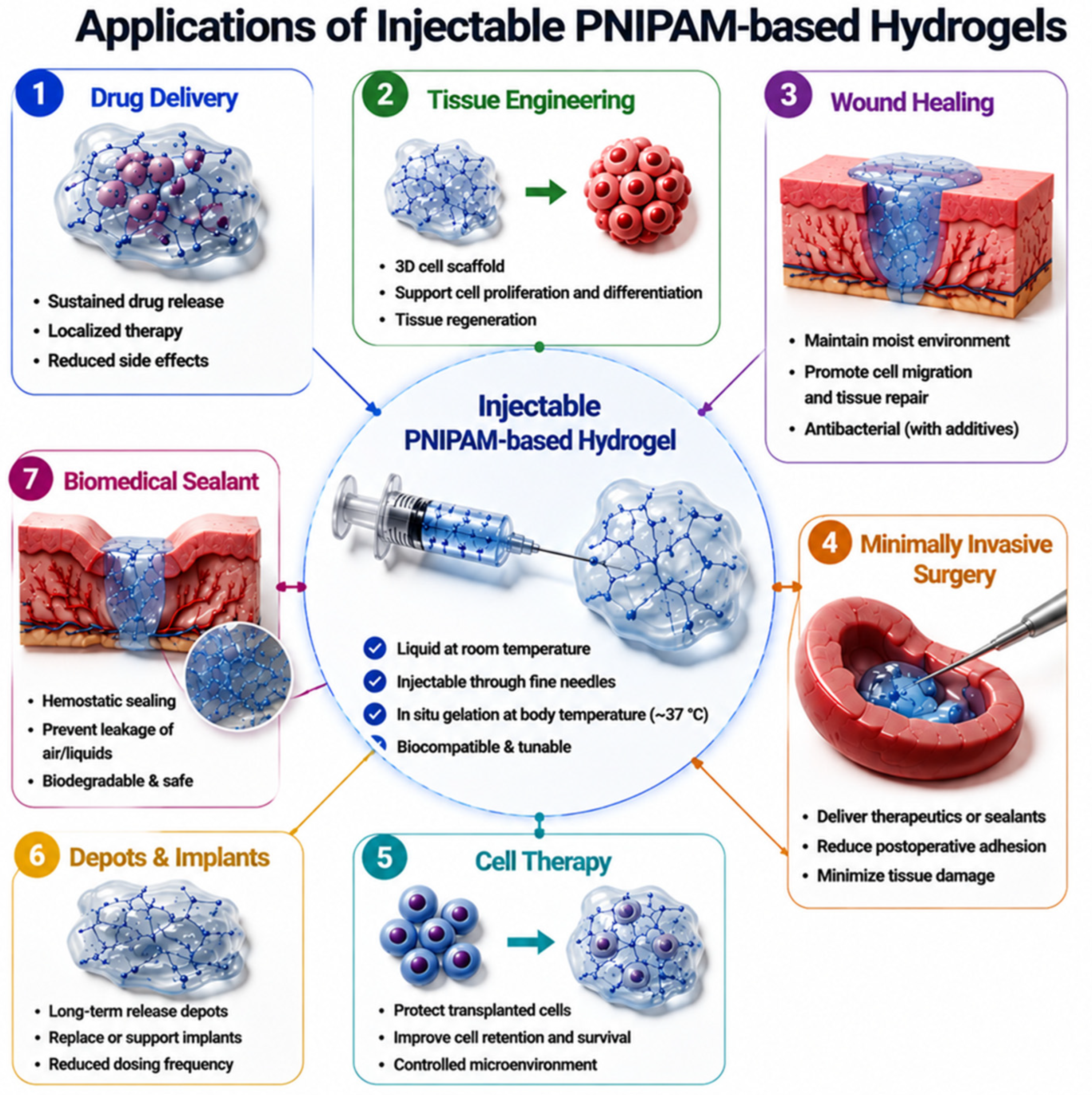
Figure 2.
Phase diagrams of a PNIPAM-based polymer. (a) - polymer without cross-links. Sol1 – transparent sol below the transition temperature, Sol2 – turbid sol above the transition temperature, Gel – turbid gel above the transition temperature. The green band marks the region of concentrations too low for the gel formation. At the higher concentrations, some PNIPAM-based (co)polymers are capable of forming physical gels, while other polymers precipitate. (b)– crosslinked polymer. Gel1 – swollen transparent gel below the transition temperature. Gel2 – turbid deswollen gel above the transition temperature. φ2 is the volume fraction of the polymer.
Figure 2.
Phase diagrams of a PNIPAM-based polymer. (a) - polymer without cross-links. Sol1 – transparent sol below the transition temperature, Sol2 – turbid sol above the transition temperature, Gel – turbid gel above the transition temperature. The green band marks the region of concentrations too low for the gel formation. At the higher concentrations, some PNIPAM-based (co)polymers are capable of forming physical gels, while other polymers precipitate. (b)– crosslinked polymer. Gel1 – swollen transparent gel below the transition temperature. Gel2 – turbid deswollen gel above the transition temperature. φ2 is the volume fraction of the polymer.
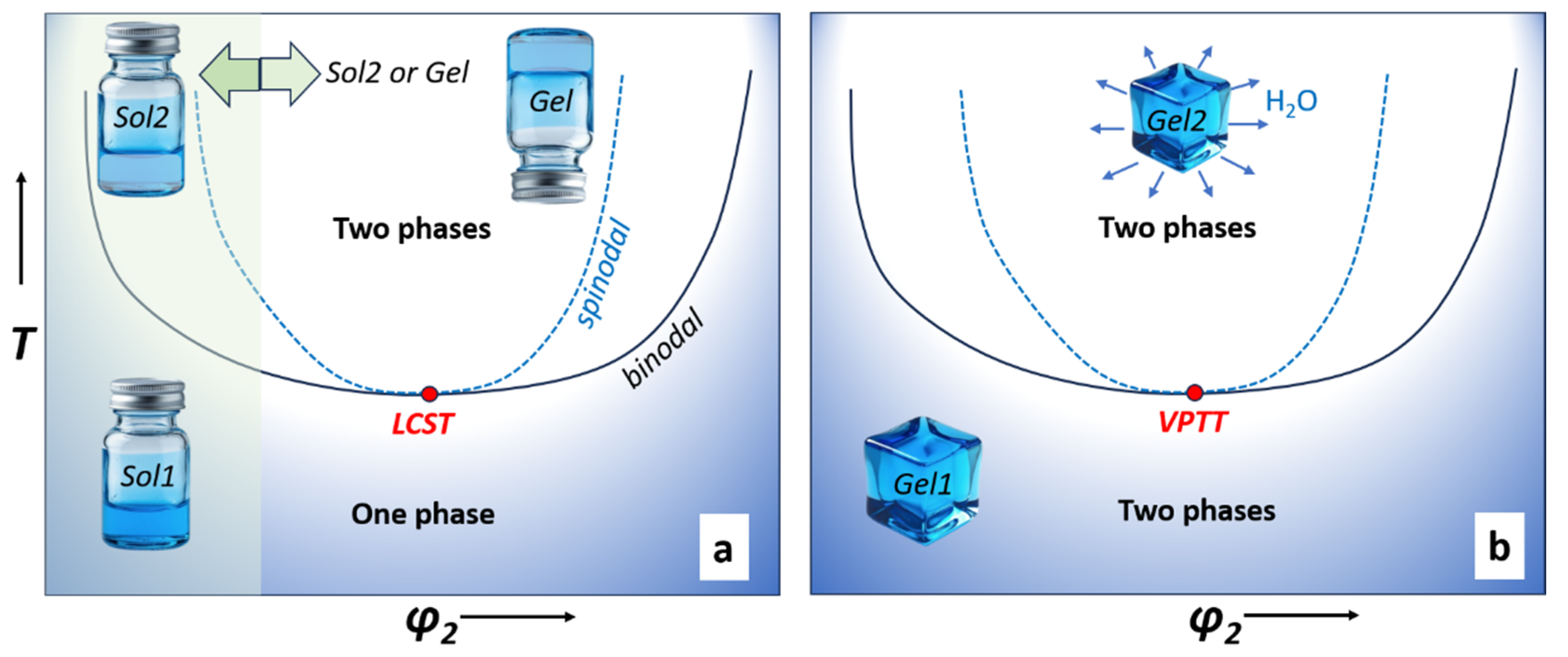
Figure 3.
Coil-to-globule transition in a single PNIPAM chain. (a) - a repeat unit of PNIPAM with a hydrophobic backbone and isopropyl group and a hydrophilic amide group; (b) – hydrogen bonding between two PNIPAM macromolecules and between a PNIPAM macromolecule and water; (c) – an extended PNIPAM macromolecule below the LCST with “water cages” and the collapsed macromolecule above the LCST with “water cages” mostly destroyed [31]. Adapted from Macromolecules under Creative Commons Attribution 4.0 International License.
Figure 3.
Coil-to-globule transition in a single PNIPAM chain. (a) - a repeat unit of PNIPAM with a hydrophobic backbone and isopropyl group and a hydrophilic amide group; (b) – hydrogen bonding between two PNIPAM macromolecules and between a PNIPAM macromolecule and water; (c) – an extended PNIPAM macromolecule below the LCST with “water cages” and the collapsed macromolecule above the LCST with “water cages” mostly destroyed [31]. Adapted from Macromolecules under Creative Commons Attribution 4.0 International License.
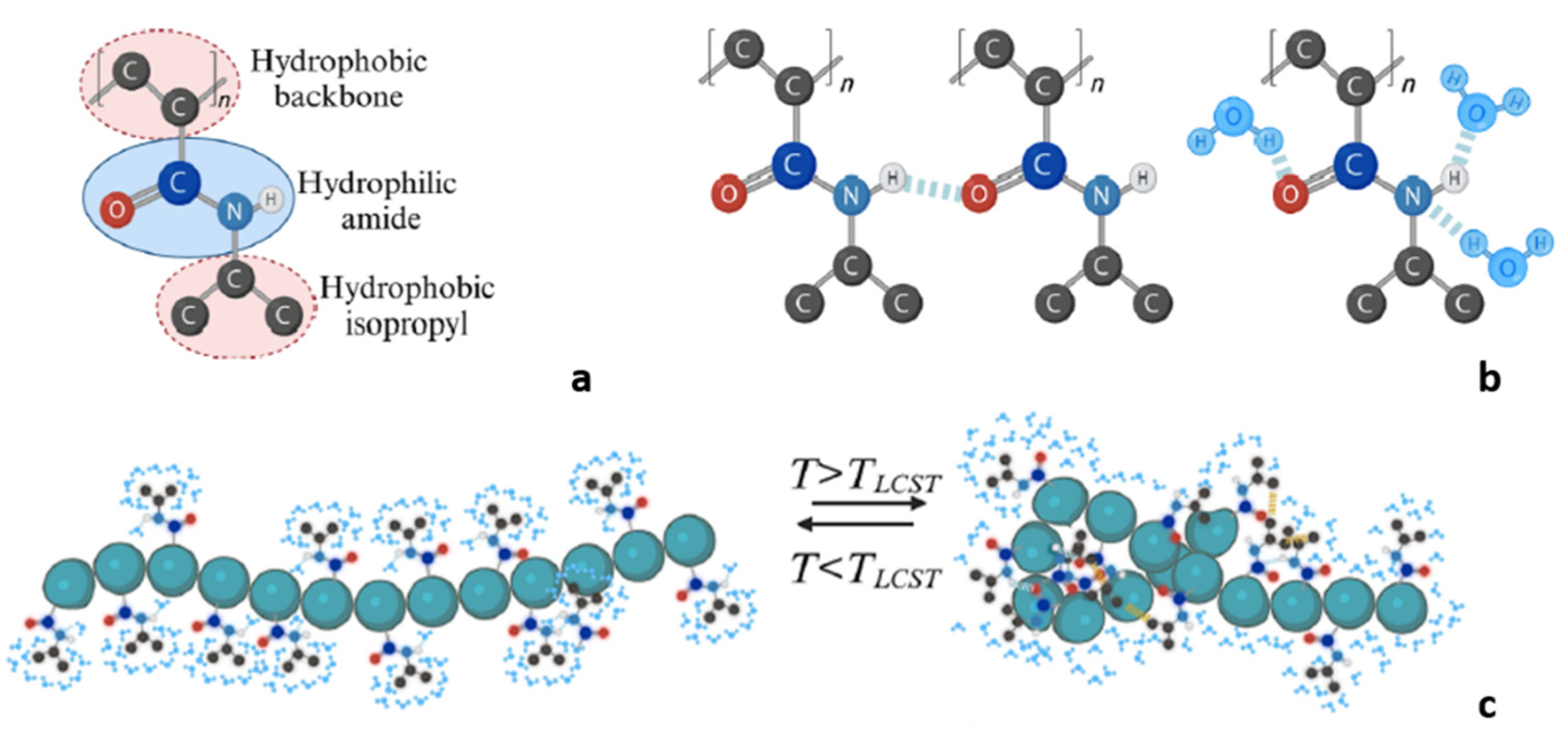
Figure 4.
Mechanisms of physical gelation in block-copolymers containing hydrophilic blocks and thermoresponsive blocks [10]. (a) – a single chain with a hydrophilic and thermoresponsive (associating) blocks; (b) – gelation via physical entanglement; (c) – gelation via the association of micelles with the formation of liquid crystalline structures; (d) – ABA triblock copolymers may form flower-like structures bridged to a percolating network; (e) – elastic network formed by cylindrical micelles. Reproduced from Advanced Functional Materials under Creative Commons Attribution 4.0 International License.
Figure 4.
Mechanisms of physical gelation in block-copolymers containing hydrophilic blocks and thermoresponsive blocks [10]. (a) – a single chain with a hydrophilic and thermoresponsive (associating) blocks; (b) – gelation via physical entanglement; (c) – gelation via the association of micelles with the formation of liquid crystalline structures; (d) – ABA triblock copolymers may form flower-like structures bridged to a percolating network; (e) – elastic network formed by cylindrical micelles. Reproduced from Advanced Functional Materials under Creative Commons Attribution 4.0 International License.
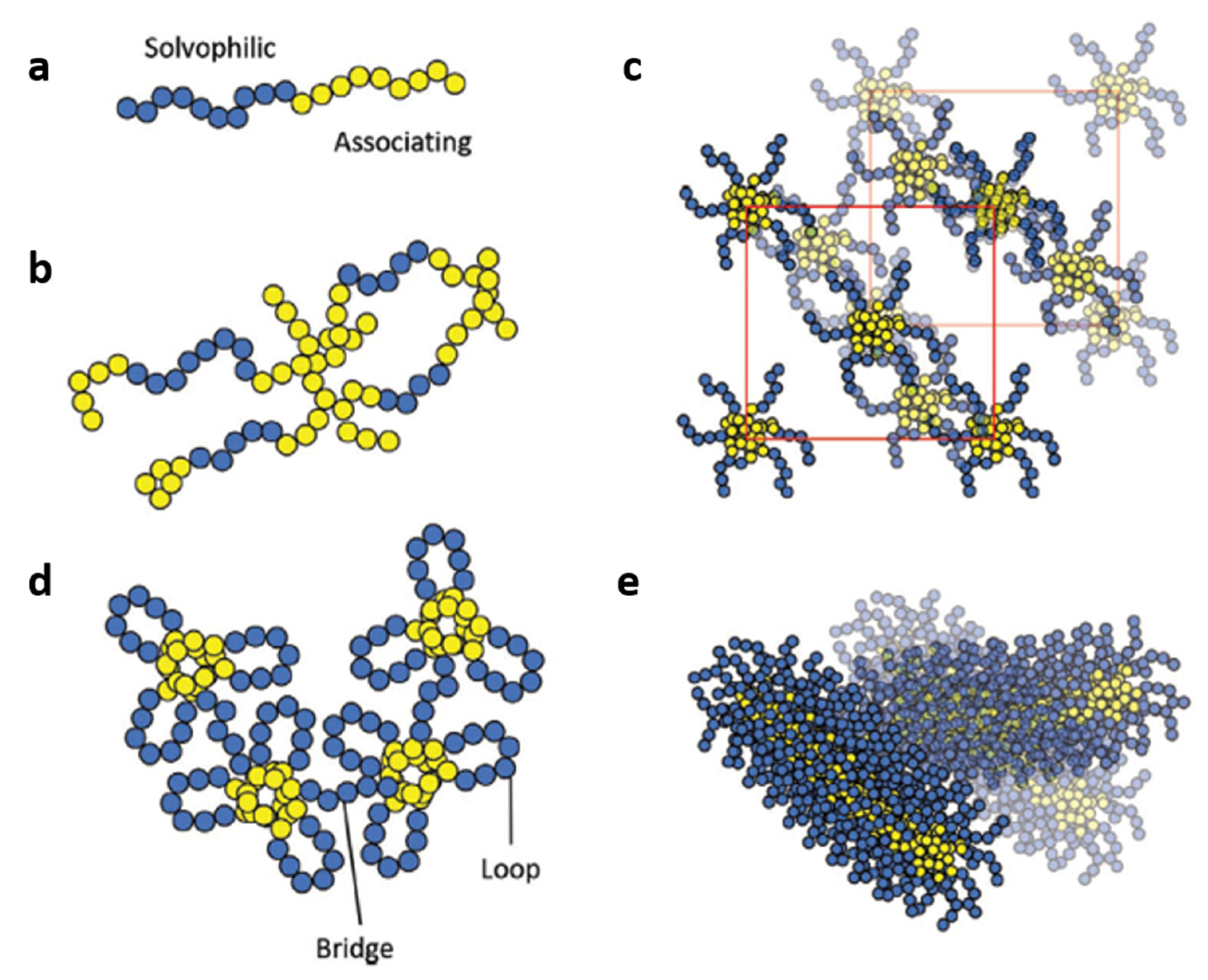
Figure 5.
Mechanism of the coil-to-globule phase transition in a crosslinked thermoresponsive hydrogel. At T<LCST, the polymer chains in the 3D network adopt an extended conformation forming strong hydrogen bonds with surrounding water molecules. Above the coil-to-globule transition temperature, the network collapses, polymer chains are mostly stripped from their hydration shells, and hydrophobic interactions dominate. The water molecules from the hydration shells of polymer chains are released beyond the shrunk hydrogel volume.
Figure 5.
Mechanism of the coil-to-globule phase transition in a crosslinked thermoresponsive hydrogel. At T<LCST, the polymer chains in the 3D network adopt an extended conformation forming strong hydrogen bonds with surrounding water molecules. Above the coil-to-globule transition temperature, the network collapses, polymer chains are mostly stripped from their hydration shells, and hydrophobic interactions dominate. The water molecules from the hydration shells of polymer chains are released beyond the shrunk hydrogel volume.
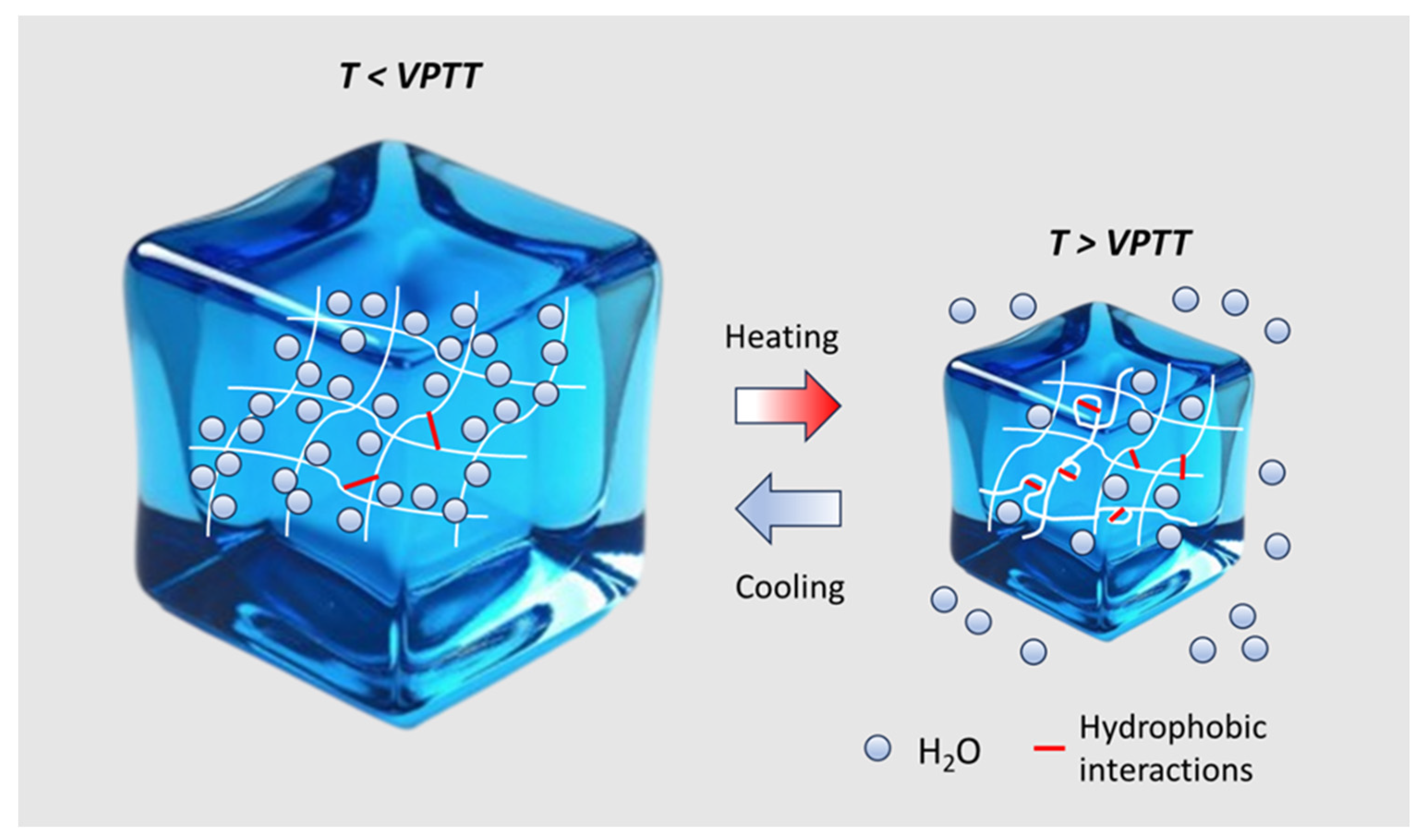
Figure 6.
Salting-out of PNIPAM molecules in the presence of kosmotropic anions [71]. Reproduced from Nature Communications under a Creative Commons Attribution 4.0 International License.
Figure 6.
Salting-out of PNIPAM molecules in the presence of kosmotropic anions [71]. Reproduced from Nature Communications under a Creative Commons Attribution 4.0 International License.
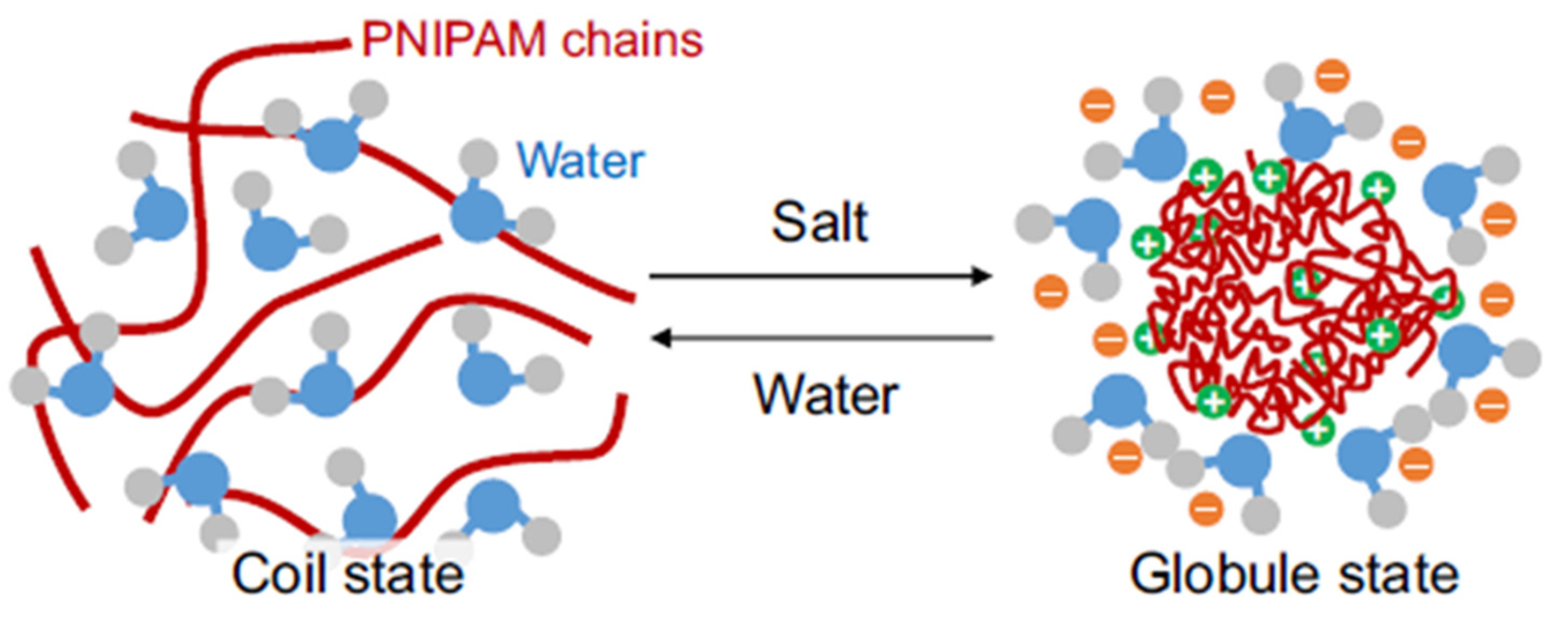
Figure 7.
Phase diagram of a PNIPAM-based polymer with the process of gelation separate from coil-to-globule transition (CGT). Sol1 – transparent sol, Sol2 – turbid sol above the coil-to-globule transition temperature, Gel1 – transparent gel below the VPTT, Gel2 – turbid gel above the VPTT. The green band marks the region of concentrations too low for the gel formation. The green dot marks the triple point of Sol1-Gel1-Gel2 phases.
Figure 7.
Phase diagram of a PNIPAM-based polymer with the process of gelation separate from coil-to-globule transition (CGT). Sol1 – transparent sol, Sol2 – turbid sol above the coil-to-globule transition temperature, Gel1 – transparent gel below the VPTT, Gel2 – turbid gel above the VPTT. The green band marks the region of concentrations too low for the gel formation. The green dot marks the triple point of Sol1-Gel1-Gel2 phases.
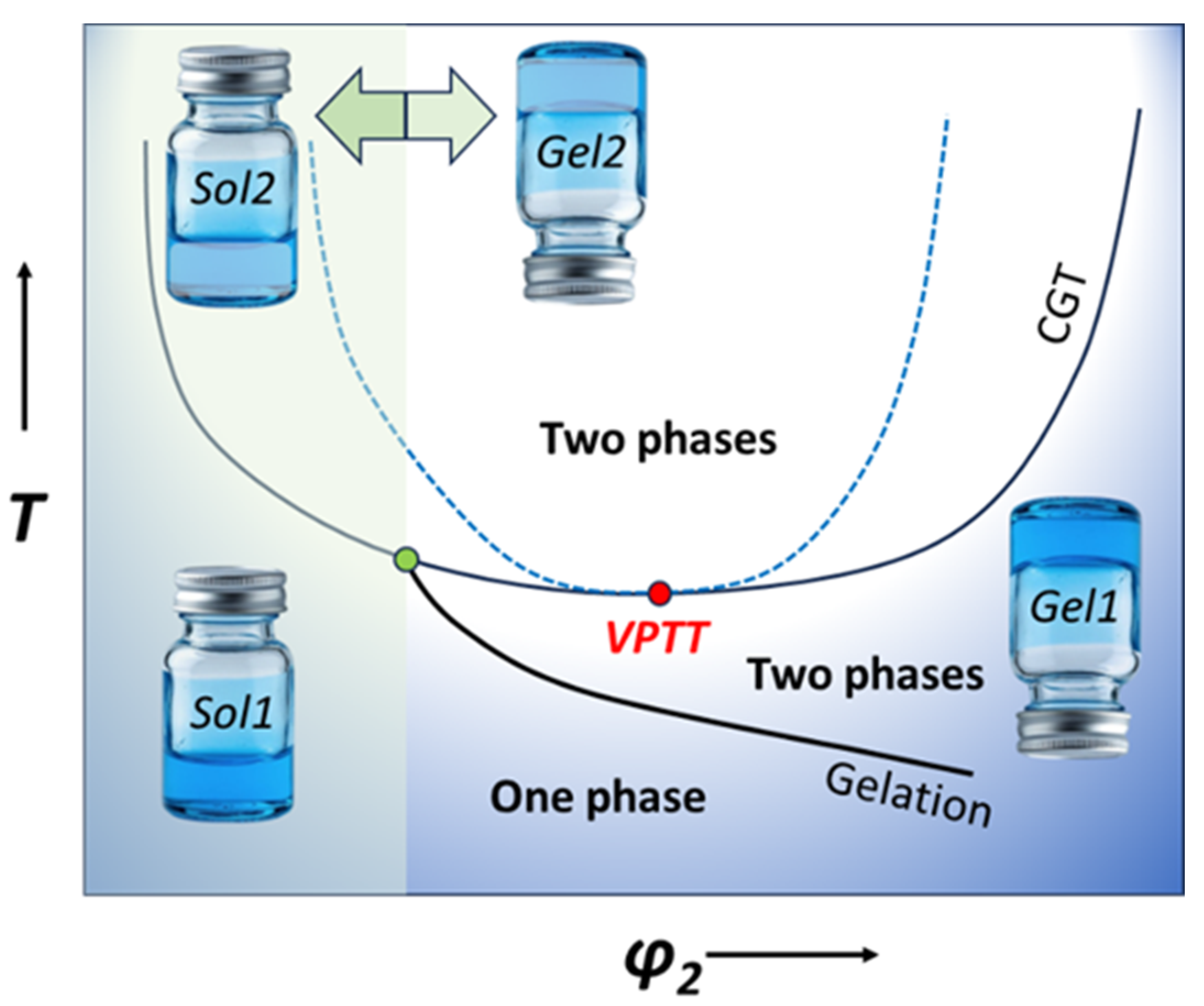
Figure 8.
Phase diagram of atactic PNIPAM described in [91]. Five domains are identified in the quasi-equilibrium phase diagram depending upon the composition and temperature, namely, domains (I): T < T1, stable single-phase solution with the thermorheological simplicity, (II): T1 < T < Tgel, the single-phase solution containing the interchain association subjected to profound concentration fluctuations, (III): Tgel < T < Tb, transparent gel, (IV): Tb < T < Ts,gel, opaque gel, and (V): T > Ts,gel, unstable gel undergoing viscoelastic phase separation via spinodal decomposition. Reproduced from Gels under a Creative Commons Attribution 4.0 International License.
Figure 8.
Phase diagram of atactic PNIPAM described in [91]. Five domains are identified in the quasi-equilibrium phase diagram depending upon the composition and temperature, namely, domains (I): T < T1, stable single-phase solution with the thermorheological simplicity, (II): T1 < T < Tgel, the single-phase solution containing the interchain association subjected to profound concentration fluctuations, (III): Tgel < T < Tb, transparent gel, (IV): Tb < T < Ts,gel, opaque gel, and (V): T > Ts,gel, unstable gel undergoing viscoelastic phase separation via spinodal decomposition. Reproduced from Gels under a Creative Commons Attribution 4.0 International License.
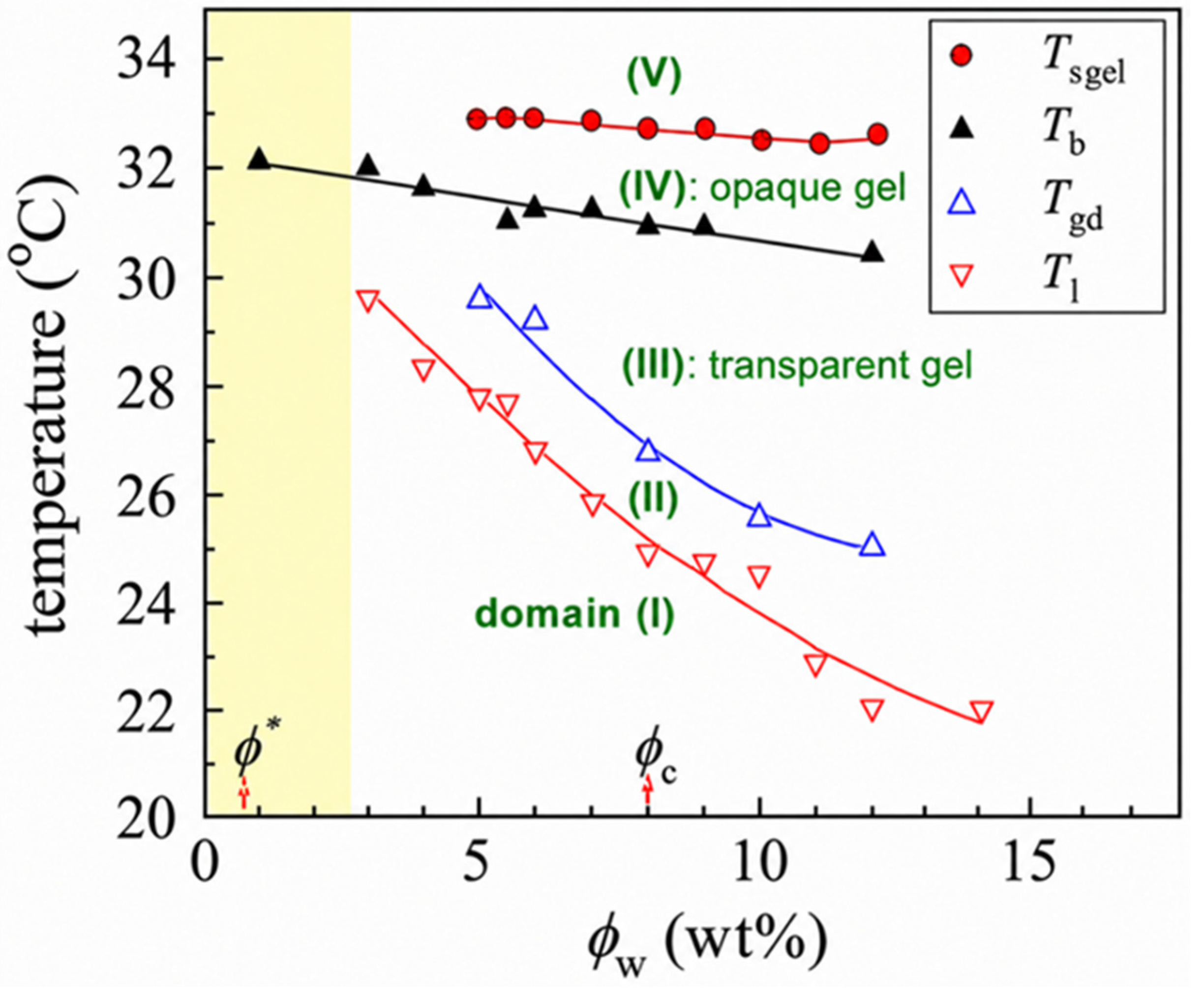
Figure 9.
Model of physical gelation in PNIPAM based on the “pearl-necklace” concept [87,90]. A. Proposed formation of a physical junction: (a) Two a-PNIPAM chains are connected via the hydrophobic interaction of the “pearls” in the overlapping region (red circles, reacted) to form “coupled pearls”; (b) enlargement of the “coupled pearls” to illustrate the collapsed chain segments to highlight the interchain association via inter-amide hydrogen bonding. (a-1) and (a-2) show the reaction pathway of the two contacting pearls that gradually overlap and eventually develop the inter-amide hydrogen bonds in (b). B. Formation of a trifunctional and tetrafunctional junctions. Reproduced from Gels under Creative Commons Attribution 4.0 International License.
Figure 9.
Model of physical gelation in PNIPAM based on the “pearl-necklace” concept [87,90]. A. Proposed formation of a physical junction: (a) Two a-PNIPAM chains are connected via the hydrophobic interaction of the “pearls” in the overlapping region (red circles, reacted) to form “coupled pearls”; (b) enlargement of the “coupled pearls” to illustrate the collapsed chain segments to highlight the interchain association via inter-amide hydrogen bonding. (a-1) and (a-2) show the reaction pathway of the two contacting pearls that gradually overlap and eventually develop the inter-amide hydrogen bonds in (b). B. Formation of a trifunctional and tetrafunctional junctions. Reproduced from Gels under Creative Commons Attribution 4.0 International License.
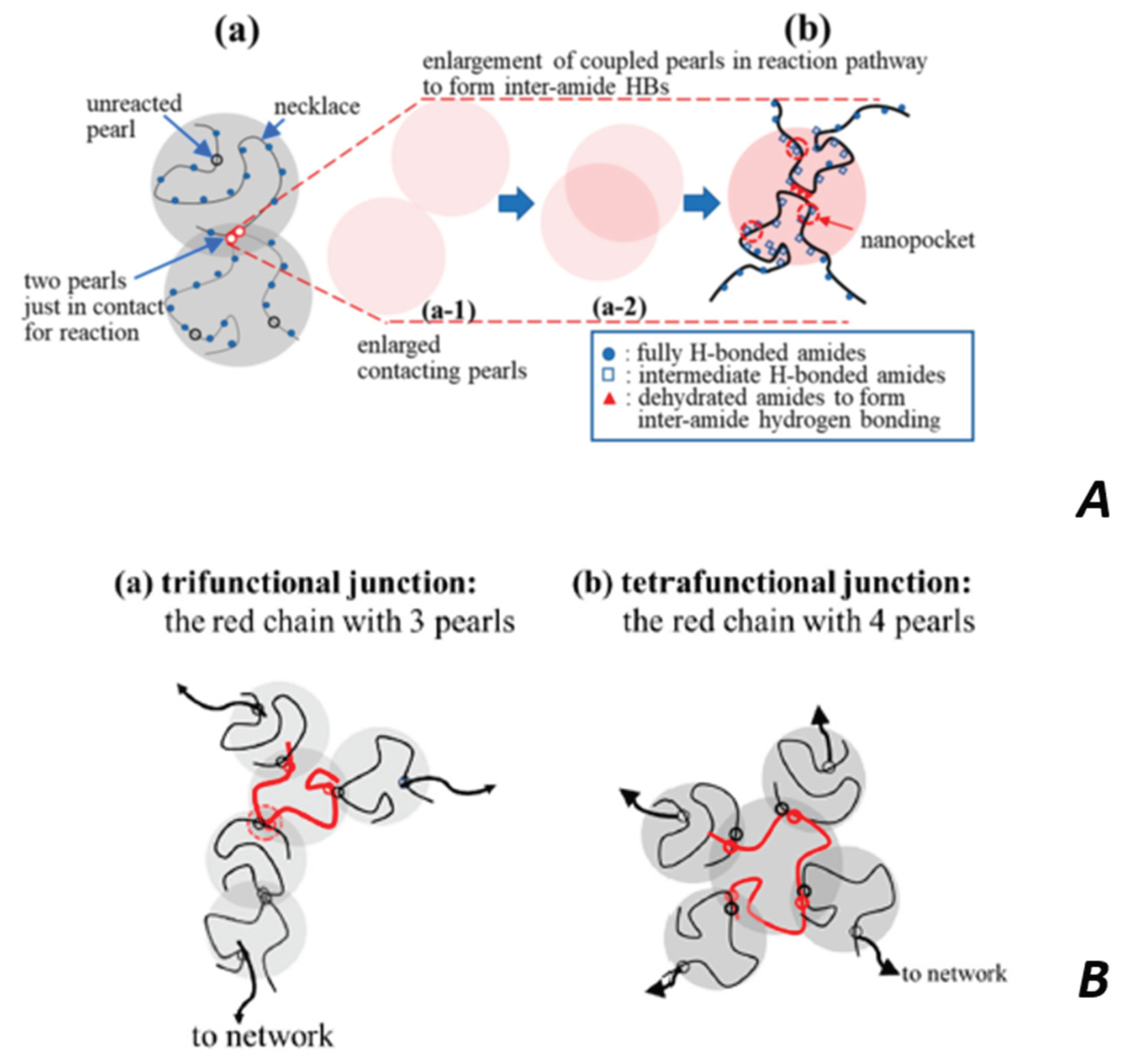
Disclaimer/Publisher’s Note: The statements, opinions and data contained in all publications are solely those of the individual author(s) and contributor(s) and not of MDPI and/or the editor(s). MDPI and/or the editor(s) disclaim responsibility for any injury to people or property resulting from any ideas, methods, instructions or products referred to in the content. |
© 2026 by the authors. Licensee MDPI, Basel, Switzerland. This article is an open access article distributed under the terms and conditions of the Creative Commons Attribution (CC BY) license (http://creativecommons.org/licenses/by/4.0/).
Copyright: This open access article is published under a Creative Commons CC BY 4.0 license, which permit the free download, distribution, and reuse, provided that the author and preprint are cited in any reuse.