

Submitted:
08 September 2026
Posted:
09 September 2026
You are already at the latest version
Abstract
Background: Although a protective vaccine is available, diphtheria reemerged in Somalia starting in mid-2023 with outbreak reported throughout the country in 2025. In response, the Federal Ministry of Health (FMoH) developed a diphtheria outbreak response plan in 2025, launching a vaccination campaign with the first round conducted in 2025 and a second round in early 2026. The vaccination campaign was a mass public health push to rapidly deliver Pentavalent and Td vaccines to children in Somalia regardless of past vaccination status, to stop the diphtheria outbreak. During the campaign, under 5 children received Pentavalent vaccines, while 5-15 years olds received Diphtheria and Tetanus (Td). This study aims to evaluate the post-campaign coverage of diphtheria vaccines in the three most stable states in Somalia, namely the Benadir region, Puntland, and Galmudug states. Methods: The post-campaign coverage survey (PCCS) was conducted from May 18th to July 21st, 2026, in Benadir, Galmudug, and Puntland states. A two-stage cluster sampling design was employed, whereby 362 clusters were randomly selected from a national sampling frame covering all accessible districts, villages, and nomadic areas across the three states. The sample size was calculated according to the WHO 2018 manual, resulting in the selection of 120 clusters and 1,335 households from each state, culminating in a total of 4,093 interviews and covered 9184 children. Surveys were carried out by 152 trained personnel equipped with the KoboCollect app for digital data collection. Ethical approval was obtained from the Somali National University Ethical Committee. Results: Among the children, 49.7% were aged 0 to <5 years, and 50.3% were aged 5 to 15 years. Weighted data indicated that 84.1% of children aged 0 to 15 years across the three states received at least one dose of the diphtheria vaccine during the campaign (95% CI: 80.4% to 87.2%). Among those vaccinated, only 25% of children under 5 years of age and 36% of children aged 5 to 15 years received two doses. Vaccination coverage varied significantly by state: Puntland reported the highest coverage at 93.9%, while Galmudug had the lowest at 75.4% (95% CI: 69.2–80.7%), and Benadir showed intermediate coverage at 80.3% (95% CI: 74.5–85.1%). Geographically, internally displaced persons (IDPs) and nomadic populations had the lowest coverage rates, at 71.9% (95% CI: 55.0–84.2%) and 72.6% (95% CI: 57.9–83.7%) respectively. The primary reason for children not being vaccinated was a lack of awareness about the vaccination campaign. Conclusion: Post-campaign vaccination coverage is notably lower in Galmudug, the most fragile of the three states in terms of security. This indicates that even among Somalia’s relatively stable states, vaccination coverage tends to reflect the security situation of each state. Furthermore, despite the campaign has achieved a relatively high overall vaccination rate of 84.1% in the three states, specific groups—particularly nomadic populations and IDPs remain underserved. Efforts must be intensified to improve accessibility and ensure equitable and comprehensive vaccine coverage for all children throughout Somalia.
Keywords:
vaccination
; diphtheria outbreak
; Somalia
; conflict affected countries
1. Background
Diphtheria primarily affects children younger than 15 years of age, with the highest risk observed among individuals who are unvaccinated or immunocompromised [1]. Before the widespread introduction of vaccination, the disease was a leading cause of illness and death among children[2]. In Somalia, the disease resurfaced in mid-2023, underscoring persistent immunity gaps and vulnerabilities in outbreak detection, preparedness, and response [3]. Despite the availability of a protective vaccine, diphtheria has resurfaced in Somalia since mid-2023, which underscores considerable immunity gaps and weaknesses in the country's outbreak preparedness. By August 2025, Somalia had reported a total of 1,811 suspected diphtheria cases and 89 deaths, resulting in an overall case fatality rate (CFR) of 5% [4]. The situation is exacerbated by the aid cut that interrupted the vaccination campaigns [5]. However, the reported distribution of diphtheria cases across Somalia may largely reflect differences in the performance of state-level health information and reporting systems. States with stronger health infrastructure, such as Puntland, are more likely to detect and report cases, whereas conflict-affected regions such as Hirshabelle, South West, and Jubaland may experience substantial underreporting [6]. Consistent with its comparatively stronger surveillance and reporting system, Puntland recorded 756 cases and 29 deaths, with the highest concentrations reported in Galkayo (384 cases, 8 deaths) and Garowe (237 cases, 7 deaths) [7]. Neighboring Galmudug state reported 112 cases and 6 deaths primarily in Galkayo and Hobyo. States with weak data reporting system in which large parts of the state is controlled by non-state actors such as South-West State registered 177 cases and 3 deaths, Hirshabelle state reported 23 cases and 1 death, while Jubaland confirmed 2 cases [7]. Somaliland reported cases in someoareas [7].
Acknowledging the gravity of the situation, the Federal Ministry of Health (FMoH) of Somalia developed a Diphtheria Outbreak Response Plan in 2025. The plan was presented to Gavi, the Vaccine Alliance, and entailed a targeted approach in 50 high-risk districts. The vaccination campaign was launched with the first round in 2025, followed by a second round in 2026. The vaccination campaign was a mass public health push to rapidly deliver Pentavalent and Td vaccines to children in Somalia regardless of past vaccination status, to stop the diphtheria outbreak. During the campaign, under 5 children received Pentavalent vaccines, while 5-15 received Diphtheria and Tetanus (Td). These initiatives were crucial for combating diphtheria, aiming to safeguard vulnerable populations, bolster immunity, and enhance health resilience against Somalia's diverse challenges. In May 2026, the WHO Somalia Immunization Technical Advisory Group recommended a Diphtheria post-campaign coverage estimation survey following WHO survey guidance [8], which would be conducted by an independent organization. The aim was to estimate, compare and classify Diphtheria coverage attained after the 2025, 2026 vaccination campaign in three states in Somalia. In response to this call, an independent organization conducted a post-campaign coverage survey (PCCS) to assess the uptake of at least one dose of diphtheria-containing vaccine among children aged 0 to 59 months and those aged 5 to 15 years who were targeted during the immunization campaign. The survey was implemented in Puntland, Galmudug, and the Benadir region, where security conditions permitted reliable data collection. Both quantitative and qualitative data were gathered, including information on the reasons for non-vaccination. The findings provided a comprehensive evaluation of the campaign's planning, implementation, and reach, generating valuable evidence to inform future vaccination strategies.
2. Methodology
2.1. Survey Setting
The PCCS was conducted in Puntland and Galmudug states and the Benadir region. We have included all districts targeted during the diphtheria vaccination campaign in 2025 & 2026. We also included remote and hard-to reach areas, such as nomadic populations, IDPs and underserved communities in rural areas.
We ensured that every person in the target districts has non-zero probability of being selected. To obtain our sample, we used a sampling frame that was provided by the WHO country office. The sample frame had a complete list of clusters in the three states except 2 inaccessible districts located in Galmudug (Elbur and Galhareri). The entire districts in Puntland, and Benadir states were accessible and included in the PCCS.
In addition, in the Benadir region, three accessible districts, Darussalam, Gubadley, and Garasbaley, had no pre-existing clusters in the sampling frame despite being covered by the vaccination campaign. To address this gap, we collaborated with local authorities to create clusters using administrative maps (15 clusters in Darusalam, 11 in Gubadley, and 13 in Garasbaley). Based on administrative boundaries and in consultation with district administrators, we then randomly selected clusters from these newly established frames for the survey.
2.2. Survey Population
Our target population were all children aged <5 years and 5 to 15 years in three states covered by immunization campaign for at least one dose of diphtheria vaccine. We interviewed parents/caregivers over 15 years, living in selected districts and consented to participate in the survey. Parents or caregivers younger than 15 years, and those who do not consent to participate were excluded from survey.
This study utilized a quantitative method to estimate, compare and classify vaccination coverage attained after a diphtheria vaccination campaign in the aforementioned three states. The survey followed two-stage cluster sampling methodology, consistent with WHO guidelines for post-campaign coverage evaluation[8]. A structured questionnaire was designed to systematically collect data on geographic, demographic, and socio-contextual factors, along with public perceptions and communication practices related to immunization. Prior to full-scale deployment, a pilot study involving 129 interviews was conducted to evaluate the questionnaire's structure, response validity, and technical functionalities, including skip logic and filter mechanisms, leading to refinement before finalization. The final Somali version of the tool was used to collect the data from the respondents. To standardize data collection, responses related to vaccination status were categorized as "Yes" (received), "No" (not received), or "Do not know " (uncertain about receipt).
Sample Size calculation
| Indicators | Parameters used for the calculation |
| Number of strata =3 | Coverage estimates of Diphtheria campaign |
| Expected coverage falls 50%-70% | Number of respondents required to estimate the coverage for a simple random sample to be done. This number is derived with assumption that expected coverage of 50%-70 and with desired precision of 5% (WHO manual 2018) |
| Desired precision=5% | To inflate the number respondents to achieve same level precision, taking 10 as target number of respondents per cluster, ICC of 0.167 and adjusting the variation occurred due to survey weight as 0.5 |
| Effective sample size=401 | |
| Design effect = 3 | |
| Average number of households to find an eligible child =1 | Three parameters, crude birth rate, infant mortality rate and household size from different literature (DHS-2020, World bank, and UNICEF) |
| Non-response rate= 1.11 | As there is no similar survey available, we used estimation of 10% |
| Total number of completed interviews =3609 | Multiplication of three parameters; number of strata, effective sample size, and design effect |
| Total number of HH to visit =4006 | Multiplication of total number of completed interviews required, average number of HH to visit to get an eligible child, and non-response rate |
| Total number of HH to visit per stratum = 1335 | Multiplication of sample size, design effect and average number of HH to visit to get eligible child and total number of completed interviews required |
| Total number of clusters per stratum =120 | Three parameters were used: Effective sample size, design effect and target number of respondents |
| Total number of HH per cluster =11 | It is the outcome of average number of HH to visit to get eligible child, non-response rate and target number of respondents. |
| Total number of clusters =360 | This is the product of total number of clusters per stratum and the number of strata |
2.3. Sampling Procedure
The survey used a two-stage cluster sampling methodology, aligning with WHO guidelines for post-campaign coverage evaluation[8]. As the first stage of selection, a total of 362 enumeration areas (EAs) were randomly selected from a sampling frame nationwide. The primary sampling unit (PSU) of our survey was the enumeration areas (EAs) or cluster. About 120 EAs were selected randomly from each state. Supervisors and enumerators systematically numbered households with eligible children within each cluster to create comprehensive lists that would facilitate the random selection of households using simple random sampling techniques. This numbering process was completed on the day before the survey. We used WHO survey report checklist and the PRICSSA guideline [8]. For the second stage of selection, a simple random sampling method was employed to choose households within each enumeration area\cluster (the randomization process is explained below).
2.4. Composition of the Survey Team and the Training of the Fieldwork Teams
The survey was managed by a Project Manager who, in close consultation with the project leader and two co-leaders, oversaw its overall coordination and management. State level supervisors and district supervisors were responsible for managing the survey in their respective states and districts, ensuring its quality through extensive visits to randomly selected clusters. A two-phase comprehensive, refresher training program were provided to the field team, which included state coordinators, district supervisors and enumerators. A total of 152 trained personnel, including state coordinators, district supervisors, and enumerators, were deployed across the three states (Table 1). State and district supervisors oversaw operations within their designated strata, ensuring adherence to established protocols and timelines.
2.5. Data Collection
The vaccination campaign was implemented in 2025 and early 2026, with the evaluation survey conducted from 18th to 21st July 2026 across the three states. A team consisting of two enumerators and a district supervisor was formed to conduct pre-survey visits to the selected clusters within each district in Benadir region and Puntland state, two days prior to the survey commencement, while six enumerators and a supervisor were deployed in Galmudug state.
To oversee data collection across all regions, we employed a 'live data collection monitoring' system using KoboCollect geocoordinates (GPS). This system captured data for all sampled settlements and households, ensuring location verification and aiding in data validation. It allowed the survey supervisory team to promptly address any feedback regarding data quality or completeness and take immediate corrective actions as needed to maintain the survey's integrity. All eligible children within the household were included in the data collection. For each child, vaccination cards were reviewed and photographed, and parents' reports were documented.
2.6. Data Analysis
Prior to data analysis, we conducted data management tasks to ensure the information collected was complete, accurate, and consistent. This included creating new variables and assigning value labels. We utilized frequency and cross-tabulation, alongside descriptive statistics, to identify any outliers. To calculate the coverage in the three states, and overall coverage, a survey weighting methodology was applied. Specific procedures were used to determine cluster and household weights, following the formula outlined in the WHO Vaccination Coverage Cluster Survey 2018 [8].
In the analysis phase, descriptive statistics, including frequency counts and proportions, enabled us to summarize the general attributes of the sample. Conversely, inferential statistics were used to estimate general vaccine coverage, featuring point estimates and confidence intervals (Wilson 95% Confidence Intervals), with the application of survey weights. In the sampling weights and appropriate commands (e.g., svy in Stata) were performed. Results were systematically presented in tables and figures, offering a clear visual interpretation of the data. All analyses were conducted using STATA software version 18, ensuring robust and reliable statistical computation.
2.7. Calculation of Survey Weight
In this survey, design weights were computed for every EAs and household selected to participate in the survey. The design weight is the inverse of probability of selecting a household to be interviewed.
The design weight was calculated using the following formula:
Household weight for household The samples were selected through a two-stage process; therefore, the overall probability of household will be the product of the selection probabilities at each stage.
In the first stage, selection of 120 PSUs from every state (stratum)
The probability of selecting in stratum ℎ is:
where is the PSUs to be selected in stratum h and is total number of PSUs in stratum h.
In the second stage, a fixed number [11] of households (SSUs) were selected from each sampled cluster.
The probability of selecting SSUi from PSUi in stratum ℎ is:
where is the fixed number of households in in stratum h and is the total number of households in in stratum h. Therefore, the household weight will be:
During the analysis, we carefully considered the following aspects:
a. Sample Description: We used unweighted data to present key demographic information such as gender, literacy levels, decision-making related to vaccination, and reasons for non-receipt of Diphtheria vaccines.
b. Overall Coverage: Weighted data was employed to estimate the coverage of Diphtheria vaccinations among children under 5 years and those aged 5 to 15 years, applying Wilson 95% confidence intervals for precision.
c. Coverage Verification: Vaccination coverage was validated by analyzing both card records and caregiver recall, using weighted and unweighted data as appropriate.
d. Demographic Analysis: Coverage estimates were further stratified by sex, age groups, and geographical classifications including rural, pastoralist, and urban areas, with weighted Wilson 95% confidence intervals applied.
e. Social and Behavioral Factors: We examined drivers of vaccination uptake using weighted data.
2.8. Ethics
Because survey participation must be exclusively voluntary, freedom to participate were given to participants without any coercion, while the confidentiality of their information was assured to them. Lastly, after they fully understood what is taking place in the study, informed oral consent was obtained from each participant. In addition, the research protocol was approved by ethical committee of the Somali National University (Number: JUS/KCC&CT/2040/2026). We ensured the removal of all personally identifiable information by anonymizing the data. Pictures were deleted from personal devices and saved on institution-owned, password-protected devices accessible only to the study team. These images will be deleted one year after the report is submitted.
2.9. Study Limitations
-In cases where a vaccination card was unavailable during the interview, the data on vaccination coverage was based on the mother's or caregiver's report. This reliance on personal recollection can introduce recall bias, as the respondents may not accurately remember the vaccination details.
-The survey was conducted months after the completion of the vaccination campaigns. Combined with the typically low rate of vaccination card retention in Somalia, these circumstances necessitated relying on parental\caregivers recall for some respondents, which is susceptible to recall bias
3. Results
We conducted interviews with 4093 families, living in 362 clusters, covering 9184 children across three states (Benadir, Puntland and Galmudug). Among these children, 46.43% were girls and 53.57% were boys (Table 2).
As shown in Table 3, the proportions of children aged under 5 years and those aged 5 to 15 years were equal, each representing 50% of the study population.
Most children (67.25%) lived in urban areas, followed by 19.26% in rural areas, with 9.44% and 4.05% residing in nomadic areas and IDP camps, respectively (see Table 4).
In Puntland, 77.78% of participants were vaccinated within a 30-minute walk from home, compared to 60.46% in Galmudug and 40.15% in Benadir, where 32.05% traveled over an hour on foot (see Table 5).
Table 6 shows that over half of nomads walked 30 minutes or more for vaccination, with 27.78% traveling over an hour to reach the site.
Diphtheria Vaccine Coverage
Overall, 84.1% of children across the three states received at least one dose of the diphtheria vaccine during the campaign ( CI: 80.4–87.2%). Coverage varied significantly by state: Puntland had the highest at 93.9%, Galmudug the lowest at 75.4% (CI: 69.2–80.7%), and Benadir was 80.3% (CI: 74.5–85.1) (see Table 7).
As shown in Table 8, IDPs (71.9, CI: 55.0 - 84.2) and nomads (72.6, CI: 57.9 - 83.7) had the lowest coverage of diphtheria vaccine in the three states. There is no significant difference in vaccine coverage between males and females, nor between the two diphtheria antigens administered to children under 5 years and those aged 5 to 15 years.
The overall vaccination card seen rate was 19% (CI: 14.84%–23.88%). Puntland had the highest rate at 30.44% (CI: 21.50%–41.16%), while Benadir had the lowest at 9.24% (CI: 5.72%–14.61%) (see Table 9).
Unexpectedly, nomads exhibit the highest card seen rate at 34.86% (CI: 16.81–58.64), followed by urban residents at 19.02% (CI: 14.40–24.70). In contrast, internally displaced persons (IDPs) have the lowest card seen rate, at 13.4% (CI: 2.98–43.83) (see Table 10).
Table 11 shows that 59.78% of children in the three states received one dose of the diphtheria vaccine during the 2025 and 2026 campaigns (CI: 52.84–66.35), while 31.10% (CI: 25.01–37.91) received two doses. Additionally, 9.12% were unsure about the number of doses. Internally displaced persons (IDPs) and nomadic communities had the lowest two-dose coverage.
As shown in Table 12, nearly half of the clusters had 100% coverage for diphtheria vaccines, while 37.85% had coverage between 50% and 99.9%, and 12.43% had coverage below 50%.
Figure 1 is an organ pipe plot showing the proportion of children vaccinated against diphtheria in each survey cluster. A total of 9,184 children were surveyed across 362 clusters. Of these, 180 clusters achieved full coverage, 137 clusters had coverage between 50% and 99.9%, and 45 clusters had less than 50% coverage with 16 of them had zero coverage.
Each vertical bar represents a cluster, with width proportional to the cluster’s total survey weight and height reflecting the proportion of vaccinated children. Clusters are arranged from left to right in descending order of coverage. A thin golden line indicates the number of children sampled per cluster. Colors represent vaccination coverage: green for 100%, olive for 50% to 90.9%, purple for less than 50%, and red for no children vaccinated.
As shown in Table 19, there are 16 clusters without vaccination coverage. Of these, 14 are located in South Mudug, while the remaining two are in the Galgudud region, both within Galmudug state.
Regarding the reasons for not vaccinating children by settlement, the most commonly reported reason across all groups was “Didn’t know about the campaign,” except for IDPs, whose primary reason was “Vaccine not available at the site.” This was also the second most cited reason among Nomads, Urban, and Rural communities (see Table 13).
4. Discussion
The overall campaign-related diphtheria vaccination coverage was 84.1%, indicating that a substantial proportion of children in the three surveyed states were vaccinated with at least one dose. It is important to highlight that these states, along with Somaliland, are among the most peaceful and stable regions in Somalia [9]. The high post-campaign diphtheria vaccine coverage in these stable states is encouraging. However, significant portions of the country’s most conflict-prone states, where outbreaks occurred, remain unstudied. Notably, all 16 clusters reporting no vaccination are in Galmudug, the most fragile of the three surveyed states. This pattern, previously observed in Somalia, highlights an inverse relationship between conflict intensity and vaccine coverage—the more stable the state, the higher the vaccination rates [9]. For example, Puntland, one of the most stable states, achieved coverage exceeding 93%. Despite this, Puntland’s success offers hope that other Somali states can also attain substantial coverage by sharing best practices.
Regarding settlements, vaccine coverage among IDPs (71.9%) and Nomads (72.6%) is significantly lower compared to rural and urban populations. Their coverage rates fall well below the overall vaccine coverage of 84.1% observed across the three states, highlighting a concerning gap in reaching some of the most vulnerable groups. Similar pattern were seen earlier in measles vaccination in Somalia [9]. Nomads in Somalia are known to have lower access to healthcare than other groups in the country [10]. This disparity exacerbates existing inequities in vaccine access and underscores the urgent need for targeted immunization efforts within these communities.
Similar to previous PCCS findings for measles vaccination in Somalia [9], one of the primary reasons for children not being vaccinated was a lack of awareness about vaccination campaigns. This represents a significant public health challenge, highlighting the urgent need for a well-coordinated national community sensitization and awareness campaign prior to vaccination. Such a campaign should focus on educating families about upcoming vaccination efforts and emphasizing the benefits of immunizing their children. By effectively disseminating this information, families will be better informed of the importance of vaccinations, which can ultimately lead to higher participation rates [11,12]. Furthermore, this awareness campaign could also help address and reduce several other barriers to vaccination identified in this study, creating a synergistic effect in improving overall vaccine uptake.
Although the design effect observed in this study is significantly lower than what was reported in the 2025 measles PCCS [9], it still remains a concern. Notably, the design effect used for calculating the PCCS sample size was 3, whereas the design effect calculated from the study results is substantially higher at 20.96. The reason for this unexpectedly large design effect is unclear. One possible explanation is that individuals within the same cluster, whether pastoralist, urban, or rural, tend to be more similar to each other, a theory supported by the high intra-cluster correlation (ICC) value. However, the true cause of this large design effect remains uncertain and warrants further investigation.
5. Recommendations
To address the weaknesses identified in the vaccination campaign in Somalia and enhance vaccine coverage, the following recommendations should be considered;
1. Develop Targeted Outreach Programs: Design initiatives specifically aimed at reaching overlooked clusters to ensure every child in South Mudug, and Galgudud receives necessary vaccinations.
2. Invest in Capacity Building: Allocate resources and training to local healthcare workers in these regions to enhance their ability to deliver and manage vaccination services effectively.
3. Launch a Comprehensive Sensitization Campaign: Prior to immunization activities, initiate a community awareness effort using various media channels, community gatherings, and local influencers to engage diverse populations and boost the visibility of vaccination efforts.
4. Travel distances to vaccination sites are long in the Benadir region and nomadic communities. To address this, temporary or permanent clinics should be set up within these communities, particularly in areas with low vaccination coverage, to make access easier and more affordable for families.
5. Enhance Training for Community Health Workers: Provide community health workers across the country with extensive training and resources, empowering them with in-depth knowledge and effective communication skills to promote vaccinations effectively.
Author Contributions
AG & AS collected the data, analyzed it and wrote the manuscript. MT participated in the critical review and the write up of the manuscript.
Funding
The study was funded by the World Health Organization.
Institutional Review Board Statement
The study was approved by the Ethical Committee of the Somali National University Protocol-number: JUS/KCC&CT/2040/2026.
Informed Consent Statement
All participants in this study were over 18 years old and they provided informed consent for the study.
Data Availability Statement
Data available on request due to privacy\ethical restrictions.
Acknowledgments
We thank all research assistants and study participants who participated in the study. We equally than WHO organization who funded the study.
Conflicts of Interest
Authors declare that there is no conflict of interest.
References
- World Health Organization. Diphtheria vaccine: WHO position paper — August 2017. Wkly. Epidemiol. Rec. 2017, 92, 417–435. [Google Scholar] [PubMed]
- WHO Eastern Mediterranean Region. Vaccine and vaccination. Available online: https://www.emro.who.int/health-topics/diphtheria/vaccine-vaccination.html.
- Dureab, F.; et al. Diphtheria outbreak in Yemen: the impact of conflict on a fragile health system. Confl. Health 2019, 13, 19. [Google Scholar] [CrossRef] [PubMed]
- Hussein, S.A.; Osman, M.M.; Hassan, M.M.; Hassan, Y.S.A.; Hussein, A.A.; Adem, R.; Fuje, M.M.A.; Ali, A.N.; Mohamed, A.H.; Mohamud, K.H.; Ibrahim, A.M.; Yusuf, M.F.; Hussein, A.A.; Mohamud, A.M.; Ali, A.A. Diphtheria outbreak in Somalia: a weekly sitrep on the recent health crisis-2025. Trop. Med. Health 2025, 53(1), 167. [Google Scholar] [CrossRef] [PubMed]
- Somalia - Diphtheria outbreak (DG ECHO, WHO, Somalia’s MoH, NGOs) (ECHO daily flash of 20 August 2025)—Somalia. ReliefWeb. 2025. Available online: https://reliefweb.int/report/somalia/somalia-diphtheria-outbreak-dg-echo-who-somalias-moh-ngos-echo-daily-flash-20-august-2025.
- Ali, Aisha Mohamud Isse; Kawila, Caroline; Mwangi, Muthoni. FACTORS INFLUENCING IMPLEMENTATION OF HEALTH MANAGEMENT INFORMATION SYSTEM IN PUBLIC HEALTH FACILITIES IN PUNT LAND STATE, SOMALIA. International Research Journal of Medicine and Health Sciences. 2024. Available online: https://www.irjp.org/index.php/IRJMHS/article/view/297.
- Siad, A.S.; Yusuf, A.M.; Warsame, M.O.; Nor, M.A.; Abshir, S.N.; Mohammed, A.I. Diphtheria Outbreak in Somalia: An Alarming Public Health Crisis, Challenges, and Solutions. Infect. Drug Resist. 2026, 19, 563822. [Google Scholar] [CrossRef] [PubMed]
- WHO. Vaccination Coverage Cluster Surveys: Reference Manual; World Health Organization: Geneva, 2018; ISBN licence: CC BY-NC-SA 3.0 IGO. [Google Scholar]
- Salad, A.M.; Gedi, M.A.; Mire, A.A.; Duale, H.A.; Eltayeb, A.O.; Ali, D.A.; Awil, M.J.; Derow, M.M.; Gele, A. Vaccine hurdles for children in war-torn Somalia: the result of post-campaign coverage survey 2025. Confl. Health 2026, 20(1), 10. [Google Scholar] [CrossRef] [PubMed]
- Duale, H.A.; Salad, A.M.; Mohamoud, S.; et al. Unveiling healthcare disparities in Somalia: the hidden struggles of nomadic communities. Int. J. Equity Health 2026, 25, 141. [Google Scholar] [CrossRef] [PubMed]
- Mohanty, S.; Leader, A.E.; Gibeau, E.; Johnson, C. Using Facebook to reach adolescents for human papillomavirus (HPV) vaccination. Vaccine 2018, 36(40), 5955–61. [Google Scholar] [CrossRef]
- Jalloh, M.F.; Wilhelm, E.; Abad, N.; Prybylski, D. Mobilize to vaccinate: lessons learned from social mobilization for immunization in low and middle-income countries. Hum. Vaccin Immunother. 2020, 16(5), 1208–14. [Google Scholar] [CrossRef] [PubMed]
Figure 1.
Children in each survey cluster who received the Diphtheria vaccine.
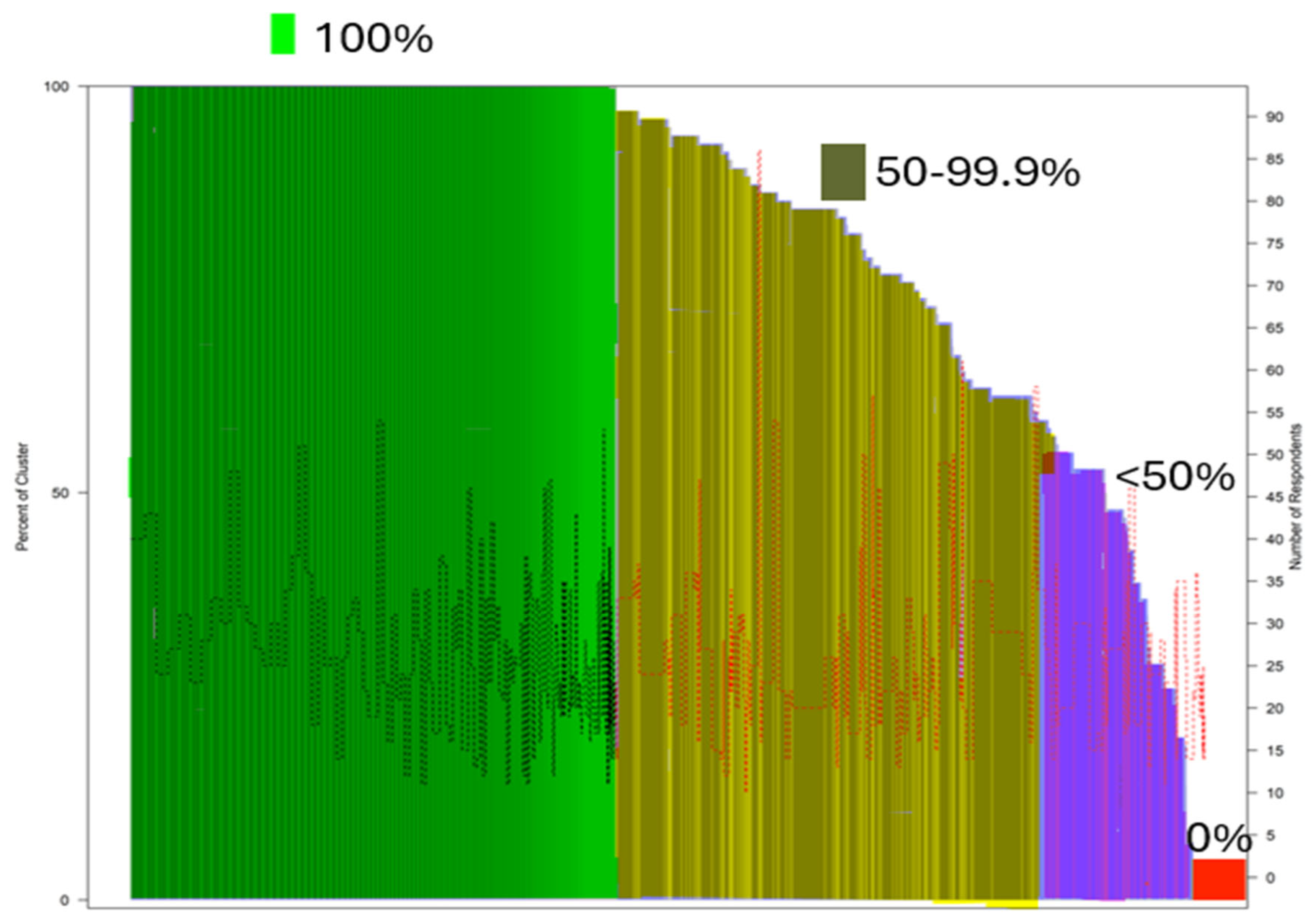

Table 1.
Number of teams disaggregated by state.
| Position | State/administration | Total | ||
| Puntland | Benadir | Galmudug | ||
| District Supervisors | 18 | 20 | 5 | 43 |
| State coordinator | 1 | 1 | 1 | 3 |
| Enumerators | 36 | 40 | 30 | 106 |
| Total | 55 | 61 | 36 | 152 |
Table 2.
Gender of the children.
| Gender | Freq. | Percent |
| Female | 4264 | 46.43 |
| Male | 4920 | 53.57 |
| Total | 9184 | 100.00 |
Table 3.
Age categories.
| Age group | Freq. | Percent |
| Under-5 years | 4565 | 49.71 |
| Over-five years | 4619 | 50.29 |
| Total | 9184 | 100.00 |
Table 4.
Participants by settlement.
| Type of settlement | Freq. | Percent | Cum. |
| IDP/Refugee | 372 | 4.05 | 4.05 |
| Nomadic | 867 | 9.44 | 13.49 |
| Rural | 1769 | 19.26 | 32.75 |
| Urban | 6176 | 67.25 | 100.00 |
| Total | 9184 | 100.00 |
Table 5.
Distance to vaccination site by state.
| Distance | Stratum (State) | |||
| Banadir | Galmudug | Puntland | Total | |
| <30 minutes | 40.15 | 60.46 | 77.78 | 68.03 |
| 30-60 minutes | 27.80 | 29.66 | 15.66 | 20.31 |
| >1 hour | 32.05 | 9.89 | 6.56 | 11.66 |
| Total | 100.00 | 100.00 | 100.00 | 100.00 |
Table 6.
Distance to vaccination site by settlement.
| Distance | Settlement type | ||||
| IDP/Refugee | Nomadic | Rural | Urban | Total | |
| <30 minutes | 57.50 | 48.61 | 87.11 | 63.93 | 68.03 |
| 30-60 minutes | 37.50 | 23.61 | 8.18 | 23.14 | 20.31 |
| >1 hour | 5.00 | 27.78 | 4.72 | 12.92 | 11.66 |
| Total | 100.00 | 100.00 | 100.00 | 100.00 | 100.00 |
Table 7.
Diphtheria vaccination coverage (weighted).
| (%) | 95% CI (%) | StdErr (%) | DEFF | ICC | N | Weighted N | |
| Three states | 84.1 | (80.4,87.2) | 0.02 | 20.96 | 0.45 | 9,100 | 9,115 |
| Banadir | 80.3 | 74.5,85.1 | 0.03 | 13.55 | 0.35 | 2,815 | 5128 |
| Galmudug | 75.4 | 69.2,80.7 | 0.03 | 13.71 | 0.52 | 3,009 | 1090 |
| Puntland | 93.9 | 90.7,96.1 | 0.01 | 10.69 | 0.27 | 3,276 | 2898 |
Table 8.
Diphtheria vaccine coverage by geography, age category, sex and literacy (weighted).
| Background characteristics | Children receiving Diphtheria vaccine | |
| Geographic | % | 95% CI |
| IDP/refugee | 71.9 | 55.0-84.2 |
| Nomadic | 72.6 | 57.9-83.7 |
| Rural | 87.2 | 82.1-91.1 |
| Urban | 84.3 | 79.9-87.9 |
| Gender | ||
| Female | 82.39 | 76.9- 86.8 |
| Male | 84.32 | 80.9- 87.2 |
| Age group | ||
| <5 years | 84.25 | 80.2-87.6 |
| ≥5 years | 82.73 | 78.2- 86.5 |
| Literacy | ||
| cannot read and write | 75.3 | 69.4 - 80.4 |
| can read and write | 87.61 | 84.2-90.4 |
Table 9.
Diphtheria vaccine validation by state (weighted).
| Background characteristics | By card | By recall | Total | ||
| % | 95% CI | % | 95% CI | N Weighted | |
| Three states | 18.95 | 14.84-23.88 | 81.05 | 76.12-85.16 | 7,662 |
| State | |||||
| Banadir | 9.24 | 5.72-14.61 | 90.76 | 85.39-94.28 | 4119 |
| Galmudug | 29.53 | 21.18-39.52 | 70.47 | 60.48-78.82 | 821 |
| Puntland | 30.44 | 21.50-41.16 | 69.56 | 58.84-78.50 | 2722 |
Table 10.
Diphtheria vaccine validation by geography, age category, sex and literacy (weighted).
| Background characteristics | vaccination card seen | Recall | ||
| % | 95% CI | % | 95% CI | |
| Geographic | ||||
| ID/refugee | 13.4 | 2.98-43.83 | 86.6 | 56.17-97.02 |
| Nomadic | 34.86 | 16.81-58.64 | 65.14 | 41.36-83.19 |
| Rural | 16.81 | 8.95-29.33 | 83.19 | 70.67-91.05 |
| Urban | 19.02 | 14.40-24.70 | 80.98 | 75.30-85.60 |
| Gender | ||||
| Female | 18.27 | 14.19-23.19 | 81.73 | 76.81-85.81 |
| Male | 19.53 | 15.18-24.76 | 80.47 | 75.24-84.82 |
| Age group | ||||
| Under-5 years | 23.2 | 18.13-29.17 | 76.8 | 70.83-81.87 |
| Over-five years | 15.34 | 11.68-19.88 | 84.66 | 80.12-88.32 |
| Literacy | ||||
| cannot read and write | 14.65 | 9.52-21.86 | 85.35 | 78.14-90.48 |
| can read and write | 20.45 | 15.84-25.99 | 79.55 | 74.01-84.16 |
Table 11.
Diphtheria vaccine dose by state, geography, age category, sex and literacy (weighted).
| Background characteristics | One dose | Two doses | Don’t know | ||
| % | 95% CI | % | 95% CI | % | |
| Somalia | 59.78 | 52.84-66.35 | 31.10 | 25.01-37.91 | 9.12 |
| State | |||||
| Banadir | 48.52 | 39.29-57.86 | 37.70 | 28.53-47.85 | 13.78 |
| Galmudug | 78.60 | 67.45-86.69 | 20.36 | 12.34-31.70 | 1.04 |
| Puntland | 71.13 | 61.43-79.22 | 24.35 | 17.27-33.16 | 4.52 |
| Geographic | |||||
| ID/refugee | 71.59 | 44.14-88.93 | 19.5 | 7.42-42.42 | 32.13 |
| Nomadic | 46.18 | 28.09-65.33 | 36.11 | 18.80-57.98 | 17.71 |
| Rural | 55.37 | 41.05-68.86 | 39.40 | 27.06-53.26 | 5.22 |
| Urban | 60.56 | 52.45-68.13 | 29.89 | 22.99-37.84 | 9.55 |
| Gender | |||||
| Female | 60.09 | 52.78-66.98 | 30.53 | 24.09-37.84 | 9.38 |
| Male | 59.51 | 52.42-66.23 | 31.58 | 25.31-38.59 | 8.91 |
| Age group | |||||
| Under-5 years | 66.84 | 60.04-73.00 | 25.02 | 19.69-31.24 | 8.13 |
| Over-five years | 53.77 | 45.73-61.62 | 36.26 | 28.78-44.47 | 9.96 |
| Literacy | |||||
| can read and write | 60.89 | 52.95-68.29 | 30.40 | 23.25-38.40 | 5.71 |
| cannot read and write | 59.39 | 51.39-66.93 | 30.29 | 23.25-38.40 | 10.31 |
Table 12.
Classification of clusters by vaccination coverage.
| Freq. | Percent | |
| Clusters with 100% children vaccinated | 180 | 49.72 |
| Clusters with >50% - 99.9% children vaccinated | 137 | 37.85 |
| Clusters with 0-50% children vaccinated | 45 | 12.43 |
| Total | 362 | 100.00 |
Table 19.
Clusters with zero diphtheria coverage by region.
| Region | Clusters | Percent |
| Galgadud | 2 | 12.50 |
| South Mudug | 14 | 87.50 |
| Total | 16 | 100.00 |
Table 13.
Reason not vaccinating the child by type of settlement (unweighted).
| Reason not vaccinating the child | IDP/Refuge | Nomadic | Rural | Urban |
| Fear of side effects | 10.19 | 2.46 | 4.14 | 5.09 |
| Didn't know about the campaign | 25 | 40.85 | 18.05 | 41.34 |
| Confused with other vaccines | 0 | 0.35 | 0 | 2.47 |
| Parent/Guardian were missing | 3.7 | 1.41 | 6.8 | 9.9 |
| Fear of injections | 10.19 | 3.17 | 0.89 | 3.78 |
| Lack of confidence in the vaccine | 6.48 | 6.69 | 15.98 | 4.37 |
| Site of vaccination was not known | 0.93 | 5.99 | 16.27 | 0.87 |
| Vaccination hours unsuitable | 4.63 | 3.52 | 0.89 | 1.02 |
| Waited too long at the site | 0 | 0.7 | 0.3 | 0.44 |
| Site of vaccination too far | 0 | 6.34 | 24.85 | 0.44 |
| Vaccine not available at the site | 38.89 | 34.51 | 13.31 | 9.17 |
| Missing vaccinator at the site | 0 | 0 | 4.14 | 6.26 |
| Not authorized by head of household | 0 | 0 | 0.89 | 3.35 |
| Religious beliefs | 0 | 0 | 0.59 | 0.15 |
| Child was sick at time of vaccination | 3.7 | 1.41 | 2.66 | 2.47 |
| Absent/traveling during the | 5.56 | 1.76 | 4.73 | 3.2 |
| Too busy to take child | 2.78 | 0.35 | 1.48 | 2.77 |
| Parent/caregiver was sick | 0 | 0 | 0.3 | 0.58 |
| Other | 0.93 | 1.06 | 4.14 | 6.84 |
Disclaimer/Publisher’s Note: The statements, opinions and data contained in all publications are solely those of the individual author(s) and contributor(s) and not of MDPI and/or the editor(s). MDPI and/or the editor(s) disclaim responsibility for any injury to people or property resulting from any ideas, methods, instructions or products referred to in the content. |
© 2026 by the authors. Licensee MDPI, Basel, Switzerland. This article is an open access article distributed under the terms and conditions of the Creative Commons Attribution (CC BY) license (http://creativecommons.org/licenses/by/4.0/).
Copyright: This open access article is published under a Creative Commons CC BY 4.0 license, which permit the free download, distribution, and reuse, provided that the author and preprint are cited in any reuse.