

Submitted:
08 September 2026
Posted:
09 September 2026
You are already at the latest version
Abstract
Introduction: Patients on a thrice-weekly haemodialysis (TWH) maintenance schedule require a protein intake of at least 1.0-1.2 g/kg, providing 30-35 Kcal/kg. The mean age of patients on TWH routinely exceeds the age of 70, with more than 25% of patients over the age of 80. It is widely acknowledged that comorbid conditions and anorexia frequently hamper protein and calorie intake in the elderly, thus resulting in the onset of sarcopenia and/or Protein Energy Wasting (PEW). These conditions are further complicated by the massive loss of amino acids (AAs) in dialysate caused by the diffusive-convective mechanisms routinely used in TWH. Materials and Methods: A review of the available literature was performed to identify trials focussed on the replacement of amino acids to replace AA losses incurred following the use of extracorporeal treatments such as haemodialysis (HD) and haemodiafiltration (HDF), and studies adopting oral amino acid replacement protocols subsequently extrapolated and examined. The authors moreover intended to highlight how procedures developed in recent years had evolved, with the aim of identifying novel and better-tailored mixtures of free amino acids (FAAs) capable of yielding additional benefits. Results: Literature reports relating to patients on TWH who receive amino acid supplementation to replace annual AA losses that, depending on the type of extracorporeal method used, potentially exceed 1.0-1.5 Kg/year, are currently considerably limited. More recent papers describe the main mechanisms of action of amino acid mixes capable of affording a series of significant results: improvement of anaemia and cardiac performance and a beneficial effect on the percentage of muscle mass and metabolic and nutritional status resulting from enhanced patient compliance. Conclusions: We hypothesize that supplementation using novel mixes of FAAs may slow down the inevitable progression of sarcopenia and/or PEW by replacing the severe haemodialysis-induced amino acid deficit and eliciting markedly positive metabolic and clinical effects.
Keywords:
hemodialysis amino acid loss
; amino acids oral replacement
Introduction
Low-protein dietary protocols (0.4 – 0.6 g/kg/day) with a calorie intake of at least 25-30 kcal/kg/day have been used for decades in the conservative management of Chronic Kidney Disease (CKD) to slow down progressive deterioration of the disease from CKD3b to End Stage Failure, particularly in the elderly and frail, thus preventing the rapid progression of CKD and need for dialysis [1,2]. A completely different scenario is however encountered with patients undergoing TWH who, in order to prevent malnutrition, need to ensure a protein intake of at least 1.2 g/kg/day with a provision of at least 30-35 kcal/kg/day [3]. The availability and anabolic use of amino acids, already reduced due to the frequent onset of hypercatabolism elicited by the presence of a series of comorbidities, is further exacerbated by a major dialysis-induced loss of AAs [4]. All AAs are low molecular weight molecules (ranging from 89.1Da of alanine to 204.2 Da of tryptophan) which readily pass through the dialysis membrane, thus producing huge losses in spent dialysate caused by both diffusive concentration gradient and convection/ultrafiltration in the presence of high-flux haemodialysis membranes and high ultrafiltration gradients at varying levels of transmembrane pressure [5,6]. Whilst haemodialysis-associated AAs losses were first reported at the end of the 1970s [7], it was only towards the early 2000s that the scientific literature started to report how major AA losses during TWH exerted a negative effect on nutritional status and preservation of fat and muscle mass, and anaemia, thus adding to the growing awareness of the need to replace AAs losses in both patients with an adequate nutritional status and, in particular, frail patients at early or advanced stages of malnutrition. Cognisant of the quality and quantity of AAs lost and their metabolic fate [4,5], research studies focussed on developing targeted FAA mixes [8,9,10,11,12,13]. The studies undertaken confirmed remarkably high losses of both essential (EAAs) and non-essential amino acids (NEAAs), as well as a series of so-called conditionally essential AAs (arginine, cysteine, glutamine, glycine, proline and tyrosine) [5]. In more advanced cases of sarcopenia detected in the context of TWH, AAs supplementation may be administered parenterally during the haemodialysis session with calories largely comprised of intradialytic parenteral infusions of glucose. However, the influx of high amounts of AAs is largely invalidated by the high plasma levels reached following parenteral administration, with high AAs concentrations not only exceeding intra-cellular absorption capacity, but particularly producing a high plasma/dialysate concentration gradient with consequent increased elimination of AAs in spent dialysate (up to double the amount of AAs infused), thus hindering an adequate nutritional and clinical outcome [14]. This review is focussed on studies based on the oral administration of an amino acid supplement, potentially representing a long-term “buffer” therapeutic option aimed at preserving a metabolic and nutritional steady state for as long as possible, particularly in the elderly. A search of the available literature was performed to evaluate the results obtained in studies using a range of oral AAs formulations, taking into account study design, safety, effects on other organs and apparatus and patient adherence to the protocols adopted.
Methods
When reading this review, it is important to consider that all patients recruited for the selected studies displayed good nutritional status, as defined by the KDIGO guidelines [3], taking into account protocols based on the sole oral administration of a range of different products and mixes of AAs indicated for use in patients on TWH, and excluding the concurrent use of other parenterally administered products. The studies selected were defined as focussing on either the treatment of a group of patients with amino acids (TG) or a control group receiving no treatment and/or placebo (CG). The main aim of the study was to assess the overall number of patients recruited to the various studies, and to determine, where available, the following parameters: age of the population studied, extracorporeal dialysis method adopted, study duration, prescribed calorie and protein intake, type of products or oral mixes in terms of quality and quantity of AAs, amino acid losses incurred at each dialysis session and per year, blood chemistry, clinical and nutritional findings, Above all, adherence to the prescribed AA supplementation is important, including strict compliance with the dosage and how long patients have adhered to the AAs protocol. Lastly, the lab techniques used to determine AAs are important. Research engines used: PubMed, Cochrane Library, Google Scholar. Research Criteria: Nutritional supplementation for replacing amino acids in patients undergoing thrice-weekly extra-corporeal treatment. The following were excluded: amino acids in paediatric trials; administration of proteins in which AAs content was not quantifiable; incremental haemodialysis protocols; patients with inadequate calorie-protein intake; administration of amino acids to patients with acute kidney injury (AKI) or in a critical situation, or those undergoing Continuous Renal Replacement Therapy (CRRT): see Figure 1.
Results
The literature search conducted yielded a total of 75 relevant publications, although only 9 of these met the established criteria for oral administration of amino acid replacement, Figure 1.
The only observational study performed with no control group (CG) on a total of 32 patients by Małgorzewicz S. [15] administered Oral Nutritional Supplementation (ONS) comprised of: Leucine, Isoleucine, Valine, Lysine, Threonine, Methionine and Phenylalanine. Three trials adopted a mix of AAs keto-analogues (KAAs) and FFAAs: In their prospective comparative observational studies, Neuhäuser M. [16] and Ulm A. [17] adopted a mix comprised of: Lysine, Threonine, Tryptophan, Histidine, Tyrosine and keto-analogues of Isoleucine, Leucine, Phenylalanine, Valin and Methionine, although no significant differences were observed between TG and CG. In a comparative randomised study performed by Li HL [19] between TG and CG, a mix comprising D,L-Alpha-keto isoleucine, Alpha-keto leucine, Alpha-keto phenylalanine, Alpha-keto valine, D,L-Alpha hydroxy-methionine, lysine, threonine, tryptophan, histidine and tyrosine was administered: the comparison highlighted the lack of any beneficial clinical effects and change in plasmatic levels of AAs. Moreover, the Authors deemed it opportune to administer up to 8-12 sachets of this KAAs mix daily in an attempt to replace at least 4-5 g/day (one sachet = 0.675g of AAs, with a prescription of one sachet per every 5 kg body weight). In the study by Hiroshige K. [8], protein intake was adjusted according to the mean body weight and BMI of the Chinese population [20], resulting in significant nutritional findings when using a mixture containing high doses of branched-chain amino acids. (BCAA): valine, leucine and isoleucine; in TG alone, the study observed: weight gain, increase in BMI and fat and lean mass, with increased appetite and protein and calorie intake during supplementation. In 2011, Bolasco P. [10] and in 2012, Sukkar SG. [18] adopted the first commercial mix of FFAAs comprised of: L-Leucine, L-Lysine, L-Isoleucine, L-Valine, L-Threonine, L-Cystine, L-Histidine, L-Phenylalanine, L-Methionine, L-Tyrosine, L-Tryptophan. The randomised parallel-group prospective study conducted by Bolasco P. obtained, in the TG group alone, an increase in: dry weight, protein catabolic rate, fat mass, albumin and haemoglobin, total IgG, and CRP decrease. In the double-blind, prospective, randomized, study undertaken by Sukkar SG using the same mix, no relevant differences were observed for TG versus CG, with the exception of a significant increase in transferrin in TG. In 2022, Murtas S. [12] conducted a randomised trial using a novel, and potentially more effective, amino acid mix with the addition of mitochondrial accelerators (Amino-Ther Pro® – Professional Dietetics – Milan – Italy) comprising: L-Threonine, L-Isoleucine, L-Valine, L-Cysteine, L-Histidine, L-Phenylalanine, L-Methionine, L-Tryptophan, citric acid, malic acid and succinic acid. A subsequent double-blind, randomised trial conducted by Murtas et al. in 2024 [13] studied a newly-developed novel amino acid mix comprised of identical amounts of each individual amino acid lost during haemodialysis, although containing a higher amount of glutamine (Amino-Dyal® – Professional Dietetics – Milan – Italy): L-Leucine, L-Isoleucine, L-Valine, L-Histidine, L-Phenylalanine, L-Lysine, L-Threonine, L-Tryptophan, L-Methionine, L-Proline, L-Cysteine, glutamic acid, L- Glutamine, L- Alanine, L-Glycine, L-Arginine, L-Tyrosine, L-Serine, Choline, aspartic acid. It should be highlighted how, in the studies undertaken by Bolasco et al. [10], Murtas S. 2022 [12], and Murtas 2024 [13], the AA mix was administered as far as possible from the haemodialysis session, following the end of post-dialysis rebound, cessation of hypercatabolism induced as a result of haemodialysis and cytokine release following blood/membrane contact during dialysis, and once a fluid compartment balance had been re-established [21,22,23]. In all 10 studies selected, dietary prescriptions for patients on TWH in terms of protein and calorie intake adhered to the official guidelines and are briefly summarised in Table 1.
In the studies listed in Table 1, patient adherence to treatment, based on percentage and duration of regular use, is rarely indicated. Lastly, studies describing the type of analytical assessment methods used highlight the progressive evolution and precision of technological and biochemical over time.
Discussion
Over the last decade, sachets containing a mix of 4.0–4.6g FAAs, virtually all essential amino acids, have been commercially manufactured. Research in the specific field has thus received a significant impetus and promising findings from a series of trials using these new products have been published. Accordingly, extended trials investigating the administration of EAAs and NEAAs to both CKD and TWH patients should be undertaken in the future. Both palatability of these novel amino acid mixes together with the need to only take a single daily dose have boosted patient compliance in medium to long-term trials, thus facilitating replacement of the massive dialysis-induced amino acid losses experienced even in adequately nourished patients undergoing TWH. Indeed, one dialysis session after another, AAs leach largely from muscle mass, resulting in a gradual, but unstoppable, decline into sarcopenia, particularly in the elderly [24,25,26,27,28,29,30]. Unfortunately, trials such as that conducted in China by Li H-L (listed in Table 1) [19], together with others [16,17] which opted to use mixes of KAAs/AAs + FAAs, inextricably necessitating administration of a high number of tablets or sachets daily, have failed to achieve optimal patient adherence. Indeed, Table 1 highlights how several studies completely overlooked the importance of assessing patient adherence. Conversely, when a mix of FAAs was orally administered and patients closely monitored, an adherence rate ranging between 93.3% and 100% was observed throughout the duration of the trial [10,12,13]. This led to the development of novel mixtures which were better tailored to uremic status and dialysis techniques used in TWH. In 2022, [12] the Amino-Ther PRO® mix (Professional Dietetics -Milan), in addition to effectively replacing dialysis-induced AA losses from both a qualitative and quantitative point of view, also comprised additional compounds known as mitochondrial accelerators [31]. These are represented by citric acid which combines with oxaloacetic acid to kick start the Krebs cycle, regulating and controlling the activity of key enzymes (such as phosphofructokinase), thus instantly providing the driving force needed to facilitate ribosome binding and incorporation of AAs into cell structures [32,33]. In the latter process, succinate produces ATP and is further oxidised by the succinate dehydrogenase enzyme, thus allowing the inner mitochondrial membrane to produce additional energy (ATP) and prevent premature cell senescence by maintaining the flow of electrons through mitochondrial II complex and optimising the production of further cellular energy (ATP) [34]. Lastly, malic acid [35] is involved in the malate-aspartate shuttle [36] which, as an intermediate in the Krebs cycle, acts mainly within the mitochondrial matrix to produce large amounts of clean energy (ATP) by crossing the mitochondrial membranes. Consequently, an improved recovery and tolerance to hypoxia are observed, thus contributing to the production of key molecules implicated in protecting cells against oxidative stress via NADPH synthesis. No side effects have been reported in the TG population. In 2024, the benefits of the Amino-Dyal ® (Professional Dietetics -Milan) novel mix of AAs [13] were reported, with the mix, devoid of mitochondrial accelerators, comprising the exact amount of each individual amino acid lost during haemodialysis. This amino acid mix was developed taking into account the need to reintroduce glutamine, the amino acid most widely present in biological fluids which, although not an essential amino acid, assumes a crucial role in haemodialysis patients due to the high levels of glutamine lost during haemodialysis. Thus, glutamine is supplemented to boost its metabolic role with the aim of protecting the mitochondrial metabolism in muscle and brain by exerting a major antioxidant and anti-inflammatory action, particularly in the context of chronic diseases such as CKD, and in haemodialysis patients affected by negative changes to the tricarboxylic acid cycle (TCA) [37,38]. The addition of glutamine to AAs mixes in TWH patients has proven beneficial for the following reasons: a) it readily crosses the blood-brain barrier, thus representing an important energy substrate and precursor of key neurotransmitters [39]. Glutamine protects the central nervous system primarily through the action of glutamine synthetase, which converts it into glutamate the main excitatory neurotransmitter in the central nervous system. This “glutamate-glutamine” cycle is repeated to reduce NH3 and convey it to the liver, where it is converted into urea and is rapidly eliminated through dialysis. Moreover, Glutamate is a precursor of gamma-amino-butyric acid (GABA), a fundamental inhibitory brain neurotransmitter [40]; b) glutamine contrasts sarcopenia by stimulating the production and muscle uptake of BCAAs [41]; c) glutamine exerts a crucial anti-inflammatory action on the permeability of intestinal mucosa by preserving the multi-protein complex of the intestinal tight junction [42]; d) moreover, lymphocytes, macrophages and natural killer cells use glutamine (glutaminolysis) as a primary source of energy [43]. The amino acid tryptophan, whilst necessitating supplementation, must be carefully regulated in the amino acid mix to ensure that dialysis-induced losses are not exceeded. Tryptophan exerts a protective action on intestinal cells and peristalsis, thus ensuring a regular production of serotonin which acts on the gut-brain axis, promoting use by BCAAs [44,45,46]. However, during the later stages of CKD, and particularly in haemodialysis patients, the gut microbiome undergoes a series of detrimental changes due to the uremic environment [47]. Tryptophan is readily converted in the liver, where it may go on to produce toxic molecules such as Indoxyl Sulfate and indole-3-Acetic Acid which bind to proteins, thus forming Protein Bound Uremic Toxins (PBUTs) [48], particularly toxic for organ systems and apparatus in TWH patients; moreover, only scarce quantities of PBUTs are eliminated during haemodialysis, even when using High-Flux HDF techniques [48]. Accordingly, the amino acid mix should only supplement tryptophan with amounts corresponding to those lost via dialysis [13]. Likewise, stable tyrosine levels should be ensured to adequately preserve adrenergic neurotransmitters and prevent the onset of cognitive and motor impairment. Methionine supplementation should also correspond to the precise amounts lost during dialysis, long being considered a “double-edged sword” as, despite the beneficial action on cellular oxidative stress [50], elevated plasma concentrations may undergo conversion into homocysteine via a continual biochemical cycle of hepatic transmethylation [51]
Conclusions
The long-term efficacy of amino acid supplementation is dependent on the use of an optimal (from both a qualitative and quantitative point of view) blend of EAAs, together with a series of NEAAs aimed at boosting intracellular protein anabolism and optimising the Krebs cycle and energy production. It is undeniable that haemodialysis patients tend to prefer products involving the lowest possible number of tablets or sachets to be taken on a daily basis. The Authors wish to underline how the present review did not include studies to which haemodialysis patients featuring initial or evident signs of malnutrition, sarcopenia and/or PEW had been recruited, but only those in which patients on TWH had been adequately nourished in line with the KDIGO guidelines. Indeed, studies performed over the last 15 years using a mix of free amino acids FFAAs have contributed towards slowing down the onset of malnutrition and have yielded a series of key nutritional, blood chemistry and anthropometric findings. We look forward to additional studies being conducted by other Authors on a larger patient population using updated innovative amino acid mixes, and trust that optimal levels of patient compliance may be associated with a single daily or intermittent administration, or indeed even short monthly or bi-monthly cycles of amino acids.
Author Contributions
PB: Conceptualization, Methodology, Validation, Formal Analysis, Data Curation, Writing – Original Draft Preparation. SM: Validation, data curation. GB: Data curation.
Funding
This research received no external funding.
Conflicts of Interest
the Authors declare no conflict of interest.
Abbreviations
The following abbreviations are used in this manuscript:
| AAs | Amino Acids |
| AKI | Acute Kidney Injury |
| ATP | Adenosine Triphosphate |
| BCAAs | Branched-Chain Amino Acids |
| CG | Control Groups |
| CKD | Chronic Kidney Disease |
| CRP | C-Reactive Protein |
| CRRT | Continuous Renal Replacement Therapy |
| EAAs | Essential Amino Acids |
| FAAs | Free Amino Acids |
| GABA | gamma-amino-butyric acid |
| HD | Hemodialysis |
| HDF | hemodiafiltration |
| KAAs | Keto-Analogues of Amino Acids |
| NADPH | Nicotinamide Adenine Dinucleotide Phosphate |
| NEAAs | Non-Essential Amino Acids |
| PBUTs | Protein Bound Uremic Toxins |
| PEW | Protein Energy Wasting |
| TCA | tricarboxylic acid cycle |
| TG | Treatment Groups Patients |
| TWH | Thrice-Weekly-Hemodialysis |
References
- Kidney Disease: Improving Global Outcomes (KDIGO) CKD Work Group. KDIGO 2024 clinical practice guideline for the evaluation and management of chronic kidney disease. Kidney Int. 2024, 105(4S), S117–S314. [PubMed]
- Ortiz, A.; Arreola Guerra, J.M.; Chan, J.C.N.; Jha, V.; Kramer, H.; Nicholas, S.B.; Pavkov, M.E.; Wanner, C.; Wong, L.P.; Cheung, M.; King, J.M.; Grams, M.E.; Jadoul, M.; Tuttle, K.R. Preventing chronic kidney disease and maintaining kidney health: conclusions from a kidney disease: Improving Global Outcomes (KDIGO) Controversies Conference. Kidney Int. 2025, 108(4), 555–571. [Google Scholar] [CrossRef] [PubMed]
- Ikizler, T.A.; Jerrilynn; Burrowes, J.D.; Byham-Gray, L.D.; Campbell, K.L.; Carrero, J.J.; Chan, W.; Fouque, D.; Friedman, A.N.; Ghaddar, S.; Goldstein-Fuchs, D.J.; Kaysen, G.A.; Kopple, J.D.; Teta, D.; Yee-Moon Wang, A.; Cuppari, L. 3) KDOQI Clinical Practice Guideline for Nutrition in CKD: 2020 Update. Am. J. Kidney Dis. 2020, 76((3) Suppl. 1, S1–S107. [Google Scholar] [CrossRef] [PubMed]
- Murtas, S.; Aquilani, R.; Deiana, M.L.; Iadarola, P.; Secci, R.; Cadeddu, M.; Salis, S.; Serpi, D.; Bolasco, P. Differences in Amino Acid Loss Between High-Efficiency Hemodialysis and Postdilution and Predilution Hemodiafiltration Using High Convection Volume Exchange-A New Metabolic Scenario? A Pilot Study. J. Ren. Nutr. 2019, 29(2), 126–135. [Google Scholar] [CrossRef] [PubMed]
- Murtas, S.; Aquilani, R.; Iadarola, P.; Deiana, M.L.; Secci, R.; Cadeddu, M.; Bolasco, P. Differences and Effects of Metabolic Fate of Individual Amino Acid Loss in High-Efficiency Hemodialysis and Hemodiafiltration. J. Ren. Nutr. 2020, 30(5), 440–451. [Google Scholar] [CrossRef] [PubMed]
- Mafrici, B.; Viramontes-Horner, D.; Gardner, D.S.; Smith, K.; Taal, M.W.; Selby, N.M.; Hall, M. Amino Acid and Protein Losses in Adult Patients Receiving Maintenance Dialysis: A Literature Review. J. Ren. Nutr. 2026, 36(1), 30–48. [Google Scholar] [CrossRef] [PubMed]
- Kopple, J.D.; Swendseid, M.D.; Shinaberger, J.H.; Umezawa, C.Y. The free and bound amino acids removed by hemodialysis. Trans. Am. Soc. Artif. Intern Organs 1973, 19, 309–13. [Google Scholar] [CrossRef] [PubMed]
- Hiroshige, H.; Sonta, T.; Suda, T.; Kanegae, K.; Ohtani, A. Oral supplementation of branched-chain amino acid improves nutritional status in elderly patients on chronic haemodialysis. Nephrol. Dial. Transplant. 2001, 16(9), 1856–62. [Google Scholar] [CrossRef] [PubMed]
- Małgorzewicz, S.; Debska-Slizień, A.; Rutkowski, B.; Lysiak-Szydłowska, W. Serum concentration of amino acids versus nutritional status in hemodialysis patients. J. Ren. Nutr. 2008, 18(2), 239–47. [Google Scholar] [CrossRef] [PubMed]
- Bolasco, P.; Caria, S.; Cupisti, A.; Secci, R.; Saverio Dioguardi, F. A novel amino acids oral supplementation in hemodialysis patients: a pilot study. Ren. Fail 2011, 33(1), 1e5. [Google Scholar] [CrossRef] [PubMed]
- Bolasco, P. Hemodialysis-Nutritional Flaws in Diagnosis and Prescriptions. Could Amino Acid Losses be the Sharpest "Sword of Damocles"? Nutrients 2020, 12(6), 1773. [Google Scholar] [CrossRef] [PubMed]
- Murtas, S.; Aquilani, R.; Fiori, G.; Maestri, R.; Iadarola, P.; Graccione, C.; et al. Effects of a novel amino acid formula on nutritional and metabolic status, anemia and myocardial function in thrice-weekly hemodialysis patients: results of a six-month randomized double-blind placebo-controlled pilot study. Nutrients 2022, 14(17), 3492. [Google Scholar] [CrossRef] [PubMed]
- Murtas, S.; Reggiardo, G.; Contu, R.; Cadeddu, M.; Secci, R.; Putzu, P.; Mocco, C.; Leoni, M.; Gigante Maria, V.; Marras, C.; Moro, F.; Marongiu, M.; Meleddu, M.; Bolasco, P. Replacement of the massive amino acid losses induced by hemodialysis: A new treatment option proposal for a largely underestimated issue. Clin. Nutr. ESPEN 2024, 63, 354–363. [Google Scholar] [CrossRef] [PubMed]
- Dumrongsukit, S.; Tiranathanagul, K.; Asavapujanamanee, P.; MettaK; Eiam-OngS; Kittiskulnam, P. Nutritional outcomes between different techniques of intradialytic amino acid replacement: a randomized controlled trial. Clin. Kidney J. 2025, vol. 18(no. 1), sfae361. [Google Scholar] [CrossRef] [PubMed]
- Małgorzewicz, S.; Gałęzowska, G.; Cieszyńska-Semenowicz, M.; Ratajczyk, J.; Wolska, L.; Rutkowski, P.; Jankowska, M.; Rutkowski, B.; Dębska-Ślizień, A. Amino acid profile after oral nutritional supplementation in hemodialysis patients with protein-energy wasting. Nutrition 2019, 57, 231–236. [Google Scholar] [CrossRef] [PubMed]
- Neuhäuser, M.; Ulm, A.; Leber, H.W.; Schütterle, G. Influence of essential amino acids and keto acids on protein metabolism and the anaemia of patients on chronic intermittent haemodialysis. Proc. Eur. Dial. Transpl. Assoc. 1977, 14, 557–62. [Google Scholar]
- Ulm, A.; Neuhäuser, N.; Leber, H.V. Influence of essential amino acids and keto acids on protein metabolism and anemia of patients on intermittent hemodialysis. Am. J. Clin. Nutr. 1978, 31(10), 1827–30. [Google Scholar] [CrossRef] [PubMed]
- Sukkar, S.G.; Gallo, F.; Borrini, C.; Vaccaro, A.; Marchello, C.; Boicelli, R.; Borgarelli, C.; Solari, P.; Ratto, C.E.; Ravera, G. Effects of a new mixture of essential amino acids in malnourished haemodialysis patients. Mediterr. Nutr. Metab. 2012, 5, 259–266. [Google Scholar] [CrossRef]
- Li, H.-L.; Li, H.; Cao, Y.-F.; Qi, Y.; Wang, W.-Q.; Liu, S.-Q.; Yang, C.-D.; Yu, X.-Y.; Xu, T.; Zhu, Y.; Chen, W.; Tao, J.-L.; LI, X.-W. Effects of keto acid supplements on Chinese patients receiving maintenance hemodialysis: a prospective, randomized, controlled, single-center clinical Study. Chin. Med. J. (Engl) 2020, 133(1), 9–16. [Google Scholar] [CrossRef] [PubMed]
- Wildman, R.P.; Gu, D.; Reynolds, K.; Duan, X.; He, J. Appropriate body mass index and waist circumference cutoffs for categorization of overweight and central adiposity among Chinese adults. Am. J. Clin. Nutr. 2004, 80(5), 1129–36. [Google Scholar] [CrossRef] [PubMed]
- Yoowannakul, S.; Vongsanim, S.; Tangvoraphonkchai, K.; Davenport, A. Delayed post-dialysis recovery times are associated with relative changes in intracellular and extracellular fluid ratios between different body compartments Ther Apher Dial. 2024, 28(4), 572–579. [Google Scholar] [CrossRef] [PubMed]
- Pedrini, L.A.; Zereik, S.; Rasmy, S. Causes, kinetics and clinical implications of post-hemodialysis urea rebound. Kidney Int. 1988, 34(6), 817–24. [Google Scholar] [CrossRef] [PubMed]
- Dheda, S.; Vesey, D.A.; Hawley, C.; Johnson, D.W.; Fahim, M. Effect of a Hemodialysis Session on Markers of Inflammation and Endotoxin. Int. J. Inflam. 2022, 2022, 8632245. [Google Scholar] [CrossRef] [PubMed]
- Kopple, J.D.; Swendseid, M.D.; Shinaberger, J.H.; Umezawa, C.Y. Amino acids removed by hemodialysis. Trans. Am. Soc. Artif. Intern Organs 1973, 19, 309–13. [Google Scholar] [CrossRef] [PubMed]
- Bucciante, G.; Costa, C.; Bernardi, A.; Costa, A.; Lauro, P.; Firrincieli, A.; Biasia, F. Amino acid loss in patients treated with periodic hemodialysis. Minerva Nefrol. 1979, 26(4), 567–70. [Google Scholar] [PubMed]
- Ikizler, T.A.; Flakoll, P.J.; Parker, R.A.; Hakim, R.M. Amino acid and albumin losses during hemodialysis. Kidney Int. 1994, Vol 46(Issue 3), 830–837. [Google Scholar] [CrossRef] [PubMed]
- Borrelli, S.; De Nicola, L.; Sagliocca, A.; Liberti, M.E.; Santangelo, S.; Donnarumma, G.; Garofalo, C.; Pacilio, M.; Zamboli, P.; Minutolo, R.; Conte, G. Amino acid loss during dialysis treatment. G. Ital. Nefrol. 2011, 28(1), 26–31. [Google Scholar] [PubMed]
- Yokomatsu, A.; Fujikawa, T.; Toya, Y.; Shino-Kakimoto, M.; Itoh, Y.; Mitsuhashi, H.; Tamura, K.; Hirawa, N.; Yasuda, G.; Umemura, S. Loss of amino acids into dialysate during hemodialysis using hydrophilic and non-hydrophilic polyester-polymer alloy and polyacrylonitrile membrane dialyzers. Ther. Apher. Dial. 2014, 18(4), 340–6. [Google Scholar] [CrossRef] [PubMed]
- Urabe, S.; Hyodo, T.; Hosono, T.; Kurata, Y.; Kitamura, M.; Hida, M.; Kokubo, K. Amino acid losses are lower during pre-dilution on-line HDF than HD of the same Kt/V for urea. J. Artif. Organs 2020, 23(4), 342–347. [Google Scholar] [CrossRef] [PubMed]
- Mafrici, B.; Viramontes-Hörner, D.; Gardner, D.S.; Smith, K.; Taal, M.W.; Selby, N.M.; Hall, M. J Amino Acid and Protein Losses in Adult Patients Receiving Maintenance Dialysis: A Literature Review. Ren. Nutr. 2026, 36(1), 30–48. [Google Scholar] [CrossRef] [PubMed]
- Aquilani, R.; Bolasco, P.; Murtas, S.; Maestri, R.; Iadarola, P.; Testa, C.; Deiana, M.L.; Esposito, M.P.; Contu, R.; Cadeddu, M.; Secci, R.; Boschi, F. Effects of a Metabolic Mixture on Gut Inflammation and Permeability in Elderly Patients with Chronic Kidney Disease: A Proof-of-Concept Study. Metabolites 2022, 12(10), 987. [Google Scholar] [CrossRef] [PubMed]
- Akram, M. Citric acid cycle and role of its intermediates in metabolism. Cell Biochem Biophys. 2014, 68(3), 475–8. [Google Scholar] [CrossRef] [PubMed]
- Kurhaluk, N. Tricarboxylic Acid Cycle Intermediates and Individual Ageing. Biomolecules 2024, 14(3), 260. [Google Scholar] [CrossRef] [PubMed]
- Vinokurov, A.Y.; Bazhenov, P.A.; Pogonyalova, M.I.; Seryogina, E.S.; Vetrova, E.A.; Andreeva, L.; Abramov, A.Y.; Angelova, P.R. Enhancement of Energy Metabolism in Skeletal Myocytes Protects Against Age-Related Sarcopenia. J. Cell Mol. Med. 2025, 29(9), e70588. [Google Scholar] [CrossRef] [PubMed]
- Lu, J.; Zhang, S.; Wu, S.; Gao, C. l-malic acid: A multifunctional metabolite at the crossroads of redox signaling, microbial symbiosis, and therapeutic innovation. Arch. Biochem Biophys. 2025, 772, 110554. [Google Scholar] [CrossRef] [PubMed]
- Borst, P. The malate-aspartate shuttle (Borst cycle): How it started and developed into a major metabolic pathway. IUBMB Life 2020, 72(11), 2241–2259. [Google Scholar] [CrossRef] [PubMed]
- Raj, Dominic S C; Welbourne, T.; Dominic, E.A.; Waters, Debra; Wolfe, R.; Ferrando, A. Glutamine kinetics and protein turnover in end-stage renal disease. Am. J. Physiol. Endocrinol. Metab. 2005, 288(1), E37-46. [Google Scholar] [CrossRef] [PubMed]
- Matés, M.J.; Segura, A.J.; Campos-Sandoval, J.A.; Lobo, C.; Alonso, L.; Alonso, F.J.; Márquez, J. Glutamine homeostasis and mitochondrial dynamics. Int. J. Biochem Cell Biol. 2009, 41(10), 2051–61. [Google Scholar] [CrossRef] [PubMed]
- Albrecht, J.; Sidoryk-Węgrzynowicz, M.; Zielińska, M.; Aschner, A. Roles of glutamine in neurotransmission. Neuron Glia Biol. 2010, 6(4), 263–76. [Google Scholar] [CrossRef] [PubMed]
- Andersen, J.V. The Glutamate/GABA-Glutamine Cycle: Insights, Updates, and Advances. J. Neurochem. 2025, 169(3), e70029. [Google Scholar] [CrossRef] [PubMed]
- Negro, M.; Crisafulli, O.; Giuseppe D'Antona, G. Effects of essential amino acid (EAA) and glutamine supplementation on skeletal muscle wasting in acute, subacute, and post-acute conditions. Clin. Nutr. ESPEN 2024, 62, 224–233. [Google Scholar] [CrossRef] [PubMed]
- Rao, R.; Samak, G. Role of Glutamine in Protection of Intestinal Epithelial Tight Junctions. J. Epithel. Biol. Pharmacol. 2012, 5 (Suppl 1-M7), 47–54. [Google Scholar] [CrossRef] [PubMed]
- Newsholme, P.; Curi, R.; Pithon Curi, T.C.; Murphy, C.J.; Garcia, C.; Pires de Melo, M. Glutamine metabolism by lymphocytes, macrophages, and neutrophils: its importance in health and disease. J. Nutr. Biochem. 1999, 10(6), 316–24. [Google Scholar] [CrossRef] [PubMed]
- Richard, D.M.; Dawes, M.A.; Mathias, C.W.; Acheson, A.; Hill-Kapturczak, N.; Dougherty, D.M. L-Tryptophan: Basic Metabolic Functions, Behavioral Research and Therapeutic Indications. Int. J. Tryptophan Res. 2009, 2, 45–60. [Google Scholar] [CrossRef] [PubMed]
- Jenkins, T.A.; Nguyen, J.C.D.; Polglaze, K.E.; Paul, P.; Bertrand, P.P. Influence of Tryptophan and Serotonin on Mood and Cognition with a Possible Role of the Gut-Brain Axis. Nutrients 2016, 8(1), 56. [Google Scholar] [CrossRef] [PubMed]
- In the study by Hiroshige K. [8], protein intake was adjusted according to the mean body weight and BMI of the Chinese population [20], resulting in significant nutritional findings when using a mixture containing high doses of branched-chain amino acids
- Martínez, Y.; Li, X.; Liu, G.; Bin, P.; Yan, W.; Más, D.; Valdivié, M.; Hu, C.A.; Ren, W.; Yin, Y. The role of methionine on metabolism, oxidative stress, and diseases. Amino Acids 2017, 49(12), 2091–2098. [Google Scholar] [CrossRef] [PubMed]
- Selhub, J. Homocysteine metabolism. Annu Rev. Nutr. 1999, 19, 217–46. [Google Scholar] [CrossRef] [PubMed]
Figure 1.
Flow-Chart.
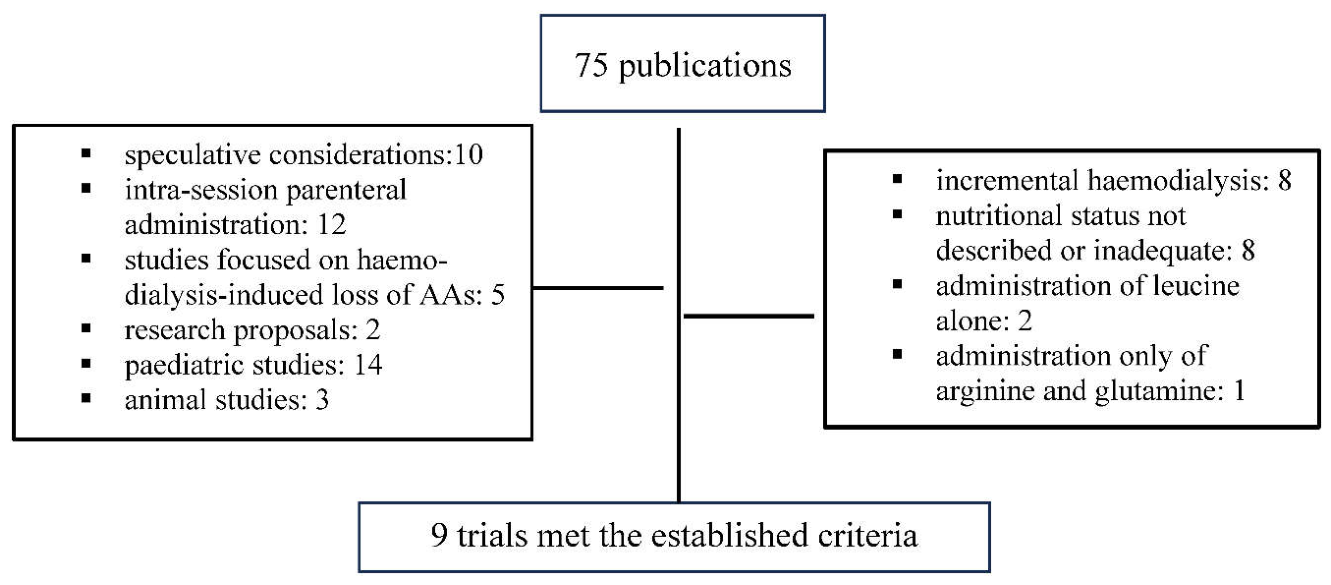

Table 1.
Replacement of Amino Acid losses in patients on thrice-weekly maintenance haemodialysis.
| Author, Journal, year | Number of Patients, Statistical comparison methods | Mean Age of Treatment and Control groups in years | Extracorporeal Treatment Strategy | Study Duration | Dietary Prescription | Amino Acid Replacement Protocol | Assessment of Amino Acid Losses | Amino Acid Mixes |
Adherence and duration to AAs trial (%, months) |
Blood chemistry and Clinical findings | Analytical Technique used |
|---|---|---|---|---|---|---|---|---|---|---|---|
| Neuhäuser M. et Al. [16] Proc Eur Dial Transplant Assoc 1977 |
TG: 9 patients CG: 11 patients no supplement Prospective observational | unreported | Unreported | 3 months | protein 1.0 g/kg/d calorie intake 31 Kcal/d |
Lysine, Threonine, Tryptophan, Histidine Tyrosine and keto-analogues of Isoleucine, Leucine, Phenylalanine, Valine, Methionine |
not evaluated | unreported | unreported | ineffective | unreported |
| Ulm A. et Al. [17] Am J Clin Nutr 1978 | TG: 9 patients CG: 11 patients no supplement Prospective observational |
56±13.2 | Haemodialysis | 3 months | protein 1.0 g/kg/d calorie intake 31 Kcal/d |
Lysine, Threonine, Tryptophan, Histidine, Tyrosine and keto-analogues of Isoleucine, Leucine, Phenylalanine, Valine, Methionine |
not evaluated | unreported | unreported | ineffective | unreported |
| Hiroshige K.et Al. [8] NDT 2001 | 6 cross-over evaluation months of TG versus 6 months of CG (14 vs 14) prospective randomly assigned | TG: 75±7 CG: 74±8 | Polysulphone | 12 months | protein 1.0-1.2 g/kg/d; calorie intake 30-35 Kcal/d | TG: 12gr/daily BCAA granules orally with dextrose; CG: placebo. |
not evaluated | 12 g/day of BCAA granules containing: valine 1.1 gr, leucine 1.9 g; isoleucine 1.0 gr + dextrose 2 gr |
unreported | Weight gain; increased: BMI, lean body mass, appetite, protein and calorie intake | Beckman 121M amino acid analyser using a lithium buffer system |
| Bolasco P. et Al. [10] Renal Failure 2011 | 15 TG versus 15 CG prospective randomised | TG: 72.7±10.2. CG 75.2±11.2 | 10 patients HDF low- and high-flux with polysulphone and 5 patients with AN69 | 3 months | protein 1.2 g/kg/d; calorie intake 30-35 Kcal/d |
2 sachets of EAAs a day | not evaluated | 4g sachets containing: Leucine, Lysine, Iso-leucine, Valine, Threonine, Cystine, Histidine, Methionine, Phenylalanine, Tyrosine and Tryptophan | 100%, 3 months | TG group: increase in dry weight, protein catabolic rate, fat mass, albumin, Hb and total IgG, decreased CRP | Amino acid analyser HPLC X-LC-Jasco linked to an HP ProDesk elaborator |
| Sukkar SG. et Al. [18] Mediterr J Nutr Metab 2012 | 12 TG versus 12 CG. prospective, randomized, double blind | unreported | Unreported | 4 months | protein 1.2 g/kg/d; calorie intake 25 Kcal/d |
2 sachets of EAAs a day | not evaluated | 4g sachets containing: Leucine, Lysine, Isoleucine, Valine, Threonine, Cystine, Histidine, Methionine, Phenylalanine, Tyrosine and Tryptophan | unreported | TG: increase of transferrin | unreported |
| Małgorzewicz S. et Al [15] Nutrition 2019 | 32 TG observational | 59.1 ± 9.5 | HD with polysulphone membrane | 3 months | unreported | ONS: 125 ml twice a day | not evaluated | ONS containing: Leucine, Isoleucine, Valine, Lysine, Threonine, Methionine, Phenyl- alanine, Tryptophan, Histidine | unreported | Increase of prealbumin, albumin, and AAs plasma concentration | Precolumn orthophtaldehyde derivatization and HPLC |
| Hai-Long Li et Al. [19] Chinese Medical Journal 2020 | TG 15 versus 14 CG. randomized, controlled | TG:55.3±10.1 CG:52±12.3 | unreported | 6 months | protein 0.9 g/kg/d; calorie intake 30 Kcal/d |
TG group of KA mix 0.1 g/Kg/day |
not evaluated | 0.1 g/kg/day containing: Alpha-keto-isoleucine, Alpha-keto leucine, Alpha-keto Phenylalanine, Alpha-keto valine, Alpha-hydroxy- methionine, Lysine, Threonine, Tryptophan, Histidine, Tyrosine |
unreported | Administration of KA in TG did not modify AA levels compared with CG | High performance liquid chromatography |
| Murtas S. et Al [12] Nutrients 2022 | 22 (11TG vs 11CG) Prospective double-blind centralized randomization | TG:67.2±9.5 CG: 68.2±10.5 | HDFpost | 3 months | protein 1.2 g/kg/d; calorie intake 30-35 Kcal/d |
1 sachet per day, taken orally at a distance from the haemodialysis session | per session: TAAs: 5.2 g; EAAs: 2.0 g of which BCAAs 1.5g and NEAAs: 3.3 g | AMINO-THER PRO mix: Threonine, Isoleucine, Valine, Cysteine, Histidine, Phenylalanine, Methionine, Tryptophan in addition to the AAs mix, mitochondrial accelerators | 100%, 6 months |
CG: decrease in phase angle and muscle mass. TG: unchanged Hb levels with decreased EPO requirement with better ERI, and raised LVEF. |
Amino acid analyser HPLC X-LC-Jasco linked to an HP ProDesk elaborator |
| Murtas S. et Al. [13] Clin Nutr ESPEN 2024 | 30 (TG 14 vs CG 15) prospective double-blind randomization | TG:73.1±11.1. CG:74.2±10.1 | HHD, HDFpost, HDFpre | 3 months pre-treatment; 3 months treatment; 3 months post-treatment |
Protein 1.2 g/kg/d; calorie intake 30-35 Kcal/d |
1 sachet per day, taken orally at a distance from the haemodialysis session | per session: TAAs: 5.3 g; EAAs:2.0 g of which BCAA: 1.1g and NEAAs: 3.2 g | AMINO-DYAL: Leucine, Isoleucine, Valine, Histidine, Phenylalanine, Lysine, Threonine, Tryptophan, Methionine, Proline, Cysteine, glutamic acid, Glutamine, Alanine, Glycine, Arginine, Tyrosine, Serine, Choline, Aspartic acid | 93.3%, 3 months |
TG: decreased PCR, increased IgG, C3, and Hb at lower EPO requirement dosage, with decreased ferritin depots. CG: increased PCR, loss of fat mass | Amino acid analyser HPLC X-LC-Jasco linked to an HP ProDesk elaborator |
TG: Treatment Group; CG: Control no supplement or Placebo Group; HD: Haemodialysis; HHD: High Efficiency HD; HDFpost: post-dilution Haemodiafiltration, HDFpre: pre-dilution Hemodiafiltration; AAs: Amino Acids; TAAS: total Amino Acids; EAAS: Essential Amino Acids; NEAAs: Non-Essential Amino Acids; BCAA: Branched Chain Amino Acids; EPO: Erythropoietin; ERI: Erythropoietin Resistance Index.
Disclaimer/Publisher’s Note: The statements, opinions and data contained in all publications are solely those of the individual author(s) and contributor(s) and not of MDPI and/or the editor(s). MDPI and/or the editor(s) disclaim responsibility for any injury to people or property resulting from any ideas, methods, instructions or products referred to in the content. |
© 2026 by the authors. Licensee MDPI, Basel, Switzerland. This article is an open access article distributed under the terms and conditions of the Creative Commons Attribution (CC BY) license (http://creativecommons.org/licenses/by/4.0/).
Copyright: This open access article is published under a Creative Commons CC BY 4.0 license, which permit the free download, distribution, and reuse, provided that the author and preprint are cited in any reuse.