
Submitted:
08 September 2026
Posted:
09 September 2026
You are already at the latest version
Abstract
Doctoral research monitoring in technical universities can be conceptualized as a socio-technical system in which research trajectories, supervisory practices, institutional rules, digital infrastructures, and assessment norms interact within a broader socioeconomic environment. This article develops a conceptual framework and a Provisional Diagnostic Model (PDM) for Engineering and Management through an integrative conceptual synthesis. The framework specifies system boundaries and hypothesized reinforcing, balancing, and metric-gaming feedback loops. The model separates institutional opportunity conditions from evidence of individual progress and engagement, and reports effective weights and evidence coverage alongside its aggregate score. It distinguishes research novelty from applied relevance through profile-specific contribution rules and introduces a separate, non-compensatory gate for novelty, research integrity, and methodological rigor. Fully specified synthetic examples demonstrate calculation, missing-data treatment, and parameter sensitivity. The framework is neither an empirically validated instrument nor a calibrated system-dynamics simulation. It provides an explicit conceptual specification for future testing and formative doctoral monitoring without treating resource access or output counts as sufficient evidence of research quality.
Keywords:
socio-technical systems
; systems thinking
; socioeconomic systems
; doctoral research monitoring
; integrative conceptual synthesis
; feedback loops
; provisional diagnostic model
; opportunity conditions
; evidence coverage
; engineering and management
1. Introduction
Doctoral research monitoring in technical universities can be understood as a socio-technical systems problem. It connects individual research trajectories, supervisory practices, institutional rules, digital infrastructures, industrial collaboration opportunities and assessment mechanisms within a broader socioeconomic environment [1,2,3,4]. In this sense, doctoral monitoring is not only an academic management procedure, but a systems challenge involving interactions between human actors, organizational structures, technologies and evaluation norms.
The doctorate can no longer be understood exclusively as a stage of preparation for an academic career. Studies on the economic contribution and career trajectories of doctoral graduates show that they may play important roles in industry, administration, applied research and regional innovation, while also highlighting the risk of misalignment between doctoral training and labor-market expectations [5,6,7,8].
Recent transformations in European higher education have increased the pressure on doctoral programs to move beyond the traditional model centered mainly on the thesis and publications. Universities are expected to ensure research quality, academic integrity, international exposure, the development of transferable competences, interdisciplinary collaboration and graduate employability. European University Association reports show that European doctoral education is becoming increasingly institutionalized, with emphasis on supervision, support structures, competences and international cooperation [9,10].
In this context, monitoring doctoral progress becomes an important issue of academic management. Traditional indicators, such as the number of publications, conference participation or citations, remain relevant, but they are not sufficient to describe the quality of doctoral education. They do not adequately capture the quality of supervision, the coherence of scientific progress, the development of transferable competences, integration into research communities, the applied relevance of results or the responsible use of digital technologies.
This socio-technical perspective is particularly relevant for Engineering and Management. By its nature, the field lies at the intersection of technical systems, industrial processes, organizational management, innovation, sustainability and digital transformation. A doctoral thesis in Engineering and Management may propose a conceptual model, a methodology, a system of indicators, a decision-support architecture, a maturity assessment tool or an applied solution validated in an organizational context. The value of such a contribution cannot be assessed only through bibliometric outputs; it must be analyzed in relation to research novelty, methodological rigor, applied relevance, transferability, research integrity and the opportunity structures provided by the program or institution.
The European principles for innovative doctoral training emphasize research excellence, interdisciplinarity, exposure to industry, international networks, transferable competences and quality assurance [11]. These principles support a broader training logic than the mere accumulation of outputs. However, translating these principles into monitoring instruments remains difficult because the doctoral program evolves over time, and the dimensions that are relevant at the beginning of the doctorate do not fully coincide with those that are decisive in the final stage.
Studies on doctoral completion and doctoral students' motivation show that progress depends on multiple factors: the quality of supervision, integration into the research community, clarity of expectations, working conditions, motivation and institutional support [12,13]. For this reason, doctoral monitoring must follow the process, not only the final outcome. At the same time, responsible research assessment recommends using quantitative indicators as support for qualitative judgment, not as a substitute for it [14,15,16].
The growing role of industrial collaboration and the emergence of generative artificial intelligence (GenAI) further complicate the assessment and monitoring of doctoral training. Generative artificial intelligence may support literature mapping, writing, data analysis and research organization, but it also raises issues related to integrity, authorship, confidentiality and source verification [17,18]. Open science adds another dimension because it requires transparency, documentation and responsible sharing, while research with industrial partners may involve confidential data and intellectual property [19].
The central problem addressed in this article is the following: how can doctoral research monitoring be conceptualized as a socio-technical system without reducing doctoral quality to output indicators and without allowing strong peripheral dimensions, such as mobility, participation, formal competences or the use of digital tools, to compensate for insufficient scientific originality or research integrity?
Starting from this problem, the article proposes a socio-technical doctoral research monitoring framework for Engineering and Management. The framework is not presented as an empirically validated instrument, but as a provisional conceptual and methodological architecture that requires subsequent calibration, testing and validation. Its purpose is to provide a structured basis for diagnosis, institutional reflection and systems-based improvement of doctoral monitoring practices.
The article addresses three research questions:
RQ1. What socio-technical dimensions are necessary to represent doctoral research monitoring in technical universities, particularly in Engineering and Management?
RQ2. How can these dimensions be operationalized into a provisional diagnostic model without reducing doctoral quality to indicators based exclusively on publications or other quantifiable outputs?
RQ3. How can doctoral progress be represented through a lifecycle-dependent model while preserving non-compensatory conditions for research originality, academic integrity and methodological rigor, and while accounting for institutional opportunity conditions?
By answering these questions, the article contributes to systems-oriented higher education research through three main elements. First, it conceptualizes doctoral research monitoring as a socio-technical system composed of individual, program-level, institutional, industrial and digital governance dimensions. Second, it distinguishes between research novelty and applied relevance, avoiding confusion between scientific originality and industrial usefulness. Third, it introduces the principle that some dimensions of doctoral quality should not be treated as compensatory: a high level of internationalization, transferable competences or industrial collaboration cannot compensate for the absence of an original contribution or for breaches of research integrity.
2. Theoretical Foundations: Doctoral Education and Socio-Technical Systems
2.1. Doctoral Education Beyond Output Metrics
Contemporary doctoral education increasingly incorporates broader developmental and professional objectives. Whereas the traditional model emphasized primarily thesis development and the production of publishable scientific results, current models also include transferable competences, internationalization, interdisciplinary collaboration, career support and the social responsibility of research. This transformation does not eliminate the role of publications, but changes their status: publications become evidence of visibility and validation, not the complete definition of doctoral quality.
In an output-centered model, the doctoral student may be evaluated mainly through what is produced at the end: articles, conference participation, reports or citations. In a dynamic monitoring model, the emphasis shifts toward how the doctoral student progresses, how the research problem is clarified, how the methodology is developed, how the contribution is constructed and how integrity, autonomy and transfer capacity are demonstrated. Monitoring thus becomes a formative mechanism, not merely an administrative verification procedure.
In this article, the term output metrics refers to indicators oriented mainly toward visible and quantifiable results, such as publications, conferences, citations or reports. These indicators are necessary, but incomplete. The dynamic doctoral monitoring proposed here adds indicators related to progress, competences, external collaboration, research novelty, integrity, applied relevance and digital governance.
In Engineering and Management, limiting assessment to outputs is even more problematic because many valuable contributions are expressed through models, decision-support tools, methodologies, assessment architectures or organizationally validated applications. These forms of contribution may require time for construction, testing and refinement. Overly rigid monitoring, oriented exclusively toward rapid outputs, may discourage complex research and favor the fragmented production of results.
2.2. Specificity of the Engineering and Management Field
Engineering and Management has a distinct socio-technical profile at the intersection of engineering and organizational research because it combines technical research, organizational analysis, quantitative methods and managerial perspectives. Doctoral topics may address industrial performance, quality management, process optimization, sustainability, digitalization, supply-chain resilience, organizational maturity, innovation management or the transformation of socio-technical systems.
This interdisciplinary character creates a specific requirement for doctoral assessment. A doctoral contribution in Engineering and Management may take the form of a conceptual model, a methodology, an assessment framework, a system of indicators, a decision-support tool or a solution validated through case studies. Consequently, the quality of a thesis cannot be assessed only through scientific outputs but must also be related to the coherence of the problem, methodological robustness, originality of the contribution, organizational relevance and transfer potential.
In this field, research originality may take different forms. It may consist of developing a new model, combining existing concepts in an original way, adapting a method to an unexplored industrial context, defining a new set of indicators or validating a decision-support architecture. Therefore, originality assessment must distinguish between scientific novelty and applied relevance. A solution may be highly useful for a company but have a modest scientific contribution; conversely, a contribution may be highly original theoretically, even if its immediate industrial applicability is limited.
A direct implication is that doctoral monitoring must be sensitive to the profile of the topic. A thesis focused on a theoretical model of organizational performance may require different indicators from a thesis built on industrial data or on the validation of a decision-support tool. For this reason, the proposed framework does not set universal weights but introduces stage-dependent weights that can be calibrated according to context.
2.3. Transferable Competences, Industrial Collaboration and a Responsible Research Culture
The development of transferable competences is a central direction of contemporary doctoral education. Training in these competences supports career development and research capacity [20], while the Vitae Researcher Development Framework provides a structured basis for researchers to reflect on and plan their development [21].
In Engineering and Management, transferable competences are particularly important because doctoral students may work with companies, clusters, public organizations, multidisciplinary teams or applied research projects. They must formulate relevant problems, collect and interpret data, communicate results to different audiences and propose solutions that organizational actors can understand and use.
Industrial collaboration adds a further dimension. Collaborative and industrial doctorates can increase the relevance of research, facilitate access to real data and contexts, and support the employability of graduates [22,23,24]. However, industrial collaboration must be managed carefully. A doctoral thesis should not become mere consultancy for a company, but must preserve scientific autonomy, original contribution and methodological rigor.
Research on doctoral employability links industrial career preparation with communication, collaboration, project management, adaptability, and impact orientation [25]. Doctoral training should therefore support scientific, transferable, and applied competences, not merely a sequence of research reports. A systematic review of graduate employability connects skills development, learning in professional contexts, and university–industry collaboration; its broader graduate focus should not be interpreted as doctoral-specific validation [26].
Responsible research assessment, AI and open science complement this theoretical background because they introduce criteria related to integrity, transparency and the digital governance of the doctoral process.
Research assessment is undergoing reform at the international level. DORA, the Leiden Manifesto and CoARA support the responsible use of indicators, avoidance of excessive dependence on journal-based metrics and recognition of the diversity of research outputs [14,15,16]. These principles are relevant for doctoral education because doctoral students are often assessed through visible but incomplete indicators.
The emergence of generative artificial intelligence introduces a new challenge. AI tools may support literature analysis, writing, information synthesis, data analysis and research planning. However, they may also generate risks related to fabricated references, bias, undeclared assistance, data confidentiality and authorship attribution [17,18]. Therefore, doctoral monitoring should not measure simplistically whether a doctoral student uses AI or not, but whether the use of digital tools is responsibly governed. In doctoral education, recent institutional guidelines on GenAI emphasize that the use of such tools must be related to authorship, intellectual oversight, academic integrity and the criteria of the doctoral qualification [27]. In addition, comparative evidence from doctoral dissertations suggests that AI and plagiarism should be treated as doctoral integrity issues, not merely as technical matters of automated detection [28].
Open science complements this perspective. The UNESCO Recommendation on Open Science promotes transparency, collaboration, accessibility and the sharing of scientific knowledge [19]. In Engineering and Management, this is especially important in research with industrial partners, where scientific openness must be balanced with data protection, intellectual property and organizational data confidentiality.
2.4. Systems Thinking and Socio-Technical Foundations
General systems theory frames doctoral research monitoring as an open system whose outcomes emerge from interactions among interdependent components rather than from isolated indicators. The doctoral student, supervisor, committee, program, institution, external partners and digital research infrastructure form a nested configuration with permeable boundaries and exchanges with the wider socioeconomic environment [1,2,4].
Socio-technical systems theory further emphasizes the joint optimization of social and technical subsystems. In doctoral monitoring, the social subsystem includes supervision, learning, committee judgment, institutional norms and collaboration, whereas the technical subsystem includes data infrastructures, digital platforms, AI-assisted tools and monitoring mechanisms. A diagnostically useful model should therefore avoid attributing system-level opportunity constraints to individual doctoral quality [3].
Soft systems thinking is relevant because doctoral monitoring is a plural and partly ill-structured problem: doctoral students, supervisors, committees, institutions and industrial partners may define progress and value differently. The proposed framework uses these perspectives to specify system boundaries, stakeholder roles and feedback relationships, while retaining the PDM as a provisional diagnostic device rather than a validated control instrument [1,4].
3. Materials and Methods
The study uses an integrative conceptual synthesis to develop a provisional socio-technical monitoring model. Theory adaptation and model building connect systems concepts with selected doctoral-education and governance literature. The analytical roles of these sources are made explicit rather than treating their coexistence as proof of the model [29]. The objective is conceptual design and internal consistency, not estimation of effects or empirical validation.
The source collection is purposive, not the result of an exhaustive, prospectively documented database search. PRISMA 2020 and PRISMA-ScR are reporting frameworks for systematic and scoping reviews [30,31]; no compliance with either is claimed here. No undocumented search strings, dates, screening totals, or exclusion counts are reconstructed retrospectively.
The analytical outputs are proposed constructs, causal hypotheses, scoring rules, and synthetic test cases. The operational rules in Section 4, Section 5 and Section 6 are design choices motivated by the synthesis, not measures already validated in the cited studies. Practical adoption requires agreement on the codebook, appropriate institutional oversight, and empirical evaluation.
3.1. Conceptual Design and Analytical Workflow
The synthesis proceeds through five analytical tasks: define the monitoring problem; select sources for conceptual relevance; assign primary analytical roles; distinguish constructs, context, and feedback; and check the resulting rules through synthetic examples. Figure 1 documents this reasoning workflow, not a record-selection flowchart or a causal validation procedure.
The approach accommodates systems theory, doctoral education, career development, external collaboration, responsible assessment, and digital governance. The source-to-concept matrix in Table 2 makes their different analytical roles visible. It does not establish that the proposed weights or causal effects are correct.
3.2. Source Selection and Scope
The conceptual collection contains 39 sources selected for their relevance to the monitoring problem: foundational and domain literature, methodological guidance, and official descriptions of five identifiable monitoring instruments. Sources serve different purposes: research publications support reported arguments or findings, policy documents provide normative context, and institutional tools document operational functions. This selection is not intended to represent all doctoral-monitoring research.
The selection rationale is relevance to system boundaries, feedback, individual progress, opportunity conditions, contribution assessment, or research governance. Domain-specific studies are used only for their stated conceptual relevance. No formal quality-appraisal score, independent duplicate screening, or inter-rater coding reliability is claimed. Publication dates are recorded where specified; access dates are not substituted for missing publication years.
Table 1 summarizes the scope and limitations of this conceptual synthesis.
3.3. Conceptual Coding and Model Construction
Sources are assigned one primary analytical role for descriptive counting, although a source can inform several concepts. Table 2 distinguishes systems foundations, doctoral processes, careers, competences, industrial doctorates, responsible assessment, digital governance, methodological guidance, and operational benchmarks. This explicit classification describes the selected collection; it is not an estimate of topic prevalence in the wider literature.
Three construct boundaries guide model construction. Opportunity availability is recorded in O(t), separately from the student’s documented engagement. External engagement C(t) records participation in research processes, whereas AR(t) records relevance of the contribution. Digital research governance distinguishes AI accountability from data stewardship. These definitions reduce conceptual overlap but do not establish statistical independence.
Research novelty RN(t) is distinguished from applied relevance AR(t), research integrity RI(t), and methodological rigor MR(t). Applicability, evidence scoring, missing-data treatment, and gate rules are specified before numerical illustration. The causal-loop diagram articulates mechanisms for future investigation; the calculations test only the internal behavior of the proposed aggregation rules.
3.4. Descriptive Source Mapping and Traceability
Figure 2 and Figure 3 describe the retained bibliography, not the distribution or strength of evidence in an entire research field. They are not used to derive the relative importance of PDM dimensions. Table 2 provides the corresponding source-to-concept mapping.
Of the 39 references, 36 have an explicit publication year and three are undated web resources. The temporal distribution therefore uses 36 dated sources, whereas the thematic distribution uses all 39. The PRES 2025 report is recorded under 2026, the publication year stated on its official page, rather than the survey year in its title.
Nine mutually exclusive primary roles are used for counting in Figure 3. The categories do not imply that a source has only one possible conceptual use. Operational instrument sources are distinguished from theoretical and normative works.
4. Results: A Socio-Technical Doctoral Research Monitoring Framework
4.1. System Boundary, Components and Feedback Logic
The system boundary includes the student, supervisory team, doctoral committee, program governance, relevant external partners, and research infrastructure. Funding, labor markets, regulation, and partner priorities form the wider environment. Inputs include training, feedback, access to research settings, and digital resources; processes include inquiry, learning, documentation, and review. Career outcomes are downstream system outcomes, not components of the student-level PDM score.
Monitoring is modeled as a feedback mechanism: evidence of progress or an unmet milestone informs supervisory dialogue, which can prompt methodological correction, training, or resource provision. The effects can be delayed. Figure 4 identifies hypothesized link directions and loop polarities; it does not estimate causal effects.
4.2. Conceptual Benchmarking
Table 3 compares PDM with named frameworks and instruments using common criteria: unit and timing, progress/context functions, and treatment of contribution quality. The comparison concerns the cited public descriptions; an unspecified feature is not proof that no local implementation contains it.
PDM’s proposed addition is the joint reporting of opportunity context, student-level evidence, effective weights, coverage, and a separate quality gate. This is a design proposition, not a claim of empirical superiority. Existing tools can provide evidence for this architecture rather than being displaced by it.
4.3. Levels of Analysis
The progress of a doctoral student, the support provided by a program, and institutional governance are different units of analysis. PDM is explicitly student-level. Program and institutional conditions are reported alongside it in O(t), not added to individual performance.
A supervisor’s availability describes context; a student’s documented response to agreed feedback describes activity. The evidence record must identify the claim being assessed and the level responsible for it. An artifact may inform different judgments, but the same achievement is not credited repeatedly within a single aggregate.
O(t) records international/external access, supervision, training provision, and infrastructure. Limited availability is a system constraint, not a student deficit. Applicability is documented before scoring for activities that are genuinely unavailable or outside the agreed research profile. Such activities are not silently assigned zero.
Supervision quality is a contextual factor. A protected route for reporting inadequate support is needed so that the committee can distinguish supervisory constraints from research shortcomings. A contextual flag informs the remedial response; it does not remove the requirement for an original, rigorous, and responsible doctoral contribution.
Table 4 synthesizes the three levels of analysis used for doctoral monitoring.
4.4. Socio-Technical Architecture of the Proposed Framework
Figure 4 presents three hypothesized loops. R1 (developmental learning) connects verified evidence, useful supervisory feedback, research-plan clarity, and documented progress through positive links. B1 (corrective support) connects an unmet milestone gap with targeted support, research capability, and progress; increased progress reduces the gap. A delay is expected between support provision and capability development.
R2 (metric gaming) describes a possible reinforcing cycle: metric pressure encourages score-oriented shortcuts, apparent outputs increase reliance on metrics, and that reliance renews pressure. This mechanism is motivated by concerns about metric targets [14,15,16,32,33], not by causal observations in this study. Candidate interventions are opportunity provision, evidence-based supervisory dialogue, and independent contribution review. Link polarity means same- or opposite-direction influence, all else equal, not a favorable or unfavorable outcome.
5. Provisional Diagnostic Model for Socio-Technical Doctoral Monitoring
5.1. Scoring, Applicability, Coverage, and Stage Weights
PDM(t) is the aggregate diagnostic value at doctoral stage t. Its six student-level dimensions are I(t), P(t), C(t), T(t), Q(t), and D(t). I and C measure documented engagement, not opportunity availability; O(t) is reported separately. Equations (1)–(6) specify aggregation, applicability, and coverage.
PDM is not a validated scale, a causal estimator, or a ranking, funding, or sanctioning rule. Stage weights express declared priorities. A change in the aggregate can reflect changing weights as well as changing evidence. Longitudinal interpretation therefore requires dimension scores and, for direct comparison, recalculation with a common prespecified weight vector.
For a weighted dimension, zᵢⱼ(t) is a normalized evidence score and bᵢⱼ its prespecified nonnegative weight, with ∑ⱼbᵢⱼ=1. The applicability flag aᵢⱼ is 1 only if the indicator is relevant and any opportunity-dependent activity is feasible under the agreed plan. The observation flag rᵢⱼ is 1 when the score has been assessed. Confirmed noncompletion of a feasible, applicable task has zᵢⱼ=0 and rᵢⱼ=1; pending evidence has rᵢⱼ=0. Flags and reasons are documented.
Equation (3) requires a positive denominator; otherwise Xᵢ is unscored. Let aᵢ=1 when the dimension contains applicable evidence criteria, and rᵢ=1 when an aggregate can be calculated. Effective between- and within-dimension weights are:
Within-dimension coverage hᵢ is the observed applicable weight divided by all applicable weight. Global coverage H uses this information; S records the retained share of the original six-dimension scope. Set hᵢ=0 for an unscored dimension. A zero denominator produces a “not assessable” result, not a zero-quality score.
The report includes the indicator set, within-dimension applicability shares, hᵢ, H, S, and both effective weight sets. Full coverage of a reduced scope is not full coverage of the original profile. Equal H does not establish comparability. Nested Q requires the applicable RN/AR evidence before it is scored; D coverage reflects its applicable subconstructs. Retrospective applicability changes to improve scores are not permitted.
OI denotes access to international research engagement; OC, external/industrial settings; OS, supervisory support; OT, training; and OD, digital/data infrastructure. Proposed context descriptors are 0 = unavailable, 0.5 = constrained, and 1 = available as agreed. Unknown status remains missing. O is neither added to PDM nor used as a divisor to inflate it. These descriptors guide applicability and intervention; statistical correction of opportunity bias is not claimed.
For the hierarchical constructs, the applicability-and-observation logic of Equation (3) is applied recursively. RN, AR, DA, and DS are first calculated from their leaf indicators using their prospectively specified indicator weights. A subconstruct is scored only when the denominator in Equation (3) is positive; otherwise it remains unscored. Coverage is propagated with the original path weights, not with the weights re-normalized for scoring. For coverage reporting only, the RN and AR branches of Q receive parent shares 1/(1 + κ) and κ/(1 + κ), respectively, whereas the DA and DS branches of D receive η and 1 − η.
For an applied profile, Q is calculated only when both RN and required AR are scored, and hQ = [hRN + κhAR]/(1 + κ); if either required branch is wholly unobserved, Q remains unscored and hQ = 0. For a theoretical profile, AR is prospectively N/A, Q = RN, and hQ = hRN. When both DA and DS are applicable, hD = ηhDA + (1 − η)hDS. If only one applicable D branch is observed, D may be calculated from that branch by re-normalizing the parent score weights, while the unobserved branch retains its original share in hD; if no applicable branch is observed, D remains unscored. Verified non-use of AI makes DA N/A rather than missing, so D = DS and hD = hDS, with the reduced internal scope disclosed. At every level, N/A removes a criterion from scope, whereas pending evidence remains in scope and lowers coverage; neither is replaced by zero, and undefined scores are excluded before multiplication or summation.
Table 5 separates student-level dimensions from the contextual vector.
Table 6 provides proposed scoring rules. The evidence record identifies the assessor, date, criterion, and justification. These are operational design proposals, not psychometrically validated scales.
5.2. Operationalization of Student-Level Dimensions
Equations (7)–(10) are complete-data forms. Equation (3) governs cases involving missing or non-applicable data. The nonnegative α, β, γ, and δ coefficients sum to 1 within each dimension and are specified prospectively for the research profile and stage. They are not adjusted to obtain a preferred aggregate.
M denotes the documented research contribution of relevant mobility or an agreed remote equivalent; CS, the student’s work in co-supervision; CI, contribution to international joint research or coauthorship; and ME, demonstrated learning from joint modules/events. These indicators do not score the availability or prestige of opportunities.
PG denotes evidence of research-task progress; RO, documented outputs appropriate to the trajectory; RT, delivery against feasible agreed timelines, including justified revisions; and MA, committee-assessed milestones. The rubric distinguishes task progress, output evidence, planning, and independent review so that one publication is not repeatedly credited as separate achievements.
EP denotes completed external-project tasks; DU, documented research use of accessible external data; CW, planned case-study work; EX, contribution to external research exchanges; and CR, fulfillment of collaborative responsibilities. These process indicators replace scores of access or partner availability, which belong to OC. They exclude industrial usefulness, transfer potential, and stakeholder validation, assessed through AR. C is N/A if external engagement is not part of the agreed profile.
SC denotes scientific communication; PM, project management; RE, demonstrated research-ethics learning; EN, entrepreneurship where relevant; and CP, career planning. RE is not the final integrity judgment RI: completing training cannot compensate for a confirmed integrity failure.
Digital research governance distinguishes AI accountability DA from data stewardship DS, consistent with responsibility for research processes and outputs [17,18,19,27,28,34]. The complete-data form uses a prespecified share η; η=0.5 is an illustrative starting point, not a validated estimate.
DC denotes accurate AI-use disclosure; VP, verification of AI-assisted outputs; CC, confidentiality compliance in AI-assisted operations; and TR, traceability of those operations. DM denotes data or research-record management; DOC, method/provenance documentation; and OP, appropriate openness or a documented ethical/legal restriction. Responsible restriction of industrial data can receive full stewardship credit. Without AI use, DA is N/A and D=DS, with the reduced scope disclosed; pending disclosure is not equivalent to nonuse. Independent integrity review remains necessary.
5.3. Research Novelty and Applied Relevance
Research novelty concerns the scientific contribution; applied relevance concerns usefulness, transfer potential, and contextual validation. Useful consulting outputs are not automatically original doctoral research, while a rigorous theoretical contribution need not have immediate industrial application.
AR therefore modulates diagnostic contribution quality for an agreed applied profile, but cannot replace novelty or raise Q above RN. Equation (16) explicitly defines the theoretical case. The profile must be declared before scoring, not changed retrospectively to avoid a weak result.
NT, NM, and NE denote theoretical, methodological, and empirical novelty; IR, TP, and SV denote industrial/contextual relevance, transfer potential, and stakeholder validation. Nonnegative λ weights and nonnegative ρ weights each sum to 1. The novelty profile may emphasize the form of contribution actually claimed, rather than requiring equal novelty in every form. An unexplored context alone does not establish an original doctoral contribution.
For an applied profile, RN/(1+κ)≤Q≤RN. At κ=0, Q is independent of AR; increasing κ gives more emphasis to demonstrated application. The committee and disciplinary experts should choose κ prospectively from the contribution aims, record the rationale, and inspect sensitivity. The example fixes κ=0.5 without claiming expert calibration. Required but pending AR evidence leaves Q unscored; it is neither replaced by zero nor treated as theoretical-profile N/A.
Table 8 summarizes the separate assessment claims.
5.4. Non-Compensatory Conditions
The weighted aggregate remains compensatory, so a separate gate protects core non-compensatory requirements. A high PDM cannot establish sufficient novelty, integrity, or rigor. The result is reported as (PDM, G), accompanied by context and coverage, rather than multiplying by G and concealing the diagnostic profile.
Table 9 proposes evidence rubrics for RI and MR. The committee should include independent disciplinary assessment, document disagreements, and record its justification. These rules are provisional. Unreviewed evidence produces a pending judgment, not an allegation of misconduct and not a passing gate.
KRI and KMR are the prospectively documented applicable core domains. Their minimum prevents adequate performance in one domain from offsetting a material deficiency in another.
Essential domains cannot be waived for convenience. No observed committee ratings are reported in this study.
G=1 means all specified checks are satisfied; G=0 means at least one is unmet. The equation is evaluated only after required gate evidence has been reviewed; otherwise G is pending. A final-stage gate is not imposed unchanged on earlier stages. The numerical scenario uses θRN=0.60, θRI=1.00, and θMR=0.75 solely to demonstrate the logic. These are not validated or universally recommended thresholds, and G=1 is not an automatic degree-award decision.
6. Illustrative Numerical Example and Systemic Implications
6.1. Illustrative Numerical Example
Table 10 presents a synthetic complete-data scenario using the exact weights reported in Table 7 and κ=0.5. I and C represent documented engagement under feasible agreed activities, not resource availability. All six dimensions are applicable and observed, hᵢ=H=S=1, and effective weights equal base weights. Construct scores are chosen inputs, not participant measurements or observed rubric distributions.
Using unrounded intermediate values, Q equals 23/75 (approximately 0.3066667), 0.51, and 0.702. Equation (1) gives PDM=0.5385, 0.6345, and 0.7682, displayed as 0.54, 0.63, and 0.77. These numbers illustrate the revised engagement-based specification; they do not represent an empirical conversion of access scores into student performance.
Figure 6 uses the unrounded values in Table 10. Rising lines are an assumed scenario, not evidence that progress is necessarily monotonic or that monitoring causes improvement. The aggregate must be interpreted with its component profile, context, coverage, effective weights, and gate status.
Table 11 checks limited changes to final-stage assumptions. The fixed non-Q components contribute 0.5225, so PDM=0.5225+0.35Q for the complete six-dimension case. These checks make the arithmetic behavior transparent; they do not establish empirical robustness.
As an additional synthetic check, setting the final-stage weight of Q to 0.25 or 0.45 and proportionally rescaling all other weights gives PDM = 0.778385 or 0.758015, respectively, compared with 0.7682 at the reference weight of 0.35. All construct scores and κ = 0.5 remain unchanged.
6.2. Practical Implications for Doctoral Schools and Socio-Technical Governance
Doctoral schools can use PDM and O(t) to distinguish responses to similar scores: pending evidence calls for clarification, a research gap calls for academic support, and unavailable opportunities call for program-level action. This diagnostic differentiation is proposed; reduced attrition or improved completion is not demonstrated.
For doctoral supervisors, the model can clarify expectations by stage. In the first year, discussions may focus on formulating the problem, positioning it in the literature and defining originality criteria. In the mid-stage, the emphasis may shift toward data collection, validation, initial outputs and competence development. In the final stage, assessment must address coherence of the contribution, originality, integrity and transferability.
For doctoral students, the framework can be transformed into a self-monitoring instrument. The doctoral student can see that progress is not reduced to publication, but also cannot be replaced by formal participation in activities. The model shows that all dimensions matter, but that some dimensions, such as originality and integrity, have a fundamental status.
For industrial partners, the framework can clarify that an industrial or collaborative doctorate is not equivalent to a consultancy project. The partner may contribute through data, real problems, validation and transfer, but the doctoral standard remains defined by scientific contribution, methodological rigor and research autonomy.
Implementation in Engineering and Management programs requires agreed rubrics, confidential reporting of support constraints, reviewer training, and an audit trail. Documentation should be proportionate to its feedback value. Table 12 identifies intended uses and benefits, which remain to be empirically tested.
7. Discussion, Limitations and Future Directions
7.1. Discussion
The proposed framework separates the socio-technical research system from the student-level diagnostic record. Systems perspectives [1,2,3,4] explain why supervision, infrastructure, and research activity interact, but do not establish a valid weighted measure. PDM adds an explicit reporting architecture rather than claiming a new general systems theory or demonstrated superiority over existing instruments.
The operational distinction is joint reporting of engagement, context, effective weights, coverage, and gate status. myIDP and the UCL Log already support development and reflection, while Manchester reviews incorporate qualitative judgment [35,36,37]. PRES and the CGS project examine experience or cohort outcomes [38,39]. PDM should complement these functions, not dismiss them as administrative. A low engagement score should trigger review of feasible expectations and evidence, whereas a low opportunity rating should direct attention to program resources. The distinction locates responsibility without assuming that mathematical normalization can remove inequities in research conditions.
The causal loops distinguish mechanisms that an aggregate would conceal. R1 links useful feedback with clearer plans and better evidence for subsequent review. B1 connects documented gaps with corrective support, acknowledging a delay between resource provision and research capability. The context vector identifies the system level responsible for constraints. These mechanisms require longitudinal or comparative evaluation.
R2 concerns a contrasting response: targeting scores can reward apparent output rather than substantive inquiry, consistent with Goodhart and Campbell [32,33]. The gate and audit trail are safeguards to test, not evidence that gaming is eliminated. Reviews can themselves impose burdens or incentives to conceal difficulties, making student participation and periodic scrutiny essential.
The calculations expose limits rather than validate PDM. Equal rounded aggregates can arise from different missing-evidence or applicability conditions. Coverage and effective weights reveal these differences without establishing measurement equivalence. Stage-weight changes can also increase the total without improvement in underlying evidence. The profile-specific Q rule avoids requiring industrial relevance from theoretical research, while the independent gate prevents a high aggregate from being sufficient evidence of doctoral quality. No quantitative result in this article demonstrates that these safeguards improve institutional decisions in practice.
7.2. Limitations and Future Directions
The model is conceptual and unvalidated. Scores, weights, rubric levels, η, κ, and thresholds are design assumptions. Calculability under stated inputs does not establish reliability, fairness, predictive validity, or beneficial educational effects.
The recursive coverage rules are likewise provisional design choices. Their path-weight specification for Q and D should be examined in pilot data for interpretability, sensitivity to missingness, inter-rater consistency, and unintended decision effects.
The purposive synthesis does not support literature-prevalence claims. Table 2 improves traceability but no independent coding-reliability estimate or full systematic search is reported. A future systematic or scoping review requires prospectively documented procedures, not retrospective reconstruction.
Context separation and coverage reporting address interpretive ambiguity but do not eliminate structural inequality. Feasibility, N/A status, and adequate evidence remain contestable judgments. Future research should examine inter-rater agreement, missingness patterns, access constraints, administrative burden, and gaming.
The feedback loops are hypotheses, not estimated causal structures. Their directions, delays, and interactions require stakeholder inquiry and longitudinal evidence. A system-dynamics simulation would additionally need stocks, flows, time units, calibrated parameters, and validation.
A pilot should develop the codebook with students, supervisors, committees, and relevant partners; test rubric consistency and parameter sensitivity; and examine whether feedback leads to useful action. Program-level reporting must retain contextual information and must not turn student scores into institutional rankings.
8. Conclusions
This article develops a provisional socio-technical architecture for monitoring doctoral research in Engineering and Management. Its main contribution is separating student progress and engagement from institutional opportunity conditions, while making effective weights and evidence coverage explicit. The proposed feedback loops connect diagnostic records with supervision and program action, but their causal operation has not been established.
The contribution rule distinguishes novelty from applied relevance and sets Q=RN for theory-oriented profiles. A separate gate reports whether novelty, integrity, and methodological rigor meet prespecified criteria. Synthetic examples demonstrate the arithmetic and show why a high aggregate, or equal rounded scores, cannot establish doctoral quality or comparability across profiles.
PDM is intended for formative diagnosis, not ranking, funding, sanctions, or automatic degree decisions. Its practical value must be tested through stakeholder-informed calibration, rubric-reliability assessment, sensitivity analysis, and monitored pilots. The framework offers an explicit specification for that evaluation rather than a validated solution.
Author Contributions
Conceptualization, L.F., S.B., F.L., D.F. and I.A.C.; methodology, L.F. and D.F.; formal analysis, L.F.; investigation, L.F.; visualization, L.F. and D.F.; writing—original draft preparation, L.F.; writing—review and editing, S.B., D.F. and I.A.C.; supervision, S.B. and F.L. All authors have read and agreed to the published version of the manuscript.
Funding
This research received no external funding.
Institutional Review Board Statement
Not applicable. The study is conceptual and does not involve human participants, animals or personal data.
Informed Consent Statement
Not applicable.
Data Availability Statement
No empirical participant dataset was created or analyzed. Table 2 gives the reference-to-role mapping for Figure 2 and Figure 3. Equations (1)–(19) and Table 6, Table 7, Table 8, Table 9, Table 10 and Table 11 disclose the scoring assumptions and synthetic numerical inputs. The causal-loop links are conceptual propositions, not observed data.
Acknowledgments
The authors gratefully acknowledge the administrative and technical support provided by the Technical University of Cluj-Napoca during the development of this research.
Declaration of Generative AI and AI-Assisted Technologies in the Writing Process
During manuscript preparation, the authors used ChatGPT (OpenAI) to assist with Romani-an-to-English translation, language editing, conceptual drafting and restructuring, checking synthetic calculations, and preparing or refining figures and associated code. The authors reviewed and revised the retained outputs, verified the numerical results and cited sources, and take responsibility for the final manuscript. No participant data were generated with these tools.
Conflicts of Interest
The authors declare no conflicts of interest.
Abbreviations
The following abbreviations are used in this manuscript:
| AAAS | American Association for the Advancement of Science |
| AHP | Analytic Hierarchy Process |
| AI | Artificial Intelligence |
| AR | Applied Relevance |
| CGS | Council of Graduate Schools |
| CoARA | Coalition for Advancing Research Assessment |
| DORA | San Francisco Declaration on Research Assessment |
| EUA | European University Association |
| GenAI | Generative Artificial Intelligence |
| IDP | Individual Development Plan |
| MR | Methodological Rigor |
| N/A | Not Applicable |
| PDM | Provisional Diagnostic Model |
| PGR | Postgraduate Researcher |
| PRES | Postgraduate Research Experience Survey |
| PRISMA | Preferred Reporting Items for Systematic Reviews and Meta-Analyses |
| PRISMA-ScR | PRISMA Extension for Scoping Reviews |
| RDF | Researcher Development Framework |
| RI | Research Integrity |
| RN | Research Novelty |
| UCL | University College London |
References
- Checkland, P. Systems Thinking, Systems Practice; John Wiley & Sons: Chichester, UK, 1981. [Google Scholar]
- Von Bertalanffy, L. General System Theory: Foundations, Development, Applications; George Braziller: New York, NY, USA, 1968. [Google Scholar]
- Trist, E.L. The Evolution of Socio-Technical Systems: A Conceptual Framework and an Action Research Program; Ontario Quality of Working Life Centre: Toronto, ON, Canada, 1981. [Google Scholar]
- Meadows, D.H. Thinking in Systems: A Primer; Chelsea Green Publishing: White River Junction, VT, USA, 2008. [Google Scholar]
- Casey, B.H. The economic contribution of PhDs. J. High. Educ. Policy Manag. 2009, 31, 219–227. [Google Scholar] [CrossRef]
- Daza Pérez, L.; Llanes Ordóñez, J.; Rojas Araya, D. Impacto del doctorado: formación y realidad laboral de los egresados. REOP-Rev. Española De Orientación Y Psicopedag. 2021, 32, 41–59. [Google Scholar] [CrossRef]
- Germain-Alamartine, E. Doctoral education and employment in the regions: The case of Catalonia. Reg. Stud. Reg. Sci. 2019, 6, 299–318. [Google Scholar] [CrossRef]
- Schwabe, M. The career paths of doctoral graduates in Austria. Eur. J. Educ. 2011, 46, 153–168. [Google Scholar] [CrossRef]
- Hasgall, A.; Saenen, B.; Borrell-Damian, L.; Van Deynze, F.; Seeber, M.; Huisman, J. Doctoral Education in Europe Today: Approaches and Institutional Structures; European University Association: Brussels, Belgium, 2019; Available online: https://www.eua.eu/publications/reports/doctoral-education-in-europe-today-approaches-and-institutional-structures.html.
- Marti, S.; Peneoasu, A.M. Doctoral Education in Europe Today: Enhanced Structures and Practices for the European Knowledge Society; European University Association: Brussels, Belgium, 2025; Available online: https://www.eua-cde.org/reports-publications/1122:doctoral-education-in-europe-today-enhanced-structures-and-practices-for-the-european-knowledge-society.html.
- European Commission. Principles for Innovative Doctoral Training; European Commission: Brussels, Belgium, 2011; Available online: https://euraxess.ec.europa.eu/sites/default/files/policy_library/principles_for_innovative_doctoral_training.pdf.
- Benzon, B.; Vukojevic, K.; Filipovic, N.; Tomic, S.; Glavina Durdov, M. Factors that determine completion rates of biomedical students in a PhD programme. Educ. Sci. 2020, 10, 336. [Google Scholar] [CrossRef]
- Perkins, H.; Tsugawa-Nieves, M.; Bahnson, M.; Satterfield, D.; Parker, M.; Kirn, A.; Cass, C. Motivation profiles of engineering doctoral students and implications for persistence. In Proceedings of the 2019 IEEE Frontiers in Education Conference (FIE), Covington, KY, USA, 16–19 October 2019; pp. 1–7. [Google Scholar] [CrossRef]
- CoARA. Agreement on Reforming Research Assessment. Coalition for Advancing Research Assessment, 2022. Available online: https://www.coara.org/agreement/the-agreement-full-text/.
- DORA. San Francisco Declaration on Research Assessment. 2012. Available online: https://sfdora.org/read/.
- Hicks, D.; Wouters, P.; Waltman, L.; de Rijcke, S.; Rafols, I. Bibliometrics: The Leiden Manifesto for research metrics. Nature 2015, 520, 429–431. [Google Scholar] [CrossRef]
- European Commission. Living Guidelines on the Responsible Use of Generative AI in Research; Directorate-General for Research and Innovation: Brussels, Belgium, 2024; Available online: https://research-and-innovation.ec.europa.eu/document/download/2b6cf7e5-36ac-41cb-aab5-0d32050143dc_en?filename=ec_rtd_ai-guidelines.pdf.
- Întorsureanu, I.; Voicu-Dorobanțu, R.; Nisioiu, C.F.; Ploae, C. Generative artificial intelligence and the academic integrity of graduation works in economics–Exploring perceptions of Romanian academia. Econ. Comput. Econ. Cybern. Stud. Res. 2024, 58(2), 132–147. [Google Scholar] [CrossRef]
- UNESCO. Recommendation on Open Science; United Nations Educational, Scientific and Cultural Organization: Paris, France, 2021; Available online: https://unesdoc.unesco.org/ark:/48223/pf0000379949.locale=en.
- OECD. Transferable Skills Training for Researchers: Supporting Career Development and Research; OECD Publishing: Paris, France, 2012. [Google Scholar] [CrossRef]
- Vitae. Vitae Researcher Development Framework; Careers Research and Advisory Centre: Cambridge, UK, 2025; Available online: https://vitae.ac.uk/vitae-researcher-development-framework/.
- Compagnucci, L.; Spigarelli, F. Industrial doctorates: A systematic literature review and future research agenda. Stud. High. Educ. 2025, 50, 1076–1103. [Google Scholar] [CrossRef]
- EUA. Collaborative Doctoral Education: University-Industry Partnerships for Enhancing Knowledge Exchange; European University Association: Brussels, Belgium, 2009; Available online: https://www.eua.eu/downloads/publications/collaborative%20doctoral%20education%20university-industry%20partnerships%20doc-careers%20project.pdf.
- Yang, H. A Triple Helix model of doctoral education: A case study of an industrial doctorate. Sustainability 2022, 14, 10942. [Google Scholar] [CrossRef]
- Roy, D.; Jiménez López, M.D.; García Álvarez, M.E. Hires-PhD: A transversal skills framework for diversifying PhD employability. Humanit. Soc. Sci. Commun. 2025, 12, 18. [Google Scholar] [CrossRef]
- Vlachopoulos, D.; Pachni Tsitiridou, O. Preparing university graduates for the labour market through employability skills development and university-industry collaboration: A systematic review. Educ. Sci. 2026, 16, 426. [Google Scholar] [CrossRef]
- Molinari, J.; Gooch, D.; Tipi, N. Position Statement and Guidance on Generative AI and Doctoral Education, Version 2.0.2; The Open University: Milton Keynes, UK, 2025; Available online: https://university.open.ac.uk/students/research/ou/services/position-statement-and-guidance-generative-ai-and-doctoral-education.
- Murch, H.; Worley, M.; Volk, F. A comparative analysis of the prevalence of artificial intelligence and plagiarism in doctoral dissertations using Turnitin. J. Acad. Ethics 2025, 23, 1915–1933. [Google Scholar] [CrossRef]
- Jaakkola, E. Designing conceptual articles: Four approaches. AMS Rev. 2020, 10, 18–26. [Google Scholar] [CrossRef]
- Page, M.J.; McKenzie, J.E.; Bossuyt, P.M.; Boutron, I.; Hoffmann, T.C.; Mulrow, C.D.; et al. The PRISMA 2020 statement: An updated guideline for reporting systematic reviews. BMJ 2021, 372, n71. [Google Scholar] [CrossRef]
- Tricco, A.C.; Lillie, E.; Zarin, W.; O'Brien, K.K.; Colquhoun, H.; Levac, D.; et al. PRISMA Extension for Scoping Reviews (PRISMA-ScR): Checklist and explanation. Ann. Intern. Med. 2018, 169, 467–473. [Google Scholar] [CrossRef]
- Goodhart, C.A.E. Problems of monetary management: The U.K. experience. In Papers in Monetary Economics; Reserve Bank of Australia: Sydney, Australia, 1975. [Google Scholar]
- Campbell, D.T. Assessing the impact of planned social change. Eval. Program Plan. 1979, 2, 67–90. [Google Scholar] [CrossRef]
- Wu, E. From production to verification: Generative AI, doctoral formation, and the leadership of digital education. Front. Educ. 2026, 11, 1890769. [Google Scholar] [CrossRef]
- American Association for the Advancement of Science. myIDP. Available online: https://myidp.sciencecareers.org/ (accessed on 31 August 2026).
- University College London. Graduate Research Degrees Code of Practice: Research Student Log. Available online: https://www.ucl.ac.uk/study/doctoral-school/rights-and-responsibilities/graduate-research-degrees-code-practice (accessed on 31 August 2026).
- University of Manchester. Policy on the Progress and Review of Postgraduate Researchers. November 2024. Available online: https://documents.manchester.ac.uk/display.aspx?DocID=612 (accessed on 31 August 2026).
- Advance, H.E. Postgraduate Research Experience Survey 2025; published 19 February 2026. Available online: https://advance-he.org/knowledge-hub/postgraduate-research-experience-survey-2025/ (accessed on 31 August 2026).
- Council of Graduate Schools. Ph.D. Completion Project. Available online: https://cgsnet.org/data-insights/access-and-inclusion/degree-completion/ph-d-completion-project (accessed on 31 August 2026).
Figure 1.
Integrative conceptual synthesis workflow; stages describe analytical tasks rather than systematic-review screening.
Figure 1.
Integrative conceptual synthesis workflow; stages describe analytical tasks rather than systematic-review screening.
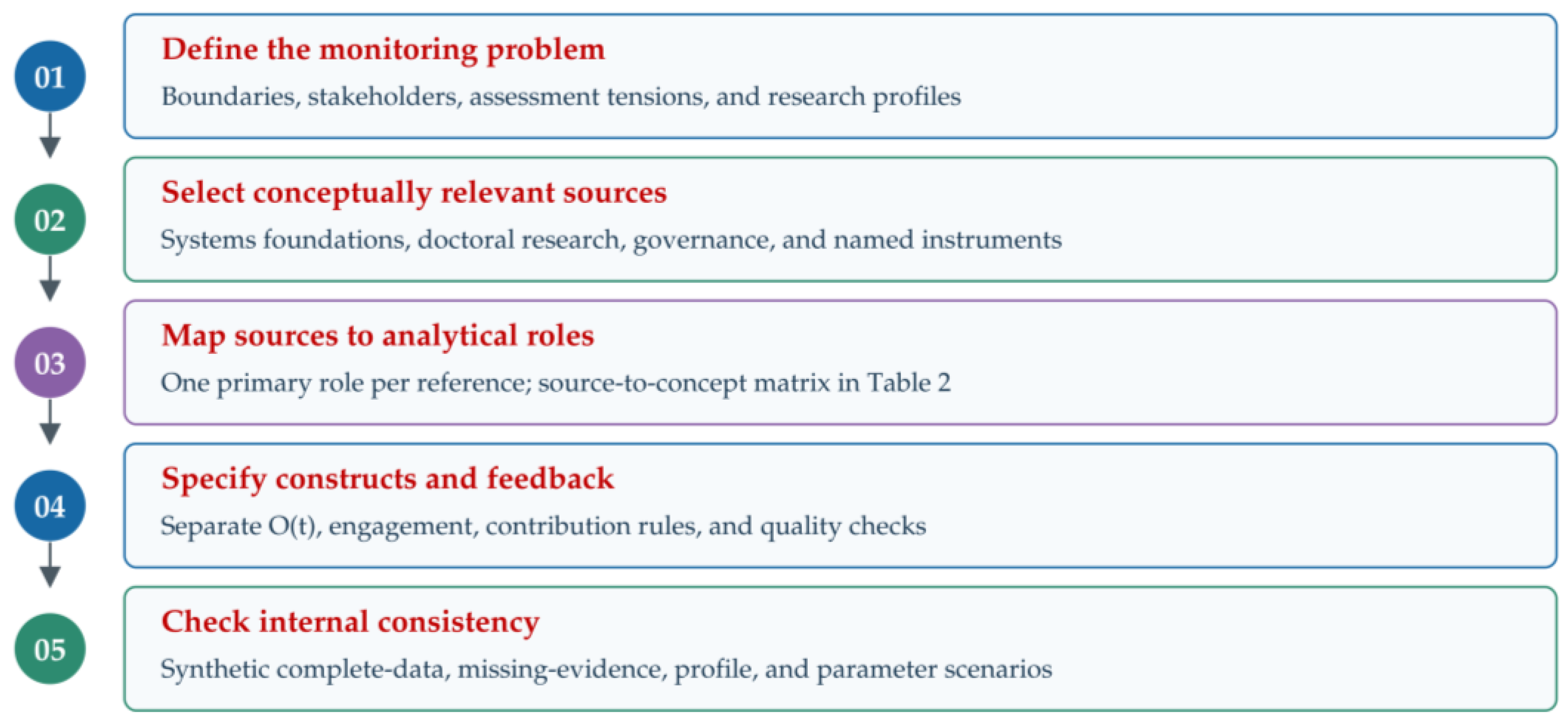
Figure 2.
Publication-year distribution of 36 dated references; three undated resources are excluded.
Figure 2.
Publication-year distribution of 36 dated references; three undated resources are excluded.
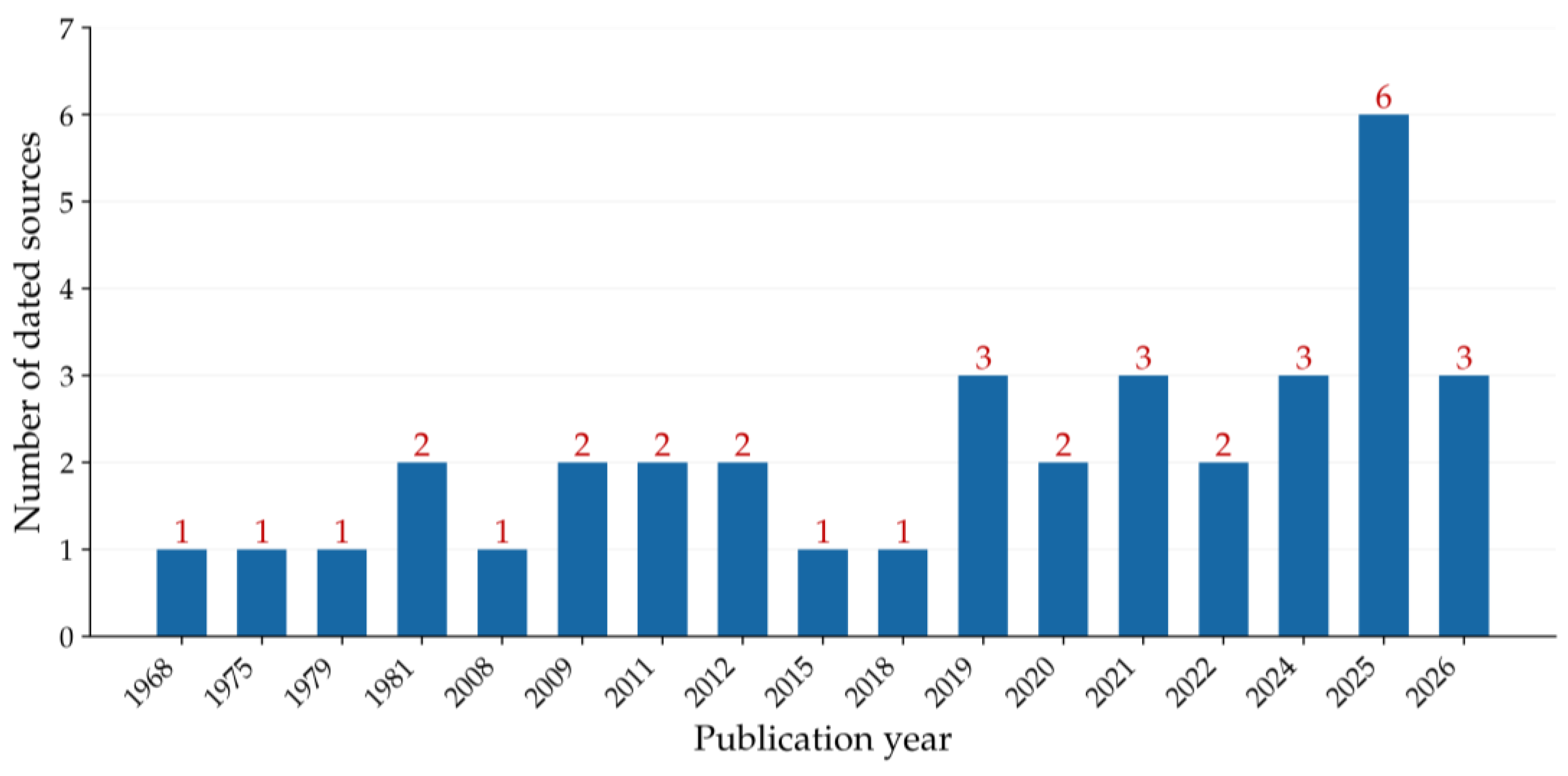
Figure 3.
Primary analytical roles of the 39 references; assignments are listed in Table 2.
Figure 3.
Primary analytical roles of the 39 references; assignments are listed in Table 2.
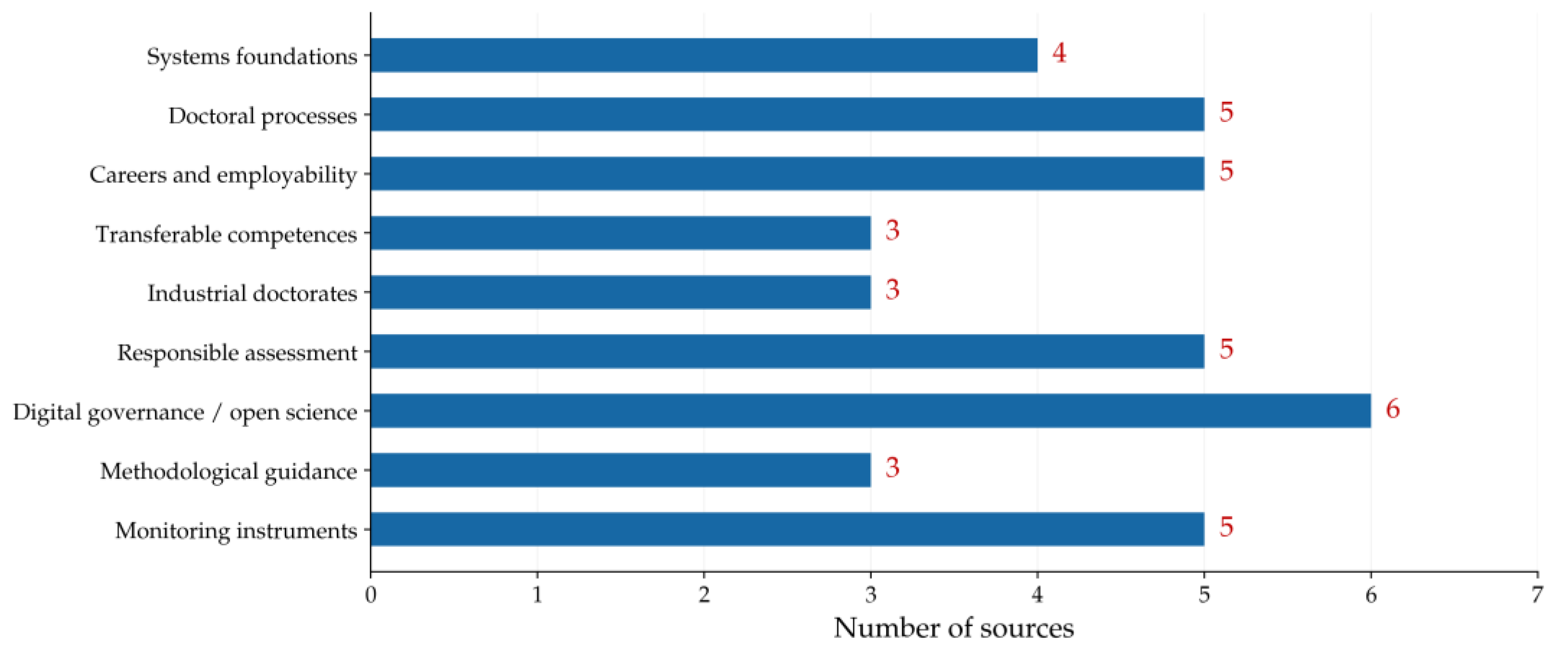
Figure 4.
Hypothesized socio-technical causal loops.
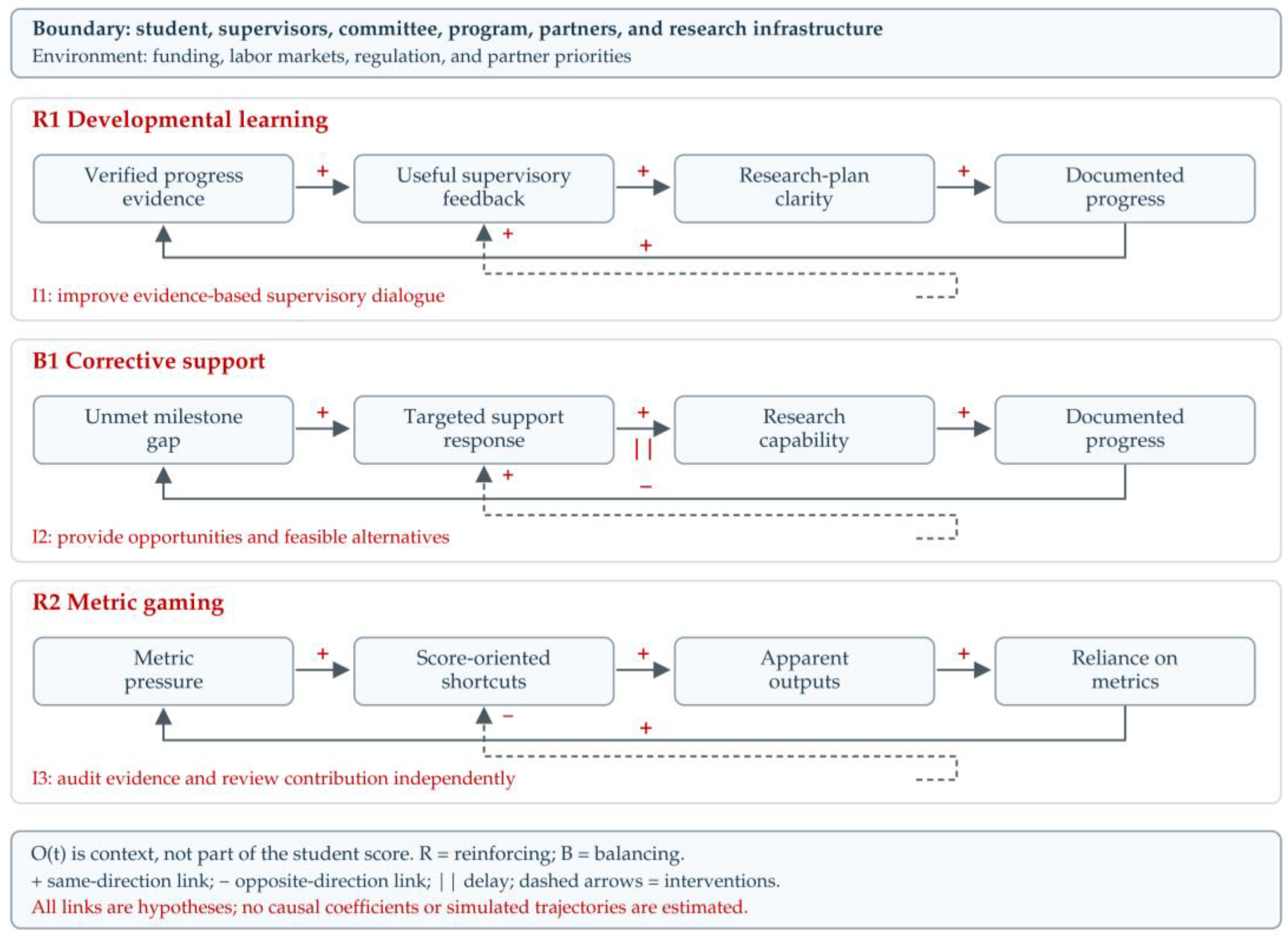
Figure 5.
Exact illustrative PDM weights from Table 7 for Year I, mid-stage, and final stage.
Figure 5.
Exact illustrative PDM weights from Table 7 for Year I, mid-stage, and final stage.
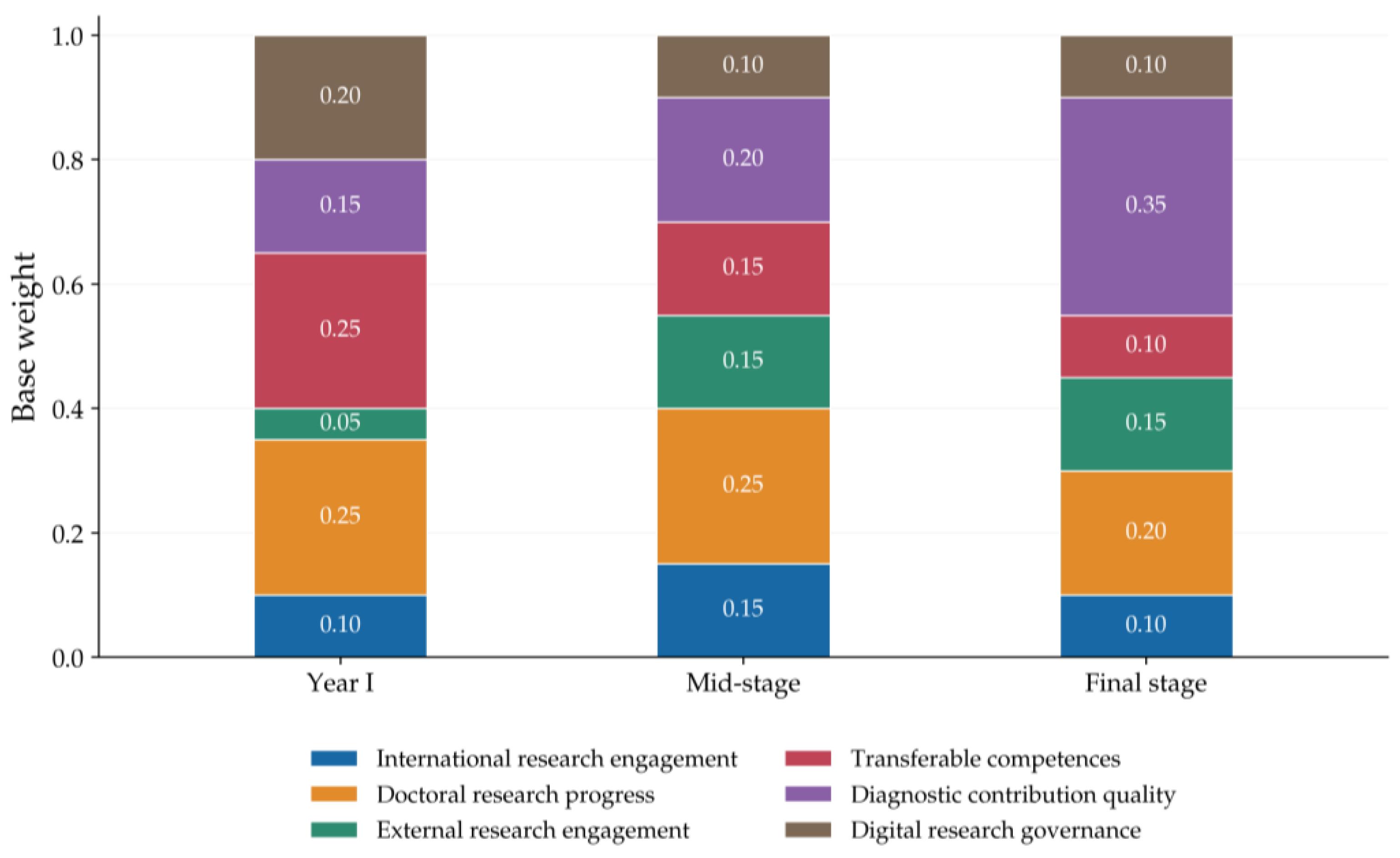
Figure 6.
Synthetic trajectories calculated from Table 10; final-stage PDM=0.7682 (0.77 rounded). No empirical or causal simulation trajectory is claimed.
Figure 6.
Synthetic trajectories calculated from Table 10; final-stage PDM=0.7682 (0.77 rounded). No empirical or causal simulation trajectory is claimed.
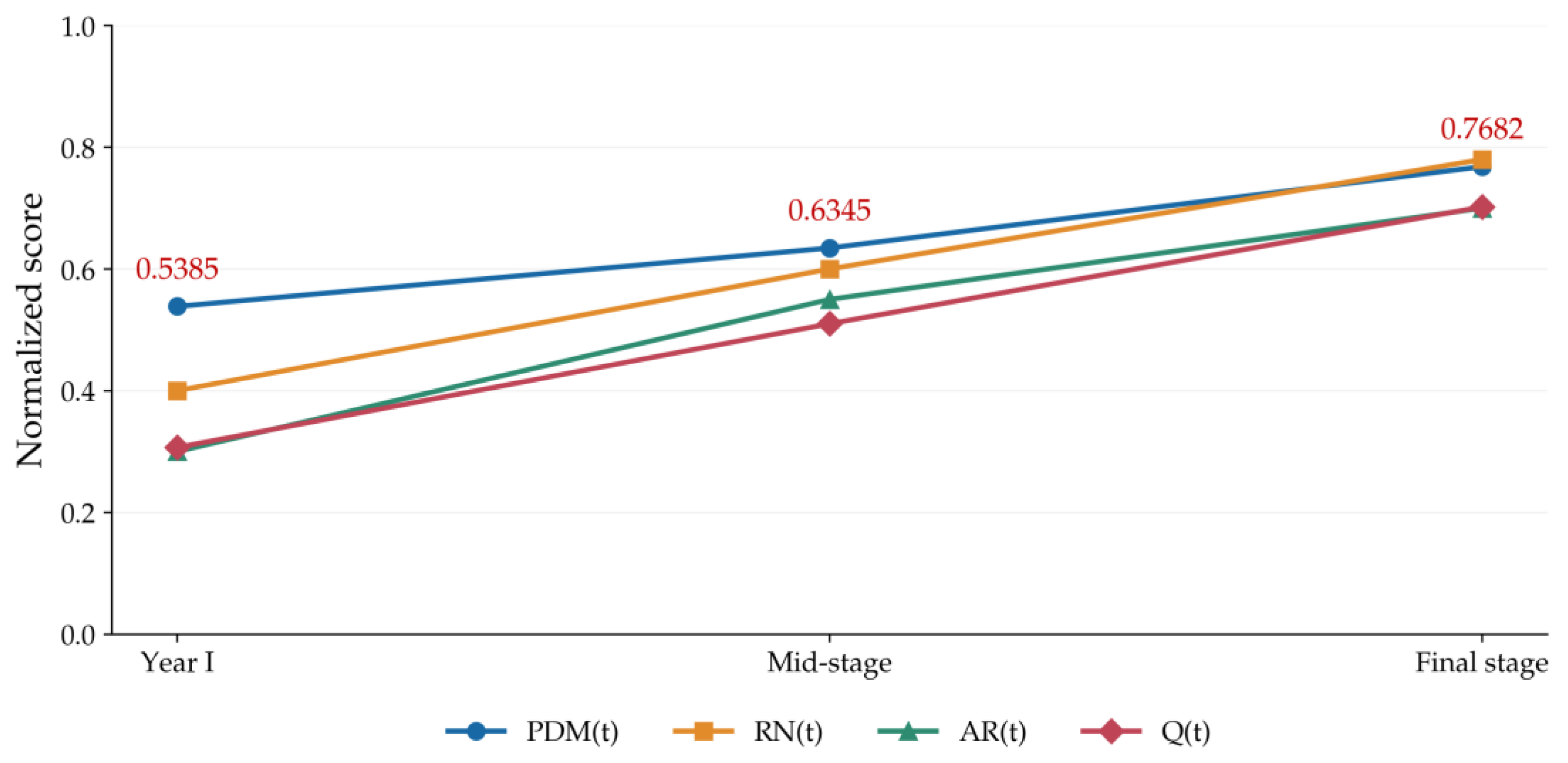

Table 1.
Scope and limits of source selection.
| Element | Specification | Interpretive limit |
|---|---|---|
| Conceptual collection |
39 references spanning systems foundations, doctoral education, research governance, methodological guidance, and named instruments. | Purposive coverage, not a representative sample or an exhaustive review. |
| Selection rationale | Relevance to boundaries, feedback, progress, opportunities, contribution, or digital research responsibility. | Relevance is an analytical judgment, not proof of PDM effectiveness. |
| Evidence types | Research publications, foundational works, policy documents, development frameworks, and institutional tools. | Normative principles and institutional descriptions are not effect estimates. |
| Traceability | Each reference has a primary role in Table 2; construct and scoring rules are specified in Section 5 and Section 6. | No undocumented search history or screening counts are implied. |
| Validation status | Conceptual reasoning and synthetic consistency checks only. | No participant observations, causal estimates, or calibrated thresholds. |
Table 2.
Source-to-concept matrix; each reference is counted once.
| Primary role | Sources | Use in the model |
|---|---|---|
| Systems foundations | [1,2,3,4] | Open-system boundary, stakeholder viewpoints, feedback, and social–technical coordination. |
| Doctoral processes | [9,10,11,12,13] | Research development, supervision, progress review, and completion; informs P(t) and contextual support. |
| Careers and employability | [5,6,7,8,26] | Career diversity and links with professional settings; informs T(t) and engagement interpretation. |
| Transferable competences | [20,21,25] | Researcher development, communication, planning, and career competences; informs T(t). |
| Industrial doctorates | [22,23,24] | Collaboration and application settings; distinguishes O(t), C(t), and AR(t). |
| Responsible assessment | [14,15,16,32,33] | Limits of metrics and target-driven behavior; informs safeguards and the gate. |
| Digital governance and open science | [17,18,19,27,28,34] | Accountability, confidentiality, verification, and stewardship; informs D(t) and evidence requirements. |
| Methodological guidance | [29,30,31] | Conceptual research design and distinction from systematic/scoping-review reporting. |
| Monitoring instruments | [35,36,37,38,39] | Comparison of development planning, progress reviews, student experience, and completion reporting. |
Table 3.
Comparison with named frameworks and doctoral-monitoring instruments.
| Framework/instrument | Unit and timing | Progress and contextual support | Contribution assessment and implication |
|---|---|---|---|
| Systems and socio-technical approaches [1,2,3,4] | System, stakeholders, and organizational change. | Boundaries, interdependence, feedback, and social–technical coordination. | Conceptual foundations, not validation of PDM weights or thresholds. |
| Vitae Researcher Development Framework [21] | Researcher development across a career. | Reflection, development planning, and competencies. | PDM adds coverage and a contribution/gate layer; it does not replace the RDF. |
| AAAS myIDP [35] | Science PhD students/postdoctoral researchers; iterative goal setting. | Self-assessment, career exploration, and development goals. | A career-development tool, not a thesis-novelty assessment; relevant to planning evidence. |
| UCL Research Student Log [36] | Research student throughout the degree. | Records academic progression and skills development, linked with supervision. | Public guidance does not specify the proposed coverage-and-gate calculation; the Log can supply evidence. |
| Manchester progress-and-review policy [37] | PGR, supervisory team, and review panel; periodic reviews. | Research/training plans, progress, support needs, and continuation decisions. | Already includes qualitative judgment; PDM makes context, evidence aggregation, and gate status explicit. |
| Advance HE PRES [38] | Research-student experience; institutional/sector survey. | Supervision, resources, development, research culture, and community. | Experience evidence concerns support and cannot substitute for an individual thesis-quality judgment. |
| CGS Ph.D. Completion Project [39] | Programs and cohorts; completion and attrition over time. | Outcomes and institutional conditions, including mentoring and support. | Cohort outcomes do not establish individual contribution quality; relevant to program-level diagnosis. |
| Proposed PDM | Student-level diagnostic cycle; three doctoral stages. | Documented progress/engagement, separate O(t), coverage, and effective weights. | Independent RN/RI/MR checks; no psychometric validity, causal effect, or superiority is claimed. |
Table 4.
Levels of analysis for doctoral monitoring.
| Level | Unit | Evidence examples | Reporting and use |
|---|---|---|---|
| 1 | Doctoral student | Documented progress, engagement, competences, contribution, and digital practices. | PDM, coverage, effective weights, and G; formative diagnosis. |
| 2 | Doctoral program | Supervision, training, research access, review procedures, and bottlenecks. | O(t); support responsibilities and program improvement. |
| 3 | Institutional ecosystem | Infrastructure, policies, funding access, partnerships, and research governance. | O(t) and governance indicators; no direct attribution to individual quality. |
Table 5.
Student-level dimensions and separately reported context.
| Symbol | Meaning | Evidence and boundary |
|---|---|---|
| I(t) | International research engagement | Documented contribution to international exchange, joint work, or learning; access belongs to OI. |
| P(t) | Doctoral research progress | Research tasks, appropriate outputs, feasible timelines, and reviewed milestones; not publication counts alone. |
| C(t) | External research engagement | Completed collaborative tasks, data use, case-study work, research exchanges, and responsibilities; not usefulness of the solution. |
| T(t) | Transferable competences | Communication, project management, ethics learning, entrepreneurship where relevant, and career planning. |
| Q(t) | Diagnostic contribution quality | Novelty with profile-specific modulation by applied relevance; independent RI/MR checks remain necessary. |
| D(t) | Digital research governance | AI accountability and data stewardship, assessed separately before aggregation. |
| O(t) | Context; outside PDM | International/external access, supervision, training, and infrastructure, with constraints and responsible actors. |
Table 6.
Proposed scoring, applicability, and coverage rules.
| Issue | Rule | Required record |
|---|---|---|
| Process evidence | Use 0, 0.25, 0.50, 0.75, 1 for absent/failed, initiated with major gaps, partial, adequate stage completion, and fully evidenced completion. | A stage-specific descriptor and supporting artifact or review. Aggregate scores can take intermediate values. |
| Appropriate activity counts | Use z=min(x/target,1), with a positive, feasible target agreed in advance. Counts document activity, not originality. | Numerator, target, time window, and rationale; no cohort min–max scaling in the example. |
| Opportunity constraints | Record O(t) and feasible alternatives. Unavailable activities are N/A only with documented prospective justification. | Reason, date, and program response. Core novelty, integrity, and rigor cannot be waived to improve scores. |
| N/A | Exclude agreed non-applicable items and disclose re-normalized weights under Equations (3)–(5). | Applicable set, hᵢ, H, S, and effective weights. |
| Missing evidence | Pending evidence is unscored. Zero is assigned only to confirmed noncompletion of an applicable and feasible expectation. | Distinguish pending assessment, no opportunity, irrelevant criterion, and noncompletion. |
| Comparison | Different profiles, indicator sets, and weights do not define interchangeable scores. | Dimension-level trajectory and, when relevant, common-weight comparison. |
| Illustrative inputs | All six dimensions are applicable and observed in Table 10; hᵢ=H=S=1. | Construct scores are synthetic inputs, not participant measurements. |
Table 7.
Exact illustrative weights for the modeled doctoral stages.
| Stage | I | P | C | T | Q | D | Sum |
|---|---|---|---|---|---|---|---|
| Year I | 0.10 | 0.25 | 0.05 | 0.25 | 0.15 | 0.20 | 1 |
| Mid-stage | 0.15 | 0.25 | 0.15 | 0.15 | 0.20 | 0.10 | 1 |
| Final stage | 0.10 | 0.20 | 0.15 | 0.10 | 0.35 | 0.10 | 1 |
Table 8.
Research novelty, applied relevance, and diagnostic contribution quality.
| Construct | Claim | Evidence | Role and boundary |
|---|---|---|---|
| RN(t) | Scientific novelty appropriate to the declared contribution. | Prior-work comparison, explicit contribution, and supporting arguments or results. | Necessary condition; independent of industrial usefulness. |
| AR(t) | Relevance, transfer potential, and contextual validation for an applied profile. | Use-case evidence, stakeholder validation, and transfer conditions. | Modulates Q only where applicable; N/A for genuine theoretical profiles. |
| Q(t) | Profile-specific diagnostic contribution quality. | RN, required AR evidence, profile, and κ. | Bounded by RN; not a substitute for RI/MR checks. |
Table 9.
Proposed final-stage research-integrity and methodological-rigor rubrics.
| Check | Domains/evidence | Scoring rule | Responsibility |
|---|---|---|---|
| RI | Required ethics/consent compliance; provenance; accurate attribution/authorship; truthful AI disclosure and verification. | Each applicable domain: 1 = verified compliance; 0.5 = documented remediable deficiency; 0 = confirmed material noncompliance. Pending evidence is unscored. Use the minimum. | Committee reviews evidence. Suspected misconduct follows institutional procedures, not an automated score. |
| MR | Question/design alignment; justified methods and data/argument adequacy; transparent analysis; validation/critical testing and limitations. | 0 = absent/invalid; 0.25 = major defects; 0.5 = partial justification; 0.75 = adequate; 1 = thoroughly supported. Use the minimum applicable domain. | Independent disciplinary assessment. Theoretical work uses logical adequacy, not inappropriate empirical requirements. |
|
RN threshold |
Original contribution claim and positioning relative to prior work. | A prespecified minimum θRN; no universal numerical threshold is asserted. | Committee and disciplinary experts, not output counts alone. |
Table 10.
Fully specified synthetic example for PDM(t).
| Stage | Student-level inputs | Contribution inputs/result | PDM; coverage | Gate interpretation |
|---|---|---|---|---|
| Year I | I=0.30; P=0.65; C=0.20; T=0.60; D=0.70 | RN=0.40; AR=0.30; κ=0.50; Q=0.3066667 | 0.5385 → 0.54; H=S=1 | Final-stage gate not applied; novelty is a developmental priority. |
| Mid-stage | I=0.60; P=0.70; C=0.50; T=0.75; D=.80 | RN=0.60; AR=0.55; κ=0.50; Q=0.51 | 0.6345 → 0.63; H=S=1 | Final-stage gate not applied; consolidate contribution and validation. |
| Final stage | I=0.70; P=0.85; C=0.75; T=0.80; D=0.90 | RN=0.78; AR=0.70; κ=0.50; Q=0.702 | 0.7682 → 0.77; H=S=1 | Illustrative RI=1.00, MR=0.75 yield G=1 at the stated thresholds; not a degree decision. |
Table 11.
Synthetic final-stage sensitivity, applicability, and gate checks.
| Scenario | Assumption change | Q; PDM | Coverage/interpretation |
|---|---|---|---|
| Applied, κ=0 | Other Table 10 inputs unchanged. | 0.78; 0.7955 | H=S=1. AR has no modulation effect. |
| Applied, κ=0.5 | Reference scenario. | 0.702; 0.7682 | H=S=1; plotted in Figure 6. |
| Applied, κ=1 | Other inputs unchanged. | 0.663; 0.75455 | H=S=1. Larger application emphasis lowers Q when AR<1. |
| Theoretical profile | AR prospectively N/A; Q=RN. Engagement remains applicable in this mathematical contrast. | 0.78; 0.7955 | H=S=1 for scored dimensions; different profiles are not rank-comparable. |
| C genuinely N/A | Exclude C; retain applied contribution profile and re-normalize. | 0.702; 0.771412 | H=1; S=0.85. Effective I,P,C,T,Q,D weights: 0.117647, 0.235294, 0, 0.117647, 0.411765, 0.117647. |
| C evidence pending | C is applicable but unobserved; do not invent zero. | 0.702; 0.771412 | H=0.85; S=1. Same aggregate as N/A case, but different meaning. |
| Integrity deficiency | Other score inputs unchanged; RI=0.50 with θRI=1. | 0.702; 0.7682 | G=0: result (0.7682, 0). Strong scored dimensions do not override the gate. |
Table 12.
Proposed uses and intended, unvalidated benefits.
| Actor | Possible use | Intended benefit |
|---|---|---|
| Doctoral school | Review coverage and program bottlenecks without ranking students. | Clearer support needs and intervention responsibility. |
| Doctoral supervisor | Discuss documented milestones and agreed criteria. | More focused evidence-based feedback. |
| Doctoral student | Review evidence, applicability, and the distinction between support and performance. | Greater transparency and grounds to challenge unsupported judgments. |
| External/industrial partner | Agree feasible research tasks separately from usefulness validation. | Collaboration without equating organizational utility with novelty. |
| Doctoral committee | Assess RN, RI, MR independently and document G. | Transparent justified decisions, not automatic classification. |
Disclaimer/Publisher’s Note: The statements, opinions and data contained in all publications are solely those of the individual author(s) and contributor(s) and not of MDPI and/or the editor(s). MDPI and/or the editor(s) disclaim responsibility for any injury to people or property resulting from any ideas, methods, instructions or products referred to in the content. |
© 2026 by the authors. Licensee MDPI, Basel, Switzerland. This article is an open access article distributed under the terms and conditions of the Creative Commons Attribution (CC BY) license (http://creativecommons.org/licenses/by/4.0/).
Copyright: This open access article is published under a Creative Commons CC BY 4.0 license, which permit the free download, distribution, and reuse, provided that the author and preprint are cited in any reuse.