

Submitted:
07 September 2026
Posted:
09 September 2026
You are already at the latest version
Abstract
The immune system is a dynamic, energy-dependent network regulated by temporal biology. Advances in circadian biology have revealed that the molecular transcription–translation feedback loop coordinates approximately 15% of the human transcriptome, synchronizing metabolism, immune surveillance, tissue repair, and adaptation to environmental cycles. Here, we propose a metabolomic, endocrine, neurological chromodynamic model of immune health, based on time of day rhythms. Immune resilience is defined by synchronization among four “wheels”: i) the central circadian clocks, ii) food-entrainable metabolic oscillators, iii) peripheral cellular clocks, and iv) neuroimmune regulatory pathways. The model provides a framework to optimize these interconnected systems to maintain metabolic efficiency, minimize unnecessary inflammation, and enable precise immune responses through temporal gating. External factors of modern lifestyle disruptions, including irregular feeding patterns, sleep deprivation, and chronic stress, induce internal circadian desynchrony, contributing to persistent low-grade inflammation, metabolic dysfunction, immune aging, and chronic non-communicable diseases. We propose that immune health is characterized not merely by the absence of disease, but by stable circadian phase coherence, low inflammatory noise, and adaptive immune flexibility. A propose a panel of chrono-biomarkers of metabolomic and endocrine parameters, that may provide a functional assessment of immune resilience, defined by inflammatory tone, immune adaptability, metabolic integrity, and repair capacity. This framework integrates chronobiology, endocrine and immunometabolism to shift medicine from reactive disease management toward proactive assessment and restoration of biological resilience.
Keywords:
circadian rhythms
; metabolism
; nutrition
; endocrine
; regulation
; immune health
Introduction: The Paradigm from Defense to Homeostasis
The immune system has evolved over millions of years to defend the host against pathogens while maintaining tolerance to self-antigens and commensal microbiota. Over the past 50+ years, our understanding of immunity has advanced through a focused mechanistic approach, enabling in-depth characterization of the pathways, cells, proteins, and genes that govern immune responses and contribute to the pathogenesis and treatment of infectious diseases, autoimmune disorders, and cancer [1]. We now know that the healthy immune system is not merely a defensive mechanism but a regulatory system that sustains tissue homeostasis, facilitates repair and shapes host-microbiome interactions. Significant advances have been made in the understanding the fundamental components of innate and adaptive immunity, which are executed by 3 trillion “immune” cells [2]. The development of an immune system involves a series of interactions with dendritic cells, lymphocytes, natural killer (NK) cells and other immune cells in lymphoid organs. These interactions include cell-cell combination, induction of cytokines, changes in cell surface receptors, proliferations, and differentiation into effector cells, and immune memory. An effective immune response depends on a balance between activating and regulatory signals, which are influenced by metabolic, endocrine, neurological and several other factors. provide feedback to the nervous and endocrine systems, creating a dynamic bidirectional network that links immune function with the physiological rhythms of the organism. An emerging frontier is chronobiology, which recognizes that immune responses are orchestrated in time as well as space [3,4]. Circadian clocks synchronize immune surveillance, metabolism, tissue repair, and host defense with predictable environmental cycles, giving rise to a chrono-dynamic view of immunity. In this review, we have discussed a framework on recent advances in understanding the homoeostasis in immunology through the lens of a chrono(logical), dynamic and systemic approach.
50. Years of Immunology
Innate immunity is the first layer of defense involved in pattern recognition of foreign bodies by delivering biochemical signals with alarm the adaptive system [5]. Adaptive immunity has evolved to provide specificity and memory through specialized cells and receptors generated by the process of clonal selection and gene editing [6]. Tissue-specific immunity has emerged as a new paradigm. In that, the nature of the immune response (to an antigen) is governed by the nature of the local organ-specific immune responses, such that an immune response to an antigen is quite different in the liver, lung, eye or brain [6]. The microbiome (which comprises of more than a trillion cells), influences every aspect of the immune system. And most astoundingly, action potentials - activated in the brain (through thought, experiences, through the 8 senses) - have been shown to influence the (innate) immune system to anticipate (predict) danger [7]. This aspect of the immune system has been termed as the anticipatory immune system [8]. Overall, while these systems enable the body to respond and neutralize the plethora of microbes and foreign bodies, the immune system has a vast role in maintaining body homeostasis and “good immune health”.
Anticipatory Chrono-Dynamic Immune-Metabolic Framework
The focus in this approach shifts from a disease-centric to a health-centric view of immunity. Continuous immune activation is metabolically costly [8] . To balance effective host defense with energy conservation, the immune system has evolved to operate according to circadian rhythms. Rather than remaining constantly activated, immune cells are deployed, redistributed between the circulation, tissues, and lymphoid organs, and renewed in a predictable daily light and dark cycles that anticipate environmental challenges while promoting tissue repair during rest [3]. This dynamic, energy-efficient strategy, replacing the static view of the immune system is highly sensitive to metabolic cues and shifts in energy utilization can influence their activation, differentiation and longevity a concept now recognized as immunometabolism [9]. The systemic approach involved the night/day, or light-and-dark cycles (Figure 1 and supplementary Table).
Light Cycle. It is the surveillance/defense phase. During the light cycle, the immune system prepares the body for anticipated exposure to pathogens and tissue injury. Rising cortisol levels, coordinated through the hypothalamic-pituitary-adrenal (HPA) axis under the control of the suprachiasmatic nucleus (SCN), promote the redistribution of leukocytes, including naïve T cells and monocytes, from the circulation to barrier tissues such as the skin, lungs, and gastrointestinal tract [10]. Guided by chemokines, these cells enhance immune surveillance at sites most likely to encounter environmental challenges [11]. At the same time, increased sympathetic tone and endocrine signals, including insulin sensitivity, and thyroid hormones synchronize immune metabolism with the energetic demands of the active phase, favoring rapid innate immune responses and efficient host defense. This anticipatory deployment allows rapid detection and containment of pathogens while minimizing unnecessary immune activation.
Dark Cycle. This is the restorative/repair/memory phase. During the dark cycle, the immune system shifts from surveillance to repair and immune restoration. Under the control of the suprachiasmatic nucleus (SCN), increasing melatonin levels from the pineal gland, reduced cortisol levels, enhanced parasympathetic (vagal) activity, and changes in inflammatory mediators promote the migration of circulating leukocytes back to the bone marrow and secondary lymphoid organs [12]. Leukocyte trafficking changes during this period, with immune cells redistributing from the circulation toward tissues and lymphoid compartments. Increased interactions among antigen-presenting cells, T cells, and B cells, together with changes in cytokine signaling, support the organization of immune responses and the development and consolidation of immunological memory. During sleep, immune cells interact to facilitate antigen presentation, T- and B-cell activation, immune memory formation, and tissue repair [13]. Cellular maintenance processes, including DNA repair, protein quality control, autophagy, and mitochondrial restoration, are enhanced during this period, while adaptive immune responses are consolidated. In addition to these systemic endocrine signals, immune and tissue-resident cells locally activate hormones such as calcitriol from circulating calcifediol, providing tissue-specific regulation of immune tolerance, regulatory T-cell differentiation, and barrier homeostasis. Thus, the dark cycle serves as the principal phase for immune restoration, metabolic recovery, and preparation for the next cycle of immune surveillance.
Four Integrated Timing Systems of the Immune–Metabolic Chronobiome
The discovery of the molecular Transcription–Translation Feedback Loop (TTFL) involving BMAL1, CLOCK, PER, and CRY proteins by Hall, Rosbash, and Young (Nobel Prize, 2017) established the foundation of chronogenetics. Approximately 15% of the human transcriptome consists of Clock-Controlled Genes (CCGs), whose expression is temporally coordinated through phase-locking mechanisms that synchronize cellular transcription, metabolism, DNA repair, and immune functions with endogenous circadian and environmental diurnal cycles [14]. The four interconnected timing systems comprise of the i) SCN master clock, ii) the food-entrainable oscillator, iii) peripheral cellular clocks, and the iv) vagal–parasympathetic network together comprise of the oscillatory networks to establish temporal organization of immune function, metabolism, and tissue repair.
1. Suprachiasmatic Nucleus (SCN): The Central Circadian Coordinator
The SCN of the hypothalamus functions as the primary master clock, integrating environmental light signals and synchronizing systemic circadian rhythms through the hypothalamic–pituitary–adrenal (HPA) axis and neuroendocrine pathways [15]. The SCN coordinates behavioral, metabolic, and immune rhythms by aligning peripheral clocks with the external day–night cycle [4]. SCN influences timing of leucocyte trafficking, immune cell activation, cytokine production, and inflammatory responses. This temporal coordination enables immune cells to anticipate predictable changes in environmental exposure and metabolic demand.
2. Food-Entrainable Oscillators (FEOs): The Nutritional Timekeeper
Independent of light-driven SCN regulation, food-entrainable oscillators in the liver, hypothalamic nuclei, and gastrointestinal ghrelin-producing cells synchronize circadian programs with feeding–fasting cycles through the gut–brain axis [16]. These clocks regulate nutrient sensing, metabolism, and immune energy availability.
3. Peripheral Cellular Oscillators: The Immunometabolic Phase Network
Every nucleated cell contains an autonomous TTFL-based molecular clock, generating approximately 30 trillion peripheral oscillators across the human body [17]. These cellular clocks function as phase comparators, continuously adjusting local transcriptional programs, including immune activation, metabolic pathways, and tissue repair, in order to maintain systemic circadian alignment.
4. Vagal–Parasympathetic Network: The Homeostatic Immune Regulator
The parasympathetic nervous system (PNS), mediated largely through the vagus nerve, serves as a bidirectional communication network between the brain, gut, and peripheral organs [18]. Vagal sensory inputs regulate SCN responsiveness and immune–metabolic adaptation. During rest phases, parasympathetic dominance promotes acetylcholine-mediated tissue repair, metabolic restoration, and immune regulation. Enhanced vagal tone suppresses excessive sympathetic activation, reduces stress-induced inflammatory signaling, limits pro-inflammatory cytokine production, and supports immune tolerance and metabolic homeostasis.
Thus, immune health may be viewed as a state of dynamic immune-metabolic synchronization that maintains coherence between central and peripheral circadian clocks. This dynamic process ensures coordination of immune surveillance, metabolism, tissue repair, and adaptation to environmental cues. Circadian disruption converts this highly regulated anticipatory system into a state of chronic metabolic and inflammatory imbalance, characterized by reduced temporal precision, persistent low-grade inflammation, and impaired immune discrimination. Defining health through this chrono-dynamic framework provides a foundation for identifying measurable immune-metabolic biomarkers that capture the resilience, amplitude, and adaptability of the immune system.
Endocrine and the Clock Influences on the Immune System
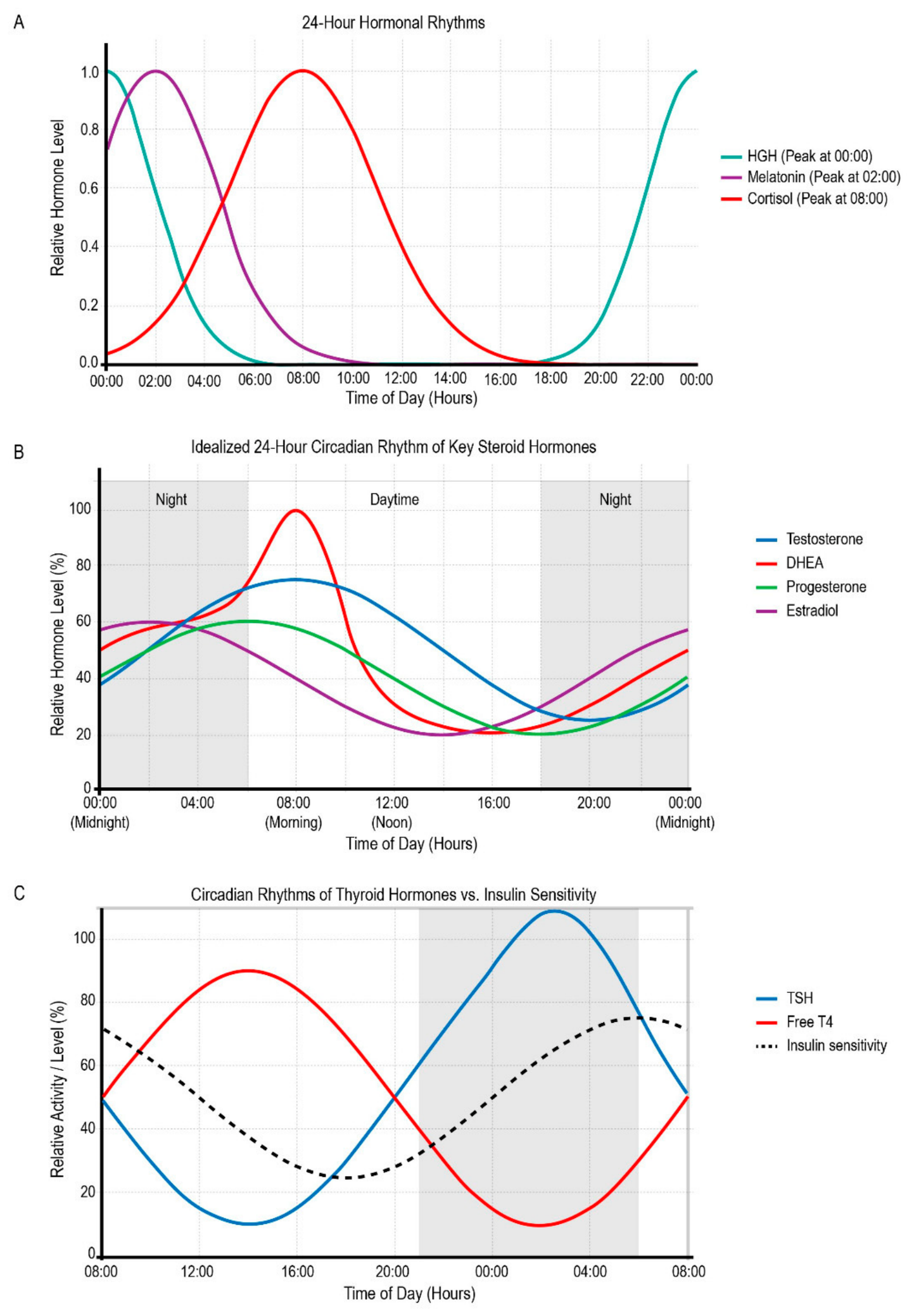
Hormone chronobiology directly dictates immune system behavior through a 24-hour master clock in the brain that orchestrates daily peaks and troughs of key hormones such as Cortisol, Melatonin, Human Growth Hormone (HGH), insulin sensitivity and thyroid hormones [19] (Figure 2 a-c). This hormonal fluctuation coordinates the migration, activation, and suppression of immune cells to optimize defense against pathogens while preventing autoimmune damage during the day. Endocrine hormonal activity may regulate circadian-dependent movement of lymphoid cells from various lymphoid tissues to peripheral blood. Cortisol, melatonin, HGH, thyroid hormones and insulin sensitivity follow distinct circadian rhythms driven by the brain's master clock, the SCN. They work in precise opposition to manage energy, sleep quality, and cellular repair [20,21].
The immune system is closely integrated with the endocrine circadian system, which coordinates daily changes in hormone concentrations and the sensitivity of target tissues. During the dark cycle, declining cortisol together with increasing melatonin and growth hormone contributes to a state of immune consolidation and tissue restoration. Cortisol is a potent anti-inflammatory and immunosuppressive hormone [22]. Its levels naturally decrease to their lowest point in the early hours of the dark cycle, enabling immune activation. Leukocyte trafficking changes during this period, with immune cells redistributing from the circulation toward tissues and lymphoid compartments. Increased interactions among antigen-presenting cells, T cells, and B cells, together with changes in cytokine signaling, support the organization of immune responses and the development and consolidation of immunological memory. The dark cycle therefore provides an important window for immune regulation, repair, and restoration.
The endocrine rhythms are influenced by biological sex, age, and reproductive status. Adrenal hormones, particularly cortisol, exhibit robust circadian patterns, whereas hormones predominantly derived from the gonads show more subtle daily oscillations that are superimposed on longer-term cycles, including the menstrual cycle. Consequently, endocrine regulation of immunity varies across individuals and across the lifespan and should be considered when interpreting chronobiological immune biomarkers and developing chronotherapeutic strategies. The endocrine system functions as a major temporal synchronizer of immunity, coupling the circadian clock to daily changes in immune-cell trafficking, inflammatory activity, metabolism, tissue repair, and immune memory. Disruption of these rhythms—through environmental, behavioral, metabolic, or genetic factors—may impair immune homeostasis and contribute to chronic inflammatory, metabolic, and oncological disease. Understanding and restoring endocrine–circadian alignment therefore represents an important component of a dynamic approach to immune health and disease.
Chrono-Metabolic Immune Metabolism Biomarkers
A healthy immune-metabolic system is characterized not by maximal immune activation, but by temporal regulation, including appropriate circadian amplitude, low baseline inflammatory tone, preserved immune reserve, and rapid, proportionate responses to challenge [23]. Therefore, biomarkers of health should capture the resilience, quiescence, and phase coherence of immune–metabolic networks rather than only disease-associated elevations. A panel of circulating markers obtained from routine blood samples can provide an integrated assessment of systemic inflammation, immune adaptability, metabolic homeostasis, tissue repair capacity, and physiological reserve. Importantly, the timing of sampling is critical for many of these biomarkers, since a single measurement may obscure physiologically meaningful diurnal variation. Table 1 lists some of the key biomarkers that inform the chrono-metabolic state of the immune system. These biomarkers span several interconnected dimensions of immune-metabolic health: inflammatory tone (hs-CRP, IL-6, TNF-α, SAA), immune-cell composition and reserve (NLR and naïve T cells), adrenal and circadian regulation (cortisol and DHEA-S), nocturnal restoration (melatonin and GH), and endocrine-metabolic regulation (thyroid hormones and vitamin D metabolites). Their greatest value may not lie in any individual measurement, but in the relationships among them and their temporal patterns.
We have previously reported on immunoSCORE as a signature to monitor the evolution of an immune responses to infectious agents, autoimmunity, cancer and therapeutic biologics [24]. Monitoring a dynamic immune response will require multiple immune signatures over the course of time and organ(s). The advent of systems immunology will enable the understanding of the complexity of multi-dimensional aspects of the immune system. The emerging opportunity is therefore to move from a static biomarker model to a dynamic immune-metabolic phenotype. Serial measurements obtained at defined biological times, combined with clinical, metabolic, behavioral, and physiological data, could quantify the amplitude, phase, coherence, and recovery of immune–endocrine networks. Such an approach could ultimately define immune-metabolic resilience, the capacity of the organism to anticipate physiological challenges, mount an appropriate immune response, and efficiently return to homeostasis.
Integration: A Chrono-Dynamic Definition of Immune Health
The immune system is not a static defense mechanism but a dynamic, temporally organized network that has evolved to anticipate environmental challenges while preserving energy and tissue integrity. The integration of circadian clocks, metabolic sensors, peripheral immune oscillators, and neuroimmune communication pathways creates a highly coordinated immunometabolic ecosystem with remarkable precision. Disease emerges when this temporal architecture loses synchronization, resulting in chronic inflammatory noise, impaired metabolic flexibility, and diminished repair capacity. A new definition of health therefore requires moving beyond measurements of disease burden toward assessment of biological coordination and resilience. A healthy organism maintains robust circadian phase coherence, appropriate immune activation thresholds, metabolic harmony, and efficient restoration during periods of rest. Chrono-biomarkers provide an opportunity to quantify this state by measuring the amplitude, adaptability, and stability of immunometabolic regulation. This chronodynamic perspective reframes health as an active biological state of synchronized resilience, where the goal of medicine shifts from suppressing pathology alone to restoring the evolutionary programs that maintain immune balance, metabolic integrity, and lifelong adaptability.
With the advent of multi-omics, organ-specific data, and systems immunology, it is possible to evaluate this chronodynamic systems framework across diverse disease states and determine how disruptions in temporal immune organization contribute to pathology. Future studies should investigate whether non-infectious chronic diseases, including obesity, diabetes, cardiovascular disease, neurodegeneration, and cancer, are associated with distinct patterns of chronobiological immune dysfunction. Similarly, chronic infections, autoimmune diseases, allergic disorders, and immune aging may reflect persistent alterations in immune-metabolic synchronization rather than isolated molecular defects. Integrating longitudinal multi-omics, wearable physiological monitoring, circadian biomarkers, and computational modeling will enable quantitative characterization of these dynamic immune states. Such studies may identify disease-specific chronodynamic signatures, uncover novel therapeutic windows for chronotherapy, and provide a framework for precision medicine based on restoration of temporal immune homeostasis rather than treatment of static pathological endpoints.
Supplementary Materials
The following supporting information can be downloaded at the website of this paper posted on Preprints.org.
References
- Editors. Immunology is for everyone. Cell. 2024;187(9):2029.
- Sender R, Weiss Y, Navon Y, Milo I, Azulay N, Keren L, et al. The total mass, number, and distribution of immune cells in the human body. Proc Natl Acad Sci U S A. 2023;120(44):e2308511120. [CrossRef]
- Skarke C, Lahens NF, Rhoades SD, Campbell A, Bittinger K, Bailey A, et al. A Pilot Characterization of the Human Chronobiome. Sci Rep. 2017;7(1):17141. [CrossRef]
- Wyss-Coray T, Topol EJ. Biological aging clocks in health and disease. Nature Medicine. 2026;32(7):2383–94. [CrossRef]
- Carpenter S, O'Neill LAJ. From periphery to center stage: 50 years of advancements in innate immunity. Cell. 2024;187(9):2030–51. [CrossRef]
- Weisberg SP, Ural BB, Farber DL. Tissue-specific immunity for a changing world. Cell. 2021;184(6):1517–29. [CrossRef]
- Trabanelli S, Akselrod M, Fellrath J, Vanoni G, Bertoni T, Serino S, et al. Neural anticipation of virtual infection triggers an immune response. Nat Neurosci. 2025;28(9):1968–77. [CrossRef]
- Cohen JA, Edwards TN, Liu AW, Hirai T, Jones MR, Wu J, et al. Cutaneous TRPV1 Neurons Trigger Protective Innate Type 17 Anticipatory Immunity. Cell. 2019;178(4):919–32.e14. [CrossRef]
- Clarke J, Mauro C. The many facets of immunometabolism. PLoS Biol. 2026;24(1):e3003641. [CrossRef]
- Xu J, Wang B, Ao H. Corticosterone effects induced by stress and immunity and inflammation: mechanisms of communication. Frontiers in Endocrinology. 2025;Volume 16 - 2025. [CrossRef]
- Zeng Y, Guo Z, Wu M, Chen F, Chen L. Circadian rhythm regulates the function of immune cells and participates in the development of tumors. Cell Death Discovery. 2024;10(1):199. [CrossRef]
- Poole J, Kitchen GB. Circadian regulation of innate immunity in animals and humans and implications for human disease. (1863-2300 (Electronic)). [CrossRef]
- Besedovsky L, Lange T, Haack M. The Sleep-Immune Crosstalk in Health and Disease. Physiol Rev. 2019;99(3):1325–80. [CrossRef]
- Kim YH, Lazar MA. Transcriptional Control of Circadian Rhythms and Metabolism: A Matter of Time and Space. Endocr Rev. 2020;41(5):707–32. [CrossRef]
- Li Y, Lu L, Androulakis IP. The Physiological and Pharmacological Significance of the Circadian Timing of the HPA Axis: A Mathematical Modeling Approach. J Pharm Sci. 2024;113(1):33–46. [CrossRef]
- Petersen CC, Cao F, Stinchcombe AR, Mistlberger RE. Multiple entrained oscillator model of food anticipatory circadian rhythms. Scientific Reports. 2022;12(1):9306. [CrossRef]
- Yi JS, Díaz NM, D'Souza S, Buhr ED. The molecular clockwork of mammalian cells. Semin Cell Dev Biol. 2022;126:87–96. [CrossRef]
- Liu L, Lou S, Fu D, Ji P, Xia P, Shuang S, et al. Neuro-immune interactions: Exploring the anti-inflammatory role of the vagus nerve. Int Immunopharmacol. 2025;159:114941. [CrossRef]
- Fernandes G. Chronobiology of Immune Functions: Cellular and Humoral Aspects. In: Touitou Y, Haus E, editors. Biologic Rhythms in Clinical and Laboratory Medicine. Berlin, Heidelberg: Springer Berlin Heidelberg; 1992. p. 493–503. [CrossRef]
- Van Drunen R, Eckel-Mahan K. Circadian rhythms as modulators of brain health during development and throughout aging. Front Neural Circuits. 2022;16:1059229. [CrossRef]
- Kim TW, Jeong JH, Hong SC. The impact of sleep and circadian disturbance on hormones and metabolism. Int J Endocrinol. 2015;2015:591729. [CrossRef]
- Chen MH, Hung YC, Kuo WN, Hsu HY, Lee IT, Tsai CY, et al. Sleep and circadian disruption reshape immune homeostasis in oral tissues: mechanistic roles of melatonin and cortisol in periodontal disease and xerostomia. Front Immunol. 2026;17:1781288. [CrossRef]
- Szredzka A, Chwastowicz A, Pergoł J, Matryba P. Circadian clocks and adaptive immune function: from mechanisms to therapeutic applications. Front Immunol. 2025;16:1697854. [CrossRef]
- Gopallawa I, Chavan S, Goswami A, Jawa V, Chirmule N. A quantitative metric of immune responses with applications in vaccines, cancer immunity, autoimmunity, and anti-drug antibody monitoring. Journal of Pharmaceutical Sciences. 2026;115(6):104254. [CrossRef]
Figure 1.
Chronodynamic model of SCN–FEO phase-locked loops and peripheral oscillators. The model depicts bidirectional neuro-hematolymphoid coordination between the photic-entrained suprachiasmatic nucleus (SCN) master pacemaker and trophic/feeding-entrained food-entrainable oscillators (FEOs), represented as coupled gears. The 24-h cycle is organized into six sequential physiological phases, with cell-autonomous transcription–translation feedback loops (TTFLs), including CRY/PER, providing the molecular timing mechanism synchronized by the SCN. Four FEOs and 12 peripheral oscillators (POs) are organized according to their principal entrainment pathways and include neuroendocrine, gastrointestinal/metabolic, visceral, locomotor, cardiac, pulmonary, renal, and adipose tissues. Sympathetic (SNS) and parasympathetic (PNS) signaling provide directional systemic coupling, while key hormonal and metabolic signals mark phase transitions. The SCN and FEO networks function as dual phase-locked loops, permitting limited temporal desynchrony; prolonged disentrainment may disrupt inter-organ synchronization and contribute to progressive pathophysiology associated with noncommunicable diseases. Abbreviations: SCN, (suprachiasmatic nucleus), the central master clock and light-entrained circadian pacemaker; FEOs, (food-entrainable oscillators), a metabolic clock network entrained by trophic, nutrient, and feeding cues; POs, (peripheral oscillators), local autonomous tissue clocks embedded within organs; TTFL, (transcription–translation feedback loop), the molecular cell-autonomous genetic transcriptional clock synchronized by the SCN; CRY/PER, (cryptochrome/period, core repressor proteins) comprising the negative arm of the TTFL; PNS, (parasympathetic nervous system), the autonomic branch associated with rest-and-digest functions and viscous damping; SNS, (sympathetic nervous system), the autonomic branch driving daytime activation, arousal, and alertness; CAR, (cortisol awakening response), the SCN-driven increase in cortisol levels immediately upon waking; DLMO, (dim light melatonin onset), the initiation of evening melatonin synthesis associated with photic dusk; HGH/AVP, (human growth hormone/arginine vasopressin), nocturnal signaling associated with tissue repair and water retention; Mel/ACh, (melatonin/acetylcholine), signals involved in sleep maintenance and REM-associated neural activity; Orx/Testo, (orexin/testosterone), mid-day signals associated with vigilance, locomotion, and virility; DHEA, (dehydroepiandrosterone), an adrenal steroid associated with daytime energy and immune resilience; Adiponectin, an adipokine acting through AdipoR1/AdipoR2 and associated with insulin sensitivity, GLUT4 translocation, and AMPK activation; CCK, (cholecystokinin), a vagally mediated satiety peptide involved in regulation of gastric emptying; TAG, (triacylglycerols (triglycerides)), lipid compounds mobilized for storage during the transition to evening rest.
Figure 1.
Chronodynamic model of SCN–FEO phase-locked loops and peripheral oscillators. The model depicts bidirectional neuro-hematolymphoid coordination between the photic-entrained suprachiasmatic nucleus (SCN) master pacemaker and trophic/feeding-entrained food-entrainable oscillators (FEOs), represented as coupled gears. The 24-h cycle is organized into six sequential physiological phases, with cell-autonomous transcription–translation feedback loops (TTFLs), including CRY/PER, providing the molecular timing mechanism synchronized by the SCN. Four FEOs and 12 peripheral oscillators (POs) are organized according to their principal entrainment pathways and include neuroendocrine, gastrointestinal/metabolic, visceral, locomotor, cardiac, pulmonary, renal, and adipose tissues. Sympathetic (SNS) and parasympathetic (PNS) signaling provide directional systemic coupling, while key hormonal and metabolic signals mark phase transitions. The SCN and FEO networks function as dual phase-locked loops, permitting limited temporal desynchrony; prolonged disentrainment may disrupt inter-organ synchronization and contribute to progressive pathophysiology associated with noncommunicable diseases. Abbreviations: SCN, (suprachiasmatic nucleus), the central master clock and light-entrained circadian pacemaker; FEOs, (food-entrainable oscillators), a metabolic clock network entrained by trophic, nutrient, and feeding cues; POs, (peripheral oscillators), local autonomous tissue clocks embedded within organs; TTFL, (transcription–translation feedback loop), the molecular cell-autonomous genetic transcriptional clock synchronized by the SCN; CRY/PER, (cryptochrome/period, core repressor proteins) comprising the negative arm of the TTFL; PNS, (parasympathetic nervous system), the autonomic branch associated with rest-and-digest functions and viscous damping; SNS, (sympathetic nervous system), the autonomic branch driving daytime activation, arousal, and alertness; CAR, (cortisol awakening response), the SCN-driven increase in cortisol levels immediately upon waking; DLMO, (dim light melatonin onset), the initiation of evening melatonin synthesis associated with photic dusk; HGH/AVP, (human growth hormone/arginine vasopressin), nocturnal signaling associated with tissue repair and water retention; Mel/ACh, (melatonin/acetylcholine), signals involved in sleep maintenance and REM-associated neural activity; Orx/Testo, (orexin/testosterone), mid-day signals associated with vigilance, locomotion, and virility; DHEA, (dehydroepiandrosterone), an adrenal steroid associated with daytime energy and immune resilience; Adiponectin, an adipokine acting through AdipoR1/AdipoR2 and associated with insulin sensitivity, GLUT4 translocation, and AMPK activation; CCK, (cholecystokinin), a vagally mediated satiety peptide involved in regulation of gastric emptying; TAG, (triacylglycerols (triglycerides)), lipid compounds mobilized for storage during the transition to evening rest.
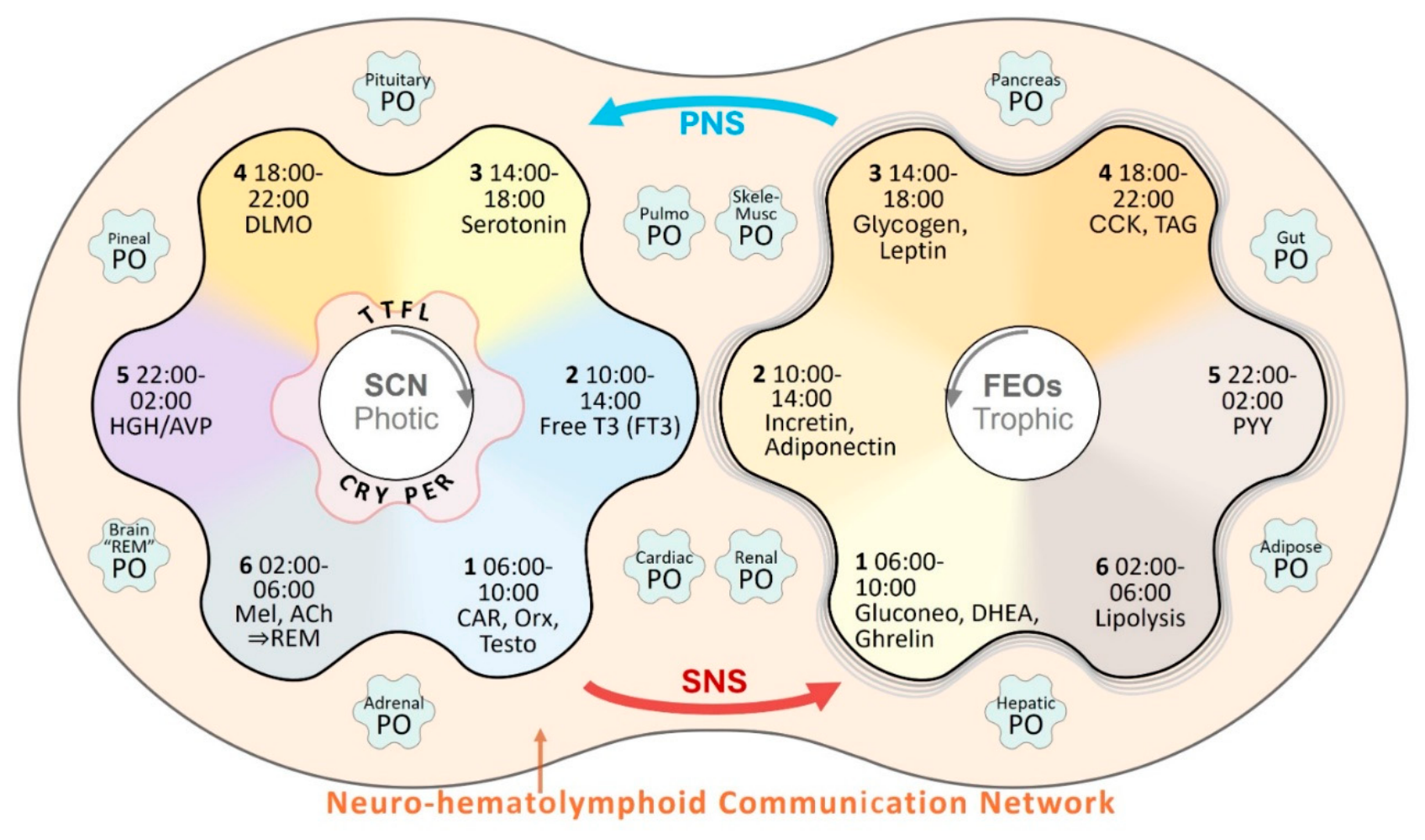
Figure 2.
abc. Endocrine biomarkers over time of day.

| Biomarker | Homeostatic / Reference Profile* | Immunometabolic Significance |
|---|---|---|
| hs-CRP | <1 mg/L in low-risk adults | Indicates low systemic inflammatory burden and absence of persistent low-grade metabolic inflammation. |
| IL-6 / TNF-α | Low basal concentrations with appropriate diurnal variation | Reflects effective temporal regulation of inflammatory signaling rather than persistent or inappropriate activation. |
| Neutrophil:lymphocyte ratio (NLR) | ~1.5–2.0 in healthy adults; age- and context-dependent | Provides an integrated measure of innate/adaptive immune balance and may reflect chronic stress, inflammation, or myeloid bias. |
| Naïve CD4⁺ T cells (CD45RA⁺) | Preserved age-adjusted frequency | Reflects adaptive immune reserve, repertoire diversity, and capacity to respond to novel antigens. |
| hs-CRP | <1 mg/L (fasting) | Indicates low systemic inflammatory burden and absence of chronic metabolic inflammation. |
| Serum amyloid A (SAA) | Low/near-baseline concentrations; <3 mg/L proposed in the source framework | Reflects systemic acute-phase activation and may provide an indicator of persistent inflammatory or barrier-associated stress. |
| DHEA-S | Age- and sex-adjusted high-normal range | Reflects adrenal reserve and anabolic–catabolic balance and may provide an indicator of HPA-axis resilience and tissue-repair capacity. |
| Cortisol | Preserved diurnal rhythm with a morning peak and progressive decline toward night | Coordinates daytime metabolic readiness, leukocyte trafficking, and control of excessive inflammatory responses. Loss of amplitude or altered timing may indicate impaired circadian–endocrine regulation. |
| Melatonin | Low daytime levels with a robust nocturnal rise | Signals the dark phase and contributes to circadian synchronization, immune regulation, antioxidant defenses, and nocturnal tissue restoration. |
| Growth hormone (GH/HGH) | Pulsatile secretion with prominent nocturnal secretion, particularly during early sleep | Links sleep and circadian physiology to tissue growth, repair, protein synthesis, and metabolic restoration. |
| Thyroid hormones (T3/T4) | Preserved physiological circadian pattern; interpreted with TSH and clinical context | Couple circadian timing to basal metabolic rate, mitochondrial activity, thermogenesis, and energy availability, thereby influencing immunometabolic function. |
| 25-hydroxyvitamin D [25(OH)D] | Sufficient circulating concentration; interpretation is context- and guideline-dependent | Provides the circulating substrate for local calcitriol production in immune and peripheral tissues and therefore links systemic endocrine status with local immune regulation. |
| 1,25-dihydroxyvitamin D [calcitriol] | Physiologically regulated rather than simply maximized | Active vitamin D hormone that regulates VDR-dependent gene expression and contributes to immune tolerance, barrier immunity, and regulatory T-cell biology. |
Disclaimer/Publisher’s Note: The statements, opinions and data contained in all publications are solely those of the individual author(s) and contributor(s) and not of MDPI and/or the editor(s). MDPI and/or the editor(s) disclaim responsibility for any injury to people or property resulting from any ideas, methods, instructions or products referred to in the content. |
© 2026 by the authors. Licensee MDPI, Basel, Switzerland. This article is an open access article distributed under the terms and conditions of the Creative Commons Attribution (CC BY) license (http://creativecommons.org/licenses/by/4.0/).
Copyright: This open access article is published under a Creative Commons CC BY 4.0 license, which permit the free download, distribution, and reuse, provided that the author and preprint are cited in any reuse.