

Submitted:
08 September 2026
Posted:
09 September 2026
You are already at the latest version
Abstract
Adolescent mental health difficulties represent a significant public health concern. This study aimed to identify prevalence rates and predictors of suicide ideation, depressive symptoms, and symptoms of post-traumatic stress disorder (PTSD) among Iraqi adolescents. A cross-sectional quantitative survey design was used. 469 adolescents aged 12-20 years (M=16.25) participated across eight high schools in Iraq. Multiple regression models were used to examined predictors. Mean depressive (M=14.01) and PTSD (M=30.98) symptom scores were in the ‘moderate’ range, with the majority of participants scoring in the ‘moderate’ or ‘severe’ range (80% and 75.5%, depressive and PTSD symptoms respectively). 12.4% of young people scored in the ‘high risk’ range for suicidal behaviour. Males reported higher depressive symptoms, while females reported higher PTSD symptoms. Older age was negatively associated with suicide ideation but positively associated with PTSD symptoms. Quality of life emerged as the strongest and most consistent predictor across all models. Hopelessness predicted suicide ideation, while PTSD symptoms predicted depression. Adolescents were experiencing clinically elevated rates of depressive and PTSD symptoms on average. A significant minority were also experiencing suicidal thoughts. Interventions that enhance functioning, reduce hopelessness, and incorporate trauma-informed approaches may be effective targets for prevention and early intervention in Iraq.
Keywords:
adolescent mental health
; Suicide ideation
; quality of life
; psychological predictors
; PTSD
; depression
; Iraq
1. Introduction
Mental health conditions represent a substantial share of the global disease burden among young people (World Health Organization [WHO], 2025), with mental health difficulties affecting approximately 10–20% of children and adolescents. In particular, depression, post-traumatic stress disorder (PTSD), and suicide ideation represent key contributors to the overall burden of disease in this population (Kieling et al., 2011). Most lifetime mental health conditions emerge between the ages of 12 and 24, making this period a crucial point for intervention (Kessler et al., 2003). Poor mental health during this stage is strongly linked to multiple negative outcomes across the lifecourse, including lower educational attainment, quality of life, substance abuse, and violence (Patel et al., 2007). Despite their significant impact on health and development, adolescent mental health needs remain largely unmet, particularly in low- and middle-income countries where service provision is limited. Recent population-based evidence from 82 countries revealed that around 14% of adolescents reported suicide ideation and 9% experienced anxiety symptoms within a 12-month period, with the highest prevalence observed in the African region (Biswas et al., 2020). These findings underscore the urgent need for early, culturally sensitive interventions to address global disparities in adolescent mental health and prevent the long-term effects.
Exposure to traumatic events such as violence, displacement, or conflict is associated with elevated rates of PTSD, depression, and suicide ideation. Evidence from the UK indicates that nearly one-third of adolescents experience at least one traumatic event by age 18, with those meeting criteria for PTSD showing higher rates of self-harm, suicide attempts, and depression (Lewis et al., 2019). PTSD symptom severity is also associated with poorer health-related quality of life, including social, academic, and physical domains, which may reinforce hopelessness and psychological distress (Dams et al., 2020; Miller et al., 2024). Research in adult populations also shows that adverse childhood experiences (ACEs), including trauma, have lasting effects on mental health and psychosocial functioning, including complex PTSD, highlighting the importance of trauma-informed assessments and interventions for individuals exposed to early-life stress (Turgoose and Murphy, 2024).
Specifically in Iraq, prolonged exposure to war and social instability has significantly intensified psychological distress among internally displaced populations, with adolescents especially vulnerable due to repeated trauma, instability, and limited access to mental health care (Ahmed et al., 2024; Pham et al., 2021). The disruption of social structures, repeated displacement, and traumatic exposure to violence have particularly affected young Iraqis’ mental health (Al Juboori 2024; Alatrany et al., 2025), with those residing in camp settings experiencing markedly higher distress than peers in urban or host community accommodations (Pham et al., 2021). The mental health of Iraqi adolescents is further shaped by unique sociocultural and environmental challenges, including ongoing conflict, economic hardship, and stigma surrounding psychological disorders, collectively exacerbating vulnerability to depression, anxiety, and PTSD (Pham et al., 2021; Ahmed et al., 2024; Al Juboori 2024; Alatrany et al., 2025). However, the overall evidence base is still sparse, and much of what exists focuses only on vulnerable or internally displaced adult populations.
Key predictors of PTSD, depression, and suicide ideation include demographic factors such as age, sex and socioeconomic background, prior psychological disorders, and post-trauma variables, including perceived life threat, thought suppression, and aspects of the recovery environment (Trickey et al., 2012). Additional psychological and social determinants include hopelessness, low quality of life, low suicide literacy, and exposure to childhood trauma or ACEs such as abuse, bullying, parental loss, and violence (Baldini et al., 2023; Blair et al., 2025; Carroll et al., 2017; De Bellis and Zisk, 2014). Each additional ACE increases the likelihood of suicide ideation and attempts by 23 to 24 percent, even after accounting for later traumatic exposures (Carroll et al., 2017). Despite this evidence, most research in Iraq has focused on adults or clinical samples, leaving gaps in understanding the prevalence and predictors of mental health outcomes in adolescents. Thus, population-based studies are needed to gain a clearer picture of the difficulties affecting Iraqi youth, in order to enable effective identification of at-risk individuals and guide subsequent early intervention and prevention strategies (Trickey et al., 2012).
The Current Study
Given the high prevalence of mental health difficulties among adolescents in conflict-affected settings, and the unique sociocultural challenges in Iraq, there is a critical need for population-based studies to identify prevalence and predictors of youth mental health difficulties in the wider community. Understanding the impact of childhood trauma, social stressors, and demographic factors is essential for early identification, intervention, and prevention. Thus, the current study aims to quantitatively examine prevalence rates and predictors of suicide ideation, depression, and PTSD symptoms among Iraqi secondary school students. This research extends our previous work (Alatrany et al., 2025) by integrating multiple mental health measures alongside demographic variables to identify factors associated with psychological distress and suicidal behaviour in adolescents. Findings are expected to be useful in informing culturally tailored prevention and intervention strategies, and providing guidance for policy, clinical practice, and suicide risk reduction in high-trauma environments.
2. Methods
2.1. Study Design
This study employed a cross-sectional quantitative survey design to examine prevalence rates and predictors of suicide ideation, depression, and PTSD among Iraqi secondary school students. All procedures were approved by Imam Ja’afar Al-Sadiq University, College of Arts Ethical Approval Committee Ethical Approval Committee on 4th November 2024 (Ref: 2024-05).
2.2. Participants and Recruitment
A total of 469 adolescents from eight secondary schools were recruited between January 2025 and March 2025, with four schools in each district of Baghdad (Karkh and Rusafa). In each district, the sample included two male schools and two female schools. Data collectors visited all eight selected schools and, in coordination with the school Principals, selected a maximum of two classes per school (with an average of 50 students per classroom). Opt-in consent was then sought from parents/carers of students in participating classes. If the parents/carers consented to their child taking part, students were invited to complete paper-based surveys in school. To maintain participant privacy, female data collectors were assigned to female schools. Informed assent was sought from the students, who were asked to tick a box at the beginning of the survey if they were happy to take part. Students were informed that participation was voluntary, and they could leave before or during the completion of the survey without any negative consequences.
2.3. Measures
Participants provided demographic and psychological data through a structured survey. Demographic information included age, sex, and existing mental health conditions. Sex was coded as male or female, and mental health conditions represented participants’ self-reported diagnosis across 12 categories.
Depressive symptoms were assessed using the Patient Health Questionnaire–9 (PHQ-9; Kroenke et al., 2001). This 9-item measure assesses the frequency of depressive symptoms over the previous two weeks on a four-point scale (0 = Not at all to 3 = Nearly every day). PHQ-9 scores can range from 0 to 27, with higher scores indicating more severe depressive symptoms. Higher scores reflect greater depression severity, and severity classifications were also coded (e.g., minimal, mild, moderate, moderately severe, severe).
Suicide ideation was measured using the Suicide ideation Attributes Scale (SIDAS; van Spijker et al., 2014). The SIDAS is a self-report measure designed to screen individuals in the community for presence of suicidal thoughts and assess the severity of these thoughts. It comprises five items, each assessing an attribute of suicidal thoughts: frequency, controllability, distress, closeness to attempt, and impact on daily functioning. Responses are measured on a 10-point scale. SIDAS scores were calculated using a total score approach (sum of the five items, with Item 2 reverse-scored). SIDAS scores have a possible range of 0 to 50, with higher scores indicating greater suicide ideation. Young people scoring equal to above 21 are considered to be at high-risk for suicide ideation.
Post-traumatic stress symptoms were assessed with the Child PTSD Symptom Scale (CPSS; Foa et al., 2001). CPSS consists of 27 items across five subscales, four mapped to DSM-5 criteria (intrusion, avoidance, changes in cognition and mood, and increased arousal and reactivity) and one focusing on functioning. Items are rated on a five-point scale of frequency and severity from 0 (not at all) to 4 (6 or more times a week/severe). The seven functioning items are rated on yes/no. Scores represent total symptom severity, ranging from 0 to 80, with higher values reflecting more severe post-traumatic stress.
Quality of life was assessed using the Child Health Utility 9D (CHU9D; Stevens 2021), a nine-item measure, with five response levels per item, capturing health-related quality of life across domains such as worry, sadness, tiredness, and daily functioning. CHU9D total scores can range from 0 to 36, with higher scores indicating poorer health-related quality of life.
Knowledge about suicide was assessed using the Suicide Literacy Scale-short form (SLS; Batterham et al., 2013; 2018). This contains 12 statements rated on a “true/false/don’t know” scale. The correct response for items 1, 3, 4, 5, 7, 8, and 10 is “false” while items 2, 6, 9, 11, and 12 are correctly answered “true”. The scale was adapted to include 9-items (SLS-9) and provides a total literacy score, where higher scores indicate greater suicide literacy. Three items were excluded for use with a school-aged population by the study team.
Hopelessness was evaluated using the Brief Hopelessness Scale (BHS-Pos; Fraser et al., 2014). This is a two-item positively worded measure of hopelessness. Respondents indicate agreement on a five-point scale (range 2–10), with higher scores indicating higher hopelessness.
2.4. Safeguarding
Safeguarding procedures were established in collaboration with the school prior to data collection to ensure appropriate support for participants. As all survey data, including SIDAS responses, were collected anonymously, individual students could not be identified or followed up in cases of elevated scores. A risk protocol was therefore implemented at the institutional level, whereby students were informed of available support and encouraged to seek help if completing the survey caused distress or raised personal concerns. A qualified school counsellor was on site throughout the study period, and any student who independently disclosed immediate or direct risk to school staff was managed according to the school’s existing safeguarding procedures.
2.5. Material Development
A pre-testing pilot was conducted to test the translation of the survey from English to Arabic on a small group similar to the target population. The survey was then distributed within schools. See Box 1 in Alatrany et al. (2025) for more information on the translation process.
2.6. Statistical Analyses
All statistical analyses were conducted in R ((R Core Team26) and RStudio 2024.12.0 “Kousa Dogwood” Release on a Windows platform). The dataset was shared in raw form with the UK team; it was subsequently scored and cleaned to address missing or inconsistent responses before proceeding with analysis.
Continuous variables were examined for normality, and descriptive statistics were calculated for all outcome measures, including suicide ideation, depressive symptoms (PHQ-9), PTSD symptoms (CPSS), quality of life (CHU9D), hopelessness, and suicide literacy. Gender differences in continuous variables were assessed using Welch’s two-sample t-tests, and associations between gender and categorical variables (diagnosis) were evaluated using Pearson’s chi-square tests. Effect sizes and 95% confidence intervals were reported for all comparisons.
Three multiple linear regression models were estimated to examine predictors of mental health outcomes. Model 1 predicted suicide ideation (SIDAS), Model 2 predicted depressive symptoms (PHQ-9), and Model 3 predicted PTSD symptoms (CPSS). Predictors included age, sex, self-reported mental health condition, hopelessness, quality of life, suicide literacy, and, where appropriate, comorbid symptoms (e.g., PHQ-9 and SIDAS in the PTSD model). Regression assumptions were assessed via Shapiro–Wilk tests for normality and Studentized Breusch–Pagan tests for heteroscedasticity. Standardized (β) and unstandardized (B) coefficients, p-values, and overall model fit indices (R2, adjusted R2, F-statistics) were reported. Models with significant heteroscedasticity were interpreted cautiously, and robust standard errors were considered. Post-hoc analyses examined symptom severity across gender and diagnostic groups. Significance was set at α = 0.05, two-tailed.
3. Results
3.1. Demographic Characteristics
The sample consisted of 469 adolescents, with a mean age of 16.25 years (range: 12-20), including 200 females (42.6%) and 269 males (57.4%). Regarding diagnostic categories (Table 1), 21.75% of participants were diagnosed with depression, while 31.34% were unsure of their diagnosis. Other diagnoses included anxiety (14.29%), OCD (5.54%), anorexia nervosa (4.26%), psychotic disorders (3.41%), PTSD (3.41%), autism spectrum disorder (3.41%), personality disorders (3.41%), ADHD (3.20%), bipolar disorder (3.20%), and substance use disorder (2.77%).
Regarding psychological measures (Table 2), PHQ scores ranged from 0 to 24, with a mean of 14.01 (SD ≈ 5), indicating moderate depressive symptoms in the sample on average. In terms of severity, the majority (80.0%) were experiencing clinically significant symptoms, with 160 participants (34.1%) falling in the moderate range, 143 (30.5%) in the moderately severe range, and 72 (15.4%) in the severe range. Conversely, 79 (16.8%) participants were in the mild range, and 15 (3.2%) reported none or minimal symptoms. The mean PTSD score was 30.98 (SD = 15), corresponding to moderate PTSD symptoms on average. Symptom severity categorization showed the majority (75.5%) were experiencing moderate to severe levels of symptoms, with 233 participants (49.7%) in the moderate range, 107 (22.8%) in the severe range, and 14 (3.0%) in the very severe range. Conversely, 71 (15.1%) scored in the mild range, and 44 (9.4%) in the minimal range. Mean scores for other measures indicated low to moderate suicide ideation (M = 9.90, SD = 9; range: 0 - 40), moderate health-related quality of life (M = 11.49, SD = 6; range: 0 - 34), moderate knowledge about suicide (M = 4.67, SD = 1.7; range: 0 - 9), and mild hopelessness (M = 3.74, SD = 2; range: 2 - 10). Overall, 12.4% of young people (n = 59) scored at or above the SIDAS at-risk threshold (≥21).
3.2. Gender Differences
Figure 1.
Gender-Based Variations Across Key Psychological Measures.
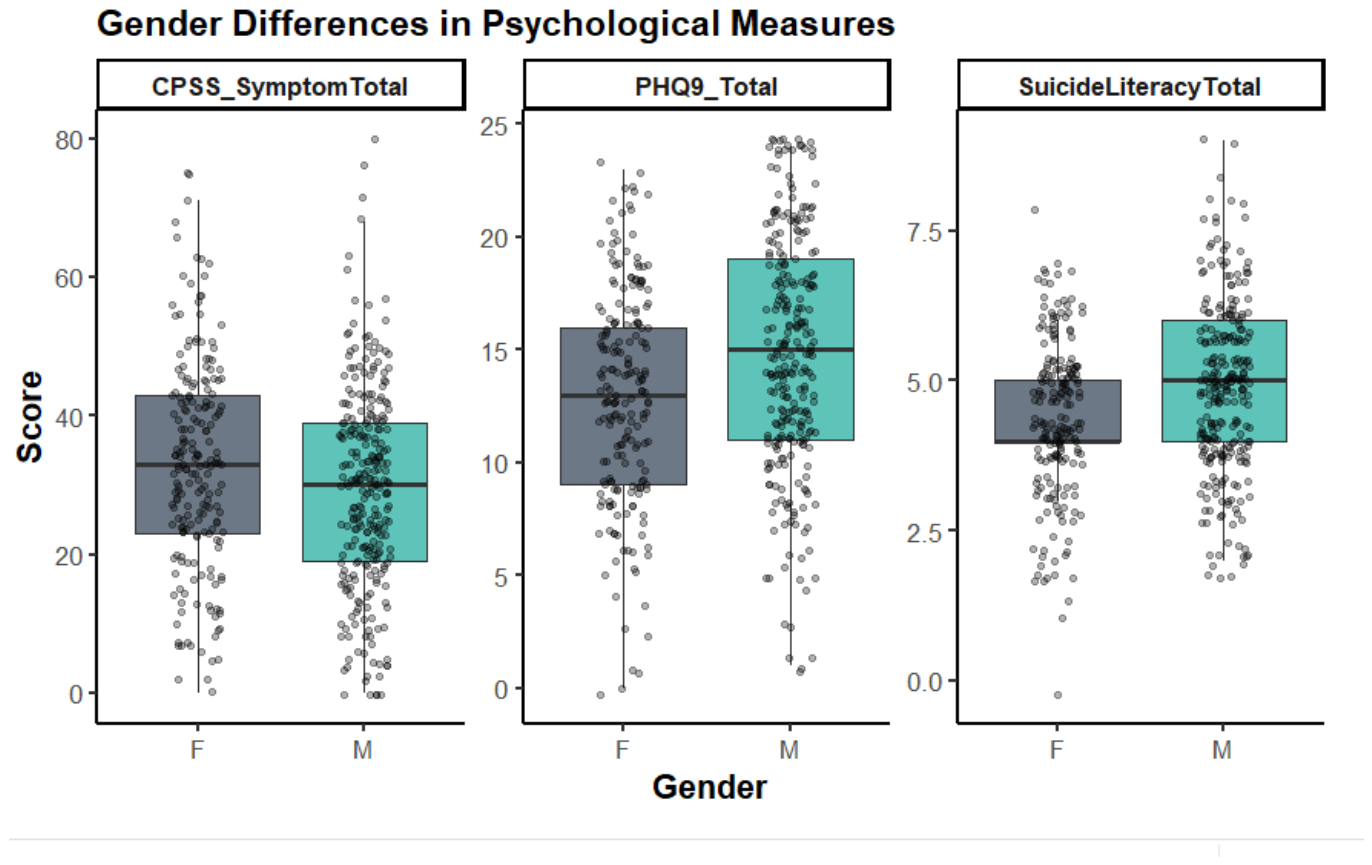
Welch’s t-tests indicated that males reported higher depressive symptoms than females (t = -3.75, p < .001), whereas females reported higher PTSD symptoms than males (t = 2.56, p = .011). There were no significant gender differences in suicide ideation (t = 0.49, p = .63), hopelessness (t = 0.66, p = .51), or quality of life (t = 1.70, p = .089, trend-level). Males scored higher on suicide literacy than females (t = -3.84, p < 0.001).
Pearson’s chi-square test revealed a significant association between gender and type of mental health disorder (χ2(11) = 20.53, p = .039). Standardised residuals indicated that depression was more common among females, while males were more likely to report being “unsure” of their diagnosis. Other disorders (e.g., anxiety, ADHD, OCD) did not show significant gender differences.
3.3. Disorder-Based Analyses
A one-way ANOVA indicated significant differences in PTSD symptom severity across diagnostic groups, F(11, 457) = 2.88, p = .001. Post-hoc Tukey comparisons showed that adolescents with personality disorders reported higher PTSD symptoms than those who were unsure of their diagnosis (p = .023). No other pairwise differences reached statistical significance.
3.4. Predictors of Suicide Ideation, Depression, and PTSD Symptoms
Figure 2.
Standardised Regression Coefficients from Multivariate Models Predicting Depression, PTSD, and Suicidal Ideation.
Figure 2.
Standardised Regression Coefficients from Multivariate Models Predicting Depression, PTSD, and Suicidal Ideation.
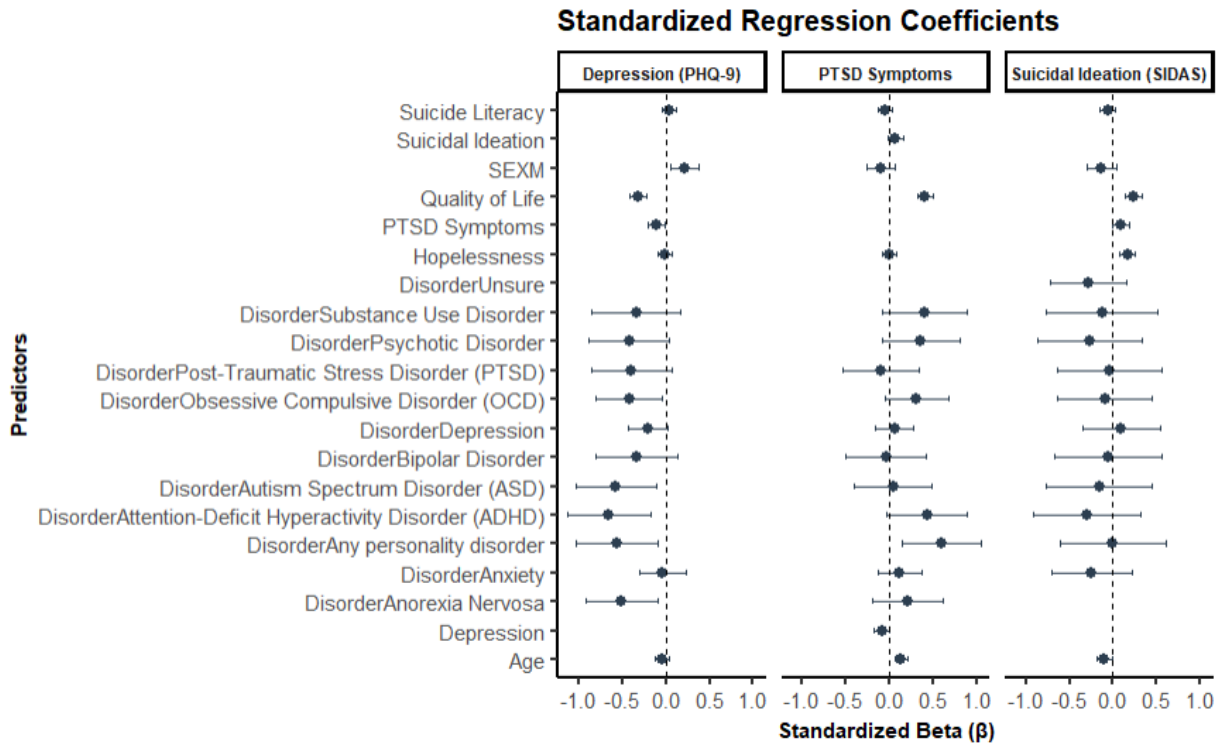
Model 1 examined predictors of suicidal ideation. The overall model was statistically significant, F(17, 451) = 6.46, p < .001, explaining approximately 19.6% of the variance in SIDAS scores (adjusted R2 = 0.17). Higher hopelessness (B = 0.68, β = 0.16, p < .001) and lower quality of life (B = 0.28, β = 0.23, p < .001) were significant predictors of higher suicidal ideation. Younger age was also associated with higher suicidal ideation (B = −0.45, β = −0.10, p = .023). Sex, suicide literacy, PTSD symptoms, and self-reported mental health disorder categories were not significant predictors (p > 0.05).
Diagnostic tests indicated violations of model assumptions. Residuals deviated from normality (Shapiro-Wilk W = 0.96, p < 0.001), and evidence of heteroscedasticity was observed (Breusch-Pagan BP = 56.60, p < 0.001), suggesting that the estimated standard errors should be interpreted with caution.
Model 2 examined predictors of depressive symptoms. The model explained 25% of variance (adjusted R2 = 0.222), F(17, 451) = 8.87, p < .001. Significant predictors were male sex (B = 1.11, β = 0.11, p = .012), self-reported anxiety disorder (B = 2.41, β = 0.17, p = .037), being unsure of diagnosis (B = 2.60, β = 0.24, p = .017), poorer quality of life (CHU9D; B = -0.23, β = -0.32, p < .001), and higher PTSD symptoms (CPSS; B = -0.036, β = -0.11, p = .030). Age, ADHD, depression, and hopelessness were not significant predictors. Residuals were approximately homoscedastic (BP = 19.62, p=.29), although slightly non-normal (Shapiro–Wilk W=0.988, p<.0001). Quality of life emerged as the strongest predictor of depressive symptom severity.
Model 3 examined predictors of PTSD symptoms. The model explained 31% of variance (adjusted R2 = 0.282), F(18, 450) = 11.22, p < .001. Significant predictors included older age (B = 1.09, β = 0.14, p <.001), lower quality of life (B = 0.83, β = 0.40, p < .001), and increased suicide ideation (B = 0.13, β = 0.09, p = .050). Depression, hopelessness, and suicide literacy were not significant predictors. Most self-reported disorder categories did not significantly predict PTSD symptoms after accounting for age, quality of life, and suicide ideation.
4. Discussion
This study examined the prevalence and predictors of suicide ideation, depressive symptoms, and PTSD severity among adolescents in Iraq, considering demographic variables, mental health diagnoses, psychological factors, and quality of life. Findings indicated that the majority of adolescents in the sample were experiencing clinically significant levels of difficulties, with over three-quarters scoring in the ‘moderate’ or ‘severe’ range for both depressive and PTSD symptoms. 12% of young people were also scoring in the at-risk range for suicide ideation. One-fifth reported a diagnosis of depression, 14.3% reported a diagnosis of anxiety, and 3.4% reported a PTSD diagnosis.
Across all three models, quality of life consistently emerged as the strongest and most robust predictor of mental health outcomes, highlighting the critical role of overall functioning and wellbeing in adolescents, a pattern that has been widely documented in youth mental health research (Stevens 2012; Kiss et al., 2024). Hopelessness was a significant predictor of suicide ideation but did not independently predict depressive symptoms or PTSD severity, suggesting its specific relevance to suicidal risk. This finding aligns with cognitive and interpersonal models of suicide, which conceptualise hopelessness as a proximal driver of suicide ideation through negative future expectancies (Alatrany et al., 2025; Fraser et al. 2014). In addition, although PTSD symptoms were associated with depressive symptoms, they did not independently predict suicidal ideation when other psychological factors were included in the model.
Age and sex showed outcome-specific associations that are consistent with developmental and gender-based differences reported in prior research. Younger adolescents reported higher suicide ideation, while older adolescents exhibited higher PTSD severity, suggesting that the manifestation of risk may shift across developmental stages as cumulative trauma exposure and symptom chronicity increase with age (Sisk and Gee, 2022; Trickey et al., 2012). Recent research has shown that suicidal ideation tends to peak during adolescence and then decline into young adulthood (Chen 2025), but has not highlighted the outcomes of PTSD alongside this decrease. Males demonstrated higher depressive symptoms and suicide literacy, whereas females reported higher PTSD symptoms, reflecting documented sex differences in symptom expression, help-seeking, and trauma responses during adolescence (Biswas et al. 2020; Sisk and Gee, 2022). The diagnostic categories did not significantly predict suicidal ideation in the multivariable models, indicating that symptom severity and wellbeing may play a more prominent role than diagnostic classifications in explaining suicidal risk. Nevertheless, adolescents with personality disorders reported elevated PTSD symptoms, consistent with research linking personality disorders to heightened trauma sensitivity and emotional dysregulation (Turgoose and Murphy, 2024). Overall, these findings underscore the complexity of adolescent mental health in Iraq, where psychological risk factors and functional impairment may be more informative targets for intervention than diagnostic labels alone.
4.1. Clinical Implications and Recommendations
Interventions for adolescent mental health in Iraq need to prioritise enhancing quality of life by supporting social, academic, and family functioning, which may buffer against depression, PTSD, and suicide ideation (Biswas et al. 2020). Efforts to reduce hopelessness through early cognitive-behavioural strategies focused on hope and problem-solving could further mitigate suicide risk (Kieling et al., 2011). Screening and intervention approaches should be sensitive to gender and age differences, recognising that males and females may present differently and younger adolescents may be at higher risk for suicide ideation (Alatrany et al., 2025). Improving diagnostic awareness through psychoeducation and accessible assessment may increase engagement and adherence to treatment, particularly for adolescents uncertain about their mental health status. Trauma-informed care should be integrated for those presenting with depression or suicidality, given the observed comorbidity with PTSD symptoms. Finally, a multifactorial approach is recommended, considering the modest variance explained by individual predictors, to address the complex interplay of psychosocial, environmental, and psychological factors influencing adolescent mental health (Patel et al., 2007).
4.2. Limitations and Future Directions
Some limitations should be considered when interpreting these findings. First, the study relied on self-reported measures, which may be subject to reporting biases, particularly regarding sensitive topics such as suicide ideation and mental health diagnoses. The cross-sectional design precludes causal inferences, limiting conclusions about the directionality of associations between predictors and mental health outcomes. Sample sizes for some diagnostic subgroups were small, which may have contributed to counterintuitive findings, such as lower suicide ideation among adolescents reporting psychotic disorders or ADHD. Additionally, residuals in the suicide ideation model were non-normal and heteroscedastic, suggesting that standard errors for some predictors may be biased.
Future research should consider longitudinal designs to examine temporal and causal relationships between quality of life, hopelessness, trauma, and mental health outcomes. Larger, more balanced samples across diagnostic categories would improve the reliability of subgroup comparisons. Integrating objective measures of mental health and functioning, alongside self-report, could reduce potential bias. Research could also explore mechanistic pathways, such as how quality of life mediates the effects of trauma and hopelessness on depression and suicide ideation, to inform targeted interventions. Finally, examining the impact of socioeconomic, cultural, and family factors may provide a more comprehensive understanding of adolescent mental health risk and resilience.
5. Conclusion
This study highlights the central importance of quality of life, psychological risk factors, and trauma-related symptoms in shaping suicide ideation, depression, and PTSD among adolescents in Iraq. These findings point toward the value of interventions that prioritise overall wellbeing, strengthen coping and hope, and integrate trauma-informed care across services. Addressing diagnostic uncertainty through psychoeducation and accessible assessment may also support earlier engagement and treatment effectiveness. Overall, the study highlights the complex interplay of psychosocial factors in adolescent mental health and suggests that prevention and early intervention efforts should adopt a holistic, multi-dimensional framework focused on functioning, trauma, and psychological risk rather than diagnostic labels in isolation.
Author Contributions
Authors 1 and 10 contributed to conceptualisation, data curation, funding acquisition, investigation, methodology, project administration, resources and writing – original draft. Authors 1, 2, 6 and 10 contributed to conceptualisation, investigation and validation. Authors 1 and 10 contributed to conceptualisation, methodology and supervision. Author 3 contributed to data curation and investigation. All authors provided review of each draft and their final approval for the version to be published.
Funding
The first author received funding from [funder name]. The funding source played no role in the study’s design, data collection, analysis, interpretation, manuscript preparation or the decision to submit it for publication. The funding source did not influence the study’s findings and conclusions.
Institutional Review Board Statement
Ethical approval for this study was obtained from the relevant Human Research Ethics Committee on 4th November 2024 (Ref: 2024-05). All procedures performed in studies involving human participants were conducted in accordance with the ethical standards of the approving research ethics committee and with the 1964 Helsinki Declaration and its later amendments or comparable ethical standards.
Informed Consent: For participants under the age of 18 years, written parental consent and participant assent were obtained prior to participation.
Data Availability Statement
The data supporting the findings of this study are available from the first author upon request.
Conflicts of Interest
The authors confirm that there are no conflicts of interest or significant financial support that could have influenced this work. All authors have read and approved the manuscript, and no eligible contributors have been omitted. The order of authorship has been mutually agreed upon.
References
- Ahmed, DR; Mesbah, SM; Al Azzawi, MAD; Heun, R. Trauma and mental health problems among Iraqi IDPs following the 2014 ISIS Invasion: a systematic review. Med Confl Surviv 2024, 40(4), 366–87. [Google Scholar] [CrossRef] [PubMed]
- Alatrany, SS; McCarthy, M; Flaiyah, AM; Ashworth, E; ALdrraji, HAS; Alatrany, AS; Al-Jumeily, D; Nadeem, S; Robinson, J; Saini, P. Rates of suicide ideation and associated risk factors among female secondary school students in Iraq. Healthcare (Basel) 2025, 13(11), 1260. [Google Scholar] [CrossRef] [PubMed]
- Al Juboori, R. Violence and child mental health outcomes in Iraq: mapping vulnerable areas. Psychiatry Int 2024, 5(1), 39–52. [Google Scholar] [CrossRef]
- Baldini, V; Di Stefano, R; Rindi, LV; Ahmed, AO; Koola, MM; Solmi, M; Papola, D; De Ronchi, D; Barbui, C; Ostuzzi, G. Association between adverse childhood experiences and suicidal behavior in schizophrenia spectrum disorders: a systematic review and meta-analysis. Psychiatry Res 2023, 329, 115488. [Google Scholar] [CrossRef] [PubMed]
- Batterham, PJ; Calear, AL; Christensen, H. Correlates of suicide stigma and suicide literacy in the community. Suicide Life Threat Behav 2013, 43(4), 406–17. [Google Scholar] [CrossRef] [PubMed]
- Batterham, PJ; Han, J; Calear, AL; Anderson, J; Christensen, H. Suicide stigma and suicide literacy in a clinical sample. Suicide Life Threat Behav 2018, 48(4), 452–63. [Google Scholar] [CrossRef] [PubMed]
- Biswas, T; Scott, JG; Munir, K; Renzaho, AMN; Rawal, LB; Baxter, J; Mamun, AA. Global variation in the prevalence of suicide ideation, anxiety and their correlates among adolescents: a population based study of 82 countries. EClinicalMedicine 2020, 24, 100395. [Google Scholar] [CrossRef] [PubMed]
- Blair, D-L; Kingsbury, M; Eccles, H; Akther, A; Siddiqi, S; Condran, G; Obeegadoo, I; Murray, J; Geoffroy, M-C; Menezes, AMB; Sikora, L; Colman, I. Adverse childhood experiences and suicidality in low-income and middle-income countries: a systematic review and meta-analysis. BMJ Glob Health 2025, 2;10(5), e018129. [Google Scholar] [CrossRef] [PubMed]
- Carroll, TD; Currier, JM; McCormick, WH; Drescher, KD. Adverse childhood experiences and risk for suicidal behavior in male Iraq and Afghanistan veterans seeking PTSD treatment. Psychol Trauma 2017, 9(5), 583–6. [Google Scholar] [CrossRef] [PubMed]
- Chen, Y. Understanding suicidal ideation trajectories from adolescence to young adulthood: Influencing factors and latent growth patterns. Research on Child and Adolescent Psychopathology 2025, 53, 1687–1698. [Google Scholar] [CrossRef] [PubMed]
- Dams, J.; Rimane, E.; Steil, R.; Renneberg, B.; Rosner, R.; König, H.-H. Health-related quality of life and costs of posttraumatic stress disorder in adolescents and young adults in Germany. Frontiers in Psychiatry 2020, 11, 697. [Google Scholar] [CrossRef]
- De Bellis, MD; Zisk, A. The biological effects of childhood trauma. Child Adolesc Psychiatr Clin N Am 2014, 23(2), 185–222, vii. [Google Scholar] [CrossRef] [PubMed]
- Foa, EB; Johnson, KM; Feeny, NC; Treadwell, KRH. The Child PTSD Symptom Scale: a preliminary examination of its psychometric properties. J Clin Child Adolesc Psychol 2001, 30(3), 376–84. [Google Scholar] [CrossRef] [PubMed]
- Fraser, L; Burnell, M; Currin Salter, L; Fourkala, E-O; Kalsi, J; Ryan, A; Gessler, S; Gidron, Y; Steptoe, A; Menon, U. Identifying hopelessness in population research: a validation study of two brief measures of hopelessness. BMJ Open 2014, 4(5), e005093. [Google Scholar] [CrossRef] [PubMed]
- Kieling, C.; Baker-Henningham, H.; Belfer, M.; Conti, G.; Ertem, I.; Omigbodun, O.; Rohde, L. A.; Srinath, S.; Ulkuer, N.; Rahman, A. Child and adolescent mental health worldwide: evidence for action. The Lancet 2011, 378(9801), 1515–1525. [Google Scholar] [CrossRef] [PubMed]
- Kessler, RC; Barker, PR; Colpe, LJ; et al. Screening for serious mental illness in the general population. Archives of General Psychiatry 2003, 60, 184–189. [Google Scholar] [CrossRef] [PubMed]
- Kiss, E.; de Oliveira, O. R.; Wittmann, E.; Herczegh, Z.; Kapornai, K. The effect of psychological and behavioral problems on the quality of life of children and adolescents based on self-reports and proxy reports. Health and Quality of Life Outcomes 2024, 22, 84. [Google Scholar] [CrossRef] [PubMed]
- Kroenke, K; Spitzer, RL; Williams, JB. The PHQ-9: validity of a brief depression severity measure. J Gen Intern Med 2001, 16(9), 606–13. [Google Scholar] [CrossRef] [PubMed]
- Lewis, S.J.; Arseneault, L.; Caspi, A.; Fisher, H.L.; Matthews, T.; Moffitt, T.E.; Odgers, C.L.; Stahl, D.; Teng, J.Y.; Danese, A. The epidemiology of trauma and post-traumatic stress disorder in a representative cohort of young people in England and Wales. The Lancet Psychiatry 2019, 6(3), 247–256. [Google Scholar] [CrossRef] [PubMed]
- Miller, C. R.; McDonald, J. E.; Grau, P. P.; Wetterneck, C. T. Quality of Life in Posttraumatic Stress Disorder: The Role of Posttraumatic Anhedonia and Depressive Symptoms in a Treatment-Seeking Community Sample. Trauma Care 2024, 4(1), 87–97. [Google Scholar] [CrossRef]
- Patel, V; Flisher, AJ; Hetrick, S; McGorry, P. Mental health of young people: a global public-health challenge. Lancet 2007, 14;369(9569), 1302–13. [Google Scholar] [CrossRef] [PubMed]
- Pham, PN; Fozouni, L; al-Saiedi, A; Hassan, H; Abass, A; Karim, R; Younis, S. Association between distress and displacement settings: a cross-sectional survey among displaced Yazidis in northern Iraq. BMC Public Health 2021, 21, 679. [Google Scholar] [CrossRef] [PubMed]
- Sisk, LM; Gee, DG. Stress and adolescence: vulnerability and opportunity during a sensitive window of development. Curr Opin Psychol 2022, 44, 286–92. [Google Scholar] [CrossRef] [PubMed]
- Stevens, K. Valuation of the Child Health Utility 9D Index. Pharmacoeconomics 2012, 30, 729–47. [Google Scholar] [CrossRef] [PubMed]
- Trickey, D; Siddaway, AP; Meiser-Stedman, R; Serpell, L; Field, AP. A meta-analysis of risk factors for post-traumatic stress disorder in children and adolescents. Clin Psychol Rev 2012, 32(2), 122–38. [Google Scholar] [CrossRef] [PubMed]
- Turgoose, D; Murphy, D. Associations between adverse childhood experiences (ACEs) and Complex-PTSD, moral injury and perceived social support: a latent class analysis. Eur J Trauma Dissociation 2024, 8(4), 100463. [Google Scholar] [CrossRef]
- van Spijker, BAJ; Batterham, PJ; Calear, AL; Farrer, L; Christensen, H; Reynolds, J; Kerkhof, AJFM. The Suicide ideation Attributes Scale (SIDAS): community-based validation study of a new scale for the measurement of suicide ideation. Suicide Life Threat Behav 2014, 44(4), 408–19. [Google Scholar] [CrossRef] [PubMed]
- World Health Organization. World Mental Health Today and Mental Health Atlas 2024. WHO, 2025. Available online: https://www.who.int/news/item/02-09-2025-who-releases-new-reports-and-estimates-highlighting-urgent-gaps-in-mental-health.

Table 1.
Number and percentage of participants reporting a mental health/ neurodivergent condition.
| Diagnosis Categories | n | % |
| Depression | 102 | 21.75 |
| Unsure | 147 | 31.34 |
| Bipolar Disorder | 15 | 3.20 |
| Psychotic Disorder | 16 | 3.41 |
| Anorexia Nervosa | 20 | 4.26 |
| PTSD | 16 | 3.41 |
| Anxiety | 67 | 14.29 |
| Any Personality Disorder | 16 | 3.41 |
| ADHD | 15 | 3.20 |
| Autism Spectrum Disorder (ASD) | 16 | 3.41 |
| OCD | 26 | 5.54 |
| Substance Use Disorder | 13 | 2.77 |
Table 2.
Mean scores, standard deviation (SD), and ranges for psychological measures.
| Psychological Measures | Mean (SD) | Possible Range | Observed Range |
| PHQ-9 | 14.01 (5) | 0 - 27 | 0 - 24 |
| SIDAS | 9.90 (9) | 0 - 50 | 0 - 40 |
| CPSS-PTSD | 30.98 (15) | 0 - 80 | 0 - 80 |
| CHU9D | 11.49 (6) | 0 - 36 | 0 - 34 |
| Suicide Literacy (SLS-9) | 4.67 (1.7) | 0 - 9 | 0 - 9 |
| Brief Hopelessness Scale | 3.74 (2) | 2 - 10 | 2 - 10 |
Disclaimer/Publisher’s Note: The statements, opinions and data contained in all publications are solely those of the individual author(s) and contributor(s) and not of MDPI and/or the editor(s). MDPI and/or the editor(s) disclaim responsibility for any injury to people or property resulting from any ideas, methods, instructions or products referred to in the content. |
© 2026 by the authors. Licensee MDPI, Basel, Switzerland. This article is an open access article distributed under the terms and conditions of the Creative Commons Attribution (CC BY) license (http://creativecommons.org/licenses/by/4.0/).
Copyright: This open access article is published under a Creative Commons CC BY 4.0 license, which permit the free download, distribution, and reuse, provided that the author and preprint are cited in any reuse.