

Submitted:
08 September 2026
Posted:
09 September 2026
You are already at the latest version
Abstract
The computational literature on Digital Patients combines heterogeneous data, models, software, infrastructure, and intended outputs. A catalogue of these parts is not evidence that they form an operational or credible pipeline. We examined computational-construction and credibility fields in a shared cohort of 61 reviews. Input, model-family, standards, computing, and output categories were counted non-exclusively at review level. Scripted classifications were manually verified against the full-text articles. Validation, reproducibility, prospective-evidence, and maturity totals were withheld when a semantic audit showed that defined rules counted negation, future recommendations, adjacent systems, or unrelated meanings. Imaging appeared in 49 reviews, sensors or wearables in 43, electronic health records in 29, and omics in 24. Artificial intelligence or machine learning appeared in 50, mechanistic modeling in 38, and hybrid modeling in 33. DICOM, HL7, FHIR, and OMOP were named in 15, 14, 13, and 11 reviews, respectively, but mention did not demonstrate conformance or end-to-end semantic traceability. Only 11 source reviews reported a named appraisal of their included evidence. Focused reviews described synthetic-only tests, component-level validation, sparse sensitivity or uncertainty analysis, retrospective evaluation, and incomplete reproducibility. Readiness should be argued as a chain of linked claims: defined context of use, fit and traceable data, explicit update logic, verified software and models, identifiable calibration, decision-relevant validation and uncertainty, external evaluation when warranted, and controlled lifecycle change. The reviewed literature shows abundant components; it does not establish the prevalence of integrated, updating, closed-loop, or clinically ready Digital Patient systems.
Keywords:
digital patient
; computational pipeline
; multimodal data
; hybrid modeling
; verification
; validation
; uncertainty quantification
; lifecycle
1. Introduction
Digital Patient computing is often presented as a sequence: acquire data, construct a model, produce an output. Real systems are less tidy. A construct defines the subject being represented. A model makes a task-specific approximation. A platform supplies data services, interfaces, software, and operational support. A realization configures these pieces for one intended use. The Digital Patient literature has long treated modeling, visualization, systems biology, physics-based simulation, statistical reasoning, and software as complementary capabilities rather than as one canonical implementation [1]. For this review, a pipeline is therefore an analytic frame [2,3,4,5].
Three distinctions determine whether a pipeline claim is technically meaningful. First, simulating a time-dependent process is different from updating the model with newly acquired patient data. Second, sending observations into software is different from assimilating them into a state estimate or parameter set. Third, displaying an output to a clinician is different from clinician-mediated feedback, and both differ from automatic closed-loop actuation [6] Each transition introduces interfaces, assumptions, latency, failure modes, and evidence requirements.
Credibility guidance for computational modeling links the amount and type of evidence to context of use, model influence, decision consequence, and resulting model risk [7,8,9,10]. Digital-twin guidance adds interaction, updating, and lifecycle behavior to that assurance problem [11]. We used those principles to audit two registered questions: what computational elements are reported, and how much directly supportable evidence connects those elements to a credible system?
2. Methods
2.1. Protocol, Registration, and Reporting Framework
This paper is a focused analysis of a shared systematic overview registered in PROSPERO (CRD420261458411). It did not conduct a separate search, create an independent cohort, or make an additional registration. The paper-specific plan assigns specific non-overlapping research questions to computational construction and to validation and fidelity; intended functions are used only as output context following PRISMA 2020 guideline [12,13]. The focused plan was recorded after assembly of the evidence map and before submission as a transparent reporting amendment. While companion reports evaluate conceptual terminology and clinical adoption governance, this manuscript focuses exclusively on the technical construction, multimodal data integration, model coupling, interoperability layers, and Verification, Validation, and Uncertainty Quantification (VVUQ) across the computational pipeline.
The parent protocol included English-language reviews published from 2020 onward that examined patient-linked physiological, biomechanical, biological, or adjacent computational representations. Web of Science, PubMed, IEEE Xplore, and Google Scholar were searched, with reference-list and designated preprint-server supplementation. The search was conducted in October 2025; no later search was incorporated. Of 247 reports assessed for eligibility, 183 were excluded and 64 entered extraction (Figure 1). A bibliographic audit then removed three duplicate reports, yielding 61 unique reviews.
2.2. Data Collection
CADIMA, a web-based evidence-synthesis platform, was used to manage and document the systematic-review process (Kohl et al., 2018) [14]. Data were collected on data sources, model types, coupling, temporal orientation, modeling approaches, integration standards, computing infrastructure, tools or platforms, validation methods and data, fidelity metrics, reproducibility, source-review appraisal, intended functions, maturity wording, and limitations. Candidate categories were generated by prespecified phrase matching. A review contributed no more than one count to a category, but categories were non-exclusive.
Inputs were grouped as imaging; sensors, wearables, or internet of things (IoT); electronic health records (EHR) or clinical records; omics; laboratory or biomarkers; lifestyle or environment; and simulation or literature. Model families were AI or machine learning, mechanistic or physics-based, hybrid, simulation, and statistical or probabilistic. Architecture fields included cloud, edge, hybrid cloud–edge, high-performance, and federated or distributed computing. Interface fields included DICOM, HL7, FHIR, OMOP, and named ontologies or identifiers.
2.3. Data Processing and Semantic Audit
We reproduced the scripted classifications and manually verified each row-level match against the full-text articles. Manual verification constituted the primary relabeling step, with scripted classifications serving as an initial screening aid. Component mentions confirmed during this process were retained as review-level observations. Four families of mechanically reproducible totals were stopped: validation, reproducibility, prospective evidence, and maturity. Their rules treated negated claims, proposed future work, diagnostic sensitivity, reproducibility of review methods, forecasting language, and adjacent technologies as affirmative system evidence. Reporting those totals would have converted a reproducible error into a precise-looking result. This stop rule is central to the analysis. Missing or ambiguous evidence was not reclassified as failure, and an unreliable aggregate was not replaced by undocumented judgment. Instead, validation was examined through field completeness, review-appraisal coverage, and interpretable within-review findings. Complete record-level recoding remains necessary before cohort frequencies can be claimed.
2.4. Synthesis Methods and Interpretation Constraints
The pipeline map displays marginal frequencies. Its arrows organize categories; they do not assert causal flow, mass balance, integration, or even co-occurrence in one primary system. Temporal and directional wording was used only as context. Virtual cohorts were recognized as computational evidence but not as evidence of longitudinal connection to one index patient.
3. Results
3.1. Layer I—Inputs, Inference Engines, and Intended Outputs
The final evidence base comprised 61 unique reviews after three post-selection duplicates were removed from the 64 records selected for extraction (Table 1). Publication increased markedly over the study period, with most reviews published in 2024 (n = 19) or 2025 (n = 27), compared with five in 2022, eight in 2023, and two in 2026. The reviews covered a broad range of clinical domains, most frequently cardiovascular applications (n = 32), oncology (n = 25), surgery, orthopedics, and dentistry (n = 24), neurology and neuroscience (n = 18), and diabetes and endocrine applications (n = 17). Instrument-based methodological appraisal was available for 39 reviews, whereas one had qualitative-only appraisal and 21 lacked an available appraisal. These appraisal results characterize the methodological context of the review evidence base and should not be interpreted as assessments of model validity or fitness for purpose. Imaging was reported in 49 reviews (80.3%), sensors, wearables, or IoT in 43 (70.5%), EHR or clinical records in 29 (47.5%), omics or genomics in 24 (39.3%), lifestyle or environment in 16 (26.2%), laboratory or biomarkers in 15 (24.6%), and simulation or literature inputs in 14 (23.0%) as summarized in Table 2. AI or machine learning appeared in 50 reviews (82.0%), mechanistic or physics-based modeling in 38 (62.3%), and hybrid modeling in 33 (54.1%). Simulation appeared in 13 and statistical or probabilistic methods in nine. These frequencies support a plural computational ecosystem. They do not show that hybrid models were integrated well or that an AI and a mechanistic component exchanged valid information in one realization.
The stated output space was equally broad: treatment or therapy planning appeared in 56 reviews (91.8%), prediction, prognosis, or risk in 49 (80.3%), diagnosis or detection in 46 (75.4%), education or training in 19 (31.1%), personalized care in nine, monitoring in eight, drug development or trials in seven, and decision support in five. An output label was counted as a reported purpose, not as a demonstrated capability. Figure 2 summarizes the reported review-level frequencies for selected input, model-family, and output categories.
3.2. Layer II—Interfaces, Interoperability, and Computational Infrastructure
Cloud computing appeared in 33 reviews, hybrid cloud–edge in 17, edge in 14, high-performance computing in four, and federated or distributed computing in three. The records did not consistently structure hardware, runtime, memory, energy, end-to-end latency, availability, or approximation error. No architecture could therefore be compared on operational performance.
DICOM was named in 15 reviews, HL7 in 14, FHIR in 13, and OMOP in 11. These standards address different layers and objects. A citation to DICOM does not prove correct image-derived geometry; a FHIR endpoint does not guarantee that physiological meaning, units, identity, provenance, timing, or uncertainty survives transformation into model parameters. The rule detected no ontology or identifier category. This is a rule-dependent non-detection, not evidence that semantic resources were absent.
The unanswered interface question is end-to-end traceability. A credible report should allow a reviewer to follow a patient observation through preprocessing, segmentation or feature extraction, geometry or state definition, boundary conditions and parameters, model execution, uncertainty, output interpretation, and the action eventually supported. The review-level data showed frequent use of standards vocabulary but could not verify that chain.
3.3. Layer III—Updating, Feedback, and Control
Aggregate temporal and coupling labels were not used as implementation frequencies. A review may call a model dynamic because it solves differential equations, may call data real time because a sensor streams them, or may use “two-way” for a clinician-facing recommendation. None establishes online state assimilation or automatic control.
Focused evidence illustrates the narrower claims. Drummond et al. identified 20 dynamic systems among 80 claimed patient digital twins and nine with two-way data flow; six returned recommendations to a patient or clinician and three supported surgical navigation [17]. Tudor et al. found 18/149 systems meeting its operational-twin criteria, of which 17 relied on a human-mediated return and one autonomous cardiac system acted through a defibrillator [18]. A contextual glucose-control study (by Hovorka et al.) cited in Cappon et al. provides a more explicit control architecture: new glucose data entered an adaptive controller that calculated insulin-infusion changes [19]. These examples distinguish dynamic, two-way, human-mediated, and autonomous-control claims. They are not pooled implementation counts.
3.4. Layer IV—Validation, Reproducibility, and Assurance Evidence
Five reviews lacked validation-method text, eight lacked validation-data-source text, 13 lacked fidelity-metric text, and 20 lacked the source-review appraisal field. Even populated cells rarely distinguished training reuse, calibration, internal testing, independent external validation, or prospective evaluation.
Only 11 source reviews reported a named formal appraisal of included evidence. The meta-review separately recorded 18 AMSTAR 2 assessments, 21 SANRA assessments, one qualitative-only assessment, and 21 unassessed reviews. These appraisal counts measure review-method coverage, not model credibility.
Record-level findings revealed recurring breaks in the assurance chain. Cappon et al. reported that four of eight type 1 diabetes methods were tested only on synthetic simulator data and two implementations were open source [20]. Rodero et al. found some form of validation in 75% of 36 cardiac in silico trials but sensitivity analysis in 19%, and warned that validating a solver or component does not validate the complete study [21]. Tudor et al. found only two primary studies mentioning VVUQ [18]. Vallee et al. described predominantly internal retrospective evaluation and no prospective demonstration of improved clinical outcomes [22]. Chen et al. found open-source implementations in 18/76 drug-development articles and judged complete reproducibility generally unavailable [23]. Stefaniga et al. concluded that most oncology twinning solutions lacked adequate clinical validation (Table 3) [24].
4. Discussions
The results show that Digital Patient reviews frequently report individual inputs, model families, interoperability specifications, computing architectures, and intended outputs, but provide substantially less evidence that these components are connected, updated, validated, and governed as an operational system. Computational readiness should therefore not be inferred from the presence of a preferred technology stack or from isolated evidence of multimodal data, hybrid modeling, standards adoption, or cloud–edge deployment, but from a linked chain of claims demonstrating that each component and transition is fit for the intended decision. Table 4 presents eight assurance checkpoints spanning the definition of the decision, data fitness and traceability, update logic, implementation correctness, model identifiability, prediction credibility, transfer to practice, and lifecycle change. Because weaknesses can propagate across this chain, the depth of supporting evidence should be proportional to the context of use, model influence, decision consequence, and resulting risk [7,8,9,11,25,26].
4.1. Implications for Computational Readiness
The review literature is rich in modalities and model families. It supports the conclusion that Digital Patient computation is many-to-many and that AI and mechanistic modeling often occupy complementary roles. It does not support a prevalence claim for integrated pipelines, data assimilation, human-mediated feedback, autonomous control, or system-level credibility.
This gap is not solved by adding another component. Hybrid models, for example, can connect learned representations to physiological constraints, but every connection creates a new interface, calibration dependency, and uncertainty pathway. A high-fidelity multiphysics model may be appropriate for offline planning but impractical for continuous operation. A surrogate may meet latency requirements but needs bounded approximation error for the intended decision. Technology choice follows the question of interest; credibility follows the evidence case.
4.2. Implications for Reporting and Practice
Authors should distinguish the following terms explicitly: training, calibration, internal validation, external validation, and prospective evaluation; dynamic simulation, episodic update, and online assimilation; one-way data acquisition, clinician-facing advice, clinician-mediated feedback, and automated actuation. They should identify the patient-data partition used at each stage, carry provenance and units across transformations, report numerical and software verification, quantify sensitivity and uncertainty, and document versions and change controls.
An executed left-ventricular-assist-device VVUQ plan shows how risk, verification, sensitivity, uncertainty, and bench validation can be traced without suggesting that this level of evidence was common in the cohort [26]. Good machine-learning-practice principles add representative data, independent testing, human–AI evaluation, and lifecycle monitoring [27].
4.3. Strengths and Limitations
Strengths include a stable post-deduplication cohort, reproducible field-specific rules, row-level semantic auditing, direct checks against informative full texts, and explicit stop rules when prespecified rules failed. The analysis does not convert missing information into failure and does not convert review-level co-mention into system architecture.
The analysis reported in the current study should be interpreted relative to multiple limitations. Reviews, not implementations, were the units of analysis, and underlying-study overlap was not quantified. Free-text fields may undercount standards, computing parameters, updating, control, and evidence. Reporting in the full-text articles may have underrepresented standards, computing parameters, updating, control, and supporting evidence. State estimation, data assimilation, verification, calibration, model influence, decision consequences, external validation, latency, energy use, change control, and drift were also not reported consistently enough for reliable review-level classification. Full record-level recoding is required before validation, reproducibility, prospective-evidence, or maturity frequencies are defensible.
5. Conclusion
The computational foundation of Digital Patients cannot be judged from the number of modalities, models, or platforms named in a review. The assurance object is the connected pipeline: data with preserved meaning, verified execution, identifiable calibration, validation tied to the decision, uncertainty carried to the output, and lifecycle controls that respond to change. The literature demonstrates a substantial parts catalogue. Whether those parts form dependable clinical systems remains a record-level and ultimately implementation-level question.
6. Declarations
Copyrighted full texts and the source extraction workbook remain local and are not publicly redistributed. The cohort and review process originated in a broader evidence-map exercise and were reused here to avoid duplicate searching, screening, and extraction. The distinct analyses in this paper concern computational construction and credibility While companion reports evaluate conceptual terminology and clinical adoption governance [28].
7. Supplementary Appendix S1: Protocol and Search Method
7.1. Status and Timing
This note records the focused analysis as one paper arising from a broader evidence map conducted under a single PROSPERO-registered parent protocol (CRD420261458411). It was specified after the source evidence map had been assembled and before submission. It is not a prospective protocol, a new review, or an additional PROSPERO submission. The parent search, eligibility criteria, screening, extraction workbook, duplicate adjudication, and 61-review cohort were not changed for this analysis.
The source protocol draft and this pre-submission note are retained in the project records. The complete database search description and this note should be verified as deposited in the public reproducibility repository before submission. Stating when focused questions were formalized is consistent with transparent reporting of protocol changes [12,29].
7.2. Focused Objectives
The focused analysis asks:
- Which data sources, model families, standards, and computing architectures are reported for digital patient frameworks?
- Which input-model-output relationships are co-mentioned at review level?
- What directly supportable validation, uncertainty, reproducibility, and review-appraisal evidence is reported?
- Which standards-informed evidence checkpoints are relevant from data fitness through lifecycle operation?
7.3. Search Strategy
Table 5 reproduces the project search log. Counts retain its result (origin) notation and are not PRISMA flow counts. Reference lists of included reviews were also checked; no Boolean query applies.
PubMed — 4 October 2025; combined 1,159 before filters and 800 after filters; project-log count 794 (800)
| ("digital twin"[tiab:~1] OR "digital twins"[tiab:~1] OR "digital twinning"[tiab:~1] OR "virtual twin"[tiab:~1] OR "virtual twins"[tiab:~1] OR "virtual twinning"[tiab:~1] OR "digital replica"[tiab:~1] OR "digital replicas"[tiab:~1] OR "digital replication"[tiab:~1] OR "virtual human*"[tiab] OR "virtual patient"[tiab:~1] OR "virtual patients"[tiab:~1] OR "personalized computational model"[tiab:~1] OR "personalized computational models"[tiab:~1] OR "personalized computational modeling"[tiab:~1] OR "personalized computational modelling"[tiab:~1] OR "patient-specific computational model"[tiab:~1] OR "patient-specific computational models"[tiab:~1] OR "patient-specific computational modelling"[tiab:~1] OR "patient-specific computational modeling"[tiab:~1] OR "medical twin*" OR "digital patient*"[tiab] OR "patient avatar*"[tiab] OR "digital avatar*"[tiab] OR "virtual avatar*"[tiab] OR "health twin*"[tiab] OR "organ twin*"[tiab] OR "surrogate model*"[tiab] OR "virtual physiological human*"[tiab] OR "biomimetic twin"[tiab:~1] OR "biomimetic twins"[tiab:~1] OR "biomimetic twinning"[tiab:~1] OR "in silico patient*"[tiab]) AND (patient*[tiab] OR patients[MeSH] OR medic*[tiab] OR medicine[MeSH] OR "delivery of health care"[MeSH] OR healthcare[tiab] OR "health care"[tiab] OR health[MeSH] OR health[tiab] OR surgery[SH] OR "surgical procedures, operative"[MeSH] OR "general surgery"[MeSH] OR surg*[tiab] OR transplants[MeSH] OR transplant*[tiab] OR therapeutics[MeSH] OR therap*[tiab] OR treatment*[MeSH] OR "pharmaceutical preparations"[MeSH] OR drug*[tiab] OR pharmacology[MeSH] OR pharmacokinetics[MeSH] OR pharmaco*[tiab] OR neoplasms[MeSH] OR oncology[tiab] OR cancer[tiab] OR clinic*[tiab] OR humans[MeSH] OR human*[tiab] OR physiology[MeSH] OR physiology*[tiab] OR physiopathology[SH] OR pathophysiolog*[tiab] OR "biomechanical phenomena"[MeSH] OR biomechanic*[tiab] OR imaging[tiab] OR genome[MeSH] OR genomics[MeSH] OR genom*[tiab] OR "precision medicine"[MeSH] OR "precision medicine"[tiab] OR "precision health*"[tiab] OR "digital health"[MeSH] OR "digital health*"[tiab] OR "personalized medicine"[tiab] OR "equipment and supplies"[MeSH] OR "medical device*"[tiab] OR "preventive medicine"[MeSH] OR "preventative medicine"[tiab] OR "preventive medicine"[tiab]) AND ("systematic review"[PT] OR "systematic review"[tiab] OR "scoping review"[tiab] OR "meta-analysis"[PT] OR "meta-analysis"[tiab] OR "meta-review"[tiab] OR "review of reviews"[tiab] OR "umbrella review"[tiab] OR review[PT] OR review[tiab] OR "systematic overview"[tiab]) Filters: English; publication year 2020 onward. |
Google Scholar — 18 October 2025; project-log count 102 (241)
| ("digital twin" OR "digital twins" OR "virtual twin" OR "virtual twins" OR "virtual patient" OR "digital patient" OR "in silico patient" OR "patient specific model" OR "virtual human") (health OR medical OR clinical OR healthcare OR patient OR therapy OR surgery OR drug) intitle:review |
medRxiv — 18 October 2025; project-log count 25 (26)
| ("digital twin" OR "digital twins" OR "virtual twin" OR "virtual twins" OR "virtual patient" OR "digital patient" OR "in silico patient" OR "patient specific model" OR "virtual human") (model OR models OR modelling OR modeling) AND intitle:review AND source:medrxiv Limit recorded in the project log: since 2020. |
arXiv — 18 October 2025; project-log count 146 (149)
| ("digital twin" OR "digital twins" OR "virtual twin" OR "virtual twins" OR "virtual patient" OR "digital patient" OR "in silico patient" OR "patient-specific model" OR "virtual human") (health OR medical OR clinical OR healthcare OR patient OR therapy OR surgery OR drug) (model OR models OR modeling OR modelling) intitle:review source:arxiv |
Web of Science — 18 October 2025; project-log count 964 (1,495)
| TS=(digital NEAR/1 twin) OR TS=(digital NEAR/1 twins) OR TS=(digital NEAR/1 twinning) OR TS=(virtual NEAR/1 twin) OR TS=(virtual NEAR/1 twins) OR TS=(virtual NEAR/1 twinning) OR TS=(digital NEAR/1 replica) OR TS=(digital NEAR/1 replicas) OR TS=(digital NEAR/1 replication) OR TS=("virtual human*") OR TS=(virtual NEAR/1 patient) OR TS=(virtual NEAR/1 patients) OR TS=(personalized NEAR/1 computational NEAR/1 model) OR TS=(personalized NEAR/1 computational NEAR/1 models) OR TS=(personalized NEAR/1 computational NEAR/1 modeling) OR TS=(personalized NEAR/1 computational EAR/1 modelling) OR TS=(patient-specific NEAR/1 computational NEAR/1 model) OR TS=(patient-specific NEAR/1 computational NEAR/1 models) OR TS=(patient-specific NEAR/1 computational NEAR/1 modeling) OR TS=(patient-specific NEAR/1 computational NEAR/1 modelling) OR TS=("medical twin*") OR TS=("digital patient*") OR TS=("patient avatar*") OR TS=("digital avatar*") OR TS=("virtual avatar*") OR TS=("health twin*") OR TS=("organ twin*") OR TS=("surrogate model*") OR TS=("virtual physiological human*") OR TS=(biomimetic NEAR/1 twin) OR TS=(biomimetic NEAR/1 twins) OR TS=(biomimetic NEAR/1 twinning) OR TS=("in silico patient*") AND TS=(patient* OR medic* OR healthcare OR "health care" OR health OR surg* OR transplant* OR therap* OR treatment* OR drug* OR pharmaco* OR oncology OR cancer OR clinic* OR human* OR physiology* OR pathophysiolog* OR biomechanic* OR imaging OR genom* OR "precision medicine" OR "precision health*" OR "digital health*" OR "personalized medicine" OR "medical device*" OR "preventive medicine" OR "preventative medicine") AND TS=("systematic review" OR "scoping review" OR "meta-analysis" OR "meta review" OR "review of reviews" OR "umbrella review" OR "systematic overview" OR review) |
IEEE Xplore — 18 October 2025; project-log count 526 (603)
| (("digital twin" OR "digital twins" OR "digital twinning" OR "virtual twin" OR "virtual twins" OR "virtual twinning" OR "digital replica" OR "digital replicas" OR "digital replication" OR "virtual human" OR "virtual humans" OR "virtual patient" OR "virtual patients" OR "personalized computational model" OR "personalized computational models" OR "personalized computational modeling" OR "personalized computational modelling" OR "patient-specific computational model" OR "patient-specific computational models" OR "patient-specific computational modeling" OR "patient-specific computational modelling" OR "medical twin" OR "medical twins" OR "digital patient" OR "digital patients" OR "patient avatar" OR "patient avatars" OR "digital avatar" OR "digital avatars" OR "virtual avatar" OR "virtual avatars" OR "health twin" OR "health twins" OR "organ twin" OR "organ twins" OR "surrogate model" OR "surrogate models" OR "virtual physiological human" OR "virtual physiological humans" OR "biomimetic twin" OR "biomimetic twins" OR "biomimetic twinning" OR "in silico patient" OR "in silico patients") AND (patient OR patients OR medical OR medicine OR healthcare OR "health care" OR health OR surgery OR surgical OR transplant OR transplants OR therapy OR therapies OR therapeutic OR treatment OR treatments OR drug OR drugs OR pharmacology OR pharmacologic OR pharmacokinetic OR oncology OR cancer OR clinical OR clinic OR human OR humans OR physiology OR physiological OR pathophysiology OR pathophysiologic OR biomechanics OR biomechanical OR imaging OR genome OR genomic OR genomics OR "precision medicine" OR "precision health" OR "digital health" OR "personalized medicine" OR "medical device" OR "medical devices" OR "preventive medicine" OR "preventative medicine") AND ("systematic review" OR "scoping review" OR "meta-analysis" OR "meta review" OR "review of reviews" OR "umbrella review" OR "systematic overview" OR review)) |
7.4. Evidence Map
The relationship between the source evidence-map methods and their use in this focused analysis is summarized below.

Table 6.
Source evidence-map elements and their use in the focused analysis.
| Element | Source evidence map | Focused analysis |
| Eligibility/search | Broad parent scope and source-specific queries above | No change; no new search or topic-based exclusion |
| Selection | Title/abstract and full-text screening; unique review report after duplicate adjudication | Same 61 reviews; overlapping primary studies not estimated |
| Unit of analysis | Unique review report after post-selection duplicate adjudication | Same 61 reviews |
| Extraction | CADIMA-aligned workbook covering data, model, standards, compute, validation, functions, and appraisal | Specific research questions focused on computational construction and validation/credibility; functions provide output context |
| Appraisal | AMSTAR 2, SANRA, and CADIMA-aligned review-level fields where applicable | Qualifies review conduct; does not establish system validity or readiness |
| Synthesis | Descriptive review-level counts; non-exclusive categories; no pooled effects | Component frequencies, verified credibility findings, semantic stop rules, and an eight-claim assurance proposal |
7.5. Analysis Plan
Counts use 61 unique reviews as the denominator and describe review discourse rather than patients, systems, deployments, or independent evidence events. Co-reporting does not establish co-occurrence in one system. Three prospective lexical flags were adjudicated in full text; none represented a prospective Digital Patient-system outcome evaluation. Adjudicated protocol amendments and deviations are detailed in Table 7.
7.6. Evidence-Map Provenance and Companion-Report Relationship
The findings reported in this paper are a focused analysis of the search, screening, extraction, and evidence map developed under one broader PROSPERO-registered review protocol. The present paper did not undertake a new search, screening process, or extraction. It uses the shared dataset to examine computational components, interface semantics, validation evidence, and assurance.
This manuscript is one of three focused papers arising from the same registered review rather than an independent review or an additional PROSPERO submission. Companion reports cross-reference the common provenance while distinguishing objectives, analyses, figures, and conclusions; shared findings are not presented as independent evidence [28].
8. Supplementary Appendix S2: Inconsistency-Resolution Protocol Summary
The source CADIMA protocol distinguishes coordinator checks from eligibility decisions. Conflicts that cannot change eligibility were verified by the coordinator. Conflicts affecting inclusion, exclusion, or coding were discussed by reviewers; unresolved uncertainty favors retention until fuller information were made available, and the coordinator adjudicated when consensus was not achieved. Eligibility decisions, reasons, and post-selection duplicate exclusions remained in the audit trail. The focused analysis introduced no new screening decisions. Coding disagreements were resolved against the full text and documented rule set, with manual overrides restricted to explicit negation or contrastive wording.
Table 8.
Supplementary Appendix S3: Paper identifiers, citations, and review-level appraisal.
| ID | Review | Stratum | Rating |
| P01 | Aboarab et al. [30] | Moderate | 3/5 |
| P02 | Adibi et al. [31] | Very low | 1/5 |
| P03 | Akbarialiabad et al. [32] | Very low | 1/5 |
| P04 | Banoub et al. [33] | Moderate | 8/12 |
| P05 | Bartusik-Aebisher et al. [34] | Unavailable | - |
| P06 | Cappon et al. [20] | Low | 2/5 |
| P07 | Chaparro-Cárdenas et al. [35] | High | 11/12 |
| P08 | Chumnanvej et al. [36] | Unavailable | - |
| P09 | Coorey et al. [37] | High | 12/12 |
| P10 | D'Orsi et al. [38] | Moderate | 9/12 |
| P11 | De Oliveira El-Warrak et al. [39] | Unavailable | - |
| P12 | Drummond et al. [17] | Very low | 1/5 |
| P13 | Espinoza-Vinces et al. [40] | Moderate | 4/5 |
| P14 | Faiella et al. [41] | Moderate | 4/5 |
| P15 | Gu et al. [42] | High | 10/12 |
| P16 | Bian et al. [43] | Very low | 1/5 |
| P17 | John et al. [44] | Moderate | 3/5 |
| P18 | Khan et al. [45] | Unavailable | - |
| P19 | Naik et al. [46] | Very low | 1/5 |
| P20 | Pinton et al. [47] | Very low | 1/5 |
| P21 | Pradíes et al. [48] | Low | 2/5 |
| P22 | Riahi et al. [49] | Very low | 1/5 |
| P23 | Ringeval et al. [50] | Very low | 1/5 |
| P24 | Rodero et al. [21] | Unavailable | - |
| P25 | Seth et al. [51] | Low | 2/5 |
| P26 | Shen et al. [52] | Unavailable | - |
| P27 | Shen et al. [53] | Unavailable | - |
| P28 | Ștefănigă et al. [24] | Very low | 1/5 |
| P29 | Sun et al. [54] | Moderate | 7/12 |
| P30 | Tasmurzayev et al. [3] | Unavailable | - |
| P31 | Tudor et al. [18] | High | 10/12 |
| P32 | Varrassi et al. [55] | Moderate | 9/12 |
| P33 | Yuan et al. [56] | High | 11/12 |
| P34 | Pascual et al. [57] | Moderate | 7/12 |
| P35 | Wickramasinghe et al. [58] | Low | 6/12 |
| P36 | Mahmud et al. [59] | High | 11/12 |
| P37 | Pawar et al. [60] | Unavailable | - |
| P38 | Park et al. [61] | High | 12/12 |
| P39 | Kim et al. [4] | Moderate | 4/5 |
| P40 | Daraio et al. [62] | Unavailable | - |
| P41 | Alshahrani et al. [63] | Moderate | 7/12 |
| P42 | Zou et al. [64] | High | 12/12 |
| P43 | Ghosh et al. [65] | Unavailable | - |
| P44 | Vallée et al. [22] | High | 5/5 |
| P45 | Chen et al. [23] | Unavailable | - |
| P46 | Xu et al. [66] | Unavailable | - |
| P47 | Pellegrino et al. [67] | Unavailable | - |
| P48 | Oulefki et al. [68] | High | 12/12 |
| P49 | Cellina et al. [69] | Moderate | 7/12 |
| P50 | Garanin et al. [70] | Moderate | 7/12 |
| P51 | Sasitharasarma et al. [71] | Qualitative-only | - |
| P52 | Rudnicka et al. [72] | Unavailable | - |
| P53 | Bjelland et al. [73] | High | 10/12 |
| P54 | Lauer-Schmaltz et al. [74] | Unavailable | - |
| P55 | Maizi et al. [75] | Unavailable | - |
| P56 | Salvi et al. [76] | Moderate | 9/12 |
| P57 | Karaduman et al. [77] | Unavailable | - |
| P58 | Pisirgen et al. [78] | Unavailable | - |
| P59 | Zhang et al. [79] | Unavailable | - |
| P60 | Narigina et al. [80] | Low | 5/12 |
| P61 | Xames et al. [5] | Unavailable | - |
Note. P01–P61 are stable identifiers assigned after post-selection deduplication. Strata are very low, low, moderate, high, qualitative-only, and unavailable. AMSTAR 2 labels are compact positions: 1/5 critically low, 2/5 low, 3/5 low-to-moderate, 4/5 moderate, and 5/5 high; 3/5 is a non-standard extracted hybrid label, and the fractions are not scores. SANRA retains its 0–12 scale. A dash indicates no numeric rating. The crosswalk is descriptive, not a validated equivalence or pooled score, and says nothing about model validity or fitness for purpose. P16, P34, and P43 are retained preprints under the protocol's specific grey-literature clause. P41 is a journal article with verified editorial dates. The P42 citation is the verified International Journal of Medical Informatics article (doi:10.1016/j.ijmedinf.2025.106138).
Funding
This work was supported by the Virginia Innovation Partnership Authority of the Commonwealth of Virginia and Old Dominion University’s National Center for Collaboration in Medical Modeling and Simulation.
Conflicts of Interest
The authors declare no conflicts of interest.
Ethics Approval
Not applicable; this study synthesized published reviews.
Author Contributions
Arash Ghorbannia, PhD, led conceptualization, methodology, analysis, visualization, and manuscript drafting. Arash Ghorbannia, PhD, Mark W. Scerbo, PhD, Taryn T. Cuper, MS, April A. Pace, DHSc, Faryaneh Poursardar, PhD, Jae H. Lee, PhD, and Megan Witherow, PhD, conducted title-and-abstract screening. Arash Ghorbannia, PhD, Mark W. Scerbo, PhD, Taryn T. Cuper, MS, April A. Pace. DHSc, Jae H. Lee, PhD, and Megan Witherow, PhD, conducted full-text screening and contributed to data extraction. Ginger S. Watson, PhD, and C. Donald Combs, PhD, provided project leadership and supervision. All authors contributed to interpretation and critical revision of the manuscript and approved the final version.
Protocol and Registration
This focused analysis uses the search, screening, eligibility assessment, extraction, duplicate resolution, and review-level appraisal conducted under one broader protocol registered in PROSPERO (CRD420261458411). The focused paper was specified after assembly of the evidence map and before submission; it is not an additional registration.
References
- The Digital Patient: Advancing Healthcare, Research, and Education; John Wiley & Sons: Hoboken, NJ, 2016.
- Wright, L.; Davidson, S. How to tell the difference between a model and a digital twin. Adv. Model. Simul. Eng. Sci. 2020, 7, 13. [Google Scholar] [CrossRef]
- Tasmurzayev, N.; et al. Digital Cardiovascular Twins, AI Agents, and Sensor Data: A Narrative Review from System Architecture to Proactive Heart Health. Sensors 2025, 25, 5272. [Google Scholar] [CrossRef]
- Kim, Y.; Oh, S.; Kim, G. Convergence of Integrated Sensing and Communication (ISAC) and Digital-Twin Technologies in Healthcare Systems: A Comprehensive Review. Signals 2025, 6, 51. [Google Scholar] [CrossRef]
- Xames, Md. D.; Topcu, T. G. A Systematic Literature Review of Digital Twin Research for Healthcare Systems: Research Trends, Gaps, and Realization Challenges. IEEE Access 2024, 12, 4099–4126. [Google Scholar] [CrossRef]
- Pagani, S.; Dedè, L.; Manzoni, A.; Quarteroni, A. Data integration for the numerical simulation of cardiac electrophysiology. Pacing Clin. Electrophysiol. 2021, 44, 726–736. [Google Scholar] [CrossRef]
- American Society of Mechanical Engineers. Assessing Credibility of Computational Modeling through Verification and Validation: Application to Medical Devices; 2018. [Google Scholar]
- U.S. Food and Drug Administration. Assessing the Credibility of Computational Modeling and Simulation in Medical Device Submissions: Guidance for Industry and Food and Drug Administration Staff. 2023. [Google Scholar]
- Musuamba, F. T.; et al. Scientific and regulatory evaluation of mechanistic in silico drug and disease models in drug development: Building model credibility. CPT Pharmacomet. Syst. Pharmacol. 2021, 10, 804–825. [Google Scholar] [CrossRef]
- Galappaththige, S.; Gray, R. A.; Costa, C. M.; Niederer, S.; Pathmanathan, P. Credibility assessment of patient-specific computational modeling using patient-specific cardiac modeling as an exemplar. PLoS Comput. Biol. 2022, 18, e1010541. [Google Scholar] [CrossRef]
- National Academies of Sciences; Engineering; and Medicine. Foundational Research Gaps and Future Directions for Digital Twins; The National Academies Press: Washington, DC, 2024. [Google Scholar] [CrossRef]
- Page, M. J.; et al. The PRISMA 2020 statement: an updated guideline for reporting systematic reviews. BMJ 2021, 372, n71. [Google Scholar] [CrossRef]
- Gates, M.; et al. Reporting guideline for overviews of reviews of healthcare interventions: development of the PRIOR statement. BMJ 2022, 378, e070849. [Google Scholar] [CrossRef]
- Kohl, C.; et al. Correction to: Online tools supporting the conduct and reporting of systematic reviews and systematic maps: a case study on CADIMA and review of existing tools. Environ. Evid. 2018, 7, 12. [Google Scholar] [CrossRef]
- Shea, B. J.; et al. AMSTAR 2: a critical appraisal tool for systematic reviews that include randomised or non-randomised studies of healthcare interventions, or both. BMJ 2017, 358, j4008. [Google Scholar] [CrossRef]
- Baethge, C.; Goldbeck-Wood, S.; Mertens, S. SANRA—a scale for the quality assessment of narrative review articles. Res. Integr. Peer Rev. 2019, 4, 5. [Google Scholar] [CrossRef]
- Drummond, D.; Gonsard, A. Definitions and Characteristics of Patient Digital Twins Being Developed for Clinical Use: Scoping Review. J. Med. Internet Res. 2024, 26, e58504. [Google Scholar] [CrossRef]
- Tudor, B. H.; et al. A scoping review of human digital twins in healthcare applications and usage patterns. npj Digit. Med. 2025, 8. [Google Scholar] [CrossRef]
- Hovorka, R.; Canonico, V.; Chassin, L. J.; others. Nonlinear model predictive control of glucose concentration in subjects with type 1 diabetes. Physiol. Meas. 2004, 25, 905–920. [Google Scholar] [CrossRef]
- Cappon, G.; Facchinetti, A. Digital Twins in Type 1 Diabetes: A Systematic Review. J. Diabetes Sci. Technol. 2025, 19, 1641–1649. [Google Scholar] [CrossRef]
- Rodero, C.; et al. A systematic review of cardiac in-silico clinical trials. Prog. Biomed. Eng. 2023, 5, 032004. [Google Scholar] [CrossRef]
- Vallée, A.; Moawad, G.; Feki, A.; Ayoubi, J.-M. Digital twins in fertility, assisted reproductive technology and pregnancy: a systematic review. Reprod. Biomed. Online 2026, 52, 105281. [Google Scholar] [CrossRef]
- Chen, B.; et al. In Silico Clinical Trials in Drug Development: A Systematic Review. Ther. Innov. Regul. Sci. 2025, 60, 423–439. [Google Scholar] [CrossRef]
- Ștefănigă, S. A.; et al. Advancing Precision Oncology with Digital and Virtual Twins: A Scoping Review. Cancers 2024, 16, 3817. [Google Scholar] [CrossRef]
- Sel, K.; et al. Survey and perspective on verification, validation, and uncertainty quantification of digital twins for precision medicine. npj Digit. Med. 2025, 8, 40. [Google Scholar] [CrossRef]
- Santiago, A.; et al. Design and execution of a verification, validation, and uncertainty quantification plan for a numerical model of left ventricular flow after LVAD implantation. PLoS Comput. Biol. 2022, 18, e1010141. [Google Scholar] [CrossRef]
- International Medical Device Regulators Forum. Good Machine Learning Practice for Medical Device Development: Guiding Principles. 2025. [Google Scholar]
- International Committee of Medical Journal Editors. Overlapping publications and manuscripts based on the same database. 2026. [Google Scholar]
- Shamseer, L.; et al. Preferred reporting items for systematic review and meta-analysis protocols (PRISMA-P) 2015: elaboration and explanation. BMJ 2015, 350, g7647. [Google Scholar] [CrossRef]
- AboArab, M. A.; Potsika, V. T.; Pleouras, D. S.; Fotiadis, D. I. Computational modeling of drug-eluting balloons in peripheral artery disease: Mechanisms, optimization, and translational insights. Comput. Struct. Biotechnol. J. 2025, 27, 3640–3653. [Google Scholar] [CrossRef]
- Adibi, S.; Rajabifard, A.; Shojaei, D.; Wickramasinghe, N. Enhancing Healthcare through Sensor-Enabled Digital Twins in Smart Environments: A Comprehensive Analysis. Sensors 2024, 24, 2793. [Google Scholar] [CrossRef]
- Akbarialiabad, H.; Pasdar, A.; Murrell, D. F. Digital twins in dermatology, current status, and the road ahead. npj Digit. Med. 2024, 7. [Google Scholar] [CrossRef]
- Banoub, R. G.; et al. Enhancing Ophthalmic Care: The Transformative Potential of Digital Twins in Healthcare. Cureus 2024. [Google Scholar] [CrossRef]
- Bartusik-Aebisher, D.; Rogóż, K.; Aebisher, D. Artificial Intelligence and ECG: A New Frontier in Cardiac Diagnostics and Prevention. Biomedicines 2025, 13, 1685. [Google Scholar] [CrossRef]
- Chaparro-Cárdenas, S. L.; et al. A Technological Review of Digital Twins and Artificial Intelligence for Personalized and Predictive Healthcare. Healthcare 2025, 13, 1763. [Google Scholar] [CrossRef]
- Chumnanvej, S.; Chumnanvej, S.; Tripathi, S. Assessing the benefits of digital twins in neurosurgery: a systematic review. Neurosurg. Rev. 2024, 47. [Google Scholar] [CrossRef]
- Coorey, G.; et al. The health digital twin to tackle cardiovascular disease—a review of an emerging interdisciplinary field. npj Digit. Med. 2022, 5. [Google Scholar] [CrossRef]
- D’Orsi, L.; et al. Recent Advances in Artificial Intelligence to Improve Immunotherapy and the Use of Digital Twins to Identify Prognosis of Patients with Solid Tumors. Int. J. Mol. Sci. 2024, 25, 11588. [Google Scholar] [CrossRef]
- de Oliveira El-Warrak, L.; Miceli de Farias, C. Could digital twins be the next revolution in healthcare? Eur. J. Public Health 2024, 35, 19–25. [Google Scholar] [CrossRef]
- Espinoza-Vinces, C.; et al. Artificial intelligence in headache medicine: between automation and the doctor-patient relationship. A systematic review. J. Headache Pain 2025, 26. [Google Scholar] [CrossRef]
- Faiella, E.; et al. Digital twins in radiology: A systematic review of applications, challenges, and future perspectives. Eur. J. Radiol. 2025, 189, 112166. [Google Scholar] [CrossRef]
- Gu, D.; et al. Digital Twins in the Field of Nursing: A Literature Review. CIN Comput. Inform. Nurs. 2025, 43. [Google Scholar]
- Bian, J.; et al. Evolution of Digital Twins in Precision Health Applications: A Scoping Review Study. 2024. [Google Scholar] [CrossRef]
- John, A.; Alhajj, R.; Rokne, J. A systematic review of AI as a digital twin for prostate cancer care. Comput. Methods Programs Biomed. 2025, 268, 108804. [Google Scholar] [CrossRef]
- Khan, A.; et al. A Scoping Review of Digital Twins in the Context of the Covid-19 Pandemic. Biomed. Eng. Comput. Biol. 2022, 13. [Google Scholar] [CrossRef]
- Naik, A.; et al. Artificial intelligence and digital twins for the personalised prediction of hypertension risk. Comput. Biol. Med. 2025, 196, 110718. [Google Scholar] [CrossRef]
- Pinton, P. Computational models in inflammatory bowel disease. Clin. Transl. Sci. 2022, 15, 824–830. [Google Scholar] [CrossRef]
- Pradíes, G.; García-Naranjo, A. M.; Martínez-Rus, F.; Martínez de Fuentes, R.; Romeo-Rubio, M. EPA Consensus Project Paper: Shifting from the “Analogic Virtual Patient” to the “Digital Virtual Patient” in Prosthodontics. A Scoping Review. Eur. J. Prosthodont. Restor. Dent. 2023. [Google Scholar] [CrossRef]
- Riahi, V.; Diouf, I.; Khanna, S.; Boyle, J.; Hassanzadeh, H. Digital Twins for Clinical and Operational Decision-Making: Scoping Review. J. Med. Internet Res. 2025, 27, e55015. [Google Scholar] [CrossRef]
- Ringeval, M.; Etindele Sosso, F. A.; Cousineau, M.; Paré, G. Advancing Health Care With Digital Twins: Meta-Review of Applications and Implementation Challenges. J. Med. Internet Res. 2025, 27, e69544. [Google Scholar] [CrossRef]
- Seth, I.; et al. Digital Twins Use in Plastic Surgery: A Systematic Review. J. Clin. Med. 2024, 13, 7861. [Google Scholar] [CrossRef]
- Shen, M.; Chen, S.; Ding, X. The effectiveness of digital twins in promoting precision health across the entire population: a systematic review. npj Digit. Med. 2024, 7. [Google Scholar] [CrossRef]
- Shen, S.; et al. From virtual to reality: innovative practices of digital twins in tumor therapy. J. Transl. Med. 2025, 23. [Google Scholar] [CrossRef]
- Sun, T.; He, X.; Li, Z. Digital twin in healthcare: Recent updates and challenges. Digit. Health 2023, 9. [Google Scholar] [CrossRef]
- Varrassi, G.; Leoni, M. L. G.; Al-Alwany, A. A.; Sarzi Puttini, P.; Farì, G. Bioengineering Support in the Assessment and Rehabilitation of Low Back Pain. Bioengineering 2025, 12, 900. [Google Scholar] [CrossRef]
- Yuan, Y.; Liu, Q.; Yang, S.; He, W. Four-Dimensional Superimposition Techniques to Compose Dental Dynamic Virtual Patients: A Systematic Review. J. Funct. Biomater. 2023, 14, 33. [Google Scholar] [CrossRef]
- Pascual, H.; Masip-Bruin, X.; Alonso, A.; Cerdà, J. A Systematic Review on Human Modeling: Digging into Human Digital Twin Implementations. 2023. [Google Scholar] [CrossRef]
- Wickramasinghe, N.; Ulapane, N. Exploring human-based digital twins in healthcare: a scoping review. In Sensor Networks for Smart Hospitals; Elsevier, 2025; pp. 465–476. [Google Scholar] [CrossRef]
- Mahmud, S.; Rahman, A.; Ashrafuzzaman, Md. A Systematic Literature Review on the Role of Digital Health Twins in Preventive Healthcare for Personal and Corporate Wellbeing. Am. J. Interdiscip. Stud. 2022, 3, 1–31. [Google Scholar] [CrossRef]
- Pawar, B.; et al. Artificial Intelligence and Digital Health Twin Applications in Healthcare—A Systematic Review. In Artificial Intelligence in Healthcare 1–25; CRC Press, 2024. [Google Scholar] [CrossRef]
- Park, J.; et al. Human Digital Twins for pervasive healthcare: A scoping review. Health Inform. J. 2025, 31. [Google Scholar] [CrossRef]
- Daraio, C.; Di Leo, S.; Orsini, J. An Integrated and Flexible Review Framework to Evaluate the Evolution and Barriers of Digital-Twin Technologies in Industrial and Healthcare Domains. Glob. J. Flex. Syst. Manag. 2025, 26, 625–648. [Google Scholar] [CrossRef]
- Alshahrani, M. I. M.; et al. The Future of Digital Twins in Personalized Healthcare: A Systematic Review of Applications, Challenges, and Opportunities in Nursing and Radiology. Power Syst. Technol. 2024, 48. [Google Scholar]
- Zou, H.; et al. Digital twins in cardiovascular disease: a scoping review. Int. J. Med. Inform. 2026, 206, 106138. [Google Scholar] [CrossRef]
- Ghosh, T.; Bhattacharjee, D. A Review of Digital Twin-Driven Healthcare: Zero-Error Paradigm and Enhanced Service Quality. 2025. [Google Scholar] [CrossRef]
- Xu, J.; Wang, F. Cardiac Mechano-Electrical-Fluid Interaction: A Brief Review of Recent Advances. Eng 2025, 6, 168. [Google Scholar] [CrossRef]
- Pellegrino, G.; Gervasi, M.; Angelelli, M.; Corallo, A. A Conceptual Framework for Digital Twin in Healthcare: Evidence from a Systematic Meta-Review. Inf. Syst. Front. 2024, 27, 7–32. [Google Scholar] [CrossRef]
- Oulefki, A.; Amira, A.; Foufou, S. Digital twins and AI transforming healthcare systems through innovation and data-driven decision making. Health Technol. 2025, 15, 299–321. [Google Scholar] [CrossRef]
- Cellina, M.; et al. Digital Twins: The New Frontier for Personalized Medicine? Appl. Sci. 2023, 13, 7940. [Google Scholar] [CrossRef]
- Garanin, A. A.; Aidumova, O. Yu.; Kontsevaya, A. V. Clinical aspects of digital twins in medicine: a systematic review. Eur. Phys. J. Spec. Top. 2025, 234, 4527–4538. [Google Scholar] [CrossRef]
- Sasitharasarma, S.; Alani, N. H. S.; Wisker, Z. L. Is the Healthcare Industry Ready for Digital Twins? Examining the Opportunities and Challenges. Future Internet 2025, 17, 386. [Google Scholar] [CrossRef]
- Rudnicka, Z.; Proniewska, K.; Perkins, M.; Pregowska, A. Cardiac Healthcare Digital Twins Supported by Artificial Intelligence-Based Algorithms and Extended Reality—A Systematic Review. Electronics 2024, 13, 866. [Google Scholar] [CrossRef]
- Bjelland, O.; et al. Toward a Digital Twin for Arthroscopic Knee Surgery: A Systematic Review. IEEE Access 2022, 10, 45029–45052. [Google Scholar] [CrossRef]
- Lauer-Schmaltz, M. W.; Cash, P.; Rivera, D. G. T. ETHICA: Designing Human Digital Twins—A Systematic Review and Proposed Methodology. IEEE Access 2024, 12, 86947–86973. [Google Scholar] [CrossRef]
- Maïzi, Y.; Arcand, A.; Bendavid, Y. Digital twin in healthcare: Classification and typology of models based on hierarchy, application, and maturity. Internet Things 2024, 28, 101379. [Google Scholar] [CrossRef]
- Salvi, S.; Vu, G.; Gurupur, V.; King, C. Digital Convergence in Dental Informatics: A Structured Narrative Review of Artificial Intelligence, Internet of Things, Digital Twins, and Large Language Models with Security, Privacy, and Ethical Perspectives. Electronics 2025, 14, 3278. [Google Scholar] [CrossRef]
- Sahin Karaduman, G.; Basak, T. Virtual Patient Simulations in Nursing Education: A Descriptive Systematic Review. Simul. Gaming 2023, 55, 159–179. [Google Scholar] [CrossRef]
- Pisirgen, A.; Hiziroglu, O. A. Applications of Digital Twin in Precision Medicine: A Systematic Review. In 2025 International Conference on New Trends in Computing Sciences (ICTCS); IEEE, 2025; pp. 392–399. [Google Scholar] [CrossRef]
- Zhang, Y.; Yan, S.; Chu, X.; Lin, Z.; Tan, G. Application progress of digital twin in medical field. In 2023 IEEE 9th International Conference on Cloud Computing and Intelligent Systems (CCIS); IEEE, 2023; pp. 462–468. [Google Scholar] [CrossRef]
- Narigina, M.; Romanovs, A.; Bruzgiene, R. Digital Twin Technology in Healthcare: A Literature Review. In 2024 IEEE 11th Workshop on Advances in Information, Electronic and Electrical Engineering (AIEEE) 1–8; IEEE, 2024. [Google Scholar] [CrossRef]
Figure 1.
PRISMA 2020 flow for the evidence map underlying this analysis.
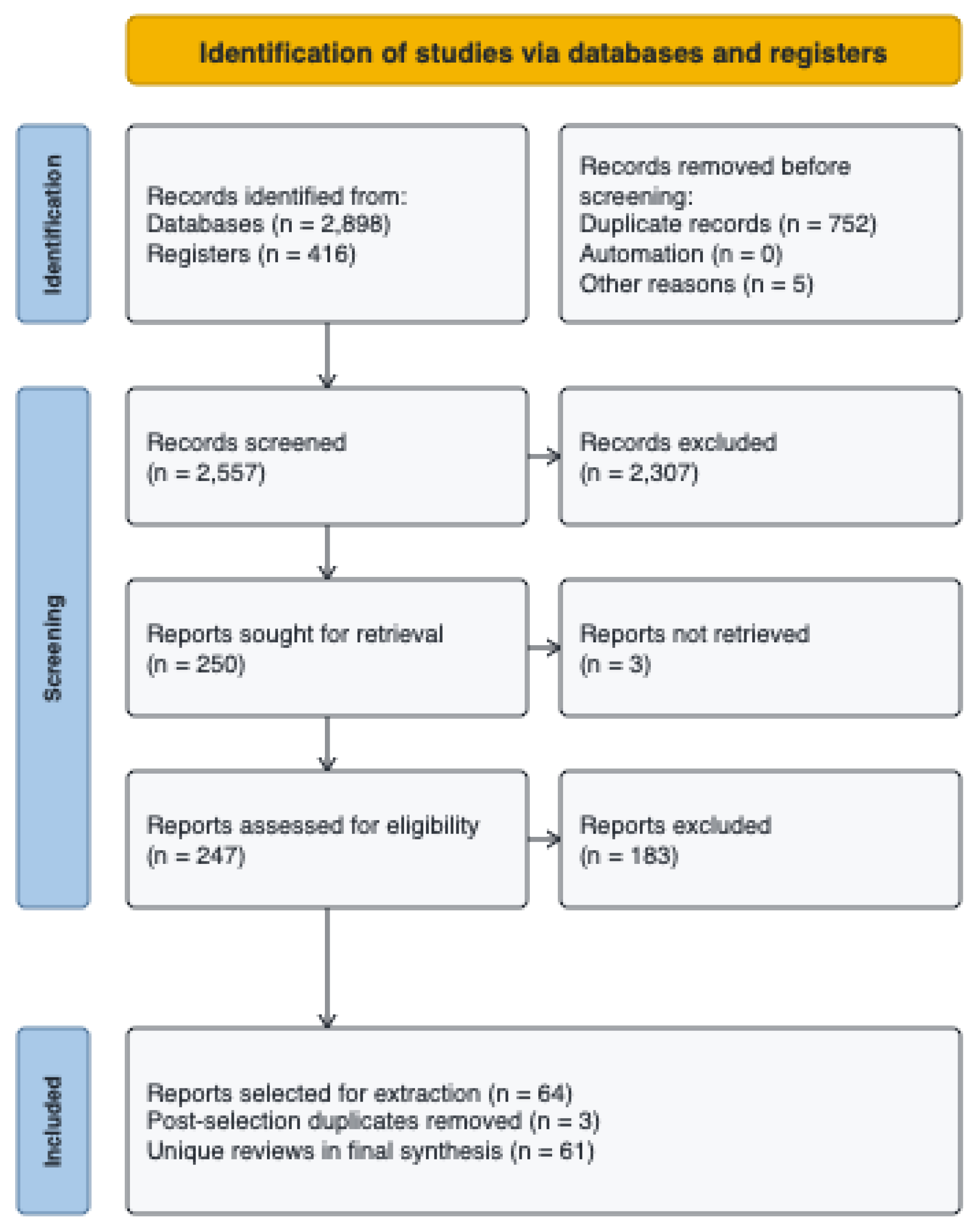
Figure 2.
Marginal review-level frequencies for selected input, model-family, and output categories.
Figure 2.
Marginal review-level frequencies for selected input, model-family, and output categories.
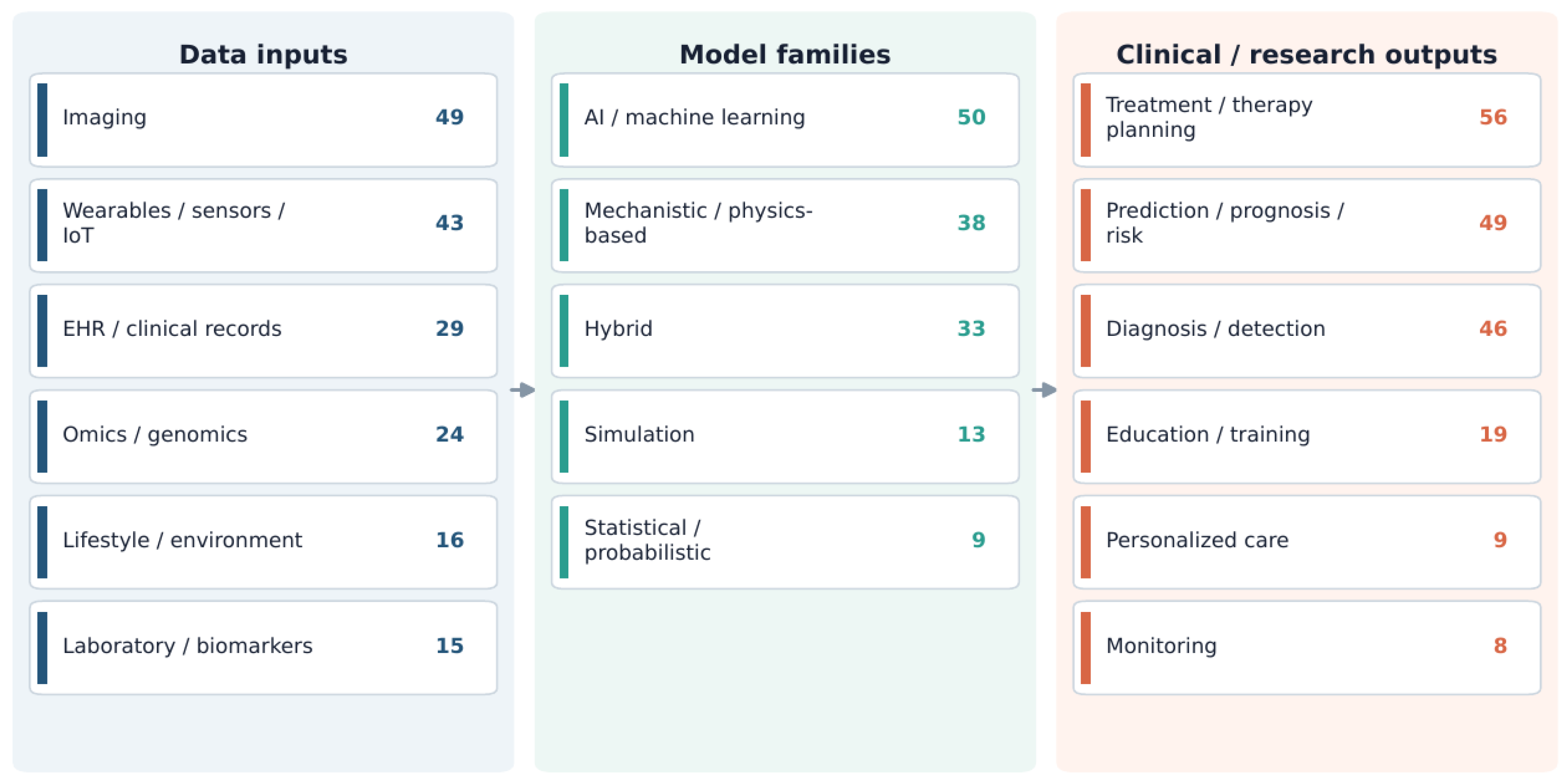
Table 1.
Characteristics of the included review evidence base.
| Dimension | Summary findings | Analytical context |
| Evidence base | 64 records selected for extraction; 3 post-selection duplicates excluded; 61 unique reviews analyzed. | Duplicate exclusions were applied before all classifications and counts. |
| Publication year | Journal-issue year was used consistently: 2022 (5); 2023 (8); 2024 (19); 2025 (27); 2026 (2). | P06, P38, P42, and P44 were reconciled; online-first dates remain in citation notes. |
| Protocol scope | English-language reviews from 2020 onward addressing patient-linked physiological, biomechanical, biological, or adjacent computational representations; the specific grey-literature clause allowed preprints not subsequently published. | Defines the evidence base and supports retaining P16, P34, and P43 as labelled preprints. |
| Dominant domains | Cardiovascular (32); Oncology (25); Surgery / orthopedics / dentistry (24); Neurology / neuroscience (18); Diabetes / endocrine (17); General / multisystem (15) | Shows the breadth of clinical applications. |
| Appraisal context | Our instrument-based review appraisal was available for 39 records; one record had qualitative-only appraisal and 21 were unavailable. | Review methodology is distinct from model validity and fitness for purpose. |
Table 2.
Modeling and computational-pipeline characteristics.
| Pipeline stage | Summary findings | Analytical context |
| Data acquisition | Imaging (49); Wearables / sensors / IoT (43); EHR / clinical records (29); Omics / genomics (24); Lifestyle / environment (16); Laboratory / biomarkers (15); Simulation / literature (14) | Multimodal inputs commonly overlapped. |
| Model construction | AI / machine learning (50); Mechanistic / physics-based (38); Hybrid (33); Simulation (13); Statistical / probabilistic (9) | Data-driven, mechanistic, and hybrid models often co-occurred. |
| Updating mechanisms | Temporal and directional descriptors were retained only as interpretive context; cohort frequencies require record-level adjudication. | Internal model time, data assimilation, feedback, and automated control are distinct claims. |
| Named interoperability specifications | DICOM (15); HL7 (14); FHIR (13); OMOP (11); no ontology/identifier match under the prespecified rule. | Specifications address different layers; mentions do not establish implementation, conformance, or semantic interoperability. |
| Computing infrastructure | Cloud (33); Hybrid cloud-edge (17); Edge (14); High-performance computing (4); Federated / distributed (3) | Architectures were reported more often than measured resource use. |
| Outputs | Treatment / therapy planning (56); Prediction / prognosis / risk (49); Diagnosis / detection (46); Education / training (19); Personalized care (9); Monitoring (8); Drug development / trials (7); Decision support (5) | Leading functions crossed model families. |
Table 3.
Directly verified review-specific credibility evidence.
| Review | Scope checked | Verified finding | Interpretive limit |
| P06 | Eight type 1 diabetes methods | Four were evaluated only with synthetic simulator data; two implementations were open source. | Synthetic testing and code availability do not establish prospective performance. |
| P24 | 36 cardiac in silico trials | 75% reported some validation; 19% reported sensitivity analysis. | Component or solver validation does not validate the complete study. |
| P31 | 149 primary systems | 18 met the review’s operational-twin criteria; two mentioned VVUQ; 17 of the 18 were human-mediated. | The review’s criteria and primary-study denominator cannot be generalized to all 61 reviews. |
| P44 | Fertility, assisted reproduction, and pregnancy | Evidence was mainly internal and retrospective, with selected external or experimental comparisons and no demonstrated prospective outcome benefit. | A peer-reviewed accepted pre-proof is not prospective effectiveness evidence. |
| P45 | 76 in silico drug-development articles | 18 provided open-source implementations; full reproducibility was generally not possible. | Open code alone does not establish complete model specification or reproducibility. |
| P28 | Oncology digital-twinning solutions | The review concluded that most solutions lacked appropriate clinical validation. | This domain-specific conclusion is not a cohort frequency. |
Table 4.
Proposed assurance claims for an updating Digital Patient computational pipeline.
| Claim | Evidence that would support the claim | Failure mode if the link is weak |
| The decision is defined | Intended user, target population, question, alternative action, acceptable error, model influence, and consequence | Metrics are reported without a risk-relevant interpretation |
| The data are fit and traceable | Identity, provenance, representativeness, missingness, units, temporal alignment, and computable semantics | Leakage, mislinkage, bias, or non-portable inputs |
| The update path is explicit | Acquisition cadence; transfer direction; state, parameter, or model update; assimilation; human role; action authority | Simulated time is mistaken for operational updating or control |
| The implementation is correct | Code tests, numerical convergence, solver and workflow verification, dependency versions, and reproducible execution | Software or numerical error is attributed to biology |
| The model can be identified | Calibration partition, identifiability, priors, overfitting controls, and parameter stability | Personalization is not uniquely supported by the observations |
| The prediction is credible for use | Independent comparator, prespecified performance, sensitivity, propagated uncertainty, and relevance to context | Component fit is mistaken for decision fitness |
| The system transfers to practice | External sites, subgroup performance, human–system tests, safety, workflow, and prospective impact when risk warrants | Retrospective performance is mistaken for clinical benefit |
| The evidence survives change | Versioned data, model, and configuration; drift controls; revalidation triggers; rollback; audit; and retirement | Credibility decays after deployment or adaptation |
Table 5.
Parent-review information sources, dates, and recorded result counts.
| Source | Search date | Project-log count (origin) |
| PubMed | 4 October 2025 | 794 (800) |
| Google Scholar | 18 October 2025 | 102 (241) |
| medRxiv | 18 October 2025 | 25 (26) |
| arXiv | 18 October 2025 | 146 (149) |
| Web of Science | 18 October 2025 | 964 (1,495) |
| IEEE Xplore | 18 October 2025 | 526 (603) |
Table 7.
Adjudicated protocol amendments and deviations.
| Stage/decision | Amendment or deviation | Reporting treatment |
| Focused output | Computational-readiness papers specified after evidence-map assembly | Identify it as one focused output from the registered parent review |
| Search update | A planned update was not incorporated | Report October 2025 as the evidence cut-off |
| Cohort reconciliation | Three duplicate reports were removed from 64 extracted rows | Assign stable IDs and summarize only the 61 unique reviews |
| Exclusion audit | Legacy reason subtotals were 188; the verified exclusion total was 183 | Report 183 exclusions and omit the unreliable reason partition |
| Semantic audit | Automated rules for validation, reproducibility, prospective evidence, and maturity produced semantically invalid classifications | Withhold cohort frequencies pending complete record-level adjudication |
| Framework | Context-of-use and lifecycle concepts were added to the extracted evidence structure | Present the eight assurance claims as a proposed framework, not as retrospective compliance findings or an extracted consensus |
| Metadata/registration | Years, preprint status, provenance, bibliographic records, and registration wording were reconciled | Use issue years, retain labelled preprints, cite verified records, and claim no additional registration |
Disclaimer/Publisher’s Note: The statements, opinions and data contained in all publications are solely those of the individual author(s) and contributor(s) and not of MDPI and/or the editor(s). MDPI and/or the editor(s) disclaim responsibility for any injury to people or property resulting from any ideas, methods, instructions or products referred to in the content. |
© 2026 by the authors. Licensee MDPI, Basel, Switzerland. This article is an open access article distributed under the terms and conditions of the Creative Commons Attribution (CC BY) license (http://creativecommons.org/licenses/by/4.0/).
Copyright: This open access article is published under a Creative Commons CC BY 4.0 license, which permit the free download, distribution, and reuse, provided that the author and preprint are cited in any reuse.