

Submitted:
07 September 2026
Posted:
09 September 2026
You are already at the latest version
Abstract
Generative artificial intelligence (GenAI) is increasingly used in advertising, yet its effects on visual attention and preference remain insufficiently characterized. This study compared human-created (H), AI-generated (AI), and human–AI co-created (HAI) advertisements using eye tracking and a forced-choice task. Thirty-nine participants completed 858 trials involving 22 advertisement pairs while gaze was recorded at 60 Hz. Fixation duration, fixation count, time to first fixation, saccadic magnitude, blink duration, and pupil diameter were analyzed using within-subject mixed-effects models with Holm correction for multiple comparisons. AI-generated advertisements were selected more frequently than human-created advertisements, whereas HAI advertisements did not differ from human-created advertisements in choice frequency. Relative to human-created advertisements, both AI and HAI stimuli elicited higher fixation counts and smaller saccadic magnitudes, with these effects surviving Holm correction. No corrected differences were observed in time to first fixation or pupil diameter, and differences in fixation and blink duration did not survive correction. The results indicate that AI-generated and HAI advertisements were associated with a more spatially concentrated pattern of visual exploration, while preference outcomes differed between the two conditions. However, the observed gaze differences cannot be uniquely attributed to creative origin because AI and HAI stimuli also exhibited higher edge density than human-created stimuli. These findings support the use of eye tracking as a sensor-based method for characterizing visual responses to AI-assisted advertising while highlighting the need for tighter stimulus control in future studies.
Keywords:
eye tracking
; generative artificial intelligence
; visual attention
; advertising
; human–AI co-creation
; visual perception
; consumer choice
1. Introduction
The rapid advancement of generative artificial intelligence (AI) has fundamentally reshaped the landscape of digital content creation, particularly within marketing and advertising ecosystems. Contemporary generative models—such as diffusion-based image generators and large-scale multimodal systems—enable the automated production of highly realistic and visually compelling advertisements at unprecedented scale. This technological shift introduces both opportunities and challenges, particularly concerning how human users perceive, process, and respond to AI-generated and co-created visual stimuli.
Understanding visual attention is central to evaluating the effectiveness of advertising content. Eye-tracking technology provides an objective and fine-grained method for capturing attentional processes by measuring gaze behavior through metrics such as fixation duration, fixation count, saccadic transitions, pupillary response, and blink dynamics [19,20,21]. Eye-tracking provides objective measures of visual behavior, including fixation duration, fixation count, time to first fixation, saccadic movements, blink behavior, and pupil responses. These measures can provide indirect evidence about visual exploration, attentional allocation, and processing demands, although their interpretation depends strongly on task context and stimulus properties. In recent years, eye-tracking has become a key methodological tool in neuromarketing, human–computer interaction, and cognitive science, enabling the quantification of user engagement beyond self-reported measures [17,40].
Concurrently, emerging research has begun to investigate how AI-generated content affects human perception and cognition. Recent studies indicate that users exhibit distinct gaze patterns when exposed to synthetic versus human-created visual stimuli, often characterized by increased scrutiny, altered fixation distributions, and variations in trust-related processing [3,9,10]. For instance, experimental evidence suggests that AI-generated images may trigger longer or more dispersed visual exploration due to uncertainty regarding authenticity, while human-created content tends to facilitate more efficient visual processing and stronger perceptual coherence. Furthermore, the integration of physiological sensing and eye-tracking has revealed that AI-generated media can modulate cognitive load and affective responses, particularly in contexts where realism and credibility are critical.
An adjacent literature establishes that evaluations of AI-authored creative work depend strongly on whether the audience is told the origin of the work. Disclosure of machine authorship has been shown to reduce appreciation of visual art and to depress evaluations of algorithmic output more generally [33,34,35,36,37]. This boundary condition is directly relevant to the present design, in which stimulus origin was never disclosed to participants, and it is returned to in Section 5.
Despite these advances, a significant research gap persists. Existing studies predominantly focus on detection accuracy, authenticity judgment, or general perception of AI-generated content, rather than systematically examining how visual attention mechanisms differ in applied contexts such as advertising. Moreover, the relationship between gaze behavior and choice behavio in AI-mediated environments remains insufficiently explored. In particular, there is a lack of controlled experimental studies that directly compare AI-generated, human-created, and human–AI hybrid advertisements using objective behavioral metrics and statistically robust methodologies. Although previous studies have examined the perception and evaluation of AI-generated visual content, comparatively less attention has been given to controlled comparisons of human-created, fully AI-generated, and human–AI co-created advertising stimuli using eye-tracking measures while participants make preference decisions. In particular, it remains unclear whether differences in gaze behavior associated with AI-assisted visual production are accompanied by corresponding differences in behavioral preference. To address this gap, the present study investigates how visual attention differs between AI-generated, human-created, and human–AI hybrid advertisements and how these differences relate to user preference. Four directional hypotheses were evaluated:
- H1. AI-generated and hybrid advertisements elicit a higher fixation count than human-created advertisements.
- H2. AI-generated and human–AI co-created advertisements elicit smaller saccadic magnitudes than human-created advertisements.
- H3. Time to first fixation does not show a detectable difference between AI-generated, human–AI co-created, and human-created advertisements under the present experimental conditions.
- H4. Differences in eye-tracking measures do not consistently correspond to differences in forced-choice preference across the AI-versus-human and human–AI-versus-human contrasts.
The main contributions of this paper are as follows:
- A controlled experimental comparison of AI-generated vs. human-created advertisements and human–AI hybrid vs. human-created advertisements using eye-tracking metrics;
- A statistical analysis linking gaze behavior to choice behavior, with correction for multiple comparisons and reported effect sizes;
- An empirical characterization of the attentional differences associated with synthetic, hybrid, and human-authored visual content under non-disclosure of stimulus origin;
- Evidence informing the interpretation of eye-tracking responses to AI-assisted advertising stimuli and their relationship with forced-choice preference.
The remainder of this paper is organized as follows. Section 2 reviews the relevant literature on eye tracking, visual attention, and AI-generated content. Section 3 describes the experimental methodology, including participants, apparatus, and metrics. Section 4 presents the results of the statistical analysis. Section 5 discusses the findings and their implications for theory and practice. Section 6 states the limitations of the study. Finally, Section 7 concludes the paper and outlines directions for future research.
2. Related Work
Understanding how humans visually process advertising stimuli requires a multidisciplinary perspective that integrates cognitive science, visual perception, and sensing technologies. In this context, eye-tracking has emerged as a fundamental methodological tool, enabling the objective quantification of attention allocation through high-resolution gaze data. Simultaneously, the proliferation of generative artificial intelligence (AI) has introduced a new class of visual stimuli whose perceptual and cognitive processing mechanisms remain only partially understood.
Recent literature has increasingly focused on the intersection between AI-generated content and human perception, highlighting differences in attention patterns, trust formation, and cognitive load. However, these research streams have largely evolved in parallel. On the one hand, eye-tracking studies have extensively characterized visual attention in marketing and interface design; on the other hand, AI-focused research has primarily examined issues of authenticity, realism, and detectability. The integration of these domains—particularly in applied contexts such as advertising—remains underdeveloped.
This section reviews the state of the art across three key dimensions: (i) the role of eye tracking in analyzing visual attention within marketing contexts, (ii) the perceptual and cognitive implications of AI-generated visual content, and (iii) emerging efforts to integrate AI methodologies with eye-tracking data for enhanced behavioral analysis.
2.1. Eye Tracking in Marketing and Visual Attention
Eye-tracking has become a central tool in the quantitative analysis of visual attention in marketing and advertising research. Metrics such as fixation duration and fixation count are strongly associated with cognitive processing, attentional engagement, and information encoding [17,19]. Empirical studies consistently demonstrate that visually complex and dynamic stimuli elicit increased fixation density and prolonged gaze durations, reflecting higher levels of cognitive involvement and attentional capture [1].
Beyond descriptive analysis, eye-tracking has been widely applied to evaluate advertising effectiveness, optimize user interfaces, and assess visual hierarchy [11,16,18,40]. These studies reveal that visual saliency, spatial layout, and design structure play a critical role in guiding attention distribution and shaping user engagement [39]. Importantly, gaze-based metrics have been shown to correlate with higher-level behavioral outcomes, including recall, preference, and decision-making, reinforcing their value as objective indicators of consumer response [28,29].
Two findings from this literature bear directly on the present design. First, in binary preference tasks, gaze progressively shifts toward the eventually chosen alternative in the seconds preceding the decision—the gaze cascade effect [28]—so that dwell-based measures and choice are mechanistically coupled rather than independent [29]. Any comparison of fixation measures between two simultaneously presented alternatives must therefore be interpreted in light of this coupling. Second, low-level image statistics alone predict a substantial share of early fixation placement [39], which makes explicit stimulus matching a precondition for attributing gaze differences to creative origin.
2.2. AI-Generated Content and Human Perception
The rapid adoption of generative AI systems has introduced new challenges in visual perception, particularly regarding authenticity, trust, and cognitive processing. Recent evidence suggests that users often struggle to reliably distinguish AI-generated content from human-created stimuli, with classification accuracy frequently falling below in controlled experimental settings [6]. This perceptual ambiguity has important implications for attention allocation and cognitive load.
Eye-tracking studies indicate that perceived authenticity modulates gaze behavior. Specifically, when users suspect that content may be AI-generated, they tend to exhibit increased visual scrutiny, characterized by longer fixation durations and more dispersed scanpaths [9,10]. Such patterns suggest heightened cognitive effort associated with verification and uncertainty resolution.
Two recent studies are especially close antecedents of the present work. de Winter et al. [10] recorded gaze while participants judged whether images were Midjourney-generated, and reported that discrimination performance and gaze allocation depend on the presence of localized generation artefacts rather than on global image properties. Kiper and Liang [4] compared AI-generated and real fashion advertisements with eye-tracking and found broadly comparable attentional outcomes across origins. The present study differs from both in that origin was never disclosed or queried, and in that a hybrid human–AI condition is included alongside the fully synthetic one.
Moreover, recent multimodal studies combining eye tracking with physiological sensing have demonstrated that AI-generated content can influence trust formation in complex ways, depending on contextual cues such as labeling and disclosure [2,15]. These findings underscore the importance of transparency and design strategies in mitigating potential negative effects associated with synthetic media [33,37].
2.3. Integration of AI and Eye Tracking
The integration of AI techniques with eye-tracking methodologies represents a promising direction for advancing behavioral analysis and adaptive system design. Eye-tracking provides fine-grained, real-time measurements of user attention, while AI enables scalable data processing, pattern recognition, and predictive modeling [5,13]. Together, these technologies offer the potential to develop intelligent systems capable of dynamically adapting content based on user gaze behavior [8].
However, despite this potential, comprehensive studies that systematically combine AI-generated stimuli with eye-tracking analysis in applied domains such as marketing remain limited [12]. Existing work has primarily focused on either optimizing gaze prediction models or analyzing perception of AI-generated media in isolation, rather than integrating both perspectives within a unified experimental framework [14].
Additionally, the convergence of AI and eye tracking raises important ethical considerations, including risks related to behavioral manipulation, privacy, and data governance. The use of gaze data as an implicit behavioral signal introduces concerns regarding user autonomy and informed consent, particularly in commercial applications [7,8]. Addressing these challenges is essential for the responsible deployment of AI-driven attention-aware systems.
2.4. Research Gap and Study Rationale
Taken together, the literature suggests that three processes may be relevant to the evaluation of AI-assisted advertising: the visual properties of the stimulus, the allocation of visual attention, and the subsequent preference decision. These processes should not be assumed to be equivalent. Low-level image properties can influence early gaze allocation, while gaze can also become coupled to choice during evidence accumulation. At the same time, knowledge about AI authorship may influence evaluative judgments independently of visual processing. The present study therefore focuses on the empirical relationship between these components under a controlled non-disclosure condition. By comparing human-created, fully AI-generated, and human–AI co-created advertisements, the study asks whether differences in gaze behavior are consistently accompanied by differences in forced-choice preference.
3. Methodology
The methodology is organized into six main sections: an overview, the experimental design, participant characteristics, data acquisition, the experimental procedure, and data processing and statistical analysis.
3.1. Overview
This study adopts a within-subject experimental design to examine differences in visual attention across advertising stimuli with distinct creative origins. Specifically, the analysis compares human-created, AI-generated, and human-AI hybrid advertisements. By exposing each participant to all stimulus conditions, the design enables direct comparison while controlling for inter-individual variability.
To empirically evaluate stimulus comparability, low-level image statistics were extracted across conditions. Paired comparisons confirmed that stimuli were matched in mean luminance (), RMS contrast (), and computational saliency dispersion (). However, quantitative differences emerged in structural complexity: AI-generated and Hybrid stimuli exhibited higher edge density compared to Human stimuli (, vs. ; ). The complete experimental workflow is illustrated in Figure 1.
3.2. Experimental Design
Participants were exposed to a total of 22 pairs of advertisements, distributed across three stimulus categories:
- Human-created (H): Advertisements fully designed by human creators;
- AI-generated (AI): Advertisements generated autonomously using generative AI systems;
- Human–AI Hybrid (HAI): Advertisements co-created through human guidance and AI generation.
The experiment consisted of 11 pairs comparing AI versus H and 11 pairs comparing HAI versus H. Each pair displayed two advertisements side-by-side, enabling direct visual comparison. For each trial, gaze metrics were first computed separately for each advertisement AOI. For inferential analysis, the resulting trial-level observations were retained rather than averaged across participants. Participant identity and stimulus-pair identity were included as crossed random intercepts to account for repeated observations within participants and heterogeneity across stimulus pairs.
To minimize order effects and positional bias, both the sequence of stimulus presentation and the left–right positioning of advertisements were fully randomized for each participant. Furthermore, all pairs were constructed from the same advertising campaign, ensuring consistency in branding, product context, typography, and conceptual layout. The experimental design was intended to control major low-level visual properties across conditions. Mean luminance, RMS contrast, and computational saliency dispersion did not differ significantly between conditions. However, edge density was higher for AI-generated and HAI stimuli than for human-created stimuli. Consequently, creative origin and structural visual complexity were not fully separable in the present stimulus set, and the eye-tracking results are interpreted with this limitation in mind. A comprehensive stimulus inventory detailing brand names, product categories, exact generative prompts, co-creation workflows, and image licenses is provided in Supplementary Material (Table S1).
Participants were not informed that the advertisements differed in origin, and were not asked at any point to judge whether an advertisement was AI-generated. All results below therefore describe preference and gaze behavior under non-disclosure of stimulus origin.
3.3. Participants
A total of participants took part in the study, aged between 18 and 26 years. Gender distribution was not recorded during data collection. Participants were recruited via convenience and snowball sampling using direct word-of-mouth, WhatsApp messaging, and institutional email invitations. The sample included individuals from diverse educational backgrounds, ranging from secondary education to undergraduate studies.
All participants reported normal or corrected-to-normal vision, ensuring reliable visual perception during the experiment. Prior to participation, informed consent was obtained in accordance with ethical research standards. The study protocol was reviewed in accordance with the applicable institutional procedures at the Porto School of Engineering (ISEP). Formal institutional ethics committee review was waived because the study involved adult participants, non-invasive eye tracking, no intervention, and collection of anonymized behavioral and gaze data. All participants provided written informed consent before participation. No directly identifying personal information was retained with the experimental dataset.
Additionally, a preliminary questionnaire was administered to collect complementary profile information, such as familiarity with AI tools and digital media. A summary of the participants’ descriptive profiling is presented in Table 1, while the complete questionnaire instrument, verbatim item wording, and response scales are reported in Supplementary Material (Table S2). No a priori power analysis was conducted before data collection. A post hoc sensitivity analysis indicated that, with 39 participants, = 0.05, and power, the design could detect paired standardized effects of approximately (. This analysis is presented as a sensitivity assessment rather than as evidence of adequate power for all hypotheses or outcome measures.
Effects smaller than this threshold cannot be reliably distinguished from null, providing a clear statistical basis for interpreting marginal or non-significant ocular differences observed in the results.
The study sample consisted of 39 participants, predominantly undergraduate students, reflecting a young and digitally immersed demographic. Social media engagement was substantial, with reporting daily usage above two hours, underscoring the relevance of visually driven communication channels for this audience.
Marketing-related behaviors indicate moderate but meaningful engagement. expressed strong interest in marketing, and acknowledged having made purchases influenced primarily by visual quality, highlighting the strategic importance of aesthetic cues in advertising targeted at younger consumers.
AI literacy emerged as a defining characteristic of the sample. reported frequent use of generative AI tools, and an equivalent proportion had previously engaged with AI-based image creation or editing. Despite this high familiarity, perceptions of AI-generated content remained ambivalent. While believed AI could match human creativity, simultaneously perceived AI-produced visuals as less authentic. This tension between technical appreciation and perceived authenticity is further reflected in ethical expectations: of participants stated that companies should disclose AI usage in advertising materials.
Due to full anonymization of the profiling questionnaire, individual responses could not be deterministically linked to participant-level eye-tracking logs without risking matching errors. Consequently, these baseline attitudes serve as an aggregate sample-level characterization. As explored in Section 5, comparing these overall stated attitudes (e.g., preference for authenticity and disclosure) against the sample’s unprompted behavioral choices provides a a discrepancy between general stated attitudes toward AI advertising and observed choices under non-disclosure. Overall, the descriptive profile reveals a digitally active, AI-experienced population with nuanced attitudes toward synthetic media. These baseline attitudes are of direct interest because they were measured before the task and can therefore be compared with the choices participants made when origin was not disclosed; this comparison is developed in Section 5.
3.4. Data Acquisition
Eye movement data were recorded using a Gazepoint GP3 eye-tracking system operating at a sampling rate of 60 Hz, controlled by Gazepoint Analysis UX Edition (v6.7.0, 64-bit) software for data acquisition and visualization. Stimuli were displayed on flat-panel monitor at a spatial resolution of pixels with a 60 Hz refresh rate. Participants were positioned at an approximate viewing distance of 65 cm, maintained using the software’s real-time optical position feedback indicator.
Before each experimental session, a standard 5-point calibration procedure was performed and validated to ensure accurate gaze tracking. During the experiment, participants were seated at a fixed distance from the display, and their gaze behavior was continuously recorded throughout stimulus presentation.
For overall gaze metrics (fixation count, fixation duration, time to first fixation, and saccadic magnitude), all participants provided valid data. However, due to partial loss of ocular reflection at 60 Hz, data from 5 participants exceeded the 20% track loss threshold for continuous eyelid closure detection. These 5 participants were excluded exclusively from the blink duration analysis, yielding for that specific measure (), while () was retained for all other behavioral and ocular metrics.
Fixations, saccades, and blinks were identified using the vendor default filtering algorithm embedded in Gazepoint Analysis UX Edition. Fixations were classified using the built-in Gazepoint spatial-temporal filter with a minimum fixation duration threshold of 45 ms (corresponding to approximately 3 consecutive samples at 60 Hz). Blinks were identified as periods of pupil signal loss lasting between 15 ms (1 sample frame) and 2130 ms ( s) bounded by valid tracking samples before and after the interruption. Signal losses exceeding this upper bound or lacking posterior validation were categorized as track loss rather than blinks and excluded from blink metrics.
3.5. Procedure
The experimental sessions followed a structured, sequential protocol. Each session began with a standard 5-point calibration phase, followed by the presentation of 22 pairs of advertisements in randomized order. No practice trials were administered prior to the experimental task, ensuring that recorded gaze behavior reflected pure, unprompted visual exploration and spontaneous decision-making from the first exposure.
The viewing regime was self-paced: each stimulus pair remained on the screen until the participant responded by clicking on their preferred advertisement using the computer mouse. No artificial time limit was imposed, allowing for the capture of natural viewing behavior and unbiased attentional patterns under realistic decision-making conditions. Because trial presentation was fully participant-driven, no formal breaks were provided during the session. The entire experimental session was completed rapidly, lasting between 1 min 38 s and 4 min 30 s per participant (, ).
3.6. Data Processing and Statistical Analysis
To evaluate attentional capture, visual exploration, and underlying cognitive processing, eye-tracking metrics were computed based on predefined Areas of Interest (AOIs). For each experimental pair, two primary rectangular AOIs were defined, corresponding to the full spatial extent of each individual advertisement (categorized by creative origin: Human, AI, or Hybrid AI), as illustrated in Figure 2.
The data analysis phase incorporated two distinct categories of eye-tracking metrics to evaluate both attentional capture and the underlying cognitive processing:
Visual Attention Metrics:
- Fixation Duration (FD):The mean duration of individual fixations on the stimulus;
- Fixation Count (FC): The total number of individual fixations, indicating the overall engagement and visual exploration density;
- Time to First Fixation (TTFF): The latency required for the participant’s gaze to enter a predefined Area of Interest (AOI), measuring initial attentional capture.
Cognitive and Physiological Metrics:
- Pupil Diameter: Pupil diameter was analyzed using the native units exported by the eye-tracking system. Because no physical calibration or trial-level baseline correction was performed, these values were interpreted only as within-participant relative measures rather than as absolute physiological pupil diameter [25,26];
- Blink Duration: The duration of eye blinks (ms), analyzed as an indicator of cognitive fatigue, visual strain, and processing load [27]; Blink duration was treated as a secondary exploratory measure because of the lower effective sample size and the temporal limitations of 60-Hz sampling
- Saccadic Magnitude: Saccadic magnitude was expressed in screen-space pixels. Because the same display configuration and viewing distance were used across conditions, the measure provides a consistent within-experiment spatial index; however, values are not directly interpretable as degrees of visual angle.
Statistical analyses and visual data exploration were conducted using Microsoft Excel (Data Analysis ToolPak), Microsoft Power BI, and Python 3.12 (utilizing opencv-python for image metrics, and statsmodels / scipy.stats for statistical modelling). The analysis plan for this study was not preregistered.
Following data collection, gaze data were processed to extract the eye-tracking metrics for each participant and condition. Choice proportions were evaluated using generalized linear mixed-effects models (GLMM, binomial family with a logit link) with crossed random intercepts for participants and stimulus pairs to account for repeated observations per participant and item-level variance [38]. The model intercept tested departure from chance (), with effect sizes reported as odds ratios () alongside confidence intervals.
Response times and eye-tracking metrics were analyzed using linear mixed-effects models (LMM) with condition as a fixed factor and crossed random intercepts for participants and stimulus pairs (). Treating stimulus pairs as random effects ensures that statistical inferences generalize to the broader population of AI-generated and human-created advertisements rather than being restricted to the specific stimulus items evaluated [38]. Across the two comparison paradigms (AI vs. Human and HAI vs. Human), 14 model contrasts were evaluated for the eye-tracking metrics. p-values were adjusted using Holm’s sequentially rejective procedure [41] to control the family-wise error rate, and only Holm-adjusted values () are interpreted as statistically significant. Seven prespecified eye-tracking outcomes were evaluated for each of the two contrasts (AI vs. H and HAI vs. H), resulting in 14 confirmatory comparisons. Holm’s sequential procedure was applied across this complete family of 14 comparisons to control the family-wise error rate.
4. Results
4.1. Log Analysis
A total of experimental trials were analyzed, consisting of forced-choice decisions between Human-created (H), AI-generated (AI), and Hybrid AI-assisted (HAI) stimuli. The experimental design comprised two binary comparison paradigms comprising 429 trials each, with repeated observations within participants and stimulus pairs. The dependent variables were choice outcome and response time (ms).
Because response-time distributions are characteristically right-skewed, both parametric (Mean ± SD) and non-parametric (Median, IQR) statistics are reported to provide an accurate characterization of central tendency and dispersion. A comprehensive synthesis of these behavioral metrics is detailed in Table 2, with the overall preference distribution illustrated in Figure 3.
4.1.1. Human vs. AI Choice Behavior
In the Human vs. AI condition, participants made strictly binary forced-choice decisions in which each trial required a direct comparison between a human-created and an AI-generated stimulus, with the outcome necessarily summing to within each pair. Across all trials of this condition (), human-created advertisements were selected in of cases, whereas AI-generated advertisements were selected in of cases, indicating an asymmetry in choice preference favoring AI-generated content.
To evaluate whether this deviation from an unbiased decision process ( under the null hypothesis) was statistically reliable while accounting for trial-level dependencies within participants, a a binomial generalized linear mixed-effects model grouped by participant was conducted [38]. The analysis revealed that the observed choice distribution differed significantly from chance expectation ().
The magnitude of this effect was quantified using an odds ratio, which indicated that AI-generated advertisements were 1.44 times more likely to be selected than human-created advertisements (). The associated confidence interval lies entirely above unity, confirming a statistically robust preference for AI-generated over human-created advertisements under non-disclosure of origin.
4.1.2. Human vs. HAI Choice Behavior
In the Human vs. HAI condition, participants again made strictly binary forced-choice decisions, with each trial requiring a direct comparison between a human-created and a hybrid AI-assisted stimulus, such that selections summed to within pairs. Across all trials of this contrast (), human-created advertisements were chosen in of trials, whereas hybrid advertisements were selected in of trials.
A generalized linear model with cluster-robust standard errors grouped by participant was conducted to assess whether this deviation from the null hypothesis of equal choice probability () was statistically significant. The results showed no statistically significant departure from chance expectation (, , ).
These results provide no evidence of a preference in either direction between human-created and hybrid advertisements. Because the confidence interval includes unity and spans odds ratios between roughly 0.71 and 1.39, this non-significant result represents a failure to reject the null hypothesis rather than proof of population equivalence.
4.1.3. Effect Size Comparison and Response Time Analysis
The two contrasts differ in outcome: AI-generated advertisements were preferred over human-created ones (, ), whereas the human-versus-hybrid contrast was indistinguishable from chance (, ). An OR > 1 indicates higher odds of selecting AI relative to Human. Although the same human-created baseline items were used in both blocks, the difference between these two odds ratios has not been formally tested with an interaction model. Therefore, no graded or monotonic relationship between the degree of AI involvement and preference is claimed from these data.
Response times were analyzed using a linear mixed-effects model including crossed random intercepts for participants and stimulus pairs. The analysis confirmed that response times did not differ significantly between alternatives in either contrast. For the Human vs. AI contrast, the effect was not significant (, , , ; participant random-intercept variance ). Similarly, for the Human vs. HAI contrast, no significant difference was observed (, , , ; participant random-intercept variance ).
Descriptively, in the Human vs. AI contrast, ms and ms; in the Human vs. HAI contrast, ms and ms. The apparent difference in overall response time between the two experimental blocks (approximately 5.6 s vs. 5.2 s) was not subjected to a formal between-block statistical test and is therefore not interpreted as a meaningful effect.
4.2. Eye-Tracking Analysis
Following the methodological framework described above, this section presents the empirical results obtained from the eye-tracking experiment. The analysis quantifies differences in visual attention across human-created, AI-generated, and human–AI hybrid advertisements using the metrics defined in Section 3.6: Fixation Duration (FD), Fixation Count (FC), Time to First Fixation (TTFF), Saccadic Magnitude, Blink Duration, and Pupil Diameter.
All statistical tests were conducted within-subject. Fourteen tests were performed in total (seven metrics × two contrasts). Seven prespecified outcome measures were tested per contrast: fixation duration, fixation count, time to first fixation, saccadic magnitude, blink duration, left-eye pupil diameter, and right-eye pupil diameter. Uncorrected p-values are reported for completeness, but inference is based on Holm-adjusted values [41], which are given in Table 3 and Table 4. Partial eta squared is reported as an effect size for each test.This yielded 14 confirmatory model comparisons
4.2.1. AI-Generated vs. Human-Created
This section compares the visual attention patterns elicited by AI-generated and human-created advertisements. Table 3 presents descriptive statistics, mean differences with confidence intervals, inferential results, and effect sizes for the two conditions. The corresponding distributions are shown in Figure 4.
Two effects survive correction for multiple comparisons. For the eye-tracking models, partial eta squared was reported as a standardized effect-size measure derived from the model F statistics. AI-generated advertisements elicited a higher fixation count than human-created advertisements ( vs. ; , , , ) and smaller saccadic magnitudes ( vs. px; , , , ). Together, these indicate that gaze was distributed over a spatially more compact region when viewing AI-generated stimuli, supporting H1 and H2.
No other comparison survived correction. The difference in fixation duration was not statistically significant before correction and not significant after it (, , , ), as was the difference in blink duration (, , , ; note that degrees of freedom for blink duration are due to missing blink events in 5 participants during artifact removal). Time to first fixation did not differ between conditions (, , ), consistent with H3, indicating that no detectable difference in TTFF was observed, which is compatible with the hypothesized absence of a detectable condition effect. Pupil diameter did not differ for either eye (both ).
4.2.2. HAI Co-Creation vs. Human-Created
This section examines the differences in visual attention between hybrid AI-assisted (HAI) and human-created advertisements. Table 4 presents descriptive statistics, mean differences with confidence intervals, inferential results, and effect sizes for the two conditions, and Figure 5 shows the corresponding distributions.
As in the previous contrast, two effects survive Holm correction. HAI advertisements elicited a higher fixation count than human-created advertisements ( vs. ; , , , ) and smaller saccadic magnitudes ( vs. px; , , , ). The direction and approximate magnitude of both effects replicate those observed in the AI-vs-H contrast, supporting H1 and H2 for hybrid stimuli as well.
The difference in blink duration ( vs. ms; , , , , ) and the difference in fixation duration (, , , ) did not survive correction and are reported as exploratory. Time to first fixation was effectively identical between conditions ( vs. ms; ), again consistent with H3, and pupil diameter did not differ for either eye (both ).
5. Discussion
Two main findings require explanation. First, under non-disclosure of origin, AI-generated advertisements were chosen significantly more often than human-created ones (, ), whereas hybrid advertisements were chosen no more and no less often than human-created ones (, ). Second, both AI-generated and hybrid advertisements produced a robust and replicated compression of visual exploration relative to human-created advertisements — characterized by a higher fixation count over a smaller saccadic span — with medium-to-large effect sizes in both contrasts. These two findings do not align directly: the gaze signature shared by AI and HAI stimuli does not track the choice outcome, which differs between them.
A parsimonious interpretation of the gaze findings is that structural and compositional properties contributed substantially to the observed pattern.
Higher fixation counts combined with shorter saccades describe gaze confined to a spatially dense region of the image. Analysis of low-level visual properties confirms that while stimuli were quantitatively matched in mean luminance (), RMS contrast (), and computational saliency dispersion (), synthetic and hybrid stimuli exhibited significantly higher structural complexity (edge density: , vs. , ). Generated imagery from current diffusion models tends toward highly detailed, visually concentrated focal elements, whereas human-designed advertisements more broadly distribute informative components — copy, logo, product, call to action — across the canvas. This elevated edge density and spatial concentration of visual detail in AI/HAI imagery provides a direct, stimulus-driven explanation for localized scanning. Because complexity differences remain present, this visual effect cannot be entirely disentangled from a genuine processing difference with the data at hand [39]. We therefore refrain from the stronger claim, advanced in earlier work, that synthetic imagery is intrinsically more efficient to process.
The invariance of time to first fixation (TTFF) across all conditions is informative in this respect. If AI-generated stimuli possessed an inherent saliency advantage in capturing initial attention, a systematic difference in visual capture would be expected; none was observed in either contrast, with the two hybrid means differing by a mere ms. Whatever distinguishes visual processing across conditions emerges during ongoing exploration rather than at onset.
The preference result should be interpreted with two constraints firmly in view. The first is disclosure. Participants were never told that stimulus origin varied and were never asked to judge it, so the observed preference for AI-generated advertisements was formed in the absence of authorship information. The literature on anthropocentric bias indicates that appreciation of visual work falls when machine authorship is revealed [33,34], and that algorithmic provenance depresses evaluation across domains [35,36,37]. The present sample makes this constraint concrete: of these same participants reported that AI-generated visuals are less authentic, at the aggregate sample level, reported support for mandatory disclosure, while AI-generated advertisements were selected in of trials.
This is a divergence between stated attitude and revealed choice, not evidence that the stated attitude is inert. A disclosure manipulation is the natural next experiment, and until it is run, the practical implication of the present result is limited to contexts in which origin is not disclosed — which is precisely the context that the majority of these participants said should not exist.
The second constraint is the coupling between gaze and choice inherent in the paradigm. In binary preference tasks, gaze shifts progressively toward the alternative that is eventually chosen [28], and dwell time and choice are jointly determined during evidence accumulation [29]. Because the two advertisements in each pair were presented simultaneously and competed for a bounded viewing period, fixation measures on the two sides are not independent. The reported fixation-count difference in the AI-vs-H contrast is therefore partly redundant with the choice difference in that same contrast. The strongest evidence available against this concern is the HAI-vs-H contrast, where the same gaze pattern appears in the absence of any choice asymmetry: hybrid stimuli drew more fixations over a smaller area while being chosen exactly as often as human-created ones. The pattern is consistent with H4, in that the similarity of the gaze effects across AI and HAI contrasts was not accompanied by equivalent choice outcomes.
It is worth stating explicitly which theoretical prediction the hybrid result fails to support. A category-ambiguity account of the uncanny valley predicts that stimuli of indeterminate origin are evaluated more negatively than stimuli of unambiguous origin, as difficulty of categorization is itself aversive [31,32]. Applied to advertising, this predicts that co-created material should be penalized relative to both fully human and fully synthetic material. No such penalty was observed: hybrid advertisements were chosen at chance level (; ). A processing-fluency account [30], on which more easily processed stimuli are preferred, fares no better here: hybrid and AI-generated stimuli produced the same compressed gaze pattern, yet only the latter was preferred. The present design does not provide a strong test of either framework.
We do not interpret the blink-duration differences. Neither survived correction for multiple comparisons, they point in opposite directions across the two contrasts (longer blinks for human stimuli in one, longer blinks for hybrid stimuli in the other), and no independent measure of cognitive workload was collected against which either could be validated [27]. The pupil results are similarly uninformative as reported: although mean luminance was quantitatively matched across experimental conditions (), the absence of trial-level pre-stimulus baseline correction limits the evidential weight of a null pupil effect in indexing subtle cognitive load differences [25,26].
Taken together, the results are most consistent with the view that generative and hybrid pipelines currently produce advertisements whose informative content is spatially concentrated and structurally dense (higher edge density), and that this compositional property changes how the image is scanned without determining whether it is preferred. For practitioners, the actionable implication is narrow but real: AI-assisted production did not degrade attentional engagement or choice relative to human production in this stimulus set, and hybrid workflows in particular achieved parity on choice. The evidence does not support recommendations about "optimizing" cognitive load, which the present measures cannot speak to. The elevated edge density of the AI-generated and HAI stimuli is therefore not merely a secondary descriptive difference but a potential alternative explanation for the observed gaze pattern. Higher edge density may increase the number of visually informative local features and consequently alter fixation placement and saccadic transitions. Because edge density was not experimentally controlled or included as a covariate in the present analysis, the data do not allow us to determine whether the observed differences are attributable to creative origin, structural complexity, or their combination. Future experiments should therefore construct stimuli in which edge density and other low-level visual properties are matched across origin conditions.
6. Limitations
Several limitations constrain the interpretation of these results.
Sample. The 39 participants were predominantly undergraduate students from a single institution, with a mean age of 20.3 years and an unusually high level of generative-AI experience ( frequent users). This is not a consumer sample, and the preference results in particular should not be generalized to broader populations without replication. No a priori power analysis was conducted.
Stimuli. Although stimuli across experimental conditions were quantitatively matched on mean luminance, RMS contrast, and computational saliency dispersion, synthetic and hybrid stimuli exhibited significantly higher structural complexity (edge density) than human-created controls. Consequently, a stimulus-driven, compositional explanation for the observed gaze compression cannot be fully disentangled from a intrinsic processing difference with the current visual corpus [39].
Design. Origin was never disclosed to participants and never explicitly queried, meaning the study cannot determine whether participants implicitly recognized AI-generated imagery, nor how visual preference would behave under formal authorship disclosure.
Measurement. The 60 Hz sampling rate of the eye tracker limits the temporal resolution of fast oculomotor events such as blinks and short saccades. Saccadic magnitude and pupil diameter were recorded in screen units (pixels) rather than physical degrees of visual angle or millimetres. Additionally, pupil size metrics lacked trial-level pre-stimulus baseline correction, which limits the sensitivity of pupil data in indexing fine-grained cognitive workload differences [25,26].
Analysis. The statistical analysis plan was not preregistered, and multiple eye-tracking outcomes were evaluated across two contrasts. Although Holm correction was applied across the prespecified family of 14 comparisons, the possibility of analytical flexibility cannot be excluded. Future studies should preregister primary outcomes, model specifications, exclusion criteria, and multiplicity procedures before data collection.
7. Conclusion
This study compared human-created, AI-generated, and human–AI co-created advertisements using eye-tracking and a forced-choice preference task with 39 participants and 858 trials, under non-disclosure of stimulus origin.
Two eye-tracking effects were robust to correction for multiple comparisons and replicated across both contrasts: relative to human-created advertisements, AI-generated and hybrid advertisements elicited more fixations ( and ) and smaller saccadic magnitudes ( and ), indicating spatially compressed visual exploration. Initial attentional capture, indexed by time to first fixation, was equivalent across all conditions, and pupil diameter did not differ. Differences in fixation duration and blink duration did not survive correction and are not interpreted.
Behaviorally, AI-generated advertisements were selected more often than human-created ones (OR , CI ), whereas the human-versus-hybrid comparison was indistinguishable from chance (OR , CI ). Response times did not differ within either contrast.
The central empirical insight of this work is a clear dissociation: while AI-generated and hybrid advertisements share a common oculomotor signature (high fixation count, short saccades), they differ markedly in choice outcomes. Compressed visual exploration is therefore not a direct predictor of decision outcome. Two qualifications bound this conclusion. First, the preference for AI imagery was observed in the absence of authorship disclosure, despite of participants expecting disclosure in commercial contexts. Second, while stimuli were quantitatively matched on mean luminance, RMS contrast, and computational saliency, synthetic and hybrid imagery exhibited elevated structural complexity (edge density), suggesting that the observed gaze compression reflects spatial composition and detail density typical of current generative pipelines rather than an intrinsic cognitive processing advantage.
Three clear directions for future research emerge. First, a formal disclosure manipulation is required to evaluate whether the preference for AI-generated advertisements persists when algorithmic provenance is made explicit. Second, isolating specific structural parameters (e.g., controlling edge density alongside saliency) will further separate spatial-compositional effects from cognitive processing mechanisms. Third, trial-level models integrating within-trial gaze dynamics with choice outcomes will provide a direct test of the attention–preference coupling in generative visual media.
Supplementary Materials
The following supporting information can be downloaded at the website of this paper posted on Preprints.org.
Author Contributions
Conceptualization, A.G., M.A. and A.T.; methodology, A.G., M.A. and A.T.; software, A.G., M.A. and A.T.; validation, A.G.; formal analysis, A.G. and A.T.; investigation, A.G.; resources, M.A. and A.T.; data curation, A.G.; writing—original draft preparation, A.G. and A.T.; writing—review and editing, A.G. and A.T.; visualization, A.G. and A.T.; supervision, M.A. and A.T.; project administration, A.G., M.A. and A.T.; funding acquisition, M.A. and A.T. All authors have read and agreed to the published version of the manuscript.
Funding
This research received no external funding. Institutional support was provided by the GECAD Research Group, Porto School of Engineering (ISEP).
Institutional Review Board Statement
The study was conducted in accordance with the Declaration of Helsinki. Formal ethical review was waived for this study in accordance with institutional guidelines for non-invasive academic research, as the study involved no potential physical or psychological risk to human participants, collected non-sensitive fully anonymized gaze and choice data, and was conducted within an academic degree project at the Porto School of Engineering (ISEP).
Informed Consent Statement
Informed consent was obtained from all individual subjects involved in the study prior to data collection. All participants were adults (aged 18 or older); therefore, parental or guardian consent was not required.
Data Availability Statement
The anonymized trial-level dataset supporting the reported findings is available from the corresponding author upon reasonable request.
Acknowledgments
The authors would like to express their gratitude to all participants who voluntarily took part in this study. Special thanks are also extended to the academic supervisors and faculty coordinators of the internship course at the Porto School of Engineering (ISEP) for their support during the participant recruitment phase.
Use of Artificial Intelligence
Generative AI tools were utilized during the execution of this study and the preparation of the manuscript. Specifically, ChatGPT (OpenAI) was used to generate the synthetic visual advertisement stimuli evaluated in the experiment. Google Gemini (Google) was employed for assistance in developing Python scripts for data extraction and for English language editing and stylistic refinement. Grammarly (Grammarly Inc.) was used for proofreading and grammar optimization. All generated visual stimuli, analysis code, data interpretations, and manuscript revisions were thoroughly verified, curated, and validated by the human authors, who accept full responsibility for the content, accuracy, and integrity of this work.
Conflicts of Interest
The authors declare no conflict of interest.
References
- Yuan, S.; Wang, T.; Li, H. An Eye-Tracking Study of Attention Capture Efficiency in Visual Advertising. Applied Sciences 2026, 16, 291. [CrossRef]
- Zhang, L.; Chen, Y.; Xu, R. The Impact of Generative AI Images on Consumer Attitudes in Advertising. Administrative Sciences 2025, 15, 395. [CrossRef]
- Cha, J.; Lee, N.; Kim, S. Impact of AI-Generated Characters on Visual Attention and Prefrontal Cognitive Responses. Frontiers in Human Neuroscience 2026. [CrossRef]
- Kiper, E.; Liang, Y. Do AI-Generated Fashion Ads Work as Effectively as Real Ads? An Eye-Tracking Comparison of Consumers’ Visual Attention. Journal of Global Fashion Marketing 2026, 17, 1–17. [CrossRef]
- Bekenova, G.; Orazgaliyeva, E. Neuromarketing Insights Using Eye-Tracking and Machine Learning. Buketov Business Review 2025. [CrossRef]
- Huang, J.; Gopalakrishnan, S.; Mittal, T. Analysis of Human Perception in Distinguishing AI-Generated Faces. arXiv 2024. [CrossRef]
- Prajod, P.; Cools, H.; El Ali, A. Gaze-Informed AI Disclosure Interfaces. arXiv 2026. [CrossRef]
- Wilson, E.; Proulx, M. Eye Gaze as a Signal for Contextual AI Systems. arXiv 2025. [CrossRef]
- Wong, D.; Wang, B.; Durak, G. Eye Movement Differences Between Real and AI Images. In Proceedings of the ACM Symposium on Eye Tracking Research & Applications (ETRA) 2025. [CrossRef]
- de Winter, J.C.F.; Pfeifer, J.; Dodou, D.; Eisma, Y.B. Detecting Midjourney-Generated Images: An Eye-Tracking Study. Human Factors 2025. [CrossRef]
- Cui, Y., & Liu, X. An Eye Tracking Study on the Reception of Second-Person Pronouns in English-Chinese Advertisement Translation. SAGE Open 2025. [CrossRef]
- Kondak, A. Integration of Eye Tracking and AI in Marketing. Management Papers 2024. [CrossRef]
- Ye, J.; Wedel, M.; Pieters, R. AdGazer: Improving Contextual Advertising with Theory-Informed Machine Learning. Journal of Marketing 2025 (Online First). [CrossRef]
- Simonov, A.; Valletti, T.; Veiga, A. Attention Spillovers from News to Ads: Evidence from an Eye-Tracking Experiment. Journal of Marketing Research 2025, 62. [CrossRef]
- Chen, C.; Zhang, D. Exploring Consumer Responses to AI-Generated Visual Marketing Content: A Dual-Process Theory Perspective. Int. J. Consum. Stud. 2025, 49, e70121. [CrossRef]
- Wedel, M.; Pieters, R. Visual Marketing: From Attention to Action; Psychology Press: New York, 2014. [CrossRef]
- Wedel, M.; Pieters, R. A Review of Eye-Tracking Research in Marketing. Review of Marketing Research 2008, 4. [CrossRef]
- Pieters, R.; Wedel, M. Goal Control of Attention to Advertising. Journal of Consumer Research 2007, 34, 224–233. [CrossRef]
- Rayner, K. Eye Movements and Attention in Reading, Scene Perception, and Visual Search. Quarterly Journal of Experimental Psychology 2009, 62, 1457–1506. [CrossRef]
- Holmqvist, K.; Nyström, M.; Andersson, R.; Dewhurst, R.; Jarodzka, H.; van de Weijer, J. Eye Tracking: A Comprehensive Guide to Methods and Measures; Oxford University Press: Oxford, 2011.
- Duchowski, A.T. Eye Tracking Methodology: Theory and Practice, 3rd ed.; Springer: Cham, 2017. [CrossRef]
- Holmqvist, K.; Örbom, S.L.; Hooge, I.T.C.; Niehorster, D.C.; Alexander, R.G.; Andersson, R.; Benjamins, J.S.; Blignaut, P.; Brouček, M.; Chuang, L.L.; et al. Eye Tracking: Empirical Foundations for a Minimal Reporting Guideline. Behavior Research Methods 2023, 55, 364–416. [CrossRef]
- Andersson, R.; Larsson, L.; Holmqvist, K.; Stridh, M.; Nyström, M. One Algorithm to Rule Them All? An Evaluation and Discussion of Ten Eye Movement Event-Detection Algorithms. Behavior Research Methods 2017, 49, 616–637. [CrossRef]
- Nyström, M.; Holmqvist, K. An Adaptive Algorithm for Fixation, Saccade, and Glissade Detection in Eyetracking Data. Behavior Research Methods 2010, 42, 188–204. [CrossRef]
- Mathôt, S. Pupillometry: Psychology, Physiology, and Function. Journal of Cognition 2018, 1, 16. [CrossRef]
- Beatty, J. Task-Evoked Pupillary Responses, Processing Load, and the Structure of Processing Resources. Psychological Bulletin 1982, 91, 276–292. [CrossRef]
- Stern, J.A.; Walrath, L.C.; Goldstein, R. The Endogenous Eyeblink. Psychophysiology 1984, 21, 22–33. [CrossRef]
- Shimojo, S.; Simion, C.; Shimojo, E.; Scheier, C. Gaze Bias Both Reflects and Influences Preference. Nature Neuroscience 2003, 6, 1317–1322. [CrossRef]
- Krajbich, I.; Armel, C.; Rangel, A. Visual Fixations and the Computation and Comparison of Value in Simple Choice. Nature Neuroscience 2010, 13, 1292–1298. [CrossRef]
- Reber, R.; Schwarz, N.; Winkielman, P. Processing Fluency and Aesthetic Pleasure: Is Beauty in the Perceiver’s Processing Experience? Personal. Soc. Psychol. Rev. 2004, 8, 364–382. [CrossRef]
- Yamada, Y.; Kawabe, T.; Ihaya, K. Categorization Difficulty Is Associated with Negative Evaluation in the Uncanny Valley Phenomenon. Jpn. Psychol. Res. 2013, 55, 20–32. [CrossRef]
- Mori, M.; MacDorman, K.F.; Kageki, N. The Uncanny Valley. IEEE Robotics & Automation Magazine 2012, 19, 98–100. [CrossRef]
- Millet, K.; Buehler, F.; Du, G.; Kokkoris, M.D. Defending Humankind: Anthropocentric Bias in the Appreciation of AI Art. Computers in Human Behavior 2023, 143, 107707. [CrossRef]
- Ragot, M.; Martin, N.; Cojean, S. AI-Generated vs. Human Artworks: A Perception Bias Towards Artificial Intelligence? In Extended Abstracts of the 2020 CHI Conference on Human Factors in Computing Systems; ACM: New York, 2020. [CrossRef]
- Longoni, C.; Bonezzi, A.; Morewedge, C.K. Resistance to Medical Artificial Intelligence. Journal of Consumer Research 2019, 46, 629–650. [CrossRef]
- Dietvorst, B.J.; Simmons, J.P.; Massey, C. Algorithm Aversion: People Erroneously Avoid Algorithms after Seeing Them Err. J. Exp. Psychol. Gen. 2015, 144, 114–126. [CrossRef]
- Jago, A.S. Algorithms and Authenticity. Acad. Manag. Discov. 2019, 5, 38–56. [CrossRef]
- Barr, D.J.; Levy, R.; Scheepers, C.; Tily, H.J. Random Effects Structure for Confirmatory Hypothesis Testing: Keep It Maximal. Journal of Memory and Language 2013, 68, 255–278. [CrossRef]
- Itti, L.; Koch, C.; Niebur, E. A Model of Saliency-Based Visual Attention for Rapid Scene Analysis. IEEE Transactions on Pattern Analysis and Machine Intelligence 1998, 20, 1254–1259. [CrossRef]
- Pieters, R.; Wedel, M. Attention Capture and Transfer in Advertising: Brand, Pictorial, and Text-Size Effects. Journal of Marketing 2004, 68, 36–50. [CrossRef]
- Holm, S. A Simple Sequentially Rejective Multiple Test Procedure. Scandinavian Journal of Statistics 1979, 6, 65–70.
- Faul, F.; Erdfelder, E.; Lang, A.-G.; Buchner, A. G*Power 3: A Flexible Statistical Power Analysis Program for the Social, Behavioral, and Biomedical Sciences. Behavior Research Methods 2007, 39, 175–191. [CrossRef]
Figure 1.
Experimental workflow. Each session comprised a 5-point calibration, followed by 22 advertisement pairs presented in randomized order with randomized left–right placement. Gaze was recorded at 60 Hz during free viewing of each pair, after which participants made a binary forced choice. Steps 2–4 were repeated for all 22 pairs; the eye-tracking metrics defined in Section 3.6 were computed offline.
Figure 1.
Experimental workflow. Each session comprised a 5-point calibration, followed by 22 advertisement pairs presented in randomized order with randomized left–right placement. Gaze was recorded at 60 Hz during free viewing of each pair, after which participants made a binary forced choice. Steps 2–4 were repeated for all 22 pairs; the eye-tracking metrics defined in Section 3.6 were computed offline.
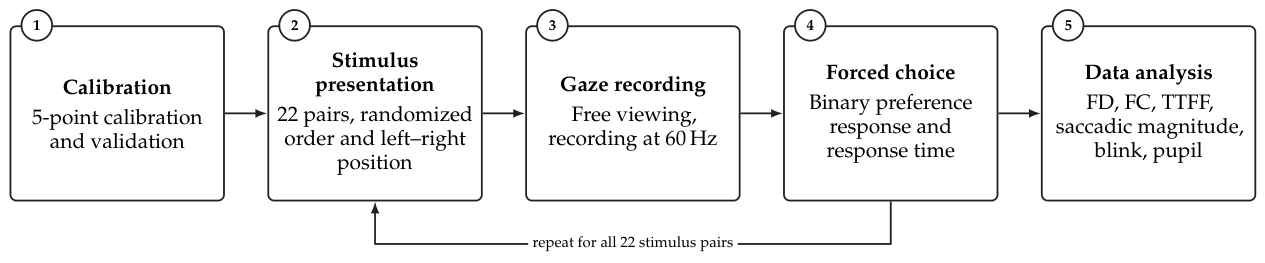
Figure 2.
Representative stimulus pair illustrating the Areas of Interest (AOIs) corresponding to the full spatial extent of each advertisement condition.
Figure 2.
Representative stimulus pair illustrating the Areas of Interest (AOIs) corresponding to the full spatial extent of each advertisement condition.

Figure 3.
Selection frequency in the two forced-choice paradigms. Bars show the percentage of trials on which each alternative was chosen, with confidence intervals; the dashed line marks chance . Trial counts are given beneath each bar (n = 429 per contrast). Inferential p-values correspond to the binomial generalized linear mixed-effects models reported in Section 4.1
Figure 3.
Selection frequency in the two forced-choice paradigms. Bars show the percentage of trials on which each alternative was chosen, with confidence intervals; the dashed line marks chance . Trial counts are given beneath each bar (n = 429 per contrast). Inferential p-values correspond to the binomial generalized linear mixed-effects models reported in Section 4.1
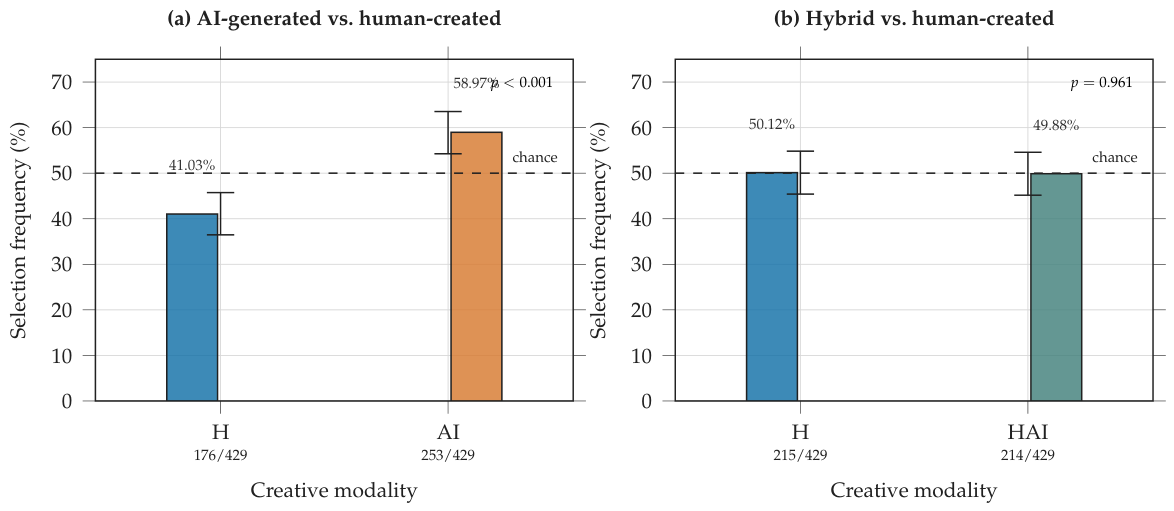
Figure 4.
Distributions of the eye-tracking metrics for AI-generated (orange) and human-created (blue) advertisements: (a) fixation count, (b) fixation duration, (c) saccadic magnitude, (d) blink duration. Boxes span the interquartile range, the horizontal rule is the median, the white circle is the mean, and whiskers extend to the minimum and maximum. Brackets give the Holm-adjusted p-value from the repeated-measures ANOVA (Table 3); n.s. denotes a comparison that does not survive correction. participants ( for blink duration). Axis ranges are shared with the corresponding panels of Figure 5.
Figure 4.
Distributions of the eye-tracking metrics for AI-generated (orange) and human-created (blue) advertisements: (a) fixation count, (b) fixation duration, (c) saccadic magnitude, (d) blink duration. Boxes span the interquartile range, the horizontal rule is the median, the white circle is the mean, and whiskers extend to the minimum and maximum. Brackets give the Holm-adjusted p-value from the repeated-measures ANOVA (Table 3); n.s. denotes a comparison that does not survive correction. participants ( for blink duration). Axis ranges are shared with the corresponding panels of Figure 5.
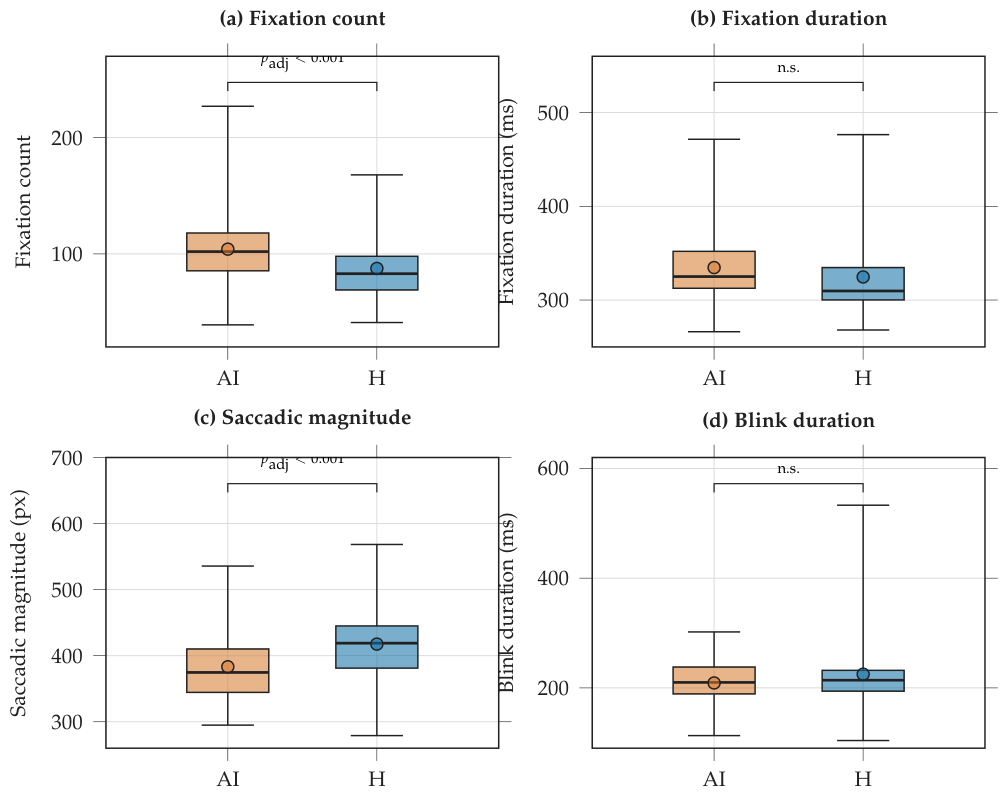
Figure 5.
Distributions of the eye-tracking metrics for hybrid HAI (teal) and human-created (blue) advertisements: (a) fixation count, (b) fixation duration, (c) saccadic magnitude, (d) blink duration. Conventions and axis ranges are identical to Figure 4. Brackets give the Holm-adjusted p-value from Table 4. participants.
Figure 5.
Distributions of the eye-tracking metrics for hybrid HAI (teal) and human-created (blue) advertisements: (a) fixation count, (b) fixation duration, (c) saccadic magnitude, (d) blink duration. Conventions and axis ranges are identical to Figure 4. Brackets give the Holm-adjusted p-value from Table 4. participants.
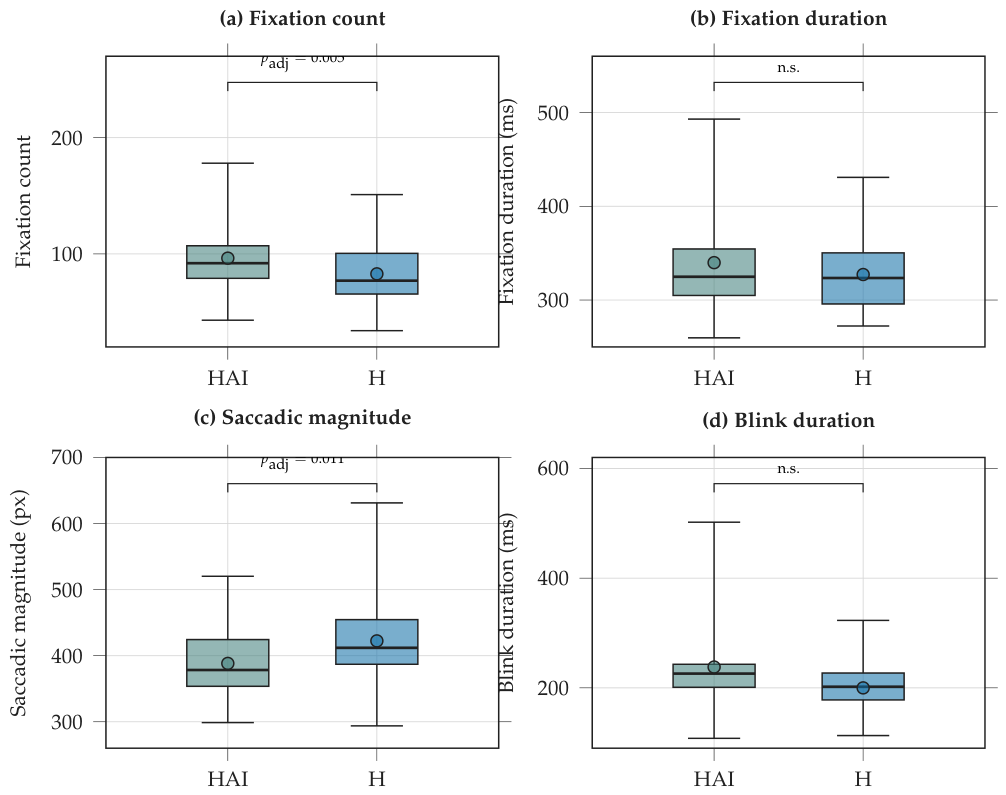

Table 1.
Descriptive profile and behavioral characterization of the study sample (). Items measured on a 5-point Likert scale (1 = Strongly Disagree to 5 = Strongly Agree) were dichotomized by reporting the proportion of participants selecting top-box responses (4 = Agree or 5 = Strongly Agree), except where specific behavioral criteria are noted.
Table 1.
Descriptive profile and behavioral characterization of the study sample (). Items measured on a 5-point Likert scale (1 = Strongly Disagree to 5 = Strongly Agree) were dichotomized by reporting the proportion of participants selecting top-box responses (4 = Agree or 5 = Strongly Agree), except where specific behavioral criteria are noted.
| Dimension | Metric / Behavioral Indicator | (%) | |
|---|---|---|---|
| Digital Engagement | Social media usage ( hours/day) | 31/39 | 79.5% |
| Marketing | Strong interest in marketing | 15/39 | 38.5% |
| Purchases influenced by visual quality | 17/39 | 43.6% | |
| AI Experience | Frequent use of generative AI tools | 36/39 | 92.3% |
| Prior engagement with AI image creation/editing | 36/39 | 92.3% | |
| AI Perceptions | Belief that AI matches human creativity | 20/39 | 51.3% |
| Perception of AI visuals as less authentic | 22/39 | 56.4% | |
| Expectation of mandatory AI disclosure by brands | 27/39 | 69.2% |
1 Indicates items originally measured on a 5-point Likert scale, reported as the percentage of top-box respondents (4 or 5).
Table 2.
Behavioral results synthesis for the forced-choice decision tasks ( total trials; per contrast).
Table 2.
Behavioral results synthesis for the forced-choice decision tasks ( total trials; per contrast).
| Human vs. AI | Human vs. HAI | |||
|---|---|---|---|---|
| Metric / Variable | Human | AI | Human | Hybrid (HAI) |
| Choice Preference (%) | 41.03% | 58.97% | 50.12% | 49.88% |
| Odds Ratio (OR) | — | 1.44 | 1.01 | — |
| 95% Confidence Interval | — | [1.15, 1.80] | [0.71, 1.39] | — |
| p-value | 0.0015 | 0.978 | ||
| Response Time (ms) | ||||
| Mean ± SD | 5658.9 ± 3101.9 | 5524.6 ± 2992.0 | 5216.8 ± 2868.8 | 5212.6 ± 3206.2 |
| Median | 4959.5 | 4806 | 4458 | 4467 |
| IQR (–) | 4050.25 | 3318.5 | 3115 | 3362.25 |
Table 3.
Comparison of eye-tracking metrics between AI-generated and human-created advertisements. Values are mean ± SD. is the Holm-adjusted p-value across all 14 tests reported in Section 4.2.
Table 3.
Comparison of eye-tracking metrics between AI-generated and human-created advertisements. Values are mean ± SD. is the Holm-adjusted p-value across all 14 tests reported in Section 4.2.
| Metric | AI-generated | Human-created | Mean Diff [95% CI] | F | df | p | ||
|---|---|---|---|---|---|---|---|---|
| FD (ms) | 334.69 ± 41.21 | 324.66 ± 43.90 | 10.03 [-0.10, 20.15] | 4.02 | 1, 38 | 0.052 | 0.416 | 0.096 |
| FC | 104.13 ± 32.66 | 87.56 ± 26.50 | 16.57 [10.84, 22.30] | 34.26 | 1, 38 | 0.474 | ||
| TTFF (ms) | 795.98 ± 588.38 | 769.89 ± 403.17 | 26.09 [-173.5, 225.7] | 0.07 | 1, 38 | 0.792 | 1.000 | 0.002 |
| Saccade (px) | 383.36 ± 52.80 | 417.63 ± 61.93 | -34.27 [-45.97, -22.57] | 35.18 | 1, 38 | 0.481 | ||
| Blink (ms)a | 209.00 ± 42.94 | 225.00 ± 69.42 | -16.00 [-33.65, 1.65] | 3.40 | 1, 33 | 0.075 | 0.525 | 0.093 |
| Pupil left (px) | 23.22 ± 4.29 | 23.32 ± 4.31 | -0.10 [-0.25, 0.05] | 1.82 | 1, 38 | 0.185 | 1.000 | 0.046 |
| Pupil right (px) | 22.91 ± 4.46 | 22.89 ± 4.57 | 0.02 [-0.18, 0.22] | 0.04 | 1, 38 | 0.842 | 1.000 | 0.001 |
| a Reduced degrees of freedom () reflect 5 participants without valid blink detection during data filtering. | ||||||||
Table 4.
Comparison of eye-tracking metrics between HAI co-created and human-created advertisements. . Values are mean ± SD. is the Holm-adjusted p-value across all 14 tests reported in Section 4.2.
Table 4.
Comparison of eye-tracking metrics between HAI co-created and human-created advertisements. . Values are mean ± SD. is the Holm-adjusted p-value across all 14 tests reported in Section 4.2.
| Metric | HAI co-created | Human-created | Mean Diff [95% CI] | F | df | p | ||
|---|---|---|---|---|---|---|---|---|
| FD (ms) | 339.92 ± 52.24 | 327.25 ± 38.14 | 12.67 [1.09, 24.25] | 4.91 | 1, 38 | 0.033 | 0.297 | 0.114 |
| FC | 96.38 ± 29.15 | 82.87 ± 27.37 | 13.51 [6.54, 20.48] | 15.39 | 1, 38 | 0.005 | 0.288 | |
| TTFF (ms) | 732.26 ± 337.97 | 732.13 ± 404.93 | 0.13 [-119.5, 119.7] | 1, 38 | 0.998 | 1.000 | ||
| Saccade (px) | 388.36 ± 49.81 | 422.44 ± 63.99 | -34.08 [-53.33, -14.83] | 12.84 | 1, 38 | 0.001 | 0.011 | 0.253 |
| Blink (ms) | 238.00 ± 81.29 | 200.00 ± 40.86 | 38.00 [8.76, 67.24] | 6.92 | 1, 38 | 0.013 | 0.130 | 0.154 |
| Pupil left (px) | 23.10 ± 4.46 | 23.10 ± 4.32 | 0.00 [0, 0] | 0.004 | 1, 38 | 0.951 | 1.000 | |
| Pupil right (px) | 22.83 ± 4.70 | 22.80 ± 4.63 | 0.03 [-0.11, 0.17] | 0.18 | 1, 38 | 0.675 | 1.000 | 0.005 |
Disclaimer/Publisher’s Note: The statements, opinions and data contained in all publications are solely those of the individual author(s) and contributor(s) and not of MDPI and/or the editor(s). MDPI and/or the editor(s) disclaim responsibility for any injury to people or property resulting from any ideas, methods, instructions or products referred to in the content. |
© 2026 by the authors. Licensee MDPI, Basel, Switzerland. This article is an open access article distributed under the terms and conditions of the Creative Commons Attribution (CC BY) license (http://creativecommons.org/licenses/by/4.0/).
Copyright: This open access article is published under a Creative Commons CC BY 4.0 license, which permit the free download, distribution, and reuse, provided that the author and preprint are cited in any reuse.