

Submitted:
08 September 2026
Posted:
09 September 2026
You are already at the latest version
Abstract
Digital representations of patients are discussed as digital twins, digital patients, virtual patients, and in silico patients, but labels do not disclose what a system represents, how it changes, or whether it is credible for use. We conducted a systematic overview of reviews (meta-review), with reporting guided by PRISMA 2020. Web of Science, PubMed, IEEE Xplore, and Google Scholar were searched for English-language structured reviews published from 2020 through October 2025, with supplementary reference-list and preprint searches. Two reviewers independently screened titles and abstracts for each record in CADIMA; one reviewer completed standardized extraction, and a second verified it; findings were synthesized descriptively. This focused terminology analysis used the resulting evidence map of 61 unique reviews and was specified after its assembly as a reporting amendment. We distinguish three concepts that must not imply one another: construct identity (the label), operational profile (what is represented and how it is configured), and credibility (evidence of fitness for a stated purpose). Four non-exclusive, non-ordered dimensions form the operational profile: represented subject and biological scale, patient specificity, temporality or update pattern, and the physical–digital information pathway. Digital twin was the primary term in 46 reviews (75.4%), but its reported configurations varied. Individual specificity appeared in 55 reviews, dynamic or continuous orientation in 53, bidirectional coupling in 26, explicitly static constructs in 15, and one-way coupling in 39. Twenty-five reviews co-reported individual specificity, dynamic or continuous orientation, and bidirectional coupling. We propose a six-question reporting grammar that targets operational profile in the first four questions, the intended decision in the fifth, and credibility evidence in the sixth question collectively providing a complete picture of the state of the digital patient framework.
Keywords:
digital patient
; digital twin
; human digital twin
; virtual patient
; operational profile
; terminology
; reporting guidance
; systematic meta-review
1. Introduction
Digital representations of health and disease support physiological simulation, clinical prediction, education, surgical planning, and in silico experimentation. The same broad family is described as digital twins (DTs), patient or human digital twins, digital patients (DPs), virtual patients, synthetic patients, avatars, and in silico patients or trials. These terms have intersected histories, but they do not specify equivalent relationships with a physical person. A virtual patient may be a teaching case; an in silico patient may be one member of a simulated cohort; and a detailed patient-specific model may never be updated after acquisition. Treating these configurations as less complete versions of a twin mistakes difference for deficiency and obscures their intended functions [1,2,3,4,5].
Three concepts are therefore separated throughout this paper. Construct identity is the label an author uses and locates a system within a discourse. An operational profile describes the represented subject and scale, patient specificity, temporality or update pattern, and physical–digital information pathway. Credibility concerns whether evidence supports fitness for a stated purpose. A DT label does not establish a particular operational profile; a particular profile does not establish credibility; and credibility for one purpose does not determine construct identity. In short, labels identify discourse, profiles describe systems, and credibility supports claims for use.
The 2024 National Academies framework is a valuable reference specification. It describes a DT as a virtual representation of a physical counterpart that is dynamically updated with data, makes predictions, informs value-producing decisions, and is connected through bidirectional interaction [6]. We use that specification to make attributes explicit, not as the sole valid definition of a useful medical DP and not as an inclusion threshold. In healthcare, a meaningful update may occur at an image, laboratory panel, or clinical encounter, and a return pathway may be mediated by a clinician rather than an actuator. The framework itself relates update frequency to the decision task [6,7]. A static patient-specific planning model, a one-way monitoring system, and an educational virtual patient may all be useful without satisfying that DT specification.
Existing reviews have organized systems by biological hierarchy, application, data flow, or maturity [1,3,8,9].Those schemes can answer the questions for which they were designed. Used as a universal ladder, however, they can conflate what is represented, how a system is configured, what it is used for, and how well its claims are supported. Medical DPs require a description that keeps these matters separate. The historical Digital Patient program was itself broader than a synchronized replica, joining multiscale models, data resources, interfaces, and decision support [10]. That breadth supports a family-level concept with explicit operational profiles rather than a label-based hierarchy.
This systematic meta-review asks: which labels identify DP constructs in reviews; how the four profile dimensions are reported and combined; how review-level appraisal relates to those descriptions; and what minimum reporting would let authors, reviewers, funders, and standards initiatives compare systems without inferring configuration or quality from a name. The aim is not to decide which systems are or are not DTs or DPs. It is to provide a practical research and reporting framework for stating what a system is and what evidence supports its intended use.
2. Methods
2.1. Evidence-Map Provenance and Protocol Status
The present systematic meta-review draws on the search, screening, eligibility assessment, data extraction, duplicate resolution, and review-level appraisal conducted under a protocol registered in PROSPERO (CRD420261458411). While companion reports evaluate computational pipeline readiness and sociotechnical clinical adoption, this manuscript focuses exclusively on the lexical evolution, taxonomy, and conceptual framing of digital patient representations. It provides a focused synthesis of terminology, operational profiles, and reporting guidance within the protocol-defined scope. The analytical framework was finalized after assembly of the evidence map and before manuscript submission, with its methods documented in Appendix S1. Reporting was guided by PRISMA 2020 [11,12].
The evidence-map plan included English-language reviews published from 2020 onward that addressed patient-linked physiological, biomechanical, biological, or adjacent computational representations. Web of Science, PubMed, IEEE Xplore, and Google Scholar were searched, with reference-list and designated preprint-server supplementation. The search was conducted in October 2025; no later search was incorporated, making October 2025 the evidence cut-off.
Of 247 reports assessed for eligibility, 183 were excluded and 64 entered extraction (Figure 1). Bibliographic reconciliation then removed three duplicate reports before stable identifiers P01–P61 were assigned (Table 7), leaving 61 unique reviews. Records were managed and screened in CADIMA. Data were extracted using a standardized CADIMA form aligned with the protocol-defined research questions. The identifier-to-citation and review-appraisal lookup is provided in Supplementary Appendix S3.
2.2. Analytical Layers
Three distinct components: construct identity, operational profile, and credibility evidence; were analyzed independently, and none was inferred from or used as a proxy for another.
2.2.1. Construct Identity
Primary terminology was assigned by a documented precedence rule using title, related construct, and definition fields. Phrase-aware filters removed null and negated statements, and a small set of contrastive expressions received documented manual overrides. Construct identity records the terminology a review used for its subject; it does not characterize the system’s configuration or quality.
2.2.2. Operational Profile
Four dimensions were coded non-exclusively from the relevant standardized extraction fields. They answer four independent descriptive questions:
- □
- Represented subject and biological scale: What is represented? Molecular or cellular, tissue, organ or physiological system, person or whole body, population, and system or other. Broader biological coverage was not treated as better than narrower coverage.
- □
- Patient specificity: Whose model is it? Generic, archetypal, or population-based representation versus a model initialized or calibrated with data from one person. A review could contain both, and individual specificity was not treated as inherently preferable.
- □
- Temporality or update pattern: How does it change? Explicitly static versus dynamic, longitudinal, episodic, continuous, or real time. Simulating change was not assumed to mean that new patient observations were assimilated during operation, and faster updating was not treated as progress.
- □
- Coupling or physical–digital information pathway: How does information cross the boundary? None or manual transfer, one-way transfer from person to model, or review-described bidirectional exchange. A recommendation returned through a clinician counted as a return pathway but not as automated control. Bidirectionality was not treated as proof of usefulness or credibility.
Initial term and profile assignments were generated using documented, phrase-aware rules applied to the standardized extraction fields. The rules removed null and negated statements, and documented overrides addressed explicit contrastive expressions. All record-level assignments for construct identity and the four operational-profile dimensions were then manually verified across the 61-review cohort against the extracted evidence, with ambiguous cases adjudicated. Only the verified classifications were used in the reported counts, combinations, tables, and figures.
For descriptive comparison only, we examined review-level co-reporting of individual specificity, dynamic or continuous orientation, and bidirectional coupling. This exploratory three-facet overlap is not a DT definition, a DP threshold, a maturity category, or evidence that one primary implementation contained all three attributes. The extraction unit was the review, and a review could describe several system classes.
Intended decision was not retrofitted as a fifth profile dimension. We distinguish clinical decision-making (CDM), concerning direct care such as diagnosis, testing, or treatment, from operational decision-making (ODM), concerning delivery-system decisions such as waiting times, staffing, beds, or revenue [13]. The extraction form did not support reliable retrospective counts for this distinction. Purpose therefore appears as a reporting requirement, not a numerical result. Credibility evidence is likewise required for interpretation but remains outside the four-dimension profile.
2.2.3. Credibility
AMSTAR 2 was used where appropriate for systematic reviews and SANRA for structured narrative reviews; CADIMA-aligned criteria provided additional review-level context [14,15]. Review-method appraisal and whether source reviews appraised their included evidence were displayed separately. These measures inform confidence in the evidence provided in the review and do not establish the credibility of every system described in the record.
2.3. Synthesis Safeguards
Our synthesis was strictly descriptive. Counts reflect reviews rather than primary studies; categories are non-exclusive, and primary-study overlap was not estimated. Co-reporting within a single review cannot justify system-level inferences. Rather than forcing reviews into mutually exclusive classes, the radial evidence matrix shown in Figure 2 retained all positive values across categories.
3. Results
3.1. Construct Identity: One Dominant Label, Variable Descriptions
Digital twin was the primary term in 46 reviews (75.4%). Patient digital twin, human digital twin, and virtual patient each led four reviews (6.6% apiece); in silico patient or trial led three (4.9%). The numerical dominance of one label did not produce one operational definition.
Boundary cases show what the labels leave unstated. John et al [8]. (P17) separated digital models, shadows, and twins according to data flow. Pradíes et al [16]. (P21) described a patient-specific dental virtual patient with captured jaw motion but did not report longitudinal synchronization with the person. Karaduman et al [4]. (P57) examined interactive virtual-patient simulations designed for learning rather than for mirroring one person’s changing state [17]. Tudor et al [2]. (P31) applied personalization, dynamic updating, and clinical decision support criteria to 149 primary studies; 18 (12.1%) met all three criteria, 17 through a human-mediated return and one through automatic action on the physical system. These examples describe different configurations and purposes, not successively better instances of one object.
3.2. Operational Profile: Four Dimensions That Did Not Move Together
Represented subject and biological scale. Organ or physiological-system scale appeared in 44 reviews, person or body scale in 43, population scale in 17, molecular or cellular scale in 14, tissue scale in 12, and system or other scale in six.
Patient specificity. Individual specificity appeared in 55 reviews (90.2%), while generic, archetypal, or population representations appeared in 29 (47.5%).
Temporality or update pattern. Dynamic or continuous orientation appeared in 53 reviews (86.9%), and explicitly static constructs appeared in 15 (24.6%).
Coupling or physical–digital information pathway. One-way coupling was reported in 39 reviews (63.9%), bidirectional coupling in 26 (42.6%), and none or manual exchange in 13 (21.3%).
Characteristics and safeguards of the included evidence base are summarized in Table 1, and the construct-identity and operational-profile findings are summarized in Table 2.
Overlaps within each dimension were expected because one review could include several model classes. Across the three attributes used in the exploratory overlap, the largest combinations were individual-specific plus dynamic or continuous plus bidirectional (25 reviews) and individual-specific plus dynamic or continuous without bidirectional coupling (23). Six reviews described individual-specific constructs without either dynamic orientation or bidirectionality; five described dynamic orientation without individual specificity or bidirectionality. One review combined individual specificity and bidirectional coupling without a dynamic or continuous orientation; one reported none of the three attributes. No review reported bidirectional coupling without individual specificity. These combinations describe review-level reporting patterns. Figure 2 displays operational-profile information and review appraisal together for comparison while keeping them conceptually separate.
3.3. Exploratory Overlap and Evidence Appraisal
Twenty-five reviews (41.0%) co-reported individual specificity, dynamic or continuous orientation, and bidirectional coupling. Their primary terms were digital twin in 20, patient digital twin in three, and human digital twin in two. No virtual-patient or in silico primary-term record overlapped. That pattern describes discourse review only. It does not estimate the number of implemented DTs, show that all three features occurred together in one system, or establish that the overlap defines a DT.
More granular reviews reinforce the need for separate dimensions. Drummond et al [1]. (P12) identified 80 claimed patient digital twins and reported one-way patient-to-model flow for 58, two-way flow for nine, and, among 64 patient-specific models, 44 static and 20 dynamic configurations. The effect of definitional boundaries was especially visible in dermatology: Akbarialiabad et al [18]. (P03) screened 157 records but found no implementation that satisfied their bounded definition. Vallée et al [19]. (P44) used individual initialization, updating, and counterfactual simulation to distinguish included from borderline systems. These reviews were used to expose differences among definitions and dimensions, not to endorse a particular threshold. Usable review-method appraisal was available for 39/61 reviews (63.9%) and 17/25 reviews (68.0%) in the exploratory overlap. By primary term, appraisal was available for 30/46 digital-twin reviews, 2/4 patient-digital-twin reviews, 3/4 human-digital-twin reviews, 3/4 virtual-patient reviews, and 1/3 in silico reviews. Only three of the 25 reviews in the exploratory overlap formally appraised their included primary evidence. Construct identity did not determine a single operational profile, and neither construct identity nor operational profile certified credibility.
4. A Six-Question Reporting Grammar
The practical response to unstable terminology is not to ban labels but to reduce the information they are expected to carry. The six-question grammar has two explicitly different parts. Questions 1–4 report on the four dimensions of the operational profile. Questions 5–6 state the purpose of the decision and credibility evidence needed to interpret that profile. The latter are reporting requirements, not additional profile dimensions. The complete grammar and the inferences each question is intended to prevent are summarized in Table 3. The grammar is informed by DT and model-credibility guidance [6,20,21].
4.1. Part A: Four Operational-Profile Questions
- What is represented? Name the physical or conceptual subject and its biological or service-system scale.
- Whose model is it? State whether it is generic, population-based, stratified, or initialized or calibrated to one person.
- How does it change? Report whether it is static or updated episodically, longitudinally, continuously, or in real time, including the trigger and cadence.
- How does information cross the boundary? Describe manual, one-way, or bidirectional flow and whether any return path is clinician-mediated or automated.
4.2. Part B: Two Requirements for Interpreting the Profile
- 5.
- What decision does it serve? Name the intended user, action, and whether the purpose is CDM, ODM, both, or neither.
- 6.
- Why should it be trusted for that purpose? Report the evidence of fitness for the stated use, including uncertainty, limitations, and performance monitoring.
For the fifth question, a model that forecasts tumor growth to compare treatments serves CDM; one that forecasts patient flow to allocate beds or staff serves ODM. A platform may support both, but each decision and user should be stated because predictive accuracy alone does not establish clinical benefit or operational value [13]. The sixth question is purpose-dependent: evidence supporting education, one-time planning, or cohort experimentation may differ from evidence required for a patient-specific clinical recommendation.
The grammar is deliberately label-agnostic. A static patient-specific anatomical model can be appropriate for one-time planning. A generic educational virtual patient can suit a defined learning objective. A one-way monitoring representation can support surveillance, and a clinician-mediated return pathway can support care without automatic actuation. A virtual cohort can support an in silico experiment without maintaining a persistent counterpart. Conversely, bidirectional real-time coupling does not by itself show that a system is accurate, safe, useful, or credible. Each system should be described by its four-dimensional profile and judged against its own stated purpose.
5. Discussion
5.1. Labels Identify Discourse; Profiles Describe Systems; Credibility Supports Claims
The principal finding is not merely that terminology is inconsistent. Rather, labels, configurations, and evidentiary support are different analytical objects. Represented subject and scale, patient specificity, temporality, and coupling answered different questions and did not move together across reviews. Purpose then specifies what the system is meant to do, while credibility concerns whether the evidence supports that claim for use. Keeping these layers separate prevents identity from being mistaken for quality and prevents a technically elaborate configuration from being mistaken for demonstrated value.
The distinction also preserves the diversity of constructs across the DP spectrum of definitions. A virtual patient can be assessed for learning validity when education is the purpose; a virtual cohort for representativeness and experimental purpose; a static surgical model for anatomical and decision fitness; and a one-way or clinician-mediated system for the task and safeguards actually intended. None is a failed or lesser DP because it lacks a feature required by one DT definition. Nor is a system more legitimate merely because it is individualized, continuously updated, or bidirectionally coupled.
Primary studies outside the review corpus illustrate how the grammar could sharpen interpretation of implemented systems. For a patient-specific pulmonary-artery DT and a simulation-trained coronary surrogate, explicit reporting would distinguish calibration and update cadence from computationally real-time prediction and clarify whether a physical–digital return pathway was implemented in the study or proposed as a future capability [22,23]. A physics-generated virtual aneurysm cohort further illustrates why simulated temporal evolution, cohort generation, and subsequent individualization should be reported separately rather than inferred from the word “virtual.”[24]
5.2. Why an Operational Profile Is Preferable to a Universal Hierarchy
Hierarchy-, application-, data-flow-, and maturity-based schemes in the cited literature make important differences visible [1,3,8,9]. The problem arises when their categories are interpreted across a single continuum of completeness. Biological scale concerns the represented subject, not sophistication. Application concerns purpose, not configuration. Data flow concerns coupling, not usefulness. A maturity designation may bundle several such judgments, but it cannot substitute for purpose-specific credibility evidence.
The operational-profile approach is therefore better suited to the heterogeneous medical DP literature. It permits more precise comparison without requiring a universal boundary around DT or DP. A molecular model and a whole-body representation can be compared on scale without treating one as superior; a static and a continuously updated system can be compared on temporality without assuming the latter is more useful; and clinician-mediated and automated return pathways can be reported without treating automation as having greater legitimacy. The National Academies definition remains a clear specification for systems intended to meet it, but it is neither the sole vocabulary for medical DPs nor a criterion for whether other configurations can provide value [6].
5.3. Practical Use and Future Development
This framework is intended as a foundation, not a gate. Authors can place the six answers in abstracts, methods, or structured model cards. Reviewers can use them to identify claims that depend on an unstated update cadence, personalization method, or return pathway. Funding agencies can require applicants to state the intended decision and purpose-matched evidence without demanding a preferred label or configuration. Standards initiatives can turn the questions into controlled fields, examples, and conformance checks for reporting completeness while explicitly avoiding a feature-count score. Future DP toolkits can represent the four profile dimensions as separate metadata fields and link each intended use to its own credibility record.
Prospective work should test inter-rater reliability, refine response options with primary-study authors and users, and evaluate whether the grammar improves study selection, reproducibility, and claim appraisal. Such testing may support extensions, but purpose and credibility should remain outside the four-dimension profile so that descriptive configuration is not converted into a ranking system.
5.4. Limitations
The current study included 61 unique reviews after bibliographic duplicate resolution, with stable identifiers assigned after deduplication. The record-level constructs classifications were generated using documented rules and manually verified across the whole cohort, with ambiguous cases adjudicated against the extracted evidence. Categories were coded non-exclusively, and review appraisal was kept separate from construct identity and operational profile. The radial display (Figure 2) retains ambiguity rather than hiding it in a forced class. The unit of analysis, however, was a review, and overlap among underlying primary studies was not quantified. A review-level combination may aggregate attributes from different systems; co-reporting does not warrant system-level inference. Manual verification established what each source review reported, but the source descriptions did not always distinguish simulated dynamics, episodic recalibration, online state estimation, and continuous operation. Similarly, review-described bidirectionality could include either a human-mediated recommendation or an automatic actuation. Intended decision was not a separate countable extraction field. Appraisal methods were heterogeneous and unavailable for many reviews, and only 11/61 source reviews formally assessed their included evidence.
The reporting grammar is a practical conceptual framework, not a validated ontology, taxonomy score, maturity model, readiness level, or classification threshold. Its categories describe what was reported; they do not decide which systems deserve the DT or DP label.
6. Conclusions
This systematic meta-review proposes a practical way to describe medical digital representations without turning terminology into a hierarchy. Construct identity records the label used. The operational profile reports four separate dimensions: represented subject and biological scale, patient specificity, temporality or update pattern, and coupling or physical–digital information pathway. Intended decision states the claim for use, and credibility evidence supports or limits that claim. The six-question grammar reports these elements but does not score them. A static, generic, one-way, or clinician-mediated system can be the right system for its purpose, just as a continuously updated bidirectional system can lack adequate evidence for its own. Labels identify discourse; profiles describe systems; credibility supports claims for use.
Supplementary Materials
The following supporting information can be downloaded at the website of this paper posted on Preprints.org.
Author Contributions
Arash Ghorbannia, Ph.D., led conceptualization, methodology, analysis, visualization, and manuscript drafting. Arash Ghorbannia, Ph.D., Mark Scerbo, Ph.D., Taryn T. Cuper, MS, April Pace, DHSc, Faryaneh Poursardar, Ph.D., Jae H. Lee, Ph.D., and Megan Witherow, Ph.D., conducted title-and-abstract screening, full-text screening, and contributed to data extraction. Ginger Watson, Ph.D., and Charles Combs, Ph.D., provided project leadership and supervision. All authors contributed to interpretation and critical revision of the manuscript and approved the final version.
Funding
This work was supported by the Virginia Innovation Partnership Authority of the Commonwealth of Virginia and Old Dominion University’s National Center for Collaboration in Medical Modeling and Simulation.
Ethics Approval
Not applicable; this study synthesized published reviews.
Data Availability and Evidence-Map Provenance
Copyrighted full texts and the source extraction workbook remain local and are not publicly redistributed. The cohort and review process originated in a broader evidence-map exercise and were reused here to avoid duplicate searching, screening, and extraction.
Conflicts of Interest
The authors declare no conflicts of interest.
Protocol and Registration
The present systematic meta-review draws on the search, screening, eligibility assessment, data extraction, duplicate resolution, and review-level appraisal conducted under a protocol registered in PROSPERO (CRD420261458411).
References
- Drummond, D.; Gonsard, A. Definitions and Characteristics of Patient Digital Twins Being Developed for Clinical Use: Scoping Review. J. Med. Internet Res. 2024, 26, e58504. [Google Scholar] [CrossRef] [PubMed]
- Tudor, B. H.; et al. A scoping review of human digital twins in healthcare applications and usage patterns. npj Digit Med. 2025, 8, 587. [Google Scholar] [CrossRef] [PubMed]
- Maïzi, Y.; Arcand, A.; Bendavid, Y. Digital twin in healthcare: Classification and typology of models based on hierarchy, application, and maturity. Internet Things 2024, 28, 101379. [Google Scholar] [CrossRef]
- Karaduman, G.; Basak, T. Virtual Patient Simulations in Nursing Education: A Descriptive Systematic Review. Simul. GAMING 2024, 55, 159–179. [Google Scholar] [CrossRef]
- Pappalardo, F.; Russo, G.; Musuamba Tshinanu, F.; Viceconti, M. In silico clinical trials: concepts and early adoptions. Brief. Bioinform. 2019, 20, 1699–1708. [Google Scholar] [CrossRef] [PubMed]
- National Academies of Sciences; Engineering; and Medicine. Foundational Research Gaps and Future Directions for Digital Twins; The National Academies Press: Washington, DC, 2024. [Google Scholar] [CrossRef] [PubMed]
- Corral-Acero, J.; others. The “Digital Twin” to enable the vision of precision cardiology. Eur. Heart J. 2020, 41, 4556–4564. [Google Scholar] [CrossRef] [PubMed]
- John, A.; Alhajj, R.; Rokne, J. A systematic review of AI as a digital twin for prostate cancer care. Comput Methods Programs BioMed 2025, 268, 108804. [Google Scholar] [CrossRef] [PubMed]
- Pellegrino, G.; Gervasi, M.; Angelelli, M.; Corallo, A. A Conceptual Framework for Digital Twin in Healthcare: Evidence from a Systematic Meta-Review. Inf. Syst. Front. 2024, 27, 7–32. [Google Scholar] [CrossRef]
- Combs, C. D.; Sokolowski, J. A.; Banks, C. M. The Digital Patient: Advancing Healthcare, Research, and Education; John Wiley & Sons, 2015. [Google Scholar]
- Page, M. J.; et al. The PRISMA 2020 statement: an updated guideline for reporting systematic reviews. BMJ 2021, 372, n71. [Google Scholar] [CrossRef] [PubMed]
- Gates, M.; et al. Reporting guideline for overviews of reviews of healthcare interventions: development of the PRIOR statement. BMJ 2022, 378, e070849. [Google Scholar] [CrossRef] [PubMed]
- Riahi, V.; Diouf, I.; Khanna, S.; Boyle, J.; Hassanzadeh, H. Digital Twins for Clinical and Operational Decision-Making: Scoping Review. J. Med. Internet Res. 2025, 27, e55015. [Google Scholar] [CrossRef] [PubMed]
- Shea, B. J.; et al. AMSTAR 2: a critical appraisal tool for systematic reviews that include randomised or non-randomised studies of healthcare interventions, or both. BMJ 2017, 358, j4008. [Google Scholar] [CrossRef] [PubMed]
- Baethge, C.; Goldbeck-Wood, S.; Mertens, S. SANRA—a scale for the quality assessment of narrative review articles. Res. Integr. Peer Rev. 2019, 4, 5. [Google Scholar] [CrossRef] [PubMed]
- Pradíes, G.; García-Naranjo, A. M.; Martínez-Rus, F.; Martínez de Fuentes, R.; Romeo-Rubio, M. EPA Consensus Project Paper: Shifting from the ‘Analogic Virtual Patient’ to the ‘Digital Virtual Patient’ in Prosthodontics. A Scoping Review. Eur. J. Prosthodont Restor. Dent. 2023. [Google Scholar] [CrossRef]
- Lioce, L.; et al. Healthcare Simulation Dictionary; 2020. [Google Scholar] [CrossRef]
- Akbarialiabad, H.; Pasdar, A.; Murrell, D. F. Digital twins in dermatology, current status, and the road ahead. npj Digit Med. 2024, 7, 228. [Google Scholar] [CrossRef] [PubMed]
- Vallée, A.; Moawad, G.; Feki, A.; Ayoubi, J.-M. Digital twins in fertility, assisted reproductive technology and pregnancy: a systematic review. Reprod. Biomed. Online 2026, 52, 105281. [Google Scholar] [CrossRef] [PubMed]
- Engineers, A. S. of M. Assessing Credibility of Computational Modeling through Verification and Validation: Application to Medical Devices; 2018. [Google Scholar]
- Food, U. S.; Administration, D. Assessing the Credibility of Computational Modeling and Simulation in Medical Device Submissions: Guidance for Industry and Food and Drug Administration Staff; 2023. [Google Scholar]
- Geddes, J. R.; et al. Digital twins for noninvasively measuring predictive markers of right heart failure. npj Digit. Med. 2025, 8, 545. [Google Scholar] [CrossRef] [PubMed]
- Ghorbannia, A.; et al. Simulation-based machine learning for real-time assessment of side-branch hemodynamics in coronary bifurcation lesions. Int. J. High Perform. Comput. Appl. 2025, 10943420251351125. [Google Scholar] [CrossRef] [PubMed]
- Jahani, F.; Jiang, Z.; Nabaei, M.; Baek, S. Generation of virtual abdominal aortic aneurysm shape evolution using a physics-based G&R model and its applications to aneurysm growth prediction. Comput. Biol. Med. 2026, 208, 111661. [Google Scholar] [CrossRef] [PubMed]
- Editors, I. C. of M. J. Overlapping publications and manuscripts based on the same database. 2026.
- AboArab, M. A.; Potsika, V. T.; Pleouras, D. S.; Fotiadis, D. I. Computational modeling of drug-eluting balloons in peripheral artery disease: Mechanisms, optimization, and translational insights. Comput Struct. Biotechnol. J. 2025, 27, 3640–3653. [Google Scholar] [CrossRef] [PubMed]
- Adibi, S.; Rajabifard, A.; Shojaei, D.; Wickramasinghe, N. Enhancing Healthcare through Sensor-Enabled Digital Twins in Smart Environments: A Comprehensive Analysis. Sens. Basel 2024, 24. [Google Scholar] [CrossRef] [PubMed]
- Banoub, R. G.; et al. Enhancing Ophthalmic Care: The Transformative Potential of Digital Twins in Healthcare. Cureus 2024, 16, e76209. [Google Scholar] [CrossRef] [PubMed]
- Bartusik-Aebisher, D.; Rogóż, K.; Aebisher, D. Artificial Intelligence and ECG: A New Frontier in Cardiac Diagnostics and Prevention. Biomedicines 2025, 13. [Google Scholar] [CrossRef] [PubMed]
- Cappon, G.; Facchinetti, A. Digital Twins in Type 1 Diabetes: A Systematic Review. J. Diabetes Sci. Technol. 2024, 19322968241262112. [Google Scholar] [CrossRef] [PubMed]
- Chaparro-Cárdenas, S. L.; et al. A Technological Review of Digital Twins and Artificial Intelligence for Personalized and Predictive Healthcare. Healthc. Basel 2025, 13. [Google Scholar] [CrossRef] [PubMed]
- Chumnanvej, S.; Tripathi, S. Assessing the benefits of digital twins in neurosurgery: a systematic review. Neurosurg. Rev. 2024, 47, 52. [Google Scholar] [CrossRef] [PubMed]
- Coorey, G.; et al. The health digital twin to tackle cardiovascular disease-a review of an emerging interdisciplinary field. npj Digit Med. 2022, 5, 126. [Google Scholar] [CrossRef] [PubMed]
- D’Orsi, L.; et al. Recent Advances in Artificial Intelligence to Improve Immunotherapy and the Use of Digital Twins to Identify Prognosis of Patients with Solid Tumors. Int. J. Mol. Sci. 2024, 25. [Google Scholar] [CrossRef] [PubMed]
- de Oliveira El-Warrak, L.; Miceli de Farias, C. Could digital twins be the next revolution in healthcare? Eur. J. Public Health 2025, 35, 19–25. [Google Scholar] [CrossRef] [PubMed]
- Espinoza-Vinces, C.; et al. Artificial intelligence in headache medicine: between automation and the doctor-patient relationship. A systematic review. J. Headache Pain 2025, 26, 192. [Google Scholar] [CrossRef] [PubMed]
- Faiella, E.; et al. Digital twins in radiology: A systematic review of applications, challenges, and future perspectives. Eur. J. Radiol. 2025, 189, 112166. [Google Scholar] [CrossRef] [PubMed]
- Gu, D.; et al. Digital Twins in the Field of Nursing: A Literature Review. Comput Inf. Nurs. 2025. [Google Scholar] [CrossRef]
- Huang, Y.; et al. Evolution of digital twins in precision health applications: a scoping review study. Res. Sq. 2024. [Google Scholar] [CrossRef]
- Khan, A.; et al. A Scoping Review of Digital Twins in the Context of the Covid-19 Pandemic. BioMed Eng. Comput Biol. 2022, 13, 11795972221102115. [Google Scholar] [CrossRef] [PubMed]
- Naik, A.; et al. Artificial intelligence and digital twins for the personalised prediction of hypertension risk. Comput Biol. Med. 2025, 196, 110718. [Google Scholar] [CrossRef] [PubMed]
- Pinton, P. Computational models in inflammatory bowel disease. Clin. Transl. Sci. 2022, 15, 824–830. [Google Scholar] [CrossRef] [PubMed]
- Ringeval, M.; Etindele Sosso, F. A.; Cousineau, M.; Paré, G. Advancing Health Care With Digital Twins: Meta-Review of Applications and Implementation Challenges. J. Med. Internet Res. 2025, 27, e69544. [Google Scholar] [CrossRef] [PubMed]
- Rodero, C.; et al. A systematic review of cardiac in-silico clinical trials. Prog. BioMed Eng. Bristol 2023, 5, 032004. [Google Scholar] [CrossRef] [PubMed]
- Seth, I.; et al. Digital Twins Use in Plastic Surgery: A Systematic Review. J. Clin. Med. 2024, 13. [Google Scholar] [CrossRef] [PubMed]
- Shen, M. D.; Chen, S. B.; Ding, X. D. The effectiveness of digital twins in promoting precision health across the entire population: a systematic review. npj Digit Med. 2024, 7, 145. [Google Scholar] [CrossRef] [PubMed]
- Shen, S.; et al. From virtual to reality: innovative practices of digital twins in tumor therapy. J. Transl. Med. 2025, 23, 348. [Google Scholar] [CrossRef] [PubMed]
- Ștefănigă, S. A.; et al. Advancing Precision Oncology with Digital and Virtual Twins: A Scoping Review. Cancers Basel 2024, 16. [Google Scholar] [CrossRef] [PubMed]
- Sun, T.; He, X.; Li, Z. Digital twin in healthcare: Recent updates and challenges. Digit Health 2023, 9, 20552076221149651. [Google Scholar] [CrossRef] [PubMed]
- Tasmurzayev, N.; et al. Digital Cardiovascular Twins, AI Agents, and Sensor Data: A Narrative Review from System Architecture to Proactive Heart Health. Sens. Basel 2025, 25. [Google Scholar] [CrossRef] [PubMed]
- Varrassi, G.; Leoni, M. L. G.; Al-Alwany, A. A.; Sarzi Puttini, P.; Farì, G. Bioengineering Support in the Assessment and Rehabilitation of Low Back Pain. Bioeng. Basel 2025, 12. [Google Scholar] [CrossRef] [PubMed]
- Yuan, Y.; Liu, Q.; Yang, S.; He, W. Four-Dimensional Superimposition Techniques to Compose Dental Dynamic Virtual Patients: A Systematic Review. J. Funct. Biomater. 2023, 14. [Google Scholar] [CrossRef] [PubMed]
- Pascual, H.; Bruin, X. M.; Alonso, A.; Cerdà, J. A Systematic Review on Human Modeling: Digging into Human Digital Twin Implementations. 2023. [Google Scholar] [CrossRef]
- Wickramasinghe, N.; Ulapane, N. Exploring human-based digital twins in healthcare: a scoping review. In Sensor Networks for Smart Hospitals; Elsevier, 2025; pp. 465–476. [Google Scholar] [CrossRef]
- Mahmud, S.; Rahman, A.; Ashrafuzzaman, Md. A Systematic Literature Review on the Role of Digital Health Twins in Preventive Healthcare for Personal and Corporate Wellbeing. Am. J. Interdiscip. Stud. 2022, 3, 1–31. [Google Scholar] [CrossRef]
- Pawar, B.; et al. Artificial Intelligence and Digital Health Twin Applications in Healthcare—A Systematic Review. In Artificial Intelligence in Healthcare ; CRC Press, 2024; pp. 1–25. [Google Scholar] [CrossRef]
- Park, J.; et al. Human Digital Twins for pervasive healthcare: A scoping review. Health Inform. J. 2025, 31. [Google Scholar] [CrossRef] [PubMed]
- Kim, Y.; Oh, S.; Kim, G. Convergence of Integrated Sensing and Communication (ISAC) and Digital-Twin Technologies in Healthcare Systems: A Comprehensive Review. Signals 2025, 6, 51. [Google Scholar] [CrossRef]
- Daraio, C.; Di Leo, S.; Orsini, J. An Integrated and Flexible Review Framework to Evaluate the Evolution and Barriers of Digital-Twin Technologies in Industrial and Healthcare Domains. Glob. J. Flex. Syst. Manag. 2025, 26, 625–648. [Google Scholar] [CrossRef]
- Alshahrani, M. I. M.; et al. The Future of Digital Twins in Personalized Healthcare: A Systematic Review of Applications, Challenges, and Opportunities in Nursing and Radiology. Power Syst. Technol. 2024, 48. [Google Scholar]
- Zou, H.; et al. Digital twins in cardiovascular disease: a scoping review. Int. J. Med. Inf. 2026, 206, 106138. [Google Scholar] [CrossRef] [PubMed]
- Ghosh, T.; Bhattacharjee, D. A Review of Digital Twin-Driven Healthcare: Zero-Error Paradigm and Enhanced Service Quality. 2025. [Google Scholar] [CrossRef]
- Chen, B.; et al. In Silico Clinical Trials in Drug Development: A Systematic Review. Ther. Innov. Regul. Sci. 2025, 60, 423–439. [Google Scholar] [CrossRef] [PubMed]
- Xu, J.; Wang, F. Cardiac Mechano-Electrical-Fluid Interaction: A Brief Review of Recent Advances. Eng 2025, 6, 168. [Google Scholar] [CrossRef]
- Oulefki, A.; Amira, A.; Foufou, S. Digital twins and AI transforming healthcare systems through innovation and data-driven decision making. Health Technol. 2025, 15, 299–321. [Google Scholar] [CrossRef]
- Cellina, M.; et al. Digital Twins: The New Frontier for Personalized Medicine? Appl. Sci. 2023, 13, 7940. [Google Scholar] [CrossRef]
- Garanin, A.; Aidumova, O.; Kontsevaya, A. Clinical aspects of digital twins in medicine: a systematic review. Eur. Phys. J.-Spec. Top. 2025. [Google Scholar] [CrossRef]
- Sasitharasarma, S.; Alani, N. H. S.; Wisker, Z. L. Is the Healthcare Industry Ready for Digital Twins? Examining the Opportunities and Challenges. Future Internet 2025, 17, 386. [Google Scholar] [CrossRef]
- Rudnicka, Z.; Proniewska, K.; Perkins, M.; Pregowska, A. Cardiac Healthcare Digital Twins Supported by Artificial Intelligence-Based Algorithms and Extended Reality-A Systematic Review. ELECTRONICS 2024, 13. [Google Scholar] [CrossRef]
- Bjelland, O.; et al. Toward a Digital Twin for Arthroscopic Knee Surgery: A Systematic Review. IEEE ACCESS 2022, 10, 45029–45052. [Google Scholar] [CrossRef]
- Lauer-Schmaltz, M. W.; Cash, P.; Rivera, D. G. T. ETHICA: Designing Human Digital Twins—A Systematic Review and Proposed Methodology. IEEE Access 2024, 12, 86947–86973. [Google Scholar] [CrossRef]
- Salvi, S.; Vu, G.; Gurupur, V.; King, C. Digital Convergence in Dental Informatics: A Structured Narrative Review of Artificial Intelligence, Internet of Things, Digital Twins, and Large Language Models with Security, Privacy, and Ethical Perspectives. Electronics 2025, 14, 3278. [Google Scholar] [CrossRef]
- Pisirgen, A.; Hiziroglu, O. A. Applications of Digital Twin in Precision Medicine: A Systematic Review. In 2025 International Conference on New Trends in Computing Sciences (ICTCS); IEEE, 2025; pp. 392–399. [Google Scholar] [CrossRef]
- Zhang, Y.; Yan, S.; Chu, X.; Lin, Z.; Tan, G. Application progress of digital twin in medical field. In 2023 IEEE 9th International Conference on Cloud Computing and Intelligent Systems (CCIS); IEEE, 2023; pp. 462–468. [Google Scholar] [CrossRef]
- Narigina, M.; Romanovs, A.; Bruzgiene, R. Digital Twin Technology in Healthcare: A Literature Review. In 2024 IEEE 11th Workshop on Advances in Information, Electronic and Electrical Engineering (AIEEE) 1–8; IEEE, 2024. [Google Scholar] [CrossRef]
- Xames, Md. D.; Topcu, T. G. A Systematic Literature Review of Digital Twin Research for Healthcare Systems: Research Trends, Gaps, and Realization Challenges. IEEE Access 2024, 12, 4099–4126. [Google Scholar] [CrossRef]
Figure 1.
PRISMA 2020 flow for the evidence map underlying this analysis.
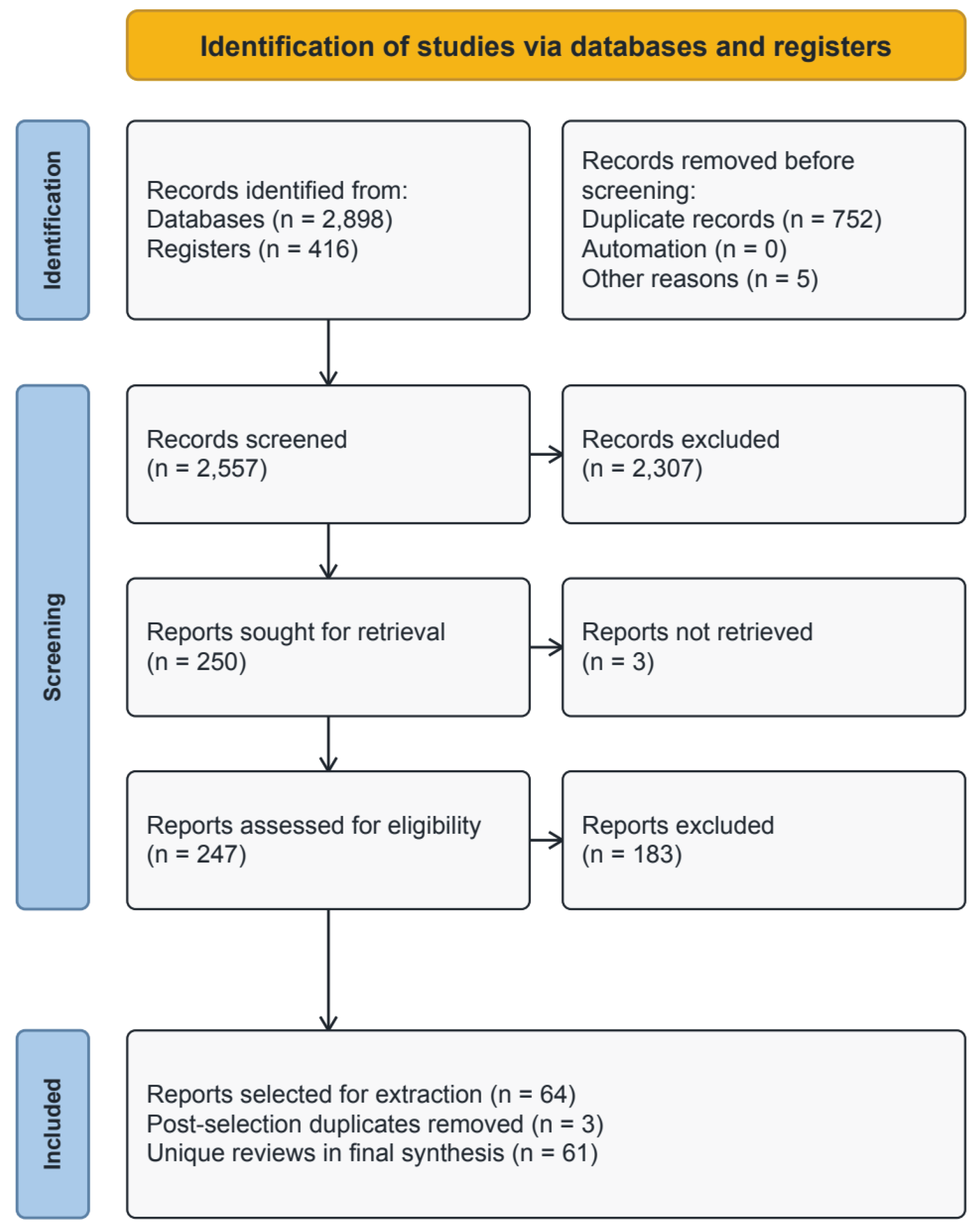
Figure 2.
Evidence matrix for 61 reviews. The four operational-profile dimensions are represented by subject and biological scale, patient specificity, temporality or update pattern, and coupling or physical–digital information pathway. Values are non-exclusive and describe review-level reporting. Concentric placement and feature count do not indicate maturity, usefulness, or legitimacy. The outer review-appraisal band is an evidence attribute, not part of construct identity or the operational profile.
Figure 2.
Evidence matrix for 61 reviews. The four operational-profile dimensions are represented by subject and biological scale, patient specificity, temporality or update pattern, and coupling or physical–digital information pathway. Values are non-exclusive and describe review-level reporting. Concentric placement and feature count do not indicate maturity, usefulness, or legitimacy. The outer review-appraisal band is an evidence attribute, not part of construct identity or the operational profile.
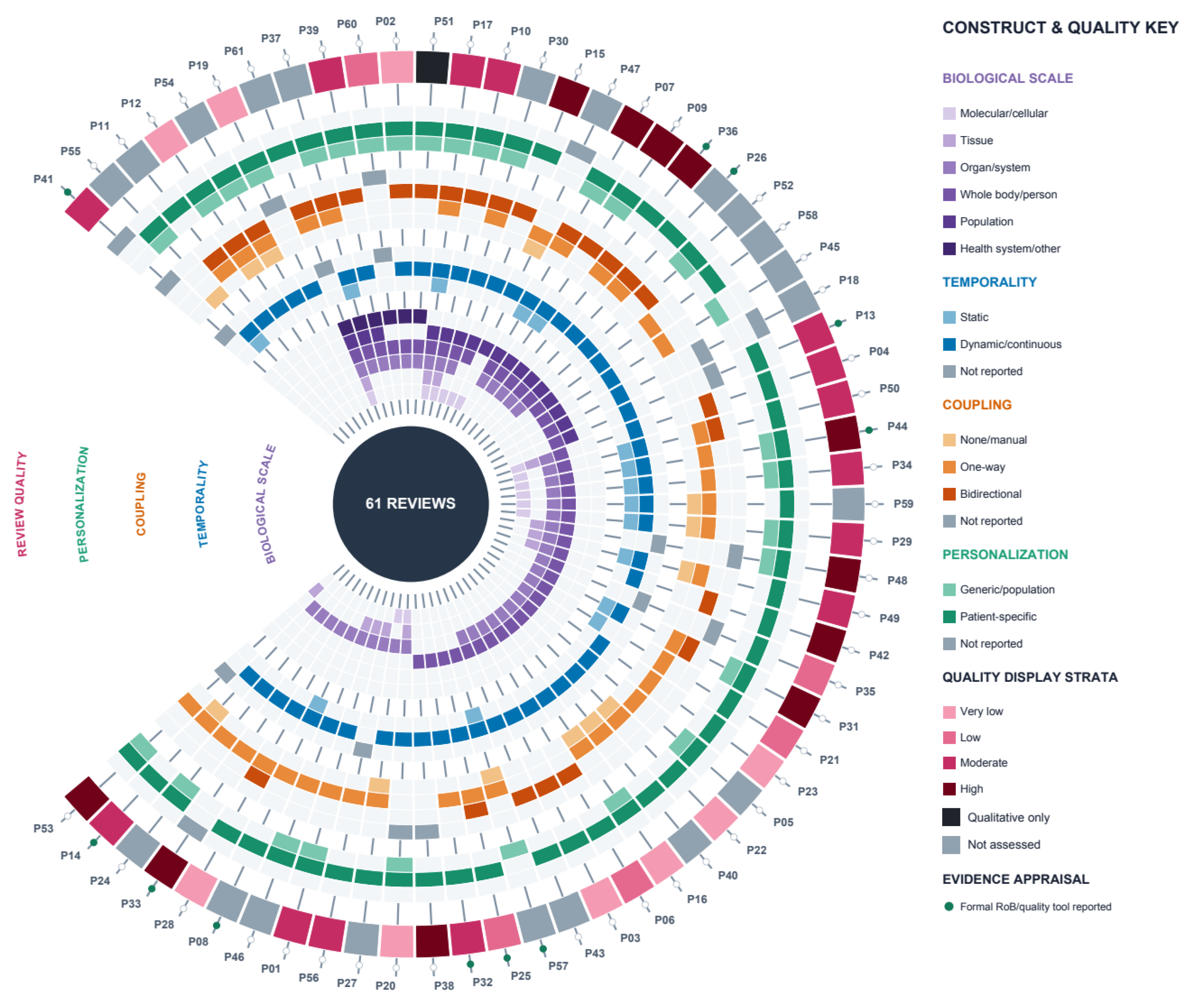

Table 1.
Characteristics and safeguards of the included review evidence base.
| Dimension | Summary findings | Analytical context |
|---|---|---|
| Evidence base | 64 records selected for extraction; 3 post-selection duplicates excluded; 61 unique reviews analyzed. | Duplicate exclusions were applied before all coding and counts. |
| Publication year | Journal-issue year was used consistently: P06 2025, P38 2025, P42 2026, and P44 2026; online-first dates are retained in citation notes. | Resolves mixed online-first and issue-year metadata without changing the cohort. |
| Protocol scope | English-language reviews from 2020 onward addressing patient-linked physiological, biomechanical, biological, or adjacent computational representations; the specific grey-literature clause allowed preprints not subsequently published. | Defines the eligible evidence base and the basis for retaining P16, P34, and P43. |
| Dominant domains | Cardiovascular (32); Oncology (25); Surgery / orthopedics / dentistry (24); Neurology / neuroscience (18); Diabetes / endocrine (17); General / multisystem (15) | Shows the breadth of clinical applications. |
| Appraisal context | Our instrument-based review appraisal was available for 39 records; one record had qualitative-only appraisal and 21 were unavailable. | Review methodology is distinct from construct identity, operational profile, model validity, and fitness for purpose. |
Table 2.
Construct identity and the four non-ordered dimensions of the operational profile.
| Layer or profile dimension | Summary findings | Analytical context |
|---|---|---|
| Construct identity: Which label is used? | Digital twin (46); Patient digital twin (4); Virtual patient (4); Human digital twin (4); In silico patient / trial (3) | Identity locates discourse; it does not determine profile or credibility. |
| Profile dimension, represented subject and scale: What is represented? | Molecular/cellular (14); tissue (12); organ/physiological system (44); person/body (43); population (17); system/other (6). | Multiple scales could be recorded per review; scale is not a hierarchy of usefulness. |
| Profile dimension, patient specificity: Whose model is it? | Individual-specific (55); generic/population/archetype (29). | Categories could overlap; individual specificity is not inherently preferable. |
| Profile dimension, temporality or update pattern: How does it change? | Dynamic/continuous (53); explicitly static (15). | Describes representation of change, not verified data-assimilation cadence or progress. |
| Profile dimension, coupling or information pathway: How does information cross the boundary? | Bidirectional (26); one-way (39); none/manual (13). | Classified independently of terminology; bidirectionality does not establish usefulness or credibility. |
Table 3.
Six-question reporting grammar: four operational-profile dimensions plus purpose and credibility requirements.
Table 3.
Six-question reporting grammar: four operational-profile dimensions plus purpose and credibility requirements.
| Role | Question | What the report should state | What the reader should not have to infer |
|---|---|---|---|
| Profile question 1 | What is represented? | Referent and molecular/cellular, tissue, organ/system, person/body, population, or service-system scale | Whole-person coverage from the word “patient” |
| Profile question 2 | Whose model is it? | Generic, stratified, population, or one-person model; source of initialization and recalibration | Personalization from anatomical detail alone |
| Profile question 3 | How does it change? | Static, episodic, longitudinal, or continuous behavior; update trigger, cadence, and latency | Real-time assimilation from sensors, simulation, or AI |
| Profile question 4 | How does information cross the boundary? | Manual, one-way, or bidirectional paths; clinician-mediated and automated returns; fallback | Closed-loop control from the word “twin” |
| Purpose requirement | What decision does it serve? | CDM, ODM, both, or neither; intended user, action informed, alternative action, and expected value | Usefulness from technical configuration alone |
| Credibility requirement | Why should it be trusted for that purpose? | Context of use, verification, calibration, validation data, uncertainty, generalizability, change control, and monitoring | Fitness for use from identity, feature count, or hierarchy |
Disclaimer/Publisher’s Note: The statements, opinions and data contained in all publications are solely those of the individual author(s) and contributor(s) and not of MDPI and/or the editor(s). MDPI and/or the editor(s) disclaim responsibility for any injury to people or property resulting from any ideas, methods, instructions or products referred to in the content. |
© 2026 by the authors. Licensee MDPI, Basel, Switzerland. This article is an open access article distributed under the terms and conditions of the Creative Commons Attribution (CC BY) license (http://creativecommons.org/licenses/by/4.0/).
Copyright: This open access article is published under a Creative Commons CC BY 4.0 license, which permit the free download, distribution, and reuse, provided that the author and preprint are cited in any reuse.