

Submitted:
02 September 2026
Posted:
09 September 2026
You are already at the latest version
Abstract
Background: Under the current Italian HPV-based cervical screening protocol, women with persistent high-risk human papillomavirus (HR-HPV) positivity at the 12-month recall are referred to colposcopy regardless of cytology results. Although this strategy maximizes lesion detection, it may generate substantial over-referral. We evaluated whether partial HPV genotyping combined with cytology can improve risk stratification in women with persistent HPV positivity at the 12-month recall. Methods: A multicenter retrospective analysis of cervical screening data collected from four Italian screening programs (Florence, Padua, Umbria and Emilia-Romagna) was performed. Among the 270,714 women screened between 2015 and 2019, 4,589 women with persistent HR-HPV positivity at 12-month recall after baseline HPV-positive/NILM results were included. Four alternative triage strategies based on cytology and HPV 16/18 genotyping were retrospectively simulated and compared with the current protocol. Outcomes included CIN2+ detection, relative sensitivity for CIN2+ and CIN3+, positive predictive value (PPV) and reduction in colposcopy referrals. Results: Under the current protocol, 4,589 colposcopies identified 327 CIN2+ lesions, including 113 CIN3+ lesions, yielding a PPV for CIN2+ of 7.1%. Overall, 36.7% of CIN2+ lesions were associated with NILM cytology at recall. HPV 16/18 genotyping identified 43.3% of these cytologically occult lesions. Among the evaluated strategies, referral of HPV 16/18-positive women regardless of cytology and referral of women with low-grade or worse cytology regardless of genotype achieved the most favorable balance between sensitivity and efficiency. This approach reduced colposcopy referrals by 57.7%, nearly doubled the PPV for CIN2+ to 13.4% and maintained relative sensitivities of 79.2% for CIN2+ and 85.0% for CIN3+. Conclusions: Combining partial HPV genotyping with cytology substantially improves risk stratification in women with persistent HR-HPV positivity at 12-month recall. A risk-based approach may markedly reduce unnecessary colposcopies while maintaining acceptable sensitivity for high-grade cervical lesions. These findings support the integration of molecular and cytological information into 12-month recall management strategies within HPV-based cervical screening programs.
Keywords:
cervical cancer screening
; HPV-DNA test
; 12-month recall
; triage strategies
; partial HPV genotyping
; cytology
; risk stratification
1. Background
1.1. HPV-Based Screening and the Challenge of Persistent Infections
The pooled analysis of four European randomized clinical trials or RCTs (NTCC, POBASCAM, ARTISTIC and SWEDESCREEN) [1,2,3,4], published in 2014 [5], established that HPV-based primary screening reduces the incidence of invasive cervical cancer by approximately 70% over a 5.5-year follow-up period, marking the transition from Pap-based to HPV-based cervical cancer screening. The WHO (World Health Organization) endorsed HPV testing as the preferred primary screening method in 2021 [6] and the European Cancer Beating Plan (2021–2030) has set a target of 90% of eligible women undergoing HPV testing by 2025 [7].
A key operational challenge of HPV-based screening concerns the management of women who are HR-HPV positive with negative triage cytology (NILM, Negative for Intraepithelial Lesion or Malignancy) at baseline and remain HR-HPV positive at the 12-month recall. Persistent HR-HPV positivity could be associated with an elevated risk of underlying high-grade disease; however, a significant proportion of these infections appear to regress spontaneously without evolving into Cervical Intraepithelial Neoplasia (CIN) or cervical cancer. So, HR-HPV persistence alone may lack the specificity needed to efficiently guide referral decisions for further testing.
1.2. Current Italian Management of Women with Persistent HR-HPV Positivity
In Tuscany, an HPV-based screening protocol has been active since 2013. Pending implementation of recent multi-societal evidence-based guidelines [8], in Italy HPV test is recommended as the primary screening test for women aged 30–64 at five-year intervals, with HR-HPV positive women triaged by cytology at baseline. Under the current protocol, women who are HR-HPV positive at baseline with negative triage cytology (NILM) are recalled after 12 months to repeat HPV test; if HR-HPV infection persists, the current protocol provides for a direct colposcopy referral regardless of the 12-month cytology triage result. This “all-referral” strategy is based on the principle that persistent HR-HPV infection represents an elevated risk of high-grade lesions incidence and it ensures maximum sensitivity by bypassing potential cytology triage false negatives. However, this approach is characterized by a very low positive predictive value (PPV) for CIN2 or more severe (CIN2+) lesions , generating a high colposcopic workload and a potential clinical over-referral: in fact, in our previous publication [9] regarding the Tuscany centralized screening program, out of approximately 300,000 screened women, 2,526 colposcopies were performed at the 12-month recall, detecting 278 CIN2+ lesions (PPV 11%) and suggesting that, even in high-quality settings, approximately 9 out of 10 colposcopies performed at the 12-month recall may not identify a high-grade lesion, with a potentially avoidable psychological and physical burden for the women referred.
1.3. Biological Rationale for Risk Stratification
Two complementary biological mechanisms appear to support the introduction of a triage step at the 12-month recall. First, a concurrent cytological abnormality seems associated with a markedly higher risk of underlying disease: UK NHS pilot data [10] on 7,315 women with persistent HR-HPV infection reported a CIN2+ PPV of 36% among cytology-positive women versus 13% among cytology-negative women, a pattern broadly consistent with the Tuscan data [9]. Second, HPV 16 and HPV 18 appear to carry a substantially higher cumulative CIN3+ risk than other oncogenic genotypes (HPV 31, 33, 35, 39, 45, 51, 52, 56, 58, 59): longitudinal studies [11,12] have estimated the 5-year CIN3+ risk at approximately 26–30% for HPV16, 14–19% for HPV18 and only 3–7% for the remaining genotypes individually. Partial HPV genotyping (distinguishing HPV 16 and HPV 18 from other HR-HPV types) has been shown to provide a more precise risk stratification than cytology alone [13], with HPV 16/18-positive, cytology-negative women (NILM) showing a 5-year CIN3+ risk comparable to that of cytology-positive (ASC-US or more severe, ASC-US+) women with non-16/18 genotypes.
Extended genotyping platforms [14], which individually detect HPV16, 18, 31, 45, 51 and 52, grouping the remaining genotypes into risk tiers P1 (33, 58), P2 (56, 59, 66) and P3 (35, 39, 68), may further refine risk stratification, although individual-genotype discrimination beyond 16/18 is not yet uniformly available in all Italian screening centers. Consistently, Italian cohort data [15] identified HPV 16 as the major determinant of CIN3+ risk both at baseline (7.9%) and at the 12-month recall (4.2%), markedly higher than HPV 18 (2% and 2.6%, respectively) or other HR-HPV types (1.3% and 0.8%), and reported a cumulative CIN3+ detection in HPV 16-positive women (9.8%) that substantially exceeded that of non-16/18 genotypes (1.8%).
International recommendations for managing persistent HR-HPV infection vary considerably, ranging from cytology-based triage to genotype- and biomarker-based approaches [16,17,18,19], reflecting the ongoing evolution towards risk-based management.
The p16/Ki-67 dual stain (DS), which indicates transforming or oncogenic rather than productive HR-HPV infection, achieved a higher cumulative sensitivity for CIN3+ than cytology in the IMPACT trial [20] (89.2% vs 71.3%) but a lower specificity (54.5% vs 64.6%); its lower residual CIN3+ risk among negative women respect to Pap test (3.6% vs 7.5%) supports its potential role as a safer “rule-out” test.
These biomarkers or methodologies (partial or extended HPV genotyping, cytology and DS), now constitute the 2025 Italian multi-societal guidelines [8], which apply the GRADE methodology to the use of biomarkers in cervical screening and define explicit CIN3+ risk thresholds to guide immediate colposcopy referral, 12-month recall or return to routine screening.
1.4. Study Objectives
The present study on the management of HPV persistent women at the 12-month recall, conducted in 2022 on behalf of the Italian Group for Cervical Cancer Screening (GISCi), can be considered as a precursor and empirical support for the recent guidelines [8], illustrating their feasibility in cervical cancer screening practice. Importantly both cytology and HR-HPV partial genotyping results at the 12-month recall were already routinely available at each screening center and recorded in Information Technology (IT) systems, but these data are not currently used in clinical practice. This retrospective study, therefore, represents the first evaluation of the impact that using this already-available information would have had, without requiring any additional testing, costs or infrastructure.
Building upon previous evidence showing that partial HPV 16/18 genotyping improves risk stratification at the baseline [15], in the same Italian screening population the present study extends this framework and dataset, by focusing on the 12-month recall protocol; the study period of the two analyses partially overlaps, with data from Florence (2016–2018) added within the present retrospective evaluation.
The aim of this study was to evaluate whether partial HPV genotyping, combined with cytology, could improve risk stratification in women with persistent HR-HPV positivity at 12-month recall and reduce unnecessary colposcopy referrals, without substantially compromising the detection of CIN2+ or CIN3+ lesions.
Specifically, the study was structured around the following key assessments:
- to characterize the performance of the current Italian 12-month recall protocol in four Italian screening centers;
- to quantify the proportion of CIN2+ lesions associated with NILM cytology at 12-month recall and the contribution of HPV 16/18 genotyping to their detection;
- to evaluate four alternative triage strategies, assessing PPV for CIN2+, relative sensitivity for CIN2+ and CIN3+ (versus the current protocol) and colposcopy avoidance or delay;
- to identify the optimal triage strategy in the context of available biomarkers, adherence constraints and subsequent literature, including the 2025 Italian guidelines.
2. Materials and Methods
2.1. Study Design and Settings
This was a multicenter retrospective analysis conducted on behalf of GISCi and its outcomes were presented at the 2022 GISCi National Conference. The study involved the retrospective application of four alternative 12-month recall protocols to an existing dataset of women already screened, using data routinely collected by the participating centers. No additional clinical procedures were performed.
Four Italian cervical cancer screening centers provided the data:
- Florence (FI): 40,496 women screened in the period 2016–2018;
- Padua (PD), Emilia Romagna (ER) and Umbria (UM): 230,218 women screened in the period 2015–2019.
The total screened population considered was 270,714 women (Figure 1). The analytic cohort included 4,589 women, who were HR-HPV positive with negative triage cytology (NILM) at baseline and who subsequently underwent the 12-month recall, with available data on HPV partial genotype, cytology, colposcopy and histological outcomes (Table 1).
2.2. Laboratory Tests
All centers used a HR-HPV assay with partial genotyping capability (COBAS 4800 HPV assay, Roche), classifying HR-HPV positive results into three categories: HPV 16-positive, HPV 18-positive, and Other HR-HPV positive (HPV 31, 33, 35, 39, 45, 51, 52, 56, 58, 59, 66, 68). Liquid-based cytology (ThinPrep) was performed on all HR-HPV persistent women and results were reported according to The Bethesda System for reporting cytology (TBS 2014); however, the cytology result at the 12-month recall was not actively used in the current protocol and all HR-HPV-persistent women were referred to colposcopy regardless of the 12-month recall cytology result. For the purposes of this analysis, cytology results were retrospectively reclassified:
- Negative (NILM: Negative for Intraepithelial Lesion or Malignancy);
- Low-grade abnormal (LG: ASC-US, LSIL);
- High-grade abnormal (HG: ASC-H, HSIL, AGC, Squamous cell carcinoma, Adenocarcinoma).
2.3. Alternative Triage Strategies
The current reference strategy, used as the comparator, refers all HR-HPV persistent women to colposcopy, regardless of the 12-month recall HPV genotype or cytology result. The four evaluated alternative strategies were:
- Strategy 1: Colposcopy referral if HR-HPV+ AND cytology ≥ LG;
- Strategy 2: Colposcopy referral if HPV 16/18+ (regardless of cytology) OR cytology ≥ LG regardless of genotype (HPV Other+ and LG+);
- Strategy 3: Colposcopy referral if HR-HPV+ AND cytology ≥ HG;
- Strategy 4: Colposcopy referral if HPV 16/18+ OR cytology ≥ HG.
2.4. Statistical Analysis
Descriptive statistics were used to summarize the demographic and clinical characteristics of the study population. Categorical variables are presented as frequencies and percentages and were compared using Pearson's chi-square test or Fisher's exact test, as appropriate. Age was categorized into clinically relevant groups (30–39, 40–49 and 50–64 years) and differences between HPV genotype groups were assessed using the chi-square test.
Absolute risks of histologically confirmed CIN2+, CIN3+ and invasive cervical cancer were calculated for each combination of HPV genotype (HPV 16/18 versus other HR-HPV types) and cytological result at the 12-month recall. Risk estimates are presented as percentages with exact 95% confidence intervals (Clopper–Pearson method).
The diagnostic performance of the current management protocol was compared with four alternative risk-based management strategies. For each strategy, the number and proportion of women referred to colposcopy, the reduction in colposcopy referrals compared to the current protocol, the number and proportion of detected CIN2+, CIN3+ and cervical cancer cases, as well as the number of missed CIN3+ lesions and invasive cancers, were calculated.
To facilitate interpretation of the clinical impact of each strategy, graphical summaries were generated, including a heatmap illustrating the absolute risk of CIN2+, CIN3+ and cervical cancer, according to HPV genotype and cytological findings, a trade-off plot displaying the relationship between colposcopy reduction and sensitivity for CIN2+ and CIN3+ detection.
All statistical analyses were performed using R software (version 4.6.0; R Foundation for Statistical Computing, Vienna, Austria). Data visualization was generated using the ggplot2, patchwork and Complex Heatmap packages. All statistical tests were two-sided and a p-value < 0.05 was considered statistically significant.
2.5. Outcome Measures
- Detection rate (DR) for CIN2+ per 1,000 screened women (‰);
- Positive predictive value (PPV) for CIN2+ (CIN2+ lesions / total colposcopies performed);
- Relative sensitivity for CIN2+ and CIN3+ versus the reference strategy;
- Number and percentage of colposcopy referrals avoided/deferred versus the current protocol;
- Proportion of CIN2+ lesions with NILM cytology at the recall;
- Contribution of HPV 16/18 genotyping to the recovery of CIN2+ lesions with NILM cytology.
3. Results
3.1. Overall Performance of the Current Protocol
Across all four centers, 4,589 women with persistent HR-HPV infection at the 12-month recall were referred to colposcopy under the current protocol. 327 CIN2+ lesions were detected (PPV: 7.1%), of which 113 were CIN3+ (PPV: 2.5%), with an overall DR of 1.2‰ (327/270,714). Only seven invasive cervical cancers were identified (DR: 0.025‰). Table 2 summarizes the overall performance by 12-month recall HR-HPV partial genotyping and cytology category result. The highest values for CIN2+ AND CIN3+ were observed in HPV 16/18-positive women with HG cytology (CIN2+ PPV: 40.5%; CIN3+ PPV: 23.6%), while the lowest values were observed in Other HR-HPV-positive women with NILM cytology (CIN2+ PPV: 2.6%; CIN3+ PPV: 0.6%). Substantial variability was observed among centers, with DR for CIN2+ ranging from 0.5‰ (Padua) to 2.8‰ (Umbria) and PPV for CIN2+ from 4.9% (Padua) to 10.6% (Umbria); detailed center-level results are reported in Supplementary Table S1–S4.
Figure 2 graphically presents the detailed risk heatmap for CIN2+, CIN3+ and cervical cancer across all six HPV genotype–cytology strata at the 12-month recall (HPV 16/18 or Other HR-HPV – NILM or LG or HG cytology result). The color gradient reveals a gradual and consistent risk escalation along both axes: risk increases progressively from NILM to HG cytology within each genotype group and from Other HR-HPV to HPV 16/18 within each cytology category. The highest risk combination is HPV 16/18 with HG cytology, reaching a CIN2+ PPV of 40.5%, a CIN3+ PPV of 23.6% and a cancer risk of 2.8%. Conversely, the lowest-risk stratum, Other HR-HPV with NILM cytology, shows a CIN2+ risk of only 2.6%, a CIN3+ risk of 0.6% and zero cancer cases, identifying this group as the primary candidate for follow-up deferral rather than colposcopy. Notably, HPV 16/18 types with NILM cytology (CIN3+ PPV 2.4%) carries a higher risk than Other HR-HPV/LG cytology (CIN3+ PPV 1.4%).
3.2. CIN2+ Lesions with NILM Cytology at 12-Month Recall
A finding with direct implications for triage design is the proportion of CIN2+ lesions detected under the current protocol that were associated with NILM cytology, the so-called “cytologically silent” lesions. As shown in Table 3 and Table 120 out of 327 CIN2+ lesions (36.7%; range across centers: 24.7–45.7%) had NILM cytology at the 12-month recall, underscoring a limitation of cytology as a stand-alone triage tool.
Our data showed that HPV16/18 genotyping could recover 43.3% of CIN2+ lesions (52/120) undetected by cytology triage alone. No cytology-based triage strategy, however sensitive, appears able to detect almost all CIN2+ lesions on its own.
3.3. Performance of Alternative 12-Month Recall Strategies
Center-level simulation of the four alternative strategies (see also Supplementary Table S5–S8) confirmed that Strategy 2 consistently offered the most favorable balance between sensitivity and specificity, with some quantitative variation reflecting differences in local population. In Florence, Strategy 2 avoided 59.3% of colposcopies while maintaining a relative sensitivity for CIN3+ of 84.6% (PPV 15.4%). In Padua, colposcopy avoidance reached 54.7%, with a relative sensitivity for CIN3+ of 88.5% (PPV 9.5%). In Umbria, Strategy 2 avoided 57.0% of colposcopies and achieved the highest CIN3+ relative sensitivity among the four centers (91.1%; PPV 19.6%). In Emilia Romagna, Strategy 2 avoided 61.8% of colposcopies, but showed the lowest CIN3+ relative sensitivity among centers (62.5%; PPV 10.4%), possibly reflecting a higher local prevalence of non-HPV16/18 genotypes among CIN3+ lesions.
3.4. Pooled Performance of Alternative Strategies: Identification of the Optimal Protocol
Table 4 and Figure 3 present the pooled performance of all four strategies across all centers, comparing each strategy to the current protocol in terms of relative sensitivity for CIN3+ and CIN2+, colposcopy avoidance/reduction and PPV.
Strategy 2 emerges as the optimal balance between CIN2+ and CIN3+ sensitivity and colposcopy reduction among the four alternatives evaluated. Strategies 1 and 3 achieved the highest PPV for CIN2+ (18.7% and 38.8%, respectively), but at the cost of markedly lower CIN3+ sensitivity. Strategy 2 was the only strategy to simultaneously achieved: (a) an 85% relative sensitivity for CIN3+, (b) a 57.7% reduction in colposcopy referrals and (c) an approximate doubling of the PPV for CIN2+ (13.4%). CIN3+ lesions not immediately detected by colposcopy (n=17) would be expected to be managed in a subsequent follow-up round, provided that the patients are well-adherent to follow-up.
4. Discussion
4.1. The Limitations of the Current 12-Months Protocol and the Complementary Roles of Cytology and Genotyping
The present multicenter retrospective analysis suggests that the current management of women with persistent HR-HPV infection at the 12-month recall may offer opportunities for the application of a risk stratification strategy. Although the current "all-referral" strategy maximizes lesion detection, our findings indicate that it is associated with a relatively low positive predictive value for CIN2+ (7.1%), reflecting the limited specificity of HPV persistence alone as a referral criterion. These observations support the hypothesis that integrating information already routinely available in screening practice, cytology and partial HPV genotyping, may improve the balance between diagnostic sensitivity for CIN3+ and colposcopy workload.
Our findings suggest that cytology alone would not be sufficient as a triage strategy in women with persistent HR-HPV infection. More than one-third of CIN2+ lesions occurred in women with NILM cytology, confirming the intrinsic limitations of cytology in this specific clinical setting rather than questioning its overall value within cervical screening. Three principal explanations could be considered for false-negative cytology (so-called “cytologically silent” lesions) in HPV-positive women: i) inadequate exfoliation of dysplastic cells from the lesion surface (particularly for small, endocervical, or immature transformation zone lesions), ii) sampling errors at the time of specimen collection, and iii) interpretive variability in cytological reading. Notably, a recent blinded review study [21] of 384 liquid-based cytology specimens from HPV-positive women at the 12-month recall, including 128 cases with histologically confirmed CIN2+, demonstrated that the original NILM diagnosis was confirmed, also after the blinded revision, in 92.5% of cases applying the Bethesda System 2014 classification. These findings suggest that a majority of cytologically silent CIN2+ lesions at recall could be considered a “genuine” morphological negativity at the time of sampling (i.e. inadequate lesion exfoliation) or a sampling error, rather than an interpretive error, reinforcing the argument that cytology, however expertly performed, has intrinsic sensitivity limitations in the HR-HPV-positive triage context and could not be used as “stand-alone” criterion for deferring colposcopy at the 12-month recall.
Conversely, partial HPV 16/18 genotyping provided information complementary to cytology by identifying a substantial proportion of CIN2+ lesions that would otherwise have remained undetected among women with NILM cytology. These findings reinforce the concept that, in the 12-month recall cohort, combining molecular and cytological information may improve risk stratification compared with either test alone.
The heatmap in Figure 2 provides visually intuitive representation of the CIN2+, CIN3+ and Cancer risk: high-grade cytology elevates risk within both partial genotype groups, while HPV 16/18 positivity confers a clinically significant risk even in the absence of cytological abnormality. In fact, as we previously argued, HPV 16/18 genotyping appeared complementary to cytology, recovering 43.3% of the “cytologically silent” CIN2+ lesions (Table 3). Furthermore, HPV 16/18-positive women with NILM cytology showed a CIN2+ risk (6.2%) that already approaches or exceeds thresholds typically used to justify direct colposcopy referral in other settings, and their observed CIN3+ risk (2.4%) is very close to the “≥2.5% threshold” recently proposed by the Italian multi-societal guidelines [8] for direct referral, providing indirect support to that risk-tier assignment, although we would caution that a single retrospective dataset cannot substitute for prospective validation.
4.2. Why Strategy 2 Appears the Optimal Choice
Among the four retrospectively simulated strategies, Strategy 2 (colposcopy referral for HPV 16/18-positive women regardless of cytology and any HR-HPV-positive woman with low-grade or worse cytology) provided the most favorable balance between colposcopy reduction and lesion detection within the present dataset. Although no strategy completely preserved the sensitivity of the current protocol, Strategy 2 maintained a substantial reduction in colposcopy volume (57.7%) with a relatively high sensitivity for CIN3+ (85.0%). These findings suggest that this approach appears to be the best currently applicable strategy based on our retrospective evaluations, but deserves prospective evaluation before any implementation in routine clinical practice.
Our data confirms that, using laboratory tests currently available (HPV partial genotyping and cytology) a perfect solution does not exist; therefore, optimizing the clinical protocol necessarily implies accepting a marginal loss in sensitivity (minimal CIN3+ lesions loss/deferral) to achieve greater operational efficiency (a significant reduction of unnecessary colposcopies). Strategies 1 and 3 achieved greater colposcopy reduction, but at what appears to be a less acceptable cost in CIN3+ detection (relative sensitivity 67.3% and 54.9%, respectively); Strategy 3, despite its high PPV (38.8%), would defer detection of 51 CIN3+ lesions to a subsequent follow-up round. Strategy 4 offered intermediate performance without a clear advantage over Strategy 2.
Overall, Strategy 2 seems to represent a reasonable balance between diagnostic yield and resource use, although its adoption should ideally be followed by close monitoring of outcomes in the deferred population.
4.3. Consistency with Recent International Evidence and Guidelines
Interestingly, the present findings are consistent with several subsequently published studies and with the recent Italian multisocietal guidelines, all of which support a progressively more risk-based management of HPV-positive women. Although our analysis was conducted retrospectively using historical data, the observed agreement with more recent evidence strengthens the biological plausibility of the proposed approach. The Danish HCP Trial [17] confirmed that combining genotyping with cytology is better than cytology alone; furthermore, it was proved that extended genotyping favoring sensitivity broadly in line with our results. The NTCC2 study [22], using extended genotyping, identified a low-oncogenic-genotype/cytology-negative subgroup with a CIN3+ risk below 0.4% at 24 months; the analogous deferred group in our study (non-16/18 HR-HPV, NILM cytology) showed a comparable residual CIN3+ risk of 0.64%, although we were unable to further sub-stratify the “Other HR-HPV” group given the limitations of the Cobas 4800 genotyping platform used in all considered centers. The 2025 Italian multi-societal guidelines [8], which explicitly endorse genotype- and cytology-based risk stratification and an “equal management for equal risk” principle, provide a normative framework broadly consistent with the rationale underlying Strategy 2.
4.4. Screening Center Performance Variability and Its Implications
The six-fold variation in DR (0.5‰ in Padua vs. 2.8‰ in Umbria) and the more than two-fold variation in PPV for CIN2+ (4.9% in Padua vs. 10.6% in Umbria) across the four centers carry implications for national-scale implementation of triage protocols. While Strategy 2 consistently appeared to deliver the most favorable balance across centers, the magnitude of its benefits varied by local context. Centers with lower baseline PPV for CIN2+ or CIN3+ (e.g. Padua, Emilia Romagna) may gain proportionally more from a triage step, since the absolute reduction in non-diagnostic colposcopies is larger; conversely, the relative sensitivity of Strategy 2 appeared more robust in higher-prevalence centers (Umbria: 91.1% for CIN3+) than in lower-prevalence settings (Emilia Romagna: 62.5%), where the genotype distribution of high-grade lesions may differ.
This heterogeneity may argue against a single and inflexible national threshold, in favor of a possible strategy based on locally calibrated implementation, consistent with the risk-based, threshold-driven framework of the 2025 Italian guidelines. Screening programs with lower HPV 16/18 prevalence or lower CIN3+ rates may need extended genotyping, or identification of individual genotypes beyond 16/18 versus Other, to safely customize a 12-month recall triage.
Nevertheless, the observed variability between-center also highlights that the performance of any triage strategy is likely to depend on the local epidemiological context, suggesting that external validation across additional screening programs would be desirable.
4.5. Follow-Up Adherence as a Prerequisite for a Safe “Deferred Management”
The safety of any deferred-management strategy (i.e. Strategy 2) ultimately depends on the ability or capacity of screening programs to ensure adequate follow-up adherence among women not immediately referred to colposcopy, although the risk of CIN3+ is relatively low (i.e. 0.64% in our dataset). Therefore, the findings of the present study should be interpreted within the context of organized screening programs capable of ensuring high compliance with repeat testing and appropriate surveillance of deferred women.
4.6. Limitations
Limitations of this study must be acknowledged.
The retrospective design precludes direct assessment of the outcomes of women who, under Strategy 2, would have been deferred from colposcopy: no further data are available on their subsequent exams, spontaneous regression rates, or cancer incidence. The HPV genotyping strategy used in this retrospective evaluation was the “partial” one (HPV 16, HPV 18 and Other HR-HPV), precluding discrimination of the oncogenically heterogeneous “Other” group into its specific genotypes. This evaluation was conducted in areas with a well-defined HPV screening programs and, after the transition from Pap -based to HPV-based, characterized by a strong and consolidated Pap-based screening program; consequently, regions that adopted HPV-based screening more recently or who lacked a previous Pap-based screening program may present a different HR-HPV distribution or CIN2+ burden, and probably may need to modulate 12-month recall triage strategies. All data predate widespread HPV vaccination uptake in the screened cohorts; as vaccinated cohorts enter the screening program, HPV 16/18 prevalence is expected to decline, and the risk gradient between genotype strata may shift, potentially altering the performance of a partial HPV genotype-driven triage strategy over time. The alternative management strategies were evaluated through retrospective simulation rather than prospective clinical implementation. Consequently, the observed diagnostic performance should be interpreted as an estimate of the potential impact of each strategy rather than evidence of real-world effectiveness. Prospective validation remains extremely important.
5. Conclusions
This multicenter retrospective study suggests that integrating partial HPV genotyping with cytology at the 12-month recall may improve risk stratification among women with persistent HR-HPV infection compared with an "all-referral" strategy based solely on HR-HPV persistence. Within this dataset, the combined approach substantially reduced colposcopy referrals while maintaining relatively high sensitivity for CIN3+ detection. Furthermore, this improvement could be implemented without requiring women to be recalled for additional testing, but instead actively exploiting laboratory results already routinely available at screening centers (partial HPV genotyping and cytology) and recorded in IT systems
Among the four alternative triage strategies evaluated, Strategy 2 (immediate colposcopy referral for HPV 16/18-positive women or for HPV-Other-positive women with low-grade or worse cytology, with a deferred follow-up for HPV-Other-positive/NILM-cytology women) appears to offer the most favorable balance between diagnostic performance and colposcopy workload. Applied across the 270,714 screened women from four Italian centers, it would reduce colposcopy referrals at 12-month recall by 57.7%, nearly double the current PPV for CIN2+ lesions (13.4%), and maintain an 85% relative sensitivity for CIN3+. Furthermore, this approach may be achievable with tools (HPV partial genotyping and cytology) already available and performed substantially in all the Italian screening centers. However, these findings derive from a retrospective simulation and should therefore be regarded as hypothesis-generating rather than practice-changing.
Strengthening recall infrastructure therefore appears to be a prerequisite for safely implementing risk-based triage; screening programs should consider investing in multimodal active recall systems (sms, e-mail, telephone contact, Social media instant messaging, push-notification on a dedicated App), dedicated colposcopy pathways for deferred women in follow-up, and robust tracking mechanisms to flag non-responders for priority outreach.
Future prospective studies should evaluate the safety and effectiveness of Strategy 2 in routine clinical practice, particularly with respect to long-term CIN3+ incidence among women whose colposcopy would be deferred. Further research should also assess the incremental value of extended HPV genotyping, p16/Ki-67 dual staining and other emerging biomarkers, and define risk thresholds appropriate for increasingly HPV-vaccinated populations.
Ultimately, prospective validation will be essential to determine whether this risk-based approach can safely reduce unnecessary colposcopy referrals while maintaining the high level of protection expected from organized HPV-based cervical screening programs.
Supplementary Materials
The following supporting information can be downloaded at the website of this paper posted on Preprints.org.
Author Contributions
Conceptualization, G.P. and S.G.; methodology, G.P., G.G., D.P. and S.G.; formal analysis, G.P., G.G., D.P. and S.G.; investigation, G.P. and S.G.; data curation, G.P., G.G., D.P. and S.G.; writing—original draft preparation, G.P., A.M., I.P. and S.G.; writing —review and editing, G.P., D.P., A.M., I.P., G.G., S.P., B.F., A.D.M., H.F., G.S., C.C. (Chiara Castagnetti), C.C. (Cinzia Campari), A.A., C.B., D.G., E.C., S.D., R.G., C.S. and S.G.; supervision, C.S. and S.G. All authors have read and agreed to the published version of the manuscript.
Funding
This research received no external funding.
Institutional Review Board Statement
This study is a retrospective analysis based exclusively on routine clinical data. The diagnostic and screening protocol followed the standard-of-care routine, which is illustrated in Figure 1 of the manuscript. Because this study was strictly retrospective and utilized de-identified, routinely collected data covered by the initial institutional consent, no deviation from standard clinical practice occurred. The main legislative references for this section of the privacy notice derive from the intersection between the GDPR (EU Regulation 2016/679) and Italian legislation (the Privacy Code, Legislative Decree 196/2003 as amended by Legislative Decree 101/2018). So, a further Ethics Committee or Institutional Review Board approval was not required.
Informed Consent Statement
Informed consent was obtained from all subjects involved in the study/retrospective analysis.
Data Availability Statement
The data presented in this study are available on request from the corresponding author.
Acknowledgments
The authors would like to thank all the healthcare professionals, operators, and colleagues involved in the cervical cancer screening program for their invaluable support and dedication.
Conflicts of Interest
The authors declare no conflicts of interest.
References
- Ronco, G.; Giorgi-Rossi, P.; Carozzi, F.; et al. Efficacy of human papillomavirus testing for the detection of invasive cervical cancers and cervical intraepithelial neoplasia: a randomised controlled trial. Lancet Oncol. 2010, 11, 249–257. [Google Scholar] [CrossRef] [PubMed]
- Rijkaart, D.C.; Berkhof, J.; Rozendaal, L.; et al. (POBASCAM). Human papillomavirus testing for the detection of high-grade cervical intraepithelial neoplasia and cancer: final results of the POBASCAM randomised controlled trial. Lancet Oncol. 2012, 13, 78–88. [Google Scholar] [CrossRef] [PubMed]
- Kitchener, H.C.; Almonte, M.; Thomton, C.; et al. (ARTISTIC Trial). HPV testing in combination with liquid-based cytology in primary cervical screening (ARTISTIC): a randomised controlled trial. Lancet Oncol. 2009, 10, 672–682. [Google Scholar] [CrossRef] [PubMed]
- Naucler, P.; Ryd, W.; Törnberg, S.; et al. Human papillomavirus and Papanicolaou tests to screen for cervical cancer. N Engl. J. Med. 2007, 357, 1589–1597. [Google Scholar] [CrossRef] [PubMed]
- Ronco, G.; Dillner, J.; Elfström, K.M.; et al. Efficacy of HPV-based screening for prevention of invasive cervical cancer: follow-up of four European randomised controlled trials. Lancet 2014, 383(9916), 524–532. [Google Scholar] [CrossRef] [PubMed]
- World Health Organization. WHO guideline for screening and treatment of cervical pre-cancer lesions for cervical cancer prevention, second edition; WHO: Geneva, 2021. [Google Scholar]
- European Cancer Beating Plan (2021–2030). Available online: https://health.ec.europa.eu/document/download/26fc415a-1f28-4f5b-9bfa-54ea8bc32a3a_en.
- Gori, S.; Venturelli, F.; Carozzi, F.; Giorgi Rossi, P.; Del Mistro, A.; et al. Italian multisocietal guidelines for cervical cancer screening: biomarker use in an HPV-based screening programme with a risk-based approach and GRADE methodology. Br. J. Cancer 2025, 133, 1076–1084. [Google Scholar] [CrossRef] [PubMed]
- Carozzi, F.; Burroni, E.; Confortini, M.; et al. Implementation of a centralized HPV-based cervical cancer screening programme in Tuscany: First round results and comparison with the foregoing Pap-based screening programme. J. Med. Screen. 2022, 29(2), 110–122. [Google Scholar] [CrossRef] [PubMed]
- Rebolj, M.; Rimmer, J.; Denton, K.; et al. Primary cervical screening with high risk human papillomavirus testing: observational study. BMJ 2019, 364, l240. [Google Scholar] [CrossRef] [PubMed]
- Castle, P.E.; Schiffman, M.; Wheeler, C.M.; et al. Evidence for frequent regression of cervical intraepithelial neoplasia–grade 2. Obstet. Gynecol. 2009, 113(1), 18–25. [Google Scholar] [CrossRef] [PubMed]
- Schiffman, M.; Hyun, N.; Raine-Bennett, T.R.; et al. A cohort study of cervical screening using partial HPV typing and cytology triage. Int. J. Cancer 2016, 139(11), 2606–2615. [Google Scholar] [CrossRef] [PubMed]
- Bonde, J.H.; Rebolj, M.; Ejegod, D.M.; Preisler, S.; Rygaard, C.; Lynge, E. Selection of HPV-positive women for colposcopy: Comparison of three different triage strategies in the comparative validation of four HPV assay systems in the VALGENT framework. Int. J. Cancer 2020, 146(12), 3230–3241. [Google Scholar]
- De Marco, L.; Bisanzi, S.; Ronco, G.; et al. Extended HPV genotyping by the BD Onclarity assay: concordance with screening HPV-DNA assays, triage biomarkers, and histopathology in women from the NTCC2 study. Microbiol. Spectr. 2025, 13(1), e0089724. [Google Scholar] [CrossRef] [PubMed]
- Gori, S.; Battagello, J.; Gustinucci, D.; et al. Clinical relevance of partial HPV16/18 genotyping in stratifying HPV-positive women attending routine cervical cancer screening: a population-based cohort study. BJOG 2021, 128(8), 1353–1362. [Google Scholar] [CrossRef] [PubMed]
- Rebolj, M.; Rimmer, J.; Denton, K.; et al. Primary cervical screening with high risk human papillomavirus testing: observational study. BMJ Published. 2019, 364, l240. [Google Scholar] [CrossRef] [PubMed]
- Schroll, J.B.; Helmersson, S.; Lajer, C.; et al. Health care policy trial of primary human papillomavirus-based cervical screening in Denmark: comparison of three triage algorithms. Int. J. Cancer 2026. [Google Scholar] [CrossRef] [PubMed]
- Canfell, K.; Saville, M.; Caruana, M.; et al. Protocol for Compass: a randomised controlled trial of primary HPV testing versus cytology screening for cervical cancer in HPV-unvaccinated and vaccinated women aged 25-69 years living in Australia. BMJ Open 2018, 8(1), e016700. [Google Scholar] [CrossRef] [PubMed]
- Massad, L.S.; Clarke, M.A.; Perkins, R.B.; et al. Applying Results of Extended Genotyping to Management of Positive Cervicovaginal Human Papillomavirus Test Results: Enduring Guidelines. J. Low. Genit. Tract. Dis. 2025, 29(2), 134–143. [Google Scholar] [CrossRef] [PubMed]
- Wright, T.C., Jr.; Stoler, M.H.; Ranger-Moore, J.; et al. Clinical validation of p16/Ki-67 dual-stained cytology triage of HPV-positive women: Results from the IMPACT trial. Int. J. Cancer 2022, 150(3), 461–471. [Google Scholar] [CrossRef] [PubMed]
- Cannistrà, S.; Carozzi, F.; Di Stefano, C.; et al. Accuracy and Reproducibility of Cytology Triage in a HPV-Based Primary Screening Setting: A Revision of 384 Pap Tests. Acta Cytol. 2023, 67(6), 618–628. [Google Scholar] [CrossRef] [PubMed]
- Benevolo, M.; Ronco, G.; Mancuso, P.; et al. Comparison of HPV-positive triage strategies combining extended genotyping with cytology or p16/ki67 dual staining in the Italian NTCC2 study. EBioMedicine 2024, 104, 105149. [Google Scholar] [CrossRef] [PubMed]
Figure 1.
STROBE flow diagram of the study population. Among the 270,714 screened women, 4,589 women with persistent HR-HPV infection and complete data were included in the final analysis, stratified by HPV genotype and cytology result of the 12-month recall. CIN = cervical intraepithelial neoplasia.
Figure 1.
STROBE flow diagram of the study population. Among the 270,714 screened women, 4,589 women with persistent HR-HPV infection and complete data were included in the final analysis, stratified by HPV genotype and cytology result of the 12-month recall. CIN = cervical intraepithelial neoplasia.
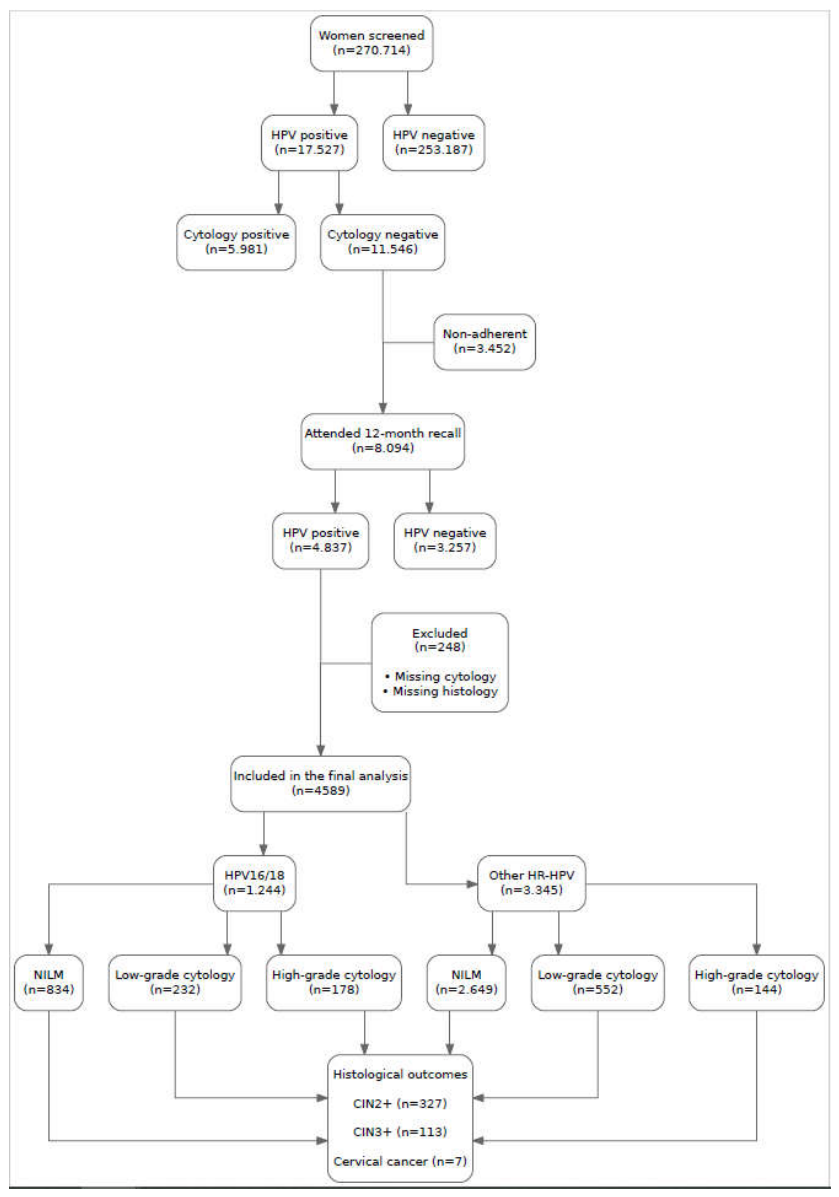
Figure 2.
Risk heatmap for CIN2+, CIN3+ and cervical cancer by recall HPV genotype and cytology. Each cell displays the absolute risk (%) for the corresponding histological endpoint within each genotype/cytology stratum. Color intensity encodes absolute risk on a continuous scale from white (lowest) to deep red (highest). HPV 16/18= Positive to HPV 16 and/or 18; Other HR-HPV= positive for at least one of the subsequent HPV types: HPV 31, 33, 35, 39, 45, 51, 52, 56, 58, 59, 66, 68; NILM= Negative for Intraepithelial Lesion or Malignancy; LG = low-grade cytology; HG = high-grade cytology; CIN = cervical intraepithelial neoplasia.
Figure 2.
Risk heatmap for CIN2+, CIN3+ and cervical cancer by recall HPV genotype and cytology. Each cell displays the absolute risk (%) for the corresponding histological endpoint within each genotype/cytology stratum. Color intensity encodes absolute risk on a continuous scale from white (lowest) to deep red (highest). HPV 16/18= Positive to HPV 16 and/or 18; Other HR-HPV= positive for at least one of the subsequent HPV types: HPV 31, 33, 35, 39, 45, 51, 52, 56, 58, 59, 66, 68; NILM= Negative for Intraepithelial Lesion or Malignancy; LG = low-grade cytology; HG = high-grade cytology; CIN = cervical intraepithelial neoplasia.
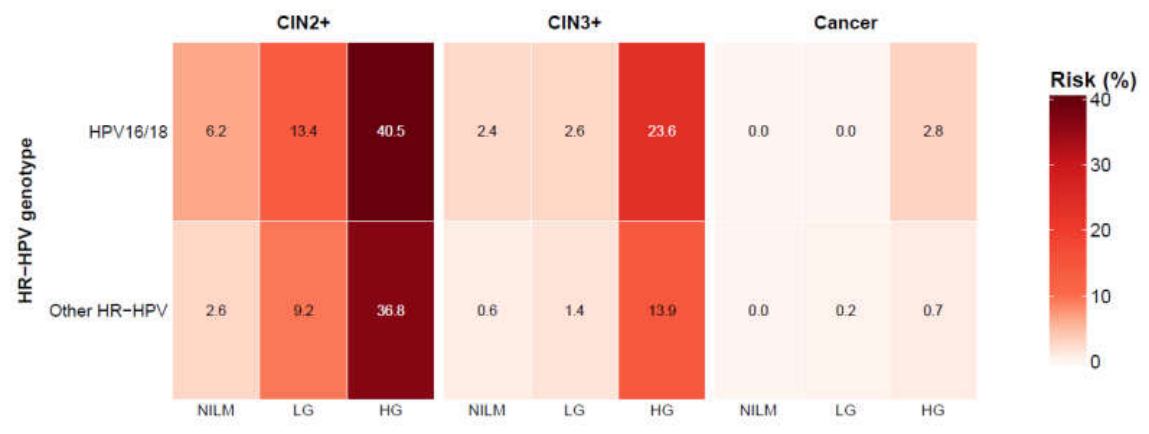
Figure 3.
Trade-off plot: colposcopy reduction versus relative sensitivity for CIN2+ and CIN3+ for the four alternative triage strategies. Each point represents one strategy applied to the pooled cohort (n=4,589). The x-axis shows the percentage of colposcopy referrals avoided compared to the current strategy; the y-axis shows the relative sensitivity for CIN2+ (left panel) and CIN3+ (right panel) versus the same reference. The upper-right region represents the ideal zone of simultaneous high sensitivity and high colposcopy reduction.
Figure 3.
Trade-off plot: colposcopy reduction versus relative sensitivity for CIN2+ and CIN3+ for the four alternative triage strategies. Each point represents one strategy applied to the pooled cohort (n=4,589). The x-axis shows the percentage of colposcopy referrals avoided compared to the current strategy; the y-axis shows the relative sensitivity for CIN2+ (left panel) and CIN3+ (right panel) versus the same reference. The upper-right region represents the ideal zone of simultaneous high sensitivity and high colposcopy reduction.
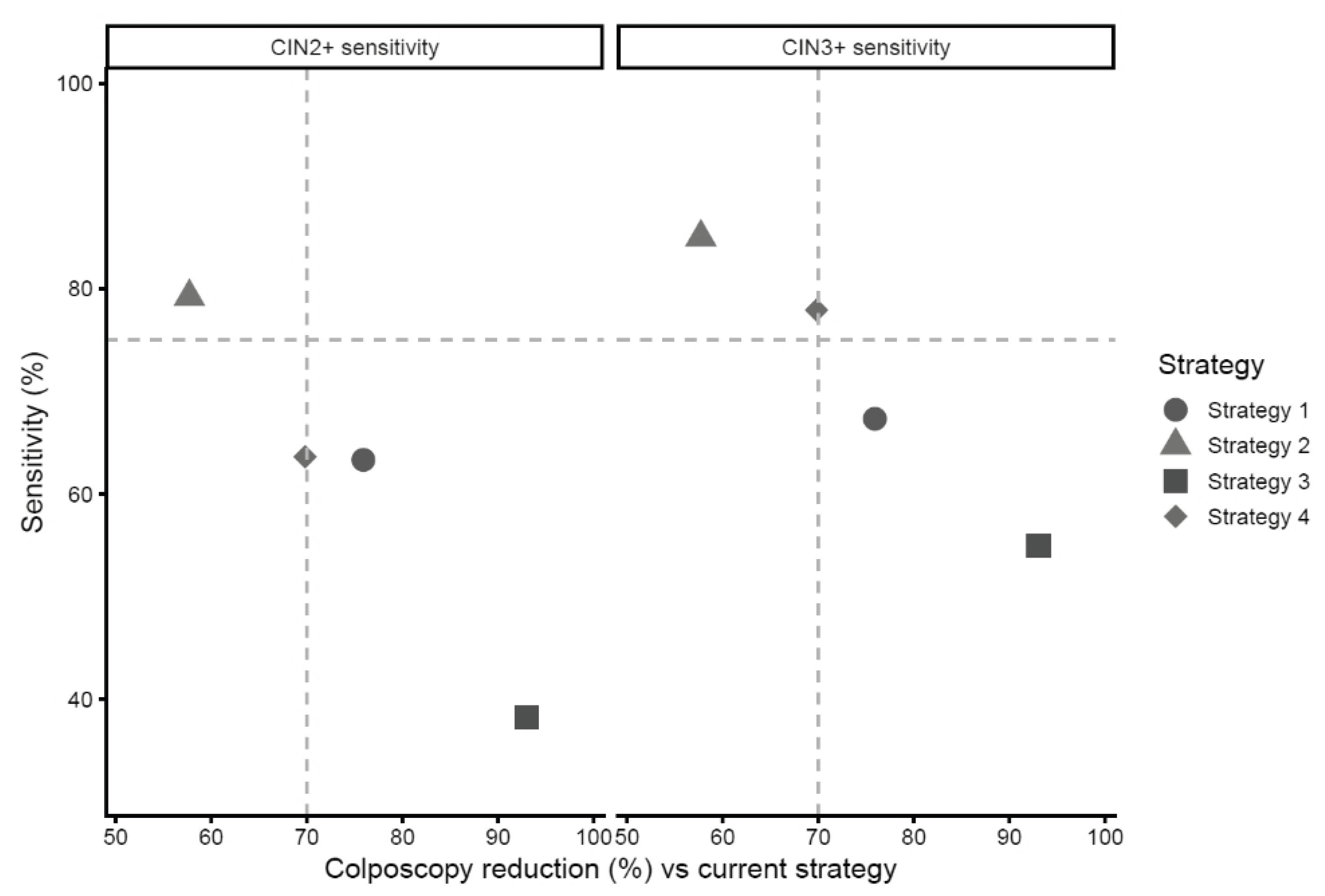

Table 1.
Demographic and clinical characteristics of the study population according to HPV genotype group.
Table 1.
Demographic and clinical characteristics of the study population according to HPV genotype group.
| Charateristic | HPV16/18 n (%) |
Other HR-HPV n (%) |
p-value |
|---|---|---|---|
| Women | 1244 (27.1) | 3345 (72.9) | |
| Age 30-39 | 519 (30.3) | 1194 (69.7) | <0.001 |
| Age 40-49 | 501 (26.1) | 1422 (73.9) | |
| Age 50-64 | 224 (23.5) | 729 (76.5) | |
| NILM | 834 (23.9) | 2649 (76.1) | <0.001 |
| Low Grade (LG) | 232 (29.6) | 552 (70.4) | |
| High Grade (HG) | 178 (55.3) | 144 (44.7) | |
| CIN2 | 87 (40.7) | 127 (59.3) | 0.004 |
| CIN3 | 58 (58.6) | 41 (41.4) | |
| Cancer | 5 (71.4) | 2 (28.6) |
Table 2.
Overall 12-month recall results with detailed information on HR-HPV partial genotyping and cytology results (NILM, LG and HG).
Table 2.
Overall 12-month recall results with detailed information on HR-HPV partial genotyping and cytology results (NILM, LG and HG).
| HPV Type | Triage Cytology | N | CIN2+ (n) | PPV CIN2+ (%) | CIN3+ (n) | PPV CIN3+ (%) | Cancer (n) | Cancer (%) |
|---|---|---|---|---|---|---|---|---|
| 16/18 | Negative (NILM) | 834 | 52 | 6.2% | 20 | 2.4% | 0 | 0.0% |
| 16/18 | Low-grade (LG) | 232 | 31 | 13.4% | 6 | 2.6% | 0 | 0.0% |
| 16/18 | High-grade (HG) | 178 | 72 | 40.5% | 42 | 23.6% | 5 | 2.8% |
| Non 16/18 | Negative (NILM) | 2649 | 68 | 2.6% | 17 | 0.6% | 0 | 0.0% |
| Non 16/18 | Low-grade (LG) | 552 | 51 | 9.2% | 8 | 1.4% | 1 | 0.2% |
| Non 16/18 | High-grade (HG) | 144 | 53 | 36.8% | 20 | 13.9% | 1 | 0.7% |
| Total | 4589 | 327 | 7.1% | 113 | 2.5% | 7 | 0.1% |
Table 3.
CIN2+ lesions with NILM cytology at the 12-month recall and contribution of HPV16/18 genotyping to their identification (n, of total CIN2+ lesions = 327).
Table 3.
CIN2+ lesions with NILM cytology at the 12-month recall and contribution of HPV16/18 genotyping to their identification (n, of total CIN2+ lesions = 327).
| Centre | NILM CIN2+ / Total CIN2+ | % NILM CIN2+ of all CIN2+ | n. of HPV16/18+ among NILM/CIN2+ (%) | HPV16/18 “recovery” of CIN2+ lesions (%) |
|---|---|---|---|---|
| Florence | 40 / 101 | 39.6% | 16/40 | 40.0% |
| Padua | 19 / 77 | 24.7% | 9/19 | 47.4% |
| Emilia Romagna | 21 / 46 | 45.7% | 8/21 | 38.1% |
| Umbria | 40 / 103 | 38.8% | 19/40 | 47.5% |
| Total | 120 / 327 | 36.7% | 52/120 | 43.3% |
Table 4.
Pooled performance of all triage strategies versus the current protocol; all centers combined (FI+PD+UM+ER). Rel. Sens. = relative sensitivity compared to the current protocol.
Table 4.
Pooled performance of all triage strategies versus the current protocol; all centers combined (FI+PD+UM+ER). Rel. Sens. = relative sensitivity compared to the current protocol.
| Strategy | Women referred to colposcopy n (%) | Reduction vs current (%) | CIN2+ detected n (%) |
CIN3+ detected n (%) |
Rel. Sens. for CIN3+ (%) | Cervical cancers detected n (%) |
Missed CIN3+ | Missed cancers |
|---|---|---|---|---|---|---|---|---|
| Current protocol | 4589 (100) | - | 327 (7.1) | 113 (2.5) | 100 | 7 (0.2) | - | - |
| 1 | 1106 (24.1) | 75.9 | 207 (18.7) | 76 (6.9) | 67.3% | 7 (0.6) | 37 | 0 |
| 2 | 1940 (42.3) | 57.7 | 259 (13.4) | 96 (4.9) | 85.0% | 7 (0.4) | 17 | 0 |
| 3 | 322 (7) | 93 | 125 (38.8) | 62 (19.3) | 54.9% | 6 (1.9) | 51 | 1 |
| 4 | 1388 (30.2) | 69.8 | 208 (15) | 88 (6.3) | 77.9% | 6 (0.4) | 25 | 1 |
Disclaimer/Publisher’s Note: The statements, opinions and data contained in all publications are solely those of the individual author(s) and contributor(s) and not of MDPI and/or the editor(s). MDPI and/or the editor(s) disclaim responsibility for any injury to people or property resulting from any ideas, methods, instructions or products referred to in the content. |
© 2026 by the authors. Licensee MDPI, Basel, Switzerland. This article is an open access article distributed under the terms and conditions of the Creative Commons Attribution (CC BY) license (http://creativecommons.org/licenses/by/4.0/).
Copyright: This open access article is published under a Creative Commons CC BY 4.0 license, which permit the free download, distribution, and reuse, provided that the author and preprint are cited in any reuse.