

Submitted:
08 September 2026
Posted:
09 September 2026
You are already at the latest version
Abstract
Rationale: The population-level impact of malaria vaccines introduced through routine health systems depends on whether reductions in malaria burden occur consistently across implementation settings. However, facility-level variation in malaria trends following vaccine introduction remains poorly characterised. Evaluating heterogeneous responses after R21/Matrix-M roll-out is necessary to determine whether observed changes reflect a uniform programme effect or are driven by local epidemiological and health system factors. Objectives: To characterise the pattern, consistency, and correlates of change in facility-recorded malaria prevalence among children aged 5-11 months following R21/Matrix-M malaria vaccine roll-out in Ogbia Local Government Area, Bayelsa State, Nigeria. Methods: A retrospective facility-based observational analysis was conducted using routinely collected malaria and immunization records from nine primary healthcare facilities across four clans in Ogbia LGA. Facility-level malaria prevalence before and after vaccine roll-out was compared using prevalence ratios (PRs) with 95% confidence intervals. Heterogeneity was assessed using Cochran’s Q and I² statistics. Additional analyses examined clan-level differences, association between catchment population size and prevalence change, regression-to-the-mean effects, vaccine coverage associations, and facility-specific excess malaria episodes. Results: Across the nine facilities, malaria prevalence increased from 3.12% before roll-out to 6.30% after roll-out, corresponding to a pooled prevalence ratio of 2.02 (95% CI: 1.66-2.45; χ²=53.18; p<0.001). Facility-level changes were heterogeneous, with PRs ranging from 0.40 (95% CI: 0.08-2.04) to 12.00 (95% CI: 1.57-91.75). Significant between-facility heterogeneity was observed (Cochran’s Q=27.97, df=8, p<0.001; I²=71.4%; τ²=0.254). At clan level, prevalence increases differed significantly (Q=19.18, df=3, p<0.001; I²=84.4%), with Abureni showing the largest increase (PR=2.90; 95% CI: 2.03-4.14). Catchment population size was not significantly associated with prevalence change (Spearman ρ=0.650; p=0.058). Baseline prevalence did not predict subsequent change (Spearman ρ=0.117; p=0.765). Neither first-dose vaccine coverage (ρ=0.200; p=0.606) nor third-dose coverage (ρ=-0.05; p=0.910) was associated with prevalence change. Ogbia Central PHC, Otuogidi PHC, and Anyama PHC contributed 80.7% of the total excess malaria episodes observed after roll-out. Conclusion: Malaria prevalence increased after R21/Matrix-M roll-out, but the magnitude of change was highly heterogeneous across facilities and clans. The absence of associations with vaccine dose coverage, catchment population size, and baseline prevalence suggests that the observed variation was unlikely to be explained by vaccination coverage patterns alone. Thus, routine malaria vaccine monitoring should incorporate facility-level surveillance to identify local drivers of divergent malaria trends and guide targeted programme responses. The findings demonstrate that malaria vaccine implementation outcomes can vary substantially within the same geographical area. Identifying facility-specific contributors to changing malaria burden is essential for translating vaccine introduction into measurable public health impact.
Keywords:
R21/Matrix-M malaria vaccine
; malaria prevalence
; vaccine roll-out
; facility-level heterogeneity
; prevalence ratio
; malaria surveillance
; vaccine coverage
; routine immunization
; Niger Delta
; Nigeria
1. Introduction
Malaria remains one of the most persistent public health challenges in sub-Saharan Africa, with Nigeria carrying a substantial proportion of the global disease burden, particularly among young children who experience the greatest risk of severe illness and death (World Health Organization [WHO], 2023). In malaria-endemic settings, sustained reductions in childhood morbidity require integrated interventions that combine vector control, prompt diagnosis, effective treatment, and vaccination strategies (WHO, 2021; Christopher et al., 2024; Promise et al., 2024; 2025; 2026; Oginifolunnia et al., 2025; 2026; Tinimoye et al., 2026; Vivian & Morufu, 2026). The development of malaria vaccines represents a major scientific milestone, following decades of research aimed at overcoming the biological complexity of Plasmodium falciparum infection (Arama & Troye-Blomberg, 2014). The R21/Matrix-M vaccine has generated considerable optimism because clinical trials demonstrated promising efficacy, safety, and immunogenicity among young African children (Datoo et al., 2024). Consequently, malaria vaccine introduction into routine immunisation platforms has been viewed as an important advancement toward achieving global malaria reduction targets (Genton, 2023; WHO, 2024). Nigeria’s adoption of malaria vaccination reflects this global momentum and the urgent need to address persistent childhood malaria transmission in high-burden communities (WHO Regional Office for Africa, 2024). However, vaccine introduction alone does not guarantee uniform population-level impact because real-world effectiveness depends on health-system capacity, caregiver acceptance, completion of recommended schedules, surveillance quality, and local transmission conditions (Afolabi et al., 2021; Mbachu et al., 2019; Okechukwu et al., 2024; Abdulraheem et al., 2025a; 2025b; 2025c; Morufu et al., 2025; Yusuf et al., 2025; Olaniyi & Morufu, 2025; Henry & Morufu, 2025). Evidence from previous vaccine programmes shows that implementation outcomes may differ substantially between communities due to variations in access, social factors, and service delivery characteristics (Adeloye et al., 2017; Yawson et al., 2017; Raimi & Raimi, 2020; Raimi et al., 2021c; Ezezika et al., 2026). In Nigeria, immunisation programmes have historically faced challenges related to geographic barriers, incomplete coverage, misinformation, and inequitable service availability, particularly in rural and riverine environments (Umar & Nwankwo, 2021; Yusuf & Okon, 2022; Kakwi et al., 2024a; 2024b; Uchenna et al., 2024; Ibrahim et al., 2025; Raimi, 2025a-d). Therefore, evaluating malaria vaccine impact requires approaches that move beyond aggregate coverage estimates and examine how vaccine introduction interacts with local epidemiological realities. Facility-level analyses provide an opportunity to identify whether observed changes in malaria burden are consistent across healthcare settings or whether specific facilities experience divergent patterns after vaccine roll-out. Despite growing evidence regarding vaccine efficacy and acceptance, limited evidence exists on how R21/Matrix-M introduction influences malaria prevalence patterns at sub-district and facility levels in routine healthcare environments. Particularly unclear is whether changes in malaria prevalence after vaccine roll-out are directly related to vaccine dose coverage or reflect underlying differences in population characteristics, baseline transmission intensity, health service utilisation, or surveillance practices. This knowledge gap is especially important in Ogbia Local Government Area (LGA), Bayelsa State, where ecological conditions, settlement patterns, and healthcare accessibility may contribute to heterogeneous malaria outcomes. Accordingly, understanding heterogeneous facility-level responses is essential for interpreting vaccine effects accurately and guiding adaptive malaria control strategies. Such evidence can help determine whether apparent increases or decreases in malaria prevalence represent vaccine-related patterns, operational challenges, or contextual differences requiring targeted public health responses within local healthcare systems effectively.
Building on this rationale, this retrospective analysis addresses a critical evidence gap by examining facility-recorded malaria prevalence among children aged 5-11 months following R21/Matrix-M vaccine roll-out in Ogbia LGA. Rather than assuming that vaccine availability produces identical outcomes across healthcare facilities, the study investigates whether changes in malaria prevalence are heterogeneous and whether such variation can be explained by measurable facility and population factors. This approach is innovative because it shifts evaluation from vaccine coverage alone toward a more comprehensive assessment of implementation performance, epidemiological context, and health-system variation. Previous malaria vaccine evaluations have primarily focused on clinical efficacy, safety outcomes, or broad programme feasibility, leaving limited understanding of facility-level differences during routine implementation (Raimi et al., 2019; Asante et al., 2024; White et al., 2015; Babbo et al., 2025). Although high vaccine uptake is desirable, protection at population level depends strongly on completion of multi-dose schedules and sustained engagement with immunisation services (Raimi et al., 2021b; Gavi, 2025; Raimi, 2025a-d; Raimi, 2026a; Promise et al., 2024; 2025; 2026; Vivian & Morufu, 2026). Furthermore, vaccine coverage indicators may not fully explain changes in disease burden because malaria transmission remains influenced by environmental conditions, healthcare-seeking behaviour, population movement, and baseline disease intensity (Anyanwu & Nduka, 2023; Effiong et al., 2022). Examining these relationships is particularly relevant in Niger Delta communities, where ecological and social factors may shape malaria exposure and healthcare utilisation patterns. The study also recognises that increases in recorded malaria cases after vaccine introduction do not automatically indicate vaccine failure; they may reflect improved case detection, changing attendance patterns, regression to the mean, or facility-specific operational differences. Therefore, robust statistical assessment of heterogeneity is necessary to distinguish consistent vaccine-related trends from local variations requiring targeted investigation. By applying facility-level prevalence ratios, heterogeneity statistics, clan comparisons, and predictive analyses, this research provides a deeper understanding of malaria vaccine implementation outcomes in a real-world setting. The findings are expected to support policymakers, immunisation managers, and malaria control programmes by identifying whether vaccine dose coverage corresponds with observed malaria prevalence changes and by highlighting facilities requiring strengthened interventions. Moreover, this investigation contributes methodological value by demonstrating how health facility records can be transformed into actionable evidence for evaluating vaccine implementation. Such analyses are important in settings where comprehensive population surveillance remains limited and where decision-makers require approaches for monitoring vaccine impact, identifying disparities, and improving malaria prevention strategies across communities. Specifically, the study aims to characterise the pattern, consistency, and correlates of change in facility-recorded malaria prevalence among children aged 5–11 months in Ogbia LGA following R21/Matrix-M vaccine introduction; estimate facility-specific prevalence ratios and statistical significance; evaluate heterogeneity using Cochran’s Q and I2 statistics; compare prevalence changes across the four constituent clans; examine relationships between catchment population size, baseline prevalence, and subsequent change; determine whether first-dose and third-dose vaccine coverage are associated with prevalence change; and quantify excess malaria episodes attributable to individual facilities relative to expected pre-roll-out rates.
2. Materials and Methods
2.1. Study Design and Analytical Framework
This study employed a retrospective facility-based observational design to evaluate changes in malaria prevalence following the introduction of the R21/Matrix-M malaria vaccine among children aged 5-11 months in Ogbia Local Government Area (LGA), Bayelsa State, Nigeria. The study used routinely collected healthcare records from primary healthcare facilities to compare malaria episodes recorded before and after vaccine roll-out and to determine whether observed changes were consistent across healthcare facilities, geographic clusters, and vaccine implementation indicators. The study was designed as an implementation-effectiveness assessment rather than a vaccine efficacy trial. While randomized controlled trials establish vaccine efficacy under controlled conditions, this analysis evaluated how malaria patterns changed under routine programme conditions, where vaccine delivery occurred alongside existing malaria transmission intensity, healthcare-seeking behaviours, diagnostic practices, environmental exposures, and health system factors. The analytical framework was structured around seven predefined objectives. Objective 1 estimated facility-specific prevalence ratios comparing malaria prevalence before and after vaccine introduction. Objective 2 assessed whether the magnitude of prevalence change differed significantly between facilities using formal heterogeneity analysis. Objective 3 evaluated geographical variation by comparing malaria prevalence changes across the four constituent clans of Ogbia LGA. Objective 4 examined whether facility catchment population size influenced the magnitude of observed malaria prevalence changes. Objective 5 assessed whether baseline malaria prevalence predicted subsequent change as an evaluation of possible regression-to-the-mean effects. Objective 6 determined whether first-dose vaccine contact and third-dose completion coverage were associated with facility-level prevalence changes. Objective 7 quantified excess malaria episodes attributable to individual facilities by comparing observed post-roll-out episodes with expected episodes assuming persistence of pre-roll-out malaria rates.
2.2. Study Setting
The study was conducted in Ogbia Local Government Area (LGA), Bayelsa State, Nigeria, located within the Niger Delta ecological region. Ogbia LGA consists of four major clans: Abureni, Anyama, Oloibiri, and Emeyal. The area is predominantly rural and riverine, characterized by dispersed settlements, extensive waterways, seasonal flooding, and variable accessibility to healthcare services. The ecological conditions of the Niger Delta, including high rainfall, humidity, surface water accumulation, and favourable mosquito breeding environments, support continuous malaria transmission. Children aged below one year remain highly vulnerable because of limited naturally acquired immunity and ongoing exposure to malaria vectors. Ogbia LGA was selected as the study setting because it represents a typical rural malaria-endemic environment where newly introduced malaria vaccines must operate alongside existing malaria prevention and treatment systems. The variation in geography, settlement patterns, healthcare accessibility, and facility utilization provided an opportunity to examine whether vaccine-era malaria trends were uniform or heterogeneous across communities.
2.3. Study Population and Eligibility Criteria
The study population comprised children aged 5-11 months who were eligible for R21/Matrix-M malaria vaccination during the implementation period in Ogbia LGA. For descriptive vaccine implementation analyses, individual child-level vaccination records were reviewed from routine immunization registers. For the primary epidemiological analyses, the unit of analysis was the healthcare facility, with malaria episodes aggregated according to facility catchment population. Eligible records included children within the target age range, registered within participating healthcare facility catchment areas, and having available malaria diagnosis and vaccination information. Records were excluded when essential variables were missing, duplicated, inconsistent, or could not be linked to a participating facility.
2.4. Selection of Healthcare Facilities and Sampling Strategy
A multistage facility selection strategy was used to ensure geographical representation across the four clans of Ogbia LGA. First, all eligible primary healthcare facilities providing routine immunization and malaria diagnostic services during the R21/Matrix-M implementation period were identified. Second, facilities were selected to represent each clan. Nine healthcare facilities were included:
- Abureni clan: Ogbia Central PHC, Oruma PHC, Ibelebiri PHC
- Anyama clan: Anyama PHC, Epebu PHC
- Oloibiri clan: Otuoke PHC, Otuogidi PHC
- Emeyal clan: Elebele PHC, Emeyal 1 PHC
The selection strategy was based on complete inclusion of eligible service delivery facilities rather than probability sampling because the research question focused on facility-level implementation patterns across the entire LGA.
2.5. Sample Size Determination and Analytical Units
The study incorporated two analytical levels: individual-level vaccine implementation assessment and facility-level malaria prevalence analysis. For the individual-level component, the minimum sample size was determined using Cochran’s formula:
where:
= required sample size
= standard normal deviate at 95% confidence level (1.96)
= estimated proportion of interest
= acceptable margin of error (5%)
This calculation informed the minimum number of child vaccination records required for describing vaccine uptake characteristics. However, the primary objectives of the current analysis focused on facility-level malaria prevalence changes. Therefore, inference was based on complete enumeration of all nine participating health facilities rather than individual-level sampling. The facility-level dataset included:
- malaria episodes before vaccine roll-out;
- malaria episodes after vaccine roll-out;
- registered catchment population;
- vaccine dose coverage indicators;
- clan classification.
The analytical hierarchy was therefore:
Child records → Facility-level aggregation → Clan-level comparison
This approach avoided inappropriate application of individual-level sample size assumptions to ecological facility-level comparisons.
2.6. Data Sources and Extraction Procedures
Data were obtained from routinely collected healthcare records, including immunization registers, malaria outpatient registers, and facility reporting systems. A standardized extraction template was used to collect:
- facility identification;
- clan location;
- catchment population size;
- pre-roll-out malaria episodes;
- post-roll-out malaria episodes;
- R21/Matrix-M dose administration records.
Data extraction was performed retrospectively, and facility-level totals were cross-checked against original registers before analysis.
2.7. Definition of Outcomes and Derived Indicators
2.7.1. Primary Outcome
The primary outcome was change in facility-recorded malaria prevalence following R21/Matrix-M vaccine introduction.
Facility prevalence was calculated as:
Facility-specific prevalence ratio
Facility-level prevalence ratio was calculated as:
A PR >1 indicated increased malaria prevalence following roll-out, whereas PR <1 indicated reduced prevalence. The 95% confidence interval was calculated on the logarithmic scale:
Heterogeneity assessment
Between-facility heterogeneity was assessed using Cochran’s Q:
and I2:
Random-effects synthesis was performed using the DerSimonian-Laird approach.
Clan-level comparison
Facility data were aggregated into four clans, and clan-specific prevalence ratios were estimated using:
Differences were evaluated using chi-square testing.
Catchment population association
The relationship between facility population size and prevalence change was assessed using Spearman rank correlation:
Pearson correlation was performed as a sensitivity analysis.
Regression-to-the-mean assessment
Change in prevalence was defined as:
The association between baseline prevalence and subsequent change was evaluated using correlation analysis.
Vaccine coverage association
Dose-specific vaccine coverage was calculated as:
Associations between:
- dose-1 coverage and prevalence change;
- dose-3 coverage and prevalence change
were assessed using Spearman correlation.
Excess malaria episode estimation
Expected post-roll-out episodes were calculated assuming continuation of pre-roll-out facility-specific rates:
Excess episodes were calculated as:
Facility contribution was calculated as:
2.8. Statistical Analysis
All analyses were conducted using IBM SPSS Statistics version 28.0. Descriptive statistics summarized facility characteristics, malaria episodes, population denominators, and vaccine coverage indicators. Facility-specific prevalence ratios were estimated with 95% confidence intervals. Chi-square tests were used to evaluate the statistical significance of pre- versus post-roll-out differences. Heterogeneity was assessed using Cochran’s Q and I2 statistics. Spearman correlation was the primary approach for association analyses because the number of analytical units was small (n=9 facilities). Pearson correlation was included as a sensitivity analysis. All statistical tests were two-sided, and statistical significance was defined as:
2.9. Quality Assurance and Validation
Quality assurance procedures included standardized data extraction, verification against original facility registers, review of missing values, and consistency checks between malaria episodes, catchment populations, and vaccination records. Calculated indicators were independently reviewed before statistical analysis to ensure correct application of denominators and formulas.
2.10. Ethical Considerations
Ethical approval was obtained from the Niger Delta Institute for Emerging and Re-emerging Infectious Diseases, Federal University Otuoke ethics committee. Because this study involved secondary analysis of routinely collected healthcare records, no direct participant recruitment occurred. All extracted records were anonymized before analysis. Confidentiality was maintained throughout data management, analysis, and reporting.
2.11. Data and Code Availability
The dataset generated and analysed during this study is available from the corresponding author upon reasonable request and subject to institutional data-sharing policies. All statistical analyses were performed using IBM SPSS Statistics version 28.0. Statistical procedures, analytical decisions, and calculation methods are described in sufficient detail to enable reproducibility.
3. Results
3.1. Facility-Specific Malaria Prevalence Changes After Vaccine Roll-Out
Table 1 & Figure 1 demonstrated a substantial but heterogeneous increase in facility-recorded malaria prevalence after vaccine introduction. The pooled analysis showed that malaria prevalence increased from 3.12% before roll-out to 6.30% after roll-out, corresponding to a prevalence ratio (PR) of 2.02 (95% CI: 1.66-2.45; χ2=53.18, df=1; p<0.001). This indicates that, across all facilities combined, the probability of recording malaria episodes among children aged 5-11 months was approximately twice as high after vaccine implementation compared with the pre-roll-out period. However, the magnitude of change varied considerably between facilities, indicating that the overall increase was not uniformly distributed across the study area. The largest relative increase was observed at Ibelebiri PHC, where malaria prevalence increased from 0.31% to 3.70%, representing a 12-fold increase (PR=12.00; 95% CI: 1.57-91.75; χ2=7.85; p=0.005). Similarly, Ogbia Central PHC recorded a marked increase from 2.46% to 9.06% (PR=3.69; 95% CI: 2.15-6.34; χ2=24.96; p<0.001), while Anyama PHC increased from 3.78% to 9.30% (PR=2.46; 95% CI: 1.58-3.84; χ2=16.28; p<0.001). Moderate but statistically significant increases were observed at Otuogidi PHC (PR=2.00; 95% CI: 1.38-2.90; χ2=13.38; p<0.001) and Oruma PHC (PR=1.91; 95% CI: 1.16-3.15; χ2=6.04; p=0.014). In contrast, Otuoke PHC showed a borderline increase that did not reach conventional statistical significance (PR=2.22; 95% CI: 1.02-4.85; χ2=3.51; p=0.061). Three facilities demonstrated non-significant reductions in recorded malaria prevalence: Elebele PHC declined from 12.24% to 8.16% (PR=0.67; 95% CI: 0.37-1.22; χ2=1.36; p=0.243), Emeyal 1 PHC declined from 1.97% to 0.99% (PR=0.50; 95% CI: 0.09-2.70; χ2=0.17; p=0.681), and Epebu PHC declined from 2.28% to 0.91% (PR=0.40; 95% CI: 0.08-2.04; χ2=0.58; p=0.446). Collectively, these findings demonstrate that the post-roll-out increase in malaria prevalence was driven predominantly by a subset of facilities rather than representing a consistent pattern across all healthcare settings. The wide confidence intervals observed in facilities with smaller catchment populations reflect reduced statistical precision due to fewer malaria episodes, whereas larger facilities provided more stable estimates. Importantly, the facility-level variation suggests that vaccine dose availability or coverage alone may not explain changes in malaria prevalence and supports further investigation of contextual factors, baseline transmission intensity, healthcare utilisation patterns, and facility-specific characteristics.
3.2. Heterogeneity of Malaria Prevalence Change Across Health Facilities
Table 2 & Figure 2 demonstrated substantial and statistically significant heterogeneity in the observed facility-level effects (Cochran’s Q=27.97, df=8, p<0.001; I2=71.4%; τ2=0.254), indicating that approximately 71% of the total variability in prevalence ratio estimates was attributable to genuine differences between facilities rather than random sampling error. This level of heterogeneity is considered substantial and suggests that the impact of vaccine roll-out was not consistent across the healthcare facilities evaluated. The fixed-effect model estimated a pooled prevalence ratio of 1.95 (95% CI: 1.66-2.30), indicating an overall increase in malaria prevalence after vaccine introduction when assuming that all facilities shared a common underlying effect. However, because the heterogeneity test demonstrated significant between-facility variation, the random-effects model provides a more appropriate interpretation by incorporating variation in facility-specific effects. Under this model, the pooled prevalence ratio was attenuated to 1.80 (95% CI: 1.17-2.75), reflecting the expected variability in implementation contexts and transmission environments. Examination of individual facility contributions to heterogeneity showed that the largest contributors were facilities demonstrating either exceptionally high increases or decreases in prevalence. Elebele PHC contributed the greatest proportion of Cochran’s Q statistic (12.31 units) despite recording a decline in malaria prevalence (PR=0.67), suggesting that its lower post-roll-out prevalence was inconsistent with the predominant upward trend observed elsewhere. Similarly, Ogbia Central PHC contributed substantially (5.27 units) because of its relatively large increase in prevalence (PR=3.69), while Epebu PHC (3.64 units), Ibelebiri PHC (3.06 units), and Emeyal 1 PHC (2.51 units) also contributed meaningfully due to their divergent effect estimates. In contrast, Otuogidi PHC and Oruma PHC contributed minimally to heterogeneity (0.01 units each), indicating that their observed increases were closely aligned with the overall facility-level pattern. These findings demonstrate that the pooled increase in malaria prevalence following R21/Matrix-M introduction should not be interpreted as a uniform programme effect. Instead, the magnitude and direction of change varied considerably between facilities, supporting the hypothesis that local-level determinants, including baseline malaria burden, population characteristics, healthcare utilisation patterns, environmental exposure, and operational differences, may influence observed post-roll-out outcomes. Therefore, the presence of substantial heterogeneity provides statistical justification for subsequent analyses examining facility-level predictors, clan-level differences, catchment population effects, baseline prevalence influence, and the relationship between vaccine dose coverage and malaria prevalence change.
3.3. Geographic Variation in Malaria Prevalence Change Across Clans
Table 3 & Figure 3 demonstrated substantial variation in the direction and magnitude of malaria prevalence changes after vaccine introduction, confirming that the observed facility-level increases were not evenly distributed geographically. Overall, three of the four clans experienced statistically significant increases in malaria prevalence, whereas Emeyal demonstrated a non-significant decline. The Abureni clan, comprising Oruma PHC, Ibelebiri PHC, and Ogbia Central PHC, recorded the largest increase, with malaria prevalence rising from 2.67% before roll-out to 7.73% after roll-out, corresponding to a prevalence ratio (PR) of 2.90 (95% CI: 2.03-4.14; χ2=36.98, df=1; p<0.001). This indicates that children within Abureni catchment communities had nearly three times the prevalence of recorded malaria episodes following vaccine introduction compared with the pre-roll-out period. The Anyama clan, represented by Anyama PHC and Epebu PHC, also experienced a significant increase, with prevalence rising from 3.42% to 7.28% (PR=2.13; 95% CI: 1.40-3.23; χ2=12.59; p<0.001). Similarly, the Oloibiri clan, including Otuoke PHC and Otuogidi PHC, showed a significant increase from 2.52% to 5.14% (PR=2.04; 95% CI: 1.46-2.86; χ2=17.45; p<0.001). In contrast, the Emeyal clan, consisting of Emeyal 1 PHC and Elebele PHC, demonstrated a reduction in malaria prevalence from 7.02% to 4.51%, corresponding to a PR of 0.64 (95% CI: 0.36-1.14; χ2=1.87; p=0.172); however, this reduction was not statistically significant. The differences between clans were further supported by formal heterogeneity testing, with Cochran’s Q=19.18 (df=3; p<0.001) and I2=84.4%, indicating substantial heterogeneity in the magnitude of malaria prevalence change across geographical clusters. This finding suggests that clan-level context contributed considerably to variation in post-roll-out malaria patterns. The high I2 value demonstrates that most of the observed variability between clans cannot be explained by random sampling variation alone and likely reflects differences in underlying epidemiological, demographic, environmental, or health-system characteristics. Importantly, the analysis indicates that vaccine roll-out occurred within diverse local contexts, where communities experienced different malaria trajectories despite receiving the same intervention. Therefore, interpretation of vaccine implementation outcomes should consider geographic clustering and local transmission characteristics rather than relying solely on aggregate coverage or overall prevalence estimates. The clan-level findings provide additional evidence supporting the investigation of facility- and population-level determinants of heterogeneous malaria prevalence change following vaccine introduction.
3.4. Association Between Facility Catchment Population Size and Malaria Prevalence Change
Table 4 & Figure 4 findings demonstrated a moderate positive association between catchment population size and magnitude of prevalence increase, although the relationship did not reach conventional statistical significance. Specifically, Spearman’s rank correlation coefficient (ρ=0.650; p=0.058) indicated that facilities with larger catchment populations tended to experience greater increases in malaria prevalence following vaccine introduction. The direction of this relationship suggests that higher-volume health facilities were more likely to contribute disproportionately to the observed rise in malaria episodes. However, because the p-value was slightly above the 0.05 significance threshold, the evidence was insufficient to confirm a statistically significant monotonic relationship. A sensitivity analysis using Pearson’s correlation produced a comparable result (r=0.601; p=0.087), supporting the presence of a positive but statistically uncertain linear association. Examination of individual facilities showed that the largest increases were not exclusively observed among the smallest or largest facilities but occurred across different population sizes. Ogbia Central PHC, with a catchment population of 651, recorded the greatest absolute increase in prevalence (+6.61 percentage points) and ranked first in magnitude of increase. Anyama PHC, serving 688 individuals, demonstrated the second-largest increase (+5.52 percentage points), while Oruma PHC, with a population of 487, showed the third-largest increase (+4.11 percentage points). Conversely, the largest facility by catchment population, Otuogidi PHC (1,144 individuals), experienced a moderate increase (+3.50 percentage points), ranking fourth among facilities. This pattern indicates that population size alone does not fully explain the observed variation in malaria prevalence change. Smaller facilities also demonstrated substantial changes, as shown by Ibelebiri PHC (324 individuals), which experienced a +3.40 percentage-point increase, whereas some low-population facilities, including Elebele PHC (196 individuals), Emeyal 1 PHC (203 individuals), and Epebu PHC (219 individuals), recorded declines in prevalence. These findings suggest that while larger catchment populations may contribute to increased absolute numbers of malaria episodes and potentially greater surveillance visibility, population size is unlikely to be the primary determinant of prevalence change. Instead, the magnitude of post-roll-out malaria trends may reflect a combination of baseline malaria transmission intensity, healthcare-seeking behaviour, environmental exposure, diagnostic practices, and facility-level operational factors. Therefore, the observed moderate positive correlation should be interpreted cautiously, as the limited number of facilities (n=9) reduces statistical power and increases uncertainty around the estimated association. Overall, the analysis provides limited evidence that facility population size influences malaria prevalence change but does not support catchment population size as an independent explanation for the heterogeneous patterns observed after R21/Matrix-M vaccine introduction.
3.5. Baseline Malaria Prevalence as a Predictor of Post-Roll-Out Change
Table 5 & Figure 5 demonstrate movement toward average values over time, independent of any intervention effect. In this analysis, facility baseline prevalence values were compared against absolute changes in prevalence (post-roll-out prevalence minus pre-roll-out prevalence) using both rank-based and linear correlation approaches. The results demonstrated no statistically significant evidence that baseline malaria prevalence predicted subsequent prevalence change across the nine facilities. Using the primary non-parametric approach, Spearman’s rank correlation showed a weak positive association between baseline prevalence and subsequent prevalence change (ρ=0.117; p=0.765), indicating that facilities with higher baseline prevalence did not consistently experience larger or smaller changes after vaccine introduction. Similarly, Pearson’s correlation analysis showed a moderate negative relationship (r=-0.495; p=0.175), but this association was not statistically significant, suggesting insufficient evidence for a linear relationship between initial prevalence levels and subsequent changes. Examination of individual facilities further illustrates this absence of a consistent baseline-dependent pattern. Elebele PHC, which had the highest pre-vaccination prevalence (12.24%) among all facilities, experienced the largest reduction in malaria prevalence (-4.08 percentage points), suggesting movement toward lower values rather than persistence of high disease burden. Conversely, facilities with relatively low baseline prevalence demonstrated some of the largest increases. For example, Ogbia Central PHC, with a baseline prevalence of 2.46%, recorded the largest increase (+6.61 percentage points), while Ibelebiri PHC, with the lowest baseline prevalence (0.31%), experienced a substantial increase of +3.40 percentage points. Similarly, Anyama PHC and Oruma PHC, with moderate baseline prevalence values of 3.78% and 4.52%, respectively, demonstrated notable increases of +5.52 and +4.11 percentage points. These patterns indicate that the magnitude of post-roll-out malaria prevalence change was not simply driven by facilities having unusually high or low baseline prevalence values. To assess the influence of an extreme observation, a sensitivity analysis was conducted after excluding Elebele PHC, which had the highest baseline prevalence and demonstrated a large decline. Following exclusion, the Spearman correlation increased to ρ=0.595 (p=0.120), while Pearson’s correlation became r=0.362 (p=0.378); however, neither association reached statistical significance. The reversal in Pearson’s correlation after removing Elebele PHC confirms that this facility exerted considerable influence on the direction of the linear relationship, highlighting the importance of evaluating influential observations in small facility-level datasets. Overall, these findings suggest that baseline malaria prevalence was not a significant predictor of subsequent prevalence change following R21/Matrix-M vaccine roll-out. Therefore, the heterogeneous facility-level changes observed in this study are unlikely to be explained primarily by regression to the mean and may instead reflect differences in local epidemiological conditions, healthcare utilisation, surveillance patterns, or other contextual factors requiring further investigation.
3.6. Relationship Between Vaccine Dose Coverage and Malaria Prevalence Change
Table 6 & Figure 6 results demonstrated that neither dose-1 nor dose-3 coverage was significantly associated with the direction or magnitude of malaria prevalence change following vaccine introduction. For first-dose coverage, Spearman’s rank correlation showed a weak positive association between dose-1 coverage and prevalence change (ρ=0.200; p=0.606), indicating that facilities with higher initial vaccine contact tended to show slightly greater increases in malaria prevalence; however, the relationship was small and statistically non-significant. Similarly, third-dose coverage showed an essentially absent relationship with prevalence change (Spearman’s ρ=-0.05; p=0.910), indicating no evidence that completion of the vaccine schedule was associated with either reduced or increased malaria prevalence after roll-out. Examination of facility-level patterns further supports these findings. Anyama PHC, which had the highest dose-1 coverage (87.4%) and high dose-3 coverage (53.5%), experienced a substantial increase in prevalence (+5.52 percentage points), whereas Otuogidi PHC, with similarly high dose-1 coverage (86.5%) and dose-3 coverage (53.9%), showed a more moderate increase (+3.50 percentage points). Conversely, Ogbia Central PHC, despite having relatively low vaccine coverage (16.7% dose-1 coverage and 2.0% dose-3 coverage), recorded the largest increase in malaria prevalence (+6.61 percentage points). These contrasting patterns demonstrate that facilities with high vaccine uptake did not consistently experience smaller malaria increases, while facilities with limited vaccine coverage did not uniformly show larger increases. Further, facilities with lower dose-1 coverage also showed heterogeneous outcomes: Oruma PHC (22.2% dose-1 coverage) experienced a notable increase (+4.11 percentage points), whereas Emeyal 1 PHC (12.8% dose-1 coverage) and Epebu PHC (20.5% dose-1 coverage) recorded declines in prevalence. The comparison between dose-1 and dose-3 coverage is particularly informative because the two indicators represent different stages of vaccine programme implementation: initial access and completion of the immunisation pathway. The absence of meaningful associations for both indicators indicates that neither reaching eligible children nor completing the vaccine schedule explained the facility-level variation in malaria prevalence change observed after roll-out. Therefore, the observed increases in malaria prevalence are unlikely to be attributable to differences in vaccine uptake alone. Instead, the findings suggest that additional factors, including healthcare utilisation patterns, malaria transmission dynamics, seasonal variation, diagnostic practices, and other contextual influences, may have contributed more substantially to the heterogeneous facility-level changes. Importantly, these results support the interpretation that the post-roll-out increase in malaria prevalence does not represent a dose-dependent vaccine effect, as neither early vaccine contact nor schedule completion demonstrated a measurable relationship with prevalence change.
3.7. Facility-Level Contribution to Excess Malaria Episodes and Burden Concentration
Across the nine health facilities, the observed post-roll-out period recorded 297 malaria episodes compared with 147 expected episodes, resulting in a net excess of 150 malaria episodes attributable to changes occurring after vaccine introduction under the assumption that pre-roll-out facility-specific rates would have remained constant (Table 7 & Figure 7). The distribution of excess episodes was highly concentrated among a small number of facilities, demonstrating that the overall increase was not evenly distributed across Ogbia Local Government Area. Ogbia Central PHC was the largest contributor, accounting for 43 excess episodes, representing 28.7% of the total excess burden. This was followed by Otuogidi PHC, which contributed 40 excess episodes (26.7%), and Anyama PHC, which contributed 38 excess episodes (25.3%). Collectively, these three facilities accounted for 121 of the 150 excess malaria episodes (80.7%), despite representing only one-third of the assessed facilities. This concentration indicates that the observed increase in malaria burden was largely driven by specific facilities rather than reflecting a uniform rise across all health service delivery points. Additional contributors included Oruma PHC, with 20 excess episodes (13.3%), followed by Ibelebiri PHC and Otuoke PHC, each contributing 11 excess episodes (7.3%). In contrast, three facilities demonstrated fewer malaria episodes than expected based on their historical pre-roll-out rates. Elebele PHC recorded 8 fewer episodes than expected (-5.3%), while Epebu PHC and Emeyal 1 PHC recorded reductions of 3 (-2.0%) and 2 episodes (-1.3%), respectively. These reductions partially offset the increases observed elsewhere but were insufficient to prevent an overall net increase of 150 malaria episodes. The concentration of excess cases among Ogbia Central, Otuogidi, and Anyama PHCs provides important epidemiological and programme-management insight because these facilities correspond with locations where the greatest absolute increases occurred, rather than necessarily those with the highest prevalence ratios. For example, facilities with very high relative increases, such as Ibelebiri PHC, contributed fewer excess episodes because of their smaller baseline case numbers. Conversely, larger facilities with higher absolute patient volumes generated greater contributions to the overall malaria burden. Therefore, this analysis demonstrates that prioritisation based solely on relative risk measures may overlook facilities contributing the greatest absolute number of additional malaria episodes. Instead, combining prevalence ratios with attributable episode estimates provides a more complete understanding of where surveillance review, operational assessment, and targeted malaria control responses may have the greatest potential impact.
4. Discussion
4.1. Facility-Specific Malaria Prevalence Changes After Vaccine Roll-Out
The present study identified a two-fold increase in facility-recorded malaria prevalence following malaria vaccine introduction, although the magnitude of change varied substantially across primary healthcare facilities. This increase should not be interpreted as evidence of reduced vaccine performance or biological failure. Rather, it may reflect the complex transition associated with integrating a novel vaccine into routine health systems, where healthcare-seeking behaviour, surveillance sensitivity, diagnostic access, and population awareness can influence observed disease patterns. Phase III trials have demonstrated that R21/Matrix-M provides substantial protection against clinical malaria, with approximately 68-75% efficacy across different transmission settings, while also confirming that protection remains incomplete. Therefore, the observed increase in facility-recorded cases likely reflects persistent malaria exposure combined with improved identification of malaria episodes among vaccinated and eligible populations rather than a contradiction of vaccine efficacy. Similar patterns have been reported during malaria vaccine implementation, where real-world effectiveness is shaped by delivery quality, coverage, transmission intensity, and health-system capacity (Morufu et al., 2021d; Abaya et al., 2024; Nimisingha et al., 2024; Asante et al., 2024; WHO, 2024; Ezezika et al., 2026; Ogar et al., 2026; Ezekiel & Raimi, 2026; Akabueze & Raimi, 2026). Malaria vaccines function as complementary interventions within integrated malaria control programmes rather than standalone tools for eliminating transmission. The WHO evidence framework emphasizes that sustained malaria reduction requires combined implementation of vaccination, insecticide-treated nets, effective case management, and vector-control strategies. Thus, the increased prevalence observed after vaccine introduction may reflect continued transmission pressure within high-burden settings such as the Niger Delta. Previous Nigerian studies have demonstrated substantial geographical variation in malaria burden associated with ecological conditions, rainfall patterns, flooding, healthcare access, and behavioural factors (Anyanwu and Nduka, 2023; Effiong et al., 2022; Morufu et al., 2022; Raimi et al., 2020a-b; Samson et al., 2020; Olalekan et al., 2020a-b). These contextual factors are critical because vaccine impact is influenced by baseline transmission intensity and population-level immunity profiles. Additionally, experiences from RTS,S/AS01 implementation indicate that vaccine introduction can increase interactions between caregivers and health facilities, potentially enhancing malaria detection and surveillance capacity (Asante et al., 2024). Therefore, the observed increase represents an early implementation signal requiring longitudinal evaluation rather than evidence of inadequate vaccine protection. As malaria vaccination expands across endemic regions, distinguishing increased case detection from increased transmission will remain essential for accurately assessing population-level impact.
The substantial variation between facilities further demonstrates that vaccine introduction does not produce uniform epidemiological outcomes across communities. Higher relative increases observed in facilities such as Ibelebiri PHC, Ogbia Central PHC, and Anyama PHC compared with facilities showing stable or declining prevalence suggest that local determinants influence observed vaccine-associated trends. These differences may reflect variations in catchment populations, baseline malaria exposure, healthcare accessibility, diagnostic practices, reporting completeness, and community engagement. Similar heterogeneity has been documented in malaria vaccine implementation programmes, where differences in delivery systems and local health-system capacity affected vaccine uptake and health outcomes. Evidence from childhood immunization programmes in Nigeria also shows that geographic inequalities, transportation barriers, caregiver awareness, and primary healthcare functionality contribute to uneven intervention performance (Adeloye et al., 2017; Yusuf and Okon, 2022; Yusuf et al., 2022; Joshua et al., 2024). These findings highlight the importance of moving beyond aggregated vaccine coverage estimates toward facility-specific surveillance approaches for evaluating malaria vaccine impact. Facilities with increased prevalence may represent areas where vaccine introduction coincided with improved case detection, increased caregiver attendance, or stronger reporting systems. In contrast, facilities with declining prevalence may reflect lower transmission intensity, improved preventive practices, or differences in routine reporting. Such interpretations are particularly relevant because routine health information systems often demonstrate variability in completeness and reliability during periods of programme expansion or intervention introduction (Oginifolunnia et al., 2025; 2026; Raimi, 2025a-e; Raimi et al., 2019). Furthermore, Bayelsa State’s riverine geography, flooding patterns, and environmental exposure characteristics may contribute to spatial differences in malaria transmission and healthcare access (Morufu et al., 2022; Anyanwu and Nduka, 2023; Oyintonyo et al., 2026). Collectively, these findings support adaptive implementation strategies in which facilities demonstrating persistent increases receive targeted epidemiological investigation, strengthened community engagement, and integrated malaria prevention support. This approach aligns with malaria vaccine policy recommendations emphasizing context-specific deployment and continuous post-introduction evaluation. Overall, this study provides important implementation evidence that malaria vaccine roll-out should be assessed through nuanced surveillance frameworks incorporating facility-level variation, health-system performance, and transmission heterogeneity. Strengthening routine surveillance and integrating vaccination with broader malaria control measures will be essential for achieving sustained reductions in childhood malaria morbidity.
4.2. Heterogeneity of Malaria Prevalence Change Across Health Facilities
The substantial heterogeneity observed across health facilities represents a major finding of this study, demonstrating that malaria vaccine introduction did not generate a uniform epidemiological response across implementation sites. Although pooled estimates indicated an overall increase in malaria prevalence following R21/Matrix-M introduction, the high inconsistency statistic (I2=71.4%) suggests that facility-specific contextual factors accounted for much of the observed variation. This finding highlights that vaccine effectiveness under routine conditions is determined not only by biological efficacy but also by interactions between delivery systems, health-system capacity, population characteristics, and local transmission dynamics. While clinical trials have demonstrated high protective efficacy of R21/Matrix-M against clinical malaria under controlled conditions, these studies operate within standardized environments with optimized vaccination, follow-up, and surveillance procedures (Datoo et al., 2024). Routine implementation, however, introduces variability in vaccine completion, healthcare accessibility, malaria exposure intensity, and diagnostic practices, all of which may influence population-level outcomes (Raimi et al., 2021a; Asante et al., 2024; Elemuwa et al., 2024a). Comparable variability has been observed during RTS,S/AS01 implementation in Ghana, Kenya, and Malawi, where differences in programme delivery influenced vaccine performance and measurable reductions in malaria burden (Asante et al., 2024). The reduced pooled prevalence ratio under the random-effects model further supports this interpretation by recognizing that facilities functioned within distinct epidemiological and operational contexts rather than assuming a uniform vaccine effect. Such heterogeneity is expected in malaria-endemic settings because transmission intensity varies across communities due to ecological conditions, vector dynamics, human behaviour, and existing prevention practices (WHO, 2023; WHO, 2024). In the Niger Delta, environmental characteristics including rainfall variability, flooding, riverine settlements, and differences in healthcare access create complex transmission landscapes that may influence vaccine-associated outcomes (Odubo & Raimi, 2019; Anyanwu and Nduka, 2023; Effiong et al., 2022; Tano et al., 2024; Agusomu et al., 2025; Tomquin et al., 2025). In addition, differences in facility reporting completeness, diagnostic capacity, and caregiver utilization patterns may contribute to observed variations in malaria prevalence after vaccine introduction. Previous studies of immunization programmes in Nigeria have similarly demonstrated that geographic inequities, healthcare infrastructure limitations, transportation barriers, and community engagement influence preventive intervention performance (Adeloye et al., 2017; Yusuf and Okon, 2022; Elemuwa et al., 2024b; Teddy et al., 2025).
Therefore, the observed heterogeneity should not be interpreted as inconsistency in vaccine action but as evidence that implementation context determines how vaccine benefits translate into measurable population outcomes. This interpretation aligns with vaccine implementation science, which emphasizes that intervention impact depends on interactions between the intervention and the delivery ecosystem in which it operates (WHO, 2021; Greenwood, 2014). Consequently, malaria vaccine monitoring frameworks should incorporate heterogeneity analyses rather than relying exclusively on aggregated coverage or prevalence indicators. The contribution of individual facilities to overall heterogeneity provides further insight into the mechanisms driving differential malaria trends after vaccine deployment. Facilities including Elebele PHC, Ogbia Central PHC, Ibelebiri PHC, and Epebu PHC contributed disproportionately to variation because their prevalence changes deviated substantially from the overall pattern. These divergent responses likely reflect unique combinations of epidemiological, demographic, and operational factors requiring targeted investigation. For example, the decline observed in Elebele PHC may indicate lower baseline transmission, stronger implementation of complementary malaria interventions, improved case management, or differences in healthcare utilization. Conversely, the marked increases observed in Ogbia Central PHC and Ibelebiri PHC may represent settings where intense malaria exposure persisted despite vaccine availability, reinforcing that vaccination alone cannot substitute for comprehensive malaria control. Previous evidence indicates that malaria vaccines provide partial protection and achieve maximum benefit when integrated with insecticide-treated nets, effective diagnosis and treatment, and vector-control interventions (WHO, 2021; Umezurike et al., 2021). This integrated approach is particularly important in Nigeria, where heterogeneous malaria transmission and health-system limitations influence preventive intervention outcomes (NMEP, 2024; NCDC, 2025). Similar facility-level differences have been reported in childhood immunization programmes, where service availability, caregiver acceptance, community engagement, and health-worker performance affect intervention completion and effectiveness (Raimi et al., 2019; Umar and Nwankwo, 2021; Elemuwa et al., 2024b; Teddy et al., 2025). Furthermore, community perceptions and acceptance of malaria vaccines may influence uptake patterns and subsequent population-level protection, particularly during early implementation phases (Mbachu et al., 2019; Simbeye et al., 2024; Ojile & Morufu, 2025; Raimi, 2026). The findings therefore support decentralized approaches to malaria vaccine evaluation that identify high-performing and underperforming implementation settings. Rather than treating heterogeneity as statistical variability alone, facility-level differences provide actionable information for adaptive programme improvement, including strengthened community engagement, improved follow-up of children requiring additional vaccine doses, enhanced surveillance, and targeted allocation of malaria control resources. Importantly, the observed between-facility variability establishes a foundation for examining facility-level predictors, geographic inequalities, vaccine completion patterns, and associations between vaccine coverage and malaria outcomes. Overall, this study demonstrates that malaria vaccine impact is spatially and operationally heterogeneous, emphasizing the need for context-sensitive implementation strategies rather than uniform delivery models across healthcare settings.
4.3. Geographic Variation in Malaria Prevalence Change Across Clans
The observed geographic variation in malaria prevalence changes across clans provides important evidence that malaria vaccine outcomes are strongly influenced by local ecological and social contexts. Despite implementation of R21/Matrix-M through a common programme strategy, the magnitude and direction of malaria prevalence changes differed substantially between clan-level clusters. The high between-clan heterogeneity (I2=84.4%) indicates that geographic factors accounted for a substantial proportion of variation in post-introduction outcomes, suggesting that contextual determinants rather than random differences primarily influenced observed patterns. This finding is consistent with malaria vaccine implementation evidence demonstrating that real-world vaccine impact is shaped by baseline transmission intensity, population immunity, healthcare access, and programme delivery conditions. Although the phase III R21/Matrix-M trial demonstrated high efficacy against clinical malaria, variation across transmission settings highlighted that vaccine effectiveness is influenced by epidemiological context rather than vaccine characteristics alone (Datoo et al., 2024). Similarly, RTS,S/AS01 implementation studies in Ghana, Kenya, and Malawi showed that health-system capacity, community acceptance, and operational factors affect the translation of vaccine efficacy into population-level impact (Asante et al., 2024). The increased malaria prevalence observed in the Abureni clan suggests that communities within this cluster may have experienced greater residual transmission pressure following vaccine introduction. This interpretation is consistent with evidence that malaria vaccines provide partial protection and achieve optimal impact when combined with complementary interventions, particularly in areas with sustained transmission intensity (WHO, 2021; WHO, 2024). The Niger Delta presents unique malaria transmission challenges due to wetlands, seasonal flooding, and environmental conditions favourable for mosquito breeding, which may sustain exposure despite preventive interventions (Anyanwu and Nduka, 2023; Tuebi et al., 2021; Raimi, 2025e). In addition, differences in socioeconomic conditions, healthcare accessibility, and community prevention practices may contribute to geographic variation. Previous Nigerian studies have documented substantial spatial inequalities in healthcare access and immunization outcomes, particularly among rural and riverine populations affected by transportation barriers and limited health infrastructure (Oweibia et al., 2024; Mordecai et al., 2024; Yusuf and Okon, 2022; Adeloye et al., 2017).
The contrasting malaria trajectories between clans further demonstrate that identical vaccine interventions may produce different observable outcomes depending on local transmission dynamics, healthcare utilization, and implementation conditions. While Abureni, Anyama, and Oloibiri experienced increased prevalence after roll-out, Emeyal demonstrated a declining but statistically non-significant trend. Similar geographic variability has been reported in immunization programmes, where community engagement, caregiver knowledge, service accessibility, and facility performance influence intervention uptake and effectiveness (Raimi et al., 2019; Umar and Nwankwo, 2021). In malaria vaccination programmes, community trust, perceptions, and understanding of vaccine benefits are also important determinants of acceptance and completion, influencing population-level protection (Mbachu et al., 2019; Simbeye et al., 2024). The observed clan-level differences may therefore reflect variations in vaccine completion, caregiver engagement, continuity of healthcare interactions, and surveillance capacity. In particular, increased prevalence in Abureni may represent persistent transmission, improved case detection after vaccine introduction, or enhanced reporting through strengthened surveillance systems. Routine health information systems often demonstrate geographic variability in reporting completeness and diagnostic capacity, especially during early intervention implementation (Oginifolunnia et al., 2025). Conversely, declining prevalence in Emeyal may reflect lower transmission intensity, stronger preventive practices, improved treatment access, or differences in healthcare-seeking behaviour. These patterns are consistent with evidence that malaria outcomes in Nigeria are shaped by interactions between environmental exposure, socioeconomic conditions, health-system performance, and community behaviours (Effiong et al., 2022; National Malaria Elimination Programme, 2024). These findings have important implications for malaria vaccine implementation policy. The high geographic heterogeneity observed in this study indicates that vaccine programmes require spatially targeted strategies rather than uniform approaches. Communities demonstrating persistent increases may benefit from intensified surveillance, improved caregiver engagement, enhanced vaccine completion monitoring, and stronger integration with vector control and case management interventions. Furthermore, the substantial between-clan variation provides a foundation for investigating demographic, environmental, healthcare, and vaccine-related determinants of differential malaria outcomes. By demonstrating that post-vaccination malaria trends are geographically structured, this study highlights the need for spatially sensitive evaluation frameworks to ensure equitable vaccine protection and address persistent inequalities in malaria risk and healthcare access.
4.4. Association Between Facility Catchment Population Size and Malaria Prevalence Change
The present analysis provides limited evidence that facility catchment population size independently influenced malaria prevalence changes following R21/Matrix-M vaccine introduction. Although a moderate positive association was observed between catchment population size and prevalence increase (Spearman’s ρ=0.650; p=0.058), the lack of statistical significance suggests that population volume alone does not explain the heterogeneous malaria trends observed across healthcare facilities. This finding highlights the distinction between healthcare service volume and epidemiological risk, which may operate through different mechanisms during routine vaccine implementation. Larger facilities may record more malaria cases because they serve larger populations, experience higher patient attendance, and often have stronger diagnostic and reporting capacity; however, these factors do not necessarily indicate higher transmission intensity within their catchment areas. Similar observations from malaria surveillance programmes indicate that increases in recorded cases after health interventions may reflect improved case detection, expanded healthcare access, and changes in reporting practices rather than increased disease transmission alone (WHO, 2023; WHO, 2024). Consistent with malaria vaccine implementation evidence, observed population-level effects are influenced by interacting factors including transmission intensity, health-system readiness, vaccine uptake, and community characteristics rather than population size alone (Asante et al., 2024). Although R21/Matrix-M demonstrates strong clinical efficacy, translating this protection into routine settings depends on vaccine reach, dose completion, and the effectiveness of complementary malaria control measures (Datoo et al., 2024). Consequently, facilities serving larger populations may appear to experience greater malaria increases because they provide greater surveillance visibility and capture more clinically detected episodes. Previous Nigerian studies have shown that routine facility data are strongly influenced by healthcare-seeking behaviour, accessibility, and service utilization patterns, which vary considerably between communities (Adeloye et al., 2017; Umar and Nwankwo, 2021). In addition, differences in staffing, diagnostic resources, community engagement, and reporting completeness among rural and riverine primary healthcare facilities may generate variability in recorded malaria trends independent of actual transmission differences (Yusuf and Okon, 2022; Raimi et al., 2019).
The absence of a statistically significant correlation, despite the positive direction of association, suggests that catchment population size may influence malaria case visibility rather than directly determine vaccine-associated prevalence changes. This interpretation is supported by the observation that facilities with both large and small catchment populations experienced substantial increases or declines. Therefore, population size should be interpreted alongside other determinants, including baseline malaria burden, environmental exposure, healthcare utilization, and vaccine implementation quality. Facility-level patterns further demonstrate that malaria prevalence changes after vaccine introduction cannot be explained by population size alone. Ogbia Central PHC and Anyama PHC, despite having moderate catchment populations, recorded some of the largest increases, whereas Otuogidi PHC, the largest facility by population size, demonstrated only a moderate increase. Similarly, Ibelebiri PHC experienced a substantial increase despite serving a smaller population, while other smaller facilities, including Elebele PHC, Emeyal 1 PHC, and Epebu PHC, showed declining trends. These patterns indicate that population size interacts with broader ecological, social, and operational determinants influencing malaria outcomes. Environmental conditions may represent stronger drivers of malaria risk than facility population volume, particularly in the Niger Delta where wetlands, flooding, and seasonal ecological changes influence mosquito breeding and transmission intensity (Raimi et al., 2017d; Anyanwu and Nduka, 2023). Previous research has demonstrated considerable spatial heterogeneity in malaria transmission across Nigerian communities due to environmental and socioeconomic differences (Effiong et al., 2022). Furthermore, healthcare utilization patterns may affect observed prevalence because facilities with greater community trust, accessibility, or diagnostic consistency may detect more malaria cases than facilities serving comparable populations. Similar influences of service availability and community engagement have been documented in vaccination programmes (Afolabi et al., 2021; Simbeye et al., 2024). Given the small number of facilities included in this analysis (n=9), the observed association should be considered exploratory rather than definitive. Nevertheless, these findings provide important implementation insights by demonstrating that facility workload and population reach are relevant for malaria vaccine surveillance but should not serve as standalone indicators of vaccine impact. Future evaluations should incorporate multidimensional models integrating population size with malaria transmission intensity, environmental factors, vaccine uptake and completion, healthcare utilization, diagnostic practices, and socioeconomic conditions. Such approaches will provide a more comprehensive understanding of why malaria outcomes differ between facilities following vaccine introduction and support a transition from simple coverage-based assessments toward context-sensitive monitoring frameworks.
4.5. Baseline Malaria Prevalence as a Predictor of Post-Roll-Out Change
The absence of a statistically significant association between baseline malaria prevalence and subsequent prevalence change provides important evidence that heterogeneous malaria trends after R21/Matrix-M introduction were not explained solely by pre-existing disease burden. Facilities with higher pre-roll-out malaria prevalence did not consistently experience greater increases or reductions after vaccine implementation, indicating that baseline transmission intensity alone was insufficient to predict early post-introduction outcomes. This finding is relevant because regression to the mean is an important consideration in before-and-after evaluations, where facilities with high baseline values may naturally demonstrate subsequent declines independent of intervention effects. However, the weak Spearman correlation (ρ=0.117; p=0.765) and non-significant Pearson relationship suggest that baseline prevalence did not systematically influence the magnitude or direction of malaria changes across facilities. These findings align with malaria vaccine implementation evidence demonstrating that vaccine impact is determined by multiple interacting factors rather than baseline disease burden alone. Although R21/Matrix-M has demonstrated high efficacy against clinical malaria in controlled trials, real-world effectiveness depends on transmission intensity, vaccination timeliness, population immunity, healthcare access, and concurrent malaria control interventions (Datoo et al., 2024). Similarly, RTS,S/AS01 implementation studies have shown that variation in operational conditions contributes substantially to differences in observed vaccine impact across settings (Asante et al., 2024). Therefore, post-introduction malaria trends should be interpreted as outcomes of complex health-system and epidemiological interactions rather than direct extensions of historical malaria patterns. Malaria transmission in endemic settings is dynamic and influenced by ecological conditions, seasonal variation, vector behaviour, and human interactions with healthcare systems (WHO, 2023; WHO, 2024). This is particularly relevant in the Niger Delta, where rainfall variability, flooding, and wetland ecosystems create heterogeneous malaria exposure patterns that may influence outcomes beyond baseline facility-level prevalence estimates (Anyanwu and Nduka, 2023). Furthermore, routine facility-based prevalence measures may capture healthcare utilization and diagnostic practices as much as underlying community transmission. Facilities with stronger healthcare access and diagnostic capacity may report higher baseline prevalence because of improved detection, whereas facilities with limited-service utilization may underestimate disease burden. Similar challenges have been documented in Nigerian surveillance and immunization systems, where reporting quality, healthcare accessibility, and facility functionality influence observed health indicators (Raimi et al., 2019; Oginifolunnia et al., 2025).
Thus, the absence of an association between baseline prevalence and post-roll-out change does not imply that transmission intensity is irrelevant; rather, it suggests that a single baseline estimate cannot adequately represent the multidimensional determinants of malaria outcomes following vaccine introduction. Longitudinal evaluations incorporating repeated transmission measurements, environmental indicators, vaccine uptake, and health-system characteristics are therefore required to better assess malaria vaccine effectiveness under routine conditions. The facility-level patterns further demonstrate why baseline prevalence alone cannot explain post-vaccination malaria trends. Elebele PHC, despite having the highest pre-roll-out prevalence, experienced the largest decline after vaccine introduction, whereas facilities with relatively low baseline prevalence, including Ibelebiri PHC and Ogbia Central PHC, recorded some of the largest increases. This pattern challenges the assumption that areas with historically higher malaria burden will necessarily continue to experience greater disease prevalence following preventive intervention. Instead, it highlights the influence of local implementation conditions, healthcare engagement, and environmental factors on vaccine-associated outcomes. The decline observed in Elebele PHC may reflect improved preventive practices, stronger integration of vaccination with malaria control services, changes in healthcare utilization, or natural transmission fluctuations. Conversely, increased prevalence in Ogbia Central and Ibelebiri PHCs may reflect persistent exposure, improved case detection, increased healthcare attendance, or incomplete vaccine-mediated protection. Because malaria vaccines provide partial protection, they achieve greatest benefit when integrated with insecticide-treated nets, effective diagnosis and treatment, and vector-control interventions (WHO, 2021; Umezurike et al., 2021). Previous Nigerian studies similarly demonstrate that malaria outcomes are shaped by interactions among environmental exposure, socioeconomic conditions, caregiver behaviour, and health-system performance rather than by single epidemiological indicators (Effiong et al., 2022; Yusuf and Okon, 2022). The sensitivity analysis excluding Elebele PHC further highlights the influence of extreme observations within small facility-level datasets. The change in correlation direction after exclusion demonstrates that individual facilities can substantially affect ecological associations, emphasizing the need for cautious interpretation of facility-level analyses. Similar methodological limitations have been recognized in implementation research involving small numbers of clusters or healthcare facilities, where estimates may be unstable and require complementary approaches to understand underlying patterns (WHO, 2021; Greenwood, 2014). Collectively, these findings indicate that baseline malaria prevalence was not a dominant determinant of post-roll-out malaria change in this setting. Instead, observed differences likely reflect the combined effects of geographic, environmental, operational, and behavioural factors. These results have important implications for malaria vaccine monitoring, suggesting that programmes should avoid relying solely on historical malaria burden to identify priority areas. Adaptive surveillance systems integrating ongoing transmission patterns, vaccine completion, healthcare utilization, and contextual vulnerability will be essential for identifying communities where vaccine benefits can be optimized and where additional malaria control measures are required.
4.6. Relationship Between Vaccine Dose Coverage and Malaria Prevalence Change
The absence of a significant association between vaccine dose coverage and malaria prevalence change provides important evidence that differences in vaccine uptake alone did not explain the heterogeneous malaria patterns observed after R21/Matrix-M introduction. Neither dose-1 coverage, reflecting initial vaccine access, nor dose-3 coverage, representing completion of the recommended schedule, demonstrated a measurable relationship with subsequent malaria prevalence changes. The weak positive association between dose-1 coverage and prevalence change (ρ=0.200; p=0.606) and the near-zero association for dose-3 coverage (ρ=-0.05; p=0.910) indicate that facilities achieving higher vaccine coverage did not necessarily experience greater malaria reductions during the early post-roll-out period. This finding aligns with the understanding that malaria vaccines provide partial protection and that population-level impact depends on multiple interacting factors beyond coverage alone. Although R21/Matrix-M demonstrated high efficacy against clinical malaria in randomized trials, routine effectiveness depends on sustained vaccine delivery, timely administration, schedule completion, baseline transmission intensity, and integration with complementary malaria control interventions (Datoo et al., 2024). Similarly, RTS,S/AS01 implementation studies have shown that vaccine introduction is feasible but that measurable malaria reductions are strongly influenced by programme context, health-system capacity, and concurrent prevention strategies (Asante et al., 2024). The absence of a dose-response relationship suggests that observed malaria changes were unlikely to be driven primarily by differences in vaccine exposure. Instead, factors such as transmission intensity, environmental conditions, healthcare utilization, and surveillance practices likely contributed more substantially to facility-level variation. Previous evidence indicates that vaccine impact is strongly influenced by ecological and epidemiological conditions, particularly in high- transmission settings where continued exposure can result in breakthrough infections despite vaccination (WHO, 2021; WHO, 2024). In the Niger Delta, wetland ecosystems, seasonal flooding, and environmental variability may sustain malaria transmission and limit the observable effect of vaccination alone during early implementation (Anyanwu and Nduka, 2023). Furthermore, routine facility-based malaria indicators may reflect changes in healthcare-seeking behaviour and diagnostic practices in addition to biological changes in disease incidence. Previous Nigerian immunization studies have shown that intervention outcomes are influenced by service accessibility, caregiver engagement, health-worker practices, and community-level factors beyond coverage levels (Adeloye et al., 2017; Umar and Nwankwo, 2021). Therefore, vaccine coverage should be interpreted as an indicator of programme reach rather than a direct proxy for malaria reduction. Although achieving high uptake and completion remains essential for maximizing vaccine benefits, measurable reductions in malaria burden require sustained implementation, sufficient time for population protection to develop, and continued strengthening of integrated malaria control measures.
Facility-level comparisons further illustrate the complexity of the relationship between vaccine coverage and malaria outcomes. Facilities with similar coverage levels experienced different malaria trajectories, indicating that vaccination operated within diverse epidemiological and operational contexts. For example, Anyama PHC and Otuogidi PHC achieved comparable dose-1 and dose-3 coverage but experienced increases in malaria prevalence, whereas Ogbia Central PHC recorded the largest prevalence increase despite relatively lower vaccine coverage. Conversely, facilities with lower coverage, including Emeyal 1 PHC and Epebu PHC, demonstrated declining trends. These contrasting patterns indicate that higher coverage does not uniformly translate into immediate reductions in malaria prevalence and that lower coverage does not necessarily predict worsening outcomes. Such findings are consistent with implementation science evidence showing that coverage alone is insufficient to predict intervention effectiveness when contextual factors differ between communities. Vaccine uptake is influenced by caregiver knowledge, trust, accessibility, communication strategies, and perceptions of vaccine benefit, which may vary substantially across populations (Mbachu et al., 2019; Simbeye et al., 2024). Although completion of the vaccine schedule is expected to provide greater protection than partial vaccination, facilities with relatively strong dose-3 coverage in this study did not consistently demonstrate reduced malaria prevalence, suggesting that vaccination alone could not overcome persistent transmission pressures. This interpretation reinforces evidence that malaria vaccines function best as complementary interventions alongside insecticide-treated nets, effective diagnosis and treatment, and vector-control activities (WHO, 2021; Umezurike et al., 2021). Additionally, early post-introduction evaluations may underestimate vaccine impact because population immunity requires time to develop, complete schedules must be achieved, and indirect effects may emerge gradually as programmes mature (Asante et al., 2024). Differences in facility functionality, diagnostic capacity, and reporting completeness may further influence observed malaria trends independently of vaccine coverage (Raimi et al., 2019; Oginifolunnia et al., 2025). Collectively, these findings demonstrate that malaria vaccine impact assessment requires multidimensional approaches integrating coverage, completion, transmission intensity, environmental exposure, and health-system performance. The increased malaria prevalence observed after roll-out was therefore not a dose-dependent phenomenon but likely reflected complex interactions between vaccination and local epidemiological conditions. Future evaluations should incorporate longer follow-up periods and individual-level vaccination histories linked with malaria outcomes to determine whether completed vaccination schedules achieve measurable reductions in clinical malaria over time.
4.7. Facility-Level Contribution to Excess Malaria Episodes and Burden Concentration
The analysis of excess malaria episodes extends the interpretation beyond relative prevalence measures by demonstrating where the absolute burden associated with post-roll-out changes was concentrated. Although previous analyses identified substantial heterogeneity in prevalence ratios across facilities, the excess episode assessment indicates that the overall increase in malaria burden was driven primarily by a small number of healthcare facilities rather than being uniformly distributed across the study area. The estimated 150 additional malaria episodes observed beyond expected levels represent a measurable increase in facility-recorded malaria burden; however, the concentration of 80.7% of excess episodes within Ogbia Central PHC, Otuogidi PHC, and Anyama PHC highlights the importance of evaluating absolute case burden alongside relative changes. This distinction is critical for public health planning because facilities with the largest relative increases may not necessarily contribute the greatest number of additional malaria cases. Similar observations from disease surveillance studies demonstrate that moderate increases occurring in high-volume populations may generate greater population-level burden than large relative increases in smaller populations (WHO, 2023; WHO, 2024). Consequently, prioritizing interventions solely according to prevalence ratios may overlook facilities where additional cases create substantial demands on healthcare services. This interpretation aligns with implementation research showing that patient volume, healthcare utilization, and system capacity influence the measurable impact of disease prevention interventions (Asante et al., 2024). Although R21/Matrix-M has demonstrated substantial efficacy against clinical malaria under trial conditions, its public health impact depends on how protection is distributed across populations and how health systems manage residual disease burden (Datoo et al., 2024). The concentration of excess episodes in a limited number of facilities suggests that local transmission environments, healthcare utilization patterns, and operational characteristics contributed to post-introduction malaria trends. Facilities serving populations with greater malaria exposure, population movement, or stronger healthcare-seeking behaviour may naturally capture more malaria episodes. This interpretation is consistent with evidence from Nigeria showing that malaria burden is spatially clustered and influenced by ecological conditions, socioeconomic factors, and healthcare accessibility (Anyanwu and Nduka, 2023; Effiong et al., 2022). However, facility-recorded excess episodes should not be interpreted as direct evidence of vaccine failure. Routine surveillance systems capture cases among individuals who access healthcare services, meaning observed increases may reflect both underlying transmission and changes in healthcare attendance, diagnostic capacity, or reporting practices. Previous studies have shown that introduction of new health interventions can temporarily increase disease detection through improved surveillance and greater interaction with healthcare systems (Raimi et al., 2019; Oginifolunnia et al., 2025). Therefore, excess episode estimates provide valuable indicators of where malaria burden is concentrated and where additional surveillance review, programme strengthening, and complementary prevention measures may have the greatest impact.
The distribution of excess episodes further demonstrates the limitations of relying exclusively on relative effect measures when planning malaria control responses. While Ibelebiri PHC experienced a substantial relative increase in prevalence, it contributed fewer excess episodes because of its smaller baseline case volume. In contrast, Ogbia Central PHC, Otuogidi PHC, and Anyama PHC generated the largest absolute increases due to greater service volumes and population reach. This distinction has important implications for resource allocation because effective public health strategies must consider both relative risk and attributable disease burden. Similar approaches in infectious disease control increasingly integrate relative effects, absolute burden, and population impact to identify areas where interventions can achieve the greatest health benefits (WHO, 2021). In malaria vaccine programmes, this burden-based approach is particularly important because vaccines provide partial protection and breakthrough infections remain expected, especially in high-transmission settings. Facilities contributing large numbers of excess cases may require intensified integration of vaccination with insecticide-treated nets, environmental management, early diagnosis, and effective treatment services (WHO, 2021; Umezurike et al., 2021). The concentration of excess episodes in Ogbia Central, Otuogidi, and Anyama PHCs may also reflect differences in surrounding community characteristics, including environmental exposure, demographic structure, and healthcare-seeking patterns. Malaria transmission is frequently heterogeneous even within small geographic areas due to differences in vector ecology, household prevention practices, and socioeconomic conditions (Greenwood, 2014; WHO, 2024). Furthermore, caregiver engagement with immunization services may influence both vaccine uptake and subsequent interactions with healthcare facilities, affecting malaria reporting patterns (Mbachu et al., 2019; Simbeye et al., 2024). Conversely, facilities including Elebele PHC, Epebu PHC, and Emeyal 1 PHC demonstrated fewer episodes than expected, potentially reflecting lower transmission intensity, stronger preventive practices, differences in healthcare utilization, or natural variation in malaria incidence. However, these reductions were insufficient to offset increases observed in other facilities, resulting in an overall elevated malaria burden during the post-roll-out period. Collectively, these findings demonstrate that malaria vaccine evaluation requires multiple complementary indicators, including prevalence ratios, absolute episode changes, and burden concentration metrics. Such an approach enables programmes to distinguish between facilities with high relative risk and those contributing the greatest population-level malaria burden. By identifying facilities responsible for most excess episodes, this study provides actionable evidence for targeted surveillance strengthening and adaptive malaria control strategies. Future assessments should incorporate additional predictors, including vaccine completion, environmental exposure, socioeconomic vulnerability, and healthcare utilization, to clarify why specific facilities become focal points for residual malaria burden following vaccine introduction.
5. Study Limitations
This study has several limitations that should be considered when interpreting the findings. First, the retrospective facility-based design relied on routinely collected malaria and immunization records, which may be influenced by variations in healthcare-seeking behaviour, diagnostic practices, reporting completeness, and facility attendance patterns over time. Second, the primary analytical unit was the healthcare facility (n=9), which limits statistical power for correlation-based analyses and reduces the ability to adjust for multiple potential confounding factors. Third, the analysis used facility catchment populations as denominators, assuming relatively stable population sizes between pre- and post-roll-out periods; therefore, population migration or changes in healthcare utilization could influence observed prevalence estimates. Fourth, although the study quantified vaccine coverage using first-dose and third-dose indicators, it did not assess individual-level vaccination status in relation to individual malaria outcomes, preventing direct estimation of vaccine effectiveness. Fifth, the study identified substantial heterogeneity across facilities and clans, but the available dataset did not include additional facility-level variables such as seasonal transmission intensity, insecticide-treated net distribution, diagnostic capacity, stock availability, environmental conditions, or changes in malaria control activities that could explain observed differences. Finally, the excess episode analysis quantified facilities contributing to the aggregate increase in recorded malaria episodes but cannot establish causal attribution to the vaccine programme. These limitations highlight the need for prospective surveillance incorporating individual-level vaccination histories, environmental indicators, and broader health system measures to further explain heterogeneous malaria trends following vaccine implementation.
6. Summary of the Findings
This study demonstrated that malaria prevalence among children aged 5-11 months increased after R21/Matrix-M vaccine roll-out in Ogbia Local Government Area, but the magnitude and direction of change varied substantially across healthcare facilities and geographic clans. Across the nine facilities, recorded malaria prevalence increased from 3.12% before roll-out to 6.30% after roll-out, representing a pooled prevalence ratio of 2.02 (95% CI: 1.66-2.45; p<0.001). However, facility-specific analyses showed marked variation, with prevalence ratios ranging from a decline at Epebu PHC (PR=0.40; 95% CI: 0.08-2.04) to a twelve-fold increase at Ibelebiri PHC (PR=12.00; 95% CI: 1.57-91.75), confirming significant heterogeneity across implementation sites (Cochran’s Q=27.97, p<0.001; I2=71.4%). Similar variation was observed across clans, with Abureni recording the greatest increase (PR=2.90; 95% CI: 2.03-4.14), and significant clan-level heterogeneity (I2=84.4%). Facility catchment population size, baseline malaria prevalence, first-dose vaccine coverage, and third-dose vaccine completion coverage were not significantly associated with the magnitude of malaria prevalence change. The excess episode analysis further demonstrated that the increase was concentrated within a limited number of facilities, with Ogbia Central PHC, Otuogidi PHC, and Anyama PHC accounting for 80.7% of the total excess malaria episodes observed after roll-out. Collectively, these findings indicate that post-roll-out malaria prevalence changes were not uniform across Ogbia LGA and were primarily characterized by facility- and location-specific variation rather than a consistent pattern associated with vaccine coverage levels alone.
7. Implications for Policy and Interventions
The findings have important implications for malaria vaccine implementation, surveillance, and resource allocation within routine health systems. The observed two-fold increase in facility-recorded malaria prevalence after R21/Matrix-M roll-out, combined with substantial heterogeneity across facilities (I2=71.4%) and clans (I2=84.4%), indicates that programme monitoring should move beyond aggregate coverage reporting and incorporate facility-level outcome surveillance. The absence of significant associations between vaccine coverage indicators and prevalence change suggests that first-dose reach and third-dose completion alone were insufficient indicators for explaining variations in malaria trends across implementation sites. Therefore, malaria vaccine programmes should integrate routine monitoring of malaria outcomes alongside vaccination indicators to rapidly identify facilities experiencing unexpected increases. The excess episode analysis provides a practical framework for prioritization, demonstrating that Ogbia Central PHC, Otuogidi PHC, and Anyama PHC accounted for 80.7% of the total excess malaria episodes despite representing only three of nine facilities. These facilities should receive targeted epidemiological review, including assessment of local malaria transmission patterns, diagnostic practices, reporting consistency, and other contextual factors that may contribute to increased malaria burden. Furthermore, the substantial clan-level variation highlights the importance of geographically tailored intervention strategies rather than uniform implementation approaches across all communities. Future programme strengthening should prioritize integrated malaria surveillance systems capable of linking vaccination data with facility-level disease outcomes to distinguish areas requiring intensified investigation, additional preventive measures, or health system support. These findings support a shift from evaluating vaccine implementation solely through coverage achievements toward a broader implementation-performance framework that considers where, when, and under what local conditions malaria trends change after vaccine introduction.
8. Conclusions
This retrospective facility-based analysis demonstrates that malaria prevalence changes following R21/Matrix-M vaccine roll-out in Ogbia Local Government Area were heterogeneous across healthcare facilities and geographic clans. Although overall malaria prevalence increased from 3.12% before roll-out to 6.30% after roll-out, the magnitude of change varied considerably between facilities, with prevalence ratios ranging from a reduction to a twelve-fold increase. Formal heterogeneity analysis confirmed substantial between-facility variation, indicating that the observed increase was not a uniform pattern across the study area. The lack of significant associations between malaria prevalence change and facility catchment population size, baseline prevalence, first-dose vaccine coverage, or third-dose vaccine completion suggests that these factors alone did not explain the differences observed. Instead, the concentration of excess malaria episodes within three facilities indicates that localized factors contributed substantially to the overall increase in recorded malaria burden. These findings do not establish causal effects of R21/Matrix-M vaccination on malaria prevalence but highlight the importance of examining implementation outcomes at granular geographic and facility levels. Continued monitoring of malaria trends after vaccine introduction, supported by facility-specific surveillance and targeted investigation of divergent outcomes, will be essential to understand implementation dynamics and maximize the public health benefits of malaria vaccination programmes.
9. Health Significance
The findings provide important implementation-level evidence that malaria prevalence following R21/Matrix-M vaccine roll-out can vary substantially within the same local government area. Although recorded malaria prevalence increased from 3.12% before roll-out to 6.30% after roll-out, the significant heterogeneity across facilities (I2=71.4%) and clans (I2=84.4%) demonstrates that the aggregate increase did not represent a uniform change across Ogbia LGA. The absence of statistically significant associations between prevalence change and first-dose coverage, third-dose coverage, facility catchment population, or baseline prevalence further indicates that these measured factors did not account for the observed facility-level variation. Importantly, the excess-episode analysis showed that Ogbia Central PHC, Otuogidi PHC, and Anyama PHC together accounted for 80.7% of the total net excess of 150 recorded malaria episodes. From a public health perspective, this concentration of excess burden is particularly relevant because it indicates that aggregate malaria trends can conceal substantial differences between individual service-delivery locations. Consequently, interpreting vaccine-era malaria outcomes solely from overall prevalence or vaccination coverage may overlook facilities experiencing disproportionately greater malaria burdens. The findings support the use of facility-level malaria surveillance alongside vaccine coverage monitoring to identify where increases are concentrated and where further epidemiological or programme investigation is warranted. They also provide a quantitative basis for prioritizing limited surveillance and intervention resources toward facilities contributing most substantially to the observed excess burden. However, the results should not be interpreted as demonstrating that R21/Matrix-M caused the increase in malaria prevalence, because the retrospective facility-level design does not establish causality and the analysed tables do not directly measure other potential determinants of malaria transmission or healthcare utilization. The principal health significance is therefore the demonstration of markedly heterogeneous malaria patterns following vaccine roll-out, emphasizing the importance of granular, facility-specific monitoring when assessing the population-level performance of malaria vaccination programmes. Thus, it is graphically represented (Figure 8 below) as:
10. Recommendations
Short-term priorities (0-12 months)
- Strengthen facility-level surveillance and data validation: Conduct targeted reviews of malaria case reporting, diagnostic practices, and data completeness in facilities demonstrating substantial increases in malaria prevalence or excess malaria episodes to distinguish changes in transmission from improved case detection.
- Prioritize high-burden facilities for immediate intervention support: Direct additional surveillance, clinical support, and malaria control resources to facilities contributing the greatest excess malaria episodes, particularly Ogbia Central PHC, Otuogidi PHC, and Anyama PHC, where increases contributed disproportionately to overall burden.
- Implement targeted vaccine completion monitoring: Establish tracking mechanisms for children who initiate but do not complete the recommended vaccine schedule, particularly in communities and facilities with lower dose completion patterns.
- Integrate vaccine delivery with existing malaria control activities: Ensure that malaria vaccination is consistently implemented alongside insecticide-treated nets, prompt diagnosis, effective treatment, and vector-control interventions, particularly in areas with persistent transmission.
- Conduct community engagement in high-variation geographic clusters: Strengthen caregiver communication, vaccine confidence, and awareness of the importance of completing the vaccination schedule in communities demonstrating variable uptake or outcomes.
Mid-term priorities (1-3 years)
- Develop spatially targeted malaria vaccine monitoring systems: Incorporate geographic and facility-level indicators into routine vaccine evaluation frameworks to identify communities experiencing persistent malaria burden despite vaccine availability.
- Establish adaptive implementation strategies based on local context: Modify programme approaches according to ecological conditions, healthcare access, transmission intensity, and facility performance rather than applying uniform implementation models across all communities.
- Expand routine surveillance indicators beyond vaccine coverage: Integrate vaccine completion, malaria incidence trends, healthcare utilization patterns, diagnostic capacity, environmental risk factors, and facility workload into malaria vaccine performance assessments.
- Strengthen primary healthcare capacity in underserved communities: Improve diagnostic capacity, reporting systems, staffing, and service accessibility in rural and riverine settings where health-system limitations may influence vaccine impact and malaria outcomes.
- Investigate determinants of facility and clan-level variability: Conduct operational research to identify demographic, environmental, behavioural, and health-system factors contributing to differences in vaccine performance across facilities and geographic clusters.
Long-term priorities (≥3 years)
- Establish integrated malaria vaccine effectiveness evaluation frameworks: Develop longitudinal monitoring platforms linking individual vaccination histories with malaria outcomes, environmental exposure, healthcare utilization, and socioeconomic indicators to measure real-world vaccine effectiveness.
- Adopt burden-based resource allocation approaches: Use combined indicators of relative risk, absolute malaria episodes, and population impact to guide allocation of malaria control resources and identify priority intervention areas.
- Strengthen climate-responsive malaria control strategies: Incorporate environmental surveillance, including rainfall patterns, flooding, and ecological risk mapping, into malaria vaccine planning in regions such as the Niger Delta, where transmission is strongly influenced by environmental conditions.
- Promote precision public health approaches for malaria elimination: Transition from generalized intervention models toward data-driven strategies that identify high-risk communities, optimize vaccine delivery, and tailor complementary malaria interventions according to local needs.
- Establish continuous policy feedback mechanisms: Ensure that malaria vaccine programmes incorporate routine evaluation findings into implementation decisions, allowing policies and delivery strategies to evolve as evidence on vaccine performance accumulates.
Malaria vaccine implementation should be evaluated through a context-sensitive, multidimensional framework that integrates vaccination coverage, dose completion, transmission intensity, geographic variation, health-system performance, and absolute malaria burden. The findings demonstrate that vaccine introduction alone does not produce uniform outcomes across communities; therefore, achieving sustained reductions in childhood malaria requires adaptive strategies that combine vaccination with strengthened surveillance and comprehensive malaria control interventions.
Funding
This study received no external funding. The authors conducted the research as part of their institutional responsibilities without financial support from any funding body or sponsor.
Clinical Trial Number
not applicable.
Ethics, Consent to Participate, and Consent to Publish Declarations
not applicable. This study involved a retrospective analysis of aggregated, anonymized, publicly available malaria vaccination data from government sources (Bayelsa State Ministry of Health & Bayelsa State Primary Health Care Board (BYSPHCB)). No direct interaction with human participants occurred, no personal identifiers were collected or accessed, and no individual-level private data were used. Therefore, ethical approval and participant consent were not required for this analysis. No person’s data (including images, videos, or personal identifiers) are presented in this manuscript.
Conflicts of Interest
The authors declare no conflict of interest.
Data Availability Statement
The data supporting the results are available upon reasonable request from the corresponding author.
Acknowledgments
The authors appreciate the Bayelsa State Ministry of Health and the Bayelsa State Primary Health Care Board (BYSPHCB) for making vaccination data available for analysis. We also thank all health workers and community stakeholders who contributed to the malaria vaccination campaign in Bayelsa State.
References
- Abaya, S. T., Ogoina, D., Stow, J., Abaye, B. B., Emeka, C., & Raimi, M. O. (2024). Beyond the epidemic: Effective public health strategies in response to Nigeria’s first Lassa fever outbreak in a non-endemic region. JMIR Preprints. [CrossRef]
- Abdulraheem, A. F., Ononokpono, D. N., & Raimi, M. O. (2025a). Breaking barriers: How socio-demographic, cultural, and geographic factors shape skilled birth attendance in Nigeria—A call for equity and empowerment. JMIR Preprints. https://preprints.jmir.org/preprint/78050.
- Abdulraheem, A. F., Ononokpono, D. N., & Raimi, M. O. (2025c). Breaking barriers to safe motherhood: How social, cultural, and geographic inequalities shape skilled birth attendance in Nigeria. Sociology International Journal, 9(5), 188–200. [CrossRef]
- Abdulraheem, A. F., Raimi, M. O., & Ononokpono, D. N. (2025b). Who delivers safely? The hidden role of transport and education in Nigeria’s maternal health crisis. JMIR Preprints. [CrossRef]
- Abiache, I. M., Nsobimenyui, D., Ukah, C. E., Kumenyuy, Y. L., Ngeha, N. C., Wefuan, R., Dang, S. Z., Ndip, N. E., Feuem, M. P., & Nsagha, D. S. (2025). Uptake and determinants of malaria vaccination among under-five children in the Tiko Health District: A community based cross-sectional study. MedRxiv Preprint. [CrossRef]
- Adebayo, O. R., & Fatima, T. (2022). Trends in malaria vaccination coverage in sub-Saharan Africa: A decade of progress. African Journal of Public Health, 15(3), 267-274. [CrossRef]
- Adeloye, D., Jacobs, W., Amuta, A. O., Ogundipe, O., Mosaku, O., & Gadanya, M. A. (2017). Coverage and determinants of childhood immunization in Nigeria: A systematic review and meta-analysis. Vaccine, 35, 2871–2881. [CrossRef]
- Adeyemo, A., Okunola, O., & Alabi, M. (2022a). Barriers to malaria vaccination in Nigeria: A systematic review. Nigerian Journal of Clinical Practice, 25(3), 1-10.
- Adeyemo, A., Okunola, O., & Alabi, M. (2022b). Barriers to malaria vaccination in Nigeria: Immediate and remote challenges. Journal of Public Health in Africa, 13(2), 210–218. [CrossRef]
- Adeyemo, O. O., Akinyemi, A. J., Okafor, C. U., Bello, I. M., & Oladipo, F. A. (2022). Barriers to malaria vaccination in Nigeria: Immediate and remote challenges. Journal of Public Health in Africa, 13(2), 210–218.
- Adigwe, O. P. (2021). COVID-19 vaccine hesitancy and willingness to pay: Emergent factors from a cross-sectional study in Nigeria. Vaccine X, 9, 100112. [CrossRef]
- Adigwe, O. P., & Onavbavba, G. (2025). Malaria Journal, 24, 36. https://1615801705759/pdf/Nigeria-Immunization-Financing-Assessment.pdf.
- Afolabi, M. O., Ale, B. M., Dabira, E. D., Agbla, S. C., Anna, L. B., & Ndiaye, J. L. A. (2021). Community engagement and its implications for malaria vaccination in Nigeria. Vaccine, 39(32), 4484–4492. [CrossRef]
- Afolabi, M. O., John, M., & Ilesanmi, O. (2021a). Vaccine acceptance and community engagement: Implications for malaria vaccination in Nigeria. International Journal of Health Sciences, 15(5), 23-30.
- Afolabi, M. O., John, M., & Ilesanmi, O. (2021b). Community engagement and its implications for malaria vaccination in Nigeria. Vaccine, 39(32), 4484-4492. [CrossRef]
- Agbenyega, T., Datoo, S. M., Halidou, T., & Tinto, H. (2020). Efficacy and safety of the R21 malaria vaccine in children aged 5-17 months in Ghana, Kenya, Malawi, and Tanzania: An open-label, randomized, controlled Phase III trial. The Lancet Infectious Diseases, 20(1), 13-22. [CrossRef]
- Agnandji, S. T., Lell, B., Fernandes, J. F., Abossolo, B. P., Methogo, B. G. N. O., & Kabwende, A. L. (2015). A phase 3 trial of RTS,S/AS01 malaria vaccine in African infants: A report of 3-year outcomes. The Lancet Infectious Diseases, 15(11), 1337–1346. [CrossRef]
- Aguilar, R. V., White, M. T., & Griffin, J. T. (2015). Efficacy, immunogenicity and safety of the RTS,S/AS01 malaria vaccine in children aged 5-7 years in Ghana, Kenya, Malawi and Tanzania. The Lancet Infectious Diseases, 15(12), 1450–1458. [CrossRef]
- Agusomu TD, Ohwo O, Raimi MO (2025). Living with the waters: perception, adaptation, and policy implications of flooding in Yenagoa metropolis, Nigeria. Open Access J Sci. 2025;8(1):117‒131. [CrossRef]
- Akabueze, C. T., & Raimi, M. O. (2026). Tele-epidemiology in the digital age: Ethical communication, governance, and innovation in remote disease monitoring. Preprints. [CrossRef]
- Amoran, O. E., Odu, B. O., & Emokpae, A. (2021a). Impact of RTS,S malaria vaccine implementation on child morbidity in Nigeria. International Journal of Infectious Diseases, 104, 681-688. [CrossRef]
- Amoran, O. E., Odu, B. O., & Emokpae, A. M. (2021b). An assessment of the impact of RTS,S/AS01 malaria vaccine on children aged 6 to 12 weeks and 5 to 17 months in Sub-Saharan Africa: A systematic review and meta-analysis. Journal of Preventive Medicine and Hygiene, 62(2), E336–E345. [CrossRef]
- Anders Bjorkman, C., Stabell Benn, P., Aaby, P., & Schapira, A. (2015). RTS,S/AS01 malaria vaccine and child mortality. The Lancet. [CrossRef]
- Anyanwu, C. P., & Nduka, F. O. (2023). Malaria transmission dynamics in the Niger Delta: A post-flood analysis. Journal of African Tropical Medicine, 15(2), 45-58.
- Arama, C., & Troye-Blomberg, M. (2014). The path of malaria vaccine development: Challenges and perspectives. Journal of Internal Medicine, 275, 456–466. [CrossRef]
- Asante, K. P., Mathanga, D. P., Milligan, P., Akech, S., Oduro, A., Mwapasa, V., Moore, K. A., Kwambai, T. K., Hamel, M. J., Gyan, T., Westercamp, N., Kapito-Tembo, A., Njuguna, P.,... & Malaria Vaccine Programme Evaluation Partners. (2024). Feasibility, safety, and impact of the RTS,S/AS01E malaria vaccine when implemented through national immunisation programmes: Evaluation of cluster-randomised introduction of the vaccine in Ghana, Kenya, and Malawi. The Lancet, 403(10437), 1660–1670. [CrossRef]
- Babbo, D., Raimi, M. O., Samson, T. K., Adesina, A. D., Adaka, O. A., & Jatau, S. S. (2025). Understanding HPV vaccine awareness and knowledge through sociodemographic profiling and multivariable predictive modelling in Port Harcourt Local Government Area, Nigeria. JMIR Preprints. [CrossRef]
- Chima, R., Eze, U., & Okezie, D. (2021). The impact of malaria on child mortality in Nigeria. Tropical Medicine and International Health, 26(1), 75-82.
- Christopher, O. E., Muyi, A., Teddy, C. A., Rotifa, S. U., Oyeyemi, A. S., Uchenna, G. E., Ansa, H., Oyindiepreye, L. A., Akinloye, B. O., & Morufu, O. R. (2024). Transforming primary healthcare in Nigeria: Enhancing universal health coverage through strong and sustainable primary healthcare laboratories. Qeios. [CrossRef]
- Collins, K. A., Snaith, R., & Cottingham, M. G. (2017). Enhancing protective immunity to malaria with a highly immunogenic virus-like particle vaccine. Science Reports, 7. https://www.nature.com/articles/s41598-017-04323-9.
- Datoo, M. S., Dicko, A., Tinto, H., Ouédraogo, J. B., Hamaluba, M., Olotu, A., & Beaumont, E. (2024). Safety and efficacy of malaria vaccine candidate R21/Matrix-M in African children: A multicentre, double-blind, randomised, phase 3 trial. The Lancet, 403(10426), 533–544. [CrossRef]
- Desshpande, A. S., & Ogbuoji, O. (2024). Are households with under five children in Nigeria socioeconomically disadvantaged? PLoS Global Public Health, 4(1), e0002616. https://journals.plos.org/globalpublichealth/article?id=10.1371/journal.pgph.0002616.
- Donaldson, A. L., Hardstaff, J. L., Harris, J. P., Vivancos, R., & O’Brien, S. J. (2021). School-based surveillance of acute infectious disease in children: A systematic review. BMC Infectious Diseases, 21, 1186. [CrossRef]
- Dror, A. A., Eisenbach, N., Taiber, S., Morozov, N. G., Mizrachi, M., & Zigron, A. (2020). Vaccine hesitancy: The next challenge in the fight against COVID-19. European Journal of Epidemiology, 35, 775–779. https://link.springer.com/article/10.1007/s10654-020-00671-y.
- Effiong, B., Akpan, U., Okon, E., & Etim, G. (2022). Malaria burden and mortality in Nigeria: A review. African Health Sciences, 22(3), 145–153.
- Egbewale, B. E., & Oyedeji, O. A. (2020). Socio-demographic factors and perception of malaria vaccine: Implications for malaria vaccination in Nigeria. International Journal of Health Sciences, 14(3), 23–29. https://www.ncbi.nlm.nih.gov/pmc/articles/PMC7210619/.
- Egbon, O. A., Bogoni, M. A., Babalola, B. T., & Louzada, F. (2022). Under age five children survival times in Nigeria: A Bayesian spatial modeling approach. BMC Public Health, 22, 2207. [CrossRef]
- Elemuwa, C. O., Ainu, M., Adias, T. C., Sunday, O. A., Ufuoma, R. S., Elemuwa, U. G., Christopher, O., Raimi, M. O., Oginifolunnia, O. C., Oweibia, M., Ozoemena, O. V., & Daniel, E. T. (2024b). Boosting community engagement: Leveraging the ward health system approach for enhanced HPV vaccination acceptance in Nigeria. F1000Research, 13, 1392. [CrossRef]
- Elemuwa, C. O., Raimi, M. O., Ainu, M., Adias, T. C., Ufuoma, R. S., Elemuwa, U. G., Oginifolunnia, O. C., Rath, B. A., & Obermeier, P. E. (2024a). Conquering Mpox: A comprehensive public health strategy for addressing Mpox and poxvirus infections in Nigeria—Understanding global trends, transmission dynamics, and effective prevention and control measures in Nigeria. JMIR Preprints. [CrossRef]
- Ezekiel, A. A., & Raimi, M. O. (2026). Pandemic preparedness and the infodemic: Communication strategies to mitigate misinformation and improve public compliance. JMIR Preprints. [CrossRef]
- Ezezika, O., Sonko, B., Olorunbiyi, O., Amponsah-Dacosta, E., Kwabena Ameyaw, E., Omori Omwenga, E., Kandala, N.-B., Djuidje-Ngounoue, M., Raimi, M., Surakat, O., Ariyo, O., Malande, O. O., Mong’are, S., Demi, S. M., Ndodo, N., Quibrantar, S., Kishif, F., Abdullahi, M., Edor, J.,... Luginaah, I. N. (2026). Pairwise and three-country comparisons of high and low COVID-19 vaccination rates in 12 African countries: A mixed-method study protocol. BMJ Open, 16, e114816. [CrossRef]
- Federal Ministry of Health Nigeria. (2022). District Health Information System (DHIS) routine immunization coverage data. Abuja: Department of Public Health, National Primary Health Care Development Agency. https://nphcda.gov.ng/ri-portal.
- Gavi, the Vaccine Alliance. (2025). Introducing the malaria vaccine in Nigeria. Gavi VaccinesWork. https://www.gavi.org/vaccineswork/introducing-malaria-vaccine-nigeria.
- Genton, B. (2023). R21/Matrix-M malaria vaccine; a new tool to achieve WHO’s goal to eliminate malaria in 30 countries by 2030? Journal of Travel Medicine, 30(8), taad140. [CrossRef]
- Global Health Organization. (2023). Malaria vaccine recommendation: The RTS,S/AS01 vaccine. https://www.who.int/news-room/fact-sheets/detail/malaria.
- Greenwood, B. (2014). The contribution of vaccination to global health: Past, present and future. Philosophical Transactions of the Royal Society B: Biological Sciences, 369(1645), 20130433. https://royalsocietypublishing.org/doi/10.1098/rstb.2013.0433.
- Ibrahim, M. L., Sawyerr, H. O., Opasola, O. A., Adiama, Y. B., & Raimi, M. O. (2025). Bridging knowledge and practice gaps in Lassa fever prevention: Awareness, attitudes, and infection control measures among healthcare workers and residents in Edo, Ondo, and Kwara States. JMIR Preprints. [CrossRef]
- Joffe, A., Okeke, T., & Musa, M. (2020). Assessing community perceptions of malaria vaccines in Nigeria: A qualitative study. BMC Public Health, 20(1), 1534. [CrossRef]
- Johnson, S. L., & Kanu, I. (2020). Assessment of community awareness and acceptance of malaria vaccination in southeastern Nigeria. Nigerian Medical Journal, 61(1), 25-32. [CrossRef]
- Joshua, M. T., Austin-Asomeji, I., Izah, S. C., & Raimi, M. O. (2024). Environmental factors exacerbating hepatitis transmission: A mini review. Journal of Pharmacology and Clinical Toxicology, 12(1), 1181. [CrossRef]
- Kakwi, J. D., Yakasai, K. M., Kakwi, J. D., & Raimi, M. O. (2024b). Campaigning against vaccine hesitancy: Evaluating the effectiveness of health communication on COVID-19 vaccination uptake in Plateau State, Nigeria. JMIR Preprints. [CrossRef]
- Kakwi, J. D., Yakasai, K. M., Kakwi, J. D., & Raimi, M. O. (2025). Promotion over pixels: A mixed-methods analysis of vaccine communication strategies in Plateau State, Nigeria. BMJ Open. [CrossRef]
- Kakwi, J. D., Yakasai, K. M., Raimi, M. O., & Kakwi, J. D. (2024a). Understanding the dynamics of COVID-19 vaccine uptake in Plateau State, Nigeria: Analyzing socioeconomic, cultural, and communication influences. JMIR Preprints. [CrossRef]
- Lucchi, N. W., Poorak, M., Oberstaller, J., DeBarry, J., Srinivasamoorthy, G., Goldman, I., Xayavong, M., & Da Silva, A. J. (2012). A new single-step PCR assay for the detection of the zoonotic malaria parasite Plasmodium knowlesi. PLOS ONE, 7(2), e31848. https://journals.plos.org/plosone/article?id=10.1371/journal.pone.0031848.
- Mbachu, C. O., Onwujekwe, O. E., Uzochukwu, B. S., Okeke, C., & Ezeonu, P. (2019). Barriers to malaria vaccine uptake in Nigeria: A qualitative study. Malaria Journal, 18(1), 112. https://malariajournal.biomedcentral.com/articles/10.1186/s12936-019-2746-1.
- Mordecai, O., Uchenna, G. E., Emma, A., Elemuwa, T. D., Gabriel, J. O., Egberipou, T., Etim, E. O., Christopher, O. E., Morufu, O. R., & Anuoluwapo, B. (2024). Analyzing Nigeria’s journey towards sustainable development goals: A comprehensive review from inception to present. Qeios. [CrossRef]
- Morufu, O. R., Aziba-anyam, G. R., & Teddy, C. A. (2021d). Evidence-based environmental and public health practices to respond to the COVID-19 crisis. Research Square. [CrossRef]
- Morufu, O. R., Christopher, O., Emeka, C. L., Ebikapaye, O., & Alabo, A. F. (2022). Beyond palliatives: Responding to the current flooding and preventing the next one from Kogi to Bayelsa State. Bayelsa State Judiciary Magazine (4th ed.).
- Morufu, O. R., Emeka, C. L., Ebikapaye, O., Angalabiri, C., Christopher, O., & Atoyebi, B. (2021a). COVID-19 decision impacts: Vaccine hesitancy, its barriers and impact studies: Taking Bayelsa State as an example. Research Square. [CrossRef]
- National Agency for Food and Drug Administration and Control. (2023). NAFDAC gives provisional approval for R21 malaria vaccine. https://www.nafdac.gov.ng/press-briefing-by-prof-mojisola-christianahadeyeye-director-general-national-agency-for-food-and-drug-administration-and-control-nafdac-on-the-regulatory-approval-of-r21-malaria-vaccine-by-nafdac/.
- National Bureau of Statistics & National Population Commission. (2020). Nigeria Malaria Indicator Survey 2018. Abuja, Nigeria. https://www.nbs.gov.ng.
- National Malaria Elimination Programme (NMEP). (2018). National Malaria Strategic Plan 2014–2020. Federal Ministry of Health. https://nmep.gov.ng/wp-content/uploads/2021/05/National-Malaria-Strategic-Plan-2014-2020.pdf.
- National Population Commission (NPC) & ICF. (2024). Nigeria Demographic and Health Survey 2023-24: Key indicators report. NPC and ICF. https://dhsprogram.com/pubs/pdf/PR157/PR157.pdf.
- National Primary Health Care Development Agency (NPHCDA). (2020). National Strategic Plan for Malaria Prevention and Control in Nigeria. Abuja: NPHCDA.
- National Primary Health Care Development Agency. (2025). Is immunization free in Nigeria? https://nphcda.gov.ng/faq/is-immunization-free-in-nigeria/.
- Nigeria Centre for Disease Control (NCDC). (2025). Annual epidemiological report on malaria and vaccine-preventable diseases. NCDC Press. https://ncdc.gov.ng/reports.
- Nigeria Malaria Elimination Programme (NMEP). (2024). National strategy for malaria vaccine rollout in endemic LGAs. Federal Ministry of Health.
- Nimisingha, J. A., Morufu, O. R., Lawan, M. I., Alina, P., Anuoluwapo, A. B., Sarah, S. J., & Funmilayo, A. A. (2024). Advancements in disaster response through telemedicine and emergency medical operating system (TELEMED-EMOS) integration: A narrative review. Advance. [CrossRef]
- Odubo TR and Raimi MO (2019) Resettlement and Readjustment Patterns of Rural Dwellers During and After Flood Disasters in Bayelsa State Nigeria. British Journal of Environmental Sciences Vol .7, No .3, Pp. 45-52, July 2019. www.eajournals.org.
- Ogar, O. O., Iruo, L. A., & Raimi, M. O. (2026). Evaluating public health education for the prevention of mother-to-child HIV transmission among pregnant women in Cross River State, Nigeria. Preprints. [CrossRef]
- Oginifolunnia, O. C., Elemuwa, C. O., Adias, T. C., Raimi, M. O., & Angalabiri, C. (2025). Bridging the gaps: Unveiling weaknesses in disease surveillance during mass immunization campaigns in Nigeria. JMIR Preprints. [CrossRef]
- Oginifolunnia, O. C., Elemuwa, C. O., Raimi, M. O., & Clement, A. (2026). Bridging surveillance gaps in Nigeria’s polio programme: Policy lessons from the April 2025 National Immunization Plus Days. Journal of Ecopolitics, Peace, and Sustainable Development, 2(2), 50-70. [CrossRef]
- Ogunjimi, A., & Adediran, O. (2023). Evaluating malaria vaccination as a strategy in Bayelsa State, Nigeria. Nigerian Journal of Clinical Practice, 26(4), 512–520. https://www.njcponline.com/article.asp?issn=11193077;year=2023;volume=26;issue=4;spage=512;epage=520;aulast=Ogunjimi.
- Ogunjimi, R., & Adediran, A. (2023). Evaluating vaccination campaigns in combating malaria: Lessons from Bayelsa State. Journal of Tropical Medicine and Public Health, 8(2), 145-159. [CrossRef]
- Ojile Meshach Owhotemu, & Morufu Olalekan Raimi. (2025). Harnessing health impact assessment and artificial intelligence for sustainable policy implementation in Nigeria: A community-engaged case study. In Proceedings of the ACS-FUO Conference of the Faculty of Science, Federal University Otuoke, Bayelsa State (p. 96).
- Okechukwu, C. O., Ainu, M., Adias, T. C., Elemuwa, C. O., Rotifa, S. U., Ogbointuwei, C., Raimi, M. O., Oweibia, M., Alabo, A. F., Okoyen, E., & Appah, W. W. (2024). Evaluating the impact of rotavirus vaccination on childhood diarrhea incidence in Bayelsa State, Nigeria: Achievements, challenges, and future directions. JMIR Preprints. [CrossRef]
- Okeke, A. F., & Walker, O. (2018a). Understanding factors influencing vaccination uptake in malaria-endemic regions. BMC Public Health, 18, 1027.
- Okeke, A. F., & Walker, O. (2018b). Understanding factors influencing vaccination uptake in Nigeria. Journal of Public Health in Africa, 9(2), 827. [CrossRef]
- Olalekan, R. M., Oluwatoyin, O. A., Olawale, S. H., Emmanuel, O. O., & Olalekan, A. Z. (2020a). A critical review of health impact assessment: Towards strengthening the knowledge of decision makers understand sustainable development goals in the twenty-first century: Necessity today; essentiality tomorrow. Research and Advances: Environmental Sciences, 2020(1), 72-84. [CrossRef]
- Olalekan, R. M., Oluwatoyin, O., & Olalekan, A. (2020b). Health impact assessment: A tool to advance the knowledge of policy makers understand sustainable development goals: A review. ES Journal of Public Health, 1(1), 1002.
- Oluwasanu, M. M., Afolabi, B. M., Ajayi, I. O., & Okonkwo, O. (2018). Barriers to the use of insecticide-treated nets in malaria-endemic regions. BMC Public Health, 18, 1027. https://bmcpublichealth.biomedcentral.com/articles/10.1186/s12889-018-6014-z.
- Omole, V. N., Balogun, M. S., & Adebayo, O. (2023). Determinants of malaria vaccine acceptance among caregivers in Southern Nigeria. Public Health Reports (Nigeria), 12(1), 102-115.
- Orange, E., Arnzen, A., Muluma, C., Akalalambili, S., Tobolo, T., & Ndalama, F. (2024). Community acceptance of a novel malaria intervention, attractive targeted sugar baits, in a ATSB Zambia phase III trial. Malaria Journal, 23, 142. https://malariajournal.biomedcentral.com/articles/10.1186/s12936-024-04961-z.
- Oweibia, M., Elemuwa, U. G., Akpan, E., et al. (2024). Analyzing Nigeria’s journey towards sustainable development goals: A comprehensive review from inception to present. F1000Research, 13, 984. [CrossRef]
- Oyintonyo Michael-Olomu, Endurance Uzobo, & Robert Jacob Baratuaipre et al. (2026). Environmental exposure to crude oil pollution is associated with under-five morbidity and mortality in Nigeria’s Niger Delta. Research Square. [CrossRef]
- Promise, V. I., Alabere, I., Abdulraheem, I., & Raimi, M. O. (2025). The effect of mobile phone and home visit on childhood vaccination uptake in rural communities of Bayelsa State Nigeria: A pragmatic cluster randomized control trial. JMIR Preprints. [CrossRef]
- Promise, V. I., Alabere, I., Abdulraheem, I., & Raimi, M. O. (2026). Improving childhood immunization completion in rural Bayelsa State, Nigeria: A pragmatic cluster randomized trial of mobile phone reminders and home visits. Open Journal of Preventive Medicine, 16, 1-20. [CrossRef]
- Promise, V. I., Macauley, T., Alabere, I., Abdulraheem, I., & Raimi, M. O. (2024). Closing the gap: Assessment of vaccination coverage among under two children in Bayelsa State, Nigeria. JMIR Preprints. [CrossRef]
- Raghunathan, P., Fumagalli, M., Jane, G., Francis, A., & Jayne, W. (2019). Barriers to malaria vaccination: Lessons from ongoing research. Journal of Global Health, 9(1), 010301. [CrossRef]
- Raimi, M. O. (2025a). Peer review report for: Zero-dose childhood immunization in conflict-affected productive safety net program districts of Ethiopia: A comparative cross-sectional study [version 2; peer review: 2 approved with reservations, 1 not approved]. VeriXiv, 2, 140. [CrossRef]
- Raimi, M. O. (2025b). Peer review report for: Zero-dose childhood immunization in conflict-affected PSNP districts of Ethiopia: A comparative cross-sectional study [version 3; peer review: 1 approved, 1 approved with reservations, 1 not approved]. VeriXiv, 2, 140. [CrossRef]
- Raimi, M. O. (2025c). Peer review report for: Mapping community vulnerability to reduced vaccine impact in Uganda and Kenya: A spatial data-driven approach [version 2; peer review: 1 approved with reservations]. NIHR Open Res, 5, 24. [CrossRef]
- Raimi, M. O. (2025d). Peer review report for: Mapping community vulnerability to reduced vaccine impact in Uganda and Kenya: A spatial data-driven approach [version 3; peer review: 2 approved]. NIHR Open Res, 5, 24. [CrossRef]
- Raimi, M. O. (2025e). Peer review report for: Development of a health impact assessment implementation model: Enhancing intersectoral approaches in tackling health inequalities—A mixed methods study protocol [version 3; peer review: 2 approved, 1 approved with reservations]. HRB Open Res, 7, 14. [CrossRef]
- Raimi, M. O. (2026). Health impact assessment as a tool for governance and equity in Nigeria [Conference abstract]. In International Association for Impact Assessment (IAIA26), Dublin, Ireland.
- Raimi, M. O. (2026a). Peer review report for: Knowledge, attitude, and practice of child immunization amongst mothers of under-five children attending University of Nigeria Teaching Hospital, Enugu State, Nigeria [version 1; peer review: 1 approved with reservations]. Open Res Africa, 9, 50. [CrossRef]
- Raimi, M. O., & Raimi, A. G. (2020). The toughest triage in decision impacts: Rethinking scientific evidence for environmental and human health action in the times of concomitant global crises. CPQ Medicine, 11(1), 01-05.
- Raimi, M. O., & Raimi, A. G. (2020). The toughest triage in decision impacts: Rethinking scientific evidence for environmental and human health action in the times of concomitant global crises. CPQ Medicine, 11(1), 01-05.
- Raimi, M. O., Aziba-anyam, G. R., & Teddy, C. A. (2021d). Evidence-based environmental and public health practices to respond to the COVID-19 crisis. Research Square. [CrossRef]
- Raimi, M. O., Emeka, C. L., Ebikapaye, O., Angalabiri, C., Christopher, O., & Atoyebi, B. (2021a). COVID-19 decision impacts: Vaccine hesitancy, its barriers and impact studies: Taking Bayelsa State as an example. Research Square. [CrossRef]
- Raimi, M. O., Ihuoma, B. A., Esther, O. U., Abdulraheem, A. F., Opufou, T., Deinkuro, N. S., Adebayo, P. A., & Adeniji, A. O. (2020b). Health impact assessment: Expanding public policy tools for promoting sustainable development goals (SDGs) in Nigeria. EC Emergency Medicine and Critical Care, 4(9).
- Raimi, M. O., Lucky, E. C., Okoyen, E., Clement, A., Ogbointuwei, C., et al. (2021b). Making better informed, more confident COVID-19 decisions: Vaccine hesitancy, its barriers and impact studies: Taking Bayelsa State as an example. International Journal of Vaccine and Immunization, 5(1). https://sciforschenonline.org/journals/vaccines/IJVI126.php.
- Raimi, M. O., Mcfubara, K. G., Abisoye, O. S., Ifeanyichukwu, E. C., Henry, S. O., & Raimi, G. A. (2021c). Responding to the call through translating science into impact: Building an evidence-based approaches to effectively curb public health emergencies [COVID-19 Crisis]. Global Journal of Epidemiology and Infectious Disease, 1(1). [CrossRef]
- Raimi, M. O., Moses, T., Okoyen, E., Sawyerr, H. O., Joseph, B. O., & Oyinlola, B. O. (2020a). A beacon for dark times: Rethinking scientific evidence for environmental and public health action in the Coronavirus Diseases 2019 era. Medical and Research Microbiology, 1(3).
- Raimi, M. O., Omidiji, A. O., Ebikapaye, O., Moses, T., Adeolu, T. A., & Makanjuola Bosede, C. (2019). Situational analysis of national immunization programme in Nigeria. Journal of Immunology and Inflammation Diseases Therapy. [CrossRef]
- Raimi, MO, Pigha, Tarilayun K and Ochayi, E. O (2017d). Water-Related Problems and Health Conditions in the Oil-Producing Communities in Central Senatorial District of Bayelsa State. Imperial Journal of Interdisciplinary Research (IJIR) Vol-3, Issue-6, ISSN: 2454-1362.
- Romore, I., Ali, A. M., Semali, I., Mshinda, H., Tanner, M., & Abdulla, S. (2015). Assessment of parental perception of malaria vaccine in Tanzania. Malaria Journal, 14, 226. https://malariajournal.biomedcentral.com/articles/10.1186/s12936-015-0744-8.
- Rosenstock, I. M. (1974). Historical origins of the health belief model. Health Education Monographs, 2(4), 328-335. https://journals.sagepub.com/doi/10.1177/109019817400200403.
- Samson, T. K., Ogunlaran, O. M., & Raimi, O. M. (2020). A predictive model for confirmed cases of COVID-19 in Nigeria. European Journal of Applied Sciences, 8(4), 1-10. [CrossRef]
- Sarma, N., Patouillard, E., Cibulskis, R. E., & Arcand, J. L. (2019). The economic burden of malaria: Revisiting the evidence. American Journal of Tropical Medicine & Hygiene, 101, 1405–1415. [CrossRef]
- Simbeye, A. J., Kumwenda, S., Cohee, L. M., Omondi, D., Masibo, P. K., Wao, H., & Awandu, S. A. (2024). Community perspectives on the implementation of malaria vaccines in sub-Saharan Africa: A systematic review. Malaria Journal, 23, 54. [CrossRef]
- Singh, B., Kim, S. L., Matusop, A., Radhakrishnan, A., Shamsul, S. S., & Cox-Singh, J. (2004). A large focus of naturally acquired Plasmodium knowlesi infections in human beings. Lancet, 363, 1017-1024.
- Snaith, R., Collins, K. A., Williams, S. K., & Cottingham, M. G. (2017). A highly immunogenic virus-like particle vaccine expressing the circumsporozoite protein of Plasmodium falciparum malaria. FEBS Journal, 284(16), 2569–2578. https://febs.onlinelibrary.wiley.com/doi/full/10.1111/febs.1414.
- Sulaiman, S. K., Musa, M. S., Tsiga-Ahmed, F. I., Dayyab, F. M., Sulaiman, A. K., & Bako, T. A. (2022). A systematic review and meta-analysis of the prevalence of caregiver acceptance of malaria vaccine for under-five children in low-income and middle-income countries (LMICs). PLOS ONE, 17(11), e0278224. [CrossRef]
- Tabiri, D., Claude, J., Pingdwinde, R., & Nortey, P. A. (2021). Factors associated with malaria vaccine uptake in Sunyani Municipality, Ghana. Malaria Journal, 20, 325. [CrossRef]
- Tano DA, Odafivwotu O, Morufu OR (2024). Residents’ Perception and Adjustment to Floods in Yenagoa Metropolis, Nigeria. Advance. September 12. [CrossRef]
- Teddy, C. A., Christopher, O. E., & Morufu, O. R. (2025). Community engagement and social innovation for environmental justice in Sub-Saharan Africa. In Proceedings of the 1st International Conference of the Faculty of Science, Federal University Otuoke, Bayelsa State (p. 75).
- Thu, A. M., Phyo, A. P., Landier, J., Parker, D. M., & Nosten, F. H. (2017). Combating multidrug resistant Plasmodium falciparum malaria. FEBS Letters, 591(14), 1990-2009. [CrossRef]
- Tinimoye, M., Raimi, M. O., & Daberechi, A. (2026). Urban-rural disparities in primary healthcare service delivery and implications for sustainable development goal 3 in Southern Nigeria. Preprints. [CrossRef]
- Tomquin, A., Raimi, M. O., & Ezekwe, C. I. (2025). Climate-resilient urban planning in Nigeria: Integrating smart solutions for flood mitigation and social equity in Nigeria. In Proceedings of the 34th National Conference of the Nigerian Environmental Society: Sustainable cities with smart solutions in Africa: The place of environmental management and social justice (p. 13). Abuja, Nigeria.
- Tuebi, M., Franco, A., Raimi, M. O., Chidubem, O., & Sampou, W. D. (2021). The quality and acceptance of family planning services in improving Bayelsa State: Lessons learnt from a review of global family planning programs. Greener Journal of Medical Sciences, 11(2), 212-225.
- Uchenna, G. E., Enato, E., Christopher, O. E., Tochukwu, D. E., & Morufu, O. R. (2024). Pentavalent vaccine: How safe is it among infants accessing immunization in Nigerian health facilities. MedRxiv. [CrossRef]
- Ugboso, E. C., Idoko, E. A., & Alabi, O. (2021). Health system challenges and malaria vaccination in Nigeria: A regional perspective. Nigerian Journal of Health Policy Research, 3(2), 96-112.
- Umar, F. A., & Nwankwo, C. (2021). Factors influencing vaccination uptake among children: Insights from a survey in Nigeria. Health Policy and Planning, 36(7), 946-954. [CrossRef]
- Umezurike, O., Crompton, P. D., Pierce, S. K., & Miller, L. H. (2021). Current status of malaria vaccination in Nigeria: A comprehensive overview. Nigerian Journal of Clinical Practice, 24(4), 1025–1035. https://www.njcponline.com/article.asp?issn=1119-3077;year=2021;volume=24;issue=4;spage=1025;epage=1035;aulast=Umezurike.
- UNICEF. (2024). Nigeria receives malaria vaccines ahead of roll out. UNICEF Nigeria. https://www.unicef.org/nigeria/press-releases/nigeria-receives-malaria-vaccines-ahead-roll-out.
- Vivian, I. P., & Morufu, O. R. (2026). Determinants, barriers, and completion patterns of routine childhood immunization in Bayelsa State, Nigeria. MedRxiv. [CrossRef]
- Wagnew, Y., Hagos, T., Weldegerima, B., & Debie, A. (2021). Willingness to pay for childhood malaria vaccine among caregivers of under-five children in Northwest Ethiopia. Clinical and Economics Outcomes Research, 13, 165–174. [CrossRef]
- White, M. T., Verity, R., Griffin, J. T., Asante, K. P., Owusu-Agyei, S., Greenwood, B., Drakeley, C., Ghani, A. C., & Aguilar, R. V. (2015). Immunogenicity of the RTS,S/AS01 malaria vaccine and implications for duration of protective efficacy: Secondary analysis of data from a phase 3 trial. The Lancet Infectious Diseases, 15(12), 1450–1458. [CrossRef]
- WHO Regional Office for Africa. (2024, December 5). Nigeria introduces the R21 vaccine in a pivotal move for malaria control. WHO Africa. https://www.afro.who.int/countries/nigeria/news/nigeria-introduces-r21-vaccine-pivotal-move-malaria-control.
- World Bank Group. (2018). Nigeria Immunization Financing Assessment. https://documents1.worldbank.org/curated/en/95588.
- World Health Organization. (2009). Integrated management of childhood illnesses (IMCI). Geneva, Switzerland: World Health Organization.
- World Health Organization. (2009). Integrated management of childhood illness (IMCI): Chart booklet. Geneva, Switzerland: World Health Organization. https://www.who.int/publications/i/item/9789241597289.
- World Health Organization. (2016). Global Technical Strategy for Malaria 2016–2030. Geneva: WHO. https://www.who.int/publications/i/item/9789241564992.
- World Health Organization. (2021). Malaria vaccines: WHO position paper — October 2021. World Health Organization. https://www.who.int/publications/i/item/who-wer9641-435-456.
- World Health Organization. (2021). World malaria report 2021. Geneva: WHO Press. https://www.who.int/publications/i/item/9789240040496.
- World Health Organization. (2021b). World malaria report 2021. https://www.who.int/teams/global-malaria-programme/reports/world-malaria-report-2021.
- World Health Organization. (2021c). WHO position paper on malaria vaccines. https://www.who.int/publications/i/item/who-position-paper-on-malaria-vaccines.
- World Health Organization. (2021d). Immunization Agenda 2030 (IA2030). Geneva, World Health Organization. https://www.who.int/immunization/ia2030.
- World Health Organization. (2022). World malaria report 2022. Geneva, Switzerland: World Health Organization. https://www.who.int/publications/i/item/9789240064034.
- World Health Organization. (2023). World Malaria Report 2023. Geneva: WHO. https://www.who.int/publications/i/item/9789240078025.
- World Health Organization. (2023). World malaria report 2023. https://www.who.int/teams/global-malaria-programme/reports/world-malaria-report-2023.
- World Health Organization. (2024). World malaria report 2024. https://www.who.int/news-room/fact-sheet/detail/malaria.
- World Health Organization. (2024). World malaria report 2024. World Health Organization. https://www.who.int/publications/i/item/9789240102644.
- World Health Organization. (2024b). WHO review of malaria vaccine clinical development. Geneva: World Health Organization. https://www.int/observation/global-observatory-on-health-research-and-development/monitoring/who-review-of-malaria-vaccine-clinical-development.
- Yawson, A. E., Bonsu, G., Senaya, L. K., & Ibrahim, A. H. (2017). Regional disparities in immunization services in Ghana through a bottleneck analysis approach: Implications for sustaining national gains in immunization. Archives of Public Health, 75, 1–10. [CrossRef]
- Yusuf, A., & Okon, E. (2022). Challenges of immunization coverage in riverine communities of Bayelsa State, Nigeria. International Journal of Community Medicine, 9(4), 210-222. [CrossRef]
- Yusuf, O. R., Adewoye, S. O., Sawyerr, H. O., & Morufu, O. R. (2022). Incidence of Hepatitis B and C viruses among the scavengers in Kwara State, Nigeria. MedRxiv. [CrossRef]
Figure 1.
Facility-specific change in malaria prevalence before vs after R21/Matrix-M vaccine roll-out.
Figure 1.
Facility-specific change in malaria prevalence before vs after R21/Matrix-M vaccine roll-out.
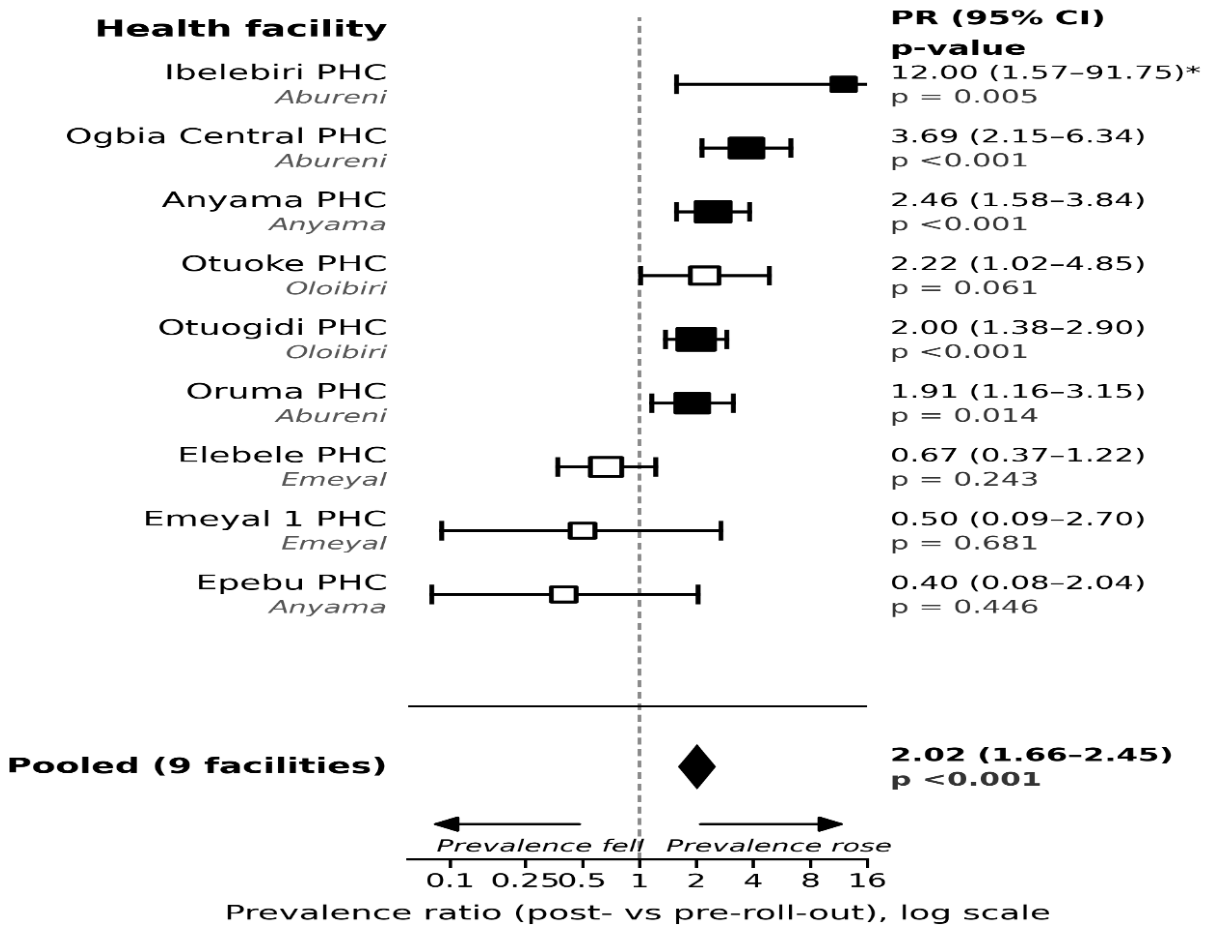
Figure 2.
Heterogeneity in malaria prevalence change across nine health facilities.
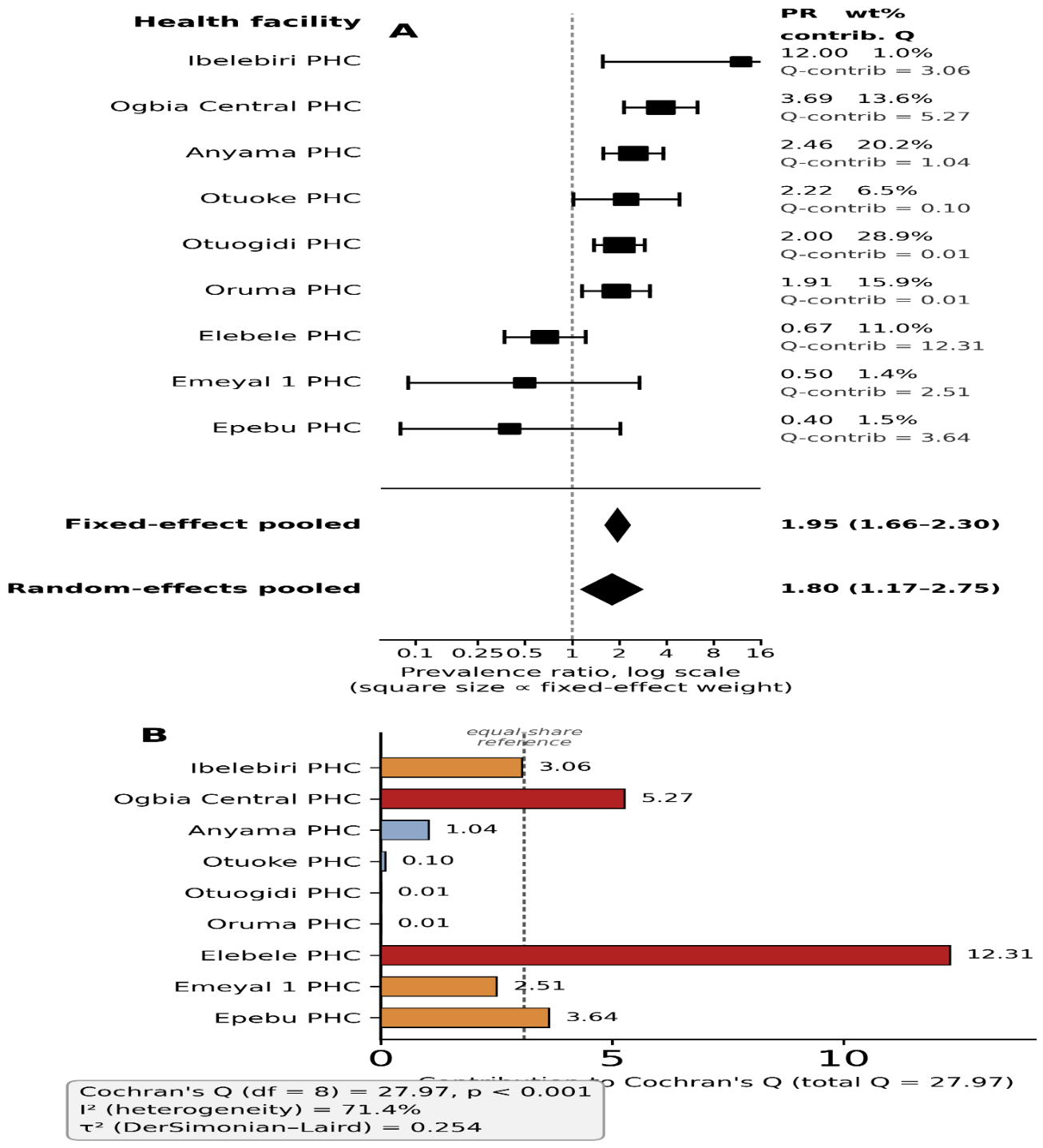
Figure 3.
Clan-level comparison of malaria prevalence change after R21/Matrix-M vaccine roll-out, Ogbia LGA.
Figure 3.
Clan-level comparison of malaria prevalence change after R21/Matrix-M vaccine roll-out, Ogbia LGA.
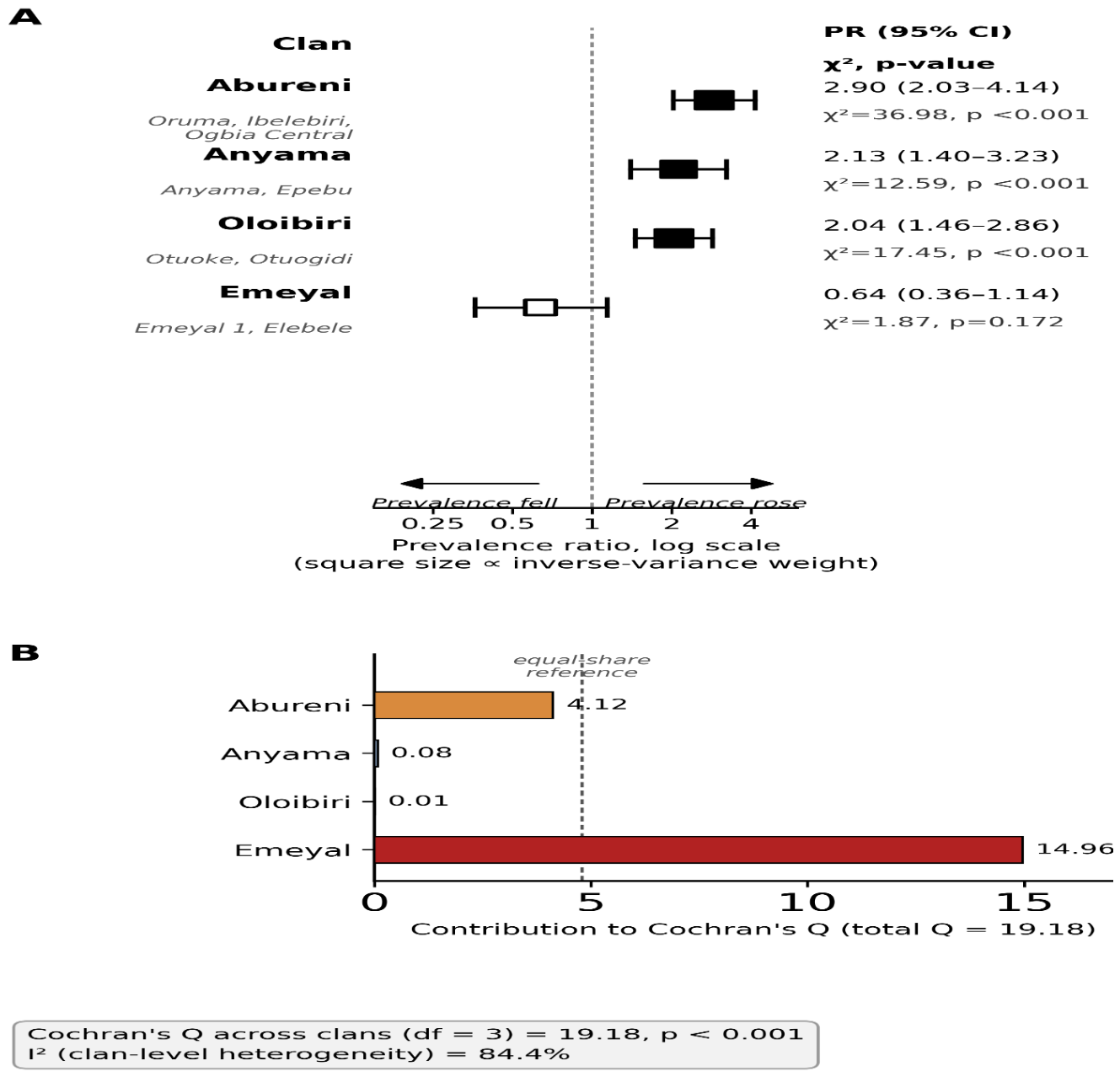
Figure 4.
Facility Catchment population vs. magnitude of change in malaria prevalence (n = 9 facilities).
Figure 4.
Facility Catchment population vs. magnitude of change in malaria prevalence (n = 9 facilities).
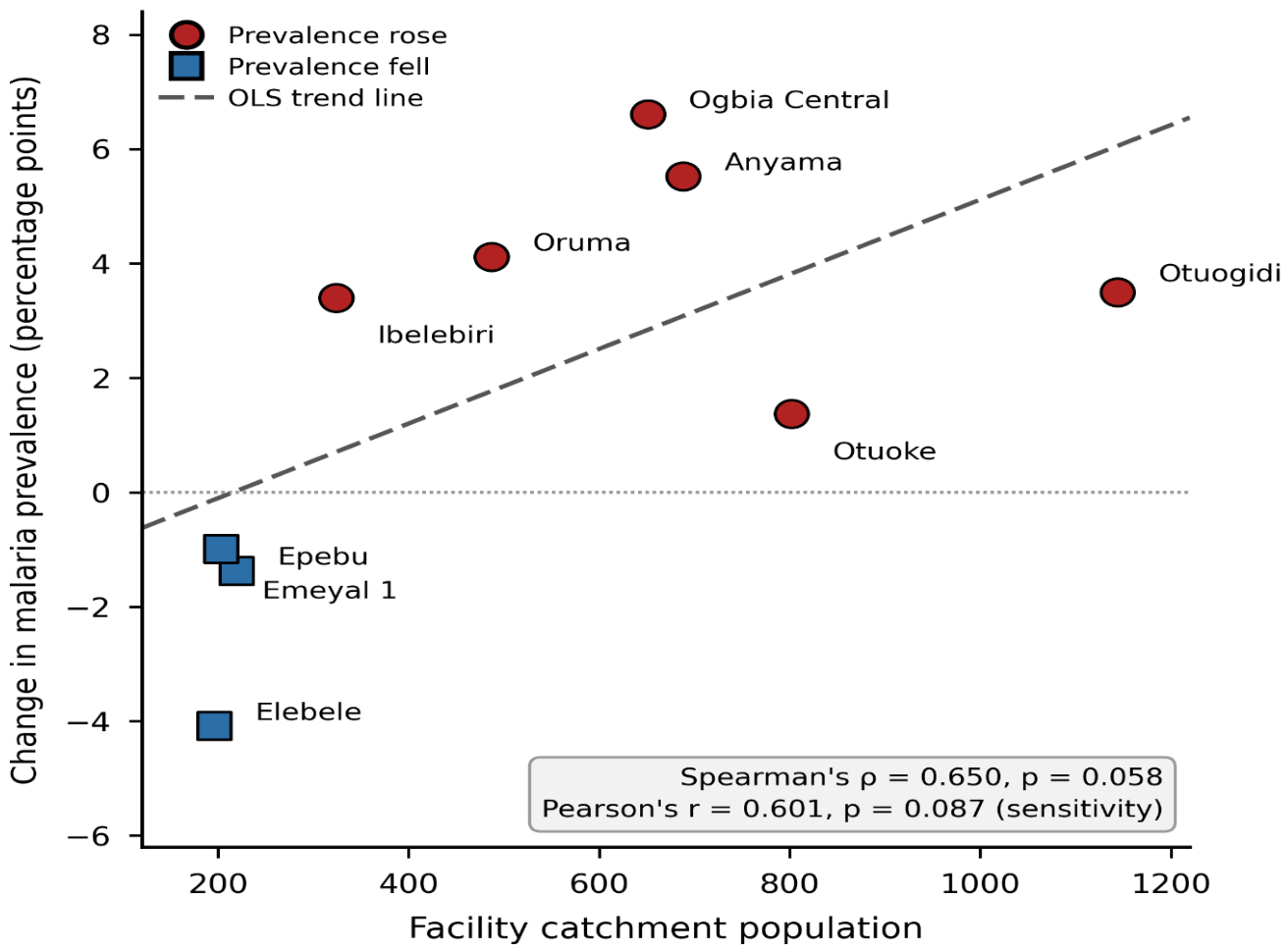
Figure 5.
Baseline prevalence vs. subsequent change (regression-to0the-mean assessment, n = 9).
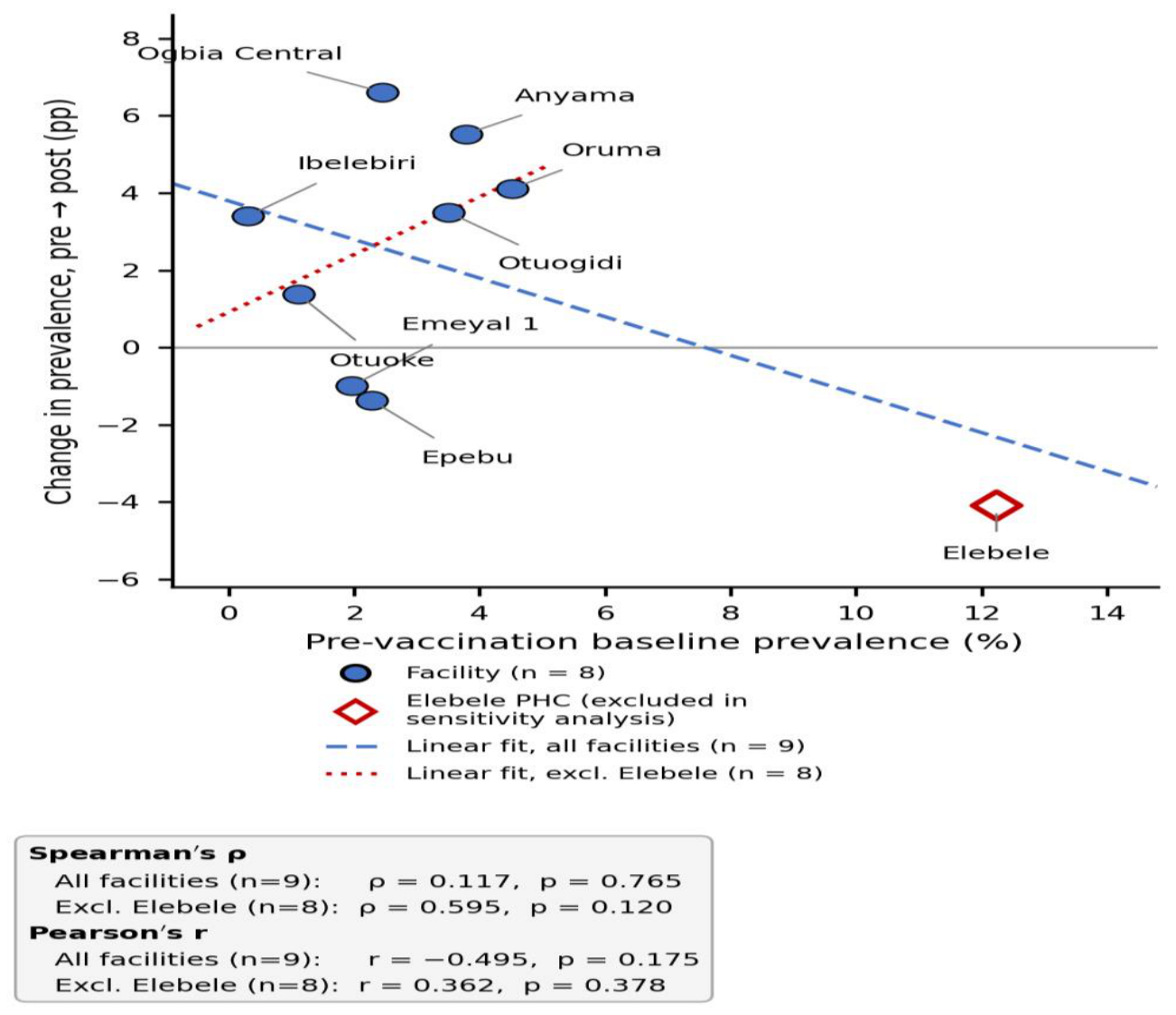
Figure 6.
First-dose vs. third-dose R21/Matrix-M coverage and malaria prevalence change by health facility (n = 9).
Figure 6.
First-dose vs. third-dose R21/Matrix-M coverage and malaria prevalence change by health facility (n = 9).
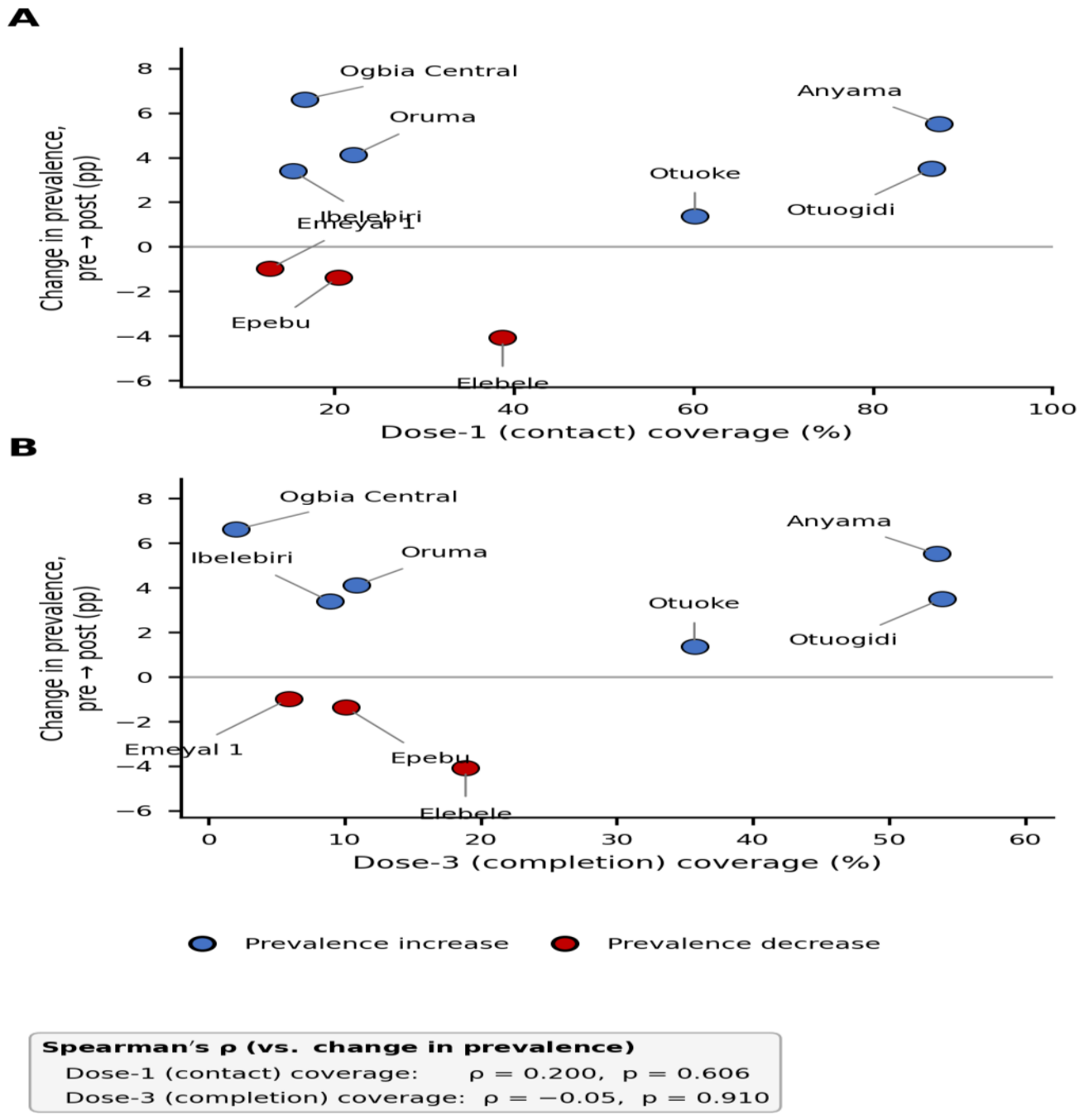
Figure 7.
Excess malaria episodes attributable to R21/Matrix-M roll-out, by health facility (n = 9).
Figure 7.
Excess malaria episodes attributable to R21/Matrix-M roll-out, by health facility (n = 9).
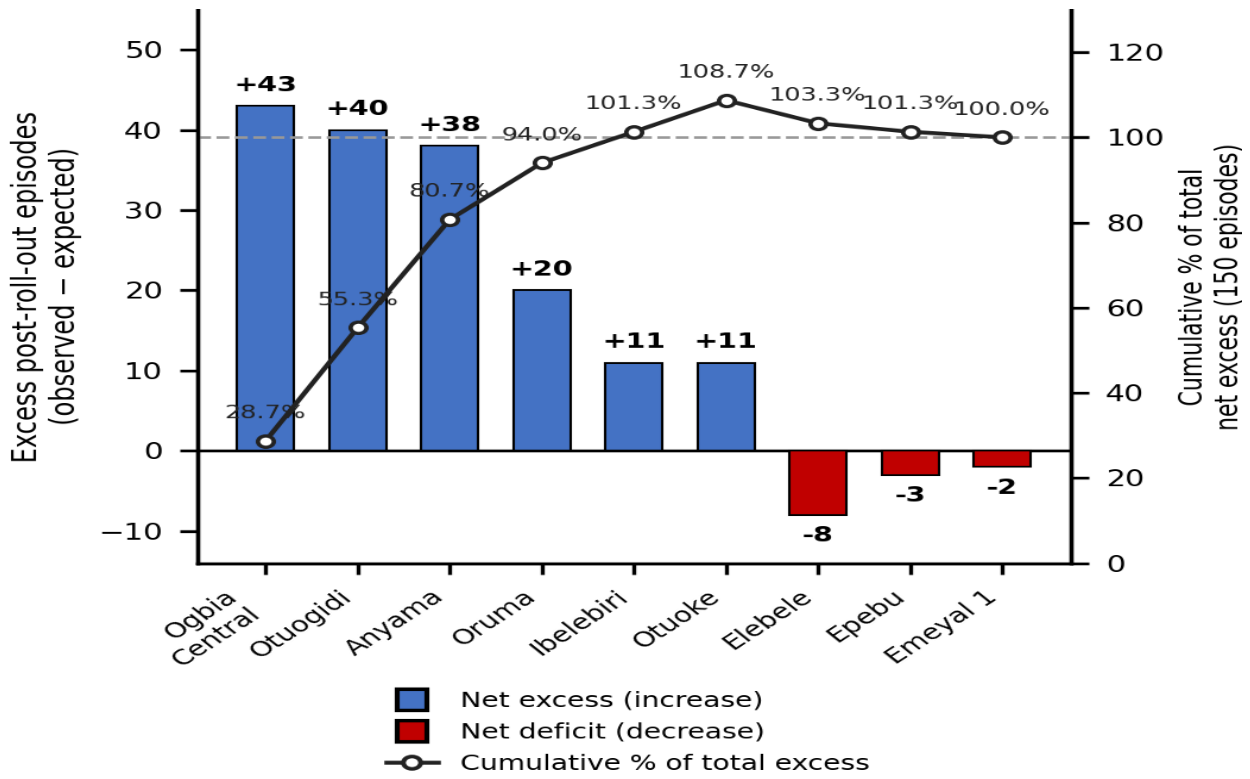
Figure 8.
Implementation significance of malaria vaccine introduction: linking facility-level heterogeneity, excess burden, and targeted control strategies.
Figure 8.
Implementation significance of malaria vaccine introduction: linking facility-level heterogeneity, excess burden, and targeted control strategies.
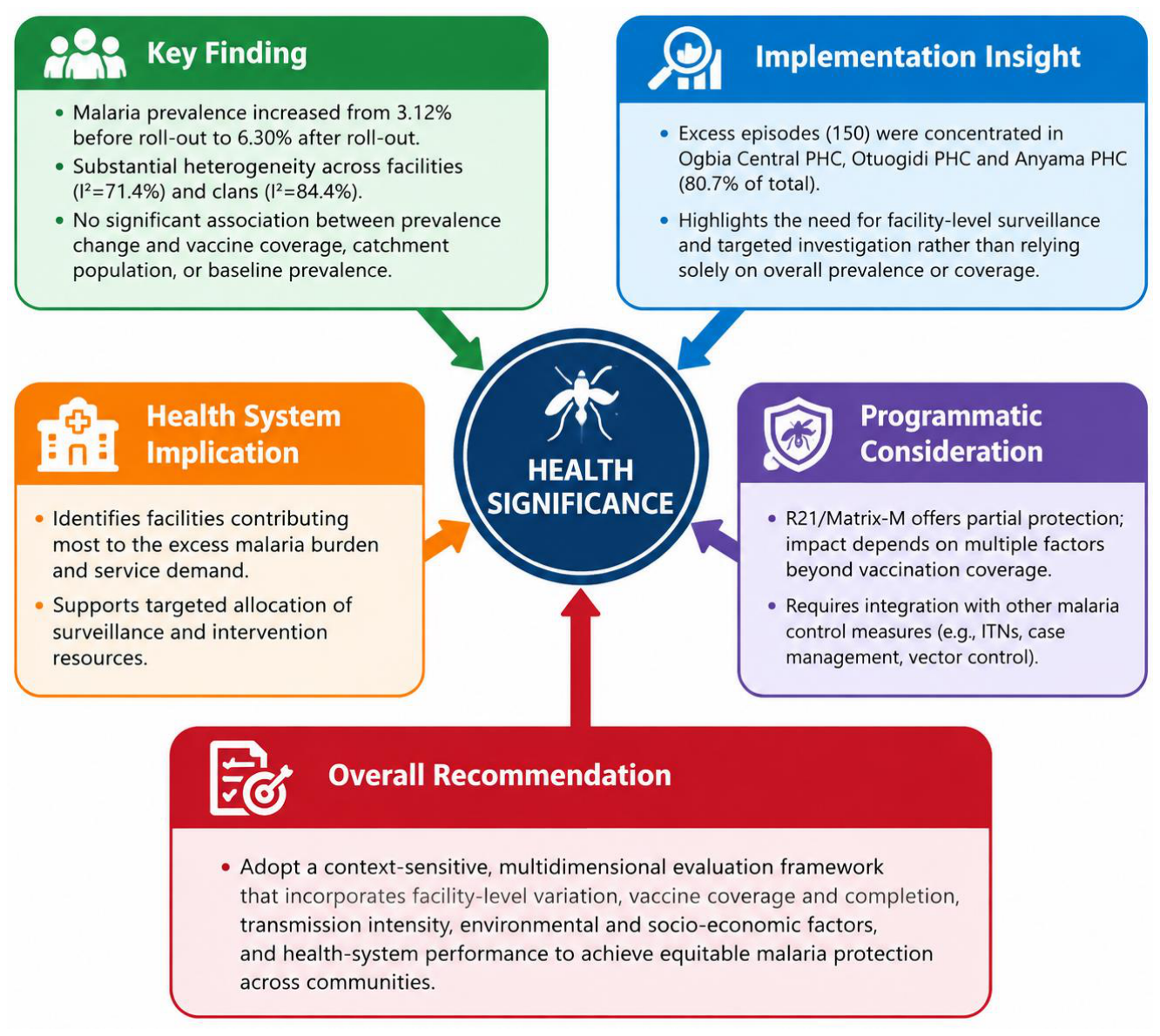

Table 1.
Facility-specific prevalence ratios and significance of change in malaria prevalence before versus after R21/Matrix-M vaccine roll-out (n = 9 facilities).
Table 1.
Facility-specific prevalence ratios and significance of change in malaria prevalence before versus after R21/Matrix-M vaccine roll-out (n = 9 facilities).
| Health facility | Clan | Catchment population | Pre episodes | Pre prevalence (%) | Post episodes | Post prevalence (%) | Prevalence ratio (95% CI) | χ2 (df=1) | p-value |
|---|---|---|---|---|---|---|---|---|---|
| Ibelebiri PHC | Abureni | 324 | 1 | 0.31 | 12 | 3.70 | 12.00 (1.57-91.75) | 7.85 | 0.005 |
| Ogbia Central PHC | Abureni | 651 | 16 | 2.46 | 59 | 9.06 | 3.69 (2.15-6.34) | 24.96 | <0.001 |
| Anyama PHC | Anyama | 688 | 26 | 3.78 | 64 | 9.30 | 2.46 (1.58-3.84) | 16.28 | <0.001 |
| Otuoke PHC | Oloibiri | 802 | 9 | 1.12 | 20 | 2.49 | 2.22 (1.02-4.85) | 3.51 | 0.061 |
| Otuogidi PHC | Oloibiri | 1,144 | 40 | 3.50 | 80 | 6.99 | 2.00 (1.38-2.90) | 13.38 | <0.001 |
| Oruma PHC | Abureni | 487 | 22 | 4.52 | 42 | 8.62 | 1.91 (1.16-3.15) | 6.04 | 0.014 |
| Elebele PHC | Emeyal | 196 | 24 | 12.24 | 16 | 8.16 | 0.67 (0.37-1.22) | 1.36 | 0.243 |
| Emeyal 1 PHC | Emeyal | 203 | 4 | 1.97 | 2 | 0.99 | 0.50 (0.09-2.70) | 0.17 | 0.681 |
| Epebu PHC | Anyama | 219 | 5 | 2.28 | 2 | 0.91 | 0.40 (0.08-2.04) | 0.58 | 0.446 |
| Pooled (9 facilities) | — | 4,714 | 147 | 3.12 | 297 | 6.30 | 2.02 (1.66-2.45) | 53.18 | <0.001 |
Statistical note: Prevalence ratios represent post-roll-out prevalence divided by pre-roll-out prevalence using the same facility catchment denominator for both periods. Confidence intervals were calculated on the logarithmic scale using the standard independent-proportions approach. Chi-square tests were performed with Yates’ continuity correction (1 degree of freedom); sensitivity analysis using Fisher’s exact test produced comparable conclusions. Facilities are ordered from the greatest increase to the greatest reduction in malaria prevalence.
Table 2.
Heterogeneity in the magnitude of malaria prevalence change across the nine health facilities (fixed- and random-effects meta-analytic synthesis).
Table 2.
Heterogeneity in the magnitude of malaria prevalence change across the nine health facilities (fixed- and random-effects meta-analytic synthesis).
| Health facility | ln(PR) | Prevalence ratio | Fixed-effect weight (%) | Contribution to Cochran’s Q |
|---|---|---|---|---|
| Ibelebiri PHC | 2.485 | 12.00 | 1.0 | 3.06 |
| Ogbia Central PHC | 1.305 | 3.69 | 13.6 | 5.27 |
| Anyama PHC | 0.901 | 2.46 | 20.2 | 1.04 |
| Otuoke PHC | 0.799 | 2.22 | 6.5 | 0.10 |
| Otuogidi PHC | 0.693 | 2.00 | 28.9 | 0.01 |
| Oruma PHC | 0.647 | 1.91 | 15.9 | 0.01 |
| Elebele PHC | -0.406 | 0.67 | 11.0 | 12.31 |
| Emeyal 1 PHC | -0.693 | 0.50 | 1.4 | 2.51 |
| Epebu PHC | -0.916 | 0.40 | 1.5 | 3.64 |
| Summary statistic | Estimate | |||
| Cochran’s Q (df=8) | 27.97, p<0.001 | |||
| I2 (proportion of variance due to true heterogeneity) | 71.4% | |||
| τ2 (between-facility variance, DerSimonian–Laird) | 0.254 | |||
| Fixed-effect pooled prevalence ratio (95% CI) | 1.95 (1.66-2.30) | |||
| Random-effects pooled prevalence ratio (95% CI) | 1.80 (1.17-2.75) | |||
Statistical note: The fixed-effect pooled estimate was calculated using inverse-variance weighting on the log prevalence ratio scale and is presented for comparison with the directly pooled prevalence ratio reported in Objective 1. The small numerical difference reflects the weighting framework rather than a discrepancy in the underlying facility-level data. Given the significant heterogeneity (Q test p<0.001; I2=71.4%), the random-effects estimate is considered the more appropriate summary measure because it accounts for genuine variability in facility-specific malaria prevalence changes.
Table 3.
Clan-level comparison of malaria prevalence before and after R21/Matrix-M vaccine roll-out, Ogbia LGA (n = 4 clans).
Table 3.
Clan-level comparison of malaria prevalence before and after R21/Matrix-M vaccine roll-out, Ogbia LGA (n = 4 clans).
| Clan | Facilities included | Catchment population | Pre episodes | Pre prevalence (%) | Post episodes | Post prevalence (%) | Prevalence ratio (95% CI) | χ2 (df=1) | p-value |
|---|---|---|---|---|---|---|---|---|---|
| Abureni | Oruma, Ibelebiri, Ogbia Central | 1,462 | 39 | 2.67 | 113 | 7.73 | 2.90 (2.03-4.14) | 36.98 | <0.001 |
| Anyama | Anyama, Epebu | 907 | 31 | 3.42 | 66 | 7.28 | 2.13 (1.40-3.23) | 12.59 | <0.001 |
| Oloibiri | Otuoke, Otuogidi | 1,946 | 49 | 2.52 | 100 | 5.14 | 2.04 (1.46-2.86) | 17.45 | <0.001 |
| Emeyal | Emeyal 1, Elebele | 399 | 28 | 7.02 | 18 | 4.51 | 0.64 (0.36-1.14) | 1.87 | 0.172 |
| Summary statistic | Estimate | ||||||||
| Cochran’s Q across clans (df=3) | 19.18 | ||||||||
| p-value | <0.001 | ||||||||
| I2 (clan-level heterogeneity) | 84.4% | ||||||||
Statistical note: Clan-specific prevalence ratios represent post-roll-out prevalence divided by pre-roll-out prevalence using the same clan-level catchment denominators across both periods. Confidence intervals and χ2 tests were calculated using the same methodology applied in the facility-level analyses. The significant Cochran’s Q statistic and high I2 value indicate substantial heterogeneity between clans, demonstrating that malaria prevalence changes after R21/Matrix-M introduction varied significantly according to geographic grouping. Clans are ranked according to the magnitude of prevalence increase, from the largest rise to the largest decline.
Table 4.
Facility catchment population size versus magnitude of change in malaria prevalence before to after R21/Matrix-M vaccine roll-out (n = 9 facilities).
Table 4.
Facility catchment population size versus magnitude of change in malaria prevalence before to after R21/Matrix-M vaccine roll-out (n = 9 facilities).
| Health facility | Catchment population | Population rank (1 = largest) | Change in prevalence (pp) | Change rank (1 = largest rise) |
|---|---|---|---|---|
| Otuogidi PHC | 1,144 | 1 | +3.50 | 4 |
| Otuoke PHC | 802 | 2 | +1.37 | 6 |
| Anyama PHC | 688 | 3 | +5.52 | 2 |
| Ogbia Central PHC | 651 | 4 | +6.61 | 1 |
| Oruma PHC | 487 | 5 | +4.11 | 3 |
| Ibelebiri PHC | 324 | 6 | +3.40 | 5 |
| Epebu PHC | 219 | 7 | −1.37 | 8 |
| Emeyal 1 PHC | 203 | 8 | −0.99 | 7 |
| Elebele PHC | 196 | 9 | −4.08 | 9 |
| Correlation statistic | Estimate | |||
| Spearman’s ρ | 0.650 | |||
| p-value | 0.058 | |||
| Pearson’s r (sensitivity analysis) | 0.601 | |||
| p-value | 0.087 | |||
Statistical note: Change in prevalence (percentage points) was calculated as post-roll-out prevalence minus pre-roll-out prevalence for each facility. Population and change rankings were ordered from largest (rank 1) to smallest (rank 9). Positive correlation coefficients indicate that facilities with larger catchment populations tended to show greater increases in malaria prevalence. Spearman’s correlation was selected as the primary analysis because of the small sample size and potential non-normal distribution of facility-level estimates, while Pearson’s correlation was included as a sensitivity assessment.
Table 5.
Pre-vaccination baseline prevalence versus magnitude of subsequent prevalence change—regression-to-the-mean assessment (n = 9 facilities).
Table 5.
Pre-vaccination baseline prevalence versus magnitude of subsequent prevalence change—regression-to-the-mean assessment (n = 9 facilities).
| Health facility | Baseline (pre) prevalence (%) | Baseline rank (1 = highest) | Change in prevalence (pp) | Change rank (1 = largest rise) |
|---|---|---|---|---|
| Elebele PHC | 12.24 | 1 | −4.08 | 9 |
| Oruma PHC | 4.52 | 2 | +4.11 | 3 |
| Anyama PHC | 3.78 | 3 | +5.52 | 2 |
| Otuogidi PHC | 3.50 | 4 | +3.50 | 4 |
| Ogbia Central PHC | 2.46 | 5 | +6.61 | 1 |
| Epebu PHC | 2.28 | 6 | −1.37 | 8 |
| Emeyal 1 PHC | 1.97 | 7 | −0.99 | 7 |
| Otuoke PHC | 1.12 | 8 | +1.37 | 6 |
| Ibelebiri PHC | 0.31 | 9 | +3.40 | 5 |
| Correlation statistic | Estimate | |||
| Spearman’s ρ (all 9 facilities) | 0.117; p=0.765 | |||
| Pearson’s r (all 9 facilities) | −0.495; p=0.175 | |||
| Spearman’s ρ (sensitivity analysis excluding Elebele PHC, n=8) | 0.595; p=0.120 | |||
| Pearson’s r (sensitivity analysis excluding Elebele PHC, n=8) | 0.362; p=0.378 | |||
Statistical note: Baseline prevalence and change in prevalence (percentage points) were calculated from the facility-level pre- and post-roll-out estimates. Spearman’s correlation was considered the primary assessment because of the small number of facilities and potential departures from normality. Pearson’s correlation was included as a sensitivity analysis. The exclusion of Elebele PHC was performed because this facility represented an influential observation with the highest baseline prevalence and a substantial decline after roll-out. The persistence of non-significant associations after sensitivity testing indicates that baseline prevalence did not significantly explain the observed variability in malaria prevalence change across facilities.
Table 6.
First-dose (contact) coverage versus changes in malaria prevalence, compared against third-dose (completion) coverage, by health facility (n = 9 facilities).
Table 6.
First-dose (contact) coverage versus changes in malaria prevalence, compared against third-dose (completion) coverage, by health facility (n = 9 facilities).
| Health facility | Dose-1 coverage (%) | Dose-3 coverage (%) | Change in prevalence (pp) | Dose-1 rank (1 = highest) | Change rank (1 = largest rise) |
|---|---|---|---|---|---|
| Anyama PHC | 87.4 | 53.5 | +5.52 | 1 | 2 |
| Otuogidi PHC | 86.5 | 53.9 | +3.50 | 2 | 4 |
| Otuoke PHC | 60.2 | 35.7 | +1.37 | 3 | 6 |
| Elebele PHC | 38.8 | 18.9 | −4.08 | 4 | 9 |
| Oruma PHC | 22.2 | 10.9 | +4.11 | 5 | 3 |
| Epebu PHC | 20.5 | 10.1 | −1.37 | 6 | 8 |
| Ogbia Central PHC | 16.7 | 2.0 | +6.61 | 7 | 1 |
| Ibelebiri PHC | 15.4 | 8.9 | +3.40 | 8 | 5 |
| Emeyal 1 PHC | 12.8 | 5.9 | −0.99 | 9 | 7 |
| Correlation statistic | Estimate | ||||
| Spearman’s ρ (dose-1 coverage vs. prevalence change) | 0.200; p=0.606 | ||||
| Spearman’s ρ (dose-3 coverage vs. prevalence change) | −0.05; p=0.910 | ||||
Statistical note: Dose-1 and dose-3 coverage were calculated as doses administered divided by facility catchment population. Spearman’s correlation was selected as the primary analysis because of the small number of facilities (n=9) and the potential for non-normal distributions. Dose-3 coverage estimates and correlation statistics were included for direct comparison with the existing manuscript analysis. The opposite and equally weak correlation directions for dose-1 and dose-3 coverage indicate that neither initial vaccine contact nor completion of the vaccination schedule was associated with facility-level malaria prevalence change following R21/Matrix-M introduction. These findings support the interpretation that observed prevalence changes are more likely related to non-vaccine contextual factors rather than differences in vaccine uptake intensity.
Table 7.
Excess (attributable) malaria episodes by health facility before versus after R21/Matrix-M vaccine roll-out (n = 9 facilities).
Table 7.
Excess (attributable) malaria episodes by health facility before versus after R21/Matrix-M vaccine roll-out (n = 9 facilities).
| Health facility | Clan | Catchment population | Pre-episodes (expected post if pre-rate persisted) | Observed post episodes | Excess episodes (observed- expected) | % of total excess (150) | Cumulative % |
|---|---|---|---|---|---|---|---|
| Ogbia Central PHC | Abureni | 651 | 16 | 59 | +43 | 28.7% | 28.7% |
| Otuogidi PHC | Oloibiri | 1,144 | 40 | 80 | +40 | 26.7% | 55.3% |
| Anyama PHC | Anyama | 688 | 26 | 64 | +38 | 25.3% | 80.7% |
| Oruma PHC | Abureni | 487 | 22 | 42 | +20 | 13.3% | 94.0% |
| Ibelebiri PHC | Abureni | 324 | 1 | 12 | +11 | 7.3% | 101.3% |
| Otuoke PHC | Oloibiri | 802 | 9 | 20 | +11 | 7.3% | 108.7% |
| Elebele PHC | Emeyal | 196 | 24 | 16 | −8 | −5.3% | 103.3% |
| Epebu PHC | Anyama | 219 | 5 | 2 | −3 | −2.0% | 101.3% |
| Emeyal 1 PHC | Emeyal | 203 | 4 | 2 | −2 | −1.3% | 100.0% |
| Total | — | 4,714 | 147 | 297 | +150 | 100% | — |
Statistical note: Expected post-roll-out episodes were calculated by applying each facility’s pre-roll-out malaria prevalence rate to the same catchment population during the post-roll-out period, assuming that the facility-specific baseline rate would have remained unchanged. Excess episodes represent the difference between observed post-roll-out episodes and expected episodes. Facilities are ranked according to their contribution to the total excess burden. The cumulative percentage exceeds 100% during intermediate ranking because facilities with reductions contribute negative excess values, which offset positive excess episodes when calculating the final net increase. This burden-based analysis complements prevalence ratio estimates by identifying facilities contributing the greatest absolute number of additional malaria episodes rather than only the greatest proportional changes.
Disclaimer/Publisher’s Note: The statements, opinions and data contained in all publications are solely those of the individual author(s) and contributor(s) and not of MDPI and/or the editor(s). MDPI and/or the editor(s) disclaim responsibility for any injury to people or property resulting from any ideas, methods, instructions or products referred to in the content. |
© 2026 by the authors. Licensee MDPI, Basel, Switzerland. This article is an open access article distributed under the terms and conditions of the Creative Commons Attribution (CC BY) license (http://creativecommons.org/licenses/by/4.0/).
Copyright: This open access article is published under a Creative Commons CC BY 4.0 license, which permit the free download, distribution, and reuse, provided that the author and preprint are cited in any reuse.