

Submitted:
07 September 2026
Posted:
08 September 2026
You are already at the latest version
Abstract
Antimony (Sb) is a critical raw material whose European supply depends strongly on imports, renewing interest in the metallogenic framework of historical Sb provinces. This review compiles and reassesses 100 Sb deposits and occurrences from Spain and Portugal within a unified geological, structural, and mineralogical framework. Six broad deposit types and twelve mineral associations are recognized, with the Central Iberian Zone containing the largest number and greatest diversity of occurrences. The regional distribution of mineralization indicates a hierarchical control in which long-lived Variscan shear zones and crustal faults organized hydrothermal circulation, whereas second-order fractures, breccias, and favorable lithological or stratigraphic horizons localized ore deposition. Vein-type and stratabound mineralization are therefore interpreted as potentially related expressions of evolving tectono-hydrothermal systems rather than necessarily distinct genetic families. Gold-bearing Sb systems are particularly developed in western Iberia, whereas carbonate-hosted Sb-Hg mineralization characterizes the Cantabrian Zone and Sb-Cu associations are prominent in the South Portuguese Zone. An integrated multistage model is proposed in which heterogeneous pre-ore metal reservoirs, Variscan crustal architecture, late Variscan reactivation, magmatic and thermal activity, and local structural-lithological traps collectively controlled Sb mobilization and deposition. The model emphasizes repeated tectono-hydrothermal reactivation rather than a single universal metal or fluid source.
Keywords:
antimony
; Iberian Peninsula
; Variscan Belt
; metallogeny
; shear zones
; hydrothermal mineralization
; structural control
; critical raw materials
1. Introduction
Antimony (Sb) is regarded as a critical raw material by the European Union and other Western economies because of its strategic applications, limited supply diversification, and the high concentration of mining, processing, and refining capacity in a small number of producing countries [1,2]. Its uses include flame-retardant formulations, lead-acid batteries, high-technology and electronic applications, chemical and petroleum-refining catalysts, and a wide range of defense-related products. Antimony is also attracting renewed interest in connection with emerging large-capacity energy-storage technologies. The absence of current Sb ore mining and concentrate production within the European Union, together with its complete dependence on imports, reinforces the strategic relevance of reassessing European Sb resources and the geological processes responsible for their concentration.
The Iberian Peninsula contains a large and geologically diverse population of antimony mineralizations, most of them located within the Iberian Massif, the southern segment of the Western European Variscan Belt. Early regional syntheses by Gumiel [3,4], Arribas and Gumiel [5], and Gumiel and Arribas [6] established the foundations for understanding their geological, structural, and metallogenic characteristics. Subsequent work has provided additional information on individual districts, mineral associations, structural controls, igneous relationships, and possible genetic mechanisms.
The present review compiles and reassesses information from 100 antimony deposits and occurrences distributed across Spain and Portugal. Rather than treating these occurrences as an inventory of isolated deposits, the review seeks to identify recurrent regional patterns linking deposit morphology, host-rock composition and age, mineral associations, structural position, and the presence of nearby igneous rocks. The compiled dataset permits recognition of six broad deposit types and twelve mineral associations, while also showing that the different mineral associations are unevenly distributed among the principal tectonostratigraphic zones of the Iberian Massif.
A central theme of this synthesis is the role of faults and shear zones in controlling the location of Sb mineralization. Many Iberian deposits occur in structural corridors related to major Variscan shear zones or within second-order fractures connected to them. This structural framework is especially significant because late Variscan deformation and the development of the Ibero-Armorican (Asturian) orocline reactivated pre-existing structures, generated new fracture systems, and coincided with widespread magmatic and hydrothermal activity [7,8,9,10,11,12,13,14,15].
A second objective is to evaluate how structural control interacts with lithological control. The Iberian dataset contains both discordant vein systems and stratabound mineralizations. The latter are particularly significant where mineralization replaces favorable carbonate or siliceous horizons and is locally remobilized into fractures. Consequently, vein-type and stratabound occurrences are treated here as expressions that must be evaluated within a common tectono-hydrothermal framework rather than as purely descriptive categories.
Finally, the review considers the possible contribution of volcanic and plutonic processes to Sb enrichment. Mafic rocks, especially dolerite bodies and dikes, occur close to several important Iberian districts, whereas other deposits show spatial or geochemical relationships with felsic intrusive rocks. These relationships remain genetically debated and are therefore treated as testable constraints rather than as a single established model. The overall aim is to provide an integrated metallogenic framework for Iberian Sb mineralization and to establish a basis for comparison with other Variscan and world-class antimony provinces.
2. Geological and Geodynamic Framework
2.1. Tectonostratigraphic Architecture of the Iberian Massif
The Iberian Massif constitutes the largest exposure of Variscan basement in the Iberian Peninsula and represents the southernmost major segment of the Western European Variscan Belt (Figure 1). Its present architecture records a long Paleozoic history involving rifting along the northern Gondwanan margin, development and consumption of oceanic domains, accretion of continental and oceanic terranes, collision, crustal thickening, subsequent extension, and late-orogenic transcurrent deformation. This evolution was superimposed on a heterogeneous Neoproterozoic basement and produced a strongly segmented orogen in which contrasting lithostratigraphic successions, metamorphic grades, structural styles, magmatic and metallogenic histories are juxtaposed across major tectonic boundaries [16,17,18,19,20,21,22,23,24,25,26,27].
The principal tectonostratigraphic domains relevant to the distribution of Sb mineralization are the Cantabrian Zone (CZ), West Asturian-Leonese Zone (WALZ), Galicia-Trás-os-Montes Zone (GTMZ), Central Iberian Zone (CIZ), Ossa-Morena Zone (OMZ), and South Portuguese Zone (SPZ). These zones represent different positions within the Variscan orogen and preserve markedly different pre-Variscan and Variscan histories.
The CZ constitutes the external, largely unmetamorphosed foreland fold-and-thrust belt, whereas the WALZ records the transition toward the more internal and metamorphic domains. The CIZ forms a major Gondwanan domain and contains extensive Neoproterozoic and Paleozoic metasedimentary successions together with the largest volumes of Variscan granitoids. In northwestern Iberia, it is structurally overlain by the allochthonous complexes of the GTMZ [32], which preserve remnants of continental-margin, arc, back-arc, and oceanic units involved in the Variscan collision.
To the south, the CIZ, OMZ, and SPZ are separated by crustal-scale tectonic boundaries interpreted as major sutures and transpressional zones. West of the N-S-trending Porto-Tomar Shear Zone (PTSZ), the Finisterra Terrane has also been distinguished as a separate tectonostratigraphic domain [31,33]. This tectonostratigraphic subdivision is particularly relevant to Sb metallogeny because each domain combines a different crustal inheritance with distinctive host-rock successions and structural architectures.
The oldest geological formations in the Variscan Massif are late Precambrian in age. In the northwestern part of the Iberian Peninsula, they include volcanic, pelitic, greywacke, and locally carbonate successions. In central and western Iberia, these units are extensively represented by the two sequences of the Schist-Greywacke Complex (SGC) [34], partly equivalent to the Beiras Formation in Portugal [35], whereas the Serie Negra is especially important in the southern Iberian Massif, where it underlies the SGC in the transition from the CIZ to the OMZ. Paleozoic metasedimentary and metavolcanic successions overlie these older sequences and were variably affected by Variscan deformation and metamorphism. The resulting lithological heterogeneity provided contrasting mechanical and chemical environments for later hydrothermal circulation, ranging from competent quartzites and greywackes prone to brittle fracturing to reactive carbonate horizons capable of focusing replacement and stratabound mineralization.
Variscan metamorphism and deformation vary substantially across the Massif. The external CZ is characterized by comparatively weak metamorphism and thin-skinned deformation, whereas the WALZ records more pervasive strain and metamorphism. The CIZ includes both high-grade metamorphic domains and extensive low- to medium-grade metasedimentary regions. In addition, large volumes of granitoids were emplaced during and after the main Variscan deformation, especially in the CIZ, while more restricted felsic and mafic magmatism occurred in other domains. This combination of heterogeneous basement, contrasting sedimentary successions, regional metamorphism, and widespread magmatism established the crustal framework subsequently affected by late Variscan deformation and hydrothermal activity.
2.2. Deep Crustal Architecture and Southern Iberian Sutures
The crustal-scale relationships among the CIZ, OMZ, and SPZ are particularly well constrained by the IBERSEIS and ALCUDIA deep seismic reflection transects [21,24]. The IBERSEIS profile extends for approximately 303 km across southwestern Iberia, whereas the ALCUDIA transect continues the crustal image for about 230 km farther into the CIZ. Together, these profiles provide a regional-scale section through a substantial part of the southern Iberian Variscan Belt and demonstrate the close correspondence between surface tectonostratigraphic boundaries and structures imaged at depth.
One of the most striking features of the IBERSEIS image is the Iberseis Reflective Body (IRB), a broad, laterally extensive band of strong reflectivity situated at mid-crustal levels. In the original interpretation, the IRB is approximately 1-2 s thick, occurs mainly between about 4 and 6 s two-way travel time, and extends for more than 140 km. The Moho is represented by a marked decrease in reflectivity at approximately 10.5 s, corresponding to a crustal thickness of about 31.5 km along much of the profile [21]. The IRB occupies a position close to the boundary between the upper and lower crust and changes in thickness laterally, indicating a major crustal feature rather than a local intrusive body.
The CIZ-OMZ boundary is imaged as a thick northeast-dipping reflective zone that is truncated at mid-crustal levels by the IRB. This geometry has been interpreted to indicate that emplacement of the reflective body was late- or post-collisional relative to the development of the CIZ-OMZ suture. Mafic igneous activity associated with this crustal architecture is represented at surface by several bodies, including the Aguablanca intrusion, dated at approximately 345 Ma [36]. The relationship between deep crustal structures and mafic magmatism is important in a regional metallogenic context because it demonstrates that the Variscan crust contained long-lived pathways capable of connecting different crustal levels.
Farther south, the contact between the OMZ and SPZ is expressed in the middle crust by an abrupt termination of the IRB. This relationship is compatible with a geodynamic evolution in which final OMZ-SPZ amalgamation post-dated at least part of the mid-crustal magmatic event. The SPZ subsequently evolved under strong oblique convergence and left-lateral transcurrent deformation during the Late Devonian-Early Carboniferous [21,37,38,39,40,41]. These processes generated major crustal fault systems and strongly deformed sedimentary-volcanic basins, establishing structural corridors that were available for subsequent reactivation during continued Variscan shortening and transpression.
The structural relationships among these three geological zones were first outlined by Simancas et al. [42] and subsequently developed further by Simancas et al. [21,43,44]. These authors proposed that the Iberian Massif comprises two branches with opposite subduction polarities connected by a transform fault. The Variscan evolution of the northern branch includes west-dipping subduction, obduction of ocean-derived units, and eastward propagation of deformation. The southern branch displays southwestward vergence and two sutures: the first delineates the boundary between the SPZ and OMZ and records north-dipping subduction, whereas the second delineates the boundary between the OMZ and CIZ and also records north-dipping subduction.
The CIZ constitutes the footwall of the allochthonous terranes of the GTMZ in the northern branch, and it is the hanging wall of the suture-related rocks in the southern branch. The change in subduction polarity is explained by the existence of a transform fault connecting both domains, presently represented by the Porto-Tomar Shear Zone (PTSZ). In addition, the northern domain is characterized by the predominance of granite and abundant high-grade metamorphic rock formations, while the southern domain is dominated by low-grade metasedimentary rock formations. The two domains are separated by the so-called Domo Extremeño Group, an extensive anticlinal structure composed primarily of Upper Proterozoic rocks of the SGC, which is located just south of the Alpine Spanish Central System.
The seismic profiles therefore show that the surface zonation of the southern Iberian Massif is rooted in a complex crustal architecture involving sutures, deep shear zones, crustal-scale reflectors, and magmatic bodies. For the purposes of this review, the principal implication is not that these deep structures directly hosted Sb mineralization, but that they established a long-lived framework of crustal heterogeneity and mechanical weakness within which later deformation, magmatism, and fluid circulation were organized.
2.3. Oroclinal Development and Late Variscan Reactivation
One of the most characteristic features of the Iberian Massif is its arcuate geometry, traditionally referred to as the Ibero-Armorican or Asturian Arc. The Asturian Arc is interpreted as a secondary orocline produced by bending of previously formed Variscan structures, with its main development occurring from the Moscovian to the Asselian, approximately 310-292 Ma [10,43,45]. Consequently, oroclinal development post-dated much of the principal collisional architecture and imposed a new regional deformation pattern on previously established folds, thrusts, sutures, and shear zones.
The core of the orocline lies in the Cantabrian Zone, where bending and associated deformation are particularly evident [46]. However, the age and regional scale of the process imply that its effects extended far beyond the hinge zone and influenced a large part of the Iberian Variscan Massif. In the Cantabrian foreland, previously deposited carbonate-platform and syn-orogenic successions were affected by intense folding, thrusting, reverse faulting, and strike-slip deformation. Elsewhere in the orogen, older structures were rotated or reactivated, and new fault systems developed in response to the changing stress field.
Late collisional deformation also involved the development of large-wavelength upright folds and important strike-slip ductile shear zones [10,13,47]. Paleomagnetic and structural models indicate major vertical-axis rotations during formation of the Ibero-Armorican Arc [7,8,11,12]. Such rotations required substantial reorganization of the regional stress-strain field and promoted repeated reactivation of inherited anisotropies. Structures originally generated during earlier stages of convergence could therefore acquire new kinematic roles during late-orogenic transpression or transtension.
This late Variscan interval was also accompanied by widespread thermal and igneous activity. Orocline formation has been linked to lithospheric-scale processes, including a proposed late Carboniferous-Early Permian delamination event [7,8,11,48,49]. Regardless of the precise geodynamic mechanism, the coincidence of regional deformation, renewed fracturing, elevated heat flow, and magmatic activity created favorable conditions for large-scale hydrothermal circulation. This temporal and structural framework is particularly relevant to Sb mineralization because many Iberian deposits occupy fractures and shear-related structures that could have been opened or reactivated during these late stages [14,15,50].
During oroclinal development, dextral strike-slip shear zones are predominantly sub-parallel to the main Variscan structures [10], although the most prominent one, the N-S trending Porto-Tomar Shear Zone (PTSZ), is oblique to them (Figure 1). In contrast, most sinistral shear zones are oriented obliquely to the main structural grain. This is the result of predominantly dextral shear and less pervasive conjugate sinistral shearing attributable to oroclinal buckling that gave rise to the Cantabrian Arc [7,8].
The term 'Late Variscan' is therefore used here to encompass the final stages of the Variscan tectonic evolution during which pre-existing sutures, thrusts, folds, and faults were extensively reactivated and new transpressional or transtensional structures developed. Rather than representing a minor terminal event, this interval produced an interconnected network of subvertical strike-slip shear zones and subsidiary brittle structures. At the regional scale, these structures provided a mechanism for linking deep crustal architecture with upper-crustal fracture systems, thereby creating potential pathways for hydrothermal fluids. This interval was also characterized by significant magmatism across the entire orogen, including the foreland, which facilitated the circulation of various types of fluids and associated mineralizing processes [14,15,50].
2.4. Late Variscan Magmatism and Hydrothermal Framework
Magmatism constitutes another fundamental component of the late Variscan geological framework. Granitic plutonism is especially abundant in the CIZ, where syn- to late-orogenic granitoids form extensive batholiths and smaller intrusive bodies. More restricted felsic and mafic intrusions also occur in the CZ, WALZ, OMZ, and other domains. In the inner part of the Cantabrian orocline, post-collisional magmatism, varying from gabbros to granodiorites and granites, developed during the latest Carboniferous-Early Permian interval, and several authors have proposed a significant mantle contribution followed by crustal contamination during magma ascent [14,51]. This area experienced mantle-derived magmatism between 300 and 292 Ma [14,52].
In the southern CIZ, the Pedroches batholith [43,53] is underlain by a conspicuous Variscan wedge structure that is responsible for significant crustal thickening. Furthermore, subduction of the Ossa-Morena lower crust beneath the southern Central Iberian Zone [43] may also have contributed to crustal thickening in this area. In this interpretation, the OMZ is subducted beneath the CIZ, representing the final zone of the active continental margin. In this setting, the granites that crop out parallel to the suture zone [54,55,56] are related to this subduction zone. These granites form a post-collisional batholith in southern Iberia that is rooted in the mantle [54].
The spatial relationships among intrusions, regional fractures, and mineralized systems are important but should not be interpreted as evidence for a single magmatic source of Sb. In several parts of the Iberian Massif, intrusive bodies and mineral occurrences are preferentially localized along regional structural corridors [57]. Mafic rocks, including gabbros, dolerite bodies and dikes, occur close to a number of Sb districts, whereas other mineralized areas show spatial relationships with felsic granitoids. These contrasting associations suggest that igneous activity may have influenced the thermal regime, permeability structure, fluid production, or metal availability in different ways depending on the district.
From a regional perspective, the most robust relationship is therefore the temporal and spatial coincidence between late Variscan deformation, magmatic activity, and enhanced crustal permeability. The repeated opening and reactivation of fault and shear networks would have facilitated fluid migration across different crustal levels, while intrusive activity provided additional heat and locally modified fluid-rock interaction. The relative importance of magmatic, metamorphic, and externally derived fluids cannot be established from regional spatial relationships alone and is considered separately in the genetic discussion of this review.
This distinction is important for the metallogenic model developed below. Granitoids and mafic rocks are treated as components of the tectono-magmatic environment rather than automatically as direct metal sources. Similarly, the proximity of an Sb occurrence to an intrusion is considered a geological constraint that must be evaluated together with age relationships, mineral chemistry, fluid inclusions, isotopic evidence, and structural chronology.
2.5. Major Crustal-Scale Shear Zones Relevant to the Regional Framework
The late Variscan structural framework of the Iberian Massif includes numerous crustal-scale shear zones (Figure 1), several of which are spatially associated with important Sb districts. Their significance lies primarily in their longevity and capacity for repeated reactivation. Major shear zones may act as first-order zones of crustal weakness, whereas mineralization is commonly localized in subsidiary faults, fractures, dilational jogs, breccias, or favorable lithological horizons connected to these larger structures.
The Porto-Tomar Shear Zone (PTSZ) was an ancient transform fault [58,59] that connected the change in subduction polarity in two domains. It later developed into a north-south trending dextral strike-slip fault along the westernmost edge of the Iberian Massif [58]. This fault extends northward through several dextral shear zones. In northwest Galicia, these dextral shear zones transition to a NE-SW orientation (Figure 1). These transcurrent structures are interpreted to extend into the Armorican Massif into the South Armorican Shear Zone (SASZ).
The Juzbado-Penalva Shear Zone (JPSZ) is a major sinistral structure trending approximately ENE-WSW across the northern CIZ between Salamanca and Viseu. Westward, its strike changes toward NW-SE and it continues into the Douro-Beirã Shear Zone (DBSZ) [60]. The combined JPSZ-DBSZ system illustrates the complexity of late Variscan transcurrent deformation and the capacity of regional structures to change orientation along strike while remaining part of a broader deformation corridor.
The Badajoz-Córdoba Shear Zone (BCSZ) forms the major tectonic boundary between the CIZ and OMZ (Figure 1) and is characterized by an important sinistral component of deformation [61,62,63]. Parts of its deformation history are Devonian to Early Carboniferous, and fabrics associated with the zone record a prolonged tectonic evolution. Nevertheless, younger reactivation has also been documented, and sinistral motion may have continued or been renewed during later stages of the Variscan evolution [21,42,43]. The BCSZ is therefore best regarded as a long-lived crustal discontinuity rather than as a structure generated during a single tectonic event.
Taken together, the JPSZ-DBSZ, PTSZ, BCSZ, and associated regional faults define a first-order structural network superimposed on the tectonostratigraphic architecture of the Iberian Massif. Their prolonged evolution allowed them to influence deformation partitioning and crustal permeability repeatedly through time. The specific relationships between these regional structures and individual Sb districts are addressed in the structural and metallogenic sections below; at this stage, their importance is to establish the crustal-scale framework within which mineralized second-order structures developed.
2.6. Implications for the Iberian Sb Metallogenic Framework
The geological framework described above defines a heterogeneous and polyphase crustal setting characterized by inherited lithological contrasts, major sutures and shear zones, widespread Variscan magmatism, and repeated late-orogenic reactivation. These elements establish the regional geological context in which Iberian Sb mineralization developed. Their genetic significance, however, cannot be inferred from spatial association alone and is evaluated later using the metallogenic, structural, and geochemical evidence compiled in this review.
The first step in this evaluation is therefore to establish how deposit morphology, host-rock character, and mineral association vary across the Iberian dataset.
3. Distribution and Classification of Iberian Sb Deposits
3.1. Spatial Distribution and Classification Approach
The 100 deposits and occurrences compiled in this review are distributed across several tectonostratigraphic domains and show substantial variation in host-rock age, geometry, mineralogy, and structural setting (Figure 2 and Table S1). The first regional typological classifications were developed by Gumiel [3,4] and Gumiel and Arribas [6]. The updated scheme used here combines morphology, host-rock character, lithological control, structural setting, and mineral association, thereby providing a metallogenic-structural classification rather than a purely descriptive one.
Two end-member geometries dominate the Iberian dataset: discordant veins and stratabound mineralization. Bedding-parallel veins occupy an intermediate structural category. These categories are descriptive rather than strictly genetic, because stratabound mineralization may be affected by later fracture-controlled remobilization and vein systems may develop close to favorable lithological horizons. Morphology is therefore considered together with host-rock and structural information.
3.2. Deposit Morphology and Host-Rock Control
3.2.1. Discordant Sb Veins in Precambrian and Paleozoic Rocks
Thirty deposits and prospects occur as Sb veins in Precambrian rocks, particularly within schists and greywackes of the SGC in the CIZ, such as the Sarzedas area and Mari Rosa mine. These veins generally crosscut the host sequence, fill fractures, and display lenticular geometries with pinch-and-swell structures. Stibnite is commonly concentrated in irregular ore shoots. A further 27 vein-type occurrences are hosted in Paleozoic rocks, especially quartzites and slates of Cambrian to Ordovician age, such as the Grijó and San Cristóbal mines. Their morphology is comparable, including lenticular veins, local boudinage, and irregular stibnite-rich shoots. In both groups, direct lithological control is commonly subordinate to structural control.
3.2.2. Bedding-Parallel Sb Veins
Six occurrences are classified as bedding-parallel veins. These mineral-filled fractures or fissures broadly follow stratification and therefore combine a clear structural control with the anisotropy of the sedimentary host. The Las Cogollas deposit in the Losacio district (Zamora), hosted in Lower Ordovician schists and slates of the CIZ, is the most representative example.
3.2.3. Stratabound Deposits in Carbonate Rocks
Twenty-two deposits are stratabound within carbonate-bearing successions. They occur in limestones, marls, black shales, dolomitic rocks, and locally intraformational breccias. This group displays the clearest combined lithostratigraphic and structural control in the Iberian dataset. Important examples include the Villarbacú occurrences in the WALZ and the San Antonio Sb-W deposit in the southern CIZ. Fracture-controlled remobilization is common, producing local vein systems adjacent to the stratabound ore.
3.2.4. Stratabound Deposits in Siliceous Rocks
Thirteen deposits are hosted in Paleozoic quartzite-slate successions. Important examples include the Nazarena group in the Lower Ordovician Pochico beds of Ciudad Real and Ribeiro da Igreja in Portugal. As in carbonate-hosted occurrences, the mineralized horizons may be strongly controlled by stratigraphy and brecciation, while later fractures provide pathways for local remobilization and vein formation.
3.2.5. Cenozoic Volcanic-Hosted Veins
Las Minillas and La Chacona in southeastern Spain form a distinct, younger group. They are the only compiled Iberian Sb occurrences hosted by Cenozoic rocks and are associated with the Neogene calc-alkaline and ultrapotassic volcanic province. Their inclusion is important because they demonstrate that the Iberian Sb record is not restricted to the Variscan basement and that younger tectono-magmatic systems could locally generate or remobilize Sb mineralization.
3.3. Mineralogical Associations
Twelve mineral associations are distinguished in the compiled dataset, updating the schemes of Gumiel [3] and Arribas and Gumiel [5]. Their value is not only descriptive: the associations show systematic relationships with host rocks, tectonostratigraphic position, and particular districts (Figure 3 and Table 1). These relationships provide a basis for the regional metallogenic comparison developed in Chapter 4.
The quartz-stibnite association (Qz-Sb) is the most common, occurring in 36 deposits and prospects. It is characterized by stibnite in quartz gangue, with berthierite locally included in stibnite and generally minor arsenopyrite and iron sulfides. The Qz-Sb-Au association, defined in the Mari Rosa mine, contains stibnite, pyrite, arsenopyrite, and native gold and is especially important in Precambrian-hosted veins of the CIZ. In contrast, the Cb-Qz-Sb-Hg association is strongly concentrated in carbonate-hosted stratabound deposits of the Cantabrian Zone, whereas the Cb-Qz-Sb-W association is diagnostic of San Antonio and related occurrences in the southern CIZ.
The Qz-Sb-Zn association is particularly characteristic of the Nazarena group, where sphalerite predates the main Sb sulfides. The Qz-Sb-Cu and Qz-Cu-Pb-Sb associations become more important in southern tectonostratigraphic domains, including the SPZ and the Pyrenean occurrences. These regional contrasts indicate that mineral association, host lithology, and tectonic setting are linked and should be evaluated together.
3.4. Relationships Between Morphology, Host Rocks, and Mineral Association
The combined classification shows that morphology, host lithology, and mineral association are interrelated but vary substantially across the Iberian dataset. Simple Qz-Sb assemblages occur in several host-rock and morphological settings, whereas more complex associations show a more restricted regional distribution. Stratabound mineralization is likewise not restricted to a single mineral association and may combine lithological trapping with fracture-controlled redistribution. These regional contrasts are examined explicitly in the following section within the tectonostratigraphic framework of the Iberian Massif.
4. Regional Metallogenic Framework of Iberian Sb Mineralization
The 100 Sb deposits and occurrences compiled in this review are unevenly distributed among the tectonostratigraphic domains of the Iberian Peninsula and display marked regional differences in host-rock lithology, deposit morphology, mineral association, and structural setting. These contrasts define distinct regional metallogenic patterns, which are examined below by tectonostratigraphic domain.
The Central Iberian Zone (CIZ) constitutes the principal Sb province in terms of both number of occurrences and diversity of mineral associations. It contains simple Sb veins together with important Sb-Au, Sb-Au-W, Sb-Pb-Au, Sb-Zn, and Sb-W systems. In contrast, the Cantabrian Zone (CZ) displays a much stronger metallogenic specialization, dominated by carbonate-hosted Sb-Hg mineralization. The South Portuguese Zone (SPZ) is similarly distinctive because of the predominance of Sb-Cu associations, whereas the West Asturian-Leonese Zone (WALZ), Galicia-Trás-os-Montes Zone (GTMZ), and Ossa-Morena Zone (OMZ) contain smaller but geologically significant populations. The Pyrenean, Betic, and Neogene volcanic occurrences provide additional end members outside the principal Iberian Variscan Sb province. These regional differences are summarized in Table 2, whereas the complete dataset of the 100 deposits and occurrences is provided in Supplementary Table S1. The following sections therefore examine each domain in terms of its geological framework and metallogenic significance.
4.1. Cantabrian Zone: Carbonate-Hosted Sb-Hg Specialization
The CZ forms the external, largely unmetamorphosed foreland of the Iberian Variscan Belt and occupies the core of the Ibero-Armorican Arc [64]. Its stratigraphic succession consists predominantly of shallow-marine Paleozoic rocks, including extensive carbonate units, together with thick syn-orogenic Carboniferous deposits [65,66,67]. Variscan deformation generated a complex fold-and-thrust belt subsequently affected by late brittle deformation and fault systems trending mainly E-W, NE-SW, and NW-SE [9,10,46,57,68]. Late Variscan fracturing was accompanied locally by calc-alkaline magmatism, demonstrating that the external part of the orogen also underwent significant late-orogenic tectono-magmatic reactivation [9,14,57,69,70,71]. Most gold deposits in the CZ gold belts are associated with this magmatism [72,73,74] as are some Hg-Sb deposits, such as Escarlati [15].
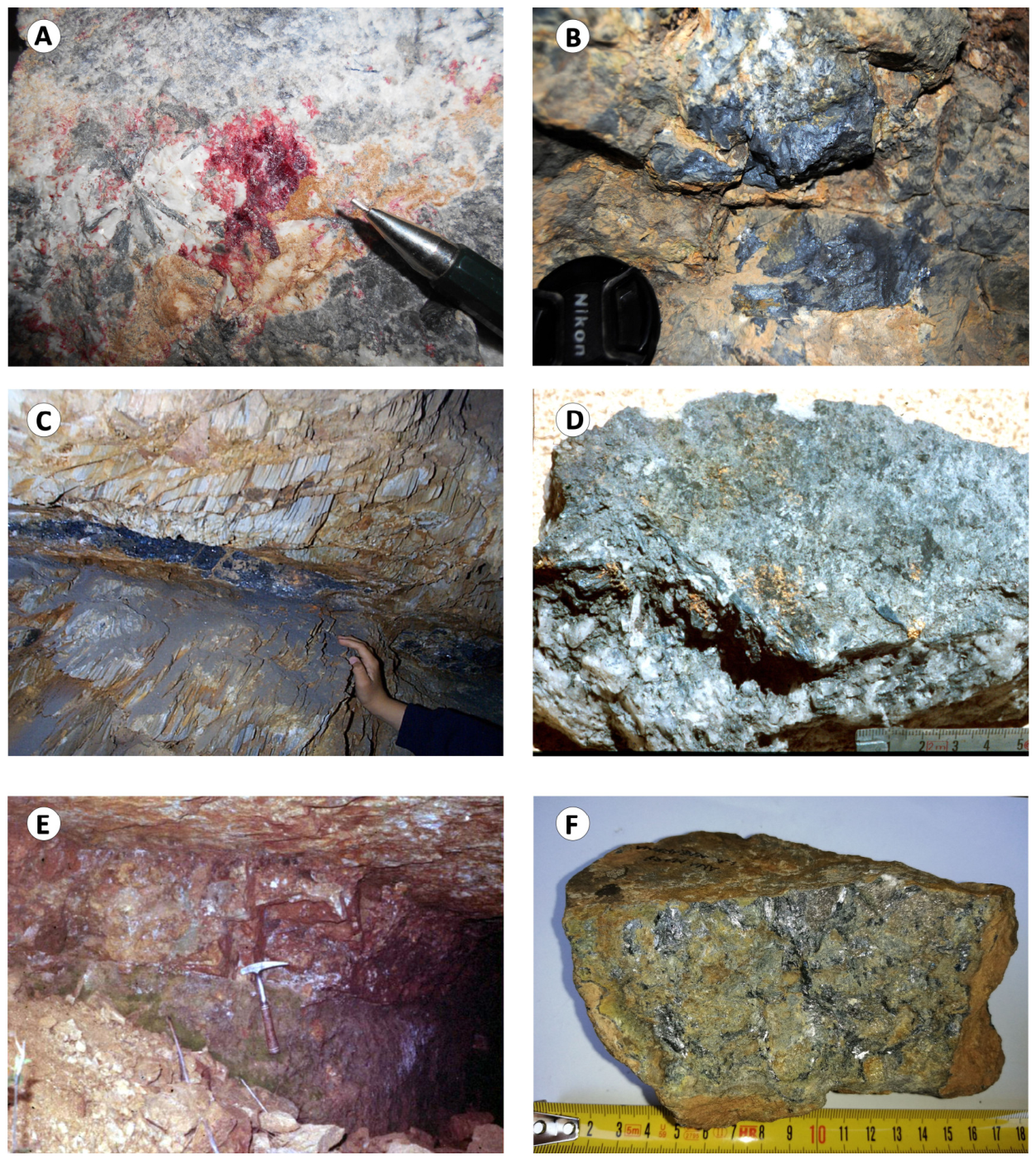
Eighteen Sb deposits and prospects are recorded in the CZ (Figure 4). Their most distinctive characteristic is the predominance of carbonate-hosted mineralization and, particularly, the strong development of the Cb-Qz-Sb-Hg association. Valeriana, Navaliega/Valentina, Riter-San Vicente, María Teresa, Pedrosa del Rey, and Escarlati (Figure 8A) constitute representative examples, concentrated mainly in the Pliegues-Mantos and Pisuerga-Carrión regions. Many occur as stratabound mineralized bodies in Cambrian or Carboniferous carbonate successions and display evidence of subsequent fracture-controlled redistribution or remobilization.
The Escarlati mine is the best-studied Sb-Hg mineralization in the CZ and records a two-stage metallogenic evolution, with an initial Sb stage followed by Hg mineralization [15]. Fluid-inclusion data, δ13C-depleted carbon, the oxygen-isotope composition of the fluid in equilibrium with calcite, and heavy δ34S sulfur-isotope values suggest that the mineralization may be related to Permian subvolcanic magmatism documented in the Cantabrian Zone [14] in the Río Narcea Gold Belt, consistent with the alternative model proposed by Gumiel et al. [75].
The mineralogy further distinguishes the Cantabrian deposits from most other Iberian Sb systems. The Sb-Hg assemblage may include cinnabar, realgar, and orpiment in addition to stibnite, whereas Burón defines the unique Cb-Qz-Sb-F association of the compiled dataset, characterized by fluorite-rich mineralization with Sb and accessory Au. Simpler Qz-Sb occurrences are also present, including deposits hosted by Precambrian slates of the Narcea Antiform and by Carboniferous carbonate sequences [75]. The zone is therefore not mineralogically uniform, but the predominance of Sb-Hg mineralization in carbonate host rocks constitutes a robust regional signature.
This association suggests that lithology exerted a strong first-order influence on ore localization in the CZ. Nevertheless, the common occurrence of fracture-related remobilization indicates that favorable carbonate horizons alone were insufficient to determine the final geometry of the deposits. The metallogenic character of the CZ is therefore best interpreted as the result of interaction between reactive carbonate stratigraphy and late structural permeability. This combined control provides an important end member for comparison with the predominantly siliciclastic-hosted Sb-Au and Sb-Au-W systems farther south and west in the CIZ.
4.2. West Asturian-Leonese Zone: Transition from Carbonate- to Siliciclastic-Hosted Systems
The WALZ represents an internal transitional domain between the external Cantabrian Zone and the more internal parts of the Variscan Belt. Its stratigraphy comprises a thick Neoproterozoic terrigenous succession overlain by Cambrian to Lower Devonian platform deposits. In contrast to the CZ, the WALZ experienced more intense Variscan deformation and metamorphism, with metamorphic grade generally increasing westward, as well as widespread syn- and post-tectonic granitoid emplacement [70,76,77,78,79,80].
Sb mineralization is correspondingly more heterogeneous in both host-rock character and mineral association. The Villarbacú group represents an important carbonate-hosted system within Upper Ordovician successions, whereas Santa Rufina, La Abandonada, Nueva Virginia, and El Carrascal illustrate mineralization developed in siliciclastic and carbonate hosts of different ages. Most WALZ occurrences belong to the widespread Qz-Sb association, but the zone also contains more complex polymetallic assemblages (Figure 5). Peña Negra represents Qz-Sb-Cu mineralization, whereas La Plana and Leonor contain the Qz-Cu-Pb-Sb association hosted by Upper Cambrian quartzite-slate horizons [81].
The Salave Au deposit provides an additional perspective on the role of Sb in the WALZ. Although Salave is fundamentally an Au system rather than an Sb deposit sensu stricto, its paragenesis contains a late Sb-Au-rich stage with stibnite and Pb-Sb-Ag sulfosalts superimposed on an earlier As-Au assemblage. The deposit has been interpreted as a mesothermal Au system associated with late collisional magmatism [80,82,83]. Its significance for this review lies in demonstrating that Sb may also enter the hydrothermal record as a late-stage component of a more complex mineralizing system, rather than necessarily defining an independent Sb event.
The WALZ can therefore be regarded as a metallogenic transition between the carbonate-dominated Sb-Hg specialization of the CZ and the structurally controlled, compositionally diverse systems of the internal Variscan domains. The progressive increase in metamorphism, granitoid abundance, structural complexity, and diversity of host rocks is accompanied by a corresponding diversification of Sb associations.
4.3. Central Iberian Zone: The Principal Iberian Sb province
The CIZ is the largest tectonostratigraphic domain of the Iberian Massif and contains both the greatest number of Sb deposits and the widest range of mineral associations recognized in this review (Figure 6). Its geology is markedly heterogeneous. In the northwest, the CIZ includes the Upper Proterozoic Schist-Greywacke Complex (SGC), the Ollo de Sapo Antiform, Paleozoic metasedimentary sequences, and abundant Variscan granitoids. Farther south, the SGC and Paleozoic siliciclastic successions remain widespread, but regional metamorphic grade is generally lower and large WSW-ESE-trending folds dominate the structural architecture. The southern boundary of the zone is defined by the CIZ-OMZ suture and the Badajoz-Córdoba Shear Zone (BCSZ) [42,43,44,84,85].
This lithological and structural diversity is reflected directly in Sb metallogeny. Simple Qz-Sb veins are widespread in Precambrian SGC rocks and Lower Paleozoic quartzite-slate successions, but individual districts show strong specialization in Au, W, Zn, or Pb. Consequently, the CIZ cannot be characterized by a single representative deposit type. Rather, it contains a series of metallogenic subdomains whose common feature is the interaction between inherited crustal structures, second-order faults, and locally favorable lithological or magmatic settings.
In northern Portugal, the Valongo-Gondomar district represents the most important Sb-Au concentration in the Iberian Peninsula and historically included numerous antimony workings (Figure 6). Mineralization is hosted mainly in Precambrian metasedimentary rocks and occurs in an area containing dolerite dikes and local granitic bodies [86]. Of particular regional significance is its position close to the interaction between the Porto-Tomar Shear Zone (PTSZ) and Douro-Beirã Shear Zone (DBSZ), linking one of the major Sb-Au districts directly with the first-order Variscan structural architecture [87,88,89].
Farther south, the Sarzedas district (Figure 6), near Castelo Branco, defines the principal Qz-Sb-Au-W specialization. Das Gatas (Figure 8B), Barroca da Santa, Pomar, Monte da Gula, and Casalinho occur predominantly in Precambrian SGC rocks and locally in felsitic dikes. Their concentration close to the regional interaction of the PTSZ, BCSZ, and Vilariça Fault, again suggests that the major structural corridors exerted a first-order control on the location of mineralized districts, even though individual veins occupy subsidiary fractures.
Western Spain provides additional evidence for the diversity of CIZ systems. In the Valencia de Alcántara area, Portoviejo, Mari Rosa, and Cuadrillas de Barbellido represent Qz-Sb-Au veins. Mari Rosa is particularly relevant because it demonstrates the coexistence of Sb and native Au within a structurally controlled hydrothermal system (Figure 8C-D). In contrast, the Losacio district in Zamora is characterized by the Qz-Sb-Pb-Au association. Valdeconejos, Las Cogollas (Figure 8E), and La Cabrera occur as bedding-parallel veins in Lower Ordovician metasedimentary rocks surrounding the Losacio granite [3]. These differences demonstrate that even Au-bearing Sb mineralization within the CIZ cannot be assigned to a unique host rock, vein geometry, or magmatic relationship.
The southern CIZ contains two districts of particular importance because they demonstrate the significance of lithological trapping in addition to structural focusing. The Nazarena group, near Almuradiel, is hosted by Lower Ordovician quartzite-slate successions (Pochico Formation) and defines the Qz-Sb-Zn association (Figure 8F). Sphalerite precedes the principal Sb sulfides, indicating a multistage mineralizing history. The deposits show stratabound control combined with fracture-related remobilization, and doleritic bodies occur close to the mineralized succession (Figure 7). Their spatial relationship is significant, although the available evidence does not demonstrate whether the mafic rocks acted as a metal source, heat source, or simply exploited the same structural architecture as the mineralizing fluids.
The San Antonio district, near Alburquerque, represents the most significant historical Sb deposit in Spain and the type locality for the Cb-Qz-Sb-W association (Figure 6). Mineralization occurs in Devonian limestones, calcareous shales, and breccias and provides one of the clearest examples of combined structural and lithological control in the Iberian dataset [3,4,6,90,91]. The mineralized carbonate belt was intensely deformed during late Variscan activity associated with the BCSZ, whereas NW-SE-trending second-order faults are interpreted as important pathways for fluid migration. Ore deposition was subsequently favoured by carbonate horizons and breccias, producing a hierarchical relationship between regional structure, subsidiary permeability, and local lithological trapping. Dolerites are also abundant close to the mineralized area (Figure 12), although, as at Nazarena, their genetic role remains to be demonstrated.
Taken together, the CIZ records the clearest Iberian evidence that regional metal specialization is superimposed on a common structural framework. Valongo-Gondomar, Sarzedas, Losacio, Nazarena, and San Antonio districts differ substantially in mineral association and host-rock character, but all illustrate how first-order crustal structures may organize regional hydrothermal circulation while second-order structures and lithological conditions determine the final sites and styles of ore deposition. The CIZ therefore provides the principal natural laboratory for the integrated metallogenic model developed later in this review.
Figure 7.
Geological and metallogenic setting of the Nazarena Sb–Zn district in the southern Central Iberian Zone (CIZ). (A) Distribution of the principal Sb occurrences within the Lower Ordovician quartzite–slate succession of the Pochico Formation. Redrawn by the authors based on Gumiel [3] (B) Dolerite bodies exposed south of the Nazarena group. Mineralization combines stratigraphic control with fracture-related remobilization.
Figure 7.
Geological and metallogenic setting of the Nazarena Sb–Zn district in the southern Central Iberian Zone (CIZ). (A) Distribution of the principal Sb occurrences within the Lower Ordovician quartzite–slate succession of the Pochico Formation. Redrawn by the authors based on Gumiel [3] (B) Dolerite bodies exposed south of the Nazarena group. Mineralization combines stratigraphic control with fracture-related remobilization.
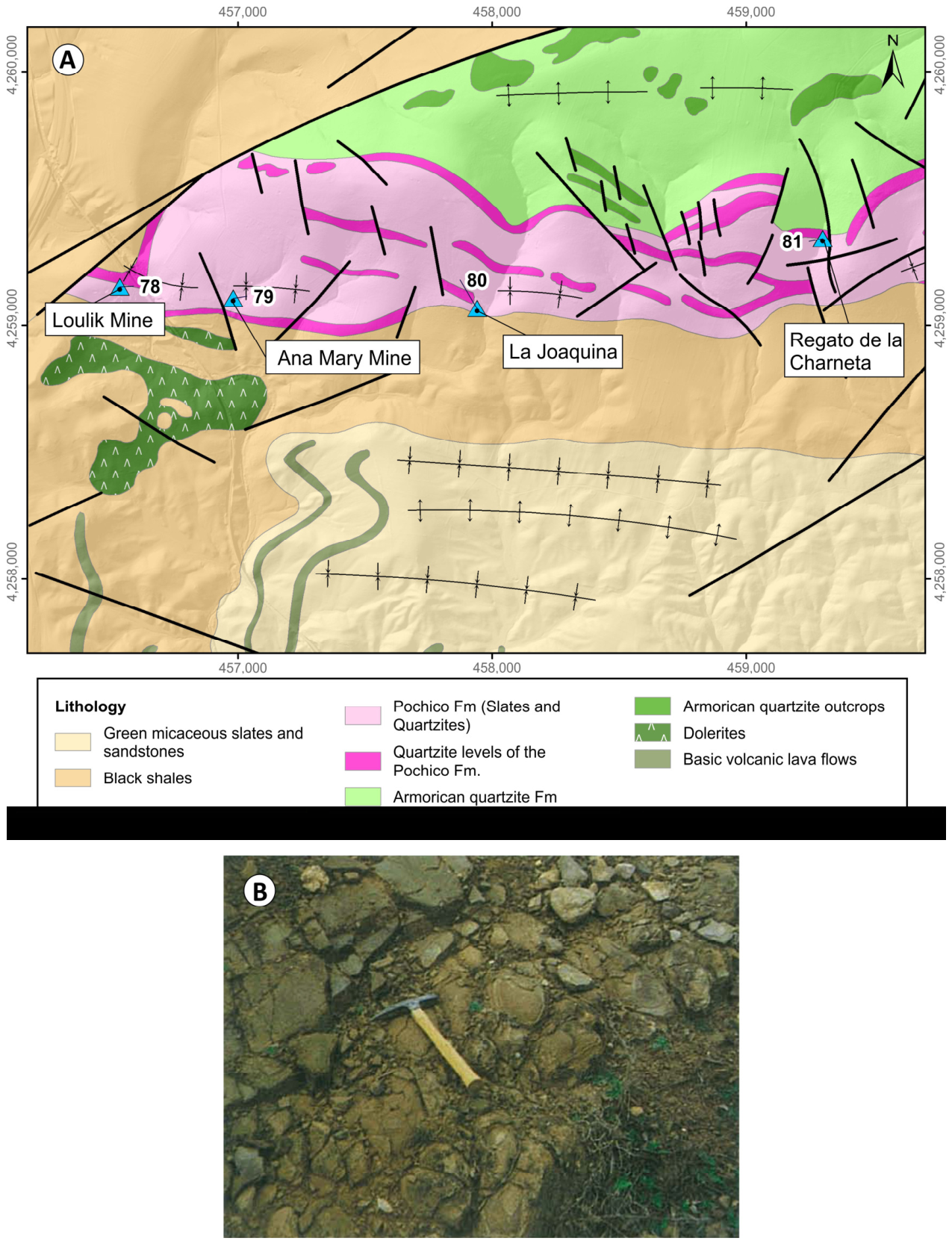
Figure 8.
Representative mineralization styles and mineral associations of Iberian Sb deposits. (A) Cinnabar and stibnite at Escarlati, Cb-Qz-Sb-Hg association; (B) stibnite at Das Gatas, Qz-Sb-Au-W association; (C) low-angle stibnite veins at Mari Rosa, Qz-Sb-Au association; (D) native gold in quartz with stibnite at Mari Rosa; (E) bedding-parallel stibnite veins at Las Cogollas, Qz-Sb-Pb-Au association; and (F) stibnite and stibiconite in the Nazarena group, Qz-Sb-Zn association. Photographs by the authors.
Figure 8.
Representative mineralization styles and mineral associations of Iberian Sb deposits. (A) Cinnabar and stibnite at Escarlati, Cb-Qz-Sb-Hg association; (B) stibnite at Das Gatas, Qz-Sb-Au-W association; (C) low-angle stibnite veins at Mari Rosa, Qz-Sb-Au association; (D) native gold in quartz with stibnite at Mari Rosa; (E) bedding-parallel stibnite veins at Las Cogollas, Qz-Sb-Pb-Au association; and (F) stibnite and stibiconite in the Nazarena group, Qz-Sb-Zn association. Photographs by the authors.
4.4. Galicia-Trás-os-Montes Zone: Sb Mineralization in Allochthonous and Parautochthonous Terranes
The GTMZ structurally overlies the CIZ in northwestern Iberia and comprises a complex assemblage of parautochthonous and allochthonous units. These include continental-margin, rift-related, ophiolitic, and arc-derived rocks that record contrasting tectonothermal histories associated with the Variscan collision [92,93,94,95]. The resulting geological architecture differs markedly from the relatively continuous metasedimentary successions that host many CIZ deposits.
Seven Qz-Sb deposits and prospects are recognized in the GTMZ. They occur in different tectonic units, including Pandeiro in the Órdenes Complex and several occurrences around Bragança, such as the Canedo do Mulher mine, demonstrating that Sb mineralization is not confined to a single allochthonous slice. Most show relatively simple quartz-stibnite assemblages, but Grijó is distinctive because it contains a Qz-Sb-Pb-Au association hosted by Devonian greywackes, phyllites, and basic volcanic rocks of the Basal Unit of the Morais Allochthonous Complex (Figure 9A).
The GTMZ therefore represents a comparatively small Sb province, but one that is metallogenically important because it demonstrates that Au-bearing Sb systems also occur within tectonically imbricated terranes containing mafic and volcano-sedimentary components. This provides a useful contrast with the metasedimentary-dominated CIZ and reinforces the broader conclusion that the nature of the crustal reservoir and host-rock package may influence the associated metal signature without removing the importance of structural focusing.
4.5. Ossa-Morena Zone: Mineralization Along Transpressional Sutures and Magmatic Domains
The Ossa-Morena Zone occupies a structurally complex position in southwestern Iberia. It is bounded to the north by the BCSZ (CIZ-OMZ suture) and to the south by the Southern Iberian Shear Zone (SISZ) towards the SPZ. The zone experienced prolonged Variscan transpression, and its northern boundary records an important component of sinistral strike-slip deformation [19,58,62,96]. This setting makes the OMZ particularly useful for evaluating the relative contributions of regional shear zones, subsidiary structures, and magmatism to Sb mineralization.
Although the number of known Sb occurrences is substantially smaller than in the CIZ, their mineralogical diversity is notable. Herdade da Prata, Don Beck, and Pepín belong to the Qz-Sb association; Herdade das Palmas contains Qz-Sb-Au mineralization; Herdade da Ventosa and Sierra Morena 2ª represent Qz-Sb-Cu systems; and Almojafras is a stratabound Pb-Sb occurrence hosted by limestones of the Ficalho Volcano-Sedimentary Complex (Figure 9B).
Several of these occurrences are spatially associated with leucogranites, diorites, amphibolites, or regional magmatic alignments. Such relationships are potentially important but should not automatically be interpreted as evidence for a direct magmatic source of Sb. In the context of the present review, the OMZ instead illustrates the difficulty of separating the effects of magmatic contribution, thermal influence, inherited metal reservoirs, and structurally focused hydrothermal circulation.
Together with the GTMZ and SPZ, the OMZ therefore forms part of a group of peripheral Variscan domains in which the number of deposits is modest, but the associations provide important constraints on the regional model.
4.6. South Portuguese Zone: Sb-Cu Specialization and Possible Remobilization from Volcanogenic Massive Sulfide Deposits
The SPZ constitutes the southernmost tectonostratigraphic domain of the Iberian Variscan Belt. Its stratigraphy comprises the Devonian Phyllite-Quartzite Group, the Late Devonian-Middle Visean Volcano-Sedimentary Complex, and the syn-orogenic Culm Group. Its tectonic evolution involved Early Carboniferous transtension and intense volcanic activity followed by Variscan compression, transpression, and inversion of earlier extensional structures [38,40,41,97,98,99].
The five Sb deposits and prospects included in the SPZ (Cortes Pereira, Vale de Espadas, La Esmeralda, El Chaparral, and Nerón) define one of the clearest regional metal specializations in the dataset because they are assigned predominantly to the Qz-Sb-Cu association (Figure 9C). Several occur as bedding-parallel veins within Carboniferous Culm slates and greywackes, indicating that the anisotropy of the sedimentary sequence influenced the geometry of structurally controlled mineralization.
The metallogenic significance of this Sb-Cu association becomes clearer when considered in the broader context of the Iberian Pyrite Belt. Sb-bearing minerals such as bournonite, famatinite, tetrahedrite, boulangerite, jamesonite, and gudmundite are widespread components of volcanogenic massive sulfide systems within the SPZ. Consequently, the possibility exists that at least part of the Sb subsequently concentrated in structurally controlled veins was inherited from or remobilized from the older volcano-sedimentary and sulfide-bearing sequence.
This interpretation remains a hypothesis rather than a demonstrated source relationship, but it has important implications for the regional model. It suggests that first-order structural controls may determine where hydrothermal fluids circulate, while the composition of the crustal sequence through which those fluids migrate may influence the resulting metal association. The SPZ therefore provides a particularly useful contrast with the Sb-Au-rich western CIZ, the Sb-W southern CIZ, and the Sb-Hg-dominated CZ.
4.7. Pyrenean and Betic Occurrences
Sb mineralization outside the Iberian Massif is considerably less abundant, but the Pyrenean and Betic occurrences provide useful comparisons because they developed in tectonic settings subsequently affected by Alpine deformation.
In the eastern Pyrenees, Planoles and Freser form a small but distinctive Qz-Cu-Pb-Sb group (Figure 10A). Mineralization is hosted by Ordovician phyllites, shales, and intermediate volcanic tuffs and contains stibnite together with Pb-Sb sulfosalts. The spatial relationship with the late Variscan Costabona granite led Ayora et al. [100] to propose a hydrothermal connection with the intrusive system. These deposits therefore provide another example in which Sb occurs as part of a broader polymetallic assemblage rather than as a simple quartz-stibnite system.
The Matilde or La Victoria mine, near La Viñuela in the Betic Cordillera, represents a different structural context (Figure 10B). It is the only Sb occurrence in the compiled dataset from the Alpujárride Complex and consists of Qz-Sb mineralization in NW-SE-trending quartz veins hosted by Paleozoic metamorphic rocks. The area underwent ductile thrusting followed by brittle-ductile shearing and later Alpine extensional reworking. The mineralization has been interpreted as a medium-temperature hydrothermal system related to thrust and shear structures [101,102,103].
These examples emphasize that the occurrence of Sb in Iberia is not exclusively tied to the principal Variscan metallogenic domains, although the limited number of deposits outside the Iberian Massif prevents recognition of a comparable regional Sb province.
4.8. Neogene Volcanic-Hosted Sb occurrences in Southeastern Iberia
Las Minillas and La Chacona, near Carboneras in Almería, constitute the youngest and most geologically distinct Sb occurrences in the compiled dataset. Unlike the Paleozoic-hosted deposits that dominate the Iberian record, they occur in Neogene dacitic-andesitic volcanic and pyroclastic rocks associated with the calc-alkaline and ultrapotassic magmatism of southeastern Spain. This volcanic activity developed during the complex Neogene convergence-extension history of the western Mediterranean [104].
Both occurrences belong to the Qz-Sb association and are spatially and structurally related to the NE-SW Carboneras strike-slip fault system (Figure 10C). Although the number of Sb deposits is very small, they demonstrate that Sb mineralization can develop in a much younger tectono-magmatic system independently of the Variscan basement framework.
At the same time, these occurrences should not be used as direct genetic analogues for the main Iberian Variscan deposits. Rather, they provide an instructive end member demonstrating the more general capacity of long-lived crustal faults, active hydrothermal circulation, and magmatism to concentrate Sb under appropriate conditions.
4.9. Regional Synthesis
The regional comparison reveals a first-order distinction between the highly diverse CIZ province and the more compositionally specialized surrounding domains. The CIZ contains simple Qz-Sb mineralization together with Sb-Au, Sb-Au-W, Sb-Pb-Au, Sb-Zn-Au, Sb-Zn, and Sb-W associations, distributed among both vein-type and stratabound systems. In contrast, the CZ is dominated by carbonate-hosted Sb-Hg and locally Sb-F mineralization, whereas the SPZ displays a particularly clear Sb-Cu specialization. The WALZ, GTMZ, and OMZ occupy intermediate positions, with smaller deposit populations but a range of host rocks and polymetallic associations that provide important links between these principal end members (Table 2).
Three observations emerge from this regional framework. First, host-rock composition influences metal specialization but does not independently determine deposit location. Carbonate rocks are particularly important in the CZ and at San Antonio, siliceous metasedimentary rocks dominate many CIZ vein systems, and volcano-sedimentary successions may have influenced the Sb-Cu signature of the SPZ. Second, major structures recur at the scale of the most important districts, particularly in the CIZ and OMZ, but ore is commonly localized within second-order faults, fractures, breccias, or favorable stratigraphic horizons rather than within the highest-strain parts of the regional shear zones themselves. Third, magmatic rocks occur close to several important Sb systems, but their significance varies between districts, and spatial association alone cannot establish a direct genetic relationship.
Taken together, these observations establish the regional metallogenic constraints of the Iberian Sb dataset without requiring a genetic interpretation at this stage. The regional patterns established here are examined further through the structural dataset in Chapter 5 and the quantitative distribution of Au in Chapter 6, before their genetic significance is evaluated in the Discussion.
5. Structural Controls on Iberian Sb Mineralization
Structural control is one of the most persistent characteristics of antimony mineralization in the Iberian Peninsula. Although stratabound deposits may show strong lithostratigraphic control, both stratabound and, especially, vein-type mineralizations are closely associated with fractures, faults, and shear zones. The compiled structural dataset includes 124 vein orientations and shows that the dominant trends vary systematically among tectonostratigraphic domains (Figure 11 and Table S1). Rather than defining a single regional fracture direction, these variations record the polyphase Variscan deformation, late-orogenic strike-slip reactivation, and subsequent rotation of structural domains during development of the Ibero-Armorican orocline [7,8,10].
5.1. Regional Orientation Patterns of Sb-Bearing Structures
The rose-diagram dataset reveals distinct regional structural signatures (Figure 11). In the Cantabrian Zone, the principal Sb-bearing directions are NW-SE (N120°E-N140°E), NE-SW (N40°E-N60°E), and N-S to N20°E, with the NW-SE set reaching a maximum frequency of approximately 25%. In the West Asturian-Leonese Zone, ENE-WSW structures (N60°E-N80°E) are dominant and account for as much as 50% of the measured veins, whereas NE-SW and NW-SE sets are subordinate. In the Galicia-Trás-os-Montes Zone, particularly around Bragança, NW-SE veins (N120°E-N140°E) predominate, reaching approximately 42.9% of the dataset.
The Central Iberian Zone contains the largest number of Sb veins and consequently the most heterogeneous structural dataset. In the northern CIZ, WNW-ESE (N100°E-N120°E) and E-W structures are dominant, as illustrated by the Losacio vein field. In the western CIZ, including the Portuguese Sb-Au and Sb-Au-W districts, NE-SW veins (N40°E-N60°E) are the most frequent, although N-S, E-W, and NW-SE orientations are also present. The central CIZ likewise shows a principal NE-SW set (N20°E-N40°E), together with NNW-SSE and NW-SE structures. In the eastern CIZ, the dominant trend remains NE-SW, particularly within the Alcudia-Almadén area and the Nazarena district.
In the Ossa-Morena Zone, the structural distribution is bimodal, with ENE-WSW and NNW-SSE orientations, whereas the South Portuguese Zone is distinguished by a strongly dominant E-W set (N80°E-N100°E), represented by La Esmeralda, El Chaparral, and Nerón. These contrasts indicate that Sb-bearing structures were controlled by regional deformation partitioning and local reactivation histories rather than by a uniform Iberian stress field.
5.2. Late Variscan Deformation and Oroclinal Reactivation
The abundance of NE-SW, NW-SE, NNW-SSE, and E-W mineralized structures is consistent with repeated reactivation and generation of fault sets during late Variscan deformation. During development of the Ibero-Armorican Arc, pre-existing sutures, thrusts, folds, and faults were reactivated as transpressional or transtensional shear zones. Oroclinal bending also produced vertical-axis rotations of crustal blocks and systematic reorientation of regional stress fields [7,8,10].
This framework is especially evident in the CIZ, where Sb-(Au) veins are most abundant. NE-SW faults acted as important accommodation structures during rotation, while NW-SE and NNW-SSE faults and shear zones accommodated strike-slip components of transpressional deformation. The resulting fracture network increased crustal permeability and created repeated pathways for hydrothermal circulation. Some of these structures were later reactivated during Mesozoic rifting and Alpine compression, demonstrating that the present geometry of individual deposits may record more than one tectonic episode.
5.3. First-Order Shear Zones and Localization of Sb Districts
At district scale, several of the most important Iberian Sb concentrations occur close to first-order crustal structures. The relationship is particularly clear for the Badajoz-Córdoba, Porto-Tomar, and Douro-Beirã shear zones, as well as for major NW-SE crustal faults in the southern CIZ. These structures are interpreted primarily as long-lived zones of crustal weakness that focused deformation and fluid flow; the ore bodies themselves commonly occupy subsidiary structures rather than the main shear-zone trace.
5.3.1. Badajoz-Córdoba Shear Zone and the San Antonio Sb-W District
San Antonio and the nearby Casas de Benavente, Melita Viejo, and Melita Nuevo occurrences form the principal Iberian Sb-W cluster and are spatially related to the Badajoz-Córdoba Shear Zone (BCSZ). Continued left-lateral transpression along the BCSZ generated N-S and NE-SW faults that progressively rotate toward NW-SE orientations with increasing dextral displacement, a geometry interpreted as bookshelf faulting [62]. Within this framework, antithetic NW-trending dextral faults could have acted as second-order fluid pathways (Figure 12A).
The San Antonio system therefore illustrates the hierarchical control proposed for Iberian Sb mineralization, from a first-order crustal structural corridor to second-order faults and dilation zones, followed by replacement and ore concentration in favorable carbonate horizons. Sheared breccias and reactive Devonian carbonate horizons exert an important control on ore deposition [105]. This combination explains why the deposit is stratabound at mine scale while remaining strongly structurally controlled at district scale (Figure 12B, C and D).
5.3.2. Porto-Tomar-Douro-Beirã Interaction and the Valongo-Gondomar Sb-Au District
In northern Portugal, the Valongo-Gondomar Sb-Au district is located in a structurally complex region influenced by the Porto-Tomar Shear Zone (PTSZ), the Douro-Beirã Shear Zone (DBSZ), and associated subsidiary faults (Figure 6). The conjunction of these structures is interpreted to have favoured localization of the district and development of the fracture systems that host quartz-stibnite-gold veins. The occurrence of abundant dolerite dikes within the same structural corridor is an additional feature of potential genetic significance, but the structural relationship itself is independent of the ultimate source of Sb and Au [87,88,89].
5.3.3. Interaction of the Porto-Tomar and Badajoz-Córdoba Shear Zones and the Sarzedas Sb-Au-W District
Further south, the Sarzedas district is located near the regional convergence of the PTSZ and BCSZ, and the NNE-SSW-trending sinistral Vilariça strike-slip fault (Figure 6). The Pomar, Monte da Gula, Das Gatas, Casalinho, and Barroca da Santa occurrences form a distinctive Sb-Au-W cluster. Their vein orientations are variable, but NE-SW structures are prominent in the western CIZ dataset. The coexistence of several orientations suggests that mineralization exploited a connected fracture network rather than a single fault structure.
5.3.4. Puertollano-Herrera and Fuencaliente-Almadén Structures
The southern and eastern CIZ also contain Sb occurrences spatially associated with major NW-SE crustal faults. The Puertollano-Herrera Structure (PHS, Figure 6), characterized by important vertical block movements and sinistral kinematics [106], may have controlled the emplacement of mineralization at Pilar, Arroyo de Tamujar, and Diógenes. The Fuencaliente-Almadén Structure (FAS, Figure 6), another NW-SE crustal fault, has similarly been proposed as a regional control for deposits such as Susana Mine. These examples extend the first-order structural pattern beyond the major named shear zones at the margins of the CIZ.
5.4. Second-Order Structures, Dilation Zones, and Fault Connectivity
The spatial association between Sb districts and major shear zones does not imply that mineralization was deposited directly within the highest-strain parts of those structures. The compiled examples instead support a multiscale model in which second-order faults, extensional fractures, bends, intersections, and dilation zones provided the most favorable sites for ore deposition. Structural intersections are especially important because they increase fault connectivity and permit repeated fluid access to chemically favourable host rocks.
This distinction is critical for interpreting both vein and stratabound deposits. In vein systems, ore occupies fractures with suitable orientation and permeability. In stratabound systems, faults and fractures deliver fluids to reactive beds, after which replacement may spread laterally along favorable horizons. Later deformation can remobilize previously deposited Sb into new fractures, creating vein-like mineralization around stratabound bodies. Structural and lithological controls should therefore be regarded as complementary mechanisms.
5.5. Structural Implications for an Iberian Metallogenic Model
The structural dataset supports three main conclusions. First, the regional orientation of Sb veins varies among tectonic domains, reflecting deformation partitioning and block rotation during the polyphase Variscan evolution. Second, several of the most important districts occur near major shear-zone corridors and, in some cases, at regional structural junctions. Third, ore deposition was commonly localized in second-order structures connected to those first-order corridors, particularly where fault connectivity coincided with favorable lithologies.
Accordingly, major shear zones are best interpreted here as regional-scale controls on permeability and hydrothermal focusing rather than as a complete genetic explanation for Sb mineralization. These structural relationships establish the permeability framework of the Iberian Sb systems. Before their genetic significance is evaluated, Chapter 6 examines whether the distribution of Au provides an additional quantitative constraint on regional metallogenic differentiation.
6. Gold Distribution in Iberian Sb Deposits
The regional metallogenic patterns described above are complemented by quantitative geochemical data for gold. Au analyses are available for 40 Sb deposits across the Iberian Variscan Massif (Table S2) compiled from published and regional metallogenic sources [107,108], providing the largest numerical dataset for an associated metal and allowing the regional Sb-Au relationship to be evaluated independently of the mineralogical classification.
The data show a strongly uneven distribution. The highest Au concentrations occur in the CIZ, especially its western sector, and in the Morais Allochthonous Complex of the GTMZ. By contrast, analyzed deposits in the Cantabrian and West Asturian-Leonese zones generally contain low Au values, although individual occurrences approach 2 ppm. This regional contrast is consistent with the concentration of Qz-Sb-Au and Qz-Sb-Au-W mineral associations in western and central Iberia (Figure 13).
6.1. Valongo-Gondomar: The Principal Sb-Au District
Valongo-Gondomar contains the most significant concentration of Au-rich Sb deposits in the Iberian Peninsula [87,88,89]. Historical production from twelve principal mines amounted to approximately 12,000 t of high-grade antimony ore containing about 2 t of gold [109]. The analytical dataset confirms this Au enrichment: Vale do Inferno contains about 5 ppm Au, Pinheirinhos-Corgo 6.6 ppm, Ribeira da Serra-Tapada 12 ppm, Alto do Sobrido 7 ppm, and Montalto records the highest reported value (70 ppm) in the dataset [110]. These values establish the western CIZ as the principal Iberian Sb-Au metallogenic domain (Figure 13 and Table S2).
6.2. Sarzedas District: Sb-Au-W Enrichment
The Sarzedas district represents a second Au-rich cluster in the western CIZ, but differs mineralogically from Valongo-Gondomar through its characteristic Sb-Au-W association. Reported Au values include approximately 12.3 ppm at Pomar, 11.84 ppm at Das Gatas, 5.8 ppm at Barroca da Santa, 2.2 ppm at Monte da Gula, and 0.53 ppm at Casalinho [111]. The coexistence of gold and significant wolframite distinguishes this district from the simpler Qz-Sb-Au systems and suggests a different degree of metal specialization within the same broad western CIZ structural province (Figure 13).
6.3. Other Au-Bearing Districts and Deposits
Outside the western CIZ, the Grijó mines in the Morais Allochthonous Complex contain approximately 10 ppm Au, while Cabecinho do Prado and Canedo do Mulher contain lower but significant values [110]. In the central CIZ, Mari Rosa and G.M. Suerte/Aguijoncillo contain several ppm Au, and San Cristóbal in eastern CIZ records about 3 ppm. The available dataset suggests an overall decrease in Au abundance eastward toward the Alcudia Valley, although local exceptions occur. Northern CIZ deposits such as Las Cogollas and María also contain measurable gold (Figure 13).
Couto et al. [112] relate the Au-rich Sb systems of Bragança and Valongo-Gondomar to late Variscan hydrothermal activity along brittle-ductile shear zones and anticline-related fractures. Multistage vein formation, deformation-related remobilization, and late-stage Au enrichment have been proposed, while supergene processes may locally release native gold and electrum [113]. These interpretations are retained here as genetic hypotheses to be evaluated critically in the later discussion rather than as demonstrated mechanisms for all Iberian Sb-Au deposits.
Taken together, the Au dataset confirms that the metallogenic heterogeneity identified from mineral associations also has a quantitative geochemical expression. These compositional differences, however, do not by themselves demonstrate distinct genetic systems. Their significance must be evaluated together with crustal inheritance, structural reactivation, magmatism, fluid circulation, and ore trapping. These relationships form the basis of the genetic discussion below.
7. Discussion: Genetic Interpretation and an Integrated Metallogenic Model for Iberian Sb Deposits
The geological, metallogenic, geochemical, and structural evidence established in Chapters 2–6 supports a multistage interpretation of Iberian Sb mineralization. A key distinction is therefore made here between metal inheritance, hydrothermal mobilization, and final ore deposition.
The deep crustal architecture described in Chapter 2 is considered in this context as an inherited framework of crustal heterogeneity and mechanical weakness capable of later tectono-hydrothermal reactivation, rather than as a direct host to Sb mineralization.
7.1. Contrasting Hypotheses for the Source of Sb and Associated Metals
The source of Sb remains the least constrained component of the Iberian metallogenic model. Three non-exclusive hypotheses can be considered: (1) remobilization from pre-existing sedimentary, volcanic, volcano-sedimentary, or mafic crustal reservoirs; (2) direct or indirect contributions from felsic magmatism; and (3) hydrothermal extraction of metals from a heterogeneous crust during regional metamorphic and tectonic reworking. At present, the relative importance of these processes cannot be generalized across the Peninsula.
The inherited-reservoir hypothesis is attractive because the Variscan basement contains numerous lithological packages capable of recording earlier metal enrichment. In this interpretation, the principal late hydrothermal event would not need to introduce all of the Sb from an external source. Instead, fluids moving through a heterogeneous crust could selectively leach and redistribute metals already present in particular stratigraphic or igneous domains. The possible remobilization of Sb from older volcano-sedimentary and sulfide-bearing successions in the South Portuguese Zone represents one expression of this mechanism. More generally, this hypothesis offers a way to explain regional variations in associated metals without requiring a different late hydrothermal mechanism for every metallogenic domain.
Mafic magmatism provides a second, more specific hypothesis. The repeated spatial association of doleritic bodies with several Iberian Sb districts is unlikely to be irrelevant, but spatial coincidence alone does not establish causality. Mafic rocks could have supplied Sb or other metals, provided heat that promoted fluid circulation, modified the chemical environment of the crust, or simply exploited the same long-lived structures later used by mineralizing fluids. The Armorican Massif is critical in this respect because studies there have related an approximately 360 Ma mafic event and dolerite emplacement to Sb metallogeny and to a metasomatized mantle source [114,115,116,117]. This model provides a testable analogue for Iberia, but the necessary temporal relationship between dolerite emplacement, metal enrichment, and Sb ore formation has not yet been demonstrated in the principal Iberian districts.
Felsic magmatism must be evaluated with the same caution. The revised geological framework shows that late Variscan deformation coincided with widespread granitoid emplacement and, locally, mantle-influenced post-collisional magmatism. This tectono-magmatic coincidence makes a thermal or hydrothermal role for intrusions plausible, but does not demonstrate that granites were universally the source of Sb. Mari Rosa and Escarlati Mines are most suitable Iberian cases for a magmatic contribution because fluid-inclusion, sulfur-isotope, and geochemical relationships support the involvement of the igneous rocks in the genesis of these deposits [15,118]. Elsewhere, the alternative model of granitoids acting mainly as thermal engines capable of driving circulation and remobilization remains equally viable [119]. Consequently, the genetic role of felsic magmatism should be tested deposit by deposit rather than adopted as a province-wide explanation.
7.2. Late Variscan Reactivation as a Mechanism for Fluid Generation and Focusing
If metal sources were heterogeneous, a separate process is required to explain why Sb mineralization repeatedly became focused within particular parts of the Variscan crust. The most coherent regional mechanism is the late Variscan reactivation of an inherited structural architecture. The preceding sections document the relevant crustal structures and their deposit-scale expressions; genetically, the important point is that these structures formed a vertically and laterally connected permeability network capable of being reactivated during changing stress regimes.
Oroclinal development between approximately 310 and 292 Ma reorganized the regional stress field, rotated earlier structures, and promoted renewed strike-slip, transpressional, and locally transtensional deformation [7,8,10,11,12,43]. At roughly the same time, the Iberian Massif experienced elevated heat flow and widespread magmatic activity. The genetic significance of this coincidence is that deformation could repeatedly create permeability while thermal and magmatic processes enhanced fluid production and circulation. Thus, late Variscan tectonics provides a mechanism capable of coupling deep crustal architecture to upper-crustal hydrothermal systems without requiring that every deposit formed from an identical fluid.
This interpretation also clarifies the relationship between structural and lithological controls. Regional structures are best regarded as fluid-focusing systems rather than as the final sites of ore deposition. Mineralization was concentrated where those pathways intersected locally favorable permeability and chemical traps. Consequently, vein filling, breccia cementation, replacement, stratabound mineralization, and later remobilization can represent different expressions of the same evolving hydrothermal system. The genetic distinction is therefore not simply between 'vein' and 'stratabound' deposits, but between fluid transport at regional scale and precipitation or replacement at deposit scale.
A further implication is that the present geometry of the deposits may record superposition. Repeated Variscan deformation, and in some areas later Mesozoic or Alpine reactivation, could have modified earlier ore bodies or reopened existing structures. Accordingly, structural coincidence must be evaluated together with mineral paragenesis and absolute timing. Without this temporal control, it remains difficult to distinguish structures that formed the ore system from those that merely modified an older mineralization.
7.3. Comparison with other Sb provinces: Testing Processes Rather than Seeking Direct Analogues
Comparison with other Sb provinces is useful only if it tests specific components of the Iberian model. Direct equivalence is inappropriate because the compared provinces differ in age, tectonic setting, host rocks, scale, and fluid history. The relevant question is therefore whether similar relationships among crustal inheritance, major structures, local permeability, lithological trapping, magmatism, and remobilization are repeated in independent Sb systems.
7.3.1. Armorican and French Central Massifs: The Closest Variscan Test
The Armorican and French Central Massifs provide the most meaningful comparison because they belong to the same Western European Variscan Belt (Figure 14). Their importance lies less in the presence of individual Sb districts than in the recurrence of late-orogenic structural control and in the debate concerning the role of magmatism [120].
Earlier models proposed that some Sb mineralization was metallogenically related to classic granitic cupolas, whereas other occurrences were linked at depth to later felsic stocks [121]. For example, French Variscan antimony veins were described by Geffroy [122] as mesothermal deposits that represent a transition between intrusive types and subvolcanic systems.
Armorican Sb districts occur in relation to major shear-zone systems (NASZ, SASZ-N and SASZ-S), while the French Central Massif also records mineralization controlled by late Variscan faults and dextral shear systems [114,115,116,123]. This supports the broader inference that long-lived Variscan structures were repeatedly capable of organizing Sb-bearing hydrothermal circulation.
France also provides an important temporal test. A major Sb-Au episode has been placed at approximately 310–295 Ma, broadly coincident with late-orogenic post-thickening deformation, whereas older mafic events near 360 Ma have been proposed as possible stages of metal enrichment in parts of the Armorican Massif [114,115,116,117,124]. If an analogous separation between early enrichment and younger ore formation were demonstrated in Iberia, it would provide strong support for the multistage model proposed here. At present, however, this remains a hypothesis requiring direct geochronological testing.
The French examples also caution against assuming a universal magmatic source. At La Lucette, recent work indicates that an additional direct magmatic source is not required to explain the Sb-Au-(W) system [124], whereas other Armorican models emphasize mafic magmatism. The principal lesson for Iberia is therefore not that either model should be imported directly, but that structurally similar Variscan systems may obtain their metals and fluids through different pathways.
7.3.2. Xikuangshan: Testing Structural-Lithological Coupling
Xikuangshan (China) provides a different test because it is not a Variscan analogue. Its value lies in the interaction between regional fault systems and favorable stratigraphic horizons. The deposit is controlled by major structures, including the F75 and Taojiang-Chengbu fault systems, together with folding and stratigraphic controls in Upper Devonian sedimentary rocks [125,126,127,128]. Proposed fluid models include mixing between meteoric and magmatic waters.
The comparison is therefore process-based. Xikuangshan demonstrates that a giant Sb system can develop where large-scale structures deliver fluids to favorable lithological traps. This supports the interpretation that structural and stratigraphic controls in Iberia should not be treated as competing explanations. It does not, however, imply a common fluid source, age, or tectonic setting, and it should not be used to infer a direct genetic equivalence with carbonate-hosted Iberian occurrences.
7.3.3. Murchison Antimony Line: Testing the Shear-Corridor Model
The Murchison Antimony Line (South Africa) provides a complementary test of the first-order structural hypothesis. Sb mineralization is distributed intermittently along an approximately 35 km long upper-crustal shear corridor and occurs as replacement bodies, brecciated or mylonitic mineralization, and quartz-carbonate veins [129,130,131,132]. The system demonstrates that a regional shear zone can organize mineralization without requiring ore to be uniformly distributed along the entire structure.
This is particularly relevant to Iberia, where the principal genetic significance assigned to crustal-scale shear zones is regional organization rather than direct ore deposition. In both settings, local structural connectivity and lithological heterogeneity determine where mineralization becomes concentrated. The transferable feature is therefore hierarchical permeability, not a common tectonic or geochemical origin.
7.3.4. Implications of the International Comparison
Taken together, the French, Chinese, and South African examples support a process-based interpretation in which regional-scale structures organize hydrothermal flow while deposit-scale permeability and lithological traps localize ore. These comparisons therefore test individual components of the Iberian model rather than defining a single external analogue for the Iberian Sb province. The principal comparative features are summarized in Table 3.
7.4. Towards an Integrated Metallogenic Model for Iberian Sb Deposits
The Iberian data can be reconciled in a multistage model comprising four conceptually distinct but potentially overlapping stages. First, the pre-ore crust was heterogeneous and may have contained unevenly distributed Sb and associated-metal reservoirs inherited from Neoproterozoic and Paleozoic sedimentary, volcanic, volcano-sedimentary, and igneous processes. This stage establishes metal availability but does not require formation of economic Sb mineralization.
Second, Variscan convergence and collision created the fundamental crustal architecture. Sutures, transforms, shear zones, magmatic domains, and mechanically contrasting tectonostratigraphic blocks established long-lived anisotropies extending through different crustal levels. The new geological information provided by the IBERSEIS and ALCUDIA framework is important here because it demonstrates that the surface structural pattern is rooted in a much deeper and more complex architecture. In the model, this architecture represents inherited potential for later fluid focusing rather than the ore-forming event itself.
Third, late Variscan reactivation transformed this inherited architecture into an effective hydrothermal network. Oroclinal bending, strike-slip deformation, transpression/transtension, renewed fracturing, and contemporaneous thermal-magmatic activity created the conditions for fluid production, migration, and repeated access to previously isolated crustal reservoirs. Fluids may have been metamorphic, magmatic, meteoric, basinal, or mixtures of these components. The model does not require a single regional fluid source; it requires a mechanism capable of moving fluids through a heterogeneous crust and focusing them into favorable structural corridors.
Fourth, ore deposition occurred where regional pathways connected with local permeability and suitable physicochemical traps. Lithological replacement, vein filling, brecciation, and stratabound concentration are therefore deposit-scale outcomes of the same hierarchical system. Subsequent deformation and renewed fluid circulation could remobilize earlier mineralization, modify metal ratios, and generate polyphase parageneses. This final stage provides a mechanism by which deposits with contrasting morphologies and associated metals can develop within the same broad tectono-hydrothermal framework.
The model consequently separates what appears to be regionally robust from what remains district-specific. The regional component is the existence and repeated reactivation of a heterogeneous Variscan crustal architecture. District-specific components include the initial metal reservoir, the relative importance of mafic or felsic magmatism, the composition and origin of the mineralizing fluids, host-rock reactivity, and the number of remobilization events. This distinction allows the model to accommodate geological diversity without reducing the Iberian Sb province to either a single deposit type or a collection of unrelated occurrences.
7.5. Implications for Exploration
The proposed model has direct exploration implications. The most prospective settings are not defined by the presence of a single rock type or a single fault orientation, but by the coincidence of several favorable factors: proximity to first-order Variscan structures, dense networks of second-order faults, structural intersections or dilation zones, reactive carbonate or mechanically contrasting stratigraphic horizons, evidence of hydrothermal brecciation, and regional metal associations compatible with the target sought.
For Au-bearing Sb systems, western CIZ and GTMZ structural corridors remain particularly significant. For Sb-W exploration, the San Antonio district demonstrates the importance of carbonate horizons adjacent to major transpressional structures. For Sb-Hg systems, the Cantabrian carbonate domain is distinctive, whereas Sb-Cu exploration in the SPZ should consider the possibility of remobilization from Sb-bearing volcano-sedimentary sequences.
7.6. Uncertainties and Critical Tests of the Model
The principal uncertainty is chronology. The proposed model depends on separating possible early metal enrichment from later hydrothermal deposition and subsequent remobilization, but direct ages for Iberian Sb mineralization remain sparse. Geochronology of representative ore-forming stages is therefore the most important test. Demonstrating a late Carboniferous-Early Permian Sb event in several structurally distinct Iberian districts would substantially strengthen the role assigned here to late Variscan reactivation; conversely, a wide range of mineralization ages would require a more explicitly polycyclic model.
A second critical test concerns the mafic association. Dolerites spatially associated with Sb mineralization should be characterized systematically by high-precision geochronology, whole-rock and trace-element geochemistry, and isotopic methods. The objective is not simply to date the dikes, but to establish whether they predate, overlap with, or postdate ore formation and whether their geochemical signatures permit a plausible metal contribution. Only then can the Armorican pre-enrichment model be evaluated rigorously for Iberia.
Third, the relative contributions of magmatic, metamorphic, meteoric, and basinal fluids remain inadequately resolved. Comparative fluid-inclusion, stable-isotope, and mineral-chemistry studies across representative districts are required to determine whether apparently different Iberian Sb systems share a common hydrothermal signature or instead record several fluid reservoirs. Mari Rosa provides an important benchmark for evaluating a possible felsic magmatic contribution [118], whereas Escarlati offers an independent test of the proposed relationship between Sb-Hg mineralization and Permian subvolcanic activity [15]. Comparable datasets are required from other districts before the role of magmatism can be evaluated at province scale.
Finally, structural chronology must be linked directly to mineral growth. Kinematic analysis of mineralized fault networks, microstructural studies, vein-sealing relationships, and restoration of late Variscan rotations should be integrated with mineral paragenesis and geochronology. This is necessary to distinguish structures that generated permeability during ore formation from older inherited structures and younger reactivations that merely modified the deposits.
Until these tests are available, the Iberian Peninsula is best interpreted as a polygenetic Sb metallogenic province whose principal unifying feature is the repeated tectono-hydrothermal reactivation of a heterogeneous Variscan crust. This constitutes a testable working hypothesis rather than a universal genetic model.
8. Conclusions
The Iberian Sb deposits and occurrences cannot be satisfactorily explained by a single deposit type or a unique source of metals and fluids. They are better interpreted as a heterogeneous, polygenetic metallogenic province in which metal inheritance, hydrothermal mobilization, and final ore deposition may represent distinct stages. This framework preserves the regional coherence of Iberian Sb mineralization without requiring genetic equivalence among all deposits.
The geological and structural evidence indicates that inherited Variscan crustal architecture provided the first-order framework for later hydrothermal systems, while late Variscan reactivation offered the most plausible regional mechanism for renewing permeability and fluid circulation. Ore deposition was ultimately controlled at smaller scales by second-order structures, brecciation, and favorable lithological or stratigraphic traps. Vein filling, replacement, stratabound concentration, and remobilization can therefore represent different expressions or stages of an evolving tectono-hydrothermal system.
Magmatism may have contributed metals, fluids, and/or heat, but its role appears to vary among districts. The association with dolerites remains a testable hypothesis, while felsic intrusions may represent direct contributors in some systems and mainly thermal drivers of circulation and remobilization in others. Spatial association alone is therefore insufficient to establish a universal magmatic source for Iberian Sb.
Comparison with Variscan and other important Sb provinces (China and South Africa) indicates that the most transferable feature is the hierarchical coupling of long-lived regional structures with local permeability and lithological traps, rather than direct genetic equivalence among districts. The French Variscan examples are particularly relevant for testing whether early metal enrichment and younger late-orogenic ore formation may have been temporally distinct stages in Iberia.
The resulting model is hierarchical and multistage: heterogeneous pre-ore metal reservoirs provide variable metal inventories; Variscan convergence and collision establish the crustal architecture; late Variscan reactivation generates or renews hydrothermal connectivity; second-order permeability and favorable host rocks focus ore deposition; and subsequent deformation and fluid circulation permit remobilization and overprinting. The principal unifying feature of Iberian Sb mineralization is therefore not a common metal or fluid source, but the repeated tectono-hydrothermal reactivation of a heterogeneous Variscan crust.
The principal uncertainties concern the timing of mineralization, the significance of associated mafic and felsic rocks, fluid sources, and the chronology of structural reactivation. Integrated geochronological, geochemical, isotopic, fluid-inclusion, mineral-chemical, and structural studies are required to determine whether early metal enrichment, late Variscan ore formation, and subsequent remobilization represent distinct stages of the Iberian Sb metallogenic evolution. These tests will ultimately determine whether the integrated model can be applied across the Iberian province or must be resolved into several temporally and genetically distinct metallogenic systems.
Supplementary Materials
The following supporting information can be downloaded at the website of this paper posted on Preprints.org: Table S1: Complete database of the 100 Sb deposits and occurrences compiled from the Iberian Peninsula, including location, tectonostratigraphic domain, host-rock characteristics, deposit morphology, mineral association, and relevant geological information; Table S2: Reported Au concentrations (ppm) for 40 Iberian Sb deposits and occurrences, including the bibliographic sources used in the compilation.
Author Contributions
Conceptualization, M.A., P.G. and A.M.-I.; methodology, M.A., P.G. and A.M.-I.; investigation, M.A., P.G. and A.M.-I.; data curation, M.A. and P. G.; writing—original draft preparation, M.A., P.G. and A.M.-I.; writing—review and editing, M.A., P.G. and A.M.-I.; visualization, M.A. and P. G.; supervision, M. A., P.G. and A.M.-I. All authors have read and agreed to the published version of the manuscript.
Funding
This research received no external funding.
Data Availability Statement
The data supporting this review are contained within the article and its Supplementary Materials. The compiled deposit database is provided in Table S1, and the Au dataset is provided in Table S2; the original published sources from which these data were compiled are cited in the manuscript and supplementary tables.
Acknowledgments
During the preparation of this manuscript, the authors used ChatGPT (OpenAI) for scientific-English language editing, terminological consistency checks, and editorial-formatting assistance. The authors reviewed and edited all AI-assisted output and take full responsibility for the content of the publication.
Conflicts of Interest
The authors declare no conflicts of interest.
References
- EU. European Commission: Directorate-General for Internal Market, Industry, Entrepreneurship and SMEs, Grohol, M. and Veeh, C., Study on the critical raw materials– Final report; Publications Office of the European Union, 2023. [Google Scholar] [CrossRef]
- USGS. Methodology and Technical Input for the 2025 U.S. List of Critical Minerals. Open-File Report 2025-1047; 2025. [Google Scholar] [CrossRef]
- Gumiel, P. Metalogenia de los Yacimientos de Antimonio de la Península Ibérica. PhD Thesis, Univ. de Salamanca, Departamento de Cristalografía y Mineralogía, Salamanca, 1982; p. 324 p. [Google Scholar]
- Gumiel, P. Metalogenia de los yacimientos de antimonio de la Península Ibérica. Tecniterrae 1983, 54, 120 p. [Google Scholar]
- Arribas, A.; Gumiel, P. First occurrence of a stratabound Sb-W-Hg deposit in the Spanish Hercynian massif. In Syngenesis and Epigenesis in the Formation of Mineral Deposits; Wauschkuhn, A., Kluth, C., Zimmerman, R.H., Eds.; Springer-Verlag: Berlin-Heidelberg, 1984; pp. 469–481. [Google Scholar] [CrossRef]
- Gumiel, P.; Arribas, A. Antimony deposits in the Iberian Peninsula. Econ. Geol. 1987, 82(6), 1453–1463. [Google Scholar] [CrossRef]
- Gutiérrez-Alonso, G.; Fernández-Suárez, J.; Weil, A.B. Orocline triggered lithospheric delamination. In Spec. Pap. Geol. Soc. Am.; Weil, B., Sussman, A., Eds.; 2004; Volume 383, pp. 121–130. [Google Scholar] [CrossRef]
- Gutiérrez-Alonso, G.; Murphy, J.B.B.; Fernández-Suárez, J.; Hamilton, M.A.A. Rifting along the northern Gondwana margin and the evolution of the Rheic Ocean: A Devonian age for the El Castillo volcanic rocks (Salamanca, Central Iberian Zone). Tectonophys. 2008, 461, 157–165. [Google Scholar] [CrossRef]
- Gutiérrez-Alonso, G.; Fernández-Suárez, J.; Jeffries, T.E.; Johnston, S.T.; Pastor-Galán, D.; Murphy, J.B.B.; Franco, M.P.; Gonzalo, J.C. Diachronous post-orogenic magmatism within a developing orocline in Iberia, European Variscides. Tectonics 2011, 30, TC5008. [Google Scholar] [CrossRef]
- Gutiérrez-Alonso, G.; Collins, A.S.; Fernández-Suárez, J.; Pastor-Galán, D.; González-Clavijo, E.; Jourdan, F.; Weil, A.B.; Johnston, S.T. Dating of lithospheric buckling: 40Ar/39Ar ages of syn-orocline strike-slip shear zones in northwestern Iberia. Tectonophysics 2015, 643, 44–54. [Google Scholar] [CrossRef]
- Weil, A.B.; Gutiérrez-Alonso, G.; Conan, J. New time constraints on lithospheric-scale oroclinal bending of the Ibero-Armorican Arc: a palaeomagnetic study of earliest Permian rocks from Iberia. J. Geol. Soc. Lond. 2010, 167, 127–143. [Google Scholar] [CrossRef]
- Weil, A.B.; Gutiérrez-Alonso, G.; Johnston, S.T.; Pastor-Galán, D. Kinematic constraints on buckling a lithospheric scale orocline along the northern margin of Gondwana: A geologic synthesis. Tectonophysics 2013, 582, 25–49. [Google Scholar] [CrossRef]
- Martínez-Catalán, J.R.; Arenas, R.; Abati, J.; Sánchez Martínez, S.; Díaz García, F.; Fernández-Suárez, J.; González Cuadra, P.; Castiñeiras, P.; Gómez Barreiro, J.; Díez Montes, A.; González Clavijo, E.; Rubio Pascual, F.J.; Andonaegui, P.; Jeffries, T.E.; Alcock, J.E.; Díez Fernández, R.; López Carmona, A. A rootless suture and the loss of the roots of a mountain chain: the Variscan belt of NW Iberia. Compt. Rendus Geosci. 2009, 341, 114–126. [Google Scholar] [CrossRef]
- Martín-Izard, A.; Fuertes-Fuente, M.; Cepedal, A.; Moreiras, D.; Nieto, J.G.; Maldonado, C.; Pevida, L.R. The Río Narcea Gold Belt Intrusions: geology, petrology, geochemistry and timing. J. Geochem. Explor. 2000a, 71(2), 103–117. [Google Scholar] [CrossRef]
- Martín-Izard, A.; Gumiel, P.; Arias, M.; Cepedal, A.; Fuertes-Fuente, M.; Reguilón, R. Genesis and evolution of the structurally controlled vein mineralization (Sb–Hg) in the Escarlati deposit (León, Spain): Evidence from fault population analysis methods, fluid-inclusion research and stable isotope data. J. Geochem. Explor. 2009, 100, 51–66. [Google Scholar] [CrossRef]
- Lotze, F. Observaciones respecto a la división de las Varíscides de la Meseta Ibérica. Inst. Geol. Min. España Pub. Ext. Geol. España 1950, 5, 149–166. [Google Scholar]
- Capdevila, R.; Corretgé, L.G.; Floor, P. Les granitoïdes varisques de la Meseta Ibérique. Bull. Soc. Géol. Fr. 1973, 15, 209–228. [Google Scholar] [CrossRef]
- Julivert, M.; Fontboté, J.; Ribeiro, A.; Conde, L. Memoria explicativa del mapa tectónico de la Península Ibérica y Baleares ; Inst. Geol. Minero España: Madrid, 1974; p. 113. [Google Scholar]
- Quesada, C. Geological constraints on the Paleozoic tectonic evolution of tectonostratigraphic terranes in the Iberian Massif. Tectonophysics 1991, 185, 225–245. [Google Scholar] [CrossRef]
- McKerrow, W.S.; MacNiocaill, C.; Ahlberg, P.E.; Clayton, G.; Cleal, C.J.; Eagar, R.M.C. The late Palaeozoic relations between Gondwana and Laurussia. In Orogenic Processes: Quantification and Modelling in the Variscan Belt. Geol. Soc. London Spec. Publ.; Franke, W., Haak, V., Oncken, O., Tanner, D., Eds.; 2000; Volume 179, pp. 9–20. [Google Scholar] [CrossRef]
- Simancas, F.; Carbonell, R.; González Lodeiro, F.; Pérez-Estaún, A.; Juhlin, C.; Ayarza, P.; Kashubin, A.; Azor, A.; Martínez Poyatos, D.; Almodóvar, G.R.; Pascual, E.; Sáez, R.; Expósito, I. Crustal structure of the transpressional Variscan orogen of SW Iberia: SW Iberia deep seismic reflection profile (IBERSEIS). Tectonics 2003, 22(6), 1062. [Google Scholar] [CrossRef]
- Carbonell, R.; Simancas, J.F.; Juhlin, C.; Pous, J.; Pérez-Estaún, A.; Gonzalez-Lodeiro, F.; Muñoz, G.; Heise, W.; Ayarza, P. Geophysical evidence of a mantle derived intrusion in SW Iberia. Geophys. Res. Lett. 2004, 31, 1–4. [Google Scholar] [CrossRef]
- Martínez-Catalán, J.R. Are the oroclines of the Variscan belt related to late Variscan strike–slip tectonics? Terra Nova 2011, 23, 241–247. [Google Scholar] [CrossRef]
- Martínez-Poyatos, D.; Carbonell, R.; Palomeras, I.; Simancas, J.F.; Ayarza, P.; Martí, D. Imaging the crustal structure of the Central Iberian Zone (Variscan Belt): The ALCUDIA deep seismic reflection transect. Tectonics 2012, 31, TC3017. [Google Scholar] [CrossRef]
- Quesada, C.; Oliveira, J.T. The Geology of Iberia: A Geodynamic Approach. In Reg. Geol. Rev. Springer Int. Publ.; The Variscan Cycle: Cham, 2019; Volume 2. [Google Scholar] [CrossRef]
- Arribas, A. Mineral paragenesis in the Variscan metallogeny of Spain. Stud. Geol. 1978, 14, 223–260. [Google Scholar]
- Gumiel, P.; Arribas, A. Autochthonous Sequences: Metallogeny. In Pre-Mesozoic Geology of Iberia; Dallmeyer, R.D., Martínez-García, E., Eds.; Springer-Verlag: Berlin, 1990; pp. 212–219. [Google Scholar] [CrossRef]
- Martínez-Catalán, J.R.; Arenas, R.; Díaz García, F.; Gómez-Barreiro, J.; González Cuadra, P.; Abati, J.; Castiñeiras, P.; Fernández-Suárez, J.; Sánchez Martínez, S.; Andonaegui, P.; Gónzalez Clavijo, E.; Díez Montes, A.; Rubio Pascual, F.J.; Valle Aguado, B. Space and time in the tectonic evolution of the northwestern Iberian Massif: implications for the Variscan belt. In 4-D framework of Continental Crust. Geol. Soc. Am. Memoir; Hatcher Jr., R.D., Carlson, M.P., McBride, J.H., Martínez Catalán, J.R., Eds.; 2007; Volume 200, pp. 403–423. [Google Scholar] [CrossRef]
- García-Sansegundo, J.; Poblet, J.; Alonso, J.L.; Clariana, P. Hinterland-foreland zonation of the Variscan orogen in the Central Pyrenees: comparison with the northern part of the Iberian Variscan Massif. Geol. Soc. Lond. Spec. Publ. 2011, 349, 169–184. [Google Scholar] [CrossRef]
- García-Sansegundo, J.; Martín-Izard, A.; Gavaldà, J. Structural control and geological significance of the Zn–Pb ores formed in the Benasque Pass area (Central Pyrenees) during the post-late Ordovician extensional event of the Gondwana margin. Ore Geol. Rev. 2014, 56, 516–527. [Google Scholar] [CrossRef]
- Moreira, N.; Pedro, J.; Santos, J.F.; Araújo, A.; Romão, J.; Dias, R.; Ribeiro, A.; Ribeiro, S.; Mirão, J. 87Sr/86Sr ratios discrimination applied to the main Paleozoic carbonate sedimentation in Ossa-Morena Zone. Geo-Temas 2016, 16-1, 161–164. [Google Scholar]
- Arias, M.; Nuñez, P.; Arias, D.; Gumiel, P.; Castañón, C.; Fuertes-Blanco, J.; Martin-Izard, A. 3D Geological Model of the Touro Cu Deposit, A World-Class Mafic-Siliciclastic VMS Deposit in the NW of the Iberian Peninsula. Minerals 2021, 11, 85. [Google Scholar] [CrossRef]
- Romão, J.; Moreira, N.; Dias, R.; Pedro, J.; Mateus, A.; Ribeiro, A. Tectonostratigraphy of the Iberian Terrane in the Tomar Sardoal-Ferreira do Zêzere sector and Finisterra Terrane relations. Comun. Geol. 2014, 101 (Especial I), 559–562. Available online: www.lneg.pt/iedt/unidades/16/paginas/26/30/18.
- Palero, F.J. Tectónica pre-hercínica de las series infraordovícicas del anticlinal de Alcudia y la discordancia intraprecámbrica en su parte oriental Sector meridional de la Zona Centroibérica. Boletín Geológico Y Min. 1993, 104, 227–242. [Google Scholar]
- San José, M.A. El complejo sedimentario pelítico-grauváquico. Libro Jubil. J. M. Ríos. Geol. De España. 1983, 91–99. [Google Scholar]
- Ordóñez-Casado, B.; Martin-Izard, A.; García-Nieto, J. SHRIMP-zircon U–Pb dating of the Ni–Cu–PGE mineralized Aguablanca gabbro and Santa Olalla granodiorite: Confirmation of an Early Carboniferous metallogenic epoch in the Variscan Massif of the Iberian Peninsula. Ore Geol. Rev. 2008, 34, 343–353. [Google Scholar] [CrossRef]
- Silva, J.B.; Oliveira, J.T.; Ribeiro, A. Structural outline of the South Portuguese Zone. In Pre-Mesozoic Geol. Iberia.; Dallmeyer, R.D., Martínez García, E., Eds.; Springer: Heidelberg, 1990; pp. 348–361. [Google Scholar] [CrossRef]
- Oliveira, J. South Portuguese Zone. Stratigraphy and synsedimentary tectonism; Dallmeyer, R.D., Martínez García, E., Eds.; Springer-Verlag: Berlin, 1990; pp. 334–347. [Google Scholar] [CrossRef]
- Mantero, E.M.; Alonso-Chaves, F.M.; García-Navarro, E.; Azor, A.; Lisle, R.J. Tectonic Style and Structural Analysis of the Puebla de Guzman Antiform (Iberian Pyrite Belt, South Portuguese Zone, SW Spain). In Spec. Publ. Geol. Soc. London.; Poblet, J., Ed.; 2011; Volume 349, pp. 203–222. [Google Scholar] [CrossRef]
- Martín-Izard, A.; Arias, D.; Arias, M.; Gumiel, P.; Sanderson, D.J.; Castañón, C.; Lavandeira, A.; Sanchez, J. A new 3D geological model and interpretation of structural evolution of the world-class Rio Tinto VMS deposit, Iberian Pyrite Belt (Spain). Ore Geol. Rev. 2015, 71, 457–476. [Google Scholar] [CrossRef]
- Martín-Izard, A.; Arias, D.; Arias, M.; Gumiel, P.; Sanderson, D.J.; Castañon, C.; Sanchez, J. Ore deposit types and tectonic evolution of the Iberian Pyrite Belt: From transtensional basins and magmatism to transpression and inversion tectonics. Ore Geol. Rev. 2016, 79, 254–267. [Google Scholar] [CrossRef]
- Simancas, F.; González Lodeiro, F.; Expósito Ramos, I.; Azor, A.; Martínez Poyatos, D. Opposite subduction polarities connected by transform faults in the Iberian Massif and western European Variscides. In Variscan-Appalachian Dynamics: The Building of the Late Paleozoic Basement. Geol. Soc. Am. Spec. Pap.; Martínez Catalán, J.R., Hatcher, R.D., Arenas, R., Díaz García, F., Eds.; 2002; Volume 364, pp. 249–258. [Google Scholar] [CrossRef]
- Simancas, J.F.; Ayarza, P.; Azor, A.; Carbonell, R.; Martínez Poyatos, D.; Pérez-Estaún, A.; González Lodeiro, F. A seismic geotraverse across the Iberian Variscides: Orogenic shortening, collisional magmatism, and orocline development. Tectonics 2013, 32, 417–432. [Google Scholar] [CrossRef]
- Simancas, J.F.; Carbonell, R.; González Lodeiro, F.; Pérez Estaún, A.; Juhlin, C.; Ayarza, P.; Kashubin, A.; Azor, A.; Martínez Poyatos, D.; Sáez, R.; Ruiz Almodóvar, G.; Pascual, E.; Flecha, I.; Martí, D. Transpressional collision tectonics and mantle plume dynamics: the Variscides of southwestern Iberia. Eur. Lithos. Dyn. Geol. Soc. Lond. 2006, 32. [Google Scholar] [CrossRef]
- Pastor-Galán, D.; Gutiérrez-Alonso, G.; Murphy, J.B.; Fernández-Suárez, J.; Hofmann, M.; Linnemann, U. Provenance analysis of the Paleozoic sequences of the northern Gondwana margin in NW Iberia: Passive margin to Variscan collision and orocline development. Gondwana Res. 2013, 23(3), 1089–1103. [Google Scholar] [CrossRef]
- Del Greco, K.; Johnston, S.T.; Gutiérrez-Alonso, G.; Shaw, J.; Lozano, J.F. Interference folding and orocline implications: A structural study of the Ponga Unit, Cantabrian orocline, northern Spain. Lithosphere 2016, 8, 757–768. [Google Scholar] [CrossRef]
- Gutiérrez-Alonso, G.; Fernández-Suárez, J.; López-Carmona, A.; Gärtner, A. Exhuming a cold case: The early granodiorites of the northwest Iberian Variscan belt—A Visean magmatic flareup? Lithosphere 2018, 10, 194–216. [Google Scholar] [CrossRef]
- Fernández-Suárez, J.; Dunning, G.R.; Jenner, G.A.; Gutiérrez-Alonso, G. Variscan collisional magmatism and deformation in NW Iberia; constraints from U-Pb geochronology of granitoids. J. Geol. Soc. Lond. 2000, 157, 565–576. [Google Scholar] [CrossRef]
- Weil, A.B.; Van der Voo, R.; Van der Pluijm, B.A. Oroclinal bending and evidence against the Pangea megashear: The Cantabria-Asturias arc (northern Spain). Geology 2001, 29, 991–994. [Google Scholar]
- Cepedal, A.; Fuertes-Fuente, M.; Martín-Izard, A.; García-Nieto, J.; Boiron, M.C. An intrusion-related gold deposit (IRGD) in the NW of Spain, the Linares deposit: Igneous rocks, veins and related alterations, ore features and fluids involved. J. Geochem. Explor. 2013, 124, 101–126. [Google Scholar] [CrossRef]
- Cuesta, A.; Suárez, O.; Gallastegui, G. Caracterización geoquímica del magmatismo tardío en la Cordillera Cantábrica. Bol. Soc. Esp. Min. 1998, 21, 70–71. [Google Scholar]
- Mortensen, J.; Izard, A.; Cepedal, A.; Fuertes-Fuente, M.; Lima, A.; Creaser, R. Gold Metallogeny of northwestern Iberia: Superimposed orogenic and intrusion-related mineralization in an evolving Variscan orogen. Society of Economic Geologists Conference, 2014. [Google Scholar]
- Carracedo, M.; Paquette, J.L.; Alonso Olazabal, A.; Santos Zalduegui, J.F.; García de Madinabeitia, S.; Tiepolo, M.; Gil Ibarguchi, J.L. U-Pb dating of granodiorite and granite units of the Los Pedroches batholith: Implications for geodynamic models of the southern Central Iberian Zone. Int. J. Earth Sci. 2009, 98, 1609–1624. [Google Scholar] [CrossRef]
- Gómez-Frutos, D.; Castro, A.; Gutiérrez-Alonso, G. Post-collisional batholiths do contribute to continental growth. Earth Planet. Sci. Lett. 2023, 603(1), 117978. [Google Scholar] [CrossRef]
- Castro, A.; Rodríguez, C.; Gutiérrez-Alonso, G.; de la Rosa, J.D. A post-collisional batholith from Southern Iberia rooted in the Earth's mantle: Los Pedroches batholith. Lithos 2023, 454–455, 107245. [Google Scholar] [CrossRef]
- Solá, A.R.; Williams, I.S.; Neiva, A.M.R.; Ribeiro, M.L. U–Th–Pb SHRIMP ages and oxygen isotope composition of zircon from two contrasting late Variscan granitoids Nisa-Albuquerque batholith, SW Iberian Massif: Petrologic and regional implications. Lithos 2009, 111(3-4), 156–167. [Google Scholar] [CrossRef]
- Spiering, E.D.; Pevida, L.R.; Maldonado, C.; González, S.; García, J.; Varela, A.; Arias, D.; Martín-Izard, A. The gold belts of western Asturias and Galicia (NW Spain). J. Geochem. Explor. 2000, 71, 89–101. [Google Scholar] [CrossRef]
- Ribeiro, A.; Quesada, C.; Dallmeyer, R.D. Geodynamic evolution of the Iberian Massif. In Pre-Mesozoic Geol. Iberia.; Dallmeyer, R.D., Martínez García, E., Eds.; Springer-Verlag: Berlin, 1990; pp. 399–409. [Google Scholar] [CrossRef]
- Dias, R.; Ribeiro, A. Porto-Tomar shear zone, a major structure since the beginning of the Variscan orogeny. Commun. Inst. Geol. Min. 1993, 79, 31–40. [Google Scholar]
- Valle Aguado, B.; Azevedo, M.R.; Schaltegger, U.; Martínez Catalán, J.R.; Nolan, J. U-Pb zircon and monazite of Variscan magmatism related to syn-convergence extension in central northern Portugal. Lithos 2005, 82, 169–184. [Google Scholar] [CrossRef]
- Burg, J.P.; Iglesias, M.; Laurent, P.; Matte, P.; Ribeiro, A. Variscan intracontinental deformation: the Coimbra-Córdoba shear zone (SW Iberian Peninsula). Tectonophysics 1981, 78, 161–177. [Google Scholar] [CrossRef]
- Sanderson, D.J.; Roberts, S.R.; McGowan, J.; Gumiel, P. Hercynian transpressive tectonics at the southern margin of the Central Iberian Zone, West Spain. J. Geol. Soc. Lond. 1991, 148, 893–898. [Google Scholar] [CrossRef]
- Ribeiro, A.; Munhá, J.; Dias, R.; Mateus, A.; Pereira, E.; Ribeiro, L.; Fonseca, P.; Araújo, A.; Oliveira, T.; Romão, J.; Chaminé, H.; Coke, C.; Pedro, J. Geodynamic evolution of the SW Europe Variscides. Tectonics 2007, 26(6). [Google Scholar] [CrossRef]
- Dias, R.; Ribeiro, A. The Ibero-Armorican Arc: A collision effect against an irregular continent? Tectonophysics 1995, 246, 113–128. [Google Scholar] [CrossRef]
- Julivert, M.; Fontboté, J.; Ribeiro, A.; Conde, L. Mapa Tectónico de la Península Ibérica y Baleares (Memoria). Inst. Geol. Min. España. 1980, 1–113 p. [Google Scholar]
- Marcos, A.; Pulgar, J.A. An approach to the tectonostratigraphic evolution of the Cantabrian Foreland thrust and fold belt, Hercynian Cordillera of NW Spain. N. Jb. Geol. Paläont. Abh. 1982, 163, 256–260. [Google Scholar] [CrossRef]
- Pérez-Estaún, A.; Bastida, F.; Alonso, J.L.; Marquínez, J.; Aller, J.; Álvarez-Marrón, J.; Marcos, A.; Pulgar, J.A. A thin-skinned tectonics model for an arcuate fold and thrust belt: The Cantabrian Zone (Variscan Ibero-Armorican Arc). Tectonics 1988, 7, 517–537. [Google Scholar] [CrossRef]
- Pérez Estaún, A.; Bastida, F. Cantabrian and Palentian zones: structure of the Cantabrian Zone. In Pre-Mesozoic Geol. Iberia.; Dallmeyer, R.D., Martínez-García, E., Eds.; Springer-Verlag: Berlin, 1990; pp. 55–69. [Google Scholar] [CrossRef]
- Jahoda, C.; Andrews, J.; Foster, R. Structural controls of Monte Roso and other gold deposits in NW Spain, fractures jogs and hot jogs. Trans. Inst. Min. Metall. 1989, 98, 1–6. [Google Scholar]
- Corretgé, L.G.; Suárez, O.; Galán, G. Igneous rocks. In Pre-Mesozoic Geology of Iberia; Dallmeyer, R.D., Martínez-García, E., Eds.; Springer-Verlag: Berlin, 1990; pp. 115–128. [Google Scholar] [CrossRef]
- Gutiérrez Claverol, M.; Martínez-García, E.; Luque, C.; Suárez, V.; Ruiz, F. Gold deposits, late Hercynian tectonics and magmatism in the northeastern Iberian Massif (NW Spain). Chron. Rech. Min. 1991, 503, 3–13. [Google Scholar]
- Cepedal, A.; Martın-Izard, A.; Reguilón, R.; Rodrıguez-Pevida, L.; Spiering, E.; González-Nistal, S. Origin and evolution of the calcic and magnesian skarns hosting the El Valle-Boinás copper–gold deposit, Asturias (Spain). J. Geochem. Explor. 2000, 71(2), 119–151. [Google Scholar] [CrossRef]
- Fuertes-Fuente, M.; Martin-Izard, A.; Nieto, J. G.; Maldonado, C.; Varela, A. Preliminary mineralogical and petrological study of the Ortosa Au–Bi–Te ore deposit: a reduced gold skarn in the northern part of the Rio Narcea Gold Belt, Asturias, Spain. J. Geochem. Explor. 2000, 71(2), 177–190. [Google Scholar] [CrossRef]
- Martin-Izard, A.; Paniagua, A.; García-Iglesias, J.; Fuertes-Fuente, M.; Boixet, Ll; Maldonado, C.; Varela, A. The Carlés copper–gold–molybdenum skarn (Asturias, Spain): geometry, mineral associations and metasomatic evolution. J. Geochem. Explor. 2000b, 71, 153–175. [Google Scholar] [CrossRef]
- Gumiel, P.; Arribas, A.; Vindel, E. Los yacimientos estratoides de antimonio del Carbonífero de la Cordillera Cantábrica. Dixieme Congr. Int. De Stratigr. Et. De Geol. Du. Carbonif. 1985, 3, 121–143. [Google Scholar]
- Marcos, A. Las Series del Paleozoico Inferior y la estructura herciniana del occidente de Asturias (NW de España). Trab. Geol. Univ. Oviedo. 1973, 6, 1–113. [Google Scholar]
- Capdevila, R. Le métamorphisme régional progressif et les granites dans le segment hercynien de Galice nord oriental (NW de l’Espagne). In Thèse, Université de Montpellier; 1969; p. 430 p. [Google Scholar]
- Pérez Estaún, A.; Bastida, F.; Martínez Catalán, J.R.; Gutiérrez Marco, J.C.; Marcos, A.; Pulgar, J.A. West Asturian–Leonese zone, stratigraphy. In Pre-Mesozoic Geol. Iberia.; Dallmeyer, R.D., Martínez-García, E., Eds.; Springer-Verlag, 1990; pp. 92–102. [Google Scholar] [CrossRef]
- Martínez-Catalán, J.R.; Pérez-Estaún, A.; Bastida, F.; Pulgar, J.A.; Marcos, A. West Asturian-Leonese Zone: structure. In Pre-Mesozoic Geol. Iberia.; Dallmeyer, R.D., Martínez-García, E., Eds.; Springer, 1990; pp. 103–114. [Google Scholar] [CrossRef]
- Rodríguez-Terente, L.M.; Martin-Izard, A.; Arias, D.; Fuertes-Fuente, M.; Cepedal, A. The Salave Mine, a Variscan intrusion related gold deposit (IRGD) in the NW of Spain: Geological context, hydrothermal alterations and ore features. J. Geochem. Explor. 2018, 188, 364–389. [Google Scholar] [CrossRef]
- Gallego, M.; Lunar, R.; Gumiel, P. Relaciones entre mineralizaciones estratoides y filonianas de Cu-Sb-Pb al sur de Ateca (provincia de Zaragoza). Bol. Soc. Esp. Mineral. 1987, 10-1, 51–52. [Google Scholar]
- Rodríguez-Terente, L.M. Las mineralizaciones auríferas de la granodiorita de Salave (Tapia de Casariego, Asturias). Ph.D. Thesis, Universidad de Oviedo, 2007; p. 403 p. [Google Scholar]
- Gumiel, P.; Martín-Izard, A.; Arias, M.; Rodríguez-Terente, L. Geometrical analysis of the Punta del Pedrón shear zone (Asturias, Spain): Implications related to exploration of Salave Gold-type mineralization. J. Struct. Geol. 2008, 30, 354–365. [Google Scholar] [CrossRef]
- Pérez-Estaún, A.; Martínez-Catalán, J.R.; Bastida, F. Crustal thickening and deformation sequence in the footwall to the suture of the Variscan belt of northwest Spain. Tectonophysics 1991, 191(3–4), 243–253. [Google Scholar] [CrossRef]
- Díez-Montes, A.; Martínez Catalán, J.R.; Bellido Mulas, F. Role of the Ollo de Sapo massive felsic volcanism of NW Iberia in the Early Ordovician dynamics of northern Gondwana. Gondwana Res. 2010, 17, 363–376. [Google Scholar] [CrossRef]
- Ferreira, M.P.; Santos Oliveira, J.M.; Santarém Andrade, R. Ocorrencias do antimonio no norte de Portugal, 1st sec. 4 ed; Cong. Hispano-Luso-Amer. Geol. Econ.: Madrid, 1971; Volume v. 1, pp. 597–617. [Google Scholar]
- Couto, H.; Roger, G.; Moëlo, Y.; Brill, H. Le district à antimoine-or Dúrico–Beirão (Portugal): évolution paragenétique et géochimique; implications métallogéniques. Miner. Depos. 1990, 25 (Suppl.), 569–581. [Google Scholar] [CrossRef]
- Martins, L.P. Mineral Resources of Portugal; Technical report; Direcção Geral de Energia e Geologia: Lisboa, 2012. [Google Scholar]
- Couto, H.; Roger, G. Palaeozoic Magmatism Associated with Gold-Antimony-Tin-Tungsten-Lead-Zinc and Silver Mineralization in the Neighbourhood of Porto, Northern Portugal. IOP Conf. Ser. Earth Environ. Sci. 2017, 95, 022054. [Google Scholar] [CrossRef]
- Gumiel, P.; Arribas, A.; Saavedra, J. Geología y metalogenia del yacimiento de estibina-scheelita de San Antonio. Stud. Geol. 1976, 10, 61–93. [Google Scholar]
- Gumiel, P.; Medina, E.; Santos, J.A. Litoestratigrafía y control estructural de la mineralización antimonífera de la franja calcárea devónica de Alburquerque (Badajoz). Bol. Geol. Min. 1978, 89(1), 61–93. [Google Scholar]
- Farias, P.; Gallastegui, G.; González Lodeiro, F.; Marquínez, J.; Martín Parra, L.M.; Martínez Catalán, J.R.; Pablo Maciá, J.G.; Rodríguez Fernández, L.R. Aportaciones al conocimiento de la litoestratigrafía y estructura de Galicia Central. Mem. Mus. Lab. Min. Geol. Fac. Cienc. Univ. Porto 1987, 1, 411–431. [Google Scholar]
- Arenas, R.; Díez Fernández, R.; Rubio Pascual, F.J.; Sánchez Martínez, S.; Martín Parra, L.M.; Matas, J.; González del Tánago, J.; Jiménez-Díaz, A.; Fuenlabrada, J.M.; Andonaegui, P.; Garcia-Casco, A. The Galicia–Ossa-Morena Zone: Proposal for a new zone of the Iberian Massif. Variscan implications. Tectonophysics 2016, 681, 135–143. [Google Scholar] [CrossRef]
- Martínez-Catalán, J.R.; González Clavijo, E.; Meireles, C.; Díez Fernández, R.; Bevis, J. Relationships between syn-orogenic sedimentation and nappe emplacement in the hinterland of the Variscan belt in NW Iberia deduced from detrital zircons. Geol. Mag. 2016, 153, 38–60. [Google Scholar] [CrossRef]
- Ayarza, P.; Martínez Catalán, J.R.; Martínez García, A.; Alcalde, J.; Andrés, J.; Simancas, J.F.; Palomeras, I.; Martí, D.; DeFelipe, I.; Juhlin, C.; Carbonell, R. Evolution of the Iberian Massif as deduced from its crustal thickness and geometry of a mid-crustal (Conrad) discontinuity. Solid Earth 2021, 12, 1515–1547. [Google Scholar] [CrossRef]
- Silva, J.B.; Pereira, M.F. Transcurrent continental tectonics model for the Ossa-Morena Zone Neoproterozoic-Paleozoic evolution, SW Iberian Massif, Portugal. Int. J. Earth Sci. (Geol. Rundsch.) 2004, 93, 886–896. [Google Scholar] [CrossRef]
- Strauss, G.K.; Gray, K.G. Base metal deposits in the Iberian Pyrite Belt. In Geol. Metallogeny Copper Deposits.; Friedrich, G.H., et al., Eds.; Springer-Verlag: Berlin, Heidelberg, 1986; pp. 304–324. [Google Scholar] [CrossRef]
- Quesada, C. A reappraisal of the structure of the Spanish segment of the Iberian Pyrite Belt. Miner. Depos. 1997, 33, 31–44. [Google Scholar] [CrossRef]
- Soriano, C.; Martí, J. Facies analysis of volcano-sedimentary successions hosting massive sulfide deposits in the Iberian Pyrite Belt, Spain. Econ. Geol. 1999, 94, 867–882. [Google Scholar] [CrossRef]
- Ayora, C.; Cardellac, E.; Phillips, R. Mineralization from Vall de Ribes area (eastern Pyrenees, Spain). Miner. Depos. 1981, 16, 729–746. [Google Scholar] [CrossRef]
- Tubía, J.M.; Cuevas, J.; Navarro-Vilá, F.; Alvarez, F.; Aldaya, F. Tectonic evolution of the Alpujárride Complex (Betic Cordillera, southern Spain). J. Struct. Geol. 1992, 14-2, 193–203. [Google Scholar] [CrossRef]
- Romero Silva, J.C. Rasgos generales de los Yacimientos metálicos de la provincia de Málaga. In Comunicación del XXI Congreso de la Sociedad Española de Mineralogía (SEM); Edita Universidad de Málaga, 2001. [Google Scholar]
- Orozco, M.; Alonso-Chaves, F. M.; Platt, J.P. Late extensional shear zones and associated recumbent folds in the Alpujarride subduction complex, Betic Cordillera, southern Spain. Geol. Acta 2017, 15 1, 51–66. [Google Scholar] [CrossRef]
- Mattei, M.; Riggs, N. R.; Giordano, G.; Guarnieri, L.; Cifelli, F.; Soriano, C. C.; Jicha, B.; Jasim, A.; Marchionni, S.; Franciosi, L.; Tommasini, S.; Porreca, M.; Conticelli, S. Geochronology, Geochemistry and Geodynamics of the Cabo de Gata volcanic zone, Southeastern Spain. Ital. J. Geosci. 2014, 133(3), 341–361. [Google Scholar] [CrossRef]
- Gumiel, P.; Gallego, M. Other prospects. Development of new multi-disciplinary techniques for mineral exploration in several areas of the western Iberian Peninsula. In Publicaciones Especiales del Bol. Geol. Min.; Gumiel, P., Antón-Pacheco, C., Campos, R., Eds.; 1991; pp. 43–54. [Google Scholar]
- Palero, F.J.; Martin-Izard, A.; Zarzalejos, M.; Mansilla, L. Geological context and plumbotectonic evolution of the giant Almadén Mercury Deposit. Ore Geol. Rev. 2015, 64, 71–88. [Google Scholar] [CrossRef]
- García-Cortés, A.; Boixereu, E.; Florido, P.; González-Sanz, F.; Gumiel, P. Mapa metalogenético de Extremadura 1:250.000; Instituto Geológico y Minero de España, 2007; ISBN 978-84-7840-672-2. [Google Scholar]
- Siemcalsa. Mapa geológico y minero de Castilla y León: escala 1:400 000 (Incluye CD-ROM); Junta de Castilla y León, 2006; ISBN 9788478466436. [Google Scholar]
- de Carvalho, A.D. Recuperação de antigas explorações mineiras; Congresso 81 da Ordem dos Engenheiros: Lisboa, 1981; pp. 1–9. [Google Scholar]
- Neiva, A.M.R.; Andráš, P.; Ramos, J.M.F. Antimony quartz and antimony-gold quartz veins from northern Portugal. Ore Geol. Rev. 2008, 34, 533–546. [Google Scholar] [CrossRef]
- Scotgold. Report 4. Soils Geochemical data processing and Geophysics (VLF survey) of Das Gatas and Pomar areas, 2016. [Unpublished internal company report].
- Couto, H.; Roger, G.; Borges, F. S. Late Paleozoic orogenic gold antimony deposits from the Dúrico-Beirã area (North Portugal): relation with hidden granitic apexes. In Proceedings of the Eighth Ninth Biennal Meeting of the Society for Geology Applied to Mineral Deposits; Dublin, Ireland, Andrew, C.J., et al., Eds.; DIGGING DEEPER: Dublin, Ireland, 2007; Volume 1, pp. 609–612. [Google Scholar]
- Cruz, C.; Noronha, F.; Santos, P.; Mortensen, J. K.; Lima, A. Supergene gold enrichment in the Castromil-Serra da Quinta gold deposit, NW Portugal. Mineral. Mag. 2018, 82(S1), S307–S320. [Google Scholar] [CrossRef]
- Pochon, A.; Gapais, D.; Gloaguen, E.; Gumiaux, C.; Branquet, Y.; Cagnard, F.; Martelet, G. Antimony deposits in the Variscan Armorican belt, a link with mafic intrusives? Terra Nova 2016, 28, 138–145. [Google Scholar] [CrossRef]
- Pochon, A.; Beaudoin, G.; Branquet, Y.; Boulvais, P.; Gloaguen, E.; Gapais, D. Metal mobility during hydrothermal breakdown of Fe-Ti oxides: insights from Sb-Au mineralizing event (Variscan Armorican Massif, France). Ore Geol. Rev. 2017, 91, 66–99. [Google Scholar] [CrossRef]
- Pochon, A.; Gloaguen, E.; Branquet, Y.; Poujol, M.; Ruffet, G.; Boirond, M.C.; Boulvais, P.; Gumiaux, C.; Cagnard, F.; Gouazou, F.; Gapais, D. Variscan Sb-Au mineralization in Central Brittany (France): A new metallogenic model derived from the Le Semnon district. Ore Geol. Rev. 2018, 97, 109–142. [Google Scholar] [CrossRef]
- Gloaguen, E.; Campos, H.; Pochon, A.; León Higueras, P.; Lorenzo, S.; Esbrí, J.-M.; Iacono-Marziano, G.; Lima, A. Origin and significance of the antimony mineralisation associated to mafic intrusions in the Iberian Zone and the Central Armorican Domain. EGU Gen. Assem. (online) 2021, EGU21-13154. [Google Scholar] [CrossRef]
- Ortega, L.; Oyarzun, R.; Gallego, M. The Mari Rosa late Hercynian Sb-Au deposit, western Spain. Miner. Depos. 1996, 31, 172–187. [Google Scholar] [CrossRef]
- Bernard, A.J.; Marignac, C. Métallogénie et tectonique des plaques. Réflexions méthodologiques. Ann. Soc. Minér. Belg. 1976, 9, 729–746. [Google Scholar]
- Marcoux, E.; Chauris, L. Metallogeny of the Armorican Massif. In Pre-Mesozoic Geology in France and Related Areas; Springer-Verlag Berlin Heidelberg, 1994; pp. 243–264. [Google Scholar] [CrossRef]
- Marcoux, E.; Serment, R.; Allon, A. Les gîtes d’antimoine de Vendèe (Massif Armoricain, France). Historique des recherches et synthèse métallogénique. Chron. Rech. Min. 1984, 476, 3–30. [Google Scholar]
- Geffroy, J. Métallogénie de l’antimoine dans les aires Hercynienne françaises. Assoc. Anc. Élèves Geol. Appliqué. Bull. 1955, 5, 28–35. [Google Scholar]
- Melleton, J.; Tourlière, B.; Gloaguen, E.; Angel, J.M. Revalorisation du potentiel minier français. Méthodes prédictives appliquées à l’antimoine et au Massif Central. Rapport final 2018; BRGM/RP-68060-FR.
- Cheval-Garabédian, F.; Marcoux, E.; Raimbourg, H.; Faure, M. The La Lucette Sb–Au–(W) vein-deposit (Armorican Massif, France): New time and genetic constraints to decipher the 310–295 Ma Sb-Au metallogenic peak in the Variscan Belt. Ore Geol. Rev. 2023, 163, 105728. [Google Scholar] [CrossRef]
- Laznicka, P. Quantitative relationships among giant deposits of metals. Econ. Geol. 1999, 94, 455–472. [Google Scholar] [CrossRef]
- Ding, J.; Yong Zhang, Y.; Ma, Y.; Wang, Y.; Zhang, J.; Zhang, T. Metallogenic characteristics and resource potential of antimony in China. J. Geochem. Explor. 2021, 230, 22 pp. [Google Scholar] [CrossRef]
- Hu, A.X.; Weng, J.; Peng, J.T. REE geochemical characteristics of calcites in the Xikuangshan antimony deposit, central Hunan and their indicative significances for prospecting. Acta Petrol. Sin. (in Chinese with English abstract). 2023, 43, 38–48. [Google Scholar]
- Kang, L.Y.; Xu, J.W.; Liu, X.H.; Song, X.F.; Li, N.X.; Li, B. Comparison of the genesis of typical antimony deposits in the Xiangzhong Antimony Ore Belt, South China. Ore Geol. Rev. 2025, 183, 106695. [Google Scholar] [CrossRef]
- Vearncombe, J.R.; Cheshire, P.E.; de Beer, J.H.; Killick, A.M.; Mallinson, W.S.; McCourt, S.; Stettler, E.H. Structures related to the Antimony Line, Murchison Schist Belt, Kaapvaal Craton, South Africa. Tectonophysics 1988, 154, 285–308. [Google Scholar] [CrossRef]
- Vearncombe, J.R.; McNaughton, N.J.; Porter, J.K.; Zi, J.; Talavera, C. Age of the Archaean Murchison Belt and mineralisation, South Africa. S. Afr. J. Geol. 2020. [Google Scholar] [CrossRef]
- Viljoen, M.J.; Van Vuuren, M.J.; Pearton, T.N.; Minnitt, R.C.A.; Muff, R.; Cilliers, P. The regional geology setting of mineralisation in the Murchison range with particular reference to antimony. Spec. Publ. Geol. Soc. S. Afr. 1978, 4, 55–76. [Google Scholar]
- Viljoen, M.V.; Pearton, T. Antimony / Gold Mineralisation of the Murchison Greenstone Belt. Paper Number: 3756. 35th Int. Geol. Congr. Conf. 2016. [Google Scholar]
Figure 1.
Tectonostratigraphic domains of the Iberian Variscan Massif and location of the principal crustal-scale shear zones and fault systems discussed in this review. The map provides the regional tectonic framework used to evaluate the distribution and structural control of Iberian Sb mineralization. Compiled and redrawn by the authors based on Martínez-Catalán et al. [28], García-Sansegundo et al. [29,30], and Moreira et al. [31].
Figure 1.
Tectonostratigraphic domains of the Iberian Variscan Massif and location of the principal crustal-scale shear zones and fault systems discussed in this review. The map provides the regional tectonic framework used to evaluate the distribution and structural control of Iberian Sb mineralization. Compiled and redrawn by the authors based on Martínez-Catalán et al. [28], García-Sansegundo et al. [29,30], and Moreira et al. [31].
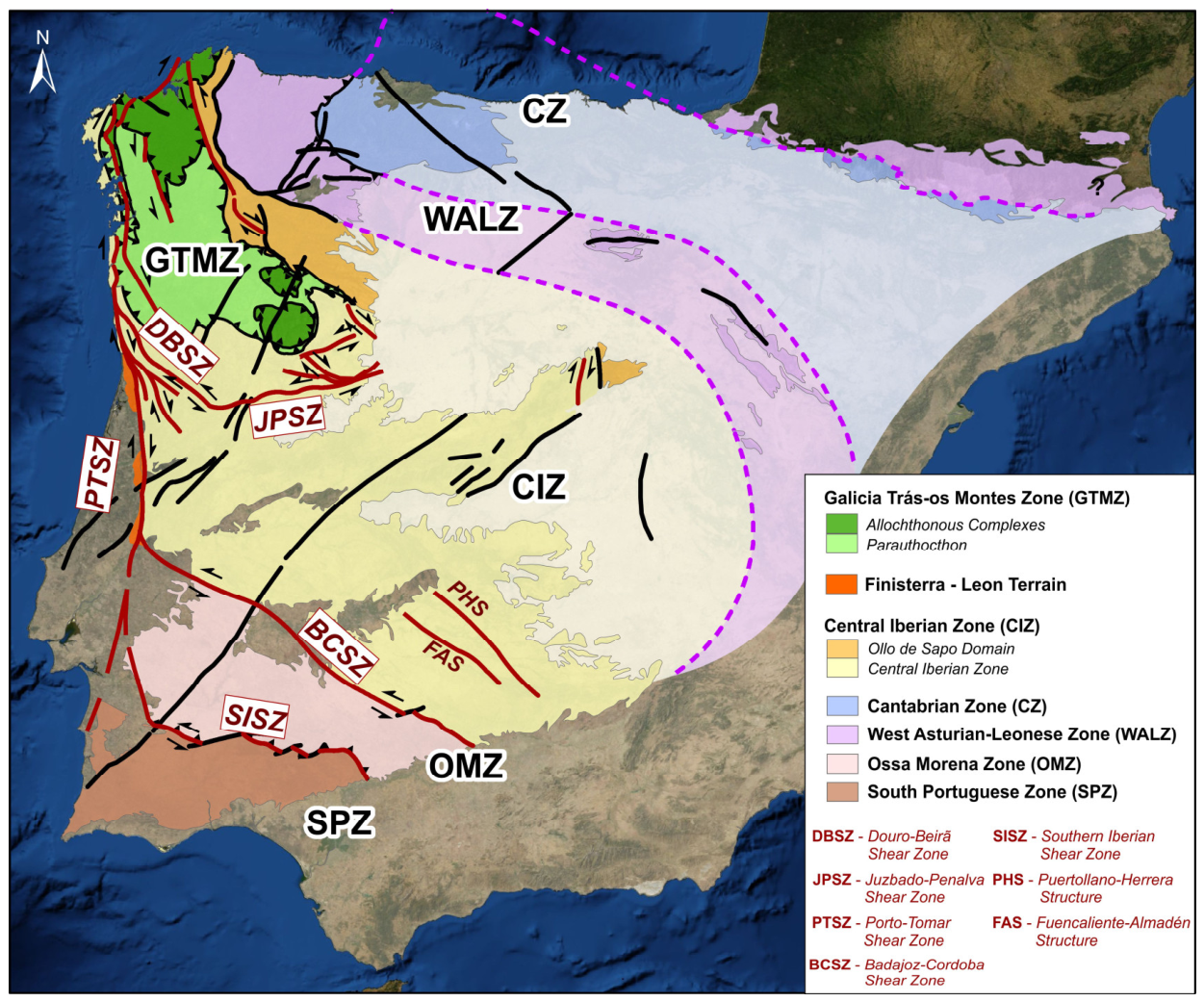
Figure 2.
Distribution and morphological classification of the 100 Sb deposits and occurrences compiled in the Iberian Peninsula. Deposits are grouped into discordant Sb veins hosted by Precambrian or Paleozoic rocks, bedding-parallel veins, stratabound mineralization in carbonate or siliceous rocks, and Cenozoic volcanic-hosted veins. Deposit numbers correspond to the complete database provided in Supplementary Table S1.
Figure 2.
Distribution and morphological classification of the 100 Sb deposits and occurrences compiled in the Iberian Peninsula. Deposits are grouped into discordant Sb veins hosted by Precambrian or Paleozoic rocks, bedding-parallel veins, stratabound mineralization in carbonate or siliceous rocks, and Cenozoic volcanic-hosted veins. Deposit numbers correspond to the complete database provided in Supplementary Table S1.
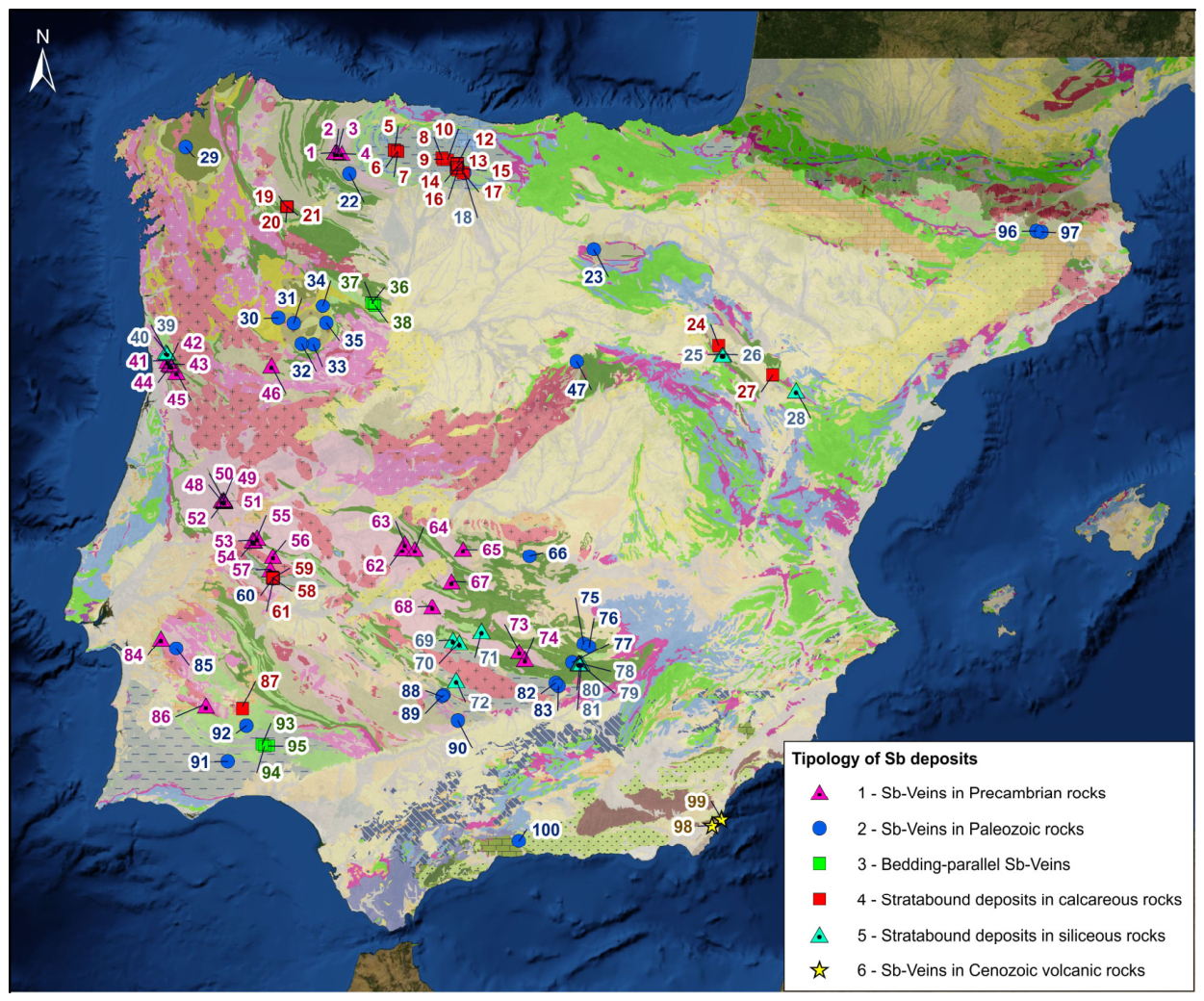
Figure 3.
Regional distribution of the twelve mineral associations recognized in the 100 Iberian Sb deposits and occurrences. The map highlights the marked metallogenic heterogeneity of the Iberian Sb province and provides the basis for evaluating regional metal specialization. Deposit numbers correspond to the identifiers used in Supplementary Table S1.
Figure 3.
Regional distribution of the twelve mineral associations recognized in the 100 Iberian Sb deposits and occurrences. The map highlights the marked metallogenic heterogeneity of the Iberian Sb province and provides the basis for evaluating regional metal specialization. Deposit numbers correspond to the identifiers used in Supplementary Table S1.
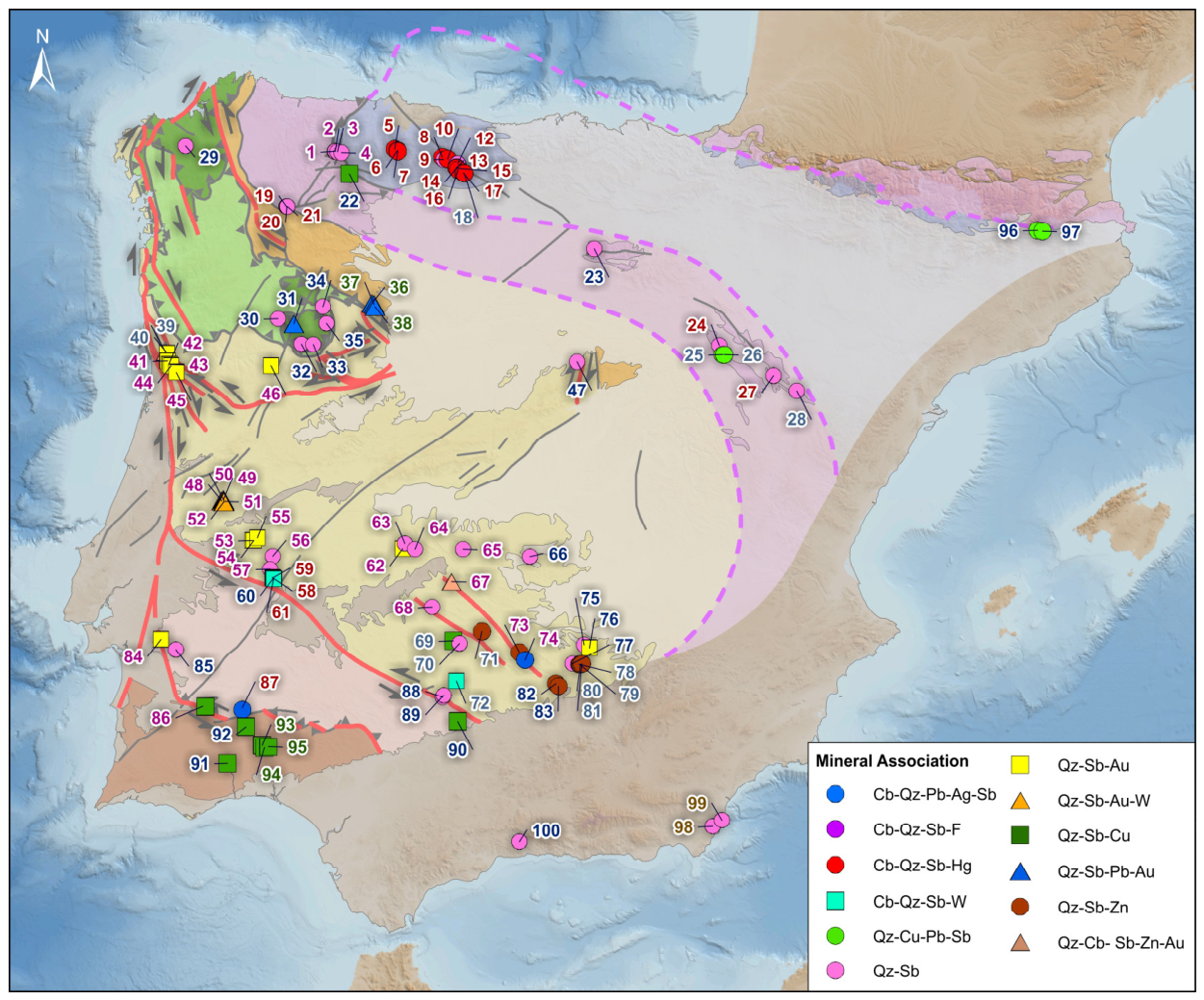
Figure 4.
Distribution of Sb deposits and occurrences in the Cantabrian Zone (CZ), showing the regional concentration of carbonate-hosted Sb–Hg mineralization. The spatial association among Sb–Hg deposits, carbonate successions, and late structural reactivation defines one of the most distinctive metallogenic specializations of the Iberian Sb province.
Figure 4.
Distribution of Sb deposits and occurrences in the Cantabrian Zone (CZ), showing the regional concentration of carbonate-hosted Sb–Hg mineralization. The spatial association among Sb–Hg deposits, carbonate successions, and late structural reactivation defines one of the most distinctive metallogenic specializations of the Iberian Sb province.
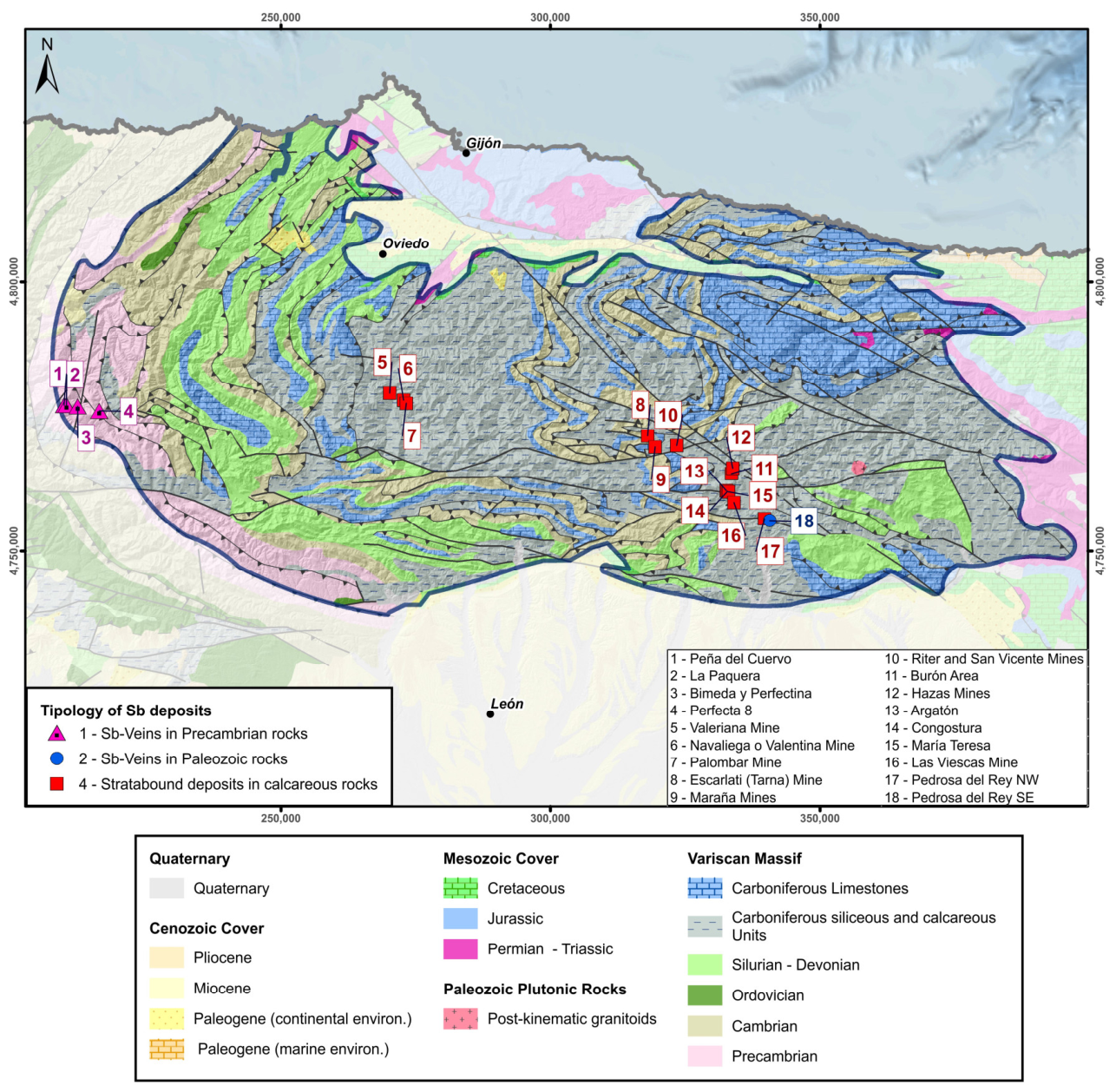
Figure 5.
Distribution of Sb deposits and occurrences in the West Asturian-Leonese Zone (WALZ), illustrating the coexistence of mineralization hosted by carbonate and siliciclastic successions and the greater diversity of deposit styles and mineral associations relative to the neighboring Cantabrian Zone (CZ).
Figure 5.
Distribution of Sb deposits and occurrences in the West Asturian-Leonese Zone (WALZ), illustrating the coexistence of mineralization hosted by carbonate and siliciclastic successions and the greater diversity of deposit styles and mineral associations relative to the neighboring Cantabrian Zone (CZ).
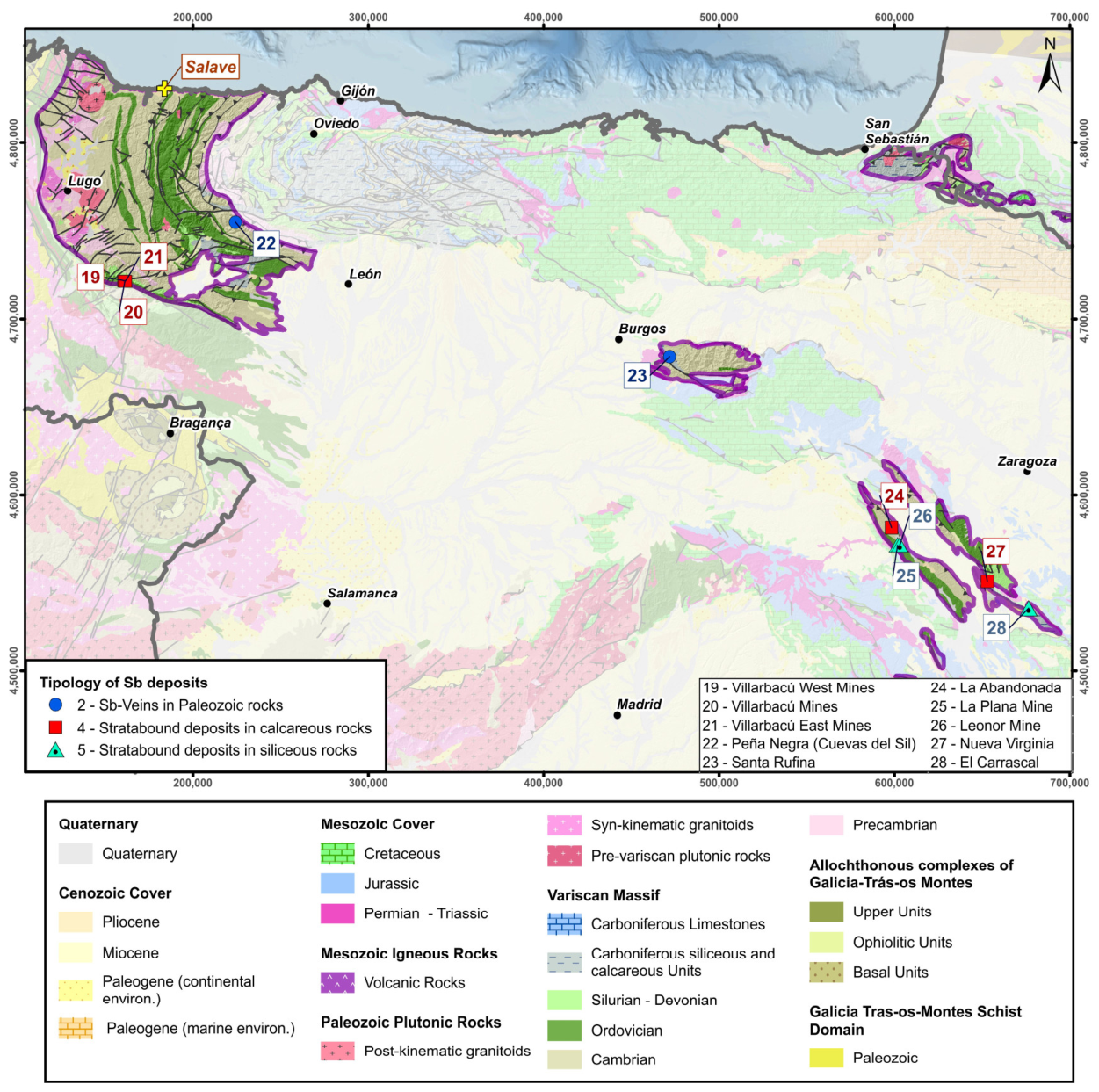
Figure 6.
Distribution and metallogenic specialization of Sb deposits in the Central Iberian Zone (CIZ) of Spain and Portugal in relation to the principal regional structures. The CIZ constitutes the main Iberian Sb province and contains the greatest diversity of mineral associations, including the major Sb–Au, Sb–Au–W, Sb–W, and Sb–Zn systems. Representative districts include Valongo–Gondomar, Sarzedas, Nazarena, and San Antonio.
Figure 6.
Distribution and metallogenic specialization of Sb deposits in the Central Iberian Zone (CIZ) of Spain and Portugal in relation to the principal regional structures. The CIZ constitutes the main Iberian Sb province and contains the greatest diversity of mineral associations, including the major Sb–Au, Sb–Au–W, Sb–W, and Sb–Zn systems. Representative districts include Valongo–Gondomar, Sarzedas, Nazarena, and San Antonio.
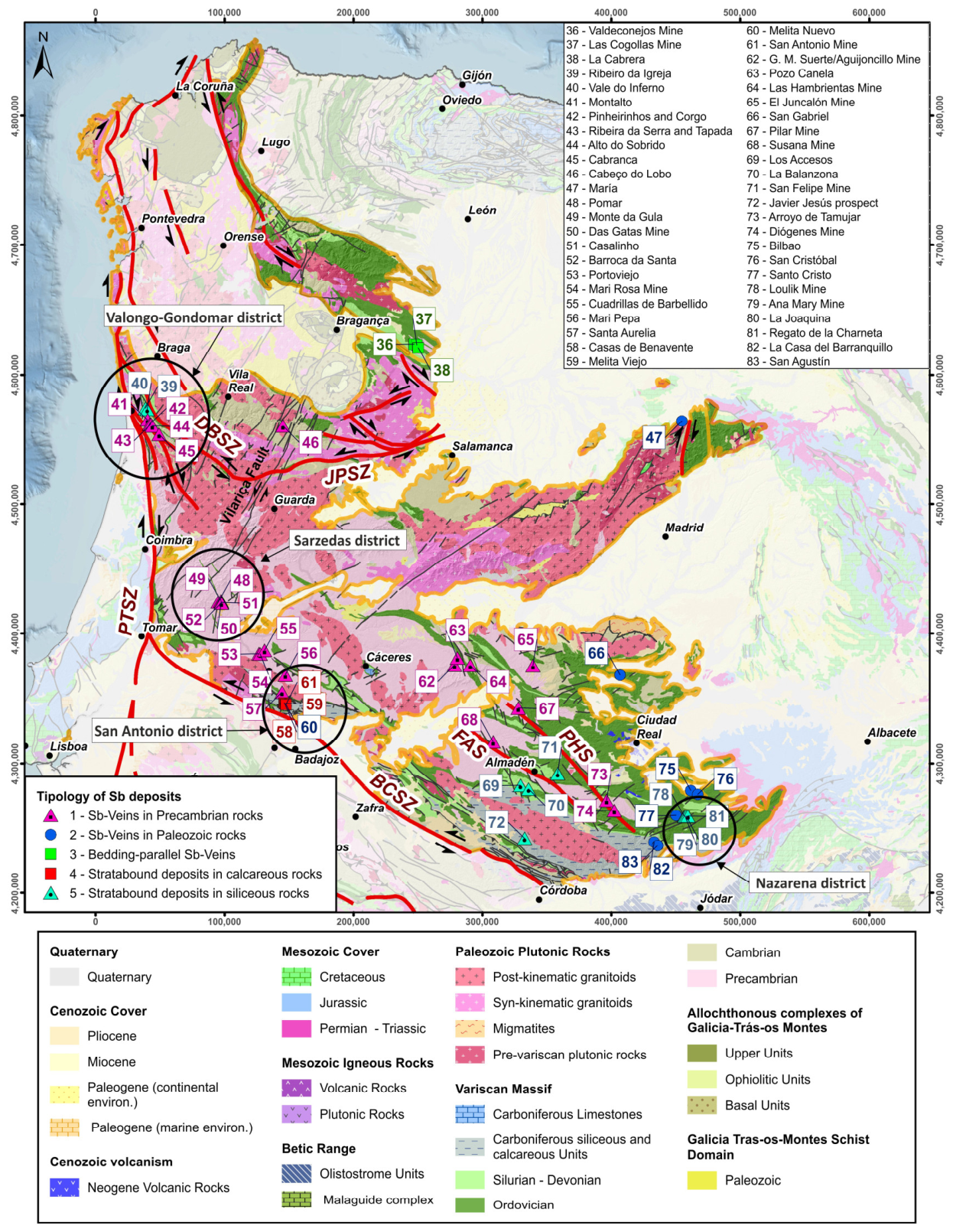
Figure 9.
Distribution of Sb mineralization in other tectonostratigraphic domains of the Iberian Variscan Massif. (A) Galicia–Trás-os-Montes Zone (GTMZ), including locally Au-bearing Sb systems; (B) Ossa-Morena Zone (OMZ), characterized by a relatively small but mineralogically diverse Sb population; and (C) South Portuguese Zone (SPZ), where the Qz-Sb-Cu association is dominant. The SPZ occurrences may partly reflect remobilization of Sb from metal-bearing volcano-sedimentary successions of the Iberian Pyrite Belt.
Figure 9.
Distribution of Sb mineralization in other tectonostratigraphic domains of the Iberian Variscan Massif. (A) Galicia–Trás-os-Montes Zone (GTMZ), including locally Au-bearing Sb systems; (B) Ossa-Morena Zone (OMZ), characterized by a relatively small but mineralogically diverse Sb population; and (C) South Portuguese Zone (SPZ), where the Qz-Sb-Cu association is dominant. The SPZ occurrences may partly reflect remobilization of Sb from metal-bearing volcano-sedimentary successions of the Iberian Pyrite Belt.
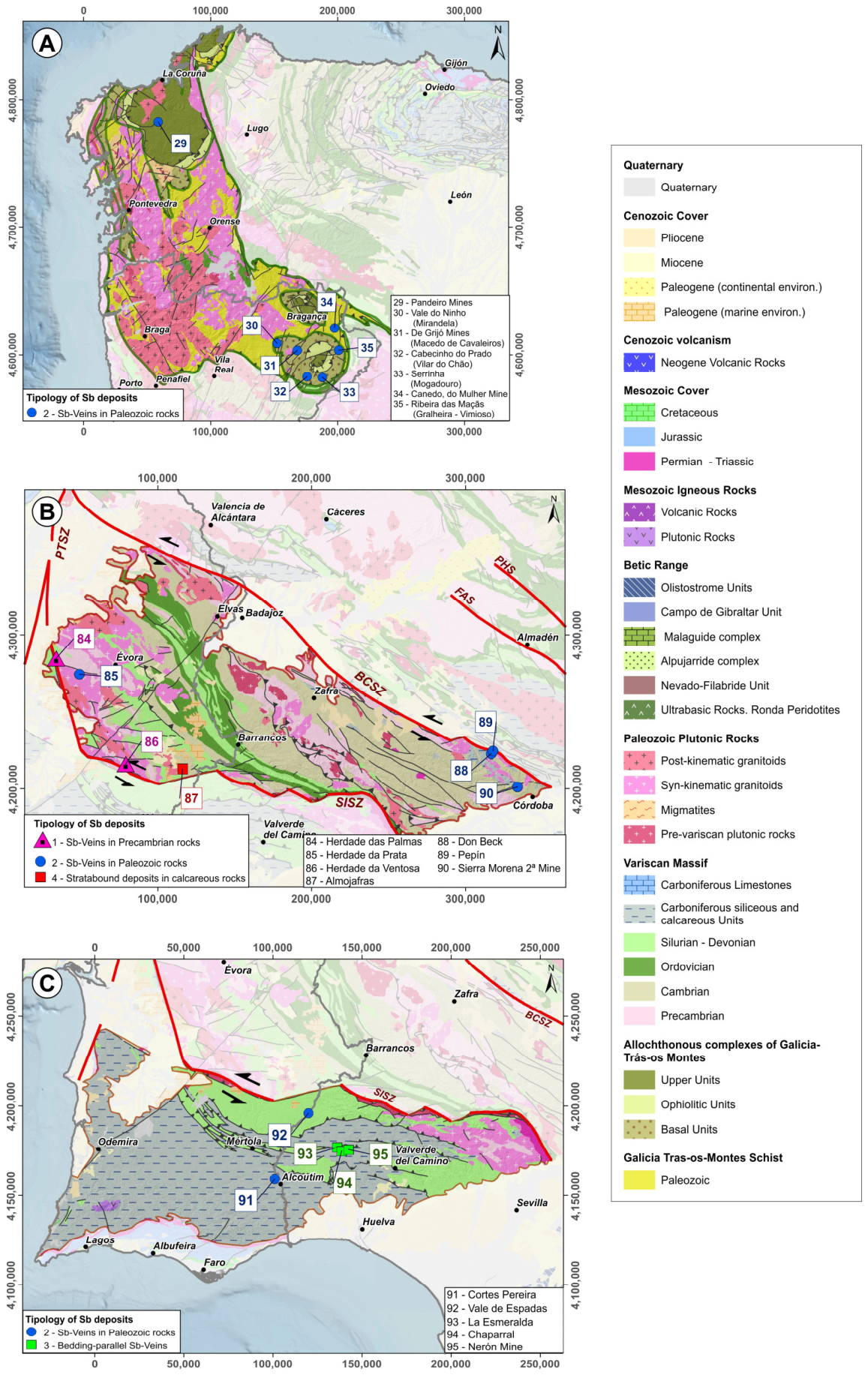
Figure 10.
Sb occurrences outside the principal Iberian Variscan Sb province. (A) Eastern Pyrenees, characterized by the Qz-Cu-Pb-Sb mineral association; (B) Alpujárride Complex of the Betic Cordillera; and (C) Cenozoic volcanic province of southeastern Iberia. These occurrences are considered separately from the main Variscan Sb systems.
Figure 10.
Sb occurrences outside the principal Iberian Variscan Sb province. (A) Eastern Pyrenees, characterized by the Qz-Cu-Pb-Sb mineral association; (B) Alpujárride Complex of the Betic Cordillera; and (C) Cenozoic volcanic province of southeastern Iberia. These occurrences are considered separately from the main Variscan Sb systems.
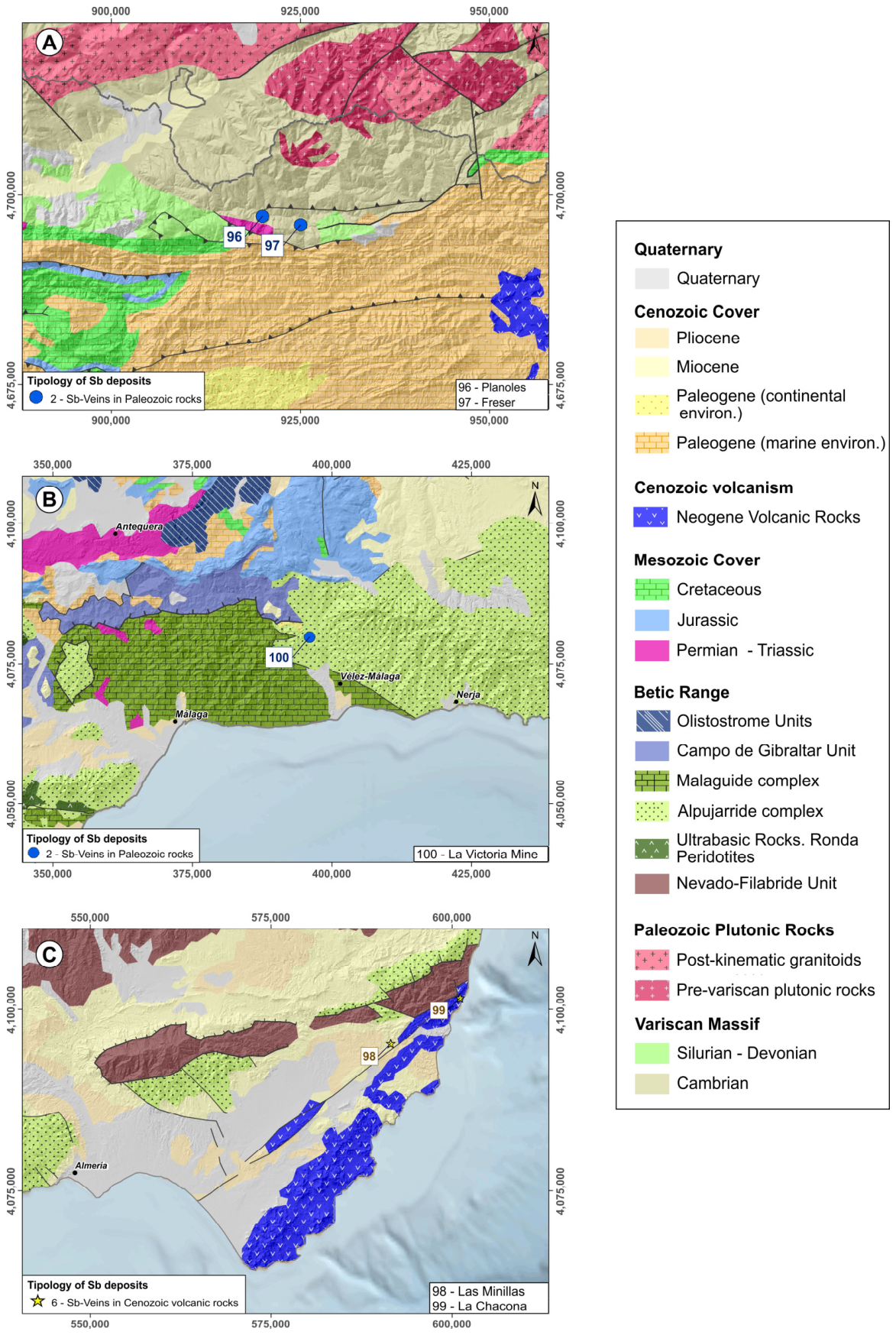
Figure 11.
Rose diagrams showing the orientations of Sb-bearing veins throughout the principal tectonostratigraphic domains of the Iberian Peninsula (n = 124). The contrasting regional orientation patterns indicate deformation partitioning and polyphase structural reactivation rather than a single Iberian-scale mineralized fracture direction.
Figure 11.
Rose diagrams showing the orientations of Sb-bearing veins throughout the principal tectonostratigraphic domains of the Iberian Peninsula (n = 124). The contrasting regional orientation patterns indicate deformation partitioning and polyphase structural reactivation rather than a single Iberian-scale mineralized fracture direction.
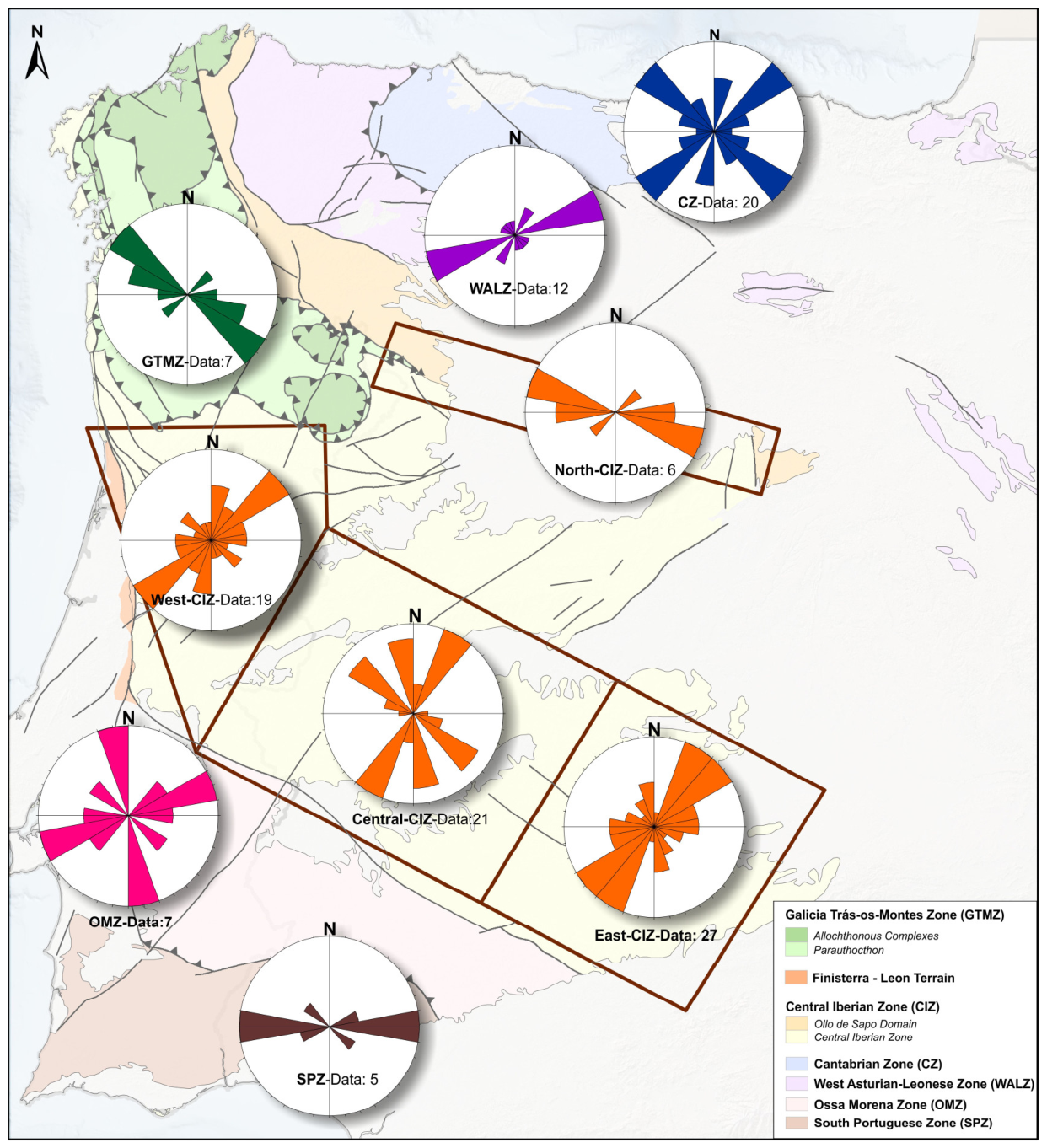
Figure 12.
Multiscale structural and lithological controls on the San Antonio Sb–W deposit, southern Central Iberian Zone (CIZ). (A) Regional and district-scale structural setting in relation to the Badajoz–Córdoba Shear Zone (BCSZ) and associated transpressional structures. (B) N–S geological section through the San Antonio mineralized body, redrawn by the authors based on Gumiel [3]. (C) Stibnite mineralization in Devonian calcareous breccia. (D) Stibnite and scheelite in mineralized breccia.
Figure 12.
Multiscale structural and lithological controls on the San Antonio Sb–W deposit, southern Central Iberian Zone (CIZ). (A) Regional and district-scale structural setting in relation to the Badajoz–Córdoba Shear Zone (BCSZ) and associated transpressional structures. (B) N–S geological section through the San Antonio mineralized body, redrawn by the authors based on Gumiel [3]. (C) Stibnite mineralization in Devonian calcareous breccia. (D) Stibnite and scheelite in mineralized breccia.
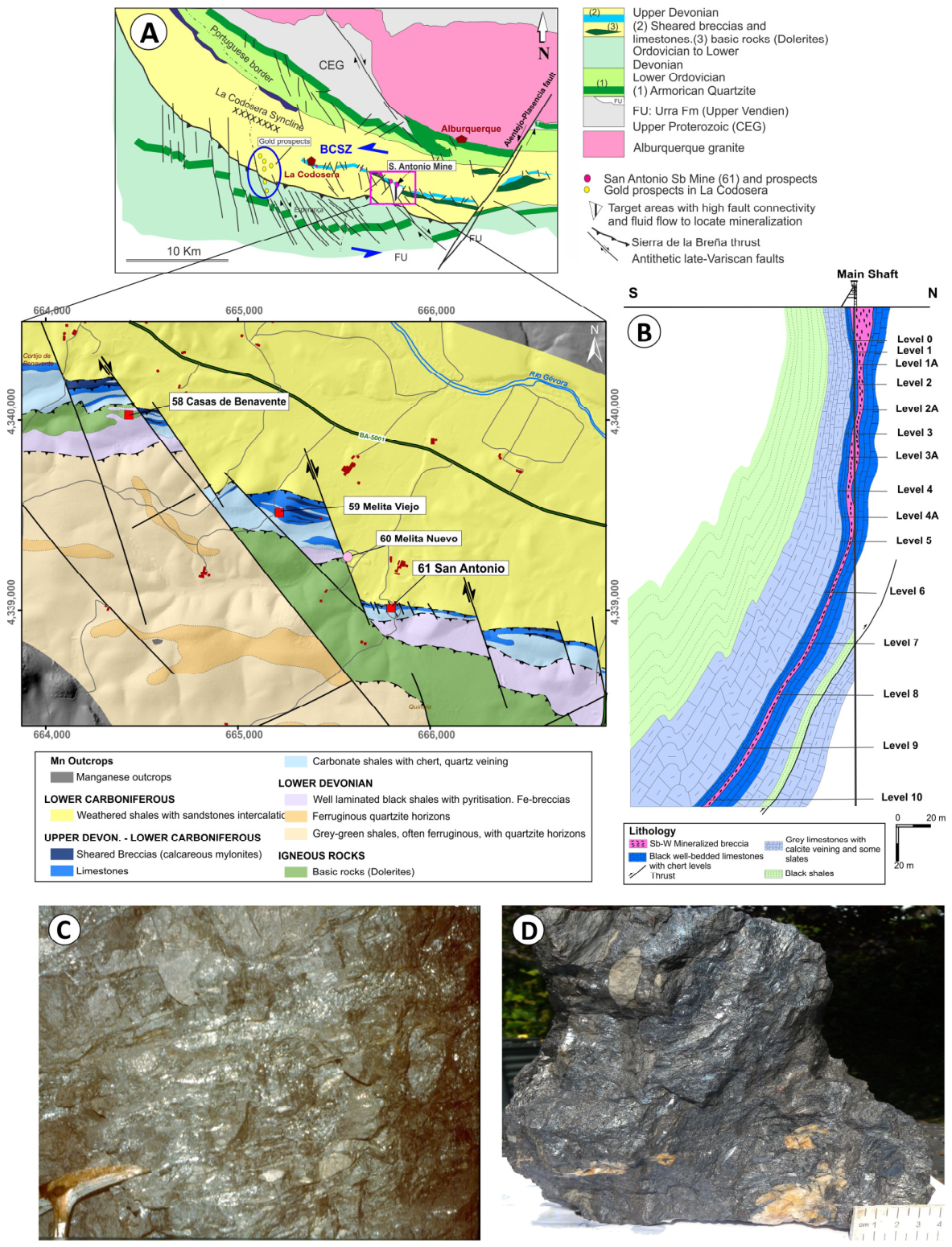
Figure 13.
Gold concentrations (ppm Au) reported for 40 Sb deposits and occurrences in the Iberian Peninsula. The dataset highlights the preferential concentration of the highest Au values in western Iberian Sb districts, particularly Valongo–Gondomar and Sarzedas, and supports the recognition of regional Sb–Au and Sb–Au–W metallogenic specialization. Reported Au values (ppm) are provided in Supplementary Table S2.
Figure 13.
Gold concentrations (ppm Au) reported for 40 Sb deposits and occurrences in the Iberian Peninsula. The dataset highlights the preferential concentration of the highest Au values in western Iberian Sb districts, particularly Valongo–Gondomar and Sarzedas, and supports the recognition of regional Sb–Au and Sb–Au–W metallogenic specialization. Reported Au values (ppm) are provided in Supplementary Table S2.
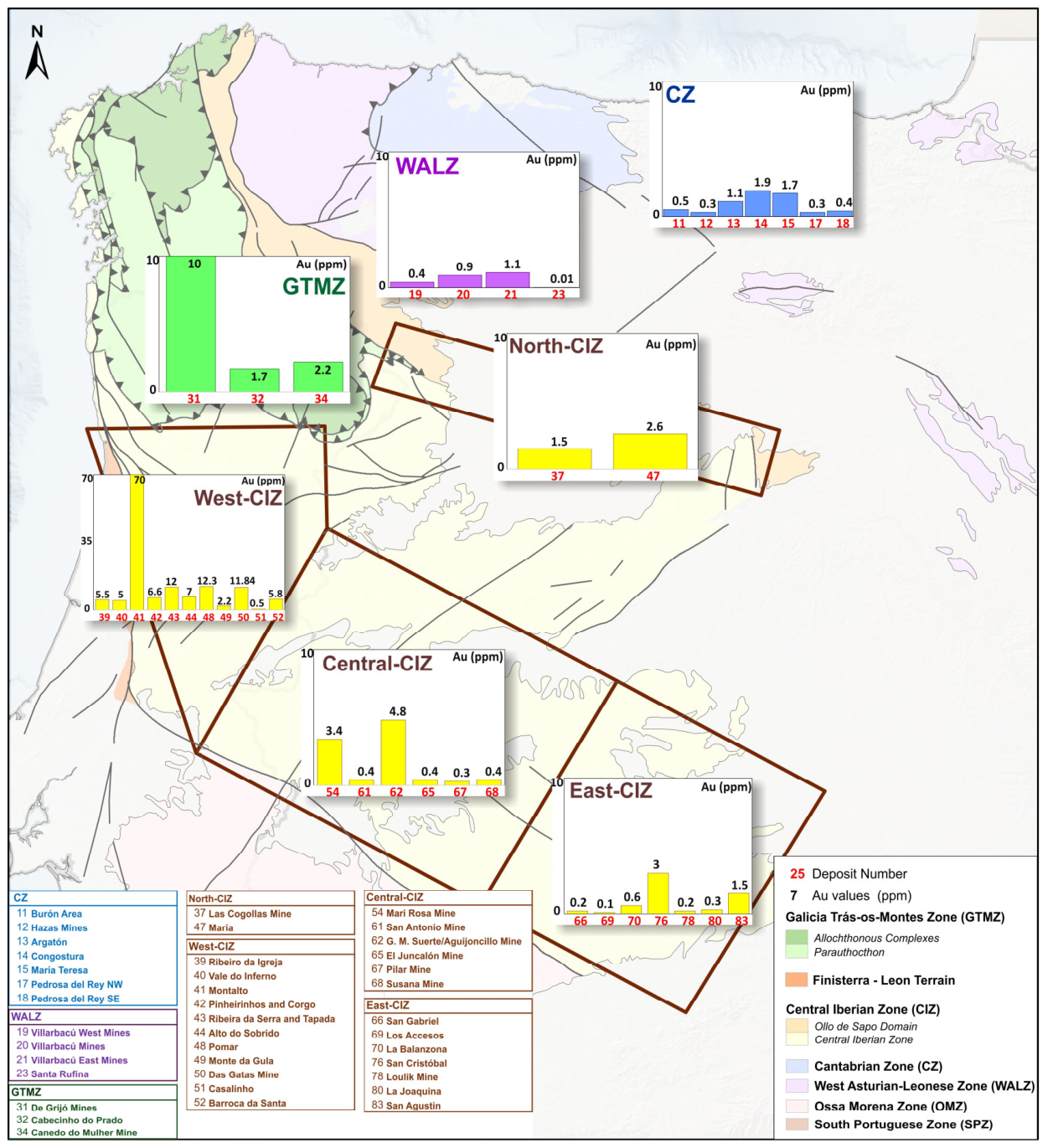
Figure 14.
Major Sb districts of the Iberian, Armorican, and French Central Massifs in relation to first-order Variscan shear zones and fault systems. The distribution emphasizes the recurrent localization of Sb mineralization along or adjacent to long-lived crustal structures throughout the Western European Variscan Belt. BCSZ, Badajoz–Córdoba Shear Zone; PTSZ, Porto–Tomar Shear Zone; DBSZ, Douro–Beirã Shear Zone; JPSZ, Juzbado–Penalva Shear Zone; NASZ, North Armorican Shear Zone; SASZ-N and SASZ-S, northern and southern branches of the South Armorican Shear Zone. Compiled and redrawn by the authors based on Martínez-Catalán et al. [28], García-Sansegundo et al. [29,30], and Moreira et al. [31].
Figure 14.
Major Sb districts of the Iberian, Armorican, and French Central Massifs in relation to first-order Variscan shear zones and fault systems. The distribution emphasizes the recurrent localization of Sb mineralization along or adjacent to long-lived crustal structures throughout the Western European Variscan Belt. BCSZ, Badajoz–Córdoba Shear Zone; PTSZ, Porto–Tomar Shear Zone; DBSZ, Douro–Beirã Shear Zone; JPSZ, Juzbado–Penalva Shear Zone; NASZ, North Armorican Shear Zone; SASZ-N and SASZ-S, northern and southern branches of the South Armorican Shear Zone. Compiled and redrawn by the authors based on Martínez-Catalán et al. [28], García-Sansegundo et al. [29,30], and Moreira et al. [31].
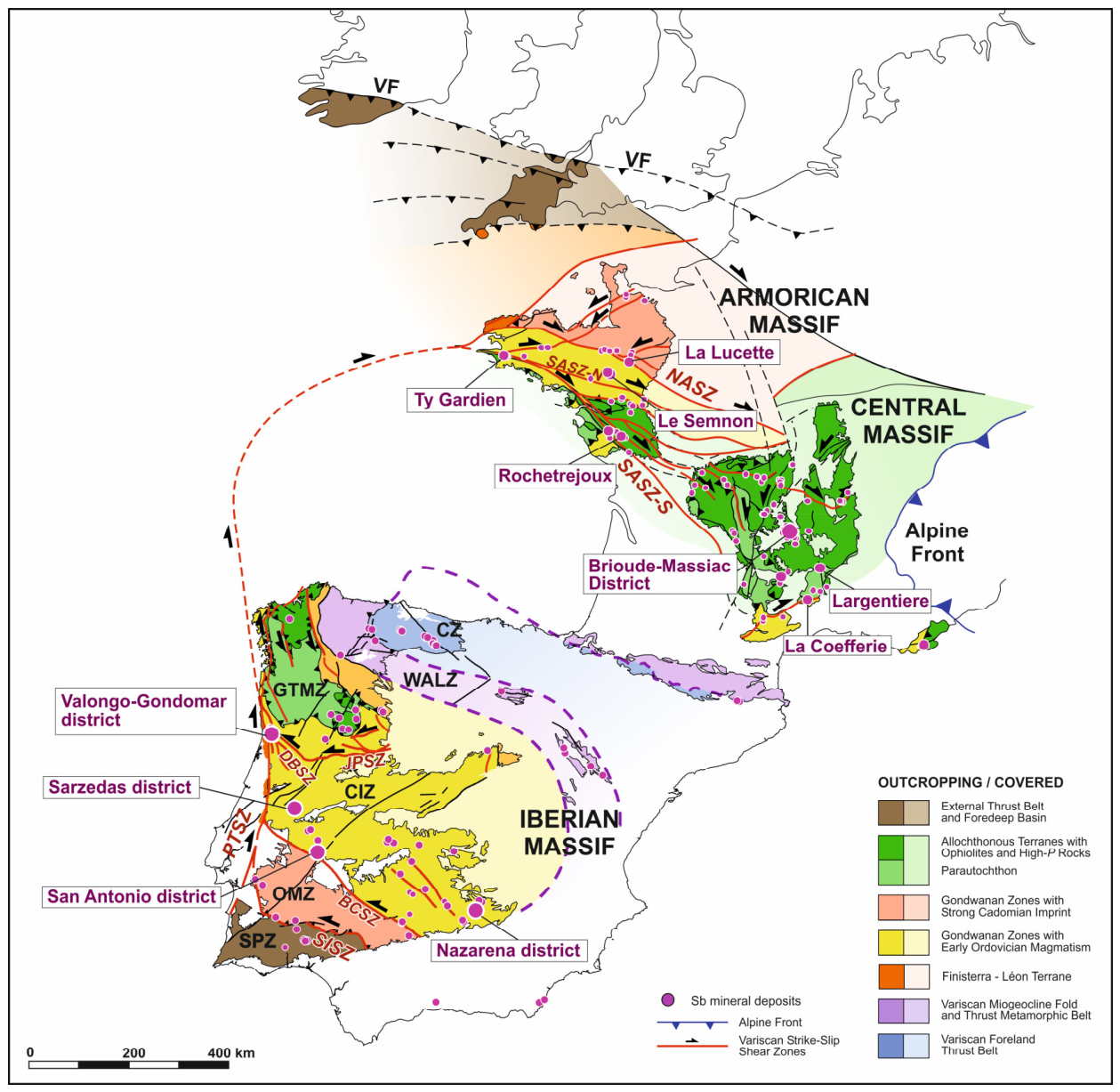

Table 1.
Summary of the mineral associations recognized in the 100 Sb deposits and occurrences compiled from the Iberian Peninsula. The table summarizes the principal ore and gangue minerals, associated metals, number of deposits, and metallogenic significance of each association. These mineral assemblages provide the basis for identifying regional metallogenic specialization and for comparing the contrasting Sb systems developed across the main Iberian tectonostratigraphic domains.
Table 1.
Summary of the mineral associations recognized in the 100 Sb deposits and occurrences compiled from the Iberian Peninsula. The table summarizes the principal ore and gangue minerals, associated metals, number of deposits, and metallogenic significance of each association. These mineral assemblages provide the basis for identifying regional metallogenic specialization and for comparing the contrasting Sb systems developed across the main Iberian tectonostratigraphic domains.
| Code | Mineral association | N | Metallogenic significance |
|---|---|---|---|
| Qz-Sb | Quartz-stibnite | 36 | Most widespread; veins in Precambrian and Paleozoic rocks, locally stratabound. |
| Qz-Sb-Au | Quartz-stibnite-gold | 13 | Characteristic of several CIZ Sb-Au districts; commonly includes pyrite and arsenopyrite. |
| Qz-Sb-Au-W | Quartz-stibnite-gold-wolframite | 5 | Characteristic of the Sarzedas area; significant Au and wolframite. |
| Qz-Sb-Pb-Au | Quartz-stibnite-galena-gold | 4 | Typical of the Losacio group and Grijó; includes berthierite, galena, and Au. |
| Qz-Cb-Sb-Zn-Au | Quartz-carbonate-stibnite-sphalerite-gold-(tetrahedrite) | 2 | Recognized at Pilar Mine and Ribeiro da Igreja; polymetallic assemblage. |
| Cb-Qz-Pb-Ag-Sb | Carbonate-quartz-galena-Ag-stibnite | 2 | Diógenes Mine and Almojafras; Pb-Sb and Ag-Sb sulfosalt evolution. |
| Qz-Sb-Zn | Quartz-stibnite-sphalerite-(chalcopyrite) | 8 | Strongly represented in the Nazarena group; sphalerite precedes Sb sulfides. |
| Cb-Qz-Sb-W | Carbonate-quartz-stibnite-scheelite | 5 | Defined at San Antonio Mine; stibnite-scheelite association. |
| Cb-Qz-Sb-Hg | Carbonate-quartz-stibnite-cinnabar | 11 | Concentrated in the Cantabrian Zone; includes cinnabar, realgar, and orpiment. |
| Cb-Qz-Sb-F | Carbonate-quartz-stibnite-fluorite | 1 | Burón area; fluorite-rich assemblage with Sb and accessory Au. |
| Qz-Sb-Cu | Quartz-stibnite-chalcopyrite | 9 | Occurs in several southern Iberian settings, especially Paleozoic sequences. |
| Qz-Cu-Pb-Sb | Quartz-chalcopyrite-galena-stibnite | 4 | La Plana-Leonor and Planoles-Freser; abundant Pb-Sb sulfosalts. |
Table 2.
Summary of the principal metallogenic characteristics of Sb deposits and occurrences in the Iberian Peninsula by tectonostratigraphic domain, including deposit abundance, dominant deposit styles and mineral associations, representative deposits, and the main geological and structural controls. The complete dataset of the 100 compiled Sb deposits and occurrences is provided in Supplementary Table S1.
Table 2.
Summary of the principal metallogenic characteristics of Sb deposits and occurrences in the Iberian Peninsula by tectonostratigraphic domain, including deposit abundance, dominant deposit styles and mineral associations, representative deposits, and the main geological and structural controls. The complete dataset of the 100 compiled Sb deposits and occurrences is provided in Supplementary Table S1.
| Domain | N | Main deposit style(s) | Mineral association(s) | Representative deposits | Main geological and structural controls |
|---|---|---|---|---|---|
| Cantabrian Zone (CZ) | 18 | Stratabound + veins; subordinate veins | Cb-Qz-Sb-Hg; Qz-Sb; Cb-Qz-Sb-F |
Valeriana; Navaliega/Valentina; Palombar; Escarlati; Pedrosa del Rey | Strong carbonate host-rock control (mainly Cambrian-Carboniferous limestones) combined with fracture-controlled remobilization; late structural reactivation. |
| West Asturian-Leonese Zone (WALZ) | 10 | Stratabound + veins; veins | Qz-Sb; locally Qz-Cu-Pb-Sb and Qz-Sb-Cu | Villarbacú group; Peña Negra; La Plana; Leonor; Nueva Virginia | Mixed carbonate and siliciclastic hosts; polyphase Variscan deformation and fault/fracture control. |
| Galicia-Trás-os-Montes Zone (GTMZ) | 7 | Veins | Qz-Sb; local Qz-Sb-Pb-Au | De Grijó; Vale do Ninho; Cabecinho do Prado; Canedo do Mulher | Vein systems in metasedimentary and metavolcanic successions; widespread spatial association with basic rocks. |
| Central Iberian Zone (CIZ) | 48 | Veins; stratabound + veins; local bedding-parallel veins | Qz-Sb-Au, Qz-Sb-Au-W, Cb-Qz-Sb-W, Qz-Sb-Zn; also Qz-Sb and Qz-Sb-Pb-Au | Valongo-Gondomar; Sarzedas; Mari Rosa; San Antonio; Nazarena; Losacio | Principal Iberian Sb province. Major Variscan shear zones/crustal faults provide first-order control; subsidiary faults, dilation zones, host lithology, and local igneous associations control ore localization. |
| Ossa-Morena Zone (OMZ) | 7 | Mainly veins; local stratabound | Qz-Sb; Qz-Sb-Cu; local Qz-Sb-Au and Cb-Qz-Pb-Ag-Sb | Herdade das Palmas; Herdade da Prata; Herdade da Ventosa; Almojafras; Sierra Morena 2ª | Structurally controlled veins with locally important intrusive/contact relationships and variable host lithologies. |
| South Portuguese Zone (SPZ) | 5 | Veins and bedding-parallel veins | Qz-Sb-Cu | Cortes Pereira; Vale de Espadas; La Esmeralda; Chaparral; Nerón | Paleozoic metasedimentary hosts; strong structural control. Possible remobilization from Sb-bearing volcano-sedimentary sequences of the Iberian Pyrite Belt. |
| Axial Zone of the Pyrenees (AZP) | 2 | Veins | Qz-Cu-Pb-Sb | Planoles; Freser | Ordovician metasedimentary-volcanic succession; spatial relationship with the late Variscan Costabona intrusive system. |
| Neogene volcanic province (NCUV) | 2 | Veins | Qz-Sb | Las Minillas; La Chacona | Neogene dacitic-andesitic volcanic/pyroclastic hosts; fault-controlled mineralization in SE Iberia. |
| Betic Cordillera - Alpujárride Complex | 1 | Veins | Qz-Sb | La Victoria (Matilde) | NW-SE quartz veins in Paleozoic metamorphic basement affected by thrusting and later brittle-ductile/Alpine reworking. |
Table 3.
Comparative metallogenic characteristics of the Iberian Sb province, the Variscan Sb districts of the Armorican and French Central Massifs, and the selected global comparison systems of Xikuangshan (China) and the Murchison Antimony Line (South Africa). The comparison identifies convergent geological and structural controls and does not imply direct genetic equivalence among the different districts or provinces.
Table 3.
Comparative metallogenic characteristics of the Iberian Sb province, the Variscan Sb districts of the Armorican and French Central Massifs, and the selected global comparison systems of Xikuangshan (China) and the Murchison Antimony Line (South Africa). The comparison identifies convergent geological and structural controls and does not imply direct genetic equivalence among the different districts or provinces.
| Feature | Iberian Massif | Armorican Massif / French Massif Central | Xikuangshan | Murchison Antimony Line |
|---|---|---|---|---|
| First-order structural control | Major Variscan shear zones and crustal faults (BCSZ, PTSZ, DBSZ, etc.) | NASZ, SASZ and late Variscan shear systems | Taojiang-Chengbu/F75 fault system | Upper-crustal shear zone |
| Typical ore sites | Subsidiary faults, dilation zones, bedding contacts, breccias | Extensional/strike-slip veins; locally stratabound | Fault footwall and favorable stratigraphic contacts | Replacement, breccias and quartz-carbonate veins |
| Lithological control | Strong locally, especially carbonates and quartzite-slate sequences | Variable | Strong in Devonian sedimentary sequence | Strong where carbonate horizons are developed |
| Mafic association | Common spatially in several districts; genetic role debated | Important in some Armorican models | Not the main comparison used here | Basic volcanic rocks present |
| Metal specialization | Sb, Sb-Au, Sb-Au-W, Sb-W, Sb-Hg, Sb-Zn, Sb-Cu | Sb, Sb-Au, Sb-Au-W | Dominantly Sb | Sb-Au |
Disclaimer/Publisher’s Note: The statements, opinions and data contained in all publications are solely those of the individual author(s) and contributor(s) and not of MDPI and/or the editor(s). MDPI and/or the editor(s) disclaim responsibility for any injury to people or property resulting from any ideas, methods, instructions or products referred to in the content. |
© 2026 by the authors. Licensee MDPI, Basel, Switzerland. This article is an open access article distributed under the terms and conditions of the Creative Commons Attribution (CC BY) license (http://creativecommons.org/licenses/by/4.0/).
Copyright: This open access article is published under a Creative Commons CC BY 4.0 license, which permit the free download, distribution, and reuse, provided that the author and preprint are cited in any reuse.