

Submitted:
07 September 2026
Posted:
08 September 2026
Read the latest preprint version here
Abstract
World models are increasingly used to predict and simulate how environments evolve, yet their evaluation remains fragmented across video generation, autonomous driving, and robotics. World-model benchmarks differ in four respects: what capability is evaluated, how the model is evaluated, which metrics are used, and where the data come from. Thus, similar scores may reflect different evidence and should not support the same capability claims. We present an evaluation-centric survey of 102 representative benchmarks released between 2018 and 2026. We characterize them through four coupled dimensions: Evaluation Target, Evaluation Protocol, Evaluation Metrics, and Evaluation Data. Evaluation Target encompasses visual and temporal quality, spatial and state consistency, long-horizon memory and state persistence, physical plausibility, causal and counterfactual reasoning, control fidelity and interactive dynamics, and functional utility. Our analysis reveals that evaluation targets are expanding beyond visual and temporal quality toward functional utility, while corresponding protocols, metrics, and data lag behind. This evidence gap allows open-loop prediction scores to be overinterpreted as evidence of intervention response or closed-loop reliability beyond what a benchmark directly tests. We identify priorities for evaluating functional utility across downstream roles, developing intervention-based and closed-loop protocols, combining prediction-level and downstream outcome metrics, constructing multimodal action-grounded data, and building standardized and reproducible evaluation toolkits. By clarifying what each benchmark measures and which claims its evidence can support, this survey provides a roadmap toward credible and comparable world-model evaluation. The survey website is available at https://world-model-benchmarks.github.io/.
Keywords:
world models
; evaluation benchmarks
; evaluation taxonomy
; video generation
; embodied intelligence
1. Introduction
World models aim to predict how environments evolve and how candidate actions may affect future states by learning representations of environments and their dynamics [1,2,3,4,5,6,7,8,9,10,11,12]. At their core, these models encode the current state of the environment and learn transition dynamics [13,14,15] that can be rolled forward to predict future trajectories, either in a latent representation space [16,17,18,19,20] or directly in observation space [21,22,23]. With advances in large-scale generative modeling, world models are moving beyond controlled experimental settings toward various real-world applications [24,25,26,27,28,29,30,31]. For example, they can generate plausible future scenes for video generation [32,33,34,35,36,37], produce synthetic training data for autonomous driving [3,38], and support planning and decision-making [39,40,41] in embodied robots [1,39,42].
As the capabilities of world models have expanded, their evaluation has become increasingly challenging because the scope of evaluation has broadened accordingly. Early evaluation efforts largely focused on visual plausibility or physical consistency in controlled settings [32,43,44,45]. More recent benchmarks increasingly examine whether world models can preserve state over long horizons and respond faithfully to actions and interventions, with growing emphasis on their reliability in closed-loop interactions and functional value to downstream agents [42,46,47,48,49]. In short, the focus of world model evaluation is moving from “Does the generated world look reasonable?” to “Is it really useful to the agent?”.
This shift has resulted in a highly fragmented benchmark landscape. Developed across different research communities, existing benchmarks target different capabilities and vary substantially in their evaluation protocols, metrics, and data. As a result, a benchmark score reported as evidence of world model performance may support fundamentally different capability claims. For example, a visually realistic rollout may still drift in terms of object identity or physical consistency, while success on a downstream task may depend as much on the surrounding planner or policy as on the world model itself. Such discrepancies make results difficult to compare and obscure what each benchmark actually evaluates.
Existing surveys of world models provide valuable perspectives but are largely model-centric. General surveys review world model architectures, training paradigms, and applications [50,51,52], while specialized surveys focus on specific domains or representation settings, such as autonomous driving [3,4], robot learning [1,2,53], vision world models [54], and 3D/4D world modeling [55]. These works shed light on how world models are constructed and used, yet they typically treat benchmarks and evaluation methods as supporting components rather than primary objects of analysis. Recent concurrent work has begun to examine world model evaluation more directly from the perspective of embodied decision-making, organizing evaluation evidence according to how well it supports claims about interventional fidelity, outcome prediction, policy evaluation, planning, and policy optimization [56]. This decision-making-centric perspective provides an important account of the evidential requirements of downstream decision claims. However, it does not aim to characterize the broader benchmark landscape or systematically separate the different components of benchmark design across applications and modalities. As evaluation becomes an increasingly important bottleneck in the world model field, this leaves a complementary need for a benchmark-centric framework that clarifies what current benchmarks measure and how their results should be interpreted. Table 1 summarizes the differences in perspective between this survey and existing ones.
In this survey, we organize world model benchmarks through a four-dimensional taxonomy comprising Evaluation Target, Evaluation Protocol, Evaluation Metrics, and Evaluation Data. These dimensions answer four fundamental questions: What capability is evaluated?How is the model evaluated?Which metrics are used? and Where do the data come from? Figure 1 presents the taxonomy and its subcategories. To the best of our knowledge, this is the first survey to explicitly distinguish these components and clarify their respective roles in world model evaluation. Using this framework, we examine 102 representative benchmarks published between 2018 and 2026, including 85 that span multiple evaluation-target categories. We further analyze how the focus of world model evaluation has shifted over this period, as illustrated by the temporal distribution of benchmarks in Figure 2.
The main contributions are summarized below:
- We provide an evaluation-centric survey of existing world model benchmarks, complementing existing model-centric surveys that focus on model architectures, training paradigms, and applications.
- We introduce a unified four-dimensional taxonomy comprising Evaluation Target, Evaluation Protocol, Evaluation Metrics, and Evaluation Data, clarifying the distinct roles of these components across world model benchmarks.
- We conduct a corpus-level joint analysis of target, protocol, metric evidence, and data-source coverage, revealing systematic gaps between capability claims and the evidence provided by current benchmarks.
- We analyze temporal trends in world model evaluation to reveal how benchmark priorities are evolving and where key gaps remain, thereby providing guidance for future benchmark development and research.
The remainder of this survey is organized as follows. Section 2 gives an operational definition of world models and defines the scope of the survey and the inclusion/exclusion criteria for benchmarks. Section 3 outlines the four-dimensional Target–Protocol–Metrics–Data framework. Section 4 systematizes evaluation targets along seven evaluation-target categories. Section 5 discusses evaluation protocols. Section 6 discusses evaluation metrics. Section 7 organizes evaluation data sources. Section 8 analyzes trends, gaps, and future directions. Section 9 discusses the limitations of this survey. Section 10 concludes the survey.
2. Background and Scope
2.1. Operational Definition of World Models
In this survey, we define a world model as a predictive dynamics model that learns a representation of the external world and estimates how world states evolve over time under histories, actions, interactions, or other conditioning signals [10,11,12,18,19,39,40,58,59]. Formally, a world model can be written as
where H denotes the prediction horizon; denotes the available history, including observations, agent states, past actions, spatial layouts, or other contextual information; denotes optional action or control signals, such as robot actions, ego-motion, camera movements, navigation commands, or other agent interventions; u denotes additional conditioning information, such as language instructions, goals, prompts, event descriptions, or task specifications; and denotes future world states. Figure 3 visualizes this mapping.
The state is understood broadly. It may be represented by pixels or videos, but it may also correspond to latent states, 3D structures, object-centric variables, semantic scene descriptions, physical quantities, robot states, simulator states, or task-relevant variables [60,61,62,63,64,65]. Thus, the central object of a world model is not necessarily a pixel-level future, but a rollable representation of the world whose evolution can be predicted, queried, and conditioned on. Observable outputs such as images, videos, trajectories, or task outcomes can be viewed as different readouts of this underlying state evolution.
Under this definition, world models include video-based future simulators, latent dynamics models, spatial or 3D world representations, object-centric predictive models [66], and embodied world models. They differ from generic generative models by modeling state evolution rather than merely producing plausible outputs; action-conditioned dynamics are an important, but not exclusive, evaluation target, alongside temporal coherence, spatial and state consistency, physical evolution, causal response, and long-horizon persistence.
2.2. Scope of World-Model Evaluation
The above definition provides a common basis for specifying the scope of world-model evaluation. Since a world model estimates how future world states evolve from the available history , optional actions , and additional conditioning information u, a benchmark can be viewed as an evaluation probe applied to this predictive-dynamics mapping. Such a probe determines how the model is queried, which observable readout is extracted from the predicted future or downstream process, and how that readout is converted into a score.
Formally, let
denote the input context in Eq. (1). A generic benchmark probe can be written as
where denotes the benchmark distribution, is the probing procedure applied to the model, extracts the observable readout, is the optional reference signal, with when no reference is available, and is the scoring rule. Here and throughout the survey, “score” is used generically: need not have a common optimization direction across benchmarks and may be reported as either a higher-is-better score or a lower-is-better error or distance.
Concretely, may instantiate different benchmark protocols. In a video-prediction benchmark, it may condition on a short history and decode a future video rollout whose frames are compared with held-out reference futures. In a long-horizon benchmark, it may repeatedly roll the model forward to test whether object identities, scene layouts, or task progress persist over extended horizons. In a controlled benchmark, it may perturb actions, camera motions, language instructions, or counterfactual conditions and measure whether the predicted future changes in the intended way. In an interactive or downstream benchmark, it may place inside a planner, policy evaluator, simulator, or embodied agent loop, where the readout may be a task outcome, planning success rate, policy-ranking accuracy, or execution trace rather than a generated video alone.
This probe-based view makes explicit that a benchmark score is not a capability claim by itself. Its interpretation depends on four coupled design choices: the property being tested, the protocol by which the model is exercised, the metrics used to quantify performance, and the data from which evaluation cases are drawn. Accordingly, we decompose world-model benchmarks into the following four dimensions:
- Evaluation target specifies the property of world-state evolution or downstream use being evaluated, namely which aspect of the mapping in Eq. (1) the scoring rule is intended to characterize.
- Evaluation protocol specifies the probing procedure , including whether the model is evaluated through open-loop evaluation under fixed or externally controlled conditions, or closed-loop interaction inside a planner, policy, simulator, or agent loop.
- Evaluation metrics specify the observable readout , the optional reference signal (with when no reference is available), and the scoring rule that turns the readout into a benchmark score.
- Evaluation data specify the benchmark distribution and the availability of histories , actions , conditions u, states , references, annotations, and ground-truth signals. They determine which targets can be evaluated, which protocols can be implemented, and which metrics can be computed.
2.3. Benchmark Selection and Coding
Following this scope, we include a benchmark if it satisfies at least one of the following conditions: it evaluates generated or predicted future world states; measures temporal, spatial, semantic, physical, causal, or long-horizon consistency in world-state evolution; tests whether actions or other controls induce appropriate state transitions; or evaluates the functional role of a learned world model in downstream agent systems. Candidate benchmarks were collected from work on world models, video generation and prediction, physical and causal reasoning, embodied AI, robotics, autonomous driving [67], interactive agents, and learned simulators, then filtered according to whether the evaluation target was directly connected to world-state evolution or downstream use of a learned world model.
In this survey, a benchmark refers broadly to a standardized evaluation setting. It may be released as a standalone evaluation suite, a dataset with an evaluation protocol, a reusable test suite introduced in a model paper, or a standardized evaluation protocol implemented through a platform. One-off evaluations without a reusable protocol, and general-purpose infrastructure without a defined benchmark, are not included in the benchmark corpus.
The corpus was assembled through a seed-and-expansion process. We started from widely used world-model, video-generation, physical-reasoning, embodied-AI, robotics, and autonomous-driving benchmarks, then expanded the pool through backward and forward citation search, related-work sections of recent surveys, benchmark leaderboards and project pages, and searches of Google Scholar, Semantic Scholar, DBLP, arXiv, OpenReview, IEEE Xplore, the ACM Digital Library, CVF Open Access, and PMLR. Queries combined terms such as “world model benchmark,” “video world model evaluation,” “embodied world model benchmark,” “physical plausibility benchmark,” “action-conditioned video generation benchmark,” “policy evaluation world model,” and “closed-loop world model evaluation.” Candidate records were deduplicated, screened by title and abstract, and then checked in full text against the criteria below. The formal corpus covers benchmarks released from 2018 through 2026; earlier datasets and evaluation settings, such as Moving MNIST and BAIR Robot Pushing, are discussed only as historical antecedents and are not counted unless they satisfy the same inclusion criteria. The corpus snapshot used in this survey was last checked on August 31, 2026; newly released or substantially revised benchmarks after that date may not be covered.
We exclude benchmarks whose evaluation setting is disconnected from world-state evolution or the downstream use of a learned world model.
For each included benchmark, we code four attributes used throughout the survey: the evaluation target, the evaluation protocol, the evaluation metrics, and the evaluation data source. Target labels are assigned from the benchmark’s stated evaluation questions and tasks; protocol labels distinguish evaluation under fixed inputs from repeated model–environment interaction; metric labels distinguish prediction-level measurements from downstream outcomes; and data labels describe how the evaluation instances are constructed. These assignments follow the seven target categories in Table 2 and the framework summarized in Figure 1 and detailed in Section 5, Section 6 and Section 7. The resulting corpus contains 102 unique representative benchmarks across the seven category tables; a benchmark is marked as cross-category only when its released tasks or reported metrics directly evaluate more than one top-level target. Under this rule, 85 benchmarks receive cross-category labels. Reference futures, labels, annotations, and simulator states are coded as attached signals available within a data pipeline, not as a separate data-construction family.
All assignments were reviewed iteratively against the benchmark papers, supplementary materials, and released project documentation. Ambiguous cases were revisited using the benchmark’s primary evaluation protocol and reported metrics as the deciding evidence. Because world-model benchmarking is evolving rapidly, especially for 2025–2026 preprints and benchmark suites, the coding should be read as a reproducible literature-based synthesis rather than a claim of final benchmark ontology.
With this scope in place, the central question is how the design choices in Eq. (2) can be organized into a usable taxonomy of world-model benchmarks. The next section introduces the Target–Protocol–Metrics–Data framework used throughout the survey.
3. Taxonomy Overview: Target, Protocol, Metrics, and Data
A world-model benchmark can be characterized by four coupled dimensions: Evaluation Target, Evaluation Protocol, Evaluation Metrics, and Evaluation Data. These dimensions define the Target–Protocol–Metrics–Data framework used throughout this survey, summarized in Figure 1. This section introduces the four dimensions; detailed reviews are provided in Section 4, Section 5, Section 6 and Section 7.
3.1. Overview of the Four-Dimensional Framework
Using the notation of Section 2.2, a benchmark instantiates Eq. (2) by selecting a target property of , a probing procedure , a scoring rule that maps the readout and the optional reference to a score , and a benchmark distribution . The same target can be evaluated by different protocols, and evidence about the same target may be obtained from direct predictions or from downstream outcomes under different data sources and available references. A benchmark should therefore be interpreted as a particular cell in the Target–Protocol–Metrics–Data space, rather than as a single undifferentiated capability label.
The data dimension determines which cells in this space are reachable. Reference signals and annotations are attached to data-construction pipelines rather than treated as a separate construction family. This separation is important because two benchmarks may share the same target but differ substantially in protocol, metrics, or available references, leading to different claims about what their scores support.
3.2. Evaluation Target: What Capability Is Evaluated?
The evaluation target specifies which property of the predictive-dynamics mapping in Eq. (1) a benchmark is intended to characterize. We organize evaluation targets into seven major categories, derived from the operational definition and instantiated as recurring probe classes in Table 2: visual and temporal quality, spatial and state consistency, long-horizon memory and state persistence, physical plausibility, causal and counterfactual reasoning, control fidelity and interactive dynamics, and functional utility. The first six concern properties of the predicted future world states themselves, whereas the seventh concerns the value of the learned world model when embedded in a downstream agent system. These categories are major evaluation targets rather than a strict hierarchy; many benchmarks target multiple capabilities and are therefore assigned to multiple branches of the detailed taxonomy in Section 4.
3.3. Evaluation Protocol: How Is the Model Evaluated?
The evaluation protocol specifies the probing procedure in Eq. (2): how the world model is exercised and whether its outputs influence later inputs or decisions. We distinguish two protocol classes, reviewed in detail in Section 5. Open-loop evaluation scores predictions, rollouts, or task responses under fixed or externally controlled conditions without allowing model outputs to determine later evaluation inputs or environment states. Closed-loop interaction places the world model inside a feedback-driven decision or interaction process, so that its outputs can influence later actions, observations, states, or task outcomes.
3.4. Evaluation Metrics: Which Metrics Are Used?
The evaluation metrics dimension specifies what observable evidence supports a benchmark score. We distinguish two evidence levels, reviewed in detail in Section 6. Prediction-level metrics assess model predictions or other direct readouts before they are used in an external decision, learning, or execution process. Downstream outcome metrics assess consequences that become observable only after model outputs are consumed by a simulator, planner, policy, controller, training pipeline, or physical system. Prediction-level evidence may be obtained through programmatic measurements or evaluator judgments, including human ratings, prompted MLLM/LLM judgments, and learned judgment models.
The central question is not only which metric is used, but what kind of claim that evidence can support. Prediction-level evidence can be reproducible and diagnostic, but may miss whether a model supports useful behavior; downstream outcomes are closer to functional utility, but may confound the world model with the surrounding planner, policy, controller, or simulator interface. A benchmark is therefore most informative when it reports complementary evidence at both levels rather than repeatedly measuring the same surface signal.
3.5. Evaluation Data: Where Do the Data Come From?
The evaluation data dimension specifies the source of the benchmark cases and the signals attached to them. Real-world data collection provides natural visual and semantic diversity; simulation-based generation provides controllable states and intervention structure; scenario/prompt/task curation supports scalable open-domain evaluation; and hybrid construction pipelines combine multiple sources to enable richer closed-loop settings. Evaluation data are reviewed in detail in Section 7.
4. Evaluation Target
4.1. Overview of Evaluation Target
In this section, we review evaluation targets of world-model benchmarks along the seven categories derived from the operational definition in Section 2 and the probe formulation in Eq. (2), and previewed in Section 3.2. Figure 4 gives a quick-scan organization of the targets and their representative benchmarks. Each subsection (Section 4.2–Section 4.8) is paired with its own summary table (Table 3, Table 4, Table 5, Table 6, Table 7, Table 8, Table 9); column conventions are introduced in Table 3 and reused throughout.
The seven categories are presented as distinct evaluation targets rather than as a strict hierarchy or a common maturity ranking. Because their protocols expose different failure modes, evidence strength should be interpreted relative to the capability claim being evaluated rather than compared along a single scale. As introduced in Section 3.2, the first six targets (Section 4.2–Section 4.7) concern properties of the predicted future world states, while the seventh target (Section 4.8) covers the downstream value of the learned world model to an agent system. Many benchmarks evaluate more than one target; cross-category benchmarks are marked accordingly in Figure 4.
4.2. Visual and Temporal Quality
Visual and temporal quality asks whether a generated rollout is usable as a video signal before stronger claims about state, physics, causality, or control are made. It serves as an entry layer rather than a complete test of world understanding, since a model may generate sharp and smooth frames while still forgetting objects, violating dynamics, or ignoring actions. We separate frame-level visual quality from cross-frame temporal behavior because benchmarks may target either or both. Although this category inherits directly from video-generation evaluation, its role in world-model evaluation is mainly diagnostic: blurred frames, flicker, or unnatural motion can obscure whether failures come from weak perception, unstable dynamics, poor memory, or poor control following [24,25,26,161]. Conversely, visually realistic rollouts may overstate world understanding if surface realism is mistaken for correct world evolution. Thus, this category establishes a perceptual floor before evaluating higher-level spatial, physical, causal, or functional properties.
Figure 5.
Visual and Temporal Quality pipeline (Section 4.2). Open-loop video rollouts are assessed for frame realism, artifacts, temporal smoothness, motion quality, and event order using representative programmatic and learned metrics.
Figure 5.
Visual and Temporal Quality pipeline (Section 4.2). Open-loop video rollouts are assessed for frame realism, artifacts, temporal smoothness, motion quality, and event order using representative programmatic and learned metrics.
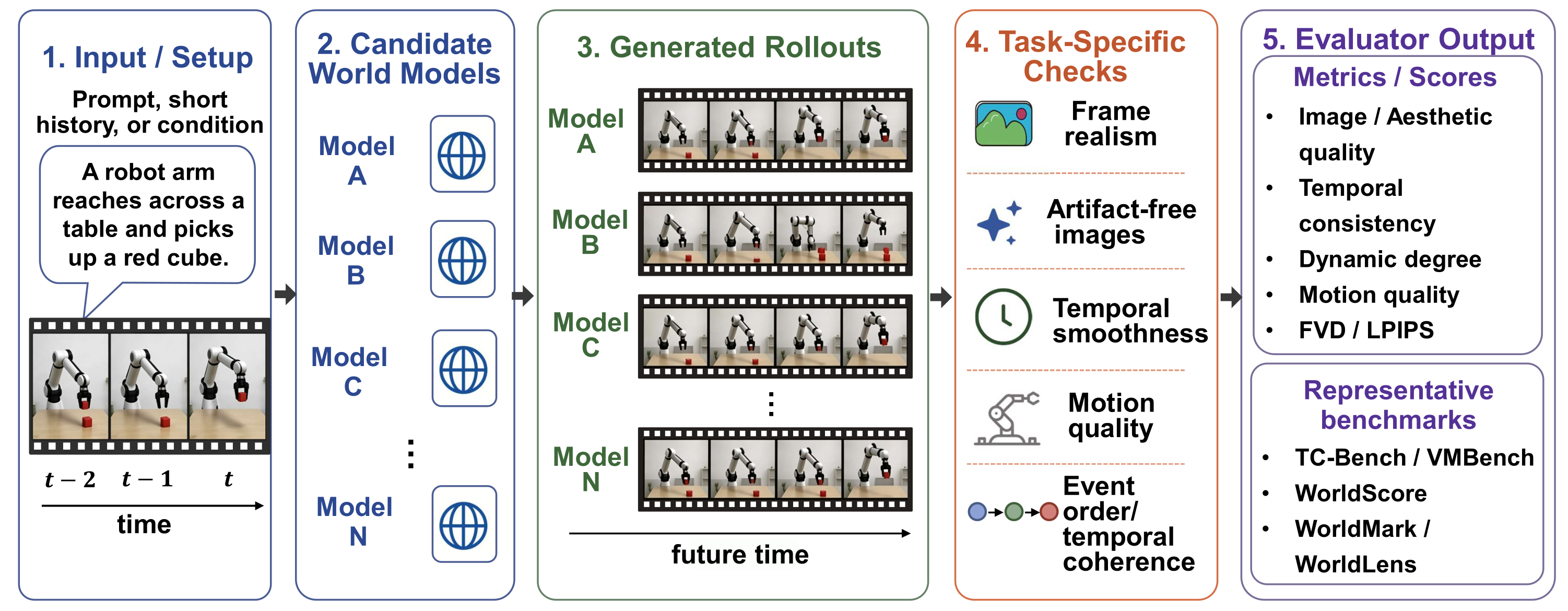
4.2.1. Visual Quality
Visual quality evaluates whether individual frames are clear, artifact-free, aesthetically plausible, and visually realistic for the target domain. This evaluation inherits fine-grained imaging, aesthetic, and human-alignment measures from the broader video-generation literature, complementing distributional scores such as FID and FVD [32,33,162,163,164].
World-model benchmarks reuse these visual metrics but make them domain-sensitive. WorldScore and 4DWorldBench include visual quality as a first-stage signal before judging 3D/4D consistency or world-generation dynamics [69,74]. EWMBench, WorldArena, and WorldArena 2.0 evaluate scene quality in embodied rollouts, where unclear objects or viewpoints directly affect downstream perception [48,49,71]. GameWorld Score, the evaluation suite introduced with Matrix-Game, and WorldMark score visual quality in interactive game or video-world settings, while WorldLens and DrivingGen adapt the same concern to driving scenes, including road layout, agents, and camera-conditioned appearance [72,73,75,76]. Gen-ViRe and PEDRA further show that visual realism is often retained as a gate even when the final target is reasoning or trajectory simulation [77,78]. iWorld-Bench likewise includes visual generation as an explicit evaluation task alongside trajectory following and memory [79].
The methodological trend is from generic frame realism toward task-conditioned visual sufficiency. Early scores can say that a frame is clean or aesthetically plausible, but they often do not say whether the relevant objects, affordances, or environmental cues are visible enough for the intended world-model use. Driving benchmarks, for example, care less about global beauty than about lanes, agents, occlusions, and camera-consistent road geometry; embodied benchmarks care about object boundaries, gripper visibility, contact regions, and viewpoint changes. Thus, visual quality becomes more diagnostic when it is tied to the downstream scene vocabulary and failure modes of the domain being simulated.
4.2.2. Temporal Quality
Temporal quality evaluates whether the frames form a coherent temporal sequence. The core metrics are temporal consistency, flicker or warping stability, motion smoothness, dynamic degree, and ordered event progression. Earlier video-generation evaluation established fine-grained and human-aligned measures for these low-level temporal properties [32,33,163,164]. ChronoMagic-Bench focuses on metamorphic and time-lapse change, VMBench isolates perception-aligned motion generation, and TC-Bench tests whether compositional temporal events occur in the correct order [68,70,106].
World-model evaluation makes temporal quality operational rather than merely cinematic. WorldScore and 4DWorldBench include dynamic or video-level scores for world generation; GameWorld Score, WorldMark, and WBench test whether temporal coherence survives interactive or multi-turn control; and EWMBench, WorldArena, WorldArena 2.0, WorldLens, DrivingGen, PEDRA, and Gen-ViRe evaluate motion quality in embodied, driving, trajectory, or reasoning-oriented rollouts [48,49,69,71,72,73,74,75,76,77,78,107].
Taken together, the visual and temporal assessments reviewed here characterize perceptual quality and short-range temporal coherence. These scores alone do not establish state consistency, physical or causal correctness, action responsiveness, or downstream utility.
4.3. Spatial and State Consistency
Spatial and state consistency asks whether the generated future remains the same underlying world as the history: the same entities, compatible spatial relations, coherent geometry, and persistent scene state [60,61,62,63,64,65]. It differs from temporal quality because the video may be smooth while still swapping object identities, drifting layouts, breaking occlusion relations, or resetting hidden state after a camera turn. Figure 6 shows the pipeline, sub-checks, and representative benchmarks for this category.
The key distinction is that this category treats the rollout as evidence about a latent world state, not merely as a sequence of images. A model may preserve adjacent-frame similarity while gradually changing an object’s identity, moving a wall, altering a road layout, or forgetting that an object was occluded rather than having disappeared. Such failures are central for world models because planning and interaction require the future to remain compatible with the history . Evaluation therefore asks whether the predicted state can be interpreted as a continuation of the same scene rather than as a newly sampled plausible scene at each step.
Appearance- and entity-persistence measures provide the first group of consistency tests. Earlier video-generation evaluation separated subject and background consistency from generic visual quality, providing basic signals for identity drift and scene instability [32,163]. WorldMark, GameWorld Score, EWMBench, WorldArena, and WorldLens adapt the same question to world-model evaluation by measuring object, scene, or semantic consistency under interaction, embodiment, or driving constraints [48,71,72,73,75]. DrivingGen similarly evaluates whether generated driving rollouts preserve agents, trajectories, and road-scene layout [76].
Figure 6.
Spatial and State Consistency pipeline (Section 4.3). Cross-frame, cross-view, and revisit rollouts test whether identities, geometry, layouts, and scene states remain mutually consistent.
Figure 6.
Spatial and State Consistency pipeline (Section 4.3). Cross-frame, cross-view, and revisit rollouts test whether identities, geometry, layouts, and scene states remain mutually consistent.
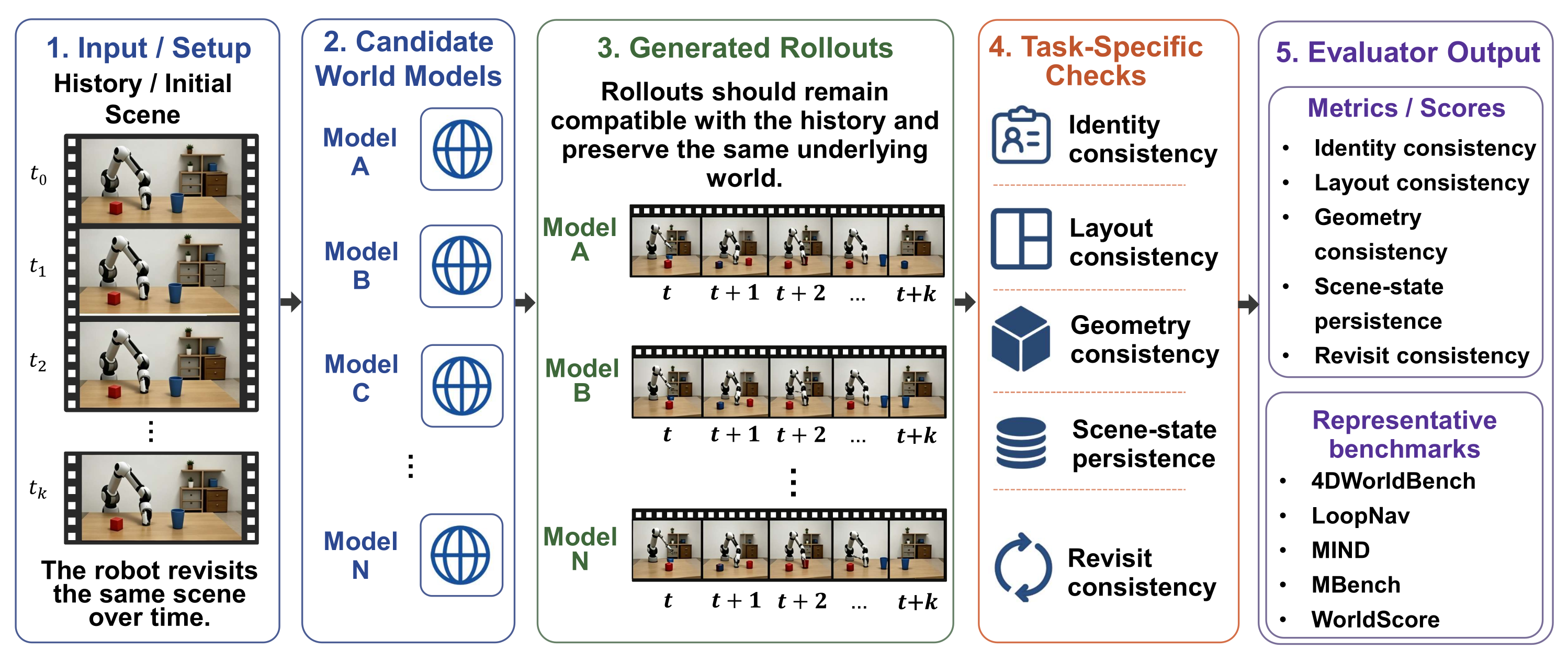
This appearance-level group is useful but incomplete. Subject and background consistency scores can catch obvious identity drift, yet they may still miss errors that are semantically small but decision-critical: a cup changing pose under a gripper, a pedestrian shifting lanes, or a navigable passage silently becoming blocked. For this reason, world-model benchmarks increasingly combine perceptual matching with object-level, scene-level, or task-level checks. The evaluation target is not pixel identity, since viewpoints and states legitimately change; it is compatibility between changed observations and a stable underlying configuration.
The second group targets geometry and spatial structure more directly. WorldScore evaluates whether generated scenes can be read as coherent worlds through quality, dynamics, and world-generation metrics; 4DWorldBench extends this to 3D/4D dynamic world generation [69,74]. Quantitative Video World Model Evaluation for Geometric-Consistency, or PDI-Bench, makes the geometric requirement explicit by checking scale-depth alignment, 3D motion consistency, and rigidity-like residuals [111]. LoopNav turns spatial consistency into a loop-closure problem: after navigation and return, the world should preserve the same scene graph instead of regenerating a plausible substitute [112].
Geometry-oriented protocols add a stronger constraint because they ask whether views, depths, trajectories, and object motions can coexist in one spatial world. This is where spatial consistency becomes different from style consistency: the generated frames need not look identical, but their camera motion, object displacement, and depth relations should be mutually explainable. Loop-closure and revisit settings are particularly diagnostic because they deny the model an easy escape route; if the agent returns to a previously observed place, the scene must agree with earlier evidence rather than being resynthesized from a generic prior.
The third group evaluates state persistence under partial observation, memory, or causal-spatial probes. MIND and MBench focus on memory consistency in video world models, including entity, environment, action, and context persistence across revisits [46,113]. STEVO-Bench asks whether state evolution continues when the relevant process is out of sight, making hidden-state persistence directly testable [114]. CausalSpatial evaluates object-centric spatial reasoning over collision, compatibility, occlusion, and trajectory settings [115]. WorldOlympiad adds a geometry track for structural consistency, cross-view coherence, and camera-trajectory alignment over long rollouts [47]. HOCA-Bench evaluates ontological anomalies involving entity definition and persistence [117]. What-If World includes embodied interventions where unchanged scene elements must remain stable as causal variables change [116].
These protocols are effective at detecting inconsistencies in object identity, layout, geometry, and revisited states, but they only indirectly reveal the mechanisms that produced them. High spatial and state-consistency scores therefore do not by themselves establish physical correctness, causal understanding, action responsiveness, or downstream utility.
4.4. Long-Horizon Memory and State Persistence
Long-horizon memory and state persistence asks whether a world model can sustain a coherent, stable world state across long-horizon generation, multi-step prediction, multi-turn interaction, and embodied tasks [60,61,62,63,64,65]. “Memory” here is not merely keeping past frames available: it is whether the model continuously maintains object identities, spatial layouts, environment state, causal change, action consequences, and task progress. “Persistence” emphasizes whether these states are stably preserved as the world evolves, rather than gradually drifting, being forgotten, or silently reset as rollouts grow longer [165,166]. The dimension is therefore distinct from short-horizon temporal consistency: the latter mainly concerns whether adjacent frames are smooth, whereas long-horizon memory and persistence asks whether the generated world after a long time is still the same world.
Figure 7.
Long-Horizon Memory and State Persistence pipeline (Section 4.4). Extended rollouts, revisits, and continuations probe memory retention, state recall, task progress, and accumulated drift.
Figure 7.
Long-Horizon Memory and State Persistence pipeline (Section 4.4). Extended rollouts, revisits, and continuations probe memory retention, state recall, task progress, and accumulated drift.
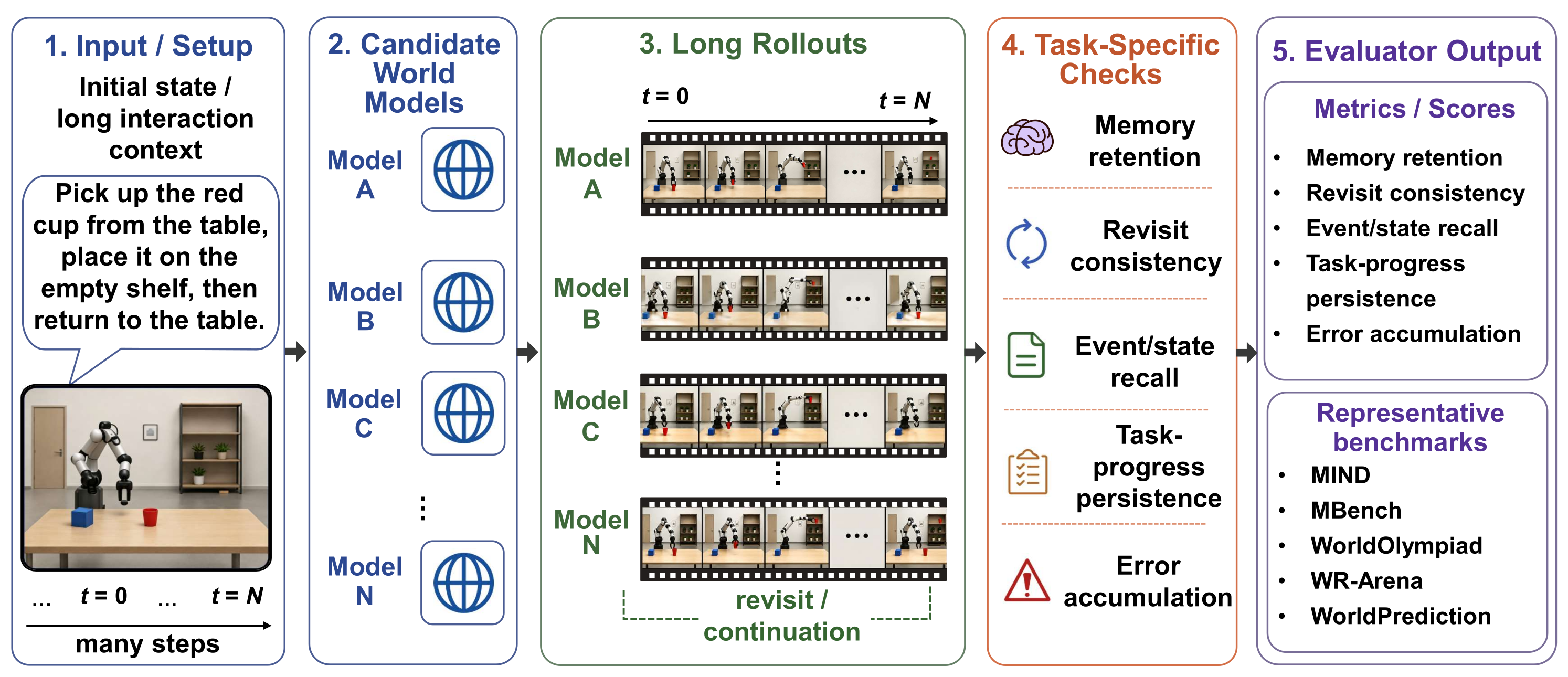
The dimension matters because the goal of a world model is not just to generate visually plausible short videos, but to provide a stable world simulation for prediction, planning, and control. If the model cannot remember objects, positions, or interaction outcomes that appeared earlier, it cannot reliably support long-horizon embodied tasks. For example, in tasks that interleave navigation and manipulation, an agent must know the spatial structure it has already traversed, the location of target objects, whether actions have already altered the environment, and the current task progress. If these states are forgotten over long-horizon generation, even short clips that individually look real cannot serve as a reliable basis for decision-making.
Early benchmarks have begun to touch on long-horizon prediction and state evolution, but generally have not made memory or persistence an independent evaluation target. One line targets long-horizon prediction and procedural planning: given initial and final world states, it evaluates whether a model can identify the correct action or action sequence [128]; this kind of evaluation emphasizes high-level action sequences and world state change, but does not directly check the persistence of generated world state inside a long video. A second line evaluates extended rollouts in controlled dynamic environments and observes how prediction error accumulates over time [125]; this setting has good diagnostic value but is still distant from the complex world states of real video and embodied interaction. A third line evaluates interactive video world models through unified action interfaces and standardized scenes, so that different models can be compared on world consistency under the same scenes and action sequences [73,110]; the focus, however, is still on interaction standardization and short-to-medium-horizon consistency.
Recent benchmarks have begun to evaluate long-term memory and state persistence more directly. MBench explicitly decomposes the memory capability of a video world model into sub-dimensions such as entity consistency, environment consistency, and causal consistency, measuring whether the model maintains a stable internal state over extended temporal horizons [113]. MIND further evaluates a world model along two axes of memory consistency and action control. It emphasizes whether the model still maintains contextual consistency when a scene is revisited or interaction continues [46]. WBench extends evaluation to multi-turn interactive settings, examining whether environment state, physical behavior, and action response remain consistent across turns [107]. WorldOlympiad targets interactive long-video world models and diagnoses, along physical, geometric, and interaction dimensions, whether the model can sustain structural and behavioral consistency over long videos [47]. In addition, HTEWorld places long-horizon state persistence within hybrid embodied tasks that alternate navigation and manipulation [95], while iWorld-Bench explicitly evaluates memory together with visual generation and trajectory following [79]. RoboWM-Bench evaluates, from the perspective of robotic manipulation whether generated behavior can be converted into executable actions, further linking long-horizon state consistency to embodied executability [38].
Although these benchmarks have meaningfully advanced long-horizon evaluation, several common limitations remain. First, memory itself is hard to observe directly; many benchmarks still infer state preservation indirectly through generated video, action execution outcomes, or MLLM judges. Second, the meaning of “persistence” differs across settings: game environments emphasize long-context state evolution; robot manipulation emphasizes object position, contact state, and action consequences; driving emphasizes road structure, vehicle state, and dynamic behavior consistency. Cross-benchmark results are therefore not always directly comparable. Third, long-horizon failure often arises from multiple co-occurring causes, including memory loss, weak physical understanding, unstable action control, geometric drift, and visual degradation. Current evaluations cannot fully separate these failure modes. Finally, a gap remains between programmatic measurements and evaluator judgments, especially for fine-grained errors such as object-identity drift, slow drift of spatial relations, and forgetting of task progress, which remain hard to capture reliably.
Consequently, a high persistence score shows that selected state variables remain stable under the benchmark’s horizon and observation regime; it does not by itself establish correct physical dynamics, reliable control, or long-horizon task utility.
4.5. Physical Plausibility
Physical plausibility asks whether the state transitions in a rollout obey reasonable physical regularities [167,168,169,170,171,172,173,174,175]. Unlike visual realism, it concerns whether objects can move, collide, deform, fall, flow, melt, reflect, or interact in the depicted way. We treat mechanics, materials, fluids, thermodynamics, optics, and electromagnetism as phenomenon tags within one category, because the same benchmark often covers several of them.
Figure 8.
Physical Plausibility pipeline (Section 4.5). Predicted interactions are checked for contact and collision correctness, physical commonsense, law compliance, and possible-versus-impossible outcomes.
Figure 8.
Physical Plausibility pipeline (Section 4.5). Predicted interactions are checked for contact and collision correctness, physical commonsense, law compliance, and possible-versus-impossible outcomes.
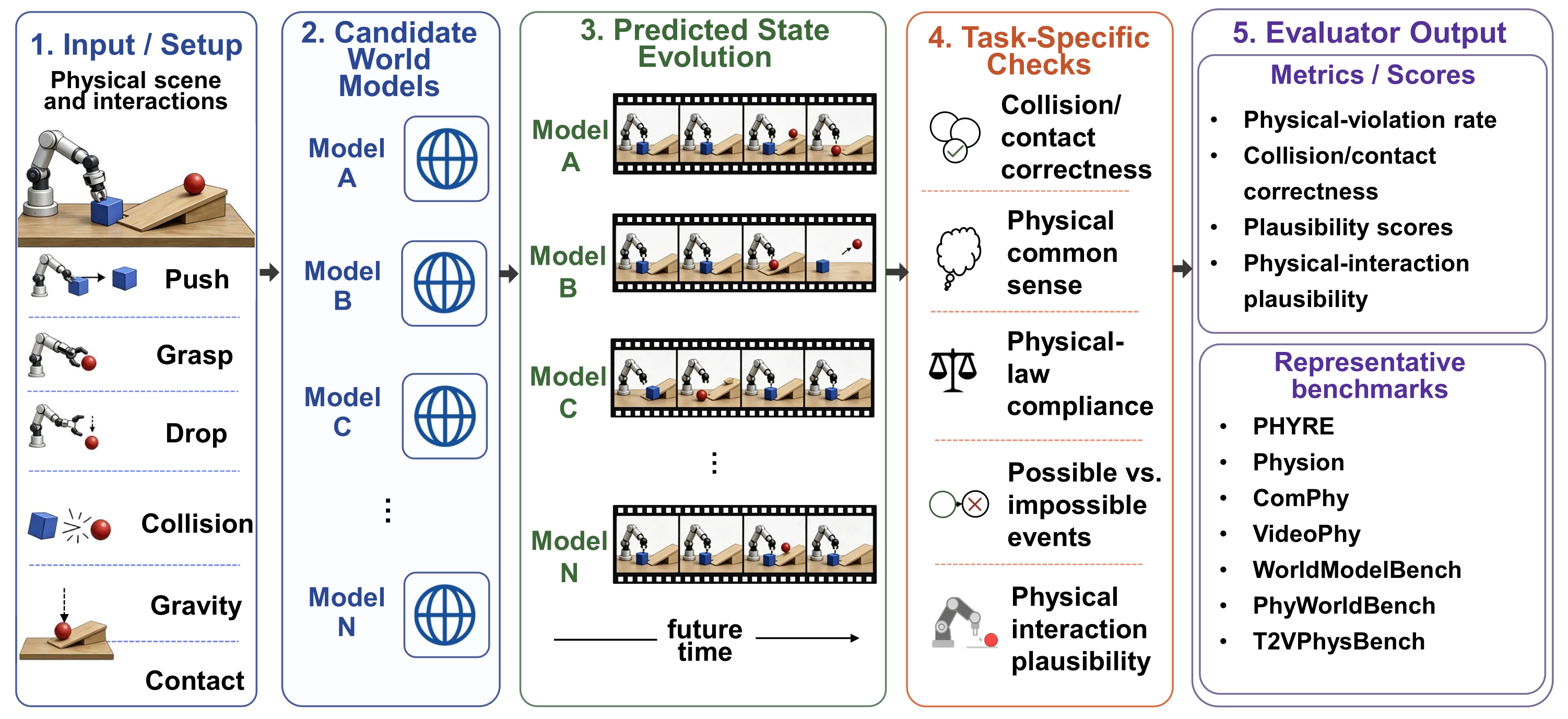
This axis is central to world-model evaluation because physics is the constraint that turns visual continuation into simulation. A generated video may preserve object identity and appear temporally smooth while still violating support, contact, inertia, conservation, or material behavior. Conversely, physical plausibility does not require photorealism: a simple synthetic scene can be a strong physics benchmark if the relevant variables and outcomes are observable. The evaluation problem is therefore less about visual polish than about whether the transition from to is compatible with the physical conditions implied by the scene.
Early benchmarks use controlled environments where ground truth is explicit. IntPhys and IntPhys 2 test intuitive physics through possible/impossible events and object permanence, solidity, continuity, or immutability [43,124]. CLEVRER evaluates descriptive, predictive, explanatory, and counterfactual reasoning over collisions; CoPhy and CRAFT introduce counterfactual or force-interaction reasoning; and PHYRE casts physical understanding as solving 2D mechanics puzzles [44,130,131,132]. Physion and Physion++ expand this line to richer physical prediction and online inference of latent properties such as mass or friction [45,133].
The advantage of these controlled benchmarks is interpretability: because objects, forces, and outcomes are known, errors can be linked to specific physical concepts such as object permanence, collision response, support, or latent mass. Their limitation is restricted ecological validity. Many synthetic tasks simplify perception, materials, and camera variation, so success may indicate mastery of a narrow physical regime rather than general physical simulation. This tradeoff explains why later benchmarks retain controlled probes but add more diverse generated-video and real-world settings.
A second line broadens the physical phenomena and the generated-video setting. ComPhy evaluates compositional physical reasoning, while ContPhy extends evaluation to continuum media such as ropes, cloth, fluids, and deformable bodies [134,135]. PhyCoBench uses optical-flow-guided frame prediction to score physical coherence; VideoPhy and VideoPhy-2 judge physical commonsense in generated videos, with the latter emphasizing action-centric cases [136,137,138]. PhyGenBench, T2VPhysBench, Physics-IQ, WorldBench, PhyWorldBench, T2VWorldBench, WorldModelBench, and VBench-2.0 move toward law-level, parameter-level, or category-level diagnostics for text-to-video and world-model generation [101,103,126,127,139,140,141,142].
Across this line, evaluation shifts from asking whether a model recognizes a possible event to asking whether it can generate or judge physically coherent evolution under varied prompts. This shift is important but also introduces judge uncertainty. MLLM or LLM judges can cover broader physical categories, but they may reward plausible descriptions over precise dynamics; script-based metrics are more reproducible, but they require measurable quantities such as flow, trajectory, contact, or depth. Stronger physical evaluation usually combines both: semantic criteria define what should happen, while quantitative probes check whether the resulting motion and interaction are consistent.
World-model-oriented benchmarks then evaluate physical plausibility within interactive, embodied, or domain-specific simulation settings. GameWorld Score includes physical rule understanding; 4DWorldBench, WorldArena, and EWMBench include physical or dynamic realism as part of broader world-generation and embodied evaluation [48,71,72,74]. RoboWM-Bench and DreamGen evaluate robotic rollouts where hand, arm, object, and embodiment dynamics must be executable or useful for robot learning [38,144]. WorldLens adapts physical plausibility to driving through failures such as teleportation, interpenetration, and unrealistic scene dynamics [75]. RigidBench and PDI-Bench supply more quantitative geometry/trajectory checks, while Morpheus uses real physical experiments and law-based scores over conservation-style constraints [96,111,143]. PhysicsMind further tests mechanics reasoning and prediction in simulated and real settings [149].
Embodied and driving settings make the stakes of physics more concrete. In robotics, a visually plausible grasp is still a failure if contacts, object pose, or arm motion cannot be executed; in driving, small violations such as vehicle interpenetration or teleportation can invalidate planning and safety judgments. These settings also blur the boundary between physical plausibility, spatial consistency, and control fidelity: physical errors often appear as geometric inconsistency or action-response failure. For this reason, benchmarks such as WorldLens, RoboWM-Bench, and WorldArena-style evaluations are valuable not because they isolate a single law perfectly, but because they reveal whether physical errors propagate into operational rollouts.
Recent benchmarks make the diagnostic protocol more explicit. What-If World and CRONOS evaluate whether physical behavior remains consistent under controlled interventions or counterfactual changes [116,147], making both benchmarks cross-category with causal and counterfactual reasoning. PhyGround grounds judgments in physical criteria, Physion-Eval adds expert-like human reasoning traces for generated-video realism, VACT automates causal testing over video behavior, STEVO-Bench checks whether physical state continues to evolve when unobserved, and HOCA-Bench frames predictive world modeling through ontological and causal anomalies [114,117,145,146,148].
Taken together, these benchmarks are effective at detecting visible violations of motion, contact, collision, support, and object interaction, especially when semantic judgments are combined with measurable trajectories or states. They remain less diagnostic when the relevant forces, material parameters, or hidden contact states are unobserved, and many evaluations cannot fully separate physical error from geometric or control failure. High physical-plausibility scores should therefore not be interpreted as evidence of executable manipulation or planning utility without action-conditioned or execution-grounded validation.
4.6. Causal and Counterfactual Reasoning
Causal and counterfactual reasoning evaluates whether a world model captures the mechanisms behind observed events, rather than merely continuing visual patterns [176,177,178,179,180,181]. A plausible next frame may show temporal continuity, but it does not reveal whether the model understands why an event happened, which action caused an outcome, or how the outcome would change under a different condition. This category therefore probes a stronger form of world modeling: the ability to explain observed dynamics, predict consequences, and simulate interventions.
We distinguish benchmarks by the strength of their causal evidence. Observation-grounded evaluation (OG) derives references from observed trajectories or annotations and therefore measures agreement with observational causal judgments. Intervention-grounded evaluation (IG) executes controlled interventions in a simulator or executable environment and compares predictions with the resulting outcomes, providing stronger evidence of causal effects within the modeled system.
Figure 9.
Causal and Counterfactual Reasoning pipeline (Section 4.6). Observation-grounded (OG) evaluation uses annotated or judged references without realized intervention outcomes, whereas intervention-grounded (IG) evaluation compares predictions with outcomes produced under controlled interventions.
Figure 9.
Causal and Counterfactual Reasoning pipeline (Section 4.6). Observation-grounded (OG) evaluation uses annotated or judged references without realized intervention outcomes, whereas intervention-grounded (IG) evaluation compares predictions with outcomes produced under controlled interventions.
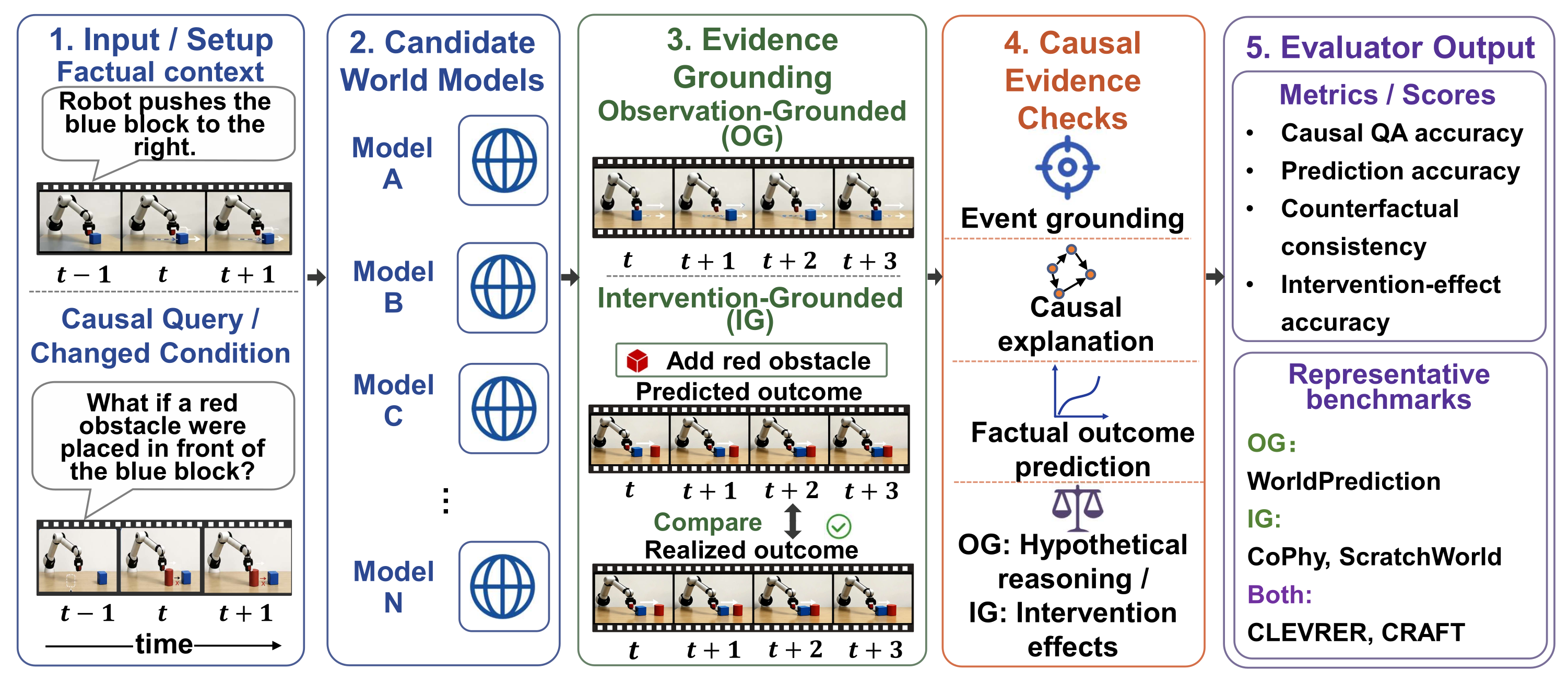
4.6.1. Observation-Grounded Evaluation
OG benchmarks derive their references from observed trajectories, human annotations, or judge-based assessments without executing the corresponding intervention. They cover event grounding, causal explanation, predictive dynamics, and hypothetical or generative reasoning, but their observational references do not necessarily determine a unique underlying causal relation.
Within OG, event grounding serves as a perceptual prerequisite for causal evaluation. It tests whether the model can recognize the entities, actions, state changes, and temporal order on which subsequent causal judgments depend. CLEVRER illustrates this diagnostic role by combining descriptive questions with explanatory, predictive, and counterfactual tasks in the same controlled collision scenes [44]. Causal-VidQA and CausalVQA apply event grounding to everyday actions and real videos [155,158]. Event grounding therefore helps distinguish failures of event perception from failures of subsequent causal judgment.
Causal explanation goes beyond identifying events and asks which event caused, enabled, or prevented another event. Controlled synthetic benchmarks make such relations explicit: CLEVRER isolates causal explanation in collision scenes, while CRAFT refines causal roles into cause, enable, and prevent over forces and interactions [44,132]. Real-video benchmarks broaden the same problem to human actions, goals, and domain knowledge. Causal-VidQA addresses causal questions in real videos, while MMWorld introduces attribution across multiple disciplines [155,157]. This level tests whether a model can produce benchmark-consistent causal attributions rather than merely recognize temporal co-occurrence; for OG benchmarks, it should not be interpreted as independently identifying causal responsibility.
Several benchmarks introduced for spatial, physical, or world-knowledge evaluation also incorporate causal targets. T2VWorldBench includes causality among its six world-knowledge categories [101], VACT defines multi-level causal evaluation metrics for generated videos [148], and HOCA-Bench distinguishes causal anomalies from ontological anomalies [117].
Predictive-dynamics benchmarks infer unobserved futures from factual observations. Early work tests contact, collision, object stability, or final-position outcomes, as in CLEVRER’s factual tasks and Physion [44,45]. More recent benchmarks move closer to world simulation. Physics-IQ turns physical prediction into video continuation conditioned on real initial footage, requiring the future to be generated rather than selected [141]. WorldPrediction asks which action or ordered action sequence links an initial state to a final state, with counterfactual distractors among the options [128]. WR-Arena further extends the horizon by coupling action-conditioned prediction with simulative planning [110]. Collectively, these benchmarks extend physical prediction from short-horizon outcome recognition to generated and action-conditioned world evolution.
Real-video benchmarks further broaden causal evaluation through hypothetical and counterfactual questions. ACQUIRED, Causal-VidQA, MMWorld, and CausalVQA ask what would change if an action, object, or condition were different [155,156,157,158]. Such tasks test whether a model can produce plausible alternatives under ambiguous perception, human intent, and domain knowledge. Their targets are typically supplied by annotation rather than by executing and observing the corresponding intervention.
Recent work extends causal evaluation from question answering to generative counterfactual consistency. CRONOS examines whether generated videos preserve physical coherence under changes in viewpoint, scene context, object category, and appearance [147]. What-If World uses contrastive prompt pairs to test whether changing a single physical variable induces the expected difference in generated outcomes [116], while WR-Arena compares counterfactual futures under externally specified agent actions or scene interventions using judge-based simulation scores [110]. Its separate iterative planning track evaluates goal completion and is discussed under Functional Utility (Section 4.8). Collectively, these benchmarks shift the focus from answering causal questions to assessing whether generated alternatives respond coherently to changed conditions through direct consistency or judge-based metrics.
OG evaluation nevertheless relies on observational trajectories, for which causal sufficiency generally cannot be assumed: the same observed association may arise from either a direct causal relation or an unobserved common cause. This motivates latent-confounding-aware graphical representations. Let denote an underlying causal graph over observed variables V and latent variables L. After marginalizing L, a maximal ancestral graph (MAG) preserves the relevant dependence structure among V, while a partial ancestral graph (PAG) summarizes the equivalence class of MAGs compatible with the observational evidence [182,183]. These representations, together with recent neural ADMG and differentiable causal-discovery methods [184,185], provide a principled way to determine which causal claims remain valid under latent confounding. Existing OG benchmarks, however, generally do not perform such claim-level analyses; their scores therefore measure agreement with annotated causal judgments rather than identification of interventional effects.
4.6.2. Intervention-Grounded Evaluation
IG benchmarks evaluate a causal prediction against an outcome produced under an explicitly executed change [186,187]. The evaluation protocol must specify the manipulated variable or condition, hold the relevant background factors fixed or controlled, execute the intervention in a program, simulator, game, or real environment, and record the resulting outcome as the reference. Synthetic data or “what-if” wording alone does not establish intervention grounding; the defining requirement is a realized outcome under the altered condition.
Controlled synthetic benchmarks provide the cleanest diagnostic setting because the intervention and the correct alternative outcome are known by construction. CLEVRER and CRAFT intervene on collision scenes by removing or altering objects and evaluating the resulting causal effect [44,132]. CoPhy and ComPhy change initial conditions or latent physical properties such as mass and charge, testing whether the model can infer how hidden variables affect future outcomes [130,134]. CausalSpatial evaluates controlled consequences of object motion across collision, compatibility, occlusion, and trajectory tasks [115]. These benchmarks make interventions explicit and measurable, but their synthetic construction limits scene diversity and visual complexity.
Intervention grounding can also be implemented in interactive simulators, games, or closed-loop environments. The protocol may alter an action, initial state, object property, or environmental condition, execute both factual and intervened cases, and compare the model’s predicted difference with the realized difference. This design evaluates intervention response rather than merely the plausibility of an imagined alternative. Benchmarks such as AutumnBench, ScratchWorld, and ReactSim-Bench move in this direction by using executable environments or closed-loop protocols, although the exact causal claim remains limited to the interventions and environments that they cover [118,121,151].
IG provides a stronger basis for causal interpretation than agreement with an observational annotation, but it does not establish unrestricted causal competence. Its validity depends on whether the intervention is well specified, whether other causal factors are controlled, whether the reference outcome is measured reliably, and whether the evaluation covers the interventions relevant to downstream use. Simulator control removes hidden variables only within the modeled generative system; it does not guarantee transfer to unmodeled real-world mechanisms.
Across both categories, causal failures remain entangled with perception, physical modeling, and condition following. The OG–IG division therefore does not rank benchmark difficulty; it calibrates the causal meaning of the evidence. OG measures agreement with observational, annotated, or judged targets, whereas IG tests predictions against realized intervention outcomes. Neither score should be interpreted as reliable action control or closed-loop planning unless those capabilities are directly exercised by the evaluation protocol.
4.7. Control Fidelity and Interactive Dynamics
Control Fidelity and Interactive Dynamics evaluates whether a world model faithfully follows external control signals and whether these controls induce the intended world evolution [188,189,190,191,192,193]. This category is distinct from visual quality: a generated video may look realistic while ignoring a specified trajectory, omitting a required object, violating a camera path, or failing to respond to an action. We organize this category into two control sub-targets. The first is pre-specified control fidelity, where the full control specification is given before generation and the final output is checked against it. The second is interactive action fidelity, where actions are issued against the current world state and the model is evaluated by whether these actions cause correct state transitions.
Here, control signals include both natural-language instructions and structured controls. Structured controls refer to explicit, measurable inputs such as trajectories, camera paths, bounding boxes, masks, action sequences, initial and target states, or intervention variables. Compared with natural-language prompts, they make the intended behavior more precise and allow evaluation through trajectory error, geometric deviation, region matching, or transition completion, rather than relying only on semantic judgments.
Figure 10.
Control Fidelity and Interactive Dynamics pipeline (Section 4.7). Pre-specified or interactive controls test instruction following, action fidelity, target-state alignment, and closed-loop success.
Figure 10.
Control Fidelity and Interactive Dynamics pipeline (Section 4.7). Pre-specified or interactive controls test instruction following, action fidelity, target-state alignment, and closed-loop success.
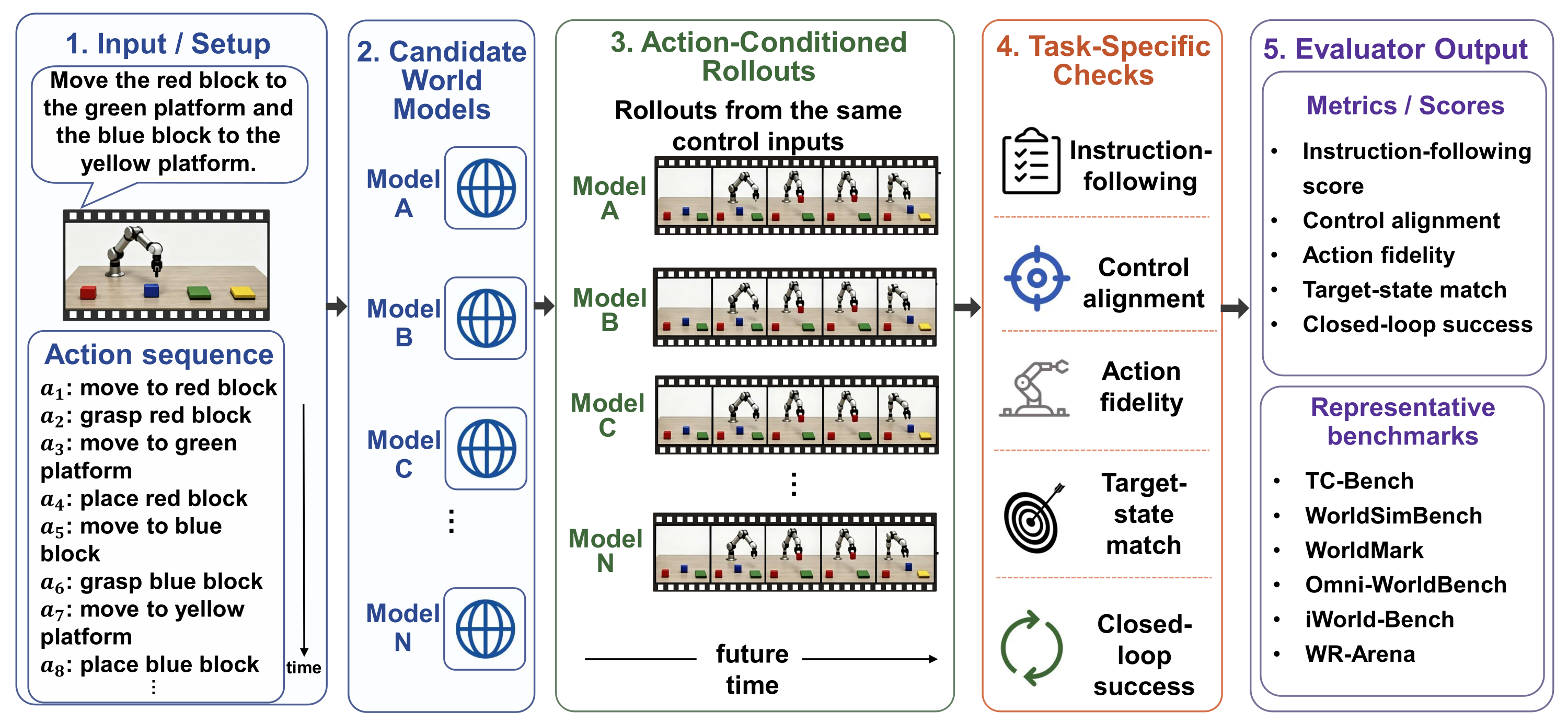
4.7.1. Pre-Specified Control Fidelity
Pre-specified Control Fidelity asks whether a model follows a complete control specification provided before generation. Earlier video-generation evaluation developed prompt-following measures over objects, attributes, spatial relations, actions, and interactions [194]. TC-Bench and StoryEval move toward transition completion and multi-event ordering [106,159], while VideoPhy, VideoPhy-2, PhyGenBench, and PhyWorldBench connect condition following with physical event validity and commonsense physical rules [137,138,139,142]. These benchmarks decompose condition adherence into more diagnostic units, but they still largely treat control as a static condition checked after generation. DreamGen Bench and WorldModelBench pair physical adherence with instruction following, while VBench-2.0 includes controllability as one of its five core intrinsic-faithfulness dimensions [103,126,144]. These benchmarks are therefore cross-listed with Physical Plausibility.
Recent benchmarks make the control signal more structured and measurable. OSCBench focuses on object state changes, testing whether a specified action actually changes the object state [100]. MoveBench and MagicBench evaluate trajectory-, mask-, and box-based controllability [97,98]. WorldScore introduces camera-trajectory-based world generation and jointly evaluates controllability, quality, and dynamics [69]. 4DWorldBench extends condition following to 4D world generation through condition–4D alignment, physical realism, and 4D consistency [74]. In driving, DrivingGen and ACT-Bench evaluate whether generated driving scenes follow specified trajectories or action instructions [76,160]. What-If World further tests physical interventions through minimal-pair prompts, asking whether controlled changes in the input produce the expected changes in the generated world [116]. Omni-WorldBench is partly cross-category, since it evaluates interaction effects but still uses pre-specified interaction settings [99].
The main limitation of this protocol is that it remains mostly one-shot. The control condition is given before generation, and the evaluation checks whether the final video satisfies it. This is useful for measuring prompt, trajectory, or intervention fidelity, but it does not fully test whether a model can respond to actions during generation. Moreover, control fidelity is often entangled with visual quality, physics, and geometry: a failure to follow a trajectory may result from poor control, poor spatial understanding, or degraded video generation. Fine-grained state changes also remain difficult to judge automatically.
This pre-specified setting marks the shift from global text-to-video alignment to more local and measurable control following. It evaluates whether generated worlds satisfy specified conditions, but it does not yet fully capture interactive world dynamics.
4.7.2. Interactive Action Fidelity
Interactive Action Fidelity asks whether actions issued against the current world state induce correct state transitions. This protocol is closer to the role of world models in embodied AI: an action should not merely co-occur with plausible motion, but should cause the world to evolve in the intended way. Formally, the model is evaluated by whether the transition from the current state and action to the next state is correct.
Early interactive benchmarks begin by standardizing action-response evaluation. WorldMark introduces a unified WASD-style action vocabulary and maps it to different interactive video world models, enabling comparable evaluation of control alignment and world consistency [73]. WR-Arena evaluates action simulation fidelity under externally specified action sequences; its separate iterative VLM–world-model planning track uses simulated outcomes to guide subsequent action selection and is covered under Functional Utility [110]. WorldOlympiad complements this direction through an interaction track that evaluates whether generated rollouts follow complex action prompts and remain coherent across consecutive video chunks [47]. WorldSimBench further evaluates video-action consistency by checking whether generated videos support correct control signals in downstream manipulation settings [104]. These benchmarks move beyond static condition following and begin to evaluate whether actions have causal effects on world evolution.
Recent benchmarks further extend this idea to multi-turn, physical, and embodied interaction. WBench evaluates multi-turn interactive world models through interaction adherence, consistency, and physics compliance [107]. iWorld-Bench introduces a unified action generation framework and evaluates interaction-related abilities spanning visual generation, distance perception, trajectory following, and memory, making it cross-category with visual quality, spatial consistency, and long-horizon persistence [79]. MIND jointly evaluates memory consistency and action control, making it a cross-category benchmark with long-horizon persistence [46]. Omni-WorldBench explicitly formulates interactive response as a core ability of 4D world models, measuring how actions affect final outcomes and intermediate state evolution [99]. ACWM-Phys evaluates action-conditioned prediction under diverse physical dynamics [94], making it cross-category with Physical Plausibility, while RoboWM-Bench moves toward embodied evaluation by testing whether generated behaviors align with robot actions and physical execution [38]. WorldArena 2.0 can be viewed as a cross-category benchmark, since its interactive RL and embodied settings evaluate action response mainly through downstream functional utility [49].
The common limitation of interactive action benchmarks is the lack of a unified action space. Driving trajectories, game controls, camera motions, object trajectories, and robot actions are represented very differently, making cross-domain comparison difficult. Multi-turn interaction also makes error attribution harder: a failed transition may come from poor action control, physical reasoning, geometry, memory, or visual generation. In addition, subtle action consequences such as contact, grasping, small displacement, or object state change are difficult to evaluate with a single automated evaluator. More realistic embodied evaluation is valuable, but it is also more costly.
Interactive Action Fidelity therefore represents the shift from condition matching to causal world control. A strong world model should not only generate outputs compatible with a control signal; it should make the world evolve according to that signal over actions, turns, and embodied interactions.
Thus, these benchmarks directly test condition or action responsiveness, but their conclusions remain tied to the represented action space, evaluation horizon, and evaluator. High control-fidelity scores in a fixed or short-horizon setting should not be interpreted as evidence of long-horizon closed-loop reliability, transfer, or downstream utility.
4.8. Functional Utility
Functional utility evaluates whether a world model improves the performance, efficiency, or reliability of a downstream agent [188,189,190,191,192,193,195,196,197,198,199,200,201]. Unlike the first six targets above, which assess properties of the predicted future world states themselves, this category treats the world model as a component in an operational pipeline. It should therefore be evaluated by downstream outcomes: whether generated data improves policy learning, whether world-model rollouts rank policies correctly, whether predicted futures improve planning, and whether policies trained in learned environments transfer to the target simulator or real system.
This distinction is necessary because high fidelity does not guarantee usefulness. A world model may generate visually plausible futures but still fail to support task completion, policy selection, or safe execution. Recent embodied evaluations make this gap explicit: visually realistic rollouts may not translate into closed-loop task success, and physically plausible videos may still fail when decoded into executable robot behavior [38,42]. Functional utility therefore asks not only whether the generated world looks plausible, but whether an agent can benefit from using it.
Following the role decomposition introduced by the WorldArena series [48,49], we organize functional utility according to how the world model enters the downstream agent pipeline: as a data engine, policy evaluator, planner, or interactive training environment [202,203,204].
4.8.1. World Model as Data Engine
As a data engine, a world model is used to generate synthetic experience for policy learning. The evaluation target is not the generated samples themselves, but the policy trained with them. A typical protocol first generates trajectories, recovers or assigns actions, trains a downstream policy, and then evaluates whether the resulting policy improves in data efficiency, task success, or transfer. This role is important because it tests whether learned world dynamics can reduce dependence on costly physical interaction and improve downstream generalization.
Several world models and generation systems have been developed for this purpose. DreamGen generates neural trajectories with video world models, recovers pseudo-actions, and evaluates the resulting robot policies on behavior and environment generalization [144]. GigaWorld-0 combines video and 3D generation as a data engine and validates generated experience through the performance of VLA policies deployed on physical robots [205]. RoboScape tests whether synthetic robotic videos produced by a physics-informed world model improve downstream policy learning [206]. DriveDreamer4D illustrates a related use beyond policy training, where world-model-generated novel-trajectory videos improve downstream 4D driving-scene representation [207].
Benchmarks provide shared procedures for measuring the downstream value of generated experience. WorldArena converts generated videos into action-labeled training data and measures the resulting policy improvement, while WorldArena 2.0 extends this evaluation to visuotactile generation and cross-embodiment transfer [48,49]. These benchmarks require synthetic data to demonstrate measurable improvements in a downstream learner or representation system, rather than relying on visual quality alone. Figure 11 illustrates this role.
Figure 11.
World Model as Data Engine (Section 4.8.1). Synthetic trajectories are converted into training data and evaluated through downstream policy gains in data efficiency, task success, or transfer. VLA denotes vision-language-action.
Figure 11.
World Model as Data Engine (Section 4.8.1). Synthetic trajectories are converted into training data and evaluated through downstream policy gains in data efficiency, task success, or transfer. VLA denotes vision-language-action.
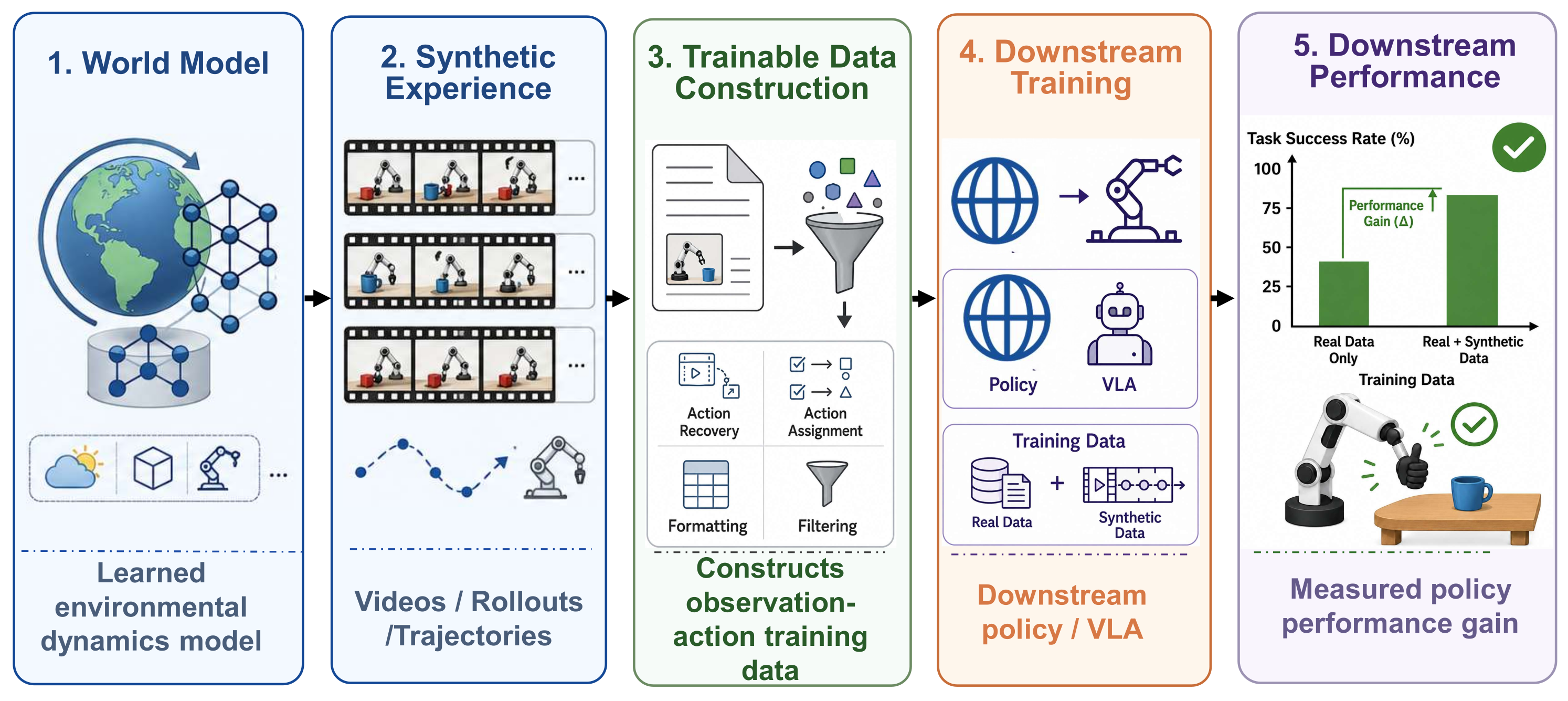
4.8.2. World Model as Policy Evaluator
As a policy evaluator, a world model is used as a low-cost proxy for real-world or high-fidelity simulator evaluation. Instead of executing every policy in the target environment, policies are rolled out in the learned world model, and the generated trajectories are used to estimate task success and compare relative policy performance. The key question is whether these world-model-based evaluations agree with the task outcomes and policy rankings obtained through real-world or high-fidelity simulator execution. Evaluation therefore focuses on ranking correlation, selection accuracy, or value prediction accuracy, rather than visual realism alone. This role is particularly important in robotics, where evaluating many policies and checkpoints through physical execution is costly, slow, and difficult to reproduce.
Several world models have been developed specifically for this task. WorldEval uses policy-conditioned video rollouts to rank robot policies and checkpoints against real-world results [202]. WorldGym places policies in an autoregressive action-conditioned video world model and tests whether their success rates and relative rankings agree with physical execution [204]. dWorldEval predicts both future observations and task progress in a discrete-diffusion world model for scalable policy assessment [203]. Ctrl-World uses a controllable generative world model for policy-in-the-loop evaluation and targeted policy improvement [208]. GigaWorld-1 further targets long-horizon, action-faithful robot policy evaluation, emphasizing the consistency required to preserve policy outcomes over extended rollouts [102]. The Scalable Policy Evaluation study also examines whether world-model-based policy values and rankings agree with simulated and real-robot results [209].
Benchmarks then provide shared protocols for comparing evaluator reliability across world models. WorldArena compares policy rankings induced by world-model rollouts with rankings obtained from RoboTwin simulator execution [48]. WMBench runs robot policies in closed loop on world-model-generated observations and compares the resulting success predictions and policy-level conclusions with matched physical executions [102]. Its controlled evaluation spans multiple video world models and action representations, enabling systematic analysis of how action grounding and long-horizon rollout consistency affect policy-evaluation reliability. Together, these benchmarks test whether a world model can reliably distinguish better policies from worse ones and preserve conclusions that would be obtained through direct execution. Figure 12 illustrates this role.
Figure 12.
World Model as Policy Evaluator (Section 4.8.2). Predicted rollouts estimate task success and relative policy performance as a proxy for direct execution. MMRV denotes Mean Maximum Rank Violation.
Figure 12.
World Model as Policy Evaluator (Section 4.8.2). Predicted rollouts estimate task success and relative policy performance as a proxy for direct execution. MMRV denotes Mean Maximum Rank Violation.
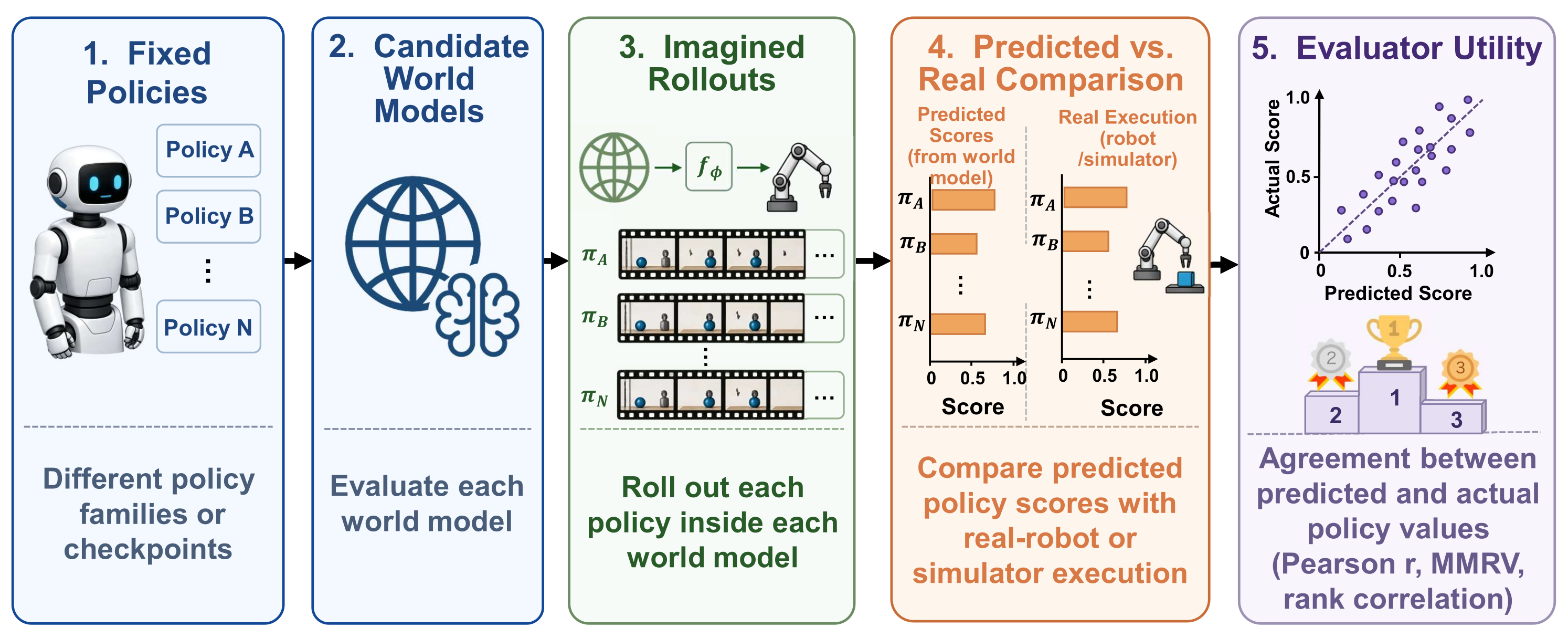
4.8.3. World Model as Planner
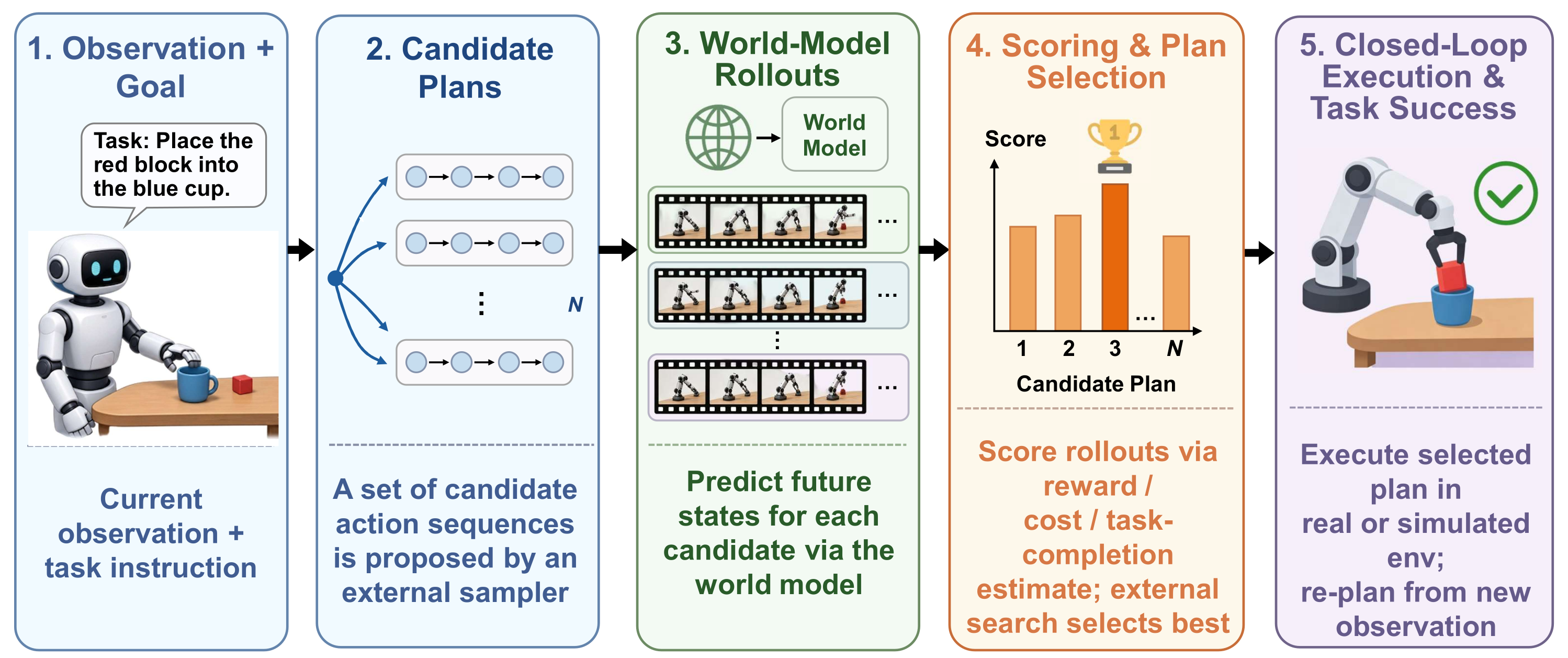
As a planner, a world model supports action selection by predicting or generating possible futures. In this role, the model is evaluated not merely as a passive future predictor; rather, its predictions are used to decide what the agent should do next. The key question is therefore not merely whether the predicted future looks plausible, but whether it helps the agent choose actions that lead to better task outcomes [59].
Planning-oriented benchmarks can be distinguished by how predicted futures are connected to actions. The first group evaluates high-level planning and procedural reasoning. These benchmarks focus on whether a model can infer task progress, describe plausible actions, predict the next step, or reason about how to complete a task. EVA-Bench, introduced with EVA, is representative of this setting, as it evaluates action description, finish thinking, how-to planning, and next-step prediction, and further validates whether such predictions can be converted into executable actions [109]. Here, the world model is mainly used to support symbolic or semantic planning rather than directly controlling low-level behavior.
The second group evaluates closed-loop planning in interactive environments. In this setting, the model’s predictions are repeatedly used to update decisions as the agent interacts with the environment. World-in-World exposes a unified interface for online planning and action generation in embodied environments, while WorldLens evaluates whether generated driving worlds can support closed-loop route following [42,75]. These benchmarks test whether a world model can provide useful future information over multiple decision steps, where early prediction errors may alter later observations and actions.
The third group evaluates whether generated futures can be converted into executable behavior. RoboWM-Bench measures whether robot-manipulation videos generated by a world model can be grounded into executable actions, while WorldSimBench evaluates video–action consistency by recovering control signals from generated videos and testing downstream task completion [38,104]. These benchmarks are especially demanding because errors in physical dynamics, object interaction, or action feasibility can directly lead to execution failure.
Several world-model systems instantiate these planning and behavior-generation roles. ReSim couples action-conditioned driving simulation with Video2Reward so that predicted futures can improve planning and policy selection [210]. PhysWorld learns deformable-object dynamics from physics-aware synthesized demonstrations and embeds the learned model in MPPI control for goal-directed manipulation [211]. For executable behavior generation, DreamGen recovers pseudo-actions from generated robot videos for downstream policy learning [144]; Robot Learning from a Physical World Model reconstructs a manipulable physical world from generated task videos and grounds the resulting motions into robot trajectories [212]; and Genie Envisioner connects a video world foundation model to GE-Act for action generation [213].
Planning utility therefore requires more than open-loop prediction quality. A useful world model for planning must preserve the task-relevant consequences of actions, support decision updates during interaction, and produce futures that can be connected to executable behavior when needed. Figure 13 illustrates this role.
Figure 13.
World Model as Planner (Section 4.8.3). Candidate futures support procedural planning, closed-loop online planning, or executable behavior decoding and are evaluated through task outcomes. MPPI and CEM denote Model Predictive Path Integral and the Cross-Entropy Method.
Figure 13.
World Model as Planner (Section 4.8.3). Candidate futures support procedural planning, closed-loop online planning, or executable behavior decoding and are evaluated through task outcomes. MPPI and CEM denote Model Predictive Path Integral and the Cross-Entropy Method.
4.8.4. World Model as Interactive Training Environment
As an interactive training environment, a world model provides a learned transition process for policy training. A policy repeatedly takes actions in the learned environment and receives predicted observations, rewards, progress signals, or other task feedback. This differs from the data-engine role, where generated trajectories are used as a fixed training set. Here, the policy is optimized through interaction with the world model, so evaluation must measure whether the trained policy remains effective when transferred to the target simulator or real system. WorldArena 2.0 instantiates this role as an interactive RL environment for policy optimization, comparing policies trained in learned environments with supervised fine-tuning and simulator-trained baselines [49]. The decisive criterion is not whether the learned environment looks realistic, but whether training in it produces policies that work outside it. Figure 14 illustrates this role.
Figure 14.
World Model as Interactive Training Environment (Section 4.8.4). A policy is optimized through repeated interaction with learned transitions and evaluated by its effectiveness outside the learned environment.
Figure 14.
World Model as Interactive Training Environment (Section 4.8.4). A policy is optimized through repeated interaction with learned transitions and evaluated by its effectiveness outside the learned environment.
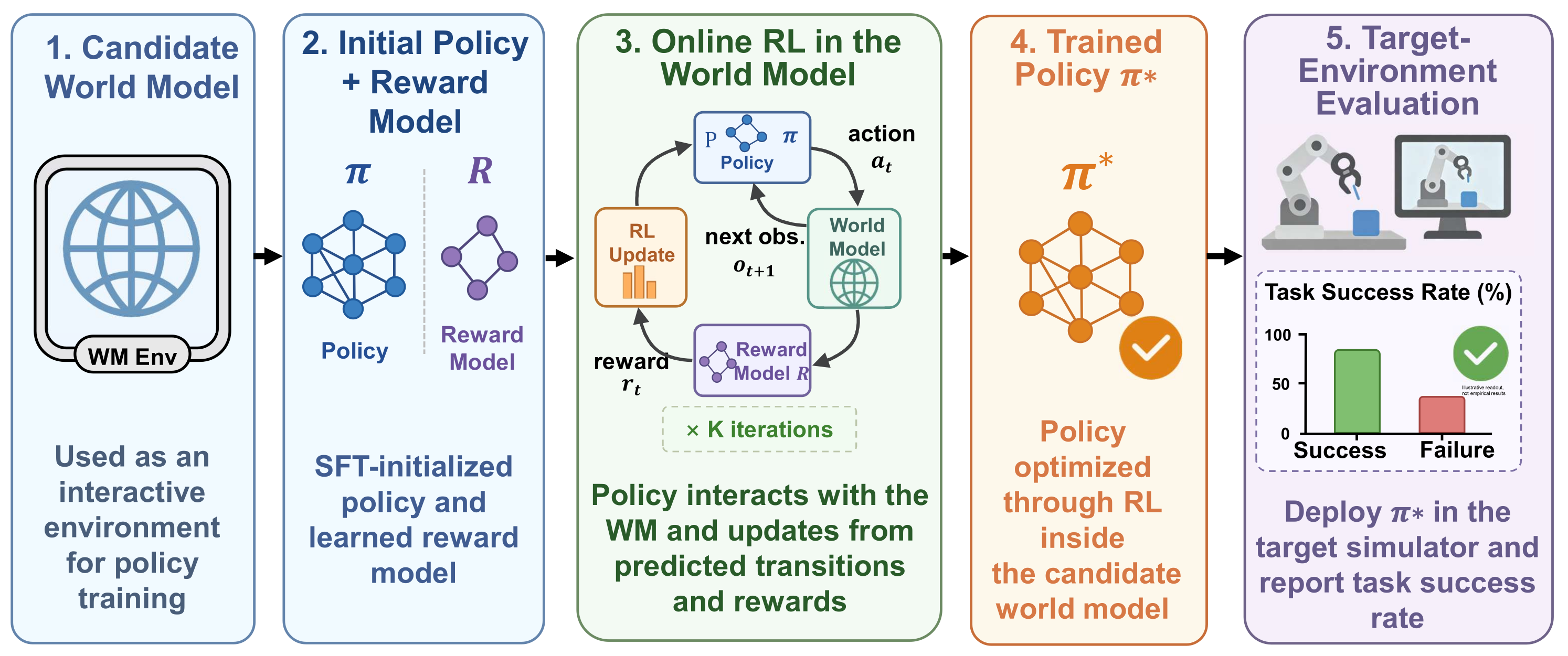
Functional-utility benchmarks provide the most direct evidence that using a world model benefits an agent pipeline. Their main limitation is attribution: performance also depends on the policy learner, planner, action decoder, simulator, and transfer setting, while results are rarely comparable across tasks or embodiments. High utility in one pipeline should therefore not be interpreted as a general property of the world model without component ablations and evaluation across independent downstream settings.
5. Evaluation Protocols
Beyond specifying what capability is evaluated, a benchmark must define how the world model is evaluated. A central distinction is whether the evaluation process is specified independently of the model’s preceding outputs or evolves through feedback from them. We accordingly distinguish two broad protocol classes: open-loop evaluation and closed-loop interaction. In open-loop evaluation, inputs and evaluation conditions are fixed or externally scheduled and are not adapted in response to model outputs. In closed-loop interaction, model outputs inform subsequent decisions or actions, which in turn affect later observations, states, outcomes, or model queries. The distinction therefore lies in whether the evaluation process contains an adaptive feedback dependency.
5.1. Open-Loop Evaluation
Open-loop evaluation assesses a world model without embedding it in an adaptive feedback process. The model receives inputs specified independently of its preceding outputs, either once or according to a predetermined schedule. These inputs may include a history, prompt, initial observation, action sequence, control signal, instruction, intervention, or counterfactual condition. The resulting prediction, rollout, or task response is then scored offline. Although inputs may be deliberately varied across time or test cases, model outputs do not determine subsequent inputs, actions, observations, or environment states.
5.1.1. Fixed-Condition Prediction
A common open-loop setting provides a fixed history, prompt, initial observation, or other condition and evaluates the resulting prediction, future rollout, or task response against a reference, rubric, or rule. Generation-quality and temporal-consistency suites score videos generated from fixed prompts or conditions [32,126,164]; physical and causal diagnostics score responses to fixed stimuli [43,44,45,127]; and prediction benchmarks compare generated continuations with held-out real futures or simulator ground truth [76,96,141]. This setting is inexpensive, reproducible, and diagnostically focused. However, strong single-pass performance does not establish that the model remains reliable when its predictions influence subsequent decisions or observations.
5.1.2. Controlled and Counterfactual Prediction
Controlled and counterfactual prediction evaluates whether a model responds appropriately when actions, controls, instructions, interventions, or counterfactual conditions are varied externally [186,187,188,189,190,191,192]. Unlike fixed-condition prediction, these evaluations explicitly test whether changing an input produces the intended change in the predicted future. The benchmark supplies the varying conditions across matched test cases or according to a predetermined temporal schedule; the model does not select these conditions or enter an adaptive feedback loop.
Action- and control-conditioned prediction tests whether robot actions, camera motions, navigation commands, ego-motions, or other low-level controls induce the intended future-state transitions. Representative benchmarks include EWMBench, WorldScore, 4DWorldBench, ACT-Bench, DrivingGen, OSCBench, MoveBench, and MagicBench [69,71,74,76,97,98,100,160]. Interactive video-world benchmarks such as Matrix-Game’s GameWorld Score and WorldMark also use open-loop evaluation tracks when they replay externally specified action streams and score the resulting generations offline [72,73].
Instruction- and event-conditioned prediction tests whether generated futures follow text instructions or event chains, as in TC-Bench, StoryEval, and the instruction-following tracks of VideoPhy, VideoPhy-2, PhyGenBench, PhyWorldBench, and T2VPhysBench [106,137,138,139,140,142,159]. Counterfactual prediction holds the relevant initial context fixed while perturbing causes, conditions, or interventions, and then tests whether the predicted future changes appropriately while irrelevant factors are preserved. Representative open-loop benchmarks include CoPhy, ComPhy, CRAFT, ACQUIRED, Causal-VidQA, MMWorld, CausalVQA, and What-If World [116,130,132,134,155,156,157,158]. These evaluations provide stronger evidence of conditional responsiveness than fixed-condition prediction while retaining reproducibility through benchmark-controlled input schedules. WR-Arena extends this setting with an additional iterative planning track in which simulated outcomes affect subsequent action selection [110].
5.2. Closed-Loop Interaction
Closed-loop interaction evaluates a world model as part of a recurrent decision or interaction process rather than as an isolated predictor [19,39,40,57,188,189,190,191,192,193,195,196,197,198,199,200,201,214]. A typical loop may consist of world-model prediction or imagined rollout, planner or policy decision, action execution or environment transition, acquisition of a new observation, and a subsequent model query. Its defining feature is that information produced earlier in the loop can influence later decisions, actions, states, observations, or model inputs. Depending on the role played by the world model, closed-loop interaction can take two main forms.
5.2.1. World Model as the Interaction Environment
In one form, the world model itself serves as an interactive proxy environment. A policy selects an action from the current model-generated observation, the world model predicts the next observation or state, and the policy acts again on that prediction. WorldArena 2.0 instantiates this setting by treating world models as interactive reinforcement-learning environments, allowing policies to be iteratively optimized through model-generated transitions and reward signals [49]. Such evaluations directly expose error accumulation, policy exploitation of model inaccuracies, and instability over repeated interactions.
5.2.2. World-Model-Guided External-Environment Interaction
In another form, the world model supports a planner or policy that acts in an external simulator, game world, embodied platform, or physical environment. The model predicts or compares possible futures, an action is selected and executed in the external environment, and the resulting observation is used for subsequent prediction and replanning. World-in-World evaluates world models through such a closed-loop planning interface, prioritizing embodied task success over isolated visual quality [42]. WorldSimBench includes embodied evaluation tracks that assess model-guided behavior through simulator-derived task signals [104]. Real-world variants provide particularly strong downstream-outcome evidence: GigaWorld-0 reports success rates of optimized policies deployed in real environments, while WorldArena 2.0 evaluates optimized policies on a real robot for interactive tasks [49,205]. These settings are closer to operational use than open-loop evaluation because model errors can alter subsequent decisions and compound over time. Adjacent closed-loop benchmarks for vision-language driving systems also provide useful protocol precedents by connecting high-level model outputs to simulation or physical execution through hierarchical action interfaces [215]. Although these benchmarks do not directly evaluate a learned world model, they illustrate how executable feedback can expose failures that remain invisible under static prediction-only evaluation.
Failures in closed-loop systems may arise not only from the world model, but also from the planner, policy, reward model, action decoder, environment interface, or interactions among these components [216]. Reliable evaluation therefore requires repeated trials, controlled resets, deterministic seeding where possible, and explicit reporting of the surrounding decision, control, and environment components. Component-wise ablations and intermediate diagnostics are also important for separating world-model errors from failures elsewhere in the closed-loop system.
6. Evaluation Metrics
Given an evaluation target and protocol, a benchmark must specify what observable evidence supports its performance claims. Because internal world-model states are generally inaccessible and not directly comparable across architectures, evaluation relies on either direct model readouts or the consequences of using those readouts in an external process. We therefore distinguish prediction-level metrics, which assess model outputs or other direct readouts before they are used in decision making, learning, or execution, from downstream outcome metrics, which assess consequences observable only after model outputs are consumed by a simulator, planner, policy, controller, training pipeline, or physical system. For example, comparing a predicted trajectory with a simulator-provided reference is prediction-level, whereas executing that trajectory and measuring collision, reward, or task success is downstream-outcome-level.
6.1. Prediction-Level Metrics
Prediction-level metrics ask whether a model’s direct readout has the properties claimed by the benchmark. The readout may be a generated frame or video, a state or trajectory prediction, a geometric reconstruction, a task response, or a predictive distribution. The evidence may be computed by a fixed procedure or supplied by an evaluator, but it is always available before the prediction is used in a downstream decision or execution process.
The first group is perceptual and feature-space metrics, which measure visual fidelity, distributional realism, or semantic alignment directly from frames or videos. Reference-based frame fidelity scores such as PSNR, SSIM, LPIPS [217], and pixel-wise MSE compare generated frames with paired ground-truth futures and mainly capture local reconstruction quality in controlled video-prediction settings [141,206,208,218,219]. When paired references are unavailable, distributional realism scores such as FID [220] and FVD [221] compare generated and real samples in deep feature space and provide scalable metrics of image- or video-level realism without guaranteeing correct state evolution [161,207,222,223,224,225,226,227]. Cross-modal alignment scores such as CLIPScore, BLIPScore, ViCLIP, UMTScore, and related variants measure prompt–video or condition–video agreement at the semantic level [32,68,69,162,164,228,229]. Representation-based measurements, including V-JEPA feature distances, similarly compare predictions through learned feature spaces [48,230]. These metrics provide efficient proxies for perceptual and semantic readouts, but they do not by themselves certify the full correctness of world-state evolution.
The second group is detection-, geometry-, and trajectory-based metrics, which evaluate whether generated outputs preserve objects, spatial structure, camera motion, or dynamical paths. Detector or tracker outputs support mAP, IoU, object consistency, event detection, and camera-control measurements, allowing evaluation of whether entities and events can be consistently identified across generated frames [32,70,207]. Geometric and depth signals test whether the output supports a coherent spatial or 3D interpretation. These signals include depth error, camera-pose error, optical-flow endpoint error, reprojection error, SLAM self-consistency, multi-view consistency, Chamfer distance, centroid distance, and scale-invariant depth MSE [69,73,96,111,126,206]. Trajectory-based metrics such as ADE, DTW, Wasserstein distance, Hausdorff distance, and Fréchet Trajectory Distance examine whether agents, objects, or cameras follow plausible paths over time [71,72,76]. Compared with image-level scores, this group is closer to world-state evaluation because it asks whether the generated output can support a coherent spatial, geometric, or dynamical interpretation; however, its verdicts inherit any failures of the detector, tracker, depth estimator, pose estimator, or reconstruction pipeline used to compute them.
The third group is rule-, accuracy-, and script-based metrics that evaluate whether generated futures satisfy predefined constraints or answer discriminative questions correctly. Discriminative accuracy on multiple-choice, plausible/implausible classification, action-selection, or task-solving outputs reduces reasoning, physical understanding, or planning to tasks with known answers [43,44,45,128,134,155,157,158]. Rule- and violation-based metrics check whether generated futures obey predefined physical or causal regularities. These metrics include physical-rule accuracy, violation counting, anti-physics tests, concept-disentangled scores, keypoint-dynamics error, and equation- or conservation-based scores [103,127,136,139,140,142,143]. Many of these scores are computed by scripted evaluators that first convert generated video into structured symbols via detector, tracker, or segmenter pipelines and then apply deterministic rules. Examples of these pipelines include SAM-Track in EvalCrafter [164], GRiT/Tag2Text/ViCLIP in VBench [32], the fine-tuned YOLO-World end-effector tracker of EWMBench [71], YOLO11 box consistency in DriveDreamer4D [207], and the physics-informed trajectory checker of Morpheus [143]. These pipelines extend script-based scoring from text answers to generated videos, but their verdicts depend on the reliability of the perception modules used to extract symbols.
Evaluator judgments provide a complementary prediction-level signal when the relevant property cannot be specified as a fixed measurement. Human studies can assess realism, instruction following, physical plausibility, causal consistency, and preference; prompted LLMs and MLLMs can apply similar criteria at scale; and learned models such as VideoScore predict human ratings or benchmark-specific quality dimensions [33,48,74,75,76,103,104,116,126,137,138,145,146,159]. These scores remain prediction-level because they are derived from the output itself, but they require disclosure of the rubric, evaluator version, prompt template or training data, aggregation rule, and available agreement or calibration evidence.
6.2. Downstream Outcome Metrics
Downstream outcome metrics derive scores from the consequences of using model predictions, rather than from direct assessment of the predictions or readouts themselves. They include simulator-grounded verdicts and downstream agent-system outcomes. The key question is no longer whether a rollout looks correct, but whether it leads to a valid physical or task outcome [188,189,190,191,192,193,195,196,197,198,199,200,201,202,203,204].
Simulator-grounded evaluation is one common form of outcome evidence: it runs predicted states, decoded actions, or generated behaviors inside a simulator and measures the resulting outcome. RoboWM-Bench decodes generated behavior into actions and validates them in high-fidelity simulation through real-to-sim reconstruction [38], and WorldSimBench grounds embodied evaluation in simulator-derived task signals across game, driving, and robot-manipulation scenarios [104]. Outcome evidence can also be read from agent systems that consume the world model, including task success, policy return, planning success, execution accuracy, transfer performance, and ranking correlations. Task success rate measures whether an imagined behavior, generated action sequence, or world-model-assisted policy completes a task [38,42,49,205]; Pearson, Spearman, and rank-violation correlations test whether world-model-based evaluation agrees with real or high-fidelity execution [48,209]; planning success and execution-accuracy scores test whether plans grounded in the world model reach the goal. Real-world execution outcomes (Section 5.2) provide the closest evidence to deployment conditions, as in GigaWorld-0 [205] and WorldArena 2.0 [49].
The strength of this metric family is that consequence-level verdicts can expose failures that visual or language-based judges miss, especially in physics, control, manipulation, and functional utility. The limitations are also clear: simulator verdicts are only as reliable as the simulator’s dynamics, task specification, and reconstruction pipeline, and they inherit the sim-to-real gap; downstream verdicts are entangled with the surrounding planner, policy, controller, action decoder, simulator, or environment, so attribution to the world model itself requires careful ablation; and real-world execution, while closest to deployment conditions, is difficult to scale due to hardware, safety, and embodiment constraints.
7. Evaluation Data
Evaluation data constitute the fourth dimension of the framework. The way benchmark data are collected determines which evaluation targets can be probed, which evaluation protocols can be implemented, and which metrics can be computed: it fixes the available inputs (histories, actions, conditions), the available reference signals (held-out futures, simulator states, action labels, annotations), and the available interventions (controlled actions, counterfactual conditions, multi-turn interactions).
We use four mutually exclusive coding categories for evaluation-data construction: real-world data collection, simulation-based generation, scenario/prompt/task curation, and hybrid construction pipelines. The purpose of this section is not only to list where benchmark data come from, but also to clarify what each pipeline can support. Real-world data collection provides natural visual and semantic diversity; simulation-based generation provides controllable states and intervention structure; scenario/prompt/task curation supports scalable open-domain evaluation; and hybrid construction pipelines combine multiple sources to enable richer closed-loop settings. A benchmark is coded as a hybrid construction pipeline when its evaluation cases or validation procedure materially combine two or more of the preceding construction sources, such as real data with simulated reconstruction, real inputs with generated rollouts followed by downstream execution, or mixed real-and-simulated evaluation stages. Otherwise, it is coded by the source that directly constructs its evaluation cases; prompts derived from reference videos remain scenario/prompt/task curation when the evaluated model receives only the prompt rather than the reference state. Reference signals and annotations are treated as properties attached to these pipelines rather than as a separate construction family.
7.1. Real-World Data Collection
Real-world data collection gathers evaluation data directly from real scenes, cameras, sensors, robots, vehicles, or human activities [231,232]. Its main advantage is authenticity: the future used for evaluation corresponds to something that actually happened. Such data capture natural appearance, material properties, human behavior, environmental diversity, and real physical noise that are difficult to reproduce synthetically. The main limitation is that real scenes are hard to replay under controlled changes. A recorded event usually provides one observed future, but not a full set of alternative futures under different actions, object properties, or interventions. Within this family, the key distinction is whether the data are passive videos or embodied interaction trajectories.
7.1.1. Passive Real-World Videos
Passive real-world videos record the world as it unfolds without an explicit agent action signal. They provide credible ground-truth futures and are therefore suitable for passive prediction, video question answering, commonsense reasoning, world knowledge, and causal reasoning over observed events. Real-video reasoning benchmarks such as Causal-VidQA, CausalVQA, ACQUIRED, and MMWorld use natural videos to probe temporal, causal, and domain-specific understanding [155,156,157,158]. WorldPrediction constructs high-level procedural-planning stimuli from existing real-video corpora [128]. Physics-IQ and Morpheus condition generation on real initial footage, allowing generated continuations to be compared with real observed futures under the same initial condition [141,143]. The intrinsic limitation is that passive videos lack explicit action labels and controlled interventions, so they cannot directly certify action-conditioned dynamics or counterfactual responses.
7.1.2. Embodied Interaction Trajectories
Embodied interaction trajectories are collected while an agent or robot acts in the world. Unlike passive videos, they pair observations with states, actions, and task information. This makes them essential for evaluating whether a world model predicts the consequence of a given action, supports control alignment, or improves downstream policy learning. Representative sources include BAIR Robot Pushing, RoboNet, and Open X-Embodiment [218,233,234]. Because the benchmark knows which action produced the next state, such data can support action-conditioned prediction and functional-utility evaluation. Their limitation is cost and coverage: real interaction data are expensive to collect, often tied to specific robots, sensors, and environments, and still provide limited counterfactual variation.
7.2. Simulation-Based Generation
Simulation-based generation constructs benchmark data within controlled simulation engines rather than collecting them from the real world [235,236,237,238,239,240,241]. Scenes, objects, physical parameters, actions, and interventions can be specified explicitly, and the reference outcome can often be obtained directly from the simulator. This makes simulated data especially useful for benchmarks that require unambiguous answers, such as physical reasoning, causal diagnosis, object interaction, and counterfactual evaluation. Related autonomous-driving testing frameworks further show that safety-critical scenarios can be generated and iteratively evolved through interactions among multiple traffic participants, providing a scalable source of intervention-oriented and failure-focused evaluation cases [242].
Synthetic reasoning benchmarks use this construction pipeline to isolate specific capabilities. IntPhys, CLEVRER, PHYRE, CoPhy, ComPhy, and CRAFT render controlled scenes involving violation of expectation, collisions, action-consequence puzzles, latent physical properties, and causal roles [43,44,124,130,131,132,134]. Physion and Physion++ extend this setting to contact-rich physical prediction, while ContPhy evaluates continuum physical behavior [45,133,135]. RigidBench further uses Blender physics to provide photorealistic rendering together with exact 3D trajectories, masks, and depth as ground truth [96]. The trade-off is that simulated data may contain engine-specific artifacts, suffer from sim-to-real gaps, or create contamination risks if similar engines are used during model development and evaluation [29,243,244,245].
7.3. Scenario, Prompt, and Task Curation
Scenario, prompt, and task curation constructs benchmark data by specifying evaluation conditions rather than recording or simulating a ground-truth trajectory. A benchmark usually provides a text prompt, scenario description, or task specification, and the evaluated model generates the corresponding video or world. This construction pipeline is cheap, flexible, and easy to scale across open-ended scenarios, making it widely used for text-to-video and open-domain world generation.
Curated suites are often built around the evaluation target they aim to stress. Some focus on visual quality, motion quality, and temporal consistency [32,70,126,162,164], while ChronoMagic-Bench targets metamorphic time-lapse generation as a separate axis [68]. Others target compositional controllability and event-level instruction following [159,194]. A further group probes physical commonsense, physical plausibility, and anti-physical prompts [136,137,138,139,140,142]. World-knowledge benchmarks similarly rely on curated prompts to test whether generated videos reflect plausible objects, scenes, and commonsense relations [101]. Task-oriented curation extends the same pipeline to embodied and planning evaluations by specifying tasks, goals, or instructions rather than full trajectories. The limitation is weak grounding: because there is no observed future or exact state transition, correctness must be judged indirectly by human raters, MLLM judges, or hand-designed metrics. Reference videos may be used to design prompts, calibrate metrics, or train evaluators, but if the evaluated generator receives text only, the benchmark remains curation-based rather than state-grounded.
7.4. Hybrid Construction Pipelines
Hybrid construction pipelines combine multiple data sources or evaluation stages [214]. They may start from real footage and extend it with generated rollouts, mix simulated and real settings, reconstruct real scenes in simulation, or decode generated videos into actions for downstream execution [231,232,235,236,237,238,239,240,241,243,244,245]. These pipelines are useful when a benchmark needs both realistic inputs and some form of controllability or downstream validation. Their strength is that they can support richer closed-loop settings than pure prompts, pure simulation, or passive recording alone. Their weakness is attribution: the final result may depend not only on the world model, but also on the policy, controller, action decoder, simulator, or reconstruction pipeline.
Several recurring patterns appear in existing benchmarks. One pattern starts from real data and extends it with generated or rendered futures, as in WorldBench, which combines captured videos with Kubric-rendered clips [127]. A second pattern mixes simulated and real settings to validate policy evaluation or sim-to-real generalization, as in Scalable Policy Evaluation, which cross-checks rankings on RoboMimic simulation and on real-robot Bridge data [209]. A third pattern connects generated videos to executable actions and validates them downstream. RoboWM-Bench decodes generated behaviors into robot actions and evaluates them through high-fidelity simulation with real-to-sim reconstruction [38]. DrivingGen similarly compares real footage with model rollouts on a shared driving substrate, showing that general-purpose video models may look visually realistic while violating physical dynamics, whereas driving-specific models may better capture dynamics but lag in visual quality [76]. These examples show that hybrid construction pipelines are powerful precisely because they assemble a larger evaluation system, but this also makes their results harder to interpret.
8. Trends, Gaps, and Future Directions
Section 4, Section 5, Section 6 and Section 7 reviewed existing world-model benchmarks along four dimensions: evaluation target, evaluation protocol, evaluation metrics, and evaluation data. This section further discusses which capability conclusions these design choices are able to support.
Based on our cross-dimensional synthesis, we argue that the validity of evaluation evidence is claim-dependent: a benchmark result should support only those conclusions for which its protocol, metrics, and data can expose an observable failure. The main problem with current benchmarks is not only that capability coverage is incomplete, but that evaluation target, protocol, metrics, and data are frequently misaligned. For instance, a model’s open-loop prediction score on in-distribution futures is often further interpreted as evidence that the model possesses reliable control, intervention response, or downstream decision-making ability, even though the corresponding protocol does not directly test these properties.
Based on this principle, we first summarize three overall trends in current world-model evaluation, and then discuss the main gaps in evaluation target, protocol, metrics, and data, as well as in toolkit support and reproducibility.
8.1. Overall Trends
Evaluation targets are shifting from generation fidelity toward functional utility. Early benchmarks mainly assessed visual quality, temporal coherence, and physical plausibility–whether generated futures appeared clear, natural, and consistent with basic physical laws. More recent work increasingly asks whether models can preserve task-relevant states over long horizons, respond correctly to actions, support sustained interaction, and improve downstream decision-making. This broader shift is reflected in the benchmark distribution over time and across evaluation targets in Figure 2. The focus is therefore moving from whether generated futures look plausible to whether they provide reliable support for planning, policy evaluation, data generation, and interactive training. Nevertheless, evaluation of surface generation quality remains substantially more mature than evaluation of control capability, closed-loop reliability, and functional utility.
The evolution of evaluation protocols lags behind that of evaluation targets. Although more benchmarks now assess Control Fidelity and Interactive Dynamics, open-loop prediction remains dominant. In these settings, models generate futures from fixed histories and predefined action sequences, without allowing predicted states to affect subsequent action selection or interaction. They therefore cannot capture the feedback-driven state drift and error accumulation that arise when predictions are repeatedly used by a planner or policy.
Table 10 compares the evaluation protocols and evidence types of benchmarks assessing Control Fidelity and Interactive Dynamics with those of benchmarks assessing Functional Utility. The comparison reveals a clear asymmetry. Functional Utility benchmarks usually include closed-loop interaction and always incorporate downstream outcomes, whereas Control Fidelity and Interactive Dynamics benchmarks rely mainly on open-loop protocols and prediction-level evidence. The latter can test action responsiveness under fixed conditions, but not reliability under repeated planning and interaction. Evaluation targets have thus shifted from generation toward interaction, while the supporting protocols remain predominantly offline.
The choice of metrics depends more on data conditions than on the evaluation target. Metric selection is often determined by the supervision and interaction interfaces available to a benchmark. When reference futures exist, studies typically adopt pixel-, feature-, state-, or trajectory-level similarity; when precise ground truth is unavailable, they rely on human or multimodal large language model (MLLM) judgments; when an execution interface is available, they measure task success, policy return, or other downstream outcomes. These metric families provide different forms of evidence and cannot substitute for one another. Reference similarity does not establish correct action-dependent state transitions, human or MLLM approval indicates perceived plausibility but not executability, and downstream success is jointly influenced by the world model, planner, controller, and simulator. Metric results should therefore be interpreted according to the evidence they provide, and benchmark conclusions should be restricted to the properties that their data, protocols, and metrics can directly support.
8.2. Evaluation Target Gap
Among the seven evaluation-target categories in Section 4, visual and temporal quality, spatial and state consistency, and physical plausibility have received considerable attention. By contrast, long-horizon state maintenance, control fidelity, interactive dynamics, and functional utility still lack systematic evaluation.
The core gap along the target dimension is not simply to add new capability categories, but to determine whether a world model’s utility is reusable across settings. Existing functional-utility benchmarks usually evaluate a model in a single role, for example as a data engine, policy evaluator, planner, or interactive training environment. Evaluation further tends to fix the task suite, simulator, embodiment, and policy family. Therefore, an improvement obtained by a model in one specific pipeline only shows that it is effective in that pipeline’s specific role, and does not directly show that its representation has general downstream value.
Future benchmarks should evaluate the same world model across multiple roles, embodiments, and policy families. In addition, they should separate the contribution of the world model from that of the surrounding system through component-level ablation. For example, one can fix the planner and swap the world model, or fix the world model and replace the action decoder and policy, so as to determine whether a performance gain comes from the predictive representation or from downstream engineering components.
Efficiency constitutes an explicit dimension rather than merely an implementation concern. Xiao et al. [246] introduce the first unified framework for improving agent efficiency across the two stages of internal reasoning and external action. By jointly reducing redundant reasoning and inefficient tool invocation, their method lowers both computational and interaction costs. This perspective has direct implications for world model evaluation: two systems may achieve comparable task success while requiring substantially different amounts of environment interaction.
Safety and competence-scope awareness should also be treated as independent evaluation targets. Beyond overall quality, benchmarks should report unsafe-event recall, false-safe rate, and abstention behavior under distribution shift. Related evaluation frameworks for text-to-video models further demonstrate the need to jointly evaluate generation quality and temporally distributed safety risks rather than treating perceptual fidelity as sufficient evidence of safe behavior [247,248]. In particular, benchmarks should test whether a model’s uncertainty increases with its actual prediction error, rather than merely requiring the model to output a single definite future. Safety evaluation should additionally assess robustness to adversarial inputs, jailbreak-like instructions, and rare unsafe scenarios outside the nominal evaluation distribution [249,250,251].
The unresolved question is how much cross-role, cross-task, and cross-embodiment evidence is required before an improvement on a benchmark can be attributed to the world model itself.
8.3. Evaluation Protocol Gap
Open-loop prediction mainly tests whether a model can generate plausible subsequent states from a history, whereas control, planning, and interaction require predicting how the state changes when an action, environmental condition, or key variable is altered. A model may accurately fit futures in the training distribution while remaining insensitive to the variables that determine the outcome. Open-loop accuracy and executability are therefore insufficient, on their own, to demonstrate that a model has captured interactive dynamics.
The first direction is latent-confounding-aware evaluation. In OG settings, causal labels derived from observational trajectories may remain compatible with multiple causal explanations involving unobserved common causes. Future benchmarks could define the relevant variables and assumptions and use MAG/PAG-based or equivalent analyses to characterize the causal structures compatible with the observational evidence [182,183]. This would distinguish claims that remain valid across compatible structures from those whose identifiability has not been established. Neural ADMG learning and differentiable causal-discovery methods provide possible tools for such claim-level analyses [184,185].
The second direction is to move from comparing single futures to comparing intervention effects. Benchmarks can fix the initial state, alter only the action, goal, contact condition, object property, or another key variable, and compare the change predicted by the model against the change actually realized in the underlying environment. Existing minimal-pair and counterfactual designs [110,116] have begun to alter actions or goals, but systematic intervention on physical variables such as mass, friction, and contact relations remains limited. Such protocols should provide a clear failure criterion. If a key variable is changed while the model’s predicted outcome remains essentially unchanged, then even if its prediction in the original scene is accurate, the model should not be regarded as possessing reliable intervention-response capability.
The third direction is to evaluate continually evolving world-model systems. Real systems may repeatedly perform data generation, policy update, and redeployment rather than completing only a single rollout. The corresponding benchmark should specify the initial policy, imagined-data generation rule, update algorithm, independent audit environment, stopping criterion, and per-iteration performance under distribution shift. Closed-loop frameworks such as World-in-World and WR-Arena [42,110] have covered some of these components, but the evaluation of repeated self-improvement remains insufficient.
An unresolved question is what kind of independent audit protocol can determine whether a policy has genuinely achieved transferable improvement rather than gradually overfitting the world model or the evaluator.
8.4. Evaluation Metric Gap
Most benchmarks rely mainly on one of automatic metrics, judge models, or downstream outcomes, and less often cross-validate among the three metric families in Section 6. This makes it easy for the systematic bias of a single metric to be mistaken for model capability.
First, evaluation should not report only average performance. In safety-critical tasks, the cost of errors is usually highly asymmetric, so near-miss recall, false-safe rate, tail risk, and worst-case category performance should also be reported. For stochastic environments with multiple plausible futures, metrics further need to reflect prediction accuracy, distribution coverage, and uncertainty calibration simultaneously.
Second, when MLLM judges are used, one should report their calibration against held-out human annotations, the agreement among different judges, and their stability across different judge models or versions. The model under evaluation and the judge model should also be kept clearly separate, so as to reduce judge contamination caused by shared training data, model families, or preference patterns [252,253,254,255].
Third, closed-loop and downstream outcomes should be reported together with variance, random seeds, per-category performance, and ablations of key components. Although task success rate is closest to actual utility, it is usually influenced simultaneously by the world model, planner, policy, and execution interface. Reporting only the final success rate cannot identify the specific source of a capability. Beyond metric validity, a benchmark should also demonstrate discriminative power: its scores should respond predictably to controlled capability degradation, preserve meaningful model rankings across repeated evaluations, and avoid severe floor or ceiling effects. Capability-specific ablations and deliberately weakened baselines can therefore test whether a benchmark detects changes in the capability it claims to measure.
A more reasonable practice for the future is to use multi-source evidence: automatic metrics for reproducible low-level checks, human or model judgment for semantic and overall-plausibility assessment, and simulator states or real execution outcomes for verifying actual consequences. The three should play complementary roles, rather than being merged into a single score that lacks interpretability.
The unresolved question is how to integrate counterfactual testing, risk-aware metrics, and judge calibration [256] into a unified protocol at an acceptable computational and annotation cost.
8.5. Evaluation Data Gap
Evaluation data determine which protocols can be implemented and which metrics have a reliable reference. Real interaction trajectories offer strong real-world grounding, but collecting data with paired action, state, and outcome annotations is expensive and usually tied to a specific embodiment and device. Simulated data can provide complete state and controllable intervention, but when training and evaluation use the same or similar engines, they may overestimate a model’s generalization ability. Curated prompt and task suites are easy to scale, but in the absence of reference futures or precise state transitions, they can only provide weak outcome grounding.
The modality coverage of existing benchmarks is also limited. Most work still centers on RGB video and short-horizon rollouts, whereas embodied world models need to jointly model depth, geometry, tactile feedback [257], proprioception, language, and action over longer time scales. A model may separately generate plausible visual, motion, or tactile signals, yet whether these signals describe the same state transition is still rarely tested systematically.
Future data pipelines should combine multimodal sensing, action information, and explicit state annotations, and should provide controllable distribution shifts. Periodically refreshed or semi-private test splits, together with controlled statistical contamination detection [258,259], can reduce the risk of pretraining contamination, and procedural generators with transparent provenance can support cross-lab reproduction and controlled intervention [260,261].
The unresolved question is how to construct a standardized test bed that does not depend on proprietary robot hardware yet still covers long horizons, multiple modalities, and action grounding.
8.6. Evaluation Toolkit and Reproducibility Gap
The evaluation directions above require unified toolkit support. At present, different benchmarks typically adopt their own data formats, model interfaces, rollout logic, judges, and reporting rules, so that the same world model must be separately adapted for each evaluation, and results are hard to compare directly.
A mature evaluation toolkit should include at least five parts: a unified data layer supporting trajectories, prompts, actions, conditions, and interaction histories; a model interface centered on history, action, and future state; rollout protocols with deterministic seeds, environment reset, and cache control; composable automatic, judge-based, and outcome-grounded evaluators; and a reporting layer that separately reports visual quality, state consistency, control response, functional utility, and computational cost [260,261,262,263,264,265,266].
To accommodate different resource budgets, such a toolkit should support both claim-specific and comprehensive evaluation configurations, while reporting generation, inference, judge, annotation, and execution costs for each configuration. Within such configurations, efficient subset selection provides one possible way to reduce the cost of large-scale evaluation. Zhuang et al. [267] first propose a bias-bounded subset-selection framework that achieves accurate score estimation using no more than 30% of the full benchmark. This result suggests that a standardized toolkit need not execute every available case under every configuration, provided that the selected subset offers explicit control over estimation bias and preserves the conclusions relevant to the intended comparison.
Recent systems already offer several complementary directions. stable-worldmodel [268] emphasizes standardized environments, data storage, baselines, and planning solvers. The WorldArena series [48,49] combines perception metrics with data-generation, policy-evaluation, and planning tasks, and further extends across modalities and platforms. World-in-World [42] uses a unified action interface and an online planning pipeline so that different world models can be placed in the same closed loop for comparison.
However, these platforms have not yet formed a community-level standard. Future work needs to further unify data schemas, model interfaces, rollout and caching rules, generalization splits, judge calibration, and contamination safeguards. Each benchmark should also disclose data provenance, the sealing procedure for test sets, the judge models and their versions, random seeds, failure-handling rules, and known limitations.
A directly feasible option is to establish a standardized benchmark card for each benchmark. The card should record the intended capability claim, evaluation target, testing protocol, metric rules, data source, computational and annotation requirements, observable failure conditions, judge calibration, contamination safeguards, and scope of applicability [260,262,265]. In particular, the card should state in advance what observation would count as evidence against the claimed capability. For example, if changing a key action or intervention produces nearly unchanged predictions, the benchmark should treat this result as a failure of intervention-response or control fidelity, even when the model achieves a high open-loop prediction score.
The information recorded in a benchmark card also provides a practical basis for benchmark selection. Researchers can first identify the capability claim they wish to evaluate and then select the smallest set of benchmarks whose protocols, metrics, and data can directly test that claim. When resources permit, a broader suite can be used to examine complementary capabilities and possible trade-offs across evaluation dimensions.
The unresolved question is what minimum set of experimental and disclosure standards the community should require before a benchmark result is treated as valid progress.
Summary. Taken together, these gaps indicate that the next stage of world-model benchmarks cannot merely increase data scale or the number of metrics, but must realign evaluation targets, testing protocols, and capability conclusions. Evaluation targets should jointly cover state consistency, controllability, safety, and downstream utility; protocols should include actions, interventions, and closed-loop feedback; metrics should combine automatic signals, judge results, and actual execution outcomes; data should provide multimodal state, action annotations, and explicit distribution shifts; and the toolkit should ensure that results are reproducible, comparable, and protected against contamination.
More fundamentally, future benchmarks should specify, at design time, the failure conditions of a capability claim–that is, what observation, if it occurs, should refute the claim that a model possesses a given capability. Only in this way can the focus of world-model evaluation truly move from score ranking to verifiable judgments of capability.
9. Limitations of This Survey
This survey has several limitations. First, the benchmark corpus represents a snapshot of the literature last verified on August 31, 2026. As world-model evaluation is evolving rapidly, several recently included benchmarks remain preprints, and their protocols, contents, names, or publication status may change over time. Second, the survey is evaluation-centric rather than model-centric. We organize benchmarks according to the capabilities they assess and the forms of evidence they provide, but do not aim to offer an exhaustive review of world-model architectures, representations, or training methodologies. Third, heterogeneous reporting across benchmarks prevents a unified quantitative meta-analysis of model scores. Nevertheless, our taxonomy coding permits descriptive aggregate statistics for selected benchmark subsets, such as the protocol and evidence breakdown reported in Table 10. Existing studies evaluate different model sets and report scores under different protocols, metrics, and data conditions, so their results cannot be reliably normalized into a common cross-benchmark ranking. Fourth, our analysis relies primarily on released papers, supplementary materials, project documentation, and reported experimental results. We did not independently reproduce every benchmark across all evaluated models; consequently, implementation-dependent conclusions remain contingent on the reporting quality and reproducibility of the original studies. Finally, although category assignments were iteratively checked against the released tasks, evaluation protocols, and metrics, benchmark inclusion and cross-category coding inevitably involve interpretive judgment in ambiguous cases. The accompanying survey website serves as a platform for future corpus updates and community feedback. As it is updated, the website will preserve dated corpus snapshots and document changes to benchmark inclusion and taxonomy coding.
10. Conclusions
This survey provides an evaluation-centric view of the world-model benchmark landscape, covering 102 representative benchmarks. We organize these benchmarks through a four-dimensional taxonomy comprising Evaluation Target, Evaluation Protocol, Evaluation Metrics, and Evaluation Data. The target dimension is grounded in the capabilities of world models rather than in any specific application or modality, while the other three dimensions characterize how the model is evaluated, which metrics are used, and where the evaluation data come from. By separating these components, our framework clarifies what benchmark scores measure, what claims they can support, and how results can be compared and interpreted across benchmarks.
Across the surveyed landscape, evaluation is expanding beyond visual and temporal quality toward spatial and state consistency, long-horizon memory and state persistence, physical plausibility, control fidelity and interactive dynamics, and functional utility. This expansion, however, has been uneven and, more importantly, poorly aligned: the shift in evaluation targets has outpaced the corresponding protocols, metrics, and data, so that open-loop, prediction-level scores are often read as evidence for control, intervention response, or downstream utility that the protocol never directly tested. Closing these gaps is therefore less a matter of adding further target categories than of realigning targets, protocols, metrics, and data with the capability claims they are meant to support. Future benchmarks should clearly specify the capabilities being tested, adopt protocols appropriate to those capabilities–including action, intervention, and closed-loop feedback–combine complementary prediction-level and downstream evidence, and construct evaluation data with the inputs, reference signals, annotations, and intervention structures needed to support the intended claims. Standardized interfaces, transparent reporting, judge calibration, and contamination safeguards are equally essential for making results reproducible and comparable. More fundamentally, benchmarks should state in advance the conditions under which a capability claim would fail, so that world-model evaluation moves from score ranking toward verifiable judgments of capability. The taxonomy and future directions presented in this survey provide a concrete roadmap for designing, comparing, and interpreting the next generation of world-model benchmarks.
References
- Li, X.; He, X.; Zhang, L.; Wu, M.; Li, X.; Liu, Y. A comprehensive survey on world models for embodied ai. arXiv 2025, arXiv:2510.16732. [Google Scholar]
- Hou, B.; Li, G.; Jia, J.; An, T.; Guo, X.; Leng, S.; Geng, H.; Ze, Y.; Harada, T.; Torr, P.; et al. World model for robot learning: A comprehensive survey. arXiv 2026, arXiv:2605.00080. [Google Scholar]
- Tu, S.; Zhou, X.; Liang, D.; Jiang, X.; Zhang, Y.; Li, X.; Bai, X. The role of world models in shaping autonomous driving: A comprehensive survey. arXiv 2025, arXiv:2502.10498. [Google Scholar]
- Guan, Y.; Liao, H.; Li, Z.; Hu, J.; Yuan, R.; Zhang, G.; Xu, C. World models for autonomous driving: An initial survey. IEEE Transactions on Intelligent Vehicles, 2024. [Google Scholar]
- Ha, D.; Schmidhuber, J. World models. arXiv 2018, arXiv:1803.101222, 440. [Google Scholar]
- Hafner, D.; Lillicrap, T.; Ba, J.; Norouzi, M. Dream to control: Learning behaviors by latent imagination. arXiv 2019, arXiv:1912.01603. [Google Scholar]
- Hafner, D.; Pasukonis, J.; Ba, J.; Lillicrap, T. Mastering diverse domains through world models. arXiv 2023, arXiv:2301.04104. [Google Scholar]
- LeCun, Y.; et al. A path towards autonomous machine intelligence version 0.9. 2, 2022-06-27. Open Rev. 2022, 62, 1–62. [Google Scholar]
- Zhu, Z.; Wang, X.; Zhao, W.; Min, C.; Li, B.; Deng, N.; Dou, M.; Wang, Y.; Shi, B.; Wang, K.; et al. Is sora a world simulator? a comprehensive survey on general world models and beyond. arXiv 2024, arXiv:2405.03520. [Google Scholar]
- M. Moerland, T.; Broekens, J.; Plaat, A.; M. Jonker, C. Model-based reinforcement learning: A survey. Found. Trends Mach. Learn. 2023, 16, 1–118. [Google Scholar] [CrossRef]
- Luo, F.M.; Xu, T.; Lai, H.; Chen, X.H.; Zhang, W.; Yu, Y. A survey on model-based reinforcement learning. Sci. China Inf. Sci. 2024, 67, 121101. [Google Scholar] [CrossRef]
- Plaat, A.; Kosters, W.; Preuss, M. High-accuracy model-based reinforcement learning, a survey: A. Plaat et al. Artif. Intell. Rev. 2023, 56, 9541–9573. [Google Scholar]
- Micheli, V.; Alonso, E.; Fleuret, F. Transformers are sample-efficient world models. arXiv 2022, arXiv:2209.00588. [Google Scholar]
- Robine, J.; Höftmann, M.; Uelwer, T.; Harmeling, S. Transformer-based world models are happy with 100k interactions. arXiv 2023, arXiv:2303.07109. [Google Scholar]
- Alonso, E.; Jelley, A.; Micheli, V.; Kanervisto, A.; Storkey, A.; Pearce, T.; Fleuret, F. Diffusion for world modeling: Visual details matter in atari. Adv. Neural Inf. Process. Syst. 2024, 37, 58757–58791. [Google Scholar] [CrossRef]
- Watter, M.; Springenberg, J.; Boedecker, J.; Riedmiller, M. Embed to control: A locally linear latent dynamics model for control from raw images. Adv. Neural Inf. Process. Syst. 2015, 28. [Google Scholar]
- Buesing, L.; Weber, T.; Racaniere, S.; Eslami, S.; Rezende, D.; Reichert, D.P.; Viola, F.; Besse, F.; Gregor, K.; Hassabis, D.; et al. Learning and querying fast generative models for reinforcement learning. arXiv 2018, arXiv:1802.03006. [Google Scholar]
- Hafner, D.; Lillicrap, T.; Fischer, I.; Villegas, R.; Ha, D.; Lee, H.; Davidson, J. Learning latent dynamics for planning from pixels. In Proceedings of the International conference on machine learning. PMLR, 2019; pp. 2555–2565. [Google Scholar]
- Silver, D.; Hasselt, H.; Hessel, M.; Schaul, T.; Guez, A.; Harley, T.; Dulac-Arnold, G.; Reichert, D.; Rabinowitz, N.; Barreto, A.; et al. The predictron: End-to-end learning and planning. In Proceedings of the International conference on machine learning. PMLR, 2017; pp. 3191–3199. [Google Scholar]
- Huang, J.; Wu, Z.; Zhang, Z.; Wang, Z.; You, S.; Huang, T. Foresight Without Seeing: Latent Futures for World Action Models. arXiv 2026, arXiv:2608.11605. [Google Scholar]
- Oh, J.; Guo, X.; Lee, H.; Lewis, R.L.; Singh, S. Action-conditional video prediction using deep networks in atari games. Adv. Neural Inf. Process. Syst. 2015, 28. [Google Scholar]
- Finn, C.; Goodfellow, I.; Levine, S. Unsupervised learning for physical interaction through video prediction. Adv. Neural Inf. Process. Syst. 2016, 29. [Google Scholar]
- Chiappa, S.; Racaniere, S.; Wierstra, D.; Mohamed, S. Recurrent environment simulators. arXiv 2017, arXiv:1704.02254. [Google Scholar]
- Oprea, S.; Martinez-Gonzalez, P.; Garcia-Garcia, A.; Castro-Vargas, J.A.; Orts-Escolano, S.; Garcia-Rodriguez, J.; Argyros, A. A review on deep learning techniques for video prediction. IEEE Trans. Pattern Anal. Mach. Intell. 2020, 44, 2806–2826. [Google Scholar] [CrossRef]
- Xing, Z.; Feng, Q.; Chen, H.; Dai, Q.; Hu, H.; Xu, H.; Wu, Z.; Jiang, Y.G. A survey on video diffusion models. ACM Comput. Surv. 2024, 57, 1–42. [Google Scholar] [CrossRef]
- Puspitasari, F.D.; Zhang, C.; Cho, J.; Haider, A.; Eman, N.U.; Amin, O.; Mankowski, A.; Umair, M.; Zheng, J.; Zheng, S.; et al. Sora as a world model? A complete survey on text-to-video generation. arXiv 2024, arXiv:2403.05131. [Google Scholar]
- Duan, J.; Yu, S.; Tan, H.L.; Zhu, H.; Tan, C. A survey of embodied ai: From simulators to research tasks. IEEE Trans. Emerg. Top. Comput. Intell. 2022, 6, 230–244. [Google Scholar] [CrossRef]
- Firoozi, R.; Tucker, J.; Tian, S.; Majumdar, A.; Sun, J.; Liu, W.; Zhu, Y.; Song, S.; Kapoor, A.; Hausman, K.; et al. Foundation models in robotics: Applications, challenges, and the future. Int. J. Robot. Res. 2025, 44, 701–739. [Google Scholar] [CrossRef]
- Zhao, W.; Queralta, J.P.; Westerlund, T. Sim-to-real transfer in deep reinforcement learning for robotics: a survey. In Proceedings of the 2020 IEEE symposium series on computational intelligence (SSCI); IEEE, 2020; pp. 737–744. [Google Scholar]
- Gao, W.; Liu, Q.; Yue, L.; Yao, F.; Lv, R.; Zhang, Z.; Wang, H.; Huang, Z. Agent4edu: Generating learner response data by generative agents for intelligent education systems. Proc. Proc. AAAI Conf. Artif. Intell. 2025, Vol. 39, 23923–23932. [Google Scholar] [CrossRef]
- Gao, W.; Liu, Q.; Yue, L.; Zhang, Z.; Du, Y.; Yao, F.; Yu, A.; Huang, Z.; Wang, S. Edu-Theater: A Data-Efficient Agent Framework for Scalable Learner Behavior Simulation through Staging Roll-Call. arXiv 2026, arXiv:2606.15225. [Google Scholar]
- Huang, Z.; He, Y.; Yu, J.; Zhang, F.; Si, C.; Jiang, Y.; Zhang, Y.; Wu, T.; Jin, Q.; Chanpaisit, N.; et al. Vbench: Comprehensive benchmark suite for video generative models. In Proceedings of the 2024 IEEE/CVF Conference on Computer Vision and Pattern Recognition (CVPR); IEEE, 2024; pp. 21807–21818. [Google Scholar]
- He, X.; Jiang, D.; Zhang, G.; Ku, M.; Soni, A.; Siu, S.; Chen, H.; Chandra, A.; Jiang, Z.; Arulraj, A.; et al. Videoscore: Building automatic metrics to simulate fine-grained human feedback for video generation. In Proceedings of the Proceedings of the 2024 Conference on Empirical Methods in Natural Language Processing, 2024; pp. 2105–2123. [Google Scholar]
- Hu, A.; Russell, L.; Yeo, H.; Murez, Z.; Fedoseev, G.; Kendall, A.; Shotton, J.; Corrado, G. Gaia-1: A generative world model for autonomous driving. arXiv 2023, arXiv:2309.17080. [Google Scholar]
- Wang, X.; Zhu, Z.; Huang, G.; Chen, X.; Zhu, J.; Lu, J. Drivedreamer: Towards real-world-drive world models for autonomous driving. In Proceedings of the European conference on computer vision, 2024; Springer; pp. 55–72. [Google Scholar]
- Gao, S.; Yang, J.; Chen, L.; Chitta, K.; Qiu, Y.; Geiger, A.; Zhang, J.; Li, H. Vista: A generalizable driving world model with high fidelity and versatile controllability. Adv. Neural Inf. Process. Syst. 2024, 37, 91560–91596. [Google Scholar] [CrossRef]
- Russell, L.; Hu, A.; Bertoni, L.; Fedoseev, G.; Shotton, J.; Arani, E.; Corrado, G. Gaia-2: A controllable multi-view generative world model for autonomous driving. arXiv 2025, arXiv:2503.20523. [Google Scholar]
- Jiang, F.; Chen, Y.; Xu, K.; Liu, Y.; Wang, H.; Shen, Z.; Lu, J.; Huang, S.; Wang, Y.; Xie, C.; et al. Robowm-bench: A benchmark for evaluating world models in robotic manipulation. arXiv 2026, arXiv:2604.19092. [Google Scholar]
- Schrittwieser, J.; Antonoglou, I.; Hubert, T.; Simonyan, K.; Sifre, L.; Schmitt, S.; Guez, A.; Lockhart, E.; Hassabis, D.; Graepel, T.; et al. Mastering atari, go, chess and shogi by planning with a learned model. Nature 2020, 588, 604–609. [Google Scholar] [CrossRef]
- Kaiser, L.; Babaeizadeh, M.; Milos, P.; Osinski, B.; Campbell, R.H.; Czechowski, K.; Erhan, D.; Finn, C.; Kozakowski, P.; Levine, S.; et al. Model-based reinforcement learning for atari. arXiv 2019, arXiv:1903.00374. [Google Scholar]
- Team, K.; Wang, F.; You, S.; Zhang, Q.; Huang, T.; Fu, Z.; Zheng, Z.; Xi, Y.; Lv, F.; Wu, X.; et al. Kairos: A Regret-Aware Native World-Action Model Stack for Physical AI. arXiv 2026, arXiv:2606.16533. [Google Scholar]
- Zhang, J.; Jiang, M.; Dai, N.; Lu, T.; Uzunoglu, A.; Zhang, S.; Wei, Y.; Wang, J.; Patel, V.; Liang, P.; et al. World-in-world: World models in a closed-loop world. Proc. Int. Conf. Learn. Represent. 2026, Vol. 2026, 55660–55699. [Google Scholar]
- Riochet, R.; Castro, M.Y.; Bernard, M.; Lerer, A.; Fergus, R.; Izard, V.; Dupoux, E. Intphys: A framework and benchmark for visual intuitive physics reasoning. arXiv 2018, arXiv:1803.07616. [Google Scholar]
- Yi, K.; Gan, C.; Li, Y.; Kohli, P.; Wu, J.; Torralba, A.; Tenenbaum, J.B. Clevrer: Collision events for video representation and reasoning. arXiv 2019, arXiv:1910.01442. [Google Scholar]
- Bear, D.M.; Wang, E.; Mrowca, D.; Binder, F.J.; Tung, H.Y.F.; Pramod, R.; Holdaway, C.; Tao, S.; Smith, K.; Sun, F.Y.; et al. Physion: Evaluating physical prediction from vision in humans and machines. arXiv 2021, arXiv:2106.08261. [Google Scholar]
- Ye, Y.; Lu, X.; Jiang, Y.; Gu, Y.; Zhao, R.; Liang, Q.; Pan, J.; Zhang, F.; Wu, W.; Wang, A.J. Mind: Benchmarking memory consistency and action control in world models. arXiv 2026, arXiv:2602.08025. [Google Scholar]
- Zhao, Y.; Zhao, W.; Wang, W.; Zhang, Z.; An, D.; Liu, A.; Yu, Y.; Tang, J.; Wang, F.; Wang, W.; et al. WorldOlympiad: Can Your World Model Survive a Triathlon? arXiv 2026, arXiv:2606.11129. [Google Scholar]
- Shang, Y.; Li, Z.; Ma, Y.; Su, W.; Jin, X.; Wang, Z.; Jin, L.; Zhang, X.; Tang, Y.; Su, H.; et al. Worldarena: A unified benchmark for evaluating perception and functional utility of embodied world models. AI Open 2026, 7, 208–226. [Google Scholar] [CrossRef]
- Shang, Y.; Tang, Y.; Ma, Y.; Li, Z.; Jin, L.; Su, W.; Jin, X.; Wang, Z.; Wang, Z.; Zhang, X.; et al. WorldArena 2.0: Extending Embodied World Model Benchmarking on Modality, Functionality and Platform. arXiv 2026, arXiv:2605.17912. [Google Scholar]
- Dong, J.; Lyu, Q.; Liu, B.; Wang, X.; Liang, W.; Zhang, D.; Tu, J.; Li, H.; Zhao, H.; Ding, H.; et al. Learning to model the world: A survey of world models in artificial intelligence. 2026. [CrossRef]
- Ding, J.; Zhang, Y.; Shang, Y.; Zhang, Y.; Zong, Z.; Feng, J.; Yuan, Y.; Su, H.; Li, N.; Sukiennik, N.; et al. Understanding world or predicting future? a comprehensive survey of world models. ACM Comput. Surv. 2025, 58, 1–38. [Google Scholar] [CrossRef]
- Zidan, A.H.; Pan, Y.; Jiang, H.; Yan, R.; Ruan, W.; Wu, Z.; Chen, L.; You, W.; Li, X.; Chen, B.; et al. World Models: A Comprehensive Survey of Architectures, Methodologies, Reasoning Paradigms, and Applications. arXiv 2026, arXiv:2606.00133. [Google Scholar]
- Kober, J.; Bagnell, J.A.; Peters, J. Reinforcement learning in robotics: A survey. Int. J. Robot. Res. 2013, 32, 1238–1274. [Google Scholar] [CrossRef]
- Yu, X.; Zhang, Y.; Wang, M.; Zhao, S.; Liu, W.; Yin, Y.; Ren, Z.; An, N.; Wu, X.; Liu, H.; et al. From Seeing to Knowing the World: A Survey of Vision World Models. 2026. [CrossRef]
- Kong, L.; Yang, Y.; Mei, J.; Liu, Y.; Liang, A.; Zhu, D.; Lu, D.; Yin, W.; Hu, X.; Jia, M.; et al. 3d and 4d world modeling: A survey. arXiv 2025, arXiv:2509.07996. [Google Scholar]
- Yu, Y.; Zhang, S.; Sheng, Y.; Ren, H.; Lin, H. How Should World Models Be Evaluated? A Decision-Making-Centric Position. arXiv 2026, arXiv:2606.15032. [Google Scholar]
- Polydoros, A.S.; Nalpantidis, L. Survey of model-based reinforcement learning: Applications on robotics. J. Intell. Robot. Syst. 2017, 86, 153–173. [Google Scholar] [CrossRef]
- Sutton, R.S. Integrated architectures for learning, planning, and reacting based on approximating dynamic programming. Machine learning proceedings 1990, 1990; Elsevier; pp. 216–224. [Google Scholar]
- Levine, S. Reinforcement learning and control as probabilistic inference: Tutorial and review. arXiv 2018, arXiv:1805.00909. [Google Scholar]
- Eslami, S.; Heess, N.; Weber, T.; Tassa, Y.; Szepesvari, D.; Hinton, G.E.; et al. Attend, infer, repeat: Fast scene understanding with generative models. Adv. Neural Inf. Process. Syst. 2016, 29. [Google Scholar]
- Burgess, C.P.; Matthey, L.; Watters, N.; Kabra, R.; Higgins, I.; Botvinick, M.; Lerchner, A. Monet: Unsupervised scene decomposition and representation. arXiv 2019, arXiv:1901.11390. [Google Scholar]
- Greff, K.; Kaufman, R.L.; Kabra, R.; Watters, N.; Burgess, C.; Zoran, D.; Matthey, L.; Botvinick, M.; Lerchner, A. Multi-object representation learning with iterative variational inference. In Proceedings of the International conference on machine learning. PMLR, 2019; pp. 2424–2433. [Google Scholar]
- Locatello, F.; Weissenborn, D.; Unterthiner, T.; Mahendran, A.; Heigold, G.; Uszkoreit, J.; Dosovitskiy, A.; Kipf, T. Object-centric learning with slot attention. Adv. Neural Inf. Process. Syst. 2020, 33, 11525–11538. [Google Scholar]
- Kipf, T.; Van der Pol, E.; Welling, M. Contrastive learning of structured world models. arXiv 2019, arXiv:1911.12247. [Google Scholar]
- Kipf, T.; Elsayed, G.F.; Mahendran, A.; Stone, A.; Sabour, S.; Heigold, G.; Jonschkowski, R.; Dosovitskiy, A.; Greff, K. Conditional object-centric learning from video. arXiv 2021, arXiv:2111.12594. [Google Scholar]
- Battaglia, P.W.; Hamrick, J.B.; Bapst, V.; Sanchez-Gonzalez, A.; Zambaldi, V.; Malinowski, M.; Tacchetti, A.; Raposo, D.; Santoro, A.; Faulkner, R.; et al. Relational inductive biases, deep learning, and graph networks. arXiv 2018, arXiv:1806.012612, 5. [Google Scholar]
- Grigorescu, S.; Trasnea, B.; Cocias, T.; Macesanu, G. A survey of deep learning techniques for autonomous driving. J. Field Robot. 2020, 37, 362–386. [Google Scholar] [CrossRef]
- Yuan, S.; Huang, J.; Xu, Y.; Liu, Y.; Zhang, S.; Shi, Y.; Zhu, R.; Cheng, X.; Luo, J.; Yuan, L. Chronomagic-bench: A benchmark for metamorphic evaluation of text-to-time-lapse video generation. Adv. Neural Inf. Process. Syst. 2024, 37, 21236–21270. [Google Scholar] [CrossRef]
- Duan, H.; Yu, H.X.; Chen, S.; Fei-Fei, L.; Wu, J. Worldscore: A unified evaluation benchmark for world generation. In Proceedings of the Proceedings of the IEEE/CVF international conference on computer vision, 2025; pp. 27713–27724. [Google Scholar]
- Ling, X.; Zhu, C.; Wu, M.; Li, H.; Feng, X.; Yang, C.; Hao, A.; Zhu, J.; Wu, J.; Chu, X. Vmbench: A benchmark for perception-aligned video motion generation. In Proceedings of the 2025 IEEE/CVF International Conference on Computer Vision (ICCV); IEEE, 2025; pp. 13087–13098. [Google Scholar]
- Yue, H.; Huang, S.; Liao, Y.; Chen, S.; Zhou, P.; Chen, L.; Yao, M.; Ren, G. Ewmbench: Evaluating scene, motion, and semantic quality in embodied world models. arXiv 2025, arXiv:2505.09694. [Google Scholar]
- Zhang, Y.; Peng, C.; Wang, B.; Wang, P.; Zhu, Q.; Kang, F.; Jiang, B.; Gao, Z.; Li, E.; Liu, Y.; et al. Matrix-game: Interactive world foundation model. arXiv 2025, arXiv:2506.18701. [Google Scholar]
- Xu, X.; Lin, Z.; He, K.; Feng, Y.; Mao, X.; Yin, Y.; Zhang, K.; Ge, Y. WorldMark: A Unified Benchmark Suite for Interactive Video World Models. arXiv 2026, arXiv:2604.21686. [Google Scholar]
- Lu, Y.; Luo, W.; Tu, P.; Li, H.; Zhu, H.; Yu, Z.; Wang, X.; Chen, X.; Peng, X.; Li, X.; et al. 4dworldbench: A comprehensive evaluation framework for 3d/4d world generation models. 2026; pp. 34322–34332.
- Liang, A.; Kong, L.; Yan, T.; Liu, H.; Yang, Y.; Huang, Z.; Yin, W.; Zuo, J.; Hu, Y.; Zhu, D.; et al. WorldLens: Full-spectrum evaluations of driving world models in real world. In Proceedings of the Proceedings of the IEEE/CVF Conference on Computer Vision and Pattern Recognition, 2026; pp. 36385–36399. [Google Scholar]
- Zhou, Y.; Shao, H.; Wang, L.; Zong, Z.; Li, H.; Waslander, S. Drivinggen: A comprehensive benchmark for generative video world models in autonomous driving. Proc. Int. Conf. Learn. Represent. 2026, Vol. 2026, 103502–103524. [Google Scholar]
- Appelle, A.; Lynch, J.P. PEDRA: Evaluating the Realism of Pedestrian Dynamics in Video Generation. In Proceedings of the Proceedings of the IEEE/CVF Conference on Computer Vision and Pattern Recognition, 2026; pp. 4461–4474. [Google Scholar]
- Liu, X.; Xu, Z.; Li, M.; Wang, K.; Lee, Y.J.; Shang, Y. Can world simulators reason? Gen-ViRe: A generative visual reasoning benchmark. arXiv 2025, arXiv:2511.13853. [Google Scholar]
- Fang, J.; Lei, Y.; Wan, Q.; Wang, Z.; Huang, Y.; Xu, Y.; Zhao, B.; Zhang, W.; Gao, C.; Chen, X.; et al. iWorld-Bench: A Benchmark for Interactive World Models with a Unified Action Generation Framework. arXiv 2026, arXiv:2605.03941. [Google Scholar]
- Fan, C.K.; Chi, X.; Ju, X.; Li, H.; Bao, Y.; Wang, Y.K.; Chen, L.; Jiang, Z.; Ge, K.; Li, Y.; et al. Wow, wo, val! a comprehensive embodied world model evaluation turing test. arXiv 2026, arXiv:2601.04137. [Google Scholar]
- Deng, Y.; Pan, Z.; Zhang, H.; Li, X.; Hu, R.; Ding, Y.; Zou, Y.; Zeng, Y.; Zhou, D. Rethinking video generation model for the embodied world. In Proceedings of the Forty-third International Conference on Machine Learning, 2026. [Google Scholar]
- Zhou, F.; Huang, J.; Li, J.; Ramanan, D.; Shi, H. Pai-bench: A comprehensive benchmark for physical ai. In Proceedings of the Proceedings of the IEEE/CVF Conference on Computer Vision and Pattern Recognition, 2026; pp. 21522–21536. [Google Scholar]
- Chen, Y.; Chen, R.; Huo, D.; Yang, Y.; Qi, D.; Liu, H.; Lin, T.; Zeng, S.; Xiao, J.; Chang, X.; et al. Abot-physworld: Interactive world foundation model for robotic manipulation with physics alignment. arXiv 2026, arXiv:2603.23376. [Google Scholar]
- Xu, T.B.; Sui, J.; Gao, Z.; Shi, K.; Yang, W.; Liu, Z.; Sun, Z.; Sun, M.; Pan, H.; Jiang, F.; et al. WorldRoamBench: An Open-World Benchmark for Long-Horizon Stability of Interactive World Models. arXiv 2026, arXiv:2606.31672. [Google Scholar]
- Chen, H.; Zhou, K.; Hua, H.; Zhang, K.; Qian, J.; Ma, W.; Chen, H.; Liu, C.; Zhao, Y.; Wang, X.; et al. MemoBench: Benchmarking World Modeling in Dynamically Changing Environments. arXiv 2026, arXiv:2606.27537. [Google Scholar]
- Li, H.; Wang, J.; Mei, Z.; Majumdar, A.; Chen, J.; Zhu, B. RoboTrustBench: Benchmarking the Trustworthiness of Video World Models for Robotic Manipulation. arXiv 2026, arXiv:2606.01600. [Google Scholar]
- Yang, Y.; Shang, S.; Wang, J.; Zhou, Z.; Tan, L.; Zeng, J.; Li, R.; Li, J.; Liu, Y.; Yang, X.; et al. WorldExam: Benchmarking World Models from Apparent Appearance to Inherent Reactivity. arXiv 2026, arXiv:2608.02603. [Google Scholar]
- Liu, H.; Huang, W.; Zhang, B.; Cai, W.; Tian, C.; Li, Q. SurgWMBench: A Vision-Based Benchmark for World-Modeling Surgical Instrument Motion Planning. arXiv 2026, arXiv:2608.08070. [Google Scholar]
- Rong, D.; Shi, Y.; Ma, C.; Cao, J.; Wang, Z.; Zhang, Z.; Mu, Y.; Zhai, G.; Liu, N. H2R-Bench: Benchmarking Human-to-Robot Manipulation Video Generation in World Models. arXiv 2026, arXiv:2608.13049. [Google Scholar]
- Ding, K.; Chen, X.; Cai, M.; Xu, Z.; Wang, Y.; Lu, Y.; Li, J.; Chen, S.; Gao, Y.; Tao, X.; et al. PlayWorld: Benchmarking World Models with Agent Players over Long-Horizon Objectives. arXiv 2026, arXiv:2608.13552. [Google Scholar]
- Chen, Y.; Yang, J.; Xu, Y.; Ma, Q.; He, K.; Li, P.; Wang, K.; He, Z.; Wu, X.; Liu, J.; et al. XEWorld: Can Action-Conditioned World Models Generalize to Unseen Robot Embodiments? arXiv 2026, arXiv:2608.05799. [Google Scholar]
- Chen, W.; Sun, H.; Gao, J.; Chi, J.; Wang, H.; Dai, Q.; Li, Y.; Li, H.; Gao, J.; Hung, Y.H.; et al. HarnessEval-W: Agentifying the Evaluation of Visual Worlds. arXiv 2026, arXiv:2608.16859. [Google Scholar]
- Chen, S.; Liu, J.; Wu, J.; Guo, Y.; Wang, T.; Qian, S.; Chen, H.; Cao, J.; Tang, J.; Zhang, S. Do Robotic World Models Really Follow Actions? Diagnosing and Aligning Action-Conditioned Generation for Policy Learning. arXiv 2026, arXiv:2608.24885. [Google Scholar]
- Xue, H.; Chen, Y.; Ma, L.; Zhao, Z.; Moukheiber, L.; Zhu, Y.; Chen, Y. ACWM-Phys: Investigating Generalized Physical Interaction in Action-Conditioned Video World Models. arXiv 2026, arXiv:2605.08567. [Google Scholar]
- Lin, Z.; Zhang, J.; Jia, P.; Zhao, X.; Zhang, S.; Chen, X. World-Ego Modeling for Long-Horizon Evolution in Hybrid Embodied Tasks. arXiv 2026, arXiv:2605.19957. [Google Scholar]
- Jain, S.; Wu, S. RigidBench: Evaluating Rigid-Body Physics in Video Generation Models. arXiv 2026, arXiv:2608.15555. [Google Scholar]
- Li, Q.; Xing, Z.; Wang, R.; Zhang, H.; Dai, Q.; Wu, Z. Magicmotion: Controllable video generation with dense-to-sparse trajectory guidance. In Proceedings of the 2025 IEEE/CVF International Conference on Computer Vision (ICCV); IEEE, 2025; pp. 12112–12123. [Google Scholar]
- Chu, R.; He, Y.; Chen, Z.; Zhang, S.; Xu, X.; WANG, D.; Yi, H.; Liu, X.; Zhao, H.; Liu, Y.; et al. Wan-move: Motion-controllable video generation via latent trajectory guidance. Adv. Neural Inf. Process. Syst. 2026, 38, 404–432. [Google Scholar]
- Wu, M.; Cai, Z.; Zhao, F.; Feng, X.; Dang, R.; Song, B.; Tian, R.; Zhu, J.; Lei, J.; Dou, H.; et al. Omni-worldbench: Towards a comprehensive interaction-centric evaluation for world models. arXiv 2026, arXiv:2603.22212. [Google Scholar]
- Han, X.; Zhu, B.; Hu, S.; Li, F.M.; Carrington, P.; Zimmermann, R.; Chen, J. OSCBench: Benchmarking Object State Change in Text-to-Video Generation. In Proceedings of the Proceedings of the 64th Annual Meeting of the Association for Computational Linguistics (Volume 1: Long Papers); 2026; pp. 30867–30884. [Google Scholar] [CrossRef]
- Chen, Y.; Guo, X.; Shi, Z.; Song, Z.; Zhang, J. T2vworldbench: A benchmark for evaluating world knowledge in text-to-video generation. In Proceedings of the 2026 IEEE/CVF Winter Conference on Applications of Computer Vision (WACV); IEEE, 2026; pp. 6474–6485. [Google Scholar]
- Team, G.; Ma, A.; Wang, B.; Li, B.; Ni, C.; Li, G.; Huang, G.; Zhao, G.; Li, H.; Li, H.; et al. GigaWorld-1: A Roadmap to Build World Models for Robot Policy Evaluation. arXiv 2026, arXiv:2607.02642. [Google Scholar]
- Li, D.; Fang, Y.; Chen, Y.; Yang, S.; Cao, S.; Wong, J.; Luo, M.; Wang, X.; Yin, H.; Gonzalez, J.; et al. Worldmodelbench: Judging video generation models as world models. Adv. Neural Inf. Process. Syst. 2026, 38. [Google Scholar]
- Qin, Y.; Shi, Z.; Yu, J.; Wang, X.; Zhou, E.; Li, L.; Yin, Z.; Liu, X.; Sheng, L.; Shao, J.; et al. Worldsimbench: Towards video generation models as world simulators. arXiv 2024, arXiv:2410.18072. [Google Scholar]
- Yao, R.; Hu, K.; Cao, Y.; Wang, R.; Tian, S.; Cao, Z.; Fan, W.; Huang, Z.; Dong, Y.; Li, H.; et al. Apple-π: Benchmarking Thinking with Video Towards Law-Grounded Physical Intelligence. arXiv 2026, arXiv:2607.16401. [Google Scholar]
- Feng, W.; Li, J.; Saxon, M.; Fu, T.j.; Chen, W.; Wang, W.Y. Tc-bench: Benchmarking temporal compositionality in text-to-video and image-to-video generation. arXiv 2024, arXiv:2406.08656. [Google Scholar]
- Ying, K.; Hu, H.; Ren, S.; Li, J.; Chen, F.; Wang, Z.; Cao, X.; Cai, X.; Ding, H. Wbench: A comprehensive multi-turn benchmark for interactive video world model evaluation. arXiv 2026, arXiv:2605.25874. [Google Scholar]
- Chen, N.; Liu, L.; Li, Z.; Zeng, Z.; Zhu, Z.; Cong, W.; Hong, J.; Yang, Y.; Tu, Z.; Wang, Y.; et al. A Physics-Grounded Benchmark for Multi-Agent Dynamics in World Models. In Proceedings of the The 2nd Workshop on Foundation Models Meet Embodied Agents at CVPR 2026, 2026. [Google Scholar]
- Chi, X.; Fan, C.K.; Zhang, H.; Qi, X.; Zhang, R.; Chen, A.; Chan, C.m.; Xue, W.; Liu, Q.; Zhang, S.; et al. Eva: An embodied world model for future video anticipation. arXiv 2024, arXiv:2410.15461. [Google Scholar]
- Gao, Q.; Zhou, K.; Xiang, J.; Liu, Z.; Yang, D.; Chen, J.; Ahmad, A.; Zeng, C.; Bannur, G.; Huang, X.; et al. World Reasoning Arena. arXiv 2026, arXiv:2603.25887. [Google Scholar]
- Wu, J.; Pi, Y.; Zhang, Y.; Li, Y.; Zou, X. Quantitative Video World Model Evaluation for Geometric-Consistency. arXiv 2026, arXiv:2605.15185. [Google Scholar]
- Lian, K.; Cai, S.; Liang, Y.; Liu, A. LoopNav: Benchmarking Spatial Consistency in World Models. arXiv 2025, arXiv:2505.22976. [Google Scholar]
- Zhang, S.; Zhang, Z.; Huang, S.; Tang, Z.; Wang, H.; Dai, C.; Chen, M.; Li, Y.; Li, Y.; Chen, Y.; et al. Mbench: A comprehensive benchmark on memory capability for video world models. arXiv 2026, arXiv:2606.00793. [Google Scholar]
- Ma, Z.; Liufu, M.; Gkioxari, G. Out of sight, out of mind? evaluating state evolution in video world models. arXiv 2026, arXiv:2603.13215. [Google Scholar]
- Ma, W.; Wang, C.; Yuan, R.; Chen, H.; Dai, N.; Zhou, S.K.; Yang, Y.; Yuille, A.; Chen, J. CausalSpatial: A Benchmark for Object-Centric Causal Spatial Reasoning. arXiv 2026, arXiv:2601.13304. [Google Scholar]
- Cai, K.; Song, R.; Zhang, J.; Zhang, K.; Bodapati, P.; Yu, A.; Suya, F.; Rostami, M.; Ma, J.; Tian, Y. What-If World: A Causal Benchmark for General World Models in Embodied Scenarios. arXiv 2026, arXiv:2605.27589. [Google Scholar]
- Liu, C.; Ye, Y.; Zhou, Q.; Tan, X.; Luo, M.; Qiu, Z.; Peng, W.; Cai, Z. Video-HOCA: A Diagnostic Benchmark for Physical Anomaly Reasoning in Video-LLMs. arXiv 2026, arXiv:2602.19571. [Google Scholar]
- Warrier, A.; Nguyen, D.; Naim, M.; Jain, M.; Liang, Y.; Schroeder, K.; Yang, C.; Tenenbaum, J.B.; Vollmer, S.; Ellis, K.; et al. Benchmarking World-Model Learning with Environment-Level Queries. arXiv 2025, arXiv:2510.19788. [Google Scholar]
- Krojer, B.; Komeili, M.; Ross, C.; Garrido, Q.; Sinha, K.; Ballas, N.; Assran, M. A shortcut-aware video-qa benchmark for physical understanding via minimal video pairs. arXiv 2025, arXiv:2506.09987. [Google Scholar]
- Zhang, Z.; Zhou, P.; Zhang, K.; Desai, A.; Amosa, T.; Soleymanzadeh, D.; Lei, J.; Zheng, M.; She, Y. ContactWorld: What Matters in Vision-Tactile World Models for Contact-Rich Manipulation. arXiv 2026, arXiv:2606.13877. [Google Scholar]
- Lin, Y.; Zhang, J. ScratchWorld: Evaluating if world models compute executable consequences. arXiv 2026, arXiv:2606.31689. [Google Scholar]
- Yang, T.; Shen, Z.; Mi, Z.; Zhang, Z.; Zhou, J.; Ji, J.; Dai, J.; Chen, J.; Chen, B.; Yang, Y. MiraBench: Evaluating Action-Conditioned Reliability in Robotic World Models. arXiv 2026, arXiv:2605.29360. [Google Scholar]
- Walker, B.; Lyons, T. Chess-World-Model: A 10M-Game Benchmark for Exact State Tracking from Chess Move Sequences. arXiv 2026, arXiv:2605.30100. [Google Scholar]
- Bordes, F.; Garrido, Q.; Kao, J.T.; Williams, A.; Rabbat, M.; Dupoux, E. Intphys 2: Benchmarking intuitive physics understanding in complex synthetic environments. arXiv 2025, arXiv:2506.09849. [Google Scholar]
- Li, X.; Xia, Z.; Lu, W.; Hao, C.; Chen, Y. SmallWorlds: Assessing Dynamics Understanding of World Models in Isolated Environments. arXiv 2025, arXiv:2511.23465. [Google Scholar]
- Zheng, D.; Huang, Z.; Liu, H.; Zou, K.; He, Y.; Zhang, F.; Gu, L.; Zhang, Y.; He, J.; Zheng, W.S.; et al. Vbench-2.0: Advancing video generation benchmark suite for intrinsic faithfulness. arXiv 2025, arXiv:2503.21755. [Google Scholar]
- Upadhyay, R.; Zhang, H.; Solomon, J.; Agrawal, A.; Boreddy, P.; Narayana, S.S.; Ba, Y.; Wong, A.; de Melo, C.M.; Kadambi, A. Worldbench: Disambiguating physics for diagnostic evaluation of world models. arXiv 2026, arXiv:2601.21282. [Google Scholar]
- Chen, D.; Chung, W.; Bang, Y.; Ji, Z.; Fung, P. Worldprediction: A benchmark for high-level world modeling and long-horizon procedural planning. arXiv 2025, arXiv:2506.04363. [Google Scholar]
- Wang, R.; Wu, Y.; Zhang, X.; Qi, M. ExPhy: A Benchmark for Explicit Physical Property Learning in Multi-Object Trajectory Forecasting. arXiv 2026, arXiv:2608.20009. [Google Scholar]
- Baradel, F.; Neverova, N.; Mille, J.; Mori, G.; Wolf, C. Cophy: Counterfactual learning of physical dynamics. arXiv 2019, arXiv:1909.12000. [Google Scholar]
- Bakhtin, A.; van der Maaten, L.; Johnson, J.; Gustafson, L.; Girshick, R. Phyre: A new benchmark for physical reasoning. Adv. Neural Inf. Process. Syst. 2019, 32. [Google Scholar]
- Ates, T.; Ateşoğlu, M.; Yiğit, Ç.; Kesen, I.; Kobas, M.; Erdem, E.; Erdem, A.; Goksun, T.; Yuret, D. Craft: A benchmark for causal reasoning about forces and interactions. In Proceedings of the Findings of the Association for Computational Linguistics: ACL 2022; 2022; pp. 2602–2627. [Google Scholar] [CrossRef]
- Tung, H.Y.; Ding, M.; Chen, Z.; Bear, D.; Gan, C.; Tenenbaum, J.; Yamins, D.; Fan, J.; Smith, K. Physion++: Evaluating physical scene understanding that requires online inference of different physical properties. Adv. Neural Inf. Process. Syst. 2023, 36, 67048–67068. [Google Scholar] [CrossRef]
- Chen, Z.; Yi, K.; Li, Y.; Ding, M.; Torralba, A.; Tenenbaum, J.B.; Gan, C. Comphy: Compositional physical reasoning of objects and events from videos. arXiv 2022, arXiv:2205.01089. [Google Scholar]
- Zheng, Z.; Yan, X.; Chen, Z.; Wang, J.; Lim, Q.Z.E.; Tenenbaum, J.B.; Gan, C. Contphy: Continuum physical concept learning and reasoning from videos. arXiv 2024, arXiv:2402.06119. [Google Scholar]
- Chen, Y.; Zhu, X.; Li, T. A physical coherence benchmark for evaluating video generation models via optical flow-guided frame prediction. arXiv 2025, arXiv:2502.05503. [Google Scholar]
- Bansal, H.; Lin, Z.; Xie, T.; Zong, Z.; Yarom, M.; Bitton, Y.; Jiang, C.; Sun, Y.; Chang, K.W.; Grover, A. Videophy: Evaluating physical commonsense for video generation. Proc. Int. Conf. Learn. Represent. 2025, Vol. 2025, 102075–102121. [Google Scholar]
- Bansal, H.; Peng, C.; Bitton, Y.; Goldenberg, R.; Grover, A.; Chang, K.W. Videophy-2: A challenging action-centric physical commonsense evaluation in video generation. Proc. Int. Conf. Learn. Represent. 2026, Vol. 2026, 118456–118470. [Google Scholar]
- Meng, F.; Liao, J.; Tan, X.; Shao, W.; Lu, Q.; Zhang, K.; Cheng, Y.; Li, D.; Qiao, Y.; Luo, P. Towards world simulator: Crafting physical commonsense-based benchmark for video generation. arXiv 2024, arXiv:2410.05363. [Google Scholar]
- Guo, X.; Huo, J.; Shi, Z.; Song, Z.; Zhang, J.; Zhao, J. T2vphysbench: A first-principles benchmark for physical consistency in text-to-video generation. arXiv 2025, arXiv:2505.00337. [Google Scholar]
- Motamed, S.; Culp, L.; Swersky, K.; Jaini, P.; Geirhos, R. Do generative video models understand physical principles? In Proceedings of the 2026 IEEE/CVF Winter Conference on Applications of Computer Vision (WACV); IEEE, 2026; pp. 948–958. [Google Scholar]
- Gu, J.; Liu, X.; Zeng, Y.; Nagarajan, A.; Zhu, F.; Hong, D.; Fan, Y.; Yan, Q.; Zhou, K.; Liu, M.Y.; et al. PhyWorldBench: A Comprehensive Evaluation of Physical Realism in Text-to-Video Models. Proc. Int. Conf. Learn. Represent. 2026, Vol. 2026, 75130–75164. [Google Scholar]
- Tragoudaras, A.; Zhang, C.; Cherniavskii, D.; Vozikis, A.; Nijdam, T.; Prinzhorn, D.W.; Bodracska, M.; Sebe, N.; Zadaianchuk, A.; Gavves, E. Evaluating Newtonian Mechanics in Video Generative Models with Real Physical Systems. arXiv 2025, arXiv:2504.02918. [Google Scholar]
- Jang, J.; Ye, S.; Lin, Z.; Xiang, J.; Bjorck, J.; Fang, Y.; Hu, F.; Huang, S.; Kundalia, K.; Lin, Y.C.; et al. Dreamgen: Unlocking generalization in robot learning through video world models. arXiv 2025, arXiv:2505.12705. [Google Scholar]
- Lin, J.; Akbari, A.; He, Y.; Zhao, L.; Zhang, H.; Akbari, A.; Xu, X.; Lu, Z.Y.; Nan, E.; Deng, H.; et al. PhyGround: Benchmarking Physical Reasoning in Generative World Models. arXiv 2026, arXiv:2605.10806. [Google Scholar]
- Zhang, Q.; Jing, P.; Yu, H.X.; Ding, F.; Nie, F.; Wang, W.; Du, Y.; Zou, J.; Wu, J.; Shuai, B. Physion-eval: Evaluating physical realism in generated video via human reasoning. arXiv 2026, arXiv:2603.19607. [Google Scholar]
- Begiristain, L.; Dünkel, O.; Kortylewski, A. CRONOS: Benchmarking Counterfactual Physical Consistency in Video Models. arXiv 2026, arXiv:2605.23699. [Google Scholar]
- Yang, H.; Zheng, Q.; Gao, Y.; Yang, Y.; He, Y.; Lin, Z.; Zhang, M. VACT: A Video Automatic Causal Testing System and a Benchmark. arXiv 2025, arXiv:2503.06163. [Google Scholar]
- Mak, C.W.; Zhu, G.; Zhang, B.; Li, H.; Chi, X.; Zhang, K.; Wu, Y.; He, Y.; Fan, C.K.; Lu, W.; et al. PhysicsMind: Sim and Real Mechanics Benchmarking for Physical Reasoning and Prediction in Foundational VLMs and World Models. arXiv 2026, arXiv:2601.16007. [Google Scholar]
- Liu, Z.; Zhu, Z.; Zhang, Y.; Fan, C.; Bai, C.; Li, X. KineBench: Benchmarking Embodied World Models via IDM-Free Kinematic Grounding. arXiv 2026, arXiv:2607.19876. [Google Scholar]
- Zhang, Z.; Peng, Y.; Zhang, J.; Guo, X.; Huang, Z.; Liu, H.; Li, Q.; Zhang, S.; Jia, X.; Yan, J. ReactSim-Bench: Benchmarking Reactive Behavior World Model Simulation in Autonomous Driving. arXiv 2026, arXiv:2606.14058. [Google Scholar]
- Wang, S.; Feng, Y.; Jiang, X.; Tian, S.; Yan, N.; Shen, X.; Lyu, C.; Wang, H.; Zhou, Y.; Wang, H.; et al. GAUGE: A Measurement-Grounded Benchmark for Physical Fidelity in Simulation Engines and Video World Models. arXiv 2026, arXiv:2608.05948. [Google Scholar]
- Sadeghi, J.; Seidenschwarz, J.; Allardice, J.; Srinivasan, S.; Graham, B.; Hawke, J. CaliBench: Are the Stochastic Dynamics of Video World Models Physically Calibrated? arXiv 2026, arXiv:2608.16829. [Google Scholar]
- Co, P.; Hu, S.; Jiao, C.; Cheng, H.; Luo, Y.; Xu, Y.; Chen, S.; Zhao, Z.; Wang, Z.; Chi, D.; et al. WorldSimProbe: Diagnosing Simulator Faithfulness in Action-Conditioned World Models for Embodied Manipulation. arXiv 2026, arXiv:2608.09298. [Google Scholar]
- Li, J.; Niu, L.; Zhang, L. From representation to reasoning: Towards both evidence and commonsense reasoning for video question-answering. In Proceedings of the 2022 IEEE/CVF Conference on Computer Vision and Pattern Recognition (CVPR); IEEE, 2022; pp. 21241–21250. [Google Scholar]
- Wu, T.L.; Dou, Z.Y.; Hu, Q.; Hou, Y.; Chandra, N.; Freedman, M.; Weischedel, R.; Peng, N. ACQUIRED: A dataset for answering counterfactual questions in real-life videos. In Proceedings of the Proceedings of the 2023 Conference on Empirical Methods in Natural Language Processing, 2023; pp. 11753–11770. [Google Scholar]
- He, X.; Feng, W.; Zheng, K.; Lu, Y.; Zhu, W.; Li, J.; Fan, Y.; Wang, J.; Li, L.; Yang, Z.; et al. Mmworld: Towards multi-discipline multi-faceted world model evaluation in videos. arXiv 2024, arXiv:2406.08407. [Google Scholar]
- Foss, A.; Evans, C.; Mitts, S.; Sinha, K.; Rizvi, A.; Kao, J.T. Causalvqa: A physically grounded causal reasoning benchmark for video models. arXiv 2025, arXiv:2506.09943. [Google Scholar]
- Wang, Y.; He, X.; Wang, K.; Ma, L.; Yang, J.; Wang, S.; Du, S.S.; Shen, Y. Is your world simulator a good story presenter? a consecutive events-based benchmark for future long video generation. In Proceedings of the 2025 IEEE/CVF Conference on Computer Vision and Pattern Recognition (CVPR); IEEE, 2025; pp. 13629–13638. [Google Scholar]
- Arai, H.; Ishihara, K.; Takahashi, T.; Yamaguchi, Y. Act-bench: Towards action controllable world models for autonomous driving. arXiv 2024, arXiv:2412.05337. [Google Scholar]
- Borji, A. Pros and cons of GAN evaluation measures. Comput. Vis. Image Underst. 2019, 179, 41–65. [Google Scholar] [CrossRef]
- Liu, Y.; Li, L.; Ren, S.; Gao, R.; Li, S.; Chen, S.; Sun, X.; Hou, L. Fetv: A benchmark for fine-grained evaluation of open-domain text-to-video generation. Adv. Neural Inf. Process. Syst. 2023, 36, 62352–62387. [Google Scholar] [CrossRef]
- Huang, Z.; Zhang, F.; Xu, X.; He, Y.; Yu, J.; Dong, Z.; Ma, Q.; Chanpaisit, N.; Si, C.; Jiang, Y.; et al. Vbench++: Comprehensive and versatile benchmark suite for video generative models. IEEE Transactions on Pattern Analysis and Machine Intelligence, 2025. [Google Scholar]
- Liu, Y.; Cun, X.; Liu, X.; Wang, X.; Zhang, Y.; Chen, H.; Liu, Y.; Zeng, T.; Chan, R.; Shan, Y. Evalcrafter: Benchmarking and evaluating large video generation models. In Proceedings of the 2024 IEEE/CVF Conference on Computer Vision and Pattern Recognition (CVPR); IEEE, 2024; pp. 22139–22149. [Google Scholar]
- Lu, H.A.; Wei, Z.; Zhang, Q.; Zeng, J.; Cao, B.; Meng, L.; Li, M.; Wang, Z.; Yin, H.; Xue, N.; et al. Looped world models. arXiv 2026, arXiv:2606.18208. [Google Scholar]
- Team, D.; Bai, Y.; Chen, R.; Chu, X.; Dang, R.; Dou, H.; Gao, B.; Gu, Q.; Hong, S.; Lei, J.; et al. DreamX-World 1.0: A General-Purpose Interactive World Model. arXiv 2026, arXiv:2606.16993. [Google Scholar]
- Battaglia, P.; Pascanu, R.; Lai, M.; Jimenez Rezende, D.; et al. Interaction networks for learning about objects, relations and physics. Adv. Neural Inf. Process. Syst. 2016, 29. [Google Scholar]
- Chang, M.B.; Ullman, T.; Torralba, A.; Tenenbaum, J.B. A compositional object-based approach to learning physical dynamics. arXiv 2016, arXiv:1612.00341. [Google Scholar]
- Watters, N.; Zoran, D.; Weber, T.; Battaglia, P.; Pascanu, R.; Tacchetti, A. Visual interaction networks: Learning a physics simulator from video. Adv. Neural Inf. Process. Syst. 2017, 30. [Google Scholar]
- Mrowca, D.; Zhuang, C.; Wang, E.; Haber, N.; Fei-Fei, L.F.; Tenenbaum, J.; Yamins, D.L. Flexible neural representation for physics prediction. Adv. Neural Inf. Process. Syst. 2018, 31. [Google Scholar]
- Sanchez-Gonzalez, A.; Godwin, J.; Pfaff, T.; Ying, R.; Leskovec, J.; Battaglia, P. Learning to simulate complex physics with graph networks. In Proceedings of the International conference on machine learning, 2020; Pmlr; pp. 8459–8468. [Google Scholar]
- Pfaff, T.; Fortunato, M.; Sanchez-Gonzalez, A.; Battaglia, P.W. Learning mesh-based simulation with graph networks. arXiv 2020, arXiv:2010.03409. [Google Scholar]
- Piloto, L.S.; Weinstein, A.; Battaglia, P.; Botvinick, M. Intuitive physics learning in a deep-learning model inspired by developmental psychology. Nat. Hum. Behav. 2022, 6, 1257–1267. [Google Scholar] [CrossRef]
- Ullman, T.D.; Spelke, E.; Battaglia, P.; Tenenbaum, J.B. Mind games: Game engines as an architecture for intuitive physics. Trends Cogn. Sci. 2017, 21, 649–665. [Google Scholar] [CrossRef]
- Karniadakis, G.E.; Kevrekidis, I.G.; Lu, L.; Perdikaris, P.; Wang, S.; Yang, L. Physics-informed machine learning. Nat. Rev. Phys. 2021, 3, 422–440. [Google Scholar] [CrossRef]
- Pearl, J. Causality; Cambridge university press, 2009. [Google Scholar]
- Peters, J.; Janzing, D.; Schölkopf, B. Elements of causal inference: foundations and learning algorithms; The MIT press, 2017. [Google Scholar]
- Schölkopf, B.; Locatello, F.; Bauer, S.; Ke, N.R.; Kalchbrenner, N.; Goyal, A.; Bengio, Y. Toward causal representation learning. Proc. IEEE 2021, 109, 612–634. [Google Scholar] [CrossRef]
- Kaddour, J.; Lynch, A.; Liu, Q.; Kusner, M.J.; Ricardo, S. Causal machine learning: A survey and open problems. Found. Trends Optim. 2025, 9, 1–247. [Google Scholar] [CrossRef]
- Feder, A.; Keith, K.A.; Manzoor, E.; Pryzant, R.; Sridhar, D.; Wood-Doughty, Z.; Eisenstein, J.; Grimmer, J.; Reichart, R.; Roberts, M.E.; et al. Causal inference in natural language processing: Estimation, prediction, interpretation and beyond. Trans. Assoc. Comput. Linguist. 2022, 10, 1138–1158. [Google Scholar] [CrossRef]
- Goyal, A.; Lamb, A.; Hoffmann, J.; Sodhani, S.; Levine, S.; Bengio, Y.; Schölkopf, B. Recurrent independent mechanisms. arXiv 2019, arXiv:1909.10893. [Google Scholar]
- Richardson, T.; Spirtes, P. Ancestral graph Markov models. Ann. Stat. 2002, 30, 962–1030. [Google Scholar] [CrossRef]
- Spirtes, P.; Glymour, C.; Scheines, R. Causation, prediction, and search; The MIT press, 2001. [Google Scholar]
- Ashman, M.; Ma, C.; Hilmkil, A.; Jennings, J.; Zhang, C. Causal reasoning in the presence of latent confounders via neural ADMG learning. arXiv 2023, arXiv:2303.12703. [Google Scholar]
- Ma, P.; Ding, R.; Fu, Q.; Zhang, J.; Wang, S.; Han, S.; Zhang, D. Scalable differentiable causal discovery in the presence of latent confounders with skeleton posterior. In Proceedings of the Proceedings of the 30th ACM SIGKDD conference on knowledge discovery and data mining, 2024; pp. 2141–2152. [Google Scholar]
- Ahmed, O.; Träuble, F.; Goyal, A.; Neitz, A.; Bengio, Y.; Schölkopf, B.; Wüthrich, M.; Bauer, S. Causalworld: A robotic manipulation benchmark for causal structure and transfer learning. arXiv 2020, arXiv:2010.04296. [Google Scholar]
- Buesing, L.; Weber, T.; Zwols, Y.; Racaniere, S.; Guez, A.; Lespiau, J.B.; Heess, N. Woulda, coulda, shoulda: Counterfactually-guided policy search. arXiv 2018, arXiv:1811.06272. [Google Scholar]
- Chua, K.; Calandra, R.; McAllister, R.; Levine, S. Deep reinforcement learning in a handful of trials using probabilistic dynamics models. Adv. Neural Inf. Process. Syst. 2018, 31. [Google Scholar]
- Hansen, N.; Wang, X.; Su, H. Temporal difference learning for model predictive control. arXiv 2022, arXiv:2203.04955. [Google Scholar]
- Hansen, N.; Su, H.; Wang, X. Td-mpc2: Scalable, robust world models for continuous control. Proc. Int. Conf. Learn. Represent. 2024, Vol. 2024, 47376–47405. [Google Scholar]
- Deisenroth, M.; Rasmussen, C.E. PILCO: A model-based and data-efficient approach to policy search. In Proceedings of the Proceedings of the 28th International Conference on machine learning (ICML-11), 2011; pp. 465–472. [Google Scholar]
- Amos, B.; Jimenez, I.; Sacks, J.; Boots, B.; Kolter, J.Z. Differentiable mpc for end-to-end planning and control. Adv. Neural Inf. Process. Syst. 2018, 31. [Google Scholar]
- Hafner, D.; Lillicrap, T.; Norouzi, M.; Ba, J. Mastering atari with discrete world models. arXiv 2020, arXiv:2010.02193. [Google Scholar]
- Sun, K.; Huang, K.; Liu, X.; Wu, Y.; Xu, Z.; Li, Z.; Liu, X. T2v-compbench: A comprehensive benchmark for compositional text-to-video generation. In Proceedings of the 2025 IEEE/CVF Conference on Computer Vision and Pattern Recognition (CVPR); IEEE, 2025; pp. 8406–8416. [Google Scholar]
- Janner, M.; Fu, J.; Zhang, M.; Levine, S. When to trust your model: Model-based policy optimization. Adv. Neural Inf. Process. Syst. 2019, 32. [Google Scholar]
- Yu, T.; Thomas, G.; Yu, L.; Ermon, S.; Zou, J.Y.; Levine, S.; Finn, C.; Ma, T. Mopo: Model-based offline policy optimization. Adv. Neural Inf. Process. Syst. 2020, 33, 14129–14142. [Google Scholar]
- Kidambi, R.; Rajeswaran, A.; Netrapalli, P.; Joachims, T. Morel: Model-based offline reinforcement learning. Adv. Neural Inf. Process. Syst. 2020, 33, 21810–21823. [Google Scholar]
- Farahmand, A.m. Iterative value-aware model learning. Adv. Neural Inf. Process. Syst. 2018, 31. [Google Scholar]
- Grimm, C.; Barreto, A.; Singh, S.; Silver, D. The value equivalence principle for model-based reinforcement learning. Adv. Neural Inf. Process. Syst. 2020, 33, 5541–5552. [Google Scholar]
- Lambert, N.; Amos, B.; Yadan, O.; Calandra, R. Objective mismatch in model-based reinforcement learning. arXiv 2020, arXiv:2002.04523. [Google Scholar]
- Talvitie, E. Self-correcting models for model-based reinforcement learning. In Proceedings of the Proceedings of the AAAI conference on artificial intelligence, 2017; Vol. 31. [Google Scholar]
- Li, Y.; Zhu, Y.; Wen, J.; Shen, C.; Xu, Y. Worldeval: World model as real-world robot policies evaluator. arXiv 2025, arXiv:2505.19017. [Google Scholar]
- Li, Y.; Zhou, Z.; Chen, Y.; Xue, Y.; Zhu, Y. dworldeval: Scalable robotic policy evaluation via discrete diffusion world model. arXiv 2026, arXiv:2604.22152. [Google Scholar]
- Quevedo, J.; Sharma, A.K.; Sun, Y.; Suryavanshi, V.; Liang, P.; Yang, S. Worldgym: World model as an environment for policy evaluation. Proc. Int. Conf. Learn. Represent. 2026, Vol. 2026, 78932–78957. [Google Scholar]
- Team, G.; Ye, A.; Wang, B.; Ni, C.; Huang, G.; Zhao, G.; Li, H.; Zhu, J.; Li, K.; Xu, M.; et al. Gigaworld-0: World models as data engine to empower embodied ai. arXiv 2025, arXiv:2511.19861. [Google Scholar]
- Shang, Y.; Zhang, X.; Tang, Y.; Jin, L.; Gao, C.; Wu, W.; Li, Y. Roboscape: Physics-informed embodied world model. Adv. Neural Inf. Process. Syst. 2026, 38, 63674–63698. [Google Scholar]
- Zhao, G.; Ni, C.; Wang, X.; Zhu, Z.; Zhang, X.; Wang, Y.; Huang, G.; Chen, X.; Wang, B.; Zhang, Y.; et al. Drivedreamer4d: World models are effective data machines for 4d driving scene representation. In Proceedings of the 2025 IEEE/CVF Conference on Computer Vision and Pattern Recognition (CVPR); IEEE, 2025; pp. 12015–12026. [Google Scholar]
- Guo, Y.; Shi, L.; Chen, J.; Finn, C. Ctrl-world: A controllable generative world model for robot manipulation. Proc. Int. Conf. Learn. Represent. 2026, Vol. 2026, 6121–6138. [Google Scholar]
- Tseng, W.C.; Gu, J.; Zhang, Q.; Mao, H.; Liu, M.Y.; Shkurti, F.; Yen-Chen, L. Scalable policy evaluation with video world models. arXiv 2025, arXiv:2511.11520. [Google Scholar]
- Yang, J.; Chitta, K.; Gao, S.; Chen, L.; Shao, Y.; Jia, X.; Li, H.; Geiger, A.; Yue, X.; Chen, L. Resim: Reliable world simulation for autonomous driving. Adv. Neural Inf. Process. Syst. 2026, 38, 167710–167741. [Google Scholar]
- Yang, Y.; Zhang, Z.; Zhang, X.; Zeng, Y.; Li, H.; Zuo, W. Physworld: From real videos to world models of deformable objects via physics-aware demonstration synthesis. arXiv 2025, arXiv:2510.21447. [Google Scholar]
- Mao, J.; He, S.; Wu, H.N.; You, Y.; Sun, S.; Wang, Z.; Bao, Y.; Chen, H.; Guibas, L.; Guizilini, V.; et al. Robot learning from a physical world model. arXiv 2025, arXiv:2511.07416. [Google Scholar]
- Liao, Y.; Zhou, P.; Huang, S.; Yang, D.; Chen, S.; Jiang, Y.; Hu, Y.; Liu, S.; Luo, J.; Chen, L.; et al. Genie envisioner: A unified world foundation platform for robotic manipulation. Proc. Int. Conf. Learn. Represent. 2026, Vol. 2026, 88446–88463. [Google Scholar]
- Wong, S.; Jia, X.; You, J.; Zhang, B.; Xu, P.; Xia, R.; Qiu, Y.; Zhang, S.; Zhao, Z.; Yan, X.; et al. Point as Skeleton: Accumulated Point Cloud Enhanced Autoregressive Generation for Closed-Loop Autonomous Driving Simulation. arXiv 2026, arXiv:2607.06516. [Google Scholar]
- Zhang, T.; Jin, T.; Wang, L.; Liu, J.; Liang, S.; Zhang, M.; Liu, A.; Liu, X. Bench2advlm: A closed-loop benchmark for vision-language models in autonomous driving. arXiv 2025, arXiv:2508.02028. [Google Scholar]
- Yang, S.; Du, Y.; Ghasemipour, K.; Tompson, J.; Kaelbling, L.; Schuurmans, D.; Abbeel, P. Learning interactive real-world simulators. arXiv 2023, arXiv:2310.06114. [Google Scholar]
- Zhang, R.; Isola, P.; Efros, A.A.; Shechtman, E.; Wang, O. The unreasonable effectiveness of deep features as a perceptual metric. In Proceedings of the 2018 IEEE/CVF conference on computer vision and pattern recognition; IEEE, 2018; pp. 586–595. [Google Scholar]
- Ebert, F.; Finn, C.; Lee, A.X.; Levine, S. Self-Supervised Visual Planning with Temporal Skip Connections. CoRL 2017, 12, 23. [Google Scholar]
- Wang, Z.; Bovik, A.C.; Sheikh, H.R.; Simoncelli, E.P. Image quality assessment: from error visibility to structural similarity. IEEE Trans. Image Process. 2004, 13, 600–612. [Google Scholar] [CrossRef]
- Heusel, M.; Ramsauer, H.; Unterthiner, T.; Nessler, B.; Hochreiter, S. Gans trained by a two time-scale update rule converge to a local nash equilibrium. Adv. Neural Inf. Process. Syst. 2017, 30. [Google Scholar]
- Unterthiner, T.; Van Steenkiste, S.; Kurach, K.; Marinier, R.; Michalski, M.; Gelly, S. Towards accurate generative models of video: A new metric & challenges. arXiv 2018, arXiv:1812.01717. [Google Scholar]
- Ho, J.; Salimans, T.; Gritsenko, A.; Chan, W.; Norouzi, M.; Fleet, D.J. Video diffusion models. Adv. Neural Inf. Process. Syst. 2022, 35, 8633–8646. [Google Scholar] [CrossRef]
- Salimans, T.; Goodfellow, I.; Zaremba, W.; Cheung, V.; Radford, A.; Chen, X. Improved techniques for training gans. Adv. Neural Inf. Process. Syst. 2016, 29. [Google Scholar]
- Bińkowski, M.; Sutherland, D.J.; Arbel, M.; Gretton, A. Demystifying mmd gans. arXiv 2018, arXiv:1801.01401. [Google Scholar]
- Sajjadi, M.S.; Bachem, O.; Lucic, M.; Bousquet, O.; Gelly, S. Assessing generative models via precision and recall. Adv. Neural Inf. Process. Syst. 2018, 31. [Google Scholar]
- Kynkäänniemi, T.; Karras, T.; Laine, S.; Lehtinen, J.; Aila, T. Improved precision and recall metric for assessing generative models. Adv. Neural Inf. Process. Syst. 2019, 32. [Google Scholar]
- Naeem, M.F.; Oh, S.J.; Uh, Y.; Choi, Y.; Yoo, J. Reliable fidelity and diversity metrics for generative models. In Proceedings of the International conference on machine learning. PMLR, 2020; pp. 7176–7185. [Google Scholar]
- Radford, A.; Kim, J.W.; Hallacy, C.; Ramesh, A.; Goh, G.; Agarwal, S.; Sastry, G.; Askell, A.; Mishkin, P.; Clark, J.; et al. Learning transferable visual models from natural language supervision. In Proceedings of the International conference on machine learning. PmLR, 2021; pp. 8748–8763. [Google Scholar]
- Hessel, J.; Holtzman, A.; Forbes, M.; Le Bras, R.; Choi, Y. Clipscore: A reference-free evaluation metric for image captioning. In Proceedings of the Proceedings of the 2021 conference on empirical methods in natural language processing, 2021; pp. 7514–7528. [Google Scholar]
- Assran, M.; Bardes, A.; Fan, D.; Garrido, Q.; Howes, R.; Muckley, M.; Rizvi, A.; Roberts, C.; Sinha, K.; Zholus, A.; et al. V-jepa 2: Self-supervised video models enable understanding, prediction and planning. arXiv 2025, arXiv:2506.09985. [Google Scholar]
- Grauman, K.; Westbury, A.; Byrne, E.; Chavis, Z.; Furnari, A.; Girdhar, R.; Hamburger, J.; Jiang, H.; Liu, M.; Liu, X.; et al. Ego4d: Around the world in 3,000 hours of egocentric video. In Proceedings of the Proceedings of the IEEE/CVF conference on computer vision and pattern recognition, 2022; pp. 18995–19012. [Google Scholar]
- Fu, J.; Kumar, A.; Nachum, O.; Tucker, G.; Levine, S. D4rl: Datasets for deep data-driven reinforcement learning. arXiv 2020, arXiv:2004.07219. [Google Scholar]
- Dasari, S.; Ebert, F.; Tian, S.; Nair, S.; Bucher, B.; Schmeckpeper, K.; Singh, S.; Levine, S.; Finn, C. Robonet: Large-scale multi-robot learning. arXiv 2019, arXiv:1910.11215. [Google Scholar]
- Vuong, Q.; Levine, S.; Walke, H.R.; Pertsch, K.; Singh, A.; Doshi, R.; Xu, C.; Luo, J.; Tan, L.; Shah, D.; et al. Open x-embodiment: Robotic learning datasets and rt-x models. In Proceedings of the Towards Generalist Robots: Learning Paradigms for Scalable Skill Acquisition@ CoRL2023, 2023. [Google Scholar]
- Ros, G.; Sellart, L.; Materzynska, J.; Vazquez, D.; Lopez, A.M. The synthia dataset: A large collection of synthetic images for semantic segmentation of urban scenes. In Proceedings of the Proceedings of the IEEE conference on computer vision and pattern recognition, 2016; pp. 3234–3243. [Google Scholar]
- Dosovitskiy, A.; Ros, G.; Codevilla, F.; Lopez, A.; Koltun, V. CARLA: An open urban driving simulator. In Proceedings of the Conference on robot learning. PMLR, 2017; pp. 1–16. [Google Scholar]
- Kolve, E.; Mottaghi, R.; Han, W.; VanderBilt, E.; Weihs, L.; Herrasti, A.; Deitke, M.; Ehsani, K.; Gordon, D.; Zhu, Y.; et al. Ai2-thor: An interactive 3d environment for visual ai. arXiv 2017, arXiv:1712.05474. [Google Scholar]
- Savva, M.; Kadian, A.; Maksymets, O.; Zhao, Y.; Wijmans, E.; Jain, B.; Straub, J.; Liu, J.; Koltun, V.; Malik, J.; et al. Habitat: A platform for embodied ai research. In Proceedings of the 2019 IEEE/CVF International Conference on Computer Vision (ICCV); IEEE, 2019; pp. 9338–9346. [Google Scholar]
- Juliani, A.; Berges, V.P.; Teng, E.; Cohen, A.; Harper, J.; Elion, C.; Goy, C.; Gao, Y.; Henry, H.; Mattar, M.; et al. Unity: A general platform for intelligent agents. arXiv 2018, arXiv:1809.02627. [Google Scholar]
- Greff, K.; Belletti, F.; Beyer, L.; Doersch, C.; Du, Y.; Duckworth, D.; Fleet, D.J.; Gnanapragasam, D.; Golemo, F.; Herrmann, C.; et al. Kubric: A scalable dataset generator. In Proceedings of the Proceedings of the IEEE/CVF conference on computer vision and pattern recognition, 2022; pp. 3749–3761. [Google Scholar]
- Gan, C.; Schwartz, J.; Alter, S.; Mrowca, D.; Schrimpf, M.; Traer, J.; De Freitas, J.; Kubilius, J.; Bhandwaldar, A.; Haber, N.; et al. Threedworld: A platform for interactive multi-modal physical simulation. arXiv 2020, arXiv:2007.04954. [Google Scholar]
- Liu, J.; Guo, Y.; Zhong, F.; Zhang, T.; Jing, Z.; Liang, S.; Wang, J.; Zhang, M.; Liu, A.; Liu, X. Adversarial generation and collaborative evolution of safety-critical scenarios for autonomous vehicles. Proc. Proc. AAAI Conf. Artif. Intell. 2026, Vol. 40, 38926–38934. [Google Scholar] [CrossRef]
- Tobin, J.; Fong, R.; Ray, A.; Schneider, J.; Zaremba, W.; Abbeel, P. Domain randomization for transferring deep neural networks from simulation to the real world. In Proceedings of the 2017 IEEE/RSJ international conference on intelligent robots and systems (IROS); IEEE, 2017; pp. 23–30. [Google Scholar]
- Peng, X.B.; Andrychowicz, M.; Zaremba, W.; Abbeel, P. Sim-to-real transfer of robotic control with dynamics randomization. In Proceedings of the 2018 IEEE international conference on robotics and automation (ICRA); IEEE, 2018; pp. 3803–3810. [Google Scholar]
- Sadeghi, F.; Levine, S. Cad2rl: Real single-image flight without a single real image. arXiv 2016, arXiv:1611.04201. [Google Scholar]
- Xiao, Y.; Gong, S.; Yue, L. Think Less, Act Warranted: Efficient Tool-Integrated Reasoning via Dual-Efficiency Regularization. Proceedings of the Proceedings of the 32nd ACM SIGKDD Conference on Knowledge Discovery and Data Mining 2026, V. 2, 5662–5673. [Google Scholar] [CrossRef]
- Liang, S.; Liu, J.; Zhai, J.; Fang, T.; Tu, R.; Liu, A.; Cao, X.; Tao, D. T2vshield: Model-agnostic jailbreak defense for text-to-video models. Int. J. Comput. Vis. 2026, 134, 144. [Google Scholar] [CrossRef]
- Liu, J.; Liang, S.; Zhao, S.; Tu, R.C.; Zhou, W.; Liu, A.; Tao, D.; Lam, S.K. T2v-optjail: Discrete prompt optimization for text-to-video jailbreak attacks. Adv. Neural Inf. Process. Syst. 2026, 38, 73752–73770. [Google Scholar]
- Guo, Z.; Liang, S.; Fu, S.; Guo, C.; Balogh, A.; Jelasity, M.; Tao, D. WMAttack: Automated Attack Search for Adversarial Evaluation of World-Model Agents. arXiv 2026, arXiv:2605.23220. [Google Scholar]
- Guo, Z.; Liang, S.; Balogh, A.; Lunberry, N.; Tu, R.C.; Jelasity, M.; Tao, D. When world models dream wrong: Physical-conditioned adversarial attacks against world models. arXiv 2026, arXiv:2602.18739. [Google Scholar]
- Xu, S.; Liang, S.; Zheng, H.; Luo, Y.; Hu, H.; Zhang, L.; Tao, D. CtrlAttack: A unified attack on world-model control in diffusion models. arXiv 2026, arXiv:2603.13435. [Google Scholar]
- Zheng, L.; Chiang, W.L.; Sheng, Y.; Zhuang, S.; Wu, Z.; Zhuang, Y.; Lin, Z.; Li, Z.; Li, D.; Xing, E.; et al. Judging llm-as-a-judge with mt-bench and chatbot arena. Adv. Neural Inf. Process. Syst. 2023, 36, 46595–46623. [Google Scholar] [CrossRef]
- Liu, Y.; Iter, D.; Xu, Y.; Wang, S.; Xu, R.; Zhu, C. G-eval: NLG evaluation using gpt-4 with better human alignment. In Proceedings of the Proceedings of the 2023 conference on empirical methods in natural language processing, 2023; pp. 2511–2522. [Google Scholar]
- Dubois, Y.; Li, C.X.; Taori, R.; Zhang, T.; Gulrajani, I.; Ba, J.; Guestrin, C.; Liang, P.S.; Hashimoto, T.B. Alpacafarm: A simulation framework for methods that learn from human feedback. Adv. Neural Inf. Process. Syst. 2023, 36, 30039–30069. [Google Scholar] [CrossRef]
- Wang, P.; Li, L.; Chen, L.; Cai, Z.; Zhu, D.; Lin, B.; Cao, Y.; Kong, L.; Liu, Q.; Liu, T.; et al. Large language models are not fair evaluators. Proceedings of the Proceedings of the 62nd annual meeting of the association for computational linguistics 2024, volume 1, 9440–9450. [Google Scholar] [CrossRef]
- Chang, Y.; Wang, X.; Wang, J.; Wu, Y.; Yang, L.; Zhu, K.; Chen, H.; Yi, X.; Wang, C.; Wang, Y.; et al. A survey on evaluation of large language models. ACM Trans. Intell. Syst. Technol. 2024, 15, 1–45. [Google Scholar] [CrossRef]
- Zang, Y.; Zheng, Y.; Nie, X.; Zheng, Y.; Tian, S.; Gu, S.; Gao, C.; Wang, Z.; Yan, S.; Ding, W. TacForeSight: Force-Guided Tactile World Model for Contact-Rich Manipulation. arXiv 2026, arXiv:2606.11184. [Google Scholar]
- Zhang, Z.; Liu, Q.; Liang, S.; Li, N.; Hu, Z.; Gao, W.; Li, R.; Huang, Z.; Rutkowski, L.; Yu, B.; et al. Controllable Contamination Detection for Reliable LLM Evaluation with Statistical Guarantees. Proceedings of the Proceedings of the 64th Annual Meeting of the Association for Computational Linguistics 2026, Volume 1, 30122–30143. [Google Scholar] [CrossRef]
- Hu, Z.; Wang, Y.; Zhang, Z.; Chen, H.; Tao, D. A Statistical Approach for Controlled Training Data Detection. Proc. Int. Conf. Learn. Represent. 2025, Vol. 2025, 80594–80613. [Google Scholar]
- Gebru, T.; Morgenstern, J.; Vecchione, B.; Vaughan, J.W.; Wallach, H.; Iii, H.D.; Crawford, K. Datasheets for datasets. Commun. ACM 2021, 64, 86–92. [Google Scholar] [CrossRef]
- Kapoor, S.; Narayanan, A. Leakage and the reproducibility crisis in machine-learning-based science. Patterns 2023, 4. [Google Scholar] [CrossRef]
- Mitchell, M.; Wu, S.; Zaldivar, A.; Barnes, P.; Vasserman, L.; Hutchinson, B.; Spitzer, E.; Raji, I.D.; Gebru, T. Model cards for model reporting. In Proceedings of the Proceedings of the conference on fairness, accountability, and transparency, 2019; pp. 220–229. [Google Scholar]
- Pineau, J.; Vincent-Lamarre, P.; Sinha, K.; Larivière, V.; Beygelzimer, A.; d’Alché Buc, F.; Fox, E.; Larochelle, H. Improving reproducibility in machine learning research (a report from the neurips 2019 reproducibility program). J. Mach. Learn. Res. 2021, 22, 1–20. [Google Scholar]
- Dehghani, M.; Tay, Y.; Gritsenko, A.A.; Zhao, Z.; Houlsby, N.; Diaz, F.; Metzler, D.; Vinyals, O. The benchmark lottery. arXiv 2021, arXiv:2107.07002. [Google Scholar]
- Liang, P.; Bommasani, R.; Lee, T.; Tsipras, D.; Soylu, D.; Yasunaga, M.; Zhang, Y.; Narayanan, D.; Wu, Y.; Kumar, A.; et al. Holistic evaluation of language models. arXiv 2022, arXiv:2211.09110. [Google Scholar]
- Zhang, J.M.; Harman, M.; Ma, L.; Liu, Y. Machine learning testing: Survey, landscapes and horizons. IEEE Trans. Softw. Eng. 2020, 48, 1–36. [Google Scholar] [CrossRef]
- Zhuang, Y.; Yu, J.; Liu, Q.; Sun, Y.; Li, J.; Huang, Z.; Chen, E. Efficient Benchmarking via Bias-Bounded Subset Selection. IEEE Trans. Pattern Anal. Mach. Intell. 2025, 47, 11785–11801. [Google Scholar] [CrossRef]
- Maes, L.; Lidec, Q.L.; Facury, L.; Massaudi, N.; Chaurasia, A.; Capuano, F.; Gao, R.; Gillin, T.; Haramati, D.; Scieur, D.; et al. stable-worldmodel: A Platform for Reproducible World Modeling Research and Evaluation. arXiv 2026, arXiv:2605.21800. [Google Scholar]
Figure 1.
A taxonomy of world-model benchmarks. We characterize existing benchmarks along four interrelated dimensions: evaluation target, evaluation protocol, evaluation metrics, and evaluation data.
Figure 1.
A taxonomy of world-model benchmarks. We characterize existing benchmarks along four interrelated dimensions: evaluation target, evaluation protocol, evaluation metrics, and evaluation data.
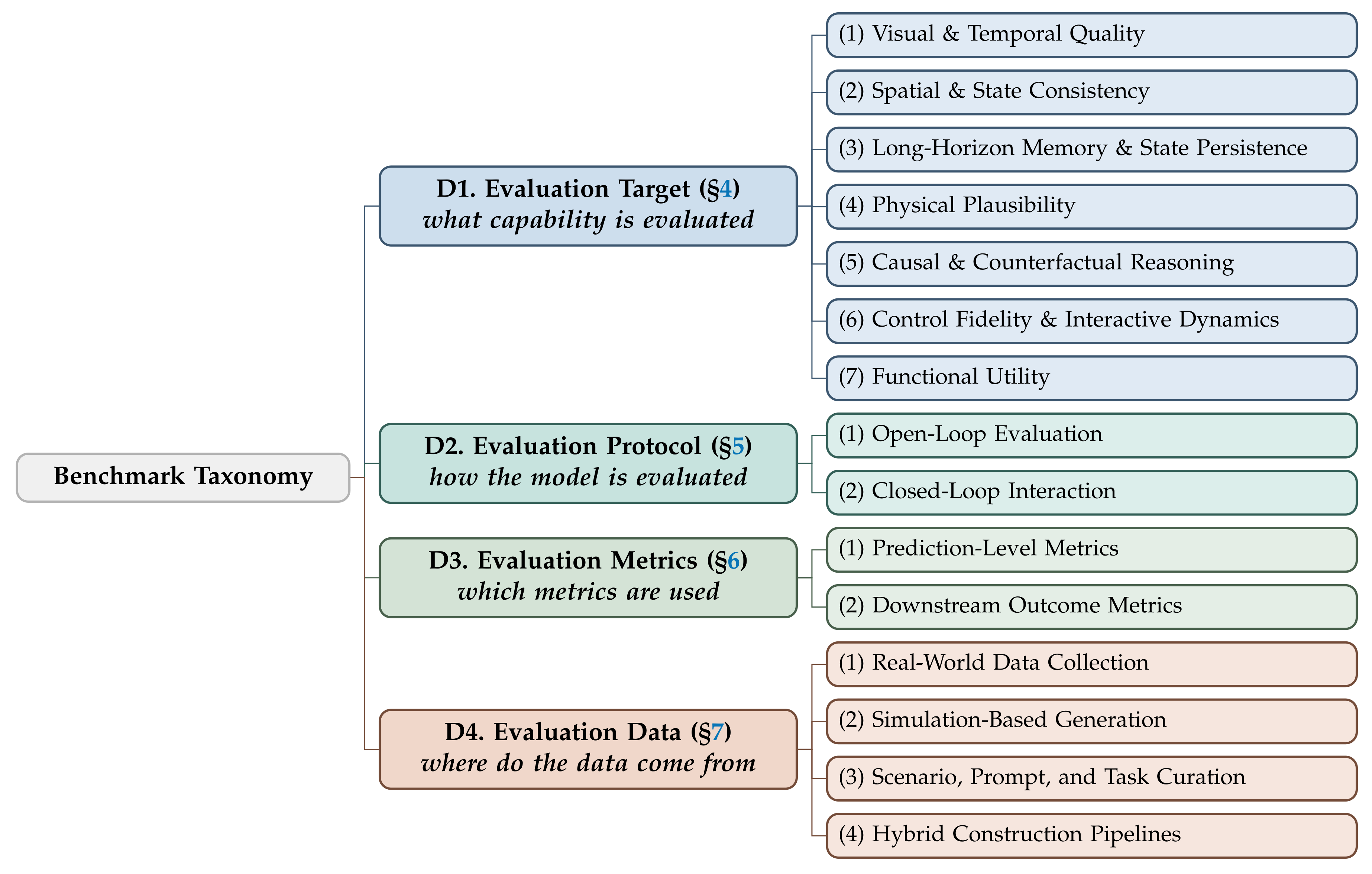
Figure 2.
World-model benchmarks over time. The panels show annual and cumulative corpus counts, representative benchmarks by evaluation target and release window, and the shift from fidelity-oriented evaluation toward control, persistence, interaction, and functional utility. Cross-category benchmarks may appear in multiple rows.
Figure 2.
World-model benchmarks over time. The panels show annual and cumulative corpus counts, representative benchmarks by evaluation target and release window, and the shift from fidelity-oriented evaluation toward control, persistence, interaction, and functional utility. Cross-category benchmarks may appear in multiple rows.
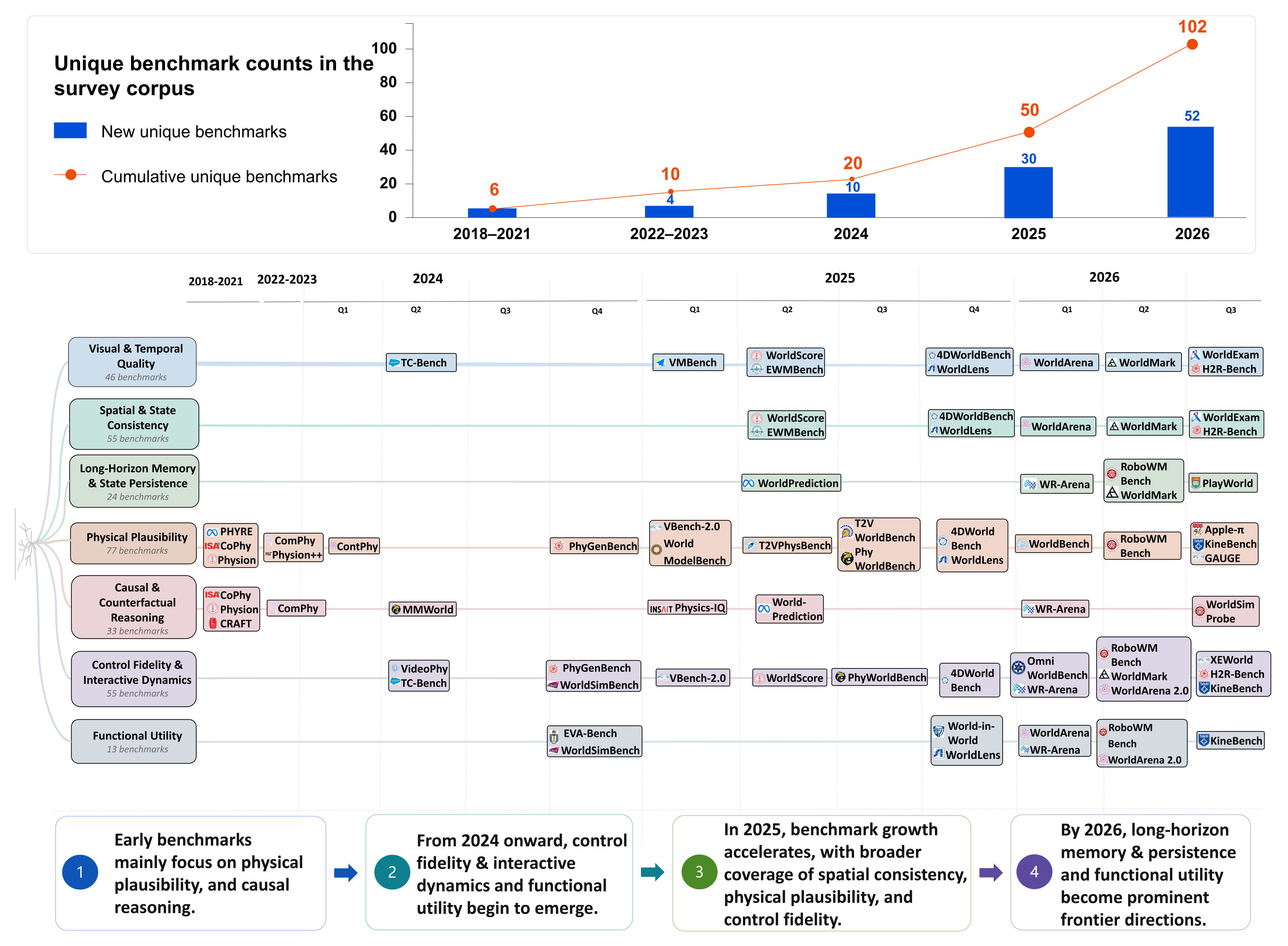
Figure 3.
Operational world-model mapping in Eq. (1): history, optional actions, and other conditions are mapped to a distribution over future world states.
Figure 3.
Operational world-model mapping in Eq. (1): history, optional actions, and other conditions are mapped to a distribution over future world states.
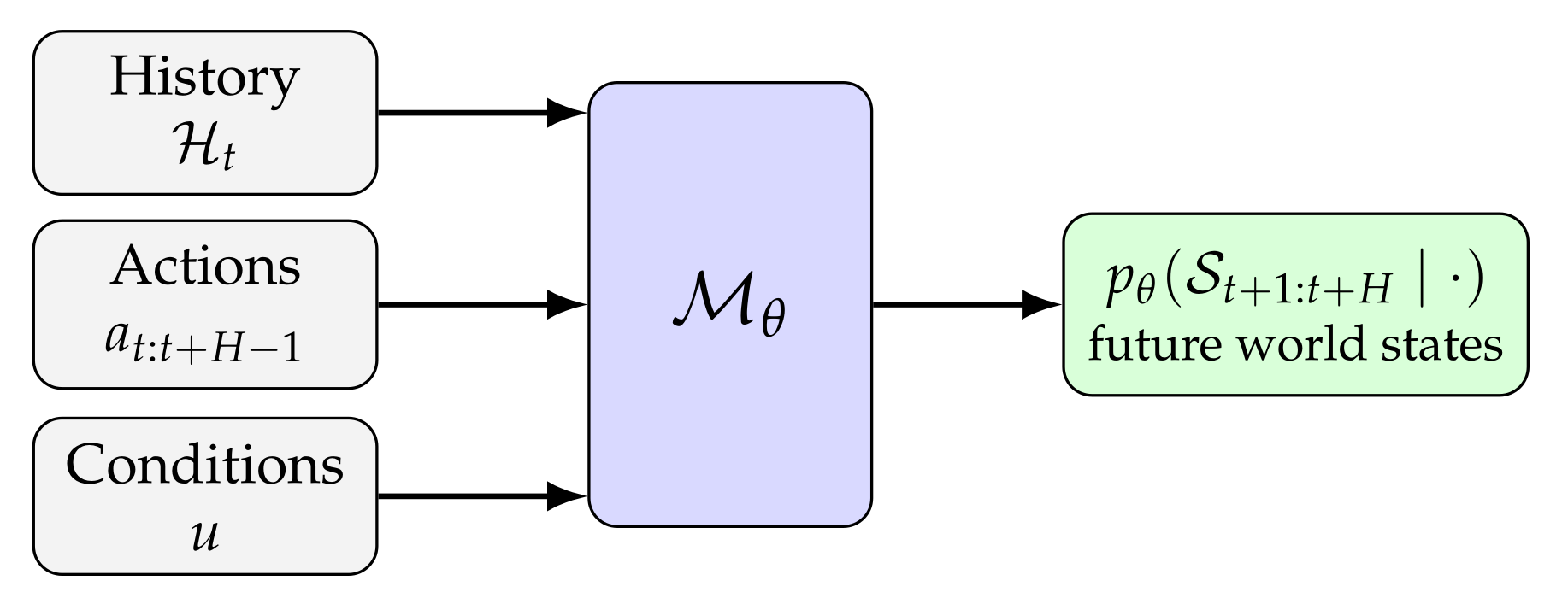
Figure 4.
World-model benchmarks organized by evaluation target. Functional utility is divided into four downstream roles. Benchmarks may appear under multiple targets; ▵ marks cross-category assignments.
Figure 4.
World-model benchmarks organized by evaluation target. Functional utility is divided into four downstream roles. Benchmarks may appear under multiple targets; ▵ marks cross-category assignments.
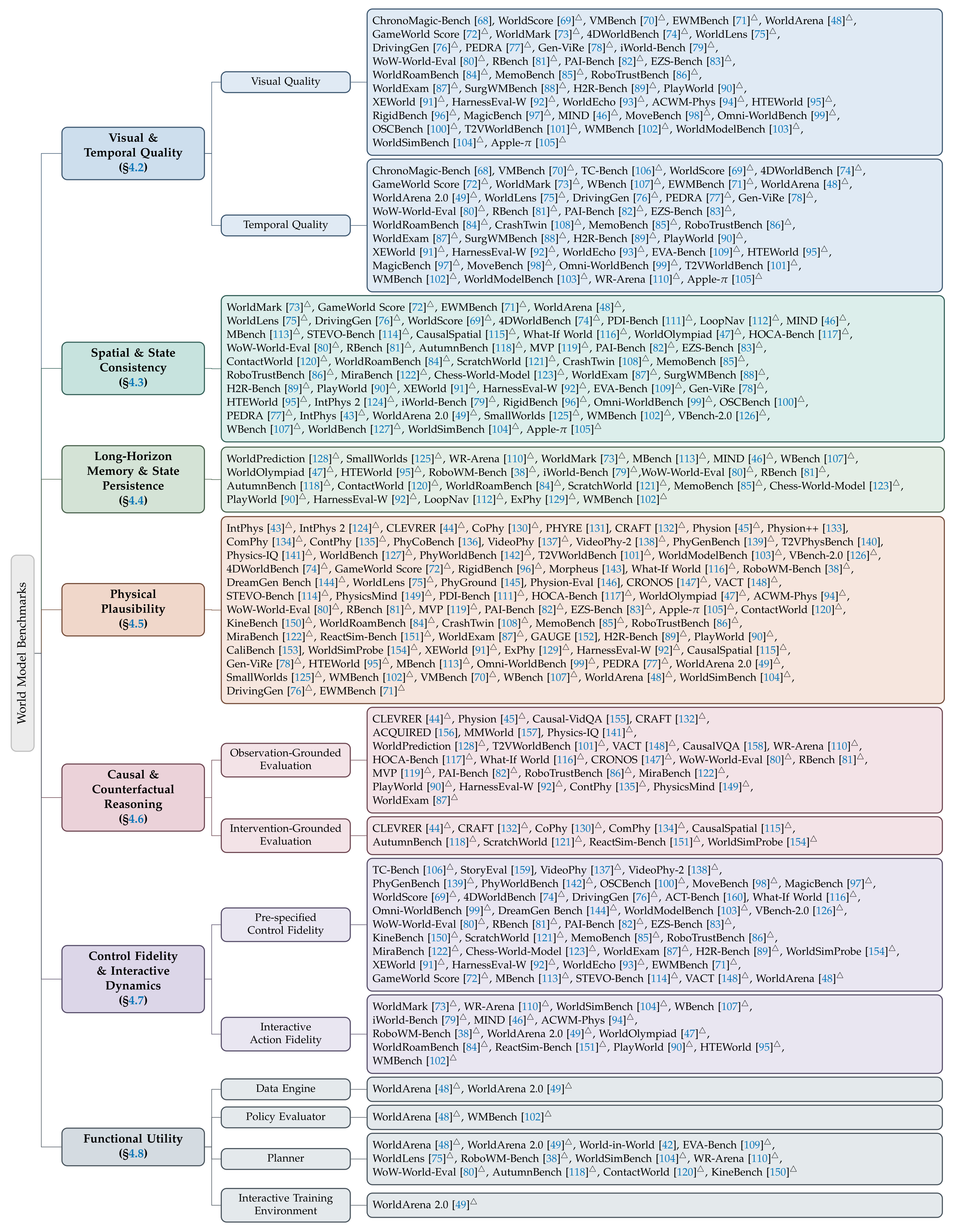

Table 1.
Key differences from representative world-model surveys.
| Survey group | Key distinction |
|---|---|
| General world-model surveys [50,51,52] | Broad reviews of architectures, learning paradigms, reasoning, and applications; benchmarks serve as supporting material rather than the primary object of analysis. |
| Driving surveys [3,4] | Focus on driving-specific world models and applications, with evaluation tied to driving datasets, simulators, and tasks. |
| Embodied and robot-learning surveys [1,2,53,57] | Focus on embodied or robot-learning pipelines and downstream use; benchmark analysis remains task-, platform-, or embodiment-specific. |
| Vision world-model surveys [54] | Organize visual world models by representation, prediction, and generation, with limited systematic analysis of benchmark design. |
| 3D/4D world-model surveys [55] | Focus on spatiotemporal representations and generation, with evaluation specialized to 3D/4D modeling settings. |
| Decision-making-centric evaluation [56] | Organizes evaluation evidence around embodied decision-making claims, from intervention fidelity to policy optimization. |
| This survey | Provides a benchmark-centric analysis of world model evaluation across applications and modalities, systematically separating evaluation target, protocol, metrics, and data to clarify what each benchmark measures and what its scores support. |
Table 2.
The seven evaluation targets as benchmark probes of the predictive-dynamics mapping in Eq. (1).
Table 2.
The seven evaluation targets as benchmark probes of the predictive-dynamics mapping in Eq. (1).
| Probe class | What the probe measures | Evaluation target |
|---|---|---|
| Readouts of future states | Whether generated future states are visually realistic, coherent, and temporally smooth when read out as frames or videos. | Visual and Temporal Quality |
| Compatibility between and | Whether future states remain consistent with the historical context, including scene layout, object identity, attributes, spatial relations, and geometry. | Spatial and State Consistency |
| Extended rollout of with | Whether identities, attributes, memory traces, accumulated changes, and task progress persist over long horizons rather than drifting, being forgotten, or resetting. Here, denotes an extended evaluation rollout horizon chosen substantially longer than the nominal prediction horizon H. | Long-Horizon Memory and State Persistence |
| Physical constraints on transitions | Whether the predicted evolution of future states follows plausible physical regularities, such as motion, gravity, collision, support, contact, friction, rigidity, or material interaction. | Physical Plausibility |
| Perturbations of causes, events, or conditions in u | Whether the model predicts appropriate changes under altered causes, hypothetical conditions, interventions, or counterfactual settings while preserving irrelevant factors. | Causal and Counterfactual Reasoning |
| Perturbations of actions or controls | Whether robot actions, camera motions, trajectories, navigation commands, or interaction signals induce the intended future state transitions. | Control Fidelity and Interactive Dynamics |
| Downstream use of | Whether the learned world model improves or supports data generation, policy evaluation, planning, interactive training, or other agent-system functions. | Functional Utility |
Table 3.
Representative benchmarks for Section 4.2 (Visual and Temporal Quality). Protocol (Section 5): OL = Open-Loop Evaluation (Section 5.1); CL = Closed-Loop Interaction (Section 5.2); OL+CL indicates that a benchmark includes both open- and closed-loop evaluation tracks. Metrics (Section 6): P = Prediction-Level Metrics (Section 6.1); O = Downstream Outcome Metrics (Section 6.2); P+O indicates that a benchmark reports evidence at both levels. Data (Section 7): RWD = Real-World Data Collection (Section 7.1); SBG = Simulation-Based Generation (Section 7.2); SPTC = Scenario, Prompt, and Task Curation (Section 7.3); HCP = Hybrid Construction Pipelines (Section 7.4). Benchmarks marked ▵ are cross-category with other evaluation targets in Section 4.
Table 3.
Representative benchmarks for Section 4.2 (Visual and Temporal Quality). Protocol (Section 5): OL = Open-Loop Evaluation (Section 5.1); CL = Closed-Loop Interaction (Section 5.2); OL+CL indicates that a benchmark includes both open- and closed-loop evaluation tracks. Metrics (Section 6): P = Prediction-Level Metrics (Section 6.1); O = Downstream Outcome Metrics (Section 6.2); P+O indicates that a benchmark reports evidence at both levels. Data (Section 7): RWD = Real-World Data Collection (Section 7.1); SBG = Simulation-Based Generation (Section 7.2); SPTC = Scenario, Prompt, and Task Curation (Section 7.3); HCP = Hybrid Construction Pipelines (Section 7.4). Benchmarks marked ▵ are cross-category with other evaluation targets in Section 4.
| Benchmark | Year | Domain | Protocol | Metrics | Data | Benchmark | Year | Domain | Protocol | Metrics | Data |
|---|---|---|---|---|---|---|---|---|---|---|---|
| ChronoMagic-Bench [68] | 2024 | video | OL | P | SPTC | RoboTrustBench [86]▵ | 2026 | embodied | OL | P | HCP |
| WorldScore [69]▵ | 2025 | video | OL | P | HCP | WorldExam [87]▵ | 2026 | video | OL | P | HCP |
| VMBench [70]▵ | 2025 | video | OL | P | SPTC | SurgWMBench [88]▵ | 2026 | embodied | OL | P | RWD |
| EWMBench [71]▵ | 2025 | embodied | OL | P | HCP | H2R-Bench [89]▵ | 2026 | embodied | OL | P | HCP |
| WorldArena [48]▵ | 2026 | embodied | OL | P | SBG | PlayWorld [90]▵ | 2026 | game+video | CL | P | HCP |
| GameWorld Score [72]▵ | 2025 | game | OL | P | SBG | XEWorld [91]▵ | 2026 | embodied | OL | P | SBG |
| WorldMark [73]▵ | 2026 | game+video | OL | P | HCP | HarnessEval-W [92]▵ | 2026 | video | OL | P | HCP |
| 4DWorldBench [74]▵ | 2025 | video | OL | P | HCP | WorldEcho [93]▵ | 2026 | embodied | OL | P | SBG |
| TC-Bench [106]▵ | 2024 | video | OL | P | HCP | ACWM-Phys [94]▵ | 2026 | video | OL | P | SBG |
| WorldLens [75]▵ | 2025 | driving | OL | P | HCP | EVA-Bench [109]▵ | 2024 | embodied | OL | P | HCP |
| WorldArena 2.0 [49]▵ | 2026 | embodied | OL | P | HCP | HTEWorld [95]▵ | 2026 | embodied | OL | P | SBG |
| DrivingGen [76]▵ | 2026 | driving | OL | P | RWD | RigidBench [96]▵ | 2026 | video | OL | P | SBG |
| WBench [107]▵ | 2026 | video | OL | P | HCP | MagicBench [97]▵ | 2025 | video | OL | P | RWD |
| PEDRA [77]▵ | 2025 | video | OL | P | RWD | MIND [46]▵ | 2026 | video | OL | P | SBG |
| Gen-ViRe [78]▵ | 2025 | video | OL | P | HCP | MoveBench [98]▵ | 2025 | video | OL | P | RWD |
| iWorld-Bench [79]▵ | 2026 | video | OL | P | HCP | Omni-WorldBench [99]▵ | 2026 | video | OL | P | HCP |
| WoW-World-Eval [80]▵ | 2026 | embodied | OL | P | HCP | OSCBench [100]▵ | 2026 | video | OL | P | SPTC |
| RBench [81]▵ | 2026 | embodied | OL | P | RWD | T2VWorldBench [101]▵ | 2025 | video | OL | P | SPTC |
| PAI-Bench [82]▵ | 2025 | video | OL | P | HCP | WMBench [102]▵ | 2026 | embodied | CL | P | HCP |
| EZS-Bench [83]▵ | 2026 | embodied | OL | P | HCP | WorldModelBench [103]▵ | 2025 | video | OL | P | SPTC |
| WorldRoamBench [84]▵ | 2026 | video+game | OL | P | HCP | WorldSimBench [104]▵ | 2024 | game+driving+embodied | OL | P | HCP |
| CrashTwin [108]▵ | 2026 | driving+video | OL | P | HCP | WR-Arena [110]▵ | 2026 | driving+embodied | OL | P | HCP |
| MemoBench [85]▵ | 2026 | video | OL | P | HCP | Apple- [105]▵ | 2026 | video | OL | P | HCP |
Table 4.
Representative benchmarks for Section 4.3 (Spatial and State Consistency). Column conventions follow Table 3. Benchmarks marked ▵ are cross-category with other evaluation targets in Section 4.
Table 4.
Representative benchmarks for Section 4.3 (Spatial and State Consistency). Column conventions follow Table 3. Benchmarks marked ▵ are cross-category with other evaluation targets in Section 4.
| Benchmark | Year | Domain | Protocol | Metrics | Data | Benchmark | Year | Domain | Protocol | Metrics | Data |
|---|---|---|---|---|---|---|---|---|---|---|---|
| WorldMark [73]▵ | 2026 | game+video | OL | P | HCP | RoboTrustBench [86]▵ | 2026 | embodied | OL | P | HCP |
| WorldLens [75]▵ | 2025 | driving | OL | P | HCP | MiraBench [122]▵ | 2026 | embodied | OL | P | HCP |
| WorldArena [48]▵ | 2026 | embodied | OL | P | SBG | Chess-World-Model [123]▵ | 2026 | game | OL | P | HCP |
| WorldScore [69]▵ | 2025 | video | OL | P | HCP | WorldExam [87]▵ | 2026 | video | OL | P | HCP |
| DrivingGen [76]▵ | 2026 | driving | OL | P | RWD | SurgWMBench [88]▵ | 2026 | embodied | OL | P | RWD |
| EWMBench [71]▵ | 2025 | embodied | OL | P | HCP | H2R-Bench [89]▵ | 2026 | embodied | OL | P | HCP |
| What-If World [116]▵ | 2026 | driving+embodied | OL | P | RWD | PlayWorld [90]▵ | 2026 | game+video | CL | P | HCP |
| 4DWorldBench [74]▵ | 2025 | video | OL | P | HCP | XEWorld [91]▵ | 2026 | embodied | OL | P | SBG |
| GameWorld Score [72]▵ | 2025 | game | OL | P | SBG | HarnessEval-W [92]▵ | 2026 | video | OL | P | HCP |
| LoopNav [112]▵ | 2025 | game | OL | P | SBG | EVA-Bench [109]▵ | 2024 | embodied | OL | P | HCP |
| MIND [46]▵ | 2026 | video | OL | P | SBG | Gen-ViRe [78]▵ | 2025 | video | OL | P | HCP |
| MBench [113]▵ | 2026 | video | OL | P | RWD | HTEWorld [95]▵ | 2026 | embodied | OL | P | SBG |
| STEVO-Bench [114]▵ | 2026 | video | OL | P | HCP | IntPhys 2 [124]▵ | 2025 | video | OL | P | SBG |
| CausalSpatial [115]▵ | 2026 | image | OL | P | SBG | iWorld-Bench [79]▵ | 2026 | video | OL | P | HCP |
| PDI-Bench [111]▵ | 2026 | video | OL | P | HCP | RigidBench [96]▵ | 2026 | video | OL | P | SBG |
| WorldOlympiad [47]▵ | 2026 | video | OL | P | HCP | Omni-WorldBench [99]▵ | 2026 | video | OL | P | HCP |
| HOCA-Bench [117]▵ | 2026 | video | OL | P | HCP | OSCBench [100]▵ | 2026 | video | OL | P | SPTC |
| WoW-World-Eval [80]▵ | 2026 | embodied | OL | P | HCP | PEDRA [77]▵ | 2025 | video | OL | P | RWD |
| RBench [81]▵ | 2026 | embodied | OL | P | RWD | IntPhys [43]▵ | 2018 | video | OL | P | SBG |
| AutumnBench [118]▵ | 2025 | game | CL | P+O | SBG | WorldArena 2.0 [49]▵ | 2026 | embodied | OL | P | HCP |
| MVP [119]▵ | 2025 | video | OL | P | HCP | SmallWorlds [125]▵ | 2025 | video | OL | P | SBG |
| PAI-Bench [82]▵ | 2025 | video | OL | P | HCP | WMBench [102]▵ | 2026 | embodied | CL | P | HCP |
| EZS-Bench [83]▵ | 2026 | embodied | OL | P | HCP | VBench-2.0 [126]▵ | 2025 | video | OL | P | SPTC |
| ContactWorld [120]▵ | 2026 | embodied | CL | P+O | HCP | WBench [107]▵ | 2026 | video | OL | P | HCP |
| WorldRoamBench [84]▵ | 2026 | video+game | OL | P | HCP | WorldBench [127]▵ | 2026 | video | OL | P | HCP |
| ScratchWorld [121]▵ | 2026 | game | OL | P | HCP | WorldSimBench [104]▵ | 2024 | game+driving+embodied | OL | P | HCP |
| CrashTwin [108]▵ | 2026 | driving+video | OL | P | HCP | Apple- [105]▵ | 2026 | video | OL | P | HCP |
| MemoBench [85]▵ | 2026 | video | OL | P | HCP |
Table 5.
Representative benchmarks for Section 4.4 (Long-Horizon Memory and State Persistence). Column conventions follow Table 3. Benchmarks marked ▵ are cross-category with other evaluation targets in Section 4.
Table 5.
Representative benchmarks for Section 4.4 (Long-Horizon Memory and State Persistence). Column conventions follow Table 3. Benchmarks marked ▵ are cross-category with other evaluation targets in Section 4.
| Benchmark | Year | Domain | Protocol | Metrics | Data | Benchmark | Year | Domain | Protocol | Metrics | Data |
|---|---|---|---|---|---|---|---|---|---|---|---|
| WorldPrediction [128]▵ | 2025 | video | OL | P | RWD | RBench [81]▵ | 2026 | embodied | OL | P | RWD |
| SmallWorlds [125]▵ | 2025 | video | OL | P | SBG | AutumnBench [118]▵ | 2025 | game | CL | P+O | SBG |
| WR-Arena [110]▵ | 2026 | driving+embodied | OL | P | HCP | ContactWorld [120]▵ | 2026 | embodied | CL | P+O | HCP |
| WorldMark [73]▵ | 2026 | game+video | OL | P | HCP | WorldRoamBench [84]▵ | 2026 | video+game | OL | P | HCP |
| MBench [113]▵ | 2026 | video | OL | P | RWD | ScratchWorld [121]▵ | 2026 | game | OL | P | HCP |
| MIND [46]▵ | 2026 | video | OL | P | SBG | MemoBench [85]▵ | 2026 | video | OL | P | HCP |
| WBench [107]▵ | 2026 | video | OL | P | HCP | Chess-World-Model [123]▵ | 2026 | game | OL | P | HCP |
| WorldOlympiad [47]▵ | 2026 | video | OL | P | HCP | PlayWorld [90]▵ | 2026 | game+video | CL | P | HCP |
| HTEWorld [95]▵ | 2026 | embodied | OL | P | SBG | HarnessEval-W [92]▵ | 2026 | video | OL | P | HCP |
| RoboWM-Bench [38]▵ | 2026 | embodied | OL | O | HCP | LoopNav [112]▵ | 2025 | game | OL | P | SBG |
| iWorld-Bench [79]▵ | 2026 | video | OL | P | HCP | ExPhy [129]▵ | 2026 | embodied | OL | P | SBG |
| WoW-World-Eval [80]▵ | 2026 | embodied | OL | P | HCP | WMBench [102]▵ | 2026 | embodied | CL | P | HCP |
Table 6.
Representative benchmarks for Section 4.5 (Physical Plausibility). Column conventions follow Table 3; the rows here are laid out as two parallel halves to fit the larger benchmark list. Benchmarks marked ▵ are cross-category with other evaluation targets in Section 4.
Table 6.
Representative benchmarks for Section 4.5 (Physical Plausibility). Column conventions follow Table 3; the rows here are laid out as two parallel halves to fit the larger benchmark list. Benchmarks marked ▵ are cross-category with other evaluation targets in Section 4.
| Benchmark | Year | Domain | Protocol | Metrics | Data | Benchmark | Year | Domain | Protocol | Metrics | Data |
|---|---|---|---|---|---|---|---|---|---|---|---|
| IntPhys [43]▵ | 2018 | video | OL | P | SBG | WorldModelBench [103]▵ | 2025 | video | OL | P | SPTC |
| IntPhys 2 [124]▵ | 2025 | video | OL | P | SBG | VBench-2.0 [126]▵ | 2025 | video | OL | P | SPTC |
| CLEVRER [44]▵ | 2019 | video | OL | P | SBG | GameWorld Score [72]▵ | 2025 | game | OL | P | SBG |
| CoPhy [130]▵ | 2019 | video | OL | P | SBG | T2VWorldBench [101]▵ | 2025 | video | OL | P | SPTC |
| PHYRE [131] | 2019 | video | CL | O | SBG | 4DWorldBench [74]▵ | 2025 | video | OL | P | HCP |
| CRAFT [132]▵ | 2020 | video | OL | P | SBG | RoboWM-Bench [38]▵ | 2026 | embodied | OL | O | HCP |
| Physion [45]▵ | 2021 | video | OL | P | SBG | DreamGen Bench [144]▵ | 2025 | embodied | OL | P | HCP |
| Physion++ [133] | 2023 | video | OL | P | SBG | WorldLens [75]▵ | 2025 | driving | OL | P | HCP |
| ComPhy [134]▵ | 2022 | video | OL | P | SBG | RigidBench [96]▵ | 2026 | video | OL | P | SBG |
| ContPhy [135]▵ | 2024 | video | OL | P | SBG | Morpheus [143] | 2025 | video | OL | P | RWD |
| PhyCoBench [136] | 2025 | video | OL | P | SPTC | What-If World [116]▵ | 2026 | driving+embodied | OL | P | RWD |
| VideoPhy [137]▵ | 2024 | video | OL | P | SPTC | PhyGround [145] | 2026 | video | OL | P | SPTC |
| VideoPhy-2 [138]▵ | 2025 | video | OL | P | SPTC | Physion-Eval [146] | 2026 | video | OL | P | HCP |
| PhyGenBench [139]▵ | 2024 | video | OL | P | SPTC | CRONOS [147]▵ | 2026 | video | OL | P | HCP |
| T2VPhysBench [140] | 2025 | video | OL | P | SPTC | VACT [148]▵ | 2025 | video | OL | P | SPTC |
| Physics-IQ [141]▵ | 2025 | video | OL | P | RWD | STEVO-Bench [114]▵ | 2026 | video | OL | P | HCP |
| WorldBench [127]▵ | 2026 | video | OL | P | HCP | PhysicsMind [149]▵ | 2026 | video | OL | P | HCP |
| PhyWorldBench [142]▵ | 2025 | video | OL | P | SPTC | PDI-Bench [111]▵ | 2026 | video | OL | P | HCP |
| WorldOlympiad [47]▵ | 2026 | video | OL | P | HCP | HOCA-Bench [117]▵ | 2026 | video | OL | P | HCP |
| MVP [119]▵ | 2025 | video | OL | P | HCP | ACWM-Phys [94]▵ | 2026 | video | OL | P | SBG |
| WoW-World-Eval [80]▵ | 2026 | embodied | OL | P+O | HCP | RBench [81]▵ | 2026 | embodied | OL | P | RWD |
| PAI-Bench [82]▵ | 2025 | video | OL | P | HCP | EZS-Bench [83]▵ | 2026 | embodied | OL | P | HCP |
| Apple- [105]▵ | 2026 | video | OL | P | HCP | ContactWorld [120]▵ | 2026 | embodied | CL | P+O | HCP |
| KineBench [150]▵ | 2026 | embodied | CL | P+O | HCP | WorldRoamBench [84]▵ | 2026 | video+game | OL | P | HCP |
| CrashTwin [108]▵ | 2026 | driving+video | OL | P | HCP | MemoBench [85]▵ | 2026 | video | OL | P | HCP |
| RoboTrustBench [86]▵ | 2026 | embodied | OL | P | HCP | MiraBench [122]▵ | 2026 | embodied | OL | P | HCP |
| ReactSim-Bench [151]▵ | 2026 | driving | CL | P | HCP | WorldExam [87]▵ | 2026 | video | OL | P | HCP |
| GAUGE [152] | 2026 | video | OL | P | HCP | H2R-Bench [89]▵ | 2026 | embodied | OL | P | HCP |
| PlayWorld [90]▵ | 2026 | game+video | CL | P | HCP | CaliBench [153] | 2026 | video | OL | P | HCP |
| WorldSimProbe [154]▵ | 2026 | embodied | OL | P | SBG | XEWorld [91]▵ | 2026 | embodied | OL | P | SBG |
| ExPhy [129]▵ | 2026 | embodied | OL | P | SBG | HarnessEval-W [92]▵ | 2026 | video | OL | P | HCP |
| CausalSpatial [115]▵ | 2026 | image | OL | P | SBG | Gen-ViRe [78]▵ | 2025 | video | OL | P | HCP |
| HTEWorld [95]▵ | 2026 | embodied | OL | P | SBG | MBench [113]▵ | 2026 | video | OL | P | RWD |
| Omni-WorldBench [99]▵ | 2026 | video | OL | P | HCP | PEDRA [77]▵ | 2025 | video | OL | P | RWD |
| WorldArena 2.0 [49]▵ | 2026 | embodied | OL | P | HCP | SmallWorlds [125]▵ | 2025 | video | OL | P | SBG |
| WMBench [102]▵ | 2026 | embodied | CL | P | HCP | VMBench [70]▵ | 2025 | video | OL | P | SPTC |
| WBench [107]▵ | 2026 | video | OL | P | HCP | WorldArena [48]▵ | 2026 | embodied | OL | P | SBG |
| WorldSimBench [104]▵ | 2024 | game+driving+embodied | OL+CL | P+O | HCP | DrivingGen [76]▵ | 2026 | driving | OL | P | RWD |
| EWMBench [71]▵ | 2025 | embodied | OL | P | HCP |
Table 7.
Representative benchmarks for Section 4.6 (Causal and Counterfactual Reasoning). Each benchmark is listed once for compact presentation; Figure 4 uses a leaf-level multi-label display. Column conventions follow Table 3. Benchmarks marked ▵ are cross-category with other top-level evaluation targets.
Table 7.
Representative benchmarks for Section 4.6 (Causal and Counterfactual Reasoning). Each benchmark is listed once for compact presentation; Figure 4 uses a leaf-level multi-label display. Column conventions follow Table 3. Benchmarks marked ▵ are cross-category with other top-level evaluation targets.
| Benchmark | Year | Domain | Protocol | Metrics | Data | Benchmark | Year | Domain | Protocol | Metrics | Data |
|---|---|---|---|---|---|---|---|---|---|---|---|
| CLEVRER [44]▵ | 2019 | video | OL | P | SBG | CRONOS [147]▵ | 2026 | video | OL | P | HCP |
| CoPhy [130]▵ | 2019 | video | OL | P | SBG | WoW-World-Eval [80]▵ | 2026 | embodied | OL | P | HCP |
| Physion [45]▵ | 2021 | video | OL | P | SBG | RBench [81]▵ | 2026 | embodied | OL | P | RWD |
| Causal-VidQA [155] | 2022 | video | OL | P | RWD | AutumnBench [118]▵ | 2025 | game | CL | P | SBG |
| CRAFT [132]▵ | 2020 | video | OL | P | SBG | MVP [119]▵ | 2025 | video | OL | P | HCP |
| ComPhy [134]▵ | 2022 | video | OL | P | SBG | PAI-Bench [82]▵ | 2025 | video | OL | P | HCP |
| ACQUIRED [156] | 2023 | video | OL | P | RWD | ScratchWorld [121]▵ | 2026 | game | OL | P | HCP |
| MMWorld [157] | 2024 | video | OL | P | HCP | RoboTrustBench [86]▵ | 2026 | embodied | OL | P | HCP |
| Physics-IQ [141]▵ | 2025 | video | OL | P | RWD | MiraBench [122]▵ | 2026 | embodied | OL | P | HCP |
| WorldPrediction [128]▵ | 2025 | video | OL | P | RWD | ReactSim-Bench [151]▵ | 2026 | driving | CL | P | HCP |
| T2VWorldBench [101]▵ | 2025 | video | OL | P | SPTC | PlayWorld [90]▵ | 2026 | game+video | CL | P | HCP |
| VACT [148]▵ | 2025 | video | OL | P | SPTC | WorldSimProbe [154]▵ | 2026 | embodied | OL | P | SBG |
| CausalVQA [158] | 2025 | video | OL | P | RWD | HarnessEval-W [92]▵ | 2026 | video | OL | P | HCP |
| WR-Arena [110]▵ | 2026 | driving+embodied | OL | P | HCP | ContPhy [135]▵ | 2024 | video | OL | P | SBG |
| CausalSpatial [115]▵ | 2026 | image | OL | P | SBG | PhysicsMind [149]▵ | 2026 | video | OL | P | HCP |
| HOCA-Bench [117]▵ | 2026 | video | OL | P | HCP | WorldExam [87]▵ | 2026 | video | OL | P | HCP |
| What-If World [116]▵ | 2026 | driving+embodied | OL | P | RWD |
Table 8.
Representative benchmarks for Section 4.7 (Control Fidelity and Interactive Dynamics), grouped by the two control sub-targets. Column conventions follow Table 3. Benchmarks marked ▵ are cross-category with other evaluation targets in Section 4.
Table 8.
Representative benchmarks for Section 4.7 (Control Fidelity and Interactive Dynamics), grouped by the two control sub-targets. Column conventions follow Table 3. Benchmarks marked ▵ are cross-category with other evaluation targets in Section 4.
| Benchmark | Year | Domain | Protocol | Metrics | Data |
|---|---|---|---|---|---|
| Pre-specified Control Fidelity (Section 4.7) | |||||
| TC-Bench [106]▵ | 2024 | video | OL | P | HCP |
| StoryEval [159] | 2024 | video | OL | P | SPTC |
| VideoPhy [137]▵ | 2024 | video | OL | P | SPTC |
| VideoPhy-2 [138]▵ | 2025 | video | OL | P | SPTC |
| PhyGenBench [139]▵ | 2024 | video | OL | P | SPTC |
| PhyWorldBench [142]▵ | 2025 | video | OL | P | SPTC |
| OSCBench [100]▵ | 2026 | video | OL | P | SPTC |
| MoveBench [98]▵ | 2025 | video | OL | P | RWD |
| MagicBench [97]▵ | 2025 | video | OL | P | RWD |
| WorldScore [69]▵ | 2025 | video | OL | P | HCP |
| 4DWorldBench [74]▵ | 2025 | video | OL | P | HCP |
| DrivingGen [76]▵ | 2026 | driving | OL | P | RWD |
| ACT-Bench [160] | 2024 | driving | OL | P | RWD |
| What-If World [116]▵ | 2026 | driving+embodied | OL | P | RWD |
| Omni-WorldBench [99]▵ | 2026 | video | OL | P | HCP |
| DreamGen Bench [144]▵ | 2025 | embodied | OL | P | HCP |
| WorldModelBench [103]▵ | 2025 | video | OL | P | SPTC |
| VBench-2.0 [126]▵ | 2025 | video | OL | P | SPTC |
| WoW-World-Eval [80]▵ | 2026 | embodied | OL | P+O | HCP |
| RBench [81]▵ | 2026 | embodied | OL | P | RWD |
| PAI-Bench [82]▵ | 2025 | video | OL | P | HCP |
| EZS-Bench [83]▵ | 2026 | embodied | OL | P | HCP |
| KineBench [150]▵ | 2026 | embodied | CL | P+O | HCP |
| ScratchWorld [121]▵ | 2026 | game | OL | P | HCP |
| MemoBench [85]▵ | 2026 | video | OL | P | HCP |
| RoboTrustBench [86]▵ | 2026 | embodied | OL | P | HCP |
| MiraBench [122]▵ | 2026 | embodied | OL | P | HCP |
| Chess-World-Model [123]▵ | 2026 | game | OL | P | HCP |
| Benchmark | Year | Domain | Protocol | Metrics | Data |
|---|---|---|---|---|---|
| Pre-specified Control Fidelity (Section 4.7) | |||||
| WorldExam [87]▵ | 2026 | video | OL | P | HCP |
| H2R-Bench [89]▵ | 2026 | embodied | OL | P | HCP |
| WorldSimProbe [154]▵ | 2026 | embodied | OL | P | SBG |
| XEWorld [91]▵ | 2026 | embodied | OL | P | SBG |
| HarnessEval-W [92]▵ | 2026 | video | OL | P | HCP |
| WorldEcho [93]▵ | 2026 | embodied | OL | P | SBG |
| EWMBench [71]▵ | 2025 | embodied | OL | P | HCP |
| GameWorld Score [72]▵ | 2025 | game | OL | P | SBG |
| MBench [113]▵ | 2026 | video | OL | P | RWD |
| STEVO-Bench [114]▵ | 2026 | video | OL | P | HCP |
| VACT [148]▵ | 2025 | video | OL | P | SPTC |
| WorldArena [48]▵ | 2026 | embodied | OL | P | SBG |
| Interactive Action Fidelity (Section 4.7) | |||||
| WorldMark [73]▵ | 2026 | game+video | OL | P | HCP |
| WR-Arena [110]▵ | 2026 | driving+embodied | OL | P | HCP |
| WorldSimBench [104]▵ | 2024 | game+driving+embodied | OL+CL | P+O | HCP |
| WBench [107]▵ | 2026 | video | OL | P | HCP |
| iWorld-Bench [79]▵ | 2026 | video | OL | P | HCP |
| MIND [46]▵ | 2026 | video | OL | P | SBG |
| ACWM-Phys [94]▵ | 2026 | video | OL | P | SBG |
| RoboWM-Bench [38]▵ | 2026 | embodied | OL | O | HCP |
| WorldArena 2.0 [49]▵ | 2026 | embodied | OL | P | HCP |
| WorldOlympiad [47]▵ | 2026 | video | OL | P | HCP |
| WorldRoamBench [84]▵ | 2026 | video+game | OL | P | HCP |
| ReactSim-Bench [151]▵ | 2026 | driving | CL | P | HCP |
| PlayWorld [90]▵ | 2026 | game+video | CL | P | HCP |
| HTEWorld [95]▵ | 2026 | embodied | OL | P | SBG |
| WMBench [102]▵ | 2026 | embodied | CL | P | HCP |
Table 9.
Representative benchmarks for Section 4.8 (Functional Utility), grouped by downstream roles. Column conventions follow Table 3. Benchmarks marked ▵ are cross-category with other evaluation targets in Section 4.
Table 9.
Representative benchmarks for Section 4.8 (Functional Utility), grouped by downstream roles. Column conventions follow Table 3. Benchmarks marked ▵ are cross-category with other evaluation targets in Section 4.
| Benchmark | Year | Domain | Protocol | Metrics | Data |
|---|---|---|---|---|---|
| Data Engine (Section 4.8.1) | |||||
| WorldArena [48]▵ | 2026 | embodied | OL | O | SBG |
| WorldArena 2.0 [49]▵ | 2026 | embodied | OL | O | HCP |
| Policy Evaluator (Section 4.8.2) | |||||
| WorldArena [48]▵ | 2026 | embodied | CL | O | SBG |
| WMBench [102]▵ | 2026 | embodied | CL | P+O | HCP |
| Planner (Section 4.8.3) | |||||
| WorldArena [48]▵ | 2026 | embodied | CL | O | SBG |
| WorldArena 2.0 [49]▵ | 2026 | embodied | OL+CL | O | HCP |
| World-in-World [42] | 2025 | embodied | CL | O | HCP |
| EVA-Bench [109]▵ | 2024 | embodied | OL | O | HCP |
| Benchmark | Year | Domain | Protocol | Metrics | Data |
|---|---|---|---|---|---|
| Planner (Section 4.8.3) | |||||
| WorldLens [75]▵ | 2025 | driving | CL | O | HCP |
| RoboWM-Bench [38]▵ | 2026 | embodied | OL | O | HCP |
| WorldSimBench [104]▵ | 2024 | game+driving+embodied | CL | O | HCP |
| WR-Arena [110]▵ | 2026 | driving+embodied | OL+CL | P+O | HCP |
| WoW-World-Eval [80]▵ | 2026 | embodied | OL | P+O | HCP |
| AutumnBench [118]▵ | 2025 | game | CL | P+O | SBG |
| ContactWorld [120]▵ | 2026 | embodied | CL | P+O | HCP |
| KineBench [150]▵ | 2026 | embodied | CL | P+O | HCP |
| Interactive Training Environment (Section 4.8.4) | |||||
| WorldArena 2.0 [49]▵ | 2026 | embodied | CL | O | HCP |
Table 10.
Protocol and evidence coverage for two target categories: Control Fidelity and Interactive Dynamics, and Functional Utility. Each entry reports the count/denominator and within-category share; the two target categories may overlap.
Table 10.
Protocol and evidence coverage for two target categories: Control Fidelity and Interactive Dynamics, and Functional Utility. Each entry reports the count/denominator and within-category share; the two target categories may overlap.
| Evaluation setting | Control Fidelity and Interactive Dynamics () |
Functional Utility () |
|---|---|---|
| Evaluation protocol | ||
| Open-loop only | 49/55 (89.1%) | 3/13 (23.1%) |
| Includes closed-loop interaction | 6/55 (10.9%) | 10/13 (76.9%) |
| Evidence type | ||
| Prediction-level only | 49/55 (89.1%) | 0/13 (0.0%) |
| Includes downstream outcomes | 6/55 (10.9%) | 13/13 (100.0%) |
Disclaimer/Publisher’s Note: The statements, opinions and data contained in all publications are solely those of the individual author(s) and contributor(s) and not of MDPI and/or the editor(s). MDPI and/or the editor(s) disclaim responsibility for any injury to people or property resulting from any ideas, methods, instructions or products referred to in the content. |
© 2026 by the authors. Licensee MDPI, Basel, Switzerland. This article is an open access article distributed under the terms and conditions of the Creative Commons Attribution (CC BY) license.
Copyright: This open access article is published under a Creative Commons CC BY 4.0 license, which permit the free download, distribution, and reuse, provided that the author and preprint are cited in any reuse.