

Submitted:
07 September 2026
Posted:
08 September 2026
You are already at the latest version
Abstract
Background/Objectives: Metabolic dysfunction-associated steatotic liver disease (MASLD) is increasingly prevalent, is closely linked to obesity, and carries significant hepatic and cardiometabolic risk. Current first-line lifestyle interventions often yield suboptimal results. Endoscopic sleeve gastroplasty (ESG), a minimally invasive endobariatric procedure, has shown safety and efficacy for weight loss, but evidence, particularly regarding liver-specific outcomes in Asian populations, is limited. We evaluated the effectiveness and safety of ESG on hepatic steatosis, liver function, and weight in unselected Asian patients with MASLD and obesity. Methods: This case series reports six patients with MASLD who underwent ESG for obesity management after failing dietary and weight-loss programs. Patients were followed at 3 and 6 months. Primary outcomes were changes in steatosis (ultrasound attenuation parameter, UAP), liver function (alanine aminotransferase, ALT), and procedure-related adverse events; secondary outcomes were total body weight loss (%TBWL), change in body mass index (ΔBMI), and technical success. Results: The cohort comprised three men and three women with a mean age of 47.8 ± 7.52 years and a median baseline body mass index of 32.37 (interquartile range 29.24–38.00) kg/m². All patients with available follow-up achieved normalization of UAP and ALT after the procedure, and no major complications occurred. A weight loss of −9.33 ± 6.80 kg with a %TBWL of −9.97 ± 5.29% was observed (p = 0.02), and all procedures were technically successful. Conclusions: ESG appears to be a promising treatment for hepatic steatosis in patients with obesity and MASLD, but these findings should be validated through larger, controlled studies.
Keywords:
endoscopic sleeve gastroplasty
; metabolic dysfunction-associated steatotic liver disease
; obesity
; hepatic steatosis
; fatty liver
; bariatric endoscopy
1. Introduction
Metabolic dysfunction-associated steatotic liver disease (MASLD) is an increasingly prevalent chronic liver disease worldwide, affecting approximately one-third of the adult population. The rising prevalence of MASLD parallels the global increase in obesity and metabolic syndrome. Beyond progressive liver injury that may advance from steatosis to steatohepatitis, fibrosis, and cirrhosis, MASLD is also associated with a number of serious health risks, including heart disease, stroke, type 2 diabetes, and certain types of cancer [1].
Despite the progressive incidence and complications of the disease, there has been little significant progress in the therapeutic strategies for MASLD. The most recommended first-line intervention for MASLD is currently lifestyle modification through diet and exercise [2]. This strategy, however, is often difficult to achieve in real-world practice, and many patients fail to reach the ≥7–10% weight-loss threshold associated with meaningful hepatic improvement [3]. The limited success of traditional weight-loss methods has driven significant interest in both surgical and non-surgical interventions.
Many clinical studies show that bariatric surgery may result in favourable outcomes in relation to obesity-related comorbidities. In the United States, laparoscopic sleeve gastrectomy (LSG) is the most common weight-loss surgery, representing over half of all bariatric procedures performed each year [4]. However, its invasiveness and associated risks, such as anastomotic leak, nutritional deficiency, and worsening gastroesophageal reflux, limit broader acceptance [5]. To overcome these concerns, over the last ten years endoscopic bariatric therapy has become a promising option for patients with MASLD and obesity.
Endoscopic sleeve gastroplasty (ESG), first described by Abu Dayyeh et al. in 2013 [6], reproduces the restrictive effect of LSG through endoscopic full-thickness suturing without gastric resection, offering a minimally invasive alternative with faster recovery. In multiple studies, ESG has demonstrated favourable safety profiles and significant weight-loss outcomes in patients with obesity [7,8,9]. Beyond weight reduction, ESG may improve metabolic dysfunction, insulin resistance, and hepatic steatosis [10], but the available evidence is concentrated in Western cohorts and in patients treated as a last resort. Data evaluating both liver function and hepatic steatosis simultaneously with ESG as an earlier hepatologic intervention, particularly in Asian patients—who may develop MASLD at lower BMI thresholds and exhibit different metabolic phenotypes—remain scarce.
Thus, we report a real-life case series evaluating the effectiveness and safety of ESG on liver function (ALT), hepatic steatosis (UAP), and weight loss in unselected Asian patients with MASLD and obesity who had failed dietary and weight-loss programs. By assessing ESG as an earlier therapeutic option, this report aims to offer insight into the potential role of minimally invasive endoscopic treatments in the management of MASLD.
2. Materials and Methods
2.1. Participants and Data Collection
This study was conducted ethically, following the Declaration of Helsinki and Good Clinical Practice guidelines. Six patients who underwent ESG for obesity management over a 2-year period at three tertiary referral hospitals in Jakarta were consecutively reviewed. Prior to the procedure, all patients provided informed consent for publication of this case series and any related images. All patients referred for ESG had completed a dietary modification program and a supervised exercise program and had declined bariatric surgery. Inclusion criteria were age ≥ 18 years, BMI ≥ 25 kg/m², and the presence of a metabolic condition. Exclusion criteria were pregnancy and coagulopathy. We collected data on weight-loss outcomes, liver transient elastography, length of stay, and complications.
2.2. ESG Procedure
All ESG procedures were performed by the same experienced interventional endoscopist (C.R.A.L.) under general anaesthesia. A therapeutic endoscope (GIF 1TH190, Olympus, Tokyo, Japan) equipped with a suturing device (Apollo OverStitch™ Endoscopic Suturing System, Apollo Endosurgery, Austin, TX, USA) was used (Figure 1). All patients received peri-procedural antibiotics and were managed with antiemetics and proton-pump inhibitors. After the procedure, patients were monitored by a multidisciplinary team of dietitians and gastroenterologists. For the first four weeks, patients adhered to a strict liquid diet and then progressed to semi-solid and solid food as tolerated.
2.3. Outcomes
Patients were evaluated at 3 and 6 months for anthropometric features (BMI, weight) and serological parameters (haemoglobin, lipid panel, and liver function tests). Hepatic steatosis and liver stiffness were assessed non-invasively using the ultrasound attenuation parameter (UAP) of the FibroTouch® system (Hisky Medical Technologies, Wuxi, China). Primary outcomes were the impact of ESG on steatosis, liver function, adverse effects, and complications within 24 h and 6 months post-procedure. Secondary outcomes included total body weight loss (TBWL, in kg), change in BMI (ΔBMI, in kg/m²), technical success, and complication rates.
2.4. Statistical Analysis
All six patients who underwent ESG were included in the analysis (full analysis set). Each endpoint was analysed using all available follow-up data; when a parameter was missing for a patient, that patient was omitted only from the affected analysis, so the number of observations varies by endpoint. Continuous variables were summarized as mean ± standard deviation (SD) when normally distributed and as median (interquartile range, IQR) when non-normally distributed. Categorical variables were expressed as frequencies and percentages. Normality was evaluated using the Shapiro–Wilk test. For pre- versus post-procedure comparisons (e.g., ALT, UAP, weight, BMI), tests were selected based on the distribution of the paired differences: normally distributed paired data were analysed with the paired t-test and non-normally distributed paired data with the Wilcoxon signed-rank test. A two-sided p-value < 0.05 was considered statistically significant.
3. Results
Six patients (three men and three women) with a mean age of 47.8 ± 7.52 years were included. All met the MASLD diagnostic criteria of the Asian Pacific Association for the Study of the Liver (APASL) [11]. The mean baseline weight was 88.17 ± 18.33 kg and the median baseline BMI was 32.37 (29.24–38.00) kg/m² (Table 1).
All six patients were included in the outcome analysis using their available data (n = 6), with the number of observations varying by parameter owing to missing follow-up values; three patients had 6-month follow-up data and three had 3-month data. Improvements were observed in hepatic steatosis and liver enzymes. ALT decreased from a median of 25.50 (21.75–138.50) U/L at baseline to a mean of 14.67 ± 3.51 U/L at the last follow-up, although this change did not reach statistical significance in the three patients with paired data (paired t-test, p = 0.40). One patient improved from 311 U/L to 18 U/L. UAP values also improved, with normalization in the patients with available follow-up data, including one patient whose severe steatosis (327 dB/m) decreased to a normal value (230 dB/m). A weight loss of 9.33 ± 6.80 kg (p = 0.02) with a %TBWL of 9.97 ± 5.29% was observed. Individual body-weight changes are shown in Figure 2. All patients had normal lipid profiles afterwards (Table 2).
All procedures were technically successful. Mild pain and nausea occurred in all patients but responded well to analgesics and antiemetics. No major adverse events or complications (perforation or haemorrhage) were observed during or after the procedure. One patient was lost to follow-up at the 4th month, regained weight, and was found to have partially loosened sutures at repeat endoscopic evaluation.
4. Discussion
This case series suggests that ESG was a safe procedure associated with weight loss and possible improvements in hepatic steatosis and liver function (Figure 2). The procedure was well tolerated, with no major complications and rapid recovery. ESG produced substantial weight reduction within the observation period, with apparent improvements in related metabolic parameters.
MASLD is predicted to become the leading aetiology of chronic liver disease globally, driven by the expanding burden of metabolic disease and unhealthy lifestyles. Approximately 17–51% of adults worldwide are affected by MASLD, and the prevalence of metabolic dysfunction-associated steatohepatitis (MASH) is rising in parallel, which may lead to further complications [12,13]. Weight loss plays an important role in fibrosis regression, which occurs in almost half of MASLD patients within one year. A meta-analysis of 2588 patients similarly demonstrated improvements in ALT, steatosis (assessed histologically or radiologically), NAFLD activity score, and liver stiffness in MASLD patients. Over the long term, progression to steatohepatitis and cirrhosis may also be prevented. A further potential benefit of weight loss is modulation of microbiome dysbiosis, a recognized driver of liver inflammation and steatohepatitis through increased bacterial translocation, immune dysregulation, and enhanced production and absorption of fatty acids [14,15]. The patients in our series likewise experienced improvement in their liver condition: one patient with severe steatosis improved to a normal value, and the patients with available follow-up data showed normalization of UAP and ALT after achieving significant weight loss.
In patients with obesity for whom appropriate dietary and physical-activity interventions are difficult to sustain, bariatric-based approaches have been proposed for MASLD. The overarching aim of bariatric therapy in MASLD is to improve the metabolic profile through direct and indirect effects. Direct effects arise from reduced caloric intake, whereas indirect effects derive from altered gastrointestinal physiology, such as reduced ghrelin secretion from the gastric fundus. Gradual weight loss after bariatric therapy can also improve insulin sensitivity, and modulation of leptin and ghrelin is further influenced by endocrine effects related to the rapid transit of nutrients to the distal small bowel [2].
ESG is one of the minimally invasive endoscopic bariatric therapies. It achieves anatomical restriction similar to laparoscopic sleeve gastroplasty using an endoscopic suturing device but, unlike the laparoscopic technique, restriction is achieved without resection of the gastric corpus or fundus [2,16]. ESG promotes early satiety by mechanically altering gastric function and delaying emptying, while preserving the stomach's natural structure, nerves, and blood supply. These distinctions, together with the smaller stomach pouch, likely account for the fewer side effects and lower incidence of gastroesophageal reflux observed after ESG [17]. A meta-analysis by Beran et al. reported that ESG produced less weight loss than LSG but with fewer adverse events, supporting ESG as an acceptable and safe alternative to LSG [18].
Our series suggests that ESG offers several advantages over traditional bariatric surgery: it is minimally invasive, allows faster recovery, carries a lower risk of complications, and is effective for weight loss. The side effects observed were limited to pain and nausea, with no serious adverse events such as perforation or bleeding. The maximum hospital stay was 4 days, extended in one patient who underwent a sequential laparoscopic fundoplication for a hiatal hernia—an illustration of a combined procedure—and for monitoring of diet tolerance and management of nausea and pain. These findings are in line with studies by Asokkumar et al. demonstrating that ESG is safe and effective for weight reduction in Asian [19] and Western [20] populations. One patient developed partially loosened sutures by month 6 and regained weight, attributable to a lack of routine follow-up and poor dietary adherence; no other adverse effects beyond weight gain were observed.
Traditionally, ESG has been considered a last-resort therapy, used only after dietary interventions, other therapies, and medications have failed [11]. Our findings suggest that ESG may normalize ALT and steatosis within 6 months while maintaining a good safety profile, indicating potential value earlier in the management pathway for patients with obesity and MASLD.
These findings should nonetheless be interpreted cautiously. The study is limited by its small sample size and relatively short 6-month follow-up, which constrain the strength and generalizability of the conclusions. A further limitation is the incompleteness of follow-up data for several parameters: post-procedure ALT, UAP, and haemoglobin values were available for only three, two, and four patients, respectively, so these outcomes are based on fewer observations than the anthropometric measures and should be interpreted with particular caution. Accordingly, this report should be regarded as a preliminary feasibility observation rather than a definitive evaluation of ESG outcomes in MASLD. Larger prospective studies with longer follow-up and complete data capture are needed to better define the metabolic and hepatic benefits of ESG in patients with obesity and MASLD.
5. Conclusions
In this exploratory case series, ESG was associated with improvements in hepatic steatosis, ALT, and weight in patients with obesity and MASLD, without major adverse events. ESG may represent a promising adjunctive intervention, but its role should be confirmed through larger, controlled studies with longer follow-up.
6. Patient Perspective
The patient had struggled with obesity for decades, with significant weight gain beginning during medical school. At the peak of the COVID-19 pandemic, the patient reached a maximum weight of 122 kg. This long-standing problem led to several complications, including worsening lower back pain, shortness of breath, persistent fatigue, and, most concerningly, severe fatty liver disease (S3, F3). After numerous weight-loss attempts and repeated relapses, the patient felt increasingly hopeless about regaining control of their health.
In February 2024, the patient underwent ESG after a long period of consideration. The outcome was remarkable: within six months, the patient lost 22 kg with a markedly improved quality of life. Symptoms such as fatigue, dyspnoea, and back pain decreased substantially. Although the first one to two months required gradual dietary adjustment beginning with liquid meals, the patient soon experienced a natural reduction in appetite and portion size. A follow-up FibroScan revealed complete resolution of fatty liver disease (S0, F0), indicating full recovery of liver health. The patient credits this life-changing transformation to the ESG procedure and accompanying lifestyle modification.
Author Contributions
Conceptualization, C.R.A.L. and S.S.; methodology, C.R.A.L. and S.S.; investigation, M.S.P. and R.A.G.; resources, M.S.P. and R.A.G.; data curation, M.S.P. and R.A.G.; formal analysis, C.R.A.L., S.S. and V.J.D.; writing—original draft preparation, S.S. and V.J.D.; writing—review and editing, C.R.A.L., M.S.P. and R.A.G.; visualization, V.J.D.; supervision, C.R.A.L. and R.A.G.; project administration, C.R.A.L., S.S. and V.J.D. All authors have read and agreed to the published version of the manuscript.
Funding
This research received no external funding.
Institutional Review Board Statement
The study was conducted in accordance with the Declaration of Helsinki (as revised in 2013) and approved by the Ethics Committee of Medistra Hospital (protocol code 002/LoE/KEPKM/2025, approved on 14 July 2025).
Informed Consent Statement
Written informed consent was obtained from all patients involved in the study for publication of this case series and any accompanying images.
Data Availability Statement
The data presented in this study are available on request from the corresponding author. The data are not publicly available due to patient privacy and ethical restrictions.
Acknowledgments
The authors thank the multidisciplinary care teams at the participating centres. During the preparation of this manuscript, the authors did not use any generative artificial intelligence tools for the generation of text, data, or graphics.
Conflicts of Interest
The authors declare no conflicts of interest.
Abbreviations
The following abbreviations are used in this manuscript:
| ALT | alanine aminotransferase |
| APASL | Asian Pacific Association for the Study of the Liver |
| BMI | body mass index |
| ESG | endoscopic sleeve gastroplasty |
| IQR | interquartile range |
| LSG | laparoscopic sleeve gastrectomy |
| MASH | metabolic dysfunction-associated steatohepatitis |
| MASLD | metabolic dysfunction-associated steatotic liver disease |
| SD | standard deviation |
| TBWL | total body weight loss |
| UAP | ultrasound attenuation parameter |
References
- Boccatonda, A.; Andreetto, L.; D'Ardes, D.; et al. From NAFLD to MAFLD: Definition, Pathophysiological Basis and Cardiovascular Implications. Biomedicines 2023, 11, 883. [Google Scholar] [CrossRef]
- Yeoh, A.; Wong, R.; Singal, A.K. The Role of Bariatric Surgery and Endobariatric Therapies in Nonalcoholic Steatohepatitis. Clin. Liver Dis. 2023, 27, 413–427. [Google Scholar] [CrossRef]
- Yoo, E.R.; Sallam, S.; Perumpail, B.J.; et al. When to Initiate Weight Loss Medications in the NAFLD Population. Diseases 2018, 6, 91. [Google Scholar] [CrossRef]
- Angrisani, L.; Santonicola, A.; Iovino, P.; et al. Bariatric Surgery Survey 2018: Similarities and Disparities Among the 5 IFSO Chapters. Obes. Surg. 2021, 31, 1937–1948. [Google Scholar] [CrossRef]
- Rinella, M.E. Nonalcoholic Fatty Liver Disease: A Systematic Review. JAMA 2015, 313, 2263–2273. [Google Scholar]
- Abu Dayyeh, B.K.; Rajan, E.; Gostout, C.J. Endoscopic Sleeve Gastroplasty: A Potential Endoscopic Alternative to Surgical Sleeve Gastrectomy for Treatment of Obesity. Gastrointest. Endosc. 2013, 78, 530–535. [Google Scholar] [CrossRef]
- Abu Dayyeh, B.K.; Bazerbachi, F.; Vargas, E.J.; et al. Endoscopic Sleeve Gastroplasty for Treatment of Class 1 and 2 Obesity (MERIT): A Prospective, Multicentre, Randomised Trial. Lancet 2022, 400, 441–451. [Google Scholar] [CrossRef]
- Lopez-Nava, G.; Sharaiha, R.Z.; Vargas, E.J.; et al. Endoscopic Sleeve Gastroplasty for Obesity: A Multicenter Study of 248 Patients with 24 Months Follow-Up. Obes. Surg. 2017, 27, 2649–2655. [Google Scholar] [CrossRef]
- Sarkar, A.; Tawadros, A.; Andalib, I.; et al. Safety and Efficacy of Endoscopic Sleeve Gastroplasty for Obesity Management in New Bariatric Endoscopy Programs: A Multicenter International Study. Ther. Adv. Gastrointest. Endosc. 2022, 15, 26317745221093883. [Google Scholar] [CrossRef]
- Hajifathalian, K.; Mehta, A.; Ang, B.; et al. Improvement in Insulin Resistance and Estimated Hepatic Steatosis and Fibrosis After Endoscopic Sleeve Gastroplasty. Gastrointest. Endosc. 2021, 93, 1110–1118. [Google Scholar] [CrossRef]
- Eslam, M.; Sarin, S.K.; Wong, V.W.S.; et al. The Asian Pacific Association for the Study of the Liver Clinical Practice Guidelines for the Diagnosis and Management of Metabolic Associated Fatty Liver Disease. Hepatol. Int. 2020, 14, 889–919. [Google Scholar] [CrossRef]
- Maya-Miles, D.; Ampuero, J.; Gallego-Durán, R.; et al. Management of NAFLD Patients with Advanced Fibrosis. Liver Int. 2021, 41, 95–104. [Google Scholar] [CrossRef]
- Sangro, B.; Argemi, J.; Ronot, M.; et al. EASL Clinical Practice Guidelines on the Management of Hepatocellular Carcinoma. J. Hepatol. 2025, 82, 315–374. [Google Scholar] [CrossRef]
- Vilar-Gomez, E.; Martinez-Perez, Y.; Calzadilla-Bertot, L.; et al. Weight Loss Through Lifestyle Modification Significantly Reduces Features of Nonalcoholic Steatohepatitis. Gastroenterology 2015, 149, 367–378.e5. [Google Scholar] [CrossRef]
- Brunaldi, V.O.; Neto, M.G. Endoscopic Sleeve Gastroplasty: A Narrative Review on Historical Evolution, Physiology, Outcomes, and Future Standpoints. Chin. Med. J. (Engl.) 2022, 135, 774–778. [Google Scholar] [CrossRef]
- Salomone, F.; Sharaiha, R.Z.; Boškoski, I. Endoscopic Bariatric and Metabolic Therapies for Non-Alcoholic Fatty Liver Disease: Evidence and Perspectives. Liver Int. 2020, 40, 1262–1268. [Google Scholar] [CrossRef]
- Fayad, L.; Adam, A.; Schweitzer, M.; et al. Endoscopic Sleeve Gastroplasty Versus Laparoscopic Sleeve Gastrectomy: A Case-Matched Study. Gastrointest. Endosc. 2019, 89, 782–788. [Google Scholar] [CrossRef]
- Beran, A.; Matar, R.; Jaruvongvanich, V.; et al. Comparative Effectiveness and Safety Between Endoscopic Sleeve Gastroplasty and Laparoscopic Sleeve Gastrectomy: A Meta-Analysis of 6775 Individuals with Obesity. Obes. Surg. 2022, 32, 3504–3512. [Google Scholar] [CrossRef]
- Asokkumar, R.; Lim, C.H.; Tan, A.S.; et al. Safety and Early Efficacy of Endoscopic Sleeve Gastroplasty (ESG) for Obesity in a Multi-Ethnic Asian Population in Singapore. JGH Open 2021, 5, 1351–1356. [Google Scholar] [CrossRef]
- de Miranda Neto, A.A.; de Moura, D.T.H.; Ribeiro, I.B.; et al. Efficacy and Safety of Endoscopic Sleeve Gastroplasty at Mid Term in the Management of Overweight and Obese Patients: A Systematic Review and Meta-Analysis. Obes. Surg. 2020, 30, 1971–1987. [Google Scholar] [CrossRef]
Figure 1.
Endoscopic views during endoscopic sleeve gastroplasty in a patient with MASLD, showing full-thickness suture placement with the endoscopic suturing device: (a) initial suture placement along the greater curvature; (b) progressive plication of the gastric body. MASLD, metabolic dysfunction-associated steatotic liver disease.
Figure 1.
Endoscopic views during endoscopic sleeve gastroplasty in a patient with MASLD, showing full-thickness suture placement with the endoscopic suturing device: (a) initial suture placement along the greater curvature; (b) progressive plication of the gastric body. MASLD, metabolic dysfunction-associated steatotic liver disease.
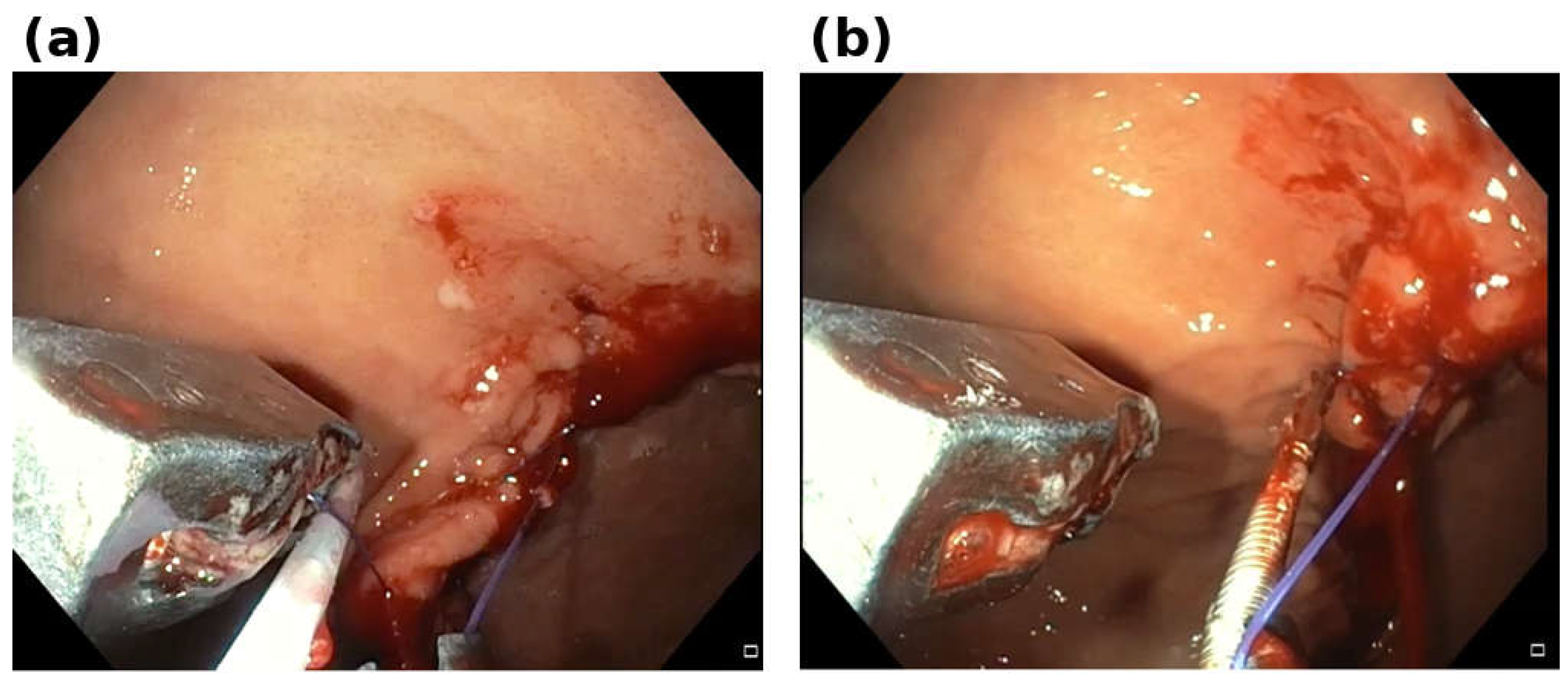
Figure 2.
Individual body-weight changes before and after ESG (88.17 ± 18.33 vs. 78.83 ± 13.00 kg; p = 0.02). ESG, endoscopic sleeve gastroplasty.
Figure 2.
Individual body-weight changes before and after ESG (88.17 ± 18.33 vs. 78.83 ± 13.00 kg; p = 0.02). ESG, endoscopic sleeve gastroplasty.
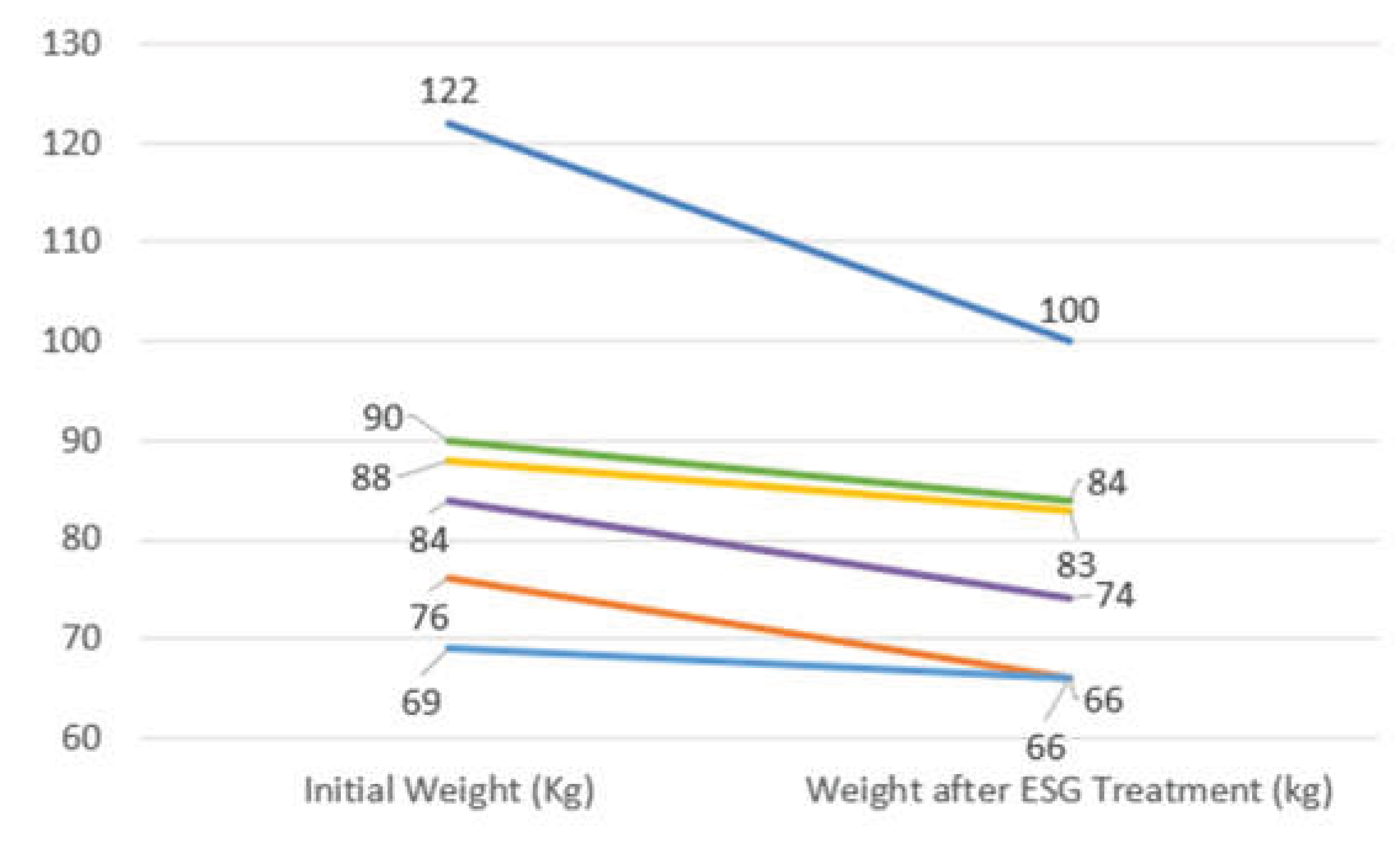

Table 1.
Clinical characteristics of the six patients.
| Patient | Sex | Age † (yr) | Weight (kg) | BMI (kg/m²) | ALT (U/L) | UAP (dB/m) | Main Comorbidities / Diagnoses | Follow-Up (mo) |
|---|---|---|---|---|---|---|---|---|
| P1 | M | 51 | 84 | 29.76 | 26 | 327 | MASLD; GERD/NERD; OSA; obesity | 6 |
| P2 | M | 58 | 88 | 31.02 | 25 | — | MASLD; CAD (post-PCI); gastritis; haemorrhoids; colitis; obesity | 3 |
| P3 | F | 40 | 76 | 34.04 | 12 | 260.4 | MASLD; functional GI disorder | 6 |
| P4 | F | 39 | 69 | 27.67 | 311 | 296 | MASH | 3 |
| P5 | F | 46 | 90 | 33.72 | 81 | 346 | MASH | 3 |
| P6 | M | 53 | 122 | 49.87 | 25 | — | MASH | 6 |
† Age at time of ESG. —, not available (no baseline UAP recorded). ALT, alanine aminotransferase; BMI, body mass index; CAD, coronary artery disease; ESG, endoscopic sleeve gastroplasty; GERD, gastro-oesophageal reflux disease; MASH, metabolic dysfunction-associated steatohepatitis; MASLD, metabolic dysfunction-associated steatotic liver disease; NERD, non-erosive reflux disease; OSA, obstructive sleep apnoea; PCI, percutaneous coronary intervention; UAP, ultrasound attenuation parameter.
Table 2.
Individual anthropometric, hepatic, and laboratory outcomes before and after ESG.
| Patient | Sex | FU (mo) | Weight, kg (pre→post) | Δ Wt (kg) | %TBWL | BMI, kg/m² (pre→post) | ALT, U/L (pre→post) | UAP, dB/m (pre→post) | Hb, g/dL (pre→post) |
|---|---|---|---|---|---|---|---|---|---|
| P1 | M | 6 | 84 → 74 | −10 | −11.9 | 29.76 → 26.20 | 26 → 15 | 327 → 230 | 11.8 → 12.5 |
| P2 | M | 3 | 88 → 83 | −5 | −5.7 | 31.02 → 28.45 | 25 → NA | NA → NA | 11.5 → 13.0 |
| P3 | F | 6 | 76 → 66 | −10 | −13.2 | 34.04 → 29.33 | 12 → 11 | 260.4 → 218 | 13.6 → 13.8 |
| P4 | F | 3 | 69 → 66 | −3 | −4.3 | 27.67 → 26.70 | 311 → 18 | 296 → NA | 12.8 → 12.0 |
| P5 | F | 3 | 90 → 84 | −6 | −6.7 | 33.72 → 31.61 | 81 → NA | 346 → NA | 13.6 → NA |
| P6 | M | 6 | 122 → 100 | −22 | −18.0 | 49.87 → 40.05 | 25 → NA | NA → NA | 14.0 → NA |
| Mean ± SD | 88.17 ± 18.33 → 78.83 ± 13.00 | −9.33 ± 6.80 | −9.97 ± 5.29 | ΔBMI −3.96 ± 3.14 | 14.67 ± 3.51 (n = 3) | 224.0 ± 8.48 (n = 2) | Δ 0.40 ± 0.96 (n = 4) |
Weight before vs. after ESG: paired t-test p = 0.02 (paired differences normally distributed, Shapiro–Wilk p = 0.14). NA, follow-up value not available; FU, follow-up (last available visit); Δ Wt, weight change; %TBWL, percentage total body weight loss; Hb, haemoglobin; other abbreviations as in Table 1.
Disclaimer/Publisher’s Note: The statements, opinions and data contained in all publications are solely those of the individual author(s) and contributor(s) and not of MDPI and/or the editor(s). MDPI and/or the editor(s) disclaim responsibility for any injury to people or property resulting from any ideas, methods, instructions or products referred to in the content. |
© 2026 by the authors. Licensee MDPI, Basel, Switzerland. This article is an open access article distributed under the terms and conditions of the Creative Commons Attribution (CC BY) license (http://creativecommons.org/licenses/by/4.0/).
Copyright: This open access article is published under a Creative Commons CC BY 4.0 license, which permit the free download, distribution, and reuse, provided that the author and preprint are cited in any reuse.