

Submitted:
08 September 2026
Posted:
08 September 2026
You are already at the latest version
Abstract
Digital Patient systems are being increasingly explored across a range of health care domains. However, it remains unclear whether their reported clinical reach matches the available evidence of implementation and clinical adoption. The purpose of this study was to distinguish the clinical reach claimed for Digital Patient systems from the available evidence and to clarify the organizational conditions needed for responsible adoption. We synthesized application, maturity, barrier, and future-priority fields from a shared meta-review of 61 reviews following PRISMA guidelines. Categories were non-exclusive and described what reviews discussed, not numbers of systems, deployments, patients, or benefits. The reviews spanned multiple health care domains and identified recurring functions, most frequently treatment planning, prediction or prognosis, and diagnosis. Reported barriers to clinical adoption included: Privacy/security/governance, ethical/legal/regulatory concerns, and computing/scalability, each reported in 51 reviews; interoperability in 49; workflow and data barriers in 40 each; and validation or reproducibility in 34. Prototype wording appeared in 43 reviews and operational wording in 19. Our findings suggest that successful adoption requires the satisfaction of four linked gates: establish purpose and accountability; demonstrate data integrity and semantic continuity; build an intended-use credibility and lifecycle case; and show workflow fit, safety, equity, and outcomes. Requirements should increase with the level of clinical influence and degree of potential consequences. This four-part framework is an implementation hypothesis rather than a validated maturity scale.
Keywords:
digital patient
; digital twin
; clinical adoption
; governance
; implementation
; interoperability
; workflow
; policy
1. Introduction
Digital Patient systems are now discussed across a range of clinical and research domains, including cardiology, oncology, surgery, diabetes, neurology, rehabilitation, drug development, and education. Their proposed roles are equally varied: diagnosis, prognosis, treatment planning, monitoring, training, clinical trial support, and personalized care. This breadth suggests the field is approaching maturity, while technical refinement remains a major gap. However, a use case described in the literature does not mean that a Digital Patient has become a service that is safely and reliably used in routine care. Similarly, a system described as predictive, personalized, or monitoring does not mean it is safe, effective, equitable, or sustainable.
The long-running Digital Patient vision links computational and physiological modeling with the practical objectives of improving health care, research, and education [1]. Translating that vision to routine practice, however, changes the focus from whether a model can be developed and perform well to whether the resulting system can be successfully integrated and adopted into clinical care processes. The healthcare system evaluates not just an algorithm but also the arrangement of patient data, models, user interfaces, clinical roles, accountability, infrastructure, and processes for managing change over time. The range of Digital Patient implementations, including computational models, virtual cohorts, clinician-facing tools, instructional simulations, and operational platforms can obscure these distinctions [2,3].
We use operational profile as a meaningful way to describe a Digital Patient system. In the context of clinical adoption, this profile specifies what or whom the Digital Patient represents, the intended user and use, how the patient is represented, its inputs and outputs and how they are updated, how its outputs influence clinical decisions, what roles humans perform, the return or actuation path, where the system is used, its validation context, and how changes are controlled. This operational profile is not simply a label; instead, it documents each specific aspect of how a Digital Patient functions in clinical care, without several consequential assumptions. For example, the availability of longitudinal data does not guarantee assimilation of that data during operation. A clinician-facing recommendation does not imply a closed control loop. Likewise, the presence of a clinician does not, by itself, resolve automation bias, accountability, or a contingency procedure [4,5].
This companion analysis addresses the registered questions regarding barriers and future priorities, using application and maturity fields to examine a practical proposition: is the widespread discussion of Digital Patients in clinical settings matched by evidence of actual adoption, and what must organizations establish before a Digital Patient system can be responsibly introduced and sustained? The challenge is not to determine whether Digital Patient technology is technically possible; it is to determine whether they are adequately specified, validated, integrated, governed, and maintained to a level that allows them to become a dependable element of clinical care.
2. Methods
2.1. Shared Evidence, Distinct Question
This meta-review analysis uses the search, screening record, extraction workbook, duplicate decisions, appraisal, and 61-review cohort developed under one broad systematic overview registered in PROSPERO (CRD420261458411). It is not an independent search or an additional registration. Reporting follows PRISMA 2020, with complete source-specific search strategies provided in Supplementary Appendix S1 [6,7]. While companion reports using the same registered protocol evaluate conceptual terminology and computational pipeline architectures, this manuscript focuses exclusively on the sociotechnical, ethical, governance, and workflow requirements for clinical adoption.
The parent protocol included English-language reviews from 2020 onward addressing patient-linked physiological, biomechanical, biological, or adjacent computational representations. Web of Science, PubMed, IEEE Xplore, and Google Scholar were searched, with reference-list and designated preprint-server supplementation. The search was conducted in October 2025; no later search was incorporated, making October 2025 the evidence cut-off. Of 247 reports assessed for eligibility, 183 were excluded and 64 entered extraction (Figure 1). Bibliographic reconciliation then removed three duplicate reports leaving 61 unique reviews.
2.2. From Workbook Fields to Adoption Themes
Records were managed and screened in CADIMA [8]. Data were extracted using a standardized form aligned with the protocol-defined research questions. The CADIMA-aligned workbook captured clinical domains, intended functions, maturity wording, ethical issues, technical and data limitations, interoperability, organizational barriers, and priorities for research, standards, technology, collaboration, and governance. Barrier text was grouped into seven non-exclusive themes: privacy, security, or governance; ethical, legal, or regulatory; computing, scalability, or resources; interoperability or standards; clinical adoption or workflow; data quality, availability, or integration; and validation, evidence, or reproducibility. The unit of analysis was a review. One review could mention several fields, and reviews could include overlapping primary studies. Counts therefore represent discourse within the review literature. They do not estimate the number of deployed systems, exposed patients, adverse events, or the effectiveness of interventions. A domain and a function named in one review may also refer to different primary examples. Maturity fields were initially classified by pre-specified phrase matching rules. The “prospective” rule flagged three records. These were examined in full text and found to indicate forecasting, ordinary prospective AI studies, and negated claims. This focused adjudication concerned the flags only and did not reopen eligibility.
2.3. Appraisal and Framework Development
This meta-review used AMSTAR 2 or SANRA, as assigned in the extraction, to appraise included reviews [9,10]. These ratings concern review conduct rather than the clinical validity of underlying systems. We recorded whether source reviews formally appraised their own evidence. Application and barrier findings were synthesized, including a domain–function co-mention matrix. The four-gate adoption framework, developed from these findings, originated in the extracted barrier and was elaborated using model-credibility, health-information, ethics, implementation-science, and human factors [11,12,13,14].
3. Results
The 61-review cohort was recent: five reviews were dated 2022, eight in 2023, 19 in 2024, 27 in 2025, and two in 2026 after journal-issue year was applied consistently. Methodological appraisal was available for 39 reviews: 11 high, 14 moderate, five low, and nine very low. Twenty-one were unassessed and one had only qualitative appraisal. Only 11/61 source reviews reported a formal appraisal of their own included evidence. These findings are summarized in Table 1.
3.1. Clinical Reach Was Broad
Cardiovascular applications were mentioned in 32 reviews (52.5%), oncology in 25 (41.0%), surgery, orthopedics, or dentistry in 24 (39.3%), neurology or neuroscience in 18 (29.5%), diabetes or endocrine care in 17 (27.9%), general or multisystem care in 15 (24.6%), pharmacology or drug development in 10 (16.4%), pulmonary or respiratory care in nine (14.8%), and dermatology or ophthalmology in three (4.9%). Treatment or therapy planning appeared in 56 reviews (91.8%), prediction, prognosis, or risk in 49 (80.3%), diagnosis or detection in 46 (75.4%), education or training in 19 (31.1%), personalized care in nine, monitoring in eight, drug development or trials in seven, and decision support in five. These findings are summarized in Table 2.
Figure 2 is a heatmap showing the frequency of review records that addresses each combination of healthcare domain and Digital Patient function, with darker shades indicating a higher number of records. Each mention does not necessarily indicate a deployed service or a successful implementation; rather, this map shows the frequency of mentions across reviews. Treatment or therapy planning was the most frequently reported function, particularly in cardiovascular disease (31 reviews), oncology (24), and surgery/orthopedics, dentistry (23). Prediction/prognosis and diagnosis/detection were also prominent in these domains. In contrast, personalized care, monitoring, and drug development/trials were less frequently reported. Cardiovascular applications were broadly and consistently represented across functions, while drug development had much fewer mentions and range. Overall, this analysis suggests that the literature is more focused on treatment planning, prediction/prognosis, and diagnosis rather than on more downstream functions.
3.2. Barriers to Clinical Adoption
Several barriers to Digital Patient implementation were discussed amongst the reviews (see Table 3), spanning technology, data, ethics, interoperability, and organizational domains. Barriers to privacy, security, or governance appeared in 51 reviews (83.6%). Ethical, legal, or regulatory concerns and computing, scalability, or resource limitations were equally prominent, each appearing in 51 reviews. Interoperability or standards were reported in 49 reviews (80.3%), followed by clinical adoption or workflow in 40 (65.6%) and data quality, availability, or integration in 40 (65.6%). Validation, evidence, or reproducibility concerns were reported in 34 (55.7%).
These categories are analytically distinct but operationally interdependent. For example, consent, ownership, and rules regarding secondary use determine which data can be assembled and used. Data identity, provenance, heterogeneity, and bias affect whether a patient representation is meaningful and reliable. Interoperability and standards determine whether that representation survives organizational boundaries. Validation and uncertainty determine whether outputs are trustworthy and reliable enough to support clinical decisions. Workflow, human oversight, liability, and contingency procedures shape how it is implemented and interpreted. Finally, computing, cybersecurity, and procurement determine whether the arrangement can be sustained [15,16,17].
Overall, these findings show that clinical adoption is not impacted by a single barrier. Rather, successful implementation depends on the coordination of governance, technology, data, clinical practice, and organizational infrastructure. Therefore, a system may be technologically capable but still unsuitable for routine clinical use if any of these barriers has not been sufficiently addressed.
3.3. Adoption Language Is More Compelling than Confirmed Outcome
Prototype or proof-of-concept wording appeared in 43 reviews (70.5%), theoretical or conceptual wording in 21 (34.4%), and deployed or operational wording in 19 (31.1%). The categories overlap, may refer to different components, and were not necessarily fully realized as implementation states.
The risk of treating terminology as evidence was demonstrated by an automated phrase-matching rule that was employed across the review base. This rule identified three included review records with wording that suggested “prospective” evidence. However, full-text examination found that none of these instances reported prospective outcome evaluation of a Digital Patient system. In Espinoza-Vinces et al., “prospective” referred to prospective headache-AI studies rather than prospective evaluation of a Digital Patient system [14]. Mahmud et al. referred to prospective evidence in forecasting with sensor data [58]. Finally, Vallée et al. explicitly reported no prospective demonstration of improved clinical outcomes [65].
Accordingly, the presence of the word “prospective” alone cannot be used to classify a study or review as reporting prospective outcome evaluation of a Digital Patient system. In the flagged passages, “prospective” instead described a study design applied to another technology, forecasting based on sensor data, or an explicit statement that prospective evidence was absent. This finding does not exclude the possibility that a prospective primary study exists somewhere within the overlapping evidence bases; it shows that review-level phrase matching did not establish the presence of such evidence.
Focused reviews were similarly cautious. Drummond et al. identified 80 claimed patient twins, 78 (97.5%) in preclinical phases; 58 used one-way data flow and nine two-way flow, of which six returned recommendations and three supported surgical navigation [18]. Bian et al. found no real-world implementation in its 50-study review [19]. Tudor et al. found that 18/149 systems met its operational criteria and only two mentioned verification, validation, and uncertainty quantification [17]. Zou et al. characterized cardiovascular evidence as largely preclinical or proof of concept [20].
3.4. From a List of Barriers to a Path to Adoption
The barrier analysis suggests four criteria that a Digital Patient system must be able to satisfy. They are presented here as linked gates because a failure in a preceding gate can undermine the application or interpretation of subsequent gates. A successful infrastructure should support all four (Figure 3).
3.4.1. Gate 1—Who Is Responsible, and for What?
Before procurement or data access, the organization should state the subject represented, context of use, intended user, decision supported, expected benefit, clinical influence, and consequence of error. Responsibility cannot be left as a generic partnership between a vendor and a health system. Named owners are needed for clinical safety, model performance, data stewardship, cybersecurity, patient communication, incident response, and retirement.
Governance should specify consent or other lawful basis, any secondary use, retention, patient control, access, audit, liability, recourse, and equity across the data and inference lifecycle. Stakeholder evidence suggests that role disruption and unequal distribution of benefits require attention in addition to privacy [21,22,23].
3.4.2. Gate 2—Does the Representation Remain Meaningful as Data Move?
Effective data exchange requires more than an interface. Identity, provenance, timestamps, units, missingness, representativeness, and clinical semantics must be preserved from source systems into the model and from model output back into the record or workflow. Reports should distinguish data used to configure a generic model, to calibrate an individual’s parameters offline, to update state during operation, and to contextualize a recommendation.
DICOM, HL7/FHIR, and OMOP address different information layers, but their presence does not by itself ensure that meaning has been preserved across those layers. Semantic concordance, temporal synchronization, and fitness for clinical purpose must still be demonstrated. Requirements for update cadence, latency, and synchronization should be tied to the actual operational description and context of use rather than imposed uniformly.
3.4.3. Gate 3—Is It Credible Now and What Happens When It Changes?
Credibility is an intended-use judgment about the complete arrangement, not a property granted by the term “digital twin.” Applicable evidence may include software and numerical verification, calibration, independent context-relevant validation, sensitivity and uncertainty, transportability, subgroup performance, and human–system evaluation [11,12].
An adoption decision also needs a change management plan. If source data, sensors, code, parameters, models, thresholds, or user interfaces can change, the organization needs to define versions, permissions, revalidation triggers, drift limits, rollback, audit, incident escalation, and retirement. A model that was credible at launch can become unsuitable through gradual changes in data, context, or performance, without any single dramatic failure.
3.4.4. Gate 4—Does It Improve What Matters, and Can It Work in Care?
Prospective evaluation should establish whether the system improves outcomes at a level of consequence appropriate to the system. Outcomes include not only predictive performance or numerical error, but also clinical actions, safety, patient outcomes, equity, acceptability, resource use, and unintended consequences. Last, usability testing should evaluate the system in context addressing real roles, handoffs, workload, alert burden, override, escalation, downtime, contingency procedures, and training [14].
The degree of clinical influence should determine the level of required evidence. An educational simulation, a static planning model, clinician-mediated decision support, and an automatically actuating system should not carry identical evidence and monitoring obligations. This proportionality does not indicate a lower standard; rather, it is a closer match between evidence, influence, and risk.
3.5. The Operating Conditions Beneath Every Gate
Infrastructure should be tested against the intended service: measured latency, availability, resilience, security, privacy, reproducibility, interoperability, support, and cost. Cloud, edge, hybrid, high-performance, and federated arrangements are architectural choices, not stages of adoption. Roles and responsibilities extend across institutional boundaries. Developers document the operational description, evidence, interfaces, limitations, and change plan. Health systems conduct local validation, govern workflows and incidents, and retain an exit strategy. Clinicians and patients shape acceptable use, communication, override, and recourse. Regulators, standards bodies, researchers, and peer reviewed journals align reporting and evidence expectations with clinical influence [5,13]. Table 4 summarizes proposed standards-informed priorities and maps them to the review-level barrier synthesis.
3.6. Implications for Those Who Must Act
3.6.1. Health-System Leaders and Purchasers
Procurement should request a use-specific evidence dossier rather than a product-level claim of being a Digital Patient or digital twin. At a minimum, the dossier should include the Digital Patient operational profile, validation population, known failure modes, uncertainty, semantic conformance, human factors evidence, change controls, service levels, post-deployment measures, incident responsibilities, and an exit plan. Because local data and workflow can invalidate external performance, acceptance testing and ongoing surveillance should be part of the contract.
3.6.2. Clinicians and Patients
The central questions are practical: what information is entered, what does the system change, how is uncertainty communicated, who remains accountable, how is a recommendation challenged, and what happens when the service is unavailable. Human oversight must be designed, resourced, trained, and audited. Requiring a clinician to review an algorithmic output does not, by itself, establish effective oversight; the clinician must have the information, time, authority, and procedures needed to question, override, or escalate the recommendation. Patients need understandable information about data use, model purpose, the role of automation/AI, material limitations, recourse, and whether outputs may change their care. Representation and equity should be evaluated in the relevant population rather than inferred from overall accuracy.
3.6.3. Researchers, Regulators, and Peer Review Journals
Reporting standards should require clear separation of prototype, retrospective evaluation, prospective verification, comparative clinical evaluation, and post-deployment monitoring. Three contextual examples demonstrate why: a sepsis model underwent prospective one-step verification without an interventional outcome evaluation; a patient–physician dyad was assessed retrospectively rather than operated as a clinical feedback loop; and a year-long randomized personalized-nutrition study reported outcome improvements alongside substantial industry involvement [24,25,26]. These are distinct evidence stages and context should be clearly distinguished in published abstracts, tables, and regulatory claims.
4. Discussion
4.1. Adoption Is a Sociotechnical Accomplishment
These findings suggest that adoption is a sociotechnical accomplishment. While many clinical applications are reported, the main challenge lies in governance, trustworthy data, credible evidence, workflow, accountability, and lifecycle control. Technical innovation remains necessary but is no longer sufficient. The aforementioned barriers are not independent obstacles to overcome one by one. Rather, they describe a system of dependencies. Weak provenance limits validation, poor interoperability creates workflow workarounds, and poor usability can change clinical behavior. Unclear authority can increase the risks of feedback and actuation, while inadequate procurement terms can undermine monitoring or retirement. Adoption succeeds only when these aspects work together, and the resulting service remains defensible in the setting where people use it. This framing also explains why the type and level of evidence required should vary by operational role. A static educational representation, clinician-mediated prediction tool, and automated treatment controller may all be called Digital Patient, but they expose different people to different consequences. Context of use and clinical influence are therefore more useful anchors for governance than terminology alone.
4.2. Strengths and Limitations
Methodological strengths include use of all 61 retained reviews, stable IDs after duplicate adjudication, reproducible non-exclusive category rules, a domain–function map, explicit separation of review mentions from implementation events, and additional review of the three “prospective” flags. The proposed gates translate this review’s conclusions to registered fields and to recognized credibility and implementation principles. The reported synthesis should be interpreted relative to several limitations elaborated here. Underlying study overlap was not estimated. Lexical categories varied in specificity, and the prototype and operational groups were not comprehensively adjudicated. The extraction did not consistently distinguish simulated time, state assimilation, one-way transfer, human-mediated feedback, and automated control. Economic, procurement, human factors, post-deployment, and equity outcomes were not structured in enough detail to support prevalence estimates. Review appraisal was heterogeneous and incomplete. The October 2025 cut-off also limits the currency of the evidence base. Finally, the four gates combine extracted themes with contextual sources; they are intended as decision criteria, not as a scoring system and require prospective testing before use as such.
5. Conclusions
The Digital Patient field has demonstrated breadth and ingenuity in applications. The next test is institutional: can a specific organization explain the purpose, preserve the meaning and integrity of patient data, establish the system’s credibility, integrate it into care, monitor its consequences, and remain accountable as the system changes? The four proposed gates turn recurrent barriers into questions that should be answered before adoption. Meeting them will require evidence proportional to what the system can do to, for, and with a patient.
Supplementary Materials
The following supporting information can be downloaded at the website of this paper posted on Preprints.org.
Author Contributions
Arash Ghorbannia, PhD led conceptualization, methodology, analysis, visualization, and manuscript drafting. Arash Ghorbannia, PhD, Mark W. Scerbo, PhD, Taryn T. Cuper, MS, April Pace, DHSc, Faryaneh Poursardar, PhD, Jae H. Lee, PhD, and Megan Witherow, PhD conducted title-and-abstract screening. Arash Ghorbannia, PhD, Mark W. Scerbo, PhD, Taryn T. Cuper, MS, April Pace, DHSc, Jae H. Lee, PhD, and Megan Witherow, PhD conducted full-text screening and contributed to data extraction. Ginger S. Watson, PhD, and C. Donald Combs, PhD provided project leadership and supervision. All authors contributed to interpretation and critical revision of the manuscript and approved the final version.
Funding
This work was supported by the Virginia Innovation Partnership Authority of the Commonwealth of Virginia and Old Dominion University’s National Center for Collaboration in Medical Modeling and Simulation.
Ethics Approval
Not applicable; this study synthesized published reviews.
Data Availability
The project retains category rules, duplicate decisions, derived record-level evidence, tables, figures, and automated quality checks. Copyrighted full texts and the source extraction workbook remain local and are not redistributed. The cohort and review process originated in a broader evidence-map exercise and were reused here to avoid duplicate searching, screening, and extraction.
Conflicts of interest
The authors declare no conflicts of interest.
Companion Report Transparency
This paper uses the same parent protocol, search, screening process, extraction dataset, and 61-review cohort as the terminology and computational-pipeline papers. Its distinct contribution is the clinical-application, barrier, governance, and implementation synthesis.
Protocol and Registration
This focused analysis uses the search, screening, eligibility assessment, extraction, duplicate resolution, and review-level appraisal conducted under one broader protocol registered in PROSPERO (CRD420261458411). The focused paper was specified after assembly of the evidence map and before submission; it is not an additional registration.
References
- The Digital Patient: Advancing Healthcare, Research, and Education; John Wiley & Sons: Hoboken, NJ, 2016. [CrossRef]
- Ringeval, M.; Etindele Sosso, F.A.; Cousineau, M.; Paré, G. Advancing Health Care With Digital Twins: Meta-Review of Applications and Implementation Challenges. J. Med. Internet Res. 2025, 27, e69544. [Google Scholar] [CrossRef] [PubMed]
- Riahi, V.; Diouf, I.; Khanna, S.; Boyle, J.; Hassanzadeh, H. Digital Twins for Clinical and Operational Decision-Making: Scoping Review. J. Med. Internet Res. 2025, 27, e55015. [Google Scholar] [CrossRef] [PubMed]
- Drummond, D.; Coulet, A. Technical, Ethical, Legal, and Societal Challenges With Digital Twin Systems for the Management of Chronic Diseases in Children and Young People. J. Med. Internet Res. 2022, 24, e39698. [Google Scholar] [CrossRef] [PubMed]
- Venkatesh, K.P.; Raza, M.M.; Kvedar, J.C. Health digital twins as tools for precision medicine: Considerations for computation, implementation, and regulation. npj Digit. Med. 2022, 5, 150. [Google Scholar] [CrossRef] [PubMed]
- Page, M.J.; et al. The PRISMA 2020 statement: An updated guideline for reporting systematic reviews. BMJ 2021, 372, n71. [Google Scholar] [CrossRef] [PubMed]
- Gates, M.; et al. Reporting guideline for overviews of reviews of healthcare interventions: Development of the PRIOR statement. BMJ 2022, 378, e070849. [Google Scholar] [CrossRef] [PubMed]
- Kohl, C.; et al. Correction to: Online tools supporting the conduct and reporting of systematic reviews and systematic maps: A case study on CADIMA and review of existing tools. Environ. Evid. 2018, 7, 12. [Google Scholar] [CrossRef]
- Shea, B.J.; et al. AMSTAR 2: A critical appraisal tool for systematic reviews that include randomised or non-randomised studies of healthcare interventions, or both. BMJ 2017, 358, j4008. [Google Scholar] [CrossRef] [PubMed]
- Baethge, C.; Goldbeck-Wood, S.; Mertens, S. SANRA—A scale for the quality assessment of narrative review articles. Res. Integr. Peer Rev. 2019, 4, 5. [Google Scholar] [CrossRef] [PubMed]
- American Society of Mechanical Engineers. Assessing Credibility of Computational Modeling through Verification and Validation: Application to Medical Devices. 2018. [Google Scholar] [PubMed]
- US Food and Drug Administration. Assessing the Credibility of Computational Modeling and Simulation in Medical Device Submissions: Guidance for Industry and Food and Drug Administration Staff. 2023.
- Winter, P.D.; Chico, T.J.A. Using the Non-Adoption, Abandonment, Scale-Up, Spread, and Sustainability (NASSS) Framework to Identify Barriers and Facilitators for the Implementation of Digital Twins in Cardiovascular Medicine. Sensors 2023, 23, 6333. [Google Scholar] [CrossRef] [PubMed]
- Harte, R.; et al. A Human-Centered Design Methodology to Enhance the Usability, Human Factors, and User Experience of Connected Health Systems: A Three-Phase Methodology. JMIR Hum. Factors 2017, 4, e8. [Google Scholar] [CrossRef] [PubMed]
- Cellina, M.; et al. Digital Twins: The New Frontier for Personalized Medicine? Appl. Sci. 2023, 13, 7940. [Google Scholar] [CrossRef]
- Maïzi, Y.; Arcand, A.; Bendavid, Y. Digital twin in healthcare: Classification and typology of models based on hierarchy, application, and maturity. Internet Things 2024, 28, 101379. [Google Scholar] [CrossRef]
- Tudor, B.H.; et al. A scoping review of human digital twins in healthcare applications and usage patterns. npj Digit. Med. 2025, 8. [Google Scholar] [CrossRef] [PubMed]
- Drummond, D.; Gonsard, A. Definitions and Characteristics of Patient Digital Twins Being Developed for Clinical Use: Scoping Review. J. Med. Internet Res. 2024, 26, e58504. [Google Scholar] [CrossRef] [PubMed]
- Bian, J.; et al. Evolution of Digital Twins in Precision Health Applications: A Scoping Review Study. 2024. [Google Scholar] [CrossRef] [PubMed]
- Zou, H.; et al. Digital twins in cardiovascular disease: A scoping review. Int. J. Med. Inf. 2026, 206, 106138. [Google Scholar] [CrossRef] [PubMed]
- Popa, E.O.; van Hilten, M.; Oosterkamp, E.; Bogaardt, M.-J. The use of digital twins in healthcare: Socio-ethical benefits and socio-ethical risks. Life Sci. Soc. Policy 2021, 17, 6. [Google Scholar] [CrossRef] [PubMed]
- Huang, P.-H.; Kim, K.H.; Schermer, M. Ethical Issues of Digital Twins for Personalized Health Care Service: Preliminary Mapping Study. J. Med. Internet Res. 2022, 24, e33081. [Google Scholar] [CrossRef] [PubMed]
- Konopik, J.; Wolf, L.; Schöffski, O. Digital twins for breast cancer treatment—An empirical study on stakeholders’ perspectives on potentials and challenges. Health Technol. 2023, 13, 1003–1010. [Google Scholar] [CrossRef]
- Lal, A.; Li, G.; Cubro, E.; Gajic, O. Development and Verification of a Digital Twin Patient Model to Predict Specific Treatment Response During the First 24 Hours of Sepsis. Crit. Care Explor. 2020, 2, e0249. [Google Scholar] [CrossRef] [PubMed]
- Tardini, E.; et al. Optimal Treatment Selection in Sequential Systemic and Locoregional Therapy of Oropharyngeal Squamous Carcinomas: Deep Q-Learning With a Patient-Physician Digital Twin Dyad. J. Med. Internet Res. 2022, 24, e29455. [Google Scholar] [CrossRef] [PubMed]
- Joshi, S.; et al. Digital Twin-Enabled Personalized Nutrition Improves Metabolic Dysfunction-Associated Fatty Liver Disease in Type 2 Diabetes: Results of a 1-Year Randomized Controlled Study. Endocr. Pract. 2023, 29, 960–970. [Google Scholar] [CrossRef] [PubMed]
- International Committee of Medical Journal Editors. Overlapping publications and manuscripts based on the same database. 2026. [Google Scholar] [PubMed]
- AboArab, M.A.; Potsika, V.T.; Pleouras, D.S.; Fotiadis, D.I. Computational modeling of drug-eluting balloons in peripheral artery disease: Mechanisms, optimization, and translational insights. Comput. Struct. Biotechnol. J. 2025, 27, 3640–3653. [Google Scholar] [CrossRef] [PubMed]
- Adibi, S.; Rajabifard, A.; Shojaei, D.; Wickramasinghe, N. Enhancing Healthcare through Sensor-Enabled Digital Twins in Smart Environments: A Comprehensive Analysis. Sensors 2024, 24, 2793. [Google Scholar] [CrossRef] [PubMed]
- Akbarialiabad, H.; Pasdar, A.; Murrell, D.F. Digital twins in dermatology, current status, and the road ahead. npj Digit. Med. 2024, 7. [Google Scholar] [CrossRef] [PubMed]
- Banoub, R.G.; et al. Enhancing Ophthalmic Care: The Transformative Potential of Digital Twins in Healthcare. Cureus 2024. [Google Scholar] [CrossRef] [PubMed]
- Bartusik-Aebisher, D.; Rogóż, K.; Aebisher, D. Artificial Intelligence and ECG: A New Frontier in Cardiac Diagnostics and Prevention. Biomedicines 2025, 13, 1685. [Google Scholar] [CrossRef] [PubMed]
- Cappon, G.; Facchinetti, A. Digital Twins in Type 1 Diabetes: A Systematic Review. J. Diabetes Sci. Technol. 2025, 19, 1641–1649. [Google Scholar] [CrossRef] [PubMed]
- Chaparro-Cárdenas, S.L.; et al. A Technological Review of Digital Twins and Artificial Intelligence for Personalized and Predictive Healthcare. Healthcare 2025, 13, 1763. [Google Scholar] [CrossRef] [PubMed]
- Chumnanvej, S.; Chumnanvej, S.; Tripathi, S. Assessing the benefits of digital twins in neurosurgery: A systematic review. Neurosurg. Rev. 2024, 47. [Google Scholar] [CrossRef] [PubMed]
- Coorey, G.; et al. The health digital twin to tackle cardiovascular disease—A review of an emerging interdisciplinary field. npj Digit. Med. 2022, 5. [Google Scholar] [CrossRef] [PubMed]
- D’Orsi, L.; et al. Recent Advances in Artificial Intelligence to Improve Immunotherapy and the Use of Digital Twins to Identify Prognosis of Patients with Solid Tumors. Int. J. Mol. Sci. 2024, 25, 11588. [Google Scholar] [CrossRef] [PubMed]
- de Oliveira El-Warrak, L.; Miceli de Farias, C. Could digital twins be the next revolution in healthcare? Eur. J. Public Health 2024, 35, 19–25. [Google Scholar] [CrossRef] [PubMed]
- Espinoza-Vinces, C.; et al. Artificial intelligence in headache medicine: Between automation and the doctor-patient relationship. A systematic review. J. Headache Pain 2025, 26. [Google Scholar] [CrossRef] [PubMed]
- Faiella, E.; et al. Digital twins in radiology: A systematic review of applications, challenges, and future perspectives. Eur. J. Radiol. 2025, 189, 112166. [Google Scholar] [CrossRef] [PubMed]
- Gu, D.; et al. Digital Twins in the Field of Nursing: A Literature Review. CIN Comput. Inform. Nurs. 2025, 43. [Google Scholar] [CrossRef] [PubMed]
- John, A.; Alhajj, R.; Rokne, J. A systematic review of AI as a digital twin for prostate cancer care. Comput. Methods Programs Biomed. 2025, 268, 108804. [Google Scholar] [CrossRef] [PubMed]
- Khan, A.; et al. A Scoping Review of Digital Twins in the Context of the Covid-19 Pandemic. Biomed. Eng. Comput. Biol. 2022, 13. [Google Scholar] [CrossRef] [PubMed]
- Naik, A.; et al. Artificial intelligence and digital twins for the personalised prediction of hypertension risk. Comput. Biol. Med. 2025, 196, 110718. [Google Scholar] [CrossRef] [PubMed]
- Pinton, P. Computational models in inflammatory bowel disease. Clin. Transl. Sci. 2022, 15, 824–830. [Google Scholar] [CrossRef] [PubMed]
- Pradíes, G.; García-Naranjo, A.M.; Martínez-Rus, F.; Martínez de Fuentes, R.; Romeo-Rubio, M. EPA Consensus Project Paper: Shifting from the “Analogic Virtual Patient” to the “Digital Virtual Patient” in Prosthodontics. A Scoping Review. Eur. J. Prosthodont. Restor. Dent. 2023. [Google Scholar] [CrossRef] [PubMed]
- Rodero, C.; et al. A systematic review of cardiac in-silico clinical trials. Prog. Biomed. Eng. 2023, 5, 032004. [Google Scholar] [CrossRef] [PubMed]
- Seth, I.; et al. Digital Twins Use in Plastic Surgery: A Systematic Review. J. Clin. Med. 2024, 13, 7861. [Google Scholar] [CrossRef] [PubMed]
- Shen, M.; Chen, S.; Ding, X. The effectiveness of digital twins in promoting precision health across the entire population: A systematic review. npj Digit. Med. 2024, 7. [Google Scholar] [CrossRef] [PubMed]
- Shen, S.; et al. From virtual to reality: Innovative practices of digital twins in tumor therapy. J. Transl. Med. 2025, 23. [Google Scholar] [CrossRef] [PubMed]
- Ștefănigă, S.A.; et al. Advancing Precision Oncology with Digital and Virtual Twins: A Scoping Review. Cancers 2024, 16, 3817. [Google Scholar] [CrossRef] [PubMed]
- Sun, T.; He, X.; Li, Z. Digital twin in healthcare: Recent updates and challenges. Digit. Health 2023, 9. [Google Scholar] [CrossRef] [PubMed]
- Tasmurzayev, N.; et al. Digital Cardiovascular Twins, AI Agents, and Sensor Data: A Narrative Review from System Architecture to Proactive Heart Health. Sensors 2025, 25, 5272. [Google Scholar] [CrossRef] [PubMed]
- Varrassi, G.; Leoni, M.L.G.; Al-Alwany, A.A.; Sarzi Puttini, P.; Farì, G. Bioengineering Support in the Assessment and Rehabilitation of Low Back Pain. Bioengineering 2025, 12, 900. [Google Scholar] [CrossRef] [PubMed]
- Yuan, Y.; Liu, Q.; Yang, S.; He, W. Four-Dimensional Superimposition Techniques to Compose Dental Dynamic Virtual Patients: A Systematic Review. J. Funct. Biomater. 2023, 14, 33. [Google Scholar] [CrossRef] [PubMed]
- Pascual, H.; Masip-Bruin, X.; Alonso, A.; Cerdà, J. A Systematic Review on Human Modeling: Digging into Human Digital Twin Implementations. 2023. [Google Scholar] [CrossRef]
- Wickramasinghe, N.; Ulapane, N. Exploring human-based digital twins in healthcare: A scoping review. In Sensor Networks for Smart Hospitals; Elsevier, 2025; pp. 465–476. [Google Scholar] [CrossRef]
- Mahmud, S.; Rahman, A.; Ashrafuzzaman, M. A Systematic Literature Review on the Role of Digital Health Twins in Preventive Healthcare for Personal and Corporate Wellbeing. Am. J. Interdiscip. Stud. 2022, 3, 1–31. [Google Scholar] [CrossRef]
- Pawar, B.; et al. Artificial Intelligence and Digital Health Twin Applications in Healthcare—A Systematic Review. in Artificial Intelligence in Healthcare 1–25 (CRC Press, 2024). [CrossRef]
- Park, J.; et al. Human Digital Twins for pervasive healthcare: A scoping review. Health Inform. J. 2025, 31. [Google Scholar] [CrossRef] [PubMed]
- Kim, Y.; Oh, S.; Kim, G. Convergence of Integrated Sensing and Communication (ISAC) and Digital-Twin Technologies in Healthcare Systems: A Comprehensive Review. Signals 2025, 6, 51. [Google Scholar] [CrossRef]
- Daraio, C.; Di Leo, S.; Orsini, J. An Integrated and Flexible Review Framework to Evaluate the Evolution and Barriers of Digital-Twin Technologies in Industrial and Healthcare Domains. Glob. J. Flex. Syst. Manag. 2025, 26, 625–648. [Google Scholar] [CrossRef]
- Alshahrani, M.I.M.; et al. The Future of Digital Twins in Personalized Healthcare: A Systematic Review of Applications, Challenges, and Opportunities in Nursing and Radiology. Power Syst. Technol. 2024, 48. [Google Scholar]
- Ghosh, T.; Bhattacharjee, D. A Review of Digital Twin-Driven Healthcare: Zero-Error Paradigm and Enhanced Service Quality. 2025. [Google Scholar] [CrossRef]
- Vallée, A.; Moawad, G.; Feki, A.; Ayoubi, J.-M. Digital twins in fertility, assisted reproductive technology and pregnancy: A systematic review. Reprod. Biomed. Online 2026, 52, 105281. [Google Scholar] [CrossRef] [PubMed]
- Chen, B.; et al. In Silico Clinical Trials in Drug Development: A Systematic Review. Ther. Innov. Regul. Sci. 2025, 60, 423–439. [Google Scholar] [CrossRef] [PubMed]
- Xu, J.; Wang, F. Cardiac Mechano-Electrical-Fluid Interaction: A Brief Review of Recent Advances. Eng 2025, 6, 168. [Google Scholar] [CrossRef]
- Pellegrino, G.; Gervasi, M.; Angelelli, M.; Corallo, A. A Conceptual Framework for Digital Twin in Healthcare: Evidence from a Systematic Meta-Review. Inf. Syst. Front. 2024, 27, 7–32. [Google Scholar] [CrossRef]
- Oulefki, A.; Amira, A.; Foufou, S. Digital twins and AI transforming healthcare systems through innovation and data-driven decision making. Health Technol. 2025, 15, 299–321. [Google Scholar] [CrossRef]
- Garanin, A.A.; Aidumova, O.Y.; Kontsevaya, A.V. Clinical aspects of digital twins in medicine: A systematic review. Eur. Phys. J. Spec. Top. 2025, 234, 4527–4538. [Google Scholar] [CrossRef]
- Sasitharasarma, S.; Alani, N.H.S.; Wisker, Z.L. Is the Healthcare Industry Ready for Digital Twins? Examining the Opportunities and Challenges. Future Internet 2025, 17, 386. [Google Scholar] [CrossRef]
- Rudnicka, Z.; Proniewska, K.; Perkins, M.; Pregowska, A. Cardiac Healthcare Digital Twins Supported by Artificial Intelligence-Based Algorithms and Extended Reality—A Systematic Review. Electronics 2024, 13, 866. [Google Scholar] [CrossRef]
- Bjelland, O.; et al. Toward a Digital Twin for Arthroscopic Knee Surgery: A Systematic Review. IEEE Access 2022, 10, 45029–45052. [Google Scholar] [CrossRef]
- Lauer-Schmaltz, M.W.; Cash, P.; Rivera, D.G.T. ETHICA: Designing Human Digital Twins—A Systematic Review and Proposed Methodology. IEEE Access 2024, 12, 86947–86973. [Google Scholar] [CrossRef]
- Salvi, S.; Vu, G.; Gurupur, V.; King, C. Digital Convergence in Dental Informatics: A Structured Narrative Review of Artificial Intelligence, Internet of Things, Digital Twins, and Large Language Models with Security, Privacy, and Ethical Perspectives. Electronics 2025, 14, 3278. [Google Scholar] [CrossRef]
- Sahin Karaduman, G.; Basak, T. Virtual Patient Simulations in Nursing Education: A Descriptive Systematic Review. Simul. Gaming 2023, 55, 159–179. [Google Scholar] [CrossRef]
- Pisirgen, A.; Hiziroglu, O.A. Applications of Digital Twin in Precision Medicine: A Systematic Review. in 2025 International Conference on New Trends in Computing Sciences (ICTCS); 392–399 (IEEE, 2025). [CrossRef]
- Zhang, Y.; Yan, S.; Chu, X.; Lin, Z.; Tan, G. Application progress of digital twin in medical field. in 2023 IEEE 9th International Conference on Cloud Computing and Intelligent Systems (CCIS) 462–468 (IEEE, 2023). [CrossRef]
- Narigina, M.; Romanovs, A.; Bruzgiene, R. Digital Twin Technology in Healthcare: A Literature Review. in 2024 IEEE 11th Workshop on Advances in Information, Electronic and Electrical Engineering (AIEEE) 1–8 (IEEE, 2024). [CrossRef]
- Xames, M.D.; Topcu, T.G. A Systematic Literature Review of Digital Twin Research for Healthcare Systems: Research Trends, Gaps, and Realization Challenges. IEEE Access 2024, 12, 4099–4126. [Google Scholar] [CrossRef]
Figure 1.
PRISMA 2020 flow for the evidence map underlying this analysis.
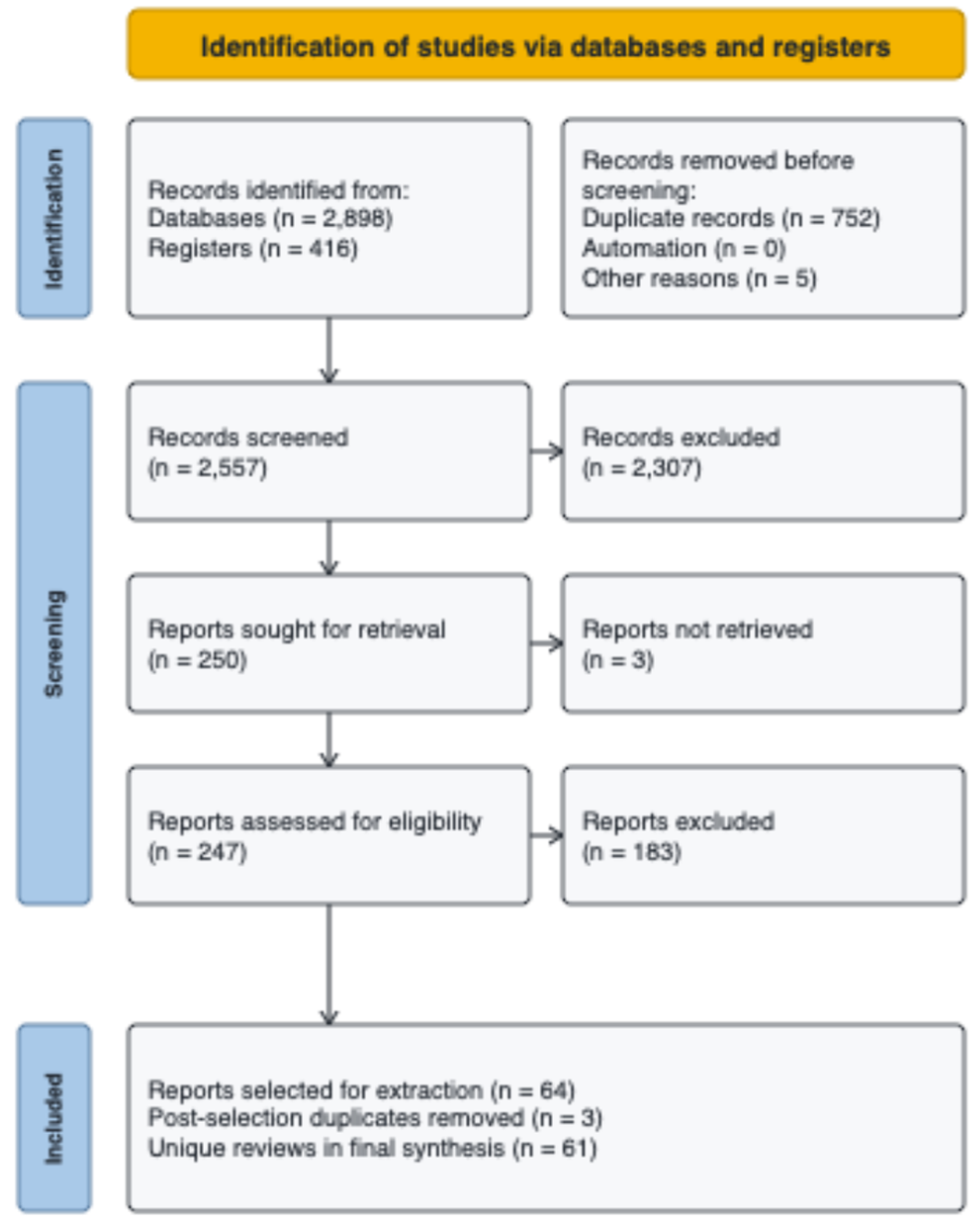
Figure 2.
Review-level co-mention of leading clinical domains and intended functions. Categories are non-exclusive. Co-mention does not prove that a function was implemented or effective in a system from that domain.
Figure 2.
Review-level co-mention of leading clinical domains and intended functions. Categories are non-exclusive. Co-mention does not prove that a function was implemented or effective in a system from that domain.
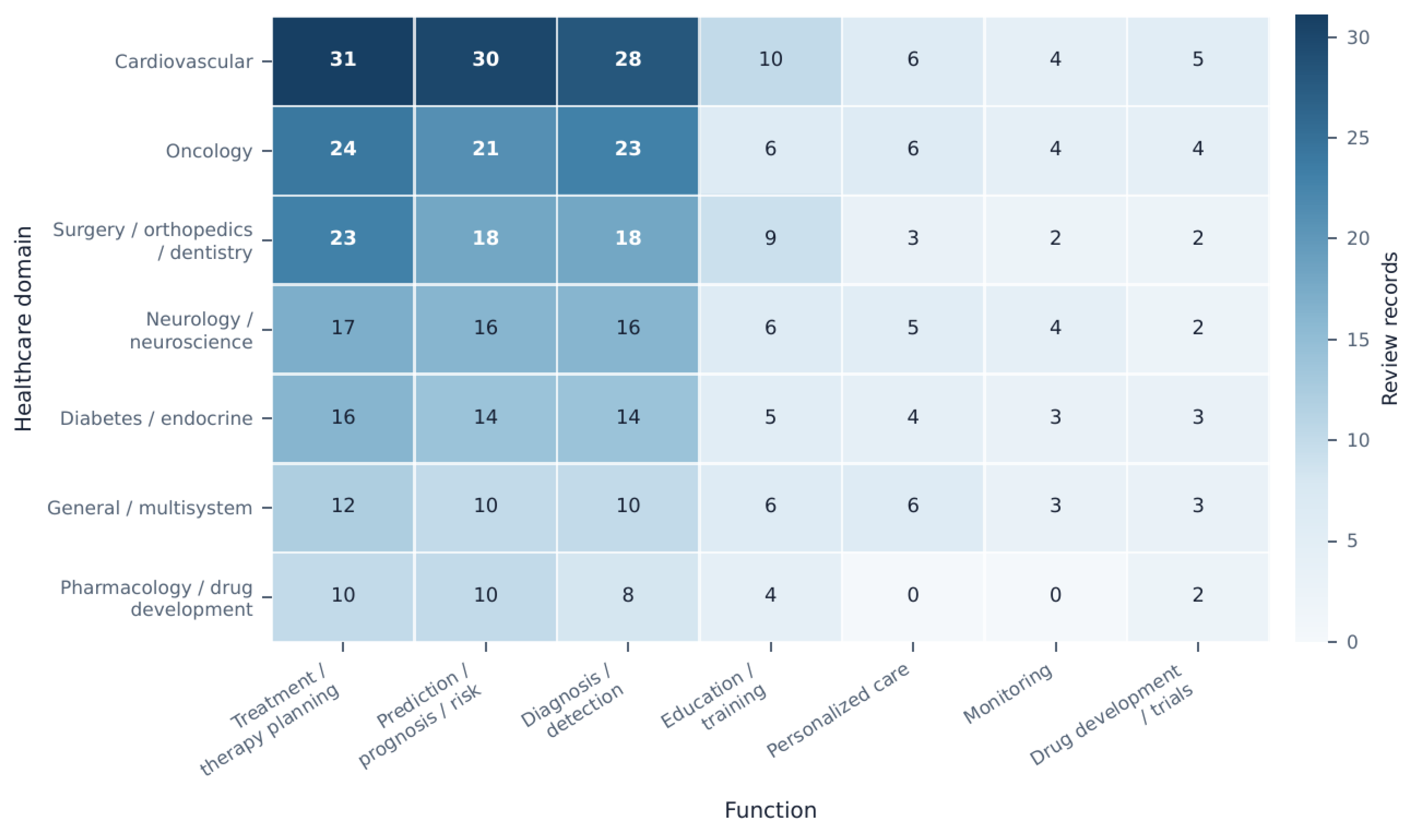
Figure 3.
Four-gate adoption framework derived from review-level barrier themes and contextual standards. Counts are non-exclusive review mentions. The sequence is an implementation hypothesis, not a validated maturity or risk score.
Figure 3.
Four-gate adoption framework derived from review-level barrier themes and contextual standards. Counts are non-exclusive review mentions. The sequence is an implementation hypothesis, not a validated maturity or risk score.
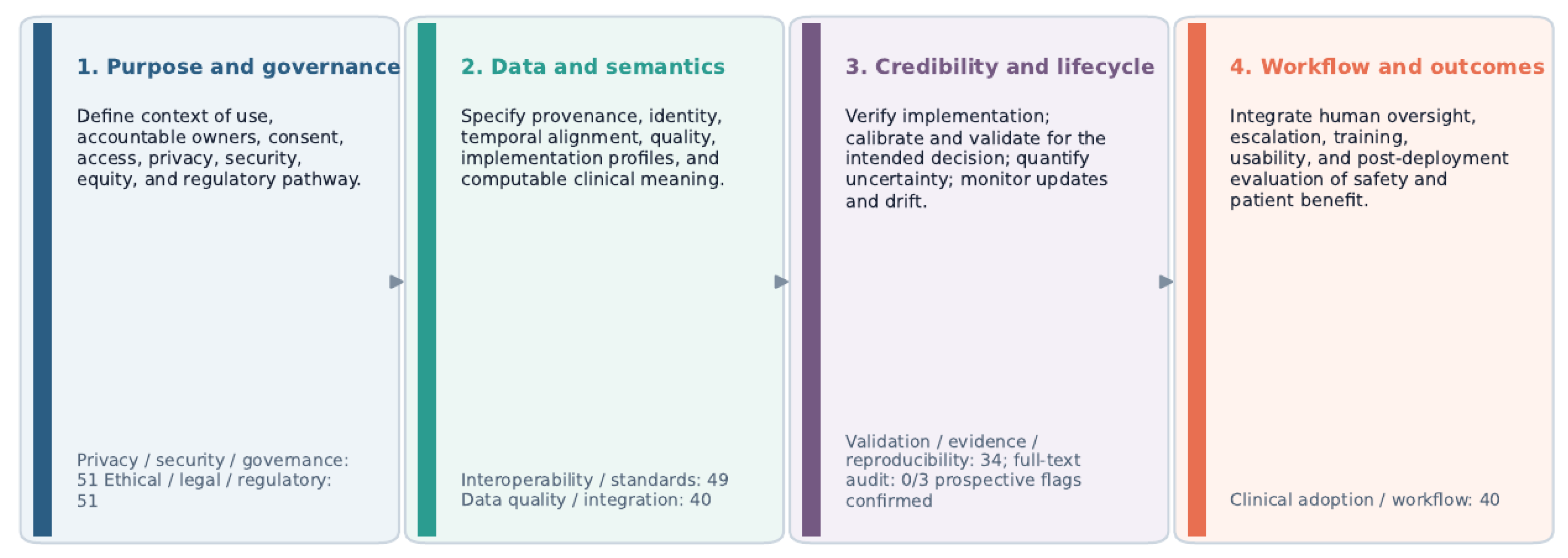

Table 1.
Characteristics of the included review evidence base.
| Dimension | Summary findings | Analytical context |
| Evidence base | 64 records selected for extraction; 3 post-selection duplicates excluded; 61 unique reviews analyzed. | Duplicate exclusions were applied before all classifications and counts. |
| Publication years | Journal-issue year was used consistently: 2022 (5); 2023 (8); 2024 (19); 2025 (27); 2026 (2). | P06, P38, P42, and P44 were reconciled; online-first dates remain in citation notes. |
| Protocol scope | English-language reviews from 2020 onward addressing patient-linked physiological, biomechanical, biological, or adjacent computational representations; the specific grey-literature clause allowed preprints not subsequently published. | Defines the evidence base and supports retaining P16, P34, and P43 as labelled preprints. |
| Dominant domains | Cardiovascular (32); Oncology (25); Surgery / orthopedics / dentistry (24); Neurology / neuroscience (18); Diabetes / endocrine (17); General / multisystem (15) | Shows the breadth of clinical applications. |
| Our review appraisal | High: 11; moderate: 14; low: 5; very low: 9; not assessed: 21; qualitative-only: 1. | AMSTAR 2 or SANRA ratings appraise included reviews. |
| Source-review appraisal | 11 of 61 reviews reported formal appraisal of their included evidence. | This extracted characteristic is distinct from our appraisal. |
Table 2.
Applications by healthcare domain and function.
| Application layer | Summary findings | Analytical context |
| Healthcare domains | Cardiovascular (32); Oncology (25); Surgery / orthopedics / dentistry (24); Neurology / neuroscience (18); Diabetes / endocrine (17); General / multisystem (15); Pharmacology / drug development (10); Pulmonary / respiratory (9); Dermatology / ophthalmology (3) | Applications crossed clinical specialties. |
| Reported function categories | Treatment / therapy planning (56); Prediction / prognosis / risk (49); Diagnosis / detection (46); Education / training (19); Personalized care (9); Monitoring (8); Drug development / trials (7); Decision support (5) | Categories were non-exclusive review-level mentions. |
| Domain–function overlap | Reviews could match multiple domain–function pairs. | Co-mention does not show that features occurred in the same underlying model. |
| Translation | Functions reported in reviews were not necessarily deployed clinically. | Application breadth was not indicative of maturity. |
Table 3.
Barriers and limitations reported across review records. Counts are non-exclusive review-level mentions and do not indicate failure rates of deployed systems.
Table 3.
Barriers and limitations reported across review records. Counts are non-exclusive review-level mentions and do not indicate failure rates of deployed systems.
| Barrier category | Reviews, n | Proposed adoption implication |
| Privacy / security / governance | 51 | Include privacy, consent, security, access control, and stewardship in the conceptual framework. |
| Ethical / legal / regulatory | 51 | Define accountability, fairness, transparency, liability, and regulatory pathways. |
| Computing / scalability / resources | 51 | Treat scalable, reproducible computational environments as translational infrastructure. |
| Interoperability / standards | 49 | Use implementation profiles and shared semantics to reduce fragmented integration. |
| Clinical adoption / workflow | 40 | Evaluate clinician trust, workflow fit, implementation burden, and workforce needs. |
| Data quality / availability / integration | 40 | Prioritize longitudinal, multimodal, harmonized, representative datasets. |
| Validation / evidence / reproducibility | 34 | Make prospective validation, benchmarks, uncertainty, and reproducibility core requirements. |
Table 4.
Standards-informed priorities mapped to the review-level barrier synthesis. The proposed priorities combine extracted review-level barrier categories with contextual standards and implementation science. They are not frequency-ranked, empirically derived requirements, or a validated implementation instrument.
Table 4.
Standards-informed priorities mapped to the review-level barrier synthesis. The proposed priorities combine extracted review-level barrier categories with contextual standards and implementation science. They are not frequency-ranked, empirically derived requirements, or a validated implementation instrument.
| Proposed priority | Evidence basis | Clinical-adoption purpose |
| Specify purpose and operational profile | Governance, ethics, workflow, and taxonomy context | Scale evidence and oversight to intended use, clinical influence, human role, and consequence of error. |
| Make data use and semantics traceable | Data-quality, governance, and interoperability categories | Distinguish offline calibration, operational state updating, contextual display, and feedback or actuation paths. |
| Build an intended-use credibility case | Validation and reproducibility plus model-credibility standards | Separate review quality from model fitness; define verification, validation, uncertainty, transportability, and change control. |
| Evaluate workflow and human factors | Clinical-adoption and workflow category plus human-centered design methods | Test usability, workload, handoffs, override, contingency procedures, training, and human–system performance with intended users. |
| Generate prospective outcome evidence | Maturity-language audit and source-review recommendations | Distinguish prospective verification, retrospective simulation, comparative evaluation, and post-deployment surveillance. |
| Govern infrastructure across the lifecycle | Computing, interoperability, privacy, and security categories | Specify measured service levels, resilience, cybersecurity, portability, monitoring, incident response, rollback, and retirement. |
Disclaimer/Publisher’s Note: The statements, opinions and data contained in all publications are solely those of the individual author(s) and contributor(s) and not of MDPI and/or the editor(s). MDPI and/or the editor(s) disclaim responsibility for any injury to people or property resulting from any ideas, methods, instructions or products referred to in the content. |
© 2026 by the authors. Licensee MDPI, Basel, Switzerland. This article is an open access article distributed under the terms and conditions of the Creative Commons Attribution (CC BY) license (http://creativecommons.org/licenses/by/4.0/).
Copyright: This open access article is published under a Creative Commons CC BY 4.0 license, which permit the free download, distribution, and reuse, provided that the author and preprint are cited in any reuse.