

Submitted:
06 September 2026
Posted:
08 September 2026
You are already at the latest version
Abstract
Faricimab (Vabysmo, Roche, EU) may improve treatment durability while maintaining functional and anatomical outcomes in neovascular age-related macular degeneration (nAMD). This single-centre retrospective study evaluated 52 eyes of 49 refractory nAMD patients switched from ranibizumab, aflibercept 2 mg, or brolucizumab to faricimab. Best-corrected visual acuity (BCVA), central retinal thickness (CRT), injection intervals, optical coherent tomography (OCT) fluid, and adverse events were assessed at baseline and last follow-up. Mean age was 78.8 years. Before switching, patients had received a mean of 21.85 injections over 996 days, and 77.4% were short responders, with a mean treatment interval of 6.3 weeks. After a mean 466 days of faricimab treatment, BCVA remained stable, changing from 0.389 to 0.378 logMAR (mean change −0.012 logMAR; p = 0.509). BCVA improved in 19.2%, remained stable in 67.3%, and worsened in 13.5% of eyes. CRT decreased significantly from 257.8 to 224.8 μm (mean change −32.9 μm; p = 0.00005). The mean injection interval increased to 8.0 weeks, reaching 8.42 weeks among eyes continuing faricimab. Thirteen eyes (25%) required switching to aflibercept 8 mg because of recurrent fluid or OCT worsening. No endophthalmitis or severe intraocular inflammation occurred. Faricimab maintained vision, improved macular anatomy, and reduced treatment burden, although some refractory eyes required further treatment escalation.
Keywords:
age-related macular degeneration
; faricimab
; anti-VEGF
; switch
; real world evidence
; intravitreal injections
; treatment burden
1. Introduction
Neovascular age related macular degeneration (nAMD) is a leading cause of irreversible central visual loss in elderly people worldwide and requires long term intravitreal anti VEGF therapy to stabilize or improve vision. [1,2]While current agents such as ranibizumab, aflibercept 2 mg, and brolucizumab are effective, many patients require injections at intervals shorter than 8 weeks to maintain disease control. This results in a substantial treatment and logistical burden. This burden is particularly pronounced in older, frail patients who face difficulties related to transport, caregiver support, and procedure related anxiety, and who may become physically and psychologically exhausted by the treatment itself. [1,3]
Despite intensive therapy, a proportion of eyes demonstrate persistent or recurrent intraretinal or subretinal fluid, retinal pigment epithelium detachment, or inadequate extension of injection intervals, classically defined as “short responders”. These eyes remain vulnerable to cumulative structural damage and functional decline over time, and there is an unmet need for strategies that can provide more durable control of exudation without increasing visit frequency. [4]
Faricimab is a bispecific monoclonal antibody that simultaneously inhibits vascular endothelial growth factor A (VEGF A) and Angiopoietin 2 (Ang-2), targeting two key pathways involved in macular neovascular membrane formation, vascular permeability and instability. Phase III clinical trials in nAMD have demonstrated that faricimab can maintain visual outcomes with dosing intervals up to 16 weeks in many patients, suggesting the potential to reduce treatment burden while preserving efficacy. [5] But real-world data for faricimab in treatment experienced, refractory nAMD eyes, especially in Eastern European populations, are still limited.
The primary aim of this study was to evaluate the functional and anatomical outcomes of switching to faricimab in a cohort of refractory nAMD patients previously treated with other anti VEGF agents in a single centre in Nowy Sącz, Poland. Secondary aims included assessing the change in injection intervals, the persistence or resolution of retinal fluid on OCT, and the safety profile of faricimab in this real-world setting.
2. Materials and Methods
This was a single centre retrospective cohort study conducted at the Prof. Zagórski Eye Surgery Centre in Nowy Sącz, Poland. All consecutive nAMD patients who were switched from another anti VEGF agent to faricimab (Vabysmo, Roche, EU) between 7 May 2024 and 8th April 2025 were screened for inclusion. Data were extracted from electronic medical records and an internal treatment registry.
Eligible patients were adults with a diagnosis of nAMD in at least one eye, previously treated with intravitreal ranibizumab, aflibercept 2 mg, or brolucizumab, who were switched to faricimab and had at least 9 months of follow up after the switch. Included eyes were characterized as refractory or short responder based on the need for frequent injections and/or persistent or recurrent intraretinal or subretinal fluid despite optimized treatment.
52 eyes (49 patients - 18 men and 31 women) were included at baseline. Last dates of follow-up visits were between 6th Dec 2025 to 19th May 2026. At the end of the observation period, 39 eyes remained on faricimab, while 13 patients discontinued faricimab due to anatomical worsening at the minimum interval of 8 weeks and were switched to aflibercept 8 mg.
Before switching, patients had undergone long term anti VEGF therapy with ranibizumab, aflibercept 2 mg, and/or brolucizumab. The mean duration of prior treatment was 996 days (approximately 2.7 years; median 833 days), with a minimum of 286 days and a maximum of 2255 days. The mean number of injections prior to faricimab was 21.85 per eye (median 18.5; standard deviation ±13.72). More than half of theses eyes (55.8%) had been treated with one anti VEGF agent, 32.7% with two agents, and 11.5% with three agents before the switch. Injection intervals before faricimab were short, reflecting the refractory nature of the cohort: the mean interval between injections was 43.9 days (6.3 weeks; median 43.3 days, 6.2 weeks; standard deviation ±8.5 days). Short responders, defined as eyes in whom the interval could not be extended beyond 4 weeks without fluid recurrence, accounted for 77.4% of the cohort (40 eyes). Demographics and baseline data are summarized in Table 1.
Faricimab (Vabysmo, Roche, EU) treatment protocol was as follows. All eyes received four consecutive monthly injections of faricimab according to a loading (saturation) regimen, followed by individualized treat and extend dosing based on OCT and clinical findings. The mean duration of faricimab therapy during the observation period was 466 days (approximately 1.28 years; median 494 days; range 286–623 days). The mean number of faricimab injections was 8.33 per eye (median 8 injections). Injection intervals were extended in 4-week steps when OCT showed no new or increased intraretinal or subretinal fluid and were shortened when fluid recurred or vision deteriorated. The eyes, where disease worsened despite dosing at a required minimum interval of 8 weeks, after at least seven faricimab injections, were considered for a subsequent switch to aflibercept 8 mg (Eylea 8, Bayer, EU).
The primary functional outcome was BCVA (decimal, converted to logMAR) recorded at baseline (first faricimab injection) and at the last faricimab visit. Primary anatomical outcome was CRT measured by spectral domain OCT at the same time points. Secondary outcomes included change in injection interval (weeks) on faricimab and presence of intraretinal, subretinal, or sub-RPE fluid at baseline, and at the last faricimab visit. Potential treatment adverse events were also evaluated. Proportion of eyes with improved, stable, or worsened BCVA and CRT was assessed. Relationship between fluid persistence or recurrence and functional outcomes, including analysis of patients deteriorating after extension to 8-week intervals was evaluated, too.
2.1. Statistical Analysis
Continuous variables were reported as mean, standard deviation, median, and range. Paired t tests were used to compare BCVA and CRT before and after switching to faricimab. For categorical variables (e.g., presence of fluid, worsening after extension), chi square tests of independence were employed, and effect size was estimated using the phi coefficient. A pvalue < 0.05 was considered statistically significant.
3. Results
3.1. Baseline Characteristics
The study included 52 eyes (49 patients). Mean age in the cohort was 78.8 years. The eyes were heavily pretreated. Mean prior treatment duration was 996 days (median 833 days), and the mean number of prior injections was 21.85 (median 18.5). Most eyes (55,8%) had received one anti VEGF agents before faricimab, 32.7% eyes had had two, and 11.5% of eyes had had three medications before the switch. Baseline visual function reflected chronic disease: mean BCVA was 0.444 in decimal scale (equivalent to 0.389 logMAR), indicating moderate visual impairment. Mean CRT at baseline was 257.8 μm, suggesting residual but not massive exudation. A high proportion of eyes (77,4%) required short injection intervals prior to switching, with a mean of 6.3 weeks; There were classified as short responders to treatment.
3.2. Treatment Exposure and Injection Interval
During faricimab therapy, the eyes were followed for a mean of 466 days (median 494 days), receiving a mean of 8.33 injections. The mean injection interval increased from 6.3 weeks before switching to 8.0 weeks after switching to faricimab. Among the 39 eyes that remained on faricimab at the end of follow up, the mean interval further extended to 8.42 weeks (mean 59.0 days; median 61 days; standard deviation 9.6 days). Fig.1 showes distribution of treatment intervals between previous antiVEGF medications and faricimab.
Thirteen eyes (25%) discontinued faricimab due to anatomical worsening or fluid recurrence despite an 8-week interval and after at least seven faricimab injections. These eyes were switched to aflibercept 8 mg. This subgroup represents a distinct population with persistently active disease despite dual-pathway inhibition.
3.3. Visual Outcomes
Mean BCVA remained stable following the switch to faricimab. The mean BCVA changed from 0.389 logMAR at baseline to 0.378 logMAR at the last visit, corresponding to a mean change of −0.012 logMAR. This change was not statistically significant (paired t test, t=0.665, p=0.509). Fig.2 shows mean BCVA response on faricimab over time – first 12 months of treatment.
When BCVA was categorised, 19,23% of eyes experienced an improvement in visual acuity, 67,31% remained stable, and 13,46% worsened (improvement or worsening were defined as a change of at least 0,1 logMar). The median change in BCVA was 0 logMAR, and the standard deviation of 0.126 indicated substantial inter individual variability. The small mean improvement, combined with a high variability, explains the lack of statistical significance despite a meaningful proportion of eyes with functional gain. These findings suggest that in this chronically treated, structurally compromised cohort, faricimab primarily stabilized visual acuity rather than producing large functional gains, which is consistent with the advanced disease stage and long prior treatment history.
3.4. Anatomical Outcomes
In contrast to visual outcomes, anatomical response was robust. Mean CRT decreased from 257.8 μm at baseline to 224.8 μm following faricimab treatment, representing a mean reduction of 32.9 μm (median −27.0 μm; standard deviation 53.6 μm). This reduction was statistically significant (paired t test, t=4.43, p=0.00005); (Fig.3.).
CRT decreased in 55,77% of eyes, stabilized in 38,46% and increased in 5,77% - decreases or increases were defined as a change of at least 10% in CRT. The negative median change confirms that most patients exhibited improvement, while the relatively large standard deviation points to heterogeneity in anatomical response. These data indicate a strong anatomical effect of faricimab on macular thickness, even in eyes with long standing disease and prior intensive anti-VEGF exposure.
3.5. Retinal Fluid and Response Patterns
Persistent or recurrent intraretinal or subretinal fluid remained an important issue in a subset of eyes. In 18 eyes (34.6%), an increase in subretinal fluid was observed after extension of the injection interval with faricimab following the loading phase. At the last faricimab visit, 17 eyes (32.7%) still had retinal fluid on OCT, indicating an incomplete anatomical response. Among eyes which showed worsening after extension to an 8 week interval, 15 of 18 (83%) had persistent fluid at the last assessed visit. In contrast, only 2 of 34 eyes (6%) without anatomical worsening had fluid at the last visit. Chi square analysis demonstrated a highly significant association between visual deterioration after extension and the presence of fluid (chi square 28.66, p=0.000001), with a large effect size (phi = 0.74).
These results suggest that eyes which deteriorate after interval extension are very likely to exhibit persistent exudation and may require either interval shortening or a switch to another agent, such as aflibercept 8 mg. Our data also highlight that while faricimab improves anatomy in most eyes, there remains a subgroup with partial or inadequate response.
3.6. Safety
No cases of endophthalmitis or severe intraocular inflammation were reported during faricimab treatment in this cohort. No systemic safety signals attributable to the drug were identified in the medical records. Faricimab was well tolerated and did not raise new safety concerns in our group.
4. Discussion
This single centre, real world study provides evidence that switching to faricimab can stabilize visual acuity, significantly improve macular anatomy, and extend injection intervals in heavily pretreated, predominantly short responder nAMD patients. The mean extension of injection intervals from 6.3 to 8.0 weeks overall, and to 8.42 weeks among eyes remaining on faricimab, is clinically meaningful for elderly patients burdened by frequent visits. The marked anatomical response, with a mean CRT reduction of 32.9 μm and improvement in over 55% and stabilization in 38% of eyes (overall 94%of eyes) underscores the biological activity of dual VEGF A/Ang 2 inhibition in this setting.
The lack of statistically significant visual acuity improvement despite substantial CRT reduction reflects the chronicity and severity of disease in this cohort. These eyes had been treated for nearly three years on average and had received more than 20 prior injections, which may have led to irreversible photoreceptor and retinal pigment epithelium damage. In such eyes, anatomical improvements may not translate directly into visual gains, but the preservation of vision over an extended follow up is still clinically important. [6]
Our findings are broadly consistent with previously published real-world studies evaluating switch to faricimab in pre-treated nAMD patients. Several studies investigated patients with a suboptimal response to prior anti-VEGF therapy and reported comparable outcomes - significant anatomical improvements, stabilization of BCVA and extension of dosing intervals. [7,8,9,10] Some other published data showed even better outcomes, additionally observing an improvement in BCVA. [11,12]
The presence of a subgroup of eyes (approximately one quarter) which deteriorated anatomically or/and functionally despite minimum 8-week dosing and required changing treatment strategy highlights ongoing unmet needs in refractory nAMD. Importantly, this does not necessarily imply treatment failure of faricimab itself but rather reflects the severity and chronicity of disease in a subgroup of highly treatment-resistant eyes. Switching anti-VEGF agents may provide temporary or partial benefit in some patients but does not completely overcome the underlying complexity of chronic neovascular AMD. Our findings appear consistent with this broader concept of incomplete responsiveness in advanced disease. [13]Careful OCT guided monitoring remains essential, even when using more durable agents. One of previously published studies showed that there were eyes, whose condition worsened due to the fluid persistence, visual acuity or both, despite switching to faricimab. However, the proportion of such eyes was lower than in our group. [14]
From a practical standpoint, this study underscores the value of faricimab as a strategy to reduce treatment burden in real world clinical practice. Many patients in our cohort were exhausted by frequent visits and injections, with transportation difficulties, anxiety, and need for caregivers contributing to overall burden. The ability to safely extend injection intervals without sacrificing anatomical control in most eyes is particularly relevant in such populations. [9,10]
Strengths of this study include its focus on a clearly defined, difficult to treat cohort and the use of detailed registry data, including quantitative analysis of injection intervals, BCVA, CRT, and fluid status. Limitations include its retrospective design, single centre setting, relatively small sample size, and absence of a parallel control group continuing prior anti VEGF therapy. In addition, follow up duration varied between patients, and functional outcomes may have been influenced by cataract progression, coexisting other ocular pathologies, or systemic factors not fully captured in the registry.
Future research should include larger, multicentre real-world cohorts and prospective studies comparing faricimab with other strategies, such as aflibercept 8 mg or combination regimens, particularly in patients with persistent fluid or limited functional reserve. Exploratory analyses investigating predictors of good versus poor response to faricimab, including baseline OCT biomarkers and prior treatment patterns, may help refine patient selection and individualized treatment protocols.
5. Conclusion
In this real-world cohort of heavily pretreated, refractory nAMD patients in the single centre in Poland, switching from other anti-VEGF agents to faricimab allowed to maintain visual acuity over approximately 9-12 months of follow-up in most of the study eyes. It allowed to significantly reduce CRT and extend injection intervals. A subset of patients with persistent fluid and functional deterioration after interval extension required further switching to aflibercept 8 mg, which indicate that dual pathway inhibition may not overcome treatment resistance. Faricimab seems to be a valuable therapeutic option for nAMD eyes requiring frequent injections, particularly for previously treated eyes, which still have active disease.
Author Contributions
Author Contributions: Conceptualization, M.O., A.K.K, and T.U.; methodology, M.O., P Ł., formal analysis, M.O., P. Ł., A. K.K.; investigation, M.O., PŁ., K.J. data curation, M.O., P.Ł., T.U., K.J., writing—original draft preparation, A.K.K and M.O.; writing—review and editing, all authors; supervision AKK. All authors have read and agreed to the published version of the manuscript.
Funding
APC support by Roche Poland.
Institutional Review Board Statement
The study adhered to the principles of the Declaration of Helsinki. No approval of ethical committee was required due to retrospective analysis of the records with full anonymization of personal patients’ data.
Informed Consent Statement
Informed consent was obtained from all subjects involved in the study. Written informed consent has been obtained from the patient(s) to use their anonymized data to publish this work.
Data Availability Statement
Data supporting the findings of this study are contained within the article and its supplementary materials; additional de identified data may be available from the corresponding author upon reasonable request.
Acknowledgments
For tables creation and editing and reference list creation according to MDPI style instructions (Life) Perplexity Gen AI, version 5.0 was used by A. K.K.
Conflicts of Interest
All Authors declare no relevant conflict of interest connected to this work.
Abbreviations:
The following abbreviations are used in this manuscript:
| nAMD | neovascular age-related macular degeneration |
| BCVA | best corrected visual acuity |
| CRT | central retinal thickness |
| VEGF A | vascular endothelial growth factor A |
| Ang-2 | angiopoetin-2 |
| OCT | optical coherent tomography |
| SRF | subretinal fluid |
| IRF | intraretinal fluid |
| E-2 | Eylea (aflibercept) 2mg |
| E-8 | Eylea (aflibercept) 8mg |
References
- Wong, W.L.; Su, X.; Li, X.; Cheung, C.M.G.; Klein, R.; Cheng, C.-Y.; Wong, T.Y. Global Prevalence of Age-Related Macular Degeneration and Disease Burden Projection for 2020 and 2040: A Systematic Review and Meta-Analysis. Lancet Glob. Health 2014, 2, e106–e116. [Google Scholar] [CrossRef]
- Li, J.Q.; Welchowski, T.; Schmid, M.; Mauschitz, M.M.; Holz, F.G.; Finger, R.P. Prevalence and Incidence of Age-Related Macular Degeneration in Europe: A Systematic Review and Meta-Analysis. Br. J. Ophthalmol. 2020, 104, 1077–1084. [Google Scholar] [CrossRef]
- Holz, F.G.; Tadayoni, R.; Beatty, S.; Berger, A.; Cereda, M.G.; Cortez, R.; Hoyng, C.B.; Hykin, P.; Staurenghi, G.; Heldner, S.; et al. Multi-Country Real-Life Experience of Anti-Vascular Endothelial Growth Factor Therapy for Wet Age-Related Macular Degeneration. Br. J. Ophthalmol. 2015, 99, 220–226. [Google Scholar] [CrossRef]
- Gigon, A.; Iskandar, A.; Kasser, S.; Naso, S.; Zola, M.; Mantel, I. Short-Term Response to Anti-VEGF as Indicator of Visual Prognosis in Refractory Age-Related Macular Degeneration. Eye 2024, 38, 1342–1348. [Google Scholar] [CrossRef]
- Heier, J.S.; Khanani, A.M.; Quezada Ruiz, C.; Basu, K.; Ferrone, P.J.; Brittain, C.; Figueroa, M.S.; Lin, H.; Holz, F.G.; Patel, V.; et al. Efficacy, Durability, and Safety of Intravitreal Faricimab up to Every 16 Weeks for Neovascular Age-Related Macular Degeneration (TENAYA and LUCERNE): Two Randomised, Double-Masked, Phase 3, Non-Inferiority Trials. The Lancet 2022, 399, 729–740. [Google Scholar] [CrossRef]
- Downey, L.; Sivaprasad, S.; Chhabra, R.; Bailey, C.; Chakrabarti, S.; Elsherbiny, S.; Patel, J.; Silvestri, G.; Watson, S.-L.; Williams, G.; et al. Dual Pathway Inhibition with Faricimab for Previously Treated Neovascular Age-Related Macular Degeneration and Diabetic Macular Oedema: Guidance from a UK Panel of Retina Specialists. Eye 2024, 38, 3077–3086. [Google Scholar] [CrossRef]
- CDA-AMC Faricimab (Vabysmo). Can. J. Health Technol. 2025, 5. [CrossRef]
- Janmohamed, I.K.; Mushtaq, A.; Kabbani, J.; Harrow, S.; Nadarajasundaram, A.; Ata, A.; Monye, H.; Jarrar, Z.; Hannan, S.; Membrey, L. 1-Year Real-World Outcomes of Faricimab in Previously Treated Neovascular Age-Related Macular Degeneration. Eye 2025, 39, 1344–1348. [Google Scholar] [CrossRef]
- Sim, S.Y.; Chalkiadaki, E.; Koutsocheras, G.; Nicholson, L.; Sivaprasad, S.; Patel, P.J.; Selvam, S.; Pal, B.; Keane, P.A.; Bhatia, B.; et al. Real-World 1-Year Outcomes of Treatment-Intensive Neovascular Age-Related Macular Degeneration Switched to Faricimab. Ophthalmol. Retin. 2025, 9, 22–30. [Google Scholar] [CrossRef]
- Grimaldi, G.; Ambresin, A.; Pfister, I.B.; Schild, C.; Plasencia, C.; Hatz, K.; Stillenmunkes, R.; Munk, M.R.; Paris, A.; Menghini, M.; et al. One-Year Outcomes after Switching to Faricimab in Eyes with Pretreated Neovascular Age-Related Macular Degeneration: A Swiss Retina Research Network Report. Ophthalmol. Retin. 2025, 9, 838–847. [Google Scholar] [CrossRef]
- Rush, R.B. One-Year Outcomes of Faricimab Treatment for Aflibercept-Resistant Neovascular Age-Related Macular Degeneration. Clin. Ophthalmol. 2023, Volume 17, 2201–2208. [Google Scholar] [CrossRef]
- Leung, E.H.; Oh, D.J.; Alderson, S.E.; Bracy, J.; McLeod, M.; Perez, L.I.; Bottini, A.; Chin Yee, D.; Mukkamala, K. Initial Real-World Experience with Faricimab in Treatment-Resistant Neovascular Age-Related Macular Degeneration. Clin. Ophthalmol. 2023, Volume 17, 1287–1293. [Google Scholar] [CrossRef]
- Penha, F.M.; Masud, M.; Khanani, Z.A.; Thomas, M.; Fong, R.D.; Smith, K.; Chand, A.; Khan, M.; Gahn, G.; Melo, G.B.; et al. Review of Real-World Evidence of Dual Inhibition of VEGF-A and ANG-2 with Faricimab in NAMD and DME. Int. J. Retin. Vitr. 2024, 10. [Google Scholar] [CrossRef]
- Ambati, N.R.; Leone, A.; Brill, D.; Sisk, R.A. REAL-WORLD LONG-TERM OUTCOMES OF INTRAVITREAL FARICIMAB IN PREVIOUSLY TREATED CHRONIC NEOVASCULAR AGE-RELATED MACULAR DEGENERATION. Retina 2025, 45, 446–453. [Google Scholar] [CrossRef]
Figure 1.
Treatment intervals in the cohort.
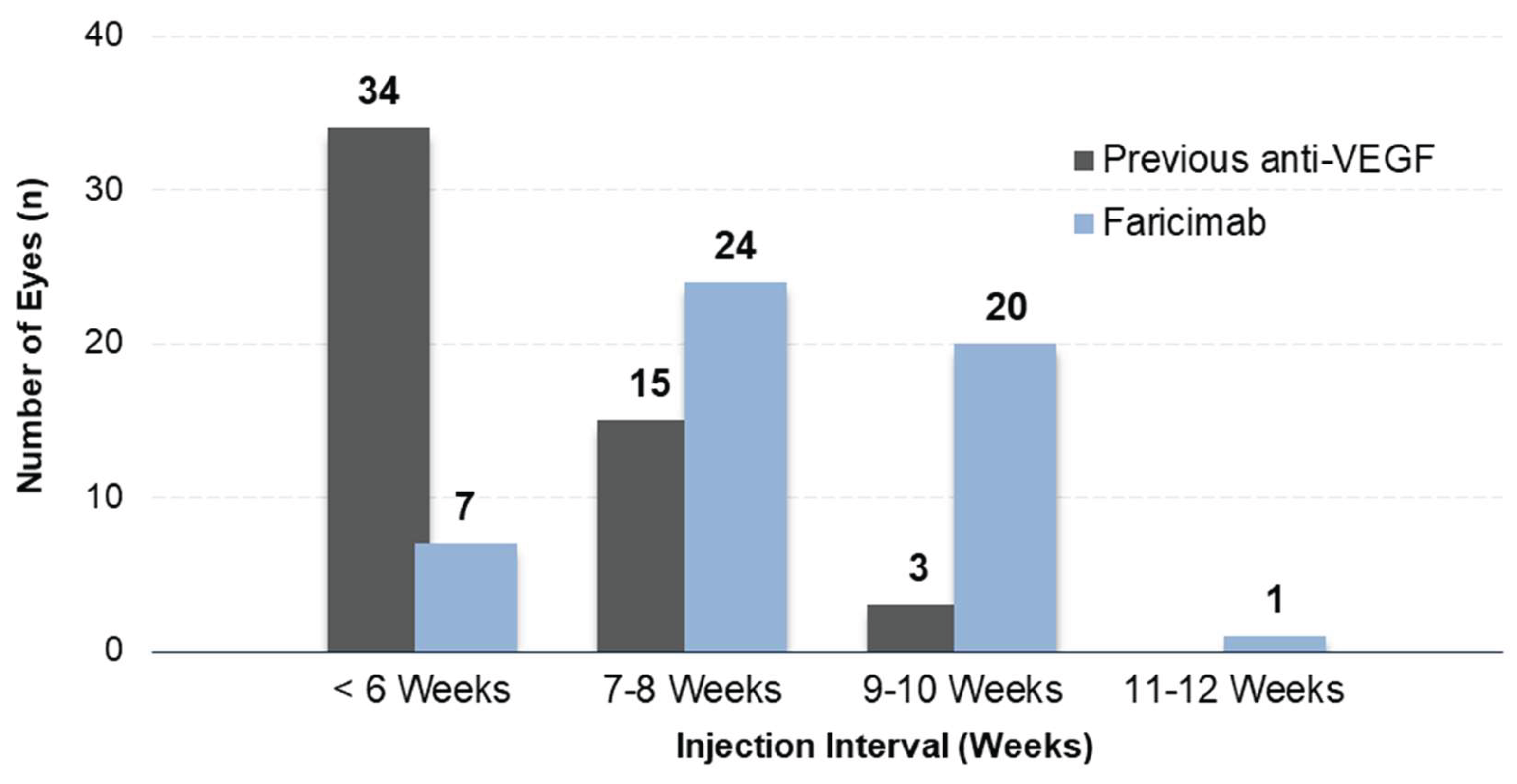
Figure 2.
BCVA change as a response to faricimab. Note sustained BCVA over time.
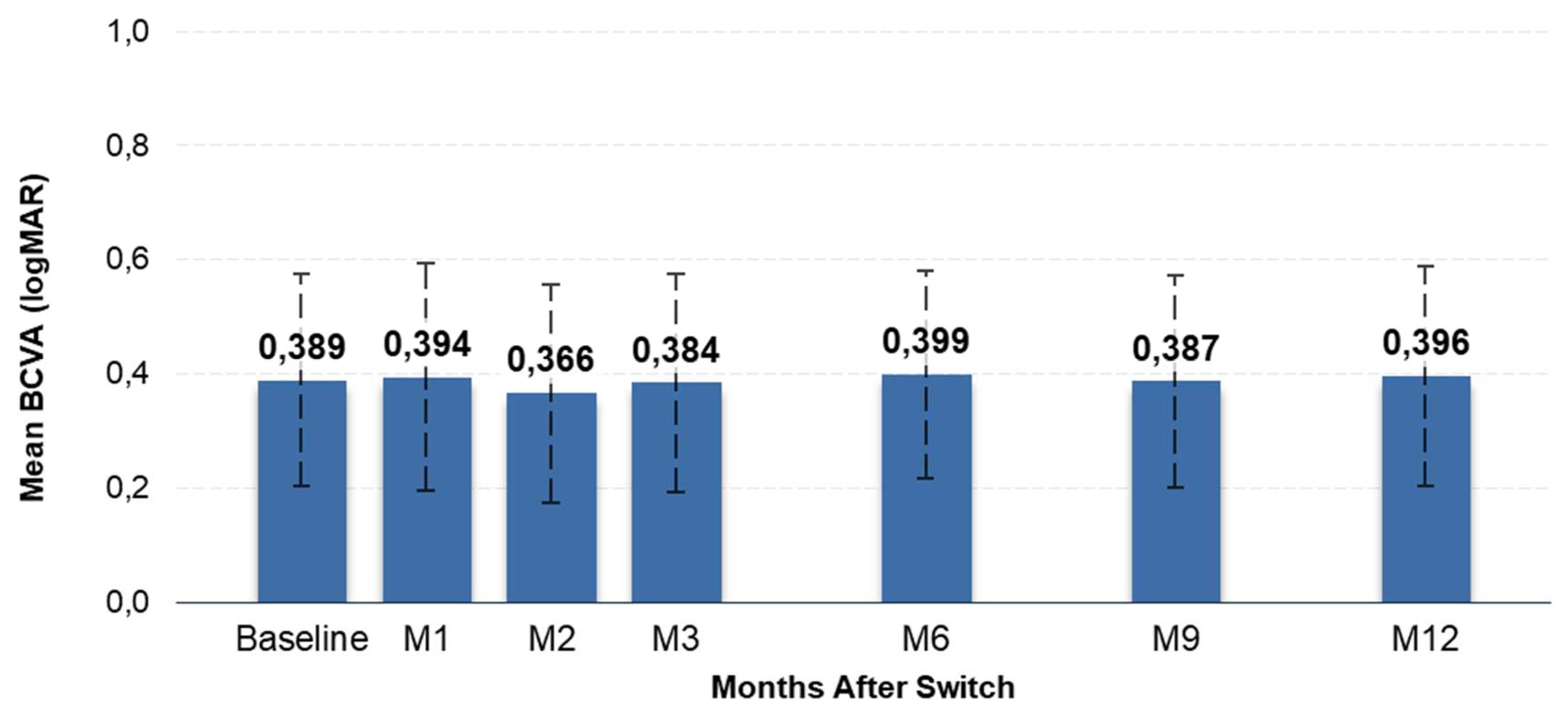
Figure 3.
Mean CRT response on faricimab over time – first 12 months of treatment.
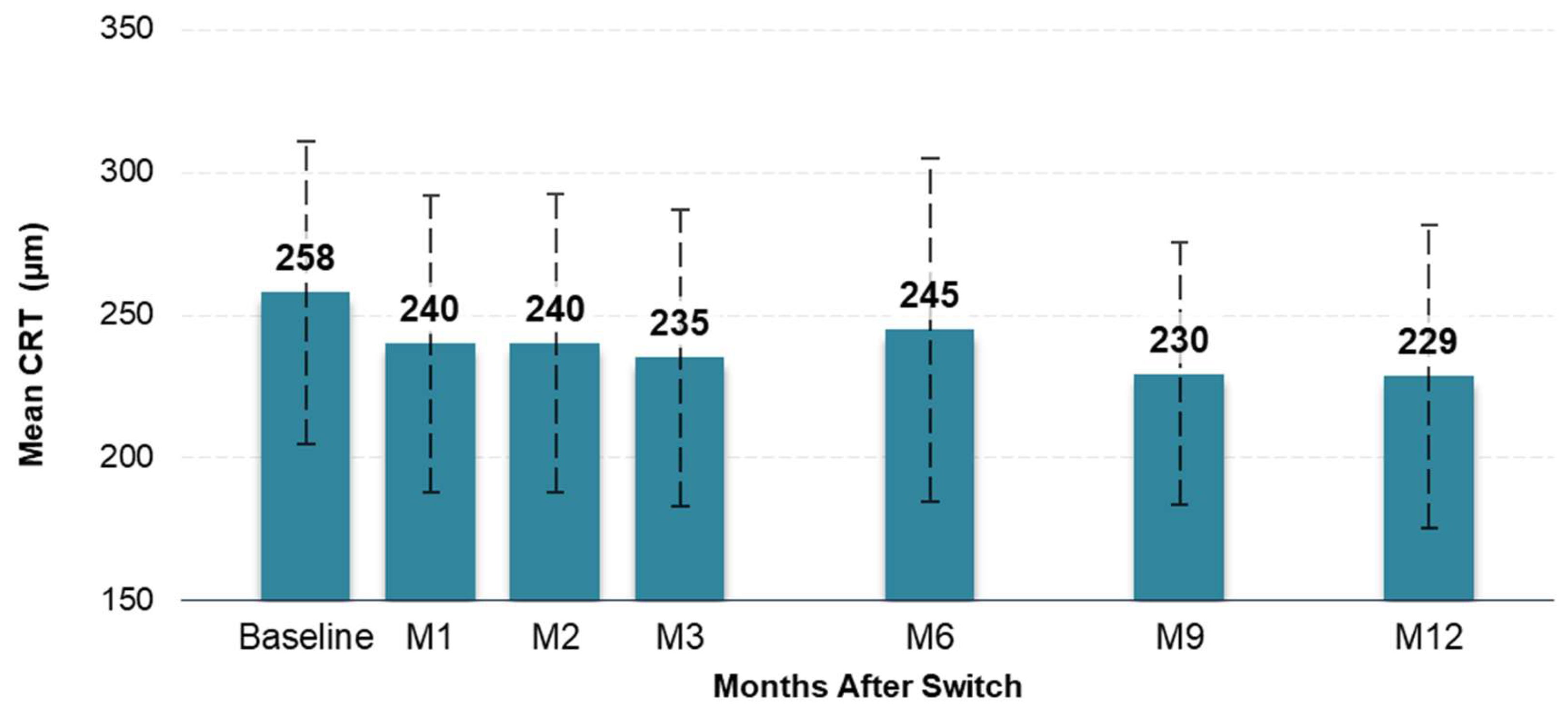

Table 1.
Demographic and baseline.
| Value (n) | Characteristic |
| 52 | Eyes, n |
| 49 | Patients, n |
| 31/18 | Female/male patients, n |
| 78.8 | Mean age, years |
| 996 (833) | Prior anti-VEGF treatment duration, days, mean (median) |
| 2.7 | Prior anti-VEGF treatment duration, years, mean |
| 21.85 (18.5) | Previous anti-VEGF injections per eye, mean (median) |
| 29 (55.8) | Eyes previously treated with one agent, n (%) |
| 17 (32.7) | Eyes previously treated with two agents, n (%) |
| 6 (11.5) | Eyes previously treated with three agents, n (%) |
| 43.9 | Pre-switch injection interval, days, mean |
| 6.3 | Pre-switch injection interval, weeks, mean |
| 40 (77.4) | Short responders, n eyes (%) |
| 0.389 | Baseline BCVA, logMAR, mean |
| 0.444 | Baseline BCVA, decimal, mean |
| 257.8 | Baseline CRT, µm, mean |
Disclaimer/Publisher’s Note: The statements, opinions and data contained in all publications are solely those of the individual author(s) and contributor(s) and not of MDPI and/or the editor(s). MDPI and/or the editor(s) disclaim responsibility for any injury to people or property resulting from any ideas, methods, instructions or products referred to in the content. |
© 2026 by the authors. Licensee MDPI, Basel, Switzerland. This article is an open access article distributed under the terms and conditions of the Creative Commons Attribution (CC BY) license (http://creativecommons.org/licenses/by/4.0/).
Copyright: This open access article is published under a Creative Commons CC BY 4.0 license, which permit the free download, distribution, and reuse, provided that the author and preprint are cited in any reuse.