

Submitted:
05 September 2026
Posted:
08 September 2026
You are already at the latest version
Abstract
Large language models (LLMs) generate fluent text, but they hallucinate and work from knowledge that ages quickly. Retrieval-Augmented Generation (RAG) answers both challenges by grounding generation in external sources a reader can check. What is at stake is the trustworthy use of generative artificial intelligence (AI) in high-stakes domains such as education. Self-regulated learning (SRL) research has argued for decades that students who set goals, track their own progress, pick strategies deliberately and reflect on the results learn more deeply and retain more, and that these matters most in the loosely structured, learner-directed conditions typical of digital education platforms. This review examines where the two lines of work meet, and what evidence exists on how RAG systems are being designed, deployed and evaluated as support for self-regulated, personalised learning. We first trace RAG from classical information-retrieval models through neural dense retrieval to the current generation of large models. We then map its applications onto the phases of self-regulation: goal setting and planning, retrieval-grounded tutoring and conversational scaffolding, personalised content retrieval and adaptive sequencing, automated assessment and feedback, learning-analytics-based monitoring, curriculum-grounded content creation, and support for diverse learners. Thereafter we examine the challenges that qualify this promise, including retrieval-conditioned hallucination, data privacy and security risks specific to vector-based retrieval, algorithmic and retrieval fairness, interpretability of retrieved evidence, infrastructural and implementation barriers, and disruptions to academic integrity. In this review conclusion, it is noted that RAG offers a precisely feasible as well as progressively evidenced pathway to a personalised, scalable and pedagogically grounded support for self-regulated learning, but that realising this potential responsibly requires deliberate attention to quality of retrieval, rigour in terms of evaluation as well as learner agency rather than technical capability alone.
Keywords:
retrieval-augmented generation
; self-regulated learning
; personalised learning
; digital education
; large language models
; intelligent tutoring systems
; learning analytics
; educational technology
1. Introduction
Three terms get used interchangeably in discussions of AI in education, and they do not mean the same thing. Artificial intelligence (AI) is the broad field concerned with building systems that perform tasks associated with human intelligence. Machine learning (ML) is the subset of that field in which systems learn patterns from data rather than following rules written by hand. Generative AI is narrower again: large neural models that produce new text, code or media rather than classifying inputs into fixed categories [1]. Retrieval-Augmented Generation (RAG) sits inside generative AI as one particular way of building such a system. Instead of drawing only on what the model absorbed into its parameters during pre-training, a RAG system retrieves passages from an external knowledge store at query time and writes its answer from what it finds there [2]. That store can be updated without retraining the model. The retrieve-then-generate design was introduced to fix two known weaknesses of purely parametric large language models (LLMs). They hallucinate, producing fluent content that is simply wrong. They also cannot reach anything published after their training cutoff, or anything held privately by an institution or a course [3].
The appeal of RAG for education follows directly from these properties. Digital education platforms increasingly rely on generative AI to power conversational tutors, automated feedback tools, and content-recommendation engines, yet the correctness and provenance of what such tools say to learners carries pedagogical and, in professional or credentialing contexts, ethical weight that generic consumer chatbot use does not [4]. By grounding generated responses in a curated corpus, such as a course's syllabus, textbook, lecture transcripts, or an institution's assessment rubrics, a RAG-based educational tool can in principle offer the fluency and interactivity of a large language model while remaining traceable to a specific, auditable source. That property matters for self-regulated learning (SRL), the research tradition concerned with how learners plan, monitor and adjust their own thinking and motivation while working towards a goal [5,6,7]. Learners in loosely structured, self-paced digital environments have to regulate themselves far more than learners in a tightly scaffolded classroom. Technology that ignores this, or undercuts it by handing over answers without engaging the learner's own monitoring and strategy use, can make outcomes worse [8,9]. Keeping effort and interest up when the work gets hard is its own part of SRL, and it is the part that gets overlooked. A support tool has to handle motivation as well as cognitive and metacognitive strategy [10]. Reviews of scaffolding in computer-based learning environments do find measurable gains in planning and monitoring, provided the prompts and tools are designed well [11]. A recent scoping review has started mapping SRL constructs onto technology-enhanced learning research in higher education, and RAG sits inside that map [12]. RAG systems can be tied to a specific curriculum and set up to scaffold rather than simply answer. This review asks how far that combination can carry SRL support at scale.
Adoption is moving quickly on both the commercial and the institutional side, which adds urgency. Industry analysts put the global AI-in-education market at about USD 8.3 billion in 2025, rising to USD 11.4 billion in 2026 and USD 57.2 billion by 2033, a compound annual growth rate near 25.9 percent [13]. The RAG market alone was estimated at USD 1.2 billion in 2024 and is forecast to grow at roughly 49.1 percent annually, reaching USD 11.0 billion by 2030 [14]. In a few years RAG has gone from a research technique to deployed enterprise and educational infrastructure. That makes it worth asking what is actually known, technically and pedagogically, about RAG's role in supporting self-regulated personalised learning.
The review uses narrative synthesis, which suits a fast-moving and only partly peer-reviewed literature spread across computer science venues (NeurIPS, ACL, EMNLP, SIGIR, SIGKDD, AAAI), education-technology journals (British Journal of Educational Technology, Computers & Education, Journal of Computer Assisted Learning, Frontiers in Education), and preprint servers such as arXiv, where most recent RAG-in-education work appears first. Sources came from structured searches of Google Scholar, Scopus, IEEE Xplore, the ACM Digital Library, arXiv and ERIC between January and August 2026, combining the terms “retrieval-augmented generation,” “RAG,” “self-regulated learning,” “personalised learning,” “adaptive learning,” “intelligent tutoring,” and “digital education,” supplemented by forward and backward citation chasing from key surveys [3,15]. Given the pace of publication in this area, priority was given to work published or posted between 2023 and 2026, while foundational technical and theoretical sources predating this window were retained where they remain the primary reference for a concept still in active use.
2. Materials and Methods
This paper adopts a narrative review of literature on retrieval-augmented generation (RAG) in self-regulated and personalised learning. A narrative rather than systematic design was chosen because the field is young, methodologically heterogeneous, and dominated by system-description papers that do not share a common outcome measure, so meta-analytic synthesis is not yet feasible [16]. A narrative approach was therefore selected deliberately rather than by default, following the review-typology guidance that matches design to the maturity and heterogeneity of the underlying evidence base [17]. The review nonetheless follows a documented and reproducible search procedure, reported here so that readers can assess coverage and bias.
Literature was identified through structured searches of [Scopus, Web of Science, ACM Digital Library, IEEE Xplore, ERIC, and Google Scholar], covering publications from [2017] to [June 2026]. The lower bound was set at 2017 to capture the transformer architecture and the neural retrieval work that made RAG possible; foundational pre-2017 sources in information retrieval and self-regulated learning theory were added through backward citation chaining where they were required to establish conceptual lineage. Search strings combined three concept blocks with Boolean operators: (i) retrieval terms (“retrieval-augmented generation” OR “RAG” OR “retrieval-augmented” OR “grounded generation”); (ii) learning terms (“self-regulated learning” OR “personalised learning” OR “adaptive learning” OR “intelligent tutoring”); and (iii) context terms (“education” OR “digital learning” OR “learner”). Reference lists of included papers were screened for additional sources, consistent with evidence that no single database offers adequate coverage on its own and that multi-database searching with citation chaining improves retrieval completeness [18].
Records were included where they reported the design, deployment, or evaluation of a retrieval-grounded generative system in an educational setting, or where they contributed theoretical or empirical grounding on self-regulated learning that the review draws on directly. Records were excluded where they addressed retrieval or generation outside an educational context without transferable implications, where they were not available in English, or where they were non-peer-reviewed material other than widely cited preprints that introduce architectures central to the field. Preprints were retained selectively on that last basis and are identified as such in the reference list.
Figure 1 summarises the identification, screening, and synthesis workflow, adapted for a narrative review from the PRISMA 2020 reporting conventions [19]. Searches returned [n] records. After removal of duplicates and title and abstract screening, [n] full texts were assessed, of which [n] are cited here. Included sources were organised thematically rather than chronologically, using Zimmerman's three-phase model of self-regulated learning (forethought, performance, self-reflection) [5] as the organising frame for the applications discussed in Section 4, and an inductively derived category set for the challenges discussed in Section 5. Themes were developed by reading each source against both frames and revising the category boundaries iteratively until all included sources were accommodated, following the six-phase approach to thematic analysis of qualitative and documentary material [20].
3. Historical Development of Retrieval-Augmented Generation
3.1. Early Foundations: Information Retrieval and Computer-Assisted Instruction
The retrieval component of RAG has intellectual roots that precede neural networks by decades. Salton, Wong, and Yang's vector space model, published in 1975, represented documents and queries as vectors in a shared term space and ranked documents by geometric similarity to a query, establishing the basic retrieve-by-similarity paradigm that all subsequent dense and sparse retrieval methods, including those used in modern RAG pipelines, still instantiate in some form [21]. Probabilistic ranking functions such as Okapi BM25, formalised by Robertson and Zaragoza, extended this paradigm with term-frequency and document-length normalisation and remained the dominant sparse retrieval baseline against which neural retrievers are still benchmarked [22]. On the generation and pedagogy side, computer-assisted instruction and early intelligent tutoring systems (ITSs) established the idea that a computer program could adapt its presentation of content to an individual learner's responses. Nwana's early overview of intelligent tutoring systems catalogued the architectural components, a domain model, a student model, and a pedagogical/tutoring model, that later RAG-based tutors would re-implement with a retrieval-augmented generative core in place of hand-authored production rules [23]. Meta-analytic evidence subsequently confirmed that well-designed ITSs could approach the effectiveness of human one-on-one tutoring, providing the empirical benchmark that generative-AI tutoring, including RAG-based tutoring, is still implicitly measured against [24,25].
3.2. Emergence of Neural Information Retrieval and Neural Language Generation
The 2017–2020 period saw two previously separate research threads, neural information retrieval and neural language generation, converge into the technical substrate from which RAG emerged. Vaswani et al. transformer replaced recurrent and convolutional sequence models with self-attention, and it became the shared backbone for retrievers and generators alike [26]. Devlin et al. BERT then showed that bidirectional pre-training on large unlabelled corpora yields representations that transfer well to downstream tasks, passage ranking among them [27]. Reimers and Gurevych's Sentence-BERT adapted the same architecture to produce sentence-level embeddings usable for similarity search at scale [28]. Retrieval moved next. Karpukhin et al. Dense Passage Retrieval (DPR) trained a dual-encoder to put questions and their answering passages near each other in embedding space, and it beat sparse lexical retrieval on open-domain question answering by a wide margin. The original RAG architecture used DPR's retriever directly [29]. Around the same time, Guu et al. REALM pre-trained a masked language model jointly with a learnable retriever, which put retrieval inside the pre-training objective instead of bolting it on afterwards [30]. Khattab and Zaharia's ColBERT offered late-interaction retrieval, more expressive than single-vector dense retrieval and more expensive to run [31]. None of this scales without fast approximate nearest-neighbour search over the resulting vector spaces, which FAISS [32] and hierarchical navigable small world (HNSW) graphs [33] made practical. Both sit under the vector databases used in production RAG systems today. On the generation side, Brown et al. GPT-3 showed that a large enough autoregressive model can take on new tasks from a handful of in-context examples, with no task-specific fine-tuning. That few-shot capability is what RAG systems point at retrieved context [34].
3.3. The Retrieval-Augmented Generation Architecture and the Generative AI Revolution
Lewis et al. themed the architecture in 2020: a pre-trained parametric sequence-to-sequence generator paired with a non-parametric dense vector index reached through a learned retriever. The hybrid beat purely parametric models on knowledge-intensive tasks, and its outputs were more specific, more varied and better grounded [2]. Nearly every education-facing RAG system in Section 4 descends from it. As large language models multiplied and the public took up conversational AI from 2022, far more practitioners ran into the problem RAG solves: hallucination, and answers that are neither current nor traceable to a source. Refinement of the architecture came quickly. Asai et al. Self-RAG introduced adaptive retrieval, in which the model itself learns when retrieval is necessary and generates explicit reflection tokens to critique the relevance and support of its own retrieved evidence [35]. Yan et al. Corrective RAG added a lightweight retrieval evaluator that can trigger corrective actions, including falling back to web search, when retrieved documents are judged irrelevant, improving robustness against poor retrieval [36]. Edge et al. GraphRAG combined automatically constructed knowledge graphs with retrieval to support holistic, corpus-level queries that single-passage retrieval struggles to answer [37], while Gao et al. formalised a “Modular RAG” framework decomposing RAG systems into composable routing, retrieval, and generation modules [38]. Liu et al. empirical finding that LLMs use long contexts unevenly, performing worse when relevant information is buried in the middle of a long retrieved context, directly informs the context-ordering and reranking choices made by education-facing RAG systems [39], and Es et al. RAGAS framework supplied the reference-free evaluation metrics, faithfulness, answer relevance, and context precision and recall, that most subsequent RAG evaluation work, educational or otherwise, now reports against [40]. Comprehensive surveys by Gao et al. [3], Fan et al. [41], and, most recently, on agentic [42] and multimodal [43] RAG architectures, document the field's rapid maturation from a single 2020 paper into a broad architectural family within only a few years, a maturation corroborated by a further systematic literature review that consolidates the fragmented terminology, evaluation metrics, and open technical challenges reported across this fast-growing body of work [44].
3.4. Evolution of RAG Research Themes towards Self-Regulated Personalised Learning
The application of RAG specifically to education, and more specifically still to self-regulated and personalised learning, is a recent and still-consolidating research theme. Early education-facing work such as Levonian et al. study of RAG for mathematics question answering, grounded in an OpenStax textbook, was already explicitly concerned not merely with factual accuracy but with the trade-off between groundedness and human (educator) preference, foreshadowing the pedagogical, rather than purely technical, evaluation criteria that would come to characterise the field [45]. By 2025 there were dedicated surveys of RAG chatbots in education [46] and of educational RAG applications generally [15,42], a sign the field had grown large enough to need synthesis. It covered in a few years what ML in education took decades to do. Part of that literature now ties RAG and generative AI directly to SRL theory. Instead of the generic “AI tutor” framing, these systems and their evaluations are organised around the phases of self-regulation, as reviewed in Section 4 [47,48,49].
Figure 2 sets this out as a timeline: classical information retrieval and early intelligent tutoring systems (pre-2017), the neural retrieval and transformer era (2017–2020), the arrival of RAG and its rapid branching into variants (2020–2024), and the current education-specific, SRL-oriented work on application and evaluation (2023–2026).
4. Applications of RAG in Self-Regulated Personalised Learning
Organising the applications literature by the phase of self-regulation it primarily supports, rather than purely by technical function, makes explicit the theoretical link between RAG's technical affordances and SRL's pedagogical goals. Figure 3 presents this mapping as a categorised overview of the RAG-in-SRL application space; the following subsections review the evidence behind each category.
4.1. Supporting Goal Setting and Planning
The forethought phase of SRL, in which learners set goals, activate prior knowledge, and plan a strategy, is the least directly addressed by current RAG systems, most of which are reactive, responding to a learner's query rather than proactively scaffolding goal formation, but a growing body of work treats this gap explicitly. Conceptual and empirical work on adapting SRL theory to generative-AI chatbot contexts argues that chatbots must be deliberately designed to prompt goal articulation and planning rather than simply answering whatever is asked, or risk short-circuiting the forethought phase entirely [48]. Reviews of chatbot design for SRL make the same point, among them one built on Habermas's theory of communicative, strategic and emancipatory interests. A chatbot that supports SRL has to be built to draw learners into planning dialogue rather than answer questions as they come [50]. Cohn et al. show one way to do that. Their log-contextualized RAG retrieves from a learner's own interaction history to personalize what the agent says, so the system is grounded in course content and in the learner's stated goals and past work, which makes the planning support specific to that learner [51].
4.2. Retrieval-Grounded Intelligent Tutoring and Conversational Agents
The performance phase of SRL, where learners monitor their understanding and apply strategies as they work, gets the most attention in the current literature, mostly through retrieval-grounded conversational tutors. Course-grounded RAG tutors have been evaluated in technical education [52], introductory psychology [53], chemistry, where the chatbots were used to support and assess student reasoning rather than deliver answers [54], and language learning [55]. One classroom study found that grounding LLM tools in course-specific retrieval improved both relevance and instructor-rated usefulness of generated responses compared with ungrounded generation [56]. Deployments run from locally hosted, domain-specific tutoring systems [57] to tutors wired straight into learning management systems like Moodle [58], and general-purpose tools such as NotebookLM repurposed as a Socratic physics tutor [59]. One worry comes up repeatedly: an agent optimised for helpfulness alone becomes a shortcut that dispenses answers and erodes self-regulation. The PeteChat case study frames its assistant as a guardrailed “tutor, not solver,” constraining retrieval and generation so the system scaffolds reasoning instead of handing over final answers [60]. Comparative and evaluative studies reinforce this concern from the other direction: an expert-rated comparison of a prompt-only LLM tutor against a learner-state-aware RAG tutor found the retrieval-grounded, state-aware system rated as more pedagogically appropriate [61], while a multimodal knowledge-graph-grounded intelligent tutoring system demonstrated that structured retrieval sources can support more coherent step-by-step tutoring than flat passage retrieval alone [62]. A closely related architecture, MDKAG, extracts entities from textbooks, slides, and lecture video into a multimodal disciplinary knowledge graph and reports a measurable reduction in hallucination rate alongside improved answer accuracy relative to text-only retrieval, reinforcing that the structure of the retrieval source, not only its content, shapes tutoring quality [63]. Protocol-level architecture is a further emerging design axis: a hybrid intelligent-tutoring system combining RAG with a Model Context Protocol for session- and course-level state and an Agent Communication Protocol for coordinating specialised agents was evaluated against 240 annotated question-answer pairs and human raters, and reduced unsupported claims relative to a baseline RAG pipeline, suggesting that standardised inter-agent protocols are becoming as consequential to tutoring reliability as the underlying retriever or generator [64]. Algorithm-tracing and problem-solving tutors in computer science education [65], scalability-focused deployments of RAG chatbots for higher-education student support [66,67], and domain-specific applications such as a RAG chatbot for obstetric medical education [68] collectively indicate that retrieval-grounded conversational tutoring is now the most mature and empirically tested RAG-in-education use case.
4.3. Personalised Content Retrieval and Adaptive Learning
Beyond conversational tutoring, RAG has been applied directly to the problem of retrieving or recommending the right content for an individual learner at the right time, the core technical problem of adaptive and personalised learning. RAMO applies RAG to improve MOOC recommendation, retrieving semantically relevant course content rather than relying on collaborative-filtering signals alone [69], while the CLARE framework extends this idea with category-aware retrieval for recommending discrete learning objects in both educational and professional-training contexts [70]. Nguyen et al. context-aware RAG system explicitly adapts retrieved and generated content to a learner's grade level, operationalising personalisation as a retrieval-and-generation constraint rather than a separate recommendation layer [71], and the RAG-PRISM framework frames adaptive retrieval-augmented tutoring around rapid, personalised skill mastery [72]. In programming education specifically, the SP-TeachLLM framework combines curriculum decomposition, reinforcement-learning-based strategy selection, and reflective assessment to personalize instruction, and reports consistent gains in code-generation accuracy across benchmark tasks, with the largest gains for smaller, more deployable student-facing models, a result directly relevant to the cost and scalability constraints discussed in Section 5.5 [73]. This personalisation ambition is not unique to RAG; a systematic review of self- and shared regulation within adaptive digital learning environments more broadly finds that adaptivity alone does not guarantee support for self-regulation unless the system is explicitly designed to make its adaptive decisions visible and actionable to the learner, a design requirement equally applicable to RAG-based personalisation [74]. Equitable access has driven interest in lightweight deployment. One example is a scalable, low-cost mobile RAG architecture built to bring AI-augmented learning to institutions and personal devices with limited computing resources [75]. Retrieval reliability is a related focus, since inaccurate retrieved sources feed straight into the personalised output a learner sees [76].
4.4. Automated Assessment and Feedback
Self-reflection in SRL depends on feedback that reaches learners quickly and holds up on the substance. That is close to what RAG does well: it ties generated text back to source material a learner or instructor can check. Xu and Corter's GraphRAG-based short-answer grading system explicitly bridges pedagogical feedback needs with technical grading capability by grounding both the score and the accompanying explanation in retrieved rubric and reference content [77], while a modular RAG-based scoring system similarly emphasises generating feedback, not only a score, from retrieved reference answers [78]. On the content-generation side of assessment, Maity et al. compared in-context learning, RAG, and hybrid approaches for automatic question generation grounded in course material [79], and subsequent work has applied RAG specifically to multiple-choice question generation [80], including in the resource-constrained setting of generating exam-quality questions with smaller, more deployable models for Brazil's national computing examination, POSCOMP [81]. An LLM-powered, RAG-based assessment system aimed specifically at higher education further illustrates the trend towards retrieval-grounded assessment tooling as a distinct application category rather than a byproduct of tutoring systems [82].
4.5. Learning Analytics and Monitoring of Self-Regulation
RAG's relevance to the monitoring phase of SRL is more indirect than its relevance to tutoring or assessment, operating primarily through its capacity to ground the generation of natural-language explanations and recommendations on top of existing learning-analytics infrastructure. Jivet et al. systematic review of learning-analytics dashboards from an SRL perspective found that most existing dashboards visualise activity data without adequately supporting the monitoring and strategy-adjustment functions SRL theory identifies as central, a gap that retrieval-grounded natural-language explanation could plausibly help close [83], and subsequent dashboard-design work has begun evaluating tools built explicitly around SRL-phase support [84]. Winne et al. methodological argument for using fine-grained trace data, rather than retrospective self-report, to study SRL as it actually unfolds is directly relevant to RAG-based tutoring systems, which by their nature log detailed interaction traces that could in principle serve as both a monitoring signal for the learner and a retrieval context for the system itself, as in Cohn et al. log-contextualized approach [51]. The MetaTutor project, an intelligent tutoring system built explicitly to scaffold SRL using multichannel learner data, provides a substantial evidence base for what phase-aware, monitoring-integrated tutoring can look like even where the underlying generative component is not itself RAG-based [85], and related work on pedagogical-agent scaffolding of SRL within ITSs offers a design template that RAG-based conversational agents are beginning to adopt [86]. A recent meta-analysis quantifying the effects of intelligent tutoring systems on SRL outcomes provides the most direct existing evidence for how much of a difference phase-aware tutoring support can make, forming a benchmark against which RAG-specific systems can eventually be compared once a comparable body of controlled studies accumulates [87].
4.6. Content Creation and Curriculum Grounding
RAG is also used to generate lesson materials, explanations, and curricular content drawn from an approved source corpus instead of whatever the model already holds in its weights. This overlaps with assessment-item generation but counts as a separate use case. A 2025 systematic review of technology-enabled personalised learning and SRL research argues that an adaptive content-generation system works only if the content itself is pedagogically sound; personalisation machinery does not make up for weak material. The point applies to RAG-based generation too [88]. The College English online teaching-resource platform illustrates this application concretely, using RAG to ground automatically assembled or generated language-learning materials in a curated instructional corpus rather than open-domain generation [55], and the broader survey literature on RAG chatbots and RAG applications in education situates curriculum-grounded content generation as one of several converging use cases alongside tutoring and assessment [15,46,47].
4.7. Supporting Diverse Learners and Inclusive Education
RAG's capacity to adapt both the content retrieved and the language in which it is presented gives it particular relevance to inclusive and accessible education, though this remains the least developed of the seven application areas reviewed here. Language-learning platforms that ground content generation in curated instructional material, such as the College English RAG platform, illustrate one pathway towards supporting learners studying in a second or additional language [55], while low-cost, mobile-first RAG architectures directly target learners whose access to conventional computing infrastructure is limited [75]. This potential must, however, be read alongside the documented risk that AI systems, including retrieval-grounded ones, can produce systematically different quality of support for different learner populations if the underlying retrieval corpus or generation model embeds cultural or linguistic assumptions that do not generalise; Stanford HAI's applied analysis of AI bias harms specifically for diverse student populations makes this caution explicit, and it applies with equal force whether the underlying generative system is retrieval-augmented or not [89].
5. Challenges of RAG in Self-Regulated Personalised Learning
The literature reviewed here converges on six recurring problem areas, set out in Figure 4: ethical and fairness risks; data privacy and security; pedagogical appropriateness and effectiveness; hallucination, retrieval quality, and interpretability; infrastructure and implementation barriers; and academic integrity. Each is treated in turn below.
5.1. Ethical Challenges and Algorithmic and Retrieval Fairness
RAG systems inherit the general fairness concerns documented for large language models, which Gallegos et al. catalogue across bias sources from training data through decoding strategy [4]. Retrieval adds a problem of its own: the corpus itself can be unrepresentative or out of date, even when the generative model is well aligned. Debiased LLMs have been shown to retain biased associations at an implicit level, so grounding generation in retrieved evidence does not settle the fairness question on its own; it moves the question of whose knowledge and whose framing reaches the learner rather than answering it [90]. In education, the cost of that bias falls hardest on students who are already underserved, which is what gives the problem its pedagogical weight [89].
5.2. Data Privacy and Security in Retrieval Systems
Because RAG systems retrieve from an external corpus at inference time, they introduce privacy and security risks distinct from those of purely parametric models. Bodea et al. systematisation of privacy risks in RAG systems documents threats including membership inference against the retrieval corpus and embedding inversion, by which an attacker can partially reconstruct sensitive source text from its vector representation, both directly relevant where the retrieval corpus contains student work, assessment data, or other personally identifiable educational records [91]. The OWASP Gen AI Security Project's treatment of vector and embedding weaknesses provides a complementary, practitioner-oriented taxonomy of the same attack surface [92]. These technical risks sit alongside long-standing legal obligations, such as the United States' Family Educational Rights and Privacy Act (FERPA), whose application to AI tools that process student data is still being actively clarified by institutions [93]. Privacy-preserving RAG design in education therefore depends on institutional governance as much as on the technical controls themselves.
5.3. Pedagogical Appropriateness and Effectiveness
A retrieval-grounded answer is not automatically a pedagogically appropriate one, and a growing strand of the literature evaluates RAG-based educational tools specifically on this dimension rather than on retrieval accuracy alone. Slade, Hyk, and Gurung's pilot evaluation of a RAG tutor for introductory psychology directly tested whether grounding actually improved learning-relevant outcomes rather than assuming it would [53], and the expert-rated comparison of prompt-only versus learner-state-aware RAG tutoring found that pedagogical quality depended on more than the presence of retrieval alone, specifically on whether the system was also aware of and responsive to the learner's current state [61]. Systematic surveys of RAG in education converge on the observation that the evidence base for learning-outcome effectiveness remains thinner than the rapidly growing body of system-description papers, a methodological gap that mirrors the broader machine-learning-in-education literature's own evidence deficit [15,47].
5.4. Hallucination, Retrieval Quality, and Interpretability
RAG is frequently, and only partially accurately, described as “solving” hallucination. Huang et al. comprehensive taxonomy of LLM hallucination shows that retrieval augmentation mitigates but does not eliminate the problem, since a generator can still ignore, misread, or contradict correctly retrieved evidence [94], and benchmarks such as HaluEval provide the large-scale evaluation infrastructure needed to measure this residual risk empirically [95]. A focused review of hallucination mitigation specifically for retrieval-augmented LLMs catalogues the main technical countermeasures, including retrieval-evaluator gating, citation-grounded decoding, and post-hoc verification [96], and applied work in structured-output settings demonstrates that narrowly scoped, high-quality retrieval corpora can substantially reduce hallucination rates in practice [97]. Retrieval quality itself is a second, closely related failure mode: Liu et al. finding that models underuse information placed in the middle of a long retrieved context [39] and the broader RAG evaluation literature's emphasis on faithfulness and context precision as first-class metrics [40,98,99] both indicate that a technically successful retrieval step does not guarantee a faithful generated answer. Interpretability compounds this concern: the dense embedding models underlying RAG retrieval are themselves largely opaque, and recent work on interpretable text embeddings [100] and on explainable knowledge-graph RAG that traces which retrieved facts actually drove a generated answer [101] represents an active but still immature research response to the resulting “why did the system say this” problem, which is especially consequential when a RAG tutor's explanation is itself the thing a self-regulating learner is meant to evaluate and act on. Entity linking has been proposed as a complementary, more lightweight remedy for a closely related failure mode, ambiguous or underspecified retrieval queries in educational platforms, where grounding query terms to disambiguated entities before retrieval has been shown to improve retrieval precision without the computational overhead of a full knowledge-graph pipeline [102].
5.5. Infrastructure and Implementation Barriers
Deploying RAG at institutional scale requires vector database infrastructure, embedding computation, and ongoing corpus curation that many educational institutions, particularly under-resourced ones, do not currently possess, a concern documented in recent evidence mapping of the generative-AI digital divide in higher education [103] and in policy-oriented analysis of AI's potential to widen rather than narrow existing educational access gaps [104]. Lightweight and mobile-first RAG architectures answer the hardware side of this barrier [75]. The organisational side is harder: someone has to keep the corpus current and keep staff trained, and the institution has to fund both long after rollout. That is what decides whether a deployment stays pedagogically useful.
5.6. Academic Integrity and the Evolving Nature of Learning
Generative AI has already disrupted conventional academic-integrity practice, and RAG-based tools, precisely because they can produce fluent, source-grounded, and therefore more convincing output, intensify rather than resolve this disruption. Cotton, Cotton, and Shipway's early and widely cited analysis of academic integrity in the era of ChatGPT established the terms of this debate [105], and subsequent empirical work confirms that generative AI, including retrieval-grounded tools, continues to undermine assumptions built into authentic-assessment design [106]. Evidence on the unreliability of automated AI-text detection tools indicates that institutions cannot rely on detection as a primary response [107], a conclusion reinforced by systematic reviews calling instead for redesigned assessment and explicit institutional policy [108]. Broader systematic reviews of the ethical and regulatory landscape [109] and of responsible-AI risk mitigation in education [110] situate academic integrity as one instance of a wider question this review's other challenge sections also raise: whether the profession is designing RAG-based tools around genuine pedagogical goals, including the goal of preserving and strengthening learners' capacity for self-regulation, or around technical capability alone.
6. Discussion and Conclusions
Retrieval-Augmented Generation offers a technically coherent answer to a problem that predates it: how to make generative AI trustworthy enough, in the specific sense of being traceable to a verifiable source, for use in a domain where factual accuracy and pedagogical appropriateness both matter. The work reviewed here tests that promise across every phase of self-regulated learning, from goal setting to self-reflection. Most of the evidence sits in retrieval-grounded tutoring and assessment. Goal setting and monitoring remain thin, and in those phases, RAG works in the background rather than facing the learner directly. The challenges in Section 5 bear directly on whether these systems end up supporting self-regulation or undermining it. A tutor that answers too readily, retrieves from a narrow corpus, cannot say which evidence it used, or logs interaction data without proper safeguards fails at more than a technical benchmark. It reproduces, in more fluent and more convincing form, the unscaffolded support that SRL theory predicts will fail the learners who need help most.
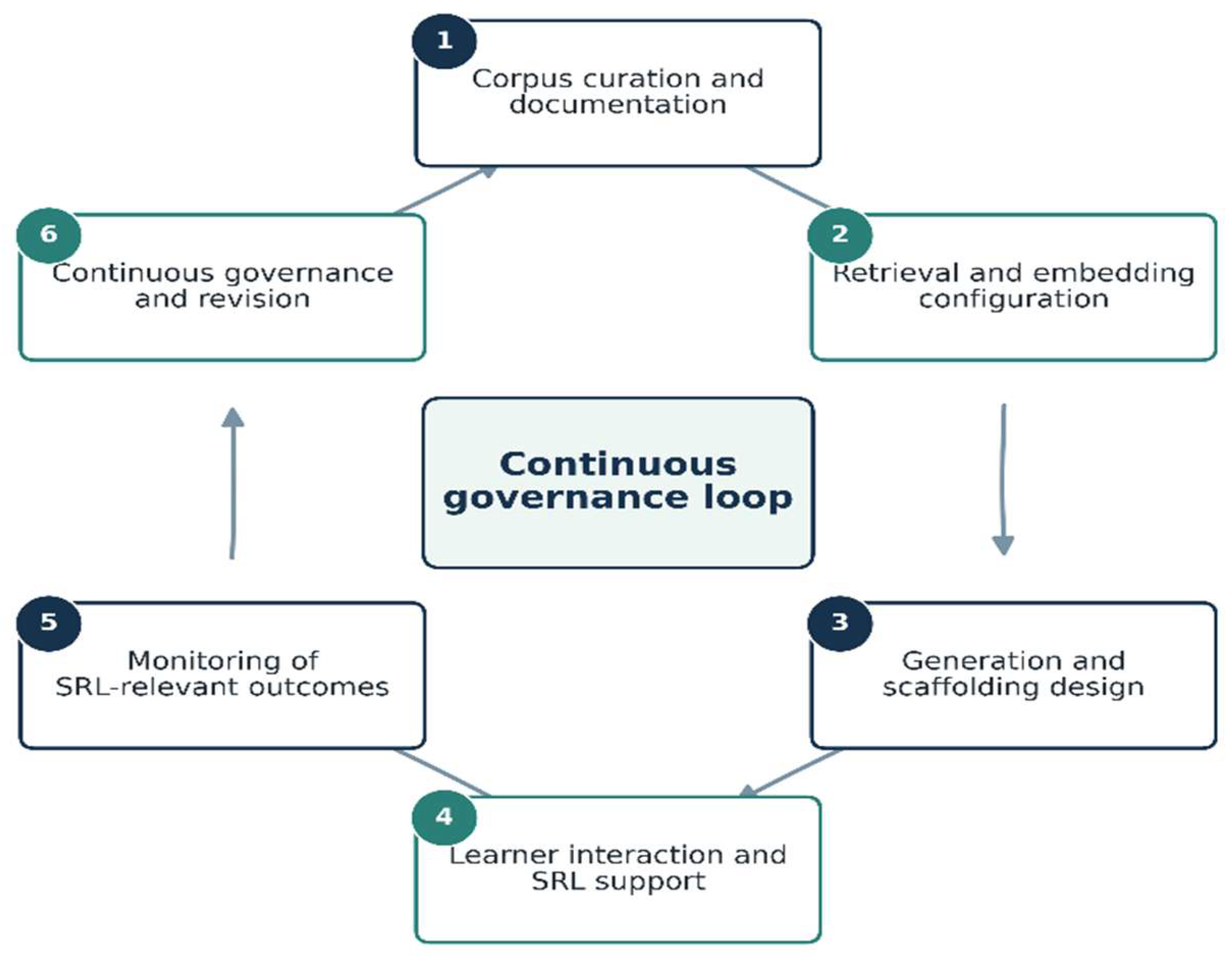
Three implications follow for researchers and system designers working at this intersection. First, evaluation of RAG-based educational tools should be organised explicitly around SRL-relevant outcomes, planning quality, monitoring accuracy, strategy adaptation, and not only around retrieval-faithfulness metrics borrowed from the general NLP literature, since a system can score well on the latter while still failing to support the former. Second, retrieval corpus design and curation deserve the same design attention currently given to prompt engineering and model selection, since the corpus, not only the model, determines what a learner is actually shown, and both the fairness and pedagogical-appropriateness challenges reviewed above trace back substantially to corpus composition. Third, given the demonstrated unreliability of both hallucination and of AI-text detection, institutions adopting RAG-based tools should treat retrieval-groundedness as a risk-reduction measure rather than a guarantee, maintaining human oversight and authentic-assessment redesign as complementary, not alternative, safeguards. Figure 5 draws these implications together as a deployment pipeline with governance checkpoints, spanning corpus curation and documentation, retrieval and generation configuration, learner-facing scaffolding design, monitoring of SRL-relevant outcomes, and continuous review.
This review has limitations characteristic of a narrative synthesis of a fast-moving field: a substantial share of the applications literature consists of preprints and conference papers not yet subject to full peer review, reflecting the genuine pace of the field rather than a deliberate lowering of evidentiary standards, and the concentration of controlled, outcome-focused evaluation studies remains small relative to the number of system-description papers. Future research should prioritise randomised or quasi-experimental comparisons of RAG-based and non-RAG-based educational tools on SRL-specific outcome measures, longitudinal study of whether retrieval-grounded scaffolding builds or erodes learners' independent self-regulatory capacity over time, and continued development of interpretability methods that make a RAG system's retrieved evidence, and not only its final answer, visible and actionable to the learner. RAG is not a solved problem for education, but the trajectory traced in this review, from classical information retrieval, through neural dense retrieval, to increasingly SRL-aware application design, indicates a field converging on the recognition that grounding a generative system in evidence is necessary but not sufficient; grounding it in sound pedagogy is the harder and still-unfinished task.
Author Contributions
Conceptualization, I.O., L.M. and E.O.; methodology, I.O.; investigation, I.O.; writing—original draft preparation, I.O.; writing—review and editing, L.M. and E.O.; supervision, L.M. and E.O. All authors have read and agreed to the published version of the manuscript.
Funding
This research received no external funding.
Data Availability Statement
No new data were created or analyzed in this study. Data sharing is not applicable to this article.
Acknowledgments
The authors acknowledge KCA University for institutional support.
Conflicts of Interest
The authors declare no conflicts of interest.
References
- Haenlein, M.; Kaplan, A. A Brief History of Artificial Intelligence: On the Past, Present, and Future of Artificial Intelligence. Calif. Manag. Rev. 2019, 61, 5–14. [Google Scholar] [CrossRef]
- Lewis, P.; Perez, E.; Piktus, A.; Petroni, F.; Karpukhin, V.; Goyal, N.; Küttler, H.; Lewis, M.; Yih, W.; Rocktäschel, T.; Riedel, S.; Kiela, D. Retrieval-Augmented Generation for Knowledge-Intensive NLP Tasks. Adv. Neural Inf. Process. Syst. 2020, 33, 9459–9474. Available online: https://arxiv.org/abs/2005.11401.
- Gao, Y.; Xiong, Y.; Gao, X.; Jia, K.; Pan, J.; Bi, Y.; Dai, Y.; Sun, J.; Wang, M.; Wang, H. Retrieval-Augmented Generation for Large Language Models: A Survey. arXiv. 2023. Available online: https://arxiv.org/abs/2312.10997.
- Gallegos, I.O.; Rossi, R.A.; Barrow, J.; Tanjim, M.M.; Kim, S.; Dernoncourt, F.; Yu, T.; Zhang, R.; Ahmed, N.K. Bias and Fairness in Large Language Models: A Survey. Comput. Linguist. 2024, 50, 1097–1179. Available online: https://aclanthology.org/2024.cl-3.8/. [CrossRef]
- Zimmerman, B.J. Attaining Self-Regulation: A Social Cognitive Perspective. In Handbook of Self-Regulation; Boekaerts, M., Pintrich, P.R., Zeidner, M., Eds.; Academic Press: San Diego, CA, USA, 2000; pp. 13–39. [Google Scholar] [CrossRef]
- Winne, P.H.; Hadwin, A.F. Studying as Self-Regulated Learning. In Metacognition in Educational Theory and Practice; Hacker, D.J., Dunlosky, J., Graesser, A.C., Eds.; Lawrence Erlbaum: Mahwah, NJ, USA, 1998; pp. 277–304. Available online: https://www.researchgate.net/publication/247664651_Studying_as_Self-Regulated_Learning.
- Pintrich, P.R. A Conceptual Framework for Assessing Motivation and Self-Regulated Learning in College Students. Educ. Psychol. Rev. 2004, 16, 385–407. [Google Scholar] [CrossRef]
- Broadbent, J.; Poon, W.L. Self-Regulated Learning Strategies & Academic Achievement in Online Higher Education Learning Environments: A Systematic Review. Internet High. Educ. 2015, 27, 1–13. [Google Scholar] [CrossRef]
- Panadero, E. A Review of Self-Regulated Learning: Six Models and Four Directions for Research. Front. Psychol. 2017, 8, 422. [Google Scholar] [CrossRef] [PubMed]
- Wolters, C.A. Regulation of Motivation: Evaluating an Underemphasized Aspect of Self-Regulated Learning. Educ. Psychol. 2003, 38, 189–205. [Google Scholar] [CrossRef] [PubMed]
- Devolder, A.; van Braak, J.; Tondeur, J. Supporting Self-Regulated Learning in Computer-Based Learning Environments: Systematic Review of Effects of Scaffolding in the Domain of Science Education. J. Comput. Assist. Learn. 2012, 28, 557–573. [Google Scholar] [CrossRef]
- Araka, E.; Maina, E.; Gitonga, R.; Oboko, R. Self-Regulated Learning and Technology-Enhanced Learning Environments in Higher Education: A Scoping Review. Sustainability 2021, 13, 7281. [Google Scholar] [CrossRef]
- Grand View Research. AI in Education Market Size, Share and Growth Report, 2033; Grand View Research: San Francisco, CA, USA, 2026; Available online: https://www.grandviewresearch.com/industry-analysis/artificial-intelligence-ai-education-market-report.
- Grand View Research. Retrieval Augmented Generation Market Report; Grand View Research: San Francisco, CA, USA, 2025; Available online: https://www.grandviewresearch.com/industry-analysis/retrieval-augmented-generation-rag-market-report.
- Retrieval-Augmented Generation for Educational Application: A Systematic Survey. Comput. Educ. Artif. Intell. 2025. Available online: https://www.sciencedirect.com/science/article/pii/S2666920X25000578.
- Baumeister, R.F.; Leary, M.R. Writing Narrative Literature Reviews. Rev. Gen. Psychol. 1997, 1, 311–320. [Google Scholar] [CrossRef]
- Grant, M.J.; Booth, A. A Typology of Reviews: An Analysis of 14 Review Types and Associated Methodologies. Health Info. Libr. J. 2009, 26, 91–108. [Google Scholar] [CrossRef] [PubMed]
- Bramer, W.M.; Rethlefsen, M.L.; Kleijnen, J.; Franco, O.H. Optimal Database Combinations for Literature Searches in Systematic Reviews: A Prospective Exploratory Study. Syst. Rev. 2017, 6, 245. [Google Scholar] [CrossRef] [PubMed]
- Page, M.J.; McKenzie, J.E.; Bossuyt, P.M.; Boutron, I.; Hoffmann, T.C.; Mulrow, C.D.; Shamseer, L.; Tetzlaff, J.M.; Akl, E.A.; Brennan, S.E.; et al. The PRISMA 2020 Statement: An Updated Guideline for Reporting Systematic Reviews. BMJ 2021, 372, n71. [Google Scholar] [CrossRef] [PubMed]
- Braun, V.; Clarke, V. Using Thematic Analysis in Psychology. Qual. Res. Psychol. 2006, 3, 77–101. [Google Scholar] [CrossRef]
- Salton, G.; Wong, A.; Yang, C.S. A Vector Space Model for Automatic Indexing. Commun. ACM 1975, 18, 613–620. [Google Scholar] [CrossRef]
- Robertson, S.; Zaragoza, H. The Probabilistic Relevance Framework: BM25 and Beyond. Found. Trends Inf. Retr. 2009, 3, 333–389. [Google Scholar] [CrossRef]
- Nwana, H.S. Intelligent Tutoring Systems: An Overview. Artif. Intell. Rev. 1990, 4, 251–277. [Google Scholar] [CrossRef]
- VanLehn, K. The Relative Effectiveness of Human Tutoring, Intelligent Tutoring Systems, and Other Tutoring Systems. Educ. Psychol. 2011, 46, 197–221. [Google Scholar] [CrossRef]
- Alkhatlan, A.; Kalita, J.K. Intelligent Tutoring Systems: A Comprehensive Historical Survey with Recent Developments. arXiv 2018, arXiv:1812.09628. [Google Scholar]
- Vaswani, A.; Shazeer, N.; Parmar, N.; Uszkoreit, J.; Jones, L.; Gomez, A.N.; Kaiser, Ł.; Polosukhin, I. Attention Is All You Need. Adv. Neural Inf. Process. Syst. 2017, 30, 5998–6008. Available online: https://arxiv.org/abs/1706.03762.
- Devlin, J.; Chang, M.-W.; Lee, K.; Toutanova, K. BERT: Pre-training of Deep Bidirectional Transformers for Language Understanding. Proceedings of NAACL-HLT 2019, Minneapolis, MN, USA, 2–7 June 2019; Available online: https://arxiv.org/abs/1810.04805.
- Reimers, N.; Gurevych, I. Sentence-BERT: Sentence Embeddings Using Siamese BERT-Networks. Proceedings of EMNLP-IJCNLP 2019, Hong Kong, China, 3–7 November 2019; Available online: https://arxiv.org/abs/1908.10084.
- Karpukhin, V.; Oğuz, B.; Min, S.; Lewis, P.; Wu, L.; Edunov, S.; Chen, D.; Yih, W. Dense Passage Retrieval for Open-Domain Question Answering. Proceedings of EMNLP 2020, Online, 16–20 November 2020; Available online: https://arxiv.org/abs/2004.04906.
- Guu, K.; Lee, K.; Tung, Z.; Pasupat, P.; Chang, M. REALM: Retrieval-Augmented Language Model Pre-Training. Proceedings of ICML 2020, Online, 13–18 July 2020; Available online: https://arxiv.org/abs/2002.08909.
- Khattab, O.; Zaharia, M. ColBERT: Efficient and Effective Passage Search via Contextualized Late Interaction over BERT. Proceedings of SIGIR 2020, Online, 25–30 July 2020; Available online: https://arxiv.org/abs/2004.12832.
- Johnson, J.; Douze, M.; Jégou, H. Billion-Scale Similarity Search with GPUs. IEEE Trans. Big Data 2019, 7, 535–547. Available online: https://arxiv.org/abs/1702.08734. [CrossRef]
- Malkov, Y.A.; Yashunin, D.A. Efficient and Robust Approximate Nearest Neighbor Search Using Hierarchical Navigable Small World Graphs. IEEE Trans. Pattern Anal. Mach. Intell. 2020, 42, 824–836. Available online: https://arxiv.org/abs/1603.09320. [CrossRef] [PubMed]
- Brown, T.B.; Mann, B.; Ryder, N.; Subbiah, M.; Kaplan, J.; Dhariwal, P.; Neelakantan, A.; Shyam, P.; Sastry, G.; Askell, A.; et al. Language Models Are Few-Shot Learners. Adv. Neural Inf. Process. Syst. 2020, 33, 1877–1901. Available online: https://arxiv.org/abs/2005.14165.
- Asai, A.; Wu, Z.; Wang, Y.; Sil, A.; Hajishirzi, H. Self-RAG: Learning to Retrieve, Generate, and Critique through Self-Reflection. Proceedings of ICLR 2024, Vienna, Austria, 7–11 May 2024; Available online: https://arxiv.org/abs/2310.11511.
- Yan, S.-Q.; Gu, J.-C.; Zhu, Y.; Ling, Z.-H. Corrective Retrieval Augmented Generation. arXiv 2024, arXiv:2401.15884. [Google Scholar]
- Edge, D.; Trinh, H.; Cheng, N.; Bradley, J.; Chao, A.; Mody, A.; Truitt, S.; Larson, J. From Local to Global: A Graph RAG Approach to Query-Focused Summarization. arXiv. 2024. Available online: https://arxiv.org/abs/2404.16130.
- Gao, Y.; Xiong, Y.; Wang, M.; Wang, H. Modular RAG: Transforming RAG Systems into LEGO-like Reconfigurable Frameworks. arXiv 2024, arXiv:2407.21059. [Google Scholar]
- Liu, N.F.; Lin, K.; Hewitt, J.; Paranjape, A.; Bevilacqua, M.; Petroni, F.; Liang, P. Lost in the Middle: How Language Models Use Long Contexts. Trans. Assoc. Comput. Linguist. 2024, 12, 157–173. Available online: https://arxiv.org/abs/2307.03172. [CrossRef]
- Es, S.; James, J.; Espinosa-Anke, L.; Schockaert, S. RAGAs: Automated Evaluation of Retrieval Augmented Generation. Proceedings of EACL 2024 (System Demonstrations), St. Julians, Malta, 17–22 March 2024; Available online: https://arxiv.org/abs/2309.15217.
- Fan, W.; Ding, Y.; Ning, L.; Wang, S.; Li, H.; Yin, D.; Chua, T.-S.; Li, Q. A Survey on RAG Meeting LLMs: Towards Retrieval-Augmented Large Language Models. In Proceedings of the 30th ACM SIGKDD Conference on Knowledge Discovery and Data Mining (KDD 2024), Barcelona, Spain, 25–29 August 2024. [Google Scholar] [CrossRef]
- Singh, A.; Ehtesham, A.; Kumar, S.; Khoei, T.T.; Vasilakos, A.V. Agentic Retrieval-Augmented Generation: A Survey on Agentic RAG. arXiv 2025, arXiv:2501.09136. [Google Scholar]
- Abootorabi, M.M.; Zobeiri, A.; Dehghani, M.; Mohammadkhani, M.; Mohammadi, B.; Ghahroodi, O.; Baghshah, M.S.; Asgari, E. Ask in Any Modality: A Comprehensive Survey on Multimodal Retrieval-Augmented Generation. In Findings of the Association for Computational Linguistics: ACL 2025; Vienna, Austria, 27 July–1 August 2025; Available online: https://arxiv.org/abs/2502.08826.
- Brown, A.; Roman, M.; Devereux, B. A Systematic Literature Review of Retrieval-Augmented Generation: Techniques, Metrics, and Challenges. Big Data Cogn. Comput. 2025, 9, 320. [Google Scholar] [CrossRef]
- Levonian, Z.; Li, C.; Zhu, W.; Gade, A.; Henkel, O.; Postle, M.-E.; Xing, W. Retrieval-Augmented Generation to Improve Math Question-Answering: Trade-Offs between Groundedness and Human Preference. arXiv. 2023. Available online: https://arxiv.org/abs/2310.03184.
- Retrieval-Augmented Generation (RAG) Chatbots for Education: A Survey of Applications. Appl. Sci. 2025, 15, 4234. [CrossRef]
- A Systematic Literature Review of Retrieval-Augmented Generation Implementation for Enhancing Large Language Models in Education. J. Nas. Pendidik. Tek. Inform. (JANAPATI) 2025, 15. [CrossRef]
- Adapting Self-Regulated Learning in an Age of Generative Artificial Intelligence Chatbots. Future Internet 2024, 16, 218. [CrossRef]
- Ng, D.T.K.; Tan, C.W.; Leung, J.K.L. Empowering Student Self-Regulated Learning and Science Education through ChatGPT: A Pioneering Pilot Study. Br. J. Educ. Technol. 2024. [Google Scholar] [CrossRef]
- Designing Artificial Intelligence Chatbots for Self-Regulated Learning from a Systematic Review Based on Habermas's Three Interests. Interact. Learn. Environ. 2025. [CrossRef]
- Cohn, C.; Rayala; et al. Personalizing Student-Agent Interactions Using Log-Contextualized Retrieval-Augmented Generation (RAG). arXiv. 2025. Available online: https://arxiv.org/abs/2505.17238.
- Vu-Minh, A.; Nguyen-The, Q.; Nguyen, N.; Pham, X.-L.; Nguyen, A. Designing a Course-Grounded AI Tutor with Retrieval-Augmented Generation: A DSR Approach to Technical Education. 2025. Available online: https://papers.ssrn.com/sol3/papers.cfm?abstract_id=5607971.
- Slade, J.J.; Hyk, A.; Gurung, R.A.R. Transforming Learning: Assessing the Efficacy of a Retrieval-Augmented Generation System as a Tutor for Introductory Psychology. Proc. Hum. Factors Ergon. Soc. Annu. Meet. 2024, 68, 1827–1830. [Google Scholar] [CrossRef]
- Let Us Not Squander the Affordances of LLMs for the Sake of Expedience: Using Retrieval Augmented Generative AI Chatbots to Support and Evaluate Student Reasoning. J. Chem. Educ. 2024. [CrossRef]
- Design and Application of Online Teaching Resource Platform for College English Based on Retrieval-Augmented Generation. In Proceedings of the 2nd International Conference on Educational Knowledge and Informatization (ICEKI, 2024. [CrossRef]
- Mullins, E.A.; et al. Enhancing Classroom Teaching with LLMs and RAG. In Proceedings of the 25th Annual Conference on Information Technology Education (SIGITE 2024), El Paso, TX, USA, 9–12 October 2024. [Google Scholar] [CrossRef]
- Designing a Local RAG-Based Intelligent Tutoring System for Domain-Specific Education. In Advances in Intelligent Systems and Computing; Springer: Cham, Switzerland, 2026. [CrossRef]
- From Surface Learning to Deep Understanding: A Grounded AI Tutoring System for Moodle. arXiv. 2026. Available online: https://arxiv.org/html/2605.06963.
- NotebookLM as a Socratic Physics Tutor: Design and Preliminary Observations of a RAG-Based Tool. arXiv 2025, arXiv:2504.09720.
- Tutor, Not Solver: Designing a Guardrailed AI Assistant for Learning in Higher Education—A Design Case of PeteChat. arXiv. 2026. Available online: https://arxiv.org/html/2606.09845v1.
- Retrieval-Augmented Generation for Pedagogically Aware Educational AI: An Expert-Rated Comparison of a Prompt-Only LLM Tutor and an Integrated, Learner-State-Aware RAG Tutor. Front. Educ. 2026, 11. [CrossRef]
- Research on an Intelligent Tutoring System Based on Automatic Construction of Multimodal Knowledge Graphs and Retrieval-Augmented Generation. Front. Comput. Sci. 2026, 8. [CrossRef]
- Zhao, X.; Wang, G.; Lu, Y. MDKAG: Retrieval-Augmented Educational QA Powered by a Multimodal Disciplinary Knowledge Graph. Appl. Sci. 2025, 15, 9095. [Google Scholar] [CrossRef]
- Modran, H.A. Leveraging RAG with ACP & MCP for Adaptive Intelligent Tutoring. Appl. Sci. 2025, 15, 11443. [Google Scholar] [CrossRef]
- Retrieval-Augmented Tutoring for Algorithm Tracing and Problem-Solving in AI Education. arXiv. 2026. Available online: https://arxiv.org/html/2605.12988v1.
- Retrieval-Augmented Chatbots for Scalable Educational Support in Higher Education. CEUR Workshop Proc. 2025, 3994, paper 3. Available online: https://ceur-ws.org/Vol-3994/paper3.pdf.
- AI-Powered Learning Support: A Study of Retrieval-Augmented Generation (RAG) Chatbot Effectiveness in an Online Course. Inf. Syst. Educ. J. 2025, 23. Available online: https://eric.ed.gov/?id=EJ1467995. [CrossRef]
- Optimization of a RAG Model Chatbot for Obstetric Medical Education. 2025. Available online: https://scholarworks.indianapolis.iu.edu/items/015f038b-b0df-49c9-b431-3bfd8ac508d4.
- RAMO: Retrieval-Augmented Generation for Enhancing MOOCs Recommendations. arXiv 2024, arXiv:2407.04925.
- CLARE: A Category-Aware RAG-Based Framework for Recommending Learning Objects in Education and Professional Training. In Lecture Notes in Computer Science; Springer: Cham, Switzerland, 2026. [CrossRef]
- Nguyen; et al. Towards Personalized AI Education: Context-Aware Retrieval-Augmented Generation with Grade-Level LLM Adaptation. Comput. Appl. Eng. Educ. 2026, 34. [Google Scholar] [CrossRef]
- RAG-PRISM: A Personalized, Rapid, and Immersive Skill Mastery Framework with Adaptive Retrieval-Augmented Tutoring. arXiv. 2025. Available online: https://arxiv.org/html/2509.00646v1.
- Huang, S.; Sun, Y.; Yu, X. SP-TeachLLM: An LLM-Driven Framework for Personalized and Adaptive Programming Education. Information 2025, 16, 1045. [Google Scholar] [CrossRef]
- Sharma, K.; Nguyen; et al. Self-Regulation and Shared Regulation in Collaborative Learning in Adaptive Digital Learning Environments: A Systematic Review of Empirical Studies. Br. J. Educ. Technol. 2024. [Google Scholar] [CrossRef]
- Bojorque, R.; Plaza, A.; Morquecho, P.; Moscoso, F. A Scalable and Low-Cost Mobile RAG Architecture for AI-Augmented Learning in Higher Education. Appl. Sci. 2026, 16, 963. [Google Scholar] [CrossRef]
- Machine Assistant with Reliable Knowledge: Enhancing Student Learning via RAG-Based Retrieval. arXiv. 2025. Available online: https://arxiv.org/html/2506.23026.
- Xu, G.; Corter, J. Graph RAG for Automated Short Answer Grading with Feedback: Bridging Pedagogical Needs and Technical Capabilities. Proc. AAAI Conf. Artif. Intell. 2026, 40, 40916–40924. [Google Scholar] [CrossRef]
- Beyond Scores: A Modular RAG-Based System for Automatic Short Answer Scoring with Feedback. arXiv 2024, arXiv:2409.20042.
- Maity, S.; Deroy, A.; Sarkar, S. Leveraging In-Context Learning and Retrieval-Augmented Generation for Automatic Question Generation in Educational Domains. In Proceedings of the 16th Annual Meeting of the Forum for Information Retrieval Evaluation (FIRE 2024), Gandhinagar, India, 2024. [Google Scholar] [CrossRef]
- Retrieval-Augmented Generation for Multiple-Choice Questions and Answers Generation. Procedia Comput. Sci. 2025. Available online: https://www.sciencedirect.com/science/article/pii/S1877050925010968.
- Smarter Questions, Smaller Models: RAG-Enhanced Multiple-Choice Question Generation for POSCOMP. Anais do Simósio Brasileiro de Informática na Educação (SBIE. 2025. Available online: https://arxiv.org/abs/2509.09651.
- An LLM-Powered Assessment Retrieval-Augmented Generation (RAG) for Higher Education. arXiv 2026, arXiv:2601.06141.
- Jivet, I.; Scheffel, M.; Specht, M.; Drachsler, H. A Systematic Review of Empirical Studies on Learning Analytics Dashboards: A Self-Regulated Learning Perspective. IEEE Trans. Learn. Technol. 2018. [Google Scholar] [CrossRef]
- Learning Analytics Dashboard Design and Evaluation to Support Student Self-Regulation of Study Behaviour. J. Learn. Anal. 2024, 11. Available online: https://learning-analytics.info/index.php/JLA/article/view/8529. [CrossRef]
- Azevedo, R.; Bouchet, F.; Duffy, M.; Harley, J.; Taub, M.; Trevors, G.; Cloude, E.; Dever, D.; Wiedbusch, M.; Wortha, F.; Cerezo, R.; et al. Lessons Learned and Future Directions of MetaTutor: Leveraging Multichannel Data to Scaffold Self-Regulated Learning with an Intelligent Tutoring System. Front. Psychol. 2022, 13, 813632. [Google Scholar] [CrossRef] [PubMed]
- Duffy, M.C.; et al. A Complex Systems Approach to Analyzing Pedagogical Agents' Scaffolding of Self-Regulated Learning within an Intelligent Tutoring System. In Metacognition Learn; 2023. [Google Scholar] [CrossRef]
- The Effects of Intelligent Tutoring Systems on Self-Regulated Learning: A Meta-Analysis. Educ. Psychol. Rev. 2026, 38. [CrossRef]
- An Integrative Systematic Review Analysis of Research on Technology-Enabled Personalized Learning and Self-Regulated Learning. Smart Learn. Environ. 2025, 12. [CrossRef]
- Stanford Institute for Human-Centered Artificial Intelligence. How Harmful Are AI's Biases on Diverse Student Populations? Stanford HAI: Stanford, CA, USA, 2024; Available online: https://hai.stanford.edu/news/how-harmful-are-ais-biases-on-diverse-student-populations.
- Explicitly Unbiased Large Language Models Still Form Biased Associations. Proc. Natl. Acad. Sci. USA 2025, 122. [CrossRef] [PubMed]
- Bodea, A.-E.; Meisenbacher, S.; Klymenko, A.; Matthes, F. SoK: Privacy Risks and Mitigations in Retrieval-Augmented Generation Systems. arXiv 2026, arXiv:2601.03979. [Google Scholar]
- OWASP Gen AI Security Project. LLM08:2025—Vector and Embedding Weaknesses. OWASP Foundation, 2025. Available online: https://genai.owasp.org/llmrisk/llm08-vector-and-embedding-weaknesses/.
- University of Wisconsin–Madison Office of the Registrar. FERPA and Artificial Intelligence (AI). University of Wisconsin–Madison: Madison, WI, USA, 2026. Available online: https://registrar.wisc.edu/ferpa-and-artificial-intelligence-ai/.
- Huang, L.; Yu, W.; Ma, W.; Zhong, W.; Feng, Z.; Wang, H.; Chen, Q.; Peng, W.; Feng, X.; Qin, B.; Liu, T. A Survey on Hallucination in Large Language Models: Principles, Taxonomy, Challenges, and Open Questions. ACM Trans. Inf. Syst. 2025, 43. [Google Scholar] [CrossRef]
- Li, J.; Cheng, X.; Zhao, W.X.; Nie, J.-Y.; Wen, J.-R. HaluEval: A Large-Scale Hallucination Evaluation Benchmark for Large Language Models. Proceedings of EMNLP 2023, Singapore, 6–10 December 2023; Available online: https://aclanthology.org/2023.emnlp-main.397/.
- Zhang, W.; Zhang, J. Hallucination Mitigation for Retrieval-Augmented Large Language Models: A Review. Mathematics 2025, 13, 856. [Google Scholar] [CrossRef]
- Reducing Hallucination in Structured Outputs via Retrieval-Augmented Generation. Proceedings of NAACL 2024 (Industry Track), Mexico City, Mexico, 16–21 June 2024; Available online: https://aclanthology.org/2024.naacl-industry.19/.
- Evaluation of Retrieval-Augmented Generation: A Survey. arXiv. 2024. Available online: https://arxiv.org/abs/2405.07437.
- Retrieval-Augmented Generation for Natural Language Processing: A Survey. arXiv. 2024. Available online: https://arxiv.org/abs/2407.13193.
- Interpretable Text Embeddings and Text Similarity Explanation: A Survey. arXiv 2025, arXiv:2502.14862.
- Explainable Knowledge Graph Retrieval-Augmented Generation (KG-RAG) with KG-SMILE. arXiv 2025, arXiv:2509.03626.
- Granata, F.; Poggi, F.; Mongiovì, M. Enhancing Retrieval-Augmented Generation with Entity Linking for Educational Platforms. Big Data Cogn. Comput. 2026, 10, 120. [Google Scholar] [CrossRef]
- Systematised Evidence Mapping of Generative Artificial Intelligence (GenAI) and Digital Divide Phenomena in Higher Education. Discov. Comput. 2026, 29. [CrossRef]
- Brookings Institution. AI and the Next Digital Divide in Education; Brookings: Washington, DC, USA, 2024; Available online: https://www.brookings.edu/articles/ai-and-the-next-digital-divide-in-education/.
- Cotton, D.R.E.; Cotton, P.A.; Shipway, J.R. Chatting and Cheating: Ensuring Academic Integrity in the Era of ChatGPT. Innov. Educ. Teach. Int. 2024, 61, 228–239. [Google Scholar] [CrossRef]
- Kofinas, A.K.; Tsay, C.H.-H.; Pike, D. The Impact of Generative AI on Academic Integrity of Authentic Assessments within a Higher Education Context. Br. J. Educ. Technol. 2025. [Google Scholar] [CrossRef]
- Who Wrote This? Evaluating the Reliability of AI Detection Tools in Higher Education. Int. J. Educ. Integr. 2026, 22. [CrossRef]
- Generative AI and Academic Integrity in Higher Education: A Systematic Review and Research Agenda. Information 2025, 16, 296. [CrossRef]
- Ethical and Regulatory Challenges of Generative AI in Education: A Systematic Review. Front. Educ. 2025, 10, 1565938. [CrossRef]
- Zhu, H.; Sun, Y.; et al. Towards Responsible Artificial Intelligence in Education: A Systematic Review on Identifying and Mitigating Ethical Risks. Humanit. Soc. Sci. Commun. 2025, 12, 1111. [Google Scholar] [CrossRef]
Figure 1.
Literature identification, screening, and synthesis workflow for this review.
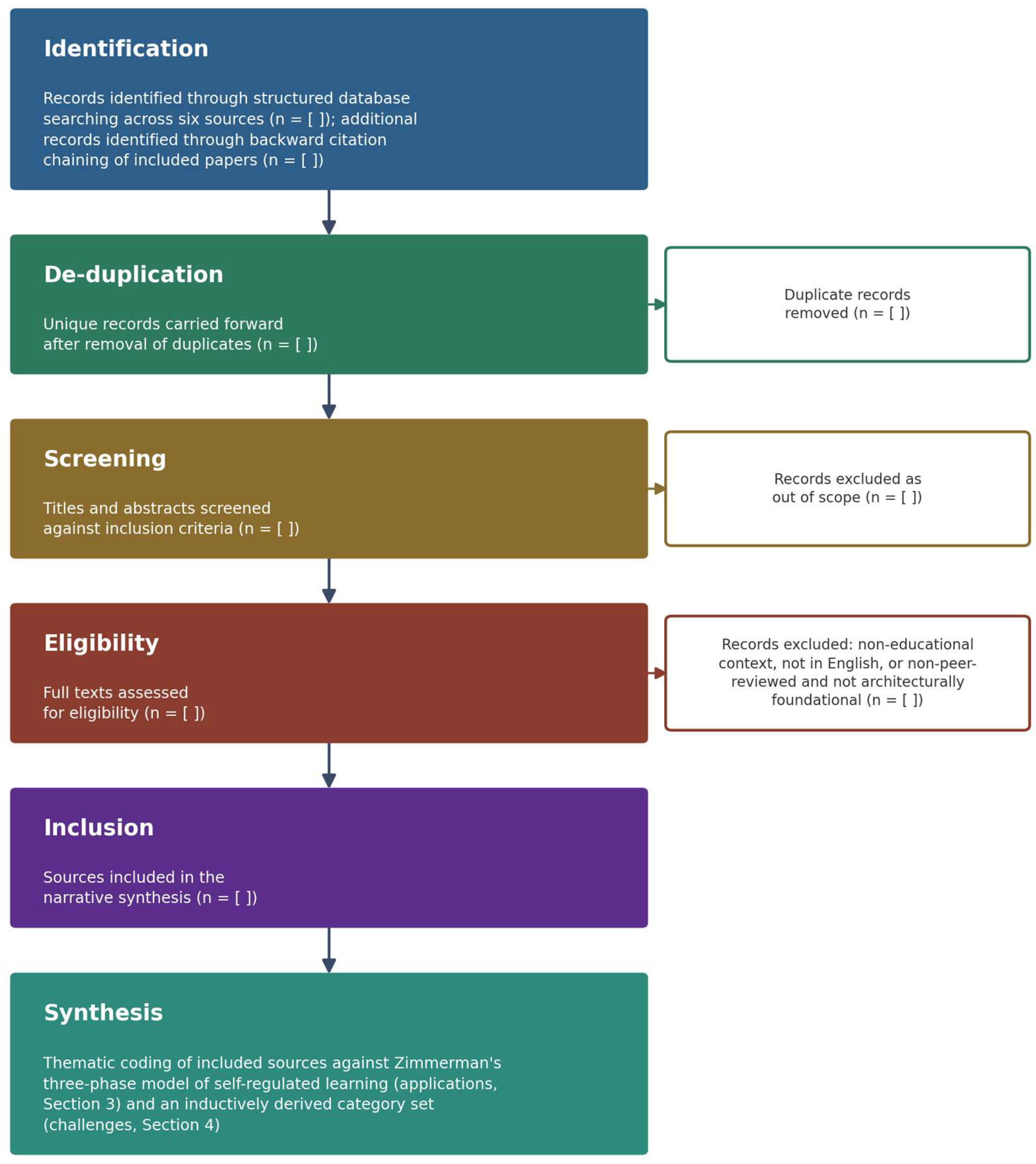
Figure 2.
Timeline of key milestones in the development of Retrieval-Augmented Generation and its convergence with self-regulated learning research, 1975–2026.
Figure 2.
Timeline of key milestones in the development of Retrieval-Augmented Generation and its convergence with self-regulated learning research, 1975–2026.
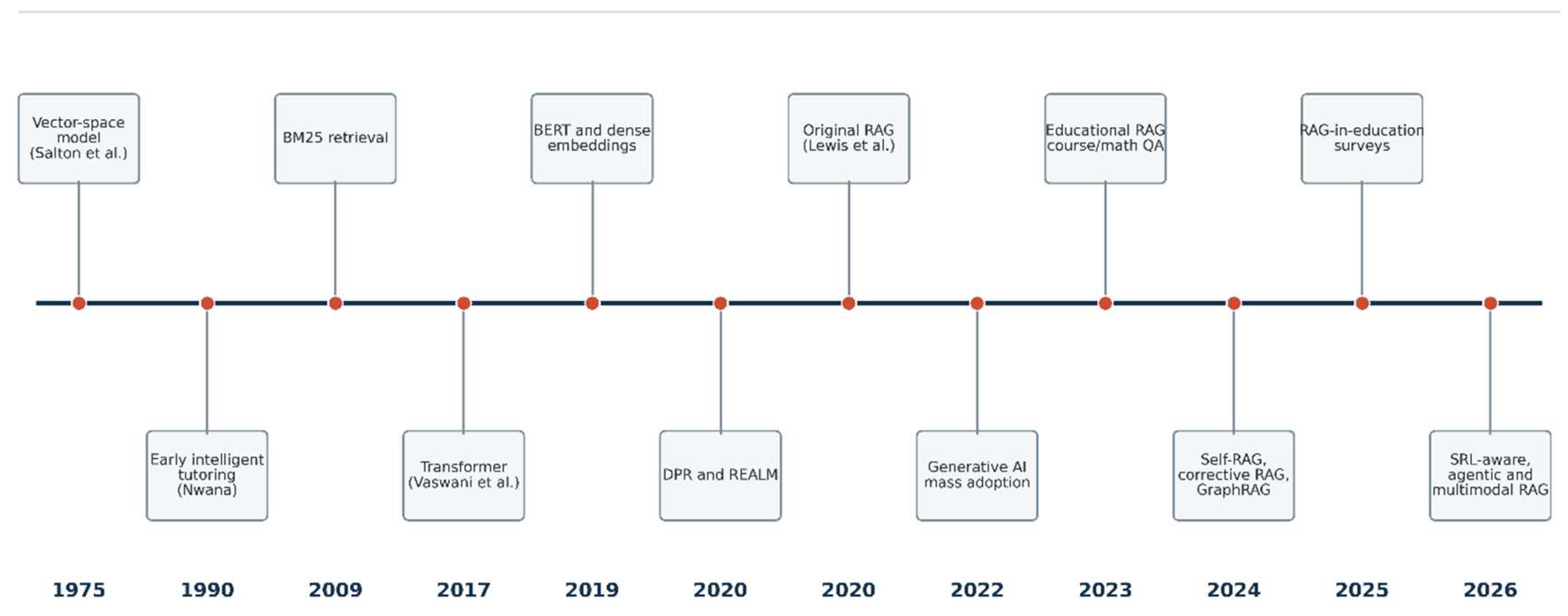
Figure 3.
A categorised overview of RAG applications in self-regulated personalised learning, organised by SRL phase: goal setting and planning; tutoring and conversational scaffolding; personalised content retrieval and adaptive learning; automated assessment and feedback; learning analytics and monitoring; content creation and curriculum grounding; and support for diverse learners.
Figure 3.
A categorised overview of RAG applications in self-regulated personalised learning, organised by SRL phase: goal setting and planning; tutoring and conversational scaffolding; personalised content retrieval and adaptive learning; automated assessment and feedback; learning analytics and monitoring; content creation and curriculum grounding; and support for diverse learners.
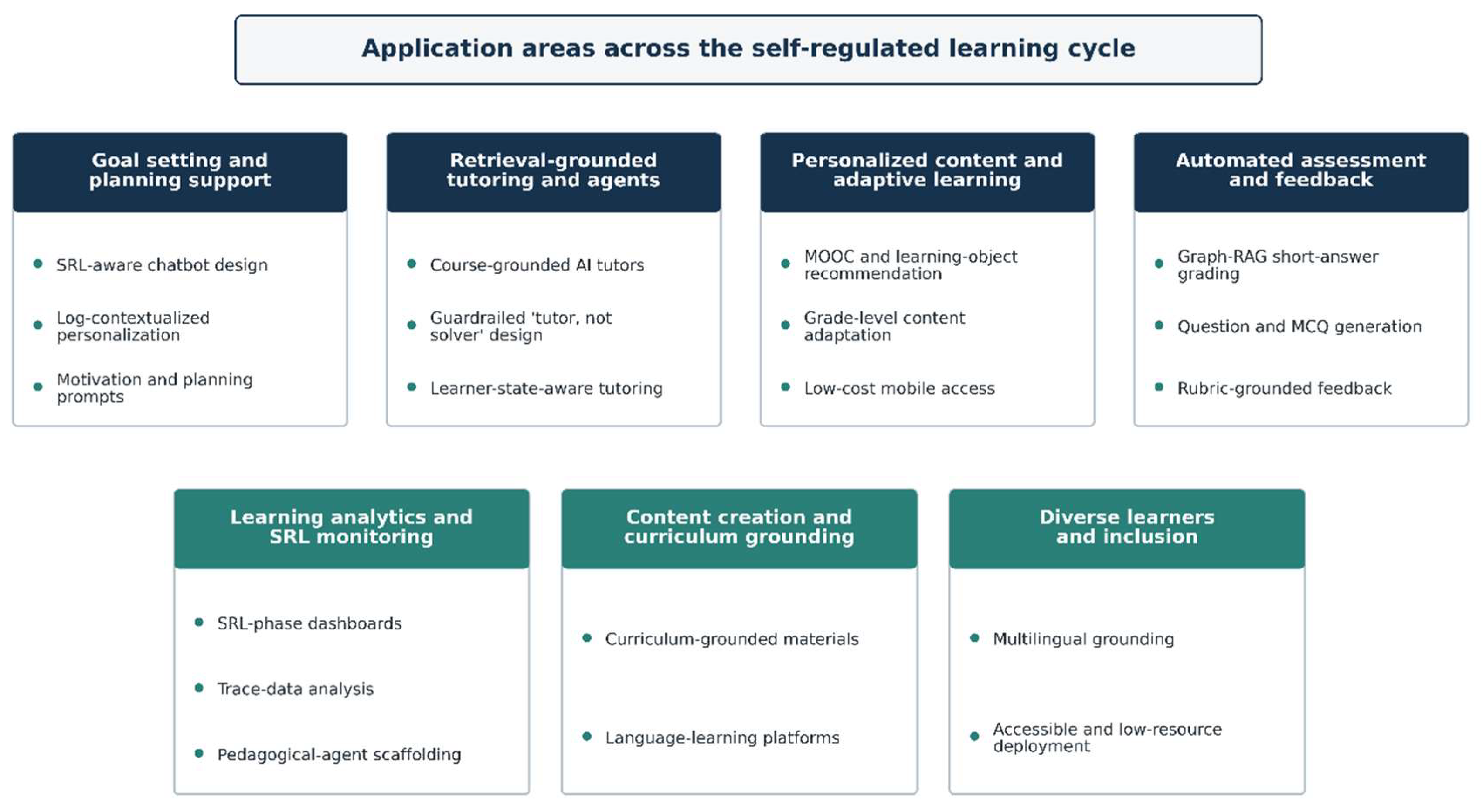
Figure 4.
Principal challenges of RAG in self-regulated personalised learning: ethical and fairness risks; data privacy and security; pedagogical appropriateness and effectiveness; hallucination, retrieval quality, and interpretability; infrastructure and implementation barriers; and academic integrity.
Figure 4.
Principal challenges of RAG in self-regulated personalised learning: ethical and fairness risks; data privacy and security; pedagogical appropriateness and effectiveness; hallucination, retrieval quality, and interpretability; infrastructure and implementation barriers; and academic integrity.
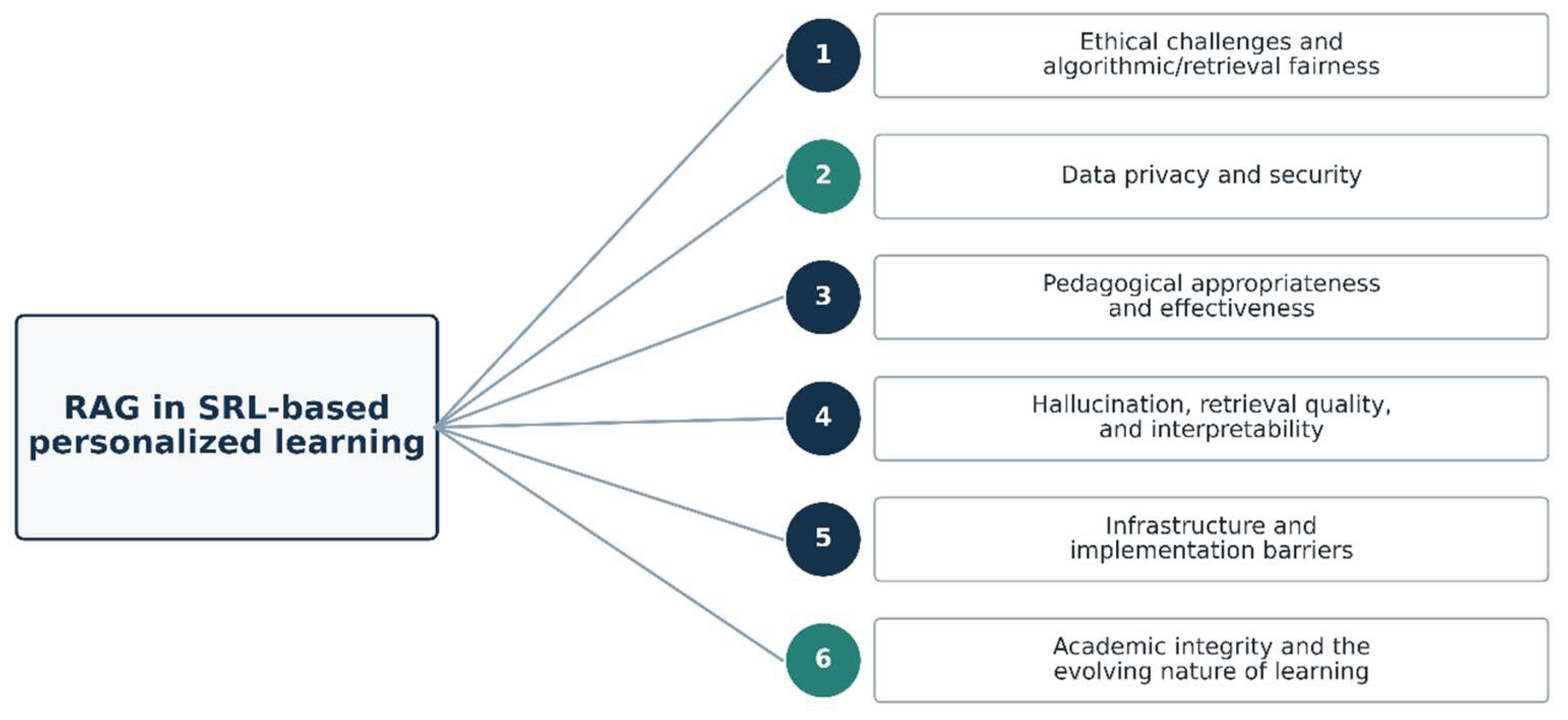
Figure 5.
A RAG-in-SRL deployment pipeline with governance checkpoints, spanning corpus curation and documentation, retrieval and generation configuration, learner-facing scaffolding design, monitoring of SRL-relevant outcomes, and continuous review.
Figure 5.
A RAG-in-SRL deployment pipeline with governance checkpoints, spanning corpus curation and documentation, retrieval and generation configuration, learner-facing scaffolding design, monitoring of SRL-relevant outcomes, and continuous review.
Disclaimer/Publisher’s Note: The statements, opinions and data contained in all publications are solely those of the individual author(s) and contributor(s) and not of MDPI and/or the editor(s). MDPI and/or the editor(s) disclaim responsibility for any injury to people or property resulting from any ideas, methods, instructions or products referred to in the content. |
© 2026 by the authors. Licensee MDPI, Basel, Switzerland. This article is an open access article distributed under the terms and conditions of the Creative Commons Attribution (CC BY) license (http://creativecommons.org/licenses/by/4.0/).
Copyright: This open access article is published under a Creative Commons CC BY 4.0 license, which permit the free download, distribution, and reuse, provided that the author and preprint are cited in any reuse.