

Submitted:
31 August 2026
Posted:
08 September 2026
You are already at the latest version
Abstract
Background: Frailty, a multidimensional syndrome characterized by diminished physiological reserve and increased vulnerability to stressors, has emerged as a critical prognostic factor in cardiac surgery. With the aging population and increasing complexity of cardiac surgical patients, traditional risk stratification models inadequately capture perioperative risk in this vulnerable cohort. Review: This review synthesizes current evidence on frailty in cardiac surgery, examining its prevalence, risk factors, association with postoperative outcomes, and clinical applications. A 2025 systematic review and meta-analysis of 78 studies involving 6,613,392 patients reported a pooled frailty prevalence of 30.2% among cardiac surgery patients. Another 2025 meta-analysis of 19 studies (n = 11,667) reported a prevalence of 16.8%. Frailty was significantly associated with delirium, infection, renal complications, and extended hospital and intensive care unit stays. Frailty increased the odds of 30-day mortality and one-year mortality. Key risk factors include increasing age, male sex, New York Heart Association class IV, and lower hemoglobin and albumin. Major society guidelines now recommend routine frailty screening in preoperative assessment. Multiple assessment tools exist, including the Fried Frailty Phenotype, Clinical Frailty Scale, Essential Frailty Toolset, and Edmonton Frail Scale. Prehabilitation strategies combining exercise, nutritional optimization, and psychological support show promise but require further high-quality evidence. Conclusions: Frailty impacts approximately one in five to one in three cardiac surgery patients and is independently associated with adverse postoperative outcomes. Routine preoperative frailty assessment using validated tools and targeted management of modifiable risk factors, including prehabilitation strategies, could enhance perioperative outcomes. Future research should focus on standardization of assessment approaches, high-quality trials of frailty-modifying interventions, and integration of artificial intelligence for precision risk stratification.
Keywords:
cardiac surgery
; frailty
; frailty assessment
; frailty outcomes
; geriatric cardiac surgery
; mortality
; postoperative complications
; prehabilitation
; preoperative risk assessment
; risk stratification
Introduction and Background
Frailty is a clinical syndrome of decreased physiological reserve and increased vulnerability to adverse health outcomes, arising from cumulative age-related declines across multiple physiological systems [1]. Unlike chronological age, which serves as an imperfect proxy for biological aging, frailty captures the heterogeneity of functional decline and better predicts an individual's capacity to tolerate physiological stressors, including major surgical interventions [2].
The clinical significance of frailty in cardiac surgery has grown substantially as the patient population has aged. The prevalence of frailty among patients undergoing cardiac surgery ranges from approximately 15% to 50% depending on the assessment tool and population studied [1,2]. A comprehensive 2025 systematic review and meta-analysis of 78 studies involving 6,613,392 patients reported a pooled frailty prevalence of 30.2% (95% CI: 28.3-32.0), with high heterogeneity (I² = 99.99%, p < .001) [1]. A separate 2025 meta-analysis of 19 studies involving 11,667 patients (mean age 71.9 ± 8.1 years, 28% female) reported a more conservative frailty prevalence estimate of 16.8% [2]. The variation in prevalence estimates reflects differences in patient populations, surgical procedures, assessment methodologies, and inclusion criteria.
Traditional cardiac surgery risk scores, including the European System for Cardiac Operative Risk Evaluation (EuroSCORE) II and the Society of Thoracic Surgeons predicted risk of mortality, incorporate age and several comorbidities but do not directly assess frailty. This represents a significant limitation, as frailty has been demonstrated to predict adverse outcomes independently of these established risk factors [2]. The failure to account for frailty may lead to underestimation of risk in vulnerable patients and overestimation of benefit in those with limited physiological reserve. A 2025 study found that adding albumin measurement as a frailty marker to EuroSCORE II increased the R-squared value from 0.07 to 0.144, improving its ability to predict early postoperative mortality and morbidity in elderly patients undergoing cardiac surgery [3].
The recognition of this gap has prompted major professional societies to recommend frailty assessment as a component of preoperative evaluation. The European Association for Cardio-Thoracic Surgery (EACTS) and the European Association of Preventive Cardiology (EAPC) of the European Society of Cardiology (ESC) published a consensus statement in 2024 advocating for systematic preinterventional frailty assessment in patients scheduled for cardiac surgery or transcatheter aortic valve implantation [4]. Similarly, the EACTS published a consensus paper in 2023 on the determination of frailty in cardiac surgery, emphasizing the importance of frailty assessment in clinical decision-making [5].
Despite these recommendations, significant challenges persist in the clinical implementation of frailty assessment. These include the proliferation of assessment tools with varying validity and feasibility, lack of standardization across institutions, limited training in tool administration, and uncertainty regarding how frailty assessment should influence clinical decision-making. Furthermore, while frailty is increasingly recognized as a potentially modifiable risk factor, the evidence base for interventions targeting frailty in the cardiac surgery population remains limited.
This review aims to synthesize the current evidence on frailty in cardiac surgery, examining its prevalence, risk factors, association with postoperative outcomes, comparative utility of assessment tools, and clinical applications. By providing a comprehensive framework for understanding the role of frailty in contemporary cardiac surgery practice, this review seeks to inform clinical decision-making and identify key directions for future research.
Review
Definition and Epidemiology of Frailty
Frailty is conceptualized through two predominant models: the phenotype model and the deficit accumulation model. The phenotype model, operationalized by the Fried Frailty Phenotype, defines frailty based on the presence of three or more of five criteria: unintentional weight loss, exhaustion, weakness (grip strength), slow walking speed, and low physical activity [6]. This model conceptualizes frailty as a distinct clinical syndrome with a specific pathophysiology and has been widely validated in geriatric populations.
The deficit accumulation model, operationalized by the Frailty Index, defines frailty as the accumulation of health deficits across multiple domains, with the index calculated as the proportion of deficits present in an individual. This model conceptualizes frailty as a continuous measure of vulnerability and captures the cumulative impact of multiple age-related health problems [5].
The prevalence of frailty varies significantly across cardiac surgery populations, influenced by patient demographics, surgical procedures, and assessment methodologies. A 2025 systematic review of 78 studies found a pooled frailty prevalence of 30.2%, with substantial heterogeneity across included studies [1]. Key risk factors identified include increasing age, male sex, lower hemoglobin, lower albumin, New York Heart Association class IV, and higher EuroSCORE II [1].
Pathophysiological Basis of Frailty
From a pathophysiological perspective, frailty is characterized by dysregulation across multiple biological systems. Key mechanisms include chronic low-grade inflammation (inflammaging), mitochondrial dysfunction, neuroendocrine dysregulation, and sarcopenia [7]. Sarcopenia, the age-related loss of muscle mass and function, is a particularly important component of frailty in the cardiac surgery population, as it directly impacts functional capacity and the ability to tolerate surgical stress [7].
The interplay between these mechanisms creates a state of reduced physiological reserve that impairs the body's ability to mount an effective stress response to surgical injury. This reduced reserve manifests clinically as increased vulnerability to adverse outcomes following major surgical interventions, including cardiac surgery.
Frailty Assessment Tools
In cardiac surgery, several frailty assessment tools have been validated and are commonly used, each with distinct characteristics and clinical applications [7,8]. The choice of assessment tool involves trade-offs between comprehensiveness and feasibility, with implications for routine clinical implementation (Table 1).
The Fried Frailty Phenotype, while considered a reference standard, requires specialized equipment and trained personnel, limiting its routine clinical applicability [6]. The Clinical Frailty Scale is rapid and feasible but relies on clinical judgment and is subject to inter-rater variability [5]. The Essential Frailty Toolset has been specifically validated for cardiac surgery and transcatheter aortic valve implantation (TAVI) populations and offers a balance of feasibility and predictive validity [4].
The EACTS/EAPC consensus statement identified specific tools with evidence-based recommendations, including gait speed, Fried's Frailty Phenotype, Clinical Frailty Scale, Short Physical Performance Battery, and serum albumin [4]. A 2025 study involving 137 elderly patients found that frailty prevalence ranged from 13.1% to 43.1% depending on the criterion used, with the Fried Frailty Phenotype and Clinical Frailty Scale identified as independent risk factors for major adverse cardiovascular and cerebral events with equivalent prognostic prediction.
Impact of Frailty on Cardiac Surgery Outcomes
A substantial body of evidence demonstrates that frailty is independently associated with adverse postoperative outcomes across multiple domains (Table 2).
Frailty and Postoperative Complications
Frailty was significantly associated with several major postoperative complications [2]: Delirium: OR, 4.11 (95% CI, 2.00-8.45; P < .001)
Infection: OR, 3.72 (95% CI, 2.27-6.12; P < .001)
Renal complications: OR, 2.72 (95% CI, 2.05-3.60; P < .001)
The association between frailty and delirium is particularly noteworthy given the impact of delirium on cognitive function, length of stay, and long-term outcomes in elderly patients. A 2025 review noted that multiple studies have reported the association between frailty and an increased risk of post-operative delirium, as well as increased length of intensive care unit and hospital stays [7]. Early recognition and treatment of postoperative delirium, combined with geriatric consultation, may improve outcomes in frail patients [7].
Frailty and Mortality
Frailty significantly increases the odds of both short-term and long-term mortality. A 2025 meta-analysis reported that frailty increased the odds of 30-day mortality (OR, 3.58; 95% CI, 2.16-5.93; P < .001) and one-year mortality (OR, 2.25; 95% CI, 1.56-3.25; P < .001) [2]. These findings indicate that frailty confers a two-to threefold increased risk of mortality following cardiac surgery, comparable to or exceeding that associated with traditional risk factors such as age or ejection fraction [12].
Lee and colleagues demonstrated that frail patients were at increased risk for mortality and prolonged institutional care after cardiac surgery, highlighting the long-term implications of frailty beyond the perioperative period [12]. The study of 3,826 patients found that frailty was independently associated with in-hospital mortality (adjusted OR 1.8, 95% CI 1.1-3.0, P=0.03) and discharge to an institution (OR 6.3), emphasizing the unique contribution of frailty to risk assessment [12].
Frailty and Quality of Life
The CURE-Frailty Trial demonstrated that cardiac surgery has the potential to reverse frailty, with cardiac rehabilitation being an important factor in the postoperative improvement of frailty [9]. In 76 patients, median Clinical Frailty Scale decreased from 4 to 3 at one year postoperatively (P < 0.001), with frailty improving in 35.5% of participants [9]. These findings suggest that frailty is not a fixed state and that cardiac surgery, combined with rehabilitation, may lead to meaningful improvements in functional status and quality of life.
Frailty-Guided Decision Making
The integration of frailty assessment into clinical decision-making requires a structured approach that considers both the severity of frailty and the patient's values and preferences. The EACTS consensus emphasizes that frailty should not be used to exclude patients from surgical intervention but rather to identify those who may benefit from additional support and optimization [4]. Shared decision-making models that incorporate frailty assessment can help align treatment decisions with patient values and preferences while avoiding age-based discrimination.
A 2026 review examining frailty assessment in coronary artery bypass grafting found that frailty has emerged as a critical determinant of operative risk among patients undergoing cardiac surgery, particularly as the age and comorbidity burden of this population continue to rise [8]. Studies have consistently demonstrated that frail patients undergoing cardiac surgery experience higher rates of mortality, postoperative morbidity, prolonged hospitalization, delirium, and non-home discharge compared to non-frail patients [8].
Prehabilitation and Optimization Strategies
Prehabilitation, a multimodal intervention combining exercise training, nutritional optimization, and psychological support, has emerged as a promising strategy for modifying frailty and improving surgical outcomes [7,11,13].
Prehabilitation comprises three pillars: exercise, nutritional, and psychological components [7]. Candidates for cardiac surgery present unique challenges, including reduced cardiorespiratory fitness and high prevalence of frailty. The dual care pathway differs markedly between elective outpatients and acutely admitted inpatients, with implications for timing, feasibility, and components of prehabilitation.
A pilot randomized controlled trial of prehabilitation for patients with mild to moderate frailty (Clinical Frailty Scale 4-6) undergoing coronary artery and valve surgery demonstrated the feasibility of a multimodal prehabilitation program integrating structured education, nutritional optimization, stress management, and exercise training [13]. The exercise protocol included aerobic, resistance, and balance training, with individualized prescriptions based on baseline assessment. The trial demonstrated that prehabilitation is feasible in this patient population, with acceptable recruitment and adherence rates [13].
A randomized controlled trial examining the effect of exercise prehabilitation on quality of recovery after cardiac surgery recruited patients with Clinical Frailty Scale 4-6 (prefrail to moderately frail) undergoing elective cardiac surgery [11]. Of 164 randomised patients, 138 were included in the primary analysis (median age 64 [interquartile range 60-69] years; 70% males). Compliance with the 5-week prehabilitation programme was high (82%), with no adverse exercise-induced events reported. While there were no between-group differences in Quality of Recovery-15 scores, prehabilitated patients had lower disability levels than control patients at 90 days after surgery (mean difference -9%, 95% CI -17% to -2%; P=0.022) [11]. This suggests that while prehabilitation may not improve early recovery scores, it can result in clinically meaningful decreases in disability at 90 days after surgery.
Post-operatively, interventions such as early recognition and treatment of post-operative delirium, nutrition optimisation, early planning for cardiac rehabilitation, and occupational therapy can support patients' recovery and reintegration into daily activities [7]. These perioperative strategies, combined with prehabilitation, form a comprehensive approach to managing frailty in cardiac surgery patients.
Future Directions
Artificial Intelligence and Predictive Modeling: Artificial intelligence-based prediction models incorporating frailty assessment data may improve risk stratification accuracy beyond traditional models. Machine learning approaches that integrate multiple data sources, including electronic health records, functional assessments, and biomarkers, may identify novel frailty patterns and predict outcomes with greater precision [8]. The integration of frailty assessment with AI-based risk prediction represents a promising direction for personalized risk stratification.
Precision Risk Stratification: Moving beyond binary frailty classification toward more granular risk stratification may enable more personalized clinical decision-making. The development of frailty subtyping approaches that identify distinct patterns of physiological decline may help predict specific outcome risks and guide targeted interventions. The identification of frailty subtypes with different prognostic implications may enable more precise risk communication and treatment planning.
Digital Frailty Assessment: Digital health technologies, including wearable devices and mobile applications, may enable remote frailty assessment and monitoring. Such approaches could facilitate continuous rather than point-in-time assessment, potentially identifying early deterioration and enabling timely intervention. Digital assessment tools may also reduce the administrative burden associated with frailty screening, facilitating routine implementation.
Biomarkers: The identification of biomarkers associated with frailty could enable more objective frailty assessment and monitoring. Inflammatory markers, hormonal profiles, and other molecular correlates of frailty may be incorporated into risk prediction models, enhancing accuracy and reducing reliance on subjective measures [3].
Health Economics and Implementation Science: The cost-effectiveness of frailty assessment and prehabilitation requires further evaluation. Implementation science approaches can identify barriers and facilitators to routine frailty assessment, supporting the translation of evidence into clinical practice. Health economic analyses will be essential for informing resource allocation decisions and advocating for frailty assessment programs.
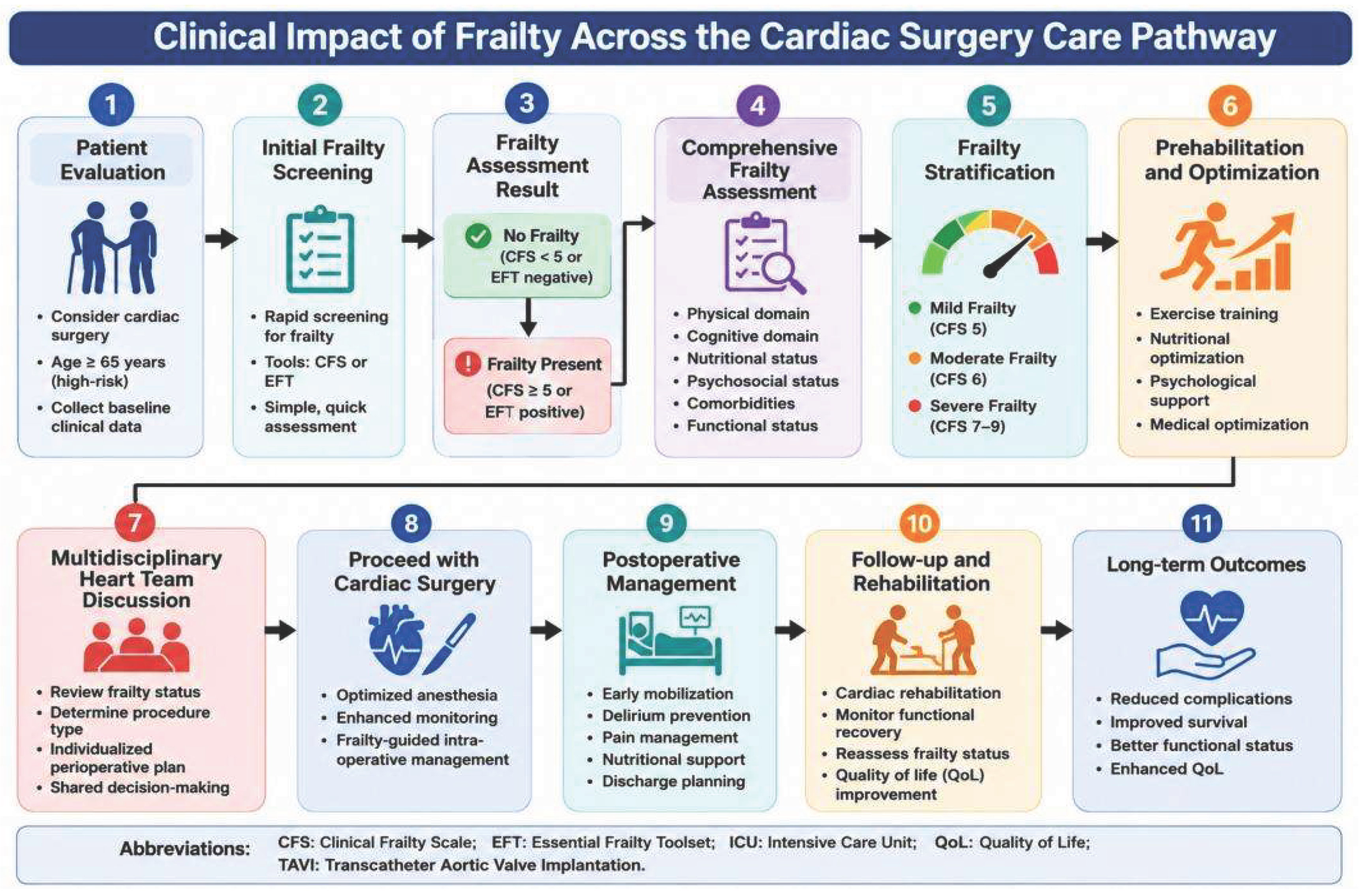
Figure 1.
Clinical Impact of Frailty Across the Cardiac Surgery Care Pathway. This figure illustrates the clinical pathway integrating frailty assessment into cardiac surgery decision-making, from initial patient evaluation through postoperative follow-up. Abbreviations: CFS, Clinical Frailty Scale; EFT.
Figure 1.
Clinical Impact of Frailty Across the Cardiac Surgery Care Pathway. This figure illustrates the clinical pathway integrating frailty assessment into cardiac surgery decision-making, from initial patient evaluation through postoperative follow-up. Abbreviations: CFS, Clinical Frailty Scale; EFT.
Frailty is a prevalent and clinically significant condition among patients undergoing cardiac surgery, affecting approximately one in five to one in three older adults in this population, depending on the assessment tool and population studied. The evidence demonstrating associations between frailty and adverse postoperative outcomes-including mortality, delirium, infection, renal complications, and prolonged recovery-is robust and consistent across multiple systematic reviews and meta-analyses. Key modifiable risk factors include low hemoglobin and albumin, high New York Heart Association class, and elevated EuroSCORE II.
The integration of frailty assessment into clinical practice offers opportunities for improved risk stratification, enhanced shared decision-making, and targeted perioperative interventions. Major professional societies now recommend routine frailty assessment as an integral component of preoperative evaluation. However, significant challenges remain regarding standardization of assessment approaches, evidence for frailty-modifying interventions, and optimal clinical integration.
Future research should focus on comparative effectiveness of assessment tools, development of scalable implementation strategies, high-quality trials of prehabilitation and other frailty-modifying interventions, and the application of artificial intelligence for precision risk stratification. The goal of frailty assessment in cardiac surgery should not be to exclude vulnerable patients from potentially beneficial interventions but to identify opportunities for optimization, to facilitate informed decision-making, and to allocate resources more effectively.
Conclusions
Frailty is a prevalent and clinically significant condition among patients undergoing cardiac surgery, affecting approximately one in five to one in three older adults in this population, depending on the assessment tool and population studied. The evidence demonstrating associations between frailty and adverse postoperative outcomes-including mortality, delirium, infection, renal complications, and prolonged recovery-is robust and consistent across multiple systematic reviews and meta-analyses. Key modifiable risk factors include low hemoglobin and albumin, high New York Heart Association class, and elevated EuroSCORE II.
The integration of frailty assessment into clinical practice offers opportunities for improved risk stratification, enhanced shared decision-making, and targeted perioperative interventions. Major professional societies now recommend routine frailty assessment as an integral component of preoperative evaluation. However, significant challenges remain regarding standardization of assessment approaches, evidence for frailty-modifying interventions, and optimal clinical integration.
Future research should focus on comparative effectiveness of assessment tools, development of scalable implementation strategies, high-quality trials of prehabilitation and other frailty-modifying interventions, and the application of artificial intelligence for precision risk stratification. The goal of frailty assessment in cardiac surgery should not be to exclude vulnerable patients from potentially beneficial interventions but to identify opportunities for optimization, to facilitate informed decision-making, and to allocate resources more effectively.
Author Contributions
All authors have reviewed the final version to be published and agreed to be accountable for all aspects of the work.
Concept and design
Asad Ullah
Drafting of the manuscript
Asad Ullah
Critical review of the manuscript for important intellectual content
Asad Ullah
Supervision
Asad Ullah
Conflicts of interest
In compliance with the ICMJE uniform disclosure form, all authors declare the following: Payment/services info: All authors have declared that no financial support was received from any organization for the submitted work. Financial relationships: All authors have declared that they have no financial relationships at present or within the previous three years with any organizations that might have an interest in the submitted work. Other relationships: All authors have declared that there are no other relationships or activities that could appear to have influenced the submitted work.
References
- Sarmadi, S.; Hosseini, S.; Gholami, M.; et al. Prevalence and risk factors of frailty among cardiac surgery patients: a systematic review and meta-analysis. Ann. Med. 2025, 57, 2576638. [Google Scholar] [CrossRef] [PubMed]
- Thangavelu, V.; Bhatia, O.; Hasija, A.; et al. Association of preoperative frailty and postoperative outcomes in older adults undergoing major cardiac procedures: a systematic review and meta-analysis. Anesth. Analg. 2025. [Google Scholar] [CrossRef] [PubMed]
- Ozeren, K.; Topcu, A.C.; Kayacioglu, I. Frailty assessment to improve risk stratification in elderly patients undergoing elective cardiac surgery. Braz. J. Cardiovasc Surg. 2025, 40, 20230182. [Google Scholar] [CrossRef]
- Niebauer, J.; Baeck, C.; Bischoff-Ferrari, H.A.; et al. Preinterventional frailty assessment in patients scheduled for cardiac surgery or transcatheter aortic valve implantation: a consensus statement of the. European Association for Cardio-Thoracic Surgery (EACTS) and the European Association of Preventive Cardiology (EAPC) of the European Society of Cardiology (ESC). Eur. J. Prev. Cardiol. 2024, 31, 146–181. [Google Scholar] [CrossRef] [PubMed]
- Sündermann, S.H.; van Boven, W.J.; Gorter, T.M.; et al. EACTS consensus paper on the determination of frailty. Eur. J. Cardiothorac. Surg. 2023, 64, 283. [Google Scholar] [CrossRef] [PubMed]
- Fried, L.P.; Tangen, C.M.; Walston, J.; et al. Frailty in older adults: evidence for a phenotype. J. Gerontol. A Biol. Sci. Med. Sci. 2001, 56, 146–156. [Google Scholar] [CrossRef] [PubMed]
- Chandiramani, A.; Bansal, A.; Kumar, A.; et al. Frailty in cardiac surgery—assessment tools, impact on outcomes, and optimisation strategies: a narrative review. J. Cardiovasc Dev. Dis. 2025, 12, 127. [Google Scholar] [CrossRef] [PubMed]
- Venkatesan, A.; Singh, S.; Gupta, R.; et al. Frailty assessment in coronary artery bypass grafting: a review of current tools and clinical applications. J. Cardiothorac. Vasc. Anesth. 2026. [Google Scholar] [CrossRef] [PubMed]
- Rudas, V.A.; Lassnigg, A.; Fischer-Hammerschmied, A.; et al. Cardiac surgery as a means of reversing frailty - the CURE-Frailty Trial a prospective cohort study. BMC Geriatr. 2026. [Google Scholar] [CrossRef] [PubMed]
- de Salles, F.B.; Moreira, L.R.; Costa, M.D.; et al. Influence of frailty syndrome on outcomes of cardiovascular surgery in elderly patients. Braz. J. Cardiovasc Surg. 2025, 40, 20240402. [Google Scholar] [CrossRef] [PubMed]
- Yau, D.K.W.; Ng, F.F.; Wong, M.K.H.; et al. Effect of exercise prehabilitation on quality of recovery after cardiac surgery: a single-centre randomised controlled trial. Br. J. Anaesth. 2025, 134, 45–53. [Google Scholar] [CrossRef] [PubMed]
- Lee, D.H.; Buth, K.J.; Martin, B.J.; et al. Frail patients are at increased risk for mortality and prolonged institutional care after cardiac surgery. Circulation 2010, 121, 973–978. [Google Scholar] [CrossRef] [PubMed]
- Ter Steege, R.; van der Wal, M.H.; van Dijk, E.M.; et al. Prehabilitation for patients with mild to moderate frailty undergoing coronary artery and valve surgery: a pilot randomized controlled trial. Eur. J. Cardiovasc Nurs. 2024. [Google Scholar] [CrossRef] [PubMed]

Table 1.
Frailty Assessment Tools Used in Cardiac Surgery.
| Tool | Components | Advantages | Limitations |
| Fried Frailty Phenotype | 5 criteria: weight loss, exhaustion, weakness, slow gait, low activity | Well-validated; widely used; gold standard; conceptual clarity | Requires specialized equipment; time-consuming (10-15 min); trained personnel needed |
| Clinical Frailty Scale (CFS) | 9-point scale based on functional status and clinical judgment | Rapid (1-2 min); simple; integrates clinical judgment; validated in large cohorts | Subjective; inter-rater variability; less granular |
| Essential Frailty Toolset (EFT) | 4 items: cognition, hemoglobin, albumin, chair rise | Rapid (2-3 min); specifically validated for cardiac surgery/TAVI; objective measures | Limited validation; may miss non-physical domains |
| Edmonton Frail Scale | 11 items across 9 domains including cognition, mood, function | Multidimensional; validated in various settings | Less used in cardiac surgery; moderate administration time (5-10 min) |
| Short Physical Performance Battery (SPPB) | Balance, gait speed, chair stand tests | Objective performance-based; predicts medium-term mortality and prolonged hospital stay | Requires physical testing; time-consuming |
| Frailty Index | 30-70+ items across multiple domains (deficit accumulation) | Comprehensive; continuous measure; captures multi-system decline | Time-consuming; requires extensive data; may not be feasible in routine practice |
Abbreviations: CFS, Clinical Frailty Scale; EFT, Essential Frailty Toolset; SPPB, Short Physical Performance Battery.
Table 2.
Major Clinical Studies Evaluating Frailty and Outcomes in Cardiac Surgery.
| Study | Design | Population | Main Findings | Clinical Significance |
| Sarmadi et al. 2025 [1] | Systematic review & meta-analysis | 78 studies, n=6,613,392 | Pooled frailty prevalence 30.2%; risk factors: age, male sex, NYHA IV, lower albumin, lower hemoglobin |
Comprehensive screening needed; modifiable risk factors identified for targeted intervention |
|
Thangavelu et al. 2025 [2] |
Systematic review & meta-analysis | 19 studies, n=11,667; mean age 71.9 years |
Frailty prevalence 16.8%; OR for delirium 4.11; OR for infection 3.72; OR for 30-day mortality 3.58; OR for 1-year mortality 2.25 |
Routine frailty screening recommended; targeted perioperative strategies needed |
| Ozeren et al. 2025 [3] | Prospective cohort | 164 patients; median age 70 years |
EuroSCORE II and albumin significantly associated with primary endpoint; R² improved from 0.07 to 0.144 with albumin addition | Albumin measurement improves EuroSCORE II predictive power; simple biomarker integration |
| Rudas et al. 2026 [9] | Prospective cohort | 76 patients | Median CFS decreased from 4 to 3 at 1 year (P<0.001); frailty improved in 35.5%; cardiac rehabilitation associated with improvement | Cardiac surgery can reverse frailty; rehabilitation is key |
| de Salles et al. 2025 [10] | Prospective cohort | 137 patients; mean age 69.4 years |
Frailty prevalence 13.1%–43.1% depending on criterion; FFP and CFS were independent predictors of MACCE | Tool selection affects frailty identification; FFP and CFS demonstrated equivalent prognostic value |
| Yau et al. 2025 [11] | Randomized controlled trial | 138 patients; median age 64 years |
Prehabilitation was safe; no improvement in QoR-15 scores; disability reduced at 90 days (mean difference −9%, P=0.022) | Prehabilitation may improve long-term functional outcomes despite limited early recovery benefits |
| Lee et al. 2010 [12] | Retrospective cohort | 3,826 patients; 157 frail (4.1%) |
Frailty independently associated with in-hospital mortality (OR 1.8, P=0.03) and institutional discharge (OR 6.3) | Frailty assessment identifies high-risk patients and informs perioperative planning and discharge disposition |
Abbreviations: CFS, Clinical Frailty Scale; EFT, Essential Frailty Toolset; FFP, Fried Frailty Phenotype; MACCE, major adverse cardiovascular and cerebral events; NYHA, New York Heart Association; OR, odds ratio; QoR-15, Quality of Recovery-15; TAVI, transcatheter aortic valve implantation.
Disclaimer/Publisher’s Note: The statements, opinions and data contained in all publications are solely those of the individual author(s) and contributor(s) and not of MDPI and/or the editor(s). MDPI and/or the editor(s) disclaim responsibility for any injury to people or property resulting from any ideas, methods, instructions or products referred to in the content. |
© 2026 by the authors. Licensee MDPI, Basel, Switzerland. This article is an open access article distributed under the terms and conditions of the Creative Commons Attribution (CC BY) license (http://creativecommons.org/licenses/by/4.0/).
Copyright: This open access article is published under a Creative Commons CC BY 4.0 license, which permit the free download, distribution, and reuse, provided that the author and preprint are cited in any reuse.