

Submitted:
04 September 2026
Posted:
08 September 2026
You are already at the latest version
Abstract
Background: Healthcare-associated infections (HAIs), particularly those caused by an-timicrobial-resistant pathogens, remain an important cause of adverse outcomes among hospitalized patients. The combined contribution of antimicrobial resistance, clinical characteristics, and antimicrobial treatment to mortality requires further evaluation. This study aimed to investigate factors associated with in-hospital mortal-ity among patients with HAIs, with particular emphasis on multidrug resistance (MDR) and post-culture antimicrobial treatment.
Methods: We conducted a retrospective observational cohort study including 192 pa-tients with 242 documented HAI episodes in a hospital in Târgu-Mureș, Romania. Demographic and clinical characteristics, invasive procedures, microbiological find-ings, antimicrobial resistance phenotypes, antimicrobial exposure, and in-hospital outcome were evaluated. Comparisons between survivors and non-survivors were performed using the Mann–Whitney U test, Pearson's chi-square test, or Fisher's exact test, as appropriate. Factors associated with in-hospital mortality were investigated using univariable and multivariable logistic regression.
Results: Overall, 161/192 patients (83.9%) died during hospitalization. Non-survivors were significantly older than survivors [median 71 (IQR 62–78) vs. 62 (50.5–72) years; p=0.025]. MDR organisms were more frequent among non-survivors (51.6% vs. 22.6%; p=0.003), and MDR phenotype was associated with increased odds of mortality in univariable analysis (OR=3.65, 95% CI 1.49–8.95; p=0.005). After adjustment for age, mechanical ventilation, and recent surgery, MDR remained independently associated with in-hospital mortality (aOR=3.58, 95% CI 1.42–8.98; p=0.007). In the treat-ment-focused model, aminopenicillin exposure (aOR=0.21, 95% CI 0.07–0.64; p=0.006), second-generation aminoglycosides (aOR=0.23, 95% CI 0.06–0.97; p=0.045), and third-generation cephalosporins (aOR=0.35, 95% CI 0.14–0.88; p=0.025) were associat-ed with lower odds of mortality. No significant association was observed between time to specific antimicrobial therapy and mortality (p=0.541).
Conclusions: MDR was the main antimicrobial-resistance factor independently asso-ciated with in-hospital mortality among patients with HAIs. Although several antimi-crobial classes were associated with lower odds of death, these observational associa-tions should not be interpreted as causal treatment effects. The findings emphasize the importance of antimicrobial resistance surveillance, rapid microbiological diagnosis, antimicrobial stewardship, and timely access to active antimicrobial therapy.
Keywords:
healthcare-associated infections
; antimicrobial resistance
; multidrug resistance
; MDR
; in-hospital mortality
; antimicrobial therapy
; Acinetobacter baumannii
; antimicrobial stewardship
1. Introduction
Healthcare-associated infections (HAIs) remain a major patient-safety challenge and contribute substantially to morbidity, mortality, prolonged hospitalization, antimicrobial consumption, and healthcare expenditure. The World Health Organization (WHO) emphasizes that HAIs continue to affect patients and healthcare systems worldwide and represent an important driver of antimicrobial resistance (AMR), while a substantial proportion of these infections could be prevented through effective infection prevention and control measures [1].
In Europe, the most recent point-prevalence survey conducted by the European Centre for Disease Prevention and Control (ECDC) included more than 290,000 patients from 1,250 acute-care hospitals in the EU/EEA, confirming the continuing substantial burden of HAIs and antimicrobial use across European healthcare systems [2]. Earlier European burden analyses have similarly demonstrated that HAIs account for a considerable loss of healthy life-years and represent a major component of the overall burden of communicable diseases [3].
The clinical impact of HAIs is increasingly compounded by antimicrobial resistance. Globally, bacterial AMR is associated with a substantial mortality burden, and large-scale analyses have identified resistant bacterial infections as an important and growing threat to population health [4]. Of particular concern in healthcare settings are multidrug-resistant (MDR), extensively drug-resistant (XDR), and pandrug-resistant (PDR) organisms, which restrict therapeutic options and may increase the likelihood of initially ineffective antimicrobial treatment. The WHO Bacterial Priority Pathogens List 2024 highlights several resistant Gram-negative pathogens of major public-health importance, including carbapenem-resistant Acinetobacter baumannii, carbapenem-resistant Pseudomonas aeruginosa, and resistant Enterobacterales [5]. These microorganisms are particularly relevant in critically ill patients, who frequently experience prolonged hospitalization, invasive procedures, mechanical ventilation, central venous catheterization, and extensive previous antimicrobial exposure.
Among these pathogens, Acinetobacter baumannii represents a major challenge because of its ability to persist in healthcare environments and acquire resistance to multiple antimicrobial classes. High levels of multidrug resistance have been reported among A. baumannii isolates responsible for hospital-acquired and ventilator-associated pneumonia, with substantial associated mortality [6]. Carbapenem resistance further complicates the management of A. baumannii infections and has been associated with adverse clinical outcomes [7]. Nevertheless, the relationship between antimicrobial resistance and mortality is complex. Mortality among patients infected with resistant organisms may reflect not only the resistance phenotype itself but also advanced age, underlying disease, severity of illness, invasive procedures, infection site, and delays in receiving active antimicrobial therapy. Indeed, previous cohort studies have produced heterogeneous findings regarding whether multidrug resistance itself remains independently associated with mortality after adjustment for these clinical factors [8].
Antimicrobial treatment represents another key determinant of clinical outcome. The therapeutic management of HAIs caused by resistant organisms requires a balance between sufficiently broad empirical coverage and antimicrobial stewardship. Inappropriate empirical therapy is more likely when infections are caused by resistant microorganisms and may adversely affect survival. A large cohort study of more than 21,000 patients with bloodstream infections demonstrated that discordant empirical antimicrobial therapy was independently associated with increased mortality, while antimicrobial resistance strongly predicted the receipt of discordant treatment [9]. Similarly, a systematic review and meta-analysis including 198 studies and nearly 90,000 patients with bacteremia found that inappropriate empirical antimicrobial therapy was associated with approximately twice the odds of mortality compared with appropriate therapy [10]. More recent studies have also reported lower mortality among patients receiving antimicrobial treatment active against the causative Gram-negative pathogen [11,12].
However, evaluating the relationship between individual antimicrobial agents and mortality in observational studies remains challenging. Antimicrobial selection is influenced by infection severity, previous antibiotic exposure, pathogen identity, susceptibility profile, organ dysfunction, and availability of therapeutic alternatives. Consequently, associations between specific antimicrobial classes and clinical outcomes may be affected by confounding by indication and should not automatically be interpreted as causal treatment effects. An integrated assessment incorporating patient characteristics, invasive procedures, microbiological findings, resistance phenotypes, and antimicrobial exposure is therefore necessary to better characterize the determinants of mortality among patients with HAIs.
Therefore, this study aimed to investigate the clinical, microbiological, antimicrobial-resistance, and treatment-related factors associated with in-hospital mortality among patients with HAIs. Particular emphasis was placed on determining whether MDR phenotype was independently associated with mortality after adjustment for relevant clinical factors and on evaluating the relationship between post-culture antimicrobial treatment and patient outcome. We hypothesized that MDR infection would be independently associated with increased in-hospital mortality and that antimicrobial treatment patterns would differ between survivors and non-survivors.
2. Results
Among the 192 patients included in the study, 161 (83.9%) died during hospitalization and 31 (16.1%) survived. Non-survivors were significantly older than survivors, with a median age of 71 years (IQR 62–78) versus 62 years (IQR 50.5–72), respectively (p=0.025). Recent surgery was more frequently documented among survivors than among non-survivors (35.5% vs. 17.4%, p=0.022). Mechanical ventilation was highly prevalent in both groups and was more frequent among non-survivors (91.9% vs. 80.6%), although the difference did not reach statistical significance (p=0.092). No significant differences according to in-hospital outcome were observed for sex, place of residence, cardiovascular, pulmonary, oncological, metabolic or renal comorbidities, central venous catheterization, previous antibiotic exposure, or length of hospital stay (Table 1).
Insert Table 1

Table 1.
Patient characteristics according to in-hospital outcome.
| Characteristic | Non-survivors n=161 | Survivors n=31 | p-value |
| Age, years, median (IQR) | 71 (62–78) | 62 (50.5–72) | 0.025 |
| Male sex, n (%) | 101 (62.7%) | 21 (67.7%) | 0.596 |
| Rural residence, n (%) | 89 (55.3%) | 19 (61.3%) | 0.537 |
| Cardiovascular comorbidities, n (%) | 106 (65.8%) | 19 (61.3%) | 0.627 |
| Pulmonary comorbidities, n (%) | 35 (21.7%) | 11 (35.5%) | 0.101 |
| Oncological comorbidities, n (%) | 17 (10.6%) | 4 (12.9%) | 0.753 |
| Metabolic comorbidities, n (%) | 52 (32.3%) | 10 (32.3%) | 0.997 |
| Renal comorbidities, n (%) | 23 (14.3%) | 2 (6.5%) | 0.381 |
| Mechanical ventilation, n (%) | 148 (91.9%) | 25 (80.6%) | 0.092 |
| Central venous catheter, n (%) | 126 (78.3%) | 26 (83.9%) | 0.481 |
| Previous antibiotic therapy, n (%) | 152 (94.4%) | 29 (93.5%) | 0.693 |
| Recent surgery, n (%) | 28 (17.4%) | 11 (35.5%) | 0.022 |
| Length of stay, days, median (IQR) | 14 (9–20) | 18 (7.5–33.5) | 0.417 |
Continuous variables: Mann–Whitney U test. Categorical variables: Pearson χ2 or Fisher’s exact test, as appropriate.
Marked differences in antimicrobial resistance patterns were observed according to in-hospital outcome. MDR organisms were significantly more frequent among non-survivors than among survivors (51.6% vs. 22.6%, p=0.003). Carbapenem-resistant phenotypes also differed significantly between outcome groups (25.5% vs. 45.2%, p=0.026), whereas XDR status was not significantly associated with mortality. Among the selected microorganisms and resistance profiles, MDR Acinetobacter baumannii was substantially more frequent among non-survivors (47.8% vs. 12.9%, p<0.001). The overall distribution of A. baumannii also differed significantly according to outcome (35.4% vs. 61.3%, p=0.007). No statistically significant differences were observed for Pseudomonas aeruginosa, carbapenem-resistant P. aeruginosa, Klebsiella pneumoniae, or CPE-producing K. pneumoniae (Table 2).
Insert Table 2
Table 2.
Microbiological characteristics and antimicrobial resistance according to in-hospital outcome.
Table 2.
Microbiological characteristics and antimicrobial resistance according to in-hospital outcome.
| Microbiological characteristic | Non-survivors n=161 | Survivors n=31 | p-value |
| Antimicrobial resistance phenotypes | |||
| MDR | 83 (51.6%) | 7 (22.6%) | 0.003 |
| XDR | 32 (19.9%) | 9 (29.0%) | 0.255 |
| Carbapenem-resistant phenotype | 41 (25.5%) | 14 (45.2%) | 0.026 |
| Selected microorganisms / resistance profiles | |||
| Acinetobacter baumannii MDR | 77 (47.8%) | 4 (12.9%) | <0.001 |
| Acinetobacter baumannii CR | 10 (6.2%) | 5 (16.1%) | 0.072 |
| Acinetobacter baumannii | 57 (35.4%) | 19 (61.3%) | 0.007 |
| Pseudomonas aeruginosa | 17 (10.6%) | 5 (16.1%) | 0.363 |
| Pseudomonas aeruginosa CR | 4 (2.5%) | 1 (3.2%) | 0.590 |
| Klebsiella pneumoniae | 7 (4.3%) | 2 (6.5%) | 0.640 |
| Klebsiella pneumoniae CPE | 7 (4.3%) | 4 (12.9%) | 0.081 |
For patients with multiple infection episodes, microbiological variables were coded as present if documented in at least one linked episode (242 infections mapped to 192 patients).
When patients were classified according to the highest antimicrobial resistance phenotype identified during hospitalization, in-hospital mortality was highest among patients with MDR organisms (89.3%; 50/56), compared with 80.6% (29/36) among patients with XDR organisms and 72.9% (43/59) among those without an MDR/XDR/PDR phenotype (Figure 1). Mortality was 50.0% (2/4) in the PDR subgroup; however, this estimate should be interpreted cautiously because of the very small number of patients in this category.
Insert Figure 1
Figure 1.
In-hospital mortality according to antimicrobial resistance phenotype.
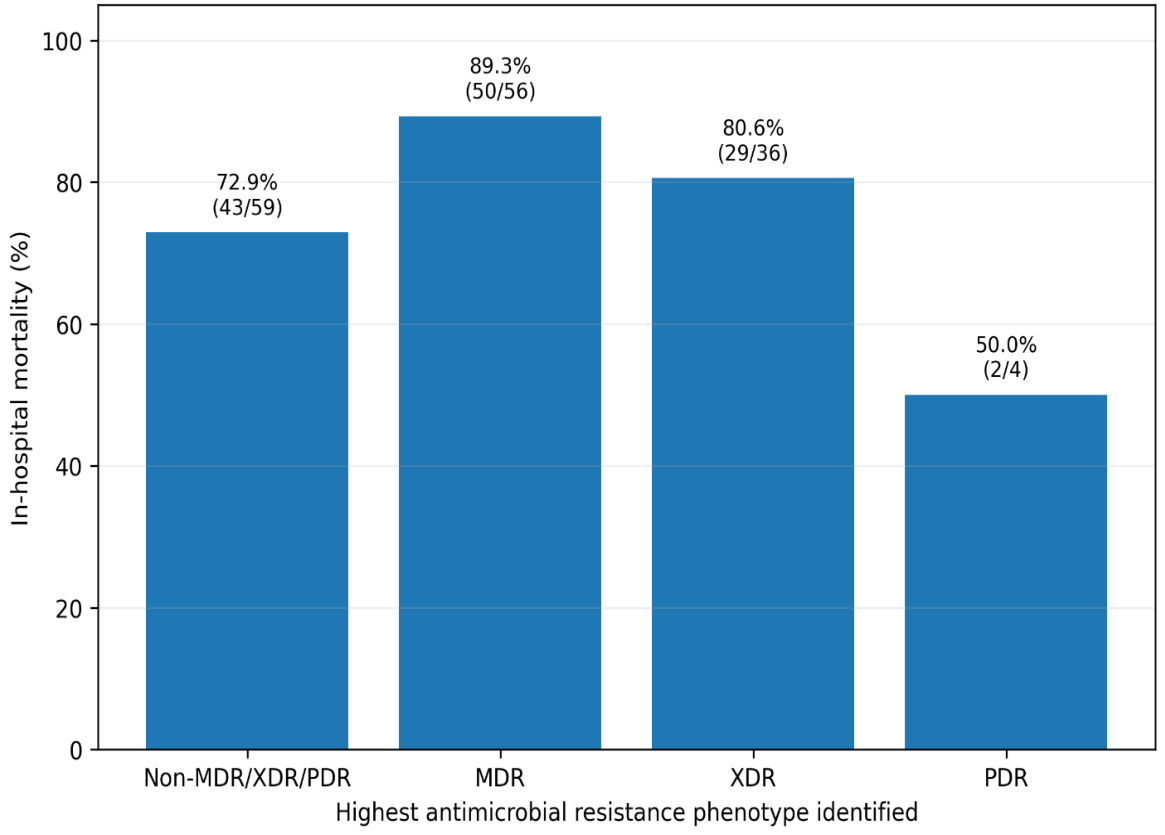
Figure 1. In-hospital mortality according to antimicrobial resistance phenotype. Patients were classified according to the highest antimicrobial resistance phenotype identified during hospitalization. In-hospital mortality was 72.9% (43/59) among patients without an MDR/XDR/PDR phenotype, 89.3% (50/56) among patients with MDR organisms, 80.6% (29/36) among those with XDR organisms, and 50.0% (2/4) among patients with PDR organisms.
Post-culture antimicrobial treatment patterns differed between survivors and non-survivors. Aminopenicillins were administered more frequently among survivors than non-survivors (32.3% vs. 6.8%, p<0.001), as were second-generation aminoglycosides (22.6% vs. 3.1%, p<0.001) and third-generation cephalosporins (54.8% vs. 31.1%, p=0.011). No statistically significant differences were observed for fluoroquinolones, glycylcyclines, oxazolidinones, glycopeptides, carbapenems, or polymyxins.
The median time from microbiological sampling to initiation of specific antimicrobial therapy was 6 days in both non-survivors and survivors and did not differ significantly between the groups (p=0.541). In contrast, the median duration of antibiotic treatment was significantly shorter among non-survivors than survivors [4 days (IQR 2–8) vs. 9 days (IQR 5–19), p<0.001].
Insert Table 3
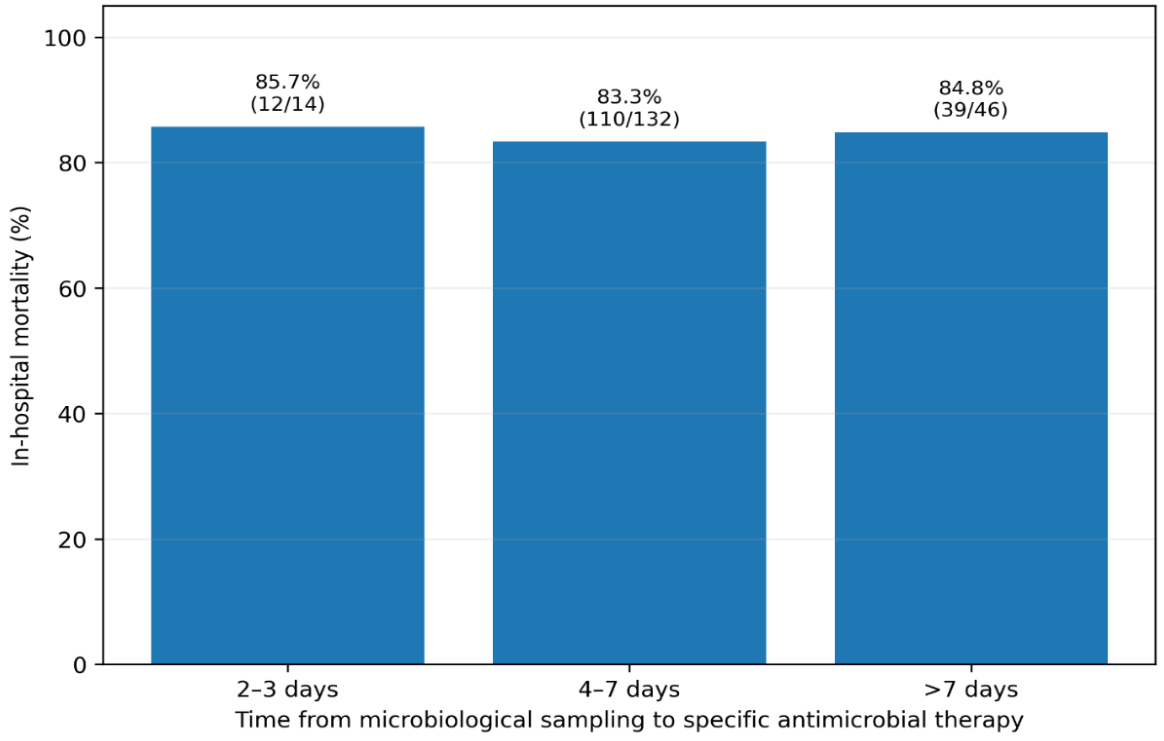
No clear relationship was observed between increasing time to initiation of specific antimicrobial therapy and in-hospital mortality (Figure 2). Mortality was 85.7% among patients in whom specific treatment was initiated within 2–3 days after microbiological sampling, 83.3% among those treated within 4–7 days, and 84.8% among those in whom treatment was initiated after more than 7 days. These findings were consistent with the continuous analysis, in which the median time to specific therapy was 6 days in both survivors and non-survivors (p=0.541).
Insert Figure 2
Figure 2.
Delay to specific antimicrobial therapy and in-hospital mortality.
In univariable logistic regression analysis, increasing age was associated with higher odds of in-hospital mortality (OR per 1-year increase=1.03, 95% CI 1.00–1.06; p=0.031). The presence of an MDR phenotype was strongly associated with mortality, corresponding to more than a threefold increase in the odds of death (OR=3.65, 95% CI 1.49–8.95; p=0.005). Mechanical ventilation was also associated with higher odds of mortality (OR=2.73, 95% CI 0.95–7.86), although the association did not reach statistical significance (p=0.062). Recent surgery was inversely associated with mortality (OR=0.38, 95% CI 0.17–0.89; p=0.025).
Regarding antimicrobial treatment, exposure to aminopenicillins (OR=0.15, 95% CI 0.06–0.41; p<0.001), second-generation aminoglycosides (OR=0.11, 95% CI 0.03–0.37; p<0.001), third-generation aminoglycosides (OR=0.31, 95% CI 0.10–0.99; p=0.048), and third-generation cephalosporins (OR=0.37, 95% CI 0.17–0.81; p=0.013) was associated with lower odds of in-hospital mortality in univariable analysis. Carbapenem and polymyxin exposure was not significantly associated with mortality (Table 4).
Insert Table 4
Table 4.
Univariable logistic regression analysis of factors associated with in-hospital mortality.
| Predictor | Crude OR | 95% CI | p-value |
|---|---|---|---|
| Age, per 1-year increase | 1.03 | 1.00–1.06 | 0.031 |
| Male sex | 0.80 | 0.35–1.82 | 0.596 |
| Mechanical ventilation | 2.73 | 0.95–7.86 | 0.062 |
| Central venous catheter | 0.69 | 0.25–1.93 | 0.483 |
| Recent surgery | 0.38 | 0.17–0.89 | 0.025 |
| MDR phenotype | 3.65 | 1.49–8.95 | 0.005 |
| XDR phenotype | 0.61 | 0.25–1.44 | 0.258 |
| Carbapenem-resistant phenotype | 0.41 | 0.19–0.92 | 0.029 |
| Aminopenicillins | 0.15 | 0.06–0.41 | <0.001 |
| 2nd-generation aminoglycosides | 0.11 | 0.03–0.37 | <0.001 |
| 3rd-generation aminoglycosides | 0.31 | 0.10–0.99 | 0.048 |
| 3rd-generation cephalosporins | 0.37 | 0.17–0.81 | 0.013 |
| Carbapenems | 1.77 | 0.81–3.89 | 0.154 |
| Polymyxins | 0.59 | 0.27–1.27 | 0.177 |
In the clinical and antimicrobial-resistance multivariable model, MDR phenotype remained independently associated with in-hospital mortality after adjustment for age, mechanical ventilation, and recent surgery (aOR=3.58, 95% CI 1.42–8.98; p=0.007). Age showed a borderline association with mortality (aOR per 1-year increase=1.03, 95% CI 1.00–1.06; p=0.067). Mechanical ventilation was associated with an approximately 2.8-fold increase in the odds of death, although the association did not reach statistical significance (aOR=2.79, 95% CI 0.88–8.88; p=0.082). Recent surgery was no longer significantly associated with mortality after multivariable adjustment (aOR=0.48, 95% CI 0.20–1.19; p=0.113).
In the treatment-focused multivariable model, aminopenicillin exposure remained associated with lower odds of in-hospital mortality (aOR=0.21, 95% CI 0.07–0.64; p=0.006). Similar independent associations were observed for second-generation aminoglycosides (aOR=0.23, 95% CI 0.06–0.97; p=0.045) and third-generation cephalosporins (aOR=0.35, 95% CI 0.14–0.88; p=0.025), after adjustment for age, mechanical ventilation, and recent surgery.
No independent association with mortality was observed for the remaining clinical covariates included in the treatment-focused model.
Insert Table 5
Figure 3 summarizes the magnitude and direction of the associations between clinical characteristics, antimicrobial resistance phenotypes, antimicrobial treatment, and in-hospital mortality. MDR phenotype showed the strongest positive association with mortality (OR=3.65, 95% CI 1.49–8.95; p=0.005), while mechanical ventilation was associated with higher odds of death but did not reach statistical significance (OR=2.73, 95% CI 0.95–7.86; p=0.062). Several antimicrobial exposures, including aminopenicillins, second- and third-generation aminoglycosides, and third-generation cephalosporins, were associated with significantly lower odds of in-hospital mortality in univariable analysis.
Insert Figure 3
Figure 3.
Factors associated with in-hospital mortality.
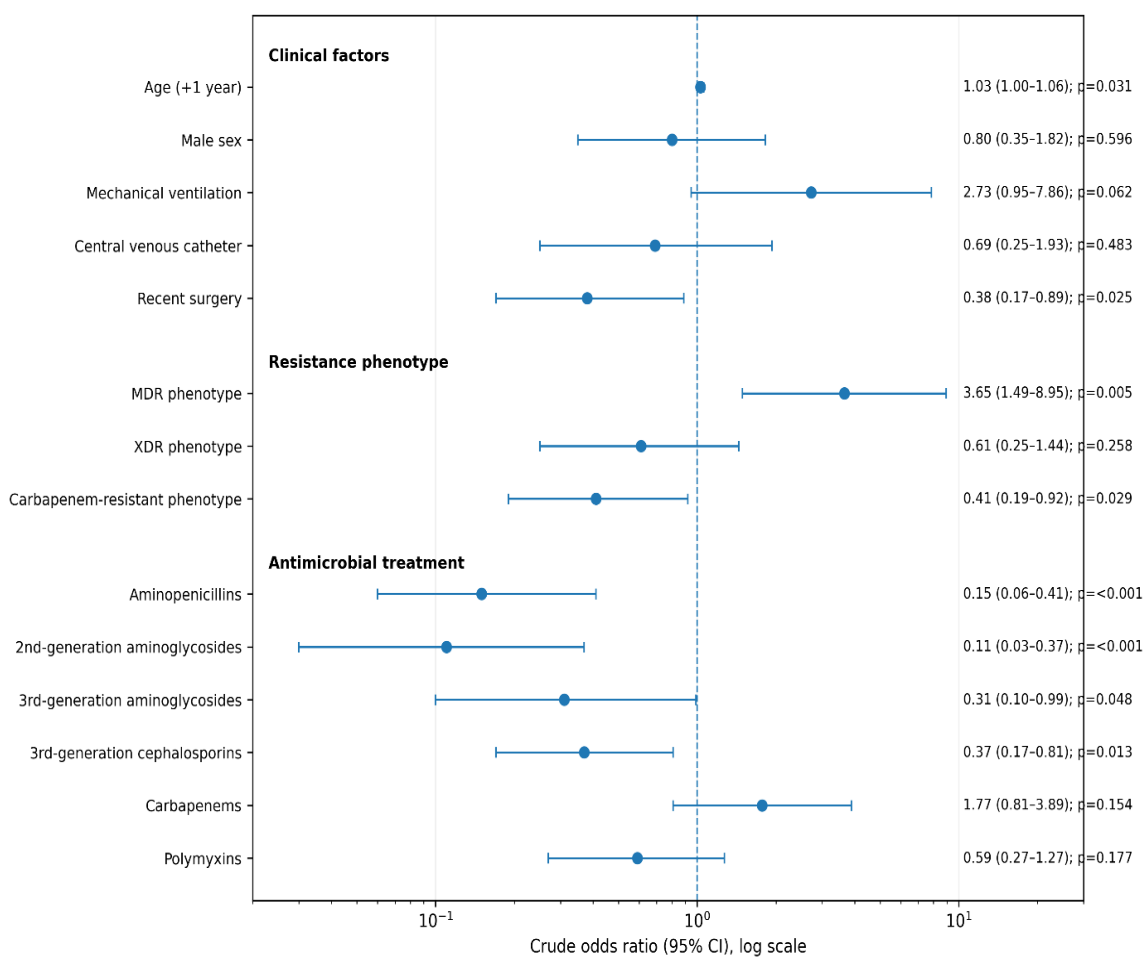
Figure 3. Forest plot of univariable associations between clinical characteristics, antimicrobial resistance phenotypes, antimicrobial exposure, and in-hospital mortality. Odds ratios (ORs) and 95% confidence intervals (CIs) are shown on a logarithmic scale. The vertical dashed line indicates the null value (OR=1).
3. Discussion
The present study evaluated clinical, microbiological, antimicrobial-resistance, and treatment-related factors associated with in-hospital mortality among 192 patients with 242 healthcare-associated infection episodes. The principal finding was the strong association between multidrug resistance and mortality. MDR organisms were substantially more frequent among non-survivors than survivors, and MDR phenotype remained independently associated with in-hospital death after adjustment for age, mechanical ventilation, and recent surgery. This finding suggests that, within this cohort, the adverse prognostic significance of multidrug resistance could not be explained solely by the major clinical characteristics included in the adjusted model.
The relationship between antimicrobial resistance and mortality has been consistently recognized as clinically important, although the magnitude of the effect varies substantially according to pathogen, infection site, patient population, and analytical approach.
Global analyses continue to demonstrate a considerable mortality burden attributable to bacterial antimicrobial resistance. More specifically, recent observational evidence has reported significant associations between infection with multidrug-resistant organisms and in-hospital mortality, although residual confounding by severity of illness and comorbidity remains an important consideration [13].
Our finding that MDR infection was associated with more than threefold higher adjusted odds of death is therefore consistent with the broader evidence supporting antimicrobial resistance as an important marker of poor prognosis in hospitalized patients.
The predominance of Acinetobacter baumannii and resistant A. baumannii phenotypes is also clinically relevant. A. baumannii is a major healthcare-associated pathogen, particularly among critically ill and mechanically ventilated patients, and its capacity to accumulate multiple resistance mechanisms severely limits therapeutic options. A systematic review and meta-analysis examining hospital-acquired and ventilator-associated pneumonia caused by A. baumannii reported a pooled MDR prevalence of approximately 80% and an overall mortality estimate exceeding 40% [6]. More recent ICU cohorts continue to show particularly poor outcomes in carbapenem-resistant A. baumannii infections; for example, a five-year cohort of patients with Gram-negative bacteriemia reported substantially higher overall in-hospital mortality among patients with CRAB bacteriemia than among those infected with other Gram-negative organisms [14]. These findings support the clinical importance of resistant Acinetobacter in populations characterized by extensive healthcare exposure and invasive procedures.
Our findings should also be considered in the context of recent Romanian data. Studies conducted in Romanian tertiary-care hospitals have documented a substantial burden of MDR healthcare-associated infections, particularly in intensive care settings, with Acinetobacter baumannii consistently emerging as one of the predominant resistant pathogens. However, reported mortality varies considerably across populations and clinical settings. Differences in mortality between our cohort and previous Romanian studies should therefore be interpreted in light of differences in case mix, clinical severity, invasive supportive care, infection characteristics, and antimicrobial-resistance burden [15,16,17].
An important feature of the present cohort was the very high overall in-hospital mortality (83.9%). This figure should not be interpreted as an estimate of HAI-attributable mortality or of mortality among the overall population of patients with HAIs treated at the institution. Rather, it represents all-cause in-hospital mortality within the selected study cohort, which was characterized by a particularly high-risk clinical profile. More than 90% of patients required mechanical ventilation, approximately four-fifths had a central venous catheter, more than 94% had previous antimicrobial exposure, and some patients experienced multiple HAI episodes during hospitalization. These characteristics indicate substantial healthcare exposure and suggest a predominance of critically ill patients with a high baseline risk of death. Accordingly, the high observed mortality likely reflects the combined effects of underlying disease severity, invasive supportive care, recurrent or multiple infectious episodes, and antimicrobial resistance, rather than the attributable effect of HAI alone. Mechanical ventilation was more frequent among non-survivors and was associated with approximately 2.7-fold higher odds of mortality in univariable analysis; the magnitude of this association remained substantial after multivariable adjustment, although it did not reach conventional statistical significance. This result should not be interpreted as evidence that mechanical ventilation itself causes mortality. Rather, mechanical ventilation is likely to act as a marker of underlying disease severity, critical illness, prolonged exposure to invasive devices, and increased susceptibility to respiratory HAIs. The wide confidence intervals observed in the adjusted model also indicate limited precision, most likely reflecting the relatively small number of survivors.
Age was another clinically relevant factor. Non-survivors were significantly older than survivors, and increasing age was associated with greater odds of mortality in univariable analysis. After adjustment, the association became borderline and no longer met the conventional threshold for statistical significance. This attenuation suggests that part of the effect of age may overlap with other clinical characteristics and the burden of resistant infection. Nevertheless, the direction of the association is biologically plausible, given the reduced physiological reserve, greater burden of chronic disease, and vulnerability to severe infection typically observed in older hospitalized populations.
A second major finding concerned antimicrobial treatment. Exposure to aminopenicillins, second-generation aminoglycosides, and third-generation cephalosporins was associated with lower odds of in-hospital mortality in both univariable and treatment-focused multivariable analyses. These findings require particularly cautious interpretation. They should not be regarded as evidence that these antimicrobial classes exert an independent protective effect. In observational studies, antimicrobial selection is strongly determined by pathogen susceptibility, infection severity, prior antimicrobial exposure, organ function, and the availability of active therapeutic alternatives. Patients infected with susceptible organisms and with less severe disease are more likely to remain eligible for narrower or conventional antimicrobial regimens, whereas critically ill patients infected with highly resistant organisms are more likely to receive broad-spectrum or last-line agents. Therefore, the observed associations may at least partly reflect confounding by indication and differences in underlying microbiological susceptibility rather than direct treatment effects.
This interpretation is supported by existing evidence showing that the adequacy of antimicrobial therapy is often more prognostically relevant than the antimicrobial class itself.
In a large US cohort of more than 20,000 bloodstream infection episodes, discordant empirical antimicrobial therapy was closely associated with antimicrobial resistance and with increased mortality [9]. Similarly, a systematic review and meta-analysis found that inappropriate empirical antimicrobial therapy was associated with unfavorable mortality outcomes across bacteriemic populations [10]. More recent real-world evidence has likewise shown higher mortality among patients receiving initially inadequate treatment, particularly when resistant bacteria were involved [18]. Consequently, future analyses of this cohort would benefit from direct matching of each administered antimicrobial agent with the susceptibility profile of the corresponding isolate, allowing classification of therapy as microbiologically appropriate or inappropriate.
Interestingly, the interval between microbiological sampling and initiation of specific antimicrobial therapy was not significantly associated with mortality in the present study. Mortality remained high and relatively similar across the 2–3-day, 4–7-day, and >7-day categories, and the median interval to specific treatment was 6 days in both survivors and non-survivors. This finding should not be interpreted as evidence that treatment delay is clinically irrelevant. Rather, the variable available in the database represented time to specific therapy, not necessarily time to the first microbiologically active therapy. Studies evaluating sepsis and bloodstream infection populations have reported associations between delayed or inappropriate antimicrobial treatment and poorer outcomes, although the magnitude of the effect varies according to disease severity, infection source, and the definition of treatment adequacy [19]. The absence of a clear association in our cohort may therefore reflect limitations in treatment-timing measurement, heterogeneity of infection episodes, and inability to determine whether the initiated therapy was active against the causative pathogen.
The significantly longer duration of antimicrobial treatment among survivors should also be interpreted cautiously. A longer treatment course cannot be considered protective on the basis of these data because patients who die early inherently have less opportunity to accumulate treatment days. This introduces a form of survivorship or time-dependent bias. Accordingly, treatment duration was retained as a descriptive variable rather than interpreted as a causal determinant of survival.
The findings concerning carbapenem-resistant phenotypes also require a nuanced interpretation. Although carbapenem resistance differed between survivors and non-survivors in the unadjusted analyses, the direction of this association was not straightforward and did not parallel the strong association observed for MDR. Resistance categories are partly overlapping constructs, and their prognostic significance may depend on the microorganism involved, infection site, antimicrobial regimen, and patient severity. Therefore, the present findings support the use of MDR as the main resistance variable in the adjusted mortality model rather than interpreting each resistance phenotype in isolation.
3.1. Strengths and Limitations
This study has several strengths. First, it integrates patient-level clinical characteristics, microbiological data, antimicrobial-resistance phenotypes, invasive procedures, and antimicrobial treatment within the same analysis. Second, mortality was evaluated using multivariable logistic regression rather than relying exclusively on bivariate associations. Third, patients with multiple infection episodes were analyzed at the patient level for the primary mortality outcome, thereby reducing the risk of treating repeated infection episodes as independent mortality observations.
Several limitations should also be acknowledged. The retrospective, single-center nature of the study limits causal inference and external generalizability. The exceptionally high proportion of mechanically ventilated patients indicates a highly selected case mix and limits direct comparison of the observed mortality with that reported in unselected HAI populations. Although 192 patients and 242 infection episodes were included, the number of survivors was relatively small, restricting the number of covariates that could be incorporated into multivariable models and contributing to wide confidence intervals for some estimates. Residual confounding by severity of illness is likely because standardized severity scores such as APACHE II, SOFA, or SAPS were not available in the database. Antimicrobial treatment was evaluated primarily by drug class, and treatment exposure could not be fully matched to isolate-level susceptibility to classify therapy as appropriate or inappropriate. Furthermore, the timing variable represented initiation of specific treatment rather than time to the first microbiologically active antimicrobial agent. Finally, the association between treatment duration and survival is vulnerable to survivorship bias and should not be interpreted causally.
Overall, our findings highlight the prognostic relevance of multidrug resistance among patients with healthcare-associated infections. MDR phenotype remained independently associated with in-hospital mortality even after adjustment for relevant clinical characteristics, whereas associations between individual antimicrobial classes and survival were more complex and should be interpreted in the context of antimicrobial susceptibility and treatment selection. These results reinforce the importance of early microbiological diagnosis, local resistance surveillance, antimicrobial stewardship, and rapid access to active therapy for patients at risk of infection with multidrug-resistant organisms. Prospective studies incorporating standardized severity scores and isolate-level assessment of antimicrobial appropriateness are warranted to further clarify the interaction between antimicrobial resistance, treatment adequacy, and mortality.
4. Materials and Methods
4.1. Study Design and Setting
This retrospective observational cohort study included patients with confirmed HAIs hospitalized between 2020 and 2025 in different departments of a hospital in Târgu-Mureș, Romania. The study population comprised 192 patients with a total of 242 documented HAI episodes. As some patients experienced more than one infection episode during hospitalization, analyses were structured at both the patient and infection-episode levels, depending on the variable of interest. For mortality analyses, the patient represented the primary unit of analysis.
4.2. Study Population
Patients were eligible for inclusion if they had a confirmed healthcare-associated infection according to the case definitions applicable under Romanian national surveillance regulations (Order of the Ministry of Health No. 1101/2016), which incorporate the case definitions established by Commission Implementing Decision 2018/945/EU [20], and if complete clinical and paraclinical data required for the study analyses were available. Patients with incomplete relevant clinical or laboratory data were excluded. All eligible cases available during the study period were included; therefore, no additional sampling procedure was applied.
4.3. Data Sources and Data Collection
Data were retrospectively extracted from the healthcare-associated infection surveillance database of the Mureș County Public Health Directorate. Information collected for each patient included demographic characteristics, hospital department, length of hospitalization, relevant comorbidities, previous antimicrobial exposure, invasive procedures, microbiological specimens, isolated microorganisms, antimicrobial susceptibility and resistance profiles, antimicrobial treatment, and in-hospital outcome.
4.4. Study Variables and Outcome Definition
The primary outcome was all-cause in-hospital mortality, defined as death occurring during the index hospitalization. Patients were consequently classified as non-survivors or survivors.
Demographic and clinical variables included age, sex, place of residence, cardiovascular, pulmonary, oncological, metabolic, and renal comorbidities, mechanical ventilation, central venous catheterization, recent surgery, previous antimicrobial therapy, and length of hospital stay.
Antimicrobial treatment variables included exposure to aminopenicillins, fluoroquinolones, aminoglycosides, glycylcyclines, oxazolidinones, cephalosporins, glycopeptides, carbapenems, and polymyxins. For patients with multiple documented infection episodes, exposure to an antimicrobial class was considered present if the respective class had been administered during at least one linked infection episode.
4.5. Microbiological Assessment and Antimicrobial Resistance
Antimicrobial resistance phenotypes were categorized as multidrug-resistant (MDR), extensively drug-resistant (XDR), and pandrug-resistant (PDR) according to the standardized international definitions proposed by Magiorakos et al. [21]. MDR was defined as acquired non-susceptibility to at least one agent in three or more antimicrobial categories; XDR as non-susceptibility to at least one agent in all but two or fewer antimicrobial categories (i.e., susceptibility retained to only one or two antimicrobial categories); and PDR as non-susceptibility to all agents in all antimicrobial categories [21]. Carbapenem resistance (CR) was analyzed separately from the MDR/XDR/PDR classification.
For patients with multiple infection episodes, a resistance phenotype was considered present if documented in at least one linked microbiological episode. For the graphical comparison of mortality across resistance categories, mutually exclusive groups were generated by assigning each patient to the highest resistance phenotype identified during hospitalization (PDR > XDR > MDR > non-MDR/XDR/PDR). For the remaining patient-level analyses, resistance indicators were not considered mutually exclusive; therefore, an individual patient could meet more than one resistance criterion during hospitalization.
4.6. Antimicrobial Treatment Assessment
Post-culture antimicrobial treatment was evaluated according to the antimicrobial classes administered after microbiological sampling. Time to specific antimicrobial therapy was defined as the number of days between microbiological sampling and initiation of the recorded specific treatment. For patients with multiple infection episodes, time-to-treatment analyses were based on the index infection episode.
Because microbiological susceptibility and administered treatment were not matched at the individual drug–isolate level for the present analysis, “specific antimicrobial therapy” should not be interpreted as synonymous with “appropriate” or susceptibility-active antimicrobial therapy.
4.7. Statistical Analysis
Statistical analyses were performed at the patient level for the primary outcome of in-hospital mortality. Continuous variables were assessed for distribution and are presented as median and interquartile range (IQR) where appropriate, whereas categorical variables are reported as absolute frequencies and percentages. Continuous variables were compared between survivors and non-survivors using the Mann–Whitney U test. Categorical variables were compared using Pearson’s chi-square test or Fisher’s exact test, as appropriate according to expected cell frequencies.
Binary logistic regression was used to investigate factors associated with in-hospital mortality. Univariable logistic regression analyses were initially performed to estimate crude odds ratios (ORs) with 95% confidence intervals (CIs) for demographic and clinical characteristics, antimicrobial resistance phenotypes, and antimicrobial treatment variables.
Two multivariable logistic regression models were constructed to limit model overfitting and to separately evaluate the contribution of antimicrobial resistance and antimicrobial treatment. Model 1 (clinical and antimicrobial-resistance model) included age, mechanical ventilation, recent surgery, and MDR phenotype. Model 2 (treatment-focused model) included age, mechanical ventilation, recent surgery, aminopenicillin exposure, second-generation aminoglycoside exposure, and third-generation cephalosporin exposure. Adjusted odds ratios (aORs) with 95% CIs were reported.
Separate models were used because of the limited number of survivors and to avoid excessive parameterization relative to the number of outcome events in the smaller outcome group. Clinical covariates were selected based on clinical relevance and their potential confounding effect on the relationship between antimicrobial resistance, antimicrobial treatment, and mortality.
All statistical tests were two-sided, and a p-value <0.05 was considered statistically significant. Statistical analyses were performed using IBM SPSS Statistics for Windows, version 23 (IBM Corp., Armonk, NY, USA).
5. Conclusions
In this retrospective cohort of patients with healthcare-associated infections, multidrug resistance was strongly associated with in-hospital mortality and remained independently associated with mortality after adjustment for relevant clinical factors. MDR phenotype was associated with substantially higher odds of death, underscoring the prognostic importance of antimicrobial resistance in hospitalized patients with HAIs.
Several antimicrobial treatment classes were associated with lower odds of mortality; however, these findings should be interpreted cautiously because treatment selection was influenced by clinical severity, pathogen susceptibility, and therapeutic availability.
The observed associations therefore do not establish a causal protective effect of specific antimicrobial classes.
No clear association was identified between the time to initiation of specific antimicrobial therapy and mortality, although this variable did not necessarily reflect time to microbiologically appropriate therapy.
These findings support the importance of antimicrobial resistance surveillance, rapid microbiological diagnosis, antimicrobial stewardship, and timely access to active treatment in patients at risk of MDR healthcare-associated infections. Future prospective studies incorporating standardized severity-of-illness scores and isolate-level assessment of treatment appropriateness are needed to better define the interaction between antimicrobial resistance, antimicrobial therapy, and mortality.
Author Contributions
Conceptualization SV, RB and BMA.; methodology SV.; software IM.; validation SV, LM and IM.; formal analysis SV.; investigation SV.; resources IM.; data curation IM.; writing—original draft preparation SV.; writing—review and editing SV.; visualization RB, BMA.; supervision LM.; All authors have read and agreed to the published version of the manuscript.
Funding
This research received no external funding.
Institutional Review Board Statement
Not applicable.
Informed Consent Statement
Not applicable.
Data Availability Statement
Data Availability Statements are available in section “MDPI Research Data Policies” at https://www.mdpi.com/ethics.
Conflicts of Interest
The authors declare no conflicts of interest.
References
- World Health Organization. Global report on infection prevention and control 2024; WHO: Geneva, 2024. [Google Scholar]
- European Centre for Disease Prevention and Control. Point prevalence survey of healthcare-associated infections and antimicrobial use in European acute care hospitals – 2022–2023; ECDC: Stockholm, 2024. [Google Scholar]
- Cassini, A.; Plachouras, D.; Eckmanns, T.; et al. Burden of six healthcare-associated infections on European population health: estimating incidence-based disability-adjusted life years through a population prevalence-based modelling study. PLoS Med. 2016, 13(10), e1002150. [Google Scholar] [CrossRef] [PubMed]
- Antimicrobial Resistance Collaborators. Global burden of bacterial antimicrobial resistance in 2019: a systematic analysis. Lancet 2022, 399, 629–655. [Google Scholar] [CrossRef] [PubMed]
- World Health Organization. WHO bacterial priority pathogens list, 2024: bacterial pathogens of public health importance to guide research, development and strategies to prevent and control antimicrobial resistance; WHO: Geneva, 2024. [Google Scholar]
- Lim, S.M.S.; Abidin, A.Z.; Liew, S.M.; Roberts, J.A.; Sime, F.B. The global prevalence of multidrug-resistance among Acinetobacter baumannii causing hospital-acquired and ventilator-associated pneumonia and its associated mortality: a systematic review and meta-analysis. J. Infect. 2019, 79(6), 593–600. [Google Scholar] [CrossRef] [PubMed]
- Lemos, E.V.; de la Hoz, F.P.; Einarson, T.R.; et al. Carbapenem resistance and mortality in patients with Acinetobacter baumannii infection: systematic review and meta-analysis. Clin. Microbiol. Infect. 2014, 20(5), 416–423. [Google Scholar] [CrossRef] [PubMed]
- Lye, D.C.; Earnest, A.; Ling, M.L.; Lee, T.E.; Yong, H.C.; Fisher, D.A.; Krishnan, P.; Hsu, L.Y. The impact of multidrug resistance in healthcare-associated and nosocomial Gram-negative bacteraemia on mortality and length of stay: cohort study. Clin. Microbiol. Infect. 2012, 18(5), 502–508. [Google Scholar] [CrossRef] [PubMed]
- Kadri, S.S.; Lai, Y.L.; Warner, S.; et al. Inappropriate empirical antibiotic therapy for bloodstream infections based on discordant in-vitro susceptibilities: a retrospective cohort analysis of prevalence, predictors, and mortality risk in US hospitals. Lancet Infect. Dis. 2021, 21(2), 241–251. [Google Scholar] [CrossRef] [PubMed]
- Hung, Y.P.; et al. Effects of inappropriate administration of empirical antibiotics on mortality in adults with bacteraemia: systematic review and meta-analysis. Front Med. 2022, 9, 869822. [Google Scholar] [CrossRef] [PubMed]
- Xu, S.; Song, Z.; Han, F.; Zhang, C. Effect of appropriate empirical antimicrobial therapy on mortality of patients with Gram-negative bloodstream infections: a retrospective cohort study. BMC Infect. Dis. 2023, 23(1), 344. [Google Scholar] [CrossRef] [PubMed]
- Ohnuma, T.; Chihara, S.; Costin, B.; Treggiari, M.M.; Bartz, R.R.; Raghunathan, K.; Krishnamoorthy, V. Association of appropriate empirical antimicrobial therapy with in-hospital mortality in patients with bloodstream infections in the US. JAMA Netw. Open 2023, 6(1), e2249353. [Google Scholar] [CrossRef] [PubMed]
- GBD 2021 Antimicrobial Resistance Collaborators. Global burden of bacterial antimicrobial resistance 1990–2021: a systematic analysis with forecasts to 2050. Lancet 2024, 404(10459), 1199–1226. [Google Scholar] [CrossRef] [PubMed]
- Karakonstantis, S.; Kritsotakis, E.I.; Tziolos, R.N.; et al. Mortality due to carbapenem-resistant Acinetobacter baumannii bacteraemia: a 5-year cohort study in intensive care patients. Clin. Microbiol. Infect. 2025, 31(6), 1033–1039. [Google Scholar] [CrossRef] [PubMed]
- Sandu, A.M.; Vrancianu, C.O.; Tantu, A.C.; et al. Epidemiology of Healthcare-Associated Infections Caused by Multidrug-Resistant Bacteria and Antimicrobial Resistance Patterns in a Romanian Tertiary Care Hospital. J. Clin. Med. 2026, 15(2), 667. [Google Scholar] [CrossRef] [PubMed]
- Bereanu, A.S.; Vintilă, B.I.; Oprinca-Muja, L.A.; Bereanu, R.; Codru, I.R.; Bădilă, R.M.; et al. Prevalence and multidrug resistance of WHO-priority bacterial pathogens in a Romanian intensive care unit. J. Clin. Med. 2026, 15(7), 2799. [Google Scholar] [CrossRef] [PubMed]
- Stoian, I.A.; Balas Maftei, B.; Costin, C.A.; Crișan-Dabija, R.; Damian, C.; Paval, R.; Manciuc, C. Clinical severity and organ dysfunction as drivers of mortality in antimicrobial-resistant Acinetobacter baumannii pneumonia: a retrospective cohort study. Antibiotics 2026, 15(6), 578. [Google Scholar] [CrossRef] [PubMed]
- Allel, K.; Peters, A.; Furuya-Kanamori, L.; et al. Impact of inappropriate empirical antibiotic therapy on in-hospital mortality: a retrospective multicentre cohort study of patients with bloodstream infections in Chile, 2018–2022. BMJ Public Health 2024, 2(2), e001289. [Google Scholar] [CrossRef] [PubMed]
- Tang, F.; Yuan, H.; Li, X.; Qiao, L. Effect of delayed antibiotic use on mortality outcomes in patients with sepsis or septic shock: a systematic review and meta-analysis. Int. Immunopharmacol. 2024, 129, 111616. [Google Scholar] [CrossRef] [PubMed]
- Ministry of Health of Romania. Order No. 1101/2016 approving the norms for surveillance, prevention and limitation of healthcare-associated infections in healthcare facilities. In Official Gazette of Romania; 7 October 2016; No. 791. [Google Scholar]
- Magiorakos, A.P.; Srinivasan, A.; Carey, R.B.; Carmeli, Y.; Falagas, M.E.; Giske, C.G.; et al. Multidrug-resistant, extensively drug-resistant and pandrug-resistant bacteria: an international expert proposal for interim standard definitions for acquired resistance. Clin. Microbiol. Infect. 2012, 18(3), 268–281. [Google Scholar] [CrossRef] [PubMed]
Table 3.
Post-culture antimicrobial treatment according to in-hospital outcome.
| Antimicrobial exposure/treatment characteristic | Non-survivors n=161 | Survivors n=31 | p-value |
|---|---|---|---|
| Aminopenicillins, n (%) | 11 (6.8%) | 10 (32.3%) | <0.001 |
| 2nd-generation fluoroquinolones, n (%) | 31 (19.3%) | 4 (12.9%) | 0.402 |
| 3rd-generation fluoroquinolones, n (%) | 11 (6.8%) | 3 (9.7%) | 0.704 |
| 2nd-generation aminoglycosides, n (%) | 5 (3.1%) | 7 (22.6%) | <0.001 |
| 3rd-generation aminoglycosides, n (%) | 9 (5.6%) | 5 (16.1%) | 0.054 |
| Glycylcyclines, n (%) | 14 (8.7%) | 1 (3.2%) | 0.473 |
| Oxazolidinones, n (%) | 37 (23.0%) | 4 (12.9%) | 0.210 |
| 3rd-generation cephalosporins, n (%) | 50 (31.1%) | 17 (54.8%) | 0.011 |
| Glycopeptides, n (%) | 34 (21.1%) | 7 (22.6%) | 0.856 |
| Carbapenems, n (%) | 85 (52.8%) | 12 (38.7%) | 0.151 |
| Polymyxins, n (%) | 62 (38.5%) | 16 (51.6%) | 0.174 |
| Time to specific therapy, days, median (IQR) | 6 (4–7) | 6 (5–7) | 0.541 |
| Antibiotic treatment duration, days, median (IQR) | 4 (2–8) | 9 (5–19) | <0.001 |
Antimicrobial exposure was coded as any documented exposure across linked infection episodes. Time-to-treatment and duration refer to the index episode. Treatment-duration findings should be interpreted cautiously because of survivorship bias.
Table 5.
Multivariable logistic regression models for in-hospital mortality.
| Predictor | Model 1 aOR (95% CI) | p-value | Model 2 aOR (95% CI) | p-value |
|---|---|---|---|---|
| Age, per 1-year increase | 1.03 (1.00–1.06) | 0.067 | 1.03 (1.00–1.06) | 0.097 |
| Mechanical ventilation | 2.79 (0.88–8.88) | 0.082 | 2.63 (0.79–8.71) | 0.114 |
| Recent surgery | 0.48 (0.20–1.19) | 0.113 | 0.42 (0.15–1.15) | 0.091 |
| MDR phenotype | 3.58 (1.42–8.98) | 0.007 | — | — |
| Aminopenicillins | — | — | 0.21 (0.07–0.64) | 0.006 |
| 2nd-generation aminoglycosides | — | — | 0.23 (0.06–0.97) | 0.045 |
| 3rd-generation cephalosporins | — | — | 0.35 (0.14–0.88) | 0.025 |
Model 1: clinical + antimicrobial-resistance model (age, mechanical ventilation, recent surgery, MDR). Model 2: treatment-focused model adjusted for age, mechanical ventilation, and recent surgery. aOR, adjusted odds ratio; CI, confidence interval.
Disclaimer/Publisher’s Note: The statements, opinions and data contained in all publications are solely those of the individual author(s) and contributor(s) and not of MDPI and/or the editor(s). MDPI and/or the editor(s) disclaim responsibility for any injury to people or property resulting from any ideas, methods, instructions or products referred to in the content. |
© 2026 by the authors. Licensee MDPI, Basel, Switzerland. This article is an open access article distributed under the terms and conditions of the Creative Commons Attribution (CC BY) license (http://creativecommons.org/licenses/by/4.0/).
Copyright: This open access article is published under a Creative Commons CC BY 4.0 license, which permit the free download, distribution, and reuse, provided that the author and preprint are cited in any reuse.