

Submitted:
05 September 2026
Posted:
07 September 2026
You are already at the latest version
Abstract
Background: Gastrointestinal infections remain a major cause of morbidity, mortality, and healthcare utilization worldwide. Although most episodes are self-limiting and require supportive care, antibiotics are essential in selected severe, invasive, or high-risk infections. Inappropriate prescribing contributes to adverse events, microbiome disruption, Clostridioides difficile infection, and antimicrobial resistance. Methods: This narrative review examined evidence on antibiotic use in gastrointestinal infections, emphasizing clinical indications, pathogen-directed therapy, stewardship, resistance, and emerging treatments. PubMed, Scopus, and Google Scholar were searched primarily for publications from 2014 to 2026. Relevant international guidelines and landmark earlier studies were also included. Evidence was selected according to clinical relevance and methodological quality. Results: Antibiotic decisions should be guided by disease severity, host factors, epidemiological exposures, microbiological findings, and local susceptibility patterns. Routine treatment is generally unnecessary for uncomplicated non-typhoidal salmonellosis and campylobacteriosis but may benefit patients with severe disease or increased risk of invasive infection. Treatment is indicated for selected shigellosis, cholera, travelers’ diarrhea, and Clostridioides difficile infection, whereas antibiotics should be avoided in Shiga toxin-producing Escherichia coli infection because of the potential risk of hemolytic uremic syndrome. Rapid molecular diagnostics improve pathogen detection but require careful interpretation and do not replace culture or susceptibility testing. Fidaxomicin, microbiota-based therapies, vaccines, and clinical decision-support systems may further improve outcomes. Conclusion: Effective management requires selective, evidence-based prescribing integrated with prompt rehydration, diagnostic stewardship, and resistance surveillance. Preserving antimicrobial effectiveness and intestinal microbial integrity will require coordinated clinical, public-health, and One Health strategies, alongside equitable access to diagnostics, effective treatments, sanitation, vaccination, and continuing professional education.
Keywords:
gastroenteritis
; infectious diarrhea
; antibiotic therapy
; antimicrobial stewardship
; antimicrobial resistance
; precision medicine
1. Introduction
Gastrointestinal infections remain a major global health challenge, affecting populations in both high-income and resource-limited settings [1,2,3,4,5,6,7]. They are an important cause of morbidity and, in their most severe forms, account for an estimated 1.17-1.2 million deaths annually [2,6,7]. Despite substantial advances in sanitation, food safety, healthcare infrastructure, and supportive treatment, their persistently high incidence continues to place a considerable burden on patients and health systems worldwide.
The burden of disease is distributed unequally. In high-income countries, mortality has declined by approximately 60% since the 1990s [7], but gastrointestinal infections continue to generate substantial healthcare use and expenditure. In low-income countries, by contrast, they remain a leading cause of death among children younger than 5 years, accounting for approximately 444,000 deaths annually and up to 9% of deaths in this age group [7,8]. Malnutrition and delayed or inadequate treatment of dehydration further increase the risk of poor outcomes [7,9]. Mortality is estimated to be approximately 50-fold higher in low-income than in high-income countries [2,7], and nearly 88% of pediatric deaths occur in South Asia and sub-Saharan Africa [7,8,9].
Infectious diarrhea is the most common clinical manifestation and occurs particularly frequently in children, travelers, and immunocompromised individuals [10,11,12,13], with millions of cases reported each year.
The central challenge in clinical practice is to identify the minority of patients who require urgent, targeted treatment while avoiding unnecessary antimicrobial exposure in those with self-limiting disease. Most episodes resolve with supportive care, particularly oral or intravenous rehydration and symptomatic management. However, some patients develop severe dehydration, systemic infection, or other life-threatening complications that require prompt pharmacological intervention. Important sequelae include hemolytic uremic syndrome (HUS), particularly after infection with certain Escherichia coli strains, as well as sepsis and hypovolemic shock [1,11,14,15,16].
Etiological assessment is therefore fundamental to therapeutic decision-making. Gastrointestinal infections may be caused by viruses, most commonly norovirus and rotavirus [5,17,18]; bacteria, including Escherichia coli, Salmonella, Shigella, and Campylobacter [14,15,19,20,21,22]; or parasites, particularly Giardia duodenalis, Cryptosporidium spp., and Entamoeba histolytica [11,12,14,15]. Distinguishing among these categories is a crucial first step when considering antimicrobial treatment [10,14,15,23,24]. Antibiotics provide no benefit in most viral infections and may prolong fecal carriage in some Salmonella infections [14,21,25]. Parasitic infections may instead require pathogen-specific agents such as metronidazole or nitazoxanide; nevertheless, empirical treatment should generally be reserved for selected patients, including those with persistent diarrhea or a relevant travel history [10,12,13,23,24,26,27].
Despite these principles, antibiotics are frequently prescribed inappropriately for acute gastrointestinal infections [14,25,28,29]. Contributing factors include concern about deterioration in high-risk patients, pressure to provide rapid treatment, and patients’ mistaken perception that antibiotics offer the fastest route to recovery [28,30]. Diagnostic uncertainty further encourages empirical prescribing, particularly when timely microbiological testing is unavailable [3,14,24,30].
Inappropriate antibiotic exposure has both immediate and long-term consequences. Direct harms include allergic, toxic, and other drug-related adverse events. Indirect harms include disruption of the physiological intestinal microbiota, which supports digestive and immune functions and provides colonization resistance against opportunistic pathogens. This disruption can facilitate infections such as Clostridioides difficile, whose incidence has increased markedly in recent years [31,32,33,34].
At the population level, unnecessary antibiotic use accelerates the selection and persistence of resistant pathogenic strains and has become a major global health emergency [19,35,36,37,38,39,40].
Antimicrobial resistance, in turn, complicates treatment, increases morbidity and hospital admission rates, and imposes additional costs on healthcare systems [2,35,36,38].
Current national and international guidelines therefore emphasize a rational, selective, and evidence-based approach to antimicrobial therapy [5,10,14,15,23,41,42]. Careful assessment of clinical severity, host risk factors, epidemiological exposure, and diagnostic findings is essential to identify patients who are likely to benefit from treatment while avoiding unnecessary therapy in those who are not [3,6,14,43,44].
Against this background, the present narrative review provides an updated overview of the indications for antibiotic therapy in gastrointestinal infections. It first examines the general principles of antimicrobial prescribing, including appropriate indications, contraindications, and the principal antibiotic classes used in clinical practice. It then reviews pathogen-directed treatment of the most common bacterial gastrointestinal infections, with attention to first-line regimens, alternative options, and treatment duration according to current international guidance. Finally, it considers emerging challenges and future directions, including antimicrobial resistance, rapid molecular diagnostics, precision antimicrobial therapy, microbiome-preserving strategies, fecal microbiota transplantation, and vaccine development. The conceptual framework and scope of the review are summarized in Figure 1.
2. Methods
This narrative review was undertaken to provide a clinically oriented synthesis of current evidence on the use of antibiotic therapy in gastrointestinal infections in adults and children. The review focused on three complementary questions: which patients are most likely to benefit from antimicrobial treatment; which pathogen-directed regimens are recommended according to disease severity, host characteristics, and resistance patterns; and how antimicrobial stewardship and emerging therapeutic strategies may improve clinical outcomes while limiting unnecessary antibiotic exposure.
Relevant literature was identified through searches of PubMed and Scopus, supplemented by Google Scholar, with primary emphasis on publications issued between 2014 and 2026. Earlier landmark studies were retained when they provided foundational evidence, remained relevant to current practice, or were repeatedly cited in contemporary guidance. To ensure that recommendations reflected authoritative clinical standards, guidelines, consensus documents, surveillance reports, and public-health statements from the Infectious Diseases Society of America, the European Society of Clinical Microbiology and Infectious Diseases, the World Health Organization, the US Centers for Disease Control and Prevention, and the European Centre for Disease Prevention and Control were also considered.
The search strategy combined terms describing the clinical syndrome, causative pathogens, antimicrobial treatment, resistance, stewardship, and emerging interventions. Search concepts were linked as appropriate to capture evidence on epidemiology, diagnostic assessment, treatment indications, contraindications, therapeutic efficacy, safety, resistance, and recurrence.
The principal search terms included “infectious diarrhea,” “gastroenteritis,” “antibiotic therapy,” “travelers’ diarrhea,” “antimicrobial resistance,” “antibiotic stewardship,” “Clostridioides difficile,” “Salmonella,” “Shigella,” “Campylobacter,” “Escherichia coli,” “cholera,” and “fecal microbiota transplantation.” Related terms and pathogen names were combined to identify general reviews, clinical studies, treatment guidelines, and evidence addressing specific patient populations or therapeutic approaches.
Publications were considered eligible when they addressed the clinical management of gastrointestinal infections in adults or pediatric patients and provided information relevant to antibiotic indications or contraindications, choice and duration of therapy, pathogen-specific treatment, antimicrobial susceptibility or resistance, adverse effects, recurrence, stewardship, or emerging therapeutic approaches. Clinical practice guidelines, systematic and narrative reviews, randomized and observational studies, surveillance reports, and selected public-health documents were prioritized according to their relevance to the review questions and their contribution to current clinical decision-making.
Non-English-language publications, isolated case reports without broader clinical implications, opinion pieces lacking an identifiable evidentiary basis, and studies with insufficient methodological detail or limited relevance to clinical management were excluded. Evidence was synthesized narratively because of the breadth of pathogens, patient populations, interventions, and outcomes covered. Findings were organized into general prescribing principles, antibiotic classes, pathogen-directed recommendations, antimicrobial resistance and stewardship, and future diagnostic and therapeutic perspectives. When recommendations differed across sources, greater weight was given to recent international guidelines, clinically applicable comparative evidence, and documented local or regional resistance considerations.
3. General Principles of Antibiotic Therapy in Gastrointestinal Infections
3.1. When NOT to Use Antibiotics
Viral infections are the most common cause of acute diarrhea, particularly in high-income countries, and include pathogens such as norovirus, rotavirus, and adenovirus. In the United States, norovirus is the leading cause of gastroenteritis and is especially prevalent in closed settings such as cruise ships, nursing homes, dormitories, and hospitals. A decline in adult rotavirus-associated gastroenteritis has been observed following the introduction of pediatric rotavirus vaccination. In these cases, management is primarily supportive, based on oral or intravenous rehydration, with no benefit from antibiotic therapy. In patients with moderate to severe diarrhea, the primary therapeutic goal is the correction and maintenance of fluid and electrolyte balance, which may be life-saving in elderly individuals, patients with comorbidities, and neonates [11,14].
Antibiotics are not recommended for mild, tolerable diarrheal symptoms that do not interfere with daily activities. In most individuals with acute watery diarrhea and no recent international travel, empirical antimicrobial therapy is not indicated and should also be avoided in cases of persistent watery diarrhea lasting more than 14 days. Self-limiting watery diarrhea is typically characterized by mild to moderate symptoms, absence of high fever, and spontaneous resolution within a few days. In such cases, antibiotics do not significantly shorten disease duration and may instead disrupt the intestinal microbiota, promoting complications such as antimicrobial resistance and opportunistic infections [11,14,15].
3.2. When to Consider Antibiotics
Antibiotic therapy should be considered only when the expected clinical benefit outweighs the risks of adverse effects, disruption of the intestinal microbiota, and selection of antimicrobial resistance. The decision should integrate disease severity, the presence of systemic toxicity or sepsis, stool characteristics, duration of illness, patient age and immune status, recent travel or outbreak exposure, and the likelihood of a treatable bacterial pathogen. Whenever feasible, diagnostic specimens should be obtained before treatment so that empirical therapy can be narrowed, changed, or discontinued once an etiology is established [14,15].
Empirical therapy is therefore reserved for selected high-risk presentations rather than used routinely in acute diarrhea. In immunocompetent children and adults with bloody diarrhea, antimicrobial treatment is generally not recommended while diagnostic results are pending, except in the following situations:
- infants younger than 3 months of age in whom a bacterial etiology is suspected;
- ill immunocompetent patients with fever, abdominal pain, bloody diarrhea, and clinical features of bacillary dysentery suggestive of Shigella infection;
- patients with recent international travel who present with a body temperature ≥38.5 °C and/or signs of sepsis [14].
Empirical antibacterial treatment should also be considered in immunocompromised patients with severe illness and bloody diarrhea [14]. When empirical therapy is justified in adults, either azithromycin or a fluoroquinolone may be selected according to travel history, the suspected pathogen, contraindications, and local or travel-associated susceptibility patterns. Appropriate stool and, when indicated, blood cultures should be collected before antibiotic administration because treatment may reduce culture yield [14,15].
Once a clinically plausible pathogen is identified, therapy should become pathogen-directed. Antibiotics are beneficial in only a minority of acute diarrheal illnesses, but may be important for shigellosis, selected cases of salmonellosis or campylobacteriosis, cholera, enteric fever, and Clostridioides difficile infection; they may be lifesaving in bacteremic salmonellosis and other severe invasive infections [11]. Adjunctive loperamide may be considered in adequately hydrated, immunocompetent adults with moderate-to-severe non-dysenteric travelers’ diarrhea, but it should not be used as monotherapy in patients with fever or bloody diarrhea.
3.3. Factors Influencing Therapeutic Choice
Appropriate empirical antibiotic selection should consider national surveillance systems and local epidemiological data, when available.
The National Antimicrobial Resistance Monitoring System (NARMS) monitors trends in antimicrobial susceptibility among enteric pathogens (Salmonella spp., Shigella, Escherichia coli O157, Campylobacter spp., Vibrio spp.) isolated from clinical samples, food products, and food-producing animals. Recent NARMS data indicate that resistance to fluoroquinolones and trimethoprim-sulfamethoxazole is relatively common among these pathogens, limiting their utility as empirical therapy. Ceftriaxone remains a reliable option in healthcare settings where intravenous or intramuscular administration is possible, with activity against over 90% of clinically significant bacterial pathogens, except Campylobacter spp., which is typically resistant to Ceftriaxone. Azithromycin is active against most Campylobacter isolates, although its activity against other pathogens, such as Salmonella, is more variable.
The decision to initiate empirical antibiotic therapy in infectious diarrhea should be guided by disease severity and the availability of diagnostic testing. Collection of appropriate diagnostic specimens should be prioritized, as antibiotic administration may affect culture yield.
A particular management challenge is posed by Shiga toxin–producing Escherichia coli (STEC), in which the risks of empirical antibiotic therapy may outweigh potential benefits [15].
The management of travelers’ diarrhea requires special consideration due to differences in risk–benefit assessment and access to healthcare, diagnostics, and antibiotics [15]. A multicenter, multinational cross-sectional study using a tropical medicine surveillance network analyzed antimicrobial susceptibility profiles of enteropathogens isolated from 859 travelers to 103 destinations. Significant regional variability in resistance patterns was observed among common bacterial causes of acute travelers’ diarrhea. For Campylobacter spp., high rates of fluoroquinolone resistance were reported in South-Central Asia (88%) and Southeast Asia (80%), with lower but still concerning resistance to macrolides (24% and 11%, respectively). Shigella spp., a common cause of diarrhea in both travelers and residents of low- and middle-income countries, showed high rates (78%) of macrolide non-susceptibility among isolates from travelers to South America [36].
4. Main Antibiotic Classes Used in Gastroenteritis
Antibiotics have a limited but important role in the management of gastrointestinal infections. Selection should be guided by the clinical syndrome, disease severity, likely or confirmed pathogen, host risk factors, travel history, and local antimicrobial susceptibility. The principal classes used in this setting are summarized below; their representative agents, major indications, and clinically relevant limitations are compared in Table 1 [2,3,10,14,15,16,19,21,22,29,30,35,45,46].
4.1. Fluoroquinolones
Ciprofloxacin and levofloxacin are the fluoroquinolones most commonly used for selected bacterial gastrointestinal infections [3,10,14,15,16,30]. Their rapid oral absorption and broad activity can be clinically useful, but empirical use must be individualized because resistance varies substantially by pathogen and geographic region.
Potential indications include susceptible Shigella and Vibrio cholerae infections and moderate-to-severe travelers’ diarrhea when local resistance patterns support their use [10,22,35,46].
Fluoroquinolones may also be considered for severe or systemic Yersinia infection, particularly in immunocompromised patients or other individuals at increased risk of invasive disease.
For non-typhoidal Salmonella gastroenteritis, treatment is generally reserved for patients at increased risk of invasive infection, including young infants, older adults with suspected atherosclerotic disease, immunocompromised individuals, and patients with important cardiovascular or joint disease [21].
Empirical fluoroquinolone therapy should not be routine. It may be considered in selected adults with severe bloody diarrhea, features of bacillary dysentery, recent international travel with fever or sepsis, or severe illness in an immunocompromised host, provided that Shiga toxin-producing Escherichia coli has been considered and appropriate diagnostic specimens have been collected [22].
The usefulness of this class is increasingly constrained by fluoroquinolone resistance, particularly among Campylobacter and Salmonella enterica serovars Typhi and Paratyphi, as well as some non-typhoidal Salmonella and Shigella isolates [2,19,29]. Fluoroquinolones are also associated with uncommon but potentially disabling and persistent adverse effects involving the tendons, musculoskeletal system, peripheral nerves, and central nervous system; these risks should be weighed against the expected clinical benefit.
4.2. Macrolides
Azithromycin is the principal macrolide used in gastrointestinal infections. It is active against most Campylobacter jejuni isolates, many Shigella strains, and common bacterial causes of travelers’ diarrhea, although susceptibility is variable and reduced activity has been reported in some regions and pathogens, including Salmonella and Shigella [3,10,14,15,23,30,35,36].
Its role in empirical therapy should be limited to clinical situations in which the expected benefit outweighs the risks of unnecessary antimicrobial exposure and in which local or travel-associated resistance patterns support its use.
Azithromycin may be selected empirically in young infants when a bacterial etiology is strongly suspected, according to age-specific guidance and local susceptibility data.
In adults, it is an important option for severe febrile or dysenteric diarrhea, particularly when Shigella is suspected or fluoroquinolone resistance is likely.
It may also be considered in immunocompromised patients with severe disease, after collection of appropriate diagnostic specimens whenever feasible.
For travelers with fever, dysentery, or suspected acquisition in regions with high fluoroquinolone resistance, azithromycin is often preferred; the regimen should be adapted to illness severity and current local or travel-associated resistance patterns.
4.3. Third-Generation Cephalosporins
Ceftriaxone is an important parenteral option for severe or invasive enteric infections. It is used for susceptible Shigella infection, Salmonella enterica serovar Typhi or Paratyphi bacteremia, and non-typhoidal Salmonella infection in patients at increased risk of invasive disease, including young infants, older adults with suspected atherosclerotic disease, and immunocompromised patients [14,15,21,47].
Ceftriaxone may also be used empirically in infants younger than 3 months with severe bloody diarrhea and suspected bacterial infection. It should not be selected for Campylobacter enteritis, because Campylobacter is intrinsically resistant to cephalosporins. Whenever possible, treatment should be narrowed once microbiological identification and susceptibility results are available [2,19,20,29].
4.4. Trimethoprim-Sulfamethoxazole
Trimethoprim-sulfamethoxazole (TMP-SMX), rather than sulfamethoxazole alone, is the clinically relevant combination used for selected susceptible enteric infections. Its role is limited by widespread and geographically variable resistance; therefore, susceptibility confirmation is particularly important.
TMP-SMX has also been used for travelers’ diarrhea, although it is no longer a reliable empirical option in many regions because of resistance [10,35,46].
It may be considered for susceptible non-typhoidal Salmonella infection when antimicrobial treatment is otherwise indicated [21].
TMP-SMX can serve as an alternative for selected Salmonella Typhi or Paratyphi infections only when susceptibility is documented. Empirical pediatric use should be individualized according to age, illness severity, local guidance, and resistance data.
Use during pregnancy requires careful assessment because trimethoprim is a folate antagonist and sulfonamides carry gestational-age-specific risks. Dose adjustment and monitoring may be required in renal impairment, and serious cutaneous, hematologic, hepatic, renal, and gastrointestinal adverse reactions should be considered [3,10,14,15,16,30].
4.5. Tetracyclines
Doxycycline is the tetracycline most relevant to infectious gastrointestinal disease. A single-dose regimen is a preferred option for susceptible Vibrio cholerae infection in appropriate patients, and doxycycline may be combined with an aminoglycoside for severe systemic Yersinia infection under specialist guidance [3,10,14,15,16,30].
Age, pregnancy, breastfeeding, expected treatment duration, and the availability of effective alternatives should guide tetracycline use. Recommendations for children have evolved for short courses of doxycycline in selected serious infections; therefore, pediatric prescribing should follow current age- and indication-specific guidance rather than a uniform class-wide prohibition.
4.6. Non-Absorbable Intestinal Antibiotics
Rifaximin is a minimally absorbed rifamycin derivative that achieves high intraluminal concentrations and has activity against a broad range of enteric bacteria [3,10,14,15,16,30]. Its limited systemic exposure generally supports good tolerability, but it also restricts the drug’s usefulness to infections confined to the intestinal lumen.
The best-established role of rifaximin in acute gastrointestinal infection is the treatment of moderate, noninvasive travelers’ diarrhea, particularly when azithromycin or a fluoroquinolone cannot be used. Routine antibiotic prophylaxis is discouraged; if prophylaxis is considered for an exceptional high-risk traveler, the potential benefits must be weighed against adverse effects, microbiome disruption, and selection of antimicrobial resistance.
Rifaximin should not be used when invasive diarrhea is suspected, including fever, dysentery, systemic toxicity, or likely infection with Campylobacter, Salmonella, or Shigella.
5. Pathogen-Targeted Antibiotic Therapy
5.1. Salmonellosis
Salmonellosis is caused by Salmonella enterica and encompasses both non-typhoidal salmonellosis, which typically presents as acute gastroenteritis, and enteric fever caused by the typhoidal serovars Salmonella Typhi and Salmonella Paratyphi. Infection should be suspected following the consumption of raw or undercooked meat, poultry, or eggs; unpasteurized milk, dairy products, fruit juices, or other beverages; and contaminated vegetables, particularly leafy greens and sprouts. Additional epidemiological risk factors include exposure to foodborne outbreaks in restaurants, hotels, or cruise ships; contact with reptiles or young poultry; swimming in or drinking untreated freshwater; and travel to resource-limited settings [14].
The clinical presentation of non-typhoidal salmonellosis commonly includes acute diarrhea, which may be watery or bloody, abdominal cramps, fever, nausea, and occasionally vomiting. Although the infection is usually self-limiting, severe dehydration, bacteremia, sepsis, and extraintestinal complications may occur, particularly in infants, older adults, immunocompromised individuals, and patients with relevant comorbidities [14,15]. Enteric fever generally presents as a systemic febrile illness and may be accompanied by abdominal symptoms, diarrhea, constipation, hepatosplenomegaly, or neurological manifestations.
When microbiological confirmation is required, stool culture remains the standard diagnostic method for acute non-typhoidal salmonellosis. If a culture-independent molecular assay is positive, reflex stool culture should be considered to obtain an isolate for serotyping and antimicrobial susceptibility testing. Blood cultures are indicated in patients with suspected bacteremia, sepsis, enteric fever, or extraintestinal infection. For Salmonella Typhi and Salmonella Paratyphi, appropriate specimens may include blood, stool, bone marrow, and, in selected circumstances, duodenal fluid [14]. Antimicrobial susceptibility testing is particularly important when treatment is indicated because resistance patterns vary geographically and may be influenced by previous antimicrobial exposure and travel history.
Routine follow-up stool testing is generally unnecessary after clinical resolution. However, clearance testing may be required by local public health authorities, particularly for food handlers, healthcare workers, childcare personnel, or other individuals employed in settings associated with a high risk of transmission [14].
The cornerstone of treatment for uncomplicated non-typhoidal salmonellosis is supportive care, including oral or intravenous rehydration and correction of electrolyte abnormalities. Antibiotic therapy is not recommended for otherwise healthy patients with mild or moderate, self-limiting gastroenteritis because it generally does not shorten the duration of illness and may prolong fecal carriage, disrupt the intestinal microbiota, and promote antimicrobial resistance [11,21].
Antibiotic treatment should be reserved for patients with severe disease, systemic toxicity, bacteremia, sepsis, extraintestinal infection, or an increased risk of invasive disease. High-risk groups include infants younger than 3 months, older adults—particularly those with atherosclerotic cardiovascular disease—immunocompromised patients, and individuals with significant cardiac, vascular, or major joint disease. The selection of antimicrobial therapy should be guided by disease severity, infection site, patient characteristics, travel history, local resistance patterns, and, whenever available, culture and susceptibility results [11,14,21].
Unlike uncomplicated non-typhoidal gastroenteritis, enteric fever caused by Salmonella Typhi or Salmonella Paratyphi always requires antimicrobial treatment. Recommended regimens for non-typhoidal salmonellosis and enteric fever are summarized in Table 2 [10,11,48].
Patients with persistent carriage of Salmonella Typhi should receive prolonged, susceptibility-guided antimicrobial therapy. Because chronic carriage is frequently associated with gallbladder colonization and cholelithiasis, evaluation for biliary disease is warranted when eradication therapy fails, and cholecystectomy may be considered in selected cases [11].
In pediatric patients, antimicrobial therapy is recommended for infants younger than 3 months because of their increased risk of bacteremia and other invasive complications. Third-generation cephalosporins, particularly ceftriaxone, are generally preferred for severe or invasive infection, whereas azithromycin may represent an effective oral alternative in selected patients, depending on clinical severity and local antimicrobial susceptibility patterns [10,11,14,21,48].
5.2. Shigellosis
Shigellosis is an acute enteric infection caused by Shigella spp., a group of highly contagious pathogens transmitted primarily by the fecal–oral route. Because ingestion of only a small number of organisms may cause disease, person-to-person transmission occurs readily, particularly in settings involving close contact or inadequate sanitation. Risk factors include travel to resource-limited regions, consumption of contaminated food or untreated water, exposure during foodborne or waterborne outbreaks, attendance or employment in childcare facilities, institutional residence, homelessness, and sexual practices involving oral–anal contact. Young children are particularly susceptible to infection and frequently contribute to secondary household and community transmission [11,14].
The clinical manifestations range from mild, self-limiting watery diarrhea to severe inflammatory diarrhea or dysentery. Typical symptoms include fever, abdominal cramps, tenesmus, and frequent small-volume stools containing blood or mucus. Nausea, vomiting, and dehydration may also occur. Although most infections resolve without complications, severe disease, bacteremia, toxic megacolon, neurological manifestations, and other extraintestinal complications may develop, particularly in young children, older adults, malnourished patients, and immunocompromised individuals. Infection with Shigella dysenteriae type 1 is of particular concern because this organism produces Shiga toxin and may be associated with HUS [14,15].
Microbiological confirmation is recommended in patients with bloody diarrhea, severe or prolonged illness, suspected outbreaks, or risk factors for antimicrobial-resistant infection. Diagnosis can be established using stool culture or a nucleic acid amplification test. When a culture-independent assay detects Shigella, reflex stool culture should be performed whenever possible to obtain an isolate for species identification, public health surveillance, and antimicrobial susceptibility testing. Culture and susceptibility testing are particularly important when antibiotic therapy is being considered because multidrug-resistant strains are increasingly prevalent [14].
The cornerstone of management is adequate oral or intravenous rehydration and correction of electrolyte abnormalities. Antimotility agents, including loperamide and diphenoxylate–atropine, should be avoided in patients with dysentery because they may worsen the clinical course or delay pathogen clearance. Antibiotic therapy is not required for every patient, as mild shigellosis is frequently self-limiting. Nevertheless, appropriate treatment can shorten the duration of fever and diarrhea, reduce fecal shedding, and limit person-to-person transmission [11,22,49].
Antibiotic therapy should therefore be considered for patients with dysentery, severe or prolonged disease, systemic toxicity, sepsis, or extraintestinal infection. Treatment is also appropriate for individuals at increased risk of complications, including young children, older or frail adults, malnourished patients, and immunocompromised individuals. From a public health perspective, antibiotics may additionally be indicated during outbreaks or when reducing transmission is particularly important, such as among food handlers and people living or working in childcare, healthcare, or long-term care facilities. Whenever possible, antimicrobial selection should be guided by culture and susceptibility results, local resistance patterns, previous antibiotic exposure, and travel history [11,22,49].
The global emergence of multidrug-resistant and extensively drug-resistant (XDR) Shigella has substantially complicated empirical treatment. The US Centers for Disease Control and Prevention defines XDR Shigella as resistant to all commonly recommended empirical and alternative agents, namely azithromycin, ciprofloxacin, ceftriaxone, trimethoprim–sulfamethoxazole, and ampicillin. Populations disproportionately affected by resistant infections include men who have sex with men, people experiencing homelessness, individuals living with HIV, and recent international travelers [15].
In patients with risk factors for resistant infection, stool culture and antimicrobial susceptibility testing should be obtained before treatment whenever clinically feasible. Empirical therapy should be selected according to disease severity and current local or travel-associated resistance data and subsequently modified once susceptibility results become available. Because evidence supporting the optimal treatment of XDR shigellosis remains limited, patients with severe, invasive, or treatment-refractory infection should be managed in consultation with infectious-disease and public health specialists. Intravenous carbapenems may be considered for hospitalized patients with severe XDR infection or complications when supported by the anticipated or confirmed susceptibility profile; however, their routine empirical use is not recommended [15]. Recommended antimicrobial regimens and treatment considerations for shigellosis are summarized in Table 3 [10,11,22,48,50].
5.3. Campylobacteriosis
Campylobacteriosis is an acute enteric infection caused predominantly by Campylobacter jejuni, although other species, including C. coli, C. fetus, C. upsaliensis, and C. lari, may also cause human disease. It is among the most common causes of bacterial gastroenteritis worldwide. Transmission occurs primarily through the consumption of raw or undercooked poultry or foods cross-contaminated during preparation. Other risk factors include the consumption of unpasteurized milk or dairy products, exposure to untreated or contaminated water, international travel, contact with infected dogs or cats, and occupational or recreational exposure to poultry, livestock, or animals at petting zoos. Although outbreaks have been associated with contaminated food, raw milk, and water, most infections are sporadic, and poultry remains the most frequently implicated source [14,47].
Following an incubation period of approximately 2–5 days, campylobacteriosis typically presents with acute diarrhea, which may be watery or bloody, accompanied by fever, abdominal cramps, nausea, malaise, and occasionally vomiting. Abdominal pain may be sufficiently severe to mimic acute appendicitis or inflammatory bowel disease. Most infections are self-limiting and resolve within approximately one week; however, severe colitis, dehydration, bacteremia, sepsis, and extraintestinal infection may occur, particularly in vulnerable patients [14,15,20].
Microbiological testing should be considered in patients with bloody diarrhea, severe or prolonged symptoms, systemic manifestations, suspected outbreaks, or an increased risk of complications. Diagnosis can be established through stool culture or a culture-independent diagnostic test, including nucleic acid amplification testing. Although molecular assays provide rapid and sensitive detection, culture confirmation of positive specimens remains important for antimicrobial susceptibility testing, epidemiological surveillance, and molecular subtyping. Susceptibility testing is especially relevant when treatment is indicated because fluoroquinolone resistance is increasingly common and resistance patterns vary geographically [14,20].
The cornerstone of management is supportive care, including adequate oral or intravenous rehydration and correction of electrolyte abnormalities. Routine antibiotic therapy is not recommended for mild or uncomplicated infection because most patients recover spontaneously and the clinical benefit of treatment is generally modest. When indicated, antimicrobial therapy is most effective when initiated early in the course of illness [10,11,20].
Antibiotic treatment should be considered for patients with severe disease, including high fever, dysentery, severe abdominal pain, worsening or persistent symptoms, substantial volume depletion, bacteremia, sepsis, or other evidence of extraintestinal infection. Treatment may also be appropriate for individuals at increased risk of severe or invasive disease, particularly adults aged 65 years or older, pregnant women, immunocompromised patients, and individuals with significant underlying comorbidities. In these populations, the decision to initiate therapy should be based on the severity and duration of symptoms, host-related risk factors, and the likelihood of antimicrobial resistance [10,11,20].
Macrolides, particularly azithromycin, are generally preferred as first-line therapy because of their clinical efficacy and the high prevalence of fluoroquinolone resistance. Fluoroquinolones may be considered when susceptibility has been demonstrated or when reliable local surveillance data indicate low resistance rates. Whenever possible, definitive treatment should be guided by antimicrobial susceptibility results, particularly in patients with severe, invasive, persistent, or treatment-refractory disease. Recommended antimicrobial regimens and treatment considerations for campylobacteriosis are summarized in Table 4 [10,11,20,48].
Although uncommon, campylobacteriosis may be followed by clinically important post-infectious complications. These include reactive arthritis, post-infectious irritable bowel syndrome, and Guillain–Barré syndrome. Guillain–Barré syndrome usually develops several days to weeks after the gastrointestinal infection and is attributed to molecular mimicry between bacterial lipooligosaccharides and gangliosides expressed on peripheral nerves. Febrile seizures may also occur, particularly in young children with high fever [11,15,20].
5.4. Escherichia Coli
Escherichia coli comprises a heterogeneous group of Gram-negative bacteria, most of which are harmless components of the intestinal microbiota. However, several diarrheagenic pathotypes possess distinct virulence factors and cause gastrointestinal disease. The principal pathotypes include enterotoxigenic E. coli (ETEC), Shiga toxin-producing E. coli (STEC), including enterohemorrhagic E. coli (EHEC), enteropathogenic E. coli (EPEC), enteroaggregative E. coli (EAEC), enteroinvasive E. coli (EIEC), and diffusely adherent E. coli (DAEC). Their clinical manifestations range from self-limiting watery diarrhea to invasive hemorrhagic colitis and life-threatening systemic complications.
ETEC is a leading bacterial cause of travelers’ diarrhea and typically produces acute watery diarrhea accompanied by abdominal cramps, nausea, and occasionally low-grade fever. EPEC and EAEC are also associated with travelers’ diarrhea and may cause persistent symptoms, particularly in children and immunocompromised patients. EIEC produces an invasive inflammatory illness that may resemble shigellosis. By contrast, STEC infection commonly presents with severe abdominal cramps and bloody diarrhea, often with little or no fever, and may progress to HUS through the systemic effects of Shiga toxin.
The diagnosis of diarrheagenic E. coli infection is increasingly based on multiplex nucleic acid amplification tests. When STEC is suspected, stool specimens should be tested for Shiga toxin or the genes encoding it and cultured for E. coli O157. Shiga toxin-positive specimens and presumptive O157 isolates should be forwarded to an appropriate public health laboratory for further characterization. Rapid identification of STEC is particularly important because the administration of antibiotics or antimotility agents may adversely affect clinical outcomes [12,51,52,53,54,55].
Management of non-STEC diarrheagenic E. coli infection is primarily guided by clinical severity. In travelers’ diarrhea, severity should be classified according to its functional impact rather than stool frequency alone. Mild illness is tolerable and does not interfere with planned activities; moderate illness is distressing or interferes with activities; and severe illness is incapacitating or prevents normal activities. All dysentery should be considered severe. Persistent travelers’ diarrhea is not a separate severity category but is defined by a duration of at least 14 days and requires additional diagnostic evaluation, particularly for parasitic causes [1].
Antibiotics are not recommended for mild travelers’ diarrhea. For moderate illness, antibiotic therapy may be considered according to the patient’s symptoms, comorbidities, and preferences, whereas treatment is generally advised for severe disease. Azithromycin is preferred for severe, febrile, or dysenteric diarrhea and in regions where fluoroquinolone resistance is prevalent. Rifaximin may be considered for moderate non-invasive diarrhea but should not be used when invasive disease is suspected, including in patients with fever or bloody stools. Fluoroquinolones represent an alternative only when local susceptibility patterns support their use, with additional caution warranted because of their adverse-effect profile and increasing global resistance [1,12,51,52,53].
Single-dose antibiotic regimens are effective for many patients with travelers’ diarrhea and may improve adherence. If symptoms have not resolved within 24 hours after a single dose, treatment may be continued using the corresponding multidose regimen for up to three days. In adults, loperamide may be used alone for mild or moderate non-invasive diarrhea or as an adjunct to antibiotics. However, antimotility agents should not be used as monotherapy in patients with fever or bloody diarrhea and must be avoided when STEC infection is suspected or confirmed [1,12,51,52,53].
In contrast to ETEC and other non-STEC pathotypes, antibiotic therapy should be avoided in patients with suspected or confirmed STEC infection, particularly infections caused by E. coli O157, strains producing Shiga toxin 2, or strains for which the toxin genotype is unknown. Antimicrobial exposure may increase Shiga toxin production or release and has been associated with an increased risk of HUS. Antimotility agents should likewise be avoided because delayed intestinal transit may increase toxin exposure and the risk of complications, including HUS, toxic megacolon, and neurological involvement [12,54,55].
The management of STEC infection is therefore supportive and should emphasize prompt assessment of hydration status, appropriate fluid and electrolyte replacement, and close monitoring for the development of HUS. Early intravenous fluid administration may reduce the risk of renal complications in children with STEC infection. Patients should be monitored for anemia, thrombocytopenia, acute kidney injury, and neurological manifestations, particularly during the first two weeks after diarrhea onset [12,54,55].
Increasing antimicrobial resistance among diarrheagenic E. coli and other enteric pathogens has substantially affected empirical treatment strategies for travelers’ diarrhea. Geographic variation in susceptibility to fluoroquinolones, macrolides, and other agents requires consideration of the travel destination, local surveillance data, previous antimicrobial exposure, and individual patient factors. Antibiotic use should be limited to situations in which the expected clinical benefit outweighs the risks of adverse effects, disruption of the intestinal microbiota, Clostridioides difficile infection, and acquisition of antimicrobial-resistant organisms [52,55]. Recommended treatment strategies for the major diarrheagenic E. coli pathotypes are summarized in Table 5 [1,12,51,52,53,54,55].
5.5. Vibrio Cholerae
Cholera is an acute secretory diarrheal disease caused by toxigenic strains of Vibrio cholerae, predominantly serogroups O1 and O139. Transmission occurs through the ingestion of contaminated food or water and is strongly associated with inadequate access to safe water, sanitation, and hygiene. Although many infections are asymptomatic or mild, severe cholera is characterized by the abrupt onset of profuse, painless watery diarrhea—classically described as “rice-water” stool—often accompanied by vomiting and leg cramps. Rapid fluid losses can result in severe dehydration, electrolyte disturbances, metabolic acidosis, hypovolemic shock, acute kidney injury, and death within hours if treatment is delayed [11,56].
Immediate fluid and electrolyte replacement is the cornerstone of management and has the greatest effect on survival. Oral rehydration solution should be initiated as soon as cholera is suspected and continued to replace ongoing losses. Patients with severe dehydration, shock, altered consciousness, uncontrollable vomiting, or an inability to drink require rapid intravenous rehydration, preferably with Ringer’s lactate, followed by oral rehydration as soon as tolerated. Breastfeeding and age-appropriate feeding should be continued, and zinc supplementation should be provided to children where recommended. Antibiotics must always be regarded as an adjunct to, and never a substitute for, prompt and adequate rehydration [11,56].
Most patients with mild cholera recover with rehydration alone and do not require antimicrobial treatment, including during outbreaks. Antibiotic therapy is recommended primarily for patients with severe cholera or severe dehydration and may also be considered for hospitalized patients with moderate dehydration who continue to pass large volumes of watery stool during rehydration. In appropriately selected patients, effective antimicrobial treatment reduces the duration of diarrhea, stool volume, fluid requirements, bacterial shedding, and length of hospitalization [11,12,56,57].
The selection of an antimicrobial agent should be based on local or outbreak-specific susceptibility data because resistance patterns may change rapidly. A single oral dose of doxycycline is generally effective and convenient for susceptible infections. Azithromycin is an effective alternative and is often preferred for pregnant women, children, and patients infected in regions where resistance to tetracyclines or fluoroquinolones is prevalent. Other options, including tetracycline, ciprofloxacin, or selected cephalosporins, may be considered according to antimicrobial susceptibility, patient characteristics, contraindications, and local availability. Single-dose regimens are preferred when supported by susceptibility data, although multidose treatment for up to three days may be required with certain agents or in cases of an inadequate clinical response [12,58,59,60,61].
Empirical antibiotic therapy is not recommended for most patients presenting with undifferentiated acute watery diarrhea. However, treatment may be initiated after rehydration in patients with severe illness and a strong epidemiological suspicion of cholera, particularly during a confirmed outbreak or following travel to an affected area, without awaiting microbiological confirmation. The empirical agent should reflect current local susceptibility data and should be modified if subsequent testing identifies resistance. Antimotility agents are not recommended in severe cholera because they do not address the potentially life-threatening fluid losses and may interfere with appropriate clinical monitoring [14,53].
Microbiological testing is particularly important when cholera is suspected outside a recognized outbreak, in the first cases of a possible outbreak, in patients with severe disease, and for antimicrobial-resistance surveillance. Confirmation is based on the isolation and identification of toxigenic V. cholerae O1 or O139 from a stool specimen or rectal swab. Culture on selective media, including thiosulfate–citrate–bile salts–sucrose agar, remains a standard diagnostic method. Polymerase chain reaction and other molecular techniques can provide rapid and sensitive detection, whereas rapid diagnostic tests may support outbreak investigation but generally require confirmation according to public health protocols [14,53].
Routine antibiotic prophylaxis for household or community contacts is not recommended. Although chemoprophylaxis may transiently reduce secondary infections, it does not provide sustained protection and may promote antimicrobial resistance, cause adverse effects, and divert resources from more effective interventions. Prevention should instead focus on rapid case identification, access to safe water, adequate sanitation, hand hygiene, food safety, health education, and vaccination when indicated [62]. Recommended antimicrobial regimens and treatment considerations for cholera are summarized in Table 6 [11,12,56,57,58,59,60,61,62].
5.6. Clostridioides difficile Infection
Clostridioides difficile infection (CDI) is a major cause of healthcare-associated diarrhea and one of the most clinically important complications of antimicrobial exposure. Antibiotics disrupt colonization resistance within the intestinal microbiota, allowing toxigenic C. difficile strains to proliferate and produce toxins A and B. Additional risk factors include advanced age, recent hospitalization or residence in a long-term care facility, immunosuppression, serious underlying disease, and a previous episode of CDI.
CDI is defined by compatible clinical manifestations—typically three or more new, unformed stools within 24 hours—together with laboratory evidence of toxigenic C. difficile or free toxin in the stool, in the absence of another likely explanation. Testing should be restricted to symptomatic patients and performed only on unformed stool, as nucleic acid amplification tests may detect asymptomatic colonization and lead to overdiagnosis. Depending on institutional diagnostic-stewardship practices, multistep algorithms combining glutamate dehydrogenase, toxin enzyme immunoassay, and nucleic acid amplification testing may improve diagnostic specificity. CDI may also be diagnosed by the demonstration of pseudomembranous colitis during endoscopy, surgery, or histopathological examination. Repeat testing to document cure is not recommended because patients may remain colonized after clinical recovery [63].
Initial management should include assessment of disease severity, correction of fluid and electrolyte abnormalities, discontinuation of unnecessary antimicrobials, and review of other medications that may contribute to diarrhea or impair recovery. Treatment selection should consider disease severity, previous CDI episodes, recurrence risk, drug availability, and patient-specific factors.
For an initial non-fulminant episode, current IDSA/SHEA and ESCMID guidance favors fidaxomicin over a standard course of oral vancomycin when resources and availability permit. Fidaxomicin has a narrow spectrum of activity, limited systemic absorption, and less disruptive effects on the intestinal microbiota. Clinical cure rates are comparable to those achieved with vancomycin, but sustained response is improved because recurrence occurs less frequently. Resistance remains uncommon, although ongoing surveillance is required [30,63,64].
Oral vancomycin remains a highly effective and acceptable alternative when fidaxomicin is unavailable, contraindicated, or inaccessible. Its minimal systemic absorption produces high intraluminal concentrations, although its broader effect on the intestinal microbiota may impair colonization resistance. Metronidazole should no longer be considered a preferred first-line treatment because it is less effective, particularly in severe CDI, and prolonged or repeated exposure carries a risk of cumulative neurotoxicity. Its use should generally be limited to an initial non-severe episode when fidaxomicin and oral vancomycin are unavailable. Oral teicoplanin has demonstrated efficacy in clinical studies and may be considered in selected settings where it is available, although it is not universally included among standard first-line regimens [63,65].
5.6.1. Severe and Fulminant CDI
Severe CDI is commonly identified by marked leukocytosis or an elevated serum creatinine concentration, whereas fulminant CDI is characterized by hypotension or shock, ileus, toxic megacolon, or other evidence of critical illness. Patients with severe or fulminant disease require prompt antimicrobial therapy, close clinical and laboratory monitoring, aggressive fluid and electrolyte management, and early multidisciplinary evaluation.
For fulminant CDI, high-dose oral vancomycin—or administration through a nasogastric tube when necessary—remains the recommended treatment. Intravenous metronidazole should be administered concurrently, particularly when ileus may limit the delivery of orally administered vancomycin to the colon. Rectal vancomycin should also be considered in patients with ileus to improve intracolonic drug exposure [30].
Fidaxomicin is not currently recommended as standard therapy for fulminant CDI because patients with fulminant disease were generally excluded from the pivotal clinical trials. In refractory or deteriorating cases, alternative or combination strategies, including intravenous tigecycline, may be considered after specialist consultation. However, evidence supporting these approaches is derived largely from observational studies, and they should not delay surgical assessment or other source-control interventions [64,66].
5.6.2. Recurrent CDI
Recurrent CDI is generally defined as the reappearance of compatible symptoms and a positive diagnostic test within 2–8 weeks after resolution of a previous episode. Approximately 20–25% of patients experience recurrence after an initial episode, and the probability of further recurrence increases substantially with each subsequent episode. Important risk factors include older age, immunosuppression, severe CDI, continued exposure to non-CDI antibiotics, and previous recurrence [63].
For a first recurrence, standard-course or extended-pulsed fidaxomicin is generally preferred because it reduces the likelihood of an additional recurrence. A tapered and pulsed oral vancomycin regimen is an effective alternative, particularly when fidaxomicin is unavailable or when vancomycin was not used for the initial episode. By introducing antibiotic-free intervals, the tapered-pulsed strategy allows residual spores to germinate and exposes the resulting vegetative organisms to subsequent vancomycin doses [63,67].
Patients with multiple recurrences require an individualized strategy. Options include fidaxomicin, a tapered and pulsed vancomycin regimen, or oral vancomycin followed by rifaximin. The choice should account for previous treatment responses, recurrence risk, drug accessibility, and the need to restore microbiome-mediated colonization resistance [63,67,68].
Bezlotoxumab, a human monoclonal antibody directed against toxin B, has been shown to reduce recurrence when administered as a single intravenous infusion alongside standard antimicrobial therapy, particularly in patients aged 65 years or older, immunocompromised individuals, and those with severe CDI or a recent recurrence. It does not treat the active infection and should only be used as an adjunct to appropriate antimicrobial therapy. Its clinical use is dependent on regional availability, and caution is required in patients with congestive heart failure [63,68].
Microbiota-restoration therapy is an important option for preventing further episodes in patients with recurrent CDI after completion of appropriate antimicrobial treatment. Conventional fecal microbiota transplantation (FMT) is highly effective for appropriately selected patients with multiple recurrences, but it must be performed using rigorously screened donor material because of the potential transmission of infectious organisms and antimicrobial-resistance genes. Standardized microbiota-based products, administered rectally or orally, provide additional options in jurisdictions where they have received regulatory approval. These interventions are intended to prevent recurrence by restoring microbial diversity and colonization resistance; they are not substitutes for antimicrobial treatment of an active severe or fulminant episode [63,68].
Current guidelines do not support the routine use of probiotics for the primary prevention of CDI or the prevention of recurrence because efficacy remains uncertain and results vary substantially according to the organism, formulation, dose, and patient population. Although selected preparations containing Saccharomyces boulardii or Lactobacillus species have shown possible benefit in individual studies, probiotics may cause invasive infection in severely immunocompromised or critically ill patients and should not be routinely recommended [63].
5.6.3. Surgical Management
Early surgical consultation is essential in patients with fulminant CDI accompanied by toxic megacolon, colonic perforation, peritonitis, an acute surgical abdomen, worsening organ failure, rising lactate levels, or progressive clinical deterioration despite optimal medical therapy. Delaying consultation until refractory shock or multiorgan failure develops may substantially worsen the prognosis.
Subtotal or total abdominal colectomy with preservation of the rectum and formation of an end ileostomy remains the standard operative approach for fulminant colitis requiring surgery. Diverting loop ileostomy with intraoperative colonic lavage and postoperative intracolonic vancomycin represents a colon-preserving alternative in carefully selected patients, although evidence supporting its comparative effectiveness remains limited. The choice of procedure should be individualized according to disease extent, physiological status, surgical expertise, and the likelihood of colonic recovery [64].
5.6.4. Clinical Bottom Line
The management of CDI extends beyond eradication of the vegetative organism and increasingly emphasizes diagnostic stewardship, preservation or restoration of the intestinal microbiota, prevention of recurrence, and individualized risk assessment. Fidaxomicin is preferred for most initial and recurrent non-fulminant episodes when available, whereas oral vancomycin remains an effective and widely used alternative. Fulminant CDI requires high-dose oral or enteral vancomycin, adjunctive intravenous metronidazole, consideration of rectal vancomycin in the presence of ileus, and early surgical consultation. Patients with recurrent disease may benefit from tapered antimicrobial regimens or microbiota-restoration therapies after completion of active CDI treatment. Recommended therapeutic regimens according to disease severity and recurrence history are summarized in Table 7, whereas Figure 2 shows the therapeutic algorithm for the management of CD infection [30,63,64,65,67,68].
6. Antibiotic Resistance
Antimicrobial resistance among enteric pathogens is an expanding threat to individual patient care, outbreak control, and global health security. Resistant gastrointestinal infections may result in treatment failure, prolonged symptoms and bacterial shedding, greater reliance on broad-spectrum or parenteral agents, increased hospitalization, and a higher risk of invasive complications. The epidemiology of resistance is highly dynamic and varies according to pathogen, antimicrobial class, geographical region, travel history, food-production practices, and local patterns of antimicrobial use [19,39].
Enteric bacteria acquire resistance through several mechanisms, including chromosomal mutations and horizontal transfer of mobile genetic elements such as plasmids, transposons, and integrons. These mechanisms may alter antimicrobial targets, reduce membrane permeability, increase drug efflux, or enable the production of antibiotic-inactivating enzymes. The intestinal microbiota provides an important reservoir for resistance genes, facilitating their exchange between commensal organisms and pathogenic bacteria. Inappropriate or unnecessary antimicrobial exposure intensifies the selective pressure favoring resistant strains and may promote their persistence and transmission [2,29,69,70,71].
Fluoroquinolone resistance is particularly important because these agents were historically used as first-line empirical therapy for travelers’ diarrhea and several invasive bacterial gastrointestinal infections. Resistance is now widespread among Campylobacter jejuni and has also increased among diarrheagenic Escherichia coli, Shigella, and Salmonella. Fluoroquinolone resistance among Campylobacter isolates is especially prevalent in South and Southeast Asia and is also reported in many other regions. Consequently, empirical fluoroquinolone treatment of returning travelers may be ineffective, particularly when the infection was acquired in a region with high resistance, while still exposing patients to adverse effects and further selective pressure [21,35,36,37].
Macrolides, particularly azithromycin, have become important alternatives for severe travelers’ diarrhea and infections caused by fluoroquinolone-resistant organisms. However, reduced macrolide susceptibility and clinically relevant resistance are increasingly reported in Shigella and Campylobacter. This trend is particularly concerning because azithromycin is one of the few convenient oral options available for children, pregnant women, and travelers returning from regions with extensive fluoroquinolone resistance [35,72].
Multidrug-resistant (MDR) and extensively drug-resistant phenotypes represent a further therapeutic challenge. MDR Shigella and non-typhoidal Salmonella may be resistant to several traditional oral agents, limiting empirical treatment options and increasing the potential need for parenteral therapy. Resistant infections may also be associated with delayed administration of effective treatment, prolonged bacterial shedding, transmission within communities or institutions, and a greater risk of invasive disease in vulnerable patients [19,22,32].
International travel contributes substantially to the acquisition and global dissemination of antimicrobial-resistant enteric bacteria. Travelers may become colonized with extended-spectrum β-lactamase-producing Enterobacterales after exposure to contaminated food, water, healthcare environments, or community reservoirs. Reported acquisition rates vary considerably according to destination and study population but may exceed 50% among travelers returning from high-prevalence regions. Antibiotic use during travel and the occurrence of travelers’ diarrhea further increase this risk, although colonization may also occur without antimicrobial exposure. Returning travelers can subsequently introduce resistant organisms and mobile resistance genes into households, communities, and healthcare settings [13,28,35,46].
The food-production system is another major component of this problem. Antimicrobial use in livestock and other food-producing animals creates selective pressure that can favor resistant zoonotic bacteria, including Campylobacter and non-typhoidal Salmonella. Resistant organisms or resistance genes may then reach humans through the food chain, direct animal contact, or environmental contamination. The interaction between human, animal, food, and environmental reservoirs highlights the need for a coordinated One Health response [19,73].
The increasing prevalence and geographical variability of resistance have shifted clinical practice away from indiscriminate empirical prescribing and toward selective, evidence-based treatment. Antibiotics should be reserved for infections in which a meaningful clinical or public health benefit is expected, particularly severe, invasive, persistent, or high-risk disease. Whenever possible, therapy should be guided by microbiological identification, antimicrobial-susceptibility results, travel history, and current local surveillance data [5,14,23].
Antimicrobial resistance in gastrointestinal infections is therefore a multifactorial problem that cannot be addressed through prescribing interventions alone. Effective control requires rational antimicrobial use in human and veterinary medicine, improved access to rapid and reliable diagnostics, strengthened laboratory capacity, coordinated international surveillance, safe water and sanitation, infection-prevention measures, vaccination, and regulation of antimicrobial use throughout the food-production chain [41,43,71].
7. Antimicrobial Stewardship
Antimicrobial stewardship is a coordinated approach to improving and measuring antimicrobial use in order to optimize clinical outcomes, minimize drug-related toxicity, preserve the intestinal microbiota, and limit the selection and transmission of resistant organisms. In gastrointestinal infections, stewardship is especially important because most episodes of acute diarrhea are viral or self-limiting and do not benefit from antibiotics. The objective is not simply to reduce prescribing but to ensure that patients who genuinely require treatment receive the most appropriate agent, dose, route, and duration without avoidable delay [13,16,70,71,74].
A fundamental component of stewardship is careful clinical assessment. Before prescribing antibiotics, clinicians should evaluate disease severity, hydration status, the presence of fever or dysentery, symptom duration, travel and exposure history, immune status, age, comorbidities, and evidence of sepsis or extraintestinal infection. Supportive care and close observation are appropriate for most otherwise healthy patients with mild, self-limiting illness. By contrast, prompt empirical treatment may be justified in selected patients with severe disease or a high risk of invasive infection, provided that appropriate diagnostic specimens are collected before treatment whenever feasible [14,17,74].
Diagnostic stewardship is closely linked to antimicrobial stewardship. Conventional methods, including stool culture and microscopic or antigen-based examination for parasites, remain important but may have limited sensitivity and often require 48–72 hours or longer to provide definitive results. These delays may encourage empirical prescribing, particularly in severely ill or high-risk patients [3,14,23].
Multiplex molecular gastrointestinal panels can detect numerous bacterial, viral, and parasitic targets from a single stool specimen, often within a few hours. Their rapid turnaround time can support earlier pathogen-directed treatment, facilitate the discontinuation of unnecessary empirical therapy, identify infections in which antibiotics should be avoided, and improve infection-control decisions. These benefits depend on using the tests in clinically appropriate patients and ensuring that results are reviewed promptly [16,38].
Molecular results nevertheless require careful interpretation. Detection of microbial nucleic acid does not necessarily establish active disease because the identified organism may represent asymptomatic colonization, prolonged shedding, or nonviable material. Multiple organisms may be detected simultaneously, and the clinical significance of each finding may be uncertain. Results must therefore be interpreted in conjunction with the patient’s symptoms, epidemiological history, immune status, and pretest probability of infection [11,43].
Most multiplex panels identify pathogens but do not provide comprehensive phenotypic antimicrobial-susceptibility information. Although some assays detect selected resistance genes, the presence or absence of these markers does not always predict the complete susceptibility profile. Stool culture and antimicrobial-susceptibility testing remain necessary when treatment decisions, outbreak investigation, resistance surveillance, or public health reporting require a viable isolate. Molecular testing should therefore complement, rather than replace, conventional microbiology [5,23].
When empirical antibiotics are initiated, treatment should be reassessed as soon as clinical and microbiological information becomes available. Therapy should be discontinued if a bacterial indication is not confirmed, narrowed to the most targeted effective agent when a pathogen is identified, and administered for the shortest evidence-based duration. Additional stewardship measures include avoiding duplicate antimicrobial coverage, adjusting doses for age and renal or hepatic function, converting from intravenous to oral therapy when appropriate, and incorporating local antibiograms and travel-associated resistance data into empirical-treatment protocols [5,13,23,70,74].
Antimicrobial stewardship programs should also support prospective audit and feedback, prescribing review, locally adapted clinical pathways, and collaboration among infectious-disease specialists, microbiologists, pharmacists, infection-control teams, emergency physicians, pediatricians, and primary care clinicians. Monitoring antibiotic use, treatment outcomes, Clostridioides difficile infection, adverse events, and resistance trends allows institutions to identify inappropriate practices and evaluate the effects of stewardship interventions [2,19,39,71].
Education is essential at both the professional and public levels. Clinicians require regular updates on treatment guidelines, diagnostic-test interpretation, and evolving local and international resistance patterns. Patients should receive clear explanations that antibiotics do not benefit most self-limiting diarrheal illnesses and may cause adverse reactions, disrupt the intestinal microbiota, promote CDI, and facilitate the acquisition of resistant organisms. Clear safety-net instructions—including when to seek reassessment for persistent symptoms, bloody diarrhea, dehydration, fever, or clinical deterioration—can reduce unnecessary prescribing without compromising patient safety [2,19,39,71,74].
Ultimately, effective stewardship combines selective testing, accurate interpretation, timely treatment of patients who are likely to benefit, and active discontinuation or de-escalation when antibiotics are unnecessary. Integration of these principles with surveillance, infection prevention, vaccination, sanitation, and One Health policies is essential to preserve antimicrobial effectiveness while maintaining safe and effective care for gastrointestinal infections.
8. Future Perspectives
The management of gastrointestinal infections is undergoing a substantial transformation. A traditional model based largely on syndromic assessment and empirical antimicrobial prescribing is gradually being replaced by a more individualized approach integrating rapid diagnostics, host-related risk stratification, antimicrobial stewardship, local resistance epidemiology, and preservation of the intestinal microbiota. Future strategies will therefore extend beyond selecting an antimicrobial agent and will instead aim to deliver timely treatment to patients most likely to benefit while minimizing adverse effects, microbiome disruption, and the selection of antimicrobial resistance.
8.1. Toward Precision Management of Gastrointestinal Infections
Advances in molecular diagnostics are reshaping the clinical management of infectious diarrhea. Multiplex gastrointestinal panels can simultaneously detect numerous bacterial, viral, and parasitic pathogens from a single stool specimen, often within a few hours. Compared with conventional culture and microscopy, these assays substantially shorten diagnostic turnaround time and may facilitate earlier pathogen-directed treatment, the timely discontinuation of unnecessary empirical antibiotics, and improved infection-control measures.
The clinical value of rapid diagnostics depends on appropriate patient selection and careful interpretation. Highly sensitive molecular assays may detect asymptomatic colonization, prolonged shedding after clinical recovery, nonviable organisms, or multiple pathogens of uncertain significance. A positive result should therefore not automatically prompt antimicrobial treatment but should be evaluated in the context of symptom severity, immune status, epidemiological exposures, travel history, and the presence of an alternative diagnosis.
Current multiplex panels primarily identify pathogens and generally do not provide a complete antimicrobial-susceptibility profile. Future diagnostic platforms are expected to combine rapid pathogen identification with detection of clinically relevant resistance determinants, quantitative pathogen measurements, host-response biomarkers, and selected microbiome signatures. Nevertheless, genotypic resistance data will need to be interpreted cautiously because the detection or absence of a resistance gene does not always predict the complete phenotypic susceptibility profile. Culture and conventional antimicrobial-susceptibility testing will therefore remain important for selected patients, outbreak investigations, and surveillance.
Precision management will increasingly integrate microbiological results with disease severity, age, pregnancy, immune status, comorbidities, previous antimicrobial exposure, travel destination, drug allergies, and local resistance patterns. This approach may allow clinicians to distinguish patients who require immediate empirical therapy from those in whom treatment can safely be withheld until diagnostic results become available. The ultimate objective is not merely more rapid prescribing, but more accurate treatment initiation, selection, de-escalation, and discontinuation.
8.2. Vaccines
Vaccination offers an important strategy for reducing the burden of gastrointestinal infections and, indirectly, the need for antimicrobial treatment. Licensed vaccines are currently available against rotavirus, typhoid fever caused by Salmonella Typhi, and cholera caused by toxigenic Vibrio cholerae. Their broader and more equitable implementation could prevent severe disease, reduce healthcare utilization, limit outbreak transmission, and decrease the antimicrobial selection pressure generated by both appropriate and inappropriate prescribing [40,75].
No licensed vaccine is currently available against Shigella, despite its substantial global burden and the increasing prevalence of multidrug-resistant and extensively drug-resistant strains. Several candidates are undergoing clinical development, including conjugate, bioconjugate, generalized modules for membrane antigens, live-attenuated, and subunit platforms. Major challenges include achieving broad protection against the diversity of circulating serotypes, generating durable mucosal immunity, and demonstrating efficacy in infants and young children living in endemic regions [40,75].
Vaccines against ETEC are also under investigation. Candidate strategies include live-attenuated organisms, inactivated whole-cell formulations, adhesin- and toxin-based subunits, and multivalent vaccines designed to provide protection against heterogeneous colonization factors. A successful ETEC vaccine could have particular value for young children in endemic regions, international travelers, and military personnel [40,75].
Norovirus vaccine development remains challenging because of extensive genetic diversity, incomplete cross-protection between genotypes, and the absence of durable immunity after natural infection. Several injectable and oral candidates are being evaluated, including adenoviral-vector tablet vaccines such as VXA-G1.1-NN. Although early studies have examined their safety and immunogenicity, additional trials are required to establish clinical efficacy, durability of protection, coverage across predominant genotypes, and effectiveness in high-risk populations [75,76].
Future vaccine development should prioritize multivalent coverage, induction of durable mucosal immunity, thermostable formulations, simplified administration, and accessibility in resource-limited settings. Vaccination should be regarded not only as an infection-prevention strategy but also as an integral component of antimicrobial stewardship and the global response to antimicrobial resistance.
8.3. Microbiota-Based Therapies
Growing recognition of the intestinal microbiota as a major determinant of colonization resistance, mucosal immunity, and metabolic homeostasis has broadened the therapeutic objectives of gastrointestinal infection management. Antibiotics may eliminate susceptible pathogens but can simultaneously reduce microbial diversity and create ecological conditions that favor recurrent or opportunistic infection. Microbiota-based interventions seek to restore this disrupted ecosystem rather than directly targeting a pathogen with an additional antimicrobial agent.
Fecal microbiota transplantation involves the administration of processed stool obtained from carefully screened donors to restore microbial diversity in a recipient. Its best-established indication is recurrent CDI after appropriate antimicrobial treatment. FMT is highly effective in selected patients with multiple recurrences, but its use requires rigorous donor screening, standardized preparation, traceability, and monitoring because of the potential transmission of infectious agents, antimicrobial-resistance genes, and other incompletely characterized biological components [40,77].
In pediatric practice, FMT should not be used solely because an initial CDI episode is classified as moderate or severe. It may be considered for children with multiple recurrences or disease refractory to recommended antimicrobial regimens after multidisciplinary evaluation and in accordance with pediatric specialist guidance and local regulatory requirements. Evidence in children remains more limited than in adults, and long-term safety requires continued study [40,77].
The development of standardized microbiota-based products represents an important advance beyond conventional donor-derived FMT. Regulated oral and rectally administered products are available in some jurisdictions for the prevention of recurrent CDI in adults after completion of antibacterial treatment. These therapies provide greater manufacturing consistency and standardized donor screening, although they are intended to prevent recurrence rather than treat an active episode of CDI [50,77].
Additional investigational strategies include defined microbial consortia, live biotherapeutic products, next-generation probiotics, bacteriophages, engineered bacteria, and targeted metabolites. These approaches aim to restore selected microbial functions, suppress specific pathogens, preserve beneficial organisms, or deliver therapeutic molecules directly within the intestinal environment. In principle, they may reduce reliance on broad-spectrum antibiotics and improve long-term outcomes while exerting less ecological pressure on the microbiome.
Bacteriophage therapy is particularly attractive because of its potential for highly specific pathogen targeting with limited disruption of commensal organisms. However, its clinical implementation is complicated by narrow host ranges, the rapid emergence of phage resistance, manufacturing and regulatory challenges, and the need to match phages to individual bacterial strains. Similar questions regarding durability, safety, formulation, and cost-effectiveness apply to other live biotherapeutic and microbial-consortium products.
Outside recurrent CDI, FMT and related microbiota interventions should generally be restricted to clinical trials or rigorously designed research protocols. Current evidence does not support their routine use for other infectious or noninfectious gastrointestinal disorders, and enthusiasm for microbiome modulation must be balanced against unresolved questions concerning long-term safety, reproducibility, and unintended ecological effects [50,77].
8.4. Artificial Intelligence and Clinical Decision Support
Artificial intelligence and machine-learning methods may support more individualized antimicrobial decision-making by combining clinical, microbiological, epidemiological, and pharmacological information. Future clinical decision-support systems could integrate symptoms and disease severity, laboratory parameters, multiplex molecular results, antimicrobial-susceptibility data, previous antimicrobial exposure, local and international resistance surveillance, travel history, host-related risk factors, and medication contraindications.
Such systems could assist clinicians in estimating the probability of bacterial infection, identifying patients at risk of invasive disease or clinical deterioration, selecting appropriate empirical therapy, and recommending treatment discontinuation or de-escalation when antibiotics are unlikely to provide benefit. They could also provide real-time alerts regarding drug interactions, dosing adjustments, outbreak signals, and changes in local resistance patterns.
The value of artificial intelligence will depend on the quality, representativeness, and timeliness of the data used to develop and update these systems. Algorithms trained in a single healthcare system or geographical region may not perform reliably in populations with different pathogen prevalence, resistance patterns, or access to diagnostic testing. Additional concerns include algorithmic bias, lack of transparency, automation bias, data privacy, interoperability, regulatory oversight, and uncertainty regarding clinical accountability.
Artificial intelligence should therefore augment rather than replace clinical judgment. Before widespread implementation, decision-support systems require prospective validation, assessment of their effects on patient outcomes and antimicrobial consumption, continuous performance monitoring, and clear mechanisms allowing clinicians to review or override recommendations. Their greatest value may lie in combining complex and rapidly changing information into transparent, evidence-based recommendations delivered at the point of care.
Collectively, rapid diagnostics, vaccines, microbiota-based therapies, and artificial intelligence are moving the management of gastrointestinal infections toward a more preventive, precise, and ecologically responsible model. Their relationships with clinical assessment, antimicrobial stewardship, and individualized treatment are ummarized in Figure 3.
9. Conclusions
The effective management of gastrointestinal infections requires a shift from symptom-driven empirical prescribing toward an evidence-based approach integrating clinical assessment, disease severity, host-related risk factors, epidemiological exposures, and microbiological findings. Although antibiotics remain indispensable for selected severe, invasive, or high-risk infections, most episodes of acute infectious diarrhea are self-limiting and should be managed primarily with rehydration and supportive care. Appropriate patient selection is therefore essential to maximize therapeutic benefit while avoiding preventable harm [15,18].
A diagnosis-driven strategy supported by rapid nucleic acid amplification testing, conventional culture, antimicrobial-susceptibility testing, and, when clinically or epidemiologically appropriate, genomic sequencing can facilitate earlier pathogen-directed treatment and identify relevant resistance determinants. These technologies must nevertheless be interpreted within the clinical context, as pathogen detection does not invariably indicate active infection or establish a need for antimicrobial therapy. Their greatest value lies in supporting timely treatment initiation, de-escalation, modification, or discontinuation [14,43].
The successful implementation of this approach requires clinicians to remain informed about evolving guidelines, diagnostic technologies, therapeutic options, and local and international resistance patterns. Robust surveillance systems, antimicrobial stewardship programs, multidisciplinary collaboration, professional education, and supportive healthcare policies are equally necessary to translate scientific advances into safe, equitable, and effective patient care [6,34].
Responsible antimicrobial use is both a clinical necessity and an ethical commitment to global health. Preserving the effectiveness of existing treatments requires avoiding unnecessary exposure, selecting the narrowest effective agent, and using an appropriate dose and duration whenever therapy is indicated. At the same time, protecting the intestinal microbiota, limiting the spread of antimicrobial resistance, and investing in preventive and microbiome-preserving strategies will help safeguard the health of current patients and future generations [1,78].
Author Contriutions: RR wrote the first draft of the manuscript; PC, SO, and CS performed the literature review; SE coordinated the project, revised the first draft of the manuscript, and gave a substantial scientific contribution. All authors have read and agreed to the published version of the manuscript.
Funding
This research received no external funding.
Institutional Review Board Statement
Not applicable for a review article.
Informed Consent Statement
Not applicable for a review article.
Data Availability Statement
No new data were created or analyzed in this study. Data sharing is not applicable to this arti-cle. .
Conflicts of Interest
The authors declare no conflicts of interest.
References
- Guerrant RL, DeBoer MD, Moore SR, Moore SR, Scharf RJ, Lima AAM. The impoverished gut--a triple burden of diarrhoea, stunting and chronic disease. Nat Rev Gastroenterol Hepatol. 2013 Apr;10(4):220-9. [CrossRef]
- GBD 2021 Antimicrobial Resistance Collaborators. Global burden of bacterial antimicrobial resistance 1990-2021: a systematic analysis with forecasts to 2050. Lancet. 2024 Sep 28;404(10459):1199-1226. [CrossRef]
- Manthey CF, Lohse AW. Die neue Leitlinie für gastrointestinale Infektionen [The new guideline for gastrointestinal infections]. Dtsch Med Wochenschr. 2024 Jun;149(12):709-713. [CrossRef]
- Meisenheimer ES MD, MBA, Epstein C DO, Thiel D MD, MPH. Acute Diarrhea in Adults. Am Fam Physician. 2022 Jul;106(1):72-80.
- Scallan Walter EJ, Cui Z, Tierney R, Griffin PM, Hoekstra RM, Payne DC, Rose EB, Devine C, Namwase AS, Mirza SA, Kambhampati AK, Straily A, Bruce BB. Foodborne Illness Acquired in the United States-Major Pathogens, 2019. Emerg Infect Dis. 2025 Apr;31(4):669-677. [CrossRef]
- GBD 2021 Diarrhoeal Diseases Collaborators. Global, regional, and national age-sex-specific burden of diarrhoeal diseases, their risk factors, and aetiologies, 1990-2021, for 204 countries and territories: a systematic analysis for the Global Burden of Disease Study 2021. Lancet Infect Dis. 2025 May;25(5):519-536. [CrossRef]
- United Nations Inter-agency Group for Child Mortality Estimation (UN IGME). Levels & Trends in Child Mortality: Report 2025. New York: United Nations Children’s Fund; 2026. Available at: https://data.unicef.org/wp-content/uploads/2026/05/UNIGME-Child-Mortality-Report-2025.pdf?utm_source=chatgpt.com (accessed on 28 August 2026).
- Riddle MS, DuPont HL, Connor BA. ACG Clinical Guideline: Diagnosis, Treatment, and Prevention of Acute Diarrheal Infections in Adults. Am J Gastroenterol. 2016 May;111(5):602-22. [CrossRef]
- Righi E, Mutters NT, Guirao X, Del Toro MD, Eckmann C, Friedrich AW, Giannella M, Kluytmans J, Presterl E, Christaki E, Cross ELA, Visentin A, Sganga G, Tsioutis C, Tacconelli E. ESCMID/EUCIC clinical practice guidelines on perioperative antibiotic prophylaxis in patients colonized by multidrug-resistant Gram-negative bacteria before surgery. Clin Microbiol Infect. 2023 Apr;29(4):463-479. [CrossRef]
- Riddle MS, Connor BA, Beeching NJ, DuPont HL, Hamer DH, Kozarsky P, Libman M, Steffen R, Taylor D, Tribble DR, Vila J, Zanger P, Ericsson CD. Guidelines for the prevention and treatment of travelers’ diarrhea: a graded expert panel report. J Travel Med. 2017 Apr 1;24(suppl_1):S57-S74. [CrossRef]
- DuPont HL. Acute infectious diarrhea in immunocompetent adults. N Engl J Med. 2014 Apr 17;370(16):1532-40. [CrossRef]
- Connor BA, Leung DT. Travelers’ diarrhea. In: Halsey ES, Angelo KM, Barnett ED, et al., editors. CDC Yellow Book 2026: Health Information for International Travel [Internet]. Atlanta (GA): Centers for Disease Control and Prevention; 2025. Available at: https://www.cdc.gov/yellow-book/hcp/preparing-international-travelers/travelers-diarrhea.html (accessed on 28 August 2026).
- Taylor DN, Hamer DH, Shlim DR. Medications for the prevention and treatment of travellers’ diarrhea. J Travel Med. 2017 Apr 1;24(suppl_1):S17-S22. [CrossRef]
- Shane AL, Mody RK, Crump JA, Tarr PI, Steiner TS, Kotloff K, Langley JM, Wanke C, Warren CA, Cheng AC, Cantey J, Pickering LK. 2017 Infectious Diseases Society of America Clinical Practice Guidelines for the Diagnosis and Management of Infectious Diarrhea. Clin Infect Dis. 2017 Nov 29;65(12):1963-1973. [CrossRef]
- Shane AL, Gonzalez MD, Roy AM, Preidis GA, Woodworth MH. State-of-the-Art Review: Infectious Diarrhea. Clin Infect Dis. 2025 Dec 24;81(5):e250-e262. [CrossRef]
- Tribble DR. Antibiotic Therapy for Acute Watery Diarrhea and Dysentery. Mil Med. 2017 Sep;182(S2):17-25. [CrossRef]
- Flynn TG, Olortegui MP, Kosek MN. Viral gastroenteritis. Lancet. 2024 Mar 2;403(10429):862-876.
- Bányai K, Estes MK, Martella V, Parashar UD. Viral gastroenteritis. Lancet. 2018 Jul 14;392(10142):175-186. [CrossRef]
- Tadesse DA, Zhao S, Tong E, Ayers S, Singh A, Bartholomew MJ, McDermott PF. Antimicrobial drug resistance in Escherichia coli from humans and food animals, United States, 1950-2002. Emerg Infect Dis. 2012 May;18(5):741-9. [CrossRef]
- Dai L, Sahin O, Grover M, Zhang Q. New and alternative strategies for the prevention, control, and treatment of antibiotic-resistant Campylobacter. Transl Res. 2020 Sep;223:76-88. [CrossRef]
- Sima CM, Buzilă ER, Trofin F, Păduraru D, Luncă C, Duhaniuc A, Dorneanu OS, Nastase EV. Emerging Strategies against Non-Typhoidal Salmonella: From Pathogenesis to Treatment. Curr Issues Mol Biol. 2024 Jul 14;46(7):7447-7472. [CrossRef]
- Hendrick J, Raqib R, Noor Z, Faruque ASG, Haque R, Petri WA. Shigellosis. Lancet. 2025 Oct 4;406(10511):1508-1519. [CrossRef]
- Riddle MS, Connor BA, Beeching NJ, DuPont HL, Hamer DH, Kozarsky P, Libman M, Steffen R, Taylor D, Tribble DR, Vila J, Zanger P, Ericsson CD. Guidelines for the prevention and treatment of travelers’ diarrhea: a graded expert panel report. J Travel Med. 2017 Apr 1;24(suppl_1):S57-S74. [CrossRef]
- Fang YH, Wan CM, Gong ST, Fang F, Sun M, Qian Y, Huang Y, Wang BX, Xu CD, Jin Y, Ye LY, Shu SN, Wu QB, Wu J, Li XQ, Chen JF, Xu HM, Li ZH, Yu H, Deng JK, Chen J. Clinical practice guidelines for acute infectious diarrhea in children in China (2024). World J Pediatr. 2025 Jul;21(7):708-719. [CrossRef]
- Federman SS, Jenkins E, Wilson C, DeLaGarza A, Schwensohn C, Schneider B, Nsubuga J, Literman R, Wellman A, Whitney BM, Bell RL, Harris-Garner K, McKenna C, Brillhart D, Cross M, Rueber K, Schlichte T, Oni K, Adams J, Crosby AJ, Bazaco MC, Gieraltowski L, Nolte K, Viazis S. An investigation of an outbreak of Salmonella Typhimurium infections linked to cantaloupe - United States, 2022. Food Control. 2024 Dec;166:110733. [CrossRef]
- Hamer DH, Wu HM, Kozarsky PE. The international business traveler. In: Halsey ES, Angelo KM, Barnett ED, et al., editors. CDC Yellow Book 2026: Health Information for International Travel. Atlanta (GA): Centers for Disease Control and Prevention; 2025 Apr 23. Available at: https://www.cdc.gov/yellow-book/hcp/travel-for-work-other/international-business-traveler.html (accessed on 28 August 2026).
- Acevedo-Rodriguez JG, Contreras CA, Ochoa TJ. Viral diarrheas - newer advances in diagnosis and management. Curr Opin Infect Dis. 2024 Oct 1;37(5):385-391. [CrossRef]
- Connor BA, Keystone JS. Editorial commentary: Antibiotic self-treatment of travelers’ diarrhea: helpful or harmful? Clin Infect Dis. 2015 Mar 15;60(6):847-8. [CrossRef]
- Wallace MJ, Fishbein SRS, Dantas G. Antimicrobial resistance in enteric bacteria: current state and next-generation solutions. Gut Microbes. 2020 Nov 9;12(1):1799654. [CrossRef]
- Siciliano V, Nista EC, Rosà T, Brigida M, Franceschi F. Clinical Management of Infectious Diarrhea. Rev Recent Clin Trials. 2020;15(4):298-308. [CrossRef]
- Bishop EJ, Tiruvoipati R. Management of Clostridioides difficile infection in adults and challenges in clinical practice: review and comparison of current IDSA/SHEA, ESCMID and ASID guidelines. J Antimicrob Chemother. 2022 Dec 23;78(1):21-30. [CrossRef]
- van Prehn J, Reigadas E, Vogelzang EH, Bouza E, Hristea A, Guery B, Krutova M, Norén T, Allerberger F, Coia JE, Goorhuis A, van Rossen TM, Ooijevaar RE, Burns K, Scharvik Olesen BR, Tschudin-Sutter S, Wilcox MH, Vehreschild MJGT, Fitzpatrick F, Kuijper EJ; Guideline Committee of the European Study Group on Clostridioides difficile. European Society of Clinical Microbiology and Infectious Diseases: 2021 update on the treatment guidance document for Clostridioides difficile infection in adults. Clin Microbiol Infect. 2021 Dec;27 Suppl 2:S1-S21. [CrossRef]
- Leffler DA, Lamont JT. Clostridium difficile infection. N Engl J Med. 2015 Apr 16;372(16):1539-48. [CrossRef]
- Ajulo S, Awosile B. Global antimicrobial resistance and use surveillance system (GLASS 2022): Investigating the relationship between antimicrobial resistance and antimicrobial consumption data across the participating countries. PLoS One. 2024 Feb 5;19(2):e0297921. [CrossRef]
- Hamer DH, Connor BA. Antimicrobial resistance among pathogens causing travelers’ diarrhea. Lancet Infect Dis. 2021;21:e13-e22.
- Amatya B, Pandey P, McGuinness SL, Grobusch MP, Muhi S, Leder K, Díaz-Menéndez M, Stroffolini G, Gobbi F, Oliveira-Souto I, Waggoner JJ, Theunissen C, de Miguel R, Kazmi K, Dawadi S, Pradhan R, Goorhuis A, Connor BA, Hamer DH, Leung DT; GeoSentinel Surveillance Network. GeoSentinel Analysis of Travelers’ Diarrhea Antimicrobial Resistance Patterns. JAMA Netw Open. 2025 Dec 1;8(12):e2551089. [CrossRef]
- Hedrich N, Lovey T, Kuenzli E, Epéron G, Blanke U, Schlagenhauf P. Infection tracking in travellers using a mobile app (ITIT): The pilot study. Travel Med Infect Dis. 2023 Mar-Apr;52:102526. [CrossRef]
- Crowther-Gibson P, Cohen C, Klugman KP, de Gouveia L, von Gottberg A; Group for Enteric, Respiratory, and Meningeal Disease Surveillance in South Africa (GERMS-SA). Risk factors for multidrug-resistant invasive pneumococcal disease in South Africa, a setting with high HIV prevalence, in the prevaccine era from 2003 to 2008. Antimicrob Agents Chemother. 2012 Oct;56(10):5088-95. [CrossRef]
- Masuet-Aumatell C, Atouguia J. Typhoid fever infection - Antibiotic resistance and vaccination strategies: A narrative review. Travel Med Infect Dis. 2021 Mar-Apr;40:101946. [CrossRef]
- Oliva-Hemker M, Kahn SA, Steinbach WJ; SECTION ON GASTROENTEROLOY, HEPATOLOGY, AND NUTRITION; COMMITTEE ON INFECTIOUS DISEASES. Fecal Microbiota Transplantation: Information for the Pediatrician. Pediatrics. 2023 Dec 1;152(6):e2023062922.
- Rudrapal M, Estrada-Garcia T. Editorial: Perspectives in clinical microbiology for combating multi-drug resistant bacterial infections: 2024/2025. Front Cell Infect Microbiol. 2026 Jan 23;16:1783280. [CrossRef]
- Pettit NN, Shaeer KM, Chahine EB. Live Biotherapeutic Products for the Prevention of Recurrent Clostridioides difficile Infection. Ann Pharmacother. 2024 Dec;58(12):1204-1217. [CrossRef]
- Besser JM, Carleton HA, Trees E, Stroika SG, Hise K, Wise M, Gerner-Smidt P. Interpretation of Whole-Genome Sequencing for Enteric Disease Surveillance and Outbreak Investigation. Foodborne Pathog Dis. 2019 Jul;16(7):504-512. [CrossRef]
- Riddle MS, Chen WH, Kirkwood CD, MacLennan CA. Update on vaccines for enteric pathogens. Clin Microbiol Infect. 2018 Oct;24(10):1039-1045. [CrossRef]
- van Prehn J, Reigadas E, Vogelzang EH, Bouza E, Hristea A, Guery B, Krutova M, Norén T, Allerberger F, Coia JE, Goorhuis A, van Rossen TM, Ooijevaar RE, Burns K, Scharvik Olesen BR, Tschudin-Sutter S, Wilcox MH, Vehreschild MJGT, Fitzpatrick F, Kuijper EJ; Guideline Committee of the European Study Group on Clostridioides difficile. European Society of Clinical Microbiology and Infectious Diseases: 2021 update on the treatment guidance document for Clostridioides difficile infection in adults. Clin Microbiol Infect. 2021 Dec;27 Suppl 2:S1-S21. [CrossRef]
- Kantele A, Kuenzli E, Dunn SJ, Dance DAB, Newton PN, Davong V, Mero S, Pakkanen SH, Neumayr A, Hatz C, Snaith A, Kallonen T, Corander J, McNally A. Dynamics of intestinal multidrug-resistant bacteria colonisation contracted by visitors to a high-endemic setting: a prospective, daily, real-time sampling study. Lancet Microbe. 2021 Apr;2(4):e151-e158. [CrossRef]
- Paul M, Carrara E, Retamar P, Tängdén T, Bitterman R, Bonomo RA, de Waele J, Daikos GL, Akova M, Harbarth S, Pulcini C, Garnacho-Montero J, Seme K, Tumbarello M, Lindemann PC, Gandra S, Yu Y, Bassetti M, Mouton JW, Tacconelli E, Rodríguez-Baño J. European Society of Clinical Microbiology and Infectious Diseases (ESCMID) guidelines for the treatment of infections caused by multidrug-resistant Gram-negative bacilli (endorsed by European society of intensive care medicine). Clin Microbiol Infect. 2022 Apr;28(4):521-547. [CrossRef]
- Bruzzese E, Giannattasio A, Guarino A. Antibiotic treatment of acute gastroenteritis in children. F1000Res. 2018 Feb 15;7:193. [CrossRef]
- WHO. Guidelines for the control of shigellosis, including epidemics due to Shigella dysenteriae type 1 Available at: https://www.who.int/publications/i/item/9241592330 (accessed on 28 August 2026).
- Williams PCM, Berkley JA. Guidelines for the treatment of dysentery (shigellosis): a systematic review of the evidence. Paediatr Int Child Health. 2018 Nov;38(sup1):S50-S65. [CrossRef]
- Caeiro JP, DuPont HL. Management of travellers’ diarrhoea. Drugs. 1998 Jul;56(1):73-81. [CrossRef]
- Leung AKC, Leung AAM, Wong AHC, Hon KL. Travelers’ Diarrhea: A Clinical Review. Recent Pat Inflamm Allergy Drug Discov. 2019;13(1):38-48. [CrossRef]
- Carré D, Simon F, Hance P, Coton T, Delpy R, Guisset M. Diarrhée du voyageur. EMC Hépato-Gastroentérologie. 2005;2(3):249-63.
- Zimmerhackl LB. E. coli, antibiotics, and the hemolytic-uremic syndrome. N Engl J Med. 2000 Jun 29;342(26):1990-1. [CrossRef]
- Allos BM. Campylobacter jejuni Infections: update on emerging issues and trends. Clin Infect Dis. 2001 Apr 15;32(8):1201-6. [CrossRef]
- Harris JB, LaRocque RC, Qadri F, Ryan ET, Calderwood SB. Cholera. Lancet. 2012 Jun 30;379(9835):2466-2476.
- Sack DA, Sack RB, Nair GB, Siddique AK. Cholera. Lancet. 2004 Jan 17;363(9404):223-33.
- Leibovici-Weissman Y, Neuberger A, Bitterman R, Sinclair D, Salam MA, Paul M. Antimicrobial drugs for treating cholera. Cochrane Database Syst Rev. 2014 Jun 19;2014(6):CD008625. [CrossRef]
- Carpenter CC Jr, Mahmoud AA, Warren KS. Algorithms in the diagnosis and management of exotic diseases. XXVI. Cholera. J Infect Dis. 1977 Sep;136(3):461-4.
- Hsueh BY, Waters CM. Combating Cholera. F1000Res. 2019 Apr 30;8. [CrossRef]
- Tribble DR. Resistant pathogens as causes of traveller’s diarrhea globally and impact(s) on treatment failure and recommendations. J Travel Med. 2017 Apr 1;24(suppl_1):S6-S12. [CrossRef]
- Chowdhury F, Ross AG, Islam MT, McMillan NAJ, Qadri F. Diagnosis, Management, and Future Control of Cholera. Clin Microbiol Rev. 2022 Sep 21;35(3):e0021121. [CrossRef]
- Wallace MJ, Fishbein SRS, Dantas G. Antimicrobial resistance in enteric bacteria: current state and next-generation solutions. Gut Microbes. 2020 Nov 9;12(1):1799654. [CrossRef]
- Chilton CH, Viprey V, Normington C, Moura IB, Buckley AM, Freeman J, Davies K, Wilcox MH. Clostridioides difficile pathogenesis and control. Nat Rev Microbiol. 2026 Mar;24(3):215-232. [CrossRef]
- Debast SB, Bauer MP, Kuijper EJ; European Society of Clinical Microbiology and Infectious Diseases. European Society of Clinical Microbiology and Infectious Diseases: update of the treatment guidance document for Clostridium difficile infection. Clin Microbiol Infect. 2014 Mar;20 Suppl 2:1-26. [CrossRef]
- Cheng AC, Ferguson JK, Richards MJ, Robson JM, Gilbert GL, McGregor A, Roberts S, Korman TM, Riley TV; Australasian Society for Infections Diseases. Australasian Society for Infectious Diseases guidelines for the diagnosis and treatment of Clostridium difficile infection. Med J Aust. 2011 Apr 4;194(7):353-8. [CrossRef]
- Song JH, Kim YS. Recurrent Clostridium difficile Infection: Risk Factors, Treatment, and Prevention. Gut Liver. 2019 Jan 15;13(1):16-24. [CrossRef]
- Johnson S. Recurrent Clostridium difficile infection: a review of risk factors, treatments, and outcomes. J Infect. 2009 Jun;58(6):403-10. [CrossRef]
- Kuehn R, Rahden P, Hussain HS, Karkey A, Qamar FN, Rupali P, Parry CM. Enteric (typhoid and paratyphoid) fever. Lancet. 2025 Sep 20;406(10509):1283-1294. [CrossRef]
- Giske CG, Turnidge J, Cantón R, Kahlmeter G; EUCAST Steering Committee. Update from the European Committee on Antimicrobial Susceptibility Testing (EUCAST). J Clin Microbiol. 2022 Mar 16;60(3):e0027621. [CrossRef]
- Gilchrist JJ, MacLennan CA. Invasive Nontyphoidal Salmonella Disease in Africa. EcoSal Plus. 2019 Jan;8(2):10.1128/ecosalplus.ESP-0007-2018. [CrossRef]
- Berry P, Khanna S. Fecal microbiota spores, live-brpk (VOWST™/VOS) for prevention of recurrent Clostridioides difficile infection. Future Microbiol. 2024;19(18):1519-1528. [CrossRef]
- Mullish BH, Merrick B, Quraishi MN, Bak A, Green CA, Moore DJ, Porter RJ, Elumogo NT, Segal JP, Sharma N, Marsh B, Kontkowski G, Manzoor SE, Hart AL, Settle C, Keller JJ, Hawkey P, Iqbal TH, Goldenberg SD, Williams HRT. The use of faecal microbiota transplant as treatment for recurrent or refractory Clostridioides difficile infection and other potential indications: second edition of joint British Society of Gastroenterology (BSG) and Healthcare Infection Society (HIS) guidelines. Gut. 2024 Jun 6;73(7):1052-1075. [CrossRef]
- DuPont HL. Persistent Diarrhea: A Clinical Review. JAMA. 2016 Jun 28;315(24):2712-23. [CrossRef]
- Flitter BA, Greco SN, Lester CA, Neuhaus ED, Tedjakusuma SN, Shriver M, Cuevas-Juárez E, Gutierrez S, Braun MR, Pasetti MF, Tucker SN, Cummings JF. An oral norovirus vaccine tablet was safe and elicited mucosal immunity in older adults in a phase 1b clinical trial. Sci Transl Med. 2025 Mar 5;17(788):eads0556. [CrossRef]
- Peery AF, Kelly CR, Kao D, Vaughn BP, Lebwohl B, Singh S, Imdad A, Altayar O; AGA Clinical Guidelines Committee. Electronic address: clinicalpractice@gastro.org. AGA Clinical Practice Guideline on Fecal Microbiota-Based Therapies for Select Gastrointestinal Diseases. Gastroenterology. 2024 Mar;166(3):409-434. [CrossRef]
- Wallace MJ, Fishbein SRS, Dantas G. Antimicrobial resistance in enteric bacteria: current state and next-generation solutions. Gut Microbes. 2020 Nov 9;12(1):1799654. [CrossRef]
- Institute for Health Metrics and Evaluation (IHME). Global Burden of Disease 2023: findings from the GBD 2023 study. Seattle (WA): IHME; 2025. Available at: https://www.healthdata.org/research-analysis/library/global-burden-disease-2023-findings-gbd-2023-study (accessed on 28 August 2026).
Figure 1.
Clinical framework for the management of gastrointestinal infections.
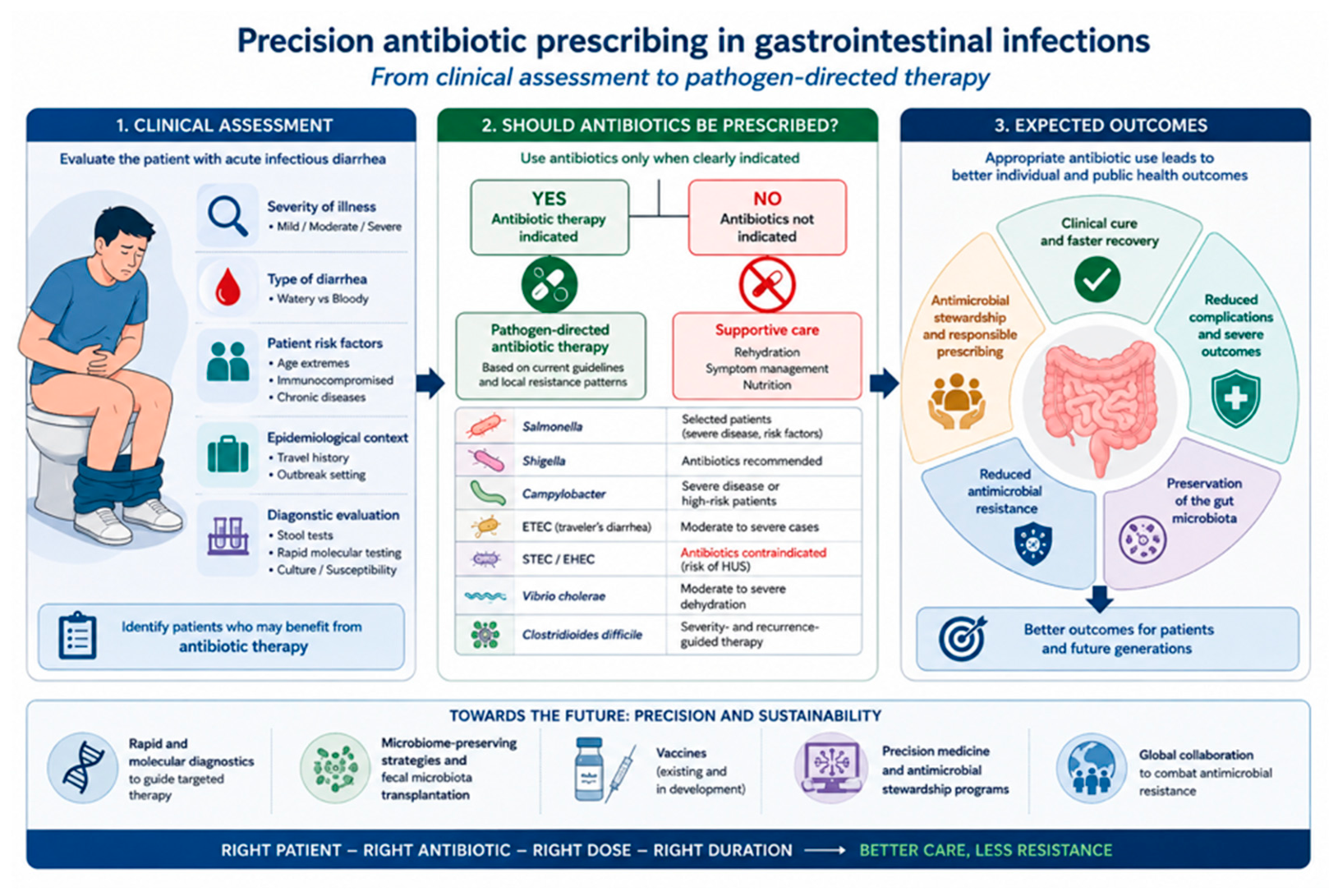
Figure 2.
Proposed therapeutic algorithm for the management of Clostridioides difficile infection (CDI). Following diagnostic confirmation, treatment is guided by disease severity and recurrence. Fidaxomicin is the preferred therapy for an initial episode, whereas severe or fulminant CDI requires high-dose oral vancomycin plus intravenous metronidazole. In recurrent disease, extended-pulsed fidaxomicin or tapered/pulsed vancomycin are recommended, with bezlotoxumab and fecal microbiota transplantation (FMT) reserved for selected patients at high risk of recurrence or with refractory disease.
Figure 2.
Proposed therapeutic algorithm for the management of Clostridioides difficile infection (CDI). Following diagnostic confirmation, treatment is guided by disease severity and recurrence. Fidaxomicin is the preferred therapy for an initial episode, whereas severe or fulminant CDI requires high-dose oral vancomycin plus intravenous metronidazole. In recurrent disease, extended-pulsed fidaxomicin or tapered/pulsed vancomycin are recommended, with bezlotoxumab and fecal microbiota transplantation (FMT) reserved for selected patients at high risk of recurrence or with refractory disease.
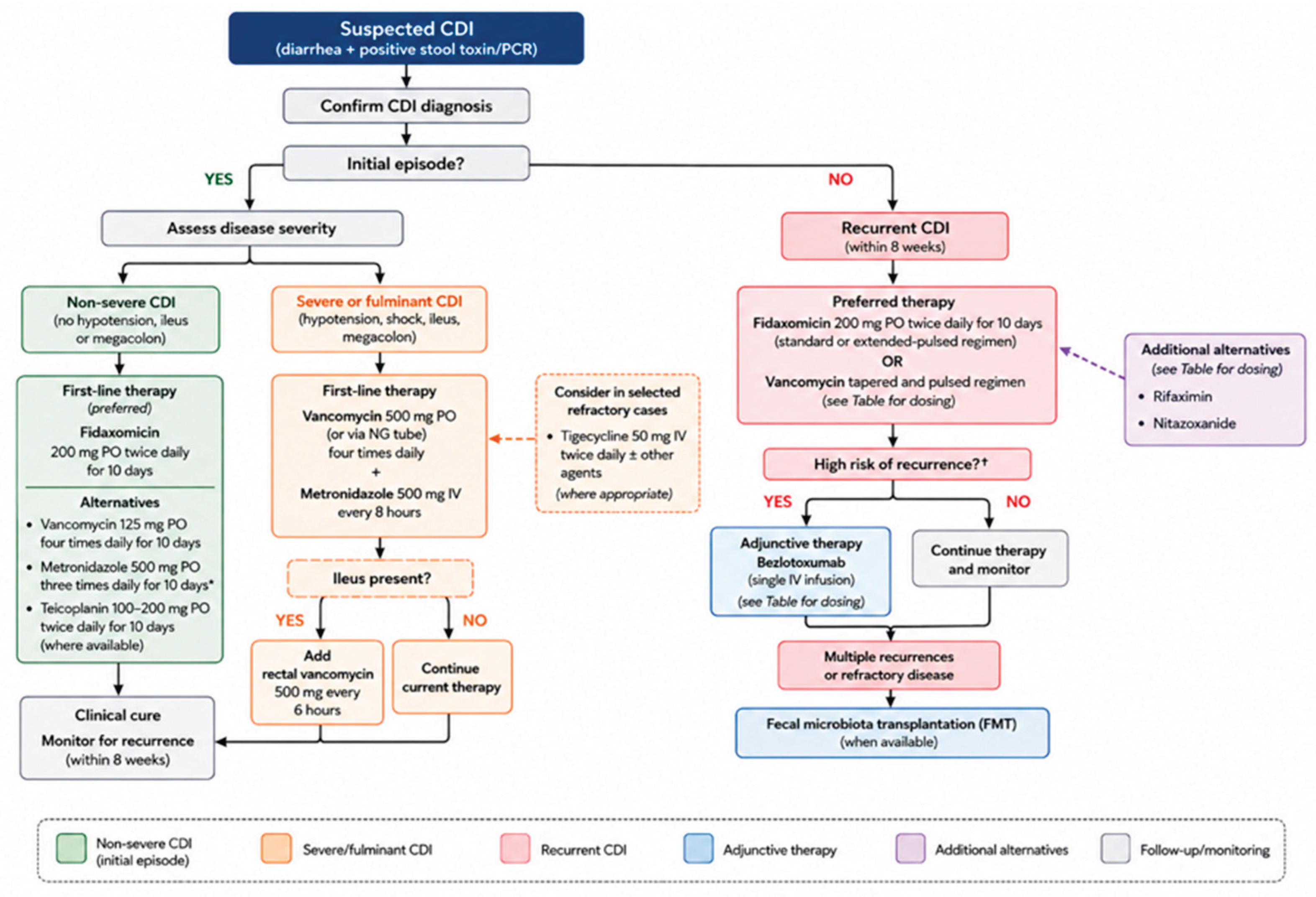
Figure 3.
Evolution of gastrointestinal infection management.
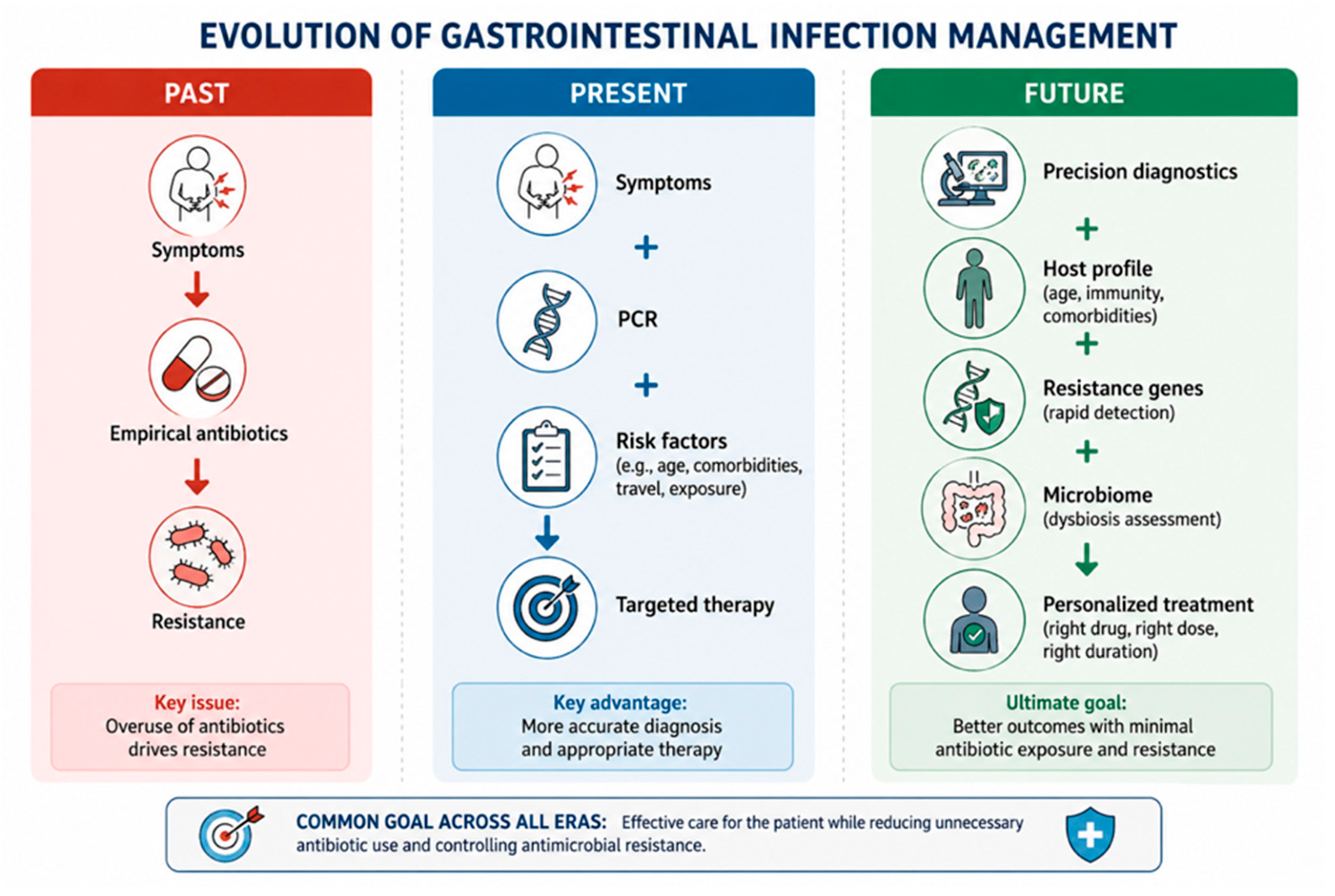

Table 1.
Principal antibiotic classes used in the treatment of gastrointestinal infections.
| Antibiotic class | Main drug | Target pathogens/indications | Limits |
|---|---|---|---|
| Fluoroquinolones [2,10,19,21,22,29,35,45,46] |
Ciprofloxacin Levofloxacin |
·Shigella, Vibrio cholerae · Travelers’ diarrhea · Empirical therapy |
- Not indicated in pediatric age ·Increased resistance from Campylobacter spp. and Salmonella spp. ·Side effects on the musculoskeletal system and nervous system (rare but disabling) |
| Macrolides [3,10,14,15,16,30,35,46] |
Azithromycin |
·Campylobacter jejuni, Shigella · Travelers’ diarrhea ·Empirical therapy |
Variable activity against Salmonella spp.; reduced macrolide susceptibility has emerged in some Shigella isolates |
| Third-generation cephalosporins [3,10,14,15,16,30] |
Ceftriaxone | ·Shigella, Salmonella ·Empirical therapy in infants |
No clinically useful activity against Campylobacter |
| Trimethoprim-sulfamethoxazole [10,21,22,35,46] |
Trimethoprim-sulfamethoxazole (TMP-SMX) | Susceptible Yersinia, Shigella, and selected Salmonella infections | Variable resistance; pregnancy- and renal-function-related precautions; serious cutaneous and hematologic reactions |
| Tetracyclines [3,10,14,15,16,30] |
Doxycycline |
· Vibrio cholerae ·Yersinia, in association with Aminoglycoside |
Use according to current age- and indication-specific guidance; assess pregnancy and breastfeeding |
| Non-absorbable intestinal antibiotics [3,10,14,15,16,30] | Rifaximin | Moderate, noninvasive travelers’ diarrhea | Not recommended for fever, dysentery, systemic illness, or suspected invasive bacterial infection |
Table 2.
Recommended antibiotic therapy for Salmonella infections according to clinical presentation.
Table 2.
Recommended antibiotic therapy for Salmonella infections according to clinical presentation.
| Pathogen | Indications for antibiotics | First-line therapy | Alternatives | Duration |
|---|---|---|---|---|
| Non-typhoidal Salmonella [10,11,48] | Bacteremia; immunocompromised patients; infants <3 months; elderly; severe disease or systemic toxicity | Adults: Fluoroquinolone (Ciprofloxacin 500 mg PO twice daily Levofloxacin: 500 mg once daily) or Ceftriaxone 1–2 g IV once daily. Children: Ceftriaxone 50–75 mg/kg/day IV (max 2 g/day); Azithromycin 10–20 mg/kg/day (max 1 g/day) when appropriate according to susceptibility. | Amoxicillin 80–100 mg/kg/day in 3 divided doses (max 3 g/day); Trimethoprim–sulfamethoxazole (TMP component 8–10 mg/kg/day in 2 divided doses, max TMP 320 mg/day), according to susceptibility. | 7–10 days (10–14 days if immunocompromised or bacteremic) |
| Salmonella Typhi/Paratyphi [10,11,48] | Antibiotic therapy always indicated (enteric fever) | Adults: Fluoroquinolone (according to susceptibility) or Ceftriaxone 2 g/day IV. Children: Ceftriaxone 75 mg/kg/day IV (max 2 g/day) or Azithromycin 20 mg/kg/day (max 1 g/day); Fluoroquinolones may be considered in selected cases according to susceptibility and national recommendation |
Chloramphenicol 50–75 mg/kg/day in 4 divided doses (where still recommended and susceptibility confirmed). | 7–14 days (longer in immunocompromised patients or according to clinical response) |
| Chronic carrier of Salmonella Typhi [10,11] | Chronic fecal carriage | Adults: Ciprofloxacin 750 mg twice daily or Norfloxacin 400 mg twice daily | No standardized pediatric regimen; management should be individualized with an infectious disease specialist according to susceptibility testing | 4–6 weeks |
Table 3.
Recommended antibiotic therapy for Shigella infections according to disease severity and patient characteristics.
Table 3.
Recommended antibiotic therapy for Shigella infections according to disease severity and patient characteristics.
| Pathogen | Indications for antibiotics | First-line therapy | Alternatives | Duration |
|---|---|---|---|---|
|
Shigella [10,11,22,48,50] |
Moderate-to-severe disease; dysentery; infants and children with severe disease; malnutrition; immunocompromised patients; sepsis; outbreak control or institutional settings | Adults: Ciprofloxacin 500 mg PO twice daily (or 750 mg once daily) or Azithromycin 500 mg PO once daily. Children: Azithromycin 10–12 mg/kg/day PO (max 500 mg/day) for 3 days or Ciprofloxacin 15 mg/kg/dose PO every 12 h (max 500 mg/dose), according to susceptibility and national recommendations. |
Adults and children: Ceftriaxone 50–100 mg/kg/day IV (max 2 g/day) for severe disease or hospitalization; Pivmecillinam (where available and susceptible); Carbapenems (e.g., Ertapenem 15 mg/kg IV every 12 h, max 1 g/day) for suspected or confirmed XDR Shigella. | 3 days (5–7 days for severe or invasive infections, according to clinical response) |
Table 4.
Indications and recommended antibiotic regimens for Campylobacter jejuni infection.
| Pathogen | Indications for antibiotics | First-line therapy | Alternatives | Duration |
|---|---|---|---|---|
| Campylobacter jejuni [10,11,20,48] | Severe disease (high fever, dysentery, severe abdominal pain, prolonged diarrhea, or systemic illness); pregnancy; immunocompromised patients, including HIV; elderly or patients at increased risk of invasive disease | Adults: Azithromycin 500 mg PO once daily for 3 days or 1 g PO as a single dose. Children: Azithromycin 10 mg/kg/day PO once daily (max 500 mg/day) for 3 days. Alternative macrolide in children: Erythromycin 40 mg/kg/day PO in 4 divided doses (max 2 g/day) for 5 days. | Ciprofloxacin: Adults 500 mg PO twice daily; Children 15 mg/kg/dose PO every 12 h (max 500 mg/dose), only when susceptibility is documented or local resistance is known to be low. Severe invasive/extraintestinal infection: aminoglycoside or carbapenem (e.g., imipenem), guided by susceptibility testing and specialist assessment. | Azithromycin: 1 dose or 3 days, according to regimen. Erythromycin: 5 days. Longer treatment may be required for invasive or extraintestinal disease. |
Table 5.
Recommended antimicrobial therapy for enterotoxigenic (ETEC) and enterohemorrhagic/Shiga toxin-producing (EHEC/STEC) Escherichia coli infections according to disease severity.
Table 5.
Recommended antimicrobial therapy for enterotoxigenic (ETEC) and enterohemorrhagic/Shiga toxin-producing (EHEC/STEC) Escherichia coli infections according to disease severity.
| Pathogen | Indications for antibiotics | First-line therapy | Alternatives | Duration |
|---|---|---|---|---|
| Enterotoxigenic Escherichia coli (ETEC) (Travelers’ diarrhea) [1,12,51,52,53] | Moderate diarrhea (interferes with planned activities); Severe diarrhea, including febrile diarrhea or dysentery | Adults: Azithromycin 1 g PO single dose or 500 mg PO once daily for 3 days. Children: Azithromycin 10 mg/kg/day PO once daily (max 500 mg/day) for 3 days. Adjunctive therapy: Loperamide may be considered in adults with moderate-to-severe non-dysenteric diarrhea. | Moderate, non-invasive diarrhea: Rifaximin 200 mg PO three times daily for 3 days (adults only). Fluoroquinolones (e.g., Ciprofloxacin): Adults 750 mg PO single dose or 500 mg PO twice daily for 3 days; Children: generally not recommended, but may be considered in selected cases according to susceptibility and national recommendations. | Single dose or 3 days, according to regimen and clinical response. |
| Shiga toxin-producing Escherichia coli (STEC), including enterohemorrhagic E. coli (EHEC) [12,54,55] | Antibiotics are contraindicated | Supportive care only, including oral or intravenous rehydration. Renal function should be closely monitored and dialysis instituted when indicated. | No antimicrobial therapy recommended. Antimotility agents (e.g., loperamide) should also be avoided because of the increased risk of hemolytic uremic syndrome (HUS) |
Supportive management only |
Table 6.
Clinical indications and recommended antibiotic regimens for Vibrio cholerae infection.
| Pathogen | Indications for antibiotics | First-line antibiotics | Alternatives | Duration |
|---|---|---|---|---|
| Vibrio cholerae [11,12,56,57,58,59,60,61,62] | Moderate-to-severe dehydration; severe cholera; profuse watery diarrhea after rehydration; selected immunocompromised patients or severely ill infants with strong clinical suspicion | Adults: Doxycycline 300 mg PO single dose. Children: Doxycycline 6 mg/kg PO single dose (where appropriate according to age and national recommendations). Alternative first-line: Azithromycin 1 g PO single dose (adults) or 20 mg/kg PO single dose (max 1 g) in children. |
Adults: Ciprofloxacin 1 g PO single dose or 500 mg PO twice daily for 3 days (according to susceptibility). Children: Ciprofloxacin 15 mg/kg/dose PO every 12 h (max 500 mg/dose) only when indicated. Ceftriaxone may be considered for severe infection when oral therapy is not feasible. Tetracycline: Adults 500 mg PO four times daily for 3 days; Children 12.5 mg/kg/dose PO four times daily for 3 days (where appropriate) | Single dose (preferred) or 3-day course according to the selected regimen and clinical response. |
Table 7.
Clinical indications and recommended antimicrobial regimens for Clostridoides difficile infection (CDI). *Pediatric fidaxomicin dosing should follow the approved formulation and current national recommendations.
Table 7.
Clinical indications and recommended antimicrobial regimens for Clostridoides difficile infection (CDI). *Pediatric fidaxomicin dosing should follow the approved formulation and current national recommendations.
| Pathogen | Indications for antibiotics | First-line antibiotics | Alternatives | Duration |
|---|---|---|---|---|
| Initial CDI [30,63,64,65] | Symptomatic CDI confirmed by stool toxin assay or compatible microbiological testing | Preferred: Fidaxomicin 200 mg PO twice daily. Children: 16 mg/kg/day PO in 2 divided doses (max 400 mg/day)* |
Vancomycin: Adults 125 mg PO four times daily; Children: 10 mg/kg/dose PO four times daily (max 125 mg/dose). Metronidazole: Adults 500 mg PO three times daily; Children: 7.5–10 mg/kg/dose PO every 8 h (max 500 mg/dose), only if fidaxomicin or vancomycin are unavailable. Teicoplanin: Adults 100–200 mg PO twice daily (where available) | 10 days |
| Severe or fulminant CDI [30,63,64,66] | Fulminant disease, ileus, toxic megacolon, hypotension or shock | Adults: Vancomycin 500 mg PO (or via NG tube) four times daily plus Metronidazole 500 mg IV every 8 h. Children: Vancomycin 10 mg/kg/dose PO four times daily (max 500 mg/dose) plus Metronidazole 10 mg/kg IV every 8 h (max 500 mg/dose). | Rectal vancomycin in patients with ileus. Tigecycline may be considered in selected refractory cases according to ESCMID recommendations. | - Approximately 10 days (individualize according to clinical response). daily for 10 days |
| Recurrent CDI [63,67,68] | Recurrence within 8 weeks after resolution of a previous episode | Preferred: Fidaxomicin 200 mg PO twice daily for 10 days or extended-pulsed fidaxomicin (EPFX). Vancomycin taper-and-pulse regimen may also be used. | Bezlotoxumab (single IV infusion) in high-risk patients; Fecal microbiota transplantation (FMT) after multiple recurrences; Rifaximin “chaser”; Nitazoxanide in selected patients. | · Fidaxomicin: 10 days; Vancomycin taper: 3–5 weeks (according to regimen). |
Disclaimer/Publisher’s Note: The statements, opinions and data contained in all publications are solely those of the individual author(s) and contributor(s) and not of MDPI and/or the editor(s). MDPI and/or the editor(s) disclaim responsibility for any injury to people or property resulting from any ideas, methods, instructions or products referred to in the content. |
© 2026 by the authors. Licensee MDPI, Basel, Switzerland. This article is an open access article distributed under the terms and conditions of the Creative Commons Attribution (CC BY) license (http://creativecommons.org/licenses/by/4.0/).
Copyright: This open access article is published under a Creative Commons CC BY 4.0 license, which permit the free download, distribution, and reuse, provided that the author and preprint are cited in any reuse.