

Submitted:
04 September 2026
Posted:
07 September 2026
You are already at the latest version
Abstract
This study investigates the incorporation of natural antimicrobial agents—tannin extracted from banana peels and curcumin extracted from turmeric—into natural rubber latex compounds for medical glove applications. The additives were introduced at concentrations of 0, 1.0, 1.5, and 2.0 wt%, resulting in a total of seven experimental formulations. The objective of this research is to evaluate the effects of bio-based additives on the structural, physical, and mechanical properties of the resulting glove films. Comprehensive characterization was performed and is reported in this study. The morphological and structural characteristics of the films were analyzed using scanning electron microscopy (SEM). Physical properties, including film thickness and solubility, were measured. Chemical functional groups were identified using Fourier transform infrared spectroscopy (FTIR), while phase composition and crystallinity were examined using X-ray diffraction (XRD). Surface wettability was evaluated through contact angle measurements using a non-destructive testing (NDT) approach. In addition, the mechanical properties of the rubber films were assessed, including tensile stress, tensile strength, and percentage elongation at break. The results provide insights into the influence of tannin and curcumin on the performance of natural rubber glove films, highlighting their potential as non-cytotoxic antimicrobial additives for enhancing the functionality and safety of medical gloves.
Keywords:
herbs
; antimicrobial agents
; natural rubber latex gloves
; mechanical properties
; banana peels
; tannin
; turmeric
; curcumin
1. Introduction
Natural rubber (NR) latex glove films are high-performance elastomeric materials derived from the Hevea brasiliensis tree, widely used in medical and industrial applications for their superior physical and barrier properties. They are characterized by exceptional flexibility, high tensile strength, and tactile sensitivity, offering a “second skin” feel. Natural rubber films possess superior strength and the ability to undergo significant elongation during use, making them durable. They are generally tougher and more resilient than many synthetic alternatives. Furthermore, these films are highly effective against microorganisms (bacteria and viruses) and water-soluble substances. The addition of antimicrobial agents to the rubber glove film is therefore an interesting approach that can help to prevent the transmission of pathogens into the body and to minimize the risk of exposure to cross-infection between patients and healthcare workers. There are many types of antimicrobial agents, including both synthetic and biological substances. However, the use of biological substances offers several advantages, such as safety for contact with the human body and cells (biocompatibility), low cost, wide availability in nature, non-toxicity to cells (non-toxicity), and easy biodegradability in the environment (biodegradable). Biomaterial-based antimicrobial agents for glove films are designed to prevent the transmission of microorganisms, reduce biofouling, and enhance safety for medical professionals. These agents are generally integrated into glove polymers (like natural rubber latex or nitrile) via coating, dipping, or direct dispersion to create active, durable antimicrobial surfaces. According to the recommendations of the World Health Organization (WHO), protective gloves should always be used when there is contact with blood, mucous membranes, injured skin, or other potentially infectious materials, as well as when handling hazardous chemicals and drugs.[1] The aim of this study is to develop the materials used in medical gloves due to their importance as an element of personal protection. There are many kinds of biomaterial antimicrobila agents such as lavender, eucalyptus, tea tree, plant extracts rich in polyphenol, tannins, flavonoids, banana peel, curcumins.[1,2,3]
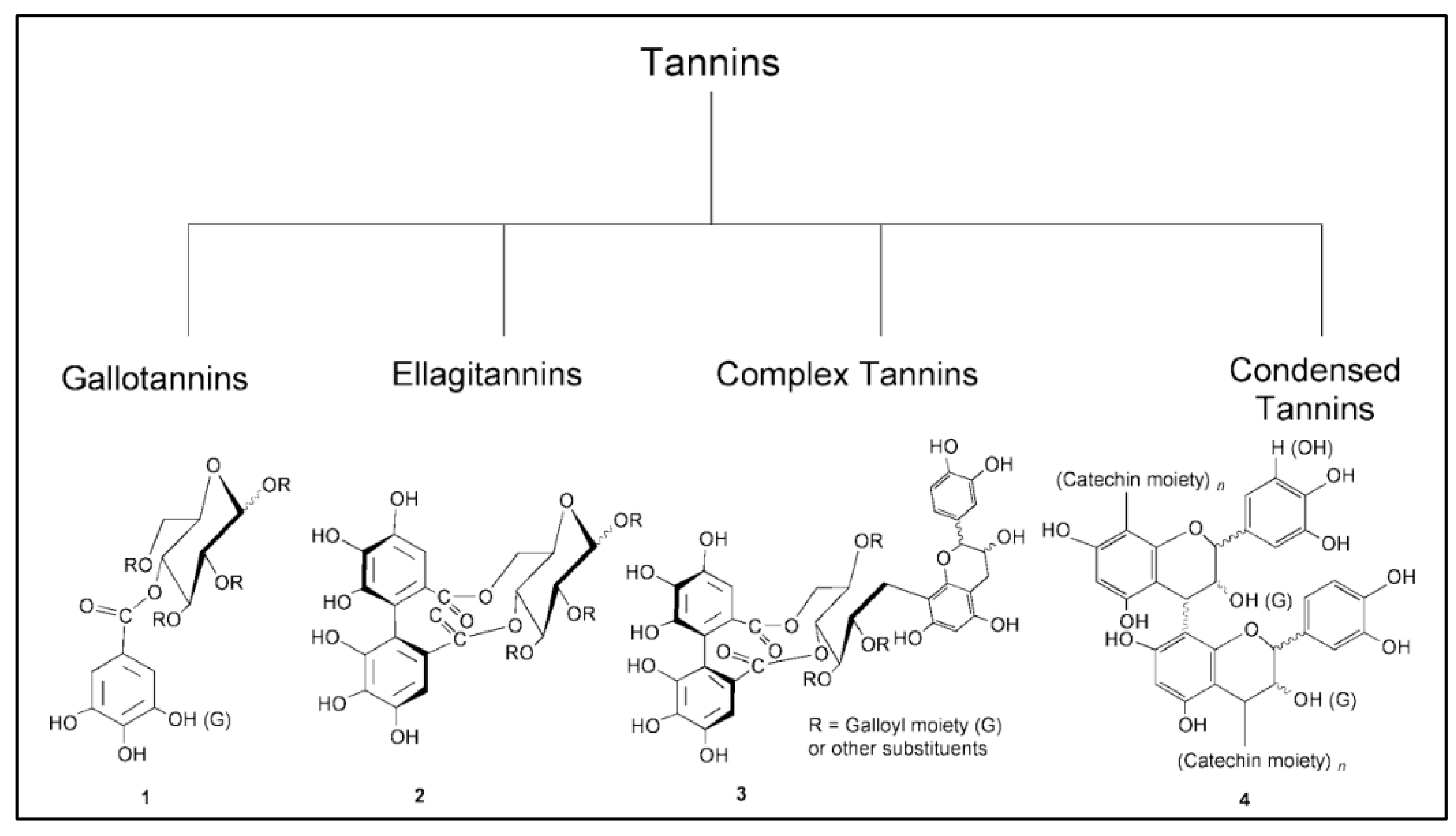
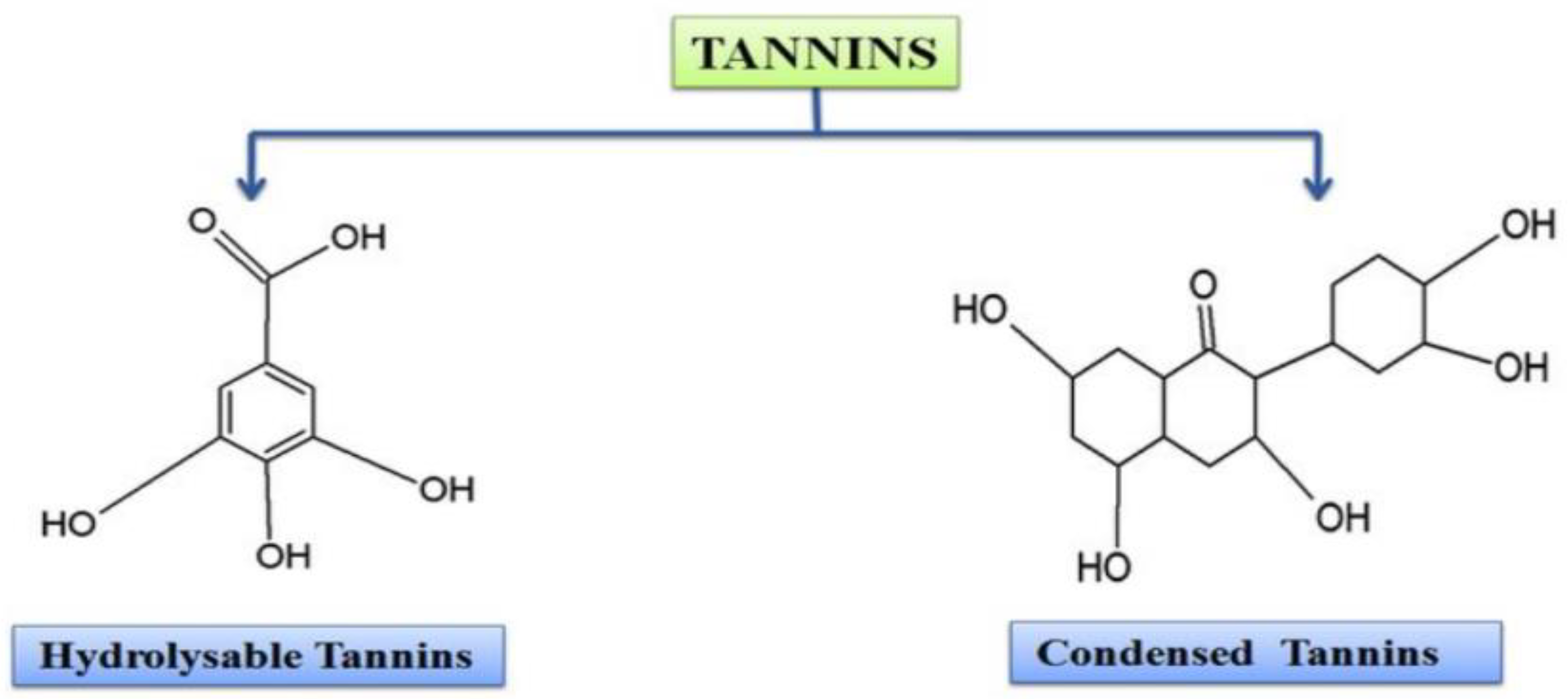
Tannins are naturally occurring polyphenolic compounds found in many plants such as bark, leaves, fruits, seeds, curcumins, and banana peels. Tannins can be used as antimicrobial materials, food preservatives, pharmaceutical and biomedical applications, natural antioxidants, biodegradable coating and polymers, and rubber or polymer additives for antimicrobial surfaces. Based on their structural characteristics it is therefore possible to divide the tannins into four major groups: Gallotannins, ellagitannins, complex tannins, and condensed tannins as shown in scheme 1. Gallotannins are all those tannins in which galloyl units or their meta-depsidic derivatives are bound to diverse polyol-, catechin-, or triterpenoid units.[1,2] Ellagitannins are those tannins in which at least two galloyl units are C–C coupled to each other, and do not contain a glycosidically linked catechin unit.[3] Complex tannins are tannins in which a catechin unit is bound glycosidically to a gallotannin or an ellagitannin unit.[4] Condensed tannins are all oligomeric and polymeric proanthocyanidins formed by linkage of C-4 of one catechin with C-8 or C-6 of the next monomeric catechin as shown in Scheme 1 and Scheme 2.
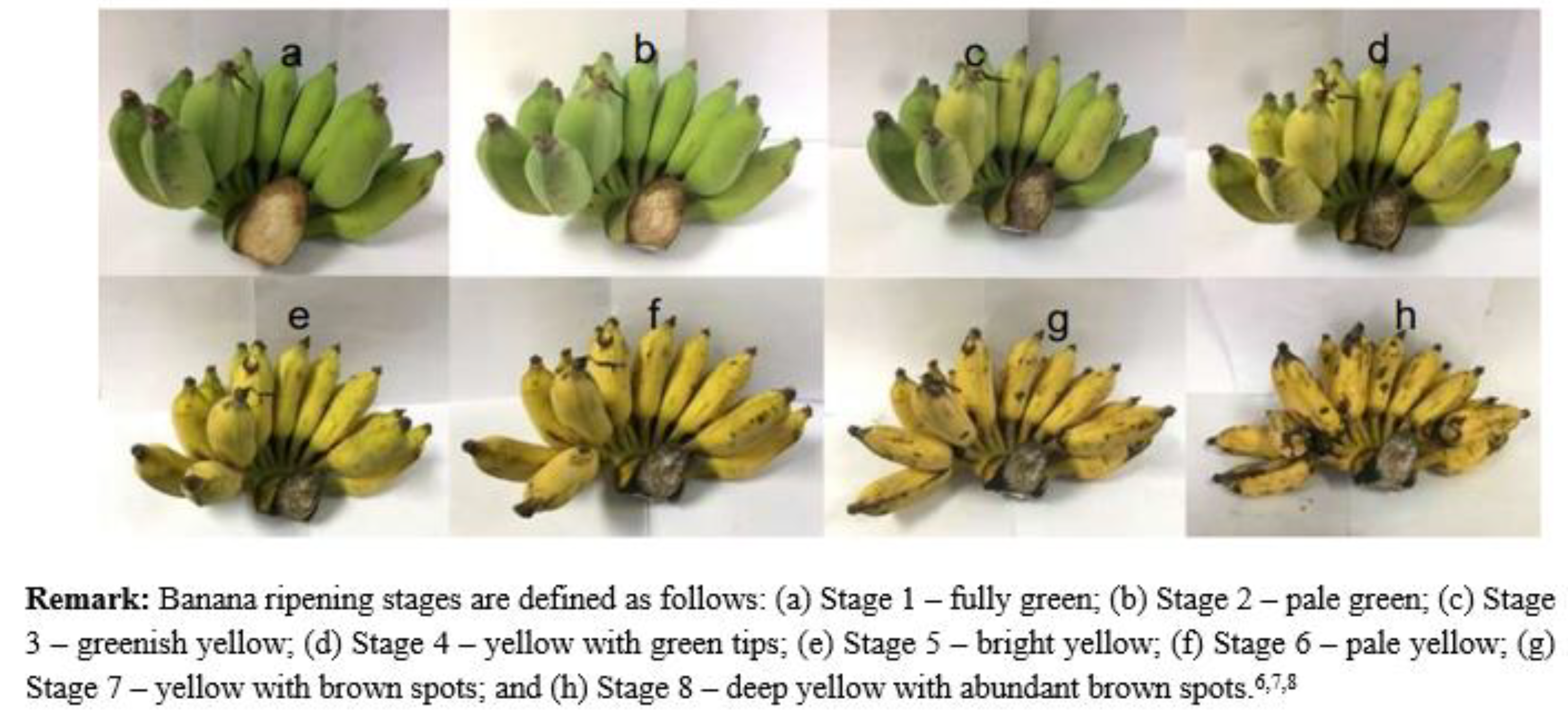
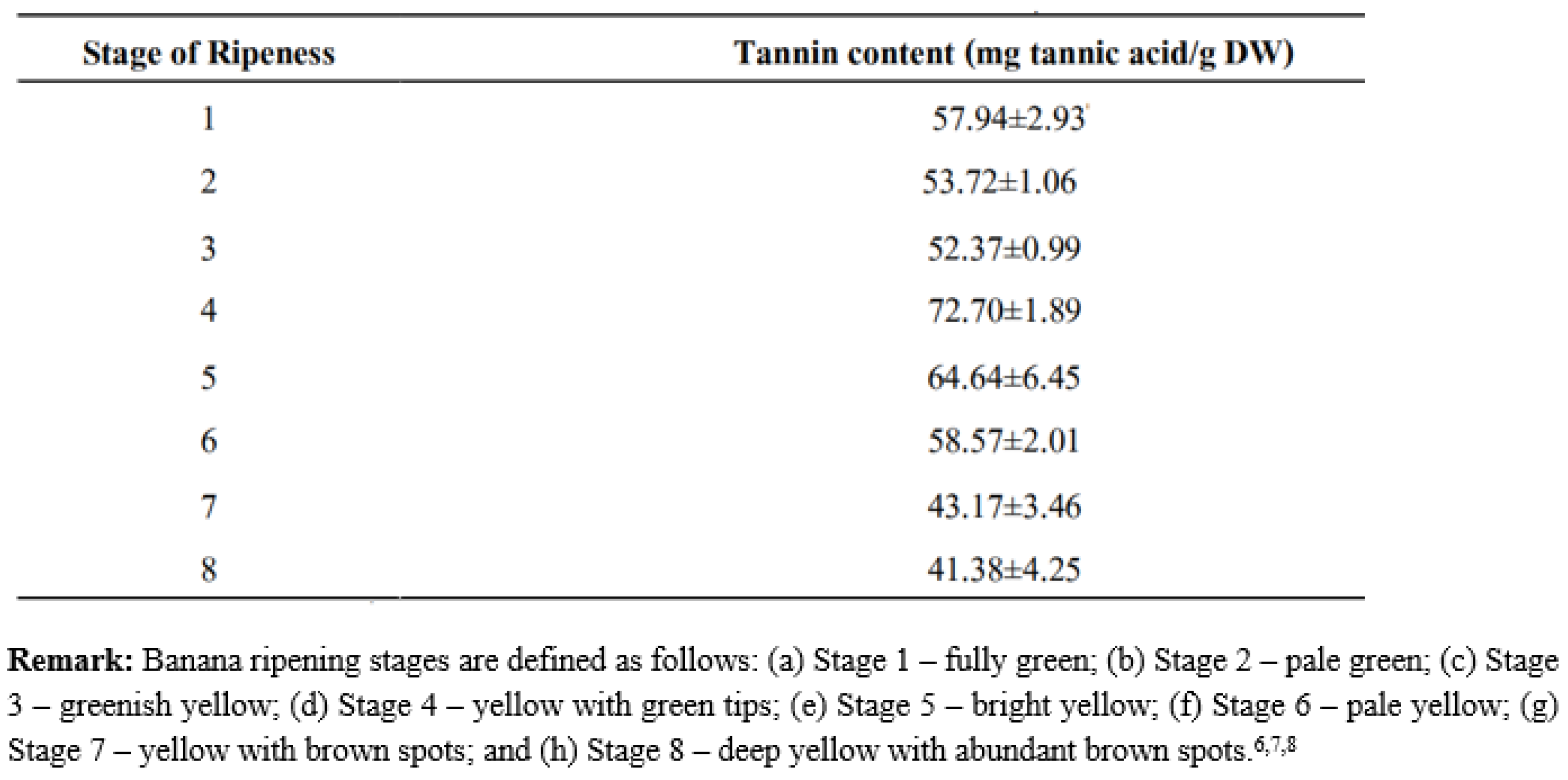
Banana peels are an abundant agricultural waste generated from both industrial food processing and post-consumption. Due to their high availability and low economic value, they have attracted increasing attention as a sustainable biomaterial for value-added applications.[5] Banana peels from various cultivars, such as Nam Wa, Cavendish (Hom), Khai, Lep Mue Nang, and Khai Muk, are particularly rich in tannins, a class of plant-derived polyphenolic compounds known for their strong antioxidant and antimicrobial activities.[6,7] Importantly, the tannin content in banana peels is strongly influenced by the stage of fruit ripeness. As illustrated in Scheme 3, bananas undergo significant physical and biochemical changes during ripening, progressing from fully green to deep yellow with brown spots, which can be monitored using non-invasive surface analysis techniques.[4] These ripening stages directly affect the accumulation and transformation of phenolic compounds, including tannins.[8] Quantitative results in Scheme 4 indicate that tannin content varies noticeably across ripening stages, ranging from approximately 41.38 to 72.70 mg tannic acid/g dry weight. The highest tannin content was observed at ripening stage 4 (72.70 ± 1.89 mg/g), followed by stage 5 (64.64 ± 6.45 mg/g), while lower values were found at later stages, such as stage 7 (43.17 ± 3.46 mg/g) and stage 8 (41.38 ± 4.25 mg/g). This trend is consistent with previous studies reporting that phenolic compounds tend to decrease during advanced ripening due to oxidation and polymerization reactions.[8] Tannins possess multiple hydroxyl (–OH) functional groups, enabling strong interactions with microbial cell membranes and proteins, resulting in antimicrobial effects through mechanisms such as enzyme inhibition, membrane disruption, and protein precipitation.[9,10] Additionally, their metal-chelating ability further suppresses microbial growth by limiting essential ions required for microbial metabolism.[6] From a materials perspective, tannins derived from banana peels are non-toxic, biodegradable, and environmentally friendly, making them suitable for applications involving direct human contact, such as medical gloves.[11] Their hydrophilic nature also enhances compatibility with aqueous systems like natural rubber latex, although excessive polarity may lead to phase separation if not properly controlled.[12]
In addition, another interesting medicinal plant with similar antimicrobial properties is turmeric, which is rich in curcumin.[13,14] Turmeric is a perennial herb in the ginger family (Zingiberaceae).[14] It has large green leaves and yellow-orange rhizomes, which are the most commonly used part. The rhizome has a distinctive aroma and a deep yellow color due to its active compounds.[14] It is a medicinal plant widely used in traditional medicine because of its anti-inflammatory, antimicrobial, antioxidant, and wound-healing properties.[10,14,15] It also supports the digestive system and exhibits potential anticancer activity.[13,14] Curcumin has a chemical structure that is important for its antimicrobial activity, as shown in Scheme 5.[13,16] It contains phenolic groups at both ends, which contribute to redox (oxidation–reduction) reactions and interfere with intracellular processes in microorganisms.[10] It also has a conjugated double bond system, which increases molecular stability and allows it to easily insert into microbial cell membranes.[13,16] In addition, the β-diketone group and keto–enol tautomerism enable curcumin to bind to microbial proteins or enzymes, leading to disruption of cellular functions.[13] Furthermore, curcumin is hydrophobic, allowing it to disturb the lipid bilayer structure of cell membranes, resulting in membrane leakage and cell death.[16] It also has metal-chelating properties, which can inhibit enzymes that require metal ions as cofactors.[10] Therefore, curcumin’s structure enables it to damage cell membranes, interfere with enzymes, and inhibit microbial metabolic processes, thereby exerting effective antibacterial, antifungal, and broad-spectrum antimicrobial activities.[10,15,16] The incorporation of curcumin into medical glove formulations therefore provides an additional option for inhibiting various microorganisms and pathogens, preventing them from easily entering the body.[17,18,19] Turmeric is also a medicinal plant that is easy to cultivate and grow and is relatively inexpensive.[14] This study is therefore aimed at providing additional alternatives for the medical industry, hygiene and public health sectors, and pharmacology, as well as improving the prevention of disease occurrence and outbreaks more effectively.[19,20,21]
Therefore, the objective of this study is to utilize tannins extracted from banana peels and curcumin extracted from turmeric, which not only enhance antimicrobial performance but also support sustainable material development by converting agricultural by-products and medicinal plants into high-value functional additives.[6,11] Another important factor for achieving high-efficiency tannin extraction is the control of banana peel ripening stages, which can improve their effectiveness as antimicrobial agents.[4,8] In addition, the amount of extracted compounds used in the natural rubber latex compound formulation for medical glove production is also a key parameter for enhancing antimicrobial potential.[17,18,22] This, in turn, improves the shelf life of rubber gloves and increases user safety and confidence in medical and public health applications.[23,24,25]
2. Materials and Methods
2.1. Materials
Raw green banana peels (Kluai Namwa) and tumeric were purchased from a local market in Bangkok. Natural rubber latex and other chemical reagents, such as potassium hydroxide (KOH), Teric 16A16, sulfur, zinc diethyldithiocarbamate (ZDEC), zinc 2-mercaptobenzothiazole (ZMBT), titanium dioxide (TiO2), Wingstay L, zinc oxide (ZnO), and coagulant, were supplied by the Thailand Institute of Scientific and Technological Research (TISTR), Bangkok, Thailand. Ethyl alcohol and ferric chloride were purchased from Suksapanpanit, Bangkok, Thailand.
2.2. Methods
2.2.1. Characterization of Raw Materials and Natural Rubber Glove Film Samples with and Without Antioxidants Acccording to Standard Test Methods (Tisi 1056-2548, Iso 11193-1: 2020, Single-Use Medical Examination Gloves)2[3,24]
An X-ray diffractometer (XRD; Philips, X’Pert, Almelo, Netherlands), equipped with a VANTEC-1 detector and a double-crystal wide-angle goniometer, was used to analyze the crystalline structure and phase formation of the coagulant (CaCl2) and natural rubber glove films with and without the addition of antioxidants. The scan speed during data collection was set at 2° 2θ/min, with a 2θ increment of either 0.05° or 0.03°. The scanning range was from 0° to 80°. CuKα radiation, with a wavelength (λ) of 0.15406 nm, was used as the X-ray source. The diffraction peak patterns obtained from the XRD analysis were then compared with standard reference patterns from the International Center for Diffraction Data (Joint Committee on Powder Diffraction Standards, JCPDS) to identify crystalline phases and their positions.
Fourier-transform infrared (FTIR) spectroscopy (PerkinElmer, Waltham, MA, USA; Bruker Alpha E, Billerica, MA, USA) was employed to assess the chemical functional groups of raw materials (tannin and curcumin extracted from banana peel and turmeric, respectively) and natural rubber latex glove films. The FTIR analysis covered the range of 500–4,000 cm−1 and was performed using attenuated total reflectance (ATR) mode. Natural rubber latex glove films without the addition of tannin and curcumin served as the reference for comparison with natutal rubber latex glove films containing tannin and curcumin. All natural rubber latex glove films, both with and without the addition of tannin and curcumin, were analyzed and compared in terms of functional groups using both absorption and transmission modes.
A Universal Testing Machine (UTM; Hounsfield, H50KS, Redhill, Surrey, United Kingdom) was used to assess the mechanical properties of natural rubber latex glove films, both with and without the addition of tannin and curcumin antioxidants. Properties examined included stress, strain, Young’s modulus, and tensile strength. During tensile testing, the UTM applied a maximum load of 900 N at a constant crosshead speed of 50 mm/min according to ASTM D638. The gauge length, representing the initial length of the film used for strain measurement, was set at 50 mm. Each formulation was tested three times, and the average values with standard deviations were reported.
A Scanning Electron Microscope (SEM; Hitachi, SU3500, Tokyo, Japan) was used to observe and characterize the micro- and nanostructures of the natural rubber latex glove film samples. To enhance electrical conductivity during imaging, a thin layer of gold was sputtered-coated using a sputtering coater (EDWARD, Pirani 501, Crawley, West Sussex, United Kingdom). SEM images were captured at an acceleration voltage of 10 kV and magnifications of 1,000× and 5,000×.
A Contact Angle Analyzer (Kyowa, DM-CE 1, Saitama, Japan) was used to measure the contact angle between a water droplet and the surface of the rubber glove film within 2,000 ms. Each formulation was tested three times, and the average values with standard deviations were reported. The contact angle provides information on the wettability or non-wettability of the sample surfaces.
Antibiotic testing by the zone of inhibition (ZOI) method is a qualitative or semi-quantitative antimicrobial assay used to evaluate the ability of a material or chemical agent to inhibit the growth of microorganisms on a solid culture medium. This method is commonly performed using agar diffusion techniques, in which an antimicrobial agent diffuses from a source into agar that has been inoculated with a test microorganism. The test is fundamentally based on Fick’s law of diffusion and microbial growth inhibition kinetics.[20,21] The theoretical basis of the test consists of the following principles:
- An antimicrobial agent diffuses radially from the test sample into the agar.
- A concentration gradient is established, with the highest concentration near the sample and decreasing outward.
- microbial growth is inhibited in regions where the antimicrobial concentration is equal to or greater than the minimum inhibitory concentration (MIC); and
Larger inhibition zones generally indicate stronger antimicrobial activity; however, diffusion behavior must also be considered. This method is suitable for evaluating a wide range of microorganisms, including Gram-positive bacteria such as Staphylococcus aureus and Gram-negative bacteria such as Escherichia coli, as well as fungi such as Candida albicans and Aspergillus niger,[15,26] for both qualitative and semi-quantitative analyses. The principle of the ZOI test involves measuring the diameter of the inhibition zone (mm) after incubation. The measured diameter is influenced by several factors, including the diffusion rate of the antimicrobial agent, the growth rate of the microorganism, agar composition and thickness, and incubation conditions (temperature and time). Only diffusible antimicrobial agents can form clear inhibition zones. In contrast, non-leaching or contact-active materials may exhibit little or no visible zone despite possessing antimicrobial properties.[10,27] It should be noted that the semi-quantitative ZOI measurement do not directly determine microbial killing efficiency; rather, they reflect growth inhibition only. Furthermore, this method cannot distinguish between bacteriostatic and bactericidal effects without additional testing.[16] Important parameters affecting semi-quantitative analysis include agar properties, particularly agar thickness and concentration. Agar thickness is typically standardized at 4 ± 0.5 mm, as it significantly influences the inhibition zone size. Higher agar concentrations reduce diffusion and consequently decrease the diameter of the inhibition zone.[2] Despite its advantages, the ZOI method has limitations. It is not suitable for hydrophobic or poorly diffusing compounds, and results cannot be directly compared across different experimental conditions.[20,21]
2.2.2. Extraction of Tannin from Banana Peels
In general, bananas undergo eight stages of ripeness. The fourth stage is reported to contain the highest tannin content. At this stage, the peel is yellow with green tips, as presented in scheme 3. Therefore, raw green Namwa bananas at the fourth stage of ripeness were selected for tannin extraction. Raw green banana peels washed with tap water, let them dry and keep them in an oven at 60 °C for seven days. The banana peels were washed with tap water, air-dried, and then oven-dried at 60 °C for seven days. The dried peels were cut and milled into small pieces prior to tannin extraction using hot water for 2 h. The extracted tannin was analyzed for purity using a wet chemical method with ferric chloride solution. The obtained tannin extract was subsequently used as an antioxidant additive in natural rubber latex glove films at concentrations of 0, 1.0, 1.5, and 2.0 wt%, as shown in Figure 1.
2.2.3. Curcumin Extraction from Turmeric
Curcumin was extracted from turmeric by immersion in ethanol at room temperature for 15 days. The extracted curcumin was evaluated for purity and efficiency using a wet chemical method with ferric chloride solution. The obtained curcumin was used as an additional antioxidant in the preparation of antimicrobial glove films by incorporation into natural rubber latex compounds at concentrations of 0, 1.0, 1.5. and 2.0 wt%, as shown in Figure 1.
2.2.4. Preparation of Natural Rubber Latex Glove Films with and Without Antimicrobial Substances
Porcelain hand formers were used as molds for the preparation of rubber latex glove films. The molds were cleaned with water and then dipped into a calcium chloride (CaCl2) coagulant, followed by immersion in natural rubber latex compounds, as summarized in Table 1 and Table 2. The formulation of the natural rubber latex compounds is presented in Table 1, while the compositions containing 0, 1.0, 1.5, and 2.0 wt% antioxidants (tannin and curcumin) are listed in Table 2. In total, seven formulations were prepared. The resulting cured and cast rubber glove films were characterized in terms of physical, mechanical, and antioxidant properties and compared with commercial natural and synthetic glove films as reference samples (Figure 1), in accordance with standard specifications (TISI 1056-2548 and ISO 11193-1: 2020). The dipping, curing, and film formation processes are illustrated in Figure 2 and Figure 3. Initially, the porcelain molds were cleaned with tap water and dried. The molds were then dipped into a CaCl₂ coagulant solution for approximately 1 s (Figure 2), followed by immersion in the natural rubber latex compound for 1 min to form a thin film. The coated molds were subsequently rinsed with hot and cold water and then placed in an oven at 100 °C for 20 min to accelerate curing and vulcanization. This process enhances the strength, elasticity, and durability of rubber films. After curing, the films were washed again to remove residual proteins and chemicals, thereby reducing the risk of allergic reactions. Finally, the glove films were stripped from the molds. A lubricant powder (e.g., talcum, cornstarch, or other starch) may be applied to facilitate removal (powdered process). Alternatively, a powder-free process can be employed by applying a surface coating prior to stripping.
2.2.5. Staphylococcus Aureus (S. Aureus) Testing of Natural Rubber Glove Film Samples with and Without Antioxidants (Tannin and Curcumin)
Natural rubber glove films with and without the incorporation of tannin and curcumin were cut into specimens and evaluated for antimicrobial activity against Staphylococcus aureus. Antimicrobial activity was assessed using the zone of inhibition (ZOI) method. The diameter of the inhibition zone was measured using a vernier caliper, and the test was conducted at a sample size of 20 mm, as shown in Scheme 6. The percentage of inhibition was calculated using Equation (1):
Scheme 6.
Antibacterial testing procedure.
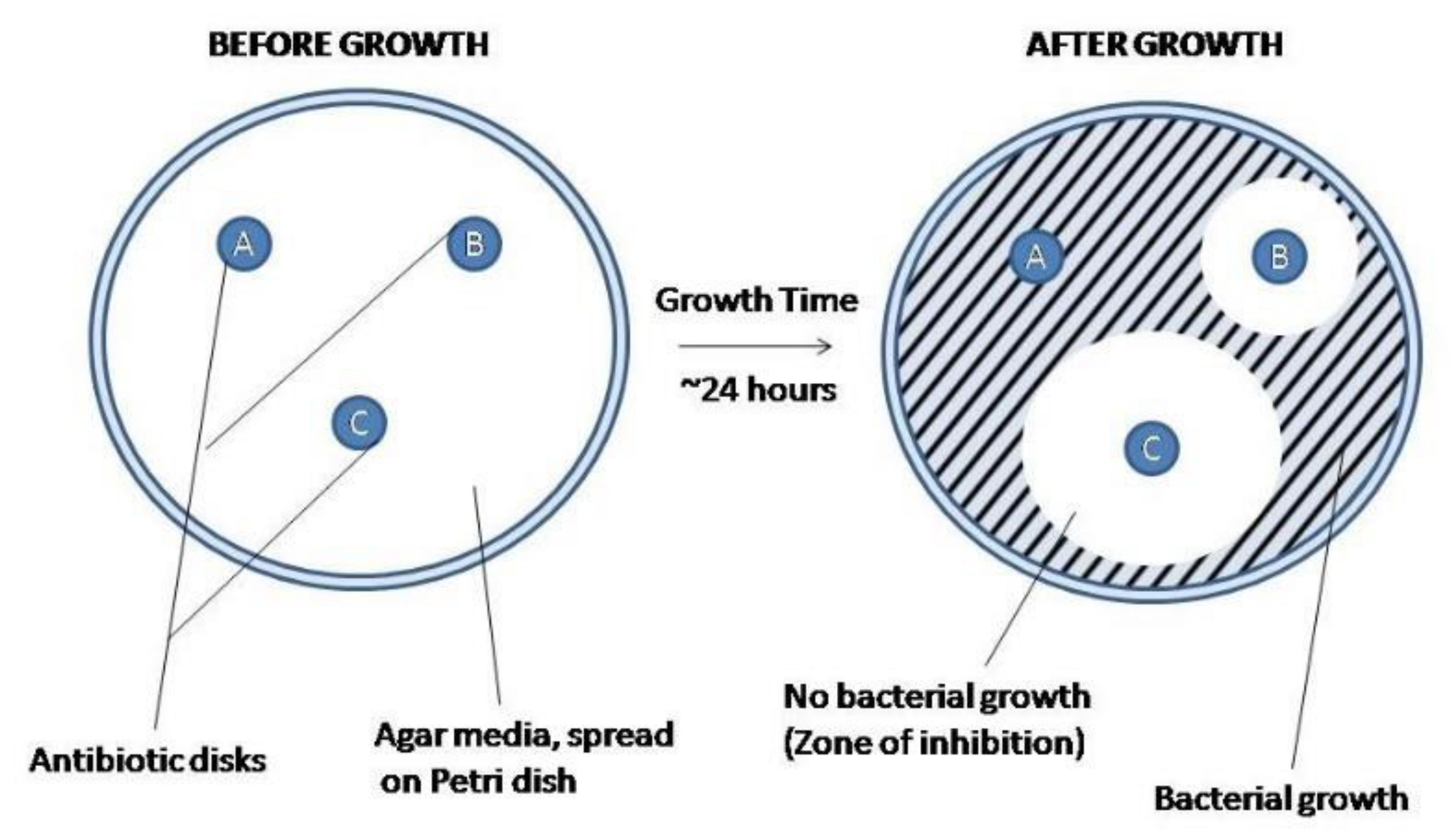
In the zone of inhibition test, approximately colony-forming units (CFU) of S. aureus were uniformly spread onto an agar plate using a sterile swab. The samples were then placed on the agar surface and incubated under appropriate conditions. If the S. aureus strain is susceptible to the antimicrobial agents (tannin and curcumin), a clear inhibition zone appears around the sample due to the suppression of microbial growth. In contrast, if the bacteria are resistant, no clear zone is observed, indicating no antimicrobial activity.
3. Results and Discussion
3.1. Physical Properties and Characteristics of Extracted Tannin and Curcumin
The effect of banana ripeness on tannin content is presented in scheme 4. The fourth stage of Namwa banana ripeness, characterized by a yellow peel with green tips, exhibited the highest tannin content (approximately 72.07 ± 1.89 mg/g).[4,8,28] Therefore, this stage was selected for tannin extraction. Raw green banana peels were cut into small pieces, washed, and oven-dried for seven days. The dried peels were then boiled in hot water for 2 h to extract tannin. The extracted tannin was water-soluble and appeared as a brown-colored solution, as shown in Figure 1a and Figure 1b. In contrast, turmeric was cut into small pieces, cleaned, and extracted with ethanol to obtain curcumin. The extracted curcumin exhibited a deep yellow–orange color, as shown in Figure 1c and Figure 1d. Both tannin and curcumin extracts were subsequently used as antimicrobial agents in natural rubber latex glove films, as illustrated in Figure 1e.
The solubility of tannin and curcumin was investigated in water and ethanol, respectively. Green Namwa banana peels possess an astringent taste due to the presence of tannins, which are complex polyphenolic compounds (C₇₅H₅₂O₄₆). Tannins are weakly acidic and are generally soluble in hot water, ethanol, and acetone.[6,11] Conversely, curcumin is hydrophobic and practically insoluble in water, but it shows good solubility in organic solvents such as ethanol and oils.[13,14]
Both tannin and curcumin (powder and extracts) were characterized using Fourier Transform Infrared Spectroscopy (FTIR) in the wavenumber range of 500–4000 cm⁻¹, as shown in Figure 4, with corresponding data summarized in Table 3. The FTIR spectrum of curcumin exhibited characteristic peaks consistent with its diarylheptanoid structure. A broad O–H stretching band appeared at 3500–3400 cm⁻¹. Aromatic C=C stretching and conjugated C=O vibrations were observed at approximately 1626–1630 cm⁻¹, while peaks around 1505–1510 cm⁻¹ corresponded to aromatic ring vibrations. The enol C–O stretching appeared in the range of 1250–1280 cm⁻¹, and benzene ring vibrations were observed near 1424 cm⁻¹. Additionally, C–O–C bending and aliphatic C–O stretching were detected at 1150–1180 cm⁻¹, with trans C–H vibrations appearing at 960–980 cm⁻¹. These findings are consistent with previous studies.[13,29] The FTIR spectra of tannin showed characteristic features of polyphenolic structures, including both condensed and hydrolyzable tannins. A broad O–H stretching band appeared around 3324–3400 cm⁻¹ due to phenolic hydroxyl groups. Aromatic C=C stretching peaks were observed near 1611 cm⁻¹, while carbonyl (C=O) stretching associated with hydrolyzable tannins appeared around 1709–1735 cm⁻¹. The C–O stretching vibrations were observed in the range of 1029–1444 cm⁻¹. These results are consistent with previously reported FTIR characteristics of tannins.[6,30,31]
3.2. Physical Properties and Microstructure of Natural Rubber Latex Glove Films
Tannin and curcumin solutions were incorporated into natural rubber latex compounds at concentrations of 0, 1.0, 1.5, and 2.0 wt% for glove film preparation. Initially, porcelain hand formers were cleaned, dried, and dipped into a CaCl₂ coagulant solution, as illustrated in Figure 2. The preparation process of medical glove films, both with and without tannin and curcumin, followed standard procedures according to TISI 1056-2548 and ISO 11193-1:2020 for single-use medical examination gloves, as shown in Figure 3.
The glove films were fabricated from natural rubber latex compounded with vulcanization accelerators and antioxidants (Table 1). Antimicrobial agents—tannin and curcumin—were subsequently incorporated at 0, 1.0, 1.5, and 2.0 wt%, resulting in seven formulations (Table 2). Formulation 1 served as the control without antimicrobial additives. Each formulation was prepared in ten specimens for evaluating physical, mechanical, antimicrobial, and microstructural properties, with results reported as mean ± standard deviation. The control film exhibited an off-white appearance after curing as shown in Figure 3. Films containing tannin retained a similar off-white color, whereas those containing curcumin exhibited a dark yellow coloration due to the intrinsic pigment of curcumin as illustrated in Figure 3f, consistent with previous reports on curcumin-based polymer films.[18,32]
The chemical structures of the glove films were analyzed using FTIR spectroscopy (Figure 5), and the corresponding functional groups are summarized in Table 3. The spectra of the control sample confirm the characteristic structure of cis-1,4-polyisoprene, the primary component of natural rubber.[33,34] A broad absorption band at 3600–3900 cm⁻¹ corresponds to O–H stretching vibrations, associated with hydroxyl groups from moisture or additives.[35] Peaks in the range of 3300–3500 cm⁻¹ are attributed to N–H stretching, indicating residual proteins or nitrogen-containing compounds in latex.[35] The strong bands at 2850–2950 cm⁻¹ correspond to C–H stretching of –CH₃ and –CH₂ groups in the polyisoprene backbone.[34,36] The peak near 1660–1630 cm⁻¹ is assigned to C=C stretching of isoprene units, confirming the unsaturated structure of natural rubber.[33] Weak bands at 1700–1750 cm⁻¹ correspond to C=O stretching, possibly arising from oxidation products or ester/protein components.[6] Additional peaks at 1450 and 1375 cm⁻¹ are attributed to C–H bending, while the region 1000–1250 cm⁻¹ corresponds to C–O stretching and rubber–additive interactions.[37] Peaks below 1000 cm⁻¹ indicate out-of-plane bending of =C–H groups, confirming the polyisoprene structure.[35] For films containing tannin and curcumin, additional functional groups were observed. The enhanced O–H stretching band reflects the presence of phenolic compounds from tannin and curcumin.[6,29] Characteristic peaks corresponding to C=O and aromatic C=C vibrations (1500–1700 cm⁻¹) further confirm the incorporation of these bioactive compounds.[30] The presence of C–O and C–N stretching vibrations (1000–1300 cm⁻¹) indicates interactions between the rubber matrix and additives, consistent with previous studies on bioactive polymer composites.[29] Overall, the FTIR results confirm that the base polyisoprene structure remains intact, with additional contributions from tannin and curcumin.
The XRD peak patterns of natural rubber latex glove films, with and without antimicrobial agents (tannin and curcumin), are presented in Figure 6. The observed diffraction peaks were compared with standard patterns from JCPDS files, revealing correspondence with characteristic crystalline phases of sulfur (01-076-0183), titanium dioxide (03-065-6429), zinc oxide (00-021-1486), and potassium hydroxide (00-001-1054). These results are consistent with previous studies reporting the presence of such inorganic compounds as common additives in natural rubber latex compounding systems.[38,39] Sulfur is widely used as a vulcanizing agent in rubber processing, facilitating crosslink formation and enhancing mechanical properties.[38] Zinc oxide functions as an activator in the vulcanization process, improving the efficiency of sulfur crosslinking.[38] Titanium dioxide is commonly incorporated as a pigment and reinforcing filler, contributing to UV resistance and opacity.[40] In addition, potassium hydroxide serves as a stabilizer in natural rubber latex systems, helping to maintain colloidal stability during processing.[40] Therefore, the XRD results confirm that the detected crystalline phases originate primarily from compounding ingredients rather than from the natural rubber matrix itself, which is predominantly amorphous in nature, as widely reported in the literature.[40,41,42]
The SEM microstructure of tannin extracted from banana peel exhibits a powder-like morphology, with particles compactly arranged into layered or flaky structures. The particles are densely packed and strongly aggregated, forming hard agglomerates or cluster-like structures with irregular shapes and rough surfaces, resulting in a compact morphology, as shown in Figure 7a and Figure 7a-1. This behavior can be attributed to the presence of polyphenolic compounds and lignocellulosic constituents, which promote intermolecular interactions and particle aggregation. Similar morphological characteristics have been reported for banana peel-derived materials, where SEM images revealed compact, heterogeneous, and highly aggregated structures due to hydrogen bonding and complex biopolymer networks.[8,28] For the SEM microstructure of curcumin extracted from turmeric, the morphology appears as relatively large crystalline structures that also exhibit aggregation. The particles are present as irregular lumps or plate-like formations with rough surfaces; however, they are more dispersed compared to tannin. This observation is consistent with previous studies indicating that curcumin tends to crystallize into irregular domains and form partially aggregated structures depending on extraction and processing conditions.[13,43] Furthermore, the improved dispersion of curcumin compared to tannin may be attributed to its lower molecular weight and relatively weaker intermolecular interactions, leading to less compact packing and a more heterogeneous distribution.[14] These characteristics are illustrated in Figure 7b and Figure 7b-1. The SEM microstructure of natural rubber latex compounds reveals that rubber particles exhibit small spherical or oval shapes, which are uniformly dispersed throughout the rubber film. During curing, water evaporation from the latex leads to the coalescence of rubber particles into a continuous film with good homogeneity.[44] However, due to the incorporation of additives to maintain quality and enhance the mechanical properties of the rubber film, these substances are distributed and embedded within the interstitial spaces between the rubber particles. This results in a heterogeneous but well-integrated structure within the rubber matrix. Similar observations have been reported, where fillers and compounding ingredients are dispersed within the rubber matrix and occupy voids, significantly influencing morphology and interparticle interactions.[39,41] These characteristics are illustrated in Figure 7c and Figure 7c-1. For rubber-glove film samples incorporated with both tannin and curcumin at concentrations of 1.0, 1.5, and 2.0 wt%, a similar trend is observed. The amount of tannin and curcumin particles increases proportionally with their content in the formulation. At higher loading (2.0 wt%), a greater number of particles are densely distributed on the surface of the rubber glove film, as shown in Figure 7f and Figure 7f-1 (tannin) and Figure 7i and Figure 7i-1 (curcumin), compared to lower loadings. At 1.5 wt%, particle distribution is moderately dense, as illustrated in Figure 7e and Figure 7e-1 (tannin) and Figure 7h and Figure 7h-1 (curcumin). Meanwhile, at 1.0 wt%, fewer particles are observed on the film surface, as shown in Figure 7d and Figure 7d-1 (tannin) and Figure 7g and Figure 7g-1 (curcumin). This behavior is consistent with previous studies indicating that increasing the concentration of fillers or bioactive compounds results in higher particle density, an increased likelihood of agglomeration, and changes in surface morphology and dispersion within rubber matrices.[42,45]
The contact angle measurement, as shown in Figure 8 and summarized in Table 4, represents the angle formed at the interface between a liquid droplet and a solid surface, in this case, the rubber film. This parameter reflects the wettability of the surface and indicates how effectively a liquid can spread across the rubber film.[46] For rubber glove film formulation 1 (the reference formulation without tannin and curcumin), the contact angle was approximately 88.90°, indicating relatively low wettability and a more hydrophobic surface. The incorporation of tannin and curcumin into the natural rubber latex compound, followed by the dipping and accelerated curing processes, leads to noticeable changes in surface wettability due to differences in their chemical structures and hydrophilic–hydrophobic characteristics.[12,47] The results show that rubber glove films containing tannin (formulations 2, 3, and 4) exhibit higher contact angles than those containing curcumin (formulations 5, 6, and 7) at the same loading levels. This behavior can be attributed to differences in molecular structure and interaction with the rubber matrix. Although tannin contains hydrophilic phenolic groups, its strong intermolecular hydrogen bonding and tendency to form aggregates within the matrix can reduce its effective surface exposure.[6,7] In contrast, curcumin exhibits relatively better dispersion within polymer matrices, which can enhance surface wettability.[18,32] At 1.0 wt% loading, formulation 2 containing tannin (Figure 8b) shows a contact angle of 77.30°, whereas formulation 5 containing curcumin (Figure 8e) exhibits a lower contact angle of 52.50°, indicating higher wettability. Increasing the concentration of tannin to 1.5 and 2.0 wt% further decreases the contact angle to 58.40° (Figure 8c) and 55.90° (Figure 8d), respectively. Similarly, curcumin-loaded films show contact angles of 55.10° and 45.90° at 1.5 and 2.0 wt%, respectively. This trend suggests that increasing the concentration of bioactive additives enhances surface wettability due to the increased presence of polar functional groups and changes in surface morphology.[12,48] Furthermore, the reduction in contact angle is more pronounced for tannin (a decrease of 21.40° from 1.0 to 2.0 wt%) compared to curcumin (a decrease of 6.60°), indicating that tannin has a stronger concentration-dependent effect on surface wettability. This may be related to its higher polarity and greater number of hydroxyl groups, which enhance interactions with water molecules.[6]
These variations in wettability are closely associated with the performance of the rubber films, including water absorption, solvent swelling behavior, and long-term stability. Increased wettability generally correlates with higher water uptake and potential changes in mechanical durability and service life. Similar trends have been reported in natural rubber and polymer composite systems containing hydrophilic additives, where surface energy and interfacial interactions significantly influence functional properties.[17,22]
3.3. Mechanical Properties of Natural Rubber Latex Glove Films
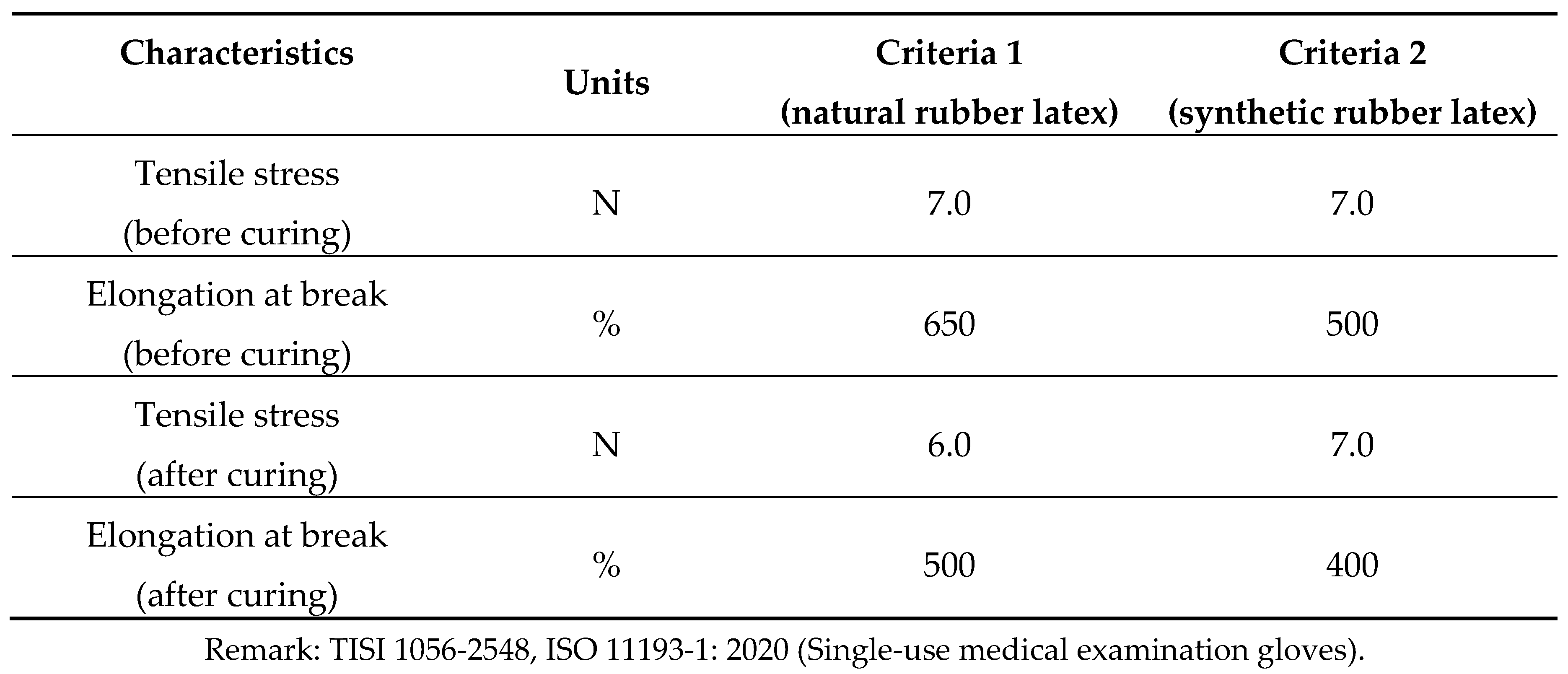
Table 4 presents the mechanical properties of natural rubber latex glove films, both with and without the incorporation of antimicrobial agents (tannin and curcumin). Commercial natural and synthetic rubber glove films were also included as reference samples for comparison with the prepared formulations. The films were fabricated by dipping ceramic hand molds into a calcium chloride (CaCl₂) coagulant for 1 s, followed by immersion in the natural rubber latex compound for 1 min. The molds were then slowly and uniformly withdrawn to form thin rubber films and subsequently subjected to thermal curing. This process produced films with comparable thicknesses in the range of 0.14–0.19 mm. Mechanical properties, including tensile strength and elongation at break, were evaluated as summarized in Table 4 and illustrated in Figure 9. The results indicate that all prepared samples (formulations 1–7), both with and without antimicrobial agents, exhibited higher tensile strength and elongation at break than the commercial glove films, including natural rubber (11.00 ± 1.45 MPa) and synthetic rubber (11.66 ± 0.97 MPa). This improvement can be attributed to differences in formulation design, processing conditions, and the dispersion of additives within the rubber matrix.[39,41,48] When comparing the modified films with the reference formulation (formulation 1), rubber films containing curcumin (formulations 5–7) exhibited significantly improved mechanical properties, including tensile force, tensile strength, and elongation at break. In particular, formulation 5 (1.0 wt% curcumin) with a film thickness of 0.19 ± 0.01 mm showed a tensile strength of 17.76 ± 0.18 MPa, an elongation at break of 783.34 ± 1.21%, and a maximum tensile force of 25.45 ± 3.51 N. In contrast, rubber films containing tannin (formulations 2–4) showed optimal mechanical performance at 1.0 wt% loading (formulation 2), with a thickness of 0.16 ± 0.01 mm, tensile strength of 16.63 ± 0.21 MPa, elongation at break of 650.56 ± 2.46%, and maximum tensile force of 27.45 ± 3.19 N. However, further increases in tannin content (1.5 and 2.0 wt%) resulted in reduced mechanical performance. The superior mechanical properties of curcumin-incorporated films compared to tannin-incorporated films can be attributed to differences in compatibility and dispersion within the rubber matrix. Curcumin is relatively hydrophobic and contains aromatic structures that are more compatible with the nonpolar cis-1,4-polyisoprene chains of natural rubber. This promotes better dispersion, reduces defect sites, and enhances stress transfer efficiency within the matrix.[32,42,48] In contrast, tannin contains a high density of hydroxyl (–OH) groups, making it highly polar and hydrophilic. As a result, tannin tends to preferentially interact with the aqueous phase rather than the rubber phase during latex processing, leading to poor dispersion, aggregation, or phase separation.[6,7] This behavior is consistent with the SEM observations (Figure 7d–f), where agglomerated structures and non-uniform dispersion were observed. Such poor interfacial interaction can lead to the formation of microvoids or defects, resulting in a discontinuous network structure and reduced mechanical properties.[41,48] On the other hand, curcumin contains functional groups such as hydroxyl (–OH) and carbonyl (–C=O), which can facilitate secondary interactions (e.g., hydrogen bonding or weak physical crosslinking) with rubber chains. These interactions contribute to the formation of a more compact and cohesive network structure, thereby enhancing mechanical performance.[18,22] This is further supported by SEM images (Figure 7g–i), which show improved dispersion and structural integrity. Therefore, curcumin, when well dispersed at the micro- or nanoscale, can act as a reinforcing filler in addition to its antimicrobial function, whereas tannin tends to behave as a non-reinforcing or weakly reinforcing additive due to its limited compatibility with the rubber matrix.[7,48]
3.4. Antimicrobial Staphylococcus Aureus Properties of Natural Rubber Latex Glove Films
The antimicrobial activity of natural rubber latex glove films incorporated with tannin and curcumin was evaluated against Staphylococcus aureus using the agar diffusion method. The inhibition zones were measured and compared with a positive control (clindamycin, 2 µg). The control sample (Glove film-0) exhibited no measurable inhibition zone, confirming that unmodified natural rubber does not possess intrinsic antibacterial properties. This observation is consistent with previous reports indicating that polymeric materials generally require functional modification to exhibit antimicrobial activity.[20,21]
All modified samples demonstrated distinct inhibition zones, indicating effective antimicrobial activity due to the incorporation of bioactive compounds. For tannin-loaded films, the inhibition zone increased with increasing concentration, reflecting a dose-dependent antibacterial effect. Similarly, curcumin-incorporated films exhibited enhanced inhibition zones with increasing loading levels, with the highest antibacterial activity observed at 2.0 wt%. This trend is consistent with previous studies reporting that both curcumin and tannic acid exhibit significant antibacterial activity against S. aureus in a concentration-dependent manner.[9,15,16,27]
The antibacterial activity of curcumin is primarily attributed to its ability to disrupt bacterial cell membrane integrity and interfere with intracellular processes, ultimately leading to cell death, as summarized in Table 5 and illustrated in Figure 10.[15,16] In contrast, tannins exert antimicrobial effects mainly through protein precipitation, enzyme inhibition, and membrane disruption.[9,10] When expressed relative to the positive control, the percentage inhibition values confirm that both additives significantly enhance antimicrobial performance, although their activity remains lower than that of standard antibiotics. Comparatively, curcumin exhibited slightly higher antibacterial activity than tannin at equivalent concentrations, suggesting a stronger inhibitory effect against S. aureus. Similar findings have been reported in composite biomaterials containing curcumin and tannic acid, where synergistic or enhanced antimicrobial performance was observed.[19,26] Overall, the results demonstrate that the incorporation of natural bioactive compounds, particularly curcumin, effectively enhances the antimicrobial properties of natural rubber latex glove films, making them promising candidates for hygienic and biomedical applications.
4. Conclusions
This study investigated the use of herb-based biomaterials—specifically tannin extracted from banana peels and curcumin extracted from turmeric—as non-cytotoxic antimicrobial agents. These extracts effectively inhibit microbial growth and are suitable for enhancing infection resistance in smart natural rubber glove films without adversely affecting their physical and mechanical properties. A comparison of the mechanical properties and antimicrobial performance of tannin and curcumin revealed that incorporating curcumin into natural rubber latex compounds, followed by accelerated curing and vulcanization, resulted in superior overall performance. The glove film containing 1.0 wt% curcumin (Formulation 5: Glove film–curcumin 1.0) exhibited a tensile stress of 25.45 ± 3.51 N, tensile strength of 17.76 ± 0.18 MPa, and the highest elongation at break of 783.34 ± 1.21%. In contrast, the glove film containing 1.0 wt% tannin (Formulation 2: Glove film–tannin 1.0) showed a tensile stress of 27.45 ± 3.19 N, tensile strength of 16.63 ± 0.21 MPa, and an elongation at break of 650.56 ± 2.46%. These differences are attributed to their distinct chemical structures and physicochemical properties. Tannin is more water-soluble than curcumin due to its high content of hydroxyl (–OH) functional groups, which make it highly polar and hydrophilic. This promotes its preferential dissolution in the aqueous phase rather than in the rubber matrix, leading to poor dispersion, phase separation, or aggregation. In contrast, curcumin exhibits better compatibility and more uniform dispersion within the rubber matrix, thereby reducing defect sites in the film and enhancing stress transfer efficiency. Top of FormBoth tannin- and curcumin-incorporated glove films demonstrated effective antimicrobial activity, contributing to improved safety and user confidence in applications involving exposure to pathogenic microorganisms.
Supplementary Materials
The supplementary information can be downloaded at the website of this paper posted on Preprints.org.
Author Contributions
Manisinee Chavarangpong: Investigation, Methodology, Data curation. Srisupat Petchom: Methodology, Visualization, Formal analysis, Investigation. Kanchana Kaewta: Methodology, Data curation, Formal analysis, Investigation, Validation, Visualization; Nuchnapa Tangboriboon: Conceptualization, Supervision, Writing – original draft, Review & editing. All authors have read and agreed to the published version of the manuscript.
Data Availability Statement
All data supporting the findings of this study are available upon reasonable request from the corresponding author. Access may also be granted to affiliated organizations, partners, or end-users where appropriate.
Acknowledgments
The authors gratefully acknowledge the Department of Materials Engineering, Faculty of Engineering, Kasetsart University, Bangkok, Thailand, for providing access to the essential analytical equipment used in this research.
Conflicts of Interest
The authors declare no competing financial interests.
References
- Revathi, T.; Thambidurai, S. Cytotoxic, antioxidant and antibacterial activities of copper oxide incorporated chitosan-neem seed biocomposites. Int. J. Biol. Macromol. 2019, 139, 867–878. [Google Scholar] [CrossRef] [PubMed]
- Rhim, J. W.; Hong, S.I.; Park, H.M.; Ng, P. K.W. Preparation and characterization of chitosan-based nanocomposite films with antimicrobial activity. J. Agric. Food Chem. 2006, 54, 5814–5822. [Google Scholar] [CrossRef] [PubMed]
- Rahaman, Md. T. Sustainable functionalization of biodegradable antimicrobial materials for healthcare textiles: A comprehensive review. Hybrid. Adv. 2026, 12, 100580. [Google Scholar] [CrossRef]
- Ringer, T.; Damerow, L.; Blanke, M.M. Non-invasive determination of surface features of banana during ripening. J. Food Sci. Technol. 2018, 55/10, 4197–4203. [Google Scholar] [CrossRef] [PubMed]
- Sulaiman, F.; Abodullah, N.; Gerhauser, H.; Shariff, A. An outlook of Malaysian enegy, oil plamindustry and its utilization of wastes as useful resources. Biomass Bioenergy 2011, 35, 3775–3786. [Google Scholar] [CrossRef]
- Das, A. K.; Islam, M. N.; Faruk, M. O.; Ashaduzzaman, M.; Dungani, R. Review on tannins: extraction processes, applications and possibilities. S. Afr. J.Bot. 2020, 135, 58–70. [Google Scholar] [CrossRef]
- Sharma, P.; Kaur, G.; Kumar, A. Tannin-based bio-additives in polymer systems: A review. Ind. Crops Prod. 2021, 171, 113915. [Google Scholar]
- Khawas, P.; Deka, S. C. Comparative nutritional, functional, morphological, and diffractogram study on culinary banana peel at various stages of development. Int. J. Food Prop. 2016, 19(12), 2832–2853. [Google Scholar] [CrossRef]
- Scalbert, A. Antimicrobial properties of tannins. Phytochemistry 1991, 30(12), 3875–3883. [Google Scholar] [CrossRef]
- Daglia, M. Polyphenols as antimicrobial agents. Curr. Opin. Biotechnol. 2012, 23(2), 174–181. [Google Scholar] [CrossRef] [PubMed]
- Carvalhd, D.de M.; Takeuchi, K.P.; Geraldine, R.M.; Mdura, C.J de.; Tdrres, M.C.L. Production, solubility and antioxidant activity of curcumin nanosuspension. Food Sci. Technol., Camp. 2015, 35/1, 115–119. [Google Scholar] [CrossRef]
- Zhang, Y.; Li, X.; Wang, Y. Influence of hydrophilic and hydrophobic additives on latex film morphology. Colloids Surf. A Physicochem. Eng. Asp. 2021, 627, 127190. [Google Scholar]
- Priyadarsini, K. I. The chemistry of curcumin: From extraction to therapeutic agent. Molecules 2014, 19(12), 20091–20112. [Google Scholar] [CrossRef] [PubMed]
- Sowbhagya, H. B. Chemistry, technology, and nutraceutical functions of turmeric (Curcuma longa L.). Crit. Rev. Food Sci. Nutr. 2013, 53(9), 974–993. [Google Scholar] [CrossRef] [PubMed]
- Teow, S.Y.; Liew, K.; Ali, S.A.; Khoo, A.S.B.; Peh, S.C. Antibacterial Action of Curcumin against Staphylococcus aureus: A Brief Review. J. Trop. Med. 2016, 2016, 2853045. [Google Scholar] [CrossRef] [PubMed]
- Tyagi, P.; Singh, M.; Kumari, H.; Kumari, A.; Mukhopadhyay, K. Bactericidal activity of curcumin I is associated with damaging of bacterial membrane. PLoS ONE 2015, 10(3), e0121313. [Google Scholar] [CrossRef] [PubMed]
- Sarih, N. M.; Dzulkafly, N. S.; Maher, S.; Rashid, A. A. Wearable natural rubber latex gloves with curcumin for torn glove detection in clinical settings. Polymers 2022, 14(15), 3048. [Google Scholar] [CrossRef] [PubMed]
- Sadegh-Hassani, F.; Nafchi, A.M. Development of bioactive films incorporating curcumin: Structure and properties. Int. J. Biol. Macromol. 2020, 164, 3797–3806. [Google Scholar] [CrossRef] [PubMed]
- Anand, R.; Collard, D.; Thomann, J.-S.; Duday, D. Antimicrobial sponge: A polyvinyl alcohol, tannic acid and curcumin-loaded nanolignin hydrogel composite scaffold. Gels 2025, 11(3), 168. [Google Scholar] [CrossRef] [PubMed]
- Muñoz-Bonilla, A.; Fernández-García, M. Polymeric materials with antimicrobial activity. Prog. Polym. Sci. 2012, 37(2), 281–339. [Google Scholar] [CrossRef]
- Kenawy, E.R.; Worley, S.D.; Broughton, R. The chemistry and applications of antimicrobial polymers: A state-of-the-art review. Biomacromolecules 2007, 8(5), 1359–1384. [Google Scholar] [CrossRef] [PubMed]
- Gong, H.; Wang, Z.; Fang, L.; Liao, J.; Liang, K.; Wen, Z. Multifunctionalization of natural latex film based on multiple hydrogen bond interactions. Ind. Crops Prod. 2024, 215, 118633. [Google Scholar] [CrossRef]
- Thai Industrial Standard Gloves (TISI 1056-2548); Part 1 Specification for Gloves Made from Rubber Latex or Rubber Solution, Single-use medical examination gloves.
- The International Organization for Standardization. ISO 11193-1: 2020; Single-use medical examination gloves.
- Asami, J.; Quevedo, B. V.; Santos, A. R.; Giorno, L. P.; Komatsu, D.; Rangel, E. C.; Duek, E. A. R. Development and investigation of the synergistic properties of latex (Hevea brasiliensis)/poly (vinyl alcohol) as a potential dermal dressing. J. Appl. Polym. Sci. 2026, 143, e70173. [Google Scholar] [CrossRef]
- Sardjiman; Rahardjoputro, R.; Santoso, J.; Ernawati; Widyaningrum, N.R. Antibacterial Effectiveness of Curcumin and Tannic Acid against Staphylococcus aureus and Escherichia coli in vitro. Indones. J. Pharm. Nat. Prod. 2023, 7(1), 1–7. [Google Scholar]
- Nguyen, L. B.; Yamamoto, Y.; Sasaki, A.; Kawahara, S. Natural rubber prepared by the fast rubber sheet-forming method. ACS Sustain. Chem. Eng. 2025, 13(7), 2875–2883. [Google Scholar] [CrossRef]
- Pelissari, F. M.; Andrade-Mahecha, M. M.; do Amaral Sobral, P. J.; Menegalli, F. C. Isolation and characterization of the flour and starch from plantain bananas (Musa paradisiaca). Starch/Stärke 2014, 66(3–4), 339–347. [Google Scholar] [CrossRef]
- Kusumadewi, A. P.; Martien, R.; Pramono, S.; Setyawan, A. A.; Windarsih, A.; Rohman, A. Application of FTIR spectroscopy and chemometrics for correlation of antioxidant activity, phenolics, and flavonoid contents of Curcuma xanthorrhiza. Int. J. Food Prop. 2022, 25(1), 2364–2372. [Google Scholar] [CrossRef]
- Li, J.; Zhang, J.; Zhou, Y.; Zhou, Z.; Essawy, H.; Zhou, X.; Du, G. Preparation and characterization of tannin-based resin and its properties. J. Renew. Mater. 2020, 8(9), 1019–1032. [Google Scholar] [CrossRef]
- Khan, Z. A.; Wani, M. Y.; Ahmad, A.; Basha, M.T.; Aly, N.A.; YakoutA, A. Multifunctional chitosan-cross linked-curcumin-tannic acid biocomposites disrupt quorum sensing and biofilm formation in pathogenic bacteria. Int. J. Biol. Macromol. 2024, 271, 132719. [Google Scholar] [CrossRef] [PubMed]
- Arrieta, M.P.; Peltzer, M.A.; López, J.; Garrigós, M.C. Functional properties of PLA–curcumin antimicrobial films. Polym. Degrad. Stab. 2019, 165, 235–244. [Google Scholar]
- Chen, D.; Shao, H.; Yao, W.; Huang, B. Fourier transform infrared spectral analysis of polyisoprene of different microstructures. Int. J. Polym. Sci. 2013, 1–5. [Google Scholar] [CrossRef]
- Achmad, F.; Prasetyo, A.; Nugroho, A. Differences in molecular structure of natural rubber based on FTIR analysis. J. Rekayasa Proses. 2025, 19(1), 1–10. [Google Scholar]
- Sumantri, I. B.; Wahyuni, H. S.; Mustanti, L. F. Total phenolic, flavonoid, and FTIR spectroscopic analysis of plant extracts. Pharmacogn. J. 2020, 12(6), 1395–1401. [Google Scholar] [CrossRef]
- Gunasekaran, S.; Natarajan, R. K.; Kala, A. FTIR spectra and mechanical strength analysis of some selected rubber derivatives. Spectrochim. Acta Part A Mol. Biomol. Spectrosc. 2007, 68(2), 323–330. [Google Scholar] [CrossRef] [PubMed]
- Kralevich, M. L.; Koenig, J. L. FTIR analysis of silica-filled natural rubber. Rubber Chem. Technol. 1998, 71(2), 300–309. [Google Scholar] [CrossRef]
- Heideman, G.; Noordermeer, J. W. M.; Datta, R. N.; van Baarle, B. Influence of zinc oxide during different stages of sulfur vulcanization. Rubber Chem. Technol. 2005, 95(6), 1388–1404. [Google Scholar] [CrossRef]
- Sae-oui, P.; Rakdee, C.; Thanmathorn, P. Use of rice husk ash as filler in natural rubber vulcanizates: In comparison with other commercial fillers. J. Appl. Polym. Sci. 2017, 134(3), 44471. [Google Scholar] [CrossRef]
- Ismail, H.; Edyham, M. R.; Wirjosentono, B. Bamboo fibre filled natural rubber composites: The effects of filler loading and bonding agent. Polym. Test. 2002, 21(2), 139–144. [Google Scholar] [CrossRef]
- Bokobza, L. Natural rubber nanocomposites: A review. Nanomaterials 2019, 9(1), 12. [Google Scholar] [CrossRef] [PubMed]
- Thomas, S.; Stephen, R.; Thomas, S. P. Advances in natural rubber-based composites and nanocomposites: Morphology–property relationships. Mater. Today Commun. 2022, 31, 103519. [Google Scholar] [CrossRef]
- Vonnie, J. M.; Ting, B. J.; Rovina, K.; Erna, K. H.; Felicia, W. X. L. Development of Aloe vera–green banana Saba–curcumin composite film for colorimetric detection of Fe²⁺. Polymers 2022, 14(12), 2353. [Google Scholar] [CrossRef] [PubMed]
- Sriring, M.; Nimpaiboon, A.; Kumarn, S.; Higaki, K.; Higaki, Y.; Kojio, K.; Takahara, A.; Ho, C. C.; Sakdapipanich, J. Film formation process of natural rubber latex particles: Roles of particle size and non-rubber components on film microstructure. Colloids Surf. A Physicochem. Eng. Asp. 2020, 592, 124571. [Google Scholar] [CrossRef]
- George, J. J.; Siengchin, S.; Parameswaranpillai, J.; Jose, S. Natural rubber composites: Effect of filler loading on morphology and mechanical properties – A review. J. Mater.Res.Technol. 2020, 9(6), 15582–15603. [Google Scholar] [CrossRef]
- Yuan, Y.; Lee, T. R. Contact angle and wetting properties. In Surface Science Techniques; Springer, 2013; pp. 3–34. [Google Scholar] [CrossRef]
- Rashid, N.; Khalid, S.H.; Khan, I.U.; Chauhdary, Z.; Mahmood, H.; Saleem, A.; Umair, M.; Asghar, S. Curcumin-loaded bioactive polymer composite film with enhanced physicochemical and biological properties. ACS Omega 2023, 8, 7575–7586. [Google Scholar] [CrossRef] [PubMed]
- Xu, X.; Zhao, J.; Li, K. Structure–property relationships of natural rubber composites: Effect of filler–rubber interactions. Compos. Part B Eng. 2022, 233, 109639. [Google Scholar]
Scheme 1.
Types of tannins.
Scheme 2.
Classification of tannins.
Scheme 5.
Chemical structure of curcumin.
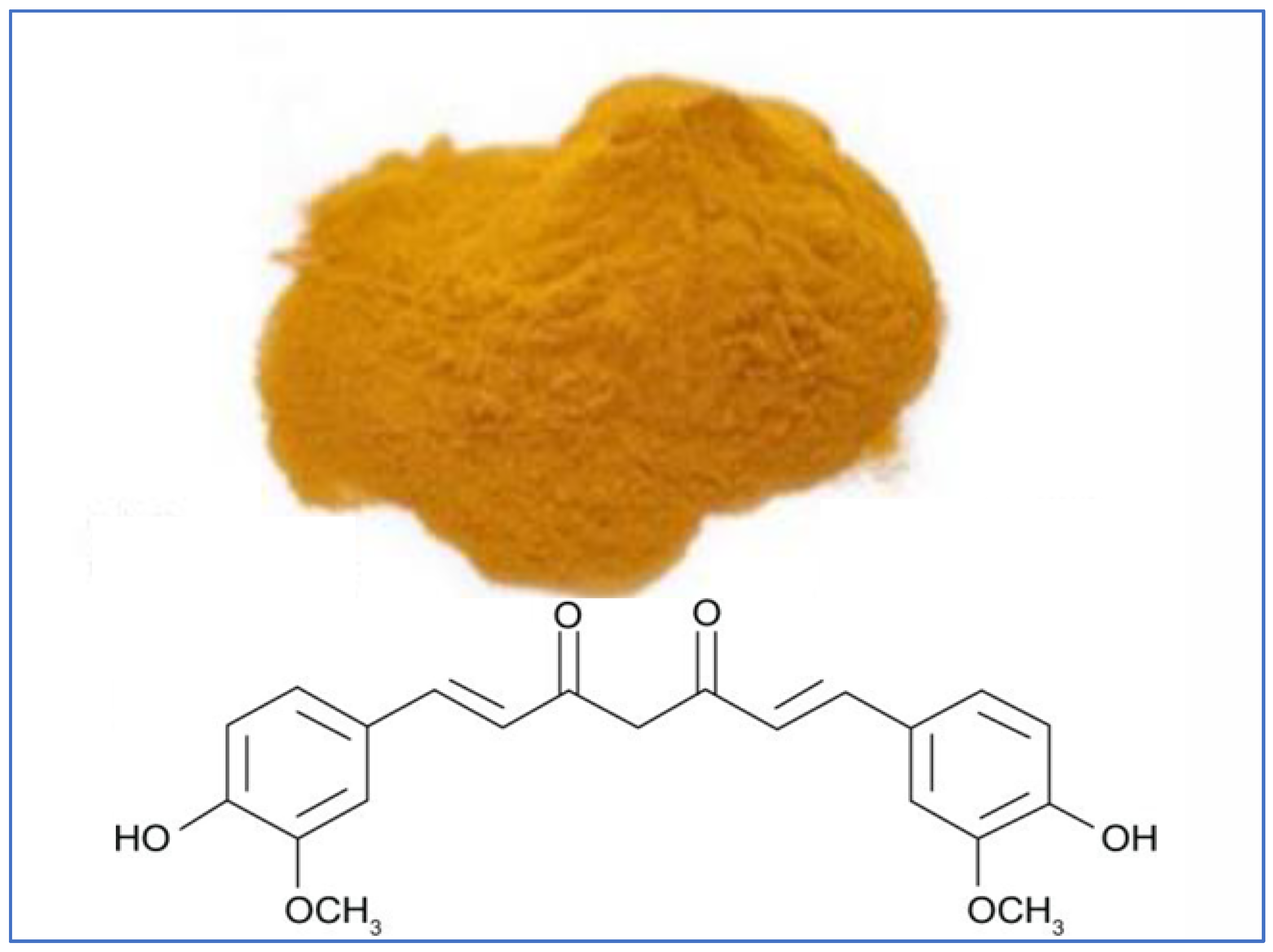
Figure 1.
a) Tannin from raw banana peels; (b) tannin extracted from banana peel; (c) turmeric; (d) curcumin extracted from turmeric; (e) natural rubber latex compound for medical gloves with added tannin extract from banana peel and curcumin from turmeric.
Figure 1.
a) Tannin from raw banana peels; (b) tannin extracted from banana peel; (c) turmeric; (d) curcumin extracted from turmeric; (e) natural rubber latex compound for medical gloves with added tannin extract from banana peel and curcumin from turmeric.
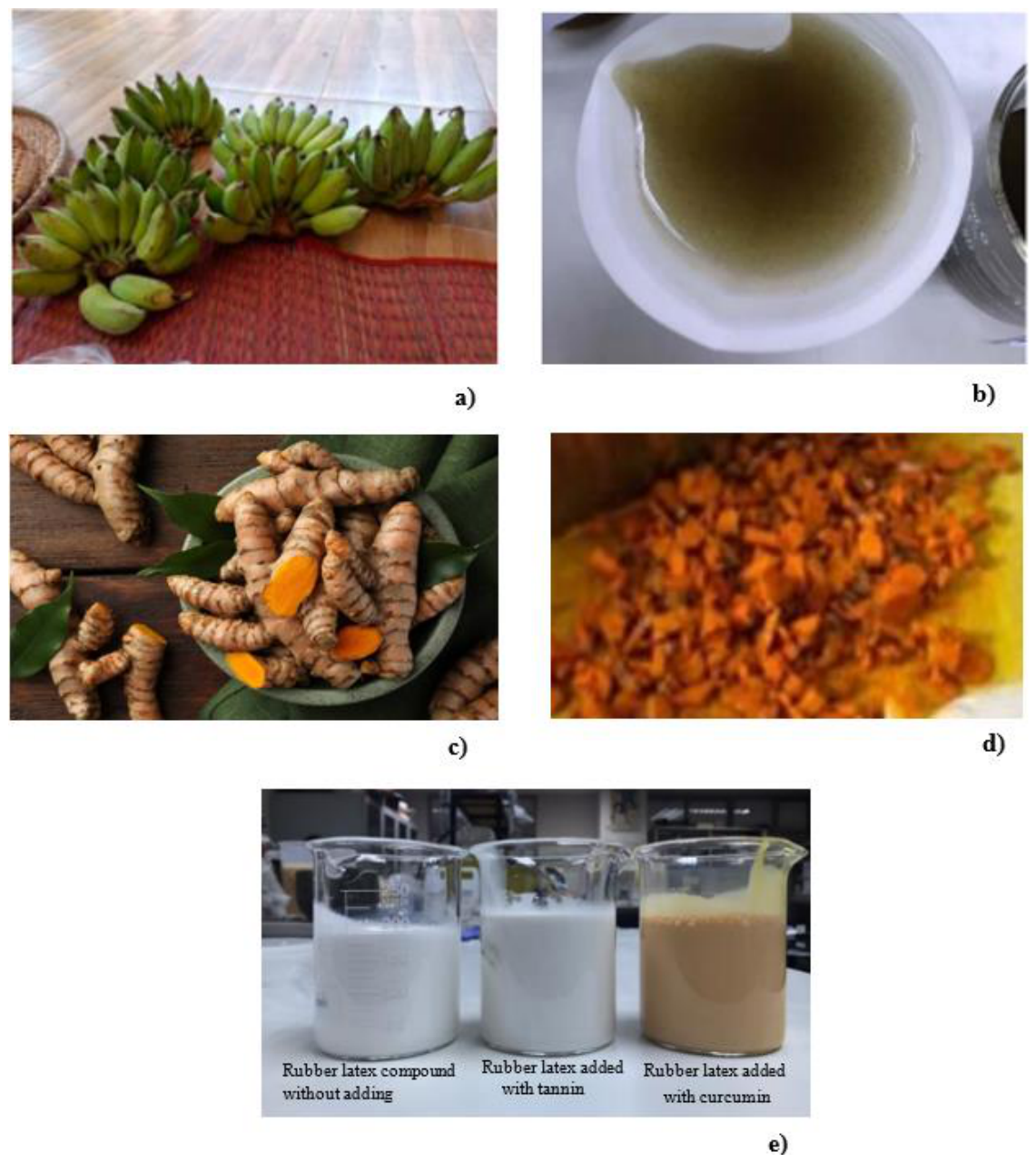
Figure 2.
a) Washing the hand mold with water; (b) drying the cleaned hand mold in a steam oven; (c) dipping the hand mold in coagulant; and (d) air-drying the mold after coagulant application.
Figure 2.
a) Washing the hand mold with water; (b) drying the cleaned hand mold in a steam oven; (c) dipping the hand mold in coagulant; and (d) air-drying the mold after coagulant application.
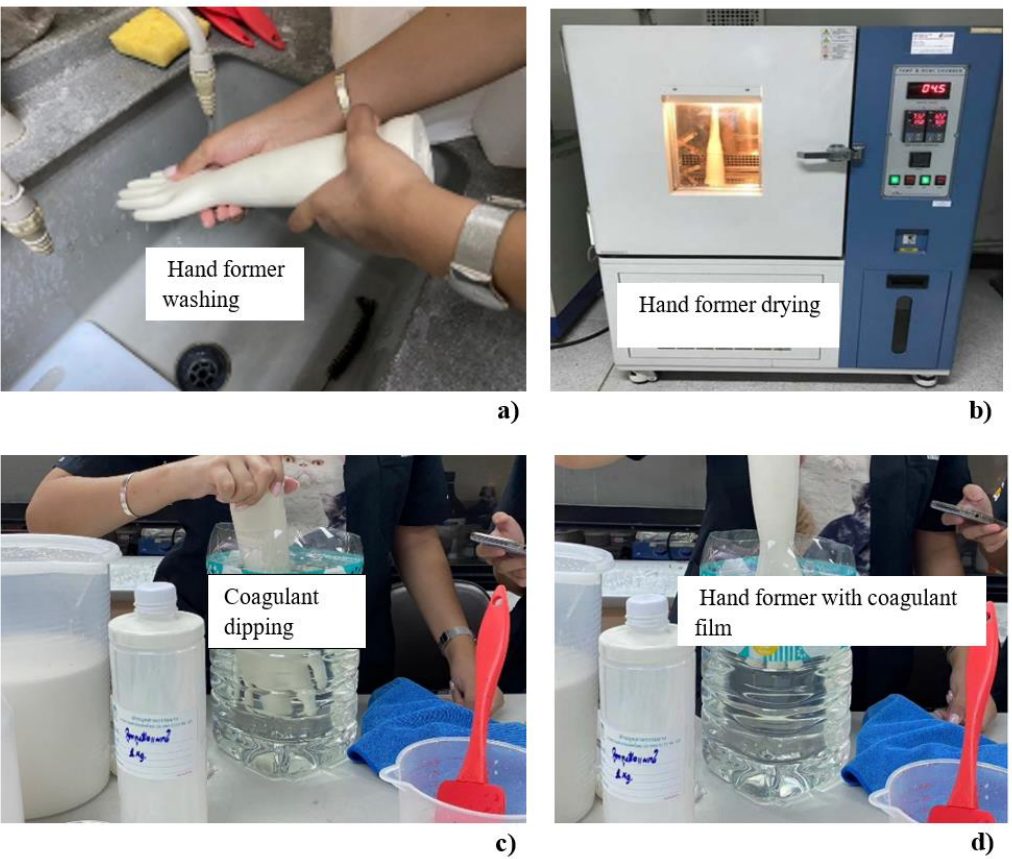
Figure 3.
a) Dipping the hand mold in latex compound containing tannin; (b) dipping the hand mold in latex compound containing curcumin; (c) curing the glove film in an oven; (d) steam-oven curing of rubber film; (e) glove films containing tannin on hand formers; (f) glove films containing curcumin on hand formers; (g) removal of glove film from the mold; (h) glove film after demolding; (i) preliminary leakage test by filling gloves with water; (j) intact rubber glove.
Figure 3.
a) Dipping the hand mold in latex compound containing tannin; (b) dipping the hand mold in latex compound containing curcumin; (c) curing the glove film in an oven; (d) steam-oven curing of rubber film; (e) glove films containing tannin on hand formers; (f) glove films containing curcumin on hand formers; (g) removal of glove film from the mold; (h) glove film after demolding; (i) preliminary leakage test by filling gloves with water; (j) intact rubber glove.
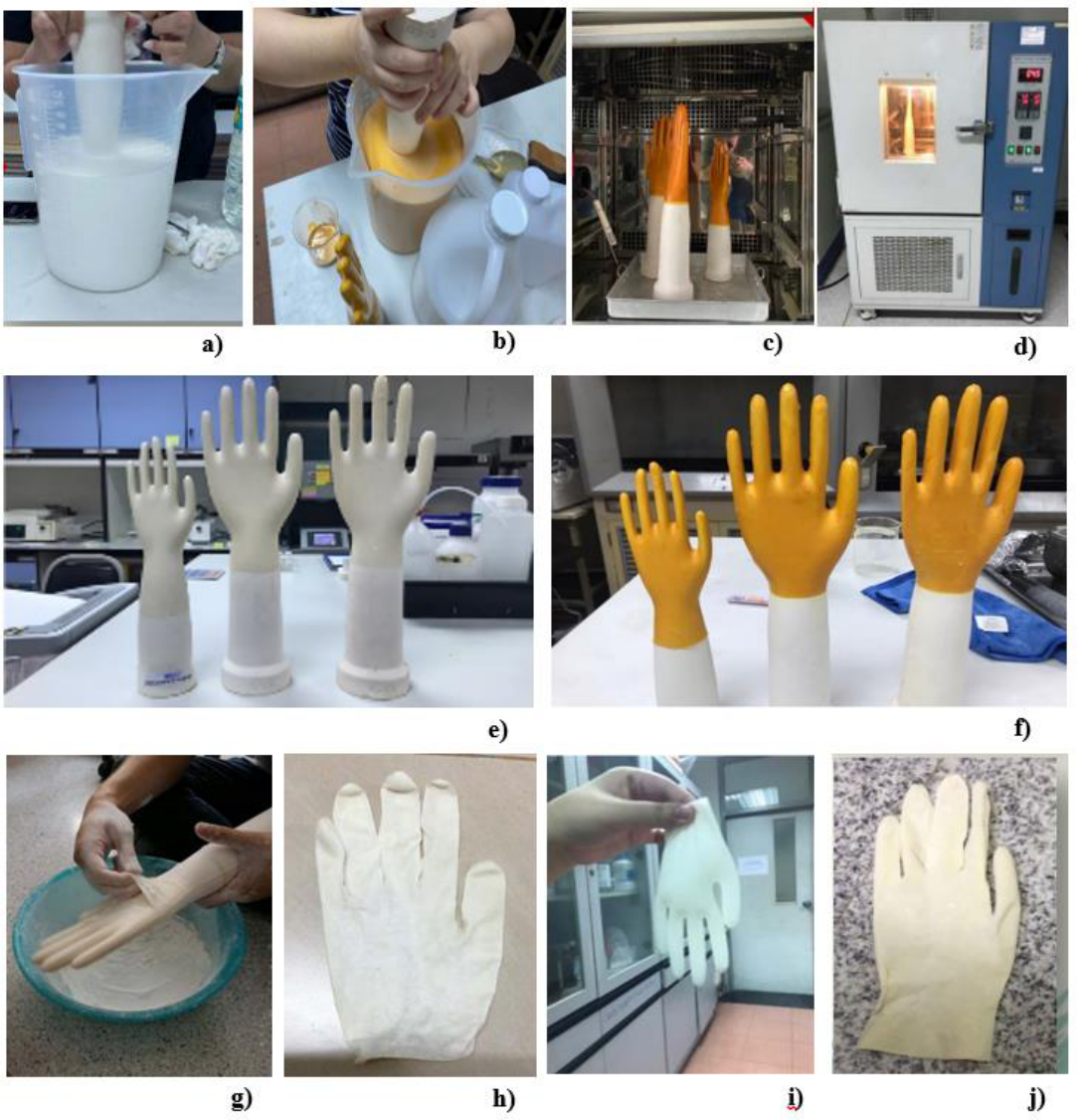
Figure 4.
FTIR spectra of antimicrobial reagents: tannin from green banana peel and curcumin from turmeric, and solubility of tannin and curcumin in water and ethanol, respectively.
Figure 4.
FTIR spectra of antimicrobial reagents: tannin from green banana peel and curcumin from turmeric, and solubility of tannin and curcumin in water and ethanol, respectively.
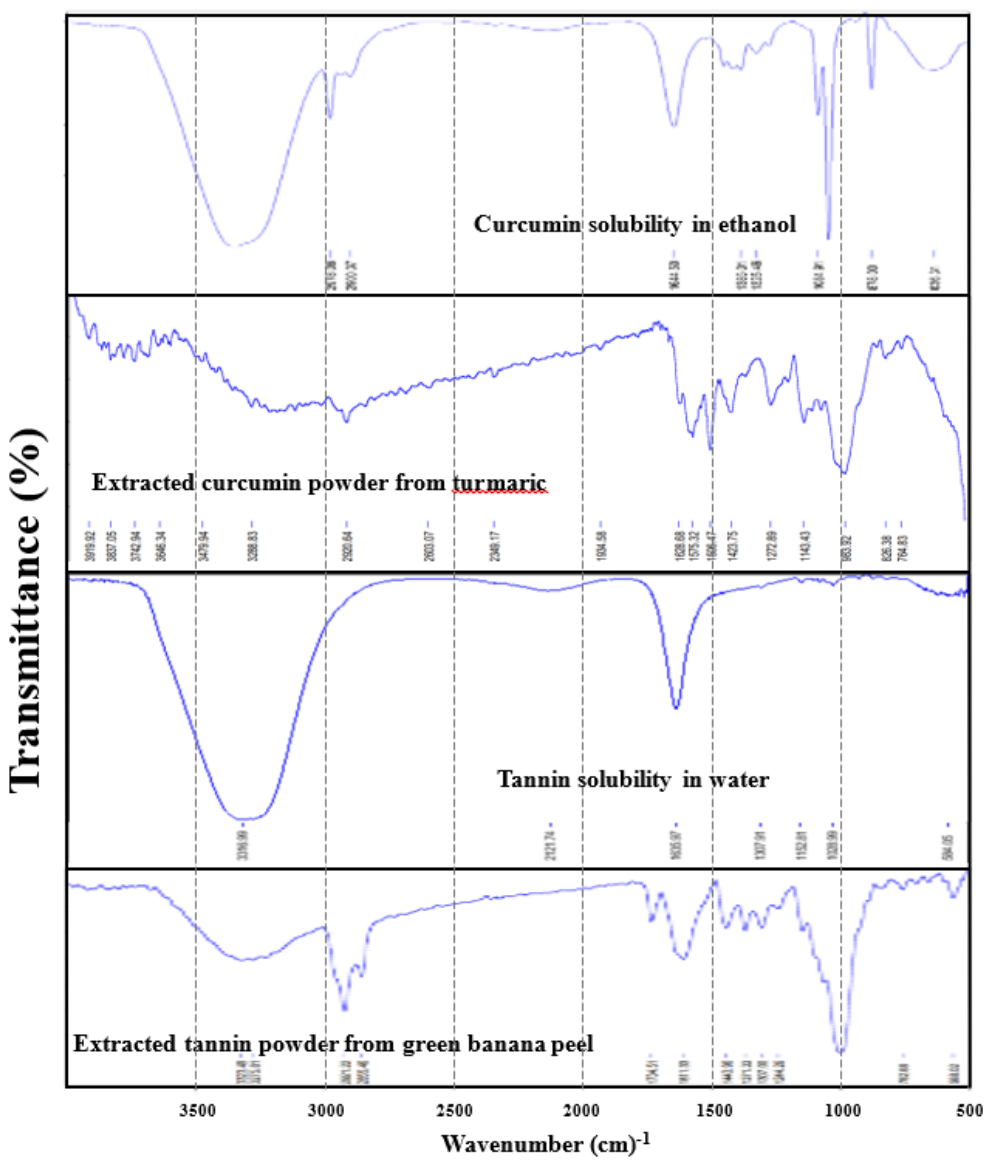
Figure 5.
FTIR of rubber latex glove films with and without adding antibiotic agents (tannin and curcumin).
Figure 5.
FTIR of rubber latex glove films with and without adding antibiotic agents (tannin and curcumin).
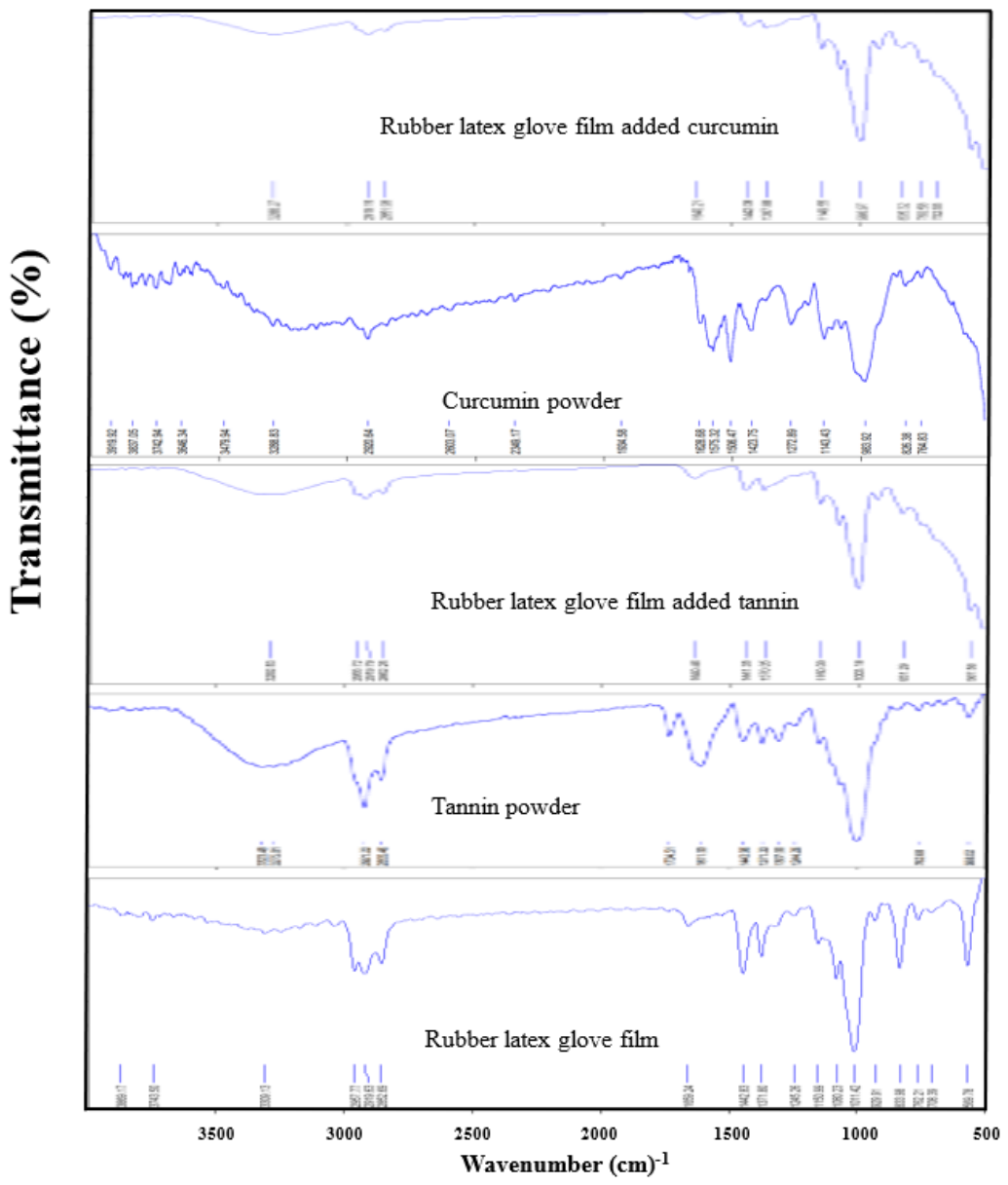
Figure 6.
XRD patterns of natural rubber latex glove films with and without antimicrobial agents (tannin and curcumin).
Figure 6.
XRD patterns of natural rubber latex glove films with and without antimicrobial agents (tannin and curcumin).
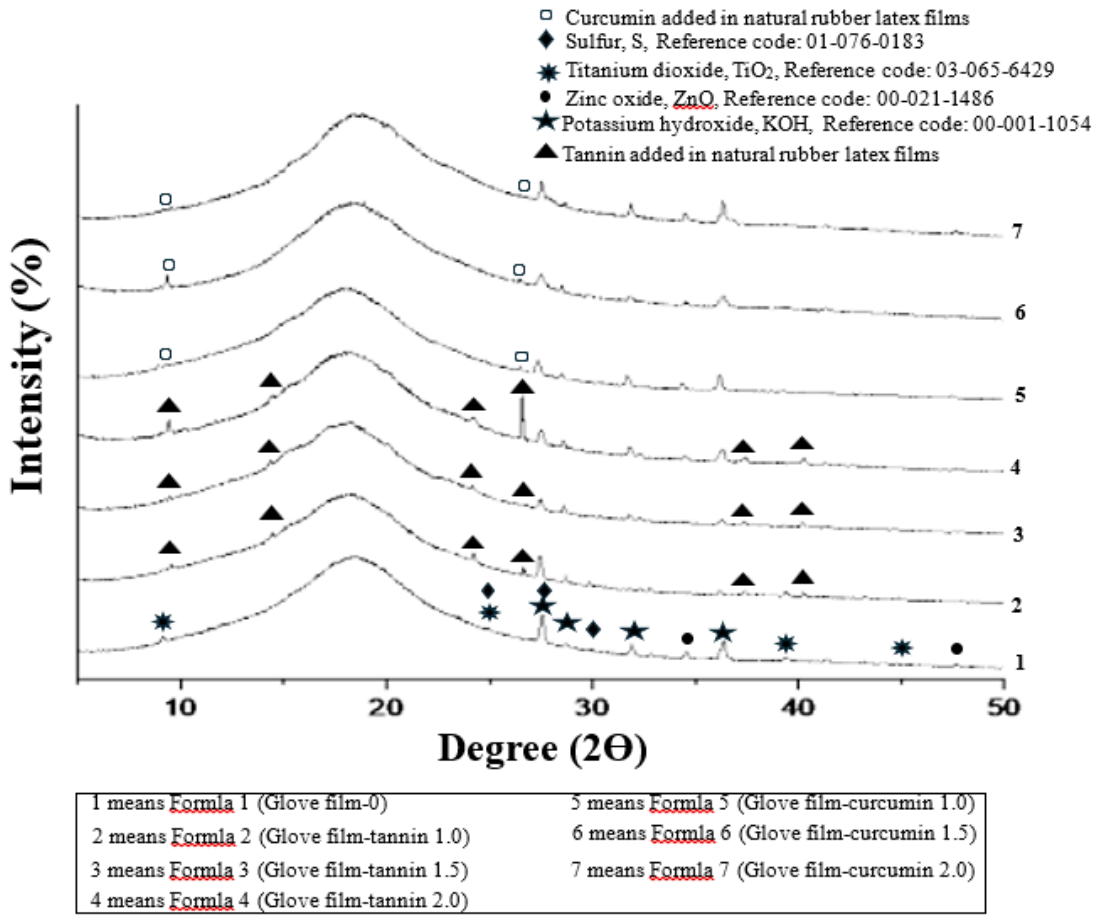
Figure 7.
SEM micrographs at 1,000× and 5,000× magnifications: (a, a-1) tannin powder; (b, b-1) curcumin powder; (c, c-1) natural rubber latex film without antimicrobial agent; (d, d-1) natural rubber latex film with 1.0 wt% tannin; (e, e-1) 1.5 wt% tannin; (f, f-1) 2.0 wt% tannin; (g, g-1) 1.0 wt% curcumin; (h, h-1) 1.5 wt% curcumin; (i, i-1) 2.0 wt% curcumin.
Figure 7.
SEM micrographs at 1,000× and 5,000× magnifications: (a, a-1) tannin powder; (b, b-1) curcumin powder; (c, c-1) natural rubber latex film without antimicrobial agent; (d, d-1) natural rubber latex film with 1.0 wt% tannin; (e, e-1) 1.5 wt% tannin; (f, f-1) 2.0 wt% tannin; (g, g-1) 1.0 wt% curcumin; (h, h-1) 1.5 wt% curcumin; (i, i-1) 2.0 wt% curcumin.
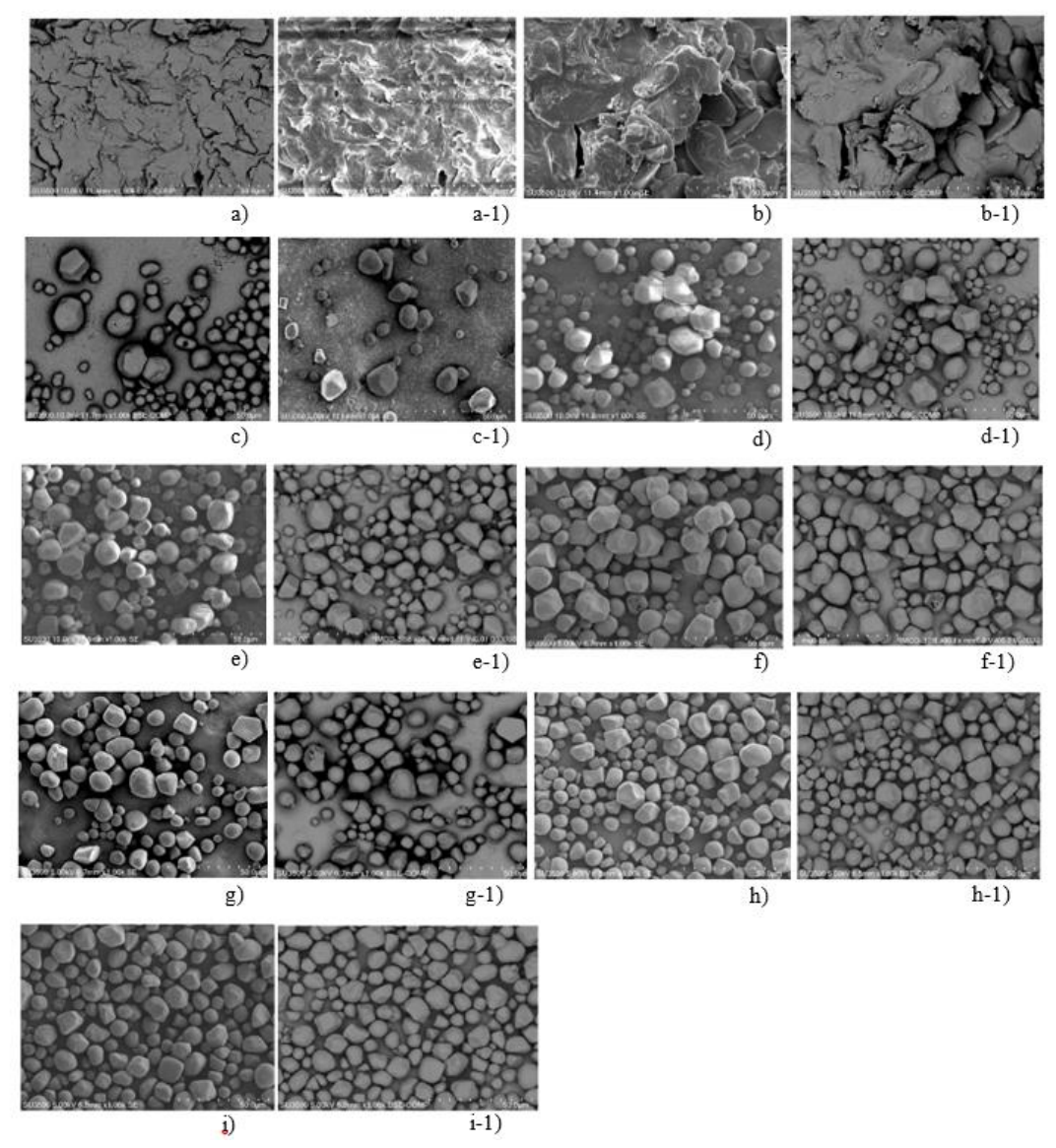
Figure 8.
Contact angle of water drop on natural rubber latex glove film surface for 2000 ms: a) Formula 1 (reference sample); b) Formula 2; c) Formula 3; d) Formula 4; e) Formula 5; f) Formula 6; and g) Formula 7. .
Figure 8.
Contact angle of water drop on natural rubber latex glove film surface for 2000 ms: a) Formula 1 (reference sample); b) Formula 2; c) Formula 3; d) Formula 4; e) Formula 5; f) Formula 6; and g) Formula 7. .
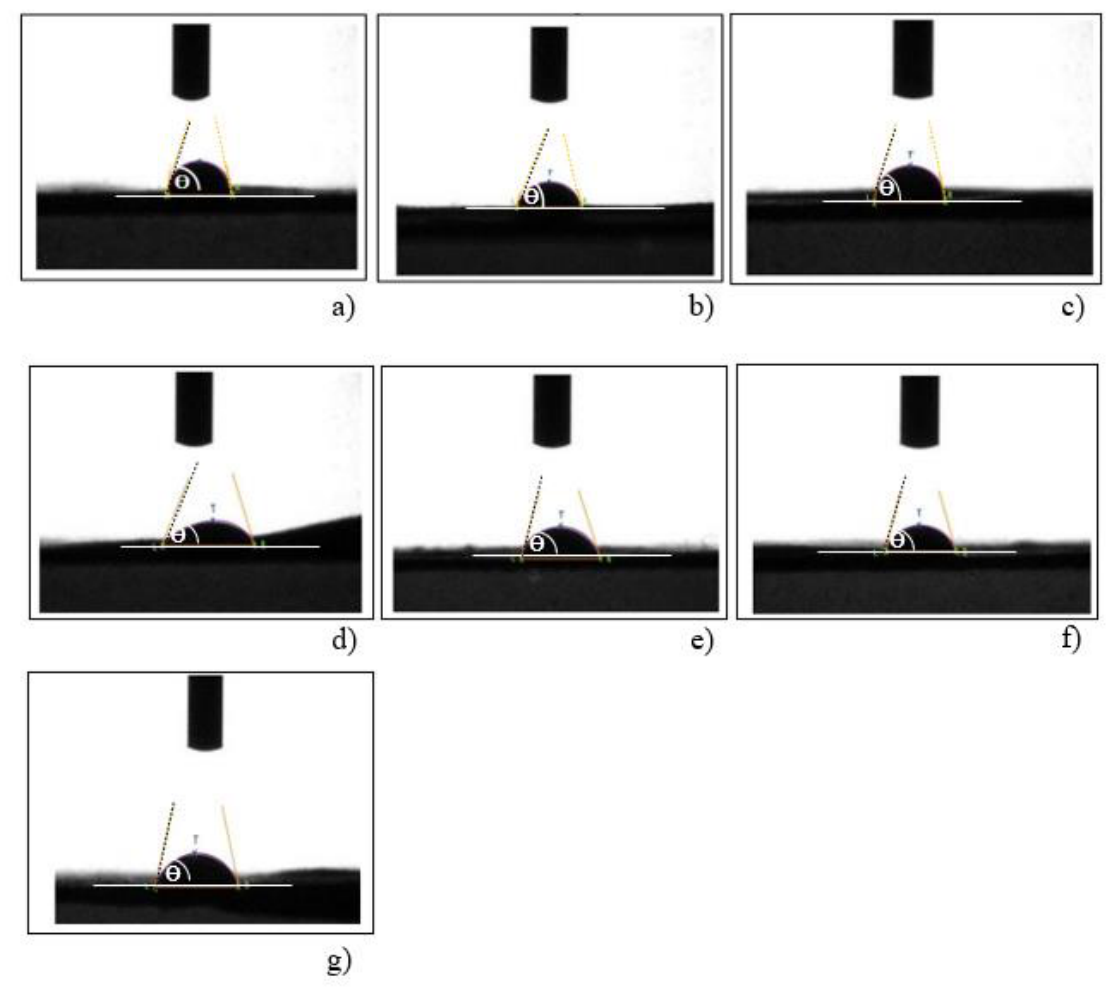
Figure 9.
Mechanical properties of natural rubber latex glove films: (a) elongation at break and (b) tensile strength.
Figure 9.
Mechanical properties of natural rubber latex glove films: (a) elongation at break and (b) tensile strength.
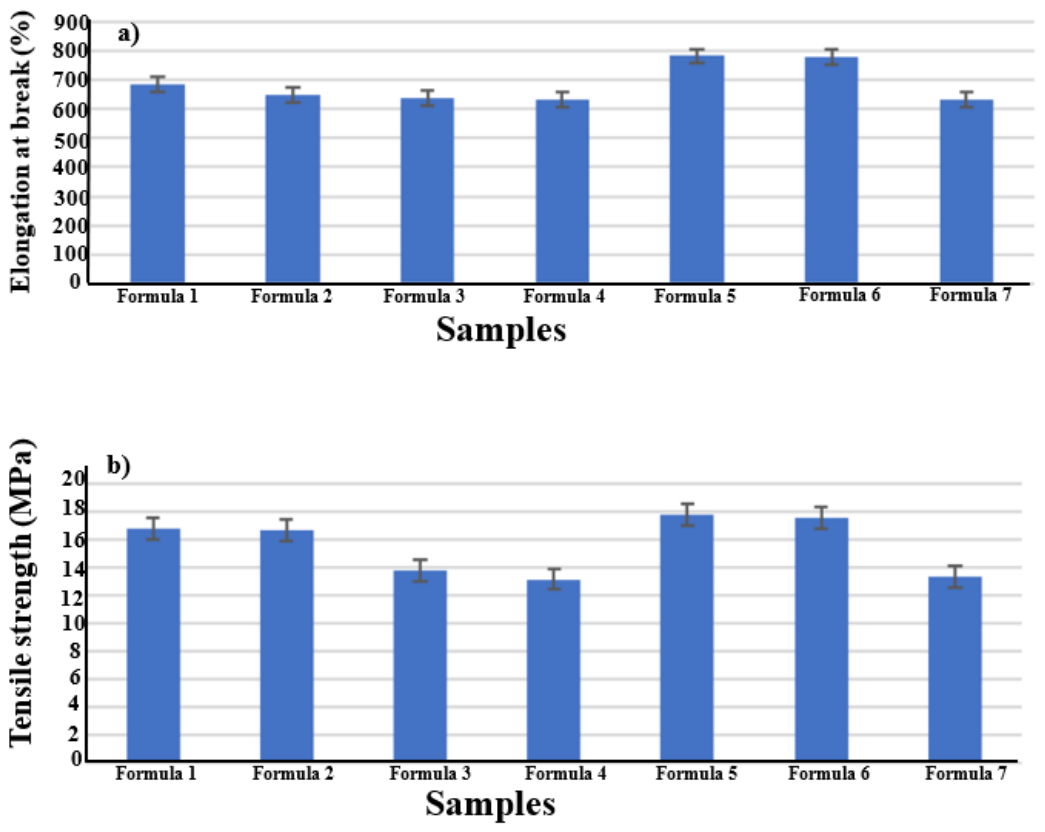
Figure 10.
Antibacterial activity of Staphylococcus aureus evaluated by zone of inhibition test (mean ± standard deviation; n = 3).
Figure 10.
Antibacterial activity of Staphylococcus aureus evaluated by zone of inhibition test (mean ± standard deviation; n = 3).
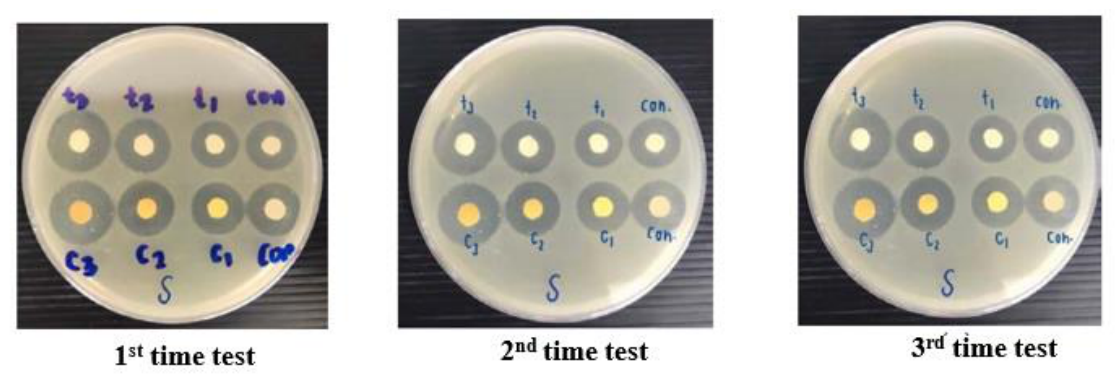

Table 1.
Chemical composition used in the preparation of natural rubber latex glove films.
|
Chemical substances |
Weight (g) |
Functions of chemical substances |
|---|---|---|
| 60% conc. Natural rubber latex |
167.0 | Main raw material |
| 10% Potassium hydroxide (KOH) |
2.0 | Increasing pH and reducing extractable protein content |
| 10% Teric 16A16 |
0.2 | A non-ionic surfactant |
| 50% Sulfur |
1.6 | A vulcanizing agent |
| 50% Zinc diethyldithiocarbamate (ZDEC) |
0.8 | A vulcanization accelerator and activator |
| 50% Zinc 2-mercaptobenzothiazole (ZMBT) | 0.8 | A vulcanization accelerator and activator |
| 50% Titanium dioxide (TiO2) |
2.0 | A pigment enhances whiteness and opacity |
| 50% Wingstay L |
2.0 | Antioxidant and extend shelf life of rubber |
| 50% Zinc oxide (ZnO) |
2.0 | Activator of vulcanization |
| Water (H2O) |
170.5 | Medium of mixing |
Table 2.
Formulations of natural rubber latex films.
| Antioxidant | 1 Glove film-0 |
2 Glove film-tannin 1.0 |
3 Glove film-tannin 1.5 |
4 Glove film-tannin 2.0 |
5 Glove film-curcumin 1.0 |
6 Glove film-curcumin 1.5 |
7 Glove film-curcumin 2.0 |
|
|---|---|---|---|---|---|---|---|---|
| Formula | ||||||||
| Natural rubber latex compound without adding antioxidant | Reference | - | - | - | - | - | - | |
| Natural rubber latex compound added with tannin from raw banana peels (wt%) | - | 1.0 | 1.5 | 2.0 | - | - | - | |
| Natural rubber latex compound added with curcumin from turmeric (wt%) | - | - | - | - | 1.0 | 1.5 | 2.0 | |
Remark: Each formulation of natural rubber glove films was prepared in ten samples Encoded sample designation: Glove film–x–y refers to natural rubber latex glove films with or without antioxidant (tannin or curcumin), where x indicates the type of antioxidant and y represents the concentration of added antioxidant in percent by weight (wt%). Example: Glove film–0 refers to natural rubber glove films without added antioxidants, used as the reference sample.
Table 3.
Chemical functional groups of samples measured by FTIR.
| Wavenumbers (cm)-1 |
Chemical functional groups |
|---|---|
| 3920, 3869, 3745 (3900-3600) |
O-H |
| 3480, 3400, 3317 (3500-3300) |
N-H |
| 3276, 2958, 2950, 2920, 2900, 2856, 2852, 2835 (3300-2800) |
≡C-H, =CH2, ₋CH3 |
| 2140-2100 |
C≡C |
| 2000-1600 |
=CH2 |
| 1750-1700 |
C=O |
| 1636, 1620 (1600-1500) |
C=C |
| 1450, 1400, 1320, 1307, 1250 |
C-H bending, O-H bending, C-N stretching |
| 1153, 1100, 1029, 1010 |
C-O stretching, CO-O-CO stretching, =C-H bending |
| 952, 866, 756, 750, 648, 585, 584 |
C=C bending, C-H bending, COOH bending, and S-O stretching |
Table 4.
Mechanical properties and contact angle values of natural rubber glove films with and without mixing antibiotic agents (tannin and curcumin).
Table 4.
Mechanical properties and contact angle values of natural rubber glove films with and without mixing antibiotic agents (tannin and curcumin).
| Sample | Film thickness (Palm of the hand) (mm) |
Film thickness (Finger) (avg, mm) |
Max. force (N) |
Elongation at break (%) | Tensile strength (MPa) |
Contact angle (degree, °) |
|---|---|---|---|---|---|---|
| Commercial Natural Rubber Glove Films |
0.11±0.01 | - | - | 577.59 ± 9.88 | 11.00 ± 1.45 | - |
| Commercial Synthetic Rubber Glove Films |
0.14±0.01 | - | - | 382.00 ± 1.09 | 11.66 ± 0.97 | - |
| Formula 1 (Glove film-0) |
0.19±0.01 | 0.48 | 24.72 ± 1.38 | 685.85 ± 4.85 | 16.78 ± 0.19 | 88.90 |
| Formula 2 (Glove film-tannin 1.0) |
0.16±0.01 | 0.62 | 27.45 ± 3.19 | 650.56 ± 2.46 | 16.63 ± 0.21 | 77.30 |
| Formula 3 (Glove film-tannin 1.5) |
0.18±0.01 | 0.62 | 26.17 ± 1.73 | 639.82 ± 3.18 | 13.71 ± 0.15 | 58.40 |
| Formula 4 (Glove film-tannin 2.0) |
0.16±0.01 | 0.62 | 26.08 ± 0.73 | 634.84 ± 0.84 | 13.15 ± 0.23 | 55.90 |
| Formula 5 (Glove film-curcumin 1.0) |
0.19±0.01 | 0.69 | 25.45 ± 3.51 |
783.34 ± 1.21 | 17.76 ± 0.18 | 52.50 |
| Formula 6 (Glove film-curcumin 1.5) |
0.19±0.01 | 0.69 | 25.24 ± 1.46 | 780.71 ± 0.85 | 17.50 ± 0.05 | 50.10 |
| Formula 7 (Glove film-curcumin 2.0) |
0.19±0.01 | 0.69 | 24.78 ± 3.34 | 634.84 ± 0.34 | 13.34 ± 0.10 | 45.90 |
Remark: “–“ indicates not measured.Each formulation of natural rubber glove films was tested in triplicate (n = 3).Encoded sample designation: Glove film–x–y refers to natural rubber latex glove films with or without antioxidant (tannin or curcumin), where x indicates the type of antioxidant and y represents the concentration of added antioxidant in percent by weight (wt%). Example: Glove film–0 refers to natural rubber glove films without added antioxidants, used as the reference sample.
Table 5.
Antimicrobial performance of tannin and curcumin incorporation in natural rubber latex compound.
Table 5.
Antimicrobial performance of tannin and curcumin incorporation in natural rubber latex compound.
| Sample |
Inhibition zone of Staphylococcus aureus (mm) |
|---|---|
| Formula 1 (Glove film-0) |
- |
| Formula 2 (Glove film-tannin 1.0) |
13.590 ± 0.003 |
| Formula 3 (Glove film-tannin 1.5) |
13.670 ± 0.003 |
| Formula 4 (Glove film-tannin 2.0) |
14.400 ± 0.140 |
| Formula 5 (Glove film-curcumin 1.0) |
13.950±0.067 |
| Formula 6 (Glove film-curcumin 1.5) |
14.630±0.023 |
| Formula 7 (Glove film-curcumin 2.0) |
14.990±0.027 |
Remark: “–“ indicates not measured.Each formulation of natural rubber glove films was tested in triplicate (n = 3). Encoded sample designation: Glove film–x–y refers to natural rubber latex glove films with or without antioxidant (tannin or curcumin), where x indicates the type of antioxidant and y represents the concentration of added antioxidant in percent by weight (wt%). Example: Glove film–0 refers to natural rubber glove films without added antioxidants, used as the reference sample.
Disclaimer/Publisher’s Note: The statements, opinions and data contained in all publications are solely those of the individual author(s) and contributor(s) and not of MDPI and/or the editor(s). MDPI and/or the editor(s) disclaim responsibility for any injury to people or property resulting from any ideas, methods, instructions or products referred to in the content. |
© 2026 by the authors. Licensee MDPI, Basel, Switzerland. This article is an open access article distributed under the terms and conditions of the Creative Commons Attribution (CC BY) license (http://creativecommons.org/licenses/by/4.0/).
Copyright: This open access article is published under a Creative Commons CC BY 4.0 license, which permit the free download, distribution, and reuse, provided that the author and preprint are cited in any reuse.