
Submitted:
05 September 2026
Posted:
07 September 2026
You are already at the latest version
Abstract
Few-shot stressor extraction from temporally shifting social-media text is challenged by unstable span boundaries and by a mismatch between structural confidence and task-semantic validity. We propose VFR-MISE, an asymmetric dual-evidence verification–fallback framework. VFR-MISE retains the temporal few-shot and knowledge-inheritance paradigm of MISE, strengthens candidate generation with DeBERTa-v3-base, and constructs two candidate-level signals: a guideline-conditioned verifier for semantic evidence and BIOES emission aggregation for structural evidence. Semantic evidence governs candidate admission; structural evidence is consulted only in the rejected region for constrained recovery, after which deterministic span merging produces the final output. In controlled reruns using identical data splits, training budgets, and Exact-span evaluation, replacing RoBERTa-base with DeBERTa-v3-base increases cross-shot F1 from 0.6841 to 0.7236 (+3.95 percentage points). With the DeBERTa-v3 backbone fixed, the complete VFR-MISE reaches 0.7248. These results suggest that stronger candidate representations and asymmetric dual-evidence decision refinement provide complementary benefits, improving the precision–recall trade-off while retaining an auditable decision process.
Keywords:
stressor extraction
; few-shot sequence labeling
; DeBERTa-v3
; dual-evidence verification
; asymmetric fallback
; temporal generalization
1. Introduction
Social media offers a large-scale, low-cost, and temporally continuous window into individuals' experiences of stress and its precipitating factors. Most prior work formulates the problem as post-level stress classification; for example, Dreaddit determines whether a Reddit post expresses stress [1]. MISE moves beyond this formulation by estimating the specific textual spans that describe stressors and by using temporal partitioning and knowledge inheritance to support few-shot adaptation in future intervals [2]. More recently, PsyEvent has shown that extracting interpretable life events from social-media posts can benefit mental-health risk analysis and downstream prediction [3]. Accordingly, the research focus is shifting from whether a post contains stress to which concrete event or situation causes that stress. The latter provides auditable event-level evidence but imposes stricter requirements on span boundaries, semantic validity, and temporal generalization.
Although stressor extraction and named entity recognition (NER) both require the localization of contiguous text spans, the two tasks are not equivalent. Social-media text contains abbreviations, colloquialisms, ellipsis, spelling variants, and rapidly evolving expressions; findings from the WNUT shared tasks show that such noise substantially complicates both entity-boundary detection and category assignment [4]. BERT, RoBERTa, DeBERTa, and DeBERTa-v3 have improved contextual representation [5,6,7,8], while conditional random fields (CRFs) improve sequence consistency through label-transition constraints [9]. However, the optimal BIOES-CRF path primarily reflects the joint structural score of local emissions and label transitions and does not inherently guarantee that a candidate span denotes a concrete cause of stress. Pure emotions, symptom descriptions, generic stress terms, poorly resolved referring expressions, and spans with expanded or truncated boundaries may all receive high structural scores and become false positives.
Few-shot conditions further amplify these problems. MAML and prototypical networks established influential paradigms for rapid adaptation and metric learning [10,11]. Few-NERD and subsequent studies have improved few-shot NER through structured nearest-neighbor learning, empirical baselines, decomposed meta-learning, contrastive learning, label semantics, boundary–type coordination, and boundary-aware large language models [12,13,14,15,16,17,18,19]. In parallel, SpanNER, boundary smoothing, two-stage locate-and-label approaches, and teacher–student span-recognition frameworks show that explicitly modeling span candidates and boundary uncertainty can complement the inductive bias of conventional sequence labeling [20,21,22,23]. Taken together, these studies indicate that, under scarce supervision, boundary identification and semantic discrimination are related but cannot be fully represented by a single score. When only the top-1 sequence path is used, erroneous candidates lack an independent review mechanism.
Prediction confidence provides another route for post-processing, but high confidence is not synonymous with semantic correctness. Temperature scaling can improve the correspondence between predicted probabilities and empirical accuracy [24], and calibration for structured outputs extends confidence estimation from individual tokens to structured objects such as entities or answers [25]. Recent NER work has also examined how data augmentation affects calibration and uncertainty estimation [26]. Conformal prediction emphasizes finite-sample coverage guarantees [27], selective prediction controls risk through rejection [28], and self-verification approaches such as Chem-FINESE use reconstruction signals to assess extraction fidelity [29]. Nevertheless, existing methods focus primarily on probability calibration, global abstention, or generative self-verification. Relatively little work has examined, for top-1 spans in few-shot sequence labeling, how high-confidence structural information from the first stage can be used in a constrained manner to recover candidates that are wrongly removed after independent semantic verification. Hard filtering may improve precision at the expense of recall, whereas a high CRF threshold alone may discard many true spans.
The temporal dimension makes this trade-off more difficult. Test-time adaptation methods such as TENT allow a model to update during inference using test-distribution information permitted by the evaluation protocol [30]. Yet the language and topical content of social media evolve over time, and entity-centric tasks often exhibit greater performance degradation under temporal shift than general topic or sentiment classification [31]. Longitudinal NLP research further indicates that random splits can obscure the true difficulty of generalizing to future time periods and individual trajectories; evaluation should therefore use prospective partitions aligned with the intended deployment setting [32]. VIBE similarly exploits topic evolution to improve temporal adaptation for social-media classification [33]. MISE organizes this process through historical-interval training, few-shot support-set adaptation in a future interval, and knowledge inheritance; its original base estimator uses RoBERTa for contextual encoding and a CRF decoder [2]. This design provides an effective baseline for temporally staged few-shot stressor extraction, but leaves two opportunities for improvement: contextual representation during candidate generation, and semantic validation plus recall compensation before top-1 candidates enter the final output.
Motivated by these limitations, we propose VFR-MISE (Verification and Fallback Refinement for MISE), which organizes few-shot stressor extraction into a two-level refinement pipeline comprising enhanced candidate generation, semantic verification, constrained fallback, and deterministic merging. The core methodological contribution lies in candidate-level asymmetric dual-evidence decision-making. Our contributions are fourfold. First, we introduce an asymmetric dual-evidence verification–fallback framework in which semantic evidence v(c) from an independent verifier governs candidate validation and admission, whereas structural evidence q(c) from the base extractor is not fused symmetrically with v(c) and is used only for conditional recovery within the semantically rejected region. This design explicitly separates structural plausibility from task-semantic validity. Second, at the representation level, we build a DeBERTa-v3-enhanced candidate generator and independently estimate the effect of backbone choice through controlled RoBERTa-base/DeBERTa-v3-base reruns using the same code path, support/query partitions, training budget, and Exact-span evaluation. Third, we design a candidate-preserving, guideline-conditioned span verifier and combine it with high-confidence constrained fallback and deterministic span merging. Candidate acceptance, rejection, recovery, and conflict displacement are recorded as a traceable event stream, yielding an auditable coupling between precision-oriented verification and recall preservation. Fourth, we construct an evidence hierarchy aligned with these methodological levels: controlled backbone replacement, paired A0/A1/A3 comparisons, TP/FP conservation analysis, error and calibration diagnostics, and lightweight-model experiments are used separately to explain representation gains, decision-layer mechanisms, and engineering costs, avoiding the conflation of cross-paper results, backbone upgrades, and VFR post-hoc refinement into a single performance gain.
We formulate three testable hypotheses. H1: across seed × shot run units, the independent verifier removes more false positives (FPs) than true positives (TPs) overall, indicating that verification tends to purify the candidate set. H2: applying a high-confidence fallback to verifier-rejected candidates recovers a subset of wrongly removed TPs while reintroducing a quantifiable number of FPs; the TP recovery rate and FP reintroduction rate use the deleted TP and deleted FP sets, respectively, as denominators and therefore characterize the mechanism rather than directly representing net F1 contribution. H3: under identical support/query partitions, random seeds, and evaluation protocols, the A3 condition with verification and fixed fallback achieves higher cross-shot Exact-span F1 than the A0 baseline without post-hoc decision refinement. The experimental conditions, metric definitions, and statistical procedures used to test these hypotheses are specified in subsequent sections.
2. Related Work
2.1. Stress Recognition and Stressor Extraction from Social Media
Early computational work on mental health in social media predominantly relied on post-level or user-level classification, using lexical, emotional, topical, and contextual features to detect stress, depression, or other risk states. Dreaddit introduced a Reddit dataset for stress analysis and formalized stress recognition as a supervised post-level classification task [1]. Such approaches are useful for broad screening, but their outputs are typically a single label or probability and therefore do not identify which event in the post constitutes the stressor or support text-level auditing of errors.
MISE advances the task toward stressor estimation by extracting concrete spans in few-shot future intervals through temporal episodes and knowledge inheritance; its base estimator encodes posts with RoBERTa and performs sequence decoding with a CRF [2]. PsyEvent, in contrast, targets life events, constructs a manually annotated multiclass dataset, and demonstrates the value of event extraction for mental-health analysis [3]. Together, these studies show that event-level extraction is more interpretable than post-level classification. Stressors, however, are not conventional named entities from a closed ontology: whether an event constitutes a stressor depends on contextual causal and experiential expressions, and candidate spans must exclude pure emotions, symptoms, generic stress words, and expressions without a concrete referent. Stressor extraction is therefore both a boundary-localization problem and a semantic-discrimination problem constrained by the task definition. The representational capacity of the base encoder and the post-hoc candidate-level discriminator consequently form two distinct determinants of model performance.
The open vocabulary and evolving expressions of social media further increase extraction difficulty. Results from the WNUT novel and emerging entity recognition task show that neologisms, variants, and low-frequency expressions in noncanonical text affect both boundary detection and entity typing [4]. For stressors, boundary errors have a more direct interpretability cost: spans that are too short may omit event-defining modifiers, whereas overly long spans may incorporate emotions, evaluations, or irrelevant background. Existing stress-analysis research has focused much more heavily on classification accuracy than on the joint questions of whether a candidate expresses a concrete cause, whether its boundary is exact, and whether it remains valid in a future time interval. This gap motivates the first research focus of the present study.
2.2. Few-Shot Sequence Labeling and Span-Boundary Modeling
Pretrained language models have substantially improved contextual modeling for sequence labeling. BERT introduced deep bidirectional representations [5], RoBERTa improved robustness through a more thoroughly optimized pretraining regime [6], and DeBERTa introduced disentangled attention; DeBERTa-v3 further combines ELECTRA-style replaced-token detection with gradient-disentangled embedding sharing to strengthen pretrained representations [7,8]. At the output layer, CRFs impose label-transition constraints to promote structurally consistent BIO/BIOES sequences [9]. The original MISE uses RoBERTa+CRF [2]. In this study, while preserving its sequence-decoding and temporal few-shot learning paradigm, we conduct a controlled comparison between RoBERTa-base and DeBERTa-v3-base so that representation-level improvement is evaluated separately from the subsequent VFR decision-layer refinement. Stronger structural representations do not guarantee semantic correctness of every candidate; thus, a backbone upgrade cannot replace candidate-level verification and fallback.
Few-shot learning has developed mainly along the complementary directions of rapid adaptation and metric learning. MAML learns an initialization that can be adapted in a small number of gradient steps [10], whereas prototypical networks classify examples by distance to class prototypes [11]. Few-NERD provides a large-scale fine-grained benchmark for few-shot NER [12]. Structured nearest-neighbor methods exploit label-sequence structure to improve local matching [13], empirical baseline studies reveal the sensitivity of results to representation, decoding, and sampling choices [14], and decomposed meta-learning, contrastive learning, and label-semantic approaches improve generalization through task decomposition, within-class representation learning, and label-knowledge injection, respectively [15,16,17]. Conjoin-after-decompose and BANER further emphasize the interaction between boundary detection and entity classification [18,19].
Span-based modeling offers a complementary view of boundary errors to token-wise classification. SpanNER reformulates NER as span prediction and shows that span models can function both as standalone recognizers and as system combiners that review outputs from other models [20]. Boundary smoothing allocates probability mass to neighboring spans to reduce boundary-label ambiguity and model overconfidence [21]. Locate and Label first generates and corrects span candidates and then performs category classification [22]. A three-stage few-shot framework uses a teacher boundary matrix, a student span recognizer, and a prototype classifier to separate boundary learning from semantic classification [23]. These approaches provide methodological support for generating candidates first and judging them independently afterward, but they primarily optimize end-to-end NER architectures rather than post-hoc semantic verification and recovery under a stressor-specific task definition.
Few-shot sequence labeling is also highly stochastic. Different initializations, example orders, and support-set compositions can produce substantial variation in evaluation scores, so reporting a single run can overstate methodological advantages. Reporting score distributions and paired differences over multiple random seeds is more reliable [34]. We therefore freeze 20 paired seeds and compare A0, A1, and A3 under identical support/query conditions, enabling model-condition effects to be separated from run-to-run variability.
2.3. Confidence Calibration, Candidate Verification, and Selective Decision-Making
Deep neural models frequently produce overconfident probabilities. Temperature scaling is a standard post-hoc calibration method that adjusts the correspondence between confidence and empirical correctness without changing predicted classes [24]. For structured tasks such as NER and question answering, individual token probabilities are insufficient to represent entity- or answer-level reliability, motivating calibration methods defined over structured output objects [25]. Recent research further shows that data augmentation can alter calibration and uncertainty estimation for NER in in-domain, cross-genre, and cross-lingual settings [26]. These findings motivate explicit auditing of candidate-level confidence, but calibration by itself cannot determine whether a candidate satisfies the semantic criterion of a concrete cause of stress.
Conformal prediction constructs prediction sets with finite-sample coverage guarantees [27], whereas selective prediction methods such as SelectiveNet allow abstention on low-confidence examples to control risk among accepted predictions [28]. Their central objective is coverage or rejection. In contrast, the present system must ultimately output a set of spans and therefore cannot be reduced to conformal set prediction or global abstention. Chem-FINESE uses text reconstruction to self-verify entity-extraction results [29], while knowledge distillation constrains a student model with teacher distributions to preserve existing knowledge [35]. These studies demonstrate the value of using a second signal to review first-stage outputs, but generative reconstruction and training-time distillation are fundamentally different from the discriminative span verification and fixed high-confidence fallback used here.
From a decision-theoretic perspective, a hard semantic verifier can reduce false positives but inevitably removes some true spans, whereas gating solely by CRF confidence can mistake a high structural score for semantic correctness. VFR-MISE therefore organizes the two signals into an asymmetric verification–fallback process: the semantic verifier has priority in deciding candidate admission, and structural evidence is used for constrained recovery only in the rejected region. The design is neither a monotonic calibration of CRF scores nor a reranking of multiple global sequences. Instead, it establishes a post-hoc dual-evidence decision layer with explicit role separation over the top-1 candidate universe. Its validity must therefore be evaluated at two levels: mechanistically through deleted FPs, deleted TPs, recovered TPs, and reintroduced FPs, and systemically through final Exact-span F1.
2.4. Temporal Generalization, Test-Time Adaptation, and Responsible Governance
Social media is a prototypical dynamic-text environment in which vocabulary, events, and topics continuously evolve. TENT achieves fully test-time adaptation by minimizing prediction entropy [30], but assumes that only protocol-permitted unlabeled information is used at test time. A systematic study of temporal drift in social media found relatively consistent degradation for entity-centric tasks such as entity recognition and entity disambiguation in future periods, while simple continued pretraining did not necessarily improve temporal adaptation [31]. Longitudinal NLP research further argues that evaluation splits should align with deployment objectives and should distinguish cross-person generalization from prospective generalization to future observations [32]. VIBE uses topic-evolution representations to improve temporal adaptation for Twitter classification [33]. Consequently, temporal ordering, support/query separation, and the provenance and freezing of threshold choices are central to credible evaluation in future intervals.
MISE uses intervals 1–7 for historical training and selection, adapts on a small number of support posts in interval 8, and evaluates on a disjoint query set [2]. We retain this temporal protocol and additionally audit whether query gold labels enter training, checkpoint selection, verifier training, threshold search, or the support loss. Unlike generic test-time adaptation, we do not claim unsupervised online adaptation, and query labels are never used in any decision. The 3/5/10-shot support sets are nested within each seed, and the A0/A1/A3 conditions use exactly the same query set for a given seed, reducing compositional bias in paired comparisons.
Mental-health-related social-media research also raises risks involving privacy, re-identification, stigmatization, and purpose drift. Existing ethical protocols emphasize minimizing data exposure, assessing potential harms, and avoiding the substitution of computational outputs for professional judgment [36]. Research on inferring mental states from social media further identifies tensions involving consent, label validity, group harms, and deployment misuse [37]. Data statements, model cards, datasheets, and NLP reproducibility checklists provide complementary governance frameworks for documenting data provenance, model scope, dataset responsibility, and experimental transparency [38,39,40,41]. Accordingly, we position VFR-MISE as a research tool for extracting stressor spans rather than a clinical diagnostic or individual risk-assessment system, and the reproducibility materials include de-textualized derived predictions, a data statement, a model card, and explicit evidence-level annotations.
3. The VFR-MISE Asymmetric Dual-Evidence Verification–Fallback Framework
3.1. Problem Formulation and Design Objectives
Given a social-media post represented by a token sequence x = (w1, …, wn) and a few-shot support set S from a future time interval, the objective is to identify zero or more stressors in a query post xq and return their exact boundaries as half-open character intervals. A stressor is not a fixed entity type drawn from a closed ontology; rather, it is a concrete cause, event, task, relationship, financial or health problem, or external circumstance that satisfies the task guideline. Pure emotions, symptoms, generic stress terms, and expressions without a concrete referent are excluded. The task therefore requires both semantic validity and boundary exactness, while remaining robust under limited annotation and temporal shift.
Here, Y denotes the gold-standard span set, (si, ei) is the half-open character interval of the ith span, Ŷ is the model output, and Θ collectively denotes the frozen base parameters and the adapted parameters. An exact match requires both predicted boundary coordinates to coincide with the gold span. The data partitioning, shot construction, and statistical aggregation procedures are specified in Section 4.
We interpret the MISE-style extractor as a candidate generator and define VFR-MISE as an asymmetric dual-evidence verification–fallback function operating at the candidate level. The base model supplies only a restricted candidate universe derived from the top-1 BIOES path. The post-hoc decision layer does not generate arbitrary new spans: it first performs independent semantic verification and then invokes structural evidence for constrained recovery only among rejected candidates. The objective is to reduce semantic or boundary false positives while limiting the loss of true positives.
Equation (2) delineates the scope of VFR-MISE: it improves decision reliability during candidate selection without changing the meta-training outer loop of the base extractor or repurposing the verifier as a second candidate-generation network. The design objectives are therefore fourfold: preserve traceable candidate identities and boundaries; let semantic evidence govern candidate verification and admission; invoke structural evidence for high-confidence constrained fallback only in the semantically rejected region; and ensure stable final outputs through deterministic set construction.

Table 1.
Main notation and candidate-level evidence in VFR-MISE.
| Symbol | Meaning |
| x=(w1,…,wn) | Input post and its token sequence |
| S, xq | Few-shot support set from the future interval and query post to be predicted |
| Y, Ŷ | Gold-standard and final predicted sets of half-open character spans |
| C(x), c=[i,j) | Candidate set produced by the base extractor and a half-open token span |
| v(c) | Candidate semantic confidence produced by the independent verifier |
| q(c) | Structural evidence obtained by BIOES-position-compatible aggregation of emission probabilities |
| τv, τf | Verification-acceptance threshold and constrained-fallback threshold |
| D(c) | Unified candidate-acceptance decision function |
3.2. Overall Architecture of Asymmetric Dual-Evidence Verification and Fallback
As illustrated in Figure 1, VFR-MISE comprises four stages with distinct responsibilities and a sequential information flow. First, after support-set adaptation, the temporal few-shot base extractor encodes the query post and performs top-1 BIOES-CRF decoding to obtain the candidate set C(x). Second, a candidate-preserving, guideline-conditioned verifier reviews each candidate independently and outputs semantic evidence v(c), which provides the primary verification and admission decision. Third, structural evidence q(c) is consulted only for candidates that fail semantic verification: candidates exceeding the fallback threshold are restored under a high-confidence constraint, whereas the remainder are rejected. Finally, the system applies deduplication, overlap-conflict resolution, and token-to-character coordinate mapping to produce the exact span set. VFR-MISE is therefore not a simple cascade of a verifier and a threshold; it is an asymmetric dual-evidence verification–fallback framework with explicitly separated evidential roles.
The defining property of this information flow is asymmetry. The semantic and structural signals v(c) and q(c) are neither symmetrically weighted nor combined into a single score applied to all candidates. Semantic evidence is responsible for primary verification and admission, whereas structural evidence serves only as a conditional recovery signal in the rejected region. This division of roles integrates precision-oriented verification and recall-preserving fallback into a single auditable post-hoc decision chain. The temporal protocol is separated from the model pipeline at the bottom of the architecture: historical intervals are used for training and selection, the future support set is used only for protocol-permitted adaptation, and a disjoint query set is reserved for final evaluation. Query gold labels are never used for training, selection, or adaptation.
3.3. DeBERTa-v3-Enhanced Temporal Few-Shot Base Extractor and Candidate Generation
3.3.1. DeBERTa-v3 Contextual Encoding and BIOES-CRF Structured Decoding
The original MISE base estimator uses RoBERTa as the pretrained language model and combines it with a CRF for stressor sequence labeling [2]. We retain its temporal episodic structure, knowledge inheritance, and BIOES-CRF decoding pipeline, but replace the contextual encoder with DeBERTa-v3-base so that candidate generation begins from a stronger contextual representation. DeBERTa-v3 strengthens token representations through disentangled attention and improved replaced-token-detection pretraining [7,8]. The encoded hidden state ht is mapped by a linear emission layer into the five-label BIOES space, yielding unnormalized logits zt. This backbone replacement is a representation-level enhancement independent of the subsequent VFR verification–fallback decision layer; its empirical effect is evaluated through the controlled replacement experiment in Section 5.4.2.
The CRF transition matrix A models dependencies between adjacent labels. For any label path y, its structured score is the sum of token-level emission terms and label-transition terms; Viterbi decoding selects the globally optimal sequence from the legal path space Y(x).
The CRF improves sequence legality and boundary coherence, but its globally optimal path still primarily reflects joint support from emission and transition structure. It cannot guarantee that every local span satisfies the open-ended semantic definition of a concrete cause of stress. This structure–semantics gap directly motivates independent candidate verification.
3.3.2. Support-Set Adaptation and Knowledge Inheritance
During adaptation to the future interval, the pre-adaptation model is frozen as the teacher and the adapting model serves as the student. In addition to the supervised CRF objective on the support set, the teacher produces soft distributions over protocol-permitted unlabeled query tokens to constrain the extent to which the student departs from historical knowledge. We therefore describe this implementation as a MISE-style episodic baseline rather than broadly characterizing it as strict MAML. The number of adaptation steps, learning rates, distillation temperature, and loss weights are experimental settings and are reported in Section 4.
In Equation (5), T is the distillation temperature; in Equation (6), N is the number of tokens participating in knowledge inheritance; and α controls the relative contribution of supervised structured learning and distributional inheritance. On the query side, only teacher-generated soft distributions are used; query gold labels are never accessed.
3.3.3. Candidate-Span Construction and Coordinate Mapping
Candidates are recovered from the top-1 path using a deterministic BIOES state machine. An S tag forms a single-token candidate; B or I initiates a segment that absorbs consecutive I tags and may subsequently be closed by E; an isolated E is recovered as a single-token segment. The rule assigns a unique output even to noncanonical paths and does not rely on stochastic post-processing. Token spans are then mapped to half-open character intervals using tokenizer offsets, with whitespace and punctuation trimmed at the boundaries so that evaluation coordinates align with the original post.
RecoverBIOES denotes the deterministic recovery operation described above. Its role is to construct an auditable candidate set from the structured decoding output rather than to perform a second boundary search. Unit tests for illegal paths, padding handling, and extreme logits are documented in the reproducibility appendix and the implementation details in Section 4.
3.4. Candidate-Preserving, Guideline-Conditioned Span Verifier
3.4.1. Candidate-Centered Input Representation
For each candidate c, an independent verifier rereads a candidate-centered context with explicit boundary markers, a duplicate of the candidate text, and the complete task guideline. This input jointly conditions the decision on what span appears in the post and what qualifies as a stressor under the annotation definition, enabling the verifier to distinguish concrete external causes from emotions, symptoms, generic stress words, and boundary-incomplete expressions.
Here, Cs and Ce denote the candidate start and end markers, xL and xR are the left and right contexts surrounding the candidate, text(c) is a duplicated copy of the candidate text, and G is the complete task guideline. The verifier and extractor have independent parameters; consequently, v(c) is not a temperature-scaled version of q(c).
3.4.2. Candidate-Preserving Context Compression
Conventional right truncation can remove the end of a candidate, the duplicated candidate text, or the task guideline under a fixed input-length budget, causing verification to depend on the candidate's incidental position. The candidate-preserving strategy partitions information into an incompressible core and a compressible periphery. Candidate markers and text, the candidate copy, and the full guideline must be retained; only the left and right context may be reduced approximately symmetrically around the candidate. The implementation constructs the input using a character radius r and then performs a binary search over the tokenizer length function ℓ(·) to identify the largest admissible radius.
If g0, which contains only the candidate core and the full guideline, still exceeds Lmax, the system raises an explicit error rather than silently truncating protected information. Figure 2 illustrates this information-priority constraint: peripheral context may be compressed, but candidate identity and task semantics remain intact.
3.4.3. Semantic Verification Probability and Training Objective
The verifier takes the Transformer's [CLS] representation hCLS and maps it through a linear layer and a sigmoid function to obtain v(c), the semantic confidence that the candidate is an exact stressor span. Exact-gold candidates are positive examples; nonoverlapping candidates and candidates generated by boundary shifts, expansions, or truncations are negative examples. Class imbalance is handled with a positive-class weight ω.
yc ∈ {0,1} is the supervision label for candidate c. The quantity v(c) is a guideline-conditioned semantic-discrimination output; it should not be interpreted as a calibrated CRF probability or as providing a distribution-free probability guarantee outside the current candidate distribution.
3.5. Dual-Evidence Modeling and Asymmetric Decision Regions
3.5.1. Structural Evidence: Position-Compatible Emission Aggregation
Structural evidence q(c) is derived from token emissions produced by the base extractor rather than from full CRF marginal probabilities. To obtain numerically stable label probabilities, a softmax is first applied over the label dimension at each token.
For a single-token candidate, the S-STRESSOR probability is used. For a multi-token candidate, the probabilities corresponding to B at the start, I at intermediate positions, and E at the end are selected and averaged arithmetically. This definition matches the implementation and avoids the oversimplification of taking, at each token, the maximum probability over all entity labels.
The q(c) in Equation (12) aggregates only the local emission-layer support for BIOES positions inside the candidate. It excludes CRF transition terms and is not independently probability calibrated. We therefore refer to q(c) as structural evidence or emission-based span confidence rather than a full CRF confidence probability.
3.5.2. Semantic Evidence and Its Complementarity with Structural Evidence
Semantic evidence v(c) is produced by an independent model that reevaluates the candidate together with its context and the task guideline. It can therefore identify candidates with high structural scores that semantically correspond to emotions, symptoms, vague stress terms, or incomplete boundaries. Conversely, q(c) retains the base sequence model's local support for the candidate's BIOES boundary configuration. When the verifier mistakenly rejects a true candidate because of few-shot bias or distributional mismatch in synthetic negatives, a high q(c) can provide limited evidence for recovery. Structural evidence, however, cannot substitute for semantic correctness.
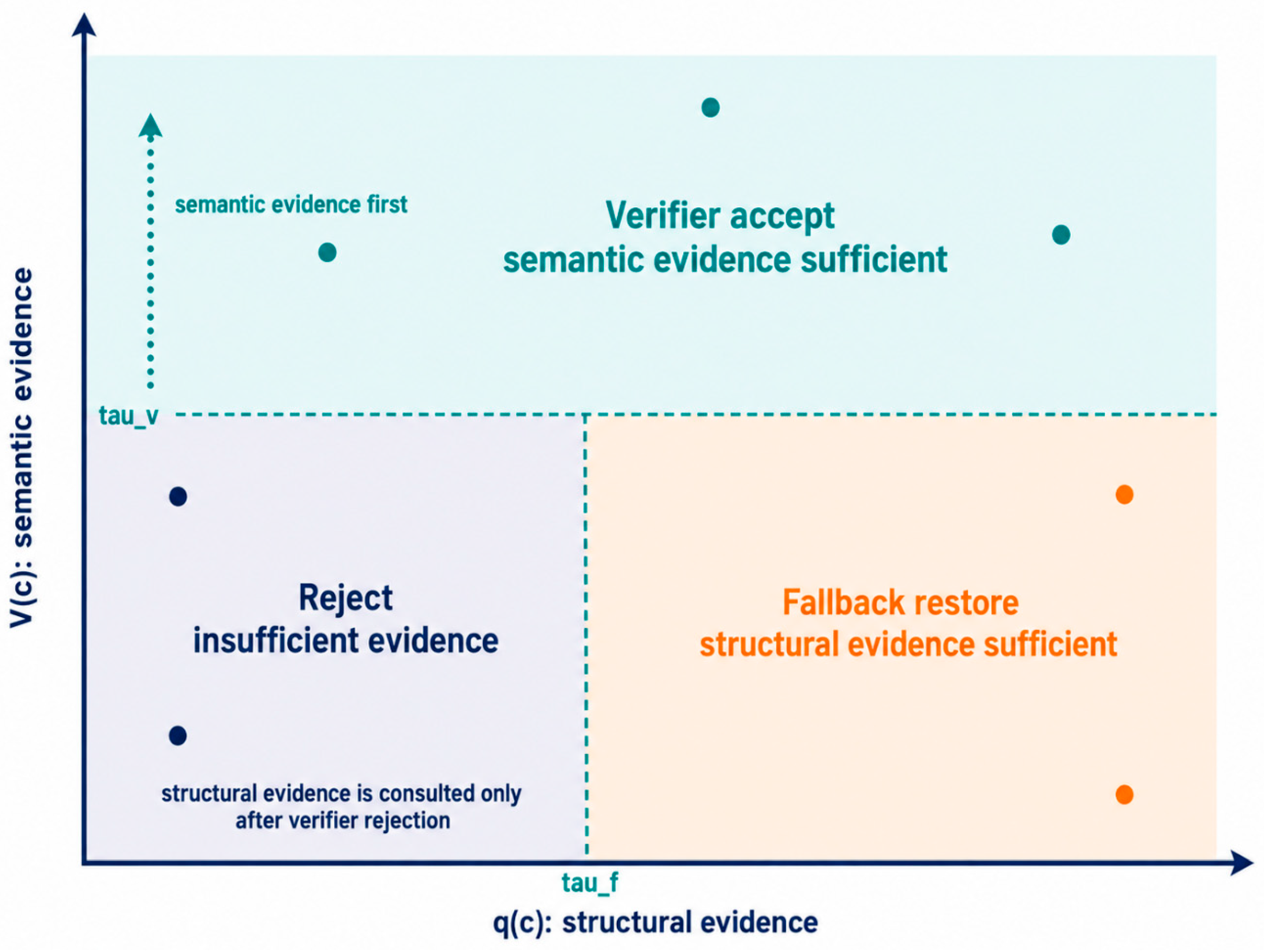
3.5.3. Asymmetric Decision Regions in the Dual-Evidence Space
Mapping each candidate into the two-dimensional evidence space (q(c), v(c)) yields three mutually exclusive decision regions: the verification-acceptance region ΩA, the fallback-recovery region ΩF, and the final-rejection region ΩR. The horizontal structural threshold is active only in the lower half-plane where v(c) falls below the verification threshold; hence, the three regions are not generated by thresholding a single linear score.
Figure 3.
Asymmetric acceptance, fallback, and rejection regions in the candidate-level dual-evidence space.
Figure 3.
Asymmetric acceptance, fallback, and rejection regions in the candidate-level dual-evidence space.
3.6. Coupling Mechanism for Asymmetric Dual-Evidence Verification and Fallback
The verification stage first performs a precision-oriented semantic review. A candidate is admitted directly when v(c) reaches the verification threshold. This operation is intended to remove semantic or boundary false positives, but it does not necessarily improve F1 on its own because the independent verifier may also reject true positives. The fallback stage is therefore strictly conditional: structural evidence q(c) is examined only for candidates that fail semantic verification, and a candidate is restored under a high-confidence constraint when q(c) reaches the frozen fallback threshold; otherwise, it remains rejected. The threshold values, search ranges, provenance, and freezing time are reported in Section 4; the present section defines only their decision roles.
Av(c) denotes direct acceptance by semantic verification, Rf(c) denotes constrained fallback recovery, and D(c) is the unified candidate decision. The key mechanism is not a simple union of candidates but the asymmetric coupling of verification and fallback: a low semantic score cannot be unconditionally overridden by a high structural score, and structural evidence provides recall compensation only within a predefined rejected region. H1 tests the candidate-purification tendency of semantic verification, H2 quantifies the mechanistic benefit and cost of recovering TPs and reintroducing FPs through constrained fallback, and H3 evaluates the system-level effect of the complete asymmetric dual-evidence verification–fallback framework relative to A0.
3.7. Deterministic Span Merging and Final Prediction
Candidates admitted directly by verification and candidates restored by fallback may contain duplicate coordinates or overlapping character intervals. The system first deduplicates candidates by (sample_id, char_start, char_end) while merging their provenance, and then applies a fixed-priority ordering followed by greedy nonoverlap selection. To match the implementation exactly, the effective verifier score of a fallback candidate is promoted to the verification threshold, whereas directly accepted candidates retain their observed v(c).
Equation (15) is interpreted in ascending lexicographic order: higher effective verifier scores take precedence, followed by shorter spans, CRF top-1 provenance, earlier start positions, and finally end positions as a stable tie-breaker. Here, ρ(c) = 0 indicates that the candidate includes CRF top-1 provenance and ρ(c) = 1 otherwise. This term is usually constant in the top-1 candidate universe considered here, but retaining it accurately reflects the implementation. After sorting by π(c), a candidate is added to the final set only if it does not overlap any already selected span.
Merge jointly performs coordinate-level deduplication, conflict resolution, and conversion to half-open character intervals. The fixed ordering key ensures that identical inputs, parameters, and thresholds produce identical outputs, and makes every candidate traceable as verification-accepted, fallback-restored, displaced by a conflict, or finally rejected.
3.8. Methodological Properties and Complexity
VFR-MISE has four methodological properties. First, it uses dual evidence: semantic evidence v(c) and structural evidence q(c) are assigned distinct verification and recovery functions rather than being collapsed into a single score. Second, the evidence is asymmetric: semantic verification governs candidate admission, whereas structural evidence triggers constrained fallback only in the rejection region, distinguishing the framework from global weighted fusion or uniform thresholding. Third, the process is auditable: candidate evidence, threshold paths, and merge outcomes can be recorded stage by stage, supporting TP/FP conservation analysis. Fourth, the framework is modular and reproducible: it does not rewrite the outer training loop of the base extractor, and candidate recovery, fallback, and conflict resolution are all deterministic.
Let n denote post length, K = |C(x)| the number of candidates, and Lv the verifier input budget. The base extractor encodes each post once, while each candidate incurs one additional verifier encoding. Sorting costs K log K, and the current greedy overlap check requires up to K² interval comparisons in the worst case. The resulting inference complexity can therefore be written as:
In practice, the dominant overhead is the K independent verifier forward passes rather than the parameter-free fallback rule. Parameter counts, latency, hardware, and software environments are reported together in Section 4. Overall, VFR-MISE comprises two enhancement levels that are conceptually separate but operationally connected: the DeBERTa-v3 backbone improves candidate-generation quality at the representation level, whereas the asymmetric dual-evidence verification–fallback mechanism improves candidate-selection reliability at the decision level. The latter is not merely an additional binary classifier; it organizes guideline-conditioned semantic verification, high-confidence structurally constrained fallback, and deterministic set construction into a candidate-level decision framework with explicit evidential authority.
4. Experimental Design
4.1. Dataset and Temporal Few-Shot Evaluation Protocol
We follow the staged temporal partition defined in the public MISE study, using intervals 1–7 as historical intervals for base-extractor training, verifier training, and model/threshold selection, and interval 8 as the target interval representing future expression drift. For each random seed, separate 3-, 5-, and 10-shot support sets are constructed within interval 8, and support posts are removed from the corresponding query set. A shot is counted by the number of support posts rather than by the number of stressor spans. The 3-, 5-, and 10-shot support sets are nested within each seed to reduce additional variance due to changes in sample composition across shot conditions. All model conditions share exactly the same support/query indices and query order within each seed × shot unit, enabling model differences to be estimated with a paired design.
Twenty random seeds were frozen before the main evaluation. A0, A1, and A3 are defined as progressive conditions over the same DeBERTa-v3 candidate universe. A0 is the MISE-style BIOES-CRF baseline after the RoBERTa→DeBERTa-v3 backbone upgrade; A1 adds semantic verification to the A0 candidates only; and A3 further applies a fixed high-confidence constrained fallback exclusively to candidates rejected by A1. Thus, A0→A1 corresponds to the verification/filtering effect in H1, A1→A3 corresponds to the fallback recovery–cost mechanism in H2, and the paired A3–A0 difference corresponds to the complete asymmetric dual-evidence verification–fallback effect tested in H3. Importantly, the DeBERTa-v3 backbone is fixed across A0/A1/A3, so these comparisons isolate the decision layer. The representation-level effect of replacing RoBERTa with DeBERTa-v3 is estimated independently in Section 4.2.
4.2. Comparison Systems, Backbone Upgrade, and Sensitivity Experiments
In addition to the three main conditions, we conduct an independent controlled backbone-replacement experiment to estimate how replacing RoBERTa-base with DeBERTa-v3-base affects candidate generation under our reproduction code and evaluation protocol. The original MISE base estimator uses RoBERTa encoding with CRF decoding [2], but we do not use its published score directly as the RoBERTa comparator. Specifically, for seeds 13/21/42/87/100 under the 3-, 5-, and 10-shot settings, we rerun RoBERTa-base and DeBERTa-v3-base while changing only the pretrained encoder and keeping the training budget, support/query indices, evaluation samples, and all VFR module switches identical; span verification and fallback are disabled. This experiment therefore isolates the representation-level backbone effect under the same Exact-span protocol rather than a cross-paper difference between the current model and the published MISE result. We also conduct a verifier-capacity sensitivity experiment by fixing the DeBERTa-v3 extraction backbone and A3 decision logic and replacing the independent DeBERTa verifier with MiniLM. These experiments operate at different methodological levels and should not be interpreted as an unconditional ranking among RoBERTa, DeBERTa, and MiniLM.
4.3. Implementation Details and Hyperparameter Control
Table 2 summarizes the hardware/software environment and frozen settings used to reproduce the main experiments. Both the base extractor and the verifier are optimized with AdamW. The maximum verifier input length is 256 tokens, and the candidate-preserving strategy defined in Section 3.4 is used. A separate verifier is trained for each seed. The verification threshold τv is determined using only validation information from intervals 1–7. The fallback threshold τf = 0.98 was frozen before evaluation of the final main results and was not subsequently adjusted according to those results. Because 0.98 is not supported by preregistration or an immutable repository record, we describe it as an engineering choice frozen before the main evaluation rather than as a preregistered theoretically optimal threshold.
4.4. Information Isolation, Data-Leakage Audit, and Experimental Lineage
To control temporal leakage and comparison bias, automated audits check the following constraints: query gold labels must not enter historical training, checkpoint selection, verifier training, threshold search, or the supervised support loss; support and query IDs must be mutually exclusive; A0/A1/A3 must have the same query set, order, and gold coordinates within each seed × shot unit; and the 3-, 5-, and 10-shot support sets must satisfy the required nesting relation. It is important to distinguish label isolation from the use of unlabeled test information. Under the permitted MISE-style knowledge-inheritance protocol, query text may be read by a frozen teacher to generate soft distributions, but query gold labels are never read. Thus, our no-leakage statement means specifically that query labels do not enter training or model selection; we do not characterize the protocol as a fully inductive evaluation. The available file-level audit found no evidence that these constraints were violated.
Experimental lineage is tracked through scripts, configuration files, support/query IDs, output manifests, and SHA-256 digests. Because the historical run directories do not contain a .git directory and no immutable operation-level file-access log is available, we do not fabricate commit information or elevate the absence of file-level leakage evidence into a mathematical proof that leakage was impossible. This limitation is retained explicitly in the reproducibility materials so that reviewers can distinguish directly verifiable artifact evidence from historical processes that cannot be reconstructed.
4.5. Evaluation Metrics and Statistical Inference
The primary evaluation uses Exact-span Precision, Recall, and F1. A prediction is counted as a TP only when both character boundaries exactly match a gold span; expanded, truncated, or shifted boundaries are treated as nonexact matches. This strict metric is consistent with the objective of producing auditable, concrete stressor spans and means that boundary errors are fully reflected in the evaluation.
To avoid treating nested shot settings and repeated sample × seed × shot records as independent observations, the main comparison first averages F1 equally across the 3-, 5-, and 10-shot settings within each seed. The 20 paired seeds are then used as the statistical units for reporting the mean, median, standard deviation, win/tie/loss (W/T/L), exact Wilcoxon signed-rank test, exact sign-flip test, and paired standardized effect size Cohen's dz [42,43]. The two inference strategies answer different questions. Seed-level tests characterize paired differences under training and sampling stochasticity, whereas the sample_id-cluster bootstrap resamples posts as clusters while preserving repeated records for the same post across seeds and shot settings, thereby estimating the uncertainty of F1 differences attributable to sample composition. Neither procedure substitutes for the other.
The primary system comparison is prespecified as A3−A0; A3−A1 and A1−A0 are used for mechanism decomposition. The RoBERTa→DeBERTa-v3 backbone upgrade is reported as independent representation-level architectural evidence and is interpreted separately from the VFR decision-layer mechanisms targeted by H1–H3. Results based on the frozen 10-seed subset, per-shot analyses, thresholds, adaptation steps, and lightweight-model comparisons are treated as sensitivity or exploratory evidence rather than as confirmatory conclusions based on a single p-value. Because the backbone-replacement experiment contains only five independent seeds, we report point estimates and 95% t intervals together with exact Wilcoxon and sign-flip results to make the inferential instability associated with the small sample explicit.
4.6. Mechanism Auditing, Calibration, Error Analysis, and Efficiency Evaluation
4.6.1. Mechanism Audit of Asymmetric Dual-Evidence Verification and Fallback
For H1, the A0→A1 stage is characterized within each seed × shot run by verifier_deleted_fp, verifier_deleted_tp, and their ratio, which quantify the candidate-purification tendency of semantic verification. For H2, the A1→A3 stage is characterized by fallback_restored_tp, fallback_reintroduced_fp, and the TP recovery and FP reintroduction rates relative to the sets deleted by the verifier, quantifying the recovery benefit and cost of constrained fallback. All mechanism quantities are first computed within run units and then clustered by seed to obtain intervals. Pooled counts over the 60 seed × shot units are used only to verify TP/FP conservation and are not treated as independent observations for inference. TPs and FPs displaced during overlap resolution are recorded separately so that restoration by fallback is not conflated with survival in the final output.
4.6.2. Threshold Sensitivity and Candidate-Level Calibration
Threshold analysis performs a post-hoc sensitivity sweep of τf on interval 8 solely to describe the local performance profile around the fixed operating point; it is not used to reselect the main model. Calibration analysis compares zero-step and five-step support-set adaptation on decoded top-1 candidates, using Exact-match correctness as a binary label and reporting expected calibration error (ECE), Brier score, reliability bins, and Spearman rank correlation for spans present both before and after adaptation. We additionally measure changes in structural confidence within the verifier-rejected subset. This analysis is a candidate-level diagnostic conditional on decoded candidates; it is not token-level calibration, full CRF marginal calibration, or a causal analysis of adaptation.
4.6.3. Error Adjudication and External Exploration
The automated error analysis uses reproducible boundary, length, and word-frequency rules together with explicit fixed lexicons to descriptively tag phenomena such as pure emotion, symptom, generic stress words, vague expression, boundary shift, overlong/incomplete spans, and overlap. These heuristic tags are not equivalent to manually established semantic gold labels [44]. We further draw deterministic samples of 25 run events from each of four mechanism strata—verifier correctly deletes an FP, verifier incorrectly deletes a TP, fallback correctly restores a TP, and fallback incorrectly reintroduces an FP—yielding 100 rows corresponding to 73 unique candidate–gold units for expert-assisted adjudication. Repeated run events are not extrapolated as independent text samples. Derived pseudo-gold results for project-internal intervals 9–11 are used only for code-level out-of-distribution exploration and do not constitute evidence of external validity.
4.6.4. Computational Cost and Lightweight-Model Evaluation
Efficiency evaluation reports total parameter count, training/adaptation wall-clock time, and estimated serial inference latency derived from matched module-level timers. Because the timings for A0 and the verifier originate from separate module-level records, their sum is not a unified end-to-end profile and is used only to compare relative operating points under the current hardware and code path. The MiniLM experiment uses the same candidate construction, truncation, seeds, shot settings, and threshold-selection protocol as the DeBERTa verifier so that cost differences are attributable, as far as possible, to verifier capacity.
5. Results
5.1. Overall Performance and the Paired Effect for H3
Table 3 exhibits the verification–recovery trajectory expected from the asymmetric dual-evidence design. It is important to note that A0, A1, and A3 all use the upgraded DeBERTa-v3 backbone; the table therefore reflects decision-layer effects and excludes the representation-level gain from RoBERTa→DeBERTa-v3. Adding semantic verification alone (A1) increases cross-shot Precision from 0.7202 for A0 to 0.7447 (+2.45 percentage points), but reduces Recall from 0.7233 to 0.6963 (−2.70 percentage points), yielding a 0.2053-point decrease in F1. After high-confidence constrained fallback is introduced, A3 achieves Precision of 0.7436, largely preserving the precision advantage of A1, while Recall recovers to 0.7080 and F1 reaches 0.7248. Relative to DeBERTa-A0, A3 improves F1 by a further 0.3299 percentage points; relative to A1, fallback contributes a 0.5352-point recovery. These results indicate that, on top of the stronger candidate-generation backbone, semantic evidence mainly suppresses false positives, whereas structural evidence compensates for part of the lost recall only within the rejected region.
Table 3.
Exact-span performance of A0, A1, and A3 across 20 frozen seeds.
| Condition | Scope | P | R | Exact-span F1 | Seed SD | No. of Seeds |
| A0 | 3-shot | 0.7207 | 0.7239 | 0.7220 | 0.0107 | 20 |
| A0 | 5-shot | 0.7207 | 0.7226 | 0.7213 | 0.0113 | 20 |
| A0 | 10-shot | 0.7194 | 0.7235 | 0.7211 | 0.0114 | 20 |
| A0 | Cross-shot | 0.7202 | 0.7233 | 0.7215 | 0.0108 | 20 |
| A1 | 3-shot | 0.7449 | 0.6968 | 0.7198 | 0.0117 | 20 |
| A1 | 5-shot | 0.7450 | 0.6957 | 0.7192 | 0.0121 | 20 |
| A1 | 10-shot | 0.7442 | 0.6964 | 0.7192 | 0.0118 | 20 |
| A1 | Cross-shot | 0.7447 | 0.6963 | 0.7194 | 0.0116 | 20 |
| A3 | 3-shot | 0.7437 | 0.7086 | 0.7251 | 0.0134 | 20 |
| A3 | 5-shot | 0.7439 | 0.7075 | 0.7247 | 0.0140 | 20 |
| A3 | 10-shot | 0.7433 | 0.7078 | 0.7245 | 0.0148 | 20 |
| A3 | Cross-shot | 0.7436 | 0.7080 | 0.7248 | 0.0139 | 20 |
Note: Each shot-specific row is the mean of runs over 20 seeds. The cross-shot value is obtained by first averaging the 3-, 5-, and 10-shot scores equally within each seed and then aggregating across seeds; it is therefore not a pooled-count metric computed from total TP/FP/FN counts.
Table 4.
Cross-shot paired F1 across the 20 frozen seeds and the A3−A0 difference.
| Seed | A0 | A1 | A3 | A3−A0 / percentage points |
| 13 | 0.7209 | 0.7154 | 0.7282 | +0.7286 |
| 21 | 0.7172 | 0.7172 | 0.7172 | +0.0000 |
| 42 | 0.7263 | 0.7360 | 0.7376 | +1.1241 |
| 87 | 0.7112 | 0.7203 | 0.7192 | +0.8001 |
| 100 | 0.7149 | 0.7162 | 0.7195 | +0.4573 |
| 7 | 0.7172 | 0.7107 | 0.7189 | +0.1647 |
| 11 | 0.7088 | 0.7015 | 0.7194 | +1.0578 |
| 17 | 0.7388 | 0.7309 | 0.7399 | +0.1040 |
| 19 | 0.7229 | 0.7071 | 0.7236 | +0.0699 |
| 23 | 0.7381 | 0.7388 | 0.7450 | +0.6923 |
| 29 | 0.7336 | 0.7350 | 0.7400 | +0.6398 |
| 31 | 0.7118 | 0.7095 | 0.7186 | +0.6766 |
| 37 | 0.7308 | 0.7215 | 0.7318 | +0.0994 |
| 41 | 0.7385 | 0.7394 | 0.7424 | +0.3930 |
| 43 | 0.7275 | 0.7183 | 0.7344 | +0.6959 |
| 47 | 0.7094 | 0.7120 | 0.7203 | +1.0933 |
| 53 | 0.7120 | 0.7120 | 0.6854 | -2.6535 |
| 59 | 0.7175 | 0.7228 | 0.7233 | +0.5823 |
| 61 | 0.7034 | 0.7018 | 0.7054 | +0.2062 |
| 67 | 0.7284 | 0.7219 | 0.7251 | -0.3332 |
Figure 4.
Cross-shot paired F1 for A0 and A3 over the 20 frozen seeds. Connecting lines indicate pairing rather than a continuous training trajectory.
Figure 4.
Cross-shot paired F1 for A0 and A3 over the 20 frozen seeds. Connecting lines indicate pairing rather than a continuous training trajectory.
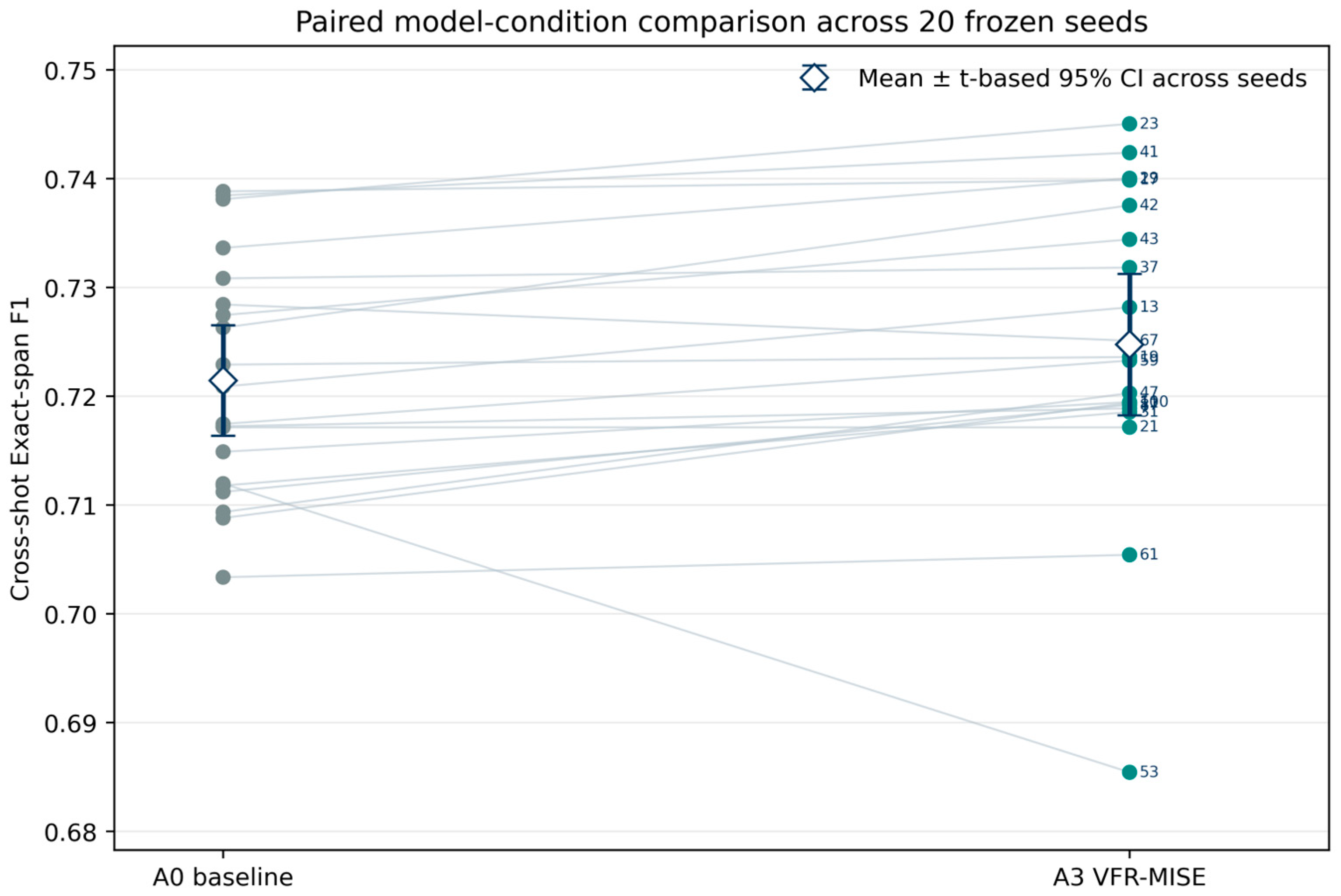
Seed-wise paired results reveal substantial heterogeneity behind the average effect. A3 outperforms A0 for 17 of the 20 seeds, ties for one, and underperforms for two. Most differences are modestly positive, but seed 53 exhibits a marked negative shift of −2.6535 percentage points, and seed 67 is also negative. Thus, the aggregate gain is not generated consistently under every random condition. Statistical interpretation should therefore consider the distribution and dependence structure of paired differences rather than relying only on mean F1 or the proportion of wins.
5.2. Statistical Robustness and Consistency of Evidence
The mean cross-shot A3−A0 difference is 0.3299 percentage points. The sample_id-cluster bootstrap 95% CI is [0.0509, 0.6010] percentage points, remaining above zero when post-level dependence is preserved during resampling. Treating the 20 seeds as paired stochastic units yields an exact Wilcoxon p = 0.00334167, an exact sign-flip p = 0.0765839, and Cohen's dz = 0.409. These results are not contradictory: the cluster bootstrap primarily reflects uncertainty due to evaluation-sample composition, the Wilcoxon test uses the ranks of paired differences, and the sign-flip test uses only their signs under an exact permutation distribution. Because these procedures provide different levels of evidence for A3−A0, H3 should be interpreted as directionally supported but not uniformly confirmed across all stochasticity tests, rather than as a stable significant advantage established by a single p-value.
Table 5.
Paired statistics for system differences and sample-cluster uncertainty.
| Comparison | Mean/pp | Median/pp | SD/pp | Sample-cluster 95% CI/pp | W/T/L | Wilcoxon p | Sign-flip p | dz |
| A1-A0 | -0.2053 | -0.0773 | 0.6477 | [-0.6901, 0.2348] | 8/2/10 | 0.212143 | 0.172737 | -0.317 |
| A3-A1 | 0.5352 | 0.5621 | 0.9366 | [0.2345, 0.8605] | 17/1/2 | 0.00169373 | 0.0184135 | 0.571 |
| A3-A0 | 0.3299 | 0.5198 | 0.8063 | [0.0509, 0.6010] | 17/1/2 | 0.00334167 | 0.0765839 | 0.409 |
Note: The sample-cluster confidence interval resamples by sample_id while preserving all correlated records for the same post across seed × shot conditions. P-values treat the 20 paired seeds as independent units of stochasticity. Bootstrap confidence intervals for dz, relative error reduction, the frozen 10-seed analysis, and per-shot results are provided in statistical_analysis.md.
For mechanism decomposition, the mean A1−A0 difference is −0.2053 percentage points, with a confidence interval crossing zero and nonsignificant paired tests. By contrast, A3−A1 is +0.5352 percentage points, with a sample-cluster interval of [0.2345, 0.8605], an exact Wilcoxon p = 0.00169373, and a sign-flip p = 0.0184135. The net improvement of the complete system therefore does not arise because the verifier alone improves F1; rather, it results from the coupling of asymmetric semantic verification with constrained fallback.
5.3. Mechanism Audit of Asymmetric Dual-Evidence Verification–Fallback and H1/H2
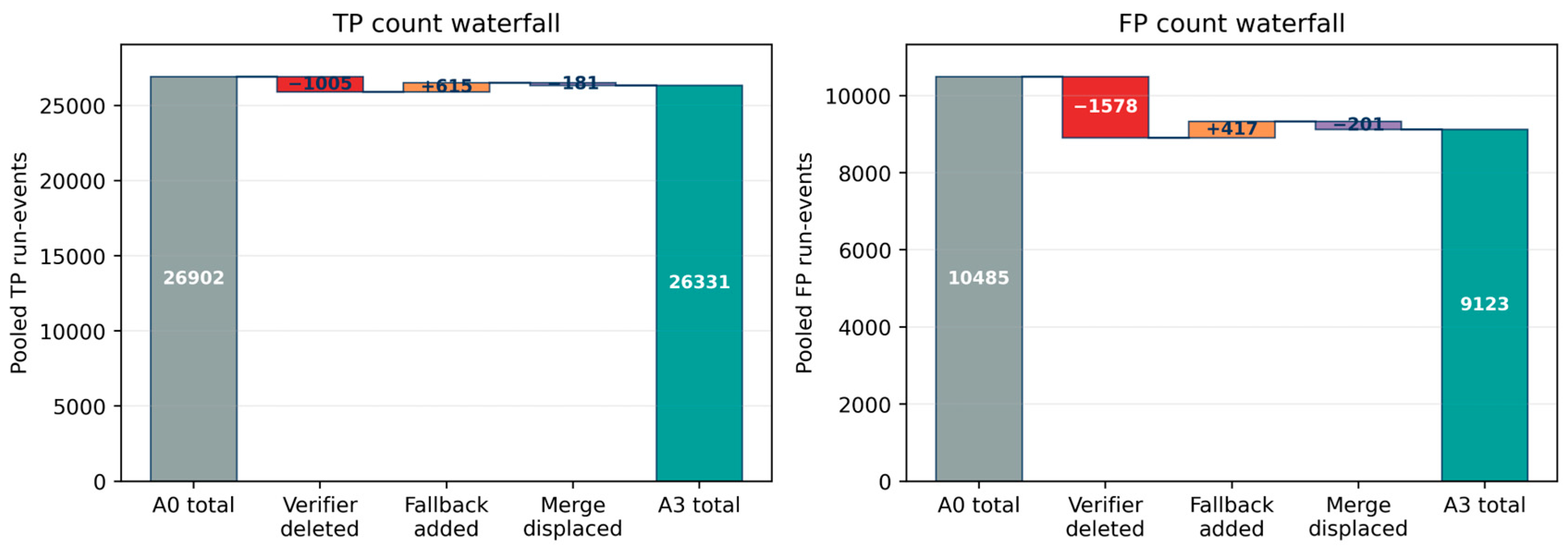
Conservation statistics over the pool of 60 seed × shot run units show that A0 contains 26,902 TPs and 10,485 FPs. The verification stage removes 1005 TPs and 1578 FPs. The fallback stage restores 615 TPs while reintroducing 417 FPs, after which overlap resolution displaces a further 181 TPs and 201 FPs. The final A3 output therefore contains 26,331 TPs and 9123 FPs. Relative to A0, the net changes are −571 TPs and −1362 FPs. These pooled counts are used to verify conservation across the event stream; inference for H1 and H2 remains based on run-level statistics.
Table 6 provides direct candidate-level mechanistic evidence for H1. On average, each run removes 26.30 FPs and 16.75 TPs, and deleted_fp_per_tp has a mean of 1.839 with a 95% seed-cluster CI of [1.461, 2.299], entirely above 1. Thus, under the current candidate distribution, semantic verification does exhibit a purification tendency in which more FPs than TPs are removed. H2 is likewise supported at the mechanism level: constrained fallback restores, on average, 57.3% of TPs mistakenly deleted by the verifier (95% CI [49.2%, 64.9%]), while reintroducing 25.0% of the deleted FPs (95% CI [18.6%, 30.9%]). However, overlap resolution after fallback can still displace existing TPs or FPs, so the recovery rate should not be equated directly with the final F1 contribution.
Figure 5.
TP/FP event flow induced by verification, fallback, and overlap resolution across 20 seeds × 3 shot settings.
Figure 5.
TP/FP event flow induced by verification, fallback, and overlap resolution across 20 seeds × 3 shot settings.
5.4. Sensitivity of Key Components, the Extraction Backbone, and Verifier Capacity
5.4.1. Candidate-Preserving Truncation: Methodological Validity Rather Than Direct Performance Gain
Candidate-preserving truncation does not improve F1 in this five-seed comparison: A1 and A3 decrease by 0.4004 and 0.2028 percentage points, respectively. We therefore do not present the design as an empirical performance-enhancement module. Its value is methodological: candidate text and the complete guideline can no longer be silently truncated because of right-side position or input-length limits, ensuring that semantic verification is based on definitionally complete and auditable inputs. The main results consequently use the corrected candidate-preserving implementation even though its point estimates are lower than those of the legacy implementation.
Table 7.
Same-seed comparison of legacy right truncation and candidate-preserving truncation.
| Same 5-seed condition | Legacy right-truncation F1 | Candidate-preserving F1 | Change/pp |
| A1 | 0.7250 | 0.7210 | -0.4004 |
| A3 | 0.7263 | 0.7243 | -0.2028 |
Note: Both columns use the same five seeds and identical support/query sets. The verifier for the candidate-preserving condition is trained from scratch rather than reusing a legacy checkpoint.
5.4.2. Controlled Backbone Replacement: RoBERTa-base→DeBERTa-v3-base
The original MISE base estimator uses RoBERTa as its pretrained encoder together with CRF sequence decoding [2]. To isolate the effect of encoder choice, we do not directly subtract the published MISE result from the DeBERTa result. Instead, RoBERTa-base and DeBERTa-v3-base are rerun under identical support/query indices, training budgets, evaluation samples, VFR-off settings, and Exact-span evaluation. In these controlled reruns, cross-shot Exact-span F1 is 0.6841 for RoBERTa-base and 0.7236 for DeBERTa-v3-base, corresponding to a 3.95-percentage-point increase relative to the controlled RoBERTa comparator; Precision and Recall improve by 2.2340 and 5.5538 percentage points, respectively. The 3.95-point difference can therefore be interpreted only as a backbone-substitution effect under the present experimental protocol and must not be reported as a 3.95-point improvement over the published MISE paper. For historical context, the original MISE study reports F1 values of 0.6914, 0.7212, and 0.7420 under the 3-, 5-, and 10-shot settings [2], and its implementation description uses token-level Precision, Recall, and F1. The primary evaluation in the present study uses Exact-span F1, so these published scores are not strictly the same metric and do not enter the controlled difference calculation. Moreover, the backbone experiment includes only five independent seeds, for which both the exact two-sided Wilcoxon and sign-flip tests yield p = 0.0625. The appropriate conclusion is therefore that, under the current data, splits, code path, and Exact-span protocol, DeBERTa-v3 shows a directionally consistent and practically large empirical advantage that supports its use as the enhanced candidate-generation backbone, but the evidence is insufficient to establish universal superiority across datasets or general NER tasks. This backbone substitution is an evidence-supported representation-level enhancement; the central methodological innovation remains the subsequent asymmetric dual-evidence verification–fallback mechanism.
Table 8.
Layered evidence for controlled extraction-backbone replacement and lightweight A3 verifier substitution.
Table 8.
Layered evidence for controlled extraction-backbone replacement and lightweight A3 verifier substitution.
| Experimental Level | System | Seed | Cross-shot F1 | Paired Difference/pp | Inference and Scope |
| Extraction-backbone replacement (A0-style) | RoBERTa-base | 5 | 0.6841 | Reference | 3/5/10-shot; identical support/query |
| Extraction-backbone replacement (A0-style) | DeBERTa-v3-base | 5 | 0.7236 | +3.95 | 95% t CI [1.1147, 6.7736]; exact p=0.0625 |
| A3 verifier replacement | DeBERTa verifier | 20 | 0.7248 | Reference | DeBERTa-v3 extraction backbone in both conditions |
| A3 verifier replacement | MiniLM verifier | 20 | 0.7263 | +0.1558 | 95% t CI [-0.2082, 0.5198]; no evidence of significant superiority |
Note: The first two rows are backbone comparisons rerun in this study under the same code path, support/query sets, and Exact-span evaluation. The 3.95-percentage-point difference is an internal paired difference and not a direct difference from the published MISE score. The last two rows replace only the A3 span verifier. The two experiment groups address different questions, and the backbone experiment includes only five independent seeds.
5.4.3. Lightweight Verifier and the Efficiency–Accuracy Operating Point
MiniLM-A3 and DeBERTa-A3 use exactly the same 60 seed × shot query/gold conditions, covering 547 sample_id clusters. The mean cross-shot MiniLM−DeBERTa difference is only +0.1558 percentage points, with a seed-level 95% t CI of [−0.2082, 0.5198], a sample-cluster 95% CI of [−0.0503, 0.3630], W/T/L = 11/1/8, exact Wilcoxon p = 0.622562, and sign-flip p = 0.475979. Because both intervals cross zero, these results do not support a claim that MiniLM is more accurate. Post-hoc 90% analyses using a 0.25-percentage-point noninferiority margin and a 0.50-percentage-point equivalence margin are reported only as engineering sensitivity analyses and do not constitute a preregistered replacement trial. In contrast, MiniLM reduces total A3 parameters from 370.09M to 219.02M (−40.82%) and estimated serial latency from 9.287 ms/post to 6.136 ms/post (−33.93%), yielding a more attractive efficiency–accuracy operating point under the current hardware and implementation.
Wall-clock logs further show mean training times of 13.75 min per seed for the base model, 22.22 min for the DeBERTa verifier, and 9.96 min for the MiniLM verifier; the 60 support-adaptation runs average 36.56 s. Because these measurements come from the current RTX 5080 environment, module-level timers, and existing code path, Table 9 and the wall-clock results support only relative engineering comparisons and should not be extrapolated as fixed latency or throughput values for other hardware.
5.5. Threshold Sensitivity and Candidate-Level Calibration
Figure 6 examines the performance profile around the fixed fallback threshold rather than reselecting τf. Because the curve is computed from the interval-8 main-evaluation results, it answers only the post-hoc question of how sensitive the system would have been to changes around this operating point. It does not establish 0.98 as validation-optimal, nor can it retrospectively make the threshold a preregistered hyperparameter.
Candidate-level calibration changes only slightly after five-step adaptation. ECE decreases from 0.244718 to 0.241683 (absolute change −0.003035), and the Brier score decreases from 0.245967 to 0.244976 (−0.000991). For identical span coordinates present both before and after adaptation, the median seed × shot Spearman rank correlation reaches 0.985513. Across 2308 run events in which a verifier-rejected span retains the same coordinates before and after adaptation, mean structural confidence changes by only −0.003900. Taken together, candidate-confidence rankings remain highly stable after support-set adaptation, while calibration metrics improve only marginally. The current evidence therefore does not support a mechanistic claim that adaptation substantially reshapes or improves CRF confidence.
It should be emphasized that the reliability and distribution analyses in Figure 7 are conditional on candidates that have already been decoded from the top-1 path, and correctness is defined by Exact-span match. Because the candidate set itself can change after adaptation, these results describe candidate-level associations rather than probabilistic calibration of the full structured model and cannot identify the causal origin of adaptation-induced score shifts.
5.6. Error Composition, Expert-Assisted Adjudication, and External Exploration
Automated rules cover all 60 run units and identify pure emotion, symptom, generic stress words, vague expression, boundary shift, overlong/incomplete spans, overlap, and error patterns associated with length and frequency. For the 100-row expert-assisted material sampled from the four mechanism strata, the two judgment columns have a raw agreement of 0.770 and a nominal Cohen's κ of 0.681. After deduplication to 73 unique candidate–gold units, agreement is 0.753 and κ is 0.667. Because the procedure cannot be verified as blinded annotation by two independent human annotators, these agreement measures characterize the assisted adjudication process only and are not presented as evidence of independent human-gold reliability.
Table 10.
Expert-assisted adjudication results for the four mechanism-stratified samples.
| Mechanism Stratum | n | Exact | Incomplete Boundary | Overlong Boundary | Semantically Non-stressor | Unresolved |
| FP correctly deleted by verifier | 25 | 0 | 11 | 4 | 9 | 1 |
| TP incorrectly deleted by verifier | 25 | 22 | 2 | 0 | 1 | 0 |
| TP correctly restored by fallback | 25 | 24 | 0 | 0 | 1 | 0 |
| FP incorrectly reintroduced by fallback | 25 | 0 | 10 | 6 | 6 | 3 |
Note: Twenty-five run events are sampled deterministically from each of the four mechanism strata. The 100 rows correspond to 73 unique candidate–gold units. Equal stratification is used for mechanism interpretation and does not represent the natural prevalence of error types in the full population.
Among the 50 stratified events from the two FP mechanism strata, 31 (62%) are classified as boundary shifts, 15 (30%) as semantically non-stressor spans, and 4 (8%) as unresolved. Thus, the FPs addressed by the asymmetric dual-evidence framework are not purely semantic; overly long and incomplete boundaries are also major sources. Among the 50 events from the two TP mechanism strata, 46 (92%) are judged to be exact stressor spans in the assisted adjudication, with two boundary-incomplete cases, one pure-emotion case, and one generic-stress-word case. This small level of disagreement suggests that dataset Exact-match gold and guideline-based semantic review are not perfectly isomorphic for every boundary case. Error analysis should therefore retain both annotation-consistency and semantic-plausibility perspectives.
Table 11.
Exploratory performance on derived pseudo-gold data from intervals 9–11.
| Condition | P | R | F1 | Evidence Level |
| A0 | 0.2485 | 0.2351 | 0.2413 | Pseudo-gold; not an out-of-time test |
| A1 | 0.2763 | 0.2246 | 0.2473 | Pseudo-gold; not an out-of-time test |
| A3 | 0.2679 | 0.2283 | 0.2462 | Pseudo-gold; not an out-of-time test |
Note: Intervals 9–11 were reconstructed within the project using GPT and subsequently filtered; they are neither independently human-annotated gold data nor future intervals collected as a genuine temporal continuation. The official MISE data card and code repository define only intervals 1–8. Table 11 is therefore used solely for code-level out-of-distribution exploration. F1 is 0.2413, 0.2473, and 0.2462 for A0, A1, and A3, respectively—substantially below the interval-8 main results—and A3 does not consistently outperform A1. This pattern is more appropriately interpreted as a warning that changes in distribution or annotation provenance can substantially degrade system performance than as evidence of external generalization.
5.7. Evidence Summary for the Research Hypotheses
H1 receives relatively clear mechanism-level support: the 95% seed-cluster interval for run-level deleted_fp_per_tp lies entirely above 1. H2 is also directly supported: fallback consistently recovers a proportion of TPs mistakenly removed by the verifier while reintroducing a quantifiable proportion of FPs. For H3, the point estimate, W/T/L pattern, sample-cluster interval, and Wilcoxon test generally favor A3 over A0, whereas the exact sign-flip test does not cross the conventional 0.05 threshold. We therefore characterize H3 as supported by directional and partial inferential evidence rather than as uniformly confirmed across statistical procedures. Separately from H1–H3, the backbone experiment shows a 3.95-percentage-point cross-shot F1 point-estimate difference between controlled RoBERTa-base and DeBERTa-v3-base reruns under the same Exact-span protocol. This value is an internal controlled comparison, not a direct improvement over the published MISE score, and it is based on only five independent seeds; accordingly, it is treated as empirical evidence for representation-level architecture selection rather than as confirmatory proof.
6. Discussion
6.1. Main Findings and the Asymmetric Dual-Evidence Verification–Fallback Mechanism
From the perspective of overall model evolution, the performance changes in VFR-MISE arise from two levels that must be interpreted separately. The first is representation enhancement. Under the same code path, support/query partitions, and Exact-span evaluation protocol, controlled reruns of RoBERTa-base and DeBERTa-v3-base increase cross-shot F1 from 0.6841 to 0.7236, an internal paired difference of 3.95 percentage points. This result supports DeBERTa-v3 as the current candidate-generation backbone, but it must not be restated as a 3.95-point improvement over the original MISE paper because the published MISE results were obtained under its own experimental setting and token-level evaluation. The second level is decision refinement. With the DeBERTa-v3 backbone fixed, A3 improves F1 by a further 0.3299 percentage points relative to A0. Although this absolute gain is modest, the candidate event stream provides a mechanistic explanation: semantic verification reduces FPs at the cost of some Recall, and constrained fallback recovers part of the lost TPs while largely preserving the precision advantage. We therefore do not add cross-paper differences, backbone replacement, and VFR gains into a single total improvement; instead, they are interpreted as complementary effects of controlled representation enhancement and candidate-level asymmetric decision refinement within the present study.
This layered interpretation also clarifies the locus of innovation. Replacing RoBERTa with DeBERTa-v3 is not a new pretrained architecture proposed by this study; it is a representation-level choice supported by our controlled reproduction, and the 3.95-point difference describes only that experiment. The core methodological innovation lies at the candidate decision layer. VFR-MISE is not an engineering cascade of a second classifier plus a high threshold. Rather, it assigns different decision rights to structural evidence q(c) and guideline-conditioned semantic evidence v(c): v(c) governs verification and admission, whereas q(c) provides only limited recovery within the semantically rejected region. This asymmetry of evidential roles is precisely the dual-evidence asymmetric verification–fallback mechanism highlighted in the title. DeBERTa-v3 improves first-stage candidate representation, while VFR constrains second-stage candidate retention; the two address different error sources. The former cannot replace the latter, and the latter cannot recover a missed span that never enters the candidate universe.
The candidate-preserving truncation results require particularly cautious interpretation. Relative to legacy right truncation, the corrected A1/A3 implementation yields slightly lower F1 in the five-seed comparison, demonstrating that this component is not a performance innovation based on truncation. Its scientific value is instead to control input-construction bias: the candidate itself and the complete guideline are explicitly protected as incompressible information, so verifier decisions no longer depend on the candidate's incidental position within a long input. In other words, the design improves the validity and reproducibility of the method definition rather than guaranteeing a higher point estimate.
6.2. Methodological Positioning and Contributions of Asymmetric Dual-Evidence Verification–Fallback
Within the broader methodological landscape, the two levels of improvement address different problems: representation learning and candidate decision-making. The DeBERTa-v3 backbone upgrade uses stronger pretrained representations to improve first-stage candidate generation without changing the temporal few-shot task definition inherited from MISE. The core VFR layer shares a basic premise with span-based NER, boundary smoothing, and two-stage locate-and-label frameworks [20,21,22,23]: sequence-level structural validity and candidate-level boundary/semantic reliability cannot be fully represented by the same token-path score. VFR-MISE does not rescan the full span space and does not alter the base CRF training objective. Instead, it defines the top-1 path as a restricted candidate universe, performs independent semantic verification within that universe, and invokes structural evidence for constrained fallback only in the rejection region. Its principal methodological contribution is therefore a candidate-level verification–fallback decision framework with asymmetric evidential roles, built on an enhanced DeBERTa-v3 representation layer.
VFR-MISE also differs from probability calibration, conformal prediction, and selective classification [24,25,26,27,28]. The verifier output v(c) is not a monotonic transformation of q(c); nor does the system provide coverage guarantees or final abstention for all candidates. Because the system must return a span set, semantic verification, conditional rejection, and structural recovery are instead defined as asymmetric decision regions. Unlike generative self-verification [29], the proposed method does not assess faithfulness by reconstructing text; it uses a task-guideline-driven discriminative verifier to reassess whether a span is a concrete stressor. The advantage of this framework is traceability: every candidate can be categorized as verification-accepted, verification-rejected, fallback-restored, or conflict-displaced, linking system-level performance differences to observable TP/FP mechanisms.
The temporal dimension further bounds the scope of this methodological contribution. Prior work shows that entity-centric social-media tasks are particularly vulnerable to temporal degradation [31], and longitudinal NLP emphasizes evaluation partitions that align with prospective deployment objectives [32,33]. The interval 1–7→interval 8 protocol used here is therefore closer to future-interval adaptation than a randomly mixed split. Nevertheless, it contains only one genuine future interval and cannot establish that asymmetric dual-evidence verification–fallback yields stable gains across different temporal horizons, platforms, or languages.
6.3. Robustness, Efficiency, and Deployment Boundaries
The main-system gain should be assessed jointly with statistical heterogeneity and engineering cost. A3−A0 is positive for 17 of 20 seeds, but seed 53 exhibits a pronounced negative difference; moreover, the Wilcoxon and sign-flip tests provide different levels of evidence for H3. The 0.3299-percentage-point gain should therefore not be interpreted as a stable improvement independent of random conditions. For deployment, VFR-MISE is better viewed as a tunable verification–fallback decision layer whose τv and τf values must be revalidated according to the relative costs of FPs and FNs in the target setting, rather than transferring the value 0.98 directly to a new platform.
From an efficiency perspective, the independent DeBERTa verifier nearly doubles the system parameter count. Under the present experiment, MiniLM reduces the A3 parameter count and estimated serial latency by 40.82% and 33.93%, respectively, while the 95% interval for the performance difference crosses zero. MiniLM is therefore a more attractive lightweight candidate under the current protocol, but the evidence does not establish formal noninferiority or a statistically significant advantage over DeBERTa. Further engineering work should examine shared encoders, verifier distillation, batched candidate verification, and true end-to-end profiling to determine whether the accuracy–interpretability benefits of dual encoding justify the deployment cost.
6.4. Limitations and Threats to Validity
First, construct validity remains constrained by the gold definition and the boundary between semantic judgments. The main task uses strict Exact-span gold labels, while expert-assisted adjudication reveals limited tension between some gold spans and guideline-driven semantic judgments. Moreover, negative examples for verifier training are derived primarily from gold spans and deterministic synthetic perturbations rather than from a complete reproduction of the CRF error distribution encountered at deployment. The verifier's decision boundary may therefore be affected by a train–deployment distribution shift in the candidate space.
Second, internal validity and experimental lineage have limitations. Although τf = 0.98 was frozen before final main-result evaluation, there is no preregistration or immutable Git evidence documenting this choice. Historical runs provide only file-level leakage audits rather than immutable operation-level data-access traces. In addition, VFR-MISE operates only on candidates produced by the base CRF's top-1 path; it cannot recover false negatives that never enter the candidate universe, so its recall ceiling is constrained by first-stage candidate-generation quality.
Third, statistical conclusions and architectural comparisons remain limited by sample size. The main experiment contains only 20 independent seeds, and the 3-, 5-, and 10-shot settings are dependent because the support sets are nested and the query sets overlap extensively. The controlled RoBERTa-base→DeBERTa-v3-base backbone replacement uses only five independent seeds. Although the 3.95-percentage-point point-estimate difference under the present protocol is directionally consistent across those five seeds, it is insufficient to establish confirmatory architectural superiority across datasets. More importantly, the 3.95-point value comes from an internal rerun under a common Exact-span protocol. The backbone experiment and the MiniLM verifier experiment address different methodological levels and therefore do not form a direct three-model ranking among RoBERTa, DeBERTa, and MiniLM. The current serial-latency estimate is also not based on unified end-to-end profiling, and shared-encoder joint training has not yet been evaluated.
Fourth, external-validity evidence is limited. The principal results with genuine human gold labels come from a single MISE dataset and a single future interval (interval 8), and therefore cannot be generalized directly to other social platforms, languages, stressor ontologies, or generic NER tasks. Intervals 9–11 were reconstructed and filtered using GPT to create pseudo-gold material; their substantially lower overall F1 and the absence of a consistent A3 advantage over A1 instead underscore the need for independently human-annotated out-of-time test sets to evaluate cross-distribution generalization.
6.5. Ethics, Bias, and Responsible Use
Mental-health-related social-media text entails risks involving privacy, re-identification, stigmatization, and purpose drift [36,37,38,39,40]. VFR-MISE outputs only candidate text spans that satisfy the operational stressor definition; it does not constitute a clinical diagnosis, a determination of psychological state, or an individual risk score. Data release and reproduction should comply with the original license and should prioritize de-textualized derived outputs, hashes, and the minimum necessary context. Any high-risk use involving real individuals requires review by qualified professionals together with mechanisms for appeal and correction. Because the current data lack reliable annotations of group and identity attributes and the automated error taxonomy partly relies on fixed lexicons, this study does not claim to have completed a systematic fairness evaluation. Future work should examine group-specific error distributions and potential harms only where such analysis is lawful, necessary, and ethically reviewed.
7. Conclusions
This study introduces VFR-MISE, an asymmetric dual-evidence verification–fallback framework for few-shot stressor extraction from social media, and evaluates representation-level enhancement separately from decision-layer innovation. At the representation level, controlled reruns of RoBERTa-base and DeBERTa-v3-base under the same code path, data partitions, training budget, and Exact-span metric increase cross-shot F1 from 0.6841 to 0.7236, an internal difference of 3.95 percentage points. This value reflects only the backbone-substitution effect under the present protocol and is not a direct improvement over the published MISE results. At the decision level, VFR-MISE integrates guideline-conditioned semantic verification, high-confidence constrained fallback, and deterministic span merging into a unified candidate event stream. Its asymmetric evidence assignment gives semantic evidence v(c) authority over admission and restricts structural evidence q(c) to conditional recovery in the rejection region. With the DeBERTa-v3 backbone fixed, complete A3 further improves F1 by 0.33 percentage points over A0 while reducing FPs and recovering part of the lost Recall. The principal contribution is therefore an auditable asymmetric dual-evidence verification–fallback mechanism built on stronger candidate representations, rather than an uninterpretable aggregate gain obtained by combining cross-paper scores, backbone replacement, and post-hoc modules.
The strength of evidence for the two levels should also be distinguished. The advantage of DeBERTa-v3 over the controlled RoBERTa rerun is based on only five paired seeds, which supports the current architectural choice but is insufficient to establish general superiority. The few-shot F1 values reported in the original MISE paper use its own token-level evaluation protocol and are included only as historical context, not in the Exact-span difference calculations reported here. The gain of A3 over DeBERTa-A0 also receives different levels of support across stochasticity tests. Candidate-preserving truncation improves the validity of input construction but is not a direct performance gain. Future work should expand both backbone comparisons and VFR evaluation to independently human-annotated datasets spanning multiple future intervals, platforms, and languages; harmonize evaluation protocols; preregister thresholds and primary comparisons; and further investigate shared encoders, distillation-based lightweight architectures, and unified end-to-end efficiency measurements.
Supplementary Materials
The following supporting information can be downloaded at the website of this paper posted on Preprints.org. An anonymized reproducibility package accompanies the manuscript; see the Data Availability Statement for its contents and access conditions.
Author Contributions
Conceptualization, Xiaohua Wang and Fang Niu; methodology, Haiyang Yu; software, Haiyang Yu; validation, Xiaohua Wang and Haiyang Yu; formal analysis, Xiaohua Wang and Haiyang Yu; investigation, Fang Niu; resources, Xiaohua Wang .; data curation, Xiaohua Wang and Haiyang Yu; writing—original draft preparation, Xiaohua Wang ; writing—review and editing, Xiaohua Wang and Haiyang Yu; visualization, Xiaohua Wang and Haiyang Yu; supervision, Xiaohua Wang ; project administration, Xiaohua Wang; funding acquisition, Xiaohua Wang and Haiyang Yu. All authors have read and agreed to the published version of the manuscript.
Funding
This research was funded by General Project of Humanities and Social Sciences Research in Higher Education Institutions of Henan Province, grant number 2025-ZDJH-534 and National Natural Science Foundation of China, grant numberU1304402.
Data Availability Statement
An anonymized reproducibility package was submitted together with the manuscript. It includes the README, locked environment, configuration files, data-access instructions, split and support/query IDs, manifests, leakage audit, commands for training, testing, statistical analysis, and plotting, de-textualized sample-level predictions, result snapshots, adjudication materials and machine-readable statistics, SHA-256 digests, LICENSE, model card, and data statement. The license governing the original social-media posts does not permit redistribution; therefore, the raw text is not included. Researchers with lawful access to the original data can reconstruct the experiments using the supplied IDs, hashes, configurations, and commands.
Conflicts of Interest
The authors declare no conflicts of interest.
Appendix A. Support/Query Structure and Statistical Dependence
The complete matrix is provided in revision/support_query_overlap.csv. Within each seed, the support sets satisfy 3-shot ⊆ 5-shot ⊆ 10-shot. Each query set excludes its corresponding support set, resulting in substantial overlap among shot-specific query sets. The sample_id-cluster bootstrap preserves these repeated structures.
Appendix B. Thresholds and Scope of Exploratory Experiments
All threshold curves computed on interval 8 are labeled post-hoc sensitivity analyses. Conditions B1/B2/B4, A2/A4/A5, and S1/S3/S5/S8/S-val are exploratory and are not used to select the primary model retrospectively according to their best test-set values.
Appendix C. Unit Tests and Candidate Provenance
Unit tests cover candidate-preserving truncation, CRF span confidence, zero-step adaptation, statistical procedures, error sampling, calibration, and external-evidence grading. verifier_candidate_provenance.json records the generation rules and counts for each candidate source; the number of model-predicted candidates is 0.
References
- Turcan, E.; McKeown, K. Dreaddit: A Reddit dataset for stress analysis in social media. In Proceedings of the Tenth International Workshop on Health Text Mining and Information Analysis; ACL, 2019; pp. 97–107. [CrossRef]
- Wang, X.; Feng, L.; Zhang, H.; et al. MISE: Meta-knowledge inheritance for social media-based stressor estimation. In Proceedings of the ACM Web Conference 2025; ACM: New York, NY, USA, 2025; pp. 1866–1876. [CrossRef]
- Lv, M.; Chen, S.; Jin, H.; et al. Tracking Life’s Ups and Downs: Mining Life Events from Social Media Posts for Mental Health Analysis. In Proceedings of the 63rd Annual Meeting of the Association for Computational Linguistics (Volume 1: Long Papers); Association for Computational Linguistics: Vienna, Austria, 2025; pp. 6950–6965. [CrossRef]
- Derczynski, L.; Nichols, E.; van Erp, M.; et al. Results of the WNUT2017 shared task on novel and emerging entity recognition. In Proceedings of the 3rd Workshop on Noisy User-generated Text; ACL, 2017; pp. 140–147. [CrossRef]
- Devlin, J.; Chang, M.W.; Lee, K.; et al. BERT: Pre-training of deep bidirectional transformers for language understanding. In Proceedings of NAACL-HLT; ACL, 2019; pp. 4171–4186. [CrossRef]
- Liu, Y.; Ott, M.; Goyal, N.; et al. RoBERTa: A robustly optimized BERT pretraining approach. arXiv 2019, arXiv:1907.11692.
- He, P.; Liu, X.; Gao, J.; et al. DeBERTa: Decoding-enhanced BERT with disentangled attention. In Proceedings of the International Conference on Learning Representations, 2021.
- He, P.; Gao, J.; Chen, W. DeBERTaV3: Improving DeBERTa using ELECTRA-style pre-training with gradient-disentangled embedding sharing. arXiv 2021, arXiv:2111.09543.
- Lafferty, J.; McCallum, A.; Pereira, F. Conditional random fields: Probabilistic models for segmenting and labeling sequence data. In Proceedings of ICML, 2001; pp. 282–289.
- Finn, C.; Abbeel, P.; Levine, S. Model-agnostic meta-learning for fast adaptation of deep networks. In Proceedings of ICML; PMLR, 2017; Volume 70, pp. 1126–1135.
- Snell, J.; Swersky, K.; Zemel, R.S. Prototypical networks for few-shot learning. In Advances in Neural Information Processing Systems; 2017; Volume 30.
- Ding, N.; Xu, G.; Chen, Y.; et al. Few-NERD: A few-shot named entity recognition dataset. In Proceedings of ACL-IJCNLP; ACL, 2021; pp. 3198–3213. [CrossRef]
- Yang, Y.; Katiyar, A. Simple and effective few-shot named entity recognition with structured nearest neighbor learning. In Proceedings of EMNLP; ACL, 2020; pp. 6365–6375. [CrossRef]
- Huang, J.; Li, C.; Subudhi, K.; et al. Few-shot named entity recognition: An empirical baseline study. In Proceedings of EMNLP; ACL, 2021; pp. 10408–10423. [CrossRef]
- Ma, T.; Jiang, H.; Wu, Q.; et al. Decomposed meta-learning for few-shot named entity recognition. In Findings of ACL; ACL, 2022; pp. 1584–1596. [CrossRef]
- Das, S.S.S.; Katiyar, A.; Passonneau, R.; et al. CONTaiNER: Few-shot named entity recognition via contrastive learning. In Proceedings of ACL; ACL, 2022; pp. 6338–6353. [CrossRef]
- Ma, J.; Ballesteros, M.; Doss, S.; et al. Label semantics for few shot named entity recognition. In Findings of ACL; ACL, 2022; pp. 1956–1971. [CrossRef]
- Han, C.; Zhu, R.; Kuang, J.; et al. Conjoin after decompose: Improving few-shot performance of named entity recognition. In Proceedings of LREC-COLING, 2024; pp. 3707–3717.
- Guo, Q.; Dong, Y.; Tian, L.; et al. BANER: Boundary-aware LLMs for few-shot named entity recognition. In Proceedings of COLING; ACL, 2025; pp. 10375–10389.
- Fu, J.; Huang, X.; Liu, P. SpanNER: Named Entity Re-/Recognition as Span Prediction. In Proceedings of the 59th Annual Meeting of the Association for Computational Linguistics and the 11th International Joint Conference on Natural Language Processing (Volume 1: Long Papers); Association for Computational Linguistics, 2021; pp. 7183–7195. [CrossRef]
- Zhu, E.; Li, J. Boundary Smoothing for Named Entity Recognition. In Proceedings of the 60th Annual Meeting of the Association for Computational Linguistics (Volume 1: Long Papers); Association for Computational Linguistics: Dublin, Ireland, 2022; pp. 7096–7108. [CrossRef]
- Shen, Y.; Ma, X.; Tan, Z.; et al. Locate and Label: A Two-stage Identifier for Nested Named Entity Recognition. In Proceedings of the 59th Annual Meeting of the Association for Computational Linguistics and the 11th International Joint Conference on Natural Language Processing (Volume 1: Long Papers); Association for Computational Linguistics, 2021; pp. 2782–2794. [CrossRef]
- Ji, S.; Kong, F. A Novel Three-stage Framework for Few-shot Named Entity Recognition. In Proceedings of LREC-COLING 2024; ELRA and ICCL: Torino, Italy, 2024; pp. 1293–1305.
- Guo, C.; Pleiss, G.; Sun, Y.; et al. On calibration of modern neural networks. In Proceedings of ICML; PMLR, 2017; Volume 70, pp. 1321–1330.
- Jagannatha, A.; Yu, H. Calibrating structured output predictors for natural language processing. In Proceedings of ACL; ACL, 2020; pp. 2078–2092. [CrossRef]
- Hashimoto, W.; Kamigaito, H.; Watanabe, T. Are Data Augmentation Methods in Named Entity Recognition Applicable for Uncertainty Estimation? In Proceedings of the 2024 Conference on Empirical Methods in Natural Language Processing; Association for Computational Linguistics: Miami, FL, USA, 2024; pp. 18852–18867. [CrossRef]
- Campos, M.; Farinhas, A.; Zerva, C.; et al. Conformal Prediction for Natural Language Processing: A Survey. Trans. Assoc. Comput. Linguist. 2024, 12, 1497–1516. [CrossRef]
- Geifman, Y.; El-Yaniv, R. SelectiveNet: A deep neural network with an integrated reject option. In Proceedings of ICML; PMLR, 2019; Volume 97, pp. 2151–2159.
- Wang, Q.; Zhang, Z.; Li, H.; et al. Chem-FINESE: Validating Fine-Grained Few-shot Entity Extraction through Text Reconstruction. In Findings of the Association for Computational Linguistics: EACL 2024; Association for Computational Linguistics: St. Julian’s, Malta, 2024; pp. 1–16. [CrossRef]
- Wang, D.; Shelhamer, E.; Liu, S.; et al. Tent: Fully test-time adaptation by entropy minimization. In Proceedings of the International Conference on Learning Representations, 2021.
- Ushio, A.; Camacho-Collados, J. A Systematic Analysis on the Temporal Generalization of Language Models in Social Media. In Proceedings of the 14th Workshop on Computational Approaches to Subjectivity, Sentiment, & Social Media Analysis; Association for Computational Linguistics: Bangkok, Thailand, 2024; pp. 52–62. [CrossRef]
- Ganesan, A.V.; Varadarajan, V.; Kjell, O.; et al. From Word Sequences to Behavioral Sequences: Adapting Modeling and Evaluation Paradigms for Longitudinal NLP. In Proceedings of the 64th Annual Meeting of the Association for Computational Linguistics (Volume 1: Long Papers); Association for Computational Linguistics: San Diego, CA, USA, 2026; pp. 47160–47179. [CrossRef]
- Zhang, Y.; Li, J.; Li, W. VIBE: Topic-Driven Temporal Adaptation for Twitter Classification. In Proceedings of the 2023 Conference on Empirical Methods in Natural Language Processing; Association for Computational Linguistics: Singapore, 2023; pp. 3340–3354. [CrossRef]
- Reimers, N.; Gurevych, I. Reporting score distributions makes a difference: Performance study of LSTM-networks for sequence tagging. In Proceedings of EMNLP; ACL, 2017; pp. 338–348. [CrossRef]
- Hinton, G.; Vinyals, O.; Dean, J. Distilling the knowledge in a neural network. arXiv 2015, arXiv:1503.02531.
- Benton, A.; Coppersmith, G.; Dredze, M. Ethical research protocols for social media health research. In Proceedings of the First ACL Workshop on Ethics in NLP; ACL, 2017; pp. 94–102. [CrossRef]
- Chancellor, S.; Birnbaum, M.L.; Caine, E.D.; et al. A taxonomy of ethical tensions in inferring mental health states from social media. In Proceedings of FAT*; ACM, 2019; pp. 79–88. [CrossRef]
- Bender, E.M.; Friedman, B. Data statements for natural language processing: Toward mitigating system bias and enabling better science. Trans. Assoc. Comput. Linguist. 2018, 6, 587–604. [CrossRef]
- Mitchell, M.; Wu, S.; Zaldivar, A.; et al. Model cards for model reporting. In Proceedings of FAT*; ACM, 2019; pp. 220–229.
- Gebru, T.; Morgenstern, J.; Vecchione, B.; et al. Datasheets for datasets. Commun. ACM 2021, 64, 86–92.
- Magnusson, I.; Smith, N.A.; Dodge, J. Reproducibility in NLP: What Have We Learned from the Checklist? In Findings of ACL; ACL, 2023; pp. 12789–12811. [CrossRef]
- Efron, B.; Tibshirani, R.J. An Introduction to the Bootstrap; Chapman & Hall/CRC: New York, NY, USA, 1993.
- Wilcoxon, F. Individual comparisons by ranking methods. Biom. Bull. 1945, 1, 80–83. [CrossRef]
- Röttger, P.; Vidgen, B.; Hovy, D.; et al. Two contrasting data annotation paradigms for subjective NLP tasks. In Proceedings of NAACL-HLT; ACL, 2022; pp. 175–190. [CrossRef]
Figure 1.
Overall architecture of the VFR-MISE asymmetric dual-evidence verification–fallback framework.
Figure 1.
Overall architecture of the VFR-MISE asymmetric dual-evidence verification–fallback framework.
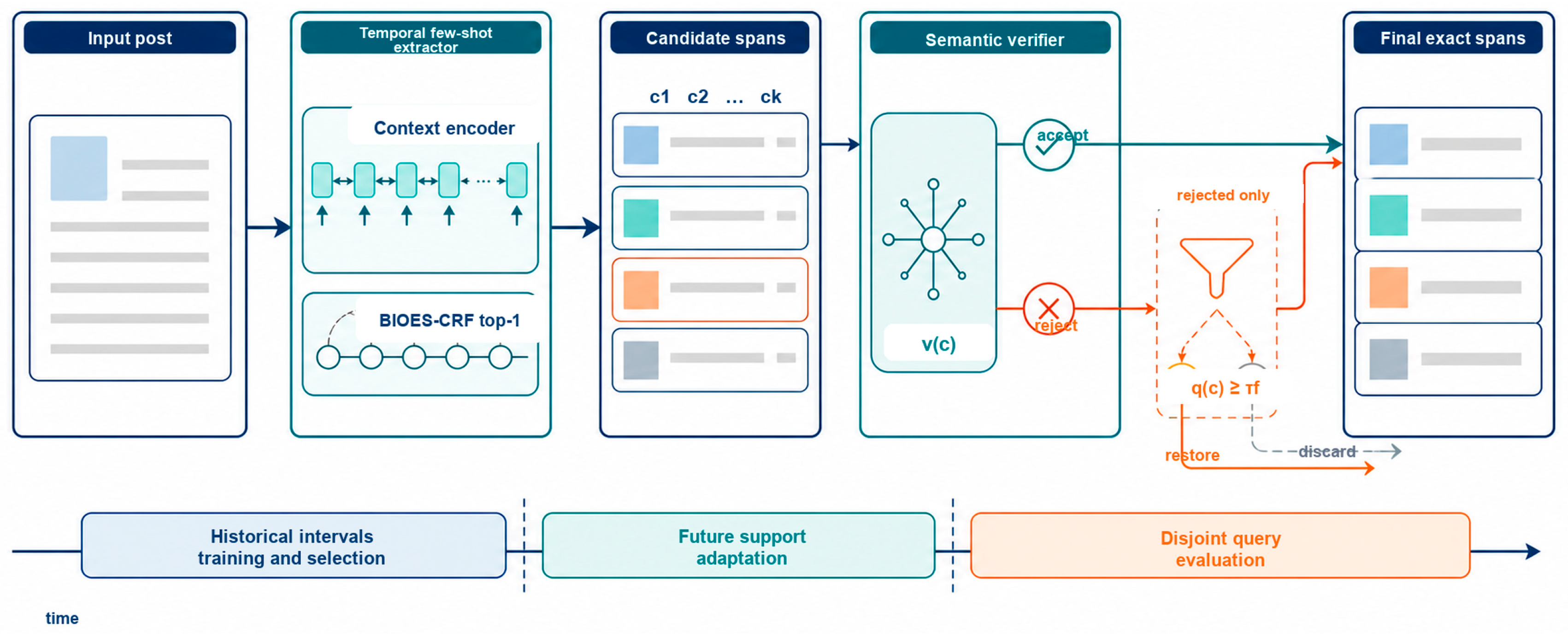
Figure 2.
Principle of the candidate-preserving, guideline-conditioned span verifier.
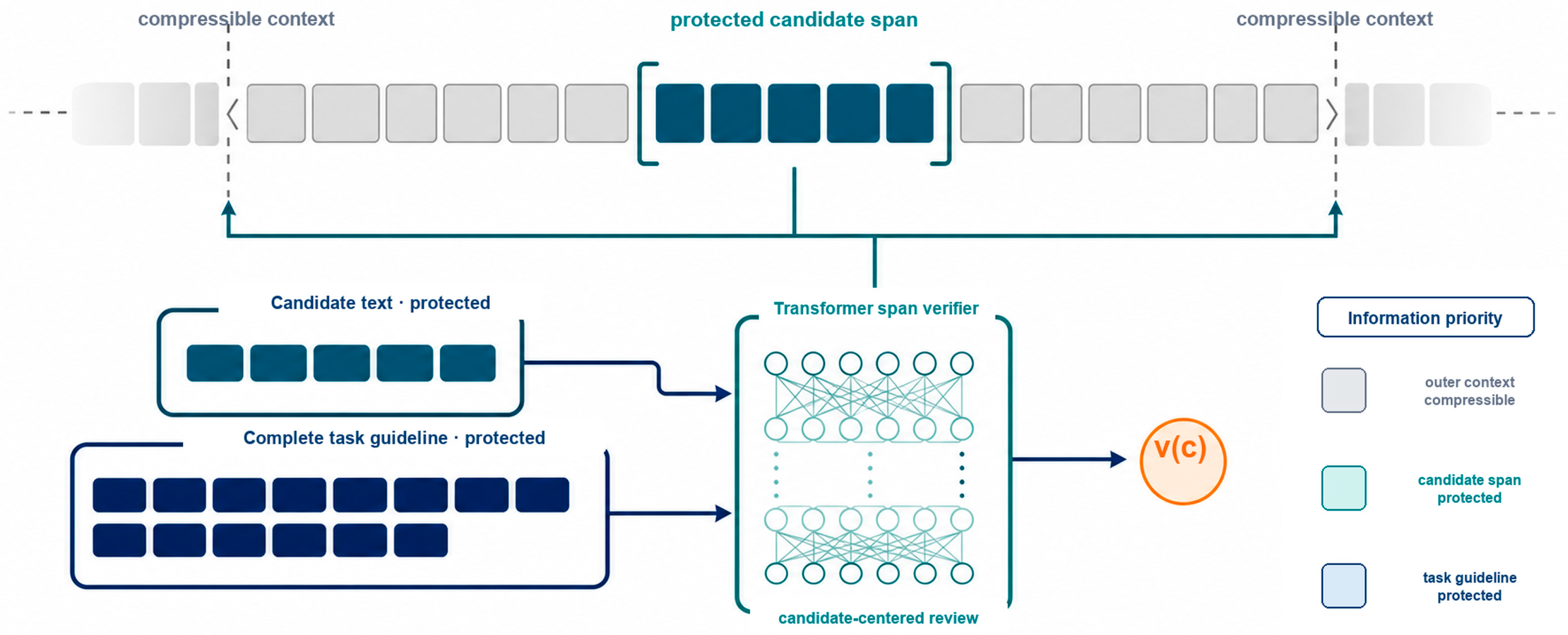
Figure 6.
Post-hoc fallback-threshold sensitivity on interval 8: full-scale F1 and ΔF1 relative to τf = 0.98.
Figure 6.
Post-hoc fallback-threshold sensitivity on interval 8: full-scale F1 and ΔF1 relative to τf = 0.98.
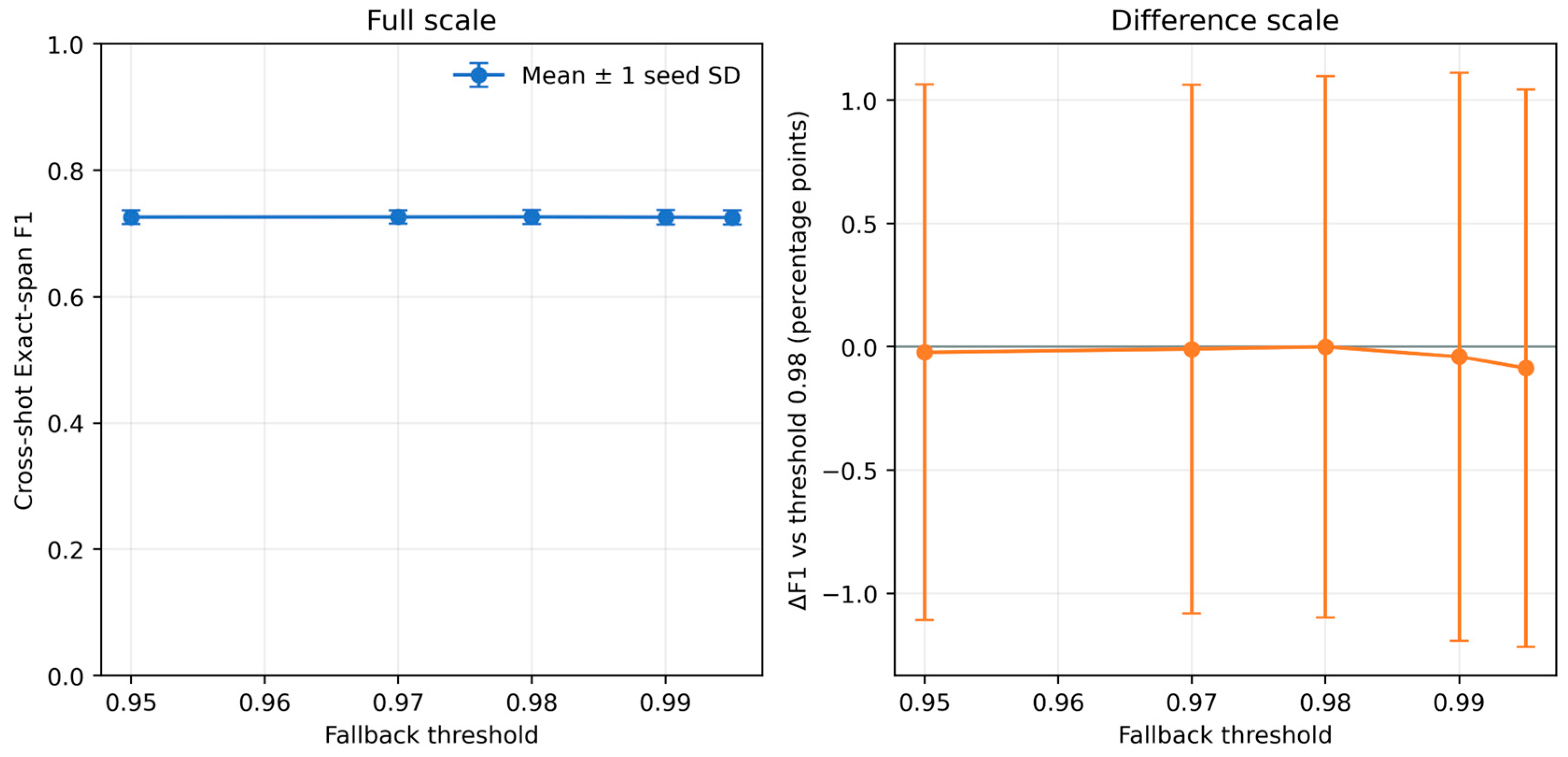
Figure 7.
Reliability and structural-confidence distributions for decoded candidates before and after support-set adaptation.
Figure 7.
Reliability and structural-confidence distributions for decoded candidates before and after support-set adaptation.
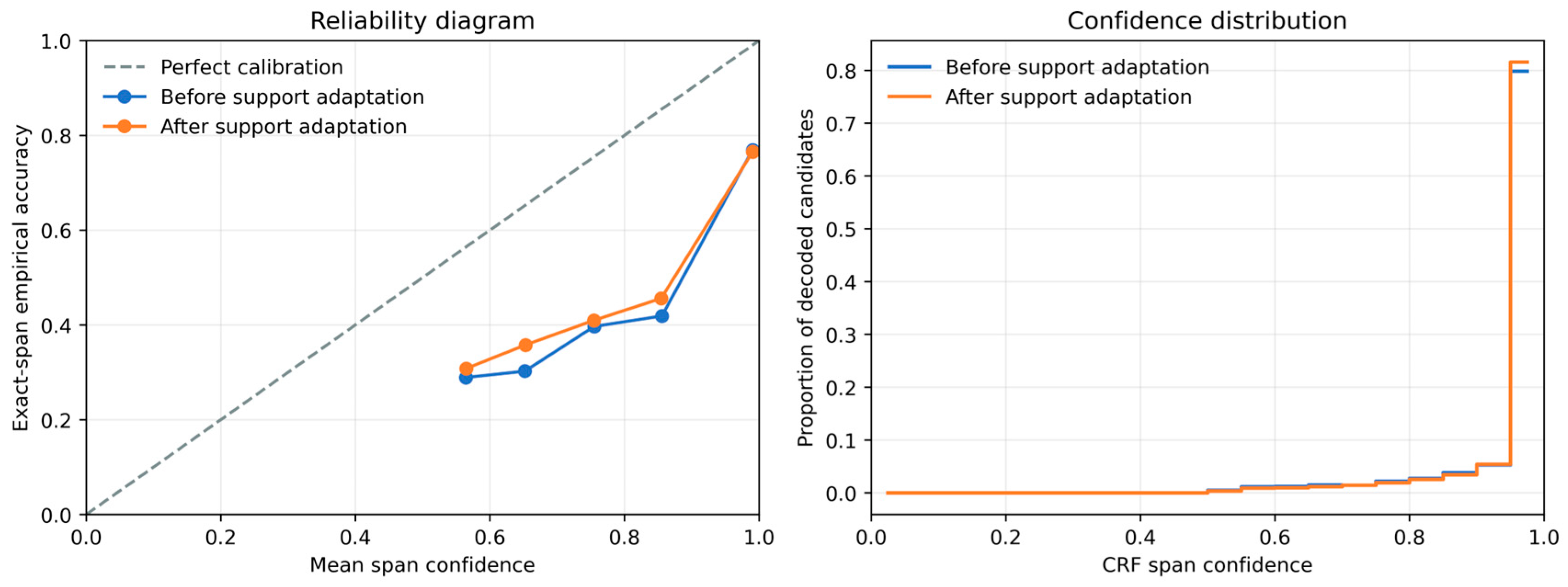
Table 2.
Runtime environment, training budget, and key hyperparameters.
| Item | Observed/Frozen Value |
| Python / PyTorch | 3.12.7 / 2.10.0+cu128 |
| Transformers / tokenizers | 5.12.0 / 0.22.2 |
| CUDA / cuDNN / GPU | 12.8 / 91002 / NVIDIA GeForce RTX 5080 |
| Optimizer | AdamW; betas=(0.9,0.999), epsilon=1e-8 (PyTorch default), weight decay=0.01 |
| Learning-rate control | meta LR=5e-5; inner/verifier LR=2e-5; no scheduler; no warm-up |
| Training control | dropout=0.1; gradient clipping=1.0; bf16=False (FP32); max_length=256 |
| Randomness | Python/NumPy/PyTorch/CUDA seeded; cuDNN deterministic=True; explicit DataLoader generator |
| Backbone training/adaptation | batch size=4; gradient accumulation=2 (effective batch=8); 20 training epochs; 5 adaptation steps |
| Verifier | batch=16; up to 5 epochs; patience=2; candidate-preserving; trained independently for each seed |
Table 6.
Run-level mechanism quantities for H1/H2 and seed-cluster confidence intervals.
| Metric | Mean | Median | Minimum | Maximum | 95% Seed-Cluster CI |
| verifier_deleted_tp | 16.750 | 16.500 | 0.000 | 37.000 | [12.617, 20.817] |
| verifier_deleted_fp | 26.300 | 26.000 | 0.000 | 53.000 | [20.833, 31.550] |
| deleted_fp_per_tp | 1.839 | 1.581 | 0.903 | 5.200 | [1.461, 2.299] |
| fallback_restored_tp | 10.250 | 11.000 | 0.000 | 27.000 | [7.183, 13.500] |
| fallback_reintroduced_fp | 6.950 | 7.000 | 0.000 | 17.000 | [4.617, 9.284] |
| fallback_displaced_tp | 3.017 | 0.000 | 0.000 | 64.000 | [0.000, 8.983] |
| fallback_displaced_fp | 3.350 | 0.000 | 0.000 | 68.000 | [0.000, 9.967] |
| tp_recovery_rate | 0.573 | 0.619 | 0.235 | 0.875 | [0.492, 0.649] |
| fp_reintroduction_rate | 0.250 | 0.302 | 0.000 | 0.471 | [0.186, 0.309] |
| final_tp_change | -9.517 | -7.000 | -64.000 | 0.000 | [-15.517, -5.817] |
| final_fp_change | -22.700 | -19.500 | -68.000 | 0.000 | [-28.650, -17.883] |
Note: Metrics are first computed for each seed × shot run; confidence intervals resample seeds while retaining the three shot conditions within each seed.
Table 9.
Efficiency–accuracy operating points for A0, DeBERTa-A3, and MiniLM-A3.
| System | Cross-shot F1 | Total Parameters | Estimated Serial Latency | Evidence Scope |
| A0 | 0.7215 | 185.66M | 3.810 ms/post | Single-encoder baseline |
| DeBERTa-A3 | 0.7248 | 370.09M | 9.287 ms/post | Main 20-seed method |
| MiniLM-A3 | 0.7263 | 219.02M | 6.136 ms/post | Lightweight Transformer under the same protocol |
Note: Latency is the sum of the A0 module-level timing and the 20-seed verifier timing, not a unified end-to-end profiling measurement.
Disclaimer/Publisher’s Note: The statements, opinions and data contained in all publications are solely those of the individual author(s) and contributor(s) and not of MDPI and/or the editor(s). MDPI and/or the editor(s) disclaim responsibility for any injury to people or property resulting from any ideas, methods, instructions or products referred to in the content. |
© 2026 by the authors. Licensee MDPI, Basel, Switzerland. This article is an open access article distributed under the terms and conditions of the Creative Commons Attribution (CC BY) license (http://creativecommons.org/licenses/by/4.0/).
Copyright: This open access article is published under a Creative Commons CC BY 4.0 license, which permit the free download, distribution, and reuse, provided that the author and preprint are cited in any reuse.