

Submitted:
05 September 2026
Posted:
07 September 2026
You are already at the latest version
Abstract
A physiological variable held by a controller with integral action cannot be moved by a sustained input. This is a theorem, not an observation: integral action drives the sensitivity function to zero at zero frequency, so a constant drug input produces zero steady-state deviation at any receptor occupancy. Potency cannot overcome it. What can move such a variable is a signal placed where the loop’s rejection is weakest, and Bode’s sensitivity integral guarantees that such a band exists. This paper derives that bound and shows by simulation that the drug-to-output path is a bandpass peaking at the loop’s natural frequency. Under an amplitude ceiling the effect of a pulsatile input peaks at a dosing period that is a fixed multiple of the loop’s natural period, the multiplier set by damping; the peak is broad, so what the model constrains sharply is the loss incurred by dosing faster than the loop. Four independent literatures retrodict the result: parathyroid hormone, gonadotropin-releasing hormone, adaptive deep brain stimulation, and conditioned dose reduction. Each shows a regulated system responding to the temporal pattern of exposure rather than its integral. The framework treats chronic symptom disorders as failures of active inference. That interpretation is assessed against what has actually been tested, which is less than the field’s confidence implies. Four predictions are stated, each with a criterion for failure.
Keywords:
integral rein control
; sensitivity function
; dosing schedule
; allostasis
; active inference
; physiological regulation
1. Introduction
Physiological regulation is not passive. A variable that matters to survival is held by a controller, and the controller opposes anything that moves it. This is uncontroversial as physiology and almost entirely absent from therapeutics, where the working model remains that a molecule with sufficient affinity for a target will produce a proportionate change in the phenotype the target influences.
The consequences of that mismatch are visible in the economics of drug development, though the aggregate figures are easy to over-read. Scannell et al. (2012) documented that new drugs approved per billion US dollars of research spending halved roughly every nine years from 1950, falling around eightyfold in inflation-adjusted terms, and their later analysis located much of the cause in the predictive validity of screening models rather than in any ontological error (Scannell et al. 2022). Wong et al. (2019), from 406,038 trial entries, reported a 3.4% probability of success from phase I to approval in oncology, with the annual figure rebounding from a trough of 1.7% in 2012 to 8.3% in 2015; Zhou et al. (2025) have since shown the quantity is not stationary. These numbers describe an enterprise that engages targets reliably and predicts organismal responses poorly. They do not by themselves diagnose why.
This paper offers a specific answer for one class of disease and derives it rather than asserting it. Section 2 sets out the organism as a system that infers the hidden causes of its sensory and interoceptive states and acts to make those states conform to its predictions. Section 3 recasts a family of chronic conditions as failures of that inference, and reports what has actually been tested, which is less than the field’s confidence implies. Section 4 contains the result: a controller with integral action imposes a hard bound on what any sustained pharmacological input can do to a regulated variable, and the same analysis identifies where an input can still act. Section 5 shows that four unrelated literatures already behave as the bound predicts. Section 6 and Section 7 set out what follows for diagnosis and design, and state four predictions with criteria for failure.
1.1. Relation to Prior Work
Bettinger and Friston set out the variational foundations of physiological regulation, upgrading allostasis to a relational notion of stability under the free energy principle (Bettinger and Friston 2023); that treatment is the closest antecedent to Section 2 and is taken here as established. Badcock and Davey assess how far active inference has informed psychiatry and conclude that translational progress has been slow (Badcock and Davey 2024), which states the problem this review addresses. Sedley et al. (2024), with Friston, have applied the framework to a single neurological disease, arguing that migraine is an allostatic reset triggered by unresolved interoceptive prediction error and functions as a failsafe that becomes maladaptive when triggered excessively. Theirs is a mechanistic account of one syndrome; the present argument concerns what any intervention must do to a regulated loop, whatever the syndrome.
Two further positions deserve explicit contrast. Carhart-Harris et al. (2023) describe pathology as canalization, in which model precision is raised defensively and the phenotypic state space narrows, and propose that plasticity-inducing agents can reverse it by decreasing precision, a proposal developed further in the REBUS account (Carhart-Harris and Friston 2019). That is an intervention on priors. The proposal below is an intervention on the temporal structure of afferent evidence, and Section 6 argues the two are complementary rather than rival. Jungilligens and Perez review predictive processing in functional neurological disorder (Jungilligens and Perez 2025) and Davey applies it to the bodily presentation of depression (Davey 2025); both are single-syndrome treatments where Section 3 argues for a shared form. Jinich-Diamant et al. (2025) propose that soft-tissue manipulation reshapes predictive models of somatosensory experience, which is one modality meeting the specification derived in Section 4.
On the technological side, Yang et al. (2026) survey de novo protein design and state its open problem directly: the current questions are not how to design but what to design, and open-source methods now let biochemists and molecular biologists explore applications broadly. Kortemme reaches a similar conclusion (Kortemme 2024). That is an invitation to domain scientists. Section 6 takes it up with a design objective expressed in the units a chemist can act on.
2. The Organism as an Inferential System
2.1. Process, Closure, Anticipation
Whitehead’s objection to the mechanistic picture was that it retained only what could be quantified and lost contact with what it was meant to describe, and his alternative took events rather than substances as basic (Whitehead 1978). For biology the point is modest. Most of a cell’s proteins turn over in hours to days, so identity is carried by the coherence of flux; the exceptions are informative, since Toyama et al. (2013) found a long-lived proteome in rat brain whose components are inefficiently replenished and therefore accumulate damage.
Rosen gave the distinction formal edge. An organism is closed to efficient causation: the catalysts required for its operation are its own products (Rosen 1991). His stronger claims remain contested and nothing here depends on them. What survives is that such systems absorb perturbation through the network that generates the response, which is why inhibiting a node yields less clinical effect than its pharmacology predicts. Hopkins made the same argument as network pharmacology, noting that phenotypic robustness suggests highly selective compounds may show lower clinical efficacy than multitarget drugs (Hopkins 2008).
The property that matters most here is anticipation: a system containing a predictive model of itself and its environment, using that model’s output to set present behaviour (Rosen 1991). A thermostat corrects deviations that have occurred. An organism prepares for deviations that have not.
2.2. Free Energy, Precision, Volatility
A system maintaining a non-equilibrium steady state possesses a Markov blanket, a set of states rendering internal states conditionally independent of external ones (Kirchhoff et al. 2018; Palacios et al. 2019), and will appear to minimise variational free energy, an upper bound on the surprisal of its sensory states given an internal generative model (Friston 2010; Ramstead et al. 2023). The construct is contested: Bruineberg et al. (2022), replying to thirty-five commentaries, organise the dispute around whether these are the blankets of Bayesian inference or a distinct demarcation between agent and environment. The argument below uses the blanket descriptively and does not turn on that dispute.
Two routes reduce free energy. Perceptual inference updates the model; active inference changes the evidence by acting (Friston et al. 2017; Ramstead et al. 2017). The clinically decisive variable is precision, the inverse-variance weight applied to a prediction error. Limanowski et al. (2024) catalogue its roles and locate its implementation in neuromodulatory control of post-synaptic gain within cortical hierarchies. That localisation constrains what any peripherally acting agent can do, and Section 6 respects it.
Precision estimation is itself hierarchical, and this matters for therapeutics in a way that is usually skipped. The parameter governing how fast precision estimates update is an estimate of environmental volatility, formalised in the hierarchical Gaussian filter (Mathys et al. 2011) and shown to be tracked near-optimally by humans (Behrens et al. 2007). It is separately identifiable and abnormal in clinical populations: overestimated in autism, with a pupillometric correlate implicating noradrenergic gain (Lawson et al. 2017), and poorly adjusted between stable and volatile environments in trait anxiety (Browning et al. 2015). Pulcu and Browning argue that misestimation of uncertainty, rather than first-order precision, is the tractable clinical target (Pulcu and Browning 2019), and Powers et al. (2017) showed prior-weighting parameters can be recovered from patients and mapped to circuits.
This resolves a circularity that otherwise defeats any therapy aimed at precision. If pathology is a miscalibrated precision estimator, then supplying a more reliable afferent channel and expecting the system to upweight it assumes the very estimator that is broken. Moving up one level dissolves the problem: an intervention can supply a channel whose volatility structure is legible, and it is the volatility estimate that gates how far the precision estimate is free to move. Volatility and first-order precision are separable parameters, so this is a different and testable claim.
2.3. Allostasis
Sterling’s objection to homeostasis was that regulation waiting for an error is a poor design, and that physiology instead predicts demand and adjusts in advance (Sterling 2011; Schulkin and Sterling 2019). Interoceptive predictions descend to the periphery and autonomic reflexes act to fulfil them (Barrett and Simmons 2015; Seth and Friston 2016), with the ascending limb mapped to insular cortex (Craig 2002). Stephan et al. (2016) added the metacognitive layer, defining dyshomeostasis as sustained interoceptive surprise; Petzschner et al. (2021) survey the computational models and are candid about their limits.

Table 1.
Two descriptions of physiological regulation.
| Classical homeostasis | Allostatic regulation | |
|---|---|---|
| Control signal | Deviation measured after the fact | Predicted demand, computed in advance |
| Mechanism | Negative feedback | Descending prediction; peripheral action fulfils it (Barrett and Simmons 2015; Seth and Friston 2016) |
| Stability | Return to a fixed reference | Maintenance of a low-free-energy attractor (Bettinger and Friston 2023) |
| Set point | Externally specified | Emergent property of coupled loops (Bettinger and Friston 2023; Saunders et al. 1998) |
| Failure mode | Gain too low or too high | Precision miscalibration; entrapment in a rigid regime |
3. Pathology as Maladaptive Inference, and What Has Been Tested
3.1. The Proposed Form
Consider a tissue injured and imperfectly healed, leaving afferent signalling that is noisy rather than absent. The system estimates the reliability of that channel from its statistics and finds it low, which is locally correct. Subsequent evidence, including evidence that the tissue is sound, then carries insufficient weight to revise the descending prediction that it is not, and active inference recruits behaviour — guarding, immobilisation, autonomic adjustment — that generates afferent signals consistent with the prediction. No persisting peripheral lesion is required.
The same form has been proposed under four labels: chronic pain as inference about bodily threat, with expectation precision setting placebo magnitude (Büchel et al. 2014; Tabor et al. 2017; Ongaro and Kaptchuk 2019); functional neurological disorder as abnormally precise priors at an intermediate level of the motor hierarchy (Edwards et al. 2012); persistent physical symptoms as perceptual dysregulation, with disconfirming evidence discounted rather than assimilated (Van et al. 2017; Henningsen et al. 2018; Sauer et al. 2025); and depression and apathy as re-weighted interoceptive and action-outcome precision (Davey 2025; Williams and Rowe 2025).
Table 2.
A proposed shared form, and the strongest published test of each.
| Syndrome | Prediction that becomes rigid | Strongest published test |
|---|---|---|
| Chronic pain | Body region is damaged | Complex regional pain syndrome: elevated threat and safety learning with increased choice stochasticity, fitted (Gopalakrishnan et al. 2026). Fibromyalgia: visuotactile weights not different from controls (Augière et al. 2024) |
| Functional neurological disorder | Limb is weak, or movement is not self-generated | Reduced drift rate recovered by drift-diffusion fitting (Sadnicka et al. 2020); four of five performance-controlled metacognition studies found equivalence to controls (Sadnicka et al. 2025) |
| Persistent physical symptoms | Body is diseased | Experimental prior manipulation; imprecise hidden-state prior raised health anxiety, symptom report unaffected (Sauer et al. 2025) |
| Depression, apathy | Future bodily states are unfavourable | Transdiagnostic failure to adapt interoceptive precision, replicated (Lavalley et al. 2024) |
3.2. What Has Been Tested
The framework is at present better at reinterpretation than at prediction, and the honest position is narrower than the literature’s confidence suggests.
What has been recovered in patients, by fitting a model, are learning rates and decision parameters rather than precision terms. Sadnicka et al. (2020) fitted a drift-diffusion model in functional movement disorder and found pathologically reduced drift rate (P = 0.002); the reading of that parameter as down-weighted sensory evidence is an interpretation offered in the discussion, not a fitted quantity. Gopalakrishnan et al. (2026) fitted a reinforcement-learning model in complex regional pain syndrome and found elevated threat and safety learning with increased choice stochasticity. The clearest recovery of an actual precision parameter comes from an adjacent population: Lavalley et al. (2024), in a pre-registered replication of 285 patients pooled to 719, found that patients with affective, substance use and eating disorders failed to adjust beliefs about the precision of cardiac signals under an interoceptive perturbation, where healthy individuals did.
Against this, three results deserve equal weight. Augière et al. (2024) found visuotactile sensory weights in fibromyalgia not different from controls. Sadnicka et al. (2025)’ systematic review found that four of five studies using performance-controlled metrics reported metacognition in functional neurological disorder equivalent to controls, and asked whether it may be intact. And in healthy volunteers, where the paradigms are cleanest, assimilation of pain to prediction occurs but does not scale with prediction precision as the account requires (Derksen et al. 2025).
Two methodological constraints bound what any of this can currently show. Karvelis et al. (2024) found hierarchical Gaussian filter parameters at two-week retest to have largely poor reliability, with intra-class correlation coefficients below 0.5, substantially affected by intrinsic measurement noise as indicated by parameter recovery; their review warns that poor psychometric properties pose a risk of invalidating previous findings (Karvelis et al. 2023). A study powered on such a parameter is not powered. Separately, Bowman et al. (2023) show that precision-weighting can rescue almost any contra-predictive amplitude result, but that raising precision necessarily also shortens response latency and raises response frequency, so a precision explanation is admissible only when those co-signatures are present. Those constraints are defined for evoked electrophysiological responses and do not transfer to behavioural parameter studies, which is where most of the evidence above sits.
3.3. Complexity: What Actually Replicates
The claim that these syndromes show loss of physiological complexity is weaker than it is usually stated. Lipsitz and Goldberger proposed complexity loss as a signature of ageing and disease (Lipsitz and Goldberger 1992); Vaillancourt and Newell replied that this unidirectional view is too narrow and that complexity can move in either direction depending on the constraints channelling system dynamics (Vaillancourt and Newell 2002), and the exchange was published in the same issue as Goldberger’s response. It remains unresolved.
What replicates in these populations is the linear vagal finding. Vreijling et al. (2021), pooling 58 studies in chronic fatigue syndrome, irritable bowel syndrome and fibromyalgia, found reduced RMSSD (k = 22, Hedges g = −0.37, 95% CI −0.53 to −0.21) and reduced high-frequency heart rate variability (k = 52, g = −0.69, 95% CI −1.03 to −0.36). Tracy et al. (2016), reviewing 51 studies and pooling 26, reported a moderate-to-large decrease in high-frequency variability heavily influenced by fibromyalgia studies. Every published meta-analysis in these conditions pooled time- and frequency-domain indices; Vreijling et al. (2021) state that nonlinear studies have not accumulated to the point where a meta-analysis is reasonable. Any complexity claim in this literature is therefore a claim about primary studies, not about synthesis, and it should be made in those terms.
Criticality is in a similar position. Destexhe and Touboul showed that two non-critical systems passed all the tests used to assess criticality in one recent analysis (Destexhe and Touboul 2021), and Hengen and Shew, meta-analysing 140 datasets, argue the long-standing controversy is the product of a methodological choice with no bearing on underlying dynamics (Hengen and Shew 2025). Distance to criticality is not yet an identifiable quantity from routine recordings.
4. What a Controller Does to a Drug
4.1. The Bound
Let a regulated variable be y, let the endogenous controller possess integral action, and let a drug enter as an exogenous input u at the plant input. Integral action is what Saunders, Koeslag and Wessels formalised as integral rein control, and it is why a physiological set point is an emergent property of loop dynamics rather than a stored reference (Saunders et al. 1998).
Write the loop transfer as L(s) and the sensitivity function as S(s) = 1/(1 + L(s)). Two results follow, and neither is a hypothesis.
Integral action forces S(0) = 0. A constant input produces zero steady-state deviation in the regulated variable, in the limit, at any receptor occupancy whatsoever. For a first-order plant G(s) = k/(τs + 1) under an integral controller C(s) = Ki/s, the drug-to-output transfer is
whose zero at the origin is the bound made explicit. Sustained monotherapy against a regulated variable has a ceiling that is not a potency problem, and cannot be solved by a better molecule. Tolerance and tachyphylaxis, on this reading, are the loop’s integrator doing its job.
H(s) = G/(1 + CG) = k·s / (τs² + s + Kik)
Bode’s sensitivity integral forbids rejection everywhere. For a stable open loop with relative degree at least two and no right-half-plane poles, the integral of ln|S(jω)| over all frequencies from zero to infinity equals zero. Suppression at one frequency is paid for by amplification at another. There is therefore always a band in which the loop amplifies rather than rejects an input, and its location is a property of the patient’s loop, not of the drug.
The design principle follows as a consequence rather than an intuition. The therapeutic object in a regulated system is a spectrum, not a concentration. Potency and duration of exposure, the two quantities pharmacology optimises, place a drug’s energy precisely where rejection is strongest.
4.2. Simulation
Simulation was used to establish where the energy should go instead. The model above was solved exactly in the frequency domain, so no integration error enters; code is provided as supplementary material.
Figure 1 shows the analysis. H is a bandpass whose peak lies at the closed-loop natural frequency ωn = √(Kik/τ), with unit gain at the peak, confirmed to four decimal places across three values of ωn. This gives the waterbed band a precise location: a drug should deliver its energy at the natural frequency of the loop it is meant to perturb.
Two further results qualify the picture, and both correct intuitions that seem obvious.
With the mean dose fixed and no ceiling on peak amplitude, concentrating the dose into shorter, taller pulses increases effect monotonically but toward a finite asymptote, the impulse-train limit: mean absolute deviation rose 0.0418, 0.0624, 0.0631, 0.0633, 0.0633 as amplitude rose from 0.1 to 25 at fixed mean exposure. Effect does not increase without limit, and an amplitude ceiling is therefore not what creates an interior optimum.
With the mean dose and the amplitude ceiling both fixed and only the dosing period varied, an interior maximum appears at
and κ is invariant in ωn to five decimal places across an eightfold range, provided the damping ratio ζ is held fixed. Its value rises with damping: κ = 1.034 at ζ = 0.25, 1.145 at ζ = 0.5, 1.460 at ζ = 1.0 and 2.164 at ζ = 2.0. Two loop parameters must therefore be measured rather than one. Varying loop gain alone moves ωn and ζ together and destroys the invariance, yielding an apparent κ ranging from 1.15 to 2.63 across an eightfold range of ωn; that confound is why the scaling must be stated with damping controlled.
T* = κ(ζ) · (2π/ωn)
The shape of the maximum matters more than its location, and it is the reason this result should not be read as a sharp optimum. The curve is shallow near its peak and, for ζ ≤ 0.5, bimodal: at ζ = 0.5 a second local maximum sits at T ≈ 1.96 Tn, 1.3% below the global one, and the band within 5% of maximum runs from about 0.9 to 3.7 Tn. A unimodal optimiser will settle on either peak depending on where it starts. What the model constrains sharply is the fast side: at T = 0.5 Tn the effect falls to 61% of maximum at ζ = 0.5 and to 36% at ζ = 0.25. The actionable claim is therefore that dosing substantially faster than the loop’s own period is costly, while a wide range of slower schedules performs comparably.
4.3. Limits of the Analysis
These are linear time-invariant results. Physiological loops are nonlinear, time-varying, and have saturating actuators, and the amplitude ceiling in Section 4.2 is that nonlinearity entering by the back door. The analysis is therefore local, around an operating point, which is not a weakness for a clinical claim, since a patient is always at an operating point. The plant is first order; higher-order plants introduce additional phase and will shift κ. The bound in Section 4.1 is exact for any loop with integral action; the scaling law in Section 4.2 is established for one loop class and is offered as a prediction, not a general theorem.
5. Retrodictions
Four literatures, none collected with this analysis in mind, behave as it predicts.
Parathyroid hormone. Frolik et al. (2003) gave rats the same total daily dose of PTH(1-34) over one hour or over six. The one-hour schedule increased proximal tibial bone mass and the six-hour schedule decreased it, and they concluded the response is determined primarily by the time each day that serum concentrations remain above baseline, and only secondarily by peak concentration or area under the curve. Same molecule, same receptor, same integral, opposite sign. That dichotomy is the pharmacological basis of intermittent teriparatide dosing in osteoporosis (Neer et al. 2001).
Gonadotropin-releasing hormone. Belchetz et al. (1978) found that continuous infusion failed across a thousandfold range of delivery rates, including a total roughly tenfold larger than that delivered by an effective hourly pulse, and concluded that the phenomenon is attributable to the pattern of delivery rather than to the amounts to which the pituitary is exposed. Wildt et al. (1981) then showed frequency-dependence directly: raising pulse frequency from one per hour to two, three or five, at constant infusion rate and pulse duration, produced progressive declines in plasma gonadotropins that were most profound at the highest frequencies. Because raising frequency at fixed infusion rate raises total delivery, this is more hormone producing less effect.
Adaptive deep brain stimulation. Little et al. (2013) compared adaptive with continuous stimulation in eight patients with Parkinson’s disease under blinded assessment. Motor scores improved 66% unblinded and 50% blinded during adaptive stimulation, which were 29% (p = 0.03) and 27% (p = 0.005) better than continuous stimulation, achieved with a 56% reduction in stimulation time and a corresponding reduction in energy (p < 0.001); adaptive stimulation was also more effective than random intermittent stimulation. The random-intermittent arm is the important one, because it controls duty cycle without the matching. Bronte-Stewart et al. (2025) subsequently reported long-term at-home adaptive stimulation, with total electrical energy delivered reduced by 15% relative to continuous stimulation; that trial was open-label and non-randomised for the adaptive-versus-continuous comparison, its primary threshold was applied post hoc so its p-values are nominal, and seven authors are employees of the device manufacturer.
Closed-loop spinal cord stimulation. In the EVOKE trial, stimulation controlled by evoked compound action potentials outperformed fixed-output stimulation under participant, investigator and assessor blinding: at 36 months, 77.6% versus 49.3% achieved at least 50% pain reduction, a difference of 28.4% (95% CI 12.8 to 43.9, p < 0.001) (Mekhail et al. 2024). The closed-loop arm also achieved greater neural activation, so magnitude and matching are confounded within this trial; the 36-month analysis was not prespecified, crossover was permitted after 24 months, and fifteen authors are employees of the manufacturer. Read against the adaptive-stimulation trials the confounds point in opposite directions, which is more informative than either alone: one modality won while delivering more, the other won while delivering less and while beating a duty-cycle-matched control.
Conditioned dose reduction. If a regulatory system responds to the predictive structure of drug delivery, then altering that structure should alter clinical effect at reduced total dose. Sandler et al. (2010) randomised 99 children with attention-deficit hyperactivity disorder after double-blind dose finding; pairing a visually distinctive placebo with the stimulant, given open-label, maintained symptom control equivalent to full dose at 50% of that dose, with the lowest rate of emergent side effects of the three arms, among the 70 who completed. Flowers et al. (2021) randomised conditioned open-label placebo after spine surgery and found approximately 30% lower daily morphine milligram equivalents (−14.5, 95% CI −26.8 to −2.2) and lower worst pain (−1.0, 95% CI −2.0 to −0.1), with average daily pain not significantly different (−0.8, 95% CI −1.7 to 0.2). The evidence base is small and not uniformly positive: Ader et al. (2010)’ psoriasis trial describes itself as preliminary, its relapse percentages rest on 15, 13 and 9 patients, and its severity outcome at one of two sites neither supported nor refuted the hypothesis; and a conditioning study of amitriptyline-induced REM suppression produced rebound rather than the predicted conditioned response (Winkler et al. 2016). Siegel’s demonstration that morphine tolerance is in part a learned, cue-dependent and extinguishable response (Siegel 1975; Siegel et al. 1982) remains the mechanistic anchor.
6. Consequences
6.1. A Diagnostic Object Worth Building
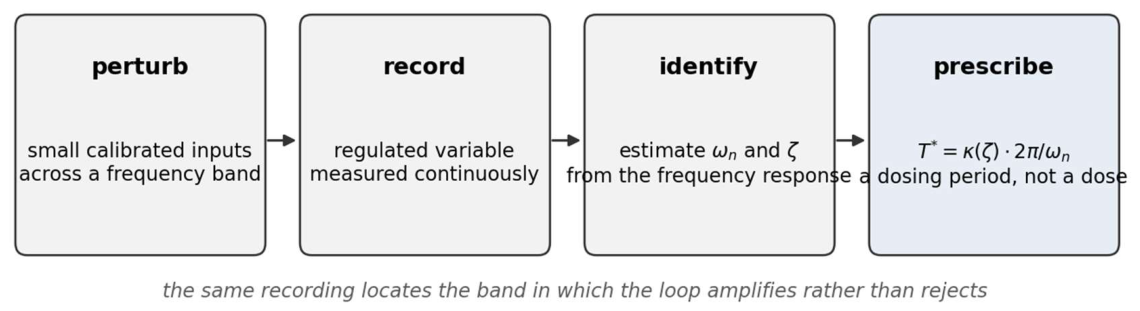
If the bound is right, the clinically relevant quantity is not a concentration but a loop characterisation: the location of the band in which |S(jω)| > 1, and the natural frequency and damping of the loop. Both are estimable by standard frequency-domain system identification, injecting small calibrated perturbations across a frequency range and measuring the regulated variable; Figure 2 sets out the procedure and its output. The output is a dosing schedule rather than a dose. This requires no new chemistry, and it is a more consequential proposal than any molecule.
6.2. Two Levers, Two Timescales
A specification stated in afferent firing statistics lives on milliseconds to seconds. Designed proteins act on minutes to hours; even facilitated-dissociation constructs operate on seconds. Three orders of magnitude separate the two, and conflating them is the error most likely to be made here. The levers should be kept apart. Channel gain and excitability, on minutes to hours, is where cytokines, neuropeptides and designed proteins act: de novo design now specifies receptor selectivity, dissociation kinetics and oligomeric geometry in advance (Yang et al. 2026; Silva et al. 2019; Broerman et al. 2025; Edman et al. 2024), with reported experimental success rates of 10 to 100% depending on target (Pacesa et al. 2025). Temporal pattern on milliseconds to seconds is where electrical stimulation and ion-channel pharmacology act, which is why the neuromodulation results in Section 5 are the strongest evidence available. Under this division, Section 5’s stimulation trials and the protein design literature stop competing for the same job.
6.3. Sequencing
If a rigid regime is sustained by over-precise priors, then better afferent evidence delivered to a system whose volatility estimate is pinned near zero will be discounted on arrival. Escape plausibly requires two phases in order: raise volatility, so the model becomes open to revision, then supply structured afferent evidence, which determines what is learned. This unifies modalities currently discussed separately. Plasticity-inducing agents are an intervention of the first kind (Carhart-Harris et al. 2023; Carhart-Harris and Friston 2019); graded exposure, interoceptive training and closed-loop stimulation are of the second. Neither phase alone should suffice, which is prediction 4.
7. Predictions, Limitations, Conclusions
7.1. Four Predictions
- The scaling law, and the fast-side falloff. At fixed total exposure and fixed peak amplitude, the effect of a pulsatile input on a regulated variable depends on the dosing period, and the dependence is set by the loop rather than by the drug. Two claims are separable, and the second is the stronger test. First, the location of the maximum scales as T* = κ(ζ)·(2π/ωn) with ωn and ζ measured in advance by frequency-domain identification of the same loop; because the maximum is broad, this is tested by comparing two loops matched on ζ but differing in ωn, where the whole effect-versus-period curve should translate without changing shape. Second, and sharper, halving the dosing period from T* should cost a substantial fraction of the effect, with the fraction increasing as damping falls. An isolated perfused organ preparation satisfies the requirements, since effector concentration at the receptor can be stepped and the regulated variable tracked, and peak concentration must be reported alongside total exposure. Failure criteria: curves from ωn-mismatched loops that do not superimpose after rescaling by Tn; or no reduction in effect at T = 0.5 Tn relative to T*.
- Afferent statistics govern the central precision estimate. Controlled variation of the reliability of an afferent channel, at constant mean intensity, will shift the precision parameter recovered from a hierarchical model fitted to the participant’s responses, in the direction of higher precision for lower variance. This is the link on which any peripheral intervention on precision depends, and it is currently assumed rather than shown. Failure criterion: within-subject effect below Cohen’s d = 0.5 across at least three variance levels, in a sample powered at 80%. The study must include a test-retest arm and report parameter recovery from simulated data, since the target parameter’s published two-week reliability is below 0.5 (Karvelis et al. 2024).
- Schedule at fixed exposure in humans. In a chronic condition treated with a scheduled agent, randomising the schedule at fixed total weekly exposure will change the clinical outcome, and the size of the change will depend on the relation between dosing period and an individually measured loop period. Failure criterion: no schedule effect at equal total exposure, or no modification by the measured loop period.
- Order matters. A plasticity-opening intervention followed by structured interoceptive evidence will outperform either alone by more than their sum, and the reverse order will not. Failure criterion: a non-significant interaction term, or an order effect in the opposite direction. Prespecify both.
7.2. Limitations
The bound in Section 4.1 is exact but idealised; the scaling law in Section 4.2 is established in one loop class by simulation, not in tissue. Section 3 remains largely reinterpretive, and the parameters it relies on have poor measured reliability (Karvelis et al. 2024; Karvelis et al. 2023). The proposal in Section 6.1 has not been implemented in any patient. And the claim that active inference will unify psychiatry has been made before with slow results (Badcock and Davey 2024); nothing here guarantees otherwise. What is offered is a constraint that holds independently of the inference framework, and which the inference framework then interprets.
7.3. Conclusions
A regulated variable resists a sustained input by construction, and no increase in affinity changes that. The same analysis that establishes the resistance also locates where it is weakest, and the location is measurable in the individual. Four literatures, developed separately, already show a regulated system responding to when a signal arrives as much as to how much of it arrives. The therapeutic question this raises is not which target to engage but on what schedule, and it can be asked of drugs already licensed.
Author Contributions
Geert A. Sulter is the sole author and is responsible for conceptualisation, formal analysis, the simulation code, writing of the original draft, and revision.
Funding
No funding was received to assist with the preparation of this manuscript.
Competing interests
The author has no relevant financial or non-financial interests to disclose.
Ethics approval
Not applicable. The article involves no human participants, human data, human tissue, or animal experiments.
Consent to participate and consent to publish
Not applicable.
Data availability
No new empirical data were generated or analysed. The article is theoretical, and every quantitative result reported in Sect. 4.2 is an output of the simulation described there.
Code availability
The simulation code reproducing all results in Sect. 4.2 and Figure 1 is supplied as an Online Resource and is archived on Zenodo under the MIT licence. The version used for this paper (v1.0.0) is https://doi.org/10.5281/zenodo.22253423; the concept identifier https://doi.org/10.5281/zenodo.22253422 resolves to the most recent version.
Use of AI tools
The manuscript has no Methods section, so this declaration is placed here. AI tools (Claude, Anthropic) were used for literature searching, for drafting and formatting, and for writing and running the simulation code. The author reviewed and verified all output, including every reference and every numerical result, and takes full responsibility for the content. No AI tool is listed as an author.
Related manuscript
A related manuscript on the process-ontological formalisation of active inference in artificial agents is under consideration at Cognitive Systems Research (COGSYS-D-26-00779). It contains no pharmacological or control-theoretic content; the overlap with the present paper is confined to the ontological background of Section 2.1. A copy accompanies this submission.
Acknowledgments
None to declare. The author thanks the editors and the anonymous reviewers in advance for their time.
References
- Ader, R.; Mercurio, M.G.; Walton, J.; James, D.; Davis, M.; Ojha, V.; et al. Conditioned pharmacotherapeutic effects: a preliminary study. Psychosom. Med. 2010, 72, 192–197. [Google Scholar] [CrossRef] [PubMed]
- Augière, T.; Simoneau, M.; Mercier, C. Visuotactile integration in individuals with fibromyalgia. Front Hum. Neurosci. 2024, 18, 1390609. [Google Scholar] [CrossRef] [PubMed]
- Badcock, P.B.; Davey, C.G. Active inference in psychology and psychiatry: progress to date? Entropy 2024, 26, 833. [Google Scholar] [CrossRef] [PubMed]
- Barrett, L.F.; Simmons, W.K. Interoceptive predictions in the brain. Nat. Rev. Neurosci. 2015, 16, 419–429. [Google Scholar] [CrossRef] [PubMed]
- Behrens, T.E.J.; Woolrich, M.W.; Walton, M.E.; Rushworth, M.F.S. Learning the value of information in an uncertain world. Nat. Neurosci. 2007, 10, 1214–1221. [Google Scholar] [CrossRef] [PubMed]
- Belchetz, P.E.; Plant, T.M.; Nakai, Y.; Keogh, E.J.; Knobil, E. Hypophysial responses to continuous and intermittent delivery of hypothalamic gonadotropin-releasing hormone. Science 1978, 202, 631–633. [Google Scholar] [CrossRef] [PubMed]
- Bettinger, J.S.; Friston, K.J. Conceptual foundations of physiological regulation incorporating the free energy principle and self-organized criticality. Neurosci. Biobehav Rev. 2023, 155, 105459. [Google Scholar] [CrossRef] [PubMed]
- Bowman, H.; Collins, D.J.; Nayak, A.K.; Cruse, D. Is predictive coding falsifiable? Neurosci. Biobehav Rev. 2023, 154, 105404. [Google Scholar] [CrossRef] [PubMed]
- Broerman, A.J.; Pollmann, C.; Zhao, Y.; Lichtenstein, M.A.; Jackson, M.D.; Tessmer, M.H.; et al. Design of facilitated dissociation enables timing of cytokine signalling. Nature 2025, 647, 528–535. [Google Scholar] [CrossRef] [PubMed]
- Bronte-Stewart, H.M.; Beudel, M.; Ostrem, J.L.; Little, S.; Almeida, L.; Ramirez-Zamora, A.; et al. Long-term personalized adaptive deep brain stimulation in Parkinson disease: a nonrandomized clinical trial. JAMA Neurol. 2025, 82, 1171–1180. [Google Scholar] [CrossRef] [PubMed]
- Browning, M.; Behrens, T.E.; Jocham, G.; O’Reilly, J.X.; Bishop, S.J. Anxious individuals have difficulty learning the causal statistics of aversive environments. Nat. Neurosci. 2015, 18, 590–596. [Google Scholar] [CrossRef] [PubMed]
- Bruineberg, J.; Dołęga, K.; Dewhurst, J.; Baltieri, M. The Emperor Is Naked: replies to commentaries on the target article. Behav. Brain Sci. 2022, 45, e219. [Google Scholar] [CrossRef] [PubMed]
- Büchel, C.; Geuter, S.; Sprenger, C.; Eippert, F. Placebo analgesia: a predictive coding perspective. Neuron 2014, 81, 1223–1239. [Google Scholar] [CrossRef] [PubMed]
- Carhart-Harris, R.L.; Friston, K.J. REBUS and the anarchic brain: toward a unified model of the brain action of psychedelics. Pharmacol. Rev. 2019, 71, 316–344. [Google Scholar] [CrossRef] [PubMed]
- Carhart-Harris, R.L.; Chandaria, S.; Erritzoe, D.E.; Gazzaley, A.; Girn, M.; Kettner, H.; et al. Canalization and plasticity in psychopathology. Neuropharmacology 2023, 226, 109398. [Google Scholar] [CrossRef] [PubMed]
- Craig, A.D. How do you feel? Interoception: the sense of the physiological condition of the body. Nat. Rev. Neurosci. 2002, 3, 655–666. [Google Scholar] [CrossRef] [PubMed]
- Davey, C.G. The body intervenes: how active inference explains depression’s clinical presentation. Neurosci. Biobehav Rev. 2025, 175, 106229. [Google Scholar] [CrossRef] [PubMed]
- Derksen, S.M.J.C.; Konttinen, M.; Myronenko, A.; Seymour, B.; Peerdeman, K.J. How the magnitude and precision of pain predictions shape pain experiences. Eur. J. Pain 2025, 29, e4769. [Google Scholar] [CrossRef] [PubMed]
- Destexhe, A.; Touboul, J.D. Is there sufficient evidence for criticality in cortical systems? eNeuro 2021, 8, 0551–20. [Google Scholar] [CrossRef] [PubMed]
- Edman, N.I.; Phal, A.; Redler, R.L.; Schlichthaerle, T.; Srivatsan, S.R.; Ehnes, D.D.; et al. Modulation of FGF pathway signaling and vascular differentiation using designed oligomeric assemblies. Cell 2024, 187, 3726–3740.e43. [Google Scholar] [CrossRef] [PubMed]
- Edwards, M.J.; Adams, R.A.; Brown, H.; Pareés, I.; Friston, K.J. A Bayesian account of ‘hysteria’. Brain 2012, 135, 3495–3512. [Google Scholar] [CrossRef] [PubMed]
- Flowers, K.M.; Patton, M.E.; Hruschak, V.J.; Fields, K.G.; Schwartz, E.; Zeballos, J.; et al. Conditioned open-label placebo for opioid reduction after spine surgery: a randomized controlled trial. Pain 2021, 162, 1828–1839. [Google Scholar] [CrossRef] [PubMed]
- Friston, K. The free-energy principle: a unified brain theory? Nat. Rev. Neurosci. 2010, 11, 127–138. [Google Scholar] [CrossRef] [PubMed]
- Friston, K.; FitzGerald, T.; Rigoli, F.; Schwartenbeck, P.; Pezzulo, G. Active inference: a process theory. Neural Comput 2017, 29, 1–49. [Google Scholar] [CrossRef] [PubMed]
- Frolik, C.A.; Black, E.C.; Cain, R.L.; Satterwhite, J.H.; Brown-Augsburger, P.L.; Sato, M.; et al. Anabolic and catabolic bone effects of human parathyroid hormone (1-34) are predicted by duration of hormone exposure. Bone 2003, 33, 372–379. [Google Scholar] [CrossRef] [PubMed]
- Gopalakrishnan, R.; Malan, N.S.; Sonneborn, C.; Hogue, O.; Tankha, P.; Baillet, S.; et al. Mechanisms underlying pain avoidance in complex regional pain syndrome. Eur. J. Pain 2026, 30, e70339. [Google Scholar] [CrossRef] [PubMed]
- Hengen, K.B.; Shew, W.L. Is criticality a unified setpoint of brain function? Neuron 2025, 113, 2582–2598.e2. [Google Scholar] [CrossRef] [PubMed]
- Henningsen, P.; Gündel, H.; Kop, W.J.; Löwe, B.; Martin, A.; Rief, W.; et al. Persistent physical symptoms as perceptual dysregulation: a neuropsychobehavioral model and its clinical implications. Psychosom. Med. 2018, 80, 422–431. [Google Scholar] [CrossRef] [PubMed]
- Hopkins, A.L. Network pharmacology: the next paradigm in drug discovery. Nat. Chem. Biol. 2008, 4, 682–690. [Google Scholar] [CrossRef] [PubMed]
- Jinich-Diamant, A.; Albinni, B.; Fishbein, J.N.; Jacobson, E.; Abraira, V.E.; Hong, S.; et al. MASSAG model: towards an integrative neuroscience framework linking emotional trauma, pain, and mechanisms of force-based manipulations. Neurosci. Biobehav Rev. 2025, 181, 106517. [Google Scholar] [CrossRef] [PubMed]
- Jungilligens, J.; Perez, D.L. Predictive processing and the pathophysiology of functional neurological disorder. Curr. Top. Behav. Neurosci. 2025, 74, 279–305. [Google Scholar] [CrossRef] [PubMed]
- Karvelis, P.; Paulus, M.P.; Diaconescu, A.O. Individual differences in computational psychiatry: a review of current challenges. Neurosci. Biobehav Rev. 2023, 148, 105137. [Google Scholar] [CrossRef] [PubMed]
- Karvelis, P.; Hauke, D.J.; Wobmann, M.; Andreou, C.; Mackintosh, A.; de Bock, R.; et al. Test-retest reliability of behavioral and computational measures of advice taking under volatility. PLoS ONE 2024, 19, e0312255. [Google Scholar] [CrossRef] [PubMed]
- Kirchhoff, M.; Parr, T.; Palacios, E.; Friston, K.; Kiverstein, J. The Markov blankets of life: autonomy, active inference and the free energy principle. J. R Soc. Interface 2018, 15, 20170792. [Google Scholar] [CrossRef] [PubMed]
- Kortemme, T. De novo protein design: from new structures to programmable functions. Cell 2024, 187, 526–544. [Google Scholar] [CrossRef] [PubMed]
- Lavalley, C.A.; Hakimi, N.; Taylor, S.; Kuplicki, R.; Forthman, K.L.; Stewart, J.L.; et al. Transdiagnostic failure to adapt interoceptive precision estimates across affective, substance use, and eating disorders: a replication and extension of previous results. Biol. Psychol. 2024, 191, 108825. [Google Scholar] [CrossRef] [PubMed]
- Lawson, R.P.; Mathys, C.; Rees, G. Adults with autism overestimate the volatility of the sensory environment. Nat. Neurosci. 2017, 20, 1293–1299. [Google Scholar] [CrossRef] [PubMed]
- Limanowski, J.; Adams, R.A.; Kilner, J.; Parr, T. The many roles of precision in action. Entropy 2024, 26, 790. [Google Scholar] [CrossRef] [PubMed]
- Lipsitz, L.A.; Goldberger, A.L. Loss of ‘complexity’ and aging. Potential applications of fractals and chaos theory to senescence. JAMA 1992, 267, 1806–1809. [Google Scholar] [CrossRef]
- Little, S.; Pogosyan, A.; Neal, S.; Zavala, B.; Zrinzo, L.; Hariz, M.; et al. Adaptive deep brain stimulation in advanced Parkinson disease. Ann. Neurol. 2013, 74, 449–457. [Google Scholar] [CrossRef] [PubMed]
- Mathys, C.; Daunizeau, J.; Friston, K.J.; Stephan, K.E. A Bayesian foundation for individual learning under uncertainty. Front Hum. Neurosci. 2011, 5, 39. [Google Scholar] [CrossRef] [PubMed]
- Mekhail, N.A.; Levy, R.M.; Deer, T.R.; Kapural, L.; Li, S.; Amirdelfan, K.; et al. ECAP-controlled closed-loop versus open-loop SCS for the treatment of chronic pain: 36-month results of the EVOKE blinded randomized clinical trial. Reg. Anesth. Pain Med. 2024, 49, 346–354. [Google Scholar] [CrossRef] [PubMed]
- Neer, R.M.; Arnaud, C.D.; Zanchetta, J.R.; Prince, R.; Gaich, G.A.; Reginster, J.Y.; et al. Effect of parathyroid hormone (1-34) on fractures and bone mineral density in postmenopausal women with osteoporosis. N Engl. J. Med. 2001, 344, 1434–1441. [Google Scholar] [CrossRef] [PubMed]
- Ongaro, G.; Kaptchuk, T.J. Symptom perception, placebo effects, and the Bayesian brain. Pain 2019, 160, 1–4. [Google Scholar] [CrossRef] [PubMed]
- Pacesa, M.; Nickel, L.; Schellhaas, C.; Schmidt, J.; Pyatova, E.; Kissling, L.; et al. One-shot design of functional protein binders with BindCraft. Nature 2025, 646, 483–492. [Google Scholar] [CrossRef] [PubMed]
- Palacios, E.R.; Razi, A.; Parr, T.; Kirchhoff, M.; Friston, K. On Markov blankets and hierarchical self-organisation. J. Theor. Biol. 2019, 486, 110089. [Google Scholar] [CrossRef] [PubMed]
- Petzschner, F.H.; Garfinkel, S.N.; Paulus, M.P.; Koch, C.; Khalsa, S.S. Computational models of interoception and body regulation. Trends Neurosci. 2021, 44, 63–76. [Google Scholar] [CrossRef] [PubMed]
- Powers, A.R.; Mathys, C.; Corlett, P.R. Pavlovian conditioning-induced hallucinations result from overweighting of perceptual priors. Science 2017, 357, 596–600. [Google Scholar] [CrossRef] [PubMed]
- Pulcu, E.; Browning, M. The misestimation of uncertainty in affective disorders. Trends Cogn. Sci. 2019, 23, 865–875. [Google Scholar] [CrossRef] [PubMed]
- Ramstead, M.J.D.; Badcock, P.B.; Friston, K.J. Answering Schrödinger’s question: a free-energy formulation. Phys. Life Rev. 2017, 24, 1–16. [Google Scholar] [CrossRef] [PubMed]
- Ramstead, M.J.D.; Sakthivadivel, D.A.R.; Heins, C.; Koudahl, M.; Millidge, B.; Da Costa, L.; et al. On Bayesian mechanics: a physics of and by beliefs. Interface Focus 2023, 13, 20220029. [Google Scholar] [CrossRef] [PubMed]
- Rosen, R. Life itself: a comprehensive inquiry into the nature, origin, and fabrication of life; Columbia University Press: New York, 1991. [Google Scholar]
- Sadnicka, A.; Daum, C.; Meppelink, A.M.; Manohar, S.; Edwards, M. Reduced drift rate: a biomarker of impaired information processing in functional movement disorders. Brain 2020, 143, 674–683. [Google Scholar] [CrossRef] [PubMed]
- Sadnicka, A.; Strudwick, A.M.; Grogan, J.P.; Manohar, S.; Nielsen, G. Going ‘meta’: a systematic review of metacognition and functional neurological disorder. Brain Commun. 2025, 7, fcaf014. [Google Scholar] [CrossRef] [PubMed]
- Sandler, A.D.; Glesne, C.E.; Bodfish, J.W. Conditioned placebo dose reduction: a new treatment in attention-deficit hyperactivity disorder? J. Dev. Behav. Pediatr. 2010, 31, 369–375. [Google Scholar] [CrossRef] [PubMed]
- Sauer, K.S.; Pohl, A.; Van den Bergh, O.; Witthöft, M. Support for predictive processing assumptions on health anxiety: imprecise expectations on the origin of somatic symptoms increase health anxiety. Biopsychosoc. Sci. Med. 2025, 87, 672–681. [Google Scholar] [CrossRef] [PubMed]
- Saunders, P.T.; Koeslag, J.H.; Wessels, J.A. Integral rein control in physiology. J. Theor. Biol. 1998, 194, 163–173. [Google Scholar] [CrossRef] [PubMed]
- Scannell, J.W.; Blanckley, A.; Boldon, H.; Warrington, B. Diagnosing the decline in pharmaceutical R&D efficiency. Nat. Rev. Drug Discov. 2012, 11, 191–200. [Google Scholar] [CrossRef] [PubMed]
- Scannell, J.W.; Bosley, J.; Hickman, J.A.; Dawson, G.R.; Truebel, H.; Ferreira, G.S.; et al. Predictive validity in drug discovery: what it is, why it matters and how to improve it. Nat. Rev. Drug Discov. 2022, 21, 915–931. [Google Scholar] [CrossRef] [PubMed]
- Schulkin, J.; Sterling, P. Allostasis: a brain-centered, predictive mode of physiological regulation. Trends Neurosci. 2019, 42, 740–752. [Google Scholar] [CrossRef] [PubMed]
- Sedley, W.; Kumar, S.; Jones, S.; Levy, A.; Friston, K.; Griffiths, T.; et al. Migraine as an allostatic reset triggered by unresolved interoceptive prediction errors. Neurosci. Biobehav Rev. 2024, 157, 105536. [Google Scholar] [CrossRef] [PubMed]
- Seth, A.K.; Friston, K.J. Active interoceptive inference and the emotional brain. Philos. Trans. R Soc. Lond. B Biol. Sci. 2016, 371, 20160007. [Google Scholar] [CrossRef] [PubMed]
- Siegel, S. Evidence from rats that morphine tolerance is a learned response. J. Comp. Physiol. Psychol. 1975, 89, 498–506. [Google Scholar] [CrossRef] [PubMed]
- Siegel, S.; Hinson, R.E.; Krank, M.D.; McCully, J. Heroin “overdose” death: contribution of drug-associated environmental cues. Science 1982, 216, 436–437. [Google Scholar] [CrossRef] [PubMed]
- Silva, D.A.; Yu, S.; Ulge, U.Y.; Spangler, J.B.; Jude, K.M.; Labão-Almeida, C.; et al. De novo design of potent and selective mimics of IL-2 and IL-15. Nature 2019, 565, 186–191. [Google Scholar] [CrossRef] [PubMed]
- Stephan, K.E.; Manjaly, Z.M.; Mathys, C.D.; Weber, L.A.E.; Paliwal, S.; Gard, T.; et al. Allostatic self-efficacy: a metacognitive theory of dyshomeostasis-induced fatigue and depression. Front Hum. Neurosci. 2016, 10, 550. [Google Scholar] [CrossRef] [PubMed]
- Sterling, P. Allostasis: a model of predictive regulation. Physiol. Behav. 2011, 106, 5–15. [Google Scholar] [CrossRef] [PubMed]
- Tabor, A.; Thacker, M.A.; Moseley, G.L.; Körding, K.P. Pain: a statistical account. PLoS Comput Biol. 2017, 13, e1005142. [Google Scholar] [CrossRef] [PubMed]
- Toyama, B.H.; Savas, J.N.; Park, S.K.; Harris, M.S.; Ingolia, N.T.; Yates, J.R.; et al. Identification of long-lived proteins reveals exceptional stability of essential cellular structures. Cell 2013, 154, 971–982. [Google Scholar] [CrossRef] [PubMed]
- Tracy, L.M.; Ioannou, L.; Baker, K.S.; Gibson, S.J.; Georgiou-Karistianis, N.; Giummarra, M.J. Meta-analytic evidence for decreased heart rate variability in chronic pain implicating parasympathetic nervous system dysregulation. Pain 2016, 157, 7–29. [Google Scholar] [CrossRef] [PubMed]
- Vaillancourt, D.E.; Newell, K.M. Changing complexity in human behavior and physiology through aging and disease. Neurobiol. Aging 2002, 23, 1–11. [Google Scholar] [CrossRef] [PubMed]
- Van den Bergh, O.; Witthöft, M.; Petersen, S.; Brown, R.J. Symptoms and the body: taking the inferential leap. Neurosci. Biobehav Rev. 2017, 74, 185–203. [Google Scholar] [CrossRef] [PubMed]
- Vreijling, S.R.; Troudart, Y.; Brosschot, J.F. Reduced heart rate variability in patients with medically unexplained physical symptoms: a meta-analysis of HF-HRV and RMSSD. Psychosom. Med. 2021, 83, 2–15. [Google Scholar] [CrossRef] [PubMed]
- Whitehead, A.N. Process and reality: an essay in cosmology, corrected edn; Griffin, D.R., Sherburne, D.W., Eds.; Free Press: New York, 1978. [Google Scholar]
- Wildt, L.; Häusler, A.; Marshall, G.; Hutchison, J.S.; Plant, T.M.; Belchetz, P.E.; et al. Frequency and amplitude of gonadotropin-releasing hormone stimulation and gonadotropin secretion in the rhesus monkey. Endocrinology 1981, 109, 376–385. [Google Scholar] [CrossRef] [PubMed]
- Williams, R.S.; Rowe, J.B. Apathy as a failure of active inference. Trends Neurosci. 2025, 48, 940–951. [Google Scholar] [CrossRef] [PubMed]
- Winkler, A.; Rheker, J.; Doering, B.K.; Rief, W. Conditioning of amitriptyline-induced REM sleep suppression in healthy participants: a randomized controlled trial. Psychophysiology 2016, 53, 1560–1566. [Google Scholar] [CrossRef] [PubMed]
- Wong, C.H.; Siah, K.W.; Lo, A.W. Estimation of clinical trial success rates and related parameters. Biostatistics 2019, 20, 273–286. [Google Scholar] [CrossRef] [PubMed]
- Yang, W.; Wang, S.; Lee, G.R.; Zhang, J.Z.; Courbet, A.; Juergens, D.; et al. The past, present and future of de novo protein design. Nature 2026, 652, 1139–1152. [Google Scholar] [CrossRef] [PubMed]
- Zhou, Y.; Zhang, Y.; Xu, H.; Chen, Z.; Huang, S.; Li, Y.; et al. Dynamic clinical trial success rates for drugs in the 21st century. Nat. Commun. 2025, 16, 9537. [Google Scholar] [CrossRef] [PubMed]
Figure 1.
The loop analysis. (a) Magnitude of the sensitivity function |S(jω)| for the integral-rein loop, showing the high-pass shape imposed by integral action and the band in which |S| > 1 that Bode’s integral guarantees. (b) Magnitude of the drug-to-output transfer |H(jω)|, a bandpass with its peak at the closed-loop natural frequency ωn. (c) Regulated-variable traces under step, slow-ramp and pulse-train input at matched total exposure; the step trace settles at zero. (d) Mean absolute deviation against dosing period for three loop bandwidths at fixed damping (ζ = 0.5), showing the maximum displaced to longer periods as the loop slows, at T* = 1.145 Tn in each case. Shading marks the band within 5% of maximum, which spans roughly 0.9 to 3.7 Tn; the maximum is broad and, at this damping, bimodal, with a second local peak 1.3% lower at about 1.96 Tn.
Figure 1.
The loop analysis. (a) Magnitude of the sensitivity function |S(jω)| for the integral-rein loop, showing the high-pass shape imposed by integral action and the band in which |S| > 1 that Bode’s integral guarantees. (b) Magnitude of the drug-to-output transfer |H(jω)|, a bandpass with its peak at the closed-loop natural frequency ωn. (c) Regulated-variable traces under step, slow-ramp and pulse-train input at matched total exposure; the step trace settles at zero. (d) Mean absolute deviation against dosing period for three loop bandwidths at fixed damping (ζ = 0.5), showing the maximum displaced to longer periods as the loop slows, at T* = 1.145 Tn in each case. Shading marks the band within 5% of maximum, which spans roughly 0.9 to 3.7 Tn; the maximum is broad and, at this damping, bimodal, with a second local peak 1.3% lower at about 1.96 Tn.
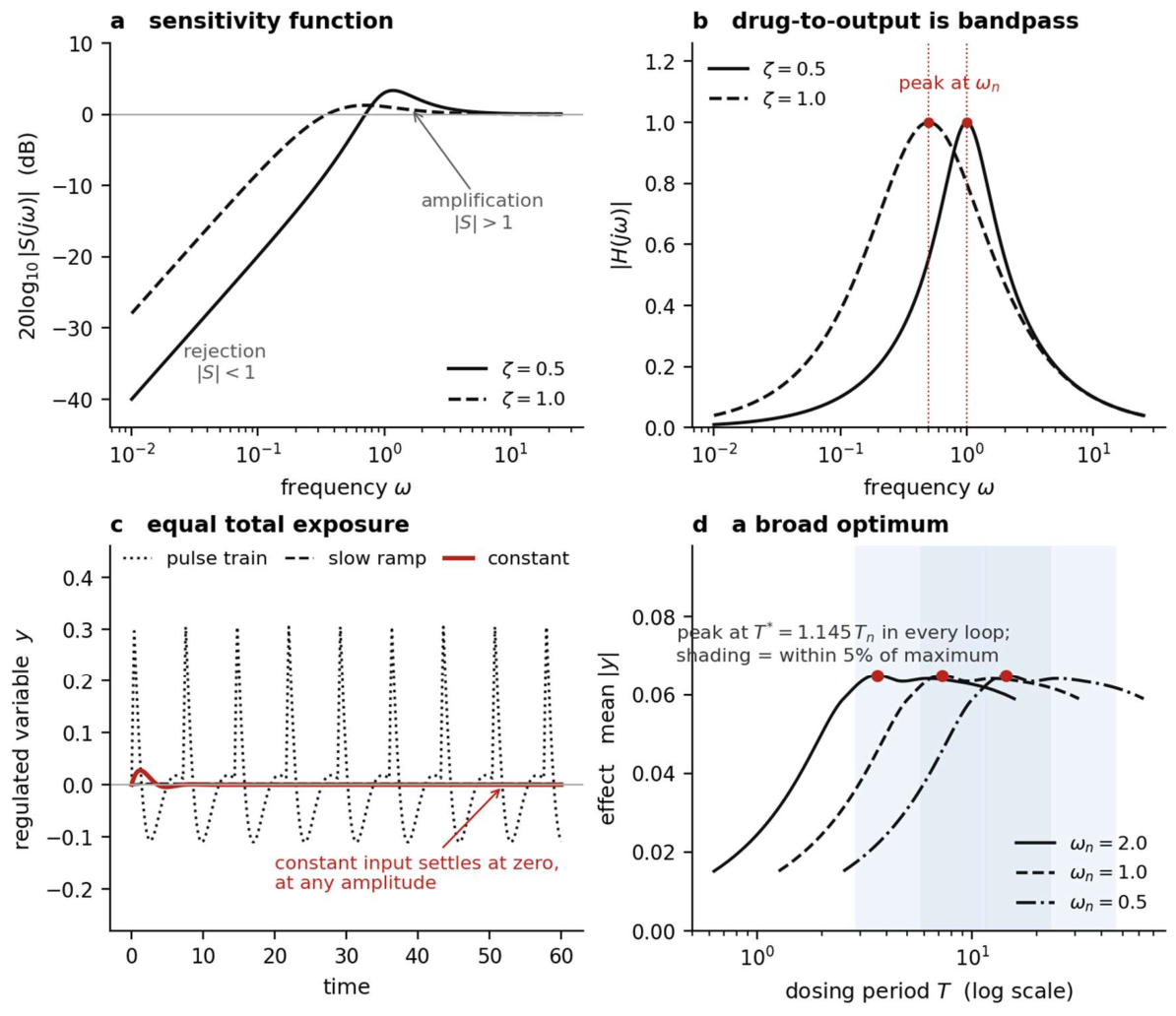
Figure 2.
The loop characterisation procedure. Small calibrated perturbations are delivered across a frequency range; the regulated variable is recorded; ωn and ζ are estimated from the resulting frequency response; the output is a dosing period rather than a dose. The same recording identifies the band in which the loop amplifies rather than rejects.
Figure 2.
The loop characterisation procedure. Small calibrated perturbations are delivered across a frequency range; the regulated variable is recorded; ωn and ζ are estimated from the resulting frequency response; the output is a dosing period rather than a dose. The same recording identifies the band in which the loop amplifies rather than rejects.
Disclaimer/Publisher’s Note: The statements, opinions and data contained in all publications are solely those of the individual author(s) and contributor(s) and not of MDPI and/or the editor(s). MDPI and/or the editor(s) disclaim responsibility for any injury to people or property resulting from any ideas, methods, instructions or products referred to in the content. |
© 2026 by the authors. Licensee MDPI, Basel, Switzerland. This article is an open access article distributed under the terms and conditions of the Creative Commons Attribution (CC BY) license (http://creativecommons.org/licenses/by/4.0/).
Copyright: This open access article is published under a Creative Commons CC BY 4.0 license, which permit the free download, distribution, and reuse, provided that the author and preprint are cited in any reuse.