

Submitted:
05 September 2026
Posted:
07 September 2026
You are already at the latest version
Abstract
The Yang-Baxter equations are important tools in mathematics, physics and computer science. Yang-Baxter equations are recognised as the origin of the theory of quantum groups or quasitriangular Hopf algebras. We propose new solutions for Yang-Baxter equations. Connecting celebrated topics, the current paper also deals with a many circles version of the Johnson–Tzitzeica theorem. Taking as a model some results from the Yang-Baxter theory, a self-dual theorem for cones is stated and proved.
Keywords:
Yang-Baxter equations
; Johnson-Tzitzeica theorems
; Euler formula
MSC: 00A05; 00A27; 16B50; 16T25; 30D05
1. Introduction
The Yang-Baxter equations are important tools in mathematics, physics and computer science (see [1,2,3,4,5,6,7,8]). Their origins are in theoretical physics, in the context of factorisation of S-matrices and in the quantum inverse scattering method. Yang-Baxter equations are recognised as the origin of the theory of quantum groups or quasitriangular Hopf algebras. Some of their solutions are obtained be applying the Euler formula (see [9,12]). The Yang-Baxter equations create a unifying framework for the duality of finite dimensional algebras and finite dimensional coalgebras. This will be briefly explained and new solutions are presented. There exists a unifying equation for the braid condition and the quantum Yang-Baxter equation ([11]), and some solutions for it will be given. The Yang-Baxter equations are important in knot theory and in the theory of braided monoidal categories. We introduce elements of trigonometry in racks, obtain an Euler formula in this context, and find Yang-Baxter operators.
Motivated by the need for developing a general theory of non-commutative principal bundles, entwining structures were introduced as generalised symmetries of such bundles. Entwining structures and categories of modules associated to them have been used to provide a unification of various types of Hopf modules, and led to the revival of the theory of corings.
We will propose a partial dualization of the famous Johnson-Tzitzeica theorem (see, for example, [10,11]). Our new theorem also uses circles of the same radius (see the Figure 1), and its proof is based on the use of the Euler formula:
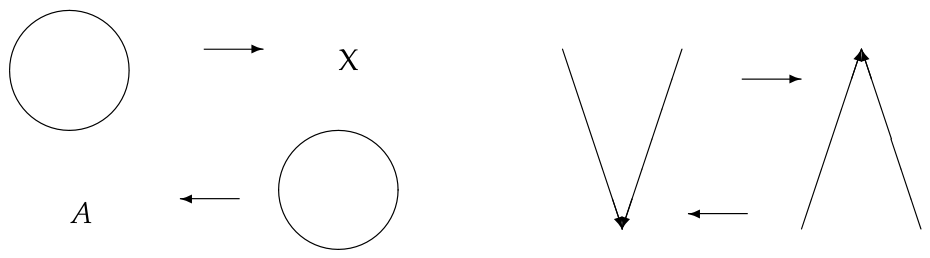
One of the most important dualities happens in the Euclidean plane, when we interchange points with lines. In Section 5, we refer to a duality in which we interchange points with circles. We then present a theorem whose dual is exactly the same theorem. The main reason for this property is the fact that the dual of a cone is also a cone. In this case, cones with different orientation are interchanged.
The concluding section attempts to explain the connection between some of the main topics of the current paper. Our self-dual theorem from Euclidean geometry might be seen as a pictorial illustration for the extension of the duality of finite dimensional algebras and finite dimensional coalgebras.
2. Yang-Baxter Equations
The purpose of this section is threefold: (i) we recall some concepts which will be used later in another framework; (ii) we present new examples of solutions for the (set-theoretic) braid condition; (iii) we discuss about an unifying equation which emerged in a recent paper ([11]).
We adopt the usual terminology: the tensor products are defined over a field k, is the identity map of the k-space V, etc. We denote by the twist map defined by . For a k-linear map, let We denote by a linear map acting on the first and third component of .
Definition 2.1.
A Yang-Baxter operator is k-linear map , which satisfies the braid condition:
(Usually, we also require that the map R is invertible).
Remark 2.2.
If R satisfies (1) then both and satisfy the the quantum Yang-Baxter equation:
Theorem 2.3.
(New solutions for the set-theoretic braid condition)
Let be an element in a Boolean algebra. Then, the map ,
is a solution for the set-theoretic Braid Condition.
Proof.
The computations are quite involved. We will prioritize the ∧ operation.
We will use the following notation in order to simplify the proof: .
Some details in the proof will be omitted.
The right-hand-side reads: .
The left-hand-side reads: . □
Remark 2.4.
Duality Principle ([16]). Let us suppose that a Boolean map
verifies the braid condition. Then its dual,
also verifies the braid condition.
Remark 2.5.
We now apply the Duality Principle to the previous theorem.
So,
It follows that:
Remark 2.6.
The Yang–Baxter equations could be interpreted as unifying structures for the algebra structures and coalgebra structures, using the construction of the self-inverse Yang-Baxter operators from (co)algebra structures (see [17]). The duality of finite dimensional algebras and finite dimensional coalgebras ([18]), can be extended to the category of Yang–Baxter structures, using these self-inverse Yang-Baxter operators ([19]). In a similar manner, in the next section we will consider a geometrical figure which unifies a point and a circle. The duality of points and circles could be extended to a duality which interchanges cones with opposite orientation.
Remark 2.7.
We now consider an unifying equations for the quantum Yang-Baxter equation and the braid condition (UYBC):
Theorem 2.8.
The following new solution for UYBC is proposed below:
, and . We require that and .
Proof.
This can be checked directly. The left hand side reads:
.
The right hand side reads:
. □
Remark 2.9.
If and , then is a solution for the quantum Yang-Baxter equation, the braid condition and UYBC.
Also, if and f is invertible, then is an invertible solution for UYBC.
3. Trigonometry and the Euler Formula in Racks
In this section, we will introduce elements of trigonometry in racks. Then we will obtain an Euler formula in this framework.
3.1. Trigonometry in Racks
Definition 3.1.
A rack is triple , where S is a set with two binary operations, satisfying the following four axioms:
.
The operation is called the main operation, and we will write .
Definition 3.2.
We can define a dual rack with the opposite operations, , where the new operations are the following: and .
We now choose , and let and .
Let be “trigonometric” functions in our rack.
The following properties hold for our “trigonometric” functions:
;
;
.
3.2. The Euler Formula and the Euler Identity in Racks
On the set , we can put a rack structure obtained as the cartesien product of the initial rack with its dual. Let us denote its main operation as follows: .
We now define an “exponential” function on :
.
The “exponential” map has the property: .
There exist a diagonal map . This is a rack morphism because .
Let . Then,
Also,
Theorem 3.3.
The function is a solution for the Quantum Yang-Baxter equation ().
Proof.
⠀
;
.
□
4. On Tzitzeica-Johnson’s Theorem and Pictorial Mathematics
We will borrow the method of Florin Caragiu for presenting the Tzitzeica-Johnson problem and its “relatives” (see [13,14]).
Theorem 4.1.
Three circles of radius r intersect in four points: the pairs of circles intersect in A, B and C, and the common point of intersection of the three circles is denoted by O (see the Figure 2).
Then there exists a circle with radius r, passing through the points A, B and C.
Proof.
We chose a Cartesian coordinate system with the origin O and we use the Euler’s formula. The circles which intersect in O are given by the following equations: , and . The intersections of these circles which differ from O are given by the following complex numbers: , and .
The fourth circle is given by the equation . □
The dual of the Tzitzeica-Johnson theorem (see the Figure 3) is the following.
Theorem 4.2.
Three points, X, Y and Z, are placed on a circle of radius r. Then, the circles of radius r through the pairs of points (X, Y), (X, Z) and (Y,Z ), have a common point of intersection, denoted by O (see the Figure 3).
Proof.
The dual of the Tzitzeica-Johnson theorem can also be proved using the Euler’s formula. On the unit circle we pick three points: , and . The circles throught two of these are given by the following equations: , and .
The conclusion is that the last three circles pass through the point . □
We consider a new theorem, which is related to “The three circles problem”. All the circles have the same radius. The hypothesis of this theorem starts with the following picture (see the Figure 4).
We will add more circles. Let be a circle through C tangent to . Let be a circle through B tangent to (see the Figure 5).
We add circles (Figure 6).
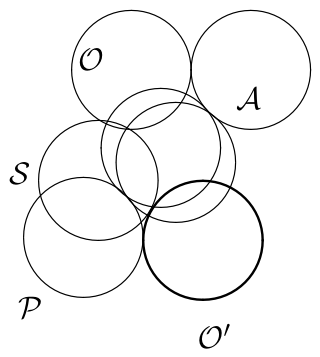
The conclusion of the MCP is that the circle through Q and R is tangent to the circle (Figure 7).
This theorem establishes some kind of partial duality in geometry. We will give its formal statement and its proof below.
Theorem 4.3.
All the circles in this theorem have the same radius. Let and be two tangent cirles, and . Let the circle , tangent to , pass through C, and the circle , tangent to , pass through B. Let the circle pass through B and . Let and . Let the circle be tangent to and .
Then, the circle through R and Q is tangent to the circle .
Proof of MCP.
We now sketch the proof to the The Many Coins Problem (MCP). It will be based on the Euler’s formula [15]. We will change the perspective a little bit in order to simplify the computations. Also, we will use the symmetries of the figure.
Our approach is to choose as the origin of a Cartesian system the center of the circle , and the x-axis to pass through the center of the circle .
The center of the circle will be . The centers of the circle and will be , respectively . The distance from the centers of the circles and will be .
Suppose that the polar coordinates of C and B are and . Then, the coordinates of the center of are (because these coordinates form a rhombus).
By similar arguments, the coordinates of Q and R are and .
The center of the circle is .
Now, the distance between the center of the circle and the center of the circle is:
.
So, the circle through R and Q is tangent to the circle . □
5. A Self-Dual Theorem in Geometry
The unification of the Tzitzeica-Johnson theorem and its dual will be given in terms of right circular cones. We will consider to parallel planes and . Some right circular cones have the bases in the plane and the vertices in the plane . Other right circular cones have the bases in the plane and the vertices in the plane . There exists a duality between upward and downward cones. It could be interpreted as a duality between stalactites (a mineral formation that hangs from the ceiling of a cave) and stalagmites (a mineral formation that rises from the floor to the ceiling of a cave).
Figure 8.
The duality and downward cones.
Theorem 5.1.
Let α and β be two parallel planes.
Let be a right circular cone with the vertex and the base circle .
Let , and be three right circular cones such that and . Let also and .
Let , and be three cones such that , , , , , , and .
Then, there exists a cone of vertex and base the circle such that and .
Proof.
The proof follows from applying both the Tzitzeica-Johnson theorem and its dual.
The Tzitzeica-Johnson theorem takes place in the plane .
The dual of the Tzitzeica-Johnson theorem takes place in the plane . □
Remark 5.2.
Let be a cone of vertex O and base the circle and let be a cone such that and . We denote this commutative relation by: .
The above theorem can be stated using the above notation as follows:
“Let , and . Let , , , , and .
Then there exists a cone such that , and .”
Remark 5.3.
The dual of the above theorem is the theorem itself, because the dual of the cone is also a cone , and, also, if , then .
6. Conclusions
The Yang–Baxter equations could be interpreted as unifying structures for the algebra structures and coalgebra structures. Moreover, the duality of finite dimensional algebras and finite dimensional coalgebras can be extended to the category of Yang–Baxter structures. This duality extension led to a similar construction in geometry. The involutory functor taking points to circles and circles to points can be extended to cones.
There exists a unifying equation for the braid condition and the quantum Yang-Baxter equation. This unification could also be interpreted as a construction which embeds a bijection in an involution.
The new results of the paper are the proofs of the Tzitzeica-Johnson theorem and its dual by using the Euler formula, the MCP (which could be interpreted as a partial duality example), the new solutions for the set-theoretic braid condition, the solution for the UYBC and the example of a self-dual theorem with cones. As a future project, we propose the axiomatization of the cones geometry presented in the previous section.
References
- Yang, C. N. Some exact results for the many-body problem in one dimension with repulsive delta-function interaction. Phys. Rev. Lett. 1967, 19, 1312–1315. [Google Scholar] [CrossRef]
- Baxter, R.J. Exactly Solved Models in Statistical Mechanics; Acad. Press: London, 1982. [Google Scholar]
- Baxter, R.J. Partition function for the eight-vertex lattice model. Ann. Phys. 1972, 70, 193–228. [Google Scholar] [CrossRef]
- Andrusziewicz, R.R.; Smoktunowicz, A. The Yang–Baxter Matrix Equation for Involutions. Miskolc Math. Notes 2022, Vol. 23(No. 1), 61–70. [Google Scholar] [CrossRef]
- Kumar, A.; Cardoso, J.R.; Singh, G. Explicit Solutions of the Singular Yang–Baxter–like Matrix Equation and Their Numerical Computation. Mediterr. J. Math. 2022, volume 19, 85. [Google Scholar] [CrossRef]
- Iordanescu, R.; Nichita, F.F.; Nichita, I.M. The Yang-Baxter Equation, (Quantum) Computers and Unifying Theories. Axioms 2014, 3, 360–368. [Google Scholar] [CrossRef]
- Nichita, F.F. Mathematics and Poetry · Unification, Unity, Union. Sci 2020, 2, 72. [Google Scholar] [CrossRef]
- Nichita, F.F. Unification Theories: Examples and Applications. Axioms 2018, 7, 85. [Google Scholar] [CrossRef]
- Marcus, Solomon; Nichita, Florin. On transcendental numbers: new results and a little history. Axioms 2018, 7, 15. [Google Scholar] [CrossRef]
- Johnson, Roger Arthur. A Circle Theorem. Am. Math. Mon. 1916, 23, 161–162. [Google Scholar] [CrossRef]
- Nichita, F.F. On the Johnson–Tzitzeica Theorem, Graph Theory, and Yang–Baxter Equations. Symmetry 2021, 13, 2070. [Google Scholar] [CrossRef]
- Nichita, F. On Transcendental Numbers. Axioms 2014, 3(1), 64–69. [Google Scholar] [CrossRef]
- Caragiu, F.; Lemeni, A.; Trausan-Matu, S. Language in Mathematics, Science and Artificial Intelligence vs. Language in Theology. In Dialog in Absolut / ieromonah Ghelasie Gheorghe; Platytera: Bucuresti, 2007; pp. 293–3007. [Google Scholar]
- Moise, L.D.; Cristea, R. Titeica - reverbertii si permanente ale geometriei in contemporaneitate. In Proceedings, Conferinta Nationala de Invatamant Virtual; 2013; Volume editia a XI-a, pp. 150–156. [Google Scholar]
- Iordanescu, R.; Nichita, F.F.; Pasarescu, O. Unification Theories: Means and Generalized Euler Formulas. Axioms 2020, 9, 144. [Google Scholar] [CrossRef]
- Kalkan, T.; Nichita, F.F.; Oner, T.; Senturk, I.; Terzier, M. Mathematics and Poetry · Yang–Baxter Equations, Boolean Algebras, and BCK–Algebras. Sci 2022, 4, 16. [Google Scholar] [CrossRef]
- Nichita, F. Self-inverse Yang-Baxter operators from (co)algebra structures. J. Algebra 1999, 218, 738–759. [Google Scholar] [CrossRef]
- Nichita, F. F.; Schack, S. D. The duality between algebras and coalgebras. Ann. Univ. Ferrara-Sez. VII-Sc. Mat. 2005, vol. LI, 173–181. [Google Scholar] [CrossRef]
- Nichita, F. F. On Some Unification Theorems: Yang-Baxter Systems Johnson-Tzitzeica Theorem, Axioms 2025, 14, 156.
Figure 1.
The Many Circles Problem (MCP). The hypothesis and the final mosaic.
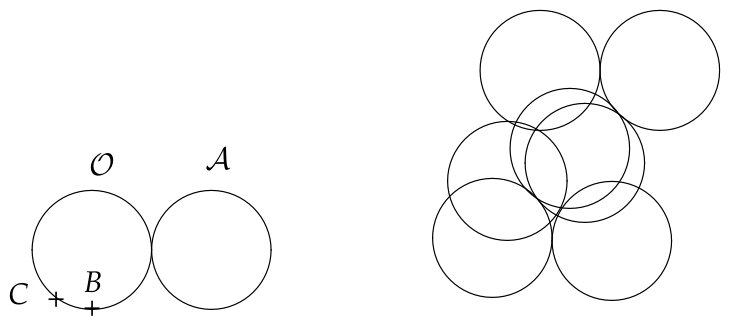
Figure 2.
The three circles problem. Hypothesis and Conclusion.
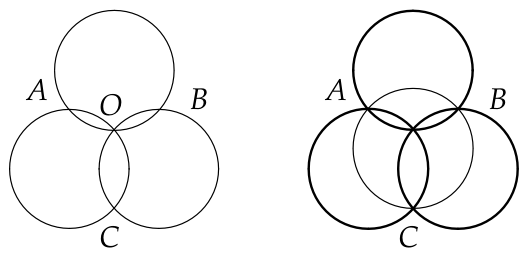
Figure 3.
The dual of the Tzitzeica-Johnson theorem.
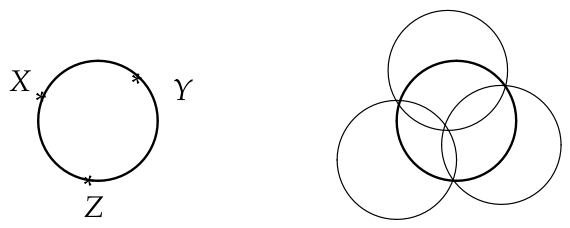
Figure 4.
The hypothesis of the Many Circles Problem (MCP). We begin with 2 circles. The points B and C are taken on the first circle.
Figure 4.
The hypothesis of the Many Circles Problem (MCP). We begin with 2 circles. The points B and C are taken on the first circle.
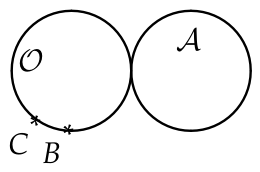
Figure 5.
MCP. A third circle, tangent to , is drawn through the point C. A forth circle, tangent to , is drawn through the point B.
Figure 5.
MCP. A third circle, tangent to , is drawn through the point C. A forth circle, tangent to , is drawn through the point B.
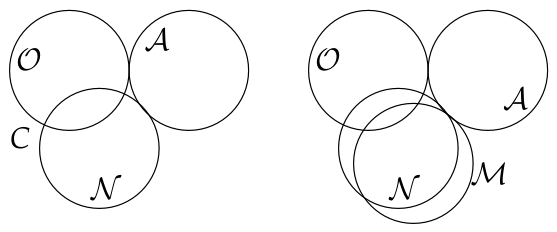
Figure 6.
MCP. A fifth circle, , is drawn through the points B and C. It intersects the circles and in R and Q. A sixth circle, , tangent to the circles and , is drawn.
Figure 6.
MCP. A fifth circle, , is drawn through the points B and C. It intersects the circles and in R and Q. A sixth circle, , tangent to the circles and , is drawn.
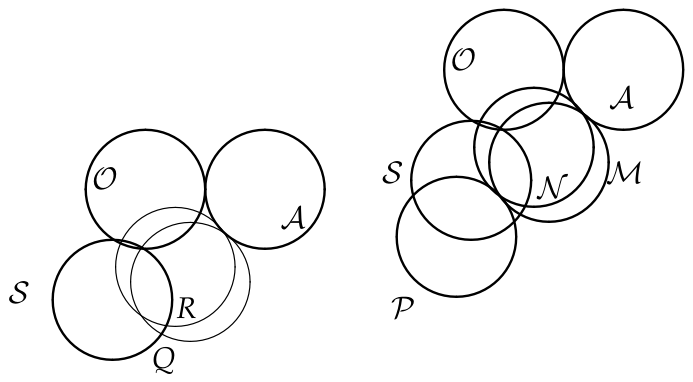
Figure 7.
Conclusion. The circle , through Q and R, is tangent to the circle .
Disclaimer/Publisher’s Note: The statements, opinions and data contained in all publications are solely those of the individual author(s) and contributor(s) and not of MDPI and/or the editor(s). MDPI and/or the editor(s) disclaim responsibility for any injury to people or property resulting from any ideas, methods, instructions or products referred to in the content. |
© 2026 by the authors. Licensee MDPI, Basel, Switzerland. This article is an open access article distributed under the terms and conditions of the Creative Commons Attribution (CC BY) license (http://creativecommons.org/licenses/by/4.0/).
Copyright: This open access article is published under a Creative Commons CC BY 4.0 license, which permit the free download, distribution, and reuse, provided that the author and preprint are cited in any reuse.