

Submitted:
07 September 2026
Posted:
07 September 2026
You are already at the latest version
Abstract
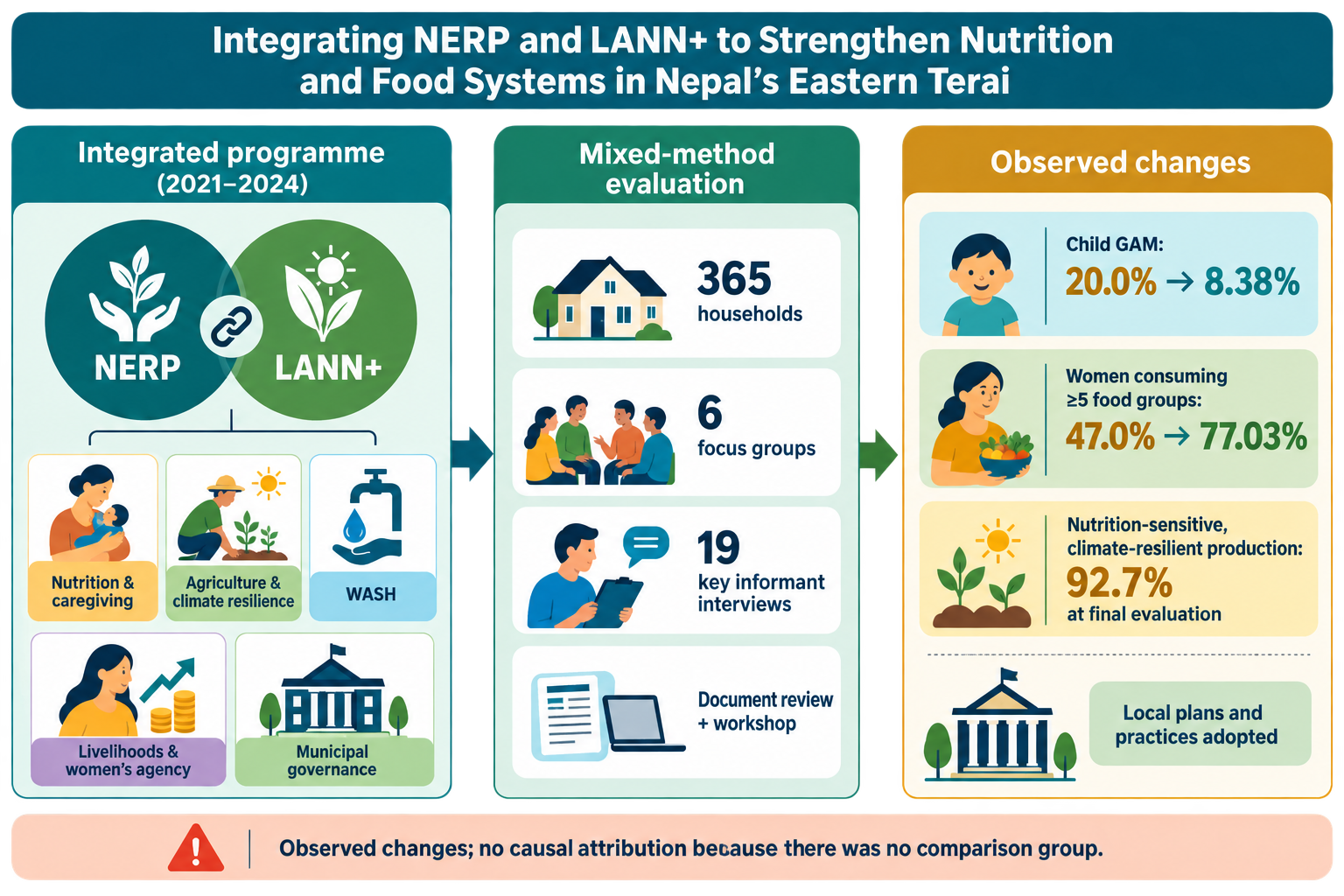
Malnutrition in Nepal’s Eastern Terai is linked not only to food intake and health services but also to the resilience of local food systems, water and sanitation conditions, women’s access to resources, and climate-sensitive agricultural livelihoods. These interdependencies make nutrition programming relevant to planetary health, which considers human health together with the natural and social systems that sustain it. This mixed-methods evaluation examined an integrated Nutrition Education and Rehabilitation Program (NERP) and Linking Agriculture and Natural Resource Management towards Nutrition (LANN+) model implemented in Karjanha, Kalyanpur, and Siraha municipalities from 2021 to 2024. The final evaluation included a household survey of 365 participating households (Kalyanpur n=107, Karjanha n=78, Siraha n=180), six focus group discussions with 69 participants, 19 key informant interviews, document review, and a partner reflection workshop. Endline categorical outcomes were compared across municipalities using Pearson chi-square tests and Cramér’s V. Global Acute Malnutrition among children aged 6–59 months changed from 20.0% at baseline to 8.38% at final assessment. In the directly observed endline survey sample, Minimum Dietary Diversity for Women was 79.3% (242/305) and differed across municipalities (62.2% Kalyanpur, 74.5% Karjanha, 90.6% Siraha; χ²=29.30, p<0.001, V=0.310). Adequate nutrition actions also differed (52.5%, 58.3%, and 82.1%, respectively; χ²=13.35, p=0.001, V=0.300). The Sustainable Integrated Farming System criterion was met by 98.0% of eligible households in Kalyanpur, 96.9% in Karjanha, and 87.7% in Siraha (χ²=11.35, p=0.003, V=0.189), whereas the overall hygiene composite did not differ significantly (p=0.161). Qualitative findings indicated that nutrition gardens, diversified production, NERP/LANN+ learning, women’s economic participation, and municipal planning were perceived as mutually reinforcing, while COVID-19 disruptions, procurement delays, seasonal water constraints, and weak routine water treatment limited implementation. The findings provide municipality-level evidence that integrated nutrition and food-system programming can connect dietary, agricultural, WASH, and governance pathways relevant to planetary health. However, because the evaluation was cross-sectional at endline and lacked a comparison group, the observed changes should not be interpreted as causal effects.
Keywords:
planetary health
; nutrition
; NERP
; LANN+
; climate-resilient agriculture
; food systems
; MDD-W
; WASH
; Nepal
; mixed methods
1. Introduction
Planetary health focuses on safeguarding human health while sustaining the natural systems on which health depends [1]. Malnutrition is therefore not only a biomedical or dietary problem: it is shaped by food production, climate variability, land and water resources, livelihoods, sanitation, gender relations, and the capacity of local institutions to manage these interacting systems. Nutrition-sensitive programmes can complement direct nutrition interventions by addressing these underlying determinants through agriculture, livelihoods, women’s empowerment, education, social protection, and WASH [2,3].
Agriculture is especially important in rural and low-income settings because it affects what households produce and consume, their incomes and market access, women’s time and control over resources, and exposure to environmental risks. Systematic reviews show that agriculture programmes can improve production, access to nutrient-dense foods, and dietary diversity, although effects on child anthropometry are less consistent [4,5,6]. This suggests that agricultural production is more likely to support nutrition when nutrition objectives are explicit and when production is linked with behaviour change, health, caregiving, and WASH [2,5,6].
These relationships are particularly relevant in South Asia, where climate-sensitive agriculture, social exclusion, land constraints, and persistent maternal and child undernutrition overlap. Evidence from Nepal has linked agricultural production diversity and women’s empowerment with maternal and child nutrition outcomes [8,9], while large multisectoral programmes have shown that nutrition, WASH, food security, social and behaviour change, and governance can be delivered together at scale [10]. WASH remains an important pathway because exposure to unsafe water, sanitation, and hygiene can undermine nutrition through infection and enteric disease, even when diets improve [11,12,13].
The study was conducted in Karjanha, Kalyanpur, and Siraha municipalities of Siraha District, Madhesh Province, within the Kamala River Basin. The project ran from 1 March 2021 to 31 December 2024 and targeted nutritionally vulnerable women and children, smallholders cultivating less than 0.2 hectares, landless households, and local-government actors. The intervention combined Sustainable Integrated Farming Systems (SIFS), Farmer Field Schools, nutrition gardens, crop diversification, soil and water conservation, irrigation, poultry, leasehold and riverbed farming, livelihood support, NERP, LANN+, hygiene promotion, nutrition screening, and local nutrition-governance activities. The three municipalities were included because they were the complete set of project municipalities; they were not selected as a representative sample of all municipalities in Madhesh Province.
NERP and LANN+ formed the principal link between immediate nutrition needs and longer-term food-system resilience. NERP focused on caregiver counselling, practical rehabilitation and learning for families of malnourished children, while LANN+ linked nutrition and dietary diversity with agriculture, natural-resource management, hygiene, and participatory community learning. From a planetary-health perspective, the model is relevant because it attempts to improve human nutrition while simultaneously changing how households manage food production, soil and water resources, external farm inputs, sanitation, and local institutions. The evaluation did not measure ecological endpoints such as greenhouse-gas emissions, biodiversity, soil carbon, or water footprints; its planetary-health contribution is therefore assessed through these proximate food-system and environmental-resilience pathways rather than direct ecological outcomes.
This study addressed four questions: (1) What changes in nutrition, dietary diversity, hygiene, climate-resilient food production, livelihoods, and nutrition governance were observed over the project period? (2) How did key endline survey outcomes differ across Karjanha, Kalyanpur, and Siraha municipalities? (3) What qualitative findings and implementation challenges help explain the observed patterns and prospects for sustainability? and (4) What do these findings contribute to understanding integrated nutrition and food-system programming from a planetary-health perspective?
2. Materials and Methods
2.1. Study Setting and Intervention
The project operated across 45 wards in Karjanha, Kalyanpur, and Siraha municipalities. Project targets included approximately 3,500 children younger than five and their mothers or guardians, 3,000 smallholder households, 500 landless households, and about 450 elected or government representatives. Activities were implemented by Aasaman Nepal with technical and financial support from Welthungerhilfe Nepal. Selected advocacy and nutrition-governance activities also reached district, provincial, and federal stakeholders.
The intervention package had three linked components. First, SIFS and Farmer Field Schools promoted nutrition gardens, vegetable and fruit production, mixed cropping, crop rotation, intercropping, composting, soil and water conservation, irrigation, indigenous crops, poultry, kitchen ponds, leasehold and riverbed farming, and women-friendly technologies. Second, NERP and LANN+ combined direct nutrition education, acute-malnutrition screening and referral, infant and young-child feeding, dietary-diversity learning, and hygiene promotion. Third, nutrition profiles, food and nutrition security plans, policy dialogue, municipal advisory mechanisms, and citizen participation were used to strengthen local nutrition governance. Direct nutrition interventions are supported by evidence on maternal and child nutrition [14], while diversified household food production can improve access to nutrient-rich foods when combined with nutrition education [4,5,6,7].
2.2. Study Design and Data Provenance
The study is based on the independent external final evaluation of the project. The evaluation used a cross-sectional mixed-methods design with summative and formative purposes. It combined a household survey, focus group discussions (FGDs), key informant interviews (KIIs), document review, and a reflection workshop. The external evaluation is treated in this manuscript as the underlying study and data source rather than as an external bibliographic reference; therefore, study findings are reported directly and the evaluation report is not included in the reference list.Baseline and final project indicators are presented as descriptive changes over time; because the baseline and final measurements were not repeated observations from the same cohort and no control group was used, they are not analysed as causal intervention effects.
2.3. Household Survey and Sampling
The household sampling frame consisted of 3,679 participating households. A finite-population calculation using a 95% confidence level, an assumed proportion of 50%, and a 5% margin of error yielded an initial sample of 348 households. Allowing approximately 5% for non-response produced a planned sample of about 366; 365 household interviews were completed. Sample allocation was proportional to municipality and participant category. The final sample comprised 107 households in Kalyanpur, 78 in Karjanha, and 180 in Siraha. Wards and communities were selected to provide geographic coverage of smallholder and landless participant groups; within selected communities, enumerators proceeded from the first accessible participating household until the required community quota was achieved. Thus, the survey supports comparison among surveyed project households but should not be interpreted as a fully probability-based population estimate for each municipality.
The questionnaire covered household demographics and vulnerability, landholding and livelihoods, food sufficiency and income, SIFS and climate-resilient agriculture, infant and young-child feeding and care, women’s dietary diversity, water treatment and storage, sanitation and hygiene, women’s participation and decision-making, and engagement with local planning. Indicator-specific denominators were used. SIFS analyses included 317 eligible smallholder/SIFS-LANN households (Kalyanpur n=98, Karjanha n=64, Siraha n=155); child-nutrition analyses included 148 eligible households (40, 24, and 84, respectively); and MDD-W analyses included 305 women aged 15–49 years (90, 55, and 160, respectively).

Table 1.
Household survey sample and selected respondent characteristics by municipality.
| Characteristic | Total | Kalyanpur | Karjanha | Siraha |
| Household survey sample, n | 365 | 107 | 78 | 180 |
| Female respondents, % | 95% | 100 | 73 | 174 |
| Male respondents, % | 5% | 7 | 5 | 6 |
Overall, 95% of household respondents were women; 58% belonged to Dalit, ethnic, or Muslim groups, 13.15% were landless, the mean respondent age was 36.73 years, and 60.27% were household heads. These characteristics reflect the project’s deliberate focus on women, smallholders, landless households, and socially excluded groups.
2.4. Qualitative Sampling and Data Collection
Qualitative sampling was purposive and designed to capture the perspectives of the main intervention groups and institutional actors. Six FGDs involved 69 participants, of whom 63 (91.3%) were women. Two FGDs were conducted in each municipality and included SIFS members, LANN+ members, and landless participants. Nineteen KIIs included four elected representatives (two Deputy Mayors and two Ward Chairpersons), seven municipal or government officials from health and agriculture, three Welthungerhilfe/Aasaman Nepal staff including a Community Nutrition Facilitator, and five project participants including a Local Resource Person. Eight KII participants were women. A partner reflection workshop was also used to identify implementation successes, challenges, and lessons.
Table 2.
Composition of focus group discussions.
| Municipality | Location | Participant group | Male | Female | Total |
| Karjanha | Simra | LANN+ group | 0 | 14 | 14 |
| Karjanha | Simra | Landless group | 0 | 10 | 10 |
| Kalyanpur | Baniniya | SIFS group | 2 | 11 | 13 |
| Kalyanpur | Dumri | Landless/LANN+ group | 0 | 9 | 9 |
| Siraha | Kharsalwa | LANN+ group | 3 | 9 | 12 |
| Siraha | Naraiya | SIFS group | 1 | 10 | 11 |
| Total | 6 | 63 | 69 |
2.5. Data Management and Analysis
Survey records were reviewed, cleaned, and tabulated by the evaluation team, and the qualitative interviews and FGDs were transcribed for thematic analysis. For this manuscript, categorical endline outcomes were summarized as n/N (%) and compared across municipalities using Pearson chi-square tests of independence. Cramér’s V was used to quantify the strength of municipality-outcome associations, and statistical significance was assessed at p<0.05. Expected cell counts were checked; tests with sparse expected cells are reported with caution. Because the design is cross-sectional at endline, significant municipality differences indicate association rather than causal effects of municipality or intervention exposure.
The main relational analyses focused on four composite outcomes: MDD-W, adequate nutrition actions, adequate hygiene actions, and the SIFS nutrition-sensitive/climate-resilient production criterion. Component indicators were then examined to identify which practices contributed to municipality patterns. Women’s dietary diversity was defined as consumption of at least five of ten standard food groups in the previous 24 hours, consistent with the MDD-W measurement approach [15]. The project-level logframe reported 77.03% of 3,500 targeted women meeting the dietary-diversity requirement, whereas the direct endline survey sample yielded 242/305 (79.3%); municipality analyses use the directly observed survey denominator.
Qualitative data were organized into themes covering relevance, behaviour change, agriculture and food production, WASH, women’s agency, governance, implementation constraints, and sustainability. Findings were triangulated with household survey patterns. Qualitative evidence was used to identify plausible mechanisms and contextual explanations, not to establish causality.
2.6. Implementation Context and Study Limitations
Several implementation and evaluation challenges affected both programme exposure and interpretation. COVID-19 disrupted early planning, municipal coordination, community nutrition and WASH campaigns, training, and advisory meetings. Procurement delays reduced the time that some households had to use seeds, irrigation equipment, and other inputs. Seasonal water scarcity and dependence on wage labour constrained some households’ ability to adopt recommended practices. The evaluation also reported agronomic difficulties with zero-tillage approaches, including weeds, pests, and soil compaction, and noted that routine drinking-water purification remained weak.
The final evaluation field visit was postponed by approximately three weeks because of project-closure priorities and the Tihar and Chhath festival period. Multi-criteria indicators required repeated household visits to complete missing information, and some project and financial documents became available later than planned. These constraints were mitigated through follow-up interviews and triangulation, but they should be considered when interpreting the findings.
The study has four principal analytical limitations. First, there was no control or comparison group and the same households were not followed longitudinally, so baseline-to-final changes cannot be attributed solely to the project. Second, the final household survey was not fully probability-based within each selected community. Third, several composite indicators used multiple criteria and different eligibility denominators, which limits direct comparison across indicators. Fourth, some municipality contingency tables contained small expected counts; those chi-square results are interpreted cautiously. In addition, the study measured climate-resilient practices but did not quantify environmental outcomes such as emissions, biodiversity, soil health, or water-use efficiency.
3. Results
3.1. Descriptive Changes over the Project Period
Across the project period, large descriptive changes were recorded in acute malnutrition, dietary diversity, nutrition practices, hygiene, and nutrition-sensitive agriculture. These values combine different project monitoring and evaluation sources and should be interpreted as programme trends rather than causal effect estimates.
Table 3.
Baseline and final values for selected project indicators.
| Indicator | Baseline | Final study value |
| Global Acute Malnutrition among children aged 6–59 months | 20.0% | 8.38% |
| Targeted women meeting ≥5 food-group dietary requirement (project-level indicator) | 47.0% | 77.03%* |
| SIFS nutrition-sensitive and climate-resilient production criterion | 3.0% | 92.7% (294/317) |
| Adequate nutrition actions composite | 12.0% | 70.3% (104/148) |
| Adequate hygiene actions composite | 65.0% | 95.6% (349/365) |
| Growth monitoring during previous year | 62.7% | 87.2% |
*The project-level logframe value is 2,696/3,500=77.03%. The directly observed endline survey sample for MDD-W was 242/305=79.3% and is used for municipality-level inferential analysis. Source: study baseline records, GAM assessment, and 2024 evaluation household survey.
3.2. Municipality Differences in Key Outcomes
The endline survey showed substantial municipality heterogeneity. MDD-W, the adequate nutrition-actions composite, and SIFS achievement differed significantly across the three municipalities, whereas the overall hygiene composite did not. Siraha recorded the highest MDD-W and nutrition-action prevalence, while SIFS composite achievement was highest in Kalyanpur and Karjanha. This pattern indicates that municipalities did not perform uniformly across domains; stronger nutrition results in Siraha coexisted with lower SIFS composite achievement.
Table 4.
Municipality-wise key endline outcomes and relational analysis.
| Outcome | Kalyanpur n/N (%) | Karjanha n/N (%) | Siraha n/N (%) | χ² | df | p-value | Cramér’s V |
| MDD-W ≥5 food groups | 56/90 (62.2) | 41/55 (74.5) | 145/160 (90.6) | 29.30 | 2 | <0.001 | 0.310 |
| Adequate nutrition actions | 21/40 (52.5) | 14/24 (58.3) | 69/84 (82.1) | 13.35 | 2 | 0.001 | 0.300 |
| Adequate hygiene actions | 105/107 (98.1) | 72/78 (92.3) | 172/180 (95.6) | 3.65 | 2 | 0.161 | 0.100 |
| SIFS composite criterion | 96/98 (98.0) | 62/64 (96.9) | 136/155 (87.7) | 11.35 | 2 | 0.003 | 0.189 |
Pearson chi-square tests compare municipality and binary outcome status. SIFS and hygiene composite tests included one or more expected cells below five and should be interpreted cautiously.
3.3. Nutrition and Dietary Diversity
Among 305 women aged 15–49 years with valid dietary-diversity data, 242 (79.3%) met MDD-W. The proportion rose from 62.2% in Kalyanpur to 74.5% in Karjanha and 90.6% in Siraha (p<0.001, V=0.310). Among 148 households with eligible young children, 70.3% met the adequate nutrition-actions composite, again with a marked municipality gradient: 52.5% in Kalyanpur, 58.3% in Karjanha, and 82.1% in Siraha (p=0.001, V=0.300).
Component analysis showed that breastfeeding criteria differed significantly (57.5% Kalyanpur, 87.5% Karjanha, 86.9% Siraha; p<0.001) and Vitamin A-related prevention/control practices were substantially higher in Siraha (54.8%) than in Kalyanpur (17.5%) or Karjanha (16.7%; p<0.001). In contrast, complementary-feeding criteria (p=0.220) and care of sick or malnourished children (p=0.825) did not differ significantly. These results suggest that the overall municipality difference in the nutrition composite was driven by specific practices rather than uniform differences across all nutrition behaviours.
3.4. WASH and Hygiene
The overall hygiene composite was high in all three municipalities and did not differ statistically (p=0.161). However, the underlying components showed contrasting patterns. Handwashing with soap at critical times was highest in Karjanha (87.2%) compared with Kalyanpur (60.7%) and Siraha (62.2%; p<0.001). Conversely, the combined criterion for improved water source, water treatment/purification, and safe storage was much lower in Karjanha (9.0%) than in Kalyanpur (39.3%) or Siraha (50.6%; p<0.001, V=0.330). Latrine use and proper faeces disposal were high and did not differ significantly (p=0.279). Thus, the high composite hygiene score masked important municipality-specific gaps in drinking-water management.
3.5. Nutrition-Sensitive and Climate-Resilient Agriculture
Among 317 eligible smallholder/SIFS-LANN households, 294 (92.7%) met the SIFS composite criterion. Achievement was 98.0% in Kalyanpur, 96.9% in Karjanha, and 87.7% in Siraha (p=0.003, V=0.189). The municipality pattern was not driven by every component. Inter-subsystem resource flow, crop diversity, training received, and the no-external-food-input criterion showed no statistically significant municipality difference, whereas group/cooperative participation, soil-water conservation, the required number of farming subsystems, reliance on external farm inputs, and income from agricultural sales differed.
Table 5.
Selected component indicators underlying municipality differences.
| Component indicator | Kalyanpur % | Karjanha % | Siraha % | χ² | p-value | V |
| Breastfeeding | 57.5 | 87.5 | 86.9 | 15.38 | <0.001 | 0.322 |
| Complementary feeding | 67.5 | 70.8 | 81.0 | 3.03 | 0.220 | 0.143 |
| Vitamin A practices | 17.5 | 16.7 | 54.8 | 21.66 | <0.001 | 0.383 |
| Handwashing with soap | 60.7 | 87.2 | 62.2 | 18.15 | <0.001 | 0.223 |
| Safe water treatment/storage | 39.3 | 9.0 | 50.6 | 39.85 | <0.001 | 0.330 |
| Soil-water conservation | 88.8 | 70.3 | 86.5 | 11.23 | 0.004 | 0.188 |
| No external farm inputs | 91.8 | 100.0 | 63.2 | 50.84 | <0.001 | 0.400 |
| Income from farm sales | 34.7 | 14.1 | 31.6 | 8.99 | 0.011 | 0.168 |
3.6. Qualitative Findings Across Municipalities
The qualitative findings provided evidence for several pathways linking the quantitative outcomes. Across municipalities, participants described nutrition gardens, diversified crops, locally available foods, and repeated group learning as practical ways to connect agricultural production with household diets. In Simra, Karjanha, one FGD participant summarized the dietary shift by saying that salt had been “replaced by green vegetables.” Health and municipal respondents also described NERP as a practical approach for families with malnourished children because it combined counselling with locally available foods and links to screening and health services.
Women’s participation emerged as both a social and nutrition-related pathway. In Kalyanpur, municipal respondents described women gaining access to their own resources through vegetable sales and small enterprises and receiving greater respect within households. These accounts were consistent with the survey’s predominantly female respondent profile and with broader qualitative reports of increased confidence, purchasing power, and participation in household decision-making.
Local governance was also perceived as part of the intervention mechanism. In Siraha, an agriculture technical officer described municipal involvement in planning and monitoring and reported learning from the project. Across the three municipalities, nutrition profiles, food and nutrition security plans, municipal advisory processes, and coordination with health and agriculture sections were used to link community practices with local planning and resource allocation. The evaluation also found that many SIFS and LANN+ groups had been registered with municipalities, potentially improving access to future technical and financial support.
The qualitative data also help interpret why municipality results were not uniform. Different practices appear to have been taken up at different intensities: Karjanha had the strongest handwashing-with-soap result but the weakest combined water-treatment/storage result; Siraha had the strongest MDD-W and nutrition composite results but the lowest SIFS composite; and Kalyanpur showed strong SIFS performance but lower breastfeeding and MDD-W. The evaluation did not collect sufficiently detailed baseline municipality profiles to attribute these differences to a single cause. Plausible explanations include differences in local service availability, exposure to specific activities, group functioning, household composition, water constraints, and municipal follow-up. These should be treated as hypotheses supported by triangulation rather than causal explanations.
3.7. Implementation Challenges and Their Influence on Findings
COVID-19 affected early coordination and reduced or delayed some community campaigns, training events, and municipal meetings. Procurement delays shortened the time during which households could use some agricultural inputs and irrigation support. Seasonal water scarcity, wage-labour dependence, and constraints in zero-tillage practices influenced households’ capacity to adopt all promoted practices. The evaluation also noted low routine use of purified drinking water, which is consistent with the municipality-level water-treatment gap observed in the survey. These implementation constraints mean that endline outcomes reflect variable intensity and duration of exposure, not a uniform intervention dose.
Evaluation logistics also influenced the study process. Final fieldwork was postponed by approximately three weeks because of project closure activities and major festivals, and multi-criteria indicators required repeated visits to complete data. Although follow-up interviews, data cleaning, and triangulation were used to strengthen data quality, these factors reinforce the need for cautious interpretation of small municipality differences and for clearer prospective monitoring protocols in future evaluations.
4. Discussion
The revised analysis strengthens the evidence beyond descriptive project percentages by showing that endline outcomes differed across municipalities and that the direction of difference varied by domain. Siraha had the highest MDD-W and nutrition-action prevalence, Kalyanpur and Karjanha had higher SIFS composite achievement, and the overall hygiene composite was similarly high across municipalities despite major differences in its water-treatment and handwashing components. These findings are important because they show that an integrated programme should not be interpreted as producing a single, uniform “nutrition result.” Instead, nutrition, WASH, and climate-resilient food-production pathways can move differently within the same programme area.
This heterogeneity is directly relevant to planetary health. Planetary health emphasizes that human health depends on functioning natural and social systems [1]. The NERP–LANN+ model operationalized this idea at local level by linking dietary adequacy and child nutrition with food production, soil and water conservation, reduced external farm inputs, sanitation, household behaviour, women’s agency, and municipal governance. The study therefore contributes implementation evidence on how a planetary-health-oriented nutrition model can be translated into community and municipal practice. At the same time, the absence of direct ecological measurements means that the findings demonstrate pathway alignment with planetary health rather than measured environmental benefit.
The dietary-diversity findings are compatible with evidence that household food production and diversified agriculture can improve access to nutrient-rich foods, particularly when agricultural support is combined with nutrition education and behaviour change [4,5,6,7]. Evidence from Nepal also indicates that agricultural diversity and women’s empowerment can influence maternal and child nutrition pathways [8,9]. In the present study, the highest MDD-W result occurred in Siraha even though SIFS composite achievement was lower there than in the other municipalities. This is a useful caution against assuming that a single agricultural composite maps directly onto dietary diversity. Markets, household purchasing, women’s control over food and income, health services, and nutrition learning may all mediate the relationship between production and diet.
The component-level WASH results provide a similar lesson. The overall hygiene composite exceeded 90% in every municipality, but Karjanha combined high handwashing-with-soap performance with very low achievement of the water-source/treatment/storage criterion. This matters because WASH influences nutrition through multiple exposure pathways [11,12,13]; a high composite score can conceal a specific environmental-health risk. Future monitoring should therefore report key WASH components alongside composite indicators, particularly drinking-water treatment and safe storage.
The large increase in the SIFS composite from 3.0% at baseline to 92.7% at final evaluation suggests widespread adoption of promoted practices, but municipality analysis shows that adoption was not uniform. Siraha’s lower score was accompanied by lower group/cooperative participation and greater reliance on external farm inputs, whereas Karjanha had weaker soil-water conservation and fewer farming subsystems. These differences are programmatically important because climate resilience is not a single behaviour; it depends on combinations of soil and water management, diversification, resource cycling, social organization, and market conditions. Future evaluations should retain these component measures rather than relying only on the composite.
The decline in GAM from 20.0% to 8.38% is encouraging and was below the project target of 9%. Direct nutrition interventions, including appropriate feeding, maternal nutrition support, and management of acute malnutrition, can improve child nutrition outcomes [14]. The evaluation’s qualitative evidence also suggests that NERP helped caregivers link screening, counselling, and locally available foods. However, the study design cannot determine how much of the GAM change was related to NERP, LANN+, SIFS, WASH improvements, health services, secular trends, or other factors. A prospective cohort of children enrolled in NERP, ideally with an appropriate comparison group, would be needed for stronger inference.
The qualitative evidence supports the plausibility of an integrated pathway: participants connected nutrition gardens and crop diversity with household diets; women described greater economic participation and decision-making; and municipal respondents described integration of nutrition and agriculture activities into planning. Yet the same qualitative evidence also identifies threats to sustainability, including limited municipal resources, competing priorities, the need to finance screening and NERP after project closure, high production costs, and limited follow-up for new technologies. Sustained planetary-health benefits therefore depend on institutionalization and financing, not only on household behaviour change.
The study also has implications for evaluation design. Composite indicators should be accompanied by transparent definitions, denominators, and component results; municipality comparisons should be planned prospectively; baseline measures should use the same indicator construction as endline; and ecological outcomes should be added when a project is framed in planetary-health terms. Relevant future measures could include soil organic matter, irrigation-water efficiency, crop and dietary diversity, pesticide/fertilizer use, seasonal water security, and livelihood resilience alongside anthropometry and dietary outcomes.
5. Conclusions
The NERP–LANN+ model in Siraha linked direct nutrition learning and rehabilitation with climate-resilient agriculture, WASH, livelihoods, women’s participation, and municipal governance. The final evaluation documented lower GAM than at baseline and high endline levels of dietary diversity, nutrition practices, hygiene, and SIFS adoption. Relational analysis showed, however, that these outcomes differed across municipalities: Siraha performed strongest on MDD-W and nutrition actions, Kalyanpur and Karjanha on the SIFS composite, and the overall hygiene composite did not differ significantly.
These cross-domain patterns are the study’s main contribution to planetary-health knowledge. They show that improvements in human nutrition, environmental-resilience practices, and WASH do not necessarily advance uniformly and that composite indicators can mask important local gaps. Integrated programmes therefore need municipality-specific monitoring and adaptation rather than assuming one common implementation pathway.
The findings should not be interpreted as causal effects because the evaluation lacked a control group, did not follow a longitudinal cohort, and did not directly measure ecological outcomes. Future research should combine repeated household and child measurements with appropriate comparison designs and explicit environmental indicators. For implementation, municipal financing, early registration and linkage of community groups, routine integration of NERP and screening into health systems, stronger drinking-water management, market support, and continued technical follow-up are priorities for sustaining the integrated approach.
Author Contributions
Conceptualization, A.Y., M.R. and co-authors; methodology and evaluation oversight, T.P. and the external evaluation team; investigation and primary data collection, external evaluation team; resources and project implementation, Welthungerhilfe Nepal and Aasaman Nepal; statistical re-analysis and manuscript preparation, A.Y. and co-authors; writing—original draft preparation, A.Y. and M.R.; writing—review and editing, all authors; supervision, T.P. All authors have read and agreed to the published version of the manuscript.
Funding
Building Livelihood Resilience + Nutrition Security in Kamala River Basin, Siraha, Phase II (Project NPL 1070-19) received funding from the German Federal Ministry for Economic Cooperation and Development (BMZ) through Welthungerhilfe. Welthungerhilfe Nepal commissioned the independent final external evaluation.
Institutional Review Board Statement
The study was conducted as an external programme evaluation. The evaluation protocol included consent, confidentiality, and data-protection procedures during enumerator training and fieldwork. The evaluation documentation does not report a formal institutional review board approval number.
Informed Consent Statement
Informed consent was obtained from participants before household surveys, focus group discussions, and key informant interviews, in accordance with the evaluation protocol.
Data Availability Statement
The household survey dataset, FGD and KII materials, case studies, and related evaluation records are held by the responsible project organizations and are not publicly archived because they contain potentially identifiable programme-participant information. Reasonable requests for de-identified data may be directed to the corresponding author and will be considered subject to consent, confidentiality, organizational approval, and data-protection requirements.
Acknowledgments
The authors thank the participating households, women’s groups, farmers, landless groups, Community Nutrition Facilitators, Local Resource Persons, health workers, agriculture personnel, elected representatives, and municipal officials who contributed to the project and evaluation. We also acknowledge Aasaman Nepal and the independent external evaluation team from Jamarko Nepal Consultant Pvt. Ltd. for implementation and data collection. During preparation of this manuscript, the authors used ChatGPT (OpenAI) to assist with language editing and restructuring. Generative AI was not used to generate research data or alter study findings; all AI-assisted text was reviewed and verified by the authors.
Conflicts of Interest
The authors are affiliated with Welthungerhilfe Nepal, which provided technical and financial support to the project and commissioned the independent external evaluation. Primary evaluation data collection and the final external evaluation were conducted by an external evaluation team. The authors are responsible for the secondary analysis and interpretation presented in this manuscript.
Abbreviations
BMZ — German Federal Ministry for Economic Cooperation and Development; CNF — Community Nutrition Facilitator; FGD — Focus Group Discussion; GAM — Global Acute Malnutrition; GESI — Gender Equality and Social Inclusion; KII — Key Informant Interview; LANN+ — Linking Agriculture and Natural Resource Management towards Nutrition; LRP — Local Resource Person; MDD-W — Minimum Dietary Diversity for Women; NERP — Nutrition Education and Rehabilitation Program; SIFS — Sustainable Integrated Farming System; WASH — Water, Sanitation, and Hygiene; WHH — Welthungerhilfe.
References
- Whitmee, S.; Haines, A.; Beyrer, C.; Boltz, F.; Capon, A.G.; de Souza Dias, B.F.; Ezeh, A.; Frumkin, H.; Gong, P.; Head, P.; et al. Safeguarding human health in the Anthropocene epoch: Report of The Rockefeller Foundation–Lancet Commission on planetary health. Lancet 2015, 386, 1973–2028. [Google Scholar] [CrossRef] [PubMed]
- Ruel, M.T.; Alderman, H. Maternal and Child Nutrition Study Group. Nutrition-sensitive interventions and programmes: How can they help to accelerate progress in improving maternal and child nutrition? Lancet 2013, 382, 536–551. [Google Scholar] [CrossRef] [PubMed]
- Gillespie, S.; van den Bold, M. Agriculture, food systems, and nutrition: Meeting the challenge. Glob. Chall. 2017, 1, 1600002. [Google Scholar] [CrossRef] [PubMed]
- Masset, E.; Haddad, L.; Cornelius, A.; Isaza-Castro, J. Effectiveness of agricultural interventions that aim to improve nutritional status of children: Systematic review. BMJ 2012, 344, d8222. [Google Scholar] [CrossRef] [PubMed]
- Girard, A.W.; Self, J.L.; McAuliffe, C.; Olude, O. The effects of household food production strategies on the health and nutrition outcomes of women and young children: A systematic review. Paediatr. Perinat. Epidemiol. 2012, 26 (Suppl. 1), 205–222. [Google Scholar] [CrossRef] [PubMed]
- Pandey, V.L.; Dev, S.M.; Jayachandran, U. Impact of agricultural interventions on the nutritional status in South Asia: A review. Food Policy 2016, 62, 28–40. [Google Scholar] [CrossRef] [PubMed]
- Olney, D.K.; Pedehombga, A.; Ruel, M.T.; Dillon, A. A 2-year integrated agriculture and nutrition and health behavior change communication program targeted to women in Burkina Faso reduces anemia, wasting, and diarrhea in children 3–12.9 months of age at baseline: A cluster-randomized controlled trial. J. Nutr. 2015, 145, 1317–1324. [Google Scholar] [CrossRef] [PubMed]
- Shively, G.; Sununtnasuk, C. Agricultural diversity and child stunting in Nepal. J. Dev. Stud. 2015, 51, 1078–1096. [Google Scholar] [CrossRef]
- Malapit, H.J.L.; Kadiyala, S.; Quisumbing, A.R.; Cunningham, K.; Tyagi, P. Women’s empowerment mitigates the negative effects of low production diversity on maternal and child nutrition in Nepal. J. Dev. Stud. 2015, 51, 1097–1123. [Google Scholar] [CrossRef]
- Cunningham, K.; Singh, A.; Pandey Rana, P.; Brye, L.; Alayon, S.; Lapping, K.; Gautam, B.; Underwood, C.; Klemm, R. Suaahara in Nepal: An at-scale, multi-sectoral nutrition program influences knowledge and practices while enhancing equity. Matern. Child Nutr. 2017, 13, e12415. [Google Scholar] [CrossRef] [PubMed]
- Cumming, O.; Cairncross, S. Can water, sanitation and hygiene help eliminate stunting? Current evidence and policy implications. Matern. Child Nutr. 2016, 12 (Suppl. 1), 91–105. [Google Scholar] [CrossRef] [PubMed]
- Luby, S.P.; Rahman, M.; Arnold, B.F.; Unicomb, L.; Ashraf, S.; Winch, P.J.; Stewart, C.P.; Begum, F.; Hussain, F.; Benjamin-Chung, J.; et al. Effects of water quality, sanitation, handwashing, and nutritional interventions on diarrhoea and child growth in rural Bangladesh: A cluster randomised controlled trial. Lancet Glob. Health 2018, 6, e302–e315. [Google Scholar] [CrossRef] [PubMed]
- Null, C.; Stewart, C.P.; Pickering, A.J.; Dentz, H.N.; Arnold, B.F.; Arnold, C.D.; Benjamin-Chung, J.; Clasen, T.; Dewey, K.G.; Fernald, L.C.H.; et al. Effects of water quality, sanitation, handwashing, and nutritional interventions on diarrhoea and child growth in rural Kenya: A cluster-randomised controlled trial. Lancet Glob. Health 2018, 6, e316–e329. [Google Scholar] [CrossRef] [PubMed]
- Bhutta, Z.A.; Das, J.K.; Rizvi, A.; Gaffey, M.F.; Walker, N.; Horton, S.; Webb, P.; Lartey, A.; Black, R.E. Evidence-based interventions for improvement of maternal and child nutrition: What can be done and at what cost? Lancet 2013, 382, 452–477. [Google Scholar] [CrossRef] [PubMed]
- Food and Agriculture Organization of the United Nations; FHI 360. Minimum Dietary Diversity for Women: A Guide for Measurement; FAO: Rome, Italy, 2016. [Google Scholar]
Disclaimer/Publisher’s Note: The statements, opinions and data contained in all publications are solely those of the individual author(s) and contributor(s) and not of MDPI and/or the editor(s). MDPI and/or the editor(s) disclaim responsibility for any injury to people or property resulting from any ideas, methods, instructions or products referred to in the content. |
© 2026 by the authors. Licensee MDPI, Basel, Switzerland. This article is an open access article distributed under the terms and conditions of the Creative Commons Attribution (CC BY) license (http://creativecommons.org/licenses/by/4.0/).
Copyright: This open access article is published under a Creative Commons CC BY 4.0 license, which permit the free download, distribution, and reuse, provided that the author and preprint are cited in any reuse.