
Submitted:
04 September 2026
Posted:
07 September 2026
You are already at the latest version
Abstract
This review critically updates the Pariza microbial enzyme safety evaluation decision tree, which has been used by industry since the turn of the century, to reflect current biotechnology tools and microbial safety assessment practices. The updated decision tree preserves the principle that enzyme safety depends primarily on the safety of the selected microbial production organism. Our review adds refinements to be more inclusive of production organisms improved by random or targeted mutagenesis. Its questions are redesigned to consider current technologies, such as gene synthesis, gene editing, whole genome sequencing, and safety concepts such as Qualified Presumption of Safety (QPS) status of production organisms. With these updates, the decision tree continues to support the view that responsible genetic improvement poses few, if any, safety concerns. It also provides a robust and globally relevant framework for assessing the safety of food and feed enzymes and may serve as model for other microbially produced ingredients and dietary proteins.
Keywords:
microbial enzymes
; gene editing
; safe strain lineage
; qualified presumption of safety
; precision fermentation
Introduction
Enzyme Safety. Enzymes have a well-established history of safe use in food (Pariza and Johnson, 2001) and animal feed (Pariza and Cook, 2010). Most enzymes are produced with microbial cell factories (aka production organisms) that also have a well-established history of safe use in food (e.g., Carpenter et al., 2026) or feed (e.g., AAFCO, 2025) or as production organism for enzymes (e.g., Olempska-Beer et al., 2006). The low risk profile of commonly used food or feed enzymes produced by well-characterized and/or previously tested production organisms justifies streamlining of safety assessments so that precious resources can be directed to food substances of higher risk.
Harmonization. Harmonization can progress in stages. The first focus is to standardize data requirements across jurisdictions as reflected in the JECFA (2020) guidance. Once those basic data requirements and their interpretation are well-recognized, jurisdictions can begin to rely on one another’s safety assessments. Such mutual recognition of safety assessments was established for enzymes between Denmark and France (DVFAFA, 2025) and for novel foods between Australia/New Zealand and Canada (Health Canada, 2024). Finally, widely recognized reference lists could support local approvals in jurisdictions that seek to enable access to innovation while preserving food safety and reserving resources on higher-risk substances. Examples include the Codex Inventory of Processing Aids (IPA) maintained by China (https://ipa.cfsa.net.cn/pages/substance/advancedSearch.jsp) and the recently published list of microbial ingredients (Carpenter et al., 2026). In addition, the International Enzyme Coordination Group (IECG) led by the Enzyme Technical Association (ETA) and the Association of Manufacturers and Formulators of Enzyme Products (AMFEP) maintains a database of food enzymes with Generally Recognized as Safe (GRAS) status and regulatory approval in major jurisdictions, a summary of which was kindly provided by McMurtry and Begley (2026) for inclusion in this manuscript as supplementary material on Mendeley Data via doi: 10.17632/3k2t25dx3j.1.
Safety assessment. Safety assessment of microbially-produced food and feed enzymes evaluates the enzyme, the production organism, the manufacturing process, available safety data, and dietary exposure (CFSAN, 2010; EFSA, 2021; Sewalt et al., 2016). If dietary exposure to enzymes is negligible, as in certain processing aid applications where the enzyme is completely removed, toxicology data requirements may be waived (Kovalkovicova et al., 2025). Logic-based decision trees and data waivers were early steps toward harmonizing enzyme safety requirements because they recognized the history of safe use of enzymes from certain sources (e.g., JECFA, 2020) and allowed read-across from previous toxicology studies (e.g., Pariza and Johnson, 2001, JECFA, 2020). The Pariza decision tree and its embedded concepts are now routinely used in GRAS Notices in FDA’s GRAS Notice Inventory (https://www.fda.gov/food/generally-recognized-safe-gras/gras-notice-inventory). Weight-of-evidence approaches showing a lack of genotoxicity or food allergenicity for microbial enzymes provide additional support for such streamlining (Ladics and Sewalt, 2018).
In this review, we present an updated safety assessment decision tree adapted from Pariza and Johnson (2001). The update keeps the production organism at the center of the safety framework while accommodating new genetic modification techniques (such as gene editing) and current safety concepts and tools documented elsewhere (JECFA, 2020; EFSA, 2021).
Genetic Improvement Techniques. Random mutagenesis has been used for well over half a century to improve microbial enzyme production strains (e.g., Burkholder and Giles, 1947) and its use intensified after 1970 with historical initiatives such as the US Trichoderma reesei cellulase development program (Mandels et al., 1971). Enzymes produced by randomly mutagenized microbes found wide application in the 1980s in industrial and food applications (e.g., baking) and initial food enzyme safety evaluation procedures were published at that time (Pariza and Foster, 1983).
Subsequently, recombinant nucleic acid techniques allowed the industrialization of many enzymes found in nature in so-called cell factories (e.g., Arbige and Pitcher, 1989) and also provided a first entrée into optimizing enzyme protein sequences for functionality and stability under specific application conditions, including extreme pH, temperature or salt concentration (Arbige et al., 2019). The Pariza and Foster (1983) safety evaluation decision tree was updated by Pariza and Johnson (2001) to expand its scope to food enzymes made with genetically engineered microorganisms (GEMs) and further by Pariza and Cook (2010) to accommodate animal feed enzymes. Key concepts underlying the decision tree included the ‘History of Safe Use’ of the expressed enzyme class, the use of production organisms belonging to a ‘Safe Strain Lineage,’ and extrapolating the known naturally occurring variations in enzyme structure to support the safety of protein-engineered enzymes (Sewalt et al., 2016).
Since 2001, the number of industrially produced enzymes has increased dramatically, particularly those made in microbial production platforms suited for industrial manufacture, such as Aspergillus niger, A. oryzae, Trichoderma reesei, Bacillus subtilis, and B. licheniformis (Olempska-Beer et al., 2006; Deckers et al., 2020). New genomic techniques now enable improvement of industrial microorganisms with greater speed, accuracy, and flexibility than before, and we may anticipate the continued development of ever newer technical improvements into the future. Currently, the most widely used new genomic technique is CRISPR-Cas gene editing, in which a guide RNA directs a Cas endonuclease to a complementary DNA sequence in the genome (Barrangou et al., 2007; Jinek et al., 2012; Barrangou and Horvath, 2017; Hanlon and Sewalt, 2021). The enzyme cuts the targeted DNA, and the cell’s native DNA repair enzymes then close the resulting gap in the genome. CRISPR-Cas and other site-directed nuclease tools have recently been reviewed for improving microbial strains used in industrial, food, and probiotic applications (Wei and Li, 2023; Dal Bello et al., 2024). Although zinc finger nucleases and transcription activator-like effector nucleases preceded CRISPR-Cas, CRISPR-Cas rapidly superseded them when it was discovered as a natural bacterial immune system against bacteriophages (Barrangou et al., 2007) and then adapted as a flexible gene editing tool (Jinek et al., 2012).
CRISPR-Cas has been used effectively to create or improve production strains of Bacillus subtilis (Altenbuchner, 2016; Westbrook et al., 2016; Zhang et al., 2018), Bacillus licheniformis (Li et al., 2018; Zhou et al., 2019), and Trichoderma reesei (Zou and Zhou, 2021). Given its precision, control, affordability, and speed, CRISPR-Cas is rapidly becoming the preferred method for improving microbes engineered to produce enzymes and other food ingredients (Salazar-Cerezo et al., 2020; Park et al., 2019; Dong et al., 2020) and microbes used directly as food ingredients (Dal Bello et al., 2024).
Scope of decision tree review. For the 25th anniversary of the widely used current Pariza enzyme decision tree, we critically reviewed each step for continued applicability to production organisms engineered by gene editing in addition to older techniques. We also considered how to incorporate industry best practices enabled by high-throughput DNA synthesis and sequencing, and how to align industry use of the Safe Strain Lineage concept (Pariza and Johnson, 2001; Sewalt et al., 2016) with other well-established concepts such as Qualified Presumption of Safety (EFSA, 2007) and JECFA’s Presumed Safe Progeny Strain concept (JECFA, 2020).
Our review resulted in minor updates to the decision tree, reflected in Figure 1, that accommodate modern genomic improvement methods without changing the underlying principles of safety evaluation or basic data requirements. The updates are intended to keep the decision tree independent of the specific genetic improvement method, integrate US, EU, and JECFA approaches to defining safe microbial hosts, and focus each question on the safety-relevant outcome of strain improvement. This approach accommodates current techniques, including conventional mutagenesis, rDNA techniques, site-directed nuclease mediated gene editing, and directed evolution, and may also apply to future methods based on similar principles.
Updates to the Pariza Decision Tree for Microbial Enzymes
In the early days of industrial biotechnology (prior to 1980), microbial production strains were improved by UV or chemically-induced random mutagenesis followed by selection. Between 1980 and the early 2010s, recombinant DNA technology was typically used for strain improvement, sometimes in combination with mutagenesis and selective pressure (e.g., Arnold, 2017). With the recent advent of site-directed nuclease (SDN) gene editing techniques such as CRISPR-Cas, it is now possible to randomly fill a DNA break in the genome via the native DNA repair enzymes (designated site-directed nuclease-1 or SDN-1), introduce very specific mutations into the deletion site (designated SDN-2), or precisely introduce entirely new genetic material into the deletion site (designated SDN-3) (Dederer and Hamburger, 2022). Similar to more traditional recombinant DNA techniques, gene editing may produce unexpected outcomes, for example off-target mutations, unintended frameshifts, or, in filamentous fungi and macrofungi, genetic mosaicism (heterokaryosis) that may lead to unstable enzyme expression over successive generations (Choi et al., 2023; Shen et al., 2023). Given the similar concerns raised by both rDNA and gene editing technologies (and we assume other techniques that may be developed in the future) the wording of the decision tree is refined to focus on outcome of the genetic improvement relevant to safety, without regard to specific process.
Accordingly, each question was assessed and, if needed, redefined, with a focus on assessing the outcome of genetic improvement independent of the improvement technique used. For example, it will no longer be sufficient to ask whether recombinant DNA methods were used (original question 2) as that is a process-focused question that could exclude directed evolution, gene editing or other relevant improvement methods.
The original question 2 asked whether the production strain had been modified by recombinant DNA techniques, a process-focused question. The updated decision tree is intended to evaluate all microbial production strains based on the safety-relevant outcome of the modification rather than the technique used. It therefor replaces question 2 with a question asking whether the modification introduces genetic material into the genome, as distinct from a mutation or deletion. Introduced genetic material includes both the gene of interest encoding the target product and any other DNA, such as selection markers, whose safety is addressed in question 3. If question 2 is answered "No," all parts of question 3 can be skipped, but question 4 must still be addressed, as shown in Figure 1 and Box 1.
The refocus from process to outcome in question 2 parallels the recent trend in risk-based oversight of novel foods and GM crops in various additional jurisdictions outside the U.S., including the Australia/New Zealand definitions of GM food and novel DNA (FSANZ, 2026), the risk-based novel foods approach in Singapore (Teo et al., 2026), proposals for reform in Canada (Godefroy et al., 2026) as well as the recent EFSA GMO panel (2025) update on newly expressed proteins in GM crops.
Question 3 in the original decision tree had five sub parts, two of which (3c and 3d) specifically addressed the presence of transferable antibiotic resistance genes of human or animal clinical relevance. However, concern for increased antibiotic resistance has led to the development of alternative markers that no longer rely on antibiotics but rather on metabolic or nutritional dependency elements, so questions 3c and 3d in the original decision tree no longer apply to strains that are improved using the latest genetic technology. Given that we aim for the decision tree to remain relevant for multiple decades, it seems superfluous to retain these specific questions. Even for existing strains that may undergo updated safety assessments, it is appropriate and adequate to address whether all introduced genetic material is sufficiently characterized and found to be free of sequences of concern (e.g., encoding for allergens, toxins or transferable antibiotic resistance). Sequence homology with food allergens and toxins can be assessed using methods by Ladics et al. (2011) or other equivalent methods. The mere detection of a gene sequence that is homologous to a food allergen or toxin does not necessarily mean that the enzyme is automatically rejected, but could aid in the selection or design of candidates without such homology as it would simplify downstream assessment. For example, beyond allergen sequence homology analysis, further testing can be deployed in a weight-of-evidence approach, including structural modeling, digestive stability, and serum screening (Ladics, 2008).
Based on the need to assess the inserted DNA as well as deletions and mutations, and as we also focus on where in the genome the modification took place, Question 4 in the decision tree asks if all modifications in the genome of the production strain were well characterized and not the cause of unintended phenotypic consequences. Whole Genome Sequence (WGS) analysis, such as is required by the European Food Safety Authority (EFSA, 2024), may be a useful tool to identify unintended changes in the microbe’s genome, such as off-target promoter activation, frame-shifts or instability of the introduced trait, but WGS analysis may also point at changes in the genome that may be hard to interpret from a safety perspective, such as large genomic deletions as reported for Trichoderma reesei (Kubicek, 2013). As WGS analysis is not necessarily conclusive, it is not included as an explicit decision node requirement , but rather as one tool in the overall assessment toolbox, in addition to phenotypic observations (such as stability of strain productivity) or more straightforward genetic analysis for stability of copy number of the inserted gene, especially for high-copy number transformants (see Table 1).
| Box 1. The Decision Tree for safety evaluation of microbial enzyme preparations | |||
| Original Tree for enzymes used in food (Pariza and Johnson, 2001) or feed (Pariza and Cook, 2010) | Updated edition for enzymes used in human food and animal feed (questions in shaded background have been revised) | ||
| 1. | Is the production strain genetically modified? | 1. | Is the production strain genetically modified? |
| If yes, go to 2. If no, go to 6. | If yes, go to 2. If no, go to 6. | ||
| 2. | Is the production strain modified using rDNA techniques? | 2. | Does the genetic modification involve the introduction of genetic material that remains in the host? |
| If yes, go to 3. If no, go to 5. | If yes, go to 3. If no, go to 4. | ||
| 3a. | Do the expressed enzymes encoded by the introduced DNA have a history of safe use in food or feed? | 3a. | Does the expressed enzyme class encoded by the introduced genetic material have a history of safe use in food or feed? |
| If yes, go to 3c. If no, go to 3b | If yes, go to 3c. If no, go to 3b | ||
| 3b. | Is the No-Observed Adverse Effect Level (NOAEL) for the test article in oral studies sufficiently high to ensure safety? | 3b. | Is the NOAEL for the test article in oral studies sufficient to ensure a sufficient margin of exposure in the intended use? |
| If yes, go to 3c. If no, reject. | If yes, go to 3c. If no, reject. | ||
| 3c. | Is the test article free of transferable antibiotic resistance DNA? | 3c. | Is all introduced DNA sufficiently well characterized and free of sequences of concern (e.g., homology to food allergens, homology to toxins or encoding transferable antibiotic resistance? |
| If yes, go to 3e. If no, go to 3d | |||
| 3d. | Does the resistance gene(s) code for resistance to a drug used in treatment of disease agents in man or animal? | ||
| If no, go to 3e. If yes, reject | |||
| 3e. | Is all other introduced DNA well characterized and free of attributes that render it unsafe? | ||
| If yes, go to 4. If no, reject. | |||
| 4. | Is introduced DNA randomly integrated into the chromosome? | ||
| If yes, go to 5. If no, go to 6. | If yes, go to 4. If no, reject. | ||
| 5. | Is production strain sufficiently well-characterized so that one may reasonably conclude that unintended pleotropic effects (synthesis of toxins or other unsafe metabolites) will not arise? | 4. | Is the modified production strain sufficiently well-characterized genetically (sequence analysis), phenotypically (pleiotropic effects), and/or analytically (unsafe metabolites), as needed? |
| If yes, go to 6. If no, go to 7. | If yes, go to 5. If no, reject or go to 6 to initiate full assessment. | ||
| 6. | Is production strain derived from a safe lineage, demonstrated by repeated assessment via this evaluation procedure? | 5. | Is the production strain QPS (EFSA, 2007) or derived from a Safe Strain Lineage (Pariza & Johnson, 2001; JECFA, 2020)? |
| If yes, the test article is accepted. If no, go to 7. | If QPS, then the test article is accepted. If relying on SSL, go to 10 and select existing study for read-across. If neither QPS nor SSL, go to 6. (Clearing the path that starts at 6 will lead to a new oral tox test.) | ||
| 7. | Is the organism non-pathogenic? | 6. | Is the organism non-pathogenic? |
| If yes, go to 8. If no, reject. | If yes, go to 7. If no, reject. | ||
| 8. | Is the test article free of antibiotics? | 7. | Does the production strain harbor acquired antibiotic resistance genes or produce antibiotics? |
| If yes, go to 9. If no, reject. | If no, go to 8. If yes, reject. | ||
| 9. | Is the test article free of oral toxins known to be produced by other members of the same species? | 8. | Is the production strain capable of producing oral toxins? |
| If yes, go to 11. If no, go to 10. | If no, go to 10. If yes, go to 9. | ||
| 10. | Is the amount of toxins below levels of concern? | 9. | Is the amount of such oral toxins in a representative test article below levels of concern? |
| If yes, go to 11. If no, reject. | If yes, go to 10. If no, reject. | ||
| 11. | Is the NOAEL for the test article in appropriate oral studies sufficiently high to ensure safety? | 10. | Is the NOAEL for the test article in oral studies (new or appropriate read-across from existing study) sufficiently high to ensure safety? |
| If yes, the test article is accepted. If no, reject. | If yes, the test article is accepted. If no, reject. | ||
Our conservative approach acknowledges that unintended genomic changes merit at least as much attention as targeted changes. Although off-target effects of gene editing may be relatively easy to avoid in bacteria (Rostain et al., 2023), they still need to be addressed. WGS analysis is one tool in the assessment toolbox, alongside analytical screening and phenotypic observation for pleiotropic effects. In filamentous fungi, WGS analysis can be particularly helpful to support reliance on bridging data from members of a microbial lineage with an established safety record, such as under the Safe Strain Lineage concept (Sewalt et al., 2016; Galano et al., 2021).
Question 5 originally focused on phenotypical strain characterization to ascertain the possibility of pleiotropic effects. We merged questions 4 and 5 to provide flexibility to use phenotypic strain characterization, supplemented when needed for species capable of producing toxic metabolites by analysis of relevant metabolites, hereafter referred to as ‘toxic metabolite analysis’ or ‘toxin analysis’, or by a cytotoxicity test (e.g., Galano et al., 2021). WGS analysis can also be used as a supplementary tool, especially when non-targeted genomic changes occur in fungi or other non-QPS species.
If the strain is well-characterized and there are no unaddressed concerns relating to frame shifts, off-target changes or genetic stability, then, as before, one can move to the next question. Original question 6 was focused on Safe Strain Lineage (SSL) as the basis for using read-across data from related members of safe lineage to support the safety of a new production strain and enzyme. In the updated decision tree, we expand the basis for read-across to acknowledge the Qualified Presumption of Safety (QPS) concept developed by the European Food Safety Authority (EFSA, 2007). Question 5 in the updated decision tree now asks if the production strain belongs to a species that is eligible for QPS or that belongs to an SSL. The inclusion of QPS into the decision tree is not a new safety principle, but rather the result of critical mapping in Box 2 of the differences and similarities between QPS and SSL as well as between SSL and JECFA’s Presumed Safe Progeny Strain approach (JECFA, 2020), with the outcome being a clear harmonization opportunity, without a change in the safety logic:
| If the enzyme production organism belongs to a QPS species with all applicable strain-level qualifications satisfied as defined by EFSA (2007), such as absence of acquired antimicrobial resistance genes or, for Bacillus spp., lack of toxigenic potential, then this sufficiently supports the safety of that enzyme production organism without triggering the need to re-examine the No-Observed Adverse Effect Level (NOAEL) from an existing sub-chronic toxicity study performed on an enzyme preparation by a related strain. Box 2. Enzyme safety data read-across principles as defined in the context of the Pariza decision tree (Pariza and Cook, 2010), by FAO/WHO (JECFA, 2020) and by the European Food Safety Authority (EFSA, 2021) | |
|
Safe Strain Lineage(Pariza and Cook, 2010) refers to related strains derived by genetic improvement from a single isolate that was thoroughly characterized and shown to be non-toxigenic and non-pathogenic before the modifications to improve enzyme yield or function were initiated. Genetic improvements may be by traditional mutagenesis and selection, gene deletion, directed modification of existing genes, or by the intentional introduction of new genes via rDNA technology. The strains and their enzyme preparations, after being evaluated and accepted, encompass and define a safe strain lineage (SSL). Once the safe strain lineage has been defined, additional modifications of the isolate using safe methods to introduce different enzyme activities can be evaluated and accepted without additional toxicology studies being required. |
Safe Food Enzyme Production Strain (SFEPS) (JECFA, 2020) is a non-pathogenic, non-toxigenic microbial strain with a demonstrated history of safe use in the manufacture of food enzymes.
|
EFSA (2021): substitute toxicological data for microbial enzymes are acceptable if:
| |
Key differences:
| |
- If the production strain is not QPS (as is currently the case for all filamentous fungi and macro fungi), then it is prudent to use the NOAEL from a study conducted with another enzyme produced by a member of the same Safe Strain Lineage to assess whether the margin of exposure to the Total Organic Solids (TOS) representative of the Safe Strain Lineage is still adequate. This NOAEL reference approach is commonly used by industry in GRAS Notices (e.g., GRN 587, GRN 592, GRN 594, GRN 774, and GRN 974), even though the Pariza and Johnson (2001) decision tree does not specifically call for it.
The QPS qualifications for any strain belonging to a QPS species are well-defined by EFSA (2007) and lead to an abbreviated enzyme safety evaluation as summarized in Figure 2. Safe Strain Lineage was loosely defined in the original Pariza and Johnson (2001) reference publication as follows: “A Safe Strain Lineage is established upon repeated assessment of related strains via the decision tree.” The definition was formalized in Pariza and Cook (2010) and similar, although somewhat more restrictive, definitions were later adopted by JECFA and EFSA (see Box 2). Both QPS status and SSL status can streamline toxicology requirements for enzymes undergoing EFSA safety evaluation, subject to different qualifications. This led us to integrate QPS into the new step 5 of the decision tree and to acknowledge different versions of SSL-based read-across to support broader acceptance and harmonization potential.
Integrating QPS and Safe Strain Lineage (SSL) read-across into the decision tree requires reconciling different regulatory approaches. As summarized in Box 2, EFSA and JECFA restrict read-across to strains that have not undergone additional random mutagenesis. This conservative position is scientifically justified when a modification method may produce unpredictable outcomes, particularly in some non-QPS species, because a new toxicity study can confirm the NOAEL used in margin-of-exposure calculations in such instances. Industry research has also documented this approach (Ladics and Sewalt, 2018; Sewalt et al., 2018). By contrast, Galano et al. (2021) proposed that the SSL concept can extend to strains developed through either genetic engineering or traditional mutagenesis and selection. Their rationale is that traditional mutagenesis is considered safe in organisms without sequences of concern and that whole-genome sequencing can characterize an entire lineage and identify changes introduced by random or targeted methods.
Following Galano et al. (2021), WGS may provide sufficient evidence to characterize an additional random-mutagenesis event in a non-QPS species where a well-established SSL already exists and focused analytical testing addresses known metabolites of concern. Trichoderma reesei is a useful example because established industry lineages are all derived from a single parent strain (QM6A) and the main safety concern, paracelsin (EPA, 2011), can be managed through submerged fermentation and confirmed absent analytically. Furthermore, the U.S. EPA’s (2011) risk-based assessment of T. reesei is broadly comparable to the type of organism-level safety evaluation used by EFSA (2021) for QPS assessments. Thus, for a new branch of an established T. reesei SSL created by random mutagenesis, conclusive WGS analysis and focused metabolite data can re-establish the lineage and justify waiving an additional oral toxicity study. Here, “conclusive” means that the sequence data are of sufficient quality and completeness to identify and interpret relevant genomic changes, and that any remaining safety questions are addressed through phenotype-based observations or focused analytical testing.
This proposal occupies a middle position between current regulatory approaches: the U.S. FDA generally relies on the history of safe use of established production species without requiring WGS after random mutagenesis, whereas EFSA requires WGS but rarely, if ever, treats it as sufficient evidence to waive new toxicology studies for enzymes produced by randomly mutagenized non-QPS species. We therefore propose a tripartite weight of evidence comprising history of safe use, genomic information, and focused analytical evidence. This approach is more conservative than the minimum FDA (2010) expectations, is likely to satisfy JECFA (2020) requirements, but may not be accepted under current EFSA guidance. That position may evolve following EFSA’s retrospective review of 90-day oral toxicity studies in technical enzyme dossiers (EFSA, 2025), whose preliminary outcome indicated that food enzymes are generally of low toxicological concern and that routine 90-day animal studies may add limited value (EFSA, 2026).
Decision Tree Basics That Do Not Change
The current enzyme decision tree as originally proposed by Pariza and Johnson (2001) starts with the question of whether the production strain is genetically modified. In this context the term ‘genetically modified’ includes any modification of the genome by any technique, including the application of selection pressure (sometimes referred to as ‘accelerated strain evolution’), random mutagenesis followed by selection, and natural microbial gene transfer processes not involving recombinant DNA, such as transformation, transduction or conjugation. This is in complete alignment with considerations by the US Department of Agriculture (USDA, 2026), US Food and Drug Administration (FDA, 2019), and the Canadian General Standards Board (CGSB, 2021). It is in partial alignment with definitions underlying EU legislation (Council of the European Union, European Parliament, 2001) and regulation (Council of the European Union, European Parliament, 2003) as random mutagenesis is, in fact, considered a genetic modification technique even though it is not subject to GM regulation - for further discussion, see Hanlon and Sewalt (2021). When considering the applicability today and in the future of the original broad term ‘modified,’ the use of this term in question 1 of the decision tree can be left unchanged from the original version as it remains fully applicable (see Box 1).
After question 2, question 3a deals with the safety of the expressed product produced by the modified micro-organism. For modified strains, Question 3a is where the first requirement to conduct a subchronic oral toxicity study may get triggered (in the case of a feed enzyme: an appropriate target animal tolerance study) if it involves a novel enzyme activity or protein sequence without a documented history of safe use in food or feed, which is established at the enzyme class level, e.g., lipase or α-amylase, and would apply to variants of the same enzyme as well. Our take on protein-engineered enzymes is not new (e.g., see discussions in Pariza and Johnson, 2001; Pariza and Cook, 2010, and Sewalt et al., 2016) and directly parallels the trajectory in the GM crop novel protein literature. For example, Hammond et al. (2013) also established that proteins with a history of safe use or functional equivalence to such proteins, can be considered safe despite sequence modifications, precisely because sequence change per se does not predict toxicity when function is conserved. This was also acknowledged by EFSA’s (2025) GMO panel update, which advances a weight-of-evidence framework integrating history of safe use, in silico tools, and targeted in vivo studies for novel proteins.
In addressing question 3, the source of the expressed enzyme, sometimes referred to as the ‘gene donor’, is irrelevant if the safety of the specific enzyme class is well-established (for further discussion, see Sewalt et al., 2018). This is especially true for synthetic gene sequences, which do not retain cloning remnants from the original microbial source. The gene donor is becoming even less relevant for gene sequences inspired by consensus sequences that can no longer be linked to one donor (e.g., Ladics et al., 2020) or that are generated with the aid of artificial intelligence (e.g., Butcher et al., 2025; Corley et al., 2025). Questions 3a and 3b are core to the decision tree and remain unchanged.
As discussed before, the original questions 3c, 3d, and 3e are now condensed into one question regarding introduced DNA characterization, which can be conclusively addressed either with the use of sequence-verified synthetic DNA or sequence analysis of the inserted DNA across the border junctions. Demonstrating that inserted DNA is safe has become more straightforward compared to 25 years ago by the availability of fully annotated gene sequence databases and the advent of affordable DNA sequencing. Moreover, use of sequence-verified synthetic DNA rather than cloned genes has eliminated the inadvertent transfer of cloning remnants in the insert from the original cloning event (Hanlon and Sewalt, 2021).
After question 5 (the QPS/SSL node), the remaining five questions of the decision tree were not materially changed, with two minor exceptions (see Box 1). Question 7 now includes both the ability to produce antibiotics and acquired antibiotic resistance as part of the assessment process, consistent with international norms for the assessment of new strains (e.g., EFSA Scientific Committee et al., 2025). The final question (“Is the NOAEL for the test article in appropriate oral studies sufficiently high to ensure safety?)” now is specifically used for both new studies and read-across as an intermediate step for enzymes made with a production organism belonging to a Safe Strain Lineage. Finally, although not spelled out in each of the questions 6, 7 and 8, WGS analysis is assumed to be used in addressing pathogenicity, the ability to produce antibiotics, acquired antibiotic resistance, and toxigenicity at the genome level of new non-QPS strains without a history of safe use and for which a Safe Strain Lineage is not yet established.
Validation
The decision tree and its embedded SSL and HOSU concepts have been used in several GRAS Notices (GRNs) for enzymes, including GRNs 587, 592, 594, 774, 974, and 1011. A high-level reassessment of the enzymes in these six notices using the updated decision tree resulted in positive evaluations for each enzyme (data not shown).
Future Research Considerations for Broad Applicability of the Decision Tree
We anticipate that the updated decision tree may also serve as a model for evaluating other food or feed ingredients produced with improved microbial production organisms. Its embedded concepts have already been used in the assessment of yeast-produced dietary proteins in several GRNs, including GRN 737, 967, 1001, and 1142 (FDA, 2026). Those notices do not explicitly address the need to update the exposure assessment, which we have now introduced in the final step for non-QPS production organisms. This step is especially important for macro-ingredients, where exposure to microbial metabolites in the total organic solids may be substantially higher than in an enzyme reference study designed for very low concentrations in food or feed. For milk or egg proteins with a long history of safe use, the assessment would focus on any specific microbial metabolite of concern, considering what is known about the microorganism, the metabolite concentration in the ingredient or dietary protein preparation, intended consumption, and publicly available safety data. For a commonly used yeast production organism such as Pichia pastoris / Komagatella phaffi (GRNs 737, 967, 1001, 1142), microbial metabolites are unlikely to be an issue, although exposure remains relevant because this species is QPS only for enzyme production. By contrast, filamentous fungi used as production organisms of macro-ingredients, e.g., Aspergillus oryzae (GRN 1145) or Trichoderma reesei (GRN 863), which are both capable of producing metabolites of concern under certain conditions, require closer attention. Concentration of microbial metabolites present in the TOS may be reduced by purification, if economically viable. If purification or existing toxicology information are insufficient to address specific metabolites of concern in a high-consumption ingredient or dietary protein, further toxicology testing may be needed, either on isolated metabolites or on a reconstituted test article consisting of the dietary ingredient spiked with graded levels of the metabolite(s). An example of this approach was reported for a yeast strain that was engineered to produce butanol in relation to newly produced metabolites such as isobutanol, 2,3-butanediol, and isobutyric acid (Roper et al., 2019).
Conclusions
The Pariza decision tree for food and feed enzymes (Pariza and Johnson, 2001; Pariza and Cook, 2010) was reviewed for continued applicability to production organisms developed with new genomic techniques, including gene editing and other genome improvement methods developed after 2001. We conclude that its underlying principles, especially the focus on production strain safety, remain valid for production organisms improved with the latest improvement techniques. Refinements were needed to incorporate current tools and concepts, including synthetic DNA, gene editing, whole genome sequencing, and the option to consider QPS status alongside Safe Strain Lineage-based read across. With these updates, the decision tree remains a robust tool for assessing the safety of food and feed enzymes across jurisdictions. Although the updated decision tree is no longer uniquely tied to the U.S. GRAS framework, it may also serve as inspiration for updates to the current FDA enzyme guidance (FDA, 2010). Finally, the updated tree is intended to support discussion toward global harmonization of enzyme safety assessment and may also inform evaluation of other food or feed ingredients produced with improved microbial production organisms.
Author Contributions
Vincent Sewalt: Conceptualization, Investigation, Methodology, Project administration, Validation, Visualization, Writing – original draft, Writing – review & editing. Michael Pariza: Writing – original draft, Writing – review & editing.
Acknowledgments
The authors are grateful to Diane Shanahan, Lori Gregg, Peter Hvass, Manki Ho, and Jennie Landry for their thoughtful reviews of prior drafts of this manuscript. We thank the International Enzyme Coordination Group (in particular, their founding members, the Enzyme Technical Association and the Association of Manufacturers and Formulators of Enzyme Products) for providing a forum for discussion and alignment on best practices in enzyme safety evaluation and for providing access to the list of food enzymes with clearance in various jurisdictions.
Conflicts of Interest
Both authors act as independent consultants advising the enzyme and fermentation industry on the safety evaluation of microbially produced enzymes and food ingredients. The authors declare that they received no compensation or industry funding for the work reported in this publication, and no commercial entity had any role or influence in the study.
References
- AAFCO. Chapter Six, AAFCO Official Publication (OP). Association of American Feed Control Officials. 2025. Available online: https://www.aafco.org/resources/official-publication/op-chapter-6-public-access/ (accessed on 14 July 2026).
- Altenbuchner, J. Editing of the Bacillus subtilis genome by the CRISPR-Cas9 system. Appl. Environ. Microbiol. 82 2016, 5421–5427. [Google Scholar] [CrossRef]
- Arbige, M.V.; Pitcher, W.H. Industrial enzymology: a look towards the future. Trends Biotechnol. 7 1989, 330–335. [Google Scholar] [CrossRef]
- Arbige, M.V.; Shetty, J.K.; Chotani, G.K. Industrial enzymology: the next chapter. Trends Biotechnol. 37 2019, 1355–1366. [Google Scholar] [CrossRef]
- Arnold, F.H. Directed Evolution: bringing new chemistry to life. Angew. Chem. Int. Ed. 57 2017, 1443–1448. [Google Scholar] [CrossRef]
- Barrangou, R.; Fremaux, C.; Deveau, H.; Richards, M.; Boyaval, P.; Moineau, S.; Romero, D.A.; Horvath, P. CRISPR provides acquired resistance against viruses in prokaryotes. Sci. 315 2007, 1709–1712. [Google Scholar] [CrossRef]
- Barrangou, R.; Horvath, P. A decade of discovery: CRISPR functions and applications. Nat. Microbiol. 2 2017, 17092. [Google Scholar] [CrossRef]
- Burkholder, P.R.; Giles, N.H. Induced biochemical mutations in Bacillus subtilis. Am. J. Bot. 34 1947, 345–348. [Google Scholar] [CrossRef]
- Butcher, J.; Krishna, R.; Mitra, R.; Brent, R.I.; Li, Y.; Corley, N.; Kim, P.T.; Funk, J.; Mathis; Salike, S.; Muraishi, S.; Eisenach, A.; Thompson, H.; Chen, T.R.; Politanska, J.; Sehgal, Y.; Coventry, E.; Zhang, B.; Qiang, O.; Didi, B.; Kazman, K.; DiMaio, M.; Baker, F.D. De novo design of All-atom Biomolecular Interactions with RFdiffusion3. bioRxiv [Preprint] 2025.09.18.676967 2025. [Google Scholar] [CrossRef]
- Carpenter, A.; Carnovale, M.; Davies, J.; De Cicco, M.; Henoud, S.; Laulund, S.; Naderi, N.; Ng, W.; Sewalt, V. Comprehensive review of safe microbial ingredients for use in food. J. Food Prot. 89 2026, 100879. [Google Scholar] [CrossRef]
- CGSB - Canadian General Standards Board. Voluntary Labeling and Advertising of Foods that are and are not Products of Genetic Engineering. National Standard of Canada CAN/CGSB-32.315-2004. Canadian General Standards Board, Ottawa, ON Canada K1A 0S5, 2021. Available online: https://publications.gc.ca/collections/collection_2021/ongc-cgsb/P29-32-315-2021-eng.pdf (accessed on 11 May 2026).
- Choi, Y.J.; Eom, H.; Yang, S.-H.; Nandre, R.; Kim, S.; Kim, M.; Oh, Y.-L.; Nakazawa, T.; Honda, Y.; Ro, H.-S. Heterokaryosis, the main obstacle in the generation of PPO1-edited Agaricus bisporus by CRISPR/Cas9 system. Sci. Hort. 318 2023, 112095. [Google Scholar] [CrossRef]
- Corley, N.; Mathis, S.; Krishna, R.; Bauer, M.S.; Thompson, T.R.; Ahern, W.; Kazman, M.W.; Brent, R.I.; Didi, K.; Kubaney, A.; McHugh, L.; Nagle, A.; Favor, A.; Kshirsagar, M.; Sturmfels, P.; Li, Y.; Butcher, J.; Qiang, B.; Schaaf, L.L.; Mitra, R.; Campbell, K.; Zhang, O.; Weissman, R.; Humphreys, I.R.; Cong, Q.; Funk, J.; Sonthalia, S.; Liò, P.; Baker, D.; DiMaio, F. Accelerating biomolecular modeling with AtomWorks and RF3. 2025. [Google Scholar] [CrossRef]
- Council of the European Union; European Parliament. Directive 2001/18/EC of the European Parliament and of the Council of 12 March 2001 on the deliberate release into the environment of genetically modified organisms and repealing Council Directive 90/220/EEC - Commission Declaration. Off. J. 2001, L 106. Available online: https://eur-lex.europa.eu/eli/dir/2001/18/oj.
- Council of the European Union; European Parliament. Regulation (EC) No 1829/2003 of the European Parliament and of the Council of 22 September 2003 on genetically modified food and feed. Off. J. L 2003, 268. Available online: http://data.europa.eu/eli/reg/2003/1829/oj.
- Dal Bello, F.; Bocquet, L.; Bru, A.; Laulund, S.; Machielsen, R.; Raneri, M.; Sewalt, V.; van Peij, N.; Ville, P.; Volonté, F.; White, Y.; Rusek, J. New Genomic Techniques applied to food cultures: a powerful contribution to innovative, safe, and sustainable food products. FEMS Microbiol. Lett. 371 2024, fnae010. [Google Scholar] [CrossRef]
- Deckers, M.; Deforce, D.; Fraiture, M.-A.; Roosens, N.H.C. Genetically modified micro-Organisms for industrial food Enzyme production: An Overview. Foods 9 2020, 326. [Google Scholar] [CrossRef]
- Dederer, H.G.; Hamburger, D. Are genome-edited micro-organisms covered by Directive 2009/41/EC?—implications of the CJEU’s judgment in the case C-528/16 for the contained use of genome-edited micro-organisms. J. Law Biosci. 9 2022, lsab033. [Google Scholar] [CrossRef]
- Dong, L.; Yu, D.; Lin, X.; Wang, B.; Pan, L. Improving expression of thermostable trehalase from Myceliophthora sepedonium in Aspergillus niger mediated by the CRISPR/Cas9 tool and its purification, characterization. Protein Expr. Purif. 165 2020, 105482. [Google Scholar] [CrossRef]
- DVFAFA - Danish Veterinary; Food; Agriculture and Fisheries Agency. Food Enzymes. 2025. Available online: https://en.foedevarestyrelsen.dk/food/food-safety-and-hygiene/chemical-food-safety/additions-to-food/enzymes (accessed on 31 August 2026).
- EFSA - European Food Safety Authority. Introduction of a Qualified Presumption of Safety (QPS) approach for assessment of selected microorganisms referred to EFSA - Opinion of the Scientific Committee. EFSA J. 2007, 5(12), 1–16. [Google Scholar] [CrossRef]
- EFSA. Scientific Guidance for the submission of dossiers on Food Enzymes. EFSA J. 2021, 19(10), e06851. [Google Scholar] [CrossRef]
- EFSA. EFSA statement on the requirements for whole genome sequence analysis of microorganisms intentionally used in the food chain. EFSA J. 2024, 22(8), e8912. [Google Scholar] [CrossRef]
- EFSA. Self-task mandate proposed to EFSA by the Food Enzymes (FEZ) Panel for a Scientific Opinion on phasing out the repeated dose 90-day oral toxicity studies in rodents in the regulatory approval of food enzymes. Mandate Number M-2025-00067. 2025. Available online: https://open.efsa.europa.eu/questions?search=M-2025-00067 (accessed on 24 August 2026).
- EFSA. Information session: Retrospective review of 90-day toxicity studies for regulatory assessment of food enzymes. 2026. Available online: https://www.efsa.europa.eu/en/events/information-session-retrospective-review-90-day-toxicity-studies-regulatory-assessment-food (accessed on 31 August 2026).
- EFSA GMO Panel (EFSA Panel on Genetically Modified Organisms); Casacuberta, J.; Barro, F.; Braeuning, A.; de Maagd, R.; Epstein, M. M.; Frenzel, T.; Gallois, J.-L.; Koning, F.; Messéan, A.; Moreno, F. J.; Nogué, F.; Savoini, G.; Schulman, A. H.; Tebbe, C.; Veromann, E.; Ardizzone, M.; Belmonte, L.; Bonatti, M.; Dewhurst, I.; Dimitrov, I.; Ferrari, A.; Goumperis, T.; Hogeveen, K.; Lewandowska, A.; Ornsrud, R.; Papadopoulou, N.; Paraskevopoulos, K.; Raffaello, T.; Schoonjans, R.; Waigmann, E.; Sánchez-Brunete, E.; Fernandez Dumont, A. Current practice, challenges and future opportunities in the safety assessment of newly expressed proteins in genetically modified plants. EFSA J. 2025, 23(8), e9568. [Google Scholar] [CrossRef]
- EFSA Scientific Committee; Bennekou, S. H.; Allende, A.; Bearth, A.; Casacuberta, J.; Castle, L.; Coja, T.; Crépet, A.; Halldorsson, T. I.; Hoogenboom, R.; Jokelainen, P.; Knutsen, H. K.; Lambré, C.; Nielsen, S. S.; Turck, D.; Civera, A. V.; Villa, R. E.; Zorn, H.; Gómez, M. A.; …; Glandorf, B. Guidance on the characterisation of microorganisms in support of the risk assessment of products used in the food chain. EFSA J. 2025, 23(11), e9705. [Google Scholar] [CrossRef]
- EPA - Environmental Protection Agency. Risk Assessment of Trichoderma reesei for Consideration of Addition to the List of Eligible Microorganisms for the Tiered 5(h)4 Exemptions from MCAN Reporting Requirements. Document ID EPA-HQ-OPPT-2011-0740-0007. 42 pp. 2011. Available online: https://www.regulations.gov/document/EPA-HQ-OPPT-2011-0740-0007 (accessed on 26 August 2026).
- FDA - Food and Drug Administration. Enzyme Preparations: Recommendations for submission of chemical and technological data for food additive petitions and GRAS Notices. Guidance for Industry (revised July 2010). Food and Drug Administration, U.S. Department of Health and Human Services. 2010. Available online: https://www.fda.gov/media/79379/download (accessed on 31 August 2026).
- FDA. Voluntary Labeling Indicating Whether Foods Have or Have Not Been Derived from Genetically Engineered Plants: Guidance for Industry. Human Foods Program, FDA (issued 2015, revised 2019). 2019. Available online: https://www.fda.gov/regulatory-information/search-fda-guidance-documents/guidance-industry-voluntary-labeling-indicating-whether-foods-have-or-have-not-been-derived (accessed on 31 August 2026).
- FDA. GRAS Notice Inventory. 2026. Available online: https://www.fda.gov/food/generally-recognized-safe-gras/gras-notice-inventory (accessed on 23 August 2026).
- FSANZ. A guide to definitions for genetically modified food and novel DNA in the Australia New Zealand Food Standards Code. Food Regulation Secretariat, Canberra, Australia. 2026. Available online: https://www.foodregulation.gov.au/resources/publications/guide-definitions-genetically-modified-food-and-novel-dna-australia-new-zealand-food-standards-code (accessed on 22 August 2026).
- Galano, M.; van den Dungen, M.W.; van Rij, T.; Abbas, H.E. Safety evaluation of food enzymes produced by a safe strain lineage of Bacillus subtilis. Regul. Toxicol. Pharmacol. 126 2021, 105030. [Google Scholar] [CrossRef]
- Godefroy, S.B.; Dominguez, S.; Théolier, J.; Riahi, I.; Marinangeli, C.P.F. Rethinking novel foods regulation in Canada: learning from global models to foster innovation. Crit. Rev. Food Sci. Nutr. 2026, 1–21. [Google Scholar] [CrossRef]
- Hammond, B.; Kough, J.; Herouet-Guicheney, C.; Jez, J.M. Toxicological evaluation of proteins introduced into food crops. Crit. Rev. Toxicol. 2013, 43(sup2), 25–42. [Google Scholar] [CrossRef]
- Hanlon, P.; Sewalt, V. GEMs: genetically engineered microorganisms and the regulatory oversight of their uses in modern food production. Crit. Rev. Food Sci. Nutr. 61 2021, 959–970. [Google Scholar] [CrossRef]
- Health Canada. Piloting the Health Canada-FSANZ shared assessment process. 2024. Available online: https://www.canada.ca/en/health-canada/services/food-nutrition/genetically-modified-foods-other-novel-foods/fsanz-shared-assessment-process-information-applicants.html (accessed on 31 August 2026).
- Herman, L.; Chemaly, M.; Cocconcelli, P.S.; Fernandez, P.; Klein, G.; Peixe, L.; Prieto, M.; Querol, A.; Suarez, J.E.; Sundh, I.; Vlak, J.; Correia, S. The Qualified Presumption of Safety assessment and its role in EFSA risk evaluations: 15 years past. FEMS Microbiol. Lett. 366 2019, fny260. [Google Scholar] [CrossRef]
- JECFA. Section 9.1.4.2. Enzymes (second edition), in: Chapter 9, Principles Related to Specific Groups of Substances, of Environmental Health Criteria 240 (EHC 240). 2020. Available online: https://www.who.int/publications/i/item/9789241572408 (accessed on 31 August 2026).
- Jinek, M.; Chylinski, K.; Fonfara, I.; Hauer, M.; Doudna, J.; Charpentier, E. A programmable dual-RNA–guided DNA endonuclease in adaptive bacterial immunity. Sci. 337 2012, 816–821. [Google Scholar] [CrossRef]
- Kovalkovicova, N.; Liu, Y.; Curtui, V.-G.; Criado, A.; Aguilera, J.; Andryszkiewicz, M.; Cavanna, D.; Fernández-Fraguas, C.; Gomes, A.; Lunardi, S.; Peluso, S.; Marini, E.; Oilier, A.; Pasch, J.; Sicuri, M.C.; Tokic, V.; Volpi, D. P30-24 Use of the new approach methodologies (NAMs) in the safety evaluation of food enzymes and regulatory decisions. Toxicol. Lett. 2025, 411, S384–S384a. [Google Scholar] [CrossRef]
- Kubicek, C.P. Systems biological approaches towards understanding cellulase production by Trichoderma reesei. J. Biotechnol. 163 2013, 133–142. [Google Scholar] [CrossRef]
- Ladics, G.S. Current codex guidelines for assessment of potential protein allergenicity. Food Chem. Toxicol. 2008, 46(10), S20–S23. [Google Scholar] [CrossRef]
- Ladics; G, S.; Cressman, R.F.; Herouet-Guicheney, C.; Herman, R.A.; Privalle, L.; Song, P.; Ward, J.M.; McClain, S. Bioinformatics and the allergy assessment of agricultural biotechnology products: Industry practices and recommendations. Regul. Toxicol. Pharmacol. 60 2011, 46–53. [Google Scholar] [CrossRef]
- Ladics, G.S.; Han, K.H.; Jang, M.S.; Park, H.; Marshall, V.; Dersjant-Li, Y.; Sewalt, V.J. Safety evaluation of a novel variant of consensus bacterial phytase. Toxicol. Rep. 2020, 7, 844–851. [Google Scholar] [CrossRef]
- Ladics, G.S.; Sewalt, V. Industrial microbial enzyme safety: What does the weight-of-evidence indicate? Toxicol. Pharmacol. 2018, 98, 151–154. [Google Scholar] [CrossRef]
- Li, K.; Cai, D.; Wang, Z.; He, Z.; Chen, S. Development of an efficient genome editing tool in Bacillus licheniformis using CRISPR-Cas9 nickase. Appl. Environ. Microbiol. 84 2018, e02608-17. [Google Scholar] [CrossRef]
- Mandels, M.; Weber, J.; Parizek, R. Enhanced cellulase production by a mutant of Trichoderma viride. Appl. Microbiol. 21 1971, 152–154. [Google Scholar] [CrossRef]
- McMurtry, L.; Begley, A. Global Food Enzyme List. 2026. [Google Scholar] [CrossRef]
- Moon, K.; Basnet, P.; Um, T.; Choi, I.Y. Review of the technology used for structural characterization of the GMO genome using NGS data. Genom. Inform. 2024, 22(1), 14. [Google Scholar] [CrossRef]
- Pariza, M.W.; Cook, M. Determining the safety of enzymes used in animal feed. Regul. Toxicol. Pharmacol. 56 2010, 332–342. [Google Scholar] [CrossRef]
- Pariza, M.W.; Foster, E.M. Determining the safety of enzymes used in food processing. J. Food Prot. 1983, 46(5), 453–468. [Google Scholar] [CrossRef]
- Pariza, M.W.; Johnson, E.A. Evaluating the safety of microbial enzyme preparations used in food processing: update for a new century. Regul. Toxicol. Pharmacol. 33 2001, 173–186. [Google Scholar] [CrossRef]
- Park, J.; Yu, B.J.; Choi, J.-I.; Woo, H.M. Heterologous production of squalene from glucose in engineered Corynebacterium glutamicum using mMultiplex CRISPR Interference and high-throughput fermentation. J. Agric. Food Chem. 67 2019, 308–319. [Google Scholar] [CrossRef]
- Roper, J.M.; Smith, B.L.; Caverly Rae, J.M.; Huang, E.; Walker, C.A.; McNaughton, J.L.; Chen, A.; Reidinger, K.S. Nutrient composition and safety evaluation of simulated isobutanol distillers dried grains with solubles and associated fermentation metabolites when fed to male Ross 708 broiler chickens (Gallus domesticus). PLoS ONE 2019, 14(7), e0219016. [Google Scholar] [CrossRef]
- Rostain, W.; Grebert, T.; Vyhovskyi, D.; Thiel Pizarro, P.; Tshinsele-Van Bellingen, G.; Cui, L.; Bikard, D. Cas9 off-target binding to the promoter of bacterial genes leads to silencing and toxicity. Nucl. Acids Res. 51 2023, 3485–3496. [Google Scholar] [CrossRef]
- Salazar-Cerezo, S.; Kun, R.S.; de Vries, R.P.; Garrigues, S. CRISPR/Cas9 technology enables the development of the filamentous ascomycete fungus Penicillium subrubescens as a new industrial enzyme producer. Enzym. Microb. Technol. 133 2020, 109463. [Google Scholar] [CrossRef]
- Sewalt, V.; Shanahan, D.; Gregg, L.; LaMarta, J.; Carrillo, R. The Generally Recognized as Safe (GRAS) process for industrial microbial enzymes. Ind. Biotechnol. 12 2016, 295–302. [Google Scholar] [CrossRef]
- Sewalt, V.J.; Reyes, T.F.; Bui, Q. Safety evaluation of two α-amylase enzyme preparations derived from Bacillus licheniformis expressing an α-amylase gene from Cytophaga species. Regul. Toxicol. Pharmacol. 98 2018, 140–150. [Google Scholar] [CrossRef]
- Shen, J.-Y.; Zhao, Q.; He, Q.-L. Application of CRISPR in filamentous fungi and macrofungi: from component function to development potentiality. ACS Synth. Biol. 2023, 12(7), 1908–1923. [Google Scholar] [CrossRef]
- Teo, Z.T.; Soon, F.M.; Er, J.C.; Low, T.Y. Singapore’s regulatory effort: novel food derived from precision fermentation. Abstract presented at the Singapore International Food Forum (SIFF) 2026 held at the National University of Singapore, 2026; Available online: https://siff2026.sg/posters.php (accessed on 31 August 2026).
- USDA. Agricultural Biotechnology Glossary. US Department of Agriculture. 2026. Available online: https://www.usda.gov/topics/biotechnology/biotechnology-glossary (accessed on 31 August 2026).
- Wei, J.; Li, Y. CRISPR-based gene editing technology and its application in microbial engineering. Engin. Microbiol. 3 2023, 100101. [Google Scholar] [CrossRef]
- Westbrook, A.W.; Moo-Young, M.; Chou, C.P. Development of a CRISPR-Cas9 tool kit for comprehensive engineering of Bacillus subtilis. Appl. Environ. Microbiol. 82 2016, 4876–4895. [Google Scholar] [CrossRef]
- Xu, W.; Liang, J.; Wang, F.; Yang, L. Comparative evaluation of gene copy number estimation techniques in genetically modified crops: insights from Southern blotting, qPCR, dPCR and NGS. Plant Biotechnol. J. 2024, 22(12), 3456–3458. [Google Scholar] [CrossRef]
- Zhang, K.; Su, L.; Wu, J. Enhanced extracellular pullulanase production in Bacillus subtilis using protease-deficient strains and optimal feeding. Appl. Microbiol. Biotechnol. 102 2018, 5089–5103. [Google Scholar] [CrossRef]
- Zhou, C.; Liu, H.; Yuan, F.; Chai, H.; Wang, H.; Liu, F.; Li, Y.; Zhang, H.; Lu, F. Development and application of a CRISPR/Cas9 system for Bacillus licheniformis genome editing. Int. J. Biol. Macromol. 122 2019, 329–337. [Google Scholar] [CrossRef]
- Zou, G.; Zhou, Z. CRISPR/Cas9-mediated genome editing of Trichoderma reesei Trichoderma reesei. In Methods in Molecular Biology (MIMB); Mach-Aigner, A.R., Martzy, R., Eds.; Humana: New York, NY, 2021; vol 2234, pp. 87–98. [Google Scholar] [CrossRef]
Figure 1.
Graphical representation of the updated enzyme safety decision tree. Most steps in the decision tree (mid-blue color) focus on the safety of the production strain, with exception of 3a (expressed enzyme product, light blue color), 9 (manufacturing process, dark blue color) and 3a / 10 (90-day oral toxicity study, gray color). For a detailed review of changes to each step in the decision tree, see Box 1.
Figure 1.
Graphical representation of the updated enzyme safety decision tree. Most steps in the decision tree (mid-blue color) focus on the safety of the production strain, with exception of 3a (expressed enzyme product, light blue color), 9 (manufacturing process, dark blue color) and 3a / 10 (90-day oral toxicity study, gray color). For a detailed review of changes to each step in the decision tree, see Box 1.
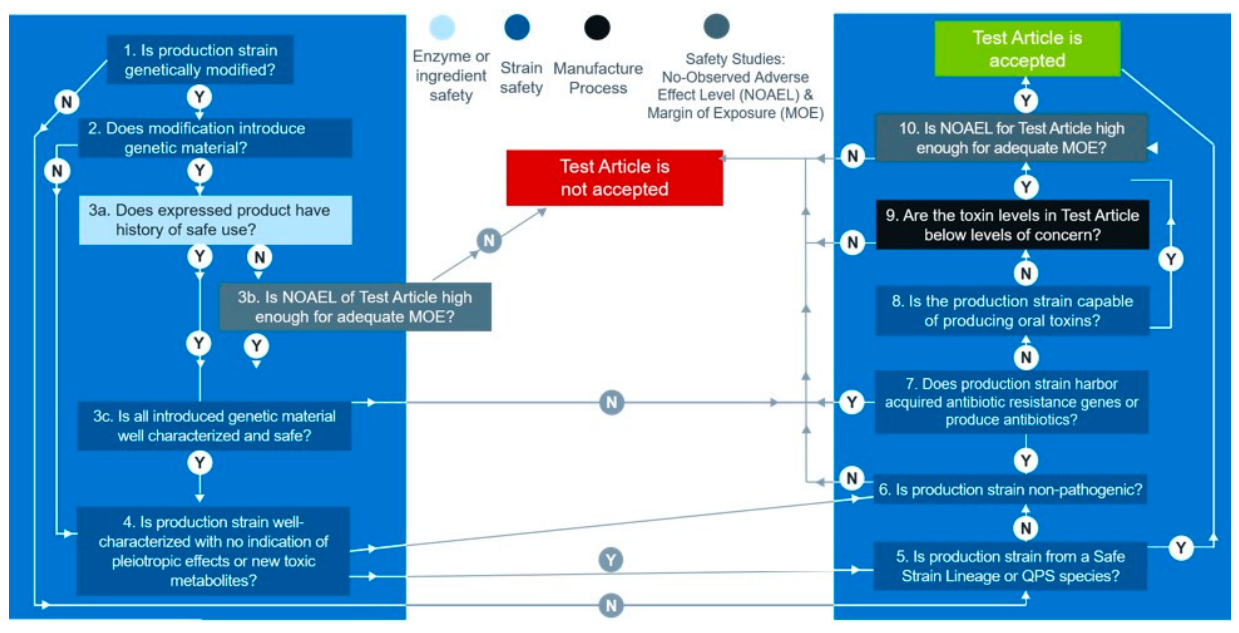
Figure 2.
EFSA assessment workflows for enzymes made with QPS or non-QPS production organisms (Herman et al., 2019) including read-across using substitute data from the same safe strain lineage (EFSA, 2021) prior to EU market authorization.
Figure 2.
EFSA assessment workflows for enzymes made with QPS or non-QPS production organisms (Herman et al., 2019) including read-across using substitute data from the same safe strain lineage (EFSA, 2021) prior to EU market authorization.
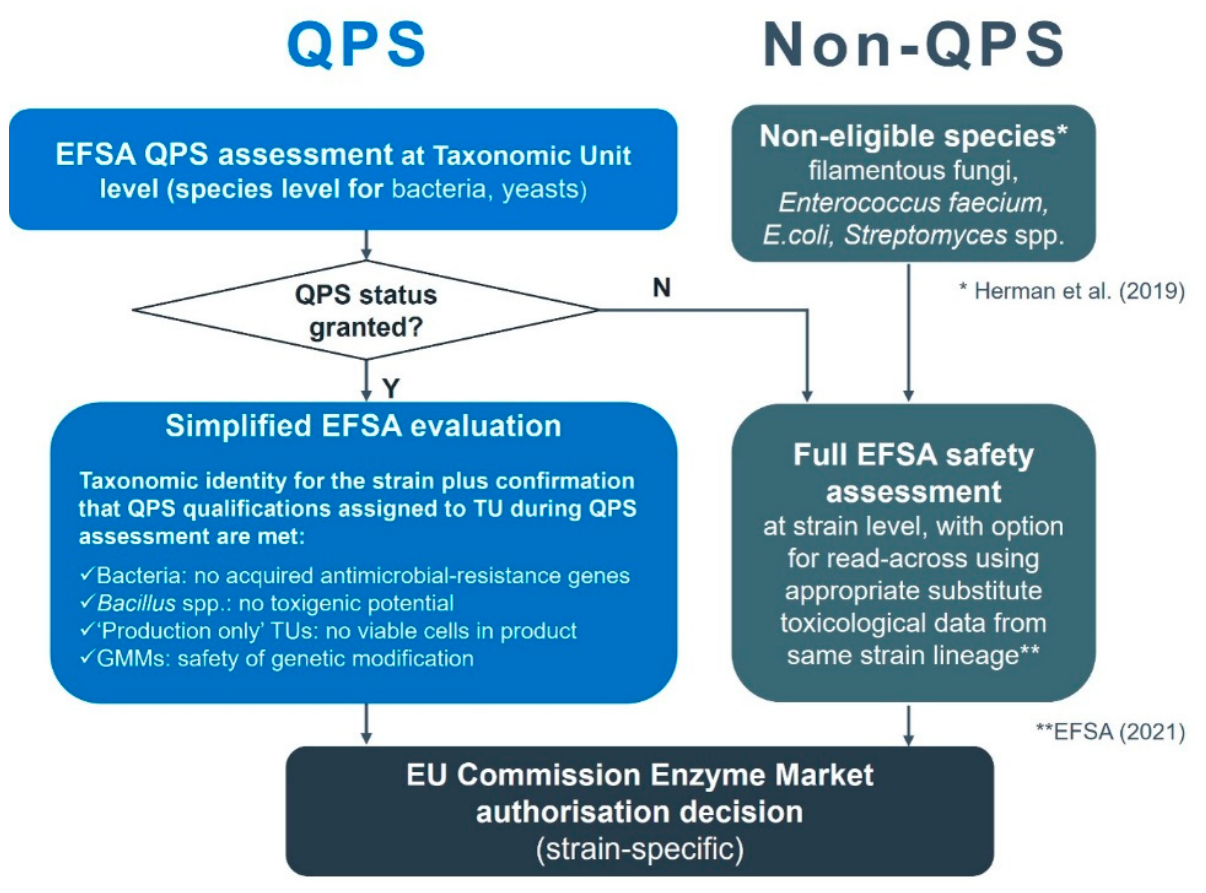

Table 1.
Available methods to assess genetic stability (EFSA Scientific Committee et al., 2025; Moon et al., 2024; Xu et al., 2024).
Table 1.
Available methods to assess genetic stability (EFSA Scientific Committee et al., 2025; Moon et al., 2024; Xu et al., 2024).
| Method | Target Assessment | Strengths | Limitations |
| Southern Blot Analysis | • Copy number of inserts • Structural integrity • Integration site flanking regions |
• Traditional regulatory gold standard • Detects large structural rearrangements |
• Labor-intensive • Requires larger amounts of DNA • Low throughput • Silencing can occur without DNA loss. |
| Quantitative PCR (qPCR) or droplet digital PCR (ddPCR) | • Precise copy number estimation • Relative or absolute quantification |
• Highly sensitive • Fast turnaround • High throughput |
• Does not detect distant rearrangements. • qPCR requires precise standard curves (ddPCR does not). |
| Whole Genome Sequencing (WGS) | • Single nucleotide variants (SNPs) & deletions • Insert integrity & orientation • Flanking sequence identity |
• Comprehensive coverage • Detects point mutations and indels • Reveals off-target integrations |
• Complex bioinformatics needed and not always conclusive • Complexity led EFSA to distrust companies’ assessments, require WGS submission - IP concern. |
| Phenotypic / Expression Assays | • Functional stability • Protein/metabolite presence |
• Confirms biological activity • Links genotype to phenotype under the relevant conditions |
• Needs verification if conditions change (e.g., T. reesei change from submerged fermentation to surface culture). |
Disclaimer/Publisher’s Note: The statements, opinions and data contained in all publications are solely those of the individual author(s) and contributor(s) and not of MDPI and/or the editor(s). MDPI and/or the editor(s) disclaim responsibility for any injury to people or property resulting from any ideas, methods, instructions or products referred to in the content. |
© 2026 by the authors. Licensee MDPI, Basel, Switzerland. This article is an open access article distributed under the terms and conditions of the Creative Commons Attribution (CC BY) license.
Copyright: This open access article is published under a Creative Commons CC BY 4.0 license, which permit the free download, distribution, and reuse, provided that the author and preprint are cited in any reuse.