

Submitted:
05 September 2026
Posted:
07 September 2026
You are already at the latest version
Abstract
Patient-facing generative AI can enter healthcare from outside organizational boundaries, but patient use does not automatically translate into organizational change. This Perspective develops a cross-level framework for explaining when such changes become consequential for healthcare delivery and organizations. It distinguishes technical AI affordances from effective patient capability, identifies two patient-mediated routes into care—care-seeking/utilization and AI-mediated patient inputs—and separates delivery-level change from persistent mismatch and organizational recognition. Organizational responses may then be formal, decentralized, both or neither. As a conditional extension, the framework distinguishes the existence of system-level patterns of healthcare delivery from causal attribution to organizational change. By making stopping points explicit, the framework is designed to prevent evidence at the patient or encounter level from being overextended into unsupported organizational or system-level claims.
Keywords:
patient-facing generative AI
; healthcare delivery
; health services
; organizational response
; effective patient capability
; system-level patterns of healthcare delivery
Introduction
Prominent frameworks for digital health implementation have focused on technologies selected, deployed or governed by healthcare organizations and subsequently integrated into care [1]. Patient-facing generative artificial intelligence introduces another route through which technological change can enter care. General-purpose tools can be adopted directly by patients outside healthcare organizations and may shape questions, interpretations, preferences and requests. This direction is not unprecedented: patient portals, online health information and other consumer-facing technologies have long enabled information originating outside clinical organizations to enter encounters [2,3]. The relevant shift is that a general-purpose conversational technology can support several forms of interpretation, synthesis and preparation beyond organizational control and then enter delivery through patient behaviour. It can also operate without a provider having selected, deployed or even observed the tool. We conceptualize patient-facing generative AI as a potential patient-side technological shock that may alter the inputs, interactions and demands encountered in healthcare delivery. This is an analytical framing, not a claim that GenAI has already produced a uniform shock across patients, organizations or healthcare systems.
Earlier patient-facing technologies primarily expanded access to information, records and patient-generated data, whereas generative AI may also support interpretation, comparison and question formulation [4,5,6]. Its potential significance lies partly in reducing selected cognitive and communicative effort, not merely in retrieving information. Yet AI-system capability cannot be equated with patient capability. A model may produce a coherent summary or recommendation while the patient cannot judge its reliability, relevance or appropriateness, or cannot use it within the constraints of care. Whether technical affordances alter what a patient can realistically understand, express or do depends on output quality, literacy, clinical circumstances, resources and institutional constraints. These factors may amplify, constrain or redirect effects rather than uniformly increase capability. The relevant question is therefore whether, and under what conditions, affordances are translated into effective patient capability and a reshaped set of feasible options without assuming that capability determines behaviour.
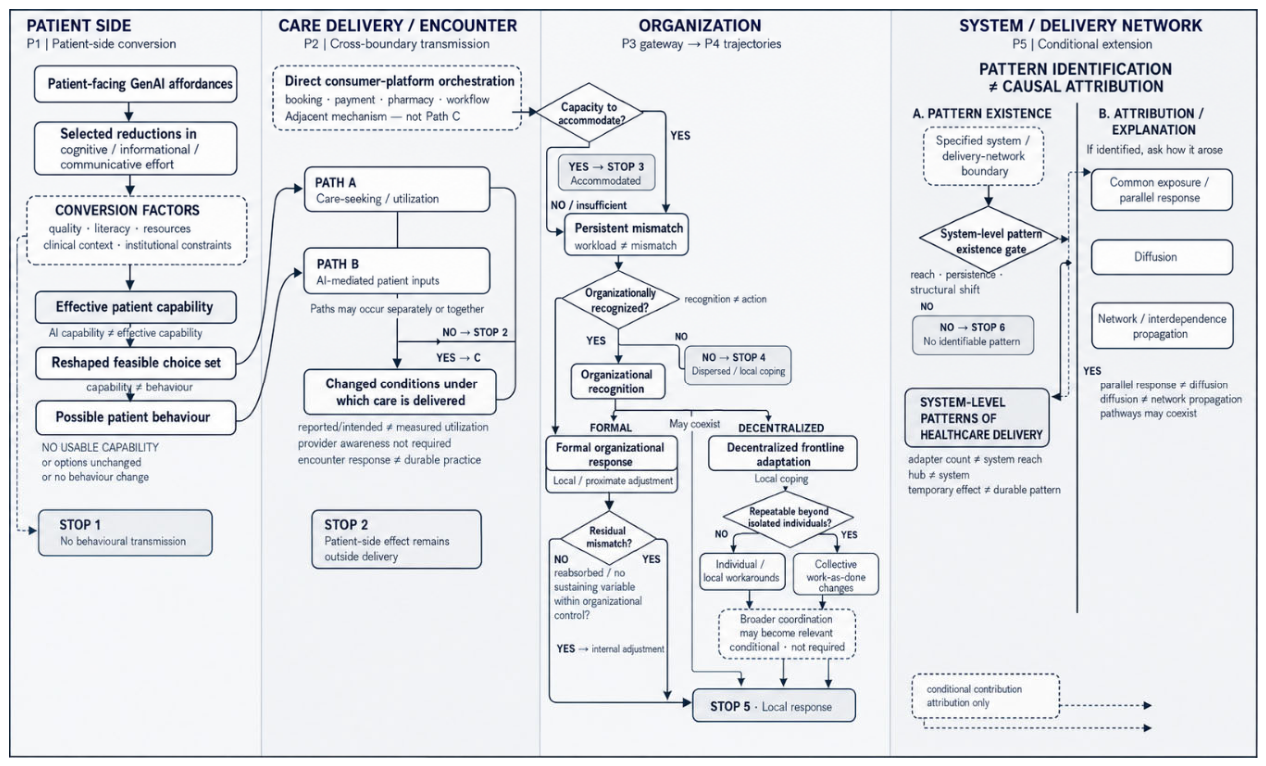
Figure 1.
| Conditional cross-level propagation of patient-facing generative AI into healthcare delivery. The framework shows how patient-facing GenAI adopted outside healthcare organizations may, under conversion factors, contribute to effective patient capability, a reshaped feasible choice set and possible behaviour. Effects may terminate without behavioural transmission or enter delivery through two patient-mediated routes: changed care-seeking/utilization and AI-mediated patient inputs, which may occur separately or together. Direct consumer-platform orchestration is adjacent, not a third route. At the P3 gateway, changed delivery conditions may be accommodated. If accommodation is insufficient, recurrent misfit may constitute persistent mismatch, which may remain dispersed or locally managed if unrecognized, or become organizationally recognized. Recognition opens formal organizational response and continued decentralized frontline adaptation, which may coexist; neither guarantees broader coordination. P5 separates whether a system-level pattern exists within a specified boundary from how it arose. Common exposure/parallel response, diffusion and network/interdependence propagation are distinct, potentially coexisting attribution pathways. Arrows are conditional, not deterministic, and STOP branches are valid outcomes. The hard endpoint is system-level patterns of healthcare delivery.
Figure 1.
| Conditional cross-level propagation of patient-facing generative AI into healthcare delivery. The framework shows how patient-facing GenAI adopted outside healthcare organizations may, under conversion factors, contribute to effective patient capability, a reshaped feasible choice set and possible behaviour. Effects may terminate without behavioural transmission or enter delivery through two patient-mediated routes: changed care-seeking/utilization and AI-mediated patient inputs, which may occur separately or together. Direct consumer-platform orchestration is adjacent, not a third route. At the P3 gateway, changed delivery conditions may be accommodated. If accommodation is insufficient, recurrent misfit may constitute persistent mismatch, which may remain dispersed or locally managed if unrecognized, or become organizationally recognized. Recognition opens formal organizational response and continued decentralized frontline adaptation, which may coexist; neither guarantees broader coordination. P5 separates whether a system-level pattern exists within a specified boundary from how it arose. Common exposure/parallel response, diffusion and network/interdependence propagation are distinct, potentially coexisting attribution pathways. Arrows are conditional, not deterministic, and STOP branches are valid outcomes. The hard endpoint is system-level patterns of healthcare delivery.
Patient-side changes may affect whether, when or where care is sought and may also shape what patients bring into clinical encounters. These routes allow technology adopted outside healthcare organizations to enter delivery through altered care-seeking or utilization and/or AI-mediated patient inputs [4,7,8]. Care may be sought sooner, later, elsewhere or not at all, while encounter inputs may differ in organization, specificity, volume or evidential framing. The first route can alter the timing, site, specialty and urgency of demand without any AI-generated material being shown to a clinician. The second can alter questions, histories, comparisons, requests or refusals within care that is already being delivered. Patient requests have long influenced clinical decisions, and emerging GenAI evidence suggests that AI-mediated inputs may likewise affect individual encounters [9,10]. Such effects need not require disclosure of AI use, and an encounter-level change is not equivalent to durable clinician practice or organizational adaptation. The broader question is when patient-side changes become consequential for healthcare delivery and organizational consideration.
Recent work has conceptualized consumer AI as increasingly integrated into healthcare pathways and as a potential source of pathway-level control [11]. What remains less clearly explained is how patient-mediated changes originating outside healthcare organizations become, or fail to become, organizationally consequential. We develop a cross-level framework linking the conditional conversion of GenAI affordances into effective patient capability and possible behaviour, their transmission through care-seeking and/or patient inputs into delivery conditions, and the circumstances under which delivery-level changes become organizationally consequential. It distinguishes variation that can be accommodated from persistent mismatch and organizational recognition, while allowing formal response, decentralized adaptation, both or neither. Only as a conditional extension does it consider when organizational changes may contribute to wider system-level patterns of healthcare delivery. The contribution is cross-level integration, not a claim that any single mechanism is unprecedented or that higher-level effects necessarily follow. The framework is intended to connect literatures that are often studied separately, while retaining the boundaries that separate patient, encounter, organizational and system-level claims.
P1 — Patient-Side Conversion
Patients have long performed information work around illness: seeking information, interpreting unfamiliar terms, comparing explanations, organizing records and preparing questions for care. Digital technologies have supported parts of this work, while generative AI can potentially assist several tasks within one conversational interface [4,6]. A patient may ask a model to explain a report, connect it with previous results, compare interpretations, reorganize a history or formulate questions. Its potentially consequential feature is therefore not simply another source of medical information, but the possibility of reducing cognitive and communicative effort required to transform dispersed or technical information into forms a patient can understand and potentially use.
This assistance should not be mistaken for an equivalent increase in patients’ capacity to act. A model may summarize a record, compare options or generate questions while the patient remains unable to judge reliability, relevance or appropriateness; an AI interpretation may also be unusable within an actual healthcare encounter. The translation from technical affordance to patient action depends on conversion factors, including output quality, digital and health literacy, clinical uncertainty, time and financial resources, access to records and services, and the willingness of professionals and institutions to engage with resulting input. This distinction draws on the capability approach, which separates resources from the capabilities people can realize after accounting for conversion factors [12]. These factors can amplify, constrain or redirect the same technical capability across patients and settings.
We use effective patient capability as an analytical construct describing capacities a patient can realistically mobilize to understand a medical situation, form judgments and preferences, make choices, express intentions and influence care under institutional and resource constraints. Related health-capability work emphasizes practical health functioning within personal and social conditions [13]. It is not a psychometric scale or replacement for health literacy, patient activation, enablement, agency or patient capacity; it specifies the capabilities that become practically usable in a particular context. The qualifier effective matters because a technically available capability may remain practically unavailable if the patient cannot assess the output, access the relevant service, afford the intervention or introduce the information meaningfully into care. Effective patient capability is therefore relational and context-dependent, and distinct from patient behaviour: it changes what a patient could do, not what the patient will choose.
Changes in effective patient capability first alter the set of realistically available actions rather than determine a particular behaviour. A patient may gain access to a request or comparison that was previously too difficult, but the feasible set may also remain unchanged or be reshaped in another direction. An altered feasible choice set does not imply greater healthcare use or confrontation. Patients may request tests or referrals, but may also decline interventions, accept reassurance, postpone care or choose more selectively [4,7,8]. Behaviour emerges from these options combined with preferences, risk perceptions, trust, resources and setting constraints. Once such changes affect whether, when or where patients seek care, or are expressed through what they bring into encounters, they begin to alter the conditions under which healthcare is delivered.
P1 also requires attention to heterogeneity. Clinical complexity, literacy, access and institutional receptiveness may determine whether the same output becomes usable capability, a different feasible option or no practical change. These differences are not noise around a single average effect; they are part of the conversion problem.
P2 — Cross-Boundary Transmission
Patient capability becomes relevant to healthcare delivery when it alters the conditions under which care is sought or delivered. Many effects may remain outside delivery when patients use a model privately without changing care-seeking or communicating resulting information or preferences. The boundary can be crossed through two routes. Path A is changed care-seeking or utilization: whether care is sought, postponed or avoided; when and with what urgency; and which facility, specialty or pathway is chosen. Existing patient-reported studies provide preliminary evidence that GenAI may influence care-seeking judgments and reported decisions, but do not establish measured utilization [4,7,8]. Path B is patient inputs into care already being delivered: questions, narratives, interpretations, preferences, requests, refusals, comparisons, challenges, organized records or AI-generated material brought into an encounter [4,6,7]. The term patient inputs is used in its ordinary-language sense; AI-mediated patient inputs refers to inputs whose content, structure or timing has been shaped by GenAI. Neither is a new construct.
Patient-facing GenAI can therefore affect healthcare delivery without being deployed by the provider. Care-seeking may alter patient flows, timing, mix and demand before or without an encounter input. AI-mediated inputs may alter the informational and interactional conditions of care already being delivered. For the input route, clinical decisions occur within interactions that include patient information, preferences, expectations and requests. When GenAI changes their content, structure, specificity or volume, clinicians may face a different decision context even when the underlying disease is unchanged. The same underlying condition may therefore be encountered in a different decision context when accompanied by a structured history, AI-generated differential, treatment comparison or testing request. LLMs can also generate contextualized question prompts from EHR-derived data, although this supports preparation rather than actual clinical use [5].
The influence of patient inputs on clinical decisions is not new. Long before GenAI, patient requests and preferences could influence information, options and, in some circumstances, investigations or treatments [9]. GenAI may modify this mechanism by changing whether inputs are brought into an encounter and their organization, specificity, apparent evidential support and preparation. A preregistered field experiment reported encounter-level changes in prescriptions and diagnostic testing after pre-visit chatbot access, but the evidence remains a preprint and does not establish persistent clinician practice [10]. An encounter response does not establish team or organizational adaptation, and it need not require that clinicians know AI was used: changed questions, requests or histories may alter interaction while their origin remains undisclosed [7,8].
Consumer-facing AI systems may also become integrated with appointment booking, payment, pharmacy fulfilment or clinical workflow infrastructure [11]. Such platform-level integration may create pathways not mediated primarily through the patient behaviours or inputs examined here and is adjacent to, rather than a third route within, this framework. The two patient-mediated routes may elicit operational or encounter-level responses, but neither changed care-seeking, patient inputs nor an immediate response establishes that existing delivery arrangements have changed or become inadequate. The next question is when repeated or consequential changes in delivery conditions remain absorbable and when they become organizationally relevant.
Path A should consequently be studied as an evidence ladder rather than inferred from recommendations or intentions. Path B should be observed at the encounter level without treating disclosure as necessary or an encounter response as durable practice. The two routes can produce different delivery consequences and should remain empirically separable.
P3 — From Delivery-Level Change to Organizational Relevance
Delivery-level responses to changed care-seeking, patient behaviour or patient inputs need not become organizational problems. Healthcare delivery relies on routines, professional discretion, time allocation, communication, referral pathways, documentation and operational flexibility that can absorb variation. Changed flows, more or less appropriate care-seeking, better-organized histories or AI-mediated inputs may therefore be accommodated without durable organizational change. Better preparation or selective care-seeking may reduce some work; more complex, contested or voluminous inputs, or changed timing and case mix, may increase verification, explanation, negotiation, documentation or throughput demands. Healthcare workaround and work-as-done research provides a near-neighbour analogue showing that local responses to operational variation may have mixed consequences [14,15]. These are delivery-level possibilities rather than a prediction of net burden. Organizational significance depends on whether demands and opportunities can be accommodated without durable changes to how work is performed. Accommodation may differ between services facing the same patient-side change because their discretion, referral capacity, administrative support and ability to redistribute work are configured differently.
We use capacity to accommodate as a descriptive analytical term for the combined flexibility of an existing delivery arrangement, not the organizational-learning construct of absorptive capacity. It includes discretion, time and attention, communication and documentation routines, diagnostic and referral pathways, administrative and digital support, and redistribution of work. It is relational rather than fixed: the same patient-side change may be readily accommodated in one setting but difficult to absorb in another. The relevant question is not simply whether additional work occurs, but whether changed work—more, less or different—can be incorporated without persistent changes in roles, workflows or coordination.
Persistent mismatch is descriptive shorthand for sustained misalignment when changes in behaviour, care-seeking or inputs recur but cannot be fully absorbed. It is not an individual patient–clinician conflict and does not require service failure. It concerns the fit between patterns entering care and the routines, roles, resources and coordination mechanisms configured to handle them. It may involve recurrent verification, referral negotiation, documentation, handling AI material, difficulty incorporating new participation or strain from changed timing and case mix. It may also occur when useful patient capability cannot be received or acted on, or when appropriate care-seeking leaves capacity that cannot be reallocated. A single encounter, request, attendance change or temporary workload shift does not establish persistence; the misfit must recur, endure or have consequences beyond ordinary variation. Additional workload can thus occur without mismatch, while mismatch can arise through an inability to use beneficial patient-side capability even when workload does not increase.
Persistent mismatch does not automatically become organizationally relevant. It may remain dispersed across encounters or be treated as local variation. Recognition requires visibility and interpretability at an organizational level, through indicators, complaints, waits, referrals, documentation, incidents, resource use, frontline reports or managerial observation. Kim et al. [16] provide a near-direct frontline analogue of clinicians observing and interpreting patient-led GenAI signals, not evidence of implemented organizational adaptation. Organizational recognition remains distinct from decision: an organization may recognize mismatch yet not intervene or continue relying on local coping. Frontline notice, organizational recognition and organizational action are therefore separate observations. Recognition is consequently a gateway into explicit organizational consideration, not a measurement of response or a guarantee that response will occur.
P3 is also where the framework can terminate without organizational adaptation. A service may absorb a change, fail to recognize a recurring misfit, or leave local coping fragmented. These are not exceptional qualifications added after the fact; they are the conditions that keep delivery-level variation distinct from organizational change.
P4 — Organizational Response
Organizational sensemaking may provide a springboard into action without specifying whether or what formal response follows [17]. Recognition nevertheless does not determine whether or how formal action follows. Formal organizational response and continued decentralized frontline adaptation are analytically distinct but may coexist, conflict or remain absent. In the formal path, problemistic-search theory suggests that organizations may initially search near existing activities, knowledge and control before broadening their search when proximate responses prove insufficient [18]. This is a tendency rather than a law: mandates, crises or other constraints may bypass local adjustment. Initial changes may reabsorb mismatch; if consequential residual mismatch remains, the distribution of control over sustaining variables becomes relevant. A recognized mismatch may therefore produce a protocol change, a local workaround, both or no observable response depending on authority, resources and perceived value.
If variables remain within organizational control, internal adjustment may suffice. Adjacent scale-fit, cross-level and collaborative-governance literatures provide parallels [19,20,21]. If they are distributed across autonomous actors, the organization may buffer or substitute around external conditions but cannot alone coordinate or directly alter variables controlled elsewhere. Broader coordination is therefore conditionally relevant only when the objective is to coordinate or alter those external variables, and it concerns governance scope rather than automatic hierarchy. Mismatch may also diminish through buffering, substitution, patient-side adaptation or unilateral external change. In the nonformal path, healthcare research shows gaps between prescribed work and work-as-done and that workarounds may be individual or collective with mixed consequences [14,15]. Local coping becomes organizationally consequential only when it recurs beyond isolated individuals and becomes observable collective work-as-done. Formal and nonformal change may coexist without alignment. Whether formal responses or accumulated work-as-done extend beyond one organization is addressed in the next section.
P5 — System-Level Patterns of Healthcare Delivery
P5 is a conditional extension. A single organization does not by itself constitute a system-level pattern. Within an explicitly specified system or delivery-network boundary, a durable pattern requires sufficient system reach, persistence beyond a transient perturbation and an observable aggregate distributional and/or relational structural shift. Reach is not adapter count: distributed change or a structurally consequential hub may alter wider network conditions, while the hub remains distinct from the system. A short-lived system-wide effect may therefore be system-level without being a durable pattern. Patient-sharing network studies show how structure and centrality can be measured in relation to care patterns [22,23]. These criteria are stricter than counting organizations or observing simultaneous change because a broad response may cancel, remain local or reflect a transient common shock.
Pattern existence is distinct from attribution. A common exposure may generate heterogeneous parallel responses without interaction; practices may diffuse through professional learning, imitation or dissemination [24]; or change may propagate when flows, referrals, shared clinicians, information or resources in one node alter conditions elsewhere. Parallel response is not diffusion, and diffusion is not network propagation. Mandates, payer-wide incentives and platform-wide changes may instead be shared external exposures. Patterns may be observed as shifts in care-seeking distributions, flows, referrals, service shares, consultation/testing or coordination structures, but current evidence does not justify claiming that patient-side GenAI has already produced durable system-level changes. A pattern may be identified before its generating pathway is known; attribution to organizational change requires the separate pathway test. The endpoint is system-level patterns of healthcare delivery, not policy reform, governance escalation or health-system transformation.
The system-level extension should therefore be evaluated with a named boundary and outcome, not with a count of participating hospitals. Network centrality can make a small number of organizations consequential, while heterogeneous responses can leave aggregate distributions unchanged. Attribution remains a separate question from identifying the pattern itself.
Research Agenda
Future tests should first determine when GenAI affordances become effective patient capability and feasible options rather than merely producing sophisticated outputs. Output quality, comprehension, relevance judgment and context-specific options must be distinguished from empowerment self-report, with heterogeneous effects across clinical complexity, literacy, access and resources. A null result in which high-quality assistance changes neither usable capability nor feasible options would weaken the P1 conversion claim.
Second, studies should trace both P2 routes. Path A requires separating recommendation and intention from reported behaviour, actual care-seeking and measured utilization. Path B requires measuring how AI-mediated inputs change questions, histories, requests or refusals and whether clinicians respond. Linked episode data are needed for utilization; encounter designs can address clinician response without implying durable practice. Disclosure is not exposure, and the routes should not be collapsed.
Third, longitudinal operational evidence should test P3 by distinguishing accommodation from recurrent unabsorbed misfit and by separating problem existence, frontline noticing and organizational recognition. Additional workload is not persistent mismatch, and complete accommodation, dispersed mismatch or absent recognition are informative outcomes.
Fourth, comparative longitudinal studies should distinguish formal response from individual workaround, repeated local coping, collective work-as-done and their possible coexistence or conflict. They should test whether local adjustment reabsorbs mismatch and whether buffering, substitution, patient-side adaptation or unilateral external change can reduce it without broader coordination. For P5, a named boundary, system reach, persistence for durable claims and observed aggregate/relational shift identify a pattern; attribution separately requires discriminating common exposure/parallel response, diffusion and network propagation. Local-only change, an absent pattern or unresolved attribution are valid termination points.
Research findings that terminate before organization or system are equally informative: a patient-side effect may not alter behaviour, a behaviour change may not alter delivery, or a delivery change may be fully accommodated. Likewise, organizational change may remain local, and a system-level pattern may be observed without a defensible attribution to patient-side GenAI. These outcomes identify where the explanatory chain stops rather than constituting evidence that the framework requires every link to occur.
The distinction between formal and nonformal response is important because unchanged policy does not imply unchanged work, while changed work does not imply formal organizational decision. Conversely, formal change may have little effect on work-as-done. These possibilities should not be collapsed into a single response outcome.
The value of these tests lies in locating the stopping point, not in presuming that continuation is the normal result. This is especially important at the organizational and system levels, where direct patient-facing GenAI evidence remains limited and attribution is empirically difficult.
Limitations
Several terms are analytical constructs or descriptive shorthand rather than validated measures, including effective patient capability, capacity to accommodate, persistent mismatch, organizational recognition, system reach and system-level patterns of healthcare delivery. They have no universal instruments or thresholds: persistent mismatch is not fixed by workload or duration, and system reach is not fixed by organization count. Evidence is also uneven: more direct evidence concerns patient-side use, information/preparation, reported behaviour and encounter response, while P3–P5 evidence is progressively indirect. Evidence at one level cannot establish that subsequent levels occurred.
“Patient used GenAI” is not a uniform exposure. Users self-select; prompts, intensity, products, disclosure and self-report vary; models, interfaces and guardrails change. These features constrain causal attribution, dose–response interpretation, reproducibility and transportability across products or versions.
Pathways also depend on gatekeeping, referral and payment structures, access, literacy, language, scarcity and institutional norms. Some use may be performed by caregivers or proxies, especially in paediatrics, cognitive impairment, dependent decisions or severe illness. Teams, units, organizations and systems must be distinguished, and the framework is not a general theory of clinician-facing, hospital-deployed, EHR, payer or regulator AI. Direct consumer-platform orchestration remains adjacent to the focal patient-mediated mechanism.
Finally, P1–P5 is an analytical ordering, not a deterministic sequence; processes may overlap, coexist, recurse or terminate early. Regulation, mandates, payer incentives and other common shocks can produce higher-level change, so attribution to patient-side GenAI is not automatic. The framework explains propagation rather than desirability or clinical benefit. Its endpoint is system-level patterns of healthcare delivery, not mortality, diagnostic accuracy, population health, policy reform or health-system transformation.
Conclusions
Patient-facing GenAI creates a route through which technological change can enter healthcare from outside organizational boundaries. Its effects may or may not become effective patient capability or behaviour, and may enter delivery through care-seeking/utilization, AI-mediated patient inputs or both. The framework connects these processes to delivery conditions without treating an encounter response as organizational adaptation. Repeated changes may become organizationally consequential when they cannot be accommodated and become recognized, but formal and decentralized responses remain conditional. Under specific conditions, organizational changes may contribute to wider system-level patterns of healthcare delivery, as a conditional extension rather than an assumed outcome. Its value lies in identifying where the chain proceeds or terminates, and where attribution remains uncertain. The appropriate unit of analysis therefore extends beyond the isolated user to the conditions under which healthcare is delivered, without assuming that every patient-side change becomes organizational or systemic.
Author contributions
The author conceived the article, developed and critically refined the conceptual framework, conducted the literature search, source verification and evidence appraisal, designed and reviewed the conceptual figure, wrote and revised the manuscript, and approved the final version.
Funding
The author received no specific funding for this work.
Competing interests
The author declares no competing interests.
Use of artificial intelligence
Generative artificial intelligence tools, including OpenAI ChatGPT and LLM-assisted workflows used through OpenCode, were used during manuscript development to support literature retrieval and source verification, stress-testing and refinement of the conceptual framework, manuscript organization, language editing, citation and consistency checks, and the drafting and iterative refinement of the schematic framework figure. The author independently reviewed the underlying sources, determined the conceptual framework and evidence interpretation, verified factual and bibliographic claims, and reviewed and approved all manuscript text and figure content. All scholarly judgments and conclusions are those of the author, who takes full responsibility for the accuracy, originality and integrity of the work.
References
- Greenhalgh, T.; et al. Beyond Adoption: A New Framework for Theorizing and Evaluating Nonadoption, Abandonment, and Challenges to the Scale-Up, Spread, and Sustainability of Health and Care Technologies. J. Med. Internet Res. 2017, 19, e367. [Google Scholar] [CrossRef] [PubMed]
- Wang, J.; Ashvetiya, T.; Quaye, E.; Parakh, K.; Martin, S. S. Online Health Searches and Their Perceived Effects on Patients and Patient-Clinician Relationships: A Systematic Review. Am. J. Med. 2018, 131, 1250.e1–1250.e10. [Google Scholar] [CrossRef] [PubMed]
- Fraccaro, P.; et al. The influence of patient portals on users’ decision making is insufficiently investigated: A systematic methodological review. Int. J. Med. Inform. 2018, 111, 100–111. [Google Scholar] [CrossRef] [PubMed]
- Ding, W.; Wang, J. Generative Artificial Intelligence (AI)-Assisted Self-Diagnosis and the Patient-Physician Relationship: Mixed Methods Study of Calibration, Participation, and Trust. J. Med. Internet Res. 2026, 28, e95072. [Google Scholar] [CrossRef] [PubMed]
- He, Z.; et al. Generating Question Prompt Lists From Electronic Health Record Data Using Large Language Models: Iterative Evaluation Study. J. Med. Internet Res. 2026, 28, e87280. [Google Scholar] [CrossRef] [PubMed]
- Luckhaus, J. L.; et al. “ChatGPT knows my Parkinson’s”: Perspectives of people with Parkinson’s disease on use of generative AI. J. Park. Dis. 2026, 16, 782–787. [Google Scholar] [CrossRef] [PubMed]
- Blease, C.; et al. Patient and Family Perspectives on Generative AI Tools in Rare Diseases: Exploratory Mixed Methods Online Survey. J. Particip. Med. 2026, 18, e93720. [Google Scholar] [CrossRef] [PubMed]
- Wójcik, S.; Rulkiewicz, A.; Domienik-Karłowicz, J. Generative AI use before medical visits: disclosure-item responses, trust, and care-seeking behaviors in a cross-sectional social-media survey in Poland. Front. Digit. Health 2026. [Google Scholar] [CrossRef]
- Kravitz, R. L.; et al. Influence of patients' requests for direct-to-consumer advertised antidepressants: a randomized controlled trial. JAMA 2005, 293, 1995–2002. [Google Scholar] [CrossRef]
- Chen, Y.; Li, H.; Meng, L.; Qiu, X.; Yang, Q. Directional AI Advice: Experimental Evidence from Healthcare. 2026. Available online: https://arxiv.org/abs/2607.08706.
- Wu, Y.; Liu, T. Y. A.; Topol, E. J.; Keane, P. A. Integration of consumer AI into healthcare pathways. Nat. Health 2026. [Google Scholar] [CrossRef]
- Robeyns, I. The Capability Approach: a theoretical survey. J. Hum. Dev. 2005, 6, 93–117. [Google Scholar] [CrossRef]
- Ruger, J. P. Health Capability: Conceptualization and Operationalization. Am. J. Public Health 2010, 100, 41–49. [Google Scholar] [CrossRef] [PubMed]
- Debono, D. S.; et al. Nurses’ workarounds in acute healthcare settings: a scoping review. BMC Health Serv. Res. 2013, 13, 175. [Google Scholar] [CrossRef] [PubMed]
- Blijleven, V.; Koelemeijer, K.; Wetzels, M.; Jaspers, M. Workarounds Emerging From Electronic Health Record System Usage: Consequences for Patient Safety, Effectiveness of Care, and Efficiency of Care. JMIR Hum. Factors 2017, 4, e27. [Google Scholar] [CrossRef] [PubMed]
- Kim, M.; et al. Mapping Practice-Based Signals of Generative AI in Psychiatric Care: Qualitative Study of Korean Psychiatrists’ Experiences, Interpretations, and Implementation Priorities. J. Med. Internet Res. 2026, 28, e96556. [Google Scholar] [CrossRef] [PubMed]
- Weick, K. E.; Sutcliffe, K. M.; Obstfeld, D. Organizing and the Process of Sensemaking. Organ. Sci. 2005, 16, 409–421. [Google Scholar] [CrossRef]
- Posen, H. E.; Keil, T.; Kim, S.; Meissner, F. D. Renewing Research on Problemistic Search—A Review and Research Agenda. Acad. Manag. Ann. 2018, 12, 208–251. [Google Scholar] [CrossRef]
- Cumming, G. S.; Cumming, D. H. M.; Redman, C. L. Scale mismatches in social-ecological systems: causes, consequences, and solutions. Ecol. Soc. 2006, 11, 14. [Google Scholar] [CrossRef]
- Cash, D. W.; et al. Scale and Cross-Scale Dynamics: Governance and Information in a Multilevel World. Ecol. Soc. 2006, 11, 8. [Google Scholar] [CrossRef]
- Emerson, K.; Nabatchi, T.; Balogh, S. An Integrative Framework for Collaborative Governance. J. Public Adm. Res. Theory 2012, 22, 1–29. [Google Scholar] [CrossRef]
- Landon, B. E.; et al. Variation in patient-sharing networks of physicians across the United States. JAMA 2012, 308, 265–273. [Google Scholar] [CrossRef] [PubMed]
- Barnett, M. L.; et al. Physician patient-sharing networks and the cost and intensity of care in US hospitals. Med. Care 2012, 50, 152–160. [Google Scholar] [CrossRef] [PubMed]
- Greenhalgh, T.; Robert, G.; Macfarlane, F.; Bate, P.; Kyriakidou, O. Diffusion of innovations in service organizations: systematic review and recommendations. Milbank Q. 2004, 82, 581–629. [Google Scholar] [CrossRef] [PubMed]
Disclaimer/Publisher’s Note: The statements, opinions and data contained in all publications are solely those of the individual author(s) and contributor(s) and not of MDPI and/or the editor(s). MDPI and/or the editor(s) disclaim responsibility for any injury to people or property resulting from any ideas, methods, instructions or products referred to in the content. |
© 2026 by the authors. Licensee MDPI, Basel, Switzerland. This article is an open access article distributed under the terms and conditions of the Creative Commons Attribution (CC BY) license (http://creativecommons.org/licenses/by/4.0/).
Copyright: This open access article is published under a Creative Commons CC BY 4.0 license, which permit the free download, distribution, and reuse, provided that the author and preprint are cited in any reuse.