

Submitted:
04 September 2026
Posted:
07 September 2026
You are already at the latest version
Abstract
Dysphagia comprises aspiration risk as well as oral-phase impairment, post-swallow residue, reduced sensation, delayed pharyngeal onset, and incomplete hyolaryngeal elevation. Current daily-life approaches generally separate wearable sensing from electrical stimulation and rarely provide per-swallow, safety-bounded adaptation. This paper presents SafeSwallow™, a compact wearable neuroprosthesis that integrates around-ear or glasses electroencephalography (EEG) for anticipatory arming, submental surface electromyography (sEMG), laryngeal bioimpedance (BI), contact acoustics, and inertial measurement for swallow verification and elevation feedback. The controller combines reactive multimodal gating, anticipatory onset prediction, explicit electromechanical-delay (EMD) compensation, elevation-state estimation, and iterative learning control (ILC) of stimulation dose under a non-learned Tier-0 safety supervisor. The study evaluates the architecture on two complementary tracks: a physiology-inspired 1-kHz synthetic closed-loop experiment with healthy and Parkinsonian phenotypes and a public videofluoroscopy-aligned high-resolution cervical auscultation (HRCA) dataset. On held-out synthetic trials, closed-loop control achieved 100.0% Q1 force success with 0.0% misses and 0.0% false stimulation, while reducing normalized elevation error from 0.253 under matched open-loop dosing to 0.116. On the public HRCA test set, the improved causal front-end increased detection from 83.1% to 94.9% and modeled Q1 force success from 59.2% to 92.9%. These results support engineering feasibility of the proposed timing and control architecture, while demonstrating that clinical translation requires paired multimodal datasets, measured electrode-specific EMD, and prospective human validation.
Keywords:
dysphagia
; wearable medical device
; closed-loop control
; functional electrical stimulation
; bioimpedance
; surface electromyography
; electroencephalography
; TinyML
; iterative learning control
; electromechanical delay
; high-resolution cervical auscultation
; videofluoroscopy
; Parkinson’s disease
1. Introduction
1.1. Clinical Motivation: Multiphase Dysphagia Beyond Aspiration
Swallowing is a rapid, highly coordinated sensorimotor sequence that transports a bolus from the oral cavity through the pharynx into the esophagus while diverting the airway. Airway protection depends on appropriately timed hyolaryngeal elevation, epiglottic deflection, vocal-fold closure, and coordinated tongue-base retraction. Failure in timing, amplitude, sensation, or coordination produces clinically important dysphagia [1,2,3,4].
The clinical problem is broader than aspiration alone. Important deficits include impaired oral bolus formation or propulsion, premature spill toward the pharynx, post-swallow residue, reduced sensation and awareness of residue, delayed pharyngeal initiation, and incomplete hyolaryngeal elevation [1,5,6,7,8]. These failures compromise both airway safety and nutritional efficiency and can contribute to pneumonia, dehydration, feeding-tube dependence, prolonged hospitalization, and loss of independence. A wearable that focuses only on aspiration therefore addresses only one part of the dysphagia phenotype.
SafeSwallow is consequently framed as a multiphase platform with an acute engineering beachhead at airway-protective hyolaryngeal assistance. The preferred embodiment is a discrete ear–chin form factor intended for continuous meal-time wear, with future modes for oral assistance and residue clearance sharing the same safety spine.
1.2. Problem Statement and Hard Real-Time Constraint
The engineering problem is to deliver useful assistive force early enough in the swallow for airway protection while avoiding false stimulation. The manuscript models the mean hyolaryngeal elevation ramp as approximately 390 ms and defines the first quarter of this ramp as the Q1 window. A force delivered after Q1 is scored as a timing miss in the present engineering evaluation. The corresponding deadline is approximately 97.5 ms after pharyngeal onset [9,10,11,12].
Three latency sources consume this budget: causal filtering in the detection chain, residual edge inference latency, and EMD between electrical stimulation and useful mechanical force. The resulting design tension is fundamental: reactive detection improves specificity but consumes timing margin; anticipatory arming improves timing margin but must not be permitted to fire on its own. SafeSwallow resolves this tension by allowing EEG to pre-arm or pre-charge while requiring peripheral multimodal confirmation before energy delivery.
The second problem is adaptation. A fixed stimulation dose cannot directly compensate for fatigue, electrode–skin impedance changes, or subject-specific physiology. The proposed controller therefore measures post-stimulus elevation from BI and optional acoustics/IMU signals and applies ILC to update the next-swallow dose while respecting hard saturation limits.
1.3. State of the Art and Unmet Need
Clinical diagnosis remains centered on videofluoroscopic swallow study (VFSS) and fiberoptic endoscopic evaluation of swallowing (FEES). These modalities provide critical anatomical and temporal ground truth but are not practical continuous sensors during ordinary meals [8,16,17,18]. Behavioral compensation and exercise remain essential, but they do not generally provide millisecond-scale mechanical assistance at every swallow [19]. Surface neuromuscular electrical stimulation (NMES) can influence hyolaryngeal motion [20,21,22], and self-triggered stimulation has demonstrated the feasibility of linking a swallow event to stimulation [11,12]. Hospital pharyngeal electrical stimulation systems, in contrast, primarily target treatment-session neuroplasticity rather than portable per-swallow mechanical assistance [23,24].
Wearable sensing has progressed substantially. Suprahyoid sEMG provides a useful activation proxy but is vulnerable to speech, chewing, co-contraction, and head motion [25]. Neck BI provides information related to hyolaryngeal movement and can improve onset detection when combined with EMG [9,26]. HRCA combines contact-microphone and accelerometer signals and supports machine-learning identification of swallows from wearable-compatible signals [27,28]. Around-ear EEG technologies such as cEEGrid-class electrodes provide a path to discreet cortical sensing [29], while soft submental patches support unobtrusive peripheral measurement [30,31].
The gap addressed here is therefore not simply sensing or stimulation. It is the integration of (1) anticipatory intent information, (2) multimodal swallow verification, (3) explicit latency compensation, (4) closed-loop elevation feedback, (5) per-swallow dose adaptation, and (6) deterministic safety overrides in a compact wearable.
1.4. Objectives, Hypotheses, and Contributions
The primary objective is to evaluate whether the proposed controller can satisfy stated engineering feasibility criteria for Q1-timed assistive force under noise, stochastic compute delay, and Parkinsonian impairment models while improving elevation tracking over matched open-loop dosing. A secondary objective is to determine whether richer causal signal processing and anticipatory scheduling improve detection and modeled Q1 performance on a real public HRCA corpus that lacks BI and EEG.
H1.
anticipatory arming combined with explicit EMD compensation is required to recover Q1 timing margin for delayed-onset phenotypes.
H2.
BI ∩ sEMG ∩ TinyML verification with abstain-under-uncertainty can limit false stimulation within the engineering envelope.
H3.
ILC dose adaptation reduces normalized elevation error relative to fixed open-loop dosing.
H4.
richer causal features and anticipatory scheduling improve HRCA detection and modeled Q1 metrics relative to a baseline envelope/verifier pipeline.
2. Proposed Safeswallow Approach
2.1. Wearable Hardware Configuration
The preferred embodiment consists of four compact modules. First, a behind-ear hub contains the system-on-chip (SoC), an optional neural-processing unit (NPU) accelerator, power management, battery, charge-balanced stimulator, and a tactile OFF control. Second, a thin around-ear EEG film and/or glasses-temple electrodes provide an anticipatory intent stream; a forehead electrode is treated as a fallback rather than a preferred configuration. Third, a submental U-film combines small sEMG sensing contacts and FES pads directed toward reachable elevation musculature. Fourth, a laryngeal sensing stamp carries BI electrodes, a contact microphone, and a tri-axial inertial measurement unit (IMU) near the laryngeal prominence.
Figure 1.
Preferred SafeSwallow compact wearable configuration: behind-ear compute/stimulation hub, around-ear EEG film, submental sense/stimulation contacts, and laryngeal sensing stamp.
Figure 1.
Preferred SafeSwallow compact wearable configuration: behind-ear compute/stimulation hub, around-ear EEG film, submental sense/stimulation contacts, and laryngeal sensing stamp.
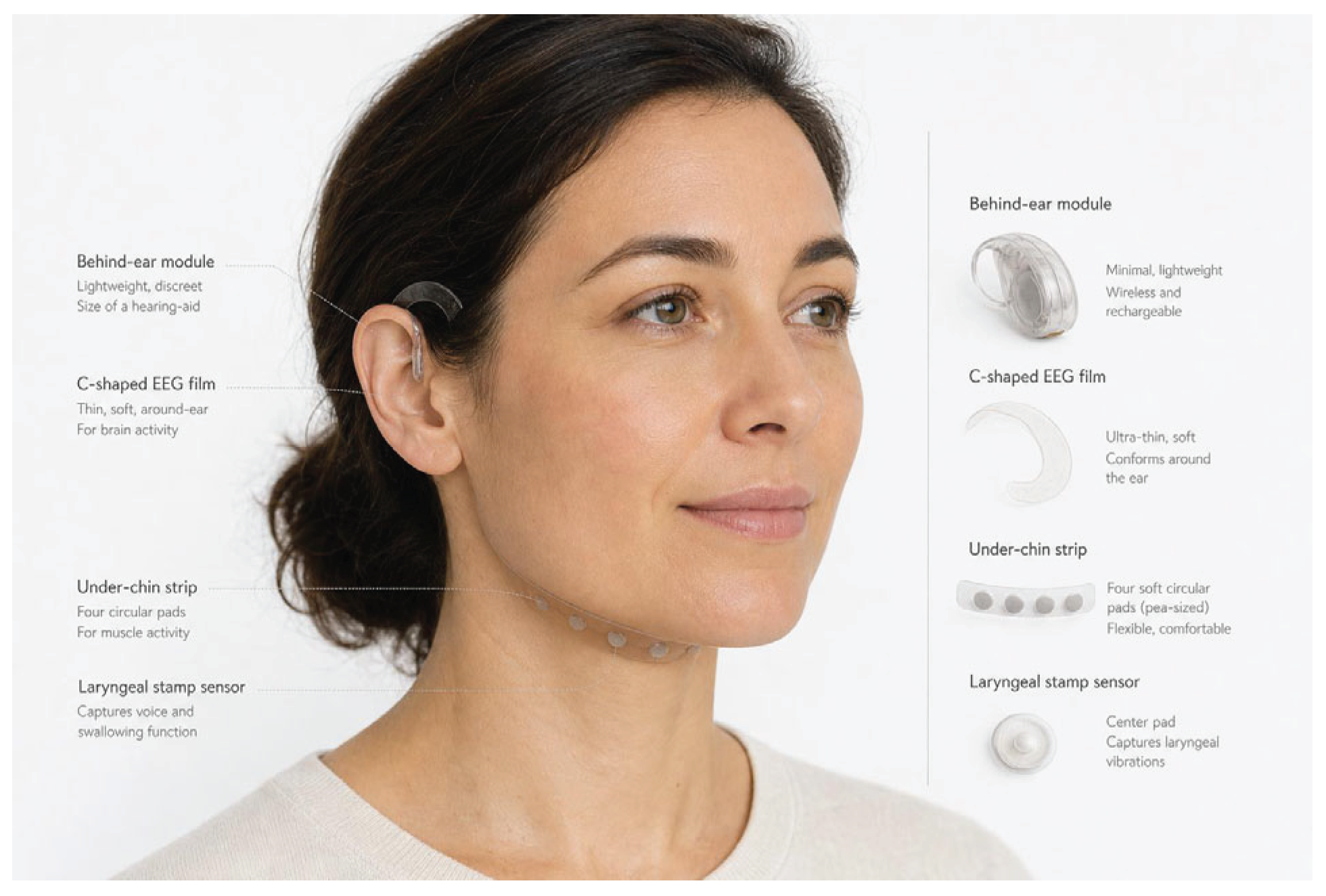
Figure 2.
Anterior person-mounted view showing the submental sense/stimulation contacts and laryngeal sensing stamp.
Figure 2.
Anterior person-mounted view showing the submental sense/stimulation contacts and laryngeal sensing stamp.
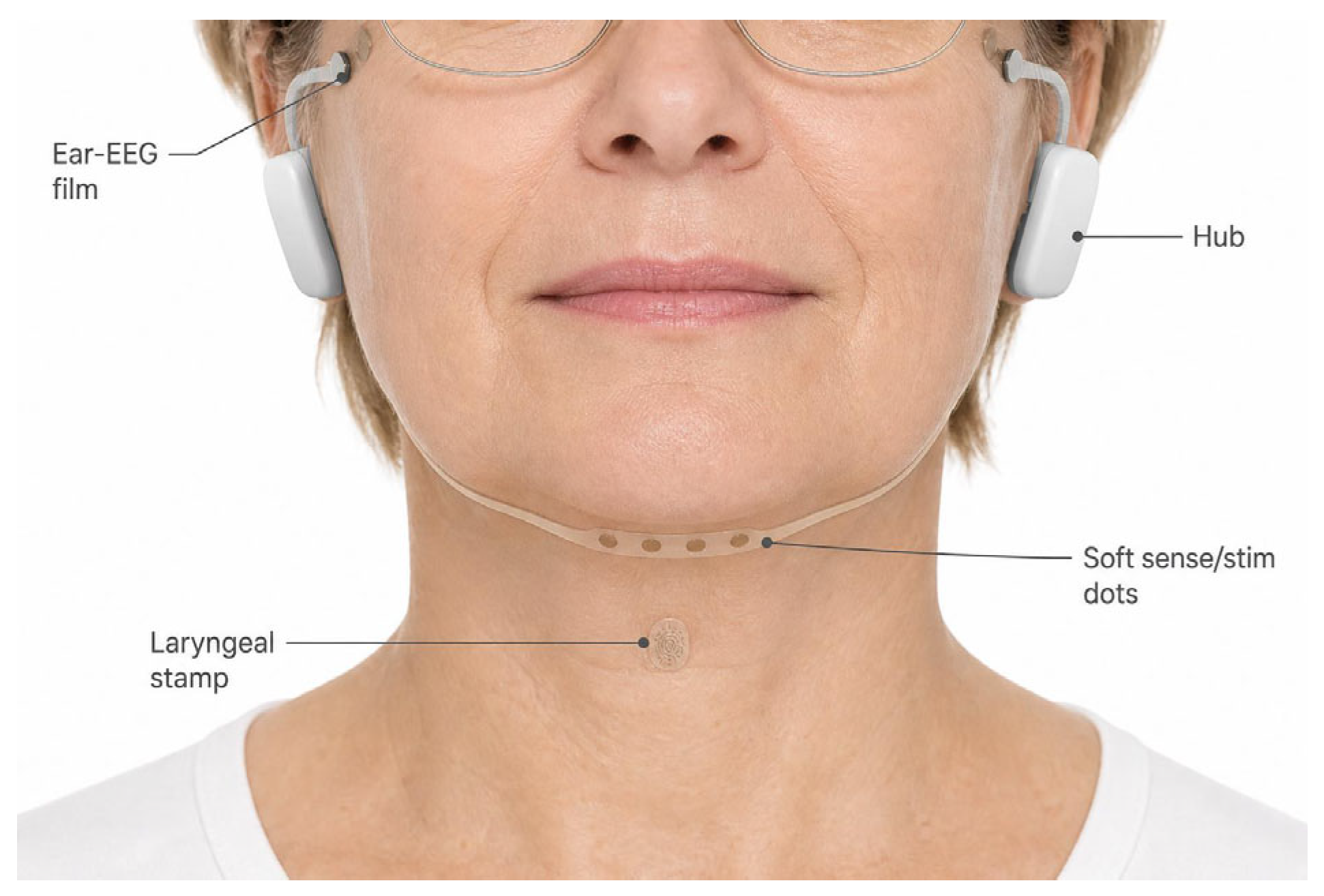
Figure 3.
Multimodal sensor/actuator suite, control roles, and compact anatomical placements. EEG provides intent arming only; sEMG gates co-activation; BI provides onset and elevation feedback; acoustics/IMU support verification; FES provides assistive force; the kill-switch inhibits energy delivery.
Figure 3.
Multimodal sensor/actuator suite, control roles, and compact anatomical placements. EEG provides intent arming only; sEMG gates co-activation; BI provides onset and elevation feedback; acoustics/IMU support verification; FES provides assistive force; the kill-switch inhibits energy delivery.
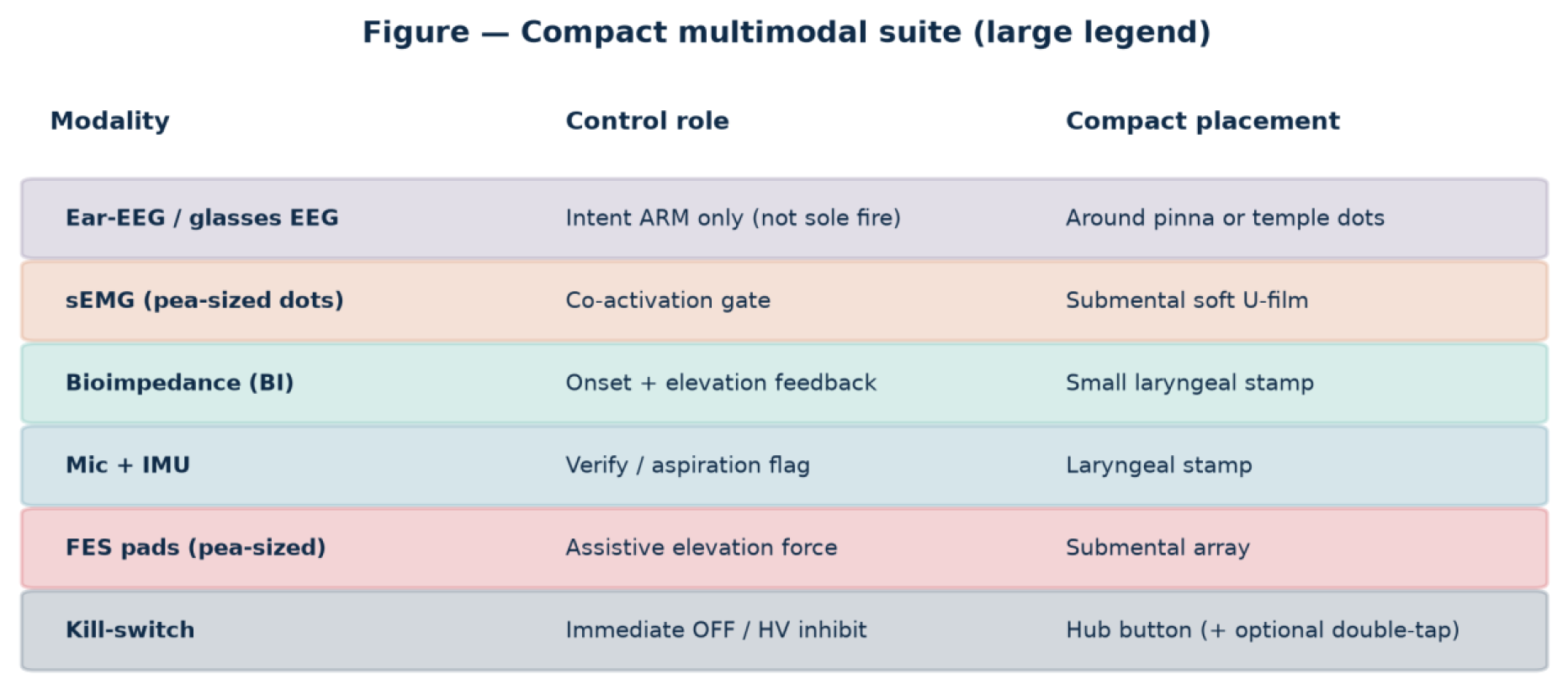
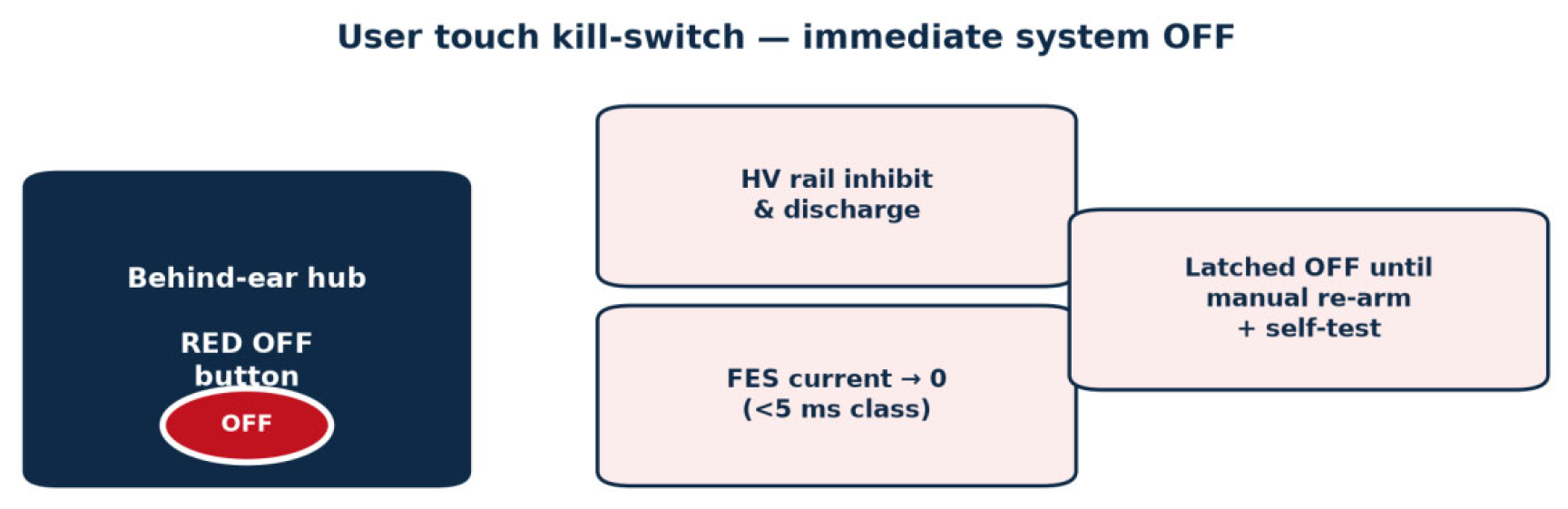
Figure 4.
Tier-0 user touch OFF path. Activation disables the high-voltage rail, commands zero current, and latches the system in a safe state until manual re-arm and self-test.
Figure 4.
Tier-0 user touch OFF path. Activation disables the high-voltage rail, commands zero current, and latches the system in a safe state until manual re-arm and self-test.
2.2. Hierarchical Controller and Information Flow
SafeSwallow is organized as a hierarchical controller. Tier 0 contains non-learned safety logic that cannot be overridden by learned modules. Tier 1 implements reactive stimulation authorization using BI preselection, sEMG co-activation, and artificial-intelligence (AI) swallow verification. Tier 2 adds anticipatory onset prediction from ear/glasses EEG and early peripheral signals. Tier 3 estimates achieved elevation and fatigue and updates the next-swallow dose using ILC. The platform is intentionally structured so that EEG can arm the path but cannot sole-fire FES.
Figure 5.
Hierarchical closed-loop control architecture with Tier-0 safety overrides and three control tiers: reactive verification, anticipatory feedforward, and feedback/learning.
Figure 5.
Hierarchical closed-loop control architecture with Tier-0 safety overrides and three control tiers: reactive verification, anticipatory feedforward, and feedback/learning.
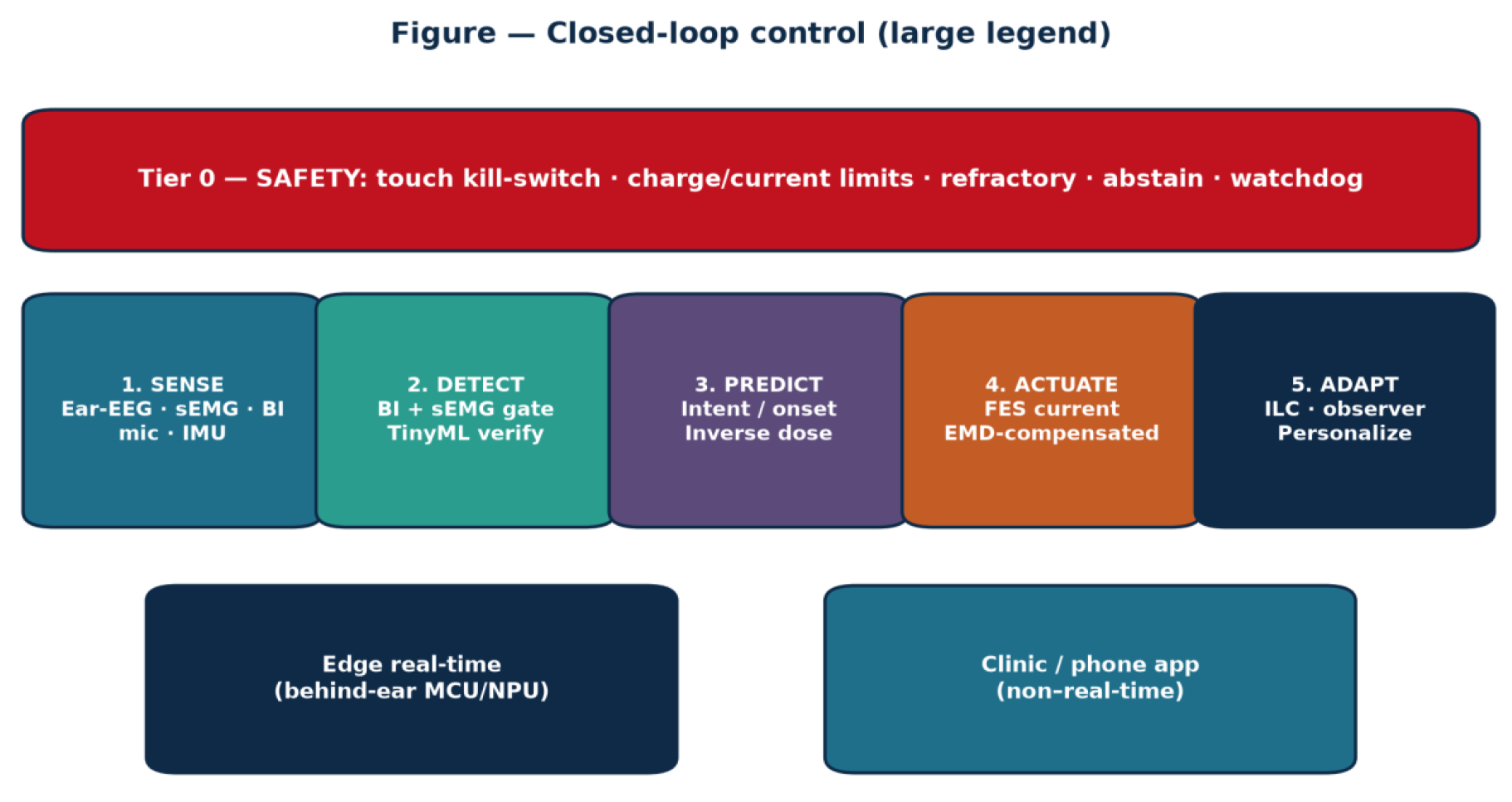
Figure 6.
Signal/decision/actuation flow: multimodal sensing, causal feature extraction, intent estimation and swallow verification, EMD-compensated scheduling, FES delivery, and post-action feedback.
Figure 6.
Signal/decision/actuation flow: multimodal sensing, causal feature extraction, intent estimation and swallow verification, EMD-compensated scheduling, FES delivery, and post-action feedback.
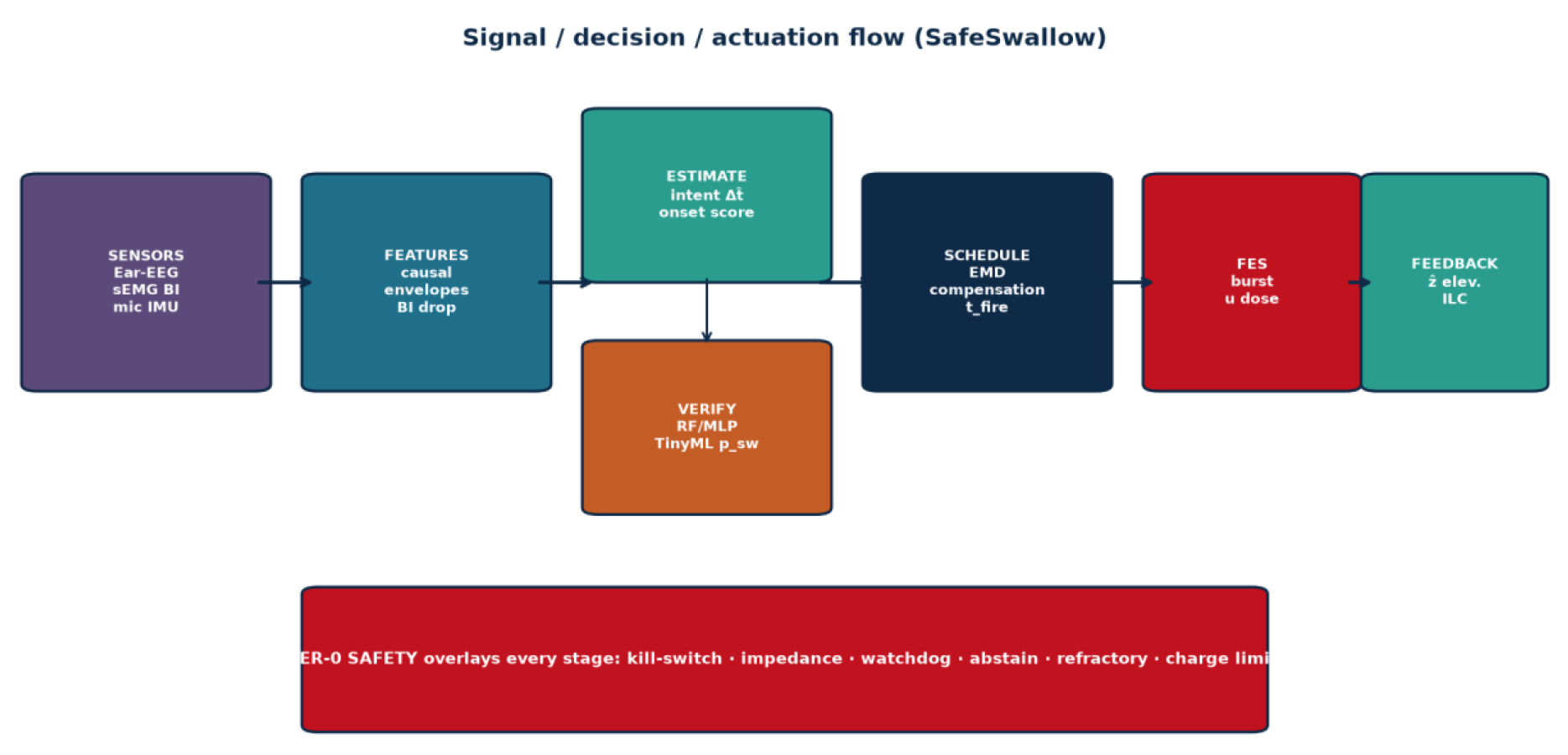
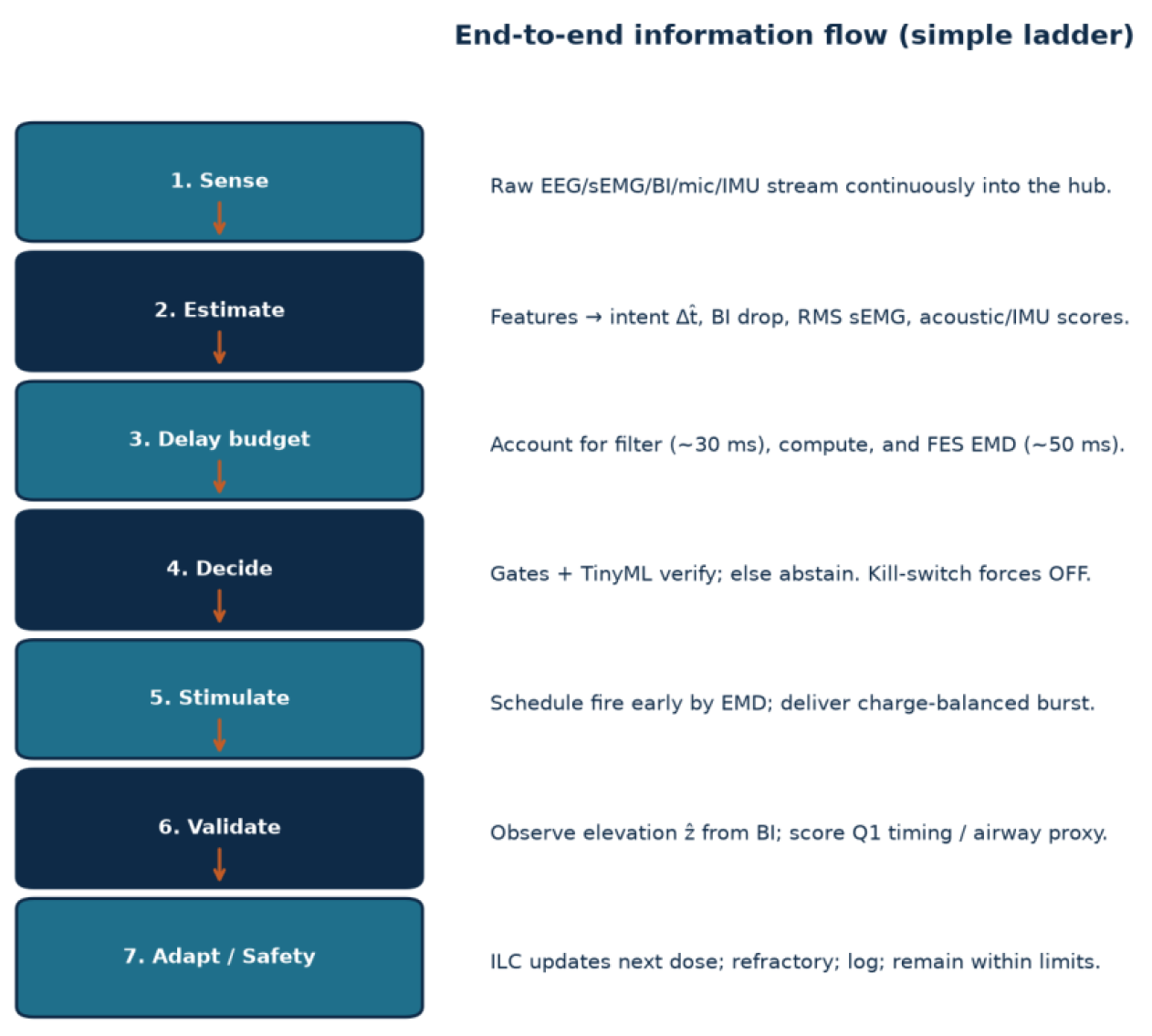
Figure 7.
End-to-end information-flow ladder. The seven stages are sensing, estimation, delay accounting, decision, stimulation, validation, and adaptation/safety.
Figure 7.
End-to-end information-flow ladder. The seven stages are sensing, estimation, delay accounting, decision, stimulation, validation, and adaptation/safety.
2.3. Sensor Roles and Decision Logic
EEG is used as a preparatory signal. It is not the sole authority for stimulation. sEMG measures activity of submental elevators and forms a co-activation gate. BI is measured at the laryngeal region and is used both for onset preselection and as an elevation feedback proxy. Contact acoustics and IMU provide additional evidence to discriminate swallowing from speech, chewing, coughing, and head-motion confounders and are especially useful in the public HRCA evaluation.
The decision path is intentionally causal. Short windows are buffered without non-causal look-ahead. A candidate swallow is authorized only when all required logical gates pass and no Tier-0 inhibit is active. Otherwise, the system abstains. This design explicitly treats a false positive electrical stimulus as more consequential than a missed assistive opportunity.
3. Mathematical Formulation
3.1. Q1 Timing Deadline
is the end of the first-quarter ( ) assistive-force window, referenced to the onset of the pharyngeal phase.
t₀ is the pharyngeal onset time of the swallow.
Interpretation of (1): this is a deliberately conservative engineering timing definition. The model does not claim that Q1 is a universal physiological cutoff; it defines a reproducible target interval for the present controller evaluation. The nominal value follows directly from the reported elevation prior, Tₕ ≈ 0.390 s, so T_q = Tₕ/4 ≈ 0.0975 s. The physiological premise that timely laryngeal elevation contributes to airway protection and that stimulation can augment laryngeal movement is supported by Burnett et al. [11,12].
is the modeled hyolaryngeal elevation-ramp duration; the present engineering prior uses approximately 0.390 s.
The Q1 window is therefore approximately 0.0975 s for the nominal 0.390-s elevation ramp.
3.2. Bioimpedance and sEMG Gating
∈ {0,1} is the BI preselection gate.
is the measured tissue impedance in ohms and is a slowly varying causal baseline.
is the minimum impedance-drop threshold; the synthetic controller used 0.18 Ω as an engineering prior.
Interpretation of (2)–(3): the BI gate b(t) is a preselection mechanism, not a diagnosis of swallowing. Riebold et al. showed that combining BI and surface electromyography (EMG) improved swallow-onset detection relative to EMG alone in a patient dataset, motivating the division of labor used here [9]. The threshold θ_b is an engineering/calibration parameter; it is not a universal biological constant. Likewise, θ_m is subject dependent because absolute sEMG amplitudes vary with electrode placement, tissue impedance, and muscle activation.
∈ {0,1} is the submental co-activation gate.
is the causal root-mean-square (RMS) magnitude of the band-passed signal.
is a subject-calibrated activation threshold.
3.3. Learned Swallow Verification and Fire Authorization
pₛw(t) ∈ [0,1] is the estimated probability that the current causal feature window represents a swallow.
is the trained RF/MLP/ensemble verifier and is the multimodal causal feature vector.
is the operating threshold; the synthetic implementation used a minimum authorization probability of 0.55 and selected the operating point using training-fold .
Interpretation of (4)–(5): p_s(t)=f_θ(x_t) is a probabilistic classifier output. The threshold θ_s is selected on grouped training/validation folds and then frozen before the held-out evaluation. The logical authorization a(t) is intentionally more restrictive than a classifier decision: a high p_s(t) is necessary but not sufficient because the Tier-0 conditions can independently inhibit stimulation. This separation makes the learned component advisory within a deterministic safety envelope rather than the final actuator authority.
∈ {0,1} is the final energy-delivery authorization.
The predicate represents the user OFF state.
The predicate represents the post-stimulation refractory lockout interval.
represents the deterministic Tier-0 safety gate, which is false for out-of-range electrode impedance, watchdog failure, refractory lockout, user OFF state, or charge/current violation.
3.4. EMD-Compensated Scheduling
is the electrical stimulus onset time.
Interpretation of (6)–(7): t_f is scheduled earlier than confirmation by the estimated electromechanical delay T_e. The relation t_a=t_f+T_e is an accounting identity for the expected force-arrival time, not a measured subject-specific transfer function. The present study uses T_e≈50 ms as an engineering prior. Burnett et al. demonstrated the feasibility of swallow-triggered FES and the importance of temporal synchronization between the swallow and stimulation [12]. In a clinical implementation, T_e must be measured for the final electrode geometry, waveform, muscle targets, and subject.
is the time at which swallow confirmation becomes available.
is the residual computation/inference delay after confirmation.
is the electromechanical delay; the present engineering prior is approximately 0.050 s.
is the estimated time at which useful assistive force reaches the target musculature.
Under the success criterion, must be less than or equal to .
3.5. Elevation Error and Iterative Learning Control
k indexes successive swallows.
is the desired or reference elevation for swallow k.
Interpretation of (8)–(9): the update is an iterative learning control law applied from one swallow to the next. The error e_k compares the desired elevation target z_k* with the observed elevation estimate ẑ_k. If the observed elevation is below target, the update increases u_{k+1}; if it is above target, the update decreases the dose, subject to saturation. This is consistent with the repetitive-trial viewpoint of ILC described by Bristow, Tharayil, and Alleyne [15]. The study does not claim formal stability for the nonlinear human swallowing plant; the learning gain L and saturation bounds are engineering parameters to be identified and validated experimentally.
is the estimated achieved elevation obtained from BI and optional acoustic/IMU observations.
is the swallow-to-swallow elevation tracking error.
is the stimulation dose, represented in the present model primarily by current amplitude in milliamperes.
L is the ILC learning gain.
Interpretation of (10)–(11): the binary cross-entropy objective is the standard negative log-likelihood for probabilistic binary classification and is widely described in statistical pattern recognition [34]. The F1 score combines precision and recall through their harmonic mean; it is particularly useful here because class imbalance and the asymmetric consequence of false stimulation make raw accuracy insufficient [35]. The selected threshold τ* is therefore an operating point chosen from training/validation folds rather than from the held-out test set.
sat(.) clamps the update to the hardware-safe interval [, ].
The controller therefore adapts across repeated swallows while preserving explicit safety bounds.
3.6. Verifier Training and Operating Point
is the binary cross-entropy objective.
yᵢ ∈ {0,1} is the ground-truth label for sample i and pᵢ = () is the predicted swallow probability.
is selected from subject-grouped training folds to balance precision and recall under class imbalance.
() denotes the harmonic mean of precision and recall at candidate threshold .
Interpretation of (12)–(14): (12) is a linear discrete-time state-space approximation; (13) is the measurement-update form of the Kalman filter, following the state-estimation framework introduced by Kalman [37]. The matrices A, B, and C are not assumed to be universal physiological constants; they are model parameters representing local state propagation, stimulation influence, and measurement mapping. The process covariance and measurement covariance describe uncertainty in latent-state evolution and sensor observations. Equation (14), Q_p=I_pτ_p, follows directly from the definition of charge as current integrated over pulse duration. The resulting density ρ_q=Q_p/A_e is used as a safety accounting variable, while the final permissible limit must be determined from the final electrode geometry, waveform, tissue-interface characterization, and applicable medical-device safety requirements. IEC 60601-2-10 specifies requirements for the basic safety and essential performance of nerve and muscle stimulators [38].
3.7. Elevation Observer and Electrical Safety Constraint
Interpretation of (15): the HRCA dataset contains audio/accelerometer samples at 4 kHz and reference VFSS timing at 60 frames/s. The frame-to-sample conversion therefore maps a video frame index into the nearest equivalent signal sample using the ratio 4000/60. This is a synchronization operation defined by the dataset sampling rates, not a learned parameter [27,28].
xₜ is the latent elevation/fatigue state; is stimulation input; contains BI and optional acoustic/IMU measurements.
A, B, and C are the state, input, and output matrices; and represent process and measurement noise.
The predicted state is , and the filtered estimate is .
is the Kalman gain and the bracketed term is the measurement innovation.
is the charge delivered during a single phase of a biphasic pulse.
denotes pulse-current amplitude, is pulse-phase width, and is electrode contact area.
is the enforced charge-density ceiling implemented by the Tier-0 safety supervisor.
Equation (15) maps a VFSS frame index to the corresponding signal-sample index. Here, nₛ is the HRCA sample index, n_f is the VFSS video-frame index, fₛ is the HRCA signal sampling frequency (4000 Hz), and fᵥ is the VFSS frame rate (60 frames/s). Thus, nₛ = n_f(fₛ/fᵥ) converts the video-domain time base to the sensor-signal time base without introducing a learned parameter. This synchronization convention follows the sampling characteristics of the public HRCA dataset [27,28].
The conversion maps a VFSS frame index to the corresponding HRCA sample index.
4. Algorithms and Implementation
4.1. Safety Supervisor and Causal Feature Front-End
Algorithm A0 monitors the kill-switch, electrode impedance, watchdog state, refractory state, and charge/current bounds on every control cycle. A fault immediately disables the high-voltage rail and forces the commanded stimulation current to zero. Algorithm A1 computes causal features: EEG intent features, band-passed sEMG RMS, BI drop and slope, multi-band microphone envelopes, spectral moments, and an IMU superior–inferior displacement proxy.
Algorithm A1—causal feature front-end
Figure 15.
Algorithm A1 flow: causal feature extraction and construction of the multimodal feature vector.
Figure 15.
Algorithm A1 flow: causal feature extraction and construction of the multimodal feature vector.
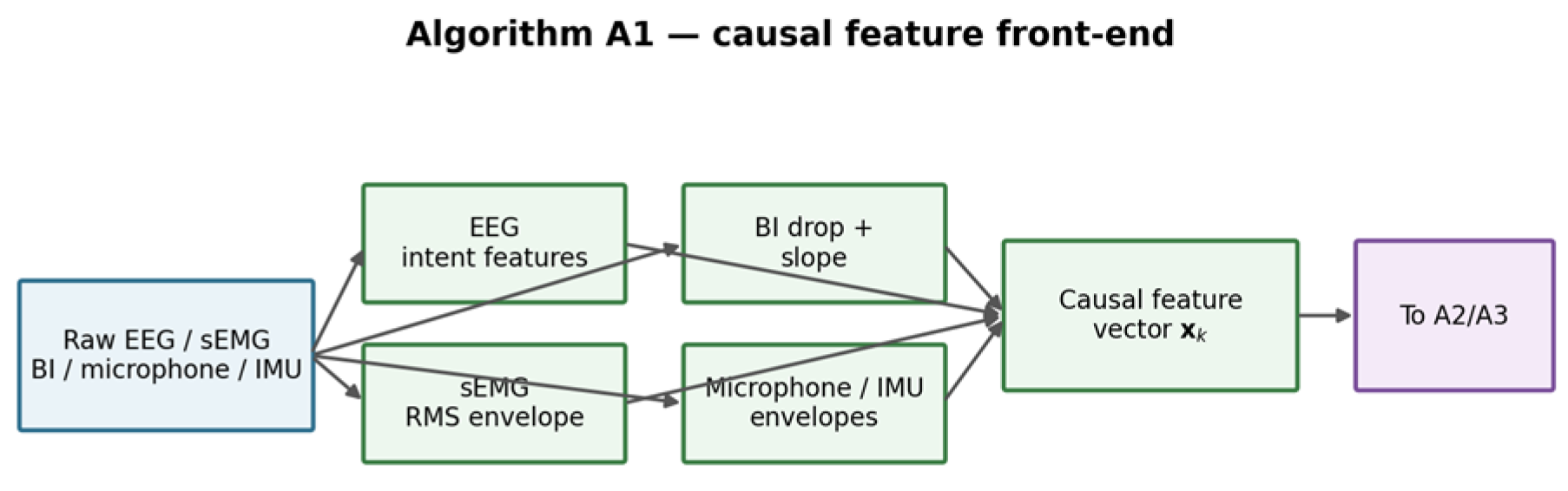
A1 converts the heterogeneous sensor streams into a compact, causal feature vector. EEG features are used for anticipatory intent estimation; surface EMG is summarized by a causal RMS envelope; BI contributes baseline-relative drop and slope; microphone and inertial channels contribute envelope, spectral, and superior–inferior-motion features. No future samples are used. The feature layer is deterministic, calibrated, and therefore does not constitute the learned swallow verifier.
Algorithm A0—deterministic safety supervisor
Figure 14.
Algorithm A0 flow: deterministic safety supervision and inhibit logic.
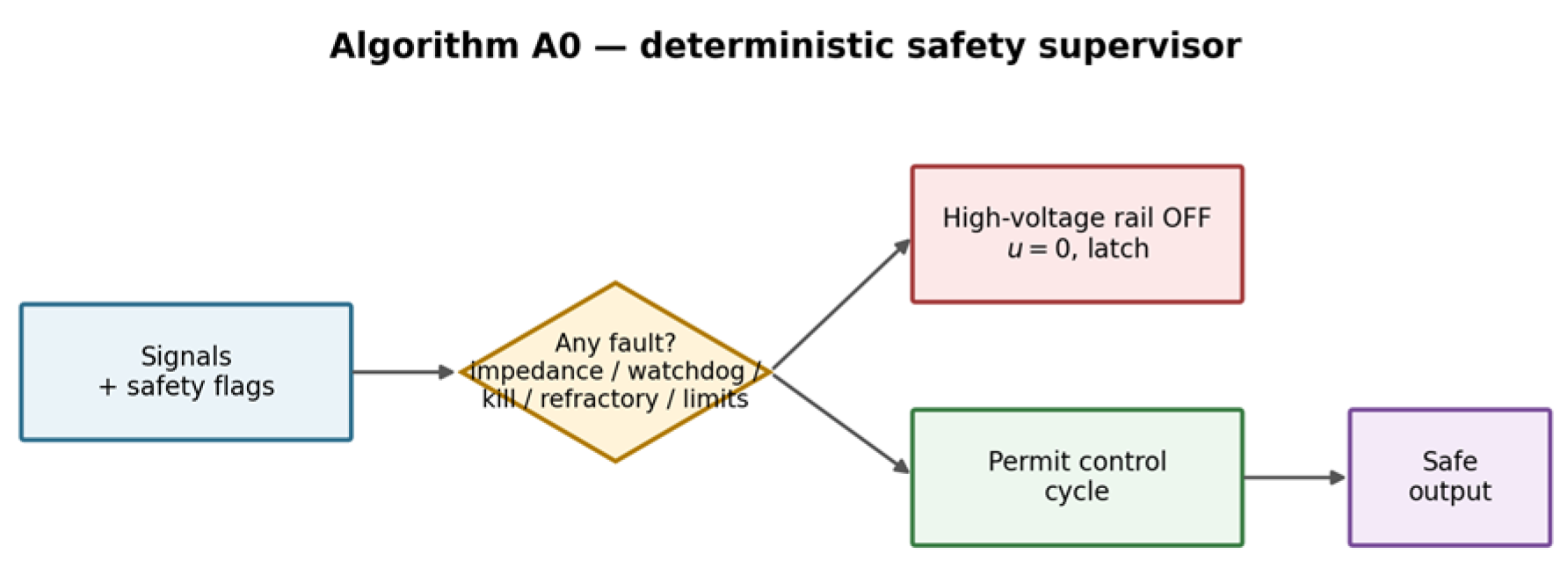
A0 is the non-learned supervisory layer. At every control cycle it evaluates the user kill-switch, electrode impedance, watchdog status, refractory lockout, and hard current/charge limits. If any inhibit condition is asserted, the high-voltage rail is disabled and the requested dose is forced to zero. A0 therefore has no training phase and no learned parameters. Its purpose is to make safety monotonic: adding a learned model cannot weaken the hard constraints. The diagram shows the decision point and the two possible control paths.
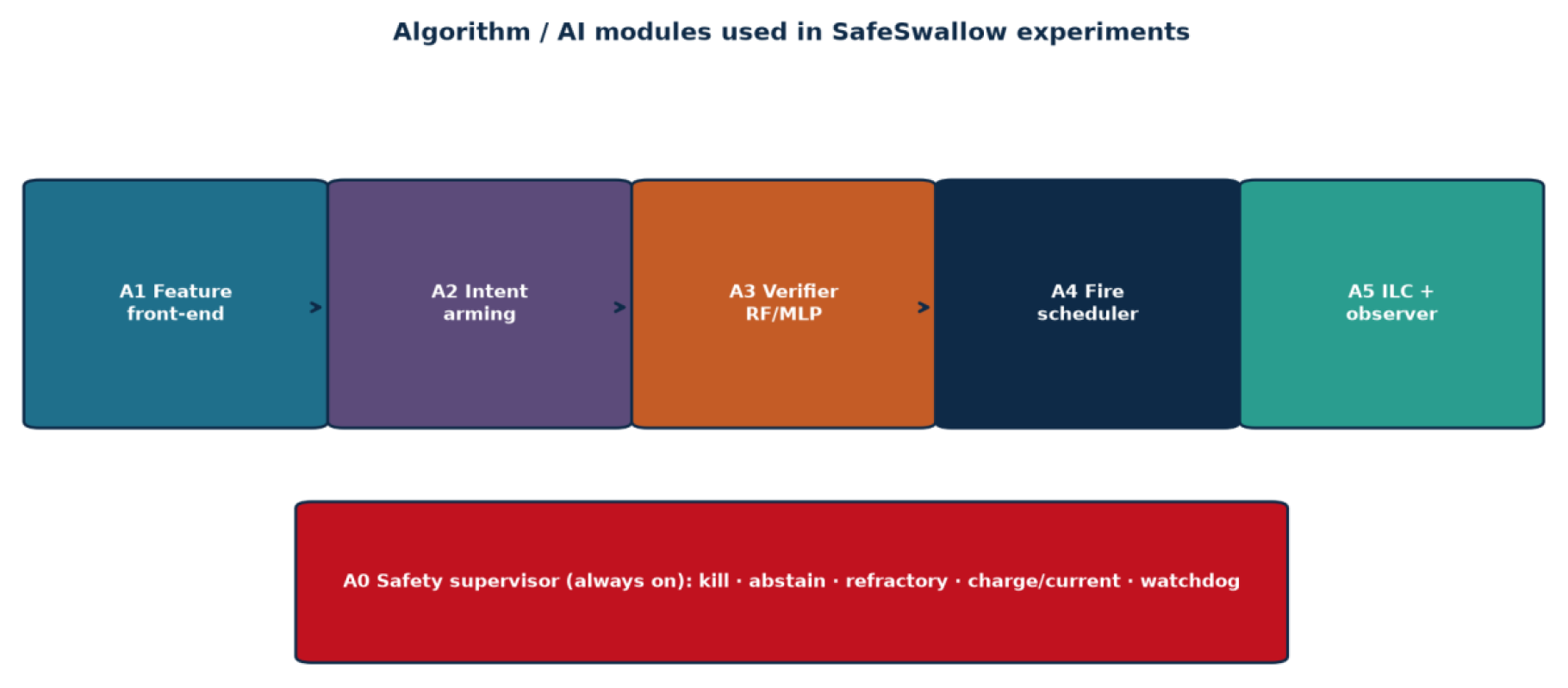
Figure 8.
Algorithm modules used in the reported experiments. A0 is the always-on safety supervisor; A1–A5 comprise the real-time control path; A6 is used for the public HRCA evaluation.
Figure 8.
Algorithm modules used in the reported experiments. A0 is the always-on safety supervisor; A1–A5 comprise the real-time control path; A6 is used for the public HRCA evaluation.
4.2. Anticipatory Arming and Swallow Verification
Algorithm A2 predicts imminent swallow onset from EEG and early peripheral features. When confidence exceeds an arming threshold and the predicted onset lies within a configured horizon, the system may pre-charge the compliance rail and compute a provisional fire time. This step changes the timing budget without allowing EEG alone to authorize stimulation. Algorithm A3 then verifies the swallow from the multimodal feature vector using a compact random forest (RF), multilayer perceptron (MLP), or ensemble. In the synthetic implementation, the MLP used hidden layers [16, 8] and approximately 305 trainable parameters over nine causal features.
Algorithm A3—swallow verifier
Figure 17.
Algorithm A3 flow: probabilistic swallow verification and abstention.
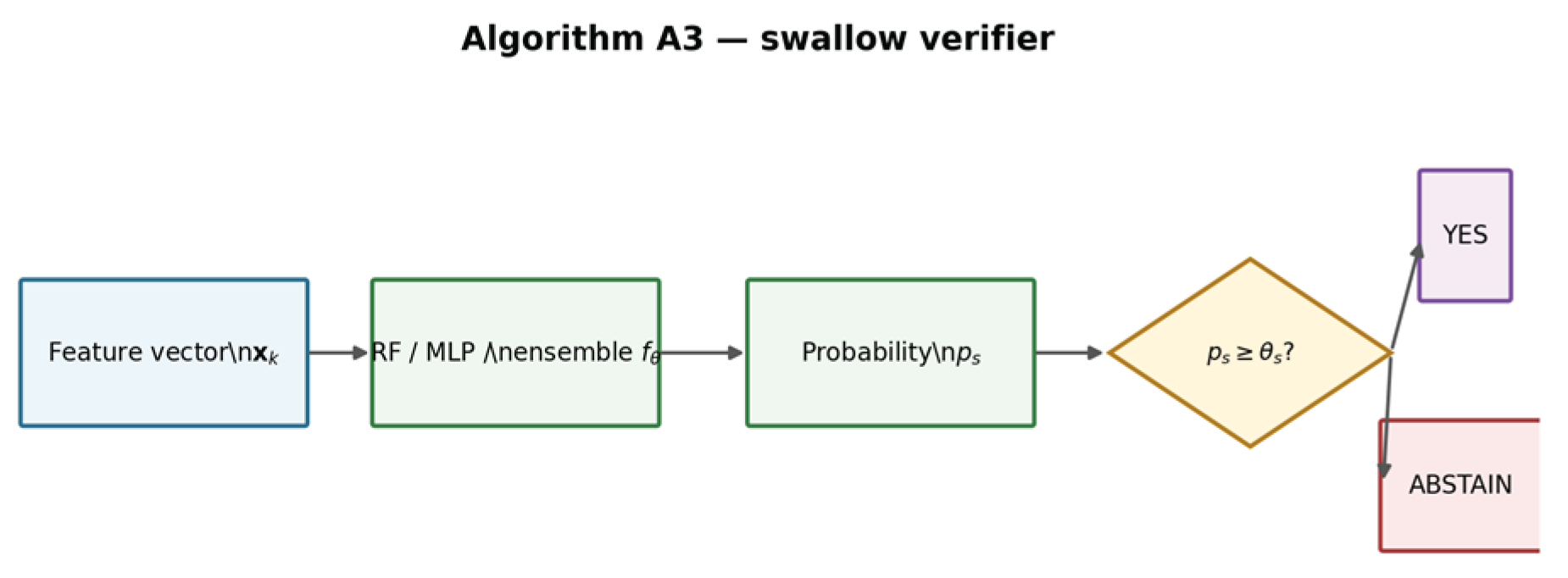
A3 performs the final probabilistic discrimination of swallow versus non-swallow events. Candidate implementations include a random forest, multilayer perceptron, or ensemble. Training is subject-grouped, and the probability threshold θₛ is selected only on training/validation folds. At runtime, a prediction below θₛ produces abstention rather than stimulation. The diagram makes the decisive role of the probability gate explicit.
Algorithm A2—anticipatory arming
Figure 16.
Algorithm A2 flow: anticipatory onset prediction, confidence gate, and provisional scheduling.
Figure 16.
Algorithm A2 flow: anticipatory onset prediction, confidence gate, and provisional scheduling.
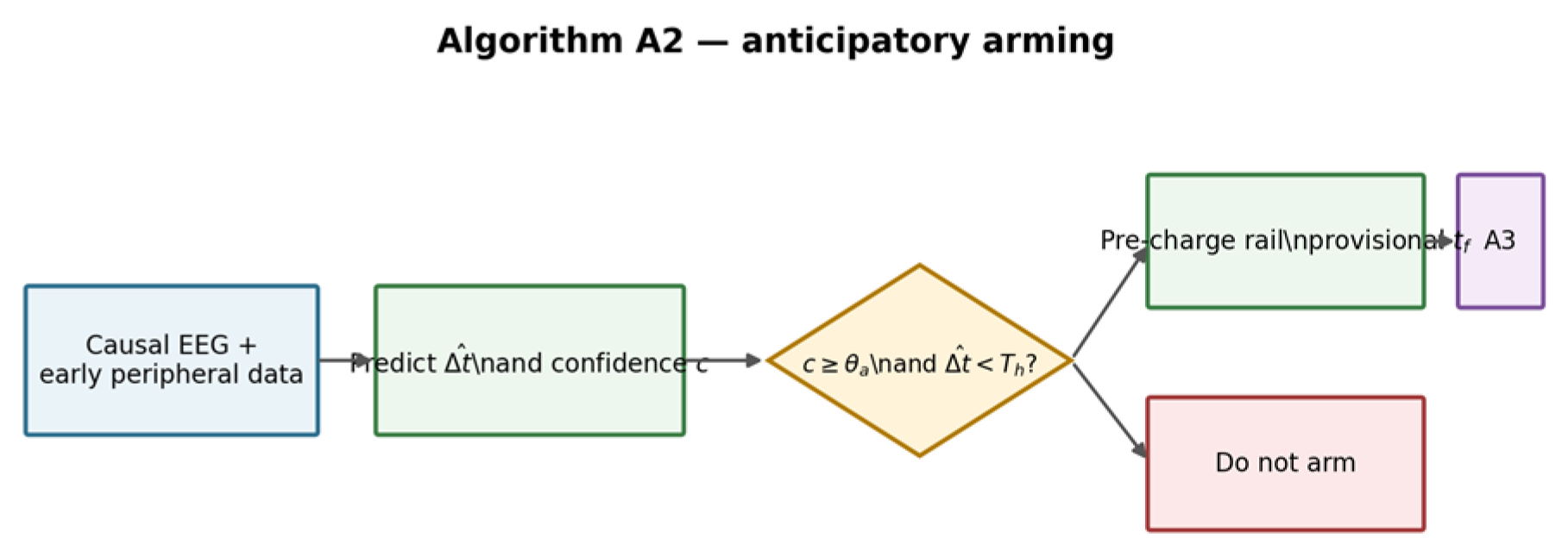
A2 predicts whether a swallow is approaching and, when possible, estimates the time to onset. The model can be implemented with a temporal convolutional network or gated recurrent unit, but in all cases its authority is limited to arming and pre-computation. If confidence c exceeds θₐ and the predicted time-to-onset lies within the horizon Tₕ, the rail may be pre-charged and a provisional fire time computed. A2 cannot by itself authorize stimulation. This separation is central to the safety argument.
4.3. Reactive Fire Scheduling, Observer, and ILC
Algorithm A4 executes only when the system is armed and all BI, sEMG, AI, and Tier-0 conditions are satisfied. The scheduler applies Eq. (6), delivers a charge-balanced biphasic burst, and enters refractory. Algorithm A5 observes achieved elevation, computes Eq. (8), and applies Eq. (9) to obtain the next-swallow dose. Algorithm A6 modifies the HRCA signal path using multi-band envelopes, superior–inferior displacement proxies, tri-axial consensus gating, a class-balanced RF+MLP ensemble, acoustic corroboration, anticipatory rising-edge triggers, and EMD-compensated scoring.
Algorithm A5—observer and ILC adaptation
Algorithm A6—improved HRCA evaluation pipeline
Figure 20.
Algorithm A6 flow: improved HRCA signal processing, ensemble verification, and anticipatory Q1 scoring.
Figure 20.
Algorithm A6 flow: improved HRCA signal processing, ensemble verification, and anticipatory Q1 scoring.
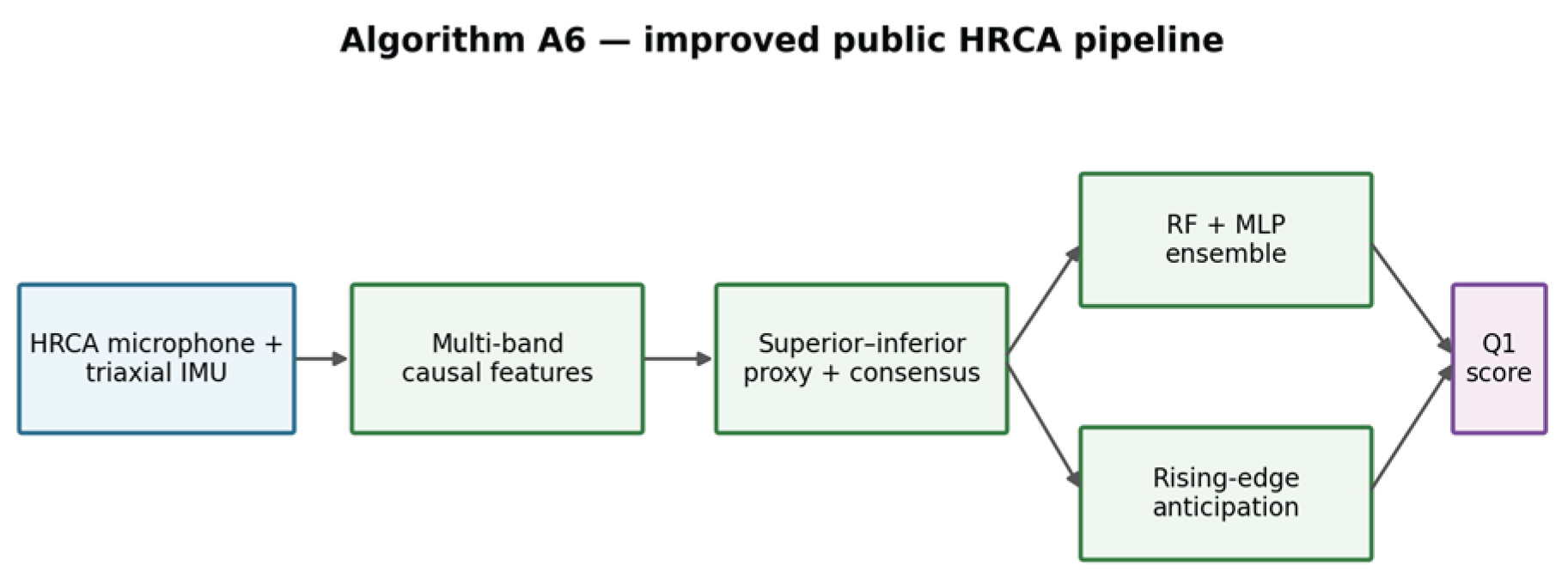
A6 is the public-data algorithm used for the HRCA track. It does not claim to reconstruct the full SafeSwallow sensing stack because BI and EEG are absent from the corpus. Instead, it improves the available microphone/accelerometer path with multi-band causal features, superior–inferior motion proxies, tri-axial consensus, a class-balanced RF+MLP ensemble, acoustic corroboration, and anticipatory rising-edge timing. The final output is a detection/Q1 score against VFSS-aligned labels.
Figure 19.
Algorithm A5 flow: elevation observation, error computation, and swallow-to-swallow ILC adaptation.
Figure 19.
Algorithm A5 flow: elevation observation, error computation, and swallow-to-swallow ILC adaptation.
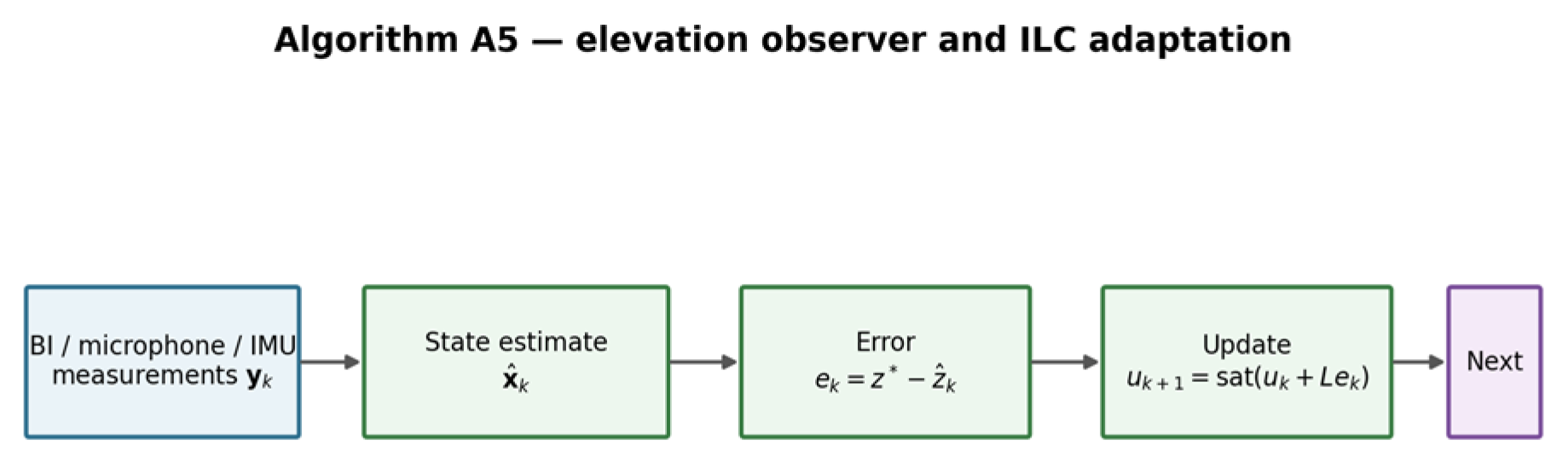
A5 updates the next-swallow stimulation dose. First, BI and optional microphone/IMU measurements are mapped to an elevation/fatigue state estimate. The elevation error e_k is then passed through the ILC learning law to update u_{k+1}, with saturation and optional rate limiting. The loop operates across swallows, not as an unconstrained within-swallow high-bandwidth controller.
Algorithm A4—reactive fire scheduler
Figure 18.
Algorithm A4 flow: gated firing, EMD compensation, FES delivery, and refractory lockout.
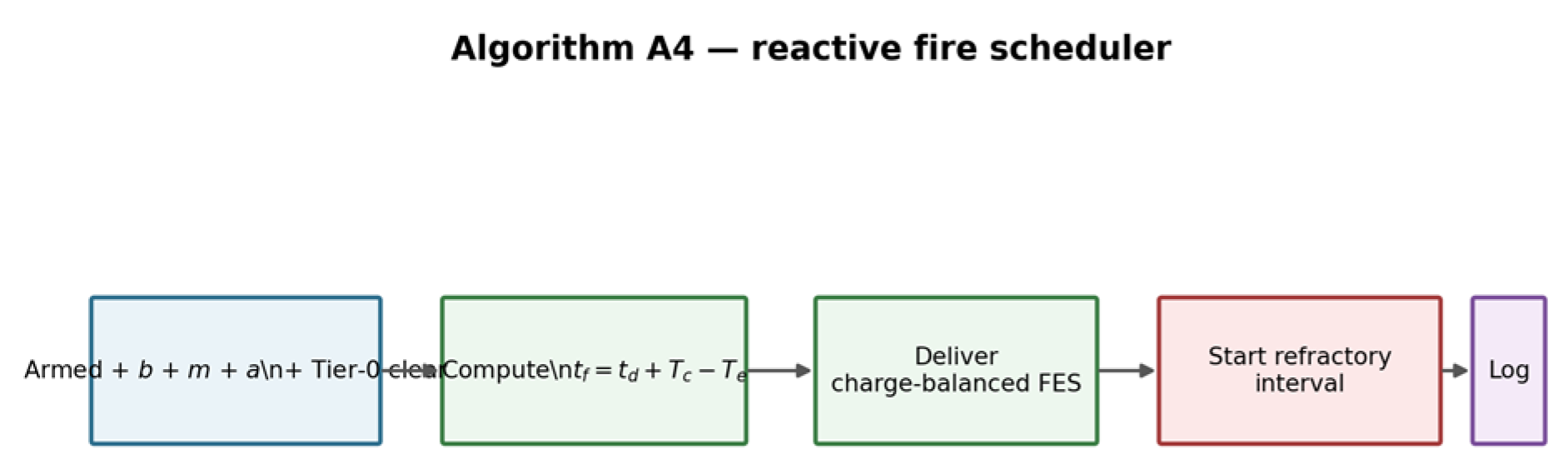
A4 is the timing-critical actuator scheduler. It requires the system to be armed and all peripheral and Tier-0 gates to be clear. It then evaluates t_f=t_d+T_c−T_e, delivers the charge-balanced FES burst, and starts the refractory interval. This is the module in which the timing model, actuator delay, and safety gates directly meet.
5. Experimental Design and Methods
5.1. Synthetic Closed-Loop Experiment
The synthetic experiment was designed as a controlled stress test rather than a clinical validation study. A physiology-inspired plant generated multimodal signals at 1 kHz, including BI, sEMG, microphone, IMU, and optional EEG features. Healthy priors used a peak elevation of approximately 12 ± 1.2 mm and an elevation duration of 0.39 ± 0.03 s. Parkinsonian phenotypes were represented by severity tiers with reduced voluntary gain, delayed onset, prolonged elevation, faster fatigue, and medication ON/OFF scaling. These are engineering priors, not patient-specific claims.
Confounders resembling speech, chewing, and coughing were injected to stress false-stimulation behavior. The controller used = 0.18 ohm, a 0.55 swallow-probability authorization threshold, 50-ms EMD, a nominal 12-mA dose with 4–25 mA limits, approximately 0.60-s stimulation bursts with a 0.04-s ramp, a 1.0-s refractory interval, and a modeled compute delay of approximately 8 ± 3 ms.
The classifier training set contained 8 subjects with 20 swallows and 12 confounders per subject. A held-out classifier evaluation set contained 4 unseen subjects with 15 swallows and 10 confounders per subject. The final closed-loop and matched open-loop evaluation used 8 unseen test subjects: 4 healthy and 4 Parkinsonian. Each contributed 25 swallows and 10 confounders in each condition, producing 280 held-out trials per condition (200 swallows and 80 confounders). A fixed random seed of 7 was used.
The subject-grouped split is essential because random window-level splitting could place highly correlated windows from the same synthetic subject in both training and test data, inflating performance estimates. The present implementation therefore treats the subject as the grouping unit.
5.2. Engineering Feasibility Criteria and Metrics
The study deliberately distinguishes engineering feasibility from clinical efficacy. A controller configuration was considered feasible when Q1 force success was at least 80%, missed swallows were at most 15%, false stimulation was at most 5%, and mean normalized elevation error was at most 0.35. Per-trial logs included detection and force latency, abstention, modeled airway-protection status, stimulation amplitude, verifier probability, compute delay, and inhibit reason codes.

Table 1.
Synthetic experimental design and controller settings.
| Parameter | Setting |
|---|---|
| Simulation rate | 1 kHz |
| Healthy peak elevation prior | 12 ± 1.2 mm |
| Elevation duration prior | 0.39 ± 0.03 s |
| BI preselection threshold | 0.18 ohm |
| Verifier authorization threshold | 0.55 |
| EMD prior | 50 ms |
| Compute delay | 8 ± 3 ms |
| Stimulation dose | 12 mA nominal; 4–25 mA bounds |
| Burst / ramp | 0.60 s / 0.04 s |
| Refractory | 1.0 s |
| Final held-out test | 280 trials per condition |
5.3. Public HRCA Evaluation
The public-data experiment used the Swallowing High Resolution Cervical Auscultation Signals corpus, available through Zenodo under digital object identifier (DOI) 10.5281/zenodo.4539695. The corpus contains contact-microphone and tri-axial accelerometer signals sampled at 4 kHz with VFSS-derived swallow onset/offset labels [27,28]. A 100-file subset containing 148 labeled swallows was analyzed. Because the corpus lacks BI and EEG, the experiment tests the real-signal sensing, verification, and scheduling components rather than the complete multimodal closed loop.
VFSS frame indices were converted to samples using Eq. (15). Subject/file-aware GroupShuffleSplit partitions were held fixed between baseline and improved methods. The baseline pipeline used single-band causal envelopes, a random-forest verifier, and reactive timing. The improved pipeline added multi-band causal envelopes, signal-to-noise ratio (SNR)-proxy denoising, a superior–inferior displacement proxy, tri-axial consensus gating, a class-balanced RF+MLP ensemble, an -optimized threshold, acoustic dual-gating, anticipatory rising-edge detection, and EMD-compensated scheduling. Negative latency values indicate decisions that precede the VFSS-labeled onset and therefore represent anticipatory timing rather than delayed detection.
5.4. Software and Reproducibility
The synthetic and HRCA analyses used a Python scientific-computing workflow centered on NumPy/SciPy/pandas/scikit-learn-style components with explicit random seeds. The manuscript reports result summaries in JSON form (summary.json and hrca_compare_summary.json). Public HRCA data are available under Creative Commons Attribution 4.0 International (CC BY 4.0). No new human subjects were enrolled, and the study used synthetic physiology-inspired simulations plus secondary analysis of an anonymized public dataset.
6. Results
6.1. Synthetic Closed-Loop Versus Open-Loop Performance
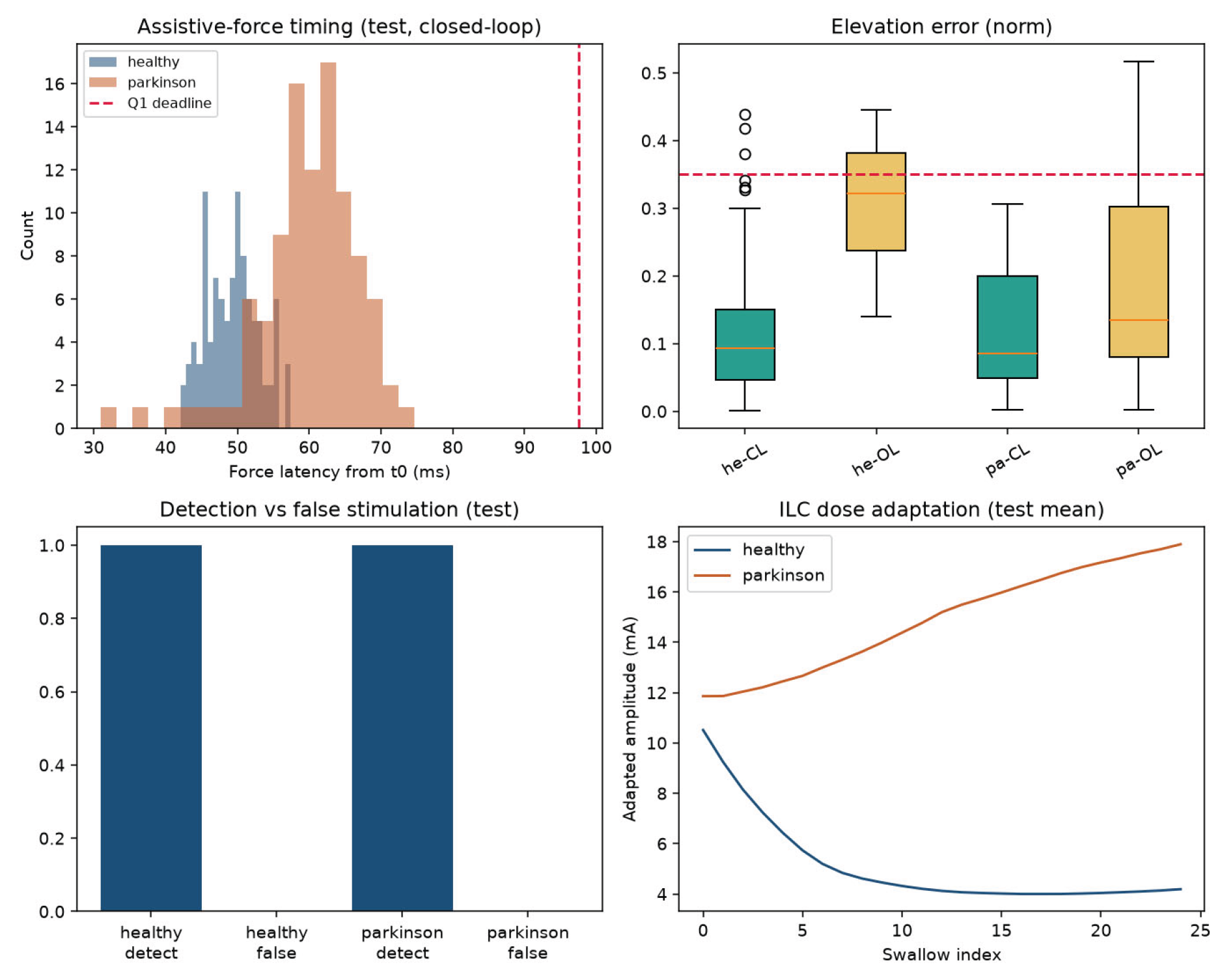
On 280 held-out synthetic trials, the closed-loop controller achieved 100.0% Q1 force success, 0.0% miss rate, 0.0% false stimulation, 54.6-ms mean force latency, 0.116 mean normalized elevation error, and 100.0% modeled airway-ok performance. The system abstained on approximately 25.0% of trials, reflecting the safety-first policy. Healthy and Parkinsonian strata both met the feasibility bars, with mean force latencies of 49.3 and 59.8 ms, respectively.
Matched open-loop dosing preserved Q1 timing in the present synthetic configuration but produced materially larger elevation error (0.253 versus 0.116) and lower airway-ok performance (94.0% versus 100.0%). The comparison is therefore most informative for the adaptation loop rather than the timing loop: the synthetic result suggests that feedback-based dose adjustment improves elevation tracking without sacrificing the selected Q1 timing criterion.
Table 2.
Held-out synthetic closed-loop and open-loop results.
| Cohort | N | Timing and error metrics | Force latency | Abstain / feasible |
|---|---|---|---|---|
| Test CL (all) | 280 | Q1 100%; miss 0%; false-stim 0%; elev. err. 0.116 | 54.6 ms | 25.0% / Yes |
| Healthy CL | 140 | Q1 100%; miss 0%; false-stim 0%; elev. err. 0.116 | 49.3 ms | 28.6% / Yes |
| Parkinson CL | 140 | Q1 100%; miss 0%; false-stim 0%; elev. err. 0.116 | 59.8 ms | 21.4% / Yes |
| Open-loop | 280 | Q1 100%; miss 0%; false-stim 0%; elev. err. 0.253 | 53.9 ms | 25.4% / Yes |
Table 3.
TinyML verifier and feasibility criteria.
| Metric | Value |
|---|---|
| Hidden layers | [16, 8] |
| Approx. parameters | 305 |
| Test AUC / / accuracy | 1.000 / 1.000 / 1.000 |
| Q1 / miss / false-stim / elevation-error criteria | ≥80% / ≤15% / ≤5% / ≤0.35 |
Figure 9.
Control timing across the four reported experiment tracks: synthetic closed loop, synthetic open loop, HRCA baseline, and HRCA improved. The shaded region marks the window; vertical markers identify modeled detection and force times.
Figure 9.
Control timing across the four reported experiment tracks: synthetic closed loop, synthetic open loop, HRCA baseline, and HRCA improved. The shaded region marks the window; vertical markers identify modeled detection and force times.
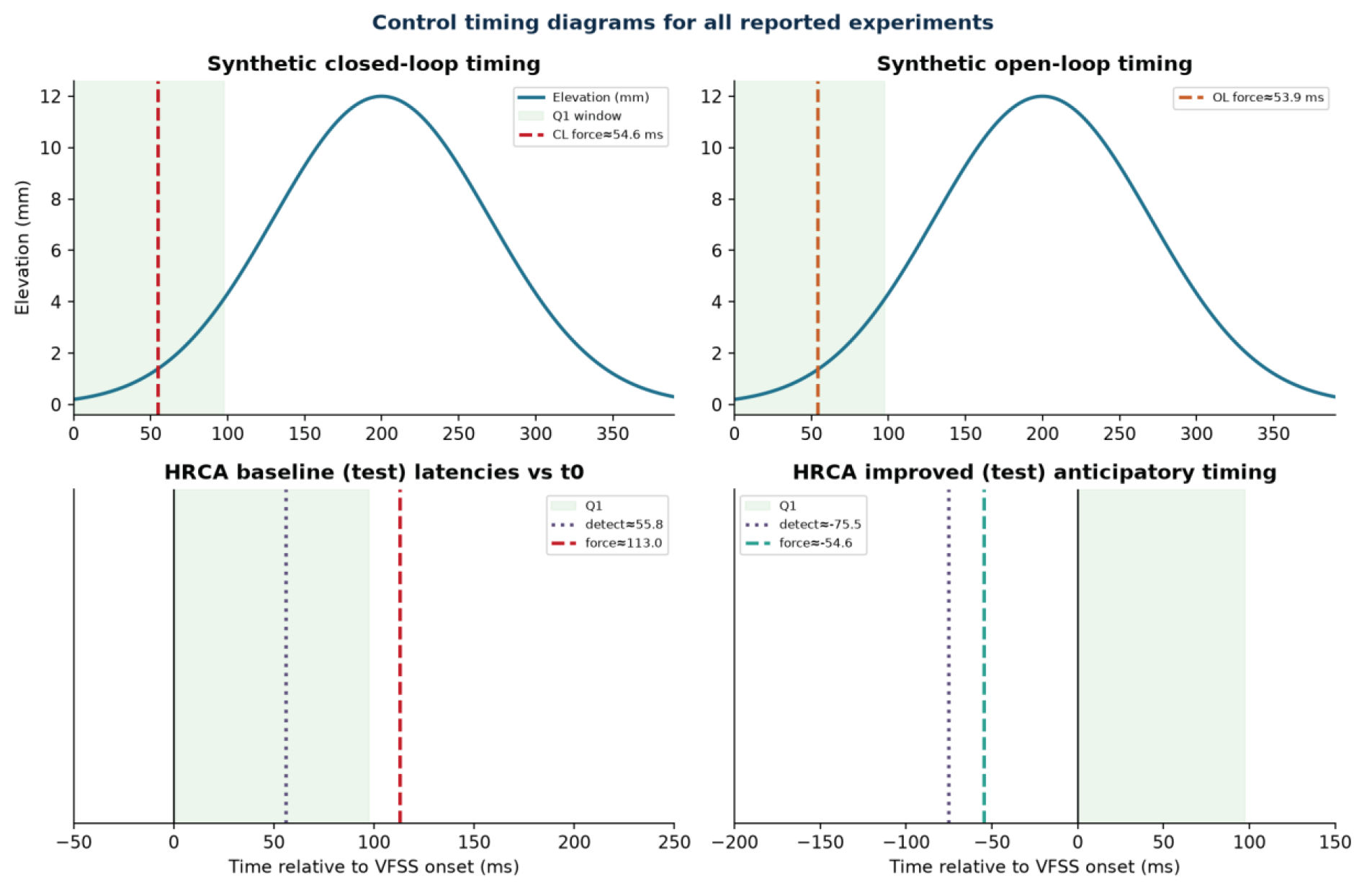
Figure 10.
Seven-step stimulation timing flow sheet: sensing, EEG arming, BI/sEMG gate, TinyML verification, EMD-compensated firing, assistive force, and feedback/ILC.
Figure 10.
Seven-step stimulation timing flow sheet: sensing, EEG arming, BI/sEMG gate, TinyML verification, EMD-compensated firing, assistive force, and feedback/ILC.
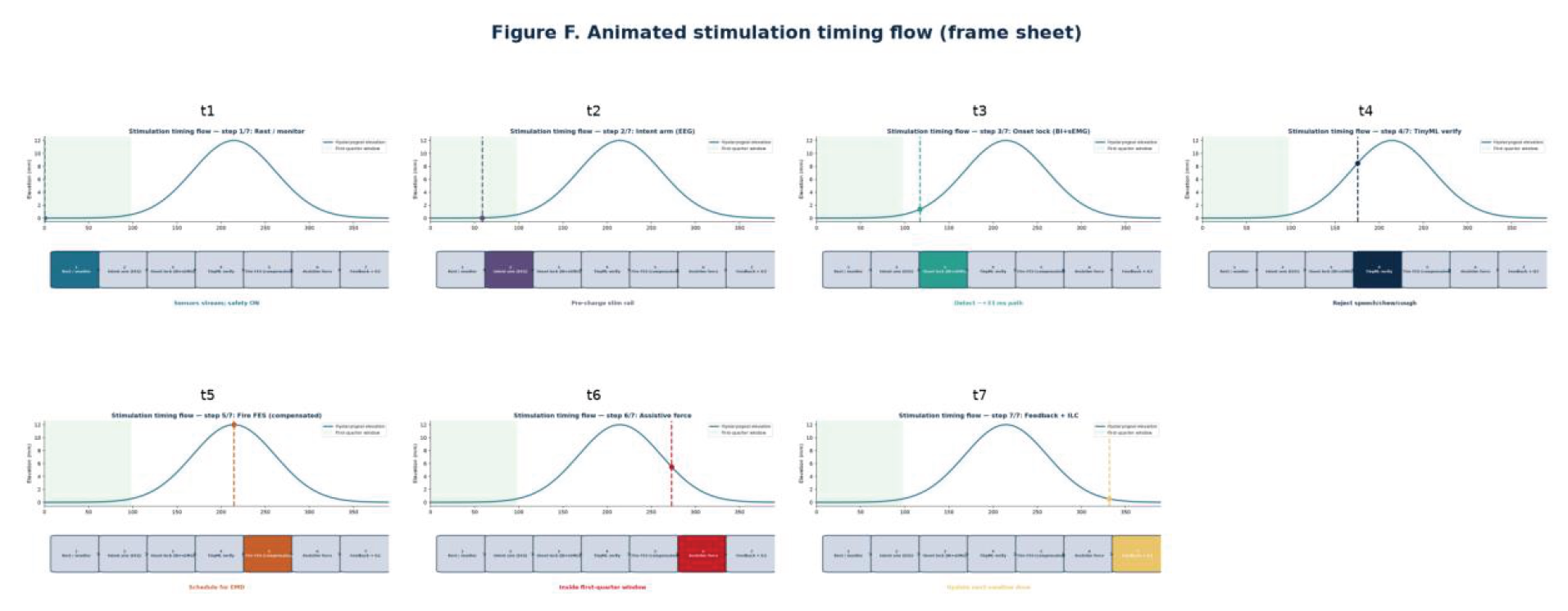
Figure 11.
Synthetic feasibility plots. The panels show assistive-force timing, normalized elevation error, detection versus false stimulation, and ILC dose adaptation across swallows.
Figure 11.
Synthetic feasibility plots. The panels show assistive-force timing, normalized elevation error, detection versus false stimulation, and ILC dose adaptation across swallows.
6.2. Public HRCA Performance
The verifier area under the receiver operating characteristic curve (AUC) increased from 0.612 to 0.688, while the F1 score increased from 0.245 to 0.429. Precision increased from 30.8% to 53.8% and recall from 20.3% to 35.6%.
The improved pipeline produced mean detection and modeled force latencies of approximately -75.5 and -54.6 ms relative to the VFSS onset label. These negative values are intentional in the experimental design: they reflect anticipatory rising-edge decisions that attempt to offset EMD. They should not be interpreted as proof that a clinical wearable would always stimulate sufficiently early, because the public HRCA corpus does not contain simultaneous BI, EEG, or final-electrode EMD measurements.
Table 4.
Public HRCA held-out results.
| Metric | Baseline | Improved | |
|---|---|---|---|
| Detect rate | 83.1% | 94.9% | +11.9 pp |
| Force in Q1 | 59.2% | 92.9% | +33.7 pp |
| Mean detect latency | 55.8 ms | -75.5 ms | -131.3 ms |
| Mean force latency | 113.0 ms | -54.6 ms | -167.6 ms |
| Verifier AUC | 0.612 | 0.688 | +0.076 |
| Verifier | 0.245 | 0.429 | +0.184 |
| 30.8% | 53.8% | +23.1 pp | |
| 20.3% | 35.6% | +15.3 pp |
Figure 12.
Public HRCA comparison. The improved front-end increases timing feasibility and verifier performance relative to the baseline pipeline.
Figure 12.
Public HRCA comparison. The improved front-end increases timing feasibility and verifier performance relative to the baseline pipeline.
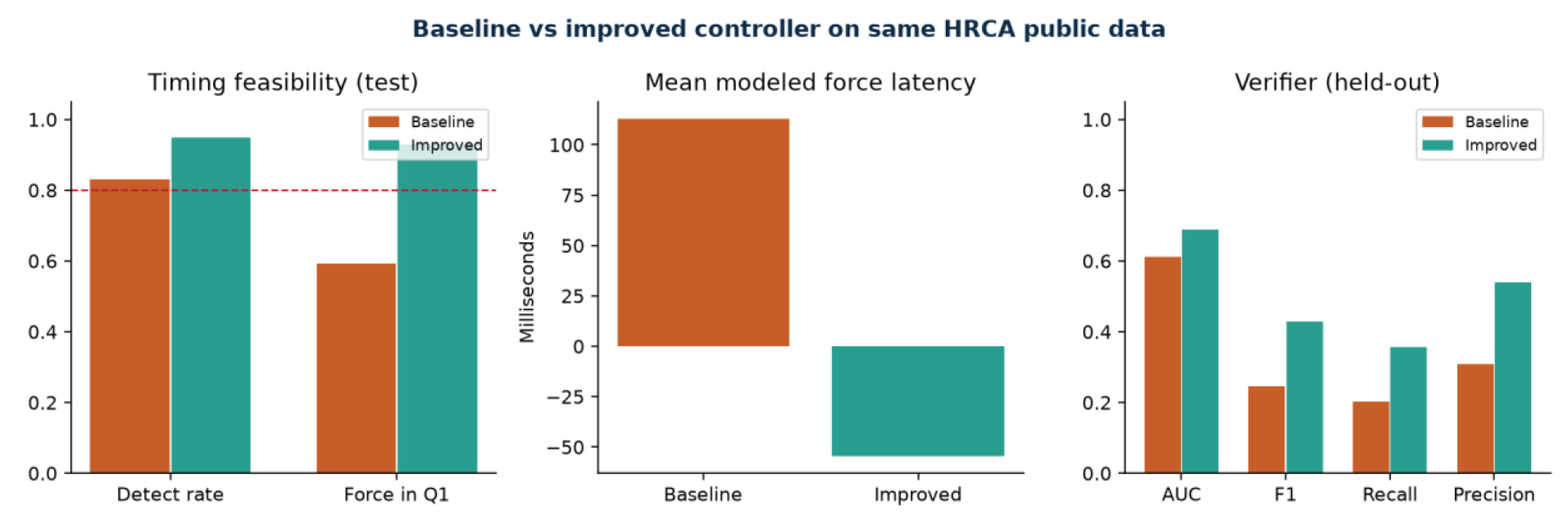
Figure 13.
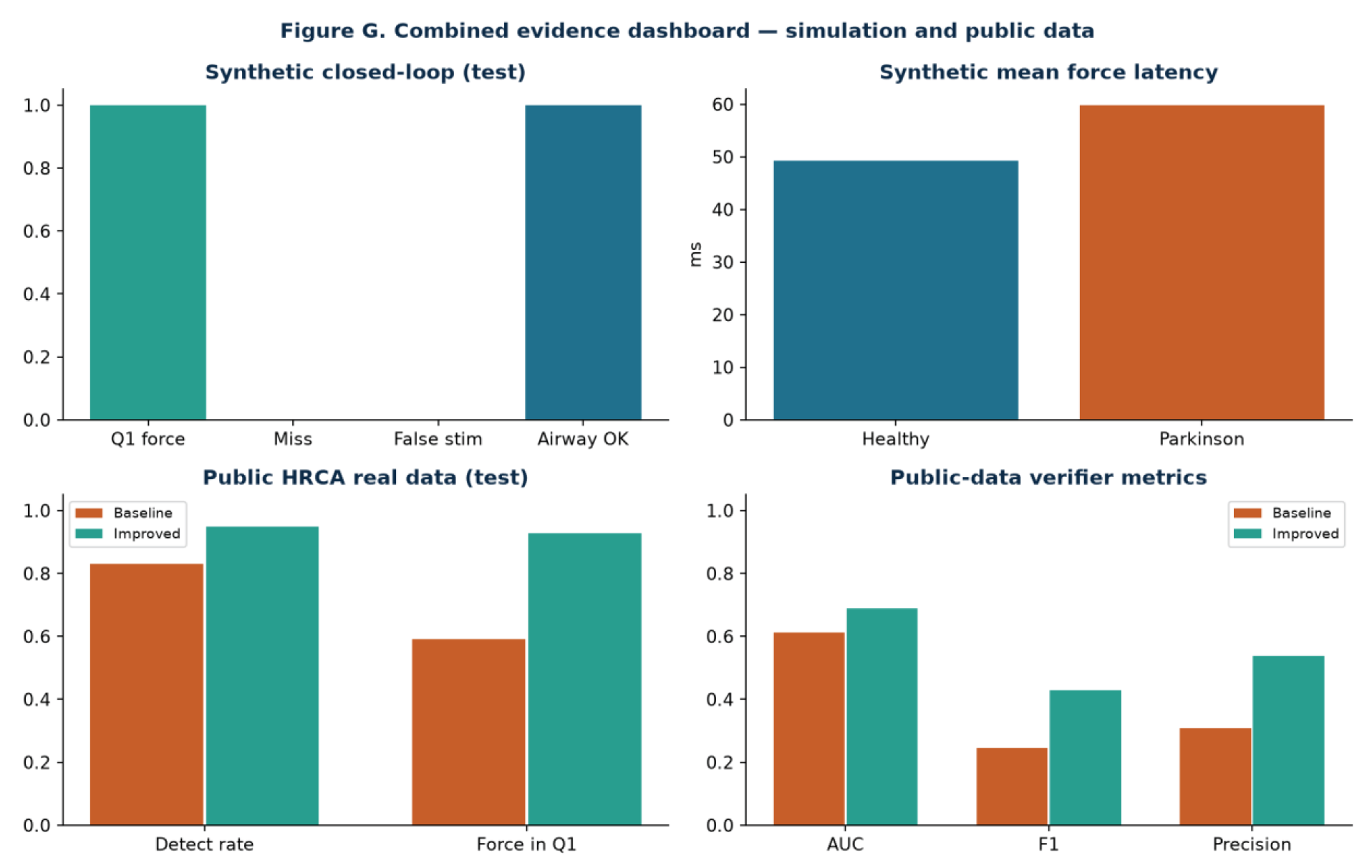
Combined evidence dashboard summarizing synthetic closed-loop feasibility, phenotype-dependent latency, public HRCA timing, and verifier metrics.
Figure 13.
Combined evidence dashboard summarizing synthetic closed-loop feasibility, phenotype-dependent latency, public HRCA timing, and verifier metrics.
7. Assessment and Discussion
7.1. Assessment of the Hypotheses
H1 is supported within the limits of the synthetic model: the final controller maintained Q1 feasibility in Parkinsonian strata, and development runs in the source study indicated that purely reactive configurations without anticipatory arming could fail Q1 under delayed-onset conditions. The result supports the control rationale for combining anticipatory arming with explicit EMD compensation, but it does not establish clinical necessity because EMD and onset distributions have not yet been measured on patients wearing the final electrode geometry.
H2 is supported by the held-out synthetic result of zero misses and zero false stimulation under a safety-first abstention policy. Importantly, this result must be interpreted as an engineering property of the specified synthetic plant and classifier rather than evidence of clinical classification accuracy. The 25.0% overall abstention rate shows that the controller is not simply forcing a decision on every trial.
H3 is supported by the comparison of normalized elevation error: 0.116 with ILC versus 0.253 under fixed open-loop dosing. The finding is consistent with the intended role of feedback adaptation in compensating for changing plant gain and phenotype-dependent response. It does not demonstrate optimality of the present ILC gain or prove long-term stability in human subjects.
H4 is supported by the public HRCA results. Richer causal feature extraction, consensus gating, ensemble verification, anticipatory rising-edge detection, and EMD-aware timing substantially improved both detection and modeled Q1 performance on the held-out real-signal dataset. However, the HRCA corpus lacks the peripheral and cortical signals needed to validate the complete SafeSwallow loop.
7.2. Engineering Significance
The main technical contribution is the integration of timing, verification, feedback, and safety into one causal control pipeline. The architecture does not treat a wearable sensor and a stimulator as independent devices. Instead, sensing is explicitly linked to a decision gate, timing compensation is explicitly linked to EMD, stimulation is explicitly linked to a measurable elevation response, and adaptation is explicitly constrained by non-learned safety logic. This architecture makes the failure modes visible and testable at the software level before clinical translation.
The compact form factor is also a system-level contribution. A behind-ear hub, around-ear EEG film, submental U-film, and laryngeal sensing stamp distribute functions according to their control role while avoiding a permanent forehead electrode in the preferred configuration. The architecture described in the supplied manuscript therefore addresses not only algorithmic closed-loop control but also the practical co-location of sensing, computation, stimulation, and user-accessible safety.
7.3. Limitations
Several limitations materially constrain the interpretation of the results. First, the synthetic physiology is a model and may exaggerate class separability; the apparently saturated verifier metrics must therefore be read as feasibility evidence, not clinical generalization. Second, the public HRCA corpus lacks BI and EEG and thus cannot validate the full multimodal loop. Third, EMD is an engineering prior of approximately 50 ms rather than a measurement of the final electrode geometry. Fourth, the study did not quantify comfort, donning time, skin effects, kill-switch usability, or other human-factors endpoints. Fifth, the modeled airway-ok variable is a proxy and is not equivalent to aspiration/penetration scoring on VFSS or FEES. Finally, negative latency values in HRCA should not be equated with guaranteed clinical earliness until synchronized multimodal ground truth is available.
7.4. Relation to Prior Art and Novelty Framing
Relative to the state of the art summarized in the source manuscript, SafeSwallow is differentiated by the combination of ear/glasses EEG arming without relying on EEG as the sole fire authority; BI and sEMG gating; TinyML/RF swallow verification; explicit EMD/Q1-referenced scheduling; elevation-feedback ILC dose adaptation; and a deterministic Tier-0 safety layer incorporating current/charge limits, refractory timing, watchdogs, impedance inhibition, abstention, and a user kill-switch [32]. The scientific paper should therefore frame the contribution as a systems-level integration and control architecture rather than claiming that individual sensing modalities or stimulation methods are themselves new.
Equations (16)–(20) formalize the timing budget. The quarter-window construction is derived from the stated engineering prior for the elevation ramp; it is not a new physiological law. The decomposition of T_p into filtering, feature extraction, inference, and scheduling terms is a causal latency accounting model. The force-arrival relation uses the actuator-delay prior T_e. This is consistent with the literature showing that laryngeal elevation can be actively augmented and that stimulation must be temporally coordinated with swallowing [11,12].
8. Future Work
The next stage is hardware and clinical translation. First, the preferred patch/hub should be prototyped and the actual electrode-specific EMD, charge density, current limits, and skin-safety margins should be measured. Second, paired BI–sEMG–accelerometry–microphone–EEG recordings should be collected with VFSS or FEES ground truth so that the full multimodal control loop can be trained and evaluated without substituting one sensor modality for another. Third, the full HRCA corpus should be used to stress-test false-positive behavior under speech, chewing, coughing, and other everyday confounders. Fourth, human-factors studies should quantify comfort, cosmetic acceptability, donning, placement repeatability, and kill-switch usability. Fifth, prospective controlled clinical studies should test safety first and then functional outcomes. Finally, the same Tier-0 safety spine can support future phase-specific modes for oral propulsion and post-swallow residue clearance.
9. Conclusions
This paper reformulates SafeSwallow as a scientific engineering study rather than a technical design report. The proposed system is a compact wearable neuroprosthesis that combines multimodal sensing, anticipatory arming, causal swallow verification, explicit EMD compensation, FES, post-action elevation estimation, and ILC dose adaptation under a deterministic safety supervisor. Two complementary evaluations were conducted. In synthetic held-out experiments, the final controller met all stated engineering feasibility criteria and reduced normalized elevation error relative to matched open-loop dosing. On public HRCA data, improved causal feature processing and anticipatory scheduling substantially improved detection and modeled Q1 performance. The evidence supports the engineering plausibility of the architecture, but it also makes the remaining translational requirements explicit: paired multimodal clinical data, measured electrode-specific EMD, validated stimulation safety, and prospective human studies.
10. Data Availability and Disclosures
The public HRCA recordings analyzed in this study are available from Zenodo under digital object identifier (DOI) 10.5281/zenodo.4539695 and CC-BY-4.0. Synthetic experiment summaries are represented by the article tables and can be supplied in JavaScript Object Notation (JSON) files such as summary.json and hrca_compare_summary.json. No new human subjects were enrolled; institutional review board review and informed consent were therefore not applicable to the reported analyses. The work received no external funding. The author is the inventor of a U.S. provisional patent application related to SafeSwallow. The source materials state that generative AI tools assisted manuscript drafting and figure layout, while the author reviewed the material and retained responsibility for the scientific content and measurements.
11. Expanded Control-Theoretic Formulation
This section develops the controller beyond the compact formulation in Section III. The purpose is not to introduce new experimental evidence, but to make explicit the mathematical assumptions, timing variables, estimator structure, safety constraints, and adaptation laws that are implicit in the implemented SafeSwallow architecture. The resulting formulation is suitable for independent implementation and for subsequent replacement of engineering priors by subject-specific measurements.
11.1. Timing Geometry and Causal Feasibility
Let denote the VFSS-referenced pharyngeal onset and let Telev denote the duration of the principal hyolaryngeal elevation ramp. The first-quarter interval is used as an engineering target because assistance arriving after a substantial fraction of the elevation trajectory has elapsed provides progressively less opportunity to influence early airway protection. The Q1 criterion is deliberately conservative and is not asserted to be a universal clinical boundary.
Equations (21)–(23) describe a multimodal observation model. The vector y_k collects heterogeneous causal measurements; the map Φ converts the most recent W samples into features; and f_θ maps those features to swallow probability. The formulation is intentionally sensor-fusion rather than sensor-substitution: no single channel is declared ground truth. This approach is aligned with the BI/EMG swallow-onset methodology reported by Riebold et al. [9] and with HRCA work showing that microphone and accelerometer features can support machine-learning swallow identification [27,28].
where is the duration of the first-quarter target interval and is the elevation-ramp duration.
where is the absolute Q1 deadline and is pharyngeal onset.
where is the causal electronic decision-path delay; , , , and denote filtering, feature extraction, inference, and scheduling delays, respectively.
where is the expected onset of useful mechanical force, is the effective decision origin, and is the stimulation-to-force electromechanical delay.
where is the timing margin. Positive values indicate modeled force arrival before the deadline; negative values indicate a timing miss.
Equations (24)–(26) separate the learned authorization gate from deterministic safety conditions. The gate a(t) is a logical AND of necessary conditions, so any unsafe state forces abstention. This structure is a control-design choice of the SafeSwallow architecture, while the specific charge/current and watchdog implementation must ultimately be verified against the final hardware and applicable safety standards. IEC 60601-2-10 is the relevant particular standard for nerve and muscle stimulators [38].
Equation (20) makes the reason for anticipatory arming transparent. If the sum of causal processing delay and EMD approaches the available Q1 interval, a purely reactive controller has little robustness to delayed physiology, computational jitter, or conservative verification. SafeSwallow therefore separates arming from firing. EEG and early peripheral features may prepare the high-voltage rail and compute a provisional schedule, but stimulation remains contingent on the independent peripheral and safety gates.
Table 4.
Timing variables and engineering priors used in the reported experiments.
| Symbol | Meaning | Reported prior / role |
|---|---|---|
| Tₕ | Hyolaryngeal elevation-ramp duration | 0.390 s mean prior |
| T_q | First-quarter target interval | 0.0975 s for =0.390 s |
| T_f | Causal filtering contribution | approximately 0.030 s within detection path |
| T_d | Peripheral detection path | approximately 0.033 s |
| T_c | Residual compute delay | approximately 0.008 +/- 0.003 s in simulation |
| T_e | Electrical-to-mechanical delay | 0.050 s engineering prior |
| T_r | Post-stimulation refractory interval | approximately 1.0 s |
| T_b | FES burst duration | approximately 0.60 s |
| T_g | Stimulation ramp | approximately 0.04 s |
11.2. Multimodal Observation Model
The wearable does not treat any single sensor as ground truth. Instead, each modality contributes a partial observation of a latent swallow state. EEG contributes anticipatory intent, sEMG contributes elevator recruitment, BI contributes onset and elevation geometry, and the microphone/IMU pair contributes vibration and kinematic corroboration. This division of labor is central to the architecture because the modalities have different latency, specificity, and artifact profiles.
where is the multimodal observation vector at sample k; each component is the causal measurement or derived feature stream from one sensing modality.
where is the causal feature vector and is the deterministic feature map applied only to the most recent W samples; no future samples are used.
Equations (27)–(33) provide a standard state-estimation model followed by an across-swallow adaptation law. The state-space and Kalman update are derived from classical stochastic filtering [37]. The ILC update is based on the repetitive-process learning framework summarized by Bristow et al. [15]. The optional rate limiter is introduced here as an engineering safeguard to prevent abrupt changes in stimulation amplitude between swallows; it is not derived from a universal physiological constant.
where is the calibrated probability of a true swallow and is the trained RF, MLP, or ensemble verifier.
where is the binary verification gate and is selected on training folds rather than on the held-out test set.
The causal-window requirement is important. Offline zero-phase filtering or symmetric smoothing can make a detector appear earlier than a realizable embedded implementation. All reported timing interpretations therefore assume causal processing. The HRCA negative latencies arise from early signal structure relative to the VFSS-labeled reference frame and from anticipatory scheduling, not from non-causal access to future data.
11.3. Safety-Constrained Fire Logic
where indicates acceptable electrode impedance, indicates a healthy watchdog, is the user OFF state, is refractory lockout, and indicates that current/charge constraints are satisfied.
where is the final authorization gate. Every factor must be true before stimulation energy can be delivered.
where is commanded dose, is the adaptive requested dose, and sat(·) enforces hard hardware limits.
where is charge delivered in one stimulation phase, is phase current, and is phase width.
where is charge density, is effective electrode area, and is the hardware/clinical safety ceiling to be finalized for the physical electrode.
The logical structure in (24)-(26) intentionally places learned components below deterministic interlocks. A classifier may withhold stimulation but cannot raise current limits, bypass a fault, shorten refractory lockout, or override the tactile kill-switch. This separation is a design principle rather than a claim of completed regulatory verification.
11.4. Elevation Observer and Adaptive Dose Law
Equation Provenance, Assumptions, and Limits of Interpretation
The expanded equations in this section make explicit relationships that were only implicit in the compact controller description. They should be read as engineering models used for simulation and implementation planning, not as experimentally identified physiological laws. Each relationship therefore has a clearly stated provenance or assumption.
The adaptation loop operates across swallows rather than attempting unconstrained high-bandwidth correction during a single swallow. This choice matches the repetitive nature of meal-time swallowing and avoids allowing a learned controller to chase noisy within-swallow measurements. BI is the principal elevation proxy in the proposed embodiment, with microphone and IMU features available to improve observability.
where is a latent state containing elevation and slowly varying fatigue terms; is stimulation dose; is process disturbance.
Equations (34)–(37) define the deterministic feature layer. The RMS expression is the standard discrete-time energy-envelope estimator; the BI-difference and slope features are causal local descriptors; and z-score normalization uses training/calibration statistics so that the held-out test set is not used to define scaling parameters. These choices are implementation methods, not claims of physiological uniqueness. The literature supports BI/EMG fusion for swallow-onset detection [9].
where contains BI-derived elevation and optional acoustic/IMU features; is measurement noise.
where is the one-step predicted state estimate.
where is the Kalman gain, is predicted covariance, and R is measurement-noise covariance.
where is the corrected state estimate and the parenthetical term is the innovation.
where is the elevation error for swallow n, is the desired elevation target, and is observed elevation.
Equations (38)–(41) formalize the classifier objective and operating-point selection. Binary cross-entropy corresponds to the negative log-likelihood of a Bernoulli model [34]. The F1 definition follows the standard precision/recall framework [35]. The threshold is deliberately selected from grouped training/validation data to prevent information leakage into the held-out evaluation.
where is the next-swallow dose and L is the ILC learning gain.
where is an optional rate-limited dose increment; prevents abrupt swallow-to-swallow changes.
For a locally linear static approximation , the scalar ILC error dynamics become . A sufficient local monotonicity condition is over the plausible gain range. In the present study, this relation is used as engineering intuition; the reported results arise from the simulation implementation and not from a formal proof of stability for human physiology.
12. Detailed Algorithm Description and Training Pipeline
12.1. Algorithmic Decomposition
The software is decomposed into seven modules so that sensing, learned inference, scheduling, adaptation, and safety can be tested independently. This modularity is especially important for a medical controller because a performance improvement in the verifier must not silently alter the stimulation envelope. Table V states the input-output contract of each module.
Equations (42)–(43) describe anticipatory onset prediction. The Huber loss is used because it is quadratic for small errors and linear for large errors, reducing sensitivity to outlying onset-time errors; this robust-loss concept originates with Huber [36]. The additional false-arm penalty is specific to SafeSwallow because an early prediction is useful only when it does not create unnecessary pre-charge or stimulation opportunities.
Table 5.
software modules, inputs, ouuts, and failure behavior.
| Module | Primary input | Output | Failure behavior |
|---|---|---|---|
| A0 Safety supervisor | kill, impedance, watchdog, charge, refractory | allow/inhibit, HV state | latched inhibit / zero current |
| A1 Feature front-end | EEG, sEMG, BI, mic, IMU | causal feature vector | mark invalid / abstain |
| A2 Intent arming | EEG + early peripheral features | time-to-onset, confidence, arm | no arm if confidence low |
| A3 Swallow verifier | causal feature vector | pₛw, | abstain below threshold |
| A4 Fire scheduler | gates + timing model | , burst command | no fire if any gate fails |
| A5 Observer + ILC | post-action BI/mic/IMU | , next dose | retain/conservatively bound dose |
| A6 HRCA front-end | mic + tri-axial acceleration | detect, verifier score, modeled timing | evaluation only; no physical stimulation |
12.2. Feature Engineering
The deterministic front-end converts heterogeneous sensor streams into a compact vector suitable for embedded inference. For sEMG, the principal quantity is a causal RMS envelope after band-limited conditioning. For BI, the features include deviation from a slowly varying baseline and local slope. Microphone and accelerometer channels contribute multi-band energy, envelope, spectral moments, and superior–inferior (SI) motion proxies. EEG contributes intent-related features and an estimated time to onset when available. Features are normalized using statistics estimated from training/calibration data only.
where is the causal N-sample root-mean-square envelope of the conditioned sEMG signal.
where is the BI drop relative to the slow causal baseline .
where is an m-sample causal BI slope estimate and is the sample period.
where is normalized feature j; and are training/calibration statistics; and prevents division by zero.
12.3. Swallow Verifier Training
The synthetic verifier was trained using subject-grouped data so that windows from a held-out subject did not leak into training. Eight training subjects contributed 20 swallow events and 12 confounders per subject. Four unseen subjects were reserved for held-out classifier metrics, and the subsequent closed-loop/open-loop evaluation used eight additional unseen subjects. The classifier therefore encountered new simulated subjects during final control evaluation. The compact MLP used two hidden layers of 16 and 8 units, approximately 305 trainable parameters for the nine-feature implementation reported in the source manuscript.
The selected MLP formulation is consistent with standard supervised probabilistic classification practice [34]. The manuscript reports the architecture and split explicitly so that the engineering result can be reproduced without implying that the model is clinically validated.
The experimental-model equations following this section should be interpreted with the same discipline: whenever a parameter is borrowed from literature it is marked as an engineering prior; whenever a parameter is selected by the present study it is described as a design choice; and whenever an equation represents an implementation convenience rather than a validated physiological law, that distinction is made explicitly. This prevents the mathematical model from being mistaken for clinical ground truth.
where is binary cross-entropy, is the true class, and = () is the predicted swallow probability.
where , , and denote true-positive, false-positive, and false-negative counts.
where is the harmonic mean used to choose the operating point under class imbalance.
where is chosen exclusively on training/validation folds and then frozen for held-out evaluation.
Probability calibration is desirable because the verifier output is used as a safety gate rather than merely a ranking score. In the reported engineering implementation, the minimum fire-authorization probability was 0.55. This value should be regarded as an engineering prior, not a clinically validated threshold. Future clinical work should select operating points from prospectively defined risk functions that penalize false stimulation more strongly than ordinary classification error.
12.4. Anticipatory Model Training
The anticipatory model is conceptually distinct from the verifier. Its task is to estimate whether a swallow is approaching and, when possible, predict the remaining time to onset. It is intentionally prevented from sole-firing the stimulator. Candidate causal sequence models include a temporal convolutional network (TCN) or gated recurrent unit (GRU). Training targets are onset-relative times derived from synchronized annotations. False early arms are explicitly penalized because unnecessary pre-charge increases power consumption and can reduce the interpretability of the timing path.
The anticipatory predictor is a feedforward timing aid, not the final classifier. The distinction prevents the system from conflating “likely to swallow soon” with “authorized to stimulate.”
where is the robust onset-regression loss, is predicted onset, is reference onset, and is the Huber transition parameter.
where augments timing error with a penalty on false anticipatory arms; controls the penalty weight.
12.5. Reproducible Reference Pseudocode
| Listing 1. reference real-time control logic (implementation-oriented pseudocode). |
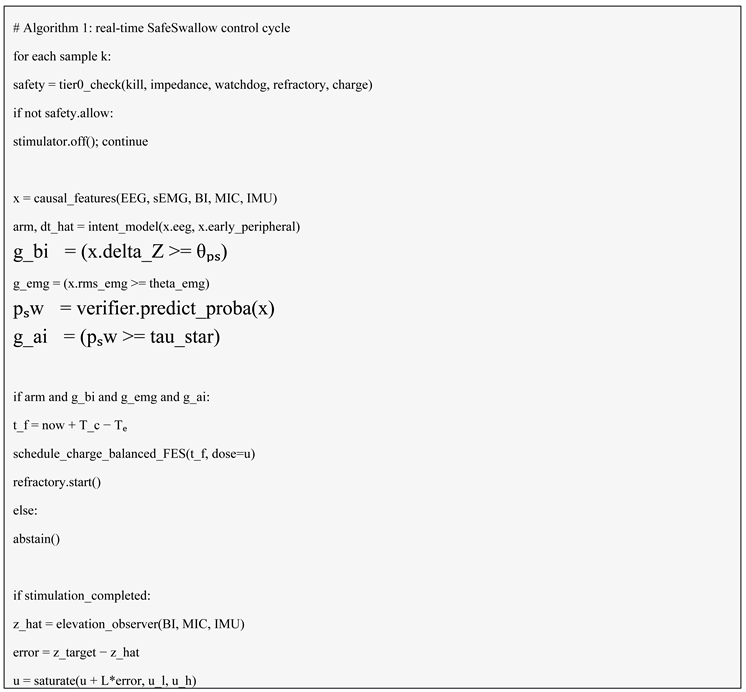 |
| Listing 2. Reference training and operating-point selection pipeline. |
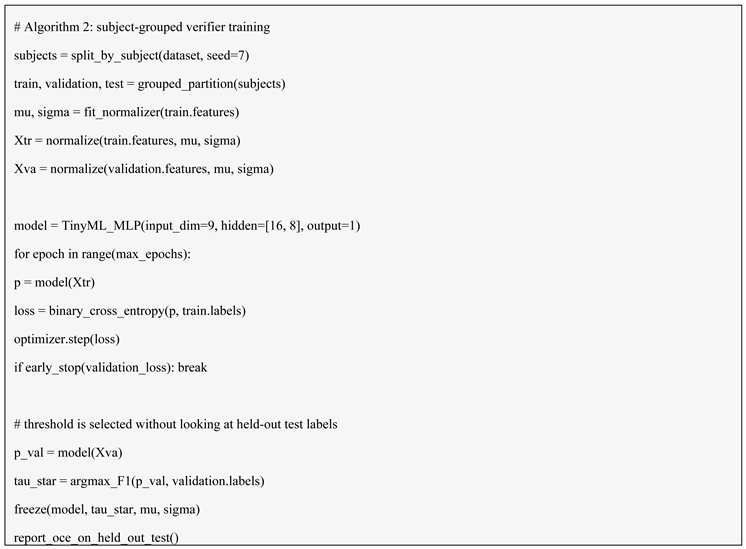 |
| Listing 3. Safety-bounded swallow-to-swallow ilc update. |
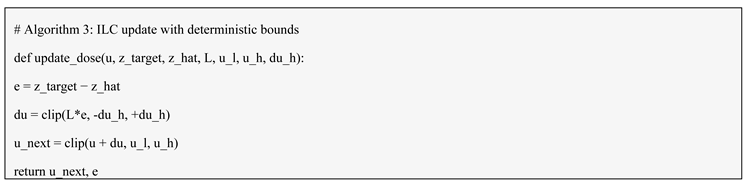 |
13. Expanded Experimental Design and Reproducibility
13.1. Synthetic Experiment as a Controlled Ablation Environment
The synthetic experiment should be interpreted as a controlled engineering stress test rather than a clinical trial. Its value is that timing, fatigue, noise, confounders, medication-state scaling, and controller components can be changed independently while preserving ground truth. This allows direct comparison of fixed-dose and adaptive control under matched latent physiology. The principal risk is model optimism: if the synthetic class distributions are too separable, classifier metrics can saturate, as occurred for the compact verifier. Consequently, the synthetic results support implementation feasibility but do not establish clinical sensitivity or specificity.
Table 6.
Synthetic experiment factors and their purpose.
| Factor | Implementation in reported study | Purpose |
|---|---|---|
| Sampling | 1 kHz simulated multimodal streams | resolve millisecond-scale timing |
| Healthy phenotype | ~12 +/- 1.2 mm peak elevation; ~0.39 +/- 0.03 s duration | nominal control condition |
| Parkinsonian phenotype | reduced gain, delayed onset, prolonged elevation, faster fatigue | stress delayed/bradykinetic behavior |
| Medication state | ON/OFF scaling pattern | introduce within-phenotype variability |
| Confounders | speech/chew/cough-like events | test false-stimulation rejection |
| EMD | 50 ms engineering prior | force-arrival timing model |
| Compute jitter | ~8 +/- 3 ms | edge inference variability |
| Dose bounds | 4-25 mA; nominal 12 mA | constrain adaptation |
| Refractory | 1.0 s | prevent rapid retriggering |
13.2. Cohort Construction and Data Separation
The training, classifier-test, and controller-test populations were separated by subject identifiers. The final controller experiment used eight unseen subjects, four healthy and four Parkinsonian, with 25 swallows and 10 confounders per subject. This yielded 280 trials for closed-loop evaluation and a matched 280-trial open-loop comparison. The use of matched subject/event counts reduces variance when comparing elevation error, although the simulation remains dependent on the assumed plant distribution.
Table 7.
Data partitioning used in the synthetic track.
| Partition | Subjects | Events per subject | Role |
|---|---|---|---|
| Verifier training | 8 | 20 swallows + 12 confounders | fit classifier parameters |
| Held-out classifier set | 4 unseen | 15 swallows + 10 confounders | classifier metrics |
| Closed-loop control test | 8 unseen | 25 swallows + 10 confounders | final adaptive-control evaluation |
| Open-loop control test | same 8 unseen | matched event counts | fixed-dose comparator |
13.3. HRCA Public-Data Experiment
The second evidence track deliberately replaces synthetic acoustic/kinematic channels with real recordings. The public HRCA corpus provides a contact microphone and tri-axial accelerometry synchronized to VFSS-derived swallow annotations. Because it lacks BI and EEG, it cannot instantiate the complete SafeSwallow loop. Its role is narrower and important: it tests whether a causal wearable-compatible front-end can improve event detection and modeled timing under real physiological and acquisition noise.
where is the audio/accelerometer sample corresponding to VFSS frame ; = 4000 Hz and = 60 frames/s in the reported conversion.
The baseline and improved methods use identical group-aware partitions. The improved method adds multi-band causal envelopes, soft-threshold denoising as an SNR proxy, a superior-inferior displacement proxy, tri-axial consensus, a class-balanced RF+MLP ensemble, an -selected threshold, acoustic corroboration, and an anticipatory rising-edge rule. The comparison therefore evaluates a pipeline change rather than a change in test data.
13.4. Metrics and Statistical Interpretation.
where is swallow detection rate on labeled swallows.
where is the modeled fraction of true swallows for which useful force is predicted to arrive by the deadline.
where is the false-stimulation rate over non-swallow confounders.
where is mean normalized elevation error; is the normalization scale used by the simulation.
These metrics should not be conflated. Detection rate describes sensing performance, whereas Q1 success additionally incorporates the timing model and EMD. Elevation error measures the dose-control objective. A system can therefore detect every swallow yet still fail the timing requirement, or meet timing while delivering a poorly matched dose. The architecture is intentionally evaluated along all three axes.
14. Expanded Results and Engineering Interpretation
14.1. Synthetic Closed-Loop Performance
The held-out synthetic closed-loop experiment met all prespecified engineering feasibility bars: Q1 force success was 100.0%, miss rate 0.0%, false stimulation 0.0%, mean force latency 54.6 ms, and mean normalized elevation error 0.116. Healthy and Parkinsonian strata both met the Q1 criterion, with mean force latencies of approximately 49.3 and 59.8 ms, respectively. These numbers demonstrate that the implemented timing policy has margin under the assumed plant and delay distributions; they do not demonstrate that human patients will exhibit the same timing or separability.
The most informative comparison is not the saturated detection score but the reduction in elevation error relative to fixed-dose control. Open-loop dosing produced mean normalized elevation error 0.253 versus 0.116 for closed-loop control, a reduction of approximately 54%. This is consistent with the intended role of ILC: timing determines when assistance arrives, while feedback adaptation determines how much assistance is requested on subsequent swallows.
where is the relative reduction in normalized elevation error; and are open-loop and closed-loop errors.
Substituting the reported values gives approximately (0.253-0.116)/0.253 = 54.2%. This effect is engineering evidence that adaptation is active in the model, not a clinical effect size.
Table 8.
Interpretation of the synthetic results.
| Observation | Numerical result | Engineering interpretation | Caution |
|---|---|---|---|
| Q1 success | 100.0% | timing policy satisfies modeled deadline | depends on assumed EMD and plant |
| False stimulation | 0.0% | multigate logic rejects simulated confounders | synthetic confounders may be easier than real artifacts |
| Elevation error | 0.116 CL vs 0.253 OL | feedback/ILC improves dose matching | not a clinical swallowing score |
| Healthy force latency | 49.3 ms | substantial modeled Q1 margin | simulation only |
| Parkinson force latency | 59.8 ms | delayed phenotype remains feasible | phenotype is literature-inspired, not patient-specific |
14.2. HRCA Real-Signal Performance
On held-out HRCA swallows, the baseline front-end detected 83.1% of labeled swallows and achieved 59.2% modeled Q1 success. The improved pipeline increased detection to 94.9% and modeled Q1 success to 92.9%. The absolute gains were therefore 11.9 percentage points and 33.7 percentage points, respectively. The much larger improvement in Q1 than in detection shows that scheduling policy and early feature exploitation affect timing even when the underlying detection improvement is more modest.
where is the absolute detection improvement; rounding in the source table reports +11.9 percentage points.
where is the absolute improvement in modeled force success.
The verifier area under the receiver operating characteristic curve (AUC) increased from 0.612 to 0.688, while the F1 score increased from 0.245 to 0.429. Precision increased from 30.8% to 53.8% and recall from 20.3% to 35.6%.
Mean detection and modeled force latencies became negative relative to the VFSS-labeled onset (-75.5 ms and -54.6 ms). Negative values should be read as anticipatory timing relative to that reference, not as evidence that the full physiological swallow was known before it began. Early hyoid/vibration structure, annotation granularity, and the definition of the VFSS onset all contribute to this quantity. A future paired dataset is required to determine how consistently these early features predict clinically relevant airway timing.
Table 9.
Hrca results with interpretive emphasis.
| Metric | Baseline | Improved | Interpretation |
|---|---|---|---|
| Detect rate | 83.1% | 94.9% | improved sensitivity to labeled swallow events |
| Modeled Q1 success | 59.2% | 92.9% | large timing benefit from anticipatory/scheduling changes |
| Mean detect latency | 55.8 ms | -75.5 ms | early decision relative to VFSS reference |
| Mean force latency | 113.0 ms | -54.6 ms | EMD-compensated modeled force becomes anticipatory |
| AUC | 0.612 | 0.688 | moderate discrimination improvement |
| 0.245 | 0.429 | better class-imbalanced operating performance | |
| 30.8% | 53.8% | fewer false positive decisions among positives | |
| 20.3% | 35.6% | more true swallows recovered |
14.3. Hypothesis-by-Hypothesis Assessment
Table 10.
Assessment of the four predefined engineering hypotheses.
| Hypothesis | Evidence in this study | Assessment |
|---|---|---|
| H1: anticipatory arming + EMD compensation recover Q1 margin | Parkinsonian synthetic strata remained Q1-feasible; development reactive configurations were reported as insufficient | Supported as engineering evidence; not clinically proven |
| H2: multimodal verification + abstention limits false stimulation | 0% false stimulation in synthetic held-out confounders with nonzero abstention | Supported within simulation distribution |
| H3: ILC reduces elevation error | 0.116 closed-loop vs 0.253 open-loop normalized error | Supported in matched synthetic comparison |
| H4: richer causal HRCA front-end improves detection/Q1 proxy | 83.1->94.9% detect; 59.2->92.9% Q1 | Supported on analyzed public subset |
15. System Implementation, Computational Budget, and Failure Modes
15.1. Embedded Execution Model
The intended embedded implementation separates the hard real-time path from non-real-time clinician analytics. The behind-ear hub performs causal filtering, feature extraction, inference, scheduling, stimulation control, and Tier-0 safety locally. A phone or clinic application may receive logs, calibration summaries, and longitudinal statistics, but is not required for millisecond-scale fire authorization. This architecture reduces dependence on wireless latency and preserves deterministic behavior if connectivity is lost.
Table 11.
Real-time versus non-real-time functions.
| Function | Execution location | Timing criticality |
|---|---|---|
| Sensor acquisition | behind-ear hub / local AFE | hard real time |
| Causal feature extraction | hub MCU/NPU | hard real time |
| Verifier inference | hub MCU/NPU | hard real time |
| Fire scheduling | hub MCU | hard real time |
| Charge/current enforcement | dedicated hardware + MCU safety | hard real time |
| ILC update | hub after swallow | soft real time between swallows |
| Clinician visualization | phone/clinic application | non-real time |
| Model fleet analytics / optional federated update | off-device | non-real time; never sole fire authority |
15.2. Failure-Mode-Oriented Design
A clinically credible wearable must be designed around failure behavior, not only nominal accuracy. The principal hazards include false stimulation during speech or cough, stimulation with poor electrode contact, runaway or corrupted learned output, stale or delayed sensor data, repeated retriggering, and user discomfort. The present architecture addresses these hazards structurally through independent gates, saturation, refractory lockout, watchdogs, impedance checks, and a tactile OFF path. Formal risk management and verification remain future regulatory work.
Table 12.
Representative failure modes and design responses.
| Failure mode | Potential consequence | Architectural response |
|---|---|---|
| Speech/chew/cough misclassified | inappropriate FES | BI+sEMG+AI corroboration; abstain |
| Electrode detachment / high impedance | ineffective or uncomfortable stimulation | impedance inhibit |
| Classifier out-of-distribution input | unreliable probability | confidence/OOD abstention |
| Software hang | stale stimulation command | watchdog disables HV rail |
| Rapid repeated triggers | excess duty cycle | refractory lockout |
| Excess learned dose request | unsafe current/charge | hard saturation independent of AI |
| User distress | continued stimulation | tactile kill-switch with latched OFF |
| Wireless failure | loss of remote services | real-time loop remains local |
16. Limitations, Translational Requirements, and Future Experiments
The present work is best understood as a design-and-feasibility study. The synthetic plant provides controlled access to variables that are difficult to isolate clinically, but it cannot reproduce the full diversity of dysphagia, electrode placement, tissue impedance, voluntary compensation, bolus properties, medication effects, or motion artifact. The public HRCA analysis introduces real human signals but omits BI, EEG, and actual stimulation. Consequently, neither evidence track alone validates the complete wearable closed loop in patients.
The next decisive experiment is a synchronized multimodal study in which BI, submental sEMG, microphone, accelerometry, and optional ear/glasses EEG are recorded together with VFSS or FEES ground truth. The same session should measure subject-specific EMD from stimulation onset to mechanically observable hyolaryngeal response. Only after these quantities are measured can the Q1 timing model be replaced by individualized empirical distributions and the anticipatory policy be assessed prospectively.
Table 13.
Proposed translational experiment sequence.
| Stage | Participants / setting | Primary measurement | Decision enabled |
|---|---|---|---|
| 1. Bench + phantom | no human participants | stimulator timing, charge balance, watchdog, impedance faults | verify hardware safety functions |
| 2. Healthy feasibility | healthy volunteers | EMD, comfort, electrode repeatability, false triggers | calibrate physical timing and usability |
| 3. Observational dysphagia study | patients; no assistive firing initially | paired BI/sEMG/HRCA/EEG with VFSS/FEES | train/validate multimodal detector and observer |
| 4. Supervised assistive pilot | selected dysphagia patients | Q1 timing, elevation response, adverse events | estimate safe adaptive-control parameters |
| 5. Comparative clinical study | target population | airway safety/efficiency endpoints plus usability | test clinical benefit vs standard care |
16.1. Statistical Plan for a Future Clinical Validation
A future clinical protocol should predefine patient-level train/validation/test separation, primary endpoints, and an analysis hierarchy. Repeated swallows within a patient are not statistically independent; therefore confidence intervals and hypothesis tests should account for subject clustering. A mixed-effects or hierarchical model is preferable to treating every swallow as an independent observation. The current manuscript does not contain sufficient clinical data to estimate such a model, so no inferential p-values are added retrospectively.
where is an outcome for swallow j in subject i, is the treatment effect, is a subject-specific random intercept, and is residual error. This is a proposed future analysis model, not one fitted to the present data.
16.2. Reproducibility Checklist
Table 14.
Reproducibility information available from the present study.
| Item | Status / detail |
|---|---|
| Random seed | 7 for reported synthetic partitioning |
| Simulation rate | 1 kHz |
| Public HRCA sampling | 4 kHz |
| VFSS conversion | Frame x 4000/60 |
| Synthetic test size | 280 CL trials + matched OL trials |
| HRCA analyzed subset | 100 files / 148 labeled swallows |
| TinyML architecture | 9 inputs; hidden layers [16, 8]; ~305 parameters |
| Threshold selection | -optimal on training folds; engineering fire floor 0.55 |
| EMD prior | 50 ms |
| Reported software stack | Python scientific stack; NumPy/SciPy/pandas/scikit-learn-style pipelines |
17. Extended Discussion: What the Results Do and Do Not Establish
The combined evidence supports a specific engineering proposition: a compact architecture can be organized so that anticipatory sensing, causal peripheral verification, explicit delay accounting, safety-bounded stimulation, and swallow-to-swallow dose adaptation coexist within a plausible edge-computing workflow. The strongest evidence for timing under real noise comes from HRCA; the strongest evidence for complete control-loop behavior comes from simulation. The two tracks are complementary precisely because neither is sufficient alone.
The results do not establish prevention of aspiration, clinical efficacy in Parkinson disease or stroke, superiority to established dysphagia therapy, or safety of the proposed current amplitudes in a final electrode geometry. The airway-ok variable in simulation is a model proxy. Similarly, modeled Q1 force in HRCA is a timing calculation that applies an EMD assumption; no FES was delivered in the public dataset. Maintaining these distinctions is essential for a scientifically defensible transition from engineering feasibility to clinical investigation.
The main scientific contribution is therefore architectural integration. Prior literature separately supports surface stimulation, BI/sEMG swallow detection, cervical acoustics, wearable EEG, and adaptive-control methods. SafeSwallow combines these components around a hard timing objective and an explicit safety hierarchy. Whether that integration produces clinically meaningful benefit is the central question for the next phase of work.
Author information
Allon Guez is an Independent Researcher in Philadelphia and a faculty member at Drexel University. His research spans engineering and control systems, biomedical devices, adaptive and learning control, intelligent sensing, and closed-loop wearable neuroprostheses, including SafeSwallow and safety-bounded medical control.
Notation and Abbreviation Convention
| Symbol | Definition | Units / domain |
| t₀ | pharyngeal onset reference time | s |
| Tₕ | hyolaryngeal elevation-ramp duration | s |
| T_q | Q1 target-window duration | s |
| t_q | Q1 deadline time | s |
| T_p | total causal decision-path delay | s |
| T_e | electromechanical delay from stimulus to useful force | s |
| t_d | swallow confirmation time | s |
| t_f | electrical stimulation onset time | s |
| t_a | predicted useful force arrival time | s |
| M_q | timing margin relative to Q1 deadline | s |
| Z(t) | tissue bioimpedance at time t | Ω |
| Z₀ | slowly varying causal impedance baseline | Ω |
| θ_b | BI preselection threshold | Ω |
| s(t) | causal sEMG envelope | arbitrary units |
| θ_m | sEMG co-activation threshold | same as s(t) |
| b(t) | BI preselection gate | {0,1} |
| m(t) | sEMG co-activation gate | {0,1} |
| p_s(t) | swallow probability | [0,1] |
| θ_s | swallow-authorization threshold | [0,1] |
| a(t) | final energy-delivery authorization gate | {0,1} |
| x_k | latent elevation/fatigue state at sample k | vector |
| y_k | measurement vector at sample k | vector |
| u_k | stimulation dose for swallow k | mA or pulse parameter |
| z_k* | desired/reference elevation | mm or normalized |
| ẑ_k | estimated achieved elevation | mm or normalized |
| e_k | swallow-to-swallow elevation error | same as z* |
| L | ILC learning gain | dimension-dependent |
| K_k | Kalman gain at sample k | matrix |
| Q_p | charge per phase | C |
| I_p | phase current | A |
| τ_p | phase width | s |
| A_e | electrode contact area | cm² |
| ρ_q | charge density | C/cm² |
| θ_a | anticipatory arming threshold | probability/confidence |
| T_h | anticipatory horizon | s |
The paper uses compact mathematical symbols with at most one short subscript. Full semantic meanings are stated at first use and summarized below. The same identifiers are used in equations, explanatory text, tables, and algorithm diagrams. Subscripts identify role or index rather than spelling out multi-word descriptions.
References
- Logemann, J. A. Evaluation and Treatment of Swallowing Disorders, 2nd ed.; PRO-ED: Austin, TX, USA, 1998. [Google Scholar]
- Ertekin, C.; Aydogdu, I. Neurophysiology of swallowing. Clin. Neurophysiol. 2003, 114(12), 2226–2244. [Google Scholar] [CrossRef] [PubMed]
- Martino, R.; Foley, N.; Bhogal, S.; Diamant, N.; Speechley, M.; Teasell, R. Dysphagia after stroke: Incidence, diagnosis, and pulmonary complications. Stroke 2005, 36(12), 2756–2763. [Google Scholar] [CrossRef] [PubMed]
- Clavé, P.; Shaker, R. Dysphagia: Current reality and scope of the problem. Nat. Rev. Gastroenterol. Hepatol. 2015, 12, 259–270. [Google Scholar] [CrossRef] [PubMed]
- Steele, C. M.; et al. Physiological factors related to aspiration risk: A systematic review. Dysphagia 2015. [Google Scholar] [CrossRef] [PubMed]
- Langmore, S. E.; et al. Predictors of aspiration pneumonia: How important is dysphagia? Dysphagia 1998, 13, 69–81. [Google Scholar] [CrossRef] [PubMed]
- Suttrup; Warnecke, T. Dysphagia in Parkinson’s disease. Dysphagia 2016, 31, 24–32. [Google Scholar] [CrossRef] [PubMed]
- Martin-Harris, B.; Jones, B. The videofluorographic swallowing study. Phys. Med. Rehabil. Clin. N. Am. 2008, 19, 769–785. [Google Scholar] [CrossRef] [PubMed]
- Riebold, B.; Seidl, R. O.; Schauer, T. Electromyography- and bioimpedance-based detection of swallow onset for the control of dysphagia treatment. Sensors 2024, 24(20), 6525. [Google Scholar] [CrossRef] [PubMed]
- Schultheiss, C.; et al. Evaluation of an EMG bioimpedance measurement system for recording and analysing the pharyngeal phase of swallowing. Eur. Arch. Otorhinolaryngol. 2013. [Google Scholar] [CrossRef] [PubMed]
- Burnett, T. A.; et al. Laryngeal elevation achieved by neuromuscular stimulation. J. Appl. Physiol. 2003. [Google Scholar] [CrossRef] [PubMed]
- Burnett, T. A.; et al. Self-triggered functional electrical stimulation during swallowing. J. Neurophysiol. 2005. [Google Scholar] [CrossRef] [PubMed]
- Ciucci, M. R.; et al. Early identification and treatment of communication and swallowing deficits in Parkinson disease. Semin. Speech Lang. 2013. [Google Scholar] [CrossRef] [PubMed]
- Suttrup; Warnecke, T. Dysphagia in Parkinson’s disease: Pathophysiology and management. 2016.
- Bristow, D. A.; Tharayil, M.; Alleyne, A. G. A survey of iterative learning control. IEEE Control Syst. Mag. 2006, 26(3), 96–114. [Google Scholar] [CrossRef]
- Rosenbek, J. C.; et al. A penetration–aspiration scale. Dysphagia 1996, 11, 93–98. [Google Scholar] [CrossRef] [PubMed]
- Langmore, S. E.; Schatz, K.; Olsen, N. Fiberoptic endoscopic examination of swallowing safety. Ann. Otol. Rhinol. Laryngol. 1988. [Google Scholar] [CrossRef] [PubMed]
- S. E. Langmore, Endoscopic Evaluation and Treatment of Swallowing Disorders; Thieme: New York, NY, USA, 2001.
- Martino, R.; et al. The Toronto Bedside Swallowing Screening Test (TOR-BSST). Stroke 2009. [Google Scholar] [CrossRef] [PubMed]
- Carnaby-Mann, G. D.; Crary, M. A. Examining the evidence on neuromuscular electrical stimulation for swallowing. Arch. Otolaryngol. Head Neck Surg. 2007. [Google Scholar] [CrossRef] [PubMed]
- Clark, H.; et al. Evidence-based systematic review: Effects of neuromuscular electrical stimulation on swallowing and neural activation. Amer. J. Speech Lang. Pathol. 2009. [Google Scholar] [CrossRef] [PubMed]
- Ludlow, C. L.; et al. Effects of surface electrical stimulation both at rest and during swallowing in chronic pharyngeal dysphagia. Dysphagia 2007. [Google Scholar] [CrossRef] [PubMed]
- Phagenesis Ltd. “Phagenyx System,” FDA De Novo DEN220025.
- Jayasekeran, V.; et al. Adjunctive functional pharyngeal electrical stimulation reverses swallowing disability after brain lesions. Gastroenterology 2010. [Google Scholar] [CrossRef] [PubMed]
- Ding, R.; et al. Surface electromyographic studies of swallowing in normal adults. Dysphagia 2002. [Google Scholar] [CrossRef] [PubMed]
- Nahrstaedt, H. Automatic Detection and Assessment of Swallowing Based on Bioimpedance and Electromyography Measurements. Ph.D. dissertation, TU Berlin, Berlin, Germany, 2017. [Google Scholar]
- Khalifa, Y.; Donohue, C.; Coyle, J.; Sejdić, E. Swallowing High Resolution Cervical Auscultation Signals. Zenodo 2021. [Google Scholar] [CrossRef]
- Khalifa, Y.; Coyle, J. L.; Sejdić, E. Non-invasive identification of swallows via deep learning in high resolution cervical auscultation recordings. Sci. Rep. 2020. [Google Scholar] [CrossRef] [PubMed]
- Debener, S.; et al. Unobtrusive ambulatory EEGusing a smartphone and flexible printed electrodes around the ear (cEEGrid). Front. Hum. Neurosci. 2017. [Google Scholar]
- Kim, M. K.; et al. Flexible submental sensor patch for continuous monitoring of oropharyngeal swallowing disorders. Sci. Adv. 2019. [Google Scholar] [CrossRef] [PubMed]
- Kantarcigil, C.; et al. Validation of a novel wearable electromyography patch for monitoring articulatory muscle activity. J. Speech Lang. Hear. Res. 2020. [Google Scholar] [CrossRef] [PubMed]
- Guez. Closed-loop wearable neuroprosthesis for safer swallowing (SafeSwallow). U.S. Provisional Patent Application, filed 2026 (patent pending).
- Pedregosa, F.; et al. Scikit-learn: Machine learning in Python. J. Mach. Learn. Res. 2011, 12, 2825–2830. [Google Scholar]
- C. M. Bishop, Pattern Recognition and Machine Learning; Springer: New York, NY, USA, 2006.
- Sokolova, M.; Lapalme, G. A systematic analysis of performance measures for classification tasks. Inf. Process. Manag. 2009, 45(4), 427–437. [Google Scholar] [CrossRef]
- Huber, P. J. Robust estimation of a location parameter. Ann. Math. Stat. 1964, 35(1), 73–101. [Google Scholar] [CrossRef]
- Kalman, R. E. A new approach to linear filtering and prediction problems. J. Basic Eng. 1960, 82(1), 35–45. [Google Scholar] [CrossRef]
- IEC. IEC 60601-2-10:2012+A1:2016+A2:2023; Medical electrical equipment—Part 2-10: Particular requirements for the basic safety and essential performance of nerve and muscle stimulators. 2023.
- Cogan, S. F.; Ludwig, K. A.; Welle, C. G.; Takmakov, P. Tissue damage thresholds during therapeutic electrical stimulation. J. Neural Eng. 2016, 13(2), 021001. [Google Scholar] [CrossRef] [PubMed]
Disclaimer/Publisher’s Note: The statements, opinions and data contained in all publications are solely those of the individual author(s) and contributor(s) and not of MDPI and/or the editor(s). MDPI and/or the editor(s) disclaim responsibility for any injury to people or property resulting from any ideas, methods, instructions or products referred to in the content. |
© 2026 by the author. Licensee MDPI, Basel, Switzerland. This article is an open access article distributed under the terms and conditions of the Creative Commons Attribution (CC BY) license.
Copyright: This open access article is published under a Creative Commons CC BY 4.0 license, which permit the free download, distribution, and reuse, provided that the author and preprint are cited in any reuse.