

Submitted:
04 September 2026
Posted:
07 September 2026
You are already at the latest version
Abstract
Background: Most medication use occurs at home, after a consultation ends. Patients may need to recall why each medicine matters, how and when to take it, follow changing dose schedules, and recall observations for the next consultation. These tasks are often distributed across separate sources and tools. Methods: We describe the design, implemented functions, and intended-use boundaries of Medil AI, a multilingual Android and iOS treatment-support platform. Needs identified from clinical experience and the literature were mapped to application workflows, documented from interface screens and public guides (version 4.17; September 2026). Reporting was guided by mERA and iCHECK-DH. Results: Medil AI connects source-linked medicine information from official sources in 12 countries (United States, Canada, Israel, France, United Kingdom, Germany, Spain, Russia, Japan, South Korea, Singapore, and Argentina); translation into 20 languages; prescription capture; medication reminders; and dose recording. Health measurements can be synchronized through Health Connect on Android and HealthKit on iOS, and recorded by camera-assisted capture of values displayed by home-monitoring devices, including blood pressure, pulse, weight, temperature, and oxygen saturation. Detected values are saved after confirmation in the medical diary alongside medication-use records for follow-up. The application supports implementation of prescribed dose sequences for selected medications, including semaglutide (Ozempic, Rybelsus, Wegovy), tirzepatide (Mounjaro, Zepbound), liraglutide (Victoza, Saxenda), and varenicline (Chantix and generic products). Conclusions: A continuous patient journey from prescription to understanding, daily implementation, and the next consultation has been implemented in one application. Independent evaluation of usability, recognition accuracy, medication comprehension, adherence, and clinical effects is warranted.
Keywords:
medication reminders
; medication adherence support
; prescription image recognition
; prescribed dose sequence
; camera-assisted measurement entry
; blood pressure tracking
; mobile health
; patient health records
; GLP-1 dosage
Introduction
The Work of Treatment Begins when the Consultation Ends
A man in his sixties leaves the clinic with six medicines: a statin, an angiotensin receptor blocker, an SGLT2 inhibitor, a combined tablet for his diabetes, a low-dose aspirin, and a weekly injection. One is for his cholesterol; another, he was told, protects his kidneys and heart. About the sixth, he is no longer certain. He feels perfectly well, and nothing about how he feels will remind him why several of these preventive treatments matter.
By the time he reaches the pharmacy he may be unsure which to take in the morning and which in the evening. Each box contains a leaflet running to several pages of small print. Over the next three months he will make hundreds of medicine-taking decisions with little or no direct contact with the clinician who prescribed them. At his next appointment he will be asked how he has been getting on, and much of the answer may depend on memory.
This is the ordinary shape of treatment for a patient with several risk factors for long-term conditions, and it is where medication support is thinnest. A prescription states what should be taken. It does not, on its own, help a patient understand what each medicine is for, remember the instructions, fit doses into a working day, follow a schedule that changes over time, or arrive at the next visit with anything more than a recollection.
The Medicines that Most Need Explaining are the Ones that Cannot be Felt
Patients with diabetes, hypertension, obesity, or other cardiovascular disease risk factors are commonly prescribed several medicines at once, and a substantial share of them are preventive. Many do not make the patient feel better this week, and some may cause inconvenience or adverse effects.
Adherence to treatment for a long-term condition is associated with how necessary a patient believes a medicine to be, weighed against concerns about taking it.1 For a medicine that relieves a symptom, necessity may be reinforced by immediate experience. For a medicine intended to prevent a complication years from now, there may be nothing to feel; the rationale has to come from an explanation the patient can remember or retrieve. A patient who cannot say what the sixth medicine is for has little information on which to base day-to-day decisions about taking it.
The knowledge gap is therefore not evenly distributed across a prescription. It may fall most heavily on medicines whose benefits are preventive and not immediately perceptible. Accessible, source-linked information about what each medicine treats or is intended to prevent may therefore be particularly important. The purpose is not to persuade a patient to follow treatment, but to preserve access to reliable information and support an informed discussion with the clinician.
Instructions that Decide Whether a Medicine Works
Understanding is often not only a question of why a medicine is taken, but of how. Levothyroxine is a clear illustration. Its absorption is sensitive to food and to concomitant calcium, iron, and other preparations, making consistent administration instructions important.2 A patient who takes it inconsistently presents the clinician with a moving target: subsequent thyroid-function results may reflect variable administration as well as the prescribed dose.
Instructions of this kind are easy to state in a consultation and easy to lose by the time the patient is standing in the kitchen at seven in the morning, months later. Storing the instruction beside the medicine and presenting it with the relevant reminder carries the explanation to the point of use; it complements prescribing and pharmacy counselling.
When the Schedule Itself is the Treatment
For some medicines, the prescription does not describe a constant dose. The patient is asked to follow a sequence that changes over weeks or months, and the sequence can differ between products containing the same molecule, between indications, and by route or market. A reminder that identifies only the medicine or dosing day may therefore be insufficient; the useful instruction is the product-specific dose scheduled for the current phase.
A paper instruction can state a starting dose and a schedule, but patients may still need to determine, on a particular morning in week five, which dose they should take. This need is especially pronounced for medicines with structured dose-escalation schedules, including GLP-1–based therapies and varenicline.
A phone is particularly well suited to carrying an instruction that changes with time because it remains available at the moment the instruction applies. The current phase does not have to be reconstructed from memory or dates, and a dated self-reported record of the sequence followed can be preserved for the next consultation.
Medication nonadherence has many causes. Beliefs about treatment, side effects, cost, the complexity of a regimen, access to a pharmacy, communication, memory, and the readability of health information all contribute. 3–6 Following complex dose-adjustment instructions correctly can help treatment effects emerge gradually while reducing adverse effects associated with overly rapid dose changes. Supporting patients in implementing these schedules is therefore an important and potentially modifiable component of medication adherence and treatment success.
Three Specific Gaps
Information given once is hard to retain. A consultation is a short and pressured moment. Patients commonly recall only part of what was said, and the written material they take home can contain technical terms, implied timings, several instructions in one sentence, and quantities expressed in unfamiliar ways. 4,6 Research on medication communication points consistently to the same remedies: plain language, explicit timing, information in the patient’s own language, personalization, and availability at the moment the question arises. 4,5
Language stands between many patients and their own treatment. Migrants, refugees, and other patients living in a country whose language they read less comfortably may receive a prescription, a pharmacy label, and an official medicine leaflet in a language they cannot use confidently. Reviews of medicine use in these populations identify language and access to translated medicine information as recurring themes.7–9 The practical consequence is that the safety information written for a patient does not reach them.
Months of experience are compressed into one recalled sentence. Between visits, patients take and occasionally miss doses, notice symptoms, attend tests, and may measure their blood pressure, glucose, or weight. Readings and observations that patients record themselves can improve awareness and give a consultation something concrete to work from, provided they are organized, dated, and clearly attributed.10,11 Without a convenient and structured way to document them, such observations may be forgotten, fragmented across different tools, or difficult to retrieve at the next consultation.
Mobile medication applications can support adherence, particularly when reminders are combined with education or self-management functions rather than offered alone.12,13 This suggests that the useful unit of design is not the reminder but the connected sequence around it.
Purpose of this Report
The mobile application Medil AI was built to join these three gaps into one path: from the prescription to an understanding of it, from understanding to a workable daily plan, and from daily treatment to an organized account of the interval that a patient can bring to the next consultation.
This report describes the identified treatment gap, the design principles derived from it, the released patient-facing functions, the countries and languages covered, provenance and confirmation controls, and the resulting patient workflow. It is a descriptive design and implementation study; it does not evaluate usability, recognition accuracy, adherence, or clinical outcomes.
Methods
Study Design and Reporting Framework
We drew on our clinical experience as general practitioners, together with a review of the literature, to identify common challenges faced by patients between clinical encounters and to design a patient-facing mobile application intended to address them. We then implemented the functions considered most relevant to these needs in Android and iOS applications. The unit of analysis was the implemented patient workflow and its safety and provenance boundaries, rather than patient outcomes or the underlying software architecture.
We used a problem-driven requirements-mapping approach. Needs identified on medication literacy, adherence, language access, and patient-generated health data were mapped to application functions and to the safeguards applied at each step. Table 1 presents this mapping.
Reporting was informed by the mobile health Evidence Reporting and Assessment (mERA) checklist and the iCHECK-DH guideline for digital health implementations. 14,15
Features were documented from released application screens and public patient and clinician guides as present in version 4.17 (3 September 2026).16–18 Availability was classified by platform, market, and subscription status.
Design Objectives and Intended-Use Boundaries
Understanding. A patient should be able to identify a medicine they have been prescribed, read source-linked information about it, and obtain a short explanation in ordinary words without losing sight of the source material.
Language. A patient should be able to read medicine information and personal instructions in a language they use comfortably, and to recognize a medicine name across alphabets and national naming conventions.
Daily implementation. A patient-confirmed treatment plan should generate medication reminders at times that fit the patient’s schedule, support prescribed dose-sequence protocols where needed, and allow contemporaneous self-reported recording of medication use.
Follow-up and safety. Doses, symptoms, appointments, and health readings should accumulate on a patient-controlled timeline. Machine-read or generated content should remain labeled, source-linked where applicable, and subject to the appropriate review step. The application should not prescribe, independently adjust doses, validate home-monitoring devices, or interpret measurements. Table 2 summarizes the provenance, confirmation requirements, and intended interpretation of the main content types.
Medicine Data Sources and Country Coverage
Source-linked medicine information is assembled from public regulatory and authoritative datasets for 12 country-specific data environments: the United States, Canada, Israel, France, the United Kingdom, Germany, Spain, Russia, Japan, South Korea, Singapore, and Argentina.18 For other European countries, a Europe-wide authorization layer is shown. Table 3 lists the data source for each environment. The available fields and update timing follow the source dataset.
Ethics
This report used software, public product documentation, demonstration records, and application screens containing no identifiable patient information. It involved no research participants, no identifiable patient records, no clinical intervention, and no biological material. Ethics approval and participant consent were therefore not required.
Results
The results below constitute a dated implementation snapshot that attempts to fulfill the design requirements: the functions released, their coverage, and the controls that connect and distinguish them. They are not clinical-effectiveness results.
One Continuous Path Instead of Several Separate Tasks
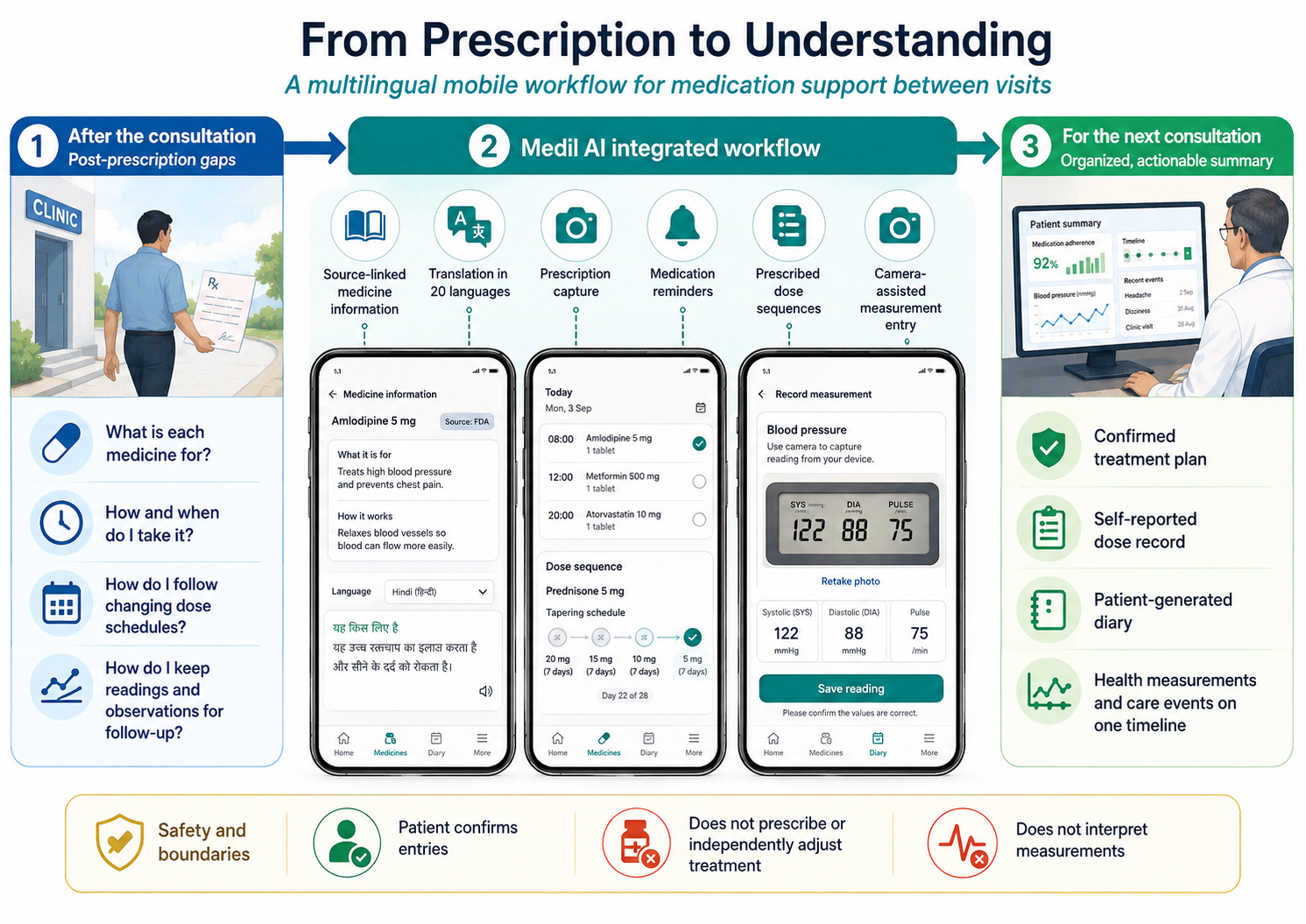
The design connects steps that patients ordinarily experience as unrelated. A patient can move from identifying a prescribed medicine, to source-linked information about it, to an explanation in a language they use comfortably, to a saved set of personal instructions, to reminders at the right times, to a record of doses taken, and finally to an organized account of the interval to bring to the next appointment—without re-entering the same treatment details. Figure 1 maps the three post-prescription gaps onto this path.
Post-prescription gaps in understanding, language access, and between-visit records mapped onto the integrated Medil AI workflow.
Table 4 presents the implemented patient-facing functions and access status as of 3 September 2026.
The Patient Workflow
A patient can search by brand name or active ingredient, including names written in another alphabet. This may be particularly useful for migrants and travelers who are not fluent or literate in the language in which prescriptions and medicine information are provided in the country.
Photographing the prescription through the application helps the patient identify the prescribed medicines, strengths, doses, frequencies, and timings. Each captured field is editable and presented for confirmation, and low-confidence fields are flagged for review rather than silently accepted. Figure 2 shows the sequence from image framing to the resulting care plan.
Three Medil AI screens showing prescription framing, a proposed medication list with a low-confidence field flagged for review, and the resulting patient-confirmed care plan.
The medicine page then places that prescription in context. It shows the available product name, ingredients, strength, form, route, authorized uses, notices, images, and links from the relevant public data source.
The practical effect is that a prescription stops being an isolated instruction and becomes something the patient can look up, read about, translate, and ask questions about when questions arise between consultations. This matters most when a patient needs to retrieve why a medicine was prescribed or how it should be taken. An instruction such as taking a medicine before food or apart from another preparation can remain attached to the medicine and appear with its reminder rather than being reconstructed from memory months later.
Medication Reminders and Support for Taking Medicines as Prescribed
After reviewing and saving a treatment plan, the patient selects the days, times, and notification options. A reminder opens the corresponding entry in the Care tracker, where the patient can record the scheduled dose as taken, partially taken, or not taken; adjust the quantity; add a note; or undo an entry.
This closes a loop that is usually left open: an instruction becomes a schedule, the schedule becomes a reminder, and the reminder becomes a contemporaneous self-reported record. The component functions correspond to features identified in prior adherence-support literature: understandable instructions, explicit timing, prompting, and a simple way to record medication use.4,5,12,13 The record documents what the patient reports having taken in real time (Figure 3A–B).
Three Medil AI screens: a reminder notification with a Taken action; the Care tracker showing an evening’s medicines and a physiotherapy appointment; and the dialog for choosing which personal details accompany a question to an external AI service.
Reading about Your Medicines in your Own Language
Language support goes beyond menus. On-demand translation of medicine content is available in 20 languages, including Hindi and Mandarin Chinese, while personal instructions remain integrated within the treatment workflow. A text-to-speech function can also read the displayed information aloud for patients who have difficulty reading.
In practice, an Arabic-speaking patient can read medication information in their language using a right-to-left layout; a Russian- or Ukrainian-speaking patient can search in Cyrillic; and medicine content can be translated on demand into the supported languages. Figure 4 illustrates translated and cross-script interfaces.
Four Medil AI screens illustrating source-linked medicine information, on-demand translation, and cross-script search.
Remaining questions can be submitted by the user to an external AI assistant of their choice. In this case, the application helps provide useful clinical context by attaching an accurate transcription of the patient’s background, treatment plan, and latest health measurements, with separate user confirmation for each category of data shared. The resulting conversation takes place outside Medil AI, directly between the user and the selected AI service (C).
Treatments whose dose Changes over Time
For medicines with a predefined changing-dose schedule, the application stores a product-specific dose sequence. These schedules are available for semaglutide products (Ozempic, Rybelsus, and Wegovy), tirzepatide products (Mounjaro and Zepbound), liraglutide products (Victoza and Saxenda), and varenicline products (Chantix and generic varenicline). Products sharing the same molecule may have distinct routes, indications, and labeled dose sequences.
Before scheduling, the complete sequence is shown to the patient: every phase, its dose, and its duration. Figure 5 shows one implementation example for once-weekly semaglutide (Wegovy). The patient is asked to confirm that the sequence matches the prescriber’s instructions; current product information and clinician instructions remain authoritative.
Medil AI dose-sequence confirmation dialog for a once-weekly semaglutide (Wegovy) implementation example. The patient must confirm that the displayed sequence matches the prescriber’s instructions before it is scheduled.
After confirmation, the schedule advances according to the stored phase dates and each reminder identifies the dose assigned to that phase. The application does not decide whether a patient should advance, hold, stop, or change treatment. If the prescriber changes the plan, the patient can easily update the schedule to reflect the new instruction.
The practical value is specific: the patient does not have to count forward across weeks or reconstruct the current phase from memory. Each reminder names the dose assigned to the stored phase, and each self-reported dose contributes to a dated history that can be reviewed at follow-up. Whether this improves schedule accuracy, persistence, tolerability, or clinical outcomes remains to be evaluated.
Arriving at the Next Appointment with Something to Show
The diary is the answer to the recalled sentence. It places self-reported doses alongside patient notes, appointments, tests, and dated health readings.
Readings can be entered manually or imported, with permission, from the phone’s health platform.19,20 A user can also point the phone camera at the display of a home-monitoring device; the application proposes the detected values in editable fields while the camera view remains visible so the transcription can be checked before saving (Figure 6A). Supported examples include blood pressure and pulse, weight, temperature, and oxygen saturation. Camera-transcribed entries remain patient-generated records and are not interpreted by the application.
Two Medil AI screens: camera-assisted transcription of a blood-pressure monitor display with user verification before saving; and an integrated month view combining medication records with selected patient-generated health measurements.
The calendar gives a compact month view of medicines, appointments, and readings. The chart can place selected trends—blood pressure, pulse, glucose, weight, temperature, oxygen saturation, steps, and activity—on the same time axis as the medication record. The record can be reviewed on the phone, printed, or exported. Figure 6B shows the integrated month view.
This is the digital equivalent of a patient-kept blood-pressure or glucose notebook, but it combines several record types on a single timeline. The clinician can review these measurements alongside the patient’s contemporaneous record of medication use, including the doses recorded as taken.
Access Model
The core medication-support functions—medicine information, a personal medicine list, dose scheduling, medication reminders, dose recording, and released dose-sequence templates—are available without a subscription. Advanced functions are available through a Medil AI+ subscription after a free trial and include prescription-image recognition, plain-language summaries and translation, camera-assisted measurement entry, health-platform imports, full calendar and chart views, and export and printing.
Discussion
What this Design Contributes
Medil AI is not primarily a medicine database, and not primarily a reminder application. Its principal design contribution is the connection between them: one continuous path after the consultation, along which the same patient-confirmed treatment plan carries what was prescribed, what the patient can look up about it, what they intend to do, what they report having done, and what they bring back.
The value of that continuity is practical. A patient does not have to hold a treatment plan in one application, medicine information in a search engine, reminders in a phone alarm, and blood-pressure readings in a notebook, and then reconcile the four from memory during a short appointment.
It also changes where the instruction lives. Information given during an encounter may otherwise be entrusted to memory or paper. Moving relevant instructions onto the device the patient carries keeps them legible, searchable, translatable, and attached to the medicine they belong to for as long as the treatment continues.
Understanding and Adherence
The design incorporates features that prior literature has associated with medication communication and adherence support: plain language, explicit instructions, personalization, prompting, and information available when the question arises.4,5,12,13
Two design targets deserve emphasis. Perceived necessity is associated with adherence to long-term medicines,1 and for preventive therapy the rationale for treatment may be difficult to recall because benefit is often not felt day to day. A source-linked medicine page that keeps this rationale available months after the consultation is designed to support that need. Separately, for medicines whose schedule changes over time, carrying the current prescribed phase to the moment of the dose may support correct implementation. Both effects require direct testing.
Nonadherence has many determinants, including cost, side effects, beliefs, trust, cognitive difficulty, housing instability, and pharmacy access. Clearer information and reminders address only part of this problem. The defensible claim is that the platform was designed to support adherence-related tasks, not that it improves adherence.
Language Access and Equity
On-demand translation, text-to-speech, and cross-script search are relevant to migrant and linguistically underserved patients.7–9 Source-linked country data can also help a patient recognize a product encountered after migration or travel.
Language availability is necessary but not sufficient for equitable access. Certified medical translation, native-speaker review, cultural adaptation, health literacy, device access, connectivity, digital confidence, disability accessibility, and cost remain relevant. However, availability should not be interpreted as cultural or linguistic validation until community-based testing has been completed.
Records Patients Keep Themselves
The diary is intended to make a short follow-up appointment more informative by replacing an undifferentiated recollection with a dated record the patient has kept and can choose to show.
Patient-generated health data can improve awareness and provide concrete material for a consultation, but can also create workload when data are voluminous or poorly structured.10,11 Calendar, chart, export, and selection functions are intended to present an organized summary rather than a stream of data. Camera-assisted entry may reduce typing, but it introduces recognition error in addition to device and measurement-technique error. Users should verify recorded values, and clinicians should interpret trends rather than treating the diary as a validated diagnostic record.
The Role of AI and Image Recognition
Three computational roles should be distinguished. First, AI-generated summaries and translations are constrained to source text, labeled as generated, and intended as reading aids rather than clinical advice. Second, prescription and device-display recognition transcribe candidate information; prescription fields require confirmation, while recorded measurements remain patient-generated data that should be checked by the user. Third, the application can transfer patient-selected context to an external general-purpose AI service outside Medil AI’s control. The patient initiates that handoff, and the external answer is not presented as professional advice.
Visually distinguishing source-linked, generated, image-recognized, patient-entered, and external content is therefore a central safety principle. Clinically important information should be checked against the prescription, current product information, the measuring device, and professional advice as applicable.
Strengths and Limitations
A strength of this study is that it documents a broad, implemented medication-support workflow rather than a proposed system. Use of mERA and iCHECK-DH makes the description more structured and comparable with other digital health implementation reports.
The central limitation is the absence of independent empirical evaluation. No patients were recruited and no comparative or observational data were collected. Accordingly, this study does not establish usability, recognition accuracy, medication comprehension, adherence, or clinical effectiveness. The described safeguards are design features whose real-world performance is unknown. The implications of the mixed access model for affordability, equity, and uptake also require prospective evaluation. In addition, one author has a commercial interest in the platform, making independent evaluation particularly important.
Future Directions
Future work should prioritize task-based usability; field-level accuracy of prescription and device-display recognition; independent clinician verification and version control of dose-sequence templates; native-speaker assessment of translated and plain-language content; notification reliability; privacy and security testing; medication comprehension; clinician workflow and data burden; accessibility and equity; and prospective assessment of adherence and clinical outcomes.
Conclusion
Medication support often becomes fragmented once the consultation ends. Medil AI was built to carry it further: source-linked medicine information, prescription capture, plain-language explanations and translation into 20 languages, personal treatment instructions, medication reminders, product-specific prescribed dose sequences for semaglutide, tirzepatide, liraglutide, and varenicline products, self-reported dose records, and a diary that combines treatment events with patient-generated health readings. Medil AI+ adds camera-assisted transcription of values displayed by home-monitoring devices. Together these functions create a continuous patient journey from prescription to understanding, daily implementation, and a record the patient can bring to the next consultation.
This report documents implementation and intended-use boundaries. The application does not prescribe, independently adjust doses, validate devices, or interpret measurements. Independent technical, usability, and clinical evaluation is required before making claims of effectiveness.
Statements and Declarations
Ethical Considerations: This design and development report used software, public product documentation, demonstration records, and application screens containing no identifiable patient information. It involved no human participants and no identifiable patient data. Ethics approval was therefore not required.
Consent to Participate: Not applicable. The report involved no human participants.
Consent for Publication: Not applicable. No identifiable individual patient information is included. All application screens were created with demonstration records.
Contributorship: Ariel Israel designed the application, formulated the study and manuscript concept, assembled the documentation, and drafted and revised the manuscript. Eugene Merzon contributed to the study design and to the drafting and critical revision of the manuscript. Both authors reviewed and approved the final manuscript.
Conflicting Interests: Ariel Israel is the creator of Medil AI and founder CEO of Medil Health Technologies Ltd, and may benefit financially from the application’s adoption. Eugene Merzon declares no competing interest.
Funding: The authors received no financial support for the research, authorship, and/or publication of this article.
Guarantor: Ariel Israel.
Data Availability: Patient guides, product information, and source descriptions are publicly available at https://medil.ai/. No participant dataset was used.
Software Availability: Medil AI is available for Android and iOS. Product information is available at https://medil.ai/. The implementation snapshot in this report is version 4.17, 3 September 2026.
Generative-AI Assistance: The authors used generative artificial intelligence tools (ChatGPT and Claude) to assist with manuscript editing, improve linguistic clarity and reference search. The authors reviewed all AI-assisted revisions and take full responsibility for the accuracy and integrity of the final manuscript.
Acknowledgments: None.
ORCID iDs: Ariel Israel: 0000-0003-4389-8896; Eugene Merzon: 0000-0001-5469-0236.
References
- Horne, R.; Chapman, S.C.E.; Parham, R.; et al. Understanding patients’ adherence-related beliefs about medicines prescribed for long-term conditions: a meta-analytic review of the Necessity-Concerns Framework. PLoS ONE 2013, 8, e80633. [Google Scholar] [CrossRef] [PubMed]
- Wiesner, A.; Gajewska, D.; Pasko, P. Levothyroxine interactions with food and dietary supplements - a systematic review. Pharmaceuticals 2021, 14, 206. [Google Scholar] [CrossRef] [PubMed]
- World Health Organization. Adherence to long-term therapies: evidence for action; World Health Organization: Geneva, 2003; Available online: https://iris.who.int/handle/10665/42682.
- Maghroudi, E.; van Hooijdonk, C.M.J.; van de Bruinhorst, H.; et al. The impact of textual elements on the comprehensibility of drug label instructions (DLIs): A systematic review. PLoS ONE 2021, 16, e0250238. [Google Scholar] [CrossRef] [PubMed]
- Wali, H.; Hudani, Z.; Wali, S.; et al. A systematic review of interventions to improve medication information for low health literate populations. Res. Soc. Adm. Pharm. 2016, 12, 830–864. [Google Scholar] [CrossRef] [PubMed]
- Watson, P.W.B.; McKinstry, B. A systematic review of interventions to improve recall of medical advice in healthcare consultations. J. R Soc. Med. 2009, 102, 235–243. [Google Scholar] [CrossRef] [PubMed]
- Patel, D.; Jalal, Z.; Guo, P. Medicine adherence and associated factors in immigrants and refugees: a systematic review. Int. J. Clin. Pract. 2022, 2022, 1993066. [Google Scholar] [CrossRef] [PubMed]
- Filmer, T.; Ray, R.; Glass, B.D. Barriers and facilitators experienced by migrants and refugees when accessing pharmaceutical care: A scoping review. Res. Soc. Adm. Pharm. 2023, 19, 977–988. [Google Scholar] [CrossRef] [PubMed]
- Sawalha, R.; Hosseinzadeh, H.; Bajorek, B. Medicines use issues perceived by Arabic-speaking patients living in English-speaking countries: a systematic review. Int. J. Pharm. Pract. 2023, 31, 369–379. [Google Scholar] [CrossRef] [PubMed]
- Lordon, R.J.; Mikles, S.P.; Kneale, L.; et al. How patient-generated health data and patient-reported outcomes affect patient-clinician relationships: A systematic review. Health Inform. J. 2020, 26, 2689–2706. [Google Scholar] [CrossRef] [PubMed]
- Tiase, V.L.; Hull, W.; McFarland, M.M.; et al. Patient-generated health data and electronic health record integration: a scoping review. JAMIA Open 2020, 3, 619–627. [Google Scholar] [CrossRef] [PubMed]
- Lanke, V.; Trimm, K.; Habib, B.; et al. Evaluating the effectiveness of mobile apps on medication adherence for chronic conditions: systematic review and meta-analysis. J. Med. Internet Res. 2025, 27, e60822. [Google Scholar] [CrossRef] [PubMed]
- Perez-Jover, V.; Sala-Gonzalez, M.; Guilabert, M.; et al. Mobile apps for increasing treatment adherence: systematic review. J. Med. Internet Res. 2019, 21, e12505. [Google Scholar] [CrossRef] [PubMed]
- Agarwal, S.; LeFevre, A.E.; Lee, J.; et al. Guidelines for reporting of health interventions using mobile phones: mobile health (mHealth) evidence reporting and assessment (mERA) checklist. BMJ 2016, 352, i1174. [Google Scholar] [CrossRef] [PubMed]
- Perrin Franck, C.; Babington-Ashaye, A.; Dietrich, D.; et al. iCHECK-DH: guidelines and checklist for the reporting on digital health implementations. J. Med. Internet Res. 2023, 25, e46694. [Google Scholar] [CrossRef] [PubMed]
- Medil Health Technologies Ltd. Medil AI patient guide; Medil Health Technologies Ltd, 2026; Available online: https://medil.ai/patient-guides/en/.
- Medil Health Technologies Ltd. Medil AI for doctors; Medil Health Technologies Ltd, 2026; Available online: https://doctor.medil.ai/en/.
- Medil Health Technologies Ltd. How Medil AI handles medication information; Medil Health Technologies Ltd, 2026; Available online: https://medil.ai/sources/en/.
- Google. Health Connect; Google, 2026; Available online: https://developer.android.com/health-and-fitness/health-connect.
- Apple Inc. HealthKit. Apple Inc. 2026. Available online: https://developer.apple.com/documentation/healthkit/.
- US National Library of Medicine. DailyMed. US National Library of Medicine, 2026. Available online: https://dailymed.nlm.nih.gov/dailymed/.
- Health Canada. Drug Product Database. Health Canada. 2026. Available online: https://www.canada.ca/en/health-canada/services/drugs-health-products/drug-products/drug-product-database.html.
- Israel Ministry of Health. The Israeli Drug Registry. Israel Ministry of Health. 2026. Available online: https://www.gov.il/en/service/israeli-drug-index.
- Agence nationale de securite du medicament et des produits de sante. Base de donnees publique des medicaments. Agence nationale de securite du medicament et des produits de sante. 2026. Available online: https://base-donnees-publique.medicaments.gouv.fr/.
- NHS Business Services Authority. NHS dictionary of medicines and devices (dm+d). NHS Business Services Authority. 2026. Available online: https://www.nhsbsa.nhs.uk/pharmacies-gp-practices-and-appliance-contractors/dictionary-medicines-and-devices-dmd.
- Bundesinstitut fur Arzneimittel und Medizinprodukte. Referenzdatenbank fur Fertigarzneimittel gemass § 31b SGB V. Bundesinstitut fur Arzneimittel und Medizinprodukte. 2026. Available online: https://www.bfarm.de/DE/Arzneimittel/Arzneimittelinformationen/Referenzdatenbank/_node.html.
- Agencia Espanola de Medicamentos y Productos Sanitarios. CIMA: Centro de informacion de medicamentos. Agencia Espanola de Medicamentos y Productos Sanitarios. 2026. Available online: https://cima.aemps.es/cima/publico/home.html.
- Ministry of Health of the Russian Federation. State Register of Medicines (GRLS). Ministry of Health of the Russian Federation. 2026. Available online: https://grls.rosminzdrav.ru/grls.aspx.
- Pharmaceuticals and Medical Devices Agency. Review reports, package inserts and product information. Pharmaceuticals and Medical Devices Agency. 2026. Available online: https://www.pmda.go.jp/english/search_index.html.
- Ministry of Food and Drug Safety. Drug Safety Portal (nedrug). Ministry of Food and Drug Safety. 2026. Available online: https://nedrug.mfds.go.kr/.
- Health Sciences Authority. INFOSEARCH: Register of Therapeutic Products. Health Sciences Authority. 2026. Available online: https://eservice.hsa.gov.sg/prism/common/enquirepublic/SearchDRBProduct.do?action=load.
- Ministerio de Salud de la Nacion Argentina. Precios de medicamentos. Ministerio de Salud de la Nacion Argentina. 2026. Available online: https://www.argentina.gob.ar/precios-de-medicamentos.
- European Medicines Agency. Reporting requirements for marketing-authorisation holders (Article 57 data on authorized medicines). European Medicines Agency, 2026. Available online: https://www.ema.europa.eu/en/human-regulatory-overview/post-authorisation/data-medicines-iso-idmp-standards-post-authorisation/reporting-requirements-marketing-authorisation-holders.
Figure 1.
Post-prescription design gaps and the integrated Medil AI workflow. Three needs commonly persist after a consultation: understandable medicine information, information in a language the patient reads comfortably, and an organized account of what happened between visits. The figure maps these needs to source-linked medicine information and accessible explanations, a confirmed treatment plan with reminders and dose records, and a patient-generated diary for follow-up.
Figure 1.
Post-prescription design gaps and the integrated Medil AI workflow. Three needs commonly persist after a consultation: understandable medicine information, information in a language the patient reads comfortably, and an organized account of what happened between visits. The figure maps these needs to source-linked medicine information and accessible explanations, a confirmed treatment plan with reminders and dose records, and a patient-generated diary for follow-up.
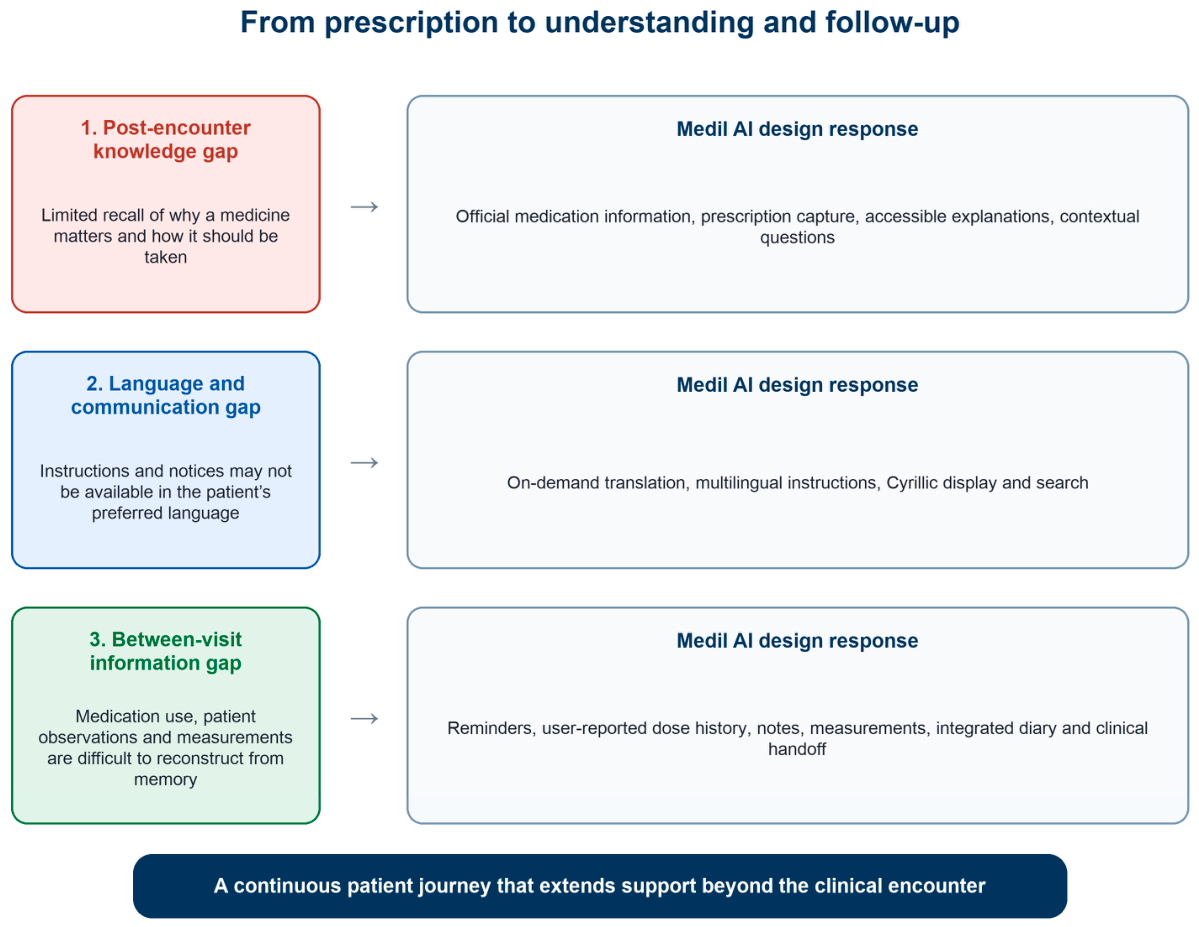
Figure 2.
From a prescription image to a patient-confirmed treatment plan. The patient frames the part of a prescription containing medicines and instructions. (B) The application proposes medicine names, strengths, doses, and timings; the patient can correct every field, and a low-confidence strength is flagged for manual review rather than accepted silently. (C) The resulting care plan groups the confirmed entries by time of day and includes a once-weekly semaglutide injection on its scheduled day. Screens use synthetic demonstration records and contain no identifiable patient information.
Figure 2.
From a prescription image to a patient-confirmed treatment plan. The patient frames the part of a prescription containing medicines and instructions. (B) The application proposes medicine names, strengths, doses, and timings; the patient can correct every field, and a low-confidence strength is flagged for manual review rather than accepted silently. (C) The resulting care plan groups the confirmed entries by time of day and includes a once-weekly semaglutide injection on its scheduled day. Screens use synthetic demonstration records and contain no identifiable patient information.
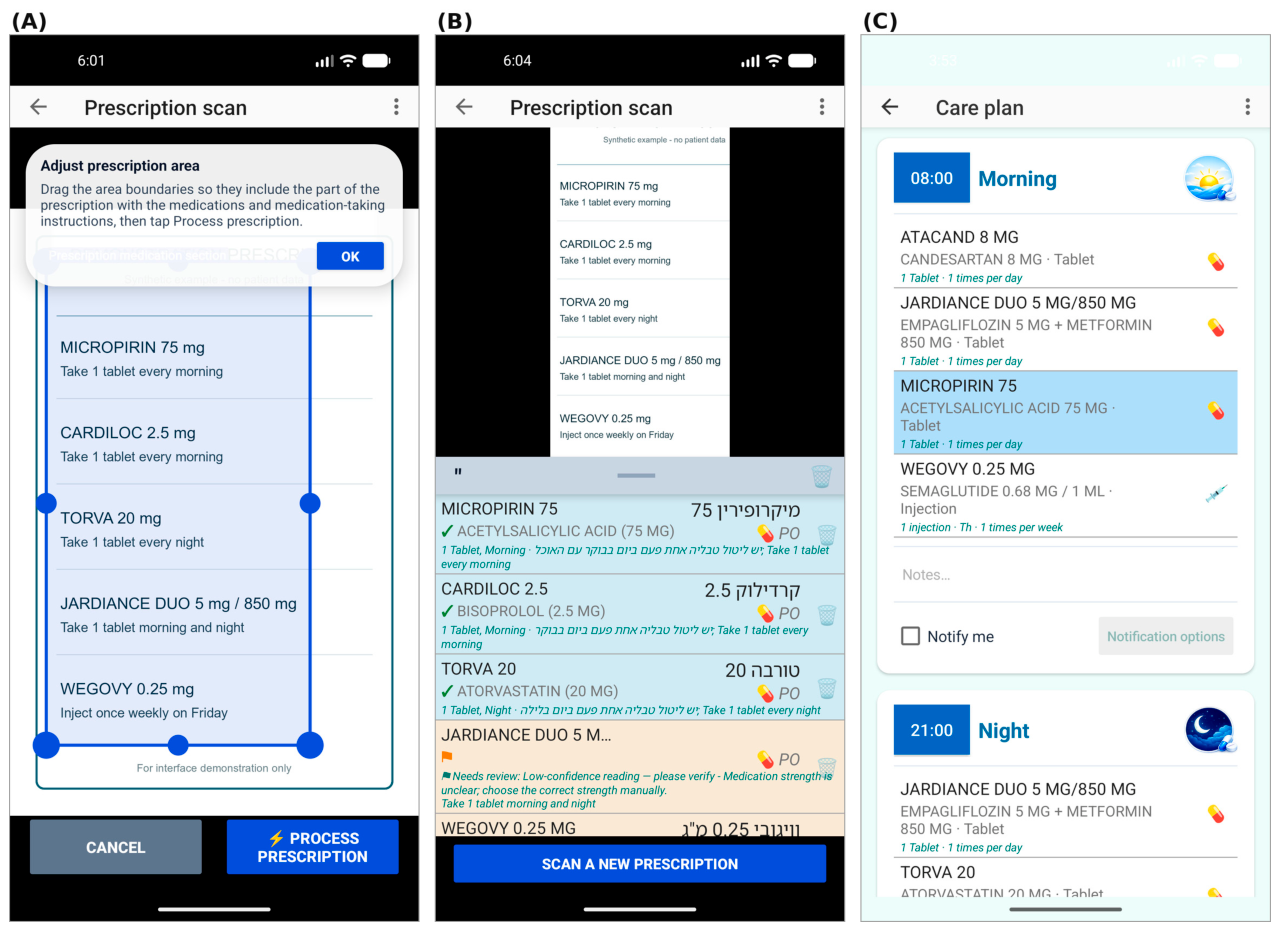
Figure 3.
Medication reminders, self-reported dose recording, and an external-AI handoff. (A) A reminder arrives at the scheduled time and can be answered from the notification itself, either recording the dose as taken or deferring it. (B) The Care tracker for one evening, where each medicine can be recorded, adjusted, or cancelled, a note added, and a care event marked as attended. (C) Before a question is sent to an external assistant, the patient chooses which of their own details to include; the dialog states that the conversation takes place outside the application and does not replace professional advice.
Figure 3.
Medication reminders, self-reported dose recording, and an external-AI handoff. (A) A reminder arrives at the scheduled time and can be answered from the notification itself, either recording the dose as taken or deferring it. (B) The Care tracker for one evening, where each medicine can be recorded, adjusted, or cancelled, a note added, and a care event marked as attended. (C) Before a question is sent to an external assistant, the patient chooses which of their own details to include; the dialog states that the conversation takes place outside the application and does not replace professional advice.
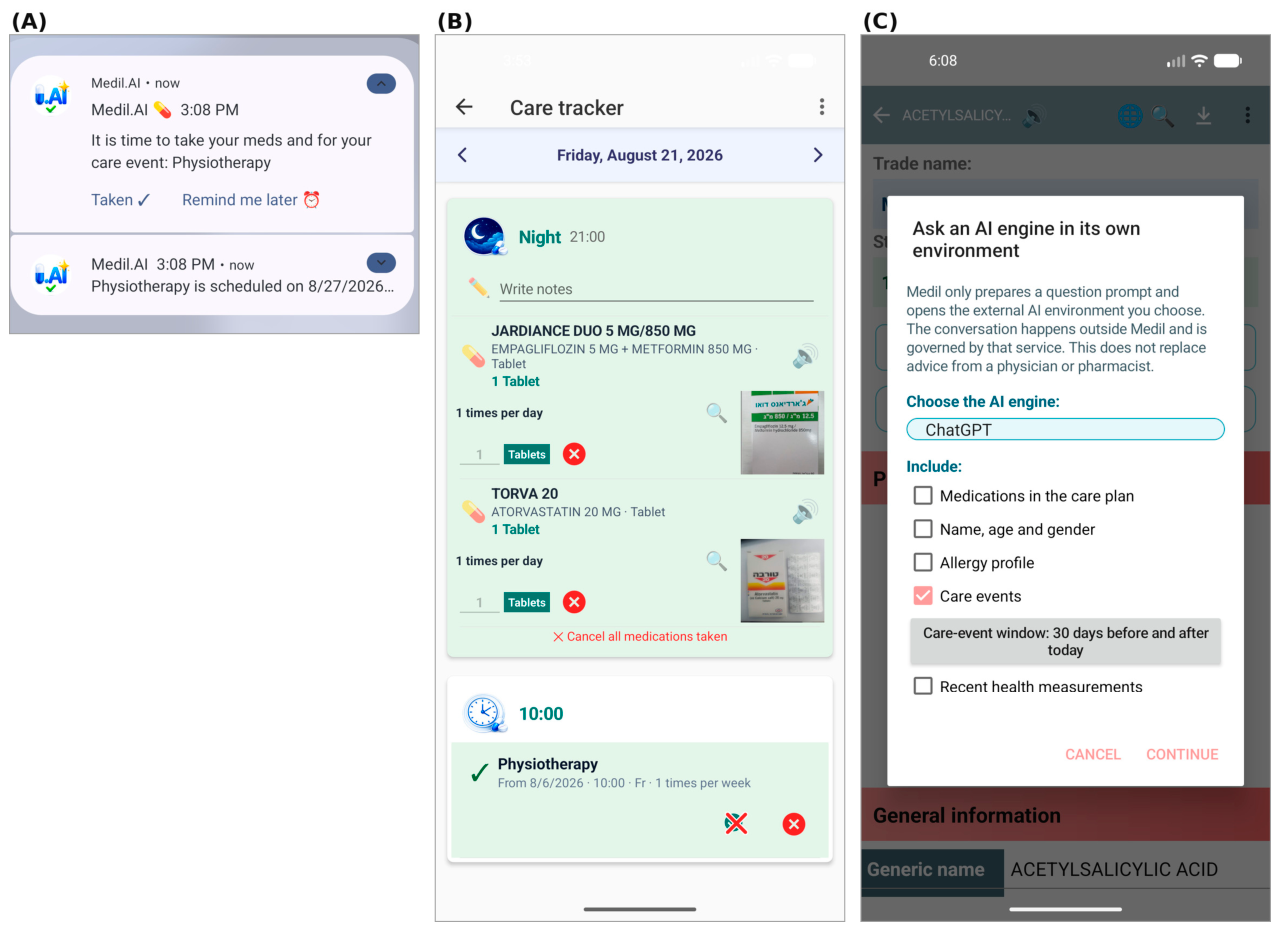
Figure 4.
Medicine information in the patient’s own language. (A) A medicine page in English; (B) on-demand Arabic translation with a right-to-left layout; (C) Cyrillic search with Latin transliteration; and (D) a Russian State Register product record.
Figure 4.
Medicine information in the patient’s own language. (A) A medicine page in English; (B) on-demand Arabic translation with a right-to-left layout; (C) Cyrillic search with Latin transliteration; and (D) a Russian State Register product record.
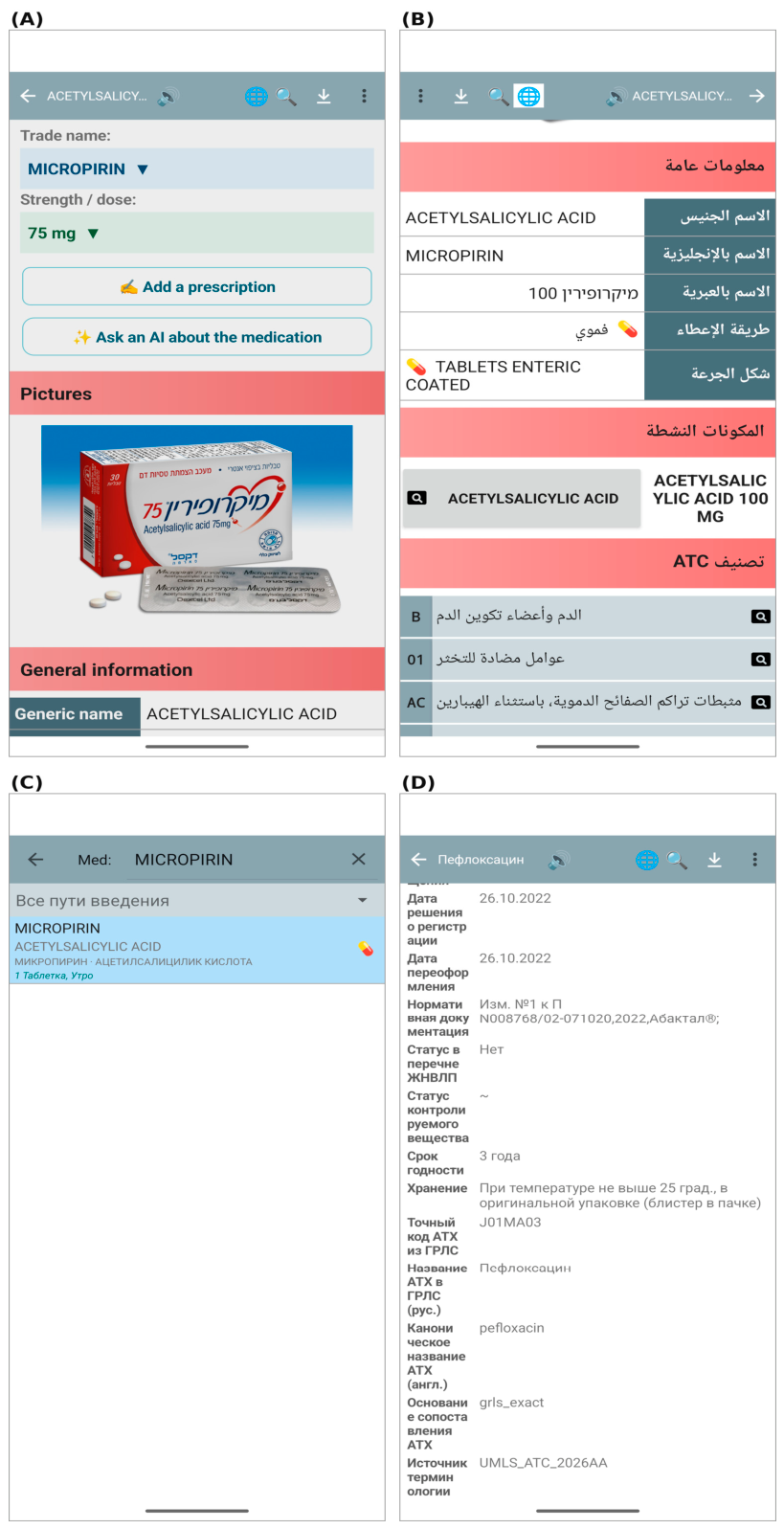
Figure 5.
A product-specific prescribed dose sequence. Before a medicine with a released dose-sequence template is scheduled, the application lists each phase, dose, and duration and asks the patient to confirm that the sequence matches the prescriber’s instructions. The figure shows the once-weekly semaglutide (Wegovy) sequence displayed in the application at the time of capture. It documents the interface and is not prescribing guidance; current product information and clinician instructions remain authoritative. Template availability varies by product, market, route, indication, and app version.
Figure 5.
A product-specific prescribed dose sequence. Before a medicine with a released dose-sequence template is scheduled, the application lists each phase, dose, and duration and asks the patient to confirm that the sequence matches the prescriber’s instructions. The figure shows the once-weekly semaglutide (Wegovy) sequence displayed in the application at the time of capture. It documents the interface and is not prescribing guidance; current product information and clinician instructions remain authoritative. Template availability varies by product, market, route, indication, and app version.
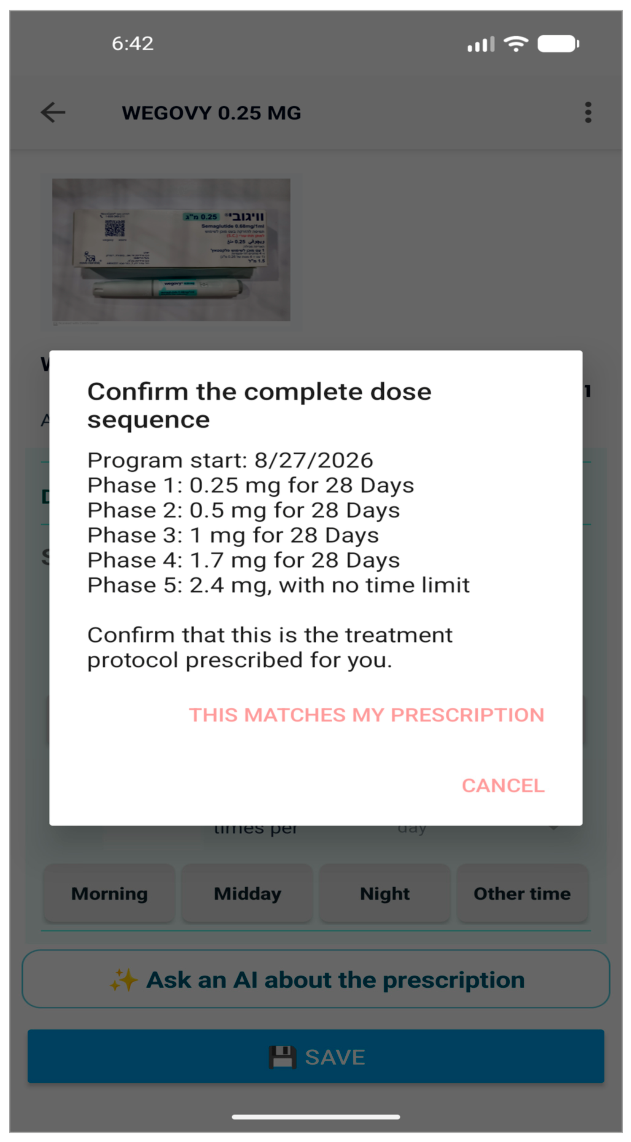
Figure 6.
Patient-generated medication and health data for follow-up. (A) Camera-assisted measurement entry in Medil AI+: the phone camera is directed at a blood-pressure monitor display, and the proposed systolic (122 mmHg), diastolic (88 mmHg), and pulse (75 beats/min) values are shown above the camera view for user verification or correction before saving. (B) One month of the diary, showing self-reported medication completion, a weekly injection, steps, weight, blood pressure, and care events. Measurements may be entered manually, imported from the phone’s health platform, or transcribed from a supported device display. Camera transcription does not validate the device, measurement technique, or clinical meaning.
Figure 6.
Patient-generated medication and health data for follow-up. (A) Camera-assisted measurement entry in Medil AI+: the phone camera is directed at a blood-pressure monitor display, and the proposed systolic (122 mmHg), diastolic (88 mmHg), and pulse (75 beats/min) values are shown above the camera view for user verification or correction before saving. (B) One month of the diary, showing self-reported medication completion, a weekly injection, steps, weight, blood pressure, and care events. Measurements may be entered manually, imported from the phone’s health platform, or transcribed from a supported device display. Camera transcription does not validate the device, measurement technique, or clinical meaning.
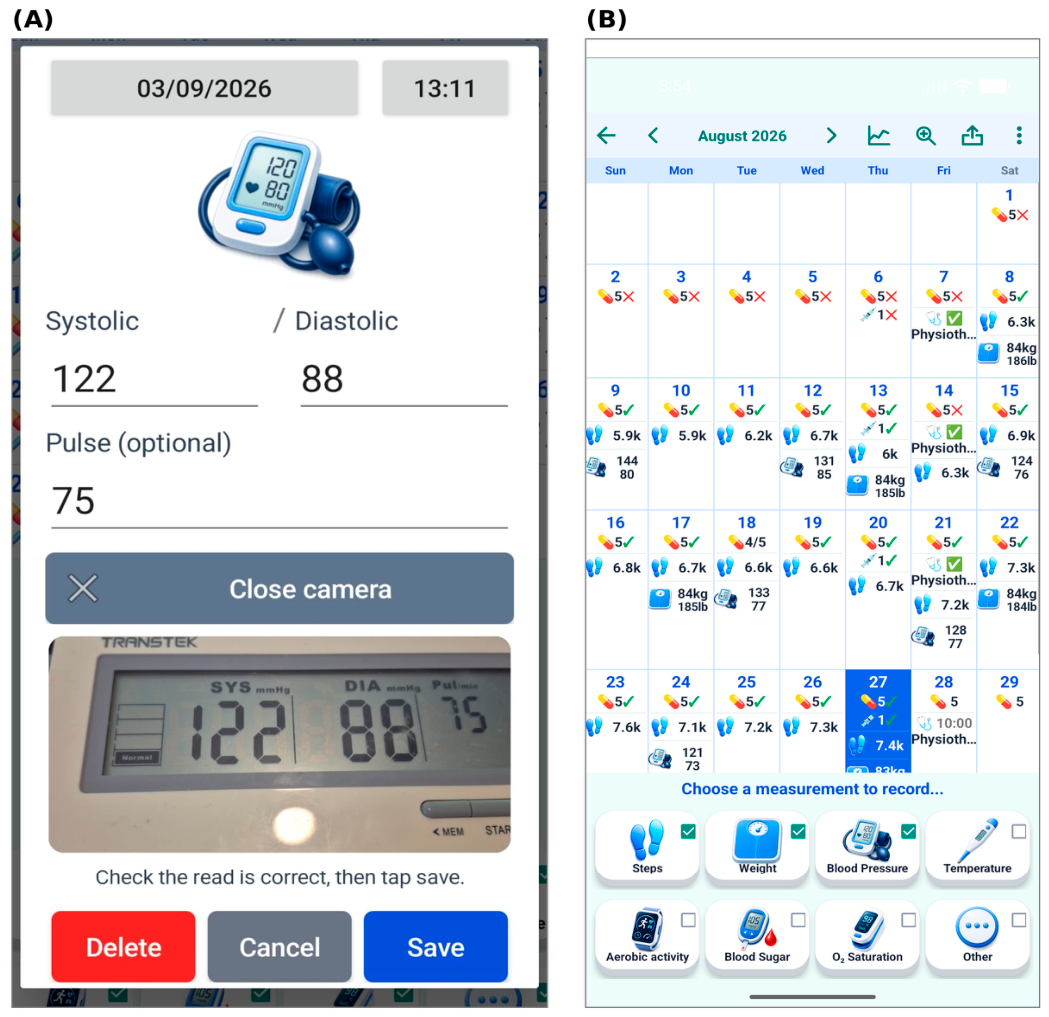

Table 1.
What patients need after a consultation, and how Medil AI responds.
| The gap | What the patient needs | What Medil AI does | What to keep in mind |
| Instructions given once, at a difficult moment | To understand why a medicine matters and how to take it | A source-linked medicine page, the patient’s saved instructions, and a labeled plain-language explanation | Supports discussion with the clinician; does not replace prescribing or counseling |
| A preventive medicine that relieves no immediate symptom | To remember why it matters when the benefit cannot be felt | The medicine page states authorized uses and can preserve the patient’s own explanation of why it was prescribed | The indication for the individual patient is determined by the clinician |
| An instruction that determines whether the medicine works | To recall exactly how and when to take it, at the moment of the dose | Personal instructions saved in the patient’s own words with the medicine and shown with its reminder | The instruction is the one the patient saved; the prescription remains the reference |
| Official notices that are long and technical | To find the part that applies to them | The official document, plus a labeled plain-language summary of the section they choose | The summary sits beside the original, which stays one tap away |
| Information written in a language the patient does not read comfortably | To read about treatment in a familiar language | On-demand translation of medicine content into 20 languages, with personal instructions in the supported workflow | Translation is a reading aid and is not a certified medical translation |
| A medicine known under another name or alphabet | To recognize or search for a medicine across countries and scripts | Official local names, plus Cyrillic display and search and names spelled out in Latin letters | The Latin spelling is a way of finding a medicine, not its registered name |
| Copying a prescription by hand | To save time without losing control of what was written | Photographing the prescription proposes the medicines and instructions, editable before saving | Every field is presented for the patient to check against the prescription |
| Remembering doses inside a busy day | A schedule and prompt that fit the patient’s routine | A personal schedule, medication reminders, the Care tracker, notes, and undo | Reminder delivery depends on notification permissions, battery settings, and time zone |
| A prescribed dose that changes by treatment phase | To know which dose is scheduled now without calculating dates | A product-specific sequence shown for confirmation before scheduling; each reminder identifies the phase dose | The app does not prescribe or decide whether to escalate, hold, stop, or change treatment |
| Months of treatment and symptoms held in memory | A place to keep doses, symptoms, appointments, and readings | One diary combining medication events, notes, care events, and health readings | The record is the patient’s own account, kept as they go |
| Recording measurements from a home-monitoring device | To place displayed readings into the diary with less manual entry | Medil AI+ uses the phone camera to transcribe displayed values into patient-generated diary entries | The user should verify the record; the app does not validate the device or interpret the reading |
| A time-limited follow-up appointment | To present the interval clearly | Calendar and chart views, on-screen review, printing, and export | The clinician reads it alongside history, examination, and tests |
Table 2.
Provenance, confirmation, and interpretation of application content.
| Element | Function | How it should be interpreted |
| Source-linked medicine information | Information drawn from a public regulatory or authoritative medicine-data source and displayed with its origin | Coverage and update timing follow the source; current product information and professional advice remain authoritative |
| Plain-language summary or translation | A generated reading aid associated with the source text | Clinically important information should be checked against the source material |
| Prescription read from an image | A proposal that reduces manual transcription | The patient must compare and confirm each field before saving |
| Medication reminder | A prompt at the time selected or assigned in the confirmed plan | Delivery depends on notification permissions, battery settings, operating-system behavior, and time zone |
| Prescribed dose-sequence template | A product-specific series of phases shown for confirmation and then used to schedule reminders | The app does not prescribe or decide whether a patient should advance, hold, stop, or change treatment |
| Self-reported dose record | The patient’s dated account of taking, partly taking, or not taking a medicine | Documents what the patient reports; it does not verify ingestion |
| Health reading | A value entered manually, imported from the phone’s health platform, or transcribed from a device display | Accuracy depends on the source device, technique, transfer, and transcription; the value is not a clinical interpretation |
| Camera-assisted measurement entry | Transcribes values visible on a supported home-monitoring device display into a diary entry | The user should verify the recorded value; the app does not validate the device or interpret the measurement |
| Diary and chart | A dated account of the interval, organized for a consultation | Shows what happened and when; what it means for treatment is a clinical judgement |
| Question sent to an external assistant | The patient’s question, with the personal context they chose to include | The conversation takes place in that service, under its terms; answers are not professional medical advice |
Table 3.
Country-specific medicine-data environments and source datasets.
| Country or region | Public data source | What patients typically see |
| United States | FDA / National Library of Medicine DailyMed | Products, package labels, identifiers, links to the official record21 |
| Canada | Health Canada Drug Product Database | Products with their DIN, ingredients, strength, route, status, monographs22 |
| Israel | Ministry of Health Drug Registry | Products, packages, notices, prices, barcodes, and images where published23 |
| France | Base de données publique des médicaments / ANSM | Products and presentations, composition, routes, official documents24 |
| United Kingdom | NHSBSA dictionary of medicines and devices | Product and presentation terms, components, form, route, pack details25 |
| Germany | BfArM §31b reference data with European fields | National product facts for matched records, plus European authorization data26 |
| Spain | AEMPS CIMA | Registered products and presentations, route and form, documents, images27 |
| Russia | Ministry of Health State Register of Medicines (GRLS) | Registered products, official Russian names, presentations, record links28 |
| Japan | MHLW drug price standard with PMDA links | Japanese product names, identifiers, categories, official product links29 |
| South Korea | MFDS and HIRA | Licensed products, ingredients, images, safety and reimbursement fields30 |
| Singapore | Health Sciences Authority | Registered therapeutic products, ingredients, route and form, supply class31 |
| Argentina | Ministry of Health medicine price services and PAMI data | Product identifiers, active ingredients, route and form, price and programme fields32 |
| Other European countries | European Medicines Agency Article 57 | Europe-wide authorization information33 |
Table 4.
Implemented patient-facing functions and access status as of version 4.17, September 2026.
| What the patient wants to do | How Medil AI does it | Access status |
| Find out what a medicine I have been prescribed is for | Search by brand name or active ingredient and open the medicine page | No subscription |
| Understand why I take a medicine that does not make me feel any different | The medicine page sets out what it treats and what it is intended to prevent | No subscription |
| Remember that a tablet must be taken on an empty stomach, away from other medicines | Save the instruction in your own words with the medicine; it appears with the reminder | No subscription |
| Read source information for my medicine | The medicine page links to the available notice or record from the relevant public regulatory or authoritative data source | No subscription |
| Understand a leaflet written in technical language | Request a plain-language explanation of the section, with the original beside it | Medil AI+ |
| Read about my medicines in a language I use comfortably | Translate supported medicine content in 20 languages or have displayed information read aloud | Medil AI+ |
| Use the app in Arabic or Hebrew | The whole interface, including layout, reads right to left | No subscription |
| Find a medicine I know by its Russian or Ukrainian name | Search in Cyrillic, or in the same name spelled out in Latin letters | No subscription |
| Enter my prescription without typing it all | Photograph the prescription; check and correct what is proposed before saving | Medil AI+ |
| Be reminded when to take each medicine | Set days and times; a medication reminder opens directly to the scheduled entry | No subscription |
| Follow a prescribed dose sequence that changes over time | Confirm the complete product-specific sequence once; reminders then identify the dose scheduled for each phase | No subscription |
| Use the released schedule for my specific medicine | Templates include semaglutide (Ozempic, Rybelsus, Wegovy); tirzepatide (Mounjaro, Zepbound); liraglutide (Victoza, Saxenda); and varenicline (Chantix and generic varenicline products). Availability varies by product, market, route, indication, and app version. | No subscription |
| Keep a contemporaneous record of medication use | Record a full dose, partial dose, or dose not taken, add a note, and review complete, partial, and missed entries in the calendar | No subscription |
| Ask a question about my medicine with my own details attached | Choose which categories of personal context to include—such as age, allergies, medicines, or health measurements—and send the question to an external assistant. | Medil AI+ |
| Record blood pressure, glucose, weight, or another supported reading | Enter the reading manually or import authorized data from the phone’s health platform | Manual entry: no subscription; health-platform import: Medil AI+ |
| Record a value displayed by a home-monitoring device without typing it | Point the phone camera at the display; detected values are presented for confirmation before saving. | Medil AI+ |
| Keep a note of symptoms and how I have been feeling | Add dated notes to the diary alongside the medication record | No subscription |
| Keep track of appointments, tests, and physiotherapy | Add care events to the same diary | No subscription |
| See whether my readings changed when my treatment changed | The chart aligns selected readings with the medication record on one time axis | Medil AI+ |
| Show my doctor what happened since the last visit | Show the calendar or chart on the phone, or print or export it | On-screen review: no subscription; print/export: Medil AI+ |
Disclaimer/Publisher’s Note: The statements, opinions and data contained in all publications are solely those of the individual author(s) and contributor(s) and not of MDPI and/or the editor(s). MDPI and/or the editor(s) disclaim responsibility for any injury to people or property resulting from any ideas, methods, instructions or products referred to in the content. |
© 2026 by the authors. Licensee MDPI, Basel, Switzerland. This article is an open access article distributed under the terms and conditions of the Creative Commons Attribution (CC BY) license (http://creativecommons.org/licenses/by/4.0/).
Copyright: This open access article is published under a Creative Commons CC BY 4.0 license, which permit the free download, distribution, and reuse, provided that the author and preprint are cited in any reuse.