

Submitted:
04 September 2026
Posted:
04 September 2026
You are already at the latest version
Abstract
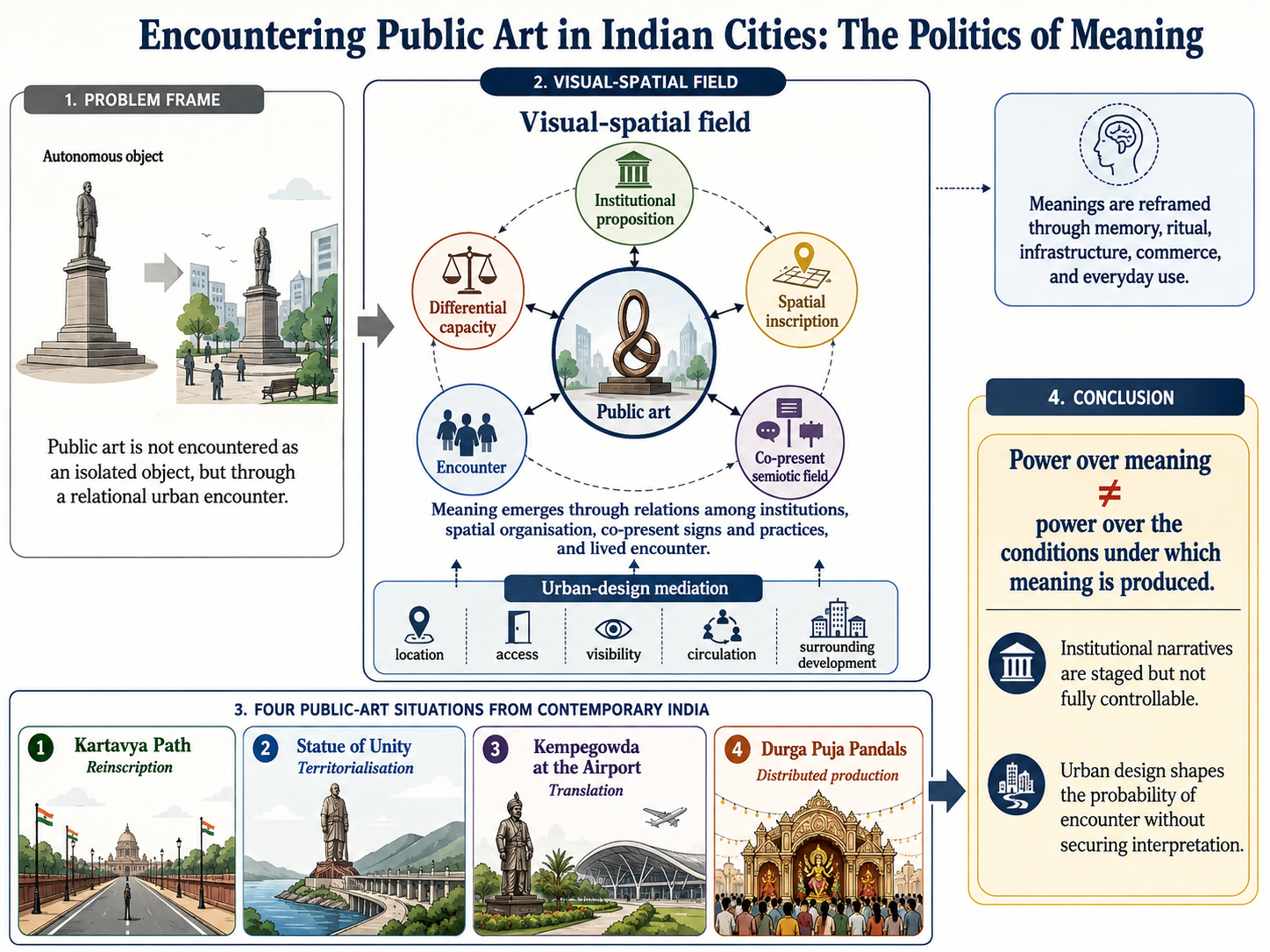
Public art does not enter public life as an autonomous object in a neutral setting; it is a relational encounter embedded in urban life. Its meanings are co-produced through the political, spatial, and visual organisation of the city. Drawing on theories of socially produced space, visual culture, spectacle and aesthetic governmentality, this paper examines a few contemporary Indian public-art situations where curated visual narratives coexist with informality, congestion, contested histories, and intensely lived public realms. The cases are the India Gate–Kartavya Path precinct in New Delhi, the Statue of Unity in the Narmada Valley, the Kempegowda statue at Bengaluru’s international airport, and Kolkata’s Durga Puja pandals. These are embedded within projects of nation-building, infrastructure development, city branding, heritage production and ritual expression. The cases reveal distinct modes of visual-spatial production: reinscription, as political narratives are rewritten through inherited monumental landscapes; territorialisation, as monumentality extends into infrastructure and development; translation, as regional memory is reformulated through metropolitan aspiration; and distributed production, where aesthetic production cannot be attributed to a single institutional author. In state-backed cases, public art may function as an aesthetic instrument through which the postcolonial state stages preferred narratives of development, identity, and aspiration; these are subsequently reframed through interactions with informality, ritual, memory, and everyday use.. This paper develops the concept of the visual-spatial field to examine how public art is read through relations among co-present signs and practices. The paper consequently positions urban design as an active mediator in the politics of public art: through decisions about location, access, visibility, and surrounding development, they structure the conditions of encounter without determining their outcome. The paper distinguishes power over meaning from power over the conditions under which meaning is produced, arguing that co-production should not be confused with equal capacity.
Keywords:
aesthetic governmentality
; aesthetic instrument
; postcolonial state
; Global South
; public art
; urban design
; urban semiotics
; visual-spatial field
Copyright: This open access article is published under a Creative Commons CC BY 4.0 license, which permit the free download, distribution, and reuse, provided that the author and preprint are cited in any reuse.