
Submitted:
04 September 2026
Posted:
04 September 2026
You are already at the latest version
Abstract
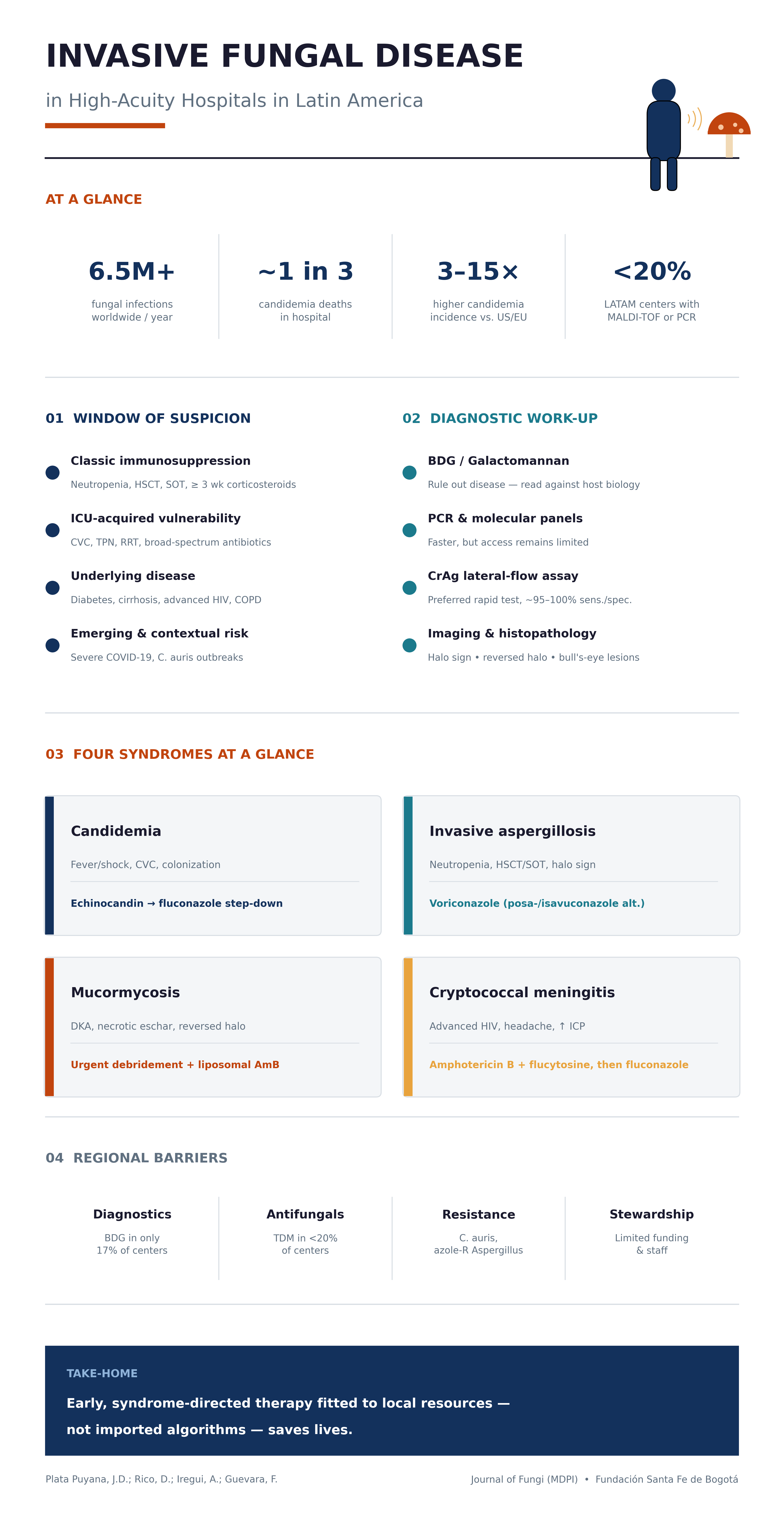
Invasive fungal diseases (IFD) have become a routine diagnostic and therapeutic challenge in high-acuity hospitals worldwide, and Latin America presents a distinctive scenario in which opportunistic mycoses of tertiary care coexist with endemic dimorphic fungi, heterogeneous diagnostic capacity, and uneven antifungal access. This narrative review organizes a practical, clinically usable pathway for Latin American high-acuity hospitals, from the construction of a “window of suspicion” based on host risk factors, through the diagnostic work-up available in the region (non-culture biomarkers, molecular platforms, imaging, and histopathology), to syndrome-specific clinical pathways for candidemia, invasive aspergillosis, mucormycosis, and cryptococcal meningitis, including antifungal selection, dosing, and stewardship. We highlight where regional diagnostic and therapeutic constraints depart from guidance developed in high-resource settings and where structured clinical suspicion must substitute for advanced biomarkers. We conclude that early, syndrome-directed pathways adapted to local resource availability, rather than uncritical adoption of international algorithms, offer the most realistic route to earlier antifungal therapy and improved outcomes in Latin American high-acuity hospitals.
Keywords:
invasive fungal disease
; candidemia
; invasive aspergillosis
; mucormycosis
; cryptococcal meningitis
; Latin America
; diagnostic pathway
; antifungal stewardship
; high-acuity hospitals
; galac-tomannan
Copyright: This open access article is published under a Creative Commons CC BY 4.0 license, which permit the free download, distribution, and reuse, provided that the author and preprint are cited in any reuse.