
Submitted:
04 September 2026
Posted:
04 September 2026
You are already at the latest version
Abstract
Multiportal video-assisted thoracoscopic surgery (VATS) was introduced in Japan in the 1990s, with uniportal VATS (U-VATS) and robot-assisted thoracic surgery (RATS) following in the 2010s. U-VATS gained significant traction after the 1st Japanese Society of Thoracic Surgeons (JSTS) Fellowship in 2018, leading to the establishment of the Japanese Uniportal VATS Interest Group (JUVIG) in April 2018. JUVIG has since driven wider adoption through extensive activities, including educational programs, publications, and collaborative multicenter studies. As a result, expert surgeons now utilize U-VATS for complex procedures such as bronchoplasty, completion lobectomy, complex segmentectomy, and pediatric surgery. Concurrently, RATS gained insurance coverage in Japan in 2018 and has become more prevalent than U-VATS. Despite the significant costs associated with RATS, its adoption rate surpasses that of U-VATS due to institutional policies, perceived ease of implementation, branding, recruitment incentives, and recent national healthcare insurance reimbursement revisions (add-ons) introduced in 2026, which exert administrative pressure to prioritize robotic cases. Although reduced-port RATS is gaining popularity—blurring the lines with U-VATS—and newly emerging indigenous robotic platforms are expected to further accelerate RATS adoption, multiportal VATS (M-VATS) remains the dominant approach in many institutions. Furthermore, maintaining proficiency in VATS, U-VATS, and open thoracotomy remains indispensable for surgical education, economic viability, and acute intraoperative crisis management. Ultimately, while U-VATS represents a promising minimally invasive option, its widespread adoption for major and complex resections in Japan continues to be restricted by both educational and societal barriers.
Keywords:
uniportal
; video-assisted thoracoscopic surgery
; robot-assisted thoracic surgery
; minimally invasive surgery
Introduction
The development of thoracoscopy marked a definitive shift toward minimally invasive surgery (MIS), moving the field from open thoracotomy to video-assisted thoracic surgery (VATS). Initially, VATS was performed via mini-thoracotomy; it subsequently evolved to complete multiportal VATS (M-VATS), the then-dominant approach. Following this, uniportal VATS (U-VATS) was pioneered by Dr. Diego González-Rivas [1] and introduced in Japan in the 2010s [2,3]. Its adoption accelerated following U-VATS international training courses and the first JSTS Fellowship in 2018, serving as a key turning point for domestic academic recognition [4]. Despite the COVID-19 pandemic, the Japanese Uniportal VATS Interest Group (JUVIG) sustained U-VATS promotion through educational materials, seminars, publications, and device development [2,5]. Initial criticism from M-VATS proponents waned after studies showed U-VATS outcomes from early Japanese adopters were comparable or superior to M-VATS [7,8,9,10,11].
RATS Dominance and Discrepancy
Robot-assisted thoracic surgery (RATS), also introduced in the 2010s, is currently more prevalent in Japan, with an institutional adoption rate of 57.5% vs. 42.5% for U-VATS [12]. RATS faces persistent challenges, including high capital costs, a multiportal configuration, and ongoing limitations in insurance coverage and system availability [13,14]. While U-VATS is arguably less invasive based on wound size and pain, RATS is more widely adopted [12].
This discrepancy is primarily attributed to three main factors: (1) organizational pressure to utilize expensive RATS equipment to offset capital costs, (2) the symbolic prestige and institutional branding of cutting-edge robotic technology—which serves as a key driver for patient recruitment and the attraction of young surgical trainees amidst Japan's severe shortage of surgical workforce [15,16]—and (3) the technical complexity of U-VATS combined with a scarcity of qualified instructors. Few surgeons are proficient in U-VATS compared to RATS. Consequently, surgical modalities are heavily shaped by managerial mandates, hospital marketing strategies, and recruitment incentives, alongside the challenge of navigating a demanding learning curve without adequate mentorship. Meanwhile, RATS itself is evolving from multiportal to reduced-port and uniportal approaches [17] (Figure 1).
Socioeconomic Drivers and Healthcare Insurance System
Under Japan’s National Health Insurance (NHI) system, the adoption of RATS has been heavily shaped by complex reimbursement dynamics. Historically, high capital and consumable costs rendered RATS less profitable than conventional VATS or U-VATS [13,14], forcing hospitals to rely on robotic platforms primarily for institutional marketing and amortization of capital equipment. This dynamic has been further accelerated by recent NHI reimbursement revisions, which introduced dedicated financial add-on fees (kasan) for RATS since 2026 [19]. Although this addition secures a baseline profit margin for health facilities, it has markedly increased administrative pressure from hospital management to execute more robotic cases to maximize institutional revenue. Consequently, surgeons are increasingly compelled by organizational incentives to prioritize RATS. However, it should be noted that NHI coverage and these financial add-on fees for RATS remain strictly restricted to specific malignant indications and designated surgical procedures. This trend raises concern: despite the lack of clear, proven clinical superiority of RATS over U-VATS for patients, surgical decision-making is being substantially influenced by institutional financial motives, departing from the fundamental principle of patient-centered care [20,21].
Educational Ecosystem, Systemic Constraints, and Safety Considerations
These advancements reflect Japan's decade-long MIS trend, yet conservative institutions still predominantly rely on M-VATS [12]. This reliance presents a striking paradox given that some facilities aggressively adopt RATS primarily to recruit young surgeons [15,16]; despite this recruitment-driven push for advanced robotics, senior surgeons often lack the expertise to teach U-VATS. A perception persists that M-VATS proficiency is necessary before advancing to U-VATS or RATS. This mindset closely mirrors the historical dogma that proficiency in open thoracotomy was an absolute prerequisite for performing conventional VATS [22]. As long as this status quo persists, educating junior surgeons remains difficult until techniques are standardized and outcomes stabilize. While COVID-19 accelerated self-directed video-based learning, early-adopting institutions must continue to lead surgical education to convey crucial technical tips and pitfalls [23].
Regarding simulation training, RATS—exemplified by Intuitive Surgical’s da Vinci platform—holds a distinct advantage over U-VATS due to its integrated video-based and virtual training modules, which offer educational capabilities unobtainable through traditional dry or wet labs [2,24,25,26]. Additionally, Intuitive Surgical actively drives the construction of collaborative networks bridging surgical societies and clinical centers. Supported by a robust socio-economic framework, this comprehensive ecosystem likely serves as a major catalyst for the rapid dissemination of RATS over U-VATS.
Operational and safety constraints also pose significant challenges for RATS. Because the number of robotic systems per facility is inherently limited, efficient cross-departmental scheduling is required, and surgical modalities must be tailored to specific anatomical needs rather than relying solely on platform availability. Furthermore, exclusive long-term reliance on RATS training could compromise a surgeon’s ability to manage acute intraoperative crises. From a patient safety perspective—accounting for contingencies such as device malfunction, system conversion, or severe intraoperative hemorrhage—VATS, U-VATS, and open thoracotomy remain indispensable components of surgical expertise [22,27].
Another critical barrier to the broader adoption of U-VATS is the relative paucity of high-level evidence, which naturally makes senior surgeons and potential mentors hesitant to actively embrace the technique. Addressing this evidentiary gap is essential to engaging surgical leaders; notably, an upcoming prospective study on long-term outcomes planned by JUVIG is expected to provide the necessary clinical validation to overcome this hurdle.
Evaluation Systems and Institutional Barriers
The Thoracoscopic Safety Technical Certification System, initiated by JSTS in 2021, aims to assess whether a surgeon can safely perform thoracoscopic lobectomy—primarily right upper lobectomy—rather than evaluating mere technical dexterity [28]. This initiative was established against the background of preventing fatal massive intraoperative hemorrhage caused by pulmonary vascular injury [29]. Any approach under the broad category of VATS, including M-VATS, U-VATS, and RATS, is eligible for application.
Although the evaluation criteria are uniform regardless of the surgical approach, there was a substantial disparity in pass rates during the system's inaugural year in 2021: 33.3% for U-VATS compared to 72.1% for M-VATS. By 2023, however, the pass rate for U-VATS improved significantly to 66.7%, while M-VATS reached 80.6% [29].
This initial gap was heavily influenced by reviewers' limited personal experience with U-VATS, leading to resistance against unfamiliar techniques—such as U-VATS-specific surgical field exposure, distal camera visualization, and non-grasping techniques—which drew skepticism and criticism [30]. Similar to the historical transition from open thoracotomy to conventional VATS [22,31], critical sentiment during the early adoption phase may be inevitable. The recent rise in pass rates is likely attributable to standardized evaluation criteria established through repeated consensus meetings, broader acceptance of U-VATS techniques among evaluators, and improvements in surgical technique by U-VATS surgeons informed by previous assessment feedback.
Global Perspectives and Future Outlook
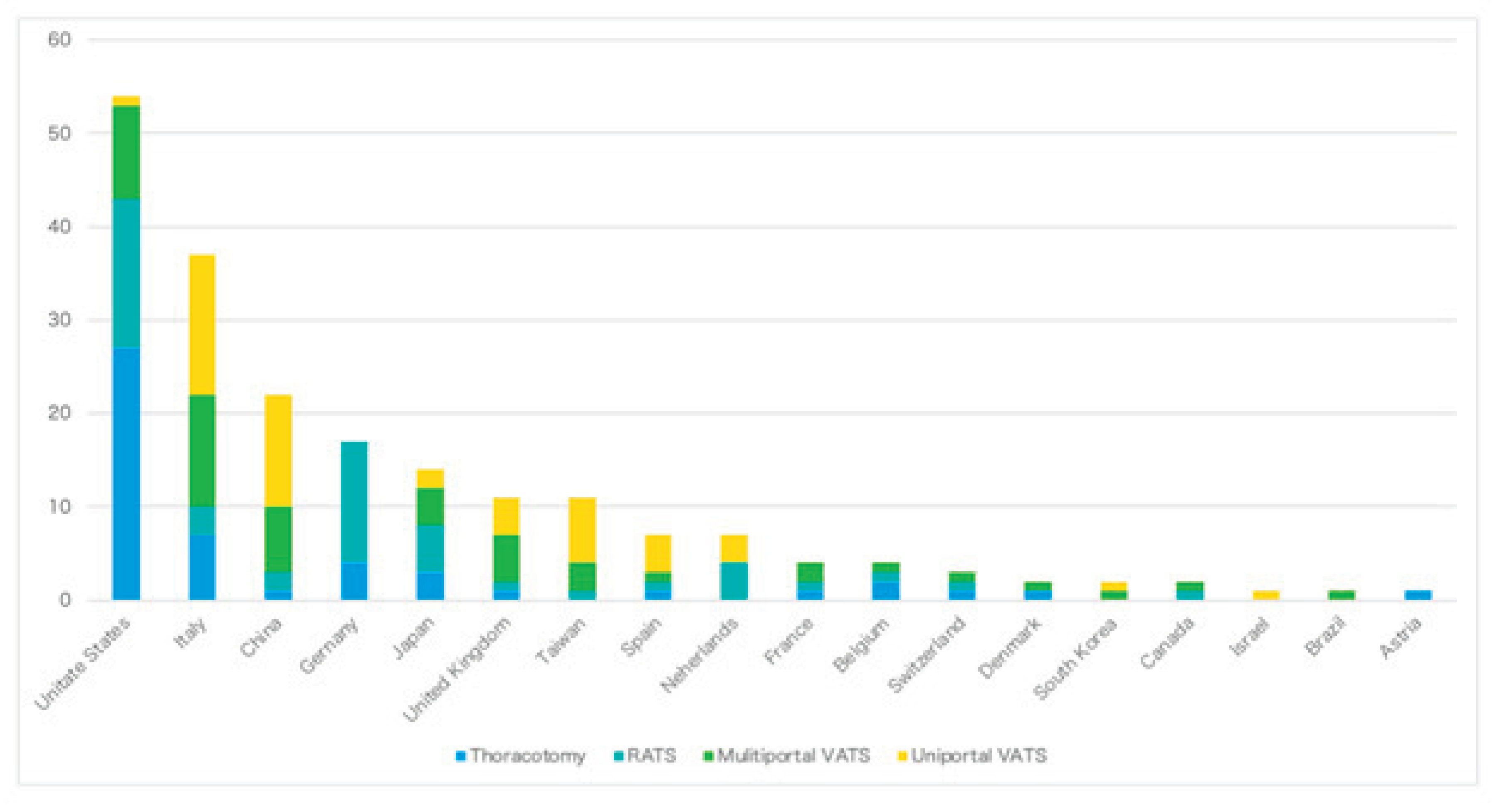
The dissemination of U-VATS and RATS exhibits distinct geographic variation. These regional adoption patterns appear to be strongly influenced by key opinion leaders, the country of origin/development, and overall economic scale (Figure 2 and Figure 3) [12,13,14,20,21,32,33]. Compared to RATS, U-VATS requires substantially lower initial capital expenditure and ongoing maintenance costs. Regarding robotic surgery, the market is no longer exclusive to Intuitive Surgical’s da Vinci platform, as numerous companies worldwide have entered the field and achieved clinical implementation [26,33,34]. In Japan alone, multiple indigenous platforms have emerged, including hinotori [35] and Saroa [36]. Because these newer robotic systems generally offer lower initial acquisition and operational costs compared to the da Vinci system, RATS adoption is anticipated to accelerate further, expanding even into regions where robotic programs were previously cost-prohibitive.
Conclusion
Uniportal VATS represents a promising option for minimally invasive surgery. However, its widespread adoption for major and complex resections in Japan is restricted by both educational and societal barriers. Although RATS is expected to become increasingly widespread, VATS, U-VATS, and open thoracotomy will remain essential and maintain steady demand for the foreseeable future, driven by crucial educational, safety, and economic considerations.
Author Contributions
T.H. contributed to the conception and design of the study and drafted the manuscript. All authors critically revised the manuscript for important intellectual content and provided study supervision. All authors read and approved the final manuscript.
Funding
This work was financially supported by the Korean Society for Thoracic and Cardiovascular Surgery and the Asia-Pacific Innovative Thoracic Surgery Symposium 2025.
Data Availability Statement
The data underlying this article will be shared upon reasonable request to the corresponding author, beginning 3 months and ending 5 years following article publication.
Acknowledgments
We acknowledge the assistance of a large language model (Google's Gemini) for providing a part of the conceptual framework and formatting for Figures 1 and 2. The final content, design, and analysis were performed solely by the authors.
Conflicts of Interest
Research Grant and Payment: Yes. This work received financial support from the Korean Society for Thoracic and Cardiovascular Surgery and the Asia-Pacific Innovative Thoracic Surgery Symposium 2025. Other Conflicts (Employment, Expert Witness, Ownership interest, Membership/affiliation with pressure or political groups, Other research support/funding, Others): None.
References
- Gonzalez, D.; Paradela, M.; Garcia, J.; et al. Single-port video-assisted thoracoscopic lobectomy. Interact. Cardiovasc Thorac. Surg. 2011, 12, 514–5. [Google Scholar] [CrossRef]
- The Japanese Uniportal VATS Interest Group. Uniportal VATS manual; Nanzando, Tokyo, June 2021. [Google Scholar]
- Suda, T.; Sugimura, H.; Tochii, D.; Kihara, M.; Hattori, Y. Single-port thymectomy through an infrasternal approach. Ann. Thorac. Surg. 2012, 93, 334–6. [Google Scholar] [CrossRef]
- Homma, T. Report on uniportal VATS international course at Shanghai Pulmonary Hospital. (in Japanese). 2019, 33 Suppl. [Google Scholar] [CrossRef]
- Homma, T.; Shimada, Y.; Tanabe, K. Experiences of novel cotton device for uniportal video-assited thoracoscopic surgery: CS Two-Way HandleTM. J. Thorac. Dis. 2023, 15, 2800–5. [Google Scholar] [CrossRef]
- Homma, T.; Shimada, Y.; Tanabe, K. Decreased postoperative complications, neuropathic pain and epidural anesthesia-free effect of uniportal video-assisted thoracoscopic anatomical lung resection: a single-center initial experience of 100 cases. J. Thorac. Dis. 2022, 14, 3154–66. [Google Scholar] [CrossRef]
- Homma, T.; Saji, H.; Shimada, Y.; Tanabe, K.; Kojima, K.; Marushima, H.; Miyazawa, T.; Kimura, H.; Sakai, H.; Otsubo, K.; et al. Surgical outcomes and learning curve of complex versus simple segmentectomy for uniportal video-assisted thoracoscopic surgery: An initial experience of 100 cases of a single experienced surgeon. J. Thorac. Dis. 2023, 16, 7361–7371. [Google Scholar] [CrossRef]
- Homma, T.; Shimada, Y.; Tanabe, K. Lymphadenectomy in the subcarinal zone using a uniportal thoracoscopic approach: a narrative review. AME Surg. J. 2022, 2, 6.8. [Google Scholar] [CrossRef]
- Igai, H.; Watanabe, T.; Homma, T.; Suda, T.; Morikawa, T. A nationwide survey of uniportal thoracoscopic anatomical pulmonary resections in Japan. J. Thorac. Dis. 2026, 18, 221. [Google Scholar] [CrossRef]
- Igai, H.; Watanabe, T.; Homma, T.; Suda, T.; Morikawa, T. Comparison of the perioperative outcomes between uniportal thoracoscopic lobectomy and segmentectomy for early-stage non-small-cell lung cancer in Japan. Surg. Endosc. 2026. [Google Scholar] [CrossRef]
- Igai, H.; Watanabe, T.; Homma, T.; Suda, T.; Morikawa, T. The impact of institutional surgical volume on perioperative outcomes in uniportal thoracoscopic major pulmonary resections: a nationwide study in Japan. Surg. Endosc. 2026, 40, 5734–43. [Google Scholar] [CrossRef]
- Watanabe, T.; et al. Gen. Thorac. Cardiovasc Surg. 2025. [CrossRef]
- Sakai, Y.; Morishita, T. The financial impact of robotic surgery on hospital gross profits in Japan compared to laparoscopic surgery. Asian J. Endosc. Surg. 2025, 18, e13410. [Google Scholar] [CrossRef]
- Homma, T.; Kitamura, N.; Ojima, T.; et al. Initial experiences of robot-assisted thoracic surgery: safety approach and comparison with video-assisted thoracoscopic surgery. Jpn. J. Chest Surg. 2019, 33, 113–21. [Google Scholar] [CrossRef]
- Homma, T.; Tanaka, R.; Nakamura, S.; Aragaki, M.; Chen-Yoshikawa, T.F.; Kato, T.; Saji, H. Motivations and factors influencing the choice of a career as a thoracic surgeon in Japan: results of a nationwide questionnaire survey. Surg. Today 2026, 56, 216–28. [Google Scholar] [CrossRef]
- Takami, H.; Kodera, Y.; Eguchi, H.; Kitago, M.; Murotani, K.; Hirano, S.; et al. The shortage of surgeons in Japan: results of an online survey of qualified teaching hospitals that take part in the surgical training programs for board certification by the Japan Surgical Society. Surg. Today 2024, 54, 41–52. [Google Scholar] [CrossRef]
- Park, S.Y.; Han, K.N.; Hong, J.I.; et al. Subxiphoid approach for robotic single-site-assisted thymectomy. Eur. J. Cardiothorac. Surg. 2020, 58 (Suppl_1), I34–8. [Google Scholar] [CrossRef]
- Watanabe, H.; Ebana, H.; Kanauchi, N.; Suzuki, J.; Ujiie, H.; Chiba, M.; Sato, K.; Matsuo, S.; Hoshijima, K.; Kobayashi, A.; Shiono, S. Dual-portal robotic-assisted thoracic surgery (DRATS) as a reduced port RATS: early experiences in three institutions in Japan. J. Thorac. Dis. 2023, 15, 6475–82. [Google Scholar] [CrossRef]
- Ministry of Health; Labour and Welfare. The medical fee revision for fiscal year 2026. Internet. Available online: https://www.mhlw.go.jp/stf/newpage_67729.html.
- Lamas, F.M.; Lech, G.E.; Maboni, L.R.; Silveria, P.A.Z.; et al. Robotic-assisted thoracic surgery versus video-assisted thoracic surgery for patients undergoing lung resection: a systematic review and meta-analysis of randomized controlled trials. Gen. Thorac. Cardiovasc Surg. 2026, 74, 1–10. [Google Scholar] [CrossRef]
- Fok, M.; Bashir, M.; Harky, A.; et al. Video-Assisted Thoracoscopic Versus Robotic-Assisted Thoracoscopic Thymectomy: Systematic Review and Meta-analysis. Innovations 2017, 12, 259–264. [Google Scholar] [CrossRef]
- Rocco, G.; Internullo, E.; Cassivi, S.D.; et al. The variability of practice in minimally invasive thoracic surgery for pulmonary resections. Thorac. Surg. Clin. 2008, 18, 235–47. [Google Scholar] [CrossRef]
- Mota, P.; Carvalho, N.; Carvalho-Dias, E.; et al. Video-Based Surgical Learning: Improving Trainee Education and Preparation for Surgery. J. Surg. Educ. 2018, 75, 828–35. [Google Scholar] [CrossRef]
- Connolly, M.; Seligman, J.; Kastenmeier, A.; et al. Validation of a virtual reality-based robotic surgical skills curriculum. Surg. Endosc. 2014, 28, 1691–4. [Google Scholar] [CrossRef]
- Sihoe, A.L. Developing training for uniportal video-assisted thoracic surgery: a commentary. Eur. J. Cardiothorac. Surg. 2020, 58 (Suppl_1), i1–5. [Google Scholar] [CrossRef]
- Seeliger, B.; Pavone, M.; Schroder, W.; et al. Skill progress during a dedicated societal robotic surgery training curriculum including several robotic surgery platforms. Surg. Endosc. 2024, 38, 5405–12. [Google Scholar] [CrossRef]
- Servais, E.; Miller, D.L.; Thibault, D.; et al. Conversion to Thoracotomy During Thoracoscopic vs Robotic Lobectomy: Predictors and Outcomes. Ann. Thorac. Surg. 2022, 114, 409–17. [Google Scholar] [CrossRef]
- The Japanese Society of Thoracic Surgeons. The endoscopic surgical skill qualification system by the Japan Society for Endoscopic Surgery and The Japanese Society of Thoracic Surgeons. Internet. Available online: http://www.jacsurg.gr.jp/qualification/vatsns/vatsns_rul.pdf.
- Iwata, H. Safety management for video-assisted thoracoscopic surgery and robot-assisted thoracoscopic surgery by the Japanese Association for Chest Surgery. J. Jpn. Surg. Soc. 2024, 125, 317–24. [Google Scholar]
- Liu, C.; Ma, L.; Guo, C.; Liu, L. Non-grasping en bloc mediastinal lymph node dissection through uniportal video-assisted thoracic surgery for lung cancer surgery. J. Thorac. Dis. 2016, 8, 2956–9. [Google Scholar] [CrossRef]
- McCormack, P.M.; Bains, M.S.; Begg, C.B.; Burt, M.E.; et al. Role of video-assisted thoracic surgery in the treatment of pulmonary metastases: results of a prospective trial. Ann. Thorac. Surg. 1996, 62, 213–6. [Google Scholar] [CrossRef]
- Cao, C.; Frick, A.E.; Ilonen, I.; McElnay, P.; Guerrera, F.; Tian, D.H.; Lim, E.; Rocco, G. European questionnaire on the clinical use of video-assisted thoracoscopic surgery. Interact. Cardiovasc Thorac. Sugr 2018, 27, 379–83. [Google Scholar] [CrossRef]
- Broderick, S.R.; Grau-Sepulveda, M.; Kosinski, A.S.; et al. The society of thoracic surgeons composite score rating pulmonary resection for lung cancer. Ann. Thorac. Surg. 2020, 109, 848–65. [Google Scholar] [CrossRef]
- Umstadt, J.; Hochstein, J.N.; Alm, M.; Egberts, J.H. First reported Ivor Lewis esophagectomy using the HUGO RAS system in a high-volume center: a technical feasibility report and configurational setup. Surg. Innov. 2026, 15533506261474216. [Google Scholar] [CrossRef]
- Li, C.; Xie, Z.; Ding, C.; Chen, J.; Zhu, X.; Shi, Y.; Fang, Z.; Gonzalez-Rivas, D.; et al. Safety and efficacy of SHURUI single-port serpentine-arm robotic surgery system in lung surgery: a prospective single-centre study. Interdiscip. Cardiovasc Thorac. Surg. 2025, 40, vaf232. [Google Scholar] [CrossRef]
- Kubouchi, Y.; Yasuda, R.; Nozaka, Y.; Fujiwara, W.; Matsui, S.; Tanaka, Y. Early clinical experience with the Hinotori robotic surgical system: comparable perioperative outcomes with the da Vinci platform in primary lung cancer. Asian J. Endosc. Surg. 2026, 19, e70286. [Google Scholar] [CrossRef]
- Mori, S.; Li, L.; Arakawa, S.; Tsubouchi, S.; Toya, N.; Ohtsuka, T. Clinical Feasibility of robot-assisted pulmonary resection using a platform incorporating haptic feedback. Ann. Thorac. Surg. 2026, S0003-4975((26)00675-2). [Google Scholar] [CrossRef]
Figure 1.
The evolution of minimally invasive thoracic surgery: parallel trends toward uniportal convergence. The evolution of minimally invasive thoracic surgery has proceeded along two distinct tracks: port reduction via video-assisted thoracoscopic surgery (VATS) and enhanced maneuverability via robot-assisted thoracic surgery (RATS). "Invasiveness" is defined broadly to include both clinical burden and medical cost. Both streams are currently converging toward the ultimate uniport approach.
Figure 1.
The evolution of minimally invasive thoracic surgery: parallel trends toward uniportal convergence. The evolution of minimally invasive thoracic surgery has proceeded along two distinct tracks: port reduction via video-assisted thoracoscopic surgery (VATS) and enhanced maneuverability via robot-assisted thoracic surgery (RATS). "Invasiveness" is defined broadly to include both clinical burden and medical cost. Both streams are currently converging toward the ultimate uniport approach.
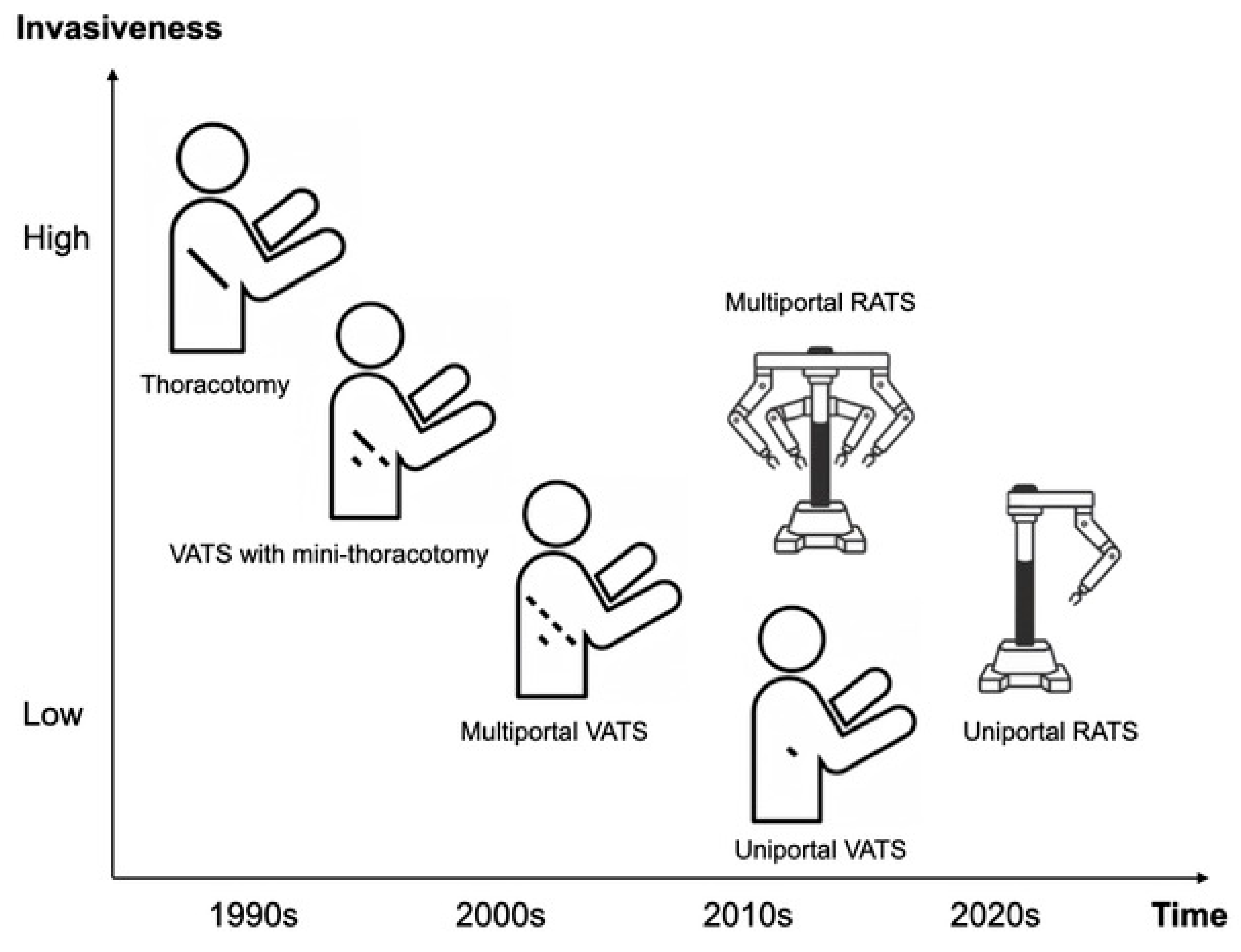
Figure 2.
Regional frequencies of surgical approaches in lung cancer resection (comparison among Japan, Europe, and North America).Proportion of primary surgical approaches—video-assisted thoracoscopic surgery (VATS), uniportal VATS (U-VATS), robot-assisted thoracic surgery (RATS), and thoracotomy across three regions. Data were derived from 497 centers in Japan (2024) (A), 100 centers in Europe (2016) (B), and 256 centers in the United States (2015–2017) (C).
Figure 2.
Regional frequencies of surgical approaches in lung cancer resection (comparison among Japan, Europe, and North America).Proportion of primary surgical approaches—video-assisted thoracoscopic surgery (VATS), uniportal VATS (U-VATS), robot-assisted thoracic surgery (RATS), and thoracotomy across three regions. Data were derived from 497 centers in Japan (2024) (A), 100 centers in Europe (2016) (B), and 256 centers in the United States (2015–2017) (C).
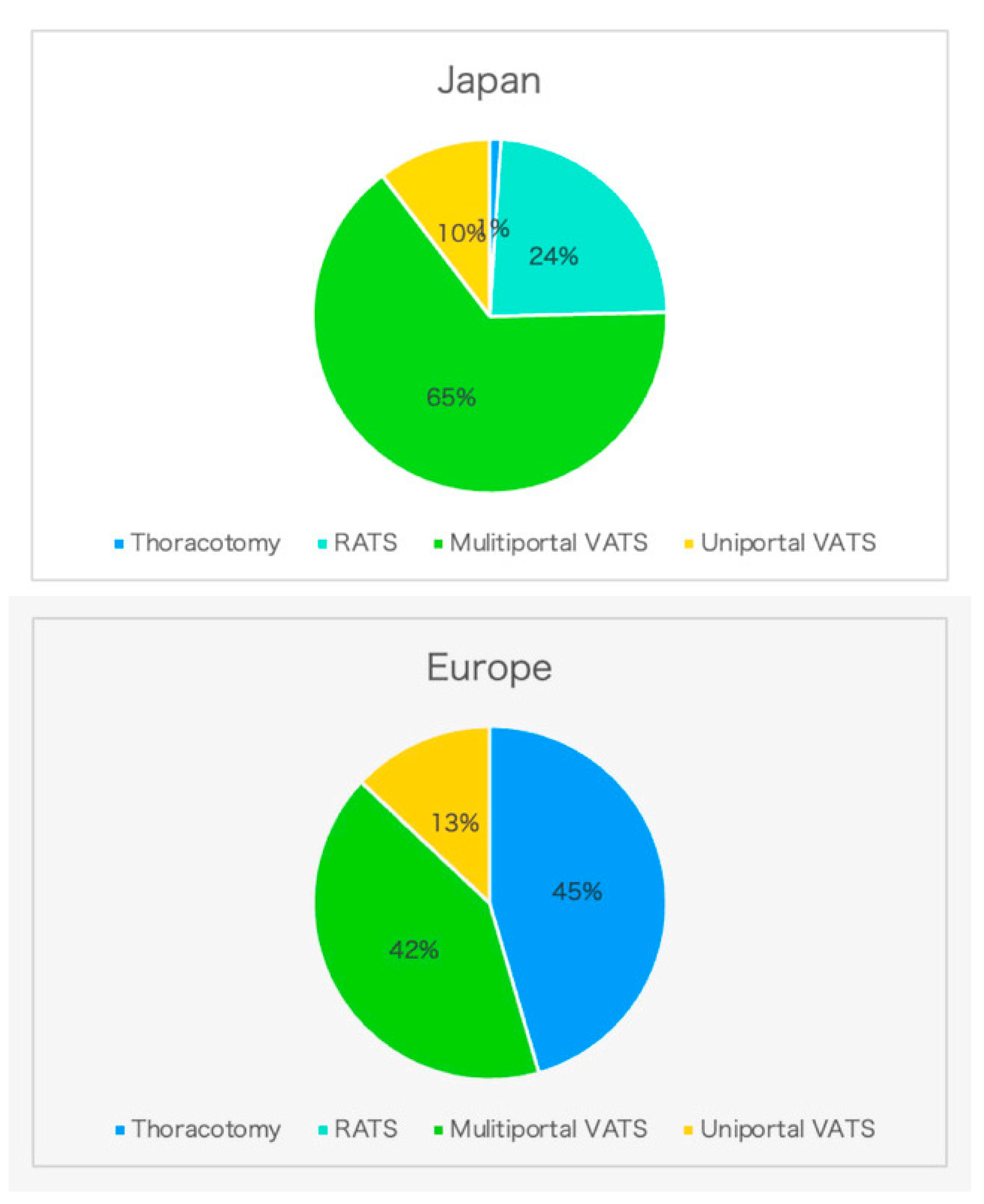
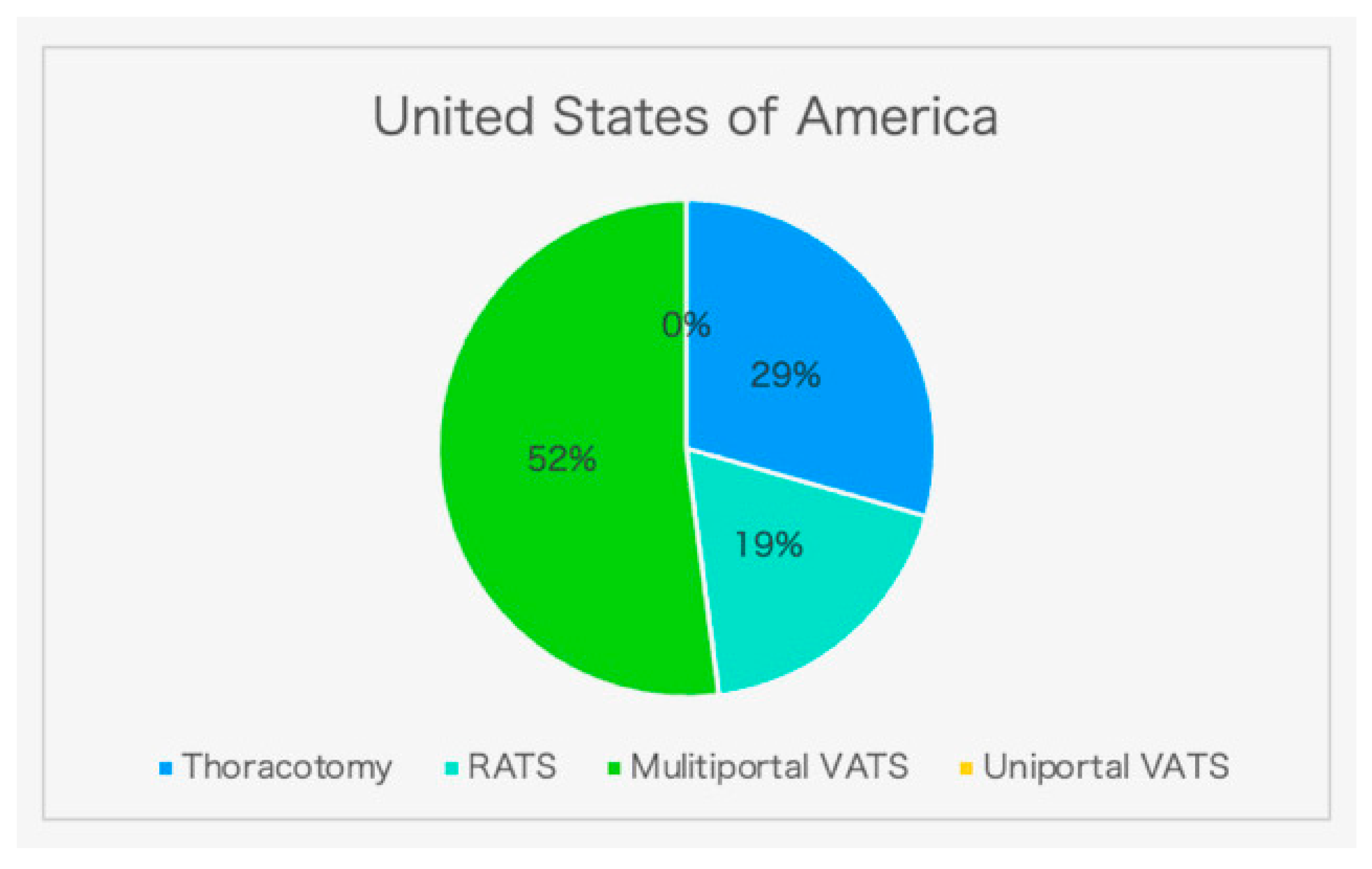
Figure 3.
Global academic leadership distribution by surgical approach. Geographic distribution of the top 50 authors by publication volume (n = 50 per approach, total n = 200) across four surgical approaches: robot-assisted thoracic surgery (RATS), open thoracotomy, uniportal video-assisted thoracoscopic surgery (U-VATS), and multiportal VATS (M-VATS). Literature searches were conducted using Dimensions (Digital Science) to identify the top 50 authors for each approach, and the results were categorized and graphed by country.
Figure 3.
Global academic leadership distribution by surgical approach. Geographic distribution of the top 50 authors by publication volume (n = 50 per approach, total n = 200) across four surgical approaches: robot-assisted thoracic surgery (RATS), open thoracotomy, uniportal video-assisted thoracoscopic surgery (U-VATS), and multiportal VATS (M-VATS). Literature searches were conducted using Dimensions (Digital Science) to identify the top 50 authors for each approach, and the results were categorized and graphed by country.
Disclaimer/Publisher’s Note: The statements, opinions and data contained in all publications are solely those of the individual author(s) and contributor(s) and not of MDPI and/or the editor(s). MDPI and/or the editor(s) disclaim responsibility for any injury to people or property resulting from any ideas, methods, instructions or products referred to in the content. |
© 2026 by the authors. Licensee MDPI, Basel, Switzerland. This article is an open access article distributed under the terms and conditions of the Creative Commons Attribution (CC BY) license (http://creativecommons.org/licenses/by/4.0/).
Copyright: This open access article is published under a Creative Commons CC BY 4.0 license, which permit the free download, distribution, and reuse, provided that the author and preprint are cited in any reuse.