

Submitted:
03 September 2026
Posted:
04 September 2026
You are already at the latest version
Abstract
Ecological driven sustainability of plastic materials encounters a major challenge in eco-efficient mechanical recycling falling short of meeting the required quality and quantities of post-consumer-recyclates (PCR) in sensitive applications areas demanded by regulatory authorities. Remaining toxicological concerning residues of contaminants after mechanical recycling restrict the use in sensitive application areas. Addressing the integration of PCR into high demanding applications, such as food contact materials, this work investigates a novel technology for PCR product use by an innovative migration barrier development pathway of Si-based plasma enhanced chemical vapour deposition (PECVD) coatings on pre-contaminated polypropylene (PP) model PCR cups compliant with applicable regulatory frameworks including European Food Safety Authority (EFSA) authorization requirements. As a starting point for migration barrier development optimized oxygen transmission rate (OTR) barrier coatings for PCR cups were reproduced and transferred on virgin and model PCR PP-cups. The coating procedure consisted out of a pretreatment, applied organic adhesion interlayer SiOCH and inorganic functional barrier layer SiOx, where the functionality was related to the applied SiOx layer based on the barrier efficiency. Therefore, SiOx was varied in the migration barrier development to find a suitable process window and efficiently correlate the effects of process parameters on OTR before and after migration testing, mass loss of simulant and the reduction of migration of eight introduced contaminants in the model PCR cup using GC/MS. This work advanced the understanding of PECVD as migrations barriers under regulatory frameworks and reduced PCR matrix complexity in the analysis during development using model PCR cups.
Keywords:
barrier development
; migration
; model recyclates
; PECVD
; packaging
; polypropylene
1. Introduction
In the past decades PECVD has been widely used as an advanced technique for surface valorization purposes of plastic substrates to achieve functionalities ranging from protective coatings to gas barriers [1,2,3]. PECVD offers a platform to develop unique chemical and physical constituted layers based on the applied processes parameters linked to application-related properties [2,3,4,5,6] . In light of current challenges associated with the use of PCR in conventional product streams, particularly in sensitive applications such as cosmetic and food-contact materials, increasing regulatory constraints and material quality limitations, especially inhomogeneous properties and contaminations necessitate the development and implementation of advanced enabling novel technologies [7,8,9,10,11]. Regulatory frameworks, including the Packaging and Packaging Waste Regulation, impose stringent requirements on the safety, composition and performance of recycled plastics [12,13]. Simultaneously, inconsistencies in the quality, properties and availability of recycled feedstocks limit their direct integration into high-value applications [14,15]. Consequently, advanced surface engineering approaches such as PECVD are emerging as promising strategies to enable migration reduction, enhance barrier performance, reduce materials use, decouple product properties, combine layer functionalities and closing the gap to surface and material incompatibilities (e.g. impurities and fluctuating PCR properties), thereby facilitating the broader implementation of PCR in demanding application areas [8,9,10,11,16]. Further, Silicon Si-based PECVD barrier coatings used in packaging materials are of particular interest due to their recyclability, food-contact compliance and EFSA allowance as a novel technology, supporting the transition towards sustainable packaging concepts [8,16,17,18,19,20].
Previous studies demonstrated the feasibility of applying PECVD coatings to PCR substrates with initial results confirming a reduction in OTR [8,11,16]. These findings established a foundational proof-of-concept for extending functional barrier coatings to PCR packaging materials [8,11,16]. Building upon this groundwork, the present work pursues a systematic migration barrier development strategy tailored to the specific challenges posed by PCR substrates. A fundamental requirement for efficient migration barrier development is the reduction of matrix complexity inherent to PCR materials during migration assessment [9,21,22,23,24]. To address this, a novel model contamination approach was previously developed for PP using model substrates [9,23]. Eight surrogate substances were selected based on their high solubility in PP and classified according to their polarity and volatility [volatile polar- (dimethyl maleate, butyl benzoate), volatile nonpolar- (1-nonanol, dodecane), non-volatile polar- (benzophenone, triethyl citrate), non-volatile nonpolar compounds (dimethyl isophthalate, butylated hydroxytoluene)] based on regulatory [13,17,20,24]. These model contaminants were incorporated into PP at high concentrations to generate model PCR cups, representing a worst case recyclate and enabling efficient development and feasibility studies [9]. In parallel, a migration procedure and analytical methodology based on gas chromatography mass spectrometry (GC/MS) were established to ensure validated and quantitative migration assessment based on EFSA regulatory [23]. In this study, in the beginning the reproducibility and a general transferability of previously developed PECVD coatings from PCR cups [8] to virgin and model PCR cups was systematically evaluated based on OTR. Prior to coating deposition, a pretreatment (PT) was applied to remove surface contaminants, increase surface reactivity, promote homogeneous coating nucleation and enhance the interfacial adhesion of the subsequently deposited plasma layers [8,25]. The subsequently applied organic, low crosslinked SiOCH interlayer served multiple functions, including adhesion promotion, stress relaxation of the overlying barrier layer, decoupling of substrate surface properties from the barrier coating and as a platform of a suitable interface for uniform SiOx barrier growth [6,8,25,26,27]. The applied on top SiOx functional barrier was a highly crosslinked inorganic layer widley applied as gas permeation barrier in industrial packaging application [8,25,27,28]. To further enhance barrier performance in terms of OTR, multilayer dyads consisting of alternating SiOCH and SiOx layers were investigated. The repeated SiOCH/SiOx structure was intended to prevent the impact of coating defects originating from either the substrate surface or individual coating layers, while enabling an increase in the effective SiOx barrier thickness without inducing excessive residual stress [25,29]. Consequently, the dyad structure was expected to improve overall barrier performance by extending the diffusion pathway and reducing defect-initiated diffusion [8,30]. After migration assessment of the individual parameter combinations migration barrier effect was attributed to a specific layer within the coating structure. Employing a structured parameter study using an experimental screening design, the influence of key process parameters on the migration barrier coating properties was evaluated. Especially migration behavior, oxygen barrier performance and overall coating properties were assessed to elucidate correlations among plasma deposition parameters, migration values, OTR before and after migration testing and mass loss incurred during migration procedures. Further the potential for achieving multifunctional coatings combining barrier and migration reduction performance was assessed.
2. Materials and Methods
2.1. Materials and Chemicals
Virgin PP (Moplen HP 640J, LyondellBasell Industries) served as the polymer matrix for compounding and thermoforming. The following model contaminants were incorporated into the virgin PP matrix and used for analysis: butyl benzoate (CAS 136-60-7), dimethyl maleate (CAS 624-48-6), triethyl citrate (CAS 77-93-0), benzophenone (CAS 119-61-9), 1-nonanol (CAS 143-08-8), n-dodecane (CAS 112-40-3), dimethyl isophthalate (CAS 1459-93-4), butylated hydroxytoluene (CAS 128-37-0) and Phenol-d6 (CAS: 13151-52-9), all sourced from Sigma-Aldrich (Steinheim, Germany). Ethanol (EtOH; CAS 64-17-5, ROTISOLV® HPLC Gradient Grade), supplied by Carl Roth GmbH (Karlsruhe, Germany) and ultrapure water suitable for gas chromatography (CAS 7732-18-5), supplied by Merck KGaA (Darmstadt, Germany) were used for the preparation of food simulants in accordance to regulatory. Magnesium sulfate (MgSO₄; CAS 7487-88-9) purchased from Sigma-Aldrich (Steinheim, Germany) was used as a drying agent during the drying and filtration sample work up procedure. All chemicals were of analytical grade and used as received without further purification. PTFE membrane filters (diameter: 15 mm, pore size: 0.2 μm) used during work up were also obtained from Sigma-Aldrich (Steinheim, Germany).
For coating experiments virgin PP-, PCR PP- and model PCR cups were produced by GIZEH Verpackungen GmbH & Co. KG (Bergneustadt, Germany) in thermoforming processes using PP virgin material Moplen Hp 640J from LyondellBasell, recycled PP Systalen PP-C14900 gr000 which was provided by Duales System Holding GmbH & Co. KG (Germany) and from a blend of 10 % (w/w) contaminated granules and 90 % (w/w) virgin PP.
The virgin and the PCR cups have approximately the geometric shape of a truncated circular cone including a non-linear sidewall profile with a full rim volume of VRV of 214 cm3 and a nominal volume of VN of 160 cm3 (see Figure 1). The model PCR cups have a linear sidewall profile in a tapered and contoured geometry with a geometric shape full rim volume of VRV of 226 cm3 and a nominal volume of VN of 180 cm3. For migration testing a sealing foil supplied by Ballerstaedt & Co. OHG (Rastatt, Germany) was used. For the PECVD coating processes, hexamethyldisiloxane (HMDSO; Sigma-Aldrich Chemie GmbH, Steinheim, Germany; purity ≥ 98.5%) and oxygen (O₂; Westfalen AG, Münster, Germany; purity grade 5.0, corresponding to ≥ 99.999%) were used as process gases.
2.2. Plasma Enhanced Chemical Vapor Deposition (PECVD)
The plastic cups were coated by means of PECVD in a low-pressure reactor designed and developed for the surface modification of hollow bodies at the Institute of Plastics Processing IKV at RWTH Aachen University, Germany [8]. Pulsed microwave radiation was utilized as the energy source for plasma excitation and sustained discharge during the coating process. Energy was coupled into the reactor chamber via four magnetrons (Muegge GmbH, Reichelsheim, Germany), each capable of delivering a power of P of 1,000 W through waveguide assemblies. To enable precise control over the energy input and plasma parameters, pulsed microwave power was applied throughout the plasma coating process [26].
2.2.1. Coatings
As a starting point for the development of migration barrier coatings, the process parameters of an OTR-optimized multilayer system were reproduced and adopted. The coating architecture consisted of a plasma pretreatment (PT) using only oxygen to activate the polymer surface and improve coating adhesion, a low crosslinked organosilicon-based interlayer SiOCH to enhance interfacial stability, uniform layer growth and reduce residual stress and an inorganic highly crosslinked silicon oxide barrier layer SiOx providing the functional barrier properties (see Table 1). Furthermore, multilayer dyads consisting of alternating SiOCH and SiOx layers were applied to combine the mechanical flexibility of the SiOCH interlayer with the excellent barrier performance of SiOx [8].
2.2.2. Scope of Experiments
To gain insights into the influence of the SiOx coating mainly regarding the migration of the multilayer system and finding a suitable migration barrier the introduced starting point parameters (SP) were used in a definitive screening design (DSD) [31]. A parameter deviation of barrier coating systems in the multi-layer PECVD system, the coating time (5000 - 25 000 ms), microwave peak power (500 - 2 000 W), microwave pulsing (pulse on time ton 1 - 3 ms; pulse off time toff 80 - 200 ms) and the HMDSO volume flow (20 - 40 sccm) on the migration, OTRs before and after migration and mass loss were investigated in a three-step DSD.
Process pressure was kept constant at 25 Pa and Purge time at 10 s. The targeted values in the DSD were analysed regarding their corresponding Yasuda factors and respective ton/toff-times. The Yasuda factor was used as a normalized process parameter to describe the PECVD conditions and is defined as:
where is the Yasuda factor, is the mean plasma power and and represent the HMDSO and oxygen flow rates [32,33]. The mean power is calculated as the the duty-cycle-corrected peak power as following:
where P is the Peak Power and ton, toff -time the pulsing times. The Yasuda factor therefore represents the ratio of effective plasma energy input to the total precursor and reactive gas supply, enabling a normalized comparison of different process conditions in terms of plasma energy density and its influence on layer deposition and barrier properties [32,33]. The Yasuda factor was observed in combination with the ton- and toff-times in the DSD to account for the effective plasma energy input under pulsed PECVD conditions.
The standard pre-treatment PT and the optimized inter layer SiOCH from the SP, which were developed to improve adhesion on recyclate materials, particularly polypropylene (PP) substrates, mitigate the influence of surface defects and material property fluctuations, were used to develop the SiOx migration barrier coating. As variations in the coating parameters result in different deposition rates and coating thicknesses, all coating variants were deposited with the same thickness of the reference barrier to enable a meaningful comparison of barrier performance. The SP coating thickness of 40 nm was determined by profilometry. For each of the 17 DSD parameter sets, deposition rates were calculated from coatings deposited for 20 and 30 s on silicon wafers using linear regression. The corresponding deposition time required to reproduce the SP coating thickness was subsequently calculated assuming a linear deposition rate (see Table 2).
The primary objective was to evaluate the migration barrier performance in order to identify a suitable local process window and demonstrate the feasibility of PECVD based SiOx coatings as effective migration barriers for PCR cups. This was assessed by quantifying the migration reduction of the intentionally introduced model contaminants in model PCR cups. The OTR, migration values and mass loss were determined in triplicate and represent the mean values of three independent measurements. The Barrier Improvement Factor (BIF) was given as a dimensionless parameter used to quantify the enhancement of a material’s barrier properties and is defined as the ratio of the barrier effects of a reference material to that of the coated sample as following by the example of OTR:
The significance of the investigated process parameters on different response values was evaluated using the Effect Summary function implemented in JMP Pro (SAS Institute Inc., USA). The effect summary ranks all model terms according to their LogWorth value, defined as , where p is the corresponding probability value (p-value) obtained from the least-squares regression model. Consequently, larger LogWorth values indicate higher statistical significance. A significance threshold of α of 0.05 (LogWorth of 1.301; accepting a 5 % risk of falsely declaring a factor significant) was applied to identify statistically significant main effects. The resulting effect rankings were used to identify the dominant process parameters influencing the investigated response variables.
In addition, the overall model significance was assessed using the ANOVA-based F-test (model P-value), indicating whether the regression model provides a statistically meaningful explanation of the response variability. A model P-value below 0.05 was used as the criterion for significance, indicating that at least one parameter significantly influences the response variable. Model performance was further evaluated using the coefficient of determination (R²), describing the proportion of explained variance and the root mean square error (RMSE), representing the average prediction error in the units of the response variable.
2.3. Analysis
2.3.1. Gaschromatography Coupled Mass Spectrometry
Chromatographic analyses were performed using a gas chromatograph (GC, Agilent Technologies 8890) equipped with an automated liquid sampler (Agilent Technologies 7693A), a headspace sampler (Agilent Technologies 7697A) and a triple quadrupole mass spectrometer (Agilent Technologies 7000D). Samples were injected in split mode using a split ratio of 1:10. Separation was achieved on a non-polar DB-1ms capillary column (30 m x 250 μm, 0.25 μm film thickness; Agilent Technologies) coated with 100 % dimethylpolysiloxane as the stationary phase. The mass spectrometer was used in electron ionization (EI) mode with a triple quadrupole analyzer. Helium (Linde, Germany; purity grade 5.0) was used as the carrier gas, while nitrogen (Air Liquide, Germany; purity grade 5.0) served as the collision gas. Data acquisition and quantitative evaluation were performed using MassHunter software (Agilent Technologies) and compound identification was based on comparison with the NIST20 mass spectral library. A detailed description of the chromatographic method, including the temperature program, instrumental parameters and calibration, is provided elsewhere [9,23].
2.3.2. Migration Testing and Work Up
Migration experiments were conducted filling the cups with 100 mL food simulant consisting of 95 % ethanol and 5 % water (v/v), in accordance with Annex II of the relevant European Commission regulation [20]. The cups were sealed with aluminum sealing foil and stored at 60 °C for 10 days, corresponding to accelerated migration testing conditions representing long-term storage at ambient temperature under EU regulatory guidelines [20].
Following storage, the migration solutions were processed using a drying and filtration work-up prior to GC/MS triple quadrupole analysis. An aliquot of 8 mL was dried over anhydrous MgSO₄ to remove residual water. Subsequently, a portion of ethanol (corresponding to 5 % (v/v) of the original sample volume) was added to compensate for the removed water and thereby maintaining the original analyte concentrations. The samples were centrifuged at 2 500 rpm and 20 °C for 5 min, followed by filtration through a 15 mm PTFE membrane filter (0.2 µm pore size). The filtrates were transferred into GC vials equipped with chemically resistant closures [23].
For GC/MS triple quadrupole analysis, 25 µL of each analyte was diluted to a final volume of 1 mL with ethanol. An internal standard stock solution containing phenol-d₆ (1 000 ng/mL in ethanol) was added during sample dilution to obtain a final internal standard concentration of 500 ng/mL. Quantitative analysis was performed using calibration standards prepared according to the method described elsewhere [9,23].
2.3.3. Oxygen Transmission Rate Analysis
Systech Illinois Oxygen Permeation Analyser 8700 was used to measure OTR. To ensure a tight seal between the measuring cell and the test specimen, the measuring surface was first lightly coated with a vacuum grease (High Vacuum Grease, Dow Corning®). The OTR values under ambient atmospheric conditions (21 % O₂) were recorded. Assuming a linear dependence on oxygen partial pressure, the measured value obtained under ambient atmospheric conditions can be converted to a 100 % oxygen basis by applying a factor of approximately 4.76, subsequently stating the values in units of cm3/(cup day bar) [34,35].
2.3.4. Gravimmetric Analysis for Mass Loss
To enable normalization of the migrated analyte amounts, the empty weight of each migration cup was determined prior to filling. After sealing and again after the migration experiment, the cups were reweighed to determine any mass loss resulting during storage.
3. Results and Discussion
3.1. Oxygen Transmission Rate Starting Point
The previously developed OTR barrier coating was hypothesized to be transferable to virgin and model PCR cups and to provide a suitable starting point for the subsequent development of migration barrier coatings. As a starting point to show transferability previously developed OTR coatings for PCR cups were applied to virgin and model PCR cups (see Figure 1).
A reduction in OTR values with an increasing number of dyad systems is observed for all cup types, as shown in Figure 1 and given in Table 3.
The observed reduction enhances with increasing number of dyads, indicating a stepwise improvement of the barrier performance provided by the multilayer system. For the PCR cups, the OTR was reduced from approximately 0.435 in the uncoated blank reference to 0.102 after deposition of a single dyad, further to 0.016 with four dyads and to 0.010 with eight dyads, demonstrating an improvement due to the optimized barrier coating. For the virgin cups, the OTR improved from 0.308 to 0.223 with one dyad, to 0.028 with four dyads and to 0.012 with eight dyads. For the model PCR cups, a reduction was observed, from 0.328 to 0.011 with one dyad, to 0.003 with four dyads and to 0.001 with eight dyads. The results confirm the general transferability of the barrier system to all cup types. Comparable OTR values for the different cups are obtained only at higher dyad numbers (≥ 4), indicating that the barrier efficiency is reached after sufficient multilayer dyads, resulting from a decoupling of the barrier properties from the substrate.
Further, lower barrier effects are observed for virgin cups, while significant reductions can be seen for model PCR cups in comparison to PCR cups. These reduced effects on virgin cups may be attributed to insufficient surface activation by the PT for the SiOCH interlayer, which was optimised for PCR substrates exhibiting different surface polarities, energies and defect densities. Surface roughness is also expected to influence coating deposition, as PCR cups inherit higher roughness than virgin materials, potentially influencing nucleation processes and coating adhesion. The growth of the inter layer may also lead to over-deposition and a cauliflower-like morphology, particularly on less or more reactive surfaces, resulting in increased defect formation and an insufficient barrier layer deposition [36]. In comparison, model PCR substrates have modified surface chemistries due to high amounts of contaminants incorporated, that could promote improved growth processes, adhesion and smoother SiOCH layers. These could result in enhanced interfacial bonding and a more uniform barrier layer formation, leading to lower OTR values due to reduced defect density and improved layer crosslinking on a smoother SiOCH surface.
The different barrier efficiencies observed for PCR, virgin and model PCR cups indicate a substrate-dependent growth and crosslinking of the PECVD based multilayer system. The improved performance on model PCR substrates suggests enhanced interfacial adhesion, smoother SiOCH surfaces and more favorable nucleation conditions for the dyad system, leading to a reduced defect density of the inorganic barrier layer. The demonstrated transferability of the coating system indicates that the developed parameters can be used as a starting point for the investigation of migration barrier coatings on model PCR cups. In turn, this also supports the reverse transferability of the system back to PCR substrates.
3.2. Effect of Dyad System on the Target Values for Model PCR Cups
The barrier performance of the individual process steps within the dyad structure was systematically assessed to identify their respective contribution to migration reduction. To attribute the observed barrier efficiencies (migration-related overall migration contamination per cup (Contamination/Cup), barrier properties of the investigated model PCR cups before and after migration and mass losses) to a specific layer within the dyad structure, only pre-treatment, deposition of SiOCH and a single-dyad were evaluated in comparison to the blank model PCR cup (see Figure 2).
The highest contamination/cup was observed for the SiOCH coating with 2.70 ± 0.12 mg/g, followed by the uncoated reference (Blank) at 2.19 ± 0.05 mg/g. In comparison, the PT resulted in a contamination/cup of 1.87 ± 0.11 mg/g (see Table 4). The dyad system from the SP showed a 1.49 ± 0.03 mg/g significantly reduced contamination/cup value, indicating an improved barrier performance against the model contaminants. The OTR remained comparable before and after migration for Blank, PT and SiOCH (Blank 0.328 to 0.317 cm3/(cup day); PT 0.3100 to 0.3100 cm3/(cup day); SiOCH 0.307 to 0.312 cm3/(cup day)), reflecting no barrier effects for these samples. The lowest OTR at 0.026 cm3/(cup day) was obtained for the Dyad (SP), implying the oxygen barrier efficiency, but showed an increase to 0.142 cm3/(cup day) after migration. This suggests a migration induced degradation of the barrier layer in the Dyad (SP) e.g. possible hydrolysis or thermal effects. The gravimetrically determined mass loss ranged from PT 1.14 to Blank 1.81 g.
The reduction in migration values obtained for the PT may be related to the short-term vacuum exposure applied during the PECVD process, as well as to associated changes in surface energy and surface chemistry resulting from the plasma-induced surface treatment (modification). These changes are assumed to hinder the diffusion of the migrant toward the simulant beneath the reduction via applied vacuum exposure. An opposite effect was observed for SiOCH, where the deposition of the organic-type layer chemistry, attributed to a weakly cross-linked, carbon-rich physical structure, is presumed to promote faster and enhanced diffusion toward the simulant, resulting in higher migration.
The OTR values before and after migration, as well as the mass loss, remained nearly statistically comparable within experimental errors within the Blank, PT and SiOCH, indicating that the applied plasma processes and layers had no measurable effect on these target parameters, especially migration. These results show that SiOCH and SiOx only provide an effective barrier when applied together as a dyad. The observable migration barrier effect can be attributed to the deposition of the SiOx layer. The reduction of OTR after migration can possibly be attributed to migration induced degradation e.g. hydrolysis. No reduction in mass loss could be attributed to the applied PECVD processes.
3.3. Correlation of SiOx Processes Parameters with Barrier Effects
3.3.1. Overall Migration, Mass Loss, OTR Before and After Migration
The SiOx layer in the dyad system was selected to find a suitable migration barrier and gain insights regarding the barrier efficiency based on the attributable barrier effects observed in Figure 3. Beneath the observable migration barrier effect of the SiOx, the hypothesis was that an increased degree of crosslinking and more SiOx based chemistry within the SiOx structure would not only reduce further gas permeation but also reduce the migration of contaminants, thereby simultaneously reducing mass transfer, OTR after migration and possible degradations during storage.
Figure 3 shows the overall migration contamination/cup and targeted barrier outcome values of the varied SiOx in the dyad systems as a function of the calculated Yasuda factor and deposition parameters (ton-/toff-times). The results are presented as specific contamination per cup, OTR before and after migration testing and gravimetric mass loss.
All SiOx variants of the dyads from showed reduced overall contamination compared to the uncoated blank (2.19 ± 0.05 mg/g), revealing that the deposited SiOx barrier layers act as an effective migration barrier against the model contaminants (see Figure 3 and Table 5).
The extent of reduction, however, varied significantly troughout the process conditions, ranging from a minimum of 1.20 ± 0.09 mg/g (Yasuda 455 J/sccm, ton/toff 8/60 ms) to a maximum of 2.02 ± 0.29 mg/g (Yasuda 98 J/sccm, ton/toff 4/75 ms). No clear correlation was identified between the Yasuda factor and the measured migrating overall contamination/cup. Despite identical energy input densities (e.g. samples with 234 and 246 J/sccm) different migration values were obtained. This finding indicate that the pulse regimes (ton/toff) beneath the overall energy doses and monomer flows, determines migration by influencing depostion and growth kinetics, thereby determining crosslink, physical structure, chemistry and defects.
A consistent trend within nearly all coated samples was an increase in OTR after the migration tests, relative to the OTR before migration. For the uncoated blank, OTR remained unchanged (0.328 to 0.317 cm3/(cup day)), as expected without a barrier layer (see Figure 4). For the coated cups, OTR after migration was typically two- to five times higher than before migration (e.g. SP 0.026 to 0.142 cm3/(cup day)), supporting the suggested migration induced degradation (e.g. hydrolysis, thermal effects, migration induced delamination or microcracks). Two samples (Yasuda factor of 98 J/sccm and 289 J/sccm) deviated from this trend, showing a decrease in OTR after migration. Given the high uncertanaty associated with their OTR values, the effect can be attribitued to measurement variability.
Gravimetric mass loss after migration storage varied across the investigated SiOx (0.64 to 8.60 g) and did not correlate clearly with either contamination or OTR data (see Figure 5). Notably, the SiOₓ coating deposited at a Yasuda factor of 97 J/sccm exhibited the highest mass loss of 8.60 ± 1.62 g, which resulted with a high overall contamination/cup migration of 1.74 mg/g and an increase in OTR following migration testing, indicating further degradation of the barrier layer. In comparision, low massloss coatings (e.g. Yasuda 161, 455, 98 J/sccm) did not uniformly correspond to low migration, indicating that mass loss reflects a superposition of effects, rather than being a direct indicator for barrier properties or improvement.
Taken together, these results indicate that while PECVD-deposited dyad coatings substantially reduce migration of the model contaminants relative to uncoated model PCR cups, the barrier function and integraty is not retained under migration-testing conditions (see Figure 6). The increase in OTRs observed after migration testings indicate that the simulant interacts with the coating (e.g. degredation), resulting in a reduction of its barrier effects. The barrier efficiency is intrinsically linked to coating characteristics, including its chemistry, resulting defects and physical constitution, which are determined by the applied pulsed plasma time regime with the corresponding gas flow conditions and energy input being represented by the selected Yasuda factor. Therefore, PECVD barrier coating optimisation should not be based only on Yasuda factors, as these neglect to consider significantly for the influence of pulse timing on PECVD growth and deposition kinetics and the resulting barrier efficiencies. To further characterize derived potential degradation phenomena, imaging techniques (e.g. SEM or AFM) should be used.
Nevertheless, a suitable processes point was identified for the SiOₓ coating parameter with Yasuda factor of 455 J/sccm with a ton/toff of 8/60 s, which exhibited the lowest migration (contamination/cup), low mass loss and both the lowest initial OTR and the OTR after migration. Based on the hypothesis and described possible effects this reflects reduced barrier degradation under the migration conditions with a BIF of 1.82. Given that the model PCR cups represent worst-case contamination scenarios, the reduction achieved through the deposition of a single diad can be considered a significant improvement. Although the Yasuda factor is identical to the SP, the results of the barrier efficiencies in comparision confirm the influence of the pulse parameters, suggesting that the pulse timings affect the resulting physical structure and chemistry, likely leading to a higher degree of crosslinking, favorable growth and deposition kinetics due to increased ton/toff-time and reduced ion intensity during PECVD. These trends can be further supported by the statistical evaluation of the experimental scope, in particular the effect summary of the investigated parameters on the target responses. To evaluate the overall influence of the investigated process parameters on the coating efficiencies, an overall effect summary was generated in JMP considering all four response barrier values togheter (Contamination/cup, OTR before migration, OTR after migration and mass loss) (see Figure 7).
The results of the experimental scope allow unbiased estimation of main effects, while limiting confounding among second-order effects [31]. As the investigated process parameters are correlating, an intentionally focus was set on evaluating the individual main effects rather than complex parameter interactions, as all process parameters influence each other and determine toghter the coating strucutre [31]. Since the Yasuda factor was calculated from the process parameters rather than included as a factor in the experimental scope, it was not treated as an independent variable in the effect summary analysis. Instead, the screening focused on the original process parameters, which constitute the statistically independent factors of the experimental design and provide a direct interpretation of their influence on the target responses. The comparatively low LogWorth of the Yasuda factor further confirmed that it did not improve the interpretation of the model and therefore was excluded. The factors were evaluated according to their cumulative LogWorth values. HMDSO flow exhibited the highest overall influence (LogWorth of 3.347), followed by ton-time (2.079), oxygen flow (1.665) and toff-time (1.359). Plasma power showed the lowest overall LogWorth (0.972) and was therefore not statistically significant troughout the combined responses.
The results reflect that the precursor flow of HMDSO is a significant predictor process parameter inhibiting a high influence on coating efficiency. As the precursor concentration directly determines the concentration of reactive silicon-containing species available for deposition and layer growth, variations in HMDSO flow affect both the coating composition, structure and deposition kinetics. Consequently, changes in HMDSO flow influence not only the barrier efficiency but also the residual organic content of the coating, which is reflected by the combined responses. The ton-time was identified as the second most influential parameter. Increasing the ton-time duration increases the plasma exposure time and therefore the energy delivered to the plasma. This promotes precursor fragmentation and enhances the formation of a more cross-linked SiOx network, thereby affecting both barrier properties and coating stability. Oxygen flow also showed a statistically significant overall influence. Oxygen is required for the oxidation of precursor fragments and promotes the formation of inorganic Si-O bonds. However, excessive oxygen concentrations may also increase precursor oxidation in the plasma phase and reduce the deposition efficiency, explaining its intermediate influence as a predictor within the investigated design space. toff-time exhibited a comparatively smaller but still significant contribution. The off-time controls the relaxation period between plasma pulses, thereby influencing the equilibrium between precursor recovery and plasma chemistry. Within the investigated parameter range, this effect was less significant than those of HMDSO flow and ton-time. Plasma power parameter did not reveal a statistically significant overall influence. This implies that, within the investigated range of 3200 - 4000 W, the plasma energy was already sufficient to sustain stable precursor fragmentation and deposition. Consequently, further increases in power did not result in measurable improvements across the combined response variables.
The statistical evaluation demonstrates that precursor supply and pulsing of plasma during the process have a more significant impact on the overall coating performance than variations in plasma power within the investigated process window. These findings further support the hypothesis that an interplay between process parameters and their predictor values determine the resulting physical and chemical structure of SiOx and that optimised deposition dynamics are required to achieve a highly crosslinked network, leading to significant improvements in barrier performance and less degredation.
The regression models exhibited different predictive performances depending on the investigated response variable (see Table 6).
The models for the OTR before and after migration showed good agreement with the experimental data, with coefficients of determination (R²) of 0.78 and 0.65, respectivly. Both models were statistically significant (model P values below 0.05), indicating that the investigated process parameters reflected a substantial proportion of the variability in the barrier performance. In comparision, the models for contamination per cup (R2 of 0.45, model P value of 0.153) and mass loss (R2 of 0.34, model P value of 0.351) were less significant, indicating that these responses were not adequately explained by the investigated process parameters within the selected design space. Furthermore, these findings show that the migration barrier effect is more complex than the oxygen barrier effect. Unlike oxygen permeability, migration may not be directly correlated with the investigated plasma process parameters alone but could instead depend significantly on the intrinsic properties of the deposited coatings resulting from the induced process conditions linked to the combined process parameters.
3.3.2. Specific Migration of Contaminants
The migration barrier perfomance of the SiOx layer was expected to depend on the physicochemical properties of the contaminants related to the SiOx constitution linked to the applied processes parameters. As the SiOx layer in the dyad system were varied and showed dependend migration barrier effects the migration in terms of contaminantion/cup for the different contamination groups non polar & volatile, non polar & volatile, polar & non volatile and polar & volatile were compared (see Figure 5).
Although all coated samples exhibited lower migration in terms of contamination/cup per contamination category relative to the uncoated blank, differences were observed between the investigated parameter combinations. The SP (Yasuda factor 455 J/sccm, ton/toff 6/45 ms) reduced all contaminant/cup fractions, confirming repeatedly the effectiveness of the SiOx coating (see Figure 8).

Table 7.
Calculated Yasuda factors and pulsed plasma regimes of the parameters in comparision to blank and SP and in relation to the obtained different target values of the contamination/cup.
Table 7.
Calculated Yasuda factors and pulsed plasma regimes of the parameters in comparision to blank and SP and in relation to the obtained different target values of the contamination/cup.
| Yasuda [J/sccm] | ton/toff [s] |
Contamination/Cup [mg/g] | ||||||
|---|---|---|---|---|---|---|---|---|
| Non polar & non volatile | Non polar & volatile | Polar & non volatile | Polar & volatile | |||||
| (Blank) - | - | 0.659 ± 0.029 | 0.468 ± 0.019 | 0.807 ± 0.024 | 0.260 ± 0.016 | |||
| (SP) 455 | 6/45 | 0.462 ± 0.018 | 0.218 ± 0.010 | 0.664 ± 0.017 | 0.148 ± 0.004 | |||
| 97 | 4/60 | 0.574 ± 0.016 | 0.304 ± 0.008 | 0.675 ± 0.033 | 0.188 ± 0.003 | |||
| 171 | 8/75 | 0.456 ± 0.037 | 0.248 ± 0.016 | 0.507 ± 0.051 | 0.153 ± 0.011 | |||
| 117 | 6/75 | 0.490 ± 0.019 | 0.263 ± 0.023 | 0.609 ± 0.010 | 0.162 ± 0.010 | |||
| 295 | 8/45 | 0.478 ± 0.044 | 0.265 ± 0.017 | 0.579 ± 0.071 | 0.166 ± 0.015 | |||
| 234 | 8/45 | 0.503 ± 0.056 | 0.279 ± 0.039 | 0.650 ± 0.108 | 0.173 ± 0.083 | |||
| 246 | 8/75 | 0.384 ± 0.054 | 0.239 ± 0.032 | 0.510 ± 0.125 | 0.144 ± 0.040 | |||
| 441 | 6/45 | 0.425 ± 0.026 | 0.295 ± 0.010 | 0.508 ± 0.078 | 0.175 ± 0.008 | |||
| 170 | 4/45 | 0.439 ± 0.022 | 0.304 ± 0.013 | 0.530 ± 0.032 | 0.183 ± 0.007 | |||
| 196 | 4/75 | 0.435 ± 0.058 | 0.318 ± 0.046 | 0.497 ± 0.052 | 0.190 ± 0.026 | |||
| 211 | 6/60 | 0.440 ± 0.029 | 0.331 ± 0.019 | 0.526 ± 0.054 | 0.199 ± 0.012 | |||
| 161 | 4/45 | 0.362 ± 0.069 | 0.287 ± 0.041 | 0.416 ± 0.098 | 0.171 ± 0.025 | |||
| 289 | 8/75 | 0.530 ± 0.051 | 0.311 ± 0.031 | 0.658 ± 0.063 | 0.177 ± 0.019 | |||
| 467 | 8/45 | 0.476 ± 0.016 | 0.292 ± 0.020 | 0.652 ± 0.077 | 0.167 ± 0.005 | |||
| 154 | 4/75 | 0.475 ± 0.023 | 0.313 ± 0.008 | 0.640 ± 0.041 | 0.174 ± 0.009 | |||
| 455 | 8/60 | 0.329 ± 0.050 | 0.263 ± 0.011 | 0.429 ± 0.050 | 0.141 ± 0.011 | |||
| 98 | 4/75 | 0.592 ± 0.129 | 0.384 ± 0.062 | 0.825 ± 0.243 | 0.217 ± 0.046 | |||
| 276 | 4/75 | 0.444 ± 0.071 | 0.304 ± 0.055 | 0.601 ± 0.106 | 0.166 ± 0.029 | |||
The optimization of the plasma parameters further enhanced the barrier properties. Over all investigated parameter variations, the coating deposited with a Yasuda factor of 455 J/sccm and a pulse sequence of 8/60 ms inhibted the lowest migration in terms of contamination/cup related to the introduced contaminant categories, reducing the non-polar & non-volatile, non-polar & volatile, polar & non-volatile, and polar & volatile fractions by approximately 50 %, 44 %, 47 % and 46 %, in relation to the blank (with a BIF of approx. 2). This uniform improvement across chemically individual contaminant fractions and previous discussed results from Figure 6 indicate a higher crosslinked and more homogeneous barrier layer with fewer diffusion pathways, supporting the above stated hypothesis. In comparison, coatings deposited under less favorable conditions, i.e., a Yasuda factor of 98 J/sccm and pulse frequencies of 4/75 ms, exceeded the contamination levels of the blank for several fractions, which can be explained by enabling better diffusion pathways and insufficient barrier, thereby highlighting the significant influence of the deposition parameters on barrier efficiency as already stated by the previous results. These results further demonstrate that appropriate optimisation of the plasma process substantially improves the barrier efficiency by influencing the outcoming barrier deposition kinetics, chemical and physical constitution.
To evaluate the overall influence of the investigated plasma process parameters on the individual contamination/cup contaminants, an overall Effect Summary was generated considering the four contamination categories (non-polar & non-volatile, non-polar & volatile, polar & non-volatile and polar & volatile) simultaneously (see Figure 9).
The applied parameters were evaluated according to their cumulative LogWorth values with statistical significance defined at α of 0.05 (LogWorth of 1.301). As the Yasuda factor was primarlaly derived from the investigated process parameters as shown above, it was excluded from the effect summary analysis and was not treated as an independent predictor variable in the statistical evaluation. As shown in Figure 9, ton-time exhibited the highest overall influence (LogWorth of 1.703, p of 0.020) and was the only statistically significant process parameter. Plasma power (LogWorth of 1.153, p of 0.080) and HMDSO flow (LogWorth of 1.088, p of 0.082) showed moderate effects but did not reach the significance threshold. Oxygen flow (LogWorth of 0.653, p of 0.223) and toff-time (LogWorth of 0.373, p of 0.423) showed only minor overall influences on the combined contamination responses.
The statistical evaluation reveals that the ton-time is the primary process parameter affecting the contamination/cup migration in relation to all the individual contaminant categories of the deposited SiOx coatings. A longer ton-time increases the plasma exposure period and the energy transferred to the precursor molecules, thus enhancing precursor fragmentation and influencing the plasma chemistry, physical constitution and deposition further supporting the above stated hypothesis. Plasma power and HMDSO flow showed comparable LogWorth values (1.153 and 1.088) and p-values close to the significance threshold (p of 0.080 and 0.082). Although these parameters were not statistically significant at α of 0.05, they show a clear statistical trend. Plasma power controls the energy density available for precursor dissociation, while HMDSO flow determines the precursor concentration within the plasma and consequently influences deposition kinetics and layer composition. Their near-significant results suggest that both parameters contribute to the coating constitution and structure e.g. corsslinking but that their effects are less significant than those of ton-time within the investigated process window on the resulting values of migration for the contamination/cup for the different introduced contamination categories. Oxygen flow and toff-time reveal lower LogWorth values and considerably higher p-values. This indicates that these parameters have no significant influence under the selected deposition conditions on the outcome values. The negligible influence of the toff-time is linked to the function of defining the duration of plasma extinction. In contrast as mentioned above the ton-time determines the active plasma period, during which precursor fragmentation, reactive species formation and film growth occur. As a result, ton-time directly determines the plasma-surface interactions responsible for coating formation, whereas variations in toff-time are expected to have only a limited effect on the deposition process and consequently on the resulting migration barrier efficiency. The oxygen flow rate also showed only a minor influence within the investigated process window, which suggests that oxygen flow rates above 100 sccm already provide sufficient oxygen to sustain the formation of a highly crosslinked oxygen rich SiOx structure under the selected deposition conditions. Oxygen is therefore not expected to represent the rate limiting parameter for coating growth but rather to provide more oxygen species for the formation of the necessary SiOx structure. Once a sufficient oxygen concentration has been reached, further increases in oxygen flow within the investigated process window do not result in measurable improvements in migration barrier performance.
The results indicate that the contamination/cup of the different categories are mainly controlled by parameters regulating the energy input during the plasma pulse, e.g. connected to crosslinking rather than by variations in oxygen concentration or toff duration. The observed statistical phenomena for plasma power and HMDSO flow further suggest that precursor fragmentation and precursor availability contribute to contamination migration reduction, despite their influence was insufficient to reach statistical significance within the investigated design space. These findings further support that precursor supply and pulsed plasma during the process have a significant impact on the coating performance.
The predictive performance of the regression models varied among the contamination/cup values for the four contamination classes (see Table 8).
The highest R2 was obtained for non-polar & non-volatile contamination/cup (R2 of 0.50), followed by polar & volatile contamination (R2 of 0.47), non-polar & volatile contamination (R2 of 0.46) and polar & non-volatile contamination (R2 of 0.33). None of the models reached statistical significance at the 95 % confidence level with model P-values ranging from 0.097 to 0.382. Consequently, the investigated process parameters explained only a limited proportion of the variability in the individual contamination categories, indicating that the SiOx is uniformly preventing migration of all introduced contaminants. Further the results support that the migration barrier effect is more complex than the oxygen barrier effect and that the migration effect cannot be attributed by the investigated plasma process parameters alone, rather than in combination with their resulting intrinsic layer properties. Additionally, this interpretation is substantiated by both models, which demonstrate that the relatively low proportion of variance explained for migration indicates that parameter interactions contribute to the intrinsic layer properties and shape the barrier efficiency with respect to migration.
4. Summary and Outlook
This work demonstrates the successful migration barrier effect of PECVD based SiOCH/SiOₓ barrier coatings for reducing the migration of contaminants for PCR on worst case model PCR cups and respective developed methodology. The transferability of a previously developed oxygen barrier coating from PCR cups to virgin and model PCR substrates was shown, with increasing numbers of SiOCH/SiOₓ dyads resulting in gradually lower OTRs. At four or more dyads, comparable oxygen barrier performances were obtained for all investigated substrates, indicating that the multilayer architecture effectively decouples the barrier properties from the underlying polymer surface. The investigation of the individual coating layers revealed that the migration barrier effect originates from the SiOₓ layer, whereas the SiOCH interlayer is expected to promote adhesion, stress relaxation, decouple the SiOx deposition from surface properties and enable homogeneous barrier growth, known from oxygen barriers. Although PT alone slightly reduced migration, only the SiOCH/SiOₓ dyad significantly reduced both oxygen permeation and contaminant migration, demonstrating the synergistic effect of the multilayer system.
The SiOₓ deposition by means of the experimental scope further improved the barrier efficiency. While all investigated SiOₓ coatings reduced overall migration compared to the uncoated reference, the barrier efficiency depended on the deposition conditions. Suitable process parameters were identified, which resulted in the lowest overall migration, the lowest OTR before and after migration testing and low gravimetric mass loss. Furthermore, this parameter combination consistently reduced all investigated introduced contaminant and respective categorisation, indicating the formation of a higher crosslinked and more homogeneous barrier layer with fewer diffusion pathways and more SiOx like nature. The results demonstrate that coating efficiencies cannot be predicted only by the Yasuda factor, as identical energy input densities resulted in substantially different results. Beneath the pulsing of plasma (ton-time; toff-time) plays a decisive role in combination to the Yasuda factor by affecting precursor fragmentation, deposition kinetics, the intrinsic chemical and physical structure of the SiOₓ layer.
The statistical evaluations further demonstrated that precursor supply and pulsed plasma parameters respective ton-time are significant process variables controlling barrier efficiencies. As the Yasuda factor was primarlaly derived from the investigated process parameters, it was excluded from the effect summary analysis and was not treated as an independent predictor variable in the statistical evaluation. HMDSO flow and ton-time had the highest overall influence on the combined barrier responses, while ton-time was identified as the only statistically significant predictor for the individual introduced contaminants and respecitve categories. Conclusive regression models were obtained for OTR, migration-related responses showed only moderate predictive capability, indicating that migration is controlled by more complex mechanisms than oxygen permeation and depends on intrinsic coating properties that are not fully captured by the investigated process parameters alone. The results demonstrate that PECVD-deposited SiOCH/SiOₓ dyad coatings constitute a promising approach for improving oxygen and migration barrier properties of PP packaging, including challenging model PCR substrates representing worst-case contamination scenarios. Furthermore, an optimal process parameter for SiOx was developed.
Further work is in progresses on developing dyad coating systems based on the suitable and derived coating parameters for SiOx, to further demonstrate PECVD based barrier potential and feasibility by progressively reducing the migration, as shown in this study for OTR performance. In addition, a dyad coating strategy is being explored, with the aim of further minimizing degradation effects. Furthermore, the complex correlations between plasma process parameters, coating nanostructure and migration barrier performance are being systematically investigated. Finally, validation of the coating with PCR cups should be done to demonstrate the transferability and the effect of PECVD based migration barriers for the implementation of PCR based materials in food packaging materials and industrial applicability of the developed migration barrier concept. Further, it remains to be determined whether this barrier performance can be extended to the heterogeneous contaminant profiles in PCR materials. Additionally, the minimum number of dyads required to achieve the required barrier efficiency for PCR for food-contact applications must be systematically evaluated based on non-intentional added substance screenings.
Authorship Contribution: Ali Cetin: Software, Validation, Conceptualization, Data curation, Fromal analysis, Project administration, Methodology, Conceptualization, Investigation, Writing – original draft, Writing – review & editing. Rainer Dahlmann: Resources, Funding acquisition, Supervision and Review & editing.
Data Availability Statement
Data will be made available on request.
Acknowledgments
Parts of this research has been funded by the Deutsche Forschungsgemeinschaft (DFG) as part of the Collaborative Research Centre SFB-TR 87 ‘Pulsed High Power Plasmas for the Synthesis of Nanostructured Functional Layers’. We would like to cordially extend our thanks to the DFG. Additionally, we would like to thank Professor Grundmeier and his team from Universität Paderborn and our partners GIZEH Verpackungen GmbH&Co. KG, DSD - DualesSystem Holding GmbH & Co. KG.
Conflicts of Interest
The authors declare that they have no known competing financial interests or personal relationships that could have appeared to influence the work reported in this paper.
Abbreviations
Alternating SiOCH and SiOx layers (dyads); ANOVA-based F-test (model P-value); Barrier improvement factor (BIF); Coefficient of determination (R²); Definitive screening design (DSD); Design of Experiments (DOE); European Food Safety Authority (EFSA); Gaschromatography coupled mass spectrometry (GC/MS); Inorganic bases Si layer (SiOx); Organic based Si layer (SiOCH); Overall migration contamination per cup (Contamination/Cup); Oxygen transmission rate (OTR); Plasma-enhanced chemical vapour deposition (PECVD); Plasma pretreatment (PT); Polypropylene (PP); Post-consumer-recyclates (PCR); Probability value (p-value); Pulse off (toff); Pulse on (ton); Root mean square error (RMSE); Starting point (SP); uncoated reference (Blank)
References
- Snyders, R.; Hegemann, D.; Thiry, D.; Zabeida, O.; Klemberg-Sapieha, J.; Martinu, L. Foundations of plasma enhanced chemical vapor deposition of functional coatings. Plasma Sources Sci. Technol. 2023, 32, 74001. [Google Scholar] [CrossRef]
- Liu, Z.; Yang, L.; Sang, L.; Wang, Z.; Zhang, H.; Cheng, J.; Shi, J.; Chen, Q. The role of plasma technology in barrier coating deposition. Rev. Mod. Plasma Phys. 2022, 6. [Google Scholar] [CrossRef]
- de los Arcos, T.; Awakowicz, P.; Benedikt, J.; Biskup, B.; Böke, M.; Boysen, N.; Buschhaus, R.; Dahlmann, R.; Devi, A.; Gergs, T.; Jenderny, J.; von Keudell, A.; Kühne, T.D.; Kusmierz, S.; Müller, H.; Mussenbrock, T.; Trieschmann, J.; Zanders, D.; Zysk, F.; Grundmeier, G. PECVD and PEALD on polymer substrates (part I): Fundamentals and analysis of plasma activation and thin film growth. Plasma Process. Polym. 2024, 21, 2300150. [Google Scholar] [CrossRef]
- Jaritz, M.; Alizadeh, P.; Wilski, S.; Kleines, L.; Dahlmann, R. Comparison of HMDSO and HMDSN as precursors for high-barrier plasma-polymerized multilayer coating systems on polyethylene terephthalate films. Plasma Process. Polym. 2021, 18, 2100018. [Google Scholar] [CrossRef]
- Friedrich, J. Mechanisms of Plasma Polymerization – Reviewed from a Chemical Point of View. In Plasma Processes & Polymers; 2011; Volume 8, pp. 783–802. [Google Scholar] [CrossRef]
- de los Arcos, T.; Awakowicz, P.; Böke, M.; Boysen, N.; Brinkmann, R.P.; Dahlmann, R.; Devi, A.; Eremin, D.; Franke, J.; Gergs, T.; Jenderny, J.; Kemaneci, E.; Kühne, T.D.; Kusmierz, S.; Mussenbrock, T.; Rubner, J.; Trieschmann, J.; Wessling, M.; Xie, X.; Zanders, D.; Zysk, F.; Grundmeier, G. PECVD and PEALD on polymer substrates (part II): Understanding and tuning of barrier and membrane properties of thin films. Plasma Process. Polym. 2024, 21, 2300186. [Google Scholar] [CrossRef]
- Alabi; Akande, T.O.; Gbadeyan, O. Joseph; Deenadayalu, N. Advanced technologies for plastic waste recycling: examine recent developments in plastic waste recycling technologies. RSC Adv. 2025, 15, 40541–40557. [Google Scholar] [CrossRef]
- Kleines, L.; Blasius, T.; Dahlmann, R. PECVD barrier coating systems on post-consumer recyclates for food contact applications. Surf. Eng. 2022, 38, 968–976. [Google Scholar] [CrossRef]
- Cetin, R. Dahlmann, Recyclates for sustainable food contact method development for the validation of migration barriers; Universidad de los Andes, 2024. [Google Scholar]
- Cruz, S.A.; Zanin, M.; Nerin, C.; de Moraes, M.A.B. Study of barrier properties and chemical resistance of recycled PET coated with amorphous carbon through a plasma enhanced chemical vapour deposition (PECVD) process. Food Addit. Contam. 2006, 23, 100–106. [Google Scholar] [CrossRef]
- Paiva, R.; Wrona, M.; Nerín, C.; Cruz, S.A. Hydrogenated amorphous carbon film deposited by plasma on recycled polypropylene as a functional barrier to hazardous migrants. Food Packag. Shelf Life 2022, 33, 100864. [Google Scholar] [CrossRef]
- P. Désilets, Die sechs Herausforderungen der PPWR, Nachhalt. Ind. 2025, 6, 26–29. [CrossRef]
- Varalda, G.M.; Zellmer, S.; Tietz, T. Risk assessment of food contact materials. EFSA J. 2024, 22, e221107. [Google Scholar] [CrossRef]
- Alassali; Picuno, C.; Chong, Z.K.; Guo, J.; Maletz, R.; Kuchta, K. Towards Higher Quality of Recycled Plastics: Limitations from the Material’s Perspective. Sustainability 2021, 13, 13266. [Google Scholar] [CrossRef]
- Kianpisheh, M.; Tran, T.A.; Jönkkäri, I.; Aarnio, A.; Machl, D.; Sarlin, E. Identifying the roots of property variability in post-consumer recycled polypropylene feedstocks. Waste Manag. 2026, 220, 115586. [Google Scholar] [CrossRef]
- Welle, F.; Franz, R. SiOx layer as functional barrier in polyethylene terephthalate (PET) bottles against potential contaminants from post-consumer recycled PET. Food Addit. Contam. Part A Chem. Anal. Control Expo. Risk Assess. 2008, 25, 788–794. [Google Scholar] [CrossRef]
- EFSA Panel on Food Contact Material, Enzymes, Flavourings and Processing Aids, Statement on the safety assessment of the substance silicon dioxide, silanated, FCM Substance No 87 for use in food contact materials. EFS2 2014, 12. [CrossRef]
- Lagaron, J.M.; Catalá, R.; Gavara, R. Structural characteristics defining high barrier properties in polymeric materials. Mater. Sci. Technol. 2004, 20, 1–7. [Google Scholar] [CrossRef]
- Hahladakis, J.N.; Iacovidou, E. Closing the loop on plastic packaging materials: What is quality and how does it affect their circularity? Sci. Total Environ. 2018, 630, 1394–1400. [Google Scholar] [CrossRef]
- European Commission. Commission Regulation (EU) No 10/2011 of 14 January 2011 on plastic materials and articles intended to come into contact with food. In Official Journal of the European Union; 2011. [Google Scholar]
- Undas, A.K.; Groenen, M.; Peters, R.J.B.; van Leeuwen, S.P.J. Safety of recycled plastics and textiles: Review on the detection, identification and safety assessment of contaminants. Chemosphere 2023, 312, 137175. [Google Scholar] [CrossRef]
- Franz, R.; Huber, M.; Piringer, O.G. Testing and evaluation of recycled plastics for food packaging use--possible migration through a functional barrier. Food Addit. Contam. 1994, 11, 479–496. [Google Scholar] [CrossRef]
- Cetin; Dahlmann, R. Determination of food simulant for model recyclates to measure migration as a starting point for efficiency evaluations. 2026. [Google Scholar] [CrossRef]
- Lambré; Barat Baviera, J.M.; Bolognesi, C.; Chesson, A.; Cocconcelli, P.S.; Crebelli, R.; Gott, D.M.; Grob, K.; Mengelers, M.; Mortensen, A.; Rivière, G.; Steffensen, I.-L.; Tlustos, C.; van Loveren, H.; Vernis, L.; Zorn, H.; Dudler, V.; Milana, M.R.; Papaspyrides, C.; Tavares Poças, M.d.F.; Colombo, G.; Comandella, D.; Lioupis, A.; Marano, R.; Munoz Guajardo, I.P.; Savini, E.; Sfika, V.; Tsochatzis, E.; Volk, K.; Lampi, E. Scientific Guidance on the criteria for the evaluation and on the preparation of applications for the safety assessment of post-consumer mechanical PET recycling processes intended to be used for manufacture of materials and articles in contact with food. EFS2 2024, 22, e8879. [Google Scholar] [CrossRef]
- Franke, J.; Liedke, M.O.; Schäfer, A.; Butterling, M.; Attallah, A.G.; Hirschmann, E.; Wagner, A.; Dahlmann, R. Comparison of the Coating Structure of Silicon-Based PECVD Coatings With Varying Organic Content. Plasma Process. Polym. 2026, 23, e70107. [Google Scholar] [CrossRef]
- Laux, M.; Dreher, R.; Emmerich, R.; Henning, F. Deposition of Mesoporous Silicon Dioxide Films Using Microwave PECVD. Materials 2025, 18. [Google Scholar] [CrossRef]
- Ma, C.; Nikiforov, A.; Hegemann, D.; de Geyter, N.; Morent, R.; Ostrikov, K. Plasma-controlled surface wettability: recent advances and future applications. Int. Mater. Rev. 2023, 68, 82–119. [Google Scholar] [CrossRef]
- Grüniger; Bieder, A.; Sonnenfeld, A.; von Rohr, P.R.; Müller, U.; Hauert, R. Influence of film structure and composition on diffusion barrier performance of SiOx thin films deposited by PECVD. Surf. Coat. Technol. 2006, 200, 4564–4571. [Google Scholar] [CrossRef]
- Patelli; Vezzù, S.; Zottarel, L.; Menin, E.; Sada, C.; Martucci, A.; Costacurta, S. SiOx-Based Multilayer Barrier Coatings Produced by a Single PECVD Process. Plasma Process. Polym. 2009, 6. [Google Scholar] [CrossRef]
- Nielsen, L.E. Models for the Permeability of Filled Polymer Systems. J. Macromol. Sci. Part A-Chem. 1967, 1, 929–942. [Google Scholar] [CrossRef]
- Jones, C.J. Nachtsheim, Blocking Schemes for Definitive Screening Designs. Technometrics 2016, 58, 74–83. [Google Scholar] [CrossRef]
- Hegemann. Plasma activation mechanisms governed by specific energy input: Potential and perspectives. Plasma Process. Polym. 2023, 20, 2300010. [Google Scholar] [CrossRef]
- Hegemann; Nisol, B.; Gaiser, S.; Watson, S.; Wertheimer, M.R. Energy conversion efficiency in low- and atmospheric-pressure plasma polymerization processes with hydrocarbons. Phys. Chem. Chem. Phys. 2019, 21, 8698–8708. [Google Scholar] [CrossRef]
- Brandrup, J.; Immergut, E.H.; Grulke, E.A. (Eds.) The Wiley Database of Polymer Properties; Wiley, 2003. [Google Scholar]
- Comyn, J. (Ed.) Polymer Permeability; Springer Netherlands: Dordrecht, 1985. [Google Scholar]
- Michaeli, W.; Fonteiner, I.; Goebel, S. Characterization of the layer growth of plasma-polymerized HMDSO coatings on polycarbonate. Macromol. Mater. Eng. 2000, 284-285, 30–34. [Google Scholar] [CrossRef]
Figure 1.
Visualisation of the coating structure (top left), overview of the cups (bottom left) and corresponding OTR of the uncoated and coated corresponding cups after dyads deposition (right).
Figure 1.
Visualisation of the coating structure (top left), overview of the cups (bottom left) and corresponding OTR of the uncoated and coated corresponding cups after dyads deposition (right).
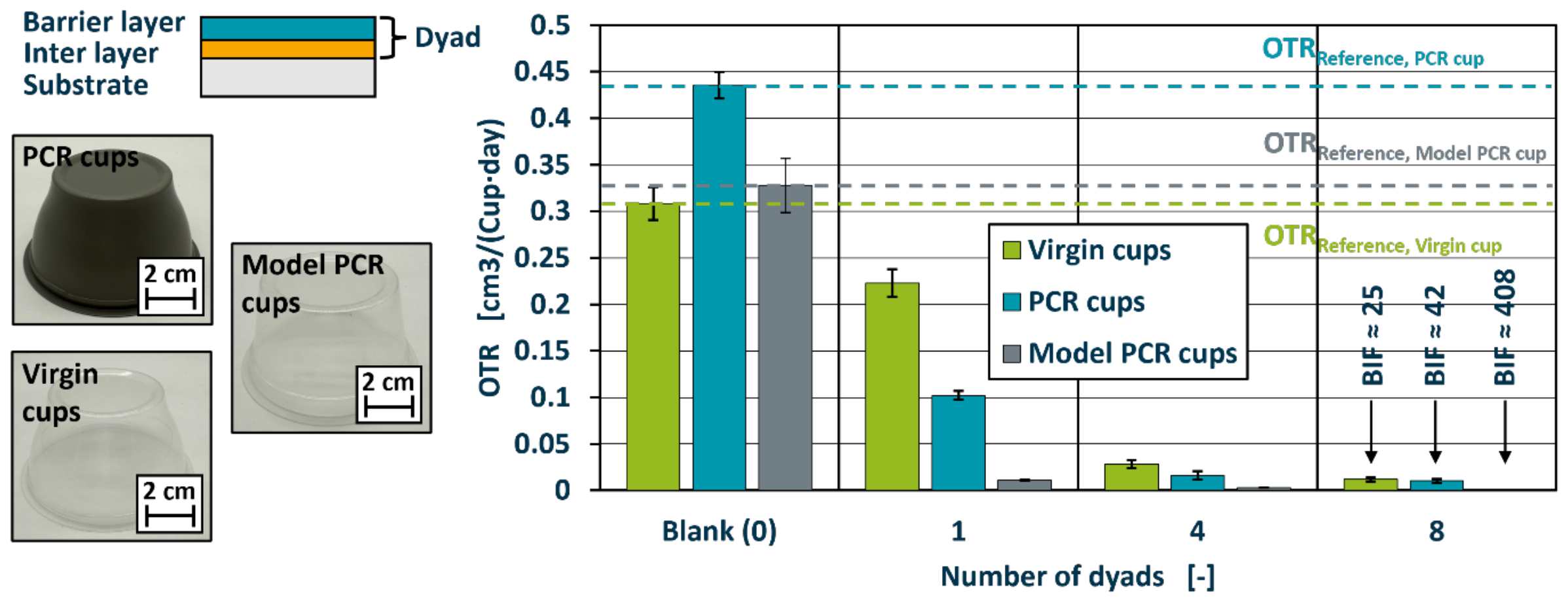
Figure 2.
Migration expressed as contamination/cup, mass loss, OTR before and after migration for blank, PT, SiOCH and Dyad (SP).
Figure 2.
Migration expressed as contamination/cup, mass loss, OTR before and after migration for blank, PT, SiOCH and Dyad (SP).
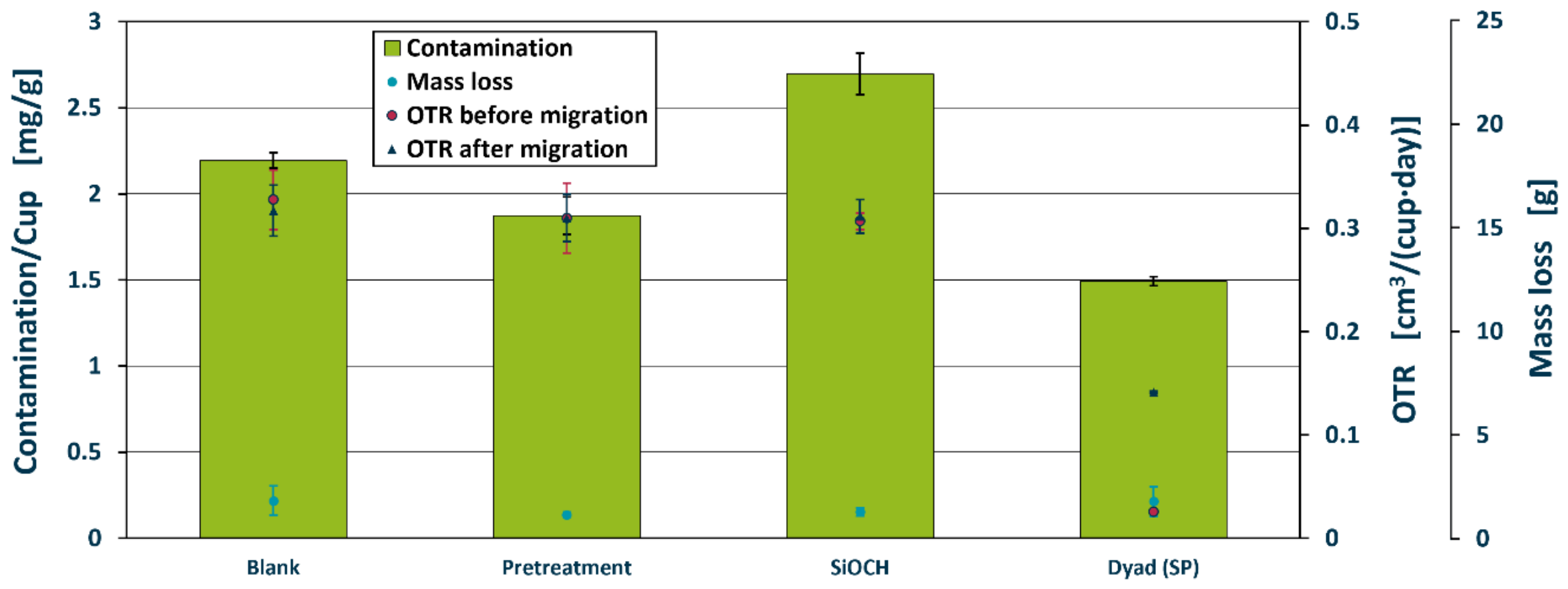
Figure 3.
Migrated contamination per cup of the SiOx coatings in comparision to blank and applied SP.
Figure 3.
Migrated contamination per cup of the SiOx coatings in comparision to blank and applied SP.
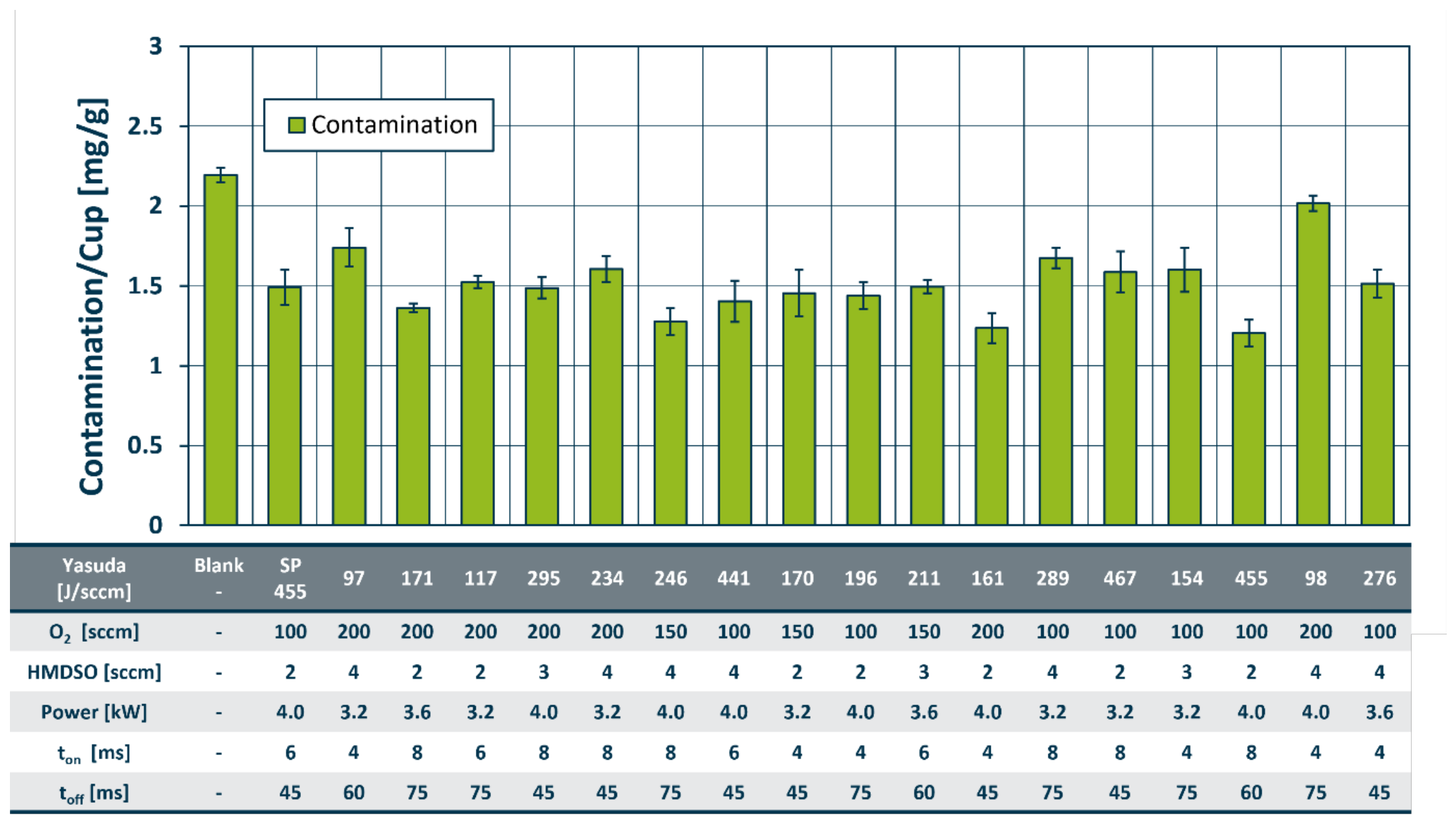
Figure 4.
OTR before and after migration of the SiOx coatings in comparision to blank and applied SP.
Figure 4.
OTR before and after migration of the SiOx coatings in comparision to blank and applied SP.
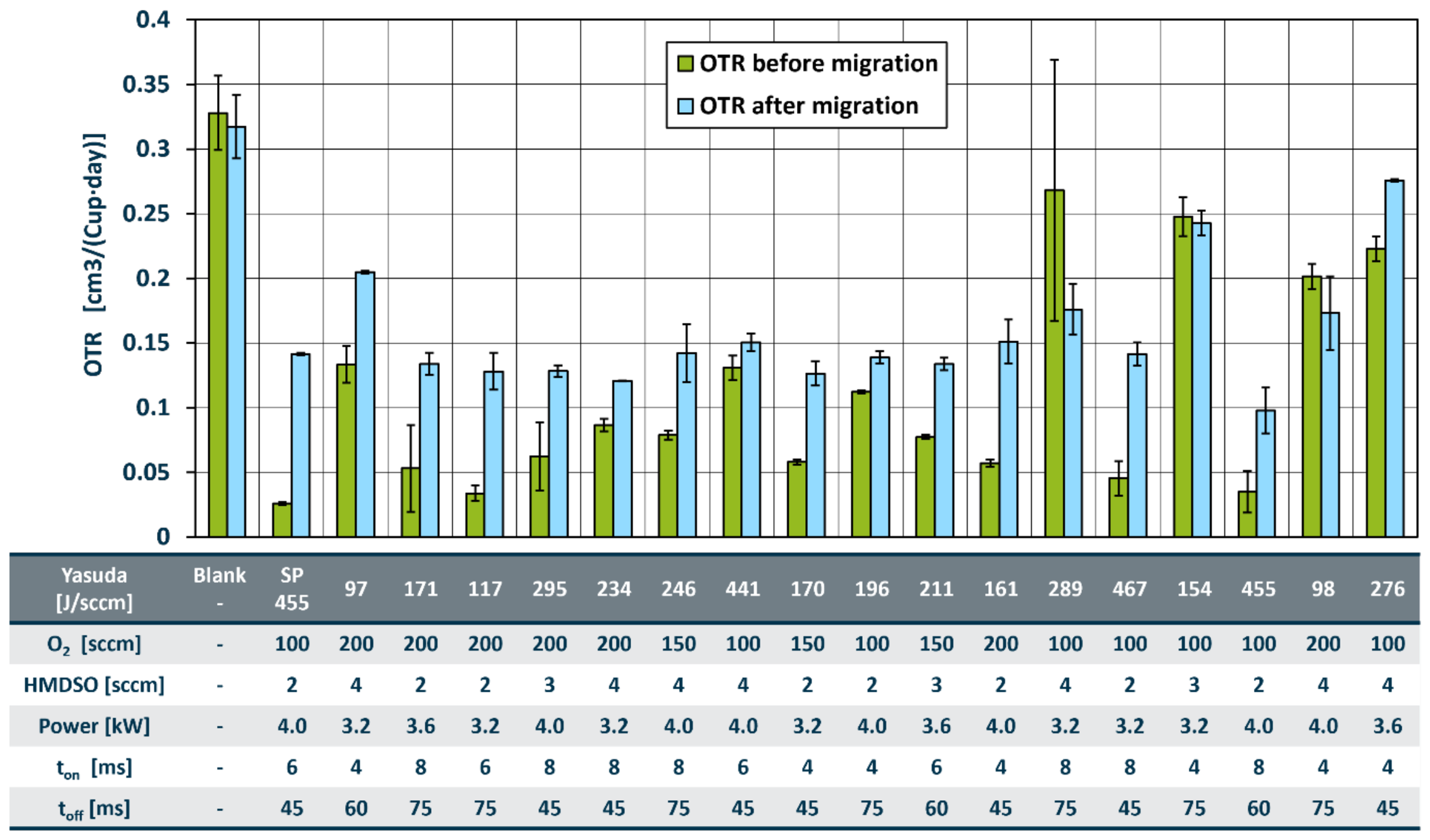
Figure 5.
Mass loss of the SiOx coatings in comparision to blank and applied SP.
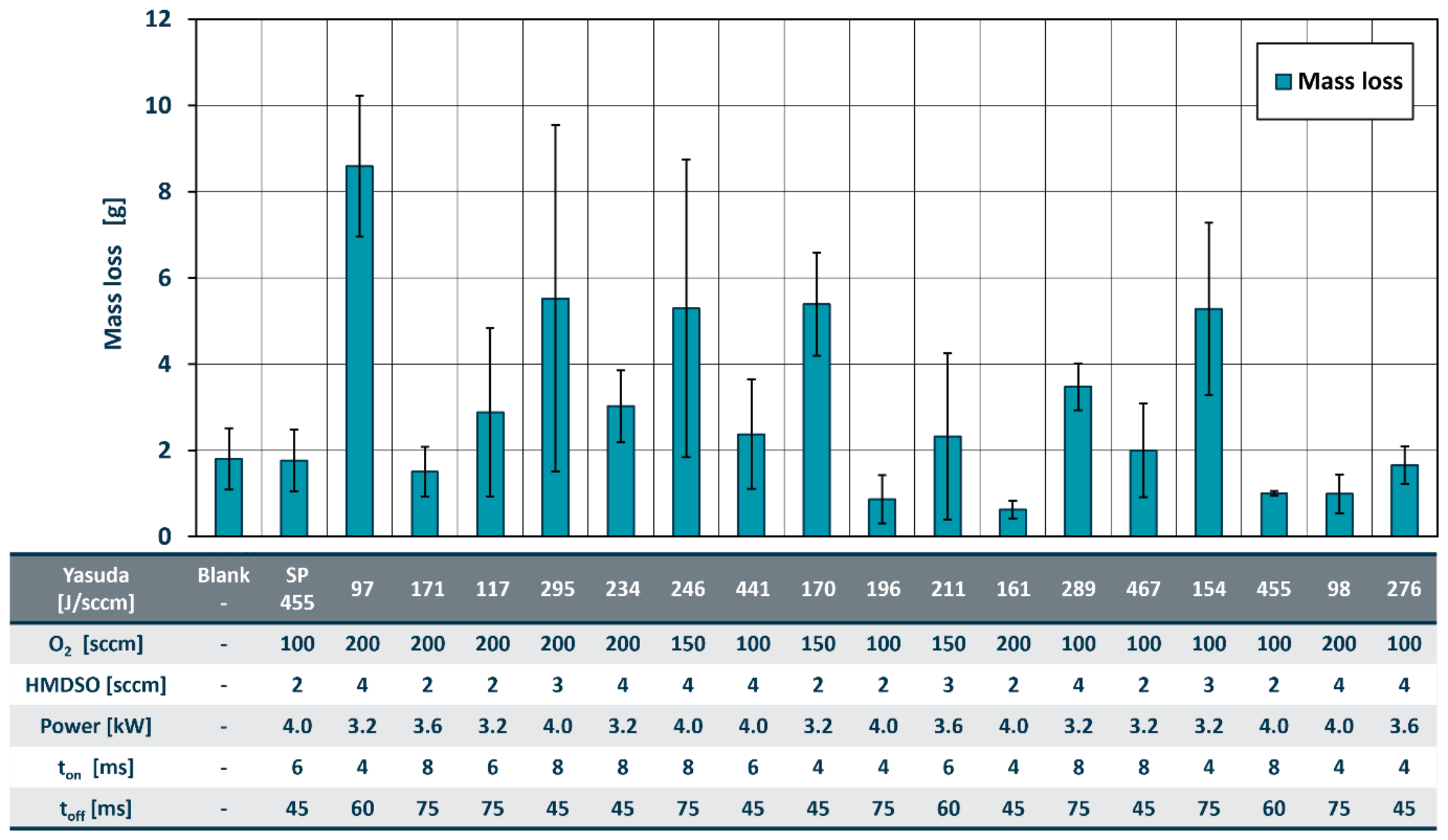
Figure 6.
Obtained target values of the SiOx coatings in comparision to blank and applied SP.
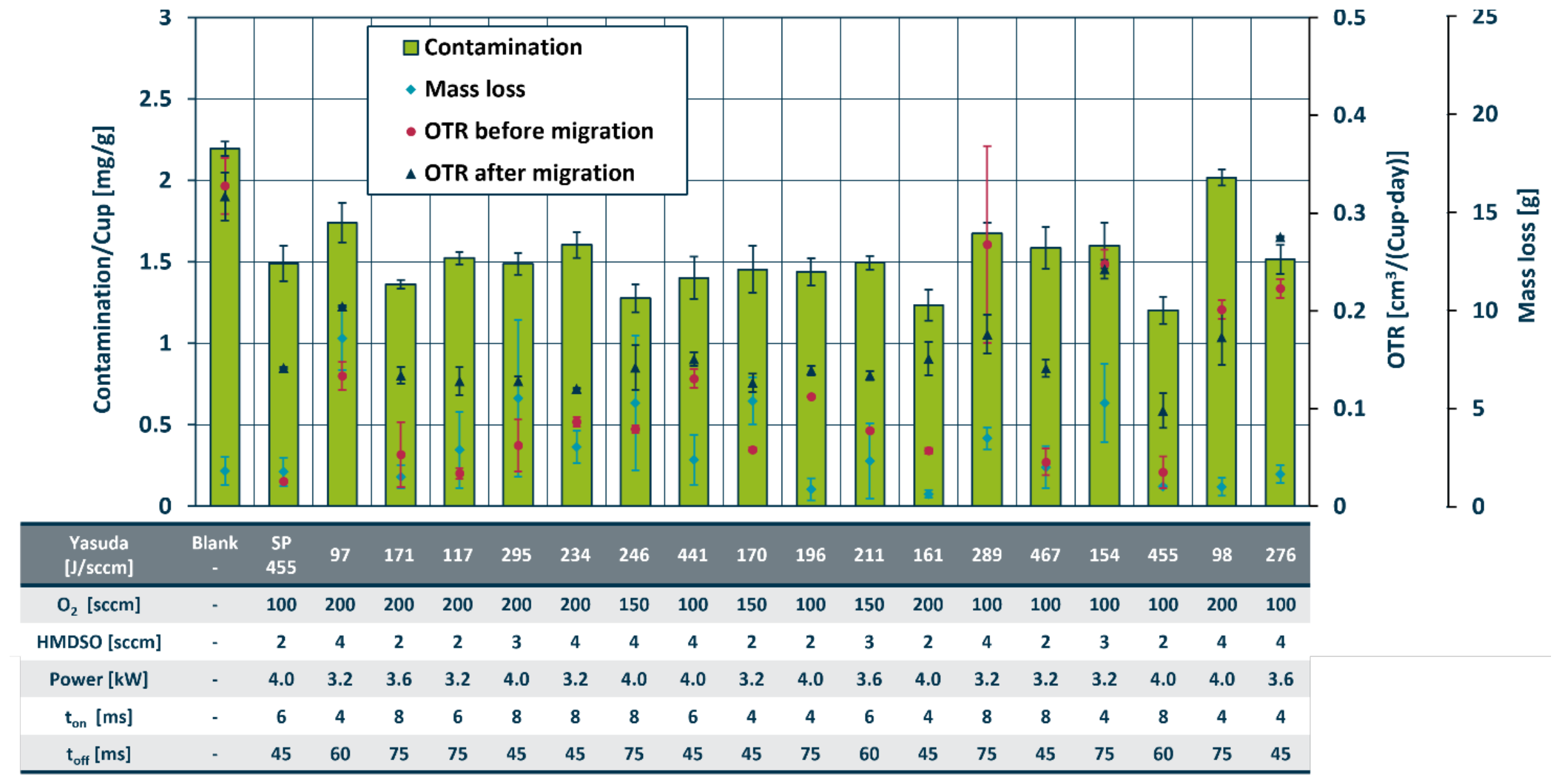
Figure 7.
Effect summary from JMP for the used plasma process parameters in relation to contamination/cup, OTR before migration, OTR after migration and mass loss barrier target values.
Figure 7.
Effect summary from JMP for the used plasma process parameters in relation to contamination/cup, OTR before migration, OTR after migration and mass loss barrier target values.
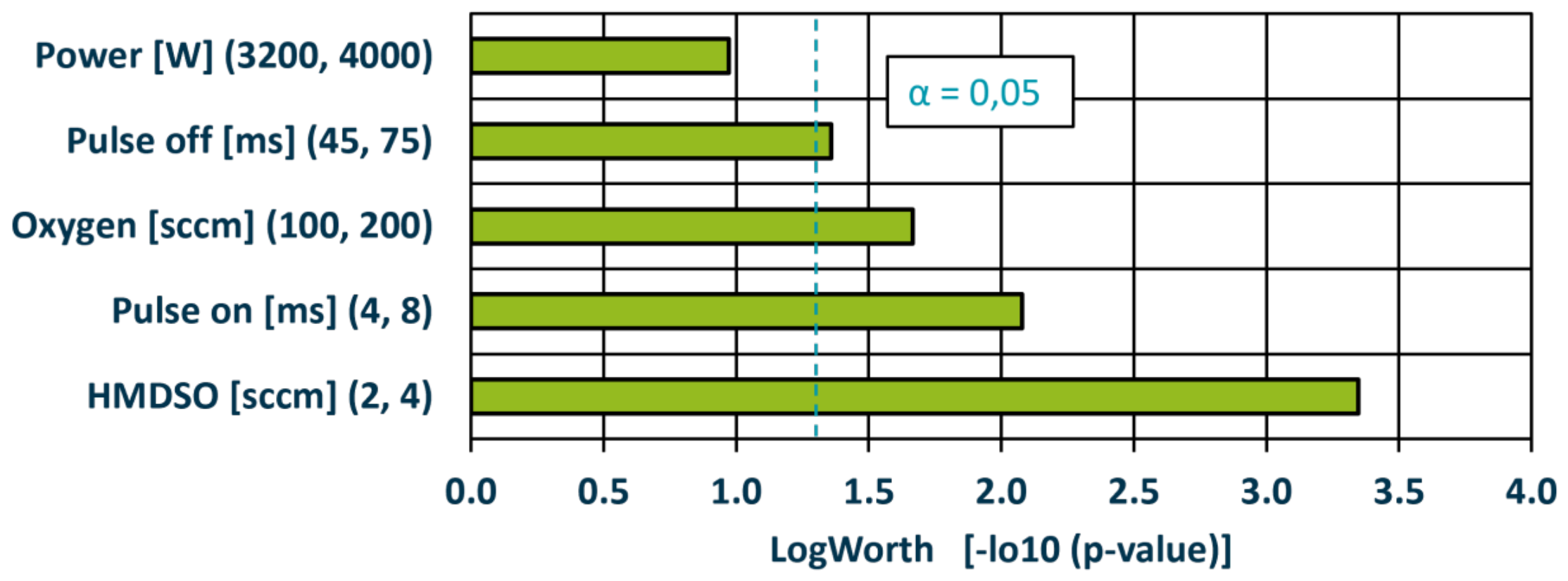
Figure 8.
Comparision of the applied SiOx layers regarding migration barrier effects in terms of contaminantion/cup for the different contamination (groups non polar & volatile, non polar & volatile, polar & non volatile and polar & volatile).
Figure 8.
Comparision of the applied SiOx layers regarding migration barrier effects in terms of contaminantion/cup for the different contamination (groups non polar & volatile, non polar & volatile, polar & non volatile and polar & volatile).
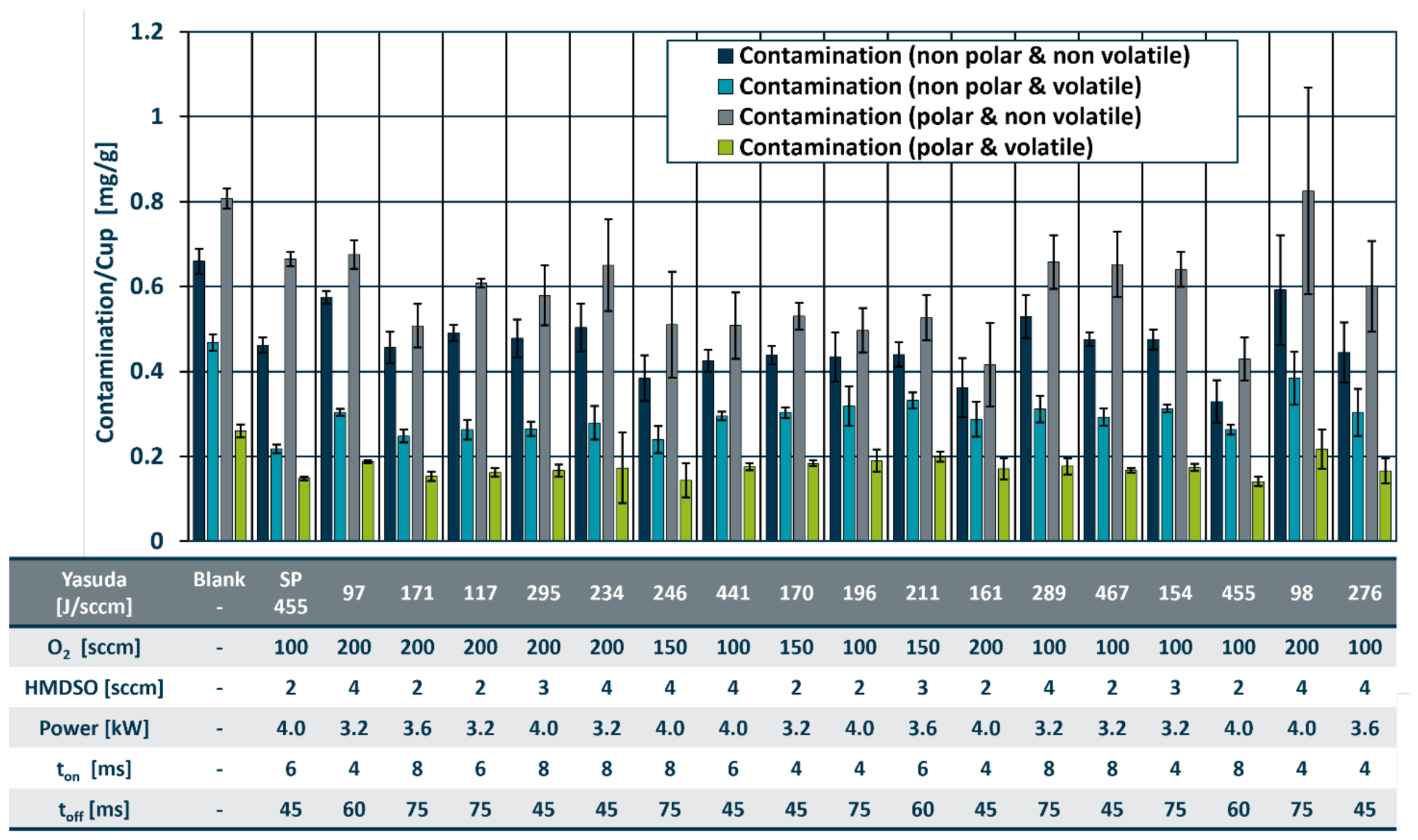
Figure 9.
Effect summary from JMP for the used plasma process parameters considering the four contamination categories (non-polar & non-volatile, non-polar & volatile, polar & non-volatile and polar & volatile).
Figure 9.
Effect summary from JMP for the used plasma process parameters considering the four contamination categories (non-polar & non-volatile, non-polar & volatile, polar & non-volatile and polar & volatile).
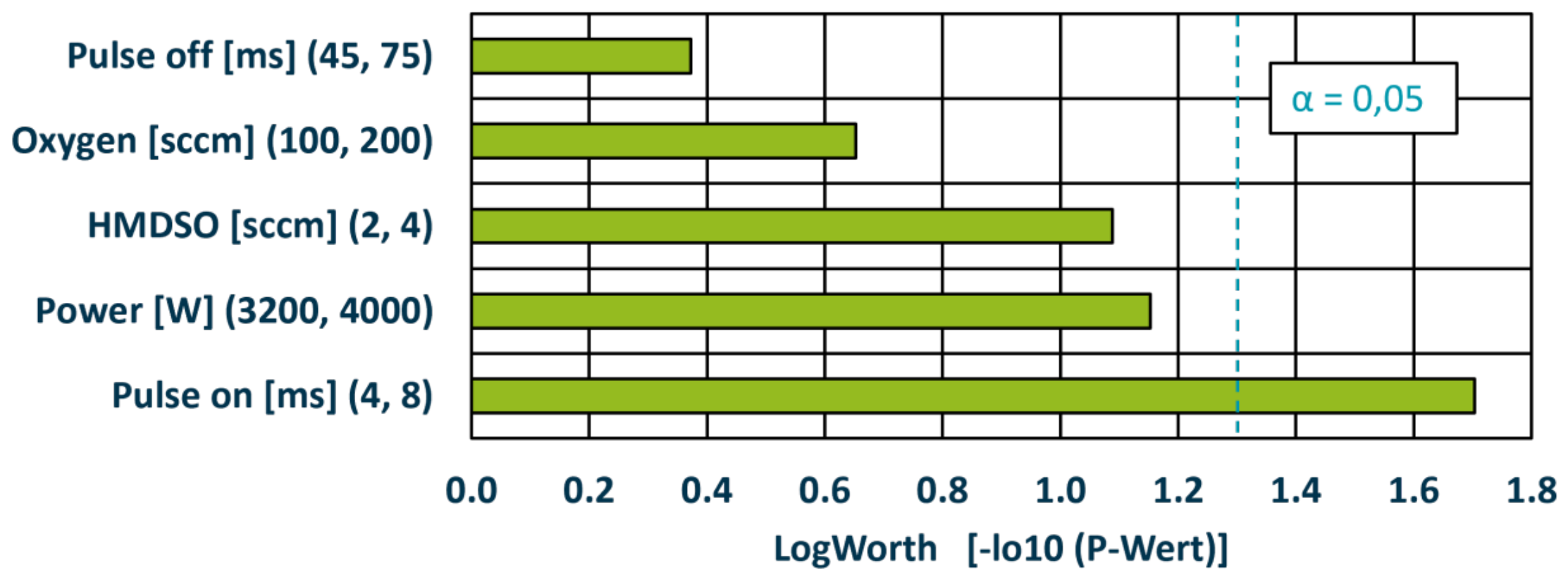
Table 1.
Coating parameters of the startin point.
| O2 [sccm] | HMDSO [sccm] | Power [W] | Pulse-On [ms] | Pulse-Off [ms] | Pressure [Pa] | Purge Time [s] | Coat time [s] | |
|---|---|---|---|---|---|---|---|---|
| PT | 100 | 0 | 2000 | 4 | 40 | 25 | 10 | 0.5 |
| SiOCH | 0 | 20 | 2000 | 2 | 80 | 25 | 10 | 25 |
| SiOx | 100 | 2 | 4000 | 6 | 45 | 25 | 10 | 5 |
Table 2.
Coating parameters of the definitive screening design.
| O2 [sccm] |
HMDSO [sccm] | Power [kW] | Pulse-On [ms] | Pulse-Off [ms] | Yasuda [J/sccm] | Pressure [Pa] | Purge time [s] | Coat time [s] |
|---|---|---|---|---|---|---|---|---|
| 100 | 2 | 4.0 | 6 | 45 | (SP) 455.41 | 25 | 10 | 5 |
| 200 | 4 | 3.2 | 4 | 60 | 96.77 | 25 | 10 | 6.53 |
| 200 | 2 | 3.6 | 8 | 75 | 170.65 | 25 | 10 | 8.40 |
| 200 | 2 | 3.2 | 6 | 75 | 116.58 | 25 | 10 | 7.54 |
| 200 | 3 | 4.0 | 8 | 45 | 294.52 | 25 | 10 | 2.84 |
| 200 | 4 | 3.2 | 8 | 45 | 233.72 | 25 | 10 | 2.78 |
| 150 | 4 | 4.0 | 8 | 75 | 246.09 | 25 | 10 | 4.84 |
| 100 | 4 | 4.0 | 6 | 45 | 441.18 | 25 | 10 | 4.43 |
| 150 | 2 | 3.2 | 4 | 45 | 170.36 | 25 | 10 | 8.96 |
| 100 | 2 | 4.0 | 4 | 75 | 196.00 | 25 | 10 | 9.75 |
| 150 | 3 | 3.6 | 6 | 60 | 211.14 | 25 | 10 | 5.16 |
| 200 | 2 | 4.0 | 4 | 45 | 160.59 | 25 | 10 | 7.34 |
| 100 | 4 | 3.2 | 8 | 75 | 289.16 | 25 | 10 | 4.47 |
| 100 | 2 | 3.2 | 8 | 45 | 467.44 | 25 | 10 | 5.67 |
| 100 | 3 | 3.2 | 4 | 75 | 154.31 | 25 | 10 | 8.20 |
| 100 | 2 | 4.0 | 8 | 60 | 455.41 | 25 | 10 | 8.14 |
| 200 | 4 | 4.0 | 4 | 75 | 98.00 | 25 | 10 | 5.84 |
| 100 | 4 | 3.6 | 4 | 45 | 275.51 | 25 | 10 | 4.08 |
Table 3.
OTR values of the uncoated and coated cups after dyads application.
| Virgin cups | PCR cups | Model PCR cups | |||||
|---|---|---|---|---|---|---|---|
| Dyad [-] | OTR [cm3/(cup day)] | BIF [-] | OTR [cm3/(cup day)] | BIF [-] | OTR [cm3/(cup day)] | BIF [-] | |
| Blank (0) | 0.308 ± 0.017 | 1.0 | 0.435 ± 0.014 | 1.0 | 0.328 ± 0.029 | 1.0 | |
| 1 | 0.223 ± 0.015 | 1.4 | 0.102 ± 0.005 | 4.3 | 0.011 ± 0.001 | 31.7 | |
| 4 | 0.028 ± 0.004 | 11.0 | 0.016 ± 0.005 | 26.8 | 0.003 ± 0.001 | 107.3 | |
| 8 | 0.012 ± 0.003 | 25.2 | 0.010 ± 0.002 | 42.4 | 0.001 ± 0.000 | 408.9 | |
Table 4.
Obtained target values for blank, pretreated, applied SiOCH and Dyad (SP) on model PCR cups.
Table 4.
Obtained target values for blank, pretreated, applied SiOCH and Dyad (SP) on model PCR cups.
| Contamination/Cup [mg/g] | OTR before migration [cm3/(cup day)] | OTR after migration [cm3/(cup day)] | Mass loss [g] | |
|---|---|---|---|---|
| Blank | 2.19 ± 0.05 | 0.328 ± 0.029 | 0.317 ± 0.025 | 1.8 ± 0.7 |
| Pretreatment (PT) | 1.87 ± 0.11 | 0.310 ± 0.034 | 0.310 ± 0.023 | 1.1 ± 0.1 |
| SiOCH | 2.70 ± 0.12 | 0.307 ± 0.008 | 0.312 ± 0.016 | 1.3 ± 0.2 |
| Dyad (SP) | 1.49 ± 0.03 | 0.026 ± 0.001 | 0.142 ± 0.001 | 1.8 ± 0.7 |
Table 5.
Calculated Yasuda factors and pulsed plasma regimes of the DSD parameters in comparision to blank and SP and in relation to the obtained target values.
Table 5.
Calculated Yasuda factors and pulsed plasma regimes of the DSD parameters in comparision to blank and SP and in relation to the obtained target values.
| Yasuda [J/sccm] | ton/toff [s] |
Contamination/Cup [mg/g] | OTR before migration [cm3/(cup day)] | OTR after migration [cm3/(cup day)] | Mass loss [g] |
|---|---|---|---|---|---|
| (Blank) - | - | 2.19 ± 0.05 | 0.328 ± 0.029 | 0.317 ± 0.025 | 1.8 ± 0.7 |
| (SP) 455 | 6/45 | 1.49 ± 0.03 | 0.026 ± 0.001 | 0.142 ± 0.001 | 1.8 ± 0.7 |
| 97 | 4/60 | 1.74 ± 0.04 | 0.134 ± 0.014 | 0.205 ± 0.001 | 8.6 ± 1.6 |
| 171 | 8/75 | 1.36 ± 0.07 | 0.053 ± 0.034 | 0.134 ± 0.009 | 1.5 ± 0.6 |
| 117 | 6/75 | 1.52 ± 0.08 | 0.034 ± 0.059 | 0.128 ± 0.014 | 2.9 ± 1.9 |
| 295 | 8/45 | 1.49 ± 0.09 | 0.062 ± 0.027 | 0.128 ± 0.000 | 5.5 ± 4.0 |
| 234 | 8/45 | 1.61 ± 0.13 | 0.087 ± 0.005 | 0.121 ± 0.003 | 3.0 ± 0.8 |
| 246 | 8/75 | 1.28 ± 0.15 | 0.079 ± 0.004 | 0.142 ± 0.007 | 5.3 ± 3.5 |
| 441 | 6/45 | 1.40 ± 0.08 | 0.131 ± 0.010 | 0.151 ± 0.007 | 2.4 ± 1.3 |
| 170 | 4/45 | 1.46 ± 0.04 | 0.058 ± 0.002 | 0.127 ± 0.010 | 5.4 ± 1.2 |
| 196 | 4/75 | 1.44 ± 0.09 | 0.112 ± 0.001 | 0.139 ± 0.005 | 0.9 ± 0.6 |
| 211 | 6/60 | 1.50 ± 0.06 | 0.077 ± 0.001 | 0.134 ± 0.005 | 2.3 ± 1.9 |
| 161 | 4/45 | 1.24 ± 0.13 | 0.057 ± 0.003 | 0.151 ± 0.017 | 0.6 ± 0.2 |
| 289 | 8/75 | 1.68 ± 0.14 | 0.268 ± 0.101 | 0.176 ± 0.020 | 3.5 ± 0.6 |
| 467 | 8/45 | 1.59 ± 0.08 | 0.045 ± 0.014 | 0.141 ± 0.009 | 2.0 ± 1.1 |
| 154 | 4/75 | 1.60 ± 0.05 | 0.248 ± 0.015 | 0.243 ± 0.009 | 5.3 ± 2.0 |
| 455 | 8/60 | 1.20 ± 0.09 | 0.035 ± 0.016 | 0.098 ± 0.018 | 1.0 ± 0.1 |
| 98 | 4/75 | 2.02 ± 0.29 | 0.2015 ± 0.0098 | 0.1732 ± 0.0284 | 1.0 ± 0.5 |
| 276 | 4/75 | 1.51 ± 0.14 | 0.2229 ± 0.0094 | 0.2757 ± 0.0010 | 1.7 ± 0.4 |
Table 6.
Results from the regression models related to the contamination/cup, OTR before migration, OTR after migration and mass loss barrier target values.
Table 6.
Results from the regression models related to the contamination/cup, OTR before migration, OTR after migration and mass loss barrier target values.
| R2 [-] | RSME [-] | Model P value [-] | |
|---|---|---|---|
| Contamination/Cup [mg/g] | 0.45 | 0.17 | 0.153 |
| OTR before migration [cm3/(cup day)] | 0.78 | 0.04 | 0.001 |
| OTR after migration [cm3/(cup day)] | 0.65 | 0.03 | 0.017 |
| Mass loss [g] | 0.34 | 2.09 | 0.351 |
Table 8.
Results from the regression models related to the the contamination/cup values for the four contamination groups.
Table 8.
Results from the regression models related to the the contamination/cup values for the four contamination groups.
| R2 [-] | RSME [-] | P value [-] | |
|---|---|---|---|
| Contamination/Cup (non polar & non volatile) [mg/g] | 0.46 | 0.03 | 0.148 |
| Contamination/Cup (non polar & volatile) [mg/g] | 0.47 | 0.02 | 0.130 |
| Contamination/Cup (polar & non volatile) [mg/g] | 0.33 | 0.10 | 0.382 |
| Contamination/Cup (polar & volatile) [mg/g] | 0.47 | 0.02 | 0.130 |
Disclaimer/Publisher’s Note: The statements, opinions and data contained in all publications are solely those of the individual author(s) and contributor(s) and not of MDPI and/or the editor(s). MDPI and/or the editor(s) disclaim responsibility for any injury to people or property resulting from any ideas, methods, instructions or products referred to in the content. |
© 2026 by the authors. Licensee MDPI, Basel, Switzerland. This article is an open access article distributed under the terms and conditions of the Creative Commons Attribution (CC BY) license (http://creativecommons.org/licenses/by/4.0/).
Copyright: This open access article is published under a Creative Commons CC BY 4.0 license, which permit the free download, distribution, and reuse, provided that the author and preprint are cited in any reuse.