

Submitted:
01 September 2026
Posted:
04 September 2026
You are already at the latest version
Abstract
Background: Huntington’s disease (HD) is an autosomal dominant neurodegenerative disorder characterized by chorea, cognitive impairment, and behavioral-psychiatric disturbances. 30 years after the development of presymptomatic genetic testing for at-risk individuals and families, concerns remain about adverse psychosocial effects secondary to gene-status disclosure. We conducted a scoping review to update findings from Crozier and co-authors’ (2015) systematic review of the psychosocial effects of HD testing. Methods: We searched MEDLINE, APA PsycInfo, and Scopus for 2014-2025. Using Covidence software, two raters screened, reviewed, and extracted each publication; a third rater completed consensus ratings. After removing 102 duplicates, 238 articles underwent title/abstract screening (174 excluded), 64 underwent full text review (58 excluded), and six underwent data extraction. Results: The final articles reported heterogenous findings. Three found no significant or important differences between presymptomatic gene-carriers and non-carriers on the Brief Symptom Inventory, Unified HD Rating Scale behavioral assessment, and in-house structured interviews. Three studies found that presymptomatic gene-carriers scored significantly or importantly higher on the Beck Depression Inventory, risk perception scale, and in-house structured interviews. Given data reporting limitations, effect sizes were not estimated. Articles identified such methodological limitations as potential sampling bias, limited internal/external validity, and study instrument issues. Conclusions: This review replicates the previous review’s mixed findings. Though the literature does not clearly suggest large negative psychological effects secondary to result disclosure, persistent issues with study design complicate efforts to harmonize reported findings. More methodologically sound work is needed, including studies disclosing cytosine-adenine-guanine (CAG) repeat length and estimated age of onset.
Keywords:
genetic testing
; predictive testing
; Huntington′s disease
; psychological impact
; scoping review
Introduction
Huntington’s disease (HD) is an autosomal dominant neurodegenerative disorder characterized by chorea, cognitive impairments, and behavioral-psychiatric disturbances. The age of onset is roughly 30 to 50 years and has a prevalence of 5-10 people per 100,000 in the Caucasian population.[1] The disease is caused by 36 or more CAG repeats on the short arm of the chromosome 4p16.3 in the first exon of the HTT gene (IT15), which creates a mutant huntingtin protein (mHTT).[2,3] While existing treatments may improve quality of life and disease-modifying therapeutics are in development, no preventative treatment is currently approved to cure or slow the progression of HD.
In 1983, the 4p16.3 region on chromosome 4, which encodes HTT, was linked to HD, and in 1993, the exact trinucleotide repeat expansion on the first exon in this gene was officially confirmed.[3,4] Prior to the 1993 gene discovery, linkage analysis was the primary method for predictive testing, a complicated, expensive, and time-consuming process that produces results that are less than 100% accurate. [5] Following the gene discovery, direct gene testing for the mutant HTT allele became available using polymerase chain reaction (PCR), increasing the testing accuracy to over 99%.[5] International guidelines have been developed and periodically updated to orient providers and researchers in the HD presymptomatic testing and disclosure process.[6,7]
While predictive testing creates new opportunities for persons at risk for HD and their families, it also comes with certain costs. For individuals and families at risk of dominantly inherited diseases such as HD, learning the results of a predictive genetic test in the absence of an approved preventative treatment may increase negative psychological outcomes. Health professionals remain concerned that predictive testing may cause high psychological stress levels or even suicide, which is much more prevalent in the families of persons with HD than in the general population. Death by suicide in the community of persons with HD is reported to be 13%, up to 12-times higher than the general population.[5,8,9,10,11,12,13] All in all, concerns about negative psychological outcomes remain unresolved.
To shed light on this matter, a 2015 systematic review assessed the prevalence of negative psychological outcomes secondary to predictive testing and disclosure of HD gene-status.[14] The authors conducted title/abstract screening and full text review of relevant articles published between 1993 and November 2013. Ultimately, eight publications met the eligibility criteria for meta-analysis. The review found that, although varying levels of distress were identified in huntingtin gene expansion carriers and non-carriers, no significant impact was associated with the test results.[14]
This scoping review aims to update the 2015 review and to integrate any new findings regarding negative psychological outcomes secondary to predictive testing and disclosure of HD gene-status. This updated review may synthesize important findings that could benefit providers and researchers engaged in the HD presymptomatic testing and disclosure process. It could also inform how providers and researchers utilize supportive services to help those affected by an HD test result. This updated review may also detect any changes in current research directions since the 2015 review, such as emerging research questions or the relative balance of quantitative and qualitative studies.
Methods
Search Strategy
To update the previous review, we first worked with a research librarian in March and April 2025 to refine our search strategy and to complete our search in May 2025. Our intention was to access any relevant literature published since 2014. The search strategy developed by Crozier and coauthors has been adapted for this scoping review. We therefore conducted searches of the same three electronic bibliographic databases (Medline, APA PsycInfo, and Scopus) to capture publications from biomedical and psychological research. Crozier and coauthors employed the following search keywords and Boolean operators: psycholog* AND (impact OR effect OR consequence) AND (genetic OR predictive) AND (testing OR screening) AND (HD OR Huntington*). After consulting a librarian, we modified these search terms and operators for each database to capture a wider range of studies. The adapted search strings are listed in the review protocol (Supplement S1).
We restricted the publication dates to articles published between January 1, 2014 (after the 2013 search reported in the 2015 review) and May 20, 2025. We also reviewed the references of any included publications for any additional relevant studies. In late July 2026, one rater (DKB) completed a follow-up search of these databases for any publications appearing since May 2025 that could meet the review’s eligibility criteria. This search yielded 27 eligible results (ten from PubMed; eight from Scopus; nine from APA PsycInfo), with five duplicates, but no new publications met eligibility criteria. To conduct the review process, we utilized Covidence, an online systematic review management software. Each publication was reviewed by two raters during each phase of the process. In case of rater disagreement, a third member of the review team (DKB) completed a consensus rating. From the three databases, a total of 340 articles were identified (Figure 1). 102 articles were removed because they were identified as duplicates manually (n=1) or by Covidence (n=101). A total of 238 studies were then included for abstract screening. Following abstract screening, 174 studies were excluded because they did not meet the eligibility criteria outlined in Table 1.
Full Text Review and Data Extraction
Following the title/abstract screening, 64 articles advanced to the full text review phase. The full text review took place in two phases from July to September 2025 and from October to December 2025. During both phases, two raters carefully read and reviewed each paper to determine whether it met all eligibility criteria. In case of rater disagreement, a third member of the review team (DKB) completed a consensus rating. Following the first phase (July-September 2025), two publications met the review’s eligibility criteria. It was determined that these publications did not include sufficient data to replicate the 2015 review and to update its findings regarding effect sizes. The review team therefore decided to loosen one of the eligibility criteria (namely, the requirement of a standardized outcome measure), to include publications with standardized survey items to capture self-reported states secondary to genetic testing, and to re-run the full text review of the 64 articles that had advanced to the full text review phase. The rationale was to capture more published findings and to present the evidence base as it exists in the literature, heterogenous though it might be. Following the second phase of the full text review (October to December 2025), we ultimately advanced six articles to the data extraction phase. To ensure that the data extraction process was consistent across all raters, we used Covidence to develop a data extraction template. All six articles were extracted by two researchers, with a third rater performing consensus ratings. Our data extraction template is included in Supplement S2.
Eligible Papers
Ultimately, six articles were included in this review. We excluded a total of 58 articles for the following reasons: no disclosure of HD gene-status (n=41); no pre- and post-test quantitative psychological outcome measure (n=7); no adult at-risk HD population reported separately from other genetically inherited disease populations (n=5); not in English (n=3); participants under 18 years (n=1); predates 2013 search (n=1) (Figure 1). Although one publication does not report complete data on HD participants separately from other test-taker populations, it reports some individual findings (i.e., Brief Symptom inventory subscores for HD test-takers) that made it minimally eligible for inclusion in the final review.[15] The scoping review was conducted in accordance with PRISMA guidelines (Supplement S3).
Results
Description of Study Characteristics
The main characteristics of all included publications are displayed in Table 2. Studies reported by these publications were conducted across six different countries: Canada and the United States of America;[16,17] France;[18] Germany;[19] the Netherlands;[20] Portugal.[15] One of the reported studies recruited participants through a 43-site research consortium, i.e., the Prospective Huntington At-Risk Observational Study (PHAROS).[17] Another reported study recruited participants at one of two genetic centers or clinics associated with an academic medical institution.[20] In all other included publications, participant recruitment was completed by a single genetic center or clinic associated with an academic medical institution.
The reported studies varied considerably in design. Three publications reported a cross-sectional study design for the measure of interest.[15,18,19] The remaining publications reported studies with prospective designs to measure the variables of interest, with data collection ranging from three timepoints[20] to more than ten.[16,17] Carrier and non-carrier sample sizes ranged from 18 participants[18] to 171.[16] Mean non-carrier and carrier sample sizes were 41.4 and 36.4, respectively. Mean participant age ranged from 31.2 to 42.9 years, with female participation ranging from 51% to 72%.
The reported studies assessed the psychological consequences of HD genetic testing using several constructs: emotional distress or psychopathology (two studies), depression (one study), behavioral disturbances (one study), risk perception (one study), overall emotional state or decisional regret (one study), and personal motivations or family attitudes (one study) (Table 3). In terms of instruments, emotional distress or psychopathology were measured using the Brief Symptom Inventory.[21] Depression was measured using the Beck Depression Inventory.[22] Behavioral differences were measured using the behavioral domain of the Unified Huntington’s Disease Rating Scale (UHDRS).[23] Risk perception was assessed using a 100-millimeter visual analog scale.[16] Overall emotional state or decisional regret and personal motivations or family attitudes were assessed using self-report items from in-house, standardized interviews [18,19].
Psychological Consequences of HD Genetic Testing Disclosure
This literature review identified six publications reporting cross-sectional or prospective studies comparing the psychological consequences of HD genetic testing disclosure (Table 4). The three cross-sectional studies differed in their findings. One study assessing overall emotional state following disclosure found some difference between persons informed of non-carrier or carrier status: carriers were more likely to report negative emotional states following disclosure even though no carriers or non-carriers reported decisional regret.[19] Another study assessing personal motivations and family attitudes towards disclosure found no difference in psychological consequences between persons informed of non-carrier or carrier status though participants reported some adverse consequences in untested family members.[18] A third study that assessed emotional distress or psychopathology did not separate HD test-taker groups by gene-status and reported only that HD test-takers scored similarly to test-takers for Familial Amyloidotic Polyneuropathy (FAP) on measures of phobic anxiety (HD: 1.15; FAP: 1.70), psychoticism (HD: 2.35; FAP: 2.34), and positive symptom distress index (HD: 1.47; FAP: 1.44).[15] Though elevated relative to population standards, these values fell below clinically significant thresholds.
The three prospective studies also differed in their reported findings. Two studies with follow-up periods of approximately ten years reported significant differences in depression or risk perceptions between persons informed of non-carrier or carrier status: huntingtin gene expansion carriers were more likely to experience higher levels of depression than non-carriers, albeit at clinically minimal or mild levels,[17] or to experience unexpected changes in their perception of their risk for developing HD.[16] Nevertheless, one prospective study also found no significant differences in other behavioral abnormalities as measured by the UHDRS behavioral domain.[17] Over a shorter follow-up period of eight months, the third prospective study reported no significant intergroup differences in terms of distress.[20] All in all, across different designs and measures, two studies reported significant intergroup differences,[16,17] two studies reported some non-significant differences,[17,20] one study reported a nominal difference without calculated statistical significance,[19] and one study reported no differences.[18]
Description of Methodological Issues
Several included publications report heterogenous study designs with familiar methodological limitations.[24] First, most publications signaled potential sampling bias: participants were self-selected or unrepresentative of the broader population, whether due to demographic homogeneity,[16] strict exclusion criteria,[20] strong interest in research,[17] or high levels of HD education.[16,17]
Second, several publications acknowledged limited internal or external validity due to small sample sizes or high attrition rates, even by rare disease standards,[18,19] or short study follow-up or broad testing windows.[18,19,20] Relatedly, one study reporting adverse outcomes in the relatives of test-takers noted that it did not follow these relatives.[18] Third, some studies recognized concerns or limitations with study instruments or measures, including the influence of subtle psychiatric or cognitive symptoms on self-rating,[20] measurement error and social desirability bias with self-reports,[20] and the absence of an objective evaluation system for the coping capacities of participants.[19] In a similar vein, just as the authors noted in the 2015 review, only one study used an HD-specific measure[17] whereas the remaining studies used generic measures of psychological constructs to assess impact, often without an explicit rationale for how these measures might capture the specific effects of genetic testing disclosure.
Discussion
The purpose of this scoping review was to investigate changes in the evidence base regarding the psychological effects of predictive genetic testing for HD by updating a 2015 scoping review. After analyzing the new data, the current findings from the studies reporting intergroup differences are broadly consistent with the previous review’s findings (Table 5). Our findings suggest that some psychological distress is observed from a predictive HD diagnosis. In three publications, gene-status disclosure was more likely to result in higher levels of negative emotional states, depression, or unexpected changes in risk perception for huntingtin gene expansion carriers,[16,17,19] with two statistically significant differences.[16,17] This is similar to the three studies in the 2015 review that reported higher levels of depression, hopelessness, post-traumatic stress disorder, low self-esteem, aggressive behavior, and compulsions [25,26,27].
One prospective study found increased depression levels over time for the huntingtin gene expansion carriers, at two post-test time points,[17] which contrasts with published findings that indicate an initial increase but subsequent return to baseline levels.[28] At the pre-disclosure and disclosure visits, no significant differences in Beck depression scores were found between the two groups. Yet, at the first and second post-disclosure visits, depression scores for the carrier group continued to increase or remained elevated compared to the non-carrier group whose scores decreased.[17] To assess whether these findings might be explained by significant life events for test-takers, the authors examined life events as reported by participants at the disclosure visit and the first and second follow-up visits. These revealed no significant differences in life events between huntingtin gene expansion carriers and non-carriers. The authors suggested that the contrasting findings for the carrier group could be related to increased vulnerability for test-takers who are exhibiting symptoms or closer to symptom onset.[17] They also suggested that individuals who choose to participate in a research study, especially for an extended period of time, and who are asked to monitor potential emerging symptoms may differ from the larger population of those at risk for HD. Another possible explanation, though not one advanced by the authors, is that differences in depression scores may be influenced by other factors than mere predictive genetic testing and disclosure: disease progression, total number of assessments in a long observational study, length of time between assessments, or individual differences such as emotional regulation skills. This alternative must be weighed against the lesser risk of bias associated with results from longitudinal observational studies, compared with small single-center surveys.
Another prospective study found that huntingtin gene expansion non-carriers experienced unexpected changes in risk perception. More simply, they rated themselves more at risk for HD after disclosure of non-carrier status. This suggests that even test-takers to whom a prima facie favorable result (i.e., non-carrier status) is disclosed may directly or indirectly experience detrimental psychological consequences, such as guilt or intra-family tensions.[16,29] In short, a person’s understanding of their risk for HD contributes to their reactions to genetic testing disclosure. That said, it is again worth considering an alternative explanation related to the one above.[17] Though a critical construct for counseling and testing, subjective risk perception is not a fixed variable determinative of psychological outcomes but is influenced by such factors as lifetime emotional experiences, family myths, and subjective or folk theories of inheritance.[25,29]
In addition to their findings regarding psychological consequences, three studies conducted regression analyses to identify demographic, clinical, or social predictors of reported or experienced psychological impacts following genetic testing disclosure. One study identified characteristics associated with a test-taker's lack of decisional regret: the desire to know showed the strongest association, along with being female, higher age, psychological resilience, lack of family or partner pressure, and the desire to have children.[19] Another study identified characteristics associated with increased psychoticism or emotional distress four, seven, or ten years after disclosure: being female, being divorced, gene-status, and symptom progression.[15] A third study identified characteristics associated with increased distress: post-disclosure distress was largely a function of baseline distress and, to a lesser extent, attachment anxiety, attachment avoidance, and positive test result.[20] Though it did not conduct a regression analysis, another study qualitatively analyzed transcripts from follow-up interviews and clinic notes to identify factors that appear to influence risk perception following disclosure. The three most common factors were symptomatizing, inability to accept non-carrier status, and the genetic test results of family members.[16] Nonetheless, it remains unsettled which individual characteristics are most strongly associated with or predictive of adverse outcomes secondary to disclosure.
These overall findings are globally consistent with the findings from the 2015 review (Table 5). Approximately one-third of publication report significant differences between huntingtin gene expansion non-carriers as measured by at least one assessment; the other two-thirds report nominal though non-significant differences or no significant differences. Where differences are reported, the elevated scores typically fall below the threshold for clinical significance. Subject to the methodological limitations stated above, predictive genetic testing for HD and the disclosure of gene-status remain feasible and safe.
Nevertheless, it is noteworthy that the volume of publications from 2014 to 2026 meeting eligibility criteria was relatively lower than the volume of publications from 1993 to 2015, despite our review’s expanded eligibility criteria. In other words, the quantitative evidence base has not substantially grown since the publication of the previous review. One possible explanation for this relative difference may be the changed perception of the psychological effects secondary to gene-status disclosure and the psychiatric symptoms that are characteristic of HD.[1] As the scientific understanding of HD progression has improved since the 1993 gene discovery, the literature makes clear that apathy, irritability, aggression, and other psychiatric disturbances are hallmarks of the disease-course. It can, therefore, be difficult to determine whether predictive genetic testing itself directly causes or contributes to an increase in psychiatric symptoms.[1] The improved characterization of HD may have prompted researchers to shift from quantitative investigation of disclosure effects to other research questions or to qualitative investigations of these effects. Another explanation could be the prioritization of interventions and clinical trials for HD. As the field moves closer to development of effective interventions to improve symptoms or slow disease progression, the psychological effects of HD gene-status disclosure may simply be less salient for clinical and research professionals and persons affected by HD.
That being said, additional research into the psychological effects of predictive genetic testing for HD is still needed. Findings from the 2015 review and the current review are consistent with the non-negligible prevalence of preliminary or lasting adverse outcomes secondary to receiving test results. As already mentioned, more work is necessary to isolate the individual characteristics that best predict adverse outcomes secondary to disclosure. Similarly, a recent publication suggested unresolved questions regarding the uptake of genetic testing, subjective risk perception, “patient-in-waiting” status, and non-carrier reactions, among others.[29] It is therefore crucial to improve the evidence base for those professionals working with individuals at risk for HD (i.e., genetic counselors, researchers, clinicians, etc.). Considering the elevated rate of suicidal ideation and actions in HD populations or at-risk individuals,[8,9,10,11,12,13] future research into the psychological effects of predictive testing and disclosure is crucial to support the mental health and wellbeing of test-takers and their family members.[30] While psychiatric comorbidity such as anxiety, depression, aggression, and past/present alcohol abuse may be important for individualizing care and understanding risk of suicidal ideation or actions in individuals, the lack of diagnosed psychiatric symptoms should not be cause for ruling out such risk. One study found that higher UHDRS depression/anxiety and aggression were significant predictors of suicide risk.[13] Thus, future work in this area could help professionals provide support services and resources to those who are at risk for HD (or other neurogenetic disorders) before and after genetic testing and disclosure to mitigate any negative consequences, including suicidal ideation or actions. Understanding the contribution of various factors to individual reactions to genetic testing disclosure will better realize the gold standard precision/personalized care model used for HD testing.[31]
Limitations
This review faced similar challenges to the previous review, notably the limitations originating from the primary psychological literature along with the limited number of studies meeting full inclusion criteria.[14] Whereas many studies were relevant to our research question, many combined results from HD populations with those from other populations or did not conduct repeated testing with standardized psychological measures for pre- and post-disclosure (Figure 1). Four publications reported psychological effects of genetic testing of multiple diseases, but they did not report separate groups suitable for data extraction.[32,33,34,35] Likewise, another publication reported survey findings from a population including persons under 18 years old.[36] Another publication did not include standardized outcome measures and simply reported an absence of negative psychological outcomes. Although the corresponding or lead authors were contacted with requests for additional information about subgroup analyses and results, they were unable to provide this information due to data privacy concerns, data access issues, or limited resources. Consequently, we cannot estimate how these eligible but excluded findings may have changed the balance of evidence presented here.
In addition, the current review only included publications reporting quantitative data and therefore excluded relevant qualitative study designs. Qualitative approaches may help close gaps in our understanding of the psychological effects that escape typical standardized measures of psychopathology. An increase in qualitative study designs may also explain the limited quantitative data produced since the 2015 review. As a result, the current review did not capture attitudinal or experiential information that could confirm the present findings or help research and clinical professionals and persons affected by HD further interpret the quantitative information from this review.
Finally, due to incomplete data reporting or availability and heterogenous outcome assessments, we were unable to combine effect sizes or calculate pooled odds ratios for instruments or constructs like depression, anxiety, distress, or behavioral disturbances. While we provide an updated map of the evidence base by reporting the frequency of assessments and outcomes, we cannot answer pressing clinical questions about the extent to which predictive genetic testing and disclosure increase these outcomes or how well different instruments perform in detecting certain outcomes. The challenges to harmonizing psychological measures across studies are familiar,[24] but these meta-analytic measures would help professionals and persons affected by HD better navigate the genetic testing landscape.
Future Research Directions
Several new research directions would refine our understanding of the psychological impact of disclosure, the resilience or vulnerability of those opting for or against testing, and the most effective protocols to mitigate negative psychological impacts and support individuals and families at risk for HD.[14] To start, additional longitudinal studies with standardized assessments and longer follow-up could identify and confirm any changes in response to genetic testing and disclosure.[24] In the current review, the publications reporting statistically significant differences in psychological effects between carriers and non-carriers were those with the greatest number of assessment time points. These studies could be identifying subtler changes in psychological distress secondary to disclosure that other, shorter studies may not capture. Alternatively, as suggested above, the frequent assessments and extended follow-up could be identifying outcomes that are not directly related to the disclosure itself but, rather, disease progression or other non-testing related factors. Therefore, it would be beneficial for future research to report precise pre-disclosure, time-of-disclosure, and post-disclosure results of standardized validated measures of psychological wellbeing, such as the Beck Depression Index, or disease-specific measures, such as the UHDRS. Using clearly defined time points to assess psychological effects with valid and related measures could facilitate comparisons among studies and help the field understand whether any observed, heightened psychological effects result from genetic testing disclosure or other factors.
Another methodological innovation would be the use of Ecological Momentary Assessment (EMA) to measure the psychological effects secondary to predictive testing and disclosure of HD gene-status. EMA includes different methodological approaches that utilize real-time repeated data collection to capture a participant's behavior and/or experience in their natural environment.[37] Such approaches may be advantageous for future studies because they enable more frequent, repeated data collection in a participant's everyday environment. This may result in more accurate results by eliminating external factors such as recall bias or doctor’s office anxiety. EMA has been used to identify adverse events in other populations, including those at risk of Alzheimer’s Disease following the disclosure of amyloid-β results.[38] Findings from this review suggest potential benefits of using EMA to monitor psychological wellbeing: it captures fluctuating mood states with more precision and offers more data points than a typical standardized retrospective psychological assessment.[38] During the period leading up to testing and disclosure, it may even be advantageous to use EMA to multiply the time points at which psychological wellbeing or symptoms are assessed so that professionals capture more comprehensively a person’s psychological state prior to, during, and after undergoing predictive genetic testing for HD.
Relatedly, it may also be of interest to evaluate psychological stress using wearable technology throughout the disclosure process. Wearable devices can detect psychological stress by tracking physiological changes, such as heart rate variability, electrodermal activity, respiratory rate, and other health biometric data.[39] Utilizing a wearable device before, during, and after predictive testing and disclosure of HD gene-status may provide more information on the psychological distress that individuals experience during disclosure and facilitate comparisons with their everyday baseline state. With consistent data collection, trends could be better identified with less risk of influence from the external factors mentioned above. While this technology has been used to detect psychological disturbances secondary to negative life events by estimating physiological changes, more research would be needed in the context of neurodegenerative disorders to determine whether wearable heath technology can accurately detect emotional distress experienced secondary to predictive HD testing and disclosure.[40]
Conducting a literature review of qualitative studies would also be of interest given the aptitude of qualitative studies to capture and convey nuanced psychological states. Doing so would require thematic synthesis to narrow down the most important data within the vast qualitative literature related to predictive testing for HD. This would provide research and clinical professionals a more comprehensive understanding of the experience of those who have undergone predictive testing and potentially uncover psychological disturbances that other standardized measures may be missing. While quantitative studies help explain the relative occurrence of negative psychological effects, qualitative studies provide more information about the meaning of the former’s results.
Whatever the research design and methods, future studies should analyze and report the results of HD test-takers separately from test-takers with other disorders so that we may better understand how predictive genetic testing for HD affects patients. After all, the information provided by a genetic test for HD can provide information about CAG repeat length and, consequently, predicted age of onset.[41] The existing literature frequently reports findings from test-takers for various types of neurodegenerative disorders (e.g., Alzheimer’s disease, Parkinson’s disease, frontotemporal dementia) with no separate distinction for the HD population, but such findings may not be generalizable to persons at risk for HD.[32,33]
The psychosocial impacts of HD on relatives and family systems have been well-described,[42,43,44] but it may also be advantageous to conduct further research into the psychological consequences for untested family members. In one included study exploring the effect of “double disclosure”, four of the nine parents of tested individuals had adverse psychological effects, including one suicide.[18] If a person tests positive for HD, this implicates one of their biological parents. Even if the parent has not yet shown symptoms or been tested, a positive test result for HD will impact the parent, as well. This risk of psychological harm to relatives was also noted in a study included in the 2015 review. This study reported that 34.3% of participants had a family member hospitalized for psychiatric reasons related to HD.[30] Additional literature reviews or well-designed studies to explore how genetic testing impacts family members psychologically will provide more insight into the often unreported or understudied effects that a predictive test and disclosure may have beyond the individual’s mental health and wellbeing. It may also lead to the development of tailored relationship interventions.[45]
Lastly, it may also be of interest to investigate more deeply the role of gender in relation to motivations for predictive genetic testing and their psychological effects. Our review revealed some differences by gender, with most participants being female, but further research could provide more conclusive information. Since HD is an autosomal dominant disorder, reproduction is often a concern for families who know that they carry the gene. Consequently, understanding how gender influences decision making and how learning one’s gene-status affects one’s psychological wellbeing in relation to reproduction would be a fruitful avenue to explore in more depth.
Conclusions
All in all, future work in this field will help improve the lives of all persons affected by HD. Such research would be another step toward a healthcare system that better cares for persons and families who are at risk for a disease for which no disease-modifying interventions are available. Learning more about the predictive testing and disclosure process and its effects will help professionals best communicate with and support persons affected by HD.
Supplementary Materials
The following supporting information can be downloaded at the website of this paper posted on Preprints.org.
Funding
No funding was received to conduct this study.
Acknowledgments
The authors acknowledge assistance from Mary Hitchcock, Health Sciences Librarian at Ebling Library for the Health Sciences, University of Wisconsin–Madison, with protocol development and search term selection. The authors appreciate the valuable contributions of Huntington’s Disease study participants, families, and research staff to projects like PREVENT-HD (U01NS103475, U01NS105509).
Data Availability Statement
Any data reported in this manuscript are available either in the original publications cited in the manuscript or in the supplemental materials provided by the authors.
Conflicts of Interest
The authors declare that they have no financial or non-financial interests relevant to the content of this manuscript.
Institutional Review Board Statement
This manuscript does not report findings from any original research conducted by the authors.
References
- Roos, R.A. Huntington's disease: a clinical review. Orphanet J. Rare Dis. 2010, 5, 40. [Google Scholar] [CrossRef] [PubMed]
- Cheng, Y.; Zhang, S.; Shang, H. Latest advances on new promising molecular-based therapeutic approaches for Huntington's disease. J. Transl. Int. Med. 2024, 12(2), 134–147. [Google Scholar] [CrossRef] [PubMed]
- The Huntington's Disease Collaborative Research Group. A novel gene containing a trinucleotide repeat that is expanded and unstable on Huntington's disease chromosomes. Cell 1993, 72(6), 971–983. [Google Scholar] [CrossRef] [PubMed]
- Gusella, J.F.; Wexler, N.S.; Conneally, P.M.; et al. A polymorphic DNA marker genetically linked to Huntington's disease. Nature 1983, 306(5940), 234–238. [Google Scholar] [CrossRef] [PubMed]
- Quaid, K.A. Genetic testing for Huntington disease. Handb. Clin. Neurol. 2017, 144, 113–126. [Google Scholar] [CrossRef] [PubMed]
- International Huntington Association and the World Federation of Neurology Research Group on Huntington's Chorea. Guidelines for the molecular genetics predictive test in Huntington's disease. J. Med. Genet 1994, 31(7), 555–559. [Google Scholar] [CrossRef] [PubMed]
- Huntington’s Disease Society of America. Genetic Testing Protocol for Huntington’s Disease; Huntington’s Disease Society of America, 2016. [Google Scholar]
- Craufurd, D.; Thompson, J.C.; Snowden, J.S. Behavioral changes in Huntington Disease. Neuropsychiatry Neuropsychol. Behav. Neurol. 2001, 14(4), 219–226. [Google Scholar] [CrossRef] [PubMed]
- Honrath, P.; Dogan, I.; Wudarczyk, O.; et al. Risk factors of suicidal ideation in Huntington's disease: literature review and data from Enroll-HD. J. Neurol. 2018, 265(11), 2548–2561. [Google Scholar] [CrossRef] [PubMed]
- Orth, M.; Handley, O.J.; Schwenke, C.; et al. Observing Huntington's Disease: the European Huntington's Disease Network's REGISTRY. PLoS Curr. 2010, 2, RRN1184. [Google Scholar] [CrossRef] [PubMed]
- Rocha, N.P.; Tuazon, M.R.; Patino, J.; Furr Stimming, E.; Teixeira, A.L. Clinical Correlates of Depression and Suicidality in Huntington Disease: An Analysis of the Enroll-HD Observational Study. Cogn. Behav. Neurol. 2022, 35(2), 85–94. [Google Scholar] [CrossRef] [PubMed]
- van Duijn, E.; Fernandes, A.R.; Abreu, D.; Ware, J.J.; Neacy, E.; Sampaio, C. Incidence of completed suicide and suicide attempts in a global prospective study of Huntington's disease. BJPsych Open 2021, 7(5), e158. [Google Scholar] [CrossRef] [PubMed]
- Wetzel, H.H.; Gehl, C.R.; Dellefave-Castillo, L.; et al. Suicidal ideation in Huntington disease: the role of comorbidity. Psychiatry Res. 2011, 188(3), 372–376. [Google Scholar] [CrossRef] [PubMed]
- Crozier, S.; Robertson, N.; Dale, M. The psychological impact of predictive genetic testing for Huntington's disease: a systematic review of the literature. J. Genet Couns. 2015, 24(1), 29–39. [Google Scholar] [CrossRef] [PubMed]
- Lêdo, S.; Leite, A.; Souto, T.; Pimenta Dinis, M.A.; Sequeiros, J. Pre-symptomatic testing for neurodegenerative disorders: Middle- to long-term psychopathological impact. Psicothema 2017, 29(4), 446–452. [Google Scholar] [CrossRef] [PubMed]
- Stuttgen, K.; Dvoskin, R.; Bollinger, J.; et al. Risk perception before and after presymptomatic genetic testing for Huntington's disease: Not always what one might expect. Mol. Genet Genom. Med. 2018, 6(6), 1140–1147. [Google Scholar] [CrossRef] [PubMed]
- Quaid, K.A.; Eberly, S.W.; Kayson-Rubin, E.; et al. Factors related to genetic testing in adults at risk for Huntington disease: the prospective Huntington at-risk observational study (PHAROS). Clin. Genet 2017, 91(6), 824–831. [Google Scholar] [CrossRef] [PubMed]
- Bonnard, A.; Herson, A.; Gargiulo, M.; Durr, A. Reverse pre-symptomatic testing for Huntington disease: double disclosure when 25% at-risk children reveal the genetic status to their parent. Eur. J. Hum. Genet 2019, 27(1), 22–27. [Google Scholar] [CrossRef] [PubMed]
- Ibisler, A.; Ocklenburg, S.; Stemmler, S.; et al. Prospective Evaluation of Predictive DNA Testing for Huntington's Disease in a Large German Center. J. Genet Couns. 2017, 26(5), 1029–1040. [Google Scholar] [CrossRef] [PubMed]
- van der Meer, L.B.; van Duijn, E.; Giltay, E.J.; Tibben, A. Do Attachment Style and Emotion Regulation Strategies Indicate Distress in Predictive Testing? J. Genet Couns. 2015, 24(5), 862–871. [Google Scholar] [CrossRef] [PubMed]
- Derogatis, L.R.; Melisaratos, N. The Brief Symptom Inventory: an introductory report. Psychol. Med. 1983, 13(3), 595–605. [Google Scholar] [CrossRef]
- Beck, A.T.; Ward, C.H.; Mendelson, M.; Mock, J.; Erbaugh, J. An inventory for measuring depression. Arch. Gen. Psychiatry 1961, 4, 561–571. [Google Scholar] [CrossRef] [PubMed]
- Huntington Study Group. Unified Huntington's disease rating scale: Reliability and consistency. Mov. Disord. 1996, 11(2), 136–142. [Google Scholar] [CrossRef] [PubMed]
- Roberts, J.S. Assessing the Psychological Impact of Genetic Susceptibility Testing. Hastings Cent. Rep. 2019, 49 Suppl 1(Suppl 1), S38–S43. [Google Scholar] [CrossRef] [PubMed]
- Gargiulo, M.; Lejeune, S.; Tanguy, M.L.; et al. Long-term outcome of presymptomatic testing in Huntington disease. Eur. J. Hum. Genet 2009, 17(2), 165–171. [Google Scholar] [CrossRef] [PubMed]
- Larsson, M.U.; Luszcz, M.A.; Bui, T.H.; Wahlin, T.B. Depression and suicidal ideation after predictive testing for Huntington's disease: a two-year follow-up study. J. Genet Couns. 2006, 15(5), 361–374. [Google Scholar] [CrossRef] [PubMed]
- Witjes-Ane, M.N.; Zwinderman, A.H.; Tibben, A.; van Ommen, G.J.; Roos, R.A. Behavioural complaints in participants who underwent predictive testing for Huntington's disease. J. Med. Genet 2002, 39(11), 857–862. [Google Scholar] [CrossRef] [PubMed]
- Timman, R.; Roos, R.; Maat-Kievit, A.; Tibben, A. Adverse effects of predictive testing for Huntington disease underestimated: long-term effects 7-10 years after the test. Health Psychol. 2004, 23(2), 189–197. [Google Scholar] [CrossRef] [PubMed]
- Pierron, L.; Hebert, M.; Gargiulo, M.; Durr, A. Lessons learned from 30 years of presymptomatic testing in Huntington Disease. Rev. Neurol. 2025, 181(9), 852–862. [Google Scholar] [CrossRef] [PubMed]
- Kessler, S. Psychiatric implications of presymptomatic testing for Huntington's disease. Am. J. Orthopsychiatry 1987, 57(2), 212–219. [Google Scholar] [CrossRef] [PubMed]
- MacLeod, R.; Tibben, A.; Frontali, M.; et al. Recommendations for the predictive genetic test in Huntington's disease. Clin. Genet 2013, 83(3), 221–231. [Google Scholar] [CrossRef] [PubMed]
- Cohn-Hokke, P.E.; van Swieten, J.C.; Pijnenburg, Y.A.L.; Tibben, A.; Meijers-Heijboer, H.; Kievit, A. The Effect of Predictive Testing in Adult-Onset Neurodegenerative Diseases on Social and Personal Life. J. Genet Couns. 2018, 27(4), 947–954. [Google Scholar] [CrossRef] [PubMed]
- Goldman, J.; Xie, S.; Green, D.; Naini, A.; Mansukhani, M.M.; Marder, K. Predictive testing for neurodegenerative diseases in the age of next-generation sequencing. J. Genet Couns. 2020. [Google Scholar] [CrossRef] [PubMed]
- Ledo, S.; Leite, A.; Souto, T.; Dinis, M.A.; Sequeiros, J. Mid- and long-term anxiety levels associated with presymptomatic testing of Huntington's disease, Machado-Joseph disease, and familial amyloid polyneuropathy. Braz. J. Psychiatry 2016, 38(2), 113–120. [Google Scholar] [CrossRef] [PubMed]
- Ledo, S.; Ramires, A.; Leite, A.; Dinis, M.A.P.; Sequeiros, J. Long-term predictors for psychological outcome of pre-symptomatic testing for late-onset neurological diseases. Eur. J. Med. Genet 2018, 61(10), 575–580. [Google Scholar] [CrossRef] [PubMed]
- Lewit-Mendes, M.F.; Lowe, G.C.; Lewis, S.; Corben, L.A.; Delatycki, M.B. Young People Living at Risk of Huntington's Disease: The Lived Experience. J. Huntingt. Dis. 2018, 7(4), 391–402. [Google Scholar] [CrossRef] [PubMed]
- Shiffman, S.; Stone, A.A.; Hufford, M.R. Ecological momentary assessment. Annu Rev. Clin. Psychol. 2008, 4, 1–32. [Google Scholar] [CrossRef] [PubMed]
- Mattos, M.K.; Sereika, S.M.; Beach, S.R.; et al. Research Use of Ecological Momentary Assessment for Adverse Event Monitoring Following Amyloid-beta Results Disclosure. J. Alzheimers Dis. 2019, 71(4), 1071–1079. [Google Scholar] [CrossRef] [PubMed]
- Hickey, B.A.; Chalmers, T.; Newton, P.; et al. Smart Devices and Wearable Technologies to Detect and Monitor Mental Health Conditions and Stress: A Systematic Review. Sensors 2021, 21(10). [Google Scholar] [CrossRef] [PubMed]
- Faust, L.; Feldman, K.; Lin, S.; Mattingly, S.; D'Mello, S.; Chawla, N.V. Examining Response to Negative Life Events Through Fitness Tracker Data. Front Digit Health 2021, 3, 659088. [Google Scholar] [CrossRef] [PubMed]
- Caldeira Brás, I.; Dawson, J.; Kay, C.; Caron, N.S.; Hayden, M.R. Huntington Disease; Adam, M.P., Bick, S., Mirzaa, G.M., Pagon, R.A., Wallace, S.E., Amemiya, A., Eds.; GeneReviews: Seattle, WA; University of Washington: Seattle, 2026. [Google Scholar]
- Lindo, P.; Tindall, T.; Buswell, S.; Lock, S.; Gunn, S. Psychosocial Impacts of Huntington's Disease on Individuals, Relatives and Family Systems: A Thematic Synthesis. Clin. Genet 2026, 109(3), 403–415. [Google Scholar] [CrossRef] [PubMed]
- Tindall, T.; Simpson, J.; Dale, M.; Gunn, S. Exploring stigma in Huntington's disease: A scoping review of methods and conceptualizations for understanding experiences of gene expansion carriers and at-risk individuals. J. Genet Couns. 2026, 35(3), e70230. [Google Scholar] [CrossRef] [PubMed]
- Smith, C.A.; Anand, S.B.; Arnesen, A.; et al. The holistic burden of Huntington's disease: A qualitative study of multigenerational impact on individuals and family caregivers across Europe. J. Huntingt. Dis. 2026, 15(3), 487–505. [Google Scholar] [CrossRef] [PubMed]
- Petzke, T.M.; Rodriguez-Girondo, M.; van der Meer, L.B. The Hold me Tight Program for Couples Facing Huntington's Disease. J. Huntingt. Dis. 2022, 11(2), 203–215. [Google Scholar] [CrossRef] [PubMed]
Figure 1.
PRISMA flow diagram
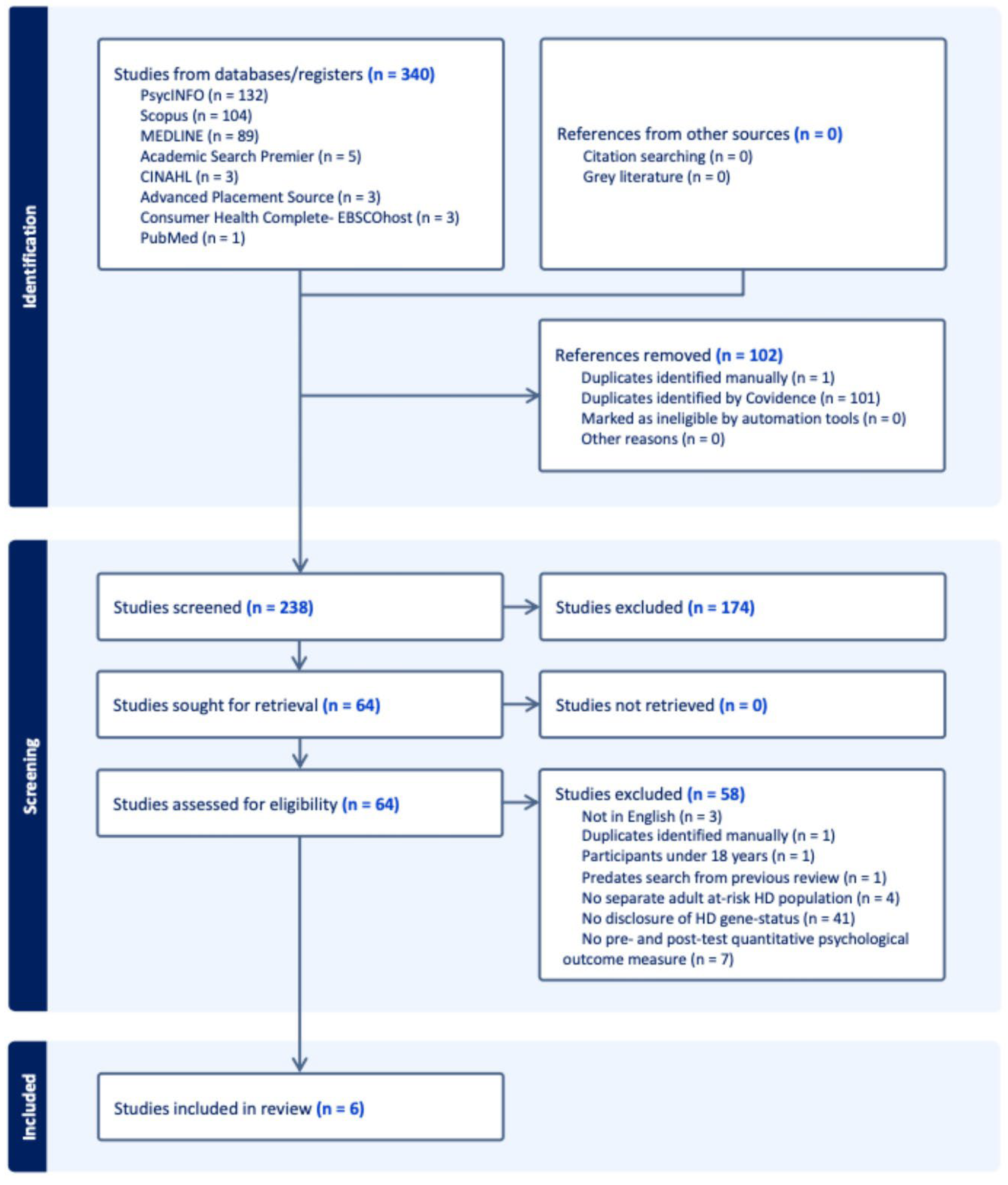

Table 1.
Eligibility criteria for inclusion in the scoping review.
| Condition or domain being studied | Huntington’s disease |
| Population |
Included: Adults at risk for Huntington’s disease Excluded: Children< 18 years old, adults not at risk for HD, or an HD at-risk sample that was not separable from other genetically inherited conditions, using confirmatory genetic, prenatal genetic or linkage analysis testing |
| Intervention(s) or exposure(s) |
Included: Disclosure of genetic testing results for adults at-risk of HD with psychological variables at the individual level Excluded: Genetic testing that was conducted using only confirmatory genetic testing, prenatal genetic, or linkage analysis testing |
| Comparator(s) or control(s) | Not applicable |
| Context | Included: Studies from any country, studies from any care setting |
| Study Characteristics |
Included
|
Table 2.
Characteristics of studies assessing psychological impact of predictive genetic testing for HD (2014-2026).
Table 2.
Characteristics of studies assessing psychological impact of predictive genetic testing for HD (2014-2026).
| Author (Country) | Non-carriers (n) | Asymptomatic carriers (n) | Symptomatic carriers (n) | Assessment time points | Measures used |
| Van der Meer et al. 2015 (Netherlands) | 26 | 54 | n/a | Baseline, 0-2 mo, 6-8 mo | - Brief Symptom Inventory |
| Ibisler et al. 2017 (Germany) | 7* | 12* | n/a | 12-15 mo | - Interview item to self-report overall emotional state since disclosure |
| Lêdo et al. 2017 (Portugal) | 29† | n/a | 4, 7, or 10 yr | - Global Severity Index - Brief Symptom Inventory - Positive Symptoms Total Index - Positive Symptoms Distress Index |
|
| Quaid et al. 2017 (Canada, USA) | 51 | 50 | n/a | Baseline, 9 mo, 18 mo, 27 mo, 36 mo, 45 mo, 54 mo, 63 mo, 72 mo, 81 mo, 90 mo, 99 mo, 108 mo, 116 mo | - Beck Depression Inventory - UHDRS behavioral (depression, esteem, aggressive behavior, compulsions) - Life Experiences Survey |
| Stuttgen et al. 2018 (USA) | 130‡ | 56 | n/a | Baseline, 3 mo, 6 mo, 9 mo, 12 mo, 18 mo, 24 mo, 3 yr, 4 yr, 5 yr 6 yr, 7 yr, 8 yr, 9 yr, 10 yr, 11 yr | - Visual analog scale for Risk Perception |
| Bonnard et al. 2019 (France) | 9 | 9 | n/a | 2-10 yr | - Standardized telephone interview (motivations for testing, family attitudes towards 25% at-risk individuals taking test) |
Note: *Maximum number of possible participants. The authors indicate that one participant from the three groups (non-carriers, carriers, unknown) did not respond to the interview item, but the authors do not identify which group is missing the data-point. †Total number of participants. The authors provide Brief Symptom Inventory subscores for HD test-takers, but they do not report separate scores for non-carriers and carriers. ‡ Non-carrier group includes 15 individuals who completed counseling, but whose results were uninformative by linkage analysis or whose status remained undisclosed. The authors report results for 130 non-carrier or unknown participants.
Table 3.
Additional characteristics of studies assessing psychological impact of predictive genetic testing for HD (2014-2026).
Table 3.
Additional characteristics of studies assessing psychological impact of predictive genetic testing for HD (2014-2026).
| Author (Country) | Study period | Study design | Construct measured | Assessments to measure constructs |
| Van der Meer et al. 2015 (Netherlands) | 2008-2013 | Prospective | - Distress (somatization, obsessive-compulsive, interpersonal sensitivity, depression, anxiety, hostility, phobic anxiety, paranoid ideation, psychoticism) | - Brief Symptom Inventory |
| Ibisler et al. 2017 (Germany) | 2010-2012 | Cross-sectional | - Overall emotional state, decisional regret | - Self-report interview item |
| Lêdo et al. 2017 (Portugal) | 2005-2015* | Cross-sectional |
- Psychopathology or emotional distress (somatization, obsessive-compulsive, interpersonal sensitivity, depression, anxiety, hostility, phobic anxiety, paranoid ideation, psychoticism) (global severity index (GSI), positive symptoms total (PSTI) and positive symptom distress index (PSDI)) |
- Brief Symptom Inventory |
| Quaid et al. 2017 (USA) | 1999-2009 | Prospective | - Depression - Behavioral disturbances (depressed mood, low self-esteem/guilt, anxiety, suicidal thoughts, disruptive or aggressive behavior, irritable behavior, preservative/obsessional thinking, compulsive behavior, delusions, hallucinations, apathy) |
- Beck Depression Inventory - UHDRS behavioral |
| Stuttgen et al. 2018 (USA) | 1986-1998 | Prospective | - Risk perception | - Visual analog scale (100-millimeter) |
| Bonnard et al. 2019 (France) | 1992-2016 | Cross-sectional | - Personal motivations, family attitudes | - Self-report interview item |
Table 4.
Finding from studies assessing psychological impact of predictive genetic testing for HD (2014-2026).
Table 4.
Finding from studies assessing psychological impact of predictive genetic testing for HD (2014-2026).
| Author (Country) | Follow-up period | Construct measured | Non-Carrier Findings | Asymp Carrier Findings | Power for Moderate Effect Size |
| Van der Meer et al. 2015 (Netherlands) | 8 mo | - Brief Symptom Inventory | NS | NS | n/a |
| Ibisler et al. 2017 (Germany) | 12-15 mo | - Interview item to self-report overall emotional state at time of interview | Lower | Higher | n/a |
| Lêdo et al. 2017 (Portugal) | 4-10 yr | - Brief Symptom Inventory |
Higher than population means, lower than clinical significance threshold | n/a | |
| Quaid et al. 2017 (USA) | 10 yr | - Beck Depression Inventory - UHDRS behavioral (depression, esteem, aggressive behavior, compulsions) |
Sig lower NS |
Sig higher NS |
n/a |
| Stuttgen et al. 2018 (USA) | 1-11 yr | - Visual analog scale for Risk Perception | Sig lower (unexpected change) |
Sig higher (unexpected change) | n/a |
| Bonnard et al. 2019 (France) | 2-10 yr | - Standardized telephone interview (motivations for testing, family attitudes) | No difference | No difference (some effects in untested family members) |
n/a |
Table 5.
Descriptive comparison of findings from 2015 review and the current review.
| Review (number of studies) | Nature of post-disclosure differences (number of studies) | Frequency of reported constructs or measures (number of studies) | Frequency of reported difference by construct or measure (number of studies with reported difference) |
| 2015 review (8) | Sig diff (3) Diff (2) No diff (4) |
Beck Depression Inventory (6) Impact of Events Scale (3) State Trait Anxiety Inventory (2) Beck Hopelessness Scale (2) Minnesota Multiphasic Personality Inventory (1) Global Severity Index (1) Short Form-12 (1) General Health Questionnaire-30 (1) Self Injurious Behavior Scale (1) Unified Huntington’s Disease Rating Scale (1) |
Beck Depression Inventory (2 sig diff, 1 diff, 3 no diff) Impact of Events Scale (2 sig diff, 1 no diff) State Trait Anxiety Inventory (2 no diff) Beck Hopelessness Scale (1 sig diff, 1 no diff) Minnesota Multiphasic Personality Inventory (1 no diff) Global Severity Index (1 diff) Short Form-12 (1 diff) General Health Questionnaire-30 (1 no diff) Self Injurious Behavior Scale (1 no diff) Unified Huntington’s Disease Rating Scale (1 sig diff) |
| Current Review (6) |
Sig diff (2) Diff (2) No diff (2) No report (1) |
Brief Symptom Inventory (2) In-house standardized interviews (2) Beck Depression Inventory (1) Unified Huntington’s Disease Rating Scale (1) Risk Perception scale (1) |
Brief Symptom Inventory (1 no diff, 1 no report) In-house standardized interviews (1 diff, 1 no diff) Beck Depression Inventory (1 sig diff) Unified Huntington’s Disease Rating Scale (1 no diff) Risk Perception scale (1 sig diff) |
Note: Sig diff = statistically significant difference; Diff = difference without calculated statistical significance; No diff = no statistically significant difference or other reported difference; No report = no differences reported separately from other disorders.
Disclaimer/Publisher’s Note: The statements, opinions and data contained in all publications are solely those of the individual author(s) and contributor(s) and not of MDPI and/or the editor(s). MDPI and/or the editor(s) disclaim responsibility for any injury to people or property resulting from any ideas, methods, instructions or products referred to in the content. |
© 2026 by the authors. Licensee MDPI, Basel, Switzerland. This article is an open access article distributed under the terms and conditions of the Creative Commons Attribution (CC BY) license (http://creativecommons.org/licenses/by/4.0/).
Copyright: This open access article is published under a Creative Commons CC BY 4.0 license, which permit the free download, distribution, and reuse, provided that the author and preprint are cited in any reuse.