

Submitted:
03 September 2026
Posted:
04 September 2026
You are already at the latest version
Abstract
In mountain areas, tourism changes land use and puts development, environmental fragility and livelihoods at odds, and managing the competition is not always simple. The question this study poses is whether the stakeholders that communities consider to be central to land-use governance in the tourism-pressured Upper Beas Basin of Himachal Pradesh, India, are also found to be effective? The evidence is derived from a structured household survey conducted over three rounds of field visits, between 2024 and 2026, with 300 respondents across nine settlements. We created three composite measures from the Likert-scale responses: a Stakeholder Role Index (SRI), a Stakeholder Effectiveness Index (SEI) and a Community Perception Index (CPI); and calculated a Role-Effectiveness Mismatch (REM) as SRI – SEI. Friedman and Wilcoxon procedures were used to test for differences among the stakeholders, Kruskal-Wallis and Holm-adjusted Mann-Whitney tests were used to test for differences across the tourism contexts, and the results were compared with HC3 regression. The highest scores were achieved by local communities in both role (SRI = 3.435) and effectiveness (SEI = 3.268). The private sector had the highest positive mismatch (REM = +0.381), while the NGOs/Civil Society had the highest negative mismatch (REM = -0.420). The tourism context had little impact on SRI and SEI but was significant for CPI (H = 10.609, p = 0.005) with high and intermediate tourism settlements being significantly different. Overall, the analysis reveals that prominence in governance and perceived effectiveness are two separate dimensions and that REM offers a practical way to locate where-and for which actors-the two diverge in mountain land governance.
Keywords:
land governance
; stakeholder governance
; mountain landscapes
; tourism
; Himalayan region
; governance effectiveness
; stakeholder participation
; land-use planning
1. Introduction
Land systems in the mountain areas are rapidly changing. The development of tourism, new infrastructure, changing livelihoods, increasing settlements and environmental pressures all impact on the same limited and sometimes hard-to-reach space simultaneously. Tourism is a significant factor here, contributing to the demand for accommodation, transport, recreation and associated facilities, and exacerbating the competition for land and natural resources. There is now a growing volume of research that considers tourism as a structural driver of land-use change and that emphasises the importance of the location and manner of this change, not just the market itself, but the planning system, land-use regulation, institutional coordination and land administration organisation [1].
This observation places land governance at the very heart of any analysis of the dynamics of tourism-driven change in the mountains. Formal planning and environmental regulation are not the only factors that determine land-use outcomes, other aspects of the policy context such as infrastructure provision, economic incentives, development controls and decisions made at various administrative levels also influence land-use outcomes [2]. Krawchenko and Tomaney define land-use governance as multi-actor and multi-scalar, meaning that it is the entire system of policies, institutions and practices that influence the use and management of land, either intentionally or unintentionally [2]. Tourism destinations further accentuate this picture, as the government, private sector, local communities and civil-society organisations all have their own powers, interests and resources and need to be brought together in a way that requires collaborative governance. Collaborative governance is a process in which public agencies and non-state actors make decisions together, and Ansell and Gash [3] highlight the role of trust, institutional design, power and resource asymmetries, leadership and a shared sense of purpose. A parallel line of work shows that sustainability of a destination is not achieved by any one institution, but by the interaction of the public authorities, businesses, communities and others [4,5]. Roxas et al. [5], for example, outline the roles of various stakeholders in the governance of sustainable tourism, and consider regulation, conservation, livelihoods and stakeholder interaction as interdependent aspects of the governance of a destination.
But participation is not necessarily effective and having an institutional role does not ensure it. Much of the stakeholder research focuses on who participates, what their interests are and how they relate to each other. Although valuable, this emphasis can leave an important governance gap insufficiently addressed, an actor can have real formal responsibility, or be perceived as influential, and still be perceived as relatively ineffective at the very functions that role suggests. The other way around is also true, actors who have only a small amount of formal power are sometimes attributed with a disproportionate impact on governance outcomes. In fact, recent research on destination-governance is a good example of this shift towards multidimensional evaluation, where participation is differentiated from effectiveness, responsibility, coherence, openness and quality [6]. In the context of mountain tourism, the point has a specific significance, as the actors involved have very different institutional and place-based capacities. There are formal regulatory and planning powers with government agencies, tourism investment, employment and land development driven by private tourism enterprises, place-based knowledge and direct reliance on land and environmental resources with local communities and environmental, social and advocacy capacities provided by NGOs or civil-society organisations. Research among stakeholders in mountain tourism reveals that they tend to value different sustainability measures, and that is why governance must be sensitive to the stakeholders involved [7]. In addition to this, Work from Sikkim argues that ecological and socio-economic processes are both interacting to shape the evolution of a tourism area and that community-based participation and capacity building is needed to strengthen the processes of evolution [8].
The Indian Himalaya is a place where these tensions are most evident, with tourism being a key component of local livelihoods, while also straining the environment and socio-economic systems. The Indian Trans-Himalaya studies reveal that tourism may create livelihood opportunities but it can also increase socio-ecological vulnerability, siphon money out of the local economy and make people question the sustainability of the current tourism model [9]. The same applies to tourism institutions in protected areas in the Himalayas i.e. the institutional structure that integrates government, local communities and other actors is very important, but a lack of governance can allow powerful actors to take control of the direction of tourism development [10]. The Manali sub-division is a suitable area to analyse these dynamics as it has experienced significant land-use change with an increase in built-up areas and the shift of agricultural land use associated with settlement growth, horticulture, tourism, road construction and economic restructuring [11,12]. This is a space that is interesting because it unfolds between public institutions, tourism businesses, local communities and civil-society actors, and because it is an area where questions can be raised about whether the roles that people assign to institutions are congruent with their perceptions of the effectiveness of these institutions.
Effectiveness is not the only question; it is also about the quality of governance in the communities. Effectiveness is what institutions and stakeholders are perceived as delivering, while community perceived governance is about whether the recipient of the governance considers the arrangements as trustworthy, fair, inclusive, accountable and appropriate. Legitimacy, transparency, accountability, inclusiveness, fairness, connectivity and resilience have been identified as indicators of governance quality in several studies [13,14] and more recent environmental-governance research posits that people’s experiences of participation and institutional process are part of the process by which they make judgements about governance quality [15]. These strands have not often been combined to consider a simple question: do communities consider the actors they perceive as central to governance to also be effective? That question has received little empirical focus in tourism-pressured mountain land systems, and in the Indian Himalaya in particular.
This study aims to fill that gap. It investigates the relationship between perceived role and perceived effectiveness of stakeholders and proposes a diagnostic, the Role–Effectiveness Mismatch (REM). It also incorporates community perceived governance and questions if this is different across settlements under varying levels of tourism pressure. The analysis is structured around three questions: what do local communities think of the roles and effectiveness of the key actors in land-use governance, do the roles match the perceived effectiveness and do there appear to be significant mismatches in the roles of the key actors, and which ones are these? and does the community-perceived governance differ across the tourism contexts? Two hypotheses follow. The first is the perception of role and effectiveness of stakeholders vary across stakeholder groups; the second is the perception of governance varies across tourism contexts. As in the observational survey design, both are considered to be comparative and associational statements and not causal. It’s a two-fold contribution. The study is empirical and demonstrates that stakeholder prominence and perceived effectiveness are two distinct concepts and that the difference between them reveals governance gaps specific to a stakeholder. Conceptually, reading that gap in conjunction with community perceived governance and tourism-context variation presents a place-sensitive narrative of governance alignment in a rapidly evolving tourism landscape in the Himalayas.
2. Materials and Methods
2.1. Study Area
Nine settlements of the Upper Beas Basin in Kullu District, Himachal Pradesh, India were selected for fieldwork, as they are located in various tourism and socio-economic contexts within the same basin. The settlements of Manali, Old Manali, Bashist and Solang were considered as high tourism settlements, Prini, Barshai and Jagatsukh as intermediate tourism and Buruwah and Sethan as remote or agro-pastoral settlements (Figure 1). This classification of settlements was a conscious design decision and reflects the varying institutional and socio-spatial contexts in which communities are faced with tourism, land use change and environmental governance.
2.2. Research Design and Field Survey
A structured household survey was employed to collect community perceptions on the roles of stakeholders, the effectiveness of stakeholders and quality of governance in relation to land use and environment. Primary data were collected during three field rounds i.e. May 2024, April 2025 and May 2026. In this context, multiple visits to the field were significant as the people who reside in these settlements are not permanently or seasonally located, certain local households rent their land for tourism and relocate for a period to other areas of the state. This meant that not all households that are part of the local socio-economic fabric were necessarily physically present during a particular round. A total of 300 respondents were surveyed in the 9 settlements. The three rounds are best viewed as a single survey design, not as an independent longitudinal panel and not necessarily the same respondents were necessarily followed from one round to the next.
2.3. Sampling and Respondent Selection
The nine settlements were sampled as strata and households were randomly selected in each of these. A sample of 300 respondents was obtained, consisting of 176 from high-tourism settlements, 85 from intermediate-tourism settlements and 39 from remote or agro-pastoral settlements. Men accounted for 194 respondents (64.7%) and women for 106 (35.3%). The respondents were drawn from a wide age group and occupation and the survey was specifically designed to include those with first-hand experience of the local environment, livelihood and governance situation who could comment on these. The survey was based on the perception of the performance of the institutions and stakeholders, so that each stakeholder-role and effectiveness measure is a community perception.
2.4. Questionnaire and Measurement Framework
A structured questionnaire with 75 items was used, organised into six sections: (A) Respondent characteristics; (B) Awareness of stakeholders; (C) Perceived stakeholder roles; (D) Perceived stakeholder effectiveness; (E) Community perceptions of governance; and (F) Policy priorities. The four stakeholder categories that were studied were: Government, NGOs/Civil Society, Private Sector and Local Community.
Perceived roles were assessed on six dimensions: decision-making, land-use control, forest and environmental protection, employment and income generation, livelihood diversification and institutional access. Perceived effectiveness was measured using 10 dimensions: efficiency, responsiveness, impact on livelihoods and income, equity, inclusion, reach of programmes or schemes, awareness of the environment, sustainable land use, and environmental degradation. Eleven items across the domains of trust and institutional credibility, accessibility and inclusiveness, perceived fairness and equity, and satisfaction with governance outcomes were used to capture community perceptions of governance. The majority of the perception items were measured on a five-point Likert-type scale ranging from 1 (very low/strongly disagree) to 5 (very high/strongly agree) and composite scores were subsequently calculated for the appropriate sets of items.
2.5. Construction of Composite Indices
These items were used to construct three composite measures i.e. the Stakeholder Role Index (SRI), the Stakeholder Effectiveness Index (SEI) and the Community Perception Index (CPI).
2.5.1. Stakeholder Role Index
The Stakeholder Role Index (SRI) was calculated as the mean of the six role dimensions (Equation (1)).
where Ris is the score of the respondent for role dimension i for stakeholder s.
The index scores are on a scale from 1 to 5, with higher scores indicating a higher perceived stakeholder role in local governance.
2.5.2. Stakeholder Effectiveness Index
The Stakeholder Effectiveness Index (SEI) was calculated as the mean of the ten effectiveness dimensions (Equation (2)). The higher the score, the more effective the perceived effectiveness.
where Eis is the perceived effectiveness score of the respondent on dimension i, stakeholder s.
2.5.3. Community Perception Index
The 11 governance-perception items are used to calculate the CPI (Equation (3)). It is different from the other two indices in that it is a measure of the community’s perception of the quality of governance, not the performance of any one stakeholder.
where Pi is the score that the respondent gives to the item “governance-perception” i.
2.6. Role-Effectiveness Mismatch
A Role-Effectiveness Mismatch (REM) was calculated for every stakeholder to determine if the role a stakeholder is perceived to be in is the same as the effectiveness attributed to that role (Equation (4)).
A positive REM indicates that the perceived role is greater than the perceived effectiveness whereas a negative REM indicates that the perceived effectiveness is greater than the perceived role and values close to zero indicate that the perceived role and effectiveness are aligned. The use of REM here is not as a proxy for the actual performance of institutions, but as a governance alignment diagnostic.
2.7. Statistical Analysis
Data from all respondents were coded and organized in MS Excel and the composite indices derived from the answers to the questionnaires were verified with the respondent-level data. The Friedman test for related samples [16] was used to test for differences in SRI and SEI between the stakeholders because all four stakeholder categories were rated by each respondent. When the omnibus test was significant, then pairwise Wilcoxon signed-rank tests were performed with a Holm correction to prevent multiple comparison inflation [17,18]. Within each stakeholder, the difference between SRI and SEI was tested using a paired Wilcoxon signed-rank test [17] with the size of the paired difference being measured by Cohen’s dz effect size [19].
where D is the difference between the respondent level SRI and SEI.
The Kruskal-Wallis test [20] was used to assess variation across the three tourism-context groups and when the omnibus test was significant, Holm-adjusted pairwise Mann–Whitney U tests were used to determine which group contrasts were responsible for the omnibus test [18,21]. Finally, ordinary least-squares models were fitted to overall SRI, SEI and CPI with age group, gender and tourism context as predictors; robust inference [22,23] was applied using HC3 heteroskedasticity-consistent standard errors. The models were not considered causal models because the survey data were observational. The level of significance used for the statistical significance was 2-sided:
Where appropriate, effect sizes and confidence intervals were reported.
3. Results
3.1. Stakeholders’ Roles and Perceived Effectiveness
There were significant differences between the four stakeholder groups in their perceptions of role and effectiveness (Table 1). The highest perceived role score (SRI = 3.435) was received by the Local Community, followed by the Private Sector (3.079), Government (2.469) and NGOs/Civil Society (2.051). A similar but not identical ordering was seen for perceived effectiveness with Local Community having the highest SEI (3.268) followed by Private Sector (2.698), NGOs/Civil Society (2.471) and Government (2.414).
The Friedman test showed that there were statistically significant differences between the four stakeholder groups for both dimensions. SRI differed significantly across stakeholders, χ2(3) = 747.80, p<0.001, as did SEI, χ2(3) = 581.95, p<0.001. For each pair of stakeholders, Holm adjusted Wilcoxon signed-rank comparisons were significant for both indices, indicating that the respondents were clearly distinguishing between the stakeholders in both perceived role and perceived effectiveness. The more significant finding is when the two rankings are juxtaposed. Government was assigned a much higher governance role than NGOs/Civil Society, and NGOs/Civil Society performed better on effectiveness. This reversal demonstrates that perceived stakeholder prominence does not necessarily correspond to perceived effectiveness.
3.2. Role-Effectiveness Mismatch
Comparing SRI with SEI revealed statistically significant role–effectiveness mismatches for each of the four groups, although the size and direction of the gaps were quite variable (Table 1,Figure 2). The government’s perceived role rated slightly ahead of its perceived effectiveness with a small positive REM of +0.056. This difference was statistically significant (p = 0.025), but the effect size was very small (dz = 0.140). In terms of being effective, Government was the closest of the four to playing its role. NGOs/Civil Society exhibited a negative REM of -0.420 (p<0.001; dz = -1.129). Perceived effectiveness was significantly higher than the role respondents assigned, with the largest negative mismatch in the analysis, and a clear positive mismatch between perceived effectiveness and role. The highest positive mismatch was for the Private Sector (REM = + 0.381; p < 0.001; dz = 0.930). In other words, its perceived role was relatively strong, but its effectiveness was not. The Local Community also had a positive mismatch (REM = + 0.167, p < 0.001; dz = 0.434), but was smaller compared to the gap observed for the Private Sector. In all four groups, therefore, role and effectiveness are empirically distinct aspects of the perception of governance
3.3. Governance Perceptions Across Tourism Contexts
The situation at the level of tourism context reversed (Table 2). There was no significant difference between high, intermediate and remote/agro-pastoral settlements in the case of SRI (H (2) = 2.818, p = 0.244) and SEI (H (2) = 2.062, p = 0.357). The Community Perception Index, on the other hand, gave a different picture, and was significantly different between the three contexts (H (2) = 10.609, p = 0.005). Tourism context had no significant association with the overall assessment of stakeholder roles or effectiveness, but was associated with broader community perceptions of governance. The CPI difference was only significant when compared to high- and intermediate-tourism settlements (U = 9283.5, p = 0.0045), but not when compared to high- versus remote, or intermediate- versus remote (p = 0.282 in both cases). The fact that the SRI and SEI did not change significantly, compared to the CPI, indicates that the position of a settlement on the tourism continuum has a greater influence on the overall assessment of governance than on the assessment of individual stakeholders’ role and effectiveness.
3.4. Multivariable Robustness Analysis
The HC3 regressions were used as a multi-variate test to see if the demographic characteristics and tourism context followed the three governance measures (Table 3). The three models captured only modest shares of variance-10.3% for SRI (R2 = 0.103; adjusted R2 = 0.085), 5.6% for SEI (R2 = 0.056; adjusted R2 = 0.037) and 9.4% for CPI (R2 = 0.094; adjusted R2 = 0.075), yet each was statistically significant overall. The respondents in the 25-40 age group and under 25 age group scored higher than the 40-60 age group, while women scored slightly lower for SRI. For SEI, respondents aged 25–40 and those below 25 reported significantly higher scores than the 40–60 reference group, whereas gender and tourism-context coefficients were not statistically significant. The 25-40 age group had scores higher than the 40-60 reference for CPI and women had lower scores. Importantly, the CPI was significantly lower for intermediate-tourism settlements than for high-tourism settlements (β = -0.083) and this was confirmed by the significant pairwise comparison found in the non-parametric analysis. The remote/agro-pastoral group was not significantly different from the high-tourism reference group. The agreement between the non-parametric and the multivariable analyses gives credit to the difference in community perceived governance between high and intermediate tourism. These associations should be interpreted as non-causal however, because of the observational design of the study.
4. Discussion
4.1. Stakeholder Prominence Does Not Imply Stakeholder Effectiveness
First, it is important to note that communities are quite distinctive in their separation of the four stakeholder groups, both on perceived role and on perceived effectiveness. The Local Community led on both counts; the Private Sector was second. However, the roles reversed in the two rankings with Government being given the bigger role and NGOs/Civil Society being perceived as the more effective of the two. This is important because there is a growing understanding of tourism governance as a networked process, where a variety of actors contribute with various resources, authority and capacities [3,4,5]. Similarly, destination-governance research does not provide much information on the quality of governance, as it also depends on coherence, responsibility, institutional capacity and the implementation of governance functions [6]. It is particularly apparent in mountain areas, where communities, businesses, governments and civil-society organisations are embedded in fragile ecological and social systems [7]. More recent research from the Garhwal Himalaya has also highlighted the importance of opportunity and capacity of the community to participate in sustainable tourism, highlighting that the presence of stakeholders is not enough to ensure effective participation [24]. Taken together, these findings suggest a new focus from stakeholder presence to stakeholder performance. Stakeholder participation alone therefore provides limited insight into whether communities perceive an actor as effectively fulfilling its governance responsibilities.
4.2. Role-Effectiveness Mismatch Reveals Differentiated Governance Gaps
The REM patterns indicate that the stakeholder groups are in very different positions, with the perceived role and the perceived effectiveness diverging from each other. These gaps are not just differences in performance, but indicators that affect the distribution of influence, formal responsibility and perceived contribution among actors. The negative mismatch suggests that NGOs/Civil Society have a greater impact than they are acknowledged for in terms of roles, which is consistent with evidence from protected areas in the Himalayas on the value of arrangements that bring community and civil-society capacities in with government institutions [10]. The Private Sector is the opposite, a prominent governance role, but not a role that is perceived as being as effective. In tourism contexts, the gap is one that should not be taken lightly as it is possible to have private actors who can guide development but are also held accountable to governance objectives that extend beyond investment and economic activity [5]. What is left is a series of unique governance gaps, not a single governance performance ladder. The findings also highlight that local communities are actors in governance as well, a view that has been echoed in recent tourism studies in the Himalayas that view participation of local communities as a key component of sustainable development [24]. The wider lesson is that measuring governance is not simply about whether stakeholders are involved, it is also about whether they feel involved, have responsibilities and contribute.
4.3. Tourism Context Influences Governance Perceptions Rather Than Stakeholder Rankings
The tourism-context results provide a valuable spatial qualification. The SRI and SEI were similar in all high, intermediate- and remote/agro-pastoral settlements, with no significant differences. However, CPI acted differently, there was a lot of variation and the post-hoc test showed that variation was between the high and intermediate tourism settlements, which even persisted in the HC3 model after age and gender were accounted for. It suggests that the overall assessment of the governance system is more important to the assessment of the communities than the ranking of individual stakeholders in the tourism context. This is in line with the concept of governance as a multidimensional phenomenon involving participation, legitimacy, coherence, accountability and institutional performance [6] and with the research in the Indian Himalayas on livelihood improvements and socio-ecological stress and institutional challenges [9,10]. Spatial context, therefore, is less important in terms of who is included or excluded, but more in terms of how governance outcomes are felt and evaluated- a significant issue for land governance, where the pressure of tourism is not evenly distributed across settlements.
4.4. Implications for Mountain Land Governance
There are three implications for practice. The first is that participation should not be valued as an end in itself but that the responsibilities assigned to a stakeholder are accompanied by the appropriate authority, resources, coordination and accountability. The second is the negative REM for NGOs/Civil Society, which is an opening, an invitation to involve more fully into governance those who are perceived as effective in their work, but who are not formally included. The third is that the positive mismatch for the Private Sector indicates that there is a need for more explicit environmental and social responsibilities for tourism enterprises in order to align with their increasing economic influence.
These are in line with a broader body of evidence that sustainable tourism requires coordinated public-private-community arrangements, rather than the work of individual actors [3,4,5,25]. Research on stakeholder engagement has similar arguments in favour of multi-stakeholder approaches that integrate community, government and tourism-business interests in the management of a destination [26,27]. The results also argue for governance that is sensitive to place. A single solution does not fit all, as the actual differences in community life with tourism development are many. Governance mechanisms should rather be responsive to local institutional capacity, exposure to tourism and community priorities. That would involve providing communities with more influence in the planning and development of tourism, establishing more transparent accountability for tourism businesses and developing more sustainable and positive roles for civil-society organisations in the Manali sub-division.
5. Conclusions
This study reveals that the roles assigned to the stakeholders and their effectiveness attributed to them are not always the same in the environmental and tourism governance of the Manali sub-division. The Role–Effectiveness Mismatch (REM) revealed a number of patterns i.e. Government was found to be close to the alignment, NGOs/Civil Society were rated more effective than their role would indicate and the Private Sector had the largest positive gap between role and effectiveness. Local communities were the most effective overall, but also had a slight effectiveness deficit. Overall role and effectiveness were not differentiated by tourism context, but tourism context did influence the communities’ perceptions of governance more broadly, as governance is best understood settlement by settlement, not in the aggregate.
There are a number of caveats to these findings. The design is based on perceptions and not on objective measures, sample sizes are not equal across the tourism contexts, tourism setting is not a continuous variable and the study is observational, which means that it cannot make causal claims. The three rounds are, furthermore, not a longitudinal panel of the same households over time, but periods of field survey. Future research may be able to match community perceptions with objective measures of institutional performance, collect longitudinal household data, quantify the intensity of tourism and compare it with other destinations in the Himalayas. Research of this nature would help to understand the extent to which the REM approach can be carried out and to better understand the link between stakeholder alignment and environmental sustainability and tourism governance in various mountain contexts.
Author Contributions
Conceptualization, Saransh Saransh; methodology, Saransh Saransh; investigation, Saransh Saransh; formal analysis, Saransh Saransh; writing—original draft preparation, Saransh Saransh; visualization, Saransh Saransh and Sourav Suman; writing—review and editing, Saransh Saransh, Bindhy Wasini Pandey, and Sourav Suman; supervision, Bindhy Wasini Pandey. All authors have read and agreed to the published version of the manuscript.
Funding
This research received no external funding.
Data Availability Statement
The data presented in this study are available from the corresponding author on reasonable request, subject to appropriate privacy and ethical considerations.
Acknowledgments
None.
Conflicts of Interest
The authors declare no conflicts of interest.
References
- Kourkouridis, D.; Salepaki, A.; Kyriakidou, E.; Karanikolas, N.; Frangopoulos, Y. Land Governance in Tourism Contexts: A Systematic Review of Spatial Planning and Regulatory Approaches (2000–2025). Land 2026, 15, 619. [CrossRef]
- Krawchenko, T.A.; Tomaney, J. The Governance of Land Use: A Conceptual Framework. Land 2023, 12, 608. [CrossRef]
- Ansell, C.; Gash, A. Collaborative Governance in Theory and Practice. Journal of Public Administration Research and Theory 2008, 18, 543–571. [CrossRef]
- Bichler, B.F.; Lösch, M. Collaborative Governance in Tourism: Empirical Insights into a Community-Oriented Destination. Sustainability 2019, 11, 6673. [CrossRef]
- Roxas, F.M.Y.; Rivera, J.P.R.; Gutierrez, E.L.M. Mapping Stakeholders’ Roles in Governing Sustainable Tourism Destinations. Journal of Hospitality and Tourism Management 2020, 45, 387–398. [CrossRef]
- Bono i Gispert, O.; Anton Clavé, S.; Casadesús Fa, M. The TDG Barometer: A Self-Assessment Tool to Integrate Quality in the Measurement of Tourism Destination Governance. International Journal of Tourism Research 2024, 26, e2774. [CrossRef]
- Colasante, A.; D’Adamo, I.; De Massis, A.; Italiano, S. An Exploratory Study of Stakeholder Views on the Sustainable Development of Mountain Tourism. Sustainable Development 2024, 32, 3722–3735. [CrossRef]
- Chakraborty, P.; Ghosal, S. An Eco-Social Exploration of Tourism Area Evolution in Mountains through Stakeholders’ Perspective. Environmental Development 2024, 49, 100963. [CrossRef]
- Mahar, N.; Dobriyal, P.; Badola, R.; Hussain, S.A. Tourism on the Roof of the World: Socio-Ecological Impacts of Tourism on the Indian Trans-Himalaya. Land Use Policy 2024, 138, 107031. [CrossRef]
- Badola, R.; Hussain, S.A.; Dobriyal, P.; Manral, U.; Barthwal, S.; Rastogi, A.; Gill, A.K. Institutional Arrangements for Managing Tourism in the Indian Himalayan Protected Areas. Tourism Management 2018, 66, 1–12. [CrossRef]
- Vaidya, P.; Bhardwaj, S.K.; Sood, S. Land Use and Land Cover Changes in Kullu Valley of Himachal Pradesh. The Indian Journal of Agricultural Sciences 2018, 88, 902–906. [CrossRef]
- Negi, V.; Chandel, V.B.S.; Brar, K.K. Landscape Change Analysis of Upper Beas Valley, India Using CORONA and PlanetScope Imageries. Punjab Geographer 2022, 18, 9–29.
- Lockwood, M. Good Governance for Terrestrial Protected Areas: A Framework, Principles and Performance Outcomes. Journal of Environmental Management 2010, 91, 754–766. [CrossRef]
- Morgan, E.A.; Bush, G.; Mandea, J.Z.; Mareseni, T. Community Evaluation of Forest and REDD+ Governance Quality in the Democratic Republic of the Congo. Journal of Environmental Management 2023, 328, 116891. [CrossRef]
- van der Wel, K.; van de Mortel, M.; van de Grift, L.; Akerboom, S. How to Make Stakeholder Participation Work? Constructing Legitimacy in Environmental Policymaking. Journal of Environmental Policy & Planning 2025, 27, 166–181. [CrossRef]
- Friedman, M. The Use of Ranks to Avoid the Assumption of Normality Implicit in the Analysis of Variance. Journal of the American Statistical Association 1937, 32, 675–701. [CrossRef]
- Wilcoxon, F. Individual Comparisons by Ranking Methods. Biometrics Bulletin 1945, 1, 80–83. [CrossRef]
- Holm, S. A Simple Sequentially Rejective Multiple Test Procedure. Scandinavian Journal of Statistics 1979, 6, 65–70.
- Lakens, D. Calculating and Reporting Effect Sizes to Facilitate Cumulative Science: A Practical Primer for t-Tests and ANOVAs. Frontiers in Psychology 2013, 4, 863. [CrossRef]
- Kruskal, W.H.; Wallis, W.A. Use of Ranks in One-Criterion Variance Analysis. Journal of the American Statistical Association 1952, 47, 583–621.
- Mann, H.B.; Whitney, D.R. On a Test of Whether One of Two Random Variables Is Stochastically Larger than the Other. The Annals of Mathematical Statistics 1947, 18, 50–60. [CrossRef]
- White, H. A Heteroskedasticity-Consistent Covariance Matrix Estimator and a Direct Test for Heteroskedasticity. Econometrica 1980, 48, 817–838. [CrossRef]
- MacKinnon, J.G.; White, H. Some Heteroskedasticity-Consistent Covariance Matrix Estimators with Improved Finite Sample Properties. Journal of Econometrics 1985, 29, 305–325. [CrossRef]
- Verma, K.; Rawat, A.; Dhodi, R.K.; Dhodi, R. Community Participation in Sustainable Tourism Development: An Application of the MOA Model in the Garhwal Himalayas of Uttarakhand, India. International Journal of Tourism Policy 2024, 14, 545–561. [CrossRef]
- Wondirad, A.; Tolkach, D.; King, B. Stakeholder Collaboration as a Major Factor for Sustainable Ecotourism Development in Developing Countries. Tourism Management 2020, 78, 104024. https://doi.org/10.1016/j.tourman.2019.104024.
- Pham, K.; Andereck, K.L.; Vogt, C.A. Stakeholders’ Involvement in an Evidence-Based Sustainable Tourism Plan. Journal of Sustainable Tourism 2025, 33, 673–696. [CrossRef]
- Panagiotopoulou, P.; Skoultsos, S. Stakeholders’ Involvement in Sustainable Destination Management: A Systematic Literature Review of Existing Multi-Stakeholder Frameworks and Approaches. Tourism and Hospitality 2025, 6, 250. [CrossRef]
Figure 1.
Study area. Source: prepared by Authors, 2026 in QGIS using SOI shapefile, ALOS PALSAR DEM and ESRI basemap.
Figure 1.
Study area. Source: prepared by Authors, 2026 in QGIS using SOI shapefile, ALOS PALSAR DEM and ESRI basemap.
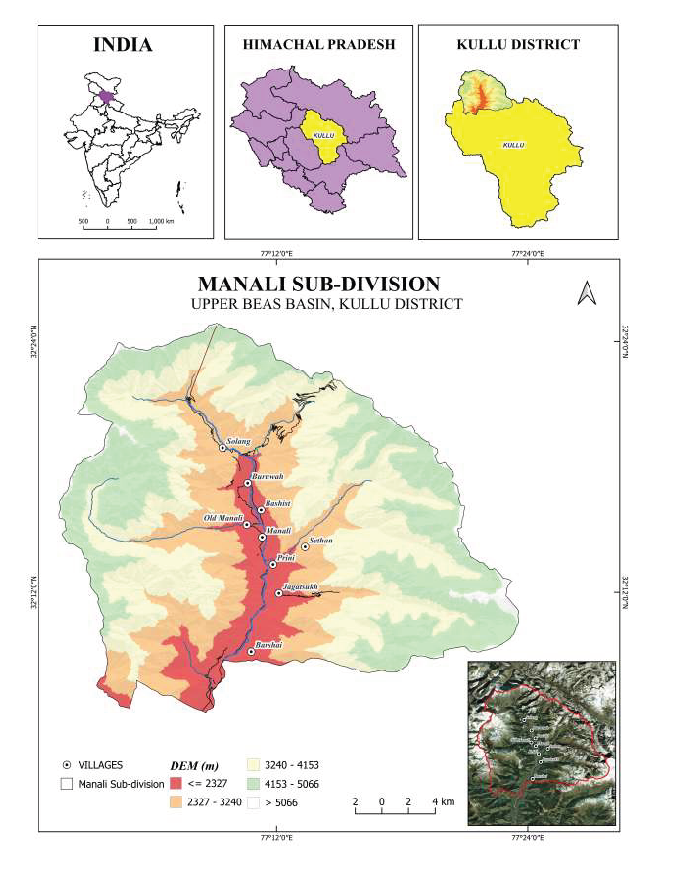
Figure 2.
Stakeholder Role–Effectiveness Matrix. Relationship between perceived stakeholder role (SRI) and perceived stakeholder effectiveness (SEI) across four stakeholder groups. The dashed 45° line represents equality between perceived role and effectiveness. Points below the line indicate positive REM (SRI > SEI), whereas points above the line indicate negative REM (SEI > SRI). Source: Authors’ calculations based on field-survey data, 2024–2026.
Figure 2.
Stakeholder Role–Effectiveness Matrix. Relationship between perceived stakeholder role (SRI) and perceived stakeholder effectiveness (SEI) across four stakeholder groups. The dashed 45° line represents equality between perceived role and effectiveness. Points below the line indicate positive REM (SRI > SEI), whereas points above the line indicate negative REM (SEI > SRI). Source: Authors’ calculations based on field-survey data, 2024–2026.
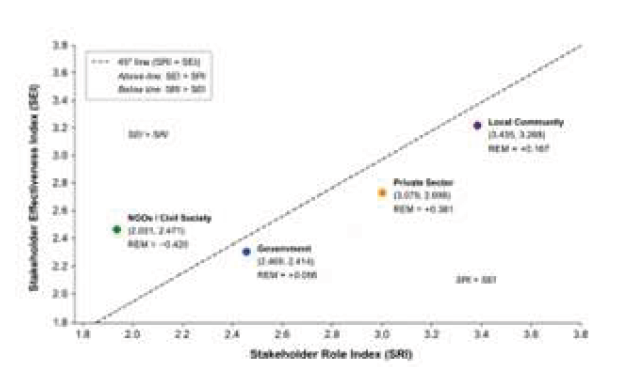

Table 1.
Stakeholder role, effectiveness and role–effectiveness mismatch.
| Stakeholder | SRI Mean ± SD | SEI Mean ± SD | REM | p (SRI vs. SEI) | Cohen’s dz |
| Government | 2.469 ± 0.331 | 2.414 ± 0.256 | +0.056 | 0.025 | 0.140 |
| NGO/Civil Society | 2.051 ± 0.304 | 2.471 ± 0.242 | −0.420 | <0.001 | −1.129 |
| Private Sector | 3.079 ± 0.332 | 2.698 ± 0.273 | +0.381 | <0.001 | 0.930 |
| Local Community | 3.435 ± 0.322 | 3.268 ± 0.245 | +0.167 | <0.001 | 0.434 |
|
Note: REM = SRI − SEI. p-values are from paired Wilcoxon signed-rank tests comparing SRI and SEI within each stakeholder group; dz is Cohen’s effect size for paired differences. Friedman test: SRI χ2(3) = 747.80, p < 0.001; SEI χ2(3) = 581.95, p < 0.001. Source: Authors’ calculations based on field-survey data, 2024–2026. | |||||
Table 2.
Tourism-context differences in governance perceptions.
| Outcome | High tourism | Intermediate | Remote/agro-pastoral | Kruskal–WallisH | p | Significant pairwise contrast |
| SRI | 2.772 | 2.737 | 2.744 | 2.818 | 0.244 | None |
| SEI | 2.704 | 2.726 | 2.724 | 2.062 | 0.357 | None |
| CPI | 2.691 | 2.599 | 2.648 | 10.609 | 0.005 | High vs intermediate |
| Note: Values are group means calculated from respondent-level observations. Kruskal–Wallis tests provide omnibus comparisons. Holm-adjusted pairwise Mann–Whitney U tests identified a significant CPI difference only between high- and intermediate-tourism settlements (U = 9283.5, p = 0.0045); other pairwise comparisons were non-significant (p = 0.282). Source: Authors’ calculations based on field-survey data, 2024–2026. | ||||||
Table 3.
HC3 robustness regression.
| Predictor | SRI β | SEI β | CPI β |
| Age 25–40 | +0.097*** | +0.064*** | +0.111** |
| Age >60 | +0.030 | +0.010 | −0.020 |
| Age <25 | +0.107*** | +0.064* | +0.083 |
| Female | −0.056** | +0.003 | −0.074* |
| Intermediate tourism | −0.027 | +0.024 | −0.083* |
| Remote/agro-pastoral | −0.032 | +0.020 | −0.050 |
| R2 | 0.103 | 0.056 | 0.094 |
| Adjusted R2 | 0.085 | 0.037 | 0.075 |
| Note: * p < 0.05; ** p < 0.01; *** p < 0.001. Reference categories are age 40–60, male, and high-tourism settlements. Coefficients are unstandardized β estimates from OLS models with HC3 heteroskedasticity-consistent standard errors. Source: Authors’ calculations based on field-survey data, 2024–2026. | |||
Disclaimer/Publisher’s Note: The statements, opinions and data contained in all publications are solely those of the individual author(s) and contributor(s) and not of MDPI and/or the editor(s). MDPI and/or the editor(s) disclaim responsibility for any injury to people or property resulting from any ideas, methods, instructions or products referred to in the content. |
© 2026 by the authors. Licensee MDPI, Basel, Switzerland. This article is an open access article distributed under the terms and conditions of the Creative Commons Attribution (CC BY) license (http://creativecommons.org/licenses/by/4.0/).
Copyright: This open access article is published under a Creative Commons CC BY 4.0 license, which permit the free download, distribution, and reuse, provided that the author and preprint are cited in any reuse.