
Submitted:
03 September 2026
Posted:
03 September 2026
You are already at the latest version
Abstract
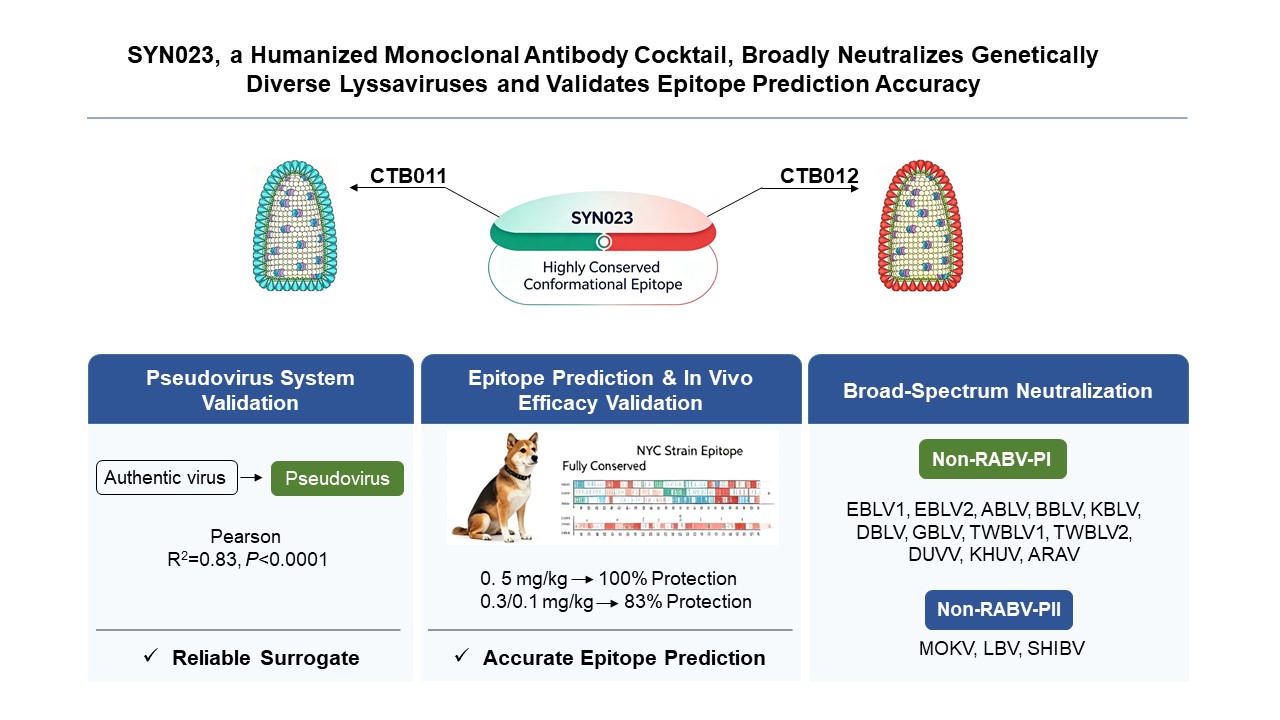
Background: Lyssaviruses remain a global public health threat, requiring broad-spectrum, high-potency neutralizing antibodies as part of recommended human rabies post-exposure prophylaxis (PEP). A humanized monoclonal antibody cocktail, SYN023, is approved for PEP in China and is under global regulatory review. Its epitope mapping data are promising. However, the neutralization breadth across diverse lyssaviruses and the reliability of pseudovirus-based neutralization assays still require comprehensive validation to support worldwide regulatory approval and clinical use. Methods: First, the correlation between authentic lyssaviruses virus and pseudotyped viruses neutralization was established experimentally to verify the reliability of the pseudovirus-based neutralization assay. Second, epitope mapping was performed using a highly virulent rabies virus (RABV) variant (New York City strain: NYC) provided by the U.S. Department of Agriculture, followed by in vivo PEP efficacy studies in a standardized canine model to functionally validate the mapped epitopes. Third, the neutralizing activity of SYN023 was evaluated against a phylogenetically diverse panel of non-RABV lyssaviruses and directly benchmarked against clinically validated comparator monoclonal antibodies, thereby providing robust, quantitative empirical evidence supporting its broad-spectrum neutralization capability. Results: A strong positive correlation was observed between neutralization titers elicited by authentic lyssaviruses and pseudotyped viruses (Pearson R2 = 0.83, P < 0.0001), validating the pseudovirus-based assay as a robust surrogate for authentic virus neutralization. Specifically, SYN023 recognized and potently neutralized the epitope mapped on the prototypic NYC RABV strain. The in vivo PEP studies conducted in a standardized canine challenge model, using the NYC strain as the challenge virus, demonstrated high protective efficacy at SYN023 doses ranging from 0.1 to 0.5 mg/kg. Furthermore, SYN023 exhibited broad, potent, and reproducible neutralizing activity against a phylogenetically diverse panel of non-RABV lyssaviruses, including European bat lyssavirus 1 (EBLV1), European bat lyssavirus 2 (EBLV2), Australian bat lyssavirus (ABLV), Bokeloh bat lyssavirus (BBLV), Taiwan bat lyssavirus 1 (TWBLV1), Taiwan bat lyssavirus 2 (TWBLV2), Kotalahti bat lyssavirus (KBLV), Divača bat lyssavirus (DBLV), Gannoruwa bat lyssavirus (GBLV), Duvenhage virus (DUVV), Khujand virus (KHUV), Aravan virus (ARAV), Mokola virus (MOKV), Lagos bat virus (LBV) and Shimoni bat virus (SHIBV). Notably, SYN023 achieved robust neutralization of MOKV (EC50 = 14.74 µg/mL), whereas clinically referenced monoclonal antibodies—Rabishield, Ormutivimab and GR1801—exhibited no detectable neutralizing activity against MOKV even at concentrations up to 1,000 µg/mL. This pan-lyssavirus neutralizing capacity was attributable mechanistically to SYN023’s targeting of a highly conserved conformational epitope within the viral glycoprotein, which is structurally preserved across all major lyssavirus phylogroups. Conclusion: This study demonstrated that the pseudovirus-based neutralization assay is a reliable surrogate platform. In addition, it confirmed the functional accuracy of the epitope mapping strategy, showed the protective efficacy against a virulent RABV challenge in dogs, and demonstrated the broad neutralization spectrum of the SYN023 antibody cocktail against both RABV and a phylogenetically diverse panel of non-RABV lyssaviruses.
Keywords:
SYN023
; lyssavirus
; pseudovirus system
; epitope prediction
; broad-spectrum neutralization
; rabies
; human monoclonal antibody
Copyright: This open access article is published under a Creative Commons CC BY 4.0 license, which permit the free download, distribution, and reuse, provided that the author and preprint are cited in any reuse.