

Submitted:
02 September 2026
Posted:
03 September 2026
You are already at the latest version
Abstract
An extreme challenge can sometimes produce a rapid surge of energy that makes previously inaccessible resources available. We call this process Adaptive Hyper-Energy. Success is not its defining feature: Argentina’s contrasting performances at the 2026 FIFA World Cup illustrate that mobilisation when failure appears imminent may achieve the desired outcome but may also prove insufficient. Activation depends on the culturally, biographically, and socially constructed meaning of what is threatened. Hyper-energy enables extraordinary resource recruitment, whereas behavioural control and recovery determine whether the response remains adaptive and reversible. Success may reinforce and prime its reactivation in similar circumstances. The same process may therefore support exceptional performance or, when regulation and recovery fail, contribute to exhaustion, aggression, and persistent rhythm dysregulation.
Keywords:
adaptive hyper-energy
; stress response
; energy mobilisation
; rhythm dysregulation
; resilience
At the 2026 FIFA World Cup, Argentina were 2–0 down against Egypt with 11 minutes remaining, then scored three goals in 13 minutes to avoid elimination. In the semi-final against England, they again mobilised under apparently desperate conditions, overturning a 0–1 deficit with two goals in the final seven minutes [1]. That second successful reversal may have reinforced or primed the response. The final provided the necessary counterexample. Argentina entered it after two knockout matches had gone to extra time, were reduced to ten men before extra time, and conceded to Spain in the 106th minute. Despite producing no attempt during regulation time, they generated their only attempt in the 116th minute, when defeat was imminent [2]. Mobilisation occurred, but it was insufficient to change the outcome.
The distinction matters. Adaptive Hyper-Energy should not be inferred retrospectively from victory: mobilisation and outcome are separate phenomena. In the final, late activation did not reverse the result and may not have terminated when the competitive objective was lost. The aggressive and maladaptive conduct after the final whistle [3] can be interpreted, cautiously, as a possible failure to deactivate or regulate an extreme mobilisation state. This interpretation may help explain the behaviour; it does not excuse it. Nor can a sequence of football matches establish a psychobiological mechanism. It can, however, expose a pattern that warrants a more precise and testable hypothesis.
Research has extensively examined how stress impairs functioning. Far less attention has been devoted to circumstances in which extreme challenge transiently improves it [4]. Observations across sport, surgery, exploration, military action, and emergency response may reflect a neglected process: a rapid increase in available energy followed by temporary reorganisation of biological, cognitive, emotional, behavioural, and social resources when ordinary strategies appear insufficient. Its defining feature is the mobilisation itself, not exceptional performance. Adaptive Hyper-Energy is therefore proposed as a response state rather than a diagnosis or a stable personality type. Its adaptive value depends on proportionality, behavioural control, biological cost, and restoration of biological and social rhythms [5,6].
Energy is the initiating mechanism in the proposed sequence, not merely one resource among many. The response begins with a subjective and observable shift from depletion, inhibition, or ordinary activation towards heightened drive and capacity for action. Fatigue may be postponed, attention intensified, effort expanded, and behaviour redirected towards the threatened objective [7]. Resource recruitment is downstream from this increase in energy. A finding from surgery is compatible with this possibility: greater physiological activation during the first five minutes of an operation was associated with fewer major surgical complications [8]. The association does not prove hyper-energy or causality, but it shows that acute activation is not invariably detrimental. When activation exceeds regulatory control, the same mobilisation may instead become disorganised, impulsive, or aggressive.
The first component is meaning. An evolutionary perspective suggests continuity without identity across species. In relatively solitary animals, intense defensive mobilisation is likely to be linked mainly to imminent threats to survival and, where parental care occurs, to offspring [9]. In social species, these fundamental triggers remain, but social learning and group-specific traditions can expand the range of events that acquire shared significance [10]. We propose that this social layer also expands what can activate exceptional energy mobilisation. In humans, symbolic thought, culture, biography, and social role extend the range further: threats to homeland, family, a way of life, group belonging, professional responsibility, personal honour, or an identity founded on not surrendering may be experienced as no less unacceptable than direct physical danger [5,11]. Culture is therefore not merely the setting for a biological response; it helps determine which possible losses acquire enough salience to activate it [11]. The relevant trigger is not objective danger alone, but danger to what the individual or group experiences as indispensable.
The proposed sequence is: culturally, biographically, and socially constructed meaning → perceived threat to identity, belonging, survival, or a highly valued objective → rapid increase in available energy → extraordinary resource recruitment → performance, behavioural control, and biological cost → recovery or rhythm dysregulation. Each stage should be assessed separately. An increase in energy and recruitment of resources may be evident even when performance remains insufficient; conversely, success alone does not demonstrate that hyper-energy occurred.
Figure 1.
A meaning-, energy-, control-, recovery-, and reinforcement-based model of Adaptive Hyper-Energy.
Figure 1.
A meaning-, energy-, control-, recovery-, and reinforcement-based model of Adaptive Hyper-Energy.
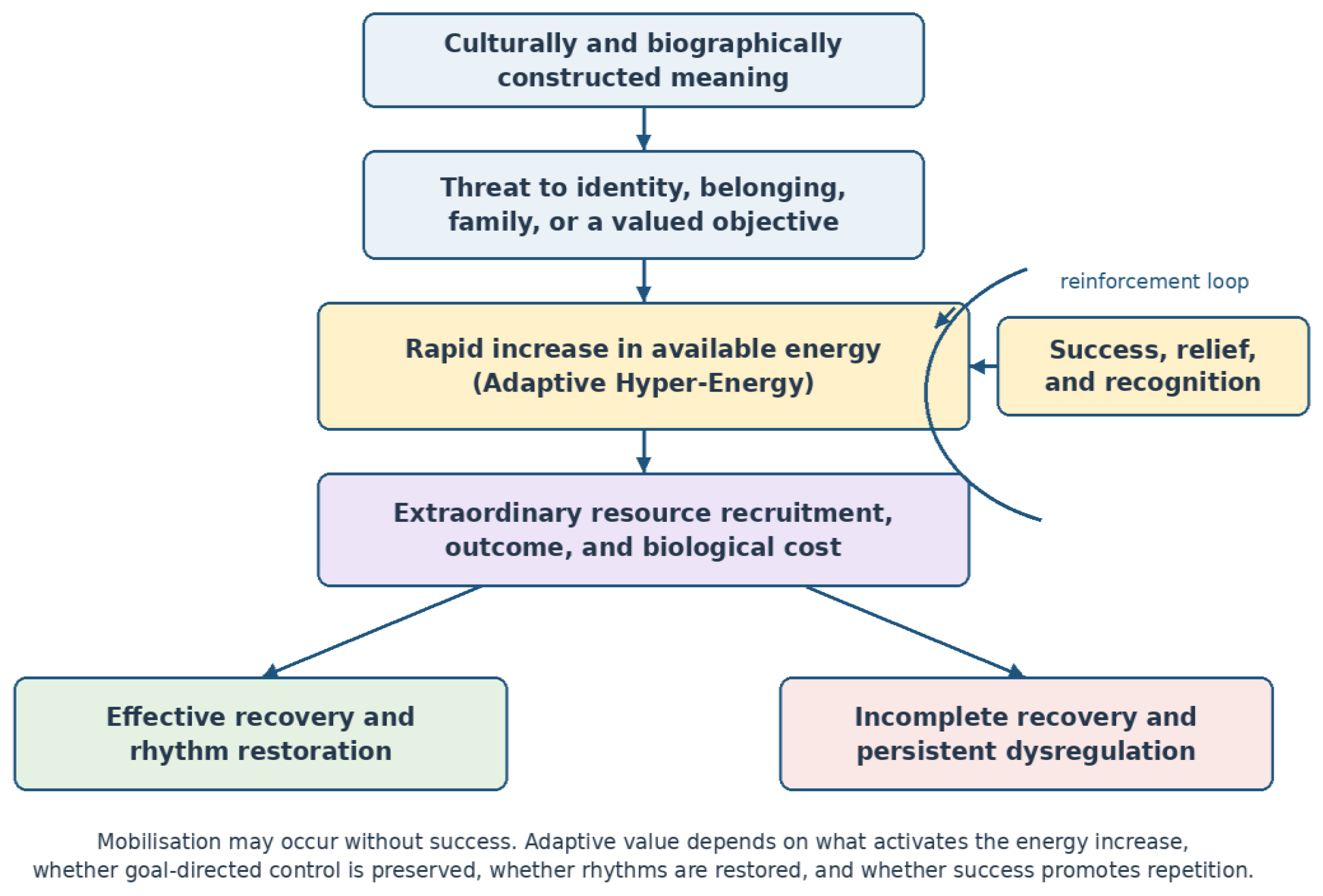
The second component is control and recovery. Individuals differ in their capacity to regulate mobilisation while the threat persists and to terminate it once the threat has passed. Some rapidly restore sleep, energy, autonomic balance, and ordinary social rhythms; others remain activated or return only partially to baseline [4]. Recovery may vary with age, cumulative stress, sleep deprivation, biological vulnerability, social support, and whether a culture permits relinquishing a heroic or protective role without loss of identity or status. When mobilisation remains proportional, controlled, and reversible, it may favour adaptation. When behavioural regulation or recovery fails, exhaustion, interpersonal harm, and psychopathological outcomes may follow. The crucial distinction may therefore lie less in intensity alone than in control and reversibility.
A third component is reinforcement. Achieving what appeared impossible can produce relief, mastery, admiration, and a heightened sense of being fully effective or alive. Success may prime the same response in similar circumstances and increase the probability of repeating it. Individuals may then seek escalating challenges, recreate urgency, curtail recovery, or come to function optimally only under extreme conditions. Repeated reliance on high-energy states could become a self-reinforcing cycle resembling behavioural dependence. Argentina’s successful late reversal against England and renewed mobilisation in the final illustrate how a rewarded response might be rapidly reinstated, although they cannot establish that reinforcement occurred. Dysregulation might arise not only from failure to recover after one episode, but also from rewarded repetition of initially effective mobilisation.
This framework may connect fields that usually examine separate outcomes. Sport psychology studies clutch performance; surgery examines performance under operative stress; emergency research examines action under threat; and psychiatry often encounters activation only after reversibility has been lost. Convergent clues have emerged from profound sociocultural transition in Malawi [12] and from exceptionally long-lived adults in Sardinia’s Blue Zone [13]. In the latter, traits of hyperenergetic response persisted in some healthy older people and were associated with a CACNA1C variant usually interpreted primarily as a marker of psychiatric vulnerability [14]. A further signal comes from Sardinian migrants in South American megacities: lifetime MDQ scores of 8 or more were more frequent than among Sardinian residents (8.6% versus 2.9%) [15]. This cross-sectional finding cannot distinguish selection from environmental activation, but it is consistent with the possibility that migration, challenge, and the search for new conditions select people with traits of hyperenergetic response and/or make that response more likely to emerge. These observations do not establish a phenotype. They suggest that variants and response traits associated with vulnerability might also contribute to extraordinary mobilisation, with consequences determined by context, control, recovery, and reinforcement.
Human beings may be equipped not merely to tolerate stress, but temporarily to increase available energy and reorganise their resources to preserve what they perceive as most meaningful. The hypothesis now requires prospective testing rather than further inference from exceptional outcomes. Studies should measure perceived meaning and threat alongside energy, goal-directed activity, sleep, autonomic activation, behavioural control, performance, and time to recovery. Repeated observations could then distinguish adaptive mobilisation from ordinary arousal, clutch performance, persistent hyperactivation, and mood pathology. A model integrating meaning, energy, control, recovery, and reinforcement may explain why the same capacity supports exceptional performance, failed but intense mobilisation, lifelong adaptation, or progressive rhythm dysregulation—and may allow it to be recognised before reversibility is lost.
Author Contributions
M.G.C. conceived the hypothesis and drafted the manuscript. A.E.N. contributed to its conceptual development and critical revision. G.C. and O.M. contributed to manuscript editing and reference verification. O.M. is the corresponding author. All authors approved the final manuscript.
Funding
This research received no specific grant from any funding agency, commercial or not-for-profit sectors.
Data Availability Statement
Data availability is not applicable to this article as no new data were created or analysed in this study.
Acknowledgments
The authors used ChatGPT (OpenAI) to assist with language editing and manuscript restructuring. The authors critically reviewed and take responsibility for the final text.
Conflicts of Interest
None.
References
- Reuters. Argentina are best with their backs to the wall, says coach Scaloni. 15 Jul 2026. Available online: https://www.reuters.com/sports/soccer/argentina-are-best-with-their-backs-wall-says-coach-scaloni-2026-07-15/ (accessed on 1 Sep 2026).
- Reuters. Argentina run out of late Messi miracles against Spanish machine. 19 Jul 2026. Available online: https://www.reuters.com/sports/soccer/argentina-run-out-late-messi-miracles-against-spanish-machine-2026-07-19/ (accessed on 25 Jul 2026).
- Reuters. Argentina’s behaviour at World Cup final ‘intolerable’, says Spain coach De la Fuente. 24 Jul 2026. Available online: https://www.reuters.com/sports/soccer/argentinas-behaviour-world-cup-final-intolerable-says-spain-coach-de-la-fuente-2026-07-24/ (accessed on 25 Jul 2026).
- Swann, C.; Crust, L.; Jackman, P.; Vella, S.A.; Allen, M.S.; Keegan, R. Psychological states underlying excellent performance in sport: toward an integrated model of flow and clutch states. J. Appl. Sport Psychol. 2017, 29, 375–401. [Google Scholar] [CrossRef]
- Ungar, M.; Theron, L. Resilience and mental health: how multisystemic processes contribute to positive outcomes. Lancet Psychiatry 2020, 7, 441–48. [Google Scholar] [CrossRef] [PubMed]
- McEwen, B.S. Stress, adaptation, and disease: allostasis and allostatic load. Ann. N Y Acad. Sci. 1998, 840, 33–44. [Google Scholar] [CrossRef] [PubMed]
- Jamieson, J.P.; Nock, M.K.; Mendes, W.B. Mind over matter: reappraising arousal improves cardiovascular and cognitive responses to stress. J. Exp. Psychol. Gen. 2012, 141, 417–22. [Google Scholar] [CrossRef] [PubMed]
- Awtry, J.; Skinner, S.; Polazzi, S.; et al. Association between surgeon stress and major surgical complications. JAMA Surg. 2025, 160, 332–40. [Google Scholar] [CrossRef] [PubMed]
- Mobbs, D.; Headley, D.B.; Ding, W.; Dayan, P. Space, time, and fear: survival computations along defensive circuits. Trends Cogn. Sci. 2020, 24, 228–41. [Google Scholar] [CrossRef] [PubMed]
- Whiten, A. The burgeoning reach of animal culture. Science 2021, 372, eabe6514. [Google Scholar] [CrossRef] [PubMed]
- Kirmayer, L.J. The place of the social in psychiatry: from structural determinants to the ecology of mind. Soc. Psychiatry Psychiatr. Epidemiol. 2025, 60, 771–83. [Google Scholar] [CrossRef] [PubMed]
- Carta, M.G. Social change and increasing of bipolar disorders: an evolutionary model. Clin. Pract. Epidemiol. Ment. Health 2013, 9, 103–9. [Google Scholar] [CrossRef] [PubMed]
- Scano, A.; Orrù, G.; Kalcev, G.; et al. Adaptive hyperactivity and biomarker exploration: insights from elders in the Blue Zone of Sardinia. J. Clin. Med. 2024, 13, 6451. [Google Scholar] [CrossRef] [PubMed]
- Kalcev, G.; Scano, A.; Orrù, G.; et al. Is a genetic variant associated with bipolar disorder frequent in people without bipolar disorder but with characteristics of hyperactivity and novelty seeking? Clin. Pract. Epidemiol. Ment. Health 2023, 19, e174501792303280. [Google Scholar] [CrossRef] [PubMed]
- Carta, M.G.; Moro, M.F.; Piras, M.; et al. Megacities, migration and an evolutionary approach to bipolar disorder: a study of Sardinian immigrants in Latin America. Braz. J. Psychiatry 2020, 42, 63–67. [Google Scholar] [CrossRef] [PubMed]
Disclaimer/Publisher’s Note: The statements, opinions and data contained in all publications are solely those of the individual author(s) and contributor(s) and not of MDPI and/or the editor(s). MDPI and/or the editor(s) disclaim responsibility for any injury to people or property resulting from any ideas, methods, instructions or products referred to in the content. |
© 2026 by the authors. Licensee MDPI, Basel, Switzerland. This article is an open access article distributed under the terms and conditions of the Creative Commons Attribution (CC BY) license (http://creativecommons.org/licenses/by/4.0/).
Copyright: This open access article is published under a Creative Commons CC BY 4.0 license, which permit the free download, distribution, and reuse, provided that the author and preprint are cited in any reuse.