

Submitted:
03 September 2026
Posted:
03 September 2026
You are already at the latest version
Abstract
Agricultural soils worldwide face a growing imbalance of heavy metal(loid)s—arsenic (As), cadmium (Cd), lead (Pb), mercury (Hg), and chromium (Cr)—driven by mining, industry, and intensive farming inputs. Because bioavailability rather than total content governs crop uptake, metal(loid)s accumulate in edible tissues and threaten food safety, particularly in rice-based diets. This review critically evaluates green management strategies that control metal(loid) accumulation along the soil–crop–food continuum while preserving soil functions and minimizing energy inputs. We first synthesize sources, soil biogeochemical controls on bioavailability, and plant uptake and translocation pathways, then appraise four strategy families: water, redox, and agronomic management; immobilization amendments, including lime, biochar, iron/manganese oxides, and nano-enabled sorbents; plant-based strategies, from low-accumulation cultivars to silicon/selenium supplementation and phytoextraction; and microbial-assisted remediation. We then link these strategies to food-safety outcomes, comparing international regulatory limits for staple foods, and identify field validation, amendment longevity, co-metal trade-offs, and life-cycle sustainability as the key remaining challenges. An integrated, site-specific green management framework—coupling cultivar selection, water control, and low-cost amendments—emerges as the most practical route to safe production on contaminated land.
Keywords:
heavy metal(loid)s
; bioavailability
; crop accumulation
; food safety
; green management
; soil amendments
; biochar
; phytoremediation
; regulatory standards
1. Introduction
Heavy metal(loid)s (HMs) - here considered to include arsenic (As), cadmium (Cd), lead (Pb), mercury (Hg) and chromium (Cr), along with the redox-sensitive metals copper (Cu), zinc (Zn) and nickel (Ni) - are natural components of soils, but anthropogenic activities have drastically changed their balance in agroecosystems around the world. The notion of "imbalance" is instructive: the same elements that are micronutrients at low levels (Cu, Zn, Ni) are toxic at high levels, while non-essential elements (Cd, Pb, Hg, As) are phytotoxic and dangerous for human consumption at trace levels [1,2]. National surveys illustrate the scale of the problem. In China, a national soil survey (2005-2013) revealed 19.4% of agricultural soil samples were above environmental quality standards, with Cd being the most common element to exceed the standard (7.0%), followed by Ni, As, Cu, Hg, Pb and Cr [3]. In the European Union, 6% of agricultural soils show concentrations that need to be investigated, with elevated levels found in mining areas and in areas with long-term agrochemical applications [4]. Global syntheses also conclude that metal(loid) contamination is one of the most widespread threats to soil health, crop yield and food security [1,2].
One of the main characteristics of this type of pollutants is that risk depends on bioavailability, but not on the total concentration [5]. The fraction of the total metal(loid) pool that becomes available to plants depends on soil pH, redox conditions, organic matter, clay mineralogy and microbial activity, which control the fraction of the total pool that enters the soil solution, the only fraction accessible to plants [5,6]. These are themselves controlled by agricultural management: decades of ammonium-based fertilization have acidified millions of hectares, releasing Cd and Zn from the soil matrix [6,7], while the flooding and drainage cycles in paddy fields drive a well-known antagonism between Cd (immobilised as sulfide under reducing conditions) and As (mobilised by reductive dissolution of iron oxides) [8,9]. Climate change adds to this picture, with warming, changes in precipitation and drought stress affecting both metal(loid) speciation and plant growth [1]. So knowledge of this soil-crop continuum is the analytical basis for management strategies.
The agricultural importance of the imbalance is in the accumulation up the food chain. Rice, which is the staple food of over half of the world population, is a very efficient accumulator of Cd and inorganic As (iAs) and rice-based diets prevail in dietary exposure to these elements in vast regions of Asia [10,11]. The analogous vector of Cd in temperate cereal production areas is wheat [12], whereas leafy vegetables and root crops accumulate Cd and Pb in peri-urban production systems that are fed by reclaimed water and biosolids [13]. Dietary exposure studies in China show that cereals alone can have levels of Cd intake above tolerable limits among sensitive population groups especially in southern China where acidic soils and rice cultivation overlap [10,14]. The regulatory limits of Cd, Pb, As and Hg in staple foods have thus been increasingly tightened under the Codex Alimentarius, European Union and Chinese national standards making it increasingly difficult to comply with regulations by farmers on contaminated land [11,15].
Conventional remediation technologies (excavation and landfilling, soil washing, electrokinetic treatment, and vitrification) are effective for point-source contamination but are energy- and resource-intensive, disruptive to soil structure and biota, and are clearly unsustainable for large areas of arable land where contamination is widespread and moderate [16,17,18,19]. This has led to a shift in paradigm towards "green management": approaches that can be incorporated into routine farming practices, use low-cost and sometimes waste-based resources, manage metal(loid) uptake by edible plant tissues rather than aiming at complete decontamination of the soil, and maintain - or even enhance - soil ecosystem services [2,20]. Green management also fits with the circular-economy concept: biochar made from crop wastes, slags from steel-making, and composted organic wastes are all products of material recycling [2,21]. These strategies are the main way regulatory safe-use goals (such as China's safe-use program of contaminated farmland) will be realised [2,15].
Although the literature is growing at a rapid pace, there is no integrative and critical appraisal of the metal(loid) source to plate that evaluates the management options at each stage against the yardsticks of efficacy, durability, cost, and environmental footprint. This review seeks to bridge this gap. Section 2 discusses the sources of HMs in agroecosystems and soil biogeochemical regulation of their bioavailability; Section 3 reviews plant uptake, translocation, and grain-loading processes and the resulting crop- and cultivar-specific patterns of accumulation; Section 4, the heart of the review, critically assesses four families of green management strategies: water and agronomic management, immobilization amendments, plant-based and genetic approaches, and microbial-assisted strategies, respectively, and their integration in the field; Section 5 links these strategies to food-safety outcomes and regulatory frameworks; Section 6 identifies knowledge gaps and future directions; Section 7 concludes. In all cases we focus on field-validated evidence rather than laboratory data, since performance in pots or spiked soils often does not scale up to actual agricultural systems.
2. Sources and Bioavailability of Heavy Metal(loid)s in Agricultural Systems
2.1. Major Sources and Entry Routes
The sources of metal(loid) inputs to cropland are few and well defined, with their relative importance varying widely across regions and production systems [13,22]. Point sources include mining and smelting: decades of dumping waste rock and tailings, acid drainage from abandoned mines, and smelter dust in nearby agricultural land, and irrigation with river water affected by mining exports contamination far downriver [2,22]. Background deposition from fossil-fuel burning, non-ferrous metal smelters, and (historically) leaded fuel add to Pb, Cd and Hg loads, with deposition rates in industrialized areas still greater than weathering [3,13]. Agricultural practices represent a third, sometimes overlooked source: phosphate fertilizers contain Cd at levels that vary greatly depending on the origin of the phosphate rock (usually 1-300 mg Cd kg−1 P2O5), livestock manures and compound feeds contain Cu, Zn, and organoarsenicals that concentrate in intensive farming areas, and old pesticides and soil conditioners have left As, Hg, and Cu residues in orchards, vineyards and vegetable fields [3,4,22]. The use of wastewater and reclaimed water for irrigation, common in peri-urban and arid regions, introduces Cd, Pb, Cr and Cu to the root zone [1,22], while the application of sewage sludge and biosolids, although restricted in the EU and China, has resulted in the accumulation of Cd, Cu, Zn and Hg pools in soils under repeated applications [2,4]. Finally, geogenic sources such as black shales, karstic limestone, mineralized belts and alluvium rich in As from the great Asian river deltas provide background contamination that is chemically identical to, and often masked by, anthropogenic contamination [3,23]. A meta-analysis of Chinese agricultural soils identified the mining/smelting, peri-urban and intensively cultivated areas as the major sources of pollution, with Cd, Pb and As being the most problematic elements [13]. The source types, their typical metal(loid) fingerprints, and their major impacts on production systems are summarised in Table 1.
2.2. Soil Biogeochemical Controls on Bioavailability
Bioavailability is defined operationally as the proportion of the soil metal(loid) pool that can be available to living organisms, and it has now become standard practice to determine it using weak extractants (e. g., 0.01 M CaCl2, DTPA) or by using the diffusive gradients in thin films (DGT) technique which measures the kinetically labile supply and not an equilibrium pool [5]. The strongest regulator is pH: adsorption of Cd, Zn, Pb, and Cu on organic matter, clay, and oxide surfaces rises steeply with pH, such that even minor changes in pH on acidified soils can increase solution concentrations by two- or three-fold, whereas liming will cause correspondingly large decreases in phytoavailability [5,6,7]. Since ammonium-based fertilization, legume production, and acid deposition acidify soils at rates of up to 0.10. 2 pH units per decade, pH management is both the most effective and the most neglected control point in agricultural practice [7].
The master variable in rice paddies is redox potential. Sulfate is reduced to sulfide and Cd precipitates as CdS under the reducing conditions of flooded soil, and arsenate sorbed to iron (oxyhydr)oxides is released as mobile arsenite when the oxides reductively dissolve, and ferric iron reduction can also release Cd previously co-precipitated in Fe phases [8,9,24]. The outcome is the well-known Cd–As antagonism: continuous flooding reduces grain Cd but increases grain As, whereas aerobic or intermittently drained management has the opposite effect, a balance which needs to be struck at the field level depending on the dominant contaminant [9,24]. Soil organic matter has a double effect: solid organic matter sorbs metals and lowers their lability, while dissolved organic matter complexes metals and can increase their mobility and uptake by roots, especially on soils fertilised with soluble organic amendments [5,25]. High capacity sorption surfaces are provided by clay minerals and iron/manganese oxides that buffer metal(loid) release, and their abundance accounts for much of the spatial variation in risk for a given load [18,26]. Microorganisms also alter the bioavailability of metal(loid)s - methylating and demethylating Hg and As, oxidizing or reducing Cr and As, and binding metals in biomass - so that microbial community composition affects bioavailability, and metal(loid) stress in turn suppresses important microbial processes such as nitrogen fixation and turnover of organic matter [23,27]. Finally, "aging": over time, newly added metal(loid)s migrate into micropores and more stable binding sites, progressively reducing their extractability - the basis of the often observed phenomenon that freshly spiked soils greatly overestimate the mobility of aged fields [5].
There are two implications for management. First, as bioavailability is regulated by dynamic soil properties rather than constant total concentrations, it can be manipulated: pH adjustment, redox control and increasing sorption capacity are the levers of green management [5,18]. Second, given that there are multiple interacting controls, no one lever is enough; management must be site-specific and, in most instances, combined across levers [9,28]. These are the principles behind the strategy families discussed in Section 4.
3. Plant Uptake, Translocation, and Accumulation in Edible Tissues
3.1. Root Uptake and Membrane Transport
Metal(loid)s enter plants almost exclusively through membrane transporters whose physiological substrates are essential nutrients—an evolutionary accident that explains why deficiency and toxicity are so intimately linked in the metal(loid) imbalance framework [29]. Cadmium uptake in rice is dominated by the manganese transporter OsNramp5, with a contribution from the iron-regulated transporter OsIRT1/2 under iron deficiency; in wheat, TaNramp5 and the low-affinity cation transporter TaLCT1 play analogous roles [12,29,30]. Arsenate is taken up via phosphate transporters, while arsenite—the dominant As species in flooded soils—enters through the silicon influx and efflux channels Lsi1 and Lsi2, which also mediate silicic acid uptake in rice [29,31]. Methylmercury (MeHg), formed microbially in paddy soils, is lipophilic and highly mobile, and rice concentrates MeHg to a much greater extent than upland cereals [23]. Lead is largely retained in root tissues and cell walls, so that grain Pb derives substantially from atmospheric deposition onto the panicle and from soil dust rather than from root translocation; hexavalent chromium enters through sulfate transporters but is reduced to poorly mobile Cr(III) in roots, limiting translocation [23,29]. This transporter-level diversity has a direct strategic consequence: because each element has a distinct entry pathway, interventions that target a shared transporter (e.g., silicon supply for As, zinc fertilization for Cd) or an element-specific redox state (Cr(VI)→Cr(III)) can be remarkably specific, but they must be matched to the contaminant signature of the site [32].
3.2. Translocation, Grain Loading, and Speciation
Once inside the root, the extent of shoot and grain contamination is governed by vacuolar sequestration and by the efficiency of xylem and phloem transport. The P1B-type ATPase OsHMA3 sequesters Cd into root vacuoles, acting as the major natural gatekeeper: cultivars with high OsHMA3 expression retain most of their Cd in roots, whereas loss-of-function alleles allow unrestricted translocation [29,30]. Xylem loading of Cd and Zn is mediated by OsHMA2/HMA4, and in rice the nodes—where vascular bundles interconnect—redistribute metals among leaves and panicles, providing a second control point that breeders and agronomists increasingly target [11,30]. During grain filling, metals are remobilized from senescing leaves through the phloem, so that both root uptake early in the season and shoot pools accumulated before heading contribute to final grain concentrations; this physiology explains why flooding applied only during the grain-filling window is already highly effective in reducing grain Cd [9,11]. Within the grain, distribution differs among elements: Cd concentrates in the outer layers and is only partially removed by polishing, whereas inorganic As (iAs) is more evenly distributed but the dimethylarsinic acid (DMA) fraction—more mobile and dominant in grains of some systems—is enriched in the endosperm and survives polishing [23,33,34]. Speciation matters for risk: iAs is a class-1 carcinogen, DMA is considerably less toxic, and MeHg targets the developing nervous system, so food-safety standards increasingly differentiate species rather than total concentrations [23,31].
3.3. Crop- and Cultivar-Dependent Variation
The accumulation varies by orders of magnitude among crops. The cereal with the highest Cd and As accumulation is rice, which has a grain Cd concentration ranging between 0.01 and 2 mg kg -1 depending on soil conditions; wheat is in the middle position, and maize grain has much lower concentrations, which forms the basis of crop-substitution strategies [12,23,34]. Peri-urban vegetable systems are disproportionately at risk due to the fact that leafy vegetables accumulate Cd and Pb more easily than fruit or grain crops [13]. Genotypic variation within species is also dramatic: surveys of Chinese rice have reported 3- to 10-fold differences in grain Cd and As among cultivars grown together, with indica varieties in southern China often surpassing the national Cd limit of 0.2 mg kg-1, whereas tolerant cultivars of the same field meet the limit [10,34]. The finding of loss-of-function alleles of OsNramp5 in low-Cd cultivar lcd-Koshihikari showed that this variation is genetically tractable and resulted in immediate implementation of low-accumulation breeding [30,35]. Since cultivar choice is the least expensive intervention option that can be made by farmers, this genetic variation is perhaps the most valuable resource of green management, assuming that yield, manganese nutrition and local adaptation are not compromised [32,36].
3.4. Effects of Metal(loid) Stress on Crop Growth and Quality
Besides the food-safety aspect, metal(loid) excess is a real agronomic stress. Cd and Pb suppress root growth and photosynthesis, induce reactive oxygen species and repress nitrogen metabolism, and yield losses of 10~30% have been reported on highly contaminated fields [12,37]. The stress is compounded by induced nutrient imbalance: Cd interferes with uptake and signaling of Zn and Fe and in many acidic soils contaminated by Cd, plants that are deficient in Zn absorb more Cd via the same IRT1 pathway - an example of deficiency enhancing toxicity [12,29]. Microbial communities in soil are generally more vulnerable than plants: long-term metal(loid) loading reduces microbial biomass, alters community structure to favor tolerant taxa, and disrupts functions like nitrogen fixation, nitrification, and organic matter turnover, with long-lasting effects decades after inputs are stopped [27]. These stress responses are important to management in two respects: they reduce the economic benefits of contaminated land and hence the resources farmers can commit to mitigation, and they imply that successful green strategies often provide co-benefits, enhanced plant nutrition and restored microbial activity, which are themselves quantifiable agronomic results rather than incidental [27,37].
4. Green Management Strategies for Controlling Accumulation
The green management can be structured as an intervention ladder along the soil-crop-food continuum: (i) prevent inputs at the source; (ii) reduce bioavailability in soil by immobilization; (iii) block root uptake and internal translocation in the plant; and (iv) remove the contaminant out of the system through phytoextraction or diverting contaminated biomass to non-food uses [2,18,28]. The fact that these strategies are called green is not their mechanism but their system logic: they employ low-cost, frequently waste-based inputs; they are compatible with, indeed embedded in, normal farming processes; and they do not trade away soil ecosystem services in order to decontaminate, as excavation or washing would do [2,20]. Each family is reviewed in the subsections below, and Figure 2 summarizes their main mechanisms.
4.1. Water, Redox, and Agronomic Management
Water management is the least expensive and among the most effective levers in paddy systems, because it directly manipulates the redox state that controls Cd and As solubility [9,24]. Continuous flooding suppresses grain Cd by 40–90% through sulfate reduction and CdS precipitation, but simultaneously increases grain As by releasing arsenite from reductively dissolved iron oxides; aerobic or drained management produces the mirror image [9,24]. Field experiments by Honma et al. identified a mild reducing regime—flooding maintained after heading at a slightly negative soil Eh, with pH near neutral—as the best compromise, and demonstrated that a three-week flooding window around heading captures most of the Cd benefit at limited As cost [9]. Practical prescriptions therefore differ by dominant contaminant: permanent flooding or late-season flooding for Cd-dominated fields, mid-season drainage and aerobic periods for As-dominated fields, and alternating wetting–drying with short re-flooding for mixed contamination [9,11]. Beyond rice, switching to uncontaminated irrigation water and avoiding paddy–upland rotation cycles (whose dry phases remobilize Cd) are equally important elements of water governance at the landscape scale [22,28].
Fertilizer choices interact with metal(loid) dynamics in several ways. Using phosphate fertilizers low in Cd is a direct source control strategy; ammonium-based nitrogen acidifies the rhizosphere and enhances Cd availability, while nitrate has the opposite effect, so changing the form of nitrogen can significantly lower grain Cd [28,38]. Potassium chloride (KCl) chloride mobilizes and takes up Cd via chloride complexation, and potassium sulfate is better on Cd-contaminated soils; sulfur fertilization promotes sulfide formation under flooded conditions, and zinc fertilization takes advantage of transporter competition to limit Cd uptake while alleviating the Zn deficiency that often accompanies Cd stress [28,38]. Organic matter management is critical: stable manures and composts dilute and bind metals, but fresh straw incorporation and soluble organic amendments can increase Cd mobility through dissolved organic carbon complexation, especially in acidic soils [25,38]. Crop rotations and intercropping round out the agronomic strategies: replacing maize (a weak accumulator) with rice, or intercropping vegetables with metal-excluding cultivars, shifts uptake from more contaminated soil fractions [12,28].
4.2. Immobilization-Based Soil Amendments
4.2.1. Alkaline Materials
Lime and alkaline industrial by-products—calcium carbonate and hydroxide, calcium–magnesium phosphate, silicate slags, and steel slags—immobilize Cd, Pb, and Zn primarily by raising pH, which increases the negative surface charge of soil colloids and favors carbonate and hydroxide precipitation [7,18]. On the acidified paddy soils of subtropical China, where soil pH has fallen to 5.0–5.5 over decades of ammonium fertilization, liming alone reduced grain Cd by 20–60% in field trials, and combined with water management brought grain concentrations below the 0.2 mg kg−1 standard on moderately contaminated fields [7,38]. The principal weakness is durability: acidification resumes with continued nitrogen fertilization, so lime must be reapplied every 2–3 years, and over-application can induce micronutrient deficiency or—at very high pH—remobilize As, underscoring the need for pH-targeted rather than blanket dosing [7,18]. Slag-based materials add silicon to the system, merging the liming and silicon mechanisms discussed below [37,39].
4.2.2. Biochar and Organic Amendments
The flagship green amendment is biochar, which is pyrolyzed biomass added to soil, and not only immobilizes cationic metals but also enhances soil quality and valorizes agricultural waste in a circular-economy loop [2,21,40]. It has several immobilization mechanisms such as liming effect, high cation-exchange capacity, surface complexation on oxygenated functional groups and physical entrapment in nanopores; its efficacy is higher at higher pyrolysis temperature (500700 o C) and with feedstocks that have high lignocellulose content, and surface modification (magnetization, iron impregnation, alkali activation) further increases capacity [21,40,41]. The evidence of the field is unusually good in this type of amendment: in a landmark three-year paddy trial, wheat-straw biochar at 2040 t ha -1 decreased rice grain Cd by 2060% without yield penalty [42], a five-year follow-up verified long-term immobilization of both Cd and Pb [43], and a systematic review of in situ field trials concluded that biochar reliably reduces Cd, PbTwo cautions dampen excitement. First, alkaline biochars are able to mobilize As in flooded soils by increasing pH and providing dissolved organic carbon competing with sorption sites, thus biochar application to As-contaminated paddies must use As-tolerant (e. g., iron-modified) formulations [25,45]. Second, aging: a meta-analysis indicated that the efficiency of immobilization decreases with weathering of biochars, and the degree of decrease depends on the properties of soils and biochars, which suggests periodic reapplication or functionalized, longer-lived products [46]. Bone char and other phosphate-rich chars combine precipitation of phosphate with sorption of Pb and Cd [47].
4.2.3. Iron-, Manganese-, and Clay-Based Inorganic Sorbents
Iron oxides and oxyhydroxides are the most As-specific sorbents available: they form inner-sphere complexes with arsenate and arsenite and re-occupy the sorption capacity lost during reductive dissolution, making them the standard amendment for As-dominated paddies; zero-valent iron (ZVI) adds a reductive pathway that converts As(V) to strongly sorbed As(III) and reduces Cr(VI) to Cr(III) [26,48]. Manganese oxides adsorb and oxidize Cd, Pb, and Cu, and clay minerals and zeolites immobilize cations through cation exchange, while phosphate amendments precipitate Pb as highly insoluble pyromorphite-like phases—although phosphate must be used cautiously on As-contaminated soils where it competes with arsenate for sorption sites [18,26]. Red mud (bauxite residue) combines high alkalinity with iron oxide sorption but requires careful dosing because of its salinity and radioactivity concerns [26]. For co-contaminated fields, composite amendments such as ZVI combined with biochar simultaneously suppressed rice grain Cd and As in paddy trials, illustrating the general principle that mixed contamination demands mixed sorbents [48,49].
4.3. Plant-Based and Genetic Strategies
4.3.1. Low-Accumulation Cultivars and Molecular Breeding
Since the choice of cultivar does not cost farmers anything other than seed price, the most scalable plant-based approach is low-accumulation varieties. The ion-beam mutagenesis of lcd-Koshihikari discovered OsNramp5 as the critical uptake transporter and generated cultivars with grain Cd that was a small proportion of traditional varieties, a method that has been confirmed by natural allelic surveys and adapted to wheat, maize, and vegetables [30,32,35]. Marker-assisted selection is now used to screen breeding populations to identify low-uptake alleles, and genome-editing technologies can be used to reproduce the loss-of-function mutations in elite backgrounds, although the regulatory position of edited crops differs across jurisdictions [11,32]. Hunan province field programs demonstrated that biochar combined with low-uptake cultivars could meet the 0.2 mg kg−1 standard after four rice seasons on contaminated soils, indicating that genetic and soil-based solutions are additive [36]. It requires two qualifications: mutations in Nramp5 may reduce manganese nutrition and, in certain soils, yield, thus low-accumulation traits should be coupled with micronutrient management; and cultivar ranking is not consistent across locations, so local screening programs, but not blanket recommendations, are needed [11,32]. At the same time, both biofortification with Zn and Se, either through breeding or fertilization, not only addresses the nutrient-imbalance aspect of the metal(loid) issue, but also inhibits Cd uptake due to ion antagonism [32,37].
4.3.2. Silicon and Selenium Supplementation
Silicon is the only beneficial element that alleviates Cd and As. Exogenous Si accumulates under the leaf cuticle, enhances apoplastic barriers in roots, represses OsNramp5 and OsLsi1 (Cd and As transporters) expression, and facilitates co-precipitation of Cd with silicates in cell walls, whereas competition between silicic acid and arsenite at the Lsi transporters directly limits As uptake [37,39]. Calcium silicate and steel slag applied to the field decreased grain Cd, Pb, and Zn by 3070 percent in multi-metal contaminated acidic paddy experiments and enhanced lodging resistance and yield hence the reason why silicate materials are some of the most economical amendments where they are available as industrial by-products [37,39]. Selenium, which is used in the form of foliar selenite, competes with Cd uptake and translocation, relieves oxidative stress, and, being a human micronutrient, also biofortifies the grain, an uncommon triple effect that has driven its widespread use in Chinese rice farming on soils affected by Cd; foliar zinc sprays have similar effects via transporter competition [28,37]. Their primary limitations to operation are the necessity of split foliar applications and cultivar-specific responsiveness that render these strategies supplements to, but not replacements of, soil-based interventions [28,37].
4.3.3. Phytoextraction and Safe Alternative Cropping
Phytoextraction employs metal-accumulating plants, including Cd/Zn hyperaccumulators like Sedum alfredii and Noccaea caerulescens and the As hyperaccumulator Pteris vittata, to strip soil of contaminants, which are then incinerated or treated to recover metals [50,51]. Since hyperaccumulators extract only kilograms or less per hectare per year, even moderately contaminated soil cannot be cleaned up in decades, so pure phytoextraction is limited to lightly contaminated land or demonstration plots; however, its low cost, aesthetic neutrality, and root activity that improves soil make it the only strategy that actually reduces overall metal load as long as the land remains in use [50,52,53]. Failure modes are always found to be plant-site mismatch, metal mixture toxicity, and slow growth, and additives, such as biodegradable organic acids or microbial inoculants, are now employed to speed up uptake, with ethylene diamine tetraacetic acid (EDTA)-type chelators being abandoned due to the risk of leaching [53,54]. A practical form safe alternative cropping redirects contaminated land to non-food crops: energy grasses, fiber crops and oilseed to biodiesel that avoids the food chain and earns money, a practice well adapted to regions where food-chain risk cannot be managed otherwise [2,50]. Intercropping of food crops with hyperaccumulators ("phytoremediation intercropping") tries to integrate both objectives, and maizeSedum systems are some of the most researched ones [51,53].
4.4. Microbial-Assisted Strategies
Rhizosphere microorganisms control metal(loid) bioavailability in four ways that green management is increasingly interested in recruiting intentionally: biosorption onto cell walls and extracellular polymeric substances, which sequester metals around the root; precipitation, through microbially secreted phosphate, sulfide or carbonate; redox transformation, which converts Cr(VI) to Cr(III), oxidizes Fe to sorptive oxides, or methylates Arbuscular mycorrhizal fungi sequester metals in extraradical mycelium and glomalin-bound aggregates, form a physical barrier at the root interface, and enhance phosphorus and water status, generally decreasing shoot uptake in crops, but with variable results depending on fungal species and metal load [55,56]. Endophytic bacteria that have been isolated in hyperaccumulators can be re-inoculated to enhance phytoextraction, combining the microbial and phytoremediation processes [54,56]. Biochar offers an efficient carrier of microbial consortia, shielding inoculants against desiccation and predation, and adding its own sorption capacity, and such biocharmicrobe composites are one of the most promising engineered green products [21,41]. Reproducibility is the decisive constraint: the survival of inoculants, competition with the resident microbiome, and soil-type dependence make field results much more variable than pot trials, and microbial strategies should thus be thought of as accelerators within integrated packages, not as single-ingredient remedies[54,55].
4.5. Nanomaterial-Enabled Strategies
Engineered nanomaterials strain immobilization efficiency to its physicochemical limit, using surface areas many orders of magnitude greater than bulk amendments. Nano zero-valent iron (nZVI) and its sulfidated form (S-nZVI) reduce Cr(VI) to Cr(III), sequester As(III/V) on the iron corrosion products that they produce, and in co-contaminated soils, simultaneously reduce available Cd, Pb, and As; S-nZVI field mesocosms restored crop production on Cr(VI)-contaminated farmland while suppressing grain Cr to safe levels [57,58]. The combination of supporting biochar with nZVI combines the two mechanisms, reduction and sorption, and experiments on Cd/As co-contaminated paddy soil demonstrated concurrent decreases in metal availability, rice bioaccumulation, and health risk, which is more effective than either material alone [49]. Nano-hydroxyapatite selectively immobilizes Pb by forming pyromorphites, layered double hydroxides intercalate oxyanions, and nano-MnO2 oxidizes and sorbs As and Cd, and graphene-family materials are primarily used as carriers [19,59]. Opposed to these strengths are three unanswered questions: passivation and aging diminish reactivity in months, cost per unit of immobilized metal is higher than bulk amendments, and ecotoxicity of engineered nanoparticles themselves- oxidative stress to soil biota, uptake into crops-is not yet fully understood, which currently limits the use of nano-enabled remediation to high-value or refractory sites instead of widespread agricultural application [46,58,59].
4.6. Integrated Strategies and Field-Scale Evidence
None of the strategies can stand up to field complexity by itself, and the best evidence base currently exists in favor of integrated packages that are assembled site-specifically. The archetype is a combination of pH management, immobilizing amendment and low-accumulation cultivar: the Hunan program with biochar and low-uptake rice varieties produced standard-compliant grain after four seasons, and lime-biochar-cultivar and ZVI-biochar combinations also performed better than their components in co-contaminated paddies [28,36,48]. The natural fourth lever in rice systems is water management, which when sequenced with amendments (flooding after heading; drainage before As-sensitive stages) multiplies the Cd/As trade-off control [9,11]. Field-scale remediation has reached maturity at the regional scale over the last decade: systematic reviews record hundreds of field trials globally, and amendment-based strategies prevail due to their farm compatibility, and national safe-utilization program in China has implemented liming, biochar, water control, and cultivar substitution on millions of hectares of Cd-affected farmland at per-hectare costs much lower than those of engineering remediatiLife-cycle assessments substantiate the green assumption quantitatively: scenarios based on amendments and phytotechnology have significantly lower energy requirements and carbon footprint compared to excavation, washing or stabilization using virgin materials, and locally manufactured biochar enhances the footprint by valorizing residues [20,60]. Table 2 summarizes the strategy families on five evaluative dimensions and Figure 3 tabulates the quantitative decreases in grain Cd and As reported in representative studies.
Figure 3 compiles the ranges of grain Cd and As reductions achieved by the principal strategy families across the representative studies discussed above, illustrating both the general efficacy of green management and the wide variance that motivates site-specific integration.
5. Food Safety Implications and Regulatory Frameworks
5.1. Dietary Exposure and Health Risk
The food-safety relevance of metal(loid) accumulation is focused in a handful of crop-element combinations. In Asia, dietary Cd and iAs exposure are dominated by rice, and market surveys indicate that a large proportion of the rice grown on contaminated paddies in southern China (10% in hotspots) exceeds the national Cd limit, with average grain Cd decreasing but not disappearing [10,34]. Arsenic is a speciation issue: paddy rice takes up iAs from soil, and in some areas significant DMA, and probabilistic risk assessments show that lifetime cancer risks for high-consumption populations reach or exceed benchmark levels even at moderate soil concentrations [31,33]. Cadmium's toxicity (renal tubular damage and bone effects after decades of low-level exposure) means cereal-based diets are the main route of exposure, and Chinese national exposure assessments reveal that the mean population intake is below the provisional tolerable monthly intake (PTMI) but high-percentile consumers, especially in southern rice-growing regions, reach or exceed it [14,15]. Lead has plummeted with the ban on leaded fuel but neurodevelopmental endpoints warrant vigilance for infants and children, whose cereal products have the lowest of limits [1,23]. Mercury in rice - primarily MeHg produced in flooded soils - provides an additional neurotoxic pathway to the traditional fish pathway, while Cr(VI) in grains, though typically low due to root reduction, is regulated under national standards [1,23]. These patterns account for the uneven regulatory framework described below.
5.2. Regulatory Limits for Food and Soil
Food-safety governance of metal(loid)s is based on three regulatory systems: the Codex Alimentarius maximum levels (MLs) in the General Standard of Contaminants and Toxins in Food and Feed (CXS 193-1995), the European Union Regulation (EU) 2023/915, and the national food safety standard of China, GB 2762-2022, which is supported on the soil side by risk-based screening values such as those of China,The comparison in Table 3 shows interesting parallels and differences. The three systems all converge to 0.2 mg kg -1 class limits of inorganic As in polished rice and Pb but diverge on Cd in rice: China has used 0.2 mg kg-1 half the Codex value of 0.4, because rice dominates the Chinese diet, and high-percentile consumers have been documented to be sensitive, whereas the EU has followed the lower value [15,34]. Cereals are controlled by China (0.02 and 1.0 mg kg−1) but not Codex or EU MLs, and there are no harmonized soil standards in the EU, with risk-based national thresholds, whereas risk-screening values in China vary with land use and pH, an explicit recognition that bioavailability, rather than total content, controls risk [2,3,4]. Another governance gap is related to bioavailability-based compliance: standards are reported in terms of total concentrations, but equal totals can result in an order-of-magnitude difference in grain uptake depending on soil chemistry, hence why risk-based soil management is increasingly reporting extractable concentrations and crop-specific models [2,5].
5.3. Green Management as the Pathway to Compliance
Connecting Section 4 and Section 5 quantitatively, the strategy families discussed here are those that have proven ability to shift contaminated production systems across the compliance boundary. Multi-season field experiments have demonstrated that cultivar replacement with biochar, or liming with water management, can reduce rice grain Cd levels from 2-5-fold above the threshold to below 0.2 mg kg−1, while ZVI-biochar combinations do likewise for As [36,42,48]. To translate this knowledge into food-safety assurance, however, an operational layer is needed that has been overlooked in the literature: pre-harvest risk assessment (bioavailable-fraction testing), in-season mitigation (water and foliar programs), and post-harvest verification (grain lot testing before marketing) which make up the "safe utilization" model adopted in China's contaminated farmland program [2,15]. Economics are good: the annualized cost of lime, biochar and cultivar substitution on paddies affected by Cd is generally one to two orders of magnitude lower than engineering solutions, and life-cycle analysis shows commensurate reductions in carbon and energy costs, so compliance is achievable without taking land out of production [2,20]. Policy measures - subsidies for amendments, lists of approved low-accumulation cultivars, procurement screening for grain, certification of safe-production zones - have been critical in scaling these practices from plot to millions of hectares [2,15].
6. Challenges, Knowledge Gaps, and Future Directions
6.1. Durability and Aging.
The key question that remains unanswered with immobilization-based strategies is their duration. Biochar and iron-based amendments weather, pH-driven immobilization erodes as acidification resumes, and the meta-analytic evidence demonstrates that aged biochars lose some of their ability, but most field trials continue to report only 15 seasons [44,46]. Before regulators can consider immobilization as a long-term risk-reduction strategy instead of a short-term buffer, long-term monitoring plans, reapplication plans, and amendments designed to age slowly are needed [19,46].
6.2. Multi-Metal Trade-Offs.
The CdAs antagonism is an example of a general rule that any single lever optimized to one element will tend to worsen another, and the vast majority of contaminated farmland will have multiple metals plus organic co-contaminants [9,48]. Metal(loid)s and organic pollutants (or microplastics) co-contamination further complicates the selection of amendments and safety evaluation, and interactions between green strategies and other stressors (salinity, drought) are seldom quantified [1,48]. The engineering of mixed-sorbents and redox-window management are promising, yet there are no validated decision rules on arbitrary combinations of contaminants.
6.3. Climate-Change Interactions.
Rising temperatures, changing precipitation patterns and increased CO2 change the geochemistry of metals(loid) and plant physiology: longer dry spells in paddies mobilise Cd, heat stress changes grain filling and element partitioning, and changing water availability limits the water-management lever itself [1,11]. Field studies that integrate contamination management with climate adaptation scenarios, as opposed to being done independently, is a clear priority of a journal section dedicated to ecosystem and climate interactions in agriculture.
6.4. From Demonstration to Adoption.
The lab-to-field disconnect is well known: efficacy of amendments drops, microbial inoculants are ineffective and cultivar rankings change [17,53,55]. The limiting factor is now socioeconomic rather than technical - whether farmers adopt demonstrated strategies depends on their knowledge, access to inputs, and incentives [2,15]. Participatory field trials, regional cultivar screening networks and subsidy-based extension services are the effective tools but they are not adequately funded compared to laboratory research.
6.5. Emerging Tools.
A number of technology trends have the potential to bridge the adoption gap. Digital soil mapping and proximal sensing (portable X-ray fluorescence, visible–near-infrared spectroscopy) enable rapid, inexpensive delineation of contaminated areas and of bioavailable fraction [2,19]; in-season monitoring of plant stress using remote sensing can trigger action such as foliar programs or drainage timing; and decision-support systems that combine soil data, cultivar characteristics, weather and economics are starting to provide field-specific prescriptions rather than generic recommendations [1,2]. The toolkit of cultivars is still expanding with genome editing and the standardization of biochar and microbial products will be critical to provide farmers with consistent products [21,32].
6.6. Science–policy Integration.
Lastly, the evidence presented here suggests a regulatory shift from total-concentration to bioavailability-based risk management: extractable-fraction screening, crop-specific soil thresholds and grain-end verification provide a better and more cost-efficient distribution of mitigation effort, as China's risk screening value system has started to show [2,5,15]. Standardised monitoring networks, reporting on remediation success, and life-cycle-based approval of amendments would complete the circle between green management practice and its validation [4,20].
7. Conclusions
The problem of heavy metal(loid) imbalance in agricultural systems is that of the soil -crop-food continuum: the total soil burdens are too large to be economically removed, but the portion that makes it to the plate is controlled by bioavailability and plant physiology, both of which can be managed. This review has demonstrated that green management water and redox control, pH management, waste-derived amendments, low-accumulation cultivars, silicon and selenium supplementation, microbial assistance and nano-enabled immobilization can decrease grain Cd by an average of 20~90% and grain As by 20~70% in field-validated experiments, enough in most reported instances to put produce within the strictest regulatory limits [9,24,36,39,42]. Since the mechanisms are additive along the continuum, integrated packages, i. e., a low-accumulation cultivar, flooding at the time of grain filling, and a liming or biochar amendment, are always more effective than any of these components alone, at costs one to two orders of magnitude lower than engineering remediation, and with lower carbon footprints [20,36,48].
There are three conclusions that can be highlighted. To begin with, site-specificity is not a caveat but the organizing principle: levers should be chosen after diagnosis of the bioavailable fraction and the dominant contaminant, since optimal levers to Cd (flooding, alkalinity) may worsen As, and vice versa [5,9]. Second, plant genetics is the most scalable lever and the least expensive, and low-accumulation breeding, which has been tested in rice, wheat, and vegetables, should be the default first step wherever cultivars are available, and micronutrient management safeguards yield and nutrition [32,35]. Third, food-safety guarantee needs an operational tier of triage, in-season intervention and grain verification, of which the safe-utilization program in China is the most successful example [2,15]. The future of the field is less about new sorbents than durability, adoption and integration: aging-resistant amendments, climate-resilient water management, digital decision support and bioavailability-based regulation are the trends that have the best chances of ensuring safe production on contaminated land in the next decade[1,20,46].
Author Contributions
Conceptualization, Y.G., W.J., and X.Z.; methodology, Y.G., M.C., L.W., X.L., and Y.Z.; investigation, Y.G., M.C., L.W., X.L., and Y.Z.; resources, W.J. and X.Z.; data curation, Y.G., M.C., L.W., X.L., and Y.Z.; writing—original draft preparation, Y.G.; writing—review and editing, Y.G., W.J., and X.Z.; visualization, Y.G.; supervision, W.J. and X.Z.; project administration, W.J. and X.Z.; funding acquisition, W.J. and X.Z. All authors have read and agreed to the published version of the manuscript.
Funding
This research was funded by Research and Integrated Demonstration on Synergistic Disposal and Resource Utilization Technologies for Municipal Sludge and Urban Organic Solid Waste(2025JH2/102800030).
Institutional Review Board Statement
Not applicable.
Informed Consent Statement
Not applicable.
Data Availability Statement
No new data were created or analyzed in this study. Data sharing is not applicable to this article.
Conflicts of Interest
The authors declare no conflicts of interest.
References
- Khan, S.; Naushad, M.; Lima, E.C.; Zhang, S.; Shaheen, S.M.; Rinklebe, J. Global soil pollution by toxic elements: Current status and future perspectives on the risk assessment and remediation strategies – A review. J. Hazard. Mater. 2021, 417, 126039. [Google Scholar] [CrossRef] [PubMed]
- Hou, D.; O’Connor, D.; Igalavithana, A.D.; Alessi, D.S.; Luo, J.; Tsang, D.C.W.; et al. Metal contamination and bioremediation of agricultural soils for food safety and sustainability. Nat. Rev. Earth Environ. 2020, 1, 366–381. [Google Scholar] [CrossRef]
- Zhao, F.-J.; Ma, Y.; Zhu, Y.-G.; Tang, Z.; McGrath, S.P. Soil Contamination in China: Current Status and Mitigation Strategies. Environ. Sci. Technol. 2015, 49, 750–759. [Google Scholar] [CrossRef] [PubMed]
- Tóth, G.; Hermann, T.; Da Silva, M.; Montanarella, L. Heavy metals in agricultural soils of the European Union with implications for food safety. Environ. Int. 2016, 88, 299–309. [Google Scholar] [CrossRef] [PubMed]
- Kim, R.-Y.; Yoon, J.-K.; Kim, T.-S.; Yang, J.E.; Owens, G.; Kim, K.-R. Bioavailability of heavy metals in soils: definitions and practical implementation—a critical review. Environ. Geochem. Health 2015, 37, 1041–1061. [Google Scholar] [CrossRef] [PubMed]
- Zeng, F.; Ali, S.; Zhang, H.; Ouyang, Y.; Qiu, B.; Wu, F.; et al. The influence of pH and organic matter content in paddy soil on heavy metal availability and their uptake by rice plants. Environ. Pollut. 2011, 159, 84–91. [Google Scholar] [CrossRef] [PubMed]
- Zhu, H.; Chen, C.; Xu, C.; Zhu, Q.; Huang, D. Effects of soil acidification and liming on the phytoavailability of cadmium in paddy soils of central subtropical China. Environ. Pollut. 2016, 219, 99–106. [Google Scholar] [CrossRef] [PubMed]
- Rinklebe, J.; Shaheen, S.M.; Yu, K. Release of As, Ba, Cd, Cu, Pb, and Sr under pre-definite redox conditions in different rice paddy soils originating from the U.S.A. and Asia. Geoderma 2016, 270, 21–32. [Google Scholar] [CrossRef]
- Honma, T.; Ohba, H.; Kaneko-Kadokura, A.; Makino, T.; Nakamura, K.; Katou, H. Optimal Soil Eh, pH, and Water Management for Simultaneously Minimizing Arsenic and Cadmium Concentrations in Rice Grains. Environ. Sci. Technol. 2016, 50, 4178–4185. [Google Scholar] [CrossRef] [PubMed]
- Meharg, A.A.; Norton, G.; Deacon, C.; Williams, P.; Adomako, E.E.; Price, A.; et al. Variation in Rice Cadmium Related to Human Exposure. Environ. Sci. Technol. 2013, 47, 5613–5618. [Google Scholar] [CrossRef] [PubMed]
- Zhao, F.-J.; Wang, P. Arsenic and cadmium accumulation in rice and mitigation strategies. Plant Soil 2020, 446, 1–21. [Google Scholar] [CrossRef]
- Rizwan, M.; Ali, S.; Abbas, T.; Zia-ur-Rehman, M.; Hannan, F.; Keller, C.; et al. Cadmium minimization in wheat: A critical review. Ecotoxicol. Environ. Saf. 2016, 130, 43–53. [Google Scholar] [CrossRef] [PubMed]
- Huang, Y.; Wang, L.; Wang, W.; Li, T.; He, Z.; Yang, X. Current status of agricultural soil pollution by heavy metals in China: A meta-analysis. Sci. Total Environ. 2019, 651, 3034–3042. [Google Scholar] [CrossRef] [PubMed]
- Song, Y.; Wang, Y.; Mao, W.; Sui, H.; Yong, L.; Yang, D.; et al. Dietary cadmium exposure assessment among the Chinese population. PLoS ONE 2017, 12, e0177978. [Google Scholar] [CrossRef] [PubMed]
- Wang, P.; Chen, H.; Kopittke, P.M.; Zhao, F.-J. Cadmium contamination in agricultural soils of China and the impact on food safety. Environ. Pollut. 2019, 249, 1038–1048. [Google Scholar] [CrossRef] [PubMed]
- Khalid, S.; Shahid, M.; Niazi, N.K.; Murtaza, B.; Bibi, I.; Dumat, C. A comparison of technologies for remediation of heavy metal contaminated soils. J. Geochem. Explor. 2017, 182, 247–268. [Google Scholar] [CrossRef]
- Gong, Y.; Zhao, D.; Wang, Q. An overview of field-scale studies on remediation of soil contaminated with heavy metals and metalloids: Technical progress over the last decade. Water Res. 2018, 147, 440–460. [Google Scholar] [CrossRef] [PubMed]
- Bolan, N.; Kunhikrishnan, A.; Thangarajan, R.; Kumpiene, J.; Park, J.; Makino, T.; et al. Remediation of heavy metal(loid)s contaminated soils – To mobilize or to immobilize? J. Hazard. Mater. 2014, 266, 141–166. [Google Scholar] [CrossRef] [PubMed]
- Song, P.; Xu, D.; Yue, J.; Ma, Y.; Dong, S.; Feng, J. Recent advances in soil remediation technology for heavy metal contaminated sites: A critical review. Sci. Total Environ. 2022, 838, 156417. [Google Scholar] [CrossRef] [PubMed]
- Jin, Y.; Wang, L.; Song, Y.; Zhu, J.; Qin, M.; Wu, L.; et al. Integrated Life Cycle Assessment for Sustainable Remediation of Contaminated Agricultural Soil in China. Environ. Sci. Technol. 2021, 55, 12032–12042. [Google Scholar] [CrossRef] [PubMed]
- Wang, J.; Wang, S. Preparation, modification and environmental application of biochar: A review. J. Clean. Prod. 2019, 227, 1002–1022. [Google Scholar] [CrossRef]
- Yang, Q.; Li, Z.; Lu, X.; Duan, Q.; Huang, L.; Bi, J. A review of soil heavy metal pollution from industrial and agricultural regions in China: Pollution and risk assessment. Sci. Total Environ. 2018, 642, 690–700. [Google Scholar] [CrossRef] [PubMed]
- Khanam, R.; Kumar, A.; Nayak, A.K.; Shahid, M.; Tripathi, R.; Vijayakumar, S.; et al. Metal(loid)s (As, Hg, Se, Pb and Cd) in paddy soil: Bioavailability and potential risk to human health. Sci. Total Environ. 2020, 699, 134330. [Google Scholar] [CrossRef] [PubMed]
- Arao, T.; Kawasaki, A.; Baba, K.; Mori, S.; Matsumoto, S. Effects of Water Management on Cadmium and Arsenic Accumulation and Dimethylarsinic Acid Concentrations in Japanese Rice. Environ. Sci. Technol. 2009, 43, 9361–9367. [Google Scholar] [CrossRef] [PubMed]
- Beesley, L.; Moreno-Jiménez, E.; Gomez-Eyles, J.L.; Harris, E.; Robinson, B.; Sizmur, T. A review of biochars’ potential role in the remediation, revegetation and restoration of contaminated soils. Environ. Pollut. 2011, 159, 3269–3282. [Google Scholar] [CrossRef] [PubMed]
- Kumpiene, J.; Lagerkvist, A.; Maurice, C. Stabilization of As, Cr, Cu, Pb and Zn in soil using amendments – A review. Waste Manag. 2008, 28, 215–225. [Google Scholar] [CrossRef] [PubMed]
- Giller, K.E.; Witter, E.; McGrath, S.P. Toxicity of heavy metals to microorganisms and microbial processes in agricultural soils: a review. Soil Biol. Biochem. 1998, 30, 1389–1414. [Google Scholar] [CrossRef]
- Hussain, B.; Ashraf, M.N.; Shafeeq-ur-Rahman; Abbas, A.; Li, J.; Farooq, M. Cadmium stress in paddy fields: Effects of soil conditions and remediation strategies. Sci. Total Environ. 2021, 754, 142188. [Google Scholar] [CrossRef] [PubMed]
- Clemens, S.; Ma, J.F. Toxic Heavy Metal and Metalloid Accumulation in Crop Plants and Foods. Annu. Rev. Plant Biol. 2016, 67, 489–512. [Google Scholar] [CrossRef] [PubMed]
- Uraguchi, S.; Fujiwara, T. Cadmium transport and tolerance in rice: perspectives for reducing grain cadmium accumulation. Rice 2012, 5, 5. [Google Scholar] [CrossRef] [PubMed]
- Zhao, F.-J.; McGrath, S.P.; Meharg, A.A. Arsenic as a Food Chain Contaminant: Mechanisms of Plant Uptake and Metabolism and Mitigation Strategies. Annu. Rev. Plant Biol. 2010, 61, 535–559. [Google Scholar] [CrossRef] [PubMed]
- Clemens, S. Safer food through plant science: reducing toxic element accumulation in crops. J. Exp. Bot. 2019, 70, 5537–5557. [Google Scholar] [CrossRef] [PubMed]
- Williams, P.N.; Price, A.H.; Raab, A.; Hossain, S.A.; Feldmann, J.; Meharg, A.A. Variation in Arsenic Speciation and Concentration in Paddy Rice Related to Dietary Exposure. Environ. Sci. Technol. 2005, 39, 5531–5540. [Google Scholar] [CrossRef] [PubMed]
- Chen, H.; Tang, Z.; Wang, P.; Zhao, F.-J. Geographical variations of cadmium and arsenic concentrations and arsenic speciation in Chinese rice. Environ. Pollut. 2018, 238, 482–490. [Google Scholar] [CrossRef] [PubMed]
- Ishikawa, S.; Ishimaru, Y.; Igura, M.; Kuramata, M.; Abe, T.; Senoura, T.; et al. Ion-beam irradiation, gene identification, and marker-assisted breeding in the development of low-cadmium rice. Proc. Natl. Acad. Sci. USA 2012, 109, 19166–19171. [Google Scholar] [CrossRef] [PubMed]
- Chen, D.; Guo, H.; Li, R.; Li, L.; Pan, G.; Chang, A.; et al. Low uptake affinity cultivars with biochar to tackle Cd-tainted rice — A field study over four rice seasons in Hunan, China. Sci. Total Environ. 2016, 541, 1489–1498. [Google Scholar] [CrossRef] [PubMed]
- Adrees, M.; Ali, S.; Rizwan, M.; Zia-ur-Rehman, M.; Ibrahim, M.; Abbas, F.; et al. Mechanisms of silicon-mediated alleviation of heavy metal toxicity in plants: A review. Ecotoxicol. Environ. Saf. 2015, 119, 186–197. [Google Scholar] [CrossRef] [PubMed]
- Hamid, Y.; Tang, L.; Sohail, M.I.; Cao, X.; Hussain, B.; Aziz, M.Z.; et al. An explanation of soil amendments to reduce cadmium phytoavailability and transfer to food chain. Sci. Total Environ. 2019, 660, 80–96. [Google Scholar] [CrossRef] [PubMed]
- Gu, H.-H.; Qiu, H.; Tian, T.; Zhan, S.-S.; Deng, T.-H.-B.; Chaney, R.L.; et al. Mitigation effects of silicon rich amendments on heavy metal accumulation in rice (Oryza sativa L.) planted on multi-metal contaminated acidic soil. Chemosphere 2011, 83, 1234–1240. [Google Scholar] [CrossRef] [PubMed]
- Ahmad, M.; Rajapaksha, A.U.; Lim, J.E.; Zhang, M.; Bolan, N.; Mohan, D.; et al. Biochar as a sorbent for contaminant management in soil and water: A review. Chemosphere 2014, 99, 19–33. [Google Scholar] [CrossRef] [PubMed]
- He, L.; Zhong, H.; Liu, G.; Dai, Z.; Brookes, P.C.; Xu, J. Remediation of heavy metal contaminated soils by biochar: Mechanisms, potential risks and applications in China. Environ. Pollut. 2019, 252, 846–855. [Google Scholar] [CrossRef] [PubMed]
- Bian, R.; Joseph, S.; Cui, L.; Pan, G.; Li, L.; Liu, X.; et al. A three-year experiment confirms continuous immobilization of cadmium and lead in contaminated paddy field with biochar amendment. J. Hazard. Mater. 2014, 272, 121–128. [Google Scholar] [CrossRef] [PubMed]
- Cui, L.; Pan, G.; Li, L.; Bian, R.; Liu, X.; Yan, J.; et al. Continuous immobilization of cadmium and lead in biochar amended contaminated paddy soil: A five-year field experiment. Ecol. Eng. 2016, 93, 1–8. [Google Scholar] [CrossRef]
- O’Connor, D.; Peng, T.; Zhang, J.; Tsang, D.C.; Alessi, D.S.; Shen, Z.; et al. Biochar application for the remediation of heavy metal polluted land: A review of in situ field trials. Sci. Total Environ. 2018, 619–620, 815–826. [Google Scholar] [CrossRef] [PubMed]
- Vithanage, M.; Herath, I.; Joseph, S.; Bundschuh, J.; Bolan, N.; Ok, Y.S.; et al. Interaction of arsenic with biochar in soil and water: A critical review. Carbon 2017, 113, 219–230. [Google Scholar] [CrossRef]
- Yuan, C.; Gao, B.; Peng, Y.; Gao, X.; Fan, B.; Chen, Q. A meta-analysis of heavy metal bioavailability response to biochar aging: Importance of soil and biochar properties. Sci. Total Environ. 2021, 756, 144058. [Google Scholar] [CrossRef] [PubMed]
- Palansooriya, K.N.; Shaheen, S.M.; Chen, S.S.; Tsang, D.C.; Hashimoto, Y.; Hou, D.; et al. Soil amendments for immobilization of potentially toxic elements in contaminated soils: A critical review. Environ. Int. 2020, 134, 105046. [Google Scholar] [CrossRef] [PubMed]
- Qiao, J.-T.; Liu, T.-X.; Wang, X.-Q.; Li, F.-B.; Lv, Y.-H.; Cui, J.-H.; et al. Simultaneous alleviation of cadmium and arsenic accumulation in rice by applying zero-valent iron and biochar to contaminated paddy soils. Chemosphere 2018, 195, 260–271. [Google Scholar] [CrossRef] [PubMed]
- Yang, D.; Yang, S.; Wang, L.; Xu, J.; Liu, X. Performance of biochar-supported nanoscale zero-valent iron for cadmium and arsenic co-contaminated soil remediation: Insights on availability, bioaccumulation and health risk. Environ. Pollut. 2021, 290, 118054. [Google Scholar] [CrossRef] [PubMed]
- Sarwar, N.; Imran, M.; Shaheen, M.R.; Ishaque, W.; Kamran, M.A.; Matloob, A.; et al. Phytoremediation strategies for soils contaminated with heavy metals: Modifications and future perspectives. Chemosphere 2017, 171, 710–721. [Google Scholar] [CrossRef] [PubMed]
- Ali, H.; Khan, E.; Sajad, M.A. Phytoremediation of heavy metals—Concepts and applications. Chemosphere 2013, 91, 869–881. [Google Scholar] [CrossRef] [PubMed]
- Mahar, A.; Wang, P.; Ali, A.; Awasthi, M.K.; Lahori, A.H.; Wang, Q.; et al. Challenges and opportunities in the phytoremediation of heavy metals contaminated soils: A review. Ecotoxicol. Environ. Saf. 2016, 126, 111–121. [Google Scholar] [CrossRef] [PubMed]
- Wang, L.; Hou, D.; Shen, Z.; Zhu, J.; Jia, X.; Ok, Y.S.; et al. Field trials of phytomining and phytoremediation: A critical review of influencing factors and effects of additives. Crit. Rev. Environ. Sci. Technol. 2020, 50, 2724–2774. [Google Scholar] [CrossRef]
- Ma, Y.; Rajkumar, M.; Zhang, C.; Freitas, H. Beneficial role of bacterial endophytes in heavy metal phytoremediation. J. Environ. Manag. 2016, 174, 14–25. [Google Scholar] [CrossRef] [PubMed]
- Etesami, H. Bacterial mediated alleviation of heavy metal stress and decreased accumulation of metals in plant tissues: Mechanisms and future prospects. Ecotoxicol. Environ. Saf. 2018, 147, 175–191. [Google Scholar] [CrossRef] [PubMed]
- Rajkumar, M.; Sandhya, S.; Prasad, M.N.V.; Freitas, H. Perspectives of plant-associated microbes in heavy metal phytoremediation. Biotechnol. Adv. 2012, 30, 1562–1574. [Google Scholar] [CrossRef] [PubMed]
- Shi, S.; Chen, L.; Zhang, Y.; Cui, J.; Zhang, S.; Tang, C.; et al. Sulfidated Nanoscale Zero-Valent Iron (S-nZVI) Facilitates Remediation and Safe Crop Production in Cr(VI) and Microplastics Co-contaminated Soil. ACS EST Eng. 2025, 5, 1513–1524. [Google Scholar] [CrossRef]
- Fan, B.; Lei, Z.; Chi, J.; Meng, X.; Liu, K.; Li, X.; et al. Mechanisms of resilient iron-based nanomaterials resisting environmental disturbances in arsenic-contaminated soil remediation. J. Hazard. Mater. 2026, 504, 141436. [Google Scholar] [CrossRef] [PubMed]
- Guerra, F.D.; Attia, M.F.; Whitehead, D.C.; Alexis, F. Nanotechnology for Environmental Remediation: Materials and Applications. Molecules 2018, 23, 1760. [Google Scholar] [CrossRef] [PubMed]
- Lemming, G.; Hauschild, M.Z.; Bjerg, P.L. Life cycle assessment of soil and groundwater remediation technologies: literature review. Int. J. Life Cycle Assess. 2010, 15, 115–127. [Google Scholar] [CrossRef]
Figure 1.
Conceptual framework of this review: sources of heavy metal(loid)s in agroecosystems, the soil biogeochemical controls on bioavailability, plant uptake and grain accumulation, food-chain transfer and regulatory limits, and the green management strategies (bottom panel, colored by their intervention point) that act at each stage of the soil–crop–food continuum.
Figure 1.
Conceptual framework of this review: sources of heavy metal(loid)s in agroecosystems, the soil biogeochemical controls on bioavailability, plant uptake and grain accumulation, food-chain transfer and regulatory limits, and the green management strategies (bottom panel, colored by their intervention point) that act at each stage of the soil–crop–food continuum.
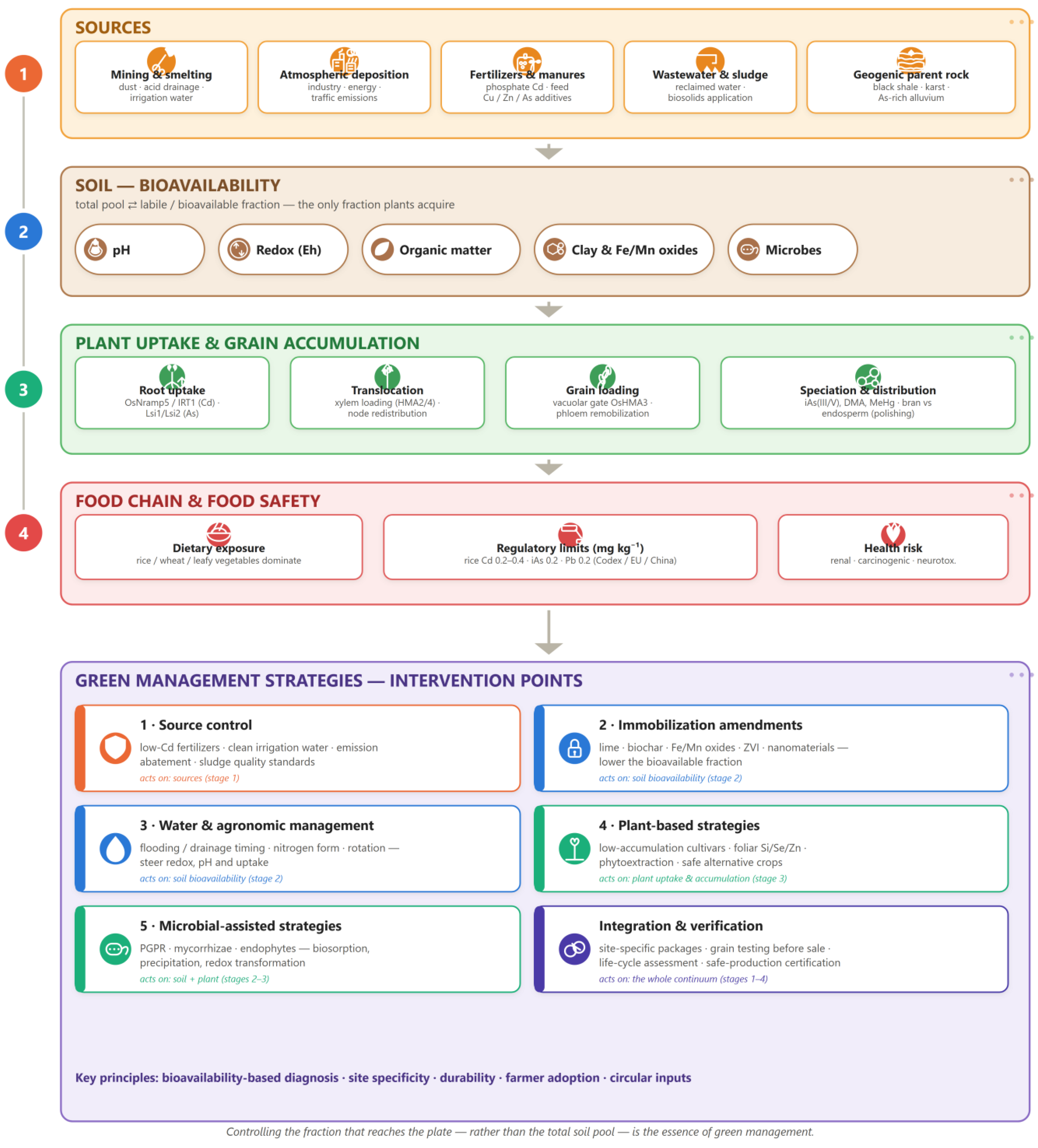
Figure 2.
Mechanisms of representative green management strategies: (a) soil amendments—pH elevation and (co)precipitation by lime, surface complexation and cation-exchange retention by biochar, inner-sphere sorption onto iron/manganese oxides, and reductive transformation by zero-valent iron; (b) plant-based strategies—low-accumulation cultivars with loss-of-function or vacuolar-sequestering metal transporters, water (redox) management steering Cd/As speciation in paddy soils, and foliar silicon/selenium suppressing root uptake and shoot translocation; (c) microbial-assisted strategies—biosorption onto cell surfaces, extracellular precipitation, siderophore-mediated chelation, and mycorrhizal sequestration in root-adjacent hyphal networks.
Figure 2.
Mechanisms of representative green management strategies: (a) soil amendments—pH elevation and (co)precipitation by lime, surface complexation and cation-exchange retention by biochar, inner-sphere sorption onto iron/manganese oxides, and reductive transformation by zero-valent iron; (b) plant-based strategies—low-accumulation cultivars with loss-of-function or vacuolar-sequestering metal transporters, water (redox) management steering Cd/As speciation in paddy soils, and foliar silicon/selenium suppressing root uptake and shoot translocation; (c) microbial-assisted strategies—biosorption onto cell surfaces, extracellular precipitation, siderophore-mediated chelation, and mycorrhizal sequestration in root-adjacent hyphal networks.
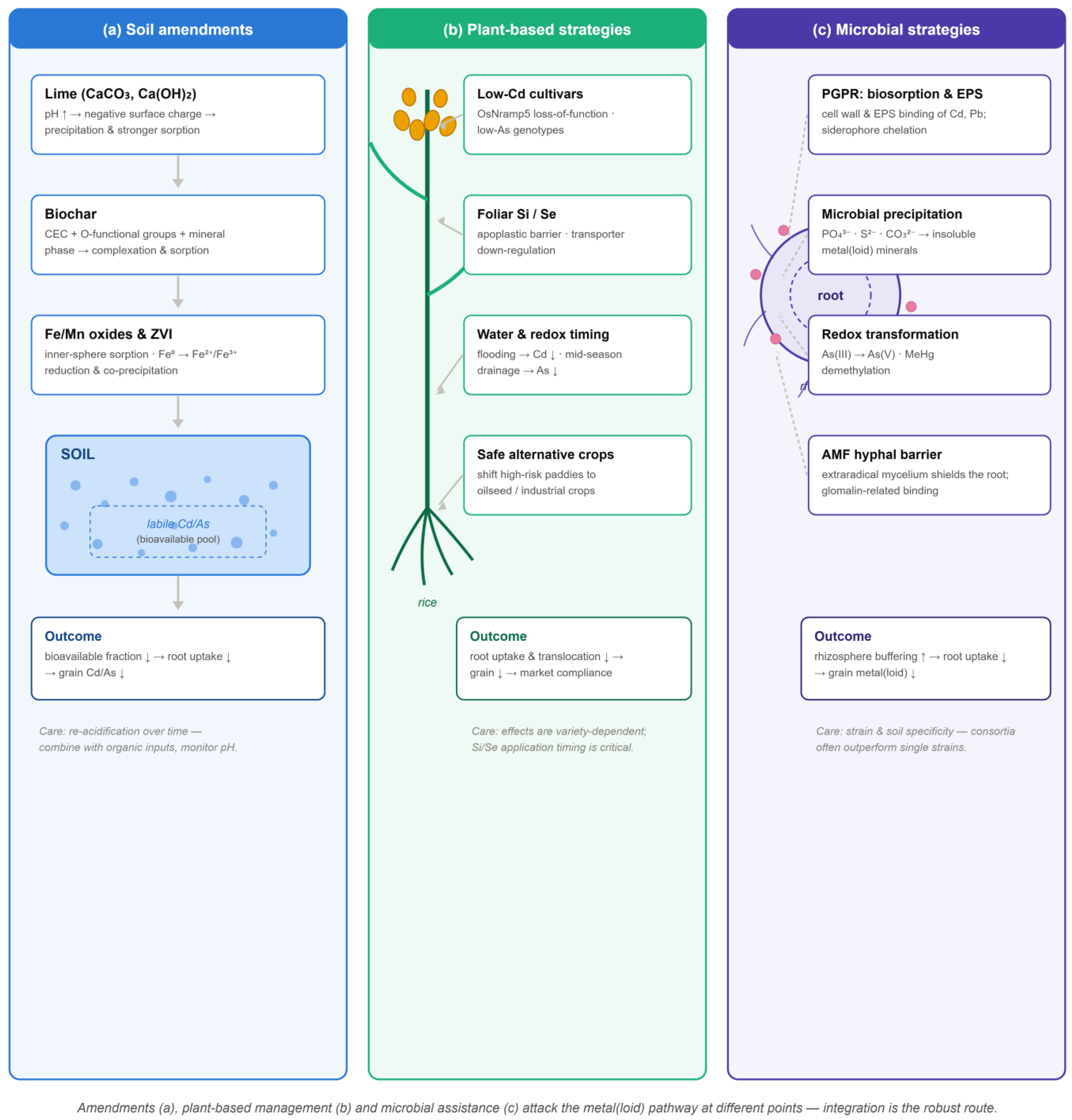
Figure 3.
Reported ranges of grain cadmium (left) and grain arsenic (right) reductions achieved by major green management strategies in representative field and pot studies compiled in this review[7, 9, 12, 24, 35~36, 38~39, 42~44, 48~49, 54~55]. Bars span reported ranges; symbols mark medians. Organic amendments are excluded from the As panel because responses are variable.
Figure 3.
Reported ranges of grain cadmium (left) and grain arsenic (right) reductions achieved by major green management strategies in representative field and pot studies compiled in this review[7, 9, 12, 24, 35~36, 38~39, 42~44, 48~49, 54~55]. Bars span reported ranges; symbols mark medians. Organic amendments are excluded from the As panel because responses are variable.
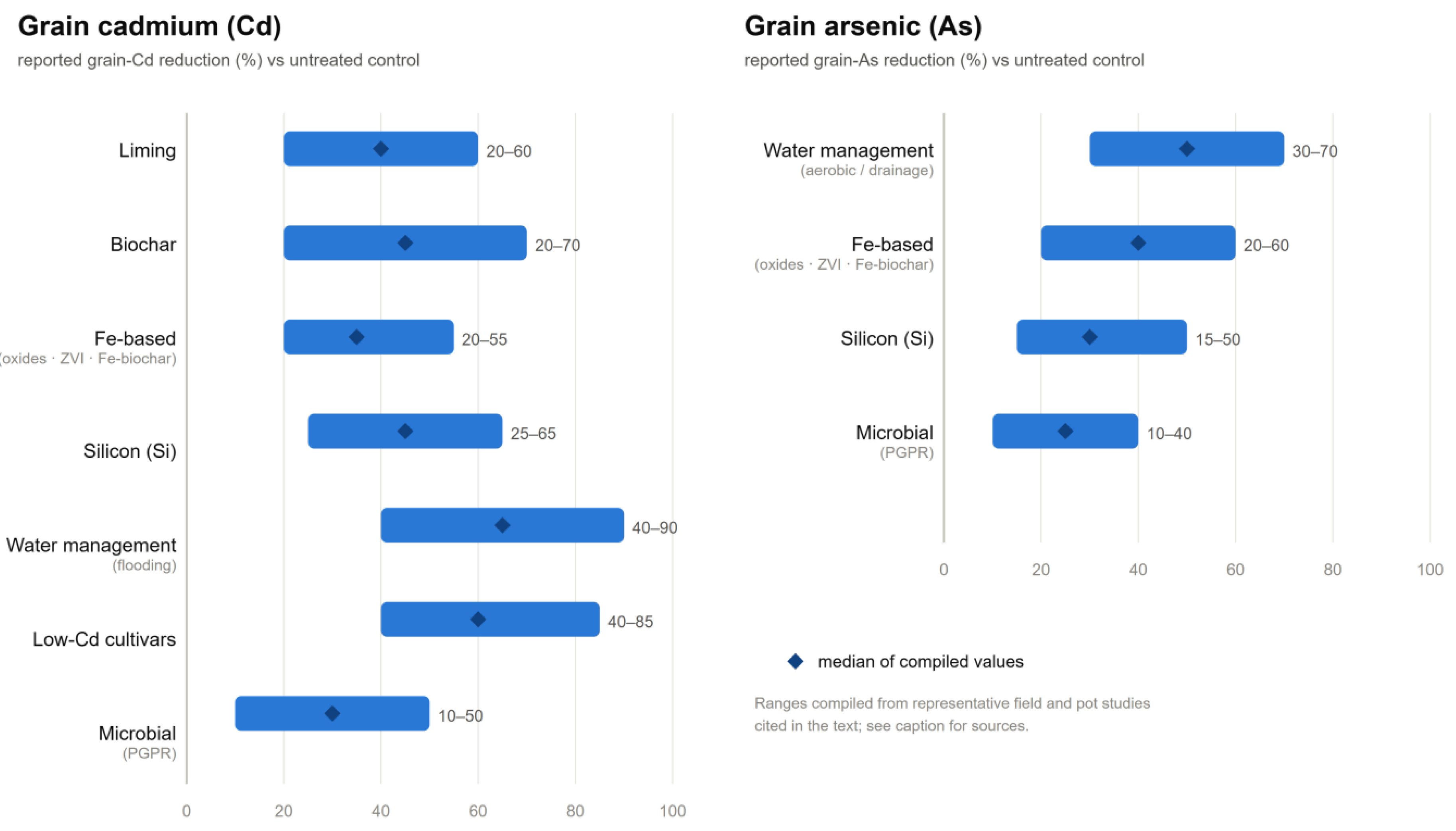

Table 1.
Major sources of heavy metal(loid)s in agricultural soils, their characteristic element signatures, entry routes, and the cropping systems most affected (compiled from [1,2,3,4,13,22]).
| Source category | Typical metal(loid)s | Major entry route | Most affected systems |
| Mining, smelting, tailings | Cd, Pb, Zn, As, Cu | Dust deposition; acid mine drainage; contaminated irrigation water | Paddy and upland fields near mining districts |
| Atmospheric deposition (industry, energy, traffic) | Pb, Cd, Hg | Dry/wet deposition onto soil and leaf surfaces | Peri-urban and downwind croplands |
| Phosphate fertilizers | Cd (U, As) | Direct soil application; repeated top-dressing | Intensive grain, vegetable, and greenhouse systems |
| Livestock manure and feed additives | Cu, Zn, As | Land spreading of manure | Pig/poultry production regions |
| Legacy pesticides and soil conditioners | As, Hg, Pb, Cu | Historic sprays and treatments | Orchards, vineyards, tea gardens |
| Wastewater / reclaimed-water irrigation | Cd, Pb, Cr, Cu, Zn | Irrigation water applied to root zone | Peri-urban and water-scarce croplands |
| Sewage sludge / biosolids | Cd, Cu, Zn, Pb, Hg | Land application of stabilized sludge | Arable land near treatment works |
| Geogenic parent material | As, Cd, Hg, Pb | Weathering of bedrock; alluvial deposition | Karst, black-shale, and deltaic regions |
Compiled from the cited reviews and surveys; element signatures are indicative and vary with local geology and industrial profile.
Table 2.
Summary of green management strategies for controlling heavy metal(loid) accumulation in crops: mechanisms, targets, reported efficacy, and principal limitations.
Table 2.
Summary of green management strategies for controlling heavy metal(loid) accumulation in crops: mechanisms, targets, reported efficacy, and principal limitations.
| Strategy family | Primary mechanism(s) | Target metal(loid)s | Reported efficacy | Key limitations |
| Water (redox) management | Flooding → CdS precipitation; drainage → As sorption onto oxidized Fe | Cd, As | Grain Cd ↓ 40–90%; grain As ↓ 30–70% | Opposite responses of Cd vs As; crop-stage dependent |
| Liming / alkaline by-products | pH elevation; surface charge; carbonate precipitation | Cd, Zn, Pb | Grain Cd ↓ 20–60% on acid soils | Re-acidification; reapplication; micronutrient risk |
| Biochar (incl. Fe-modified) | Liming effect; CEC; surface complexation; pore retention | Cd, Pb, Cu, Zn | Grain Cd ↓ 20–70% sustained 3–5 years | As mobilization when flooded; aging; feedstock variability |
| Fe/Mn oxides, ZVI, clays, phosphates | Inner-sphere sorption; redox transformation; precipitation | As, Cd, Pb, Cr | Grain As ↓ 20–60%; Cd ↓ 20–50% | Dose-dependent cost; passivation; P–As competition |
| Foliar Si / Se / Zn | Apoplastic barriers; co-precipitation; ion antagonism | Cd, Pb, As | Grain Cd ↓ 20–60% | Split applications; cultivar-dependent |
| Low-accumulation cultivars | Loss-of-function OsNramp5; vacuolar OsHMA3; MAS | Cd, As | Grain Cd ↓ 40–90% vs high accumulators | Mn nutrition penalty; site × genotype interaction |
| Microbial inoculation | Biosorption; precipitation; redox; ACC deaminase | Cd, Pb, As, Cr, Hg | Grain Cd ↓ 10–50% (variable) | Field reproducibility; inoculant survival |
| Phytoextraction / safe cropping | Hyperaccumulation and off-site removal; non-food crops | Cd, Zn, As, Ni | Decades for compliance; land remains productive | Slow; biomass disposal; metal mixture toxicity |
| Nanomaterials (nZVI, nHAp, LDH) | High-capacity sorption plus reduction | Cd, As, Pb, Cr | >90% immobilization in lab; field data limited | Cost; aging; nano-ecotoxicity unresolved |
Efficacy ranges compiled from the field and pot studies cited inSection 4.1, Section 4.2, Section 4.3, Section 4.4, Section 4.5 and Section 4.6; see [7, 9, 24, 26, 35~39, 42~44, 46, 48~49, 54~55, 57, 59].
Table 3.
Selected regulatory limits for heavy metal(loid)s in staple foods (mg kg−1) and soil risk screening values, comparing Codex, EU, and Chinese standards.
Table 3.
Selected regulatory limits for heavy metal(loid)s in staple foods (mg kg−1) and soil risk screening values, comparing Codex, EU, and Chinese standards.
| Parameter (matrix) | Codex CXS 193-1995 | EU (2023/915) | China GB 2762-2022 | China GB 15618-2018 (paddy, 5.5 < pH ≤ 6.5) |
| Cd (polished rice) | 0.4 | 0.20 | 0.2 | 0.4 (soil, mg kg−1) |
| Pb (rice) | 0.2 | 0.20 | 0.2 | 100 (soil, mg kg−1) |
| Inorganic As (polished rice) | 0.2 | 0.20 | 0.2 | 30 (soil, mg kg−1) |
| Hg (rice) | — | — | 0.02 | 0.5 (soil, mg kg−1) |
| Cr (grains) | — | — | 1.0 | 250 (soil, mg kg−1) |
Disclaimer/Publisher’s Note: The statements, opinions and data contained in all publications are solely those of the individual author(s) and contributor(s) and not of MDPI and/or the editor(s). MDPI and/or the editor(s) disclaim responsibility for any injury to people or property resulting from any ideas, methods, instructions or products referred to in the content. |
© 2026 by the authors. Licensee MDPI, Basel, Switzerland. This article is an open access article distributed under the terms and conditions of the Creative Commons Attribution (CC BY) license (http://creativecommons.org/licenses/by/4.0/).
Copyright: This open access article is published under a Creative Commons CC BY 4.0 license, which permit the free download, distribution, and reuse, provided that the author and preprint are cited in any reuse.