
Submitted:
03 September 2026
Posted:
03 September 2026
You are already at the latest version
Abstract
Pladienolide-B, a macrocyclic polyketide isolated from Streptomyces platensis Mer-11107, displays potent antiproliferative and antitumor activities by targeting the SF3b subunit of the spliceosome. Herein, we report a divergent, stereoselective synthetic route to access both the C1–C8 and C9–C13 fragments of the core moiety of Pladienolide-B starting from a common, inexpensive chiral pool precursor, L-malic acid. Key stereocenters and structural motifs were established using Sharpless asymmetric epoxidation, regioselective nucleophilic epoxide opening, Mannich reaction for exo-methylene introduction, and a tandem iodination–zinc elimination cascade. This unified precursor approach offers a streamlined tactical route toward the core macrolide framework.
Keywords:
pladienolide-B
; L-malic acid
; chiral-pool synthesis
; divergent synthesis
; stereoselective synthesis
1. Introduction
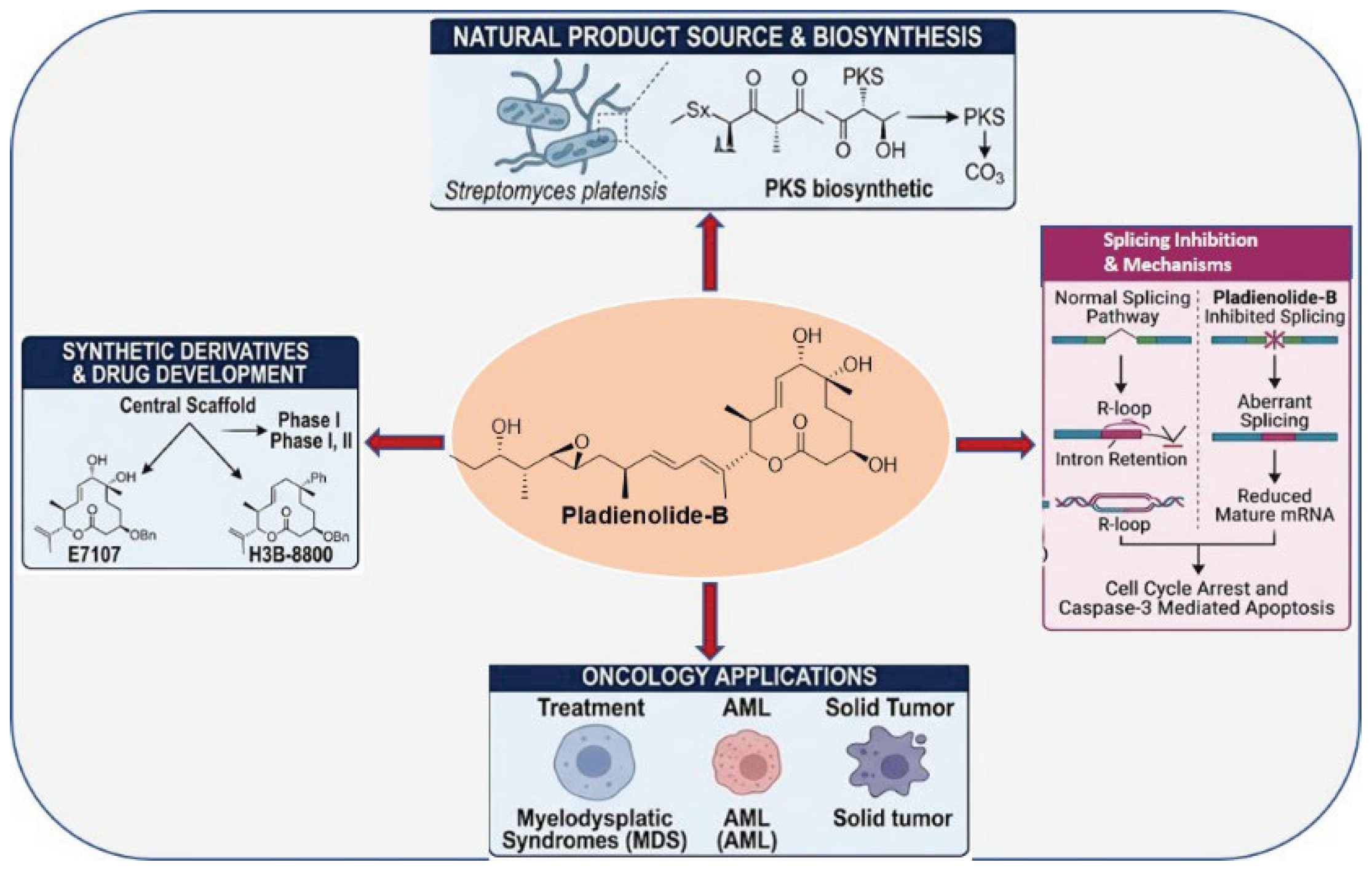
Pladienolides are a family of structurally complex 12-membered macrolides isolated from Streptomyces platensis Mer-11107. Among them, pladienolide B (1) exhibits potent antiproliferative and antitumor activities and has attracted considerable attention because of its unique mechanism of action involving the spliceosomal machinery. [1,2,3] Pladienolide B selectively targets the SF3b complex containing SF3B1, thereby disrupting pre-mRNA splicing and inhibiting cancer cell proliferation. This distinctive mode of action, together with its potent antitumor activity, has established pladienolide B as an important lead structure for the development of novel anticancer and spliceosome-targeting therapeutics. [4,5] More recently, its therapeutic potential has been further demonstrated across different cancer models, including lung adenocarcinoma and hepatocellular carcinoma, where pladienolide B was shown to suppress tumor-cell proliferation and, in combination with cisplatin, enhance antitumor activity (Figure 1). [6,7,8,9]
The combination of potent biological activity, a highly functionalized macro lactone framework, multiple stereogenic centres, and an epoxide-containing side chain makes pladienolide B an attractive target for synthetic studies. Since the isolation and structural elucidation of the pladienolides, several synthetic approaches to pladienolide B and related analogues have been reported. [10,11,12] These studies have established diverse strategies for constructing the stereochemically rich macrolide framework, including asymmetric epoxidation, epoxide opening, olefination, ring-closing metathesis, and stereoselective C–C bond-forming reactions. More recently, concise and convergent total syntheses of pladienolide B and related spliceosome modulators have been developed using catalytic asymmetric C–C bond formation and step-economical synthetic strategies. [13,14,15,16]
The C1–C8 and C9–C13 segments constitute important stereochemically defined portions of the pladienolide B core. Chiral-pool synthesis provides an attractive strategy for accessing such complex fragments because the inherent stereochemical information of readily available chiral starting materials can be efficiently transferred to the target structures. L-Malic acid, an inexpensive and readily accessible chiral starting material, has been successfully utilized in the synthesis of stereochemically rich intermediates and natural products. [17,18,19]
In the present work, we describe a divergent synthesis of the C1–C8 and C9–C13 fragments of pladienolide B using L-malic acid as a common chiral-pool starting material. The C1–C8 fragment was constructed through epoxide opening, C–C bond formation, and Sharpless asymmetric epoxidation, followed by functional-group transformations. The C9–C13 fragment was prepared from an L-malic-acid-derived triol through oxidative cleavage, olefination, reduction, and Sharpless asymmetric epoxidation. Thus, two stereochemically defined fragments of the pladienolide B core were accessed from a common chiral-pool precursor through complementary synthetic sequences.
2. Results and Discussion
2.1. Retrosynthesis
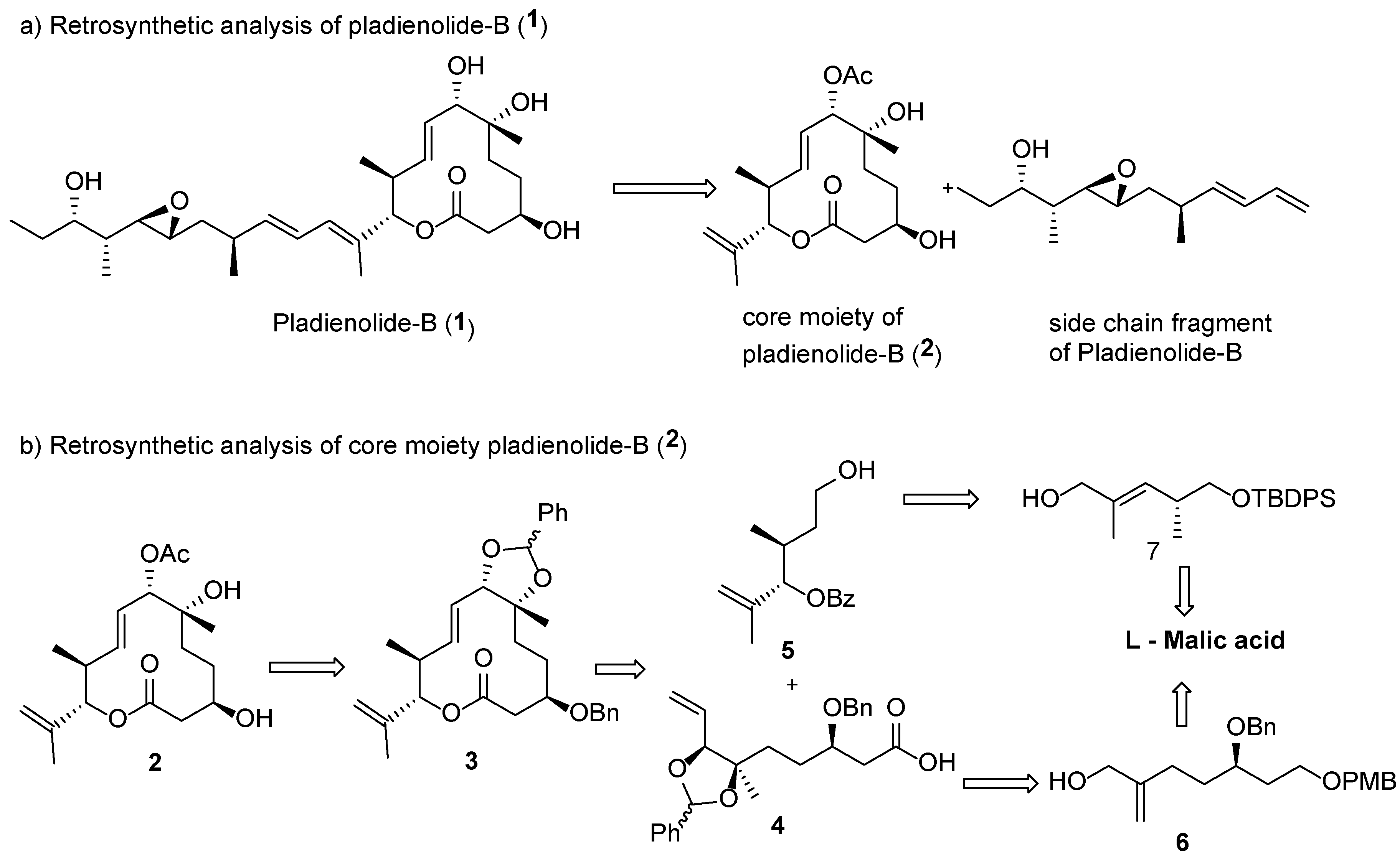
The synthesis of pladienolide B (1) was envisaged from its core moiety (2) and the corresponding side-chain fragment, as shown in Scheme 1a. Retrosynthetic analysis of the core moiety (2) revealed a convergent coupling between two polyketide subunits, namely the C1–C8 acid fragment (4) and the C9–C13 alcohol fragment (5) (Scheme 1 b). To address the efficiency and cost associated with the use of multiple, non-overlapping chiral starting materials, both fragments were traced back to intermediates 6 and 7, respectively, which could be derived from a common chiral-pool precursor, L-malic acid.
2.2. Synthesis of C1-C8 Fragment of Pladienolide-B (4)
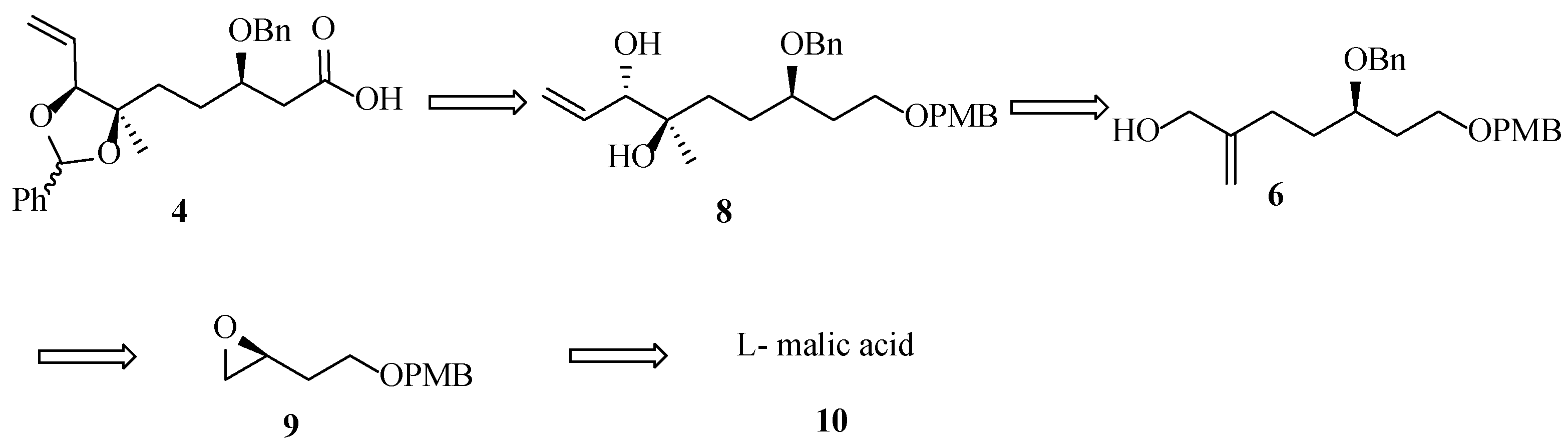
The retrosynthetic plan for the C1–C8 acid fragment 4 is depicted in Scheme 2. Target fragment 4 was envisioned to be accessible from 1,2-diol 8, which in turn could be constructed from allylic alcohol 6 via a sequence involving Sharpless asymmetric epoxidation, regioselective epoxide opening, and functional group transformations. Allylic alcohol 6 could be derived through short, sequential manipulations of known epoxide 9, prepared from L-malic acid 10.
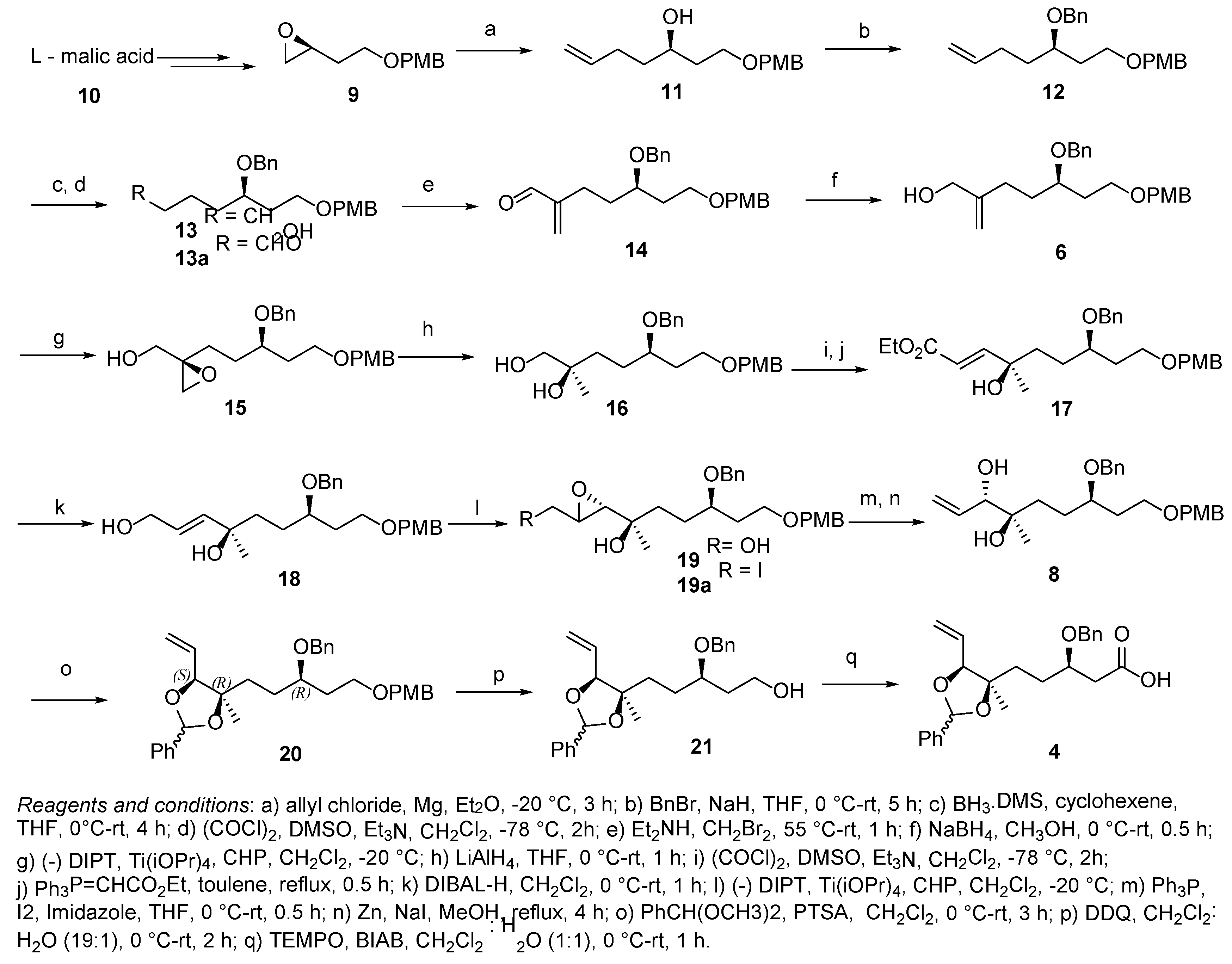
The forward synthesis commenced with the regioselective ring opening of known epoxide 9 using allyl chloride under Grignard conditions in diethyl ether at -20 °C for 3 h, delivering secondary alcohol 11 in 80% yield (Scheme 3). O-Benzylation of alcohol 11 using benzyl bromide (BnBr) and sodium hydride (NaH) in anhydrous THF at 0 °C for 5 h provided benzyl ether 12. Selective hydroboration-oxidation of the terminal alkene in 12 with BH3.DMS and cyclohexene in THF at 0 °C for 4 h furnished primary alcohol 13. Subsequent Swern oxidation of 13 yielded aldehyde 13a, which was subjected to a Mannich methylene insertion reaction using a preheated mixture of diethylaminem diethylamine and dibromo methane (CH2Br2) at room temperature for 3 h to afford α,β-unsaturated aldehyde 14 (enal). Chemo-selective reduction of enal 14 using sodium borohydride (NaBH4) in methanol at 0 °C for 0.5 h smoothly generated allylic alcohol 6.
Sharpless asymmetric epoxidation of allylic alcohol 6 using L-(+)-diethyl tartrate, Ti(iOPr)4, and tert-butyl hydroperoxide (TBHP) in dichloromethane at -20 °C established the required epoxy stereocenters in 15. Regioselective hydride reduction of epoxy alcohol 15 with lithium aluminum hydride (LiAlH4) in THF at 0 °C for 1 h produced 1,2-diol 16. Sequential Swern oxidation of diol 16 followed by Wittig homologation with methyl(triphenylphosphoranylidene)acetate Ph3P=CHCOOMe yielded αβ-unsaturated ester 17.
Reduction of ester 17 using DIBAL-H in dichloromethane at 0 °C for 1 h yielded allylic alcohol 18. A second Sharpless asymmetric epoxidation of allylic alcohol 18 under identical kinetic resolution conditions gave epoxy alcohol 19. Treatment of 19 under Appel-type iodination conditions (Ph3P, I2, imidazole) in THF at 0 °C for 30 min delivered the corresponding iodomethyl intermediate 19a. Tandem zinc-promoted reductive elimination of 19a using zinc powder and sodium iodide in refluxing methanol for 4 h cleanly set the exo-methylene motif, yielding diol 8.
Protection of diol 8 with benzaldehyde dimethyl acetal in the presence of catalytic p-toluene sulfonic acid (PTSA) in dichloromethnae at 0 °C for 3 h afforded benzylidene acetal 20. Oxidative deprotection of the secondary benzyl ether in 20 using 2,3-dichloro-5,6-dicyano-1,4-benzoquinone (DDQ) in a dichloromethane and water mixture (19:1) provided primary alcohol 21. Finally, TEMPO/BAIB-mediated oxidation of terminal alcohol 21 in CH2Cl2: H2O (1:1) at room temperature for 1 h successfully furnished the targeted C1–C8 acid fragment 4.
2.3. Synthesis of C9-C13 Fragment of Pladienolide-B (5)
The retrosynthetic strategy for the C9–C13 alcohol fragment 5 is depicted in Scheme 4. Target subunit 5 was planned to originate from allylic alcohol 7, which in turn could be prepared from known triol 22 through short, sequential manipulations starting from L-malic acid (10).
The forward synthesis commenced with the oxidative cleavage of known triol 22 using sodium periodate (NaIO4) in an acetone/water mixture (5:1) at 0 °C for 30 min to generate the corresponding crude aldehyde (Scheme 5). Subsequent Wittig olefination of this intermediate with ethyl 2-(triphenylphosphoranylidene)propanoate yielded α,β-unsaturated ester 23. Protection of the secondary hydroxyl group in 23 as a tert-butyldiphenylsilyl (TBDPS) ether using TBDPSCl and imidazole in dichloromethane at 0 °C for 1 h provided silyl ether 24. Chemoselective ester reduction of 24 using DIBAL-H in dichloromethane at 0 °C for 1 h delivered allylic alcohol 7 in 82% overall yield over two steps.
Sharpless asymmetric epoxidation of allylic alcohol 7 using L-(+)-diethyl tartrate, Ti(OiPr)4, and tert-butyl hydroperoxide (TBHP) in dichloromethane at -20 °C set the desired epoxy stereocenters in 25. Treatment of epoxy alcohol 25 under Appel-type conditions (Ph3P, I2, imidazole) in THF at 0 °C for 30 min afforded iodomethyl intermediate 25a. Subsequent tandem zinc-promoted reductive elimination of 25a using zinc powder and NaI in refluxing methanol for 4 h cleanly constructed the required 1,1-disubstituted allylic alcohol 26.
Benzoylation of allylic alcohol 26 with benzoyl chloride (BzCl) and triethylamine in dichloromethane at 0 °C for 2 h furnished benzoate ester 27. Finally, fluoride-mediated desilylation of 27 using tetra-n-butylammonium fluoride (TBAF) in THF at 0 °C for 2 h smoothly unmasked the primary hydroxyl group to yield the target C9–C13 alcohol fragment 5.
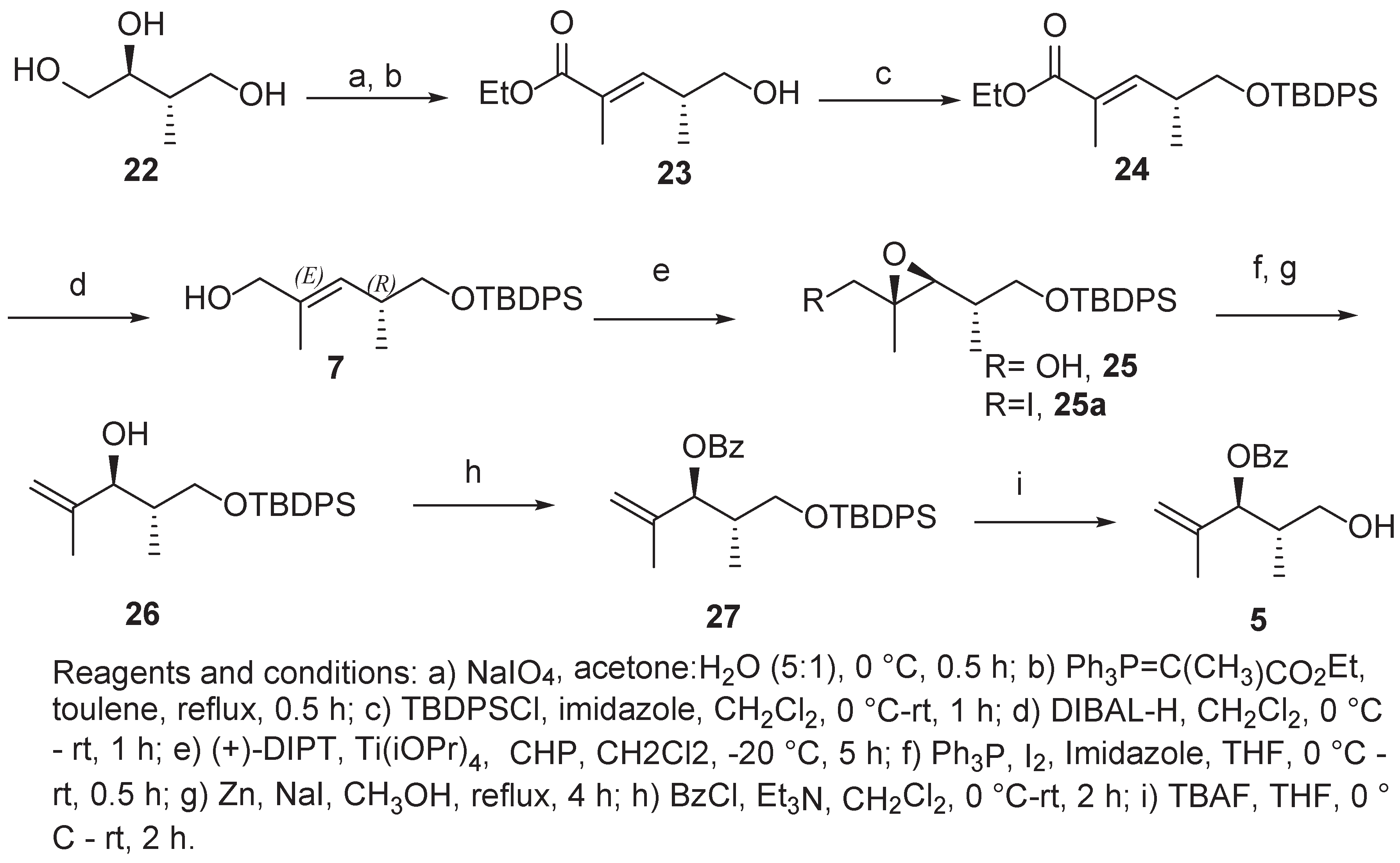
The allylic alcohol 7 on Sharpless asymmetric epoxidation gave the epoxide 25, which was treated with Ph3P, I2 and imidazole in THF at 0 °C for 30 min afford iodo compound 25a. It was further treated with Zn and NaI in CH3OH under reflux conditions for 4 h to give the allylic alcohol 26. Treatment of allylic alcohol 26 with BzCl and Et3N in CH2Cl2 0 oC for 2 h gave 27, which on reaction with TBAF in THF 0 oC for 2 h afforded 5
3. Conclusion
In conclusion, a divergent and stereoselective synthetic strategy was developed for the preparation of the C1–C8 acid fragment (4) and C9–C13 alcohol fragment (5) of the pladienolide B core (2). Both fragments were accessed from L-malic acid (10) as a common, inexpensive chiral-pool precursor. The synthesis utilized key asymmetric and stereoselective transformations, including Sharpless asymmetric epoxidation, regioselective epoxide opening, and stereoselective functional-group transformations, to establish the required stereochemical features. This common chiral-pool approach provides a unified route to two stereo chemically defined building blocks of the pladienolide B core and demonstrates the utility of L-malic acid for the synthesis of structurally complex natural-product fragments.
4. Experimental
4.1. General Methods
All reactions were carried out under an N2 atmosphere in flame-dried glassware using anhydrous solvents (CH2Cl2, THF, CCl4, benzene, or EtOAc unless otherwise noted. Petroleum ether used had a boiling range of 60–80 °C. Reaction progress was monitored by thin-layer chromatography (TLC) using Merck 60 F254 silica gel plates, and visualization was accomplished under UV light 254 nm or by staining with phosphomolybdic acid or KMnO4 solutions. Flash and column chromatography were performed using silica gel (60–120 mesh, Acme Chemical Co.,). Yields refer to chromatographically and spectroscopically (1H NMR, 13C NMR) homogeneous materials. Air- and moisture-sensitive reagents were transferred via oven-dried syringes or double-ended cannulas. Concentrating solutions under reduced pressure was performed using a Büchi rotary evaporator. Optical rotations [α]D were measured on a JASCO DIP-370 polarimeter at 25 °C. NMR spectra were recorded on Varian Unity 400 MHz, or Varian Inova 500 MHz spectrometers. NMR chemical shifts δ are reported in parts per million (ppm) relative to tetramethylsilane TMS δ = 0.00 ppm as an internal standard using CDCl3 as solvent. Low- and high-resolution mass spectra (MS) were recorded under electron impact (70eV) on an Agilent Technologies LC-MSD spectrometer.
(R)-1-((4-methoxybenzyl)oxy)hept-6-en-3-ol (11):
To a well-stirred suspension of Mg turnings (5.2 g, 216.33 mmol) in diethyl ether (75 mL), allyl chloride (17.6 mL, 216.33 mmol) was added at 0 °C. The resulting Grignard reagent was stirred until complete formation and then cooled to −40 °C. A solution of epoxide 9 (15.0 g, 72.11 mmol) in diethyl ether (75 mL) was added slowly to the Grignard solution at −40 °C. The reaction mixture was stirred at −40 °C for 2 h. Upon completion, the reaction mixture was quenched with saturated NH₄Cl solution (50 mL) and extracted with EtOAc (2 × 100 mL). The combined organic layers were washed with water (2 × 50 mL) and brine (2 × 50 mL), dried over anhydrous Na₂SO₄, and concentrated under reduced pressure. The resulting residue was purified by column chromatography over silica gel (60–120 mesh), using 4% EtOAc in petroleum ether as the eluent, to afford compound 11 as a product (12.6 g, 70% yield). [α]20D = -17.5 (c 0.1, CHCl3); IR (CHCl3): ν 3489, 3487, 3323, 2978, 2922, 1714, 1640, 1609, 1512, 1373, 1246, 1173, 914, 821 Cm-1; 1H NMR (300 MHz, CDCl3): δ 7.13 (d, 2H, J = 8.49 Hz), 6.76 (d, 2H, J = 8.49 Hz), 5.72 (m, 1H), 4.94 (m, 2H), 4.36 (s, 2H), 3.72 (s, 3H), 3.51 (m, 3H), 2.7 (bs, 1H), 2.08 (m, 2H), 1.82 (m, 1H), 1.63 (q, 1H), 1.44 (m, 2H); 13C NMR (75 MHz, CDCl3): δ 159.0, 138.4, 131.4, 129.8, 129.1, 114.3, 113.6, 72.7, 70.4, 68.5, 55.0, 36.3, 29.7; HRMS: m/z calculated for C15H22O3Na 273.1388, found: 273.1394.
(R)-1-(((3-(Benzyloxy)hept-6-en-1-yl)oxy)methyl)-4-methoxybenzene (12):
To a cooled (0 °C) suspension of NaH (3.45 g, 144 mmol; 60% w/w dispersion in paraffin oil) in dry THF (15 mL), a solution of compound 11 (12.6 g, 48.0 mmol) in dry THF (10 mL) was added, and the reaction mixture was stirred at 0 °C for 30 min. Benzyl bromide (6.27 mL, 52.8 mmol) was then added dropwise at 0 °C, and the reaction mixture was allowed to warm to room temperature and stirred for 4 h. The reaction mixture was cooled to 0 °C, and saturated aqueous NH₄Cl solution (10 mL) was added dropwise, followed by EtOAc (50 mL). The organic layer was separated, washed with water (10 mL) and brine (10 mL), dried over anhydrous Na₂SO₄, and concentrated under reduced pressure. The resulting residue was purified by column chromatography over silica gel (60–120 mesh), using 5% EtOAc in petroleum ether as the eluent, to afford compound 12 (12.0 g, 74%) as a light yellow color syrup; [α]20D = -37.7 (c 0.1, CHCl3); IR (CHCl3): ν 3065, 3002, 2923, 2854, 1716, 1640, 1512, 1453, 1360, 1246, 1171, 911, 819 Cm-1; 1H NMR (500 MHz, CDCl3): δ 7.25 (m, 5H), 7.16 (d, 2H, J = 8.0 Hz), 6.78 (d, 2H, J = 8.0 Hz), 5.75 (m, 1H), 4.93 (m, 2H), 4.44 (q, 2H), 4.35 (q, 2H), 3.77 (s, 3H), 3.51 (m, 2H), 2.11 (m, 2H), 1.78 (m, 2H), 1.61 (m, 2H); 13C NMR (75 MHz, CDCl3): δ 159.1, 138.6, 130.5, 129.3, 128.2, 127.7, 127.4, 114.5, 113.7, 75.6, 72.6, 71.2, 66.5, 55.2, 34.3, 33.4, 29.4; HRMS: m/z calculated for C22H28O3Na 363.1931, found: 363.1944.
(R)-5-(Benzyloxy)-7-((4-methoxybenzyl)oxy)heptan-1-ol (13):
To a solution of cyclohexene (5.4 mL, 52.93 mmol) in THF (10 mL), BH3.DMS (5.0 mL, 52.93 mmol) was added at 0 oC and allowed to stir for 0.5 h. A solution of 12 (12.0 g, 35.29 mmol) in THF (20 mL) was added to the reaction mixture and stirred for 4 h. Reaction mixture was quenched with 2N NaOH (20 mL) followed by H2O2 (10 mL), extracted into EtOAc (100 mL) washed with water (2 × 50 mL), brine (50 mL) and dried (Na2SO4). Solvent was evaporated and purified the residue by column chromatography (60-120 mesh Silica gel, 8% EtOAc in petroleum ether) to give 13 (8.84 g, 70%) as liquid; [α]20D = -37.4 (c 0.2, CHCl3); IR (CHCl3): ν 3393, 3360, 2925, 2855, 1712, 1610, 1585, 1456, 1363, 1247, 1173, 1034, 772 Cm-1; 1H NMR (500 MHz, CDCl3): δ 7.25 (m, 5H), 7.17 (d, 2H, J = 8.42 Hz), 6.8 (d, 2H, J = 8.42 Hz), 4.45 (q, 2H), 4.36 (t, 2H), 3.78 (s, 3H), 3.58-3.47 (m, 5H), 1.78 (m, 2H), 1.41 (m, 2H), 1.26 (bs, 1H); 13C NMR (75 MHz, CDCl3): δ 159.1, 138.8, 130.5, 129.3, 128.3, 127.7, 127.4, 113.7, 76.1, 72.6, 71.2, 66.5, 62.7, 55.2, 34.3, 33.8, 32.7, 21.3; HRMS: m/z calculated for C22H30O4Na 381.2036, found: 381.2048.
(R)-5-(Benzyloxy)-7-((4-methoxybenzyl)oxy)-2-methyleneheptan-1-ol (6):
Preparation of Aldehyde 13a
To a solution of oxalyl chloride (3.17 mL, 37.03 mmol) in dry CH₂Cl₂ (15 mL) at −78 °C, dry DMSO (5.26 mL, 74.07 mmol) was added dropwise. The reaction mixture was stirred at −78 °C for 30 min, after which a solution of alcohol 13 (8.84 g, 24.69 mmol) in CH₂Cl₂ (15 mL) was added over 10 min. The resulting mixture was stirred at −78 °C for 2 h, followed by slow addition of Et₃N (20.6 mL, 148.14 mmol). The reaction mixture was then allowed to warm to room temperature and stirred for an additional 30 min. The mixture was diluted with water (10 mL) and CH₂Cl₂ (50 mL), and the organic layer was separated, washed successively with water (10 mL) and brine (10 mL), dried over anhydrous Na₂SO₄, and concentrated under reduced pressure to afford aldehyde 13a (5.0 g, 58% yield).
Preparation of Olefin 14
Diethylamine (4.97 mL, 49.11 mmol) and CH₂Br₂ (16.7 mL, 210 mmol) were combined and heated at 55 °C for 1.5 h with stirring. The reaction mixture was then cooled to room temperature, and aldehyde 13a (5.0 g, 14.03 mmol) was added. The resulting mixture was stirred at room temperature for 1.5 h. The solvent was removed under reduced pressure, and the residue was purified by column chromatography over silica gel (60–120 mesh), using 2% EtOAc in petroleum ether as the eluent, to afford olefin 14 (2.65 g, 45% yield)
Preparation of Compound 6
To a solution of olefin 14 (2.65 g, 7.16 mmol) in CH₃OH (10 mL) at 0 °C, NaBH₄ (0.18 g, 5.05 mmol) was added. The reaction mixture was processed and the solvent was removed under reduced pressure. The resulting residue was purified by column chromatography over silica gel (60–120 mesh), using 4% EtOAc in petroleum ether as the eluent, to afford compound 6 (1.15 g, 43%); [α]20D = -87.04 (c 0.2, CHCl3); IR (CHCl3): ν 3440, 3395, 3006, 2859, 2311, 1712, 1609, 1512, 1453, 1360, 1246, 1172, 1029, 820 cm-1; 1H NMR (500 MHz, CDCl3): δ 7.25 (m, 5H), 7.18 (d, 2H, J = 8.3 Hz), 6.81 (d, 2H, J = 8.3 Hz), 4.96 (s, 1H), 4.81 (s, 1H), 4.44 (t, 2H), 4.36 (s, 2H), 3.99 (bs, 1H), 3.78 (s, 3H), 3.54 (m, 3H), 2.12 (m, 2H), 1.8 (m, 2H), 1.68 (q, 2H); 13C NMR (75 MHz, CDCl3): δ 159.1, 148.8, 138.6, 130.4, 129.3, 128.3, 127.8, 127.5, 113.7, 109.3, 75.8, 72.6, 71.2, 66.4, 65.8, 55.2, 34.1, 32.2, 28.4; HRMS: m/z, calculated for C23H30O4Na 393.2144, found 393.2148.
((R)-2-((R)-3-(Benzyloxy)-5-((4-methoxybenzyl)oxy)pentyl)oxiran-2-yl)methanol (15):
To a stirred solution of (+)-DIPT (0.13 mL, 0.62 mmol) in CH₂Cl₂ (15 mL) at −20 °C, containing activated 4 Å molecular sieves (0.30 g), Ti(OiPr)₄ (0.09 mL, 0.31 mmol) and cumene hydroperoxide (0.97 mL, 6.2 mmol) were added sequentially. The resulting mixture was stirred at −20 °C for 20 min. A solution of compound 6 (1.15 g, 3.10 mmol) in CH₂Cl₂ (15 mL) was then added, and the reaction mixture was stirred at −20 °C for 5 h. The reaction mixture was quenched by addition of 10% KOH solution (prepared by dissolving 3.0 g of KOH in 30 mL of brine) and stirred for 3 h. The mixture was filtered through a pad of Celite, washing with EtOAc (20 mL). The organic layer was separated, dried over anhydrous Na₂SO₄, and concentrated under reduced pressure. The resulting residue was purified by column chromatography over silica gel (60–120 mesh), using 20% EtOAc in petroleum ether as the eluent, to afford compound 15 (0.95 g, 80%) as a yellow syrup; [α]20D = -12.2 (c 0.2, CHCl3); IR (CHCl3): ν 3420, 3019, 2985, 1726, 1679, 1514, 1215, 1033, 928 cm-1; 1H NMR (500 MHz, CDCl3): δ 7.27 (m, 7H, ArH), 6.87 (d, 2H, J = 8.3 Hz, ArH), 4.47 (m, 2H, ArCH2), 4.40 (s, 2H, ArCH2), 3.80 (s, 3H, OMe), 3.53 (m, 5H, OCH), 2.84 (d, 2H, J = 4.53, epoxy), 2.62 (d, 1H, J = 4.15 Hz, epoxy), 1.69 (m, 6H, CH2); 13C NMR (75 MHz, CDCl3, 295 K): δ 159.06, 148.76, 138.4, 130.3, 129.3, 128.3, 127.8, 127.6, 113.7, 76.3, 72.6, 71.3, 69.0, 66.4, 61.2, 61.1, 55.4, 55.2, 34.1, 33.9, 27.5, 26.2; HRMS: m/z calculated for C23H30O5Na 409.2169, found: 409.2160.
(2R,5R)-5-(Benzyloxy)-7-((4-methoxybenzyl)oxy)-2-methylheptane-1,2-diol (16):
To a cooled suspension of LAH (0.22 g, 6.15 mmol) in dry THF (2 mL), 15 (0.95 g, 2.46 mmol) in dry THF (2 mL) was added at 0 °C and stirred at room temperature for 1 h. The reaction mixture was quenched with saturated Na2SO4 solution (2 mL) and stirred for 1 h. It was filtered, washed with EtOAc (2 x 15 mL). Combined organic layers were washed with water (5 mL), brine (5 mL) and dried (Na2SO4). Solvent was evaporated and purified the residue by column chromatography (60-120 mesh Silica gel, 20% EtOAc in petroleum ether) to furnish 16 (0.66 g, 70%) as a yellow oil; [α]20D = -13.5 (c 0.1, CHCl3); IR (CHCl3): ν 3409, 3063, 3031, 2857, 1701, 1611, 1512, 1456, 1363, 1302, 1248, 1175, 1035, 911 cm-1; 1H NMR (500 MHz, CDCl3): δ 7.28 (m, 7H), 6.87 (d, 2H, J = 8.0 Hz), 4.5 (m, 2H), 4.40 (s, 2H), 3.80 (s, 3H), 3.58 (m, 3H), 3.39 (m, 2H), 1.86 (m, 6H), 1.13 (s, 3H); 13C NMR (75 MHz, CDCl3): δ 159.1, 148.7, 138.3, 130.3, 129.3, 128.3, 127.8, 127.5, 113.7, 76.5, 72.6, 71.2, 69.6, 66.3, 55.2, 34.2, 33.5, 33.4, 27.7, 23.2, 23.0; HRMS: m/z calculated for C23H32O5Na 411.2142, found 411.2145.
(4R,7R,E)-Ethyl 7-(benzyloxy)-4-hydroxy-9-((4-methoxybenzyl)oxy)-4-methylnon-2-enoate (17):
Preparation of Aldehyde 16a
To a solution of oxalyl chloride (0.21 mL, 2.55 mmol) in dry CH₂Cl₂ (15 mL) at −78 °C, dry DMSO (0.36 mL, 5.10 mmol) was added dropwise. The reaction mixture was stirred at −78 °C for 30 min, after which a solution of alcohol 16 (0.66 g, 1.70 mmol) in CH₂Cl₂ (15 mL) was added over 10 min. The resulting mixture was stirred at −78 °C for 2 h, followed by slow addition of Et₃N (1.41 mL, 10.2 mmol). The reaction mixture was then allowed to warm to room temperature and stirred for an additional 30 min. The mixture was diluted with water (10 mL) and CH₂Cl₂ (50 mL), and the organic layer was separated, washed successively with water (10 mL) and brine (10 mL), dried over anhydrous Na₂SO₄, and concentrated under reduced pressure to afford crude aldehyde 16a, which was used directly in the next step without further purification.
Preparation of Compound 17
The crude aldehyde 16a (0.66 g, 1.70 mmol) was dissolved in benzene (30 mL), and (ethoxycarbonylmethylene)triphenylphosphorane (0.90 g, 2.56 mmol) was added. The reaction mixture was heated at reflux for 2 h with stirring. After completion, the solvent was removed under reduced pressure, and the resulting residue was purified by column chromatography over silica gel (60–120 mesh), using 5% EtOAc in petroleum ether as the eluent, to afford compound 17 (0.46 g, 60%); [α]20D = -22.5, (c 0.2, CHCl3); IR (CHCl3): ν 3452, 2924, 2854, 1715, 1655, 1610, 1513, 1457, 1368, 1251, 1176, 1094, 822 cm-1; 1H NMR (300 MHz, CDCl3): δ 7.28 (m, 7H), 6.88 (m, 3H), 6.02 (d, 1H, J = 15.48 Hz), 4.48 (s, 2H), 4.40 (s, 2H), 4.2 (q, 2H), 3.8 (s, 3H), 3.4 (m, 3H), 1.83-1.61 (m, 6H), 1.28 (s, 6H); 13C NMR (75 MHz, CDCl3): δ 154.6, 130.4, 129.3, 128.3, 127.8, 127.6, 118.5, 113.7, 75.9, 72.6, 72.5, 71.3, 66.4, 55.2, 51.5, 372, 36.8, 33.7, 28.1, 28.0, 27.8; HRMS: m/z calculated for C27H36O6Na 479.2409, found 479.2404.
(4R,7R,E)-7-(Benzyloxy)-9-((4-methoxybenzyl)oxy)-4-methylnon-2-ene-1,4-diol (18):
To a solution of compound 17 (0.46 g, 1.00 mmol) in dry CH₂Cl₂ (20 mL) at 0 °C, DIBAL-H (1.8 mL, 2.52 mmol; 20% solution in toluene) was added slowly over 15 min. The reaction mixture was allowed to warm to room temperature and stirred for 4 h. The reaction mixture was then cooled to 0 °C and quenched carefully by sequential addition of methanol (1 mL) and sodium potassium tartrate solution (5 mL). The resulting mixture was filtered through a short pad of Celite, washing with EtOAc (2 × 50 mL). The filtrate was concentrated under reduced pressure, and the resulting residue was purified by column chromatography over silica gel (60–120 mesh), using 10% EtOAc in petroleum ether as the eluent, to afford compound 18 (0.37 g, 90%) as a colorless oil; [α]20D = -31.5 (c 0.2, CHCl3); IR (CHCl3): ν 3420, 2926, 2856, 1713, 1609, 1513, 1455, 1364, 1251, 1220, 1172, 1030, 821 cm-1; 1H NMR (300 MHz, CDCl3): δ 7.71-7.62 (m, 2H), 7.58–7.52 (m, 1H), 7.35–7.27 (m, 2H), 7.25–7.22 (m, 2H), 6.85–6.84 (m, 2H), 5.82–5.68 (m, 2H), 4.53–4.41 (m, 2H), 4.42– 4.38 (m, 2H), 4.13 (d, J = 4.88 Hz, 2H), 3.79 (s, 3H), 3.67–3.57 (m, 1H), 3.57–3.48 (m, 2H), 1.92–1.83 (m, 1H), 1.82–1.74 (m, 1H), 1.72–1.52 (m, 6H), 1.26 (s, 3H); 13C NMR (75 MHz, CDCl3): δ 159.0, 138.4, 138.2, 130.3, 129.3, 128.2, 127.8, 127.7, 127.5, 126.7, 113.6, 76.3, 76.1, 72.5, 72.2, 66.4, 62.9, 55.2, 37.6, 37.4, 34.0, 33.9, 28.0; HRMS: m/z calculated for C25H34O5Na 437.2298, found 437.2308.
(2R,5R)-5-(Benzyloxy)-2-((2S)-3-(hydroxymethyl)oxiran-2-yl)-7-((4-methoxybenzyl)oxy)- heptan-2-ol (19):
To a stirred solution of (−)DIPT (0.03 g, 0.18 mmol) in CH₂Cl₂ (15 mL) at −20 °C, containing 4 Å molecular sieves (0.30 g), Ti(OiPr)₄ (0.01 mL, 0.04 mmol) and cumene hydroperoxide (0.27 mL, 1.78 mmol) were added sequentially. The resulting mixture was stirred at −20 °C for 20 min. A solution of compound 18 (0.37 g, 0.89 mmol) in CH₂Cl₂ (15 mL) was then added, and the reaction mixture was stirred at −20 °C for 5 h. The reaction mixture was quenched with 10% KOH solution (prepared by dissolving 3.0 g of KOH in 30 mL of brine) and stirred for 3 h. The resulting mixture was filtered, and the organic layer was separated, dried over anhydrous Na₂SO₄, and concentrated under reduced pressure. The residue was purified by column chromatography over silica gel (60–120 mesh), using 20% EtOAc in petroleum ether as the eluent, to afford compound 19 (0.33 g, 88%) as a yellow syrup; [α]20D = -55.5, (c 0.2, CHCl3); (c 0.1, CHCl3); IR (CHCl3): ν 3424, 2924, 2854, 1713, 1608, 1513, 1460, 1374, 1253, 1219, 1092, 772 cm-1; 1H NMR (500 MHz, CDCl3): δ 7.39 – 7.21 (m, 7H), 6.87 (d, J =8.68 Hz, 2H), 4.5 (brs, 2H), 4.4 (m, 2H), 4.41 (bs, 2H), 3.78 (s, 3H), 3.69–3.48 (m, 5H), 3.24–3.16 (m, 1H), 3.00–2.84 (m, 1H), 2.00–1.75 (m, 2H), 1.72–1.55 (m, 4H), 1.27 (s, 3H); 13C NMR (75 MHz, CDCl3): δ 157.7, 138.4, 131.2, 130.8, 130.3, 129.3, 128.7, 128.2, 127.8, 127.5, 113.6, 76.3, 76.2, 72.6, 71.3, 69.0, 66.3, 61.1, 55.4, 34.1, 33.9, 27.4, 26.2; HRMS: m/z calculated for C25H34O6Na 453.2247, found 453.2259.
(3S,4R,7R)-7-(benzyloxy)-9-((4-methoxybenzyl)oxy)-4-methylnon-1-ene-3,4-diol (8):
Preparation of Iodo Product 19a
To a solution of compound 19 (0.33 g, 0.76 mmol) in THF, PPh₃ (0.30 g, 1.15 mmol) and imidazole (0.078 g, 1.15 mmol) were added at 0 °C, followed by iodine (I₂, 0.28 g, 1.15 mmol). The reaction mixture was stirred at 0 °C for 30 min and then quenched with aqueous Na₂S₂O₃ solution (2 mL). The mixture was extracted with EtOAc (50 mL), and the organic layer was washed successively with water (50 mL) and brine (25 mL). The organic layer was dried over anhydrous Na₂SO₄ and concentrated under reduced pressure to afford the iodo product 19a (0.41 g), which was used directly in the next step without further purification.
Preparation of Compound 8
A solution of compound 19a (0.41 g, 7.64 mmol) in CH₃OH (6 mL) was treated with Zn (1.99 g, 30.69 mmol) and NaI (1.10 g, 7.67 mmol) at room temperature. The reaction mixture was heated under reflux and stirred for 6 h. After completion, the reaction mixture was filtered through a short pad of Celite, washing with EtOAc (20 mL). The filtrate was concentrated under reduced pressure, and the resulting residue was purified by column chromatography over silica gel (60–120 mesh), using 5% EtOAc in petroleum ether as the eluent, to afford compound 8 (0.19 g, 61%) as a yellow liquid ; [α]20D = -23.5, (c 0.2, CHCl3); (c 0.1, CHCl3); IR (CHCl3): ν 3384, 3059, 2925, 2855, 1712, 1610, 1512, 1438, 1364, 1250, 1176, 1030, 925 cm-1; 1H NMR (300 MHz, CDCl3): δ 7.35 (m, 5H), 7.24 (d, J = 8.69 Hz, 2H), 6.87 (d, J = 8.69 Hz, 2H), 5.87 (m, 1H), 5.30 (m, 1H), 5.12 (m, 1H), 4.49 (bs, 2H), 4.4 (m, 2H), 3.85 (bs, 1H), 3.79 (s, 3H), 3.57 (m, 3H), 1.85 (m, 6H), 1.14 (s, 3H); 13C NMR (75 MHz, CDCl3): δ 159.0, 136.5, 132.0, 131.9, 129.3, 128.5, 128.4, 128.3, 127.8, 127.5, 117.2, 113.7, 77.5, 76.8, 73.9, 72.6, 71.7, 66.5, 55.2, 34.0, 31.6, 27.3, 23.2; HRMS: m/z calculated for C25H34O5Na 437.2298, found 437.2307.
(4R,5S)-4-((R)-3-(Benzyloxy)-5-((4-methoxybenzyl)oxy)pentyl)-4-methyl-2-phenyl-5-vinyl-1,3-dioxolane (20):
To a stirred solution of compound 8 (0.19 g, 0.45 mmol) and p-toluenesulfonic acid (p-TSA; 0.078 g, 0.22 mmol) in dry CH₂Cl₂ (25 mL) at 0 °C, benzaldehyde dimethyl acetal (0.08 mL, 0.54 mmol) was added. The reaction mixture was allowed to warm to room temperature and stirred for 2 h. After completion, the reaction mixture was neutralized with Et₃N (1 mL), and the solvent was removed under reduced pressure. The resulting residue was purified by column chromatography over silica gel (60–120 mesh), using 5% EtOAc in petroleum ether as the eluent, to afford compound 20 (0.20 g, 88% yield) as a colorless product. NMR data were recorded for the major isomer. ; [α]20D = +8.2, (c 0.2, CHCl3); IR (CHCl3): ν 3440, 3395, 3006, 2859, 2311, 1712, 1609, 1512, 1453, 1360, 1246, 1172, 1029, 820 cm-1; 1H NMR (300 MHz, CDCl3): δ 7.50 (m, 2H), 7.29 (m, 10H), 6.86 (m, 2H), 5.89 (m, 2H), 5.39 (m, 1H), 5.28 (m, 1H), 4.45 (m, 4H), 4.22 (m, 1H), 3.79 (s, 3H), 3.57 (m, 3H), 1.76 (m, 4H), 1.34 (s, 3H), 1.23 (m, 2H); HRMS: m/z calculated for C32H38O5Na 525.0715, found 525.0711.
(R)-3-(Benzyloxy)-5-((4R,5S)-4-methyl-2-phenyl-5-vinyl-1,3-dioxolan-4-yl)pentan-1-ol (21):
To a stirred solution of compound 20 (0.20 g, 0.39 mmol) in a mixture of CH₂Cl₂/H₂O (4 mL/1 mL), DDQ (0.10 g, 0.43 mmol) was added at room temperature. The reaction mixture was stirred at room temperature for 2 h. After completion of the reaction, the mixture was concentrated under reduced pressure, and the resulting residue was purified by column chromatography over silica gel (60–120 mesh), using 17% EtOAc in petroleum ether as the eluent, to afford compound 21 (0.1 g, 72%) as a colorless oil; [α]20D = +8.26, (c 0.2, CHCl3); IR (CHCl3): ν 3422, 3032, 2924, 2854, 1719, 1454, 1378, 1273, 1219, 1176, 1093, 1027, 933, 772 cm-1; 1H NMR (300 MHz, CDCl3) δ 7.48 (m, 2H), 7.34 (m, 8H), 5.91 (m, 2H), 5.43 (m, 1H), 4.60 (m, 1H), 4.39 (m, 1H), 4.25 (m, 1H), 3.69 (m, 3H), 2.28 (brs, 1H), 1.79 (m, 6H), 1.34 (s, 3H); 13C NMR (75 MHz, CDCl3): δ 139.3, 138.2, 133.1, 129.5, 129.0, 128.9, 128.4, 128.2, 127.8, 126.7, 126.5, 126.2, 125.9, 118.9, 102.0, 87.7, 86.0, 83.5, 78.4, 78.2, 77.9, 70.8, 60.6, 35.8, 35.6, 28.0, 26.8, 26.2, 21.8.; HRMS: m/z calculated for C24H34O4N 400.0015, found 400.0021.
(R)-3-(Benzyloxy)-5-((4R,5S)-4-methyl-2-phenyl-5-vinyl-1,3-dioxolan-4-yl)entanoicacid (4):
To a solution of alcohol 21 (0.10 g, 0.26 mmol) in a mixture of CH₂Cl₂/H₂O (20 mL/1 mL) at 0 °C, TEMPO (0.012 g, 0.07 mmol) was added, followed by BAIB (0.25 g, 0.78 mmol). The reaction mixture was allowed to warm to room temperature and stirred for 1 h. After completion of the reaction, the mixture was quenched with aqueous sodium thiosulfate (Na₂S₂O₃) solution (50 mL). The organic layer was separated and washed successively with water (50 mL) and brine (25 mL), dried over anhydrous Na₂SO₄, and concentrated under reduced pressure. The resulting residue was purified by column chromatography over silica gel (60–120 mesh), using 70% EtOAc in petroleum ether as the eluent, to afford compound 4 (0.06 g, 60%) as a light yellow oil. [α]20D = +15.4 (c 0.2, CHCl3); IR (CHCl3): ν 2925, 2854, 1730, 1459, 1380, 1219, 1091, 1068, 7726 cm-1; 1H NMR (300 MHz, CDCl3): δ 9.73 (s, 1H), 7.48 (m, 2H), 7.34 (m, 8H), 5.91 (m, 2H), 5.43 (m, 2H), 4.60 (m, 1H), 4.39 (m, 1H), 4.25 (m, 1H), 3.69 (m, 1H), 2.28 (m, 2H), 1.79 (m, 4H), 1.34 (s, 3H). 13C NMR (75 MHz, CDCl3) δ 159.1, 132.2, 130.0, 129.6, 128.6, 123.5, 113.6, 71.7, 68.5, 65.8, 55.1; HRMS: m/z calculated for C24H27O5 395.0019 found 395.0011.
(R,E)-Ethyl 5-hydroxy-2,4-dimethylpent-2-enoate (23):
Preparation of Aldehyde 22a
To a solution of compound 22 (5.0 g, 41.66 mmol) in a 5:1 mixture of acetone/H₂O (30 mL) at 0 °C, NaIO₄ (10.7 g, 50.0 mmol) was added. The reaction mixture was allowed to warm to room temperature and stirred for 1 h. After completion, the solvent was removed under reduced pressure, and the residue was extracted with CHCl₃ (2 × 25 mL). The combined organic extracts were concentrated to afford aldehyde 22a (3.66 g), which was used directly in the next step without further purification.
Preparation of Compound 23
A solution of the Wittig ylide (20.17 g, 57.88 mmol) in toluene (10 mL) was treated with a solution of aldehyde 22a (3.96 g, 48.24 mmol) in toluene (10 mL). The resulting reaction mixture was heated under reflux and stirred for 2 h. After completion, the solvent was removed under reduced pressure, and the resulting residue was purified by column chromatography over silica gel (60–120 mesh), using 15% EtOAc in petroleum ether as the eluent, to afford compound 23 (5.07 g, 71%) as a colorless oil; [α]20D = -13.6 (c 0.2, CHCl3); IR (CHCl3): ν 3456, 3017, 2978, 2933, 2874, 1708, 1648, 1451, 1390, 1263, 1214, 1131, 1091, 930, 750 cm-1; 1H NMR (300 MHz, CDCl3): δ 6.5 (d, 1H, J = 11.33), 4.18 (q, 2H), 3.51 (m, 2H, OCH), 2.74 (m, 1H), 1.88 (s, 3H), 1.62 (bs, 1H), 1.31 (t, 3H), 1.03 (d, 3H); 13C NMR (75 MHz, CDCl3, 295 K) δ 168.1, 143.8, 129.1, 67.0, 60.6, 36.1, 16.0, 14.2, 12.7; HRMS: m/z calculated for C9H16O3Na 199.0992, found 199.0995.
(R,E)-Ethyl 5-((tert-butyldiphenylsilyl)oxy)-2,4-dimethylpent-2-enoate (24):
To a solution of ester 23 (5.07 g, 29.47 mmol) in CH₂Cl₂ (25 mL) at 0 °C, imidazole (6.01 g, 88.43 mmol) and TBDPSCl (9.68 g, 35.36 mmol) were added sequentially. The reaction mixture was stirred at 0 °C for 1 h. After completion of the reaction, the solvent was removed under reduced pressure, and the resulting residue was purified by column chromatography over silica gel (60–120 mesh), using 3% EtOAc in petroleum ether as the eluent, to afford compound 24 (8.45 g, 70%).; [α]20D = -66.2 (c 0.1, CHCl3); IR (CHCl3): ν 3070, 3050, 2959, 2931, 2896, 2858, 1711, 1651, 1588, 1469, 1427, 1365, 1266, 1234, 1109, 1083, 803 cm-1; 1H NMR (300 MHz, CDCl3): δ 7.62 (m, 4H), 7.35 (m, 6H), 6.53 (d, 1H, J = 10.00 Hz), 4.17 (q, 2H), 3.52 (d, 2H), 2.71 (m, 1H), 1.78 (d, 3H), 1.29 (t, 3H), 1.04 (s, 9H); 13C NMR (75 MHz, CDCl3, 295 K): δ 168.2, 144.4, 135.6, 133.6, 129.6, 127.9, 127.6, 67.7, 60.3, 36.1, 26.8, 19.2, 16.3, 14.3, 12.6, HRMS: m/z calculated for C25H34O3SiNa 433.1029 found 433.1024.
(R,E)-5-(tert. Butyldiphenylsilyloxy)-2,4-dimethylpent-2-en-1-ol (7):
To a cooled (0 °C) solution of compound 24 (8.45 g, 20.6 mmol) in dry CH₂Cl₂ (20 mL), DIBAL-H (21.3 mL, 30.91 mmol; 20% solution in toluene) was added slowly over 15 min. The reaction mixture was allowed to warm to room temperature and stirred for 4 h. The mixture was then cooled to 0 °C and quenched carefully with methanol (1 mL), followed by addition of sodium potassium tartrate solution (5 mL). The resulting mixture was passed through a short pad of Celite, washing with EtOAc (2 × 50 mL). The filtrate was concentrated under reduced pressure, and the residue was purified by column chromatography over silica gel (60–120 mesh), using 10% EtOAc in petroleum ether as the eluent, to afford compound 7 (6.0 g, 72%) as a colorless oil; [α]20D = -57.2 (c 0.2, CHCl3); IR (CHCl3): ν 3440, 3395, 3019, 2958, 2930, 2858, 1468, 1427, 1214, 1110, 1082, 1007, 931, 741 cm-1; 1H NMR (500 MHz, CDCl3): δ 7.62 (m, 4H), 7.36 (m, 6H), 5.2 (m, 1H), 3.9 (m, 2H), 3.46 (m, 2H), 2.6 (m, 1H), 1.6 (d, 2H), 1.32 (bs, 1H), 1.05 (s, 9H), 0.99 (d); 13C NMR (75 MHz, CDCl3): δ 135.6, 133.9, 129.5, 128.9, 127.5, 68.8, 68.4, 35.0, 26.8, 19.2, 17.2, 13.8; HRMS: m/z calculated for C23H32O2SiNa 391.0105 found 391.0109.
((2S,3S)-3-((S)-1-(tert-Butyldiphenylsilyloxy)propan-2-yl)-2-methyloxiran-2-yl)methanol (25):
To a stirred solution of (+)-DIPT (0.78 g, 3.35 mmol) in CH₂Cl₂ (15 mL) at −20 °C, containing 4 Å molecular sieves (0.30 g), Ti(OiPr)₄ (0.47 g, 1.67 mmol) and cumene hydroperoxide (5.14 g, 33.5 mmol) were added sequentially. The resulting mixture was stirred at −20 °C for 20 min. A solution of compound 7 (6.0 g, 16.75 mmol) in CH₂Cl₂ (15 mL) was then added, and the reaction mixture was stirred at −20 °C for 5 h. The reaction mixture was quenched with 10% KOH solution (prepared by dissolving 3.0 g of KOH in 30 mL of brine) and stirred for 3 h. The resulting mixture was filtered, and the organic layer was separated, dried over anhydrous Na₂SO₄, and concentrated under reduced pressure. The residue was purified by column chromatography over silica gel (60–120 mesh), using 20% EtOAc in petroleum ether as the eluent, to afford compound 25 (4.0 g, 62%) as a yellow syrup; [α]20D = -87.04 (c 0.1, CHCl3); IR (CHCl3): ν 3439, 3397, 3070, 2958, 2930, 2857 1726, 1589, 1469, 1427, 1388, 1216, 1187 1107, 1029, 889, 740 cm-1; 1H NMR (500 MHz, CDCl3): δ 7.57 (m, 5H), 7.29 (m, 5H), 3.66 (m, 2H), 3.50 m, 2H), 2.79 (m, 1H), 1.5 (m, 1H), 1.18 (bs, 3H), 1.04 (s, 9H), 0.97 (d, 6H); 13C NMR (75 MHz, CDCl3): δ 135.6, 129.5, 127.6, 66.3, 65.4, 61.3, 35.4, 26.8, 14.1, 13.4; HRMS: m/z calculated for C23H32O3NaSi 407.2013, found 407.2017.
(3S,4S)-5-(tert. Butyldiphenylsilyloxy)-2,4-dimethylpent-1-en-3-ol (26):
Preparation of Iodo Product 25a
To a solution of compound 25 (4.0 g, 10.41 mmol) in THF, PPh₃ (4.0 g, 15.62 mmol) and imidazole (2.12 g, 31.23 mmol) were added sequentially, followed by iodine (I₂, 3.93 g, 15.61 mmol). The reaction mixture was stirred at room temperature for 30 min and then quenched with saturated aqueous NaOH solution (5 mL). The mixture was extracted with EtOAc (100 mL), and the organic layer was washed successively with aqueous sodium thiosulfate (hypo) solution (50 mL), water (50 mL), and brine (25 mL). The organic layer was dried over anhydrous Na₂SO₄ and concentrated under reduced pressure to afford compound 25a (5.15 g), which was used directly in the next step without further purification.
Preparation of Compound 26
A solution of compound 25a (5.15 g, 10.42 mmol) in CH₃OH (25 mL) was treated with Zn (2.0 g, 31.27 mmol) and NaI (2.32 g, 15.63 mmol). The reaction mixture was heated under reflux and stirred for 6 h. After completion, the mixture was filtered through a short pad of Celite, washing with EtOAc (20 mL). The filtrate was concentrated under reduced pressure, and the resulting residue was purified by column chromatography over silica gel (60–120 mesh), using 5% EtOAc in petroleum ether as the eluent, to afford compound 26 (2.37 g, 62%) as a yellow liquid; [α]20D = -37.4 (c 0.2, CHCl3); IR (CHCl3): ν 3439, 3397, 3070, 2958, 2930, 2857 1726, 1632, 1620, 1589, 1490, 1469, 1427, 1388, 1216, 1187 1107, 1029, 889, 740 cm-1; 1H NMR (300 MHz, CDCl3): δ 7.65 (m, 5H), 7.38 (m, 5H), 4.93 (m, 2H), 4.27 (bs, 1H), 3.95 (d, 1H, J = 8.12 Hz), 3.72 (m, 2H), 1.85 (m, 1H), 1.68 (s, 3H), 1.27 (s, 3H), 1.07 (s, 9H), 0.8 (d, 3H); 13C NMR (75 MHz, CDCl3): δ 159.1, 138.3, 130.3, 129.3, 128.3, 127.8, 127.5, 113.7, 76.5, 72.6, 72.4, 71.2, 69.6, 66.3, 55.2, 33.9, 33.5, 27.7, 23.2, 23.0; HRMS: m/z calculated for C23H32O2NaSi 391.0015, found 391.0019.
(3S,4S)-5-(tert. Butyldiphenylsilyloxy)-2,4-dimethylpent-1-en-3-yl benzoate (27):
To a solution of compound 26 (2.37 g, 6.44 mmol) in CH₂Cl₂ at 0 °C, Et₃N (1.8 mL, 12.88 mmol) and benzoyl chloride (BzCl, 0.9 mL, 6.44 mmol) were added sequentially. A catalytic amount of DMAP was then added, and the reaction mixture was allowed to warm to room temperature and stirred for 3 h. After completion of the reaction, the solvent was removed under reduced pressure, and the resulting residue was purified by column chromatography over silica gel (60–120 mesh), using 15% EtOAc in petroleum ether as the eluent, to afford compound 27 (1.97 g, 65%) as syrup; [α]20D = +22.5 (c 0.2, CHCl3); IR (CHCl3): ν 2958, 2930, 2857 1726, 1632, 1620, 1589, 1490, 1469, 1427, 1388, 1216, 1187 1107, 1029, 889, 740 cm-1; 1H NMR (300 MHz, CDCl3): δ 8.05 (d, 2H, J = 7.17 Hz), 7.72 (d, 3H, J = 7.17 Hz), 7.74 (m, 10H), 5.01 (m, 2H), 4.41 (dd, 1H), 4.21 (m, 1H), 2.33 (m, 1H), 2.07 (t, 3H), 1.78 (d, 3H), 1.05 (s, 9H, CH3); 13C NMR (75 MHz, CDCl3): δ 165.4, 141.5, 135.5, 133.5, 132.6, 130.5, 129.5, 129.4, 128.2, 127.5, 127.4, 114.9, 79.2, 65.3, 64.6, 53.3, 37.4, 29.6, 26.7, 19.2, 17.8, 13.9; HRMS: m/z calculated for C30H36O3NaSi 495.0011, found 495.0015.
(3S,4S)-5-hydroxy-2,4-dimethylpent-1-en-3-yl benzoate (5):
To a stirred solution of compound 27 (1.97 g, 4.17 mmol) in anhydrous THF (10 mL) at 0 °C, TBAF (4.2 mL, 4.17 mmol; 1.0 M solution in THF) was added. The reaction mixture was allowed to warm to room temperature and stirred for 3 h. After completion of the reaction, the mixture was diluted with water (25 mL) and extracted with EtOAc (2 × 25 mL). The combined organic layers were washed successively with water (20 mL) and brine (20 mL), dried over anhydrous Na₂SO₄, and concentrated under reduced pressure. The resulting residue was purified by column chromatography over silica gel (60–120 mesh), using 20% EtOAc in petroleum ether as the eluent, to afford compound 5 (0.58 g, 60%) as a colourless oil; [α]D25 +12.5 (c 0.2, CHCl3); IR (neat): 3416, 2935, 1711, 1608, 1514, 1441, 1252, 1101, 1034, 916, 821 cm-1; 1H NMR (300 MHz, CDCl3): δ 8.05 (d, 2H, J = 6.29 Hz), 7.58 (t, 1H, J = 7.32 Hz), 7.46 (t, 2H), 5.37 (d, J = 9.0 Hz, 1H), 5.07 (s, 1H), 5.01 (s, 1H), 3.65 (m, 2H), 2.09 (m, 2H), 1.8 (s, 3H) 1.01 (d, 3H); 13C NMR (75 MHz, CDCl3): δ 166.3, 141.6, 134.7, 133.1, 130.0, 129.6, 128.4, 127.6, 115.1, 79.9, 63.9, 37.2, 26.5, 17.8, 13.8; HRMS: m/z calculated for C14H18O3Na 257.1148, found 257.1151.
Acknowledgments
The authors gratefully acknowledge the University Grants Commission (UGC) and the Council of Scientific and Industrial Research (CSIR), New Delhi, for financial support. The authors also acknowledge Gachon University for financial support.
References
- Sakai, T.; Sameshima, T.; Matsufuji, M.; Kawamura, N.; Dobashi, K.; Mizui, Y. Pladienolides, New Substances from Culture of Streptomyces platensis Mer-11107. I. Taxonomy, Fermentation, Isolation and Screening. J. Antibiot. 2004, 57, 173–179. [Google Scholar] [CrossRef] [PubMed]
- Sakai, T.; Asai, N.; Okuda, A.; Kawamura, N.; Mizui, Y. Pladienolides, New Substances from Culture of Streptomyces platensis Mer-11107. II. Physico-Chemical Properties and Structure Elucidation. J. Antibiot. 2004, 57, 180–187. [Google Scholar] [CrossRef] [PubMed]
- Mizui, Y.; Sakai, T.; Iwata, M.; Uenaka, T.; Okamoto, K.; Shimizu, H.; Yamori, T.; Yoshimatsu, K.; Asada, M. Pladienolides, New Substances from Culture of Streptomyces platensis Mer-11107. III. In Vitro and In Vivo Antitumor Activities. J. Antibiot. 2004, 57, 188–196. [Google Scholar] [CrossRef] [PubMed]
- Kotake, Y.; Sagane, K.; Owa, T.; Mimori-Kiyosue, Y.; Shimizu, H.; Uesugi, M.; Ishihama, Y.; Iwata, M.; Mizui, Y. Splicing Factor SF3b as a Target of the Antitumor Natural Product Pladienolide. Nat. Chem. Biol. 2007, 3, 570–575. [Google Scholar] [CrossRef] [PubMed]
- Lee, S.C.; Abdel-Wahab, O. Therapeutic Targeting of Splicing in Cancer. Nat. Med. 2016, 22, 976–986. [Google Scholar] [CrossRef] [PubMed]
- Jamal-El-Hussein, N.; Chaudhary, S.; Montaudon, E.; Nemati, F.; Genoux, A.; Polveche, H.; El Botti, R.; Barette, C.; Jia, T.; Auboeuf, D.; Decaudin, D.; Eymin, B. The SF3B1 Inhibitor Pladienolide B Massively Inhibits DNA Damage Signaling and Repair and Counteracts Resistance to Platinum Salts in Non-Small Cell Lung Cancer. bioRxiv 2026. [Google Scholar] [CrossRef]
- Xiao, W.; Yang, L.; Li, Z.; Wang, W.; Liu, Z.; Liu, B.; Qin, J.; Li, Y. Synergistic Effect of Pladienolide B and Cisplatin: Enhancing Autophagy in Hepatoma Cells through the AMPK/mTOR/ULK1 Pathway. Cell Death Discov. 2026, 12, 288. [Google Scholar] [CrossRef] [PubMed]
- Guo, Y.; Wang, X.; Du, Y.; Zhao, Y.; Gao, L.; Hao, Y.; Lv, D.; Feng, X.; Zhai, Y.; Zou, B.; Han, J.; Xu, E.; Yang, Y.; Yang, B.; Xi, Y.; Zhang, L. The Splicing Factor SF3B1 Confers Ferroptosis Resistance and Promotes Lung Adenocarcinoma Progression via Upregulation of SLC7A11. Cancer Gene Ther. 2024, 31, 1498–1510. [Google Scholar] [CrossRef] [PubMed]
- Herrera Lopez, X.I.; Martinez-Perez, K.; Guha Thakurta, S.; Levi, B.P.; Paulo, J.A. Decoding Spliceosome Inhibition: Isobaric Tag-Based Proteomic Profiling of Pladienolide B Treated Human Cell Lines. J. Proteom. 2026, 323, 105565. [Google Scholar] [CrossRef] [PubMed]
- Gaunt, M.J.; Jessiman, A.S.; Orsini, P.; Tanner, H.R.; Hook, D.F.; Ley, S.V. Synthesis of the C-1−C-28 ABCD Unit of Spongistatin 1. Org. Lett. 2003, 5, 4819–4822. [Google Scholar] [CrossRef] [PubMed]
- Gao, Y.; Hanson, R.M.; Klunder, J.M.; Ko, S.Y.; Masamune, H.; Sharpless, K.B. Catalytic asymmetric epoxidation and kinetic resolution: modified procedures including in situ derivatization. J. Am. Chem. Soc. 1987, 109, 5765–5780. [Google Scholar] [CrossRef]
- Masamune, S.; Kim, C.U.; Wilson, K.E.; Spessard, G.O.; Georghiou, P.E.; Bates, G.S. Syntheses of macrolide antibiotics I. Methymycin. J. Am. Chem. Soc. 1975, 97, 3512–3513. [Google Scholar] [CrossRef] [PubMed]
- Ghosh, A.K.; Anderson, D.D. Enantioselective Total Synthesis of Pladienolide B: A Potent Spliceosome Inhibitor. Org. Lett. 2012, 14, 4730–4733. [Google Scholar] [CrossRef] [PubMed]
- Kumar, V.P.; Chandrasekhar, S. Enantioselective Synthesis of Pladienolide B and Truncated Analogues as New Anticancer Agents. Org. Lett. 2013, 15, 3610–3613. [Google Scholar] [CrossRef] [PubMed]
- Arai, K.; Buonamici, S.; Chan, B.; Corson, L.; Endo, A.; Gerard, B.; Hao, M.-H.; Karr, C.; Kira, K.; Lee, L.; Liu, X.; Lowe, J.T.; Luo, T.; Marcaurelle, L.A.; Mizui, Y.; Nevalainen, M.; O’Shea, M.W.; Park, E.S.; Perino, S.A.; Prajapati, S.; Shan, M.; Smith, P.G.; Tivitmahaisoon, P.; Wang, J.Y.; Warmuth, M.; Wu, K.-M.; Yu, L.; Zhang, H.; Zheng, G.-Z.; Keaney, G.F. Total Synthesis of 6-Deoxypladienolide D and Assessment of Splicing Inhibitory Activity in a Mutant SF3B1 Cancer Cell Line. Org. Lett. 2014, 16, 5560–5563. [Google Scholar] [CrossRef] [PubMed]
- Sim, J.; Jang, E.; Kim, H.J.; Jeon, H. Total Syntheses of Pladienolide-Derived Spliceosome Modulators. Molecules 2021, 26, 5938. [Google Scholar] [CrossRef] [PubMed]
- Selka, A.; Abidli, A.; Schiavo, L.; Jeanmart, L.; Hanquet, G.; Lubell, W.D. Recent Advances in Sustainable Total Synthesis and Chiral Pool Strategies with Emphasis on (−)-Sclareol in Natural Products Synthesis. Eur. J. Org. Chem. 2025, 28, e202400983. [Google Scholar] [CrossRef]
- Yoo, M.; Krische, M.J. Total Synthesis of the Spliceosome Modulator Pladienolide B via Asymmetric Alcohol-Mediated syn- and anti-Diastereoselective Carbonyl Crotylation. Angew. Chem. Int. Ed. 2021, 60, 13923–13928. [Google Scholar] [CrossRef] [PubMed]
- Rhoades, D.; Rheingold, A.L.; O’Malley, B.W.; Wang, J. Expedient Total Syntheses of Pladienolide-Derived Spliceosome Modulators. J. Am. Chem. Soc. 2021, 143, 4915–4920. [Google Scholar] [CrossRef] [PubMed]
Figure 1.
Pladienolide-B: Mechanistic Insights and Clinical Applications.
Scheme 1.
Retrosynthetic analysis of pladienolide-B (1).
Scheme 2.
Retrosynthetic analysis of acid fragment 4.
Scheme 3.
Synthesis of C1-C8 fragment 4 of pladienolide-B.
Scheme 4.
Retrosynthetic analysis of C9-C13 of pladienoldie-B.

Disclaimer/Publisher’s Note: The statements, opinions and data contained in all publications are solely those of the individual author(s) and contributor(s) and not of MDPI and/or the editor(s). MDPI and/or the editor(s) disclaim responsibility for any injury to people or property resulting from any ideas, methods, instructions or products referred to in the content. |
© 2026 by the authors. Licensee MDPI, Basel, Switzerland. This article is an open access article distributed under the terms and conditions of the Creative Commons Attribution (CC BY) license (http://creativecommons.org/licenses/by/4.0/).
Copyright: This open access article is published under a Creative Commons CC BY 4.0 license, which permit the free download, distribution, and reuse, provided that the author and preprint are cited in any reuse.