

Submitted:
02 September 2026
Posted:
03 September 2026
You are already at the latest version
Abstract
Reijtenbagh, Tummers and Westerweel [Phys. Rev. Lett. 130, 174001 (2023)] measured the instantaneous drag on plates accelerated normal to their own plane, reported \(\hat F_a=C_a\rho A\sqrt{\nu aV_a}\) with \(C_a\simeq291\) independent of acceleration and velocity, and rationalized it with a history force built on the one-dimensional Stokes first problem. We solve the correct model problem---an unsteady Hiemenz layer whose strain rate grows linearly in time---using the similarity transformation of Sun [Phys. Fluids 36, 083616 (2024)]. The two-dimensional boundary-layer equation collapses to a single equation in $(\eta,\tau)$ whose coefficients are independent of the streamwise coordinate; its leading-order solution is exact and is a Kummer function of the second kind. The transformation identifies the experimental dimensionless time with the diffusion time, \(\tau=2t^{*}\), and an exact geometric identity returns the empirical law with the same coefficient \(2/\sqrt\pi\), generalized to arbitrary velocity programs as a Basset memory integral. The resulting force is smaller than the measurement by a factor that we show factorizes exactly into the ratio \(h/\delta=\sqrt{a^{*}\mathrm{Re}_h}\) of plate size to diffusion length and a residual factor of two: the boundary layer accelerates fluid over \(\sqrt{\nu t}\) where the plate accelerates it over \(h\). We then test the empirical law against the published data. Digitizing the reported coefficient for all runs shows that \(C_a\) is not constant but rises as \(V_a^{0.36\,[0.28,0.45]}\), excluding the assumed \(\nu^{1/2}\) scaling at about seven standard deviations. Frame-by-frame analysis of the supplemental video shows that \( F_D \approx \rho \, l_a \, \frac{d(\Gamma b_v)}{dt} \) to within $10\%$ throughout the acceleration, with no fitted parameter. The unsteady force on a starting plate is therefore vortical, and a single experiment---repeating a few runs at elevated viscosity---would settle the exponent.
Keywords:
unsteady boundary layer
; similar‑ity solution
; accelerated normal plate
; Basset memory integral
; vortex impulse drag
1. Status of the One-Dimensional Template
Equation (4) of Ref. [1] is the general solution of Stokes’ first problem [2,3]: a plate translating in its own plane in a semi-infinite fluid. The experiment concerns a plate translating normal to its own plane, on whose front face the surface flow is a stagnation flow that runs outward from the stagnation point and is stripped off at the edge; the authors say as much (their Figure 1(e,f), “resembling Hiemenz flow” [4]).
The template might therefore be expected to be simply the wrong problem. It is not. As shown in Section 3.1, the velocity defect of the accelerating stagnation layer obeys the heat equation with a wall value equal to the local slip speed, so Equation (4) of Ref. [1] is the leading-order solution of the correct problem, and their coefficient is the correct one. What the one-dimensional route misses is threefold: it assigns the wall value V rather than , so it is pointwise wrong everywhere on the face and survives only through the identity derived in Section 4; it retains no convective term, so it provides no criterion for its own validity and no correction; and it interprets a shear tangential to the face, whose net is zero by symmetry, as a force along the direction of motion.
Supplying those three items requires the unsteady Hiemenz layer whose outer strain rate grows linearly in time. No classical solution exists for it: the unsteady two-dimensional boundary layer resisted Stewartson [5], Dennis [6] and others [7] for seven decades. That is precisely the gap filled by the similarity transformation of Sun [8], which we apply below.
2. Formulation and Reduced Equation
Figure 1 defines the geometry. Work in the plate frame; let x run along the front face from the stagnation point, y normal to it, and let h denote the half-height of the plate in the measurement plane. Potential flow past a normal lamina [9] gives the slip velocity
so that near the stagnation point with . For write with . The boundary-layer equation on the face [10] is
Sun’s transformation for has here, which makes the layer thickness independent of x; his becomes a , and his dimensionless diffusion time closes the problem,
Then , , continuity is satisfied identically, and, using , and , every occurrence of x cancels from Equation (2):
The boundary and initial conditions are
The plate frame is non-inertial, but its acceleration is directed along y, so the x-momentum equation (2) acquires no additional term and only is affected, which is already discarded in the boundary-layer approximation. Note that Equation (2) is second order in y at leading order, so the wall shear is fixed by the no-slip and matching conditions alone; no-penetration serves only to fix the constant of integration in and does not enter the force. For a general power-law program the same reduction gives
which for is the classical impulsively started Hiemenz equation and for degenerates to the steady Hiemenz equation [10], itself the member of the Falkner–Skan family [11]. Equation (4) is thus the unsteady Blasius-type equation [12] for the accelerating normal plate.
Interpretation of .
3. Exact Leading-Order Solution
At early times the layer thickness is , i.e. . Writing , Equation (4) becomes
At , with ,
whose decaying solution is a Kummer function of the second kind [8,13]. Here denotes the nth repeated integral of the complementary error function, defined by , and , with ; explicitly,
with
For the profile obeys , so
which returns and for the impulsive start (), and Equation (10) with for constant acceleration (). The whole hierarchy of corrections lives in repeated integrals of the complementary error function [13], i.e. in Kummer functions—the structure Sun found for the flat-plate problem [8]. Figure 2(a) contrasts G with the Rayleigh profile: constant acceleration produces a fuller profile and a wall shear larger by exactly a factor two.
3.1. Equivalence with the One-Dimensional Template
Define the velocity defect . Because is independent of y, the forcing cancels identically and Equation (2) reduces at leading order to
which is Stokes’ first problem for a wall started from rest with velocity . For its solution is with G given by Equation (10), i.e. precisely Equation (4) of Ref. [1] with the plate velocity replaced by the local slip velocity; we have verified the two expressions agree to machine precision. The equivalence resides entirely in the boundary condition: the defect at the wall is the local slip speed, not the speed of the plate. This establishes the status of the one-dimensional template asserted in Section 1. The equivalence is special to the leading order—at the convective terms enter through in Equation (19) and no one-dimensional analogue exists.
4. The Diffusive Force and Its Memory Kernel
The diffusive momentum transfer from the face is with . The geometric integral obeys an exact identity. For the two-dimensional lamina,
and for a disk of radius R, where potential flow gives ,
The mean potential slip speed over the face equals V exactly, for both shapes.
Equations (14)–(15) assume attached potential flow, which is singular at the sharp edge; neither the present treatment nor Ref. [1] imposes a Kutta-type condition there. Capping the slip at , as separation requires, gives the closed form
equal to , and for , and 5, and tending to unity as . With the measured of Section 7 the leading coefficient falls from to . This is the only boundary condition in the chain that alters the result, and it does so by . It must not be applied together with the shape factor of Section 5, which already carries part of the same edge physics; the two are alternative treatments and are used below only to bracket the estimate, a bracket far narrower than the quantity it is compared with. Hence
Because the leading-order problem is linear, an arbitrary velocity program gives a memory integral with the Basset kernel [14,15],
For the experimental ramp this is : identically Equation (5) of Ref. [1], with the same constant and the same relaxation tail, which is also the impulsively started asymptote [16]. The one-dimensional template gave the right number for the wrong reason; the two-dimensional calculation returns only because of Equations (14)–(15). Equation (17) further predicts a shape-insensitive leading coefficient, consistent with the measured for rectangle, square and disk [1].
5. Corrections to the Leading Order
5.1. The Term
With and , Equation (8) gives
with and . The homogeneous operator has decaying solution , so with . The operator is self-adjoint with weight , so Green’s identity yields the wall value without solving the boundary-value problem,
(the integrand decays as times a Gaussian). An integer-relation search against found no closed form. Therefore
with , i.e. . Direct numerical solution of Equation (4) returns a small- slope of [Figure 2(b)], confirming both.
5.2. Local Strain
The leading solution is local, so B may be replaced by the local strain , giving . Two consequences follow. First, the face is never in a single regime: at , so an outer sliver of relative width is strain-saturated while the core is still Rayleigh; since near the edge behaves as , that sliver carries a fraction of the shear integral. Second, separating the instantaneous quasi-steady wall shear (which is the sharp-edge friction singularity and must be cut off by separation) from the memory excess , the history force acquires a shape factor,
with and , both plotted in Figure 2(b). If the edge singularity is capped at , then and requires .
5.3. The Displacement–Transpiration Pressure
The leading profile is x-independent, so with is uniform over the face and the equivalent blowing is . For a rigid screen this drives a half-space Neumann potential , and unsteady Bernoulli [17] gives an excess pressure on the face. Using the double integral collapses to a single one, and with ,
so that , equal to , , , for . This is the same group as Equation (17), but obtained as a pressure force normal to the plate, which removes the inconsistency of identifying a tangential shear with a drag and makes the shape-only dependence of natural, since M is a geometric quantity.
6. Numerical Solution of the Reduced Equation
Equation (4) was integrated as a parabolic problem for ,
with , on with 5000 intervals, backward Euler with a tridiagonal solve, geometric time steps , started at from the exact profile (10). The solution converges to against the Hiemenz value (). Figure 2(b) shows the wall-shear amplification relative to the pure law, : unity to within for , then a crossover near to the strain-saturated branch , where the force loses its acceleration dependence entirely, .
7. Analysis of the Supplemental Video
The supplemental animation of Ref. [1] (1073 frames, pixels) was analyzed frame by frame: the plate, the two edge vortex cores and the three panel markers were tracked, and the force and circulation curves were digitized from the axes.
Calibration.
What cannot be measured.
The upstream face is blank in every frame: no resolved vorticity and no resolved near-wall vectors. With mm against a vector pitch of mm this is expected, so B and M are not directly accessible. We note that the profile in Figure 1(f) of Ref. [1] rises over 2–5 mm, three to seven times thicker than ; whatever that figure resolves, it is not the laminar Hiemenz layer.
Vortex kinematics.
Impulse test.
Since , the impulse of the vortex pair [9,19,20,21] predicts . Comparing the digitized with , built from the independently digitized and the independently tracked with no fitted parameters, gives, over , a mean deviation of , an rms deviation of and a maximum deviation of , with the peak reproduced [Figure 3(a)]. The residual scatter is dominated by differentiating a curve digitized from a 137-pixel-wide panel; the quasi-steady level carries a separate uncertainty, – N for –, which propagates to – N. After the agreement degrades, as it must: the pair begins to convect and shed, and the tracked no longer represents the whole wake. Since while corresponds to the steady shear-layer feeding rate [22], the empirical law is equivalent to a statement about how far the edge shear layer over-feeds the vortex during the acceleration.
Edge velocity ratio.
8. Absence of a Turbulent Contribution
Since the derived coefficient falls two orders of magnitude short of the measured , it is natural to ask whether a gradient-transport closure, , could close the gap: matching against requires only , i.e. , which is of the same order as and as . On magnitude alone the idea is attractive. It fails on three independent counts.
Exponents. Write the closure in the most general admissible form ; dimensional consistency demands and . Substituting in Equation (17) gives , so the measured exponents force and hence . No eddy viscosity built from the flow scales can reproduce the observed law. The two natural closures are special cases: the Prandtl mixing length [23,24] with outer scales, , gives , whose V exponent lies twelve standard deviations from the fit of Ref. [1]; and a circulation-based closure gives , which collapses the history force into the form drag and removes the acceleration dependence altogether. Structurally, the measured law requires to be independent of V and a, so it must carry its own time scale; the problem offers only and , and the sole quantity supplying an independent one is a material property. This is why must appear in Equation (3) of Ref. [1], and simultaneously why it cannot be a turbulent .
Stability. For the video run at the exact profile (10) gives mm and mm, with shape factor . With this is and , far below any transition threshold [10]. Decisively, the acceleration parameter runs from at the plate edge to near the stagnation point, one to two orders above the relaminarization threshold [25,26]. A stagnation-point layer under this much favorable strain relaminarizes flows that arrive already turbulent; and here the layer has existed for s from rest.
Nature of the transport. The enhancement over molecular diffusion is real but coherent: the vorticity generated on the face is advected into the attached edge vortex, as Section 7 shows quantitatively. Gradient-transport modeling is the wrong representation of a two-vortex velocity field, whose momentum transport is entirely non-local. An eddy viscosity is appropriate only in the relaxation branch, , once the vortex breaks up into a three-dimensional turbulent wake [18] and the measured decays faster than Equation (18) predicts [1]; that affects the tail, not the peak, and leaves the law untouched.
9. Test of the Empirical Law
9.1. The Reported Coefficient Is Not Constant
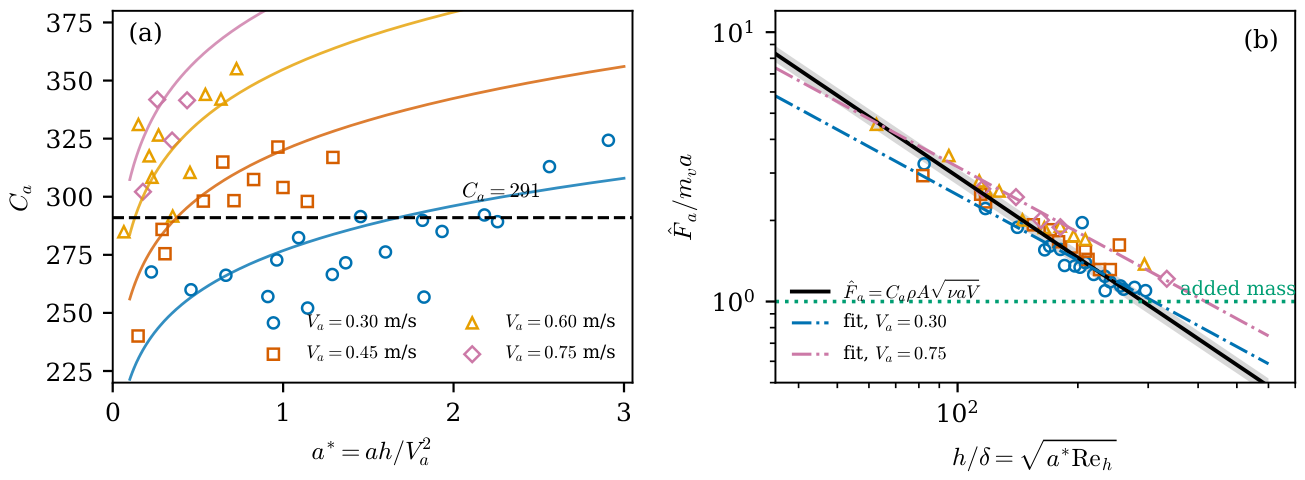
The law rests entirely on being independent of a and ; if it is not, the grouping and with it the appearance of lose their basis. Figure 5 of Ref. [1] reports for every run against , with color encoding the target velocity. We rendered that figure at 400 dpi, classified marker pixels by color against the four reference values, and took cluster centroids, obtaining 47 resolved points. Restricting to the band shared by all four velocities, so that the correlation between and cannot masquerade as a trend, the medians are 268, 304, 329 and 342 for , , and respectively. A joint fit over all points gives
the interval being a bootstrap confidence interval. The stratification by target velocity is evident in Figure 4(a). The value demanded by the reported law is excluded at about seven standard deviations; , predicted by any inviscid force of the form or , is excluded at about three. The implied force exponents are , against the quoted and .
Three caveats apply. Markers overlap in Figure 5 of Ref. [1], so merged centroids are biased toward the denser part of a cluster; the three plate shapes, whose reported means are 291, 308 and 311, are pooled here and contribute about scatter; and only four of the seven target velocities appear in that figure. None of these produces a monotone ordering of medians within a fixed band. The raw table would settle the exponent immediately, and we would encourage its publication.
9.2. Why the Boundary-Layer Force Is Small
Independently of the exponent, the diffusive force derived above is far below the measurement. For the video run, Section 4 and Section 5 give
i.e. – N depending on the edge treatment, against N. The shortfall in the coefficient is at leading order. That number is not a deficiency of the boundary-layer solution; it factorizes. Writing the two forces side by side, with and ,
they are the same expression with a different length: the boundary layer accelerates fluid over , the plate over h. Hence
with . For the video run and , and , reproducing exactly. Only the second factor is unexplained physics; the first is geometry, mm against mm. This identity is not a prediction of , and we do not present it as one: it states that a viscous-diffusive mechanism is the wrong order of magnitude for this experiment by a ratio of lengths, which no refinement of the boundary-layer solution and no gradient-transport closure (Section 8) can alter.
9.3. The Dominant Mechanism
What does account for is the vortex impulse. Section 7 shows that reproduces the measured to an rms of through the acceleration with no fitted parameter, using the measured circulation and the tracked vortex spacing. This is a diagnostic rather than a closed theory—it consumes as input—but it identifies where a predictive theory must be sought: in the roll-up of the edge shear layer [16,21,27], not in the diffusion of vorticity from the face.
Figure 4(b) recasts the same data in the form implied by Equation (28). Since , the reported law predicts a single line of slope through ; the measured points instead follow lines displaced by target velocity, the and sets bracketing the reported law. The ratio spans an order of magnitude across the grid and does not reach unity, which would require against a maximum of ; added mass therefore underestimates throughout the dataset while approaching sufficiency at the high- corner, as conjectured in Ref. [1] and anticipated by von Kármán [28].
The positive content of Section 2, Section 3 and Section 4 is unaffected by any of this: Equation (4) is the correct similarity reduction for the accelerating normal plate, Equation (10) its exact leading-order solution, and Equation (18) the correct history force for the vorticity generated on the face—a force that is real, now derived rather than asserted, and small. Its natural test is the opposite regime, low or high , where is of order unity.
10. Conclusions
Applying Sun’s similarity transformation to the front face of a uniformly accelerated normal plate yields the following.
(i) The two-dimensional unsteady boundary-layer equation for this flow reduces to the single equation (4) in , with coefficients independent of the streamwise coordinate and with the diffusion time. The reduction extends to any power-law velocity program, Equation (6), and contains the impulsively started and steady Hiemenz problems as limits. Its leading-order solution is exact, Equation (10), and belongs to the Kummer family, as do all higher corrections.
(ii) The transformation identifies the experimental dimensionless time as the diffusion time, , which accounts for the collapse observed in Ref. [1], and the identity returns their history force with the coefficient unchanged. That coefficient is correct, and Section 3.1 shows why: the one-dimensional template is the leading-order solution of the correct problem once its wall value is read as the local slip velocity. The two-dimensional formulation adds the streamwise distribution, the correction , the shape factor , the crossover to strain-saturated behavior at , and the generalization to arbitrary as the Basset integral (18).
(iii) That history force is two orders of magnitude below the measured , and Equation (28) shows the shortfall to be the ratio of plate size to diffusion length, together with a residual factor of two. A viscous-diffusive mechanism is simply the wrong order of magnitude for this experiment, and no gradient-transport closure recovers it (Section 8).
(iv) Digitizing the reported coefficient for all runs shows that is not constant but rises as , excluding the assumed scaling at about seven standard deviations while also excluding a pure dependence at about three. The measured exponents lie between the viscous and inviscid alternatives, so the existing data determine that the law is not without determining what it is.
(v) Frame-by-frame analysis of the supplemental video shows that to an rms of through the acceleration with no fitted parameter, with constant at the plate height, identifying as a vortex-impulse force.
One experiment would close the question. Repeating a subset of runs in a glycerol–water mixture at –, at fixed A, a and , changes by – if the law is viscous and leaves it unchanged if it is not; because was never varied, no measurement in the existing dataset can separate these. Two further checks use data already in hand: publishing the raw table would replace the digitization of Section 9.1 with the exponent itself, and extending the circulation and vortex-spacing tracking of Section 7 to the full grid would test whether reproduces the measured everywhere, which is a load-cell against particle-image-velocimetry consistency check and the natural starting point for a predictive theory of the edge shear layer.
Data availability.
Data Availability Statement
The data supporting the findings of this study are available from the corresponding author upon reasonable request.
Conflicts of Interest
The authors declare that there are no competing financial interests.
References
- Reijtenbagh, J.; Tummers, M.J.; Westerweel, J. Drag Force on a Starting Plate Scales with the Square Root of Acceleration. Phys. Rev. Lett. 2023, 130, 174001. [Google Scholar] [CrossRef] [PubMed]
- Stokes, G.G. On the effect of the internal friction of fluids on the motion of pendulums. Trans. Camb. Philos. Soc. 1851, 9, 8. [Google Scholar]
- Rayleigh, L. On the motion of solid bodies through viscous liquids. Philos. Mag. 1911, 21, 697. [Google Scholar] [CrossRef]
- Hiemenz, K. Die Grenzschicht an einem in den gleichförmigen Flüssigkeitsstrom eingetauchten geraden Kreiszylinder. Dinglers Polytech. J. 1911, 326, 321. [Google Scholar]
- Stewartson, K. On the impulsive motion of a flat plate in a viscous fluid. Q. J. Mech. Appl. Math. 1951, 4, 182. [Google Scholar] [CrossRef]
- Dennis, S.C.R. Motion of a viscous fluid past an impulsively started semi-infinite flat plate. IMA J. Appl. Math. 1972, 10, 105. [Google Scholar] [CrossRef]
- Ma, P.K.H.; Hui, W.H. Similarity solutions of the two-dimensional unsteady boundary-layer equations. J. Fluid Mech. 1990, 216, 537. [Google Scholar] [CrossRef]
- Sun, B.H. Similarity solutions of a class of unsteady laminar boundary layer. Phys. Fluids 2024, 36, 083616. [Google Scholar] [CrossRef]
- Lamb, H. Hydrodynamics; Cambridge University Press: Cambridge, 1916. [Google Scholar]
- Schlichting, H.; Gersten, K. Boundary-Layer Theory, 8th ed.; Springer: Berlin, 2000. [Google Scholar]
- Falkner, V.M.; Skan, S.W. Some approximate solutions of the boundary-layer equations. Philos. Mag. 1931, 12, 865. [Google Scholar] [CrossRef]
- Blasius, H. Grenzschichten in Flüssigkeiten mit kleiner Reibung. Z. Math. Phys. 1908, 56, 1. [Google Scholar]
- Abramowitz, M.; Stegun, I.A. (Eds.) Handbook of Mathematical Functions; Dover: New York, 1972. [Google Scholar]
- Basset, A.B. A Treatise on Hydrodynamics; Deighton, Bell and Co.: Cambridge, 1888; Vol. 2. [Google Scholar]
- Maxey, M.R.; Riley, J.J. Equation of motion for a small rigid sphere in a nonuniform flow. Phys. Fluids 1983, 26, 883. [Google Scholar] [CrossRef]
- Wang, C.J.; Eldredge, J.D. Low-order phenomenological modeling of leading-edge vortex formation. Theor. Comput. Fluid Dyn. 2013, 27, 577. [Google Scholar] [CrossRef]
- Batchelor, G.K. An Introduction to Fluid Dynamics; Cambridge University Press: Cambridge, 1967. [Google Scholar]
- Ringuette, M.J.; Milano, M.; Gharib, M. Role of the tip vortex in the force generation of low-aspect-ratio normal flat plates. J. Fluid Mech. 2007, 581, 453. [Google Scholar] [CrossRef]
- Saffman, P.G. Vortex Dynamics; Cambridge University Press: Cambridge, 1992. [Google Scholar]
- Wu, J.C. Theory for aerodynamic force and moment in viscous flows. AIAA J. 1981, 19, 432. [Google Scholar] [CrossRef]
- Graham, W.R.; Pitt Ford, C.W.; Babinsky, H. An impulse-based approach to estimating forces in unsteady flow. J. Fluid Mech. 2017, 815, 60. [Google Scholar] [CrossRef]
- Hoerner, S.F. Fluid-Dynamic Drag; Hoerner Fluid Dynamics: Bakersfield, CA, 1965. [Google Scholar]
- Prandtl, L. Bericht über Untersuchungen zur ausgebildeten Turbulenz. Z. Angew. Math. Mech. 1925, 5, 136. [Google Scholar] [CrossRef]
- Sun, B.H. Similarity solutions of Prandtl mixing length modelled two dimensional turbulent boundary layer equations. Theor. Appl. Mech. Lett. 2022, 12, 100338. [Google Scholar] [CrossRef]
- Launder, B.E. Laminarization of the turbulent boundary layer in a severe acceleration. J. Appl. Mech. 1964, 31, 707. [Google Scholar] [CrossRef]
- Narasimha, R.; Sreenivasan, K.R. Relaminarization of fluid flows. Adv. Appl. Mech. 1979, 19, 221. [Google Scholar] [CrossRef]
- Corkery, S.J.; Babinsky, H.; Graham, W.R. Quantification of added-mass effects using particle image velocimetry data for a translating and rotating flat plate. J. Fluid Mech. 2019, 870, 492. [Google Scholar] [CrossRef]
- von Kármán, T. The impact on seaplane floats during landing. Technical Report TN 321, NACA, Washington, DC, 1929. [Google Scholar]
Figure 1.
Schematic of the uniformly accelerated normal plate, drawn in the plate frame. The plate of in-plane height translates with and experiences the drag . On the front face the outer flow is a stagnation flow (blue streamlines) with slip velocity (orange), which drives the boundary layer of thickness (green strip) whose profile is given exactly by Equation (10) (purple). The vorticity generated on the face is swept into the two attached edge vortices of circulation and spacing (yellow); x runs along the face from the stagnation point and y is normal to it. The layer thickness is exaggerated: in the experiments of Ref. [1].
Figure 1.
Schematic of the uniformly accelerated normal plate, drawn in the plate frame. The plate of in-plane height translates with and experiences the drag . On the front face the outer flow is a stagnation flow (blue streamlines) with slip velocity (orange), which drives the boundary layer of thickness (green strip) whose profile is given exactly by Equation (10) (purple). The vorticity generated on the face is swept into the two attached edge vortices of circulation and spacing (yellow); x runs along the face from the stagnation point and y is normal to it. The layer thickness is exaggerated: in the experiments of Ref. [1].
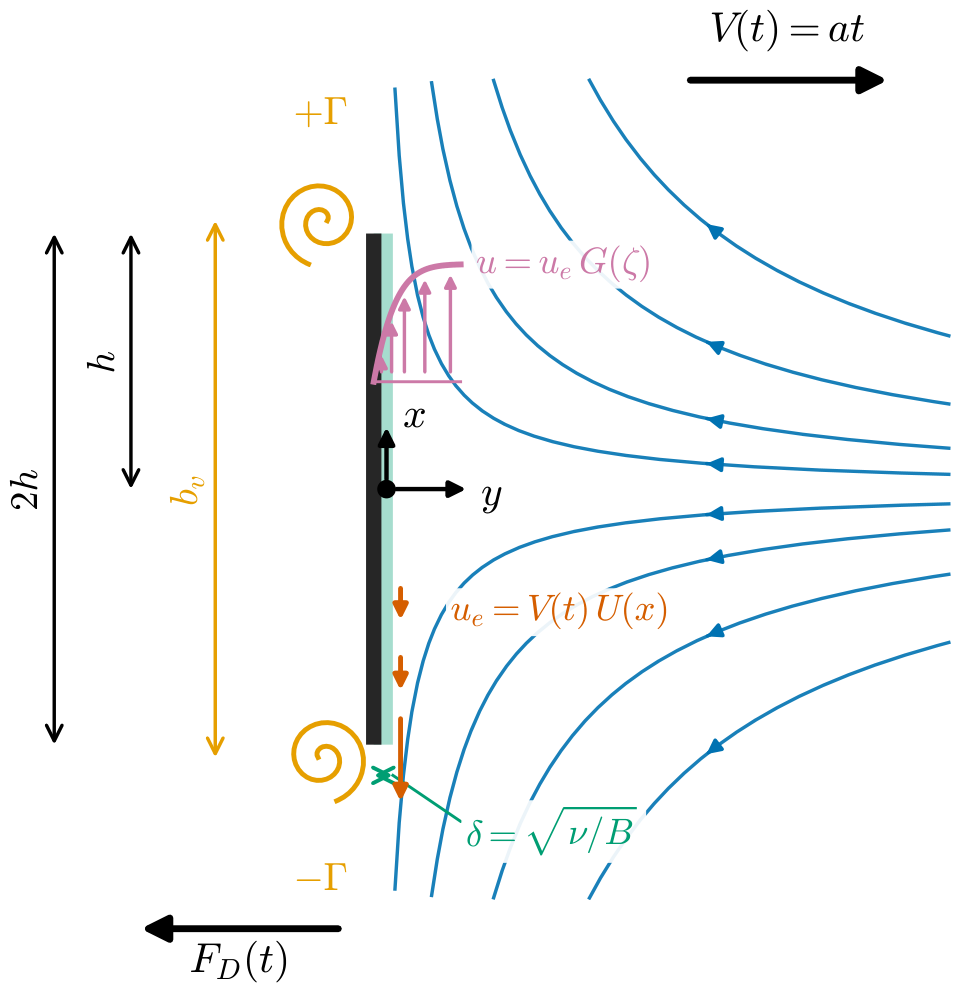
Figure 2.
(a) Leading-order velocity profile for constant acceleration, Equation (10) (blue, solid), compared with the impulsive-start Rayleigh profile (orange, dashed); the wall slope is larger by exactly a factor two. (b) Wall-shear amplification from the numerical solution of Equation (4) (black, solid), its small- expansion with (blue, dash-dotted), the steady-Hiemenz asymptote (orange, dotted), and the local-strain shape factors of Equation (22) for a strip (green, solid) and a disk (purple, dashed). Note .
Figure 2.
(a) Leading-order velocity profile for constant acceleration, Equation (10) (blue, solid), compared with the impulsive-start Rayleigh profile (orange, dashed); the wall slope is larger by exactly a factor two. (b) Wall-shear amplification from the numerical solution of Equation (4) (black, solid), its small- expansion with (blue, dash-dotted), the steady-Hiemenz asymptote (orange, dotted), and the local-strain shape factors of Equation (22) for a strip (green, solid) and a disk (purple, dashed). Note .
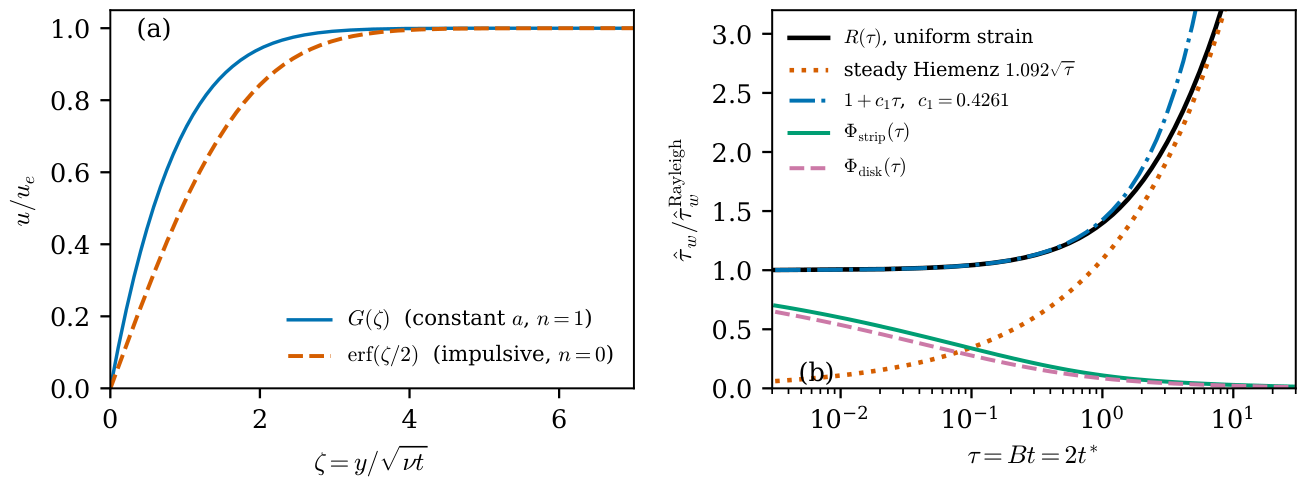
Figure 3.
Analysis of the supplemental video of Ref. [1] (, , ). (a) Digitized (open circles) against obtained from the measured circulation and the tracked vortex spacing (blue, solid), with the quasi-steady drag (orange, dotted) for reference; the grey dashed line marks the end of the acceleration. (b) Measured (blue, solid) and tracked vortex spacing (green symbols); the orange dotted line is the plate height.
Figure 3.
Analysis of the supplemental video of Ref. [1] (, , ). (a) Digitized (open circles) against obtained from the measured circulation and the tracked vortex spacing (blue, solid), with the quasi-steady drag (orange, dotted) for reference; the grey dashed line marks the end of the acceleration. (b) Measured (blue, solid) and tracked vortex spacing (green symbols); the orange dotted line is the plate height.
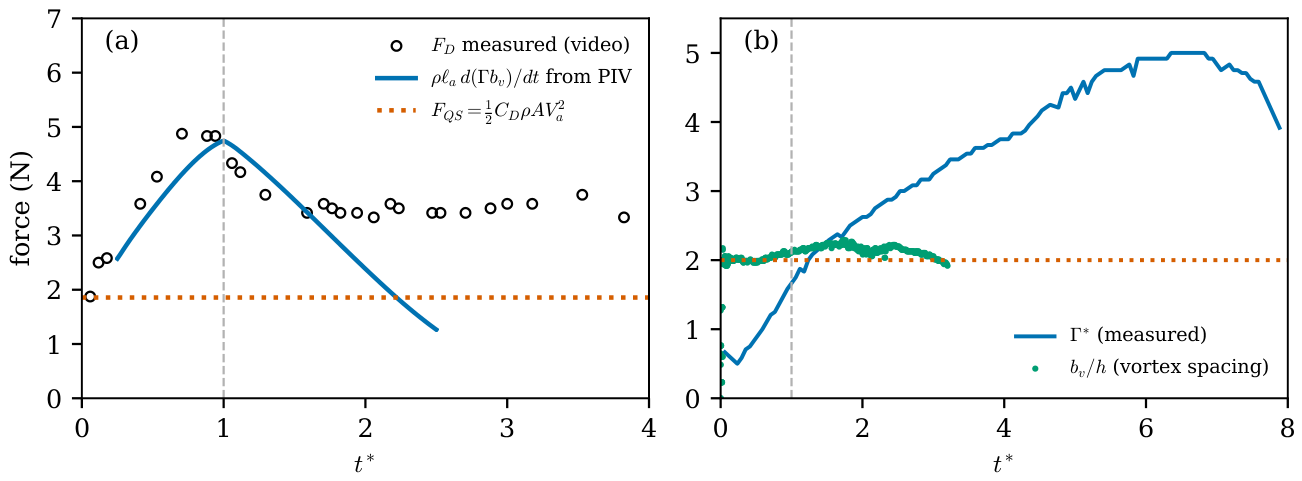
Figure 4.
Test of the reported law using the data of Ref. [1]. (a) The measured coefficient digitized from their Figure 5, separated by target velocity; solid curves are the joint fit and the dashed line is the reported constant . The stratification by is systematic. (b) The same points as against . The reported law is the single black line of slope with the grey band showing ; the dash-dotted lines are the fit (25) evaluated at the extreme target velocities. Green dotted line: pure added mass.
Figure 4.
Test of the reported law using the data of Ref. [1]. (a) The measured coefficient digitized from their Figure 5, separated by target velocity; solid curves are the joint fit and the dashed line is the reported constant . The stratification by is systematic. (b) The same points as against . The reported law is the single black line of slope with the grey band showing ; the dash-dotted lines are the fit (25) evaluated at the extreme target velocities. Green dotted line: pure added mass.
Disclaimer/Publisher’s Note: The statements, opinions and data contained in all publications are solely those of the individual author(s) and contributor(s) and not of MDPI and/or the editor(s). MDPI and/or the editor(s) disclaim responsibility for any injury to people or property resulting from any ideas, methods, instructions or products referred to in the content. |
© 2026 by the authors. Licensee MDPI, Basel, Switzerland. This article is an open access article distributed under the terms and conditions of the Creative Commons Attribution (CC BY) license (http://creativecommons.org/licenses/by/4.0/).
Copyright: This open access article is published under a Creative Commons CC BY 4.0 license, which permit the free download, distribution, and reuse, provided that the author and preprint are cited in any reuse.