

Submitted:
02 September 2026
Posted:
03 September 2026
You are already at the latest version
Abstract
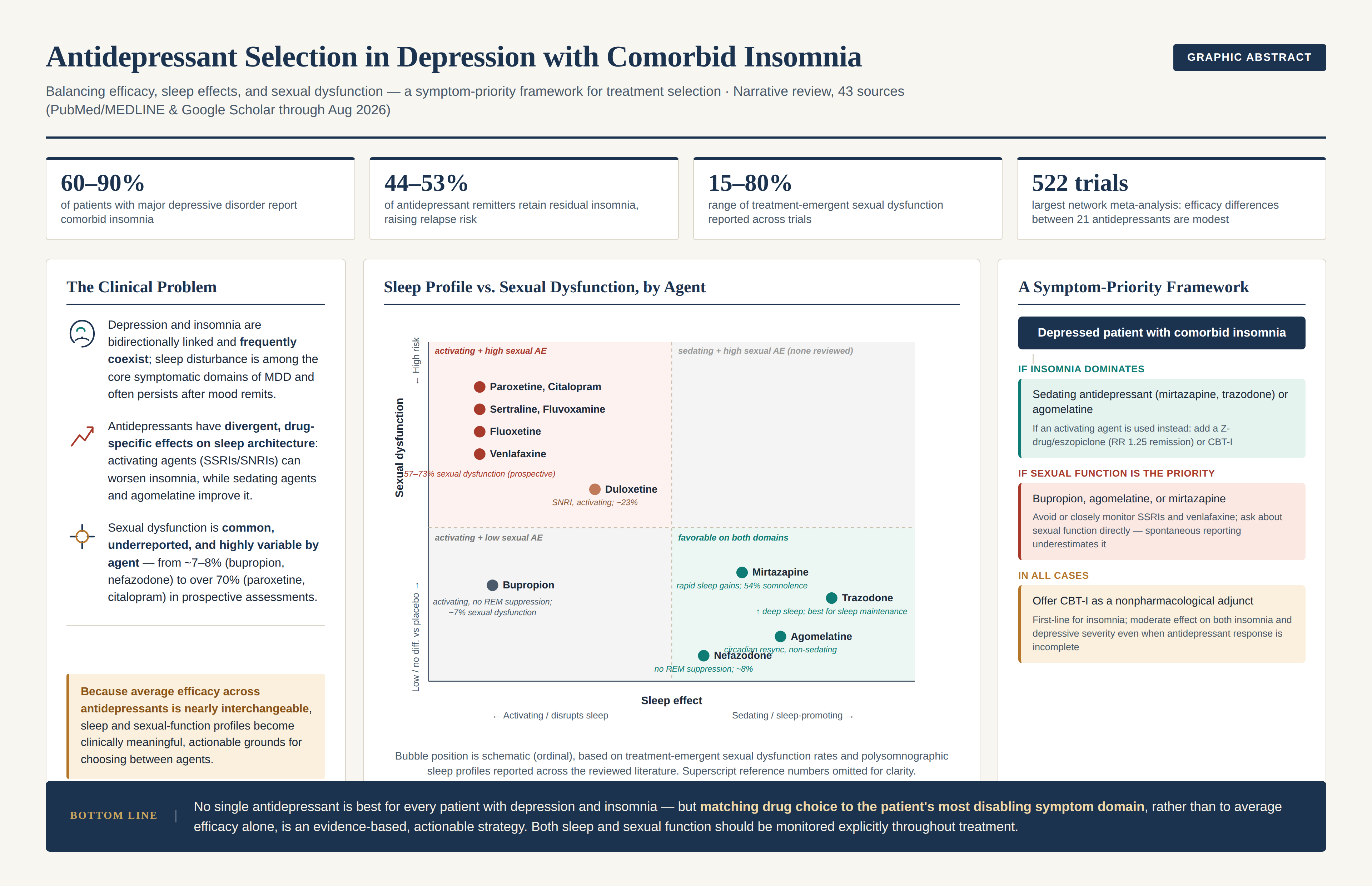
Objective: To synthesize comparative evidence on antidepressant efficacy, sleep effects, and sexual dysfunction in depression with comorbid insomnia, and to propose a symptom-priority framework for antidepressant selection.Data Sources: PubMed/MEDLINE and Google Scholar were searched through August 2026 (antidepressant, insomnia, sleep architecture, sexual dysfunction, major depressive disorder, and individual drug names); reference lists and guidelines were hand-searched.Study Selection: Randomized trials, network meta-analyses, systematic reviews, large effectiveness cohorts (e.g., STAR*D), and major guidelines on efficacy or sleep/sexual-function effects were prioritized; 43 sources were included.Data Extraction: Data on comparative efficacy, sleep effects, and treatment-emergent sexual dysfunction were extracted and synthesized narratively by drug class and agent; no formal risk-of-bias scoring was applied.Results: Because most antidepressants are comparably efficacious on average, selection in depression with insomnia hinges largely on differential sleep and sexual-function effects. Activating agents (fluoxetine, paroxetine, venlafaxine, bupropion) disrupt sleep continuity and suppress REM sleep, while sedating agents (mirtazapine, trazodone, doxepin) shorten sleep latency and increase slow-wave sleep; agomelatine promotes sleep via circadian resynchronization, not sedation. Adjunctive Z-drugs raise remission rates by about 25% over monotherapy, and CBT for insomnia is an effective adjunct. SSRIs and venlafaxine carry sexual-dysfunction rates of roughly one-quarter to three-quarters, versus no significant difference from placebo for bupropion, agomelatine, mirtazapine, and nefazodone.Conclusions: Because average efficacy differences are small, sleep and sexual-function profiles are actionable axes for antidepressant selection in depression with insomnia. Clinicians should match drug choice to the patient's most disabling symptoms, monitor both domains explicitly, and actively treat residual insomnia.
Keywords:
antidepressants
; insomnia
; major depressive disorder
; sleep architecture
; sexual dysfunction
; treatment selection
; mirtazapine
; trazodone
; agomelatine
1. Introduction: When Depression and Insomnia Coexist
Insomnia and depression are inseparable in clinical practice. Approximately 60% of adults meeting criteria for MDD complain of insomnia, and between 10% and 20% of adults endorsing current insomnia display evidence of MDD [2]. In clinical samples the figure is higher still: up to 90% of patients with MDD present with comorbid insomnia [12], and insomnia has been identified as the most common complaint associated with depression, reported by more than 90% of depressive patients in large cohort studies [13]. Sleep disturbance is among the core symptomatic domains of MDD alongside anhedonia and anxiety [14], and it is the most prominent symptom in depressive patients [1].
The epidemiological relationship is not merely associative. Longitudinal studies have established insomnia as an independent risk factor for the development of emerging or recurrent depression among young, middle-aged, and older adults, giving rise to the now widely accepted view of a bidirectional association between sleep disturbance and depression [1,15]. More recent meta-analytic work confirms that insomnia disorder increases the risk of subsequent depression and conceptualizes insomnia as a transdiagnostic process in psychopathology [16]. The clinical corollary is sobering: sleep problems do not reliably disappear when depression improves. In the STAR*D effectiveness trial, among remitters to citalopram, 29.5%, 54.9%, and 16.6% retained at least mild initial, mid-nocturnal, or early-morning insomnia, respectively, and 9.7%, 40.5%, and 6.8% had these symptoms at at least a moderate level [3]. Overall rates of residual insomnia in remitters to pharmacotherapy range from 44% to 53% across studies [3]. Residual symptoms in general — and sleep disturbance in particular — increase the probability of depressive relapse and are associated with poorer functional and psychosocial outcomes [17,18]. Whether residual insomnia specifically predicts relapse is less settled than for residual anxiety, with both positive and negative associations reported [19].
Two clinical realities follow. First, antidepressant selection in the depressed patient who cannot sleep is a decision about the whole symptom picture, not just mood: activating agents may worsen the presenting complaint, while sedating agents may resolve it. Second, residual insomnia is frequently undertreated even when it is recognized — in STAR*D, although participants were permitted adjunctive hypnotics or low-dose trazodone, only 21 of 943 remitters (2.6%) took hypnotics and 24 of 943 (2.6%) took adjunctive trazodone [3].
The decision matters against a backdrop of broadly similar efficacy. The most comprehensive network meta-analysis of antidepressants ever undertaken — 522 trials and more than 116,000 patients, comparing 21 drugs and placebo — found that while all agents were more efficacious than placebo, differences between individual antidepressants were modest [4,20]. When average efficacy is nearly interchangeable, the clinically meaningful axes of differentiation become tolerability and symptom-specific effects — and no two domains illustrate this better than sleep and sexual function.
2. Materials and Methods: Data Sources and Study Selection
This is a narrative, clinically oriented review rather than a systematic review or meta-analysis; no PRISMA protocol was registered. PubMed/MEDLINE and Google Scholar were searched from database inception through August 2026 using combinations of the terms antidepressant, insomnia, sleep, sleep architecture, polysomnography, REM sleep, sexual dysfunction, major depressive disorder, and STAR*D, cross-referenced with the names of individual agents (e.g., mirtazapine, trazodone, agomelatine, bupropion, selective serotonin reuptake inhibitor, selective serotonin-norepinephrine reuptake inhibitor). The reference lists of retrieved articles, prior systematic reviews and meta-analyses, and current clinical practice guidelines — including the 2023 European Insomnia Guideline [28] — were hand-searched for additional relevant citations. Priority was given to randomized controlled trials, network meta-analyses, systematic reviews, large effectiveness cohorts such as STAR*D [3], and major guideline documents that reported comparative antidepressant efficacy or quantified sleep or sexual-function outcomes in adults with major depressive disorder; case reports, non-English-language sources, and studies not addressing these three domains were excluded. Forty-three sources satisfying these criteria were retained and are synthesized qualitatively by drug class and individual agent below. As a narrative synthesis, study selection and weighting reflect clinical and methodological judgment rather than a fixed, reproducible search algorithm; this is discussed as a limitation in the Conclusions.
3. Sleep Architecture in Depression and How Antidepressants Modulate It
Depression is characterized by a characteristic polysomnographic signature: disturbances of sleep continuity, diminished slow-wave sleep, and altered rapid eye movement parameters, including increased REM density and reduced SWS in the first sleep cycle, which have long served as biological markers in antidepressant drug development [5]. An ideal antidepressant would reverse these abnormalities; in practice, many worsen them [5].
The most consequential distinction among antidepressants is between activating and sedating profiles. Polysomnographic studies show that SSRIs, SNRIs, and activating tricyclics increase REM latency, suppress REM sleep, and may impair sleep continuity, whereas sedating antidepressants decrease sleep latency, improve sleep efficiency, increase SWS, and usually have little or no effect on REM sleep [6]. These effects are strongest in the first few weeks of treatment but may persist in some patients, aggravating insomnia complaints or causing daytime somnolence [6]. Drugs such as bupropion and nefazodone, by contrast, lack REM-suppressant effects altogether, supporting the view that the neurochemical mechanisms regulating discrete sleep stages can be dissociated pharmacologically [21]. Understanding these signatures is clinically essential because the acute sleep effects of an antidepressant can determine adherence in the first weeks — exactly when dropout risk is highest [22].
4. Individual Agents and Their Sleep Signatures
4.1. Activating Antidepressants: SSRIs and SNRIs
For SSRIs, polysomnographic studies in both healthy volunteers and depressed patients demonstrate a decrease in sleep efficiency and total sleep time, a lengthening of sleep latency, and a deterioration in sleep continuity, including an increase in the number of awakenings and wake time during the total sleep period; sleep architecture typically shifts toward more stage 1 and stage 2 sleep, with decreases in stage 3, stage 4, and REM sleep, and a lengthening of REM latency [23]. The objective picture is partially offset subjectively: while healthy volunteers report unchanged or worsened sleep, depressed patients often report improvement, a discrepancy that complicates clinical interpretation [23]. Activating drugs — fluoxetine, paroxetine, venlafaxine, bupropion, and others — frequently require co-prescription of sleep-promoting agents, and even in maintenance treatment with activating antidepressants, as many as 30–40% of patients may still suffer from insomnia [5,6].
4.2. Mirtazapine
Mirtazapine, a noradrenergic and specific serotonergic antidepressant, has the most consistent evidence for sleep improvement among the newer agents. Polysomnographic studies in depressed patients show that during acute administration mirtazapine significantly increases total sleep time, sleep efficiency, stage 2, REM, and slow-wave sleep percentages, and decreases sleep latency and wake time — effects that persist after five weeks of treatment [24]. These objective changes are accompanied by improved subjective sleep quality, reversal of sleep markers of depression, and reduction of depressive symptoms [25]. The cost is somnolence: in clinical studies of sedating antidepressants, treatment-emergent somnolence was reported by 54% of patients treated with mirtazapine compared with 18% receiving placebo, although treatment-emergent insomnia complaints were very low (below 2%) [6].
4.3. Trazodone
Trazodone is unique among antidepressants in being used as both a full-dose antidepressant and a low-dose hypnotic. Its sleep-promoting action is mediated principally through antagonism at 5-HT2 serotonin receptors rather than H1 histamine blockade, which distinguishes it from most sedating antidepressants and is associated with a low risk of weight gain [26]. Relative to hypnotics, trazodone is less effective for sleep-onset insomnia and must be administered at least one hour before bedtime, but it is very effective for sleep-maintenance insomnia, particularly in patients with comorbid mental disorders or in patients treated with activating antidepressants [26]. Its hallmark is an increase in deep sleep duration, the opposite of the reduction in slow-wave activity produced by benzodiazepine receptor agonists [26]. Comparative data in MDD are encouraging: in a 12-week study, response rates with trazodone were similar to those with SSRIs, but trazodone was significantly more effective at reducing insomnia severity on the Athens Insomnia Scale (−12.5, 95% CI −15.4 to −9.5, versus −3.7, 95% CI −5.7 to −1.8; p < 0.001) [27]. Treatment-emergent somnolence with trazodone is 46% versus 19% with placebo [6]. The 2023 European Insomnia Guideline, however, notes that evidence for trazodone in insomnia disorder itself shows only small effects on various sleep parameters [28].
4.4. Agomelatine: A Non-Sedating Sleep-Promoting Option
Agomelatine is a first-in-class antidepressant: an agonist at MT1 and MT2 melatonin receptors and an antagonist at 5-HT2b and 5-HT2c serotonin receptors [29,30]. It promotes sleep not through sedation but through resynchronization of the circadian rhythm [5]. Four studies have shown positive effects of agomelatine on sleep continuity and quality and shortening of sleep latency [30], and its chronobiotic properties, mediated primarily through melatonin-receptor agonism in the suprachiasmatic nucleus, translate into clinical advantages: agomelatine improves sleep and circadian rest-activity rhythms compared with venlafaxine in depressed patients [7], and significantly improves the amplitude of the circadian rest-activity/sleep–wake cycle while decreasing depression and anxiety symptoms compared with sertraline [31]. Its antidepressant efficacy has been demonstrated in three short-term, pivotal, randomized, placebo-controlled studies [30], though its effect size relative to placebo has been questioned by some meta-analyses [29].
4.5. Low-Dose Sedating Antidepressants as Hypnotics
Sedating antidepressants are among the most commonly prescribed treatments for insomnia in clinical practice, yet the evidence base is strikingly thin. The one exception is doxepin, which has been approved for the treatment of insomnia characterized by difficulties in maintaining sleep [5]. For low-dose amitriptyline and mirtazapine — widely prescribed off-label for over a decade — placebo-controlled evidence is still lacking, and the DREAMING randomized trial is currently testing low-dose amitriptyline (10–20 mg/day) and mirtazapine (7.5–15 mg/day) against placebo in general practice [32]. A Cochrane review of antidepressants for insomnia identified 23 randomized trials (2,806 participants) but found only three small studies (135 participants) comparing SSRIs with placebo, and combining results was not possible [33]. The European Insomnia Guideline similarly finds that tricyclics have significant but small effects on sleep quality, total sleep time, and sleep efficiency, but not on sleep-onset latency [28]. The gap between prescribing practice and evidence is an important caveat for clinicians who reach for sedating antidepressants primarily as sleep agents in depressed patients.
5. Comparative Efficacy in Depression with Insomnia
5.1. Monotherapy Choice
For the depressed patient whose presenting complaint is dominated by insomnia, the comparative data favor agents with sleep-promoting profiles. Trazodone achieves antidepressant response comparable to SSRIs while producing substantially greater insomnia reduction [27]; mirtazapine improves sleep rapidly and objectively [24,25]; and agomelatine improves sleep continuity and restores circadian rhythmicity without the somnolence burden of sedating agents [7,30,31]. Against the broader comparative-efficacy literature, these are essentially equivalent antidepressants that differ in symptom targeting: the network meta-analysis of 21 drugs found the differences between individual agents to be modest relative to their separation from placebo [4,20]. Sleep effects, therefore, are a legitimate basis for choice precisely because efficacy is not.
5.2. Adjunctive Sleep Medication: Eszopiclone and the Z-Drugs
When the antidepressant of choice is activating — or when sleep fails to improve despite adequate treatment — adjunctive sleep medication is an evidence-supported strategy. A randomized controlled trial of eszopiclone added to fluoxetine produced statistically significant improvements in subjective sleep quality, wakefulness after sleep onset, total sleep time, and sleep efficiency [34]. In a post hoc analysis of two trials in patients with insomnia and anxious depression, eight weeks of eszopiclone co-administered with an SSRI resulted in significantly greater improvement in insomnia, significantly greater reductions in HDRS-17 total score, and significantly greater HDRS-17 response rates than placebo co-administration, although differences in remission rates and in response rates excluding insomnia items were not significant [35].
The strongest quantitative evidence comes from a 2025 systematic review and meta-analysis of combination therapy: compared with antidepressant monotherapy, adding a Z-drug improved remission rates (risk ratio 1.25, 95% CI 1.08–1.45, p = 0.003), depressive symptoms (SMD 0.17, 95% CI 0.01–0.33, p = 0.04), and insomnia symptoms (SMD 0.43, 95% CI 0.28–0.59, p < 0.001) within 12 weeks, with no differences in safety outcomes except dizziness [8]. The authors caution that long-term adjunctive Z-drug therapy has not been evaluated [8]. Low-dose trazodone is a widely used alternative adjunct, and it was among the rescue options permitted in STAR*D [3].
5.3. The Emerging Role of Orexin Receptor Antagonists
A newer avenue directly targets the hyperarousal believed to link insomnia and depression. Seltorexant, a highly selective antagonist of the orexin-2 receptor, has shown both sleep-promoting and antidepressant effects in patients with MDD and comorbid insomnia, improving core depressive symptoms over ten days relative to placebo [36]. While the dual orexin receptor antagonists approved for insomnia — suvorexant, lemborexant, and daridorexant — appear safe and useful for concomitant insomnia in antidepressant-treated patients, they have not been approved for that indication; seltorexant, by contrast, has shown significant antidepressant effects in Phase 2 and Phase 3 trials as an adjunctive treatment for patients with inadequate response to standard antidepressants [37]. At least one more unequivocally positive pivotal study will be required for regulatory approval, but the orexin system represents a mechanistically novel approach to treating the sleep–mood interface [37].
6. The Sexual-Function Trade-Off
6.1. The Magnitude of the Problem
Sexual dysfunction is the adverse effect most likely to be silently endured: rates of treatment-emergent sexual dysfunction in depressed patients from randomized clinical trials range from 15% to 80%, and a European cross-sectional study estimated the prevalence among patients prescribed SSRIs or SNRIs at between 37.1% and 61.5% [10]. Population surveys suggest that over one-third of participants report antidepressant-associated sexual dysfunction [38]. These figures substantially understate the problem, because sexual dysfunction is underreported in efficacy studies — particularly when no targeted or structured method is used to obtain information on sexual functioning at baseline and throughout treatment — and physicians underestimate its prevalence [10,39]. The consequences are not trivial: onset or worsening of sexual dysfunction can result in premature discontinuation of antidepressant treatment, relapse of depression, and worsened health outcomes and quality of life [10].
6.2. Differential Rates Across Agents
Sexual dysfunction is not uniform across antidepressants. The pivotal meta-analysis by Serretti and Chiesa found significantly higher rates of total and phase-specific treatment-emergent sexual dysfunction compared with placebo for sertraline, venlafaxine, citalopram, paroxetine, fluoxetine, imipramine, phenelzine, duloxetine, escitalopram, and fluvoxamine — in decreasing order of impact — whereas no significant difference from placebo was found for agomelatine, amineptine, bupropion, moclobemide, mirtazapine, and nefazodone [11]. Consistent with this, the first study to assess sexual dysfunction across newer antidepressants with a validated rating scale found that SSRIs and venlafaxine XR were associated with higher rates of sexual dysfunction than bupropion or nefazodone [39]. The observational data compiled by Reichenpfader and colleagues illustrate the scale of the differences [10] (Table 1).
6.3. Managing the Trade-Off
For patients who develop sexual dysfunction, the evidence supports switching as a first-line strategy. In randomized trials, nefazodone and bupropion have been associated with less sexual dysfunction than the SSRI sertraline, and reboxetine with greater sexual satisfaction than the SSRI fluoxetine [38]. The meta-analytic data identify bupropion, agomelatine, mirtazapine, and nefazodone as the agents least likely to cause treatment-emergent sexual dysfunction [11]. The practical implication is that the choice of antidepressant can be tailored to a patient’s priorities: for a patient with an active sexual relationship, an agent with a favorable sexual profile may be preferable even if the sleep profile is less ideal, and vice versa.
7. A Framework for Drug Selection
Synthesizing the evidence yields a pragmatic, symptom-priority framework.
When insomnia dominates the presentation. Prefer a sedating antidepressant (mirtazapine, trazodone) or agomelatine, whose sleep-promoting action avoids the somnolence and potential weight effects of histaminergic agents [5,6,26]. Mirtazapine produces rapid, objective sleep improvement but carries a 54% rate of somnolence and greater appetite/weight effects; trazodone is effective for sleep-maintenance insomnia and increases deep sleep but is less potent for sleep-onset difficulties [24,26]. If the antidepressant selected is activating, adjunctive Z-drug therapy is supported by meta-analytic evidence of improved remission, mood, and sleep outcomes [8], and eszopiclone plus an SSRI improves both insomnia and depressive severity [34,35].
When sexual function is the priority. Choose bupropion, agomelatine, or mirtazapine, the agents with no significant difference from placebo in treatment-emergent sexual dysfunction [11,39]; avoid or carefully monitor SSRIs and venlafaxine, which carry rates approaching or exceeding two-thirds of patients in prospective assessments [10,11]. Structured, direct inquiry about sexual function is essential at baseline and follow-up, because spontaneous reporting grossly underestimates the problem [10,39].
Nonpharmacological adjuncts. Cognitive behavioral therapy for insomnia is the first-line treatment for insomnia in current guidelines, and it works in the context of depression: in a meta-analysis of patients with mental disorders and comorbid insomnia, CBT-I reduced insomnia severity with a moderate effect size of 0.5 (95% CI 0.3–0.8) in depressed patients and reduced comorbid depressive symptom severity (0.5, 95% CI 0.1–0.8) [9]. Therapist-delivered CBT-I produces significant reductions in both insomnia and depression severity, and has been recommended as an adjunct for patients whose depression has not remitted with antidepressants [40]. Digitally delivered CBT-I achieves greater reductions in both insomnia and depression severity than sleep education, with significantly higher remission rates, and is comparably efficacious across demographic groups [41]. Notably, CBT-I is superior to traditional depression treatment in improving insomnia symptoms among patients with comorbid psychiatric disorders, though results are mixed on whether it improves overall depression outcomes [42].
A caveat on precision. The ambition to match patients to treatments by total symptom scores faces a statistical obstacle: in a study of 91 double-blind placebo-controlled trials comprising 18,965 participants, variability in response did not differ significantly between antidepressants and placebo, and the authors concluded that the data provide no empirical support for personalizing antidepressant treatment based on total depression scores [43]. Symptom-specific targets — like insomnia and sexual function — may nonetheless be the domains where differential drug effects are real and clinically usable.
8. Conclusions and Future Directions
When depression meets insomnia, the treating clinician faces a two-dimensional problem that most efficacy trials ignore: the same drugs that best treat the mood disorder may worsen the sleep disorder, and the same drugs that improve sleep may carry the heaviest burden of sexual dysfunction [11,23]. The evidence assembled in this review supports four conclusions.
First, sleep effects are a legitimate basis for antidepressant selection because average efficacy differences among drugs are small: activating agents (fluoxetine, paroxetine, venlafaxine, bupropion) can perpetuate insomnia, while mirtazapine, trazodone, and agomelatine actively improve sleep [5,6,7,24,27]. Second, residual insomnia is common, consequential, and undertreated — persisting in up to half of remitters and rarely addressed even when adjunctive options are available [3,17,18]. Third, when the primary antidepressant does not fix sleep, adjunctive Z-drugs are supported by meta-analytic evidence (25% improvement in remission rates) [8], and CBT-I — therapist-delivered or digital — should be considered a first-line adjunct [9,40,41]. Fourth, the sexual-function trade-off is quantifiable and actionable: bupropion, agomelatine, mirtazapine, and nefazodone differ significantly from placebo in sexual dysfunction rates, whereas SSRIs and venlafaxine are associated with rates of 25–73% in prospective assessments [10,11].
Looking forward, the orexin receptor antagonist seltorexant may offer a genuinely novel mechanism at the sleep–mood interface, with Phase 2 and Phase 3 evidence of antidepressant efficacy in patients with inadequate response to standard treatment [36,37]. The DREAMING trial will finally provide placebo-controlled data on low-dose amitriptyline and mirtazapine for insomnia [32]. What is most needed, however, is a change in trial design: comparative antidepressant studies that measure sleep and sexual function prospectively with structured instruments, in addition to mood outcomes, and that test symptom-priority algorithms head-to-head. As a narrative rather than systematic review, this synthesis is subject to selection and interpretation judgments that a protocol-driven review would constrain; the conclusions should be read as a clinically oriented synthesis rather than a quantitative pooled estimate. Until then, the practical answer to “which antidepressant when depression meets insomnia” remains: choose an agent whose sleep and sexual profile matches the patient’s most disabling symptoms, monitor both domains explicitly, and treat residual insomnia — pharmacologically or behaviorally — rather than accepting it as an unavoidable cost of remission [3,10].
Funding
This review received no specific grant, financial support, or sponsorship from any funding agency in the public, commercial, or not-for-profit sectors.
Data Availability Statement
No new data were generated or analyzed in support of this research. This is a narrative literature review; all data discussed and synthesized are available in the cited original publications listed in the References section.
Acknowledgments
None.
Conflicts of Interest
The author declares that there is no conflict of interest regarding the publication of this article.
References
- Fang H, Tu S, Sheng J, Shao A. Depression in sleep disturbance: A review on a bidirectional relationship, mechanisms and treatment. Journal of Cellular and Molecular Medicine. 2019 Feb 7;23(4):2324–32. [CrossRef]
- Carney CE, Ulmer CS, Edinger JD, Krystal AD, Knauss F. Assessing depression symptoms in those with insomnia: An examination of the beck depression inventory second edition (BDI-II). Journal of Psychiatric Research. 2008 Oct 27;43(5):576–82. [CrossRef]
- Nierenberg AA, Husain MM, Trivedi MH, Fava M, Warden D, Wisniewski SR, et al. Residual symptoms after remission of major depressive disorder with citalopram and risk of relapse: a STAR*D report. Psychological Medicine. 2009 May 22;40(1):41–50. [CrossRef]
- Cipriani A, Furukawa TA, Salanti G, Chaimani A, Atkinson L, Ogawa Y, et al. Comparative Efficacy and Acceptability of 21 Antidepressant Drugs for the Acute Treatment of Adults With Major Depressive Disorder: A Systematic Review and Network Meta-Analysis. FOCUS The Journal of Lifelong Learning in Psychiatry. 2018 Oct 1;16(4):420–9. [CrossRef]
- Wichniak A, Wierzbicka A, Jernajczyk W. Sleep and Antidepressant Treatment. Current Pharmaceutical Design. 2012 Oct 13;18(36):5802–17. [CrossRef]
- Wichniak A, Wierzbicka A, Walęcka M, Jernajczyk W. Effects of Antidepressants on Sleep. Current Psychiatry Reports. 2017 Aug 9;19(9):63. [CrossRef]
- Liu J, Clough SJ, Hutchinson AJ, Adamah-Biassi EB, Popovska-Gorevski M, Dubocovich ML. MT1 and MT2 Melatonin Receptors: A Therapeutic Perspective. Annual Review of Pharmacology and Toxicology. 2015 Oct 29;56(1):361–83. [CrossRef]
- Maruki T, Takeshima M, Yoshizawa K, Maeda Y, Otsuka N, Aoki Y, et al. Efficacy and safety of each class of sleep medication for major depressive disorder with insomnia symptoms: A systematic review and meta-analysis of double-blind randomized controlled trials. Psychiatry and Clinical Neurosciences. 2025 Mar 20;79(6):306–18. [CrossRef]
- Hertenstein E, Trinca E, Wunderlin M, Schneider CL, Züst MA, Fehér KD, et al. Cognitive behavioral therapy for insomnia in patients with mental disorders and comorbid insomnia: A systematic review and meta-analysis. Sleep Medicine Reviews. 2022 Feb 9;62:101597. Available online: https://pure.amsterdamumc.nl/en/publications/d074e168-a9f9-4f2d-8c46-756b6e544607.
- Reichenpfader U, Gartlehner G, Morgan LC, Greenblatt A, Nußbaumer B, Hansen RA, et al. Sexual Dysfunction associated with Second-Generation Antidepressants in Patients with Major Depressive Disorder: Results from a Systematic Review with Network Meta-Analysis. Drug Safety. 2013 Dec 12;37(1):19–31. [CrossRef]
- Serretti A, Chiesa A. Treatment-Emergent Sexual Dysfunction Related to Antidepressants. Journal of Clinical Psychopharmacology. 2009 May 21;29(3):259–66. [CrossRef]
- Kurian BT, Greer TL, Trivedi MH. Strategies to enhance the therapeutic efficacy of antidepressants: targeting residual symptoms. Expert Review of Neurotherapeutics. 2009 Jul 1;9(7):975–84. [CrossRef]
- Park S, Kim J, Jun T, Lee MS, Kim JB, Jeong SH, et al. Prevalence and Clinical Correlates of Insomnia in Depressive Disorders: The CRESCEND Study. Psychiatry Investigation. 2013 Jan 1;10(4):373. [CrossRef]
- Cui L, Li S, Wang S, Wu X, Liu Y, Yu W, et al. Major depressive disorder: hypothesis, mechanism, prevention and treatment. Signal Transduction and Targeted Therapy. 2024 Feb 9;9(1):30. [CrossRef]
- Sivertsen B, Salo P, Mykletun A, Hysing M, Pallesen S, Krokstad S, et al. The Bidirectional Association Between Depression and Insomnia. Psychosomatic Medicine. 2012 Aug 10;74(7):758–65. [CrossRef]
- Hertenstein E, Benz F, Schneider CL, Baglioni C. Insomnia—A risk factor for mental disorders. Journal of Sleep Research. 2023 May 22;32(6). [CrossRef]
- McClintock SM, Husain MM, Wisniewski SR, Nierenberg AA, Stewart JW, Trivedi MH, et al. Residual Symptoms in Depressed Outpatients Who Respond by 50% But Do Not Remit to Antidepressant Medication. Journal of Clinical Psychopharmacology. 2011 Feb 23;31(2):180–6. [CrossRef]
- Kwaśny A, Włodarczyk A, Dywel A, Szarmach J, Strandberg O, Cubała WJ. Residual insomnia in major depressive disorder: a systematic review. Frontiers in Psychiatry. 2023 Jun 16;14:1190415. [CrossRef]
- Romera I, Pérez V, Ciudad A, Caballero L, Roca M, Polavieja P, et al. Residual symptoms and functioning in depression, does the type of residual symptom matter? A post-hoc analysis. BMC Psychiatry. 2013 Feb 11;13(1):51. [CrossRef]
- Cipriani A, Salanti G, Furukawa TA, Egger M, Leucht S, Ruhé HG, et al. Antidepressants might work for people with major depression: where do we go from here? The Lancet Psychiatry. 2018 Apr 6;5(6):461–3. [CrossRef]
- Winokur A, Gary KA, Rodner S, Rae-Red C, Fernando A, Szuba MP. Depression, sleep physiology, and antidepressant drugs. Depression and Anxiety. 2001 Jan 1;14(1):19–28. [CrossRef]
- Hutka P, Krivosova M, Muchova Z, Tonhajzerová I, Hamrakova A, Mlyncekova Z, et al. Association of Sleep Architecture and Physiology with Depressive Disorder and Antidepressants Treatment. International Journal of Molecular Sciences. 2021 Jan 29;22(3):1333. [CrossRef]
- Oberndorfer S, Saletu-Zyhlarz G, Saletu B. Effects of Selective Serotonin Reuptake Inhibitors on Objective and Subjective Sleep Quality. Neuropsychobiology. 2000 Jan 1;42(2):69–81. [CrossRef]
- Schittecatte M, Dumont F, Machowski R, Cornil C, Lavergne F, Wilmotte J. Effects of Mirtazapine on Sleep Polygraphic Variables in Major Depression. Neuropsychobiology. 2002 Jan 1;46(4):197–201. [CrossRef]
- Shen J, Chung SA, Kayumov L, Moller HJ, Hossain NK, Wang X, et al. Polysomnographic and Symptomatological Analyses of Major Depressive Disorder Patients Treated with Mirtazapine. The Canadian Journal of Psychiatry. 2006 Jan 1;51(1):27–34. [CrossRef]
- Wichniak A, Wierzbicka AE, Jarema M. Treatment of insomnia -- effect of trazodone and hypnotics on sleep. Psychiatria Polska. 2021 Aug 31;55(4):743–55. [CrossRef]
- Fagiolini A, González-Pinto A, Miskowiak KW, Morgado P, Young AH, Vieta E. Role of trazodone in treatment of major depressive disorder: an update. Annals of General Psychiatry. 2023 Sep 2;22(1):32. Available online: https://www.ncbi.nlm.nih.gov/pmc/articles/10474647.
- Riemann D, Espie CA, Altena E, Arnardóttir ES, Baglioni C, Bassetti CL, et al. The European Insomnia Guideline: An update on the diagnosis and treatment of insomnia 2023. Journal of Sleep Research. 2023 Nov 28;32(6). [CrossRef]
- Robillard R, Carpenter JS, Feilds KL, Hermens DF, White D, Naismith SL, et al. Parallel Changes in Mood and Melatonin Rhythm Following an Adjunctive Multimodal Chronobiological Intervention With Agomelatine in People With Depression: A Proof of Concept Open Label Study. Frontiers in Psychiatry. 2018 Dec 11;9:624. [CrossRef]
- San L, Arranz B. Agomelatine: A novel mechanism of antidepressant action involving the melatonergic and the serotonergic system. European Psychiatry. 2008 Jun 26;23(6):396–402. [CrossRef]
- Gorwood P. Review: Restoring circadian rhythms: a new way to successfully manage depression. Journal of Psychopharmacology. 2010 Jul 27;24:15–9. [CrossRef]
- Bakker MH, Hugtenburg JG, van Straten A, van der Horst HE, Slottje P. Effectiveness of low-dose amitriptyline and mirtazapine for insomnia disorder: study protocol of a randomised, double-blind, placebo-controlled trial in general practice (the DREAMING study). BMJ Open. 2021 Sep 1;11(9). [CrossRef]
- Everitt H, Baldwin DS, Stuart B, Lipinska G, Mayers A, Malizia AL, et al. Antidepressants for insomnia in adults. Cochrane Database of Systematic Reviews. 2018 May 14;2018(5). [CrossRef]
- Murphy M, Peterson MJ. Sleep Disturbances in Depression. Sleep Medicine Clinics. 2014 Dec 13;10(1):17–23. [CrossRef]
- Fava M, Schaefer K, Huang H, Wilson AB, Iosifescu DV, Mischoulon D, et al. A Post Hoc Analysis of the Effect of Nightly Administration of Eszopiclone and a Selective Serotonin Reuptake Inhibitor in Patients With Insomnia and Anxious Depression. The Journal of Clinical Psychiatry. 2010 Nov 1;72(4):473–9. [CrossRef]
- Recourt K, de Boer P, Zuiker R, Luthringer R, Kent J, van der Ark P, et al. The selective orexin-2 antagonist seltorexant (JNJ-42847922/MIN-202) shows antidepressant and sleep-promoting effects in patients with major depressive disorder. Translational Psychiatry. 2019 Sep 3;9(1):216. [CrossRef]
- Thase ME. A new direction for adjunctive therapy of difficult-to-treat depression: examining the role of orexin receptor antagonists. European Archives of Psychiatry and Clinical Neuroscience. 2025 May 28;275(6):1611–9. [CrossRef]
- Taylor M, Rudkin L, Bullemor-Day P, Lubin J, Chukwujekwu C, Hawton K. Strategies for managing sexual dysfunction induced by antidepressant medication. Cochrane Database of Systematic Reviews. 2013 May 28;2013(5). [CrossRef]
- Clayton AH, Pradko JF, Croft HA, Montano CB, Leadbetter RA, Watson C, et al. Prevalence of Sexual Dysfunction Among Newer Antidepressants. The Journal of Clinical Psychiatry. 2002 Apr 15;63(4):357–66. [CrossRef]
- Ashworth DK, Sletten TL, Junge M, Simpson K, Clarke DM, Cunnington D, et al. A randomized controlled trial of cognitive behavioral therapy for insomnia: An effective treatment for comorbid insomnia and depression. Journal of Counseling Psychology. 2015 Apr 1;62(2):115–23. [CrossRef]
- Cheng P, Luik AI, Fellman-Couture C, Peterson EL, Joseph CLM, Tallent G, et al. Efficacy of digital CBT for insomnia to reduce depression across demographic groups: a randomized trial. Psychological Medicine. 2018 May 24;49(3):491–500. [CrossRef]
- Mirchandaney R, Barete R, Asarnow LD. Moderators of Cognitive Behavioral Treatment for Insomnia on Depression and Anxiety Outcomes. Current Psychiatry Reports. 2022 Jan 21;24(2):121–8. [CrossRef]
- Maslej MM, Furukawa TA, Cipriani A, Andrews PW, Sanches M, Tomlinson A, et al. Individual Differences in Response to Antidepressants. JAMA Psychiatry. 2021 Feb 20;78(5):490. [CrossRef]

Table 1.
Sleep profile and treatment-emergent sexual dysfunction rates of commonly used antidepressants.
Table 1.
Sleep profile and treatment-emergent sexual dysfunction rates of commonly used antidepressants.
| Antidepressant | Sleep profile | Sexual dysfunction (mean %) |
|---|---|---|
| Bupropion | Activating; lacks REM suppression [21] | 7.0 (cross-sectional) [10] |
| Fluoxetine | Activating [5] | 23.0 (cross-sectional); 57.7 (prospective) [10] |
| Paroxetine | Activating [5] | 25.0 (cross-sectional); 70.7 (prospective) [10] |
| Sertraline | SSRI class: impairs sleep continuity, suppresses REM [23] | 25.0 (cross-sectional); 62.9 (prospective) [10] |
| Citalopram | SSRI class: impairs sleep continuity, suppresses REM [23] | 30.0 (cross-sectional); 72.7 (prospective) [10] |
| Venlafaxine | Activating [5] | 30.0 (cross-sectional); 67.3 (prospective) [10] |
| Fluvoxamine | — | 62.3 (prospective) [10] |
| Duloxetine | — | 23.4 (prospective) [10] |
| Mirtazapine | Sedating; somnolence 54% vs 18% placebo [6] | 24.4 (prospective) [10] |
| Trazodone | Sedating; somnolence 46% vs 19% placebo [6] | — |
| Nefazodone | Lacks REM suppression [21] | 8.0 (prospective) [10] |
| Agomelatine | Sleep-promoting via circadian resynchronization, not sedation [5] | No significant difference vs placebo [11] |
Note. Sexual-dysfunction figures are crude mean percentages from observational studies; where two values appear, the first is from a cross-sectional survey and the second from a prospective study.
Disclaimer/Publisher’s Note: The statements, opinions and data contained in all publications are solely those of the individual author(s) and contributor(s) and not of MDPI and/or the editor(s). MDPI and/or the editor(s) disclaim responsibility for any injury to people or property resulting from any ideas, methods, instructions or products referred to in the content. |
© 2026 by the authors. Licensee MDPI, Basel, Switzerland. This article is an open access article distributed under the terms and conditions of the Creative Commons Attribution (CC BY) license (http://creativecommons.org/licenses/by/4.0/).
Copyright: This open access article is published under a Creative Commons CC BY 4.0 license, which permit the free download, distribution, and reuse, provided that the author and preprint are cited in any reuse.