

Submitted:
02 September 2026
Posted:
03 September 2026
You are already at the latest version
Abstract
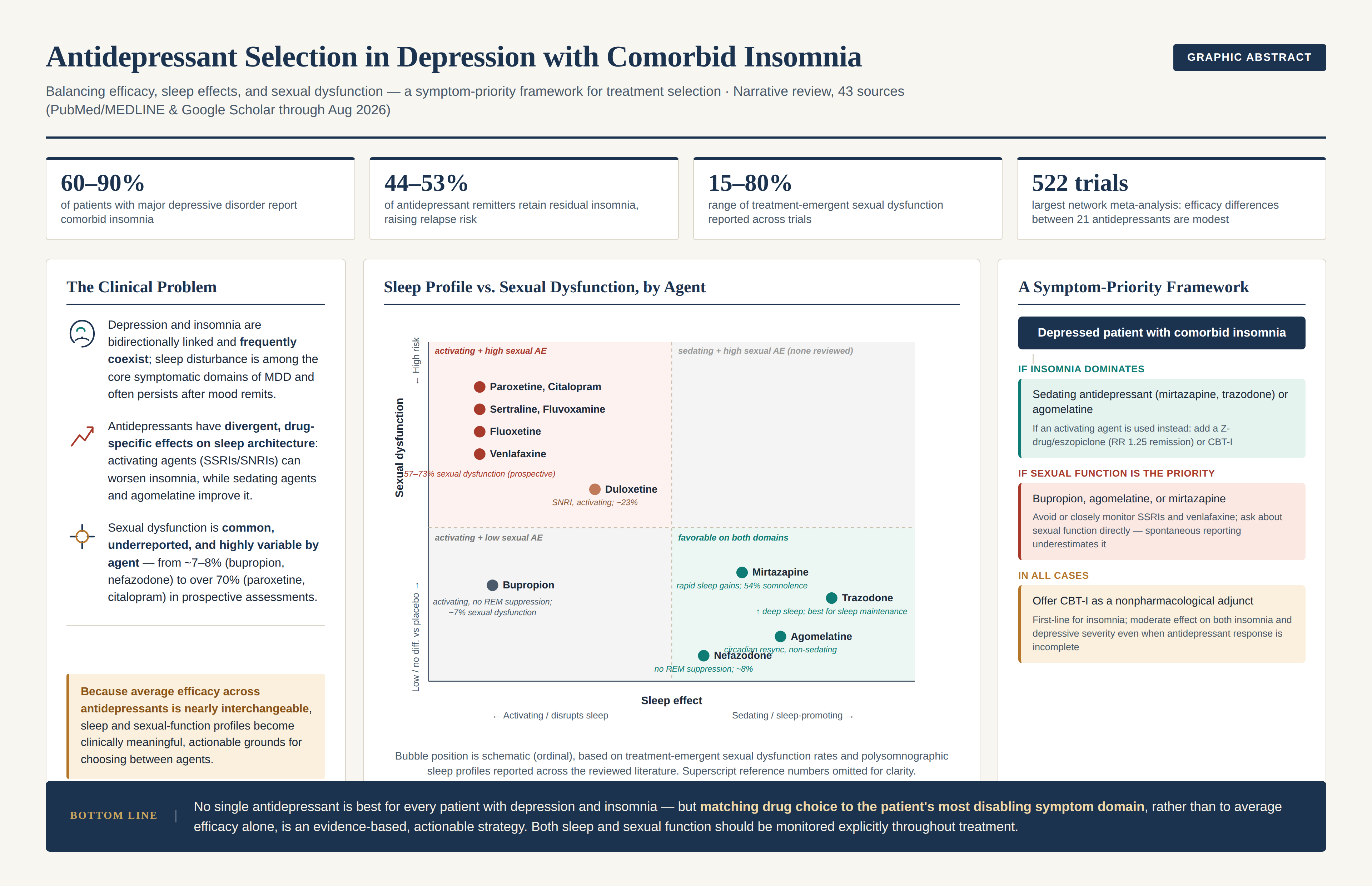
Objective: To synthesize comparative evidence on antidepressant efficacy, sleep effects, and sexual dysfunction in depression with comorbid insomnia, and to propose a symptom-priority framework for antidepressant selection.Data Sources: PubMed/MEDLINE and Google Scholar were searched through August 2026 (antidepressant, insomnia, sleep architecture, sexual dysfunction, major depressive disorder, and individual drug names); reference lists and guidelines were hand-searched.Study Selection: Randomized trials, network meta-analyses, systematic reviews, large effectiveness cohorts (e.g., STAR*D), and major guidelines on efficacy or sleep/sexual-function effects were prioritized; 43 sources were included.Data Extraction: Data on comparative efficacy, sleep effects, and treatment-emergent sexual dysfunction were extracted and synthesized narratively by drug class and agent; no formal risk-of-bias scoring was applied.Results: Because most antidepressants are comparably efficacious on average, selection in depression with insomnia hinges largely on differential sleep and sexual-function effects. Activating agents (fluoxetine, paroxetine, venlafaxine, bupropion) disrupt sleep continuity and suppress REM sleep, while sedating agents (mirtazapine, trazodone, doxepin) shorten sleep latency and increase slow-wave sleep; agomelatine promotes sleep via circadian resynchronization, not sedation. Adjunctive Z-drugs raise remission rates by about 25% over monotherapy, and CBT for insomnia is an effective adjunct. SSRIs and venlafaxine carry sexual-dysfunction rates of roughly one-quarter to three-quarters, versus no significant difference from placebo for bupropion, agomelatine, mirtazapine, and nefazodone.Conclusions: Because average efficacy differences are small, sleep and sexual-function profiles are actionable axes for antidepressant selection in depression with insomnia. Clinicians should match drug choice to the patient's most disabling symptoms, monitor both domains explicitly, and actively treat residual insomnia.
Keywords:
antidepressants
; insomnia
; major depressive disorder
; sleep architecture
; sexual dysfunction
; treatment selection
; mirtazapine
; trazodone
; agomelatine
Copyright: This open access article is published under a Creative Commons CC BY 4.0 license, which permit the free download, distribution, and reuse, provided that the author and preprint are cited in any reuse.