

Submitted:
01 September 2026
Posted:
03 September 2026
You are already at the latest version
Abstract
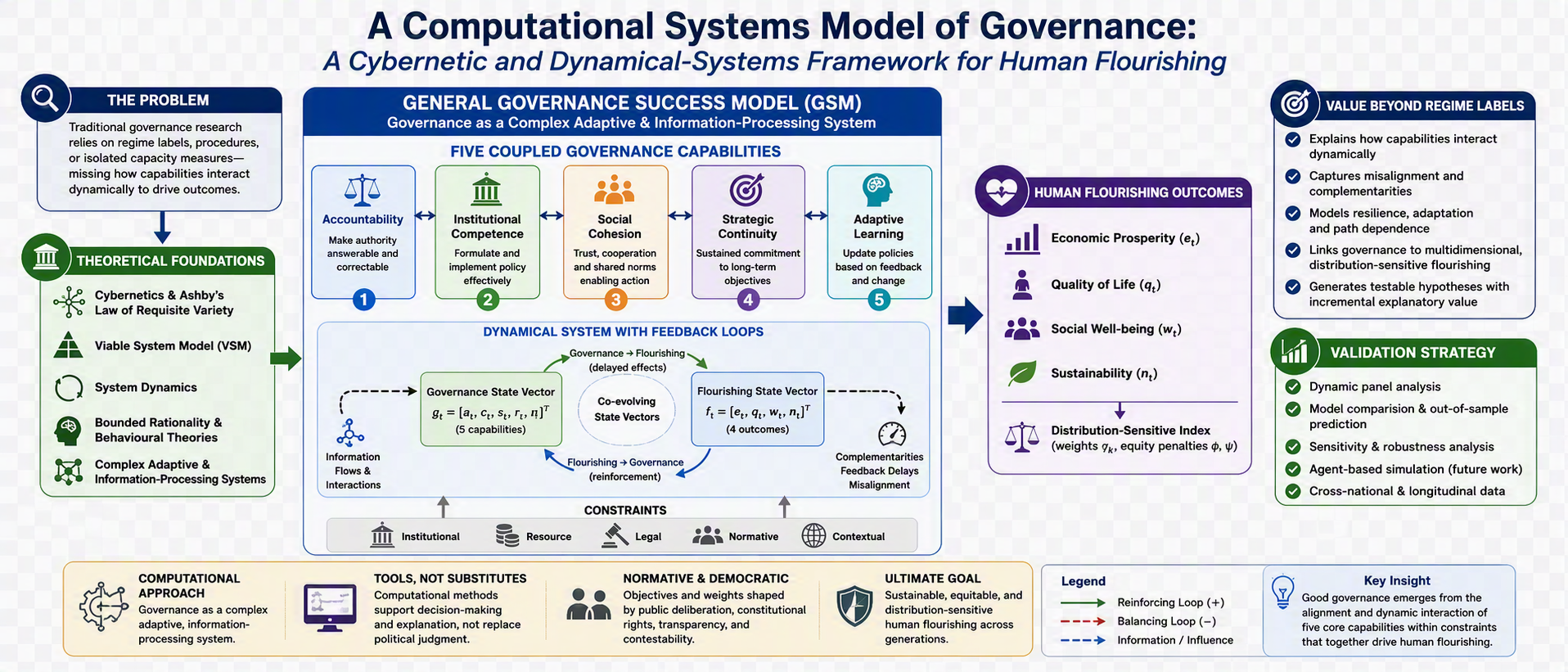
Governance research commonly evaluates political systems through regime classifications, institutional procedures, or isolated measures of state capacity. Such approaches provide limited insight into how governance capabilities interact dynamically to influence human flourishing. This conceptual paper develops the General Governance Success Model (GSM), a systems-theoretical metamodel representing governance as a complex adaptive and information-processing system. The model defines governance through five coupled capabilities: accountability, institutional competence, social cohesion, strategic continuity, and adaptive learning. Drawing on cybernetics, the Viable System Model, system dynamics, and behavioural theories of bounded rationality, the framework specifies governance performance as an outcome of capability levels, complementarities, feedback delays, and functional misalignment. Governance capabilities and flourishing outcomes are modelled as co-evolving state vectors subject to institutional, resource, legal, and normative constraints. The paper identifies empirically testable hypotheses concerning capability interactions, misalignment, resilience, and the incremental explanatory value of the model beyond regime classification. It also outlines a comparative validation strategy combining dynamic panel analysis, model comparison, sensitivity analysis, and future agent-based simulation. The framework treats computational methods as decision-support and explanatory tools rather than substitutes for political judgment. Normative objectives and model weights remain subject to public deliberation, constitutional rights, transparency, and contestability. The model contributes a transdisciplinary foundation for analysing how interacting governance capabilities may support sustainable and distribution-sensitive human flourishing.
Keywords:
governance systems
; complex adaptive systems
; dynamical systems
; cybernetics
; viable system model
; system dynamics
; human flourishing
; bounded rationality
Copyright: This open access article is published under a Creative Commons CC BY 4.0 license, which permit the free download, distribution, and reuse, provided that the author and preprint are cited in any reuse.