
Submitted:
01 September 2026
Posted:
03 September 2026
You are already at the latest version
Abstract
Polysaccharides have attracted extensive attention due to their pharmacological activities, such as regulating depression, antitumor, hypoglycemic and lipid-lowering effects, and regulating intestinal flora. In this study, four crude polysaccharide fractions were separated and prepared from Lycium barbarum L., named LICP007, LICP008, LICP009 and LICP010. With hypoglycemic activity in vitro, LICP007 with a better hypoglycemic effect was selected for further separation and purification, and one neutral polysaccharide (LICP007-N1) and two acidic polysaccharides (LICP007-S2 and LICP007-S5) were obtained by DEAE-52 and Sephadex G-200 gel electrophoresis. Among them, LICP007-S5 showed the best inhibitory activity against α-amylase and α-glucosidase. Studies on physical and chemical properties show that LICP007-S5 was indeed very different from LICP007-N1 and LICP007-S2 in molecular weight distribution, monosaccharide composition, morphology and so on. These findings provide comparative information on the structure and biological activity of different Lycium barbarum polysaccharides and highlight their potential as hypoglycemic agents in functional foods.
Keywords:
Lycium barbarum polysaccharides
; hypoglycemic activity
; structural analysis
1. Introduction
Diabetes mellitus (DM) is a common clinical metabolic disease that is caused by a deficiency in insulin secretion or impairment of its biological effects. At the same time, it is closely related to genetic environmental factors. The prevalence and incidence of DM have increased in recent decades, and approximately 10% of the global population already has type 2 diabetes or is likely to develop it (Cho et al., 2018). Due to long-term hyperglycemia, patients will directly damage various tissues of the body, including the eyes, kidney and heart. In severe cases, hyperglycemia will lead to blindness or amputation, which will bring great harm to patients’ health and quality of life (Ghaemi et al., 2021). Currently, the most effective and widely used chemical drugs in clinical practice include sulfonylureas, thiazolidinedione, α-glucosidase inhibitors, biguanide, DPP-4 inhibitors and GLP-1 analogs. As the treatment of hypoglycemia requires long-term medication, side effects and toxicity cannot be ignored (Cai, Ding, Wang, Yang, Zhang, & Yan, 2020). Therefore, one of the main directions of scientific research is the development of safer and more effective drugs for the treatment of hypoglycemia without toxic side effects. Additionally, polysaccharides derived from natural resources have received worldwide attention in recent decades owing to their various bioactivities, such as antioxidation, immunomodulation, antidiabetics, and antitumor activities (Rehman et al., 2020).
Lycium barbarum L. is a local food in China and other Asian countries. As a multipurpose medicinal and edible plant, Lycium barbarum L. contains abundant natural active components. Numerous medical studies have demonstrated that L. barbarum L. confers a variety of medicinal properties, including antiaging effects (Xiao, Deng, Zhou, & Zhang, 2021), neuroprotection (Khan et al., 2021), improved immune function (Hao, Wang, Zhao, & Li, 2020), hypoglycemia (Lu et al., 2021), hypolipidemia (Yang et al., 2021), antitumor effects (G. Gong et al., 2020), antioxidation (G. Gong et al., 2020) and cytoprotection (Y. Liu & Zhang, 2019). It can also alleviate visual fatigue and myocardial injury (Zhang et al., 2020), reduce radiation and regulate intestinal flora (Zheng et al., 2021), and act as an auxiliary treatment for chemical liver injury (Y. Liu et al., 2019). Lycium barbarum polysaccharides (LBPs) are well known and highly comparable for the abovementioned physiological activities. LBPs are water-soluble heteropolysaccharides with a molecular weight of 10~2300 kDa (D. T. Wu et al., 2016), accounting for 5~8% of dried fruits, and comprise predominantly glucose, arabinose, mannose, xylose, rhamnose, and fructose, as well as various polysaccharide complexes. An increasing number of studies have demonstrated that LBPs confer hypoglycemic effects, although the basis and exact structure of their hypoglycemic effects are still unclear.
Therefore, based on previous studies, this study involved screening the components of LBPs with hypoglycemic effects and further separating and purifying them to determine whether any components of L. barbarum possess significant hypoglycemic activity and to clarify the material basis of the hypoglycemic activity of LBPs. The results are expected to clarify the differences in the structure and biological activity of different polysaccharide fractions and provide novel natural hypoglycemic agents in the pharmaceutical and food industries.
2. Materials and Methods
2.1. Materials and Chemicals
Dried fruits of L. barbarum were obtained from Ningxia Zhongqi Wolfberry Trading Group Co., Ltd. on 1st May 2017. Steamed phenol, DC Protein Assay Kit, DEAE-52 cellulose, and Sephadex G-200 were purchased from Solarbio Science & Technology Co., Ltd. (Beijing, China); α-amylase, α-glucosase, acabosaccharide, soluble starch, and pNPG were purchased from Shanghai Source Leaf Biotechnology Co., Ltd. All other chemicals were of analytical grade or higher. The following equipment was used: a UV spectrophotometer, a Biosafer-10B Vacuum Freeze Dryer, a KQ-250DE-type CNC ultrasonic washer (Kunshan Ultrasonic Instrument Co., Ltd.), a BSA224S-CW 10000 Electronic Analysis Balance (Beijing Cedolis Instrument System Co., Ltd.), an Agilent 1260 liquid chromatograph (US Agilent Technologies), a 2200 evaporative light detector, a DHG-9140A-type electric thermal constant temperature drum air drying oven (Shanghai Jinghong Experimental Equipment Co., Ltd.), a Flying Pigeon Brand High-Speed Centrifuge (Shanghai Anting Scientific Instrument Factory), a Varioskan Flash enzyme marker (Thermo Scientific), a porous hydroxymethacrylate polymer column (A4000) (300 mm L × 8.0 mm I.D., 10 μm) and an A7 guard (50 mm L × 8.0 mm I.D., 10 μm, made in Japan) were purchased from Malvern. a CHR6040 SERIAL OMNISEC RESOLVE MAlVERN, OMNISEC GPC/SEC system from Malvern Instruments (UK Enigma Business Park, Malvern, Worcestershire, WR14 1XZ Co., Ltd.). A high-shear dispersing emulsification (HSDE) machine (IKA ULTRA TURRAX, T25 digital, Werke) and Vivaflow® 200 cross flow cassettes (Sartorius, Germany) were used.
Extraction and Separation of the L. barbarum Polysaccharide Fractions
A diagram of the procedure applied to L. barbarum to fractionate polysaccharides with significant hypoglycemic activity is presented in Figure 1. Four L. barbarum polysaccharides with varying Mws, including LICP007, LICP008, LICP009, and LICP010, were obtained using our previously reported method with slight modifications (J. Liu, Pu, Qiu, & Di, 2021). First, the L. barbarum powder (100 g) was extracted with water (1 L) at 60 °C for 30 min using a high-shear dispersing emulsification (HSDE) machine (IKA ULTRA TURRAX, T25 digital, Werke) at 15,000 rpm to stir the mixture and centrifuged at 8,000 rpm for 15 min. The crude polysaccharide aqueous solution was collected for subsequent separation using membrane technology. In this process, suitable membrane materials and a suitable molecular weight cutoff (MWCO) were selected from four Vivaflow® 200 cross flow cassettes (Sartorius, Germany) with specific MWCOs (30, 10, 5, and 2 kDa). The membrane separation procedure was as follows: 600 mL of polysaccharide extract was obtained using Vivaflow® 200 with an MWCO of 30 kDa at 0.8 MPa and a flow rate of 150 mL/min, and the membrane area was 100 × 100 mm2. When the volume of retentate was 25 mL, 50 mL of distilled water was injected from the discharge pipe of Vivaflow® 200. After separation, 600 mL of the polysaccharide extract was divided into retentate and permeate solutions; the retentate solution was lyophilized to obtain LICP007, and the permeate solution was committed to further separation experiments with an MWCO of 10 kDa to obtain LICP008. The separation procedure was similar to the above-described process. Finally, four L. barbarum polysaccharides with specific Mws were isolated and lyophilized, namely, LICP007, LICP008, LICP009, and LICP010.
Purification of the Polysaccharide Fraction LICP007
LICP007 was dissolved in hot water, and the protein was completely removed with Sevage reagent (chloroform: water-saturated n-butanol = 4:1, v/v) (Long, Yan, Cai, Li, & Luo, 2020). After treatment, the upper solution was collected, and NH3·H2O was added to adjust the pH to basic. It was then mixed with a H2O2 solution by stirring in a water bath at 60 °C until the concentration was 10%. H2O2 was wave dried and lyophilized for 48 h. The purified polysaccharide was obtained and loaded on a DEAE-52 cellulose column (5.5 cm × 60 cm), sequentially eluted at a flow rate of 1 mL/min with deionized water and 0.2 mol/L NaCl solution, followed by 0.5 mol/L NaCl solution (Taylor, 1995). The collected eluent was monitored using the phenol-sulfuric acid method, and UV detection was performed with an ultraviolet spectrophotometer at 490 nm (Rover, Johnston, Lamsal, & Brown, 2013). Then, the distilled water fraction was concentrated and lyophilized to obtain neutral polysaccharide LICP007-N1, and the fraction eluted with 0.2 M and 0.5 M aqueous NaCl was dialyzed, concentrated, and lyophilized to obtain the acidic polysaccharides LICP007-S2 and LICP007-S5. LICP007-N1, LICP007-S2, and LICP007-S5 were dissolved in 1 mL deionized water, loaded on a Sephadex G-200 column (5.5 cm × 60 cm), and eluted with deionized water at a flow rate of 1 mL/min. The eluent was monitored by the phenol-sulfuric acid method and analyzed by ultraviolet spectrophotometry at 490 nm (C. Cao, Huang, Zhang, Li, & Fu, 2018), and the three purified polysaccharides were also designated LICP007-N1, LICP007-S2 and LICP007-S5.
Hypoglycemic Activity In Vitro
Determination of α-Amylase Inhibitory Activities
Currently, α-amylase and α-glucosidase inhibitors play an important role in inhibiting the activities of enzymes to decrease the release of glucose from carbohydrates and delay carbohydrate absorption in humans (Amiri et al., 2019). The α-amylase inhibitory activities of four crude polysaccharides (LICP007, LICP008, LICP009, and LICP010) were determined using a method published by Xu with slight modifications (Xu et al., 2018). Briefly, 45 μL LICP007~LICP010 solution (0.5, 1, 5, 10, and 20 mg/mL) was mixed with 15 μL α-amylase (0.02 mg/mL) and incubated at 37 °C for 10 min. Then, 60 μL starch solution (0.08%) was added to the mixture and incubated at 37 °C for 15 min. Hydrochloric acid solution (60 μL, 1 mol/L) was added to terminate the reaction. Finally, 20 μL iodine solution (0.01 mol/L) was added. PBS buffer (15 μL) replaced α-amylase hydrolysate in the blank. Finally, the absorbance was measured at 630 nm with a microplate analyzer. The three heteropolysaccharide fractions LICP007-N1, LICP007-S2 and LICP007-S5 were analyzed using the same methods as above. The inhibition ratio was calculated using Equation (1):
where Ab represents the negative blank absorbance, Ac represents the negative control absorbance, Asb represents the blank absorbance of the sample, and Asc represents the control absorbance.
Determination of α-Glucosidase Inhibitory Activities
The α-glucosidase inhibitory activities of four crude polysaccharides (LICP007, LICP008, LICP009 and LICP010) were determined using a method published with slight modifications (C. Cao et al., 2018). Briefly, 50 μL of solution (0.5, 1, 5, 10 and 20 mg/mL) was mixed with α-glucosidase solution (4 U, 50 μL) and incubated at 37 °C for 15 min. Then, 50 μL of pNPG solution (1 mmol/L) was added as a substrate, and the mixture was incubated at 37 °C for 15 min. Finally, 50 μL of Na2CO3 solution (0.2 mol/L) was added to terminate the reaction, and the absorbance was measured at 405 nm. Three polysaccharide fractions, LICP007-N1, LICP007-S2 and LICP007-S5, were tested using the same methods as above. The inhibition ratio was calculated using Equation 1.
Structure Characterization
Qualitative Analysis
Fehling’s, biuret, iodination, and ferric chloride tests of the four polysaccharide fractions LICP007-LICP010 were performed according to a literature report (Dong, Zhu, Huang, & Xiao, 2021).
Determination of Protein, Total Carbohydrate and Uronic Acid Content
The total carbohydrate content in the polysaccharide fraction LICP007-LICP010 was measured using the phenol-sulfuric acid assay with the standard of D-glucose, the protein content was estimated using the DC protein assay kit, and the uronic acid content was detected using the carbazole-sulfuric acid method (Zhao et al., 2021).
Determination of Molecular Weight
The molecular weights (Mw) of LICP007-N1, LICP007-S2, and LICP007-S5 were estimated using a CHR6040 SERIAL OMNISEC RESOLVE MAlVERN (UK Enigma Business Park, Malvern, Worcestershire, WR14 1XZ Co., Ltd.) equipped with a porous hydroxymethacrylate polymer column (A4000). LICP007-N1, LICP007-S2, and LICP007-S5 (2.0 mg) were dissolved in 1 mL Na2SO4 solution and passed through a 0.45 μm filter with a flow rate of 0.7 mL/min. Calibration curves were prepared using dextran standards.
Monosaccharide Composition
The monosaccharide composition was analyzed using ion chromatography (ICS5000, Thermo Fisher Scientific, USA) with an electrochemical detector. The retention times and concentrations of standard monosaccharide sugars were calculated using the corresponding peak areas and response factors. LICP007-N1, LICP007-S2 and LICP007-S5 (10 mg each) were dissolved in 3 M trifluoroacetic acid (TFA, 10 mL) and hydrolyzed at 121 °C for 3 h in sealed test tubes. The hydrolysates were evaporated with N2 to remove the TFA, and the residues were dissolved in 10 mL of distilled water and mixed by vortexing. Then, 100 μL and 900 μL deionized water were added, followed by centrifugation at 12000 rpm for 5 min to obtain the supernatant and IC analysis. Then, 5 μL supernatant was drawn out for analysis via ion chromatography under the following conditions: ionexCarbopacTMPA20 (3×150) liquid chromatography column with the column temperature of 30 °C, the mobile phase was A: H2O; B: 15 mM NaOH; C: 15 mM NaOH & 100 mM NaOAc, the flow rate was 0.3 mL/min (C. Chen, You, Abbasi, Fu, Liu, & Li, 2016).
Fourier Transform Infrared (FT-IR) Spectrum Analysis
The Fourier transform infrared (FT-IR) spectra of LICP007-N1, LICP007-S2 and LICP007-S5 were collected using a Thermo Nicolet Nexus 870 ESP FT-IR spectrometer (SpectraLab Scientific Inc., Markham, ON, Canada). The sample (2 mg) was mixed with dried KBr powder at room temperature, pressed into a pellet and scanned in the range of 4000–400 cm−1.
Measurement of Zeta Potential
The zeta potentials of LICP007-N1, LICP007-S2 and LICP007-S5 were measured using a Particle Size Analyzer Litesizer 500 (Anton Paar, Austria). Briefly, the samples were dissolved in distilled water at a concentration of 1 mg/mL and analyzed at 25 °C (X. Li & Wang, 2016). The measurement was performed three times.
Atomic Force Microscopy (AFM) Images Analysis
LICP007-N1 (1.0 mg) was dissolved and diluted with 100 μL ultrapure water to obtain a final concentration of 10 mg/mL. Subsequently, the solution was dropped onto a freshly cleaved mica substrate and allowed to dry at room temperature overnight. All measurements were performed at ambient pressure and humidity by a Bruker atomic force microscope. LICP007-S2 and LICP007-S5 were similar to the same process.
Congo Red Test
LICP007-S5 (2.0 mg) was dissolved in 2.0 mL distilled water and mixed with 2.0 mL of Congo red solution (80 μmol/L) (J. J. Cao, Lv, Zhang, & Chen, 2019). Then, NaOH solution (1 mol/L) was gradually added to the mixture to achieve final NaOH concentrations of 0.1, 0.2, 0.3, 0.4 and 0.5 mol/L. The maximum absorption wavelength was determined by UV–Vis spectrometry in the 200–800 nm range (Guo, Shang, Zhao, Zhang, & Chen, 2020).
Thermogravimetric (TG) Analysis
TG analysis of LICP007-S5 was performed in the temperature range of 35–800 °C with a heating rate of 10 °C/min using an STA449C thermogravimetric analyzer (Mettler Toledo, Columbus, OH, USA).
Nuclear Magnetic Resonance (NMR) Analysis
LICP007-S5 (50 mg) was dissolved in 1.0 mL D2O to achieve deuterium exchange and then lyophilized; this process was repeated three times (Guiping Gong et al., 2016). 1H NMR and 13C NMR were measured using a Bruker Advance III HD 400 MHz spectrometer (Bruker Instruments, Inc., Billerica, MA, USA) at 25 °C.
Statistical Analysis
All experiments were performed in triplicate, and the data are expressed as the mean ± standard deviation. Statistical differences were tested using one-way analysis of variance (ANOVA).
3. Results and Discussion
Separation and Purification of Crude Polysaccharides
Changes in the molecular weight of polysaccharides may lead to different pharmacological effects. Hierarchical alcohol precipitation is the most popular method for the separation of polysaccharides. However, with the dehydration of polysaccharides in ethanol solution, the conformation of polysaccharides is transformed and assembled by intramolecular hydrogen bonds, which complicates the study of the biological activity of polysaccharides (J. Liu et al., 2021). In this work, integrated tandem hybrid membrane technology, which was developed by our team, was used to separate polysaccharides from L. barbarum into fractions marked as LICP007, LICP008, LICP009, and LICP010. Compared with hierarchical alcohol precipitation, this technology is a molecular exclusion process, which is a physical process and can avoid the structural changes of polysaccharides caused by the separation process (J. Liu et al., 2021). From Table 1, we can see that the yields of LICP007, LICP008, LICP009, and LICP010 were 4.10%, 2.74%, 2.25%, and 2.16%, respectively. The results of the iodine, Fehling reagent, Biuret, and ferric chloride reactions indicated that all four fractions did not contain starch or free monosaccharides but contained proteins and polyphenols. It was suggested that deproteination and depigmentation were both necessary processes for further purification. All four fractions contained uronic acid. The highest uronic acid content of 18.2% and total carbohydrate content of 65.3% were recorded in LICP007, while the lowest uronic acid content of 10.7% and total carbohydrate content of 49.8% occurred in LICP010. Uronic acids and total carbohydrates are the major factors that confer biological activity to polysaccharides (J. Li & Huang, 2021).
Inhibitory Effects of α-Amylase
As shown in Figure 2A, LICP007 had the highest inhibitory activity against α-amylase. At concentrations of 1–50 mg/mL, the LICP007 inhibition rate was 61.42 ± 0.29%, LICP008 possessed the worst effect, and the inhibition rate was 21.29 ± 0.22%. This indicated that LICP007 was the hypoglycemic component with the greatest potential and was significant for further separation and purification. The inhibitory effects of LICP007-N1, LICP007-S2 and LICP007-S5 on α-amylase were investigated, and all samples exhibited hypoglycemic activity. The inhibition rates increased steadily with sample concentration, demonstrating a dose-dependent inhibitory effect on α-amylase at concentrations of 0.5-20 mg/mL. Moreover, LICP007-S5 showed a stronger inhibitory effect on α-amylase than LICP007-N1 and LICP007-S2. As shown in Figure 2C, the inhibition ratios of LICP007-S5 were 13.41%, 16.32%, 75.35%, 89.88%, 98.38% for concentrations between 0.5–20 mg/mL, respectively. LICP007-S5 exhibited the best inhibitory activity against α-amylase at 20 mg/mL.
Inhibitory Effects of α-Glucosidase
Figure 3B indicates that the four polysaccharides possessed a certain inhibitory effect on α-glucosidase activity with increasing concentration. The α-glucosidase inhibitory effects on LICP007, LICP008, LICP009, and LICP010 were significant at concentrations of 1–50 mg/mL. In particular, the inhibitory effect of LICP007 was significantly higher than that of the other three polysaccharides, and the inhibition rate was up to 40.69 ± 0.35% at a concentration of 50 mg/mL. LICP010 possessed the worst effect on inhibiting α-glucosidase activity. As shown in Figure 2D, LICP007-S5 showed a higher inhibitory effect on α-glucosidase than LICP007-N1 and LICP007-S2. LICP007-S5 had the highest rates of α-glucosidase (4U) inhibition, which were 14.48%, 30.46% and 43.45% for LICP007-N1, LICP007-S2 and LICP007-S5, respectively. Both Figure 2B,D indicated that LICP007-S5 possessed greater potential for hypoglycemic activity than others, which was closely related to their structural characterizations, including monosaccharide compositions, molecular weight, glycosyl linkage types and molecular conformation (D.-T. Wu et al., 2018).
Purification of the Polysaccharide Fraction LICP007
After deproteinization, decolorization, dialysis, and lyophilization, LICP007 was then dissolved in distilled water, loaded onto a DEAE-52 cellulose column (2.6 cm × 40 cm), and treated with gradient elution by distilled water, 0.2 M NaCl, and 0.5 M NaCl solutions. Elution curve is illustrated in Fig .3. Three polysaccharide fractions were obtained. After purification by a Sephadex G-200 column, three purified polysaccharides, LICP007-N1, LICP007-S2 and LICP007-S5, were obtained.
Structure Analysis
MW Distribution Analysis
Polysaccharides are mixtures of compounds with different lengths of chains, and their MWs are the average of the homologs. HPSEC-MALLS-RID can provide the weight-average molecular weight (Mw), number-average molecular weight (Mn), z-average molecular weight (Mz) and polydispersity index (PDI) values (Mw/Mn) of three polysaccharides (LICP007-N1, LICP007-S2 and LICP007-S5), as well as the Rg values that provide an estimation of the approximate size of the molecules and the SVg value that was an estimation of molecular compactness. As shown in Table 2 and Figure 4, two major peaks were observed in LICP007-N1: Mn was determined to be 3.211×10³ and 5.112×10⁴ g/mol, Mw, Mz, and PDI were 4.229 ×10³ and 1.042×10⁵ g/mol, 4.839×10³ and 1.388×10⁵ g/mol, and 1.317 and 2.309, respectively. The Rg values of LICP007-N1 ranged from 4.85 nm to 112.7 nm. Based on the Mw and Rg values from the MALLS system, the SVg value calculated by the equation of You and Lim varied between 0.144 and 12.434 cm3/g (You & Lim, 2000). These results implied that LICP007-N1 was more heterogeneous in terms of molecular size distribution. It should be noted that the Mn, Mw, Mz, and PDI of LICP007-S2 polysaccharide were 8784 g/mol, 5.368×10⁴ g/mol, 9.259×10⁴ g/mol, and 6.111, respectively. In addition, the radius of gyration (Rg) and specific volume for gyration (SVg) were 99.74 nm and 0.276 cm3/g, respectively. All of these results suggest that LICP007-S2 had a broad Mw distribution pattern and was a polydisperse heteropolysaccharide (Figure 4B). Similarly, LICP007-S5 showed two peaks (Figure 4C), in which peak 1 contained molecules with Mn, Mw, and Mz of 4.769×10³, 9.202×10³, and 1.690×10⁴ g/mol, respectively. Peak 2 contained molecules with Mn, Mw, and Mz values of 7.871×10⁴, 1.031×10⁵, and 2.101×10⁵ g/mol, respectively. Meanwhile, the PDI values of peaks 1–2 in LICP007-S5 were 2.002 and 1.31, indicating that the two peaks were homogeneous polysaccharides. Moreover, the values of Rg and SVg in LICP007-S5 (peaks 1–2) were 38.31 and 4.13 nm and 6.890 and 0.226 cm3/g, respectively. The above results showed that obvious differences, including molecular weight, Mw distribution, particle size, and molecular compactness, existed not only between neutral polysaccharides and acid polysaccharides but also among the two acid polysaccharides. However, the relationship between these differences and activity needs further study.
Monosaccharide Composition Analysis
The monosaccharide compositions of LICP007-N1, LICP007-S2 and LICP007-S5 were analyzed by ion chromatography, as shown in Table 3. LICP007-N1 consisted of rhamnose, arabinose, glucosamine hydrochloride, galactose, glucose, xylose, mannose and glucuronic acid with a molar ratio of 2.2:50.2:3.0:27.0:11.3:3.0:1.8:1.6. LICP007-S2 was composed of rhamnose, arabinose, glucosamine hydrochloride, galactose, glucose and glucuronic acid with a molar ratio of 3.3:38.1:2.2:28.6:24.4:3.6. The composition of LICP007-S5 was basically the same as that of LICP007-S2 except for uronic acid. LICP007-S5 was composed of rhamnose, arabinose, glucosamine hydrochloride, galactose, glucose and had a molar ratio of 4.6:21.6:2.5:12.4: 31.4, which also contained galacturonic acid with a molar ratio of 27.5. According to the results, LICP007-N1, LICP007-S2 and LICP007-S5 were heteropolysaccharides. Neutral polysaccharide (LICP007-N1) contained xylose and mannose, while acidic polysaccharides (LICP007-S2 and LICP007-S5) did not. These results indicate that xylose and mannose in crude polysaccharides can be easily eluted by neutral solution and then exist in neutral polysaccharide components. The molar ratios of monosaccharides to neutral and acidic polysaccharides were also different, which indicated that the composition of polysaccharides was related to the type of eluent. In addition, LICP007-S2 contained glucuronic acid, while LICP007-S5 contained galacturonic acid, indicating that the composition of monosaccharides may also be related to the concentration of eluent. The content of uronic acid in polysaccharides could be greater with increasing NaCl concentration. The content of uronic acid in LICP007-S5 (27.5%) eluted by 0.5 M NaCl was much higher than LICP007-S2 (3.6%) by 0.2 M NaCl solutions. Compared with LICP007-N1 and LICP007-S2, LICP007-S5 had better inhibitory activity against α-glucosidase and α-amylase, which may be related to its high content of galacturonic acid. Moreover, there was evidence showing that polysaccharides consisting of more glucose have higher inhibitory activity of glycosidase (Gao et al., 2010), which was consistent with our experimental results. The above results showed that obvious differences existed not only in the monosaccharide profiles between neutral polysaccharides and acid polysaccharides but also among the two acid polysaccharides.

Table 3.
Monosaccharide composition of LICP007-N1, LICP007-S2, and LICP007-S5.
| No. | Proportion of monosaccharides (mole %) | ||||||||
| Rha | Ara | GlcN | Gal | Glc | Xyl | Man | GalA | GlcA | |
| LICP007-N1 | 2.2 | 50.2 | 3.0 | 27.0 | 11.3 | 3.0 | 1.8 | - | 1.6 |
| LICP007-S2 | 3.3 | 38.1 | 2.2 | 28.6 | 24.4 | - | - | - | 3.6 |
| LICP007-S5 | 4.6 | 21.6 | 2.5 | 12.4 | 31.4 | - | - | 27.5 | - |
FT-IR Spectrum Analysis
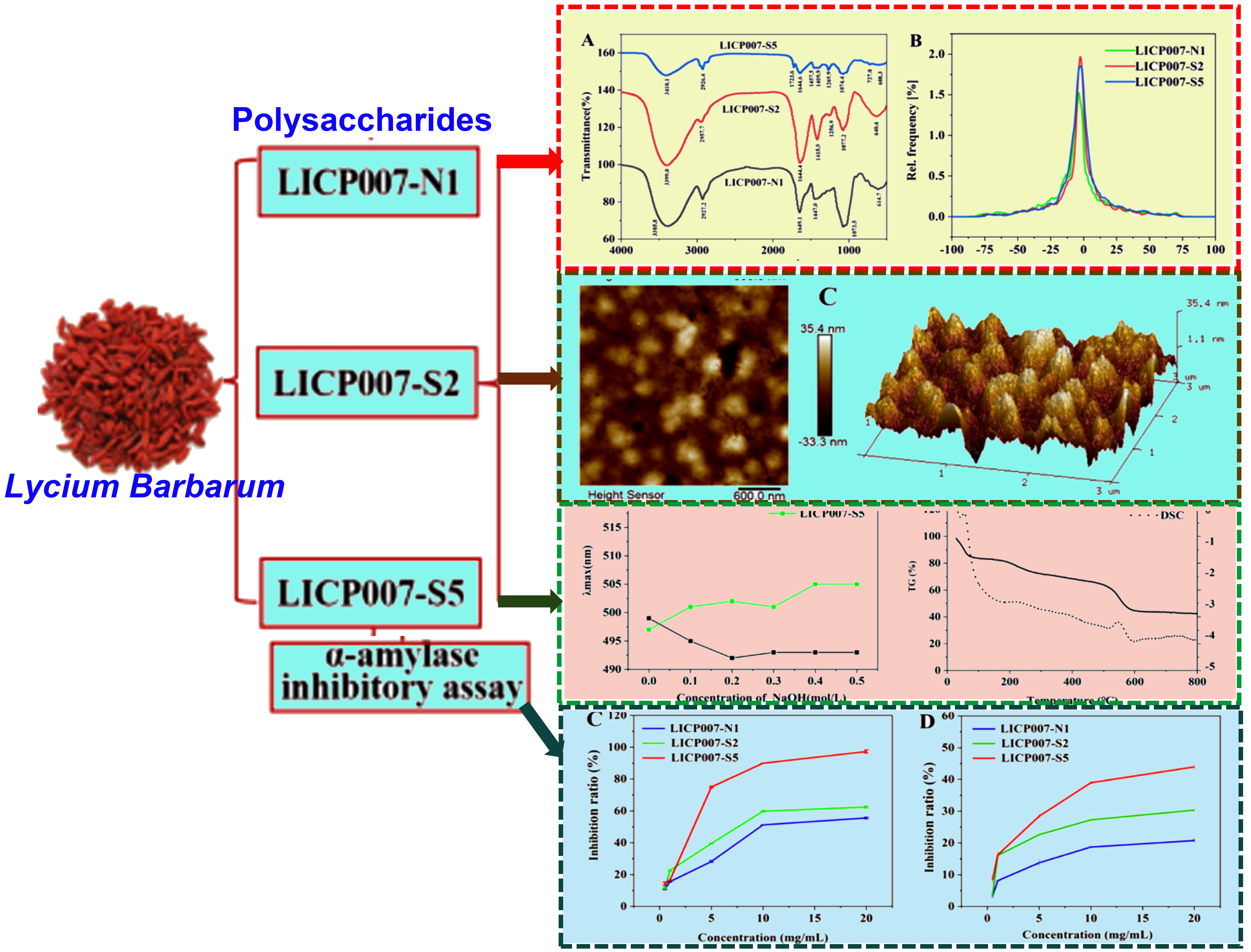
The FT-IR spectra of LICP007-N1, LICP007-S2 and LICP007-S5 in the range of 4000–400 cm-1 are shown in Figure 5A. The spectrum of LICP007-N1 had a strong and wide absorption peak at 3385.8 cm-1, which was assigned to the typical hydroxyl (O–H) group stretching vibration of the polysaccharide. Similarly, LICP007-S2 had a strong and wide absorption peak at 3399 cm-1, and LICP007-S5 had a strong and wide absorption peak at 3410.1 cm-1. The weak absorption bands at 2927.2 (LICP007-N1), 2957.7 (LICP007-S2) and 2926.4 cm-1 (LICP007-S5) represented the C–H stretching vibration. The absorption peaks of these two regions were characteristic peaks of polysaccharides. The strong peaks at 1649.1 and 1447.0 cm-1 (LICP007-N1) and 1644.4 and 1415.9 cm-1 (LICP007-S2) were assigned to the asymmetric and symmetric stretching vibrations of the carboxylate groups of uronic acid. In contrast to the spectra of LICP007-N1 and LICP007-S2, the LICP007-S5 spectrum exhibited weak peaks at 1256.9 and 1457.5 cm-1; otherwise, LICP007-S5 had a weak but clear peak at 1723.6 cm-1, which may reflect the abundance of uronic acid ester groups (J. Chen et al., 2019). The monosaccharide composition showed that the GalA ratio of LICP007-S5 was 27.5%, which was greater than that of LICP007-N1 (GlcA, 1.6%) and LICP007-S2 (GlcA, 3.6%), consistent with the IR spectrum. The very weak peaks at 1256.9 and 1415.9 cm-1 (LICP007-S2) and 1256.9 and 1457.5 cm-1 (LICP007-S5) corresponded to symmetrical deformations and angle vibrations of C–OH groups. However, LICP007-N1 had no absorption peak near 1200 cm-1, which could be a key factor to distinguish acidic polysaccharides LICP007-S2 and LICP007-S5 from neutral polysaccharide LICP007-N1. This may also be a reason for the difference in hypoglycemic activity between LICP007-S5 and LICP007-N1 and LICP007-S2. The absorption peaks in the region of 1200–1000 cm-1 were attributed to the stretching vibration of the pyranose ring (Sun, Su, & Zhuang, 2016). LICP007-N1, LICP007-S2 and LICP007-S5 all had absorption peaks at approximately 1070 cm-1, which indicated the presence of pyranose rings in the three purified polysaccharides.
Zeta Potential Analysis
The charges of polysaccharides could reflect the stability of solutions or colloids, which directly determines their potential application. In this study, the LICP007-N1, LICP007-S2, and LICP007-S5 acquiring charges were determined to be -4.9 mV, -8.7 mV, and -0.2 mV, respectively (Figure 5B). The results showed that the three polysaccharides were in an unstable state in aqueous solution. LICP007-S5 and LICP007-N1 were also prone to coagulation, and the coagulation ability of LICP007-S5 was stronger than that of LICP007-N1. The negative charges indicate that these polysaccharide fractions possessed donated electron capacities (H. Chen et al., 2021).
AFM Images Analysis
AFM is a powerful tool to observe the surface structure and roughness of polysaccharides with minimal sample preparation. The topographical AFM planar and 3-dimensional images of LICP007-N1, LICP007-S2 and LICP007-S5 are shown in Figure 6. The LICP007-N1 results showed a polysaccharide chain with a uniform size of flame-like aggregates and multiple strands arranged closely, a uniform and compact micromorphology, and network structures. Compared with LICP007-N1, the polysaccharide chain of LICP007-S2 was sparsely arranged, and the overall appearance seemed to be less compact but still showed a polysaccharide chain of flame-like aggregates with some irregular pores. In contrast, the polysaccharide chain of LICP007-S5 stranded arranged stubbies, and the micromorphology of LICP007-S5 showed that loose coacervates were gathered and closely packed together to form large aggregates with denser and larger pores. In addition, the height of LICP007-S5 was approximately 35.4 nm, much higher than LICP007-N1 with a height of 4.4 nm and LICP007-S2 with a height of 4.4 nm, indicating that LICP007-S5 exhibited a triple-helical conformation (Wang et al., 2014). Therefore, there were obvious differences between neutral and acidic polysaccharides, and acidic polysaccharides with different concentrations also had obvious differences in appearance and morphology, which may be caused by the different contents of uronic acid. These results indicated that monosaccharide composition and the cross-links between monosaccharide molecules could influence network structure formation.
Congo Red Test Analysis
Generally, the triple helical structure can be converted to a single helix and then combine with Congo red in the presence of NaOH, causing a bathochromic shift of the maximum absorption wavelength (Y. Liu et al., 2017). The conformation of LICP007-S5 was determined using the Congo red test. Figure 7A shows the changes in the maximum absorbance of Congo red for the polysaccharide complexes (0–0.5 mol/L) in NaOH solution, and the bathochromic shift of λmax of the LICP007-S5-Congo red complex was observed at all NaOH concentrations, indicating that LICP007-S5 has triple-helical structures (Jia et al., 2020), which was consistent with the AFM results.
TG Analysis
TGA was used to study the thermal stability of carbohydrates, which is an important parameter for biological applications. Figure 7B shows the TG spectra of polysaccharide LICP007-S5 from 35 to 800 °C. Within 100 °C, LICP007-S5 had a larger weight loss because of the loss of absorbed water. From 100 °C-500 °C, a small weight loss of 3% indicated that LICP007-S5 contained a small amount of hydrogen-bound water. The main weight loss peak occurred above 500 °C; at this stage, the polysaccharide LICP007-S5 underwent a strong thermal cracking reaction, and the skeleton began to break. When the temperature surpassed 600 °C, there was almost no weight loss in LICP007-S5. The above results suggested that LICP007-S5 was stable below 500 °C.
NMR Analysis
NMR spectroscopy is a convenient technique for elucidation of the structural properties of polysaccharides. Both 1H and 13C NMR spectra of LICP007-S5 showed the typical characteristics of polysaccharides. As shown in Figure 8, the strong peak at 4.70 ppm can be attributed to the solvent D2O. Six obvious chemical shifts of anomeric protons at δ 5.43, 5.05, 5.03, 5.00, 4.54 and 4.36 ppm were higher or lower than δ 5.0 ppm, indicating the existence of both α- and β-configurations. The chemical shift appearing at approximately δ 5.65 ppm indicated that there was uronic acid in LICP007-S5. The anomeric proton signals at δ 5.43 ppm and δ 5.03 ppm were attributed to α-D-Glcp, and the signals at δ 5.05 ppm were assigned to the H-1 of α-1,5-linked Araf. Meanwhile, the intense signal at 3.68 ppm was attributed to the methoxyl group, and a typical methoxyl group signal at δ 1.82 ppm. Similarly, the signals at δ 177.89 ppm and δ 175.53 ppm in 13C NMR could be attributed to carboxyl groups corresponding to the galacturonic acid units. The carbon signals appearing at δ 109.03 ppm and δ 107.55 ppm could be assigned to the C-1 of α-Araf and 1,5-α-Araf, and the signals at δ 99.88 ppm could be assigned to the C-1 of α-GalAp. The chemical shift appearing at δ 69.45 ppm indicated O-substituted C-6 of certain sugar residues. Moreover, the intense signal at δ 22.82 ppm suggested the presence of acetyl groups of the monosaccharide units.
4. Conclusions
The inhibition of α-amylase and α-glucosidase activity is an effective therapy for type 2 diabetes. In this study, one neutral polysaccharide named LICP007-N1 and two acidic polysaccharides named LICP007-S2 and LICP007-S5 were separated by membrane technology, DEAE-52 cellulose anion exchange resin and Sephadex G-200 gel. Characterization results indicated that there were obvious differences in the molecular weight, monosaccharide composition, and physicochemical properties. Moreover, the structures of polysaccharide fractions had a significant influence on their biological activities. LICP007-S5 exhibited a stronger inhibitory effect on the activities of α-amylase and α-glucosidase than LICP007-N1 and LICP007-S2, which may be related to their structural characteristics, physicochemical properties and even other factors. Overall, LICP007-S5 has the potential to be used as an inhibitor of α-amylase and α-glucosidase. However, the detailed correlation between the structure and activity of polysaccharides was not clear enough and needs to be investigated deeply and in detail.
Author Contributions
Conceptualization, Yuekun Li; methodology, Xuan Zhou and Yanyan Liu; software, Xuan Zhou; validation, Ting Huang; formal analysis, Xuan Zhou; investigation, Xuan Zhou; resources, Linyuan Duan; data curation, Xuan Zhou; writing—original draft preparation, Xuan Zhou and Yanyan Liu; writing—review and editing, Yuekun Li; supervision, Yuekun Li; project administration, Yuekun Li; funding acquisition, Xuan Zhou. All authors have read and agreed to the published version of the manuscript.
Funding
This work was supported by the Natural Science Foundation of Ningxia (2023AAC03397).
Data Availability Statement
The authors declare that all data supporting the findings of this study are available within the paper and any raw data can be obtained from the corresponding author upon request.
Conflicts of Interest
The authors state that there are no conflicts of interest to disclose.
Assurance of The Originality of data
The author(s) assure the readers and the publishers that all data presented here are original.
References
- Amiri, B.; Hosseini, N. S.; Taktaz, F.; Amini, K.; Rahmani, M.; Amiri, M.; Esmaeili, S. Inhibitory effects of selected antibiotics on the activities of α-amylase and α-glucosidase: In-vitro, in-vivo and theoretical studies. European Journal of Pharmaceutical Sciences 2019, 138, 105040. [Google Scholar] [CrossRef] [PubMed]
- Cai, W.-D.; Ding, Z.-C.; Wang, Y.-Y.; Yang, Y.; Zhang, H.-N.; Yan, J.-K. Hypoglycemic benefit and potential mechanism of a polysaccharide from Hericium erinaceus in streptozotoxin-induced diabetic rats. Process Biochemistry 2020, 88, 180–188. [Google Scholar] [CrossRef]
- Cao, C.; Huang, Q.; Zhang, B.; Li, C.; Fu, X. Physicochemical characterization and in vitro hypoglycemic activities of polysaccharides from Sargassum pallidum by microwave-assisted aqueous two-phase extraction. Int J Biol Macromol 2018, 109, 357–368. [Google Scholar] [CrossRef] [PubMed]
- Cao, J. J.; Lv, Q. Q.; Zhang, B.; Chen, H. Q. Structural characterization and hepatoprotective activities of polysaccharides from the leaves of Toona sinensis (A. Juss) Roem. Carbohydr Polym 2019, 212, 89–101. [Google Scholar] [CrossRef] [PubMed]
- Chen, C.; You, L. J.; Abbasi, A. M.; Fu, X.; Liu, R. H.; Li, C. Characterization of polysaccharide fractions in mulberry fruit and assessment of their antioxidant and hypoglycemic activities in vitro. Food Funct 2016, 7(1), 530–539. [Google Scholar] [CrossRef] [PubMed]
- Chen, H.; Zeng, J.; Wang, B.; Cheng, Z.; Xu, J.; Gao, W.; Chen, K. Structural characterization and antioxidant activities of Bletilla striata polysaccharide extracted by different methods. Carbohydr Polym 2021, 266, 118149. [Google Scholar] [CrossRef] [PubMed]
- Chen, J.; Zhang, X.; Huo, D.; Cao, C.; Li, Y.; Liang, Y.; Li, L. Preliminary characterization, antioxidant and alpha-glucosidase inhibitory activities of polysaccharides from Mallotus furetianus. Carbohydr Polym 2019, 215, 307–315. [Google Scholar] [CrossRef] [PubMed]
- Cho, N. H.; Shaw, J. E.; Karuranga, S.; Huang, Y.; da Rocha Fernandes, J. D.; Ohlrogge, A. W.; Malanda, B. IDF Diabetes Atlas: Global estimates of diabetes prevalence for 2017 and projections for 2045. Diabetes Research and Clinical Practice 2018, 138, 271–281. [Google Scholar] [CrossRef] [PubMed]
- Dong, X.; Zhu, C.-P.; Huang, G.-Q.; Xiao, J.-X. Fractionation and structural characterization of polysaccharides derived from red grape pomace. Process Biochemistry 2021, 109, 37–45. [Google Scholar] [CrossRef]
- Gao, Y.; Ye, X.; Li, X.; X, z.; Wang, L.; Huang, W.; Feng, P. Extract of Polygonatum sibiricum and their inhibition of a-glucosidase. Chin. Trad. Patent Med 2010, 32(12), 2133–2137. [Google Scholar]
- Ghaemi, F.; Firouzabadi, F. D.; Moosaie, F.; Shadnoush, M.; Poopak, A.; Kermanchi, J.; Esteghamati, A. Effects of a Mediterranean diet on the development of diabetic complications: A longitudinal study from the nationwide diabetes report of the National Program for Prevention and Control of Diabetes (NPPCD 2016-2020). Maturitas 2021, 153, 61–67. [Google Scholar] [CrossRef] [PubMed]
- Gong, G.; Fan, J.; Sun, Y.; Wu, Y.; Liu, Y.; Sun, W.; Wang, Z. Isolation, structural characterization, and antioxidativity of polysaccharide LBLP5-A from Lycium barbarum leaves. Process Biochemistry 2016, 51(2), 314–324. [Google Scholar] [CrossRef]
- Gong, G.; Liu, Q.; Deng, Y.; Dang, T.; Dai, W.; Liu, T.; Huang, L. Arabinogalactan derived from Lycium barbarum fruit inhibits cancer cell growth via cell cycle arrest and apoptosis. Int J Biol Macromol 2020, 149, 639–650. [Google Scholar] [CrossRef] [PubMed]
- Guo, Y.; Shang, H.; Zhao, J.; Zhang, H.; Chen, S. Enzyme-assisted extraction of a cup plant (Silphium perfoliatum L.) Polysaccharide and its antioxidant and hypoglycemic activities. Process Biochemistry 2020, 92, 17–28. [Google Scholar] [CrossRef]
- Hao, W.; Wang, S. F.; Zhao, J.; Li, S. P. Effects of extraction methods on immunology activity and chemical profiles of Lycium barbarum polysaccharides. J Pharm Biomed Anal 2020, 185, 113219. [Google Scholar] [CrossRef] [PubMed]
- Jia, R.-B.; Li, Z.-R.; Wu, J.; Ou, Z.-R.; Zhu, Q.; Sun, B.; Zhao, M. Physicochemical properties of polysaccharide fractions from Sargassum fusiforme and their hypoglycemic and hypolipidemic activities in type 2 diabetic rats. International Journal of Biological Macromolecules 2020, 147, 428–438. [Google Scholar] [CrossRef] [PubMed]
- Khan, Z.; Hong, S.-M.; Lee, J.-W.; Moon, E.-Y.; Huh, J.; Chang, K.-A.; Kim, S. Y. Potential of N-trans feruloyl tyramine from Lycium barbarum fruit extract on neurogenesis and neurotrophins; targeting TrkA/ERK/CREB signaling pathway. Journal of Functional Foods 2021, 80, 104432. [Google Scholar] [CrossRef]
- Li, J.; Huang, G. Extraction, purification, separation, structure, derivatization and activities of polysaccharide from Chinese date. Process Biochemistry 2021, 110, 231–242. [Google Scholar] [CrossRef]
- Li, X.; Wang, L. Effect of extraction method on structure and antioxidant activity of Hohenbuehelia serotina polysaccharides. Int J Biol Macromol 2016, 83, 270–276. [Google Scholar] [CrossRef] [PubMed]
- Liu, J.; Pu, Q.; Qiu, H.; Di, D. Polysaccharides isolated from Lycium barbarum L. by integrated tandem hybrid membrane technology exert antioxidant activities in mitochondria. Industrial Crops and Products 2021, 168, 113547. [Google Scholar] [CrossRef]
- Liu, Y., You, Y., Li, Y., Zhang, L., Yin, L., Shen, Y., ... Chen, D. The characterization, selenylation and antidiabetic activity of mycelial polysaccharides from Catathelasma ventricosum. Carbohydr Polym 2017, 174, 72–81. [CrossRef] [PubMed]
- Liu, Y.; Zhang, Y. Lycium barbarum polysaccharides alleviate hydrogen peroxide-induced injury by up-regulation of miR-4295 in human trabecular meshwork cells. Exp Mol Pathol 2019, 106, 109–115. [Google Scholar] [CrossRef] [PubMed]
- Long, X.; Yan, Q.; Cai, L.; Li, G.; Luo, X. Box-Behnken design-based optimization for deproteinization of crude polysaccharides in Lycium barbarum berry residue using the Sevag method. Heliyon 2020, 6(5), e03888. [Google Scholar] [CrossRef] [PubMed]
- Lu, H.; Liu, P.; Zhang, X.; Bao, T.; Wang, T.; Guo, L.; Wang, H. Inulin and Lycium barbarum polysaccharides ameliorate diabetes by enhancing gut barrier via modulating gut microbiota and activating gut mucosal TLR2+ intraepithelial γδ T cells in rats. Journal of Functional Foods 2021, 79, 104407. [Google Scholar] [CrossRef]
- Rehman, A.; Jafari, S. M.; Tong, Q.; Riaz, T.; Assadpour, E.; Aadil, R. M.; Khan, S. Drug nanodelivery systems based on natural polysaccharides against different diseases. Advances in Colloid and Interface Science 2020, 284, 102251. [Google Scholar] [CrossRef] [PubMed]
- Rover, M. R.; Johnston, P. A.; Lamsal, B. P.; Brown, R. C. Total water-soluble sugars quantification in bio-oil using the phenol–sulfuric acid assay. Journal of Analytical and Applied Pyrolysis 2013, 104, 194–201. [Google Scholar] [CrossRef]
- Sun, L. P.; Su, X. J.; Zhuang, Y. L. Preparation, characterization and antiglycation activities of the novel polysaccharides from Boletus snicus. Int J Biol Macromol 2016, 92, 607–614. [Google Scholar] [CrossRef] [PubMed]
- Taylor, K. A. C. C. A modification of the phenol/sulfuric acid assay for total carbohydrates giving more comparable absorbances. Applied Biochemistry and Biotechnology 1995, 53(3), 207–214. [Google Scholar] [CrossRef]
- Wang, K.-p.; Wang, J.; Li, Q.; Zhang, Q.-l.; You, R.-x.; Cheng, Y.; Zhang, Y. Structural differences and conformational characterization of five bioactive polysaccharides from Lentinus edodes. Food Research International 2014, 62, 223–232. [Google Scholar] [CrossRef]
- Wu, D.-T.; Guo, H.; Lin, S.; Lam, S.-C.; Zhao, L.; Lin, D.-R.; Qin, W. Review of the structural characterization, quality evaluation, and industrial application of Lycium barbarum polysaccharides. Trends in Food Science & Technology 2018, 79, 171–183. [Google Scholar] [CrossRef]
- Wu, D. T.; Lam, S. C.; Cheong, K. L.; Wei, F.; Lin, P. C.; Long, Z. R.; Li, S. P. Simultaneous determination of molecular weights and contents of water-soluble polysaccharides and their fractions from Lycium barbarum collected in China. J Pharm Biomed Anal 2016, 129, 210–218. [Google Scholar] [CrossRef] [PubMed]
- Xiao, Z.; Deng, Q.; Zhou, W.; Zhang, Y. Immune activities of polysaccharides isolated from Lycium barbarum L. What do we know so far? Pharmacol Ther 2021, 107921. [Google Scholar] [CrossRef] [PubMed]
- Xu, Y.; Niu, X.; Liu, N.; Gao, Y.; Wang, L.; Xu, G.; Yang, Y. Characterization, antioxidant and hypoglycemic activities of degraded polysaccharides from blackcurrant (Ribes nigrum L.) fruits. Food Chem 2018, 243, 26–35. [Google Scholar] [CrossRef] [PubMed]
- Yang, Y.; Chang, Y.; Wu, Y.; Liu, H.; Liu, Q.; Kang, Z.; Duan, J. A homogeneous polysaccharide from Lycium barbarum: Structural characterizations, anti-obesity effects and impacts on gut microbiota. Int J Biol Macromol 2021, 183, 2074–2087. [Google Scholar] [CrossRef] [PubMed]
- You, S.; Lim, S.-T. Molecular Characterization of Corn Starch Using an Aqueous HPSEC-MALLS-RI System Under Various Dissolution and Analytical Conditions. Cereal Chemistry 2000, 77(3), 303–308. [Google Scholar] [CrossRef]
- Zhang, Z.; Liu, H.; Yu, B.; Tao, H.; Li, J.; Wu, Z.; Cui, B. Lycium barbarum polysaccharide attenuates myocardial injury in high-fat diet-fed mice through manipulating the gut microbiome and fecal metabolome. Food Res Int 2020, 138 Pt B, 109778. [Google Scholar] [CrossRef] [PubMed]
- Zhao, W.; Zhang, W.; Liu, L.; Cheng, Y.; Guo, Y.; Yao, W.; Qian, H. Fractionation, characterization and anti-fatigue activity of polysaccharides from Brassica rapa L. Process Biochemistry 2021, 106, 163–175. [Google Scholar] [CrossRef]
- Zheng, Y.; Pang, X.; Zhu, X.; Meng, Z.; Chen, X.; Zhang, J.; Ma, B. Lycium barbarum mitigates radiation injury via regulation of the immune function, gut microbiota, and related metabolites. Biomed Pharmacother 2021, 139, 111654. [Google Scholar] [CrossRef] [PubMed]
Figure 1.
A scheme for extraction and fractionation of polysaccharides from Lycium barbarum L.
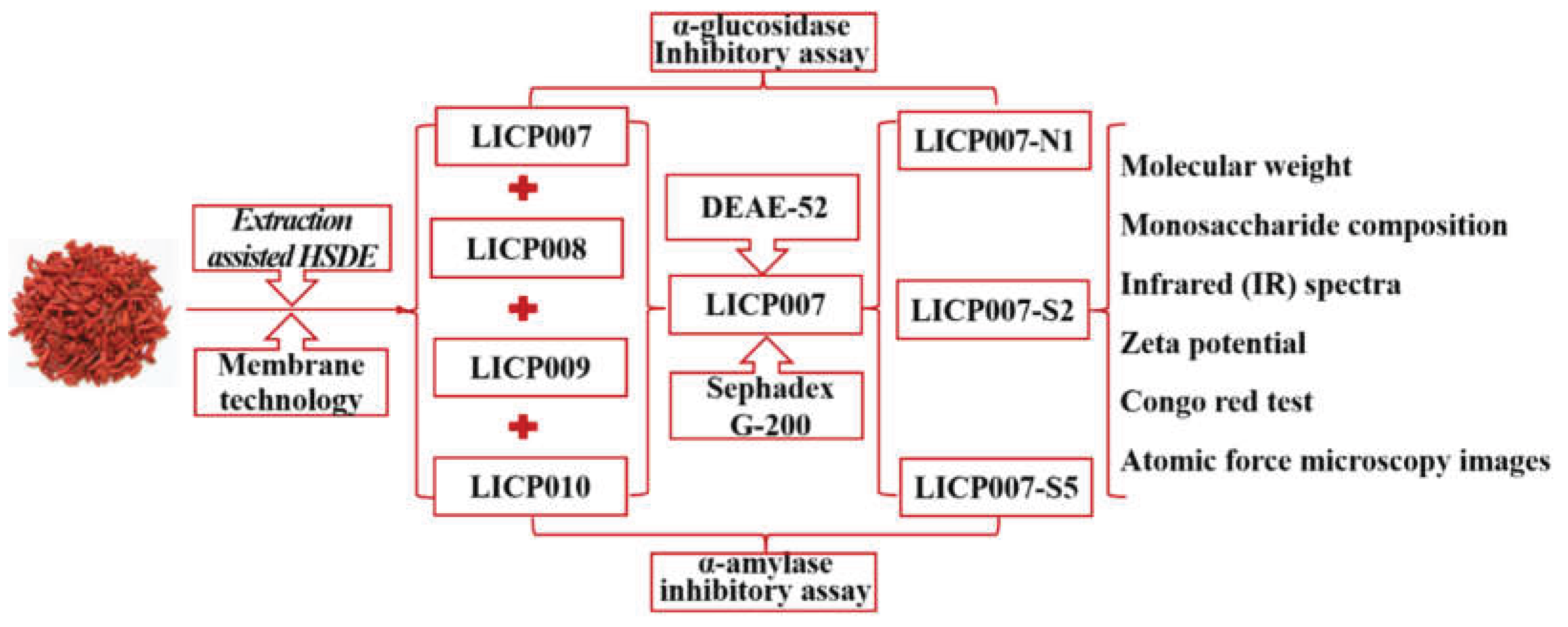
Figure 2.
Inhibitory effect of polysaccharide samples (LICP007, LICP008, LICP009, LICP010) on α-amylase activity. (A) and α-glucosidase activity (B); inhibitory effect of polysaccharide samples (LICP007-N1, LICP007-S2, and LICP007-S5) on α-amylase activity (C) and α-glucosidase activity (D).
Figure 2.
Inhibitory effect of polysaccharide samples (LICP007, LICP008, LICP009, LICP010) on α-amylase activity. (A) and α-glucosidase activity (B); inhibitory effect of polysaccharide samples (LICP007-N1, LICP007-S2, and LICP007-S5) on α-amylase activity (C) and α-glucosidase activity (D).
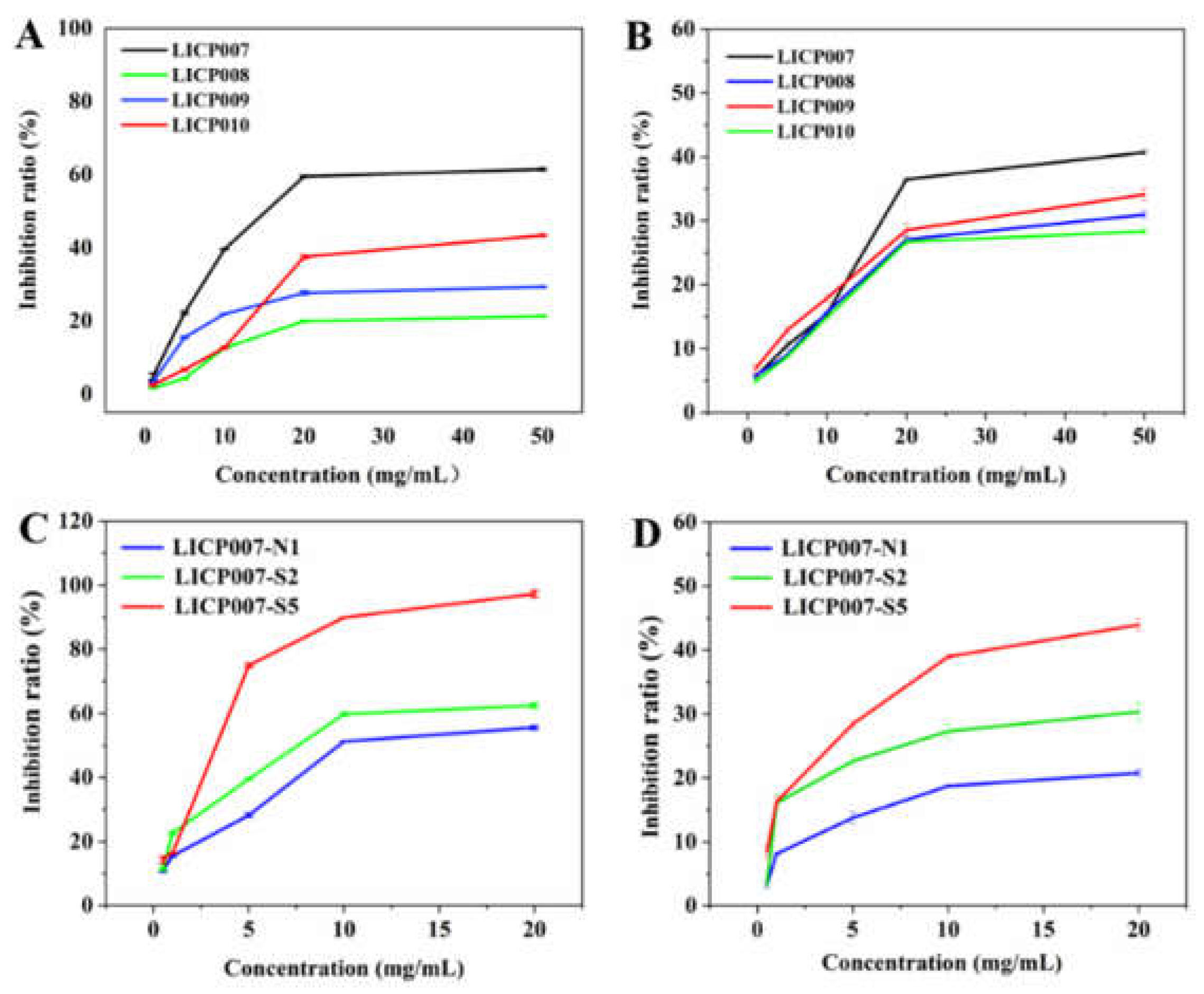
Figure 3.
Elution curve in DEAE-52 of LICP007-N1, LICP007-S2 and LICP007-S5.
Figure 4.
HPSEC-MALLS-RID chromatograms of LICP007-N1 (A), LICP007-S2 (B), and LICP007-S5 (C).
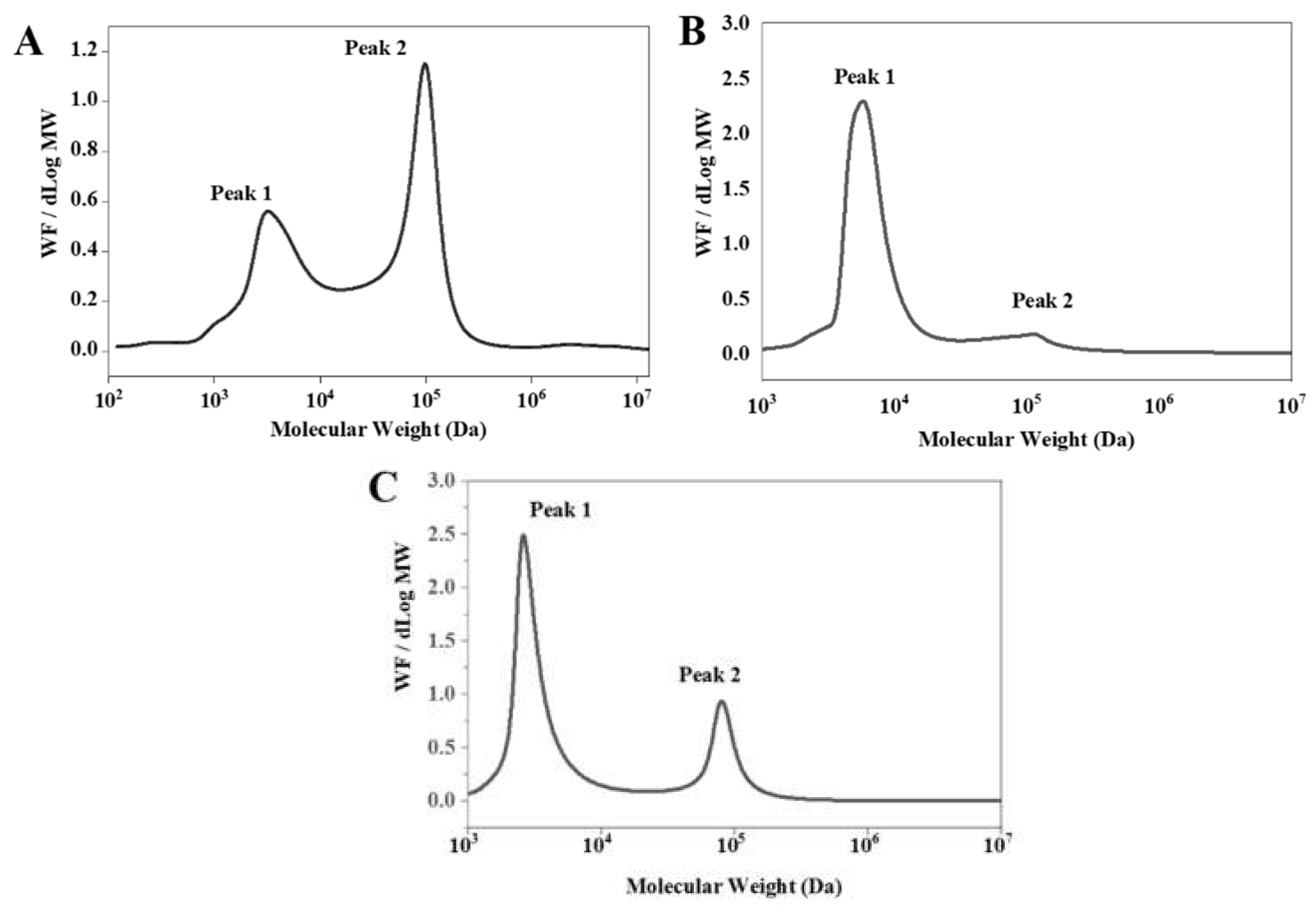
Figure 5.
FT-IR spectrum (A) and zeta potential analysis (B) of LICP007-N1, LICP007-S2, and LICP007-S5.
Figure 5.
FT-IR spectrum (A) and zeta potential analysis (B) of LICP007-N1, LICP007-S2, and LICP007-S5.
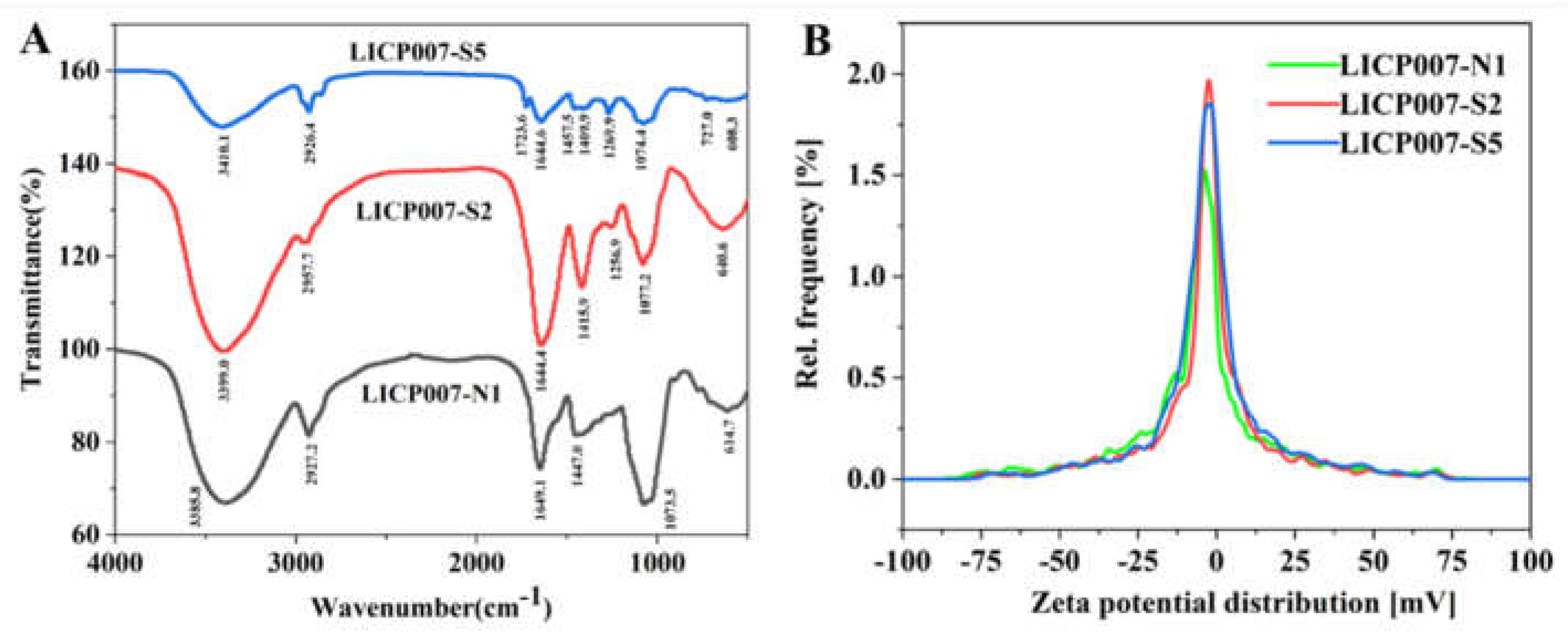
Figure 6.
AFM spectra of LICP007-N1 (A), LICP007-S2 (B), and LICP007-S5 (C).
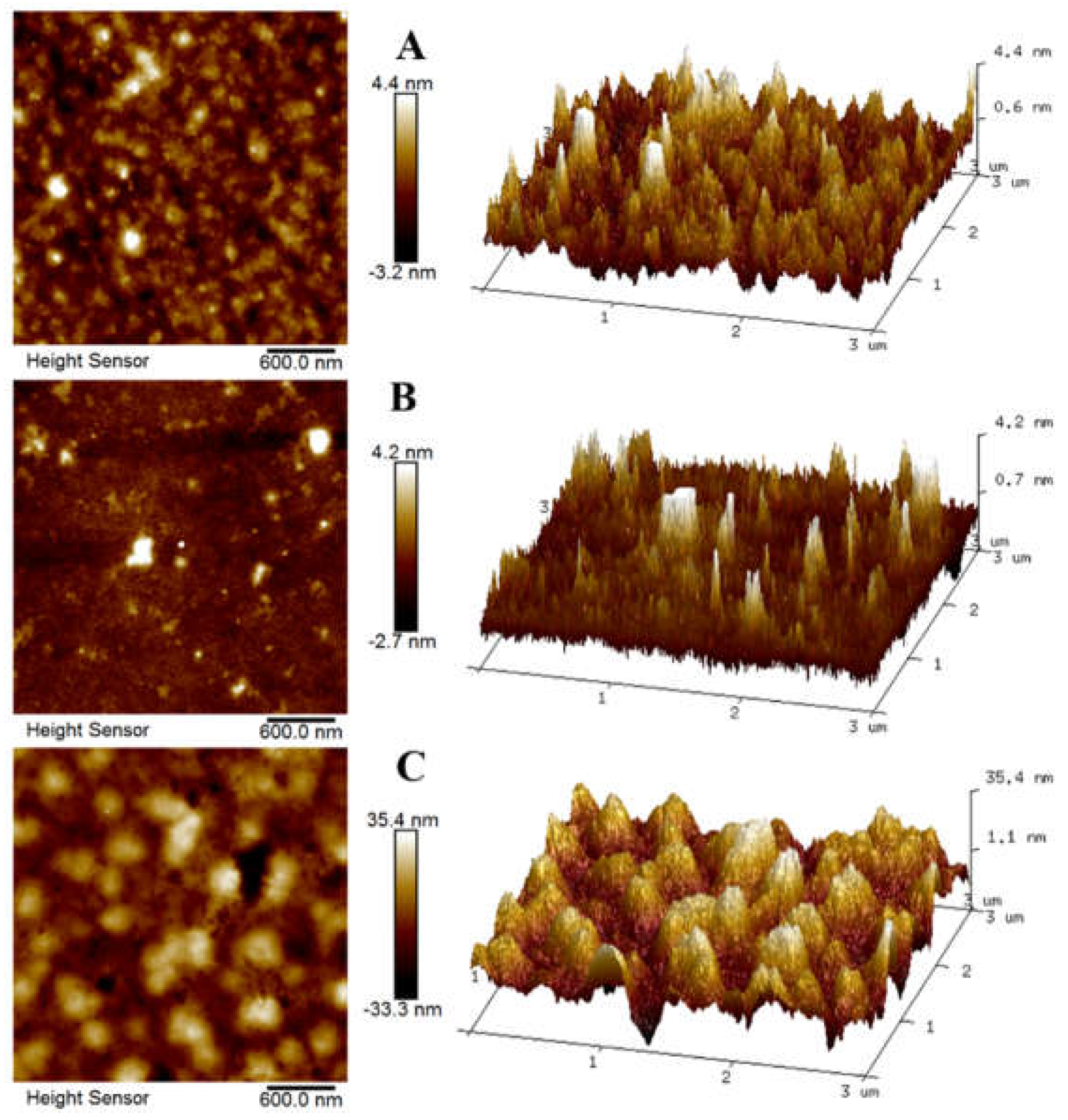
Figure 7.
Congo red test (A) and TG curve (B) of LICP007-S5.
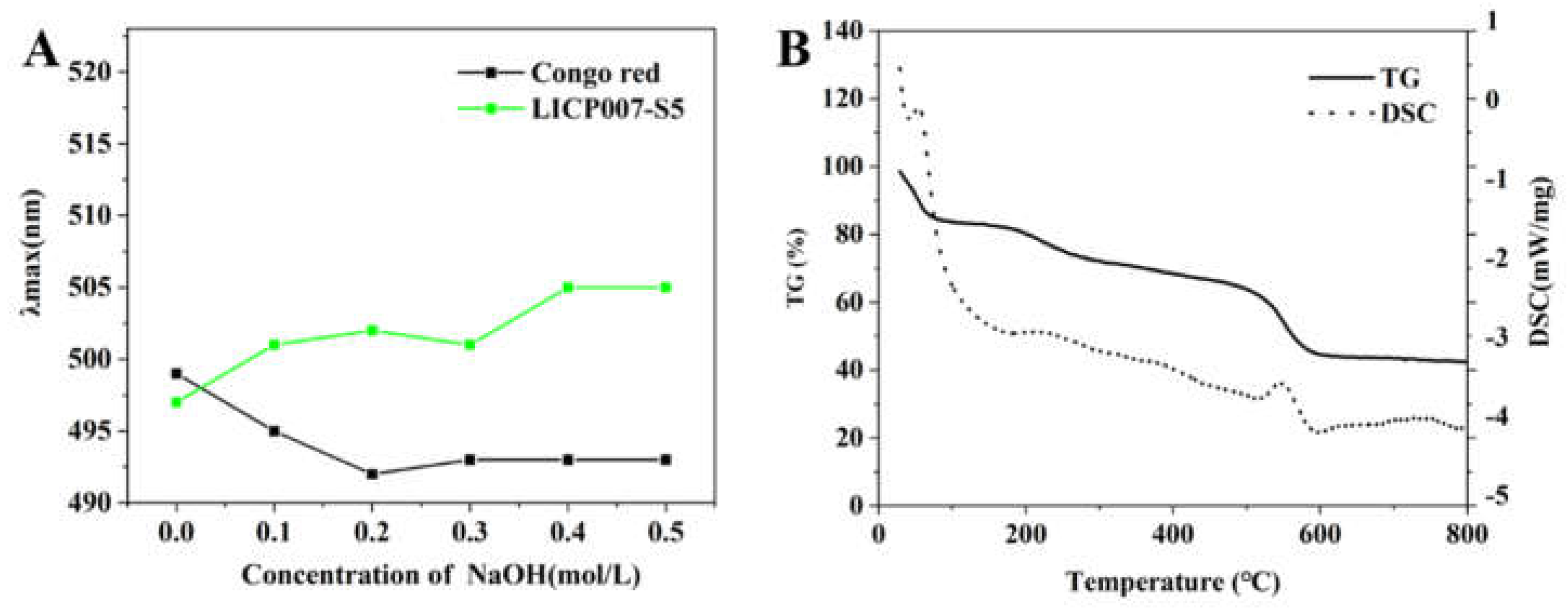
Figure 8.
1H NMR (A) and 13C NMR (B) spectra of LICP007-S5.
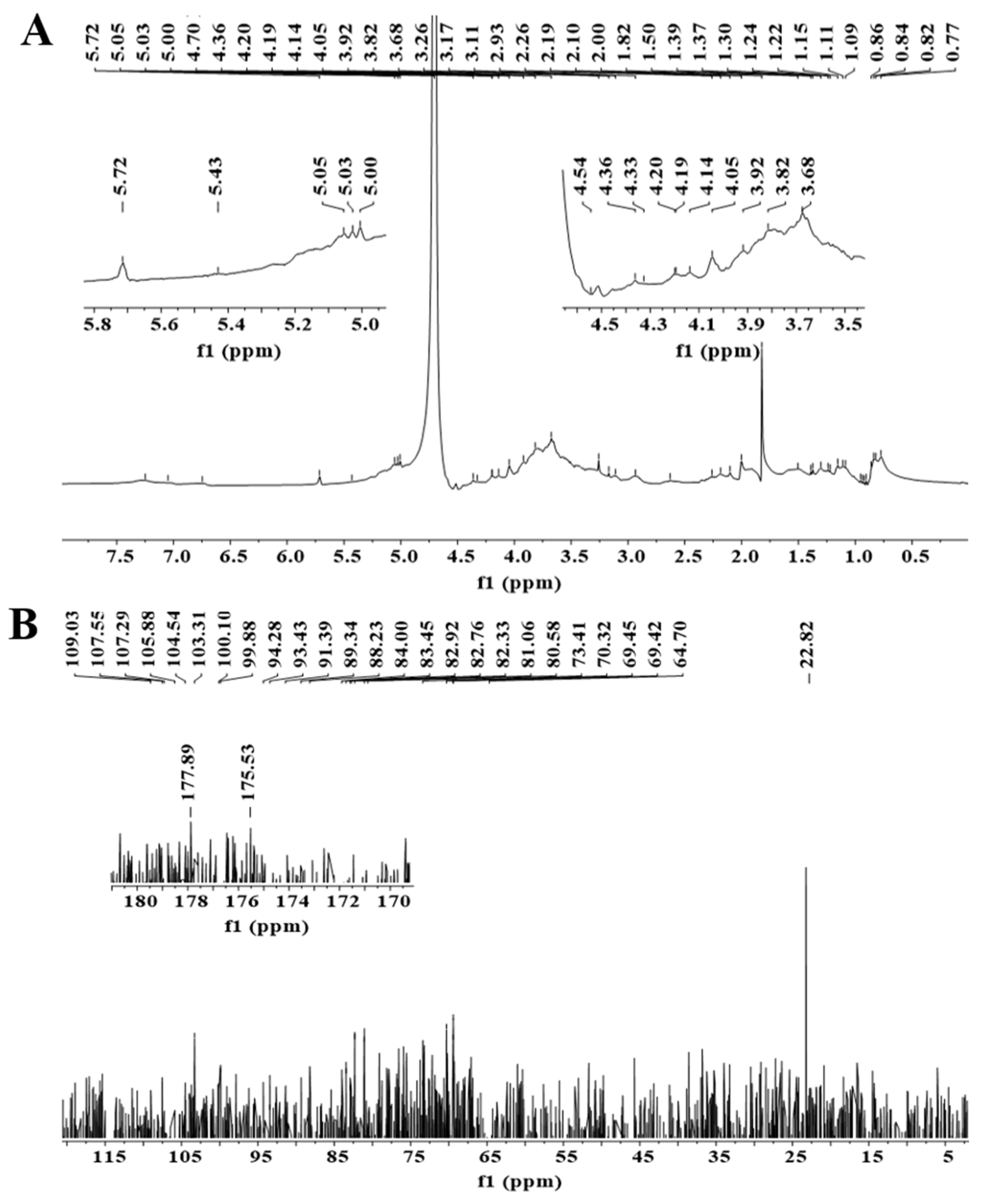
Table 1.
Qualitative analysis results and chemical composition of crude polysaccharide fractions.
| Items | LICP007 | LICP008 | LICP009 | LICP010 |
| Iodine reaction | - | - | - | - |
| Fehling reagent reaction | - | - | - | - |
| Biuret reaction | + | + | + | + |
| Ferric chloride reaction | + | + | + | + |
| Relative yield (%) | 4.10 | 2.74 | 2.25 | 2.16 |
| Protein (%) | 12.7 | 14.5 | 19.3 | 15.9 |
| Total carbohydrate (%) | 65.3 | 52.7 | 57.4 | 49.8 |
| Uronic acid (%) | 18.2 | 13.3 | 15.3 | 10.7 |
Table 2.
Molecular weight of three polysaccharide fractions from Lycium barbarum L.
| Items | LICP007-N1 | LICP007-S2 | LICP007-S5 | |||
| Peak 1 | Peak 2 | Peak 1 | Peak 1 | Peak 2 | ||
| Mn (g/mol) | 3.211×10³ | 5.112×10⁴ | 8784 | 4. 769×103 | 7.871×10⁴ | |
| Mw (g/mol) | 4.229×10³ | 1.042×10⁵ | 5.368×10⁴ | 9.202×10³ | 1.031×10⁵ | |
| Mz (g/mol) | 4.839×10³ | 1.388×10⁵ | 9.259×10⁴ | 1.690×10⁴ | 2.101×10⁵ | |
| PDI (Mw/Mn) | 1.317 | 2.309 | 6.111 | 2.002 | 1.31 | |
| SVg (cm3/g) | 12.4339 | 0.1443 | 0.2764 | 6.8907 | 0.2261 | |
| Rg (nm) | 82.7 | 4.85 | 99.74 | 38.31 | 4.13 | |
| Calc. dn/dc(mL/g) | 0.0995 | 0.0995 | 0.1217 | 0.1566 | 0.1566 | |
Disclaimer/Publisher’s Note: The statements, opinions and data contained in all publications are solely those of the individual author(s) and contributor(s) and not of MDPI and/or the editor(s). MDPI and/or the editor(s) disclaim responsibility for any injury to people or property resulting from any ideas, methods, instructions or products referred to in the content. |
© 2026 by the authors. Licensee MDPI, Basel, Switzerland. This article is an open access article distributed under the terms and conditions of the Creative Commons Attribution (CC BY) license.
Copyright: This open access article is published under a Creative Commons CC BY 4.0 license, which permit the free download, distribution, and reuse, provided that the author and preprint are cited in any reuse.