

Submitted:
02 September 2026
Posted:
03 September 2026
You are already at the latest version
Abstract
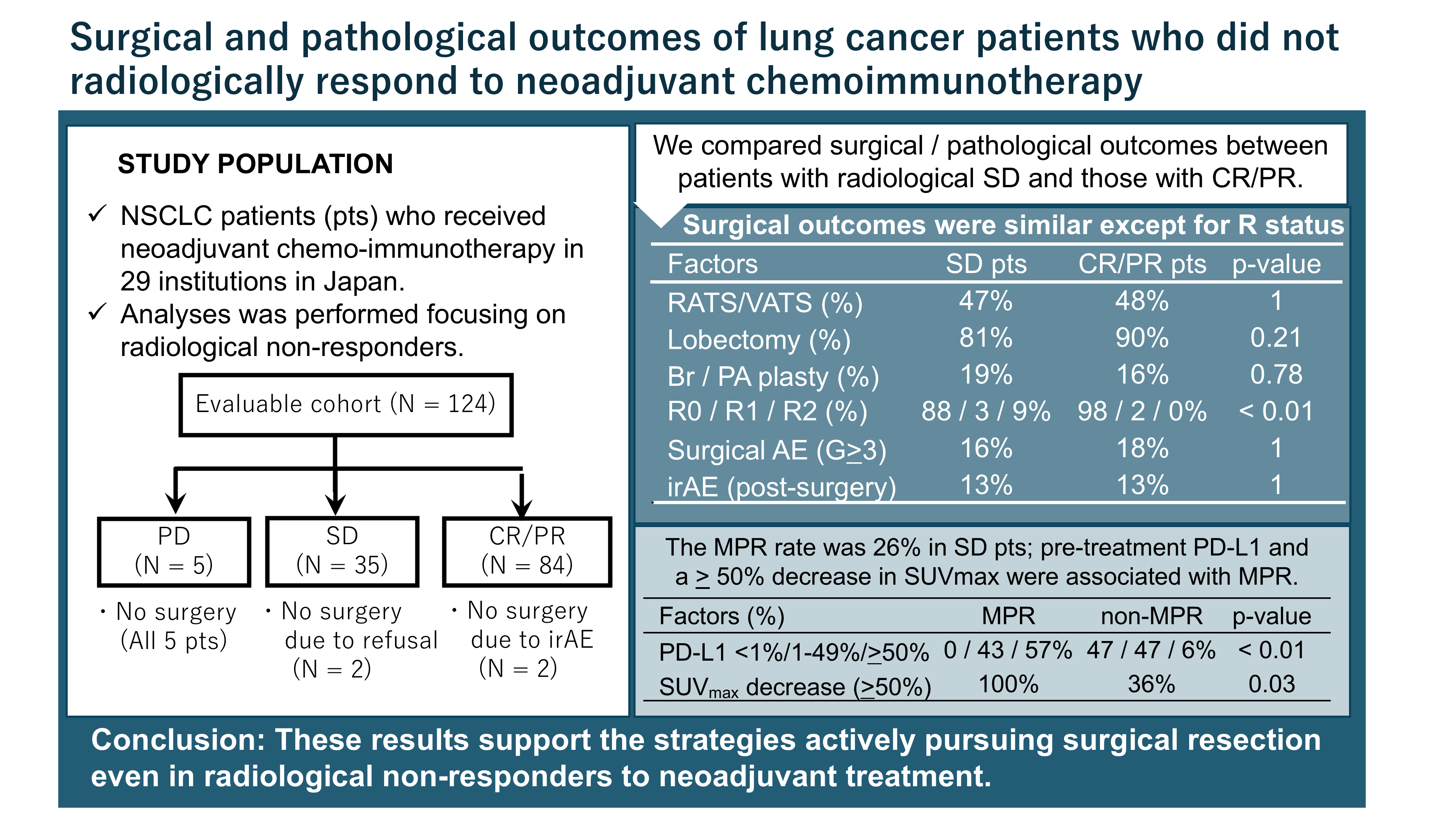
Background: Neoadjuvant chemo-immunotherapy is now a standard treatment for resectable non-small cell lung cancer (NSCLC) patients with clinical stage II–III disease. However, some patients do not respond to the treatment radiologically, and the surgical and pathological outcomes in such patients remain unclear. Methods: We conducted a multi-institutional retrospective analysis of patients who received neoadjuvant chemo-immunotherapy at 29 centers in Japan (CReGYT-04 Neo-Venus study). In this study, we focused specifically on radiological non-responders to neoadjuvant chemoimmunotherapy. Results: Of 124 eligible patients, radiological responses indicated a complete/partial response (CR/PR) in 84, stable disease (SD) in 35, and progressive disease (PD) in 5 patients. Nine patients (five with PD, two with SD, and two with PR) did not undergo surgical resection, and one SD patient had exploratory thoracotomy. Surgical outcomes, including minimally invasive approach rates, procedures, operation time, blood loss, and postoperative complications, were similar between patients with SD and those with CR/PR. Among 31 SD patients with available pathological data, a major pathologic response (MPR) was achieved in 26%, and pre-treatment PD-L1 status (p<0.01) and a ≥50% decrease in the maximum standardized uptake value on FDG-PET/CT (p=0.03) were associated with MPR. Conclusions: Surgical outcomes were similar between the SD and CR/PR groups, and 26% of SD patients achieved MPR, supporting strategies that actively pursue surgical resection, even in radiological non-responders to neoadjuvant treatment.
Keywords:
nivolumab
; SUVmax
; major pathological response
; surgical outcomes
; PD-L1
; immune-nutritional index
1. Introduction
Perioperative and neoadjuvant chemo-immunotherapy has emerged as a promising treatment strategy for patients with resectable non-small cell lung cancer (NSCLC) at clinical stages II–III [1,2,3,4,5]. Induction chemo-immunotherapy has been shown to prolong event-free and/or overall survival in clinical trials, potentially by targeting micro-metastatic lesions in the earliest phase of the treatment. Furthermore, an additional benefit of induction chemo-immunotherapy is tumor shrinkage, which can increase the likelihood of achieving an R0 resection with adequate surgical margins and, in some patients, this will facilitate the use of less invasive surgical approaches.
Clinical trials of these perioperative and neoadjuvant treatments reported objective response rates of 53.6% (95% confidence interval: 46.0–61.1; CheckMate816 study) [6] and 56.3% (51.0–61.4; AEGEAN study) [2]. These results indicate that nearly half of patients do not achieve a radiological response after induction chemo-immunotherapy. Although perioperative and neoadjuvant chemo-immunotherapy trials have demonstrated favorable surgical outcomes, the association between radiological response and surgical outcomes remains unclear.
Conversely, it has sometimes been noted that some patients who do not demonstrate a radiological response to induction chemo-immunotherapy nonetheless exhibit a pathological response [7,8]. This discrepancy is partly attributable to the difficulty of distinguishing a viable tumor from residual fibrotic tissue, inflammation, or treatment-induced scarring on computed tomography (CT). Clinically, it would be valuable to predict pathological responses among patients who do not exhibit a radiological response to treatment.
The current study aimed to clarify these issues in patients who did not demonstrate a radiological response to induction chemo-immunotherapy, using a real-world registry database comprised of patients who received induction chemo-immunotherapy at 29 institutions in Japan (CReGYT-04 Neo-Venus study).
2. Materials and Methods
2.1. Patients
Data of patients with resectable NSCLC who received induction nivolumab plus chemotherapy between March 2023 and July 2024 at 29 centers in Japan (N = 131) were collected using an electrical data collection system reported previously (the CReGYT-04 Neo-Venus study) [9]. Clinical and pathological stage data were determined using the 8th edition of the TNM classification. This study was approved by the National Cancer Center Institutional Review Board (approval number: 2024-091 / approval date: July 11, 2024). The requirement for written informed consent from patients was waived because of the retrospective nature of this study. Anonymized patient data were electronically submitted to the registration database from each institution. Data were managed independently by biostatisticians at the Yamaguchi University Graduate School of Medicine.
2.2. Data Collection and Statistical Analysis
The radiological response was evaluated using the Response Evaluation Criteria in Solid Tumors (version 1.1) [10] based on CT examinations performed before and after induction chemo-immunotherapy. Surgery-related adverse events (AEs) of grade ≥ 3 within postoperative 30 days were recorded, and any grades of immune-related AEs (irAEs) observed postoperatively were collected from the medical records. A pathological complete response (pCR) was defined as 0% viable tumor in the resected specimen, and a major pathological response (MPR) was defined as ≤10% viable tumor in the primary tumor bed [11].
Fisher’s exact test was used to statistically evaluate associations between two categorical variables. For the continuous variables of blood tests, we employed cutoff values used in clinical practice to divide the cohort into two groups. Immune-nutritional indices that are calculated by combining blood data were classified into two groups based on cutoff values selected from within the range of various previously reported thresholds, approximately at the midpoint [12,13,14]. Trends in proportions across ordered groups were evaluated using the Cochran–Armitage trend test. Statistical analyses were performed using EZR (Saitama Medical Center, Jichi Medical University, Saitama, Japan), a graphical user interface for R (version 4.3.1 and R Commander version 2.9-1, The R Foundation for Statistical Computing, Vienna, Austria). EZR is a modified version of R commander designed to add statistical functions frequently used in biostatistics [15].
3. Results
3.1. Patient Characteristics
A flow diagram of the patients included in the analyses is summarized in Figure 1. Among 124 patients who underwent post-neoadjuvant evaluation, 84 were radiologically diagnosed with complete or partial responses (CR/PR), 35 with stable disease (SD), and 5 with progressive disease (PD). Of the 84 patients with CR/PR, 2 patients were unable to undergo surgical resection because of irAEs. Among the 35 patients with SD, 2 refused surgical resection. All five patients with PD were unable to undergo surgical resection.
3.2. Surgical Outcomes
3.2.1. Surgical Procedures
Surgical outcomes were compared between 33 patients with SD and 82 patients with CR/PR. Surgical procedures were compared between these two groups after excluding one SD patient who underwent exploratory thoracotomy (Table 1). Patient characteristics, such as age, sex, and smoking status, were similar between the SD and CR/PR groups. The rates of thoracotomy rather than less invasive approaches were also similar between the groups (53% in SD vs 52% in CR/PR). The application of bronchial and/or pulmonary artery plasty was also comparable (19% in SD vs 16% in CR/PR), whereas the rates of bi-lobectomy or pneumonectomy were numerically higher in the SD group (19%) compared with the CR/PR group (10%), although this difference was not statistically significant (p=0.21). There were no significant differences in operation time or blood loss between the groups.
3.2.2. Residual Tumor (R) Classification
In the analysis of residual tumor (R) classification, after excluding 1 SD patient without available pathological data, 88% (28/32 patients) of SD patients and 98% (80/82 patients) of CR/PR patients achieved R0 resection. In the SD group, one patient (3%) had an R1 resection and three patients (9%) had R2 resections, whereas two patients (2%) in the CR/PR group were diagnosed with R1 resection. The distribution was shown to differ significantly when using the Cochran–Armitage trend test (Figure 2A, p=0.0084).
3.2.3. Adverse Events
An analysis of the postoperative clinical course indicated that 5 patients (16%) in the SD group and 15 patients (18%) in the CR/PR group experienced a surgery-related AE (grade ≥ 3) within 30 days after surgery (Table 1). Although the overall frequencies of surgery-related AEs were similar between the groups, we observed some differences in the types of AEs (Figure 3). The frequencies of empyema (2.4% vs 0%), pneumonia (8.5% vs 3.1%), chylothorax (2.4% vs 0%), and prolonged air leak (9.8% vs 3.1%) were numerically higher in the CR/PR group, whereas the frequency of atelectasis (2.4% vs 9.4%) was higher in the SD group. Despite some numerical differences between the groups, we did not perform statistical tests because of the low number of events. We also found that the frequencies of postoperatively occurring irAEs (any grade) were similar between the groups (13% in both groups, Table 1).
3.3. Pathological Evaluation Within SD Group
Pathological data were available for 31 SD patients after excluding 1 with no submitted pathological data and 1 who underwent exploratory thoracotomy. In comparison with 82 CR/PR patients, we observed a significant difference between the groups (Figure 2B, p<0.001). Although 74% of SD patients showed a non-MPR, it is noteworthy that 26% had an MPR, including 10% with pCR.
Next, we explored which clinical factors were associated with MPR versus non-MPR among patients who had radiological SD after neoadjuvant chemo-immunotherapy. There were no significant differences in age, sex, body mass index, clinical T and N factors, or histology between the MPR and non-MPR groups, whereas the pre-treatment PD-L1 status was significantly associated with a pathological response (Table 2). None of the radiological non-responders with < 1% PD-L1 achieved MPR, and 4 of 5 patients with high PD-L1 (≥ 50%) achieved an MPR despite the absence of a radiological response. Smoking data were not included because most patients were smokers (Table 1). The magnitude of the radiological response (tumor shrinkage rate ≤ 10% vs 10%–29%) did not correlate with the pathological response (p=0.69), whereas a decrease in the maximum standardized uptake value (SUVmax) of the primary tumor (≥ 50% vs < 50%) after neoadjuvant chemo-immunotherapy was significantly associated with a pathological response (p=0.03), although only about half of the patients received positron emission tomography (PET)-CT after neoadjuvant chemo-immunotherapy. We observed that 5 out of 9 patients (56%) with a ≥ 50% decrease in the SUVmax had an MPR (including pCR), whereas none of the patients with a < 50% decrease did so (Table 2).
3.4. Immune-Nutritional Indices
We also explored immune-nutritional indices between patients with an MPR and non-MPR individuals among SD patients (Table 3). We observed that none of the examined indices, including the neutrophil-to-lymphocyte ratio, pan-immune-inflammation value, or prognostic nutrition index, was significantly associated with a pathological response.
4. Discussion
This multicenter retrospective study evaluated the surgical and pathological outcomes after neoadjuvant chemo-immunotherapy, with a particular focus on patients who did not achieve a radiological response. First, we observed that 4% of the evaluable patients did not receive surgery because of PD. This underscores the importance of informing patients about the potential risk of surgery cancellation related to PD, although this risk in real-world settings is as low as that observed in clinical trials [1,16,17].
Most radiological SD patients received surgery; however, the R0 resection rate was substantially lower (88%) compared with the CR/PR group (98%). We observed that other surgical outcomes—including surgical procedures, applications of bronchial and/or PA plasty, operation time, and blood loss—were similar between the groups, suggesting that a radiological response alone may not predict surgical complexity or technical feasibility. The factors associated with the risk of conversion to open thoracotomy, such as the presence of pre-treatment nodal disease in a previous study [18], are clinically important; however, we did not analyze this because there were only four patients with conversion—two in the SD group and two in the CR/PR group. Surgery-related AEs and irAEs did not differ significantly between the SD and CR/PR groups, although some severe complications were numerically frequent in the CR/PR group, indicating the need for extensive postoperative management, regardless of radiological response.
Although SD is generally considered a suboptimal, or absence of, response to the treatment, it is of note that 26% of SD patients achieved an MPR, including pCR in 10% of SD patients, at pathological evaluation, highlighting that radiological assessment may underestimate the true biological efficacy of neoadjuvant chemo-immunotherapy. Because the pre-surgical identification of patients with an MPR among the SD group would be clinically beneficial, we explored the clinical predictors of an MPR in patients who showed radiological SD after neoadjuvant chemo-immunotherapy. Although the magnitude of radiological shrinkage (< 10% vs 10%–29%) or immuno-nutritional indices were not associated with a pathological response, we found that the pre-treatment PD-L1 status and a decrease in the SUVmax of the primary tumor (≥ 50% vs < 50%) were significantly associated with a pathological response. These observations align with better pathological responses in patients with higher PD-L1 status in clinical trials [2,6] as well as emerging literature supporting the use of metabolic imaging to assess immunotherapy responses [19,20,21]. Therefore, we consider that pre-treatment PD-L1 evaluation is useful for predicting pathological responses in cases of radiological SD. In addition, we consider that post-neoadjuvant PET-CT is also beneficial in these patients, not only to detect unexpected distant metastasis, but also to predict pathological responses.
Our study had several limitations. The retrospective design and modest cohort size, particularly for patients with radiological SD, may have limited statistical power. Although the exploratory analysis suggested trends in immune-nutritional indices among MPR versus non-MPR patients (Table 3), these did not reach statistical significance; therefore, larger studies are needed to validate these potential biomarkers.
5. Conclusions
In conclusion, although approximately 18% of radiological non-responders did not proceed to surgery, the surgical outcomes were comparable between the SD and CR/PR groups. Among those who received surgical resection, 26% of SD patients achieved MPR, and a ≥ 50% decrease in the SUVmax predicted MPR, supporting the role of metabolic imaging for pre-surgical evaluation.
Supplementary Materials
None.
Author Contributions
Conceptualization: K.S.; Data curation: K.S., S.T., T.W., and K.N.; Formal analysis: K.S.; Funding acquisition: None; Investigation: K.S., T.M., M.I., T.F., A.H., M.A., S.S., K.T., S.K., A.I. and T.K.; Methodology: K.S., T.M. and Y.T., Project administration: K.S., T.M., S.T, T.W., K.N., and Y.O.; Resources: K.S., T.M., M.I., T.F., A.H., M.A., S.S., K.T., S.K., A.I., T.K., S.T., T.W. and K.N.; Supervision: Y.O. and Y.T.; Validation: T.M., M.I., T.W., Y.O. and Y.T.; Visualization: K.S.; Writing – original draft: K.S.; Writing-review & editing: all authors.
Funding
None.
Institutional Review Board Statement
This study was approved by the National Cancer Center Institutional Review Board (approval number: 2024-091 / approval date: July 11, 2024).
Informed Consent Statement
The requirement for written informed consent from patients was waived because of the retrospective nature of this study.
Data Availability Statement
The data underlying this article will be shared upon reasonable request to the corresponding author.
Acknowledgments
We thank J. Ludovic Croxford, PhD, from Edanz (https://jp.edanz.com/ac) for editing a draft of this manuscript.
Conflicts of Interest
Akira Hamada reports a relationship with Ono Pharmaceutical Co Ltd that includes: speaking and lecture fees. Takuya Watanabe reports a relationship with Ono Pharmaceutical Co Ltd that includes: speaking and lecture fees. Yasuhisa Ohde reports a relationship with Ono Pharmaceutical Co Ltd that includes: speaking and lecture fees. Yasuhiro Tsutani reports a relationship with Ono Pharmaceutical Co Ltd that includes: speaking and lecture fees. Akira Hamada reports a relationship with Bristol-Myers Squibb Co that includes: funding grants. Yasuhiro Tsutani reports a relationship with Bristol-Myers Squibb Co that includes: speaking and lecture fees. The other authors have no conflicts of interest to disclose.
Abbreviations
The following abbreviations are used in this manuscript:
| AEs | Adverse events |
| CR | Complete response |
| CT | Computed tomography |
| irAEs | Immune-related adverse events |
| MPR | Major pathological response |
| NSCLC | Non-small cell lung cancer |
| pCR | Pathological complete response |
| PD | Progressive disease |
| PET | Positron emission tomography |
| PR | Partial response |
| SD | Stable disease |
| SUVmax | Maximum standardized uptake value |
References
- Spicer, J.D.; Garassino, M.C.; Wakelee, H.; Liberman, M.; Kato, T.; Tsuboi, M.; et al. Neoadjuvant pembrolizumab plus chemotherapy followed by adjuvant pembrolizumab compared with neoadjuvant chemotherapy alone in patients with early-stage non-small-cell lung cancer (KEYNOTE-671): a randomised, double-blind, placebo-controlled, phase 3 trial. Lancet. 2024, 404(10459), 1240–1252. [Google Scholar] [CrossRef] [PubMed]
- Heymach, J.V.; Harpole, D.; Mitsudomi, T.; Taube, J.M.; Galffy, G.; Hochmair, M.; et al. Perioperative Durvalumab for Resectable Non-Small-Cell Lung Cancer. N Engl. J. Med. 2023, 389(18), 1672–1684. [Google Scholar] [CrossRef] [PubMed]
- Forde, P.M.; Spicer, J.D.; Provencio, M.; Mitsudomi, T.; Awad, M.M.; Wang, C.; et al. Overall Survival with Neoadjuvant Nivolumab plus Chemotherapy in Lung Cancer. N Engl. J. Med. 2025, 393(8), 741–752. [Google Scholar] [CrossRef] [PubMed]
- Cascone, T.; Awad, M.M.; Spicer, J.D.; He, J.; Lu, S.; Sepesi, B.; et al. Perioperative Nivolumab in Resectable Lung Cancer. N Engl. J. Med. 2024, 390(19), 1756–1769. [Google Scholar] [CrossRef] [PubMed]
- Fukuda, S.; Suda, K.; Hamada, A.; Tsutani, Y. Recent Advances in Perioperative Immunotherapies in Lung Cancer. Biomolecules 2023, 13(9), 1377. [Google Scholar] [CrossRef] [PubMed] [PubMed Central]
- Forde, P.M.; Spicer, J.; Girard, N. Neoadjuvant Nivolumab plus Chemotherapy in Lung Cancer. Reply. N Engl. J. Med. 2022, 387(6), 572–573. [Google Scholar] [CrossRef] [PubMed]
- Nie, R.; Chen, F.; Provencio, M.; Wang, Y.; van den Ende, T.; van Laarhoven, H.W.M.; et al. Predictive value of radiological response, pathological response and relapse-free survival for overall survival in neoadjuvant immunotherapy trials: pooled analysis of 29 clinical trials. Eur. J. Cancer. 2023, 186, 211–221. [Google Scholar] [CrossRef] [PubMed]
- Xu, J.; Yao, J.; Geng, Y.; Huang, J.; Zou, B.; Sun, X.; et al. Neoadjuvant immunotherapy plus chemotherapy for resectable non-small cell lung cancer with driver mutations: a retrospective analysis. Front Immunol. 2025, 16, 1637615. [Google Scholar] [CrossRef] [PubMed] [PubMed Central]
- Nomura, K.; Watanabe, T.; Takamori, S.; Hamada, A.; Suda, K.; Ito, M.; et al. Safety Profile of Neoadjuvant Chemoimmunotherapy With Nivolumab for Patients With Resectable Non-Small Cell Lung Cancer in the Real World (CReGYT-04 Neo-Venus). Ann. Thorac. Surg. 2025, 20251030. [Google Scholar] [CrossRef] [PubMed]
- Eisenhauer, E.A.; Therasse, P.; Bogaerts, J.; Schwartz, L.H.; Sargent, D.; Ford, R.; et al. New response evaluation criteria in solid tumours: revised RECIST guideline (version 1.1). Eur. J. Cancer. 2009, 45(2), 228–247. [Google Scholar] [CrossRef] [PubMed]
- Travis, W.D.; Dacic, S.; Wistuba, I.; Sholl, L.; Adusumilli, P.; Bubendorf, L.; et al. IASLC Multidisciplinary Recommendations for Pathologic Assessment of Lung Cancer Resection Specimens After Neoadjuvant Therapy. J Thorac Oncol. 2020, 15(5), 709–740. [Google Scholar] [CrossRef] [PubMed] [PubMed Central]
- Arianmanesh, F.; Bagheri, S.; Karimi, M.A.; Izadi, S.; Ahmadi, M.H. The Evaluation of Diagnostic, Prognostic, and Predictive Role of Hematologic Inflammatory Indices NLR, PLR, and LMR in Common Solid Tumors. Cancer Rep (Hoboken) 2025, 8(12), e70407. [Google Scholar] [CrossRef] [PubMed] [PubMed Central]
- Cao, G.; Liu, Q.; Wen, H.; Zeng, Y. The prognostic importance of the pan-immune-inflammation value (PIV) in lung cancer: a systematic review and meta-analysis. Transl Lung Cancer Res. 2025, 14(10), 4357–4370. [Google Scholar] [CrossRef] [PubMed] [PubMed Central]
- Lan, J.; Lin, W.; Lai, Y.; Zhang, J. Predictive value of pre-operative prognostic nutritional index and systemic immune-inflammation index for efficacy and survival in patients with non-small cell lung cancer undergoing neoadjuvant chemotherapy. Am J Transl Res. 2024, 16(5), 2024–2033. [Google Scholar] [CrossRef] [PubMed] [PubMed Central]
- Kanda, Y. Investigation of the freely available easy-to-use software 'EZR' for medical statistics. Bone Marrow Transplant. 2013, 48(3), 452–458. [Google Scholar] [CrossRef] [PubMed] [PubMed Central]
- Spicer, J.; Wang, C.; Tanaka, F.; Saylors, G.B.; Chen, K.; Liberman, M.; et al. (Eds.) Surgical outcomes from the phase 3 CheckMate 816 trial: Nivolumab (NIVO) + platinum-doublet chemotherapy (chemo) vs chemo alone as neoadjuvant treatment for patients with resectable non-small cell lung cancer (NSCLC). J Clin Oncol. 2021, 39(15), suppl.8503. [Google Scholar] [CrossRef]
- Mitsudomi, T.; Heymach, J.; Reck, M.; Taube, J.M.; Gao, S.; Horio, Y.; et al. (Eds.) OA12.05 Surgical Outcomes with Neoadjuvant Durvalumab + Chemotherapy Followed by Adjuvant Durvalumab in Resectable NSCLC (AEGEAN). J Thorac Oncol. 2023, 18(11), S71–S72. [Google Scholar] [CrossRef]
- Chu, N.Q.; Tan, K.S.; Dycoco, J.; Adusumilli, P.S.; Bains, M.S.; Bott, M.J.; et al. Determinants of successful minimally invasive surgery for resectable non-small cell lung cancer after neoadjuvant therapy. J Thorac Cardiovasc Surg. 2025, 169(3), 753–762.e6. [Google Scholar] [CrossRef] [PubMed]
- Tao, X.; Li, N.; Wu, N.; He, J.; Ying, J.; Gao, S.; et al. The efficiency of (18)F-FDG PET-CT for predicting the major pathologic response to the neoadjuvant PD-1 blockade in resectable non-small cell lung cancer. Eur J Nucl Med Mol Imaging 2020, 47(5), 1209–1219. [Google Scholar] [CrossRef] [PubMed] [PubMed Central]
- Cheng, Y.; Chen, Z.Y.; Huang, J.J.; Shao, D. Efficacy evaluation of neoadjuvant immunotherapy plus chemotherapy for non-small-cell lung cancer: comparison of PET/CT with postoperative pathology. Eur. Radiol. 2023, 33(10), 6625–6635. [Google Scholar] [CrossRef] [PubMed]
- Guo, R.; Yan, W.; Wang, F.; Su, H.; Meng, X.; Xie, Q.; et al. The utility of (18)F-FDG PET/CT for predicting the pathological response and prognosis to neoadjuvant immunochemotherapy in resectable non-small-cell lung cancer. Cancer Imaging 2024, 24(1), 120. [Google Scholar] [CrossRef] [PubMed] [PubMed Central]
Figure 1.
A flow diagram of patients included in this study. *Two patients did not receive post-neoadjuvant evaluation. One was because of adverse events (AE) and the other patient refused to receive any post-neoadjuvant evaluation and further treatment. †Among 35 patients with stable disease (SD), 2 patients refused to receive surgical resection. ‡Among 84 patients with complete or partial responses (CR/PR), 2 patients did not receive surgical resection because of immune-related AEs. §Among 33 patients with SD and those who received surgery, 1 patient received exploratory thoracotomy and was excluded from the analysis of surgical outcomes. Among these 33 patients, pathological data was not registered for 1 patient whose data was excluded from the analysis for the residual tumor (R) classification.
Figure 1.
A flow diagram of patients included in this study. *Two patients did not receive post-neoadjuvant evaluation. One was because of adverse events (AE) and the other patient refused to receive any post-neoadjuvant evaluation and further treatment. †Among 35 patients with stable disease (SD), 2 patients refused to receive surgical resection. ‡Among 84 patients with complete or partial responses (CR/PR), 2 patients did not receive surgical resection because of immune-related AEs. §Among 33 patients with SD and those who received surgery, 1 patient received exploratory thoracotomy and was excluded from the analysis of surgical outcomes. Among these 33 patients, pathological data was not registered for 1 patient whose data was excluded from the analysis for the residual tumor (R) classification.
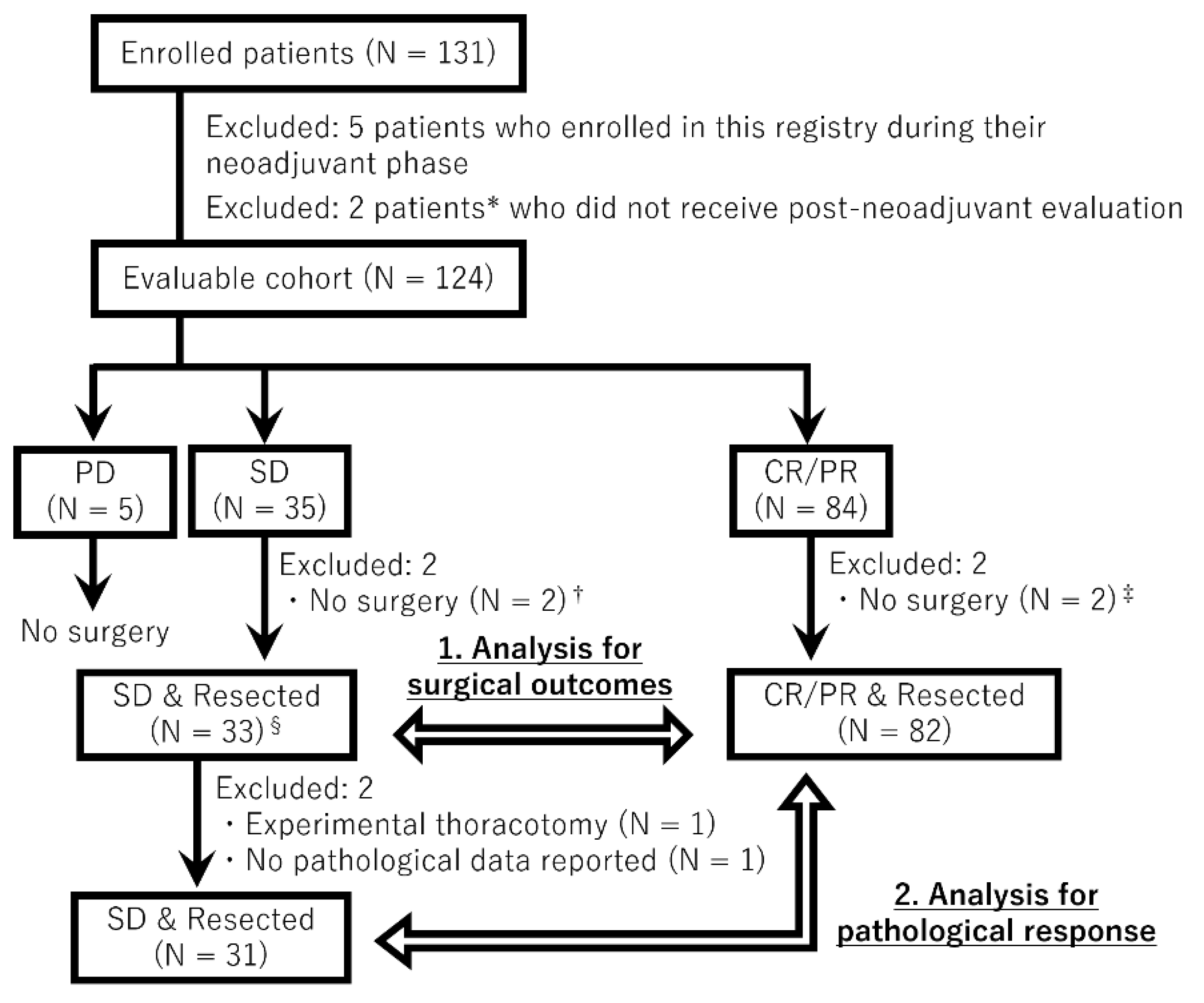
Figure 2.
Comparisons of surgical and pathological outcomes between patients with radiologically stable disease (SD) and those with complete or partial responses (CR/PR). (A) Comparison of residual tumor (R) classification between patients with SD and those with CR/PR. (B) Comparison of pathological responses between patients with SD and those with CR/PR. *Patients with pathological CR (pCR) were excluded from the major pathological response (MPR) group.
Figure 2.
Comparisons of surgical and pathological outcomes between patients with radiologically stable disease (SD) and those with complete or partial responses (CR/PR). (A) Comparison of residual tumor (R) classification between patients with SD and those with CR/PR. (B) Comparison of pathological responses between patients with SD and those with CR/PR. *Patients with pathological CR (pCR) were excluded from the major pathological response (MPR) group.
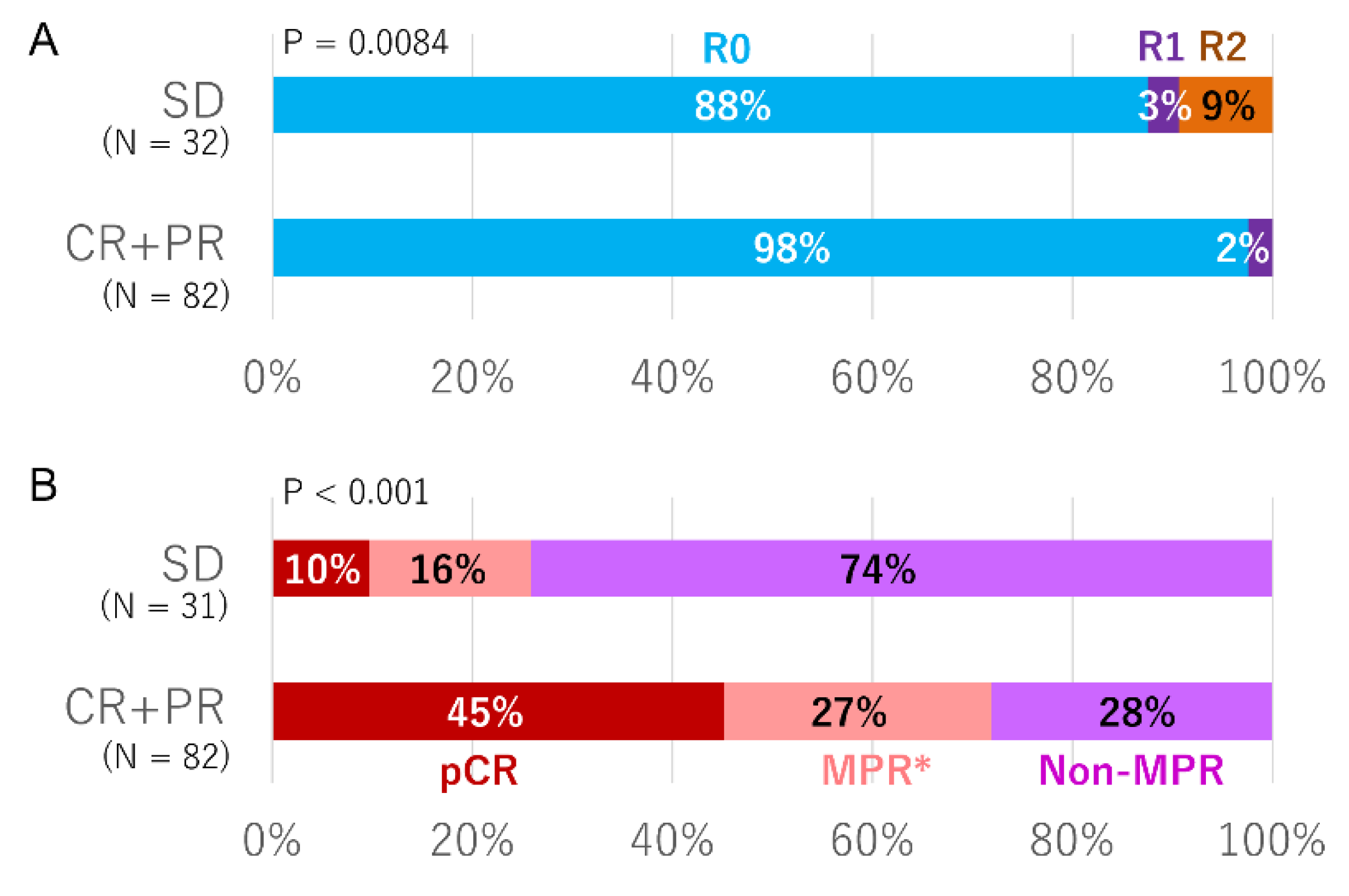
Figure 3.
Summary of postoperative adverse events comparing patients with SD and those with CR/PR. Patients who experienced surgery-related AE(s) are presented in one row per patient. Black-shaded boxes indicate the occurrence of an AE, and multiple black-shaded boxes within the same row indicate that the patient experienced multiple AEs.
Figure 3.
Summary of postoperative adverse events comparing patients with SD and those with CR/PR. Patients who experienced surgery-related AE(s) are presented in one row per patient. Black-shaded boxes indicate the occurrence of an AE, and multiple black-shaded boxes within the same row indicate that the patient experienced multiple AEs.
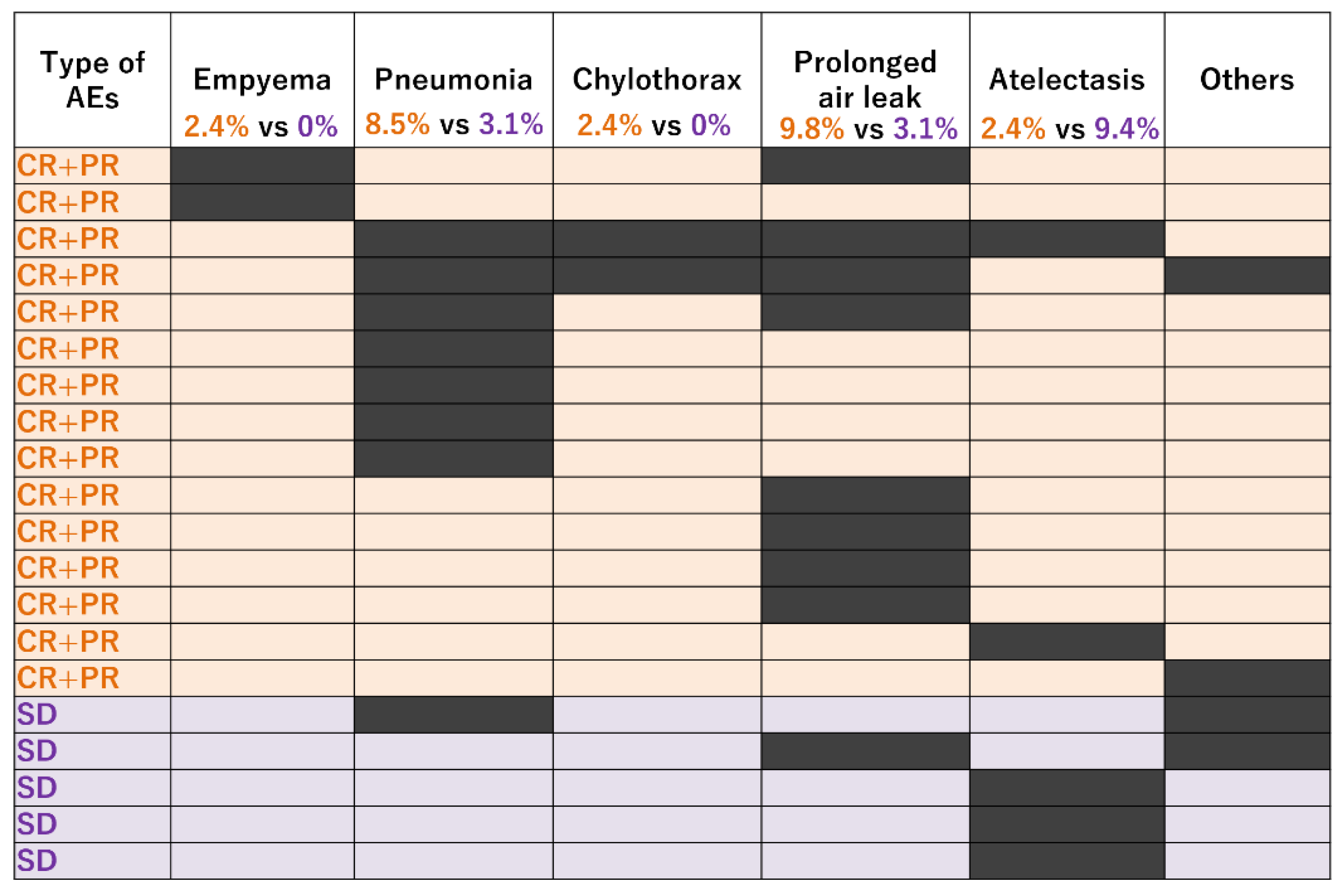

Table 1.
Comparison of surgical outcomes between patients who responded to neoadjuvant chemo-immunotherapy and those who did not.
Table 1.
Comparison of surgical outcomes between patients who responded to neoadjuvant chemo-immunotherapy and those who did not.
| Factors | Patients with SD | Patients with CR/PR | p-value | ||||||
| (N = 32) | (N = 82) | ||||||||
| Age | |||||||||
| <69 / >70 | 13 (41%) / 19 (59%) | 35 (43%) / 47 (57%) | 1 | ||||||
| Sex | |||||||||
| Male / Female | 27 (84%) / 5 (16%) | 69 (84%) / 13 (16%) | 1 | ||||||
| Smoking | |||||||||
| Yes / No | 29 (91%) / 3 (9%) | 77 (94%) / 5 (6%) | 0.68 | ||||||
| Surgical approach | |||||||||
| Thoracotomy / VATS or RATS | 17 (53%) / 15 (47%) | 43 (52%) / 39 (48%) | 1 | ||||||
| Surgical procedure | |||||||||
| Bi-lobectomy or Pneumonectomy / Lobectomy | 6 (19%) / 26 (81%) | 8 (10%) / 74 (90%) | 0.21 | ||||||
| Bronchial and/or PA plasty | |||||||||
| Yes / No | 6 (19%) / 26 (81%) | 13 (16%) / 69 (84%) | 0.78 | ||||||
| Operation time (min) | 276±129 | 265±84 | 0.64 | ||||||
| Blood loss (g) | 223±339 | 135±242 | 0.20 | ||||||
| Surgery-related AE (grade >3) | |||||||||
| Yes / No | 5 (16%) / 27 (84%) | 15 (18%) / 67 (82%) | 1 | ||||||
| Postoperatively observed irAE (any grade) | |||||||||
| Yes / No | 4 (13%) / 28 (87%) | 11 (13%) / 71 (87%) | 1 | ||||||
AE, adverse event; CR, complete response; irAE, immune-related adverse event; PA, pulmonary artery; PR, partial response; RATS, robot-assisted thoracic surgery; SD, stable disease; VATS, video-assisted thoracic surgery.
Table 2.
Comparison of clinical characteristics between patients with MPR and those with non-MPR among patients who did not radiologically respond to neoadjuvant chemo-immunotherapy.
Table 2.
Comparison of clinical characteristics between patients with MPR and those with non-MPR among patients who did not radiologically respond to neoadjuvant chemo-immunotherapy.
| Factors | Patients with MPR | Patients with non-MPR | p-value | ||||||
| (N = 8) | (N = 23) | ||||||||
| Age | |||||||||
| <69 / >70 | 3 (38%) / 5 (62%) | 10 (43%) / 13 (57%) | 1 | ||||||
| Sex | |||||||||
| Male / Female | 8 (100%) / 0 (0%) | 18 (78%) / 5 (22%) | 0.29 | ||||||
| BMI (kg/m2) | |||||||||
| 20-24.9 / Other | 7 (87%) / 1 (13%) | 12 (52%) / 11 (48%) | 0.11 | ||||||
| Clinical T factor | |||||||||
| T1-2 / T3-4 | 4 (50%) / 4 (50%) | 9 (39%) / 14 (61%) | 0.69 | ||||||
| Clinical N factor | |||||||||
| N0 / N1-2 | 4 (50%) / 4 (50%) | 8 (35%) / 15 (65%) | 0.68 | ||||||
| Histology | |||||||||
| AD / SQ | 2 (40%) / 3 (60%) | 17 (74%) / 6 (26%) | 0.29 | ||||||
| PD-L1 status | |||||||||
| <1% / 1-49% / >50% | 0 (0%) / 3 (43%) / 4 (57%) | 9 (47%) / 9 (47%) / 1 (6%) | <0.01 | ||||||
| Radiological response | |||||||||
| <10% / 10-29% | 4 (50%) / 4 (50%) | 14 (61%) / 9 (39%) | 0.69 | ||||||
| SUVmax ratio | |||||||||
| <50% / >50% | 5 (100%) / 0 (0%) | 4 (36%) / 7 (64%) | 0.03 | ||||||
AD, adenocarcinoma; BMI, body mass index; MPR, major pathological response; SQ, squamous cell carcinoma; SUVmax maximum standard uptake value. *Patients with NSCLC NOS (N = 2) and with large cell carcinoma (N = 1) were excluded. †Patients without pre-neoadjuvant PD-L1 status were excluded. ‡Patients who did not receive post-neoadjuvant PET-CT were excluded.
Table 2.
Comparison of immuno-nutritional indices between patients with MPR and those with non-MPR among patients who did not radiologically respond to neoadjuvant chemo-immunotherapy.
Table 2.
Comparison of immuno-nutritional indices between patients with MPR and those with non-MPR among patients who did not radiologically respond to neoadjuvant chemo-immunotherapy.
| Factors | Patients with MPR | Patients with non-MPR | p-value | ||||||
| (N = 8) | (N = 23) | ||||||||
| Albumin (g/dL) | |||||||||
| >4.0 / <3.9 | 6 (75%) / 2 (25%) | 9 (39%) / 14 (61%) | 0.11 | ||||||
| CRP (mg/dL) | |||||||||
| <0.5 / >0.5 | 6 (75%) / 2 (25%) | 12 (52%) / 11 (48%) | 0.41 | ||||||
| Neutrophil-to-Lymphocyte Ratio (NLR) | |||||||||
| <4.0 / >4.0 | 8 (100%) / 0 (0%) | 17 (74%) / 6 (26%) | 0.30 | ||||||
| Pan-Immune-Inflammation Value (PIV) | |||||||||
| <500 / >500 | 6 (75%) / 2 (25%) | 13 (57%) / 10 (43%) | 0.43 | ||||||
| Prognostic Nutritional Index (PNI) | |||||||||
| >46 / <46 | 5 (63%) / 3 (37%) | 8 (35%) / 15 (65%) | 0.23 | ||||||
BMI, body mass index; CRP, C-reactive protein; MPR, major pathological response.
Disclaimer/Publisher’s Note: The statements, opinions and data contained in all publications are solely those of the individual author(s) and contributor(s) and not of MDPI and/or the editor(s). MDPI and/or the editor(s) disclaim responsibility for any injury to people or property resulting from any ideas, methods, instructions or products referred to in the content. |
© 2026 by the authors. Licensee MDPI, Basel, Switzerland. This article is an open access article distributed under the terms and conditions of the Creative Commons Attribution (CC BY) license (http://creativecommons.org/licenses/by/4.0/).
Copyright: This open access article is published under a Creative Commons CC BY 4.0 license, which permit the free download, distribution, and reuse, provided that the author and preprint are cited in any reuse.