

Submitted:
28 August 2026
Posted:
02 September 2026
You are already at the latest version
Abstract
Background: People living with HIV (PLWH) have increased cardiovascular disease (CVD) risk, and dyslipidemia remains a major modifiable factor. Achieving recommended low-density lipoprotein cholesterol (LDL-C) targets can be challenging. Objective: To evaluate the real-world effectiveness and safety of fixed-dose low-dose rosuvastatin/ezetimibe in virologically stable PLWH and explore lipid-lowering kinetics versus an unmatched HIV-negative control cohort. Methods: This retrospective single-center study included 32 PLWH and 43 HIV-negative outpatients receiving rosuvastatin 5 mg plus ezetimibe 10 mg daily. Lipid parameters, CVD risk scores, and safety markers were assessed at baseline, 3 months, and 6 months. Results: In PLWH, LDL-C decreased from 170.7 ± 35.1 to 87.8 ± 24.6 mg/dL at 6 months (p< 0.001), and 53.1% reached guideline-recommended LDL targets. CVD risk scores improved and correlated with LDL-C reduction (D:A:D, r=0.74). Mixed-design ANOVA showed significant group×time interactions for total, LDL, and non-HDL cholesterol: controls achieved most lipid reduction by 3 months, whereas PLWH showed a more progressive decline through 6 months. No treatment-limiting adverse events or viro-immunological deterioration occurred. Conclusions: The combination of low-dose rosuvastatin and ezetimibe proved safe and effective in enhancing lipid profiles and lowering cardiovascular risk in PLWH, including those with metabolic comorbidities. This strategy facilitates achievement of stringent lipid targets outlined in current HIV guidelines, by delivering synergistic LDL reductions, superior to statin monotherapy. The exploratory comparison suggests distinct lipid-lowering kinetics in PLWH versus HIV-negative controls; demographic differences between cohorts warrant cautious interpretation.
Keywords:
HIV
; dyslipidemia
; rosuvastatin
; ezetimibe
; LDL cholesterol
; cardiovascular risk
1. Introduction
The advent of highly effective combination antiretroviral therapy (cART) has transformed HIV infection into a manageable chronic condition, significantly increasing the life expectancy of people living with HIV (PLWH). The elevated cardiovascular risk in this population is multifactorial, encompassing chronic immune activation, persistent inflammation, metabolic disturbances, and side effects related to long-term cART use [1,2,3]. PLWH frequently present with adverse lipid profiles characterized by elevated low-density lipoprotein cholesterol (LDL-C), hypertriglyceridemia, and reduced high-density lipoprotein cholesterol (HDL-C) [4]. Dyslipidemia is highly prevalent among PLWH, affecting up to 70–80% of individuals receiving cART [1]. As a consequence, the risk of premature coronary heart disease has been consistently reported in this population, the prompt and effective management of lipid abnormalities is considered mandatory to mitigate long-term cardiovascular risk [5].
While traditional lipid-lowering therapies, such as statins, are the cornerstone of dyslipidemia management, their use in PLWH can be complicated by potential pharmacokinetic drug-drug interactions with cART regimens [6,7]. Despite these challenges, recent guidelines from the European AIDS Clinical Society (EACS) and the European Society of Cardiology (ESC) emphasize the need to achieve and maintain aggressive LDL cholesterol targets in PLWH, particularly in those at high or very high cardiovascular risk [5,8]. Managing dyslipidemia in PLWH remains a cornerstone challenge, as traditional lipid-lowering agents must be carefully selected to avoid drug-drug interactions with cART and to address the specific pathophysiology in this population. Statins have gained attention for their effects on lipid reduction and favorable safety profiles in PLWH [9,10]. Nevertheless, despite these advances, a substantial proportion of patients fail to achieve guideline-recommended lipid targets, especially those classified as high or very high cardiovascular risk, underscoring the need for ongoing monitoring and potentially more intensive therapeutic approaches.
In the general population, the use of combination therapy with statins and ezetimibe as an initial treatment strategy is increasingly established, as it has demonstrated better tolerability and superior efficacy in lowering LDL cholesterol compared to statin monotherapy, while preserving the potential anti-inflammatory benefits that may further reduce cardiovascular risk [11]. Several studies in non-HIV populations have shown that co-administration of rosuvastatin plus ezetimibe is safe, and achieved significant improvements in lipid profiles in high-risk patients compared to monotherapy [12].
The primary aim of this study was to assess 6-month LDL-C reduction and target attainment with fixed-dose rosuvastatin/ezetimibe in virologically stable PLWH; secondary aims were to evaluate short-term tolerability and to explore differences in lipid-lowering kinetics versus HIV-negative controls.
2. Materials and Methods
2.1. Study Design and Patients
This is a retrospective study conducted on outpatients who were being followed up at the Infectious Diseases Clinic, University “Gabriele D’Annunzio” SS. Annunziata in Chieti between 01 January 2024 and 31 December 2024. We observed all patients received rosuvastatin 5 mg plus ezetimibe 10 mg daily as a single pill.
We included patients who met all the following criteria: age>18 years, HIV-1 infection for at least 60 months under stable (without any pharmacological therapy change over the last 24 weeks) and effective (HIV RNA undetectable in last 2 blood samples) cART, LDL levels in last 2 blood samples>130 mg/dl or >100 mg/dl with CVD risk.
The exclusion criteria were: any acute infection at enrollment or in last three months, non-steroidal anti-inflammatory drug (NSAID) therapy in the last ten days before blood sampling, concomitant therapy with corticosteroids, current pregnancy, cardiac ischemia or stroke in last 6 months, serum aspartate aminotransferase (AST) or alanine aminotransferase (ALT) elevations ≥3-fold upper limit of normal (ULN), serum creatine kinase (CK) concentration elevation ≥10-fold ULN.
A control group comprising 43 HIV-negative individuals was included for comparative analysis. These subjects were consecutively enrolled from the metabolic diseases outpatient clinic of the same institution during the same study period (January 2024 to December 2024). They were not individually matched to PLWH for age or sex, but were selected on the basis of a comparable cardiovascular risk profile requiring initiation of the same fixed-dose rosuvastatin/ezetimibe regimen (rosuvastatin 5 mg plus ezetimibe 10 mg daily). Controls were evaluated according to the identical follow-up schedule (baseline, 3 months, and 6 months).
2.2. Plasma Samples
After overnight fasting, and the following biomarkers were measured: blood count with leukocyte formula, C-reactive protein (CRP), creatinine, blood urea nitrogen (BUN), eGFR, AST, ALT, gamma glutamyl transpeptidase (γGT), alkaline phosphatase, dehydrogenated lactate (LDH), total cholesterol, LDL-cholesterol, HDL-cholesterol, triglycerides, cystatin-C, sodium, potassium, uric acid, CK, 25-OH-vitamin D; plasma cystatin C was determined using the BN II system with the nephelometric technique. (BN II System - Siemens Healthcare Diagnostic, Inc). CD4+and CD8+T cell counts were obtained by flow cytometry of lymphocyte subpopulations. Plasma viral load (HIV-RNA) was determined using the “Amplicor” method (Roche Molecular Diagnostics, Milan, Italy) with a detection limit of >27 HIV RNA copies/mL of plasma. All laboratory tests were performed at the Clinical Pathology of the University ‘G. D’Annunzio’ SS Annunziata Hospital of Chieti
Patients were evaluated at baseline (T0) at 3 months (T3), 6 months (T6) of follow-up. At each visit patients underwent a routine physical examination and the following testing: HIV-RNA level and CD4+ cell count; kidney and liver function; glucose levels; total cholesterol (TCh), high-density lipoprotein cholesterol (HDL), low-density lipoprotein (LDL), TGs levels.
The authors complied with the ethical standards of the relevant national and institutional committee on human experimentation and with the Declaration of Helsinki of 1975, as revised in 2024. The study was approved by the Internal Review Board of Infectious Disease, of the University ‘G. d’ Annunzio’ of Chieti-Pescara (Chieti, Italy) and data security was ensured by the pseudo-anonymization of identification codes from regional healthcare databases. No patients were personally identifiable at any time during the entire study period. Privacy-by-design (or data protection-by-design) principles were adopted in this study [13]. According to the rules from the Italian Medicines Agency (AIFA) retrospective studies without direct contact with patients do not need a written consent to process personal data when they are used for research aims. However, a more comprehensive overview of ‘privacy research by design’ can be found in existing literature [14].
2.3. Statistical Analysis
The quantitative variables were summarized as mean ± standard deviation (SD) and the qualitative variables were summarized as frequency and percentage. Statistical differences in three periods of study were evaluated applying chi-square test for qualitative variables and ANOVA test. Changes in lipid parameters over time were evaluated using repeated-measures ANOVA. To compare the longitudinal response between PLWH and HIV-negative controls, a mixed-design ANOVA was performed with time (T0, T3, T6) as the within-subject factor and study group (PLWH vs controls) as the between-subject factor. Interaction effects (group × time) were examined to assess differences in treatment response trajectories.
Relationships between CVD risk scores were tested using Spearman’s correlation coefficient (rho) towards all other parameters, especially metabolic parameters.
All statistical tests were evaluated at an alpha level of 0.05. Statistical analysis was performed using SPSS® Advanced Statistical 29 software (SPSS, Inc., Chicago, IL).
3. Results
A total of 32 Caucasian PLWH (23 males) (data general parameters Table 1) with initial combination therapy with rosuvastatin 5 mg and ezetimibe 10 mg daily, were enrolled to evaluate lipid profiles and cardiovascular risk scores in a cohort of people living with HIV (PLWH) over a six-month period. On combination therapy 10 PLWH (31.3%) are current smokers, 20 (62.5%) are family history of cardiovascular disease, 3 patients (9.4%) are diabetes, 15 (46.9%) have hypertension and 11 take antihypertensive drugs (34.4%). All patients were viro-immunologically stable and more than 53% were receiving INSTI therapy. The 43 HIV-negative controls receiving rosuvastatin + ezetimibe therapy were included in the analysis. All parameters were measured at baseline (T0), three months (T3), and six months (T6) after treatment initiation.
Baseline characteristics of PLWH and controls are summarized in Table 1. Compared with PLWH, controls were older (63.3 ± 9.3 vs 54.0 ± 7.4 years) and included a lower proportion of males (57.2% vs 71.9%), while they had a higher BMI (28.6 ± 5.1 vs 25.9 ± 5.3 kg/m²). Despite these demographic differences, the prevalence of diabetes (7.0% vs 9.4%) and hypertension (65.1% vs 46.9%) was broadly comparable between groups. Moreover, baseline Framingham 10-year cardiovascular risk did not differ significantly between PLWH and controls (19.6±18.7 vs 20.4 ± 14.3%), supporting the use of a control cohort with a comparable overall cardiovascular risk burden requiring lipid-lowering therapy. Although SCORE2 values were numerically higher in controls, both cohorts fulfilled similar clinical indications for intensive lipid-lowering therapy.
Furthermore, the main hepatic, renal, and virological parameters remained stable during the observation period, and no patients reported adverse events to the new statin and ezetimibe therapy.
At baseline, PLWH had a mean total cholesterol of 236.4 ± 39.2 mg/dL, LDL cholesterol of 170.7 ± 35.1 mg/dL, HDL cholesterol of 49.0 ± 13.4 mg/dL, non-HDL cholesterol of 187.4 ± 38.4 mg/dL, and triglycerides of 167.1 ± 127.4 mg/dL. In PLWH, total cholesterol decreased from 236.4 ± 39.2 mg/dL at baseline to 175.2 ± 38.1 mg/dL at month 3 and 153.3 ± 30.1 mg/dL at month 6 (p<0.001). LDL cholesterol decreased from 170.7 ± 35.1 mg/dL to 111.0 ± 41.2 mg/dL and 87.8 ± 24.6 mg/dL, respectively (p<0.001). Non-HDL cholesterol decreased from 187.4 ± 38.4 mg/dL at baseline to 127.7 ± 35.7 mg/dL at month 3 and 104.7 ± 25.8 mg/dL at month 6 (p<0.001). Triglycerides declined from 167.1 ± 127.4 mg/dL to 113.4 ± 82.1 mg/dL at month 6 (p=0.016), whereas HDL cholesterol remained unchanged throughout the observation period. On an individual patient level, 66% of PLWH achieved a greater than 40% reduction in LDL cholesterol at month 6, 59% achieved a reduction greater than 50%, and 25% achieved a reduction greater than 60%. Overall, 53.1% of PLWH reached the LDL target recommended according to their cardiovascular risk category.
Subjects with diabetes or hypertension exhibited higher baseline LDL, triglycerides, and elevated cardiovascular risk scores compared to those without (p < 0.05).
The significant reduction in lipid levels translated into a corresponding decrease in cardiovascular risk scores. All scores analyzed (D:A:D, Framingham, SCORE2) showed a statistically significant reduction from baseline at both three and six months with p<0.05 for all times and all scores. The mean values and standard deviations for the cardiovascular risk scores at T0, T3, and T6 are shown in the Table 2. A total of 53.1% reached the LDL target mostly in score 1 category (75%).
As expected BMI correlated positively with triglycerides (r = 0.48, p < 0.01) and total cholesterol (r = 0.35, p < 0.05). Age showed expected positive correlations with all risk scores (p < 0.01). A significant correlation was observed between the reduction in LDL cholesterol and the improvement in risk scores. Specifically, the correlation between the change in LDL cholesterol and the change in the D:A:D score was strong and positive (r=0.74), confirming that LDL cholesterol is a key driver of cardiovascular risk in this population.
Furthermore, compliance questionnaires confirmed that all medications were taken correctly and consecutively; this demonstrates, as already reported in the literature, that the single-pill combination of statin + ezetimibe also improves treatment adherence, as has been widely demonstrated for cART tablets in Single Treatment Regiment (STR).
In the control group, baseline values were 251.8 ± 53.2 mg/dL for total cholesterol, 170.6 ± 48.0 mg/dL for LDL cholesterol, 56.0 ± 12.6 mg/dL for HDL cholesterol, 195.8 ± 48.0 mg/dL for non-HDL cholesterol, and 129.2 ± 55.7 mg/dL for triglycerides.
Controls showed marked reductions in total cholesterol, from 251.8 ± 53.2 mg/dL at baseline to 157.0 ± 20.6 mg/dL at month 3 and 159.1 ± 23.4 mg/dL at month 6 (both p<0.001) (Figure 1). LDL cholesterol decreased from 170.6 ± 48.0 mg/dL to 78.3 ± 19.9 mg/dL at month 3 and 85.2 ± 21.3 mg/dL at month 6 (both p<0.001). Similarly, non-HDL cholesterol decreased from 195.8 ± 48.0 mg/dL at baseline to 102.1 ± 20.4 mg/dL at month 3 and 105.5 ± 23.0 mg/dL at month 6. Triglycerides decreased significantly between baseline and month 6 (129.2 ± 55.7 vs 101.7 ± 42.6 mg/dL, p=0.008), while HDL cholesterol remained stable. Both groups experienced significant improvements in lipid profiles during follow-up.
To compare treatment responses between groups, a mixed-design repeated-measures ANOVA was performed. A significant group × time interaction was observed for both total cholesterol (F=5.58, p=0.005, partial η²=0.071), LDL cholesterol (F=7.28, p=0.001, partial η²=0.091) and non-HDL cholesterol (F=6.65, p=0.002), indicating different temporal patterns of lipid reduction between PLWH and controls (Table 3). Specifically, controls achieved the majority of lipid reduction within the first three months of treatment and subsequently reached a plateau, whereas PLWH demonstrated a more progressive decline between months 3 and 6.
No significant group × time interaction was detected for HDL cholesterol (F=0.59, p=0.556) or triglycerides (F=1.39, p=0.252), suggesting comparable temporal trends between groups for these parameters.
4. Discussion
This study shows that low-dose fixed-dose rosuvastatin/ezetimibe substantially improves atherogenic lipid parameters and cardiovascular risk scores in virologically stable PLWH. The magnitude of LDL-C reduction observed in our cohort was clinically relevant: mean LDL-C fell by almost 50% at 6 months and 53.1% of PLWH achieved their recommended LDL-C target. These findings are consistent with previous evidence supporting combined statin/ezetimibe therapy in HIV, including the study by Saeedi et al., in which ezetimibe added to rosuvastatin enhanced LDL-C lowering compared with rosuvastatin monotherapy [16]. They also complement the REPRIEVE trial, which established the cardiovascular benefit of statin therapy in PLWH at low-to-moderate predicted risk [9,17].
Current lipid-management recommendations increasingly favor intensive LDL-C lowering and, when necessary, early combination therapy to achieve treatment targets in patients at elevated cardiovascular risk [5,18,19,20,21,22]. In this context, the almost 50% LDL-C reduction observed with single-pill rosuvastatin/ezetimibe suggests that this strategy may be particularly useful when substantial LDL-C lowering is required in PLWH.
Beyond treatment efficacy, the inclusion of an HIV-negative control cohort allowed us to explore whether the temporal lipid-lowering response differed according to HIV status. Both groups showed marked reductions in total, LDL, and non-HDL cholesterol; however, significant group×time interactions indicated different response trajectories. Controls achieved most of the lipid reduction within the first 3 months and then stabilized, whereas PLWH showed a more gradual decline that continued through month 6. The concordant findings for LDL-C and non-HDL cholesterol support a difference in the kinetics of atherogenic lipid reduction rather than an isolated change in a single lipid fraction.
The HIV-negative control group was older and included a lower proportion of men than the PLWH cohort. This demographic difference should be considered when interpreting the exploratory comparison. Nevertheless, contemporary EACS and ESC/EAS recommendations recognize HIV infection as a cardiovascular risk modifier, reflecting the contribution of chronic immune activation, persistent inflammation, and long-term antiretroviral exposure to cardiovascular risk [5,22]. Consistent with this concept, baseline Framingham 10-year risk did not differ significantly between the cohorts supporting the rationale for selecting this control population to explore differences in lipid-lowering kinetics.
At baseline, the PLWH cohort exhibited elevated total and LDL cholesterol, consistent with the dyslipidemic profile commonly reported in HIV and influenced by HIV-related factors, antiretroviral exposure, and cardiometabolic comorbidities [23,24]. Diabetes and hypertension were associated with a less favorable metabolic and cardiovascular risk profile, reinforcing the need for comprehensive risk-factor management in PLWH [25,26,27].
HDL cholesterol remained stable, whereas triglycerides improved over follow-up without a significant group×time interaction. Cardiovascular risk scores (D:A:D, Framingham, and SCORE2) also decreased in PLWH, and the strong association between LDL-C reduction and improvement in D:A:D risk (r=0.74) supports the clinical relevance of the lipid changes. A small proportion of patients showed an LDL-C increase between months 3 and 6, emphasizing the importance of adherence assessment and individualized treatment adjustment. The single-pill regimen may also help reduce pill burden, an established determinant of adherence [28,29].
The absence of a significant group×time interaction for HDL cholesterol and triglycerides suggests that the between-group difference was mainly driven by atherogenic cholesterol fractions. This pattern is clinically relevant because LDL-C and non-HDL cholesterol remain central targets of cardiovascular prevention.
The reduction in cardiovascular risk scores further supports the clinical relevance of the lipid improvements, although these scores remain surrogate estimates rather than clinical cardiovascular endpoints.
No clinically relevant safety concerns emerged during follow-up. Hepatic, renal, and viro-immunological parameters remained stable, and no patient discontinued therapy because of adverse events, supporting the short-term tolerability of low-dose rosuvastatin/ezetimibe in routine HIV care.
The lower proportion of very-high-risk patients reaching LDL-C targets (20%) also highlights the residual therapeutic gap in complex PLWH. Patients who remain above target despite statin/ezetimibe may require treatment intensification, including consideration of newer lipid-lowering agents such as PCSK9-targeted therapies, together with optimization of other modifiable cardiovascular risk factors [18].
Several limitations should be acknowledged. This was a retrospective, single-center study with a relatively small sample, particularly in the HIV cohort, which limits generalizability and statistical power for subgroup analyses. Follow-up was limited to 6 months and therefore cannot establish the durability of the lipid response or its effect on long-term cardiovascular outcomes.
The control cohort was not individually matched to PLWH and differed in age and sex distribution; therefore, residual confounding may have influenced the observed group×time interactions. Although baseline Framingham risk was similar between cohorts and HIV is recognized as a cardiovascular risk modifier, these considerations do not replace formal matching or multivariable adjustment.
Cardiovascular risk was evaluated using surrogate risk scores rather than hard clinical endpoints such as myocardial infarction, stroke, or cardiovascular mortality. Larger prospective, multicenter studies with matched or adjusted comparison groups and longer follow-up are needed to confirm whether the observed differences in lipid kinetics translate into differences in cardiovascular outcomes.
Finally, the observational design precludes causal inference.
5. Conclusions
In conclusion, low-dose rosuvastatin combined with ezetimibe produced substantial improvements in atherogenic lipid profiles and cardiovascular risk scores in PLWH. In the exploratory comparison with HIV-negative controls, PLWH exhibited a distinct temporal response characterized by a more gradual but sustained reduction in total, LDL, and non-HDL cholesterol.
These findings support early combination lipid-lowering therapy in PLWH and suggest that HIV-related metabolic and inflammatory factors may contribute to the distinct lipid-lowering kinetics observed. Prospective multicenter studies with appropriately matched or adjusted controls are needed to confirm these observations and determine their long-term cardiovascular relevance.
Author Contributions
Conceptualization, C.U and K.F; Methodology,.C.U. D.D. and K.F..; Software, R.M.R.; Validation F.C. and J.V.; Formal analysis, K.F. and C.U..; Investigation, F.C., R.F. and L.M Writing—original draft preparation, C.U., and K.F.; Writing—review and editing, C.U., and K.F. All authors have read and agreed to the published version of the manuscript.
Funding
None.
Data Availability Statement
The datasets used and evaluated in this study are available from the corresponding author upon reasonable request.
Conflicts of Interest
The authors declare that they have no competing interests.
Ethics Approval and Consent to Participate
The study was approved by the Internal Review Board of Infectious Disease, of the University ‘G. d’ Annunzio’ of Chieti-Pescara (Chieti, Italy) (001/2022-01-20) and written informed consent was obtained from all participants. All procedures were conducted in accordance with the principles of the Declaration of Helsinki.
Consent for Publication
Not applicable.
List of Abbreviations
PLWH, People living with HIV; CVD, cardiovascular disease; cART, combination antiretroviral therapy; LDL, low-density lipoprotein cholesterol; DAD, Data Collection on Adverse events of Anti-HIV Drugs; SCORE2 Systematic COronary Risk Evaluation 2; HDL, High-Density Lipoprotein; EACS, European AIDS Clinical Society; ESC, European Society of Cardiology; AST, aspartate aminotransferase; ALT, alanine aminotransferase; CK, creatine kinase; CRP, C-reactive protein; BUN, blood urea nitrogen; γGT, gamma glutamyl transpeptidase, LDH, dehydrogenated lactate, SD, standard deviation; INSTI, Integrase Strand Transfer Inhibitors; BMI, body mass index; STR, single-tablet regimen.
References
- Rodger AJ, Lodwick R, Schechter M, Deeks S, Amin J, Gilson R, Paredes R, Bakowska E, Engsig FN, Phillips A et al: Mortality in well controlled HIV in the continuous antiretroviral therapy arms of the SMART and ESPRIT trials compared with the general population. AIDS 2013, 27(6):973-979.
- Nduka C, Sarki A, Uthman O, Stranges S: Impact of antiretroviral therapy on serum lipoprotein levels and dyslipidemias: a systematic review and meta-analysis. Int J Cardiol 2015, 199:307-318.
- Falasca K, Lanuti P, Ucciferri C, Pieragostino D, Cufaro MC, Bologna G, Federici L, Miscia S, Pontolillo M, Auricchio A et al: Circulating extracellular vesicles as new inflammation marker in HIV infection. AIDS 2021, 35(4):595-604.
- Gazzaniga G, Ridolfi M, Lazzaro A, Brogi T, Pignatelli P, Pastori D, Mezzaroma I: Dyslipidemia and statin use in people with HIV-1 infection: beyond the lipid-lowering effect. Nutr Metab Cardiovasc Dis 2025, 35(10):104110.
- Ambrosioni J, Levi LI, Alagaratnam J, Sempere A, Mastrangelo A, Paioni P, Mussini C, Marzolini C, Nielsen SD, Beguelin C et al: Major revision version 13.0 of the European AIDS Clinical Society guidelines 2025. HIV Med 2026, 27(1):18-32.
- Jain A, Kolvekar T, Nair DR: HIV infection and lipids. Curr Opin Cardiol 2018, 33(4):429-435.
- Falasca K, Ucciferri C, Di Gasbarro A, Borrelli P, Di Nicola M, Frisenda C, Costantini E, Aielli L, Reale M, Vecchiet J: Cytokines assets in PLWH in two-drug dolutergravir based or three-drug antiretroviral regimen. BMC Infect Dis 2024, 24(1):665.
- Mach F, Koskinas KC, Roeters van Lennep JE, Tokgozoglu L, Badimon L, Baigent C, Benn M, Binder CJ, Catapano AL, De Backer GG et al: 2025 Focused Update of the 2019 ESC/EAS Guidelines for the management of dyslipidaemias. Atherosclerosis 2025, 409:120479.
- Grinspoon SK, Fitch KV, Zanni MV, Fichtenbaum CJ, Umbleja T, Aberg JA, Overton ET, Malvestutto CD, Bloomfield GS, Currier JS et al: Pitavastatin to Prevent Cardiovascular Disease in HIV Infection. N Engl J Med 2023, 389(8):687-699.
- Lang R, Gill MJ, McMillan JM: Statin use in people with HIV. CMAJ 2025, 197(33):E1081.
- Kang Y, Park JM, Lee SH: Moderate-Intensity Rosuvastatin/Ezetimibe Combination versus Quadruple-Dose Rosuvastatin Monotherapy: A Meta-Analysis and Systemic Review. Yonsei Med J 2024, 65(1):19-26.
- Couture P, Lamarche B: Ezetimibe and bile acid sequestrants: impact on lipoprotein metabolism and beyond. Curr Opin Lipidol 2013, 24(3):227-232.
- Arbuckle L RF: The five safes of risk-based anonymization In.; 2019.
- Zhang P, Kamel Boulos MN: Privacy-by-Design Environments for Large-Scale Health Research and Federated Learning from Data. Int J Environ Res Public Health 2022, 19(19).
- Ucciferri C, Falasca K, Vecchiet J: Hypertension in HIV: Management and Treatment. AIDS Rev 2017, 19(4):198-211.
- Saeedi R, Johns K, Frohlich J, Bennett MT, Bondy G: Lipid lowering efficacy and safety of Ezetimibe combined with rosuvastatin compared with titrating rosuvastatin monotherapy in HIV-positive patients. Lipids Health Dis 2015, 14:57.
- Diggs MR, Chu SM, Fitch KV, Olefsky M, Watanabe MG, Erlandson KM, Lu AB, Bloomfield GS, Currier JS, Curran A et al: Health-related quality of life among people with HIV at low-to-moderate risk for atherosclerotic cardiovascular disease in the REPRIEVE Trial. AIDS 2025.
- Ferri R, Falasca K, Vecchiet J, Ucciferri C: “Are new lipid lowering agents a good option for achieving lipid goals in people living with HIV? A case report”. Int J STD AIDS 2025, 36(7):591-594.
- Banach M, Reiner Z, Surma S, Bajraktari G, Bielecka-Dabrowa A, Bunc M, Bytyci I, Ceska R, Cicero AFG, Dudek D et al: 2024 Recommendations on the Optimal Use of Lipid-Lowering Therapy in Established Atherosclerotic Cardiovascular Disease and Following Acute Coronary Syndromes: A Position Paper of the International Lipid Expert Panel (ILEP). Drugs 2024, 84(12):1541-1577.
- Hosseinsabet A, Etesamifard N, Shafiee A, Jalali A, Heidari A, Heidari N, Ariannejad H, Aghajani H: Predictors of 12-Month MACE Among Diabetic, Prediabetic, and Normoglycemic Patients Undergoing Elective Percutaneous Coronary Intervention: 10 Years’ Experience From Tehran Heart Center. Health Sci Rep 2026, 9(1):e71369.
- Lee J, Bangalore S, Yun KH, Lee SH, Lee YJ, Lee SJ, Hong SJ, Ahn CM, Kim JS, Kim BK et al: Prognostic Implication of LDL-C Variability and Its Association with Lipid-Lowering Strategies: Insights from the RACING and LODESTAR Trials. Yonsei Med J 2025, 66(9):537-544.
- Mach F, Koskinas KC, Roeters van Lennep JE, Tokgozoglu L, Badimon L, Baigent C, Benn M, Binder CJ, Catapano AL, De Backer GG et al: 2025 Focused Update of the 2019 ESC/EAS Guidelines for the management of dyslipidaemias. Eur Heart J 2025, 46(42):4359-4378.
- Calza L, Colangeli V, Manfredi R, Bon I, Re MC, Viale P: Clinical management of dyslipidaemia associated with combination antiretroviral therapy in HIV-infected patients. J Antimicrob Chemother 2016, 71(6):1451-1465.
- Vecchiet J, Ucciferri C, Falasca K, Mancino P, Di Iorio A, De Caterina R: Antihypertensive and metabolic effects of telmisartan in hypertensive HIV-positive patients. Antivir Ther 2011, 16(5):639-645.
- Ucciferri C, Falasca K, Mancino P, Di Iorio A, Vecchiet J: Microalbuminuria and hypertension in HIV-infected patients: a preliminary study of telmisartan. Eur Rev Med Pharmacol Sci 2012, 16(4):491-498.
- Alagaratnam J, van Bremen K, Behrens GMN, Boccara F, Cinque P, Gisslen M, Guaraldi G, Konopnicki D, Kowalska JD, Mallon PWG et al: Statin use in HIV: European AIDS Clinical Society guidance for the primary prevention of cardiovascular disease. Lancet HIV 2025, 12(5):e382-e392.
- Erlinge D, Tsimikas S, Maeng M, Maehara A, Larsen AI, Engstrom T, Kjoller-Hansen L, Matsumura M, Ben-Yehuda O, Botker HE et al: Lipoprotein(a), Cholesterol, Triglyceride Levels, and Vulnerable Coronary Plaques: A PROSPECT II Substudy. J Am Coll Cardiol 2025, 85(21):2011-2024.
- Schulz CA, Mavarani L, Reinsch N, Albayrak-Rena S, Potthoff A, Brockmeyer N, Hower M, Erbel R, Jockel KH, Schmidt B et al: Prediction of future cardiovascular events by Framingham, SCORE and asCVD risk scores is less accurate in HIV-positive individuals from the HIV-HEART Study compared with the general population. HIV Med 2021, 22(8):732-741.
- Perez de Isla L, Liberopoulos E, Dovizio M, Veronesi C, Degli Esposti L, Zambon A: Differential Adherence to Free and Single-Pill Combination of Rosuvastatin/Ezetimibe: Findings from a Real-World Analysis in Italy. Adv Ther 2024, 41(8):3407-3418.
Figure 1.
Longitudinal evolution of total cholesterol (A) and LDL cholesterol (B) in people living with HIV (PLWH) and HIV-negative controls treated with rosuvastatin/ezetimibe. Controls exhibited a rapid reduction within the first three months followed by stabilization, whereas PLWH showed a more gradual but sustained decline over the six-month follow-up period.
Figure 1.
Longitudinal evolution of total cholesterol (A) and LDL cholesterol (B) in people living with HIV (PLWH) and HIV-negative controls treated with rosuvastatin/ezetimibe. Controls exhibited a rapid reduction within the first three months followed by stabilization, whereas PLWH showed a more gradual but sustained decline over the six-month follow-up period.
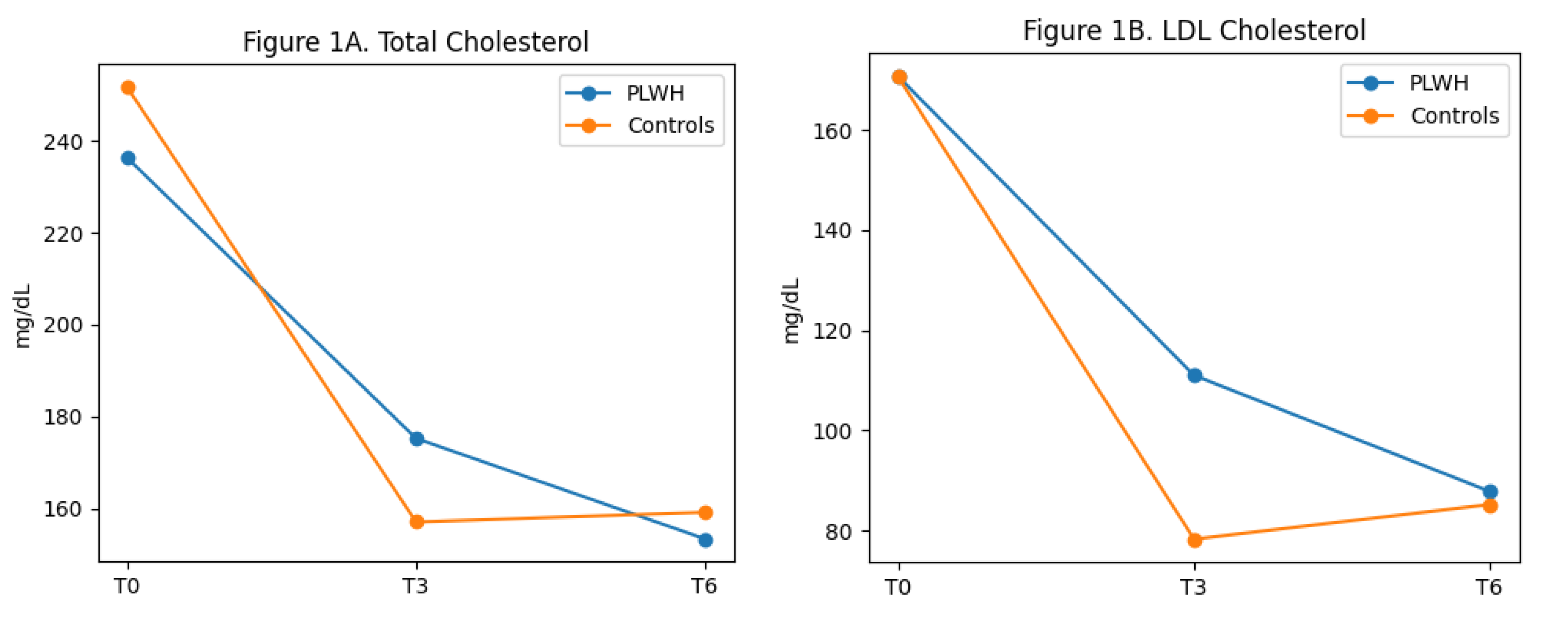

Table 1.
Baseline characteristics of PLWH and HIV-negative controls.
| Variable | PLWH (n=32) | Controls (n=43) |
| Age, years | 54.0 ± 7.4 | 63.3 ± 9.3 |
| Male sex, n (%) | 23 (71.9) | 16 (37.2) |
| BMI, kg/m² | 25.9 ± 5.3 | 28.6 ± 5.1 |
| Current smokers, n (%) | 10 (31.3) | 5 (11.6) |
| Family history of CVD, n (%) | 20 (62.5) | 16 (37.2) |
| Diabetes mellitus, n (%) | 3 (9.4) | 3 (7.0) |
| Hypertension, n (%) | 15 (46.9) | 28 (65.1) |
| Antihypertensive therapy, n (%) | 11 (34.4) | 26 (60.5) |
Table 2.
Cardiovascular risk scores in Rosuvastatin/ezetimibe HIV+ group.
| Score |
T0 Mean ± SD |
T3 Mean ± SD |
T6 Mean ± SD |
p(T0 vs T3) | p(T0 vs T6) | p(T3 vs T6) |
| D:A:D 10-year (%) | 7.7±7.9 | 7.6±7.9 | 6.8±8.2 | 0.038 | 0.004 | 0.084 |
| Framingham 10-year (%) | 19.6±18.7 | 14.4±13.8 | 12.9±14.3 | 0.028 | 0.002 | 0.077 |
| SCORE2 CVD risk (%) | 5.3±2.9 | 4.6±2.4 | 4.2±2.2 | 0.036 | 0.005 | 0.084 |
Table 3.
Group × Time interaction analysis of lipid parameters in PLWH and HIV-negative controls.
| Parameter | Group×Time F | p value | Partial η² |
| Total Cholesterol | 5.58 | 0.005 | 0.071 |
| LDL Cholesterol | 7.28 | 0.001 | 0.091 |
| Non-HDL Cholesterol | 6.65 | 0.002 | 0.084 |
| HDL Cholesterol | 0.59 | 0.556 | 0.008 |
| Triglycerides | 1.39 | 0.252 | 0.019 |
Disclaimer/Publisher’s Note: The statements, opinions and data contained in all publications are solely those of the individual author(s) and contributor(s) and not of MDPI and/or the editor(s). MDPI and/or the editor(s) disclaim responsibility for any injury to people or property resulting from any ideas, methods, instructions or products referred to in the content. |
© 2026 by the authors. Licensee MDPI, Basel, Switzerland. This article is an open access article distributed under the terms and conditions of the Creative Commons Attribution (CC BY) license (http://creativecommons.org/licenses/by/4.0/).
Copyright: This open access article is published under a Creative Commons CC BY 4.0 license, which permit the free download, distribution, and reuse, provided that the author and preprint are cited in any reuse.